false
--12-31
Q1
0001897245
http://fasb.org/us-gaap/2026#UsefulLifeTermOfLeaseMember
0001897245
2026-01-01
2026-03-31
0001897245
2026-05-13
0001897245
2026-03-31
0001897245
2025-12-31
0001897245
us-gaap:RelatedPartyMember
2026-03-31
0001897245
us-gaap:RelatedPartyMember
2025-12-31
0001897245
2025-02-24
2025-02-24
0001897245
2025-01-01
2025-03-31
0001897245
us-gaap:CommonStockMember
2025-12-31
0001897245
us-gaap:AdditionalPaidInCapitalMember
2025-12-31
0001897245
us-gaap:AccumulatedOtherComprehensiveIncomeMember
2025-12-31
0001897245
us-gaap:RetainedEarningsMember
2025-12-31
0001897245
us-gaap:ParentMember
2025-12-31
0001897245
us-gaap:NoncontrollingInterestMember
2025-12-31
0001897245
us-gaap:CommonStockMember
2024-12-31
0001897245
us-gaap:AdditionalPaidInCapitalMember
2024-12-31
0001897245
us-gaap:AccumulatedOtherComprehensiveIncomeMember
2024-12-31
0001897245
us-gaap:RetainedEarningsMember
2024-12-31
0001897245
us-gaap:ParentMember
2024-12-31
0001897245
us-gaap:NoncontrollingInterestMember
2024-12-31
0001897245
2024-12-31
0001897245
us-gaap:CommonStockMember
2026-01-01
2026-03-31
0001897245
us-gaap:AdditionalPaidInCapitalMember
2026-01-01
2026-03-31
0001897245
us-gaap:AccumulatedOtherComprehensiveIncomeMember
2026-01-01
2026-03-31
0001897245
us-gaap:RetainedEarningsMember
2026-01-01
2026-03-31
0001897245
us-gaap:ParentMember
2026-01-01
2026-03-31
0001897245
us-gaap:NoncontrollingInterestMember
2026-01-01
2026-03-31
0001897245
us-gaap:CommonStockMember
2025-01-01
2025-03-31
0001897245
us-gaap:AdditionalPaidInCapitalMember
2025-01-01
2025-03-31
0001897245
us-gaap:AccumulatedOtherComprehensiveIncomeMember
2025-01-01
2025-03-31
0001897245
us-gaap:RetainedEarningsMember
2025-01-01
2025-03-31
0001897245
us-gaap:ParentMember
2025-01-01
2025-03-31
0001897245
us-gaap:NoncontrollingInterestMember
2025-01-01
2025-03-31
0001897245
us-gaap:CommonStockMember
2026-03-31
0001897245
us-gaap:AdditionalPaidInCapitalMember
2026-03-31
0001897245
us-gaap:AccumulatedOtherComprehensiveIncomeMember
2026-03-31
0001897245
us-gaap:RetainedEarningsMember
2026-03-31
0001897245
us-gaap:ParentMember
2026-03-31
0001897245
us-gaap:NoncontrollingInterestMember
2026-03-31
0001897245
us-gaap:CommonStockMember
2025-03-31
0001897245
us-gaap:AdditionalPaidInCapitalMember
2025-03-31
0001897245
us-gaap:AccumulatedOtherComprehensiveIncomeMember
2025-03-31
0001897245
us-gaap:RetainedEarningsMember
2025-03-31
0001897245
us-gaap:ParentMember
2025-03-31
0001897245
us-gaap:NoncontrollingInterestMember
2025-03-31
0001897245
2025-03-31
0001897245
us-gaap:CommonStockMember
2025-01-06
2025-01-06
0001897245
us-gaap:CommonStockMember
2025-01-06
0001897245
HWH:PreFundedWarrantsMember
2025-01-06
0001897245
HWH:PlacementAgencyAgreementMember
2026-01-06
2026-01-06
0001897245
2025-01-01
2025-12-31
0001897245
2024-04-24
0001897245
2024-01-01
2024-12-31
0001897245
us-gaap:OfficeEquipmentMember
srt:MinimumMember
2026-03-31
0001897245
us-gaap:OfficeEquipmentMember
srt:MaximumMember
2026-03-31
0001897245
us-gaap:FurnitureAndFixturesMember
srt:MinimumMember
2026-03-31
0001897245
us-gaap:FurnitureAndFixturesMember
srt:MaximumMember
2026-03-31
0001897245
HWH:KitchenEquipmentMember
srt:MinimumMember
2026-03-31
0001897245
HWH:KitchenEquipmentMember
srt:MaximumMember
2026-03-31
0001897245
HWH:OperatingEquipmentMember
srt:MinimumMember
2026-03-31
0001897245
HWH:OperatingEquipmentMember
srt:MaximumMember
2026-03-31
0001897245
us-gaap:LeaseholdImprovementsMember
2025-12-31
0001897245
HWH:FinishedGoodsMember
2026-01-01
2026-03-31
0001897245
HWH:HandlingFeeMember
2026-01-01
2026-03-31
0001897245
HWH:ContractorFeeMember
2026-01-01
2026-03-31
0001897245
HWH:DepreciationMember
2026-01-01
2026-03-31
0001897245
HWH:FinishedGoodsMember
2025-01-01
2025-03-31
0001897245
HWH:RelatedShippingMember
2025-01-01
2025-03-31
0001897245
HWH:HandlingFeeMember
2025-01-01
2025-03-31
0001897245
HWH:ContractorFeeMember
2025-01-01
2025-03-31
0001897245
us-gaap:FranchiseMember
2025-01-01
2025-03-31
0001897245
HWH:DepreciationMember
2025-01-01
2025-03-31
0001897245
us-gaap:OfficeEquipmentMember
2026-03-31
0001897245
us-gaap:FurnitureAndFixturesMember
2026-03-31
0001897245
HWH:KitchenEquipmentMember
2026-03-31
0001897245
HWH:OtherOperatingEquipmentMember
2026-03-31
0001897245
us-gaap:LeaseholdImprovementsMember
2026-03-31
0001897245
us-gaap:OfficeEquipmentMember
2025-12-31
0001897245
us-gaap:FurnitureAndFixturesMember
2025-12-31
0001897245
HWH:KitchenEquipmentMember
2025-12-31
0001897245
HWH:OtherOperatingEquipmentMember
2025-12-31
0001897245
2024-03-14
2024-03-14
0001897245
2024-03-14
0001897245
HWH:SubscriptionAgreementMember
2024-05-23
2024-05-23
0001897245
HWH:SubscriptionAgreementMember
2024-03-13
2024-03-13
0001897245
HWH:SubscriptionAgreementMember
2024-03-14
2024-03-14
0001897245
HWH:SubscriptionAgreementMember
HWH:AlsetFandBHoldingPteLtdMember
2026-02-26
2026-02-26
0001897245
HWH:SubscriptionAgreementMember
HWH:IdealFoodandBeveragePteLtdMember
2026-02-26
2026-02-26
0001897245
2026-02-26
2026-02-26
0001897245
HWH:SubscriptionAgreementMember
2026-02-26
2026-02-26
0001897245
HWH:AesGroupIncMember
2025-04-20
0001897245
HWH:AesGroupIncMember
2025-04-23
0001897245
HWH:AesGroupIncMember
2025-04-23
2025-04-23
0001897245
2025-09-10
2025-09-10
0001897245
HWH:HWHInternationalIncMember
2023-12-18
0001897245
HWH:HWHInternationalIncMember
2023-12-18
2023-12-18
0001897245
HWH:HWHInternationalIncMember
2024-01-09
2024-01-09
0001897245
HWH:HWHInternationalIncMember
2024-01-09
0001897245
HWH:DBoralCapitalLLCMember
2026-03-31
0001897245
HWH:DBoralCapitalLLCMember
2025-12-31
0001897245
HWH:DBoralCapitalLLCMember
HWH:InstallmentsOneMember
2026-10-01
2026-10-30
0001897245
HWH:DBoralCapitalLLCMember
HWH:InstallmentsTwoMember
2027-10-01
2027-10-30
0001897245
HWH:DBoralCapitalLLCMember
HWH:InstallmentsThreeMember
2028-10-01
2028-10-30
0001897245
HWH:KetomeiPte.LtdMember
2026-01-01
2026-03-31
0001897245
HWH:KetomeiPte.LtdMember
2025-01-01
2025-12-31
0001897245
HWH:AlsetInternationalLtdMember
2026-03-31
0001897245
HWH:AlsetInternationalLtdMember
2025-12-31
0001897245
HWH:AlsetBusinessDevelopmentPteLtdMember
2024-11-01
2024-11-30
0001897245
HWH:AlsetBusinessDevelopmentPteLtdMember
2024-12-01
2024-12-31
0001897245
HWH:AlsetBusinessDevelopmentPteLtdMember
2026-03-31
0001897245
HWH:AlsetBusinessDevelopmentPteLtdMember
2025-12-31
0001897245
HWH:HapiMetaverseIncMember
2026-03-31
0001897245
HWH:HotAppInternationalLimitedMember
2026-03-31
0001897245
HWH:HapiMetaverseIncMember
2025-12-31
0001897245
HWH:HealthWealthHappinessPteLtdMember
2026-03-31
0001897245
HWH:SharingServicesGlobalCorpMember
2024-03-20
0001897245
HWH:SharingServicesGlobalCorpMember
2024-03-20
2024-03-20
0001897245
HWH:SharingServicesGlobalCorpMember
2024-05-09
0001897245
HWH:SharingServicesGlobalCorpMember
2024-05-09
2024-05-09
0001897245
HWH:SharingServicesGlobalCorpMember
2024-06-06
0001897245
HWH:SharingServicesGlobalCorpMember
2024-06-06
2024-06-06
0001897245
HWH:SharingServicesGlobalCorpMember
2024-08-13
0001897245
HWH:SharingServicesGlobalCorpMember
2024-08-13
2024-08-13
0001897245
HWH:SharingServicesGlobalCorpMember
2025-01-15
2025-01-15
0001897245
HWH:SharingServicesGlobalCorpMember
2025-03-31
0001897245
HWH:SharingServicesGlobalCorpMember
2025-03-31
2025-03-31
0001897245
HWH:LoanAgreementOneMember
HWH:SharingServicesGlobalCorpMember
2025-04-21
0001897245
HWH:SharingServicesGlobalCorpMember
HWH:LoanAgreementOneMember
2025-04-21
2025-04-21
0001897245
HWH:LoanAgreementTwoMember
HWH:SharingServicesGlobalCorpMember
2025-04-25
0001897245
HWH:SharingServicesGlobalCorpMember
HWH:LoanAgreementTwoMember
2025-04-25
2025-04-25
0001897245
HWH:SharingServicesGlobalCorpMember
HWH:LoanAgreementMember
2025-04-25
0001897245
HWH:SharingServicesGlobalCorpMember
2025-06-27
0001897245
HWH:SharingServicesGlobalCorpMember
2025-06-27
2025-06-27
0001897245
HWH:SharingServicesGlobalCorpMember
2025-09-17
0001897245
HWH:SharingServicesGlobalCorpMember
2025-09-17
2025-09-17
0001897245
HWH:SharingServicesGlobalCorpMember
2025-10-06
0001897245
HWH:SharingServicesGlobalCorpMember
2025-10-06
2025-10-06
0001897245
HWH:SharingServicesGlobalCorpMember
2025-12-10
0001897245
HWH:SharingServicesGlobalCorpMember
2025-12-10
2025-12-10
0001897245
HWH:SharingServicesGlobalCorpMember
2026-01-02
0001897245
HWH:SharingServicesGlobalCorpMember
2026-01-02
2026-01-02
0001897245
HWH:SharingServicesGlobalCorpMember
2026-01-08
0001897245
HWH:SharingServicesGlobalCorpMember
2026-01-08
2026-01-08
0001897245
HWH:SharingServicesGlobalCorpMember
2026-02-04
0001897245
HWH:SharingServicesGlobalCorpMember
2026-02-04
2026-02-04
0001897245
HWH:SharingServicesGlobalCorpMember
2026-03-31
0001897245
HWH:SharingServicesGlobalCorpMember
2025-12-31
0001897245
HWH:StockPurchaseAgreementMember
HWH:HapiMetaverseIncMember
2026-02-05
2026-02-05
0001897245
HWH:StockPurchaseAgreementMember
HWH:HapiMetaverseIncMember
2026-02-05
0001897245
HWH:HealthWealthHappinessPteLtdMember
2024-04-25
0001897245
HWH:MrChanMember
2024-04-25
0001897245
HWH:JointVentureCompanyMember
2024-04-25
0001897245
HWH:LoanAgreementMember
2024-11-06
0001897245
HWH:LoanAgreementMember
2024-11-06
2024-11-06
0001897245
HWH:HapiTravelPteLtdMember
2024-12-18
0001897245
HWH:HapiTravelPteLtdMember
2026-03-31
0001897245
HWH:HapiTravelPteLtdMember
2025-12-31
0001897245
HWH:HapiTravelPteLtdMember
2026-01-01
2026-03-31
0001897245
us-gaap:WarrantMember
HWH:SharingServicesGlobalCorpMember
us-gaap:FairValueInputsLevel1Member
2026-03-31
0001897245
us-gaap:WarrantMember
HWH:SharingServicesGlobalCorpMember
us-gaap:FairValueInputsLevel2Member
2026-03-31
0001897245
us-gaap:WarrantMember
HWH:SharingServicesGlobalCorpMember
us-gaap:FairValueInputsLevel3Member
2026-03-31
0001897245
us-gaap:WarrantMember
HWH:SharingServicesGlobalCorpMember
2026-03-31
0001897245
HWH:ConvertibleLoansReceivableMember
HWH:SharingServicesGlobalCorpMember
us-gaap:FairValueInputsLevel1Member
2026-03-31
0001897245
HWH:ConvertibleLoansReceivableMember
HWH:SharingServicesGlobalCorpMember
us-gaap:FairValueInputsLevel2Member
2026-03-31
0001897245
HWH:ConvertibleLoansReceivableMember
HWH:SharingServicesGlobalCorpMember
us-gaap:FairValueInputsLevel3Member
2026-03-31
0001897245
HWH:ConvertibleLoansReceivableMember
HWH:SharingServicesGlobalCorpMember
2026-03-31
0001897245
HWH:InvestmentSecuritiesMember
HWH:TradingMember
us-gaap:FairValueInputsLevel1Member
2026-03-31
0001897245
HWH:InvestmentSecuritiesMember
HWH:TradingMember
us-gaap:FairValueInputsLevel2Member
2026-03-31
0001897245
HWH:InvestmentSecuritiesMember
HWH:TradingMember
us-gaap:FairValueInputsLevel3Member
2026-03-31
0001897245
HWH:InvestmentSecuritiesMember
HWH:TradingMember
2026-03-31
0001897245
us-gaap:FairValueInputsLevel1Member
2026-03-31
0001897245
us-gaap:FairValueInputsLevel2Member
2026-03-31
0001897245
us-gaap:FairValueInputsLevel3Member
2026-03-31
0001897245
us-gaap:WarrantMember
HWH:SharingServicesGlobalCorpMember
us-gaap:FairValueInputsLevel1Member
2025-12-31
0001897245
us-gaap:WarrantMember
HWH:SharingServicesGlobalCorpMember
us-gaap:FairValueInputsLevel2Member
2025-12-31
0001897245
us-gaap:WarrantMember
HWH:SharingServicesGlobalCorpMember
us-gaap:FairValueInputsLevel3Member
2025-12-31
0001897245
us-gaap:WarrantMember
HWH:SharingServicesGlobalCorpMember
2025-12-31
0001897245
HWH:ConvertibleLoansReceivableMember
HWH:SharingServicesGlobalCorpMember
us-gaap:FairValueInputsLevel1Member
2025-12-31
0001897245
HWH:ConvertibleLoansReceivableMember
HWH:SharingServicesGlobalCorpMember
us-gaap:FairValueInputsLevel2Member
2025-12-31
0001897245
HWH:ConvertibleLoansReceivableMember
HWH:SharingServicesGlobalCorpMember
us-gaap:FairValueInputsLevel3Member
2025-12-31
0001897245
HWH:ConvertibleLoansReceivableMember
HWH:SharingServicesGlobalCorpMember
2025-12-31
0001897245
HWH:InvestmentSecuritiesMember
HWH:TradingMember
us-gaap:FairValueInputsLevel1Member
2025-12-31
0001897245
HWH:InvestmentSecuritiesMember
HWH:TradingMember
us-gaap:FairValueInputsLevel2Member
2025-12-31
0001897245
HWH:InvestmentSecuritiesMember
HWH:TradingMember
us-gaap:FairValueInputsLevel3Member
2025-12-31
0001897245
HWH:InvestmentSecuritiesMember
HWH:TradingMember
2025-12-31
0001897245
us-gaap:FairValueInputsLevel1Member
2025-12-31
0001897245
us-gaap:FairValueInputsLevel2Member
2025-12-31
0001897245
us-gaap:FairValueInputsLevel3Member
2025-12-31
0001897245
HWH:WRNT1Member
us-gaap:MeasurementInputSharePriceMember
2026-03-31
0001897245
HWH:WRNT1Member
us-gaap:MeasurementInputSharePriceMember
2025-12-31
0001897245
HWH:WRNT1Member
us-gaap:MeasurementInputExercisePriceMember
2026-03-31
0001897245
HWH:WRNT1Member
us-gaap:MeasurementInputExercisePriceMember
2025-12-31
0001897245
HWH:WRNT1Member
us-gaap:MeasurementInputRiskFreeInterestRateMember
2026-03-31
0001897245
HWH:WRNT1Member
us-gaap:MeasurementInputRiskFreeInterestRateMember
2025-12-31
0001897245
HWH:WRNT1Member
us-gaap:MeasurementInputPriceVolatilityMember
2026-03-31
0001897245
HWH:WRNT1Member
us-gaap:MeasurementInputPriceVolatilityMember
2025-12-31
0001897245
HWH:WRNT1Member
us-gaap:MeasurementInputExpectedDividendRateMember
2026-03-31
0001897245
HWH:WRNT1Member
us-gaap:MeasurementInputExpectedDividendRateMember
2025-12-31
0001897245
HWH:WRNT1Member
us-gaap:MeasurementInputExpectedTermMember
2026-03-31
0001897245
HWH:WRNT1Member
us-gaap:MeasurementInputExpectedTermMember
2025-12-31
0001897245
HWH:WRNT2Member
us-gaap:MeasurementInputSharePriceMember
2026-03-31
0001897245
HWH:WRNT2Member
us-gaap:MeasurementInputSharePriceMember
2025-12-31
0001897245
HWH:WRNT2Member
us-gaap:MeasurementInputExercisePriceMember
2026-03-31
0001897245
HWH:WRNT2Member
us-gaap:MeasurementInputExercisePriceMember
2025-12-31
0001897245
HWH:WRNT2Member
us-gaap:MeasurementInputRiskFreeInterestRateMember
2026-03-31
0001897245
HWH:WRNT2Member
us-gaap:MeasurementInputRiskFreeInterestRateMember
2025-12-31
0001897245
HWH:WRNT2Member
us-gaap:MeasurementInputPriceVolatilityMember
2026-03-31
0001897245
HWH:WRNT2Member
us-gaap:MeasurementInputPriceVolatilityMember
2025-12-31
0001897245
HWH:WRNT2Member
us-gaap:MeasurementInputExpectedDividendRateMember
2026-03-31
0001897245
HWH:WRNT2Member
us-gaap:MeasurementInputExpectedDividendRateMember
2025-12-31
0001897245
HWH:WRNT2Member
us-gaap:MeasurementInputExpectedTermMember
2026-03-31
0001897245
HWH:WRNT2Member
us-gaap:MeasurementInputExpectedTermMember
2025-12-31
0001897245
HWH:ConvertibleDebtOneMember
us-gaap:MeasurementInputRiskFreeInterestRateMember
2026-03-31
0001897245
HWH:ConvertibleDebtTwoMember
us-gaap:MeasurementInputRiskFreeInterestRateMember
2026-03-31
0001897245
HWH:ConvertibleDebtThreeMember
us-gaap:MeasurementInputRiskFreeInterestRateMember
2026-03-31
0001897245
HWH:ConvertibleDebtFourMember
us-gaap:MeasurementInputRiskFreeInterestRateMember
2026-03-31
0001897245
us-gaap:MeasurementInputExpectedTermMember
HWH:ConvertibleDebtOneMember
2026-01-01
2026-03-31
0001897245
us-gaap:MeasurementInputExpectedTermMember
HWH:ConvertibleDebtTwoMember
2026-01-01
2026-03-31
0001897245
us-gaap:MeasurementInputExpectedTermMember
us-gaap:ConvertibleDebtMember
2026-01-01
2026-03-31
0001897245
us-gaap:MeasurementInputExpectedTermMember
HWH:ConvertibleDebtFourMember
2026-01-01
2026-03-31
0001897245
HWH:ConvertibleDebtOneMember
us-gaap:MeasurementInputDiscountRateMember
2026-03-31
0001897245
HWH:ConvertibleDebtTwoMember
us-gaap:MeasurementInputDiscountRateMember
2026-03-31
0001897245
HWH:ConvertibleDebtThreeMember
us-gaap:MeasurementInputDiscountRateMember
2026-03-31
0001897245
HWH:ConvertibleDebtFourMember
us-gaap:MeasurementInputDiscountRateMember
2026-03-31
0001897245
HWH:ConvertibleDebtOneMember
us-gaap:MeasurementInputPriceVolatilityMember
2026-03-31
0001897245
HWH:ConvertibleDebtTwoMember
us-gaap:MeasurementInputPriceVolatilityMember
2026-03-31
0001897245
HWH:ConvertibleDebtThreeMember
us-gaap:MeasurementInputPriceVolatilityMember
2026-03-31
0001897245
HWH:ConvertibleDebtFourMember
us-gaap:MeasurementInputPriceVolatilityMember
2026-03-31
0001897245
HWH:ConvertibleDebtOneMember
us-gaap:MeasurementInputExpectedDividendRateMember
2026-03-31
0001897245
HWH:ConvertibleDebtTwoMember
us-gaap:MeasurementInputExpectedDividendRateMember
2026-03-31
0001897245
HWH:ConvertibleDebtThreeMember
us-gaap:MeasurementInputExpectedDividendRateMember
2026-03-31
0001897245
HWH:ConvertibleDebtFourMember
us-gaap:MeasurementInputExpectedDividendRateMember
2026-03-31
0001897245
HWH:ConvertibleDebtOneMember
2026-03-31
0001897245
HWH:ConvertibleDebtTwoMember
2026-03-31
0001897245
HWH:ConvertibleDebtThreeMember
2026-03-31
0001897245
HWH:ConvertibleDebtFourMember
2026-03-31
0001897245
HWH:ConvertibleDebtFiveMember
us-gaap:MeasurementInputRiskFreeInterestRateMember
2026-03-31
0001897245
HWH:ConvertibleDebtSixMember
us-gaap:MeasurementInputRiskFreeInterestRateMember
2026-03-31
0001897245
HWH:ConvertibleDebtSevenMember
us-gaap:MeasurementInputRiskFreeInterestRateMember
2026-03-31
0001897245
HWH:ConvertibleDebtEightMember
us-gaap:MeasurementInputRiskFreeInterestRateMember
2026-03-31
0001897245
us-gaap:MeasurementInputExpectedTermMember
HWH:ConvertibleDebtFiveMember
2026-01-01
2026-03-31
0001897245
us-gaap:MeasurementInputExpectedTermMember
HWH:ConvertibleDebtSixMember
2026-01-01
2026-03-31
0001897245
us-gaap:MeasurementInputExpectedTermMember
HWH:ConvertibleDebtSevenMember
2026-01-01
2026-03-31
0001897245
us-gaap:MeasurementInputExpectedTermMember
HWH:ConvertibleDebtEightMember
2026-01-01
2026-03-31
0001897245
HWH:ConvertibleDebtFiveMember
us-gaap:MeasurementInputDiscountRateMember
2026-03-31
0001897245
HWH:ConvertibleDebtSixMember
us-gaap:MeasurementInputDiscountRateMember
2026-03-31
0001897245
HWH:ConvertibleDebtSevenMember
us-gaap:MeasurementInputDiscountRateMember
2026-03-31
0001897245
HWH:ConvertibleDebtEightMember
us-gaap:MeasurementInputDiscountRateMember
2026-03-31
0001897245
HWH:ConvertibleDebtFiveMember
us-gaap:MeasurementInputPriceVolatilityMember
2026-03-31
0001897245
HWH:ConvertibleDebtSixMember
us-gaap:MeasurementInputPriceVolatilityMember
2026-03-31
0001897245
HWH:ConvertibleDebtSevenMember
us-gaap:MeasurementInputPriceVolatilityMember
2026-03-31
0001897245
HWH:ConvertibleDebtEightMember
us-gaap:MeasurementInputPriceVolatilityMember
2026-03-31
0001897245
HWH:ConvertibleDebtFiveMember
us-gaap:MeasurementInputExpectedDividendRateMember
2026-03-31
0001897245
HWH:ConvertibleDebtSixMember
us-gaap:MeasurementInputExpectedDividendRateMember
2026-03-31
0001897245
HWH:ConvertibleDebtSevenMember
us-gaap:MeasurementInputExpectedDividendRateMember
2026-03-31
0001897245
HWH:ConvertibleDebtEightMember
us-gaap:MeasurementInputExpectedDividendRateMember
2026-03-31
0001897245
HWH:ConvertibleDebtFiveMember
2026-03-31
0001897245
HWH:ConvertibleDebtSixMember
2026-03-31
0001897245
HWH:ConvertibleDebtSevenMember
2026-03-31
0001897245
HWH:ConvertibleDebtEightMember
2026-03-31
0001897245
HWH:ConvertibleDebtNineMember
us-gaap:MeasurementInputRiskFreeInterestRateMember
2026-03-31
0001897245
HWH:ConvertibleDebtTenMember
us-gaap:MeasurementInputRiskFreeInterestRateMember
2026-03-31
0001897245
us-gaap:MeasurementInputExpectedTermMember
HWH:ConvertibleDebtNineMember
2026-01-01
2026-03-31
0001897245
us-gaap:MeasurementInputExpectedTermMember
HWH:ConvertibleDebtTenMember
2026-01-01
2026-03-31
0001897245
HWH:ConvertibleDebtNineMember
us-gaap:MeasurementInputDiscountRateMember
2026-03-31
0001897245
HWH:ConvertibleDebtTenMember
us-gaap:MeasurementInputDiscountRateMember
2026-03-31
0001897245
HWH:ConvertibleDebtNineMember
us-gaap:MeasurementInputPriceVolatilityMember
2026-03-31
0001897245
HWH:ConvertibleDebtTenMember
us-gaap:MeasurementInputPriceVolatilityMember
2026-03-31
0001897245
HWH:ConvertibleDebtNineMember
us-gaap:MeasurementInputExpectedDividendRateMember
2026-03-31
0001897245
HWH:ConvertibleDebtTenMember
us-gaap:MeasurementInputExpectedDividendRateMember
2026-03-31
0001897245
HWH:ConvertibleDebtNineMember
2026-03-31
0001897245
HWH:ConvertibleDebtTenMember
2026-03-31
0001897245
HWH:ConvertibleNoteReceivableRelatedPartyMember
2025-12-31
0001897245
HWH:ConvertibleNoteReceivableRelatedPartyMember
2026-01-01
2026-03-31
0001897245
HWH:ConvertibleNoteReceivableRelatedPartyMember
2026-03-31
0001897245
HWH:ConvertibleNoteReceivableRelatedPartyMember
2024-12-31
0001897245
HWH:ConvertibleNoteReceivableRelatedPartyMember
2025-01-01
2025-03-31
0001897245
HWH:ConvertibleNoteReceivableRelatedPartyMember
2025-03-31
0001897245
HWH:SharingServicesGlobalCorporationMember
srt:MinimumMember
2025-12-31
0001897245
HWH:SharingServicesGlobalCorporationMember
srt:MinimumMember
2026-03-31
0001897245
HWH:SharingServicesGlobalCorporationMember
HWH:ConvertibleNoteReceivableRelatedPartyMember
2026-01-01
2026-03-31
0001897245
HWH:SharingServicesGlobalCorporationMember
srt:MaximumMember
2025-03-31
0001897245
HWH:SharingServicesGlobalCorporationMember
srt:MinimumMember
2025-03-31
0001897245
HWH:SharingServicesGlobalCorporationMember
HWH:ConvertibleNoteReceivableRelatedPartyMember
2025-01-01
2025-03-31
0001897245
HWH:SharingServicesGlobalCorporationMember
2026-01-01
2026-03-31
0001897245
HWH:SharingServicesGlobalCorporationMember
2025-01-01
2025-03-31
0001897245
us-gaap:PreferredStockMember
2026-03-31
0001897245
us-gaap:CommonClassAMember
us-gaap:WarrantMember
2026-03-31
0001897245
us-gaap:CommonStockMember
2025-01-03
2025-01-03
0001897245
us-gaap:CommonStockMember
2025-01-03
0001897245
HWH:PreFundedWarrantsMember
2025-01-03
0001897245
2025-01-03
0001897245
us-gaap:IPOMember
HWH:PreFundedWarrantsMember
2025-01-03
0001897245
HWH:PreFundedWarrantsMember
2025-01-03
2025-01-03
0001897245
HWH:DBoralCapitalLLCMember
2025-01-03
2025-01-03
0001897245
us-gaap:CommonStockMember
2025-01-16
0001897245
us-gaap:CommonStockMember
2025-02-24
2025-02-24
0001897245
HWH:MergerAgreementMember
HWH:HWHInternationalIncMember
2025-11-14
2025-11-14
0001897245
HWH:MergerAgreementMember
HWH:HWHInternationalIncMember
us-gaap:CommonStockMember
2025-11-14
2025-11-14
0001897245
HWH:MergerAgreementMember
HWH:HWHInternationalIncMember
us-gaap:CommonStockMember
2025-11-14
0001897245
HWH:MergerAgreementMember
HWH:HWHInternationalIncMember
us-gaap:PreferredStockMember
2025-11-14
2025-11-14
0001897245
HWH:MergerAgreementMember
HWH:HWHInternationalIncMember
us-gaap:PreferredStockMember
2025-11-14
0001897245
HWH:MergerAgreementMember
HWH:HWHInternationalIncMember
2025-11-14
0001897245
us-gaap:WarrantMember
2025-12-31
0001897245
us-gaap:WarrantMember
2025-01-01
2025-12-31
0001897245
us-gaap:WarrantMember
2026-01-01
2026-03-31
0001897245
us-gaap:WarrantMember
2026-03-31
0001897245
us-gaap:WarrantMember
2024-12-31
0001897245
us-gaap:WarrantMember
2024-01-01
2024-12-31
0001897245
us-gaap:WarrantMember
2023-12-31
0001897245
us-gaap:WarrantMember
2025-01-01
2025-03-31
0001897245
us-gaap:WarrantMember
2025-03-31
0001897245
us-gaap:CostOfGoodsTotalMember
us-gaap:SupplierConcentrationRiskMember
HWH:FiveSuppliersMember
2026-01-01
2026-03-31
0001897245
us-gaap:CostOfGoodsTotalMember
us-gaap:SupplierConcentrationRiskMember
HWH:FiveSuppliersMember
2025-01-01
2025-03-31
0001897245
us-gaap:SubsequentEventMember
2026-04-15
2026-04-16
0001897245
us-gaap:SubsequentEventMember
2026-04-19
2026-04-20
0001897245
us-gaap:SubsequentEventMember
2026-05-05
2026-05-05
0001897245
us-gaap:SubsequentEventMember
2026-05-05
0001897245
HWH:TwoThousandTwentyFiveIncentiveCompensationPlanMember
2026-01-01
2026-03-31
iso4217:USD
xbrli:shares
iso4217:USD
xbrli:shares
xbrli:pure
iso4217:SGD
UNITED
STATES
SECURITIES
AND EXCHANGE COMMISSION
Washington,
D.C. 20549
FORM
10-Q
(Mark
One)
☒
QUARTERLY REPORT PURSUANT TO SECTION 13 OR 15(d) OF THE SECURITIES EXCHANGE ACT OF 1934
For
the quarterly period ended March 31, 2026
☐
TRANSITION REPORT PURSUANT TO SECTION 13 OR 15(d) OF THE SECURITIES EXCHANGE ACT OF 1934
For
the transition period from __________ to __________
Commission
File No. 001-41254
| HWH
INTERNATIONAL INC. |
| (Exact
name of registrant as specified in its charter) |
| Nevada |
|
87-3296100 |
| (State
or other jurisdiction |
|
(I.R.S.
Employer |
| of
incorporation or organization) |
|
Identification
No.) |
| 4800
Montgomery Lane, Suite 210 |
| Bethesda,
MD 20814 |
| (Address
of Principal Executive Offices, including zip code) |
| |
| 301-971-3955 |
| (Registrant’s
telephone number, including area code) |
| |
| N/A |
| (Former
name, former address and former fiscal year, if changed since last report) |
Securities
registered pursuant to Section 12(b) of the Act:
| Title
of each class |
|
Trading
Symbol |
|
Name
of each exchange on which registered |
| |
|
|
|
|
| Common
Stock, par value $0.0001 per share |
|
HWH |
|
The
Nasdaq Capital Market |
Securities
registered pursuant to Section 12(g) of the Act: None
Indicate
by check mark if the registrant is a well-known seasoned issuer, as defined in Rule 405 of the Securities Act. Yes ☐ No ☒
Indicate
by check mark if the registrant is not required to file reports pursuant to Section 13 or Section 15(d) of the Act. Yes ☐ No ☒
Indicate
by check mark whether the registrant (1) has filed all reports required to be filed by Section 13 or 15(d) of the Securities Exchange
Act of 1934 during the preceding 12 months (or for such shorter period that the registrant was required to file such reports), and (2)
has been subject to such filing requirements for the past 90 days. Yes ☒ No ☐
Indicate
by check mark whether the registrant has submitted electronically every Interactive Data File required to be submitted pursuant to Rule
405 of Regulation S-T (§232.405 of this chapter) during the preceding 12 months (or for such shorter period that the registrant
was required to submit such files). Yes ☒ No ☐
Indicate
by check mark whether the registrant is a large accelerated filer, an accelerated filer, a non-accelerated filer, a smaller reporting
company, or an emerging growth company. See the definitions of “large accelerated filer,” “accelerated filer,”
“smaller reporting company,” and “emerging growth company” in Rule 12b-2 of the Exchange Act.
| |
☐ |
Large
accelerated filer |
☐ |
Accelerated
filer |
| |
☒ |
Non-accelerated
filer |
☒ |
Smaller
reporting company |
| |
|
|
☒ |
Emerging
growth company |
If
an emerging growth company, indicate by check mark if the registrant has elected not to use the extended transition period for complying
with any new or revised financial accounting standards provided pursuant to Section 13(a) of the Exchange Act.
Indicate
by check mark whether the registrant is a shell company (as defined in Rule 12b-2 of the Exchange Act): Yes ☐ No ☒
As
of May 13, 2026, there were 7,476,400 shares of Common Stock, par value $0.0001 per share of the Company issued and outstanding.
HWH
INTERNATIONAL INC.
Form
10-Q For the Quarter Ended March 31, 2026
Table
of Contents
PART
I. FINANCIAL INFORMATION
Item
1. Financial Statements.
HWH
International Inc. and Subsidiaries
Condensed
Consolidated Balance Sheets
(Unaudited)
| | |
March
31, 2026 | | |
December
31, 2025 | |
| ASSETS | |
| | | |
| | |
| | |
| | | |
| | |
| Current Assets | |
| | | |
| | |
| Cash | |
$ | 1,459,799 | | |
$ | 2,085,918 | |
| Account receivable, net | |
| 3,096 | | |
| 3,324 | |
| Inventory | |
| 1,085 | | |
| 1,057 | |
| Other receivables, net | |
| 641,382 | | |
| 614,577 | |
| Deposit - current | |
| 21,112 | | |
| 21,205 | |
| Convertible notes receivable - related party | |
| 222,939 | | |
| 160,941 | |
| Marketable securities | |
| 99,615 | | |
| 84,466 | |
| Prepaid expenses | |
| 52 | | |
| 549 | |
| Total Current Assets | |
$ | 2,449,080 | | |
$ | 2,972,037 | |
| | |
| | | |
| | |
| Non-Current Assets | |
| | | |
| | |
| Property and equipment, net | |
$ | 16,933 | | |
$ | 19,153 | |
| Deposit – non-current | |
| 98,963 | | |
| 104,209 | |
| Investment in associate - related party | |
| 62,729 | | |
| 60,708 | |
| Investment at cost | |
| 16,188 | | |
| 1,531 | |
| Convertible notes receivable - related party | |
| 1,491,275 | | |
| 1,317,478 | |
| Other non-current asset | |
| 14,553 | | |
| 87 | |
| Operating lease right-of-use assets, net | |
| 60,576 | | |
| 92,655 | |
| Total Non-Current Assets | |
$ | 1,761,217 | | |
$ | 1,595,821 | |
| | |
| | | |
| | |
| TOTAL ASSETS | |
$ | 4,210,297 | | |
$ | 4,567,858 | |
| | |
| | | |
| | |
| LIABILITIES AND STOCKHOLDERS’ DEFICIT | |
| | | |
| | |
| | |
| | | |
| | |
| Current Liabilities | |
| | | |
| | |
| Accounts payable and accrued expenses | |
$ | 298,486 | | |
$ | 305,028 | |
| Due to related parties, net | |
| 901,568 | | |
| 613,140 | |
| Operating lease liabilities - current | |
| 63,149 | | |
| 84,122 | |
| Brokerage margin loans | |
| 9,176 | | |
| 17,461 | |
| Notes payable - current | |
| 259,191 | | |
| 259,290 | |
| Total Current Liabilities | |
$ | 1,531,570 | | |
$ | 1,279,041 | |
| | |
| | | |
| | |
| Non-Current Liabilities | |
| | | |
| | |
| Operating lease liabilities - non-current | |
$ | - | | |
$ | 11,785 | |
| Accrued Interest for promissory note – non-current | |
| 126,757 | | |
| 118,557 | |
| Notes payable - non-current | |
| 473,750 | | |
| 473,750 | |
| Total Non-Current Liabilities | |
$ | 600,507 | | |
$ | 604,092 | |
| | |
| | | |
| | |
| Commitments and Contingencies (Note 12) | |
| - | | |
| | |
| | |
| | | |
| | |
| Stockholders’ Equity | |
| | | |
| | |
| Preferred stock, $0.0001 par value; 50,000,000 shares authorized; none issued and outstanding as of March 31, 2026 and December 31, 2025 | |
| - | | |
| - | |
| Common stock, $0.0001 par value; 450,000,000 shares authorized; 7,476,400 and 7,476,400 issued and
outstanding as of March 31, 2026 and December 31, 2025, respectively* | |
| 747 | | |
| 747 | |
| Additional paid in capital | |
| 12,470,373 | | |
| 12,470,373 | |
| Accumulated other comprehensive loss | |
| (884,348 | ) | |
| (904,609 | ) |
| Accumulated deficit | |
| (9,573,827 | ) | |
| (8,947,630 | ) |
| Total HWH International Inc. Stockholders’ Equity | |
$ | 2,012,945 | | |
$ | 2,618,881 | |
| Non-controlling interests | |
| 65,275 | | |
| 65,844 | |
| Total Stockholders’ Equity | |
| 2,078,220 | | |
| 2,684,725 | |
| | |
| | | |
| | |
| TOTAL LIABILITIES AND STOCKHOLDERS’ EQUITY | |
$ | 4,210,297 | | |
$ | 4,567,858 | |
The
accompanying notes are an integral part of these condensed consolidated financial statements.
HWH
International Inc. and Subsidiaries
Condensed
Consolidated Statements of Operations and Other Comprehensive Loss
(Unaudited)
| | |
| | |
| |
| | |
Three Months Ended March 31 | |
| | |
2026 | | |
2025 | |
| Food & Beverage Revenue | |
$ | 64,200 | | |
$ | 295,197 | |
| | |
| | | |
| | |
| Cost of revenue | |
$ | (16,912 | ) | |
$ | (147,603 | ) |
| | |
| | | |
| | |
| Gross profit | |
$ | 47,288 | | |
$ | 147,594 | |
| | |
| | | |
| | |
| Operating expenses: | |
| | | |
| | |
| General and administrative expenses | |
$ | (672,202 | ) | |
$ | (664,242 | ) |
| Impairment loss on goodwill | |
| - | | |
| (77,480 | ) |
| Total Operating expenses | |
$ | (672,202 | ) | |
$ | (741,722 | ) |
| | |
| | | |
| | |
| Other income (expense) | |
| | | |
| | |
| Other income | |
$ | 64,567 | | |
$ | 29,587 | |
| Interest expense | |
| (9,132 | ) | |
| (50,126 | ) |
| Foreign exchange transaction (loss) gain | |
| (21,540 | ) | |
| 66,070 | |
| Gain on disposal of marketable securities | |
| 10,237 | | |
| - | |
| Unrealized gain on marketable securities | |
| 932 | | |
| - | |
| Gain on equity method investment - related party | |
| 2,315 | | |
| - | |
| Unrealized (loss) Gain on convertible notes receivable and warrants – related party | |
| (49,238 | ) | |
| 17,442 | |
| Total Other (expense) income | |
$ | (1,859 | ) | |
$ | 62,973 | |
| | |
| | | |
| | |
| | |
| | | |
| | |
| Income taxes | |
| - | | |
| (42,948 | ) |
| | |
| | | |
| | |
| Net loss | |
$ | (626,773 | ) | |
$ | (574,103 | ) |
| | |
| | | |
| | |
| Less: Net loss attributable to non-controlling Interests | |
| (576 | ) | |
| (8,972 | ) |
| | |
| | | |
| | |
| Net loss attributable to common stockholders | |
$ | (626,197 | ) | |
$ | (565,131 | ) |
| | |
| | | |
| | |
| Net Loss | |
| (626,773 | ) | |
| (574,103 | ) |
| Other comprehensive income, net of tax: | |
| | | |
| | |
| Foreign currency translation adjustment | |
$ | 20,268 | | |
$ | (102,965 | ) |
| Total comprehensive loss, net of tax: | |
$ | (606,505 | ) | |
$ | (677,068 | ) |
| | |
| | | |
| | |
| Less Comprehensive loss attributable to non-controlling interests | |
| (569 | ) | |
| (8,988 | ) |
| Total Comprehensive loss attributable to common stockholders | |
$ | (605,936 | ) | |
$ | (668,080 | ) |
| | |
Three Months Ended March 31 | |
| | |
2026 | | |
2025 | |
| | |
Common stock | | |
Common stock | |
| Loss per common share | |
| | | |
| | |
| Basic | |
$ | (0.08 | ) | |
$ | (0.09 | ) |
| Diluted | |
$ | (0.08 | ) | |
$ | (0.09 | ) |
| | |
| | | |
| | |
| Weighted average number of common shares outstanding* | |
| | | |
| | |
| Basic* | |
| 7,476,400 | | |
| 6,416,274 | |
| Diluted* | |
| 7,476,400 | | |
| 6,416,274 | |
The
accompanying notes are an integral part of these condensed consolidated financial statements.
HWH
International Inc. and Subsidiaries
Condensed
Consolidated Statements of Changes in Stockholders’ Equity (Deficit)
(Unaudited)
| | |
| | |
| | |
| | |
| | |
| | |
| | |
| | |
| |
| | |
Three Months ended March 31, 2026 | |
| | |
Common Stock | | |
Additional | | |
Accumulated Other | | |
| | |
Total HWH International Inc. | | |
Non- | | |
Total | |
| | |
Shares | | |
Par Value $0.0001 | | |
Paid in Capital | | |
Comprehensive Loss | | |
Accumulated Deficit | | |
Stockholders’ Equity | | |
controlling interests | | |
Stockholders’
Equity | |
| Balances at December 31, 2025 | |
| 7,476,400 | | |
$ | 747 | | |
$ | 12,470,373 | | |
$ | (904,609 | ) | |
$ | (8,947,630 | ) | |
$ | 2,618,881 | | |
$ | 65,844 | | |
$ | 2,684,725 | |
| | |
| | | |
| | | |
| | | |
| | | |
| | | |
| | | |
| | | |
| | |
| Net loss | |
| - | | |
| - | | |
| - | | |
| - | | |
$ | (626,197 | ) | |
$ | (626,197 | ) | |
$ | (576 | ) | |
$ | (626,773 | ) |
| Foreign currency translation adjustment | |
| - | | |
| - | | |
| - | | |
$ | 20,261 | | |
| - | | |
$ | 20,261 | | |
$ | 7 | | |
$ | 20,268 | |
| | |
| | | |
| | | |
| | | |
| | | |
| | | |
| | | |
| | | |
| | |
| Balances at March 31, 2026 | |
| 7,476,400 | | |
$ | 747 | | |
$ | 12,470,373 | | |
$ | (884,348 | ) | |
$ | (9,573,827 | ) | |
$ | 2,012,945 | | |
$ | 65,275 | | |
$ | 2,078,220 | |
| | |
Three months ended March 31, 2025 | |
| | |
Common Stock | | |
Additional | | |
Accumulated Other | | |
| | |
Total HWH International Inc. | | |
Non- | | |
Total | |
| | |
Shares | | |
Par Value $0.0001 | | |
Paid in Capital | | |
Comprehensive Loss | | |
Accumulated Deficit | | |
Stockholders’ Equity | | |
controlling interests | | |
Stockholders’
Equity | |
| Balances at December 31, 2024 | |
| 5,593,920 | | |
$ | 559 | | |
$ | 9,339,413 | | |
$ | (257,598 | ) | |
$ | (6,317,010 | ) | |
$ | 2,765,364 | | |
$ | 111,835 | | |
$ | 2,877,199 | |
| | |
| | | |
| | | |
| | | |
| | | |
| | | |
| | | |
| | | |
| | |
| Issuance of Common Stock | |
| 632,500 | | |
$ | 63 | | |
$ | 1,409,795 | | |
| - | | |
| - | | |
$ | 1,409,858 | | |
| - | | |
$ | 1,409,858 | |
| Warrants exercised to Common Stock | |
| 250,000 | | |
$ | 25 | | |
$ | 100 | | |
| - | | |
| - | | |
$ | 125 | | |
| - | | |
$ | 125 | |
| Revaluation for SHRG note receivable and warrants | |
| - | | |
| - | | |
$ | 87,131 | | |
| - | | |
| - | | |
$ | 87,131 | | |
| - | | |
$ | 87,131 | |
| Acquisition of LEH Insurance Group LLC | |
| - | | |
| - | | |
| - | | |
| - | | |
| - | | |
| - | | |
$ | (1,653 | ) | |
$ | (1,653 | ) |
| Net loss | |
| - | | |
| - | | |
| - | | |
| - | | |
$ | (565,131 | ) | |
$ | (565,131 | ) | |
$ | (8,972 | ) | |
$ | (574,103 | ) |
| Foreign currency translation adjustment | |
| - | | |
| - | | |
| - | | |
$ | (102,949 | ) | |
| - | | |
$ | (102,949 | ) | |
$ | (16 | ) | |
$ | (102,965 | ) |
| | |
| | | |
| | | |
| | | |
| | | |
| | | |
| | | |
| | | |
| | |
| Balances at March 31, 2025 | |
| 6,476,420 | | |
$ | 647 | | |
$ | 10,836,439 | | |
$ | (360,547 | ) | |
$ | (6,882,141 | ) | |
$ | 3,594,398 | | |
$ | 101,194 | | |
$ | 3,695,592 | |
The
accompanying notes are an integral part of these condensed consolidated financial statements.
HWH
International Inc. and Subsidiaries
Condensed
Consolidated Statements of Cash Flows
(Unaudited)
| | |
| | |
| |
| | |
Three
Months Ended March 31, | |
| | |
2026 | | |
2025 | |
| Cash flows from operating activities: | |
| | | |
| | |
| Net loss | |
$ | (626,773 | ) | |
$ | (574,103 | ) |
| | |
| | | |
| | |
| Adjustments to reconcile net loss to net cash used in operating activities: | |
| | | |
| | |
| Foreign exchange transaction loss (gain) | |
| 21,540 | | |
| (66,070 | ) |
| Depreciation expense | |
| 2,091 | | |
| 3,282 | |
| Non-cash lease expense | |
| 30,572 | | |
| 109,129 | |
| Share of result of an associate | |
| (2,315 | ) | |
| - | |
| Impairment loss on goodwill | |
| - | | |
| 77,480 | |
| Unrealized loss (gain) on convertible notes receivable and warrants – related party | |
| 49,238 | | |
| (17,442 | ) |
| Fair value gain on marketable securities | |
| (932 | ) | |
| - | |
| Gain on disposal of marketable securities | |
| (10,237 | ) | |
| - | |
| Loss from related party balance written off | |
| 415,770 | | |
| - | |
| | |
| | | |
| | |
| Changes in operating assets and liabilities: | |
| | | |
| | |
| Account receivables | |
| (629 | ) | |
| (17,376 | ) |
| Receivable from related party | |
| (1,906 | ) | |
| - | |
| Other receivables | |
| (44,430 | ) | |
| (41,711 | ) |
| Prepaid expenses | |
| 494 | | |
| 5,603 | |
| Inventory | |
| (33 | ) | |
| (1,007 | ) |
| Accounts payable and accrued expenses | |
| 5,529 | | |
| 61,113 | |
| Deferred revenue | |
| - | | |
| 14,872 | |
| Operating lease liabilities | |
| (30,518 | ) | |
| (109,103 | ) |
| Net cash used in operating activities | |
$ | (192,539 | ) | |
$ | (555,333 | ) |
| | |
| | | |
| | |
| Cash flows from investing activities: | |
| | | |
| | |
| Purchases of property and equipment | |
$ | (766 | ) | |
$ | - | |
| Convertible notes receivable - related party | |
| (285,000 | ) | |
| (300,000 | ) |
| Investments at cost | |
| (14,907 | ) | |
| - | |
| Proceeds from disposal of marketable securities | |
| 3,190,218 | | |
| | |
| Net cash used in investing activities | |
$ | (305,416 | ) | |
$ | (300,000 | ) |
| | |
| | | |
| | |
| Cash flows from financing activities: | |
| | | |
| | |
| Repayment of loans and borrowing | |
$ | - | | |
$ | (247,300 | ) |
| Advances to related parties | |
| (140,687 | ) | |
| (506,454 | ) |
| Repayment of brokerage margin loans | |
| (928,284 | ) | |
| - | |
| Proceed from brokerage margin loans | |
| 920,539 | | |
| | |
| Proceed from issuance of Common Stock and Warrants | |
| - | | |
| 1,409,983 | |
| Net cash (used in) / provided by financing activities | |
$ | (148,432 | ) | |
$ | 656,229 | |
| | |
| | | |
| | |
| Net decrease in cash | |
$ | (646,387 | ) | |
$ | (199,104 | ) |
| Effects of foreign exchange rate on cash | |
| 20,268 | | |
| 33,904 | |
| Cash at beginning of period | |
| 2,085,918 | | |
| 4,341,746 | |
| Cash at end of period | |
$ | 1,459,799 | | |
$ | 4,176,546 | |
| | |
| | | |
| | |
| Supplemental Cash Flow Information | |
| | | |
| | |
| Cash Paid for Interest | |
$ | 932 | | |
$ | 12 | |
| Cash Paid for Taxes | |
$ | - | | |
$ | 42,948 | |
| | |
| | | |
| | |
| Supplemental disclosure of non-cash investing and financing activities | |
| | | |
| | |
| Valuation gain from notes receivable and warrants - SHRG | |
$ | - | | |
$ | 87,131 | |
The
accompanying notes are an integral part of these condensed consolidated financial statements.
HWH
International Inc. and Subsidiaries
Notes
to the Condensed Consolidated Financial Statements
For
the Three Months Ended March, 2026 and 2025
(Unaudited)
NOTE
1 — DESCRIPTION OF ORGANIZATION, BUSINESS OPERATIONS
HWH
International Inc. (“HWH”) and its consolidated subsidiaries (collectively, the “Company”) operate a food and
beverage (“F&B”) business in Singapore. The F&B business operates one café in Singapore.
The
Company is presently developing Hapi Marketplace, a business-to-consumer platform featuring diverse product categories, and Hapi Wealth
Builder, an educational program focused on wealth-building strategies. Both initiatives are being rolled out in phases, with digital
content development, partner collaborations, and regional infrastructure setup currently underway.
HWH
International Inc. was originally incorporated in Delaware on October 20, 2021 under the name Alset Capital Acquisition Corp. The Company
was formed for the purpose of effecting a merger, capital stock exchange, asset acquisition, stock purchase, reorganization or similar
business combination with one or more businesses (the “Business Combination”). The Company consummated the Business Combination
on January 9, 2024 and changed its name from “Alset Capital Acquisition Corp.” to “HWH International Inc.” The
Company is an early stage and emerging growth company and, as such, the Company is subject to all of the risks associated with early
stage and emerging growth companies.
On
January 6, 2025, the Company announced the closing of its previously disclosed public offering of 632,500 shares of common stock, par
value $0.0001 per share (the “Shares”) and 250,000 pre-funded warrants to purchase shares of common stock (“Pre-Funded
Warrants”). The Shares and Pre-Funded Warrants were offered at a public offering price of $2.00 per share and $1.9995 per Pre-Funded
Warrant, respectively. The Pre-Funded Warrants are exercisable immediately upon issuance and have an exercise price of $0.0001 per share.
The gross proceeds to the Company from the offering were approximately $1.76 million, before deducting placement agent fees and other
offering expenses. Each of the amounts of warrants and shares and the prices thereof in the foregoing paragraph are adjusted for a 1-for-5 reverse stock split of the Company’s stock split effective on February 24, 2025.
D.
Boral Capital LLC (“D. Boral Capital”) acted as the exclusive placement agent for the offering. Pursuant to the Placement
Agency Agreement, the Company paid D. Boral Capital a cash fee equal to 7.5% of the gross proceeds from the offering, a non-accountable
expense allowance equal to 1.0% of the gross proceeds, and reimbursement for legal and out-of-pocket expenses up to $75,000.
On
November 14, 2025, the Company completed a merger pursuant to which the Delaware parent merged with and into its wholly owned Nevada
subsidiary, with the Nevada entity surviving. As a result, HWH International Inc., a Nevada corporation, succeeded to all assets and
liabilities of the former parent and became the publicly traded registrant. The transaction constituted a change in legal domicile only,
with each outstanding share converting on a one-for-one basis, and had no impact on the Company’s consolidated financial position,
results of operations, or cash flows. The Company is the successor issuer under Rule 12g-3 of the Securities Exchange Act of 1934.
NOTE
2 — SUMMARY OF SIGNIFICANT ACCOUNTING POLICIES
Basis
of Presentation
The
accompanying unaudited condensed consolidated financial statements are presented in conformity with accounting principles generally accepted
in the United States of America (“US GAAP”) and pursuant to the rules and regulations of the Securities and Exchange Commission
(“SEC”). These interim financial statements have been prepared on the same basis as
the Company’s annual financial statements and, in the opinion of management, reflect all adjustments, consisting only of normal
recurring adjustments, which are necessary for a fair statement of the Company’s financial information. These interim results are
not necessarily indicative of the results to be expected for the year ending December 31, 2026 or any other interim periods or for any
other future years. These unaudited consolidated financial statements should be read in conjunction with the Company’s audited
consolidated financial statements and the notes thereto included in the Company’s Form 10-K for the year ended December 31, 2025
filed on March 26, 2026.
Basis
of Consolidation
The
condensed consolidated financial statements include all accounts of the Company and its majority owned and controlled subsidiaries. The
Company consolidates entities in which it owns more than 50% of the voting common stock and controls operations. All intercompany transactions
and balances among consolidated subsidiaries have been eliminated.
The
following chart describes the Company’s ownership of various entities:
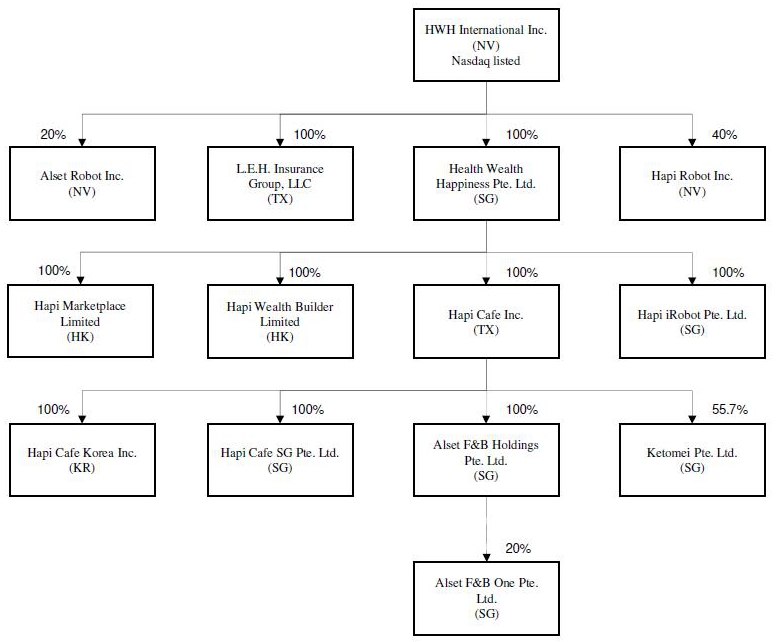
Hapi Marketplace
Ltd. (“HML”) was incorporated in Hong Kong on March 18, 2026, and remains dormant as of March 31, 2026.
Functional
and Reporting Currency
The
functional and reporting currency of the Company is the United States dollar (“$”). The financial records of the Company’s
subsidiaries located in South Korea, Singapore, Hong Kong and Malaysia are maintained in their local currencies, the Korean Won (₩),
Singapore Dollar (S$), Hong Kong Dollar (HK$) and Malaysian Ringgit (MYR), which are also the functional currencies of these entities.
Use
of Estimates
The
preparation of the financial statements in conformity with U.S. GAAP requires the Company’s management to make estimates and assumptions
that affect the reported amounts of assets and liabilities and disclosure of contingent assets and liabilities at the date of the balance
sheet.
Making
estimates requires management to exercise significant judgment. It is at least reasonably possible that the estimate of the effect of
a condition, situation or set of circumstances that existed at the date of the balance sheet, which management considered in formulating
its estimate, could change in the near term due to one or more future confirming events. Accordingly, the actual results could differ
significantly from those estimates.
Cash
and Cash Equivalents
The
Company considers all short-term investments with an original maturity of three months or less when purchased to be cash equivalents.
The Company had cash of $1,459,799 and $2,085,918 as of March 31, 2026 and December 31, 2025, respectively. The Company had no cash equivalents
as of March 31, 2026 and December 31, 2025.
Fair
Value of Financial Instruments
The
Company adopted Accounting Standards Codification (“ASC”) 820, “Fair Value Measurements and Disclosures”, for
assets and liabilities measured at fair value on a recurring basis. ASC 820 defines fair value as the exchange price that would be received
for an asset or paid to transfer a liability (an exit price) in the principal or most advantageous market for the asset or liability
in an orderly transaction between market participants on the measurement date. ASC 820 also establishes a fair value hierarchy, which
requires an entity to maximize the use of observable inputs and minimize the use of unobservable inputs when measuring fair value. ASC
820 describes three levels of inputs that may be used to measure fair value:
Level
1: Observable inputs such as quoted market prices in active markets for identical assets or liabilities
Level
2: Observable market-based inputs or unobservable inputs that are corroborated by market data
Level
3: Unobservable inputs for which there is little or no market data, which require the use of the reporting entity’s own assumptions
Level
1 marketable securities are liquid and transparent financial instruments with readily observable market prices. Their value is based
on unadjusted quoted prices in active markets for identical assets. Examples often include U.S. treasury securities, listed equities,
exchange-traded funds and open-end mutual funds, foreign currencies, and gold bullion. An active market is defined by sufficient transaction
frequency and volume to provide ongoing pricing information.
For
purpose of this disclosure, the fair value of a financial instrument is the amount at which the instrument could be exchanged in a current
transaction between willing parties, other than in a forced sale or liquidation. The carrying values reported in balance sheets for current
assets and liabilities approximate their estimated fair market values based on the short-term maturity of these instruments.
The
Company has a portfolio of trading level 1 marketable securities. The objective is to generate profits on short-term differences in market
prices. The Company does not have significant influence over any trading securities in our portfolio and fair value of these trading
securities are determined by quoted stock prices.
Investment
Securities at Cost
Investments
in equity securities without readily determinable fair values are measured at cost minus impairment adjusted by observable price changes
in orderly transactions for the identical or similar investments of the same issuer. These investments are measured at fair value on
a nonrecurring basis when there are events or changes in circumstances that may have a significant adverse effect. An impairment is recognized in the consolidated statements of comprehensive income equal to the amount by which the carrying value exceeds the fair
value of the investment.
Inventory
Inventory
is stated at the lower of cost or net realizable value. Cost is determined using the first-in, first-out method and includes all costs
in bringing the inventories to their present location and condition. Net realizable value is an estimated selling price in the ordinary
course of business less the estimated costs necessary to make the sale. As of March 31, 2026 and December 31, 2025, inventory consisted
of finished goods procured from suppliers. The Company continuously evaluates the need for reserve for obsolescence and possible price
concessions required to write-down inventory to its net realizable value.
Leases
The
Company follows FASB ASC Topic 842 in accounting for its operating lease right-of-use assets and operating lease liabilities. At inception
of a contract, the Company assesses whether a contract is, or contains, a lease. A contract is or contains a lease if it conveys the
right to control the use of an identified asset for a period of time in exchange of a consideration. To assess whether a contract is
or contains a lease, the Company assesses whether the contract involves the use of an identified asset, whether it has the right to obtain
substantially all of the economic benefits from the use of the asset and whether it has the right to control the use of the asset. The
right-of-use assets and related lease liabilities are recognized at the lease commencement date. The Company recognizes operating lease
expenses on a straight-line basis over the lease term. For leases that contain related non-lease components, such as maintenance, the
Company will account for these payments as a single lease component.
Right-of-use
of Assets
The
right-of-use of asset is measured at cost, which comprises the amount of the lease liability adjusted for any lease payments made at
or before the commencement date, plus any initial direct costs incurred and less any lease incentive received.
Lease
Liabilities
Lease
liability is measured at the present value of the outstanding lease payments at the commencement date, discounted using the Company’s
incremental borrowing rate. Lease payments included in the measurement of the lease liability comprise mainly of fixed lease payments.
Short-term
Leases and Leases of Low Value Assets
The
Company has elected to not recognize right-of-use assets and lease liabilities for short-term leases that have a lease term of 12 months
or less at inception and leases of low value assets. Lease payments associated with these leases are expensed as incurred.
Property
and Equipment
Property
and equipment are recorded at cost, less depreciation. Repairs and maintenance are expensed as incurred. Expenditures incurred
as a consequence of acquiring or using the asset, or that increase the value or productive capacity of assets are capitalized. When property
and equipment is retired, sold, or otherwise disposed of, the asset’s carrying amount and related accumulated depreciation are
removed from the accounts and any gain or loss is included in statement of operations. Depreciation is computed by the reducing balance
method (after considering their respective estimated residual values) over the estimated useful lives of the respective assets as follows:
SCHEDULE OF ESTIMATED USEFUL LIVES OF PROPERTY PLANT AND EQUIPMENT
| Office Equipment | |
| 3 – 5 years | |
| Furniture and Fittings | |
| 3 – 5 years | |
| Kitchen Equipment | |
| 3 – 5 years | |
| Operating Equipment | |
| 3 – 5 years | |
| Leasehold Improvements | |
| Shorter of lease life or asset life | |
The
Company reviews the carrying value of property and equipment for impairment whenever events and circumstances indicate that the carrying
value of an asset may not be recoverable from the estimated future cash flows expected to result from its use and eventual disposition.
In cases where undiscounted expected future cash flows are less than the carrying value, an impairment loss is recognized, equaling an
amount by which the carrying value exceeds the fair value of assets. The factors considered by management in performing this assessment
include current operating results, trends, and prospects, as well as the effects of obsolescence, demand, competition, and other economic
factors.
Deposits
Deposits
represent rental security deposits paid for the Company’s office and café locations, which are refundable upon expiration
of the respective lease terms. Deposits are classified as current or non-current based on the expected timing of refund. Deposits related
to leases expiring within the next twelve months are classified as current, while deposits related to leases expiring after twelve months
are classified as non-current. As of March 31, 2026, current deposits totaled $21,112 and non-current deposits totaled $98,963.
Revenue
Recognition
ASC
606 – Revenue from Contracts with Customers (“ASC 606”), establishes principles for reporting information about
the nature, amount, timing and uncertainty of revenue and cash flows arising from the entity’s contracts to provide goods or services
to customers.
In
accordance with ASC 606, revenue is recognized when a customer obtains control of promised goods or services. The amount of revenue recognized
reflects the consideration to which the Company expects to be entitled to receive in exchange for these goods or services. The provisions
of ASC 606 include a five-step process by which the determination of revenue recognition, depicting the transfer of goods or services
to customers in amounts reflecting the payment to which the Company expects to be entitled in exchange for those goods or services. ASC
606 requires the Company to apply the following steps:
(1)
identify the contract with the customer; (2) identify the performance obligations in the contract; (3) determine the transaction price;
(4) allocate the transaction price to the performance obligations in the contract; and (5) recognize revenue when, or as, performance
obligations are satisfied.
The
Company generates its revenue primarily from product sales and F&B business.
Food
and Beverage: The Company’s performance obligation is to transfer ownership of its F&B products to its customers. The Company
generally recognizes revenue when F&B products are delivered to its customers. Revenue is recorded net of applicable taxes, allowances,
refunds or returns. The Company receives the net sales price in cash or through credit card payments at the point of sale or from web-based
ordering system.
Accounts
Receivable
Accounts
receivable is recorded at invoiced amounts net of an allowance for credit losses and does not bear interest. The allowance for credit
losses is the Company’s best estimate of the amount of probable credit losses in the Company’s existing account receivable.
The measurement and recognition of credit losses involves the use of judgment. Management’s assessment of expected credit losses
includes consideration of current and expected economic conditions, market and industry factors affecting the Company’s customers
(including their financial condition), the aging of account balances, historical credit loss experience, customer concentrations, customer
creditworthiness, and the existence of sources of payment. The Company also establishes an allowance for credit losses for specific receivables
when it is probable that the receivable will not be collected and the loss can be reasonably estimated. Account receivable considered
uncollectible is charged against the allowance after all means of collection have been exhausted and the potential for recovery is considered
remote.
Value-added
Tax
The
Company is subject to value-added tax (“VAT”) on purchases of inventory, rent payments, professional fees, and certain other
taxable expenditures. As of March 31, 2026 and December 31, 2025, included in other receivables was VAT paid of $2,099 and $3,027,
respectively, due primarily to the purchase of inventory and payment of rents and accounting fees.
Cost
of Revenue
Cost
of revenue consists of the cost of procuring finished goods from suppliers and related shipping and handling fees from third-party money
platforms, and contractor fees for part-time staff.
Below
is a breakdown of the Company’s cost of revenue for the three months ended March 31, 2026 and 2025.
For
the three months ended:
SCHEDULE OF COST OF REVENUE
| | |
Total | |
| March 31, 2026 | |
| | |
| | |
| | |
| Finished goods | |
$ | 10,899 | |
| Handling fee | |
| 3,892 | |
| Contractor fee | |
| 31 | |
| Depreciation | |
| 2,090 | |
| Total of Cost of revenue | |
$ | 16,912 | |
| | |
| | |
| March 31, 2025 | |
| | |
| | |
| | |
| Finished goods | |
$ | 109,006 | |
| Related shipping | |
| 12,931 | |
| Handling fee | |
| 11,566 | |
| Contractor fee | |
| 8,254 | |
| Franchise commission | |
| 3,350 | |
| Depreciation | |
| 2,496 | |
| Total of Cost of revenue | |
$ | 147,603 | |
Shipping
and Handling Fees
The
Company utilizes the practical expedient under ASC 606-10-25-18B to account for its shipping and handling as fulfillment activities,
and not a promised service (a revenue element). Shipping and handling fees are included in costs of revenue within the statements of
operations.
Advertising
Expenses
Advertising
costs are charged to operations as incurred. Advertising expenses for the three months ended March 31, 2026 and 2025 were $1,000 and
$68,845, respectively.
Income
Taxes
The
Company accounts for income taxes pursuant to the provision of ASC 740-10, “Accounting for Income Taxes” (“ASC 740-10”),
which requires, among other things, assets and liabilities approach to calculating deferred income taxes. The assets and liabilities
approach requires the recognition of deferred tax assets and liabilities for the expected future tax consequences of temporary differences
between the carrying amounts and the tax bases of assets and liabilities. A valuation allowance is provided to offset any net deferred
tax assets for which management believes it is more likely than not that the net deferred tax assets will not be realized. Tax positions
that meet the more likely than not recognition threshold are measured at the largest amount of tax benefit that is more than 50 percent
likely of being realized upon settlement with the applicable taxing authority.
The
Company follows the provision of ASC 740-10 related to Accounting for Uncertain Income Tax Positions. When tax returns are filed, there
may be uncertainty about the merits of positions taken or the amount of the position that would be ultimately sustained. In accordance
with the guidance of ASC 740-10, the benefit of a tax position is recognized in the financial statements in the period during which,
based on all available evidence, management believes it is more likely than not that the position will be sustained upon examination,
including the resolution of appeals or litigation processes, if any. Tax positions taken are not offset or aggregated with other positions.
The
Company has not recorded any unrecognized tax benefits. The Company’s policy is to recognize interest and penalties related to
income taxes in income tax expense.
The
Company’s tax returns for 2022, 2023, 2024 and 2025 remain open to examination.
Franchise
Tax
The
Company was reincorporated in the State of Nevada on November 14, 2025, through a reincorporation merger. As a Nevada corporation, we
are no longer subject to the Delaware franchise tax. Prior to the reincorporation the Company was subject to annual Delaware franchise
taxes, which are a privilege fee and not an income tax. During the year ended December 31, 2025 the Company received a refund of prepaid
Delaware franchise tax of $41,349.
Earnings
(Loss) per Share
The
Company presents basic and diluted earnings (loss) per share for its common shares. Basic earnings (loss) per share is calculated by
dividing net income (loss) attributable to common shareholders of the Company by the weighted-average number of common shares outstanding
during the period, adjusted for treasury shares held by the Company.
Diluted
earnings (loss) per share is computed by dividing net income (loss) attributable to common stockholders by the weighted-average number
of shares of common stock outstanding during the period, adjusted to give effect to all potentially dilutive securities, including stock
options, warrants, and convertible debt securities. During the three months ended March 31, 2026 and 2025 there were 909,874 potentially
dilutive warrants outstanding.
For
the periods ended March 31, 2026 and 2025, basic and diluted earnings per share (EPS) were the same, as the effect of potentially dilutive
securities was anti-dilutive during periods of net loss and therefore did not reduce the loss per share.
Non-controlling
Interests
Non-controlling
interests represent the equity in a subsidiary not attributable, directly or indirectly, to owners of the Company, and are presented
separately in the Consolidated Statements of Operations and Other Comprehensive Loss, and within equity in the Consolidated Balance Sheets,
separately from equity attributable to owners of the Company.
Liquidity
and Capital Resources
In
the three months ended March 31, 2026, we incurred a net loss, a loss from operations and negative cash flow from operating cafés
during the period. These factors raise substantial doubt about our ability to continue as a going concern.
Notwithstanding
the above, the Company believes that the available cash in the Company’s bank accounts, anticipated cash from operations, and financing
availability from related parties are sufficient to alleviate substantial doubt about the Company’s ability to continue as a going
concern for at least the next 12 months. The Company’s capital requirements for the planned expansion are based on, among other
items, location-specific property costs, team requirements, and marketing steps needed. Our expansion includes plans to take over leases
of existing Hapi Cafes that we currently do not own, with a goal to add additional Hapi Cafes over the next two years. Executing these
plans will require a minimum investment for each Hapi Café location. There is no guarantee, however, that we will be able to achieve
these plans as described.
The
accompanying financial statements have been prepared assuming the Company will continue as a going concern and do not contain any adjustments
that might be required should the Company be unable to continue as a going concern.
On
April 24, 2024, the Company entered into a Credit Facility Agreement (the “Credit Agreement”) with Alset Inc., a Texas corporation
and the Company’s majority stockholder, pursuant to which Alset Inc. has provided the Company a non-revolving line of
credit facility (the “Credit Facility”), which provides a maximum, aggregate credit line of up to $1,000,000. During 2024,
$300,000 was drawn from the loan, which was converted to equity on September 24, 2024. The remaining credit of $700,000 is available
for draw as on March 31, 2026.
Pursuant
to the Credit Agreement, the Company may request an advance (each, an “Advance”) on the Credit Facility. Each Advance shall
bear a simple interest rate of three percent (3%) per annum. Each Advance and all accrued but unpaid interest shall be due and payable
at the first (1st) anniversary of the effective date of the Credit Agreement. The Company may at any time during the term
of the Credit Agreement prepay a portion or all amounts of its indebtedness without penalty. Each advance shall not be secured by a lien
or other encumbrance on any of the Company’s assets, but shall be solely a general unsecured debt obligation of the Company.
On
April 14, 2025, the Company entered into an amendment (the “Amendment”) to this Credit Facility Agreement. Under the terms
of the Amendment, the date upon which each advance made under the Credit Facility and all accrued but unpaid interest shall be due and
payable was extended from April 24, 2025 to April 14, 2026.
The
Company obtained letters of financial support from Alset Inc. pursuant to which Alset Inc. committed to provide any
additional funding required by the Company and would not demand repayment through twelve months from the filing of this Form 10-Q.
Recent
Accounting Pronouncement
Management
does not believe that any recently issued, but not effective, accounting standards, if currently adopted, would have a material effect
on the Company’s condensed consolidated financial statements.
Segment
reporting
On
November 27, 2023, the Financial Accounting Standards Board (“FASB”) issued Accounting Standards Update No. 2023-07, Improvements
to Reportable Segment Disclosures (“ASU 2023-07”). ASU 2023-07 amends ASC 280, Segment Reporting (“ASC 280”)
to expand segment disclosures by requiring disclosure of significant segment expenses that are regularly provided to the Company’s
chief operating decision maker (“CODM”), the amount and description of other segment items, the title and position of the
CODM, and an explanation of how the CODM uses the reported measure(s) of segment profit or loss in assessing segment performance and
deciding how to allocate resources. ASU 2023-07 further permits disclosure of more than one measure of segment profit or loss and extends
the full disclosure requirements of ASC 280 to companies with single reportable segments. The Company adopted ASU 2023-07 on December
31, 2025 on a retrospective basis. See —Segment reporting below for additional information.
In
December 2023, the FASB issued ASU No. 2023-09, Income Taxes (Topic 740) – Improvements to Income Tax Disclosures (“ASU 2023-09”).
ASU 2023-09 requires that an entity, on an annual basis, disclose additional income tax information, primarily related to the rate reconciliation
and income taxes paid. The amendment in the ASU is intended to enhance the transparency and decision usefulness of income tax disclosures.
The ASU’s amendments are effective for annual periods beginning after December 15, 2024. The Company adopted ASU 2023-09 for the
year ended December 31, 2025. The adoption of this ASU did not have a material impact on our condensed consolidated financial statements.
In
November 2024, the FASB issued ASU 2024-04—Debt—Debt with Conversion and Other Options (Subtopic 470-20): Induced Conversions
of Convertible Debt Instruments (“ASU 2024-04”) to improve the relevance and consistency in the application of induced conversion
guidance in Subtopic 470-20, Debt—Debt with Conversion and Other Options. The amendments in ASU 2024-04 clarify the requirements
for determining whether certain settlements of convertible debt instruments should be accounted for as an induced conversion. The amendments
in ASU 2024-04 affect entities that settle convertible debt instruments for which the conversion privileges were changed to induce conversion.
The amendments in ASU 2024-04 are effective for all entities for annual reporting periods beginning after December 15, 2025, and interim
reporting periods within those annual reporting periods. Early adoption is permitted for all entities that have adopted the amendments
in ASU 2020-06. The amendments in ASU 2024-04 permit an entity to apply the new guidance on either a prospective or a retrospective basis.
The adoption of this ASU did not have a material impact on our condensed consolidated financial statements.
Accounting
pronouncements pending adoption
On
November 4, 2024, the FASB issued ASU No. 2024-03, Expense Disaggregation Disclosures (“ASU 2024-03”). ASU 2024-03
amends ASC 220, Comprehensive Income to expand income statement expense disclosures and require disclosure in the notes to the
financial statements of specified information about certain costs and expenses. ASU 2024-03 is required to be adopted for fiscal years
commencing after December 15, 2026, with early adoption permitted. The Company is currently evaluating the impact of adopting the standard
on the condensed consolidated financial statements.
In
December 2025, the FASB issued ASU 2025-11, Interim Reporting (Topic 270). This update enhances the clarity and organization of interim
reporting and the applicability of Topic 270. It also clarifies the required form and content of interim financial statements, including
requiring entities to disclose events since the end of the last annual reporting period that have a material impact on the entity. The
standard is effective for interim reporting periods within annual periods beginning after December 15, 2027, with early adoption permitted.
Entities may apply the update either prospectively or retrospectively. We are currently evaluating the impact of adopting this standard
on our condensed consolidated financial statements and disclosures.
Segment
Reporting
The
Company reports its segment information to reflect the manner in which the CODM reviews and assesses performance. The Company’s
Chief Executive Officer and President and Chief Operating Officer have joint responsibility as the CODM and review and assess the performance
of the Company as a whole.
The
primary financial measures used by the CODM to evaluate performance and allocate resources are net income (loss) and operating income
(loss). The CODM uses net income (loss) and operating income (loss) to evaluate the performance of the Company’s ongoing operations
and as part of the Company’s internal planning and forecasting processes. Information on Net income (loss) and Operating income
(loss) is disclosed in the Consolidated Statements of Operations. Segment expenses and other segment items are provided to the CODM on
the same basis as disclosed in the Consolidated Statements of Operations.
NOTE
3 — ACCOUNTS RECEIVABLE, NET
Accounts
receivable, net at March 31, 2026 and December 31, 2025 was $3,096 and
$3,324,
respectively, represent collection received by the credit card processor in F&B business and rent receivable. Accounts
receivable is recorded at invoiced amounts net of an allowance for credit losses and does not bear interest. As of March 31, 2026
and December 31, 2025, the allowance for credit losses was an immaterial amount. The Company does not have any off-balance sheet
credit exposure related to its customers.
NOTE
4 — PROPERTY AND EQUIPMENT, NET
The
components of property and equipment are as follows:
SCHEDULE OF PROPERTY AND EQUIPMENT, NET
| | |
Total | |
| March 31, 2026 | |
| | |
| Cost: | |
| | |
| Office Equipment | |
$ | 38,951 | |
| Furniture and Fittings | |
| 5,814 | |
| Kitchen Equipment | |
| 32,231 | |
| Other Operating Equipment | |
| 12,209 | |
| Leasehold Improvements | |
| 157,244 | |
| | |
| | |
| Accumulated Depreciation: | |
| | |
| Office equipment | |
$ | (31,818 | ) |
| Furniture and Fittings | |
| (3,392 | ) |
| Kitchen Equipment | |
| (15,803 | ) |
| Other Operating Equipment | |
| (5,378 | ) |
| Leasehold Improvements | |
| (83,398 | ) |
| | |
| | |
| Impairment: | |
| | |
| Office equipment | |
$ | (7,165 | ) |
| Furniture and Fittings | |
| (2,433 | ) |
| Kitchen Equipment | |
| (12,518 | ) |
| Other Operating Equipment | |
| (6,861 | ) |
| Leasehold Improvements | |
| (61,147 | ) |
| Add: Foreign currency translation adjustment | |
| 397 | |
| | |
| | |
| Total, net | |
$ | 16,933 | |
| | |
| | |
| December 31, 2025 | |
| | |
| Cost: | |
| | |
| Office Equipment | |
$ | 39,021 | |
| Furniture and Fittings | |
| 5,839 | |
| Kitchen Equipment | |
| 31,960 | |
| Other Operating Equipment | |
| 12,263 | |
| Leasehold Improvements | |
| 159,518 | |
| | |
| | |
| Accumulated Depreciation: | |
| | |
| Office equipment | |
$ | (31,856 | ) |
| Furniture and Fittings | |
| (3,406 | ) |
| Kitchen Equipment | |
| (15,655 | ) |
| Other Operating Equipment | |
| (5,402 | ) |
| Leasehold Improvements | |
| (83,005 | ) |
| | |
| | |
| Impairment: | |
| | |
| Office equipment | |
$ | (7,165 | ) |
| Furniture and Fittings | |
| (2,433 | ) |
| Kitchen Equipment | |
| (12,518 | ) |
| Other Operating Equipment | |
| (6,861 | ) |
| Leasehold Improvements | |
| (61,147 | ) |
| | |
| | |
| Total, net | |
$ | 19,153 | |
For
the three months ended March 31, 2026 and 2025, the Company recorded depreciation expenses of $2,091 and $3,282, respectively.
There was no impairment of property and equipment during the three months ended March 31, 2026 and 2025.
NOTE
5 — INVESTMENTS
Investments
in equity securities without readily determinable fair values are measured at cost minus impairment adjusted by observable price changes
in orderly transactions for the identical or a similar investment of the same issuer. These investments are measured at fair value on
a nonrecurring basis when there are events or changes in circumstances that may have a significant adverse effect. An impairment is recognized in the consolidated statements of comprehensive income equal to the amount by which the carrying value exceeds the fair
value of the investment. No impairment was recorded as of and for the three months ended March 31, 2026 and 2025.
Ideal
Food & Beverage Pte. Ltd.
On
March 14, 2024, the Company entered into a share subscription agreement through its subsidiary Alset F&B Holding Pte. Ltd.
(“F&BH”) for 19,000
shares of Ideal Food & Beverage Pte. Ltd. (“IFBPL”), constituting 19%
of the issued shares of IFBPL. The investment amount was $14,010
paid to IFBPL on May 23, 2024. For the year ended December 31, 2024, the Company impaired this investment of $14,010
to $0.
On
February 26, 2026, the Company entered into a share subscription agreement through F&BH for additional 19,000
shares of newly issued 100,000 shares of IFBPL. The investment amount was $14,974
paid to IFBPL on February 26, 2026. Following the new investment, the Company holds a total of 38,000
shares out of 200,000 total outstanding shares of IFBPL, representing 19% of IFBPL’s outstanding shares.
Sale
of HWH World Inc. and Acquisition of AES Group Inc.
On
April 23, 2025, the Company completed the sale of HWH World Inc. (“HWHKOR”) by Health Wealth Happiness Pte. Ltd. (“HWHPL”)
to AES Group Inc. (“AES”), a Korean entity. The sale was consummated under a term sheet signed on April 20, 2025, pursuant
to which the Company agreed to transfer its 100% equity interest in HWHKOR to AES. In exchange, AES agreed to issue new shares to the
Company upon closing, representing 19.9% of AES’s share capital, with a total cost basis of $1,354. Total of $383,667
gain was generated from this deal and recorded in other non-operating income / (expenses) in the statement of operations. The disposal
of HWH World Inc. had immaterial effect on the Company’s condensed consolidated financial statements and the deconsolidation
did not meet the criteria for presentation as discontinued operations under ASC 205-20.
Sale
of Alset F&B One Pte. Ltd.
On
September 10, 2025, Alset F&B Holdings Pte. Ltd. (“F&BH”), entered into a sale and purchase agreement (the “Sale and Purchase
Agreement”) with Alset International Limited (“AIL”), pursuant to which the F&BH
agreed to sell 70% of the outstanding shares of its subsidiary, Alset F&B One Pte. Ltd. to the AIL in exchange for $170,754.
Following this sale, F&BH will continue to own 20% of Alset F&B One. Total $21,611
loss was generated from this deal and recorded in other non-operating income / (expenses) in the statement of operations. Total
$60,708 was generated from the fair value of the remaining 20% investment in Alset F&B One which is treated as basis of equity
method investment. The deconsolidation did not meet the criteria for presentation as discontinued operations under ASC
205-20.
NOTE
6 – NOTES PAYABLE
D. Boral Capital, LLC
On
December 18, 2023, the Company entered into a Satisfaction and Discharge of Indebtedness Agreement in connection with an underwriting
agreement previously entered into by HWH and D. Boral Capital LLC (“D. Boral Capital”) (formerly known as EF Hutton, LLC),
a division of Benchmark Investments, LLC, under which in lieu of HWH tendering the full amount due of $3,018,750, the underwriters accepted
a combination of $325,000 in cash paid upon the closing of Business Combination, 149,443 shares of the Company’s common stock and
a $1,184,375 promissory note as full satisfaction. This agreement was effective at the closing of Business Combination on January 9,
2024. The 149,443 shares were issued at the price of $10.10, totaling the amount of $1,509,375. The fair value of the HWH shares at issuance
on January 9, 2024 was $2.82 per share or $421,429. No gain or loss was recognized upon issuance of the shares on January 9, 2024, as
this was an adjustment to prior underwriting costs accounted for in equity. The promissory note carries interest rate equal to SOFR (secured
overnight financing rate for U.S. Government Securities Business Day published by the Federal Reserve Bank of New York) plus a margin
of one percent. The principal amount of the promissory note and any accrued interest shall mature (i) partially in the event HWH completes
an offering within one year of the date of the promissory note, the amount of outstanding debt maturing being proportionate to the amount
of proceeds of the future offering, or (ii) in partial installments through October of 2028, the outstanding balance being paid annually
until the balance owed is paid in full. The first installment of the note that was due in October 2024 was paid in January 2025, resulting
in a default due to the delay in payment. The second installment of the note was paid in October 2025. We have concluded negotiations
with D. Boral Capital LLC and cured the default stemming from the late payment of the installation due in October of 2024. As of March
31, 2026 total due to D. Boral Capital is $837,382, which includes $710,625 in principal and $126,757 in interest.
As of December 31, 2025 total due to D. Boral Capital was $829,182, which includes $710,625 in principal and $118,557 in interest.
The remaining principal will be repaid in three installments of $236,875 due in October of 2026, 2027, and 2028.
Loans
for Operations
The
Company’s subsidiary, Ketomei Pte Ltd (“Ketomei”) has a loan from DBS Bank Limited, which was used to fund
Ketomei’s current operations. Ketomei owes the bank $22,316
and $22,415
at March 31, 2026 and December 31, 2025, respectively.
NOTE
7 — DUE TO/FROM RELATED PARTIES
Due to Alset Inc.
Alset Inc. (“AEI”)
is our ultimate holding company that is incorporated in the United States of America. The amount due to AEI represents short-term working
capital advances to the Company for its daily operations. There is no written, executed agreement and the amount due to AEI is non-interest
bearing. Since the amount due to AEI is due upon request, it is classified as a current liability. The amounts due to AEI at March 31,
2026 and December 31, 2025 are $569,614 and $569,614 respectively.
Due
to Alset International Limited.
Alset
International Limited (“AIL”) is incorporated in Singapore and is a fellow subsidiary of the common parent company, Alset
Inc. The amount due to AIL represents short-term working capital advances to the Company for its daily operations. There is no written,
executed agreement and the amount due to AIL is non-interest bearing. Since the amount due to
AIL is due upon request, it is classified as a current liability. The amounts due to AIL at March 31, 2026 and December 31, 2025 are
$4,675,492 and $4,653,037, respectively.
Due
from Alset Business Development Pte. Limited.
Alset
Business Development Pte. Limited (“ABD”) is incorporated in Singapore and is a fellow subsidiary of Alset Inc. The amount
due from ABD represents amount lent by ABD to Hapi Cafe Inc. for the investment in Ketomei Pte. Ltd in March 2022, and $5,000,000
lent from HWHPL to ABD in November 2024, with partial repayment
of $707,000
received by the Company in December 2024. There is no written,
executed agreement and the amount due from ABD is non-interest bearing. Since the amount due from ABD is due upon request, it is classified
as a current asset. The amount due from ABD at March 31, 2026 and December 31, 2025 is $4,233,148
and $4,232,313,
respectively.
Due
from Hapi Metaverse Inc.
Hapi
Metaverse Inc. (“HMI”) is incorporated in the United States of America and is a fellow subsidiary of Alset Inc. The amount
due from represents short-term working capital advances for the Company to finance its daily operations, $5,000 from HMI and $122,440
from HotApp International Limited, a subsidiary of HMI, during the three months ended March 31, 2026. There is no written, executed agreement and the amount due from HMI is non-interest bearing. Since the amount due from HMI is due upon
request, it is classified as a current asset. The amount due from HMI at March 31, 2026 and December 31, 2025 is $127,440 and $381,461,
respectively. The decrease is mainly due to $382,932 impairment for the loan provided in HWHPL, and the related cost is included in general and administrative expenses.
NOTE
8 — RELATED PARTY TRANSACTIONS
On
March 20, 2024, the Company entered into a securities purchase agreement with Sharing Services Global Corporation (“SHRG”),
pursuant to which the Company purchased from SHRG a (i) Convertible Promissory Note (“CN 1”) in the amount of $250,000, convertible
into 208,333,333 shares of SHRG’s common stock at the option of the Company, and (ii) certain warrants exercisable into 208,333,333
shares of SHRG’s common stock at an exercise price of $0.0012 per share, the exercise period of the warrant being five (5) years
from the date of the securities purchase agreement, for an aggregate purchase price of $250,000 (“WRNT 1”). CN
1 bears a 6% interest rate and has scheduled maturity on March 19, 2027, three years from the date of the CN 1. At
the time of filing, the Company has not converted any of the debt contemplated by CN 1 nor exercised any of the warrants.
On
May 9, 2024, the Company entered into a securities purchase agreement with Sharing Services Global Corporation, pursuant to which the
Company purchased from SHRG a Convertible Promissory Note (“CN 2”) in the amount of $250,000, convertible into 125,000,000
shares of SHRG’s common stock at the option of the Company for an aggregate purchase price of $250,000. CN 2 bears an 8% interest
rate and has scheduled maturity on May 8, 2027, three years from the date of the CN 2. Additionally, upon signing CN 2, SHRG owed the
Company a commitment fee of 8% of the principal amount, $20,000 in total, to be paid either in cash or in common stock of SHRG, at the
discretion of the Company. At the time of filing, the Company has not converted any of the debt
contemplated by CN 2.
On
June 6, 2024, the Company entered into a securities purchase agreement with Sharing Services Global Corporation, pursuant to which the
Company purchased from SHRG a Convertible Promissory Note (“CN 3”) in the amount of $250,000, convertible into 125,000,000
shares of SHRG’s common stock at the option of the Company for an aggregate purchase price of $250,000. CN 3 bears an 8% interest
rate and has scheduled maturity on June 5, 2027, three years from the date of the CN 3. Additionally, upon signing CN 3, SHRG owed the
Company a commitment fee of 8% of the principal amount, $20,000 in total, to be paid either in cash or in common stock of SHRG, at the
discretion of the Company. At the time of filing, the Company has not converted any of the debt
contemplated by CN 3.
On
August 13, 2024, the Company entered into a securities purchase agreement with Sharing Services Global Corporation, pursuant to which
the Company purchased from SHRG a Convertible Promissory Note (“CN 4”) in the amount of $100,000, convertible into 50,000,000
shares of SHRG’s common stock at the option of the Company for an aggregate purchase price of $100,000. CN 4 bears an 8% interest
rate and has scheduled maturity on August 13, 2027, three years from the date of the CN 4. Additionally, upon signing CN 4, SHRG owed
the Company a commitment fee of 8% of the principal amount, $8,000 in total, to be paid either in cash or in common stock of SHRG, at
the discretion of the Company. At the time of filing, the Company has not converted any of the
debt contemplated by CN 4.
On
January 15, 2025, the Company entered into a securities purchase agreement with Sharing Services Global Corporation pursuant to which
the Company purchased from SHRG a Convertible Promissory Note (“CN 5”) with the principal amount of $150,000.
CN 5 bears interest at a rate of 8% per annum and matures on January 15, 2028. Under the terms of CN 5, the Company has the sole discretion
to elect repayment in either cash or shares of SHRG common stock. In the event the Company elects repayment in shares, the number of
shares issuable will be determined based on the average closing market price of SHRG’s common stock during the three trading days
immediately preceding the repayment date. At the time of filing, the Company has not converted
any of the debt contemplated by CN 5.
On
March 31, 2025, the Company entered into a securities purchase agreement with Sharing Services Global Corporation pursuant to which the
Company purchased from SHRG a (i) Convertible Promissory Note (“CN 6”) in the amount of $150,000, convertible into 187,500
shares of SHRG’s common stock at the option of the Company, and (ii) certain warrants exercisable into 937,500 shares of SHRG’s
common stock at an exercise price of $0.85 per share, the exercise period of the warrant being three (3) years from the date of the securities
purchase agreement, for an aggregate purchase price of $796,875. (“WRNT 2”). At the time of filing, the Company has not converted
any of the debt contemplated by CN 6 nor exercised any of the warrants. Additionally,
upon signing CN 6, SHRG owed the Company a commitment fee of 8% of the principal amount, $12,000 in total, to be paid either in cash
or in common stock of SHRG, at the discretion of the Company. CN 6 bears an 8% interest rate and has scheduled maturity on March 30,
2028, three years from the date of the CN 6. At the time of filing, the Company has not converted
any of the debt contemplated by CN 6 nor exercised any of the warrants.
On
April 21, 2025, the Company entered into a loan agreement (the “Loan Agreement 1”) with Sharing Services Global Corporation,
under which the Company provided a loan to SHRG in the amount of $30,000. The maturity date of the Loan Agreement 1 is April 21, 2026.
The Loan Agreement 1 bears a 10% interest rate.
On
April 25, 2025, the Company entered into a loan agreement (the “Loan Agreement 2”) with Sharing Services Global Corporation,
under which the Company provided a loan to SHRG in the amount of $250,000. The maturity date of the Loan Agreement 2 is April 25, 2026.
The Loan Agreement 2 bears an 8% interest rate. Additionally, upon execution of the Loan Agreement 2 SHRG incurred
a commitment fee representing 5% of the loan principal, $12,500.
On
June 27, 2025, the Company entered into a securities purchase agreement with Sharing Services Global Corporation pursuant to which the
Company purchased from SHRG a Convertible Promissory Note (“CN 7”) in the amount of $60,000, convertible into 10,000,000
shares of SHRG’s common stock at the option of the Company for an aggregate purchase price of $60,000. Additionally,
upon signing CN 7, SHRG owed the Company a commitment fee of 8% of the principal amount $4,800 in total, to be paid either in cash or
in common stock of SHRG, at the discretion of the Company. CN 7 bears an 8% interest rate and has scheduled maturity on June 26, 2028,
three years from the date of the CN 7. At the time of filing, the Company has not converted any
of the debt contemplated by CN 7.
On
September 17, 2025, the Company entered into a securities purchase agreement with Sharing Services Global Corporation pursuant to which
the Company purchased from SHRG a Convertible Promissory Note (“CN 8”) in the amount of $70,000, convertible into 11,666,667
shares of SHRG’s common stock at the option of the Company for an aggregate purchase price of $70,000. Additionally,
upon signing CN 8, SHRG owed the Company a commitment fee of 8% of the principal amount, $5,600 in total, to be paid either in cash or
in common stock of SHRG, at the discretion of the Company. CN 8 bears an 8% interest rate and has scheduled maturity on September 16,
2028, three years from the date of the CN 8. At the time of filing, the Company has not converted
any of the debt contemplated by CN 8.
On
October 6, 2025, the Company entered into a securities purchase agreement with Sharing Services Global Corporation pursuant to which
the Company purchased from SHRG a Convertible Promissory Note (“CN 9”) in the amount of $200,000, convertible into 33,333,333
shares of SHRG’s common stock at the option of the Company for an aggregate purchase price of $200,000. Additionally,
upon signing CN 9, SHRG owed the Company a commitment fee of 8% of the principal amount, $16,000 in total, to be paid either in cash
or in common stock of SHRG, at the discretion of the Company. CN 9 bears an 8% interest rate and has scheduled maturity on October 6,
2028, three years from the date of the CN 9. At the time of filing, the Company has not converted
any of the debt contemplated by CN 9.
On
December 10, 2025, the Company entered into a securities purchase agreement with Sharing Services Global Corporation pursuant to which
the Company purchased from SHRG a Convertible Promissory Note (“CN 10”) in the amount of $150,000, convertible into 25,000,000
shares of SHRG’s common stock at the option of the Company for an aggregate purchase price of $150,000. Additionally,
upon signing CN 10, SHRG owed the Company a commitment fee of 8% of the principal amount, $12,000 in total, to be paid either in cash
or in common stock of SHRG, at the discretion of the Company. CN 10 bears an 8% interest rate and has scheduled maturity on December
10, 2028, three years from the date of the CN 10. At the time of filing, the Company has not converted
any of the debt contemplated by CN 10.
On
January 2, 2026, the Company entered into a securities purchase agreement with Sharing Services Global Corporation pursuant to which
the Company purchased from SHRG a Convertible Promissory Note (“CN 11”) in the amount of $40,000, convertible into 6,666,667
shares of SHRG’s common stock at the option of the Company for an aggregate purchase price of $40,000. Additionally,
upon signing CN 11, SHRG owed the Company a commitment fee of 8% of the principal amount, $3,200 in total, to be paid either in cash
or in common stock of SHRG, at the discretion of the Company. CN 11 bears an 8% interest rate and has scheduled maturity on January 1,
2029, three years from the date of the CN 11. At the time of filing, the Company has not converted
any of the debt contemplated by CN 11, and recorded at cost under convertible notes receivable - related party.
On
January 8, 2026, the Company entered into a securities purchase agreement with Sharing Services Global Corporation pursuant to which
the Company purchased from SHRG a Convertible Promissory Note (“CN 12”) in the amount of $120,000, convertible into 20,000,000
shares of SHRG’s common stock at the option of the Company for an aggregate purchase price of $120,000. Additionally,
upon signing CN 12, SHRG owed the Company a commitment fee of 8% of the principal amount, $9,600 in total, to be paid either in cash
or in common stock of SHRG, at the discretion of the Company. CN 12 bears an 8% interest rate and has scheduled maturity on January 7,
2029, three years from the date of the CN 12. At the time of filing, the Company has not converted
any of the debt contemplated by CN 12, and recorded at cost under convertible notes receivable - related party.
On
February 4, 2026, the Company entered into a securities purchase agreement with Sharing Services Global Corporation pursuant to which
the Company purchased from SHRG a Convertible Promissory Note (“CN 13”) in the amount of $125,000, convertible into 20,833,333
shares of SHRG’s common stock at the option of the Company for an aggregate purchase price of $125,000. Additionally,
upon signing CN 13, SHRG owed the Company a commitment fee of 8% of the principal amount, $10,000 in total, to be paid either in cash
or in common stock of SHRG, at the discretion of the Company. CN 13 bears an 8% interest rate and has scheduled maturity on February
4, 2029, three years from the date of the CN 13. At the time of filing, the Company has not converted
any of the debt contemplated by CN 13, and recorded at cost under convertible notes receivable - related party.
As
of March 31, 2026 and December 31, 2025, a total of $133,700 and $110,900 in commitment fees, $174,094 and $147,504 of
interest was recorded under other receivable, net and $14,499 and $0 of interest was recorded under other non-current asset, respectively.
SHRG
is a related party of the Company, as our stockholders Alset Inc. and Alset International Limited, in addition to certain entities affiliated
with them, are significant stockholders of SHRG, and our former Chief Executive Officer, John Thatch, is also the Chief Executive Officer
of SHRG.
Acquisition
of Hapi Metaverse Inc.
On
February 5, 2026, Alset Inc., the Company’s majority stockholder entered into a Stock Purchase Agreement with the Company,
pursuant to which Alset Inc. agreed to sell to the Company 505,341,376
shares of Hapi Metaverse Inc. for a purchase price of $19,910,603
in the form of a promissory note convertible into newly issued shares of common stock of the Company at an exercise price of $1.85
per share, maturing five (5) years from the date of the term sheet, and bearing an interest rate of 1%
per annum. Under the terms of the transaction, upon the closing, the Company would become HMI’s largest stockholder. As of
March 31, 2026, the closing had not yet occurred and the deal was cancelled on May 6, 2026.
Other
Receivables, Net
Other
receivables, net, are primarily composed of miscellaneous receivables from related parties, including interest accrued on loans to related
parties. The remaining portion mainly represents VAT receivables expected to be refunded by the local government. As of March 31, 2026
and December 31, 2025, the amount of other receivable, net was $641,382 and $614,577, respectively, including the amount due from related
parties of $627,796 and $605,267, respectively. The impairment of other receivables, net was $173,261 and
$158,036 as of March 31, 2026 and December 31, 2025, respectively.
HapiTravel
Holding Pte. Ltd.
On
April 25, 2024, the Company entered into a binding term sheet (the “Term Sheet”) through its subsidiary Health Wealth Happiness
Pte. Ltd., outlining a joint venture with Chen Ziping, an experienced entrepreneur in the travel industry, and Chan Heng Fai, HWH’s
Executive Chairman, as a part of HWH’s strategy of building its travel business in Asia. The planned joint venture company (referred
to here as the “JVC” or “HTHPL”) will be known as HapiTravel Holding Pte. Ltd. The JVC will be initially owned
as follows: (a) HWHPL will hold 19% of the shares in the JVC; (b) Mr. Chan will hold 11%; and (c) the remaining 70% of the shares in
the JVC will be held by Mr. Chen.
On
November 6, 2024, the Company signed a loan agreement with HTHPL in the amount of $137,658 at an interest rate of 5% per annum, the maturity
date of which is on or before the second anniversary of the effective date.
On
December 18, 2024, the Company sold Hapi Travel Pte. Ltd. (“HTPL”) to HTHPL for a consideration of $834.
As
of March 31, 2026 and December 31, 2025, HTHPL owed the Company a total of $1,787 and $26,623, respectively, which is recorded
in other receivables in the financial statements. This amount is presented net of the subscription fee of $190 that the Company owed
for the 19% shareholding in the JVC.
NOTE
9 - FINANCIAL ASSETS AT FAIR VALUE
Financial
assets measured at fair value on a recurring basis are summarized below and disclosed on the consolidated balance sheet as of March 31,
2026 and December 31, 2025:
SCHEDULE OF FINANCIAL ASSETS MEASURED AT FAIR VALUE ON A RECURRING BASIS
| | |
Fair
Value Measurement Using | | |
Amount
at | |
| | |
Level
1 | | |
Level
2 | | |
Level
3 | | |
Fair
Value | |
| March
31, 2026 | |
| | | |
| | | |
| | | |
| | |
| Assets | |
| | | |
| | | |
| | | |
| | |
| Warrants
– SHRG | |
$ | - | | |
$ | 54 | | |
$ | - | | |
$ | 54 | |
| Convertible
notes receivable – SHRG | |
| - | | |
| 1,429,214 | | |
| - | | |
| 1,429,214 | |
| Marketable
securities - Trading | |
| 99,615 | | |
| - | | |
| - | | |
| 99,615 | |
| | |
| | | |
| | | |
| | | |
| | |
| Total
Investment in securities at Fair Value | |
$ | 99,615 | | |
$ | 1,429,268 | | |
$ | - | | |
$ | 1,528,883 | |
| | |
Fair
Value Measurement Using | | |
Amount
at | |
| | |
Level
1 | | |
Level
2 | | |
Level
3 | | |
Fair
Value | |
| December
31, 2025 | |
| | | |
| | | |
| | | |
| | |
| Assets | |
| | | |
| | | |
| | | |
| | |
| Warrants
– SHRG | |
$ | - | | |
$ | 87 | | |
$ | - | | |
$ | 87 | |
| Convertible
notes receivable – SHRG | |
| - | | |
| 1,478,419 | | |
| - | | |
| 1,478,419 | |
| Marketable
securities - Trading | |
| 84,466 | | |
| - | | |
| - | | |
| 84,466 | |
| | |
| | | |
| | | |
| | | |
| | |
| Total
Investment in securities at Fair Value | |
$ | 84,466 | | |
$ | 1,478,506 | | |
$ | - | | |
$ | 1,562,972 | |
The
fair value of the SHRG warrants under level 2 category as of March 31, 2026 and December 31, 2025 were calculated using a binomial option
pricing model valued with the following weighted average assumptions:
SCHEDULE OF FAIR VALUE WEIGHTED AVERAGE ASSUMPTIONS
| | |
March
31,
2026 | | |
December
31,
2025 | |
| WRNT
1 | |
| | | |
| | |
| Stock
price | |
$ | 0.0222 | | |
$ | 0.023 | |
| Exercise
price | |
$ | 1.68 | | |
$ | 1.6800 | |
| Risk
free interest rate | |
| 3.81 | % | |
| 3.56 | % |
| Annualized
volatility | |
| 403.615 | % | |
| 390.99 | % |
| Dividend
yield | |
| 0.00 | % | |
| 0.00 | % |
| Year
to maturity | |
| 2.97 | | |
| 3.21 | |
| | |
March
31,
2026 | | |
December
31,
2025 | |
| WRNT
2 | |
| | | |
| | |
| Stock
price | |
$ | 0.0222 | | |
$ | 0.023 | |
| Exercise
price | |
$ | 0.85 | | |
$ | 0.8500 | |
| Risk
free interest rate | |
| 3.79 | % | |
| 3.49 | % |
| Annualized
volatility | |
| 403.615 | % | |
| 390.99 | % |
| Dividend
yield | |
| 0.00 | % | |
| 0.00 | % |
| Year
to maturity | |
| 2.00 | | |
| 2.25 | |
| Warrants measurement input | |
| 2.00 | | |
| 2.25 | |
The
Company has elected to recognize the convertible note at fair value and therefore there was no further evaluation of embedded features
for bifurcation. The Company engaged third party valuation firm to perform the valuation of convertible notes. The fair value of the convertible
notes is calculated using the binomial tree model based on probability of remaining as straight debt using discounted cash flow with
the following assumptions:
| CN# | |
| 1 | | |
| 2 | | |
| 3 | | |
| 4 | |
| Valuation
date | |
| March
31, 2026 | | |
| March
31, 2026 | | |
| March
31, 2026 | | |
| March
31, 2026 | |
| Risk-free
interest rate | |
| 3.657 | % | |
| 3.669 | % | |
| 3.680 | % | |
| 3.706 | % |
| Expected
life | |
| 0.96
year | | |
| 1.11
year | | |
| 1.18
year | | |
| 1.37
year | |
| Discount
rate | |
| 6.00 | % | |
| 8.00 | % | |
| 8.00 | % | |
| 8.00 | % |
| Expected
volatility | |
| 403.615 | % | |
| 403.615 | % | |
| 403.615 | % | |
| 403.615 | % |
| Expected
dividend yield | |
| 0 | % | |
| 0 | % | |
| 0 | % | |
| 0 | % |
| | |
| | | |
| | | |
| | | |
| | |
| Fair
value | |
$ | 222,939 | | |
$ | 225,404 | | |
$ | 227,040 | | |
$ | 88,837 | |
| CN# | |
| 5 | | |
| 6 | | |
| 7 | | |
| 8 | |
| Valuation
date | |
| March
31, 2026 | | |
| March
31, 2026 | | |
| March
31, 2026 | | |
| March
31, 2026 | |
| Risk-free
interest rate | |
| 3.764 | % | |
| 3.793 | % | |
| 3.798 | % | |
| 3.803 | % |
| Expected
life | |
| 1.79
year | | |
| 2.00
year | | |
| 2.24
year | | |
| 2.46
year | |
| Discount
rate | |
| 8.00 | % | |
| 8.00 | % | |
| 8.00 | % | |
| 8.00 | % |
| Expected
volatility | |
| 403.615 | % | |
| 403.615 | % | |
| 403.615 | % | |
| 403.615 | % |
| Expected
dividend yield | |
| 0 | % | |
| 0 | % | |
| 0 | % | |
| 0 | % |
| | |
| | | |
| | | |
| | | |
| | |
| Fair
value | |
$ | 140,436 | | |
$ | 125,931 | | |
$ | 50,580 | | |
$ | 58,293 | |
| CN# | |
| 9 | | |
| 10 | |
| Valuation
date | |
| March
31, 2026 | | |
| March
31, 2026 | |
| Risk-free
interest rate | |
| 3.805 | % | |
| 3.809 | % |
| Expected
life | |
| 2.52
year | | |
| 2.69
year | |
| Discount
rate | |
| 8.00 | % | |
| 8.00 | % |
| Expected
volatility | |
| 403.615 | % | |
| 403.615 | % |
| Expected
dividend yield | |
| 0 | % | |
| 0 | % |
| Warrant measurement input | |
| 0 | % | |
| 0 | % |
| | |
| | | |
| | |
| Fair
value | |
$ | 166,502 | | |
$ | 123,252 | |
Changes
in the observable input values would likely cause material changes in the fair value of the Company’s Level 2 financial instruments.
A significant increase (decrease) in this likelihood would result in a higher (lower) fair value measurement.
During
the three months ended March 31, 2026 and 2025, the Company held convertible notes receivable with SHRG. The following table shows the
activity of the notes during the three ended March 31, 2026 and 2025.
SCHEDULE OF CONVERTIBLE NOTES RECEIVABLE, RELATED PARTY
| | |
December
31,
2025 | | |
Additions | | |
Unrealized
(Loss) | | |
March
31, 2026 | |
| Convertible
note receivable, related party at fair value | |
$ | 1,478,419 | | |
$ | - | | |
$ | 49,205 | | |
$ | 1,429,214 | |
| Total | |
$ | 1,478,419 | | |
$ | - | | |
$ | 49,205 | | |
$ | 1,429,214 | |
| | |
December
31,
2024 | | |
Additions | | |
Unrealized
Gain | | |
March
31, 2025 | |
| Convertible
note receivable, related party at fair value | |
$ | 744,652 | | |
$ | 300,000 | | |
$ | 16,720 | | |
$ | 1,061,372 | |
| Total | |
$ | 744,652 | | |
$ | 300,000 | | |
$ | 16,720 | | |
$ | 1,061,372 | |
The
Company remeasures its convertible note receivable from SHRG at fair value, with changes in fair value recognized in earnings. The carrying
amount decreased from $1,478,419 at December 31, 2025 to $1,429,214 at March 31, 2026, resulting in an unrealized loss of
$49,205 for the three months ended March 31, 2026. For the three months ended March 31, 2025, the carrying amount increased from $744,652
to $1,061,372, resulting in an unrealized gain of $16,720.
Realized
gain on marketable securities for the three months ended March 31, 2026 was $10,237. Realized gain on marketable securities for the three
months ended March 31, 2025 was $0. These gains were recorded directly to net loss.
NOTE
10 — STOCKHOLDERS’ EQUITY
The
total amount of authorized capital stock of the Company of 500,000,000 shares, consists of (a) 450,000,000 shares of common stock (the
“Common Stock”), and (b) 50,000,000 shares of preferred stock (the “Preferred Stock”). As of March 31, 2026 and
December 31, 2025, there were no shares of preferred stock outstanding.
Warrants
— Public Warrants may only be exercised for a whole number of shares. No fractional warrants will be issued upon separation
of the Units and only whole warrants will trade. The Public Warrants became exercisable 30 days after the completion of a Business Combination.
The Public Warrants will expire five years after the completion of the Business Combination.
The
Company will not be obligated to deliver any shares of common stock pursuant to the exercise of a warrant and will have no obligation
to settle such warrant exercise unless a registration statement under the Securities Act covering the issuance of the shares of common stock issuable upon exercise of the warrants is then effective and a current prospectus relating to those shares of
common stock is available, subject to the Company satisfying its obligations with respect to registration, or a valid exemption from
registration is available. No warrant will be exercisable for cash or on a cashless basis, and the Company will not be obligated to issue
any shares to holders seeking to exercise their warrants, unless the issuance of the shares upon such exercise is registered or qualified
under the securities laws of the state of residence of the exercising holder, or an exemption from registration is available.
Redemption
of Warrants When the Price per Share of Common Stock Equals or Exceeds $18.00 — Once the warrants become exercisable,
the Company may redeem the outstanding Public Warrants:
| |
● |
in
whole and not in part; |
| |
|
|
| |
● |
at
a price of $0.01 per Public Warrant; |
| |
|
|
| |
● |
upon
a minimum of 30 days’ prior written notice of redemption, or the 30-day redemption period to each warrant holder; and |
| |
|
|
| |
● |
if,
and only if, the last reported sale price of the common stock equals or exceeds $18.00 per share (as adjusted for stock splits,
stock dividends, reorganization, recapitalizations and the like) for any 20 trading days within a 30-trading day period ending on
the trading day prior to the date on which the Company sends the notice of redemption to warrant holders. |
If
and when the warrants become redeemable by the Company, the Company may exercise its redemption right even if it is unable to register
or qualify the underlying securities for sale under all applicable state securities laws.
If
the Company calls the Public Warrants for redemption, as described above, its management will have the option to require any holder that
wishes to exercise the Public Warrants to do so on a “cashless basis,” as described in the warrant agreement. The exercise
price and number of common stock issuable upon exercise of the Public Warrants may be adjusted in certain circumstances including in
the event of a stock dividend, extraordinary dividend or recapitalization, reorganization, merger or consolidation. However, except as
described below, the Public Warrants will not be adjusted for issuances of common stock at a price below its exercise price. Additionally,
in no event will the Company be required to net cash settle the Public Warrants.
The
Private Placement Warrants are identical to the Public Warrants underlying the Units sold in the Initial Public Offering except the Private
Placement Warrants (including the common stock issuable upon exercise of the Private Placement Warrants) were not transferable,
assignable or salable until 30 days after the completion of the Business Combination, subject to certain exceptions.
The
following table summarizes the warrant activity for the three months ended March 31, 2026 and 2025.
SCHEDULE OF WARRANT ACTIVITY
| | |
Warrants
for | | |
Weighted | | |
Remaining
Contractual | | |
Aggregate | |
| | |
Common | | |
Average | | |
Term | | |
Intrinsic | |
| | |
Shares | | |
Exercise
Price | | |
(Years) | | |
Value | |
| Warrants
Outstanding as of December 31, 2025 | |
| 909,874 | | |
$ | 57.5 | | |
| 3.03 | | |
$ | - | |
| Warrants
Vested and exercisable at December 31, 2025 | |
| 909,874 | | |
$ | 57.5 | | |
| 3.03 | | |
$ | - | |
| Granted | |
| - | | |
$ | - | | |
| | | |
| | |
| Exercised | |
| - | | |
$ | - | | |
| | | |
| | |
| Forfeited,
cancelled, expired | |
| - | | |
| - | | |
| | | |
| | |
| Warrants
Outstanding as of March 31, 2026 | |
| 909,874 | | |
$ | 57.5 | | |
| 2.78 | | |
$ | - | |
| Warrants
Vested and exercisable at March 31, 2026 | |
| 909,874 | | |
$ | 57.5 | | |
| 2.78 | | |
$ | - | |
| | |
Warrant
for | | |
Weighted | | |
Remaining
Contractual | | |
Aggregate | |
| | |
Common | | |
Average | | |
Term | | |
Intrinsic | |
| | |
Shares | | |
Exercise
Price | | |
(Years) | | |
Value | |
| Warrants
Outstanding as of December 31, 2024 | |
| 909,874 | | |
$ | 57.5 | | |
| 4.03 | | |
$ | - | |
| Warrants
Vested and exercisable at December 31, 2024 | |
| 909,874 | | |
$ | 57.5 | | |
| 4.03 | | |
$ | - | |
| Granted | |
| 250,000 | | |
$ | 2.0 | | |
| | | |
| | |
| Exercised | |
| (250,000 | ) | |
$ | (2.0 | ) | |
| | | |
| | |
| Forfeited,
cancelled, expired | |
| - | | |
| - | | |
| | | |
| | |
| Warrants
Outstanding as of March 31, 2025 | |
| 909,874 | | |
$ | 57.5 | | |
| 3.78 | | |
$ | - | |
| Warrants
Vested and exercisable at March 31, 2025 | |
| 909,874 | | |
$ | 57.5 | | |
| 3.78 | | |
$ | - | |
Public
Offering
On
January 3, 2025, the Company announced the pricing of its public offering of 3,162,500 shares of common stock, par value $0.0001 per
share (the “Shares”) and 1,250,000 pre-funded warrants to purchase shares of common stock (“Pre-Funded Warrants”).
The Shares and Pre-Funded Warrants were offered at a public offering price of $0.40 per share and $0.3999 per Pre-Funded Warrant. The
Pre-Funded Warrants were exercisable immediately upon issuance and have an exercise price of $0.0001 per share. The gross proceeds to
the Company from the offering were approximately $1.76 million, before deducting placement agent fees and other offering expenses of
approximately $355,017.
The
offering was conducted pursuant to the Company’s registration statement on Form S-1 (File No. 333-282567), which was initially
filed with the Securities and Exchange Commission on October 10, 2024, subsequently amended on October 23, 2024, December 4, 2024, and
December 10, 2024, and declared effective on December 19, 2024. The offering closed on January 6, 2025.
D.
Boral Capital LLC (“D. Boral Capital”) was acting as the exclusive placement agent for the offering. Pursuant to the Placement
Agency Agreement, the Company has agreed to pay D. Boral Capital a cash fee equal to 7.5% of the gross proceeds from the offering, a
non-accountable expense allowance equal to 1.0% of the gross proceeds, and reimbursement for legal and out-of-pocket expenses up to $75,000.
The
Reverse Stock Split
On
January 16, 2025, the holders of a majority of the issued and outstanding shares of common stock of the Company, approved by written
consent, an amendment of the Company’s Amended and Restated Certificate of Incorporation to effect a reverse stock split of the
Company’s common stock, par value $0.0001 per share, at a ratio of 1-for-5 (the “Reverse Stock Split”). The Reverse
Stock Split was effectuated on February 24, 2025.
Merger
with HWH International Inc – Nevada
On
November 12, 2025, the Company entered into an agreement and plan of merger (“Merger Agreement”) with HWH International Inc.,
a Nevada corporation and a wholly owned subsidiary of the Company (“New HWH”). The Company determined it advisable and in
the best interests of the Company and its stockholders that the Company merge with and into New HWH, with New HWH being the surviving
corporation (the “Merger”), upon the terms and subject to the conditions set forth in the Merger Agreement. The Merger was
completed on November 14, 2025. After the Merger, the total number of shares of capital stock which New HWH has the authority to issue
is five hundred million (500,000,000),
of which (i) four hundred and fifty million (450,000,000)
shares be designated as common stock, par value of $0.0001
per share, which shares shall not be subject to any preemptive
rights, and (ii) fifty million (50,000,000)
shares of preferred stock, par value of $0.0001
per share. $10
of share capital from HWH International Inc. – Nevada
was transferred to additional paid-in capital on November 14, 2025.
NOTE
11 —LEASES
The
Company has operating leases for its one F&B store in South Korea and one F&B stores in Singapore as of March 31, 2026. The related
lease agreements do not contain any material residual value guarantees or material restrictive covenants. Since the Company’s leases
do not provide an implicit rate that can be readily determined, management uses a discount rate based on the incremental borrowing rate.
The Company’s weighted-average remaining lease term relating to its operating leases is 0.74 years, with a weighted-average discount
rate of 3.89%.
The
Company has also utilized the following practical expedients:
| |
● |
Short-term
leases – for leases that are for a period of 12 months or less, the Company will not apply the recognition requirements of
ASC 842. |
| |
|
|
| |
● |
For
leases that contain related non-lease components, such as maintenance, the Company will account for these payments as a single lease
component. |
The
current portion of operating lease liabilities and the non-current portion of operating lease liabilities are presented in the balance
sheets. Total lease expenses amounted to $30,572 and $109,129, which were included in general and administrative expenses in the statements
of operations for the three months ended March 31, 2026 and 2025, respectively. Total cash paid for operating leases amounted to $122,071
and $109,104 for the three months ended March 31, 2026 and 2025, respectively. In addition, the Company leases certain equipment on a
short-term (12 months or less) basis. Total short-term lease expense of $1,212 and $3,762 is included in general and administrative expenses
for the three months ended March 31, 2026 and 2025, respectively. Supplemental balance sheet information related to operating leases
is as follows:
SCHEDULE OF BALANCE SHEET INFORMATION RELATED TO OPERATING LEASES
| | |
March
31, 2026 | | |
December
31,
2025 | |
| | |
| | |
| |
| Right-of-use
assets | |
$ | 60,576 | | |
$ | 92,655 | |
| | |
| | | |
| | |
| Lease
liabilities - current | |
$ | 63,149 | | |
$ | 84,122 | |
| Lease
liabilities - non-current | |
| - | | |
| 11,785 | |
| Total
lease liabilities | |
$ | 63,149 | | |
$ | 95,907 | |
As
of March 31, 2026, the aggregate future minimum rental payments under non-cancelable agreements are as follows:
SCHEDULE OF AGGREGATE FUTURE MINIMUM RENTAL PAYMENTS
| Maturity
of Lease Liabilities | |
Total | |
| | |
| |
| 12
months ended March 31, 2027 | |
$ | 64,364 | |
| Total
undiscounted lease payments | |
$ | 64,364 | |
| Less:
Imputed interest | |
| (1,215 | ) |
| Present
value of lease liabilities | |
$ | 63,149 | |
| Operating
lease liabilities - Current | |
| 63,149 | |
| Operating
lease liabilities - Non-current | |
$ | - | |
NOTE
12 — COMMITMENTS AND CONTINGENCIES
From
time to time the Company may be named in claims arising in the ordinary course of business. Currently, no legal proceedings, government
actions, administrative actions, investigations or claims are pending against the Company or involve the Company that, in the opinion
of management, could reasonably be expected to have a material adverse effect on its business and financial condition. For all periods
presented, the Company was not a party to any pending material litigation or other material legal proceedings.
NOTE
13 — CONCENTRATION
RISK
The
Company maintains cash balances at various financial institutions in different countries. These balances are usually secured by the central
banks’ insurance companies. At times, these balances may exceed the insurance limits. As of March 31, 2026 and December 31, 2025,
uninsured cash balances were $1,123,393 and $1,624,957, respectively.
Major
Suppliers
For
the three months ended March 31, 2026, five suppliers accounted for approximately over 59% of the Company’s total costs of revenue.
For
the three months ended March 31, 2025, five suppliers accounted for approximately over 76% of the Company’s total costs of revenue.
NOTE
14 — SUBSEQUENT EVENTS
The
Company has evaluated all subsequent events and transactions through May 13, 2026, the date that the condensed consolidated financial
statements were available to be issued and noted no subsequent events requiring financial statement recognition or disclosure other than
noted below:
Satisfaction and Discharge of Indebtedness
Agreement
On
April 16, 2026, the Company and D. Boral Capital, LLC (“D. Boral Capital”) entered into an amendment to the
Satisfaction and Discharge of Indebtedness Agreement dated December 18, 2023. Under the terms of the amendment, D. Boral Capital
accepted a one-time payment of $500,000
from the Company as satisfaction of the Company’s further obligations and indebtedness under the Satisfaction and Discharge of
Indebtedness Agreement and the promissory note in lieu of principal and interest otherwise owed and scheduled to be paid. The
settlement for $500,000 was
paid on April 20, 2026.
Term Sheet for Investment in the Company
On May 5, 2026, the Company entered into a term sheet (the “Term Sheet”) with Smart Dynamics Technology
Limited, a company incorporated in the British Virgin Islands (the “Investor”), pursuant to which the Company has agreed to
sell to the Investor, for an aggregate purchase price of $10,000,000:
(i) 20,000,000 newly issued unregistered
shares of the Company’s common stock; and
(ii) warrants to purchase 160,000,000 newly
issued, unregistered shares of the Company’s common stock at an exercise price of $0.63 per share, exercisable immediately and expiring
on the fourth anniversary of their issuance.
The Term Sheet contains certain provisions which
would, upon the closing of the transactions contemplated by the Term Sheet, grant the Investor anti-dilution rights for a period of two
years from the closing in which the Company would not be able to sell new equity securities without the consent of the Investor, subject
to certain exceptions. Further, upon the closing, the Investor would be given the right to appoint three directors to the Company’s
Board of Directors, subject to the conditions described in the Term Sheet. Pursuant to the Term Sheet, the Company would be required
to file a registration statement registering the 20,000,000 shares issuable to the Investor within sixty days of the closing.
The Company and the investor anticipate entering into definitive agreements
for the transactions described above in the immediate future. The closing of the transaction contemplated by the Term Sheet will be subject
to standard closing conditions, including the approval by the stockholders of the Company holding a majority of the Company’s common
stock.
Termination of Planned Acquisition of Hapi
Metaverse Inc.
On May 6, 2026, the Company
entered into a Termination Agreement with Alset Inc., and mutually agreed to not proceed with the closing of the acquisition of Hapi
Metaverse Inc.
Planned Amendment to 2025 Incentive Compensation
Plan
The Company’s Board
of Directors and Compensation Committee have approved an amendment to the Company’s 2025 Incentive Compensation Plan to permit the
Company to issue up to an additional 2,000,000 shares of the Company’s common stock to officers, directors, employees and certain
other persons who have provided, or shall provide, services to the Company, in addition to those shares already authorized under such
plan. Pursuant to the Term Sheet, any such shares granted as compensation will have a lock up of 12 months.
Pursuant to Nasdaq Listing
Rules, the Company will be required to seek the approval of stockholders holding a majority of our issued and outstanding common stock
in order to materially amend the 2025 Incentive Compensation Plan.
Item
2. Management’s Discussion and Analysis of Financial Condition and Results of Operations.
References
to the “Company,” “HWH International Inc.,” “HWH,” “our,” “us” or “we”
refer to HWH International Inc. and its subsidiaries. The following discussion and analysis of the Company’s financial condition
and results of operations should be read in conjunction with the unaudited interim financial statements and the notes thereto contained
elsewhere in this report. Certain information contained in the discussion and analysis set forth below includes forward-looking statements
that involve risks and uncertainties.
Cautionary
Note Regarding Forward-Looking Statements
This
Quarterly Report on Form 10-Q includes forward-looking statements within the meaning of Section 27A of the Securities Act of 1933, as
amended, and Section 21E of the Exchange Act. We have based these forward-looking statements on our current expectations and projections
about future events. These forward-looking statements are subject to known and unknown risks, uncertainties and assumptions about us
that may cause our actual results, levels of activity, performance or achievements to be materially different from any future results,
levels of activity, performance or achievements expressed or implied by such forward-looking statements. In some cases, you can identify
forward-looking statements by terminology such as “may,” “should,” “could,” “would,”
“expect,” “plan,” “anticipate,” “believe,” “estimate,” “continue,”
or the negative of such terms or other similar expressions. Factors that might cause or contribute to such a discrepancy include, but
are not limited to, those described in our other SEC filings.
Overview
Hapi
Marketplace. On November 4, 2024, the Company announced the launch of its business-to-consumer marketplace, Hapi Marketplace.
Hapi Marketplace features a selection of over forty-seven product categories including wellness, elderly care, auto accessories and more.
Launching first in the United States, we intend for Hapi Marketplace to expand in the near future to South Korea and Hong Kong, followed
by further expansion across Asia.
The
various aspects of the Hapi Marketplace will be launched in phases in different regions, each with their own timeline, depending on the
completion of logistical aspects for implementation (i.e., payment gateway systems, business licenses, banking set up, import licenses,
managerial resources, etc.) We are expanding the product range into robotics for consumer and commercial markets. As of March 31, 2026,
this project was not launched yet.
Hapi
Cafés, which are, and will be, in-person, location-based social experiences, offer customers the opportunity to build
a sense of community with like-minded customers who share a potential interest in our products. The cafes are designed to operate sustainably
as standalone businesses. The cafes also seek to be an avenue to create awareness to and educate potential and existing customers about
the products and services of HWH, providing us with the chance to significantly increase our customer base as well as increase the amounts
spent by our customers on our affiliates’ products and services. Each of our cafés is a “Hapi Café.”
We opened proof-of-concept Hapi Café locations in Seoul, the Republic of Korea and Singapore in May and July 2022, respectively,
and one more opened in Seoul, in May 2024. We plan to open additional Hapi Cafés as we beta test and further improve our business
concept. We intend to grow our customer base as we grow the number of Hapi Cafés around the world. Hapi Cafes are positioned to
be integral parts of HWH’s business model. Due to the underperformance of certain café locations, the Company closed several
cafés during 2024 and 2025. The Company currently operates one café in Singapore.
Hapi
Wealth Builder seeks to provide participants the opportunity to attend courses, workshops, and coaching sessions in person, fostering
a collaborative learning environment for those dedicated to learning investment in equities and wealth-building strategies. The team
has been diligently producing digital content for Hapi Wealth Builder and working to collaborate with the right partners to launch the
program and make it available to members. Hapi Wealth Builder will leverage the wealth of knowledge and experience of its leaders to
make wealth building accessible and effective for its members. Our unique community-centric approach will offer members tools for making
informed financial decisions while creating pathways for sustained growth.
On
October 31, 2024, we announced that the Company scheduled the launch of Hapi Wealth, a program dedicated to providing comprehensive education
in equity investment and wealth-building strategies. We are targeting a rollout in selected regions later in 2026 as well.
To
further support its mission, Hapi Wealth is opening its China headquarters, designed as a conducive environment for individuals to participate
in tutorials and workshops. The hub will offer participants the opportunity to attend courses, workshops, and coaching sessions in person,
fostering a collaborative learning environment for those dedicated to learning investment in equities and wealth-building strategies.
Our
Revenue Model
Our
total revenue for the three months ended March 31, 2026 and 2025 was $64,200 and $295,197, respectively. Our net loss for the three months
ended March 31, 2026 and 2025 was $626,773 and $574,103, respectively.
We
currently recognize revenue from food and beverage sales, which accounted for approximately 100% of revenue in the three months ended
March 31, 2026 and 2025, respectively.
From
a geographical perspective, we recognized 100% of our total revenue in the three months ended on March 31, 2026, in Singapore, and 11%
and 89% in the three months ended March 31, 2025, in South Korea and Singapore, respectively.
Matters
that May or Are Currently Affecting Our Business
In
addition to the matters described above, the primary challenges and trends that could affect or are affecting our financial results include:
●
Our ability to improve our revenue through cross-selling and revenue-sharing arrangements among our group of companies;
●
Our ability to identify complementary businesses for acquisition, obtain additional financing for these acquisitions, if and when needed,
and profitably integrate them into our existing operation;
●
Our ability to attract competent, skilled technical and sales personnel for each of our businesses at acceptable compensation levels
to manage our overhead; and
●
Our ability to control our operating expenses as we expand each of our businesses and product and service offerings.
Summary
of Significant Accounting Policies
Basis
of Presentation and Principles of Consolidation
The
Company’s condensed consolidated financial statements and related notes include all the accounts of the Company and its wholly
owned subsidiaries. They have been prepared in accordance with the accounting principles generally accepted in the United States of America
(“U.S. GAAP”). All intercompany transactions have been eliminated in consolidation.
Use
of Estimates and Critical Accounting Estimates and Assumptions
The
preparation of financial statements in conformity with U.S. GAAP requires management to make estimates and assumptions that affect the
reported amounts of assets and liabilities and disclosure of contingent assets and liabilities at the dates of the financial statements
and the reported amounts of revenues and expenses during the reporting periods. Significant estimates made by management include, but
are not limited to, allowance for credit losses, recoverability and useful lives of property, plant and equipment, the valuation allowance
of deferred taxes, contingencies, and equity compensation. Actual results could differ from those estimates.
Revenue
Recognition and Cost of Sales
Product
Sales: The Company’s performance obligation is to transfer ownership of its products to its customers. The Company generally
recognizes revenue when a product is delivered to the customer. Revenue is recorded net of applicable taxes, allowances, refund or returns.
The Company receives the net sales price in cash or through credit card payments at the point of sale.
If
any customer returns a product to the Company on a timely basis, they may obtain a replacement product from the Company for such returned
product. Allowances for product returns are provided at the time the sale is recorded. This accrual is based upon historical return rates
for each country and the relevant return pattern, which reflects anticipated returns to be received over a period of up to 12 months
following the original sale. There were no product returns for the three months ended March 31, 2026, and 2025.
Food
and Beverage: The revenue received from food and beverage business in the three months ended March 31, 2026 and 2025 was $64,200
and $295,197, respectively.
Cost
of Revenue: Cost of revenue consists of cost of procuring finished goods from suppliers and related shipping and handling fees.
Results
of Operations
Summary
of Statements of Operations for the Three Months Ended March 31, 2026 and 2025
| | |
Three
Months Ended March
31, | |
| | |
2026 | | |
2025 | |
| Revenue | |
$ | 64,200 | | |
$ | 295,197 | |
| Cost
of revenue | |
| 16,912 | | |
| 147,603 | |
| Operating
expenses | |
| 672,202 | | |
| 741,722 | |
| Other
expenses (income) | |
| 1,859 | | |
| (62,973 | ) |
| Income
taxes | |
| - | | |
| 42,948 | |
| Net
loss | |
$ | 626,773 | | |
$ | 574,103 | |
Revenue
Revenue
was $64,200 and $295,197 for the three months ended March 31, 2026 and 2025, respectively. Word of mouth, a social media presence, and
the availability of meeting spaces are significant drivers of our revenue and revenue potential. Our revenue decreased in 2026 due to
the cessation of operations of cafes located in Singapore and Korea in August and September 2025, respectively.
Cost
of revenue
Cost
of revenues decreased from $147,603 in the three months ended March 31, 2025 to $16,912 in the three months ended March 31, 2026. The
decrease is a result of the cessation of operations of cafes located in Singapore and Korea in August and September 2025, respectively.
Gross
profit decreased from $147,594 for the three months ended March 31, 2025 to $47,288 for the three months ended March 31, 2026. The
decrease in gross margin was caused by the cessation of operations of cafes located in Singapore and Korea in August and September
2025, respectively.
Operating
expenses
Operating
expenses decreased from $741,722 for the three months ended March 31, 2025 to $672,202 for the three months ended March 31, 2026.
General and administrative expenses increased from $664,242 for the three months ended March 31, 2025 to $672,202 for the three
months ended March 31, 2026. The increase in general and administrative expenses in 2026 compared with 2025 was mostly caused by the
loss from related party balance written off in Q1 2026. The Company recorded a goodwill impairment charge of $77,480 during the
three months ended March 31, 2025, which increased operating expenses for that period.
Other
non-operating (income) expense
The
Company recorded other non-operating expense of $1,859 for the three months ended March 31, 2026, compared to other non-operating income
of $62,973 for the same period in 2025. The change in non-operating income was primarily due to fluctuations in unrealized gain (loss)
on convertible note receivable and warrants – related party, which changed from a gain of $17,442 for the three months ended March
31, 2025 to a loss of $49,238 for the three months ended March 31, 2026. This was partially offset by foreign exchange transaction gain
(loss), which changed from a gain of $66,070 in the three months ended March 31, 2025 to a loss of $21,540 in the three months ended
March 31, 2026.
Net
loss
Net
loss increased from $574,103 for the three months ended March 31, 2025 to $626,773 for the three months ended March 31, 2026.
Liquidity
and Capital Resources
Our
cash has decreased from $2,085,918 as of December 31, 2025 to $1,459,799 as of March 31, 2026. Our liabilities increased from $1,883,133
at December 31, 2025 to $2,132,077 at March 31, 2026. Our total assets have decreased from $4,567,858 as of December 31, 2025 to $4,210,297
as of March 31, 2026.
In
the three months ended March 31, 2026, we incurred a net loss, a loss from operations and negative cash flow from operating cafés
during the period. These factors raise substantial doubt about our ability to continue as a going concern.
The
Company believes that the available cash in the Company’s bank accounts, anticipated cash from operations, and financing availability
from related parties are sufficient to fund our operations for at least the next 12 months. The Company’s capital requirements
for the planned expansion are based on, among other items, geographical specific property costs, team requirements, and marketing steps
needed. Our expansion consists of plans to take over leases of existing Hapi Cafes we currently do not own, as we look to add more Hapi
Cafes over the next two years. There is no guarantee that we will be able to execute on our plans as laid out above.
On
April 24, 2024, the Company entered into a Credit Facility Agreement (the “Agreement”) with Alset Inc., a Texas corporation
and the Company’s majority stockholder, pursuant to which Alset Inc. has provided the Company a line of credit
facility (the “Credit Facility”) which provides a maximum, aggregate credit line of up to $1,000,000. As of March 31, 2026,
there are no outstanding amounts related to the Credit Facility, as the debt with Alset Inc. was converted to equity on September 24,
2024. The remaining credit of $700,000 is available for draw as on March 31, 2026.
Pursuant
to the Agreement, the Company may request an advance (each, an “Advance”) on the Credit Facility. Each advance shall bear
a simple interest rate of three percent (3%) per annum. Each Advance and all accrued but unpaid interest shall be due and payable at
the first (1st) anniversary of the effective date of the Agreement. HWH may at any time during the term of the Agreement prepay a portion
or all amounts of its indebtedness without penalty. Each Advance shall not be secured by a lien or other encumbrance on any HWH assets,
but shall be solely a general unsecured debt obligation of the Company.
The
accompanying financial statements have been prepared assuming the Company will continue as a going concern and do not contain any adjustments
that might be required should the Company be unable to continue as a going concern.
The
Company has obtained letters of financial support from Alset Inc., the majority stockholder of the Company. Alset Inc. committed to provide
any additional funding required by the Company and would not demand repayment through twelve months from the issuance of these condensed
consolidated financial statements.
Summary
of Cash Flows for the Three Months Ended March 31, 2026 and 2025
| | |
Three
Months Ended March 31, | |
| | |
2026 | | |
2025 | |
| Net
cash used in operating activities | |
$ | (192,539 | ) | |
$ | (555,333 | ) |
| Net
cash used in investing activities | |
$ | (305,416 | ) | |
$ | (300,000 | ) |
| Net
cash (used in) / provided by financing activities | |
$ | (148,432 | ) | |
$ | 656,229 | |
Cash
Flows from Operating Activities
Net
cash used in operating activities was $192,539 in the three months ended of March 31, 2026, as compared to net cash used in operating
activities of $555,333 in the same period of 2025. The decrease in cash used in operating activities during the three months ended March
31, 2026 was primarily due to changes in working capital, including movements in account receivable and operating lease liabilities.
Cash
Flows from Investing Activities
Net
cash used in investing activities was $305,416 in the three months ended of March 31, 2026, as compared to net cash used in
investing activities of $300,000 in the same period of 2025. In the three months ended March 31, 2026 we paid $285,000 for
convertible note receivable – related party with the remaining amount of cash outflows related to purchases of property and
equipment, investments at cost, and purchases and sales of marketable securities. In the three months ended March 31, 2025 we paid
$300,000 for convertible note receivable – related party.
Cash
Flows from Financing Activities
Net
cash used in financing activities was $148,432 in the three months ended March 31, 2026, compared to net cash provided by financing activities
of $656,229 in the same period of 2025. In the three months ended March 31, 2026 we paid $140,687 to related parties. In the three months
ended March 31, 2025, we received $1,409,983 from the issuance of common stock and warrants and repaid $236,875 under the D. Boral Capital
(f.k.a. EF Hutton) promissory note and $506,454 to related parties.
Nasdaq
Compliance
On
September 4, 2024, the Company received written notice (the “Notice”) from the Listing Qualifications Staff of Nasdaq notifying
the Company that for the prior 30 consecutive business days prior to the date of the Notice, the Company’s bid price was below
the minimum $1 required for continued listing on the Nasdaq Global Market pursuant to Nasdaq Listing Rule 5450(a)(1) (the “Bid
Price Requirement”). In accordance with Nasdaq Listing Rule 5810(c)(3)(A), Nasdaq provided the Company with 180 calendar days,
or until March 3, 2025, (the “Compliance Date”), to regain compliance with the Bid Price Requirement.
On
February 18, 2025, the Company filed a Certificate of Amendment to the Company’s Amended and Restated Certificate of Incorporation
with the Delaware Secretary of State to effect a 1-for-5 reverse stock split (the “Reverse Stock Split”). The Reverse Stock
Split became effective as of market open on February 24, 2025.
On
March 10, 2025, the Company received written notice (the “Compliance Notice”) from Nasdaq informing the Company that it has
regained compliance with Nasdaq Listing Rule 5550(a)(2), which requires that companies listed on the Nasdaq Capital Market maintain a
minimum bid price of $1.00 per share. Nasdaq notified the Company in the Compliance Notice that, from February 24, 2025 to March 7, 2025,
the closing bid price of the Company’s common stock had been $1.00 per share or greater and, accordingly, the Company had regained
compliance with Nasdaq Listing Rule 5550(a)(2) and that the matter was now closed. The Company remains listed on the Nasdaq Capital Market.
Contractual
Obligations
As
of March 31, 2026, we did not have any long-term debt obligations, capital lease obligations, operating lease obligations, purchase obligations
or long-term liabilities.
Impact
of Inflation
We
believe that inflation has not had a material impact on our results of operations for the three months ended March 31, 2026 or the year
ended December 31, 2025. We cannot assure you that future inflation will not have an adverse impact on our operating results and financial
condition.
Impact
of Foreign Exchange Rates
The
effects of foreign exchange rate changes on the intercompany loans (under ASC 830), which mostly consist of loans between the subsidiaries
and fellow subsidiaries under common control from Singapore, South Korea and Hong Kong and which were approximately $1.2 million and
$0.7 million on March 31, 2026 and December 31, 2025, respectively, are the reason for the fluctuation in foreign currency transaction
gains or losses which are included in the Consolidated Statements of Operations and Other Comprehensive Loss. Because the intercompany
loan balances between the subsidiaries and fellow subsidiaries under common control from Singapore, South Korea and Hong Kong will remain
at approximately $1 million over the next year, we expect this fluctuation of foreign exchange rates to still impact the results of operations
in 2026, especially given that the foreign exchange rate may and is expected to be volatile. If the amount of intercompany loan is lowered
in the future, the effect will also be reduced. However, at this moment, we do not expect to repay the intercompany loans in the short
term.
Emerging
Growth Company Status
We
are an “emerging growth company,” as defined in the JOBS Act, and we may take advantage of certain exemptions from various
reporting requirements that are applicable to other public companies that are not emerging growth companies. Section 107 of the JOBS
Act provides that an emerging growth company can take advantage of the extended transition period provided in Section 7(a)(2)(B) of the
Securities Act for complying with new or revised accounting standards. In other words, an emerging growth company can delay the adoption
of certain accounting standards until those standards would otherwise apply to private companies. We have elected to take advantage of
these exemptions until we are no longer an emerging growth company or until we affirmatively and irrevocably opt out of this exemption.
Item
3. Quantitative and Qualitative Disclosures About Market Risk.
We
are a smaller reporting company as defined by Rule 12b-2 of the Exchange Act and are not required to provide the information otherwise
required under this item.
Item
4. Controls and Procedures.
Evaluation
of Disclosure Controls and Procedures
As of the end of the period
covered by this report, an evaluation was performed under the supervision and with the participation of our management, including our
Chief Executive Officer and Chief Financial Officer, of the effectiveness of the design and operation of our disclosure controls and procedures
(as defined in Rules 13a-15(e) and 15d-15(e) under the Securities Exchange Act of 1934, as amended (the “Exchange Act”)).
Based on that evaluation, our management, including our Chief Executive Officer and Chief Financial Officer, concluded that our disclosure
controls and procedures are not effective as of March 31, 2026 to ensure that information required to be disclosed by us in reports that
we file or submit under the Exchange Act is recorded, processed, summarized and reported within the time periods specified in the Securities
and Exchange Commission’s rules and forms and to ensure that information required to be disclosed by us in the reports that we file
or submit under the Exchange Act is accumulated and communicated to our management, including our Chief Executive Officer and Chief Financial
Officer as appropriate to allow timely decisions regarding required disclosure.
Changes in the Company’s Internal Controls
Over Financial Reporting
There was no change in our
internal control over financial reporting (as defined in Rules 13a-15(f) and 15(d)-15(f) under the Exchange Act) that occurred during
the quarterly period ended March 31, 2026 that has materially affected, or is reasonably likely to materially affect, our internal control
over financial reporting.
PART
II - OTHER INFORMATION
Item
1. Legal Proceedings.
None.
Item
1A. Risk Factors.
As
a smaller reporting company, we are not required to provide the information required by this item.
Item
2. Unregistered Sales of Equity Securities and Use of Proceeds.
Not
applicable.
Item
3. Defaults Upon Senior Securities.
None.
Item
4. Mine Safety Disclosures.
Not
Applicable.
Item
5. Other Information.
None.
Item
6. Exhibits
The
following exhibits are filed as part of, or incorporated by reference into, this Quarterly Report on Form 10-Q.
| Exhibit |
|
Description
|
| 2.1 |
|
Agreement
and Plan of Merger, dated as of November 12, 2025, by and between HWH International Inc., a Delaware company, and HWH International
Inc., a Nevada company, incorporated by reference to Exhibit 2.1 of the Company’s Current Report on Form 8-K filed with the
Securities and Exchange Commission on November 14, 2025. |
| 3.1 |
|
Nevada
Certificate of Merger, incorporated by reference to Exhibit 3.1 of the Company’s Current Report on Form 8-K filed with the
Securities and Exchange Commission on November 14, 2025. |
| 3.2 |
|
Delaware
Certificate of Merger, incorporated by reference to Exhibit 3.2 of the Company’s Current Report on Form 8-K filed with the
Securities and Exchange Commission on November 14, 2025. |
| 3.3 |
|
Amended
and Restated Articles of Incorporation of HWH International Inc., incorporated by reference to Exhibit 3.3 of the Company’s
Current Report on Form 8-K filed with the Securities and Exchange Commission on November 14, 2025. |
| 3.4 |
|
Bylaws
of HWH International Inc., incorporated by reference to Exhibit 3.4 of the Company’s Current Report on Form 8-K filed with
the Securities and Exchange Commission on November 14, 2025. |
| 10.1 |
|
Incentive
Compensation Plan Stock Award Agreement, dated November 26, 2025, incorporated by reference to Exhibit 10.1 of the Company’s
Current Report on Form 8-K filed with the Securities and Exchange Commission on December 1, 2025. |
| 10.2 |
|
Term
Sheet, between Alset Inc. and HWH International Inc., dated as of February 5, 2026, incorporated by reference to Exhibit 10.1 of
the Company’s Current Report on Form 8-K filed with the Securities and Exchange Commission on February 6, 2026. |
| 10.3 |
|
Stock
Purchase Agreement, between Alset Inc. and HWH International Inc., dated as of February 5, 2026, incorporated by reference to Exhibit
10.2 of the Company’s Current Report on Form 8-K filed with the Securities and Exchange Commission on February 6, 2026. |
| 10.4 |
|
Convertible
Note, between Alset Inc. and HWH International Inc., dated as of February 5, 2026, incorporated by reference to Exhibit 10.3 of the
Company’s Current Report on Form 8-K filed with the Securities and Exchange Commission on February 6, 2026. |
| 10.5 |
|
Term Sheet, between HWH International Inc. and Smart Dynamics Technology Limited, dated as of May 5, 2026, incorporated by reference to Exhibit 10.1 of the Company’s Current Report on Form 8-K filed with the Securities and Exchange Commission on May 7, 2026. |
| 10.6 |
|
Termination Agreement, between Alset Inc. and HWH International Inc., dated as of May 6, 2026, incorporated by reference to Exhibit 10.2 of the Company’s Current Report on Form 8-K filed with the Securities and Exchange Commission on May 7, 2026. |
| 31.1 |
|
Certification
of Principal Executive Officer Pursuant to Securities Exchange Act Rules 13a-14(a) and 15(d)-14(a), as adopted pursuant to Section
302 of the Sarbanes-Oxley Act of 2002 * |
| 31.2 |
|
Certification
of Principal Financial Officer Pursuant to Securities Exchange Act Rules 13a-14(a) and 15(d)-14(a), as adopted pursuant to Section
302 of the Sarbanes-Oxley Act of 2002 * |
| 32.1 |
|
Certification
of Principal Executive Officer Pursuant to 18 U.S.C. Section 1350, as adopted pursuant to Section 906 of the Sarbanes-Oxley Act of
2002 * |
| 32.2 |
|
Certification
of Principal Financial Officer Pursuant to 18 U.S.C. Section 1350, as adopted pursuant to Section 906 of the Sarbanes-Oxley Act of
2002 * |
| 99.1 |
|
2025
Incentive Compensation Plan (Incorporated by Reference in the Company’s Definitive Information Statement Pursuant to Section
14(c) of the Securities Exchange Act of 1934, filed by the Company with the SEC on October 20, 2025). |
| |
|
|
| 101.INS |
|
Inline
XBRL Instance Document. |
| |
|
|
| 101.SCH
|
|
Inline
XBRL Taxonomy Extension Schema Document. |
| |
|
|
| 101.CAL |
|
Inline
XBRL Taxonomy Extension Calculation Linkbase Document. |
| |
|
|
| 101.DEF |
|
Inline
XBRL Taxonomy Extension Definition Linkbase Document. |
| |
|
|
| 101.LAB |
|
Inline
XBRL Taxonomy Extension Label Linkbase Document. |
| |
|
|
| 101.PRE |
|
Inline
XBRL Taxonomy Extension Presentation Linkbase Document. |
| |
|
|
| 104 |
|
Cover
Page Interactive Data File (formatted as Inline XBRL and contained in Exhibit 101). |
*
Filed herewith.
SIGNATURES
In
accordance with the requirements of the Exchange Act, the registrant caused this report to be signed on its behalf by the undersigned,
thereunto duly authorized.
| |
HWH
INTERNATIONAL INC. |
| |
|
|
| May
13, 2026 |
By: |
/s/
Chan Heng Fai |
| |
Name: |
Chan
Heng Fai |
| |
Title: |
Chief
Executive Officer |
| |
|
(Principal
Executive Officer) |
| |
|
|
| May
13, 2026 |
By: |
/s/
Rongguo Wei |
| |
Name: |
Rongguo
Wei |
| |
Title: |
Chief
Financial Officer |
| |
|
(Principal
Accounting and Financial Officer) |