UNITED STATES
SECURITIES AND EXCHANGE COMMISSION
Washington, D.C. 20549
FORM 10-K
(Mark One)
☒ | ANNUAL REPORT PURSUANT TO SECTION 13 OR 15(D) OF THE SECURITIES EXCHANGE ACT OF 1934 |
For the fiscal year ended December 31, 2025
☐ | TRANSITION REPORT PURSUANT TO SECTION 13 OR 15(d) OF THE SECURITIES EXCHANGE ACT OF 1934 |
For the transition period from ________________ to ____________
Commission file number: 001-35922

PEDEVCO Corp. |
(Exact Name of Registrant as Specified in Its Charter) |
Texas | | 22-3755993 |
(State or other jurisdiction of incorporation or organization) | | (I.R.S. Employer Identification No.) |
575 N. Dairy Ashford, Suite 210, Houston, Texas | | 77079 |
(Address of Principal Executive Offices) | | (Zip Code) |
Registrant’s Telephone Number, Including Area Code: (713) 221-1768
Securities registered pursuant to Section 12(b) of the Act:
Title of each class | | Trading Symbols(s) | | Name of each exchange on which registered |
Common Stock,$0.001 Par Value Per Share | | PED | | NYSE American |
Securities registered pursuant to Section 12(g) of the Act: None.
Indicate by check mark if the registrant is a well-known seasoned issuer, as defined in Rule 405 of the Securities Act. Yes ☐ No ☒
Indicate by check mark if the registrant is not required to file reports pursuant to Section 13 or Section 15(d) of the Act. Yes ☐ No ☒
Indicate by check mark whether the registrant (1) has filed all reports required to be filed by Section 13 or 15(d) of the Securities Exchange Act of 1934 during the preceding 12 months (or for such shorter period that the registrant was required to file such reports), and (2) has been subject to such filing requirements for the past 90 days. Yes ☒ No ☐
Indicate by check mark whether the registrant has submitted electronically every Interactive Data File required to be submitted pursuant to Rule 405 of Regulation S-T (§232.405 of this chapter) during the preceding 12 months (or for such shorter period that the registrant was required to submit such files). Yes ☒ No ☐
Indicate by check mark whether the registrant is a large accelerated filer, an accelerated filer, a non-accelerated filer, a smaller reporting company, or an emerging growth company. See the definitions of “large accelerated filer,” “accelerated filer”, “smaller reporting company” and "emerging growth company" in Rule 12b-2 of the Exchange Act.
Large accelerated filer | ☐ | Accelerated filer | ☐ |
Non-accelerated filer | ☒ | Smaller reporting company | ☒ |
| | Emerging growth company | ☐ |
If an emerging growth company, indicate by check mark if the registrant has elected not to use the extended transition period for complying with any new or revised financial accounting standards provided pursuant to Section 13(a) of the Exchange Act. ☐
Indicate by check mark whether the registrant has filed a report on and attestation to its management’s assessment of the effectiveness of its internal control over financial reporting under Section 404(b) of the Sarbanes-Oxley Act (15 U.S.C. 7262(b)) by the registered public accounting firm that prepared or issued its audit report. ☐
If securities are registered pursuant to Section 12(b) of the Act, indicate by check mark whether the financial statements of the registrant included in the filing reflect the correction of an error to previously issued financial statements. ☐
Indicate by check mark whether any of those error corrections are restatements that required a recovery analysis of incentive-based compensation received by any of the registrant’s executive officers during the relevant recovery period pursuant to §240.10D-1(b). ☐
Indicate by check mark whether the registrant is a shell company (as defined in Rule 12b-2 of the Exchange Act). Yes ☐ No ☒
The aggregate market value of the voting and non-voting common equity held by non-affiliates of the registrant as of June 30, 2025 (the last trading day of the registrant’s most recently completed second fiscal quarter), based upon the closing price of $13.09 on June 30, 2025, the last reported trading price prior to such date, was approximately $23,070,209. For purposes of calculating the aggregate market value of shares held by non-affiliates, we have assumed that all outstanding shares are held by non-affiliates, except for shares held by each of our executive officers, directors and 5% or greater stockholders. In the case of 5% or greater stockholders, we have not deemed such stockholders to be affiliates unless there are facts and circumstances which would indicate that such stockholders exercise any control over our company, or unless they hold 10% or more of our outstanding common stock. These assumptions should not be deemed to constitute an admission that all executive officers, directors and 5% or greater stockholders are, in fact, affiliates of our company, or that there are not other persons who may be deemed to be affiliates of our company.
On March 13, 2026, the Company effected a 20-for-1 reverse stock split of its common stock. The aggregate market value disclosed above reflects the closing price and shares outstanding as of June 30, 2025 and has not been adjusted to give retroactive effect to the reverse stock split.
As of March 27, 2026, 13,300,621 shares of the registrant’s common stock, $0.001 par value per share, were outstanding.
DOCUMENTS INCORPORATED BY REFERENCE
None.
Table of Contents
On October 29, 2025, stockholders of PEDEVCO Corp. (the “Company”, “we” and “us”) who collectively held more than two-thirds of the combined voting power of the total issued and outstanding shares of Company common stock, executed a written consent in lieu of a special meeting of stockholders of the Company (the “Written Consent”), approving among other things, the grant of discretionary authority to the Company’s Board of Directors (the “Board”) to (A) approve an amendment to the Company’s Certificate of Formation, as amended, to effect a reverse stock split of our issued and outstanding shares of common stock, by a ratio of between one-for-ten to one-for-twenty, inclusive, with the exact ratio to be set at a whole number to be determined by our Board or a duly authorized committee thereof in its discretion, at any time after approval of the amendment and prior to October 30, 2026, and (B) determine whether to arrange for the disposition of fractional interests by stockholder entitled thereto, to pay in cash the fair value of fractions of a share of common stock as of the time when those entitled to receive such fractions are determined, or to entitle stockholder to receive from the Company’s transfer agent, in lieu of any fractional share, the number of shares of common stock rounded up to the next whole number (the “Stockholder Authority”).
The effectiveness of the Stockholder Authority was subject to the Company filing a definitive information statement on Schedule 14C, which was filed with the Securities and Exchange Commission (the “SEC” or the “Commission”) on February 2, 2026 (the “Information Statement”) and the mailing of such Information Statement to the Company’s stockholders describing among other things, the majority stockholders’ approval of the Stockholder Authority, which as described in greater detail in the Current Report on Form 8-K filed by the Company with the Commission on March 3, 2026, was mailed to the stockholders of the Company on February 6, 2026, in accordance with the Securities Exchange Act of 1934, as amended (the “Exchange Act”), and as a result, the Stockholder Authority became effective on February 27, 2026, the 21st day following the mailing date of the Information Statement.
Following effectiveness of the Stockholder Authority, the Company’s Board approved an amendment to our Second Amended and Restated Certificate of Formation to effect a reverse stock split of our common stock at a ratio of 1-for-20, and to pay in cash the fair value of fractions of a share of common stock as of the time when those entitled to receive such fractions are determined (the “Reverse Stock Split”).
On March 10, 2026, we filed a Certificate of Amendment to our Second Amended and Restated Certificate of Formation (the “Certificate of Amendment”) with the Secretary of State of the State of Texas to effect the Reverse Stock Split.
Pursuant to the Certificate of Amendment, the Reverse Stock Split became effective on March 13, 2026 at 12:01 a.m. Eastern Time (the “Effective Time”). The shares of the Company’s common stock began trading on the NYSE American (“NYSE”) on a post-split basis on March 13, 2026, with a new CUSIP number of 70532Y402. No change was made to the trading symbol for the Company’s shares of common stock, “PED” in connection with the Reverse Stock Split.
At the Effective Time, every twenty (20) shares of issued and outstanding common stock will be converted into one (1) share of issued and outstanding common stock. No fractional shares were issued in connection with the Reverse Stock Split, and stockholders who would have otherwise been entitled to receive a fractional share as a result of the Reverse Stock Split instead received cash in lieu of such fractional share, based upon the closing sale price of the common stock on the trading day immediately prior to the Effective Time as reported on the NYSE American.
In addition, the number of shares of common stock issuable upon exercise of our stock options and other equity awards (including shares reserved for issuance under the Company’s equity compensation plans) were proportionately adjusted by the applicable administrator, using the 1-for-20 ratio, and rounded down to the nearest whole share, effective as of the Effective Time, pursuant to the terms of the Company’s equity compensation plans. In addition, the exercise price for each outstanding stock option was increased in inverse proportion to the 1-for-20 split ratio such that, upon exercise, the aggregate exercise price payable by the optionee to the Company for the shares subject to the option will remain approximately the same as the aggregate exercise price prior to the Reverse Stock Split, subject to the terms of such securities.
The effects of the Reverse Stock Split have been retroactively affected throughout this Report unless otherwise stated.
CAUTIONARY NOTE REGARDING FORWARD-LOOKING STATEMENTS
This Annual Report on Form 10-K (this “Report” or “Annual Report”) includes forward-looking statements within the meaning of the federal securities laws, including The Private Securities Litigation Reform Act of 1995. Statements preceded by, followed by or that otherwise include the words “believes,” “expects,” “anticipates,” “intends,” “projects,” “estimates,” “plans,” “may,” and similar expressions or future or conditional verbs such as “should”, “would”, and “could” are generally forward-looking in nature and not historical facts. Forward-looking statements which are subject to a number of risks and uncertainties, many of which are beyond our control. All statements, other than statements of historical fact included in this Report, regarding our strategy, future operations, financial position, estimated revenues and losses, projected costs and cash flows, prospects, plans and objectives of management are forward-looking statements. These forward-looking statements were based on various factors and were derived utilizing numerous important assumptions and other important factors that could cause actual results to differ materially from those in the forward-looking statements. Forward-looking statements include the information concerning our future financial performance, business strategy, projected plans and objectives. These factors include, among others, the factors set forth below under the heading “Risk Factors.” Although we believe that the expectations reflected in the forward-looking statements are reasonable, we cannot guarantee future results, levels of activity, performance or achievements. Most of these factors are difficult to predict accurately and are generally beyond our control. We are under no obligation to publicly update any of the forward-looking statements to reflect events or circumstances after the date hereof or to reflect the occurrence of unanticipated events, except as required by law. Readers are cautioned not to place undue reliance on these forward-looking statements. As used herein, the “Company,” “we,” “us,” “our” and words of similar meaning refer to PEDEVCO Corp., which was known as Blast Energy Services, Inc. until July 30, 2012, and its consolidated subsidiaries, unless otherwise stated.
Forward-looking statements may include statements about:
| · | our business strategy; |
| · | our reserves; |
| · | our technology; |
| · | our cash flows and liquidity; |
| · | our financial strategy, budget, projections and operating results; |
| · | oil and natural gas realized prices; |
| · | timing and amount of future production of oil and natural gas; |
| · | the availability of oil field labor; |
| · | the amount, nature and timing of capital expenditures, including future exploration and development costs; |
| · | drilling of wells; |
| · | government regulation and taxation of the oil and natural gas industry; |
| · | changes in, and interpretations and enforcement of, environmental and other laws and other political and regulatory developments, including in particular additional permit scrutiny in Colorado; |
| · | exploitation projects or property acquisitions; |
| · | costs of exploiting and developing our properties and conducting other operations; |
| · | general economic conditions in the United States and around the world, including the effect of regional or global health pandemics (such as, for example, the 2019 coronavirus (“COVID-19”)), recent changes in inflation and interest rates, and risks of recessions, including as a result thereof; |
| · | competition in the oil and natural gas industry; |
| · | effectiveness of our risk management activities; |
| · | environmental liabilities; |
| · | counterparty credit risk; |
| · | developments in oil-producing and natural gas-producing countries; |
| · | political conditions in or affecting oil, NGLs and natural gas producing regions and/or pipelines, including in Eastern Europe, the Middle East and South America, for example, as experienced with the Russian invasion of the Ukraine in February 2022 and the current conflict in Iran, which conflicts are ongoing; |
| · | our future operating results; |
| · | the benefits of our recent acquisitions (discussed below) and future acquisition transactions; |
| · | our estimated future reserves and the present value of such reserves; |
| · | our plans, objectives, expectations and intentions contained in this Annual Report that are not historical; and |
| · | those risks discussed under, or incorporated by reference in, “Risk Factors” below. |
All forward-looking statements speak only at the date of the filing of this Annual Report. The reader should not place undue reliance on these forward-looking statements. Although we believe that our plans, intentions and expectations reflected in or suggested by the forward-looking statements we make in this Annual Report are reasonable, we can give no assurance that these plans, intentions or expectations will be achieved. We disclose important factors that could cause our actual results to differ materially from our expectations under “Risk Factors” and “Management’s Discussion and Analysis of Financial Condition and Results of Operations” and elsewhere in this Annual Report. These cautionary statements qualify all forward-looking statements attributable to us or persons acting on our behalf. We do not undertake any obligation to update or revise publicly any forward-looking statements except as required by law, including the securities laws of the United States and the rules and regulations of the SEC.
In this Annual Report on Form 10-K, we may rely on and refer to information regarding the oil and oil and gas industry in general from market research reports, analyst reports and other publicly available information. Although we believe that this information is reliable, we have not commissioned any of such information, we cannot guarantee the accuracy and completeness of this information, and we have not independently verified any of it.
Our fiscal year ends on December 31st. Interim results are presented on a quarterly basis for the quarters ended March 31st, June 30th, and September 30th, the first quarter, second quarter and third quarter, respectively, with the quarter ending December 31st being referenced herein as our fourth quarter. Fiscal 2025 means the year ended December 31, 2025, whereas fiscal 2024 means the year ended December 31, 2024.
Certain abbreviations and oil and gas industry terms used throughout this Annual Report are described and defined in greater detail under “Glossary of Oil and Natural Gas Terms” below, and readers are encouraged to review that section.
Unless the context otherwise requires and for the purposes of this report only:
| · | “Exchange Act” refers to the Securities Exchange Act of 1934, as amended; |
| · | “SEC” or the “Commission” refers to the United States Securities and Exchange Commission; and |
| · | “Securities Act” refers to the Securities Act of 1933, as amended. |
GLOSSARY OF OIL AND NATURAL GAS TERMS
The following is a description of the meanings of some of the oil and natural gas terms used in this Annual Report.
2-D seismic. The method by which a cross-section of the earth’s subsurface is created through the interpretation of reflecting seismic data collected along a single source profile.
3-D seismic. The method by which a three-dimensional image of the earth’s subsurface is created through the interpretation of reflection seismic data collected over a surface grid. 3-D seismic surveys allow for a more detailed understanding of the subsurface than do 2-D seismic surveys and contribute significantly to field appraisal, exploitation and production.
AFE or Authorization for Expenditures. A document that lays out proposed expenses for a particular project and authorizes an individual or group to spend a certain amount of money for that project.
ARO. Asset retirement obligation, which is a legal obligation associated with the retirement of an oil or gas well, where the owner is responsible for removing equipment, plugging the well and/or cleaning up hazardous materials at some future date.
Bbl. One stock tank barrel, or 42 U.S. gallons liquid volume, used in this Annual Report in reference to crude oil or other liquid hydrocarbons.
Bcf. An abbreviation for billion cubic feet. Unit used to measure large quantities of gas, approximately equal to 1 trillion Btu.
Boe. Barrels of oil equivalent, determined using the ratio of one Bbl of crude oil, condensate or natural gas liquids, to six Mcf of natural gas.
Boepd. Barrels of oil equivalent per day.
Bopd. Barrels of oil per day.
Btu or British thermal unit. The quantity of heat required to raise the temperature of one pound of water by one degree Fahrenheit.
Completion. The operations required to establish production of oil or natural gas from a wellbore, usually involving perforations, stimulation and/or installation of permanent equipment in the well or, in the case of a dry hole, the reporting of abandonment to the appropriate agency.
Condensate. Liquid hydrocarbons associated with the production of a primarily natural gas reserve.
Conventional resources. Natural gas or oil that is produced by a well drilled into a geologic formation in which the reservoir and fluid characteristics permit the natural gas or oil to readily flow to the wellbore.
Cushing/WTI. Means the price of West Texas Intermediate oil at the hub located in Cushing, Oklahoma.
Developed acreage. The number of acres that are allocated or assignable to productive wells.
Developed oil and natural gas reserves. Reserves of any category that can be expected to be recovered (i) through existing wells with existing equipment and operating methods or in which the cost of the required equipment is relatively minor compared to the cost of a new well and (ii) through installed extraction equipment and infrastructure operational at the time of the reserves estimate if the extraction is by means not involving a well.
Development well. A well drilled into a proved oil or natural gas reservoir to the depth of a stratigraphic horizon known to be productive.
DSU. Is a drilling spacing unit, a designated, legally authorized, and mapped acreage area within which an operator is permitted to drill, ensuring proper well spacing for optimized resource extraction and regulatory compliance.
DUC. Is a drilled but uncompleted well.
Electric submersible pump or ESP. Is an artificial-lift method for lifting moderate to high volumes of fluids from wellbores.
Estimated ultimate recovery or EUR. Estimated ultimate recovery is the sum of reserves remaining as of a given date and cumulative production as of that date.
Exploratory well. A well drilled to find and produce oil or natural gas reserves not classified as proved, to find a new reservoir in a field previously found to be productive of oil or natural gas in another reservoir or to extend a known reservoir.
Farmin or farmout. An agreement under which the owner of a working interest in an oil or natural gas lease assigns the working interest or a portion of the working interest to another party who desires to drill on the leased acreage. Generally, the assignee is required to drill one or more wells in order to earn its interest in the acreage. The assignor usually retains a royalty or reversionary interest in the lease. The interest received by an assignee is a “farmin” while the interest transferred by the assignor is a “farmout.”
FERC. Federal Energy Regulatory Commission.
Field. An area consisting of a single reservoir or multiple reservoirs all grouped on or related to the same individual geological structural feature and/or stratigraphic condition.
Frac or fracking. A short name for hydraulic fracturing, a method for extracting oil and natural gas.
Gross acres or gross wells. The total acres or wells in which a working interest is owned.
Held by production. An oil and natural gas property under lease in which the lease continues to be in force after the primary term of the lease in accordance with its terms as a result of production from the property.
Henry Hub. A natural gas pipeline located in Erath, Louisiana that serves as the official delivery location for futures contracts on the NYMEX. The settlement prices at the Henry Hub are used as benchmarks for the entire North American natural gas market.
Horizontal drilling or well. A drilling operation in which a portion of the well is drilled horizontally within a productive or potentially productive formation. This operation typically yields a horizontal well that has the ability to produce higher volumes than a vertical well drilled in the same formation. A horizontal well is designed to replace multiple vertical wells, resulting in lower capital expenditures for draining like acreage and limiting surface disruption.
Hydraulic Fracturing. Means the forcing open of fissures in subterranean rocks by introducing liquid at high pressure, especially to extract oil or gas.
IP30. Means the production of a well for the first full calendar month of production.
Liquids. Liquids, or natural gas liquids, are marketable liquid products including ethane, propane, butane and pentane resulting from the further processing of liquefiable hydrocarbons separated from raw natural gas by a natural gas processing facility.
LOE or Lease operating expenses. The costs of maintaining and operating property and equipment on a producing oil and gas lease.
MBbl or MBbls. One thousand barrels of crude oil or other liquid hydrocarbons.
MBbl/d. One thousand barrels of crude oil or other liquid hydrocarbons per day.
MBoe. Thousand barrels of oil equivalent.
MBoe/d. Thousand barrels of oil equivalent per day.
Mcf. One thousand cubic feet of natural gas.
Mcfgpd. Thousands of cubic feet of natural gas per day.
MMBtu. One million British thermal units.
MMBoe. Million barrels of oil equivalent.
MMcf. One million cubic feet of natural gas.
Net acres or net wells. The sum of the fractional working interest owned in gross acres or wells.
Net revenue interest. The interest that defines the percentage of revenue that an owner of a well receives from the sale of oil, natural gas and/or natural gas liquids that are produced from the well.
NGL. Natural gas liquids.
NYMEX. New York Mercantile Exchange.
Permeability. A reference to the ability of oil and/or natural gas to flow through a reservoir.
Petrophysical analysis. The interpretation of well log measurements, obtained from a string of electronic tools inserted into the borehole, and from core measurements, in which rock samples are retrieved from the subsurface, then combining these measurements with other relevant geological and geophysical information to describe the reservoir rock properties.
Play. A set of known or postulated oil and/or natural gas accumulations sharing similar geologic, geographic and temporal properties, such as source rock, migration pathways, timing, trapping mechanism and hydrocarbon type.
Plugging and abandonment. Refers to the sealing off of fluids in the strata penetrated by a well so that the fluids from one stratum will not escape into another or to the surface. State regulations require generally plugging of abandoned wells.
Possible reserves. Additional reserves that are less certain to be recognized than probable reserves.
Present value of future net revenues (“PV-10”). The present value of estimated future revenues to be generated from the production of proved reserves, before income taxes, calculated in accordance with SEC guidelines, net of estimated production and future development costs, using prices and costs as of the date of estimation without future escalation and without giving effect to hedging activities, non-property related expenses such as general and administrative expenses, debt service and depreciation, depletion and amortization. PV-10 is calculated using an annual discount rate of 10%.
Probable reserves. Additional reserves that are less certain to be recognized than proved reserves but which, in sum with proved reserves, are as likely as not to be recovered.
Producing well, production well or productive well. A well that is found to be capable of producing hydrocarbons in sufficient quantities such that proceeds from the sale of the well’s production exceed production-related expenses and taxes.
Production costs. Costs incurred to operate and maintain wells and related equipment and facilities, including depreciation and applicable operating costs of support equipment and facilities and other costs of operating and maintaining those wells and related equipment and facilities that become part of the cost of oil, natural gas and NGL produced.
Properties. Natural gas and oil wells, production and related equipment and facilities and natural gas, oil or other mineral fee, leasehold and related interests.
Prospect. A specific geographic area which, based on supporting geological, geophysical or other data and also preliminary economic analysis using reasonably anticipated prices and costs, is considered to have potential for the discovery of commercial hydrocarbons.
Proved developed reserves. Proved reserves that can be expected to be recovered through existing wells and facilities and by existing operating methods.
Proved reserves. Reserves of oil and natural gas that have been proved to a high degree of certainty by analysis of the producing history of a reservoir and/or by volumetric analysis of adequate geological and engineering data.
Proved undeveloped reserves or PUDs. Proved reserves that are expected to be recovered from new wells on undrilled acreage or from existing wells where a relatively major expenditure is required for recompletion.
Repeatability. The potential ability to drill multiple wells within a prospect or trend.
Reserves. Estimated remaining quantities of oil, natural gas and NGL and related substances anticipated to be economically producible by application of development projects to known accumulations. In addition, there must exist, or there must be a reasonable expectation that there will exist, the legal right to produce or a revenue interest in the production, installed means of delivering oil, natural gas and NGL or related substances to market, and all permits and financing required to implement the project. Reserves should not be assigned to adjacent reservoirs isolated by major, potentially sealing, faults until those reservoirs are penetrated and evaluated as economically producible. Reserves should not be assigned to areas that are clearly separated from a known accumulation by a non-productive reservoir (i.e., absence of reservoir, structurally low reservoir, or negative test results). Such areas may contain prospective resources (i.e., potentially recoverable resources from undiscovered accumulations).
Reservoir. A porous and permeable underground formation containing a natural accumulation of producible oil and/or natural gas that is confined by impermeable rock or water barriers and is individual and separate from other reservoirs.
Royalty interest. An interest in an oil and natural gas lease that gives the owner of the interest the right to receive a portion of the production from the leased acreage (or of the proceeds of the sale thereof), but generally does not require the owner to pay any portion of the costs of drilling or operating the wells on the leased acreage. Royalties may be either landowner’s royalties, which are reserved by the owner of the leased acreage at the time the lease is granted, or overriding royalties, which are usually reserved by an owner of the leasehold in connection with a transfer to a subsequent owner.
Salt Water Disposal Well or SWD. A salt water disposal (“SWD”) well is a disposal site for water produced as a result of the oil and gas extraction process.
Spud. Spudding is the process of beginning to drill a well in the oil and gas industry.
Standardized measure or standardized measure of discounted future net cash flows. The present value of estimated future cash inflows from proved oil, natural gas and NGL reserves, less future development and production costs and future income tax expenses, discounted at 10% per annum to reflect timing of future cash flows and using the same pricing assumptions as were used to calculate PV-10. Standardized Measure differs from PV-10 because standardized measure includes the effect of future income taxes on future net revenues.
Transition Zone. The Transition Zone usually produces both oil and water at different ratios depending on the height above the Free Water Level (“FWL”). In normal conditions, wells that are drilled in the Transition Zone will produce at some water cut.
Trend. A region of oil and/or natural gas production, the geographic limits of which have not been fully defined, having geological characteristics that have been ascertained through supporting geological, geophysical or other data to contain the potential for oil and/or natural gas reserves in a particular formation or series of formations.
Unconventional resource play. A set of known or postulated oil and or natural gas resources or reserves warranting further exploration which are extracted from (a) low-permeability sandstone and shale formations and (b) coalbed methane. These plays require the application of advanced technology to extract the oil and natural gas resources.
Undeveloped acreage. Lease acreage on which wells have not been drilled or completed to a point that would permit the production of commercial quantities of oil and natural gas, regardless of whether such acreage contains proved reserves. Undeveloped acreage is usually considered to be all acreage that is not allocated or assignable to productive wells.
Unproved and unevaluated properties. Refers to properties where no drilling or other actions have been undertaken that permit such property to be classified as proved.
USACE. United States Army Corps of Engineers.
Vertical well. A hole drilled vertically into the earth from which oil, natural gas or water flows is pumped.
Volumetric reserve analysis. A technique used to estimate the amount of recoverable oil and natural gas. It involves calculating the volume of reservoir rock and adjusting that volume for the rock porosity, hydrocarbon saturation, formation volume factor and recovery factor.
Wellbore. The hole made by a well.
Working interest. The operating interest that gives the owner the right to drill, produce and conduct operating activities on the property and receive a share of production.
WTI or West Texas Intermediate. A grade of crude oil used as a benchmark in oil pricing. This grade is described as light because of its relatively low density, and sweet because of its low sulfur content.
PART I
ITEM 1. BUSINESS.
History
We were originally incorporated in September 2000 as Rocker & Spike Entertainment, Inc. In January 2001 we changed our name to Reconstruction Data Group, Inc., and in April 2003 we changed our name to Verdisys, Inc. and were engaged in the business of providing satellite services to agribusiness. In June 2005, we changed our name to Blast Energy Services, Inc. (“Blast”) to reflect our new focus on the energy services business, and in 2010 we changed the direction of the Company to focus on the acquisition of oil and gas producing properties.
On July 27, 2012, we acquired, through a reverse acquisition, Pacific Energy Development Corp., a privately held Nevada corporation, which we refer to as Pacific Energy Development. As described below, pursuant to the acquisition, the stockholders of Pacific Energy Development gained control of approximately 95% of the then voting securities of our company. Since the transaction resulted in a change of control, Pacific Energy Development was the acquirer for accounting purposes. In connection with the merger, which we refer to as the Pacific Energy Development merger, Pacific Energy Development became our wholly-owned subsidiary and we changed our name from Blast Energy Services, Inc. to PEDEVCO Corp. Following the merger, we refocused our business plan on the acquisition, exploration, development and production of oil and natural gas resources in the United States.
As discussed in greater detail below under “Business Strategy—Merger Agreement”, on October 31, 2025, we entered into an Agreement and Plan of Merger (the “Merger Agreement”), between the Company, NP Merger Sub, LLC, a Delaware limited liability company and wholly-owned subsidiary of the Company (“First Merger Sub”), COG Merger Sub, LLC, a Delaware limited liability company and wholly-owned subsidiary of the Company (“Second Merger Sub,” and together with First Merger Sub, the “Merger Subs”), North Peak Oil & Gas, LLC, a Delaware limited liability company (“NPOG”), Century Oil and Gas Sub-Holdings, LLC, a Delaware limited liability company (“COG,” and together with NPOG, the “Acquired Companies”), and, solely for purposes of the specified provisions therein, North Peak Oil & Gas Holdings, LLC, a Delaware limited partnership (“North Peak”).
Pursuant to the Merger Agreement, on October 31, 2025, (a) First Merger Sub merged with and into NPOG, with NPOG being the surviving entity and a wholly-owned subsidiary of the Company and (b) Second Merger Sub merged with and into COG, with COG being the surviving entity and a wholly-owned subsidiary of the Company (the “Mergers”).
Our corporate headquarters are located in approximately 5,200 square feet of office space at 575 N. Dairy Ashford, Suite 210, Houston, Texas 77079. We lease that space pursuant to a lease that expires in February 2027.
Business Operations
Overview
We are an oil and gas company focused on the acquisition and development of oil and natural gas assets where the latest in modern drilling and completion techniques and technologies have yet to be applied. In particular, we focus on legacy proven properties where there is a long production history, well defined geology and existing infrastructure that can be leveraged when applying modern field management technologies. Our current properties are located in the Denver-Julesberg Basin (“D-J Basin”) in Colorado and Wyoming, the Powder River Basin (“PRB”) in Wyoming, and in the San Andres formation of the Permian Basin situated in West Texas and eastern New Mexico (the “Permian Basin”).
As of December 31, 2025, we held approximately 99,561 net acres in the D-J Basin located in Weld and Morgan Counties, Colorado and Laramie County, Wyoming, through our wholly-owned subsidiaries, PRH Holdings LLC (“PRH”) and NPOG (the “D-J Basin Asset”), which assets are operated by the Company’s wholly-owned operating subsidiaries, Red Hawk Petroleum, LLC (“Red Hawk”), North Silo Resources, LLC (“NSR”), and Longs Peak Resources, LLC (“LPR”). On April 3, 2025, effective January 1, 2025, the Company sold all of its legacy 17 gross (15.4 net) operated wells in the D-J Basin in order to reduce plugging and abandonment liabilities and recurring operating expenses. The Company retained ownership of the associated leasehold interests, as these legacy wells no longer provided meaningful oil and gas production.
As of December 31, 2025, the Company held approximately 201,886 net acres in the Powder River Basin, predominantly located in Laramie and Campbell Counties, Wyoming, through its wholly-owned subsidiary COG. These assets are operated by the Company’s wholly-owned operating subsidiaries, COG, Navigation Powder River, LLC (“NPR”), and Pine Haven Resources, LLC (“Pine Haven”), and are referred to as the “Powder River Basin Asset” or the “PRB Asset.”
As of December 31, 2025, we held approximately 14,105 net acres in the Permian Basin located in Chaves and Roosevelt Counties, New Mexico, through our wholly-owned subsidiary, Pacific Energy Development Corp. (“PEDCO”). These assets are operated by our wholly-owned operating subsidiary, Ridgeway Arizona Oil Corp. (“RAZO”), and are collectively referred to as our “Permian Basin Asset.”
As of December 31, 2025, we held interests in 184 gross (79.4 net) wells, consisting of 170 producing wells, three saltwater disposal wells, and 11 drilled but uncompleted wells (“DUCs”) in the D-J Basin Asset. Of these wells, 74 gross (66.9 net) were operated and 110 gross (12.5 net) were non-operated. In the PRB Asset, we held interests in 156 gross (135.4 net) wells, consisting of 140 producing wells, 15 injection wells, and one saltwater disposal well. Of these wells, 16 gross (1.4 net) were non-operated. In the Permian Basin, we held interests in 38 gross (34.5 net) wells consisting of 34 producing wells, two injection wells, and two saltwater disposal wells.
Business Strategy
We believe that horizontal development and exploitation of conventional and unconventional oil and gas assets in the Rockies region, including the D-J and Powder River Basins, and the Permian Basin, represent among the most economic oil and natural gas plays in the U.S. We plan to optimize our existing assets and opportunistically seek additional acreage proximate to our currently held core acreage, as well as target other acquisitions in the Rockies region that fit our acquisition criteria. We believe there is a significant opportunity to build a leading oil and gas company in the Rockies region through both organic growth and acquisitions on terms that are more attractive than what we see in other oil and gas producing basins.
Specifically, we seek to increase stockholder value through the following strategies:
· | Grow production, cash flow and reserves by developing our operated drilling inventory and participating opportunistically in non-operated projects. We believe our extensive inventory of drilling locations in the D-J Basin, Powder River Basin, and Permian Basin, combined with our operating expertise, will enable us to continue to deliver accretive production, cash flow and reserves growth. We believe the location, concentration and scale of our core leasehold positions, coupled with our technical understanding of the reservoirs, will allow us to efficiently develop our core areas and to allocate capital to maximize the value of our resource base. |
| |
· | Apply modern drilling and completion techniques and technologies. We own and intend to acquire additional properties that have been historically underdeveloped and underexploited. We believe our attention to detail and application of the latest industry advances in horizontal drilling, completions design, frac intensity and locally optimal frac fluids will allow us to successfully develop our properties. |
| |
· | Optimization of development plans, well density and configuration. We own properties that are located in oil and gas producing basins that are geologically well defined, characterized by widespread vertical and horizontal development and geological well control. We utilize the extensive geological, petrophysical and production data of such properties to confirm optimal development plans, well spacing and configuration using modern reservoir evaluation methodologies. |
| |
· | Maintain a high degree of operational control and/or form partnerships which allow for a high degree of control over non-operated properties. We believe that by retaining operational control and/or by forming partnerships which require consent and input by all partners in major development projects, we can efficiently manage the timing and amount of our capital expenditures and operating costs, and thus key in on the optimal drilling and completions strategies, which we believe will generate higher recoveries and greater rates of return per well. |
| |
· | Leverage extensive deal flow, technical and operational experience to evaluate and execute accretive acquisition opportunities. Our management and technical teams have an extensive track record of forming, buying, building and selling oil and gas businesses. We also have significant expertise in successfully sourcing, evaluating and executing acquisition opportunities. We believe our understanding of the business, financial, geology, geophysics and reservoir properties of potential acquisition targets will allow us to identify and acquire highly prospective acquisitions and leasing opportunities in order to grow our reserve base and maximize stockholder value. |
| |
· | Preserve financial flexibility to pursue organic and external growth opportunities. We intend to maintain a disciplined financial profile in order to provide flexibility across various commodity and market cycles. |
Our strategy is to be the operator and/or a significant working interest owner, directly or through our subsidiaries and joint ventures, in the majority of our acreage so we can dictate the pace of development in order to execute our business plan. In areas we deem highly economic and do not have a high enough working interest to serve as operator, we seek to participate in projects if returns match or exceed other projects in our portfolio. Due to the fragmented nature of acreage positions in some of our holdings, our ownership interest does not always allow us to serve as the operator. Our net capital expenditures for 2026 are estimated at the time of this filing to range between $16 million to $20 million. This estimate includes a range of $6 million to $7 million for drilling and completion costs on our D-J Basin Assets (of which approximately $3 million is carry over from our 2025 program) and approximately $10 million to $13 million in estimated capital expenditures for optimization projects on the newly acquired assets from the Mergers. These optimization projects include jet pump to rod pump or gas lift conversions, electronic submersible pump (ESP) to rod pump conversions, compression optimization projects, recompletions, and well cleanouts that are expected to materially lower lease operating expenses on our operated assets going forward. Other minor capital expenditures included in these figures are leasing, facilities, remediation and other miscellaneous capital expenses. We anticipate that approximately 90% of our expected capital expenditures for 2026 will be allocated to the D-J Basin and 10% will be allocated collectively to the Powder River and Permian Basin. These estimates do not include any expenditures for acquisitions or other projects that may arise but are not currently anticipated. We are evaluating future development plans for late 2026 and 2027, as we integrate the assets and operations acquired in the Mergers and work to execute the near-term optimization program outlined above. We periodically review our capital expenditures and adjust our capital forecasts and allocations based on liquidity, drilling results, leasehold acquisition opportunities, partner non-consents, proposals from third party operators, and commodity prices, while prioritizing our financial strength and liquidity (see “Part I” – “Item 1A. Risk Factors”).
We plan to continue to evaluate D-J Basin non-operated well proposals as received from third party operators and participate in those we deem most economic and prospective. If new proposals are received that meet our economic thresholds and require material capital expenditures, we have flexibility to expand our capital program or move capital from our operated D-J Basin, Powder River Basin, and Permian Basin assets, allowing for flexibility on timing of development. Our 2026 development program is based upon our current outlook for the year and is subject to revision, if and as necessary, to react to market conditions, product pricing, contractor availability, requisite permitting, capital availability, partner non-consents, capital allocation changes between assets, acquisitions, divestitures and other adjustments determined by the Company in the best interest of its shareholders while prioritizing our financial strength and liquidity.
We expect that we will have sufficient cash available to meet our needs over the next 12 months after the filing of this report and in the foreseeable future, including to fund the remainder of our 2026 development program, discussed above, which cash we anticipate being available from (i) projected cash flow from our operations, (ii) existing cash on hand, (iii) public or private debt or equity financings, including up to $7.6 million in securities which we may sell in the future in “at the market offerings”, pursuant to a Sales Agreement entered into on December 20, 2024, with Roth Capital Partners, LLC (the “Lead Agent”), and A.G.P./Alliance Global Partners (“AGP” and, together with the Lead Agent, the “Agents”) discussed in greater detail below under “Liquidity and Capital Resources—Financing” (under which we have sold 24,498 shares of common stock to date at a sales prices ranging between $14.32 to $16.02 per share), and (iv) funding through credit or loan facilities, including under the Company’s A&R Credit Agreement with Citibank, N.A., as administrative agent, which provides for an initial borrowing base of $120 million and an aggregate maximum revolving credit amount of $250 million (of which $98 million has been drawn down by the Company to date), as discussed in greater detail below under “Liquidity and Capital Resources”. In addition, we may seek additional funding through asset sales, farm-out arrangements, and credit facilities to fund potential acquisitions during the remainder of 2026.
Participations Agreements Related to D-J Basin Assets
On August 21, 2024, the Company, through PRH, entered into a five-year Participation Agreement with a large private equity-backed D-J Basin exploration and production company with extensive operational experience (“Joint Development Party”), whereby the Joint Development Party assigned to PRH a 30% interest in approximately 7,607 net acres of existing oil and gas leases and PRH assigned to the Joint Development Party a 70% interest in approximately 3,166 net acres of oil and gas leases, all located within the SW Pony Prospect in the D-J Basin in Weld County, Colorado. Additionally, to facilitate joint development of the SW Pony Prospect, the parties agreed to an Area of Mutual Interest covering approximately 16,900 gross acres wherein the parties have the opportunity to participate in subsequent leasehold acquisitions proportionate to their working interest under the Participation Agreement. Each party’s participation is based on their proportionate share of the total acquisition cost. The Company participated in six wells which were drilled and completed in 2024 (the Harlequin wells), and four wells which were drilled and completed in the fourth quarter of 2025 (three Mavericks wells and one Jaws well), all of which were within this Area of Mutual Interest.
In February 2025, the Company entered into a Joint Development Agreement with a large, Denver, Colorado-based private equity-backed D-J Basin exploration and production (E&P) Company with extensive operational experience (the “Operator”), pursuant to which the parties agreed to jointly participate in the expansion and development of the Company’s Roth and Amber drilling spacing units (DSUs) located in Weld County, Colorado, with the Operator paying to the Company $1.7 million, the Company agreeing to amend the Company’s existing Roth and Amber DSUs to increase each to 1,600 acres and transferring operatorship of the DSUs to the Operator, and the parties agreeing to jointly participate in the development of the Roth and Amber DSUs. The Roth wells were drilled and completed in the fourth quarter of 2025. The Operator has until May 10, 2026, to make an election to acquire up to 50% of the Company’s working interest in the Amber DSU at an acquisition price of approximately $2.5 million, with no election having been made to date.
Merger Agreement
On October 31, 2025 (the “Closing”), we entered into the Agreement and Plan of Merger with NP Merger Sub, LLC, a Delaware limited liability company and wholly owned subsidiary of the Company, COG Merger Sub, LLC, a Delaware limited liability company and wholly owned subsidiary of the Company, North Peak Oil & Gas, LLC, a Delaware limited liability company, Century Oil and Gas Sub-Holdings, LLC, a Delaware limited liability company, and, solely for purposes of the specified provisions therein, North Peak Oil & Gas Holdings, LLC, a Delaware limited partnership.
Pursuant to the Merger Agreement, (a) First Merger Sub merged with and into NPOG, with NPOG being the surviving entity and a wholly owned subsidiary of the Company, and (b) Second Merger Sub merged with and into COG, with COG being the surviving entity and a wholly owned subsidiary of the Company.
Subject to the terms and conditions of the Merger Agreement, all of the issued and outstanding limited liability company interests of each of NPOG and COG were automatically converted into the right to receive an aggregate of 10,650,000 validly issued, fully paid and nonassessable shares of newly designated Series A Convertible Preferred Stock of the Company (the “Merger Preferred Shares”), par value $0.001 per share (the “Series A Preferred Stock”), which shares were issued to Century Oil and Gas Holdings, LLC, a Delaware limited liability company (“Century”) and North Peak. The Series A Preferred Stock automatically converted into shares of common stock of the Company, par value $0.001 per share (the “Automatic Conversion”), at a ratio of 0.5-to-1, effective February 27, 2026, following the expiration of the twenty calendar day period commencing on the distribution of an information statement to the Company’s shareholders in accordance with Rule 14c-2 of Regulation 14C promulgated under the Exchange Act (the “Automatic Conversion Date”). On the Automatic Conversion Date, the Merger Preferred Shares converted into an aggregate of 5,325,000 shares of Company common stock.
Amended and Restated Credit Agreement
On October 31, 2025, the Company entered into an Amended and Restated Credit Agreement (the “A&R Credit Agreement”), which amended and restated that prior senior secured revolving credit agreement entered into on September 11, 2024 (the “Original Credit Agreement”) among the Company, as borrower, Citibank, N.A., as administrative agent (the “Administrative Agent”), and the lenders from time to time party thereto (the “Lenders”).
The A&R Credit Agreement has a maturity date of October 31, 2029. The A&R Credit Agreement provides for an initial borrowing base and aggregate elected commitments of $120 million and an aggregate maximum revolving credit amount of $250 million. The borrowing base is scheduled to be redetermined semiannually on or about April 1 and October 1 of each calendar year, commencing on April 1, 2026, and is subject to additional adjustments from time to time, including for certain asset sales, elimination or reduction of hedge positions and title defects.
The A&R Credit Agreement contains additional restrictive covenants that limit the ability of the Company and its subsidiaries to, among other things, incur additional indebtedness, incur additional liens, enter into mergers and consolidations, make or declare dividends, make investments and loans, engage in transactions with affiliates.
In connection with the closing of the Mergers, the Company drew $87 million under the A&R Credit Agreement. The Company subsequently borrowed an additional $6.0 million on January 8, 2026 and $5.0 million on February 5, 2026. The proceeds from these borrowings are expected to be used to fund the Company’s participation in certain non-operated well operations and to pay other Company obligations. A total of $98 million is currently outstanding under the A&R Credit Agreement as of the date of this filing.
PIPE Offering
Concurrently with the Closing of the Mergers, certain investors (the “PIPE Investors”) subscribed for and purchased an aggregate of 6,363,637 shares of Series A Preferred Stock (the “PIPE Preferred Shares”), at a price per share equal to $5.50 per share (the “Purchase Price”) ($11.00 per share on a post-reverse stock split basis), pursuant to their entry into Series A Convertible Preferred Stock Subscription Agreements in favor of the Company (the “Subscription Agreements”). On the Automatic Conversion Date, the PIPE Preferred Shares converted into 3,181,818 shares of Company common stock (the “PIPE Conversion Shares”).
The PIPE Investors included (a) The SGK 2018 Revocable Trust, a family trust of which Dr. Simon Kukes, the then Executive Chairman of the Company is trustee and beneficiary ($15,409,977); (b) American Resources, Inc., an entity owned and controlled by J. Douglas Schick, the Chief Executive Officer, President and member of the Board ($250,003); (c) Clark R. Moore, the Executive Vice President, General Counsel and Secretary of the Company ($25,003); (d) John J. Scelfo Revocable Trust Dated October 8, 2003, a trust of which John J. Scelfo, a member of the Board, is trustee and beneficiary ($550,000); (e) Jody D. Crook, the Chief Commercial Officer of the Company ($25,003); (f) J PED, LLC, an entity affiliated with Juniper Capital Advisors, L.P. (“Juniper”) ($18,550,004); (g) Reagan T. Dukes, the then Chief Executive Officer of the Acquired Companies, who was appointed Chief Operating Officer of the Company at the Closing of the Mergers ($52,503) and (h) Robert J. Long, the then Chief Financial Officer of the Acquired Companies, who was appointed Chief Financial Officer, Treasurer and Principal Accounting/Financial Officer of the Company at the Closing of the Mergers ($52,503). The PIPE Financing closed concurrently with the Mergers and the $35,000,004 of net proceeds raised by the Company pursuant to the PIPE Financing was used to pay off certain liabilities of the Acquired Companies in connection with the Mergers and certain expenses of the PIPE Financing and Mergers.
Second Amended and Restated Designation of Series A Convertible Preferred Stock
In preparation for the Closing of the Mergers, the Board of Directors approved the Second Amended and Restated Certificate of Designations establishing the rights, preferences, and limitations of the Company’s Series A Convertible Preferred Stock on October 29, 2025, which was filed with the Texas Secretary of State on October 31, 2025. A total of 17,013,637 shares of Series A Preferred Stock were designated. Except as required by law or the designation, Series A Preferred Stockholders had no voting rights, except the right to elect one director (the “Series A Director”) until the Automatic Conversion Date, with Josh Schmidt serving as such director.
Holders of Series A Preferred Stock were entitled to certain protective provisions, requiring approval by a majority in interest of outstanding shares for actions such as amending governing documents, changing board composition, issuing new securities, major acquisitions or disposals, indebtedness above $500,000, executive appointments, and other material corporate actions. The holders of Series A Preferred Stock were provided no dividend rights, and in the event of liquidation, dissolution, or winding-up, Series A holders were to receive distributions pari passu with common shareholders, as if their shares were converted to common stock. All of the 17,013,627 then outstanding shares of Series A Preferred Stock converted on the Automatic Conversion Date, into an aggregate of 8,506,818 shares of the Company common stock in a ratio of 0.5-for-1.
Additionally, on February 27, 2026, the Company, after approval of the Board of Directors and the stockholders pursuant to the Written Consent, filed a Second Amended and Restated Certificate of Formation of the Company, which among other things, terminated the designation of the Series A Preferred Stock. As such, as of the date of this Report, we have no Series A Preferred Stock outstanding or designated.
Competition
The oil and natural gas industry is highly competitive. We compete, and will continue to compete, with major and independent oil and natural gas companies for exploration and exploitation opportunities, acreage and property acquisitions. We also compete for drilling rig contracts and other equipment and labor required to drill, operate and develop our properties. Many of our competitors have substantially greater financial resources, staffs, facilities and other resources than we have. In addition, larger competitors may be able to absorb the burden of any changes in federal, state and local laws and regulations more easily than we can, which would adversely affect our competitive position. These competitors may be able to pay more for drilling rigs or exploratory prospects and productive oil and natural gas properties and may be able to define, evaluate, bid for and purchase a greater number of properties and prospects than we can. Our competitors may also be able to afford to purchase and operate their own drilling rigs.
Our ability to exploit, drill and explore for oil and natural gas and to acquire properties will depend upon our ability to conduct operations, to evaluate and select suitable properties and to consummate transactions in this highly competitive environment. Many of our competitors have a longer history of operations than we have, and many of them have also demonstrated the ability to operate through industry cycles.
Risk Management
We are exposed to certain risks relating to our ongoing business operations, including commodity price risk. In accordance with our company strategy and the covenants under the A&R Credit Agreement, derivative instruments are occasionally utilized to hedge our exposure to price fluctuations and reduce the variability in our cash flows associated with anticipated sales of future oil, natural gas and natural gas liquids production. We do not enter into derivative contracts for speculative trading purposes.
While there are many different types of derivative instruments available, we have used costless collars, producer three-way collars, standalone put options, fixed-price swaps and basis swaps to attempt to manage price risk. Costless collar and three-way producer collar agreements are combinations of put and call options used to establish floor and ceiling commodity prices for a fixed volume of production during a certain time period. All collar agreements provide for payments between the counterparties if the settlement price under the agreement exceeds the ceiling or if the settlement price under the agreement is below the floor. Standalone put options are floors that are purchased for a cost and provide that counterparties make payments to us if the settlement price is below the established floor. The fixed-price swap agreements call for payments to, or receipts from, counterparties depending on whether the index price of oil or natural gas for the period is greater or less than the fixed price established for the period contracted under the fixed-price swap agreement. The basis swaps agreements effectively lock in a price differential between regional prices where the product is sold and the relevant pricing index under which oil or natural gas production is hedged.
It is our policy to enter into derivative contracts only with counterparties that are creditworthy financial institutions deemed by management as competent and competitive market makers. We will continue to evaluate the benefit of employing derivatives in the future. Our hedge strategies and objectives may change as our operational profile changes see “Item 8 Financial Statements and Supplementary Data” – “Note 10 - Derivatives)”for additional information.
Competitive Strengths
We believe we are well positioned to successfully execute our business strategies and achieve our business objectives because of the following competitive strengths:
Legacy Conventional Focus. Legacy conventional oil fields that have seen large-scale vertical development. Vertical production confirms moveable hydrocarbons ideal for horizontal development that may have been technologically or economically limited or missed.
Technical Engineering & Operations Expertise. Lateral landing decisions incorporate log analysis, fracture-geometry modeling and an understanding of local porosity and saturation distributions. Our team are creative problem solvers with expertise in wellbore mechanics, completion design, production enhancement, artificial lift design, water handling, facilities optimization, and production down-time reduction.
Low-Cost Development. From shallow conventional reservoirs to deeper sand and shale plays across the Rockies, we have stacked pay that offers attractive returns and efficient full-scale development opportunities across our portfolio.
Management. We have assembled a management team at our Company with extensive experience in the fields of business development, petroleum engineering, geology, field development and production, operations, planning and corporate finance. Our management team is headed by J. Douglas Schick, who has served as our President since 2018 and as our Chief Executive Officer since January 2025 and also serves as a member of our Board of Directors, and has over 25 years of experience in the oil and gas industry, having co-founded American Resources, Inc., and formerly serving in executive, management and operational planning, strategy and finance roles at Highland Oil and Gas, Mariner Energy, Inc., The Houston Exploration Co., ConocoPhillips and Shell Oil Company. Additionally, our Chief Commercial Officer, Jody D. Crook, has over 25 years of experience in the oil and gas industry, having co-founded oil and gas consulting and operational firms Tenet Advisory Group LLC and Bronze Four Resources, LLC, and formerly serving in various leadership roles and positions of increasing responsibility at Jones Energy, Ltd., Southwestern Energy, and Enron Corp. In addition, Reagan Tuck (R.T.) Dukes, who was appointed as our Chief Operating Officer effective October 31, 2025, has nearly 20 years of experience in the oil and gas industry, with extensive experience in oil and gas investing, finance, research, and consulting, having formerly served as the chief financial officer and as the chief executive officer of Century Natural Resources, LLC, as a research director and director of North American supply at Wood Mckenzie Limited, and as a manager at KED Interests, LLC. Furthermore, Robert “Bobby” Long, who was appointed as our Chief Financial Officer effective October 31, 2025, has nearly 25 years of financial experience in management, corporate finance, and principal investing in the energy industry, having formerly served as the chief financial officer of Century Natural Resources, LLC, as the chief financial officer of Navigation Petroleum, as an executive director of CIBC Capital Markets, as a partner in Rivington Holdings, LLC, as an associate, and then vice president, of BNP Paribas, Global Energy Group, and as an analyst at JP Morgan Chase & Co., Energy Finance. Also, our Executive Vice President and General Counsel, Clark R. Moore, has 20 years of energy industry experience, and formerly served as acting general counsel of Erin Energy Corp. All members of the management and operations teams have also successfully helped develop and build similar exploration and production companies with like kind asset profiles and technical operations in multiple oil and gas producing basins in the United States. We believe that our management team is highly qualified to identify, acquire and exploit energy resources in the U.S.
Our Board of Directors also brings extensive oil and gas industry experience, headed by our Chairman, Josh Schmidt, who brings over 15 years of experience in the energy industry, currently serving as a partner, chief operating officer and member of the investment committee of Juniper, and previously having worked at Citigroup Energy in Houston, Texas, as a natural gas and electricity trader. Our Board also includes Edward Geiser, the founder and Executive Managing Partner of Juniper and head of its investment committee, who previously served as a managing director at Och-Ziff, and in the investment banking groups of both Merrill Lynch and Morgan Stanley. In addition, our Board includes John Howie, who has over 40 years of experience in oil and gas engineering, management, and finance, formerly serving as president of Tellurian Production Company, founder and manager of Impact Natural Resources and Parallel Resource Partners, as Head of E&P Global Capital at Goldman, Sachs and Company, as vice president of EnCap Investments, L.L.C., and at various other E&P companies, including Range Resources Corporation, Apache Corporation, and Amoco Corporation. Our Board also includes Martyn Willsher, currently chief executive officer of Unified Petroleum LLC, who formerly served as chief executive officer, senior vice president, and chief financial officer of Amplify Energy Corp., and held various management roles at Memorial Production Partners GP, LLC and Constellation Energy, and served in various business development and financial analysis roles at JM Huber Corp., FTI Consulting and PricewaterhouseCoopers LLP. Our Board also includes Kristel Franklin, who brings deep expertise spanning integrated upstream and midstream operations with over 20 years of experience in the oil and gas industry, currently serving as chief operating officer of PureWest Energy, and previously leading Moontower Resources, LLC to a successful exit for Oaktree Capital, and serving in various roles of increasing responsibility at Three-Rivers Operating Company III and Jones Energy, and at Exxon Mobil Corporation as a Senior Drilling Engineer.
Significant acreage positions and drilling potential. As of December 31, 2025, we have accumulated interests in a total of 99,561 net acres in our core D-J Basin Asset operating area, 201,886 net acres in our core Powder River Basin Asset operating area, and 14,105 net acres in our core Permian Basin Asset operating area, all of which we believe represent significant upside potential. The majority of our interests are in or near areas of considerable activity by both major and independent operators, although such activity may not be indicative of our future operations. Based on our current acreage position, we believe our D-J Basin Asset could contain up to 450 potential gross well locations of varying lateral lengths. We believe our Powder River Basin Asset could contain up to 455 potential gross well locations of varying lateral lengths. We also believe our Permian Basin Asset could contain up to 155 potential gross 1.0 mile lateral locations. Combined our asset base could contain over 1,000 gross locations of varying lateral lengths providing years of potential inventory. Not all of these potential well locations in our D-J Basin Asset, Powder River Basin and Permian Basin Asset are included in our reserve report due to SEC guidelines related to development timing.
Marketing
We generally sell a significant portion of our oil and gas production to a relatively small number of customers, and during the year ended December 31, 2025, sales to two customers comprised 26% and 22%, respectively, of the Company’s total oil and gas revenues. No other customer accounted for more than 10% of our revenue during these periods. The Company is not dependent upon any one purchaser and believes that, if its primary customers are unable or unwilling to continue to purchase the Company’s production, there are a substantial number of alternative buyers for its production at comparable prices.
For properties in which we are a non-operator, we are highly dependent on the success of our third-party operators and the decisions made in connection with their operations. Our third-party operators sell our oil, natural gas, and NGLs to purchasers, collect the cash, and distribute the cash to us. In the year ended December 31, 2025, one individual operator accounted for more than 10% of our total production revenues, representing approximately 30% of our total production sales for the year.
Oil. Our crude oil is generally sold under short-term, extendable and cancellable agreements with unaffiliated purchasers. Crude oil prices realized from production sales are indexed to published posted refinery prices, and to published crude indexes with adjustments on a contract basis. Transportation costs related to moving crude oil are also deducted from the price received for crude oil.
Natural Gas. Our natural gas is predominately sold under short-term natural gas purchase agreements, with one gas purchase agreement. Natural gas produced by us is sold at various delivery points at or near producing wells to both unaffiliated independent marketing companies and unaffiliated mid-stream companies. We receive proceeds from prices that are based on various pipeline indices less any associated fees for processing, location or transportation differentials.
Following the Mergers, the Acquired Companies continue to maintain agreements with various midstream providers for the gathering, processing and marketing of their oil and gas production, including long-term arrangements with Roaring Fork Midstream, LLC (“RFM”) covering a majority of production in Laramie County, Wyoming, which extend beyond 2030 and do not include minimum volume commitments. Although Juniper Capital Advisors, L.P. previously controlled RFM and retains a minority equity interest, the agreements are on arm’s-length terms. Additional crude volumes are gathered or sold through three separate, non-affiliated companies at prevailing market prices subject to customary marketing and transportation deductions.
Oil and Gas Properties
We believe that our D-J Basin, PRB, and Permian Basin Assets represent among the most economic oil and natural gas plays in the U.S. We plan to opportunistically seek additional acreage proximate to our currently held core acreage located in the Wattenberg and Wattenberg Extension areas of Weld and Morgan Counties, Colorado, and Laramie County, Wyoming, and elsewhere in the D-J Basin, the PRB, and the Northwest Shelf of the Permian Basin in Chaves and Roosevelt Counties, New Mexico. Our D-J Basin strategy is to participate in projects we deem highly economic on an operated or non-operated basis as our acreage position does not always allow for us to serve as operator in the D-J Basin. Our strategy in the PRB and the Permian Basin is to be the operator and/or a significant working interest owner, directly or through our subsidiaries and joint ventures, in the majority of our acreage so we can dictate the pace of development in order to execute our business plan.
Our Core Areas
D-J Basin Asset
We hold our combined D-J Basin Asset through our wholly-owned subsidiaries PRH Holdings LLC (PRH), and North Peak Oil & Gas, LLC (NPOG) an additional wholly-owned subsidiary acquired through the Mergers. Operations are conducted through our wholly-owned operating subsidiaries, including Red Hawk Oil & Gas, LLC (“Red Hawk”), Longs Peak Resources, LLC (LPR), and North Silo Resources, LLC (NSR).
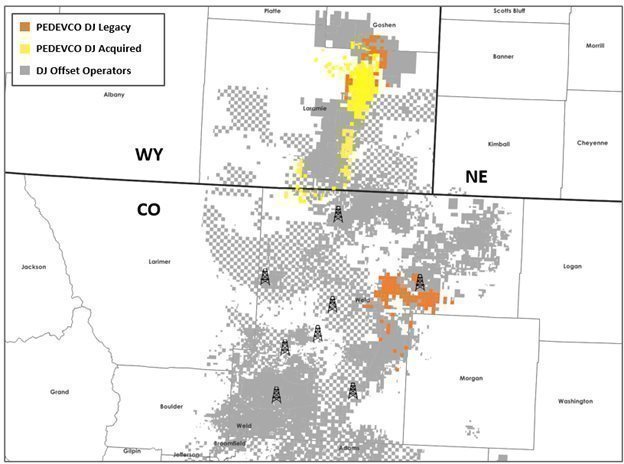
Our D-J Basin Asset was assembled through our legacy operations and expanded significantly through the Mergers which, as discussed above, closed on October 31, 2025. Prior to the Mergers, we had grown our legacy D-J Basin position to approximately 15,853 net acres in Weld and Morgan Counties, Colorado, and approximately 4,823 net acres in Laramie County, Wyoming. Through the Merger, we acquired additional substantial D-J Basin interests held by the Acquired Companies, with 72,022 net acres being located in Laramie County, Wyoming, and an additional 6,863 net acres located in Weld County, Colorado, making Wyoming the location of a majority of our combined D-J Basin net acreage.
As of December 31, 2025, our combined D-J Basin Asset consisted of 99,561 net leasehold acres, of which approximately 22,716 net acres are located in Colorado and approximately 76,845 net acres are located in Wyoming. More than 88% of our net D-J Basin acreage is located on private lands. As of December 31, 2025, approximately 70% of our net D-J Basin acres are held by production (“HBP”), and we hold an average working interest of approximately 92% across our operated net D-J Basin acreage (inclusive of our net royalty acres). Our D-J Basin Asset acreage is located in the areas shown in the map below.
We serve as operator of 74 gross (66.9 net) wells in our D-J Basin Asset, and we participate as a non-operated working interest owner in an additional 110 gross (12.5 net) wells, for a combined total of 184 gross (79.4 net) wells as of December 31, 2025.
The D-J Basin is one of the most prolific oil and natural gas producing basins in the United States, extending from northern Colorado into southeastern Wyoming and western Nebraska. Our operated D-J Basin program is focused primarily on horizontal wells targeting the Codell sandstone formation, a Lower Cretaceous siliceous sandstone that has demonstrated strong well productivity across our operated acreage in southeastern Wyoming. Our non-operated working interest participations are concentrated in horizontal wells targeting the Niobrara formation, which consists of multiple productive carbonate benches commonly referred to as the “A,” “B,” and “C” benches, and which is the primary development target for many of the leading operators active in the D-J Basin. The Wattenberg and Wattenberg Extension areas of northern Colorado and the Wyoming D-J Basin Extension have experienced a sustained and significant increase in horizontal drilling activity since 2018, driven by continued advances in completion design, including extended lateral lengths, increased proppant loading, additional frac stages, and improved stage spacing, that have materially improved well productivity and capital efficiency across both formations.
Wyoming is recognized as one of the most oil and gas operator-friendly regulatory environments in the United States. Our D-J Basin operations in Wyoming are subject to oversight by the Wyoming Oil and Gas Conservation Commission (“WOGCC”), and our Colorado D-J Basin operations are subject to oversight by the Colorado Energy & Carbon Management Commission (“ECMC”). We actively pursue operatorship across our acreage position where our leasehold ownership and surface configuration permit us to do so.
Our D-J Basin acreage is concentrated in areas proximate to leading public and private operators with active and growing Niobrara and Codell development programs. Our non-operated working interest participations benefit from the continued Niobrara-focused horizontal development programs of notable operators including Chevron Corporation (which acquired Noble Energy in October 2020 and PDC Energy in August 2023), SM Energy Company (which merged with Civitas Resources, Inc. in January 2026, with SM Energy as the surviving entity), EOG Resources, Inc., Occidental Petroleum Corporation, Bison Oil & Gas IV, and Peoria Resources, LLC (a U.S. subsidiary of Japan Petroleum Exploration Co., Ltd. (“JAPEX”), which completed the acquisition of Verdad Resources LLC’s operated D-J Basin portfolio in February 2026), among others. Continued development by these offset and partner operators provides ongoing geological delineation and production data that further support our understanding of the economic potential of our acreage across both our operated and non-operated positions.
Our primary operated D-J Basin development program targets the Codell sandstone formation with horizontal wells on our Wyoming acreage, where we serve as operator and control the pace of development. In our non-operated D-J Basin acreage, our strategy is to participate in Niobrara-focused horizontal development projects operated by leading public and private E&P companies that we deem highly economic based on well-level returns and capital efficiency. We are actively enhancing our D-J Basin land position through organic leasing, pooling, acreage swaps, bolt-on acquisitions, and the pursuit of additional operatorship opportunities similar to the recently completed Mergers. Post closing of the Mergers, we implemented a maintenance capital program focused on optimization projects on our producing wells, including well cleanouts, compression optimization, and artificial lift conversions, which we expect to meaningfully lower our lease operating expenses on a per-unit basis. We believe our combined D-J Basin Asset provides significant near-term development opportunities, with hundreds of potential drilling locations across both the Codell and Niobrara formations that are immediately adjacent to our existing producing wells.
Powder River Basin Asset
We hold our Powder River Basin Asset (our “PRB Asset”) through Century Oil & Gas Sub-Holdings, LLC, our wholly-owned subsidiary acquired through the Mergers, with operations conducted through Century Oil & Gas, LLC, Navigation Powder River, LLC, and Pine Haven Resources, LLC. Our PRB Asset was acquired in its entirety through the Mergers and represents a large-scale, multi-horizon resource opportunity in northeastern Wyoming.
Our PRB Asset interests are primarily located in Johnson, Campbell, Converse, Weston, and Niobrara Counties in northeastern Wyoming. As of December 31, 2025, our PRB Asset consisted of 201,886 net leasehold acres. More than 89% of our net PRB acreage is located on federal lands administered by the Bureau of Land Management (“BLM”). As of December 31, 2025, approximately 53,222 of our net PRB acres are held by production, with the remainder held primarily by production payment (suspense) or on primary term. We hold an average working interest of approximately 76% on our operated net PRB acreage (including our net royalty acres). Our PRB Asset acreage is located in the areas shown on the map below.
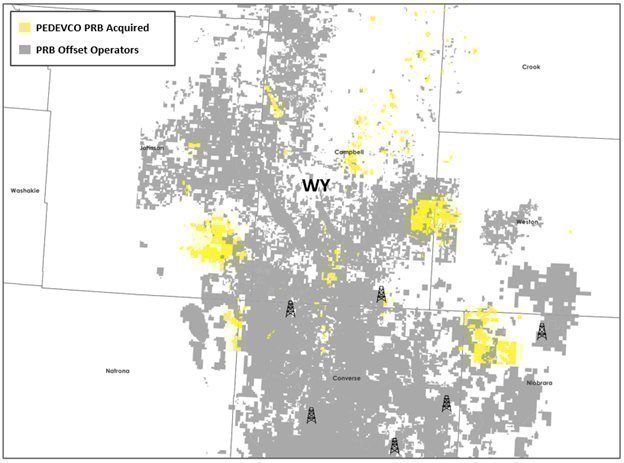
We serve as operator of 140 gross (134.1 net) wells in our PRB Asset, and we participate as a non-operated working interest owner in an additional 16 gross (1.4 net) wells, for a combined total of 156 gross (135.4 net) wells as of December 31, 2025.
The Powder River Basin is one of the most significant sedimentary basins in the Rocky Mountain region, characterized by a thick Cretaceous-age stratigraphic column with numerous stacked pay zones that provide extensive development optionality. Our PRB Asset targets a broad range of productive formations spanning both the Upper and Lower Cretaceous sections. Upper Cretaceous targets include the Teapot, Parkman, Sussex, and Shannon, while Lower Cretaceous and transitional targets include the Niobrara, Turner, Frontier, Mowry, and Muddy formations. We believe that this extensive stacked pay column, spanning thousands of feet, provides significant future development optionality for the Company across a broad range of commodity price environments and capital allocation strategies.
Within our PRB acreage position, we have identified significant multi-formation development potential supported by active offset operator drilling activity across multiple horizons proximate to our acreage. Of particular note are the Parkman, Sussex, Niobrara, Turner, and Mowry formations, each of which has been subject to meaningful offset operator activity in areas adjacent to our acreage, providing ongoing geological and production data that in our opinion further supports the economic potential of these horizons across our position. We believe the breadth of active development across these stacked formations, combined with our concentrated acreage footprint in Johnson, Campbell, Weston, and Niobrara Counties, provides us with a compelling multi-formation development inventory and the flexibility to allocate capital to the highest-return opportunities as the basin continues to mature.
Given that a substantial majority of our PRB acreage is located on federal lands, our PRB operations are subject to regulatory oversight by both the BLM and the WOGCC. We work closely with these agencies with respect to permitting, right-of-way acquisition, development planning, and compliance obligations for our PRB operations. Wyoming’s demonstrated commitment to a stable and predictable regulatory environment for oil and gas development, including permitting timelines and operational flexibility on federal lands, makes our PRB position particularly well-suited for long-term capital allocation.
Historical development activity on our PRB acreage has been focused primarily in the Central area of our position. More recently, both the North and West portions of our PRB acreage have seen a meaningful increase in offset operator activity, particularly in the Niobrara, Turner, Parkman, Sussex, and Mowry formations, which we believe will continue to delineate productivity and further support the economics of future development on our acreage. Notable operators active in the vicinity of our PRB acreage include Anschutz Exploration Corporation, Continental Resources, Inc., Devon Energy Corporation, EOG Resources, Occidental Petroleum Corporation, and various other large private operators, among others.
We believe our large and concentrated PRB acreage position provides us with the potential for years of development optionality and the ability to allocate capital efficiently as commodity markets and offset operator activity continue to evolve. We evaluate future PRB development opportunities on an ongoing basis, with a focus on projects that generate strong risk-adjusted returns.
Permian Basin Asset
We hold our Permian Basin Asset through our wholly-owned subsidiary, PEDCO, with operations conducted through PEDCO’s wholly-owned operating subsidiary, Ridgeway Arizona Oil Corp. (RAZO). Our Permian Basin Asset was assembled through three acquisitions completed between 2018 and 2019. In the first acquisition, we acquired 100% of the assets of Hunter Oil Company, with an effective date of September 1, 2018, which created our core Permian position. In 2019, we acquired additional assets in two bolt-on acquisitions from private operators, and in November 2023 we divested approximately 8,035 gross leasehold acres and related wells in the non-core Milnesand and Sawyer Fields of our Permian Basin Asset to a private operator in order to reduce our asset retirement obligations and plugging and abandoning liabilities with respect to these non-core assets, thereby eliminating approximately $3.2 million in plugging and abandonment liabilities and freeing up our resources to allow us to better focus on development of our other assets. Our current Permian Basin Asset interests are all located in Chaves and Roosevelt Counties, New Mexico, where we currently operate 35 gross (33.5 net) wells, of which 28 wells are active producers, and two are active salt water disposal (“SWD”) wells. As of December 31, 2025, our Permian Basin Asset acreage is located where indicated in the below map of the State of New Mexico and more specifically in the areas shaded in yellow in the subsequent sectional map.
State of New Mexico
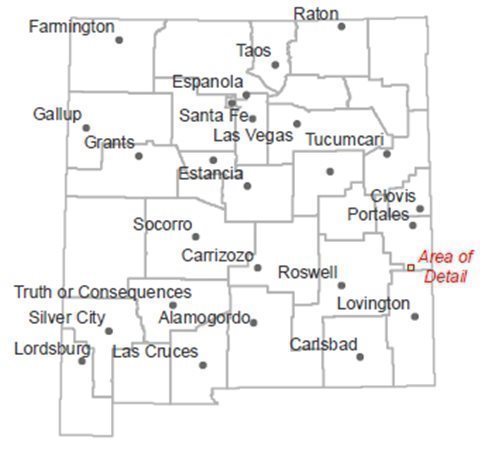
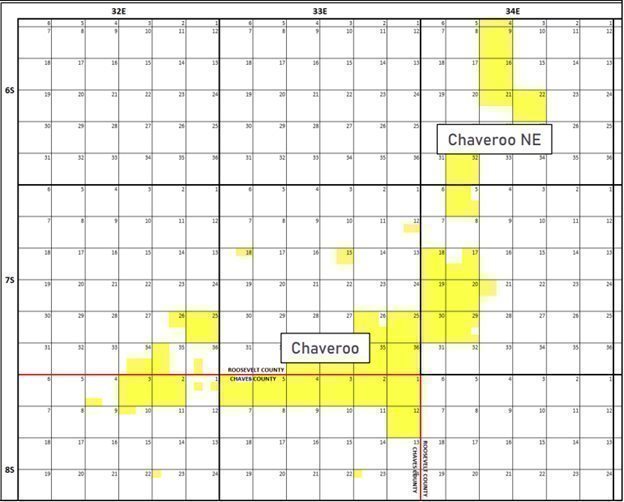
In September 2023, the Company and Evolution Petroleum Corporation (“Evolution”) entered into a Participation Agreement for the joint development of the Chaveroo oilfield in Chaves and Roosevelt Counties, New Mexico. The agreement covers twelve Development Blocks encompassing approximately 16,000 gross leasehold acres, within which the parties may jointly drill up to nine horizontal San Andres wells per block on a 50/50 working interest basis, with the Company serving as operator. Evolution's entry into each successive Development Block is optional, at a cost of approximately $450 per net acre, and either party may independently develop any block the other elects to skip. The agreement continues in effect for so long as the parties proceed with development, and new leases acquired by the Company within certain identified tracts within two years of signing are included as existing leases. To date,Evolution has acquired working interests in five Development Blocks: a 50% interest in approximately 813 net acres in the first and second Development Blocks for $366,000 in September 2023; a 50% interest in approximately 811 net acres in the third, fourth, and fifth Development Blocks for $365,000 in June 2024; and a 50% interest in approximately 640 net acres in the eighth Development Block for $288,000 in September 2025.
In addition, in December 2023, the Company’s operating company, RAZO, entered into a Stipulated Final Order (“SFO”) with the Director of the Oil and Gas Conservation Division of New Mexico (the “OCD”) pursuant to which, among other things, RAZO agreed to reimburse the OCD for actual costs incurred by the OCD for plugging and abandoning approximately 299 inactive legacy wells in the Permian Basin Asset at a rate of $2.00 per gross barrel of oil sold by RAZO during any production reporting period, subject to a minimum payment of $30,000 per month by RAZO. RAZO has been timely paying each reimbursement invoice received from the OCD in accordance with the SFO and is in full compliance with the SFO. The SFO superseded all previous Agreed Compliance Orders, as amended, entered into by and between RAZO and the OCD.
We believe that the Company’s approximately 14,550 net acres within the Chaveroo and Chaveroo NE Fields offer a unique opportunity to drill infill horizontal wells. The Chaveroo NE Field is an extension of the Chaveroo Field that was not originally developed vertically. Our current Permian Basin Asset interests are all located in Chaves and Roosevelt Counties, New Mexico, where we currently operate 35 gross (33.5 net) wells, of which 28 wells are active producers, and two are active SWDs.
Production, Sales Price and Production Costs
We have listed below the total production volumes and total revenue, net to the Company, for the years ended December 31, 2025, 2024, and 2023:
| | 2025 | | | 2024 | | | 2023 | |
| | | | | | | | | |
Total Revenues | | $ | 45,751,000 | | | $ | 39,553,000 | | | $ | 30,784,000 | |
| | | | | | | | | | | | |
Oil: | | | | | | | | | | | | |
Total Production (Bbls) | | | 672,924 | | | | 492,396 | | | | 382,794 | |
Average sales price (per Bbl) | | $ | 59.78 | | | $ | 73.50 | | | $ | 72.95 | |
Natural Gas: | | | | | | | | | | | | |
Total Production (Mcf) | | | 770,919 | | | | 608,382 | | | | 479,533 | |
Average sales price (per Mcf) | | $ | 3.45 | | | $ | 2.00 | | | $ | 3.00 | |
NGL: | | | | | | | | | | | | |
Total Production (Bbls) | | | 108,657 | | | | 78,003 | | | | 58,170 | |
Average sales price (per Bbl) | | $ | 26.30 | | | $ | 27.48 | | | $ | 24.43 | |
Oil Equivalents: | | | | | | | | | | | | |
Total Production (Boe) (1) | | | 910,068 | | | | 671,796 | | | | 520,886 | |
Average Daily Production (Boe/d) | | | 2,494 | | | | 1,835 | | | | 1,427 | |
Average Production Costs (per Boe) (2) | | $ | 11.62 | | | $ | 10.36 | | | $ | 8.98 | |
_________________________
(1) | Assumes 6 Mcf of natural gas equivalents to 1 barrel of oil. |
(2) | Excludes workover costs, marketing, ad valorem, severance taxes and ARO Settlements. |
As of December 31, 2025, the Wattenberg Field and the D-J Wyoming Field in our D-J Basin Asset, and as of December 31, 2024 the Wattenberg Field in our D-J Basin, and as of December 31, 2023, the Chaveroo Field in our Permian Basin Asset and the Wattenberg Field in our D-J Basin Asset are the fields that each comprise 15% or more of our total proved reserves. The applicable production volumes from these fields for the years ended December 31, 2025, 2024, and 2023, are represented in the table below in total barrels (Bbls):
| | 2025* | | | 2024 | | | 2023 | |
Oil (Bbls): | | | | | | | | | |
Chaveroo (Permian Asset Base) | | | - | | | | - | | | | 157,413 | |
Wattenberg (D-J Asset Base) | | | 251,402 | | | | 199,518 | | | | 220,788 | |
D-J Wyoming (D-J Asset Base) | | | 187,005 | | | | - | | | | - | |
Natural Gas (Mcf): | | | | | | | | | | | | |
Chaveroo (Permian Asset Base) | | | - | | | | - | | | | 66,270 | |
Wattenberg (D-J Asset Base) | | | 599,845 | | | | 445,650 | | | | 354,570 | |
D-J Wyoming (D-J Asset Base) | | | 137,880 | | | | - | | | | - | |
NGL (Bbls): | | | | | | | | | | | | |
Chaveroo (Permian Asset Base) | | | - | | | | - | | | | - | |
Wattenberg (D-J Asset Base) | | | 83,856 | | | | 59,842 | | | | 52,013 | |
D-J Wyoming (D-J Asset Base) | | | 22,805 | | | | - | | | | - | |
Total Production (Boe)(1): | | | | | | | | | | | | |
Chaveroo (Permian Asset Base) | | | - | | | | - | | | | 168,458 | |
Wattenberg (D-J Asset Base) | | | 435,103 | | | | 333,635 | | | | 331,896 | |
D-J Wyoming (D-J Asset Base) | | | 232,790 | | | | - | | | | - | |
(1) | Assumes 6 Mcf of natural gas equivalents to 1 barrel of oil. |
The following table summarizes our gross and net developed and undeveloped leasehold acreage at December 31, 2025:
| | Total | | | Developed (1) | | | Undeveloped (2) | |
| | Gross | | | Net | | | Gross | | | Net | | | Gross | | | Net | |
D-J Basin | | | 272,581 | | | | 99,561 | | | | 222,477 | | | | 70,244 | | | | 50,104 | | | | 29,317 | |
Powder River Basin | | | 280,731 | | | | 201,886 | | | | 132,962 | | | | 61,233 | | | | 147,769 | | | | 140,653 | |
Permian Basin | | | 26,240 | | | | 14,105 | | | | 21,760 | | | | 13,785 | | | | 4,980 | | | | 320 | |
Total | | | 580,052 | | | | 315,552 | | | | 377,199 | | | | 145,262 | | | | 202,853 | | | | 170,290 | |
(1) Developed acreage is the number of acres that are allocated or assignable to producing wells or wells capable of production.
(2) Undeveloped acreage is lease acreage on which wells have not been drilled or completed to a point that would permit the production of commercial quantities of oil and natural gas regardless of whether such acreage includes proved reserves.
We believe we have satisfactory title, in all material respects, to substantially all of our producing properties in accordance with standards generally accepted in the oil and natural gas industry.
Total Net Undeveloped Acreage Expiration
In the event that production is not established or we take no action to extend or renew the terms of our leases, our net undeveloped acreage that will expire over the next three years as follows: (i) in the D-J Basin Asset, 16,138 net acres are set to expire during 2026 (net to our direct ownership interest only), with 2,110 and 678 net acres set to expire for the years ending December 31, 2027 and 2028 respectively, and 8,081 net acres thereafter; (ii) in the Permian Basin Asset only 200 net acres are set to expire for the year ending December 31, 2026; and (iii) in the Powder River Basin Asset, 4,822 net acres are set to expire during 2026, with 34,999 and 15,828 net acres set to expire for the years ending December 31, 2027 and 2028, respectively (net to our direct ownership interest only), with all of the remaining acreage currently held by production.
Well Summary
The following table presents our ownership in productive crude oil and natural gas wells at December 31, 2025. This summary includes crude oil wells in which we have a working interest:
| | Gross | | | Net | |
Crude oil | | | 344.0 | | | | 225.4 | |
Natural gas | | | - | | | | - | |
Total* | | | 344.0 | | | | 225.4 | |
* Total percentage of gross operated wells is 66.3%.
Drilling Activity
We drilled wells or participated in the drilling of wells as indicated in the table below:
| | 2025 | | | 2024 | | | 2023 | |
| | Gross | | | Net | | | Gross | | | Net | | | Gross | | | Net | |
Development | | | | | | | | | | | | | | | | | | |
Productive | | | 36 | | | | 8.5 | | | | 27 | | | | 5.1 | | | | 8 | | | | 0.4 | |
Dry | | | - | | | | - | | | | - | | | | - | | | | - | | | | - | |
Exploratory | | | | | | | | | | | | | | | | | | | | | | | | |
Productive | | | - | | | | - | | | | - | | | | - | | | | - | | | | - | |
Dry | | | - | | | | - | | | | - | | | | - | | | | - | | | | - | |
The following table sets forth information about wells for which drilling was in progress or which were drilled but uncompleted at December 31, 2025, which are not included in the above table:
| | Drilling In Progress | | | Drilled But Uncompleted | |
| | Gross | | | Net | | | Gross | | | Net | |
Development wells | | | - | | | | - | | | | 11 | | | | 1.2 | |
Exploratory wells | | | - | | | | - | | | | - | | | | - | |
Total | | | - | | | | - | | | | 11 | | | | 1.2 | |
Oil and Natural Gas Reserves
Reserve Information. For estimates of the Company’s net proved producing reserves of crude oil and natural gas, as well as discussion of the Company’s proved and probable undeveloped reserves, see “Part II” - “Item 8 Financial Statements and Supplementary Data” – “Supplemental Oil and Gas Disclosures (Unaudited)”. At December 31, 2025, the Company’s total estimated proved reserves were 32.1 million Boe, of which 27.3 million Bbls were crude oil and NGL reserves, and 28.8 million Mcf were natural gas reserves.
Internal Controls. Arvind Krishna, our Director of Development and Reservoir Engineering (a non-executive position), is the technical person primarily responsible for our internal reserves estimation process (which is based upon the best available production, engineering and geologic data) and has in excess of five years as a reserves estimator and provides oversight of the annual audit of our year end reserves by our independent third party engineers. He has a Master of Science degree in Petroleum Engineering from The University of Texas at Austin and an MBA from Rice University.
The preparation of our reserve estimates is in accordance with our prescribed procedures that include verification of input data into reserve forecasting and economic software, as well as management review. Our reserve analysis includes, but is not limited to, the following:
| · | Research of operators near our lease acreage. Review operating and technological techniques, as well as reserve projections of such wells. |
| · | The review of internal reserve estimates by well and by area by a qualified petroleum engineer. A variance by well to the previous year-end reserve report is used as a tool in this process. |
| · | SEC-compliant internal policies to determine and report proved reserves. |
| · | The discussion of any material reserve variances among management to ensure the best estimate of remaining reserves. |
Qualifications of Third-Party Engineers. The technical person primarily responsible for the audit of our reserves estimates at Cawley, Gillespie & Associates, Inc. is W. Todd Brooker, who meets the requirements regarding qualifications, independence, objectivity, and confidentiality set forth in the Standards Pertaining to the Estimating and Auditing of Oil and Gas Reserves Information promulgated by the Society of Petroleum Engineers. Cawley, Gillespie & Associates, Inc. is an independent firm and does not own an interest in our properties and is not employed on a contingent fee basis. Reserve estimates are imprecise and subjective and may change at any time as additional information becomes available. Furthermore, estimates of oil and gas reserves are projections based on engineering data. There are uncertainties inherent in the interpretation of this data as well as the projection of future rates of production. The accuracy of any reserve estimate is a function of the quality of available data and of engineering and geological interpretation and judgment. A copy of the report issued by Cawley, Gillespie & Associates, Inc. is incorporated by reference as Exhibit 99.1 to this Report.
For more information regarding our oil and gas reserves, please refer to “Item 8 Financial Statements and Supplementary Data” – “Supplemental Oil and Gas Disclosures (Unaudited)”.
Current Year Events
Merger Agreement
On October 31, 2025, the Company closed the transactions contemplated by an Agreement and Plan of Merger dated October 31, 2025, by and among the Company; NP Merger Sub, LLC and COG Merger Sub, LLC, each a wholly owned subsidiary of the Company; NPOG; COG; and, solely for specified purposes therein, North Peak Oil & Gas Holdings, LLC.
Pursuant to the Merger Agreement, (i) NP Merger Sub, LLC merged with and into NPOG, with NPOG surviving as a wholly owned subsidiary of the Company, and (ii) COG Merger Sub, LLC merged with and into COG, with COG surviving as a wholly owned subsidiary of the Company.
Highlights of the Company following the Mergers:
| · | The Mergers position the Company as a premier publicly traded Rockies-focused operator with an expanded footprint of approximately 320,000 net acres across the D-J Basin and the PRB. The transaction significantly increases the Company’s oil-weighted production and enhances its scale in these core operating areas. |
| | |
| · | The Company generates strong cash flow supported by its relatively high oil production mix and competitive cost structure. Its substantial acreage position in the D-J Basin and Powder River Basin, which includes multiple productive formations, provides more than a decade of identified drilling inventory based on current development plans. |
| | |
| · | The Company maintains a low-cost operating profile characterized by disciplined general and administrative expenses and a conservative capital structure, which management expects to preserve going forward. |
| | |
| · | The Company believes that it is positioned for organic production growth, with 32 wells (with varying working interests) recently completed in the fourth quarter of 2025 and early first quarter of 2026. These wells are expected to drive near-term production increases. In addition, the Company intends to pursue strategic consolidation opportunities within its core areas of focus, targeting acquisitions that are expected to be accretive and generate operational synergies, while maintaining balance sheet strength. |
Drilling and Completion, Leasing, and Mineral Lease Acquisition Activities
For the year ended December 31, 2025, the Company incurred $239.2 million of capital additions of which $204.6 million were related to the Mergers (noted above) and $34.0 million of capital costs were primarily related to the Company’s completion operations with respect to four operated wells, drilled and completed with a third-party, as well as five lift conversions in the Permian Basin. The Company also participated in the drilling and completion of 23 non-operated wells in the D-J Basin for which production had begun in late 2025, with the Company working interest holdings in these wells ranging from 8% to 44%.
Additionally, the Company acquired approximately 100 net mineral acres and 310 net lease acres in and around its existing footprint in the D-J Basin through multiple transactions at total acquisition and due diligence costs of $194,000 and $420,000, respectively.
Amended and Restated A&R Credit Agreement
On October 31, 2025, the Company entered into an Amended and Restated Credit Agreement, which amended and restated its prior senior secured revolving credit agreement dated September 11, 2024, with Citibank, N.A., as administrative agent, and the lenders party thereto. The A&R Credit Agreement matures on October 31, 2029 and provides for an initial borrowing base and elected commitments of $120 million, with a maximum revolving commitment of $250 million. The borrowing base is subject to scheduled semiannual redeterminations beginning December 1, 2025, as well as unscheduled redeterminations and other adjustments, and is determined by the lenders in their discretion. Borrowings are subject to customary conditions, including compliance with financial covenants. The A&R Credit Agreement includes customary representations and warranties for a facility of that size and type, including prohibiting the Loan Parties from creating any indebtedness without the consent of the lenders, subject to certain exceptions. In connection with the closing of the Mergers, the Company borrowed $87 million under the A&R Credit Agreement, with additional borrowings of $6 million on January 8, 2026 and $5 million on February 5, 2026.
Issuance and Automatic Conversion of Series A Convertible Preferred Stock
As part of the Mergers (noted above), the Company issued Series A Convertible Preferred Stock in two transactions. First, 10,650,000 shares of Series A Convertible Preferred Stock were issued to Century Oil and Gas Holdings, LLC and North Peak in exchange for their interests in the Acquired Companies. Second, 6,363,637 shares of Series A Convertible Preferred Stock were sold to the PIPE Investors at $5.50 per share ($11.00 per share on a post-reverse stock split basis), raising $35.0 million in net proceeds, which were used to pay for certain liabilities and transaction expenses in the Mergers (noted above).
All shares of Series A Convertible Preferred Stock were convertible into common stock at a 0.5-to-1 ratio. A total of 17,013,637 shares of Series A Convertible Preferred Stock were issued and outstanding as of December 31, 2025. On February 27, 2026, all shares of Series A Convertible Preferred Stock automatically converted into 8,506,818 shares common stock of the Company.
Shareholder Agreement
At the closing of the Mergers, the Company entered into a Shareholder Agreement with Century and North Peak (together, the “Juniper Shareholder”), and, for certain limited provisions, Dr. Simon G. Kukes, the then Executive Chairman of the Company and The SGK 2018 Revocable Trust (a trust which Dr. Kukes serves as trustee and beneficiary of). The agreement granted the Juniper Shareholder board nomination rights from the closing of the Mergers until the Automatic Conversion Date, including the ability to designate one board nominee and one non-voting observer. The agreement also provides that, following the Automatic Conversion Date, the Board will consist of six directors, with Juniper’s nominees determined by its ownership percentage of shares of the Company’s common stock on the Automatic Conversion Date. Specifically, the right of the Juniper Shareholder to nominate Juniper Directors pursuant to the Shareholder Agreement will depend on its, together with its affiliates’, ownership of 3,181,818 shares of Company common stock issued to the Juniper Shareholder and its affiliates on February 27, 2026, on the applicable date of determination, as measured relative to a total of 13,300,815 shares of common stock issued and outstanding on February 27, 2026 (“Juniper Beneficial Ownership”), as follows: if Juniper Beneficial Ownership is 50% or more, the Juniper Shareholder may nominate three Juniper Directors, including one which must be an independent director; if Juniper Beneficial Ownership is between 30% and 49.9%, the Juniper Shareholder may nominate two Juniper Directors; if Juniper Beneficial Ownership is between 10% and 29.9%, the Juniper Shareholder may nominate one Juniper Director; and if Juniper Beneficial Ownership is less than 10%, the Juniper Shareholder loses the right to nominate any Juniper Directors.
The Juniper Shareholder also retains the right to remove or replace its directors, subject to Board approval and suitability requirements under SEC and NYSE standards. At least one Juniper Shareholder director will serve on each Board committee (except the audit committee), and will chair the Compensation and Governance Committees, subject to limited exceptions.
The Shareholder Agreement also grants the shareholders registration rights, requiring the Company to use commercially reasonable efforts to file a registration statement covering the resale of the shares of common stock issuable upon conversion of the Series A Preferred Stock within 45 days of the Automatic Conversion Date, using Form S-3 or Form S-1 if necessary. Shareholders may request underwritten offerings of at least $10 million, subject to customary agreements and underwriter approval, with limits on frequency and “grace periods” for delays. Piggyback registration rights allow participation in offerings by the Company or other holders, subject to underwriter and priority rules. The Company will pay related expenses and indemnify shareholders against certain Securities Act of 1933, as amended liabilities. The Shareholder Agreement became effective at the Closing and will terminate according to its terms.
The “Shareholder Agreement” is discussed in greater detail below under “Item 10. Directors, Executive Officers and Corporate Governance—Shareholder Agreement”.
On February 27, 2026 (the Automatic Conversion Date), the Board, with the recommendation of the Nominating and Corporate Governance Committee of the Board, and at the request of the Juniper Shareholder, pursuant to the terms of the Shareholder Agreement (discussed above), increased the number of members of the Board from five (5) to six (6), and appointed Mr. Edward Geiser as a member of the Board and as Chairperson of the Nominating and Corporate Governance Committee of the Board of Directors, to serve until his successor has been duly elected and qualified, or until his earlier death, resignation or removal.
Also effective on February 27, 2026, director Josh Schmidt was appointed as Chairman of the Board of the Company.
Reverse Stock Split
Effective March 13, 2026, the Company effected the 1-for-20 Reverse Stock Split discussed above under “Reverse Stock Split” and as a result of the Reverse Stock Split, every twenty (20) shares of issued and outstanding common stock were automatically combined into one (1) share of common stock. No fractional shares were issued in connection with the Reverse Stock Split. Instead, each holder of common stock received a cash payment in lieu thereof at a price equal to the fraction of one share to which the stockholder would otherwise be entitled multiplied by the closing price per share of common stock on the NYSE American on the trading day immediately prior to the effective time of the Reverse Stock Split. All share amounts, per-share data, earnings (loss) per share, and weighted-average shares outstanding presented in the accompanying consolidated financial statements and related notes have been retroactively adjusted to reflect the Reverse Stock Split for all periods presented.
Regulation of the Oil and Gas Industry
Crude oil and natural gas production operations are subject to various types of regulation, including regulation by federal and state agencies.
Federal legislation affecting the oil and gas industry is under constant review for amendment or expansion. In addition, numerous departments and agencies, both federal and state, are authorized by statute to issue, and have issued, rules and regulations applicable to the oil and gas industry. Such rules and regulations, among other things, require permits for the drilling of wells, regulate the spacing of wells, prevent the waste of natural gas through restrictions on flaring, require surety bonds for various exploration and production operations and regulate the calculation and disbursement of royalty payments (for federal and state leases), production taxes and ad valorem taxes.
A portion of our oil and gas leases are granted by the federal government and administered by the BLM. Operations conducted by the Company on federal oil and gas leases must comply with numerous additional statutory and regulatory restrictions and, in the case of leases relating to tribal lands, certain tribal environmental and permitting requirements and employment rights regulations. In addition, the U.S. Department of the Interior (through its agencies, including the BLM and the Office of Natural Resources Revenue) has certain authority over our calculation and payment of royalties, bonuses, fines, penalties, assessments and other revenues related to our federal and tribal oil and gas leases. In addition, the Inflation Reduction Act of 2022 (the “IRA”) requires that all leases granted and administered by the BLM and entered into on or after August 16, 2022, include a royalty rate of 16.67% in respect of the associated oil and gas production. In addition, in 2022, two environmental advocacy groups filed suit against the U.S. Department of Interior and the BLM challenging certain lease sales by the BLM beginning in December of 2017. On January 17, 2025, a three-judge panel of the Ninth Circuit Court of Appeals upheld vacatur of various leases sold by the BLM, on grounds that the BLM violated the National Environmental Policy Act (“NEPA”) and the Federal Land Planning and Management Act when selling certain leases. It remains unclear whether parties involved in the BLM Litigation will seek en banc review of the decision. While the Company is not named in the BLM Litigation (as defendants, intervenors or otherwise), certain of the leases owned by the Company in the PRB have been “placed in suspense” pending a ruling by the Ninth Circuit Court of Appeals in the BLM Litigation. It is possible that the Ninth Circuit Court of Appeals ruling could result in the cancellation of these leases.
Operations conducted by the Company are also subject to the NEPA which requires federal agencies, including the BLM, to evaluate major agency actions having the potential to significantly impact the environment. In the course of such evaluations, an agency will prepare an environmental assessment that pertains to the potential direct, indirect and cumulative impacts of a proposed project and, if necessary, will prepare a more detailed Environmental Impact Statement that may be made available for public review and comment. Certain of the Company’s exploration, development and production activities include leasing of federal mineral interests, which will require the acquisition of governmental permits or authorizations that are subject to the procedural requirements of NEPA. This process has the potential to delay or limit, or increase the cost of, the development of oil and natural gas projects. Authorizations under NEPA are also subject to protest, appeal or litigation, any or all of which may delay or halt projects. Moreover, depending on the mitigation strategies recommended in environmental assessments or Environmental Impact Statements, we could incur added costs, which may be substantial. For example, as part of the BLM Litigation, on September 13, 2024, the U.S. District Court for the District of Columbia issued a ruling temporarily enjoining further applications for permits to drill (“APDs”) with respect to the certain of the Company’s BLM leases, citing erroneous data that overstated the amount of available groundwater in the Project’s Environmental Impact Statement. This ruling had the effect of halting federal APD approvals within the Project area until the court “determines the appropriate final remedy” to correct the deficiency being alleged in the case. It is possible that the BLM’s review and ultimate approval of our APDs could be impacted by this federal court ruling and could result in the cancellation of these leases. However, in January 2025, President Trump issued an executive order requiring the Council on Environmental Quality (“CEQ”) to provide guidance on implementing NEPA and to propose rescinding and replacing CEQ’s NEPA regulations with implementing regulations at the agency level. The executive order also instructs federal agencies to adhere to only the relevant legislated requirements for environmental reviews and to prioritize efficiency and certainty over any other objectives in such reviews. The potential impact of further changes to the NEPA regulations and statutory text therefore remains uncertain and could have an effect on our operations and our ability to obtain governmental permits.
BLM leases contain relatively standardized terms requiring compliance with detailed regulations. Under certain circumstances, the BLM may require operations on federal leases to be suspended or terminated. Any such suspension or termination could materially and adversely affect our interests on federal lands. From time to time, the U.S. Department of the Interior has also considered limiting or pausing new oil and natural gas leases on federal lands. Any limitation or ban on permitting for oil and gas exploration and production activities on federal lands could have a material and adverse effect on our operations, financial condition and results of operations.
The transportation and sale for resale of natural gas in interstate commerce are regulated pursuant to the Natural Gas Act of 1938, as amended (the “NGA”), and the Natural Gas Policy Act of 1978. These statutes are administered by the Federal Energy Regulatory Commission (“FERC”). Effective January 1993, the Natural Gas Wellhead Decontrol Act of 1989 deregulated natural gas prices for all “first sales” of natural gas, which includes all sales by the Company of its own production. All other sales of natural gas, such as those of natural gas purchased from third parties, remain jurisdictional sales subject to a blanket sales certificate under the NGA, which has flexible terms and conditions. Consequently, all of our sales of natural gas may currently be made at unregulated market prices, subject to applicable contract provisions. Jurisdictional sales, however, may be subject in the future to greater federal oversight, including the possibility that the FERC might prospectively impose more restrictive conditions on such sales. Conversely, sales of crude oil and NGLs by the Company are made at unregulated market prices.
Proposals and proceedings that might affect the oil and gas industry are considered from time to time by Congress, the state legislatures, the FERC and other federal, state and local regulatory commissions, agencies, councils and courts. We cannot predict when or whether any such proposals or proceedings may become effective. It should also be noted that the oil and gas industry historically has been very heavily regulated; therefore, there is no assurance that the approach currently being followed by such legislative bodies and regulatory commissions, agencies, councils and courts will remain unchanged.
At the state level, our operations in Colorado are regulated by the ECMC (formerly the Colorado Oil & Gas Conservation Commission (“COGCC”)), our operations in Wyoming are regulated by the Wyoming Oil and Gas Conservation Commission (“WOGCC”), and our New Mexico operations are regulated by the Conservation Division of the New Mexico Energy, Minerals, and Natural Resources Department (regulates oil and gas operations), New Mexico Environment Department (administers environmental protection laws), and the New Mexico State Land Office (oversees surface and mineral acres and development). The Oil Conservation Division of the New Mexico Energy, Minerals, Natural Resources Department (“EMNRD”), and New Mexico State Land Office require the posting of financial assurance for owners and operators on privately owned or state land within New Mexico in order to provide for abandonment restoration and remediation of wells, and for the drilling of salt water disposal wells.
Environmental Regulation Generally
We are subject to various federal, state and local laws and regulations covering the discharge or release of materials into the environment or otherwise relating to the protection of the environment. These laws and regulations affect our operations and costs as a result of their effect on crude oil and natural gas exploration, development and production operations and related activities (e.g., carbon capture and storage). Failure to comply with these laws and regulations may result in the assessment of administrative, civil and criminal penalties, including the assessment of monetary penalties, criminal prosecution, the imposition of investigatory and remedial obligations, the suspension or revocation of necessary permits, licenses and authorizations, the requirement that additional pollution controls be installed and the issuance of orders enjoining future operations or imposing additional compliance requirements.
In addition, we have acquired certain oil and gas properties from third parties whose actions with respect to the management and disposal or release of hydrocarbons or other wastes were not under our control. Under environmental laws and regulations, we could be required to remove or remediate wastes disposed of or released by prior owners or operators. We also could incur costs related to the clean-up of third-party sites to which we sent regulated substances for disposal or to which we sent equipment for cleaning, and for damages to natural resources or other claims related to releases of regulated substances at such third-party sites. In addition, we could be responsible under environmental laws and regulations for oil and gas properties in which we previously owned or currently own an interest but were or are not currently the operator. Moreover, we are currently subject to certain reporting requirements promulgated by U.S. Environmental Protection Agency’s (the “EPA”) regarding, among other things, GHG emissions and other fugitive emissions. And, as discussed further below, we are also subject to federal, state and local laws and regulations regarding hydraulic fracturing and other aspects of our operations.
Compliance with environmental laws and regulations increases our overall cost of business, but has not had, to date, a material adverse effect on our operations, financial condition, results of operations or capital expenditures (for environmental control facilities or otherwise). In addition, it is not anticipated, based on current laws and regulations, that we will be required in the near future to expend amounts (whether for environmental control facilities or otherwise) that are material in relation to our total exploration and development expenditure program in order to comply with such laws and regulations. However, we are unable to predict (i) the timing, scope and effect of any currently proposed or future laws or regulations regarding the environment and (ii) the ultimate cost of compliance or the ultimate effect on our operations, financial condition, results of operations and capital expenditures relating to such future laws and regulations. The direct and indirect cost of such laws and regulations (if enacted) could materially and adversely affect our operations, financial condition, results of operations and capital expenditures. However, in January 2025, President Trump issued an executive order directing the heads of all federal agencies to identify and begin the processes to suspend, revise, or rescind all agency actions that are unduly burdensome on the identification, development, or use of domestic energy resources. Accordingly, future implementation and enforcement of certain environmental laws or regulations are uncertain at this time.
Climate Change Regulations
Local, state, federal and international regulatory bodies have been increasingly focused on GHG emissions and climate change issues in recent years. Congress has, from time to time, proposed legislation for imposing restrictions on, or requiring fees or carbon taxes in respect of, GHG emissions. Further, the IRA imposes a methane emissions charge on certain oil and gas facilities, including petroleum and natural gas production facilities that exceed certain emissions thresholds. The charge will be levied annually based on emissions reported under the EPA’s GHG reporting program. In November 2024, the EPA finalized a regulation to implement the IRA’s Waste Emissions Charge, which became effective on January 1, 2025. The fee imposed under the Methane Emissions Reduction Program for 2024 is $900 per ton emitted over annual methane emissions thresholds, and increases to $1,200 in 2025, and $1,500 in 2026. In January 2025, industry associations challenged the Waste Emissions Charge rule in the D.C. Circuit Court of Appeals. Also in January 2025, President Trump issued an executive order directing the heads of all federal agencies to identify and begin the processes to suspend, revise or rescind all agency actions that are unduly burdensome on the identification, development or use of domestic energy resources. In late February 2025, the newly seated Congress successfully passed a joint resolution (H.J. Res. 35) using the Congressional Review Act (CRA) to officially disapprove of the EPA’s November 2024 rule implementing the methane fee and President Trump signed this resolution into law in March 2025, effectively nullifying the previously adopted Methane Emissions Reduction Program. In addition, based on the timing of the rule's finalization and statements from congressional Republicans, the waste emissions charge rule is potentially vulnerable to repeal by Congress under the Congressional Review Act, and the IRA may also be subject to amendment or repeal through Congressional budget reconciliation. Consequently, future implementation and enforcement of these rules remains uncertain at this time.
The EPA has adopted regulations for certain large sources regulating GHG emissions as pollutants under the federal Clean Air Act. Further, the EPA, in May 2016, issued regulations that require operators to reduce methane emissions and emissions of volatile organic compounds (“VOC”) from new, modified and reconstructed crude oil and natural gas wells and equipment located at natural gas production gathering and booster stations, gas processing plants and natural gas transmission compressor stations. In November 2021, the EPA proposed a rule to further reduce methane and VOC emissions from new and existing sources in the oil and natural gas sector, and, in November 2022, the EPA issued a supplemental proposal to expand its November 2021 proposed rule, including proposed regulation of additional sources of methane and VOC emissions, such as abandoned and unplugged wells. The EPA issued the final new source performance standards and emissions guidelines for new and existing oil and gas facilities in December 2023, and although in effect, the final rule is subject to ongoing litigation. Furthermore, in January 2025, President Trump issued an executive order directing the heads of all federal agencies to identify and begin the processes to suspend, revise, or rescind all agency actions that are unduly burdensome on the identification, development, or use of domestic energy resources.
In 2019, Colorado enacted Senate Bill 19-181 (“SB 19-181”), which requires, among other things, that the Air Quality Control Commission (“AQCC”) adopt additional rules to minimize emissions of methane and other hydrocarbons and nitrogen oxides from the entire oil and gas fuel cycle. The AQCC has undertaken a multi-year rulemaking process to implement the requirements of SB 19-181, including a rulemaking to require continuous emission monitoring equipment at oil and gas facilities. Between December 2019 and December 2020, the AQCC completed several rulemakings as a result of SB 19-181, adopting significant additional and new emission control requirements applicable to oil and gas operations, including, for example, hydrocarbon liquids unloading control requirements, increased LDAR frequencies for facilities in certain proximity to occupied areas, and emission control requirements for certain large natural gas fired engines. The AQCC conducted an additional rulemaking in December 2021 related to SB 19-181, which is discussed in further detail below.
State-level rules applicable to our operations include regulations imposed by the Colorado Department of Public Health and Environment’s (“CDPHE”) Air Quality Control Commission, including stringent requirements relating to monitoring, recordkeeping and reporting matters. In 2020, the ECMC relied in part on a previously-performed human health risk assessment in adopting new siting requirements. The new requirements prohibit the siting of locations within 2,000 feet of a school facility or child-care center. A similar 2,000-foot setback requirement applies to residential and high occupancy building units, but there are “off ramps” allowing oil and gas operators to site their drill pads as close as 500 feet from building units in certain circumstances. The ECMC also generally prohibited the venting or flaring of natural gas during drilling, completion, and production operations.
In addition, on August 30, 2022, environmental groups filed a petition for rulemaking with the ECMC, petitioning the ECMC to adopt new rules to evaluate and address the cumulative air impacts of oil and gas development in Colorado. The petition proposes to address the cumulative air impacts of oil and gas development by effectively prohibiting any oil and gas project located in an area where the air quality exceeds, or may exceed, applicable air quality standards. In effect, the petition for rulemaking calls for a blanket prohibition on oil and gas development in much of Colorado. The COGCC (now ECMC) denied the petition; however, the COGCC (now the ECMC) initiated a cumulative impacts stakeholder process to determine how best to address cumulative impacts going forward, which may include additional regulations.
Since 2022, the ECMC has introduced regulatory measures impacting the oil and gas industry, including: (i) in August 2024, the ECMC proposed regulations aimed at assessing and mitigating the cumulative effects of oil and gas operations, particularly in communities disproportionately impacted by environmental burdens, which rules are now in place as of December 15, 2024; and (ii) in April 2022, the ECMC implemented new financial assurance rules mandating that oil and gas operators provide adequate funds to cover well plugging and site reclamation.
AQCC rulemakings are intended to further Colorado’s legislative directive to reduce carbon dioxide, methane and other greenhouse gases (“GHGs”) emissions to attain climate action goals. AQCC is expected to undertake several rulemaking efforts to further reduce emissions in the next several years. For example, in October 2023, the AQCC adopted the Greenhouse Gas Emissions and Energy Management for Manufacturing Phase 2 rule, which requires 18 of Colorado’s highest emitting manufacturers in the industrial sector (which includes energy use in the oil and gas industry) to collectively reduce their GHG levels by 20% by 2030, as compared to 2015 levels.
In 2021, the State of New Mexico Energy, Minerals and Natural Resources Department (“ENMRD”) enacted rule changes aimed at mitigating volumes of flared and vented natural gas. Commencing April 1, 2022, operators are required to reduce the annual volume of vented and flared natural gas in order to capture no less than ninety-eight percent of the natural gas produced from all wells by December 31, 2026 (New Mexico Administrative Code Section 19.15.27.9). This rule change is accompanied by additional reporting requirements for all flared and vented gas. We expect to meet or exceed the required gas capture requirements in accordance with this rule change.
In addition, the New Mexico state legislature is considering a bill that would increase fines and fees on oil and gas operators and codify New Mexico’s 98% methane capture rule, which the New Mexico Energy, Minerals and Natural Resources Department (“NMOCD”) enacted in 2021. Under the methane capture rule, oil and gas operators are required to capture 98% of their produced natural gas by December 31, 2026, and routine venting and flaring is prohibited. In addition, the NMOCD adopted a rule in August 2022 that requires oil and natural gas producers in counties that are at risk of non-attainment of federal ozone standards to, among other things, check emission rates and have those calculations certified by a qualified engineer, perform enhanced checks for leaks, repair those leaks within 15 days of discovery, and maintain records to demonstrate continuous compliance.
At the international level, the U.S., in December 2015, participated in the 21st Conference of the Parties of the United Nations Framework Convention on Climate Change in Paris, France. The Paris Agreement, which was adopted at the conference and went into effect in November 2016, calls for nations to undertake efforts with respect to global temperatures and set GHG emissions reduction goals every 5 years beginning in 2020. In February 2021, the Biden Administration announced reentry of the U.S. into the Paris Agreement along with a new “nationally determined contribution” for U.S. GHG emissions that would achieve emissions reductions of at least 50% relative to 2005 levels by 2030. Pursuant to its obligations as a signatory to the Paris Agreement, the United States set a target to reduce its GHG emissions by 50-52% by the year 2030 as compared with 2005 levels. In addition, in 2021, the Biden Administration publicly announced the Global Methane Pledge, a pact that aims to reduce global methane emissions at least 30% below 2020 levels by 2030, including “all feasible reductions” in the energy sector. Since its formal launch at the United Nations Framework Convention on Climate Change 26th Conference of the Parties (“COP26”), over 150 countries have joined the pledge. COP26 concluded with the finalization of the Glasgow Climate Pact (the “Glasgow Pact”), which stated long-term global goals (including those in the Paris Agreement) to limit the increase in the global average temperature and emphasized reductions in GHG emissions. At the 27th Conference of the Parties, the United States agreed, in conjunction with the European Union and a number of other partner countries, to develop standards for monitoring and reporting methane emissions to help create a market for low methane-intensity natural gas. In December 2023 at the 28th Conference of the Parties, nearly 200 countries entered into an agreement that calls for actions towards achieving, at a global scale, a tripling of renewable energy capacity and doubling energy efficiency improvements by 2030. The goals of the agreement, among other things, are to contribute to the transition away from fossil fuels, reduce methane emissions and increase renewable energy capacity, among other things, in order to achieve global net zero emissions by 2050. Most recently, at the 29th Conference of the Parties (“COP29”), delegates approved rules to operationalize international carbon markets under Article 6 of the Paris Agreement, including a new Paris Agreement Crediting Mechanism to trade UN-approved carbon credits. Additionally, participants at COP29 representing 159 countries met to review progress toward the goals of the Global Methane Pledge and the addition of nearly $500 million in new grant funding for methane abatement. On January 20th, 2025, the Trump Administration announced its intention to withdraw from the Paris Agreement and all other agreements made under the United Nations Framework Convention on Climate Change. The full impact of these actions remains unclear at this time. However, various state and local governments in the U.S. have publicly committed to furthering the goals of the Paris Agreement and many of these initiatives are expected to continue.
We are unable to predict the timing, scope and effect of any currently proposed or future investigations, laws, regulations, treaties or policies regarding climate change and GHG emissions (including any laws and regulations that may be enacted in the U.S.), but the direct and indirect costs of such investigations, laws, regulations, treaties or policies (if enacted, issued or applied) could materially and adversely affect our operations, financial condition, results of operations and capital expenditures.
Regulation of Hydraulic Fracturing and Other Operations
Hydraulic fracturing technology, which has been used by the oil and gas industry for more than 60 years and continues to evolve, enables us to produce crude oil and natural gas that otherwise would not be recovered. While hydraulic fracturing has historically been regulated by state oil and natural gas commissions, the practice has become increasingly controversial in certain parts of the country, resulting in increased scrutiny and regulation. For example, the EPA’s wastewater pretreatment standards prohibit onshore unconventional oil and natural gas extraction facilities from sending wastewater to publicly-owned treatment works. This restriction of disposal options for hydraulic fracturing waste and other changes to environmental requirements may result in increased costs.
In addition to the above-described federal regulations, some state and local governments have imposed, or have considered imposing, various conditions and restrictions on drilling and completion operations, including requirements regarding casing and cementing of wells, testing of nearby water wells, restrictions on access to, and usage of, water, disclosure of the chemical additives used in hydraulic fracturing operations, restrictions on the type of chemical additives that may be used in hydraulic fracturing operations and restrictions on drilling or injection activities on certain lands lying within wilderness wetlands, ecologically or seismically sensitive areas and other protected areas. Such federal, state and local permitting and disclosure requirements, operating restrictions, conditions or prohibitions could lead to operational delays and increased operating and compliance costs and, moreover, could delay or effectively prevent the development of crude oil and natural gas from formations which would not be economically viable without the use of hydraulic fracturing.
Compliance with laws and regulations relating to hydraulic fracturing and other aspects of our operations increases our overall cost of business, but has not had, to date, a material adverse effect on our operations, financial condition, results of operations or capital expenditures. In addition, it is not anticipated, based on current laws and regulations, that we will be required in the near future to expend amounts that are material in relation to our total exploration and development expenditure program in order to comply with such laws and regulations. However, we are unable to predict (i) the timing, scope and effect of any currently proposed or future laws or regulations regarding hydraulic fracturing in the U.S. or other aspects of our operations; and (ii) the ultimate cost of compliance or the ultimate effect on our operations, financial condition, results of operations and capital expenditures relating to such future laws and regulations. The direct and indirect costs of such laws and regulations (if enacted) could materially and adversely affect our operations, financial condition, results of operations and capital expenditures.
Other State Laws
At the state level, Colorado, where we conduct significant operations, is among the states that has adopted, and other states are considering adopting, regulations that could impose new or more stringent permitting, disclosure or well-construction requirements on hydraulic fracturing operations. Moreover, states could elect to prohibit high volume hydraulic fracturing altogether, following the approach taken by the State of New York in 2015. Also, certain interest groups in Colorado opposed to oil and natural gas development generally, and hydraulic fracturing in particular, have from time-to-time advanced various options for ballot initiatives that, if approved, would allow revisions to the state constitution in a manner that would make such exploration and production activities in the state more difficult in the future. However, during the November 2016 voting process, one proposed amendment placed on the Colorado state ballot making it relatively more difficult to place an initiative on the state ballot was passed by the voters. As a result, there are more stringent procedures now in place for placing an initiative on a state ballot. In addition to state laws, local land use restrictions may restrict drilling or the hydraulic fracturing process and cities may adopt local ordinances allowing hydraulic fracturing activities within their jurisdictions but regulating the time, place and manner of those activities.
For example, on November 6, 2018, registered voters in the State of Colorado cast their ballots and rejected Proposition 112 (“Prop. 112”), with 55% of ballots cast against the measure. Prop. 112 would have created a rigid 2,500-foot setback from oil and gas facilities to the nearest occupied structure and other “vulnerable areas,” which included parks, ball fields, open space, streams, lakes and intermittent streams. It would have dramatically increased the amount of surface area off-limits to new energy development by 26 times and put 94% of private land in the top five oil and gas producing counties in the State of Colorado off-limits to new development. It is possible that future ballot initiatives will be proposed that could limit the areas of the state in which drilling would be permitted to occur or otherwise impose increased regulations on our industry.
Passed in Colorado in 2019, SB 19-181 gives local governmental authorities increased authority to regulate oil and gas development. The authors of the legislation were clear that SB 19-181 was not intended to allow an outright ban on oil and gas development. However, anti-industry activists in Longmont, Colorado, have argued in court that SB 19-181 permits a local governmental authority to impose such a ban. We primarily operate in the rural areas of the Wattenberg Field in Weld and Morgan Counties, jurisdictions in which there has historically been significant support for the oil and gas industry.
In addition, on September 28, 2020, the COGCC (now the ECMC) voted in favor of a preliminary approval establishing a new 2,000-foot setback rule from buildings for drilling and fracturing operations statewide, increasing the previous 500-foot setback rule, which rule became effective January 1, 2021, and could likewise make it more difficult for us to undertake oil and gas development activities in Colorado, although given the distance of most of our current leases from buildings in Colorado, these setback rules have not yet had a significant impact on our operations, but may impact future development if we seek develop acreage within such setback boundaries.
Further, on May 10, 2022, the Colorado Legislature adopted SB 22-198, the “Orphaned Oil and Gas Well Enterprise” bill, which requires each oil and gas operator in Colorado to pay a mitigation fee to the “enterprise” for each well that has been spud but not yet plugged and abandoned. The ECMC submitted a notice of rulemaking on May 18, 2022, to implement SB 22-198 by amending the ECMC’s annual registration fee rules to require that an operator’s annual registration fee be paid to the enterprise as a “mitigation fee.” In addition, the newly established “Enterprise Board” now has the authority to adjust the dollar amount of the mitigation fee. The amendments became effective on June 30, 2022, and may increase the registration fees required for current and future oil and gas wells in Colorado. We anticipate that the ECMC, the Conservation Division of the New Mexico Energy, Minerals, Natural Resources Department, the New Mexico State Land Office, the New Mexico Environment Department and other federal, state and local authorities will continue to adopt new rules and regulations moving forward which will likely affect our oil and gas operations and could make it more costly for our operations or limit our activities. We routinely monitor our operations and new rules and regulations which may affect our operations, to ensure that we maintain compliance.
In New Mexico, the Company, through its New Mexico operating subsidiary RAZO, has entered into a Stipulated Final Order with the OCD pursuant to which, among other things, RAZO agreed to reimburse the OCD for actual costs incurred by the OCD for plugging and abandoning approximately 299 inactive legacy wells in the Permian Basin Asset at a rate of $2.00 per gross barrel of oil sold by RAZO during any production reporting period, subject to a minimum payment of $30,000 per month by RAZO. RAZO has been timely paying each reimbursement invoice received from the OCD in accordance with the SFO and is in full compliance with the SFO. The SFO superseded all previous Agreed Compliance Orders, as amended, entered into by and between RAZO and the OCD.
If new or more stringent federal, state or local legal restrictions relating to the hydraulic fracturing process are adopted in areas where we operate, including, for example, on federal and American Indian lands, we could incur potentially significant added costs to comply with such requirements, experience delays or curtailment in the pursuit of exploration, development or production activities, and perhaps even be precluded from drilling wells.
In the event that local or state restrictions or prohibitions are adopted in areas where we conduct operations, that impose more stringent limitations on the production and development of oil and natural gas, including, among other things, the development of increased setback distances, we and similarly situated oil and natural exploration and production operators in the state may incur significant costs to comply with such requirements or may experience delays or curtailment in the pursuit of exploration, development, or production activities, and possibly be limited or precluded in the drilling of wells or in the amounts that we and similarly situated operates are ultimately able to produce from our reserves. Any such increased costs, delays, cessations, restrictions or prohibitions could have a material adverse effect on our business, prospects, results of operations, financial condition, and liquidity. If new or more stringent federal, state or local legal restrictions relating to the hydraulic fracturing process are adopted in areas where we operate, including, for example, on federal and American Indian lands, we could incur potentially significant added cost to comply with such requirements, experience delays or curtailment in the pursuit of exploration, development or production activities, and perhaps even be precluded from drilling wells.
Moreover, because most of our operations are conducted in three particular areas, the D-J Basin in Colorado, the PRB in Wyoming, and the Permian Basin in New Mexico, legal restrictions imposed in those areas will have a significantly greater adverse effect than if we had our operations spread out amongst several diverse geographic areas. Consequently, in the event that local or state restrictions or prohibitions are adopted in the D-J Basin in Colorado, and/or the PRB and/or the D-J Basin in Wyoming, and/or the Permian Basin in New Mexico that impose more stringent limitations on the production and development of oil and natural gas, we may incur significant costs to comply with such requirements or may experience delays or curtailment in the pursuit of exploration, development, or production activities, and possibly be limited or precluded in the drilling of wells or in the amounts that we are ultimately able to produce from our reserves. Any such increased costs, delays, cessations, restrictions or prohibitions could have a material adverse effect on our business, prospects, results of operations, financial condition, and liquidity.
Endangered Species and Migratory Birds Considerations
The federal Endangered Species Act (“ESA”), and comparable state laws were established to protect endangered and threatened species. Pursuant to the ESA, if a species is listed as threatened or endangered, restrictions may be imposed on activities adversely affecting that species or that species’ habitat. Similar protections are offered to migrating birds under the Migratory Bird Treaty Act. We may conduct operations on oil and natural gas leases in areas where certain species that are listed as threatened or endangered are known to exist, including the lesser prairie chicken which is now considered endangered as of November 2022, and where other species that potentially could be listed as threatened or endangered under the ESA may exist. Moreover, as a result of one or more agreements entered into by the U.S. Fish and Wildlife Service, the agency is required to make a determination on listing of numerous species as endangered or threatened under the ESA pursuant to specific timelines. The identification or designation of the lesser prairie chicken as endangered, and previously unprotected species as threatened or endangered, in areas where underlying property operations are conducted, could cause us to incur increased costs arising from species protection measures, time delays or limitations on our exploration and production activities that could have an adverse impact on our ability to develop and produce reserves. Currently, all net acres in our Permian Basin Asset have been designated as critical or suitable habitat for the lesser prairie chicken, which could adversely impact the pace of our development and the value of these leases.
Other
We are also subject to rules regarding worker safety and similar matters promulgated by the U.S. Occupational Safety and Health Administration (“OSHA”) and other governmental authorities. OSHA has established workplace safety standards that provide guidelines for maintaining a safe workplace in light of potential hazards, such as employee exposure to hazardous substances. To this end, OSHA adopted a new rule governing employee exposure to silica, including during hydraulic fracturing activities, in March 2016.
Republican control of the House, Senate and White House could lead to decreased regulatory oversight and decreased regulation and legislation, particularly around oil and gas development on federal lands, climate impacts and taxes.
Private Lawsuits
Lawsuits have been filed against other operators in several states, including Colorado, alleging contamination of drinking water as a result of hydraulic fracturing activities. Should private litigation be initiated against us, it could result in injunctions halting our development and production operations, thereby reducing our cashflow from operations, and incurrence of costs and expenses to defend any such litigation.
Related Permits and Authorizations
Many environmental laws require us to obtain permits or other authorizations from state and/or federal agencies before initiating certain drilling, construction, production, operation, or other oil and natural gas activities, and to maintain these permits and compliance with their requirements for on-going operations. These permits are generally subject to protest, appeal, or litigation, which can in certain cases delay or halt projects and cease production or operation of wells, pipelines, and other operations.
We are not able to predict the timing, scope and effect of any currently proposed or future laws or regulations regarding hydraulic fracturing, but the direct and indirect costs of such laws and regulations (if enacted) could materially and adversely affect our business, financial conditions and results of operations. See further discussion in “Part I” – “Item 1A. Risk Factors.”
Insurance
Our oil and gas properties are subject to hazards inherent in the oil and gas industry, such as accidents, blowouts, explosions, implosions, fires and oil spills. These conditions can cause:
| · | damage to or destruction of property, equipment and the environment; |
| | |
| · | personal injury or loss of life; and |
| | |
| · | suspension of operations. |
We maintain insurance coverage that we believe to be customary in the industry against these types of hazards. However, we may not be able to maintain adequate insurance in the future at rates we consider reasonable. In addition, our insurance is subject to coverage limits and some policies exclude coverage for damages resulting from environmental contamination. The occurrence of a significant event or adverse claim in excess of the insurance coverage that we maintain or that is not covered by insurance could have a material adverse effect on our financial condition and results of operations.
Human Capital Resources
At March 27, 2026, we employed 25 people and also utilize the services of independent contractors to perform various field and other services. Our future success will depend partially on our ability to attract, retain and motivate qualified personnel. We are not a party to any collective bargaining agreements and have not experienced any strikes or work stoppages. We consider our relations with our employees to be satisfactory.
The development, attraction and retention of employees is a critical success factor for the Company. To support the advancement and education of our employees, we offer training and development programs to our employees, including training on compliance, general business, management, harassment prevention, leadership, and workplace safety-related topics to further their personal and professional development. We also require annual anti-harassment training of all employees and supervisors.
We also offer our employees competitive pay and benefits. The Company’s compensation programs are designed to align the compensation of our employees with the Company’s performance and to provide the proper incentives to attract, retain and motivate employees to achieve superior results. The structure of our compensation programs balances incentive earnings for both short-term and long-term performance. Specifically:
| · | We provide employee wages that are competitive and consistent with employee positions, skill levels, experience, knowledge and geographic location. |
| | |
| · | Annual increases and incentive compensation are based on merit, which is communicated to employees at the time of hiring and documented through our annual review procedures and upon internal transfer and/or promotion. |
| | |
| · | All employees are eligible for health insurance, paid and unpaid leaves, a retirement plan and life and disability/accident coverage. We also offer a variety of voluntary benefits that allow employees to select the options that meet their needs, including flexible spending accounts, flexible time-off, telemedicine, wellness resources, legal resources and identity protection plans, family leave, and adoption assistance, among others. |
Available Information
The Company’s Annual Reports on Form 10-K, Quarterly Reports on Form 10-Q, Current Reports on Form 8-K, and amendments to reports filed pursuant to Sections 13(a) and 15(d) of the Exchange Act. Such reports and other information filed by the Company with the SEC are available free of charge at https://www.pedevco.com/sec-filings when such reports are available on the SEC’s website. The Company periodically provides other information for investors on its corporate website, www.pedevco.com. This includes press releases and other information. The information contained on the websites referenced in this Annual Report is not incorporated by reference into this filing. Further, the Company’s references to website URLs are intended to be inactive textual references only.
ITEM 1A. RISK FACTORS.
An investment in our common stock involves a high degree of risk. You should carefully consider the risks described below as well as the other information in this filing before deciding to invest in our company. Any of the risk factors described below could significantly and adversely affect our business, prospects, financial condition and results of operations. Additional risks and uncertainties not currently known or that are currently considered to be immaterial may also materially and adversely affect our business, prospects, financial condition and results of operations. As a result, the trading price or value of our common stock could be materially adversely affected and you may lose all or part of your investment.
Summary Risk Factors
We face risks and uncertainties related to our business, many of which are beyond our control. In particular, risks associated with our business include:
| · | Our need to raise additional capital to support our operations and repay outstanding indebtedness. |
| | |
| · | The future price of oil, natural gas and NGL; |
| | |
| · | The impact of public health crises, similar to COVID-19, on the Company’s operations, future prospects, the value of its properties, and the economy in general, including the related effect on the supply and demand, and ultimate price of oil and natural gas; |
| | |
| · | The effect of political and economic conditions in oil and natural gas producing countries, including uncertainty or instability resulting from civil unrest, terrorism or war, such as the current conflicts between Russia and Ukraine, the Israel-Hamas war, the Israel-Iran conflict, recent events in Venezuela, and other instability in the Middle East; |
| | |
| · | Current and future declines in economic activity and recessions, changes in inflation and interest rates, and their effect on the Company, its property, prospects and the supply and demand, and ultimate price of oil and natural gas; |
| | |
| · | The status and availability of oil and natural gas gathering, transportation, and storage facilities owned and operated by third parties; |
| | |
| · | An increase in the differential between the NYMEX or other benchmark prices of oil and natural gas and the wellhead price we receive for our production may adversely affect our business, financial condition, and results of operations; |
| | |
| · | New or amended environmental legislation or regulatory initiatives which could result in increased costs, additional operating restrictions, or delays, or have other adverse effects on us; |
| | |
| · | The effect of future shut-ins of our operated production, should market conditions significantly deteriorate; |
| | |
| · | Declines in the value of our crude oil, natural gas and NGL properties resulting in impairments; |
| | |
| · | Our need for additional capital to complete future acquisitions, conduct our operations and fund our business, and our ability to obtain such necessary funding on favorable terms, if at all; |
| | |
| · | Our ability to generate sufficient cash flow to meet any future debt service and other obligations due to events beyond our control; |
| | |
| · | The fact that all of our assets and operations are located in the Permian Basin, the Powder River Basin, and the D-J Basin, making us vulnerable to risks associated with operating in only three geographic areas; |
| | |
| · | The speculative nature of our oil and gas operations, and general risks associated with the exploration for, and production of oil and gas; including accidents, equipment failures or mechanical problems which may occur while drilling or completing wells or in production activities; operational hazards and unforeseen interruptions for which we may not be adequately insured; the threat and impact of terrorist attacks, cyber-attacks or similar hostilities; declining reserves and production; and losses or costs we may incur as a result of title deficiencies or environmental issues in the properties in which we invest, any one of which may adversely impact our operations; |
| · | Potential conflicts of interest that could arise for certain members of our management team and Board of Directors that hold management positions with other entities and our largest stockholder; |
| | |
| · | The limited control we have over activities on properties we do not operate; |
| | |
| · | The estimates of the value of our oil and gas properties and accounting in connection therewith; |
| | |
| · | Intense competition in the oil and natural gas industry; |
| | |
| · | Our competitors use of superior technology and data resources that we may be unable to afford or obtain the use of; |
| | |
| · | Changes in the legal and regulatory environment governing the oil and natural gas industry, including new or amended environmental legislation or regulatory initiatives which could result in increased costs, additional operating restrictions, or delays, or have other adverse effects on us; |
| | |
| · | Uncertainties associated with enhanced recovery methods which may result in us not realizing an acceptable return on our investments in such projects or suffering losses; |
| | |
| · | Requirements that we must drill on certain of acreage in order to hold such acreage by production; |
| | |
| · | Improvements in or new discoveries of alternative energy technologies that could have a material adverse effect on our financial condition and results of operations; |
| | |
| · | Future litigation or governmental proceedings which could result in material adverse consequences, including judgments or settlements; |
| | |
| · | The currently sporadic and volatile market for our common stock; |
| | |
| · | Our dependence on the continued involvement of our present management; |
| | |
| · | The fact that affiliates of Juniper Capital Advisors, L.P. (“Juniper”), which are entitled to appoint, and have appointed, three of the six members of the Company's Board of Directors, beneficially own a majority of our common stock and that Juniper’s interests may be different from other shareholders; |
| | |
| · | Our ability to maintain the listing of our common stock on the NYSE American; |
| | |
| · | Dilution caused by future offerings; |
| | |
| · | Future material impairments of our oil and gas assets; and |
| | |
| · | Other risks described under “Risk Factors” below. |
Risks Related to the Oil, NGL and Natural Gas Industry; Our Business and Operations
Declines in oil and, to a lesser extent, NGL and natural gas prices, have in the past, and will continue in the future, to adversely affect our business, financial condition or results of operations and our ability to meet our capital expenditure obligations or targets and financial commitments.
The price we receive for our oil and, to a lesser extent, natural gas and NGLs, heavily influences our revenue, profitability, cash flows, liquidity, access to capital, present value and quality of our reserves, the nature and scale of our operations and future rate of growth. Oil, NGL and natural gas are commodities and, therefore, their prices are subject to wide fluctuations in response to relatively minor changes in supply and demand. In recent years, the markets for oil and natural gas have been volatile. These markets will likely continue to be volatile in the future. Further, oil prices and natural gas prices do not necessarily fluctuate in direct relation to each other. Because approximately 72% of our estimated proved reserves as of December 31, 2025 were oil, our financial results are more sensitive to movements in oil prices. The price of crude oil has experienced significant volatility over the last five years, with the price per barrel of West Texas Intermediate (“WTI”) crude, dropping below $48 per barrel in 2021 and surging to over $120 a barrel in early March 2022, following Russia’s invasion of the Ukraine, to the $90s in early 2026, and more recently increasing again to the mid-$90s per barrel following the initiation of the recent conflict in Iran . A prolonged period of low market prices for oil and natural gas, or further declines in the market prices for oil and natural gas, will likely result in capital expenditures being further curtailed and will adversely affect our business, financial condition and liquidity and our ability to meet obligations, targets or financial commitments and could ultimately lead to restructuring or filing for bankruptcy, which would have a material adverse effect on our stock price and indebtedness. Additionally, lower oil and natural gas prices have, and may in the future, cause, a decline in our stock price. The below table highlights the recent volatility in oil and gas prices by summarizing the high and low daily NYMEX WTI oil spot price and daily NYMEX natural gas Henry Hub spot price for the periods presented:
| | Daily NYMEX WTI oil spot price (per Bbl) | | | Daily NYMEX natural gas Henry Hub spot price (per MMBtu) | |
| | High | | | Low | | | High | | | Low | |
Year ended December 31, 2021 | | $ | 85.64 | | | $ | 47.47 | | | $ | 23.86 | | | $ | 2.43 | |
Year ended December 31, 2022 | | $ | 123.64 | | | $ | 71.05 | | | $ | 9.85 | | | $ | 3.46 | |
Year ended December 31, 2023 | | $ | 93.67 | | | $ | 66.61 | | | $ | 3.78 | | | $ | 1.74 | |
Year ended December 31, 2024 | | $ | 87.69 | | | $ | 66.73 | | | $ | 13.20 | | | $ | 1.21 | |
Year ended December 31, 2025 | | $ | 80.73 | | | $ | 55.44 | | | $ | 9.86 | | | $ | 2.65 | |
Quarter ended March 31, 2026* | | $ | 98.48 | | | $ | 56.01 | | | $ | 30.72 | | | $ | 2.82 | |
* Through March 16, 2026.
We have a limited operating history, have incurred net losses in the past and may incur net losses in the future.
We have a limited operating history and are engaged in the initial stages of exploration, development and exploitation of our leasehold acreage and will continue to be so until commencement of substantial production from our oil and natural gas properties, which will depend upon successful drilling results, additional and timely capital funding, and access to suitable infrastructure. Companies in their initial stages of development face substantial business risks and may suffer significant losses. We have generated substantial net losses in the past and may continue to incur net losses as we continue our drilling program. In considering an investment in our common stock, you should consider that there is only limited historical and financial operating information available upon which to base your evaluation of our performance. We have incurred net losses of $121,860,000 from the date of inception (February 9, 2011) through December 31, 2025. Additionally, we may be dependent on obtaining additional debt and/or equity financing to roll-out and scale our planned principal business operations. Management’s plans in regard to these matters consist principally of seeking additional debt and/or equity financing combined with expected cash flows from current oil and gas assets held and additional oil and gas assets that we may acquire. Our efforts may not be successful, and funds may not be available on favorable terms, if at all.
We face challenges and uncertainties in financial planning as a result of the unavailability of historical data and uncertainties regarding the nature, scope and results of our future activities. New companies must develop successful business relationships, establish operating procedures, hire staff, install management information and other systems, establish facilities and obtain licenses, as well as take other measures necessary to conduct their intended business activities. We may not be successful in implementing our business strategies or in completing the development of the infrastructure necessary to conduct our business as planned. In the event that one or more of our drilling programs is not completed or is delayed or terminated, our operating results will be adversely affected and our operations will differ materially from the activities described in this Annual Report and our subsequent periodic reports. As a result of industry factors or factors relating specifically to us, we may have to change our methods of conducting business, which may cause a material adverse effect on our results of operations and financial condition. The uncertainty and risks described in this Annual Report may impede our ability to economically find, develop, exploit, and acquire oil and natural gas reserves. As a result, we may not be able to achieve or sustain profitability or positive cash flows provided by our operating activities in the future.
We may need additional capital to complete future acquisitions and conduct our operations and fund our business in and beyond 2026, and will need to raise additional capital to repay outstanding liabilities, and our ability to obtain the necessary funding is uncertain.
We may need additional capital to complete future acquisitions and conduct our operations and fund our business in and beyond 2026, and will need to raise additional capital to repay outstanding liabilities, and may be required to raise additional funds through public or private debt or equity financing or other various means to repay outstanding liabilities, fund our operations and complete exploration and drilling operations in and beyond 2026 and acquire assets. In such a case, adequate funds may not be available when needed or may not be available on favorable terms. If we need to raise additional funds in the future by issuing equity securities, including sales of common stock under our December 2024 Sales Agreement entered into with Roth Capital Partners, LLC and A.G.P./Alliance Global Partners, pursuant to which we can sell up to $8 million in at-the-market offerings, dilution to existing stockholders will result, and such securities may have rights, preferences and privileges senior to those of our common stock, and/or through drawing debt under our A&R Credit Agreement. If funding is insufficient at any time in the future and we are unable to generate sufficient revenue from new business arrangements, to complete planned acquisitions or operations, our results of operations and the value of our securities could be adversely affected.
As of the date of this Report, we owe $98.0 million under our A&R Credit Agreement, which amounts are due and payable on October 31, 2029. Such funds may not be available when needed or may not be available on favorable terms.
Additionally, due to the nature of oil and gas interests, i.e., that rates of production generally decline over time as oil and gas reserves are depleted, if we are unable to drill additional wells and develop our reserves, either because we are unable to raise sufficient funding for such development activities, or otherwise, or in the event we are unable to acquire additional operating properties, we believe that our revenues will continue to decline over time. Furthermore, in the event we are unable to raise additional required funding in the future, we will not be able to participate in the drilling of additional wells, will not be able to complete other drilling and/or workover activities, and may not be able to make required payments on our outstanding liabilities.
If this were to happen, we may be forced to scale back our business plan, sell or liquidate assets to satisfy outstanding debts, all of which could result in the value of our outstanding securities declining in value.
We have been and may continue to be negatively impacted by inflation.
Recent increases in inflation have had an adverse effect on us. Current and future inflationary effects may be driven by, among other things, supply chain disruptions and governmental stimulus or fiscal policies, and geopolitical instability, including the recent armed conflict in Israel and the Gaza Strip, and the ongoing conflicts between the Ukraine and Russia and the United States and Iran, and the effect of tariffs. Increases in inflation, have in the past, and could in the future, impact our costs of labor, equipment and services and the margins we are able to realize on our wells, all of which could have an adverse impact on our business, financial position, results of operations and cash flows. Inflation has also resulted in higher interest rates in the past, which in turn raises our cost of debt borrowing.
Economic uncertainty may affect our access to capital and/or increase the costs of such capital.
Global economic conditions continue to be volatile and uncertain due to, among other things, consumer confidence in future economic conditions, ongoing wars and conflicts, including the ongoing conflict between the United States and Iran, fears of recession and trade wars, the effect of tariffs, the price of energy, fluctuating interest rates, the availability and cost of consumer credit, the availability and timing of government stimulus programs, levels of unemployment, increased inflation, and tax rates. These conditions remain unpredictable and create uncertainties about our ability to raise capital in the future. In the event required capital becomes unavailable in the future, or more costly, it could have a material adverse effect on our business, results of operations, and financial condition.
We have entered into a Stipulated Final Order with the Director of the OCD which requires that the Company fund the plugging and abandonment of an aggregate of approximately 299 legacy vertical wells in our Permian Basin Asset, compliance with which may be costly and our failure to comply with the SFO may materially and adversely affect our business, results of operations and cash flows.
The Company has entered into an SFO with the OCD through RAZO, the Company’s New Mexico operating subsidiary, which requires, among other things, that the Company reimburse the OCD for actual costs incurred by the OCD for plugging and abandoning approximately 299 inactive legacy wells in the Permian Basin Asset (of which seven have been plugged to date) at a rate of $2.00 per gross barrel of oil sold by RAZO during any production reporting period, subject to a minimum payment of $30,000 per month by RAZO. RAZO has been timely paying each reimbursement invoice received from the OCD in accordance with the SFO and is in full compliance with the SFO. Such required payments and reimbursements may be significant, and may reduce our cash flows and funds available for our business plan and/or require us to raise additional funding in the future. Additionally, in the event the Company is unable to fully comply with the terms of the SFO, then the Company could be subject to significant civil penalties and sanctions, which would likely have a material adverse effect on our business, financial condition and results of operations, could require us to raise additional funding which may not be available on commercially reasonable terms, if at all, and may negatively affect our drilling plans in the future, and may cause the value of our securities to decline in value.
All of our crude oil, natural gas and NGLs production is located in the Permian Basin, the Powder River Basin and the D-J Basin, making us vulnerable to risks associated with operating in only three geographic areas. In addition, we have a large amount of proved reserves attributable to a small number of producing formations.
Our current operations are focused solely in the Permian Basin located in Chaves and Roosevelt Counties, New Mexico, and the D-J Basin of Weld and Morgan Counties, Colorado, with future operations extending into the Powder River Basin in Campbell and Laramie Counties, Wyoming, as a result of our October 2025 Mergers, with which means our current producing properties and new drilling opportunities are geographically concentrated in those three areas. Because our operations are not as diversified geographically as many of our competitors, the success of our operations and our profitability may be disproportionately exposed to the effect of any regional events, including:
| · | fluctuations in prices of crude oil, natural gas and NGLs produced from the wells in these areas; |
| | |
| · | natural disasters such as the flooding that occurred in the D-J Basin area in September 2013; |
| | |
| · | the effects of local quarantines; |
| | |
| · | restrictive governmental regulations; and |
| | |
| · | curtailment of production or interruption in the availability of gathering, processing or transportation infrastructure and services, and any resulting delays or interruptions of production from existing or planned new wells. |
For example, bottlenecks in processing and transportation that have occurred in some recent periods in the Permian Basin, Powder River Basin, and D-J Basin may negatively affect our results of operations, and these adverse effects may be disproportionately severe to us compared to our more geographically diverse competitors. Similarly, the concentration of our assets within a small number of producing formations exposes us to risks, such as changes in field-wide rules that could adversely affect development activities or production relating to those formations. Such an event could have a material adverse effect on our results of operations and financial condition. In addition, in areas where exploration and production activities are increasing, as has been the case in recent years in the Permian Basin, the Powder River Basin, and D-J Basin, the demand for, and cost of, drilling rigs, equipment, supplies, personnel and oilfield services increase. Shortages or the high cost of drilling rigs, equipment, supplies, personnel or oilfield services could delay or adversely affect our development and exploration operations or cause us to incur significant expenditures that are not provided for in our capital forecast, which could have a material adverse effect on our business, financial condition or results of operations.
Drilling for and producing oil and natural gas are highly speculative and involve a high degree of risk, with many uncertainties that could adversely affect our business. We have not recorded significant proved reserves, and areas that we decide to drill may not yield oil or natural gas in commercial quantities or at all.
Exploring for and developing hydrocarbon reserves involves a high degree of operational and financial risk, which precludes us from definitively predicting the costs involved and time required to reach certain objectives. Our potential drilling locations are in various stages of evaluation, ranging from locations that are ready to drill, to locations that will require substantial additional interpretation before they can be drilled. The budgeted costs of planning, drilling, completing and operating wells are often exceeded, and such costs can increase significantly due to various complications that may arise during the drilling and operating processes. Before a well is spudded, we may incur significant geological and geophysical (seismic) costs, which are incurred whether a well eventually produces commercial quantities of hydrocarbons or is drilled at all. Exploration wells bear a much greater risk of loss than development wells. The analogies we draw from available data from other wells, more fully explored locations or producing fields may not be applicable to our drilling locations. If our actual drilling and development costs are significantly more than our estimated costs, we may not be able to continue our operations as proposed and could be forced to modify our drilling plans accordingly.
If we decide to drill a certain location, there is a risk that no commercially productive oil or natural gas reservoirs will be found or produced. We may drill or participate in new wells that are not productive. We may drill wells that are productive, but that do not produce sufficient net revenues to return a profit after drilling, operating and other costs. There is no way to predict in advance of drilling and testing whether any particular location will yield oil or natural gas in sufficient quantities to recover exploration, drilling or completion costs or to be economically viable. Even if sufficient amounts of oil or natural gas exist, we may damage the potentially productive hydrocarbon-bearing formation or experience mechanical difficulties while drilling or completing the well, resulting in a reduction in production and reserves from the well or abandonment of the well. Whether a well is ultimately productive and profitable depends on a number of additional factors, including the following:
| · | general economic and industry conditions, including the prices received for oil and natural gas; |
| | |
| · | shortages of, or delays in, obtaining equipment, including hydraulic fracturing equipment, and qualified personnel; |
| · | potential significant water production which could make a producing well uneconomic, particularly in the Permian Basin Asset, where abundant water production is a known risk; |
| | |
| · | potential drainage by operators on adjacent properties; |
| | |
| · | loss of, or damage to, oilfield development and service tools; |
| | |
| · | problems with title to the underlying properties; |
| | |
| · | increases in severance taxes; |
| | |
| · | adverse weather conditions that delay drilling activities or cause producing wells to be shut down; |
| | |
| · | domestic and foreign governmental regulations; and |
| | |
| · | proximity to and capacity of transportation facilities. |
If we do not drill productive and profitable wells in the future, our business, financial condition and results of operations could be materially and adversely affected.
Our success is dependent on the prices of oil, NGLs and natural gas. Low oil or natural gas prices and the substantial volatility in these prices have adversely affected, and are expected to continue to adversely affect, our business, financial condition and results of operations and our ability to meet our capital expenditure requirements and financial obligations.
The prices we receive for our oil, NGLs and natural gas heavily influence our revenue, profitability, cash flow available for capital expenditures, access to capital and future rate of growth. Oil, NGLs and natural gas are commodities and, therefore, their prices are subject to wide fluctuations in response to relatively minor changes in supply and demand. Historically, the commodities market has been volatile. For example, the price of crude oil has experienced significant volatility over the last five years, with the price per barrel of West Texas Intermediate (“WTI”) crude, dropping below $48 per barrel in 2021, and surging to over $120 a barrel in early March 2022, following Russia’s invasion of the Ukraine, to the $60s in early 2026, to around $98 more recently following the initiation of the recent conflict in Iran. Prices for natural gas and NGLs experienced declines of similar magnitude. An extended period of continued lower oil prices, or additional price declines, will have further adverse effects on us. The prices we receive for our production, and the levels of our production, will continue to depend on numerous factors, including the following:
| · | the domestic and foreign supply of oil, NGLs and natural gas; |
| | |
| · | the domestic and foreign demand for oil, NGLs and natural gas; |
| | |
| · | the prices and availability of competitors’ supplies of oil, NGLs and natural gas; |
| | |
| · | the actions of the Organization of Petroleum Exporting Countries, or OPEC, and state-controlled oil companies relating to oil price and production controls; |
| | |
| · | the price and quantity of foreign imports of oil, NGLs and natural gas; |
| | |
| · | the impact of U.S. dollar exchange rates on oil, NGLs and natural gas prices; |
| | |
| · | domestic and foreign governmental regulations and taxes; |
| | |
| · | speculative trading of oil, NGLs and natural gas futures contracts; |
| | |
| · | localized supply and demand fundamentals, including the availability, proximity and capacity of gathering and transportation systems for natural gas; |
| | |
| · | the availability of refining capacity; |
| | |
| · | the prices and availability of alternative fuel sources; |
| | |
| · | the threat, or perceived threat, or results, of viral pandemics, for example, as experienced with the COVID-19 pandemic in 2020 and 2021; |
| | |
| · | weather conditions and natural disasters; |
| | |
| · | political conditions in or affecting oil, NGLs and natural gas producing regions and/or pipelines, including in Eastern Europe, the Middle East and South America, for example, as experienced with the recent armed conflict in Israel and the Gaza Strip, the Russian invasion of the Ukraine in February 2022, and the more recent conflict between the United States and Iran (all of which conflicts are ongoing); |
| | |
| · | the continued threat of terrorism and the impact of military action and civil unrest; |
| | |
| · | public pressure on, and legislative and regulatory interest within, federal, state and local governments to stop, significantly limit or regulate hydraulic fracturing activities; |
| | |
| · | the level of global oil, NGL and natural gas inventories and exploration and production activity; |
| | |
| · | authorization of exports from the Unites States of liquefied natural gas; |
| | |
| · | the impact of energy conservation efforts; |
| | |
| · | technological advances affecting energy consumption; and |
| | |
| · | overall worldwide economic conditions. |
Declines in oil, NGL or natural gas prices have not, and will not, only reduce our revenue, but have and will reduce the amount of oil, NGL and natural gas that we can produce economically. Should natural gas, NGL or oil prices decline from current levels and remain there for an extended period of time, we may choose to shut-in our operated wells, (similar to our shut-in of our operated wells in the Permian Basin and the D-J Basin in 2020 in response to the COVID-19 pandemic), delay some or all of our exploration and development plans for our prospects, or to cease exploration or development activities on certain prospects due to the anticipated unfavorable economics from such activities, and, as a result, we may have to make substantial downward adjustments to our estimated proved reserves, each of which would have a material adverse effect on our business, financial condition and results of operations.
We have in the past incurred impairments and future conditions might require us to incur additional impairments or make write-downs in our assets, which would adversely affect our balance sheet and results of operations.
We review our long-lived tangible and intangible assets for impairment whenever events or changes in circumstances indicate that the carrying value of an asset may not be recoverable. For example, for the year ended December 31, 2020, due to falling oil and gas prices, we incurred a $19.3 million impairment of our oil and gas properties with respect to our D-J Basin properties, and during the years ended December 31, 2024 and 2023, the Acquired Companies recorded impairment charges of $3.9 million and $21.1 million, respectively, with respect to their proved and unproved oil and natural gas properties in the PRB for 2024 and both the PRB and D-J Basin for 2023. Aside from certain lease expirations, no significant impairment was incurred for the year ended December 31, 2025. We could be at risk for proved and unproved property impairments if we experience adverse market conditions for an extended period of time. The carrying values of our properties are sensitive to declines in oil, natural gas and NGL prices as well as increases in various development and operating costs and expenses. If oil, natural gas and NGL prices remain depressed for extended periods of time or decline materially from current levels, we may be required to record additional write-downs of the carrying value of our proved oil and natural gas properties. Further, we periodically evaluate our unproved oil and natural gas properties to determine the recoverability of our costs. Prior write-offs have adversely affected balance sheet assets and results of operations and any future significant write-offs would similarly adversely affect our balance sheet and results of operations.
Declining general economic, business or industry conditions have, and will continue to have, a material adverse effect on our results of operations, liquidity and financial condition, and are expected to continue having a material adverse effect for the foreseeable future.
Concerns over global economic conditions, the duration and effects of future pandemics, and the results thereof, energy costs, geopolitical issues (including, but not limited to the Israel/Gaza Strip conflict, the Ukraine/Russia conflict and the current Iran conflict), inflation, increasing interest rates and the availability and cost of credit have contributed to increased economic uncertainty and diminished expectations for the global economy. These factors, combined with volatile prices of oil and natural gas, and declining business and consumer confidence, have precipitated an economic slowdown, which could expand to a recession or global depression. If the economic climate in the United States or abroad deteriorates, demand for petroleum products could diminish, which could further impact the price at which we can sell our oil, natural gas and natural gas liquids, affect the ability of our vendors, suppliers and customers to continue operations, and ultimately adversely impact our results of operations, liquidity and financial condition to a greater extent that it has already.
Our business operations may be affected by worldwide economic, political and miliary events, including certain ongoing conflicts.
Worldwide economic, political and military events, including tax, trade and tariff policies of the United States and other countries involved in global energy markets, war, terrorist activity, events in the Middle East and initiatives by OPEC+, have contributed, and are likely to continue to contribute, to oil and natural gas price volatility. For example, recent events in Venezuela, the ongoing armed conflicts between Russia and Ukraine, and escalating tensions involving the United States, Israel and Iran, including direct military engagements and retaliatory actions, have led to heightened regional instability and increased global economic uncertainty. In particular, recent hostilities involving Iran have resulted in attacks on commercial shipping and energy infrastructure, as well as an effective disruption and, at times, near-total suspension of maritime traffic through the Strait of Hormuz, a critical chokepoint through which approximately 20% of the world’s oil supply transits.
The disruption of shipping lanes in and around the Persian Gulf, including congestion, rerouting and the anchoring of vessels outside the Strait of Hormuz, has caused significant delays in the transportation of crude oil, liquefied natural gas and refined products, and has contributed to increased freight, insurance and security costs, as well as volatility in global energy prices. In addition, damage to or disruption of key regional ports and infrastructure, including Iranian port facilities, and the risk of further military strikes or blockades, have exacerbated supply chain challenges and increased uncertainty regarding the availability and cost of energy commodities. The potential for broader regional conflict involving Iran, including possible prolonged closure or continued disruption of the Strait of Hormuz, as well as escalating hostilities involving the Houthi movement in Yemen, Hezbollah in Lebanon and other regional actors, has increased significantly.
Any continuation or escalation of these conflicts, including sustained disruptions to critical global shipping routes or energy infrastructure, could materially and adversely affect global supply and demand for oil and natural gas, increase commodity price volatility, disrupt our operations or those of our customers, suppliers or partners, and have a material adverse effect on our business, financial condition and results of operations.
Volatility in oil and gas prices makes it hard for us to plan and project our operations, capital expenditures, and financial performance.
Volatility in oil and natural gas prices, including for the reasons discussed in the risk factors above, significantly impairs our ability to accurately plan and project our operations, capital expenditures, and financial performance. These commodity prices are inherently unpredictable due to factors such as global supply and demand imbalances, geopolitical events, economic conditions, and regulatory changes, making it extremely difficult to forecast future price movements with any certainty. As a result, prolonged periods of low or highly volatile prices can lead to the reduction, deferral, or cancelation of exploration, development, and production activities, including but us or our operators. This uncertainty may force us to adjust our own capital spending plans, delay projects, revise budgets, and recalibrate internal projections and forecasts, which may result in reduced operational efficiency, impairments to proved reserves or other assets, and challenges in meeting financial targets or liquidity needs. For instance, sharp declines in prices can render certain development projects uneconomic, leading to lower-than-anticipated production volumes and cash flows, while sudden spikes may create inflationary pressures on costs without corresponding revenue gains in the near term. Ultimately, such price volatility contributes to greater unpredictability in our business planning, potentially materially and adversely affecting our results of operations, financial condition, and ability to execute our long-term strategy.
Our exploration, development and exploitation projects require substantial capital expenditures that may exceed cash on hand, cash flows from operations and potential borrowings, and we may be unable to obtain needed capital on satisfactory terms, which could adversely affect our future growth.
Our exploration and development activities are capital intensive. We make and expect to continue to make substantial capital expenditures in our business for the development, exploitation, production and acquisition of oil and natural gas reserves. Our cash on hand, our operating cash flows and future potential borrowings may not be adequate to fund our future acquisitions or future capital expenditure requirements. The rate of our future growth may be dependent, at least in part, on our ability to access capital at rates and on terms we determine to be acceptable.
Our cash flows from operations and access to capital are subject to a number of variables, including:
| · | our estimated proved oil and natural gas reserves; |
| | |
| · | the amount of oil and natural gas we produce from existing wells; |
| | |
| · | the prices at which we sell our production; |
| | |
| · | the costs of developing and producing our oil and natural gas reserves; |
| | |
| · | our ability to acquire, locate and produce new reserves; |
| | |
| · | the general state of the economy; |
| | |
| · | the ability and willingness of banks to lend to us; and |
| | |
| · | our ability to access the equity and debt capital markets. |
In addition, future events, such as terrorist attacks, wars and conflicts, threat of wars and conflicts, or combat peace-keeping missions, financial market disruptions, general economic recessions, oil and natural gas industry recessions, large company bankruptcies, accounting scandals, pandemic diseases, overstated reserves estimates by major public oil companies and disruptions in the financial and capital markets have caused financial institutions, credit rating agencies and the public to more closely review the financial statements, capital structures and earnings of public companies, including energy companies. Such events have constrained the capital available to the energy industry in the past, and such events or similar events could adversely affect our access to funding for our operations in the future.
If our revenues decrease as a result of lower oil and natural gas prices, operating difficulties, declines in reserves or for any other reason, we may have limited ability to obtain the capital necessary to sustain our operations at current levels, further develop and exploit our current properties or invest in additional exploration opportunities. Alternatively, a significant improvement in oil and natural gas prices or other factors could result in an increase in our capital expenditures, and we may be required to alter or increase our capitalization substantially through the issuance of debt or equity securities, the sale of production payments, the sale or farm out of interests in our assets, the borrowing of funds or otherwise to meet any increase in capital needs. If we are unable to raise additional capital from available sources at acceptable terms, our business, financial condition and results of operations could be adversely affected. Further, future debt financings may require that a portion of our cash flows provided by operating activities be used for the payment of principal and interest on our debt, thereby reducing our ability to use cash flows to fund working capital, capital expenditures and acquisitions. Debt financing may involve covenants that restrict our business activities. If we succeed in selling additional equity securities to raise funds, at such time the ownership percentage of our existing stockholders would be diluted, and new investors may demand rights, preferences or privileges senior to those of existing stockholders. If we choose to farm-out interests in our prospects, we may lose operating control over such prospects.
Our oil and natural gas reserves are estimated and may not reflect the actual volumes of oil and natural gas we will receive, and significant inaccuracies in these reserve estimates or underlying assumptions will materially affect the quantities and present value of our reserves.
The process of estimating accumulations of oil and natural gas is complex and is not exact, due to numerous inherent uncertainties. The process relies on interpretations of available geological, geophysical, engineering and production data. The extent, quality and reliability of this technical data can vary. The process also requires certain economic assumptions related to, among other things, oil and natural gas prices, drilling and operating expenses, capital expenditures, taxes and availability of funds. The accuracy of a reserves estimate is a function of:
| · | the quality and quantity of available data; |
| | |
| · | the interpretation of that data; |
| | |
| · | the judgment of the persons preparing the estimate; and |
| | |
| · | the accuracy of the assumptions. |
The accuracy of any estimates of proved reserves generally increases with the length of the production history. Due to the limited production history of our properties, the estimates of future production associated with these properties may be subject to greater variance to actual production than would be the case with properties having a longer production history. As our wells produce over time and more data is available, the estimated proved reserves will be re-determined on at least an annual basis and may be adjusted to reflect new information based upon our actual production history, results of exploration and development, prevailing oil and natural gas prices and other factors.
Actual future production, oil and natural gas prices, revenues, taxes, development expenditures, operating expenses and quantities of recoverable oil and natural gas most likely will vary from our estimates. It is possible that future production declines in our wells may be greater than we have estimated. Any significant variance to our estimates could materially affect the quantities and present value of our reserves.
Approximately 49% of our total proved reserves are classified as proved undeveloped and may ultimately prove to be less than estimated.
On December 31, 2025, approximately 49% of our total proved reserves of oil, natural gas and NGLs were classified as proved undeveloped. It will take substantial capital to drill our non-producing and undeveloped locations. Our estimate of proved reserves on December 31, 2025 assumes that we will need to spend significant development capital expenditures to develop these reserves. Further, our drilling efforts may be delayed or unsuccessful, and actual reserves may prove to be less than current reserve estimates, which could have a material adverse effect on our financial condition, future cash flows and the results of operations.
If actual reserves are lower than anticipated, the financial condition and results of operations of the Company could be adversely affected.
The Company’s ability to achieve anticipated production levels depends on the accuracy of its reserve estimates, which are inherently uncertain. Actual reserves may differ materially from estimates due to future development timing, development expenditures, operating costs, and reservoir performance as well as commodity price factors. If actual reserves are lower than anticipated, the financial condition and results of operations of the Company could be adversely affected.
Approximately 181,093 net acres in the PRB are located on federal lands as of December 31, 2025, which are subject to administrative permitting requirements, current and potential federal legislation, regulation and orders and pending litigation that may limit or restrict oil and natural gas operations on federal lands.
At December 31, 2025, approximately 181,093 net acres in the PRB were on federal lands administered by the Bureau of Land Management. In addition to permits issued by state and local authorities, oil and natural gas activities on federal lands also require permits from the BLM. Permitting for oil and natural gas activities on federal lands can take significantly longer than the permitting process for oil and natural gas activities not located on federal lands. In addition, the advancement of presidential administrative priorities and government disruptions, such as a shutdown of the U.S. federal government resulting from the failure to pass budget appropriations, adopt continuing funding resolutions or raise the debt ceiling, could delay or halt the availability of federal leases or the granting and renewal of permits or other licenses, approvals or certificates required to conduct our operations. Delays in making federal acreage available for leasing by oil and gas operators or obtaining necessary permits or other approvals can disrupt our operations and have a material adverse effect on our business. Under certain circumstances, the BLM may require operations on federal leases to be suspended or terminated. Any such suspension or termination could materially and adversely affect our interests on federal lands.
In addition, litigation related to leasing and permitting of federal lands could also restrict, delay or limit our ability to conduct operations on our federal leasehold or acquire additional federal leasehold. For example, in 2022, two environmental advocacy groups filed suit against the U.S. Department of Interior and the BLM challenging certain lease sales by the BLM beginning in December of 2017 (the “BLM Litigation”). On January 17, 2025, a three-judge panel of the Ninth Circuit Court of Appeals upheld vacatur of various leases sold by the BLM, on grounds that the BLM violated the NEPA (defined herein) and the Federal Land Planning and Management Act when selling certain leases. It remains unclear whether parties involved in the BLM Litigation will seek en banc review of the decision. While the Company is not named in the BLM Litigation (as defendants, intervenors or otherwise), certain of the leases owned by the Company in the PRB covering approximately 82,804 acres (as of December 31, 2025) have been “placed in suspense” pending a ruling by the Ninth Circuit Court of Appeals in the BLM Litigation. It is possible that the Ninth Circuit Court of Appeals ruling could result in the cancellation of these leases. In addition, as part of the BLM Litigation, on September 13, 2024, the U.S. District Court for the District of Columbia issued a ruling temporarily enjoining further applications for permits to drill with respect to certain of the Company’s BLM leases, citing erroneous data that overstated the amount of available groundwater in the Converse County Oil and Gas Project’s (the “Project’s”) Environmental Impact Statement. This ruling had the effect of halting federal APD approvals within the area of the Project until the court “determines the appropriate final remedy” to correct the deficiency being alleged in the case. It is possible that the BLM’s review and ultimate approval of our APDs could be impacted by this federal court ruling. If the January 17, 2025 Ninth Circuit Court of Appeals decision remains final, or if a final judgment on any similar future litigation results in the cancellation of leases or otherwise restricts production of our oil, natural gas or NGLs assets, our financial condition, results of operations and cash flows could be materially and adversely affected; however, we could also receive the return of up to $79 million of total lease bonuses previously paid in certain circumstances, which would have a positive effect on working capital.
Our hedging activities may prevent us from fully benefiting from increases in crude oil, natural gas and NGLs prices and may expose us to other risks, including counterparty risk, and our future production may not be sufficiently protected from any declines in commodity prices by our existing or future hedging arrangements.
We use financial derivative instruments (primarily financial fixed price swaps and collar contracts) to hedge the impact of fluctuations in commodity prices on our results of operations and cash flows. In connection with the entry into the A&R Credit Agreement, the Company was required to hedge at least 75% of its projected proved developed producing reserves (PDP) oil and gas production at the time of entry into the A&R Credit Agreement, for the first 24 months of the agreement, and 50% of its projected PDP of oil and gas production for months 25–36. Afterward, within 60 days after each fiscal quarter, the Company must show it has hedged at least 50% of expected oil and gas production for the next 18 months. The Company may hedge crude oil, natural gas, or natural gas liquids (on a barrel of oil equivalent basis) to meet these requirements, but may not hedge more than 75% of anticipated production (on a barrel of oil equivalent basis) for any month. As of the date of this report, the Company currently has approximately 75% of its crude oil production hedged through November 2027 and approximately 51% hedged from December 2027 through November 2028, and ~75% of its natural gas production hedged through November 2027 and approximately 50% hedged from December 2027 through November 2028, at various prices.
Our hedging activities may expose us to the risk of financial loss in certain circumstances, including instances in which the counterparties to our hedging contracts fail to perform under the contracts. Our hedges may in the future result in losses and reduce the amount of revenue we would otherwise obtain upon the sale of our oil and natural gas production and may also decrease our margins and net revenues.
Our actual future production may be significantly higher or lower than we estimate at the time we enter into derivative contracts for the relevant period. If the actual amount of production is higher than we estimated, we will have greater commodity price exposure than we intended. If the actual amount of production is lower than the notional amount that is subject to our derivative instruments, we might be forced to satisfy all or a portion of our derivative transactions without the benefit of the cash flow from our sale of the underlying physical commodity, resulting in a substantial diminution of our liquidity. As a result of these factors, our hedging activities may not be as effective as we intend in reducing the volatility of our cash flows, and in certain circumstances may actually increase the volatility of our cash flows.
To the extent that we have engaged, or in the future engage, in hedging activities to protect ourselves against commodity price declines, we may be prevented from fully realizing the benefits of increases in commodity prices above the prices established by our hedging contracts. In addition, our hedging activities may expose us to the risk of financial loss in certain circumstances, including instances in which the counterparties to our hedging contracts fail to perform under the contracts.
Derivative instruments also expose us to the risk of financial loss in some circumstances, including when:
| · | the counter-party to the derivative instrument defaults on its contract obligations; |
| | |
| · | there is an increase in the differential between the underlying price in the derivative instrument and actual prices received; or |
| | |
| · | the steps we take to monitor our derivative financial instruments do not detect and prevent transactions that are inconsistent with our risk management strategies. |
In addition, depending on the type of derivative arrangements we enter into, the agreements could limit the benefit we would receive from increases in oil and gas prices. It cannot be assumed that the hedging transactions we have entered into, or will enter into, will adequately protect us from fluctuations in commodity prices.
Increases in the differential between the ceiling value for oil and natural gas prices set forth in our commodity derivative contracts and commodity derivative collar contracts is anticipated to affect our business, financial condition and results of operations.
For more information regarding our current derivative instruments see “Item 8 Financial Statements and Supplementary Data” – “Note 10 – Derivatives”.
We may have accidents, equipment failures or mechanical problems while drilling or completing wells or in production activities, which could adversely affect our business.
While we are drilling and completing wells or involved in production activities, we may have accidents or experience equipment failures or mechanical problems in a well that cause us to be unable to drill and complete the well or to continue to produce the well according to our plans. We may also damage a potentially hydrocarbon-bearing formation during drilling and completion operations. Such incidents may result in a reduction of our production and reserves from the well or in abandonment of the well.
Our operations are subject to operational hazards and unforeseen interruptions for which we may not be adequately insured.
There are numerous operational hazards inherent in oil and natural gas exploration, development, production and gathering, including:
| · | unusual or unexpected geologic formations; |
| | |
| · | natural disasters; |
| | |
| · | adverse weather conditions; |
| | |
| · | unanticipated pressures; |
| | |
| · | loss of drilling fluid circulation; |
| | |
| · | blowouts where oil or natural gas flows uncontrolled at a wellhead; |
| | |
| · | cratering or collapse of the formation; |
| | |
| · | pipe or cement leaks, failures or casing collapses; |
| | |
| · | fires or explosions; |
| | |
| · | releases of hazardous substances or other waste materials that cause environmental damage; |
| | |
| · | pressures or irregularities in formations; and |
| | |
| · | equipment failures or accidents. |
In addition, there is an inherent risk of incurring significant environmental costs and liabilities in the performance of our operations, some of which may be material, due to our handling of petroleum hydrocarbons and wastes, our emissions to air and water, the underground injection or other disposal of our wastes, the use of hydraulic fracturing fluids and historical industry operations and waste disposal practices.
Any of these or other similar occurrences could result in the disruption or impairment of our operations, substantial repair costs, personal injury or loss of human life, significant damage to property, environmental pollution and substantial revenue losses. The location of our wells, gathering systems, pipelines and other facilities near populated areas, including residential areas, commercial business centers and industrial sites, could significantly increase the level of damages resulting from these risks. Insurance against all operational risks is not available to us. We are not fully insured against all risks, including development and completion risks that are generally not recoverable from third parties or insurance. In addition, pollution and environmental risks generally are not fully insurable. We maintain $2 million in general liability coverage and $10 million umbrella coverage that covers our and our subsidiaries’ business and operations. With respect to our other non-operated assets, we may elect not to obtain insurance if we believe that the cost of available insurance is excessive relative to the perceived risks presented. Losses could, therefore, occur for uninsurable or uninsured risks or in amounts in excess of existing insurance coverage. Moreover, insurance may not be available in the future at commercially reasonable prices or on commercially reasonable terms. Changes in the insurance markets due to various factors may make it more difficult for us to obtain certain types of coverage in the future. As a result, we may not be able to obtain the levels or types of insurance we would otherwise have obtained prior to these market changes, and the insurance coverage we do obtain may not cover certain hazards or all potential losses that are currently covered and may be subject to large deductibles. Losses and liabilities from uninsured and underinsured events and delays in the payment of insurance proceeds could have a material adverse effect on our business, financial condition and results of operations.
Our strategy as an onshore resource player may result in operations concentrated in certain geographic areas and may increase our exposure to many of the risks described in this Annual Report.
Our current operations are concentrated in the states of New Mexico, Colorado, and Wyoming. This concentration may increase the potential impact of many of the risks described in this Annual Report. For example, we may have greater exposure to regulatory actions impacting New Mexico, Colorado, and/or Wyoming, adverse weather and natural disasters in New Mexico, Colorado, and/or Wyoming, competition for equipment, services and materials available in, and access to infrastructure and markets in, these states.
Unless we replace our oil and natural gas reserves, our reserves and production will decline, which will adversely affect our business, financial condition and results of operations.
The rate of production from our oil and natural gas properties will decline as our reserves are depleted. Our future oil and natural gas reserves and production and, therefore, our income and cash flow, are highly dependent on our success in (a) efficiently developing and exploiting our current reserves on properties owned by us or by other persons or entities and (b) economically finding or acquiring additional oil and natural gas producing properties. In the future, we may have difficulty acquiring new properties. During periods of low oil and/or natural gas prices, it will become more difficult to raise the capital necessary to finance expansion activities. If we are unable to replace our production, our reserves will decrease, and our business, financial condition and results of operations would be adversely affected.
Our strategy includes acquisitions of oil and natural gas properties, and our failure to identify or complete future acquisitions successfully, or not produce projected revenues associated with the future acquisitions could reduce our earnings and hamper our growth.
We may be unable to identify properties for acquisition or to make acquisitions on terms that we consider economically acceptable. There is intense competition for acquisition opportunities in our industry. Competition for acquisitions may increase the cost of, or cause us to refrain from, completing acquisitions. The completion and pursuit of acquisitions may be dependent upon, among other things, our ability to obtain debt and equity financing and, in some cases, regulatory approvals. Our ability to grow through acquisitions will require us to continue to invest in operations, financial and management information systems and to attract, retain, motivate and effectively manage our employees. The inability to manage the integration of acquisitions effectively could reduce our focus on subsequent acquisitions and current operations and could negatively impact our results of operations and growth potential. Our financial position and results of operations may fluctuate significantly from period to period as a result of the completion of significant acquisitions during particular periods. If we are not successful in identifying or acquiring any material property interests, our earnings could be reduced and our growth could be restricted.
We may engage in bidding and negotiating to complete successful acquisitions. We may be required to alter or increase substantially our capitalization to finance these acquisitions through the use of cash on hand, the issuance of debt or equity securities, the sale of production payments, the sale of non-strategic assets, the borrowing of funds or otherwise. If we were to proceed with one or more acquisitions involving the issuance of our common stock, our stockholders would suffer dilution of their interests. Furthermore, our decision to acquire properties that are substantially different in operating or geologic characteristics or geographic locations from areas with which our staff is familiar may impact our productivity in such areas.
We may not be able to produce the projected revenues related to future acquisitions. There are many assumptions related to the projection of the revenues of future acquisitions including, but not limited to, drilling success, oil and natural gas prices, production decline curves and other data. If revenues from future acquisitions do not meet projections, this could adversely affect our business and financial condition.
We may purchase oil and natural gas properties with liabilities or risks that we did not know about or that we did not assess correctly, and, as a result, we could be subject to liabilities that could adversely affect our results of operations.
Before acquiring oil and natural gas properties, we estimate the reserves, future oil and natural gas prices, operating costs, potential environmental liabilities and other factors relating to the properties. However, our review involves many assumptions and estimates, and their accuracy is inherently uncertain. As a result, we may not discover all existing or potential problems associated with the properties we buy. We may not become sufficiently familiar with the properties to assess fully their deficiencies and capabilities. We do not generally perform inspections on every well or property, and we may not be able to observe mechanical and environmental problems even when we conduct an inspection. The seller may not be willing or financially able to give us contractual protection against any identified problems, and we may decide to assume environmental and other liabilities in connection with properties we acquire. If we acquire properties with risks or liabilities we did not know about or that we did not assess correctly, our business, financial condition and results of operations could be adversely affected as we settle claims and incur cleanup costs related to these liabilities.
We may incur losses or costs as a result of title deficiencies in the properties in which we invest.
If an examination of the title history of a property that we have purchased reveals an oil and natural gas lease has been purchased in error from a person who is not the owner of the property, our interest would be worthless. In such an instance, the amount paid for such oil and natural gas lease as well as any royalties paid pursuant to the terms of the lease prior to the discovery of the title defect would be lost.
Prior to the drilling of an oil and natural gas well, it is the normal practice in the oil and natural gas industry for the person or company acting as the operator of the well to obtain a preliminary title review of the spacing unit within which the proposed oil and natural gas well is to be drilled to ensure there are no obvious deficiencies in title to the well. Frequently, as a result of such examinations, certain curative work must be done to correct deficiencies in the marketability of the title, and such curative work entails expense. Our failure to cure any title defects may adversely impact our ability in the future to increase production and reserves. In the future, we may suffer a monetary loss from title defects or title failure. Additionally, unproved and unevaluated acreage has greater risk of title defects than developed acreage. If there are any title defects or defects in assignment of leasehold rights in properties in which we hold an interest, we will suffer a financial loss which could adversely affect our business, financial condition and results of operations.
Our identified drilling locations are scheduled over several years, making them susceptible to uncertainties that could materially alter the occurrence or timing of their drilling.
Our management team has identified and scheduled drilling locations in our operating areas over a multi-year period. Our ability to drill and develop these locations depends on a number of factors, including the availability of equipment and capital, approval by regulators, seasonal conditions, oil and natural gas prices, assessment of risks, costs and drilling results. The final determination on whether to drill any of these locations will be dependent upon the factors described elsewhere in this Annual Report and the documents incorporated by reference herein, as well as, to some degree, the results of our drilling activities with respect to our established drilling locations. Because of these uncertainties, we do not know if the drilling locations we have identified will be drilled within our expected timeframe or at all or if we will be able to economically produce hydrocarbons from these or any other potential drilling locations. Our actual drilling activities may be materially different from our current expectations, which could adversely affect our business, financial condition and results of operations.
We currently license only a limited amount of seismic and other geological data and may have difficulty obtaining additional data at a reasonable cost, which could adversely affect our future results of operations.
We currently license only a limited amount of seismic and other geological data to assist us in exploration and development activities. We may obtain access to additional data in our areas of interest through licensing arrangements with companies that own or have access to that data or by paying to obtain that data directly. Seismic and geological data can be expensive to license or obtain. We may not be able to license or obtain such data at an acceptable cost. In addition, even when properly interpreted, seismic data and visualization techniques are not conclusive in determining if hydrocarbons are present in economically producible amounts and seismic indications of hydrocarbon saturation are generally not reliable indicators of productive reservoir rock.
The unavailability or high cost of drilling rigs, completion equipment and services, supplies and personnel, including hydraulic fracturing equipment and personnel, could adversely affect our ability to establish and execute exploration and development plans within budget and on a timely basis, which could have a material adverse effect on our business, financial condition and results of operations.
Shortages or the high cost of drilling rigs, completion equipment and services, supplies or personnel could delay or adversely affect our operations. When drilling activity in the United States increases, associated costs typically also increase, including those costs related to drilling rigs, equipment, supplies and personnel and the services and products of other vendors to the industry. These costs may increase, and necessary equipment and services may become unavailable to us at economical prices. Should this increase in costs occur, we may delay drilling activities, which may limit our ability to establish and replace reserves, or we may incur these higher costs, which may negatively affect our business, financial condition and results of operations.
In addition, in the past, the demand for hydraulic fracturing services has exceeded the availability of fracturing equipment and crews across the industry and in our operating areas in particular. The accelerated wear and tear of hydraulic fracturing equipment due to its deployment in unconventional oil and natural gas fields characterized by longer lateral lengths and larger numbers of fracturing stages may further amplify this equipment and crew shortage. Although we believe there is currently sufficient supply of hydraulic fracturing services, if demand for fracturing services increases or the supply of fracturing equipment and crews decreases, then higher costs could result and could adversely affect our business, financial condition and results of operations.
We have limited control over activities on properties we do not operate.
We are not the operator on all of our properties located in our D-J Basin and PRB Asset, and, as a result, our ability to exercise influence over the operations of these properties or their associated costs is limited. Our dependence on the operators and other working interest owners of these projects and our limited ability to influence operations and associated costs or control the risks could materially and adversely affect the realization of our targeted returns on capital in drilling or acquisition activities. The success and timing of our drilling and development activities on properties operated by others therefore depends upon a number of factors, including:
| · | timing and amount of capital expenditures; |
| | |
| · | the operator’s expertise and financial resources; |
| | |
| · | the rate of production of reserves, if any; |
| | |
| · | approval of other participants in drilling wells; and |
| | |
| · | selection of technology. |
The marketability of our production is dependent upon oil and natural gas gathering and transportation and storage facilities owned and operated by third parties, and the unavailability of satisfactory oil and natural gas transportation arrangements have had a material adverse effect on our revenue in the past and may again in the future.
The unavailability of satisfactory oil and natural gas transportation arrangements has in the past hindered our access to oil and natural gas markets and has delayed production from our wells. The availability of a ready market for our oil and natural gas production depends on a number of factors, including the demand for, and supply of, oil and natural gas and the proximity of reserves to pipelines, terminal facilities and storage facilities. Our ability to market our production depends in substantial part on the availability and capacity of gathering systems, pipelines and processing facilities owned and operated by third parties. Our failure to obtain these services on acceptable terms has in the past, and could in the future, materially harm our business. In the past we have, and in the future, we may be required to, shut-in wells for lack of a market or because of inadequacy or unavailability of pipeline or gathering system capacity. When this occurs, we are unable to realize revenue from those wells until the market for oil and gas increases and/or until production arrangements are made to deliver our production to market. Furthermore, we are obligated to pay shut-in royalties to certain mineral interest owners in order to maintain our leases with respect to certain shut-in wells. We do not expect to purchase firm transportation capacity on third-party facilities. Therefore, we expect the transportation of our production to be generally interruptible in nature and lower in priority to those having firm transportation arrangements.
The disruption of third-party facilities due to maintenance and/or weather could negatively impact our ability to market and deliver our products. The third parties' control when or if such facilities are restored after disruption, and what prices will be charged for products. Federal and state regulation of oil and natural gas production and transportation, tax and energy policies, changes in supply and demand, pipeline pressures, damage to or destruction of pipelines and general economic conditions could adversely affect our ability to produce, gather and transport oil and natural gas.
An increase in the differential between the NYMEX or other benchmark prices of oil and natural gas and the wellhead price we receive for our production has adversely affected our business, financial condition and results of operations.
The prices that we will receive for our oil and natural gas production sometimes may reflect a discount to the relevant benchmark prices, such as the New York Mercantile Exchange (“NYMEX”), that are used for calculating hedge positions. The difference between the benchmark price and the prices we receive is called a differential. Increases in the differential between the benchmark prices for oil and natural gas and the wellhead price we receive has recently adversely affected, and is anticipated to continue to adversely affect our business, financial condition and results of operations. We do not have, and may not have in the future, any derivative contracts or hedging covering the amount of the basis differentials we experience in respect of our production. As such, we will be exposed to any increase in such differentials.
Financial difficulties encountered by our oil and natural gas purchasers, third-party operators or other third parties could decrease our cash flow from operations and adversely affect the exploration and development of our prospects and assets.
We derive and will derive in the future, substantially all of our revenues from the sale of our oil and natural gas to unaffiliated third-party purchasers, independent marketing companies and mid-stream companies. Any delays in payments from our purchasers caused by financial problems encountered by them will have an immediate negative effect on our results of operations.
Liquidity and cash flow problems encountered by our working interest co-owners or the third-party operators of our non-operated properties may prevent or delay the drilling of a well or the development of a project. Our working interest co-owners may be unwilling or unable to pay their share of the costs of projects as they become due. In the case of a farmout party, we would have to find a new farmout party or obtain alternative funding in order to complete the exploration and development of the prospects subject to a farmout agreement. In the case of a working interest owner, we could be required to pay the working interest owner’s share of the project costs. We cannot assure you that we would be able to obtain the capital necessary to fund either of these contingencies or that we would be able to find a new farmout party.
The calculated present value of future net revenues from our proved reserves will not necessarily be the same as the current market value of our estimated oil and natural gas reserves.
You should not assume that the present value of future net cash flows as included in our public filings is the current market value of our estimated proved oil and natural gas reserves. We generally base the estimated discounted future net cash flows from proved reserves on current costs held constant over time without escalation and on commodity prices using an unweighted arithmetic average of first-day-of-the-month index prices, appropriately adjusted, for the 12-month period immediately preceding the date of the estimate. Actual future prices and costs may be materially higher or lower than the prices and costs used for these estimates and will be affected by factors such as:
| · | actual prices we receive for oil and natural gas; |
| | |
| · | actual cost and timing of development and production expenditures; |
| | |
| · | the amount and timing of actual production; and |
| | |
| · | changes in governmental regulations or taxation. |
In addition, the 10% discount factor that is required to be used to calculate discounted future net revenues for reporting purposes under Generally Accepted Accounting Principles (“GAAP”) is not necessarily the most appropriate discount factor based on the cost of capital in effect from time to time and risks associated with our business and the oil and natural gas industry in general.
Competition in the oil and natural gas industry is intense, making it difficult for us to acquire properties, market oil and natural gas and secure trained personnel.
Our ability to acquire additional prospects and to find and develop reserves in the future will depend on our ability to evaluate and select suitable properties and to consummate transactions in a highly competitive environment for acquiring properties, marketing oil and natural gas and securing trained personnel. Also, there is substantial competition for capital available for investment in the oil and natural gas industry. Many of our competitors possess and employ financial, technical and personnel resources substantially greater than ours, and many of our competitors have more established presences in the United States than we have. Those companies may be able to pay more for productive oil and natural gas properties and exploratory prospects and to evaluate, bid for and purchase a greater number of properties and prospects than our financial or personnel resources permit. In addition, other companies may be able to offer better compensation packages to attract and retain qualified personnel than we are able to offer. The cost to attract and retain qualified personnel has increased in recent years due to competition and may increase substantially in the future. We may not be able to compete successfully in the future in acquiring prospective reserves, developing reserves, marketing hydrocarbons, attracting and retaining quality personnel and raising additional capital, which could have a material adverse effect on our business, financial condition and results of operations.
Our competitors may use superior technology and data resources that we may be unable to afford or that would require a costly investment by us in order to compete with them more effectively.
Our industry is subject to rapid and significant advancements in technology, including the introduction of new products and services using new technologies and databases. As our competitors use or develop new technologies, we may be placed at a competitive disadvantage, and competitive pressures may force us to implement new technologies at a substantial cost. In addition, many of our competitors will have greater financial, technical and personnel resources that allow them to enjoy technological advantages and may in the future allow them to implement new technologies before we can. We cannot be certain that we will be able to implement technologies on a timely basis or at a cost that is acceptable to us. One or more of the technologies that we will use or that we may implement in the future may become obsolete, and we may be adversely affected.
Uncertainties associated with enhanced recovery methods may result in us not realizing an acceptable return on our investments in such projects.
Production and reserves, if any, attributable to the use of enhanced recovery methods are inherently difficult to predict. If our enhanced recovery methods do not allow for the extraction of crude oil, natural gas, and associated liquids in a manner or to the extent that we anticipate, we may not realize an acceptable return on our investments in such projects. In addition, as proposed legislation and regulatory initiatives relating to hydraulic fracturing become law, the cost of some of these enhanced recovery methods could increase substantially.
Competition for hydraulic fracturing services and water disposal could impede our ability to develop our oil and gas plays.
The unavailability or high cost of high-pressure pumping services (or hydraulic fracturing services), chemicals, proppant, water and water disposal and related services and equipment could limit our ability to execute our exploration and development plans on a timely basis and within our budget. The U.S. oil and natural gas industry is experiencing a growing emphasis on the exploitation and development of shale natural gas and shale oil resource plays, which are dependent on hydraulic fracturing for economically successful development. Hydraulic fracturing in oil and gas plays requires high pressure pumping service crews. A shortage of service crews or proppant, chemical, water or water disposal options, especially if this shortage occurred in eastern New Mexico, eastern Colorado, or southern Wyoming, could materially and adversely affect our operations and the timeliness of executing our development plans within our budget.
Our operations are substantially dependent on the availability of water. Restrictions on our ability to obtain water may have an adverse effect on our financial condition, results of operations and cash flows.
Water is an essential component of shale oil and natural gas production during both the drilling and hydraulic fracturing processes. Historically, we have been able to purchase water from local land owners for use in our operations. When drought conditions occur, governmental authorities may restrict the use of water subject to their jurisdiction for hydraulic fracturing to protect local water supplies. New Mexico, Colorado, and Wyoming, all have relatively arid climates and experience drought conditions from time to time and the U.S. Southwest is currently experiencing significant drought conditions which have reduced the flow of certain rivers and forced the reduction or reallocation of certain waterways and reservoirs. If we are unable to obtain water to use in our operations from local sources or dispose of or recycle water used in operations, or if the price of water or water disposal increases significantly, we may be unable to produce oil and natural gas economically, which could have a material adverse effect on our financial condition, results of operations, and cash flows.
Downturns and volatility in global economies and commodity and credit markets have, and in the future may, materially adversely affect our business, results of operations and financial condition.
Our results of operations have been, and in the future may be, materially adversely affected by the conditions of the global economies and the credit, commodities and stock markets. Among other things, in 2020 we were adversely impacted, and may be adversely impacted in the future, due to a global reduction in consumer demand for oil and gas. In addition, a decline in consumer confidence or changing patterns in the availability and use of disposable income by consumers can negatively affect the demand for oil and gas and as a result our results of operations.
Improvements in or new discoveries of alternative energy technologies could have a material adverse effect on our financial condition and results of operations.
Because our operations depend on the demand for oil and used oil, any improvement in or new discoveries of alternative energy technologies (such as wind, solar, geothermal, fuel cells and biofuels) that increase the use of alternative forms of energy and reduce the demand for oil, gas and oil and gas related products could have a material adverse impact on our business, financial condition and results of operations. We also face competition from competing energy sources, such as renewable energy sources.
Competition due to advances in renewable fuels may lessen the demand for our products and negatively impact our profitability.
Alternatives to petroleum-based products and production methods are continually under development. For example, a number of automotive, industrial and power generation manufacturers are developing alternative clean power systems using fuel cells or clean-burning gaseous fuels that may address increasing worldwide energy costs, the long-term availability of petroleum reserves and environmental concerns, which if successful could lower the demand for oil and gas. If these non-petroleum-based products and oil alternatives continue to expand and gain broad acceptance such that the overall demand for oil and gas is decreased, it could have an adverse effect on our operations and the value of our assets.
Future litigation or governmental proceedings could result in material adverse consequences, including judgments or settlements.
From time to time, we are involved in lawsuits, regulatory inquiries and may be involved in governmental and other legal proceedings arising out of the ordinary course of our business. Many of these matters raise difficult and complicated factual and legal issues and are subject to uncertainties and complexities. The timing of the final resolutions to these types of matters is often uncertain. Additionally, the possible outcomes or resolutions to these matters could include adverse judgments or settlements, either of which could require substantial payments, adversely affecting our results of operations and liquidity.
We may be subject in the normal course of business to judicial, administrative or other third-party proceedings that could interrupt or limit our operations, require expensive remediation, result in adverse judgments, settlements or fines and create negative publicity.
Governmental agencies may, among other things, impose fines or penalties on us relating to the conduct of our business, attempt to revoke or deny renewal of our operating permits, franchises or licenses for violations or alleged violations of environmental laws or regulations or as a result of third-party challenges, require us to install additional pollution control equipment or require us to remediate potential environmental problems relating to any real property that we or our predecessors ever owned, leased or operated or any waste that we or our predecessors ever collected, transported, disposed of or stored. Individuals, citizens groups, trade associations or environmental activists may also bring actions against us in connection with our operations that could interrupt or limit the scope of our business. Any adverse outcome in such proceedings could harm our operations and financial results and create negative publicity, which could damage our reputation, competitive position and stock price. We may also be required to take corrective actions, including, but not limited to, installing additional equipment, which could require us to make substantial capital expenditures. We could also be required to indemnify our employees in connection with any expenses or liabilities that they may incur individually in connection with regulatory action against us. These could result in a material adverse effect on our prospects, business, financial condition and our results of operations.
Approximately 50% of our Colorado, New Mexico, and Wyoming properties, are undeveloped; therefore, the risk associated with our success is greater than would be the case if the majority of such properties were categorized as proved developed producing.
Because approximately 50% of our Colorado, New Mexico, and Wyoming properties, are undeveloped, we will require significant additional capital to develop such properties before they may become productive. Further, because of the inherent uncertainties associated with drilling for oil and gas, some of these properties may never be developed to the extent that they result in positive cash flow. Even if we are successful in our development efforts, it could take several years for a significant portion of our undeveloped properties to be converted to positive cash flow.
Part of our strategy involves drilling in existing or emerging oil and gas plays using some of the latest available horizontal drilling and completion techniques. The results of our planned exploratory drilling in these plays are subject to drilling and completion technique risks, and drilling results may not meet our expectations for reserves or production. As a result, we may incur material write-downs and the value of our undeveloped acreage could decline if drilling results are unsuccessful.
Our operations in the Permian Basin in Chaves and Roosevelt Counties, New Mexico, the D-J Basin in Weld and Morgan Counties, Colorado, and the PRB in Laramie and Campbell Counties, Wyoming, involve utilizing the latest drilling and completion techniques in order to maximize cumulative recoveries and therefore generate the highest possible returns. The additional risks that we face while drilling horizontally include, but are not limited to, the following:
| · | drilling wells that are significantly longer and/or deeper than more conventional wells; |
| · | landing our wellbore in the desired drilling zone; |
| · | staying in the desired drilling zone while drilling horizontally through the formation; |
| · | running our casing the entire length of the wellbore; and |
| · | being able to run tools and other equipment consistently through the horizontal wellbore. |
Risks that we face while completing our wells include, but are not limited to, the following:
| · | the ability to fracture stimulate the planned number of stages in a horizontal or lateral well bore; |
| · | the ability to run tools the entire length of the wellbore during completion operations; and |
| · | the ability to successfully clean out the wellbore after completion of the final fracture stimulation stage. |
The results of our drilling in new or emerging formations will be more uncertain initially than drilling results in areas that are more developed and have a longer history of established production. Newer or emerging formations and areas have limited or no production history and consequently we are less able to predict future drilling results in these areas. Ultimately, the success of these drilling and completion techniques can only be evaluated over time as more wells are drilled and production profiles are established over a sufficiently long time period. If our drilling results are less than anticipated or we are unable to execute our drilling program because of capital constraints, lease expirations, limited access to gathering systems and takeaway capacity, and/or prices for crude oil, natural gas, and NGLs decline, then the return on our investment for a particular project may not be as attractive as we anticipated and we could incur material write-downs of oil and gas properties and the value of our undeveloped acreage could decline in the future.
Prospects that we decide to drill may not yield oil or natural gas in commercially viable quantities.
Our prospects are in various stages of evaluation, ranging from prospects that are currently being drilled to prospects that will require substantial additional seismic data processing and interpretation. There is no way to predict in advance of drilling and testing whether any particular prospect will yield oil or natural gas in sufficient quantities to recover drilling or completion costs or to be economically viable. This risk may be enhanced in our situation, due to the fact that a significant percentage of our reserves are undeveloped. The use of seismic data and other technologies and the study of producing fields in the same area will not enable us to know conclusively prior to drilling whether oil or natural gas will be present or, if present, whether oil or natural gas will be present in commercial quantities. We cannot assure you that the analogies we draw from available data obtained by analyzing other wells, more fully explored prospects or producing fields will be applicable to our drilling prospects.
Negative public perception regarding us and/or our industry could have an adverse effect on our operations.
Negative public perception regarding us and/or our industry resulting from, among other things, concerns raised by advocacy groups about hydraulic fracturing, waste disposal, oil spills, seismic activity, climate change, explosions of natural gas transmission lines and the development and operation of pipelines and other midstream facilities may lead to increased regulatory scrutiny, which may, in turn, lead to new state and federal safety and environmental laws, regulations, guidelines and enforcement interpretations. Additionally, environmental groups, landowners, local groups and other advocates may oppose our operations through organized protests, attempts to block or sabotage our operations or those of our midstream transportation providers, intervene in regulatory or administrative proceedings involving our assets or those of our midstream transportation providers, or file lawsuits or other actions designed to prevent, disrupt or delay the development or operation of our assets and business or those of our midstream transportation providers. These actions may cause operational delays or restrictions, increased operating costs, additional regulatory burdens and increased risk of litigation. Moreover, governmental authorities exercise considerable discretion in the timing and scope of permit issuance and the public may engage in the permitting process, including through intervention in the courts. Negative public perception could cause the permits we require to conduct our operations to be withheld, delayed or burdened by requirements that restrict our ability to profitably conduct our business.
Recently, activists concerned about the potential effects of climate change have directed their attention towards sources of funding for fossil-fuel energy companies, which has resulted in certain financial institutions, funds and other sources of capital restricting or eliminating their investment in energy-related activities. Ultimately, this could make it more difficult to secure funding for exploration and production activities.
The physical effects of climate change could disrupt our production and cause us to incur significant costs in preparing for or responding to those effects. An economy-wide transition to lower GHG energy sources could have a variety of adverse effects on our operations and financial results.
Many scientists have shown that increasing concentrations of carbon dioxide, methane and other GHGs in the Earth’s atmosphere are changing global climate patterns. One consequence of climate change could be increased severity of extreme weather, such as increased hurricanes and floods. If such events were to occur, or become more frequent, our operations could be adversely affected in various ways, including through damage to our facilities or from increased costs for insurance.
Another possible consequence of climate change is increased volatility in seasonal temperatures. The market for natural gas is generally improved by periods of colder weather and impaired by periods of warmer weather, so any changes in climate could affect the market for the fuels that we produce. As a result, if there is an overall trend of warmer temperatures, it would be expected to have an adverse effect on our business.
Efforts by governments, international bodies, businesses and consumers to reduce GHGs and otherwise mitigate the effects of climate change are ongoing. The nature of these efforts and their effects on our business are inherently unpredictable and subject to change. Certain regulatory responses to climate change issues are discussed above under the headings “Changes in the legal and regulatory environment governing the oil and natural gas industry, particularly changes in the current Colorado forced pooling system and drilling operation set-back rules, salt water disposal permitting regulations in New Mexico or Wyoming, and new federal orders restricting operations on federal lands, could have a material adverse effect on our business” and “New or amended environmental legislation or regulatory initiatives could result in increased costs, additional operating restrictions, or delays, or have other adverse effects on us” and in Item 1 - Business – Regulation in the Oil and Gas Industry. However, actions taken by private parties in anticipation of, or to facilitate, a transition to a lower-GHG economy will affect us as well. For example, our cost of capital may increase if lenders or other market participants decline to invest in fossil fuel-related companies for regulatory or reputational reasons. Similarly, increased demand for low-carbon or renewable energy sources from consumers could reduce the demand for, and the price of, the products we produce. Technological changes, such as developments in renewable energy and low-carbon transportation, could also adversely affect demand for our products.
The requirements, restrictions and covenants in our A&R Credit Agreement, including interest payable thereunder, may restrict our ability to operate our business and might lead to a default under such agreement.
Borrowings under the A&R Credit Agreement may be alternate base rate (“ABR”) loans or SOFR loans, at the election of the Company. Interest is payable quarterly for ABR loans and at the end of the applicable interest period for SOFR loans. SOFR loans bear interest at the forward-looking term rate based on the secured overnight financing rate as administered by the Federal Reserve Bank of New York (“SOFR”) for a one, three or six-month interest period plus an applicable margin ranging from 300 to 400 basis points, depending on the percentage of the borrowing base utilized, plus an additional 10 basis point credit spread adjustment (the “SOFR Rate”). ABR loans bear interest at a rate per annum equal to the greatest of: (i) the prime rate as publicly announced by Citibank; (ii) the federal funds effective rate plus 50 basis points; and (iii) the adjusted forward-looking term rate based on SOFR for a one-month interest period plus 100 basis points, plus an applicable margin ranging from 200 to 300 basis points, depending on the percentage of the borrowing base utilized (the “ABR Rate”). The Company also pays a commitment fee on unused commitment amounts under its facility of 37.5 basis points or 50 basis points, depending on the percentage of the borrowing base utilized. The Company may repay any amounts borrowed under the A&R Credit Agreement prior to the maturity date without any premium or penalty, and is required to repay certain portions of the amounts borrowed under the A&R Credit Agreement upon the occurrence of certain events.
The A&R Credit Agreement includes customary representations and warranties, and affirmative and negative covenants of the Company for a facility of that size and type, including prohibiting the Company from creating any indebtedness without the consent of the Lenders, subject to certain exceptions, and the maintenance of the following financial ratios: (i) a current ratio, which is the ratio of the Company’s consolidated current assets (including unused commitments under the A&R Credit Agreement and excluding non- cash derivative assets) to its consolidated current liabilities (excluding the current portion of long-term debt under the A&R Credit Agreement and non-cash derivative liabilities), of not less than 1.0 to 1.0; and (ii) a leverage ratio, which is the ratio of Total Net Debt to EBITDAX (each as defined in the A&R Credit Agreement) for the prior four fiscal quarters, of not greater than 3.0 to 1.0. The Company is required to hedge at least 75% of its projected proved developed producing reserves (PDP) oil and gas production at the time of entry into the A&R Credit Agreement, for the first 24 months of the agreement, and 50% of its projected PDP of oil and gas production for months 25-36. Afterward, within 60 days after each fiscal quarter, the Company must show it has hedged at least 50% of expected oil and gas production for the next 18 months. The Company may hedge crude oil, natural gas, or natural gas liquids (on a barrel of oil equivalent basis) to meet these requirements, but may not hedge more than 75% of anticipated production (on a barrel of oil equivalent basis) for any month.
In addition, the A&R Credit Agreement is subject to customary events of default for a facility of that size and type, including a change in control. If an event of default occurs and is continuing, the administrative agent may, with the consent of majority lenders, or shall, at the request of the majority lenders, accelerate any amounts outstanding and terminate lender commitments and declare the entire amount of obligations owed under the A&R Credit Agreement immediately due and payable and take certain other actions provided for under the A&R Credit Agreement.
As a result of these requirements, covenants and limitations, we may not be able to respond to changes in business and economic conditions and to obtain additional financing, if needed, and we may be prevented from engaging in transactions that might otherwise be beneficial to us. The breach of any of these requirements or covenants could result in a default under the A&R Credit Agreement or future credit facilities. Upon the occurrence of an event of default, the lenders could elect to declare all amounts outstanding under such A&R Credit Agreement or future debt facilities, including accrued interest or other obligations, to be immediately due and payable. If amounts outstanding under such A&R Credit Agreement or future debt facilities were to be accelerated, our assets might not be sufficient to repay in full that indebtedness and our other indebtedness.
A prolonged period of weak, or a significant decrease in, industry activity and overall markets may make it difficult to comply with our covenants and the other restrictions in the agreements governing our debt and current global and market conditions have increased the potential for that difficulty.
As of the date of this Report, the A&R Credit Agreement has a balance of $98.0 million. Amounts, if any, that we borrow under the A&R Credit Agreement, are due on October 31, 2029.
Our obligations under the A&R Credit Agreement are secured by a first priority security interest in substantially all of our assets and various Company guarantees.
The amounts borrowed pursuant to the terms of the A&R Credit Agreement are secured by substantially all of the present and after-acquired assets of the Company and its subsidiaries. Additionally, certain of our subsidiaries have guaranteed the amounts due, and obligations under, the A&R Credit Agreement.
As a result of the above, our creditors, in the event of the occurrence of a default under the A&R Credit Agreement, may enforce their security interests over our assets and/or our subsidiaries which secure such obligations, may take control of our assets and operations, force us to seek bankruptcy protection, or force us to curtail or abandon our current business plans and operations. If that were to happen, any investment in the Company (including, but not limited to, any investment in our common stock) could become worthless.
Continued increases in interest rates will cause our debt service obligations to increase and may have an adverse effect on our operations.
The amounts borrowed under the A&R Credit Agreement bear interest at either the SOFR Rate or the ABR Rate. Interest rates have recently been subject to increasing volatility and any increase in the interest rates associated with our floating-rate debt would increase our debt service costs and affect our results of operations. In addition, a future increase in interest rates could adversely affect our future ability to obtain financing or materially increase the cost of any additional financing.
Changes in interest rates could also have a material adverse impact on our earnings and cash flows. Because our future notes payable are expected to have variable interest rates, our business results are expected to be subject to fluctuations in interest rates. Changes in market interest rates may influence our financing costs, returns on financial investments and the valuation of derivative contracts and could reduce our earnings and cash flows.
Risks Related to Management, Employees and Directors
Potential conflicts of interest could arise for certain members of our management team that hold management positions with other entities and our largest stockholder.
Mr. J. Douglas Schick, our President and Chief Executive Officer and a member of the board, Clark R. Moore, our Executive Vice President, General Counsel and Secretary, and Mr. Reagan Dukes, our Chief Operating Officer, and various of our directors, including Josh Schmidt, our Chairman and Edward Geiser, hold various other management positions with privately-held companies, some of which are involved in the oil and gas industry. We believe these positions require only an immaterial amount of each applicable officer’s time and will not conflict with the roles of our officers or directors, their or responsibilities with our company. If any of these companies enter into one or more transactions with our company, or if the officer’s or director’s position with any such company requires significantly more time than currently anticipated, potential conflicts of interests could arise from the officers or directors performing services for us and these other entities.
Additionally, pursuant to our Amended and Restated Certificate of Formation, the Juniper Shareholder and its affiliates (the “Juniper Investor Group”, which term includes the Juniper Directors) and Dr. Simon Kukes and his affiliates (collectively, the “PED Investor Group”), may each engage in other business ventures, including those that compete with or overlap with our business. Each group may hold positions, invest in, or develop opportunities related to other entities (“Other Investments”), potentially creating conflicts of interest. Pursuant to the Amended and Restated Certificate of Formation, the Company explicitly waives any right or expectation to participate in certain described corporate opportunities including businesses that may compete with, overlap with, complement, or otherwise be suitable for the Company or its subsidiaries and agrees that neither the investor groups, nor their representatives or directors, are obligated to share or offer these opportunities to the Company, unless the opportunity arises solely from their role as a director of the Company or through specific information rights in the Shareholder Agreement (“Renounced Business Opportunities”). However, the Company remains free to pursue any such renounced opportunities on its own.
The provisions in our Amended and Restated Certificate of Formation permitting the Juniper Investor Group and the PED Investor Group to engage in other business activities, including those that may compete with or overlap with our business, could result in conflicts of interest and limit our access to attractive business opportunities. Because these investors and their affiliated directors are not restricted from pursuing competing ventures or investments, they may allocate time, resources and opportunities to other entities in which they have an interest, which could adversely affect our ability to compete effectively or pursue strategic initiatives.
We depend significantly upon the continued involvement of our present management.
We depend to a significant degree upon the involvement of our management, specifically, our President and Chief Executive Officer, and member of the board, Mr. J. Douglas Schick. Our performance and success are dependent to a large extent on the efforts and continued employment of Mr. Schick. We do not believe that Mr. Schick could be quickly replaced with personnel of equal experience and capabilities, and his successor(s) may not be as effective. If Mr. Schick or any of our other key personnel resign or become unable to continue in their present roles and if they are not adequately replaced, our business operations could be adversely affected. Mr. Schick is party to an employment agreement with us which has no stated term and can be terminated by either party without cause.
We have an active Board of Directors that meets several times throughout the year and is intimately involved in our business and the determination of our operational strategies. Members of our Board of Directors work closely with management to identify potential prospects, acquisitions and areas for further development. If any of our directors resign or become unable to continue in their present role, it may be difficult to find replacements with the same knowledge and experience and as a result, our operations may be adversely affected.
Juniper beneficially owns 52% of our common stock, which gives Juniper majority voting control over stockholder matters and Juniper’s interests may be different from your interests; and as a result of such ownership, we are a “controlled company” under applicable NYSE American rules.
Juniper beneficially owns approximately 52% of our issued and outstanding common stock. As such, Juniper can control the outcome of all matters requiring a stockholder vote, including the election of directors, the adoption of amendments to our certificate of formation or bylaws and the approval of mergers and other significant corporate transactions. In addition, Juniper is entitled to appoint, and has appointed, three of the six members of the Company's Board of Directors pursuant to the Shareholder Agreement. Subject to any fiduciary duties owed to the stockholders generally, while Juniper’s interests may generally be aligned with the interests of our stockholders, in some instances Juniper may have interests different than the rest of our stockholders, including but not limited to, future potential company financings in which Juniper may participate. Juniper also has significant influence on our Board of Directors due to appointment of three of the six current members of the Company’s Board. Juniper’s influence or control of our company as a stockholder and through its Board appointments may have the effect of delaying or preventing a change of control of our company and may adversely affect the voting and other rights of other stockholders. Because Juniper controls the stockholder vote, investors will not be able to replace its appointees to the Board of Directors and may also not be able to replace other appointees, if they disagree with the way our business is being operated. Additionally, the interests of Juniper may differ from the interests of the other stockholders and thus result in corporate decisions that are adverse to other stockholders. Due to Juniper’s ownership of the Company, as discussed above, we are a “controlled company” under the rules of the NYSE American. Under these rules, a company of which more than 50% of the voting power is held by an individual, a group or another company is a “controlled company” and, as such, can elect to be exempt from certain corporate governance requirements, including requirements that:
| · | a majority of the Board of Directors consist of independent directors (or 50% in the case of a smaller reporting company such as the Company); |
| | |
| · | the board maintain a nominations committee with prescribed duties and a written charter; and |
| | |
| · | the board maintain a compensation committee with prescribed duties and a written charter and comprised solely of independent directors. |
As a “controlled company,” we may elect to rely on some or all of these exemptions, provided that we have to date not taken advantage of any of these exemptions and do not currently intend to take advantage of any of these exemptions moving forward. Notwithstanding that, should the interests of Juniper differ from those of other stockholders, the other stockholders may not have the same protections afforded to stockholders of companies that are subject to all of the NYSE American corporate governance standards. Even if we do not avail ourselves of these exemptions, our status as a controlled company could make our common stock less attractive to some investors or otherwise harm our stock price.
The Shareholder Agreement provides that the Board will consist of six directors or such other number as approved by the Board in accordance with the organizational documents of the Company and the Shareholder Agreement and be constituted as follows:
| (i) | three Directors nominated by the Juniper Shareholder, which must include at least one independent director (initially, Edward Geiser, Josh Schmidt and Martyn Willsher); |
| | |
| (ii) | two Directors, as nominated by the Governance Committee, which must include at least one independent director (initially, J. Douglas Schick and John K. Howie); and |
| | |
| (iii) | one independent director mutually agreed in writing by the Juniper Shareholder and the Governance Committee (initially Kristel Franklin), who was appointed as a member of the Board at Closing. |
The right of the Juniper Shareholder to nominate Juniper Directors pursuant to the Shareholder Agreement will depend on its, together with its affiliates’, ownership of 3,181,818 shares of Company common stock issued to the Juniper Shareholder and its affiliates on February 27, 2026, on the applicable date of determination, as measured relative to a total of 13,300,815 shares of common stock issued and outstanding on February 27, 2026 (“Juniper Beneficial Ownership”), as follows: if Juniper Beneficial Ownership is 50% or more, the Juniper Shareholder may nominate three Juniper Directors, including one which must be an independent director; if Juniper Beneficial Ownership is between 30% and 49.9%, the Juniper Shareholder may nominate two Juniper Directors; if Juniper Beneficial Ownership is between 10% and 29.9%, the Juniper Shareholder may nominate one Juniper Director; and if Juniper Beneficial Ownership is less than 10%, the Juniper Shareholder loses the right to nominate any Juniper Directors.
The nomination of such Juniper Directors is subject to such persons not being prohibited from serving as a member of the Board. In the event any Juniper Director ceases serving as a member of the Board for any reason, the Juniper Shareholder has the right to designate a replacement, and subject to certain customary exceptions, the Board is required to take all reasonable actions within its control to appoint such replacement person as a member of the Board of the Company to fill such vacancy. The Juniper Shareholder also has the right to remove any Juniper Director at any time for any reason.
The Board is prohibited from increasing or decreasing the number of members of the Board without the affirmative vote of a majority of the independent directors then on the Board that are not Juniper Directors, and the written consent of the Juniper Shareholder.
In some instances, affiliates of Juniper may have interests different than the rest of our shareholders. The influence or control of our Company by such persons may have the effect of delaying or preventing a change of control of our Company and may adversely affect the voting and other rights of other shareholders. Additionally, the interests of such persons may differ from the interests of the other shareholders and thus result in corporate decisions that are adverse to other shareholders.
In addition, this concentration of ownership might adversely affect the market price of our common stock by: (1) delaying, deferring or preventing a change of control of our Company; (2) impeding a merger, consolidation, takeover or other business combination involving our Company; or (3) discouraging a potential acquirer from making a tender offer or otherwise attempting to obtain control of our Company. Because of the ownership of securities of Juniper, investors may find it difficult to replace our current directors (and such persons as they may appoint from time to time) as members of our management if they disagree with the way our business is being operated. Additionally, the interests of Juniper may differ from the interests of the other stockholders and thus result in corporate decisions that are adverse to other stockholders.
Risks Relating to Government Regulations
New or revised rules, regulations and policies may be issued, and new legislation may be proposed, that could impact the oil and gas exploration and production industry.
New or revised rules, regulations and policies may be issued, and new legislation may be proposed, that could impact the oil and gas exploration and production industry. Such rules, regulations, policies and legislation may affect, among other things, (i) permitting for oil and gas drilling on state, tribal and federal lands; (ii) the leasing of state, tribal and federal lands for oil and gas development; (iii) the regulation and disclosure of greenhouse gas emissions and/or other climate change-related matters associated with oil and gas operations (e.g., the development, implementation and carrying out of carbon capture and storage activities, including associated financial or tax incentives); (iv) the use of hydraulic fracturing on state, tribal and federal lands; (v) the calculation of royalty payments in respect of oil and gas production from state, tribal and federal lands (including, but not limited to, an increase in applicable royalty percentages); (vi) U.S. federal income tax laws applicable to oil and gas exploration and production companies; and (vii) the use of financial derivative instruments to hedge the financial impact of fluctuations in crude oil, natural gas and NGLs prices.
For example, our business in the D-J Basin of Colorado utilizes a methodology available in Colorado known as “forced pooling,” which refers to the ability of a holder of an oil and natural gas interest in a particular prospective drilling spacing unit to apply to the Colorado Oil and Gas Conservation Commission for an order forcing all other holders of oil and natural gas interests in such area into a common pool for purposes of developing that drilling spacing unit. In addition, our Permian Basin operations require significant salt water disposal capacity, with the permitting of necessary salt water disposal wells being regulated by the New Mexico State Land Office. In recent quarters, we have encountered significant delays in receiving such permits, and increasing difficulty in obtaining required permits, from the New Mexico State Land Office, which has delayed completion operations and the bringing of new wells on to full production. Changes in the legal and regulatory environment governing our industry, particularly any changes to Colorado’s forced pooling procedures that make forced pooling more difficult to accomplish and changes in minimum set-backs distances for drilling operations from buildings (including those recently adopted), or increased regulation in New Mexico or Wyoming with respect to salt water disposal well permitting, could result in increased compliance costs and operational delays, and adversely affect our business, financial condition and results of operations.
In addition, approximately 17% of the Company’s acreage in New Mexico, 1% of the Company’s acreage in Colorado, and 66% of the Company’s acreage in Wyoming is located on federal lands, which may be subject to federal laws, regulations and orders that could limit our ability to operate. For example, on January 20, 2021, the Acting Secretary of the Interior issued Order Number 3395 (“Order No. 3395”) which contained a directive to temporarily halt all federal permitting activity for 60 days in an effort to study environmental impacts of oil and gas drilling and development, which a federal court blocked with a preliminary injunction in June 2021. President Biden subsequently announced that his administration will resume onshore oil and gas lease sales on federal lands effective April 18, 2022. While this had no impact on existing or ongoing operations, potentially subsequent federal orders could restrict our ability to develop our leases on federal lands, which could adversely affect our business, financial condition and results of operations.
Further, drilling long lateral wells in Wyoming typically involves interception and development of multiple federal leases. However, for several years, the federal government, through the BLM, has limited the number of minerals acres made available for lease. As a result, many operators suffer from leasehold “gaps” in their drilling units, which effectively prohibit these operators from developing their existing federal leasehold at no-fault of the operator. Section 39 allows for the suspension of operations and production on leases when the necessary federal tracts for exploration and development are not yet available. Section 39 suspense must be requested annually. Certain of the leases owned by the Company in the PRB have been “placed in suspense” under Section 39. The ability of the Company to effectively develop these leases is subject to its ability to close existing “gaps” in its federal leasehold by leasing additional acreage from the BLM.
In the event that federal, state or local restrictions or prohibitions are adopted in areas where we conduct operations, that restrict operations or otherwise impose more stringent limitations on the production and development of oil and natural gas, including, among other things, the development of increased setback distances, we and similarly situated oil and natural exploration and production operators in the state may incur significant costs to comply with such requirements or may experience delays or curtailment in the pursuit of exploration, development, or production activities, and possibly be limited or precluded in the drilling of wells or in the amounts that we and similarly situated operates are ultimately able to produce from our reserves. Any such increased costs, delays, cessations, restrictions or prohibitions could have a material adverse effect on our business, prospects, results of operations, financial condition, and liquidity. If new or more stringent federal, state or local legal restrictions relating to the hydraulic fracturing process are adopted in areas where we operate, including, for example, on federal and American Indian lands, we could incur potentially significant added cost to comply with such requirements, experience delays or curtailment in the pursuit of exploration, development or production activities, and perhaps even be precluded from drilling wells.
New or amended environmental legislation or regulatory initiatives could result in increased costs, additional operating restrictions, or delays, or have other adverse effects on us.
The environmental laws and regulations to which we are subject change frequently, often to become more burdensome and/or to increase the risk that we will be subject to significant liabilities. New or amended federal, state, or local laws or implementing regulations or orders imposing new environmental obligations on, or otherwise limiting, our operations could make it more difficult and more expensive to complete oil and natural gas wells, increase our costs of compliance and doing business, delay or prevent the development of resources (especially from shale formations that are not commercial without the use of hydraulic fracturing), or alter the demand for and consumption of our products. Any such outcome could have a material and adverse impact on our cash flows and results of operations.
For example, in 2014, 2016 and 2018, opponents of hydraulic fracturing sought statewide ballot initiatives in Colorado that would have restricted oil and gas development in Colorado and could have had materially adverse impacts on us. One of the proposed initiatives would have made the vast majority of the surface area of the state ineligible for drilling, including substantially all of our planned future drilling locations. By further example, in April 2019, Colorado Senate Bill 19-181 (the “Bill”) was passed into law, which prioritizes the protection of public safety, health, welfare, and the environment in the regulation of the oil and gas industry by modifying the State’s oil and gas statutes and clarifying, reinforcing, and establishing local governments’ regulatory authority over the surface impacts of oil and gas development in Colorado. This Bill, among other things, gives more power to local government entities in making land use decisions about oil and gas development and regulation, and directs the ECMC (formerly the COGCC)) to promulgate rules to ensure, among other things, proper wellbore integrity, allow public disclosure of flowline information, and evaluate when inactive or shut-in wells must be inspected before being put into production or used for injection. In addition, the Bill requires that owners of more than 50% of the mineral interests in lands to be pooled must have joined in the application for a pooling order and that the application must include proof that the applicant received approval for the facilities from the affected local government or that the affected local government does not regulate such facilities. In addition, the Bill provides that an operator cannot use the surface owned by a nonconsenting owner without permission from the nonconsenting owner, and increases nonconsenting owners’ royalty rates during a well’s pay-back period from 12.5% to 13.0%. Pursuant to the Bill, the COGCC (now the ECMC) conducted a series of rulemaking hearings during 2020 which resulted in updated regulatory and permitting requirements, including siting requirements. The COGCC (now the ECMC) commissioners determined that locations with residential or high occupancy building units within 2,000 feet would be subject to additional siting requirements, but also supported “off ramps” allowing oil and gas operators to site their drill pads as close as 500 feet from building units in certain circumstances. We anticipate that the Bill may make it more difficult and more costly for us to undertake oil and gas development activities in Colorado, although the Company has not experienced any significant additional difficulties or costs to date as a result of the Bill.
Similar to the Bill described above, proposals are made from time to time to adopt new, or amend existing, laws and regulations to address hydraulic fracturing or climate change concerns through further regulation of exploration and development activities. Please read “Part I” – “Item 1. Business” — “Regulation of the Oil and Gas Industry” and “Regulation of Environmental and Occupational Safety and Health Matters” for a further description of the laws and regulations that affect us. We cannot predict the nature, outcome, or effect on us of future regulatory initiatives, but such initiatives could materially impact our results of operations, production, reserves, and other aspects of our business.
For example, in 2019, the EPA increased the state of Colorado’s non-attainment ozone classification for the Denver Metro North Front Range Ozone Eight-Hour Non-Attainment (“Denver Metro/North Front Range NAA”) area from “moderate” to “serious” under the 2008 national ambient air quality standard. This increase in non-attainment status to “serious” triggered significant additional obligations for the state under the CAA and resulted in Colorado adopting new and more stringent air quality control requirements in December 2020 that are applicable to our operations, with additional obligations for the state under the CAA possible that could result in new and more stringent air quality permitting and control requirements, which may in turn result in significant costs and delays in obtaining necessary permits applicable to our operations. It is possible that future ballot initiatives will be proposed that could limit the areas of the state in which drilling would be permitted to occur or otherwise impose increased regulations on our industry.
The Federal Government previously instituted a moratorium on new oil and gas leases and permits on federal onshore and offshore lands, which may have a material adverse effect on the Company and its results of operations.
On January 20, 2021, the Acting U.S. Interior Secretary, instituted a moratorium on new oil and gas leases and permits on federal onshore and offshore lands, which a federal court blocked with a preliminary injunction in June 2021. President Biden subsequently announced that his administration will resume onshore oil and gas lease sales on federal lands effective April 18, 2022. A total of approximately 17% of the Company’s acreage in New Mexico, 1% of the Company’s acreage in Colorado, and 66% of the Company’s acreage in Wyoming is located on federal lands. It is currently unclear whether the moratorium will be reinstated, or whether such moratorium is the start of a change in federal policies regarding the grant of oil and gas permits on federal lands. If such prior moratorium was to become permanent, or the federal government in the future were to grant less permits on federal lands, make such permitting process more difficult, costly, or to institute more stringent rules relating to such permitting process, it could have a material adverse effect on the value of the Company’s leases and/or its ability to undertake oil and gas operations on such the portion of its leases on federal lands.
SEC rules could limit our ability to book additional proved undeveloped reserves (“PUDs”) in the future.
SEC rules require that, subject to limited exceptions, PUDs may only be booked if they relate to wells scheduled to be drilled within five years after the date of booking. This requirement has limited and may continue to limit our ability to book additional PUDs as we pursue our drilling program. Moreover, we may be required to write down our PUDs if we do not drill or plan on delaying those wells within the required five-year timeframe.
Proposed changes to U.S. tax laws, if adopted, could have an adverse effect on our business, financial condition, results of operations, and cash flows.
From time to time, legislative proposals are made that would, if enacted, result in the elimination of the immediate deduction for intangible drilling and development costs, the elimination of the deduction from income for domestic production activities relating to oil and gas exploration and development, the repeal of the percentage depletion allowance for oil and gas properties, and an extension of the amortization period for certain geological and geophysical expenditures. Such changes, if adopted, or other similar changes that reduce or eliminate deductions currently available with respect to oil and gas exploration and development, could adversely affect our business, financial condition, results of operations, and cash flows.
We may incur substantial costs to comply with the various federal, state, and local laws and regulations that affect our oil and natural gas operations, including as a result of the actions of third parties.
We are affected significantly by a substantial number of governmental regulations relating to, among other things, the release or disposal of materials into the environment, health and safety, land use, and other matters. A summary of the principal environmental rules and regulations to which we are currently subject is set forth in “Part I” – “Item 1. Business” — “Regulation of the Oil and Gas Industry” and “Regulation of Environmental and Occupational Safety and Health Matters”. Compliance with such laws and regulations often increases our cost of doing business and thereby decreases our profitability. Failure to comply with these laws and regulations may result in the assessment of administrative, civil, and criminal penalties, the incurrence of investigatory or remedial obligations, or the issuance of cease and desist orders.
The environmental laws and regulations to which we are subject may, among other things:
| · | require us to apply for and receive a permit before drilling commences or certain associated facilities are developed; |
| | |
| · | restrict the types, quantities, and concentrations of substances that can be released into the environment in connection with drilling, hydraulic fracturing, and production activities; |
| | |
| · | limit or prohibit drilling activities on certain lands lying within wilderness, wetlands and other “waters of the United States,” threatened and endangered species habitat, and other protected areas; |
| | |
| · | require remedial measures to mitigate pollution from former operations, such as plugging abandoned wells; |
| | |
| · | require us to add procedures and/or staff in order to comply with applicable laws and regulations; and |
| | |
| · | impose substantial liabilities for pollution resulting from our operations. |
In addition, we could face liability under applicable environmental laws and regulations as a result of the activities of previous owners of our properties or other third parties. For example, over the years, we have owned or leased numerous properties for oil and natural gas activities upon which petroleum hydrocarbons or other materials may have been released by us or by predecessor property owners or lessees who were not under our control. Under applicable environmental laws and regulations, including The Comprehensive Environmental Response, Compensation, and Liability Act - otherwise known as CERCLA or Superfund, and state laws, we could be held liable for the removal or remediation of previously released materials or property contamination at such locations, or at third-party locations to which we have sent waste, regardless of our fault, whether we were responsible for the release or whether the operations at the time of the release were lawful.
Compliance with, or liabilities associated with violations of or remediation obligations under, environmental laws and regulations could have a material adverse effect on our results of operations and financial condition.
Regulations could adversely affect our ability to hedge risks associated with our business and our operating results and cash flows.
Rules adopted by federal regulators establishing federal regulation of the over-the-counter (“OTC”) derivatives market and entities that participate in that market may adversely affect our ability to manage certain of our risks on a cost-effective basis. Such laws and regulations may also adversely affect our ability to execute our strategies with respect to hedging our exposure to variability in expected future cash flows attributable to the future sale of our oil and gas.
We expect that our potential future hedging activities will remain subject to significant and developing regulations and regulatory oversight. However, the full impact of the various U.S. regulatory developments in connection with these activities will not be known with certainty until such derivatives market regulations are fully implemented and related market practices and structures are fully developed.
We have identified material weaknesses in our disclosure controls and procedures and internal control over financial reporting. If not remediated, our failure to establish and maintain effective disclosure controls and procedures and internal control over financial reporting could result in material misstatements in our financial statements and a failure to meet our reporting and financial obligations, each of which could have a material adverse effect on our financial condition and the trading price of our common stock.
Maintaining effective internal control over financial reporting and effective disclosure controls and procedures are necessary for us to produce reliable financial statements. As reported under “Part II” - “Item 9A. Controls and Procedures”, as of December 31, 2025, our Chief Executive Officer (“CEO”) and Chief Financial Officer (“CFO”) have determined that our disclosure controls and procedures were not effective. Separately, management assessed the effectiveness of the Company’s internal control over financial reporting as of December 31, 2025 and determined that such internal control over financial reporting was not effective as a result of such assessment, and such internal control over financial reporting.
A material weakness is a deficiency, or a combination of deficiencies, in internal control over financial reporting, such that there is a reasonable possibility that a material misstatement of the Company's annual or interim financial statements will not be prevented or detected on a timely basis. A control deficiency exists when the design or operation of a control does not allow management or employees, in the normal course of performing their assigned functions, to prevent or detect misstatements on a timely basis.
Through the course of the Company’s preparation of its year-ended December 31, 2025 financial statements, a material weakness in our internal control over financial reporting was extended which also related to the review of our inputs to the depreciation, depletion, and amortization calculations, specifically that we did not have effective controls over the proper segregation of total proved reserves and total proved developed reserves in the depletable base of our leasehold and drilling costs calculation, and we did not accurately include the correct inputs in our depletion calculations related to our acquired properties per the Mergers. We have already developed a plan to implement new controls and procedures designed to address the identified material weakness. The Company believes these new controls and procedures will remediate the material weaknesses in a future period. However, there is the potential that the Company’s already implemented efforts to remedy the material weakness will be ineffective and/or that additional material weaknesses could occur regardless of the remediation or additional controls implemented by the Company.
Maintaining effective disclosure controls and procedures and effective internal control over financial reporting are necessary for us to produce reliable financial statements and the Company is committed to remediating its material weaknesses in such controls as promptly as possible. However, there can be no assurance as to when these material weaknesses will be remediated or that additional material weaknesses will not arise in the future. Any failure to remediate the material weaknesses, or the development of new material weaknesses in our internal control over financial reporting, could result in material misstatements in our financial statements and cause us to fail to meet our reporting and financial obligations, which in turn could have a material adverse effect on our financial condition and the trading price of our common stock, and/or result in litigation against us or our management. In addition, even if we are successful in strengthening our controls and procedures, those controls and procedures may not be adequate to prevent or identify irregularities or facilitate the fair presentation of our financial statements or our periodic reports filed with the SEC.
We have previously concluded that certain of our previously issued financial statements should not be relied upon and have restated certain of our previously issued financial statements which may affect investor confidence and raise reputational issues and may subject us to additional risks and uncertainties, including increased professional costs and the increased possibility of legal proceedings and regulatory inquiries.
As previously disclosed, on March 28, 2025, the Audit Committee of the Board, after discussion with the Company’s senior management and the Company’s then independent registered public accounting firm, Marcum LLP (“Marcum”), concluded that the Company’s previously issued audited financial statements included in the Company’s (i) audited consolidated financial statements as of and for the fiscal year ended December 31, 2023, originally included in the Company’s Annual Report on Form 10-K for the fiscal year ended December 31, 2023 (the “2023 10-K”), and (ii) audited consolidated financial statements as of and for the fiscal year ended December 31, 2022, originally included in the Company’s Annual Report on Form 10-K for the fiscal year ended December 31, 2022 (the “2022 10-K”)(collectively, the “Form 10-Ks”) filed with the Commission on March 18, 2024 and March 29, 2023, respectively, should no longer be relied upon and should be restated due to errors in the accounting for the depletion expense related to the Company’s oil and gas properties. These errors led to an overstatement of depletion expense during the impacted periods. Additionally, on October 27, 2025, the Audit Committee, after discussion with the Company’s senior management and the Company’s former independent registered public accounting firm, Marcum, which audited the Company’s financial statements for the year ended December 31, 2024, concluded that the Company’s previously issued audited financial statements included in the Company’s audited consolidated financial statements as of and for the fiscal year ended December 31, 2024, originally included in the Company’s Annual Report on Form 10-K for the fiscal year ended December 31, 2024 filed with the Commission on March 31, 2025, should no longer be relied upon and should be restated due to an error in the accounting for the prior period net operating losses in the calculation of the tax provision for the impacted period. This error resulted in an overstatement of the Company’s tax benefit and deferred income tax account during the impacted period. All of the prior financial statements which included errors have since been restated and such restatements have been included in the financial statements included in this Annual Report.
As a result of the errors discussed above and the resulting restatements of our consolidated financial statements for the impacted periods, we have incurred, and may continue to incur, unanticipated costs for accounting, legal and other professional fees in connection with or related to the restatement, and have become subject to a number of additional risks and uncertainties. These include, among other things, an increased risk of shareholder litigation, including securities class actions and derivative lawsuits, as well as regulatory inquiries and investigations. Any such litigation or inquiries could result in substantial costs, diversion of management’s attention, and potential adverse judgments, settlements or penalties. In addition, these matters may adversely affect investor confidence in the accuracy of our financial disclosures and raise reputational risks for our business, either of which could harm our business, financial condition and results of operations.
Risks Related to Our Common Stock
We currently have a sporadic and volatile market for our common stock, and the market for our common stock is and may remain sporadic and volatile in the future.
We currently have a highly sporadic and volatile market for our common stock, which market is anticipated to remain sporadic and volatile in the future. Factors that could affect our stock price or result in fluctuations in the market price or trading volume of our common stock include:
| · | our actual or anticipated operating and financial performance and drilling locations, including reserves estimates; |
| | |
| · | quarterly variations in the rate of growth of our financial indicators, such as net income per share, net income and cash flows, or those of companies that are perceived to be similar to us; |
| | |
| · | changes in revenue, cash flows or earnings estimates or publication of reports by equity research analysts; |
| | |
| · | speculation in the press or investment community; |
| | |
| · | public reaction to our press releases, announcements and filings with the SEC; |
| · | sales of our common stock by us or other stockholders, or the perception that such sales may occur; |
| | |
| · | the limited amount of our freely tradable common stock available in the public marketplace; |
| | |
| · | general financial market conditions and oil and natural gas industry market conditions, including fluctuations in commodity prices; |
| | |
| · | the realization of any of the risk factors presented in this Annual Report; |
| | |
| · | the recruitment or departure of key personnel; |
| | |
| · | commencement of, or involvement in, litigation; |
| | |
| · | the prices of oil and natural gas; |
| | |
| · | the success of our exploration and development operations, and the marketing of any oil and natural gas we produce; |
| | |
| · | changes in market valuations of companies similar to ours; and |
| | |
| · | domestic and international economic, health, legal and regulatory factors unrelated to our performance. |
Our common stock is listed on the NYSE American under the symbol “PED.” Our stock price may be impacted by factors that are unrelated or disproportionate to our operating performance. The stock markets in general have experienced extreme volatility that has often been unrelated to the operating performance of particular companies. These broad market fluctuations may adversely affect the trading price of our common stock. Additionally, general economic, political and market conditions, such as recessions, interest rates or international currency fluctuations may adversely affect the market price of our common stock. Due to the limited volume of our shares which trade, we believe that our stock prices (bid, ask and closing prices) may not be related to our actual value, and not reflect the actual value of our common stock. Stockholders and potential investors in our common stock should exercise caution before making an investment in us.
Additionally, as a result of the potential illiquidity and sporadic trading of our common stock, investors may not be interested in owning our common stock because of the inability to acquire or sell a substantial block of our common stock at one time. This may have an adverse effect on the market price of our common stock. In addition, a stockholder may not be able to borrow funds using our common stock as collateral because lenders may be unwilling to accept the pledge of securities having such a limited market. We cannot assure you that an active trading market for our common stock will develop or, if one develops, that it will be sustained.
An active and sustained trading market for our common stock may not develop in the future.
Our common stock currently trades on the NYSE American, although our common stock’s trading volume has been low from time to time and trading in our common stock has historically been sporadic. Liquid and active trading markets usually result in less price volatility and more efficiency in carrying out investors’ purchase and sale orders. However, our common stock may continue to have a sporadic trading volume, and investors may not be interested in owning our common stock because of the inability to acquire or sell a substantial block of our common stock at one time. This could have an adverse effect on the market price of our common stock. In addition, a stockholder may not be able to borrow funds using our common stock as collateral because lenders may be unwilling to accept the pledge of securities having such a limited market. We cannot assure you that an active trading market for our common stock will develop or, if one develops, be sustained.
Our outstanding options may adversely affect the trading price of our common stock.
As of December 31, 2025, there are outstanding stock options to purchase 104,200 shares of our common stock at a weighted average price per share of $20.09. For the life of the options, the holders have the opportunity to profit from a rise in the market price of our common stock without assuming the risk of ownership. The issuance of shares upon the exercise of outstanding securities will also dilute the ownership interests of our existing stockholders.
The availability of these shares for public resale, as well as any actual resales of these shares, could adversely affect the trading price of our common stock. We previously filed registration statements with the SEC on Form S-8 providing for the registration of an aggregate of approximately 1,056,745 shares of our common stock, issued, issuable or reserved for issuance under our equity incentive plans. Subject to the satisfaction of vesting conditions, the expiration of lockup agreements, any management 10b5-1 plans and certain restrictions on sales by affiliates, shares registered under registration statements on Form S-8 will be available for resale immediately in the public market without restriction.
We cannot predict the size of future issuances of our common stock pursuant to the exercise of outstanding options or conversion of other securities, or the effect, if any, that future issuances and sales of shares of our common stock may have on the market price of our common stock. Sales or distributions of substantial amounts of our common stock (including shares issued in connection with an acquisition), or the perception that such sales could occur, may cause the market price of our common stock to decline.
We are subject to the Continued Listing Criteria of the NYSE American and our failure to satisfy these criteria may result in delisting of our common stock.
Our common stock is currently listed on the NYSE American. For continued listing on the NYSE American, we must maintain certain share prices, financial and share distribution targets, including maintaining a minimum amount of shareholders’ equity ($2 million if we have reported losses from continuing operations and/or net losses in two of the prior three years; $4 million if we have reported losses from continuing operations and/or new losses in three of the last four fiscal years; and $6 million if we have losses from continuing operations and/or net losses in the last five fiscal years), a minimum market value ($1 million) and a minimum number of public shareholders (300), subject to certain exceptions. In addition to these objective standards, the NYSE American may delist the securities of any issuer if, in its opinion, the issuer’s financial condition and/or operating results appear unsatisfactory; if it appears that the extent of public distribution or the aggregate market value of the security has become so reduced as to make continued listing on the NYSE American inadvisable; if the issuer sells or disposes of principal operating assets or ceases to be an operating company; if an issuer fails to comply with the NYSE American’s listing requirements; if an issuer’s common stock sells at what the NYSE American considers a “low selling price ” (generally trading below $0.20 per share for an extended period of time) and the issuer fails to correct this via a reverse split of shares after notification by the NYSE American (provided that issuers can also be delisted if any shares of the issuer trade below $0.06 per share); or if any other event occurs or any condition exists which makes continued listing on the NYSE American, in its opinion, inadvisable. Finally, NYSE American rules require us, as long as we remain a smaller reporting company, to maintain at least 50% independent directors and to have an audit committee of at least two persons, subject to controlled company exceptions.
If the NYSE American delists our common stock, investors may face material adverse consequences, including, but not limited to, a lack of trading market for our securities, reduced liquidity, decreased analyst coverage of our securities, and an inability for us to obtain additional financing to fund our operations.
Due to the fact that our common stock is listed on the NYSE American, we are subject to financial and other reporting and corporate governance requirements which increase our costs and expenses.
We are currently required to file annual and quarterly information and other reports with the Securities and Exchange Commission that are specified in Sections 13 and 15(d) of the Exchange Act. Additionally, due to the fact that our common stock is listed on the NYSE American, we are also subject to the requirements to maintain independent directors, comply with other corporate governance requirements and are required to pay annual listing and stock issuance fees. These obligations require a commitment of additional resources including, but not limited, to additional expenses, and may result in the diversion of our senior management’s time and attention from our day-to-day operations. These obligations increase our expenses and may make it more complicated or time consuming for us to undertake certain corporate actions due to the fact that we may require NYSE approval for such transactions and/or NYSE rules may require us to obtain stockholder approval for such transactions.
Risks Associated with Our Governing Documents and Texas Law
Our Certificate of Formation and Bylaws provide for indemnification of officers and directors at our expense, which may result in a major cost to us and hurt the interests of our stockholders because corporate resources may be expended for the benefit of officers or directors.
Our Certificate of Formation and bylaws authorize us to indemnify and hold harmless, to the fullest extent permitted by applicable law, each person who is or was made a party or is threatened to be made a party to or is otherwise involved in any threatened, pending or completed action, suit or proceeding, whether civil, criminal, administrative or investigative by reason of the fact that he or she is or was a director or officer of the Company or, while a director or officer of the Company, is or was serving at the request of the Company. These indemnification obligations may result in a major cost to us and hurt the interests of our stockholders because corporate resources may be expended for the benefit of officers or directors.
We have been advised that, in the opinion of the SEC, indemnification for liabilities arising under federal securities laws is against public policy as expressed in the Securities Act and is, therefore, unenforceable. In the event that a claim for indemnification for liabilities arising under federal securities laws, other than the payment by us of expenses incurred or paid by a director, officer or controlling person in the successful defense of any action, suit or proceeding, is asserted by a director, officer or controlling person in connection with our activities, we will (unless in the determination of our counsel, the matter has been settled by controlling precedent) submit to a court of appropriate jurisdiction, the question whether indemnification by us is against public policy as expressed in the Securities Act and will be governed by the final adjudication of such issue. The legal process relating to this matter if it were to occur is likely to be very costly and may result in us receiving negative publicity, either of which factors is likely to materially reduce the market and price for our shares.
Our Certificate of Formation contains a specific provision that limits the liability of our directors for monetary damages to the Company and the Company’s stockholders.
Our Certificate of Formation provides that a director of the Company shall, to the fullest extent permitted by the Texas Business Organizations Code, as revised, as then may exist or as it may hereafter be amended, not be personally liable to the Company or its stockholders for monetary damages for breach of fiduciary duty as a director, except to the extent such exception from liability is not permitted under the Texas Business Organizations Code, as revised. The limitation of monetary liability against our directors under Texas law and the existence of indemnification rights to them may result in substantial expenditures by us and may discourage lawsuits against our directors, officers and employees. These provisions and resultant costs may also discourage us from bringing a lawsuit against our directors and officers for breaches of their fiduciary duties and may similarly discourage the filing of derivative litigation by our stockholders against our directors and officers, even though such actions, if successful, might otherwise benefit us and our stockholders.
Anti-takeover provisions in our Certificate of Formation and our Bylaws, as well as provisions of Texas law, might discourage, delay or prevent a change in control of our company or changes in our management and, therefore, depress the trading price of our securities.
Our Certificate of Formation and Bylaws and Texas law contain provisions that may discourage, delay or prevent a merger, acquisition or other change in control that stockholders may consider favorable, including transactions in which you might otherwise receive a premium for our securities. These provisions may also prevent or delay attempts by our stockholders to replace or remove our management. Our corporate governance documents include the following provisions:
| · | Special Meetings of Stockholders — Our Bylaws provide that special meetings of the stockholders may only be called by our Chairman, our President, or upon written notice to our board of directors by our stockholders holding not less than 30% of our outstanding voting capital stock. |
| · | Amendment of Bylaws — Our Bylaws may be amended by our Board of Directors alone. |
| · | Advance Notice Procedures — Our Bylaws establish an advance notice procedure for stockholder proposals to be brought before an annual meeting of our stockholders. At an annual meeting, our stockholders elect a Board of Directors and transact such other business as may properly be brought before the meeting. By contrast, at a special meeting, our stockholders may transact only the business for the purposes specified in the notice of the meeting. |
| · | No cumulative voting — Our Certificate of Formation and Bylaws do not include a provision for cumulative voting in the election of directors. |
| · | Vacancies — Our Bylaws provide that vacancies on our Board may be filled by a majority of directors in office, although less than a quorum, and not by the stockholders, except as discussed below in connection with the Shareholder Agreement. |
| · | Preferred Stock — Our Certificate of Formation allows us to issue up to 100,000,000 shares of preferred stock. The undesignated preferred stock may have rights senior to those of the common stock and that otherwise could adversely affect the rights and powers, including voting rights, of the holders of common stock. In some circumstances, this issuance could have the effect of decreasing the market price of the common stock as well as having an anti-takeover effect. |
| · | Authorized but Unissued Shares — Our Board of Directors may cause us to issue our authorized but unissued shares of common stock in the future without stockholders’ approval. These additional shares may be utilized for a variety of corporate purposes, including future public offerings to raise additional capital, corporate acquisitions and employee benefit plans. The existence of authorized but unissued shares of common stock could render more difficult or discourage an attempt to obtain control of a majority of our common stock by means of a proxy contest, tender offer, merger or otherwise. |
| | |
| · | Number of Directors. The number of members of the Board of Directors shall never be less than one and so long as the Shareholder Agreement is in effect the number of directors of the Corporation may not be changed, whether by amendment to the Bylaws of the Corporation or otherwise, if doing so would violate any covenant of the Corporation in the Shareholder Agreement. Additionally, the Bylaws provide that the number of directors shall be five (5), provided that the Board of Directors may, pursuant to a resolution adopted by a majority of the Board, fix a greater number of directors from time to time; provided that, so long as the Shareholder Agreement is in effect, and as of the date of any proposed increase in the number of directors, the Company is in compliance with the Shareholder Agreement. |
| | |
| · | Chairman of the Board of Directors. Subject to the terms of the Shareholder Agreement, the directors may from time to time elect from their number a Chairman of the Board of Directors. |
| | |
| · | Quorum. A majority of the directors then in office shall constitute a quorum for all purposes at any meeting of the Board of Directors; provided, that, for so long as a Juniper Director that is not an independent director serves on the Board of Directors, at least one such Juniper Director must be present at such meeting to constitute a quorum. |
| | |
| · | Selection of Committee Members. Each committee shall consist of such number of directors, with such qualifications, as may be required by applicable laws, regulations or stock exchange rules or as from time to time may be fixed by the Board of Directors; provided that, so long as the Shareholder Agreement is in effect, the Board of Directors may not designate a committee or its members in a manner that would violate any covenant of the Company in the Shareholder Agreement. |
Additionally, Title 2, Chapter 21, Subchapter M of the Texas Business Organizations Code (the “Texas Business Combination Law”) provides that a Texas corporation may not engage in specified types of business combinations, including mergers, consolidations and asset sales, with a person, or an affiliate or associate of that person, who is an “affiliated shareholder,” for a period of three years from the date that person became an affiliated shareholder, subject to certain exceptions. An “affiliated shareholder” is generally defined as the holder of 20% or more of the corporation’s voting shares. The law’s prohibitions do not apply if the business combination or the acquisition of shares by the affiliated shareholder was approved by the Board of Directors of the corporation before the affiliated shareholder became an affiliated shareholder; or the business combination was approved by the affirmative vote of the holders of at least two-thirds of the outstanding voting shares of the corporation not beneficially owned by the affiliated shareholder, at a meeting of shareholders called for that purpose, not less than six months after the affiliated shareholder became an affiliated shareholder. Because we have more than 100 of record shareholders, we are considered an “issuing public corporation” for purposes of this law. The Texas Business Combination Law does not apply to the following: the business combination of an issuing public corporation: where the corporation’s original charter or bylaws contain a provision expressly electing not to be governed by the Texas Business Combination Law; or that adopts an amendment to its charter or bylaws, by the affirmative vote of the holders, other than affiliated shareholders, of at least two-thirds of the outstanding voting shares of the corporation, expressly electing not to be governed by the Texas Business Combination Law and so long as the amendment does not take effect for 18 months following the date of the vote and does not apply to a business combination with an affiliated shareholder who became affiliated on or before the effective date of the amendment; a business combination of an issuing public corporation with an affiliated shareholder that became an affiliated shareholder inadvertently, if the affiliated shareholder divests itself, as soon as possible, of enough shares to no longer be an affiliated shareholder and would not at any time within the three-year period preceding the announcement of the business combination have been an affiliated shareholder but for the inadvertent acquisition; a business combination with an affiliated shareholder who became an affiliated shareholder through a transfer of shares by will or intestacy and continuously was an affiliated shareholder until the announcement date of the business combination; or a business combination of a corporation with its wholly-owned Texas subsidiary if the subsidiary is not an affiliate or associate of the affiliated shareholder other than by reason of the affiliated shareholder’s beneficial ownership of voting shares of the corporation.
The existence of the foregoing provisions and anti-takeover measures could limit the price that investors might be willing to pay in the future for shares of our common stock. They could also deter potential acquirers of our company, thereby reducing the likelihood that you could receive a premium for your common stock in an acquisition.
Our Board of Directors can authorize the issuance of preferred stock, which could diminish the rights of holders of our common stock and make a change of control of our company more difficult even if it might benefit our stockholders.
Our Board of Directors is authorized to issue shares of preferred stock in one or more series and to fix the voting powers, preferences and other rights and limitations of the preferred stock. Shares of preferred stock may be issued by our Board of Directors without stockholder approval, with voting powers and such preferences and relative, participating, optional or other special rights and powers as determined by our Board of Directors, which may be greater than the shares of common stock currently outstanding. As a result, shares of preferred stock may be issued by our Board of Directors which cause the holders to have majority voting power over our shares, provide the holders of the preferred stock the right to convert the shares of preferred stock they hold into shares of our common stock, which may cause substantial dilution to our then common stock stockholders and/or have other rights and preferences greater than those of our common stock stockholders including having a preference over our common stock with respect to dividends or distributions on liquidation or dissolution.
Investors should keep in mind that the Board of Directors has the authority to issue additional shares of common stock and preferred stock, which could cause substantial dilution to our existing stockholders. Additionally, the dilutive effect of any preferred stock which we may issue may be exacerbated given the fact that such preferred stock may have voting rights and/or other rights or preferences which could provide the preferred stockholders with substantial voting control over us subsequent to the date of this Annual Report and/or give those holders the power to prevent or cause a change in control, even if that change in control might benefit our stockholders. As a result, the issuance of shares of common stock and/or preferred stock may cause the value of our securities to decrease.
Risks Relating to the Mergers
Combining the businesses of NPOG and COG with the Company may be more difficult, costly or time-consuming than expected and the Company may fail to realize the anticipated synergies and other benefits of the Mergers, which may adversely affect the Company’s business results and negatively affect the value of our Common Stock.
The Company and each of the Acquired Companies have operated prior to the closing of the Mergers, independently. The success of the Mergers will depend on, among other things, the ability of the Company and the Acquired Companies to combine their businesses in a manner that facilitates growth opportunities and realizes expected cost savings. We entered into the Merger Agreement because we believe that the transactions contemplated by the Merger Agreement are fair to and in the best interests of our shareholders and that combining the businesses of the Company and the Acquired Companies will produce benefits as well as cost savings and other cost and capital expenditure synergies.
The Company and the Acquired Companies must successfully combine their respective businesses in a manner that permits these benefits to be realized. For example, the following issues, among others, must be addressed in integrating the operations of the companies in order to realize the anticipated benefits of the Mergers:
| · | combining the companies’ operations and corporate functions; |
| | |
| · | combining the businesses of the Company and the Acquired Companies and meeting the capital requirements of the Company, in a manner that permits the Company to achieve any cost savings or other synergies anticipated to result from the Mergers, the failure of which would result in the anticipated benefits of the Mergers not being realized in the time frame currently anticipated or at all; |
| | |
| · | integrating personnel from the companies; |
| | |
| · | integrating and unifying our reserves and the development of our new PUDs; |
| | |
| · | identifying and eliminating underperforming or uncertain wells; |
| | |
| · | harmonizing the companies’ operating practices, employee development and compensation programs, internal controls and other policies, procedures and processes; |
| | |
| · | maintaining existing agreements with customers, suppliers, distributors and vendors, avoiding delays in entering into new agreements with prospective customers, suppliers, distributors and vendors, and leveraging relationships with such third parties for the benefit of the Company; |
| | |
| · | addressing possible differences in business backgrounds, corporate cultures and management philosophies; |
| | |
| · | consolidating the companies’ administrative and information technology infrastructure; |
| | |
| · | coordinating distribution and marketing efforts; and |
| | |
| · | effecting actions that may be required in connection with obtaining regulatory or other governmental approvals. |
It is possible that the integration process could result in the loss of key employees of the Company or the Acquired Companies, the disruption of either the Company’s or the Acquired Companies’ ongoing businesses, inconsistencies in standards, controls, procedures and policies, unexpected integration issues, higher than expected integration costs and an overall post-completion integration process that takes longer than originally anticipated. In addition, the actual integration may result in additional and unforeseen expenses. If the Company is not able to adequately address integration challenges, we may be unable to successfully integrate operations and the anticipated benefits of the integration plan may not be realized.
In addition, the Company must achieve the anticipated growth and cost savings without adversely affecting current revenues and investments in future growth. If the Company is not able to successfully achieve these objectives, the anticipated synergies and other benefits of the Mergers may not be realized fully, or at all, or may take longer to realize than expected. Additionally, we may inherit from the Acquired Companies legal, regulatory, and other risks that occurred prior to the Mergers, whether known or unknown to us, which may be material to the Company. Actual growth, cost and capital expenditure synergies and other cost savings, if achieved, may be lower than what we expect and may take longer to achieve than anticipated. Moreover, at times the attention of the Company’s management and resources may be focused on the integration of the businesses of the company and diverted from day-to-day business operations or other opportunities that may have been beneficial to such company, which may disrupt the Company’s ongoing businesses.
An inability to realize the full extent of the anticipated benefits of the Mergers, as well as any delays encountered in the integration process, could have an adverse effect upon the revenues, level of expenses and operating results of the Company, which may adversely affect the value of the Company’s common stock following the consummation of the Mergers. Moreover, if the Company is unable to realize the full strategic and financial benefits currently anticipated from the Mergers, PEDEVCO shareholders will have experienced substantial dilution of their ownership interests without receiving any commensurate benefit, or only receiving part of the commensurate benefit to the extent the Company is able to realize only part of the strategic and financial benefits currently anticipated from the Mergers.
The Company may not be able to retain suppliers or distributors, or suppliers or distributors may seek to modify contractual relationships with the Company, which could have an adverse effect on the Company’s business and operations. Third parties may terminate or alter existing contracts or relationships with the Company.
As a result of the Mergers, the Company may experience impacts on relationships with suppliers and distributors that may harm the Company’s business and results of operations. Certain suppliers or distributors may seek to terminate or modify contractual obligations following the Mergers whether or not contractual rights are triggered as a result of the Mergers. There can be no guarantee that customers, suppliers and distributors will remain with or continue to have a relationship with the Company or do so on the same or similar contractual terms following the Mergers. If any customers, suppliers or distributors seek to terminate or modify contractual obligations or discontinue the relationship with the Company, then the Company’s business and results of operations may be harmed. If the Company’s suppliers were to seek to terminate or modify an arrangement with the Company, then the Company may be unable to procure necessary supplies from other suppliers in a timely and efficient manner and on acceptable terms, or at all.
The Acquired Companies were not U.S. public reporting companies prior to the closing of the Mergers, and the obligations associated with integrating into a public company may require significant resources and management attention.
The Acquired Companies were private companies that were not subject to reporting requirements and did not have accounting personnel specifically employed to review internal controls over financial reporting prior to the closing of the Mergers. Upon completion of the Mergers, the Acquired Companies became subject to the rules and regulations established from time to time by the SEC and NYSE American. In addition, as a public company, we are required to document and test our internal controls over financial reporting pursuant to Section 404(b) of the Sarbanes-Oxley Act of 2002, so that our management can certify as to the effectiveness of our internal control over financial reporting in connection with the annual report. Bringing the Acquired Companies into compliance with these rules and regulations and integrating the Acquired Companies into our current compliance and accounting system will increase our legal and financial compliance costs, make some activities more difficult, time-consuming or costly and increase demand on our systems and resources. Furthermore, the need to establish the necessary corporate infrastructure to integrate the Acquired Companies may divert management’s attention from implementing our growth strategy, which could prevent us from improving our business, financial condition and results of operations. However, the measures we take may not be sufficient to satisfy our obligations as a public company. If we do not continue to develop and implement the right processes and tools to manage our changing operations following the Mergers and maintain our culture, our ability to compete successfully and achieve our business objectives could be impaired, which could negatively impact our business, financial condition and results of operations. In addition, we cannot predict or estimate the amount of additional costs we may incur to bring the Acquired Companies into compliance with these requirements. We anticipate that these costs will materially increase our general and administration expenses. These additional obligations could have a material adverse effect on our business, financial condition, results of operations and cash flow.
The Company’s ability to utilize its net operating loss carryforwards and tax credit carryforwards may be subject to limitations.
The Company’s ability to use its federal and state net operating losses (“NOLs”) to offset potential future taxable income and related income taxes that would otherwise be due is dependent upon the Company’s generation of future taxable income, and the Company cannot predict with certainty when, or whether, the Company will generate sufficient taxable income to use all of its available NOLs.
Under Sections 382 and 383 of the Internal Revenue Code of 1986, as amended (the “Code”) and corresponding provisions of state law, if a corporation undergoes an “ownership change,” its ability to use its pre-change NOL carryforwards and other pre-change tax attributes (such as research and development tax credits) to offset its post-change income may be limited. A Section 382 “ownership change” is generally defined as a greater than 50 percentage point change (by value) in its equity ownership by certain 5% shareholders over a three-year period. The Company may have experienced such ownership changes in the past, and the Mergers also result in an ownership change. The Company may experience additional ownership changes in the future due to subsequent shifts in its stock ownership (some of which are outside of its control). The Acquired Companies may have experienced ownership changes in the past, may experience an ownership change as a result of the Mergers and the PIPE Financing, and may experience ownership changes in the future due to subsequent shifts in the Company’s stock ownership (some of which are outside of its control). Consequently, even if the Company achieves profitability, it may not be able to utilize a material portion of the Acquired Companies’ or the Company’s pre-Mergers NOL carryforwards and other tax attributes, which could have a material adverse effect on cash flow and results of operations. Similar provisions of state tax law may also apply to limit the Company’s use of accumulated state tax attributes. There is also a risk that due to regulatory changes, such as suspensions on the use of NOLs, or other unforeseen reasons, the Company’s existing NOLs could expire or otherwise be unavailable to offset future income tax liabilities. In addition, if the Company is not deemed to continue its historic business for two years after an ownership change, the Company pre-change NOL carryforwards and other pre-change tax attributes may be reduced to zero ($0).
General Risk Factors
If we complete acquisitions or enter into business combinations in the future, they may disrupt or have a negative impact on our business.
If we complete acquisitions or enter into business combinations in the future, funding permitting, we could have difficulty integrating the acquired companies’ assets, personnel and operations with our own. Additionally, acquisitions, mergers or business combinations we may enter into in the future could result in a change of control of the Company, and a change in the Board of Directors or officers of the Company. In addition, the key personnel of the acquired business may not be willing to work for us. We cannot predict the effect expansion may have on our core business. Regardless of whether we are successful in making an acquisition or completing a business combination, the negotiations could disrupt our ongoing business, distract our management and employees and increase our expenses. In addition to the risks described above, acquisitions and business combinations are accompanied by a number of inherent risks, including, without limitation, the following:
| · | the difficulty of integrating acquired companies, concepts and operations; |
| · | the potential disruption of the ongoing businesses and distraction of our management and the management of acquired companies; |
| · | change in our business focus and/or management; |
| · | difficulties in maintaining uniform standards, controls, procedures and policies; |
| · | the potential impairment of relationships with employees and partners as a result of any integration of new management personnel; |
| · | the potential inability to manage an increased number of locations and employees; |
| · | our ability to successfully manage the companies and/or concepts acquired; |
| · | the failure to realize efficiencies, synergies and cost savings; or |
| · | the effect of any government regulations which relate to the business acquired. |
Our business could be severely impaired if and to the extent that we are unable to succeed in addressing any of these risks or other problems encountered in connection with an acquisition or business combination, many of which cannot be presently identified. These risks and problems could disrupt our ongoing business, distract our management and employees, increase our expenses and adversely affect our results of operations.
Any acquisition or business combination transaction we enter into in the future could cause substantial dilution to existing stockholders, result in one party having majority or significant control over the Company or result in a change in business focus of the Company.
We may incur additional indebtedness which could reduce our financial flexibility, increase interest expense and adversely impact our operations and our unit costs.
We currently have $98.0 million outstanding indebtedness under our A&R Credit Agreement, and we may incur significant additional amounts of indebtedness in the future in order to make acquisitions or to develop our properties. Our level of indebtedness could affect our operations in several ways, including the following:
| · | a significant portion of our cash flows could be used to service our indebtedness; |
| · | a high level of debt would increase our vulnerability to general adverse economic and industry conditions; |
| · | any covenants contained in the agreements governing our outstanding indebtedness could limit our ability to borrow additional funds, dispose of assets, pay dividends and make certain investments; |
| | |
| · | a high level of debt may place us at a competitive disadvantage compared to our competitors that are less leveraged and, therefore, may be able to take advantage of opportunities that our indebtedness may prevent us from pursuing; and |
| · | debt covenants to which we may agree may affect our flexibility in planning for, and reacting to, changes in the economy and in our industry. |
A high level of indebtedness increases the risk that we may default on our debt obligations. We may not be able to generate sufficient cash flows to pay the principal or interest on our debt, and future working capital, borrowings or equity financing may not be available to pay or refinance such debt. If we do not have sufficient funds and are otherwise unable to arrange financing, we may have to sell significant assets or have a portion of our assets foreclosed upon which could have a material adverse effect on our business, financial condition and results of operations.
Because we are a small company, the requirements of being a public company, including compliance with the reporting requirements of the Exchange Act and the requirements of the Sarbanes-Oxley Act and the Dodd-Frank Act, may strain our resources, increase our costs and distract management, and we may be unable to comply with these requirements in a timely or cost-effective manner.
As a public company with listed equity securities, we must comply with the federal securities laws, rules and regulations, including certain corporate governance provisions of the Sarbanes-Oxley Act of 2002 (the “Sarbanes-Oxley Act”) and the Dodd-Frank Act, related rules and regulations of the SEC and the NYSE American, with which a private company is not required to comply. Complying with these laws, rules and regulations will occupy a significant amount of time of our Board of Directors and management and will significantly increase our costs and expenses, which we cannot estimate accurately at this time. Among other things, we must:
| · | establish and maintain a system of internal control over financial reporting in compliance with the requirements of Section 404 of the Sarbanes-Oxley Act and the related rules and regulations of the SEC and the Public Company Accounting Oversight Board; |
| | |
| · | comply with rules and regulations promulgated by the NYSE American; |
| | |
| · | prepare and distribute periodic public reports in compliance with our obligations under the federal securities laws; |
| | |
| · | maintain various internal compliance and disclosures policies, such as those relating to disclosure controls and procedures and insider trading in our common stock; |
| | |
| · | involve and retain to a greater degree outside counsel and accountants in the above activities; |
| | |
| · | maintain a comprehensive internal audit function; and |
| | |
| · | maintain an investor relations function. |
In addition, being a public company subject to these rules and regulations may require us to accept less director and officer liability insurance coverage than we desire or to incur substantial costs to obtain coverage. These factors could also make it more difficult for us to attract and retain qualified members of our Board of Directors, particularly to serve on our audit committee, and qualified executive officers.
We do not presently intend to pay any cash dividends on or repurchase any shares of our common stock.
We do not presently intend to pay any cash dividends on our common stock or to repurchase any shares of our common stock. Any payment of future dividends will be at the discretion of the Board of Directors and will depend on, among other things, our earnings, financial condition, capital requirements, level of indebtedness, statutory and contractual restrictions applying to the payment of dividends and other considerations that our Board of Directors deems relevant. Cash dividend payments in the future may only be made out of legally available funds and, if we experience substantial losses, such funds may not be available. Accordingly, you may have to sell some or all of your common stock in order to generate cash flow from your investment, and there is no guarantee that the price of our common stock that will prevail in the market will ever exceed the price paid by you.
Our business could be adversely affected by security threats, including cybersecurity threats.
We face various security threats, including cybersecurity threats to gain unauthorized access to our sensitive information, to seek initiation of unauthorized fund transfers, or to render our information or systems unusable, and threats to the security of our facilities and infrastructure or third-party facilities and infrastructure, such as gathering and processing facilities, refineries, rail facilities and pipelines. The potential for such security threats subjects our operations to increased risks that could have a material adverse effect on our business, financial condition and results of operations. For example, unauthorized access to our seismic data, reserves information or other proprietary information could lead to data corruption, communication interruptions, or other disruptions to our operations.
Our implementation of various procedures and controls to monitor and mitigate such security threats and to increase security for our information, systems, facilities and infrastructure may result in increased capital and operating costs. Moreover, there can be no assurance that such procedures and controls will be sufficient to prevent security breaches from occurring. If any of these security breaches were to occur, they could lead to losses of, or damage to, sensitive information or facilities, infrastructure and systems essential to our business and operations, as well as data corruption, reputational damage, communication interruptions or other disruptions to our operations, which, in turn, could have a material adverse effect on our business, financial position and results of operations.
Future sales of our common stock could cause our stock price to decline.
If we or our shareholders sell substantial amounts of our common stock in the public market, the market price of our common stock could decrease significantly. The perception in the public market that we or our shareholders might sell shares of our common stock could also depress the market price of our common stock. Additionally, if we or our existing shareholders sell, or indicate an intention to sell, substantial amounts of our common stock in the public market, the trading price of our common stock could decline significantly. The market price for shares of our common stock may drop significantly when such securities are sold in the public markets. A decline in the price of shares of our common stock might impede our ability to raise capital through the issuance of additional shares of our common stock or other equity securities.
The threat and impact of terrorist attacks, cyber-attacks or similar hostilities may adversely impact our operations.
We cannot assess the extent of either the threat or the potential impact of future terrorist attacks on the energy industry in general, and on us in particular, either in the short-term or in the long-term. Uncertainty surrounding such hostilities may affect our operations in unpredictable ways, including the possibility that infrastructure facilities, including pipelines and gathering systems, production facilities, processing plants and refineries, could be targets of, or indirect casualties of, an act of terror, a cyber-attack or electronic security breach, or an act of war.
We may have difficulty managing growth in our business, which could have a material adverse effect on our business, financial condition and results of operations and our ability to execute our business plan in a timely fashion.
Because of our small size, growth in accordance with our business plans, if achieved, will place a significant strain on our financial, technical, operational and management resources. As we expand our activities, including our planned increase in oil exploration, development and production, and increase the number of projects we are evaluating or in which we participate, there will be additional demands on our financial, technical and management resources. The failure to continue to upgrade our technical, administrative, operating and financial control systems or the occurrence of unexpected expansion difficulties, including the inability to recruit and retain experienced managers, geoscientists, petroleum engineers and landmen could have a material adverse effect on our business, financial condition and results of operations and our ability to execute our business plan in a timely fashion.
Failure to adequately protect critical data and technology systems could materially affect our operations.
Information technology solution failures, network disruptions and breaches of data security could disrupt our operations by causing delays or cancellation of customer orders, impeding processing of transactions and reporting financial results, resulting in the unintentional disclosure of customer, employee or our information, or damage to our reputation. There can be no assurance that a system failure or data security breach will not have a material adverse effect on our financial condition, results of operations or cash flows.
Stockholders may be diluted significantly through our efforts to obtain financing and satisfy obligations through the issuance of securities.
Wherever possible, our Board of Directors will attempt to use non-cash consideration to satisfy obligations. In many instances, we believe that the non-cash consideration will consist of shares of our common stock, preferred stock or warrants to purchase shares of our common stock. Our Board of Directors has authority, without action or vote of the stockholders, subject to the requirements of the NYSE American (which generally require stockholder approval for any transactions which would result in the issuance of more than 20% of our then outstanding shares of common stock or voting rights representing over 20% of our then outstanding shares of stock, subject to certain exceptions, including sales in a public offering and/or sales which are undertaken at or above the lower of the closing price immediately preceding the signing of the binding agreement or the average closing price for the five trading days immediately preceding the signing of the binding agreement), to issue all or part of the authorized but unissued shares of common stock, preferred stock or warrants to purchase such shares of common stock. In addition, we may attempt to raise capital by selling shares of our common stock, possibly at a discount to market in the future. These actions will result in dilution of the ownership interests of existing stockholders and may further dilute common stock book value, and that dilution may be material. Such issuances may also serve to enhance existing management’s ability to maintain control of us, because the shares may be issued to parties or entities committed to supporting existing management.
Securities analysts may not cover, or continue to cover, our common stock and this may have a negative impact on our common stock’s market price.
The trading market for our common stock will depend, in part, on the research and reports that securities or industry analysts publish about us or our business. We do not have any control over independent analysts (provided that we may engage various non-independent analysts). We currently only have a few independent analysts that cover our common stock, and these analysts may discontinue coverage of our common stock at any time. Further, we may not be able to obtain additional research coverage by independent securities and industry analysts. If no independent securities or industry analysts continue coverage of us, the trading price for our common stock could be negatively impacted. If one or more of the analysts who covers us downgrades our common stock, changes their opinion of our shares or publishes inaccurate or unfavorable research about our business, our stock price could decline. If one or more of these analysts ceases coverage of us or fails to publish reports on us regularly, demand for our common stock could decrease and we could lose visibility in the financial markets, which could cause our stock price and trading volume to decline.
If persons engage in short sales of our common stock, including sales of shares to be issued upon exercise of our outstanding warrants, the price of our common stock may decline.
Selling short is a technique used by a stockholder to take advantage of an anticipated decline in the price of a security. In addition, holders of options and warrants will sometimes sell short knowing they can, in effect, cover through the exercise of an option or warrant, thus locking in a profit. A significant number of short sales or a large volume of other sales within a relatively short period of time can create downward pressure on the market price of a security. Further sales of common stock issued upon exercise of our outstanding warrants could cause even greater declines in the price of our common stock due to the number of additional shares available in the market upon such exercise, which could encourage short sales that could further undermine the value of our common stock. Stockholders could, therefore, experience a decline in the values of their investment as a result of short sales of our common stock.
The Company does not insure against all potential losses, which could result in significant financial exposure.
The Company does not have commercial insurance or third-party indemnities to fully cover all operational risks or potential liability in the event of a significant incident or series of incidents causing catastrophic loss. As a result, the Company is, to a substantial extent, self-insured for such events. The Company relies on existing liquidity, financial resources and borrowing capacity to meet short-term obligations that would arise from such an event or series of events. The occurrence of a significant incident, series of events, or unforeseen liability for which the Company is self-insured, not fully insured or for which insurance recovery is significantly delayed could have a material adverse effect on the Company’s results of operations or financial condition.
Increasing attention to environmental, social, and governance (“ESG”) matters may impact our business.
Increasing attention to ESG matters, including those related to climate change and sustainability, increasing societal, investor and legislative pressure on companies to address ESG matters, may result in increased costs, reduced profits, increased investigations and litigation or threats thereof, negative impacts on our stock price and access to capital markets, and damage to our reputation. Increasing attention to climate change, for example, may result in demand shifts for hydrocarbon and additional governmental investigations and private litigation, or threats thereof, against the Company. In addition, organizations that provide information to investors on corporate governance and related matters have developed ratings processes for evaluating companies on their approach to ESG matters, including climate change and climate-related risks. Such ratings are used by some investors to inform their investment and voting decisions. Also, some stakeholders, including but not limited to sovereign wealth, pension, and endowment funds, have been divesting and promoting divestment of or screening out of fossil fuel equities and urging lenders to limit funding to companies engaged in the extraction of fossil fuel reserves. Unfavorable ESG ratings and investment community divestment initiatives, among other actions, may lead to negative investor sentiment toward the Company and to the diversion of investment to other industries, which could have a negative impact on our stock price and our access to and costs of capital. Additionally, evolving expectations on various ESG matters, including biodiversity, waste and water, may increase costs, require changes in how we operate and lead to negative stakeholder sentiment.
Global economic conditions could materially adversely affect our business, results of operations, financial condition and growth.
Adverse macroeconomic conditions, including inflation, slower growth or recession, new or increased tariffs, changes to fiscal and monetary policy, tighter credit, higher interest rates, high unemployment and currency fluctuations could materially adversely affect our operations, expenses, access to capital and the market for oil and gas. In addition, uncertainty about, or a decline in, global or regional economic conditions could have a significant impact on our expected funding sources, suppliers and partners. A downturn in the economic environment could also lead to limitations on our ability to issue new debt; reduced liquidity; and declines in the fair value of our financial instruments. These and other economic factors could materially adversely affect our business, results of operations, financial condition and growth.
We may be adversely affected by climate change or by legal, regulatory or market responses to such change.
The long-term effects of climate change are difficult to predict; however, such effects may be widespread. Impacts from climate change may include physical risks (such as rising sea levels or frequency and severity of extreme weather conditions), social and human effects (such as population dislocations or harm to health and well-being), compliance costs and transition risks (such as regulatory or technology changes) and other adverse effects. The effects of climate change could increase the cost of certain products, commodities and energy (including utilities), which in turn may impact our ability to procure goods or services required for the operation of our business. Climate change could also lead to increased costs as a result of physical damage to or destruction of our facilities, equipment and business interruption due to weather events that may be attributable to climate change. These events and impacts could materially adversely affect our business operations, financial position or results of operation.
We might be adversely impacted by changes in accounting standards.
Our consolidated financial statements are subject to the application of U.S. GAAP, which periodically is revised or reinterpreted. From time to time, we are required to adopt new or revised accounting standards issued by recognized authoritative bodies, including the Financial Accounting Standards Board (“FASB”) and the SEC. It is possible that future accounting standards may require changes to the accounting treatment in our consolidated financial statements and may require us to make significant changes to our financial systems. Such changes might have a materially adverse impact on our financial position or results of operations.
ITEM 1B. UNRESOLVED STAFF COMMENTS.
None.
ITEM 1C. CYBERSECURITY
The Company understands the importance of preventing, assessing, identifying, and managing material risks associated with cybersecurity threats. Cybersecurity processes to assess, identify and manage risks from cybersecurity threats have been incorporated as a part of the Company’s overall risk assessment process. These risks include, among other things: operational risks, intellectual property theft, fraud, extortion, harm to employees or customers and violation of data privacy or security laws.
We have processes in place to identify, assess and monitor material risks from cybersecurity threats, including the material risks of the Company. These processes are part of our overall enterprise risk management process and have been embedded in our operating procedures, internal controls and information systems. On a regular basis we implement into our operations these cybersecurity processes, technologies, and controls to assess, identify, and manage material risks. Cybersecurity risks related to our business, technical operations, privacy and compliance issues are identified and addressed through a multi-faceted approach including third party assessments, IT security, governance, risk and compliance reviews. To defend, detect and respond to cybersecurity incidents, we, among other things, implemented (i) multi-factor authentication and password protection requirements for accessing all Company systems and applications such as Company electronic mail and the Company’s banking and accounting environments, (ii) a secure email gateway using GoSecure that combines machine learning, behavioral scanning, exploit detection, signature-based detection and structure heuristics to provide defense against phishing and business electronic mail compromise attacks, spam, polymorphic malware, theft and other dangerous offensive content, (iii) endpoint protection using Microsoft Defender on Company and employee computers and Company-provided devices, (iv) a physical networking room with restricted access to only authorized personnel, (v) regular cybersecurity training, awareness, and threat updates programs to keep all Company personnel updated and informed regarding emerging threats and best practices, and (vi) daily cloud backups of the Company’s accounting environment.
Incidents are evaluated to determine materiality as well as operational and business impact and reviewed for privacy impact.
We describe whether and how risks from identified cybersecurity threats, including as a result of any previous cybersecurity incidents, have materially affected or are reasonably likely to materially affect us, including our business strategy, results of operations, or financial condition, under the heading “Our business could be adversely affected by security threats, including cybersecurity threats.” included as part of our risk factor disclosures at Item 1A of this Annual Report on Form 10-K.
Cybersecurity is an important part of our risk management processes and an area of focus for our Board and management.
Our management team is responsible for the oversight of risks from cybersecurity threats. The Board receives information and updates periodically with respect to the effectiveness of our cybersecurity and information security framework, data privacy and risk management. The Board will also be provided updates on any material incidents relating to information systems security and cybersecurity incidents.
As of and for the year ended December 31, 2025, there have been no cybersecurity incidents that have materially affected the Company’s business strategy, results of operations, or financial condition.
Although we have designed our cybersecurity program and governance procedures discussed above to mitigate cybersecurity risks, we may in the future experience cybersecurity risks, threats and attacks. To date, no risks, threats or attacks have had a material impact on our operations, business strategy or financial results, but we cannot provide assurance that they will not have a material impact on us in the future. See the section entitled “Risk Factors” included elsewhere in this Annual Report for further information. We continuously work to enhance our cybersecurity risk management program.
ITEM 2. PROPERTIES.
The information regarding the Company’s oil and gas properties as required by Item 102 of Regulation S-K is included in “Item 1. Business”, above and incorporated in this Item 2 by reference. Additional information regarding our oil and gas properties can be found in “Part II” - “Item 8 Financial Statements and Supplementary Data” – “Supplemental Oil and Gas Disclosures (Unaudited)”.
Office Leases
In December 2022, the Company entered into a lease agreement for approximately 5,200 square feet of office space in Houston, Texas, that commenced on September 1, 2023, which expires on February 28, 2027. The remaining monthly payments are approximately $15,800 through February 2026 and increase to approximately $16,000 through the end of the lease. The Company paid a security deposit of $14,700.
For the years ended December 31, 2025 and 2024, the Company incurred lease expense of $168,000 and $110,000, respectively, for the lease.
The Company believes its existing leased office space is suitable for the conduct of its business. We believe that this arrangement is suitable for the conduct of our business.
ITEM 3. LEGAL PROCEEDINGS
Legal Matters
From time to time, we may become party to litigation or other legal proceedings that we consider to be a part of the ordinary course of our business. Except as disclosed below, we are not currently involved in any legal proceedings that we believe could reasonably be expected to have a material adverse effect on our business, prospects, financial condition or results of operations.
Such current litigation or other legal proceedings are described in, and incorporated by reference in, this “Part I, Item 3. Legal Proceedings” of this Annual Report from, “Part II – Item 8. Financial Statements and Supplementary Data” in the Notes to Consolidated Financial Statements in “Note 13 – Commitments and Contingencies”, under the heading Other Commitments. The Company believes that the resolution of currently pending matters will not individually or in the aggregate have a material adverse effect on our financial condition or results of operations. However, assessment of the current litigation or other legal claims could change in light of the discovery of facts not presently known to the Company or by judges, juries or other finders of fact, which are not in accord with management’s evaluation of the possible liability or outcome of such litigation or claims.
Additionally, the outcome of litigation is inherently uncertain. If one or more legal matters were resolved against the Company in a reporting period for amounts in excess of management’s expectations, the Company’s financial condition and operating results for that reporting period could be materially adversely affected.
Governmental Proceedings
From time-to-time, we receive notices of violation from governmental and regulatory authorities, including notices relating to alleged violations of environmental statutes or the rules and regulations promulgated thereunder. While we cannot predict with certainty whether these notices of violation will result in fines, penalties or both, if fines or penalties are imposed, they may result in monetary sanctions, individually or in the aggregate, in excess of a specified threshold. We have elected to use a $1 million threshold for disclosing governmental proceedings of this nature. We believe proceedings under this threshold are not material to our business and financial condition.
In 2022, two environmental advocacy groups filed suit against the U.S. Department of Interior and the BLM challenging certain lease sales by the BLM beginning in December of 2017. On January 17, 2025, a three-judge panel of the Ninth Circuit Court of Appeals upheld vacatur of various leases sold by the BLM, on grounds that the BLM violated the NEPA (defined herein) and the Federal Land Planning and Management Act when selling certain leases. It remains unclear whether parties involved in the BLM Litigation will seek en banc review of the decision. While the Company is not named in the BLM Litigation (as defendants, intervenors or otherwise), certain of the leases owned by the Company in the PRB have been “placed in suspense” pending a ruling by the Ninth Circuit Court of Appeals in the BLM Litigation. It is possible that the Ninth Circuit Court of Appeals ruling could result in the cancellation of some or all of these leases. In the event all of these leases are cancelled, the Company would lose leases covering approximately 84,362 net acres in the PRB, upon cancellation of which leases the Company would receive reimbursement for leasehold purchase amounts paid of approximately $79,253,934.
ITEM 4. MINE SAFETY DISCLOSURES.
Not applicable.
PART II
ITEM 5. MARKET FOR REGISTRANT’S COMMON EQUITY, RELATED STOCKHOLDER MATTERS AND ISSUER PURCHASES OF EQUITY SECURITIES.
Market Information
Since September 10, 2013, the Company’s shares of common stock have traded on the NYSE American under the ticker symbol “PED.”
Stockholders
As of March 27, 2026, there were 13,300,621 shares of our common stock issued and outstanding held by approximately 148 holders of record of our common stock, not including any persons who hold their stock in “street name”.
Dividend Policy
We do not currently intend to pay any cash dividends on our common stock in the foreseeable future. We expect to retain all available funds and future earnings, if any, to fund the development and growth of our business. Any future determination to pay dividends, if any, on our common stock will be at the discretion of our Board of Directors and will depend on, among other factors, our results of operations, financial condition, capital requirements and contractual restrictions.
Common Stock
The Company is authorized to issue 300,000,000 shares of common stock with $0.001 par value per share. Holders of shares of common stock are entitled to one vote per share on each matter submitted to a vote of stockholders. In the event of liquidation, holders of common stock are entitled to share pro rata in the distribution of assets remaining after payment of liabilities, if any. Holders of common stock have no cumulative voting rights, and, accordingly, the holders of a majority of the outstanding shares have the ability to elect all of the directors of the Company. Holders of common stock have no preemptive or other rights to subscribe for shares. Holders of common stock are entitled to such dividends as may be declared by the Board out of funds legally available, therefore. The outstanding shares of common stock are validly issued, fully paid and non-assessable.
Preferred Stock
At December 31, 2025, the Company was authorized to issue 100,000,000 shares of preferred stock with a par value of $0.001 per share, of which 25,000,000 shares were designated “Series A Convertible Preferred Stock”. As of December 31, 2025, and 2024, there were 17,013,637 and 0 shares of the Company’s Series A Convertible Preferred Stock outstanding, respectively. On February 27, 2026, the 17,013,637 outstanding shares of Series A Convertible Preferred Stock were automatically converted into 8,506,818 shares of common stock (see “Item 8. Financial Statements and Supplementary Data” - “Note 19 - Subsequent Events”). As a result, there are no outstanding shares of preferred stock as of the date of this filing.
Additionally, on February 27, 2026, the Company, after approval of the Board of Directors and the stockholders pursuant to the Written Consent, filed a Second Amended and Restated Certificate of Formation of the Company, which among other things, terminated the designation of the Series A Preferred Stock. As such, as of the date of this Report, we have no Series A Preferred Stock outstanding or designated.
Stock Transfer Agent
Our stock transfer agent is Equiniti Trust Company, LLC located at 48 Wall Street, Floor 23 New York, NY 10005.
Recent Sales of Unregistered Securities
There have been no sales of unregistered securities during the quarter ended December 31, 2025 and from the period from January 1, 2026 to the filing date of this report, which have not previously been disclosed in a Quarterly Report on Form 10-Q or in a Current Report on Form 8-K.
Purchases of Equity Securities by The Issuer and Affiliated Purchasers
None.
ITEM 6. [RESERVED]
ITEM 7. MANAGEMENT’S DISCUSSION AND ANALYSIS OF FINANCIAL CONDITION AND RESULTS OF OPERATIONS
The following discussion and analysis of our financial condition and results of operations should be read in conjunction with the consolidated financial statements and related notes appearing elsewhere in this Annual Report. The following discussion contains “forward-looking statements” that reflect our future plans, estimates, beliefs and expected performance. We caution you that assumptions, expectations, projections, intentions or beliefs about future events may, and often do, vary from actual results and the differences can be material. See “Risk Factors” and “Forward-Looking Statements.”
Summary of The Information Contained in Management’s Discussion and Analysis of Financial Condition and Results of Operations
Our Management’s Discussion and Analysis of Financial Condition and Results of Operations (MD&A) is provided in addition to the accompanying consolidated financial statements and notes to assist readers in understanding our results of operations, financial condition, and cash flows. Our MD&A is organized as follows:
| · | Overview. Discussion of our business and overall analysis of financial and other highlights affecting us, to provide context for the remainder of our MD&A. |
| | |
| · | Results of Operations. An analysis of our financial results comparing the years ended December 31, 2025 and 2024. |
| | |
| · | Liquidity and Capital Resources. An analysis of changes in our consolidated balance sheets and cash flows and discussion of our financial condition. |
| | |
| · | Critical Accounting Estimates. Accounting estimates that we believe are important to understanding the assumptions and judgments incorporated in our reported financial results and forecasts. |
Overview
We are an oil and gas company focused on the acquisition and development of oil and natural gas assets where the latest in modern drilling and completion techniques and technologies have yet to be applied. In particular, we focus on legacy proven properties where there is a long production history, well defined geology and existing infrastructure that can be leveraged when applying modern field management technologies. Our current properties are located in the Denver-Julesberg Basin (D-J Basin) in Colorado and Wyoming, and the Powder River Basin (PRB) in Wyoming, and in the San Andres formation of the Permian Basin situated in West Texas and eastern New Mexico (Permian Basin).
As of December 31, 2025, we held approximately 99,561 net acres in the D-J Basin located in Weld and Morgan Counties, Colorado and Laramie County, Wyoming, through our wholly-owned subsidiaries, PRH Holdings LLC (PRH) and North Peak Oil & Gas, LLC (NPOG) (the D-J Basin Asset), which assets are operated by the Company’s wholly-owned operating subsidiaries, Red Hawk Petroleum, LLC (Red Hawk), North Silo Resources, LLC (NSR), and Longs Peak Resources, LLC (LPR). On April 3, 2025, effective January 1, 2025, the Company sold all of its legacy 17 gross (15.4 net) operated wells in the D-J Basin in order to reduce plugging and abandonment liabilities and recurring operating expenses. The Company retained ownership of the associated leasehold interests, as these legacy wells no longer provided meaningful oil and gas production.
As of December 31, 2025, the Company held approximately 201,886 net acres in the Powder River Basin, predominantly located in Laramie and Campbell Counties, Wyoming, through its wholly-owned subsidiary Century Oil and Gas, LLC (COG). These assets are operated by the Company’s wholly-owned operating subsidiaries, COG, Navigation Powder River, LLC (NPR), and Pine Haven Resources, LLC (“Pine Haven”), and are referred to as the “Powder River Basin Asset” or the “PRB Asset.”
As of December 31, 2025, we held approximately 14,105 net acres in the Permian Basin located in Chaves and Roosevelt Counties, New Mexico, through our wholly-owned subsidiary, Pacific Energy Development Corp. (PEDCO”. These assets are operated by our wholly-owned operating subsidiary, Ridgeway Arizona Oil Corp. (RAZO), and are collectively referred to as our “Permian Basin Asset.”
As of December 31, 2025, we held interests in 184 gross (79.4 net) wells, consisting of 170 producing wells, three saltwater disposal wells, and 11 drilled but uncompleted wells (“DUCs”) in the D-J Basin Asset. Of these wells, 74 gross (66.9 net) were operated and 110 gross (12.5 net) were non-operated. In the PRB Asset, we held interests in 156 gross (135.4 net) wells, consisting of 140 producing wells, 15 injection wells, and one saltwater disposal well. Of these wells, 16 gross (1.4 net) were non-operated. In the Permian Basin, we held interests in 38 gross (34.5 net) wells in, consisting of 34 producing wells, two injection wells, and two saltwater disposal wells.
Detailed information about our business plans and operations, including our core D-J Basin, Powder River Basin, and Permian Basin Assets, is contained under “Part 1” — “Item 1. Business” above.
How We Conduct Our Business and Evaluate Our Operations
Our use of capital for acquisitions and development allows us to direct our capital resources to what we believe to be the most attractive opportunities as market conditions evolve. We have historically acquired properties that we believe have significant appreciation potential. We intend to continue to acquire both operated and non-operated properties to the extent we believe they meet our return objectives.
We will use a variety of financial and operational metrics to assess the performance of our oil and natural gas operations, including:
| · | production volumes; |
| | |
| · | realized prices on the sale of oil and natural gas; |
| | |
| · | oil and natural gas production and operating expenses; |
| | |
| · | capital expenditures; |
| | |
| · | general and administrative expenses; |
| | |
| · | net cash provided by operating activities; and |
| | |
| · | net income. |
Reserves
Our estimated net proved crude oil and natural gas reserves at December 31, 2025 and 2024 were approximately 32.1 million barrels of oil equivalent (“MMBoe”) and 18.1 MMBoe, respectively. The 14.0 MMBoe increase was primarily due to increase in proved developed producing reserves related to the acquisition of properties in the D-J and Powder River Basin, and proved undeveloped reserves related to the acquisition of properties in the D-J Basin.
Using the average monthly crude oil price of $65.34 per barrel (“Bbl”) and natural gas price of $3.39 per thousand cubic feet (“Mcf”) for the twelve months ended December 31, 2025, our estimated discounted future net cash flow (“PV-10”) for our proved reserves was approximately $357.7 million, of which approximately $100.2 million are proved undeveloped reserves. Total reserve value at December 31, 2025, represents an increase of approximately $178.8 million or 100% from approximately $178.9 million a year earlier using the same SEC pricing and reserves methodology. The increase is primarily attributable to the increase in proved reserves volumes related to the related to the acquisition of properties in the D-J Basin and Powder River Basin from the Mergers.
The reserves as of December 31, 2025 were determined in accordance with standard industry practices and SEC regulations by the licensed independent petroleum engineering firm of Cawley, Gillespie & Associates, Inc. A large portion of the proved undeveloped crude oil reserves are associated with our D-J Basin Asset. Although these hydrocarbon quantities have been determined in accordance with industry standards, they are prepared using the subjective judgments of the independent engineers and may actually be more or less.
Oil and Natural Gas Sales Volumes
During the year ended December 31, 2025, our net crude oil, natural gas, and NGLs sales volumes increased to 910,068 Bbls, or 2,494 barrels of oil per day (“Bopd”), from 671,796 Bbls, or 1,835 Bopd, a 36% increase over the previous fiscal year. The rise in production volume is largely driven by our October 2025 Mergers, resulting in an additional 303 Mboe of production during November and December 2025 combined (see further details below).
Significant Capital Expenditures
The table below sets out the significant components of capital expenditures for the year ended December 31, 2025 (in thousands):
Capital Expenditures | | | |
Leasehold Acquisitions | | $ | 400 | |
Mineral Acquisitions | | | 200 | |
Merger Acquisition | | | 204,600 | |
Drilling and Facilities | | | 34,000 | |
Total* | | $ | 239,200 | |
*see “Item 8. Financial Statements and Supplementary Data” - “Note 6 – Merger Acquisition and Note 7 - Oil and Gas Properties”.
Market Conditions and Commodity Prices
Our financial results depend on many factors, particularly the price of crude oil and natural gas and our ability to market our production on economically attractive terms. Commodity prices are affected by many factors outside of our control, including changes in market supply and demand, which are impacted by weather conditions, inventory storage levels, basis differentials and other factors. As a result, we cannot accurately predict future commodity prices and, therefore, we cannot determine with any degree of certainty what effect increases or decreases in these prices will have on our production volumes or revenues. In addition to production volumes and commodity prices, finding and developing sufficient amounts of crude oil and natural gas reserves at economical costs are critical to our long-term success. We expect prices to remain volatile for the remainder of the year. For information about the impact of realized commodity prices on our crude oil and natural gas and condensate revenues, refer to “Results of Operations” below.
Results of Operations
The following discussion and analysis of the results of operations for each of the two fiscal years in the years ended December 31, 2025 and 2024 should be read in conjunction with the consolidated financial statements of PEDEVCO Corp. and notes thereto included herein (see “Item 8. Financial Statements and Supplementary Data”). References to the “current period” mean the year ended December 31, 2025, whereas references to the “prior period” mean the year ended December 31, 2024.
Net (Loss) Income
We reported a net loss for the year ended December 31, 2025 of $10.4 million, or ($2.25) per share, compared to net income for the year ended December 31, 2024 of $12.3 million or $2.76 per share. The decrease in net income of $22.7 million was primarily due to our October 2025 Mergers, whereby all operating expenses increased, and we incurred interest expense on our A&R Credit Agreement (for which we drew down on for the first time in October 2025) offset by a gain on derivative contracts which were novated to us on upon closing of the Mergers. Additional decreases were due to the recognition of $1.4 million from a note receivable – credit loss related to the full write-off of the Tilloo Note receivable, corresponding accrued interest and posting closing adjustments owed to the Company related to the sale of our EOR Operating Company in November 2023, and a $0.9 million impairment to oil and gas properties, offset by a net $2.6 million gain on sale on oil and gas properties when comparing periods (each discussed in more detail below) and an income tax expense of $8.1 million (see in the notes to the consolidated financial statements under “Item 8. Financial Statements and Supplementary Data” - “Note 17 – Income Taxes”).
Net Revenues
The following table sets forth the revenue and production data for the years ended December 31, 2025 and 2024:
| | 2025 | | | 2024 | | | Increase (Decrease) | | | % Increase (Decrease) | |
Sale Volumes: | | | | | | | | | | | | |
Crude Oil (Bbls) | | | 672,924 | | | | 492,396 | | | | 180,528 | | | | 37 | % |
Natural Gas (Mcf) | | | 770,919 | | | | 608,382 | | | | 162,537 | | | | 27 | % |
NGL (Bbls) | | | 108,657 | | | | 78,003 | | | | 30,654 | | | | 39 | % |
Total (Boe) (1) | | | 910,068 | | | | 671,796 | | | | 238,272 | | | | 35 | % |
| | | | | | | | | | | | | | | | |
Crude Oil (Bbls per day) | | | 1,844 | | | | 1,345 | | | | 499 | | | | 37 | % |
Natural Gas (Mcf per day) | | | 2,112 | | | | 1,662 | | | | 450 | | | | 27 | % |
NGL (Bbls per day) | | | 298 | | | | 213 | | | | 85 | | | | 40 | % |
Total (Boe per day) (1) | | | 2,494 | | | | 1,835 | | | | 659 | | | | 36 | % |
| | | | | | | | | | | | | | | | |
Average Sale Price: | | | | | | | | | | | | | | | | |
Crude Oil ($/Bbl) | | $ | 59.78 | | | $ | 73.50 | | | $ | (13.72 | ) | | (19 | %) |
Natural Gas($/Mcf) | | | 3.45 | | | | 2.00 | | | | 1.45 | | | | 73 | % |
NGL ($/Bbl) | | | 26.30 | | | | 27.48 | | | | (1.18 | ) | | (4 | %) |
| | | | | | | | | | | | | | | | |
Net Operating Revenues (In thousands): | | | | | | | | | | | | | | | | |
Crude Oil | | $ | 40,230 | | | $ | 36,193 | | | $ | 4,037 | | | | 11 | % |
Natural Gas | | | 2,663 | | | | 1,216 | | | | 1,447 | | | | 119 | % |
NGL | | | 2,858 | | | | 2,144 | | | | 714 | | | | 33 | % |
Total Revenues | | $ | 45,751 | | | $ | 39,553 | | | $ | 6,198 | | | | 16 | % |
(1) | Assumes 6 Mcf of natural gas equivalents to 1 barrel of oil. |
Total crude oil, natural gas and NGL revenues for the year ended December 31, 2025, increased $6.2 million, or 16%, to $45.8 million, compared to $39.6 million for the same period a year ago, due to a favorable volume variance of $12.2 million, offset by an unfavorable price variance of $6.0 million, due primarily to the average sales price for crude oil realized by the Company decreasing compared to the year ended December 31, 2024. The increase in production volume is related to our October 2025 Mergers whereby we added a total 303 Mboe of oil and gas production sales for the months of November and December 2025 combined.
Net Operating and Other (Income) Expenses
The following table sets forth operating and other expenses for the years ended December 31, 2025 and 2024 (in thousands):
| | | | | Increase | | | % Increase | |
| | 2025 | | | 2024 | | | (Decrease) | | | (Decrease) | |
Direct Lease Operating Expenses | | $ | 10,578 | | | $ | 6,961 | | | $ | 3,617 | | | | 52 | % |
Workovers | | | 1,289 | | | | 839 | | | | 450 | | | | 54 | % |
Other* | | | 7,253 | | | | 4,649 | | | | 2,604 | | | | 56 | % |
Total Lease Operating Expenses | | $ | 19,120 | | | $ | 12,449 | | | $ | 6,671 | | | | 54 | % |
| | | | | | | | | | | | | | | | |
Depreciation, Depletion, | | | | | | | | | | | | | | | | |
Amortization and Accretion | | $ | 18,009 | | | $ | 15,920 | | | $ | 2,089 | | | | 13 | % |
Impairment of Oil and Gas Properties | | $ | 908 | | | $ | - | | | $ | 908 | | | | 100 | % |
| | | | | | | | | | | | | | | | |
General and Administrative (Cash) | | $ | 14,025 | | | $ | 4,532 | | | $ | 9,493 | | | | 209 | % |
Share-Based Compensation (Non-Cash) | | | 2,763 | | | | 1,859 | | | | 904 | | | | 49 | % |
Total General and Administrative Expense | | $ | 16,788 | | | $ | 6,391 | | | $ | 10,397 | | | | 163 | % |
| | | | | | | | | | | | | | | | |
Gain (Loss) on Sale of Oil and Gas Properties, net | | $ | 2,597 | | | $ | (76 | ) | | $ | 2,673 | | | | 3,517 | % |
Gain on Sale of Fixed Asset | | $ | - | | | $ | 12 | | | $ | (12 | ) | | (100 | %) |
Note Receivable – Credit Loss | | $ | 1,378 | | | $ | - | | | $ | 1,378 | | | | 100 | % |
Net gain on derivative contracts | | $ | 6,253 | | | $ | - | | | $ | 6,253 | | | | 100 | % |
Interest Expense | | $ | 1,407 | | | $ | - | | | $ | 1,407 | | | | 100 | % |
Interest Income | | $ | 274 | | | $ | 351 | | | $ | (77 | ) | | (22 | %) |
Other Income (Expense) | | $ | 428 | | | $ | (42 | ) | | $ | 470 | | | | 1,119 | % |
* Includes severance, ad valorem taxes, assessment and gathering, transportation and processing costs.
Lease Operating Expenses. Lease operating expenses increased by $6.7 million for the year ended December 31, 2025, primarily as a result of the October 2025 Mergers. The acquired properties contributed $4.4 million of direct lease operating expenses, $0.3 million of workover expenses, and $2.9 million of other operating costs, during the two-month period ended December 31, 2025, offset by $0.9 million in lower direct and variable lease operating expenses associated with lower pre-merger production volumes.
Depreciation, Depletion, Amortization and Accretion. Increased by $2.1 million for the year ended December 31, 2025, compared to the prior period, primarily due to the production increase noted above.
Impairment of Oil and Gas Properties. The Company recorded an impairment of oil and gas properties of $0.9 million related to undeveloped leases representing 1,034 net acres in the D-J Basin that it allowed to expire or currently have no plans to drill prior to expiration, in the current period. There was no impairment in the prior period.
General and Administrative Expenses (excluding share-based compensation). Expenses increased by $9.5 million for the year ended December 31, 2025, compared to the prior period, primarily due to approximately $7.5 million of merger-related expenses. The increase also reflects two additional months of payroll expense of approximately $0.5 million and $0.8 million in bonus accruals associated with the addition of 12 employees in connection with the Mergers, and higher legal and audit fees period over period.
Share-Based Compensation. Share-based compensation expense, which is included in general and administrative expenses in the Consolidated Statements of Operations, increased by $0.9 million for the year ended December 31, 2025, compared to the prior period. The increase was primarily attributable to the accelerated vesting of outstanding restricted common stock held by certain Board members who resigned, as well as the grant of restricted common stock to newly appointed Board members in connection with the Mergers.
Gain (Loss) on Sale of Oil and Gas Properties, net.Represents again on sale of oil and gas properties of $1.0 million related to the Company’s sale of all of its legacy 17 gross (15.4 net) operated wells in its D-J Basin Asset during the year ended December 31, 2025. Also, the Company entered into a participation agreement under which a third party acquired 5%–22% working interests in 10 wellbores for which the purchaser carried the Company’s share of related capital expenditures for the drilling and completion of certain wells. As a result, the Company recognized an additional $1.6 million gain on the sale of oil and gas properties for a combined total of $2.6 million During the year ended December 31, 2024, the Company completed three oil and gas property sales transactions, resulting in a net loss on sale of oil and gas properties of $76,000. The transactions included (i) the sale of 30 gross (5.1 net) non-operated legacy well-bores in the D-J Basin for $90,000, resulting in a loss of $865,000 (with the Company retaining the related acreage), (ii) the sale of a legacy well-bore assignment for $25,000, resulting in a gain of $54,000, and (iii) the sale of 320 net acres of leasehold rights in the D-J Basin for $750,000, resulting in a gain of $735,000, as the associated leasehold costs were fully depleted.
Gain on Sale of Fixed Asset. Relates to the sale of a vehicle and the subsequent purchase of another vehicle in the prior period. We had no sales of fixed assets during the current period.
Note receivable – credit loss. Represents the full write-off our Tilloo Note receivable and accrued interest as well as a post-closing adjustments receivable related to the sale of our then wholly-owned subsidiary EOR Operating Company in November 2023.
Net gain on derivative contracts. In connection with the Mergers, certain derivative contracts were novated to the Company on November 1, 2025. As of December 31, 2025, the Company recognized a total gain of $6.3 million related to these derivative contracts. Of this amount, the Company recorded a realized gain of $2.1 million from derivative contract settlements, primarily due to crude oil prices at the time of settlement being above the fixed prices specified in the contracts. The Company also recorded an unrealized gain of $4.1 million related to the mark-to-market valuation of outstanding derivative contracts. The unrealized gain primarily reflects the novation of favorable derivative contracts during late 2025. (see “Item 8. Financial Statements and Supplementary Data” - Note 6 – Merger Acquisition and “Note 10 – Derivatives”).There were no derivative contracts in the prior period.
Interest expense. Interest expense increased by $1.4 million for the year ended December 31, 2025, compared to the prior period. Interest expense for the current period consisted of $1.1 million of interest incurred under the Company’s credit facility and $0.3 million related to the amortization of deferred financing costs. No interest expense or amortization of deferred financing costs was recorded in the prior period.
Interest Income and Other Income (Expense). Interest income, which includes interest earned on the Company’s interest-bearing cash accounts and interest on a note receivable, decreased compared to the prior period. The decrease was primarily attributable to lower average cash balances used to fund operations and the absence of interest income from the note receivable, which was fully written off in the current period. Other income in the current period primarily relates to sales tax refunds. Other expense in the prior period was primarily associated with the subsequent disposition of a cash escrow balance related to the sale of the Company’s former wholly owned subsidiary, EOR Operating Company.
Liquidity and Capital Resources
The primary sources of cash for the Company during the year ended December 31, 2025 were from a draw down from our A&R Credit Agreement of $87.0 million, a private placement of Series A Convertible Preferred Stock of $35.0 million and $45.0 million in sales of crude oil and natural gas. The primary uses of cash were funds used for our Mergers and drilling, completion, acquisition and operating costs.
Working Capital
At December 31, 2025, the Company’s total current liabilities of $64.5 million exceeded its total current assets of $37.8 million, resulting in a working capital deficit of $26.7 million. At December 31, 2024, the Company’s total current assets of $13.2 million exceeded its total current liabilities of $6.9 million, resulting in a working capital surplus of $6.3 million. The net decrease in our working capital is primarily related to our Mergers whereby the Company assumed an additional $23.5 million in net current liabilities (see “Item 8. Financial Statements and Supplementary Data” - “Note 6 - Merger Acquisition”). Additional decreases are primarily related to an increase in payables and expenses related to our current capital drilling program, when comparing the current period to the prior period (see “Item 8. Financial Statements and Supplementary Data” - “Note 7 - Oil and Gas Properties”).
Financing
The Company has an ongoing $8.0 million offering of securities in an “at the market offering”, pursuant to which the Company may sell securities from time to time (the “ATM Offering”). During the month of June 2025, the Company sold an aggregate of 24,498 shares of common stock in five separate sales at a sales prices ranging between $14.32 to $16.02 per share via an ongoing “at the market offering” (for net proceeds of $354,000, which includes $11,000 in commission fees). The Company also incurred $214,000 in initial and subsequent legal and audit-related fees and expenses incurred in connection with the registration and placement of the ATM Offering. As of December 31, 2025, a total of $7.6 million is available for future sales of common stock under the ATM Offering.
The ATM Offering was made pursuant to the terms of that certain December 20, 2024, Sales Agreement (the “Sales Agreement”), entered into with Roth Capital Partners, LLC (the “Lead Agent”) and A.G.P./Alliance Global Partners (“AGP”, and collectively with the Lead Agent, the “Agents”), pursuant to which the Company may sell securities from time to time in an “at the market offering”. The Company will pay the Lead Agent a commission of 3.0% of the gross sales price of any shares sold under the Sales Agreement. The Company also agreed to reimburse the Agents for their reasonable and documented out-of-pocket expenses in an amount not to exceed $75,000, in connection with entering into the Sales Agreement and for the Agents’ reasonable and documented out-of-pocket expenses related to quarterly maintenance of the Sales Agreement on a quarterly basis in an amount not to exceed $5,000.
Our net capital expenditures for 2026 are estimated at the time of this filing to range between $16 million to $20 million. This estimate includes a range of $6 million to $7 million for drilling and completion costs on our D-J Basin Assets (of which approximately $3 million is carry over from our 2025 program) and approximately $10 million to $13 million in estimated capital expenditures for optimization projects on the newly acquired assets from the Mergers. These optimization projects include jet pump to rod pump or gas lift conversions, electronic submersible pump (ESP) to rod pump conversions, compression optimization projects, recompletions, and well cleanouts that are expected to materially lower lease operating expenses on our operated assets going forward. Other minor capital expenditures included in these figures are leasing, facilities, remediation and other miscellaneous capital expenses. We anticipate that approximately 90% of our expected capital expenditures for 2026 will be allocated to the D-J Basin and 10% will be allocated to the Powder River and Permian Basins. These estimates do not include any expenditures for acquisitions or other projects that may arise but are not currently anticipated. We are evaluating future development plans for late 2026 and 2027 as we integrate the assets and operations acquired in the Merger and execute the near-term optimization program outlined above. We periodically review our capital expenditures and adjust our capital forecasts and allocations based on liquidity, drilling results, leasehold acquisition opportunities, partner non-consents, proposals from third party operators, and commodity prices, while prioritizing our financial strength and liquidity (see “Part I” – “Item 1A. Risk Factors”).
We plan to continue to evaluate D-J Basin non-operated well proposals as received from third party operators and participate in those we deem most economic and prospective. If new proposals are received that meet our economic thresholds and require material capital expenditures, we have flexibility to expand our capital program or move capital from our operated D-J Basin, Powder River Basin, and Permian Basin assets, allowing for flexibility on timing of development. Our 2026 development program is based upon our current outlook for the year and is subject to revision, if and as necessary, to react to market conditions, product pricing, contractor availability, requisite permitting, capital availability, partner non-consents, capital allocation changes between assets, acquisitions, divestitures and other adjustments determined by the Company in the best interest of its shareholders while prioritizing our financial strength and liquidity.
We expect that we will have sufficient cash available to meet our needs over the next 12 months after the filing of this report and in the foreseeable future, including to fund the remaining portion of our 2026 development program, discussed above, which cash we anticipate being available from (i) projected cash flow from our operations, (ii) existing cash on hand, (iii) borrowing under our A&R Credit Agreement with Citibank, N.A., as administrative agent, which provides for an initial borrowing base of $120 million and an aggregate maximum revolving credit amount of $250 million (of which $98 million has been drawn down by the Company to date to fund the Mergers, participation in non-operated wells operations, and other Company payables), as discussed below, (iv) public or private debt or equity financings, pursuant to the ATM Offering noted above, and (v) funding through other credit or loan facilities. In addition, we may seek additional funding through asset sales, farm-out arrangements, and partnerships to fund potential acquisitions during the remainder of 2026.
On October 31, 2025, the Company entered into the Amended and Restated Credit Agreement, which amended and restated that prior senior secured revolving credit agreement entered into on September 11, 2024 (the “Original Credit Agreement”) among the Company, as borrower, Citibank, N.A., as administrative agent (the “Administrative Agent”), and the lenders from time to time party thereto (the “Lenders”). The A&R Credit Agreement has a maturity date of October 31, 2029. The A&R Credit Agreement provides for an initial borrowing base and aggregate elected commitments of $120 million and an aggregate maximum revolving credit amount of $250 million. The Company has drawn down $98 million under the Facility as of the filing date of this Report. The A&R Credit Agreement includes customary representations and warranties, and affirmative and negative covenants of the Company for a facility of that size and type, including prohibiting the Company from creating any indebtedness without the consent of the Lenders, subject to certain exceptions, and the maintenance of the following financial ratios: (i) a current ratio, which is the ratio of the Company’s consolidated current assets (including unused commitments under the A&R Credit Agreement and excluding non- cash derivative assets) to its consolidated current liabilities (excluding the current portion of long-term debt under the A&R Credit Agreement and non-cash derivative liabilities), of not less than 1.0 to 1.0; and (ii) a leverage ratio, which is the ratio of Total Net Debt to EBITDAX (each as defined in the A&R Credit Agreement) for the prior four fiscal quarters, of not greater than 3.0 to 1.0. The Company is required to hedge at least 75% of its projected proved developed producing reserves (PDP) oil and gas production at the time of entry into the A&R Credit Agreement, for the first 24 months of the agreement, and 50% of its projected PDP of oil and gas production for months 25-36. Afterward, within 60 days after each fiscal quarter, the Company must show it has hedged at least 50% of expected oil and gas production for the next 18 months. The Company may hedge crude oil, natural gas, or natural gas liquids (on a barrel of oil equivalent basis) to meet these requirements, but may not hedge more than 75% of anticipated production (on a barrel of oil equivalent basis) for any month.
Cash Flows (in thousands)
| | Year Ended December 31, | |
| | 2025 | | | 2024 | |
Cash flows provided by operating activities | | $ | 10,758 | | | $ | 12,766 | |
Cash flows used in investing activities | | | (133,183 | ) | | | (26,874 | ) |
Cash flows provided by financing activities | | | 122,139 | | | | - | |
Net decrease in cash and restricted cash | | $ | (286 | ) | | $ | (14,108 | ) |
Cash provided by operating activities. Net cash provided by operating activities decreased by $2.0 million in the current year compared to the prior year, primarily due to the Company’s Mergers, whereby we assumed approximately $23.5 million in net current liabilities (see “Item 8. Financial Statements and Supplementary Data” - Note 6 – Merger Acquisition”). This increase was partially offset by a decrease in net income and an increase in overall operating expenses (including, but not limited to, $7.5 million of merger-related acquisition costs and $1.3 million of additional payroll costs), as well as a $15.3 million increase in deferred income tax. Operating cash flow was also impacted by a $2.1 million increase in depreciation, depletion and amortization, a $0.9 million impairment of oil and gas properties, $4.2 million in initial derivative activity, a $1.4 million credit loss on a note receivable, and additional changes in other components of working capital.
Cash used in investing activities. Net cash used in investing activities increased by $106.3 million for the current year’s period, when compared to the prior year’s period, primarily due to our Mergers (see “Item 8. Financial Statements and Supplementary Data” - Note 6 – Merger Acquisition”).
Cash financing activities. Consisted of a $87.0 million drawdown on our credit facility and the issuance of convertible preferred stock of $35.0 million related to our Mergers (see “Item 8. Financial Statements and Supplementary Data” - Note 6 – Merger Acquisition”), and sales of our common stock via our ATM Offering in the current period (discussed above). There were no cash flow financing activities in the prior period.
Non-GAAP Financial Measures
We have included EBITDA and Adjusted EBITDA in this Report as supplements to generally accepted accounting principles in the United States of America (“GAAP”) measures of performance to provide investors with an additional financial analytical framework which management uses, in addition to historical operating results, as the basis for financial, operational and planning decisions and present measurements that third parties have indicated are useful in assessing the Company and its results of operations. “EBITDA” represents net income before interest, taxes, depreciation and amortization. “Adjusted EBITDA” represents EBITDA, less share-based compensation, impairment of oil and gas properties, gain on sale of oil and gas properties, gain on sale of fixed asset, merger acquisition costs and note receivable – credit loss. Adjusted EBITDA excludes certain items that we believe affect the comparability of operating results and can exclude items that are generally non-recurring in nature or whose timing and/or amount cannot be reasonably estimated. EBITDA and Adjusted EBITDA are presented because we believe they provide additional useful information to investors due to the various noncash items during the period. EBITDA and Adjusted EBITDA are also frequently used by analysts, investors and other interested parties to evaluate companies in our industry. EBITDA and Adjusted EBITDA have limitations as analytical tools, and you should not consider them in isolation, or as a substitute for analysis of our operating results as reported under GAAP. Some of these limitations are: EBITDA and Adjusted EBITDA do not reflect cash expenditures, future requirements for capital expenditures, or contractual commitments; EBITDA and Adjusted EBITDA do not reflect changes in, or cash requirements for, working capital needs; and EBITDA and Adjusted EBITDA do not reflect the significant interest expense, or the cash requirements necessary to service interest or principal payments, on debt or cash income tax payments. For example, although depreciation and amortization are noncash charges, the assets being depreciated and amortized will often have to be replaced in the future, and EBITDA and Adjusted EBITDA do not reflect any cash requirements for such replacements. Additionally, other companies in our industry may calculate EBITDA and Adjusted EBITDA differently than PEDEVCO Corp. does, limiting its usefulness as a comparative measure. You should not consider EBITDA and Adjusted EBITDA in isolation, or as substitutes for analysis of the Company’s results as reported under GAAP. The Company’s presentation of these measures should not be construed as an inference that future results will be unaffected by unusual or nonrecurring items. We compensate for these limitations by providing a reconciliation of each of these non-GAAP measures to the most comparable GAAP measure. We encourage investors and others to review our business, results of operations, and financial information in their entirety, not to rely on any single financial measure, and to view these non-GAAP measures in conjunction with the most directly comparable GAAP financial measure. The following table presents a reconciliation of the GAAP financial measure of net income to the non-GAAP financial measure of Adjusted EBITDA (in thousands):
| | Years Ended December 31, | |
| | 2025 | | | 2024 | |
Net (loss) income | | $ | (10,362 | ) | | $ | 12,293 | |
Add (deduct) | | | | | | | | |
Interest expense | | | 1,407 | | | | - | |
Income tax expense (benefit) | | | 8,055 | | | | (7,255 | ) |
Depreciation, depletion, amortization and accretion | | | 18,009 | | | | 15,920 | |
EBITDA | | | 17,109 | | | | 20,958 | |
Add (deduct) | | | | | | | | |
Share-based compensation | | | 2,763 | | | | 1,859 | |
Merger acquisition costs | | | 7,457 | | | | - | |
Impairment of oil and gas properties | | | 908 | | | | - | |
(Gain) loss on sale of oil and gas properties | | | (2,597 | ) | | | 76 | |
Gain on sale of fixed asset | | | - | | | | (12 | ) |
Note receivable – credit loss | | | 1,378 | | | | - | |
Adjusted EBITDA | | $ | 27,018 | | | $ | 22,881 | |
Critical Accounting Estimates
Our discussion and analysis of our financial condition and results of operations is based on our financial statements, which have been prepared in accordance with accounting principles generally accepted in the United States. The preparation of these financial statements requires us to make estimates and judgments that affect the reported amounts of assets, liabilities, revenues and expenses. We base our estimates on historical experience and on various other assumptions that we believe to be reasonable under the circumstances, the results of which form the basis for making judgments about the carrying values of assets and liabilities that are not readily apparent from other sources. Actual results may differ from these estimates under different assumptions or conditions. We believe the following critical accounting policies affect our most significant judgments and estimates used in preparation of our financial statements.
Oil and Gas Properties, Successful Efforts Method. The successful efforts method of accounting is used for oil and gas exploration and production activities. Under this method, all costs for development wells, support equipment and facilities, and proved mineral interests in oil and gas properties are capitalized. Geological and geophysical costs are expensed when incurred. Costs of exploratory wells are capitalized as exploration and evaluation assets pending determination of whether the wells find proved oil and gas reserves. Proved oil and gas reserves are the estimated quantities of crude oil and natural gas which geological and engineering data demonstrate with reasonable certainty to be recoverable in future years from known reservoirs under existing economic and operating conditions, (i.e., prices and costs as of the date the estimate is made). Prices include consideration of changes in existing prices provided only by contractual arrangements, but not on escalations based upon future conditions.
Exploratory wells in areas not requiring major capital expenditures are evaluated for economic viability within one year of completion of drilling. The related well costs are expensed as dry holes if it is determined that such economic viability is not attained. Otherwise, the related well costs are reclassified to oil and gas properties and subject to impairment review. For exploratory wells that are found to have economically viable reserves in areas where major capital expenditure will be required before production can commence, the related well costs remain capitalized only if additional drilling is under way or firmly planned. Otherwise, the related well costs are expensed as dry holes.
Exploration and evaluation expenditures incurred subsequent to the acquisition of an exploration asset in a business combination are accounted for in accordance with the policy outlined above.
Depreciation, depletion and amortization of capitalized oil and gas properties is calculated on a field-by-field basis using the unit of production method. Lease acquisition costs are amortized over the total estimated proved developed and undeveloped reserves and all other capitalized costs are amortized over proved developed reserves. Costs specific to developmental wells for which drilling is in progress or uncompleted are capitalized as wells in progress and not subject to amortization until completion and production commences, at which time amortization on the basis of production will begin.
Asset Retirement Obligations. The Company records the fair value of a liability for an asset retirement obligation in the period in which it is incurred if a reasonable estimate of fair value can be made. The associated asset retirement cost is capitalized as part of the carrying amount of the long-lived asset. Asset retirement costs for oil and gas properties are depreciated using the unit-of-production method, while asset retirement costs for other assets are depreciated using the straight-line method over estimated useful lives. Additional retirement obligations increase the liability associated with new oil and gas wells and other facilities as these obligations are incurred. Accretion expense is included in DD&A expense in the Consolidated Statement of Operations.
Revenue Recognition. The Company’s revenue is comprised entirely of revenue from exploration and production activities. The Company’s oil is sold primarily to marketers, gatherers, and refiners. Natural gas is sold primarily to interstate and intrastate natural-gas pipelines, direct end-users, industrial users, local distribution companies, and natural-gas marketers. NGLs are sold primarily to direct end-users, refiners, and marketers. Payment is generally received from the customer in the month following delivery.
Contracts with customers have varying terms, including month-to-month contracts, and contracts with a finite term. The Company recognizes sales revenues for oil, natural gas, and NGLs based on the amount of each product sold to a customer when control transfers to the customer. Generally, control transfers at the time of delivery to the customer at a pipeline interconnect, the tailgate of a processing facility, or as a tanker lifting is completed. Revenue is measured based on the contract price, which may be index-based or fixed, and may include adjustments for market differentials and downstream costs incurred by the customer, including gathering, transportation, and fuel costs.
Revenues are recognized for the sale of the Company’s net share of production volumes. Sales on behalf of other working interest owners and royalty interest owners are not recognized as revenues.
Stock-Based Compensation. Pursuant to the provisions of Financial Accounting Standards Board (“FASB”) Accounting Standards Codification (“ASC”) 718, Compensation – Stock Compensation, which establishes accounting for equity instruments exchanged for employee service, we utilize the Black-Scholes option pricing model to estimate the fair value of employee stock option awards at the date of grant, which requires the input of highly subjective assumptions, including expected volatility and expected life. Changes in these inputs and assumptions can materially affect the measure of estimated fair value of our share-based compensation. These assumptions are subjective and generally require significant analysis and judgment to develop. When estimating fair value, some of the assumptions will be based on, or determined from, external data and other assumptions may be derived from our historical experience with stock-based payment arrangements. The appropriate weight to place on historical experience is a matter of judgment, based on relevant facts and circumstances. We estimate volatility by considering historical stock volatility. We have opted to use the simplified method for estimating expected term, which is equal to the midpoint between the vesting period and the contractual term.
Business Combinations. The Company accounts for business combinations using the acquisition method, recording oil and gas assets acquired and liabilities assumed at estimated fair values. Fair values are determined using discounted cash flows, market comparables, and other valuation techniques, with significant judgment applied to estimates of reserves, future commodity prices, and operating and development costs. Purchase price allocations may be adjusted during a one-year measurement period. The Merger Acquisition was completed on October 31, 2025 and has been accounted for under the acquisition method of accounting in accordance with ASC 805, Business Combinations (" ASC 805"), PEDEVCO was treated as the acquirer for accounting purposes. Under the acquisition method of accounting, the assets and liabilities of Acquired Companies have been recorded at their respective fair values as of the acquisition date on October 31, 2025. As provided under ASC 805, the purchase price allocation may be subject to change for up to one year after October 31, 2025. See Note 6 – Merger Acquisition for additional information.
Recently Adopted Accounting Pronouncements. In December 2023, the FASB issued ASU 2023-09, Income Taxes (Topic 740): Improvements to Income Tax Disclosures, which requires disaggregated information about a reporting entity's effective tax rate reconciliation, as well as information related to income taxes paid to enhance the transparency and decision usefulness of income tax disclosures. The Company adopted this ASU on December 31, 2025 and has reflected the required disclosures in the accompanying notes to the consolidated financial statements. The ASU had no impact on the Company’s consolidated balance sheets, consolidated statements of operations or consolidated statements of cash flows.
ITEM 7A. QUANTITATIVE AND QUALITATIVE DISCLOSURE ABOUT MARKET RISK.
Not required under Regulation S-K for “smaller reporting companies.”
ITEM 8. FINANCIAL STATEMENTS AND SUPPLEMENTARY DATA.
INDEX TO FINANCIAL STATEMENTS
REPORT OF INDEPENDENT REGISTERED PUBLIC ACCOUNTING FIRM
Board of Directors and Shareholders
PEDEVCO Corp.
Opinion on the Consolidated Financial Statements
We have audited the accompanying consolidated balance sheets of PEDEVCO Corp. (the “Company”) as of December 31, 2025 and 2024, and the related consolidated statements of operations, changes in stockholders’ equity, and cash flows for each of the two years in the period ended December 31, 2025, and the related notes (collectively referred to as the “consolidated financial statements”). In our opinion, the consolidated financial statements present fairly, in all material respects, the financial position of the Company as of December 31, 2025 and 2024, and the results of its operations and its cash flows for each of the two years in the period ended December 31, 2025, in conformity with accounting principles generally accepted in the United States of America.
Basis for Opinion
These consolidated financial statements are the responsibility of the entity’s management. Our responsibility is to express an opinion on these consolidated financial statements based on our audits. We are a public accounting firm registered with the Public Company Accounting Oversight Board (United States) ("PCAOB") and are required to be independent with respect to the Company in accordance with the U.S. federal securities laws and the applicable rules and regulations of the Securities and Exchange Commission and the PCAOB.
We conducted our audits in accordance with the standards of the PCAOB. Those standards require that we plan and perform the audit to obtain reasonable assurance about whether the consolidated financial statements are free of material misstatement, whether due to error or fraud. The Company is not required to have, nor were we engaged to perform, an audit of its internal control over financial reporting. As part of our audits, we are required to obtain an understanding of internal control over financial reporting but not for the purpose of expressing an opinion on the effectiveness of the entity’s internal control over financial reporting. Accordingly, we express no such opinion.
Our audits included performing procedures to assess the risks of material misstatement of the consolidated financial statements, whether due to error or fraud, and performing procedures that respond to those risks. Such procedures included examining, on a test basis, evidence regarding the amounts and disclosures in the consolidated financial statements. Our audits also included evaluating the accounting principles used and significant estimates made by management, as well as evaluating the overall presentation of the consolidated financial statements. We believe that our audits provide a reasonable basis for our opinion.
Critical Audit Matters
The critical audit matters communicated below are matters arising from the current period audit of the consolidated financial statements that were communicated or required to be communicated to the audit committee and that: (1) relate to accounts or disclosures that are material to the consolidated financial statements and (2) involved our especially challenging, subjective, or complex judgments. The communication of critical audit matters does not alter in any way our opinion on the consolidated financial statements, taken as a whole, and we are not, by communicating the critical audit matters below, providing separate opinions on the critical audit matters or on the accounts or disclosures to which they relate.
Estimation of proved oil and gas reserves impacting the valuation of depletion expense related to proved oil and gas properties
As described in Notes 3 and 7 to the consolidated financial statements, the Company uses the successful efforts method of accounting for its oil and gas exploration and production activities and determines depreciation, depletion, and amortization of capitalized oil and gas properties using the unit of production method on a field-by-field basis. Under this method, lease acquisition costs are amortized over the total estimated proved developed and undeveloped reserves, and all other capitalized costs are amortized over proved developed reserves. As disclosed by management, proved oil and gas reserves are the estimated quantities crude oil and gas which geological and engineering data demonstrate with reasonable certainty to be recoverable in future years from known reservoirs under existing economic and operating conditions (i.e., prices and costs as of the date the estimate is made). For the year ended December 31, 2025, the Company recorded depreciation, depletion, and amortization expense related to proved oil and gas properties of $17.0 million. We identified the estimation of proved oil and gas reserves impacting the valuation of depletion expense related to proved oil and gas properties as a critical audit matter.
The principal consideration for our determination that the estimation of proved oil and gas reserves is a critical audit matter is that changes in certain inputs and assumptions, which require a high degree of subjectivity necessary to estimate the volumes of the Company’s proved oil and gas reserves could have a significant impact on the measurement of depletion expense. In turn, auditing those inputs and assumptions required subjective and complex auditor judgement.
We obtained an understanding of the design and implementation of management’s controls and our audit procedures related to the estimation of proved oil and gas reserves included, among others, the following:
| · | We evaluated the level of knowledge, skill, and ability of the Company’s reservoir engineering specialists and their relationship to the Company, made inquiries of those reservoir engineers regarding the process followed and judgments made to estimate the Company’s proved oil and gas reserve volumes, and read the reserve report prepared by the Company’s specialists. |
| | |
| · | We evaluated the methods, data (both Company-produced and data from external sources) and significant assumptions used by the Company’s reservoir engineering specialists to estimate the Company’s proved oil and gas reserve volumes. Specifically, our audit procedures included, among others, the following: |
| · | Compared estimated future production volumes to relevant historical and current period information, as applicable; and |
| | |
| · | Assessed the reasonableness of the production volume decline curves by comparing to historical decline curve estimates. |
Merger with North Peak Oil & Gas Holdings, LLC and Century Oil and Gas Sub-Holdings, LLC – Estimation of the fair value of proved oil and gas properties and proved reserves acquired
As described in Notes 3 and 6 to the consolidated financial statements, on October 31, 2025, the Company completed the merger with North Peak Oil & Gas Holdings, LLC (“NPOG”) and Century Oil and Gas Sub-Holdings LLC (“COG”), which has been accounted for under the acquisition method of accounting. Under the acquisition method of accounting, the assets and liabilities of NPOG and COG have been recorded at their respective fair values as of the acquisition date on October 31, 2025. The Company recorded the assets acquired and liabilities assumed at their estimated fair value on October 31, 2025 of $179.9 million, of which $191.7 million related to proved oil and gas properties. As disclosed by management, the fair value of the oil and gas properties was calculated using an income approach based on the net discounted cash flows that utilized inputs requiring significant judgment and assumptions, including future production , future commodity prices (adjusted for basis differentials), future operating and development costs and a market-based weighted average cost of capital discount rate.
The principal considerations for our determination that the estimation of the fair value of proved oil and gas properties and proved reserves acquired in the business combination are critical audit matters are (i) the significant judgment by management, including the use of specialists, when developing the fair value estimate of the proved oil and gas properties acquired, which in turn led to (ii) a high degree of auditor judgment, subjectivity, and effort in performing procedures and evaluating management’s significant assumptions related to future production volumes, future commodity prices (adjusted for basis differentials), future operating and development costs, and the market-based weighted average cost of capital discount rate, and (iii) the audit effort involved the use of professionals with specialized skill and knowledge.
We obtained an understanding of the design and implementation of management’s controls and our audit procedures related to the fair value of proved oil and gas properties acquired included, among others, the following:
| · | We evaluated the level of knowledge, skill, and ability of management’s reservoir engineering specialists and their relationship to the Company, made inquiries of those reservoir engineering specialists regarding the process followed and judgments made to evaluate the reasonableness of the future production volumes used in the discounted cash flow models. |
| | |
| · | We evaluated the level of knowledge, skill, and ability of management’s valuation specialists and their relationship to the Company, made inquiries of those valuation specialists regarding the process followed and judgments made to evaluate the reasonableness of the discounted cash flow models and read the valuation report prepared by the Company’s specialists. |
| | |
| · | We evaluated the methods, data (both Company-produced and data from external sources) and significant assumptions used in the discounted cash flow models. Specifically, our audit procedures included, among others, the following: |
| · | Evaluated the reasonableness of the significant assumptions used by management related to future production volumes, future commodity prices (adjusted for basis differentials), and future operating and development costs by considering past performance, consistency with external market and industry data, and whether the assumptions were consistent with evidence obtained in other areas of the audit, including the evaluation of any contrary evidence. |
| | |
| · | Evaluated the reasonableness of the significant assumptions used by management related to the market-based weighted average cost of capital discount rate by considering the consistency with external market and industry data, and whether the assumptions were consistent with evidence obtained in other areas of the audit, including the evaluation of any contrary evidence. |
/s/ Weaver and Tidwell, L.L.P.
Houston, Texas
March 31, 2026
We have served as the Company’s auditor since 2025.
PEDEVCO CORP.
CONSOLIDATED BALANCE SHEETS
(amounts in thousands, except share and per share data)
| | December 31, | |
| | 2025 | | | 2024 | |
Assets | | | | | | |
Current assets: | | | | | | |
Cash | | $ | 3,222 | | | $ | 4,010 | |
Accounts receivable – oil and gas | | | 25,666 | | | | 7,995 | |
Note receivable, current | | | - | | | | 293 | |
Inventory | | | 61 | | | | - | |
Derivative contract assets, current | | | 8,368 | | | | - | |
Prepaid expenses and other current assets | | | 434 | | | | 917 | |
Total current assets | | | 37,751 | | | | 13,215 | |
| | | | | | | | |
Oil and gas properties: | | | | | | | | |
Oil and gas properties, subject to amortization, net | | | 303,411 | | | | 95,070 | |
Oil and gas properties, not subject to amortization, net | | | 18,859 | | | | 8,442 | |
Total oil and gas properties, net | | | 322,270 | | | | 103,512 | |
| | | | | | | | |
Note receivable | | | - | | | | 933 | |
Operating lease – right-of-use asset | | | 213 | | | | 224 | |
Derivative contract assets | | | 9,640 | | | | - | |
Deferred income taxes | | | - | | | | 7,255 | |
Other assets | | | 5,995 | | | | 3,210 | |
Total assets | | $ | 375,869 | | | $ | 128,349 | |
| | | | | | | | |
Liabilities and Shareholders’ Equity | | | | | | | | |
Current liabilities: | | | | | | | | |
Accounts payable | | $ | 32,436 | | | $ | 2,625 | |
Accrued expenses | | | 8,245 | | | | 2,255 | |
Revenue payable | | | 21,480 | | | | 1,266 | |
Operating lease liabilities – current | | | 182 | | | | 99 | |
Derivative contract liabilities - current | | | 964 | | | | - | |
Asset retirement obligations – current | | | 1,170 | | | | 663 | |
Total current liabilities | | | 64,477 | | | | 6,908 | |
| | | | | | | | |
Long-term liabilities: | | | | | | | | |
Revolving credit facility | | | 87,000 | | | | - | |
Operating lease liabilities, net of current portion | | | 32 | | | | 129 | |
Derivative contract liabilities | | | 6,358 | | | | - | |
Asset retirement obligations, net of current portion | | | 7,641 | | | | 5,708 | |
Deferred income taxes | | | 800 | | | | - | |
Other long-term liabilities | | | 2,197 | | | | - | |
Total liabilities | | | 168,505 | | | | 12,745 | |
| | | | | | | | |
Commitments and contingencies (Note 13) | | | | | | | | |
| | | | | | | | |
Shareholders’ equity: | | | | | | | | |
Series A preferred stock, $0.001 par value, 200,000,000 shares authorized; 17,013,637 and -0- shares issued and outstanding, respectively | | | 17,014 | | | | - | |
Common stock, $0.001 par value, 200,000,000 shares authorized; 4,797,239 and 4,474,765 shares issued and outstanding, respectively | | | 5 | | | | 4 | |
Additional paid-in capital | | | 312,205 | | | | 227,098 | |
Accumulated deficit | | | (121,860 | ) | | | (111,498 | ) |
Total shareholders’ equity | | | 207,364 | | | | 115,604 | |
Total liabilities and shareholders’ equity | | $ | 375,869 | | | $ | 128,349 | |
See accompanying notes to consolidated financial statements.
PEDEVCO CORP.
CONSOLIDATED STATEMENTS OF OPERATIONS
(amounts in thousands, except share and per share data)
| | December 31, | |
| | 2025 | | | 2024 | |
Revenue: | | | | | | |
Oil and gas sales | | $ | 45,751 | | | $ | 39,553 | |
| | | | | | | | |
Operating expenses: | | | | | | | | |
Lease operating costs | | | 19,120 | | | | 12,449 | |
Selling, general and administrative expense | | | 16,788 | | | | 6,391 | |
Impairment of oil and gas properties | | | 908 | | | | - | |
Depreciation, depletion, amortization and accretion | | | 18,009 | | | | 15,920 | |
Total operating expenses | | | 54,825 | | | | 34,760 | |
| | | | | | | | |
Gain (Loss) on sale of oil and gas properties, net | | | 2,597 | | | | (76 | ) |
Note receivable – credit loss | | | (1,378 | ) | | | - | |
Operating income | | | (7,855 | ) | | | 4,717 | |
| | | | | | | | |
Other income (expense): | | | | | | | | |
Interest expense | | | (1,407 | ) | | | - | |
Interest income | | | 274 | | | | 351 | |
Gain on sale of fixed asset | | | - | | | | 12 | |
Net gain on derivative contracts | | | 6,253 | | | | - | |
Other income (expense) | | | 428 | | | | (42 | ) |
Total other income | | | 5,548 | | | | 321 | |
Income before income taxes | | | (2,307 | ) | | | 5,038 | |
Income tax (expense) benefit | | | (8,055 | ) | | | 7,255 | |
| | | | | | | | |
Net (loss) income | | $ | (10,362 | ) | | $ | 12,293 | |
| | | | | | | | |
Earnings per common share: | | | | | | | | |
Basic | | $ | (2.25 | ) | | $ | 2.76 | |
Diluted | | $ | (2.25 | ) | | $ | 2.76 | |
| | | | | | | | |
Weighted average number of common shares outstanding: | | | | | | | | |
Basic | | | 4,615,058 | | | | 4,461,732 | |
Diluted | | | 4,615,058 | | | | 4,461,732 | |
See accompanying notes to consolidated financial statements.
PEDEVCO CORP.
CONSOLIDATED STATEMENTS OF CASH FLOWS
(amounts in thousands)
| | December 31, | |
| | 2025 | | | 2024 | |
Cash Flows From Operating Activities: | | | | | | |
Net (loss) income | | $ | (10,362 | ) | | $ | 12,293 | |
Adjustments to reconcile net (loss) income to net cash provided by operating activities: | | | | | | | | |
Depreciation, depletion, amortization and accretion | | | 18,009 | | | | 15,920 | |
Impairment of oil and gas properties | | | 908 | | | | - | |
Note receivable – credit loss | | | 1,378 | | | | - | |
Amortization of right-of-use asset | | | 170 | | | | 110 | |
Amortization of deferred financing costs | | | 267 | | | | - | |
Share-based compensation expense | | | 2,763 | | | | 1,859 | |
Unrealized gain on derivative contracts, net | | | (6,253 | ) | | | - | |
Cash received for derivative settlements, net | | | 2,136 | | | | - | |
Disposition of escrow cash account | | | - | | | | 50 | |
Deferred income taxes | | | 8,055 | | | | (7,255 | ) |
(Gain) loss on sale of oil and gas properties, net | | | (2,597 | ) | | | 76 | |
Gain on disposal of fixed asset | | | - | | | | (12 | ) |
Changes in operating assets and liabilities: | | | | | | | | |
Accounts receivable – oil and gas | | | (4,976 | ) | | | (2,115 | ) |
Inventory | | | (61 | ) | | | - | |
Note receivable accrued interest | | | (41 | ) | | | (85 | ) |
Prepaid expenses and other assets | | | (899 | ) | | | (657 | ) |
Accounts payable | | | 2,310 | | | | 541 | |
Accrued expenses | | | (1,067 | ) | | | (5,854 | ) |
Other long term liabilities | | | (46 | ) | | | - | |
Revenue payable | | | 1,064 | | | | (2,105 | ) |
Net cash provided by operating activities | | | 10,758 | | | | 12,766 | |
| | | | | | | | |
Cash Flows From Investing Activities: | | | | | | | | |
Cash paid for merger acquisition | | | (115,646 | ) | | | - | |
Cash paid for drilling and completion costs | | | (20,486 | ) | | | (27,857 | ) |
Cash paid for other property and equipment | | | - | | | | (169 | ) |
Cash received for sale of oil and gas properties | | | 2,949 | | | | 1,140 | |
Cash received for sale of vehicle | | | - | | | | 12 | |
Net cash used in investing activities | | | (133,183 | ) | | | (26,874 | ) |
| | | | | | | | |
Cash Flows From Financing Activities: | | | | | | | | |
Proceeds from credit facility | | | 87,000 | | | | - | |
Proceeds from the issuance of convertible preferred stock | | | 35,000 | | | | - | |
Proceeds from issuance of shares, net of offering costs | | | 139 | | | | - | |
Net cash provided by investing activities | | | 122,139 | | | | - | |
| | | | | | | | |
Net increase (decrease) in cash and restricted cash | | | (286 | ) | | | (14,108 | ) |
Cash and restricted cash at beginning of period | | | 6,607 | | | | 20,715 | |
Cash and restricted cash at end of period | | $ | 6,321 | | | $ | 6,607 | |
| | | | | | | | |
Supplemental Disclosure of Cash Flow Information | | | | | | | | |
Cash paid for: | | | | | | | | |
Interest | | $ | 590 | | | $ | - | |
Income taxes | | $ | - | | | $ | - | |
| | | | | | | | |
Noncash investing and financing activities: | | | | | | | | |
Change in accrued oil and gas development costs | | $ | 11,191 | | | $ | 5,747 | |
Changes in estimates of asset retirement costs, net | | $ | 1,218 | | | $ | 3,501 | |
Issuance of restricted common stock | | $ | 1 | | | $ | - | |
Non-cash consideration exchanged in Merger Acquisition: | | | | | | | | |
Issuance of convertible preferred stock | | $ | 64,220 | | | $ | - | |
See accompanying notes to consolidated financial statements.
PEDEVCO CORP.
CONSOLIDATED STATEMENT OF CHANGES IN SHAREHOLDERS' EQUITY
For the Years Ended December 31, 2025 and 2024
(amounts in thousands, except share amounts)
| | Series A Preferred Stock | | | Common Stock | | | Additional Paid-in | | | Accumulated | | | | |
| | Shares | | | Amount | | | Shares | | | Amount | | | Capital | | | Deficit | | | Totals | |
Balances at December 31, 2023 | | | - | | | $ | - | | | | 4,362,515 | | | $ | 4 | | | $ | 225,239 | | | $ | (123,791 | ) | | $ | 101,452 | |
Issuance of restricted common stock | | | - | | | | - | | | | 115,750 | | | | - | | | | - | | | | - | | | | - | |
Rescinded restricted common stock | | | - | | | | - | | | | (3,500 | ) | | | - | | | | - | | | | - | | | | - | |
Stock-based compensation | | | - | | | | - | | | | - | | | | - | | | | 1,859 | | | | - | | | | 1,859 | |
Net income | | | - | | | | - | | | | - | | | | - | | | | - | | | | 12,293 | | | | 12,293 | |
Balances at December 31, 2024 | | | - | | | | - | | | | 4,474,765 | | | | 4 | | | | 227,098 | | | | (111,498 | ) | | | 115,604 | |
Issuance of series A preferred stock - Mergers | | | 10,650,000 | | | | 10,650 | | | | - | | | | - | | | | 53,570 | | | | - | | | | 64,220 | |
Issuance of series A preferred stock - PIPE | | | 6,364,000 | | | | 6,364 | | | | - | | | | - | | | | 28,636 | | | | - | | | | 35,000 | |
Issuance of common stock for cash proceeds, net | | | - | | | | - | | | | 24,497 | | | | - | | | | 139 | | | | - | | | | 139 | |
Issuance of restricted common stock | | | - | | | | - | | | | 297,977 | | | | 1 | | | | (1 | ) | | | - | | | | - | |
Stock-based compensation | | | - | | | | - | | | | - | | | | - | | | | 2,763 | | | | - | | | | 2,763 | |
Net loss | | | - | | | | - | | | | - | | | | - | | | | - | | | | (10,362 | ) | | | (10,362 | ) |
Balances at December 31, 2025 | | | 17,013,637 | | | $ | 17,014 | | | | 4,797,239 | | | $ | 5 | | | $ | 312,205 | | | $ | (121,860 | ) | | $ | 207,364 | |
See accompanying notes to consolidated financial statements.
PEDEVCO CORP.
NOTES TO CONSOLIDATED FINANCIAL STATEMENTS
NOTE 1 – BASIS OF PRESENTATION
The accompanying consolidated financial statements of PEDEVCO Corp. (“PEDEVCO” or the “Company”), have been prepared in accordance with accounting principles generally accepted in the United States of America (“US GAAP”) and the rules of the Securities and Exchange Commission (“SEC”).
The Company’s consolidated financial statements include the accounts of the Company, its wholly-owned subsidiaries and subsidiaries in which the Company has a controlling financial interest. All significant inter-company accounts and transactions have been eliminated in consolidation.
Reverse Stock Split
On March 13, 2026, the Company effected a 1-for-20 reverse stock split of its issued and outstanding shares of common stock (the “Reverse Stock Split”). The Reverse Stock Split was approved by the Company’s stockholders on October 29, 2025, with the ratio being approved by the Company’s Board of Directors on February 27, 2026, with the stockholder consent being effective on February 27, 2026.
As a result of the Reverse Stock Split:
| · | every 20 shares of issued and outstanding common stock were automatically combined into one share of common stock; |
| | |
| · | the par value of the Company’s common stock remained unchanged at $0.001 per share; and |
| | |
| · | fractional shares remaining after the Reverse Stock Split were paid in cash. |
All authorized, issued, and outstanding common stock, stock options, and other equity instruments, as well as the related exercise or conversion prices, were proportionately adjusted to reflect the Reverse Stock Split.
Retroactive Adjustment
All share amounts, per-share data, earnings (loss) per share, and weighted-average shares outstanding presented in the accompanying consolidated financial statements and related notes have been retroactively adjusted to reflect the Reverse Stock Split for all periods presented, unless otherwise indicated. The Reverse Stock Split did not affect the Company’s total stockholders’ equity or the proportionate voting rights of stockholders, and no fractional shares were issued in connection with the reverse stock split. Stockholders who would otherwise have been entitled to receive fractional shares received cash in lieu thereof, based on the closing price of the Company’s common stock on March 12, 2026, the trading day immediately prior to the effective date of the Reverse Stock Split.
NOTE 2 – DESCRIPTION OF BUSINESS
PEDEVCO is an oil and gas company focused on the acquisition and development of oil and natural gas assets where the latest in modern drilling and completion techniques and technologies have yet to be applied. In particular, the Company focuses on legacy proven properties where there is a long production history, well defined geology and existing infrastructure that can be leveraged when applying modern field management technologies. The Company’s current properties are located in the Denver-Julesberg Basin (“D-J Basin”) in Colorado and Wyoming, the Powder River Basin (“PRB”) in Wyoming, and in the San Andres formation of the Permian Basin situated in West Texas and eastern New Mexico (the “Permian Basin”).
The Company’s D-J Basin assets (the “D-J Basin Assets”) are located in Weld and Morgan Counties, Colorado and Laramie County, Wyoming, are held through the Company’s wholly-owned subsidiaries, PRH Holdings LLC (“PRH”) and North Peak Oil & Gas, LLC (“NPOG”), and are operated by the Company’s wholly-owned operating subsidiaries, Red Hawk Petroleum, LLC (“Red Hawk”), North Silo Resources, LLC (“NSR”), and Longs Peak Resources, LLC (“LPR”).
The Company’s Powder River Basin assets (the “Powder River Basin Assets” or “PRB Assets”) are predominantly located in Laramie and Campbell Counties, Wyoming, are held through the Company’s wholly-owned subsidiary Century Oil and Gas, LLC (“Century”), and operated by the Company’s wholly-owned operating subsidiaries, Century Oil and Gas Sub-Holdings, LLC (“COG”), Navigation Powder River, LLC (“NPR”), and Pine Haven Resources, LLC (“Pine Haven”).
The Company’s Permian Basin assets (the “Permian Basin Assets”) are located in Chaves and Roosevelt Counties, New Mexico, are held by the Company’s wholly-owned subsidiary, Pacific Energy Development Corp. (“PEDCO”), and are operated by the Company’s wholly-owned subsidiary, Ridgeway Arizona Oil Corp. (“RAZO”).
On October 31, 2025, the Company completed the transactions (the “Mergers”) contemplated by that certain Agreement and Plan of Merger, dated October 31, 2025 (the “Merger Agreement”), by and among the Company; NP Merger Sub, LLC, a wholly owned subsidiary of the Company (“First Merger Sub”); COG Merger Sub, LLC, a wholly owned subsidiary of the Company (“Second Merger Sub,” and together with First Merger Sub, the “Merger Subs”); North Peak Oil & Gas, LLC (NPOG); COG (together with NPOG, the “Acquired Companies”); and, solely for purposes of specified provisions therein, North Peak Oil & Gas Holdings, LLC (“North Peak”). The Acquired Companies own substantial oil-weighted producing assets and significant leasehold interests in the D-J Basin and PRB.
The Company believes that horizontal development and exploitation of conventional assets in the Wattenberg and Wattenberg Extension in the D-J Basin, the PRB, and the Permian Basin represent among the most economic oil and natural gas plays in the United States (“U.S.”). Moving forward, the Company plans to optimize its existing assets and opportunistically seek additional acreage proximate to its currently held core acreage, as well as other attractive onshore U.S. oil and gas assets that fit the Company’s acquisition criteria, that Company management believes can be developed using its technical and operating expertise and be accretive to shareholder value.
NOTE 3 – SUMMARY OF SIGNIFICANT ACCOUNTING POLICIES
Basis of Presentation and Principles of Consolidation. The consolidated financial statements herein have been prepared in accordance with US GAAP and include the accounts of the Company and those of its wholly and partially-owned subsidiaries as follows: (i) PEDCO, a Nevada corporation; (ii) Red Hawk, a Nevada limited liability company; (iii) RAZO, an Arizona corporation; (iv) SRPT Acquisition, LLC, a Texas limited liability company, (v) PRH, a Nevada limited liability company, (vi) NPOG, a Delaware limited liability company, (ix) COG, a Delaware limited liability company, and (x) other wholly-owned subsidiaries of NPOG and COG. All significant intercompany accounts and transactions have been eliminated.
Use of Estimates in Financial Statement Preparation. The preparation of financial statements in conformity with US GAAP requires management to make estimates and assumptions that affect the reported amounts of assets, liabilities, revenues and expenses, as well as certain financial statement disclosures. While management believes that the estimates and assumptions used in the preparation of the consolidated financial statements are appropriate, actual results could differ from these estimates. Significant estimates generally include those with respect to the amount of recoverable proved oil and gas reserves, the fair value of financial instruments, oil and gas depletion, asset retirement obligations, stock-based compensation and the assignment of fair value and allocation of purchase price in connection with business combinations.
Cash and Cash Equivalents. The Company considers all highly liquid investments with original maturities of three months or less to be cash equivalents. The Company includes restricted cash within cash and cash equivalents on the consolidated statements of cash flows.
Concentrations of Credit Risk. Financial instruments which potentially subject the Company to concentrations of credit risk include cash deposits placed with financial institutions. The Company periodically assesses the financial condition of its financial institutions and considers any possible credit risk to be minimal. Sales to two customers comprised 26% and 22% of the Company’s total oil and gas revenues, with one third-party operator contributing 30% of non-operated interest revenues for the year ended December 31, 2025, compared to sales to three customers comprising 38%, 36% and 12%, respectively, of the Company’s total oil and gas revenues for the year ended December 31, 2024. The Company believes that, in the event that its primary customers are unable or unwilling to continue to purchase the Company’s production, there are a substantial number of alternative buyers for its production at comparable prices.
Accounts Receivable. Accounts receivable typically consist of oil and gas receivables. The Company has classified these as short-term assets in the consolidated balance sheet because the Company expects repayment or recovery within the next 12 months. The Company evaluates these accounts receivable for collectability considering the results of operations of these related entities and, when necessary, records allowances for expected unrecoverable amounts. To date, no allowances have been recorded. Included in accounts receivable - oil and gas are $8.5 million related to receivables from joint interest owners. As of January 1, 2024, the company had $5.8 million of accounts receivable and no contract assets.
Business Combinations. The Company accounts for business combinations using the acquisition method, recording oil and gas assets acquired and liabilities assumed at estimated fair values. Fair values are determined using discounted cash flows, market comparables, and other valuation techniques, with significant judgment applied to estimates of reserves, future commodity prices, and operating and development costs. Purchase price allocations may be adjusted during a one-year measurement period. The Merger Acquisition was completed on October 31, 2025 and has been accounted for under the acquisition method of accounting in accordance with ASC 805, Business Combinations ("ASC 805"), PEDEVCO was treated as the acquirer for accounting purposes. Under the acquisition method of accounting, the assets and liabilities of Acquired Companies have been recorded at their respective fair values as of the acquisition date on October 31, 2025. As provided under ASC 805, the purchase price allocation may be subject to change for up to one year after October 31, 2025. See Note 6 – Merger Acquisition for additional information.
Credit Loss Expense. The Company estimates credit losses and accrues a reserve on a receivable based on (i) historic loss experience, (ii) the length of time balances have been outstanding and (iii) the economic status of each counterparty. These loss estimates are then adjusted for current and expected future economic conditions, which may include an assessment of the probability of non-payment, financial distress or expected future commodity prices and the impact that any current or future conditions could have on a counterparty’s credit quality and liquidity. Though the Company’s credit losses have not historically been significant, the Company could experience increased credit loss expense should a financial downturn occur. During the year ended December 31, 2025, the Company recognized a $1.4 million note receivable – credit loss related to the sale of our then wholly-owned subsidiary EOR Operating Company in November 2023. There were no credit losses in 2024.
Equipment. Equipment is stated at cost less accumulated depreciation and amortization. Maintenance and repairs are charged to expense as incurred. Renewals and betterments which extend the life or improve existing equipment are capitalized. Upon disposition or retirement of equipment, the cost and related accumulated depreciation are removed, and any resulting gain or loss is reflected in operations. Depreciation is provided using the straight-line method over the estimated useful lives of the assets, which are 3 to 10 years.
Oil and Gas Properties, Successful Efforts Method. The successful efforts method of accounting is used for oil and gas exploration and production activities. Under this method, all costs for development wells, support equipment and facilities, and proved mineral interests in oil and gas properties are capitalized. Geological and geophysical costs are expensed when incurred. Costs of exploratory wells are capitalized as exploration and evaluation assets pending determination of whether the wells find proved oil and gas reserves. Proved oil and gas reserves are the estimated quantities of crude oil and natural gas which geological and engineering data demonstrate with reasonable certainty to be recoverable in future years from known reservoirs under existing economic and operating conditions, (i.e., prices and costs as of the date the estimate is made). Prices include consideration of changes in existing prices provided only by contractual arrangements, but not on escalations based upon future conditions.
Exploratory wells in areas not requiring major capital expenditures are evaluated for economic viability within one year of completion of drilling. The related well costs are expensed as dry holes if it is determined that such economic viability is not attained. Otherwise, the related well costs are reclassified to oil and gas properties and subject to impairment review. For exploratory wells that are found to have economically viable reserves in areas where major capital expenditure will be required before production can commence, the related well costs remain capitalized only if additional drilling is under way or firmly planned. Otherwise, the related well costs are expensed as dry holes.
Exploration and evaluation expenditures incurred subsequent to the acquisition of an exploration asset in a business combination are accounted for in accordance with the policy outlined above.
Depreciation, depletion and amortization of capitalized oil and gas properties is calculated on a field-by-field basis using the unit of production method. Lease acquisition costs are amortized over the total estimated proved developed and undeveloped reserves and all other capitalized costs are amortized over proved developed reserves. Costs specific to developmental wells for which drilling is in progress or uncompleted are capitalized as wells in progress and not subject to amortization until completion and production commences, at which time amortization on the basis of production will begin.
Impairment of Long-Lived Assets. The Company reviews the carrying value of its long-lived assets annually or whenever events or changes in circumstances indicate that the historical cost-carrying value of an asset may no longer be appropriate. The Company assesses recoverability of the carrying value of the asset by estimating the future net undiscounted cash flows expected to result from the asset, including eventual disposition. If the future net undiscounted cash flows are less than the carrying value of the asset, an impairment loss is recorded equal to the difference between the asset’s carrying value and estimated fair value. The Company also evaluates oil and gas properties not subject to amortization, including expired leases, for impairment, and when impairment is identified, a loss is recognized in the applicable period.
Asset Retirement Obligations. If a reasonable estimate of the fair value of an obligation to perform site reclamation, dismantle facilities or plug and abandon wells can be made, the Company will record a liability (an asset retirement obligation or “ARO”) on its consolidated balance sheet and capitalize the present value of the asset retirement cost in oil and gas properties in the period in which the retirement obligation is incurred. In general, the amount of an ARO and the costs capitalized will be equal to the estimated future cost to satisfy the abandonment obligation assuming the normal operation of the asset, using current prices that are escalated by an assumed inflation factor up to the estimated settlement date, which is then discounted back to the date that the abandonment obligation was incurred using an assumed cost of funds for the Company. After recording these amounts, the ARO will be accreted to its future estimated value using the same assumed cost of funds and the capitalized costs are depreciated on a unit-of-production basis over the estimated proved developed reserves. Both the accretion and the depreciation will be included in depreciation, depletion and amortization expense on our consolidated statements of operations.
Fair Value of Financial Instruments. The Company’s financial instruments consist of cash, accounts receivable, accounts payable, derivative instruments, and debt. Except for derivative instruments and debt, the carrying amounts of cash, accounts receivable and accounts payable are short-term instruments and approximate fair value due to their highly liquid nature. The carrying amount of debt approximates fair value as the variable rates on the Amended and Restated Credit Agreement, as discussed in Note 9, “Revolving Credit Facility,” are market interest rates. The fair values of the Company’s derivative assets and liabilities are based on a third-party industry-standard pricing model that uses market data obtained from third-party sources, including quoted forward prices for oil and natural gas, discount rates, and volatility factors.
Revenue Recognition. The Company’s revenue is comprised entirely of revenue from exploration and production activities. The Company’s oil is sold primarily to marketers, gatherers, and refiners. Natural gas is sold primarily to interstate and intrastate natural-gas pipelines, direct end-users, industrial users, local distribution companies, and natural-gas marketers. NGLs are sold primarily to direct end-users, refiners, and marketers. Payment is generally received from the customer in the month following delivery.
Contracts with customers have varying terms, including month-to-month contracts, and contracts with a finite term. The Company recognizes sales revenues for oil, natural gas, and NGLs based on the amount of each product sold to a customer when control transfers to the customer. Generally, control transfers at the time of delivery to the customer at a pipeline interconnect, the tailgate of a processing facility, or as a tanker lifting is completed. Revenue is measured based on the contract price, which may be index-based or fixed, and may include adjustments for market differentials and downstream costs incurred by the customer, including gathering, transportation, and fuel costs.
Revenues are recognized for the sale of the Company’s net share of production volumes. Sales on behalf of other working interest owners and royalty interest owners are not recognized as revenues.
Income Taxes. The Company utilizes the asset and liability method in accounting for income taxes. Under this method, deferred tax assets and liabilities are recognized for operating loss and tax credit carry-forwards and for the future tax consequences attributable to differences between the financial statement carrying amounts of existing assets and liabilities and their respective tax bases. Deferred tax assets and liabilities are measured using enacted tax rates expected to apply to taxable income in the year in which those temporary differences are expected to be recovered or settled. The effect on deferred tax assets and liabilities of a change in tax rates is recognized in the results of operations in the period that includes the enactment date. A valuation allowance is recorded to reduce the carrying amounts of deferred tax assets unless it is more likely than not that the value of such assets will be realized.
Uncertain Tax Positions. The Company evaluates uncertain tax positions to recognize a tax benefit from an uncertain tax position only if it is more likely than not that the tax position will be sustained on examination by the taxing authorities based on the technical merits of the position. Those tax positions failing to qualify for initial recognition are recognized in the first interim period in which they meet the more likely than not standard or are resolved through negotiation or litigation with the taxing authority, or upon expiration of the statute of limitations. De-recognition of a tax position that was previously recognized occurs when an entity subsequently determines that a tax position no longer meets the more likely than not threshold of being sustained.
The Company is subject to ongoing tax exposures, examinations and assessments in various jurisdictions. Accordingly, the Company may incur additional tax expense based upon the outcomes of such matters. In addition, when applicable, the Company will adjust tax expense to reflect the Company’s ongoing assessments of such matters, which require judgment and can materially increase or decrease its effective rate as well as impact operating results.
Stock-Based Compensation. The Company utilizes the Black-Scholes option pricing model to estimate the fair value of employee stock option awards at the date of grant, which requires the input of highly subjective assumptions, including expected volatility and expected life. Changes in these inputs and assumptions can materially affect the measure of estimated fair value of our share-based compensation. These assumptions are subjective and generally require significant analysis and judgment to develop. When estimating fair value, some of the assumptions will be based on, or determined from, external data and other assumptions may be derived from our historical experience with stock-based payment arrangements. The appropriate weight to place on historical experience is a matter of judgment, based on relevant facts and circumstances. The Company estimates volatility by considering the historical stock volatility. The Company has opted to use the simplified method for estimating expected term, which is generally equal to the midpoint between the vesting period and the contractual term. The Company accounts for forfeitures as they occur; accordingly, stock-based compensation expense is recognized for all awards granted and adjusted in the period in which awards are forfeited.
Derivative Instruments. The Company may periodically enter into derivative contracts to manage its exposure to commodity risk. These derivative contracts, which are generally placed with major financial institutions, may take the form of forward contracts, futures contracts, swaps, or options. The oil and gas reference prices upon which the commodity derivative contracts are based reflect various market indices that have a high degree of historical correlation with actual prices received by the Company for its oil and natural gas production. All derivative instruments are recorded on the consolidated balance sheet as either an asset or liability measured at fair value. Although the derivative instruments provide an economic hedge of the Company’s exposure to commodity price volatility, the Company chose not to elect hedge accounting treatment. Accordingly, the Company records the net change in the mark-to-market valuation of these positions, as well as payments and receipts on settled contracts, in “Net gain (loss) on derivative contracts” on the consolidated statements of operations.
Earnings per Common Share. Basic earnings (loss) per share (“EPS”) is calculated by dividing net income (loss) attributable to common shareholders by the weighted-average number of common shares outstanding during the period. Diluted EPS reflects the potential dilution that could occur if securities or other contracts to issue common stock were exercised or converted during the period. Diluted EPS is computed using the treasury stock method for stock options and warrants and the if-converted method for convertible preferred stock. Potentially dilutive securities are excluded from the computation of diluted EPS if their effect would be anti-dilutive.
For the year ended December 31, 2025, stock options to purchase 104,200 shares of common stock were excluded from the computation of diluted EPS because their effect was anti-dilutive. In addition, 17,013,637 shares of convertible preferred stock outstanding as of December 31, 2025, each convertible into 0.5 shares of common stock, were excluded from diluted EPS because their effect was anti-dilutive. For the year ended December 31, 2024, potentially dilutive securities related to options 1,834,041 were excluded from the computation of diluted net income per share as the inclusion of such shares would be anti-dilutive.
Recently Adopted Accounting Pronouncements. In December 2023, the FASB issued ASU 2023-09, Income Taxes (Topic 740): Improvements to Income Tax Disclosures, which requires disaggregated information about a reporting entity's effective tax rate reconciliation, as well as information related to income taxes paid to enhance the transparency and decision usefulness of income tax disclosures. The Company adopted this ASU on December 31, 2025 and has reflected the required disclosures in the accompanying notes to the consolidated financial statements. The ASU had no impact on the Company’s consolidated balance sheets, consolidated statements of operations or consolidated statements of cash flows.
Subsequent Events. The Company has evaluated all transactions through the date the consolidated financial statements were issued for subsequent event disclosure consideration.
NOTE 4 – CASH
The following table provides a reconciliation of cash and restricted cash reported within the consolidated balance sheets as of December 31, 2025 and 2024, which sum to the total of such amounts shown in the accompanying consolidated statements of cash flows (in thousands):
| | 2025 | | | 2024 | |
Cash | | $ | 3,222 | | | $ | 4,010 | |
Restricted cash included in other assets* | | | 3,099 | | | | 2,597 | |
Total cash and restricted cash | | $ | 6,321 | | | $ | 6,607 | |
* Restricted cash is related to collateral for surety bonds, which increased due to additional surety bonds acquired through the Mergers.
NOTE 5 – REVENUE FROM CONTRACTS WITH CUSTOMERS
Disaggregation of Revenue from Contracts with Customers. The following table disaggregates revenue by significant product type for the years ended December 31, 2025 and 2024 (in thousands):
| | 2025 | | | 2024 | |
Oil sales | | $ | 40,230 | | | $ | 36,193 | |
Natural gas sales | | | 2,663 | | | | 1,216 | |
Natural gas liquids sales | | | 2,858 | | | | 2,144 | |
Total revenue from customers | | $ | 45,751 | | | $ | 39,553 | |
There were no significant contract liabilities or transaction price allocations to any remaining performance obligations as of December 31, 2025 or 2024, respectively.
NOTE 6 –MERGER ACQUISITION
On October 31, 2025, the Company completed the transactions contemplated by that certain Agreement and Plan of Merger, dated October 31, 2025, by and among the Company; NP Merger Sub, LLC, a wholly owned subsidiary of the Company (First Merger Sub); COG Merger Sub, LLC, a wholly owned subsidiary of the Company (Second Merger Sub); North Peak Oil & Gas, LLC (NPOG); Century Oil and Gas Sub-Holdings, LLC; and, solely for purposes of specified provisions therein, North Peak Oil & Gas Holdings, LLC.
Pursuant to the Merger Agreement, (i) First Merger Sub merged with and into NPOG, with NPOG surviving as a wholly owned subsidiary of PEDEVCO, and (ii) Second Merger Sub merged with and into COG, with COG surviving as a wholly owned subsidiary of PEDEVCO. The Acquired Companies own substantial oil-weighted producing assets and significant leasehold interests in the D-J Basin and Powder River Basin located in Wyoming.
The aggregate fair value of the consideration paid in the Mergers was approximately $179.9 million. Of this amount, $115.6 million was paid in cash at closing, including (a) $87.0 million drawn under the Company’s Amended and Restated Credit Agreement (net of $1.3 million in debt issuance costs) and (b) proceeds from certain investors who subscribed for and purchased an aggregate of 6,363,637 shares of PEDEVCO Series A Preferred Stock at a purchase price of $5.50 per share ($11.00 per share on a post-reverse stock split basis), resulting in gross proceeds of $35.0 million. The cash consideration was further reduced by $4.7 million in transaction costs directly related to the Mergers. On February 27, 2026, the Series A Preferred Stock converted into 3,181,818 shares of PEDEVCO common stock (see Note 19 – “Subsequent Events”)(the “Automatic Conversion Date”).
The acquisition was accounted for as a business combination under the acquisition method of accounting in accordance with ASC 805, Business Combinations. The fair value of the consideration transferred was allocated to the identifiable assets acquired and liabilities assumed on a relative fair value basis and recorded as of October 31, 2025. The preliminary allocation of the fair value to the identifiable assets acquired and liabilities assumed resulted in no goodwill or bargain purchase gain being recognized Acquisition-related costs were expensed as incurred in accordance with ASC 805.
Determining the fair value of the acquired assets and assumed liabilities required significant judgment and the use of various assumptions, the most significant of which related to the valuation of NPOG’s and COG’s oil and gas properties. The inputs and assumptions used in valuing these properties were classified as Level 3 within the fair value hierarchy.
Consideration: | | | |
Series A Convertible Preferred Stock | | | 10,650 | |
Fair Value Per Share of Preferred Stock | | $ | 6.030 | |
Common stock consideration, net of estimated liabilities assumed by PEDEVCO | | $ | 64,220 | |
| | | | |
Cash paid to settle North Peak Debt | | | 115,646 | |
| | | | |
Total consideration | | $ | 179,866 | |
| | | | |
Fair value of assets acquired: | | | | |
Cash, cash equivalents and restricted cash | | $ | 24 | |
Accounts receivable | | | 12,806 | |
Commodity derivative, asset - current | | | 5,264 | |
Prepaid expenses and other current assets | | | 591 | |
Evaluated oil and gas properties | | | 191,700 | |
Unevaluated oil and gas properties | | | 11,266 | |
Asset retirement costs | | | 1,584 | |
Other long-term assets | | | 2,177 | |
Total assets acquired | | $ | 225,412 | |
| | | | |
Fair value of liabilities assumed: | | | | |
Accounts payable and accrued liabilities | | $ | 41,719 | |
Asset retirement obligations - current | | | 488 | |
Asset retirement obligations - long-term | | | 1,096 | |
Other long-term liabilities | | | 2,243 | |
Total liabilities assumed | | $ | 45,546 | |
| | | | |
Total identifiable net assets acquired | | $ | 179,866 | |
Approximately $14.2 million of revenues, $7.6 million of direct operating expenses and $6.6 million in net income attributed to the Mergers were included in the Company’s Consolidated Statements of Operations for the period from November 1, 2025 through December 31, 2025.
The Acquired Companies’ results of operations have been included in the Company’s consolidated financial statements since October 31, 2025, the effective date of the Mergers. The following unaudited supplemental pro forma information for the years ended December 31, 2025 and 2024 presents the combined results of operations as if the Mergers had been completed on January 1, 2024.
The unaudited pro forma information reflects adjustments based on available information and assumptions that management believes are reasonable and supportable. The pro forma results do not reflect any anticipated cost savings, operating synergies, or integration costs associated with the acquisition.
The unaudited pro forma information is presented for informational purposes only and is not necessarily indicative of the results of operations that would have been achieved had the transaction occurred as of January 1, 2024, nor is it intended to be indicative of future results. Actual results may differ materially due to a variety of factors, including, but not limited to, production declines, changes in commodity prices, and future acquisitions, divestitures, and development activities.
| | Year Ended December 31, | |
(in thousands, except per share information) | | 2025 | | | 2024 | |
Pro forma revenue | | $ | 132,215 | | | $ | 197,879 | |
Pro forma net income | | $ | 21,399 | | | $ | 44,429 | |
| | | | | | | | |
Pro forma basic earnings per share | | $ | 4.64 | | | $ | 9.96 | |
Pro forma diluted earnings per share | | $ | 4.64 | | | $ | 9.96 | |
At the closing of the Mergers (the “Closing”), the Company entered into a Shareholder Agreement with Century and North Peak (together, the “Juniper Shareholder”), and, for certain limited provisions, Dr. Simon G. Kukes, the then Executive Chairman of the Company and The SGK 2018 Revocable Trust (a trust which Dr. Simon serves as trustee and beneficiary of). The agreement granted the Juniper Shareholder board nomination rights from the closing of the Mergers until the Automatic Conversion Date, including the ability to designate one board nominee and one non-voting observer. The agreement also provides that, following the Automatic Conversion Date, the Board will consist of six directors, with Juniper’s nominees determined by its ownership percentage of shares of the Company’s common stock on the Automatic Conversion Date. Specifically, the right of the Juniper Shareholder to nominate Juniper Directors pursuant to the Shareholder Agreement will depend on its, together with its affiliates’, ownership of 3,181,818 shares of Company common stock issued to the Juniper Shareholder and its affiliates on February 27, 2026, on the applicable date of determination, as measured relative to a total of 13,300,815 shares of common stock issued and outstanding on February 27, 2026 (“Juniper Beneficial Ownership”), as follows: if Juniper Beneficial Ownership is 50% or more, the Juniper Shareholder may nominate three Juniper Directors, including one which must be an independent director; if Juniper Beneficial Ownership is between 30% and 49.9%, the Juniper Shareholder may nominate two Juniper Directors; if Juniper Beneficial Ownership is between 10% and 29.9%, the Juniper Shareholder may nominate one Juniper Director; and if Juniper Beneficial Ownership is less than 10%, the Juniper Shareholder loses the right to nominate any Juniper Directors.
The Juniper Shareholder also retains the right to remove or replace its directors, subject to Board approval and suitability requirements under SEC and NYSE standards. At least one Juniper Shareholder director will serve on each Board committee (except the audit committee), and will chair the Compensation and Governance Committees, subject to limited exceptions.
The Shareholder Agreement also grants the shareholders registration rights, requiring the Company to use commercially reasonable efforts to file a registration statement covering the resale of the shares of common stock issuable upon conversion of the Series A Preferred Stock within 45 days of the Automatic Conversion Date, using Form S-3 or Form S-1 if necessary. Shareholders may request underwritten offerings of at least $10 million, subject to customary agreements and underwriter approval, with limits on frequency and “grace periods” for delays. Piggyback registration rights allow participation in offerings by the Company or other holders, subject to underwriter and priority rules. The Company will pay related expenses and indemnify shareholders against certain Securities Act of 1933, as amended liabilities. The Shareholder Agreement became effective at the Closing and will terminate according to its terms.
On February 27, 2026 (the Automatic Conversion Date), the Board, with the recommendation of the Nominating and Corporate Governance Committee of the Board, and at the request of the Juniper Shareholder, pursuant to the terms of the Shareholder Agreement (discussed above), increased the number of members of the Board from five (5) to six (6), and appointed Mr. Edward Geiser as a member of the Board and as Chairperson of the Nominating and Corporate Governance Committee of the Board of Directors, to serve until his successor has been duly elected and qualified, or until his earlier death, resignation or removal.
Also effective on February 27, 2026, director Josh Schmidt was appointed as Chairman of the Board of the Company.
NOTE 7 – OIL AND GAS PROPERTIES
The following tables summarize the Company’s oil and gas activities by classification for the years ended December 31, 2025 and 2024, respectively (in thousands):
| | December 31, 2024* | | | Additions | | | Disposals | | | Transfers | | | December 31, 2025 | |
Oil and gas properties, subject to amortization | | $ | 210,039 | | | $ | 216,098 | | | $ | (322 | ) | | $ | 8,403 | | | $ | 434,218 | |
Oil and gas properties, not subject to amortization | | | 14,738 | | | | 20,238 | | | | (2,028 | ) | | | (8,403 | ) | | | 24,545 | |
Asset retirement costs | | | 4,326 | | | | 2,802 | | | | (91 | ) | | | - | | | | 7,037 | |
Accumulated depreciation and depletion | | | (81,015 | ) | | | (17,031 | ) | | | - | | | | - | | | | (98,046 | ) |
Accumulated impairment | | | (44,576 | ) | | | (908 | ) | | | - | | | | - | | | | (45,484 | ) |
Total oil and gas properties, net | | $ | 103,512 | | | $ | 221,199 | | | $ | (2,441 | ) | | $ | - | | | $ | 322,270 | |
| | December 31, 2023* | | | Additions | | | Disposals | | | Transfers | | | December 31, 2024* | |
Oil and gas properties, subject to amortization | | $ | 185,403 | | | $ | 19,607 | | | $ | (1,438 | ) | | $ | 6,467 | | | $ | 210,039 | |
Oil and gas properties, not subject to amortization | | | 18,703 | | | | 2,502 | | | | - | | | | (6,467 | ) | | | 14,738 | |
Asset retirement costs | | | 853 | | | | 3,501 | | | | (28 | ) | | | - | | | | 4,326 | |
Accumulated depreciation and depletion | | | (66,104 | ) | | | (14,911 | ) | | | - | | | | - | | | | (81,015 | ) |
Accumulated impairment | | | (44,576 | ) | | | - | | | | - | | | | - | | | | (44,576 | ) |
Total oil and gas properties, net | | $ | 94,279 | | | $ | 10,699 | | | $ | (1,466 | ) | | $ | - | | | $ | 103,512 | |
*Certain reclassifications have been made to prior period amounts to conform to the current period’s presentation, which had no effect on the previously reported total assets, total liabilities, total shareholders’ equity, results of operations or cash flows.
For the year ended December 31, 2025, the Company incurred $239.2 million of capital additions of which $204.6 million are related to the Mergers (noted above) and $34.0 million of capital costs primarily related to the Company’s completion operations with respect to four operated wells drilled and completed with a third-party as well as five lift conversions in the Permian Basin. The Company also participated in the drilling and completion of 23 non-operated wells in the D-J Basin for which production had begun in late 2025, ranging from between a 8% to 44% working interest. Additionally, the Company acquired approximately 100 net mineral acres and 1,067 net lease acres in and around its existing footprint in the D-J Basin through multiple transactions at total acquisition and due diligence costs of $194,000 and $420,000, respectively.
For the year ended December 31, 2025, the Company recorded an impairment of oil and gas properties of $908,000 related to undeveloped leases representing 1,034 net acres in the D-J Basin that it allowed to expire or had no plans to drill prior to expiration.
In February 2025, the Company entered into a joint development agreement with a private equity-backed operator to jointly develop the Roth and Amber drilling units in Weld County, Colorado. The operator paid $1.7 million to the Company, and the Company agreed to expand the units to 1,600 acres each and transfer operatorship to the operator.
In February 2025, the Company recognized $0.3 million in disposition expense related to the sale of certain capitalized equipment to a third-party in the D-J Basin.
In April 2025, the Company sold all of its legacy operated production in Weld County, Colorado to a private buyer for an adjusted price of $606,000. The sale included wellbore and surface equipment only for the Company’s 17 operated wells in its D-J Basin Asset, with the Company retaining ownership in all its existing leasehold. The effective date of the sale is January 1, 2025. As a result, the Company recorded a gain on sale of oil and gas properties of $1,021,000 in its consolidated statements of operations. Also, in November 2025, the Company entered into a participation agreement under which a third party acquired 5%–22% working interests in 10 wellbores, for which the purchaser carried the Company’s share of related capital expenditures for the drilling and completion of certain wells. As a result, the Company recognized an additional $1,576,000 gain on the sale of oil and gas properties for a combined total of $2,597,000.
In September 2023, the Company and Evolution Petroleum Corporation ("Evolution") entered into a Participation Agreement for the joint development of the Chaveroo oilfield in Chaves and Roosevelt Counties, New Mexico. The agreement covers twelve Development Blocks encompassing approximately 16,000 gross leasehold acres, within which the parties may jointly drill up to nine horizontal San Andres wells per block on a 50/50 working interest basis, with the Company serving as operator. Evolution's entry into each successive Development Block is optional, at a cost of approximately $450 per net acre, and either party may independently develop any block the other elects to skip. The agreement continues in effect for so long as the parties proceed with development, and new leases acquired by the Company within certain identified tracts within two years of signing are included as Existing Leases. To date, Evolution has acquired working interests in five Development Blocks: a 50% interest in approximately 813 net acres in the first and second Development Blocks for $366,000 in September 2023; a 50% interest in approximately 811 net acres in the third, fourth, and fifth Development Blocks for $365,000 in June 2024; and a 50% interest in approximately 640 net acres in the eighth Development Block for $288,000 in September 2025.
For the year ended December 31, 2024, the Company incurred $20.5 million of capital costs primarily related to non-operated drilling and completion costs related to the Company’s participation in 24 new non-operated wells in the D-J Basin in which the Company participated and the Company’s completion operations with respect to three operated wells with a third-party in the Permian Basin, together with costs related to certain workovers for lift conversions, cleanouts and permitting in the Company’s D-J Basin Asset.
As of December 31, 2024, the Company also acquired approximately 267 net mineral acres and 4,960 net lease acres in and around its existing footprint in the D-J Basin through multiple transactions at total acquisition and due diligence costs of $725,000 and $862,000, respectively.
On August 21, 2024, the Company, through its wholly-owned subsidiary, PRH, entered into a five-year Participation Agreement with a large private equity-backed D-J Basin exploration and production company with extensive operational experience (“Joint Development Party”), whereby the Joint Development Party assigned to PRH a 30% interest in approximately 7,607 net acres of existing oil and gas leases and PRH assigned to the Joint Development Party a 70% interest in approximately 3,166 net acres of oil and gas leases, all located within the SW Pony Prospect in the D-J Basin in Weld County, Colorado. Additionally, to facilitate joint development of the SW Pony Prospect, the parties agreed to an approximately 16,900 gross acre Area of Mutual Interest wherein the Joint Development Party will transfer 30% of future interests acquired by the Joint Development Party in leaseholds to PRH, and PRH will transfer 70% of future interests acquired by PRH in leaseholds to the Joint Development Party, in each case at an acquisition cost proportionate to their respective interests. The assigned interests will be subject to an overriding royalty, such that the assigning party shall deliver to the other party leasehold interests with an 80% net revenue interest, and the parties agreed that the Joint Development Party will be the operator of the combined leaseholds. The Participation Agreement specifically addresses the Harlequin Wells, which are existing wells within the SW Pony Prospect, whereby PRH acquired a 30% undivided interest in six Harlequin Wells as part of the leasehold assignment. The Company correspondingly paid $8.6 million in capital costs (included in the $20.5 million number above) related to these wells.
Additionally, on September 23, 2024, PRH sold 320 net acres to a third-party in the Company’s D-J Basin Asset for $750,000, and, as a result, the Company recognized a $735,000 gain from the sale of oil and gas properties. Also, the Company sold 30 gross 5.1 net non-operated legacy well-bores in our D-J Basin Asset for net cash proceeds of $90,000. As a result of the sale, the Company recognized a loss on sale of oil and gas properties of $865,000 for these non-core assets. However, the Company still retained the corresponding acreage related to the sale for any potential future development. In a separate transaction, the Company also sold an additional legacy well-bore assignment for net cash proceeds of $25,000 and recognized a gain on sale of oil and gas properties of $29,000. Taken together, the three sales transactions represented a net loss on the sale of oil and gas properties of $76,000 on its Consolidated Statement of Operations as of December 31, 2024.
The depletion recorded for production on proved properties for the years ended December 31, 2025 and 2024, amounted to $17,031,000 and $14,911,000, respectively.
NOTE 8 – NOTE RECEIVABLE
On November 9, 2023, in accordance with the sale of our then wholly-owned subsidiary EOR Operating Company (“EOR”) to Tilloo Exploration and Production LLC (“Tilloo”), the Company entered into a five-year secured promissory note (the “Note”) with Tilloo, bearing interest at 10% per annum, with no payments due until January 8, 2025, and fully-amortized payments due monthly over the remaining four years of the term thereafter until maturity. The Note contains customary events of default and is secured by a lien over all the assets and capital shares of EOR created under a Security Agreement, a Security Agreement (Pledge of Corporate Securities), and a Mortgage entered into by and between the Company and Tilloo.
Tilloo failed to make its initial installment payment on January 8, 2025, and has not made any subsequent payments as of December 31, 2025. The Company issued a notice of default under the Note to Tilloo in mid-January 2025, and sought to work with Tilloo into April 2025, in an effort to either restructure the Note or arrange for the sale of the assets securing the same to an unaffiliated third-party buyer, with proceeds of such sale to be applied toward repayment of the Note. On September 18, 2025, Tilloo filed a civil lawsuit against the Company in the District Court of Harris County, Texas, alleging breach of contract, fraudulent inducement, and negligent misrepresentation. In November 2025, the Company issued to Tilloo a notice of acceleration and demand for payment under the Note and also filed a counterclaim against Tilloo for breach of contract seeking full recovery under the Note. In February 2026, the Company filed a motion for summary judgement with respect to Tilloo’s claims and the Company’s counterclaims asserted against Tilloo for breach of contract, which motion is currently pending before the Court. Due to Tilloo’s sustained default and a determination by the Company that the prospect of recovery is remote, the Company wrote off the outstanding balance of the Note in the second quarter of 2025. As such, while the Note is still due and payable in full by Tilloo, for reporting purposes, the outstanding balance of the Note as of December 31, 2025 is nil.
Accordingly, a $1,267,000 note receivable – credit loss has been recognized in the consolidated statements of operations for the year ended December 31, 2025. Additionally, the Company has fully written off post-closing adjustments receivable due from Till related to the sale of EOR in the amount of $111,000. These write-offs reflect the Company's decision that the carrying value of the Note and post-closing adjustments receivable are no longer recoverable. Taken together, the Company recognized a total of $1,378,000 in note receivable – credit loss in the consolidated statements of operations for the year ended December 31, 2025.
NOTE 9 – REVOLVING CREDIT FACILITY
On October 31, 2025, the Company entered into an Amended and Restated Credit Agreement (the “A&R Credit Agreement”), which amended and restated its prior senior secured revolving credit agreement dated September 11, 2024, with Citibank, N.A., as administrative agent, and the lenders party thereto.
The A&R Credit Agreement matures on October 31, 2029 and provides for an initial borrowing base and elected commitments of $120 million, with a maximum revolving commitment of $250 million. The borrowing base is subject to scheduled semiannual redeterminations beginning December 1, 2025, as well as unscheduled redeterminations and other adjustments, and is determined by the lenders in their discretion. Borrowings are subject to customary conditions, including compliance with financial covenants.
The obligations are guaranteed by the Company’s subsidiaries and secured by first-priority liens on substantially all assets of the Company and its subsidiaries, including mortgages on oil and gas properties representing at least 90% of proved reserves.
Borrowings may be ABR or SOFR loans. SOFR loans bear interest at the applicable term SOFR rate plus a margin of 300–400 basis points, and ABR loans bear interest at the applicable base rate plus a margin of 200–300 basis points, in each case depending on borrowing base utilization. For the year ended December 31, 2025, total interest expense was $1.4 million, consisting of $1.1 million of contractual interest and $0.3 million of amortization of deferred financing costs, resulting in an effective interest rate of 1.6%. The Company also pays a commitment fee on unused commitments of 37.5 or 50 basis points. Amounts may be prepaid without penalty, and mandatory prepayments apply upon certain events. As of December 31, 2025, the Company paid $70,000 in commitment fees.
The A&R Credit Agreement includes customary representations, warranties, affirmative and negative covenants, and events of default, including a change in control. Financial covenants require (i) a minimum current ratio of 1.0 to 1.0 and (ii) a maximum leverage ratio of 3.0 to 1.0. Additional covenants restrict, among other things, indebtedness, liens, dividends, investments, asset sales, affiliate transactions, mergers, and hedging activities.
The Company is required to hedge at least 75% of its projected proved developed producing reserves (PDP) oil and gas production at the time of entry into the A&R Credit Agreement, for the first 24 months of the agreement, and 50% of its projected PDP of oil and gas production for months 25-36. Afterward, within 60 days after each fiscal quarter, the Company must show it has hedged at least 50% of expected oil and gas production for the next 18 months. The Company may hedge crude oil, natural gas, or natural gas liquids (on a barrel of oil equivalent basis) to meet these requirements, but may not hedge more than 75% of anticipated production (on a barrel of oil equivalent basis) for any month.
In connection with the closing of the Mergers, the Company drew $87 million under the A&R Credit Agreement (see Note 6 – Merger Acquisition above), representing the outstanding balance as of December 31, 2025. The Company subsequently borrowed an additional $6.0 million on January 8, 2026 and $5.0 million on February 5, 2026. The proceeds from these borrowings are expected to be used to fund the Company’s participation in certain non-operated well operations and to pay other Company obligations.
NOTE 10 – DERIVATIVES
The Company is exposed to certain risks relating to its ongoing business operations, such as risks related to commodity prices. Therefore, the Company uses derivative instruments primarily to manage commodity price risk.
The Company enters into derivative instruments with respect to a portion of its crude oil and natural gas to hedge future prices received. These instruments are used to mitigate revenue volatility resulting from fluctuations in commodity prices. The Company does not hold or issue derivative financial instruments for speculative trading purposes.
While there are many different types of derivative instruments available, we use costless collars, producer three-way collars, standalone put options, fixed-price swaps and basis swaps to attempt to manage price risk. Costless collar and three-way producer collar agreements are combinations of put and call options used to establish floor and ceiling commodity prices for a fixed volume of production during a certain time period. All collar agreements provide for payments between the counterparties if the settlement price under the agreement exceeds the ceiling or if the settlement price under the agreement is below the floor. Standalone put options are floors that are purchased for a cost and provide that counterparties make payments to us if the settlement price is below the established floor. The fixed-price swap agreements call for payments to, or receipts from, counterparties depending on whether the index price of oil or natural gas for the period is greater or less than the fixed price established for the period contracted under the fixed-price swap agreement. The basis swaps agreements effectively lock in a price differential between regional prices where the product is sold and the relevant pricing index under which oil or natural gas production is hedged.
On November 1, 2025, the Company assumed the derivative liabilities (novated hedges) associated with its Mergers (see Note 6 above) which are subject to master netting agreements. Additional derivative contracts with the same counterparty are also subject to netting. Still, in accordance with ASC 815, the Company will classify the fair value of all its derivative positions on a gross basis in its corresponding consolidated balance sheets. The Company has not designated its derivative instruments as accounting hedges. Accordingly, changes in the fair value of outstanding derivatives and settlements of derivative contracts are recognized in earnings and included in “Other Income (Expense)” under the caption “Net gain (loss) on derivative contracts” in the consolidated statements of operations.
“Derivative contract assets” and “Derivative contract liabilities” represent the estimated fair value of open derivative positions, which reflects the difference between current forward commodity prices and the contractual hedge prices for the remaining hedged volumes as of December 31, 2025 (the “mark-to-market” valuation). The following table summarizes the location and fair value amounts of all derivative contracts in the consolidated balance sheets as of December 31, 2025 (in thousands). There were no derivative contracts as of December 31, 2024.
| | Derivative Contract Assets | | | Derivative Contract Liabilities | |
Commodity derivative instruments | | Balance sheet location | | December 31, 2025 | | | Balance sheet location | | December 31, 2025 | |
Commodity contracts | | Current assets - derivative contract assets - current | | $ | 8,368 | | | Current assets - derivative contract liabilities - current | | $ | 964 | |
Commodity contracts | | Other assets - derivative contract assets | | | 9,640 | | | Other assets - derivative contract liabilities | | | 6,358 | |
Total Commodity derivative instruments | | | | $ | 18,008 | | | | | $ | 7,322 | |
The following table summarizes the location and amounts of the Company’s realized and unrealized gains and losses on derivative contracts in the Company’s consolidated statements of operations for the year ended December 31, 2025 (in thousands). “Realized gain on derivative contracts” represents all receipts (payments) on derivative contracts settled during the period. “Unrealized gain on derivative contracts” represents the net change in the mark-to-market valuation of the derivative contracts. There were no derivative contracts as of December 31, 2024.
| | Derivative Contract Assets | |
Commodity derivative instruments | | Location of gain recognized in income on derivative contracts | | December 31, 2025 | |
Realized gain on derivative contracts | | Other income and expenses - net gain (loss) on derivative contracts | | $ | 2,136 | |
Unrealized gain on derivative contracts | | Other income and expenses - net gain (loss) on derivative contracts | | | 4,117 | |
Total gain on derivative contracts* | | | | $ | 6,253 | |
* The amount represents net gains for the two-month period from November 1, 2025 through December 31, 2025, as the Mergers closed on October 31, 2025 and the related derivative contracts were novated to the Company after closing.
As of December 31, 2025, the Company had the following open crude oil and natural gas derivative contracts:
Crude Oil - 3 Way Collars |
| | Producer Three-Way Collars (Summary of 3 separate contracts) | | | Participating Three-Way Collars (Summary of 3 separate contracts) | |
Date | | Volume (Boe) | | | Put Sold ($/Boe) | | | Put Bought ($/Boe) | | | Call Sold ($/Boe) | | | Volume (Boe) | | | Put Bought ($/Boe) | | | Call Sold ($/Boe) | | | Call Bought ($/Boe) | |
1Q 2026 | | | 36,400 | | | $ | 45.00 | | | $ | 55.00 | | | $ | 67.65 | | | | 21,600 | | | $ | 62.50 | | | $ | 54.00 | | | $ | 80.00 | |
2Q 2026 | | | 33,900 | | | $ | 45.00 | | | $ | 55.00 | | | $ | 67.65 | | | | 23,700 | | | $ | 62.50 | | | $ | 54.00 | | | $ | 80.00 | |
3Q 2026 | | | 31,800 | | | $ | 45.00 | | | $ | 55.00 | | | $ | 67.65 | | | | 24,400 | | | $ | 62.50 | | | $ | 54.00 | | | $ | 80.00 | |
4Q 2026 | | | 29,700 | | | $ | 45.00 | | | $ | 55.00 | | | $ | 67.65 | | | | 66,900 | | | $ | 62.50 | | | $ | 54.00 | | | $ | 80.00 | |
FY 2026 | | | 131,800 | | | $ | 45.00 | | | $ | 55.00 | | | $ | 67.65 | | | | 136,600 | | | $ | 62.50 | | | $ | 54.00 | | | $ | 80.00 | |
1Q 2027 | | | 27,400 | | | $ | 45.00 | | | $ | 55.00 | | | $ | 71.55 | | | | 127,700 | | | $ | 62.50 | | | $ | 54.00 | | | $ | 80.00 | |
2Q 2027 | | | 26,200 | | | $ | 45.00 | | | $ | 55.00 | | | $ | 71.55 | | | | 163,700 | | | $ | 62.50 | | | $ | 54.00 | | | $ | 80.00 | |
3Q 2027 | | | 25,200 | | | $ | 45.00 | | | $ | 55.00 | | | $ | 71.55 | | | | 163,300 | | | $ | 62.50 | | | $ | 54.00 | | | $ | 80.00 | |
4Q 2027 | | | 24,200 | | | $ | 45.00 | | | $ | 55.00 | | | $ | 71.55 | | | | 129,800 | | | $ | 62.50 | | | $ | 54.00 | | | $ | 80.00 | |
FY 2027 | | | 103,000 | | | $ | 45.00 | | | $ | 55.00 | | | $ | 71.55 | | | | 584,500 | | | $ | 62.50 | | | $ | 54.00 | | | $ | 80.00 | |
1Q 2028 | | | - | | | | - | | | | - | | | | - | | | | 114,100 | | | $ | 62.50 | | | $ | 54.00 | | | $ | 80.00 | |
2Q 2028 | | | - | | | | - | | | | - | | | | - | | | | 128,000 | | | $ | 62.50 | | | $ | 54.00 | | | $ | 80.00 | |
3Q 2028 | | | - | | | | - | | | | - | | | | - | | | | 123,000 | | | $ | 62.50 | | | $ | 54.00 | | | $ | 80.00 | |
4Q 2028 | | | - | | | | - | | | | - | | | | - | | | | 39,100 | | | $ | 62.50 | | | $ | 54.00 | | | $ | 80.00 | |
FY 2028 | | | - | | | | - | | | | - | | | | - | | | | 404,200 | | | $ | 62.50 | | | $ | 54.00 | | | $ | 80.00 | |
Crude Oil - Swaps and Costless Collars |
| | Swaps | | | Costless Collars | |
Date | | Volume (Boe) | | | Avg. Price ($/Boe) | | | Volume (Boe) | | | Floor Price ($/Boe) | | | Ceiling Price ($/Boe) | |
1Q 2026 | | | 171,000 | | | $ | 63.40 | | | | 79,100 | | | $ | 54.57 | | | $ | 68.09 | |
2Q 2026 | | | 126,000 | | | $ | 64.15 | | | | 103,200 | | | $ | 54.89 | | | $ | 70.40 | |
3Q 2026 | | | 180,000 | | | $ | 69.69 | | | | 34,100 | | | $ | 54.87 | | | $ | 70.24 | |
4Q 2026 | | | 105,000 | | | $ | 68.51 | | | | 53,300 | | | $ | 54.63 | | | $ | 68.55 | |
FY 2026 | | | 582,000 | | | $ | 66.43 | | | | 269,700 | | | $ | 54.71 | | | $ | 69.12 | |
1Q 2027 | | | 30,000 | | | $ | 64.90 | | | | 54,900 | | | $ | 54.00 | | | $ | 64.00 | |
2Q 2027 | | | 30,000 | | | $ | 64.90 | | | | 9,900 | | | $ | 54.00 | | | $ | 64.00 | |
3Q 2027 | | | 30,000 | | | $ | 64.90 | | | | 1,700 | | | $ | 54.00 | | | $ | 64.00 | |
4Q 2027 | | | 30,000 | | | $ | 64.90 | | | | 1,800 | | | $ | 54.00 | | | $ | 64.00 | |
FY 2027 | | | 120,000 | | | $ | 64.90 | | | | 68,300 | | | $ | 54.00 | | | $ | 64.00 | |
Natural Gas |
| | Swaps | | | Costless Collars | |
Date | | Volume (Mcf) | | | Avg. Price ($/mcf) | | | Volume (Mcf) | | | Floor Price ($/mcf) | | | Ceiling Price ($/mcf) | |
1Q 2026 | | | - | | | $ | 0.00 | | | | 232,200 | | | $ | 3.25 | | | $ | 5.85 | |
2Q 2026 | | | 259,905 | | | $ | 3.95 | | | | 17,800 | | | $ | 3.50 | | | $ | 5.21 | |
3Q 2026 | | | 247,500 | | | $ | 3.95 | | | | 17,200 | | | $ | 3.50 | | | $ | 5.21 | |
4Q 2026 | | | 234,100 | | | $ | 3.95 | | | | 18,700 | | | $ | 3.50 | | | $ | 5.21 | |
FY 2026 | | | 741,505 | | | $ | 3.95 | | | | 285,900 | | | $ | 3.44 | | | $ | 5.37 | |
1Q 2027 | | | - | | | $ | 0.00 | | | | 237,000 | | | $ | 4.00 | | | $ | 5.25 | |
2Q 2027 | | | 209,000 | | | $ | 3.74 | | | | 16,900 | | | $ | 4.00 | | | $ | 5.12 | |
3Q 2027 | | | 201,900 | | | $ | 3.74 | | | | 16,900 | | | $ | 4.00 | | | $ | 5.12 | |
4Q 2027 | | | 151,200 | | | $ | 3.74 | | | | 11,500 | | | $ | 4.00 | | | $ | 5.12 | |
FY 2027 | | | 562,100 | | | $ | 3.74 | | | | 282,300 | | | $ | 4.00 | | | $ | 5.15 | |
1Q 2028 | | | - | | | | - | | | | 122,700 | | | $ | 4.00 | | | $ | 4.62 | |
2Q 2028 | | | 118,100 | | | $ | 3.49 | | | | - | | | | - | | | | - | |
3Q 2028 | | | 115,100 | | | $ | 3.49 | | | | - | | | | - | | | | - | |
4Q 2028 | | | 37,900 | | | $ | 3.49 | | | | - | | | | - | | | | - | |
FY 2028 | | | 271,100 | | | $ | 3.49 | | | | 122,700 | | | $ | 4.00 | | | $ | 4.62 | |
NOTE 11 – FAIR VALUE MEASUREMENTS
Fair value is defined as the price that would be received to sell an asset or paid to transfer a liability in an orderly transaction between market participants at the measurement date (exit price). Authoritative guidance establishes a framework for measuring fair value and requires that fair value measurements be classified and disclosed in one of the following categories:
| · | Level 1 – Observable inputs based on quoted market prices for identical assets or liabilities in active markets. |
| | |
| · | Level 2 – Observable inputs other than Level 1, including quoted prices for similar assets or liabilities in active markets, quoted prices in inactive markets, or other inputs that are observable or can be corroborated by observable market data for substantially the full term of the asset or liability. |
| | |
| · | Level 3 – Unobservable inputs for the asset or liability due to little or no market activity that are significant to the fair value measurement. These inputs reflect assumptions that market participants would use in pricing the asset or liability. |
Assets and liabilities measured at fair value are classified based on the lowest level input that is significant to the measurement. The determination of the significance of inputs requires judgment and may affect the classification within the fair value hierarchy. There were no transfers between levels of the fair value hierarchy during any period presented.
The Company measures its derivative instruments at fair value on a recurring basis using a market approach. Fair value is estimated using observable commodity futures prices for the underlying commodities obtained from a third-party pricing source. These measurements are classified within Level 2 of the fair value hierarchy. The fair values of the Company’s derivatives are not based on quoted prices for identical instruments in active markets.
The Company applies fair value guidance on a nonrecurring basis to certain non-financial assets and liabilities, which are not measured at fair value on an ongoing basis but are subject to adjustment if events or changes in circumstances indicate impairment or other adjustments may be necessary.
The following table, set forth by level within the fair value hierarchy, shows the Company’s financial assets and liabilities that were accounted for at fair value as of December 31, 2025 (in thousands).The Company did not have any derivative positions in 2024.
| | December 31, 2025 | |
| | Level 1 | | | Level 2 | | | Level 3 | | | Total | |
Assets | | | | | | | | | | | | |
Derivative contract assets | | $ | - | | | $ | 18,008 | | | $ | - | | | $ | 18,008 | |
| | | | | | | | | | | | | | | | |
Liabilities | | | | | | | | | | | | | | | | |
Derivative contract liabilities | | $ | - | | | $ | 7,322 | | | $ | - | | | $ | 7,322 | |
Derivative contracts listed above as Level 2 include fixed-price swaps and costless put/call collars that are carried at fair value. The Company records the net change in fair value of these positions in “Net gain (loss) on derivative contracts”.
Asset retirement obligations. The fair value of asset retirement obligation is estimated using discounted cash flow projections with primarily Lever 3 inputs, using numerous estimates, assumptions and judgments regarding such factors as the existence of a legal obligation, estimated plugging and abandonment costs, timing of remediation, the credit adjusted risk-free rate and inflation rate.
Merger Acquisition. On October 31, 2025, the Company completed the merger with the Acquired Companies, recording assets and liabilities at fair value. Oil and gas properties and asset retirement obligations were valued using discounted cash flows with primarily Level 3 inputs, including estimated future production based upon the estimation of reserves, future operating and development costs, future commodity prices (adjusted for basis differentials), and discount rates. See Note 6—Merger Acquisition.
NOTE 12 – ASSET RETIREMENT OBLIGATION
Activity related to the Company’s asset retirement obligations is as follows for the year ended December 31, 2025 (in thousands):
| | 2025 | |
Balance at the beginning of the period (1) | | $ | 6,371 | |
Accretion expense | | | 927 | |
Disposition of liabilities | | | (784 | ) |
Liabilities settled | | | (505 | ) |
Liabilities acquired - Merger Acquisition | | | 1,584 | |
Changes in estimates | | | 1,218 | |
Balance at end of period (2) | | $ | 8,811 | |
| (1) | Includes $663,000 of current asset retirement obligations at December 31, 2024. |
| | |
| (2) | Includes $1,170,000 of current asset retirement obligations at December 31, 2025. |
In New Mexico, the Company, through its New Mexico operating subsidiary, RAZO, has entered into a Stipulated Final Order (“SFO”) with Director of the Oil and Gas Conservation Division of New Mexico (the “OCD”) pursuant to which, among other things, RAZO agreed to reimburse the OCD for actual costs incurred by the OCD for plugging and abandoning approximately 299 inactive legacy wells in the Permian Basin Asset at a rate of $2.00 per gross barrel of oil sold by RAZO during any production reporting period, subject to a minimum payment of $30,000 per month by RAZO. RAZO has been timely paying each reimbursement invoice received from the OCD in accordance with the SFO and is in full compliance with the SFO. The SFO superseded all previous Agreed Compliance Orders, as amended, entered into by and between RAZO and the OCD. During the year ended December 31, 2025, the Company reimbursed the OCD $784,000 in plugging and abandoning costs related to the SFO.
NOTE 13 – COMMITMENTS AND CONTINGENCIES
Lease Agreements
Currently, the Company has one operating sublease for office space that requires ASC Topic 842 treatment, discussed below.
The Company’s leases typically do not provide an implicit rate. Accordingly, the Company is required to use its incremental borrowing rate in determining the present value of lease payments based on the information available at the commencement date. The Company’s incremental borrowing rate would reflect the estimated rate of interest that it would pay to borrow on a collateralized basis over a similar term, an amount equal to the lease payments in a similar economic environment. However, at the time of implementation the Company currently maintained no debt, and in order to apply an appropriate discount rate, the Company used a borrowing rate obtained from a financial institution at which it maintains banking accounts.
In December 2022, the Company entered into a lease agreement for approximately 5,200 square feet of office space in Houston, Texas, that commenced on September 1, 2023, which expires on February 28, 2027. The remaining monthly payments are approximately $15,800 through February 2026 and increase to approximately $16,000 through the end of the lease. The Company paid a security deposit of $14,700.
Supplemental cash flow information related to the Company’s operating lease is included in the table below (in thousands):
| | Year Ended | |
| | December 31, 2025 | |
Cash paid for amounts included in the measurement of lease liabilities | | $ | 168 | |
Supplemental balance sheet information related to operating leases is included in the table below (in thousands):
| | December 31, 2025 | |
Operating lease – right-of-use asset | | $ | 213 | |
| | | | |
Operating lease liabilities – current | | $ | 182 | |
Operating lease liabilities – long-term | | | 32 | |
Total lease liability | | $ | 214 | |
The weighted-average remaining lease term for the Company’s operating lease is 1.2 years as of December 31, 2025, with a weighted-average discount rate of 7.90%.
Lease liability with enforceable contract terms that have greater than one-year terms are as follows (in thousands):
2026 | | $ | 191 | |
2027 | | | 32 | |
Thereafter | | | - | |
Total lease payments | | | 223 | |
Less imputed interest | | | (9 | ) |
Total lease liability | | $ | 214 | |
Leasehold Drilling Commitments
The Company’s oil and gas leasehold acreage is subject to expiration of leases if the Company does not drill and hold such acreage by production or otherwise exercises options to extend such leases, if available, in exchange for payment of additional cash consideration. In the D-J Basin Asset, 16,138 net acres are set to expire during 2026 (net to our direct ownership interest only), with 2,110 and 678 net acres set to expire for the years ending December 31, 2027 and 2028 respectively, and 8,081 net acres thereafter, if we fail to meet drilling commitments or obtain term assignment extensions (net to our direct ownership interest only). In the PRB, in the Powder River Basin Asset, 4,822 net acres are set to expire during 2026, with 34,999 and 15,828 net acres set to expire for the years ending December 31, 2027 and 2028, respectively. In the Permian Basin Asset only 200 net acres is set to expire for the year ending December 31, 2026, (net to our direct ownership interest only), all of the remaining acreage is currently held by production.
Other Commitments
Although the Company may, from time to time, be involved in litigation and claims arising out of its operations in the normal course of business, the Company is not currently a party to any material legal proceeding. In addition, the Company is not aware of any material legal or governmental proceedings against it or contemplated to be brought against it.
As part of its regular operations, the Company may become party to various pending or threatened claims, lawsuits and administrative proceedings seeking damages or other remedies concerning its commercial operations, products, employees and other matters.
Although the Company provides no assurance about the outcome of these or any other pending legal and administrative proceedings and the effect such outcomes may have on the Company, the Company believes that any ultimate liability resulting from the outcome of such proceedings, to the extent not otherwise provided for or covered by insurance, will not have a material adverse effect on the Company’s financial condition or results of operations.
Milnesand Sale Dispute and Tilloo Note Default and Litigation
On November 4, 2024, the Company received correspondence from legal counsel to Tilloo Exploration & Production, LLC seeking to recover damages which Tilloo is alleging were caused by alleged intentional misrepresentations made by principals of the Company to principals of Tilloo in connection with Tilloo’s acquisition of the Milnesand and Sawyer fields in New Mexico from the Company for aggregate consideration of $1,122,436 effective August 1, 2023 (the “Milnesand Sale”), which consideration was paid to the Company by Tilloo via a five-year secured promissory note with 10% annual interest and no payments due until January 8, 2025 (the “Tilloo Note”). The Company does not believe any misrepresentations were made by the Company or its principals in the Milnesand Sale and that the claims will fail as a matter of law. The Company has not received any correspondence from Tilloo regarding the allegations made in November 4, 2024 correspondence subsequent to receipt of the same from Tilloo, and Tilloo failed to make the initial installment payment due under the Tilloo Note on January 8, 2025. The Company issued a notice of default under the Tilloo Note to Tilloo in mid-January 2025. On September 18, 2025, Tilloo filed a civil lawsuit against the Company in the District Court of Harris County, Texas, alleging breach of contract, fraudulent inducement, and negligent misrepresentation. The Company is currently in the process of preparing a response and intends to vigorously defend against these allegations, and make appropriate counterclaims against Tilloo, where available. In November 2025, the Company issued to Tilloo a notice of acceleration and demand for payment under the Tilloo Note and also filed a counterclaim against Tilloo for breach of contract seeking full recovery under the Tilloo Note. In February 2026, the Company filed a motion for summary judgement with respect to Tilloo’s claims and the Company’s counterclaims asserted against Tilloo for breach of contract, which motion is currently pending before the Court. The Company does not anticipate that the Company will incur any material losses related thereto.
Phoenix Litigation
Upon the consummation of the Mergers, effective October 31, 2025, a wholly-owned subsidiary of NPOG, Navigation Powder River, LLC (“NPRLLC”), became an indirect wholly-owned subsidiary of the Company. On July 31, 2025, NPRLLC and Phoenix Energy One, LLC (“Phoenix”) entered into that certain Purchase and Sale Agreement (the “Phoenix PSA”) whereby NPRLLC agreed to sell to Phoenix certain oil and gas properties located in Campbell and Converse Counties, Wyoming. On September 10, 2025, NPRLLC filed a Petition against Phoenix in the Eleventh Business District Business Court of Texas (Navigation Powder River, LLC v. Phoenix Energy One, LLC, Eleventh Business District, Texas Business Court, Houston, TX) alleging a breach of contract by Phoenix Energy for its failure to consummate the transactions contemplated by the Phoenix PSA. The Company intends to vigorously pursue its claims in an effort to secure a favorable ruling from the court. If the matter is ultimately not resolved in the Company’s favor, the Company estimates that its potential loss will be the approximately $7.7 million purchase price consideration due from Phoenix under the Phoenix PSA, provided that NPRLLC would retain the oil and gas properties in full.
NOTE 14 – SHAREHOLDERS’ EQUITY
All share and per-share amounts presented below have been retroactively adjusted to reflect the 1-for-20 reverse stock split effected on March 13, 2026.
Series A Convertible Preferred Stock
As part of the Mergers, the Company issued newly designated Series A Convertible Preferred Stock of the Company in two separate transactions. First, in connection with the Mergers, 10,650,000 shares of Series A Convertible Preferred Stock were issued to Century Oil and Gas Holdings, LLC and North Peak in exchange for their interests in the Acquired Companies (the “Merger Shares”). These Merger Shares are fully paid and nonassessable and are designed to automatically convert into common stock at a 0.5-to-1 ratio yielding 5,325,000 shares upon full conversion (see Note 6 – Merger Acquisition above for the purchase price consideration allocated to the aforementioned Series A Convertible Preferred Stock issuance).
In addition, concurrently with the Mergers, certain investors (the “PIPE Investors”) purchased 6,363,637 shares of the same Series A Convertible Preferred Stock at $5.50 per share ($11.00 per share on a post-reverse stock split basis) under subscription agreements (“PIPE Preferred Shares”). Like the Merger Shares, these PIPE Preferred Shares are convertible into common stock at a 0.5-to-1 ratio, yielding 3,181,818 shares upon full conversion. The PIPE Investors included (a) The SGK 2018 Revocable Trust, a family trust of which Dr. Simon Kukes, the then Executive Chairman of PEDEVCO is trustee and beneficiary ($15,409,977); (b) American Resources, Inc., an entity partially owned and controlled by J. Douglas Schick, the Chief Executive Officer, President and member of the Board ($250,003); (c) Clark R. Moore, the Executive Vice President, General Counsel and Secretary of the Company ($25,003); (d) John J. Scelfo Revocable Trust Dated October 8, 2003, a trust of which John J. Scelfo, a member of the Board, is trustee and beneficiary ($550,000); (e) Jody D. Crook, the Chief Commercial Officer of the Company ($25,003); (f) J PED, LLC, an entity affiliated with Juniper Capital Advisors, L.P. (“Juniper”) ($18,550,004); (g) Reagan T. Dukes, the then Chief Executive Officer of the Acquired Companies, who was appointed Chief Operating Officer of PEDEVCO at the closing of the Mergers ($52,503) and (h) Robert J. Long, the then Chief Financial Officer of the Acquired Companies, who was appointed Chief Financial Officer, Treasurer and Principal Accounting/Financial Officer of the Company at the closing of the Mergers ($52,503). The PIPE Preferred Share investment (the “PIPE Financing”) closed concurrently with the Mergers and the $35.0 million of net proceeds raised by the Company pursuant to the PIPE Financing was used to pay off certain liabilities of the Acquired Companies in connection with the Mergers and certain expenses of the PIPE Financing and Mergers. As of December 31, 2025, the Company had 17,013,637 total shares of Series A Convertible Preferred Stock outstanding. During the year ended December 31, 2024, there was no Company preferred stock issued or outstanding.
In both preferred stock issuances noted above, the preferred stock functioned as a temporary equity instrument that subsequently and automatically converted into 8,506,818 shares of common stock on February 27, 2026 (see Note 19 – Subsequent Events below).
Common Stock
During the year ended December 31, 2025, the Company granted an aggregate of 297,978 restricted stock awards to various employees and board members of the Company (see Note 15 below), after giving effect to the 1-for-20 reverse stock split.
During June 2025, the Company sold an aggregate of 24,498 shares of common stock in five separate transactions under its ongoing “at-the-market” offering program (the “ATM Offering”), at sales prices ranging from $14.32 to $16.02 per share. These sales generated net proceeds of approximately $354,000, after deducting $11,000 in commission fees. The Company also incurred approximately $214,000 in initial and subsequent legal and audit-related fees and expenses in connection with the registration and placement of the ATM Offering.
The ATM Offering was made pursuant to the terms of that certain December 20, 2024 Sales Agreement (the “Sales Agreement”) entered into with Roth Capital Partners, LLC (the “Lead Agent”) and A.G.P./Alliance Global Partners (“AGP,” and collectively with the Lead Agent, the “Agents”), pursuant to which the Company may sell securities from time to time in an “at-the-market” offering. The Company will pay the Lead Agent a commission of 3.0% of the gross sales price of any shares sold under the Sales Agreement. The Company also agreed to reimburse the Agents for their reasonable and documented out-of-pocket expenses in an amount not to exceed $75,000 in connection with entering into the Sales Agreement and for their reasonable and documented out-of-pocket expenses related to quarterly maintenance of the Sales Agreement in an amount not to exceed $5,000 per quarter.
As previously disclosed, 17,013,637 shares of Series A preferred stock automatically converted into 8,506,818 shares of the Company’s common stock on February 27, 2026 (see Note 19—Subsequent Events).
During the year ended December 31, 2024, the Company granted an aggregate of 297,978 restricted stock awards to various employees and board members of the Company (see Note 15 below).
NOTE 15 – SHARE-BASED COMPENSATION
All share and per-share amounts presented below have been retroactively adjusted to reflect the 1-for-20 reverse stock split effected on March 13, 2026.
2021 Incentive Plan
On September 1, 2021, the shareholders of the Company approved the 2021 Equity Incentive Plan (the “2021 Plan”), which was previously approved by the Board of Directors on July 11, 2021 and authorizes the issuance of various forms of stock-based awards, including incentive or non-qualified options, restricted stock awards, performance shares and other securities as described in greater detail in the 2021 Incentive Plan, to the Company’s employees, officers, directors and consultants. The 2021 Incentive Plan was amended on August 29, 2024 to increase the number of shares reserved for issuance under the 2021 Incentive Plan by 250,000 to 650,000 shares of common stock. Additionally, on October 29, 2025, the Board adopted, subject to shareholder approval, and on October 31, 2025, pursuant to a written consent to action without a meeting, the Company’s majority shareholders approved, an amendment to the 2021 Plan to increase by 250,000 shares, from 650,000 shares to 900,000 shares, the number of shares available under the 2021 Plan, which amendment became effective on February 27, 2026.
As of March 27, 2026, 551,982 shares have been issued as restricted stock, and 88,200 shares are subject to issuance upon exercise of issued and outstanding options, with 259,818 shares remaining available for issuance under the 2021 Incentive Plan as of March 27, 2026.
Restricted Stock Awards
Effective upon the closing of the merger on October 31, 2025, the Company granted an aggregate of 150,000 shares of restricted common stock to certain executive officers and employees. The grants consisted of: (i) 100,000 shares to J. Douglas Schick, President and Chief Executive Officer and a member of the Board; (ii) 25,000 shares to Clark R. Moore, Executive Vice President, General Counsel and Secretary; (iii) 15,000 shares to Jody Crook, Chief Commercial Officer; and (iv) an aggregate of 10,000 shares to two other employees. These shares have a total fair value of $1,276,000 based on the market price on the grant date.
50,000 of the 100,000 shares granted to Mr. Schick, and all shares granted to Mr. Moore, Mr. Crook, and the two other employees, vest in three equal annual installments on the first, second, and third anniversaries of the grant date, subject to continued service with the Company on each applicable vesting date and the terms and conditions of the applicable restricted stock grant agreements. The additional 50,000 shares granted to Mr. Schick are performance-based and are described below under the Performance-Based Restricted Stock Award section.
On January 23, 2025, restricted stock awards were granted to officers and employees for an aggregate of 92,206 shares under the Company’s 2021 Plan. These shares vest as follows: 33.3% on the 10-month anniversary of the vesting commencement date, 33.3% on the 22-month anniversary of the vesting commencement date, and 33.4% on the 34-month anniversary of the vesting commencement date, contingent upon continued service. These shares have a total fair value of $1,568,000 based on the market price on the grant date.
On July 7, 2025, the Company appointed John K. Howie to the Board of Directors and granted him 7,500 shares of restricted common stock under the Company’s 2021 Equity Incentive Plan, as amended. These shares vest on July 7, 2026, contingent upon continued service. These shares have a total fair value of $92,000 based on the market price on the grant date.
On August 28, 2025, the Company granted an aggregate of 27,000 shares of restricted common stock to three members of its board of directors under the Company’s 2021 Equity Incentive Plan, as amended. The shares vested in full upon the directors’ resignation from the board on October 31, 2025. The shares had a total grant-date fair value of $313,000, based on the Company’s market price on the date of grant.
On November 13, 2025, the Company appointed Josh Schmidt to the Board of Directors and granted him 9,818 shares of restricted common stock under the Company’s 2021 Equity Incentive Plan, as amended. The grants vest in four quarterly installments at the end of each fiscal quarter. Mr. Schmidt disclaims any interest in the restricted stock awards, as pursuant to applicable policies of Juniper, the shares subject to such awards are payable to Juniper following vesting. These shares have a total fair value of $120,000 based on the market price on the grant date.
Additionally, on November 13, 2025, newly appointed board members, Martyn Willsher and Kristel Franklin, were each issued 5,727 shares of restricted common stock in consideration for services rendered as members of the Board. The shares vest 25% on each of the three-, six-, nine-, and twelve-month anniversaries of October 31, 2025, subject to continued service and the terms of the applicable Restricted Shares Grant Agreements.
On January 26, 2024, restricted stock awards were granted to officers and employees for an aggregate of 105,250 shares under the Company’s 2021 Plan. These shares vest 33.3% each subsequent year from the date of grant, contingent upon continued service. These shares have a total fair value of $1,426,000 based on the market price on the grant date.
On August 29, 2024, an aggregate of 10,500 shares were granted to two board members under the Company’s 2021 Plan. The grants consisted of 6,250 shares vesting on July 12, 2025 and 4,250 shares vesting on September 27, 2025, contingent upon continued service. These shares have a total fair value of $184,000 based on the market price on the grant date.
On May 24, 2024, 3,500 shares of restricted common stock were forfeited due to an employee termination. As a result, these shares were canceled and again became eligible for future awards under the Company’s 2021 Plan.
Performance-Based Restricted Stock Award
Performance-based restricted stock awards with stock price-based conditions are valued using a Monte Carlo simulation model that estimates the probability and timing of achieving the specified stock price hurdle over the contractual performance period. Stock-based compensation expense is recognized on a straight-line basis over the respective derived service periods of the award tranches, provided the award holder remains an employee of the Company. Previously recognized compensation expense is reversed only if the requisite service period is not rendered by the holder, resulting in forfeiture of the award.
As noted above, the Company granted an additional 50,000 restricted shares of its common stock to Mr. Schick, which are subject to performance-based vesting conditions tied to the market price of the Company’s common stock. The 50,000 restricted shares vest upon achievement of a market condition whereby the 30-day average closing price of the Company’s common stock equals or exceeds $18.00 per share within four years following the closing of the Mergers (the “Closing” and the “Price Trigger”). The earliest possible vesting date is 30 days following the first anniversary of the Closing, provided the Price Trigger has been satisfied. These shares have a total fair value of $491,000 based on the criteria noted above.
Vesting upon achievement of the Price Trigger is subject to the following schedule:
| (a) | If the Price Trigger is achieved between one year and 30 days and the second anniversary of the Closing, one-third of the shares shall vest immediately upon satisfaction of the Price Trigger, with the remaining two-thirds vesting in equal installments on the second and third anniversaries of the grant date. |
| | |
| (b) | If the Price Trigger is achieved between the second and third anniversaries of the Closing, two-thirds of the shares shall vest immediately upon satisfaction of the Price Trigger, and the remaining one-third shall vest on the third anniversary of the Closing. |
| | |
| (c) | If the Price Trigger is achieved after the third anniversary of the Closing and prior to the fourth anniversary of the Closing, all shares subject to the Price Trigger shall vest immediately upon achievement. |
If the Price Trigger is not achieved on or before the fourth anniversary of the Closing, all 50,000 restricted shares subject to the Price Trigger shall be forfeited.
All of the awarded shares above are subject to trading restrictions, and forfeiture, subject to the vesting terms described above. When such securities are vested in accordance with their terms, the trading restrictions are lifted.
The Company grants restricted stock awards to employees. The following table summarizes activity for nonvested restricted stock awards for the year ended December 31, 2025:
Nonvested Awards | | Number of Awards | | | Weighted-Average Grant-Date Fair Value ($) | |
Nonvested at January 1, 2025 | | | 173,916 | | | | 16.78 | |
Granted | | | 297,978 | | | | 13.56 | |
Vested | | | (179,651 | ) | | | 16.60 | |
Forfeited | | | (16,464 | ) | | | 15.80 | |
Nonvested at December 31, 2025 | | | 292,243 | | | | 13.61 | |
Stock-based compensation expense recorded related to restricted stock, including performance based, during the years ended December 31, 2025 and 2024 was $2,542,000 and $1,581,000, respectively. The remaining amount of unamortized stock-based compensation expense related to restricted stock at December 31, 2025 and 2024 was $2,412,000 and $807,000, respectively.
Options
On January 23, 2025, the Company granted options to purchase an aggregate of 23,200 shares of common stock to various employees at an exercise price of $17.00 per share under the Company’s 2021 Plan. The options have a term of five years and fully vest in November 2027, with 33.3% vesting on the 10-month anniversary of the vesting commencement date, 33.3% vesting on the 22-month anniversary of the vesting commencement date, and 33.4% vesting on the 34-month anniversary of the vesting commencement date, contingent upon the recipient’s continued service with the Company. The aggregate fair value of the options on the date of grant, as determined using the Black-Scholes option-pricing model, was $195,000. Variables used in the Black-Scholes model included: (1) a discount rate of 4.45% based on the applicable U.S. Treasury rate, (2) an expected term of 3.5 years, (3) expected volatility of 64.5% based on the Company’s trading history, and (4) zero expected dividends.
On January 26, 2024, the Company granted options to purchase an aggregate of 23,000 shares of common stock to various employees at an exercise price of $13.55 per share under the Company’s 2021 Plan. The options have a term of five years and fully vest in January 2027, with 33.3% vesting each year from the date of grant, contingent upon continued service. The aggregate fair value of the options on the date of grant, as determined using the Black-Scholes model, was $216,000. Variables used in the model included: (1) a discount rate of 4.04% based on the applicable U.S. Treasury rate, (2) an expected term of 3.5 years, (3) expected volatility of 104% based on the Company’s trading history, and (4) zero expected dividends.
During the year ended December 31, 2025, 10,783 options expired unexercised.
During the year ended December 31, 2024, 12,833 options were forfeited due to an employee termination. As a result, these options again became eligible for future awards under the Company’s Amended and Restated 2012 and 2021 Plans.
During the year ended December 31, 2025 and 2024, the Company recognized stock option-based compensation expense related to options of $221,000 and $278,000, respectively.
The remaining amount of unamortized stock options expense at December 31, 2025 and 2024 was $100,000 and $194,000, respectively.
There was no intrinsic value of outstanding and exercisable options at December 31, 2025 and 2024, respectively.
Option activity during the years ended December 31, 2025 and 2024 was:
| | 2025 | | | 2024 | |
| | Number of Stock Options | | | Weighted Average Grant Price | | | Weighted Average Remaining Contract Term (Years) | | | Number of Stock Options | | | Weighted Average Grant Price | | | Weighted Average Remaining Contract Term (Years) | |
Outstanding at Beginning of Period | | | 91,783 | | | $ | 26.94 | | | | 2.4 | | | | 81,617 | | | $ | 25.53 | | | | 2.8 | |
Granted | | | 23,200 | | | | 17.00 | | | | | | | | 23,000 | | | | 13.55 | | | | | |
Expired/Canceled | | | (10,783 | ) | | | 33.60 | | | | | | | | (12,834 | ) | | | 26.02 | | | | | |
Outstanding at End of Period | | | 104,200 | | | $ | 20.09 | | | | 2.3 | | | | 91,783 | | | $ | 22.46 | | | | 2.4 | |
Exercisable at End of Period | | | 65,567 | | | $ | 22.15 | | | | 1.7 | | | | 46,783 | | | $ | 26.94 | | | | 1.4 | |
NOTE 16 – EARNINGS PER COMMON SHARE
Earnings (loss) per common share-basic is calculated by dividing net income (loss) by the weighted average number of shares of common stock outstanding during the period. Net (loss) income per common share-diluted assumes the conversion of all potentially dilutive securities and is calculated by dividing net income by the sum of the weighted average number of shares of common stock, as defined above, outstanding plus potentially dilutive securities. Net income (loss) per common share-diluted considers the impact of potentially dilutive securities except in periods in which there is a loss because the inclusion of the potential common shares, as defined above, would have an anti-dilutive effect.
All share and per-share amounts have been retroactively adjusted to reflect the reverse stock split described in Note 1 above.
The calculation of (loss) earnings per share for the years ended December 31, 2025 and December 31, 2024 were as follows (amounts in thousands, except share and per share data):
| | 2025 | | | 2024 | |
Numerator: | | | | | | |
Net (loss) income | | $ | (10,362 | ) | | $ | 12,293 | |
| | | | | | | | |
Denominator: | | | | | | | | |
Weighted average common shares – basic | | | 4,615,058 | | | | 4,461,732 | |
| | | | | | | | |
Dilutive effect of common stock equivalents: | | | | | | | | |
Options | | | - | | | | - | |
| | | | | | | | |
Denominator: | | | | | | | | |
Weighted average common shares – diluted | | | 4,615,058 | | | | 4,461,732 | |
| | | | | | | | |
(Loss) Earnings per share – basic | | $ | (2.25 | ) | | $ | 2.76 | |
(Loss) Earnings per share – diluted | | $ | (2.25 | ) | | $ | 2.76 | |
For the years ended December 31, 2025 and 2024, potentially dilutive securities consisting of options to purchase 104,200 and 91,783 shares of common stock, respectively, and convertible preferred stock equivalent to 8,506,818 and zero shares of common stock, respectively, were excluded from the computation of diluted net (loss) income per share because their inclusion would have been anti-dilutive.
NOTE 17 – INCOME TAXES
The components of the income tax expense (benefit) for each of the periods presented below are as follows:
| | December 31, 2025 | | | December 31, 2024 | |
Current: | | | | | | |
Federal | | | - | | | | - | |
State | | | - | | | | - | |
Total Current Expense / (Benefit) | | | - | | | | - | |
| | | | | | | | |
Deferred: | | | | | | | | |
Federal | | | 8,011 | | | | (7,335 | ) |
State | | | 44 | | | | 80 | |
Total Deferred Tax Expense / (Benefit) | | | 8,055 | | | | (7,255 | ) |
| | | | | | | | |
Income Tax Expense (Benefit) | | | 8,055 | | | | (7,255 | ) |
A reconciliation of the U.S. federal statutory tax rate to the Company’s effective income tax rate is as follows, in accordance with the updated requirements of ASU 2023-09 for the years ended December 31, 2025 and December 31, 2024:
| | 2025 | | | 2024 | |
U.S. Federal Statutory Rate | | | (485 | ) | | | 21.0 | % | | | 1,058 | | | | 21.0 | % |
State Taxes, net | | | 44 | | | | (1.9 | )% | | | 3,233 | | | | 64.2 | % |
Changes in Valuation Allowance | | | 8,459 | | | | (366.6 | )% | | | (26,381 | ) | | | (523.7 | )% |
Nondeductible Items: | | | | | | | | | | | | | | | | |
Officer Life Insurance | | | 42 | | | | (1.8 | )% | | | 46 | | | | 0.9 | % |
Stock Compensation | | | (9 | ) | | | 0.4 | % | | | 38 | | | | 0.8 | % |
Other | | | 2 | | | | (0.1 | )% | | | 2 | | | | 0.0 | % |
Other Adjustments: | | | | | | | | | | | | | | | | |
Deferred Tax Adjustments | | | 2 | | | | (0.1 | )% | | | 14,750 | | | | 292.8 | % |
Tax Expense / (Benefit) | | | 8,055 | | | | (349.1 | )% | | | (7,255 | ) | | | (144.0 | )% |
In 2025, the Company recorded a $8.1 million tax expense primarily due to the valuation allowance recorded against deferred taxes in 2025.
Deferred income taxes are provided to reflect temporary differences in the tax basis of assets and liabilities and their reported amounts in the financial statements. The tax-effected temporary differences and net operating loss (“NOL”) carryforwards that comprise our deferred income taxes are as follows:
| | December 31, 2025 | | | December 31, 2024 | |
Deferred Tax Assets: | | | | | | |
Net Operating Losses | | | 15,545 | | | | 13,974 | |
Asset Retirement Obligation | | | 2,162 | | | | 1,566 | |
Stock Compensation | | | 675 | | | | 556 | |
Right of Use Liability | | | 53 | | | | 56 | |
Other | | | 1 | | | | 1 | |
Deferred Tax Assets | | | 18,436 | | | | 16,153 | |
Valuation Allowance | | | (8,459 | ) | | | - | |
Deferred Tax Assets after Valuation Allowance | | | 9,977 | | | | 16,153 | |
| | | | | | | | |
Deferred Tax Liabilities: | | | | | | | | |
Oil & Gas Properties | | | (8,103 | ) | | | (8,843 | ) |
Derivatives | | | (2,622 | ) | | | - | |
Right of Use Asset | | | (52 | ) | | | (55 | ) |
Deferred Tax Liabilities | | | (10,777 | ) | | | (8,898 | ) |
| | | | | | | | |
Net DTA / (DTL) | | | (800 | ) | | | 7,255 | |
As of December 31, 2025 and 2024, we had net deferred tax liabilities of $0.8 million and net deferred tax assets of $7.3 million, respectively, upon which we had a valuation allowance of $8.5 million and $0 million, respectively. The net change in the valuation allowance of $8.5 million is due to the recording of the valuation allowance on deferred tax assets that are not more-likely-than-not to be realized. The change in the conclusion regarding the valuation allowance at December 31, 2025, compared to December 31, 2024, primarily relates to the operational impact of the companies acquired in the fourth quarter of 2025. The Company concluded that, due to the lack of operating history, projections of future taxable income are not available to support the valuation allowance assessment as of December 31, 2025, whereas such projections were available as of December 31, 2024.
As of December 31, 2025, the Company has federal net operating loss carryforwards of approximately $69.2 million, which if not utilized, approximately $16.0 million will begin expiring in 2025 and ending 2037, respectively. The remaining net operating losses can be carried forward indefinitely and are subject to an 80% taxable income limitation.
In assessing the realization of deferred tax assets, management considers whether it is more likely than not that some portion or all deferred assets will not be realized. The ultimate realization of the deferred tax assets is dependent upon the generation of future taxable income during the periods in which those temporary differences become deductible.
Utilization of NOL and tax credit carryforwards may be subject to a substantial annual limitation due to ownership change limitations that may have occurred or that could occur in the future, as required by the Internal Revenue Code (the “Code”), as amended, as well as similar state provisions. In general, an “ownership change” as defined by the Code results from a transaction or series of transactions over a three-year period resulting in an ownership change of more than 50 percent of the outstanding stock of a company by certain shareholders or public groups.
Based on the available objective evidence, management believes it is more likely than not that the net deferred tax assets will not be fully realizable based on the Company's ability to generate income in future periods. Accordingly, management has recorded a valuation allowance of $8.5 million against its net deferred tax assets on December 31, 2025.
The Company’s policy is to recognize interest and penalties accrued on any unrecognized tax benefits as a component of income tax expense. As of December 31, 2025, and 2024, the Company did not have any significant uncertain tax positions or unrecognized tax benefits. The Company did not have associated accrued interest or penalties, nor was any interest expense or penalties recognized for the years ended December 31, 2025, and 2024.
With the adoption of ASU 2023-09, Income Taxes, a disclosure of income taxes paid, net of refunds received, to an individual taxing jurisdiction is now required if the net payments exceed a certain threshold. The Company did not have any income tax payments or refunds for both periods ending December 31, 2025 and December 31, 2024.
The Company currently has tax returns open for examination by the Internal Revenue Service for all years, since 2019.
NOTE 18 — SEGMENT INFORMATION
Operating segments are defined as components of an enterprise for which separate financial information is available and regularly evaluated by the Chief Operating Decision Maker (“CODM”) for the purpose of making key operating decisions, allocating resources, and assessing operating performance. The Company operates in one reportable operating segment, oil and natural gas development, exploration and production. The Company’s oil and gas properties are managed as a whole rather than through discrete operating segments. Financial and operational information is tracked by geographic area; however, financial performance is assessed as a single enterprise and not on a geographic basis. Allocation of resources is made on a project basis across the Company’s entire portfolio without regard to geographic area, and considers among other things, return on investment, current market conditions, including commodity prices and market supply, availability of services and human resources, and contractual commitments. The Company’s Chief Executive Officer is its CODM.
The Company’s profitability measure is consolidated net income which is used to assess budgeted versus actual results and drives the Company’s operating cash flow. The CODM reviews significant consolidated forecasts and results of operations, including return on capital, operating expenses, and cash flow when making decisions such as the allocation of capital. The financial position, results of operations and cash flows of the Company’s reportable operating segment are consistent with the Company’s consolidated financial statements included herein.
NOTE 19 – SUBSEQUENT EVENTS
On January 27, 2026, after recommendation by the Compensation Committee of the Company’s Board of Directors, the Board of Directors of the Company, in connection with the Company’s annual compensation review, approved calendar year 2025 cash bonuses (paid in February 2026) for (i) Mr. Paul Pinkston, the Company’s Chief Accounting Officer, in the amount of $43,000, (ii) Mr. J. Douglas Schick, the President, CEO and Director of the Company, in the amount of $170,000, (iii) Mr. Clark R. Moore, the Executive Vice President, General Counsel and Secretary of the Company, in the amount of $131,000 and (iv) Mr. Jody Crook, the Chief Commercial Officer of the Company, in the amount of $125,000, (v) Reagan Tuck (R.T.), Chief Operating Officer of the Company, in the amount of $135,000, and (vi) Robert “Bobby” Long, Chief Financial Officer of the Company, in the amount of $126,000.
On January 6, 2026 and February 5, 2026, the Company borrowed an additional $6.0 million and $5.0 million, respectively, under its Credit Facility. The proceeds are expected to be used to fund the Company’s participation in certain non-operated well operations and to satisfy other Company obligations.
On February 27, 2026, in connection with his appointment to the Board, Edward Geiser was granted 9,874 shares of restricted common stock under the 2021 Plan. The shares vest in four equal 25% installments on the three-, six-, nine-, and twelve-month anniversaries of the grant date, subject to his continued service and the terms of a restricted shares grant agreement. These shares have a total fair value of $123,200 based on the market price on the grant date.
On February 27, 2026, 17,013,637 shares of Series A preferred stock automatically converted into 8,506,818 shares of the Company’s common stock on February 27, 2026.
On March 13, 2026, the Company effected a 1-for-20 reverse stock split of its issued and outstanding shares of common stock (the “Reverse Stock Split”). The Reverse Stock Split was approved by the Company’s Board of Directors and stockholders on February 27, 2026.
As a result of the Reverse Stock Split:
| · | every 20 shares of issued and outstanding common stock were automatically combined into one share of common stock; |
| · | the par value of the Company’s common stock remained unchanged at $0.001 per share; and |
| · | fractional shares were paid in cash. |
All authorized, issued, and outstanding common stock, stock options, and other equity instruments, as well as the related exercise or conversion prices, were proportionately adjusted to reflect the Reverse Stock Split. All share amounts, per-share data, earnings (loss) per share, and weighted-average shares outstanding presented in the accompanying consolidated financial statements and related notes have been retroactively adjusted to reflect the Reverse Stock Split for all periods presented, unless otherwise indicated. The Reverse Stock Split did not affect the Company’s total stockholders’ equity or the proportionate voting rights of stockholders, except for adjustments resulting from the treatment of fractional shares.
SUPPLEMENTAL INFORMATION ON OIL AND GAS PRODUCING ACTIVITIES
(UNAUDITED)
The following disclosures for the Company are made in accordance with authoritative guidance regarding disclosures about oil and natural gas producing activities. Users of this information should be aware that the process of estimating quantities of “proved,” “proved developed,” and “proved undeveloped” crude oil, natural gas liquids and natural gas reserves is complex, requiring significant subjective decisions in the evaluation of all available geological, engineering and economic data for each reservoir. The data for a given reservoir may also change substantially over time as a result of numerous factors including, but not limited to, additional development activity, evolving production history and continual reassessment of the viability of production under varying economic conditions. Consequently, material revisions (upward or downward) to existing reserve estimates may occur from time to time. Although reasonable effort is made to ensure that reserve estimates reported represent the most accurate assessments possible, the significance of the subjective decisions required and variances in available data for various reservoirs make these estimates generally less precise than other estimates presented in connection with financial statement disclosures.
Proved reserves. Reserves of oil and natural gas that have been proved to a high degree of certainty by analysis of the producing history of a reservoir and/or by volumetric analysis of adequate geological and engineering data.
Proved developed reserves. Proved reserves that can be expected to be recovered through existing wells and facilities and by existing operating methods.
Proved undeveloped reserves or proved undeveloped reserves (“PUDs”). Proved reserves that are expected to be recovered from new wells on undrilled acreage or from existing wells where a relatively major expenditure is required for recompletion.
PROVED RESERVE SUMMARY
All of the Company’s reserves are located in the United States. The following tables sets forth the changes in the Company’s net proved reserves (including developed and undeveloped reserves) for the years ended December 31, 2025, 2024 and 2023. Reserves estimates as of December 31, 2025 were estimated by the independent petroleum consulting firm Cawley, Gillespie & Associates, Inc. The reserve report is incorporated herein by reference to Exhibit 99.1 of the Annual Report on Form 10-K which these financial statements are filed with.
| | Oil (MBbls) | | | Gas (MMcf) | | | NGL (MBbls) | | | Combined (MBoe) | |
Proved developed and undeveloped reserves: | | | | | | | | | | |
December 31, 2023 | | | 11,358 | | | | 19,885 | | | | 2,374 | | | | 17,046 | |
Revisions of previous estimates | | | (2,784 | ) | | | (2,476 | ) | | | 169 | | | | (3,028 | ) |
Purchases in place | | | 471 | | | | 1,728 | | | | 253 | | | | 1,012 | |
Extensions, discoveries and other additions | | | 2,241 | | | | 4,939 | | | | 732 | | | | 3,796 | |
Sales in place | | | (54 | ) | | | (154 | ) | | | (19 | ) | | | (99 | ) |
Production | | | (439 | ) | | | (506 | ) | | | (62 | ) | | | (585 | ) |
December 31, 2024 | | | 10,793 | | | | 23,416 | | | | 3,447 | | | | 18,142 | |
Revisions of previous estimates | | | (782 | ) | | | (4,865 | ) | | | (826 | ) | | | (2,419 | ) |
Purchases in place | | | 8,953 | | | | 7,864 | | | | 1,237 | | | | 11,501 | |
Extensions, discoveries and other additions | | | 4,747 | | | | 3,277 | | | | 608 | | | | 5,901 | |
Sales in place | | | (54 | ) | | | (90 | ) | | | (11 | ) | | | (80 | ) |
Production | | | (671 | ) | | | (818 | ) | | | (114 | ) | | | (921 | ) |
December 31, 2025 | | | 22,986 | | | | 28,784 | | | | 4,341 | | | | 32,124 | |
For the year ended December 31, 2024:
Revisions of previous estimates: Includes (i) revisions of 2,841 Mboe related to an increase in leasehold and minerals and expected performance increase of 586 MBoe in the D-J Basin Asset based on offset well results, and a decrease of 3,427 MBoe related to removal of PUD locations in D-J Basin (1,970 Mboe) and Chaveroo Field of our Permian Basin Asset (1,457 MBoe) that were moved outside of the five-year development plan, (ii) downward revision of 148 MBoe due to reduced well performance compared to previous estimates, and (iii) downward revision of 39 MBoe due to change in price from December 31, 2023 to December 31, 2024 (YE2024).
Purchases in place: Includes 1,012 MBoe of purchases of working interest and mineral interest across several units in DJ-Basin.
Extensions, discoveries and other additions: Includes extensions of 3,796 MBoe related to the development of operated and non-operated sections in the D-J Basin (3,256 MBoe) and operated sections in Permian Basin (540 MBoe).
Sales in Place: Includes 99 MBoe of sale of interests in certain non-operated wellbores in DJ-Basin.
Production: Includes 585 MBoe of production from our NM and DJ-Basin assets.
For the year ended December 31, 2025:
Revisions of previous estimates: Includes (i) revisions related to expected performance increase of 102 MBoe in the D-J Basin Asset, and an expected performance decrease of 191 MBoe in Chaveroo asset, and (ii) decrease of 1,984 MBoe related to decrease in leasehold and minerals and removal of PUD locations in D-J Basin, (iii) downward revision of 143 MBoe due to change in price from December 31, 2024 to December 31, 2025, and (iv) downward revision of 202 Mboe due to reduced well performance compared to previous estimates.
Purchases in place: Includes 11,501 MBoe of purchases related to the acquisition of Juniper’s assets in DJ and Powder River Basin.
Extensions, discoveries and other additions: Includes additions of 5,791 MBoe related to the development of acquired properties in the D-J Basin as well as 110 MBoe related to the additional wells developed in the D-J Basin production from acquired properties.
Sales in Place: Includes 80 MBoe of sale of interests in certain operated wellbores in DJ-Basin.
Production: Includes 921 MBoe of production from our NM and DJ-Basin assets as well as production from acquired properties.
RESERVES
During the year ended December 31, 2025, the Company’s reserves increased by 14.0 MMBoe of proved reserves. Included in the increase, the Company had a 1.4 MMBoe increase in proved undeveloped reserves (noted below) resulting primarily from the addition of volumes in the D-J Basin following the acquisition of properties in the D-J Basin. The Company also had an increase of 12.1 MMBoe in proved developed producing reserves related to acquisition of properties in the D-J and Powder River Basin.
The following table sets forth the Company’s proved developed and undeveloped reserves at December 31, 2025, 2024 and 2023, respectively:
Proved Developed Producing Reserves | | 2025 | | | 2024 | | | 2023 | |
Crude Oil (MBbls) | | | 11,872 | | | | 2,443 | | | | 1,869 | |
Natural Gas (Mmcf) | | | 12,675 | | | | 4,292 | | | | 2,998 | |
NGL (MBbls) | | | 1,895 | | | | 630 | | | | 255 | |
Oil Equivalents (MBoe) | | | 15,880 | | | | 3,788 | | | | 2,624 | |
| | | | | | | | | | | | |
Proved Developed Non-Producing Reserves | | | | | | | | | | | | |
Crude Oil (MBbls) | | | 372 | | | | 13 | | | | 702 | |
Natural Gas (Mmcf) | | | 395 | | | | 44 | | | | 1,229 | |
NGL (MBbls) | | | 65 | | | | 7 | | | | 144 | |
Oil Equivalents (MBoe) | | | 503 | | | | 27 | | | | 1,051 | |
| | | | | | | | | | | | |
Proved Undeveloped Reserves | | | | | | | | | | | | |
Crude Oil (MBbls) | | | 10,742 | | | | 8,337 | | | | 8,787 | |
Natural Gas (Mmcf) | | | 15,713 | | | | 19,079 | | | | 15,659 | |
NGL (MBbls) | | | 2,381 | | | | 2,809 | | | | 1,975 | |
Oil Equivalents (MBoe) | | | 15,742 | | | | 14,327 | | | | 13,372 | |
| | | | | | | | | | | | |
Proved Reserves | | | | | | | | | | | | |
Crude Oil (MBbls) | | | 22,986 | | | | 10,793 | | | | 11,358 | |
Natural Gas (Mmcf) | | | 28,783 | | | | 23,415 | | | | 19,886 | |
NGL (MBbls) | | | 4,341 | | | | 3,446 | | | | 2,374 | |
Oil Equivalents (MBoe) | | | 32,124 | | | | 18,142 | | | | 17,046 | |
Proved Undeveloped Reserves
The following table is a reconciliation of the change in our PUD reserves for the periods indicated below (quantities in net MBoe):
Proved undeveloped reserves, December 31, 2023 | | | 13,372 | |
Transfers to proved developed | | | - | |
Additions | | | 3,796 | |
Revisions of prior estimates | | | (2,841 | ) |
Proved undeveloped reserves, December 31, 2024 | | | 14,327 | |
Transfers to proved developed | | | (2,303 | ) |
Additions | | | 5,791 | |
Revisions of prior estimates | | | (2,073 | ) |
Proved undeveloped reserves, December 31, 2025 | | | 15,742 | |
For the year ended December 31, 2024, total proved undeveloped reserves (PUDs) increased by 955 MBoe to 14,327 MBoe, primarily related to the following:
| · | Additions of 3,796 MBoe related to the development of operated and non-operated sections in the D-J Basin (3,256 MBoe) and operated sections in Permian Basin (540 MBoe). |
| | |
| · | Revisions of 2,841 Mboe related to increase in leasehold and minerals and expected performance increase of 586 MBoe in the D-J Basin Asset based on offset well results, and decrease of 3,427 MBoe related to removal of PUD locations in D-J Basin (1970 Mboe) and Chaveroo of our Permian Basin Asset (1457 MBoe) outside of the five-year development plan. |
| | |
| · | There was no transfer of proved undeveloped to proved developed reserves in 2024 since projects scheduled to be completed in 2024 were delayed to future periods and replaced with participation in wells through acquired leasehold properties in the D-J Basin. |
For the year ended December 31, 2025, total proved undeveloped reserves (PUDs) increased by 1,415 MBoe to 15,742 MBoe, primarily related to the following:
| · | Additions of 5,791 MBoe related to the development of acquired properties in the D-J Basin. |
| | |
| · | Revisions of 2,073 MBoe related to expected performance increase of 102 MBoe in the D-J Basin, decrease of 1,984 MBoe related to a decrease in leasehold and minerals and removal of PUD locations in the D-J Basin, and expected performance decrease of 191 MBoe in Chaveroo of our Permian Basin Asset. |
| | |
| · | Transfer of 2,303 MBoe to proved developed reserves, with conversion of 1,846 MBoe from D-J Basin asset and 457 MBoe from Chaveroo of our Permian Basin Asset. |
We expect to spend an aggregate of $190–$225 million developing proved undeveloped reserves through December 31, 2030. All proved undeveloped reserves are scheduled to be developed within five years of initial booking. We expect to fund these development costs with cash from operations and cash on hand, supplemented as needed by proceeds from asset sales, private and public offerings, credit availability and equity infusions.
Capitalized Costs Relating to Oil and Natural Gas Producing Activities. The following table sets forth the capitalized costs relating to the Company’s crude oil and natural gas producing activities at December 31, 2025 and 2024 (in thousands):
| | 2025 | | | 2024 | |
Proved oil and gas properties | | $ | 452,950 | | | $ | 229,103 | |
Unproved oil and gas properties | | | 12,850 | | | | - | |
Total oil & gas properties | | | 465,800 | | | | 229,103 | |
Accumulated depreciation and depletion and impairment | | | (143,530 | ) | | | (125,591 | ) |
Net Capitalized Costs | | $ | 322,270 | | | $ | 103,512 | |
Costs Incurred in Oil and Natural Gas Property Acquisition, Exploration and Development Activities. The following table sets forth the costs incurred in the Company’s oil and natural gas property acquisition, exploration and development activities for the years ended December 31, 2025 and 2024 (in thousands):
| | 2025 | | | 2024 | |
Acquisition of properties | | | | | | |
Proved | | $ | 192,364 | | | $ | 1,587 | |
Unproved | | | 11,266 | | | | - | |
Exploration costs | | | - | | | | - | |
Development costs | | | 33,924 | | | | 20,522 | |
Total | | $ | 237,554 | | | $ | 22,109 | |
Results of Operations for Oil and Natural Gas Producing Activities. The following table sets forth the results of operations for oil and natural gas producing activities for the years ended December 31, 2025 and 2024 (in thousands):
| | 2025 | | | 2024 | |
Crude oil and natural gas revenues | | $ | 45,751 | | | $ | 39,553 | |
Production costs | | | (19,120 | ) | | | (12,449 | ) |
Depreciation and depletion and impairment | | | (17,939 | ) | | | (14,911 | ) |
Results of operations for producing activities, excluding corporate overhead and interest costs | | $ | 8,692 | | | $ | 12,193 | |
Standardized Measure of Discounted Future Net Cash Flows Relating to Proved Oil and Natural Gas Reserves. The following information has been developed utilizing procedures prescribed by ASC Topic 932 and based on crude oil and natural gas reserves and production volumes estimated by the independent petroleum consultants of the Company. The estimates were based on a 12-month average of first-of-the-month commodity prices for the years ended December 31, 2025 and 2024. The following information may be useful for certain comparison purposes, but should not be solely relied upon in evaluating the Company or its performance. Further, information contained in the following table should not be considered as representative of realistic assessments of future cash flows, nor should the Standardized Measure of Discounted Future Net Cash Flows be viewed as representative of the current value of the Company.
The future cash flows presented below are based on cost rates and statutory income tax rates in existence as of the date of the projections and average prices over the preceding twelve months. It is expected that material revisions to some estimates of crude oil and natural gas reserves may occur in the future, development and production of the reserves may occur in periods other than those assumed, and actual prices realized and costs incurred may vary significantly from those used.
Management does not rely upon the following information in making investment and operating decisions. Such decisions are based upon a wide range of factors, including estimates of probable and possible as well as proved reserves, and varying price and cost assumptions considered more representative of a range of possible economic conditions that may be anticipated.
The following table sets forth the standardized measure of discounted future net cash flows from projected production of the Company’s oil and natural gas reserves as of December 31, 2025, 2024 and 2023 (in thousands):
| | 2025 | | | 2024 | | | 2023 | |
Future cash inflows | | $ | 1,645,677 | | | $ | 916,105 | | | $ | 972,432 | |
Future production costs | | | (705,972 | ) | | | (288,879 | ) | | | (250,681 | ) |
Future development costs | | | (264,866 | ) | | | (209,139 | ) | | | (202,842 | ) |
Future income taxes | | | (210,804 | ) | | | (100,484 | ) | | | (121,204 | ) |
Future net cash flows | | | 464,035 | | | | 317,603 | | | | 397,705 | |
Discount to present value at 10% annual rate | | | (213,995 | ) | | | (173,440 | ) | | | (207,344 | ) |
Standardized measure of discounted future net | | | | | | | | | | | | |
cash flows relating to proved oil and gas | | | | | | | | | | | | |
reserves | | $ | 250,040 | | | $ | 144,163 | | | $ | 190,361 | |
Changes in Standardized Measure of Discounted Future Net Cash Flows. The following table sets forth the changes in the standardized measure of discounted future net cash flows for each of the years ended December 31, 2025, 2024 and 2023 (in thousands):
| | 2025 | | | 2024 | | | 2023 | |
Standardized measure, beginning of year | | $ | 144,163 | | | $ | 190,361 | | | $ | 274,916 | |
Crude oil and natural gas sales, net of production costs | | | (31,930 | ) | | | (24,653 | ) | | | (22,779 | ) |
Net changes in prices and production costs | | | (10,293 | ) | | | (32,032 | ) | | | (76,156 | ) |
Extensions, discoveries, additions and improved recovery | | | 45,068 | | | | - | | | | - | |
Changes in estimated future development costs | | | 498 | | | | (740 | ) | | | (7,068 | ) |
Development costs incurred | | | - | | | | - | | | | - | |
Revisions of previous quantity estimates | | | (18,114 | ) | | | (40,363 | ) | | | (15,021 | ) |
Accretion of discount | | | 29,304 | | | | (1,173 | ) | | | (11,697 | ) |
Net change in income taxes | | | (72,972 | ) | | | 6,629 | | | | 58,301 | |
Purchases of reserves in place | | | 164,441 | | | | 47,162 | | | | - | |
Sales of reserves in place | | | (125 | ) | | | (1,028 | ) | | | (10,151 | ) |
Change in timing of estimated future production | | | - | | | | - | | | | 16 | |
Standardized measure, end of year | | $ | 250,040 | | | $ | 144,163 | | | $ | 190,361 | |
ITEM 9. CHANGES IN AND DISAGREEMENTS WITH ACCOUNTANTS ON ACCOUNTING AND FINANCIAL DISCLOSURE.
None.
ITEM 9A. CONTROLS AND PROCEDURES.
Disclosure Controls and Procedures
Disclosure controls and procedures are designed to ensure that information required to be disclosed in our reports filed or submitted under the Exchange Act is recorded, processed, summarized and reported, within the time period specified in the SEC’s rules and forms and is accumulated and communicated to the Company’s management, as appropriate, in order to allow timely decisions in connection with required disclosure.
Evaluation of Disclosure Controls and Procedures
Under the supervision and with the participation of our management, including our Chief Executive Officer (“CEO”) and Chief Financial Officer (“CFO”), we conducted an evaluation of the effectiveness of the design and operation of our disclosure controls and procedures, as defined in Rules 13a-15(e) and 15d-15(e) under the Exchange Act as of December 31, 2025, the end of the period covered by this Annual Report. Based on this evaluation, our CEO and CFO concluded as of December 31, 2025, that our disclosure controls and procedures were not designed at a reasonable assurance level and were not effective to provide reasonable assurance that the information we are required to disclose in reports that we file or submit under the Exchange Act is (i) recorded, processed, summarized and reported within the time periods specified in the SEC rules and forms and (ii) accumulated and communicated to the Company’s management, including its principal executive officer and principal financial officer, as appropriate to allow timely decisions regarding required disclosure.
Management’s Report on Internal Control Over Financial Reporting
Management of the Company is responsible for establishing and maintaining adequate internal control over financial reporting as defined in Rules 13a-15(f) and 15d-15(f) under the Exchange Act. The Company’s internal control over financial reporting is designed to provide reasonable assurance regarding the reliability of financial reporting and the preparation of financial statements for external purposes in accordance with GAAP, but because of its inherent limitations, internal control over financial reporting may not prevent or detect misstatements. The Company’s internal control over financial reporting includes those policies and procedures that are designed to:
| · | pertain to the maintenance of records that, in reasonable detail, accurately and fairly reflect the transactions and dispositions of the assets of the Company; |
| | |
| · | provide reasonable assurance that transactions are recorded as necessary to permit preparation of financial statements in accordance with GAAP, and that receipts and expenditures of the Company are being made only in accordance with authorizations of management and directors of the Company; and |
| | |
| · | provide reasonable assurance regarding prevention or timely detection of unauthorized acquisition, use or disposition of the Company’s assets that could have a material effect on the financial statements. |
Management conducted an assessment of the effectiveness of the Company’s internal control over financial reporting as of December 31, 2025. In making this assessment, management used the criteria set forth by the Committee of Sponsoring Organizations of the Treadway Commission (COSO) in Internal Control— Integrated Framework (2013). Management’s assessment and conclusion on the effectiveness of our internal control over financial reporting as of December 31, 2025 excludes an assessment of the internal control over financial reporting of the Acquired Companies as it was acquired by the Company in a business combination merger on October 31, 2025. In the prior period, a material weakness in our internal control over financial reporting was identified which related to the review of our inputs to the depreciation, depletion, and amortization calculations, specifically that we did not have effective controls over the proper inclusion of all production for the current year in the reserve base for our calculation of depreciation, depletion, and amortization of our reserves. Through the course of the Company’s preparation of its year-ended December 31, 2025 financial statements, a material weakness in our internal control over financial reporting was extended which also related to the review of our inputs to the depreciation, depletion, and amortization calculations, specifically that we did not have effective controls over the proper segregation of total proved reserves and total proved developed reserves in the depletable base of our leasehold and drilling costs calculation, and we did not accurately include the correct inputs in our depletion calculations related to our acquired properties per the Mergers. We have already developed a plan to implement new controls and procedures designed to address the identified material weakness. The Company believes these new controls and procedures will remediate the material weaknesses in a future period. However, there is the potential that the Company’s already implemented efforts to remedy the material weakness will be ineffective and/or that additional material weaknesses could occur regardless of the remediation or additional controls implemented by the Company.
There was also a material weakness in the preparation of the 2024 and 2023 tax provisions.
For the year ended December 31, 2024, the material weakness was due to the improper inclusion of additional prior period net operating losses (“NOL”) in calculation of the tax provision. This misstatement resulted in an overstatement of our tax benefit and deferred income tax account of approximately $5.5 million.
For the year ended December 31, 2023, the material weakness was due to a lack of a reconciliation between the provision tax basis to the tax return, primarily related to the tax basis of the Company’s oil and gas properties, which created an unidentified historical return to provision adjustment in the previous year. However, in the previous year, the impact was a footnote-only disclosure because there was a full valuation allowance compared to the release of the valuation allowance in the current year. This identified disclosure misstatement in the tax footnote for 2023 in the amount of $8.7 million affecting gross deferred tax assets ($1.9 million), gross deferred tax liabilities ($6.8 million), and valuation allowance ($8.7 million) was corrected with the restatement of 2023 footnote. There was no impact on net deferred tax balances.
We have implemented new controls and procedures designed to address the identified material weaknesses in the preparation of the tax provision. In particular, the Company’s Chief Accounting Officer will ensure that appropriate NOL amounts are included in the preparation of the tax provision and a reconciliation of the provision tax basis to the tax return is adequately performed prior to submission to our audit firm. The Company believes that this new control and procedure will remediate the material weaknesses in a future period. However, there is the potential that the Company’s already implemented efforts to remedy the material weakness will be ineffective and/or that additional material weaknesses could occur regardless of the remediation or additional controls implemented by the Company
Based on our assessment, management has concluded that the Company’s internal control over financial reporting were not effective as of December 31, 2025.
Changes in Internal Control Over Financial Reporting
On October 31, 2025, we completed the Mergers. As part of the ongoing integration of the acquired business, we are in the process of incorporating the controls and related procedures of the Acquired Companies. Other than incorporating the acquired Company’s controls, there were no changes in internal control over financial reporting that occurred during the quarter ended December 31, 2025 that have materially affected, or are reasonably likely to have a material effect on, our internal control over financial reporting.
Limitations on the Effectiveness of Controls
The Company’s disclosure controls and procedures are designed to provide the Company’s Chief Executive Officer and Chief Accounting Officer with reasonable assurances that the Company’s disclosure controls and procedures will achieve their objectives. However, the Company’s management does not expect that the Company’s disclosure controls and procedures or the Company’s internal control over financial reporting can or will prevent all human error. A control system, no matter how well designed and implemented, can provide only reasonable, not absolute, assurance that the objectives of the control system are met. Furthermore, the design of a control system must reflect the fact that there are internal resource constraints, and the benefit of controls must be weighed relative to their corresponding costs. Because of the limitations in all control systems, no evaluation of controls can provide complete assurance that all control issues and instances of error, if any, within the Company’s company are detected. These inherent limitations include the realities that judgments in decision-making can be faulty, and that breakdowns can occur due to human error or mistake. Additionally, controls, no matter how well designed, could be circumvented by the individual acts of specific persons within the organization. The design of any system of controls is also based in part upon certain assumptions about the likelihood of future events, and there can be no assurance that any design will succeed in achieving its stated objectives under all potential future conditions.
Attestation Report of the Registered Public Accounting Firm
This report does not include an attestation report of our registered public accounting firm regarding our internal controls over financial reporting. Under SEC rules, such attestation is not required for smaller reporting companies such as the Company.
ITEM 9B. OTHER INFORMATION.
(b) Rule 10b5-1 Trading Plans.
None of our directors or officers informed us of the adoption, modification or termination of a "Rule 10b5-1 trading arrangement" or "non-Rule 10b5-1 trading arrangement" (as those terms are defined in Item 408(c) of Regulation S-K) during the quarterly period covered by this report, except as described in the table below:
Name and Title | Action | Date Adopted | Character of Trading Arrangement (1) | Aggregate Number of Common Stock to be Purchased or Sold Pursuant to Trading Arrangement | Expiration Date (2) |
J. Douglas Schick | Termination (3) | 5/20/2025 | Rule 10b5-1 Trading Arrangement | Up to 16,000 shares to be sold | 5/19/2027 |
Chief Executive Officer, President and member of the Board |
Clark R. Moore | Termination (3) | 5/20/2025 | Rule 10b5-1 Trading Arrangement | Up to 15,833 shares to be sold | 5/19/2027 |
Executive Vice President, General Counsel and Secretary |
Paul Pinkston | Termination (3) | 5/20/2025 | Rule 10b5-1 Trading Arrangement | Up to 5,400 shares to be sold | 5/19/2027 |
Chief Accounting Officer |
Jody Crook | Termination (3) | 5/20/2025 | Rule 10b5-1 Trading Arrangement | Up to 4,243 shares to be sold | 5/19/2027 |
Chief Commercial Officer |
(1) | Except as indicated by footnote, each trading arrangement marked as a “Rule 10b5-1 Trading Arrangement” is intended to satisfy the affirmative defense of Rule 10b5-1(c), as amended (the Rule).’ |
(2) | Except as indicated by footnote, each trading arrangement permitted or permits transactions through and including the earlier to occur of (a) the completion of all purchases or sales or (b) the date listed in the table. Each trading arrangement marked as a “Rule 10b5-1 Trading Arrangement” only permitted or only permits transactions upon expiration of the applicable mandatory cooling-off period under the Rule.’ |
(3) | Terminated as of December 22, 2025. |
ITEM 9C. DISCLOSURE REGARDING FOREIGN JURISDICTIONS THAT PREVENT INSPECTIONS.
Not applicable.
PART III
ITEM 10. DIRECTORS, EXECUTIVE OFFICERS AND CORPORATE GOVERNANCE.
Information about our Executive Officers and Directors
The following table sets forth the name, age and position held by each of our executive officers and directors as of March 27, 2026. Directors are elected for a period of one year and thereafter serve until the next annual meeting at which their successors are duly elected by the shareholders or until such director’s resignation or removal.
Name | | Age | | Position |
| | | | |
J. Douglas Schick | | 50 | | President and Chief Executive Officer and Director (1) |
Reagan Tuck (R.T.) | | 42 | | Chief Operating Officer (2) |
Robert “Bobby” Long | | 49 | | Chief Financial Officer (3) |
Paul Pinkston | | 58 | | Chief Accounting Officer |
Clark R. Moore | | 53 | | Executive Vice President, General Counsel and Secretary |
Jody D. Crook | | 49 | | Chief Commercial Officer (4) |
Josh Schmidt | | 43 | | Chairman (5) |
John K. Howie | | 67 | | Director (6) |
Martyn Willsher | | 42 | | Director (7) |
Kristel Franklin | | 45 | | Director (7) |
Edward Geiser | | 48 | | Director (8) |
| (1) | Appointed as President, Chief Executive Officer and Director effective January 1, 2025; previously solely President through December 31, 2024. Has served as a member of the Board of Directors since January 2025. |
| (2) | Appointed Chief Operating Officer effective October 31, 2025. |
| (3) | Appointed Chief Financial Officer effective October 31, 2025. |
| (4) | Appointed Chief Commercial Officer effective January 1, 2025. |
| (5) | Has served as a member of the Board of Directors since October 2025 and as Chairman since February 27, 2026. |
| (6) | Has served as a member of the Board of Directors since July 2025. |
| (7) | Has served as a member of the Board of Directors since October 2025. |
| (8) | Appointed as a member of the Board of Directors effective February 27, 2026. |
Shareholder Agreement
At the closing of the Mergers, the Company entered into a Shareholder Agreement with Century and North Peak (together, the Juniper Shareholder), and, for certain limited provisions, Dr. Simon G. Kukes, the then Executive Chairman of the Company and The SGK 2018 Revocable Trust (a trust which Dr. Kukes serves as trustee and beneficiary of). The Shareholder Agreement provides the Juniper Shareholder the right (but not obligation), from the closing date of the Mergers to the Automatic Conversion Date, to designate one nominee to the Board and one board observer.
The Shareholder Agreement also provides that from and after the Automatic Conversion Date (February 27, 2026), the Board will consist of six directors or such other number as approved by the Board in accordance with the organizational documents of the Company and the Shareholder Agreement and be constituted as follows:
| (i) | three Directors nominated by the Juniper Shareholder (each, a “Juniper Director” and together, the “Juniper Directors”), which must include at least one independent director (initially, following the Automatic Conversion Date, Edward Geiser, Josh Schmidt and an independent director to be determined, who has been determined to be Martyn Willsher); |
| | |
| (ii) | two Directors, as nominated by the Nominating and Corporate Governance Committee (the “Governance Committee”), which must include at least one independent director (initially, J. Douglas Schick and John K. Howie (who is independent)); and |
| | |
| (iii) | one independent director mutually agreed in writing by the Juniper Shareholder and the Governance Committee (other than the Juniper Directors then-serving on the Governance Committee), which director is Kristel Franklin. |
The right of the Juniper Shareholder to nominate Juniper Directors pursuant to the Shareholder Agreement will depend on its, together with its affiliates’, ownership of 3,181,818 shares of Company common stock issued to the Juniper Shareholder and its affiliates on February 27, 2026, on the applicable date of determination, as measured relative to a total of 13,300,815 shares of common stock issued and outstanding on February 27, 2026, as follows: if Juniper Beneficial Ownership is 50% or more, the Juniper Shareholder may nominate three Juniper Directors, including one which must be an independent director; if Juniper Beneficial Ownership is between 30% and 49.9%, the Juniper Shareholder may nominate two Juniper Directors; if Juniper Beneficial Ownership is between 10% and 29.9%, the Juniper Shareholder may nominate one Juniper Director; and if Juniper Beneficial Ownership is less than 10%, the Juniper Shareholder loses the right to nominate any Juniper Directors.
The nomination of such Juniper Directors is subject to such persons not being prohibited from serving as a member of the Board. In the event any Juniper Director ceases serving as a member of the Board for any reason, the Juniper Shareholder has the right to designate a replacement, and subject to certain customary exceptions, the Board is required to take all reasonable actions within its control to appoint such replacement person as a member of the Board of the Company to fill such vacancy. The Juniper Shareholder also has the right to remove any Juniper Director at any time for any reason.
The Board is prohibited from increasing or decreasing the number of members of the Board without the affirmative vote of a majority of the independent directors then on the Board that are not Juniper Directors, and the written consent of the Juniper Shareholder.
Each Juniper Director nominee must, in the good faith determination of the Board or the Governance Committee, (i) be suitable to serve on the Board in accordance with customary standards of suitability for directors of NYSE-listed companies; (ii) not be prohibited from serving as a director pursuant to any rule or regulation of the SEC or any national securities exchange on which the Company’s common stock is listed or admitted to trading; and (iii) not be subject to any order, decree or judgment of any domestic (including federal, state or local) or foreign court, arbitrator, administrative, regulatory or other governmental department, agency, official, commission, tribunal, authority or instrumentality, non-government authority or self-regulatory body (including any domestic or foreign securities exchange) prohibiting service as a director of any public company.
In addition, for so long as the Juniper Shareholder is entitled to designate at least one Juniper Director, the Shareholder Agreement provides that at least one Juniper Director shall serve as a member of each committee of the Board (other than the audit committee of the Board) and a Juniper Director shall be designated as the chairperson of the Compensation Committee and the Nominating and Governance Committee, subject to certain limited exceptions.
In accordance with the terms of the Shareholder Agreement, effective February 27, 2026, director Josh Schmidt was appointed as Chairman of the Board of the Company, and director Edward Geiser was appointed as Chairman of the Nominating and Corporate Governance Committee of the Board.
Except as set forth in the Shareholder Agreement as described above, there is no arrangement or understanding between our directors and executive officers and any other person pursuant to which any director or officer was or is to be selected as a director or officer, and there is no arrangement, plan or understanding as to whether non-management shareholders will exercise their voting rights to continue to elect the current Board of Directors (the “Board”). There are also no arrangements, agreements or understandings to our knowledge between non-management shareholders that may directly or indirectly participate in or influence the management of our affairs.
Business Experience
The following is a brief description of the business experience and background of our current directors and executive officers. There are no family relationships among any of the directors or executive officers.
J. Douglas Schick, President, Chief Executive Officer and Director (President since August 2018 and Chief Executive Officer and Director since January 2025)
Mr. Schick has over twenty-five years of experience in the oil and gas industry. Prior to joining the Company as President on August 1, 2018, followed by his appointment as Chief Executive Officer and Director of the Company in January 2025, Mr. Schick was employed by American Resources, Inc., a Houston, Texas-based privately-held oil and gas investment, development and operating company which he co-founded and continues to serve as Chief Executive Officer (from August 2017 to the present) and formerly as Chief Financial Officer and Vice President of Business Development (from August 2013 to August 2017), provided that Mr. Schick’s service to American Resources requires only minimal time commitment from Mr. Schick that does not conflict with his duties and responsibilities to the Company. Prior to starting American Resources, Mr. Schick served as the founder, owner and principal of J. Douglas Enterprises, a Houston, Texas-based energy industry focused business development and financial consulting firm (from June 2011 to August 2013) as Vice President of Finance (from January 2011 until its sale in June 2011) for Highland Oil and Gas, a private equity-backed E&P company headquartered in Houston, Texas, as Manager of Planning and then Director of Planning at Houston, Texas-based Mariner Energy, Inc. (from December 2006 until its merger with Apache Corp. in December 2010), and in various roles of increasing responsibility in finance, planning, M&A, treasury and accounting at The Houston Exploration Company, ConocoPhillips and Shell Oil Company (from 1998 to 2006).
Mr. Schick holds a BBA in Finance from New Mexico State University and an MBA with a specialization in Finance from Tulane University.
Reagan Tuck (R.T.) Dukes, Chief Operating Officer (since October 2025)
Mr. Dukes has nearly 20 years of experience in the oil and gas industry, with extensive experience in oil and gas investing, finance, research, and consulting. Prior to joining the Company in October 2025, from October 2019 to May 2021, Mr. Dukes served as Chief Financial Officer, and from June 2021 to October 2025, as the Chief Executive Officer, of Century Natural Resources, LLC, a privately held Houston, Texas-based oil and gas exploration and production company that previously managed the assets acquired by the Company in October 2025 pursuant to the Mergers. Prior to Century Natural Resources, from June 2014 to September 2019, Mr. Dukes served as a Research Director and Director of North American Supply at the Houston, Texas office of Wood Mckenzie Limited, a global energy research and consulting group, where he supported commodities research and contributed to valuation and due-diligence work that accounted for billions of dollars in transactions. Before joining Wood Mackenzie, from May 2011 to May 2014, Mr. Dukes worked as a Manager at KED Interests, LLC, a Houston, Texas-based mineral investing firm.
Mr. Dukes earned his BS in Accounting and MS in Finance from Texas A&M University. He also serves on the advisory board for the Professional Program in Accounting at Texas A&M University.
Robert “Bobby” Long, Chief Financial Officer (since October 2025)
Mr. Long has nearly 25 years of financial experience in management, corporate finance, and principal investing in the energy industry. Prior to joining the Company in October 2025, from February 2022 to October 2025, Mr. Long served as the Chief Financial Officer of Century Natural Resources, LLC, a privately held Houston, Texas-based oil and gas exploration and production company that previously managed the assets acquired by the Company in October 2025 pursuant to the Mergers. At Century Natural Resources, Mr. Long managed all accounting, finance and commercial functions of four oil and gas companies operating in the Powder River Basin. Prior to Century Natural Resources, from August 2018 to January 2022, Mr. Long was the Chief Financial Officer of Navigation Petroleum, LLC, a Houston, Texas-based oil and gas exploration and production company that managed assets in the Powder River Basin. From February 2018 to August 2018, Mr. Long served as an Executive Director of CIBC Capital Markets in Houston, Texas; from September 2008 to January 2018, he served as a Partner in Rivington Holdings, LLC, a Houston, Texas-based capital advisory firm specializing in the oil and gas industry; and from July 2000 to September 2008, he served as an Associate, and then Vice President, of BNP Paribas, Global Energy Group, in its Houston, Texas office. Mr. Long began his professional career as an Analyst at JP Morgan Chase & Co., Energy Finance, in Houston, Texas, from July 1999 to July 2000.
Mr. Long holds a Bachelor of Business Administration in Finance from the University of Texas at Austin.
Paul A. Pinkston, Chief Accounting Officer (since December 2018)
Mr. Pinkston brings over 20 years of accounting, compliance, and financial reporting expertise to the Company, with extensive experience in handling and managing corporate compliance, financial reporting and audits, and other regulatory functions for companies engaged in the oil and gas industry in the U.S. Prior to joining the Company on December 1, 2018, from August 2017 to February 2018, Mr. Pinkston served as Corporate Controller and Secretary for Trecora Resources (NYSE: TREC), a Sugar Land, Texas-based petrochemical manufacturing and customer processing service company. Prior to joining Trecora Resources, from May 2013 to June 2017, Mr. Pinkston served in various roles of increasing authority and responsibility at Camber Energy, Inc. (NYSE American: CEI), a Houston, Texas-based oil and gas exploration and production company, including as Camber Energy’s Chief Accounting Officer, Secretary and Treasurer (August 2016 to June 2017), and as its Director of Financial Reporting (May 2013 to August 2016). Before joining Camber Energy, Mr. Pinkston served as a Senior Consultant with Sirius Solutions LLLP, where he performed accounting, audit and finance consulting services (January 2006 to May 2013), as a Corporate Auditor performing internal audits for Baker Hughes, Inc. (January 2002 to November 2005), and as a Senior Auditor, conducting public and private audits, at Arthur Andersen LLP (from September 1998 to November 2001).
Mr. Pinkston received a Bachelor of Business Administration (Finance and Marketing) degree from the University of Texas and earned a Master of Business Administration (Accounting) degree from the University of Houston. Mr. Pinkston is a Certified Public Accountant registered in the State of Texas.
Clark R. Moore, Executive Vice President, General Counsel and Secretary (since July 2012)
Mr. Moore has served as the Executive Vice President, General Counsel, and Secretary of Pacific Energy Development since its inception in February 2011, and has served as the Executive Vice President, General Counsel, and Secretary of the Company since its acquisition of Pacific Energy Development in July 2012. Mr. Moore began his career in 2000 as a corporate attorney at the law firm of Venture Law Group located in Menlo Park, California, which later merged into Heller Ehrman LLP in 2003. In 2004, Mr. Moore left Heller Ehrman LLP and launched a legal consulting practice focused on representation of private and public company clients in the energy and high-tech industries. In September 2006, Mr. Moore joined Erin Energy Corporation (OTCMKTS:ERN) (formerly CAMAC Energy, Inc.), an independent energy company headquartered in Houston, Texas, as its acting General Counsel and continued to serve in that role through February 2011, when he left to serve as a co-founder of Pacific Energy Development. In addition, since June 1, 2018, Mr. Moore has served as a partner at Foundation Law Group, LLP.
Mr. Moore received his J.D. with Distinction from Stanford Law School and his B.A. with Honors from the University of Washington.
Jody D. Crook, Chief Commercial Officer (since January 2025)
Mr. Crook has over twenty-five years of experience in the oil and gas industry. Prior to his appointment as Chief Commercial Officer of the Company effective January 1, 2025, Mr. Crook served as a Senior Advisor for Land and Business Development activities for the Company, both as an employee and consultant, since April 2020. Before his tenure at the Company, in 2015 Mr. Crook co-founded Tenet Advisory Group LLC, a Houston-based consulting firm that provides engineering, land, regulatory, and business development services to clients in the oil and gas sector, for which Mr. Crook continues to serve as a principal and provide limited consulting services to, provided that Mr. Crook’s service to Tenant Advisory Group and its clients requires only a minimal time commitment from Mr. Crook and does not conflict with his duties and responsibilities to the Company. Additionally, from 2017 to 2018, Mr. Crook co-founded and served as principal of Bronze Four Resources, LLC, an Austin, Texas-based contract operating company focused on contract drilling, completion, and production operations in the Anadarko basins. Prior to establishing Tenet Advisory Group and Bronze Four Resources, Mr. Crook held various leadership roles at Jones Energy, Ltd., a public oil and gas company in Austin, Texas, from June 2004 to December 2014. His positions included Land Manager, Senior Vice President of Land, Senior Vice President for the Arkoma Region, and Senior Vice President of Acquisitions & Exploration. Mr. Crook began his career in Enron Corp’s Analyst and Associates Program, where he completed rotations in Risk Management and Global LNG from January 2000 to November 2001.
Mr. Crook holds a BBA in Finance & PLM from the University of Oklahoma and an MBA from the University of Texas at Austin.
John Howie, Director (Director since July 2025)
Mr. Howie has over 40 years of experience in oil and gas engineering, management, and finance. Since August 2024, Mr. Howie has served as Chief Executive Officer of Red Wolfpack Holdings, a privately-held Houston, Texas-based firm he founded that pursues natural gas development opportunities. Prior to forming Red Wolfpack Holdings, from May 2017 until July 2024 Mr. Howie was President of Tellurian Production Company, a wholly owned subsidiary of Tellurian Inc. (formerly NYSE AMEX: TELL), a Houston, Texas-based natural gas company that was acquired by Woodside Energy Group Ltd. in October 2024. Prior to May 2017, Mr. Howie founded and managed Impact Natural Resources, a Houston, Texas-based E&P company with assets in the Texas Gulf Coast and West Texas (from January 2016-2017), Parallel Resource Partners, an energy-focused investment firm headquartered in Houston, Texas which he co-founded and served as a Principal and Managing Director (from February 2010 to December 2023), Goldman, Sachs and Company, where he served as the Head of E&P Capital (from July 2003 to June 2009), EnCap Investments, L.L.C., a Houston, Texas-based private equity firm where he served as Vice President (from July 1999 to July 2003), and at various other E&P companies, including Range Resources Corporation, Apache Corporation, and Amoco Corporation (from 1982 to 1999).
Mr. Howie holds a Bachelor of Science in Chemical Engineering, from New Mexico State University, and is a Registered Professional Engineer in Texas.
Josh Schmidt, Chairman/Juniper Director (Director since October 2025)
Mr. Schmidt has been a Partner of Juniper since 2020 and serves as a member of the firm’s investment committee. Mr. Schmidt also serves on the board of directors of several of Juniper’s portfolio companies. Mr. Schmidt has been Chief Operating Officer of Juniper since July 2024. From January 2021 to June 2023, Mr. Schmidt served on the board of directors of Ranger Oil Corporation, a formerly publicly-traded oil and gas company, where he was also chair of the compensation committee. Prior to joining Juniper, Mr. Schmidt served as a portfolio manager and fundamental analyst for Whiteside Energy (“Whiteside”), a Houston-based hedge fund, where he was responsible for, among other things, managing investments in the natural gas and electricity markets across all regions of the United States. Prior to Whiteside, Mr. Schmidt worked at Citigroup Energy in Houston as a natural gas and electricity trader.
Mr. Schmidt received a B.S. in Finance from the University of Notre Dame.
Martyn Willsher, Juniper Director (Director since October 2025)
Martyn Willsher has served as the Senior Vice President and Chief Development Officer of DCOR LLC since January 2026, where he leads A&D initiatives supporting DCOR’s expansion into new operating areas and is responsible for all company financing and surety-related activities. Previously, Mr. Willsher served as Chief Executive Officer of Unified Petroleum from October 2025 to January 2026, and as Chief Executive Officer of Amplify Energy Corp. (NYSE: AMPY) from January 2021 until July 2025, after having served as interim Chief Executive Officer since April 2020. Mr. Willsher continues to serve as a special advisor to Amplify Energy through December 2025. Mr. Willsher also previously served as Senior Vice President and Chief Financial Officer of Amplify Energy from April 2018 to January 2021. From May 2017 to April 2018, Mr. Willsher served as Amplify Energy’s Vice President and Treasurer. He also served as Treasurer of Memorial Production Partners GP, LLC, Amplify Energy’s predecessor, from July 2014 to May 2017, and as Director of Strategic Planning for Memorial Resource Development LLC, an affiliate of the predecessor of Amplify Energy, from March 2012 to June 2014. Prior to that, he served as Manager, Financial Analysis of AGL Resources from September 2009 to March 2012, and as Associate - Upstream Oil & Gas A&D of Constellation Energy from August 2006 to March 2008 and as a Director from March 2008 to March 2009. Prior to that, he served in various business development and financial analysis roles at JM Huber Corp., FTI Consulting and PricewaterhouseCoopers LLP.
Mr. Willsher received his Master of Business Administration from the University of Texas at Austin and his Bachelor of Business Administration in Finance from Texas A&M University.
Kristel Franklin, Director (Director since October 2025)
Kristel Franklin brings deep expertise spanning integrated upstream and midstream operations with over 20 years’ experience in the oil and gas industry. Over the past two decades, she has developed a diverse portfolio of experience across domestic onshore projects and operations. Since January 2023, Ms. Franklin has served as Chief Operating Officer of PureWest Energy (“PureWest”), a Denver, Colorado-based natural gas producer in the State of Wyoming. Prior to PureWest, from June 2018 to December 2022, Ms. Franklin led Moontower Resources, LLC (“Moontower”), an Austin, Texas-based Permian Basin-focused exploration and production company, to a successful exit for Oaktree Capital. Prior to Moontower, Ms. Franklin held various roles of increasing responsibility at Austin, Texas-based oil and gas acquisition and exploitation company Three-Rivers Operating Company III (March 2016 to May 2018), as Senior Vice President at Austin, Texas-based independent oil and gas producer Jones Energy (April 2007 to February 2016), and with Houston, Texas-based Exxon Mobil Corporation as a Senior Drilling Engineer (July 2003 to April 2007). Ms. Franklin also currently serves on the Board of a private midstream oil and gas company.
Ms. Franklin received a Bachelor of Science Degree in Mechanical Engineering and an MBA from the University of Texas in Austin, Texas.
Edward Geiser, Juniper Director (Director since February 2026)
Edward Geiser is the Executive Managing Partner of Juniper, a position he has held since 2015, and the head of the Investment Committee for the firm and its funds. Mr. Geiser currently serves on the board of directors of Atmos Energy Corporation (Nasdaq:ATO), a publicly-traded, regulated natural gas distribution company, a position he has held since September 2024. Mr. Geiser also serves on the board of directors, and/or as a manager of, numerous of Juniper’s portfolio companies, none of which have a class of securities registered pursuant to Section 12 of the Exchange Act or are subject to the requirements of Section 15(d) of the Exchange Act. From January 2021 to June 2023, Mr. Geiser served as Chairman of the board of directors of Ranger Oil Corporation, a formerly publicly-traded oil and gas company. Prior to the formation of Juniper in January 2014, Mr. Geiser was a Managing Director at Och-Ziff Capital Management Group (“Och-Ziff”) where he focused on Och-Ziff’s private investing activity in the energy industry in North America for over five years from 2008 to 2013. Prior to Och-Ziff, Mr. Geiser worked at each of the Merrill Lynch and Morgan Stanley Investment Banking Groups in Houston, Texas, where he provided strategic advisory and capital markets services to companies involved in the energy industry, with a particular emphasis on buy-side and sell-side advisory services to companies in the E&P sector. Mr. Geiser was also involved with the formation and investment activities of Juniper I. During his time at Juniper I, Mr. Geiser helped to source, structure and manage the firm’s investments
Mr. Geiser received a B.S. in Finance from Louisiana State University in Baton Rouge, Louisiana.
Director Qualifications
The Board believes that each of our directors is highly qualified to serve as a member of the Board. Each of the directors has contributed to the mix of skills, core competencies and qualifications of the Board. When evaluating candidates for election to the Board, the Board seeks candidates with certain qualities that it believes are important, including integrity, an objective perspective, good judgment, and leadership skills. Our directors are highly educated and have diverse backgrounds and talents and extensive track records of success in what we believe are highly relevant positions.
Family Relationships
None of our directors are related by blood, marriage, or adoption to any other director, executive officer, or other key employees.
Arrangements between Officers and Directors
Except as set forth under the Shareholder Agreement as described above, there is no arrangement or understanding between our directors and executive officers and any other person pursuant to which any director or officer was or is to be selected as a director or officer. There are also no arrangements, agreements or understandings to our knowledge between non-management shareholders that may directly or indirectly participate in or influence the management of our affairs.
Other Directorships
Except for Mr. Geiser, who currently serves on the board of directors of Atmos Energy Corporation (Nasdaq:ATO), a publicly-traded, regulated natural gas distribution company, no directors of the Company are also directors of issuers with a class of securities registered under Section 12 of the Exchange Act (or which otherwise are required to file periodic reports under the Exchange Act).
Involvement in Certain Legal Proceedings
To the best of our knowledge, during the past ten years, none of our directors or executive officers were involved in any of the following: (1) any bankruptcy petition filed by or against any business of which such person was a general partner or executive officer either at the time of the bankruptcy or within two years prior to that time; (2) any conviction in a criminal proceeding or being a named subject to a pending criminal proceeding (excluding traffic violations and other minor offenses); (3) being subject to any order, judgment, or decree, not subsequently reversed, suspended or vacated, of any court of competent jurisdiction, permanently or temporarily enjoining, barring, suspending or otherwise limiting his involvement in any type of business, securities or banking activities; (4) being found by a court of competent jurisdiction (in a civil action), the SEC or the Commodities Futures Trading Commission to have violated a federal or state securities or commodities law; (5) being the subject of, or a party to, any Federal or State judicial or administrative order, judgment, decree, or finding, not subsequently reversed, suspended or vacated, relating to an alleged violation of (i) any Federal or State securities or commodities law or regulation; (ii) any law or regulation respecting financial institutions or insurance companies including, but not limited to, a temporary or permanent injunction, order of disgorgement or restitution, civil money penalty or temporary or permanent cease-and-desist order, or removal or prohibition order; or (iii) any law or regulation prohibiting mail or wire fraud or fraud in connection with any business entity; or (6) being the subject of, or a party to, any sanction or order, not subsequently reversed, suspended or vacated, of any self-regulatory organization (as defined in Section 3(a)(26) of the Exchange Act), any registered entity (as defined in Section 1(a)(29) of the Commodity Exchange Act), or any equivalent exchange, association, entity or organization that has disciplinary authority over its members or persons associated with a member.
Board Leadership Structure
Our Board of Directors has the responsibility for selecting our appropriate leadership structure. In making leadership structure determinations, the Board of Directors considers many factors, including the specific needs of our business and what is in the best interests of our shareholders. Our current leadership structure is comprised of a separate Chairman of the Board of Directors, and Chief Executive Officer (“CEO”). Mr. Josh Schmidt serves as Chairman and Mr. J. Douglas Schick serves as CEO. The Board of Directors does not have a policy as to whether the Chairman should be an independent director, an affiliated director, or a member of management. Our Board of Directors believes that the Company’s current leadership structure is appropriate because it effectively allocates authority, responsibility, and oversight between management (the Company’s President and CEO, Mr. Schick) and the members of our Board of Directors. It does this by giving primary responsibility for the operational leadership and strategic direction of the Company to its CEO, while enabling our Executive Chairman to facilitate our Board of Directors’ oversight of management, promote communication between management and our Board of Directors, and support our Board of Directors’ consideration of key governance matters.
The Board of Directors believes that its programs for overseeing risk, as described below, would be effective under a variety of leadership frameworks and therefore do not materially affect its choice of structure.
The Board evaluates its structure periodically, as well as when warranted by specific circumstances, in order to assess which structure is in the best interests of the Company and its stockholders based on the evolving needs of the Company. This approach provides the Board appropriate flexibility to determine the leadership structure best suited to support the dynamic demands of our business.
Risk Oversight
Effective risk oversight is an important priority of the Board of Directors. Because risks are considered in virtually every business decision, the Board of Directors discusses risk throughout the year generally or in connection with specific proposed actions. The Board of Directors’ approach to risk oversight includes understanding the critical risks in our business and strategy, evaluating our risk management processes, allocating responsibilities for risk oversight among the full Board of Directors, and fostering an appropriate culture of integrity and compliance with legal responsibilities.
The Board exercises direct oversight of strategic risks to us. Our Audit Committee reviews and assesses our processes to manage business and financial risk and financial reporting risk. It also reviews our policies for risk assessment and assesses steps management has taken to control significant risks. Our Compensation Committee oversees risks relating to compensation programs and policies. In each case management periodically reports to our Board or the relevant committee, which provides the relevant oversight on risk assessment and mitigation. The Nominating and Corporate Governance Committee recommends the slate of director nominees for election to the Company’s Board, identifies and recommends candidates to fill vacancies occurring between annual stockholder meetings, reviews, evaluates and recommends changes to the Company’s corporate governance guidelines, and establishes the process for conducting the review of the Chief Executive Officer’s performance.
Our Chairman can represent the board in communications with stockholders and other stakeholders but cannot individually (however the full Board can) override our Chief Executive Officer on, any risk matters. Additionally, our Chairman has not traditionally provided input on design of the Board itself, which instead comes from the full Board.
While the Board and its committees oversee the Company’s strategy, management is charged with its day-to-day execution. To monitor performance against the Company’s strategy, the Board receives regular updates and actively engages in dialogue with management.
Director Independence
Our Board of Directors has determined that Mr. Howie, Mr. Willsher, and Ms. Franklin are independent directors as defined in the NYSE American rules governing members of boards of directors and as defined under Rule 10A-3 of the Exchange Act. Accordingly, 50% of the members of our Board of Directors are independent as defined in the NYSE American rules governing members of boards of directors and as defined under Rule 10A-3 of the Exchange Act.
In assessing director independence, the Board considers, among other matters, the nature and extent of any business relationships, including transactions conducted, between the Company and each director and between the Company and any organization for which one of our directors is a director or executive officer or with which one of our directors is otherwise affiliated.
As discussed above under “Shareholder Agreement”, for so long as the Juniper Shareholder is entitled to designate at least one Juniper Director, the Shareholder Agreement provides that at least one Juniper Director shall serve as a member of each committee of the Board (other than the audit committee of the Board) and a Juniper Director shall be designated as the chairperson of the Compensation Committee and the Nominating and Governance Committee, subject to certain limited exceptions. In connection therewith, Josh Schmidt has been appointed as Chairman of the Compensation Committee and Edward Geiser has been appointed as Chairman of the Nominating and Corporate Governance Committee.
Pursuant to Sections 804(b) and 805(b) of the NYSE American Company Guide, respectively, (1) if the nominating committee is comprised of at least three members, one director who is not independent as defined in the NYSE American rules, and is not a current officer or employee or an immediate family member of such person, may be appointed to the nominating committee, if the Board, under exceptional and limited circumstances, determines that membership on the committee by the individual is required by the best interests of the Company and its shareholders; and (2) if the compensation committee of a Smaller Reporting Company (like the Company) is comprised of at least three members, one director who is not independent as defined in Section 803A of the NYSE American rules, and is not a current officer or employee or an immediate family member of such person, may be appointed to the compensation committee, if the Board, under exceptional and limited circumstances, determines that membership on the committee by the individual is required by the best interests of the company and its shareholders. A director appointed to the nominating committee and compensation committee pursuant to these exceptions may not serve for in excess of two years.
Mr. Schmidt has been a Partner of Juniper since 2020 and serves as a member of the firm’s investment committee. Mr. Schmidt also serves on the board of directors of several of Juniper’s portfolio companies. Mr. Schmidt has been Chief Operating Officer of Juniper since July 2024.
Edward Geiser is the Executive Managing Partner of Juniper, a position he has held since 2015, and the head of the Investment Committee for the firm and its funds.
Mr. Geiser, through Juniper, beneficially owns 52% of our outstanding common stock and maintains certain Board appointment rights as set forth above under “Shareholder Agreement”.
Notwithstanding the above, the Board has determined that the appointment of Mr. Schmidt to the Compensation Committee and the appointment of Mr. Geiser to the Nominating and Corporate Governance Committee is in the best interests of the Company and its stockholders because each of Mr. Schmidt and Mr. Geiser possesses extensive knowledge of the Company’s business, operations, and industry, and their respective experience and expertise will meaningfully contribute to the work of the applicable committees. The Board believes that their participation on these committees will enhance the committees' ability to carry out their respective mandates in a manner that serves the long-term interests of the Company and its stockholders.
Furthermore, the Board has determined that other than Mr. Schmidt and Mr. Geiser, as discussed above, each of the other members of our Compensation Committee and Nominating and Corporate Governance Committee, and all of the members of the Audit Committee, are independent within the meaning of NYSE American director independence standards applicable to members of such committees, as currently in effect.
Committees of our Board of Directors
We currently maintain a Nominating and Corporate Governance Committee, Compensation Committee and Audit Committee.
The committees of the Board of Directors consist of the following members as of the date of this filing:
Director | | Audit Committee | | Compensation Committee | | Nominating and Corporate Governance Committee | | Independent |
Josh Schmidt (1) | | | | C | | | | |
J. Douglas Schick | | | | | | | | |
Edward Geiser | | | | | | C | | |
John K. Howie | | M | | M | | M | | X |
Martyn Willsher | | C | | | | M | | X |
Kristel Franklin | | M | | M | | | | X |
C - Chairman of Committee.
M – Member.
(1) – Chairman of the Board of Directors.
Each of these committees has the duties described below and operates under a charter that has been approved by our Board of Directors.
Audit Committee
The audit committee selects, on behalf of our Board of Directors, an independent public accounting firm to audit our financial statements, discusses with the independent auditors their independence, reviews and discusses the audited financial statements with the independent auditors and management, and recommends to the Board of Directors whether the audited financial statements should be included in our annual reports to be filed with the SEC. Mr. Willsher serves as Chair of the Audit Committee and our Board of Directors has determined that Mr. Willsher is an “audit committee financial expert” as defined under Item 407(d)(5) of Regulation S-K of the Exchange Act.
The Audit Committee also has various other responsibilities including: pre-approval of all audit and permitted non-audit and tax services that may be provided by the Company’s independent registered public accounting firm or by other accounting firms engaged by the Company; reviewing the Company’s annual audited financial statements and quarterly financial statements, including the notes to such financial statements, the draft annual audit report and the accompanying “management’s discussion and analysis of financial condition and results of operations” with management and the independent registered public accounting firm prior to filing such financial statements with the SEC; reviewing the Company’s earnings press releases with management and the Company’s independent registered public accounting firm prior to the public dissemination of such press releases; meeting separately, and periodically, with the Company’s Chief Executive Officer and Chief Financial Officer, members of the Company’s internal audit department and the Company’s independent registered public accounting firm to discuss the matters that are the subject of the Charter of the Audit Committee and, if appropriate, inviting some or all of such persons to applicable portions of Committee meetings; reviewing with management and the Company’s independent registered public accounting firm the effectiveness of the Company’s internal control over financial reporting; reviewing and approving the functions of the Company’s internal audit department, including its purpose, organization, responsibilities and performance; reviewing with the Company’s counsel legal matters that may have a material impact on the Company’s financial statements; reviewing and approving candidates for the positions of Chief Financial Officer, Chief Accounting Officer and Controller of the Company; and reviewing and, if appropriate, approving proposed transactions between the Company and “related persons” as defined in Item 404 of SEC Regulation S-K, and developing policies and procedures for the review and approval of such transactions.
During the year ended December 31, 2025, the audit committee held seven meetings.
Compensation Committee
The Compensation Committee has various responsibilities including: reviewing annually and approving the corporate objectives relevant to the compensation of all officers of the Company; reviewing annually and determining, or recommending to the Board for determination, the salary, bonus and other non-equity based elements of total compensation for each officer; reviewing annually, determining and awarding to officers any stock option grants and other discretionary awards under the Company’s stock option or other equity incentive plans that the Committee believes are appropriate; approving (or recommending to the Board for determination) all special perquisites, special cash payments and other special compensation and benefit arrangements for officers; considering the results of the most recent “say-on-pay” vote by the Company’s shareholders in connection with the Company’s annual meeting of shareholders; preparing an annual report on executive compensation for inclusion in the Company’s annual proxy statement, if required by the rules and regulations of the SEC; reviewing, and recommending to the Board for determination, the compensation for non-employee directors; granting stock options and other discretionary awards under the Company’s stock option or other equity incentive plans to eligible individuals in the Company’s service who are not officers; and approving (or recommending to the Board for determination) any employment or severance agreements for officers. Mr. Schmidt serves as Chair of the compensation committee.
During the year ended December 31, 2025, the compensation committee held four meetings.
Compensation Committee Interlocks and Insider Participation
The current members of the compensation committee are Messrs. Josh Schmidt (Chairman), John K. Howie and Kristel Franklin, with each of Mr. Howie and Ms. Franklin independent members of our Board of Directors. No member of the compensation committee is an employee or a former employee of the Company. During fiscal 2025, none of our executive officers served on the compensation committee (or its equivalent) or Board of Directors of another entity whose executive officer served on our Compensation Committee. Accordingly, the compensation committee members have no interlocking relationships required to be disclosed under SEC rules and regulations.
Nominating and Corporate Governance Committee
The nominating and corporate governance committee assists our Board of Directors in fulfilling its responsibilities by: identifying and approving individuals qualified to serve as members of our Board of Directors, selecting director nominees for our annual meetings of shareholders, evaluating the performance of our Board of Directors, and developing and recommending to our Board of Directors corporate governance guidelines and oversight procedures with respect to corporate governance and ethical conduct. Mr. Geiser serves as Chair of the nominating and corporate governance committee.
The nominating and governance committee of the Board of Directors considers nominees for director based upon a number of qualifications, including their personal and professional integrity, ability, judgment, and effectiveness in serving the long-term interests of our shareholders. There are no specific, minimum or absolute criteria for membership on the Board of Directors. The committee makes every effort to ensure that the Board of Directors and its committees include at least the required number of independent directors, as that term is defined by applicable standards promulgated by the NYSE American and/or the SEC.
The nominating and governance committee may use its network of contacts to compile a list of potential candidates. The nominating and governance committee has not in the past relied upon professional search firms to identify director nominees but may engage such firms if so desired. The nominating and governance committee may meet to discuss and consider candidates’ qualifications and then choose a candidate by majority vote.
The nominating and governance committee will consider qualified director candidates recommended in good faith by shareholders, provided those nominees meet the requirements of NYSE American and applicable federal securities law. The nominating and governance committee’s evaluation of candidates recommended by shareholders does not differ materially from its evaluation of candidates recommended from other sources. The Committee will consider candidates recommended by shareholders if the information relating to such candidates are properly submitted in writing to the Secretary of the Company in accordance with the manner described for shareholder proposals under “Stockholder Proposals for 2026 Annual Meeting of Stockholders and 2026 Proxy Materials” beginning on page 46 of our definitive proxy statement for the 2025 Annual Meeting of stockholders. Individuals recommended by stockholders in accordance with these procedures will receive the same consideration received by individuals identified to the Committee through other means.
During the year ended December 31, 2025, the nominating and corporate governance committee held two meetings.
Website Availability of Documents
The charters of the Audit Committee, Compensation Committee and Nominating and Corporate Governance Committee and our Code of Business Conducts and Ethics can be found on our website at https://pedevco.com/ped/corporate_governance. Unless specifically stated herein, documents and information on our website are not incorporated by reference in this Report.
Outside Advisors
Our Board and each of its committees may retain outside advisors, legal counsel, and consultants of their choosing at our expense. The Board and its committees need not obtain management’s consent to retain such outside advisors, legal counsel, and consultants.
Controlled Company Status
Because Mr. Edward Geiser controls a majority of our outstanding voting power, we are a “controlled company” under the corporate governance rules of the NYSE American. Therefore, we are not required to have a majority of our Board of Directors be independent, nor are we required to have a compensation committee or an independent nominating function. We have nevertheless opted to meet the requirements under the NYSE American listing rules for smaller reporting companies, such as the Company, which requires a Board of Directors be comprised of at least 50% independent directors and to have a compensation, nominating and governance committee comprised of independent directors (subject to the limited exceptions discussed above), as more fully described herein.
Pledging of Shares
The ability of our directors and executive officers to pledge Company stock for personal loans and investments is inherently related to their compensation due to our use of equity awards and promotion of long-termism and an ownership culture. As such, the Company has no policies in place preventing or limiting any officer or directors’ ability to pledge their stock, other than limitations imposed pursuant to our Code of Business Conducts and Ethics and our Insider Trading Policy.
Insider Trading/Anti-Hedging Policies
The Company has an insider trading policy governing the purchase, sale and other dispositions of the Company’s securities that applies to all Company personnel, including directors, officers, employees, and other covered persons. The Company also plans to follow procedures for the repurchase of any shares of its securities. The Company believes that its insider trading policy and planned repurchase procedures are reasonably designed to promote compliance with insider trading laws, rules and regulations, and listing standards applicable to the Company. A copy of the Company’s insider trading policy is incorporated by reference herein as Exhibit 19.1.
The policy also prohibits the unauthorized disclosure of any nonpublic information acquired in the workplace and the misuse of material nonpublic information in securities trading and includes specific anti-hedging provisions.
To ensure compliance with the policy and applicable federal and state securities laws, all individuals subject to the policy must refrain from the purchase or sale of our securities except in designated trading windows or pursuant to preapproved 10b5-1 trading plans. Even during a trading window period, certain identified insiders, which include the named executive officers and directors, must comply with our designated pre-clearance policy prior to trading in our securities. The anti-hedging provisions prohibit all employees, officers and directors from engaging in “short sales” of our securities or from trading in options
Policy on Timing of Award Grants
The Compensation Committee and the Board have not established policies and practices (whether written or otherwise) regarding the timing of option grants, stock appreciation rights and similar awards, or other awards, in relation to the release of material nonpublic information (“MNPI”) and do not take MNPI into account when determining the timing and terms of stock option or other equity awards to executive officers. The Company does not time the disclosure of MNPI, whether positive or negative, for the purpose of affecting the value of executive compensation.
Rule 10b5-1 Trading Plans
If a Company executive desires to conduct purchases or sale transactions, they are encouraged to conduct such transactions under a trading plan established pursuant to Rule 10b5-1 under the Exchange Act. Through a Rule 10b5-1 trading plan, the executive officer or director contracts with a broker to buy or sell shares of our common stock on a periodic basis. The broker then executes trades pursuant to parameters established by the executive officer or director when entering into the plan, without further direction from them. The executive officer or director may amend or terminate the plan in specified circumstances.
Policy on Equity Ownership
The Company does not have a policy on equity ownership at this time. However, as illustrated in the beneficial ownership table under “ITEM 12. SECURITY OWNERSHIP OF CERTAIN BENEFICIAL OWNERS AND MANAGEMENT AND RELATED STOCKHOLDER MATTERS.”, below, all Named Executive Officers and directors except Mr. Schmidt, the Company’s Chairman of the Board, are beneficial owners of stock of the Company.
Compensation Recovery and Clawback Policies
Under the Sarbanes-Oxley Act of 2002 (the “Sarbanes-Oxley Act”), in the event of misconduct that results in a financial restatement that would have reduced a previously paid incentive amount, we can recoup those improper payments from our Chief Executive Officer and Chief Financial Officer (if any). The SEC also recently adopted rules which direct national stock exchanges to require listed companies to implement policies intended to recoup bonuses paid to executives if the company is found to have misstated its financial results. Additionally, on November 8, 2023, the Board of Directors of the Company adopted a Policy for the Recovery of Erroneously Awarded Incentive-Based Compensation (the “Clawback Policy”), to comply with the final clawback rules adopted by the U.S. Securities and Exchange Commission under Section 10D and Rule 10D-1 of the Securities Exchange Act of 1934, as amended (“Rule 10D-1”), and the listing standards, as set forth in the New York Stock Exchange Listed Company Manual (the “NYSE Rules” and, together with Rule 10D-1, the “Final Clawback Rules”). The Clawback Policy provides for the mandatory recovery of erroneously awarded incentive compensation from current and former officers of the Company as defined in Rule 10D-1 (“Covered Officers”) in the event the Company is required to prepare an accounting restatement as specified in the Clawback Policy. Under the Clawback Policy, the Board may recoup from the Covered Officers erroneously awarded incentive compensation received within a lookback period of the three completed fiscal years preceding the date on which the Company is required to prepare an accounting restatement. The Clawback Policy is effective as of October 2, 2023.
A copy of the Clawback Policy is incorporated by reference herein as Exhibit 97.1.
The Company determined that the restatements of its audited financial statements previously described in this Annual Report on Form 10-K would not result in the recoupment of any compensation because none of the Company’s prior incentive compensation was based on the achievement of any specific net income or other milestones which were affected by the restatements. Because the restatements did not impact the Company’s executive compensation payments, the Company determined that there were no payments required to be pursued under the Company’s Policy for the Recovery of Erroneously Awarded Incentive-Based Compensation.
Meetings of the Board of Directors and Annual Meeting
During the fiscal year that ended on December 31, 2025, the Board held ten meetings and took various other actions via the unanimous written consent of the Board of Directors and the various committees described above. All directors attended all of the Board of Directors’ meetings and committee meetings relating to the committees on which each director served during fiscal year 2025. The Company held annual shareholders meetings on June 26, 2014, October 7, 2015, December 28, 2016, December 28, 2017, September 27, 2018, August 28, 2019, August 27, 2020, September 1, 2021, August 25, 2022, August 31, 2023, August 29, 2024, and August 28, 2025, at which meetings all directors were present in person, via teleconference or via virtual attendance. Each director of the Company is expected to be present at annual meetings of shareholders, absent exigent circumstances that prevent their attendance. Where a director is unable to attend an annual meeting in person but is able to do so by electronic conferencing, the Company will arrange for the director’s participation by means where the director can hear, and be heard, by those present at the meeting.
Executive Sessions of the Board of Directors
The independent members of our Board of Directors meet in executive session (with no management directors or management present) from time to time. The executive sessions include whatever topics the independent directors deem appropriate.
Dodd-Frank Wall Street Reform and Consumer Protection Act of 2010 (“Dodd-Frank”)
Dodd-Frank requires public companies to provide shareholders with an advisory vote on compensation of the most highly compensated executives, which are sometimes referred to as “say on pay,” as well as an advisory vote on how often the company will present say on pay votes to its shareholders. The Company’s shareholders voted on say-on-pay matters in 2023 and approved a three year-frequency for future “say on pay” votes, with the next such vote being held at the Company’s 2026 annual meeting.
Code of Ethics
In 2012, in accordance with SEC rules, our Board of Directors adopted a Code of Business Conduct and Ethics for our directors, officers and employees. Our Board of Directors believes that these individuals must set an exemplary standard of conduct. This code sets forth ethical standards to which these persons must adhere and other aspects of accounting, auditing and financial compliance, as applicable. The Code of Business Conduct and Ethics is available on our website at www.PEDEVCO.com. Please note that the information contained on our website is not incorporated by reference in, or considered to be a part of, this Annual Report.
We intend to disclose any amendments to our Code of Business Conduct and Ethics and any waivers with respect to our Code of Business Conduct and Ethics granted to our principal executive officer, our principal financial officer, or any of our other employees performing similar functions on our website at www.PEDEVCO.com, within four business days after the amendment or waiver. In such case, the disclosure regarding the amendment or waiver will remain available on our website for at least 12 months after the initial disclosure. There have been no waivers granted with respect to our Code of Business Conduct and Ethics to any such officers or employees to date.
Shareholder Communications
Our stockholders and other interested parties may communicate with members of the Board of Directors by submitting such communications in writing to our Corporate Secretary, 575 N. Dairy Ashford, Suite 210, Houston, Texas 77079 who, upon receipt of any communication other than one that is clearly marked “Confidential,” will note the date the communication was received, open the communication, make a copy of it for our files and promptly forward the communication to the director(s) to whom it is addressed. Upon receipt of any communication that is clearly marked “Confidential,” our Corporate Secretary will not open the communication, but will note the date the communication was received and promptly forward the communication to the director(s) to whom it is addressed. If the correspondence is not addressed to any particular board member or members, the communication will be forwarded to a board member to bring to the attention of the Board of Directors.
Delinquent Section 16(a) Reports
Section 16(a) of the Exchange Act requires our executive officers and directors and persons who own more than 10% of a registered class of our equity securities to file with the SEC initial statements of beneficial ownership, reports of changes in ownership and annual reports concerning their ownership in our common stock and other equity securities, on Form 3, 4 and 5 respectively. Executive officers, directors and greater than 10% stockholders are required by the SEC regulations to furnish our company with copies of all Section 16(a) reports they file.
Based solely on our review of the copies of such reports received by us and on written representation by our officers and directors regarding their compliance with the applicable reporting requirements under Section 16(a) of the Exchange Act, we believe that all filings required to be made under Section 16(a) during 2025 were timely made, except that Juniper Capital IV GP, L.P., a greater than 10% stockholder, timely file its initial beneficial ownership report on Form 3 and also failed to timely report one transaction and as a result one Form 4 was not timely filed, due to unavoidable delays in obtaining Edgar codes; Simon G. Kukes, our former Executive Chairman and greater than 10% stockholder, inadvertently failed to timely report one transaction and as a result one Form 4 was not timely filed; and John K. Howie, our director, failed to timely file his initial beneficial ownership report on Form 3 due to delays in obtaining his Edgar codes which were unavoidable.
ITEM 11. EXECUTIVE COMPENSATION
Compensation of Executive Officers
The following table sets forth certain information concerning compensation earned by or paid to certain persons who we refer to as our “Named Executive Officers” for services provided for the fiscal years ended December 31, 2025 and 2024. Our Named Executive Officers include persons who (i) served as our principal executive officer or acted in a similar capacity during the years ended December 31, 2025 and 2024, (ii) were serving at fiscal year-end as our two most highly compensated executive officers, other than the principal executive officer, whose total compensation exceeded $100,000, and (iii) if applicable, up to two additional individuals for whom disclosure would have been provided as a most highly compensated executive officer, but for the fact that the individual was not serving as an executive officer at fiscal year-end.
Name and Principal Position | | Fiscal Year | | Salary ($) | | | Bonus ($)** | | | Stock Awards ($) | | | Option Awards ($) | | | All Other Compensation ($) | | | Total ($) | |
Dr, Simon G. Kukes* | | 2024 | | | - | | | | - | | | | 367,125 | (1) | | | - | | | | - | | | | 367,125 | |
Former Chief Executive Officer | | | | | | | | | | | | | | | | | | | | | | | | | | |
| | | | | | | | | | | | | | | | | | | | | | | | | | |
J. Douglas Schick | | 2025 | | | 350,000 | | | | 130,000 | | | | 1,518,800 | (2) | | | - | | | | 18,800 | (3) | | | 2,017,600 | |
President and Chief Executive Officer# | | 2024 | | | 303,297 | | | | 120,000 | | | | 350,438 | (4) | | | - | | | | 13,979 | (3) | | | 788,714 | |
| | | | | | | | | | | | | | | | | - | | | | | | | | | |
Clark R. Moore | | 2025 | | | 294,000 | | | | 120,000 | | | | 598,900 | (5) | | | - | | | | 7,935 | (3) | | | 1,020,835 | |
Executive Vice President, General Counsel and Secretary | | 2024 | | | 292,833 | | | | 110,000 | | | | 300,375 | (6) | | | - | | | | 18,307 | (3) | | | 721,515 | |
| | | | | | | | | | | | | | | | | - | | | | | | | | | |
Paul A. Pinkston | | 2025 | | | 168,000 | | | | 50,000 | | | | 161,500 | (7) | | | - | | | | 13,080 | (3) | | | 392,580 | |
Chief Accounting Officer | | 2024 | | | 167,333 | | | | 35,000 | | | | 166,875 | (8) | | | - | | | | 12,140 | (3) | | | 381,348 | |
| | | | | | | | | | | | | | | | | | | | | | | | | | |
Jody D. Crook | | 2025 | | | 280,000 | | | | 100,000 | | | | 430,840 | (9) | | | - | | | | 20,750 | (3) | | | 831,590 | |
Chief Commercial Officer | | 2024 | | | 125,500 | | | | 30,000 | | | | 166,875 | (10) | | | - | | | | 7,755 | (3) | | | 330,130 | |
*Chief Executive Officer in 2023 and 2024; departed from Chief Executive Officer position and assumed Executive Chairman position effective January 1, 2025. Resigned from the Board of Directors effective October 31, 2025.
**Annual bonus awards are paid in January or February each year and are for performance bonuses accrued over the prior calendar year.
#President in 2024; appointed President and Chief Executive Officer effective January 1, 2025.
Summary Compensation Table
Does not include perquisites and other personal benefits or property, unless the aggregate amount of such compensation is more than $10,000. No executive officer earned any non-equity incentive plan compensation or nonqualified deferred compensation during the periods reported above. Bonus payments to executive officers were awarded at the discretion of the Board of Directors based on an assessment of the Company’s and each individual executive officer’s performance without reference to any specific individual performance objectives. Stock Awards represent the aggregate grant date fair value of awards computed in accordance with Financial Accounting Standards Board Accounting Standard Codification Topic 718. For additional information on the valuation assumptions with respect to the restricted stock grants, refer to “Part II” - “Item 8. Financial Statements and Supplementary Data” - “Note 15 – Share-Based Compensation”. These amounts do not correspond to the actual value that will be recognized by the named individuals from these awards. No executive officer serving as a director received any compensation for services on the Board of Directors separate from the compensation paid as an executive for the periods above.
(1) | Consists of the value of 27,500 shares of restricted common stock granted in January 2024 at $13.35 per share. |
(2) | Consists of the value of 25,000 shares of restricted common stock granted in January 2025 at $17.00 per share and 50,000 shares of restricted common stock granted in November 2025 at $12.76 per share, and consists of the value of 50,000 shares of restricted common stock granted in November 2025 at a value of $491,000 which is based on the performance of the Company’s stock price over a four-year vesting window. |
(3) | Consists of Company matching contributions of up to 6% of the applicable officer's salary into the Company's sponsored 401(k) plan, subject to IRS and plan limits. |
(4) | Consists of the value of 26,250 shares of restricted common stock granted in January 2024 at $13.35 per share. |
(5) | Consists of the value of 17,500 shares of restricted common stock granted in January 2025 at $17.00 per share and 25,000 shares of restricted common stock granted in November 2025 at $12.76 per share. |
(6) | Consists of the value of 22,500 shares of restricted common stock granted in January 2024 at $13.35 per share. |
(7) | Consists of the value of 9,500 shares of restricted common stock granted in January 2025 at $17.00 per share. |
(8) | Consists of the value of 12,500 shares of restricted common stock granted in January 2024 at $13.35 per share. |
(9) | Consists of the value of 12,500 shares of restricted common stock granted in January 2025 at $17.00 per share and 15,000 shares of restricted common stock granted in November 2025 at $12.76 per share. |
(10) | Consists of the value of 3,500 shares of restricted common stock granted in January 2024 at $13.35 per share. |
Outstanding Equity Awards at Year Ended December 31, 2025
The following table sets forth information as of December 31, 2025 concerning outstanding equity awards for the executive officers named in the Summary Compensation Table.
Outstanding Equity Awards at Fiscal Year-End
| | Option Awards | | | Stock Awards(6) | |
Name | | Number of securities underlying unexercised options (#) exercisable | | | Number of securities underlying unexercised options (#) unexercisable | | | Option Exercise price ($) | | | Option expiration date | | | Number of shares or units of stock that have not vested (#)(7) | | | Market value of shares or units of stock that have not vested ($)(8) | |
J. Douglas Schick | | | - | | | | - | | | | - | | | | - | | | | 5,833 | (1) | | $ | 65,334 | |
| | | - | | | | - | | | | - | | | | - | | | | 17,500 | (2) | | $ | 196,000 | |
| | | - | | | | - | | | | - | | | | - | | | | 16,666 | (3) | | $ | 186,667 | |
| | | - | | | | - | | | | - | | | | - | | | | 50,000 | (4) | | $ | 560,000 | |
| | | - | | | | - | | | | - | | | | - | | | | 50,000 | (5) | | $ | 560,000 | |
| | | | | | | | | | | | | | | | | | | | | | | | |
Clark R. Moore | | | - | | | | - | | | | - | | | | - | | | | 5,000 | (1) | | $ | 56,000 | |
| | | - | | | | - | | | | - | | | | - | | | | 15,000 | (2) | | $ | 168,000 | |
| | | - | | | | - | | | | - | | | | - | | | | 11,666 | (3) | | $ | 130,667 | |
| | | - | | | | - | | | | - | | | | - | | | | 25,000 | (4) | | $ | 280,000 | |
| | | | | | | | | | | | | | | | | | | | | | | | |
Paul A. Pinkston | | | - | | | | - | | | | - | | | | - | | | | 3,333 | (1) | | $ | 37,334 | |
| | | - | | | | - | | | | - | | | | - | | | | 8,333 | (2) | | $ | 93,334 | |
| | | - | | | | - | | | | - | | | | - | | | | 6,333 | (3) | | $ | 70,934 | |
| | | | | | | | | | | | | | | | | | | | | | | | |
Jody D. Crook | | | 3,500 | | | | - | | | | 21.80 | | | 1/23/2028 | | | | 2,333 | (2) | | $ | 26,134 | |
| | | - | | | | - | | | | - | | | | - | | | | 9,803 | (3) | | $ | 109,804 | |
| | | - | | | | - | | | | - | | | | - | | | | 15,000 | (4) | | $ | 168,000 | |
(1) | Stock award vested on January 23, 2026, and was subject to the holder remaining an employee of or consultant to the Company on such vesting dates. |
(2) | Stock award vests 50% on January 26, 2026 (vested), and January 26, 2027, subject to the holder remaining an employee of or consultant to the Company on such vesting dates. |
(3) | Stock award vests 50% on November 23, 2026, and November 23, 2027, subject to the holder remaining an employee of or consultant to the Company on such vesting dates. |
(4) | Stock award vests 33.3% on October 31, 2026, 33.3% on October 31, 2027, and 33.4% on October 31, 2028, subject to the holder remaining an employee of or consultant to the Company on such vesting dates. |
(5) | The 50,000 shares vest only if the Company’s 30-day average stock price reaches at least $18.00 within four years, with no vesting allowed before one year and 30 days after the price trigger. Depending on when the price target is met, between one-third and all shares vest immediately, and if the target is not achieved by year four, all shares are forfeited. |
(6) | There were no unearned shares, units or other rights that have not vested as of December 31, 2025. |
(7) | Share amounts have retroactively been adjusted to reflect the 1:20 reverse stock split effective on March 13, 2026) |
(8) | Calculated by multiplying the closing market price of the Company’s common stock at the end of the last completed fiscal year (December 31, 2025 and $11.20 per share) by the number of shares of stock. |
Issuances of Equity to Executive Officers
See above and see also “Part II” - “Item 8. Financial Statements and Supplementary Data” – “Note 12 – Share-Based Compensation”, for equity issuances to executive officers for the years ended December 31, 2025 and 2024, respectively.
Compensation of Directors
We compensate our Board members with stock-based compensation from time to time, as consideration for their services to the Board. Our executive officers are not paid any consideration for their service to the Board separate from the consideration they are paid as executive officers of the Company, as shown above.
The following table sets forth compensation information with respect to our non-executive directors during our fiscal year ended December 31, 2025.
Name | | Fees Earned or Paid in Cash ($)* | | | Stock Awards ($) (1) (2) | | | All Other Compensation ($) | | | Total ($) | |
Dr. Simon G. Kukes (3) | | $ | - | | | $ | 116,000 | | | $ | - | | | $ | 109,500 | |
John J. Scelfo (3) | | $ | - | | | $ | 116,000 | | | $ | - | | | $ | 109,500 | |
H. Douglas Evans (3) | | $ | - | | | $ | 81,200 | | | $ | - | | | $ | 81,200 | |
John K. Howie (4) | | $ | - | | | $ | 92,475 | | | $ | - | | | $ | 92,475 | |
Kristel Franklin (4) | | $ | - | | | $ | 70,000 | | | $ | - | | | $ | 70,000 | |
Martyn Willsher (4) | | $ | - | | | $ | 70,000 | | | $ | - | | | $ | 70,000 | |
Josh Schmidt (4) | | $ | - | | | $ | 120,000 | | | $ | - | | | $ | 120,000 | |
* The table above does not include the amount of any expense reimbursements paid to the above directors. No directors received any Non-Equity Incentive Plan Compensation or Nonqualified Deferred Compensation. Does not include perquisites and other personal benefits, or property, unless the aggregate amount of such compensation is more than $10,000.
(1) | Amounts in this column represent the aggregate grant date fair value of awards computed in accordance with Financial Accounting Standards Board Accounting Standard Codification Topic 718. For additional information on the valuation assumptions with respect to the restricted stock grants, refer to “Part II” - “Item 8. Financial Statements and Supplementary Data” - “Note 15 – Share-Based Compensation”. These amounts do not correspond to the actual value that will be recognized by the named individuals from these awards. As of December 31, 2025, the following outstanding and unvested shares of restricted stock were held by each of the above non-executive directors: John K. Howie – 7,500 shares; Kristel Franklin – 5,727 shares; and Martyn Willsher – 5,727 shares. |
(2) | Dr. Kukes, our former CEO and Executive Chairman of the Company's Board of Directors, received grants of 17,500 and 10,000 shares of restricted stock on January 23, 2025 and August 28, 2025, with an aggregate grant date fair value of $297,500 and $116,000, respectively, which vested in full on October 31, 2025 upon his resignation from the Board. There were an additional 25,000 previously unvested shares that vested in full upon Dr. Kukes’ resignation. Mr. Scelfo and Mr. Evans received grants of 10,000 and 7,000 shares of restricted stock, respectively, on August 28, 2025, with an aggregate grant date fair value of $116,000 and $81,200, respectively, which fully vested on October 31, 2025 upon their resignation from the Board. Mr. Howie received a grant of 7,500 shares of restricted stock on July 7, 2025 with an aggregate grant date fair value of $92,475, which will vest in full on July 7, 2026, subject to Mr. Howie’s continued service on the Board. Ms. Franklin and Mr. Willsher each received grants of 5,727 shares of restricted stock, respectively, with an aggregate grant date fair value of $70,000 each, and Mr. Schmidt received grants of 9,818 shares of restricted stock on November 13, 2025, with an aggregate grant date fair value of $120,000, all of which will vest at 25% over a four-year period on each anniversary date of the vesting commencement date, subject to such person’s continued service on the Board. For the year ending December 31, 2025, there was a compensation expense of $594,000 recognized by the Company related to these grants and accelerated vesting. |
(3) | Resigned from the Board of Directors, effective October 31,2025. |
(4) | Appointed to the Board of Directors, effective October 31,2025. |
From September 27, 2018 to November 13, 2025, the Board did not have a formal compensation program; provided that the Board of Directors and/or the Compensation Committee could authorize compensation (including, but not limited to cash, options and restricted stock) to the members of the Board of Directors from time to time in their discretion, with the Board generally granting yearly equity awards in August of each year to the non-executive directors.
Effective November 13, 2025, the Board adopted a new Board Compensation Program, pursuant to which each non-employee director receives annual compensation equal to $120,000, payable (i) $50,000 in cash, paid quarterly, or issued as restricted common stock if approved by the Board, and (ii) $70,000 in restricted common stock, vesting 25% quarterly from the director’s appointment date. In addition, the Board Chairman and the Chairman of the Audit Committee each receive $10,000 in additional annual cash compensation (paid quarterly), and the Chairman of each of the Compensation Committee and the Nominating and Corporate Governance Committee each receive $,5000 in additional annual cash compensation (paid quarterly). Further, any Board appointees of Juniper shall receive restricted common stock in lieu of cash, which stock shall be assigned to Juniper Capital Advisors, L.P. (or its designees), provided that compensation to Juniper appointees for service as Chairman of the Board and/or any Committees thereof of be paid in cash (paid quarterly), not restricted common stock.
Executive Employment Agreements and Offer Letters
Prior Employment Agreements and Offer Letters
Agreements which were superseded by the Employment Agreements discussed below under New Employment Agreements:
J. Douglas Schick. On August 1, 2018, in connection with his appointment as President of the Company, we entered into an offer letter with J. Douglas Schick, which offer letter was amended effective January 1, 2025 to promote Mr. Schick to the office of President and Chief Executive Officer of the Company (as amended, the “Offer Letter”). Pursuant to the Offer Letter, Mr. Schick agreed to serve as an executive officer of the Company on an at-will basis; the Company agreed to pay Mr. Schick $20,833 per month, which was increased, effective February 1, 2024, to $25,375 per month, and again to $29,167 per month effective January 1, 2025; and Mr. Schick was eligible for an annual bonus in the discretion of the Company totaling up to 40% of his then current salary and may also receive bonuses (in any amount) consisting of cash, grants of restricted stock and/or options granted in the board of directors’ and/or the Compensation Committee’s sole discretion, from time to time. Additionally, the board of directors has historically issued Mr. Schick restricted stock consideration on a yearly basis in consideration for services rendered to the Company, which issuances for 2025 and 2024 are described in the table above.
Mr. Schick’s employment could be terminated by him or the Company with 30 days’ prior written notice, and in the event of such termination, Mr. Schick was in certain circumstances due severance pay.
The Offer Letter contained standard confidentiality provisions; a standard non-compete restriction prohibiting Mr. Schick from competing against the Company during the term of his employment and for one year thereafter in connection with any directly competitive enterprise, commercial venture, or project involving petroleum exploration, development, or production activities in the same geographic areas as the Company’s activities or doing business with the Company during the six-month period before the termination of his employment, with certain exceptions; and a non-solicitation provision prohibiting him from inducing or attempting to induce any employee of the company from leaving their employment with the Company and/or attempting to induce any consultant, service provider, customer or business relation of the Company from terminating their relationship with the Company during the term of his employment and for one year thereafter.
The Offer Letter was superseded by Mr. Schick’s Employment Agreement entered into with the Company on October 31, 2025, as discussed below.
Clark R. Moore. Pacific Energy Development, our wholly-owned subsidiary, has entered into an employment agreement, dated June 10, 2011, as amended January 11, 2013 and January 25, 2022, with Clark Moore, its Executive Vice President, Secretary and General Counsel (the “Moore Employment Agreement”), pursuant to which, effective June 1, 2011, Mr. Moore has been employed by Pacific Energy Development, with a current base salary of $24,500 per month, and a target annual cash bonus of between 20% and 40% of his base salary, awardable by the board of directors in its discretion, provided that Mr. Moore may also receive bonuses (in any amount) consisting of cash, grants of restricted stock and/or options granted in the board of directors’ and/or the Compensation Committee’s sole discretion, from time to time. Additionally, the board of directors has historically issued Mr. Moore restricted stock consideration on a yearly basis in consideration for services rendered to the Company, which issuances for 2025 and 2024 are described in the table above. In addition, Mr. Moore’s employment agreement included, among other things, certain severance payment provisions. The employment agreement also prohibited Mr. Moore from engaging in competitive activities during and following termination of his employment that would result in disclosure of our confidential information but does not contain a general restriction on engaging in competitive activities.
The Moore Employment Agreement was superseded by Mr. Moore’s Employment Agreement entered into with the Company on October 31, 2025, as discussed below.
Jody D Crook. On December 7, 2024, the Company appointed Jody Crook to the office of Chief Commercial Officer of the Company, effective January 1, 2025. The Company and Mr. Crook entered into an Offer Letter, dated December 8, 2024 (the “Crook Offer Letter”), which provided for the appointment of Mr. Crook to the office of Chief Commercial Officer, effective January 1, 2025, at an annual salary of $280,000, with a discretionary annual cash bonus of up to 40% of his then-current salary, a guaranteed cash bonus of $100,000 payable in January 2025, and, subject to board of directors approval and the Company’s 2021 Plan, the grant of a number of shares of restricted Company Common Stock equal to (x) $250,000 divided by (y) the then-current fair market value of the Company Common Stock as determined under the 2021 Plan, vesting 1/3 per year over three years following the date of grant, subject to Mr. Crook’s continued employment with the Company. Mr. Crook is also eligible to receive additional bonuses from time to time, in cash or equity, in the discretion of the board of directors. The Crook Offer Letter includes customary confidentiality requirements and conflict of interest provisions. The agreement could be terminated at any time, for any reason, by either party, with thirty days prior written notice.
The Crook Offer Letter was superseded by Mr. Crook’s Employment Agreement entered into with the Company on October 31, 2025, as discussed below.
Offer Letter With Mr. Paul A. Pinkston
On December 1, 2018, the Company appointed Mr. Pinkston as the Chief Accounting Officer of the Company and Mr. Pinkston commenced employment with the Company pursuant to the terms of an Offer Letter, dated October 16, 2018, and effective December 1, 2018, entered into by and between the Company and Mr. Pinkston (the “Pinkston Offer Letter”). Also effective on December 1, 2018, Mr. Pinkston commenced serving as the Company’s Principal Financial and Accounting Officer.
Pursuant to the Pinkston Offer Letter, Mr. Pinkston agreed to serve as Chief Accounting Officer of the Company on an at-will basis, the Company agreed to pay Mr. Pinkston $11,666.67 per month (which has been increased, effective February 1, 2024, to $14,000 per month), Mr. Pinkston is eligible for an annual bonus in the discretion of the board of directors of the Company totaling up to 30% of his then current salary, provided that Mr. Pinkston may also receive bonuses (in any amount) consisting of cash, grants of restricted stock and/or options granted in the board of directors’ and/or the Compensation Committee’s sole discretion, from time to time. Additionally, the board of directors has historically issued Mr. Pinkston restricted stock consideration on a yearly basis in consideration for services rendered to the Company, which issuances for 2025 and 2024 are described in the table above. Mr. Pinkston’s employment may be terminated by him or the Company with 30 days prior written notice.
The Pinkston Offer Letter contains standard confidentiality provisions and a standard a non-solicitation provision prohibiting him from inducing or attempting to induce any employee of the Company from leaving their employment with the Company and/or attempting to induce any consultant, service provider, customer or business relation of the Company from terminating their relationship with the Company during the term of his employment and for one year thereafter. Mr. Pinkston’s salary may be increased from time to time in the discretion of the board of directors or Compensation Committee, without amending the Offer Letter.
New Employment Agreements
Messrs. Schick, Moore, and Crook
On October 31, 2025, the Company entered into Employment Agreements (the “Employment Agreements”), with each of (a) J. Douglas Schick, its President and Chief Executive Officer; (b) Clark R. Moore, its Executive Vice President, General Counsel and Secretary; and (c) Jody D. Crook, its Chief Commercial Officer (the “Executives”). All of the agreements were substantially identical, other than as to: Salary: Mr. Schick ($425,000 per year); Mr. Moore ($294,000 per year); and Mr. Crook ($280,000 per year); Targeted Bonus: Mr. Schick (60% of his salary per year); Mr. Moore (50% of his salary per year); and Mr. Crook (50% of his salary per year); Paid time off: Mr. Schick (five weeks); Mr. Moore (five weeks); and Mr. Crook (four weeks); Severance: Mr. Schick (2.5 times his annual base salary and targeted annual bonus); Mr. Moore (2 times his annual base salary and targeted annual bonus); and Mr. Crook (1 times his annual base salary and targeted annual bonus); and Section 280G gross-up (as discussed below): Mr. Schick ($1,500,000); Mr. Moore ($600,000); and Mr. Crook (none).
Pursuant to the Employment Agreements, which replaced and superseded all prior employment agreements and offer letters between the Company and the Executives, Mr. Schick will continue to serve as President and Chief Executive Officer of the Company; Mr. Moore will continue to serve as Executive Vice President, General Counsel and Secretary; and Mr. Crook will continue to serve as Chief Commercial Officer of the Company. Additionally, for so long as Mr. Schick serves as Chief Executive Officer of the Company, he is required to be nominated for re-election to the Board.
Pursuant to the Employment Agreements, each Executive’s salary is payable in accordance with the Company’s normal payroll practices, and is subject to annual review, with no reduction in salary permitted. The Executives are each also eligible to receive an annual bonus with a targeted percentage of base salary as described above, payable based on achievement of performance objectives and provided that each Executive remains employed through the end of the applicable fiscal year to which the annual bonus relates. Separately, each Executive is eligible for grants of equity awards, including options, restricted stock, restricted stock units, or similar awards, pursuant to terms to be agreed in writing.
The agreements provide for certain payments and benefits upon the termination of employment of each Executive. If the Executive’s employment is terminated by the Company without cause, due to a Disability, by the Executive for Good Reason, or due to death, the Executive is entitled to receive a lump sum cash payment equal to the amount of base salary and target annual bonus as discussed above under “severance”, acceleration of all unvested equity awards (with performance-based awards vesting at the greater of target or actual achievement through the termination date), and any stock options remaining exercisable for 12 months following such termination, and, if elected, reimbursement of COBRA premiums for up to (30 months - Mr. Schick; 24 months - Mr. Moore; and 12 months - Mr. Crook), subject to certain conditions.
Severance payments are conditioned on the applicable Executive signing a standard separation agreement, which includes customary releases and covenants, and any cash severance will be paid on the second regular payroll date following the release becoming effective. Equity acceleration will occur within fourteen days of the release, subject to applicable tax and plan timing rules. Each Employment Agreement also contains provisions intended to minimize excise taxes under Section 4999 of the Internal Revenue Code, including a gross-up payment subject to a cap through December 31, 2026 (discussed above, except for Mr. Crook, whose agreement does not include a gross-up right) and a “best results” alternative if applicable.
New Offer Letters
Messrs. Dukes and Long
In connection with the closing of the Mergers, the Company entered into offer letters with each of (a) Reagan Tuck (R.T.) Dukes; and (b) Robert “Bobby” J. Long, which replaced and superseded all prior employment agreements between such persons and the Acquired Companies (the “Offer Letters”). Pursuant to the Offer Letters, Mr. Dukes agreed to serve as Chief Operating Officer of the Company and Mr. Long agreed to serve as Chief Financial Officer of the Company, and to report to the Company’s President and Chief Executive Officer. Each executive’s employment is at- will and may be terminated by either the executive or the Company at any time, with or without cause.
The officers will receive a base salary of (a) $300,000 per year (Mr. Dukes); and (b) $280,000 per year (Mr. Long), payable in accordance with the Company’s normal payroll practices, subject to annual review. Each officer is eligible for a discretionary annual cash performance bonus of up to 50% of his base salary, pro-rated for partial years, in the sole discretion of the Company. The executives may also be considered for equity awards, including restricted stock or options, at the discretion of the Board. Each officer also will receive a one-time bonus of $1,750, payable within thirty days of their employment start date, subject to continued employment with the Company on such payment date.
Each officer is required to maintain the confidentiality of the Company’s proprietary information and to perform the duties of their position, as assigned, to the satisfaction of the President and Chief Executive Officer.
The offer letters provide for certain severance benefits if the Company terminates an officer without cause including (a) six months of base salary and 100% of the executive’s 2025 annual bonus, if terminated prior to December 31, 2025, and (b) 100% of the 2025 bonus (if terminated after December 31, 2025, and prior to the payment of such 2025 bonus), plus the targeted annual bonus for any subsequent year of termination, and, if elected by the executive, continuation of health coverage under COBRA for six months, subject to the officer’s execution of a customary release of claims.
2025 Bonuses
On January 27, 2026, after recommendation by the Compensation Committee of the Company’s Board of Directors, the Board of Directors of the Company, in connection with the Company’s annual compensation review, approved calendar year 2025 cash bonuses (paid in February 2026) for (i) Mr. Paul Pinkston, the Company’s Chief Accounting Officer, in the amount of $43,000, (ii) Mr. J. Douglas Schick, the President, CEO and Director of the Company, in the amount of $170,000, (iii) Mr. Clark R. Moore, the Executive Vice President, General Counsel and Secretary of the Company, in the amount of $131,000, (iv) Mr. Jody Crook, the Chief Commercial Officer of the Company, in the amount of $125,000, (v) Reagan Tuck (R.T.), Chief Operating Officer of the Company, in the amount of $135,000, and (vi) Robert “Bobby” Long, Chief Financial Officer of the Company, in the amount of $126,000.
Equity Incentive Plans
2021 Plan
General. On July 10, 2021, our Board of Directors adopted the PEDEVCO Corp. 2021 Equity Incentive Plan, which was approved by our stockholders on September 1, 2021. The 2021 Equity Incentive Plan provides for awards of incentive stock options, non-statutory stock options, rights to acquire restricted stock, stock appreciation rights, or SARs, and performance units and performance shares. The 2021 Incentive Plan was amended on August 29, 2024 to increase the number of shares reserved for issuance under the 2021 Incentive Plan by 250,000 to 650,000 shares of common stock. Additionally, on October 29, 2025, the Board adopted, subject to shareholder approval, and on October 31, 2025, pursuant to a written consent to action without a meeting, the Company’s majority shareholders approved, an amendment to the 2021 Plan to increase by 250,000 shares, from 650,000 shares to 900,000 shares, the number of shares available under the 2021 Plan, which amendment became effective on February 27, 2026.
We refer to the 2021 Equity Incentive Plan as the 2021 Plan.
Purpose. Our Board of Directors adopted the 2021 Plan to provide a means by which our employees, directors and consultants may be given an opportunity to benefit from increases in the value of our common stock, to assist in attracting and retaining the services of such persons, to bind the interests of eligible recipients more closely to our interests by offering them opportunities to acquire shares of our common stock and to afford such persons stock-based compensation opportunities that are competitive with those afforded by similar businesses.
Administration. Unless it delegates administration to a committee as described below, our Board of Directors will administer the 2021 Plan. Subject to the provisions of the 2021 Plan, our Board of Directors has the power to construe and interpret the 2021 Plan, and to determine: (i) the fair value of common stock subject to awards issued under the 2021 Plan; (ii) the persons to whom and the dates on which awards will be granted; (iii) what types or combinations of types of awards will be granted; (iv) the number of shares of common stock to be subject to each award; (v) the time or times during the term of each award within which all or a portion of such award may be exercised; (vi) the exercise price or purchase price of each award; and (vii) the types of consideration permitted to exercise or purchase each award and other terms of the awards.
Our Board of Directors has the power to delegate administration of the 2021 Plan to a committee composed of one or more directors. In the discretion of our Board of Directors, a committee may consist solely of two or more “independent directors” or two or more “non-employee directors” (as such terms are defined in the 2021 Plan).
Eligibility. Incentive stock options may be granted under the 2021 Plan only to employees of us and our affiliates. Employees, directors and consultants of us and our affiliates are eligible to receive all other types of awards under the 2021 Plan.
Terms of Options and SARs. The exercise price of incentive stock options may not be less than the fair market value of the common stock subject to the option on the date of the grant and, in some cases, may not be less than 110% of such fair market value. The exercise price of non-statutory options also may not be less than the fair market value of the common stock on the date of grant.
Options granted under the 2021 Plan may be exercisable in cumulative increments, or “vest,” as determined by our Board of Directors. Our Board of Directors has the power to accelerate the time as of which an option may vest or be exercised. The maximum term of options, SARs and performance shares and units under the 2021 Plan is ten years, except that in certain cases, the maximum term is five years. Options, SARs and performance shares and units awarded under the 2021 Plan generally will terminate three months after termination of the participant’s service, subject to certain exceptions.
A recipient may not transfer an incentive stock option otherwise than by will or by the laws of descent and distribution. During the lifetime of the recipient, only the recipient may exercise an option, SAR or performance share or unit. Our Board of Directors may grant non-statutory stock options, SARs and performance shares and units that are transferable to the extent provided in the applicable written agreement.
Terms of Restricted Stock Awards. Restricted stock awards may be granted under the 2021 Plan pursuant to restricted stock purchase or grant agreements. No awards of restricted stock may be granted under the 2021 Plan after ten (10) years from our Board of Directors’ adoption of the 2021 Plan (July 2031).
Shares of restricted stock acquired under a restricted stock purchase or grant agreement may, but need not, be subject to forfeiture to us or other restrictions that will lapse in accordance with a vesting schedule to be determined by our Board of Directors. In the event a recipient’s employment or service with us terminates, any or all of the shares of common stock held by such recipient that have not vested as of the date of termination under the terms of the restricted stock agreement may be forfeited to us in accordance with such restricted stock agreement.
Rights to acquire shares of common stock under the restricted stock purchase or grant agreement shall be transferable by the recipient only upon such terms and conditions as are set forth in the restricted stock agreement, as our Board of Directors shall determine in its discretion, so long as shares of common stock awarded under the restricted stock agreement remain subject to the terms of such agreement.
Adjustment Provisions. If any change is made to our outstanding shares of common stock without our receipt of consideration (whether through reorganization, stock dividend or stock split, or other specified change in our capital structure), appropriate adjustments may be made in the class and maximum number of shares of common stock subject to the 2021 Plan and outstanding awards. In that event, the 2021 Plan will be appropriately adjusted in the class and maximum number of shares of common stock subject to the 2021 Plan, and outstanding awards may be adjusted in the class, number of shares and price per share of common stock subject to such awards.
Effect of Certain Corporate Events. In the event of (i) a liquidation or dissolution of the Company; (ii) a merger or consolidation of the Company with or into another corporation or entity (other than a merger with a wholly-owned subsidiary); (iii) a sale of all or substantially all of the assets of the Company; or (iv) a purchase or other acquisition of more than 50% of the outstanding stock of the Company by one person or by more than one person acting in concert, any surviving or acquiring corporation may assume awards outstanding under the 2021 Plan or may substitute similar awards. Unless the stock award agreement otherwise provides, in the event any surviving or acquiring corporation does not assume such awards or substitute similar awards, then the awards will terminate if not exercised at or prior to such event.
Duration, Amendment and Termination. Our Board of Directors may suspend or terminate the 2021 Plan without stockholder approval or ratification at any time or from time to time. Unless sooner terminated, the 2021 Plan will terminate ten years from the date of its adoption by our Board of Directors, i.e., in July 2031.
Our Board of Directors may also amend the 2021 Plan at any time, and from time to time. However, except as it relates to adjustments upon changes in common stock, no amendment will be effective unless approved by our stockholders to the extent stockholder approval is necessary to preserve incentive stock option treatment for federal income tax purposes. Our Board of Directors may submit any other amendment to the 2021 Plan for stockholder approval if it concludes that stockholder approval is otherwise advisable.
As of the date of this Annual Report, options to purchase 88,700 shares of common stock and 551,982 shares of restricted stock have been issued and are outstanding under the 2021 Plan, with 259,818 shares of common stock remaining available for issuance under the 2021 Plan. The options have a weighted average exercise price of $18.75 per share and have expiration dates ranging from 2027 to 2030.
ITEM 12. SECURITY OWNERSHIP OF CERTAIN BENEFICIAL OWNERS AND MANAGEMENT AND RELATED STOCKHOLDER MATTERS.
The following table sets forth, as of March 27, 2026, the number and percentage of outstanding shares of our common stock beneficially owned by: (a) each person who is known by us to be the beneficial owner of more than 5% of our outstanding shares of common stock; (b) each of our directors; (c) each of our Named Executive Officers; and (d) all current directors and Named Executive Officers, as a group. As of March 27, 2026, there were 13,300,621 shares of common stock and no shares of preferred stock issued and outstanding.
Beneficial ownership has been determined in accordance with Rule 13d-3 under the Exchange Act. Under this rule, certain shares may be deemed to be beneficially owned by more than one person (if, for example, persons share the power to vote or the power to dispose of the shares). In addition, shares are deemed to be beneficially owned by a person if the person has the right to acquire shares (for example, upon exercise of an option or warrant or upon conversion of a convertible security) within 60 days of the date as of which the information is provided. In computing the percentage ownership of any person, the amount of shares is deemed to include the amount of shares beneficially owned by such person by reason of such acquisition rights. As a result, the percentage of outstanding shares of any person as shown in the following table does not necessarily reflect the person’s actual voting power at any particular date.
Beneficial ownership as set forth below is based on our review of our record stockholders list and public ownership reports filed by certain stockholders of the Company, and may not include certain securities held in brokerage accounts or beneficially owned by the stockholders described below.
To our knowledge, except as indicated in the footnotes to this table and pursuant to applicable community property laws, the persons named in the table have sole voting and investment power with respect to all shares of common stock shown as beneficially owned by them.
Unless otherwise indicated in the footnotes below, the address of each beneficial owner listed in the table below is c/o PEDEVCO Corp., 575 N. Dairy Ashford, Suite 210, Houston, Texas 77079.
| | Common Stock | |
| | Number of Common Stock Shares Beneficially Owned (1) | | | Percent of Common Stock (1) | |
Named Executive Officers and Directors | | | | | | |
Edward Geiser (2) | | | 6,861,564 | | | | 51.6 | % |
J. Douglas Schick (3) | | | 192,714 | | | | 1.4 | % |
Clark R. Moore (4) | | | 73,368 | | | * | |
Reagan Tuck (R.T.) Dukes (5) | | | 55,892 | | | * | |
Robert “Bobby” Long (6) | | | 46,308 | | | * | |
Paul A. Pinkston (7) | | | 37,661 | | | * | |
Jody D. Crook (8) | | | 36,917 | | | * | |
John K. Howie (9) | | | 9,574 | | | * | |
Martyn Willsher (10) | | | 5,727 | | | * | |
Kristen Franklin (11) | | | 5,727 | | | * | |
Josh Schmidt | | | - | | | * | |
| | | | | | | | |
All Named Executive Officers and Directors as a group (11 persons) | | | 7,325,452 | | | | 55.1 | % |
| | | | | | | | |
Greater than 5% Stockholders | | | | | | | | |
Dr. Simon G. Kukes (12) | | | 4,396,720 | | | | 33.1 | % |
*Less than 1%.
(1) | Ownership voting percentages are based on 13,300,621 total shares of common stock which were outstanding as of March 27, 2026. |
| |
(2) | Consisting of (a) 9,815 shares of PEDEVCO common stock received by Mr. Schmidt on or about November 13, 2025 and subsequently transferred as described below, which vest at the rate of (i) 25% of the shares on January 31, 2026, (ii) 25% on April 30, 2026, (iii) 25% on July 31, 2026, and (iv) 25% on October 31, 2026, subject to Mr. Schmidt’s continued service on the Board of Directors of PEDEVCO (the “Board”) on such vesting dates; (b) 9,872 shares of PEDEVCO common stock received by Mr. Geiser on or about February 27, 2026 and subsequently transferred as described below, which vest at the rate of (i) 25% of the shares on May 27, 2026, (ii) 25% on August 27, 2026, (iii) 25% on November 27, 2026, and (iv) 25% on February 27, 2027, subject to Mr. Geiser’s continued service on the Board on such vesting dates; and (c) and 6,841,877 shares of fully-vested PEDEVCO common stock. Immediately upon receipt of by Messrs. Schmidt and Geiser, the shares were transferred in various amounts to Juniper Capital II PED Holdings, LLC, which is wholly owned by Juniper Capital II, L.P. (“Fund II”); Juniper Capital III PED Holdings, LLC, which is wholly owned by Juniper Capital III, L.P. (“Fund III”); NPR Partners PED Holdings, LLC, which is wholly owned by Juniper NPR Partners, L.P. (“NPR Partners”); North Peak Partners PED Holdings, LLC, which is wholly owned by Juniper North Peak Partners, L.P. (“North Peak Partners”); and J PED, LLC, which is wholly owned by Juniper Capital IV, L.P. (“Fund IV”), since each of Mr. Schmidt and Mr. Geiser is a designated director of an affiliate of the above referenced funds. The general partner of Fund II and NPR Partners has shared voting and dispositive power with respect to 1,726,107 shares of PEDEVCO Common Stock; the general partner of Fund III has shared voting and dispositive power with respect to 3,140,969 shares of PEDEVCO Common Stock; the general partner of North Peak Partners has shared voting and dispositive power with respect to 303,272 shares of PEDEVCO Common Stock; and the general partner of Fund IV has shared voting and dispositive power with respect to 1,691,216 shares of PEDEVCO Common Stock. Mr. Geiser, as the indirect, sole owner of the general partner of each of Fund II, Fund III, NPR Partners, North Peak Partners, and Fund IV, has shared voting and dispositive power with respect to the 6,861,564 shares of the PEDEVCO Common Stock collectively held for the benefit of Fund II, Fund III, NPR Partners, North Peak Partners and Fund IV. Mr. Geiser disclaims beneficial ownership of these securities except to the extent of his pecuniary interest therein. The address of each of Fund II, Fund III, NPR Partners, North Peak Partners and Fund IV is 2727 Allen Parkway, Suite 1850, Houston, Texas 77019. |
| |
(3) | Consisting of the following: (a) 44,570 shares of fully-vested PEDEVCO common stock held by Mr. Schick; (b) 75,417 unvested shares of PEDEVCO common stock held by Mr. Schick, 8,750 of which vest on January 26, 2027, 8,333 of which vest on November 23, 2026, 8,334 of which vest on November 23, 2027, 16,666 of which vest on October 31, 2026, 16,667 of which vest on each of October 31, 2027 and October 31, 2028, in each case provided that Mr. Schick remains employed by us, or is a consultant to us, on such vesting dates; (c) 50,000 unvested shares of PEDEVCO common stock held by Mr. Schick which vest if the 30-day average closing price of the PEDEVCO common stock equals or exceeds $18.00 (as adjusted for stock splits) within four years after October 31, 2025, with the earliest possible vesting date being 30 days after October 31, 2026, and subject to the following further vesting provisions: (i) if the price trigger is met between 1 year and 30 days and two years after October 31, 2025, one-third of the shares vest immediately and the rest vest on the second and third anniversaries of October 31, 2025; (ii) if the price trigger is met between years 2 and 3 after October 31, 2025, two-thirds of the shares vest immediately and one-third vests on the third anniversary of October 31, 2025; and (iii) if the price trigger is met after the third anniversary of October 31, 2025, all shares will vest immediately, and in each case provided that Mr. Schick remains employed by us, or is a consultant to us, on such vesting dates. If the price trigger is not met by the fourth anniversary of October 31, 2025, all 50,000 shares subject to the price trigger will be forfeited; and (d) 22,727 shares of fully-vested PEDEVCO common stock held by American Resources, Inc., an entity owned and controlled by Mr. Schick, and which shares may be deemed to beneficially owned by Mr. Schick. Mr. Schick has voting control over his unvested shares of PEDEVCO common stock. |
| |
(4) | Consisting of the following: (a) 29,058 shares of fully-vested PEDEVCO common stock held by Mr. Moore; (b) 143 fully-vested shares of PEDEVCO common stock held by Mr. Moore’s minor child, which he is deemed to beneficially own; and (c) 44,167 unvested shares of PEDEVCO common stock held by Mr. Moore, 7,500 of which vest on January 26, 2027, 5,833 of which vest on November 23, 2026 and 5,834 of which vest on November 23, 2027, 8,333 of which vest on each of October 31, 2026 and October 31, 2027, and 8,334 of which vest on October 31, 2028, in each case provided that Mr. Moore remains employed by us, or is a consultant to us, on such vesting dates. Mr. Moore has voting control over his unvested shares of PEDEVCO common stock. |
(5) | Consisting of 55,892 shares of fully-vested PEDEVCO common stock held by Mr. Dukes. |
(6) | Consisting of 41,535 shares of fully-vested PEDEVCO common stock held by Mr. Long. |
(7) | Consisting of the following: (a) 27,160 shares of fully-vested PEDEVCO common stock held by Mr. Pinkston; and (b) 10,501 unvested shares of PEDEVCO common stock, 4,167 of which vest on January 26, 2027, 3,167 of which vest on November 23, 2026, and 3,167 of which vest on November 23, 2027, in each case provided that Mr. Pinkston remains employed by us, or is a consultant to us, on such vesting dates. Mr. Pinkston has voting control over his unvested shares of PEDEVCO common stock. |
| |
(8) | Consisting of the following: (a) 7,446 shares of fully-vested PEDEVCO common stock held by Mr. Crook; (b) 25,971 unvested shares of PEDEVCO common stock, 1,167 of which vest on January 26, 2027, 4,902 of which vest on November 23, 2026, 4,902 of which vest on November 23, 2027, and 5,000 of which vest on each of October 31, 2026, October 31, 2027, and October 31, 2028, in each case provided that Mr. Crook remains employed by us, or is a consultant to us, on such vesting dates; (c) fully-vested options to purchase 3,500 shares of PEDEVCO common stock at an exercise price of $21.80 per share. Mr. Crook has voting control over his unvested shares of PEDEVCO common stock. |
| |
(9) | Consisting of the following: (a) 2,074 shares of fully-vested PEDEVCO common stock held by Mr. Howie; and (b) 7,500 unvested shares of PEDEVCO common stock held by Mr. Howie, all of which vest on July 7, 2026, provided that Mr. Howie remains a director or employee of, or consultant to, the Company on such vesting date. |
| |
(10) | Consisting of the following: (a) 1,431 fully-vested shares of PEDEVCO common stock held by Mr. Willsher; and (b) 4,296 unvested shares of PEDEVCO common stock held by Mr. Willsher which vest with respect to 1,432 shares on each of April 30, 2026, July 31, 2026, and October 31, 2026, subject to Mr. Willsher remaining a director or employee of, or consultant to, the Company on such vesting dates. Mr. Willsher has voting control over his unvested shares of PEDEVCO common stock. |
(11) | Consisting of the following: (a) 1,431 fully-vested shares of PEDEVCO common stock held by Ms. Franklin; and (b) 4,296 unvested shares of PEDEVCO common stock held by Ms. Franklin which vest with respect to 1,432 shares on each of April 30, 2026, July 31, 2026, and October 31, 2026, subject to Ms. Franklin remaining a director or employee of, or consultant to, the Company on such vesting dates. Ms. Franklin has voting control over her unvested shares of PEDEVCO common stock. |
| |
(12) | Consisting of: (a) 406,097 shares held by Dr. Simon G. Kukes; (b) 3,990,473 shares of PEDEVCO common stock held by The SGK 2018 Revocable Trust; and (c) 150 shares of PEDEVCO common stock held by the spouse of Dr. Kukes. The SGK 2018 Revocable Trust is a family trust of which Dr. Kukes is the trustee and beneficiary, and as such, Dr. Kukes is deemed to be the beneficial owner of the shares held by The SGK 2018 Revocable Trust. |
Equity Compensation Plan Information
The following table sets forth information, as of December 31, 2025, with respect to our compensation plans under which common stock is authorized for issuance.
Plan Category | | Number of securities to be issued upon exercise of outstanding options, warrants and rights (A) | | | Weighted-average exercise price of outstanding options, warrants and rights (B) | | | Number of securities remaining available for future issuance under equity compensation plans (excluding securities reflected in Column A) (C) | |
Equity compensation plans approved by stockholders (1) | | | 104,200 | | | $ | 20.09 | | | | 5,121,437 | (2) |
Equity compensation plans not approved by stockholders | | | - | | | | | | | | - | |
Total | | | 104,200 | | | $ | 20.09 | | | | 5,121,437 | |
(1) | Consists of options to purchase 104,200 shares of common stock issued and outstanding under the PEDEVCO 2021 Equity Incentive Plan. |
(2) | Consists of 5,121,437 shares of common stock reserved and available for issuance under the PEDEVCO 2021 Equity Incentive Plan. |
The Company’s equity compensation plans are discussed in greater detail above under “Item 11. Executive Compensation” - “Equity Incentive Plans”.
Changes in Control
The Company is not currently aware of any arrangements which may at a subsequent date result in a change of control of the Company.
ITEM 13. CERTAIN RELATIONSHIPS AND RELATED TRANSACTIONS, AND DIRECTOR INDEPENDENCE.
Except as referenced below or otherwise disclosed above under “Item 11. Executive Compensation”, which information is incorporated by reference in this Item 13, there have been no transactions since January 1, 2024, and there is not currently any proposed transaction, in which the Company was or is to be a participant, where the amount involved exceeds the lesser of $120,000 or one percent of the average of the Company’s total assets at year-end for the last two completed fiscal years, and in which any officer, director, or any stockholder owning greater than five percent (5%) of our outstanding voting shares, nor any member of the above referenced individual’s immediate family, had or will have a direct or indirect material interest.
Related Transactions
Concurrently with the Mergers, certain investors purchased 6,363,637 shares of the same Series A Convertible Preferred Stock at $5.50 per share ($11.00 per share on a post-reverse stock split basis) under subscription agreements (“PIPE Preferred Shares”). Like the Merger Shares, these PIPE Preferred Shares are convertible into common stock at a 0.5-to-1 ratio, yielding 3,181,818 shares upon full conversion. The PIPE Investors included (a) The SGK 2018 Revocable Trust, a family trust of which Dr. Simon Kukes, the then Executive Chairman of PEDEVCO is trustee and beneficiary ($15,409,977); (b) American Resources, Inc., an entity partially owned and controlled by J. Douglas Schick, the Chief Executive Officer, President and member of the Board ($250,003); (c) Clark R. Moore, the Executive Vice President, General Counsel and Secretary of the Company ($25,003); (d) John J. Scelfo Revocable Trust Dated October 8, 2003, a trust of which John J. Scelfo, a member of the Board, is trustee and beneficiary ($550,000); (e) Jody D. Crook, the Chief Commercial Officer of the Company ($25,003); (f) J PED, LLC, an entity affiliated with Juniper Capital Advisors, L.P. ($18,550,004); (g) Reagan T. Dukes, the then Chief Executive Officer of the Acquired Companies, who was appointed Chief Operating Officer of PEDEVCO at the closing of the Mergers ($52,503) and (h) Robert J. Long, the then Chief Financial Officer of the Acquired Companies, who was appointed Chief Financial Officer, Treasurer and Principal Accounting/Financial Officer of the Company at the closing of the Mergers ($52,503). The PIPE Preferred Share investment closed concurrently with the Mergers and the $35,000,004 of net proceeds raised by the Company pursuant to the PIPE Financing was used to pay off certain liabilities of the Acquired Companies in connection with the Mergers and certain expenses of the PIPE Financing and Mergers.
On February 27, 2026, a total of 5,325,000 shares of PEDEVCO common stock (the “Merger Conversion Shares”) were issued to affiliates of Century and North Peak upon the conversion of the Merger Preferred Shares and a total of 3,181,818 shares of Company common stock (the “PIPE Conversion Shares”) were issued to the PIPE Investors (the “Automatic Conversion Date Issuances”), including: (a) 1,400,907 shares of Company common stock issued to the SGK Trust; (b) 22,727 shares of PEDEVCO common stock issued to American Resources; (c) 2,273 shares of Company common stock issued to Clark R. Moore; (d) 50,000 shares of Company common stock issued to the Scelfo Trust; (e) 2,273 shares of PEDEVCO common stock issued to Jody D. Crook; (f) 1,686,364 shares of Company common stock issued to J PED, LLC, an entity affiliated with Juniper; (g) 4,773 shares of Company common stock issued to Reagan T. Dukes; and (h) 4,773 shares of Company common stock issued to Robert J. Long.
Also on the Automatic Conversion Date, 169,485 shares of common stock were issued directly to certain third parties pursuant to a pre-existing agreement with Juniper, including (a) 51,922 shares of Company common stock issued to Reagan T. Dukes and (y) 42,136 shares of Company common stock issued to Robert J. Long.
Additional related party transactions are discussed in greater detail under “Item 8. Financial Statements and Supplementary Data” - “Note 15 – Share-Based Compensation” and “Note 19 – Subsequent Events”, of this Annual Report on Form 10-K, all of which information and disclosures is incorporated by reference into this “Item 13. Certain Relationships and Related Transactions, and Director Independence”.
Review and Approval of Related Party Transactions
We have not adopted formal policies and procedures for the review, approval or ratification of transactions, such as those described above, with our executive officer(s), director(s) and significant stockholders, provided that it is our policy that any and all such transactions are presented and approved by the independent members of the Board of Directors (typically through an ad hoc committee formed solely for the purpose of approving each individual transaction), or the Audit Committee (which pursuant to the charter of the Audit Committee is tasked with reviewing and, if appropriate, approving proposed transactions between the Company and “related persons” as defined in Item 404 of SEC Regulation S-K, and developing policies and procedures for the review and approval of such transactions, provided that no such policies or procedures have been developed to date), or a majority of the board (with the interested parties abstaining) and future material transactions between us and members of management or their affiliates shall be on terms no less favorable than those available from unaffiliated third parties.
In addition, our Code of Ethics (described above under “Item 10. Directors, Executive Officers and Corporate Governance” – “Code of Ethics”), which is applicable to all of our employees, officers and directors, requires that all employees, officers and directors avoid any conflict, or the appearance of a conflict, between an individual’s personal interests and our interests.
Director Independence
The Board annually determines the independence of each director and nominee for election as a director. The Board makes these determinations in accordance with the NYSE American’s listing standards for the independence of directors and the SEC’s rules.
In assessing director independence, the Board considers, among other matters, the nature and extent of any business relationships, including transactions conducted, between the Company and each director and between the Company and any organization for which one of our directors is a director or executive officer or with which one of our directors is otherwise affiliated.
Our Board has determined that Mr. Howie, Mr. Willsher, and Ms. Franklin are independent directors as defined in the NYSE American rules governing members of boards of directors and as defined under Rule 10A-3 of the Exchange Act. Accordingly, 50% of the members of our Board are independent as defined in the NYSE American rules governing members of boards of directors and as defined under Rule 10A-3 of the Exchange Act.
ITEM 14. PRINCIPAL ACCOUNTANT FEES AND SERVICES.
Change in Independent Registered Accounting Firm
On July 1, 2025, with the approval of the Audit Committee of the Board, the Company dismissed Marcum LLP (“Marcum”) as the Company’s independent registered public accounting firm, effective immediately. Marcum had audited the Company’s financial statements for the years ended December 31, 2024 and 2023.
Also, on July 7, 2025, with the approval of the Audit Committee, the Company engaged Weaver and Tidwell, L.L.P. (“Weaver”) as the Company’s independent registered public accounting firm for the fiscal year ending December 31, 2025, effective immediately. Weaver also re-audited the Company’s financial statements for the year ended December 31, 2024, as part of their engagement.
Audit Fees
The following table presents fees for professional services rendered by Marcum (PCAOB Auditor ID 688), the Company’s former independent registered public accounting firm, for the years ended December 31, 2025 and December 31, 2024 (in thousands):
| | 2025 | | | 2024 | |
Audit Fees (1)* | | $ | 257 | | | $ | 236 | |
Audit-Related Fees (2) | | | 155 | | | | - | |
Tax Fees (3) | | | 40 | | | | 53 | |
All Other Fees (4) | | | 102 | | | | 72 | |
Total | | $ | 554 | | | $ | 361 | |
*Includes fees for our 2024 10K/A
The following table presents fees for professional services rendered by Weaver (PCAOB Auditor ID 410), the Company’s current independent registered public accounting firm, for the year ended December 31, 2025 (in thousands):
| | 2025 | |
Audit Fees (1) | | $ | 282 | |
Audit-Related Fees (2) | | | - | |
Tax Fees (3) | | | - | |
All Other Fees (4) | | | - | |
Total | | $ | 282 | |
(1) | Audit fees include professional services rendered for (1) the audit of our annual financial statements for the fiscal years ended December 31, 2025 and 2024 and (ii) the reviews of the financial statements included in our quarterly reports on Form 10-Q for such years. |
(2) | Audit-related fees consist of fees billed for professional services that are reasonably related to the performance of the audit or review of our consolidated financial statements but are not reported under “Audit fees.” |
(3) | Tax fees include professional services relating to preparation of the annual tax return. |
(4) | Other fees include professional services for review of various filings and issuance of consents. |
Pre-Approval Policies
It is the policy of our Board of Directors that all services to be provided by our independent registered public accounting firm, including audit services and permitted audit-related and non-audit services, must be pre-approved by our Board of Directors. Our Board of Directors pre-approved all services, audit and non-audit, provided to us by Weaver in 2025 and Marcum in 2025 and 2024.
PART IV
ITEM 15. EXHIBITS AND FINANCIAL STATEMENTS
(1) Financial Statements
INDEX TO FINANCIAL STATEMENTS
(2) Financial Statement Schedules |
All financial statement schedules have been omitted, since the required information is not applicable or is not present in amounts sufficient to require submission of the schedule, or because the information required is included in the consolidated financial statements and notes thereto included in this Form 10-K.
(3) Exhibits required by Item 601 of Regulation S-K |
EXHIBIT INDEX
| | | | | | Incorporated By Reference |
Exhibit No. | | Description | | Filed or furnished With This Annual Report on Form 10-K | | Form | | Exhibit | | Filing Date/Period End Date | | File Number |
1.1 | | Sales Agreement, dated December 20, 2024 between PEDEVCO Corp., Roth Capital Partners, LLC and A.G.P./Alliance Global Partners | | | | 8-K | | 1.1 | | 12/20/2024 | | 001-35922 |
2.1# | | Agreement and Plan of Merger, by and among PEDEVCO Corp., NP Merger Sub, LLC, COG Merger Sub, LLC, North Peak Oil & Gas, LLC, Century Oil and Gas Sub-Holdings, LLC, and, solely for the limited purposes set forth therein, North Peak Oil & Gas Holdings, LLC, dated as of October 31, 2025 | | | | 8-K | | 2.1 | | 11/3/2025 | | 001-35922 |
2.2 | | First Amendment to Agreement and Plan of Merger, by and among PEDEVCO Corp., NP Merger Sub, LLC, COG Merger Sub, LLC, North Peak Oil & Gas, LLC, Century Oil and Gas Sub-Holdings, LLC, and, solely for the limited purposes set forth therein, North Peak Oil & Gas Holdings, LLC, dated as of October 31, 2025 | | | | 10-Q | | 2.2 | | 11/3/2025 | | 001-35922 |
3.1 | | Amended and Restated Certificate of Formation and Designation by Blast Acquisition Corp. and Pacific Energy Development Corp. | | | | 8-K | | 3.1 | | 8/2/2012 | | 000-53725 |
3.2 | | Certificate of Amendment of Amended and Restated Certificate of Formation | | | | 8-K | | 3.1 | | 4/23/2013 | | 000-53725 |
3.3 | | Amended and Restated Certificate of Designations of PEDEVCO Corp. Establishing the Designations, Preferences, Limitations and Relative Rights of its Series A Convertible Preferred Stock | | | | 8-K | | 3.1 | | 2/24/2015 | | 001-35922 |
3.4 | | Certificate of Amendment to Certificate of Formation (1-for-10 Reverse Stock Split of Common Stock) | | | | 8-K | | 3.1 | | 3/27/2017 | | 333-64122 |
3.5 | | Amendment to Amended and Restated Certificate of Designations of PEDEVCO Corp. Establishing the Designations, Preferences, Limitations and Relative Rights of Its Series A Convertible Preferred Stock filed with the Secretary of State of Texas on June 26, 2018 | | | | 8-K | | 3.1 | | 6/26/2018 | | 001-35922 |
3.6 | | Second Amended and Restated Certificate of Designations of PEDEVCO Corp. Establishing the Designations, Preferences, Limitations and Relative Rights of Its Series A Convertible Preferred Stock filed with the Secretary of State of Texas on October 31, 2025 | | | | 8-K | | 3.1 | | 11/3/2025 | | 001-35922 |
3.7 | | Second Amended and Restated Certificate of Formation of PEDEVCO Corp., filed with the Secretary of State of Texas on February 27, 2026 | | | | 8-K | | 3.1 | | 3/13/2026 | | 001-35922 |
3.8 | | Certificate of Amendment to Second Amended and Restated Certificate of Formation, affecting a 1-for-20 Reverse Stock Split of the Outstanding Common Stock, filed with the Secretary of State of Texas on March 10, 2026 | | | | 8-K | | 3.2 | | 11/13/2025 | | 001-35922 |
3.9 | | Amended and Restated Bylaws of PEDEVCO Corp. dated October 29, 2025 | | | | 8-K | | 3.1 | | 11/5/2025 | | 001-35922 |
4.1 | | Description of Securities of the Registrant* | | X | | | | | | | | |
4.2 | | Form of Common Stock Certificate for PEDEVCO CORP. | | | | S-3 | | 4.1 | | 10/23/2013 | | 333-191869 |
10.1♦ | | PEDEVCO Corp. - Form of Indemnification Agreement | | | | 10-K | | 10.11 | | 3/31/2014 | | 001-35922 |
10.2♦ | | Executive Employment Agreement, dated June 10, 2011, by Pacific Energy Development Corp and Clark Moore | | | | 10-K | | 10.2 | | 3/31/2014 | | 001-35922 |
10.3♦ | | Amendment No. 1 to Employment Agreement, dated January 11, 2013, by and between PEDEVCO Corp. and Clark R. Moore | | | | 10-K | | 10.58 | | 3/31/2014 | | 001-35922 |
10.4♦ | | Offer Letter with J. Douglas Schick as President dated August 1, 2018 | | | | 8-K | | 10.4 | | 8/1/2018 | | 001-35922 |
10.5♦ | | Offer Letter with Paul A. Pinkston as Chief Accounting Officer, dated October 16, 2018 | | | | 8-K | | 10.1 | | 12/3/2018 | | 001-35922 |
10.6♦ | | PEDEVCO Corp. 2012 Amended and Restated Equity Incentive Plan | | | | S-8 | | 4.1 | | 8/29/2019 | | 333-233525 |
10.7♦ | | Amendment No. 2 to Employment Agreement, effective April 1, 2020, entered into by and between Clark R. Moore and PEDEVCO Corp. | | | | 8-K | | 10.3 | | 3/31/2020 | | 001-35922 |
10.8♦ | | Amendment No. 1 to Offer Letter, effective April 1, 2020, entered into by and between J. Douglas Schick and PEDEVCO Corp. | | | | 8-K | | 10.5 | | 3/31/2020 | | 001-35922 |
10.9♦ | | PEDEVCO Corp. 2021 Equity Incentive Plan | | | | 8-K | | 10.1 | | 9/1/2021 | | 001-35922 |
10.10♦ | | PEDEVCO Corp. 2021 Equity Incentive Plan Form of Restricted Shares Grant Agreement | | | | S-8 | | 99.3 | | 9/1/2021 | | 333-259248 |
10.11♦ | | PEDEVCO Corp. 2021 Equity Incentive Plan Form of Stock Option Grant Agreement | | | | S-8 | | 99.2 | | 9/1/2021 | | 333-259248 |
10.12♦ | | Amendment No. 3 to Employment Agreement between PEDEVCO Corp. and Clark R. Moore | | | | 8-K | | 10.4 | | 1/27/2022 | | 001-35922 |
10.13# | | Participation Agreement, dated September 12, 2023, entered into by and between PEDEVCO Corp. and Evolution Petroleum Corporation | | | | 8-K | | 10.1 | | 9/13/2023 | | 001-35922 |
10.14 | | Stock Purchase Agreement dated November 9, 2023, by and between Pacific Energy Development Corp. and Tilloo Exploration and Production, LLC | | | | 8-K | | 10.1 | | 11/9/2023 | | 001-35922 |
10.15 | | Promissory Note dated November 9, 2023, executed by Tilloo Exploration and Production, LLC | | | | 8-K | | 10.2 | | 11/9/2023 | | 001-35922 |
10.16 | | Security Agreement dated November 9, 2023, by and between Pacific Energy Development Corp. and Tilloo Exploration and Production, LLC | | | | 8-K | | 10.3 | | 11/9/2023 | | 001-35922 |
10.17 | | Security Agreement dated November 9, 2023, by and between Pacific Energy Development Corp. and Tilloo Exploration and Production, LLC | | | | 8-K | | 10.4 | | 11/9/2023 | | 001-35922 |
10.18 | | Mortgage dated November 9, 2023, by and between Pacific Energy Development Corp. and Tilloo Exploration and Production, LLC | | | | 8-K | | 10.5 | | 11/9/2023 | | 001-35922 |
10.19♦ | | First Amendment to PEDEVCO Corp. 2021 Equity Incentive Plan | | | | 8-K | | 10.1 | | 8/30/2024 | | 001-35922 |
10.20# | | Credit Agreement dated September 11, 2024, by and among PEDEVCO Corp., as borrower, and Citibank N.A., as Administrative Agent, and the Lenders Party Thereto | | | | 8-K | | 10.1 | | 9/11/2024 | | 001-35922 |
10.21♦ | | Amendment No. 2 to Offer Letter between PEDEVCO Corp. and J. Douglas Schick, dated December 9, 2024 | | | | 8-K | | 10.3 | | 12/11/2024 | | 001-35922 |
10.22♦ | | Offer Letter with Jody Crook dated December 8, 2024 | | | | 8-K | | 10.4 | | 12/11/2024 | | 001-35922 |
10.23 | | Form of Series A Convertible Preferred Stock Subscription Agreement (October 2025 PIPE Financing) | | | | 8-K | | 10.1 | | 11/3/2025 | | 001-35922 |
10.24 | | Shareholder Agreement, dated October 31, 2025, by and among PEDEVCO Corp., Century Oil and Gas Holdings, LLC, North Peak Oil & Gas Holdings, LLC, The SGK 2018 Revocable Trust | | | | 8-K | | 10.2 | | 11/3/2025 | | 001-35922 |
10.25 | | Form of Support Agreement dated October 31, 2025 | | | | 8-K | | 10.3 | | 11/3/2025 | | 001-35922 |
10.26# | | Amended and Restated Credit Agreement dated as of October 31, 2025, among PEDEVCO Corp., as borrower, Citibank, N.A., as administrative agent, and the lenders party thereto | | | | 8-K | | 10.4 | | 11/3/2025 | | 001-35922 |
10.27♦ | | Second Amendment to PEDEVCO Corp. 2021 Equity Incentive Plan | | | | 8-K | | 10.7 | | 11/3/2025 | | 001-35922 |
10.28♦ | | Employment Agreement dated October 31, 2025, between PEDEVCO Corp. and J. Douglas Schick | | | | 8-K | | 10.1 | | 11/3/2025 | | 001-35922 |
10.29♦ | | Employment Agreement dated October 31, 2025, between PEDEVCO Corp. and Clark R. Moore | | | | 8-K | | 10.11 | | 11/3/2025 | | 001-35922 |
10.30♦ | | Employment Agreement dated October 31, 2025, between PEDEVCO Corp. and Jody Crook | | | | 8-K | | 10.12 | | 11/3/2025 | | 001-35922 |
10.31♦ | | Offer Letter dated October 30, 2025, between PEDEVCO Corp. and Reagan Tuck Dukes | | | | 8-K | | 10.13 | | 11/3/2025 | | 001-35922 |
10.32♦ | | Offer Letter dated October 30, 2025, between PEDEVCO Corp. and Robert J. Long | | | | 8-K | | 10.14 | | 11/3/2025 | | 001-35922 |
14.1 | | Code of Ethics and Business Conduct | | | | 8-K/A | | 14.1 | | 8/8/2012 | | 000-53725 |
16.1 | | Letter from Marcum LLP dated July 8, 2025 | | | | 8-K | | 16.1 | | 7/8/2025 | | 001-35922 |
19.1♦ | | PEDEVCO Corp. First Amended and Restated Policy on Insider Trading** | | | | 10-K | | 19.1 | | 3/31/2025 | | 001-35922 |
21.1 | | List of Subsidiaries of PEDEVCO CORP. | | X | | | | | | | | |
23.1 | | Consent of Weaver and Tidwell, L.L.P.* | | X | | | | | | | | |
23.2 | | Consent of Cawley, Gillespie & Associates, Inc.* | | X | | | | | | | | |
31.1 | | Certification of Chief Executive Officer Pursuant to Section 302 of the Sarbanes-Oxley Act of 2002 | | X | | | | | | | | |
31.2 | | Certification of Chief Financial Officer Pursuant to Section 302 of the Sarbanes-Oxley Act of 2002 | | X | | | | | | | | |
32.1 | | Certification of Chief Executive Officer Pursuant to 18 U.S.C. Section 1350, as Adopted Pursuant to Section 906 of the Sarbanes-Oxley Act of 2002 | | * | | | | | | | | |
32.2 | | Certification of Chief Financial Officer Pursuant to 18 U.S.C. Section 1350, as Adopted Pursuant to Section 906 of the Sarbanes-Oxley Act of 2002 | | * | | | | | | | | |
97.1 | | PEDEVCO Corp., Policy for the Recovery of Erroneously Awarded Incentive-Based Compensation ** | | | | 10-Q | | 10.2 | | 11/9/2023 | | 001-35922 |
99.1 | | Reserves Report of Cawley, Gillespie & Associates, Inc. for reserves of PEDEVCO Corp. as of December 31, 2025 | | | | 8-K | | 99.2 | | 2/25/2026 | | 001-35922 |
101.INS | | Inline XBRL Instance Document - the instance document does not appear in the Interactive Data File because its XBRL tags are embedded within the Inline XBRL document. | | X | | | | | | | | |
101.SCH | | XBRL Taxonomy Extension Schema Document | | X | | | | | | | | |
101.CAL | | XBRL Taxonomy Extension Calculation Linkbase Document | | X | | | | | | | | |
101.DEF | | XBRL Taxonomy Extension Definition Linkbase Document | | X | | | | | | | | |
101.LAB | | XBRL Taxonomy Extension Label Linkbase Document | | X | | | | | | | | |
101.PRE | | XBRL Taxonomy Extension Presentation Linkbase Document | | X | | | | | | | | |
104 | | Inline XBRL for the cover page of this Annual Report on Form 10-K, included in the Exhibit 101 Inline XBRL Document Set. | | X | | | | | | | | |
X | Filed herewith. |
* | Furnished herein. |
♦ | Indicates management contract or compensatory plan or arrangement. |
# | Certain schedules and exhibits have been omitted pursuant to Item 601(a)(5) of Regulation S-K. A copy of any omitted schedule or exhibit will be furnished supplementally to the Securities and Exchange Commission upon request; provided, however that the Company may request confidential treatment pursuant to Rule 24b-2 of the Securities Exchange Act of 1934, as amended, for any schedule or exhibit so furnished. |
ITEM 16. FORM 10-K SUMMARY.
None.
SIGNATURES
Pursuant to the requirements of Section 13 or 15(d) of the Securities Exchange Act of 1934, the registrant has duly caused this report to be signed on its behalf by the undersigned, thereunto duly authorized.
| PEDEVCO Corp. |
| | | |
March 31, 2026 | By: | /s/ J. Douglas Schick | |
| | J. Douglas Schick | |
| | President, Chief Executive Officer, and Director | |
| | (Principal Executive Officer) | |
March 31, 2026 | By: | /s/ Robert J. Long | |
| | Robert J. Long | |
| | Chief Financial Officer and Treasurer (Principal Financial and Accounting Officer) | |
Pursuant to the requirements of the Securities Exchange Act of 1934, this report has been signed below by the following persons on behalf of the registrant and in the capacities and on the dates indicated.
Signature | | Title | | Date |
| | | | |
By: /s/ J. Douglas Schick | | President, Chief Executive Officer, and Director | | March 31, 2026 |
Mr. J. Douglas Schick | | (Principal Executive Officer) | | |
| | | | |
By: /s/ Robert J. Long | | Chief Financial Officer and Treasurer | | March 31, 2026 |
Robert J. Long | | (Principal Financial and Accounting Officer) | | |
| | | | |
By: /s/ Josh Schmidt | | Director | | March 31, 2026 |
Josh Schmidt | | | | |
| | | | |
By: /s/ John K. Howie | | Director | | March 31, 2026 |
John K. Howie | | | | |
| | | | |
By: /s/ Martyn Willsher | | Director | | March 31, 2026 |
Martyn Willsher | | | | |
| | | | |
By: /s/ Kristel Franklin | | Director | | March 31, 2026 |
Kristel Franklin | | | | |
| | | | |
By: /s/ Edward Geiser | | Director | | March 31, 2026 |
Edward Geiser | | | | |