UNITED STATES SECURITIES AND EXCHANGE COMMISSION
Washington, D.C. 20549
Form 10-K
(Mark One)
☒ Annual Report Pursuant to Section 13 OR 15(d) of the Securities Exchange Act of 1934
For the fiscal year ended December 31, 2025
or
☐ Transition report pursuant to Section 13 OR 15(d) of the Securities Exchange Act of 1934
For the transition period from ______ to ______
Commission file number: 001-33810
American Public Education, Inc.
(Exact name of registrant as specified in its charter)
| | | | | |
Delaware | 01-0724376 |
(State or other jurisdiction of incorporation or organization) | (I.R.S. Employer Identification No.) |
| |
111 West Congress Street, Charles Town, West Virginia | 25414 |
| (Address of principal executive offices) | (Zip Code) |
Registrant’s telephone number, including area code: (304) 724-3700
Securities registered pursuant to Section 12(b) of the Act:
| | | | | | | | |
| Title of each class | Trading Symbol(s) | Name of each exchange on which registered |
| Common Stock, $0.01 par value | APEI | Nasdaq Global Select Market |
Securities registered pursuant to Section 12(g) of the Act: None
Indicate by check mark if the registrant is a well-known seasoned issuer, as defined in Rule 405 of the Securities Act.
Yes o No þ
Indicate by check mark if the registrant is not required to file reports pursuant to Section 13 or Section 15(d) of the Act.
Yes o No þ
Indicate by check mark whether the registrant (1) has filed all reports required to be filed by Section 13 or 15(d) of the Securities Exchange Act of 1934 during the preceding 12 months (or for such shorter period that the registrant was required to file such reports), and (2) has been subject to such filing requirements for the past 90 days. Yes þ No o
Indicate by check mark whether the registrant has submitted electronically every Interactive Data File required to be submitted pursuant to Rule 405 of Regulation S-T (§232.405 of this chapter) during the preceding 12 months (or for such shorter period that the registrant was required to submit such files).
Yes þ No o
Indicate by check mark whether the registrant is a large accelerated filer, an accelerated filer, a non-accelerated filer, a smaller reporting company, or an emerging growth company. See the definitions of “large accelerated filer,” “accelerated filer,” “smaller reporting company,” and “emerging growth company” in Rule 12b-2 of the Exchange Act.
| | | | | | | | | | | | | | | | | |
| Large accelerated filer | ☐ | Accelerated filer | þ | Non-accelerated filer | ☐ |
| Smaller reporting company | ☐ | Emerging growth company | ☐ | | |
If an emerging growth company indicate by check mark if the registrant has elected not to use the extended transition period for complying with any new or revised financial accounting standards provided pursuant to Section 13(a) of the Exchange Act. o
Indicate by check mark whether the registrant has filed a report on and attestation to its management’s assessment of
the effectiveness of its internal control over financial reporting under Section 404(b) of the Sarbanes-Oxley Act (15 U.S.C.
7262(b)) by the registered public accounting firm that prepared or issued its audit report. þ
If securities are registered pursuant to Section 12(b) of the Act, indicate by check mark whether the financial statements of the registrant included in the filing reflect the correction of an error to previously issued financial statements. o
Indicate by check mark whether any of those error corrections are restatements that required a recovery analysis of incentive-based compensation received by any of the registrant’s executive officers during the relevant recovery period pursuant to § 240.10D-1(b). o
Indicate by check mark whether the registrant is a shell company (as defined in Rule 12b-2 of the Act).
Yes ☐ No þ
The aggregate market value of the registrant’s common stock held by non-affiliates as of June 30, 2025, the last business day of the registrant’s most recently completed second fiscal quarter, computed by reference to the price at which the common stock was last sold on the Nasdaq Global Select Market on that date, was approximately $484 million.
The total number of shares of common stock outstanding as of March 10, 2026, was 18,380,439.
DOCUMENTS INCORPORATED BY REFERENCE
Certain portions of the registrant’s Definitive Proxy Statement for its 2026 Annual Meeting of Stockholders (which is expected to be filed with the Commission within 120 days after the end of the registrant’s 2025 fiscal year) are incorporated by reference into Part III of this Annual Report.
AMERICAN PUBLIC EDUCATION, INC.
FORM 10-K
INDEX
| | | | | | | | |
| | | Page |
|
| | |
| | |
| | |
| | |
| | |
| | |
| | |
| |
|
| | |
| | |
| | |
| | |
| | |
| | |
| | |
| | |
| | |
| |
|
| | |
| | |
| | |
| | |
| | |
| |
|
| | |
Item 16 | Form 10-K Summary | |
SPECIAL NOTE REGARDING FORWARD-LOOKING STATEMENTS
This Annual Report on Form 10-K, or this Annual Report, including the sections entitled “Business”, “Risk Factors”, and “Management’s Discussion and Analysis of Financial Condition and Results of Operations”, contains forward-looking statements. We may, in some cases, use words such as “project,” “believe,” “anticipate,” “plan,” “expect,” “estimate,” “intend,” “should,” “would,” “could,” “potentially,” “will,” or “may,” or other words or expressions that convey future events, conditions, circumstances, or outcomes to identify these forward-looking statements. Forward-looking statements in this Annual Report include statements about:
•changes in and our efforts and ability to comply with the extensive regulatory framework applicable to our industry, including the 90/10 Rule and financial responsibility standards, as well as state law and regulations and accrediting agency requirements, and the expected impacts of our efforts to comply and any non-compliance;
•federal appropriations and other budgetary matters, including government shutdowns, and the estimated impact of such matters on us and our prospective and current students, and our efforts to mitigate impacts, including with respect to the U.S. federal government shutdown from October to November 2025;
•actions by the U.S. Department of Education, or ED, institutional and programmatic accreditors, and state authorizing agencies and expectations regarding the effects of those actions;
•our ability to manage, grow, and diversify our business and execute our business initiatives and strategy;
•the impact, timing, projected benefits, and terms of the planned combination of American Public University System, or APUS, Rasmussen University, or RU, and Hondros College of Nursing, or HCN, into one consolidated institution that will be a system encompassing all APUS, RU, and HCN programs, campuses, and operations, or the Combination;
•legislative and regulatory changes, shifts in regulatory priorities, restrictions on the function, operations, and budgets of federal agencies, including ED, as a result of U.S. presidential and administration transitions and presidential directives regarding governmental actions;
•our ability to maintain, develop, and grow our technology infrastructure, including with respect to any current or planned use of artificial intelligence, or AI, or transform our technology infrastructure and realize the benefits of any such transformation;
•our cash needs and expectations regarding cash flow from operations, including the impacts of our debt service;
•our ability to undertake initiatives to improve the learning experience, attract students who are likely to persist, and improve student outcomes;
•changes to and expectations regarding our student enrollment, net course registrations, and the composition of our student body, including the pace of such changes;
•our conversion of prospective students to enrolled students and our retention of active students;
•our ability to update and expand the content of existing programs and develop new programs to meet emerging student needs and marketplace demands, and our ability to do so in a cost-effective manner or on a timely basis;
•the branding and, marketing of our institutions;
•our ability to leverage our investments in support of our initiatives, students, and institutions;
•our maintenance and expansion of our relationships and partnerships and the development of new relationships and partnerships;
•actions by the Department of Defense, or DoD, or branches of the U. S. Armed Forces, including actions related to participating in DoD tuition assistance, or TA programs, our responses to those actions, and expectations regarding the effects of those actions and responses;
•changes in enrollment in postsecondary degree-granting institutions and workforce needs;
•the competitive environment in which we operate;
•our ability to achieve the intended benefits of our cost savings initiatives and revenue-generating efforts;
•the expected benefits of insourcing and outsourcing information technology services to our operations and third-party vendors, respectively;
•the expected impact on our students and our business from campus closures and consolidations;
•our financial performance generally; and
•our expectations and estimates regarding tax and accounting matters.
Forward-looking statements are based on our beliefs, assumptions, and expectations of our future performance, taking into account information currently available to us, and are not guarantees of future results. There are a number of important factors that could cause actual results to differ materially from the results anticipated by these forward-looking statements. Risks and uncertainties involved in the forward-looking statements include, among others, the factors set forth below in “Summary of Risk Factors”.
Forward-looking statements should be considered in light of these factors and the factors described elsewhere in this Annual Report, including in “Risk Factors” and “Management’s Discussion and Analysis of Financial Condition and Results of Operations”. You should read these factors and the other cautionary statements made in this Annual Report as being applicable to all related forward-looking statements wherever they appear in this Annual Report. If one or more of these factors materialize, or if any underlying assumptions prove incorrect, our actual results, performance, or achievements may vary materially from any future results, performance, or achievements expressed or implied by these forward-looking statements.
We caution readers not to place undue reliance on any forward-looking statements made by us, which speak only as of the date of this Annual Report. We undertake no obligation to publicly update any forward-looking statements after the date of this Annual Report, whether as a result of new information, future events, or otherwise, except as required by law.
Summary of Risk Factors
We are subject to a variety of risks and uncertainties, including risks that could have a material adverse effect on our business, financial condition, results of operations, and cash flows. The following summary of the principal factors that make an investment in our securities speculative or risky should not be relied upon as an exhaustive summary of the material risks facing us. You should read the following summary together with the more detailed description of risks that we deem material described under “Risk Factors” in Item 1A of this Annual Report and the other information contained in this Annual Report before investing in our securities.
Risks Related to Attracting and Retaining Students
•We depend on the effectiveness of our ability to attract students who persist in our programs. If we are unable to effectively market our programs or expand into new markets, our results of operations would be negatively affected.
•Enrollments and course registrations have been, and may in the future be, adversely affected by factors not directly related to education programs, including changes in military activity, budgets, and government shutdowns.
•Declines in enrollments at RU as a result of failure to meet applicable National Council Licensure Examination, or NCLEX, benchmarks could materially adversely affect RU’s and our profitability, financial condition, results of operations, and cash flows.
•Changes our institutions may make to the student experience and enhance their ability to identify and to enroll students who are likely to succeed may adversely affect enrollment, profitability, financial conditions, and results of operations.
•Continued strong competition in the postsecondary education market could decrease our institutions’ market share and increase our cost of acquiring students, and if we are unable to successfully adjust to future market demands on a timely basis and in a cost-effective manner, our performance may be impaired.
•Consolidation and closure of campuses or termination of programs on certain campuses may adversely impact us or our institutions.
Risks Related to the Regulation of Our Industry
•If we or our institutions fail to comply with regulatory requirements or to maintain institutional accreditation, we could face a decline in student enrollment, revenue, results of operations, or cash flows, sanctions or liability, and significant restrictions on operations, including loss of the ability to grant degrees or participate in ED Title IV programs, TA programs, and education programs administered by the U.S. Department of Veterans Affairs, or VA.
•If one of our institutions does not comply with the “90/10 Rule” for two consecutive years, it or they will lose eligibility to participate in federal student financial aid programs.
•The One Big Beautiful Bill Act may adversely impact us or our students’ ability to participate in federal student financial aid programs, which could have a significant adverse impact on enrollments and our business, operations, and financial results.
•ED’s gainful employment requirements could materially and adversely affect our business.
•The failure to meet certain of our programs’ applicable NCLEX standards could reduce our enrollments, revenue, and cash flow, lead to adverse actions by state boards of nursing, and limit our ability to offer or force us to close educational programs.
•Our Illinois ADN program was previously adversely impacted by regulatory action, and may be in the future.
•The inability of our graduates to obtain outcomes in their chosen fields of study could reduce our enrollments and revenue, limit our ability to offer educational programs, and potentially lead to litigation that could be costly to us.
•ED rules related to borrower defense to repayment claims may create significant liability.
•Government and regulatory agencies and third parties may conduct compliance reviews, bring claims, or initiate investigations, enforcement actions, or litigation against us.
Risks Related to Our Business
•Our student registrations, revenue, and cash flow have been adversely impacted, and we could experience adverse impacts as a result of the Armed Forces’ transition to new systems for soldiers to request TA or accessing VA education benefit programs.
•Economic and market conditions in the United States and abroad and changes in interest rates could affect our enrollments, success with placement and persistence, cohort default rates and ability to access additional capital.
•Our business could be harmed if we experience a disruption in the ability to process Title IV financial aid.
•The Combination may not be completed, or may not be completed on the terms currently contemplated, and if it is, the expected benefits may not be realized, any of which could have a material adverse impact on our reputation, business, financial condition, and results of operations.
•Business combinations and acquisitions may be difficult to integrate, disrupt our business, dilute stockholder value, or divert management attention, and we may not realize the expected benefits of any consummated acquisitions. Efforts to diversify our business model may provide challenges that we are not prepared or able to address.
•We have implemented a shared services model for services to our institutions, and challenges encountered due to the ongoing operation and expansion of this model could cause strategic or operational challenges and adversely impact us.
•We rely on third-party vendors whose service may be of lower quality than ours, whose responsiveness may be less timely than ours, and whose compliance practices may increase our operational and compliance risk.
•We have incurred indebtedness, and the cost of servicing that debt could adversely affect our business and financial results. Our business may not generate sufficient cash flow, including following implementation of cost savings initiatives, and future capital or borrowings may be unavailable to us in an amount sufficient to enable us to service our debt in the future or fund our other liquidity needs.
•If we are unable to attract, retain, and develop skilled personnel, our business and growth prospects could be severely harmed, and changes in management could cause disruption and uncertainty.
Risks Related to Our Technology Infrastructure
•Transitioning outsourced RU information technology functions to internal functions and a managed service provider may not be efficient or cost-effective or may pose other operational challenges.
•We have expended, and need to continue to expend, time, money, and resources into our institutions’ information technology, which could adversely affect our systems, controls, and operating efficiency, and those of our institutions.
•Significant information technology system disruptions could negatively impact our ability to generate revenue and could damage our reputation, limiting our ability to attract and retain students.
•Cybersecurity incidents could compromise sensitive information and cause system disruptions and significant damage to our business and reputation.
•Failure to comply with privacy laws or regulations could have an adverse effect on our business.
•Increased use of AI may present operational, reputational, legal, regulatory, and competitive risks and could result in additional costs, each of which could materially and adversely affect our business, financial condition, and results of operations.
PART I
ITEM 1. BUSINESS
COMPANY OVERVIEW
American Public Education, Inc., or APEI, provides online and campus-based postsecondary education to approximately 108,600 students through our subsidiary institutions. Our institutions offer purpose-built education programs designed to prepare individuals for productive contributions to their professions and society and to offer opportunities designed to advance students in their current professions or to help them prepare for their next career.
Our Vision and Mission
Our vision is for education to transform lives, advance careers, and improve communities. Our mission is to Power Purpose, Potential and Prosperity for Those in Service to Others. Our institutions of advanced learning are purpose-built to prepare service-minded students for employment, careers, and leadership in a diverse and changing world. Many of our students are from underserved populations for whom our institutions can transform their and their families’ lives. We are the number one educator of active-duty military and of veterans through American Public University System. We are a national leader in pre-licensure nursing education, focused on a Diploma in Practical Nursing, or PN diploma, and an Associate Degree in Nursing, or ADN, through Rasmussen University and Hondros College of Nursing, as well as a Bachelor of Science in Nursing, or BSN degree, through Rasmussen University.
Our Institutions
We have three subsidiary institutions: American Public University System; Rasmussen University; and Hondros College of Nursing.
American Public University System
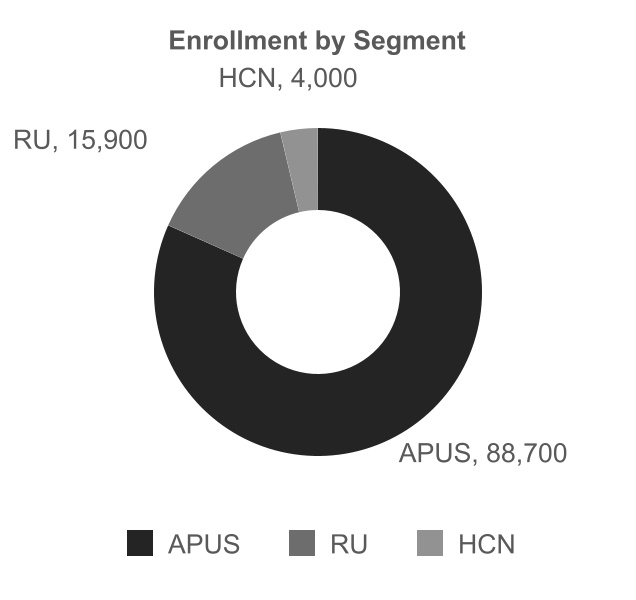
American Public University System, or APUS, provides online postsecondary education to approximately 88,700 adult learners. APUS traces its roots to American Military University, or AMU, which was founded in 1991, as a distance-learning, graduate-level institution for military officers seeking an advanced degree in military studies. Since then, APUS has broadened its focus to include veterans, extended military families, and other public service and service-minded communities, with a focus on educating those who serve. APUS has two brands: AMU, which is focused on educating students from the military and national security communities, and military families and veterans, and American Public University, or APU, which is focused on educating career-focused working adults with an emphasis on educating professionals working in service-minded communities, including nursing, public health, public administration, and business administration. Today, while the majority of APUS students are undergraduate-level, students are also enrolled in its certificate, graduate, and doctoral programs.
APUS is exclusively an online institution of higher learning, purpose-built to meet the needs of the communities it serves. Many of its students serve in positions requiring extended and irregular work schedules, are on-call for rapid response missions, participate in extended deployments and exercises, travel or relocate frequently, and often must balance family and work demands. Although APUS’s focus has broadened since its founding, it continues to have an emphasis on its relationship with the military community. As of December 31, 2025, approximately 62% of APUS’s students self-reported that they served in the military on active duty at the time of initial enrollment, and approximately 15% of APUS’s students self-reported that they are a military veteran. The remainder of APUS’s students are other military or military-affiliated professionals (such as reservists or National Guard members), family members of veterans and active-duty military and public service professionals (such as law enforcement personnel or other first responders) and other non-military students (such as working adult students).
APUS is institutionally accredited by The Higher Learning Commission, or HLC, an institutional accrediting agency recognized by the U.S. Department of Education, or ED. Most other higher education institutions accept APUS’s courses for transfer credit as a result of this accreditation. For more details on APUS’s HLC accreditation, see “Our Institutions and Operations – Our Institutions – Accreditation” and “Regulatory Environment – Accreditation – Institutional Accreditation” below.
Rasmussen University
RU provides nursing- and health sciences-focused postsecondary education to approximately 15,900 students at its 18 campuses across five states and online. Not included in these counts are the Green Bay, Wisconsin campus that was closed effective December 31, 2025, and the Wausau, Wisconsin campus, which RU intends to close on December 31, 2026. At the
beginning of its 125-year history, RU focused on educating business students to prepare them for practical careers in bookkeeping, secretarial services, and accounting. RU’s foundation of education that transforms lives created an institution built to serve those not typically served by traditional higher education. While RU continues to offer programs across a broad range of study including business, technology, and education, it expanded its breadth and embarked on providing healthcare education in 2006. Today, RU offers a comprehensive “ladder” of nursing degrees, including a pre-licensure Diploma in PN, ADN, and BSN degree, as well as the post-licensure RN to BSN degree, Master of Science in Nursing degree and Doctorate of Nursing Practice. In addition, RU also offers a post-graduate nursing certificate.
RU is committed to innovation in program delivery. For example, virtually every nursing program at RU incorporates online content alongside lab and clinical or classroom components. As of December 31, 2025, on-ground enrollment was approximately 7,100 students, of which approximately 6,200 were pursuing nursing degrees at RU, approximately 90% of whom were enrolled in RU’s pre-licensure nursing degree programs. At December 31, 2025, online enrollment was approximately 8,800 students.
RU is institutionally accredited by HLC with an Open Pathway designation, and all of RU’s Nursing programs are programmatically accredited by specialty nursing accrediting bodies. As with APUS, most other higher education institutions accept RU’s courses for transfer credit as a result of RU’s HLC accreditation.
Hondros College of Nursing
HCN provides nursing education to approximately 4,000 students at eight campuses across three states. HCN offers pre-licensure nursing programs that are designed to prepare individuals for productive careers through both a PN diploma and an ADN, and a Direct Entry ADN option that offer an accelerated graduation pathway for students who meet certain transfer credit, academic, and entrance exam requirements.
HCN’s students principally receive on-campus instruction at one of HCN’s campuses and online for certain courses for those that prefer remote course learning. As of December 31, 2025, approximately 68% of HCN students were enrolled in a PN program and 32% were enrolled in an ADN program.
HCN is institutionally accredited by the Accrediting Bureau of Health Education Schools, or ABHES, a national accrediting agency recognized by ED. HCN’s PN program is accredited by the National League for Nursing Commission for Nursing Education Accreditation, or NLN CNEA.
Our Segments
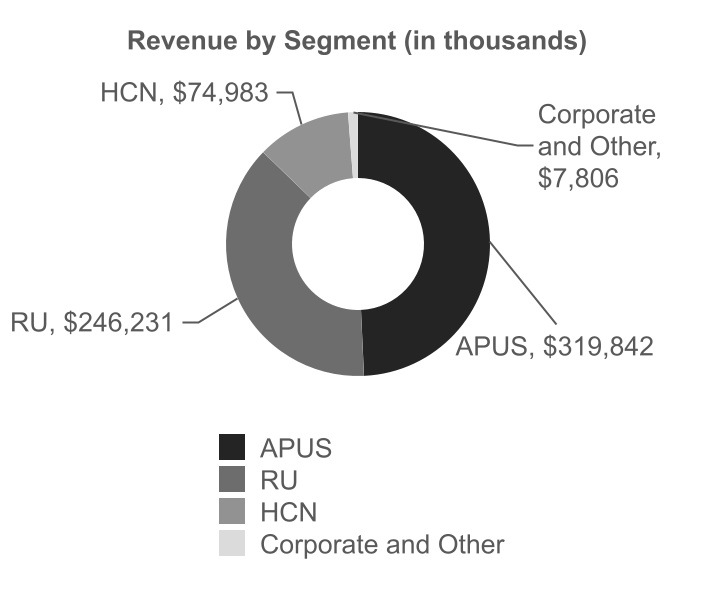
For the periods covered by this Annual Report, we had three reportable segments: the APUS Segment; the RU Segment; and the HCN Segment. Unallocated corporate activity, eliminations, and GSUSA’s results prior to the GSUSA Sale Date are included in “Corporate and Other” in the Consolidated Financial Statements. Financial information regarding each of our reportable segments is reported and discussed in this Annual Report in the sections entitled “Financial Statements and Supplementary Data” and “Management’s Discussion and Analysis of Financial Condition and Results of Operations”. Beginning in fiscal year 2026, we will have two reportable segments: APU Global, formerly the APUS Segment, and RU Health+, the businesses that formerly comprised the RU Segment and HCN Segment.
The following information for our segments is as of and for the year ended December 31, 2025.
2025 Developments and Future Financial Objectives
The Planned Combination of APUS, RU, and HCN
In 2025, we announced the planned combination of APUS, RU, and HCN, or the Combination, which will result in a combined institution named American Public University System comprised of two divisions named (i) APU Global, comprised of AMU and APU, and (ii) RU Health+, comprised of RU’s campus-based and online nursing programs, RU’s healthcare programs, HCN’s campus-based nursing and healthcare programs, and RU’s non-healthcare programs. The Combination constitutes a Change of Control, Structure or Organization pursuant to HLC policy and, accordingly, we were required to obtain HLC approval prior to effectuating the Combination. In December 2024, APUS and RU jointly submitted an application for Change of Control, Structure or Organization to HLC. Subsequently, ED informed us that we would need to follow a different process to implement the Combination that entails two steps instead of one: (i) merger of the legal entities that own and operate APUS, RU, and HCN, with the APUS entity surviving following the merger, and (ii) combination of the institutions into one HLC-accredited institution. As a result of this process change, HLC required APUS and RU to submit a new joint application for Change of Control, Structure or Organization to HLC in September 2025 containing substantially the same information that had been submitted previously and reflecting the two-step process. In February 2026, HLC approved the continuation of accreditation of APUS and RU after the legal entity merger with an acknowledgment that the intent is to eventually consolidate the three institutions into one HLC accreditation. ABHES has also informed HCN that it will continue HCN’s ABHES accreditation after the legal entity merger. On March 2, 2026, we completed the merger of the legal entities that own and operate APUS, RU, and HCN, with the APUS entity surviving the merger, and subsequently notified ED that the merger occurred and resulted in RU and HCN being directly owned by the same legal entity that directly owns APUS. We currently expect to complete implementation of step two of the Combination in the third quarter of 2026, subject to obtaining required approvals. For additional details regarding regulatory treatment of the Combination, see “Regulatory Environment – Accreditation – Institutional Accreditation” and “Regulatory Environment – Accreditation – The Planned Combination of APUS, RU, and HCN”, and for additional information regarding risks related to the Combination, see the Risk Factor with the caption beginning “The planned combination of APUS, RU, and HCN . . . .”
U.S. Federal Government Shutdown
On October 1, 2025, the U.S. federal government shut down due to a failure by Congress to pass appropriations legislation, resulting in, among other things, suspension of the DoD TA programs and ultimately an inability of APUS students seeking to use TA as a payment source to register, or in some cases stay registered, for courses. In connection with this shutdown, which ended November 12, 2025, APUS TA course registrations decreased in the fourth quarter 2025 compared to the prior year period. This was the first time since 2013 that APUS had dropped course registrations as a result of a government
shutdown because the Defense Appropriations Bill, which annually funds TA, was not passed prior to October 1, 2025. This shutdown had an adverse impact on APUS’s course registrations, which impacted APUS’s and our cash flows, results of operations, and financial condition. See “Management’s Discussion and Analysis of Financial Condition and Results of Operations – Overview – U.S. Federal Government Shutdown”, for more information.
90/10 Compliance
We continued to have a sustained focus in 2025 on the “90/10 Rule”, which is described under “Student Financing Sources and Related Regulations/Requirements – Department of Education – Regulation of Title IV Financial Aid Programs – The 90/10 Rule” below. While each of our institutions was in compliance with the 90/10 Rule for 2025, APUS’s relevant percentage for 2025 was 89%. Compliance with the 90/10 Rule will continue to be an area of focus, and despite our efforts, there can be no assurance that we will continue to be able to comply in future years, particularly at APUS. See the Risk Factors captioned “If one or more of our institutions does not comply with the 90/10 Rule for two consecutive years, it or they will lose eligibility to participate in federal student financial aid programs”, “Our student registrations, revenue, and cash flow have been adversely impacted and we could experience additional adverse impacts as a result of the Armed Forces’ TA processing system upgrades or a transition to new systems for service members to request TA or accessing VA education benefit programs”, and “There can be no guarantee that our business will generate sufficient cash flow from operations or that future capital or borrowings will be available to us in an amount sufficient to enable us to fund our other liquidity needs”, for more information.
Tuition Increases
Providing affordable degree and certificate programs is an important element of our competitive strategy. In August 2025, RU implemented a modest tuition increase for new and reentering students, and in October 2025 implemented modest increases for current students in non-prelicensure nursing programs. In January 2026, RU implemented a modest tuition increase for prelicensure nursing program students. HCN implemented a 5% increase in tuition and fees effective in October 2025 for its ADN and PN programs. The tuition and fee increases at RU and HCN are intended to reflect adjustments to be consistent with the local campus markets. Even with these increases, RU and HCN’s tuition and fees are designed to be affordable and competitive when compared to the tuition and fees at similar institutions offering the same level of flexibility, accessibility, and student experience.
In February 2026, APUS implemented a modest tuition increase for non-military undergraduate and graduate students. We believe that APUS’s tuition and fees remain lower than the average in-state cost at public universities.
Campus Consolidations and Closures
In May 2024, RU notified the Wisconsin Educational Approval Program, or EAP, that it intended to voluntarily close its two Wisconsin campuses, effective December 31, 2025, and 2026, respectively. RU closed the Green Bay campus effective December 31, 2025 as planned, and intends to close the Wausau campus on December 31, 2026. All students enrolled at the two Wisconsin campuses have expected graduation dates on or before the applicable campus closing date. For additional information, see the Risk Factor captioned “RU’s actual and planned closure of campuses or termination of programs on certain campuses may adversely impact RU and us.”
Preferred Stock Redemption
On June 23, 2025, APEI redeemed all 400 outstanding shares of Series A Senior Preferred Stock for $43.1 million, excluding unpaid and accrued dividends of $1.4 million. Accordingly, there are no shares of preferred stock issued or outstanding at December 31, 2025. For additional details regarding the redemption of the Series A Senior Preferred Stock, please refer to “Note 12. Preferred Stock” included in our Consolidated Financial Statements.
Assets Held for Sale
In the first and second quarters of 2025, APUS completed the sale of an undeveloped parcel of land and two buildings located in Charles Town, West Virginia, for net sales proceeds of approximately $23.0 million. Please refer to “Note 5. Assets Held For Sale” included in our Consolidated Financial Statements for more information.
Sale of Graduate School USA
On July 25, 2025, or the GSUSA Sale Date, APEI completed the sale of its membership interest in Graduate School USA, or GSUSA, for $0.5 million, subject to customary adjustments, and as a result, the lease liability was removed from our balance sheet. We have no continuing involvement in GSUSA. The sale of APEI’s membership interest in GSUSA is not considered significant shift in our strategic focus, nor is it considered material to our operations, cash flows, or financial position. Please refer to “Note 2. Significant Accounting Policies” included in our Consolidated Financial Statements for more information on APEI’s sale of its membership interest in GSUSA.
Executive Leadership Changes
On August 4, 2025, the Board of Directors of APEI, or the Board, appointed James Kenigsberg as Interim Chief Innovation and Technology Officer of APEI, and Mr. Kenigsberg resigned from service on the Board in connection with and effective as of his appointment.
Effective October 20, 2025, we appointed Edward H. Codispoti as Chief Financial Officer. Our former Chief Financial Officer, Richard W. Sunderland, Jr., continued to serve the Company until his departure in the first quarter of 2026.
Please refer to “Our Institutions and Our Operations – Information About our Executive Officers” below for additional information about our executive officers serving as of the date of this Annual Report.
Reductions in Force
On November 3, 2025, as a result of the government shutdown, we completed a reduction in force that resulted in the termination of approximately 40 non-faculty employees at APUS, representing approximately 6.5% of the APUS non-faculty workforce. Separately, in the fourth quarter of 2025, 19 information technology employees at APEI were terminated in connection with our ongoing efforts to optimize certain information technology functions. See “Management’s Discussion and Analysis of Financial Condition and Results of Operations – Overview – Reductions in Force”, for more information.
Our Market and Competition
Market Characteristics
The overall U.S. postsecondary education market is large, with more than 4,500 institutions of higher learning, diverse in its business models, and fragmented such that no one institution has a significant market share. Most postsecondary institutions, including for-profit postsecondary institutions, regardless of where they are located, how they are organized, or who they serve, face challenges, including:
•demand for relevance and return on investment, as they must prepare students with relevant skills to work in new and rapidly changing industries, respond to technological change, and support employers in efforts to optimize and advance their workforce;
•focus on quality and affordability, including via questions from potential students, lawmakers, the media, and others about the quality and cost of postsecondary education and the impact of poor quality and high costs;
•changes in consumer demands as prospective students look to pursue credentials outside of degrees;
•a continually changing regulatory environment;
•fluctuations in enrollment; and
•rapid technological transformation, including through increasing demand for online offerings and the utilization of technology to enhance student learning, and increasing use of artificial intelligence, or AI, technologies.
Competition
In addition to the characteristics outlined above, the U.S. postsecondary education market is characterized by intense competition. Competitive factors include, among other things:
•the quality of the academic program and alignment to high growth jobs;
•affordability;
•breadth of degree offerings;
•flexibility in delivery models;
•frequency of course or program starts;
•faculty experience;
•level of support for student success;
•career counseling and placement services;
•reputation;
•effectiveness in attracting college-ready students; and
•compliance track record.
Institutions Serving Military Students
APUS has focused on serving the military community since its founding, and the community continues to be a primary source of APUS students. Approximately 2,400 institutions serve military students through participation in Department of Defense, or DoD, tuition assistance, or TA, programs, including APUS. APUS’s primary competitors for military students are other institutions offering online instruction and colleges and universities offering on-campus instruction near military installations.
We believe that APUS will continue to see competition in the military community from both not-for-profit and for-profit schools, as well as from the Armed Forces themselves, including through distance learning programs. For example, the U.S. Naval Community College, or the USNCC, is a community college supporting naval education for enlisted service members. While a number of schools with which APUS competes are participating partners with the USNCC, APUS is not an eligible partner because of its status as a for-profit institution. As traditional not-for-profit public and private schools continue to advance online capabilities, we believe that they may present competition for APUS.
Nursing Programs
RU and HCN’s nursing programs are offered as campus-based programs in the geographic areas surrounding their campuses. In RU and HCN’s combined 26 on-ground nursing campuses, we compete with a mix of community colleges, public and private postsecondary institutions, and other career-focused nursing colleges offering similar pre-licensure nursing programs. Because of the relatively local focus of these pre-licensure programs, our competitive environment is moderately fragmented and affected by various factors specific to the states and particular areas where campuses are located, including local supply and demand for nurses and nursing schools. We are also continuing to focus on growing our post-licensure nursing programs, for which the competitive environment is less fragmented and has larger competitors, including because RN to BSN and other post-licensure degrees are available online as well as in traditional campus-based environments.
Other Public and Postsecondary Institutions
Within the broader postsecondary education market, our institutions compete primarily with not-for-profit, public, and private two-year and four-year colleges, as well as other for-profit schools, particularly those that offer online learning programs. Due to an increase in online postsecondary offerings, we face increased competition as students pursue degree and credential-based postsecondary education from a wider selection of online offerings. For example, we anticipate increased competition from campus-based postsecondary institutions as they continue to increase online degree programs and develop more non-traditional programs.
Most public institutions are aided by substantial government subsidies. Public and private not-for-profit institutions benefit from grants, tax-exemptions, contributions, and other financial resources not widely available to for-profit institutions. Many public competitors also benefit from longstanding name recognition and are able to directly recruit students in a more cost-effective manner, especially in their local markets. Many private institutions are able to make larger investments in marketing, as their cost of tuition is higher than tuition at our institutions.
Non-Traditional Competition
We also face competition, particularly at APUS and for RU’s online programs, from competing schools and others providing non-traditional education programs, often without charge or at low costs, including:
•institutions offering competency-based education, or CBE, programs and single course or course packages aimed at credentialing outcomes rather than degree outcomes;
•corporate training and other companies partnering with universities or the federal government to offer alternative educational paths for students and the federal government workforce, respectively;
•entities providing coding bootcamps or micro-credentials; and
•non-degree granting institutions such as massive online course providers.
We believe that our institutions will continue to face new competition from non-traditional programs.
For more information on competition within the postsecondary education market in which we compete, refer to “Risk Factors – Risks Related to Attracting and Retaining Students”.
Our Opportunities and Strengths
Our Opportunities
Active-Duty Military, Veterans, and their Families
The U.S. military community will continue to be an important market segment for online education. We believe service members will continue to seek respected universities that provide military-focused support services coupled with an online curriculum and flexible scheduling. We believe service members are particularly interested in postsecondary credentials that offer both career advancement within the military and preparation for employment outside of the military.
We believe that military veterans represent another important addressable market for online education. The U.S. Bureau of Labor estimates that in 2025 there were approximately 6.1 million veterans aged 18 to 54. We believe that our military heritage, affordability, and online offerings are attractive to veterans. In addition, policies and campaigns to facilitate the hiring of veterans may reduce barriers to non-military jobs and facilitate veteran-owned businesses. As these policies and campaigns reduce barriers to non-military jobs and facilitate veteran-owned businesses, we believe online universities offer valuable educational opportunities for veterans regardless of where they live, work, or learn.
We also believe that family members of both active-duty military and veterans represent an opportunity given our prominence and reputation in the military and veterans communities.
Nursing
The expanding need for healthcare coupled with a nursing shortage continues to drive significant demand for nursing education. Projected employment for licensed practical nurses and registered nurses is expected to grow by approximately 3% and 5% annually, respectively, from 2024 to 2034, according to the U.S. Bureau of Labor Statistics’ Occupational Outlook Handbook. When factoring in the need to replace workers who transfer to different occupations or exit the labor force, such as to retire, the U.S. Bureau of Labor Statistics projects openings each year for nurses of more than 200,000 through 2034, though the amount of demand varies by geography.
There is significant unmet demand from qualified students for nursing educational programs. Despite anticipated job opportunity growth, qualified applicants are not always accepted by nursing programs, primarily due to program selectivity, a shortage of clinical sites, faculty, and resource constraints. However, given the state and regulatory approvals necessary, investment in campuses, specialized programmatic knowledge and related accreditations, clinical placement requirements, time to receive approval to grow enrollments, and various standards that nursing schools must meet, we believe there are challenges for new entrants to nursing education. We also believe we may distinguish ourselves from our competitors by developing direct partnerships with healthcare providers as they become more involved in educating and training their future workforces, of which nurses are the largest segment.
Career Learning
U.S. employers are increasingly reporting significant gaps between required skills and the capabilities of their workforce. Working adults also recognize the need to be lifelong learners. We believe employers and professional associations will continue to seek partnerships with academic institutions to advance the skills and productivity of their workforce through higher education and career learning programs, which we see as an opportunity, particularly for RU and HCN. We also believe that there is an opportunity to expand the APUS brand more broadly to attract students beyond its historical constituency.
Our Competitive Strengths
Return on Educational Investment and Affordability
Our institutions are committed to continually assessing and enhancing our academic programs and student services to offer a high-quality education and facilitate successful outcomes for our students and graduates that align with employer needs.
In addition, as described in “Our Institutions and Operations – Human Capital” below, our institutions focus on excellence by hiring experienced faculty and continuing to develop their capabilities.
Providing affordable, quality degree and certificate programs is an important element of our competitive strategy. We believe the combined tuition and fees at APUS are generally less than the average in-state cost at a public university. APUS’s low tuition and fees, in combination with APUS-funded tuition grants and book grants provided to all undergraduate students, result in significant savings and mean that APUS students are not required to take on as much debt as they might at another institution. APUS’s generous transfer credit policy, and use of open educational resources, further reduce a student’s out-of-pocket costs.
Tuition and fees at RU and HCN are also designed to be affordable and competitive when compared with those of similar institutions offering the same level of flexibility, accessibility, and student experience. RU students may also lower their total cost of attendance through self-directed assessments, which provide savings by permitting students who demonstrate proficiency in a subject to test out of courses. Similarly, HCN students may apply performance-based grants toward the balance of their tuition. Please refer to “Our Institutions and Operations – Our Institutions – Affordability and Cost of Attendance” below.
We believe that, given broad concerns about rising tuition and student loan debt in higher education, there are opportunities to create awareness and attract college-ready students with the primary message of affordability and value.
Relevant Offerings Aligned with Demand
Our institutions offer programs aligned to jobs that U.S. Bureau of Labor Statistics data and non-governmental organizations have indicated as high growth areas. Our institutions are also committed to continually assessing and enhancing our academic programs and student services to offer a high-quality education and facilitate successful outcomes for our students and graduates that align with employer needs. The depth and breadth of APUS’s and RU’s non-nursing program offerings are designed to effectively address the needs of students who enter into education programs with vastly different educational and career backgrounds and goals. For example, APUS utilizes Industry Advisory Councils to evaluate its current curriculum and determine the career relevance of programs and degrees, which facilitate efforts to connect APUS’s curriculum to the industries and the students it serves and to deliver a high-quality academic product. RU and HCN, meanwhile, create new nurses to meet the significant imbalance of supply and demand that exists for nurses by preparing and training nursing students to enter the nursing profession as licensed nurses.
Flexible Program Offerings
Our institutions offer flexible learning modalities to meet the needs of busy working adults. APUS offers online delivery with monthly starts and academic support offerings that are individualized to students’ needs, while RU offers a blend of in person and online courses for their nursing and other healthcare-related programs, and flexible start dates and online courses for other programs. HCN offers PN and ADN programs that accommodate working adults by offering on-campus instruction, online instruction for certain courses, as well as daytime and evening/weekend options at its Ohio campuses.
Market Leadership
Our status as a market leader in key areas we serve means that we operate from a position of strength in those areas. APUS is the number one educator of active-duty military and of veterans. Since its founding, APUS has broadened its focus to include veterans, extended military families, and other public service and service-minded communities, with a focus on a broad purpose of “educating those who serve.” As of December 31, 2025, approximately 62% of APUS’s students self-reported that they served in the military on active duty at the time of initial enrollment, and approximately 15% of APUS’s students self-reported that they are a military veteran. We are also a national leader in pre-licensure nursing education. RU and HCN have more than 10,200 nursing students at their 26 campuses across eight states and online with over 90% of those students pursuing a pre-licensure PN diploma, ADN, or post-licensure BSN degree.
Expansive Nursing Footprint
Our institutions train nurses at 26 campuses across eight states and online. Given the state and regulatory approvals necessary, the investment in physical campus facilities, the specialized programmatic knowledge and related accreditations, clinical placement requirements, the time to receive approval to grow nursing enrollments and various standards that nursing schools must meet, we believe nursing education – and in particular first or pre-licensure nursing education – provides us with
opportunities to distinguish ourselves from our competitors. In addition, we believe we are one of the only educators with a full “ladder” of nursing curriculum from PN diplomas to Doctoral degrees.
Purpose-Built Student Information System
At APUS, our purpose-built technology platform allows for scale without significant additional cost, and our student information system is purpose-built to serve active-duty military by allowing students that intend to access their TA benefit to seamlessly enroll, register, and gain approval for this benefit.
Our Business Strategy and Goals
Win with Service-Minded Students and their Families
At our core is a recognition of the importance of individuals who serve the country and society at large. We aim to deliver on our vision of education that transforms lives, advances careers, and improves communities by “educating those who serve.” Our institutions are purpose-built to educate the service-minded student by offering programs designed to prepare individuals for contributions to their profession and society and to provide opportunities to advance students in their current professions or help them prepare for their next career.
We seek to offer curriculum in bundles that resonate with service-minded students and their families. We expect to continue to focus on education that provides real skills and pathways to employment and career advancement in fields that align with demand. We aim to deliver differentiated, memorable learner experiences across the entire student journey.
Deliver a Return on Higher Education Investment
We seek to maximize a student’s return on their educational investment. We believe learners are looking for a practical solution that provides value in return for their educational investment and that fits their lifestyle and values. We believe there are opportunities to create awareness and attract college-ready students with the primary message of affordability and value.
Grow a National Nursing Platform
We are focused on expanding nursing opportunities through geographic campus expansion and the expansion of our programs and course offerings. This focus includes expansion of our post-licensure enrollments, particularly at RU where key post-licensure programs have already been established and are primarily delivered online, which represents an opportunity for our alumni and other already-licensed nurses to advance their nursing careers. We also seek to enhance provider partnerships to act as a catalyst for enrollment growth and defray student costs. We intend to continue to seek opportunities for both organic and inorganic growth, including by exploring acquisitions of other nursing schools.
Build a Career Learning Platform
We believe that our institutions provide us with a foundation from which we can build a career learning platform. APUS partners with community colleges, which prepare students for transfer opportunities to APUS for bachelor’s degree programs. At RU and HCN we seek to enter into new nursing provider partnerships and expand existing nursing provider partnerships. Together RU and HCN have over 400 corporate alliance partners whose employees can pursue an education at RU or HCN. Additionally, among our institutions’ offerings are certificate and credentialing programs.
Achieve Sustainable Growth
We aim to increase our public market scale by growing the revenue of our enterprise organically and inorganically and delivering improved enterprise-wide operating margins. We will continue to develop capabilities to drive organic growth and plan to continue to assess and pursue strategic acquisitions and integrate and grow them for inorganic growth. For example, we will continue to focus on being the top educator for active-duty military and veterans and one of the top educators for pre-licensure nurses.
Focus on Regulatory Metrics
We strive to deliver a quality, competitive education, which goes hand-in-hand with demonstrating compliance with various regulatory standards and metrics. We expect to continue to focus on the core elements of our business that are necessary
to meet these standards and metrics. For example, in our nursing programs, we continue to focus on improving various achievement metrics, particularly around NCLEX pass rates and retention statistics, and at APUS, we continue to focus on ensuring that we comply with the 90/10 Rule.
Optimize Our Cost Structure Through the Shared Services Model
We aim to deliver better, faster, more cost effective, responsible, scalable results for our institutions by providing shared services to them, as noted in “Our Institutions and Operations” below. We believe that the shared services model promotes the efficient use of resources. With the expected completion of the Combination and the creation of APU Global and RU Health+, we expect there to be revenue synergies and cost synergy opportunities through the elimination of redundancies and optimizing operations.
OUR INSTITUTIONS AND OPERATIONS
We provide postsecondary education through three educational institutions of higher learning: APUS, RU, and HCN. Each institution is primarily responsible for its own academic mission, while APEI performs certain business functions on a shared basis for the benefit of APUS, RU, and HCN, with the capability to further expand these shared services to these entities. We believe that the shared services model promotes the efficient use of resources.
Our Institutions
Programs and Areas of Study
We offer a total of 181 degree programs, 110 certificate programs, and four diploma programs, through our institutions. We offer programs across a broad range of fields of study, including public service-focused fields such as nursing, national security, military studies, intelligence, and homeland security, as well as traditional academic fields such as business, health science, information technology, justice studies, education, and liberal arts.
| | | | | |
| Programs | Number |
| APUS Degrees | 133 |
| RU Degrees | 47 |
| HCN Degree | 1 |
| Total Degree Programs | 181 |
| Total Certificates | 110 |
| Total Diplomas | 4 |
| Total Programs, Certificates, and Diplomas | 295 |
General Academics
APUS offers 133 degree programs and 98 certificate programs across five schools of study. More than 1,700 distinct courses are available in either eight- or sixteen-week formats. Most APUS academic terms begin on the first Monday of each month. APUS’ certificate programs generally require a minimum of 18 credit hours and focus on a particular component of a broader degree program. Among those programs are 13 undergraduate and 11 graduate NanoCertsTM programs, which are focused programs comprised of three academic courses in a related area of interest that provide skills necessary for career or professional development and result in a micro credential. RU offers over 60 programs across seven schools of study in addition to nursing. RU offers approximately 700 distinct courses in 5.5 or 11-week formats with terms beginning in January, April, July, and October, as well as 5.5 week terms beginning mid- February, mid- May, mid-August, and mid-November of each year.
Nursing
RU offers a comprehensive “ladder” of nursing degrees, including a pre-licensure Diploma in PN, ADN, and a BSN degree, as well as the post-licensure RN to BSN degree, Master of Science in Nursing degree and Doctorate of Nursing Practice. In addition, RU also offers a post-graduate nursing certificate. HCN offers on-campus instruction leading to a PN diploma or ADN, as well as a Direct Entry ADN option that offers an accelerated graduation pathway for students who meet certain transfer credit, academic, and entrance exam requirements. Portions of these programs are taught online. Academic
terms for HCN’s PN and ADN programs begin four times each year, with courses starting in January, April, July, and October. Graduates of RU and HCN’s PN and ADN programs are eligible to seek licensure after passing the applicable NCLEX exams.
Student Body
Overall, our institutions have approximately 108,600 students enrolled online and at 26 campuses across eight states, with enrollment calculated differently depending on the institution.
The student body of APUS consists of approximately 88,700 enrolled students, most of whom are employed full-time. Student enrollment is defined as the number of unique active students, including those who take an approved leave of absence, who are currently attending a course or have completed at least one course within the last 12 months. APUS is designed to serve adult learners with tailored offerings to support them in successfully reaching their individual goals. As of December 31, 2025, approximately 62% of APUS’s students self-reported that they served in the military on active duty at the time of initial enrollment, and approximately 15% of APUS’s students self-reported that they are a military veteran. The remainder of APUS’s students are other military or military-affiliated professionals (such as reservists or National Guard members), public service professionals (such as law enforcement personnel or other first responders), and other non-military students (such as working adult students and military spouses). Many APUS students have significant prior education and career experiences; approximately 88% enroll at APUS with prior educational credits, approximately 90% are working adults, and APUS students have an average age of 34.
RU provides education to approximately 15,900 enrolled students at 18 campuses across five states. Student enrollment is defined as the number of unique active students, including those who take an approved leave of absence. RU offers programs across a broad range of fields of study, with a focus on healthcare, specifically nursing education. At RU, 80% of students are over the age of 25 and 83% are female. As of December 31, 2025, approximately 6,200 students are pursuing nursing degrees at RU, over 90% of whom are enrolled in RU’s pre-licensure degree programs.
HCN provides nursing education to approximately 4,000 students at eight campuses across three states. The average HCN student is approximately 35 years old and 93% of HCN students are female. As of December 31, 2025, approximately 67% of HCN students were enrolled in a PN program and 32% were enrolled in an ADN program.
Accreditation
Our institutions have institutional accreditation, and their programs often have programmatic or specialized accreditation. Institutional accreditation is an important attribute of our institutions. Colleges and universities depend, in part, on accreditation in evaluating transfers of credit and applications to graduate schools. Students and sponsors of tuition reimbursement programs look to accreditation for quality assurance, and employers rely on institutions’ accredited status when evaluating a candidate’s credentials. APUS is institutionally accredited by HLC with a Standard Pathway designation, with the next reaffirmation of accreditation site visit date to take place in May 2027, which will entail a review of APUS in its post-Combination form. RU has institutional accreditation from HLC with an Open Pathway designation, with the next comprehensive evaluation for reaffirmation of accreditation scheduled for March 2027. HCN is institutionally accredited by ABHES and has been granted continued accreditation through February 2027 for all programs at all campuses. Upon completion of the Combination, HCN will no longer maintain its separate accreditation through ABHES.
In addition to institutional accreditation, certain of our programs offered have received specialized accreditation. For example, the Accreditation Council for Business Schools and Programs accredits approximately 15 different business-focused academic programs offered by APUS and accredits APUS’s accounting program under a specialized accounting accreditation. The Commission on Collegiate Nursing Education accredits the Bachelor and Master of Science in Nursing programs at APUS and RU. Certain programs offered by RU have received specialized accreditation as well. For example, RU’s PN and ADN programs are accredited by the Accrediting Commission for Education in Nursing. HCN’s PN program is accredited by NLN CNEA.
RU and HCN’s locations and programs are approved by state agencies as well. For example, the nursing education programs offered by RU and HCN are approved by the relevant state boards of nursing.
For more information on accreditation and licensure, please refer to “Regulatory Environment – Accreditation” and “Regulatory Environment – State Authorization/Licensure” in this Annual Report.
Admissions and Admissions Standards
We seek to attract students who are more likely to persist and succeed in our programs and continue to work to identify and implement changes and initiatives in an effort to attract and enroll more college-ready students more effectively. We welcome students to apply for admission at any time through online application processes at APUS, RU, and HCN. The current qualification for most undergraduate programs is a high school diploma or General Education Development certificate. Applicants for graduate programs must hold a bachelor’s degree from an accredited U.S. institution or an equivalent foreign institution. Certain programs may have additional admissions standards and restrictions. For example, RU and HCN require prospective nursing students to achieve qualifying entrance exam scores for certain programs.
Affordability and Cost of Attendance
We have long been focused on offering our students affordable programs. Affordable tuition has been a priority of APUS since its founding. APUS tuition remains among the lowest in the four-year for-profit sector. APUS costs are approximately 22% less than the average in-state full-time undergraduate tuition, fees, and books at four-year public universities, based on the final 2024-2025 institutional data reported to ED through the Integrated Postsecondary Education Data System. The low tuition and fees, in combination with APUS-funded tuition grants and book grants provided to all undergraduate students, results in significant savings to APUS students. Additionally, APUS’s generous transfer credit policy, and use of open educational resources, further reduce a student’s out-of-pocket costs. Tuition and fees at RU and HCN are also designed to be affordable and competitive with those of similar institutions offering the same level of flexibility, accessibility, and student experience.
Tuition and Fees
APUS implemented tuition and fee increases for its non-military and veteran students in the second and third quarters of 2023. In April 2024, APUS implemented an additional modest tuition increase to master’s level students across all categories, including military, non-military, and veteran students, and in September 2024, APUS returned the military rate for master’s level students to the $250 per credit hour rate in effect prior to the April 2024 tuition increase. Following these increases, tuition for undergraduate courses is $350 per credit hour, while tuition for master’s level classes is $455 per credit hour. In general, a bachelor’s degree may be earned for $42,000 in tuition costs at current tuition rates, and APUS master’s degrees may be earned for $16,380 in tuition at current tuition rates. In February 2026, APUS increased undergraduate tuition to $360 per credit hour for undergraduate level courses, and increased tuition to $470 per credit hour for master’s level courses for non-military students. APUS does not charge an admission fee or fees for services such as registration, course drops, or similar events that trigger fees at many other institutions. Because APUS is an exclusively online institution, there are no required resident fees, such as for parking, food service, student union, and recreation. Most students taking graduate courses at APUS are charged a technology fee of $85 per course. When applicable, APUS students are charged certain additional fees, such as graduation, late registration, transcript request, and comprehensive examination fees.
RU’s costs vary among its programs and between part-time and full-time attendance. RU implemented modest tuition increases in the first quarters of 2023 and 2024 for all students for select programs, for new students for select programs in August 2024, and for returning students for select programs in October 2024, to help offset the increased cost of delivering a quality education. RU implemented modest tuition increases for new and reentering students in August 2025 and implemented modest increases for current students in non-prelicensure nursing programs in October 2025. RU implemented a modest tuition increase for prelicensure nursing program students in January 2026. RU’s ADN program typically costs $453 per credit hour in addition to course fees. Credit hour costs range from $260 per credit hour to $453 per credit hour for other undergraduate programs. At the graduate level, RU offers six different master’s programs for $290 per credit hour or less. RU charges a $200 course technology and resource fee for each course. Students may purchase required textbooks or e-books through RU for a flat fee of $15 for each textbook (traditional or e-book) for each course.
HCN’s costs vary among its programs. In the second quarter of 2023, HCN implemented a 5% increase in tuition and fees across all programs to offset the increased cost of delivering a quality, competitive education. In the fourth quarter of 2025, HCN implemented a 5% increase in tuition and fees for its ADN and PN programs, intended to reflect adjustments to be consistent with the local campus markets. HCN’s PN program may be completed for approximately $20,500 in tuition and fees, the ADN program may be completed for approximately $29,200 in tuition and fees, each of which is dependent on the campus location. Fees include the cost of examination review materials, lab fees, and test review fees, among others. Some of these costs are payable to HCN and others are payable to third parties. HCN’s students also incur costs for textbooks, supplies, uniforms, and its technology package. These costs vary by program and are paid for by HCN’s students as the textbooks or supplies are needed. HCN estimates that over the life of its programs, a student’s costs related to textbooks and supplies will be approximately $5,000 for the PN program and $6,000 for the ADN program.
At RU and HCN, tuition increases are adjusted to be consistent with the local campus markets. Even with these increases, RU and HCN’s tuition and fees are designed to be affordable and competitive when compared to the tuition and fees at similar institutions.
Grants and Other Fee Reduction Opportunities
APUS provides a Preferred Military Rate of $250 per credit hour for undergraduate and master’s level courses, for all U.S. active-duty military, National Guard members, Reservists, and military families. Active-duty military students using TA at the undergraduate level are expected to generally have no out-of-pocket expenses. In addition, APUS also provides a 10% grant for veterans and veteran’s family members, or Veteran Grant, on standard undergraduate tuition rates, a 15% Veteran Grant on master’s level courses, and a 10% Opportunity Grant for undergraduate and master’s level courses for remaining students. In addition, veterans who qualify for 100% of their Post-9/11 Veterans Educational Assistance Act of 2008, or Post-9/11 GI Bill, benefits are expected to generally have no out-of-pocket expenses either.
Active-duty military undergraduate students and their spouses and dependents enrolled in courses for academic credit at APUS receive textbooks and certain course materials at no additional cost to them through an APUS-funded institutional book-grant program. APUS also utilizes open access and online library materials where appropriate and works with various publishers to reduce the cost of textbooks and course materials for both graduate students who pay for textbooks and course materials and for APUS, which funds the book grant.
At RU, students can lower their total cost of attendance through self-directed assessments, which provide savings by permitting students who demonstrate proficiency in a subject to test out of courses. Self-directed assessments, when available, may be attempted for a prepaid fee, which is generally $149 per attempt.
HCN students may apply performance-based grants toward the balance of their tuition after the application of all other funding sources. HCN also offers an institutional affordability grant to students demonstrating financial need to cover the difference between the total cost of tuition and fees and the amount of all eligible financial aid resources. The grant is designed to limit a student’s monthly payment to $200 through an award of up to $200 per month, or $600 per term after consideration of financial aid, employer tuition reimbursement, and other financial resources.
HCN offers its students extended payment plan options. The extended payment plans are designed to assist students with educational costs including tuition and fees. HCN’s payment plans require ongoing payments while the student is enrolled in a program and extend after the last day of attendance or graduation. To the extent interest is applied, it is generally fixed and does not accrue until the student departs the program or graduates. The extended payment plan options do not impose any origination fees.
Sources of Student Financing and Financial Aid
Our students finance their education through a combination of individual resources, ED’s Title IV programs, private loans, state and federal grants, institutional grants, TA, Department of Veterans Affairs, or VA, educational benefits, and corporate reimbursement programs. Most students rely on some form of financial aid in addition to their individual resources. At APUS, students utilizing DoD’s TA programs as their primary source of payment accounted for 41% of revenue in 2025, those utilizing VA education benefits 26%, those utilizing ED’s Title IV programs 19%, and those utilizing cash and other sources 14%. At RU, students utilizing ED’s Title IV programs as their primary source of payment accounted for 78% of revenue in 2025, those utilizing cash and other sources 20%, and those utilizing VA education benefits 2%. In addition, most HCN students rely on some form of financial aid in addition to their individual resources. We believe that the ability of our students to participate in these programs is essential to the success of APUS, RU, and HCN.
Participation in TA, VA education benefits, and Title IV programs adds to our institutions’ regulatory burden and results in increased regulatory scrutiny, as described more fully below in “Regulatory Environment – Student Financing Sources and Related Regulations/Requirements”. Federal legislative activity and actions by ED, DoD, and VA may adversely impact the ability of our students to obtain tuition financing, which as with any other limitations on tuition financing could have a material adverse effect on enrollments and our financial condition, as described more fully below in “Risk Factors – Risks Related to Our Business”.
Student Retention and Academic Outcomes
Our institutions are focused on executing initiatives that will more effectively support their students and help improve those students’ educational outcomes. Improved engagement is an important element in our goal of retaining qualified students. For example, APUS and RU improve engagement through, among other things, faculty engagement initiatives and co-curricular initiatives to increase the level of engagement and collaboration in the classroom and strengthen the bond between those institutions and their students. We also carry out initiatives intended to improve the educational outcomes of our students. For example, RU is dedicated to helping students pass the NCLEX exam the first time by identifying student-specific challenge areas, providing customized tutoring resources and faculty training, and creating student support specialist positions to conduct NCLEX review sessions. In January 2025, RU implemented a contract with a third-party to provide nursing program curriculum upgrades and course materials and testing services to nursing students. These services include integrated NCLEX testing simulation and preparation tools throughout the curriculum and curriculum assessments to identify areas where RU can better enable student mastery and success. HCN offers students NCLEX fee vouchers to encourage students to take the NCLEX within a certain period after graduation. HCN continues to provide significant faculty development resources to support improvements to the teaching and learning experience and program outcomes. Additionally, HCN offers quarterly student workshops to help students prepare for taking the NCLEX exam, provides NCLEX-style questions on assessments throughout the program, and analyzes data from the NCLEX results, and other assessment tools, to adjust course requirements and materials.
Career Development
We believe assisting students in advancing their careers in their current profession or securing employment after completion of their programs or courses is an essential part of our mission. Our institutions offer an array of career services, including complementary personalized career advice for students and alumni through direct interaction with career services staff, career events such as in-person and virtual job fairs and on-campus recruiting, and institution-sponsored online job boards. APUS also offers career planning tools, such as an interest assessment to identify career options that fit student interests and guides to careers associated with student majors, and career preparation services, such as mock interview services, resume review services, and social media review services to improve students’ employer-facing online profiles. RU provides a variety of self-service resources, including access to a networking, job posting, a career research website, online resume building and interview preparation tools, webinars, and video tutorials, as well as online programmatic advising by dedicated career services advisors. We strive to link students directly with employers where we can. At RU and HCN we seek to enter into new nursing provider partnerships and expand existing nursing provider partnerships, and together RU and HCN have over 400 corporate alliance partners.
Marketing and Branding
We strive to align our marketing efforts with our business and strategy and to tailor our marketing approach to our educational offerings and the students we serve. This approach encompasses all our learning modalities, from online to on-campus to hybrid, and all our educational outcomes, from certification to degree, and leading to the career outcomes students seek after they leave us. As part of these efforts, we continue to highlight certain key marketing and branding messages that align with our strategy, including educating those who serve, affordability and value.
We execute our marketing efforts through both direct-to-student and business-to-business channels. Our marketing relationship with students extends across the entire student journey from recruitment to post-graduation and includes efforts to drive student awareness, improve student onboarding, increase persistence, improve student performance, and focus on career outcomes. We aim to market to students wherever they may be, through their chosen media or marketing channel, and in the geographies where they are located. Our approach includes in-person and relationship-based marketing as well as digital (including search, company-owned and external content, social media, and streaming services), and more traditional media television, radio, and print marketing efforts.
We also work with partners we believe can provide us with better access to students who will persist in our institutions’ programs. Over 25% of our RU enrollments are associated with an alliance or partner relationship. We have agreements with over 300 employers whose employees pursue an education at RU. APUS partners with over 120 employers and organizations directly. Additionally, we collaborate with leading tuition assistance administrators and vertical channel partners, extending our indirect reach to over 1,000 organizations and expanding awareness of our academic programs across diverse industries. The APUS Military Outreach team provides ongoing, professional, in-person services to our university’s military students across the United States. This team conducts on-base office hours across the country and participates in nearly 100 education fairs each year, ensuring consistent visibility and hands-on guidance for military learners. At RU and HCN, we
seek to establish new partnerships with healthcare providers to further career outcomes and defray costs of education, as discussed more fully in “Our Institutions – Career Development” above.
Marketing efforts tailored for our institutions consider prospective and current students, including their respective educational goals. To that end, APUS marketing has historically had a relationship-based focus on building long-term relationships with businesses, professional organizations, and individuals in the military, military-affiliated, and public service communities. We also have programs at APUS that aim to assist members of the military as they transition into private sector jobs. RU and HCN nursing program marketing includes leveraging relationships with and marketing to the healthcare community, and we continue to focus our marketing efforts on non-nursing in markets with increases in demand for those programs.
In November 2025, APUS announced its plan to optimize dedicated marketing resources to promote benefits to extended families, and increase its messaging about Veteran Grants. APUS plans to leverage its existing military outreach team and student and alumni network, as well as entering new marketing channels, in order to accelerate growth among veteran and extended military family student populations.
APUS continues to plan to expand its reach to become a global digital university that integrates emerging technology and enhanced teaching and learning opportunities for faculty and students. APUS aims to provide students with collaborative learning experiences, classroom support powered by AI, and personalized digital services. Already, students can access personalized career coaches, and 24/7 mental health support, both in multiple languages; AI-based career services; and numerous online practical work experience opportunities.
All of our institutions’ marketing is performed in-house by our centralized marketing team through a shared services model. We continue to enhance our marketing team with subject matter expertise and optimize our initiatives utilizing marketing technology, data, and analytics. This in turn allows us to improve our marketing/media mix, audience targeting, creative messaging and user experience for all of our educational institutions.
Information Technology
Information technology systems are critical to our student experience and to the operations of our institutions. APEI provides information technology services to its institutions through a shared services model that supports centralized governance while enabling institution-specific requirements.
Prior to September 2024, RU had outsourced a broad set of technology services under an agreement with Collegis LLC, including hosting and operation of learning management, student information, and customer relationship management systems, student and end-user support, voice services, network operations, and related infrastructure services.
Our Ongoing Technology Transformation
We are executing a multi-year enterprise technology transformation intended to modernize our core platforms, improve student experience, reduce long-term technology risk, and improve operational effectiveness. This work is managed through defined, sequential stages to ensure a controlled rollout while maintaining uninterrupted operations.
Throughout 2024, we insourced core platform ownership, architecture, integration, and institutional support capabilities while continuing to use managed service providers for certain operational and commodity services. This operating structure is intended to increase internal control over mission-critical systems and reduce dependency risks while benefitting from retaining the scalability of external partners.
In 2025, we began implementing an organizational redesign that aligns technology teams and functions into “domains.” Each domain is responsible for a defined set of platforms, business capabilities, and services. This structural model is intended to create clearer accountability for system ownership, reduce fragmentation, streamline decision-making, and ensure that each critical area of student, academic, and enterprise operations has a dedicated technology leadership structure. Domains are supported by centralized centers of excellence in data, cybersecurity, enterprise architecture, and platform engineering to promote consistency and standard practices across portfolios.
Student Information and Instructional Delivery
Our core enterprise systems include (i) student information systems, or SIS, which support admissions, registration, academic records, tuition and financial transactions, and student services; (ii) learning management systems, or LMS, which support instructional delivery; and (iii) customer relationship management, or CRM, systems, which support admissions and enrollment.
APUS operates a legacy customized SIS known as Partnership at a Distance™, or PAD. We continue to evaluate modernization and long-term platform strategies, including staged transition approaches intended to minimize operational disruption while providing more modern architecture and end-user experiences. RU uses Anthology Campus Nexus as its SIS and HCN uses a separate legacy SIS platform. In 2026, we will be moving non-core SIS data and workflow functions for RU and HCN into Salesforce, which already serves as a stable system of record for student lifecycle data and operational processes for APUS and RU. This approach is intended to preserve core regulatory and academic-record functions within the SIS while shifting surrounding processes into a more stable and standardized platform. In 2026, we plan to begin migrating HCN to a new SIS platform as part of our broader strategy to reduce fragmentation and complexity across student information systems.
APUS and HCN use Brightspace by D2L as their LMS platform. RU currently uses Blackboard Ultra, hosted by Anthology. In 2026, we plan to transition RU from Blackboard Ultra to D2L to consolidate our LMS environment across our institutions, which we expect will reduce operational complexity and support a more consistent academic experience. While we expect to complete certain of these upgrades in 2026 and 2027, there can be no guarantee that they will be completed on this timeline. We regularly evaluate opportunities to modernize and improve the operational effectiveness of our technology systems and platforms, and we anticipate additional changes as we work to execute on our multi-year enterprise technology transformation.
In addition to our SIS, LMS, and CRM platforms, we maintain systems that support financial aid processing, institutional finance, human resources, marketing, analytics, and enterprise decision support.
Our Information Technology Infrastructure
Our technology infrastructure consists of two co-location data centers and a mix of internally managed and third-party managed environments. Redundant network connectivity supports student and institutional access to all systems. We are continuing to transition toward a cloud-based operating model through the phased migration of applications, integration services, and infrastructure workloads to cloud platforms. We expect to operate a hybrid environment during this transition. Our objective is to improve scalability, reliability, security, and resilience while reducing reliance on fixed on-premises infrastructure and reducing exposure to individual vendor ecosystems.
For additional information regarding risks relating to our information technology systems, see “Risk Factors – Risks Related to Our Technology Infrastructure” generally.
Human Capital
Strategy and Values
Our ability to deliver on our mission, on quality student outcomes, and on sustainable growth is tightly aligned with our human capital strategy. Our performance depends on the talents, experience, and efforts of our faculty and non-faculty staff, and on our ability to foster a culture and practice of high performance, innovation, cooperation, integrity, and respect. We seek to be a destination for high-potential employees and desire to build a bench of future leaders by developing best-in-class human capital capabilities. We also strive to ensure we have optimized the position descriptions and performance expectations of the entire workforce. During 2025, our key human capital efforts focused on furthering the partnership between our centralized shared services human resources, or HR, teams and our embedded HR business partners teams in our institutions, as well as continuing to enhance our learning management and training platforms. Those teams collectively continue to support our talent acquisition and development efforts for our faculty and non-faculty staff roles.
As of December 31, 2025, APEI’s employee population comprised the following:
| | | | | | | | | | | | | | | | | | | | | | | | | | | | | | | | | | | |
| Faculty Members (Full-Time) | | Other Professional Staff (Full-Time) | | Total Full-Time Employees | | Faculty Members (Part-Time) | | Other Professional Staff (Part-Time) | | Total |
| APUS | 307 | | | 583 | | | 890 | | | 1,501 | | | 6 | | | 2,397 | |
| RU | 248 | | | 616 | | | 864 | | | 1,543 | | | 313 | | | 2,720 | |
| HCN | 150 | | | 172 | | | 322 | | | 86 | | | 32 | | | 440 | |
| Corporate | — | | | 284 | | | 284 | | | — | | | — | | | 284 | |
| Total | 705 | | | 1,655 | | | 2,360 | | | 3,130 | | | 351 | | | 5,841 | |
The different backgrounds of our employees are influenced in part by the geography in which our headquarters, administrative offices, and campuses are located and by the communities we serve, in particular military, military-affiliated, veteran, and nursing communities.
Talent Development and Retention
We believe the quality of our faculty and non-faculty staff is critical to the student experience and student outcomes and is therefore vital to our institutions’ success. Hiring competition is intense, especially for faculty in specialized areas and for qualified executives. RU and HCN also compete with both nursing schools and traditional employers of healthcare professionals to fill open faculty positions. A nursing faculty shortage continues in certain markets, adversely affecting our ability to recruit and retain qualified nursing faculty at RU and HCN. We believe that current job market dynamics, including low unemployment, have further increased the challenge of hiring and employee retention. We strive to retain our talent and closely track retention of our faculty and non-faculty staff. In 2024 and 2025, we had full-time faculty and non-faculty staff turnover of approximately 14% and 16%, of which, in 2024 and 2025, 73% and 67% were voluntary and 27% and 33% were involuntary, respectively. Although we continue to take steps to retain our current faculty and non-faculty staff and source and recruit talent, there can be no assurance that our efforts will meet our goals.
Our strategic initiatives require our personnel to perform at a high level and to adapt and learn new skills and capabilities. New faculty members complete on-boarding, orientation, and training. All faculty have annual development opportunities and requirements. In addition, our institutions regularly review faculty performance. We have implemented a centralized talent and transformation team to focus on improving internal learning and development practices and succession planning to ensure that we cultivate skills needed to deliver high quality student outcomes and help grow our operations. We execute an annual enterprise-wide talent review to ensure a consistent review of talent and construct meaningful development plans for leaders within our organization, as well as enhanced succession planning. While previous talent reviews focused on vice presidents and more senior employees, in 2025 we extended the talent review process to include all employees at director and above. We also continued our centralized, consistent compliance training approach across the organization. We continued to use the learning management and training platform that we implemented in 2024 and remain committed to working to ensure that new hires and employees are fully trained on key compliance matters upon hiring and on an annual basis thereafter. We review all required compliance trainings annually for comprehensiveness. Finally, we offer a comprehensive education benefit program that provides opportunities for our employees to advance their education and careers by taking courses at APUS, RU, and HCN.
Staffing our Institutions
We believe that hiring and retaining well-educated and qualified faculty and non-faculty staff members is important to our success. In 2025, we leveraged our fully centralized talent acquisition function and team to improve talent search efficiency, increase the consistency of our sourcing practices, and strengthen hiring processes. We have seen a significant reduction in our metrics related to time to fill open positions and believe that we have improved our ability to assess talent needs company-wide.
At APUS, approximately 77% of our full-time faculty have a terminal degree in their field of study, and virtually all undergraduate full-time faculty members hold graduate degrees. Many APUS faculty members have relevant experience at other universities and within military, corporate, and government institutions. At RU and HCN, all full-time nursing faculty have earned a BSN or higher. In addition to having the necessary educational requirements, RU and HCN seek faculty members who have demonstrated experience in the field of nursing.
Employee Engagement and Relations
We measure employee engagement, including full-time faculty, on an ongoing basis by soliciting feedback, including by using an annual, company-wide employee engagement survey to gather and assess our employees’ views on various matters. The results from these surveys are used to implement programs and processes designed to enhance employee engagement and improve the employee and faculty experience. In 2025, we launched a condensed version of our annual survey to gain feedback on key areas of importance to our human capital management strategy, and we are implementing action plans to address areas of opportunities identified in those results. None of our employees are party to a collective bargaining agreement, and management considers employee relations to be good.
Health and Safety
We are committed to the health and well-being of our employees and assess our well-being initiatives and marketplace trends on an ongoing basis. We have increased our focus on employee well-being and have enhanced our Total Rewards Team, which is focused on benefits and well-being. In addition, in 2025 we added a fitness benefit which provides access to online workouts and discounted gym memberships, and no cost mental health resources. We offer paid parental leave to support our full-time faculty and non-faculty staff and their families and additional paid time off, including time for volunteerism, as additional retention tools. In 2025, we continued to provide benefits through our employee discount program and continued focused efforts to educate our employees on the company-provided benefits and resources available to them.
Community Impact
We have a variety of engagement and community impact councils at APEI and in our education units. These teams lead our efforts to ensure that we positively impact the communities in which our employees work and live, including by organizing volunteer opportunities. We provide all full-time employees, including faculty and non-faculty staff, with eight hours of additional paid time off for volunteering and giving back to our communities.
Information About our Executive Officers
Set forth below is certain information concerning our executive officers serving as of the date of this Annual Report.
| | | | | | | | | | | | | | |
| Name | | Age | | Position |
| Angela K. Selden | | 60 | | President and Chief Executive Officer, APEI |
| Edward H. Codispoti | | 54 | | Executive Vice President, Chief Financial Officer, APEI |
| James Kenigsberg | | 49 | | Interim Chief Innovation and Technology Officer, APEI |
| Thomas A. Beckett | | 58 | | Senior Vice President, General Counsel and Secretary, APEI |
| Tanya J. Axenson | | 50 | | Senior Vice President, Chief Human Resources Officer, APEI |
| Karmela Gaffney | | 58 | | Senior Vice President, and Chief Marketing Officer |
| Nuno S. Fernandes | | 49 | | President, APUS |
| Mark L. Arnold | | 52 | | President, RU |
Angela K. Selden joined us in September 2019 as President and Chief Executive Officer and a member of our Board of Directors. Ms. Selden had previously served as Chief Executive Officer of DIGARC, LLC, an education technology provider to higher education institutions, since October 2016. From July 2015 until April 2016, Ms. Selden was Interim Chief Executive Officer of Skybridge Americas, a global contact center and provider of fulfillment solutions, and she served as a member of its board of directors from July 2015 through December 2018. Prior to Skybridge Americas, Ms. Selden served as Chief Executive Officer of Workforce Insight, LLC, a global provider of strategic workforce management, from 2014 to 2015, after Workforce Insight’s acquisition by Baird Capital Partners, where Ms. Selden served as Executive in Residence from 2013 to 2014 and participated in the acquisition of Workforce Insight. Prior to her role at Baird, Ms. Selden served as Chief Executive Officer and Executive Co-Chairman of Arise Virtual Solutions, Inc., a virtual workforce solutions outsourcer from January 2005 until August 2011. Earlier in her career, Ms. Selden spent 18 years at Accenture, including serving as the Managing Partner leading Accenture’s North American West Consumer and Industrial Products group to significant growth.
Edward H. Codispoti, CPA joined us in October 2025 as Executive Vice President and Chief Financial Officer. Mr. Codispoti had previously served as the Chief Financial Officer of NV5 Global, Inc. from June 2019 until October 2025. Prior to NV5 Global, Mr. Codispoti was the Chief Financial Officer of Ilumno Holdings, Ltd. from May 2017 until June 2019 and Chief Financial Officer of JetSmarter, Inc. from October 2016 to March 2017. He served in various capacities for TradeStation
Group, Inc., including Chief Financial Officer from June 2011 to August 2016, Chief Accounting Officer from February 2010 to June 2011 and Corporate Controller and Vice President of Accounting from September 2007 to May 2011. Mr. Codispoti began his career at Arthur Andersen, LLP.
James Kenigsberg joined us in August 2025 as the Interim Chief Innovation and Technology Officer of APEI and had previously served as a director of APEI from June 2022 until his appointment as Interim Chief Innovation and Technology Officer. Prior to joining APEI, Mr. Kenigsberg was the founding Chief Technology Officer at 2U, Inc., from August 2008 until January 2022. He continued to support 2U’s strategic initiatives as a Senior Strategic Advisor through January 2024. Prior to 2U, Mr. Kenigsberg served as Vice President of Application Development at The Princeton Review from October 2000 to August 2008. He also held senior technology roles at Thomson Reuters and Ogilvy & Mather from January 1998 to October 2000.
Thomas A. Beckett joined us in April 2011 as Director, Legal Affairs for APUS, in January 2012 became Vice President, Legal Affairs, and since January 2016, has served as our Senior Vice President and General Counsel, and Secretary since June 2016. Prior to joining APUS, Mr. Beckett was the General Counsel and Chief Operating Officer of HealthSport, Inc. and its wholly owned subsidiary, InnoZen, Inc. (now CURE Pharmaceutical) from 2007 to 2010. In addition, from 2004 to 2010, Mr. Beckett held various leadership positions at HealthSport and InnoZen. Prior to this, Mr. Beckett was an associate at King & Spalding LLP and Holland & Knight LLP. Mr. Beckett began his career as a banking officer with First Union National Bank. Mr. Beckett is on the board of directors of Shenandoah Telecommunications Company, a wireless telephone and cable services company.
Tanya J. Axenson joined us in July 2022 as Senior Vice President and Chief Human Resources Officer. Prior to joining APEI, Ms. Axenson served as Senior Vice President of HR and Chief Diversity Officer of Erickson Senior Living, which develops, operates, and manages continuing care retirement communities, from January 2021 to July 2022. Previously, Ms. Axenson also served as Vice President and Chief Human Resources Officer of Aerotek, Inc., a leading talent solutions provider, from September 2012 to January 2021. Ms. Axenson also previously held various other human capital and legal roles at Exelon/Constellation Energy, an energy provider, and served as an associate attorney at Gibson, Dunn & Crutcher LLP.
Karmela Gaffney joined us in July 2023 as Acting Chief Marketing Officer before being hired for the role full-time in December 2023. Prior to joining APEI, Ms. Gaffney served as the Chief Marketing Officer of Academic Partnerships from 2020 to 2022 and Senior Vice President of Digital and Integrated Marketing at the same company from 2018 until 2020. Prior to this, Ms. Gaffney was Vice President, eCommerce and Phoenix.edu at University of Phoenix from 2015 to 2018 and was Vice President, Digital Commerce at Choice Hotels International from 2013 to 2015. Ms. Gaffney also previously held various leadership roles at Best Western Hotels & Resorts.
Nuno S. Fernandes joined us in August 2022 as President of APUS. Prior to joining APUS, Mr. Fernandes served at Ilumno, a company that partners with universities in Latin America to expand access to higher education throughout the region, as President and Chief Executive Officer from May 2019 to August 2022, Executive Vice President, Global Operations and Strategic Alliances from April 2018 to May 2019, Executive Vice President, Strategic Alliances from May 2017 to April 2018, Senior Vice President, Global Operations from September 2016 to May 2017, Chief Marketing and Operations Officer from September 2015 to September 2016, Senior Vice President Marketing, Enrollment and Student Services from January 2014 to September 2015, and Senior Vice President Marketing, Enrollment from January 2013 to January 2014. Mr. Fernandes has also held various leadership roles at Overseas Leisure Group and Bosch.
Mark L. Arnold joined us in January 2025 as President of RU. Prior to joining RU, Mr. Arnold served as the Chief Executive Officer of Nystrom & Associates, an outpatient mental health provider, from 2020 to 2023. Prior to this, Mr. Arnold was Chief Operating Officer at Rayus Radiology (formerly, Center for Diagnostic Imaging) from 2017 to 2020 and held other various roles, including Chief Development & Strategy Officer, Senior Vice President & General Manager, Regional Vice President, Minnesota, and Vice President, Strategy and Business Development from 2011 to 2017. Mr. Arnold previously served as a senior healthcare research analyst at Piper Sandler from 2005 to 2011, held leadership roles at 3M Company, and was a healthcare management consultant.
Intellectual Property
We and our institutions own, and exercise rights associated with patents, copyrights, trademarks (registered and common law), and domain names to protect our intellectual property.
Our institutions own or license all course syllabi and course and instructional materials developed by their faculty and non-faculty staff and, as such, these course materials may be used by our institutions in current and future courses as needed to
facilitate instruction and may be modified by our institutions to meet evolving course or curriculum requirements. In general, our institutions do not assert ownership claims to scholarly works of their faculty, such as articles, professional presentations, and books, which were not developed as course materials. Such intellectual property of our institutions’ individual faculty members remains the property of each such faculty member and is reserved specifically for use only by the faculty member who owns it unless the faculty member grants permission for use by others. Generally, however, our institutions claim copyright ownership of all course syllabi and other course and instructional materials developed during faculty employment as an employee or contractor of our institutions, or if our institutions have compensated the faculty member for the particular product. In addition, our institutions claim ownership of research grant publications where our institutions have funded the research in full or in part, as well as other work products where our institutions have engaged in an agreement with the faculty or non-faculty staff member.
We or our institutions have secured or claim rights to trademarks for various names and terms used in our and their respective businesses, including rights in “American Public Education, Inc.,” “APEI,” “American Public University System,” “American Military University,” “AMU,” “American Public University,” “APU,” “Rasmussen University,” and others. In connection with our acquisition of HCN, we received a royalty-free, irrevocable, exclusive, transferable, sublicensable license to use the name “Hondros College of Nursing” and, instead of “Nursing,” any other qualifier directly related to nursing, medicine, or healthcare in connection with the business and operations of HCN. The trademarks and service marks we use are central to our institutions’ brand identities overall and associated marketing efforts, including how prospective students identify them.
Our institutions also own rights to internet domain names pertaining to their brand names and other unique descriptors. We and our institutions vigorously defend against infringement of intellectual property rights, including trademarks and copyrights.
Seasonality and Quarterly Fluctuations
We experience fluctuations in quarterly results and, therefore, the results in any quarter may not represent the results we may achieve in any subsequent quarter or full year. Operating results fluctuate as a result of seasonal or other variations in enrollments. For example, historically, across our institutions, our enrollments are higher in the fall when students traditionally start their education. Our student population also varies as a result of new enrollments, graduations, student attrition, the success of our marketing programs, and other reasons that we cannot always anticipate. We expect quarterly fluctuations to continue.
Available Information About Us
APEI was incorporated in Delaware in 2002 as the successor to a Virginia corporation incorporated in 1991. Our website is www.apei.com. We make available, free of charge through our website, our Annual Reports on Form 10-K, Quarterly Reports on Form 10-Q, Current Reports on Form 8-K, and amendments to those reports filed or furnished pursuant to Section 13(a) or 15(d) of the Exchange Act, as soon as reasonably practicable after they are electronically filed with, or furnished to, the SEC. Information on or available through our website is not incorporated by reference in this Annual Report, and any reference to our website is intended to be an inactive textual reference only.
REGULATORY ENVIRONMENT
We and our institutions are regulated by (i) accrediting agencies, (ii) state regulatory bodies, and (iii) the federal government through ED. APUS, RU, and HCN are approved to participate in tuition assistance, or TA, programs administered by DoD, and veterans education benefits programs administered by the VA and are therefore also subject to oversight by those agencies. Regulations, standards, and policies of these agencies address the vast majority of our operations, including our educational programs, facilities, instructional and administrative staff, administrative procedures, marketing, recruiting, and financial operations and condition. We are also regulated in some cases by other federal agencies including the Consumer Financial Protection Bureau, or CFPB, and Federal Trade Commission, or FTC.
The postsecondary education regulatory environment is complex and continues to evolve. Changes in or new interpretations of law, regulations, standards, and policies could have material consequences for our institutions’ accreditation, authorization to operate in various states, permissible activities, receipt of funds under student financial assistance programs, and cost of doing business. The postsecondary education regulatory environment has also changed and may change in the future as a result of United States federal elections, changes in Presidential administrations and control of Congress, and legislative activity at the state level.
Additional information regarding the regulatory and legislative environment and potential risks associated with it is available below and in the section entitled “Risk Factors” in this Annual Report.
Accreditation
Institutional Accreditation
Accreditation is a voluntary, non-governmental process through which an institution submits to review of its institution or programs based on the standards of the accrediting agency and the stated aims and purposes of the institution or program. Accrediting agencies establish criteria for accreditation, conduct peer-review evaluations, and publicly recognize those institutions or programs that meet the stated criteria and are considered accredited institutions or accredited programs. Accredited institutions and programs are subject to periodic review to assess institutional and program integrity, to encourage continued high performance and improvement, and to confirm that accreditation criteria continue to be satisfied. An institution or program that does not meet the criteria may have its accreditation limited, revoked, or not renewed.
Accreditation at the institutional level by an accrediting agency recognized by ED is necessary to participate in Title IV programs and TA. To be recognized by ED, accrediting agencies must adopt specific standards and procedures. If one of our institutions’ institutional accreditors was to lose its recognition as an accrediting agency and the institution was unable to obtain recognition from another recognized accrediting agency, the institution could lose its eligibility to participate in Title IV programs and TA. The loss of ability of one of our institutions to participate in either Title IV programs or TA could have a material adverse effect on our business and financial condition.
Additional information about each of our institutions’ accreditation is provided above in “Our Institutions and Operations – Our Institutions – Academics – Accreditation” and as follows:
•APUS is institutionally accredited by HLC with a Standard Pathway designation. All institutions on the Standard Pathway must undergo a mid-cycle comprehensive evaluation, which entails, among other things, HLC conducting a mid-cycle assurance review and site visit. APUS’s mid-cycle comprehensive evaluation had been scheduled for May 2026, but in October 2025, HLC rescheduled the visit to May 2027. The comprehensive evaluation site visit will entail a review of APUS in its post-Combination form. APUS’s next reaffirmation of accreditation is scheduled for 2030-2031.
•RU is institutionally accredited by HLC with an Open Pathway designation. RU’s reaffirmation of accreditation had been scheduled for 2025-2026, and HLC had scheduled the associated comprehensive evaluation site visit for May 2026, but in October 2025, HLC rescheduled the visit to March 2027. As a result of completion of step one of the Combination in March 2026, we expect that the March 2027 visit will be cancelled because RU will be on Accredited Change of Control status and typically will not be required to undergo routine evaluative processes.
•HCN is institutionally accredited by ABHES. In February 2021, ABHES granted HCN continued accreditation through February 2027 for all programs at its campuses in Ohio and Indiana. In July 2022, ABHES approved inclusion of HCN’s Detroit, Michigan campus into its grant of accreditation. Upon completion of the Combination, HCN will no longer maintain its separate accreditation through ABHES.
ABHES annually reviews student achievement indicators, including retention rate, placement rate, and licensing and credentialing examination pass rate. ABHES may withdraw accreditation at any time if it determines that an institution fails to demonstrate at least a 70% retention rate for each program, a 70% placement rate for each program, and a 70% pass rate on mandatory licensing and credentialing examinations or fails to meet the state-mandated results for credentialing or licensure. Alternatively, ABHES may in its discretion provide an opportunity for a program that is not meeting ABHES’ outcomes thresholds to come into compliance within a period of time specified by ABHES, and ABHES may extend the period for achieving compliance if a program demonstrates improvement over time or for other good cause. In the reporting years ended June 30, 2023, June 30, 2024, and June 30, 2025, select HCN programs at certain HCN campuses failed to satisfy certain ABHES student achievement measures, and, as a result, ABHES has placed specific programs at certain campus locations on outcomes reporting status and required action plans. HCN has submitted all the required outcomes reports and action plans.
For the reporting year ended June 30, 2024, the Cleveland and Dayton, Ohio PN programs and the Akron, Ohio ADN program were below the 70% benchmark for retention. As a result, ABHES placed these programs on outcomes reporting status and required HCN to submit reports for each of these programs demonstrating their retention rate through the first three quarters of the 2024-2025 reporting year by May 2025. These three programs met the 70%
benchmark for the reporting period, and, as a result, at its July 2025 meeting, the ABHES Commission voted to remove retention reporting requirements. HCN reported its final retention rates for the reporting year ended June 30, 2025 in November 2025. The Akron and Toledo, Ohio ADN programs and the Dayton, Ohio MA program were below the 70% benchmark for retention. As a result, ABHES placed Akron and Toledo, Ohio ADN programs and the Dayton, Ohio MA program on outcomes reporting status for those programs, and is requiring HCN to submit reports for each of these programs demonstrating their retention rate through the first three quarters of the 2025-2026 reporting year in May 2026.
For more information on the risks associated with these rates, refer to the risk factor in “Risk Factors – Risks Related to the Regulation of Our Industry” with the caption beginning “A failure of HCN to satisfy ABHES accreditation standards...”.
Institutional accreditation is an important attribute of our institutions. Colleges and universities depend, in part, on accreditation in evaluating transfers of credit and applications to graduate schools. Many institutions will only accept transfer credit from institutions with certain institutional accreditation. Students and sponsors of tuition reimbursement programs look to accreditation for quality assurance, and employers rely on institutions’ accredited status when evaluating a candidate’s credentials. Failure to maintain our institutional accreditations would result in the loss of eligibility to participate in Title IV programs and TA.
The Planned Combination of APUS, RU, and HCN
On January 28, 2025, we announced the planned combination of APUS, RU, and HCN, or the Combination, which will result in a combined institution named American Public University System comprised of two divisions named (i) APU Global, comprised of AMU and APU, and (ii) RU Health+, comprised of RU’s campus-based and online nursing programs, RU’s healthcare programs, HCN’s campus-based nursing and healthcare programs, and RU’s non-healthcare programs. The Combination constitutes a Change of Control, Structure or Organization pursuant to HLC policy and, accordingly, we were required to obtain HLC approval prior to effectuating the Combination. In December 2024, APUS and RU jointly submitted an application for Change of Control, Structure or Organization to HLC. For HLC purposes, APUS will be the surviving institution, and the application sought approval for the Combination and the expansion of APUS’s HLC accreditation to include the RU and HCN programs and locations. HLC conducted a site visit in March 2025 related to the joint application. At its June 2025 meeting, HLC approved the Combination and continuation of accreditation upon implementation of the related transactions. Subsequently, ED informed us that we would need to follow a different process to implement the Combination that entails two steps instead of one: (i) merger of the legal entities that own and operate APUS, RU, and HCN, with the APUS entity surviving following the merger, and (ii) combination of the institutions into one HLC-accredited institution. ED does not treat the combination of institutions with the same parent as a change in ownership and control for Title IV purposes. Therefore, the first step requires only that RU and HCN provide notice to ED that the merger occurred, and the second step requires APUS, as the surviving institution, to seek and obtain approval from ED to expand its Title IV certification to cover RU and HCN programs and locations. As a result of this process change, HLC required APUS and RU to submit a new joint application for Change of Control, Structure or Organization to HLC in September 2025 containing substantially the same information that had been submitted previously and reflecting the two-step process. In February 2026, HLC approved the continuation of accreditation of APUS and RU after the legal entity merger with an acknowledgment that the intent is to eventually consolidate the three institutions into one HLC accreditation. ABHES has also informed HCN that it will continue HCN’s ABHES accreditation after the legal entity merger. On March 2, 2026, we completed the merger of the legal entities that own and operate APUS, RU, and HCN with the APUS entity surviving following the merger, and subsequently notified ED that the merger occurred and resulted in RU and HCN being directly owned by the same legal entity that directly owns APUS. We currently expect implementation of step two of the Combination to be complete by the beginning of the third quarter of 2026, subject to obtaining required approvals. HLC will conduct at least one site visit after the Combination as required by HLC’s Change of Control, Structure or Organization Procedure.
In order for ED to expand APUS’s Title IV certification, we must submit evidence that APUS’s HLC accreditation has been expanded to include the RU and HCN programs and locations and that APUS is approved to operate in the states where RU and HCN have campuses. Accordingly, in addition to the HLC approval process described above, APUS will need to obtain required approvals from state agencies, including state boards of nursing, in order to operate in the states where RU and HCN currently operate. See the Risk Factor captioned “The planned combination of APUS, RU, and HCN may not be completed, or may not be completed on the terms currently contemplated, and if it is, the expected benefits may not be realized, any of which could have a material adverse impact on our business, financial condition, and results of operations” for more information.
Programmatic Accreditation and Professional Recognition
In addition to institutional accreditation, our institutions have obtained programmatic accreditation or professional recognition for certain programs, as described more fully above in “Our Institutions and Operations – Our Institutions – Academics – Accreditation”. Among other standards and requirements, programmatic accreditors may utilize benchmarks for student outcomes in the programs they accredit and may require the institution to address outcomes that fail to satisfy those benchmarks or may take other action based on such matters. If our institutions fail to satisfy the standards of these programmatic accrediting agencies or professional organizations for the relevant programs, they could be subject to restrictions or could lose the programmatic accreditation or professional recognition for those programs, which could result in materially reduced student enrollments, prevent the institution from offering the programs in certain states where programmatic accreditation is required, or prevent our students from seeking and obtaining licensure or employment.
State Authorization/Licensure
Our institutions are subject to regulation by the states in which they operate. The level of oversight varies from state to state, and such regulations change frequently. State laws typically establish standards for instruction, faculty qualifications, administrative procedures, marketing, recruiting, financial operations, and other operational matters. Some states prescribe regulations related to an institution’s financial condition, and some states require the posting of surety bonds. State laws and regulations may affect our institutions’ ability to offer educational programs, open locations, and award degrees. If one of our institutions fails to comply with a state’s requirements, it may lose its state licensure or authorization, which would result in the institution’s inability to enroll students in that state and could result in the institution’s inability to receive Title IV program funds and TA funds, at least for students in that state.
Some states assert authority to regulate an institution if its educational programs are offered to residents of those states, regardless of whether the institution maintains a physical presence in the state. The growth of online education has led and may further lead to new laws and regulations and new interpretations of existing laws and regulations. New laws, regulations, or interpretations, including with respect to whether our institutions’ activities constitute a physical presence or otherwise may require authorization or licensure, could increase our cost of doing business and affect our ability to recruit students in particular states, which could negatively affect enrollments and revenue and have a material adverse effect on our business. Changes in our business activities could lead states that do not currently require our institutions to be authorized to require such authorization. The extent of this increase in regulatory obligations, and the associated costs and significance, are not known at this time. Furthermore, in some states it may take a significant amount of time to meet the applicable regulatory requirements with respect to a new program initiative, or we may not be able to do so at all.
The State Authorization Reciprocity Agreement, or SARA, is a voluntary agreement among member states (all states except California), districts, and territories that establishes national standards for interstate offering of postsecondary distance education and is intended to make it easier for students to take online courses offered by institutions based in another jurisdiction. SARA requires member jurisdictions to approve institutions in their jurisdiction to participate in SARA based upon institutional accreditation and financial stability, and to resolve student complaints. Applications must be renewed annually. SARA does not cover, or limits its coverage related to, certain activities. As a result, an institution may still be required to obtain state authorization from, for example, state education agencies or boards responsible for professional licensure. For information on our institutions’ status under SARA, please refer to “State Authorization/Licensure of Our Institutions” in this Annual Report.
In January 2025, SARA’s coordinating entity, the National Council for State Authorization Reciprocity Agreements, or NC-SARA, initiated its policy modification process, soliciting proposals for changes to SARA policy. Such proposals included, among other things, public disclosure of provisional status and modifications to the process for evaluating financial responsibility composite scores. In October 2025, the NC-SARA board of directors approved nine proposals, which included changes related to when an institution may be placed on provisional status, public disclosure requirements for institutions placed on provisional status, and a state’s ability to calculate, or require that an institution has calculated, a composite score based on the institution’s most recent audited financial statements if ED’s composite score is outdated. See the Risk Factor captioned “Our institutions’ failure to comply with the requirements of SARA or regulations of ED or various states related to state authorization could result in actions that would have a material adverse effect on our enrollments, revenue, and results of operations” for more information. APUS, RU and HCN all participate in SARA.
Many states also have specific requirements that an individual must satisfy in order to be licensed as a professional in a specified field. Students’ success in obtaining licensure typically depends on numerous factors, including: (i) individual merits of the graduate; (ii) whether the institution and the program were approved by the state in which the graduate seeks licensure or
by a professional association; (iii) whether the program meets all state requirements for professional licensure; and (iv) the accreditation of the institution and the specific program.
Federal Requirements for State Authorization/Licensure
“Home” State Authorization
ED regulations specify how an institution may demonstrate, as required by ED, that it is authorized to offer postsecondary education programs by the state(s) where it is located, including the state where its main campus is located, which we refer to as its “home” state, and that the home state otherwise satisfies ED requirements. If ED determines that an institution does not have the required home state approval, the institution will be ineligible to participate in Title IV programs. If one of our institutions were to lose its ability to participate in Title IV programs in connection with home state authorization requirements, it would also lose its ability to participate in TA and VA, be unable to operate in the state, grant credentials, and lose institutional accreditation.
State Authorization of Online Education
ED regulations require that an institution that offers postsecondary education through distance education to students located in a state in which the institution is not physically located or in which the institution is otherwise subject to the state’s jurisdiction must meet the state’s requirements to be legally offering postsecondary distance education in that state or must be covered by a state authorization reciprocity agreement, like SARA. ED regulations also now specify the required methodology for determining the state in which a student is located for purposes of satisfying state authorization requirements for distance education courses and require an institution to disclose certain information related to whether programs leading to professional licensure meet applicable state requirements, regardless of program modality.
State Authorization and Professional Licensure
ED regulations require institutions that offer postsecondary education programs leading to employment in an occupation that requires licensure or certification to meet certain additional requirements in order for those programs to maintain eligibility to participate in Title IV programs. In each state in which the institution is located, in which students enrolled in distance education are located, or where a student enrolled after July 1, 2024 attests that they intend to seek employment, the program must: (i) meet all applicable federal or state agency accreditation or pre-accreditation requirements, including as a condition of employment in the occupation for which the program prepares the students; (ii) satisfy the applicable state education requirements for professional licensure or certification so that a student seeking employment may qualify to take any licensure or certification exam needed to practice or find employment in the state; and (iii) comply with all applicable state laws related to closure.
State Authorization/Licensure of Our Institutions
APUS is authorized to enroll students from each of the 50 states and the District of Columbia. APUS is headquartered in Charles Town, West Virginia, and is authorized to offer its programs by the West Virginia Higher Education Policy Commission, or WVHEPC. Under current law, if APUS were to lose its accreditation by HLC, WVHEPC may suspend, withdraw, or revoke APUS’s authorization. Failure to comply with WVHEPC requirements could result in APUS losing its authorization from WVHEPC, its accreditation by HLC, its eligibility to participate in Title IV programs and TA, or its ability to offer certain programs, any of which could force APUS to cease operations. As explained further in “Student Financing Sources and Related Regulations/Requirements – Department of Education – Regulation of Title IV Financial Aid Programs – Financial Responsibility”, APUS is approved to participate in SARA. APUS previously participated on provisional status due to APEI’s consolidated composite score for fiscal 2022 and 2023 being in the zone. In December 2025, APUS was removed from provisional status because APEI’s consolidated composite score for fiscal 2024 was no longer in the zone, and WVHEPC accepted that composite score without it being the most recently reflected score by ED. APUS also has obtained authorization to operate in California, which is the only state that is a non-SARA jurisdiction.
RU is headquartered in suburban Minneapolis, Minnesota and is authorized to offer its programs by the Minnesota Office of Higher Education, or MOHE. RU has a total of 18 campuses across Florida, Illinois, Kansas, Minnesota, and North Dakota, and is also authorized to offer its programs by the relevant education agencies in these states. In December 2024, the North Dakota State Board of Higher Education approved RU to operate under a provisional license effective January 1, 2025, due to APEI’s composite score for fiscal year 2022 being in the zone. In May 2025 RU provided APEI’s new fiscal year 2024 consolidated composite score and was removed from provisional status and became fully authorized to operate in the state. In July 2024, RU closed its Lake Elmo, Minnesota campus and moved all enrolled students at the campus to RU’s Eagan,
Minnesota campus, which is located less than 10 miles from the Lake Elmo campus. In addition, in May 2024, RU notified the Wisconsin Educational Approval Program, or WEAP, that RU intends to voluntarily close RU’s two Wisconsin campuses, Green Bay and Wausau, effective December 31, 2025, and 2026, respectively. All students enrolled at the two Wisconsin campuses had or have expected graduation dates on or before the applicable campus closing date. RU closed the Green Bay campus, effective December 31, 2025, as planned. As of December 31, 2025, closure of the Wausau, Wisconsin campus is expected to directly impact less than ten students.
HCN is headquartered in Westerville, Ohio and is authorized to offer its programs by the Ohio State Board of Career Colleges and Schools. HCN has six campuses in Ohio, one campus in Indiana and one campus in Michigan and is also authorized to offer its programs by the relevant education agencies in these states.
RU and HCN participate in SARA, and RU has also obtained authorization to operate in California. HCN does not offer online programs in California.
For details about “home” state authorization generally, see the “State Authorization/Licensure – Federal Requirements for State Authorization/Licensure – ‘Home’ State Authorization” above.
In addition, the nursing education programs offered by RU and HCN are approved by the relevant state boards of nursing.
To maintain regulatory approval from the state board of nursing or equivalent body in the states that we operate, an educational program must maintain a certain pass rate on the relevant licensure exam, as defined by the state. If a program does not attain this pass rate, the program may face various consequences, including development and implementation of a plan of corrective action, issuance of a corrective order, or revocation of approval pursuant to an adjudication proceeding.
A number of programs at certain RU campuses and in certain states, including its Moorhead, Minnesota, and Illinois ADN programs, as well as HCN’s Ohio ADN program, have not met state-established first-time NCLEX benchmarks for consecutive years. We believe that low pass rates may be the result of a number of factors, including, without limitation, the academic preparedness of our students, curriculum gaps, changes in the mode of course delivery including the use of virtual courses, testing failures and inconsistencies, imbalances in enrollment and resources, and changes in admission standards. For more information, please refer to the Risk Factor that begins with the caption “Failure to improve certain of our programs’ NCLEX pass rates...”.
The State of Illinois enacted legislation effective January 2024 that changed the Illinois NCLEX pass rate requirements from a one-year measurement based on first attempts only to include a three-year average that includes all test attempts, and temporarily removed all nursing programs, including for RU’s Illinois ADN program, from probationary status until September 2026. RU’s Illinois ADN program is currently approved. The Illinois Department of Financial and Professional Regulation, or IDFPR, has publicly reported that RU’s Illinois ADN program has not met the required NCLEX pass rate for the prior six years. There can be no assurance that IDFPR will not seek to impose different or additional requirements prior to September 2026 as a result of failures to satisfy the required NCLEX pass rate, and we are unable to predict what actions IDFPR may take regarding RU’s Illinois ADN program after September 2026. Actions could include reinstatement of probationary status or withdrawal of approval.
The Florida legislature passed legislation in May 2025 that would have subjected RU nursing programs to significant additional regulatory scrutiny by the Florida Board of Nursing, or FBN, and the Florida Department of Health. The legislation was vetoed by the governor in July 2025, but was expected to lead to increased challenges in hiring and retaining qualified nursing program directors and increased expenses related to compliance with new requirements. The legislation would have allowed FBN to impose disciplinary remedies on an approved program against which an adverse action has been taken by another regulatory jurisdiction in the United States. Similar legislation passed the Florida House of Representatives in January 2026, and is currently making its way through Florida Senate committees.
In February 2023, the FBN placed RU’s Fort Myers, Florida ADN program on probation due to two consecutive years of its NCLEX pass rates not meeting the state standard. In February 2024, FBN notified RU that the program would be allowed to continue on probation for one additional year. RU achieved the required NCLEX pass rate in 2024, and FBN removed probation status at its February 5, 2025 board meeting.
At its May 2024 meeting, the Florida Commission for Independent Education, or FCIE, reviewed RU for a substantive change due to financial stability concerns and, at the time, the Fort Myers, Tampa, and Ocala, Florida ADN programs being placed on probation by FBN. FCIE subsequently placed RU on a provisional license until November 30, 2024. To fulfill a
condition of licensure, RU submitted an interim report on its financial condition and NCLEX pass rates for the Fort Myers, Ocala and Tampa, Florida ADN programs to FCIE in July 2024. RU’s annual renewal was reviewed by FCIE in November 2024, and RU was granted a provisional license for 2025. In May 2025, considering the ADN programs’ removal from probation and RU’s positive working capital, FCIE moved RU from a provisional license back to a full License by Means of Accreditation. In July 2025, FCIE, placed RU on a provisional license due to RU’s application for Substantive Change, Change in Ownership or Control required for the Combination. In November 2025, FCIE moved RU back to a full License by Means of Accreditation following a review of its annual renewal application in connection with the two-step process required by ED to implement the Combination.
HCN’s ADN program has been on provisional approval status in Ohio since March 2017 due to not meeting the first-time pass rate standard. The Ohio Board of Nursing, or OBN, will consider restoring a program to full approval status when the program meets the first-time pass rate standard for at least two consecutive years.
Failure to comply with state authorization or licensure requirements has impacted and could in the future restrict our institutions’ ability to recruit or enroll students or result in other sanctions, including fines and penalties. New laws, regulations, interpretations, or changed circumstances related to our institutions’ educational programs could increase our cost of doing business and affect our ability to recruit students and offer programs in particular states, which could, in turn, adversely affect our institutions’ enrollments and revenue and have a material effect on our business. Additional information regarding the current impacts and potential risks associated with our NCLEX pass rates is provided in the “Risk Factors” section of this Annual Report.
Student Financing Sources and Related Regulations/Requirements
Our students finance their education through a combination of Title IV programs, TA, education benefits administered by the VA, private loans, corporate reimbursement programs, individual resources, and institutional grants, and in the case of HCN, extended payment plan options. Participation in federal student aid programs, including those administered by the DoD and VA, and the extended payment plan options at HCN, adds to the regulation of our operations.
Department of Education
The Higher Education Act of 1965, as amended, or the HEA, and related ED regulations subject us to significant scrutiny in the form of numerous standards we must satisfy in order to participate in and administer Title IV programs. The federal government provides support for postsecondary education through the Title IV programs in the form of grants and loans to eligible students who can use those funds to enroll in an eligible educational program at any institution that has been certified by ED. An institution will be certified to participate in the Title IV programs only if, among other things, it enters into a written program participation agreement, or PPA, with ED, which conditions participation in Title IV programs upon compliance with ED regulations and any additional conditions specified in the PPA.
ED regulations modify and expand requirements related to financial responsibility, administrative capability, and certification procedures. Under the modified regulations, institutions are required to meet additional financial responsibility criteria and must report certain “financial responsibility” events to ED. Such events include certain mandatory and discretionary triggers that capture financial circumstances that may not be reflected in an institution’s financial statements, including instances where an institution faces a potential loss of Title IV funding. If ED determines that an institution has 90/10 Rule violations, high borrower default rates, or certain pending legal and administrative actions, it will require the institution to post “financial protection”, such as a letter of credit. ED may also require the institution to post financial protection if it determines that certain discretionary triggers may have an adverse effect on the financial condition of the institution, such as pending accrediting agency or government agency actions, high annual dropout rates, or pending borrower defense claims. If ED requires financial protection as a result of more than one mandatory or discretionary trigger, ED will require separate financial protection for each individual trigger. In addition to financial protection, ED may require institutions that fail to meet these financial responsibility criteria to participate in Title IV programs under a provisional certification. ED may also impose additional requirements on the institution’s participation in Title IV programs, such as restrictions on enrollment, addition of new programs, or acquisitions.
Higher Education Act
The HEA must be periodically reauthorized by Congress, and each Title IV program must be funded through appropriations acts on an annual basis. The most recent comprehensive reauthorization occurred in 2008 when Congress reauthorized most HEA programs through the 2014 federal fiscal year. The reauthorization has been temporarily extended in
the years that have followed. Congress previously considered comprehensive legislation to reauthorize the HEA, including proposals from Republicans and Democrats, referred to as the Student Aid Improvement Act and the College Affordability Act, respectively, and Congress could consider such legislation again in the future.
We cannot predict whether, in what form, or when, HEA reauthorization legislation will be enacted. Modifications to the HEA could occur as part of reauthorization, which could require us to modify our business practices and increase administrative costs, thereby negatively impacting our results of operations.
Types of Title IV Financial Aid Programs
Title IV program aid is primarily awarded to students on the basis of financial need, generally defined as the difference between the cost of attending an institution and the amount a student can reasonably contribute. Our students receive grants and loans to fund their education under several Title IV programs, of which the two largest are federal Direct Loans, or Direct Loans, and Pell Grants. Some of our students may also be eligible for other Title IV grant programs, such as the Federal Supplemental Education Opportunity Grant. The Title IV programs are subject to Congressional action in terms of appropriations and other legislation that may affect funding levels, student eligibility, and other requirements. For example, the Pell Grant program could be subject to cuts or changes in the future, and cuts in ED’s administrative budget could lead to delays in student eligibility determinations and delays in origination and processing of federal student loans. On July 4, 2025, the One Big Beautiful Bill Act, or the OBBBA, was signed into law. Among other things, the OBBBA amends portions of the HEA and makes changes to the Title IV programs. Additional information regarding such changes is available below under “Compliance with Regulatory Standards and the Effect of Regulatory Violations – Other Recent Legislative and Regulatory Activity – The One Big Beautiful Bill Act”.
Regulation of Title IV Financial Aid Programs
To be eligible and certified to participate in Title IV programs, an institution must be accredited by an accrediting body recognized by ED, must be authorized to operate by the appropriate regulatory authority in each state where the institution maintains a physical presence, and must comply with specific standards and procedures set forth in the HEA and the regulations issued thereunder by ED.
ED periodically revises its regulations and changes its interpretations of existing laws and regulations. Accrediting agencies and state education agencies also have responsibilities for overseeing institutional compliance with certain Title IV program requirements. For these reasons, we cannot predict with certainty how Title IV program requirements will be applied in all circumstances. Key provisions relating to institutional participation in Title IV and the processing of Title IV aid that could adversely affect us include the following:
Eligibility and Certification Procedures. An institution must apply periodically to ED for continued certification to participate in Title IV programs. Recertification generally is required every six years, but may be required earlier, including when an institution undergoes a change in ownership resulting in a change of control. An institution may come under review when it expands its activities in certain ways, such as opening an additional location, adding a new program, or, in certain cases, when it modifies academic credentials that it offers.
ED regulations effective July 1, 2024, implement supplementary performance measures that ED will consider when determining whether to certify or condition an institution’s participation in Title IV programs. Among other requirements, ED may consider amounts spent on instruction and instructional activities, academic support, and support services, compared to the amounts spent on recruiting activities, advertising, and other pre-enrollment expenditures. In addition, if a program is designed to meet educational requirements for a specific professional license or certification that is required for employment in an occupation, and the institution is required by an accrediting agency or state to report passage rates for the licensure exam for the program, ED may consider such passage rates.
ED may place an institution on provisional certification status if ED finds that the institution does not fully satisfy all Title IV requirements and in certain other circumstances, such as when an institution undergoes a change in ownership resulting in a change of control. During a period of provisional certification, the institution must comply with any additional conditions imposed by ED. In addition, ED may more closely review a provisionally certified institution if it applies for approval to open a new location, add an educational program, acquire another school, or make any other significant change. If ED determines that a provisionally certified institution is unable to meet its responsibilities, it may seek to revoke the institution’s certification to participate in Title IV programs with fewer due process protections than if it were fully certified.
APUS applied for recertification to participate in Title IV programs in March 2023. In July 2024, ED notified APUS that it had approved APUS’s continued participation in the Title IV programs under a Provisional Program Participation Agreement, or PPPA, that is effective July 15, 2024, and expires June 30, 2026. ED granted approval on a provisional basis because APUS was subject to an open program review (described below) at the time of recertification. The PPPA imposes new reporting requirements on APUS related to accrediting agency actions, governmental actions, and class actions. Additionally, APEI co-signed the PPPA pursuant to ED regulations that require an entity with a direct or indirect ownership interest and the power to exercise control over the institution to co-sign the PPPA and assume joint and several liability for the participating institution’s Title IV liabilities. APUS must apply for recertification to participate in Title IV programs no later than March 31, 2026, and APUS submitted this application on February 2, 2026.
In July 2021, in connection with RU’s March 2019 change in ownership that preceded our acquisition of RU, ED imposed certain temporary growth restrictions on RU, including limitations on new programs and locations and a cap on enrollments of students who participate in Title IV programs. Additionally, ED required RU to submit periodic financial and enrollment reports and a financial responsibility letter of credit. RU was initially required to fund this letter of credit using a restricted deposit account that required a deposit of 105%, or $24.2 million, to secure the RU letter of credit. In connection with the acquisition of RU, or the Rasmussen Acquisition, RU timely submitted a change in ownership and control application to ED seeking approval to participate in the Title IV programs under our ownership and, effective October 2021, ED and RU entered into a Temporary Provisional Program Participation Agreement, or TPPPA, that allowed RU to continue disbursing Title IV funds while ED reviewed the change in ownership application. The TPPPA continued the restrictions that ED imposed as a result of the March 2019 change in ownership. In August 2023, ED notified RU that it had approved RU’s continued participation in the Title IV programs under APEI ownership under a PPPA. ED continues the prior requirement that RU submit periodic financial and Title IV enrollment reports. The PPPA also imposes new reporting requirements related to accrediting agency actions, government actions, class actions, and student complaints. The PPPA specifies that after ED reviews and accepts financial statements and compliance audits for one complete fiscal year of RU’s Title IV participation under APEI’s ownership, RU may seek approval for new programs that replace current programs. The PPPA also specifies that after ED reviews and accepts financial statements and compliance audits that cover the second complete fiscal year of RU’s Title IV participation under our ownership, RU may seek approval for new locations, new programs that are not replacing current programs, and other changes. Because two complete fiscal years of RU’s Title IV participation under APEI’s ownership have passed and ED has accepted the financial statements and compliance audits for those years, RU may now seek approval for new locations, new programs whether or not they are replacing current programs, and other changes. RU remains subject to enrollment growth limitations under the PPPA. RU can request that ED release RU from further enrollment restrictions after three full fiscal years of RU’s Title IV participation under APEI’s ownership. The August 2023 PPPA no longer requires RU to post the financial responsibility letter of credit that ED had imposed based on the 2019 change in ownership and control of RU. In May 2025, ED released the letter of credit and released RU from temporary growth restrictions imposed in connection with RU’s 2019 change in ownership. RU must apply for recertification of its Title IV participation by March 31, 2026.
In June 2023, HCN timely applied for recertification to participate in Title IV programs. ED subsequently notified HCN that it had recertified HCN’s participation in all Title IV programs effective August 15, 2023, and which expires on September 30, 2026. If ED approves the Combination, the scope of APUS’s certification to participate in Title IV programs will be expanded to include RU and HCN and RU and HCN will no longer have separate Title IV certifications. See “Business – Regulatory Environment – Accreditation – Institutional Accreditation” above for more information.
Administrative Capability. ED regulations specify extensive criteria that an institution must satisfy to establish that it has the requisite administrative capability to participate in Title IV programs. These criteria relate to, among other things, institutional staffing, operational standards such as procedures for disbursing and safeguarding Title IV program funds, timely submission of accurate reports to ED, referring to ED’s Office of Inspector General, or ED OIG, credible information that a student or employees with Title IV responsibilities may have engaged in fraud or illegal conduct in connection with Title IV program administration, and various other procedural matters. ED may find that an institution has failed the administrative capability requirements if the institution does not provide adequate financial aid counseling or career services, has been subject to a negative action by a state or federal agency, court, or accreditor, fails to verify high school diplomas, or does not timely place students in geographically accessible clinical or externship opportunities. If an institution fails to satisfy any of the administrative capability requirements, ED may require the repayment of Title IV program funds, transfer the institution from the “advance” method of payment of Title IV program funds to heightened cash monitoring status, or to the “reimbursement” method of payment, place the institution on provisional certification status, or commence a proceeding to impose a fine or to limit, suspend, or terminate the participation of the institution in Title IV programs.
Financial Responsibility. The HEA and ED regulations establish extensive standards of financial responsibility that institutions must satisfy in order to participate in Title IV programs. These standards generally require that an institution
provide the services described in its official publications and statements, properly administer Title IV programs in which it participates, and meet all of its financial obligations, including making required refunds and any repayments to ED.
ED evaluates institutions on an annual basis for compliance with specified financial responsibility standards, including a complex formula based on line items from the institution’s audited financial statements. The formula focuses on three financial ratios: (i) equity ratio (which measures the institution’s capital resources, financial viability, and ability to borrow); (ii) primary reserve ratio (which measures the institution’s viability and liquidity); and (iii) net income ratio (which measures the institution’s profitability or ability to operate within its means). Generally, an institution’s financial ratios must yield a composite score of at least 1.5 for the institution to be deemed financially responsible. A composite score between 1.0 and 1.4 is considered by ED to be in the “zone.” An institution in the “zone” may still participate in the Title IV programs as a financially responsible institution through the “zone alternative” or the “financial protection alternative” as set forth in ED regulations. Under the zone alternative, an institution: (i) must request and receive funds under the heightened cash monitoring or reimbursement payment methods (resulting in a delayed method of cash funding for Title IV aid); (ii) may be required to provide additional information to ED upon request (e.g., early submission of financial statement and compliance audit, information about current operations and future plans); (iii) must require its auditor to express an opinion regarding compliance with zone alternative requirements; and (iv) must provide timely information to ED regarding certain oversight and financial events. Under the financial protection alternative, the institution must provide financial protection of at least 50% of the Title IV funding that it received during its most recently completed fiscal year.
ED may also apply the financial responsibility standards to other entities under common ownership with an eligible institution. At the request of ED, for purposes of evaluating the financial responsibility of our institutions, including the composite score calculation, we supply consolidated financial statements to ED. Because ED does not review each of our institution’s financial statements separately, a determination by ED that our consolidated financial statements do not satisfy the “financial responsibility” requirements could cause all of our institutions to lose access to Title IV program funding or result in other penalties or conditions on continued participation. See risk factor captioned “Our subsidiary institutions’ failure to meet financial responsibility…” for more information.
In April 2025, ED notified us that according to its calculations, we had a fiscal year end 2023 consolidated composite score of 1.3 and our institutions were therefore in the “zone,” and we selected the “zone alternative” as the alternative basis on which we establish financial responsibility. Thereafter, APUS, RU and HCN operated under the zone alternative to establish financial responsibility, which imposed on us certain restrictions and obligations, including the heightened cash monitoring payment method, or HCM1. On March 10, 2026, ED notified us that, as of such date, APUS, RU, and HCN were no longer required to comply with the zone alternative requirements due to a composite score for fiscal 2024 of 2.6.
Institutions with composite scores below 1.5 do not qualify for approval from SARA unless, in the case of scores above 1.0, the home state exercises its discretion to consider additional financial information. Eligibility for SARA is determined separately for each of our institutions by the SARA portal agency in the institution’s home state. If the respective SARA portal agency for APUS, RU, or HCN were not to renew the institution’s approval due to a low composite score, we would need to obtain approval or exemptions in states in which the affected institution offers distance education programs or discontinue the affected institution’s offerings to students in such states. In addition, some states have adopted financial standards that are similar to ED’s composite score, which means an affected institution may be unable to obtain licensure in that state if it were to lose SARA participation. And, because composite scores are viewed as a measure of financial responsibility, other regulators or accreditors could consider a composite score that is in “zone” negatively, which could have an impact on their interactions with us and what they permit us to do. APUS participated in SARA in 2025 on provisional status due to its composite score for fiscal 2022 and 2023 being in the zone. In December 2025, APUS was removed from provisional status because its composite score for fiscal 2024 was no longer in the zone, and WVHEPC accepted that composite score in advance of it being approved by ED.
In September 2019, ED published modifications to its financial responsibility standards in regulations that took effect July 1, 2020, or the 2019 Borrower Defense Regulations. The 2019 Borrower Defense Regulations, among other matters, identify certain conditions or other triggering events that have or may have an adverse material effect on the institution’s financial condition, in response to which ED would or could require that the institution submit some form of financial protection, such as a letter of credit, to ED. Triggering events are characterized as either mandatory or discretionary. ED will consider an institution unable to meet its financial or administrative obligations if an institution experiences a mandatory triggering event. ED may consider an institution not to be financially responsible if an institution experiences a discretionary triggering event. For each triggering event, to demonstrate that the institution remains financially responsible, the institution may submit evidence that the triggering event has been resolved, that the institution has insurance that will cover part or all of the debt or liabilities, or that the triggering event has not or will not have a material adverse effect on the institution. If ED determines that one of our institutions is not financially responsible because of one or more triggering events, the institution
would be required to provide an irrevocable letter of credit equal to at least 10% of the amount of federal student financial aid funds received by the institution for the past year for each triggering event.
The “90/10 Rule.” Under the so-called “90/10 Rule”, a for-profit institution is prohibited from deriving more than 90% of its revenue (as computed by ED) on a cash accounting basis (except for certain institutional loans) from Title IV programs for any fiscal year. If an institution fails to satisfy the 90/10 Rule for any fiscal year, the institution is placed on provisional status for two fiscal years. An institution that fails to satisfy the rule for two consecutive fiscal years becomes ineligible to participate in Title IV programs for at least two fiscal years and is required to demonstrate compliance with Title IV eligibility and certification requirements for at least two additional fiscal years prior to resuming Title IV program participation. Such institution would also lose the ability to participate in TA because DoD requires institutions to participate in the Title IV programs in order to participate in TA. Ineligibility of any one or more of our institutions to participate in Title IV programs and TA would have a material adverse effect on our enrollments, revenue, results of operations, and cash flows.
The American Rescue Plan Act, or ARPA, modified the HEA’s 90/10 Rule to require that a for-profit institution derive not less than 10% of its revenue from sources other than “federal education assistance funds”. ED regulations that address ARPA’s modifications to the 90/10 Rule provide that federal educational assistance funds used to calculate the “90%” side of the ratio include Title IV funds and any other for fiscal years beginning on or after January 1, 2023, educational assistance funds provided by a federal agency directly to an institution or a student, including the federal portion of any grant funds provided by or administered by a non-federal agency, except for non-Title IV federal funds provided directly to a student to cover expenses other than tuition, fees, and other institutional charges. The 90/10 Rule no longer permits institutions to count federal aid for active-duty service members and veterans as part of the “10%” side of the ratio. As a result, TA and VA benefits are included in the “90%” side of the ratio. See the Risk Factor captioned “If one or more of our institutions does not comply with the 90/10 Rule for two consecutive years, it or they will lose eligibility to participate in federal student financial aid programs” for more information.
The final regulations also include other requirements, including: institutions must request and disburse Title IV funds before the end of the fiscal year (or, for institutions operating under the reimbursement method or the heightened cash monitoring method, make disbursements by the end of the fiscal year and report the funds in the “90%” side of the ratio for that fiscal year); institutions are restricted in when and how they can count institutional loans and alternative financing arrangements as non-federal revenue; institutions may, under certain circumstances, include non-federal revenue from non-Title IV programs in their 90/10 calculation; and institutions must notify ED and students in a timely manner if they fail the 90/10 Rule.
On July 7, 2025, ED issued an interpretative rule that clarified ED’s classification of revenue received by for-profit schools under the 90/10 Rule. The interpretive rule specifies that for-profit schools will be allowed to count non-federal funds generated from programs offered entirely through distance education, if such programs satisfy certain criteria, as non-federal revenue in their 90/10 calculations, and may revise 90/10 Rule calculations for prior fiscal years to include revenue from distance education programs in the “10%” side of the ratio.
Using the applicable 90/10 formula, the following table contains the percentage of cash-basis revenue earned from Title IV program funds:
| | | | | | | | | | | |
| 2023 | 2024 | 2025 |
| APUS | 89% | 89% | 89% |
| RU | 77% | 78% | 77% |
| HCN | 84% | 85% | 85% |
Incentive Payment Rule. An institution participating in Title IV programs may not provide any commission, bonus or other incentive payment to any person or entity engaged in any student recruitment, admissions, or financial aid awarding activity based directly or indirectly on success in securing enrollments or federal student financial aid. ED has previously announced that it will calculate institutional liability for noncompliance with the incentive payment rule by calculating the cost to ED of all Title IV funds improperly received by the institution, including the cost to ED of all of the Title IV funds received by the institution over a particular period of time if those funds were obtained through implementation of a policy or practice in which students were recruited in violation of the incentive payment rule. ED may also fine an institution, or take administrative action to limit, suspend, revoke, deny, or terminate an institution’s eligibility to participate in the Title IV programs, if the institution violates the prohibition.
We have designed our employee compensation and third-party contractual arrangements to comply with the incentive payment rule currently in effect. However, because there are ambiguities as to how the rule is interpreted and enforced by ED
and because we could make errors in implementation, we can make no assurances that ED would not find deficiencies in our past, current, or future employee compensation plans and relevant third-party contractual arrangements. In addition, in recent years, other postsecondary education institutions have been named as defendants in whistleblower lawsuits, known as “qui tam” cases, brought pursuant to the Federal False Claims Act, alleging that an institution’s compensation practices did not comply with the incentive payment rule. Any such litigation could be costly and could divert management’s time and attention away from the business, regardless of whether a claim has merit. The incentive payment rule also influences how our institutions are able to compensate and motivate their employees.
Cohort Default Rate. To remain eligible to participate in Title IV programs, an educational institution’s student loan cohort default rates must remain below certain levels. Pursuant to HEA requirements, if the cohort default rate for any year exceeds 40% in any single year, or exceeds 30% for three consecutive years, an institution loses eligibility to participate in Title IV programs. If an institution’s cohort default rate is equal to or greater than 30% in any year, it must establish a default prevention task force and develop a default prevention plan with measurable objectives for improving the cohort default rate.
In September 2025, ED released final official cohort default rates for institutions for federal fiscal year 2022, with ED reporting a zero percent cohort default rate for APUS, RU, and HCN. As explained further in “Student Loan Defaults” below, these rates were favorably impacted by regulatory relief provided in connection with the COVID-19 pandemic pursuant to which borrowers with Title IV program student loans were not required to make payments on their federal loans, and no interest accrued on these loans during this period. Interest accrual on forborne federal student loans resumed on September 1, 2023, and payments became due beginning October 1, 2023. In connection with these developments, ED implemented a 12-month “on-ramp” to repayment, running from October 1, 2023, to September 30, 2024, during which borrowers were not placed into default for missed payments. The end of COVID-19 pandemic-related student loan forbearance and the 12-month “on-ramp” period may lead to higher default rates in the future.
The final official ED cohort default rates for APUS, RU, and HCN for the federal fiscal years 2020, 2021 and 2022 are as follows:
| | | | | | | | | | | |
| 2020 | 2021 | 2022 |
| APUS | 0% | 0% | 0% |
| RU | 0% | 0% | 0% |
| HCN | 0% | 0% | 0% |
Student Loan Defaults. Government policies to minimize the adverse economic impact of the COVID-19 pandemic have artificially lowered our institutions’ cohort default rates, which nevertheless may be higher than otherwise expected as a result of the pandemic. Congress and ED implemented a temporary freeze on student loan payments and interest accruals, which means borrowers were less likely to default on their loans and our institutions’ cohort default rates are lower not because borrowers are making timely repayments but because the government was allowing them not to make payments. In June 2023, the Fiscal Responsibility Act was enacted, ending the freeze on payments and interest accruals. Accordingly, interest accrual on federal student loans resumed on September 1, 2023, and payments became due beginning October 1, 2023. As a result, ED implemented a 12-month “on-ramp” to repayment, running from October 1, 2023, to September 30, 2024, during which borrowers were not considered delinquent, reported to credit bureaus, placed in default, or referred to debt collection agencies for missed payments, which may lead to an increase in defaults and therefore an increase in our institutions’ cohort default rates in the future. See the Risk Factor captioned “Our institutions may lose eligibility to participate in Title IV programs if their student loan default rates are too high, and our future growth could be impaired as a result” for more information.
Gainful Employment Regulations. Effective July 1, 2024, gainful employment, or GE, regulations, established an accountability framework to determine the Title IV eligibility of GE programs based in part on satisfaction of specified performance levels of two measures defined by GE regulations: the debt-to-earnings rates (which include two rates, the discretionary debt-to-earnings rate and the annual debt-to-earnings rate) and the earnings premium measure. Institutions were required to report by July 1, 2024, initial information relating to these GE measures that covered program and student data from the 2022-2023 and 2023-2024 award years. ED extended this initial reporting deadline to September 30, 2025, and RU, APUS, and HCN reported their initial program and student data by such deadline. RU, APUS, and HCN timely reported their program and student data for award year 2024-2025.
On July 4, 2025, the OBBBA was signed into law. The OBBBA establishes an accountability framework, effective July 1, 2026, that institutions must satisfy at the program level in order for students in the program to continue to receive Direct Loans requiring that an undergraduate or graduate or professional program be ineligible for Direct Loans if, in two out of three consecutive years, the median earnings of a cohort of program completers are less than the median earnings of working adults
aged 25-34 with only a high school diploma for undergraduate program completers, or a bachelor’s degree for graduate or professional program completers, respectively, either in the state where the institution is located or, if fewer than 50% of students at the institution reside in the institution’s state, the national average. If a program fails the earnings test for one year, institutions must provide students with a warning that the program is at risk of losing Direct Loan eligibility.
On December 8, 2025, ED convened the Accountability in Higher Education and Access through Demand-driven Workforce Pell Committee, or AHEAD, and initiated the negotiated rulemaking process for the OBBBA accountability framework. On January 9, 2026, AHEAD reached consensus on proposed modifications to GE regulations that would eliminate debt-to-earnings rates, change student warning requirements, limit the consequences for failing the earnings premium measure, and add an appeal process for programs that lose Title IV eligibility under this framework. The consensus language also maintains the current regulatory requirement that ED host a website that provides program-level data, including, but not limited to, median loan debt and median earnings. Further, under the consensus language, an institution would lose Pell grant eligibility for a program if at least half of the institution’s Title IV recipients or half of an institution’s Title IV funds come from failing programs. On January 30, 2026, ED published proposed regulations to implement the AHEAD consensus language. The proposed regulations were subject to the notice and comment rulemaking process which ended on March 2, 2026. As such, the final regulations may differ from those initially proposed.
In connection with the negotiated rulemaking, in December 2025, ED issued updated institutional program performance data, or PPD, that includes calculations of the earnings premium measure under the OBBBA accountability framework for certain programs. These data are for informational purposes only and do not reflect the final data that will be used to determine whether a program will pass the earnings premium measure, as ED used a different cohort of students than will be used to calculate the actual earning premium measures and many programs’ earnings data were suppressed due to data privacy limitations. However, out of the 67 APUS programs, 43 RU programs, and two HCN programs that ED assessed in the updated PPD, one APUS program failed the OBBBA earnings premium measure, representing less than 1% of total net course registrations for the three months ended December 31, 2025, compared to five APUS programs and six RU programs failing the GE debt-to-earnings test, representing 2.60% of total APUS net course registrations and 4.91% of total RU student enrollment, respectively, for the three months ended December 31, 2025.
The current GE regulations will remain in effect until ED publishes a final rule implementing the proposed OBBBA regulatory changes and that final rule goes into effect. Under current GE regulations, beginning July 1, 2026, institutions must issue student warnings to current and prospective students if ED notifies the institution that the GE program could become ineligible based on its final debt to earnings rates or earnings premium measure for the next award year for which the measures are calculated. Prospective students would need to review and acknowledge receipt of these warnings on ED’s program information website before we can disburse any Title IV student aid funds to the student. This requirement would be changed by the anticipated proposed rules relating to the OBBBA.
Third-Party Servicers. ED regulations permit an institution to enter into a written contract with a third-party servicer for the administration of any aspect of the institution’s participation in Title IV programs. Our institutions utilize third-party servicers for some services and in the future may consider using third-party servicers for other functions that are currently managed directly by our institutions. Third-party servicers must, among other obligations, comply with Title IV requirements and be jointly and severally liable with the institution to ED for any violation by the servicer of any Title IV provision. An institution must report to ED new contracts with or any significant modifications to contracts with third-party servicers and other matters related to third-party servicers. If any third-party servicer engaged by one of our institutions does not comply with applicable statutes and regulations, our institution may be liable for its actions, and our institution could lose its eligibility to participate in Title IV programs.
Title IV Return of Funds. When a student withdraws, an institution must return unearned Title IV program funds to ED in a timely manner. An institution must first determine the amount of funds that a student “earned” before withdrawal. If the student withdraws during the first 60% of any period of enrollment or payment period, the amount of Title IV program funds that the student earned is equal to a pro rata portion of the funds for which the student would otherwise be eligible. If the student withdraws after the 60% threshold, then the student has earned 100% of the Title IV program funds. The institution must return to the appropriate Title IV programs, in a specified order, the lesser of (i) the unearned Title IV program funds or (ii) the institutional charges incurred by the student for the period multiplied by the percentage of unearned Title IV program funds. An institution must return the funds no later than 45 days after the date of the institution’s determination that a student withdrew.
If 5% or more of such returns were not timely made, the institution may be required to submit a letter of credit in favor of ED equal to 25% of the amount of unearned Title IV funds the institution was required to return for its most recently completed fiscal year. If ED determines that one of our institutions has repeatedly failed to comply with ED regulations, it may
take adverse action against the institution on the basis of the repeated finding or may find that the institution has failed to demonstrate administrative capability, as described above.
Substantial Misrepresentation. Under the HEA and its implementing regulations, ED may take action against an institution in the event of substantial misrepresentation by the institution concerning the nature of its educational programs, its financial charges, or the employability of its graduates. As part of the 2022 Borrower Defense Regulations, as defined below, ED modified the substantial misrepresentation rule to explicitly include certain “omissions of fact” as a basis for a misrepresentation claim or borrower defense to repayment, or BDTR, claim. If ED determines that an institution has engaged in substantial misrepresentation regarding the nature of its education program, its financial charges, or the employability of its graduates, ED may: (i) if the institution is provisionally certified, as some of our institutions currently are, revoke an institution’s program participation agreement or impose limitations on its participation in Title IV programs; (ii) deny participation applications made on behalf of the institution; or (iii) initiate a proceeding against the institution to fine the institution or to limit, suspend, or terminate the institution’s participation in Title IV programs.
The Clery Act. Our institutions must comply with certain campus safety and security reporting requirements as well as other requirements in the Jeanne Clery Disclosure of Campus Security Policy and Campus Crime Statistics Act, or the Clery Act. The Clery Act requires an institution, among other things, to report to ED and disclose in an annual security report, for the three most recent calendar years, statistics concerning the number of certain crimes that occurred on or within the institution’s “Clery geography,” which comprises an institution’s campus and non-campus buildings and property, public property on or adjacent to and accessible from the campus, and in some cases areas within the patrol jurisdiction of the campus police or security department, and to publish certain policies and procedures related to campus safety. A failure to comply with the Clery Act could result in our institutions being fined or having their eligibility to participate in Title IV programs limited, suspended, or terminated, could lead to litigation, or could harm our institutions’ reputation, each of which could, in turn, adversely affect our institutions’ enrollments and revenue and have a material effect on our business.
Borrower Defenses. Under the HEA, ED is authorized to specify in regulations which acts or omissions of an institution of higher education a borrower may assert as a BDTR of a loan under the Direct Loan Program, or a Direct Loan. ED may initiate a proceeding to collect from an institution the amount of relief resulting from a borrower defense claim. Prior to 2016, ED’s regulations permitted a borrower to assert a BDTR of a Direct Loan if the institution’s acts or omissions give rise to a cause of action against the institution under state law. In November 2016, ED published modifications to regulations that set forth, among other matters, the acts or omissions of an institution of higher education a student borrower or group of borrowers may assert as a defense to repayment of a Direct Loan, or the 2016 Borrower Defense Regulations. The 2016 Borrower Defense Regulations were in effect from July 1, 2017, until July 1, 2020. For Direct Loans first disbursed on or after July 1, 2017, the 2016 Borrower Defense Regulations created a new federal standard for BDTR of Direct Loans, new limitation periods for such claims, and new processes for resolution of such claims. In September 2019, ED published the 2019 Borrower Defense Regulations, which, among other things, modify the standard for BDTR of Direct Loans made on or after July 1, 2020, the limitation periods for such claims, and the processes for resolution of such claims. The 2016 Borrower Defense Regulations continue to apply to all Direct Loans made on or after July 1, 2017, and before July 1, 2020, with certain exceptions pursuant to the 2019 Borrower Defense Regulations. The 2019 Borrower Defense Regulations apply to all Direct Loans made on or after July 1, 2020, and before July 1, 2023.
In March 2021, ED announced a revised approach for determining relief for borrowers who successfully assert borrower relief claims. Under this approach, a borrower will receive full loan relief when evidence shows that the institution engaged in certain misconduct. This policy rescinded the prior administration’s formula that generally granted only partial loan relief for borrower defense claims. Under the 2016 Borrower Defense Regulations and the 2019 Borrower Defense Regulations, ED may initiate a separate proceeding to collect from an institution the amount of relief granted based on a BDTR claim.
On November 1, 2022, ED published final regulations with an effective date of July 1, 2023, to address BDTR, loan discharge, pre-dispute arbitration and class-action waivers, among other matters, or the 2022 Borrower Defense Regulations. The 2022 Borrower Defense Regulations created a single standard and streamlined process for relief that will: (i) apply to all future and pending BDTR claims as of July 1, 2023 instead of standards varying based on the date of the borrower’s first loan disbursement; (ii) allow students to assert borrower defenses related to Direct Consolidation Loans; (iii) define what kinds of misconduct could lead to borrower defense discharges (e.g., substantial misrepresentation, substantial omission of fact, breach of contract, aggressive and deceptive recruitment, and certain judgments or final ED actions); (iv) establish a reconsideration process for borrowers whose claims are not approved for a full discharge; (v) create a process for forming groups of borrowers and adjudicating claims based on the common facts of those group claims; and (vi) provide a clear timeline for adjudication of group and individual claims. The 2022 Borrower Defense Regulations indicate that ED will hold institutions accountable for the cost of discharges, including by establishing a recoupment process separate from the approval of BDTR claims and making a recoupment determination based on the standards in place at the time the loan was first disbursed. The OBBBA delays
implementation of the 2022 Borrower Defense Regulations until July 1, 2035. Accordingly, BDTR regulations that were in effect on July 1, 2020, have been reinstated.
In December 2023, RU received from ED 338 BDTR claims, all of which had submission dates between June 23, 2022, and November 15, 2022, for students attending RU between 2000 and 2022, seeking in the aggregate a discharge of approximately $6.1 million in loans. In December 2023, HCN received from ED 77 BDTR claims, all of which had submission dates between June 23, 2022, and November 15, 2022, for students attending HCN between 2007 and 2022, seeking in the aggregate a discharge of approximately $1.4 million in loans. In September 2024, APUS received from ED 408 BDTR claims, all of which had submission dates between June 23, 2022, and November 15, 2022, for students attending APUS between 2006 and 2021, seeking in the aggregate a discharge of approximately $6.6 million in loans. In 2025, RU received from ED 54 additional BDTR claims, all of which had submission dates between August 5, 2025 and November 14, 2025, for students attending RU between 1989 and 2019, seeking in the aggregate a discharge of approximately $1.1 million in loans. As of March 11, 2026, APUS received from ED 98 BDTR claims, all of which had submission dates between November 17, 2022, and October 10, 2023, for students attending APUS between 2009 and 2020, seeking in the aggregate a discharge of approximately $1.8 million in loans. As of March 11, 2026, RU received from ED 83 additional BDTR claims, all of which had submission dates between November 2022 and October 2023, for students attending RU between 2007 and 2026, seeking in the aggregate a discharge of approximately $1.6 million in loans. As of March 11, 2026, HCN received from ED 11 BDTR claims, all of which had submission dates between January 7, 2023, and September 8, 2023, for students attending HCN between 2008 and 2020, seeking in the aggregate a discharge of approximately $0.2 million in loans. Each of APUS, RU, HCN disputes the validity of these claims and has filed responses to them with ED. We are unable to predict whether ED will grant BDTR relief for the claims, or if so, whether it will seek recoupment from APUS, RU, and/or HCN. Refer to the Risk Factor captioned “ED rules related to BDTR claims may create significant liability that could have an adverse effect on our business and results of operations” for additional information.
Closed School Loan Discharge. The 2019 Borrower Defense Regulations modified ED’s requirements with respect to the circumstances under which a borrower is eligible for a loan discharge if an institution or location closes. For example, the 2016 Borrower Defense Regulations previously provided for an automatic loan discharge under certain circumstances, but the 2019 Borrower Defense Regulations eliminated the automatic loan discharge for schools closing on or after July 1, 2020. Based on automatic loan discharge rules, RU was negatively affected in 2020 by two previous campus mergers, one in North Dakota in 2015, and one in Wisconsin in 2016. The result were liabilities of $168,630, which was reduced to $77,569 after reconsideration appeals were submitted by RU to ED. RU may also face closed school discharge liabilities as a result of the 2021 consolidation of two Florida campuses, the 2022 consolidation of two Minnesota campuses, the closure of one Wisconsin campus in 2025, and the planned closure of another Wisconsin campus in 2026. The 2022 Borrower Defense Regulations include closed school loan discharge provisions that will provide for automatic discharges to any borrower who was enrolled within 180 days prior to a school’s closure and who did not complete their education at the school or through an approved teach-out agreement at another school within one year after the closure of their original school. The regulations will shorten the previous period for automatic discharge, so borrowers do not default on their loans after a closure of their school. The OBBBA delays implementation of the closed school loan discharge provisions of the 2022 Borrower Defense Regulations until July 1, 2035. Accordingly, the closed school loan discharge provisions that were in effect on July 1, 2020, have been reinstated.
Dispute Resolution. The 2016 Borrower Defense Regulations, which apply to all Direct Loans made on or after July 1, 2017, and before July 1, 2020, prohibit requiring students to initially engage in an institutions’ internal complaint processes, prohibit pre-dispute arbitration agreements, and class action lawsuit waivers, and require notification to ED of arbitration filings and awards, for claims that may form the basis for a BDTR. The 2019 Borrower Defense Regulations, which apply to all Direct Loans made on or after July 1, 2020, and before July 1, 2023, generally remove these prohibitions but require institutions whose students must enter into pre-dispute arbitration agreements or class action waivers to disclose publicly those requirements, and prohibit requiring a student to participate in arbitration or any internal dispute resolution process prior to filing a BDTR application with ED. The 2022 Borrower Defense Regulations, prohibit institutions from requiring borrowers to sign mandatory pre-dispute arbitration agreements or class action waivers for claims related to the making of a Direct Loan or the provision of educational services for which the loan was obtained. The OBBBA delays implementation of the 2022 Borrower Defense Regulations until July 1, 2035. Accordingly, dispute resolution provisions under the BDTR regulations that were in effect on July 1, 2020, have been reinstated.
Other Department of Education and Privacy Regulation
Privacy of Student Personal Information and Records. The Family Educational Rights and Privacy Act of 1974, or FERPA, and ED’s regulations implementing FERPA require education institutions to protect the privacy of students’ education records by, among other things, limiting disclosure of a student’s personally identifiable information without prior written consent. If an institution fails to comply with FERPA, ED may require corrective actions or terminate eligibility to participate in
Title IV programs. In addition, education institutions engaged in financial activities such as the granting of student loans are obligated to safeguard student information pursuant to the Gramm-Leach-Bliley Act, or GLBA, and implementing regulations, which among other things, requires reasonable security practices to protect personally identifiable financial information of students, parents, or other individuals in a customer relationship with the institution. Failure to comply with the applicable GLBA requirements may result in FTC enforcement, which could include the imposition of conditions, penalties, monitoring, and oversight. Institutions are also subject to the FTC’s general deceptive and unfair practices jurisdiction of Section 5 of the FTC Act for processing student information. FTC privacy and security enforcement focuses primarily on: (i) collecting, using, sharing, or retaining personal information inconsistent with representations, commitments, and promises in privacy policies and other public statements; (ii) privacy policies that do not adequately inform consumers about actual practices; and (iii) failing to reasonably protect the security, privacy, and confidentiality of personal information. Institutions must also comply with the FTC Red Flags Rule, a requirement designed to identify and mitigate identity theft, including for certain student accounts. States can also bring similar enforcement actions under so called “mini-FTC Acts” as well as other applicable privacy and security laws. For example, the California Consumer Privacy Act, or the CCPA, and implementing regulations impose disclosure and notice obligations on institutions and provide a broad array of consumer rights relating to California residents and their personal information, including among others, the right to access personal information, the right to opt out of sales of personal information, the right to correct or delete personal information, and the right to limit certain disclosures of personal information. The CCPA has the potential for significant civil penalties for failing to comply as well as a private right of action and statutory damages for data breaches that are the result of unreasonable security. Other comprehensive state privacy laws that our institutions may be subject to with varying requirements have come into effect in recent years and these requirements continue to evolve. Our collection of personal information relating to individuals in the European Union, or EU, or the United Kingdom, or UK, may implicate the EU’s or the UK’s General Data Protection Regulation, or GDPR. Non-compliance with the EU GDPR or UK GDPR could result in a fine for certain activities of up to €20 million or £17.5 million, respectively, or 4% of an organization’s global annual revenue, whichever is higher, per violation.
Accessibility for Students with Disabilities. Section 504 of the Rehabilitation Act of 1973, or Section 504, prohibits discrimination against a person with a disability by any organization that receives federal financial assistance, which includes us. ED’s Office for Civil Rights, or OCR, which enforces Section 504, together with the Department of Justice, have asserted that requiring the use of technology in a classroom environment when such technology is inaccessible to individuals with disabilities violates Section 504, unless those individuals are provided accommodations or modifications that permit them to receive all the educational benefits provided by the technology in an equally effective and integrated manner. In recent years, OCR has taken enforcement action against several institutions of higher education, including primarily online institutions, after determining that their websites and online learning management platforms were not accessible to persons with a disability. In 2022, OCR initiated a compliance review of APUS’s learning management system and courses. In August 2024, OCR identified APUS was out of compliance with certain accessibility requirements for people with disabilities for ten courses. Currently, APUS is cooperating with OCR on a resolution to bring APUS into compliance. At this time, we cannot predict when the compliance review will be completed, additional costs associated with compliance, whether there will be any further findings, or whether OCR will place any liability or other limitations on APUS as a result of the compliance review. An institution that does not come into compliance with Section 504 could lose access to federal funding, including the ability to participate in the Title IV programs and TA. See the Risk Factor captioned “Enforcement of laws related to the accessibility of technology continues to evolve, which could result in increased information technology development costs and compliance risks” for more information.
Title IX. Title IX of the Education Amendments of 1972, or Title IX, prohibits discrimination on the basis of sex in education programs that receive funding from the federal government. ED regulations effective August 2020, or the 2020 Rule, define what constitutes sexual harassment for purposes of Title IX in the administrative enforcement context, describe what actions trigger an institution’s obligation to respond to incidents of alleged sexual harassment, and specify how an institution must respond to allegations of sexual harassment. In April 2024, ED released new regulations that significantly revise how schools, including higher education institutions, must address cases involving sex-based discrimination, including cases of sexual harassment, sex-based harassment, and assault occurring on or after the August 1, 2024, effective date. The new regulations also explicitly include protections against discrimination based on sexual orientation, gender identity, and sex characteristics. In addition, the new regulations update protections against discrimination because of pregnancy, related conditions, or terminations of pregnancy. Multiple states challenged the new regulations, and federal district courts granted preliminary injunctions in 26 states: Alabama, Alaska, Arkansas, Florida, Georgia, Idaho, Indiana, Iowa, Kansas, Kentucky, Louisiana, Mississippi, Missouri, Montana, Nebraska, North Dakota, Ohio, Oklahoma, South Carolina, South Dakota, Tennessee, Texas, Utah, Virginia, West Virginia, and Wyoming. In some instances, courts expanded the injunction to named schools, regardless of where the schools are located; APUS was named among nearly 700 such schools in a July 2024 list. Kansas v. United States Dep’t of Educ., No. 5:24-cv-4041 (D. Kan. 2024). Except where enjoined, the new regulations otherwise became effective on August 1, 2024. In January 2025, a federal district court granted summary judgment against ED, concluding that the new regulations were unlawful and permanently vacating the rule nationwide. Tennessee v. Cardona, No.
2:24-cv-072 (E.D. Ky. 2025). In February 2025, OCR issued a Dear Colleague Letter confirming both that it will enforce Title IX under the 2020 Rule and that institutions with open investigations initiated under the new regulations should reevaluate such investigations for consistency with the 2020 Rule.
Distance Education. ED regulations provide institutions additional flexibility in offering distance education and competency-based education programs. Definitions in these regulations specify the instructional requirements that distance education programs must abide in order to remain eligible for Title IV disbursements. Failure to comply with these standards could lead to adverse actions by ED. In addition, in January 2025, ED published new regulations that define a “distance education course” and require institutions to report student enrollment in distance education in accordance with procedures that will be established by ED. The new regulations become effective July 1, 2026.
Department of Defense
Regulation of Tuition
Service members of the U.S. Armed Forces are eligible to receive TA from their branch of service through the DoD’s TA program. Service members may use TA to pursue postsecondary degrees at institutions that are accredited by accrediting agencies recognized by ED. APUS, RU, and HCN participate in TA programs. Active-duty military students in most undergraduate programs and master’s level graduate programs at APUS and RU receive per credit hour tuition pricing at a tuition rate that is commensurate with available TA funding to allow tuition charges to be 100% covered by TA.
Since March 2013, DoD has restricted the ability of service members who have not previously taken a postsecondary education course and who are in certain duty locations outside the continental United States, or overseas locations, to receive TA for courses offered by institutions of higher education that are not parties to contracts with the DoD to provide DoD voluntary education programs at those locations. Because we do not have contracts with the DoD to provide instruction at overseas locations, service members who begin their first postsecondary education program after arrival at an applicable overseas location may not use TA to pay for their education in our programs until after they have already successfully completed a course with an institution that has entered into a contract to provide voluntary education programs at that overseas location. Service members who were already enrolled in one of our programs before arriving at an overseas location may continue to receive TA for the in-progress program, but they will be encouraged to enroll in courses provided by institutions that provide programs at the applicable overseas location.
DoD requires educational institutions to meet certain criteria, including generally having at least 20 students on base, and to request access in writing that outlines among other things the specific purpose of the visit, in order to access installations solely to provide counseling, and generally prohibits education institutions from holding regular or recurring office hours on installations solely to provide counseling. This limits APUS’s ability to support existing students and serve new students. If APUS is not able to improve its access to military installations and its existing students on those installations, or find alternative methods to serve those students, its military enrollments may decline.
Each institution participating in TA is required to sign a Memorandum of Understanding, or MOU, outlining certain commitments and agreements between the institution and DoD prior to being permitted to participate in TA. Pursuant to the DoD MOUs, among other requirements, institutions must: (i) explain certain tools to service members, such as ED’s “College Navigator” website and the “Paying for College” website of the CFPB; (ii) comply with requirements related to readmission policies for service members; (iii) abide by limitations on the use of funds derived from TA; (iv) provide certain academic and student support services; (v) disclose information about transfer of credit; (vi) in certain circumstances, return TA funds to DoD (such as when a student ceases to attend or an institution cancels a course); (vii) offer to service members loan counseling before private student loans are offered or recommended; and (ix comply with ED’s Title IV “program integrity” rules, including rules related to incentive payments and misrepresentation. The DoD MOU also provides that an institution may only participate in TA if it is accredited by an accrediting agency recognized by ED, approved for VA funding, and a participant in Title IV programs. In February 2025, the DoD Voluntary Education Institutional Compliance Program, or ICP, notified APUS that it will conduct a review of APUS’s compliance with the DoD MOU. ICP completed its review in May 2025 and issued a report with no findings of noncompliance. Additional information regarding the potential risks associated with the DoD MOUs is provided in the “Risk Factors” section of this Annual Report.
Several federal government agencies have established an online student complaint system for service members, veterans, and their families to report negative experiences at education institutions and training programs administering the Post-9/11 GI Bill, TA, and other military-related education benefit programs. An institution having recurring substantive complaints, or demonstrating an unwillingness to resolve complaints, may face a range of penalties, including revocation of its MOU and removal from participation in TA.
Department of Defense Funding
A series of automatic federal budget cuts, known as sequestration, have impacted certain federal student aid programs since fiscal year 2013 and have been extended through fiscal year 2030. As a result of uncertainty about the availability of funding, several military branches initially suspended and later announced changes to their TA programs. For example, the Army now requires service members to complete one year of service after graduation from Advanced Individual Training in order to be eligible for TA, and the Army and the Coast Guard have both reduced the total per service member annual benefits The OBBBA appropriated $100 million for TA in federal fiscal year 2025, beginning on October 1, 2025, that is available until September 30, 2029 if not earlier exhausted. The $100 million was a one-time allocation across the military branches based on their active-duty population numbers. We understand that a significant portion of this allocation may have been obligated or spent.
Congressional inaction on budgetary matters has led to lapses in federal funding, resulting in government shutdowns, including the government shutdown that began on October 1, 2025, and ended on November 12, 2025, or the 2025 Shutdown, and subsequent policy changes that have affected TA programs at DoD. A future government shutdown, particularly one that includes DoD, or suspension or resulting modification of TA programs, including in connection with the failure to increase or a delay in increasing the federal debt ceiling, could have a material adverse effect on APUS’s enrollments and on our cash flows, results of operations, and financial condition. For additional details, see the Risk Factor captioned “Enrollments and course registrations have been, and may in the future be, adversely affected by a variety of factors not directly related to education programs, including changes in military activity, budgets and government shutdowns” and the “Management’s Discussion and Analysis of Financial Condition and Results of Operations – Overview – U.S. Federal Government Shutdown” section.
Funding shortfalls have also affected DoD TA programs. For example, as a result of the expected exhaustion of annual TA benefits available to sailors, in May 2019, the Navy ceased approving TA funds for eligible sailors until the start of the government’s fiscal year 2020 on October 1, 2019. Currently, Navy service members must have a minimum of three years of service before becoming eligible to use TA and cannot use TA in their last year of service. Additionally, for TA and the Navy College Program for Afloat College Education, funding is capped at 18 semester hours per fiscal year combined, and career funding is capped at 120 semester hours combined. In addition, eligible sailors can only use TA to fund two courses each quarter of the fiscal year, and reservists on one-year orders are ineligible for TA.
On December 11, 2024, the U.S. Department of the Army announced increases to the annual cap on the dollar amount of tuition assistance benefits and to the hours cap for each semester. Other service branches have since followed suit and increased the annual cap on the amount of tuition assistance benefits.
We expect each military branch and the DoD to continually evaluate their approach to education funding, and the resulting changes could have an impact on the funds available to service members to pursue their education at our institutions.
Department of Veterans Affairs
The VA administers education benefits provided by federal law, including the Montgomery GI Bill, or GI Bill, and the Post-9/11 GI Bill. APUS, RU, and HCN are approved to provide education to veterans and members of the selective reserve and their dependents by the state approving agencies where RU and HCN campuses are located for RU and HCN, and in West Virginia for APUS. In order for an institution to participate in VA education benefits, it must be a participant in the Title IV programs.
For the 2025-2026 academic year, an eligible veteran who attends a non-public U.S. institution may receive veterans education benefits to pay for tuition and fees based on the net cost to the veteran up to $29,920. Veterans pursuing a program of education on a more than half-time basis at an on-campus location are eligible for a monthly housing allowance equal to the basic allowance for housing available to service members in that location who are at a military pay grade E-5 and have dependents. Veterans pursuing a program of education solely through distance education on a more than half-time basis are eligible to receive a monthly housing allowance equal to 50% of the national average, or $1,169.00 per month.
To the extent that TA does not cover the full cost of tuition for service members, eligible service members may also use their benefits under the GI Bill or the Post-9/11 GI Bill through the “Top-Up” program. The “Top-Up” program allows U.S. Military active-duty service members to use their GI Bill or Post-9/11 GI Bill benefits to pay the difference between the total cost of a college course and the amount of TA that is paid by the military for the course but is limited to 36 months of payments.
The Johnny Isakson and David P. Roe, M.D. Veterans Health Care and Benefits Improvement Act of 2020, or the Isakson Roe Act, modified policies related to GI Bill and other VA-administered education funds, in part to align VA requirements with DoD and ED requirements related to student financial aid. Section 1018 of the Isakson Roe Act mandates that schools that receive veterans education benefits: (i) provide VA students with information on total cost of an education program, an estimate of debt the student will have upon graduation, graduation rates, requirements to obtain any license, certification, or approval for which the course of education is designed to provide preparation, and certain other information; (ii) inform VA students of the availability and potential eligibility of federal financial aid before packaging or arranging private student loans or alternative financing programs; (iii) avoid fraudulent and unduly aggressive recruiting or automatic renewal techniques; (iv) avoid misrepresentations or payment of incentive compensation on the basis of securing enrollments; (v) provide VA students with information regarding graduation requirements; (vii) obtain required approvals from the institutions’ accrediting agency for new courses or programs; (viii) maintain a policy to accommodate service members and reservists to be readmitted if they are temporarily unable to attend due to service requirements; and (ix) appoint a point of contact to provide academic and financial aid advising.
The Responsible Education Mitigating Options and Technical Extensions Act, among other things, clarified that the Isakson Roe Act Section 1018 prohibition on incentive compensation does not apply to foreign students residing outside the United States who are ineligible for federal student financial aid.
The Training in High-Demand Roles to Improve Veteran Employment Act, or the THRIVE Act, amended provisions related to veterans’ education programs found in ARPA and the Isakson Roe Act. The THRIVE Act requires the VA to work with the Department of Labor to determine the list of high-demand occupations for rapid retraining assistance, excludes programs pursued solely through distance learning on a half-time basis or less from the housing stipend available to those in the retraining program, and requires the Government Accountability Office to report on the outcomes and effectiveness of retraining programs. The legislation also requires the VA to take disciplinary action if a person with whom an institution has an agreement to provide educational or recruiting services violates the VA’s incentive compensation prohibitions.
The Ensuring the Best Schools for Veterans Act of 2022 modified how the VA implements the rule generally forbidding use of VA benefits for students enrolling in a program in which more than 85% of students enrolled in the program have any portion of their tuition, fees, or other charges paid to or for them by the institution or by the VA, or the 85/15 Requirement. Among other things, the law clarifies that reporting associated with the 85/15 Requirement generally does not apply to institutions at which 35% or fewer students receive GI bill benefits, computed separately for the main campus and any branch or extension of the institution. The law also exempts programs for which fewer than 10 students have any portion of their tuition, fees, or other charges paid to or for them by the institution or by the VA. An institution that meets the requirements for an exemption must submit verifying information to the VA on a biennial basis.
Additional Sources of Student Payments
In addition to the Title IV, DoD, and VA programs described above, eligible students may participate in other financial aid programs or receive support from other governmental and private sources. Some of our students finance their own education or receive full or partial employer tuition reimbursement. Our institutions enter into agreements with various employers through which our institutions agree to a variety of terms, including terms related to the provision of tuition grants to eligible employees. Our institutions may offer interest free payment plans of less than 12 months to students to assist them with the financing of educational expenses. In certain circumstances, our students may access alternative loan programs from a number of private lenders, which are intended to cover the difference between what the student receives from all financial aid sources and the student’s total cost of attendance. As a condition to an institution’s participation in the Title IV programs, the institution must adopt a code of conduct pertaining to student loans, including alternative loans.
HCN offers its students extended payment plan options. The extended payment plan is designed to assist students with educational costs including tuition and fees. The extended payment plan is subject to various federal and state laws and regulations, such as the Truth in Lending Act as implemented in Regulation Z, the Equal Credit Opportunity Act as implemented in Regulation B and the Unfair, Deceptive or Abusive Acts or Practices provisions of Title X of the Dodd-Frank Act.
Consumer Protection
Consumer Financial Protection Bureau
The CFPB has pursued enforcement actions against certain for-profit institutions of higher education and has released several reports that directly address issues related to institutions of higher education. In January 2026, the CFPB Education Loan Ombudsman released its annual report, which analyzed 4,500 private student loan complaints and 18,400 federal student loan complaints received during the 2024-2025 award year. The CFPB indicated that the majority of complaints involved problems consumers had dealing with their loan servicer. We do not know what enforcement actions the CFPB may pursue, or what steps Congress or federal agencies may take, in response to these reports and whether such actions, if any, will have an adverse effect on our business or results of operations.
Other Issues Related to Consumer Protection and Complaints
Many states have become more active in regulating for-profit education from a consumer protection perspective, specifically related to enforcement of consumer protection laws and implementation of new regulations by state attorneys general. Actions by state attorneys general and other governmental agencies, whether or not involving us or our institutions, could damage our reputation and the reputation of our institutions and limit the ability to recruit and enroll students, which could reduce student demand for our institutions’ programs and adversely impact our revenue and cash flow from operations.
Our institutions are recipients of complaints filed with state regulatory authorities, the Better Business Bureau, and posted in online forums. Our institutions attempt to resolve such complaints in a cooperative manner. However, even if such complaints are resolved or are otherwise unfounded, they may still harm the reputation of our institutions.
In October 2021, ED announced that it had restored an Office of Enforcement within ED’s Office of Federal Student Aid to strengthen oversight of and enforcement actions against postsecondary institutions that participate in federal student loan, grant, and work-study programs. In September 2024, the Office of Enforcement issued a Federal Student Aid Enforcement Bulletin describing conduct that creates a risk of engaging in substantial misrepresentations, which may prompt administrative action by ED against an institution.
Compliance with Regulatory Standards and the Effect of Regulatory Violations
Compliance Reviews
Our institutions and certain of our third-party service providers may be subject to compliance reviews, inspections, audits, and investigations, by various external agencies, including ED, ED OIG, state licensing agencies, DoD, VA, and accrediting agencies. For example, in February 2026, ED OIG notified RU that it would conduct an inspection related to RU’s process related to addressing students with unusual enrollment history flags for the 2024-2025 award year. The HEA and ED regulations also require institutions to submit annually a compliance audit conducted by an independent certified public accountant in accordance with Government Auditing Standards and applicable ED OIG audit standards. In addition, to enable ED to make a determination of financial responsibility, institutions must annually submit audited financial statements prepared in accordance with ED regulations.
In July 2023, ED began a program review of APUS’s administration of Title IV programs during the 2021-2022 and 2022-2023 award years, which includes, among other things, a review of compliance with the 90/10 Rule. APUS has not yet received a program review report from ED. Accordingly, at this time, we cannot predict the outcome of the APUS program review, when it will be completed, whether there will be any adverse findings in the resulting program review report, what findings there may be related to 90/10 Rule compliance, if any, or whether ED will place any liability or other limitations on APUS as a result of the review.
In order to participate in TA, institutions must agree to participate in DoD’s Voluntary Education Institutional Compliance Program, or ICP. An institution that, through the ICP, is found noncompliant with DoD requirements and demonstrates an unwillingness to resolve a finding may be subject to a range of penalties from a written warning to termination of the institution’s participation in TA. APUS and RU have previously been subject to ICP reviews. For example, in February 2025, ICP notified APUS that it will conduct a review of APUS’s compliance with the DoD MOU. ICP completed its review in May 2025 and issued a report with no findings of noncompliance.
Potential Effect of Regulatory Violations
If our institutions fail to comply with the regulatory standards governing Title IV programs, ED could impose one or more sanctions, including transferring our institutions to the reimbursement or cash monitoring system of payment, seeking to require repayment of certain Title IV program funds, requiring the posting of an irrevocable letter of credit in favor of ED as a condition for continued Title IV certification, taking emergency action against our institutions, referring the matter for criminal prosecution, or initiating proceedings to impose a fine or to limit, condition, suspend, or terminate participation in Title IV programs. If our institution’s approval to participate in Title IV programs is terminated, it will also lose its ability to participate in TA pursuant to its DoD MOU, as well as in education benefits administered by the VA.
If such sanctions or proceedings were imposed against our institutions and resulted in a substantial curtailment, or termination, of participation in Title IV programs, this would materially and adversely affect our enrollments, revenue, results of operations, and financial condition.
If one of our institutions were to lose its eligibility to participate in Title IV programs, or if the amount of available Title IV program funds were reduced, we could seek to arrange or provide alternative sources of revenue or financial aid for students. Although we believe that one or more private organizations would be willing to provide financial assistance to students attending our institutions, there is no assurance that this would be the case, and the interest rate and other terms of such financial aid might not be as favorable as those for Title IV program funds. We may be required to guarantee all or part of such alternative assistance or might incur other additional costs in connection with securing alternative sources of financial aid. Accordingly, the loss of our eligibility to participate in Title IV programs, or a reduction in the amount of available federal student financial aid, would be expected to have a material adverse effect on our financial condition and results of operations even if we could arrange or provide alternative sources of revenue or student financial aid.
In addition to the actions that may be brought against us as a result of our institutions’ participation in Title IV programs, we also may be subject, from time to time, to complaints and lawsuits relating to regulatory compliance brought not only by our regulatory agencies, but also by other government agencies and third parties, such as present or former students or employees and other members of the public.
Regulatory Actions and Restrictions on Operations
Many actions that we may wish to take in connection with our operations are subject to regulation from a variety of agencies. For example, ED’s regulations, state regulatory requirements, and accrediting agency standards may, in certain instances, limit our ability to acquire or sell institutions, and to establish additional locations and programs. Similarly, many states require approval before institutions can add new programs, campuses, or teaching locations. Generally, these agencies require institutions to notify them and sometimes require institutions to obtain their approval, in advance of opening a new location or implementing new programs. As described in “Student Financing Sources and Related Regulations/Requirements – Department of Education – Regulation of Title IV Financial Aid Programs – Eligibility and Certification Procedures”, RU was subject to certain limitations on new programs and locations and is currently subject to a cap on the number of students that participate in Title IV programs that can be enrolled.
Change in Ownership Resulting in a Change of Control
ED’s regulations, state regulatory requirements, and accreditation standards may limit our ability to acquire, merge, or sell institutions, and may impose restrictions on activities following a transaction. For example, ED must approve any change in ownership resulting in a change of control of APEI, our institutions or any institution we may acquire. These restrictions may impede our ability to grow by acquisition, or to dispose of assets. Moreover, as a publicly traded company, the potential adverse regulatory effects of a change of control could influence future decisions by us and our stockholders regarding the sale, purchase, transfer, issuance, or redemption of our common stock. In addition, the regulatory burdens and risks associated with a change of control could discourage bids for our shares of common stock and could have an adverse effect on the market price of our shares.
For example, the Rasmussen Acquisition was required to be reported to, and in some cases approved by, various education regulatory bodies. RU also pursued post-closing notices and consents related to the change in ownership. State agencies, accreditors, boards of nursing, and other relevant regulators also required further action with respect to the Rasmussen Acquisition. Additionally, some regulators required approval after the change in ownership in order to continue proper licensure, accreditation, approval, or authorization.
Department of Education
An institution that undergoes a change in ownership resulting in a change of control loses its eligibility to participate in Title IV programs and must apply to ED in order to reestablish such eligibility. ED regulations define what constitutes a change in ownership and control of various types of legal entities. For example, ED regulations provide that a change of control of a publicly traded company occurs in one of two ways: (i) there is an event that would obligate the corporation to file a Current Report on Form 8-K with the Securities and Exchange Commission disclosing a change of control; or (ii) the corporation has a stockholder that owns at least 25% of the total outstanding voting stock of the corporation and is the largest stockholder of the corporation, and that stockholder ceases to own at least 25% of such stock, or ceases to be the largest stockholder. As a result, a significant purchase or disposition of our voting stock, including an acquisition resulting in a stockholder owning at least 25% of our outstanding stock, could be determined by ED to be a change in ownership and control. For entities that are not closely held or publicly traded corporations, including limited liability companies, limited liability partnerships, limited partnerships, and similar types of legal entities, the ownership interest threshold is 50% for a change in ownership that results in a change in control automatically triggering ED’s approval process. ED’s approval process may apply when a change in control occurs despite not meeting the 50% threshold. Institutions must notify ED and students of a planned change in ownership that results in a change in control at least 90 days in advance. In addition, institutions are subject to certain reporting obligations for changes in ownership that do not result in a change in control, including 5% ownership interests for all entity types. ED’s regulations also require additional financial protection (i.e., letters of credit) when a new owner is lacking financial statements or as ED determines necessary.
The HEA provides that after an institution undergoes a change in ownership and control ED may temporarily provisionally certify the institution based on a materially complete application received within 10 business days after the change occurred. ED may continue such temporary provisional certification on a month-to-month basis until it has rendered a final decision on the institution’s application, provided the institution has timely supplied all required information and documentation. If ED approves the application, it issues a provisional certification, which extends for a period expiring not later than the end of the third complete award year following the date of provisional certification.
When a change in ownership and control occurs, ED applies certain financial tests to determine the financial responsibility of the institution under the new ownership. The institution generally is required to submit a same-day audited balance sheet reflecting the financial condition of the institution immediately following the change in ownership and control, and the same-day balance sheet must satisfy certain requirements. In addition, when a change in ownership and control occurs and there is a new owner, the institution must submit to ED the new owner’s audited financial statements for its two most recently completed fiscal years. If those audits do not satisfy ED requirements, ED may impose conditions on continued Title IV participation, such as a letter of credit, certain growth restrictions, including with respect to adding locations and programs, and additional monitoring requirements. ED’s financial responsibility standards are described more fully above in “Student Financing Sources and Related Regulations/Requirements – Department of Education – Regulation of Title IV Financial Aid Programs – Financial Responsibility”.
State Regulatory Agencies
Many states require institutions of higher education to report or obtain approval of certain changes in ownership or other aspects of institutional status. The types of and triggers for such reporting or approval vary, but many states include the sale of a controlling interest of common stock in the definition of a change of control requiring approval. A change of control may require us to obtain approval of the change in ownership and control in order to maintain our state approval. In certain circumstances, state approving agencies responsible for oversight of veterans education benefits also may require an institution to obtain approval for a change in ownership and control.
Accreditors
Many accrediting agencies, including HLC, require institutions of higher education to report or obtain approval for certain changes in legal status, ownership, form of control, or other aspects of institutional status, but the types of and triggers for such reporting or approval vary. Many accrediting agencies also require on-site evaluations to confirm the appropriateness of any approval. Some accrediting agencies’ oversight may also extend to defined changes that occur in an institution’s parent or controlling entity, and not necessarily the institution itself. Such oversight could trigger additional reviews of the institution and possible change in accreditation status.
Should we attempt to enter into transactions with institutions accredited by other accreditors, we would be required to follow the requirements of such accreditors. Our management may not have experience with the accreditors of the target
institution, which would increase the risks related to such a transaction and management of the institution subsequent to the transaction.
Restrictions on Adding Locations and Educational Programs
ED may, as a condition of participation in Title IV programs, require prior approval of new locations, programs, or otherwise restrict the number of programs an institution may add. ED’s regulations require institutions to report and, in certain cases (such as when an institution is provisionally certified such as APUS and RU), to seek approval for a new additional campus location at which at least 50% of a program will be offered if the institution wants to disburse Title IV program funds to students enrolled at that location. Institutions are responsible for knowing whether they need approval, and institutions that add locations and programs and disburse Title IV program funds in connection with those locations and programs without having obtained any necessary approval may be subject to administrative repayments and other sanctions.
The HEA requires for-profit institutions to be in full operation for two years before qualifying to participate in Title IV programs. However, ED regulations in many circumstances permit an institution that is already qualified to participate in Title IV programs to establish additional campus locations that are exempt from the two-year rule. The new campus location must satisfy all other applicable requirements for institutional eligibility, including approval by the relevant state authorizing agency and the institution’s accrediting agency.
Provisionally certified institutions of higher education, such as APUS and RU, must seek prior approval from ED to offer new academic programs eligible for Title IV program funds and to open new locations at which Title IV program funds will be disbursed. A fully certified degree-granting institution generally is not obligated to obtain ED’s prior approval for a new location, an additional program leading to a degree at the same level previously approved by ED, or a new program that both prepares students for gainful employment in the same or related recognized occupation as an education program that has previously been designated as an eligible program at that institution and meets certain minimum-length requirements. However, ED could nevertheless require a fully certified institution to obtain prior approval for new programs and locations for purposes of Title IV program participation.
Other Recent Legislative and Regulatory Activity
Many of our students rely on federally funded programs, including Title IV programs, TA and education benefits administered by the VA that may be affected by changes in the federal budget. Due to the substantial amount of federal funds disbursed to schools through Title IV programs, TA, and education benefits administered by the VA, the large number of students and institutions participating in these programs, and significant political interest in the cost of education, Congress continues to show interest in regulation and oversight of institutions of higher education, especially those that are for-profit.
In addition, ED withdrew or terminated pending rulemakings pertinent to postsecondary education shortly before the change in the Presidential administration. President Trump and members of his administration have also stated that the administration intends to dismantle ED, limiting its functions to only those that are statutorily required or transferring oversight of certain functions to other agencies. For more information, see the Risk Factor captioned “The postsecondary education regulatory environment has changed and may change in the future as a result of United States federal elections”.
The One Big Beautiful Bill Act
On July 4, 2025, the OBBBA was signed into law. Among other things, the OBBBA amends portions of the Higher Education Act of 1965, as amended, makes changes to the Title IV programs, and restores certain ED regulations related to borrower defense to repayment and closed school discharge.
The OBBBA will overhaul the structure of certain student loan programs. Effective July 1, 2026, it will eliminate Federal Direct PLUS loans for graduate and professional students, with limited grandfathering. The law also: (i) fixes annual and aggregate loan limits for graduate students, with different caps depending on whether they are or have been professional students; (ii) creates a lifetime maximum aggregate amount for Title IV loans (other than a loan made to the student as a parent on behalf of a dependent); (iii) authorizes institutions to limit the amount of loans a student may borrow in an academic year provided such limit is applied consistently to all students enrolled in a program; and (iv) requires the amount of loan funds available under a student’s annual loan eligibility to be reduced proportionately to the degree to which that student is not enrolled on a full-time basis. On September 29, 2025, ED established the Reimagining and Improving Student Education Committee, or RISE Committee, and initiated the negotiated rulemaking process for the OBBBA student loan provisions. On November 6, 2025, the RISE Committee reached consensus with ED on proposed changes regarding a new income-driven
repayment plan, the Repayment Assistance Plan, including the treatment of income for borrowers filing taxes jointly and the minimum monthly loan payment amount, and the definition of “professional student”, among other things.
The OBBBA also establishes an accountability framework, effective July 1, 2026, that institutions must satisfy at the program level in order for students in the program to continue to receive Direct Loans. On December 8, 2025, ED convened AHEAD and initiated the negotiated rulemaking process for the OBBBA accountability framework. On January 9, 2026, AHEAD reached consensus on proposed modifications to GE regulations. Additional information regarding the proposed modifications is available above under “Student Financing Sources and Related Regulations/Requirements – Department of Education – Regulation of Title IV Financial Aid Programs – Gainful Employment Regulations”. On January 30, 2026, ED published a notice of proposed rulemaking that incorporated the consensus language, and accepted public comments to the notice of proposed rulemaking until March 2, 2026.
The OBBBA creates Workforce Pell Grants, effective July 1, 2026, for students enrolled in eligible workforce programs that satisfy certain requirements and limits eligibility for Pell Grants in certain ways.
The OBBBA also changes existing U.S. tax laws, including extending or making permanent certain provisions of the Tax Cuts and Jobs Act, repealing certain clean energy initiatives, in addition to other changes. The OBBBA did not have a material impact on our annual effective tax rate in 2025.
The OBBBA also appropriated the OBBBA TA Funds, consisting of $100 million in funding for TA that is separate and apart from ordinary course appropriations and are available for use through September 30, 2029. We understand that a significant portion of this allocation may have been obligated or spent.
Finally, the OBBBA delays implementation of the Biden Administration’s BDTR regulations and closed school loan discharge regulations until July 1, 2035. Accordingly, BDTR and closed school loan discharge provisions of the 2019 Borrower Defense Regulations, as defined above, have been reinstated. For details the 2019 Borrower Defense Regulations generally, see “Student Financing Sources and Related Regulations/Requirements – Regulation of Title IV Financial Aid Programs – Borrower Defenses” and “– Closed School Loan Discharge” above.
ITEM 1A. RISK FACTORS
Investing in our common stock involves a high degree of risk. Before making an investment, you should carefully consider the following risks, as well as the other information contained in this Annual Report, including our “Financial Statements and Supplementary Data” and “Management’s Discussion and Analysis of Financial Condition and Results of Operations”. Any of the risk factors described below could significantly and adversely affect our business, financial condition, results of operations, cash flows, and prospects. The risks and uncertainties described below are not the only ones we face. Additional risks and uncertainties not presently known to us or that we currently believe are not material may also adversely affect our business, financial condition, results of operations, cash flows, and prospects. As a result of the risks and uncertainties described below, as well as such additional risks and uncertainties, the trading price of our common stock could decline, and you may lose all or part of your investment.
Risks Related to Attracting and Retaining Students
Our success and financial performance depend on the effectiveness of our ability to attract students who persist in our institutions’ programs.
Building awareness and reputation among potential students of our institutions and the programs they offer is critical to our institutions’ ability to attract new students. In order to maintain and increase our revenue, profits, and cash flows, our institutions must continue to enroll new, qualified students in a cost-effective manner, and these students must remain active and be successful in our institutions’ programs. In addition, because our institutions experience declines in their student populations as a result of graduation, transfers to other academic institutions, withdrawals, military deployments, and other reasons, in order to grow, we need to first attract sufficient students to replace those who have left. In addition to broader challenges with attracting qualified students, any negative effects resulting from the occurrence of risks set forth in this “Risk Factors” section, from action or inaction by us, regulators or accrediting agencies, or events beyond our control could prevent us from successfully advertising and marketing our institutions’ programs and from successfully enrolling and retaining qualified students in those programs. If we are unable to continue to develop awareness and a positive reputation of our institutions and the programs we offer, and to recruit and enroll students that persist in our programs over time, our enrollments will suffer and there could be a material adverse effect on our financial condition and results of operations.
If we are unable to effectively market our programs or expand into new markets, our results of operations would be negatively affected.
Our marketing strategy for APUS has traditionally focused on building long-term, mutually beneficial relationships with businesses, other organizations, and individuals in military, veterans, extended military families, and other public service and service-minded communities, with a focus on educating those who serve. We must continue to develop and expand marketing channels that attract college-ready students who use non-federal funds as a payment source and may perform well at APUS, including in order to maintain compliance with the 90/10 Rule. However, we have experienced challenges attracting such students, and there is no assurance that we will be able to do so on a cost-effective basis or to prevent declines in these types of enrollments at APUS.
Furthermore, because APUS’s tuition is generally lower than that of most of its competitors, it has fewer dollars to spend per student on marketing and advertising than its competitors. Our pricing structure and margin profile may limit the availability of financial resources to be used for marketing and enrollment in general. Nevertheless, we have tried to, and may in the future try to, implement new marketing tactics and channels, including those with which we have no experience, and there is no guarantee that our marketing and branding efforts will achieve the desired results. If we are unable to develop and optimize marketing and advertising programs that are effective in developing awareness of our institutions and the programs we offer and their value propositions, and we are unable to enroll and retain qualified students in the markets we serve, our enrollments would suffer, and there could be a material adverse effect on our financial condition and results of operations.
In April 2024, APU announced its intention to expand its reach to become a global digital university that integrates emerging technologies and enhanced teaching and learning opportunities for faculty and students, adopted a new visual identity, a new tagline: Digital Learning for Real LifeTM, an expanded global focus, and a suite of digital student services. In connection with this transition, APU aims to provide students with highly collaborative learning experiences, AI-powered classroom support, and personalized digital services. This transition and rebranding initiative may be difficult to complete, divert management attention, and require us to expend resources and incur expenses. Additionally, despite APU’s efforts, this transition and rebranding initiative may not yield increased enrollments, and, even if it does, any increased enrollments may not offset expenses we incur and could potentially impact the mix of students attracted to APU, which could have a negative effect on our compliance with the 90/10 Rule. If APU fails to successfully transition into a global digital university or incurs substantial
expenses in an unsuccessful attempt to do so, we may fail to attract new enrollments to the extent necessary to realize a sufficient return on our efforts. Accordingly, our business, results of operations, and financial condition could be impacted.
As described more fully under “Business – Regulatory Environment – Accreditation – Institutional Accreditation – The Planned Combination of APUS, RU, and HCN”, and in the Risk Factor that begins with the caption “The planned combination of APUS, RU, and HCN”, the planned Combination may impact our ability to maintain and increase student enrollments.
The success of RU and HCN depends, in part, on our ability to maintain and increase student enrollments in those institutions’ programs. As part of our strategy to continue to build a national nursing platform, we intend to open new campuses and other operating locations; however, as a result of back-to-back changes of control, composite score concerns and limitations imposed by the U.S. Department of Education, RU is currently and may continue to be limited in its ability to grow enrollment and expand in new geographical markets. Accordingly, there is no assurance that we will be able to effectuate this expansion strategy at RU or if such strategy will achieve desired results. For more on the limitations on our ability to expand our nursing programs into new geographical markets, see also the Risk Factors that begin with the captions “If our institutions are unable to successfully adjust…”, “If we or our institutions fail to comply with the extensive regulatory…,” “Failure to improve certain of our programs’ NCLEX pass rates...,” as well as “Business – Regulatory Environment – Regulatory Actions and Restrictions on Operations” and “Business – Regulatory Environment – Student Financing Sources and Related Regulations/Requirements” generally.
Opening new campuses and locations requires us to obtain appropriate federal, state, and accrediting agency approvals and to comply with any related requirements from those agencies. In addition, with the opening of new campuses, we have been and will be marketing in geographic areas in which our institutions did not previously have a campus, and these marketing efforts may not be successful. If in the future we are unable to effectively market RU’s and HCN’s programs in these geographies, we may not be able to successfully maintain and increase those institutions’ enrollments, which would negatively affect our results of operations.
If we are unable to, or suffer any delay in our ability to, obtain appropriate approvals and accreditations, open, and attract additional students to new campus locations, offer programs at new campuses in a cost-effective manner, identify appropriate clinical placements, or otherwise effectively manage the operations of newly established campuses, our results of operations and financial condition could be adversely affected. In addition, the inability to expand existing programs efficiently, or successfully, pursue new program initiatives, and add new campuses, including as a result of marketing failures, would harm our ability to grow our business and could have an adverse impact on our financial condition.
If APUS does not have strong relationships with, and access to, various military installations and installation education centers, our ability to maintain enrollments from military students and our future growth may be impaired.
At APUS, we are highly dependent on our relationship with the military and its members, and our ability to attract and retain military service members as students. Because APUS relies on referrals and personal relationships for recruiting, impediments to access can have an adverse effect on maintaining and generating registrations from military students.
DoD requires us to meet certain criteria in order to access installations solely to provide counseling and generally prohibits us from holding regular or recurring office hours on installations solely to provide counseling. Furthermore, the DoD MOU, which specifies the terms and conditions of participation in tuition assistance, or TA, and is discussed in more depth in “Business – Regulatory Environment – Student Financing Sources and Related Regulations/Requirements – Department of Defense”, and the related increased focus by DoD on relationships with and oversight of educational providers, or additional DoD restrictions, could lead to adverse changes in the nature of our relationships with military installations and their education centers and our access to military service members.
An inability to maintain strong relationships with installation education centers and with military service members would have an adverse effect on APUS’s ability to attract and retain qualified students, resulting in an adverse effect on our financial condition.
Enrollments and course registrations have been, and may in the future be, adversely affected by a variety of factors not directly related to education programs, including changes in military activity, budgets and government shutdowns.
Events not directly related to education programs, including a government shutdown, personnel reductions, or a drawdown of U.S. active-duty military forces have led, and may in the future lead, to a reduction in enrollments and course registrations. For example, Congressional inaction on budgetary matters has led to lapses in funding or has resulted in government shutdowns, and policy changes have affected federal student aid programs at the DoD. As discussed in greater detail
below under “Management’s Discussion and Analysis of Financial Condition and Results of Operations – Overview – U.S. Federal Government Shutdown”, the 2025 Shutdown occurred due to failure by Congress to pass appropriations legislation, which resulted in, among other things, the temporary suspension of TA programs. The scope and effectiveness of mitigation measures we implemented or may still implement remain uncertain. However, the 2025 Shutdown has had an adverse impact on APUS’s and our course registrations, cash flows, results of operations, and financial condition. There can be no assurance that there will not be another federal government shutdown in 2026 or future years that results in disruption to TA or other financial aid programs. The OBBBA also appropriated $100 million in funding for TA that is separate and apart from ordinary course appropriations and are available for use through September 30, 2029. However, we understand that a significant portion of this allocation may have been obligated or spent, and such funds therefore may be available if at all on a limited basis in the event of another government shutdown or budgetary disruption.
Budget cuts or constraints, including in connection with the failure to increase or a delay in increasing the federal debt ceiling, could negatively affect us by leading to force reductions or cuts to services and tools that we or APUS’s students rely upon for recruitment, enrollment, access, and TA. Even temporary changes to military activity and budgets may adversely affect operations. Increased operations and overseas deployments, increased demands on active-duty service members, and limited internet access associated with some deployments could also negatively impact the ability of certain active-duty military students to pursue higher education.
We will remain subject to the risk of events that occur within and with respect to the military, even where they do not directly relate to the use of TA. Because of APUS’s dependence on active-duty military students, changes that occur within and with respect to the military could have a material adverse effect on our results of operations.
Declines in enrollments at RU could have a material adverse effect on RU’s and our profitability, financial condition, results of operations, and cash flows.
RU enrollments have been impacted by adverse findings by accrediting agencies and state regulatory bodies as a result of failures to meet applicable NCLEX benchmarks, operational challenges, self-imposed enrollment caps, the pause on new enrollments, and the consolidation and closure of campuses, as discussed in greater detail in “Risks Related to the Regulation of Our Industry”. In addition, RU enrollments may be affected by challenges related to implementation of our integrated curriculum and testing services, along with any resulting student complaints and our approach to resolving such complaints. Declines in RU’s enrollments could have a material adverse effect on RU’s and our reputation, profitability, financial condition, results of operations, and cash flows. While we have identified, and continue to work to identify, new marketing strategies and other initiatives that we believe will attract and enroll quality students, there can be no assurance that these efforts will be successful.
Changes our institutions may make to their operations to improve the student experience and enhance our institutions’ ability to identify and enroll students who are likely to succeed may adversely affect our institutions’ enrollment, profitability, financial condition, results of operations, and cash flows.
We have identified, and continue to work to identify, potential changes and initiatives that we believe will more effectively attract and lead to the enrollment of students who are ready for and who are likely to persist in our institutions’ programs. We continue to support those students, and help improve their educational outcomes, including through changes to admissions, initiatives to increase the level of engagement and collaboration in the classroom, to improve the educational outcomes of our students, and strengthen the bond with students. We also have implemented initiatives dedicated to helping students pass the NCLEX exam the first time by identifying student-specific challenge areas, providing customized tutoring resources and faculty training, and making changes to curriculum and course retake policies at RU and HCN.
Additional initiatives have included and may in the future include the following:
•altering our institutions’ marketing efforts to target the appropriate prospective students;
•changing tuition costs and payment options;
•further revising admissions standards and requirements;
•adding technology to improve student support;
•evaluating curriculum for alignment and timeliness of learning;
•increasing staff support and faculty readiness;
•further updating the admissions process and procedures; and
•implementing more stringent satisfactory academic progress standards.
These initiatives require significant time, energy, and resources, and may adversely impact our institutions’ business, financial condition, results of operations, and cash flows, particularly in the near term. We may not succeed in achieving our
objectives due to organizational, operational, regulatory, resource, or other constraints. If our efforts are not successful, we may experience reduced enrollment, increased expense, or other impacts on our business that materially and adversely impact our results of operations, cash flows, and financial condition. Even if these initiatives successfully lead to the identification and enrollment of students who are likely to succeed and to improvements in student experience, they could result in adverse impacts on enrollments. Due to the many factors that can impact enrollments, we may not appropriately identify the cause of any adverse impacts, and therefore may not be able to appropriately modify our initiatives to address such impacts.
If our institutions are unable to successfully adjust to future market demands by updating and expanding the content of existing programs and developing new programs, specializations, and modes of teaching on a timely basis and in a cost-effective manner, our performance may be impaired.
We believe that our institutions need to continuously update and expand the content of their existing programs and develop new programs, specializations, and modes of teaching in order to continue to attract and retain qualified students and remain competitive in the postsecondary education market. However, the updates and expansions of our institutions’ existing programs and the development of new programs and specializations may not be accepted by accreditors, state and federal regulators such as ED, existing or prospective students, or employers. If we cannot respond to changes in market requirements, our business may be adversely affected. Even if our institutions are able to develop acceptable new programs, they may not be able to introduce these new programs as quickly as students require or as quickly as competitors introduce competing programs. To offer a new academic program, our institutions may be required to obtain appropriate federal, state, and accrediting agency approvals, which may be conditioned or delayed in a manner that could significantly affect our growth plans. In addition, growth restrictions imposed on our institutions in connection with changes in ownership or otherwise may adversely impact our ability to adjust to future market demands. For example, due to the change in ownership from APEI’s acquisition of RU, RU is currently subject to ED-imposed restrictions on the number of students receiving Title IV who can be enrolled at RU. Additionally, BON imposed constraints on RU nursing enrollments in Kansas. These restrictions may limit or adversely affect RU’s growth opportunities, including restricting its ability to serve additional students, and limiting its ability to continue to evolve to address current needs by providing new or modified programs. If we are unable to respond adequately to changes in market requirements due to financial constraints, regulatory limitations, or other factors, our institutions’ ability to attract and retain students could be impaired and our financial results could suffer.
Establishing new academic programs, specializations, and modes of teaching or modifying or eliminating existing programs requires our institutions to make investments in management, academic resources including faculty, and capital expenditures, incur marketing expenses, and reallocate other resources. Our institutions may have limited experience providing courses in new fields of study or new modes of teaching (including non-degree credentials) and may need to modify systems and strategies or enter into arrangements with other institutions and organizations to provide new programs effectively and profitably. If our institutions are unable to establish new academic programs, increase the number of students enrolling in new academic programs, offer programs in a cost-effective manner, hire faculty to administer new programs or deliver specialized instruction, or otherwise manage effectively the operations of those programs, our results of operations and financial condition could be adversely affected.
Continued strong competition in the postsecondary education market could decrease our institutions’ market share and increase our cost of acquiring students.
Within the postsecondary education market, our institutions compete primarily with not-for-profit public and private two-year and four-year colleges, as well as other for-profit schools. Public institutions receive substantial government subsidies, and public and private not-for-profit institutions have access to government and foundation grants, tax-deductible contributions, and other financial resources generally not available to for-profit schools. These institutions may have instructional and support resources, or course delivery tools, that are superior to those of our institutions and other for-profit schools. Many of these competitors, whether for-profit, not-for-profit, or public, may also be able to leverage their greater scale, size, name recognition, and financial and other resources to compete for potential students, or to provide instructional and support resources that may be superior to those of our institutions and other for-profit schools. In addition, as indicated in “Our Market and Competition – Competition – Institutions Serving Military Students”, the Armed Forces have established, and may in the future establish, their own postsecondary education programs. Within the nursing education market, we compete with other schools offering similar programs, including for-profit and not-for-profit public and private colleges, that may have greater resources or a greater market presence or reputation in the local areas we serve. In addition, because of the relatively local focus of RU’s and HCN’s nursing programs, our competitive environment is impacted by various factors that are specific to the particular areas where our campuses are located, including local supply and demand dynamics for our programs, nurses, and nursing schools. RU’s and HCN’s results are therefore more susceptible to the actions of single competitors than the results of an institution that draws from a broader geographical area. For example, a particularly effective or ineffective marketing approach by another school, or the opening or closing of another school, could have unanticipated detriments or benefits to RU’s and HCN’s competitive position.
Within the postsecondary education market generally, we have experienced increased competition from new market entrants providing both online and non-traditional programs, including providers partnering with Online Program Management, and a shift of for-profit institutions to not-for-profit status. In the fall of 2025, there was an industry-wide increase of approximately 2% in undergraduate enrollment as compared to an approximate 3% increase in the fall of 2024. However, despite overall increases in online postsecondary enrollments at the undergraduate and graduate levels, data suggest that previous growth in enrollment in postsecondary degree-granting institutions is slowing. The combination of reduced growth or declines in the postsecondary student population and the entrance of additional providers in the online postsecondary education market will further intensify competition, and any resulting decline in the number of enrollments could have an adverse effect on our results of operations. In addition, increased competition for college-ready students has led to an increase in the cost of advertising in certain marketing channels in 2025. Increases in our advertising costs, and continued increases in the cost of advertising in certain marketing channels, may adversely impact our ability to attract college-ready students and/or increase our student acquisition costs.
We expect to continue to face greater competition from non-traditional offerings, provided by both educational institutions and non-traditional providers.
Competing institutions and others provide non-traditional education programs without charge or at low costs, including CBE programs, coding bootcamps, micro-credentialing, massive open online courses, and other flexible and individualized programs. We believe that our institutions will continue to face new competition from non-traditional programs, including lower cost programs. We offer or are working to develop our own alternatives in some of these areas. However, these efforts may not be successful. Other institutions have programs that are more fully developed, and our offerings may not be as successful, broad, or large enough or receive market acceptance. Our institutions may not be able to compete successfully against current or future competitors and may face competitive pressures that could adversely affect their business or results of operations. Increased availability of federal student financial aid for CBE programs could create additional competition and drive additional students toward non-traditional education programs. These factors could cause our institutions’ enrollments, revenue, and profitability to decrease significantly.
Tuition and fee increases at RU, APUS, and HCN could have an adverse impact on enrollment, our financial condition and our results of operations.
As more fully described in “Our Institutions and Operations – Our Institutions – Accreditation – Affordability and Cost of Attendance”, all of our institutions implemented tuition and fee increases for certain or all students across select or all programs, as the case may be. Even with these increases, tuition and fees for our institutions are designed to be affordable and competitive when compared to the tuition and fees at similar institutions offering the same level of flexibility, accessibility, and student experience. However, higher tuition and fees may cause potential students to be unwilling, or unable, to enroll at our institutions and/or in affected programs, and existing students may be unwilling, or unable, to remain enrolled, resulting in lower enrollments at our institutions and adverse impacts on our financial condition and results of operations.
RU’s actual and planned closure of campuses or termination of programs on certain campuses may adversely impact RU and us.
In August 2023, RU decided to voluntarily pause new enrollments in the Bloomington, Minnesota ADN program beginning in November 2023, and, after informing in December 2023 MBN that it intended to voluntarily close the program, RU closed the program, effective June 15, 2024. This program had been subject to adverse action and heightened scrutiny from regulators as a result of a continued failure to meet applicable regulatory and accreditor requirements.
In July 2024, RU closed its Lake Elmo, Minnesota campus and moved all enrolled students at the campus to RU’s Eagan, Minnesota campus, which is located less than 10 miles from the Lake Elmo campus. In addition, in May 2024, RU notified the Wisconsin Educational Approval Program, or WEAP, that it planned to voluntarily close its Green Bay, and Wausau, Wisconsin campuses, effective December 31, 2025, and 2026, respectively. RU closed the Green Bay, Wisconsin campus, effective December 31, 2025, as planned, and six students who had not yet graduated, were transferred to the Wausau campus. As of December 31, 2025, less than ten students were enrolled at the Wausau, Wisconsin campus.
As RU evaluates its other campuses and programs, it could make similar consolidation and closure decisions about other campuses or programs. The closure of RU’s Bloomington, Minnesota ADN program, Green Bay, and Wausau, Wisconsin and Lake Elmo, Minnesota campuses, or any consolidation and closure of other campuses or programs may have an adverse impact on RU’s enrollments and reputation, which could further impact RU’s enrollments, operations, cash flows, and financial condition. Consolidation and closure decisions could also adversely impact online enrollment in the areas surrounding the closed
campuses. In addition, any future consolidation and closure could have a more significant impact on RU’s overall student body than these closures.
Risks Related to the Regulation of Our Industry
We and our institutions are subject to extensive regulatory requirements for the operation of postsecondary education institutions, and could face penalties and significant restrictions on operations if we or our institutions fail to comply with these requirements, including loss of federal student loans and grants and access to DoD TA programs and education programs administered by the VA.
We and our institutions are regulated by (i) accrediting agencies, (ii) state regulatory bodies, and (iii) the federal government through ED. Our institutions are also subject to DoD and VA oversight because our institutions participate in TA and veterans’ education benefits programs administered by the VA. Regulations, standards, and policies of these agencies affect the vast majority of our operations, including our educational programs, facilities, instructional and administrative staff, administrative procedures, marketing, recruiting, and financial operations and condition. These regulatory requirements can also affect our ability to acquire new institutions, open new locations, add new or expand existing educational programs, change our corporate structure or ownership, and make other substantive changes related to our company. Compliance with these requirements increases our cost of operations.
Findings of noncompliance with these laws, regulations, standards, and policies could result in any of the respective regulatory agencies taking certain actions, including: (i) imposing monetary fines, penalties, or injunctions; (ii) limiting operations, including restricting our institutions’ ability to offer new programs of study or to open new locations, or imposing limits on our growth; (iii) limiting or terminating our ability to grant degrees; (iv) restricting or revoking our institutions’ accreditation, licensure, or other approval required to operate; (v) limiting, suspending, or terminating our institutions’ eligibility to participate in Title IV programs, TA, or VA education benefit programs; (vi) requiring us to repay funds, post a letter of credit, or become subject to payment methods for Title IV programs that are not the advance payment system; (vii) subjecting us to civil or criminal penalties; or (viii) other actions that could have a material adverse effect on our business. See also the Risk Factor that begins “Government and regulatory agencies and third parties…” below.
If one of our institutions were to lose its eligibility to participate in Title IV, TA, or VA education benefit programs, or if the amount of available funds under these programs were reduced, we could seek to arrange or provide alternative sources of revenue or financial aid for students. Although we believe that one or more private organizations would be willing to provide financial assistance to students attending our institutions, there is no assurance that this would be the case, and the terms of such financial aid might not be as favorable as those for funds under the Title IV, TA, or VA education benefit programs. We may be required to guarantee all or part of such alternative assistance or might incur other additional costs in connection with securing alternative sources of financial aid. Accordingly, the loss of our eligibility to participate in these programs, or a reduction in the amount of available federal student financial aid, would be expected to have a material adverse effect on our financial condition and results of operations, even if we could arrange or provide alternative sources of revenue or student financial aid.
The regulations, standards, and policies of ED, state regulatory bodies, and our institutions’ accrediting agencies change frequently and are subject to interpretive ambiguities. Recent and pending changes in, or new interpretations of, applicable laws, regulations, standards, or policies, or our noncompliance with any applicable laws, regulations, standards, or policies, could have a material adverse effect on our accreditation, authorization to operate in various states, permissible activities, receipt of funds under TA, ability to participate in Title IV programs, ability to participate in VA education benefit programs, or costs of doing business. We cannot predict with certainty how these regulatory requirements will be applied or whether we will be able to comply, or will be deemed by others to have complied, with all of the requirements, but these requirements or our noncompliance with them could adversely impact our business, operations, financial results, and reputation. For example, pending nursing education legislation in Florida could, if passed and not vetoed, lead to increased challenges in hiring and retaining qualified nursing program directors, and increased expenses related to compliance with new requirements. The legislation would also allow FBN to impose disciplinary remedies on an approved program against which an adverse action has been taken by another regulatory jurisdiction in the United States.
In addition, in some circumstances of noncompliance or alleged noncompliance, we may be subject to lawsuits under the federal False Claims Act, similar state false claim statutes, or various “whistleblower” statutes. These lawsuits in some cases can be prosecuted by a private plaintiff in respect of some action taken by us, even if ED or another regulatory body does not agree with the plaintiff’s theory of liability, or the government can intervene and become a party to the lawsuit. These lawsuits have the potential to generate significant financial liability linked to our receipt of government funds, including Title IV funds
and TA funds. Noncompliance or alleged noncompliance may also result in derivative litigation or litigation involving other stakeholders. Any such litigation could result in substantial costs and a diversion of our management’s attention and resources.
If our institutions fail to maintain their institutional accreditation, they will lose the ability to participate in Title IV, DoD TA programs, and VA programs and our student enrollments would decline.
Accreditation at the institutional level by an accrediting agency recognized by ED is necessary to participate in Title IV and TA programs. Our institutions’ accrediting agencies may impose restrictions on their accreditation or may terminate their accreditation. To remain accredited, our institutions must continuously meet certain criteria and standards relating to, among other things, performance, governance, institutional integrity, educational quality, faculty, administrative capability, resources, and financial stability. Our institutions also must comply with accrediting agency policies and requirements, such as the requirements to apply and wait for approval before making certain changes. For example, as it did with the Rasmussen Acquisition, HLC requires approval before the closing of a transaction in order for an institution to maintain accredited status after closing. The standards of accrediting agencies that accredit our institutions and programs can and do vary, and accrediting agencies may prescribe more rigorous standards than are currently in place. Complying with more rigorous accreditation standards could require significant changes to the way we operate our business and increase our administrative and other costs. No assurances can be given that our institutions or programs would be able to comply with more rigorous accreditation standards in a timely manner or at all. Failure to meet accreditation criteria or standards or to comply with accreditation policies and requirements could result in the loss, limitation, modification, or suspension of accreditation at the discretion of the accrediting agency. The complete loss of institutional accreditation at one of our institutions would, among other things, render the institution and its students ineligible to participate in Title IV, TA, and VA programs, and have a material adverse effect on our enrollments, revenue, and results of operations. In addition, accrediting bodies may adopt new or revised criteria, standards, and policies that are intended to monitor, regulate, or limit the growth of our programs or for-profit institutions like ours.
Colleges and universities depend, in part, on accreditation in evaluating transfers of credit and applications to graduate schools. Many institutions will only accept transfer credit from institutions with certain institutional accreditation. Students and sponsors of tuition reimbursement programs look to accreditation for quality assurance, and employers rely on institutions’ accredited status when evaluating a candidate’s credentials. In addition, certain of our programs are accredited by programmatic accrediting agencies or recognized by professional organizations. If our institutions fail to satisfy the standards of these programmatic accrediting agencies, including as it relates to specific student achievement indicators, and professional organizations, the relevant programs could lose the programmatic accreditation or professional recognition, which could result in materially reduced student enrollments in those programs and have a material adverse effect on us. In addition, in certain cases, professional licensure will not be granted if an applicant for licensure earned the relevant educational credential from an institution or educational program that lacks institutional or programmatic accreditation. Failure to obtain or maintain programmatic accreditation or professional recognition for certain programs could prevent our students from seeking and obtaining licensure or employment, result in materially reduced student enrollments in affected programs, and have a material adverse effect on us.
If one or more of our institutions does not comply with the 90/10 Rule for two consecutive years, it or they will lose eligibility to participate in federal student financial aid programs.
The HEA requires all for-profit education institutions to comply with what is commonly referred to as the 90/10 Rule, which imposes sanctions on institutions that derive more than 90% of their total revenue on a cash accounting basis from Title IV programs, TA, and VA programs, and other federal educational assistance funds, as calculated under ED’s regulations. As more fully described in “Business – Regulatory Environment – Student Financing Sources and Related Regulations/Requirements – Department of Education – Regulation of Title IV Financial Aid Programs – The ‘90/10 Rule’” for fiscal years beginning on or after January 1, 2023, federal educational assistance funds used to calculate the “90%” side of the ratio include Title IV funds, TA, and VA programs, and all other educational assistance funds provided by a federal agency directly to an institution or a student, including the federal portion of any grant funds provided by or administered by a non-federal agency, except for non-Title IV federal educational assistance funds provided directly to a student to cover expenses other than tuition, fees, and other institutional charges. The 90/10 Rule no longer permits institutions to count federal aid for veterans and service members as part of the “10%” side of the ratio. As a result, effective January 1, 2023, TA and VA benefits are included in the “90%” side of the ratio. On July 7, 2025, ED issued an interpretative rule that specifies that for-profit schools will be allowed to count non-federal funds generated from programs offered entirely through distance education, if such programs satisfy certain criteria, as non-federal revenue in their 90/10 calculations, and may revise 90/10 Rule calculations for prior fiscal years to include revenue from distance education programs in the “10%” side of the ratio.
While each of our institutions was in compliance with the 90/10 Rule for 2025, with APUS’s relevant percentage for 2025 being 89%, there is no assurance that we will continue to be able to comply in future years, particularly at APUS. The
Combination (as defined above) is expected to benefit 90/10 Rule compliance and other regulatory considerations; however, there can be no assurance that the Combination will be completed on its anticipated timeline or at all, will have the expected benefits, or when those benefits will be realized.
As a result of the circumstances with TA discussed in further detail in the Risk Factor that begins “Our student registrations, revenue, and cash flow have been adversely impacted...” below, approximately $18.4 million in cash payments from the Army to APUS that were expected to be received in 2021 and 2022 were received in 2023. This together with the January 1, 2023, change to the 90/10 Rule and enrollment growth among service members as compared to declines in students who use non-federal educational assistance funds, caused APUS’s 90/10 Rule percentage to increase.
In September 2023, APUS changed its approach to invoicing for TA, taking longer to bill TA, which had the effect of delaying payments from 2023 to 2024. Due to this change in the approach to invoicing TA in the fourth quarter of 2023, in 2024, APUS collected approximately $22.1 million from TA related to periods prior to 2024. The change in billing approach positively impacted the “90%” side of the ratio in 2023. In January 2024, APUS separately revised its billing policy for students utilizing TA from two weeks to five weeks after course start date to nine weeks after the course start date. The change in billing approach positively impacted the “90%” side of the ratio in 2024.
In December 2024, APUS again changed its approach to invoicing for TA, taking longer to bill TA, and, as a result of this change, in 2025, APUS collected approximately $32.5 million from TA related to periods prior to 2025. The change in billing approach positively impacted the “90%” side of the ratio and reduced operating cash flow in 2024. In 2025, the change in billing approach increased operating cash flow and bad debt expense. While the 90% side of the ratio remained consistent in 2025, the change in billing approach could have an adverse impact on our cash flow and results of operations, as well as APUS’s ability to comply with the 90/10 Rule in 2026. The change in billing practice added to our accounts receivable as of December 31, 2025, and resulted in an increase to our leverage ratio as of December 31, 2025, under our Credit Agreement as defined and discussed in “Financial Statements and Supplementary Data – Notes to Consolidated Financial Statements – Note 9. Long-term Debt”. In July 2025, APUS again delayed billing to certain branches, further delaying payments until 2026. We estimate that this delay in APUS’s billing approach implemented beginning in July 2025 will result in approximately $34.1 million of receivables that we would have expected to receive in 2025 to be received in 2026.
As noted in the Risk Factor with the caption beginning “Government and regulatory agencies and third parties...”, ED is currently conducting a regular program review at APUS, which includes, among other things, a review of APUS’s compliance with the 90/10 Rule. APUS has not yet received a program review report from ED, and accordingly, at this time we cannot predict whether ED could have further feedback or findings on APUS’s 90/10 Rule compliance and related practices, whether as a result of the program review or otherwise.
We cannot predict whether Congress or ED will continue to modify the 90/10 Rule with respect to relevant sources of funds or other aspects of the calculation. For example, in recent years Congress has considered various other proposals that would modify the 90/10 Rule, including proposals to decrease the limit on Title IV funds from 90% to 85% or prohibit the use of federal funds to implement, administer, or enforce the 90/10 Rule. Such proposals, or other similar legislation, should they become law, could have a material impact on the operations of our institutions. In addition, states have passed or may in the future pass, their own versions of the 90/10 Rule that like the new federal 90/10 Rule include TA and VA education benefits or other sources of funds in the “90%” side of the ratio. To the extent that any additional laws or regulations are adopted that further limit or condition the participation of for-profit schools or distance education programs in TA, VA education benefits programs, or in Title IV programs, or that further limit or condition the amount of TA, or VA education benefits for which for-profit schools or distance education programs are eligible to receive, our financial condition and results of operations could be materially and adversely affected.
For the past three years, RU has derived less than 80% and HCN has derived more than 80% of its total revenue on a cash accounting basis from Title IV programs and, as applicable, other federal educational assistance funds as calculated under ED’s modified regulations. If our institutions are unable to attract students who do not depend on Title IV program aid or TA or VA benefits, such as students who finance their own education or receive full or partial tuition reimbursement from non-government employers, their 90/10 Rule percentage may increase.
While each of our institutions was in compliance with the 90/10 Rule for 2025, there is no assurance that we will continue to be able to comply in future years, particularly at APUS. Enrollments at APUS from students who use TA and VA funds have been trending upward, while enrollments from students who use non-federal educational assistance funds continued to decline. This makes it more difficult to satisfy the 90/10 Rule at APUS. In order to try and address the challenges with respect to 90/10 at APUS, we may pursue strategic transactions, including business combinations and acquisitions. Those transactions may not be successful or could cause disruption to our operations. For examples of some of the challenges that some types of
strategic transactions could have, see the Risk Factors with the captions beginning with “The planned combination of APUS, RU, and HCN” and “Business combinations and acquisitions may be difficult to integrate …” below.
If any of our institutions fails to satisfy the 90/10 Rule and loses eligibility to participate in Title IV programs, it would also lose the ability to participate in TA because DoD requires institutions to participate in Title IV programs in order to participate in TA, and ineligibility of either or both of our institutions to participate in Title IV programs and TA would have a material adverse effect on our enrollments, revenue, results of operations, and cash flows. Similarly, failure of one of our institutions to meet the 90/10 Rule for any fiscal year would require the institution to notify ED and students of this failure, would result in the institution being on provisional status for two fiscal years, could subject the institution to heightened regulatory scrutiny and possible adverse regulatory action, and could damage the institution’s reputation, which would have a material adverse impact on our results of operation, cash flow, and financial condition. Failure of an institution to meet the 90/10 Rule for two consecutive fiscal years results in the institution becoming ineligible to participate in Title IV programs for at least two fiscal years, which would have a material adverse impact on our results of operation, cash flow, and financial condition.
The OBBBA may adversely impact us or our students’ ability to participate in federal student financial aid programs, which could have a significant adverse impact on enrollments and our business, operations, and financial results.
As discussed in “Business – Regulatory Actions and Restrictions on Operations – Other Regulations – The One Big Beautiful Bill Act”, on July 4, 2025, President Trump signed into law the OBBBA, which, among other things, makes significant changes to federal student financial aid programs and eligibility requirements for such programs. New caps on federal loans for graduate and professional students and parents of undergraduates may limit borrowing options for our students and the accountability framework and related earnings test may limit the availability of certain programs due to a potential loss of Direct Loan eligibility. On September 29, 2025, ED established the RISE Committee and initiated the negotiated rulemaking process for the OBBBA student loan provisions. On November 6, 2025, the RISE Committee reached consensus with ED on proposed changes regarding the Repayment Assistance Plan, including the treatment of income for borrowers filing taxes jointly and the minimum monthly loan payment, and the definition of “professional” student, among other changes. As discussed in greater detail in “Student Financing Sources and Related Regulations/Requirements – Department of Education – Regulation of Title IV Financial Aid Programs – Gainful Employment Regulations”, on December 8, 2025, ED convened AHEAD and initiated the negotiated rulemaking process for the OBBBA accountability framework. On January 9, 2026, AHEAD reached consensus on proposed modifications to GE regulations. On January 30, 2026, ED published a notice of proposed rulemaking that incorporated the consensus language, and accepted public comments to the notice of proposed rulemaking until March 2, 2026. These changes may impact our students’ ability to participate in federal student loan programs, which may have a significant adverse impact on enrollments and our business, operations, and financial results.
The DoD’s MOU imposes extensive regulatory requirements on our institutions with respect to participation in DoD TA programs, and our revenue and number of students would decrease if our institutions were no longer able to receive funds under DoD TA programs or if TA is reduced, eliminated, or suspended.
As described in “Business – Regulatory Environment – Student Financing Sources and Related Regulations/Requirements – Department of Defense” and “Business – Regulatory Environment – Compliance with Regulatory Standards and the Effect of Regulatory Violations – Compliance Reviews”, each institution participating in TA is party to an MOU in a similar form outlining certain commitments and agreements in connection with accepting funds from TA. For example, the DOD MOU includes an agreement to participate in the DoD’s Voluntary Education Institutional Compliance Program, or ICP, in order to participate in TA. An institution that is found noncompliant with DoD requirements through the ICP and demonstrates an unwillingness to resolve a finding may be subject to a range of penalties from a written warning to termination of the institution’s participation in TA.
The DoD MOU also provides that an institution may only participate in TA if it is accredited by an accrediting agency recognized by ED, approved for VA funding, and a participant in Title IV programs. Failure to comply with the DoD MOU could result in an institution losing its ability to participate in TA. We also believe that in certain circumstances DoD may impose sanctions for a failure to comply instead of denying an institution the ability to participate in TA, including restricting student enrollment in TA programs, suspending an institution from enrolling new students, limiting access to military installations, subjecting the institution to heightened compliance oversight, or otherwise limiting an institution’s ability to participate in TA. In February 2025, ICP notified APUS that it would conduct a review of APUS’s compliance with the DoD MOU. On May 14, 2025, DoD issued a report that informed APUS that the review had been completed with no findings. If an institution fails to comply with the requirements of an MOU, it could result in sanctions, up to losing the ability to participate in TA, that could have a significant adverse effect on our results of operations and financial condition.
Students participating in TA constituted approximately 41% of APUS’s adjusted net course registrations for 2025. We do not know the scale or nature of future actions that may be taken with respect to TA, which could include eliminating those programs, reducing the funds, benefits, or level of reimbursement available thereunder, changing the eligibility criteria for beneficiaries, enacting new restrictions on institutional participation, or imposing other eligibility criteria on institutions, all of which could impact enrollments from service members. Other administrative changes to DoD programs could also have negative effects on our enrollments.
There have been previous changes to eligibility requirements under TA that have impacted us, and additional changes that impact us could occur in the future. Additional changes to TA could occur due to Congressional action or DoD policy and funding changes. For example, the failure of Congress to pass appropriations legislation has limited the release of funds at times in the past and could do so in the future as well, including as a result of budget disputes related to the federal debt ceiling. Annual TA funding is limited and could be exhausted in any given year due to budget constraints or changes in demand or policy. We are unable to predict whether and to what extent the Armed Forces will impose limitations on TA approvals in the future as a result of limited funding. Furthermore, we expect each military branch and the DoD to continually evaluate their approaches to education, including by launching or expanding their own institutions, as discussed in further detail in the Risk Factor that begins “Continued strong competition in the postsecondary education market...” above, and such actions could have an impact on the funds available to service members to pursue their education at our institutions. Changes in funding allocations could have a material adverse effect on APUS’s enrollments.
If we are no longer able to receive funds from TA, or if those programs are modified, reduced, eliminated, or temporarily suspended, our enrollments, revenue, and cash flow could be significantly reduced, which would result in a material adverse effect on our results of operations and financial condition. See also the Risk Factor captioned “Our student registrations, revenue, and cash flows have been adversely impacted and we could experience additional adverse impacts as a result of the Army’s transition to new systems for soldiers to request TA” below.
HLC could identify deficiencies during its mid-cycle comprehensive evaluation of APUS and take adverse action against APUS based on such deficiencies.
In 2023, APUS transitioned from the Open Pathway designation to the Standard Pathway designation because of the decision to conduct a focused visit in March 2024 due to concerns regarding course availability in one program. Under the Standard Pathway, APUS is subject to a mid-cycle comprehensive evaluation. For more details on this evaluation and related details involving the Combination, see “Business – Regulatory Environment – Accreditation – Institutional Accreditation.” We cannot be sure that HLC will not identify deficiencies at APUS during the mid-cycle comprehensive evaluation site visit or call for negative accreditation-related action against APUS as a result.
ED’s gainful employment requirements could materially and adversely affect our business.
As discussed in greater detail in “Business – Regulatory Environment – Student Financing Sources and Related Regulations/Requirements – Regulation of Title IV Financial Aid Programs – Gainful Employment Regulations”, GE regulations, effective July 1, 2024, establish an accountability framework to determine the Title IV eligibility of GE programs based in part on satisfaction of specified performance levels of two measures defined by the GE regulations: the debt-to-earnings rates (which include two rates, the discretionary debt-to-earnings rate and the annual debt-to-earnings rate) and the earnings premium measure. The OBBBA also establishes an accountability framework, effective July 1, 2026, that will require institutions to satisfy the OBBBA earnings test.
On December 8, 2025, ED convened AHEAD and initiated the negotiated rulemaking process for the OBBBA accountability framework. On January 9, 2026, AHEAD reached consensus with ED on proposed modifications to GE regulations that would eliminate debt-to-earnings rates, change student warning requirements, limit the consequences for failing GE the earnings premium measure, and add an appeal process for programs that lose Title IV eligibility under this framework. Further, under the consensus language, an institution would lose Pell grant eligibility for a program if at least half of the institution’s Title IV recipients or half of an institution’s Title IV funds come from failing programs. On January 30, 2026, ED published a notice of proposed rulemaking that incorporated the consensus language, and accepted public comments to the notice of proposed rulemaking until March 2, 2026. We cannot predict the language to be included in the final rule, or if a final rule will go into effect.
The current GE regulations will remain in effect until a final rule implementing the AHEAD consensus language is effective and the effective date of the OBBBA accountability framework. Under the current GE regulations, programs that fail to satisfy the specified performance levels of the GE measures in two of any three successive years for which the debt-to-earnings rates or the earnings premium measure are calculated will lose access to Title IV funding. At this time, it is difficult to predict
whether our institutions’ programs will satisfy current GE performance levels should ED calculate the GE measures. Though ED has released PPD that include calculations of the GE earning premium measure and debt-to-earnings rates and the OBBBA earnings test, PPD are of limited use because ED has not used the methodology it will use under the current GE regulations or the OBBBA accountability framework, primarily due to data limitations. Accordingly, it is difficult to predict the impact, if any, current GE regulations or the OBBBA accountability framework may have on our institutions.
Failure to improve certain of our programs’ NCLEX pass rates and to more generally satisfy NCLEX requirements could reduce our enrollments, revenue, and cash flow, lead to adverse actions taken by state boards of nursing, and limit our ability to offer educational programs.
The majority of RU’s graduates, HCN graduates, and certain APUS graduates seek professional licensure, employment or other outcomes in their chosen fields following graduation, particularly in nursing. Their success in obtaining these outcomes depends on numerous factors, including (i) individual merits of the graduate; (ii) whether the institution and the program were approved by the state in which the graduate seeks licensure, or by a professional association; (iii) whether the program meets all state requirements for professional licensure; and (iv) the accreditation of the institution and the specific program. Failure to satisfy NCLEX pass rate requirements imposed by state boards of nursing can result in the state boards of nursing and other regulators taking certain adverse actions, including placement of a program on provisional approval status or withdrawal of approval pursuant to an adjudication proceeding, and NCLEX exam pass rate requirements could limit our institutions’ ability to expand into new geographies.
As discussed more fully in “Business – Regulatory Environment – State Authorization/Licensure – State Authorization/Licensure of Our Institutions”, each of the RU PN and BSN programs met their respective state-established first-time NCLEX benchmarks based on the 2025 results. Three of the RU ADN programs did not meet the benchmarks, resulting in one program continuing its mandated corrective action. If the affected program is unable to improve its NCLEX score by the Board of Nursing-imposed deadline, this could adversely affect our ability to continue offering the ADN program at that campus. In addition, other negative impacts could result, including damage to our reputation and making it more difficult to recruit students who are likely to succeed. The success of the majority of programs demonstrates the impact of targeted intervention plans and student-readiness initiatives; however, implementation and execution of new academic resources in 2025 have presented challenges across all programs. These challenges required RU to make academic policy decisions that affected student progression. As a result, both NCLEX readiness and outcomes were impacted as students advanced through the program under these new conditions. RU is focused on achieving stronger consistency and improved first-time NCLEX pass rates in 2026 by (i) strengthening readiness strategies at both early and late stages of the program, (ii) sustaining academic support and accountability through data-driven decision-making, and (iii) prioritizing the evaluation of instructional quality and delivery across didactic, simulation, and clinical earning environments, to achieve consistent and repeatable practices that impact student learning.
Although variability in regulator and accreditor approach to and use of discretion in enforcement of NCLEX pass rate standards makes it difficult to predict consequences, failure to abide by the terms of any restrictive status placed on these programs, take appropriate corrective action, or reach applicable threshold rates within a required timeframe could subject impacted programs to additional adverse action, including withdrawal of approval, and we could take voluntary action to curtail or terminate affected programs, any of which would have an adverse effect on our results of operations, cash flows, and financial condition. Even if the affected programs have long-term success in complying with NCLEX pass rate standards, the actions we take to comply could result in increased costs or decreased enrollments, and goodwill impairment.
RU’s Illinois ADN program was previously adversely impacted by regulatory action, including as a result of the failure to meet applicable NCLEX pass rates, and further action by regulators and accreditors could result in additional adverse impacts.
As discussed more fully in “Business – Regulatory Environment – State Authorization/Licensure – State Authorization/Licensure of Our Institutions”, RU’s Illinois ADN program had not met state-established first-time NCLEX benchmarks for three consecutive years. In February 2022, RU’s Illinois ADN program was placed on probationary status by Illinois Department of Financial and Professional Regulation, or IDFPR, as a result of which RU was required to temporarily reduce admitted students in the program by 25% and was given two years to demonstrate evidence of implementing strategies to correct deficiencies and satisfy the required NCLEX pass rate. The State of Illinois enacted legislation effective January 2024 that changed the Illinois NCLEX pass rate requirements from a one-year measurement based on first attempts only to include a three-year average that includes all test attempts, and temporarily removed all nursing programs, including RU’s Illinois ADN program, from probationary status until September 2026. RU’s Illinois ADN program is currently approved; however, Illinois Department of Financial and Professional Regulation, or IDFPR, has publicly reported that RU’s Illinois ADN program has not
met the required NCLEX pass rate for the prior six years. There can be no assurance that IDFPR will not seek to impose different or additional requirements prior to September 2026 as a result of failures to satisfy the required NCLEX pass rate, and it is unknown what actions IDFPR may take regarding RU’s Illinois ADN program after September 2026, which could include reinstatement of probationary status or withdrawal of approval.
The inability of our institutions’ graduates to obtain professional licensure, employment, or other outcomes in their chosen fields of study, particularly in nursing, could reduce our enrollments and revenue, limit our ability to offer educational programs, and potentially lead to litigation that could be costly to us.
Certain graduates seek professional licensure, employment or other outcomes in their chosen fields following graduation, particularly in nursing. State requirements for licensure are subject to change, as are professional certification standards, and we may not become aware of changes that may impact our students in certain instances. In addition, as further discussed in “Business – Regulatory Environment – State Licensure/Authorization – Federal Requirements for State Authorization/Licensure - State Authorization and Professional Licensure”, ED regulations require institutions that offer postsecondary education programs leading to employment in an occupation that requires licensure or certification to meet certain additional requirements in order for those programs to maintain eligibility to participate in Title IV programs. In each state in which the institution is located, in which students enrolled in distance education are located, and where a student enrolled after July 1, 2024, attests that they intend to seek employment, the program must satisfy the applicable state education requirements for professional licensure or certification so that a student seeking employment may qualify to take any licensure or certification exam needed to practice or find employment in the state. In the event that one or more states refuse to recognize our institutions’ students for professional licensure based on factors relating to our institutions or programs, the potential and actual growth of our institutions’ programs would be negatively impacted, which could have a material adverse effect on our business, financial condition, results of operations, and cash flows.
Further, requirements for employment vary from employer to employer and from field to field. To the extent our graduates fail to satisfy requirements for employment by particular employers or in a particular profession based on characteristics of our programs, the ability to maintain enrollments, as well as the potential for growth of our institutions’ programs would be negatively impacted, which could have a material adverse effect on our business, financial condition, results of operations, and cash flows. In addition, if our institutions’ graduates fail to obtain professional licensure, employment, or other outcomes in their chosen fields of study, we and our institutions could be exposed to litigation, including class-action litigation, claiming that we are at fault for such failure, which would force us to incur legal and other expenses that could have a material adverse effect on our business, financial condition, results of operations, and cash flows.
A failure of HCN to satisfy ABHES accreditation standards, including specific student achievement indicators, could have a material adverse impact on HCN’s student enrollment, revenue, results of operations, and cash flows.
ABHES annually reviews student achievement indicators, including retention rate, placement rate, and licensing and credentialing examination pass rate. Under ABHES policy, ABHES may withdraw accreditation at any time if it determines that an institution fails to demonstrate at least a 70% retention rate for each program, a 70% placement rate for each program, and a 70% first-time pass rate on mandatory licensing and credentialing examinations or fails to meet the state-mandated results for credentialing or licensure. Alternatively, ABHES may in its discretion provide an opportunity for a program to come into compliance within a period of time specified by ABHES, and ABHES may extend the period for achieving compliance if a program demonstrates improvement over time or for other good cause.
As more fully described in “Business – Regulatory Environment – Accreditation – Institutional Accreditation”, in prior years, several HCN programs at certain HCN campuses have failed to satisfy ABHES’ student achievement measures, and, as a result, ABHES has placed certain locations and programs on program-specific warning or outcomes reporting status and required action plans. If ABHES determines that HCN’s response to the program-specific warning status is insufficient, it could take action that could have an adverse impact on our results of operations, cash flow, and financial condition, including limiting program enrollment, suspending program enrollment and new starts until HCN meets terms and conditions established by ABHES, or withdraw approval for one or more programs. HCN is also required to disclose the program-specific warnings to current and prospective students, which could adversely affect HCN’s reputation and enrollments.
If any HCN campus or program fails to satisfy ABHES achievement measures, enrollment at such HCN campus or program could decline, or we could be forced to cease enrollments at that campus or in that program, which could have a material adverse impact on HCN’s student enrollment and our and HCN’s revenue, results of operations, and cash flows. The actions HCN takes to comply with ABHES requirements may not be successful in resolving existing issues and, if those actions are targeted at specific campuses or programs, they may fail to prevent additional issues arising with respect to those or other
campuses or programs. Similarly, even if HCN is successful in the long term in complying with these standards, the actions HCN takes to comply could result in increased costs or decreased enrollments, and impairment of HCN goodwill.
If our institutions fail to maintain state authorization in the states where they are physically located, the institutions would lose their ability to grant degrees and other credentials and to participate in Title IV programs and DoD TA programs.
As discussed in “Business – Regulatory Environment – State Licensure/Authorization”, to participate in Title IV programs and TA, an institution must be legally authorized by the relevant education agency of the state in which its main campus is physically located, and, in the case of APUS, West Virginia. Loss of “home state” authorization by one of our institutions would render that institution unable to participate in Title IV programs, and therefore also TA and VA, to operate in the state and grant credentials, and to maintain institutional accreditation. If one of our institutions were to lose state authorization as to a non-main campus location, it would be unable to award Title IV aid to students at that location, and it would be unable to operate at that location.
ED regulations provide that an institution is considered legally authorized by a state if the state has a process to review and appropriately act on complaints concerning the institution, including enforcing applicable state laws, and the institution complies with any applicable state approval or licensure requirements. If a state in which one of our institutions is located fails in the future to satisfy the provisions of those regulations, our institutions’ ability to operate in that state and to participate in Title IV programs could be limited or terminated.
Our institutions’ failure to comply with the requirements of SARA or regulations of ED or various states related to state authorization could result in actions that would have a material adverse effect on our enrollments, revenue, and results of operations.
Various states impose regulatory requirements on educational institutions operating within their boundaries, including registration requirements applicable to online education institutions that have no physical location or other presence in the state but offer educational services to students who reside in the state or advertise to or recruit prospective students in the state. As described more fully in “Business – Regulatory Environment – State Authorization/Licensure”, APUS and RU must comply with the requirements of California, which is the only state that does not participate in State Agency Reciprocity Agreement, or SARA, and APUS, RU, and HCN must comply with SARA with regard to the interstate offering of postsecondary distance education and online education. Those requirements may change from time to time and, in some instances, are ambiguous or are left to the interpretative discretion of state regulators.
Changes in requirements to participate in SARA, including those policy changes approved by SARA’s coordinating entity, the NC-SARA, board of directors, or changes to state laws and regulations and the interpretation of those laws and regulations may limit our ability to participate in the reciprocity agreements, offer education programs and award degrees.
If one of our institutions were to fail to comply with such requirements, the institution could lose its ability to participate in SARA or may be subject to the loss of state licensure or authorization to provide distance education. If one of our institutions were to fail to comply with state requirements to obtain licensure or authorization, it could also be subject to injunctive actions or penalties. We cannot predict the extent to which states will retain membership in SARA, the manner in which SARA’s rules may be modified, interpreted, and enforced, our institutions’ ability to comply with SARA’s requirements and retain eligibility, or the impact that failure to meet the SARA requirements may have on our business.
Our institutions must periodically seek recertification to participate in Title IV programs, and may, in certain circumstances, be subject to review by ED prior to seeking recertification, and our future success may be adversely affected if our institutions are unable to successfully maintain certification or obtain recertification.
As more fully described in “Business – Regulatory Environment – Student Financing Sources and Related Regulations/Requirements – Department of Education – Regulation of Title IV Financial Aid Programs – Eligibility and Certification Procedures”, APUS, RU, and HCN must periodically seek recertification from ED to continue participation in Title IV programs, and ED may review our institutions’ eligibility and certification to participate in Title IV programs, or the scope thereof. However, also as described in the foregoing section, ED must in some cases provisionally certify an institution, which imposes additional conditions on the institution’s receipt of Title IV funds. For example, APUS and RU are currently provisionally certified with ED.
If our institutions are unable to successfully maintain certification, including provisional certification, or obtain recertification to participate in ED’s Title IV programs, they will not be able to participate in TA because each DoD MOU
requires an institution to be certified to participate in Title IV programs in order to participate in TA. Similarly, an institution is required to be certified to participate in the Title IV programs in order to be eligible to participate in the VA education benefits programs. Loss of participation in Title IV programs, TA, and the VA education benefits programs would have a material adverse effect on our enrollments, revenue, results of operations, and financial condition.
Our subsidiary institutions’ failure to meet financial responsibility standards may result in additional regulatory requirements that may negatively impact cash flow or the loss of eligibility by one of our institutions to participate in Title IV programs.
To participate in Title IV programs, an eligible institution must satisfy specific measures of financial responsibility prescribed by ED or post a letter of credit in favor of ED, and possibly accept other conditions, such as provisional certification, additional reporting requirements, or regulatory oversight of its participation in Title IV programs. As described in “Business – Regulatory Environment – Student Financing Sources and Related Regulations/Requirements – Department of Education – Regulation of Title IV Financial Aid Programs – Financial Responsibility”, ED’s annual evaluations for compliance with financial responsibility standards include a composite score calculation based on line items from an institution’s audited financial statements, and such composite score must be at 1.5 or above for the institution to be deemed financially responsible. A composite score between 1.0 and 1.4 is considered by ED to be in the “zone.” An institution in the “zone” may still participate in Title IV programs as a financially responsible institution through the “zone alternative” or the “financial protection alternative” as set forth in ED regulations.
In April 2025, ED notified us that according to its calculations, we had a fiscal year end 2023 consolidated composite score of 1.3 and our institutions were therefore in the “zone,” and we selected the “zone alternative” as the alternative basis on which we establish financial responsibility. Thereafter, APUS, RU and HCN operated under the zone alternative to establish financial responsibility, which imposed on us certain restrictions and obligations, including HCM1. On March 10, 2026, ED notified us that, as of such date, APUS, RU, and HCN were no longer required to comply with the zone alternative requirements due to a composite score for fiscal 2024 of 2.6. However, there is no assurance that the composite score will remain at or above 1.5 in the future or that if it falls in the “zone” in the future that we will be able to demonstrate financial responsibility. A determination that we are in the zone has resulted, and could in the future result, in additional adverse regulatory and accreditor requirements, limitations, and actions, including with respect to SARA eligibility or action related to being in the zone.
For more on the financial responsibility requirements, please refer to “Business – Regulatory Environment – Student Financing Sources and Related Regulations/Requirements – Department of Education – Regulation of Title IV Financial Aid Programs”.
A failure to demonstrate “administrative capability” may result in the loss of eligibility to participate in Title IV programs.
As more fully discussed in “Business – Regulatory Environment – Student Financing Sources and Related Regulations/Requirements – Department of Education – Regulation of Title IV Financial Aid Programs – Administrative Capability”, ED’s regulations specify extensive criteria that an institution must satisfy to establish that it has the requisite administrative capability to participate in Title IV programs and the sanctions ED may impose if an institution fails to satisfy any of those criteria. If an institution fails to satisfy any of the administrative capability requirements, ED may require the repayment of Title IV program funds, transfer the institution from the “advance” method of payment of Title IV program funds to heightened cash monitoring status, or to the “reimbursement” method of payment, place the institution on provisional certification status, or commence a proceeding to impose a fine or to limit, suspend, or terminate the participation of the institution in Title IV programs, which would adversely affect our enrollment, revenue, results of operations, and financial condition.
ED rules related to BDTR claims may create significant liability that could have an adverse effect on our business and results of operations.
Under the HEA, ED is authorized to specify in regulations which acts or omissions of an institution of higher education a borrower may assert as a defense to repayment of a Direct Loan. As more fully described in “Business – Regulatory Environment – Student Financing Sources and Related Regulations/Requirements – Department of Education – Regulation of Title IV Financial Aid Programs – Borrower Defenses”, ED may initiate a proceeding to collect from an institution the amount of relief resulting from a borrower defense brought by an individual borrower. If ED determines that borrowers of Direct Loans who attended our institutions have a defense to repayment of their Direct Loans, we could be subject to repayment liability to ED that could have a material adverse effect on our financial condition, results of operations, and cash flows. The OBBBA delays implementation of the 2022 Borrower Defense Regulations until July 1, 2035. Accordingly, BDTR regulations that were in effect on July 1, 2020, have been reinstated. As discussed in “Business – Regulatory Environment – Student Financing Sources and Related Regulations/Requirements – Department of Education – Regulation of Title IV Financial Aid Programs – Borrower
Defenses”, APUS, RU, and HCN have received from ED BDTR claims for students seeking a discharge of loans. Each of the respective institutions disputes the validity of these claims and has filed responses to them with ED. We cannot predict whether ED will grant BDTR relief for the claims, or if so, whether it will seek recoupment from our institutions. However, if in the future our institutions are subject to ED recoupment actions, our business, reputation, enrollments, and financial condition may be adversely impacted.
The postsecondary education regulatory environment has changed and may change in the future as a result of United States federal elections.
Changes in Presidential administrations and control of Congress as a result of the outcome of elections or other events have in the past resulted and could in the future result in changes in or new legislation, appropriations, regulations, standards, policies and enforcement actions that could materially affect our business, including material consequences for our institutions’ accreditation, authorization to operate in various states, permissible activities, receipt of funds under student financial assistance programs, and cost of doing business. The Trump administration has acted and may act further to change, alter, or eliminate ED regulations and to change ED policies and practices with respect to matters related to postsecondary education institutions, and the current Congress may act to change or eliminate education-related legislation and ED regulations and to enact new legislation to alter existing regulations with respect to matters related to postsecondary education institutions.
President Trump and members of his administration have also stated that the administration intends to dismantle ED, limiting its functions to only those that are statutorily required or transferring oversight of certain functions to other agencies. On March 11, 2025, ED announced a reduction in force, or RIF, effective March 21, 2025, resulting in office, staff, and program cuts. ED has claimed the RIF will not directly impact students and families and will empower states and localities. On May 22, 2025, a federal judge ordered ED to reverse the RIF, which ED has appealed. On July 14, 2025, the order was stayed by the U.S. Supreme Court pending disposition of the appeal, thus allowing the RIF to proceed. Relatedly, on March 20, 2025, President Trump signed an Executive Order titled “Improving Education Outcomes by Empowering Parents, States, and Communities”, or the Executive Order, which, among other things, instructed the Secretary of Education to facilitate the closure of ED and maintain certain services, programs, and benefits, including student loans and Pell grants. We cannot predict the extent to which the RIF or the Executive Order will impact our results of operations and business, including as it relates to the Combination.
There were additional layoffs at ED in connection with the 2025 Shutdown, but we cannot predict what additional actions the Trump administration will take with respect to the operations of ED or the response of the staff of ED to any such actions. We also cannot predict the extent to which the Trump administration and Congress, or any future administration or Congress, will act to change or eliminate or to implement new laws, regulations, standards, policies, and practices, nor can we predict the form that new laws, regulations, standards, policies, or practices may take or the extent to which those regulations, practices or policies may impact us or our institutions or federal funds disbursed to schools through Title IV programs, TA, or VA programs, nor can we predict whether any challenges to actions taken by the Trump administration will be successful. For example, even without changes being made to Title IV programs, more general changes or uncertainty at ED could cause disruptions or delays in the processing of Title IV or other necessary interactions with ED. Significant changes to ED or to federal regulation of higher education could have a material adverse impact on our enrollment, revenue, results of operations, and financial condition.
A failure by our institutions to comply with ED’s incentive payment rule could result in sanctions and liability under the False Claims Act.
If one of our institutions pays a bonus, commission, or other incentive payment in violation of the HEA’s prohibition on such payments, commonly referred to as the incentive payment rule, the institution could be subject to sanctions, which could have a material adverse effect on our business. If ED determines that one of our institutions violated the incentive payment rule, it will calculate institutional liability for noncompliance by calculating the cost to ED of all Title IV funds improperly received by the institution and may require the institution to modify its payment arrangements to ED’s satisfaction. ED may also fine the institution or initiate action to limit, suspend, or terminate the institution’s participation in Title IV programs. ED may also seek to recover Title IV funds disbursed in connection with the prohibited incentive payments. As described in “Business – Regulatory Environment – Student Financing Sources and Related Regulations/Requirements – Department of Education – Regulation of Title IV Financial Aid Programs – Incentive Payment Rule”, changes in the interpretation of this prohibition may create uncertainty about what constitutes impermissible incentive payments and errors in the implementation of our compensation programs and arrangements may also lead to impermissible payments. Ambiguities as to how the incentive payment rule is interpreted also may influence our approach, or limit our alternatives, with respect to employment policies and practices and consequently may negatively affect our ability to recruit, retain, and motivate employees.
DoD MOUs require that institutions participating in TA have policies in place that are compliant with regulations issued by ED related to restrictions on incentive payments. In addition, the Johnny Isakson and David P. Roe, M.D. Veterans Health Care and Benefits Improvement Act of 2020 bans incentive payments based on success in securing enrollments or financial aid with regard to VA benefits.
In addition, third parties may file “qui tam” or “whistleblower” suits on behalf of the federal government under the federal False Claims Act alleging violation of the incentive payment rule. Such suits may prompt ED investigations, and the federal government may determine to intervene in the lawsuits. Particularly in light of the uncertainty surrounding interpretation of the incentive payment rule, the existence of, the costs of responding to, and the outcome of, such suits or ED investigations could have a material adverse effect on our reputation, causing our enrollments to decline, could cause us to incur costs that are material to our business, and could impact the ability of our institutions to participate in Title IV programs, among other things. As a result, our business could be materially and adversely affected.
Our institutions may lose eligibility to participate in Title IV programs if their student loan default rates are too high, and our future growth could be impaired as a result.
As described more fully under “Business – Regulatory Environment – Student Financing Sources and Related Regulations/Requirements – Department of Education – Regulation of Title IV Financial Aid Programs – Student Loan Defaults” and “ – Cohort Default Rate”, if an institution’s cohort default rate for any year exceeds 40% in any single year, or exceeds 30% for three consecutive years, that institution loses eligibility to participate in Title IV programs. If an institution’s cohort default rate equals or exceeds 30% for any given year, it must establish a default prevention task force and develop a default prevention plan with measurable objectives for improving the cohort default rate.
In September 2025, ED released final official cohort default rates for institutions for federal fiscal year 2022, with ED reporting a zero percent cohort default rate for APUS, RU, and HCN. These rates were favorably impacted by regulatory relief provided in connection with the COVID-19 pandemic pursuant to which borrowers with Title IV program student loans were not required to make payments on their federal loans, and no interest accrued on these loans during this period. Interest accrual on forborne federal student loans resumed on September 1, 2023, and payments became due beginning October 1, 2023. In connection with these developments, ED implemented a 12-month “on-ramp” to repayment, running from October 1, 2023, to September 30, 2024, during which borrowers were not placed into default for missed payments. The end of COVID-19 pandemic-related student loan forbearance and the 12-month “on-ramp” period may lead to higher default rates in the future. ED has also announced other actions intended to provide debt relief and support for student loan borrowers, such as instituting a new income-driven repayment plan. However, there can be no assurance that our institutions’ cohort default rates will benefit from these efforts.
If one of our institutions loses its eligibility to participate in Title IV programs because of high student loan default rates, students would no longer be eligible to use Title IV program funds at that institution, and the institution would no longer be eligible to participate in the TA program, which would significantly reduce that institution’s enrollments and revenue and cash flows and have a material adverse effect on our results of operations. In addition, if Congress or ED restricts permitted types of default prevention assistance, the default rates of our former students may be negatively impacted. Congress could also increase the measuring period, which could also negatively impact student default rates.
We rely on third parties to administer elements of APUS’s, RU’s, and HCN’s participation in Title IV programs and their failure to perform services as agreed or to comply with applicable regulations could cause us to lose our eligibility to participate in Title IV programs.
ED’s regulations permit an institution to enter into a written contract with a third-party servicer for the administration of any aspect of the institution’s participation in Title IV programs. The third-party servicer must, among other obligations, comply with Title IV requirements and be jointly and severally liable with the institution to ED for any violation by the servicer of any Title IV provision. An institution must report to ED new contracts with or any significant modifications to contracts with third-party servicers and other matters related to third-party servicers. If any third-party servicer that we have engaged does not comply with applicable statutes and regulations, our institutions may be liable for its actions, and our institutions could lose eligibility to participate in Title IV programs. The failure of one of our third-party servicers to perform the services as agreed may adversely impact our ability to operate, our eligibility to participate in Title IV programs, and our financial condition. Further, in the event that our institutions transition to or from a third-party servicer for any of its services, there would be costs and risks related to the transition, which could have a material adverse effect on our financial condition.
Our institutions will be subject to sanctions that could be material to our results and damage our reputation if ED determines that our institutions failed to correctly calculate and timely return Title IV program funds for students who withdraw before completing their educational program.
As more fully described in “Business – Regulatory Environment – Student Financing Sources and Related Regulations/Requirements – Regulation of Title IV Financial Aid Programs – Title IV Return of Funds”, an institution participating in Title IV programs must calculate unearned Title IV program funds that have been disbursed to students who withdraw from their educational programs before completion and must timely return those funds. Under ED regulations, late returns of Title IV program funds for 5% or more of students sampled in connection with the institution’s annual Title IV compliance audit constitute material noncompliance for which an institution generally must submit an irrevocable letter of credit.
Our institutions’ failure to comply with ED’s substantial misrepresentation rules could result in material sanctions.
As more fully described in “Business – Regulatory Environment – Student Financing Sources and Related Regulations/Requirements – Regulation of Title IV Financial Aid Programs – Substantial Misrepresentation”, ED may fine, suspend or terminate the participation in Title IV programs by an institution that engages in substantial misrepresentation regarding the nature of its education program, its financial charges, or the employability of its graduates. If administrative actions or litigation claiming substantial misrepresentation were brought against our institutions, we could incur legal costs related to their investigation and defense, which could materially and adversely impact our financial condition.
Enforcement of laws related to the accessibility of technology continues to evolve, which could result in increased information technology development costs and compliance risks.
Our institutions make certain course content available to students through personal computers, mobile devices, and other technological devices. The curriculum makes use of a combination of graphics, pictures, videos, animations, sounds, and interactive content. We also communicate to both the general public and our enrolled students through our websites, which also triggers accessibility requirements under federal law. Federal agencies, including ED and the Department of Justice, have considered or are considering how electronic and information technology should be made accessible to persons with disabilities, including via specific technical standards. For example, as discussed further in “Business – Regulatory Environment – Department of Education – Regulation of Title IV Financial Aid Programs – Accessibility for Students and Disabilities”, ED’s Office for Civil Rights, or OCR, has in recent years taken enforcement action against higher education institutions in connection with the inaccessibility of their websites and online learning management platforms to persons with a disability. In 2022, OCR initiated a compliance review of APUS’s learning management system and courses. In August 2024, OCR identified APUS was out of compliance with certain accessibility requirements for people with disabilities for ten courses. Currently, APUS is cooperating with OCR on a resolution to bring APUS into compliance. At this time, we cannot predict when the compliance review will be completed, additional costs associated with compliance, whether there will be any further findings, or whether OCR will place any liability or other limitations on APUS as a result of the compliance review.
As a result of such enforcement action or as a result of new laws and regulations that require greater accessibility or accessibility in accordance with specific technical standards, our institutions may have to modify their online classrooms and other uses of technology to satisfy applicable requirements, which could require substantial financial investment. As with all nondiscrimination laws that apply to recipients of federal financial assistance, an institution may lose access to federal financial assistance if it does not comply with Section 504 requirements. In addition, private parties may file or threaten to file lawsuits alleging failure to comply with laws that prohibit discrimination on the basis of disability.
Government and regulatory agencies and third parties may conduct compliance reviews, bring claims, or initiate investigations, enforcement actions, or litigation against us, any of which could disrupt our institutions’ operations and adversely affect their performance.
Our institutions are subject to audits, compliance reviews, inquiries, complaints, investigations, claims of noncompliance, enforcement proceedings, and lawsuits by government agencies, regulatory agencies, students, employees, and third parties, including claims brought by third parties on behalf of the federal government. For example, ED regularly conducts program reviews of educational institutions that are participating in Title IV programs, and ED OIG may conduct inspections, audits, and investigations of our institutions and certain of our third-party service providers.
In July 2023, ED began a program review of APUS’s administration of Title IV programs during the 2021-2022 and 2022-2023 award years that, among other things, includes a review of compliance with the 90/10 Rule. APUS has not yet received a program review report from ED. Accordingly, at this time, we cannot predict the outcome of the APUS program
review, when it will be completed, whether there will be any adverse findings in the resulting program review report, what findings there may be related to 90/10 Rule compliance, if any, or whether ED will place any liability or other limitations on APUS as a result of the review.
In addition, the Federal Trade Commission, or FTC, has investigated and, in some cases, brought lawsuits against for-profit institutions alleging that the institutions engaged in deceptive trade practices, and the Consumer Financial Protection Bureau, or CFPB, has sued for-profit institutions for engaging in allegedly illegal predatory lending practices. The FTC announced that it would be enhancing its enforcement cooperation with other agencies with oversight of educational institutions, including ED’s Office of Federal Student Aid and the Department of Veterans Affairs. Also in October 2021, ED announced that it had restored an Office of Enforcement within ED’s Office of Federal Student Aid to strengthen oversight of and enforcement actions against postsecondary institutions that participate in federal student loan, grant, and work-study programs. Any civil penalties or enforcement actions could have a material and adverse effect on our financial condition and results of operations.
If the results of compliance reviews or other proceedings are unfavorable to our institutions, or if they are unable to defend successfully against negative regulatory or administrative actions, lawsuits, or claims, our institutions may be required to pay monetary damages or be subject to fines, limitations, loss of Title IV funding, injunctions, or other penalties, including the requirement to make refunds. Even if our institutions adequately address issues raised by a compliance review or successfully defend a lawsuit or claim, we may have to divert significant financial and management resources from our ongoing business operations to address issues raised by those reviews or to defend against those lawsuits or claims. Claims and lawsuits brought against us or one of our institutions may result in reputational damage, even if such claims and lawsuits are without merit, which could materially adversely affect our business, financial condition, results of operations, and cash flows and result in the imposition of significant restrictions on us and our institutions, which may materially adversely affect our ability to operate.
Investigations by state Attorneys General, Congress, and governmental agencies into the company and other for-profit institutions may result in increased regulatory burdens and costs and may impact our reputation.
Regulatory investigations and civil litigation brought against other for-profit education institutions have attracted adverse media and social media coverage, have been the subject of federal and state legislative hearings, and have in some cases resulted in legislation or rulemaking. In some cases, institutions have ceased operations while under multiple government investigations. Broader allegations against the overall for-profit school sector, including allegations of improper recruiting, compensation, and deceptive marketing practices, among other issues, have negatively affected public perceptions of for-profit education institutions, including our institutions, and this trend could continue or broaden. In addition, reports on student lending practices of various lending institutions and schools, including for-profit schools, and investigations by a number of state attorneys general, Congress, and governmental agencies have led to adverse media and social media coverage of postsecondary and for-profit education. Adverse media or social media coverage regarding others in our industry, or us or our institutions directly, could damage our reputation, could result in lower enrollments at our institutions, lower revenue, and increased expenses, and could have a negative impact on our stock price. Such allegations could also result in increased scrutiny and regulation by ED, Congress, accrediting bodies, state legislatures, state attorneys general, or other governmental authorities with respect to all for-profit institutions, including us and our institutions. State attorneys general may also take adverse positions on laws and apply them to institutions that offer wholly online education to students in the state. For these reasons or others, not-for-profit or public education institutions may act to differentiate themselves from the for-profit education institutions, including by choosing not to enter into collaborations with for-profit institutions, including us, or by excluding for-profit institutions from membership in industry groups. Similarly, some corporations have chosen and may in the future choose not to collaborate with for-profit providers such as us for programs for their employees or for other training purposes.
If we undergo a change in ownership or control, ED will place our institutions on provisional certification if they are not already on provisional status, and the terms of that provisional certification could limit our institutions’ potential for growth and adversely affect our institutions’ enrollment, our revenue, and results of operations.
As described more fully under “Business – Regulatory Environment – Regulatory Actions and Restrictions on Operations”, an institution whose parent undergoes a change in ownership resulting in a change of control loses its eligibility to participate in Title IV programs and must apply to ED in order to reestablish such eligibility. For example, as described in “Business – Regulatory Environment – Student Financing Sources and Related Regulations/Requirements – Department of Education – Regulation of Title IV Financial Aid Programs – Eligibility and Certification Procedures”, ED imposed growth restrictions on RU, certain of which ED has released RU from, in connection with RU’s 2019 change in ownership and continued those restrictions after the Rasmussen Acquisition as part of RU’s provisional certification, with certain qualifications more fully described in “Business – Regulatory Environment – Regulatory Actions and Restrictions on Operations” and “ – Student Financing Sources and Related Regulations/Requirements”. These growth restrictions have previously limited and could
adversely affect RU’s growth opportunities, including restricting its ability to serve additional students, particularly additional nursing students.
Future transactions could constitute a change in ownership or control under ED’s regulations and could cause ED to leave provisional certification in place for our institutions as required by the HEA. The conditions of provisional certification or heightened scrutiny by ED could impact, among other things, our institutions’ ability to add educational programs, or additional locations, our ability to acquire other institutions, or our ability to make other significant changes. In addition, if ED were to determine that our institutions were unable to meet their responsibilities while they were provisionally certified, as APUS and RU currently are, ED could seek to revoke our institutions’ certification to participate in Title IV programs with fewer due process protections than if they were fully certified. Limitations on our institutions’ operations could, and the loss of our institutions’ certification to participate in Title IV programs would also result in the loss of their ability to participate in TA programs, and would adversely affect our institutions’ enrollments, and our revenue and results of operations.
If regulators do not approve or delay their approval of transactions involving a change of control of APEI or its institutions that we own or acquire, our and our institutions’ ability to operate could be impaired.
If we or one of our institutions experiences a change of ownership or control under the standards of applicable state regulatory bodies, accrediting agencies, ED, or other regulators, we or the institution governed by such agencies must notify or seek the approval of each relevant regulatory agency. Transactions or events that constitute a change of control include significant acquisitions or dispositions of an institution’s common stock, significant changes in the composition of an institution’s Board of Directors, internal restructurings, acquisitions of institutions, including the Rasmussen Acquisition, or certain other transactions. Some of these transactions or events may be beyond our control. Our or our institutions’ failure to obtain, or a delay in obtaining, approval of any change of control from the relevant regulatory agencies following a transaction involving a change of ownership or control could result in a suspension of operating authority, loss of accreditation, or suspension, loss of ability to participate in Title IV programs or certain growth restrictions including with respect to adding locations and programs, which could have a material adverse effect on our institutions and our financial condition. Our failure to obtain, or a delay in receiving, any approval of any change of control from other states in which we are currently licensed or authorized could require our institutions to suspend activities in that state or otherwise impair our institutions’ operations. The potential adverse effects of a change of control could influence, among other things, future decisions by us and our stockholders regarding the sale, purchase, transfer, issuance, or redemption of our stock. Growth restrictions that ED could impose as a result of change in ownership are more fully described in “Business – Regulatory Environment – Regulatory Actions and Restrictions on Operations” and “– Student Financing Sources and Related Regulations/Requirements”.
Congress has in the past changed, and may in the future change, eligibility standards and funding levels for federal student financial aid programs, DoD TA, and other programs. Other governmental or regulatory bodies may also change similar laws or regulations relating to such programs, which could adversely affect our student population, revenue, and financial condition.
Title IV programs are made available pursuant to the provisions of the HEA. The HEA must be periodically reauthorized by Congress and each Title IV program must be funded through appropriations acts on an annual basis. We cannot predict whether, in what form, or when, HEA reauthorization legislation will be enacted. Modifications to the HEA could occur as part of reauthorization, which could require us to modify our business practices and increase administrative costs, thereby negatively impacting our results of operations.
Future Congressional action, including in reauthorizations or appropriations acts, may result in legislative changes that could adversely affect the ability of our institutions to participate in Title IV programs, TA, and the availability of such funding sources for our students. Members of Congress may propose legislation to alter or modify the terms under which our institutions participate in the federal student financial aid programs. Any action by Congress that significantly reduces funding for Title IV programs or the ability of our institutions or students to participate in these programs could materially harm our institutions’ business. A reduction in government funding levels could lead to lower enrollments at our institutions and require our institutions to arrange for alternative sources of financial aid for their students. Lower student enrollments at our institutions or their students’ inability to arrange alternative sources of funding could adversely affect our financial condition. Congressional action may also require our institutions to modify their practices in ways that could result in increased administrative and regulatory expenses.
We are not in a position to predict the extent to which, or whether, Congress may focus on for-profit education institutions or whether any particular legislation that could adversely affect the for-profit education sector will be passed by Congress or signed into law in the future. The reallocation of funding among Title IV programs, material changes in the
requirements for participation in such programs, or the substitution of materially different Title IV programs could reduce the ability of certain students to finance their education at our institutions and adversely affect our revenue and results of operations.
Failure to comply with the various federal and state laws and regulations governing HCN’s extended payment plan options could subject us to fines, penalties, obligations to discharge loans and other injunctive requirements.
HCN offers extended payment plan options designed to assist students with educational costs, including tuition and fees. The extended payment plan is subject to various federal and state laws and regulations, as discussed in “Business – Regulatory Environment – Student Financing Sources and Related Regulations/Requirements – Additional Sources of Student Payments”. If we do not comply with these laws and regulations, we could be subject to fines, penalties, obligations to discharge loans and other injunctive requirements, which could have a material adverse effect on our financial condition, results of operations, and cash flows and result in the imposition of significant restrictions on us and our ability to operate. Additionally, an adverse allegation, finding or outcome in any of these matters could also materially and adversely affect our ability to maintain, obtain or renew licenses, approvals or accreditation and maintain eligibility to participate in Title IV programs or serve as a basis for ED to discharge certain Title IV student loans and seek recovery for some or all of its resulting losses from us, either of which could have a material adverse effect on our business, financial condition, results of operations, and cash flows, and result in the imposition of significant restrictions on us and our ability to operate.
Risks Related to Our Business
Our student registrations, revenue, and cash flow have been adversely impacted, and we could experience additional adverse impacts as a result of the Armed Forces’ TA processing system upgrades or a transition to new systems for service members to request TA or accessing VA education benefit programs.
APUS relies on the ability of the Armed Forces to process service members’ participation in TA programs, and, from time to time, changes to processes have impacted the ability of service members to participate in these programs. The Armed Forces use third-party service providers and systems to process service members’ TA requests, approvals, and the processing of payments to APUS. For example, in August 2022, the Army transitioned from an initial version of ArmyIgnitED with a third-party service provider to an upgraded ArmyIgnitED 2.0, with a new third-party service provider, and announced that all TA requests for courses would be required to be submitted via ArmyIgnitED 2.0. As part of this change, the Army stopped allowing institutions to submit invoices for a portion of 2022, which delayed our ability to collect on our accounts receivable and caused our accounts receivable to increase.
Difficulties associated with system upgrades or a transition to a new service provider, including the related data migration, could cause further disruption to service members’ ability to seek and obtain TA and to the processing of invoices and payments to APUS. We could experience similar challenges with any other system transitions undertaken by other branches of the DoD or the government. For example, in February 2025, the third-party service provider for the Army and Air Force experienced difficulties with routine system maintenance and upgrades resulting in an approximate two-week service outage. Additionally, VA has announced multi-year plans to upgrade systems used for veteran education benefits, and we have no assurance that upgrades will not disrupt veteran access to those benefits and our ability to collect on related accounts receivable. The inability of soldiers to participate in TA programs, or of veterans to access VA education benefit programs, or continued or additional limitations on their ability to apply and participate, would have an adverse effect on our results of operations and financial condition.
Economic and market conditions in the United States and abroad and changes in interest rates could affect our enrollments, success with placement and persistence and cohort default rates.
Our business has been and may in the future be adversely affected by a general economic slowdown, recession, or other adverse economic developments in the United States or abroad, including rising interest rates and inflation. Our institutions derive a significant portion of their revenue from Title IV programs, which include student loans with interest rates subsidized by the federal government. Additionally, some students finance their education through private loans that are not government subsidized. Historically low interest rates have in the past created a favorable borrowing environment for students. However, our students may have to pay higher interest rates on their Title IV program loans and private loans as a result of increases in interest rates. Increases in applicable interest rates could result in a corresponding increase in educational costs to our existing and prospective students, which could result in a reduction in our enrollment. Higher interest rates could also contribute to higher default rates with respect to our students’ repayment of their education loans. Higher default rates may in turn adversely impact our eligibility to participate in some Title IV programs, which could adversely impact our operations and financial condition. In
addition, inflation has resulted and, in the future, could result in increased costs of labor and materials, which could adversely impact our operations and financial condition.
Adverse economic developments, such as those that resulted from the COVID-19 pandemic, that affect the United States could also result in a reduction in the number of jobs available to our graduates and lower salaries being offered in connection with available employment, which, in turn, could result in declines in our success with placements and persistence. In addition, adverse economic developments could adversely affect the ability or willingness of our former students to repay student loans, which could increase our institutions’ student loan cohort default rates and require increased time, attention, and resources to manage these defaults. Our institutions’ students are able to borrow Title IV loans in excess of their tuition and fees. The excess is received by such students as a credit balance refund. However, if a student withdraws, our institutions must return any unearned Title IV funds (which may include a portion of the credit balance refund) and must seek to collect from the student any resulting amounts owed to the institution. A protracted economic slowdown could negatively impact such students’ abilities to pay unpaid balances due us, including debts that result from returns of unearned Title IV amounts. As a result, the amount of Title IV funds we would have to return without repayment from our institutions’ students could increase, and our financial results could suffer.
Our business could be harmed if our institutions experience a disruption in their ability to process Title IV financial aid.
We collected a substantial portion of our fiscal year 2025 consolidated revenue from receipt of Title IV financial aid program funds. Any processing disruptions by ED, by our institutions, or by third-party service providers may impact the ability of our institutions’ students to obtain Title IV financial aid on a timely basis. If our institutions experience a disruption in their ability to process Title IV financial aid, either because of administrative challenges on their part or the part of their vendors, or the inability of ED to process Title IV funds on a timely basis, it could have a material adverse effect on our institutions’ business and on our financial condition, results of operations, and cash flows. If our institutions experience a disruption in their ability to process Title IV financial aid because of administrative challenges on their part or the part of their vendors, ED could require that our institutions become subject to payment methods for Title IV programs that are not the advance payment system, which could have a material adverse effect on our institutions’ cash flows.
The planned combination of APUS, RU, and HCN may not be completed, or may not be completed on the terms or timeline currently contemplated, and if it is, the expected benefits may not be realized, any of which could have a material adverse impact on our business, financial condition, and results of operations.
As discussed in greater detail under “Business – Regulatory Environment – Accreditation – Institutional Accreditation – The Planned Combination of APUS, RU, and HCN”, on January 28, 2025, we announced the Combination, which will result in one combined institution named American Public University System comprised of two divisions named (i) APU Global, comprised of AMU and APU, and (ii) RU Health+, comprised of RU’s campus-based and online nursing programs, RU’s healthcare programs, HCN’s campus-based nursing and healthcare programs, and RU’s non-healthcare programs. As a result of the process change described under “Business – Regulatory Environment – Accreditation – Institutional Accreditation – The Planned Combination of APUS, RU, and HCN”, APUS and RU submitted a new joint application for Change of Control, Structure or Organization to HLC in September 2025 containing substantially the same information that had been submitted previously and reflecting the two-step process. In February 2026, HLC approved the continuation of accreditation of APUS and RU after the legal entity merger with an acknowledgment that the intent is to eventually consolidate the three institutions into one HLC accreditation. ABHES has also informed HCN that it will continue HCN’s ABHES accreditation after the legal entity merger. On March 2, 2026, we completed the merger of the legal entities that own and operate APUS, RU, and HCN with the APUS entity surviving the merger, and subsequently notified ED that the merger occurred and resulted in RU and HCN being directly owned by the same legal entity that directly owns APUS. We currently expect to complete implementation of step two of the Combination in the third quarter of 2026, but there can be no assurances of this timing. We may experience challenges with respect to maintaining and increasing student enrollments, delays, business disruption, increased costs, including from lost synergies, negative market reaction to the announcement and planning for the Combination, and other challenges during or following the Combination, which could adversely affect our business, financial condition, and results of operations. We may also experience challenges in attracting, retaining, and motivating key personnel during the pendency of the Combination and following its completion, which could harm our business. In addition, the Combination will require substantial management attention and could detract attention from our and our institutions’ day-to-day business operations, which may disrupt our ongoing business and may adversely impact relationships with students, employees, and other counterparties.
In addition, APUS, as the surviving institution, will need to obtain required approvals from state agencies, including state boards of nursing, in order to operate in the states where HCN and RU currently operate. There can be no assurance that APUS will obtain the required state and ED approvals, including ED approval to expand APUS’s Title IV certification to
encompass the RU and HCN programs and location, nor can there be any assurance that APUS will obtain those approvals on a timely basis. If required approvals and accreditation are not obtained, we may not be able to complete the Combination. If we are not able to complete the Combination, or to complete it in a timely fashion, or if there is a negative reaction from students, employees, or other material stakeholders, our reputation, business, results of operations, and our ability to comply with regulatory requirements may be materially adversely impacted.
Business combinations and acquisitions may be difficult to integrate, disrupt our business, dilute stockholder value, or divert management attention, and we may not realize the expected benefits of any consummated business combinations or acquisitions.
From time to time, we explore or enter into business combinations and acquisitions, which are typically accompanied by a number of risks, including:
•failure to consummate or delay in consummating the transactions;
•lack of understanding of the target business;
•unrealistic expectations for the benefits of the acquisitions or underestimation of the difficulties and costs of integration and impact on cash flow;
•failure to achieve anticipated transaction benefits or projected financial results and operational synergies;
•difficulties consolidating operations and integrating financial, information technology and other systems, as well as challenges in maintaining uniform, effective, or compliant standards, controls, policies, and procedures, including financial reporting procedures;
•disruption or termination of relationships with students or business partners;
•distraction of management’s and other key personnel’s attention from normal business operations during the acquisition and integration processes;
•inability to obtain, or delay in obtaining, approval of the acquisition from the necessary regulatory agencies, or the imposition of operating restrictions or a letter of credit requirement on us or on the acquired institution;
•expenses associated with the integration efforts;
•increased costs of strategic transactions as a result of recent inflation and higher interest rates;
•adverse tax or accounting impact; and
•unidentified issues not discovered in the due diligence process, including legal and regulatory contingencies.
Any inability to integrate completed acquisitions in an efficient and timely manner could have an adverse impact on our results of operations. Further, many acquisitions result in the acquirer recording goodwill. If any acquisitions for which we record goodwill are not successful or experience challenges, that goodwill may become impaired and have an adverse impact on our results of operations.
The Rasmussen Acquisition was, and our acquisition of any other educational institution would also likely be, considered a change in ownership and control of the acquired institution under applicable regulatory standards. For the Rasmussen Acquisition, we needed, and for any such acquisition, we would need approval from ED, and we would need to notify or obtain approval from applicable state agencies and accrediting agencies, and possibly other regulatory bodies, to the extent those agencies or bodies require such actions. A number of these approvals can only be requested after completion of an acquisition. Our inability to obtain such approvals with respect to a completed acquisition could have a material adverse effect on our business, financial condition, results of operations, and cash flows. If we are not successful in completing acquisitions, we may incur substantial expenses and devote significant management time and resources without a productive result. In addition, future acquisitions could result in dilutive issuances of securities or could require use of substantial portions of our available cash, or issuances of debt or equity, as in connection with the Rasmussen Acquisition, which could adversely affect our financial condition.
We may not be able to achieve the anticipated benefits of any future acquisition, including cost savings and other synergies and growth opportunities, during the anticipated time frame, or at all, as has occurred to an extent with respect to the Rasmussen Acquisition. For example, events outside our control, such as changes in regulation and laws, public health crises and disease epidemics and pandemics, and economic trends, could adversely affect our ability to realize the expected benefits. An inability to realize in full anticipated benefits of any future acquisition could have an adverse effect on our revenue, results of operations, and level of expenses, which may adversely affect the value of our common stock.
We rely on third-party vendors whose service may be of lower quality than ours, whose responsiveness may be less timely than ours, and whose compliance practices may increase our operational and compliance risk.
We rely on third-party vendors to provide certain services to our institutions and their students primarily related to information technology services, our learning management system, our integrated curriculum and testing services, and financial aid processing, and we may rely more heavily on such vendors, particularly through cloud computing services, in the future. While we monitor and assess vendor service, it is possible that the quality of service and the timeliness of vendor responses may be less than the service and responsiveness that we or our institutions would provide. In addition, the transition of services to new third-party vendors may take longer than expected or pose other operational challenges. Using third-party vendors increases compliance risk that the vendors may not adequately protect personal information, or that they may not comply with applicable federal or state regulations. In the event that third-party vendors fail to provide services or provide inadequate services, lack adequate business continuity planning, or fail to provide necessary implementation or transition services, our financial condition and results of operations could be adversely affected. See also the Risk Factor with the caption beginning “Significant system disruptions to our computer networks, technology infrastructure, or online classroom infrastructure, or to the networks, infrastructure, and systems, or business of third parties….”
There can be no guarantee that our business will generate sufficient cash flow from operations or that future capital or borrowings will be available to us in an amount sufficient to enable us to fund our other liquidity needs.
Although we believe our cash flow from operations and our existing cash and cash equivalents will provide adequate funds for ongoing operations, debt and interest obligations, and planned capital expenditures for the next 12 months and the foreseeable future, our future capital requirements, and our ability to generate sufficient cash to fund our future operations will depend on a number of factors. Our business may not generate sufficient cash flow from operations, and future capital or borrowings may not be available to us in an amount sufficient to enable us to service our indebtedness or fund our other liquidity needs. Failure to achieve business performance consistent with our expectations, to address any downtrends in enrollments, including as a result of regulatory action, or any government shutdown could adversely impact our cash flows and results of operations. In addition, our efforts to comply with the 90/10 Rule, including APUS’s change to its billing approach to delay invoicing for TA and the Combination, could lead us to reduce enrollments, require us to make expenditures, or result in other outcomes that would reduce our existing cash available for operations.
We have incurred indebtedness under our credit agreement, the cost of servicing that debt could adversely affect our business and financial results, and we may not be able in the future to service that debt.
Our ability to make scheduled payments required under our credit agreement will depend on our financial and operating performance, which will be affected by economic, financial, competitive, business, and other factors, some of which are beyond our control. The indebtedness we incurred in connection with the Rasmussen Acquisition requires us to dedicate a portion of our cash flow to servicing this debt, thereby reducing the availability of cash to fund other business initiatives. There can be no assurance that our business will generate sufficient cash flow from operations to service our indebtedness. If we are unable to meet our debt obligations or fund our other liquidity needs, we may need to restructure or refinance all or a portion of our indebtedness on or before maturity or sell certain of our assets. There can be no assurance that we will be able to restructure or refinance any of our indebtedness on terms favorable to us or commercially reasonable terms, if at all, which could cause us to default on our debt obligations and impair our liquidity. In addition, upon the occurrence of certain events, such as a change of control, we could be required to repay or refinance our indebtedness. If we are unable to generate or borrow sufficient cash to make payments on our indebtedness, our business and financial condition would be materially harmed. For more information, see the Risk Factor that begins with the caption “If one or more of our institutions does not comply...”
We may need additional capital in the future, but there is no assurance that funds will be available on acceptable terms.
We may need additional capital in the future for various reasons, including to finance business acquisitions, to make investments in technology, or to achieve growth or fund other business initiatives. There is no assurance that capital will be available in sufficient amounts or on terms acceptable to us and may be dilutive to existing stockholders. Additionally, any securities issued to raise capital may have rights, preferences, or privileges senior to those of existing stockholders. If adequate capital is not available or is not available on acceptable terms, our and our institutions’ ability to expand, develop or enhance services or products, or respond to competitive pressures, will be limited.
Our access to capital markets and sourcing for additional funding to expand or operate our business is subject to market conditions. Credit concerns regarding the for-profit postsecondary education industry as a whole also may impede our access to capital markets. If we are unable to obtain needed capital on terms acceptable to us, we may have to limit strategic initiatives or take other actions that materially adversely affect our business, financial condition, results of operations, and cash flows.
If our institutions fail to maintain adequate systems and processes to detect and prevent fraudulent activity in student enrollment and financial aid, our institutions may lose the ability to participate in Title IV programs or DoD TA programs or have participation in these programs conditioned or limited.
Our institutions must maintain systems and processes to identify and prevent fraudulent applications for enrollment and financial aid. We cannot be certain that our institutions’ systems and processes will continue to be adequate in the face of increasingly sophisticated fraud schemes, or that we will be able to expand such systems and processes at a pace consistent with the changing nature of these fraud schemes. Our institutions, in particular APUS and RU online programs, have been the target of fraudulent and abusive activity, including related to Title IV program funds. We believe the risk of outside parties attempting to perpetrate fraud in connection with the award and disbursement of Title IV program funds at APUS and RU online, including as a result of identity theft, is heightened due to its being an online education provider and their relatively low tuition.
ED requires institutions that participate in Title IV programs to refer to ED OIG credible information about fraud or other illegal conduct involving Title IV programs, and in the past our institutions have referred to the OIG information with respect to potential fraud by applicants and students. If the systems and processes that our institutions have established to prevent and detect fraud are inadequate, ED may find that our institutions do not satisfy ED’s administrative capability requirements, which could have the adverse effects described in the Risk Factor captioned “A failure to demonstrate administrative capability may result in the loss of eligibility to participate in Title IV programs”. In addition, our institutions’ ability to participate in Title IV programs and TA is conditioned on maintaining accreditation by an accrediting agency that is recognized by ED. Any significant failure to adequately prevent and detect fraudulent activity related to student enrollment and financial aid could cause our institutions to fail to meet their accreditors’ standards. Furthermore, accrediting agencies that evaluate institutions offering online programs must require such institutions to have processes through which the institution establishes that a student who registers for such a program is the same student who participates in and receives credit for the program. Failure to meet the requirements of our institutions’ accrediting agencies could result in the loss of accreditation of one or more of our institutions, which could result in their loss of eligibility to participate in Title IV programs, TA, or both.
If we are unable to attract, retain, and develop skilled personnel and management, our business and growth prospects could be severely harmed, and changes in management could cause disruption and uncertainty.
We must attract, retain, and develop highly qualified faculty, management, administrators, and other skilled personnel to our institutions. We strive to retain our talent and closely track retention among our employees, both faculty and non-faculty staff. We need to ensure effective succession for key executive and employee roles in order to meet the growth, development, and profitability goals of our business. Hiring competition may be intense, especially for faculty in specialized areas and qualified executives, and in areas such as information technology and finance. We also believe that current job market dynamics, including low unemployment, have further increased the challenge of hiring and employee retention.
Certain markets continue to experience challenges in attracting and retaining qualified nursing faculty, which may influence our ability to staff programs across our nursing and healthcare‑focused institutions. Ensuring a stable, qualified nursing faculty base is essential for our institutional success and sustainability. If faculty‑to‑student ratios fall below desired levels, we may consider initiatives such as adjusting admissions standards or limiting cohort sizes to help maintain a strong learning environment, support student satisfaction and success, and continue improving NCLEX outcomes. While these steps are intended to protect program quality, they may also affect overall enrollment.
Any failure to develop and maintain a positive culture and strong employee morale or to continue fostering the growth and development of our personnel, including through the use of staff performance evaluation systems and processes, training and professional development opportunities, and changes in faculty oversight, could have a material adverse effect on our business and results of operations. In addition, to the extent our leaders behave in a manner that is not consistent with our values, such as leading with integrity, we could experience significant impact to our brand and reputation, as well as to our culture. Hiring and retention may also depend on our ability to build and maintain a workplace culture that enables our employees to thrive. We are investing resources into supporting the development of our leaders and in engaging our employees through meaningful employee engagement efforts and councils.
We must manage leadership development and succession planning throughout our business. We have had executive officers retire or otherwise depart our company over the last several years and we continually evaluate our leadership structure, including in connection with anticipated departures. To the extent that we lose experienced personnel, it is critical that we develop other employees, hire new qualified personnel, and successfully manage the transfer of critical knowledge. Management turnover and vacancies may negatively impact operations, morale, and our ability to execute. While we have processes in place
for management transition and the transfer of knowledge, the loss of key personnel, coupled with an inability to adequately train other personnel, hire new personnel, or transfer knowledge, could significantly impact our business and results of operations.
While we seek to attract and retain high-caliber talent, including through various human resources programs and what we believe are competitive market compensation and benefits practices, our efforts may not be successful. If we fail to attract new faculty, management, administrators, or skilled personnel or fail to retain, develop, and motivate our existing faculty, management, administrators, and skilled personnel, our institutions and our ability to serve our students, acquire new students, expand our programs, open new locations, make investments or acquisitions, and update or enhance our technology could be severely harmed, and changes in management could disrupt our business and cause uncertainty.
We may not achieve the anticipated benefits of our cost savings initiatives, including reductions in force, any benefits may be offset by increased costs in other areas.
We have in the past and may in the future conduct headcount reductions or other cost savings activities. For example, as a result of the 2025 Shutdown, we implemented various cost savings measures, including a reduction in force, hiring freeze, and reduction in travel and discretionary costs, among other activities, There can be no assurance that we will recognize the benefits we anticipate from these initiatives. Some cost savings realized may be offset by increases to wages and salaries and benefits necessary to remain competitive, or by additional hiring if we determine it is necessary, or other costs. Reductions in force may also result in increased costs, as opposed to cost savings, including due to associated legal risks, and could distract management and employees. Headcount reductions, including together with previous headcount reductions, could also adversely affect employee morale and make it more difficult to hire and retain qualified personnel. See “Management’s Discussion and Analysis of Financial Condition and Results of Operations – Overview – Reductions in Force” and “– U.S. Federal Government Shutdown” for more information.
Our limited ability to obtain exclusive proprietary rights and protect our intellectual property, as well as disputes we may encounter from time to time with third parties regarding our use of their intellectual property, could harm our operations and prospects.
In the ordinary course of business, our institutions develop intellectual property of many kinds that is or will be the subject of patents, copyrights, trademarks, service marks, domain names, agreements, and other registrations. Our institutions rely on agreements under which we obtain rights to use course content developed by faculty members and other third-party content experts.
We cannot ensure that any measures we and our institutions take to protect our intellectual property or obtain rights to the intellectual property of others will be adequate, or that we have secured, or will be able to secure, appropriate protections for all of our institutions’ proprietary rights in the U.S. or foreign jurisdictions, or that third parties will not infringe upon or violate the proprietary rights of our institutions. Despite our efforts to protect these rights, third parties may attempt to develop competing programs or copy aspects of our institutions’ curriculum, online resource material, quality management, and other proprietary content. Any such attempt, if successful, could adversely affect our institutions’ business. Protecting these types of intellectual property rights can be difficult, particularly as it relates to the development by our institutions’ competitors of competing courses and programs.
Our institutions may encounter disputes from time to time over rights and obligations concerning intellectual property and may not prevail in these disputes. Third parties may raise a claim against our institutions alleging an infringement or violation of their intellectual property. Some third-party intellectual property rights may be extremely broad, and it may not be possible for our institutions to conduct operations in such a way as to avoid disputes regarding those intellectual property rights. Any such dispute could subject our institutions to costly litigation and impose a significant strain on our financial resources and management personnel regardless of whether that dispute has merit. Our insurance may not cover potential claims of this type adequately or at all, and our institutions may be required to alter the content of their courses or pay monetary damages, which may be significant.
We may incur liability for the unauthorized duplication or distribution of course materials posted online for course discussions.
In some instances, our institutions’ faculty members or students may post various articles or other third-party content online in course discussion boards or in other venues. The laws governing the fair use of these third-party materials are imprecise and adjudicated on a case-by-case basis, which makes it challenging to adopt and implement appropriately balanced institutional policies governing these practices. Third parties may raise claims against us, our institutions, or our institutions’ faculty members or students for the unauthorized duplication of this material. Any such claims could subject us and our institutions to costly
litigation, impose a significant strain on financial resources and management personnel, and harm our institutions’ reputations and relationships with members of the military and government, regardless of whether the claims have merit. Our insurance may not cover potential claims of this type adequately or at all, and we may be required to pay monetary damages and our institutions may be required to alter the content of their courses.
We rely on dividends, distributions and other payments, advances, and transfers of funds from our operating subsidiaries to meet our obligations and to fund acquisitions and certain investments.
We rely on dividends, distributions and other payments, advances, and transfers of funds from our operating subsidiaries to meet our obligations and to fund acquisitions and certain investments and generate all of our operating income through our subsidiaries. The ability of our operating subsidiaries to pay dividends or to make distributions or other payments to us depends on their respective operating results and may be restricted by, among other things, the laws of their respective jurisdictions of organization, regulatory requirements such as obligations to maintain certain restricted cash or post letters of credit, financial performance, accreditation requirements, agreements entered into by those operating subsidiaries, and the covenants of any future obligations that we or our subsidiaries may incur. For example, due to financial performance, RU did not pay a distribution in 2023 and 2024, and HCN has not paid a dividend since 2019. If our operating subsidiaries are unable to pay dividends or make other payments or distributions, and we are instead required to fund their operations, or we are otherwise required to keep capital in these operating subsidiaries, then our business, financial condition, and results of operations could be materially adversely impacted.
Legal proceedings, particularly class action lawsuits, may require human and financial resources, distract our management, and negatively affect our reputation and results of operations.
From time to time, we and our institutions have been and may be involved in various legal proceedings. We have observed litigation brought against for-profit schools, including class actions brought by students and prospective students based on alleged misrepresentations about a school’s programs, “qui tam” lawsuits, investigations by state attorneys general into for-profit postsecondary education institutions, and compliance reviews or similar proceedings brought by regulatory agencies, which are described above under the heading “Risks Related to the Regulation of Our Industry”. Even if we are able to successfully defend against lawsuits or claims, such matters can be time-consuming, require significant human and financial resources to investigate and respond to claims brought in any future litigation, and may divert management’s attention from operating our business. Furthermore, such matters are unpredictable and could lead to larger payments or liabilities, including adverse regulatory action, monetary damages, fines, limitations, loss of Title IV funding, injunctions, or other penalties, including the requirement to make refunds, and, as a result, negatively affect our results of operations.
Risks Related to Our Technology Infrastructure
We have expended, and need to continue to expend, time, money, and resources into our and our institutions’ information technology, which may place a strain on our operational capacity and budgets that could adversely affect our systems, controls, and operating efficiency, and those of our institutions.
We have invested and need to continue to invest capital, time, and resources to update and innovate our information technology, including our hardware and student-facing systems, in response to market conditions and evolving user expectations. These investments have included and may in the future include replacing legacy infrastructure, introducing new digital capabilities, and integrating acquired systems. For example, in April 2024, APUS announced its plan to expand its reach to become a global digital university that integrates emerging technology and enhanced teaching and learning opportunities for faculty and students. We have also made investments to integrate the technology system of RU in recent years. In addition, as discussed in greater detail in “Business – Information Technology”, in 2026, we plan to begin implementing significant changes to or replacing certain core student information and services platforms of APUS, RU, and HCN. We will likely make similar investments for any other business we may acquire in the future and the Combination.
Our efforts to maintain, improve, and replace information technology systems may not be successful, may cost more than expected, may increase our level of spending, not all of which can be capitalized, may take longer than expected or require us to devote more of our information technology resources than expected, or may otherwise disrupt our operations or adversely affect our financial condition. Furthermore, hardware, software, and instructional technologies may become outdated faster than anticipated, requiring more frequent upgrades or replacements. As a result of replacing outdated hardware, software, technologies, or other technology-related assets, we have in the past had, and may in the future have, assets that become impaired, which may increase our risk of a cybersecurity incident. Also, the nature and age of our current information technology may limit our business opportunities if we are unable to improve and replace technology-related assets or information technology systems successfully or at all. Faculty, staff, or students may resist changes to current technologies or fail to use
newly adopted technologies effectively. In addition, failure to address poor data quality and integrity as well as a lack of consistency and standardization in defining, collecting, managing, using, and storing data may adversely affect our business and results of operations and may subject us to complex legal or contractual obligations. Furthermore, we may leverage technology systems that are subject to evolving federal, state, and international privacy, accessibility, and data protection laws, which may increase costs and complexity and subject us to regulatory scrutiny and civil litigation.
If we are unable to expand or update the capacity of our institutions’ technology resources appropriately, their ability to support future growth, attract or retain students, and our financial condition and results of operations could be adversely affected. Even if capacity is expanded or updated, higher levels of spending may still negatively impact our financial condition and results of operations.
Significant system disruptions to our computer networks, technology infrastructure, or online classroom infrastructure, or to the networks, infrastructure, systems, or business of third parties, could negatively impact our ability to generate revenue and could damage our reputation, limiting our ability to attract and retain students.
The performance and reliability of our and our institutions’ networks and technology infrastructure, including those of third parties’ systems we use or rely on, is critical to our operations and our institutions’ reputation and ability to attract and retain students. Any system error or failure, including as a result of outages and other difficulties that may result from having or relying on outdated systems or infrastructure, or a sudden and significant increase in bandwidth usage, could interrupt our or our institutions’ ability to operate and could result in the unavailability of our online classrooms, preventing students from accessing their courses and adversely affecting our results of operations. In addition, our institutions’ technology infrastructure, and the technology infrastructure of our third-party vendors, could be vulnerable to interruption or malfunction due to events beyond our control, including natural disasters, cyber-attacks, mistakes or malfeasance by our workforce, terrorist activities, and telecommunications failures, as well as our own failure to fully develop or test our business continuity and disaster recovery plans.
At APUS, PAD has been predominantly developed in-house, with limited support from outside vendors. To the extent that we have utilized third-party vendors to provide certain software products for our systems, we have generally needed to integrate those products into, and ensure that they function with, PAD. We continuously work on upgrades to modernize the architecture of PAD, and our employees devote substantial time to its development and to the successful integration of third-party products into PAD. To the extent that we face system disruptions, malfunctions or vulnerabilities with PAD or the failure of PAD to meet internal or industry standards, or lose employees with experience on our systems, we may not have the capacity to address such disruptions, malfunctions, vulnerabilities, or failures or to continue to administer or make adequate modifications to PAD with our internal resources, and we may not be able to identify outside contractors with expertise relevant to our custom system.
We rely on third parties for certain information technology capabilities. We use third-party services such as cloud computing and software-as-a-service for certain aspects of our operations, and a managed service provider for certain services, including service desk, student support, and other student-facing technology functions, end-user support, and network management and operations, and are reliant on the capabilities of the third parties for such functions. Reliance on these providers exposes us to risks inherent in outsourced relationships, including reduced control over systems and processes, potential service disruptions, delays in cybersecurity incident response, and challenges in maintaining consistent service quality. These third parties may take actions beyond our control or experience financial, organizational, or other disruptions that could adversely affect our access to their services, delay or otherwise impact our ability to address cybersecurity incidents, or increase costs, including by discontinuing or limiting our access to their platforms, modifying or interpreting their terms of service or other policies in a manner that impacts our ability to run our business and adversely impacts our operations, or providing us with quality or speed of service that does not meet our expectations, standards, or needs or those of our students or employees. Differences between our cybersecurity practices and standards, and those of our third-party service providers may increase the likelihood of cybersecurity incidents. If a third party’s controls, monitoring, or incident response procedures are inadequate or misaligned with our practices and standards, threats may not be detected or contained in a timely manner. Moreover, if a third-party service provider fails to perform as expected, including with respect to contractual service-level obligations, or if services cannot be transitioned to alternative providers cost effectively in a timely manner, our operations, reputation, and results of operations could be adversely affected. There is no assurance that we will renew, or be able to renew, contracts with third parties that are subject to expiration or that any renewals will be on the same or substantially similar terms or on conditions that are commercially reasonable to us. Any transition of third-party services, whether to another vendor or directly to us or our institutions, could be difficult to implement and cause us to incur significant time and expense. Reliance on a managed service provider may also expose us to service pricing increases or vendor financial instability. In addition, changes in the scope, pricing, or availability of outsourced services, or the termination or non-renewal of a provider agreement, could require us to incur significant transition costs or implement interim solutions that may not fully meet operational needs. Any significant downtime
or other interruption or disruption of these services, whether due to cyber-attacks, other cybersecurity incidents, or other causes, could adversely impact our operations and our business.
Any significant interruption in the operation of our or our vendors’ data centers or server rooms could cause a loss of data. Even with redundancy, a significant interruption in the operation of these facilities or the loss of institutional and operational data due to a natural disaster, fire, power interruption, act of terrorism, or another unanticipated catastrophic event, including as a result of climate change, may not be preventable. Any significant interruption in the operation of these facilities, including an interruption caused by the failure to successfully expand or upgrade systems, or to manage transitions and implementations, or a failure by us or our partners to promptly activate and execute our business continuity and disaster recovery plans could reduce the ability to manage network and technological infrastructure, which could adversely affect our institutions’ operations and reputations. Additionally, our institutions do not necessarily control the operation of the facilities hosting our technology infrastructure and may be required to rely on other parties to provide physical security, facilities management, and communications infrastructure services. If any third-party vendors encounter financial difficulties or other events beyond our control occur that cause them to fail to adequately secure and maintain their facilities or provide necessary connectivity or capacity, our institutions and their students may experience interruptions in service or the loss or theft of important data, which could adversely affect our financial condition.
Cybersecurity incidents could compromise sensitive information, including personal information, and cause system disruptions and significant damage to our business and reputation.
We process and maintain on our network systems certain information that is confidential, proprietary, personal, or otherwise sensitive, including financial and confidential business information. Our computer networks, and the networks of our third-party vendors or other third parties on which we rely, may be vulnerable to, without limitation, unauthorized access, social engineering (including phishing), cyber-attacks (including ransomware, malware attacks, unauthorized access attempts, and denial of service and other unintentional intrusions or malicious cyber-attacks), computer viruses, and other interruptions, fraudulent schemes, or cybersecurity incidents, including vulnerabilities in software and software code. Cybersecurity incidents may be caused by a third party, including individuals or highly sophisticated organizations, or by employee error, negligence, or fraud. An individual or group, either internal or external, that circumvents security measures or exploits vulnerabilities could misappropriate confidential, proprietary, or personal information or cause interruptions or malfunctions in operations. In addition, errors in the storage, use, or transmission of confidential, proprietary, personal, or otherwise sensitive information, errors with our network systems or those on which we rely, or intentional or unintentional disruption to or misuse, corruption, or loss of such information could impact student or employee privacy. Furthermore, these incidents could impact our or our institutions’ ability to operate and could result in the unavailability of our online classrooms, preventing students from accessing their courses, and adversely affecting our results of operations. Our network systems and the systems maintained by our third-party providers have been subject to attempts to gain unauthorized access and other system disruptions, although to date no such incidents have been material to us, and these and similar incidents could happen again. It may be difficult to anticipate or to promptly detect such incidents, the scope of such incidents and the damage caused thereby, and we may not yet be aware of, or know the scope of and damage caused by, prior incidents. Due to the complexity and interconnectedness of our network systems, and those upon which we rely, the process of upgrading or patching our protective measures could itself create a risk of cybersecurity issues or system disruptions for us, as well as for educational institutions who rely upon, or have exposure to, such network systems. If we or third parties with which we engage for critical business processes or with access to our network systems, or to confidential, proprietary, personal, or otherwise sensitive information experience cyber-attacks or cybersecurity incidents in the future or we learn of a past cybersecurity incident that we or third parties have experienced, we may be required to expend significant resources to investigate, remediate, recover from, disclose these incidents, or to address resulting regulatory scrutiny or investigations, including as a result of a failure to disclose the incident to the extent required by law or in a timely fashion, litigation, misstated or unreliable data, or other impacts. Such incidents and failures could result in imposition of penalties, disruption to our operations, damage to our reputation, or damage to our network systems or sensitive information, any of which could have a material adverse effect on our business and financial condition. Our increased use and reliance on cloud computing could expose us to additional risks. While our contractual arrangements with third-party providers such as cloud computing vendors include provisions requiring the protection of information, we cannot control these vendors or their systems and cannot guarantee that an incident will not occur in the future.
We use external vendors to perform security assessments on a periodic basis to review and assess our information security. We utilize this information to audit ourselves, monitor the security of our technology infrastructure, and assess whether and how to prioritize the allocation of resources to protect data and systems. However, we cannot ensure that these security assessments and audits will identify or appropriately categorize all relevant risks or result in sufficient protection of our computer networks against cyber-attacks and other cybersecurity incidents. Similarly, although we require our third-party vendors contractually to maintain a level of security that is acceptable to us and work closely with vendors to address potential and actual security concerns and attacks, we cannot ensure that they will protect confidential, proprietary, personal, or otherwise
sensitive information on their systems. Incidents at third-party vendors or other third parties on which we rely may also affect us. System disruptions and cybersecurity incidents affecting our online computer networks, technology infrastructure, or online classroom infrastructure, or to the networks, infrastructures, and systems of third parties could have an adverse effect on our financial condition. While we may be entitled to damages if our third-party service providers fail to satisfy their security-related obligations to us, any award may be insufficient to cover our damages, or we may be unable to recover such award.
We face an ever-increasing number of threats to our computer network systems, including unauthorized activity and access, malicious penetration, system viruses, ransomware, phishing, other malicious code and vulnerabilities in software and software code and cyber-attacks, including individual or organized cyber-attacks. Any of these threats could impact our security and disrupt our systems. These risks increase when we make changes to our network systems or implement new ones. Our size makes us a prominent target for hacking and other cyber-attacks within the education industry. From time to time, we experience security events and incidents, and these reflect an increasing level of sophistication, organization, and innovation. We have devoted and will continue to devote significant resources to the security of our computer systems, but they may still be vulnerable to these threats and may subsequently be deemed to have been inadequate by regulators or courts. Threat actors may use AI tools to automate and enhance cybersecurity attacks against us. We employ measures designed to detect cybersecurity threats, including AI-based tools, but these threats could become more sophisticated and harder to detect, which may pose significant risks to the security of our information systems and data. Further, the lack of prescriptive measures in data security and cybersecurity laws could contribute to any such regulator or court findings of inadequacy. Although we maintain insurance in respect of these types of events, there is no assurance that available insurance proceeds would be adequate to compensate us for damages sustained due to these events. Increased regulation of data collection, use, and retention practices, including self-regulation and industry standards, changes in existing laws and regulations, including changes in interpretation, enactment of new laws and regulations, and increased enforcement activity could increase our cost of compliance and operation, limit our ability to grow our business or otherwise harm us.
Failure to comply with privacy laws or regulations could have an adverse effect on our business.
As discussed in greater detail in “Business – Regulatory Environment – Student Financing Sources and Related Regulations and Requirements – Department of Education – Other Department of Education and Privacy Regulation”, various federal, state, and international laws and regulations govern the collection, use, retention, sharing, and security of personal information, including student, faculty, alumni, and consumer data. These laws could be applied in a manner that results in costs, the imposition of fines and operational conditions on our business. In addition, this area of the law and interpretations of applicable laws and regulations differ and are evolving. State and federal legislatures in the United States and countries globally have been enacting and considering new legislation. These evolving laws and interpretations are difficult to predict, may impose conflicting or unclear obligations, and could adversely impact our business, including, without limitation, by increasing compliance costs, by for example, restricting use or sharing of consumer data, including for marketing or advertising purposes. Claims of failure by us or third parties who process data on our behalf to comply with our institutions’ privacy policies, public statements regarding our handling of personal information, or applicable federal, state, and international laws or regulations could form the basis of governmental or private-party actions against us. Such claims and actions may cause damage to our institutions’ reputation and could have an adverse effect on our financial condition. The enactment of additional privacy and data security laws or amendments to existing laws could result in significant costs and require us to change some of our business practices.
Increased use of AI may present operational, reputational, legal, regulatory, and competitive risks and could result in additional costs, each of which could materially and adversely affect our business, financial condition, and results of operations.
Our increased use of AI may present operational, reputational, legal, regulatory, and competitive risks and could result in additional costs, each of which could materially and adversely affect our business, financial condition, and results of operations.
We are making investments in the use of AI across our business, with plans to increase our use of systems and tools that incorporate AI-based technologies for students, employees, faculty, and staff. We are implementing AI governance structures, policies, and safety controls to promote security and responsible use, but these measures may not fully mitigate the risks associated with rapid adoption of AI. AI is an emerging technology and, as such, presents the following inherent risks:
•Other postsecondary institutions may more successfully and quickly integrate AI as a means to facilitate business growth, reduce operating expenses, and improve the student experience, which may result in our reduced ability to attract or retain students, faculty, and staff.
•We may be unable to implement AI technologies in a cost-effective manner or in a manner that appeals or is satisfactory to current or prospective students relative to other postsecondary institutions.
•AI may hallucinate or be error-prone, demonstrate biases or discriminatory practices and responses, and its use may result in other perceived or actual legal, compliance, privacy, security, and ethical risks.
•Due to evolving regulatory conditions and related compliance obligations and otherwise, we may be unable to develop or maintain effective policies and provide adequate training regarding proper use of AI, which could lead to misuse by employees, faculty, and staff. AI may also subject to misuse by students.
•Although AI technologies may help provide more personalized learning experiences, its use in this manner, and the associated risks, including the risks of increased plagiarism, cheating, and academic integrity, is subject to ongoing debate in the education industry.
•The use of AI technologies may make us more susceptible to cybersecurity incidents, including those affecting personal or confidential information, and such incidents may be more complicated to discover due to the nature of AI.
•Compliance with new or changing laws, regulations, and industry standards related to AI may impose significant operational costs and may limit our ability to develop, deploy, or use AI technologies.
•We have and may continue to communicate externally regarding AI-related initiatives, which subjects us to the risk of allegations of inaccurate or misleading statements regarding our ability to avail ourselves of the potential benefits of AI technologies.
•Any disruption or failure of our AI systems, tools, or supporting infrastructure could adversely impact our operations.
Some or all of the foregoing risks could result in additional costs, subject us to regulatory action or increased regulatory scrutiny, litigation, reputational harm, or other liability, and could materially and adversely affect our business, financial condition, reputation, and results of operations.
Risks Related to Owning our Common Stock
The price of our common stock may be volatile, and as a result returns on an investment in our common stock may be volatile.
Trading in our common stock has historically been limited and, at times, volatile. An active trading market for our common stock may not be sustained, and the trading price of our common stock may fluctuate substantially. The price of our common stock may fluctuate as a result of some or all of the following:
•price and volume fluctuations in the overall stock market from time to time;
•significant volatility in the market price and trading volume of comparable companies;
•the actual, anticipated, or perceived impact of changes in the political environment, government policies, laws and regulations, or similar changes made by accrediting bodies;
•adverse rulings or findings by relevant governmental bodies;
•general economic conditions and trends;
•catastrophic events;
•actions of others in our industry, including but not limited to acquisitions, investments, or strategic alliances.
•actual or anticipated changes in our earnings, our institutions’ net course registrations or enrollments, or seasonal and other fluctuations in our results of operations as a result of variances to the student populations of our institutions and related fluctuations in expenses;
•potential or actual government shutdowns, government budgets and federal workforce uncertainty;
•our ability to meet or exceed, or changes in, the expectations of securities analysts, or the extent or accuracy of analyst coverage of our company;
•the depth and liquidity of the market for our common stock;
•purchases or sales of large blocks of our stock;
•future issuances or repurchases of our common stock;
•recruitment or departure of key personnel;
•regulatory burdens and risks associated with a change of control or ownership;
•an inability to realize in full anticipated benefits of acquisitions; and
•investment strategies or other actions by those trading in our stock.
In the past, following periods of volatility in the market price of a company’s securities, securities class action litigation has often been brought against that company. Because of the potential volatility of our stock price, we may become the target of securities litigation in the future. Securities litigation could result in substantial costs and monetary damages and could divert
management’s attention and resources from our business, and our insurance may not be available or adequate to cover these claims.
We may face risks associated with stockholder activism.
Publicly traded companies are subject to campaigns by stockholders advocating corporate actions related to matters such as corporate governance, operational practices, and strategic direction. We have previously been subject to stockholder activism and demands and may be subject to further activism and demands in the future. Such activism could interfere with our ability to execute our business plans, be costly and time-consuming, disrupt our operations, and divert the attention of management, any of which could have an adverse effect on our business or the price of our common stock.
Our future results of operations and financial condition may not meet our guidance or expectations.
We provide guidance on our expected results of operations, financial condition, and other measures. Such forecasts are speculative and subject to risks and uncertainties, including those described in this “Risk Factors” section and elsewhere in this Annual Report, and reflect management’s estimates and assumptions as of the date of the guidance, which may turn out to be incorrect. Actual results may vary significantly from our guidance and could fall outside any range of expected outcomes we provide. Failure to successfully implement our plans or the occurrence of events or circumstances expressed or implied in this “Risk Factors” section, and any actions we may take to comply with the extensive regulatory framework applicable to our industry, including the 90/10 Rule, state law and regulations, and accrediting agency requirements, could result in actual results differing materially from our guidance, which could have a material adverse impact on our results of operations, cash flow, financial condition and the trading price of our common stock.
Prior to 2024 we only provided quarterly guidance but are now providing annual guidance to emphasize our focus on long-term value creation. Annual guidance, while based on outcomes and assumptions that we believe, at the time guidance is given, are reasonable, may to a greater extent than quarterly guidance be unable to reflect the impact of certain actions taken by us, changes in legislation, changes in U.S. government spending authorizations, regulatory actions, or accrediting agency decisions affecting any of our institutions, or other events, and may be less accurate than quarterly guidance.
ITEM 1B. UNRESOLVED STAFF COMMENTS
None.
ITEM 1C. CYBERSECURITY
Our Information Security Efforts
Cybersecurity Risk, Management, and Strategy
The performance, reliability, and security of the networks and technology infrastructure we use or rely on is critical to our operations, our institutions’ reputation, and our ability to attract and retain students. We have developed what we believe to be a robust cybersecurity program that incorporates a process of identifying and managing cybersecurity risks across the enterprise. As part of our cybersecurity risk management process, we identify risk by reviewing the elements within our technology stack and processes, including a full scan and identification process designed to cover all APEI’s digital and physical assets within the organization, covering hardware, software, data, and personnel. Assets are documented and assessed for their value, factoring in their significance and potential cost if compromised. We conduct a threat assessment for both internal (e.g., employees, contractors, etc.) and external (e.g., hackers, malware, etc.) cybersecurity threats, and we have established plans and actions to detect unauthorized activities. We engage third-party consultants to perform assessments, including annual penetration testing, and we maintain a risk register. The risk register includes documentation of identified risks, the potential impact and likelihood of occurrence, mitigation efforts and the required enterprise level response. Each of the identified risks is given a risk classification from low to high depending on the probability of occurrence and the severity of impact.
At least annually, we test our incident response processes, enhancing our preparedness against potential threats. These exercises are conducted with the support of third-party cybersecurity experts. We perform continuous monitoring and detection of our systems, networks, and data repositories for suspicious activities by leveraging a third-party that provides 24x7 comprehensive monitoring of activity that is outside the normal patterns for our day-to-day operations. Our information security team works to stay up to date on threat intelligence through partnerships with outside agencies. We accumulate security event data into our security information and event management, or SIEM, tool that tracks and monitors events providing a comprehensive view of how to respond to various threats.
We also have an internal information technology audit team that routinely scans the environment and documents our compliance efforts with regulations and standards that govern our business, such as the Sarbanes-Oxley Act, the Payment Card Industry Data Security Standard (PCI-DSS), the Health Insurance Portability and Accountability Act, FERPA, and the Gramm-Leach-Bliley Act Safeguards Rule.
Cybersecurity threats continue to evolve with the use of emerging technologies, such as AI. These threats can disrupt operations, compromise sensitive data, and erode trust. We strive to make sure that employees and contractors are up to date with their responsibility and understand the importance of their contributions to staying cyber secure through a robust training and education program. Employees and contractors are responsible for taking mandated cyber training on an annual basis. We also run phishing exercises on a routine basis to help ensure employees and contractors can recognize and report inappropriate activity and social engineering attempts.
We have a process of continuous improvement by incorporating lessons learned from attempted attacks and feedback from phishing exercises, among other learnings. We also have a third-party risk management process pursuant to which new and existing vendors undergo a structured review of their controls and systems, as well as a periodic review from our security team to help ensure vendors protect our data and systems. We seek to require our third-party vendors contractually to maintain a level of security that is acceptable to us.
We have not experienced any negative impacts from cybersecurity threats, including as a result of any previous cybersecurity incidents, that have materially affected or that we believe are reasonably likely to materially affect us, including our business strategy, results of operations, or financial condition. We maintain specific insurance coverage to mitigate losses associated with certain cybersecurity incidents that impact our or our third parties’ information technology and information systems, but there can be no assurance that coverage would be adequate in relation to any incurred losses.
Our cybersecurity risk management process is a standalone process, but it is integrated with and informs our overall enterprise risk management program.
Cybersecurity Governance
APEI’s Information Security Steering Committee, or the Steering Committee, consisting of the Interim Chief Innovation and Technology Officer also acting as Chief Information Security Officer, Chief Financial Officer, General Counsel, and the Chief Human Resources Officer, provides a level of oversight over our cybersecurity program. The Steering Committee meets quarterly and is briefed, among other things, on our cybersecurity program, how we are mitigating risks, any notable events that occurred, and phishing campaign results. In addition, the Steering Committee reviews the program for the proper funding and staffing of the information technology security department as well as alignment of the program with our strategic objectives. The Steering Committee reviews and ratifies security policies and helps ensure the proper controls are in place and being followed. The Steering Committee is a critical element to review the cybersecurity program against applicable federal and state regulations and its progress for planned improvements.
Our Interim Chief Innovation and Technology Officer has the primary responsibility for assessing and managing our material risks from cybersecurity threats. The Interim Chief Innovation and Technology Officer has extensive experience in running and managing a cybersecurity program both in commercial enterprises and government agencies. In assessing and managing our material risks from cybersecurity threats the Interim Chief Innovation and Technology Officer utilizes real time monitoring tools, alerts, and dashboards, proactively hunt for threats, and assess capabilities through penetration testing and table top exercises, as well as access and utilize third party resources.
We have established structured processes and mechanisms, including incident reporting and escalation, and a comprehensive incident response and communication plan, in the event of a cybersecurity incident. These plans consist of internal reporting and communication, including to the Chief Executive Officer, Chief Financial Officer, and General Counsel, and, as appropriate, management, as well as external reporting, including notifying the Board of Directors, and proper agencies as appropriate. The Interim Chief Innovation and Technology Officer reports significant risks from cybersecurity threats, the level of risk, and any material cybersecurity incidents to the Board of Directors, as well as annually review with the Board of Directors the budget, utilization of systems, processes, and controls in place to address cybersecurity risks and management. The Interim Chief Innovation and Technology Officer updates the Board of Directors no less than quarterly on significant developments in these areas.
For more information on our information technology investments and their effects on our results of operations, refer to “Management’s Discussion and Analysis of Financial Condition and Results of Operations – Overview,” and for more information regarding risks related to our information technology, refer to “Risk Factors – Risks Related to Our Technology Infrastructure”.
ITEM 2. PROPERTIES
APEI and APUS together operate administrative facilities in Charles Town, West Virginia, which also serves as our corporate headquarters, and Ranson, West Virginia. These facilities comprise four owned facilities totaling approximately 60,000 square feet. APEI’s administrative offices also include approximately 3,100 square feet of leased space in Fort Lauderdale, Florida, under a lease that expires in January 2029. Excess real property located in Charles Town, West Virginia, totaling approximately 151,000 square feet, classified as assets held for sale as of December 31, 2024, was sold in June 2025. For additional details regarding assets held for sale, please refer to “Note 5. Assets Held For Sale” included in our Consolidated Financial Statements.
RU leases 18 campuses located across five states. Not included in these counts are the Green Bay, Wisconsin, campus that was closed effective December 31, 2025 and the Wausau, Wisconsin, campus which RU intends to close on December 31, 2026. The 18 campuses include a total of approximately 500,000 square feet combined. Prior to October 31, 2025, RU leased administrative office space in Minneapolis, Minnesota.
HCN leases an administrative office located in suburban Columbus, Ohio, and leases eight campuses located in three states. This administrative office and campuses include a total of approximately 228,000 square feet combined.
RU and HCN lease terms and extension options vary by location with expiration dates ranging from 2026 to 2034.
We believe our existing facilities are in good operating condition and are adequate and suitable for the conduct of our business.
ITEM 3. LEGAL PROCEEDINGS
From time to time, we have been and may be involved in various legal proceedings. We currently have no material legal proceedings pending.
ITEM 4. MINE SAFETY DISCLOSURES
Not applicable.
PART II
ITEM 5. MARKET FOR REGISTRANT’S COMMON EQUITY, RELATED STOCKHOLDER MATTERS AND ISSUER PURCHASES OF EQUITY SECURITIES
Market Information
Our common stock trades on the Nasdaq Global Select Market under the symbol “APEI”.
Holders
As of March 10, 2026, there were approximately 386 holders of record of our common stock.
Common Stock Dividends
We have not historically paid dividends on our common stock, and our credit agreement contains limitations on the payment of future dividends. The payment of any dividends on our common stock in the future will be at the discretion of our Board of Directors and will depend upon our financial condition, results of operations, earnings, capital requirements, contractual restrictions, outstanding indebtedness, and other factors deemed relevant by our Board.
Performance Graph
The graph below compares the cumulative five-year total return of holders of American Public Education, Inc.’s common stock with the cumulative total returns of the S&P 500 index, the Nasdaq Composite index, a customized peer group of six companies that includes Covista Inc. (formerly known as Adtalem Global Education Inc.), Grand Canyon Education Inc., Perdoceo Education Corp, Strategic Education Inc., Lincoln Educational Services Corporation, and Universal Technical Institute, Inc. The graph assumes that the value of the investment in our common stock, in each index, and in the peer group (including reinvestment of dividends) was $100 on December 31, 2020, and tracks the value of those investments, respectively, through December 31, 2025.
| | | | | | | | | | | | | | | | | | | | |
| December 31, 2020 | December 31, 2021 | December 31, 2022 | December 31, 2023 | December 31, 2024 | December 31, 2025 |
| APEI | 100.00 | | 73.00 | | 40.32 | | 31.66 | | 70.77 | | 124.02 | |
| S&P 500 | 100.00 | | 128.71 | | 105.40 | | 133.10 | | 166.40 | | 196.16 | |
| Nasdaq Composite | 100.00 | | 122.18 | | 82.43 | | 119.22 | | 154.48 | | 187.14 | |
| Peer Group | 100.00 | | 85.26 | | 104.72 | | 141.78 | | 189.99 | | 200.65 | |
The stock price performance included in the graph and table above is not necessarily indicative of future stock price performance.
Recent Sales of Unregistered Securities
None.
Purchases of Equity Securities by the Issuer and Affiliated Purchasers
On May 2, 2019, our Board of Directors authorized the repurchase of up to $35.0 million of shares of our common stock, and on December 5, 2019, our Board approved an additional authorization to repurchase up to $25.0 million of shares of our common stock. On March 16, 2023, our Board of Directors confirmed the availability under the 2019 share repurchase program to repurchase up to approximately $8.0 million of shares of our common stock. We fully expended this $8.0 million as of April 30, 2023, and repurchased a total of 1,335,357 shares of our common stock. On November 27, 2023, the Board of Directors authorized a new program to repurchase up to an additional $10.0 million of shares of our common stock and in the
fourth quarter of 2023, we repurchased 180,409 shares of our common stock under this authorization, for an aggregate purchase amount of $1.6 million. In the aggregate, in 2023 we repurchased 1,515,766 shares of our common stock for $9.7 million. In January 2024, we repurchased an additional 251,146 shares of our common stock under the November 2023 purchase authorization for an aggregate purchase amount of $2.8 million. Effective February 1, 2024, the Company ceased purchases under this purchase authorization.
As of December 31, 2025, approximately $6.0 million remained available under the November 2023 purchase authorization. Our credit agreement includes restrictions on our ability to repurchase our common stock.
On March 10, 2026, our Board of Directors authorized a common stock repurchase program of up to $50 million in the aggregate. The program replaces our prior repurchase authorizations, including the November 2023 purchase authorization and our prior repurchase authorization, pursuant to which we were authorized to purchase up to the cumulative number of shares issued or deemed issued in a given year under our equity incentive and stock purchase plans.
Subject to market conditions, applicable legal requirements, and other factors, repurchases may be made from time to time in the open market or in privately negotiated transactions. The authorization does not obligate us to acquire any shares, and purchases may be commenced or suspended at any time based on market conditions and other factors as we deem appropriate.
There were no share repurchases during the three months ended December 31, 2025. For additional information regarding our share repurchases, please refer to “Financial Statements and Supplementary Data - Notes to Consolidated Financial Statements - Note 11. Stockholders’ Equity – Repurchase”.
| | | | | | | | | | | | | | | | | | | | | | | | | | | | | | | | |
| Period | | Total Number of Shares Purchased | | Average Price Paid per Share | | Total Number of Shares Purchased as Part of Publicly Announced Plans or Programs | | Maximum Number of Shares that May Yet Be Purchased Under the Plans or Programs (1) | | Approximate Dollar Value of Shares that May Yet Be Purchased Under the Plans or Programs (2) (3) |
| October 1, 2025 - October 31, 2025 | | — | | | $ | — | | | — | | | 612,588 | | | $ | 5,979,687 | |
| November 1, 2025 - November 30, 2025 | | — | | | — | | | — | | | 612,588 | | | 5,979,687 | |
| December 1, 2025 - December 31, 2025 | | — | | | — | | | — | | | 612,588 | | | 5,979,687 | |
| Total | | — | | | $ | — | | | — | | | 612,588 | | | $ | 5,979,687 | |
(1)On December 9, 2011, our Board of Directors approved a stock repurchase program for our common stock under which we could annually purchase up to the cumulative number of shares issued or deemed issued in that year under our equity incentive and stock purchase plans. The authorization under this repurchase program was terminated in connection with our March 2026 purchase authorization.
(2)On May 2, 2019, our Board of Directors authorized the repurchase of up to $35.0 million of shares of our common stock, and on December 5, 2019, our Board approved an additional authorization of up to $25.0 million of shares. Further, on November 27, 2023, our Board approved an additional authorization of up to $10.0 million of shares. The authorization under this repurchase program was terminated in connection with our March 2026 purchase authorization.
(3)During the three-month period ended December 31, 2025, 2,119 shares of common stock were deemed to have been repurchased for common stock forfeited by employees to satisfy minimum tax-withholding requirements in connection with the vesting of restricted stock grants.
ITEM 6. [RESERVED]
ITEM 7. MANAGEMENT’S DISCUSSION AND ANALYSIS OF FINANCIAL CONDITION AND RESULTS OF OPERATIONS
You should read the following discussion together with the consolidated financial statements and the related notes included elsewhere in this Annual Report. This discussion contains forward-looking statements that are based on management’s current expectations, estimates, and projections about our business and operations, and involves risks and uncertainties. Our actual results may differ materially from those currently anticipated and expressed in such forward-looking statements as a result of a number of factors, including those we discuss under “Risk Factors”, “Special Note Regarding Forward-Looking Statements”, and elsewhere in this Annual Report. For a discussion of our financial condition and results of operations for 2024 compared to 2023, refer to Part II, Item 7 of our Annual Report on Form 10-K filed with the SEC, on March 6, 2025, which discussion is incorporated in this Annual Report by reference and which is available free of charge on the SECs website at www.sec.gov.
OVERVIEW
We are a provider of online and campus-based postsecondary education to approximately 108,600 students through three subsidiary institutions, American Public University System, or APUS, Rasmussen University, or RU, and Hondros College of Nursing, or HCN. Our subsidiary institutions offer purpose-built education programs designed to prepare individuals for productive contributions to their professions and society, and offer opportunities designed to advance students in their current professions or to help them prepare for their next career. Our subsidiary institutions are licensed or otherwise authorized by state authorities to offer postsecondary education programs to the extent the institutions believe such licenses or authorizations are required and are certified by ED to participate in Title IV programs. Additional information regarding our subsidiary institutions and their regulation is included in the “Business” section of this Annual Report.
Our revenue is largely driven by the number of students enrolled at our institutions, the number of and types of courses that students take, student payor source, and the mix of programs students attend. Our consolidated revenue in 2025 was $648.9 million, representing a $24.3 million, or 3.9%, increase from $624.6 million in 2024. This includes revenue from GSUSA through July 25, 2025, or the GSUSA Sale Date. A significant portion of our revenue comes from our institutions’ participation in Title IV programs, and APUS’s participation in the DoD TA programs, and VA education programs, and this creates significant risks to our operations.
Our operations for the periods covered by this Annual Report are organized into three reporting segments:
•American Public University System, or APUS Segment. This segment reflects the operational activities of APUS.
•Rasmussen University Segment, or RU Segment. This segment reflects the operational activities of RU.
•Hondros College of Nursing Segment, or HCN Segment. This segment reflects the operational activities of HCN.
Beginning in fiscal year 2026, we will have two reporting segments: APU Global, formerly the APUS Segment, and RU Health+, the business that formerly comprised the RU Segment and HCN Segment.
On January 28, 2025, we announced the planned combination of APUS, RU, and HCN, or the Combination, which will result in a combined institution named American Public University System comprised of two divisions named (i) APU Global, comprised of AMU and APU, and (ii) RU Health+, comprised of RU’s campus-based and online nursing programs, RU’s healthcare programs, HCN’s campus-based nursing and healthcare programs, and RU’s non-healthcare programs. The Combination constitutes a Change of Control, Structure or Organization pursuant to HLC policy and, accordingly, we were required to obtain HLC approval prior to effectuating the Combination. In December 2024, APUS and RU jointly submitted an application for Change of Control, Structure or Organization to HLC. Subsequently, ED informed us that we would need to follow a different process to implement the Combination that entails two steps instead of one: (i) merger of the legal entities that own and operate APUS, RU, and HCN, with the APUS entity surviving following the merger, and (ii) combination of the institutions into one HLC-accredited institution. As a result of this process change, HLC required APUS and RU to submit a new joint application for Change of Control, Structure or Organization to HLC in September 2025 containing substantially the same information that had been submitted previously and reflecting the two-step process. In February 2026, HLC approved the continuation of accreditation of APUS and RU after the legal entity merger with an acknowledgment that the intent is to eventually consolidate the three institutions into one HLC accreditation. ABHES has also informed HCN that it will continue HCN’s ABHES accreditation after the legal entity merger. On March 2, 2026, we completed the merger of the legal entities that
own and operate APUS, RU, and HCN with the APUS entity surviving the merger, and subsequently notified ED that the merger occurred and resulted in RU and HCN being directly owned by the same legal entity that directly owns APUS. We currently expect to complete the implementation of step two of the Combination in the third quarter of 2026, subject to obtaining required approvals. We will evaluate changes to our segment reporting as a result of the Combination. For the years ended December 31, 2024, and 2025, we incurred $2.2 million and $3.5 million in professional fees, respectively, and we expect to incur between approximately $2.0 million and $4.0 million in professional fees in 2026 to complete the Combination. See the Risk Factor with the caption beginning “The planned combination of APUS, RU, and HCN …” and “Business – Regulatory Environment – Accreditation – Institutional Accreditation – The Planned Combination of APUS, RU, and HCN” for more information.
U.S. Federal Government Shutdown. On October 1, 2025, the U.S. federal government shut down due to a failure by Congress to pass appropriations legislation, resulting in, among other things, suspension of the DoD TA programs and ultimately an inability of APUS students seeking to use TA as a payment source to register, or in some cases stay registered, for courses. The 2025 Shutdown ended on November 12, 2025.
In connection with the 2025 Shutdown, APUS TA course registrations decreased by approximately 20,600 in the fourth quarter 2025, when compared to the prior year period. This was the first time since 2013 that APUS had dropped course registrations as a result of a government shutdown because the Defense Appropriations Bill, which annually funds TA, was not passed before the 2025 Shutdown.
Prior to the end of the 2025 Shutdown, on October 24, 2025, the Navy announced that TA funding was restored for classes starting on or before December 31, 2025, using TA funds appropriated as part of the OBBBA, or OBBBA TA Funds. Also, prior to the end of the 2025 Shutdown, certain individuals responsible for oversight of the voluntary education programs at the Army, Air Force, Navy, and Marines returned to their roles and, in the cases of the Army, Air Force, and Navy, began approving TA requests using OBBBA TA Funds. As of November 10, 2025, APUS estimated that it was able to recover approximately 5,000 course registrations for November 2025 course starts by students using OBBBA TA funds. As a result of the 2025 Shutdown, we implemented various cost savings measures, including a reduction in force, hiring freeze, and a reduction in travel and discretionary costs.
The One Big Beautiful Bill Act. As discussed in “Business –Regulatory Actions and Restrictions on Operations – Other Regulations – The One Big Beautiful Bill Act”, President Trump recently signed into law the OBBBA, which, among other things, makes significant changes to federal student financial aid programs and related eligibility requirements. New caps on federal loans may limit borrowing options for our students and a new accountability framework could limit the availability of certain programs due to a potential loss of Direct Loans, which could have a significant adverse impact on enrollments and our business, operations, and financial results. See “Risk Factors – Risks Related to the Regulation of Our Industry – “The One Big Beautiful Bill Act . . . .” for additional information regarding risks relating to the OBBBA.
Student Body. At APUS and for RU programs excluding pre-licensure nursing and allied health programs, all coursework is delivered online. As of December 31, 2025, approximately 62% of APUS’s students self-reported that they served in the military on active duty at the time of initial enrollment, and as a result APUS is particularly reliant on TA programs, and the DoD budget. At APUS, active-duty military students generally take fewer courses per year on average than non-military students and have a lower revenue per net course registration than students utilizing other funding sources. A significant portion of APUS’s registrations is also attributable to students using VA education benefits, and funds from Title IV programs. RU nursing students and HCN students generally attend classes at physical campuses and use Title IV program funds. For the fiscal year ended December 31, 2025, 39% of RU students were enrolled in nursing programs, 26% in health sciences programs, 15% in business programs, with the remainder of students in education, technology, design and justice studies programs. For the fiscal year ended December 31, 2025, approximately 67% of HCN students were enrolled in the PN program, while 32% were enrolled in the ADN program.
Efforts to Attract and Retain Students. We believe that in order to continue to attract and retain qualified students our institutions need to continuously update and expand the content of their existing programs and develop new programs, specializations and modes of teaching, faculty engagement initiatives, and co-curricular initiatives. These efforts may require obtaining appropriate regulatory approvals, incurring marketing expenses, and making investments in management and capital expenditures, including technology-related expenditures. Initiatives to attract and retain qualified students require significant time, energy, and resources, and if our efforts are not successful, our results of operations, cash flows, and financial condition may be adversely impacted. For more information about the risks related to attracting and retaining qualified students please refer to “Risk Factors – Risks Related to Attracting and Retaining Students”.
Reductions in Force. In the third quarter of 2023, we completed a reduction in force that resulted in the termination of 74 employees, primarily non-faculty, and the elimination of 57 open positions across a variety of roles and departments at APEI, RU, HCN and GSUSA. We incurred an aggregate of approximately $3.0 million of pre-tax cash expenses associated with employee severance costs as a result of this reduction in force. These headcount reductions reflect our ongoing efforts focused on realigning our organizational structure, eliminating redundancies, and optimizing certain functions.
In the fourth quarter of 2025, as a result of the 2025 Shutdown, we completed a reduction in force that resulted in the termination of approximately 40 non-faculty employees at APUS, representing approximately 6.5% of the APUS non-faculty workforce. Separately, in the fourth quarter of 2025, approximately 20 information technology employees at APEI were terminated in connection with our ongoing efforts to optimize certain information technology functions. We incurred an aggregate of approximately $1.3 million of pre-tax cash expenses associated with employee severance costs as a result of these reductions in force.
We recorded expenses for termination benefits related to the workforce reductions in accordance with Financial Accounting Standards Board, or FASB, Accounting Standards Codification, or ASC, Topic 420, Exit or Disposal Cost Obligations.
Tuition Increases. Providing affordable degree and certificate programs is an important element of our competitive strategy. As more fully described in “Business – Our Institutions and Operations – Our Institutions – Accreditation – Affordability and Cost of Attendance”, certain of our institutions implemented tuition and fee increases in 2023, 2024, and 2025. Even with these increases, tuition and fees at our institutions are designed to be affordable and competitive when compared to the tuition and fees at similar institutions offering the same level of flexibility, accessibility, and student experience.
Our Initiatives. Our revenue may decline, and our costs and expenses may increase, as our institutions adjust to changes in their student composition, undertake initiatives to improve the learning experience, and work to attract students who are more likely to persist in their programs. Additional initiatives that we are implementing or may implement that may increase costs and expenses or adversely affect our revenue may include the following:
•altering our institutions’ marketing programs to target the appropriate prospective students;
•the Combination;
•opening new campuses or entering new markets;
•offering new degree programs;
•investing in technology related to our overall information technology program, including AI, to support our students’ current and future needs;
•changing admissions standards, requirements, processes, and procedures;
•implementing more stringent satisfactory academic progress standards;
•changing tuition costs and payment options;
•continuing to improve our RU Segment enrollment, financial results, and NCLEX pass rates;
•improving student retention and NCLEX pass rates at our HCN Segment; and
•implementing alternative learning delivery methods.
Information technology systems are an essential part of the student experience and our business operations, as discussed more fully in “Business – Company Overview – Information Technology” in this Annual Report. APEI provides information technology services to its institutions through a shared services model. We continue, and may need to increase, our investment of time and money into technology operations and enhancements to support our systems and mission and evaluate when it is appropriate to make significant changes, modifications, or upgrades. We are making investments in information technology, including AI, in response to competitive pressures in the marketplace, including increased demand for interactive solutions and access from multiple platforms, to update older systems and to enhance functionality. Information technology operating and capital expenditures may increase in future periods as we accelerate the investment in and refreshment of our information technology systems.
Changes and upgrades to our information technology systems have resulted and may continue to result in our incurring significant costs, including in the short term, and carry risk to our operations and financial results. For example, in 2024, we completed the consolidation of APUS’s customer relationship management systems onto a single platform and announced the plan to expand APU to become a global digital university that integrates emerging technology and enhanced teaching and learning opportunities for faculty and students.
In 2024, as part of our technology transformation program, we transitioned to a managed service provider for certain services including service desk, student support, end user support, and network support and operations, and completed the insourcing of information technology to APEI for RU. We incurred approximately $3.8 million in information technology transition services costs in 2024. Not all of our information technology spending can be capitalized, and our investments may cost more than expected or fail to be successful. Furthermore, as a result of unsuccessful development efforts, or a result of replacing outdated technology, software, or other technology related assets, we may have assets that become impaired.
As discussed more fully in “Business – Company Overview – Information Technology, in 2026, we plan to begin migrating HCN to a new SIS platform as part of our broader strategy to reduce fragmentation and complexity across student information systems. Additionally, we plan to transition RU from Blackboard Ultra to D2L to consolidate our LMS environment across our institutions, which we expect will reduce operational complexity and support a more consistent academic experience.
RU Change in Ownership. The Rasmussen Acquisition, was required to be reported to, and in some cases approved by, various education regulatory bodies. An institution must obtain ED approval for a change in ownership and control in order to continue to participate in Title IV programs under the new ownership. In September 2021, in connection with the Rasmussen Acquisition, RU timely submitted a change in ownership and control application to ED seeking approval to participate in the Title IV programs under our ownership. ED and RU entered into a TPPPA that allowed RU to continue disbursing Title IV funds during ED’s review of the application. The TPPPA continued growth restrictions that ED imposed as a result of RU’s March 2019 change in ownership and control, which was prior to our acquisition of RU, including limitations on new programs and locations, and an enrollment cap, until after ED reviewed and accepted financial statements and compliance audits that cover complete fiscal periods of RU’s Title IV participation under our ownership. In May 2025, ED released RU from temporary growth restrictions imposed in connection with RU’s 2019 change in ownership. For more information on the regulatory review related to the Rasmussen Acquisition and RU’s previous change in ownership and related risks, please refer to “Business – Regulatory Environment – Student Financing Sources and Related Regulations/Requirements – Regulation of Title IV Financial Aid Programs – Eligibility and Certification Procedures” and “– Regulatory Actions and Restrictions on Operations – Change in Ownership Resulting in a Change of Control”.
Competition. The U.S. postsecondary education market is characterized by intense competition, with more than 4,500 institutions of higher learning. Due to the increase in online postsecondary offerings, coupled with the prospect of continued uncertainty in postsecondary enrollment in the United States, we face increased competition as students pursue degree-based postsecondary education from a wider selection of offerings. We expect each branch of the Armed Forces and the DoD to continually evaluate their approaches to education, and any resulting changes could have a material adverse effect on APUS’s enrollments. For more information on our competition and its potential impacts, please refer to “Business – Our Market and Competition – Competition” in this Annual Report.
“90/10 Rule” Compliance and Delayed Billing. For fiscal years beginning on or after January 1, 2023, which for our institutions means the year ended December 31, 2023, federal educational assistance funds used to calculate the “90%” side of the ratio include Title IV funds, and all other educational assistance funds provided by a federal agency directly to an institution or a student, including the federal portion of any grant funds provided by or administered by a non-federal agency, except for non-Title IV federal educational assistance funds provided directly to a student to cover expenses other than tuition, fees, and other institutional charges. The 90/10 Rule no longer permits institutions to count federal aid for veterans and service members as part of the “10%” side of the ratio. Effective January 1, 2023, TA and VA benefits are included in the “90%” side of the ratio, and our institutions’ 90/10 Rule percentages increased, particularly at APUS. In addition, on July 7, 2025, ED issued an interpretative rule that specifies that for-profit schools will be allowed to count non-federal funds generated from programs offered entirely through distance education, if such programs satisfy certain criteria, as non-federal revenue in their 90/10 calculations, and may revise 90/10 Rule calculations for prior fiscal years to include revenue from distance education programs in the “10%” side of the ratio. While each of our institutions was in compliance with the 90/10 Rule for 2025, with APUS’s relevant percentage for 2025 being 89%, there is no assurance that we will continue to be able to comply in future years, particularly at APUS, including following the Combination.
As a result of the problems with TA discussed in further detail in the Risk Factor that begins “Our student registrations, revenue, and cash flow have been adversely impacted...”, approximately $18.4 million in cash payments from the Army to APUS that were expected to be received in 2021 and 2022 were received in 2023. This, together with the January 1, 2023, change to the 90/10 Rule and enrollment growth among service members as compared to declines in students who use non-federal educational assistance funds, caused APUS’s 90/10 Rule percentage to increase.
In September 2023, APUS changed its approach to invoicing for TA, taking longer to bill TA, which had the effect of delaying payments from 2023 to 2024. Due to this change in the approach to invoicing TA in the fourth quarter of 2023, in
2024 APUS collected approximately $22.1 million from TA related to periods prior to 2024. The change in billing approach positively impacted the “90%” side of the ratio in 2023. In January 2024, APUS separately revised its billing policy for students utilizing TA from two weeks to five weeks after course start date to nine weeks after the course start date. The change in billing approach positively impacted the “90%” side of the ratio in 2024.
In December 2024, APUS again changed its approach to invoicing for TA, taking longer to bill TA, and as a result of this change, in 2025, APUS collected approximately $32.5 million from TA related to periods prior to 2025. The change in billing approach positively impacted the “90%” side of the ratio and reduced operating cash flow in 2024. In 2025, the change in billing approach increased operating cash flow. In July 2025, APUS again delayed billing to certain branches, further delaying payments until 2026. We estimate that this delay in APUS’s billing approach implemented beginning in July 2025 will result in approximately $34.1 million of receivables that we would have expected to receive in 2025 to be received in 2026.
The change in billing approach could have an adverse impact on our cash flow and results of operations, as well as APUS’s ability to comply with the 90/10 Rule in 2026, including and following the Combination. The change in billing practice added to our accounts receivable as of December 31, 2025, and resulted in an increase to our leverage ratio as of December 31, 2025, under our Credit Agreement as defined and discussed in “Financial Statements and Supplementary Data – Notes to Consolidated Financial Statements – Note 9. Long-term Debt”.
Regulated Industry. Our institutions operate in a highly regulated industry. For more information on the regulations to which our institutions are subject and recent regulatory developments, please refer to “Business – Regulatory Environment” in this Annual Report. Regulations may impact our financial results in a way that we cannot predict and may have an adverse impact on our financial condition.
OUR KEY FINANCIAL METRICS
Revenue
When reviewing our revenue, we evaluate the following elements: net course registrations and enrollment; tuition rate; net tuition; and other fees.
Net course registrations and enrollment. For financial reporting and analysis purposes, APUS measures its student population in terms of aggregate course enrollments, or net course registrations. Net course registrations, which include one-credit lab courses combined with their related three-credit courses, represent the aggregate number of courses in which students remain enrolled after the date by which they may drop the course without financial penalty. RU and HCN measure their student population in terms of student enrollments. Student enrollment represents the total number of students enrolled in a term immediately after the date students may drop a term without financial penalty.
At APUS, because we recognize revenue over the length of a course, net course registrations and student enrollments in a financial reporting period do not correlate directly with revenue for that period because revenue recognized from courses is not necessarily recognized in the financial reporting period in which the course registrations or enrollments occur. For example, at APUS, revenue in a quarter reflects a portion of the revenue from courses that began in a prior quarter and continued into the quarter, all revenue from courses that began and ended in the quarter, and a portion of the revenue from courses that began but did not end in the quarter. At RU and HCN, generally terms begin and end in a calendar quarter.
The average number of courses taken by students at APUS varies by payor type. For example, Title IV students take more courses on average than TA students. As a result, should the number of APUS’s students who utilize ED’s Title IV programs decrease (or the number of students using TA increase), we anticipate that it may cause the average number of courses per student to decrease.
You should not rely on the results of any prior periods as an indication of future net course registrations at APUS, student enrollments at RU and HCN, or consolidated revenue. The composition of our students, changing market demands, and competition make forecasting very difficult, and we are unable to determine if we will continue to grow or what level of growth we will achieve, if any.
Tuition rate. Providing affordable degree and certificate programs is an important element of our competitive strategy. APUS implemented modest tuition and fee increases for non-military and veteran students in the second and third quarters of 2023. In April 2024, APUS implemented an additional tuition increase to master’s level students across all categories, including military, non-military and veteran students, and in September 2024, APUS returned the military rate for master’s level students to the $250 per credit hour rate in effect prior to the April 2024 tuition increase. In February 2026 APUS implemented modest
tuition increases for all nonmilitary undergraduate and graduate students. We believe that APUS’s tuition and fees remain lower than the average in-state cost at public universities. RU implemented modest tuition increases for all students in select programs in the first quarters of 2023 and 2024, for new students in select programs in August 2024, and for returning students in select programs in October 2024. RU implemented modest tuition increases for new and re-entering students in August 2025. RU implemented modest increases for current students in non-prelicensure nursing programs in October 2025 and implemented a modest tuition increase for prelicensure nursing program students in January 2026. In October 2026, RU plans to implement a modest tuition increase for all students. HCN implemented a 5% increase in tuition and fees effective in the second quarter of 2023 across all programs, and in October 2025 for its ADN and PN programs. The tuition and fee increases at RU and HCN are intended to reflect adjustments to be consistent with the local campus markets. Even with these increases, RU and HCN’s tuition and fees are designed to be affordable and competitive when compared to the tuition and fees at similar institutions offering the same level of flexibility, accessibility, and student experience.
Net tuition. Tuition revenue varies from period to period based on the number of students enrolled at our institutions, the number of and types of courses that students take, student payor source, the mix of programs students attend, the number of students starting courses each month during the period, and the timing of course starts each month or term. Tuition revenue is adjusted to reflect amounts for students who withdraw from a course in the month or term in which the withdrawal occurs. We also provide tuition grants and scholarships to certain students to assist them financially with their educational goals. The cost of these grants and scholarships is reported as a reduction of tuition revenue in the period incurred for purposes of establishing net tuition revenue.
Other fees. In addition to tuition, prior to the second quarter of 2023, APUS charged a technology fee of $65 per course to all non-military students. In the second quarter of 2023, the technology fee increased to $85 per course, and in the third quarter of 2023 the technology fee per course was eliminated for all undergraduate students. APUS students are also charged certain additional fees, such as graduation, late registration, transcript request, and comprehensive examination fees, when applicable. APUS provides an APUS-funded grant to cover the technology fee for certain students. Technology fee revenue net of technology fee grants was approximately $8.1 million in 2023, $4.7 million in 2024, and $5.0 million in 2025, or 2.7%, 1.5%, and 1.6% of APUS revenue, respectively.
RU and HCN students are charged fees for various items such as applications, testing, books and supplies, laboratory work, technology, and graduation. For example, RU charges a course technology and resource fee of $200 per course and a one-time administrative fee for certain programs, up to $495, for all new, reentering, and program transfer students. In addition, RU students may purchase required textbooks or e-books through RU for a flat fee of $15 for each textbook (traditional or e-book) for each course. HCN charges an application fee of $25, an enrollment fee of $50, as well as other fees for books and technology that vary by program. Textbook and other course materials revenue for RU and HCN was approximately $43.3 million in 2023, $45.7 million in 2024, and $52.0 million in 2025, or 16.0%, 16.1%, and 16.2% of RU and HCN revenue, respectively.
Costs and Expenses
We categorize our costs and expenses in the following categories: instructional costs and services expenses; selling and promotional expenses; general and administrative expenses; depreciation and amortization; impairment of goodwill and intangible assets; loss on sale of subsidiary; loss on assets held for sale; loss on leases; and loss on disposals of long-lived assets.
Instructional costs and services expenses. Instructional costs and services expenses are directly attributable to the educational services our institutions provide to their students. Instructional costs and services expenses include salaries and benefits for full-time faculty, administrators, and academic advisors, and costs associated with part-time faculty. Instructional costs and services expenses also include costs associated with curriculum development, academic records and graduation, and other services provided by our institutions, such as evaluating transcripts. Instructional costs and services expenses are generally affected by the cost of academic resources, including technology related costs, the efficiency of delivering academic products and services to our students, salaries and benefits for our faculty and other academic and administration personnel, and the level of expenditures for new and existing academic programs. At RU and HCN, instructional costs and services expenses also includes operating expenses directly associated with campus operations, including rent and technology costs. At APUS, instructional costs and services expenses include expenses related to course materials, learning resources, the library, the APUS-funded book grant program, and instructional pay for part-time faculty that are primarily dependent on the number of students taught.
Selling and promotional expenses. Selling and promotional expenses include salaries and benefits of personnel engaged in student enrollment, advertising costs, and marketing material production costs. Our selling and promotional expenses are generally affected by the cost of advertising media, the efficiency of our selling efforts, salaries and benefits for our selling and admissions personnel, and the level of expenditures for advertising initiatives for new and existing academic programs.
General and administrative expenses. General and administrative expenses include salaries and benefits of employees engaged in corporate management, finance, financial aid processing, information technology, human resources, finance, legal, and compliance, and other corporate functions, the cost of renting and maintaining administrative facilities, technology expenses, and costs for professional services. General and administrative expenses also include bad debt expense. General and administrative expenses are generally affected by the costs of salaries and benefits for our general and administrative personnel, the efficiency of delivering back-office support, including technology services, the costs of services purchased from third-party vendors, including information technology managed service providers, and the level of expenditures for supporting company initiatives.
Depreciation and amortization. We incur depreciation and amortization expenses for costs related to the capitalization of property, equipment, software, and program development on a straight-line basis over the estimated useful lives of the assets. In addition, prior to September 30, 2024, we incurred amortization expense for the amortization of identified intangible assets with a definite life resulting from the Rasmussen Acquisition.
Impairment of goodwill and intangible assets. Impairment of goodwill and intangible assets recognizes the difference between the carrying value of goodwill and intangible asset and the fair value of goodwill and intangible asset.
Loss on sale of subsidiary. Loss on sale of subsidiary is the difference between the net asset value of the subsidiary sold and the consideration received, less closing costs and customary adjustments, including for net working capital and cash.
Loss on assets held for sale. Loss on assets held for sale is the difference between the asset’s estimated fair value less estimated costs to sell and the asset’s book value at the time the asset is no longer used for operations and reclassified as held for sale in accordance with the held-for-sale criteria.
Loss on leases. Loss on leases recognizes the difference between the estimated remaining economic benefit to the Company and the carrying value of lease’s right-of-use assets, as well as losses incurred as the result of lease terminations.
Loss on disposals of long-lived assets. Loss on disposals of long-lived assets is the difference between the long-lived asset’s residual value and their book value at the time of the asset’s disposition or abandonment.
Interest expense, net. Interest expense, net, consists primarily of interest incurred on our long-term debt, net of any interest income earned on cash and cash equivalents.
Equity Investment Loss. Equity investment loss consists of our proportional share of after-tax income or losses attributable to our equity investment as well as the loss from any other-than-temporary impairment charges, which represents the difference between the carrying value of and fair value of the investment.
CRITICAL ACCOUNTING ESTIMATES
The discussion of our financial condition and results of operations is based upon our Consolidated Financial Statements, which have been prepared in accordance with accounting principles generally accepted in the United States, or GAAP. During the preparation of these financial statements, we are required to make estimates and assumptions that affect the reported amounts of assets, liabilities, revenue, costs and expenses, and related disclosures. On an ongoing basis, we evaluate our estimates and assumptions, including those related to revenue recognition and the valuation of goodwill and indefinite-lived intangible assets and assets held for sale. We base our estimates on historical experience and on various other assumptions that we believe are reasonable under the circumstances. The results of our analysis form the basis for making assumptions about the carrying values of assets and liabilities that are not readily apparent from other sources. Actual results may differ and have a material impact on our Consolidated Financial Statements, or our results of operations and financial position, and subsequent events are not necessarily indicative of the reasonableness of the original assumptions or estimates. The following discussion of our critical accounting estimates is intended to supplement the accounting policies presented in “Note 2. Significant Accounting Policies” included in our Consolidated Financial Statements.
Goodwill and indefinite-lived intangible assets.
In connection with the acquisitions of RU and HCN, we recorded goodwill and identified intangible assets. Goodwill is the excess of the purchase price of an acquired business over the fair value of the assets acquired and liabilities assumed, including identified intangible assets. Goodwill is not amortized. Goodwill is reported at the reporting unit level that we have defined as our reporting segments. There was no goodwill recorded in connection with the acquisition of GSUSA reported in Corporate and Other, and there is no goodwill in our APUS Segment. In connection with the acquisitions of RU and HCN, we also recorded identified intangible assets with an indefinite useful life which include trade name, accreditation, licensing, and Title IV, and affiliate agreements, and a definite useful life which include student roster, curricula, student contracts and relationships, lead conversions, and non-compete agreements. There are no indefinite-lived or definite-lived intangible assets in our APUS Segment.
Goodwill and indefinite-lived intangible assets are tested for impairment at least annually, and more frequently if events and circumstances exist that would more likely than not reduce the fair value of the reporting unit below its carrying amount. The process of evaluating goodwill and indefinite-lived intangible assets for impairment is subjective and requires significant judgment and estimates. When performing an optional qualitative analysis, we consider many factors, including general economic conditions, industry and market conditions, certain cost factors, financial performance, and key business drivers (for example, student enrollment), long-term operating plans, and potential changes to significant assumptions and estimates used in the most recent fair value analysis. Unanticipated events and circumstances may occur that may affect the accuracy or validity of such assumptions and estimates. Actual results may differ and have a material impact or our results of operations and financial position, and subsequent events are not necessarily indicative of the reasonableness of the original assumptions or estimates.
We estimate fair value in our quantitative analysis by weighting the results from two different valuation approaches. They are: (i) discounted cash flow and (ii) guideline public company. Under the discounted cash flow method, fair value was determined by discounting the estimated future cash flows of RU and HCN at their estimated weighted-average cost of capital. We incorporate the use of projected financial information and a discount rate that are developed using market participant-based assumptions. The cash-flow projections are based on three-year financial forecasts developed by management that include revenue projections, capital spending trends, and investment in working capital to support anticipated revenue growth, which are updated at least annually and approved by management. Under the guideline public company method, pricing multiples from other public companies in the public higher education market were used to determine the fair value of RU and HCN. Values derived under the two valuation methods are then weighted to estimate RU and HCN’s enterprise values. If we determine that the carrying amount of a reporting unit exceeds its fair value, we then calculate the implied fair value of the reporting unit goodwill as compared to its carrying amount to determine the appropriate impairment charge. Although we believe our assumptions are reasonable, actual results may vary significantly and may expose us to material impairment charges in the future. Our methodology for determining fair values remained consistent for the periods presented.
At October 31, 2025, we completed our annual assessment of goodwill and indefinite-lived intangibles for our RU and HCN Segments. The annual assessment concluded that the fair value of goodwill for RU and HCN exceeded their carrying values by approximately $92.9 million, or 64%, and $27.3 million, or 78%, respectively. Significant assumptions in the forecast used in the discounted cash flow valuation model include continued improvement in our RU Segment enrollment and cost containment measures. Our HCN Segment’s significant assumptions in the forecast relate to future campus openings and tuition increases. These assumptions could be negatively affected by and of the following including, but not limited to, changes in our regulatory environment, declines in student enrollment, adverse actions by state boards of nursing including enrollment caps, and increases in our expenses not in our plan. In addition, we determined the fair value of our RU and HCN Segment indefinite-lived intangible asset was greater than their carrying values. Therefore, for the year ended December 31, 2025, there was no impairment of RU and HCN Segment goodwill and indefinite-lived intangible assets.
Significant assumptions inherent to valuation methodologies for goodwill and indefinite-lived intangible assets include, but are not limited to, prospective financial information, growth rates, terminal value, discount rates, and comparable multiples from publicly traded companies in the higher education market. Future changes, including minor changes in the significant assumption or other factors including revenue, operating income, valuation multiples, and other inputs to the valuation process may result in future impairment charges, and those charges could be material.
At December 31, 2025, after recording non-cash impairment charges for RU and HCN Segment goodwill and intangible assets in 2022 and 2023, the carrying value of RU and HCN Segments goodwill was $33.0 million and $26.6 million, respectively, and the carrying value of RU and HCN Segments intangible assets was $24.5 million and $3.7 million, respectively.
For additional details regarding goodwill and indefinite-lived intangible assets please refer to “Note 6. Goodwill and Intangible Assets” included in our Consolidated Financial Statements.
RECENT ACCOUNTING PRONOUNCEMENTS
We consider the applicability and impact of all Accounting Standards Updates, or ASUs. Please refer to “Note 2 Significant Accounting Policies” included in our Consolidated Financial Statements for information relating to our discussion of the effects of recent accounting pronouncements.
Results of Operations
The following table sets forth statements of income data as a percentage of revenue for each of the years ended:
| | | | | | | | | | | | | | |
| | Year Ended December 31, |
| | | 2024 | | 2025 |
| Revenue | | 100.0 | % | | 100.0 | % |
| Costs and expenses: | | | | |
| Instructional costs and services | | 47.3 | % | | 45.8 | % |
| Selling and promotional | | 20.6 | % | | 21.2 | % |
| General and administrative | | 22.7 | % | | 22.3 | % |
| Depreciation and amortization | | 3.1 | % | | 2.5 | % |
| | | | |
| Loss on sale of subsidiary | | — | % | | 0.6 | % |
| Loss on assets held for sale | | 0.3 | % | | 0.2 | % |
| Loss on leases | | 0.6 | % | | — | % |
| Loss on disposals of long-lived assets | | 0.1 | % | | 0.1 | % |
| Total costs and expenses | | 94.7 | % | | 92.7 | % |
| Income from operations before interest and income taxes | | 5.3 | % | | 7.3 | % |
| | | | |
| Interest expense, net | | (0.3) | % | | (0.6) | % |
| Income from operations before income taxes | | 5.0 | % | | 6.7 | % |
| Income tax expense | | 1.7 | % | | 1.9 | % |
| Equity investment loss | | (0.7) | % | | — | % |
| Net income | | 2.6 | % | | 4.8 | % |
| Preferred Stock Dividend | | 1.0 | % | | 0.4 | % |
| Loss on redemption of preferred stock | | — | % | | 0.5 | % |
| Net income available to common stockholders | | 1.6 | % | | 3.9 | % |
Year Ended December 31, 2025, Compared to Year Ended December 31, 2024
Revenue
For the year ended December 31, 2025, our consolidated revenue was $648.9 million, an increase of $24.3 million, or 3.9%, compared to $624.6 million in 2024. The increase in revenue was due to a $30.0 million, or 13.9%, increase in revenue in our RU Segment, a $7.7 million, or 11.4%, increase in revenue in our HCN Segment, and a $2.8 million, or 0.9%, increase in revenue in our APUS Segment, partially offset by a $16.3 million, or 67.1%, decrease in GSUSA revenue included in Corporate and Other for the period prior to the GSUSA Sale Date.
The increase in APUS revenue was driven by an increase in net course registrations when compared to the prior year, and the impact of the 2024 tuition increases. APUS net course registrations increased approximately 0.7% to 381,000 for the year ended December 31, 2025, from approximately 378,400 in the 2024 period. The increase in net course registrations was primarily due to an increase in registrations by military-affiliated students utilizing VA benefits, and an increase in students using financial aid, which was partially offset by a decrease in registrations from military students utilizing TA due to the government shutdown in the fourth quarter 2025. Net course registrations represent the total number of courses for which students remain enrolled after the date by which they may drop a course without financial penalty.
The increase in RU revenue was driven by an increase in enrollment and the impact of the 2024 and 2025 tuition increases. For the year ended December 31, 2025, RU student enrollment increased 8.7% as compared to the 2024 period. This increase in enrollment was driven by a 9.6% increase in online enrollment, which has a lower revenue per student, and a 7.7% increase in on-ground enrollment. The increase in RU enrollment was primarily due to the improvement in marketing and admissions efficiencies as well as increased student retention rates driven in part by course redesigns. RU total student enrollment represents the total number of students enrolled in a term immediately after the date by which students may drop a course without financial penalty.
The increase in HCN revenue was driven by an increase in enrollment. For the year ended December 31, 2025, HCN student enrollment increased approximately 12.3% as compared to the 2024 period. The increase in total student enrollment was primarily due to the continued enrollment growth across all of our campuses. The revenue increase for the year was less than the enrollment increase due to more students taking repeat courses in the current year as compared to the prior year. Revenue per student is lower for students taking a repeat course. HCN total student enrollment represents the total number of students enrolled in a term immediately after the date by which students may drop a course without financial penalty.
Costs and Expenses
For the year ended December 31, 2025, costs and expenses were $600.9 million, an increase of $9.4 million, or 1.6%, compared to $591.5 million in 2024, and included GSUSA costs and expenses in Corporate and Other only for the period prior to the GSUSA Sale Date. Costs and expenses for the year ended December 31, 2025, included a $3.9 million loss on sale of subsidiary in Corporate and Other relating to the sale of GSUSA, $3.7 million in professional fees relating to the Combination and the sale of GSUSA in Corporate and Other, $3.3 million in severance costs in all segments and Corporate and Other, a $1.5 million loss on assets held for sale in our APUS Segment, $0.8 million in other transition services costs relating to the retirement of our former Chief Financial Officer in Corporate and Other, and a $0.1 million loss on leases in our RU Segment, all on a pre-tax basis. Costs and expenses for the year ended December 31, 2024, included $3.8 million in information technology transition services costs in all segments as well as Corporate and Other, $3.7 million loss on leases in our RU Segment, $2.2 million in professional fees in Corporate and Other relating to the Combination, $1.6 million loss on assets held for sale in our APUS Segment, and $0.5 million in severance costs in Corporate and Other and the completed and pending campus closures in Wisconsin in our RU Segment, all on a pre-tax basis. Costs and expenses for the year ended December 31, 2025, as compared to the prior year period, excluding the items noted above, increased $8.5 million, primarily due to increases in employee compensation costs, advertising costs, bad debt expense, classroom and course materials costs, and title IV processing fees, partially offset by decreases in information technology costs, occupancy costs, depreciation and amortization expenses, and other professional fees.
Costs and expenses as a percentage of revenue decreased to 92.7% in 2025 from 94.7% in 2024. Excluding items noted above, costs and expenses were 90.6% of revenue for the year ended December 31, 2025, compared to 92.9% of revenue in the prior year period. Our income before interest and income taxes as a percentage of revenue, or our operating margin, improved to 7.3% in 2025 from 5.3% compared to the prior year period. Excluding the charges noted above, our operating margin improved to 9.4% in 2025 from 7.1% compared to the prior year period. The decrease in our costs and expenses as a percentage of revenue and improvement in our operating margin was primarily due to the factors discussed above.
Instructional costs and services expenses. For the year ended December 31, 2025, instructional costs and services expenses were $297.0 million, an increase of approximately $1.3 million, or 0.4%, compared to $295.7 million in 2024. The increase in instructional costs and services expenses was driven by a $8.9 million increase in employee compensation costs and a $3.6 million increase in classroom and course materials costs in our RU and HCN Segments due to increases in enrollment. These increases were partially offset by decreases of $7.7 million in Corporate and Other costs due to the sale of GSUSA, $2.4 million in information technology costs primarily relating to the insourcing of technology and $1.1 million in occupancy costs and services expenses in our RU Segment primarily related to campus closures in 2024 and 2025. Instructional costs and services expenses as a percentage of revenue decreased to 45.8% in 2025 compared to 47.3% in 2024.
Selling and promotional expenses. For the year ended December 31, 2025, selling and promotional expenses were $137.3 million, an increase of $8.5 million, or 6.6%, compared to $128.8 million in 2024. The increase in selling and promotional expenses was primarily due to increases of $6.0 million in advertising costs and $3.7 million in employee compensation costs relating to an increase in employees to support our growth in all segments, and a $0.7 million increase in other marketing materials in our RU Segment, partially offset by a $2.0 million decrease in selling and promotional expenses in Corporate and Other due to the sale of GSUSA. Selling and promotional expenses as a percentage of revenue increased to 21.2% in 2025, compared to 20.6% in 2024.
General and administrative expenses. For the year ended December 31, 2025, general and administrative expenses were $144.6 million, an increase of $2.6 million, or 1.8%, compared to $142.0 million in 2024. General and administrative expenses for the year ended December 31, 2025, included $3.7 million in professional fees relating to the Combination and the
sale of GSUSA in Corporate and Other, and $1.4 million in severance costs in Corporate and Other, and in our HCN and APUS Segments, all on a pre-tax basis. General and administrative expenses for the year ended December 31, 2024, included $2.2 million in professional fees relating to the Combination, and $0.4 million in severance costs in Corporate and Other, all on a pre-tax basis. The increase in general and administrative expenses was primarily due to $5.8 million increases in employee compensation costs, which includes severance costs, in all segments and Corporate and Other, a $3.3 million increase in bad debt expense in all segments, and $2.3 million increase in professional fees, which included fees associated with combination, in Corporate and Other. These increases were partially offset by a decreases of $6.1 million information technology costs, which included costs associated with our offshore initiatives, in our APUS and RU Segments and Corporate and Other, a $2.5 million decrease in Corporate and Other costs due to the sale of GSUSA, and a $1.5 million decrease in professional fees in all segments primarily due to less outside legal and consulting services. General and administrative expenses as a percentage of revenue decreased to 22.3% in 2025 compared to 22.7% in 2024.
For the year ended December 31, 2025, consolidated bad debt expense increased to $21.7 million, or approximately 3.3% of revenue, from $18.5 million, or approximately 3.0% of revenue, in 2024. The increase in bad debt expense was due to an increase in the RU, HCN, and APUS Segments of $1.4 million, $1.2 million and $0.8 million, respectively, as compared to the prior year period.
Depreciation and amortization. Depreciation and amortization expenses were $16.1 million and $19.3 million for the years ended December 31, 2025, and 2024, respectively, a decrease of $3.2 million or 16.6%, primarily related to the full amortization of all definite lived intangible assets in our RU Segment in 2024. Depreciation and amortization expenses as a percentage of revenue decreased to 2.5% in 2025 compared to 3.1% in 2024.
Loss on sale of subsidiary. For the year ended December 31, 2025, we recorded a $3.9 million pre-tax loss on sale of subsidiary relating to the sale of GSUSA. There was no loss on sale of subsidiary in the prior year.
Loss on assets held for sale. For the years ended December 31, 2025, and 2024, we recorded a $1.5 million and a $1.6 million pre-tax non-cash loss, respectively, on assets held for sale for real property located in Charles Town, West Virginia in our APUS Segment.
Loss on leases. RU Segment loss on leases was $0.1 million and $3.7 million for the years ended December 31, 2025 and 2024, respectively. In 2024, we elected to terminate a lease in Dallas, Texas, consolidate two Minnesota campuses, and voluntarily close Wisconsin campuses, and, as a result, we recorded losses in the RU Segment of $2.1 million, $1.2 million, and $0.4 million, respectively. In 2025, we recorded an additional loss of $0.1 million in the RU Segment associated with the pending closure of a Wisconsin campus.
Loss on disposal of long-lived assets. The loss on disposal of long-lived assets was $0.4 million in 2025 and 2024.
Stock-based compensation. Stock-based compensation expenses included in instructional costs and services, selling and promotional, and general and administrative expenses was $8.4 million and $7.7 million for the years ended December 31, 2025 and 2024, respectively. Stock-based compensation costs includes accelerated expense for retirement-eligible employees and performance stock unit incentive costs.
The table below reflects our stock-based compensation expense recorded in our Consolidated Statements of Income included in our Consolidated Financial Statements for the years ended 2024 and 2025 (in thousands):
| | | | | | | | | | | | | | |
| | | Year Ended December 31, |
| | | 2024 | | 2025 |
| Instructional costs and services | | $ | 808 | | | $ | 770 | |
| Selling and promotional | | 562 | | | 759 | |
| General and administrative | | 6,298 | | | 6,823 | |
| Total stock-based compensation expense | | $ | 7,668 | | | $ | 8,352 | |
Interest expense, net. Interest expense, net of interest income was $4.2 million and $2.1 million for the years ended December 31, 2025 and 2024, respectively. The increase in net interest expense was primarily due to an increase in interest expense due to the expiration of the interest rate cap in December 2024 and a decrease in interest income earned, as compared to the prior year period.
Income tax expense. For the year ended December 31, 2025, we recognized an income tax expense of $12.1 million, compared to an income tax expense of $10.4 million in 2024. The effective tax rate was 27.8% and 39.3% in 2025 and 2024, respectively. The effective tax rate in 2025 was impacted by excess tax benefits related to stock compensation offset by non-deductible employee compensation. The effective tax rate in 2024 was primarily due to the $4.4 million equity investment loss not deductible for tax purposes, and an increase in non-deductible stock compensation expense in relation to taxable income in the period.
Equity investment loss. There was no equity investment loss in 2025. The equity investment loss of $4.4 million for the year ended December 31, 2024 was related to a $3.3 million non-cash investment loss on an equity investment due to the investee entering into a new convertible debt agreement, which resulted in the conversion of our preferred stock holdings in the investee into common shares, and the dilution of our ownership percentage, and a $1.1 million loss on sale of our remaining equity method investment.
Net income. Net income in 2025 was $31.6 million, compared to $16.1 million in 2024, an increase of $15.4 million. This increase was related to the factors discussed above.
Preferred stock dividends. Preferred stock dividends for the year ended December 31, 2025, were $2.8 million compared to $6.1 million in 2024. The decrease in preferred stock dividends in 2025 was due to the redemption of all 400 outstanding shares of our Series A Senior Preferred Stock in June 2025.
Loss on redemption of preferred stock. In June 2025, we redeemed all outstanding Series A Senior Preferred Stock for $43.1 million, excluding unpaid and accrued dividends of $1.4 million, resulting in a loss of $3.5 million related to the redemption premium and fees.
Net income available to common stockholders. Net income available to common stockholders in 2025 was $25.3 million, compared to $10.1 million in 2024, an increase of $15.2 million. This increase was related to the factors discussed above.
Operating Results by Reportable Segment - Year Ended December 31, 2025 Compared to Year Ended December 31, 2024
The table below details our operating results by reportable segment for the periods indicated (in thousands):
| | | | | | | | | | | | | | | | | | | | | | | |
| Year Ended December 31, |
| 2024 | | 2025 | | $ Change | | % Change |
| Revenue | | | | | | | |
| APUS Segment | $ | 317,049 | | | $ | 319,842 | | | $ | 2,793 | | | 0.9 | % |
| RU Segment | 216,262 | | | 246,231 | | | 29,969 | | | 13.9 | % |
| HCN Segment | 67,290 | | | 74,983 | | | 7,693 | | | 11.4 | % |
| Corporate and Other | 23,958 | | | 7,806 | | | (16,152) | | | (67.4) | % |
| Total Revenue | $ | 624,559 | | | $ | 648,862 | | | $ | 24,303 | | | 3.9 | % |
| Income (loss) from operations before interest and income taxes | | | | | | | |
| APUS Segment | $ | 89,422 | | | $ | 90,825 | | | 1,403 | | | 1.6 | % |
| RU Segment | (21,798) | | | 4,040 | | | 25,838 | | | (118.5) | % |
| HCN Segment | (1,122) | | | (854) | | | 268 | | | (23.9) | % |
| Corporate and Other | $ | (33,436) | | | $ | (46,076) | | | (12,640) | | | 37.8 | % |
| Total income from operations before interest and income taxes | $ | 33,066 | | | $ | 47,935 | | | $ | 14,869 | | | 45.0 | % |
APUS Segment
Our APUS Segment revenue was $319.8 million in 2025, an increase of $2.8 million, or 0.9%, compared to $317.0 million in 2024, which was primarily attributable to higher net course registrations, as compared to the prior year, and the impact of the 2024 tuition increases. Net course registrations at APUS increased 0.7% to approximately 381,000 in 2025
compared to the prior year period. The increase in net course registrations was primarily due to an increase in registrations by military-affiliated students utilizing VA benefits, and an increase in students using financial aid, partially offset by a decrease in military registrations from students utilizing TA due to the government shutdown in the fourth quarter 2025. Income from operations before interest and income taxes was $90.8 million in 2025, an increase of $1.4 million, or 1.6%, compared to the 2024 period. The increase in income from operations before interest and income taxes was due to the increase in revenue and decreases in information technology costs, depreciation and amortization expenses, and professional fees, partially offset by increases in advertising costs, bad debt expense, and employee compensation costs, as compared to the prior year period.
RU Segment
Our RU Segment revenue was $246.2 million in 2025, an increase of $30.0 million, or 13.9%, compared to $216.3 million in 2024, primarily due to an 8.7% increase in year over year total student enrollment, driven by a 9.6% increase in online enrollment, and a 7.7% increase in on-ground enrollment, as compared to the prior year period, and the impact of tuition increases in 2024 and 2025. During 2025, RU experienced improvements with both on-ground and online enrollment as compared to prior year periods. Income from operations before interest and income taxes was $4.0 million in 2025 compared to a loss from operations before income taxes of $21.8 million in 2024. The RU Segment improvement was primarily due to the increase in revenue as well as decreases in information technology costs, loss on leases, depreciation and amortization expenses, and occupancy costs partially offset by increases in employee compensation costs, classroom and course materials costs, advertising costs, and bad debt expense, as compared to the prior year period.
HCN Segment
Our HCN Segment revenue was approximately $75.0 million in 2025, an increase of $7.7 million, or 11.4%, compared to $67.3 million in 2024, primarily due to an increase in student enrollment, as compared to the prior year period. HCN student enrollment increased approximately 12.3% during the year ended December 31, 2025, as compared to the prior year period. The increase in total student enrollment was primarily due to the continued enrollment growth across all of our campuses. The revenue increase for the year was less than the enrollment increase due to more students taking repeat courses in the current year as compared to the prior year. Revenue per student is lower for students taking a repeat course. Loss from operations before interest and income taxes in the HCN Segment was approximately $0.9 million in 2025 compared to a loss from operations of $1.1 million in 2024, an improvement of $0.3 million. The HCN Segment improvement was primarily due to the increase in revenue, partially offset by increases in employee compensation costs, bad debt expense, classroom and course materials costs, and advertising costs, as compared to the prior year period.
Liquidity and Capital Resources
Cash, cash equivalents, and restricted cash was $158.9 million and $176.5 million at December 31, 2024, and 2025, respectively, representing an increase of $17.6 million, or 11.0%, in the 2025 period. The increase was primarily due to the improved financial performance at RU and the proceeds from the sale of assets held for sale of $23.0 million, partially offset by cash used to redeem our Series A Senior Preferred Stock of $43.2 million. We have historically financed operating activities and capital expenditures with cash provided by operating activities. We expect to continue to fund our costs and expenses through cash generated from operations for the next twelve months and beyond. For more on our material cash requirements from known contractual and other obligations, please refer to “Contractual Obligations” below in this Annual Report.
We derive a significant portion of our revenue from our participation in ED’s Title IV programs, for which disbursements are governed by federal regulations. We have typically received disbursements under Title IV programs within 30 days of the start of the applicable course or term. Another significant source of revenue is derived from TA from the DoD and programs from the VA. Generally, these funds are received within 60 days of the start of the courses to which they relate, however, as discussed in “90/10 Rule” Compliance and Delayed Billing” above, APUS has repeatedly changed its approach to invoicing for TA, taking longer to bill TA, which has had the effect of delaying payments from one period into another. In July 2025, APUS again delayed billing to certain branches, further delaying payments until 2026, which could have an adverse impact on APUS’s ability to comply with the 90/10 Rule in 2026 or future years. The change in TA billing practice added to our accounts receivable as of December 31, 2025, and resulted in an increase to our leverage ratio as of December 31, 2025, under our Credit Agreement as defined and discussed in “Financial Statements and Supplementary Data – Notes to Consolidated Financial Statements – Note 8. Long-term Debt”. We estimate that this delay in APUS’s billing approach implemented beginning in July 2025 will result in approximately $34.1 million of receivables that we would have expected to receive in 2025 to be received in 2026. For additional detail, please refer to the Risk Factor that begins “Our student registrations, revenue, and cash flow have been adversely impacted...”, in this Annual Report.
ED evaluates institutions on an annual basis for compliance with specified financial responsibility standards, including a complex formula based on line items from the institution’s audited financial statements. Generally, an institution’s financial
ratios must yield a composite score of at least 1.5 for the institution to be deemed financially responsible. A composite score between 1.0 and 1.4 is considered by ED to be in the “zone.” An institution in the “zone” may still participate in Title IV programs as a financially responsible institution through the “zone alternative” as set forth in ED regulations. In April 2025, ED notified us that according to its calculations, we had a fiscal year end 2023 consolidated composite score of 1.3 and our institutions were therefore in the “zone,” and we selected the “zone alternative” as the alternative basis on which we establish financial responsibility. Thereafter, APUS, RU and HCN operated under the zone alternative to establish financial responsibility, which imposed on us certain restrictions and obligations, including HCM1. On March 10, 2026, ED notified us that, as of such date, APUS, RU, and HCN were no longer required to comply with the zone alternative requirements due to a composite score for fiscal 2024 of 2.6. Our previous placement on HCM1 status did not have a significant impact on our 2025 financial results. Additionally, RU was required to provide a letter of credit for the benefit of ED on behalf of RU in connection with RU’s 2020 composite score, which is used by ED for determining compliance with financial responsibility standards being below the minimum required. Restricted cash at December 31, 2024, included a $25.4 million restricted certificate of deposit to secure a letter of credit. In May 2025, the letter of credit was released by ED, and the related cash was thereby no longer restricted.
Our Credit Agreement as defined and discussed in “Financial Statements and Supplementary Data – Notes to Consolidated Financial Statements – Note 8. Long-term Debt” contained financial covenants that required us to maintain a Total Net Leverage Ratio of no greater than 2.00 to 1.00. Our Total Net Leverage Ratio under the Credit Agreement at December 31, 2024, and 2025, was 0.20 and negative 0.30, respectively. Our Credit Agreement as defined and discussed in “Financial Statements and Supplementary Data – Notes to Consolidated Financial Statements – Note 16. Subsequent Events – 2026 Credit Agreement”, discussed in more detail in Item 9B below, contains financial covenants that requires us to maintain a Total Net Leverage Ratio of no greater than 2.50 to 1.00.
Budget cuts or constraints, particularly those that impact DoD or include suspension or modifications to TA programs, reductions in military forces, or cuts to services and tools that we or APUS students rely upon for recruitment, enrollment access, and TA, including in connection with congressional action or inaction relating to the federal debt ceiling, could have a material adverse effect on APUS’s enrollments and on our cash flows, results of operations, and financial condition. Even temporary changes to military activity and budgets may adversely affect operations. For example, funding for the federal government or portions thereof, including the DoD, Department of Homeland Security, and Coast Guard, lapsed as a result of the 2025 Shutdown. As discussed in greater detail in the Risk Factor captioned “Enrollments and course registrations may be adversely affected by a variety of factors not directly related to education programs, including changes in military activity, budgets and government shutdowns” and the “Management’s Discussion and Analysis of Financial Condition and Results of Operations – Overview – U.S. Federal Government Shutdown” section, the 2025 Shutdown resulted in, among other things, an inability of APUS students seeking to use TA as a payment source to register, or in some cases stay registered, for courses, and APUS course registration drops. The 2025 Shutdown has and could continue to have, and any future government shutdown may have, an adverse effect on APUS’s enrollments and on our cash flows and results of operations, and a U.S. government default on its debt would have broad adverse macroeconomic effects that would materially affect our cash flow and results of operations.
Our operating expenditures may increase in future periods as we continue to invest in the modernization of our information technology systems, advertising, and other expenditures. We are in the midst of a multi-year technology transformation program that we expect will enable us to enhance the learning experience for students, better accommodate new flexible learning modalities, and improve the operational effectiveness of our enterprise. In 2024, we completed a transition with a managed service provider to outsource a number of our information technology operations, including service desk, student support, end user support, and network management and operations, and we completed the insourcing of information technology services. For the year ended December 31, 2024, we incurred approximately $3.8 million in information technology transition services costs.
Operating and capital expenditures may also increase as we continue to update and invest in our core enterprise systems. As discussed in greater detail in “Business – Company Overview – Information Technology”, in 2026, we plan to begin move non-core SIS data and workflow functions for RU and HCN into Salesforce to preserve core regulatory and academic-record functions within the SIS while shifting surrounding processes into a more stable and standardized platform. In 2026 we also plan to begin migrating HCN to a new SIS platform as part of our broader strategy to reduce fragmentation and complexity across student information systems, and transition RU from Blackboard Ultra to D2L to consolidate our LMS environment across our institutions.
Capital expenditures could be higher in the future as a result of, among other things, additional expenditures for technology or other business capabilities, the maintenance of existing campuses at RU and HCN, the opening or closing of campuses or the consolidation of existing campuses at RU and HCN, the acquisition or lease of existing structures or potential new construction projects, and necessary tenant improvements that arise as a result of our ongoing evaluation of our space
needs and opportunities for physical growth. We also expect to continue to explore opportunities to invest in the education industry, which could include purchasing or investing in other education-related companies or companies developing new technologies.
On January 28, 2025, we announced the Combination. On March 2, 2026, we completed the first step of the Combination, and we anticipate completing the Combination fully in the third quarter of 2026, subject to obtaining required approvals. For the years ended December 31, 2024, and 2025, we incurred $2.2 million and $3.5 million in professional fees, respectively, and expect to incur between approximately $2.0 million and $4.0 million in professional fees in 2026 to complete the Combination. See the Risk Factor with the caption beginning “The planned combination of APUS, RU, and HCN …”, “Business – Regulatory Environment – Accreditation – Institutional Accreditation – The Planned Combination of APUS, RN, and HCN” and “Management’s Discussion and Analysis of Financial Condition and Results of Operations – Overview” for more information.
On June 23, 2025, APEI redeemed all 400 outstanding shares of Series A Senior Preferred Stock for $43.1 million, excluding unpaid and accrued dividends of $1.4 million. Accordingly, no shares of preferred stock were issued or outstanding at December 31, 2025. For additional details regarding the redemption of the Series A Senior Preferred Stock, please refer to “Note 12. Preferred Stock” included in our Consolidated Financial Statements.
In connection with the completion of the Rasmussen Acquisition, we entered into a credit agreement with Macquarie Capital Funding LLC, as administrative agent and collateral agent, Macquarie Capital (USA) Inc., and Truist Securities, Inc. as joint lead arrangers and bookrunners, and a syndicate of lenders that provided us with (i) a $175.0 million term loan, of which $96.4 million was outstanding at December 31, 2025, and (ii) a senior secured revolving loan facility in an aggregate commitment amount of $20.0 million. On March 9, 2026, we entered into a Credit Agreement with PNC Bank, National Association, as administrative agent and collateral agent, PNC Capital Markets LLC as joint lead arranger and bookrunner, and a syndicate of lenders, or the Lenders. Pursuant to the Credit Agreement, the Lenders provided us with (i) the $90.0 million Term Loan, and (ii) a senior secured revolving loan facility in an aggregate commitment amount of $40.0 million, or together with the Term Loan, the Facilities. The Facilities will be used to refinance the $20.0 million senior secured revolving loan facility and repay $96.4 million outstanding under the $175.0 million term loan. For more information on the Facilities and their terms, please refer to “Note 8. Long-Term Debt” included in the Consolidated Financial Statements in this Annual Report.
We believe our cash flow from operations and our existing cash and cash equivalents will provide adequate funds for ongoing operations, debt, and interest obligations, and planned capital expenditures for the next 12 months and the foreseeable future. However, our future capital requirements and our ability to generate sufficient cash to fund our future operations will depend on a number of factors. There can be no guarantee that our business will generate sufficient cash flow from operations or that future capital or borrowings will be available to us in an amount sufficient to enable us to service our indebtedness, or to fund our other liquidity needs. Failure to achieve business performance consistent with our expectations, including as a result of regulatory action, or to comply with the 90/10 Rule or meet the financial responsibility requirements, or any government shutdown could adversely impact our cash flows and results of operations. In addition, our efforts to comply with the 90/10 Rule could lead us to reduce enrollments or require us to make expenditures that would reduce our existing cash available for operations. In addition, upon the occurrence of certain events, such as a change of control, we could be required to repay or refinance our indebtedness, which would also reduce our existing cash available for operations. There can be no assurance that we will be able to refinance any of our indebtedness on commercially reasonable terms or at all.
Operating Activities
Net cash provided by operating activities was $48.9 million and $62.0 million in 2024, and 2025, respectively. The increase in cash from operating activities was primarily due to the improved financial performance at RU and other changes in working capital due to the timing of receipts and payments. Accounts receivable at December 31, 2025, increased approximately $5.3 million compared to December 31, 2024, primarily related to delayed billings in our APUS Segment. Income tax receivable at December 31, 2025, increased approximately $2.5 million compared to December 31, 2024, primarily related to the timing of estimated tax payments.
Investing Activities
Net cash used in investing activities was $21.1 million for the year ended December 31, 2024, compared to $4.8 million in net cash provided by investing activities in the current year period. For the year ended December 31, 2024, capital expenditures were $21.1 million compared to $15.9 million in 2025. In 2025, investing activities includes $23.0 million in proceeds from the sale of excess real property located in Charles Town, West Virginia. Prior year period capital expenditures were higher than the current year period primarily due to the planned campus consolidations at RU and relocations at HCN that occurred in the prior year period.
Financing Activities
Net cash used in financing activities was $13.2 million and $49.2 million in 2024 and 2025, respectively. The increase in cash used in financial activities is primarily due to the redemption of our Series A Senior Preferred Stock in June 2025 for $43.2 million. Financing activities for the year ended December 31, 2024, included preferred stock dividends paid of $6.1 million, $2.8 million paid for the repurchase of 251,146 shares of common stock, and $2.6 million in principal payments on our long-term debt due to a mandatory prepayment relating to the excess cash flow, compared to $2.8 million preferred stock dividends paid in the current year period.
Contractual Obligations
Long-term debt
We had long-term debt outstanding under the Credit Agreement of $96.4 million as of December 31, 2025. No principal payments are due in 2026 as a result of the December 2022 prepayments. Interest payable of $9.2 million is due in 2026, assuming the variable interest rate as of December 31, 2025. For more information on the timing and amount of our future principal and interest payments, please refer to “Note 8. Long-Term Debt” included in the Consolidated Financial Statements in this Annual Report.
Lease obligations
We have leases for campus facilities and office space. As of December 31, 2025, we had lease payment obligations of $87.3 million, with $15.1 million payable in 2026. For more information on the timing and amount of our future lease obligations, please refer to “Note 7. Leases” included in the Consolidated Financial Statements in this Annual Report.
Other purchase obligations
As of December 31, 2025, we had other purchase obligations of $12.8 million, with $5.1 million payable in 2026. In July 2024, RU entered into a contract with a third-party to provide nursing program curriculum upgrades and course materials, and testing services to nursing students, replacing an existing third-party provider. Total annual expense under this contract is estimated to be between approximately $8.0 million and $9.0 million annually through December 31, 2027, based on enrollment.
Impact of Inflation
Recently, the U.S. economy experienced the highest rates of inflation since the 1980s. Historically, we have not experienced significant inflation risk in our business arising from fluctuations in market prices; however, our ability to raise our tuition and fees depends on market conditions. APUS and RU increased certain tuition and fees in 2024, RU and HCN increased certain tuition in 2025, and APUS and RU increased tuition in the first quarter of 2026, in order to offset increased faculty costs and other costs, but there may be periods during which we are unable to fully recover increases in our costs.
ITEM 7A. QUANTITATIVE AND QUALITATIVE DISCLOSURES ABOUT MARKET RISK
We are subject to the impact of interest rate changes and may be subject to changes in the market value of future investments. We invest our excess cash in bank deposit accounts, money market funds invested in federal securities and short-term U.S. Treasury bills with original maturities of three months or less when purchased.
Market Risk
We had no material derivative financial instruments or derivative commodity instruments as of December 31, 2025. We maintain our cash and cash equivalents in bank deposit accounts, money market funds, and short-term U.S. Treasury bills. The bank deposits exceed federally insured limits. We have historically not experienced any losses in such accounts. We
believe we are not exposed to any significant credit risk on cash and cash equivalents. Due to the short-term duration of our investment portfolio, the low yield on the portfolio, and the low risk profile of our investments, a 10% increase or decrease in interest rates would not have a material impact on the fair value of our portfolio.
Interest Rate Risk
We are subject to risk from changes in interest rates primarily relating to our investment of funds in short-term U.S. Treasury bills issued at a discount to their par value. Our future investment income will vary due to changes in interest rates.
In the normal course of business, we employ established policies and procedures to manage our exposure to changes in interest rates. For every 100 basis points increase in Term SOFR, we would incur an incremental $964,000 in interest expense per year, excluding any impact offset from the interest rate cap agreement. To reduce our exposure to market risks from increases in interest rates on our variable rate indebtedness we entered into a hedging arrangement in the form of an interest rate cap agreement. The interest rate cap agreement, as further discussed in “Note 8. Long-Term Debt” included in the Notes to the Consolidated Financial Statements in this Annual Report, provided us with interest rate protection in the event that the one-month Term SOFR rate increases above 1.78% and expired on December 31, 2024. In January 2025, we entered into a new interest rate cap agreement, with a notional value of $50.0 million, which will expire in June 2026. This new interest rate cap agreement provides us with interest rate protection in the event that the Term SOFR rate exceeds 5.00%.
ITEM 8. FINANCIAL STATEMENTS AND SUPPLEMENTARY DATA
INDEX TO CONSOLIDATED FINANCIAL STATEMENTS
American Public Education, Inc. and Subsidiaries
| | | | | |
| | Page |
| | |
| American Public Education, Inc. and Subsidiaries: | |
| |
| |
| |
| |
| |
| |
| |
REPORT OF INDEPENDENT REGISTERED PUBLIC ACCOUNTING FIRM
To the Stockholders and the Board of Directors of American Public Education, Inc.
Opinion on the Financial Statements
We have audited the accompanying consolidated balance sheets of American Public Education, Inc. and subsidiaries (the "Company") as of December 31, 2025 and 2024, the related consolidated statements of income, comprehensive income, stockholders' equity, and cash flows, for each of the three years in the period ended December 31, 2025, and the related notes and the schedule listed in the Index at Item 15(c) (collectively referred to as the "financial statements"). In our opinion, the financial statements present fairly, in all material respects, the financial position of the Company as of December 31, 2025 and 2024, and the results of its operations and its cash flows for each of the three years in the period ended December 31, 2025, in conformity with accounting principles generally accepted in the United States of America.
We have also audited, in accordance with the standards of the Public Company Accounting Oversight Board (United States) (PCAOB), the Company's internal control over financial reporting as of December 31, 2025, based on criteria established in Internal Control — Integrated Framework (2013) issued by the Committee of Sponsoring Organizations of the Treadway Commission and our report dated March 12, 2026, expressed an unqualified opinion on the Company's internal control over financial reporting.
Basis for Opinion
These financial statements are the responsibility of the Company's management. Our responsibility is to express an opinion on the Company's financial statements based on our audits. We are a public accounting firm registered with the PCAOB and are required to be independent with respect to the Company in accordance with the U.S. federal securities laws and the applicable rules and regulations of the Securities and Exchange Commission and the PCAOB.
We conducted our audits in accordance with the standards of the PCAOB. Those standards require that we plan and perform the audit to obtain reasonable assurance about whether the financial statements are free of material misstatement, whether due to error or fraud. Our audits included performing procedures to assess the risks of material misstatement of the financial statements, whether due to error or fraud, and performing procedures that respond to those risks. Such procedures included examining, on a test basis, evidence regarding the amounts and disclosures in the financial statements. Our audits also included evaluating the accounting principles used and significant estimates made by management, as well as evaluating the overall presentation of the financial statements. We believe that our audits provide a reasonable basis for our opinion.
Critical Audit Matter
The critical audit matter communicated below is a matter arising from the current-period audit of the financial statements that was communicated or required to be communicated to the audit committee and that (1) relates to accounts or disclosures that are material to the financial statements and (2) involved our especially challenging, subjective, or complex judgments. The communication of critical audit matters does not alter in any way our opinion on the financial statements, taken as a whole, and we are not, by communicating the critical audit matter below, providing a separate opinion on the critical audit matter or on the accounts or disclosures to which it relates.
Goodwill and Intangible Assets — Rasmussen University Reporting Unit — Refer to Notes 2 and 6 to the financial statements.
Critical Audit Matter Description
In connection with the Company’s September 1, 2021, acquisition of Rasmussen University (“RU”), the Company recorded $217.4 million of goodwill, representing the excess of the purchase price over the amount assigned to new assets acquired, and indefinite-lived intangible assets with an initial fair value of $51.0 million. During the fiscal year ended December 31, 2022, the Company recorded non-cash impairment charges of $131.4 million and $15.5 million, reducing the carrying values of the RU goodwill and indefinite-lived intangible assets to $86.0 million and $35.5 million, respectively. During December 31, 2023, the Company recorded non-cash impairment charges of $53 million and $11 million, reducing the carrying values of RU goodwill and indefinite-lived intangible assets to $33.0 million and $24.5 million, respectively.
The Company annually assesses goodwill and indefinite-lived intangible assets, or more frequently if events and circumstances indicate that the estimated fair value may no longer exceed its carrying value. Such factors considered in the Company’s assessment include, but are not limited to, enrollment trends, financial performance, macroeconomic conditions, regulatory environment, as well as industry and market considerations. When a quantitative impairment test is performed, if the fair value
of the reporting unit or indefinite-lived intangible assets is less than its carrying amount, an impairment loss is recorded for the excess of the carrying value over the fair value.
During the fourth quarter of 2025, the Company completed their annual assessment of goodwill and indefinite-lived intangibles for the RU reporting unit. The annual assessment concluded that the fair value of goodwill and indefinite-lived intangibles for RU exceeded their carrying value, thereby resulting in no impairment loss.
Given the significant estimates and assumptions made by management to estimate the fair value of the RU reporting unit, including the fair value of indefinite-lived intangible assets, and the sensitivity of the estimated fair value to changes in those estimates and assumptions, performing audit procedures to evaluate the reasonableness of management's estimates and assumptions utilized in its impairment assessment, particularly the prospective financial information, growth rates, terminal value, discount rates, comparable multiples from publicly traded companies in the higher education market, forecasts of future revenue, the EBITDA margin, and the selection of the royalty rate, required a high degree of auditor judgment and an increased extent of effort, including the need to involve fair value specialists.
How the Critical Audit Matter Was Addressed in the Audit
Our audit procedures included evaluating management's fair value estimate and significant assumptions, forecasts of future revenue, EBITDA margin, discount rate and royalty rate used by management were reasonable considering (i) the current and past performance of the reporting unit, (ii) the consistency with external market and industry data, and (iii) whether these assumptions were consistent with evidence obtained in other areas of the audit. Our audit procedures related to the revenue projections, EBITDA margin, discount rate and royalty rate included the following, among others:
•We tested the effectiveness of controls over management’s goodwill and indefinite-live intangible assets impairment evaluation, including those over the determination of the fair value of the RU reporting unit, such as controls related to management’s forecasts of future revenues, EBITDA margin, the selection of the discount rate and selection of the royalty rate.
•We evaluated the reasonableness of management’s revenue and EBITDA margin forecasts by comparing management’s forecasts to:
◦historical results;
◦prior forecasts;
◦internal communications to the Company’s management and the board of directors; and
◦forecasted information included in the Company’s press releases as well as in analyst and industry reports of the Company and companies in its peer group.
•We considered the impact of changes in the regulatory environment on management’s forecasts, as well as the Company’s historical enrollments and revenues.
•We evaluated the impact of changes in management’s forecasts from the previous annual impairment test date of October 31, 2024, and the annual impairment test date of October 31, 2025.
•With the assistance of our fair value specialists, we evaluated the reasonableness of the valuation methodology, discount rate, long term growth rate, comparable multiples from publicly traded companies in the higher education market and royalty rates used by testing the underlying source information, the mathematical accuracy of the calculations, and developing a range of independent estimates and comparing those to the discount rate and royalty rate selected by management.
•We evaluated the work of management’s expert as audit evidence and assessed the level of knowledge, skill, and ability of the expert in the particular field.
•We compared the carrying value for the reporting unit and indefinite-lived intangible assets to amounts recorded by the Company.
/s/ Deloitte & Touche LLP
McLean, Virginia
March 12, 2026
We have served as the Company's auditor since 2018.
AMERICAN PUBLIC EDUCATION, INC.
Consolidated Balance Sheets
| | | | | | | | | | | | | | |
| | As of December 31, |
| | | 2024 | | 2025 |
| | | (In thousands, except per share amounts) |
| Assets | | | | |
| Current assets: | | | | |
| Cash, cash equivalents, and restricted cash (Note 2) | | $ | 158,941 | | | $ | 176,499 | |
Accounts receivable, net of allowance of $19,280 in 2024 and $21,113 in 2025 | | 62,465 | | | 65,662 | |
| Prepaid expenses | | 13,748 | | | 14,197 | |
| Income tax receivable | | 949 | | | 3,458 | |
| Assets held for sale (Note 5) | | 24,469 | | | — | |
| Total current assets | | 260,572 | | | 259,816 | |
| Property and equipment, net | | 73,383 | | | 70,598 | |
| Operating lease assets, net | | 94,776 | | | 57,686 | |
| Deferred income taxes | | 47,311 | | | 39,176 | |
| Intangible assets, net | | 28,221 | | | 28,221 | |
| Goodwill | | 59,593 | | | 59,593 | |
| Other assets, net | | 6,247 | | | 6,328 | |
| Total assets | | $ | 570,103 | | | $ | 521,418 | |
| Liabilities and Stockholders’ Equity | | | | |
| Current liabilities: | | | | |
| Accounts payable | | $ | 7,847 | | | $ | 4,822 | |
| Accrued compensation and benefits | | 20,546 | | | 22,463 | |
| Accrued liabilities | | 13,735 | | | 13,375 | |
| Deferred revenue and student deposits | | 23,474 | | | 23,016 | |
| | | | |
| Lease liabilities, current | | 13,553 | | | 11,374 | |
| | | | |
| Total current liabilities | | 79,155 | | | 75,050 | |
| Lease liabilities, long term | | 93,645 | | | 56,921 | |
| | | | |
| Long-term debt, net | | 93,424 | | | 94,665 | |
| Total liabilities | | 266,224 | | | 226,636 | |
| Commitments and contingencies (Note 13) | | | | |
| Stockholders’ equity: | | | | |
Preferred Stock, $.01 par value; authorized shares – 10,000,000; Series A Senior Preferred Stock, 400 shares issued or outstanding in 2024, respectively. ($117,439 liquidation preference per share, $46,976 in aggregate, for 2024, respectively) (Note 12) | | 39,691 | | | — | |
Common Stock, $.01 par value; authorized shares – 100,000,000; 17,712,575 issued and outstanding in 2024; 18,125,860 issued and outstanding in 2025 | | 177 | | | 181 | |
| Additional paid-in capital | | 305,823 | | | 311,119 | |
| Accumulated other comprehensive loss | | (7) | | | (18) | |
| Accumulated deficit | | (41,805) | | | (16,500) | |
| Total stockholders’ equity | | 303,879 | | | 294,782 | |
| Total liabilities and stockholders’ equity | | $ | 570,103 | | | $ | 521,418 | |
The accompanying notes are an integral part of these consolidated statements.
AMERICAN PUBLIC EDUCATION, INC.
Consolidated Statements of Income
| | | | | | | | | | | | | | | | | | | | |
| | Year Ended December 31, |
| | | 2023 | | 2024 | | 2025 |
| | | (In thousands, except per share amounts) |
| Revenue | | $ | 600,545 | | | $ | 624,559 | | | $ | 648,862 | |
| Costs and expenses: | | | | | | |
| Instructional costs and services | | 292,862 | | | 295,703 | | | 297,020 | |
| Selling and promotional | | 132,955 | | | 128,810 | | | 137,252 | |
| General and administrative | | 128,239 | | | 141,961 | | | 144,582 | |
| Depreciation and amortization | | 27,816 | | | 19,303 | | | 16,148 | |
| Impairment of goodwill and intangible assets | | 64,000 | | | — | | | — | |
| Loss on sale of subsidiary (Note 2) | | — | | | — | | | 3,877 | |
| Loss on assets held for sale (Note 5) | | 2,425 | | | 1,618 | | | 1,527 | |
| Loss on leases (Note 7) | | — | | | 3,715 | | | 77 | |
| Loss on disposals of long-lived assets | | 554 | | | 383 | | | 444 | |
| Total costs and expenses | | 648,851 | | | 591,493 | | | 600,927 | |
| (Loss) income from operations before interest and income taxes | | (48,306) | | | 33,066 | | | 47,935 | |
| | | | | | |
| Interest expense, net | | (4,459) | | | (2,127) | | | (4,230) | |
| (Loss) income from operations before income taxes | | (52,765) | | | 30,939 | | | 43,705 | |
| Income tax (benefit) expense | | (10,715) | | | 10,419 | | | 12,148 | |
| Equity investment loss | | (5,236) | | | (4,407) | | | — | |
| Net (loss) income | | (47,286) | | | 16,113 | | | 31,557 | |
| Preferred stock dividends | | 6,008 | | | 6,056 | | | 2,751 | |
| Loss on redemption of preferred stock | | — | | | — | | | 3,501 | |
| Net (loss) income available to common stockholders | | $ | (53,294) | | | $ | 10,057 | | | $ | 25,305 | |
| Net (loss) income per common share: | | |
| Basic | | $ | (2.94) | | | $ | 0.57 | | | $ | 1.40 | |
| Diluted | | $ | (2.93) | | | $ | 0.55 | | | $ | 1.36 | |
| Weighted average number of shares outstanding: | | | | | | |
| Basic | | 18,112 | | | 17,625 | | | 18,011 | |
| Diluted | | 18,193 | | | 18,149 | | | 18,660 | |
The accompanying notes are an integral part of these consolidated statements.
AMERICAN PUBLIC EDUCATION, INC.
Consolidated Statements of Comprehensive Income
| | | | | | | | | | | | | | | | | | | |
| 2023 | | 2024 | | 2025 | | |
| (In thousands) | | |
| Net (loss) income | $ | (47,286) | | | $ | 16,113 | | | $ | 31,557 | | | |
| Other comprehensive (loss) income, net of tax: | | | | | | | |
| Unrealized gain (loss) on hedging derivatives | 924 | | | 839 | | | (24) | | | |
| Tax effect | (227) | | | (207) | | | 8 | | | |
| Unrealized gain (loss) on hedging derivatives, net of taxes | 697 | | | 632 | | | (16) | | | |
| | | | | | | |
| Reclassifications of (gains) loss to net income | (2,857) | | | (3,031) | | | 7 | | | |
| Tax effect | 702 | | | 748 | | | (2) | | | |
| Reclassifications of (gains) loss to net income, net of taxes | (2,155) | | | (2,283) | | | 5 | | | |
| Total other comprehensive loss | $ | (1,458) | | | $ | (1,651) | | | $ | (11) | | | |
| | | | | | | |
| Comprehensive (loss) income | $ | (48,744) | | | $ | 14,462 | | | $ | 31,546 | | | |
The accompanying notes are an integral part of these consolidated statements.
AMERICAN PUBLIC EDUCATION, INC.
Consolidated Statements of Stockholders’ Equity | | | | | | | | | | | | | | | | | | | | | | | | | | | | | | | | | | | | | | | | | | | | | | | |
| (In thousands, except shares) |
| | | | | | | | | | Additional Paid-In Capital | | Accumulated Other Comprehensive Income (loss) | | Retained Earnings (Accumulated Deficit) | | Total Stockholders’ Equity |
| | Preferred Stock | | Common Stock | | | | |
| | Shares | | Amount | | Shares | | Amount | | | | |
Balance as of December 31, 2022 | 400 | | | $ | 39,691 | | | 18,892,791 | | | $ | 189 | | | $ | 292,854 | | | $ | 3,102 | | | $ | 13,891 | | | $ | 349,727 | |
| | | | | | | | | | | | | | | |
| | | | | | | | | | | | | | | |
| Preferred Stock Dividends | — | | | — | | | — | | | — | | | — | | | — | | | (6,008) | | | (6,008) | |
| Issuance of common stock under employee benefit plans | — | | | — | | | 319,201 | | | 3 | | | (3) | | | — | | | — | | | — | |
| Deemed repurchased shares of common and restricted stock for tax withholding | — | | | — | | | (91,855) | | | (1) | | | (1,030) | | | — | | | — | | | (1,031) | |
| Stock-based compensation | — | | | — | | | — | | | — | | | 7,740 | | | — | | | — | | | 7,740 | |
| | | | | | | | | | | | | | | |
| Repurchased and retired shares of common stock | — | | | — | | | (1,515,766) | | | (15) | | | — | | | — | | | (9,693) | | | (9,708) | |
| Other comprehensive loss | — | | | — | | | — | | | — | | | — | | | (1,458) | | | — | | | (1,458) | |
| Net loss | — | | | — | | | — | | | — | | | — | | | — | | | (47,286) | | | (47,286) | |
Balance as of December 31, 2023 | 400 | | | 39,691 | | | 17,604,371 | | | 176 | | | 299,561 | | | 1,644 | | | (49,096) | | | 291,976 | |
| | | | | | | | | | | | | | | |
| Preferred Stock Dividends | — | | | — | | | — | | | — | | | — | | | — | | | (6,056) | | | (6,056) | |
| Exercise of stock options | — | | | — | | | 5,796 | | | — | | | 67 | | | — | | | — | | | 67 | |
| Issuance of common stock under employee benefit plans | — | | | — | | | 475,740 | | | 4 | | | (4) | | | — | | | — | | | — | |
| Deemed repurchased shares of common and restricted stock for tax withholding | — | | | — | | | (122,186) | | | (1) | | | (1,469) | | | — | | | — | | | (1,470) | |
| Stock-based compensation | — | | | — | | | — | | | — | | | 7,668 | | | — | | | — | | | 7,668 | |
| Repurchased and retired shares of common stock | — | | | — | | | (251,146) | | | (2) | | | — | | | — | | | (2,766) | | | (2,768) | |
| Other comprehensive loss | | | | | — | | | — | | | — | | | (1,651) | | | — | | | (1,651) | |
| Net income | — | | | — | | | — | | | — | | | — | | | — | | | 16,113 | | | 16,113 | |
Balance as of December 31, 2024 | 400 | | | 39,691 | | | 17,712,575 | | | 177 | | | 305,823 | | | (7) | | | (41,805) | | | 303,879 | |
| | | | | | | | | | | | | | | |
| Preferred Stock Dividends | — | | | — | | | — | | | — | | | — | | | — | | | (2,751) | | | (2,751) | |
| Redemption of preferred stock | (400) | | | (39,691) | | | — | | | — | | | — | | | — | | | — | | | (39,691) | |
| Loss on redemption of preferred stock | — | | | — | | | — | | | — | | | — | | | — | | | (3,501) | | | (3,501) | |
| Exercise of stock options | — | | | — | | | 68,813 | | | — | | | 1,210 | | | — | | | — | | | 1,210 | |
| Issuance of common stock under employee benefit plans | — | | | — | | | 525,859 | | | 5 | | | (5) | | | — | | | — | | | — | |
| Deemed repurchased shares of common and restricted stock for tax withholding | — | | | — | | | (181,387) | | | (1) | | | (4,261) | | | — | | | — | | | (4,262) | |
| Stock-based compensation | — | | | — | | | — | | | — | | | 8,352 | | | — | | | — | | | 8,352 | |
| | | | | | | | | | | | | | | |
| Other comprehensive loss | | | | | — | | | — | | | — | | | (11) | | | — | | | (11) | |
| Net income | — | | | — | | | — | | | — | | | — | | | — | | | 31,557 | | | 31,557 | |
Balance as of December 31, 2025 | — | | | $ | — | | | 18,125,860 | | | $ | 181 | | | $ | 311,119 | | | $ | (18) | | | $ | (16,500) | | | $ | 294,782 | |
The accompanying notes are an integral part of these consolidated statements.
AMERICAN PUBLIC EDUCATION, INC.
Consolidated Statements of Cash Flows
| | | | | | | | | | | | | | | | | | | | |
| | Year Ended December 31, |
| | | 2023 | | 2024 | | 2025 |
| Operating activities | | (In thousands) |
| Net (loss) income | | $ | (47,286) | | | $ | 16,113 | | | $ | 31,557 | |
| Adjustments to reconcile net (loss) income to net cash provided by operating activities: | | | | | | |
| Depreciation and amortization | | 27,816 | | | 19,303 | | | 16,148 | |
| Amortization and write-off of debt issuance costs | | 1,631 | | | 1,480 | | | 1,341 | |
| Stock-based compensation | | 7,740 | | | 7,668 | | | 8,352 | |
| Equity investment loss | | 5,236 | | | 4,407 | | | — | |
| Deferred income taxes | | (16,005) | | | 4,049 | | | 8,135 | |
| Loss on assets held for sale | | 2,425 | | | 1,618 | | | 1,527 | |
| Loss on disposal of long-lived assets | | 554 | | | 383 | | | 444 | |
| Loss on sale of subsidiary | | — | | | — | | | 2,550 | |
| Impairment of goodwill and intangible assets | | 64,000 | | | — | | | — | |
| | | | | | |
| Changes in operating assets and liabilities: | | | | | | |
| Accounts receivable, net of allowance for bad debt | | (8,620) | | | (11,492) | | | (5,324) | |
| Prepaid expenses | | (1,623) | | | (716) | | | (761) | |
| Income tax receivable/payable | | 2,397 | | | (475) | | | (2,509) | |
| Operating lease assets, net | | 3,193 | | | 2,723 | | | 19 | |
| Other assets | | (259) | | | (1,111) | | | (1,167) | |
| Accounts payable | | 4,855 | | | (816) | | | (1,852) | |
| Accrued compensation and benefits | | 1,701 | | | 3,835 | | | 1,926 | |
| Accrued liabilities | | (2,311) | | | 2,259 | | | (275) | |
| Deferred revenue and student deposits | | 70 | | | (356) | | | 1,854 | |
| Net cash provided by operating activities | | 45,514 | | | 48,872 | | | 61,965 | |
| Investing activities | | | | | | |
| Cash outlay from sale of subsidiary | | — | | | — | | | (2,294) | |
| Capital expenditures | | (13,895) | | | (21,082) | | | (15,864) | |
| Proceeds from the sale of real property | | 123 | | | — | | | 22,959 | |
| Net cash (used in) provided by investing activities | | (13,772) | | | (21,082) | | | 4,801 | |
| Financing activities | | | | | | |
| Cash paid for repurchase of common/restricted stock | | (10,739) | | | (4,238) | | | (4,262) | |
| Preferred stock dividends paid | | (6,005) | | | (6,056) | | | (2,751) | |
| Cash received from exercise of stock options | | — | | | 67 | | | 1,210 | |
| | | | | | |
| Cash paid for redemption of preferred stock | | — | | | — | | | (43,192) | |
| Cash paid for principal on borrowings and finance leases | | (114) | | | (2,964) | | | (213) | |
| | | | | | |
| | | | | | |
| Net cash used in financing activities | | (16,858) | | | (13,191) | | | (49,208) | |
| Net increase in cash, cash equivalents, and restricted cash | | 14,884 | | | 14,599 | | | 17,558 | |
| Cash, cash equivalents, and restricted cash at beginning of period | | 129,458 | | | 144,342 | | | 158,941 | |
| Cash, cash equivalents, and restricted cash at end of period | | $ | 144,342 | | | $ | 158,941 | | | $ | 176,499 | |
| Supplemental disclosures of cash flow information | | | | | | |
| Interest paid | | $ | 10,603 | | | $ | 10,725 | | | $ | 9,644 | |
| Income taxes paid | | $ | 2,417 | | | $ | 6,304 | | | $ | 6,516 | |
The accompanying notes are an integral part of these consolidated statements.
Notes to Consolidated Financial Statements
Note 1. Nature of the Business
American Public Education, Inc., or APEI, which together with its subsidiaries is referred to as the “Company,” is a provider of online and campus-based postsecondary education to students through the following subsidiary institutions:
•American Public University System, Inc., or APUS, provides online postsecondary education directed primarily at the needs of the military, veterans, extended military families, and other public service and service-minded communities, through American Military University, or AMU, and American Public University, or APU. APUS is institutionally accredited by the Higher Learning Commission, or HLC.
•Rasmussen College, LLC, which is referred to herein as Rasmussen University, or RU, a nursing- and health sciences-focused institution, provides postsecondary education to students at 18 campuses in five states, and online. RU is institutionally accredited by HLC.
•National Education Seminars, Inc., which is referred to herein as Hondros College of Nursing, or HCN, provides nursing education to students enrolled at eight campuses in three states. HCN is institutionally accredited by the Accrediting Bureau for Health Education Schools, or ABHES.
•American Public Training LLC, which is referred to herein as Graduate School USA, or GSUSA, provides career learning and leadership training in-person and online to the federal workforce. On July 25, 2025, or the GSUSA Sale Date, APEI completed the sale of its membership interest in GSUSA; therefore, the Consolidated Balance Sheet as of December 31, 2025, no longer includes the accounts of GSUSA. The accompanying Consolidated Financial Statements include the operations of GSUSA through the GSUSA Sale Date in Corporate and Other. Please refer to “Note 2. Significant Accounting Policies” for more information on APEI’s sale of its membership interest in GSUSA.
The Company’s subsidiary institutions are licensed or otherwise authorized by state authorities to offer education programs to the extent the institutions believe such licenses or authorizations are required, and APUS, RU, and HCN are certified by the U.S. Department of Education, or ED, to participate in student financial aid programs authorized under Title IV of the Higher Education Act of 1965, as amended, or Title IV programs.
The Company’s operations for the periods covered by this Annual Report are organized into the following three reportable segments:
•American Public University System Segment, or APUS Segment. This segment reflects the operational activities of APUS.
•Rasmussen University Segment, or RU Segment. This segment reflects the operational activities of RU.
•Hondros College of Nursing Segment, or HCN Segment. This segment reflects the operational activities of HCN.
Adjustments to reconcile segment results to the Consolidated Financial Statements are included in Corporate and Other. These adjustments include unallocated corporate activity and eliminations, and, prior to the GSUSA Sale Date, the operational activities of GSUSA. Prior to the GSUSA Sale Date, GSUSA operated as a stand-alone subsidiary of APEI but did not meet the quantitative thresholds to qualify as a reportable segment and did not have other requisite characteristics as a reportable segment. Therefore, GSUSA’s results prior to the GSUSA Sale Date were combined with and presented within Corporate and Other.
Please refer to “Note 15. Segment Information” for more information on the Company’s reporting segments.
Note 2. Significant Accounting Policies
A summary of the Company’s significant accounting policies follows:
Basis of presentation and accounting. The accompanying consolidated financial statements have been prepared in accordance with accounting principles generally accepted in the United States of America, or GAAP.
Business combinations. The Company accounts for business combinations in accordance with Financial Accounting Standards Board Accounting Standards Codification 805, Business Combinations, or FASB ASC 805, which requires the
acquisition method to be used for all business combinations. Under ASC 805, the assets and liabilities of an acquired company are reported at business fair value along with the fair value of acquired intangible assets at the date of acquisition. Goodwill represents the excess of the purchase price of an acquired business over the amount assigned to the assets acquired and liabilities assumed, and the fair value assigned to identifiable intangible assets.
Business Divestitures. The Company accounts for business divestitures in accordance with FASB ASC 810, Consolidation. On the GSUSA Sale Date, APEI completed the sale of its membership interest in its wholly owned subsidiary, GSUSA, for $0.5 million, subject to customary adjustments, including for net working capital and cash, and recorded a $3.9 million loss on sale of subsidiary. Subsequent to the GSUSA Sale Date, APEI has no continuing involvement in GSUSA. The sale of its membership interest in GSUSA is not considered a significant shift in the strategic focus of APEI, nor is it considered material to APEI’s operations, cash flows, and financial position, and therefore the sale of GSUSA is not accounted for as a discontinued operation.
Principles of consolidation. The accompanying consolidated financial statements include the accounts of APEI and its wholly owned subsidiaries. All material intercompany transactions and balances have been eliminated in consolidation.
Use of estimates. In preparing financial statements in conformity with GAAP, the Company is required to make estimates and assumptions that affect the reported amounts of assets and liabilities, the disclosure of contingent assets and liabilities at the date of the financial statements, and the reported amounts of revenue and expenses during the reporting period. The Company evaluates these estimates and assumptions on an ongoing basis and bases its estimates on experience, current and expected future conditions and various other assumptions that the Company believes are reasonable under the circumstances. Actual results may differ from those estimates under different assumptions or conditions, and the impact of such differences may be material to the Consolidated Financial Statements.
Cash and cash equivalents. The Company considers all short-term highly liquid investments with maturities of three months or less when purchased to be cash equivalents. Cash and cash equivalents consist of demand deposits with financial institutions, money market funds, and U.S. Treasury bills. Cash and cash equivalents are Level 1 assets in the fair value reporting hierarchy.
Restricted cash. Restricted cash includes funds held for students for unbilled educational services that were received from Title IV programs. As a trustee of these Title IV program funds, the Company is required to maintain and restrict these funds pursuant to the terms of the program participation agreement with ED. As of December 31, 2024, restricted cash included a $25.4 million restricted certificate of deposit to secure a letter of credit for the benefit of ED on behalf of RU in connection with RU’s 2020 composite score, which was used by ED for determining compliance with financial responsibility standards, being below the minimum required. In May 2025, the letter of credit was released by ED, and the cash was thereafter no longer restricted. Restricted cash on the Consolidated Balance Sheets as of December 31, 2024 and 2025, excluding the restricted certificate of deposit at December 31, 2024, was $1.5 million and $2.4 million, respectively. Total restricted cash as of December 31, 2024, and 2025, was $27.0 million and $2.4 million, respectively.
Cash and cash equivalents and restricted cash as of December 31, 2024, and 2025, were as follows (in thousands):
| | | | | | | | | | | |
| December 31, 2024 | | December 31, 2025 |
| Cash, cash equivalents, and restricted cash | $ | 158,941 | | | $ | 176,499 | |
| Less: restricted cash | (27,015) | | | (2,404) | |
| Total unrestricted cash | $ | 131,926 | | | $ | 174,095 | |
Accounts receivable. The Company accounts for receivables in accordance with FASB ASC 310, Receivables. Tuition is recorded as accounts receivable and deferred revenue at the time students begin a course or term. Students may remit tuition payments upon enrollment in a course or term, or they may elect various other payment options with payment terms extending beyond the start of the course or term. These other payment options include ED Title IV programs, U.S. Department of Defense, or DoD, tuition assistance, or TA, programs, U.S. Department of Veterans Affairs, or VA, education benefits programs, payments by sponsors, or alternative loans, that remit payments directly to the subsidiary institution. HCN also offers extended payment plan options.
When a student or third-party remits payment after a course or term has begun, accounts receivable is reduced. If payment is made prior to the start of a course or term, the payment is recorded as a student deposit, and the student is provided access to the course when courses start, in the case of APUS, or allowed to start the term, in the case of RU and HCN. If a
payment option is confirmed, the student is allowed to start the course or term. Generally, if no receipt is confirmed or payment option secured, the student will be dropped from the course or not allowed to start the term. Therefore, billed accounts receivable represents charges that have been prepared and sent to students or the applicable third-party payor according to the terms agreed upon in advance.
TA is billed by branch of service on a course-by-course basis when a student starts a course, whereas Title IV programs are billed based on the courses included in a student’s term. Effective January 1, 2024, APUS revised its billing policy for students utilizing TA, which previously ranged from two weeks to five weeks after course start date to nine weeks after the course start date. Billed accounts receivable are considered past due if the invoice has been outstanding for more than 30 days.
Allowance for doubtful accounts. The allowance for doubtful accounts is based on management’s evaluation of the status of existing accounts receivable. Among other factors, management considers the age of the receivable, the anticipated source of payment, and historical allowance considerations. Consideration is also given to any specific known risk areas among the existing accounts receivable balances. Recoveries of receivables previously written off are recorded when received. APUS and RU do not charge interest on past due accounts receivable. HCN charges interest on payment plans when a student leaves the payment plan program upon graduation or exits the program. Interest charged by HCN on payment plans was not material for the periods presented.
Assets held for sale. Assets held for sale at December 31, 2024, represented excess real property located in Charles Town, West Virginia for the Company’s APUS Segment. Long-lived assets are classified as held for sale when the assets are expected to be sold within the next 12 months and meet the other relevant held for sale criteria. As such, properties are recorded at the lower of the carrying value or fair value, less costs to sell, until such time the asset is sold. For additional details regarding assets held for sale, please refer to “Note 5. Assets Held For Sale” in these Consolidated Financial Statements.
Property and equipment. All property and equipment is carried at cost less accumulated depreciation. Depreciation and amortization are calculated on a straight-line basis over the estimated useful lives of the assets. Leasehold improvement depreciation is calculated on a straight-line basis over the estimated useful life of the asset or the term of the lease. For tax purposes, different methods are used. Maintenance and repairs are expensed as incurred, while other costs are capitalized if they extend the useful life of the asset.
The Company capitalizes certain costs for software development in accordance with FASB ASC 350-40, Accounting for the Costs of Computer Software Developed or Obtained for Internal Use, and these costs are classified as property and equipment in the Consolidated Balance Sheets. These costs are amortized over the estimated useful life of five years. The Company also capitalizes certain costs for academic program development, and these costs are amortized over an estimated life not to exceed three years.
Leases. The Company accounts for lease arrangements in accordance with FASB ASC 842, Leases. The Company determines if there is a lease at inception. The Company analyzes each lease arrangement to determine whether it should be classified as an operating lease or a finance lease. Lease assets are right-of-use assets, or ROU assets, which represent the right to use an underlying asset for the lease term. Lease liabilities represent the obligation to make lease payments arising from the lease. ROU assets and lease liabilities are recognized at the lease commencement date based on the present value of lease payments over the lease term. When the lease does not provide an implicit interest rate, the Company uses an incremental borrowing rate based on information available at lease commencement to determine the present value of the lease payments. The ROU asset includes all lease payments and excludes lease incentives.
Leases with a term of 12 months or less are not recorded on the balance sheet. The Company recognizes lease expense for these leases on a straight-line basis over the lease term. The Company has elected to combine lease and non-lease components as a single component when calculating the ROU asset and lease liability.
Goodwill and intangible assets. Goodwill represents the excess of the purchase price of an acquired business over the amount assigned to the assets acquired and liabilities assumed, and the fair value of acquired intangible assets at the date of acquisition. Goodwill is not amortized. The Company accounts for goodwill and indefinite-lived intangible assets in accordance with FASB ASC 350, Intangibles Goodwill and Other, and Accounting Standards Update, or ASU 2017-04, Intangibles – Goodwill and Other (Topic 350): Simplifying the Test for Goodwill Impairment. The Company’s goodwill and intangible assets are deductible for tax purposes.
The Company annually assesses goodwill for impairment, or more frequently if events and circumstances indicate that goodwill might be impaired. Goodwill impairment testing consists of an optional qualitative assessment as well as a
quantitative test. The quantitative test compares the fair value of a reporting unit to its carrying value. If the carrying value of the reporting unit is greater than zero and its fair value is greater than its carrying amount, there is no impairment. If the carrying value is greater than the fair value, the difference between the two values is recorded as an impairment.
Indefinite-lived and finite-lived intangible assets acquired in business combinations are recorded at fair value on the acquisition date. Finite-lived intangible assets are amortized on a straight-line basis over the estimated useful life of the asset.
The Company reviews its indefinite-lived and finite-lived intangible assets for impairment whenever events or changes in circumstances indicate that the carrying amount of an asset may not be recoverable. If such assets are not recoverable, a potential impairment loss is recognized to the extent the carrying amount of the assets exceeds the fair value of the assets.
For additional details regarding goodwill and intangible assets, please refer to “Note 6. Goodwill and Intangible Assets” in these Consolidated Financial Statements.
Valuation of long-lived assets. The Company accounts for the valuation of long-lived assets under FASB ASC 360, Accounting for the Impairment or Disposal of Long-Lived Assets. ASC 360 requires that long-lived assets be reviewed for impairment whenever events or changes in circumstances indicate that the carrying amount of an asset may not be recoverable. Recoverability of the long-lived asset is measured by a comparison of the carrying amount of the asset to future undiscounted cash flows expected to be generated by the asset.
If such assets are considered to be impaired, the impairment to be recognized is measured by the amount by which the carrying amount of the assets exceeds the estimated fair value of the assets. Assets to be disposed of are reported at the lower of the carrying amount or fair value, less costs to sell.
Investments. Prior to December 31, 2024, the Company accounted for its investments in less than majority owned companies in accordance with FASB ASC 323, Investments – Equity Method and Joint Ventures and FASB ASC 321, Investments - Equity Securities. The Company applies ASC 323 to investments when it has the ability to exercise significant influence but does not control the operating and financial policies of the company. This is generally represented by equity ownership of at least 20 percent but not more than 50 percent. Investments accounted for under the equity method are initially recorded at cost and subsequently adjusted by the Company’s share of equity in income or losses after the date of acquisition. The pro-rata share of the operating results of the investee is reported in the Consolidated Statements of Income as equity investment income or loss. Investments that do not meet the equity method requirements are accounted for using the cost method under ASC 321 with changes in the fair value of the investment reported in the Consolidated Statements of Income as equity investment income or loss.
During the third quarter of 2023, the Company evaluated its equity investments for indicators of impairment and concluded the fair value of a cost method investment was less than its carrying amount and recorded an investment loss of $5.2 million in the same period, on a 2012 cost method investment. This investment loss was due to the investee entering into an agreement to be sold which resulted in no sales proceeds to the Company, and the loss reduced the book value of the cost method investment to zero.
During the first quarter of 2024, the Company evaluated its equity investments for indicators of impairment and concluded the fair value of a cost method investment was less than its carrying amount and recorded an investment loss of $3.3 million in the same period, on a 2015 cost method investment. This investment loss was due to the investee entering into a new convertible debt agreement that resulted in the conversion of the Company’s preferred stock holdings in the investee into common shares, and the dilution of the Company’s ownership percentage. The investment loss recorded reduced the book value of the cost method investment to zero.
During the second quarter of 2024, the Company sold its remaining equity method investment back to the investee, as it was no longer considered a strategic investment and recorded an investment loss of $1.1 million in the same period, on a 2013 equity method investment. The investment loss recorded reduced the book value of the equity method investment to zero.
These investment losses are included in equity investment loss on the Consolidated Statements of Income. There were no indicators of impairment during the year ended December 31, 2023.
Prior to December 31, 2024, the Company’s equity method and cost method investments were included in Other assets, net on the accompanying Consolidated Balance Sheets. As of December 31, 2024, and 2025, the Company no longer has any investments accounted for under ASC 323 and ASC 321.
Derivatives and hedging. Derivative financial instruments are recorded on the Consolidated Balance Sheets as assets or liabilities and re-measured at fair value at each reporting date. For derivatives designated as cash flow hedges, the effective portion of the gain or loss on the derivative is reported as other comprehensive income and reclassified into earnings in the same period during which the hedged transaction affects earnings.
Deferred revenue and student deposits. Deferred revenue and student deposits at December 31, 2024, and 2025, was $23.5 million and $23.0 million, respectively. Deferred revenue includes payments that have been received from students for courses or terms that are in process, and student deposits represent cash received from students prior to the commencement of a course or term and are refundable to the student in the event the student withdrawals before the start of the course or term.
Series A Senior Preferred Stock. Prior to the redemption of all 400 outstanding shares of the Series A Senior Preferred Stock in June 2025, the Company accounted for preferred equity in accordance with FASB ASC 480, Distinguishing Liabilities from Equity, and classified its Series A Senior Preferred Stock as permanent equity on the accompanying Consolidated Balance Sheets. The Series A Senior Preferred Stock was recorded net of issuance costs. Dividends on the Series A Senior Preferred Stock are presented in preferred stock dividends on the Consolidated Statements of Income. The Series A Senior Preferred Stock was a cumulative, perpetual, redeemable instrument. Dividends accrued as contractually obligated and were paid upon approval by the Company’s Board of Directors. Please refer to “Note 12. Preferred Stock” in these Consolidated Financial Statements.
Revenue recognition. The Company recognizes revenue in accordance with accounting standard, FASB ASC 606, Revenue from Contracts with Customers. Under ASC 606, revenue is recognized when evidence of a contract exists, delivery has occurred or as instructional services are delivered, the price is determinable, and collectability is reasonably assured. Revenue from fees is recognized as information or services are delivered to students, assuming all other revenue recognition criteria are met. For additional information regarding revenue recognition, please refer to “Note 3. Revenue” in these Consolidated Financial Statements.
Advertising costs. Advertising costs are expensed as incurred during the year. Advertising expenses for the years ended December 31, 2023, 2024 and 2025 were $82.6 million, $78.6 million, and $84.4 million, respectively, and are included in selling and promotional expenses in the accompanying Consolidated Statements of Income.
Income taxes. Deferred taxes are determined using the liability method, whereby deferred tax assets are recognized for deductible temporary differences and deferred tax liabilities are recognized for taxable temporary differences. Temporary differences are the differences between the reported amounts of assets and liabilities and their tax basis. As these differences reverse, they will enter into the determination of future taxable income. Deferred tax assets are reduced by a valuation allowance when, in the opinion of management, it is more likely than not that some portion or all of the deferred tax assets will not be realized. Deferred tax assets and liabilities are adjusted for the effects of changes in tax laws and rates on the date of enactment of such changes.
Under FASB ASC 740, Income Taxes, the Company is required to determine whether uncertain tax positions should be recognized within the Company’s financial statements. The Company recognizes interest and penalties, if any, related to uncertain tax positions in income tax expense. Uncertain tax positions are recognized when a tax position, based solely on its technical merits, is determined more likely than not to not be sustained upon examination. Upon determination, uncertain tax positions are recorded in the amount of benefit that is greater than 50% likely to be realized upon ultimate settlement with a taxing authority that has full knowledge of all relevant information. An uncertain tax position is reversed if it no longer meets the more likely than not threshold of being sustained.
Stock-based compensation. The Company accounts for stock-based compensation in accordance with FASB ASC 718, Stock Compensation, which requires companies to expense share-based compensation based on fair value, and ASU 2016-09, Compensation-Stock Compensation (Topic 718): Improvements to Employee Share-Based Payment Accounting. Stock-based payments may include incentive stock options or non-qualified stock options, stock appreciation rights, restricted stock, restricted stock units, dividend equivalent rights, performance shares, performance units, cash-based awards, other stock-based awards, including unrestricted shares, or any combination of the foregoing.
Stock-based compensation cost is recognized as expense generally over a three-year vesting period using the straight-line method for employees and the graded-vesting method for members of the Company’s Board of Directors. It is measured using the Company’s closing stock price on the date of the grant. An accelerated one-year period is used to recognize stock-based compensation cost for employees who have reached certain service and retirement eligibility criteria on the date of grant. The fair value of each option award is estimated at the date of grant using a Black-Scholes option-pricing model that uses
certain assumptions. The Company makes assumptions with respect to expected stock price volatility based on the average historical volatility of the Company’s common stock. In addition, the Company determines the risk-free interest rate by selecting the U.S. Treasury constant maturity for the same maturity as the estimated life of the option quoted on an investment basis in effect at the time of grant for that business day.
Judgment is required in estimating the percentage of share-based awards that are expected to vest, and in the case of performance stock units, or PSUs, the level of performance that will be achieved and the number of shares that will be earned. The Company estimates forfeitures of share-based awards at the time of grant and revises such estimates in subsequent periods if actual forfeitures differ from original estimates. The forfeiture assumption is ultimately adjusted to the actual forfeiture rate. If actual results differ significantly from these estimates, stock-based compensation expense could be higher or lower and have a material impact on the Company’s consolidated financial statements. Estimates of fair value are subjective and are not intended to predict actual future events, and subsequent events are not indicative of the reasonableness of the original estimates of fair value made under ASC 718. For additional information regarding stock-based compensation, please refer to “Note 11. Stockholders’ Equity” in these Consolidated Financial Statements.
Net (loss) income per common share. Net (loss) income per common share is calculated by dividing net (loss) income available to common stockholders by the weighted average number of shares of common stock outstanding during the period. Net (loss) income available to common stockholders is net (loss) income adjusted for preferred stock dividends declared. Diluted (loss) income per common share is calculated by dividing net (loss) income available to common stockholders by the weighted average number of shares of common stock outstanding, increased by the shares used in the per share calculation by the dilutive effects of restricted stock and option awards.
Fair value of financial instruments. The Company measures certain financial assets at fair value for disclosure purposes, as well as on a nonrecurring basis when they are deemed to be other-than-temporary impairments.
Fair value represents the amount that would be received to sell an asset or paid to transfer a liability in an orderly transaction between market participants. As such, fair value is a market-based measurement that is determined based on assumptions that market participants would use in pricing an asset or liability. Assets and liabilities recorded at fair value are measured and classified in accordance with a three-tier fair value hierarchy based on the observability of the inputs available in the market used to measure fair value:
Level 1 - inputs to the valuation techniques that are quoted prices in active markets for identical assets or liabilities;
Level 2 - inputs to the valuation techniques that are other than quoted prices but are observable for the assets or liabilities, either directly or indirectly; or
Level 3 - inputs to the valuation techniques that are unobservable for the assets or liabilities.
The fair value hierarchy requires an entity to maximize the use of observable inputs and minimize the use of unobservable inputs when measuring fair value.
The Company’s cash, cash equivalents, and restricted cash, accounts receivable, accounts payable and accrued liabilities are all short-term in nature. As such, their carrying amounts approximate fair value and fall within Level 1 of the fair value hierarchy. The valuation of the interest rate cap was measured as the present value of all expected future cash flows based on the Term Secured Overnight Financing Rate, or Term SOFR. The present value calculation uses discount rates that have been adjusted to reflect the credit quality of the Company and its counterparty. As such, the Company’s interest rate cap falls within Level 2 of the fair value hierarchy. The carrying value of long-term debt approximates fair value as it is based on a variable rate index.
Concentration of credit risk. The Company maintains its cash, cash equivalents, and restricted cash in bank deposit accounts with various financial institutions. Cash, cash equivalents, and restricted cash balances may exceed the FDIC insurance limit. The Company has historically not experienced any losses in such accounts.
Recent Accounting Pronouncements. The Company considers the applicability and impact of all ASUs issued by the FASB. ASUs issued but not listed were assessed and determined to be either not applicable or expected to have minimal impact on the Company’s consolidated financial position and/or results of operations.
In December 2023, the FASB issued ASU No. 2023-09, Income Taxes (Topic 740): Improvements to Income Tax Disclosures, which requires, among other things, the following for public business entities: (i) enhanced disclosures of specific categories of reconciling items included in the rate reconciliation, as well as additional information for any of these items meeting certain qualitative and quantitative thresholds; (ii) disclosure of the nature, effect and underlying causes of each individual reconciling item disclosed in the rate reconciliation and the judgment used in categorizing them if not otherwise evident; and (iii) enhanced disclosures for income taxes paid, which includes federal, state, and foreign taxes, as well as for individual jurisdictions over a certain quantitative threshold. The Company adopted this standard effective for the year ended December 31, 2025, using the retrospective approach. The Company’s adoption of this ASU did not have a material impact on its consolidated financial statements and disclosures.
In November 2024, the FASB issued ASU No. 2024-03, Income Statement – Reporting Comprehensive Income – Expense Disaggregation Disclosures, which requires disaggregated disclosure of certain costs and expenses, including purchases of inventory, employee compensation, depreciation, amortization, and depletion, within relevant income statement captions. The guidance is effective for fiscal years beginning after December 15, 2026, and interim periods within fiscal years beginning after December 15, 2027. Early adoption is permitted. The Company is currently evaluating this ASU to determine the impact of adoption on its consolidated financial statements and disclosures.
Note 3. Revenue
The following is a description of principal activities from which the Company generates its revenue.
Instructional services. Instructional services revenue includes tuition and technology and laboratory fees, and prior to the GSUSA Sale Date, contract training. The Company generally recognizes revenue ratably as instructional services are provided over the course or term, which is, for APUS, either an eight- or sixteen-week course and for RU and HCN, a quarterly term, and for GSUSA, the length of the training program. Tuition is charged by course or term, technology fees are charged to APUS students on a per course basis, and technology and laboratory fees are charged to RU and HCN students on a per term basis, when applicable. Generally, instructional services are billed when a course or term begins and paid within thirty days of the bill date. In September 2023, APUS removed the technology fee for undergraduate students.
Graduation fees. APUS graduation fee revenue represents a one-time, non-refundable, fee per degree, charged to students upon submission of a program graduation application. In April 2023, the fee was increased from $100 to $150. The graduation fee was increased to $250 in October 2024, and increased again to $350 in February 2026 for bachelor’s and master’s degrees. This fee covers administrative costs associated with completing a review of the student’s academic and financial standing prior to graduation. The Company recognizes revenue once graduation review services are completed. Generally, graduation fees are billed and paid when the student submits the graduation application.
Textbook and other course material fees. Textbook and other course materials fees represent revenue and fees related to the sale of textbooks and other course materials to RU and HCN students. Revenue is recognized at the beginning of the term when the textbooks and other course materials fees are billed. Payment is generally received within thirty days of the bill date. Sales tax collected on the sale of textbooks and other course materials is excluded from revenue.
Other fees. Other fees revenue represents one-time, non-refundable fees such as application, enrollment, transcript, and other miscellaneous fees. Generally, other fees revenue is recognized when the fee is charged to the student, which coincides with the completion of the specific performance obligation to the student.
APUS provides a Preferred Military Rate of $250 per credit hour for undergraduate and master’s level courses for all U.S. active-duty service members, National Guard members, Reservists, and military families. Active-duty military students using TA at the undergraduate level are expected to generally have no out-of-pocket expenses. In addition, APUS also provides an APUS-funded 10% grant for veterans and veteran’s family members, or Veteran Grant, on standard undergraduate, a 15% Veteran Grant on master’s level courses, and a 10% Opportunity Grant for undergraduate and master’s level courses.
RU also provides an RU-funded tuition grant to support students who are U.S. active-duty military, National Guard, Reserve, retired military and veterans enrolling in a degree, diploma or certificate program. RU also extends the grant to eligible spouses and dependents of active-duty military, retired military, and veterans.
HCN provides HCN-funded performance-based grants and offers an HCN-funded institutional affordability grant to students demonstrating financial need to cover the difference between the total cost of tuition and fees less the amount of all eligible financial aid resources. The institutional affordability grant is designed to limit a student’s monthly payment to $200
through an award of up to $200 per month, or $600 per term after consideration of financial aid, employer tuition reimbursement, and other financial resources.
APUS, RU, and HCN tuition grants and scholarships of $80.7 million, $29.9 million, and $36.5 million were provided for the years ended December 31, 2023, 2024, and 2025, respectively, and are included as a reduction to revenue in the accompanying Consolidated Statements of Income.
Disaggregation of Revenue
In the following table, revenue, shown net of grants and scholarships, is disaggregated by type of service provided. The table also includes a reconciliation of the disaggregated revenue within the reportable segments (in thousands):
| | | | | | | | | | | | | | | | | | | | | | | | | | | | | |
| Year Ended December 31, 2023 |
| APUS | | RU | | HCN | | Corporate and Other | | Consolidated |
| Instructional services, net of grants and scholarships | $ | 300,794 | | | $ | 179,699 | | | $ | 47,998 | | | $ | 26,220 | | | $ | 554,711 | |
| Graduation fees | 1,764 | | | — | | | — | | | — | | | 1,764 | |
| Textbook and other course materials | — | | | 32,008 | | | 8,255 | | | — | | | 40,263 | |
| Other fees | 745 | | | 2,379 | | | 683 | | | — | | | 3,807 | |
| Total Revenue | $ | 303,303 | | | $ | 214,086 | | | $ | 56,936 | | | $ | 26,220 | | | $ | 600,545 | |
| | | | | | | | | | | | | | | | | | | | | | | | | | | | | |
| Year Ended December 31, 2024 |
| APUS | | RU | | HCN | | Corporate and Other | | Consolidated |
| Instructional services, net of grants and scholarships | $ | 313,924 | | | $ | 181,975 | | | $ | 55,830 | | | $ | 23,958 | | | $ | 575,687 | |
| Graduation fees | 2,454 | | | — | | | — | | | — | | | 2,454 | |
| Textbook and other course materials | — | | | 32,041 | | | 10,187 | | | — | | | 42,228 | |
| Other fees | 671 | | | 2,246 | | | 1,273 | | | — | | | 4,190 | |
| Total Revenue | $ | 317,049 | | | $ | 216,262 | | | $ | 67,290 | | | $ | 23,958 | | | $ | 624,559 | |
| | | | | | | | | | | | | | | | | | | | | | | | | | | | | |
| Year Ended December 31, 2025 |
| APUS | | RU | | HCN | | Corporate and Other | | Consolidated |
| Instructional services, net of grants and scholarships | $ | 314,776 | | | $ | 207,236 | | | $ | 62,004 | | | $ | 7,806 | | | $ | 591,822 | |
| Graduation fees | 3,882 | | | — | | | — | | | — | | | 3,882 | |
| Textbook and other course materials | — | | | 35,955 | | | 11,712 | | | — | | | 47,667 | |
| Other fees | 1,184 | | | 3,040 | | | 1,267 | | | — | | | 5,491 | |
| Total Revenue | $ | 319,842 | | | $ | 246,231 | | | $ | 74,983 | | | $ | 7,806 | | | $ | 648,862 | |
Corporate and Other includes tuition and contract training revenue earned by GSUSA through the GSUSA Sale date and the elimination of intersegment revenue for courses taken by employees of one segment at other segments.
Contract Balances and Performance Obligations
The Company has no contract assets or deferred contract costs as of December 31, 2024, and 2025.
The Company recognizes a contract liability, or deferred revenue, when a student begins a course, in the case of APUS and GSUSA, or starts a term, in the case of RU and HCN. Deferred revenue at December 31, 2024, was $23.5 million and includes $14.1 million in future revenue that has not yet been earned for courses and terms that are in progress, as well as $9.4 million in consideration received in advance for future courses or terms, or student deposits, and represents the Company’s performance obligation to transfer future instructional services to students. Deferred revenue at December 31, 2025, was $23.0 million and includes $15.0 million in future revenue that has not yet been earned for courses and terms that are in progress as well as $8.0 million in student deposits.
The Company has elected, as a practical expedient, not to disclose additional information about unsatisfied performance obligations for contracts with students that have an expected duration of one year or less.
When the Company begins providing the performance obligations, a contract receivable is created, resulting in accounts receivable on the Company’s Consolidated Balance Sheets. The Company uses the portfolio approach, a practical expedient, to evaluate if a contract exists and to assess collectability at the time of contract inception based on historical experience. Contracts are subsequently reviewed for collectability if significant events or circumstances indicate a change.
Refund Policies
The Company provides a stated period of time during which students may withdraw from a course for APUS, or a term for RU and HCN, without further financial obligation resulting in a refund liability. If a student withdraws during the academic term, the Company calculates the portion of tuition that is non-refundable based on the tuition refund policy and the applicable state laws and recognizes it as revenue in the period the withdrawal occurs. For GSUSA, a refund was provided only if the student canceled before the start of a course.
Refund Liability
The Company uses the portfolio approach and applies the expected value method to determine if a refund liability exists. This requires management judgment and the use of estimates and historical data to assess the likelihood and magnitude of a revenue reversal due to a refund liability. Due to the short duration of the courses, and the refund policy described above, any uncertainty regarding a student’s withdrawal is resolved in a short time period. Based on measurement and analysis, the Company determined that a significant reversal in the cumulative amount of revenue recognized is not expected. The Company includes this estimate in the transaction price. The refund liabilities for APUS, which are included in deferred revenue, are not material for all periods presented. APUS updates the measurement of the refund liability at the end of each reporting period for changes in expectations, and if the reversal becomes significant, recognizes corresponding adjustments to revenue.
Because RU and HCN’s terms coincide with the Company’s fiscal quarter periods, there are no refund liabilities as of December 31, 2024, and 2025, for RU or HCN.
Note 4. Property and Equipment
Property and equipment consisted of the following:
| | | | | | | | | | | | | | | | | | | | |
| | | | As of December 31, |
| | Useful
Life | | 2024 | | 2025 |
| | | | | (in thousands) |
| Land | | — | | $ | 3,161 | | | $ | 3,161 | |
| Building and building improvements | | 15 - 39 years | | 16,715 | | | 16,715 | |
| Leasehold improvements | | up to 20 years | | 49,828 | | | 52,581 | |
| Office equipment | | 5 years | | 1,879 | | | 1,500 | |
| Computer equipment | | 3 - 5 years | | 25,265 | | | 21,595 | |
| Furniture and fixtures | | 5 - 7 years | | 19,751 | | | 16,984 | |
| Other capital assets | | 5 years | | 81 | | | 59 | |
| Software development | | 3 - 5 years | | 74,173 | | | 69,468 | |
| Program development | | 3 years | | 14,854 | | | 12,714 | |
| | | | | 205,707 | | | 194,777 | |
| Less: accumulated depreciation and amortization | | | | (132,324) | | | (124,179) | |
| | | | | $ | 73,383 | | | $ | 70,598 | |
During the years ended December 31, 2023, 2024, and 2025, the Company disposed of long-lived assets resulting in a loss of $0.6 million, $0.4 million, and $0.4 million, respectively. The disposals and losses were primarily related to assets no longer in use. The losses on long-lived assets are included as loss on disposals of long-lived assets in these Consolidated Financial Statements.
During the years ended December 31, 2023, 2024, and 2025, the Company recorded depreciation expense of $15.6 million, $16.0 million and $16.1 million, respectively.
Note 5. Assets Held For Sale
Assets held for sale at December 31, 2024 represent excess real properties located in Charles Town, West Virginia, for the Company’s APUS Segment. Assets are classified as held for sale when the assets are expected to be sold within the next 12 months and meet the other relevant held for sale criteria. As such, property is recorded at the lower of the carrying value or fair value less the estimated cost to sell until such time the asset is sold.
For the year ended December 31, 2023, the Company estimated the fair value of a building and an undeveloped parcel of land designated as held for sale were $9.0 million, which, after reduction for the estimated cost to sell of approximately $0.4 million, resulted in a loss of $2.4 million. The loss is included in loss on assets held for sale in these Consolidated Financial Statements for the year ended December 31, 2023.
In the fourth quarter of 2024, APUS entered into an agreement to sell a building previously in use for $16.6 million. As a result, the building was reclassified to held for sale as of December 31, 2024, at the contract amount less estimated costs to sell of $0.7 million, or $15.9 million, and recorded a loss of $1.6 million. The loss is included in loss on assets held for sale in these Consolidated Financials Statements for the year ended December 31, 2024. APUS completed the sale in June 2025 for net sales proceeds of $15.9 million.
In the fourth quarter of 2024, APUS entered into an agreement to sell the undeveloped parcel of land classified as held for sale in 2023, for $0.5 million which approximated its carrying value. APUS completed the sale in February 2025 for net sales proceeds of $0.5 million.
In the first quarter of 2025, APUS entered into an agreement to sell the building classified in assets held for sale in 2023, for $7.0 million, and recorded a loss of $1.5 million, based on the contract amount less estimated costs to sell of $0.4 million. The loss is included in loss on assets held for sale in the accompanying Consolidated Statements of Income for the year ended December 31, 2025. APUS completed the sale in June 2025 for net sales proceeds of $6.6 million.
Total cash received from the sale of assets held for sale was $23.0 million for the year ended December 31, 2025.
Note 6. Goodwill and Intangible Assets
Goodwill
In connection with the acquisitions of RU, HCN, and GSUSA, the Company applied FASB ASC 805, Business Combinations, using the acquisition method of accounting. The Company recorded $217.4 million and $38.6 million of goodwill in connection with the RU and HCN acquisitions, respectively, representing the excess of the purchase price over the fair value of assets acquired and liabilities assumed, including identifiable intangible assets. The Company subsequently recorded non-cash impairment charges in 2022 and 2023 for RU, and 2016 and 2019 for HCN, reducing the carrying value of RU and HCN goodwill to $33.0 million and $26.6 million, respectively. There was no goodwill recorded in connection with the acquisition of GSUSA.
The Company accounts for goodwill and indefinite-lived intangible assets in accordance with FASB ASC 350, Intangibles Goodwill and Other, and ASU 2017-04, Intangibles - Goodwill and Other (Topic 350): Simplifying the Test for Goodwill Impairment. The Company annually assesses goodwill for impairment, or more frequently if events and circumstances indicate that goodwill might be impaired. Goodwill impairment testing consists of an optional qualitative assessment as well as a quantitative test. The quantitative test compares the fair value of the reporting unit to its carrying value. If the carrying value of the reporting unit is greater than zero and its fair value is greater than its carrying amount, there is no impairment. If the carrying value is greater than the fair value, the difference between the two values is recorded as an impairment.
During the second quarter of 2023, the Company concluded it was more likely than not that the fair value of the Company’s RU Segment was less than its carrying amount resulting from RU’s underperformance when compared to 2023 internal targets, projected enrollment trends, the decline in financial performance projected for the remainder of 2023 as compared to prior projections, and the Company’s market value. Therefore, during the second quarter, the Company proceeded with an interim quantitative impairment test for the RU Segment. The implied fair value of RU Segment goodwill was calculated and compared to the recorded goodwill value. As a result, the Company recorded a non-cash impairment charge of $53.0 million, and the corresponding tax impact of $15.8 million, to reduce the carrying value of RU Segment goodwill to $33.0 million. The impairment charge is included as impairment of goodwill and intangible assets in these Consolidated Financial statements. The impairment charge eliminated the difference between the fair value and book value of RU Segment goodwill. During the fourth quarter of 2023, the Company completed its annual assessment of RU Segment goodwill for impairment and determined that the fair value was greater than the carrying value and therefore there was no impairment of RU Segment goodwill as of the valuation date which was October 31.
For the years ended December 31, 2024 and 2025, the Company completed its annual assessment of RU goodwill and concluded that RU’s fair value was more than the carrying value; consequently, there was no impairment. For the years ended December 31, 2023, 2024, and 2025, the Company completed its annual assessment of HCN goodwill and concluded that HCN’s fair value was more than the carrying value; consequently, there was no impairment.
The Company’s annual assessment during the fourth quarter of 2025 concluded that the fair value of RU and HCN exceeded their carrying values by approximately $92.9 million, or 64%, and $27.3 million, or 78%, respectively.
The Company engaged an independent valuation firm to assist with the valuations. The independent valuation firm weights the results of two different valuation methods to determine fair value: (i) discounted cash flow and (ii) guideline public company. Under the discounted cash flow method, fair value was determined by discounting the estimated future cash flows of RU and HCN at their estimated weighted-average cost of capital. Under the guideline public company method, pricing multiples from other public companies in the public higher education market were used to determine the fair value of RU and HCN. Values derived under the two valuation methods were then weighted to estimate RU and HCN’s enterprise values. The income and cost approaches were used, as applicable, to value the RU and HCN’s indefinite-lived intangible assets.
Changes in the carrying amount of goodwill by reportable segment during the years ended December 31, 2024, and 2025, are as follows (in thousands):
| | | | | | | | | | | | | | | | | | | | | | | |
| APUS Segment | | RU Segment | | HCN Segment | | Total Goodwill |
| | | |
Goodwill as of December 31, 2023 | $ | — | | | $ | 33,030 | | | $ | 26,563 | | | $ | 59,593 | |
| | | | | | | |
| Impairment | — | | | — | | | — | | | — | |
| | | | | | | |
Goodwill as of December 31, 2024 | $ | — | | | $ | 33,030 | | | $ | 26,563 | | | $ | 59,593 | |
| | | | | | | |
| Impairment | — | | | — | | | — | | | — | |
| | | | | | | |
Goodwill as of December 31, 2025 | $ | — | | | $ | 33,030 | | | $ | 26,563 | | | $ | 59,593 | |
Intangible Assets
In addition to goodwill, in connection with the acquisitions of RU and HCN, the Company recorded identified intangible assets with an indefinite useful life in the aggregate amount of $51.0 million and $3.7 million, respectively, which includes trade name, accreditation, licensing and Title IV, and affiliate agreements. The Company subsequently recorded non-cash impairment charges of $26.5 million in 2022 and 2023 to reduce the carrying value of RU indefinite-lived intangible assets to $24.5 million.
The Company recorded $35.5 million and $4.4 million of identified intangible assets with a definite useful life in connection with the acquisitions of RU and HCN, respectively. These identified intangible assets with a definite useful life were amortized on a straight-line basis over estimated useful lives, which were generally two to six years. All recorded identified intangible assets with a definite useful life were fully amortized as of December 31, 2024. During the years ended December 31, 2023 and 2024, the Company recorded amortization expense related to definite lived intangible assets of $12.2 million and $3.3 million, respectively.
During the second quarter of 2023, the Company concluded it was more likely than not the fair value of the Company’s RU Segment intangible assets was less than its carrying amount resulting from RU’s underperformance when compared to 2023 internal targets, projected enrollment trends, the decline in financial performance projected for the remainder of 2023 as compared to prior projections, and the Company’s market value. As a result, the Company completed an impairment test related to the valuation of RU Segment intangible assets during the second quarter. The implied fair value of intangible assets was calculated and compared to the recorded value and it was determined the fair value of the RU Segment trade name was $18.5 million, or $8.0 million less than its carrying value, and RU Segment accreditation, licensing, and Title IV was $6.0 million, or $3.0 million less than the carrying value during the second quarter. As a result, the Company recorded a non-cash impairment charge of $11.0 million to reduce the carrying values of the RU Segment indefinite-lived intangible assets during 2023. The impairment charge is included as impairment of goodwill and intangible assets in these Consolidated Financial statements. The impairment charge recorded eliminated the difference between the fair value of the trade name and accreditation, licensing, and Title IV indefinite-lived intangible assets, and the book value.
For the years ended December 31, 2024 and 2025, the Company’s annual assessment concluded that the fair value of RU’s indefinite lived intangible assets was more than the carrying value; consequently, there was no impairment. For the years ended December 31, 2023, 2024, and 2025, the Company completed its annual assessment of HCN indefinite-lived intangible assets and concluded that the fair value was more than the carrying value; consequently, there was no impairment.
The following table represents the balance of the Company’s indefinite-lived intangible assets as of December 31, 2024 and 2025 (in thousands):
| | | | | | | | | |
| | | |
| | | |
| Indefinite-lived intangible assets | | | |
| Trade name | | | $ | 20,498 | |
| Accreditation, licensing, and Title IV | | | 7,686 | |
| Affiliation agreements | | | 37 | |
| Total indefinite-lived intangible assets | | | $ | 28,221 | |
Determining fair value requires judgment and the use of significant estimates and assumptions, including fluctuations in enrollments, revenue growth rates, operating margins, discount rates, and future market conditions, among others. Given the
current competitive and regulatory environment and the uncertainties regarding the related impact on the business, there can be no assurance that the estimates and assumptions made for purposes of the Company’s interim and annual goodwill and intangible asset impairment tests will prove to be accurate predictions of the future. If the Company’s assumptions are not realized, the Company may record additional goodwill and intangible asset impairment charges in future periods. It is not possible at this time to determine if any such future impairment charge would result or whether such charge would be material.
Note 7. Leases
The Company has operating leases for office space and campus facilities and finance leases for certain copiers and printers. Leases are classified as operating leases unless they meet any of the criteria below to be classified as a finance lease:
•the lease transfers ownership of the asset at the end of the lease;
•the lease grants an option to purchase the asset which the lessee is expected to exercise;
•the lease term reflects a major part of the asset’s economic life;
•the present value of the lease payments equals or exceeds the fair value of the asset; or
•the asset is specialized with no alternative use to the lessor at the end of the term.
Operating Leases
The Company has operating leases for office space and campus facilities. Some leases include options to terminate or extend for one or more years. These options are included in the lease term when it is reasonably certain that the option will be exercised. The Company leases corporate office space in Florida, under an operating lease that expires in January 2029. The RU Segment leases 18 campuses located in five states under operating leases that expire through March 2034. RU closed one campus in Wisconsin in December 2025 and plans to close a second Wisconsin campus in December 2026. The RU Segment leased administrative office space in Minneapolis, Minnesota until October 31, 2025. The HCN Segment leases administrative office space in suburban Columbus, Ohio, and leases eight campuses located in three states under operating leases that expire through December 2034. Prior to the GSUSA Sale Date, GSUSA leased classroom and administrative office space in Washington, D.C. and Honolulu, Hawaii.
Operating lease assets are ROU assets, which represent the right to use an underlying asset for the lease term. Operating lease liabilities represent the obligation to make lease payments arising from the lease. Operating leases are included in the Operating lease assets, net, and Operating lease liabilities, current and long-term on the Consolidated Balance Sheets. These assets and lease liabilities are recognized at the lease commencement date based on the present value of lease payments over the lease term. When the lease does not provide an implicit interest rate, the Company uses an incremental borrowing rate based on information available at lease commencement to determine the present value of the lease payments. The ROU asset includes all lease payments and excludes lease incentives.
Lease expense for operating leases is recognized on a straight-line basis over the lease term. There are no variable lease payments. Operating lease expense for the years ended December 31, 2023, 2024, and 2025, was $20.7 million, $18.9 million, and $16.9 million, respectively. These costs are primarily related to long-term operating leases, but also include amounts for short-term leases with terms greater than 30 days that are not material. Cash paid for amounts included in the present value of operating lease liabilities during the years ended December 31, 2023, 2024, and 2025, was $20.2 million, $18.5 million, and $17.7 million, respectively, and is included in operating cash flows.
Loss on leases
During the first quarter of 2024, the Company elected to terminate its RU Segment lease for a planned Dallas, Texas campus. The Company paid a lease termination fee of $2.2 million and recorded a loss of $2.1 million as a result of this lease termination. Additionally, in the first quarter of 2024, the RU Segment began consolidating two Minnesota campuses, and, as a result, during the second quarter of 2024, the Company paid a lease termination fee of $1.2 million related to the consolidation and recorded $1.2 million loss on leases as a result of the lease termination.
In May 2024, RU notified the Wisconsin Educational Approval Program that it intended to voluntarily close two Wisconsin campuses, effective December 31, 2025, and 2026, respectively. RU closed the Green Bay campus effective December 31, 2025, as planned, and intends to close the Wausau campus on December 31, 2026. As a result, the Company recorded a lease impairment of $0.4 million during the second quarter of 2024, and recorded an additional lease impairment of $0.1 million during the third quarter in 2025.
The total loss on leases during the years ended December 31, 2024 and 2025, was $3.7 million and $0.1 million and is included in Loss on leases in the Consolidated Statements of Income.
Finance Leases
The Company leases copiers and printers pursuant to leases that are classified as finance leases and that expire in 2027. The Company pledged the assets financed to secure the outstanding lease obligations. As of December 31, 2025, the total finance lease liability was $0.2 million with an average interest rate of 7.00%. The ROU assets are recorded within Property and equipment, net on the Consolidated Balance Sheets. Lease amortization expense associated with the Company’s finance leases was $0.1 million, $0.2 million, and $0.2 million for the years ended December 31, 2023, 2024, and 2025, respectively, and is recorded within Depreciation and amortization expense on the Consolidated Statements of Income.
The following tables present information about the amount and timing of cash flows arising from the Company’s operating and finance leases as of December 31, 2025 (dollars in thousands):
| | | | | | | | |
| Maturity of Lease Liabilities | Operating Leases | Finance Leases |
| 2026 | 14,601 | | 213 | |
| 2027 | 13,957 | | 36 | |
| 2028 | 12,560 | | — | |
| 2029 | 10,913 | | — | |
| 2030 | 9,305 | | — | |
| 2031 and beyond | 20,394 | | — | |
| Total future minimum lease payments | $ | 81,730 | | $ | 249 | |
| Less: imputed interest | (13,673) | | (11) | |
| Present value of operating lease liabilities | $ | 68,057 | | $ | 238 | |
| Less: lease liabilities, current | (11,171) | | (203) | |
| Lease liabilities, long-term | $ | 56,886 | | $ | 35 | |
| | | | | |
| Balance Sheet Classification | |
| Current | |
| Operating lease liabilities, current | $ | 11,171 | |
| Finance lease liabilities, current | 203 | |
| Long-term | |
| Operating lease liabilities, long-term | 56,886 | |
| Finance lease liabilities, long-term | 35 | |
| Total lease liabilities | $ | 68,295 | |
| | | | | |
| Other Information | |
| Weighted average remaining lease term (in years) | |
| Operating leases | 6.14 |
| Finance leases | 1.16 |
| Weighted average discount rate | |
| Operating leases | 5.4 | % |
| Finance leases | 7.0 | % |
Note 8. Long-Term Debt
In connection with the acquisition of RU, or the Rasmussen Acquisition, APEI, as borrower, entered into a Credit Agreement with Macquarie Capital Funding LLC, or the Credit Agreement, as administrative agent and collateral agent, or the Agent, Macquarie Capital USA Inc. and Truist Securities, Inc., as lead arrangers and joint bookrunners, and certain lenders party thereto, or the Lenders. The Credit Agreement provides for (i) a senior secured term loan facility in an aggregate original
principal amount of $175.0 million, or the Term Loan, with a scheduled maturity date of September 1, 2027 and (ii) a senior secured revolving loan facility in an aggregate commitment amount of $20.0 million, or the Revolving Credit Facility, and, together with the Term Loan, is referred to as the Facilities, with a scheduled maturity date of September 1, 2026, the full capacity of which may be utilized for the issuance of letters of credit. The Revolving Credit Facility also includes a $5.0 million sub-facility for swing line loans. The Term Loan, the proceeds of which were used as part of the cash consideration for the Rasmussen Acquisition, was fully funded on September 1, 2021, or the RU Closing Date, and is presented net of deferred financing fees on the Consolidated Balance Sheets. Deferred financing fees are being amortized using the effective interest method over the term of the Term Loan. As of December 31, 2024, and 2025, the remaining unamortized deferred financing fees were $3.0 million and $1.8 million, respectively. Deferred financing fees of $0.5 million related to the Revolving Credit Facility were recorded as an asset and are being amortized to interest expense over the term of the Revolving Credit Facility. There were no borrowings outstanding on the Revolving Credit Facility as of December 31, 2024, and 2025.
The Credit Agreement provides the Company with the option, subject to certain conditions, including obtaining commitments from one or more lenders, to increase the total commitments under the Revolving Credit Facility, increase the amount of the Term Loan and/or incur incremental term loan facilities in an aggregate amount not to exceed the sum of (i) the greater of (a) $91.0 million and (b) an amount equal to consolidated EBITDA on a pro forma basis for the most recently ended four-quarter period (less the aggregate amount of certain other incremental indebtedness permitted to be incurred by APEI, and plus the aggregate amount of voluntary prepayments of certain other incremental indebtedness permitted to be incurred by APEI) and (ii) an amount (a) in the case of secured incremental facilities that rank pari passu with the Facilities, such that the First Lien Net Leverage Ratio would not be greater than 1.50 to 1.00 and the Total Net Leverage Ratio would not be greater than 2.00 to 1.00, (b) in the case of secured incremental facilities that rank junior to the Facilities, such that the Secured Net Leverage Ratio would not be greater than 1.75 to 1.00 and the Total Net Leverage Ratio would not be greater than 2.00 to 1.00, and (c) in the case of unsecured incremental facilities, such that the Total Net Leverage Ratio would not be greater than 2.00 to 1.00 or the Interest Coverage Ratio would not be less than 2.00 to 1.00. The First Lien Net Leverage Ratio, the Secured Net Leverage Ratio and the Total Net Leverage Ratio are each defined in the Credit Agreement and reflect a ratio of (x) in the case of the First Lien Net Leverage Ratio, consolidated first lien indebtedness (net of unrestricted cash and cash equivalents in excess of $50.0 million) to consolidated EBITDA, (y) in the case of the Secured Net Leverage Ratio, consolidated secured indebtedness (net of unrestricted cash and cash equivalents in excess of $50.0 million) to consolidated EBITDA, and (z) in the case of the Total Net Leverage Ratio, consolidated total indebtedness to consolidated EBITDA. The Interest Coverage Ratio is also defined in the Credit Agreement and reflects a ratio of consolidated EBITDA to consolidated interest expense.
Outstanding borrowings under the Facilities bear interest at a per annum rate equal to Term Secured Overnight Financing Rate, or Term SOFR, plus 5.50% (plus a credit spread adjustment ranging from 0.11448% to 0.42826% depending on the interest period selected by APEI, and subject to a 0.75% floor after giving effect to such adjustment), which shall increase by an additional 2.00% on all past due obligations if APEI fails to pay any amount when due. As of December 31, 2025, the Facilities borrowing rate was 9.53% excluding any offset from the interest rate cap agreement described below. An unused commitment fee in the amount of 0.50% is payable quarterly in arrears based on the average daily unused amount of the commitments under the Revolving Credit Facility. The Credit Agreement requires APEI to make principal payments of the Term Loan on the last day of each quarter in an amount equal to $2.2 million per quarter. During the years ended December 31, 2023, 2024, and 2025, APEI paid $9.6 million, $9.4 million, and $11.1 million, respectively, of interest, amortization of debt issuance costs and unused commitment fees related to its Term Loan and Revolving Credit Facility.
In December 2022, APEI made prepayments totaling $65.0 million on the Term Loan. With this prepayment, APEI is not required to make quarterly principal payments until payment of the outstanding principal amount at maturity in September 2027. In addition, as a result of the debt prepayment, the Company wrote off a proportionate amount of unamortized debt issuance costs in the amount of $3.9 million.
Subject to certain exceptions, including debt prepayments, the Term Loan contains mandatory prepayment requirements, including with respect to excess cash flow, proceeds of certain asset sales, casualty and condemnation events, and unpermitted debt issuances. During second quarter of 2024, as a result of the annual 2023 excess cash flow calculation, APEI paid $2.6 million in principal on the Term Loan. APEI had no mandatory prepayment obligation for the years ended December 31, 2024 and 2025.
The Facilities are and will be guaranteed by APEI’s subsidiaries and certain of APEI’s future subsidiaries that are required to become a party thereto as guarantors, or Guarantors. The obligations of APEI and the Guarantors are secured by a pledge of substantially all of their respective assets pursuant to the terms of the Collateral Agreement dated as of the RU Closing Date by and among APEI, the Agent and the Guarantors from time to time party thereto, or the Collateral Agreement.
The Credit Agreement contains customary affirmative and negative covenants, including limitations on APEI’s and its subsidiaries’ abilities, among other things, to incur additional debt, grant or permit additional liens, make investments and acquisitions, merge or consolidate with others, dispose of assets, pay dividends and distributions and enter into affiliate transactions, in each case, subject to certain exceptions, as well as customary representations, warranties, events of default, and remedies upon default, including acceleration and rights to foreclose on the collateral securing the Facilities. In addition, the Credit Agreement contains a financial covenant that requires APEI to maintain a Total Net Leverage Ratio of no greater than 2.00 to 1.00. As of December 31, 2025, the Company was in compliance with all debt covenants.
Prior to the redemption of the Company’s Series A Senior Preferred Stock in June 2025, the Company was subject to certain restrictions placed on its indebtedness pursuant to the terms of the Series A Senior Preferred Stock.
Long-term debt consists of the following (in thousands):
| | | | | | | | |
| As of December 31, |
| 2024 | 2025 |
| Credit agreement | $ | 96,425 | | $ | 96,425 | |
| Less: deferred financing fees | (3,001) | | (1,760) | |
| 93,424 | | 94,665 | |
| Less: current portion | — | | — | |
| $ | 93,424 | | $ | 94,665 | |
Scheduled maturities of long-term debt at December 31, 2025, are as follows (in thousands):
| | | | | |
| Maturities of Long-Term Debt | Loan Payments |
| |
| |
| |
| |
| 2027 | 96,425 | |
| Total | $ | 96,425 | |
Derivatives and Hedging
The Company is subject to interest rate risk as all outstanding borrowings under the Credit Agreement are subject to a variable rate of interest. On September 30, 2021, the Company entered into an interest rate cap agreement to manage its exposure to the variable rate of interest with a total notional value of $87.5 million. On June 30, 2023, in connection with the transition of the benchmark rate to Term SOFR, the Company entered into a new interest rate cap agreement designated as a cash flow hedge with the same notional value to provide the Company with interest rate protection in the event Term SOFR rate exceeded 1.78%. The interest rate cap agreement expired on December 31, 2024.
In January 2025, the Company entered into a new interest rate cap agreement, with a notional value of $50.0 million. This new interest rate cap agreement, designated as a cash flow hedge, provides the Company with interest rate protection in the event that the Term SOFR rate exceeds 5.00%, and is scheduled to expire on June 30, 2026.
Changes in the fair value of the interest rate cap designated as a hedging instrument that effectively offset the variability of cash flows associated with the Company’s variable-rate, long-term debt obligations are reported in accumulated other comprehensive income. These amounts subsequently are reclassified into interest expense as a yield adjustment of the hedged interest payments in the same period in which the related interest affects earnings.
For the year ended December 31, 2024, the Company reclassified $3.0 million from other comprehensive income to interest expense. For the year ended December 31, 2025, the amount reclassified from other comprehensive income to interest expense was not material to the financial statements.
Note 9. Income Taxes
The components of income tax (benefit) expense were as follows (in thousands):
| | | | | | | | | | | | | | | | | | | | |
| | Year Ended December 31, |
| | | 2023 | | 2024 | | 2025 |
| | | | | | |
| Current income tax expense: | | | | | | |
| Federal | | $ | 2,384 | | | $ | 3,141 | | | $ | 1,575 | |
| State | | 2,430 | | | 2,688 | | | 2,432 | |
| | 4,814 | | | 5,829 | | | 4,007 | |
| Deferred income tax (benefit) expense: | | | | | | |
| Federal | | (12,713) | | | 3,722 | | | 7,575 | |
| State | | (2,816) | | | 868 | | | 566 | |
| | | (15,529) | | | 4,590 | | | 8,141 | |
| Income tax (benefit) expense | | $ | (10,715) | | | $ | 10,419 | | | $ | 12,148 | |
The tax effects of principal temporary differences are as follows (in thousands):
| | | | | | | | | | | | | | |
| | As of December 31, |
| | | 2024 | | 2025 |
| | |
| Deferred tax assets | | | | |
| Goodwill and intangibles | | $ | 41,872 | | | $ | 36,521 | |
| Operating lease liability | | 26,638 | | | 17,132 | |
| Allowance for doubtful accounts | | 3,737 | | | 4,487 | |
| | | | |
| Restricted stock | | 1,801 | | | 2,013 | |
| Accrued vacation and severance | | 475 | | | 768 | |
| Investments | | 4,098 | | | 4,171 | |
| Stock compensation expense | | 38 | | | — | |
| | | | |
| | | | |
| Other comprehensive income - unrealized loss on interest rate cap | | — | | | 6 | |
| Other | | 909 | | | 688 | |
| Total gross deferred tax assets | | 79,568 | | | 65,786 | |
| Valuation allowance | | (4,409) | | | (4,596) | |
| Total net deferred tax assets | | 75,159 | | | 61,190 | |
| Deferred tax liabilities | | | | |
| Income tax deductible capitalized software development costs | | (534) | | | (3,298) | |
| Operating lease asset | | (23,668) | | | (14,552) | |
| Property and equipment | | (3,597) | | | (2,837) | |
| | | | |
| Prepaid expenses | | (49) | | | (1,032) | |
| | | | |
| Stock compensation expense | | — | | | (295) | |
| | | | |
| Total deferred tax liabilities | | (27,848) | | | (22,014) | |
| Deferred tax assets, net | | $ | 47,311 | | | $ | 39,176 | |
At December 31, 2024 and 2025, the Company had apportioned state net operating loss carryforwards of $6.4 million and $9.3 million, respectively, and federal capital loss carryforwards of $12.8 million in both years, which are available to offset future taxable income. The federal capital loss carryforwards will begin to expire in 2026 while the state net operating loss carryforwards will begin to expire in various years from 2036 through 2045. The amount of state net operating losses that can be carried forward indefinitely is $6.7 million. The Company’s utilization of net operating loss carryforwards may be subject to annual limitations due to ownership change provisions of Section 382 of Internal Revenue Code of 1986, as amended.
Income tax (benefit) expense differs from the amount of tax determined by applying the U.S. federal income tax rates to pretax loss and income due to the application of state apportionment laws, permanent tax differences, and other temporary differences (in thousands):
| | | | | | | | | | | | | | | | | | | | | | | | | | | | | | | | | | | | | | |
| | Year Ended December 31, |
| | | 2023 | | 2024 | | 2025 |
| | | Amount | | % | | Amount | | % | | Amount | | % |
| | | | | | | | | | | |
| U.S. federal Statutory tax rate | | $ | (12,180) | | | 21.00 | % | | $ | 5,572 | | | 21.00 | % | | $ | 9,178 | | | 21.00 | % |
State and local income taxes, net of federal income tax effect (1)(2)(3) | | (897) | | | 1.55 | % | | 2,991 | | | 11.27 | % | | 2,571 | | | 5.88 | % |
| Changes in Valuation allowance | | 1,265 | | | (2.18) | % | | 1,838 | | | 6.93 | % | | — | | | — | % |
| Nontaxable or nondeductible items | | | | | | | | | | | | |
| Loss on equity investment | | — | | | — | % | | (812) | | | (3.06) | % | | — | | | — | % |
| Equity-based compensation benefits | | 837 | | | (1.44) | % | | 194 | | | 0.73 | % | | (1,083) | | | (2.47) | % |
| Executive compensation | | 172 | | | (0.31) | % | | 395 | | | 1.49 | % | | 1,315 | | | 3.01 | % |
| | | | | | | | | | | | |
| Other permanent differences | | 98 | | | (0.17) | % | | 97 | | | 0.37 | % | | 127 | | | 0.29 | % |
| | | | | | | | | | | | |
| Other adjustments | | (10) | | | 0.02 | % | | 144 | | | 0.54 | % | | 40 | | | 0.09 | % |
| Effective tax rate | | $ | (10,715) | | | 18.47 | % | | $ | 10,419 | | | 39.27 | % | | $ | 12,148 | | | 27.80 | % |
(1) In 2023, state taxes in Minnesota, Florida, Illinois, Georgia, California, and Virginia made up the majority (greater than 50%) of the tax effect in this category.
(2) In 2024, state taxes in Georgia, Florida, Minnesota, Illinois, Maryland, North Carolina, and Texas made up the majority (greater than 50%) of the tax effect in this category.
(3) In 2025, state taxes in Florida, Minnesota, Illinois, Georgia, Mississippi, Maryland, and Texas made up the majority (greater than 50%) of the tax effect in this category.
The Company paid cash taxes for the years ended December 31, 2023, 2024, or 2025 as follows (in thousands):
| | | | | | | | | | | | | | | | | | | | |
| | Year Ended December 31, |
| | 2023 | | 2024 | | 2025 |
| Cash paid for U.S. federal income taxes, net | | $ | — | | | $ | 2,700 | | | $ | 4,000 | |
| Cash paid for state and local income taxes, net | | 2,417 | | | 3,604 | | | 2,516 | |
| | $ | 2,417 | | | $ | 6,304 | | | $ | 6,516 | |
Income taxes paid (net of refunds) exceeded 5 percent of total income taxes paid (net of refunds) in the following jurisdictions (in thousands):
| | | | | | | | | | | | | | | | | |
| Year Ended December 31, |
| 2023 | | 2024 | | 2025 |
| State | | | | | |
| Georgia | $ | 267 | | | $ | 427 | | | * |
| Minnesota | 233 | | | * | | * |
| Maryland | 210 | | | * | | * |
| Florida | 207 | | | * | | * |
| North Carolina | 148 | | | * | | * |
| Texas | 142 | | | * | | * |
| Pennsylvania | 129 | | | * | | * |
* Jurisdiction below the threshold for the period presented |
There were no material uncertain tax positions as of December 31, 2023, 2024, or 2025. Interest and penalties associated with uncertain income tax positions would be classified as income tax expense. The Company has not recorded any material interest or penalties during any of the years presented.
The Company is subject to U.S. federal income taxes as well as income tax of multiple state jurisdictions. For U.S. federal and state tax purposes, tax years 2022-2024 remain open to examination.
Note 10. Other Employee Benefits
The Company has established a tax deferred 401(k) retirement plan that provides retirement benefits to its eligible employees. Participants may elect to contribute up to 60% of their gross annual earnings not to exceed ERISA and Internal Revenue Service limits. The plan provides for Company discretionary profit-sharing contributions at matching percentages. The Company made discretionary contributions to the plan of $6.3 million, $6.4 million, and $6.6 million for the years ended December 31, 2023, 2024, and 2025, respectively.
The Company has an Employee Stock Purchase Plan, or ESPP, with quarterly enrollment periods. Effective December 31, 2023, the Company elected to suspend the ESPP. Beginning January 1, 2024, eligible employees may no longer purchase shares of the Company’s common stock through the ESPP until such time as the Company reinstates the plan. For the year ended December 31, 2023, compensation expense recognized in connection with the ESPP was approximately $0.1 million.
Note 11. Stockholders’ Equity
Stock Incentive Plans
The American Public Education, Inc. 2017 Omnibus Incentive Plan, or 2017 Incentive Plan, became effective on May 12, 2017. Grants under the 2017 Incentive Plan generally vest over a period of three years and the Company recognizes compensation expense over that period. The 2017 Incentive Plan includes a provision that allows individuals who have reached certain service and retirement eligibility criteria on the date of grant an accelerated service period of one year. The Company recognizes compensation expense for these individuals over the accelerated one year period.
Restricted Stock and Restricted Stock Unit Awards
The fair value of the Company’s restricted stock and restricted stock unit awards is calculated based on the closing price of the Company’s stock on the date of grant. The estimated fair value of these awards is recognized as stock-based compensation expense and is expensed over the vesting period using the straight-line method for Company employees and the graded-vesting method for members of the Company’s Board of Directors. The Company recognizes the estimated fair value of performance-based restricted stock units by assuming the satisfaction of any performance-based objectives at the “target” level, which is the most probable outcome determined for accounting purposes at the time of grant and multiplying the corresponding number of shares earned based upon such achievement by the closing price of the Company’s stock on the date of grant. To the extent performance goals are not met, compensation cost is not ultimately recognized against the goals and, to the extent
previously recognized, compensation cost is reversed. The Company also estimates forfeitures of share-based awards at the time of grant and revises such estimates in subsequent periods if actual forfeitures differ from original estimates.
The table below sets forth the restricted stock and restricted stock unit activity for the year ended December 31, 2023:
| | | | | | | | | | | | | | |
| | Number
of Shares | | Weighted
Average Grant
Price and Fair Value |
Non vested, December 31, 2022 | | 669,673 | | | $ | 22.00 | |
| Shares granted | | 831,746 | | | 11.83 | |
| Vested shares | | (319,225) | | | 22.03 | |
| Shares forfeited | | (130,030) | | | 17.53 | |
Non vested, December 31, 2023 | | 1,052,164 | | | $ | 14.74 | |
The table below sets forth the restricted stock and restricted stock unit activity for the year ended December 31, 2024:
| | | | | | | | | | | | | | |
| | Number
of Shares | | Weighted
Average Grant
Price and Fair Value |
Non vested, December 31, 2023 | | 1,052,164 | | | $ | 14.74 | |
| Shares granted | | 595,976 | | | 10.71 | |
| Vested shares | | (475,116) | | | 14.89 | |
| Shares forfeited | | (66,768) | | | 14.60 | |
Non vested, December 31, 2024 | | 1,106,256 | | | $ | 12.63 | |
The table below sets forth the restricted stock and restricted stock unit activity for the year ended December 31, 2025:
| | | | | | | | | | | | | | |
| | Number
of Shares | | Weighted
Average Grant
Price and Fair Value |
Non vested, December 31, 2024 | | 1,106,256 | | | $ | 12.63 | |
| Shares granted | | 548,171 | | | 22.91 | |
| Vested shares | | (517,471) | | | 13.50 | |
| Shares forfeited | | (210,194) | | | 16.64 | |
Non vested, December 31, 2025 | | 926,762 | | | $ | 17.01 | |
For the years ended December 31, 2023, 2024, and 2025, there were 885,080, 0, and 8,477 shares of anti-dilutive restricted stock or restricted stock units, respectively, excluded in the computation of diluted net income per common share.
At December 31, 2025, total unrecognized compensation expense in the amount of $8.3 million relates to non-vested restricted stock and restricted stock units, which will be recognized over a weighted average period of 1.8 years.
As a result of termination of employment, the Company accepted the following common shares for forfeiture: 110,632 shares for $1,866,736 in 2023, 33,788 shares for $380,948 in 2024, and 179,245 shares for $2,932,091 in 2025.
Option Awards
The fair value of each option award is estimated at the date of grant using a Black-Scholes option-pricing model. The Company makes assumptions with respect to expected stock price volatility based on the average historical volatility of the Company’s common stock. In addition, the Company determines the risk-free interest rate by selecting the U.S. Treasury
constant maturity for the same maturity as the estimated life of the option, quoted on an investment basis in effect at the time of grant for that business day. Estimates of fair value are subjective and are not intended to predict actual future events, and subsequent events are not necessarily indicative of the reasonableness of the original estimates of fair value made under ASC 718. Options currently outstanding vest ratably over a period of three years and expire ten years from the date of grant.
The table below sets forth stock option activity for the year ended December 31, 2023:
| | | | | | | | | | | | | | | | | | | | | | | | | | |
| | Number
of Options | | Weighted
Average Exercise
Price | | Weighted
Average
Contractual
Life (years) | | Aggregate
Intrinsic
Value |
| | | | | | | | | (in thousands) |
Outstanding, December 31, 2022 | | 133,588 | | | $ | 21.04 | | | 8.09 | | $ | 37 | |
| Options granted | | 33,762 | | | 6.71 | | | 10 | | $ | — | |
| Awards exercised | | — | | | — | | | | | |
| Options forfeited | | (3,968) | | | 26.20 | | | | | |
Outstanding, December 31, 2023 | | 163,382 | | | $ | 17.95 | | | 7.73 | | $ | 119 | |
Exercisable, December 31, 2023 | | 83,644 | | | $ | 23.16 | | | 6.78 | | $ | — | |
The table below sets forth stock option activity for the year ended December 31, 2024:
| | | | | | | | | | | | | | | | | | | | | | | | | | |
| | Number
of Options | | Weighted
Average Exercise
Price | | Weighted
Average
Contractual
Life (years) | | Aggregate
Intrinsic
Value |
| | | | | | | | | (in thousands) |
Outstanding, December 31, 2023 | | 163,382 | | | $ | 17.95 | | | 7.73 | | $ | 119 | |
| Options granted | | — | | | — | | | — | | | $ | — | |
| Awards exercised | | (5,796) | | | 11.60 | | | | | |
| Options forfeited | | (4,616) | | | 5.36 | | | | | |
Outstanding, December 31, 2024 | | 152,970 | | | $ | 18.57 | | | 6.64 | | $ | 799 | |
Exercisable, December 31, 2024 | | 116,332 | | | $ | 21.10 | | | 6.25 | | $ | 397 | |
The table below sets forth stock option activity for the year ended December 31, 2025:
| | | | | | | | | | | | | | | | | | | | | | | | | | |
| | Number
of Options | | Weighted
Average Exercise
Price | | Weighted
Average
Contractual
Life (years) | | Aggregate
Intrinsic
Value |
| | | | | | | | | (in thousands) |
Outstanding, December 31, 2024 | | 152,970 | | | $ | 18.57 | | | 6.64 | | $ | 799 | |
| Options granted | | — | | | — | | | — | | | $ | — | |
| Awards exercised | | (75,715) | | | 18.81 | | | | | |
| Options forfeited | | (1,600) | | | 32.33 | | | | | |
| | | | | | | | |
Outstanding, December 31, 2025 | | 75,655 | | | $ | 18.04 | | | 5.07 | | $ | 1,495 | |
Exercisable, December 31, 2025 | | 66,710 | | | $ | 19.52 | | | 4.78 | | $ | 1,220 | |
The following table sets forth the assumptions used in calculating the grant date fair value of each option award granted for the year ended December 31, 2023. There were no options granted during the years ended December 31, 2024 and 2025:
| | | | | |
| Year Ended December 31, |
| | 2023 |
| Expected volatility | 53.50 | % |
| Expected dividends | — | % |
| Expected term, in years | 10 |
| Risk-free interest rate | 3.49 | % |
| Weighted-average fair value of options granted during the year | $ | 4.44 | |
For the years ended December 31, 2023, 2024, and 2025, there were 163,382, 109,638, and 470 anti-dilutive stock options, respectively, excluded from the calculation of diluted net income per share.
At December 31, 2025, total unrecognized compensation expense in the amount of $7,472 relates to non-vested stock options, which will be recognized over a weighted average period of 0.2 years.
Stock-Based Compensation Expense
For the years ended December 31, 2023, 2024, and 2025, the Company recognized stock-based compensation expense as follows (in thousands):
| | | | | | | | | | | | | | | | | | | | |
| | | Year Ended December 31, |
| | | 2023 | | 2024 | | 2025 |
| Instructional costs and services | | $ | 895 | | | $ | 808 | | | $ | 770 | |
| Selling and promotional | | 490 | | | 562 | | | 759 | |
| General and administrative | | 6,355 | | | 6,298 | | | 6,823 | |
| Total stock-based compensation expense | | $ | 7,740 | | | $ | 7,668 | | | $ | 8,352 | |
The Company recognized income tax benefits of $1.1 million, $1.9 million, and $3.4 million from vested restricted stock and restricted stock units for the years ended December 31, 2023, 2024, and 2025, respectively.
Repurchase
The Company’s Board of Directors approved a stock repurchase program for common stock, under which the Company could annually purchase up to the cumulative number of shares issued or deemed issued in that year under the equity incentive and stock purchase plans. Repurchases could be made from time to time in the open market at prevailing market prices or in privately negotiated transactions based on business and market conditions. The stock repurchase program does not obligate the Company to repurchase any shares, may be suspended or discontinued at any time, and is funded using available cash.
In November 2023, the Company’s Board of Directors authorized the repurchase of up to $10.0 million of shares of the Company’s common stock. Subject to market conditions, applicable legal requirements, and other factors, the repurchases under these authorizations may be made from time to time in the open market or in privately negotiated transactions, in transactions structured through investment banking institutions, or a combination thereof. The Company may also, from time to time, enter into Rule 10b5-1 plans to facilitate repurchases of shares under these authorizations. The authorizations do not obligate the Company to acquire any shares, and purchases may be commenced or suspended at any time based on market conditions and other factors the Company deem appropriate. The amount and timing of repurchases are subject to a variety of factors, including liquidity, cash flow, stock price and general business and market conditions. The authorization under this program was in addition to the Company’s repurchase program under which the Company was authorized to annually purchase up to the cumulative number of shares issued or deemed issued in that year under its equity incentive and stock purchase plan. The Company’s credit agreement includes restrictions on its ability to repurchase its common stock.
During the years ended December 31, 2023, and 2024, the Company repurchased 1,515,766 and 251,146 shares of common stock for $9.7 million and $2.8 million, respectively, under the November 2023 and prior repurchase authorizations.
Effective February 1, 2024, the Company ceased purchases under the November 2023 purchase authorization, and the Company did not repurchase shares of common stock during the year ended December 31, 2025. As of December 31, 2025, the Company has approximately $6.0 million remaining under this share repurchase authorization.
During the years ended December 31, 2023, 2024, and 2025, the Company was deemed to have repurchased 91,855, 122,186, and 181,387 shares, respectively, of common stock forfeited by employees to satisfy minimum tax-withholding requirements in connection with the vesting of restricted stock grants. These repurchases were not part of the stock repurchase programs authorized by the Company’s Board of Directors as described above.
Note 12. Preferred Stock
On December 28, 2022, APEI issued $40 million of the Series A Senior Preferred Stock, $0.01 par value per share, to affiliates of existing common stockholders of the Company. On June 23, 2025, or the Redemption Date, APEI redeemed all 400 outstanding shares of Series A Senior Preferred Stock for $43.1 million, including an early redemption premium of $3.1 million, and excluding $1.4 million in accrued and unpaid dividends. The loss on redemption of $3.5 million was calculated as the difference between the consideration paid, excluding dividends, and the book value of $39.6 million, and was recorded as a reduction to net income available to common stockholders in the accompanying Consolidated Statements of Income for the year ended December 31, 2025. No shares of preferred stock were issued or outstanding at December 31, 2025. On the Redemption Date, APEI also filed a Certificate of Elimination to its Fifth Amended and Restated Certificate of Incorporation, or the Charter, with the Secretary of State of the State of Delaware eliminating from the Charter all matters set forth in the Certificate of Designation with respect to the Series A Senior Preferred Stock.
Prior to the Redemption Date, the Series A Senior Preferred Stock had cumulative dividends that accrued daily at the annual rate which was equal to Term SOFR (selected by the Company for each divided period), plus 10.00%, and dividends were paid, after declaration by the Company’s Board of Directors, for each dividend period. During the years ended December 31, 2023, 2024, and 2025, $6.0 million, $6.1 million, and $2.8 million of dividends were declared and paid on the Series A Senior Preferred Stock dividends, respectively.
As of December 31, 2024, the liquidation preference of $47.0 million was based on the occurrence of a liquidation event, which was also considered an event of default as defined in the Certificate of Designation and included an early redemption premium amount and a make-whole payment for any redemption of the securities prior to June 30, 2025. As of December 31, 2024, the make-whole payment included in the Liquidation Preference was $4.0 million, which was reduced quarterly.
The following table lists the components of the liquidation preference as of December 31, 2024 (in thousands):
| | | | | |
| Series A Senior Preferred Stock (plus accrued and unpaid dividends) | 40,068 | |
| Make whole payment | 3,993 | |
| Early redemption premium | 2,915 | |
| Liquidation Preference | $ | 46,976 | |
The Series A Senior Preferred Stock had no voting rights for directors or otherwise, except as required by law or with respect to certain protective provisions. Without the consent of at least 60% of the then outstanding shares of Series A Senior Preferred Stock, with certain exceptions, the Company could not, among other things, (i) incur any indebtedness if such incurrence would cause the Company’s Total Net Leverage Ratio (as defined in the Purchase Agreement) to exceed 0.75:1, (ii) issue any capital stock senior to or pari passu with the Series A Senior Preferred Stock, (iii) declare or pay any cash dividends on the Company’s common stock, or (iv) repurchase more than an aggregate of $30 million of the Company’s common stock.
Note 13. Contingencies
The Company accrues for costs associated with contingencies including, but not limited to, regulatory compliance and legal matters when such costs are probable and can be reasonably estimated. Liabilities established to provide for contingencies are adjusted as further information develops, circumstances change, or contingencies are resolved. The Company bases these accruals on management’s estimate of such costs, which may vary from the ultimate costs and expenses, associated with any such contingency.
From time to time the Company may be involved in legal matters in the normal course of its business.
Note 14. Concentration
Students utilize various payment sources and programs to finance their education expenses, including funds from: TA programs, VA education benefit programs, and federal student aid from Title IV programs, as well as cash and other sources. As of December 31, 2025, approximately 62% of APUS students self-reported that they served in the military on active duty at the time of initial enrollment. Active-duty military students generally take fewer courses per year on average than non-military students.
A summary of APUS Segment revenue derived from students by primary funding source is as follows:
| | | | | | | | | | | | | | | | | |
| Year Ended December 31, |
| 2023 | | 2024 | | 2025 |
| DoD tuition assistance programs | 48% | | 46% | | 41% |
| VA education benefits | 22% | | 24% | | 26% |
| Title IV programs | 17% | | 17% | | 19% |
| Cash and other sources | 13% | | 13% | | 14% |
A summary of RU Segment revenue derived from students by primary funding source is as follows:
| | | | | | | | | | | | | | | | | |
| Year Ended December 31, |
| 2023 | | 2024 | | 2025 |
| Title IV programs | 75% | | 76% | | 78% |
| Cash and other sources | 23% | | 22% | | 20% |
| VA education benefits | 2% | | 2% | | 2% |
A summary of HCN Segment revenue derived from students by primary funding source is as follows:
| | | | | | | | | | | | | | | | | |
| Year Ended December 31, |
| 2023 | | 2024 | | 2025 |
| Title IV programs | 82% | | 84% | | 85% |
| Cash and other sources | 16% | | 15% | | 14% |
| VA education benefits | 2% | | 1% | | 1% |
Reductions in or changes to TA, VA education benefits, Title IV programs and other payment sources could have a significant impact on the Company’s operations and financial condition.
Note 15. Segment Information
The Company’s Chief Executive Officer, as the chief operating decision maker, or the CODM, organizes the company, manages resource allocations, and measures performance among three operating and reportable segments: APUS, RU, and HCN. Corporate and Other includes unallocated corporate activity and eliminations to reconcile segment results to the Consolidated Financial Statements, and, prior to the GSUSA Sale Date, GSUSA revenue and expenses. GSUSA did not meet the quantitative thresholds to qualify as a reportable segment.
The CODM reviews information about each reportable segment’s revenue and categorized expenses, and allocates resources to, and measures the performance of, each reportable segment using reportable segment operating income (loss). The CODM does not evaluate reportable segment asset or liability information.
A summary of financial information by reportable segment is as follows (in thousands):
| | | | | | | | | | | | | | | | | | | | |
| | Year Ended December 31, |
| | | 2023 | | 2024 | | 2025 |
| APUS Segment | | | | | | |
| Revenue | | 303,303 | | | 317,049 | | | 319,842 | |
| Instructional costs and services | | 97,246 | | | 103,745 | | | 103,920 | |
| Selling and promotional | | 57,580 | | | 58,563 | | | 62,884 | |
| General and administrative | | 55,992 | | | 58,807 | | | 56,584 | |
Other (1) | | 8,059 | | | 6,512 | | | 5,629 | |
| Income from operations before interest and income taxes | | 84,426 | | | 89,422 | | | 90,825 | |
| RU Segment | | | | | | |
| Revenue | | 214,086 | | | 216,262 | | | 246,231 | |
| Instructional costs and services | | 140,861 | | | 133,448 | | | 139,421 | |
| Selling and promotional | | 66,571 | | | 58,682 | | | 64,045 | |
| General and administrative | | 25,401 | | | 30,324 | | | 29,876 | |
Other (2) | | 84,828 | | | 15,606 | | | 8,849 | |
| (Loss) income from operations before interest and income taxes | | (103,575) | | | (21,798) | | | 4,040 | |
| HCN Segment | | | | | | |
| Revenue | | 56,936 | | | 67,290 | | | 74,983 | |
| Instructional costs and services | | 38,582 | | | 43,795 | | | 46,623 | |
| Selling and promotional | | 4,312 | | | 6,923 | | | 7,773 | |
| General and administrative | | 14,182 | | | 15,989 | | | 19,285 | |
Other (3) | | 1,256 | | | 1,705 | | | 2,156 | |
| Loss from operations before interest and income taxes | | (1,396) | | | (1,122) | | | (854) | |
| | | | | | |
| Corporate and Other | | | | | | |
| Revenue | | 26,220 | | | 23,958 | | | 7,806 | |
| Instructional costs and services | | 16,173 | | | 14,715 | | | 7,056 | |
| Selling and promotional | | 4,492 | | | 4,642 | | | 2,550 | |
| General and administrative | | 32,664 | | | 36,841 | | | 38,837 | |
Other (4) | | 652 | | | 1,196 | | | 5,439 | |
| Loss from operations before interest and income taxes | | (27,761) | | | (33,436) | | | (46,076) | |
| | | | | | |
| Total reportable segment revenue | | 574,325 | | | 600,601 | | | 641,056 | |
| Corporate and other revenue | | 26,220 | | | 23,958 | | | 7,806 | |
| Total consolidated revenue | | 600,545 | | | 624,559 | | | 648,862 | |
| Total reportable segment (loss) income from operations before interest and income taxes | | (20,545) | | | 66,502 | | | 94,011 | |
| Corporate and other (loss) from operations before interest and income taxes | | (27,761) | | | (33,436) | | | (46,076) | |
| Total consolidated (loss) income from operations before interest and income taxes | | (48,306) | | | 33,066 | | | 47,935 | |
(1) Includes loss on assets held for sale, loss on disposal of long lived assets and depreciation and amortization expense.
(2) Includes impairment of goodwill and intangible assets, loss on leases, loss on disposal of long lived assets and depreciation and amortization expense.
(3) Includes loss on disposal of long lived assets and depreciation and amortization expense.
(4) Includes loss on sale of subsidiary, loss on disposal of long lived assets, and depreciation and amortization expense.
| | | | | | | | | | | | | | | | | | | | |
| | Year Ended December 31, |
| | | 2023 | | 2024 | | 2025 |
| Depreciation and amortization | | | | | | |
| APUS Segment | | 5,284 | | | 4,828 | | | 3,957 | |
| RU Segment | | 20,627 | | | 11,577 | | | 8,523 | |
| HCN Segment | | 1,253 | | | 1,704 | | | 2,109 | |
| Total reportable segment depreciation and amortization | | 27,164 | | | 18,109 | | | 14,589 | |
| Corporate and Other | | 652 | | | 1,194 | | | 1,559 | |
| Total consolidated depreciation and amortization | | 27,816 | | | 19,303 | | | 16,148 | |
| Interest expense, net | | | | | | |
| APUS Segment | | 1,882 | | | 1,563 | | | 1,303 | |
| RU Segment | | 11 | | | (6) | | | 662 | |
| HCN Segment | | 95 | | | 216 | | | 306 | |
| Total reportable segment interest expense, net | | 1,988 | | | 1,773 | | | 2,271 | |
| Corporate and Other | | (6,447) | | | (3,900) | | | (6,501) | |
| Total consolidated interest expense, net | | (4,459) | | | (2,127) | | | (4,230) | |
| Income tax (benefit) expense | | | | | | |
| APUS Segment | | 23,530 | | | 24,577 | | | 24,311 | |
| RU Segment | | (26,103) | | | (5,519) | | | 341 | |
| HCN Segment | | (211) | | | (62) | | | (197) | |
| Total reportable segment income tax (benefit) expense | | (2,784) | | | 18,996 | | | 24,455 | |
| Corporate and Other | | (7,931) | | | (8,577) | | | (12,307) | |
| Total consolidated income tax (benefit) expense | | (10,715) | | | 10,419 | | | 12,148 | |
Note 16. Subsequent Events
2026 Credit Agreement
On March 9, 2026, the Company entered into a Credit Agreement with PNC Bank, National Association, as administrative agent and a syndicate of lenders, or the 2026 Credit Agreement. The 2026 Credit Agreement provides for (i) a $90.0 million senior secured term loan, or the 2026 Term Loan, and (ii) a senior secured revolving credit facility in an aggregate principal amount of up to $40.0 million, or the 2026 Revolving Credit Facility and, together with the 2026 Term Loan, the 2026 Facilities. The 2026 Facilities are scheduled to mature on March 9, 2031, and borrowings thereunder are subject to a revolver commitment fee ranging from 0.20% to 0.35% and bear interest at a rate (subject to increase during an event of default) of SOFR plus a margin ranging from 1.75% to 2.75%, each, depending on the Company’s Consolidated Total Net Leverage Ratio.
The Revolving Credit Facility replaces the Company’s existing $20.0 million senior secured revolving credit facility and the proceeds of the 2026 Term Loan, together with cash on hand, were used to repay the approximately $96.4 million principal amount outstanding under the Company’s existing term loan.
Combination of APUS, RU, and HCN
On March 2, 2026, the Company completed the merger of the legal entities that own and operate APUS, RU, and HCN, with the APUS entity surviving the merger, and subsequently notified ED that the merger occurred and resulted in RU and HCN being directly owned by the same legal entity that directly owns APUS. The Company currently expects to complete implementation of step two of the Combination in the third quarter of 2026.
Note 17. Quarterly Financial Summary (unaudited)
The following unaudited consolidated interim financial information presented should be read in conjunction with other information included in the Company’s Consolidated Financial Statements. In the opinion of management, the following unaudited consolidated financial information reflects all adjustments necessary for the fair presentation of the results of interim periods. Historical results are not necessarily indicative of the results of operations to be expected for future periods. The
following tables set forth selected unaudited quarterly financial information for each of the Company’s last eight quarters (in thousands, except per share data):
| | | | | | | | | | | | | | | | | | | | | | | |
| 1st Quarter | | 2nd Quarter | | 3rd Quarter | | 4th Quarter |
| 2024 | | | | | | | |
| Revenue | $ | 154,432 | | | $ | 152,895 | | | $ | 153,122 | | | $ | 164,110 | |
| Income from operations before income taxes | 5,056 | | | 1,435 | | | 3,498 | | | 20,950 | |
| Net income (loss) available to common stockholders | (1,019) | | | (1,160) | | | 731 | | | 11,505 | |
| Net income (loss) per common share: | | | | | | | |
| Basic | $ | (0.06) | | | $ | (0.07) | | | $ | 0.04 | | | $ | 0.65 | |
| Diluted | $ | (0.06) | | | $ | (0.06) | | | $ | 0.04 | | | $ | 0.63 | |
| 2025 | | | | | | | |
| Revenue | $ | 164,551 | | | $ | 162,766 | | | $ | 163,215 | | | $ | 158,330 | |
| Income from operations before income taxes | 11,359 | | | 5,917 | | | 8,628 | | | 17,801 | |
| Net income (loss) available to common stockholders | 7,461 | | | (324) | | | 5,560 | | | 12,608 | |
| Net income (loss) per common share: | | | | | | | |
| Basic | $ | 0.42 | | | $ | (0.02) | | | $ | 0.31 | | | $ | 0.70 | |
| Diluted | $ | 0.41 | | | $ | (0.02) | | | $ | 0.30 | | | $ | 0.67 | |
ITEM 9. CHANGES IN AND DISAGREEMENTS WITH ACCOUNTANTS ON ACCOUNTING AND FINANCIAL DISCLOSURE
None.
ITEM 9A. CONTROLS AND PROCEDURES
Evaluation of Disclosure Controls and Procedures
We have carried out an evaluation, under the supervision and with the participation of our management, including our principal executive officer and principal financial officer, of the effectiveness of our disclosure controls and procedures (as defined in Rules 13a-15(e) and 15d-15(e) under the Securities Exchange Act of 1934, as amended, or the Exchange Act), as of December 31, 2025. Based upon that evaluation, our principal executive officer and principal financial officer concluded that, as of the end of that period, our disclosure controls and procedures were effective.
Changes in Internal Control Over Financial Reporting.
There were no changes in our internal control over financial reporting identified in connection with the evaluation required by Rules 13a-15(d) and 15d-15(d) of the Exchange Act that occurred during the fourth quarter of 2025 that have materially affected or is reasonably likely to materially affect our internal control over financial reporting.
MANAGEMENT’S ANNUAL REPORT ON INTERNAL CONTROL OVER FINANCIAL REPORTING
Our management is responsible for establishing and maintaining adequate internal control over financial reporting for the Company. Internal control over financial reporting is defined in Rule 13a-15(f) or 15d-15(f) promulgated under the Exchange Act as a process designed by, or under the supervision of, our principal executive and principal financial officers and effected by our Board of Directors, management and other personnel, to provide reasonable assurance regarding the reliability of financial reporting and the preparation of financial statements for external purposes in accordance with generally accepted accounting principles and includes those policies and procedures that:
•pertain to the maintenance of records that in reasonable detail accurately and fairly reflect our transactions and dispositions of our assets;
•provide reasonable assurance that transactions are recorded as necessary to permit preparation of financial statements in accordance with generally accepted accounting principles, and that our receipts and expenditures are being made only in accordance with authorizations of our management and directors; and
•provide reasonable assurance regarding prevention or timely detection of unauthorized acquisition, use or disposition of our assets that could have a material effect on the financial statements.
Because of its inherent limitations, internal control over financial reporting may not prevent or detect misstatements. Projections of any evaluation of effectiveness to future periods are subject to the risk that controls may become inadequate because of changes in conditions, or that the degree of compliance with the policies or procedures may deteriorate.
Under the supervision and with the participation of our principal executive officer and principal financial officer, our management assessed the effectiveness of our internal control over financial reporting as of December 31, 2025. In making this assessment, our management used the criteria established in Internal Control - Integrated Framework issued by the Committee of Sponsoring Organizations of the Treadway Commission in 2013.
Based on its assessment, management concluded that, as of December 31, 2025, our internal control over financial reporting is effective based on those criteria. Management reviewed the results of its assessment with the Audit Committee of our Board of Directors.
Our independent registered public accounting firm, Deloitte & Touche LLP, which audited and reported on our Consolidated Financial Statements included in this Annual Report, has also audited the effectiveness of our internal control over financial reporting as of December 31, 2025, as stated in its report that appears below.
REPORT OF INDEPENDENT REGISTERED PUBLIC ACCOUNTING FIRM
To the Stockholders and the Board of Directors of American Public Education, Inc.
Opinion on Internal Control over Financial Reporting
We have audited the internal control over financial reporting of American Public Education, Inc. and subsidiaries (the "Company") as of December 31, 2025, based on criteria established in Internal Control — Integrated Framework (2013) issued by the Committee of Sponsoring Organizations of the Treadway Commission (COSO). In our opinion, the Company maintained, in all material respects, effective internal control over financial reporting as of December 31, 2025, based on criteria established in Internal Control — Integrated Framework (2013) issued by COSO.
We have also audited, in accordance with the standards of the Public Company Accounting Oversight Board (United States) (PCAOB), the consolidated financial statements as of and for the year ended December 31, 2025, of the Company and our report dated March 12, 2026, expressed an unqualified opinion on those financial statements.
Basis for Opinion
The Company's management is responsible for maintaining effective internal control over financial reporting and for its assessment of the effectiveness of internal control over financial reporting, included in the accompanying Management's Annual Report on Internal Control over Financial Reporting. Our responsibility is to express an opinion on the Company's internal control over financial reporting based on our audit. We are a public accounting firm registered with the PCAOB and are required to be independent with respect to the Company in accordance with the U.S. federal securities laws and the applicable rules and regulations of the Securities and Exchange Commission and the PCAOB.
We conducted our audit in accordance with the standards of the PCAOB. Those standards require that we plan and perform the audit to obtain reasonable assurance about whether effective internal control over financial reporting was maintained in all material respects. Our audit included obtaining an understanding of internal control over financial reporting, assessing the risk that a material weakness exists, testing and evaluating the design and operating effectiveness of internal control based on the assessed risk, and performing such other procedures as we considered necessary in the circumstances. We believe that our audit provides a reasonable basis for our opinion.
Definition and Limitations of Internal Control over Financial Reporting
A company's internal control over financial reporting is a process designed to provide reasonable assurance regarding the reliability of financial reporting and the preparation of financial statements for external purposes in accordance with generally accepted accounting principles. A company's internal control over financial reporting includes those policies and procedures that (1) pertain to the maintenance of records that, in reasonable detail, accurately and fairly reflect the transactions and dispositions of the assets of the company; (2) provide reasonable assurance that transactions are recorded as necessary to permit preparation of financial statements in accordance with generally accepted accounting principles, and that receipts and expenditures of the company are being made only in accordance with authorizations of management and directors of the company; and (3) provide reasonable assurance regarding prevention or timely detection of unauthorized acquisition, use, or disposition of the company's assets that could have a material effect on the financial statements.
Because of its inherent limitations, internal control over financial reporting may not prevent or detect misstatements. Also, projections of any evaluation of effectiveness to future periods are subject to the risk that controls may become inadequate because of changes in conditions, or that the degree of compliance with the policies or procedures may deteriorate.
/s/ Deloitte & Touche LLP
McLean, Virginia
March 12, 2026
ITEM 9B. OTHER INFORMATION
Trading Arrangements
During the three months ended December 31, 2025, none of our directors or officers adopted or terminated a “Rule 10b5-1 trading arrangement” or “non-Rule 10b5-1 trading arrangement,” as each term is defined in Item 408(a) of Regulation S-K, except as described in the table below.
| | | | | | | | | | | | | | |
| Name and Title | Date Adopted | Character of trading Agreement | Aggregate Number of Shares of Common Stock to be (Sold) Purchased Pursuant to Trading Agreement | Duration |
Thomas A. Beckett
SVP, General Counsel and Secretary | November 24, 2025 | Rule 10b5-1 Trading Arrangement | Up to (6,500) (1) | 12/31/2026 (2) |
| | |
(1) The figure presented represents shares to be sold upon the vesting of equity awards. The actual number of shares under the trading arrangement may be different than the aggregate number of shares listed due to tax withholdings. |
(2) This trading arrangement shall expire upon the earlier to occur of the completion of all eligible sales during the final sale period from November 16, 2026, through December 31, 2026, and the date listed in the table. |
2026 Credit Agreement
On March 9, 2026, or the Closing Date, we entered into a Credit Agreement, or the 2026 Credit Agreement, by and among the Company, as borrower, our subsidiaries party thereto from time to time, as guarantors, PNC Bank, National Association, as administrative agent, or the Agent, and the lenders party thereto. The 2026 Credit Agreement provides for (i) a senior secured term loan facility in an aggregate original principal amount of $90.0 million, or the 2026 Term Loan and (ii) a senior secured revolving credit facility in an aggregate principal amount of up to $40.0 million, or the 2026 Revolving Credit Facility (and, together with the 2026 Term Loan, the 2026 Facilities), $25.0 million of which may be utilized for the issuance of letters of credit. The Revolving Credit Facility also includes a $5.0 million subfacility for swing line loans. In addition, the 2026 Credit Agreement provides us with the option, subject to certain conditions, including obtaining commitments from one or more lenders, to increase the total commitments under the 2026 Revolving Credit Facility, increase the amount of the 2026 Term Loan and/or incur incremental term loan facilities in an aggregate amount not to exceed the greater of (1) $80.0 million and (2) an amount equal to consolidated EBITDA for the most recently ended four-quarter period. Any incremental commitments under the 2026 Revolving Credit Facility are further capped at an amount such that the aggregate amount of commitments under the 2026 Revolving Credit Facility shall not exceed 31% of the aggregate amount of the 2026 Facilities at the time such option is exercised. The 2026 Credit Agreement replaces that certain Credit Agreement dated as of September 1, 2021, as amended, or the Prior Credit Agreement, by and among the Company, as borrower, the lenders from time to time party thereto and Macquarie Capital Funding, LLC, as administrative agent and collateral agent, which provided for a senior secured term loan with an original principal amount of $175.0 million and a $20.0 million senior secured revolving credit facility. The 2026 Term Loan, the proceeds of which were used to (x) refinance existing indebtedness under the Prior Credit Agreement and (y) pay fees and expenses in connection with the closing of the 2026 Facilities, was fully funded on the Closing Date. As of the Closing Date, there were no borrowings outstanding under the 2026 Revolving Credit Facility.
Each of the 2026 Facilities is scheduled to mature on March 9, 2031, or the Maturity Date, which is the fifth anniversary of the Closing Date. Outstanding borrowings under the 2026 Facilities bear interest at a rate per annum (subject to increase during an event of default) equal to, at our election, either (i) a SOFR rate plus a margin ranging from 1.75% to 2.75% or (ii) a base rate plus a margin ranging from 0.75% to 1.75%, in each case, depending on our Consolidated Total Net Leverage Ratio. A commitment fee ranging from 0.20% to 0.35% (depending on our Consolidated Total Net Leverage Ratio) is payable quarterly in arrears based on the average daily unused amount of the commitments under the 2026 Revolving Credit Facility until the Maturity Date. The Consolidated Total Net Leverage Ratio is defined in the 2026 Credit Agreement and reflects a ratio of consolidated total indebtedness (net of unrestricted cash and cash equivalents up to $100.0 million) to consolidated EBITDA. Fees are payable on outstanding letters of credit at a rate equal to the applicable margin for SOFR loans, plus certain customary fees payable solely to the issuer of the letter of credit.
We are required to make principal payments of the 2026 Term Loan on the last day of each quarter, commencing with the quarter ending June 30, 2026, in an amount equal to $1.125 million for the first three quarterly payments, approximately $1.688 million for the following eight quarterly payments, and $2.25 million for the final eight quarterly payments prior to the Maturity Date. Quarterly principal payments of the 2026 Term Loan will continue until the Maturity Date, on which date (i) the outstanding principal amount of the 2026 Term Loan, together with accrued and unpaid interest thereon and other amounts owed under the 2026 Credit Agreement will be required to be paid in full and (ii) the outstanding principal amount of any borrowings under the 2026 Revolving Credit Facility, together with accrued and unpaid interest thereon and any other amounts owed under the 2026 Revolving Credit Facility will be required to be paid in full. Subject to certain exceptions, we are also required to make mandatory prepayments of the 2026 Term Loan with the proceeds of asset sales, casualty and condemnation events and unpermitted debt issuances. We may make voluntary prepayments of the borrowings under the 2026 Facilities at any time without premium or penalty.
The 2026 Facilities are and will be guaranteed by APUS and any subsidiaries that are, or may in the future be, required to become a party thereto as guarantors, or collectively, the Guarantors. Our obligations under the 2026 Credit Agreement and the guarantee of such obligations are secured by a pledge of substantially all of our assets and will be secured by a pledge of substantially all of the assets of the Guarantors pursuant to the terms of the Security and Pledge Agreement dated as of the Closing Date by and among the Company, the Agent and the Guarantors from time to time party thereto, or the Security and Pledge Agreement.
The 2026 Credit Agreement contains affirmative and negative covenants customary for financings of this type, including limitations on our and our subsidiaries’ abilities, among other things, to incur additional debt, grant or permit additional liens, make investments and acquisitions, merge, or consolidate with others, dispose of assets, pay dividends and distributions, make capital expenditures and enter into affiliate transactions, in each case, subject to certain exceptions. In addition, the 2026 Credit Agreement contains financial covenants that require us to (i) maintain a Consolidated Total Net Leverage Ratio of no greater than 2.50:1.00, (ii) maintain a Consolidated Interest Coverage Ratio of no less than 2.50:1.00 and (iii) maintain a minimum balance of domestic unrestricted cash and cash equivalents of $40.0 million. The Consolidated Interest Coverage Ratio is defined in the 2026 Credit Agreement and reflects a ratio of consolidated EBITDA to consolidated interest expense.
The 2026 Credit Agreement also contains representations and warranties of the Company and of the Guarantors customary for financings of this type. The 2026 Credit Agreement also includes events of default customary for financings of this type, in certain cases subject to customary periods to cure, following which the Agent may accelerate all amounts outstanding under the 2026 Facilities.
The foregoing descriptions of the 2026 Credit Agreement and the Security and Pledge Agreement are qualified by reference to the full text of the 2026 Credit Agreement and the Security and Pledge Agreement, which are filed as exhibits 10.19 and 10.20 to this Annual Report on Form 10-K, respectively, and are incorporated herein by reference.
ITEM 9C. DISCLOSURE REGARDING FOREIGN JURISDICTIONS THAT PREVENT INSPECTION
Not applicable.
PART III
ITEM 10. DIRECTORS, EXECUTIVE OFFICERS, AND CORPORATE GOVERNANCE
Executive Officers
Pursuant to General Instruction G(3) of Form 10-K and the Instruction to Item 401 of Regulation S-K, information regarding our executive officers is set forth in Item 1 of Part I of this Annual Report under the caption “Information About our Executive Officers”.
Code of Ethics
As part of our system of corporate governance, our Board of Directors has adopted a Code of Ethics for Principal Officers that is applicable to our principal executive officer and senior financial officers. Our Code of Ethics for Principal Officers is available on the Governance page of our website at www.apei.com. We intend to satisfy any disclosure requirement under Item 5.05 of Form 8-K regarding an amendment to, or waiver from, a provision of the Code of Ethics for Principal Officers that applies to our principal executive officer or senior financial officers by posting such information on our website at the address above. The information on or available through our website is expressly not incorporated by reference in this Annual Report on Form 10-K, and any reference to our website is intended to be an inactive textual reference only.
Additional Information
The additional information required by this Item is hereby incorporated by reference from the information contained under the sections titled “Proposal No. 1 – Election of Directors”, “Delinquent Section 16(a) Reports”, “Composition and Meetings of the Board and its Committees – The Board of Directors and its Committees”, and “Corporate Governance – Corporate Governance Best Practices” in our Proxy Statement with respect to our 2026 Annual Meeting of Stockholders, or our Proxy Statement, which will be filed with the Securities and Exchange Commission, or the SEC, no later than 120 days following December 31, 2025.
ITEM 11. EXECUTIVE COMPENSATION
The information required by this Item is hereby incorporated by reference from the information contained under the sections titled “Executive Compensation”, “Management Development & Compensation Committee Report”, and “Compensation Tables and Disclosures” in our Proxy Statement, which will be filed with the SEC no later than 120 days following December 31, 2025.
ITEM 12. SECURITY OWNERSHIP OF CERTAIN BENEFICIAL OWNERS AND MANAGEMENT AND RELATED STOCKHOLDER MATTERS
The information required by this Item is hereby incorporated by reference from the information contained under the sections titled “Compensation Tables and Disclosures – Equity Compensation Plan Information” and “Beneficial Ownership of Common Stock” in our Proxy Statement, which will be filed with the SEC no later than 120 days following December 31, 2025.
ITEM 13. CERTAIN RELATIONSHIPS AND RELATED PARTY TRANSACTIONS, AND DIRECTOR INDEPENDENCE
The information required by this Item is hereby incorporated by reference from the information contained under the section titled “Corporate Governance – Certain Relationships and Related Person Transactions” in our Proxy Statement, which will be filed with the SEC no later than 120 days following December 31, 2025.
ITEM 14. PRINCIPAL ACCOUNTANT FEES AND SERVICES
The information required by this Item is hereby incorporated by reference from the information contained under the section titled, “Proposal No. 4 Ratification of Appointment of Independent Registered Public Accounting Firm” in our Proxy Statement, which will be filed with the SEC no later than 120 days following December 31, 2025.
PART IV
ITEM 15. EXHIBITS AND FINANCIAL STATEMENT SCHEDULES
(a)List of documents filed as part of this Annual Report:
(i)The required financial statements are included in Item 8 of Part II of this Annual Report.
(ii)The required financial statement schedules are included in Item 8 of Part II of this Annual Report.
(iii)See the Index to Exhibits included in this Annual Report and incorporated herein by reference.
(b)See the Index to Exhibits included in this Annual Report and incorporated herein by reference.
(c)See Schedule II: Valuation and Qualifying Accounts included in this Annual Report and incorporated herein by reference.
Other schedules are omitted because they are not required.
ITEM 16. FORM 10-K SUMMARY
None.
| | | | | | | | |
| | INDEX TO EXHIBITS |
| Exhibit No. | | Exhibit Description |
|
| 3.1 | | | |
| 3.2 | | | |
| 4.1 | | | |
| 4.2 | | | |
| 10.1+ | | |
| 10.2+ | | |
| 10.3+ | | |
| 10.4+ | | |
| 10.5+ | | |
| 10.6+ | | |
| 10.7+ | | |
| 10.8+ | | |
| 10.9+ | | |
| 10.10+ | | |
| 10.11+ | | |
| 10.12+ | | |
| 10.13+ | | |
| 10.14+ | | |
| 10.15+ | | |
| 10.16+ | | |
| 10.17+ | | |
| 10.18* | | |
| 10.19* | | |
| 10.20* | | |
| 10.21 | | | |
| 19.1 | | | |
| 21.1 | | | |
| 23.1 | | | |
| 24 | | | |
| 31.1 | | | |
| 31.2 | | | |
| 32.1 | | | |
| | | | | |
| EX-101.INS | Inline XBRL Instance Document - the instance document does not appear in the Interactive Data File because its XBRL tags are embedded within the Inline XBRL document |
| EX-101.SCH | Inline XBRL Taxonomy Extension Schema Document |
| EX-101.CAL | Inline XBRL Taxonomy Extension Calculation Linkbase Document |
| EX-101.DEF | Inline XBRL Taxonomy Extension Definition Linkbase Document |
| EX-101.LAB | Inline XBRL Taxonomy Extension Label Linkbase Document |
| EX-101.PRE | Inline XBRL Taxonomy Extension Presentation Linkbase Document |
| 104 | Cover Page Interactive Data File (formatted as Inline XBRL and contained in Exhibit 101) |
| | | | | | | | |
| + | | Management contract or compensatory plan or arrangement. |
| * | | Portions of this exhibit have been redacted or omitted in compliance with Regulation S-K Item 601(b) and will be furnished supplementally upon request to the SEC. |
| |
| (1) | | | Incorporated by reference to exhibit filed with Registrant’s Current Report on Form 8-K (File No. 001-33810), filed with the SEC on November 14, 2007. |
| (2) | | | Incorporated by reference to exhibit filed with Registrant’s Registration Statement on Form S-1 (File No. 333-145185). |
| (3) | | | Incorporated by reference to exhibit filed with Registrant’s Quarterly Report on Form 10-Q for the quarterly period ended June 30, 2014 (File No. 001-33810), filed with the SEC on August 5, 2014. |
| (4) | | | Incorporated by reference to exhibit filed with Registrant’s Current Report on Form 8-K (File No. 001-33810), filed with the SEC on June 17, 2014. |
| (5) | | | Incorporated by reference to exhibit filed with Registrant’s Annual Report on Form 10-K for the fiscal year ended December 31, 2013 (File No. 001-33810), filed with the SEC on February 27, 2014. |
| (6) | | | Incorporated by reference to exhibit filed with Registrant’s Current Report on Form 8-K (File No. 001-33810), filed with the SEC on May 15, 2017. |
| (7) | | | Incorporated by reference to exhibit filed with Registrant’s Current Report on Form 8-K (File No. 001-33810), filed with the SEC on August 22, 2019. |
| (8) | | | Incorporated by reference to exhibit filed with Registrant’s Current Report on Form 8-K (File No. 001-33810), filed with the SEC on May 18, 2020. |
| (9) | | | Incorporated by reference to exhibit filed with Registrant’s Quarterly Report on Form 10-Q for the quarterly period ended September 30, 2020 (File No. 001-33810), filed with the SEC on November 9, 2020. |
| (10) | | | Incorporated by reference to exhibit filed with the Registrant’s Annual Report on Form 10-K for the fiscal year ended December 31, 2020 (File No. 001-33810) filed with the SEC on March 9, 2021. |
| (11) | | | Incorporated by reference to exhibit filed with the Registrant’s Current Report on Form 8-K (File No. 001-33810) filed with the SEC on May 24, 2022. |
| (12) | | | Incorporated by reference to exhibit filed with the Registrant’s Current Report on Form 8-K (File No. 001-33810) filed with the SEC on December 23, 2022. |
| (13) | | | Incorporated by reference to exhibit filed with the Registrant’s Annual Report on Form 10-K (File No. 001-33810) filed with the SEC on March 14, 2023. |
| (14) | | | Incorporated by reference to exhibit filed with the Registrant’s Current Report on Form 8-K (File No. 001-33810) filed with the SEC on May 22, 2023. |
| (15) | | | Incorporated by reference to exhibit filed with the Registrant’s Registration Statement on Form S-8 (File No. 001-33810) filed with the SEC on June 7, 2023. |
| (16) | | | Incorporated by reference to exhibit filed with the Registrant’s Quarterly Report on Form 10-Q for the quarterly period ended June 30, 2023 (File No. 001-33810) filed with the SEC on August 8, 2023. |
| (17) | | | Incorporated by reference to exhibit filed with the Registrant’s Current Report on Form 8-K (File No. 001-33810) filed with the SEC on June 17, 2024. |
| (18) | | | Incorporated by reference to exhibit filed with the Registrant’s Annual Report on Form 10-K (File No. 001-33810) filed with the SEC on March 5, 2024. |
| (19) | | | Incorporated by reference to exhibit filed with the Registrant’s Current Report on Form 8-K (File No. 001-33810) filed with the SEC on May 27, 2025. |
| (20) | | | Incorporated by reference to exhibit filed with the Registrant’s Current Report on Form 8-K (File No. 001-33810) filed with the SEC on October 20, 2025. |
AMERICAN PUBLIC EDUCATION, INC.
Schedule II
Valuation and Qualifying Accounts
| | | | | | | | | | | | | | | | | | | | | | | | | | |
| | | Balance at
Beginning of
Period | | Additions/ (Reductions) | | Write-Offs | | Balance at
End of Period |
| | (in thousands) |
| Year ended December 31, 2025: | | | | | | | | |
| American Public University System Segment | | $ | 2,993 | | | $ | 3,536 | | | $ | (2,367) | | | $ | 4,162 | |
| Rasmussen University Segment | | 4,644 | | | 9,710 | | | (9,499) | | | 4,855 | |
| Hondros College of Nursing Segment | | 10,378 | | | 8,162 | | | (6,444) | | | 12,096 | |
Corporate and Other1 | | 1,265 | | | (623) | | | (642) | | | — | |
| Allowance for receivables | | $ | 19,280 | | | $ | 20,785 | | | $ | (18,952) | | | $ | 21,113 | |
| Year ended December 31, 2024: | | | | | | | | |
| American Public University System Segment | | $ | 2,770 | | | $ | 2,281 | | | $ | (2,058) | | | $ | 2,993 | |
| Rasmussen University Segment | | 3,922 | | | 8,348 | | | (7,626) | | | 4,644 | |
| Hondros College of Nursing Segment | | 8,130 | | | 7,211 | | | (4,963) | | | 10,378 | |
| Corporate and Other | | 537 | | | 728 | | | — | | | 1,265 | |
| Allowance for receivables | | $ | 15,359 | | | $ | 18,568 | | | $ | (14,647) | | | $ | 19,280 | |
| Year ended December 31, 2023: | | | | | | | | |
| American Public University System Segment | | $ | 1,711 | | | $ | 2,694 | | | $ | (1,635) | | | $ | 2,770 | |
| Rasmussen University Segment | | 4,547 | | | 8,694 | | | (9,319) | | | 3,922 | |
| Hondros College of Nursing Segment | | 6,938 | | | 5,691 | | | (4,499) | | | 8,130 | |
| Corporate and Other | | 132 | | | 405 | | | — | | | 537 | |
| Allowance for receivables | | $ | 13,328 | | | $ | 17,484 | | | $ | (15,453) | | | $ | 15,359 | |
1 Corporate and Other includes activity for GSUSA through the GSUSA Sale Date.
SIGNATURES
Pursuant to the requirements of Section 13 or 15(d) of the Securities Exchange Act of 1934, the registrant has duly caused this report to be signed on its behalf by the undersigned, thereunto duly authorized.
| | | | | | | | | | | |
| | AMERICAN PUBLIC EDUCATION, INC. |
| | | |
| | | |
| | | |
| Date: | March 12, 2026 | By: | /s/ Angela K. Selden |
| | Name: | Angela K. Selden |
| | Title: | President and Chief Executive Officer |
Pursuant to the requirements of the Securities Exchange Act of 1934, this report has been signed below by the following persons on behalf of the registrant and in the capacities and on the date indicated.
| | | | | | | | | | | | | | |
| Name | | Date | | Title |
| |
| | | | | |
| /s/ Angela K. Selden | | March 12, 2026 | | President, Chief Executive Officer and Director |
| Angela K. Selden | | | | (Principal Executive Officer) |
| | | | | |
| /s/ Edward H. Codispoti | | March 12, 2026 | | Executive Vice President and |
| Edward H. Codispoti | | | | Chief Financial Officer
(Principal Financial Officer and
Principal Accounting Officer) |
| | | | | |
| * | | March 12, 2026 | | Board Chair |
| Daniel S. Pianko | | | | |
| | | | |
| * | | March 12, 2026 | | Director |
| Granetta B. Blevins | | | | |
| | | | |
| * | | March 12, 2026 | | Director |
| Michael D. Braner | | | | |
| | | | |
| * | | March 12, 2026 | | Director |
| Anna M. Fabrega | | | | |
| | | | |
| * | | March 12, 2026 | | Director |
| Richard Statuto | | | | |
* Edward H. Codispoti., by signing his name hereto, does hereby sign this report on behalf of the directors of the registrant above whose typed names asterisks appear, pursuant to powers of attorney duly executed by such directors and filed with the Securities and Exchange Commission.
| | | | | | | | |
By: | /s/ Edward H. Codispoti | |
| Edward H. Codispoti | |
| | |
| Attorney in Fact | |