UNITED STATES
SECURITIES AND EXCHANGE COMMISSION
WASHINGTON, D.C. 20549
FORM 10-K
☒ ANNUAL REPORT PURSUANT TO SECTION 13
OR 15(d) OF THE SECURITIES EXCHANGE ACT OF 1934
For the fiscal year ended December 31, 2025
OR
☐ TRANSITION REPORT PURSUANT TO SECTION
13 OR 15(d) OF THE SECURITIES EXCHANGE ACT OF 1934
For the transition period from ____________
to ____________
Commission file number 000-52994

THE OLB GROUP, INC.
(Exact Name of Registrant as Specified in its Charter)
| Delaware | | 13-4188568 |
(State or other jurisdiction of
incorporation or organization) | | (I.R.S. Employer
Identification No.) |
1120 Avenue of the Americas, 4th
Floor, New York, NY 10036
(Address of Principal Executive Offices with Zip
Code)
Registrant’s telephone number, including
area code (212) 278-0900
Securities registered pursuant to Section 12(b) of the Act:
| Title of each class | | Trading Symbol(s) | | Name of each exchange on which registered |
| Common Stock, $0.0001 par value | | OLB | | The Nasdaq Capital Market |
Indicate by check mark if the registrant is a
well-known seasoned issuer, as defined in Rule 405 of the Securities Act. Yes ☐ No ☒
Indicate by check mark if the registrant is not
required to file reports pursuant to Section 13 or Section 15(d) of the Act. Yes ☐ No ☒
Indicate by check mark whether the registrant
(1) has filed all reports required to be filed by Section 13 or 15(d) of the Securities Exchange Act of 1934 during the preceding 12
months (or for such shorter period that the registrant was required to file such reports), and (2) has been subject to such filing requirements
for the past 90 days. Yes ☒ No ☐
Indicate by check mark whether the registrant
has submitted electronically every Interactive Data File required to be submitted pursuant to Rule 405 of Regulation S-T (§232.405
of this chapter) during the preceding 12 months (or for such shorter period that the registrant was required to submit and post such files).
Yes ☒ No ☐
Indicate by check mark whether the registrant
is a large accelerated filer, an accelerated filer, a non-accelerated filer, a smaller reporting company, or an emerging growth company.
See the definitions of “large accelerated filer,” “accelerated filer,” “smaller reporting company”
and “emerging growth company” in Rule 12b-2 of the Exchange Act.
| Large accelerated filer | ☐ | Accelerated filer | ☐ |
| Non-accelerated filer | ☒ | Smaller reporting company | ☒ |
| | | Emerging growth company | ☒ |
If an emerging growth company, indicate by check
mark if the registrant has elected not to use the extended transition period for complying with any new or revised financial accounting
standards provided pursuant to Section 13(a) of the Exchange Act. ☐
Indicate by check mark whether the registrant
has filed a report on and attestation to its management’s assessment of the effectiveness of its internal control over financial
reporting under Section 404(b) of the Sarbanes-Oxley Act (15 U.S.C. 7262(b)) by the registered public accounting firm that prepared or
issued its audit report. ☐
If securities are registered pursuant to Section
12(b) of the Act, indicate by check mark whether the financial statements of the registrant included in the filing reflect the correction
of an error to previously issued financial statements. ☐
Indicate by check mark whether any of those error
corrections are restatements that required a recovery analysis of incentive-based compensation received by any of the registrant’s
executive officers during the relevant recovery period pursuant to §240.10D-1(b). ☐
Indicate by check mark whether the registrant
is a shell company (as defined in Rule 12b-2 of the Exchange Act). Yes ☐ No ☒
State the aggregate market value of the voting and non-voting common
equity held by non-affiliates: $4,143,209 based on 2,215,620 shares held by non-affiliates at a price of $1.87 per share, which is
the price at which the registrant’s common shares were last sold on the last business day of the registrant’s most recently
completed second fiscal quarter.
As of March 31, 2026, there were 12,505,749 shares
of the registrant’s common stock, par value $0.0001 per share, outstanding.
THE OLB GROUP, INC.
TABLE OF CONTENTS
PART I
Item 1. Business.
Forward-Looking Statements
Unless the context indicates otherwise, as used
in this Annual Report on Form 10-K, the terms “OLB,” “we,” “us,” “our,” “our company”
and “our business” refer, to The OLB Group, Inc., including its subsidiaries named herein. Certain statements, other than
purely historical information, including estimates, projections, statements relating to our business plans, objectives, and expected operating
results, and the assumptions upon which those statements are based, are “forward-looking statements.” These forward-looking
statements generally are identified by the words “believes,” “project,” “expects,” “anticipates,”
“estimates,” “intends,” “strategy,” “plan,” “may,” “will,” “would,”
“will be,” “will continue,” “will likely result,” and similar expressions. Forward-looking statements
are based on current expectations and assumptions that are subject to risks and uncertainties which may cause actual results to differ
materially from the forward-looking statements. Our ability to predict results or the actual effect of future plans or strategies is inherently
uncertain. Factors which could have a material adverse effect on our operations and future prospects include, but are not limited to:
changes in economic conditions, legislative/regulatory changes, availability of capital, interest rates, competition, and generally accepted
accounting principles. These risks and uncertainties should also be considered in evaluating forward-looking statements and undue reliance
should not be placed on such statements.
Overview
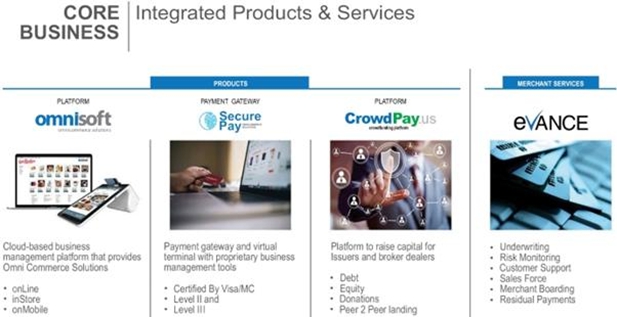
We are a FinTech company that focuses on a suite
of products in the merchant services marketplace and seeks to provide integrated business solutions to merchants throughout the United States.
We seek to provide merchants with a wide range of products and services through our various online platforms, including financial and
transaction processing services. We also have products that provide support for crowdfunding and other capital raising initiatives. We
supplement our online platforms with certain hardware solutions that are integrated with our online platforms. Our business functions
primarily through three wholly-owned subsidiaries, eVance, Inc., a Delaware corporation (“eVance”), OmniSoft.io, Inc., a Delaware
corporation (“OmniSoft”), and CrowdPay.Us, Inc., a New York corporation (“CrowdPay”).
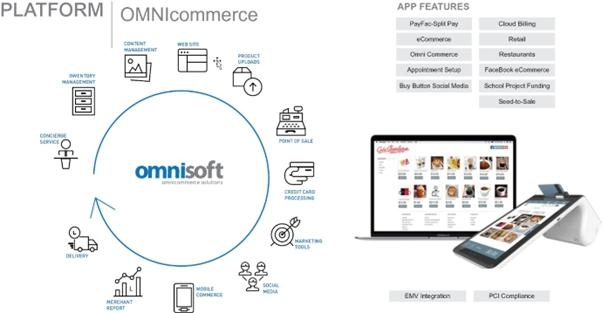
OmniSoft operates a cloud-based business management
platform that provides turnkey solutions for merchants to enable them to build and manage their retail businesses, whether online or at
a “brick and mortar” location. The OmniSoft platform, which can be accessed by merchants through any mobile and computing
device, allows merchants to, among other features, manage and track inventory, track sales and process customer transactions and can provide
interactive data analysis concerning sales of products and need for additional inventory. Merchants generally utilize the platform by
uploading to the platform information about their inventory (description of units, number of units, price per unit, and related information).
Once such information has been uploaded, merchants, either with their own device or with hardware that we sell directly to them, are able
to utilize the platform to monitor inventory and process and track sales of their products (including coordinating shipping of their products
with third party logistics companies). We manage and maintain the OmniSoft platform through a variety of domain names or a merchant can
integrate our platform with their own domain name. Using the OmniSoft platform, merchants can “check-out” their customers
at their “brick and mortar” stores or can sell products to customers online, in both cases accepting payment via a simple
credit card or debit card transaction (either swiping the credit card or entering the credit card number), a cash payment, or by use of
a QR code or loyalty and reward points, and then print or email receipts to the customer. For more information regarding our OmniSoft
platform, see “Description of our OmniSoft Business.”
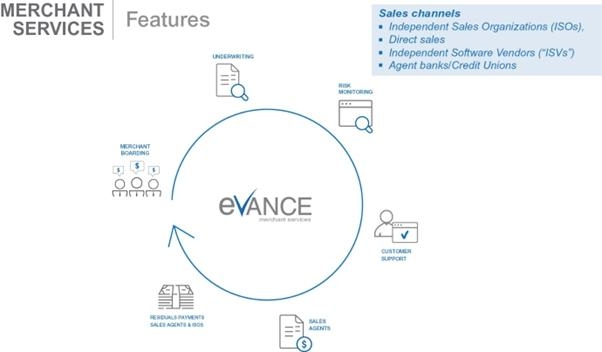
eVance provides competitive payment
processing solutions to merchants which enable merchants to process credit and debit card-based internet payments for sales of their
products at competitive prices (whether such sales occur online or at a “brick and mortar” location). eVance is an
independent sales organization (an “ISO”) that signs up new merchants on behalf of acquiring banks and processors that
provides financial and transaction processing solutions to merchants throughout the United States. eVance differentiates itself
from other ISOs by focusing on both obtaining and maintaining new merchant contracts for its own account (including, but not limited
to, merchants that utilize the OmniSoft platform) and also obtaining and maintaining merchant contracts obtained by third-party ISOs
(for which we negotiate a shared fee arrangement) and utilizing our own software and technology to provide merchants and other ISOs
differentiating products and software. In particular, we (i) own our own payments gateway, (ii) have proprietary
omni-commerce software platform, (iii) have in-house underwriting and customer service, (iv) have in-house sub-ISO
management system which offers sub-ISOs and agents tools for online boarding, account management, residual reports among other
tools, and (v) offer a suite of products in the financial markets (through CrowdPay). Leveraging our relationship with three of
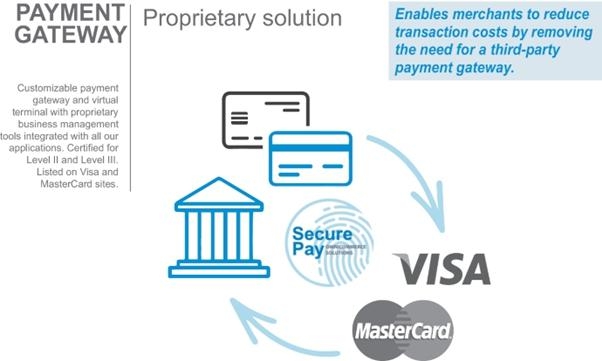
the top five merchant processors in the United States (representing a majority of the merchant processing market) and with the
use of our proprietary software, our payment gateway (which we call “SecurePay”) enables merchants to reduce the cost of
transacting with their customers by removing the need for a third-party payment gateway solution. eVance operates as both a
wholesale ISO and a retail ISO depending on the risk profile of the merchant and the applicable merchant processor and acquiring
bank. As a wholesale ISO, eVance underwrites the processing transactions for merchants, establishing a direct relationship with the
merchant and generating individual merchant processing contracts in exchange for future residual payments. As a retail ISO, eVance
primarily gathers the documents and information that our partners (acquiring banks and acquiring processors) need to underwrite
merchants’ transactions and as a result receives only residual income as commission for merchants it places with our partners.
For more information regarding the electronic payment industry, see “Business — Description of our eVance
Business — Our Industry.”

SecurePay
SecurePay is a payment gateway and virtual terminal
with proprietary business management tools that is in compliance with the Payment Card Industry (PCI).
SecurePay has been certified by Visa and MasterCard
(certified Level II and Level III) and finalized implementation of “3D Secure” in 2019 (a feature that is unique to what we
offer in order to provide for more secure environment for E-commerce and mobile payments in-store and online).
On June 15, 2023, the Company entered into a
Membership Interest Purchase Agreement with SDI Black 001, LLC (“Seller”) whereby the Company acquired from Seller
80.01% of the membership interests of Moola Cloud, LLC, a Florida limited liability company (f/k/a Cuentas SDI, LLC) (the
“LLC”). On May 20, 2024, the Company entered into a second Membership Interest Purchase Agreement with the minority
member of the LLC (the “Agreement”) whereby it acquired the remaining 19.99% of the membership interests of the LLC for
a purchase price of $215,500. As a result, effective May 20, 2024, the Company owns 100% of the LLC. On August 14, 2024, the LLC
changed its name to Moola Cloud, LLC. The Agreement contains a restrictive covenant whereby for a period of three (3) years from the
closing, none of Seller, including any of its principals, executives, officers, directors, managers, employees, salespersons, or
entities in which such principal has any interest, will directly or indirectly (i) induce, attempt to induce, interfere with,
disrupt or attempt to disrupt any past, present or prospective business relationship, solicit, market to, endeavor to obtain as a
customer, or contract with any merchant in order to provide services to such Merchant in competition with the Company; or (ii)
solicit or interfere with, disrupt or attempt to disrupt any past, present or prospective business relationship, contractual or
otherwise any person or entity that is a party to any contract assigned to the Company to terminate its contractual or business
relationship with the Company. The LLC enables the Company to focus on marketing to the underbanked communities utilizing the LLC’s debit
and calling card platform’s ability for users to reload cash to their account and provide instant access to digital products to
their customers’ Mobile App and digital wallet into its electronic portal. The Company markets to the LLC’s merchant network,
which currently has approximately 31,600 locations in the United States. The Company provides the ability of having one POS system that
will allow the retail customer to purchase products using OLB’s payment processing solutions along with the ability to reload payment
cards and their mobile phone minutes.
CrowdPay
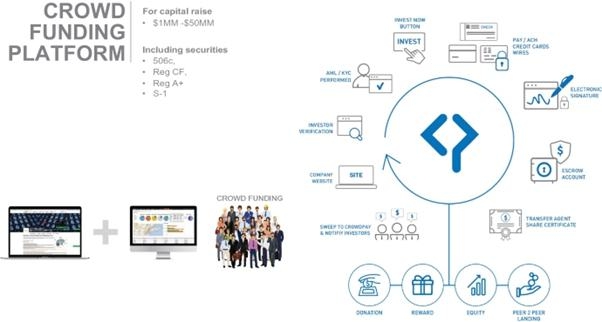
CrowdPay.us™ operates a white label capital
raising platform that targets small and midsized businesses seeking to raise capital and registered broker-dealers seeking to host capital
raising campaigns for such businesses by integrating the platform onto such company’s or broker-dealer’s website. Our CrowdPay
platform is tailored for companies seeking to raise money through a crowdfunding offering of between $1 million and $50 million pursuant
to Regulation CF under Title III of the Jumpstart Our Business Startups (the “JOBS Act”), offerings pursuant to Rule 506(b)
and Rule 506(c) under Regulation D of the Securities Act of 1933, as amended (the “Securities Act”), and offerings pursuant
to Regulation A+ of the Securities Act. Our platform, which can be used for multiple offerings at once, provides companies and broker-dealers
with an easy-to-use, turnkey solution to support company offerings, allowing companies and broker-dealers to easily present online to
potential investors relevant marketing and offering materials and by aiding in the accreditation and background check processes to ensure
investors meets the applicable requirements under the rules and regulations of the Securities Exchange Commission (the “SEC”).
CrowdPay charges a fee to each company and broker-dealer for the use of its platform under a fee structure that is agreed to between CrowdPay
and the Company and/or broker-dealer prior to the initiation of the offering. CrowdPay also generates revenues by providing ancillary
services to the companies and broker-dealers utilizing our platform, including running background checks and providing anti-money laundering
and know-your-customer compliance. CrowdPay is not a registered funding portal or a registered broker-dealer.
Crowd Ignition is a web-based crowdfunding software
system. The software provides broker-dealer, merchant banks and law firms a platform to market crowdfunding offerings, collect payments
and issue securities. The software has been developed in response to, and to comply with, recent changes in investment regulations including
Regulation D 506(b) and 506(c), Regulation A+ and Title III of the Jobs Act (Regulation CF), including raising the crowdfunding limit
from $1.07 million to $5.0 million. Crowd Ignition is one of only about 50 companies registered with the SEC to provide the services permitted
under Regulation CF.
OLBit and DMINT
On May 14, 2021, the Company formed OLBit, Inc.,
a wholly owned subsidiary (“OLBit”). The purpose of OLBit is to hold the Company’s assets and operate its business related
to its emerging money transmission and transactional business. OLBit was previously in the process of applying for money transmission
licenses in all 50 states. In June 2023, it was decided to delay the process of applying for such licenses in order to have a greater
focus of financial and management resources on the Company’s payment processing business and Bitcoin mining business.
On July 23, 2021, we formed our wholly owned
subsidiary, DMINT, Inc. (“DMINT”), to operate in the Bitcoin mining industry. DMINT initiated the first phase of its
Bitcoin mining operation by establishing data centers and ASIC-based Antminer S19J Pro mining computers specifically configured to
mine Bitcoin in Bradford, Pennsylvania. As of December 31, 2025, DMINT has 1,000 computers and had 400 computers online and mining
for Bitcoin. DMINT has a data center located in Selmer, Tennessee. In February 2023, DMINT redeployed its mining computers from its
Pennsylvania location and focus the mining efforts at the Selmer, Tennessee location because of the lower cost of operations in the
location.
On August 16, 2022, DMINT Real Estate Holdings,
Inc. (“DREH”), a wholly owned subsidiary of DMINT, purchased 4.73 acres of land and a building located at 565 Industrial Park
Drive, Selmer, McNairy County, Tennessee for a purchase price of $408,000. DMINT established a Bitcoin mining data center powered on the
local power grid. The location is expected to have capacity for up to 5,000 mining machines. The Company plans to complete the buildout
of the building to be fully operational with 5,000 machines in 2026 following a spin-off of DMINT into a standalone entity which is currently
in process.
As stated above, we are currently in the process
of spinning off DMINT into a stand-alone entity. Our planned DMINT spin-off distribution (the “Spin-Off Distribution”) will
occur upon DMINT’s Form S-1 Registration Statement filing being declared effective by the Securities and Exchange Commission, and
the approval by the Nasdaq Capital Market (“NASDAQ”) of the listing of DMINT’s common shares on the NASDAQ. Following
the consummation of the Spin-Off Distribution, of which there is no guarantee, (i) DMINT will no longer be a wholly owned subsidiary of
the Company and will be a stand-alone entity, (ii) all of DMINT’s outstanding shares of common stock will be owned by the existing
stockholders of the Company, and (iii) DMINT Real Estate Holdings, Inc. (“DREH”) will remain a wholly owned subsidiary of
DMINT.
Synergies between the subsidiaries
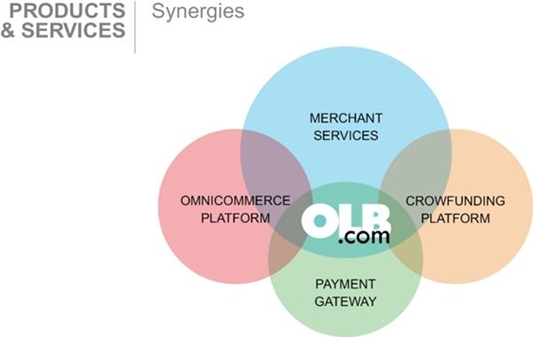
The success of our business model is dependent
on the synergies between the business segments operated by our subsidiaries. We have created and developed products that we believe form
an ecosystem of e-commerce to provide a variety of clients, from online equity financing companies or merchants selling online or in
brick and mortar stores, with multiple product offerings and ancillary services from underwriting with the banks and merchant billing
from the cloud software. We expect that these synergies will create additional revenue by charging transaction fees on each service provided
to clients by our partnerships with Merchant Acquiring Banks and PCI Compliance.
We believe that our wholly-owned subsidiaries
combine to create an ecosystem where each subsidiary benefits the other. Starting with the services provided by eVance, we enable each
of our products and platforms to communicate with each other and create an ecosystem among our products and, potentially, third-party
products. These services are provided to our other subsidiaries.
The product environment created with a new registered
merchant or issuer enables all merchant information to be stored in a single, centralized location but utilized by all subsidiaries. For
example, merchant services utilizing eVance provide electronic payment processing services that can be utilized for payments on the Crowdfunding
platform. The platform is used by merchant services to allow mobile and online processing to merchants.
The Omni commerce platform is offered to all of
the merchant services clients. The offered Merchant Services products we provide enable all processing needs for the OmniCommerce system.
The gateway will allow merchants that are using the platform to accept online E-Commerce transactions.
Competitive Advantages
We believe that our platform of services provides
the following key advantages.
| |
● |
Cost — we believe that we are the only content service provider that does not charge a setup fee. |
| |
● |
Flexibility — we believe our platform has the flexibility to provide customized solutions for partners. |
| |
● |
Pricing — we provide partners with a price comparison feature which they can utilize if they wish to set prices for products or run promotions. |
| |
● |
Payment processing — we can provide financial service companies with the ability to have their customers’ accounts directly debited for payment. |
| |
● |
We can assist existing “brick and mortar” businesses that have inventory and fulfilment capability but do not wish to create and maintain an e-commerce website and infrastructure to sell their products. |
| |
● |
We can provide a platform for early-stage companies looking for an effective and less costly way to raise capital. |
Risks Associated with our Business
Our business and ability to execute our business
strategy are subject to a number of risks of which you should be aware before you decide to buy our securities. In particular, you should
consider the following risks, which are discussed more fully in the section entitled “Risk Factors” in this Annual Report
on Form 10-K:
| |
● |
We operate in a regulatory environment that is evolving and uncertain and any changes to regulations could have a material impact on our business and financial condition; |
| |
● |
We rely on a combination of confidentiality clauses, assignment agreements and license agreements with employees and third parties, trade secrets, copyrights and trademarks to protect our intellectual property and competitive advantage, all of which offer only limited protection meaning that we may be unable to maintain and protect our intellectual property rights and proprietary information or prevent third-parties from making unauthorized use of our technology; |
| |
● |
Our growth may not be sustainable and depends on our ability to attract new merchants, retain existing merchants and increase sales to both new and existing merchants; |
| |
● |
While we believe that we have sufficient capital to continue operations
for a period of at least twelve months from the date of this Annual Report on Form 10-K, if there are unanticipated expenses, insufficient
cash from operations, we may require additional capital to continue our operations that may not be available or, if available, may not
be available on reasonable terms; |
| |
● |
We are substantially dependent on our eVance business for revenue. If we are unable to maintain our eVance business for any reason (including those described herein) or for no reason, it will have a material adverse effect on our company; |
| |
● |
Our ability to anticipate and respond to changing industry trends and the needs and preferences of our merchants and consumers may adversely affect our competitiveness or the demand for our products and services; |
| |
● |
The properties included in our mining network may experience damages; |
| |
● |
Regulatory changes or actions may alter the nature of an investment in us or restrict the use of cryptocurrencies in a manner that adversely affects our business, prospects or operations; |
| |
● |
Banks and financial institutions may not provide banking services, or may cut off services, to businesses that provide cryptocurrency-related services or that accept cryptocurrencies as payment, including financial institutions of investors in our securities; |
| |
● |
It may be illegal in the future, to acquire, own, hold, sell or use Bitcoin or other cryptocurrencies, participate in the blockchain or utilize similar digital assets in one or more countries, the ruling of which would adversely affect us. |
| |
● |
Acquisitions create certain risks and may adversely affect our business,
financial condition, results of operations and cash flows; and |
| |
● |
If we fail to improve and enhance the functionality, performance, reliability, design, security and scalability of our platform in a manner that responds to our merchants’ evolving needs, our business may be adversely affected. |
Regulations
Various aspects of our service areas are subject
to U.S. federal, state, and local regulation. Certain of our services also are subject to rules promulgated by various card networks and
banking and other authorities as more fully described below.
The Dodd-Frank Act
In July 2010, the Dodd-Frank Act was signed into
law in the United States. The Dodd-Frank Act has resulted in significant structural and other changes to the regulation of the financial
services industry. Among other things, Title X of the Dodd-Frank Act established a new, independent regulatory agency known as the Consumer
Financial Protection Bureau (the “CFPB”) to regulate consumer financial products and services (including some offered by our
customers). The CFPB may also have authority over us as a provider of services to regulated financial institutions in connection with
consumer financial products. Separately, under the Dodd-Frank Act, debit interchange transaction fees that a card issuer receives and
are established by a payment card network for an electronic debit transaction are now regulated by the Federal Reserve and must be “reasonable
and proportional” to the cost incurred by the card issuer in authorizing, clearing, and settling the transaction. Effective October
1, 2011, the Federal Reserve capped debit interchange rates for card issuers operating in the United States with assets of $10 billion
or more at the sum of $0.21 per transaction and an ad valorem component of 5 basis points to reflect a portion of the issuer’s fraud
losses plus, for qualifying issuers, an additional $0.01 per transaction in debit interchange for fraud prevention costs. In addition,
the new regulations contain non-exclusivity provisions that ban debit card networks from prohibiting an issuer from contracting with any
other card network that may process an electronic debit transaction involving an issuer’s debit cards and prohibit card issuers
and card networks from inhibiting the ability of merchants to direct the routing of debit card transactions over any network that can
process the transaction. Beginning April 1, 2012, all debit card issuers in the United States were required to participate in at least
two unaffiliated debit card networks. On April 1, 2013, the ban on network exclusivity arrangements became effective for prepaid card
and healthcare debit card issuers, with certain exceptions for prepaid cards issued before that date.
Effective July 22, 2010, merchants were allowed
to set minimum dollar amounts (not to exceed $10) for the acceptance of a credit card (while federal governmental entities and institutions
of higher education may set maximum amounts for the acceptance of credit cards). They were also allowed to provide discounts or incentives
to entice consumers to pay with an alternative payment method, such as cash, checks or debit cards.
Association and network rules
We are subject to the rules of credit card associations
and other credit and debit networks. In order to provide processing services, a number of our subsidiaries are registered with Visa or
Mastercard as service providers for member institutions. Various subsidiaries of ours are also processor level members of numerous debit
and electronic benefits transaction networks or are otherwise subject to various network rules in connection with processing services
and other services we provide. As such, we are subject to applicable network rules. Card networks and their member financial institutions
regularly update and generally expand security expectations and requirements related to the security of cardholder data and environments.
We are also subject to network operating rules promulgated by the National Automated Clearing House Association relating to payment transactions
processed by us using the Automated Clearing House Network and to various state federal and foreign laws regarding such operations, including
laws pertaining to electronic benefits transactions.
Privacy and information security regulations
We provide services that may be subject
to various state, federal, and foreign privacy laws and regulations, including, among others, the Financial Services Modernization Act
of 1999 (the “Gramm-Leach-Bliley Act”). These laws and their implementing regulations restrict certain collection, processing,
storage, use, and disclosure of personal information, require notice to individuals of privacy practices, and provide individuals with
certain rights to prevent use and disclosure of protected information. These laws also impose requirements for the safeguarding and proper
destruction of personal information through the issuance of data security standards or guidelines. Certain federal, state and foreign
laws and regulations impose similar privacy obligations and, in certain circumstances, obligations to notify affected individuals, state
officers or other governmental authorities, the media, and consumer reporting agencies, as well as businesses and governmental agencies,
of security breaches affecting personal information. In addition, there are state and foreign laws restricting the ability to collect
and utilize certain types of information such as Social Security and driver’s license numbers.
Unfair trade practice regulations
We and our clients are subject to various federal
and state laws prohibiting unfair or deceptive trade practices, such as Section 5 of the Federal Trade Commission Act. Various regulatory
agencies, including the Federal Trade Commission, the Consumer Financial Protection Bureau, and state attorneys general, have authority
to take action against parties that engage in unfair or deceptive trade practices or violate other laws, rules, and regulations, and to
the extent we are processing payments for a client that may be in violation of laws, rules, and regulations, we may be subject to enforcement
actions and incur losses and liabilities that may impact our business.
Anti-money laundering, anti-bribery, sanctions,
and counter-terrorist regulations
We are subject to anti-money laundering laws and
regulations, including certain sections of the USA PATRIOT Act of 2001. We are also subject to anti-corruption laws and regulations, including
the U.S. Foreign Corrupt Practices Act (the “FCPA”) and other laws, that prohibit the making or offering of improper payments
to foreign government officials and political figures and includes anti-bribery provisions enforced by the Department of Justice and accounting
provisions enforced by the SEC. The FCPA has a broad reach and requires maintenance of appropriate records and adequate internal controls
to prevent and detect possible FCPA violations. Many other jurisdictions where we conduct business also have similar anticorruption laws
and regulations. We have policies, procedures, systems, and controls designed to identify and address potentially impermissible transactions
under such laws and regulations.
We are also subject to certain economic and trade
sanctions programs that are administered by the Office of Foreign Assets Control (“OFAC”) which prohibit or restrict transactions
to or from or dealings with specified countries, their governments, and in certain circumstances, their nationals, and with individuals
and entities that are specially-designated nationals of those countries, narcotics traffickers, and terrorists or terrorist organizations.
Other group entities may be subject to additional local sanctions requirements in other relevant jurisdictions.
Securities Act
Since the JOBS Act was passed, Crowdfunding, Regulation
D offerings and Regulation A and A+ offerings rapidly became a familiar concept among investment firms, venture capitalists, real estate
developers and small to medium sized businesses as a way to facilitate and democratize financing. We believe it has created, and continues
to create, a profound shift in the world of investments. Below is a brief overview of the rules that permit the offer and sale of securities
through such platforms. This overview is in no way intended to be a comprehensive review of all the rules and regulations associated with
the above mentioned offerings and should not be relied upon by anyone.
Regulation D under the Securities Act is the most
common regulatory exemption used by small businesses to raise capital through equity financing. It exempts private placement offerings under
Rule 506(b) and 506(c) when sold to accredited investors, as defined under Rule 501 of Regulation D. Companies relying on the Rule 506
exemptions can raise an unlimited amount of money, so long as they comply with the rule’s requirements. Regulation A and Regulation A+
are more similar to a public offering, and require filing Form 1-A with the SEC. Regulation A and Regulation A+ offer two tiers of offerings;
the first tier is for offerings of up to $20 million within any 12 month period and the second tier is for offerings of up to $50 million,
within any 12 month period. Regulation CF allows a company to raise up to $1.07 million from non-accredited investors.
Intellectual property
Our products and services utilize a combination
of proprietary software and hardware that we own and license from third parties. Over the last few years, we have developed a payment
gateway, merchant boarding system, E-commerce platform, recurring billings and a crowdfunding platform. We generally control access to
and use of our proprietary software and other confidential information through the use of internal and external controls, including entering
into non-disclosure and confidentiality agreements with both our employees and third parties. As of the date of this Annual Report on
Form 10-K, we have a patent pending on transferable QR codes on Omni Commerce devices.
Employees
As of December 31, 2025, we had 5 key employees
as part of our overall staff of 13 full-time employees. Our risk, compliance, underwriting, accounting and customer service functions
are primarily located in Georgia. In addition, we have operations in India where we retain 25 developers at any given time depending on
our requirements and scope of projects. None of our employees are represented by a labor union or covered by a collective bargaining agreement.
We consider our relationship with our employees to be good.
Corporate Information
We were incorporated in the State of Delaware
on November 18, 2004, for the purpose of merging with OLB.com, Inc., a New York corporation incorporated in 1993 (“OLB.com”).
The merger was done for the purpose of changing our state of incorporation from New York to Delaware. In April 2018, we completed an acquisition
of substantially all of the assets of Excel Corporation and its subsidiaries Payprotec Oregon, LLC, Excel Business Solutions, Inc. and
eVance Processing, Inc. (collectively, the “eVance Asset Acquisition”) (such assets are the foundation of our eVance business).
In connection with the eVance Asset Acquisition, in May 2018, we entered into share exchange agreements with CrowdPay and OmniSoft, affiliate
companies owned by our CEO, Ronny Yakov, and John Herzog, a stockholder of the Company, pursuant to which each of CrowdPay and OmniSoft
became wholly owned subsidiaries of the Company.
On April 26, 2024, the Company filed with the
State of Delaware a Certificate of Amendment to Certificate of Incorporation (the “Certificate of Amendment”) which became
effective on April 26, 2024, to effect a one-for-ten (1:10) reverse stock split (the “Reverse Stock Split”) of the shares
of the Company’s common stock, par value $0.0001 per share (the “Common Stock”) The Reverse Stock Split was approved
by the Company’s stockholders at a special meeting on April 26, 2024.
As a result of the Reverse Stock Split, every
ten (10) shares of issued and outstanding Common Stock were automatically combined into one (1) issued and outstanding share of Common
Stock, without any change in the par value per share. No fractional shares were issued as a result of the Reverse Stock Split and any
fractional shares resulting from the reverse stock split were rounded down to the nearest number of whole shares so that we will issue
cash in lieu of any fractional shares that such stockholder would have received as a result of the Reverse Stock Split. Immediately following
the Reverse Stock Split, the number of shares of Common Stock outstanding was reduced from 18,103,462 shares to 1,810,346 shares. The
shares of Common Stock underlying the Company’s outstanding stock options and warrants were similarly adjusted along with corresponding
adjustments to their exercise prices. The number of authorized shares of Common Stock under the Certificate of Incorporation will remain
unchanged at 50,000,000 shares. Throughout this Form 10-K, each reference to a number of our issued
and outstanding common stock gives effect to the Reverse Stock Split, unless otherwise indicated.
Our Company’s headquarters is located at
1120 Avenue of the Americas, 4th Floor, New York, NY 10036. Our telephone number is (212) 278-0900.
Implications of Being an Emerging Growth Company
We qualify as an “emerging growth company”
as defined under the Securities Act. As a result, we are permitted to, and intend to, rely on exemptions from certain disclosure requirements
that are otherwise applicable to public companies. These provisions include, but are not limited to:
| |
● |
not being required to comply with the auditor attestation requirements of Section 404 of the Sarbanes-Oxley Act of 2002, as amended (or the Sarbanes-Oxley Act); |
| |
● |
reduced disclosure obligations regarding executive compensation in our periodic reports, proxy statements and registration statements; and |
| |
|
|
| |
● |
exemptions from the requirements of holding a nonbinding advisory vote on executive compensation and stockholder approval of any golden parachute payments not previously approved. |
In addition, an emerging growth company can take
advantage of an extended transition period for complying with new or revised accounting standards. This provision allows an emerging growth
company to delay the adoption of some accounting standards until those standards would otherwise apply to private companies. We have elected
to avail ourselves of this extended transition period. We will remain an emerging growth company until the earliest to occur of: (i) our
reporting $1.07 billion or more in annual gross revenues; (ii) the end of fiscal year 2025; (iii) our issuance, in a three-year period,
of more than $1 billion in non-convertible debt; and (iv) the end of the fiscal year in which the market value of our common stock held
by non-affiliates exceeded $700 million on the last business day of our second fiscal quarter.
Item 1A. Risk Factors
Investing in our common stock involves a high
degree of risk. You should consider carefully the risks and uncertainties described below, together with all of the other information
contained in this annual report, before deciding to invest in our common stock. If any of the following risks materialize, our business,
financial condition, results of operations, cashflows and prospects will likely be materially and adversely affected. In that event, the
market price of our common stock could decline and you could lose all or part of your investment.
Risks Related to Our Company
The substantial and continuing losses, and
significant operating expenses incurred in the past few years may cause us to be unable to pursue all of our operational objectives if
sufficient financing and/or additional cash from revenues is not realized.
We have limited cash resources and operating losses
throughout our history. As of December 31, 2025 we had a working capital deficit of $6,640,236 and a net loss of $5,874,051. Our cash
flow used by operating activities for the year ended December 31, 2025 was $1,330,383. Notwithstanding the foregoing, management has concluded
that it has sufficient liquidity to continue operations for a period of at least twelve months from the date of this Annual Report on
Form 10-K, which conclusion would not have been possible without close monitoring of the Company’s projected cash flow and operating
expenses for a period of at least the next twelve months.
We have historically relied on related parties
and affiliates to finance our operations, but there is no guarantee that these parties will continue to finance our operations in the
future.
While we will be able to fund future liquidity
and capital requirements through cash flows generated from our operating activities alone for a period of twelve months, we previously
financed our operations from short-term loans from Ronny Yakov, our Chief Executive Officer. It is not assured that Mr. Yakov will continue
to provide such assistance if the Company were to require it in the future.
We operate in a complex regulatory environment,
and failure to comply with applicable laws and regulations could adversely affect our business.
Our operations are subject to a broad range of
complex and evolving laws and regulations. As a result, we must perform our services in compliance with the legal and regulatory requirements
of multiple jurisdictions. Some of these laws and regulations may be difficult to ascertain or interpret and may change from time to time.
Violation of such laws and regulations could subject us to fines and penalties, damage our reputation, constitute a breach of our client
agreements, impair our ability to obtain and renew required licenses, and decrease our profitability or competitiveness. If any of these
effects were to occur, our operating results, cash flows and financial condition could be adversely affected.
We may not be able to integrate new technologies
and provide new services in a cost-efficient manner.
The online E-commerce industry is subject to rapid
and significant changes in technology, frequent new service introductions and evolving industry standards. We cannot predict the effect
of these changes on our competitive position, our profitability or the industry generally. Technological developments may reduce the competitiveness
of our networks and our software solutions and require additional capital expenditures or the procurement of additional products that
could be expensive and time consuming. In addition, new products and services arising out of technological developments may reduce the
attractiveness of our services. If we fail to adapt successfully to technological advances or fail to obtain access to new technologies,
we could lose customers and be limited in our ability to attract new customers and/or sell new services to our existing customers. In
addition, delivery of new services in a cost-efficient manner depends upon many factors, and we may not generate anticipated revenue from
such services.
Disruptions in our networks and infrastructure
may result in customer dissatisfaction, customer loss or both, which could materially and adversely affect our reputation and business.
Our systems are an integral part of our customers’
business operations. It is critical for our customers, that our systems provide a continued and uninterrupted performance. Customers may
be dissatisfied by any system failure that interrupts our ability to provide services to them. Sustained or repeated system failures would
reduce the attractiveness of our services significantly and could result in decreased demand for our services.
We face the following risks to our networks, infrastructure
and software applications:
| |
● |
the regions in which we operate may experience significant weather events which physically damage access lines; |
| |
● |
power surges and outages, computer viruses or hacking, earthquakes, terrorism attacks, vandalism and software or hardware defects which are beyond our control; and |
| |
● |
Unusual spikes in demand or capacity limitations in our or our suppliers’ networks. |
Disruptions may cause interruptions in service
or reduced capacity for customers, either of which could cause us to lose customers and/or incur expenses, and thereby adversely affect
our business, revenue and cash flow.
Our positioning in the marketplace as a
smaller provider places a significant strain on our resources, and if not managed effectively, could result in operational inefficiencies
and other difficulties.
Our positioning in the marketplace may place
a significant strain on our management, operational and financial resources, and increase demand on our systems and controls. To
manage this position effectively, we must continue to implement and improve our operational and financial systems and controls,
invest in development and engineering, critical systems and network infrastructure to maintain or improve our service quality
levels, purchase and utilize other systems and solutions, and train and manage our employee base. As we proceed with our
development, operational difficulties could arise from additional demand placed on customer provisioning and support, billing and
management information systems, product delivery and fulfilment, sales and marketing and administrative resources.
For instance, we may encounter delays or cost
overruns or suffer other adverse consequences in implementing new systems when required. In addition, our operating and financial control
systems and infrastructure could be inadequate to ensure timely and accurate financial reporting.
We must attract and retain skilled personnel.
If we are unable to hire and retain technical, technical sales and operational employees, our business could be harmed.
Our ability to integrate our acquired assets and
to grow will be particularly dependent on our ability to hire, develop and retain an effective sales force and qualified technical and
managerial personnel. We need software development specialists with in-depth knowledge of a blend of IT and telecommunications or with
a blend of security and telecom. We intend to hire additional necessary employees, including software engineers, communication engineers,
project managers, sales consultants, employees and operational employees, on a permanent basis. The competition for qualified technical
sales, technical, and managerial personnel in the communications and software industry is intense in the markets where we operate, and
we may not be able to hire and retain sufficient qualified personnel. In addition, we may not be able to maintain the quality of our operations,
control our costs, maintain compliance with all applicable regulations, and expand our internal management, technical, information and
accounting systems in order to support our desired growth, which could have an adverse impact on our operations. Volatility in the stock
market and other factors could diminish our use, and the value, of our equity awards as incentives to employees, putting us at a competitive
disadvantage or forcing us to use more cash compensation.
We are dependent on the continued services
and performance of our senior management and other key employees, the loss of any of whom could adversely affect our business, operating
results, financial condition and cash flows.
Our future performance depends on the continued
services and contributions of our senior management, including our Chief Executive Officer, Ronny Yakov, Vice President, Finance, Patrick
Smith and other key employees to execute on our business plan and to identify and pursue new opportunities and product innovations. The
loss of services of senior management or other key employees could significantly delay or prevent the achievement of our strategic objectives.
In addition, some of the members of our current senior management team have only been working together for a short period of time, which
could adversely impact our ability to achieve our goals. From time to time, there may be changes in our senior management team resulting
from the hiring or departure of executives, which could disrupt our business. We do not maintain key person life insurance policies on
any of our employees other than a policy providing limited coverage on the life of our Chief Executive Officer. The loss of the services
of one or more of our senior management or other key employees for any reason could adversely affect our business, financial condition
and operating results and require significant amounts of time, training and resources to find suitable replacements and integrate them
within our business, and could affect our corporate culture.
Our Chief Financial Officer is currently
employed on a part-time basis.
Given the size of the Company and our operational
needs, we initially hired our Chief Financial Officer, Rachel Boulds, on a part-time basis. While we have discussed with Ms. Boulds the
possibility of becoming our full-time Chief Financial Officer, it is anticipated that Ms. Boulds will continue to be employed on a part-time
basis for the next twelve months. In addition to her role as Chief Financial Officer, Ms. Boulds is also operating her solo accounting
practice providing services for clients unrelated to the Company. While we believe that Ms. Boulds currently devotes adequate time to
the Company to perform the role and duties of our Chief Financial Officer, we cannot guarantee that she will be able to continue to do
so until she is with the Company on a fulltime basis. If Ms. Boulds cannot devote adequate time to our Company to fulfil her role and
duties as Chief Financial Officer or if any conflicts of interest arise during this time, it could have a material adverse impact on our
Company.
Our success depends on our continued investment
in research and development, the level and effectiveness of which could reduce our profitability.
We intend to continue to make investments in
research and development and product development in seeking to sustain and improve our competitive position and meet our
customers’ needs. These investments currently include streamlining our suite of software functionalities, including
modularization and improving scalability of our integrated solutions. To maintain our competitive position, we may need to increase
our research and development investment, which could reduce our profitability and cash flows. In addition, we cannot assure you that
we will achieve a return on these investments, nor can we assure you that these investments will improve our competitive
position.
Risks Related to Our Business
CROWDPAY.US, INC.
We operate in a regulatory environment that
is evolving and uncertain.
The regulations that govern the companies and
broker-dealers that utilize our platform and the investors that find investment opportunities on our platform have been in existence for
a very few years. Further, there are constant discussions among legislators and regulators with respect to changing this regulatory environment.
New laws and regulations could be adopted in the United States and abroad. Further, existing laws and regulations may be interpreted in
ways that would impact our platform, including our ability to communicate and work with investors, broker-dealers and the companies that
use our platforms’ services. For instance, over the past year, there have been several attempts to modify the current regulatory
regime. Some of those suggested reforms could make it easier for anyone to sell securities (without using our platform), or could increase
our regulatory burden, including requiring us to register as a broker-dealer or funding portal before we choose to do so. Any such changes
would have a negative impact on our business.
We may be liable for misstatements made
by issuers on our platform.
Under the Securities Act and the Securities and
Exchange Act of 1934, as amended (the “Exchange Act”), issuers making offerings through our platform may be liable for including
untrue statements of material facts or for omitting information that could make the statements made misleading. This liability may also
extend in Regulation Crowdfunding offerings to funding portals. Even though we are not a registered funding portal, there can be no assurance
that if we were sued, we would prevail. Further, even if we do succeed, lawsuits are time consuming and expensive, and being a party to
such actions may cause us reputational harm that would negatively impact our business.
Our compliance is focused on U.S. laws and
we have not analyzed foreign laws regarding the participation of non-U.S. residents.
Some of the investment
opportunities posted on our platform are open to non-U.S. residents. We have not researched all the applicable foreign laws and regulations,
and therefore we have not set up our structure to be compliant with all those laws. It is possible that we may be deemed in violation
of those laws, which could result in fines or penalties as well as reputational harm. This may limit our ability in the future to assist
companies in accessing money from those investors, and compliance with those laws and regulation may limit our business operations and
plans for future expansion.
The types of offerings that we expect to
be posted on our platform are relatively new in an industry that is still quickly evolving.
The principal types of offerings that are posted
on our platform are pursuant to Regulation A and Regulation Crowdfunding (CF) which have only been in effect in their current form since
2015 and 2016, respectively. Our ability to penetrate the market to host these types of offerings remains uncertain as potential issuer
companies may choose to use different platforms or providers (including, in the case of Regulation A, using their own online platform),
or determine alternative methods of financing. Investors may decide to invest their money elsewhere. Further, our potential market may
not be as large, or our industry may not grow as rapidly, as anticipated. With a smaller market than expected, we may have fewer customers.
Success will likely be a factor of investing in the development and implementation of marketing campaigns, subsequent adoption by issuer
companies as well as investors, and favorable changes in the regulatory environment.
CrowdPay and its providers are vulnerable
to hackers and cyber-attacks.
As an internet-based business, we may be
vulnerable to hackers who may access the data of the investors and the issuer companies that utilize our platform. Further, any significant
disruption in service on our platform or in our computer systems could reduce the attractiveness of the platform and result in a loss
of investors and companies interested in using our platform. Further, we rely on a third-party technology provider to provide some of
our back-up technology as well as act as our escrow agent. Any disruptions of services or cyber-attacks either on our technology provider
or on our company could harm our reputation and materially negatively impact our financial condition and business.
CrowdPay currently relies on one escrow
agent and technology service provider.
We currently rely on Microsoft Azure to serve
as our technology provider and all escrow accounts are held at MVB Bank, Inc. Any change in these relationships will require us to find
another technology service provider, escrow agent and escrow bank. This may cause us delays as well as additional costs in transitioning
our technology.
We are dependent on general economic conditions.
Our business model is dependent on investors investing
in the companies presented on our platform. Investment dollars are disposable income. Our business model is thus dependent on national
and international economic conditions. Adverse national and international economic conditions may reduce the future availability of investment
dollars, which would negatively impact revenues generated by CrowdPay and possibly our ability to continue operations at CrowdPay. It
is not possible to accurately predict the potential adverse impacts on us, if any, of current economic conditions on its financial condition,
operating results and cash flow.
We face significant market competition.
We facilitate online capital formation. Though
this is a new market, we compete against a variety of entrants in the market as well likely new entrants into the market. Some of these
follow a regulatory model that is different from ours and might provide them competitive advantages. New entrants could include those
that may already have a foothold in the securities industry, including some established broker-dealers. Further, online capital formation
is not the only way to address helping start-ups raise capital, and we have to compete with a number of other approaches, including traditional
venture capital investments, loans and other traditional methods of raising funds and companies conducting crowdfunding raises on their
own websites. Additionally, some competitors and future competitors may be better capitalized than us, which would give them a significant
advantage in marketing and operations.
Our revenues and profits are subject to
fluctuations.
It is difficult to accurately forecast our revenues
and operating results, and these could fluctuate in the future due to a number of factors. These factors may include adverse changes in
the number of investors and amount of investors’ dollars that utilize our platform to make investments, the success of world securities
markets, general economic conditions, our ability to market our platform to companies and investors, headcount and other operating costs,
and general industry and regulatory conditions and requirements. Our operating results may fluctuate from year to year due to the factors
listed above and others not listed. At times, these fluctuations may be significant and could impact our ability to operate our business.
EVANCE, INC.
We are substantially dependent on our eVance
business for revenue. If we are unable to maintain our eVance business for any reason (including the various reasons described in the
risk factors herein) or for no reason it will have a material adverse effect on our Company.
Historically, substantially all of our
revenue has been generated from our eVance business, though we did begin generating revenue from our OmniSoft business during the
second half of 2019. In addition, the launch of our Bitcoin mining business in 2021 began to generate revenue in 2021 and 2022.
While we expect to continue to build out our OmniSoft software business and to rely more heavily on individualized merchant services
offerings and to generate revenue and to transition away from such significant reliance on our eVance business, there is no
guarantee that we will be able to do so. Accordingly, if we are unable to maintain our eVance business it will have a material
adverse effect on our company.
Our ability to anticipate and respond to
changing industry trends and the needs and preferences of our merchants and consumers may adversely affect our competitiveness or the
demand for our products and services.
The financial services and payments technology
industries are subject to rapid technological advancements, resulting in new products and services, including mobile payment applications
and customized integrated software payment solutions, and an evolving competitive landscape, as well as changing industry standards and
merchant and consumer needs and preferences. We expect that new services and technologies applicable to the financial services and payment
technology industries will continue to emerge. These changes may limit the competitiveness of and demand for our services. Also, our merchants
and consumers continue to adopt new technology for business and personal uses. We must anticipate and respond to these changes in order
to remain competitive within our relative markets. In addition, failure to develop value-added services that meet the needs and preferences
of our merchants could adversely affect our ability to compete effectively in our industry. Furthermore, merchants’ or consumers’
potential negative reaction to our products and services can spread quickly through social media and damage our reputation before we have
the opportunity to respond. If we are unable to anticipate or respond to technological or industry standard changes on a timely basis,
our ability to remain competitive could be adversely affected.
Substantial and increasingly intense competition
worldwide in the financial services and payment technology industries may adversely affect our overall business and operations.
The financial services and payment technology
industries are highly competitive, and our payment services and solutions compete against all forms of financial services and payment
systems, including cash and checks, and electronic, mobile, E-commerce and integrated payment platforms. If we are unable to differentiate
ourselves from our competitors and drive value for our merchants, we may not be able to compete effectively. Our competitors may introduce
their own value-added or other innovative services or solutions more effectively than we do, which could adversely impact our current
competitive position and prospects for growth. They also may be able to offer and provide services that we do not offer. In addition,
in certain of our markets in which we operate, we process “on-us” transactions whereby we receive fees as a merchant acquirer
and for processing services for the issuing bank. As competition in these markets grows, the number of transactions in which we receive
fees for both of these roles may decrease, which could reduce our revenue and margins in these jurisdictions. We also compete against
new entrants that have developed alternative payment systems, E-commerce payment systems, payment systems for mobile devices and customized
integrated software payment solutions. Failure to compete effectively against any of these competitive threats could adversely affect
our business, financial condition, results of operations or cash flows. In addition, some of our competitors are larger and have greater
financial resources than us, enabling them to maintain a wider range of product offerings, mount extensive promotional campaigns and be
more aggressive in offering products and services at lower rates, which may adversely affect our business, financial condition, results
of operations or cash flows.
Potential changes in the competitive landscape,
including disintermediation from other participants in the payments chain, could harm our business.
We expect that the competitive landscape will
continue to change, including:
| |
● |
rapid and significant changes in technology, resulting in new and innovative payment methods and programs, that could place us at a competitive disadvantage and reduce the use of our products and services; |
| |
● |
competitors, merchants, governments and other industry participants may develop products and services that compete with or replace our value-added products and services, including products and services that enable card networks and banks to transact with consumers directly; |
| |
● |
participants in the financial services and payment technology industries may merge, create joint ventures, or form other business combinations that may strengthen their existing business services or create new payment services that compete with our services; and |
| |
● |
new services and technologies that we develop may be impacted by industry-wide solutions and standards, including chip technology, tokenization, Blockchain and other safety and security technologies. |
Failure to compete effectively against any of
these or other competitive threats could adversely affect our business, financial condition, results of operations or cash flows.
Global economic, political and other conditions
may adversely affect trends in consumer, business and government spending, which may adversely impact the demand for our services and
our revenue and profitability.
The financial services and payment technology
industries in which we operate depend heavily upon the overall level of consumer, business and government spending. A sustained deterioration
in general economic conditions (including distress in financial markets, turmoil in specific economies around the world, public health
crises, and additional government intervention), particularly in the United States, or increases in interest rates in key countries in
which we operate, may adversely affect our financial performance by reducing the number or average purchase amount of transactions we
process. If our customers make fewer sales of products and services using electronic payments, or consumers spend less money through electronic
payments, we will have fewer transactions to process at lower dollar amounts, resulting in lower revenue.
Adverse economic trends will and may continue
to accelerate the timing, or increase the impact of, risks to our financial performance. These trends could include:
| |
● |
declining economies, foreign currency fluctuations and the pace of economic recovery can change consumer spending behaviors, such as cross-border travel patterns, on which the majority of our revenue is dependent; |
| |
● |
low levels of consumer and business confidence typically associated with recessionary environments, and those markets experiencing relatively high unemployment, may result in decreased spending by cardholders; |
| |
● |
budgetary concerns in the United States and other countries around the world could affect the United States and other specific sovereign credit ratings, impact consumer confidence and spending, and increase the risks of operating in those countries; |
| |
● |
emerging market economies tend to be more volatile than the more established markets we serve in North America and Europe, and adverse economic trends may be more pronounced in those emerging markets where we conduct business; |
| |
● |
financial institutions may restrict credit lines to cardholders or limit the issuance of new cards to mitigate cardholder credit concerns; |
| |
● |
uncertainty and volatility in the performance of our merchants’ businesses may make estimates of our revenues and financial performance less predictable; |
| |
● |
cardholders may decrease
spending for value-added services we market and sell; and |
| |
● |
government intervention, including the effect of laws, regulations and government investments in our merchants, may have potential negative effects on our business and our relationships with our merchants or otherwise alter their strategic direction away from our products and services. |
We are subject to U.S. governmental regulation
and other legal obligations, particularly related to privacy, data protection and information security, and consumer protection laws across
different markets where we conduct our business. Our actual or perceived failure to comply with such obligations could harm our business.
In the United States, we are subject to
various consumer protection laws (including laws on disputed transactions) and related regulations. If we are found to have breached
any consumer protection laws or regulations in any such market, we may be subject to enforcement actions that require us to change
our business practices in a manner which may negatively impact revenue, as well as litigation, fines, penalties and adverse
publicity that could cause our customers to lose trust in us, which could have an adverse effect on our reputation and business in a
manner that harms our financial position.
We collect personally identifiable information
and other data from our consumers and merchants. Laws and regulations in several countries restrict certain collection, processing, storage,
use, disclosure and security of personal information, require notice to individuals of privacy practices, and provide individuals with
certain rights to prevent use and disclosure of protected information.
Future restrictions on the collection, use, sharing
or disclosure of personally identifiable information or additional requirements and liability for security and data integrity could require
us to modify our solutions and features, possibly in a material manner, and could limit our ability to develop new services and features.
If our privacy or data security measures fail to comply with applicable current or future laws and regulations, we may be subject to litigation,
regulatory investigations, enforcement notices requiring us to change the way we use personal data or our marketing practices, fines or
other liabilities, as well as negative publicity and a potential loss of business.
Our inability to protect our systems and
data from continually evolving cybersecurity risks or other technological risks could affect our reputation among our merchants and consumers
and may expose us to liability.
In conducting our business, we process, transmit
and store sensitive business information and personal information about our merchants, consumers, sales and financial institution partners,
vendors, and other parties. This information may include account access credentials, credit and debit card numbers, bank account numbers,
social security numbers, driver’s license numbers, names and addresses and other types of sensitive business or personal information.
Some of this information is also processed and stored by our merchants, sales and financial institution partners, third-party service
providers to whom we outsource certain functions and other agents, which we refer to collectively as our associated third parties. We
have certain responsibilities to card networks and their member financial institutions for any failure, including the failure of our associated
third parties, to protect this information.
We are a regular target of malicious third-party
attempts to identify and exploit system vulnerabilities, and/or penetrate or bypass our security measures, in order to gain unauthorized
access to our networks and systems or those of our associated third parties. Such access could lead to the compromise of sensitive, business,
personal or confidential information. As a result, we proactively employ multiple methods at different layers of our systems to defend
our systems against intrusion and attack and to protect the data we collect. However, we cannot be certain that these measures will be
successful and will be sufficient to counter all current and emerging technology threats that are designed to breach our systems in order
to gain access to confidential information.
Our computer systems and our associated third
parties’ computer systems could be in the future, subject to breach, and our data protection measures may not prevent unauthorized
access. The techniques used to obtain unauthorized access, disable or degrade service, or sabotage systems change frequently and are often
difficult to detect. Threats to our systems and our associated third parties’ systems can derive from human error, fraud or malice
on the part of employees or third parties, or may result from accidental technological failure. Computer viruses and other malware can
be distributed and could infiltrate our systems or those of our associated third parties. In addition, denial of service or other attacks
could be launched against us for a variety of purposes, including to interfere with our services or create a diversion for other malicious
activities. Our defensive measures may not prevent downtime, unauthorized access or use of sensitive data. While we maintain cyber errors
and omissions insurance coverage that may cover certain aspects of cyber risks, our insurance coverage may be insufficient to cover all
losses. Further, while we select our associated third parties carefully, we do not control their actions. Any problems experienced by
these third parties, including those resulting from breakdowns or other disruptions in the services provided by such parties or cyber-attacks
and security breaches, could adversely affect our ability to service our merchant customers or otherwise conduct our business.
We could also be subject to liability for
claims relating to misuse of personal information, such as unauthorized marketing purposes and violation of data privacy laws. We
cannot provide assurance that the contractual requirements related to security and privacy that we impose on our service providers
who have access to customer and consumer data will be followed or will be adequate to prevent the unauthorized use or disclosure of
data. In addition, we have agreed in certain agreements to take certain protective measures to ensure the confidentiality of
merchant and consumer data. The costs of systems and procedures associated with such protective measures may increase and could
adversely affect our ability to compete effectively. Any failure to adequately enforce or provide these protective measures could
result in liability, protracted and costly litigation, governmental and card network intervention and fines and, with respect to
misuse of personal information of our merchants and consumers, lost revenue and reputational harm.
Any type of security breach, attack or misuse
of data described above or otherwise, whether experienced by us or an associated third party, could harm our reputation and deter existing
and prospective merchants from using our services or from making electronic payments generally, increase our operating expenses in order
to contain and remediate the incident, expose us to unbudgeted or uninsured liability, disrupt our operations (including potential service
interruptions), distract our management, increase our risk of regulatory scrutiny, result in the imposition of penalties and fines under
state, federal and foreign laws or by card networks and adversely affect our continued card network registration and financial institution
sponsorship. If we were to be removed from networks’ lists of PCI DSS compliant service providers, our existing merchants, sales
and financial institution partners or other third parties may cease using or referring our services. Also, prospective merchants, sales
partners, financial institution partners or other third parties may choose to terminate their relationship with us, or delay or choose
not to consider us for their processing needs. In addition, card networks could refuse to allow us to process through their networks.
We may experience failures in our processing
systems due to software defects, computer viruses and development delays, which could damage customer relations and expose us to liability.
Our core business depends heavily on the reliability
of our processing systems. A system outage or other failure could adversely affect our business, financial condition or results of operations,
including by damaging our reputation or exposing us to third-party liability. Card network rules and certain governmental regulations
allow for possible penalties if our systems do not meet certain operating standards. To successfully operate our business, we must be
able to protect our processing and other systems from interruption, including from events that may be beyond our control. Events that
could cause system interruptions include fire, natural disaster, unauthorized entry, power loss, telecommunications failure, computer
viruses, terrorist acts and war. Although we have taken steps to protect against data loss and system failures, there is still risk that
we may lose critical data or experience system failures. To help protect against these events, we perform a significant portion of disaster
recovery operations ourselves, as well as utilize select third parties for certain operations, particularly outside of the United States.
To the extent we outsource any disaster recovery functions, we are at risk of the vendor’s unresponsiveness or other failures in
the event of breakdowns in our systems. In addition, our property and business interruption insurance may not be adequate to compensate
us for all losses or failures that may occur.
Our products and services are based on sophisticated
software and computing systems that are constantly evolving. We often encounter delays and cost overruns in developing changes implemented
to our systems. In addition, the underlying software may contain undetected errors, viruses or defects. Defects in our software products
and errors or delays in our processing of electronic transactions could result in additional development costs, diversion of technical
and other resources from our other development efforts, loss of credibility with current or potential merchants, harm to our reputation
or exposure to liability claims. In addition, we rely on technologies supplied to us by third parties that may also contain undetected
errors, viruses or defects that could adversely affect our business, financial condition, results of operations or cash flows. Although
we attempt to limit our potential liability for warranty claims through disclaimers in our software documentation and limitation of liability
provisions in our licenses and other agreements with our merchants and partners, we cannot assure that these measures will be successful
in limiting our liability. Additionally, we and our merchants and partners are subject to card network rules. If we do not comply with
card network requirements or standards, we may be subject fines or sanctions, including suspension or termination of our registrations
and licenses necessary to conduct business.
Degradation of the quality of the products
and services we offer, including support services, could adversely impact our ability to attract and retain merchants and partners.
Our merchants and partners expect a
consistent level of quality in the provision of our products and services. The support services we provide are a key element of the
value proposition to our merchants and partners. If the reliability or functionality of our products and services is compromised or
the quality of those products or services is otherwise degraded, or if we fail to continue to provide a high level of support, we
could lose existing merchants and partners and find it harder to attract new merchants and partners. If we are unable to scale our
support functions to address the growth of our merchant and partner network, the quality of our support may decrease, which could
adversely affect our ability to attract and retain merchants and partners.
Continued consolidation in the banking industry
could adversely affect our growth.
The banking industry remains subject to consolidation
regardless of overall economic conditions. In addition, in times of economic distress, various regulators in the markets we serve have
acquired and in the future may acquire financial institutions, including banks with which we partner. If a current financial institution
referral partner of ours is acquired by another bank, the acquiring bank may seek to terminate our agreement and impose its own merchant
services program on the acquired bank. If a financial institution referral partner acquires another bank, our financial institution referral
partner may take the opportunity to conduct a competitive bidding process to determine whether to maintain our merchant acquiring services
or switch to another provider. In either situation, we may be unable to retain the relationship post-acquisition, or may have to offer
financial concessions to do so, which could adversely affect our results of operations or growth. If a current financial institution referral
partner of ours is acquired by a regulator, the regulator may seek to alter the terms or terminate our existing agreement with the acquired
financial institution.
Increased customer, referral partner or
sales partner attrition could cause our financial results to decline.
We experience attrition in merchant credit and
debit card processing volume resulting from several factors, including business closures, transfers of merchants’ accounts to our
competitors, unsuccessful contract renewal negotiations and account closures that we initiate for various reasons, such as heightened
credit risks or contract breaches by merchants. In addition, if an existing sales partner switches to another payment processor, terminates
our services, internalizes payment processing functions that we perform, merges with or is acquired by one of our competitors, or shuts
down or becomes insolvent, we may no longer receive new customer referrals from the sales partner, and we risk losing existing merchants
that were originally enrolled by the sales partner. We cannot predict the level of attrition in the future and it could increase. Our
referral partners are a significant source of new business. Higher than expected attrition could adversely affect our business, financial
condition or results of operations. In addition, in certain of the markets in which we conduct business, a substantial portion of our
revenue is derived from long-term contracts. If we are unable to renew our referral partner and our merchant contracts on favorable terms,
or at all, our business, financial condition or results of operations could be adversely affected.
We incur chargeback liability when our merchants
refuse to or cannot reimburse chargebacks resolved in favor of their customers. Any increase in chargebacks not paid by our merchants
may adversely affect our business, financial condition or results of operations.
In the event a dispute between a cardholder and
a merchant is not resolved in favor of the merchant, the transaction is normally charged back to the merchant and the purchase price is
credited or otherwise refunded to the cardholder. If we are unable to collect such amounts from the merchant’s account or reserve
account (if applicable), or if the merchant refuses or is unable, due to closure, bankruptcy or other reasons, to reimburse us for a chargeback,
we are responsible for the amount of the refund paid to the cardholder. The risk of chargebacks is typically greater with those merchants
that promise future delivery of goods and services rather than delivering goods or rendering services at the time of payment, as well
as “card not present” transactions in which consumers do not physically present cards to merchants in connection with the
purchase of goods and services, such as E-commerce, telephonic and mobile transactions. We may experience significant losses from chargebacks
in the future. Any increase in chargebacks not paid by our merchants could have a material adverse effect on our business, financial condition
or results of operations. We have policies and procedures to monitor and manage merchant-related credit risks and often mitigate such
risks by requiring collateral (such as cash reserves) and monitoring transaction activity. Notwithstanding our policies and procedures
for managing credit risk, it is possible that a default on such obligations by one or more of our merchants could adversely affect our
business, financial condition or results of operations.
Failure to maintain or collect reimbursements
from our financial institution referral partners could adversely affect our business.
Certain of our long-term referral
arrangements with our financial institution partners permit our bank partners to offer their merchant customers lower rates for
processing services than we typically provide to the general market. If a bank partner elects to offer these lower rates, under our
contract the partner is required to reimburse us for the full amount of the discount provided to its merchant customers.
Notwithstanding such contractual commitments, there can be no assurance that these contractual provisions will fully protect us from
potential losses should a bank partner default on its obligations to reimburse us or seek to discontinue such reimbursement
obligations in the future. If we are unable to collect the full amount of any such reimbursements for any reason, we may incur
losses. In addition, any discount provided by our financial institution partner may cause merchants in these markets to demand lower
rates for our services in the future, which could further reduce our margins or cause us to lose merchants, either of which could
adversely affect our business, financial condition or results of operations.
Fraud by merchants or others could adversely
affect our business, financial condition, results of operations or cash flows.
We may be liable for certain fraudulent transactions
and credits initiated by merchants or others. Examples of merchant fraud include merchants or other parties knowingly using a stolen or
counterfeit credit or debit card, card number, or other credentials to record a false sales or credit transaction, processing an invalid
card or intentionally failing to deliver the merchandise or services sold in an otherwise valid transaction. Criminals are using increasingly
sophisticated methods to engage in illegal activities such as counterfeiting and fraud. Failure to effectively manage risk and prevent
fraud could increase our chargeback liability or cause us to incur other liabilities. It is possible that incidents of fraud could increase
in the future. Increases in chargebacks or other liabilities could adversely affect our business, financial condition, results of operations
or cash flows.
Because we rely on third-party vendors to
provide products and services, we could be adversely impacted if they fail to fulfill their obligations.
We depend on third-party vendors and partners
to provide us with certain products and services, including components of our computer systems, software, data centers, “know-your-customer”
background checks and telecommunications networks, to conduct our business. For example, we rely on third parties for services such as
organizing and accumulating certain daily transaction data on a merchant-by-merchant and card issuer-by-card issuer basis and forwarding
the accumulated data to the relevant card network. We also rely on third parties for specific software and hardware used in providing
our products and services. Some of these organizations and service providers are our competitors or provide similar services and technology
to our competitors, and we do not have long-term or exclusive contracts with them.
Our systems and operations or those of our third-party
vendors and partners could be exposed to damage or interruption from, among other things, fire, natural disaster, power loss, telecommunications
failure, unauthorized entry, computer viruses, denial-of-service attacks, acts of terrorism, human error, vandalism or sabotage, financial
insolvency, bankruptcy and similar events (including events that are the result of the COVID-19 pandemic). In addition, we may be unable
to renew our existing contracts with our most significant vendors and partners or our vendors and partners may stop providing or otherwise
supporting the products and services we obtain from them, and we may not be able to obtain these or similar products or services on the
same or similar terms as our existing arrangements, if at all. The failure of our vendors and partners to perform their obligations and
provide the products and services we obtain from them in a timely manner for any reason could adversely affect our operations and profitability
due to, among other consequences:
| |
● |
loss of merchants and partners; |
| |
● |
loss of merchant and cardholder data; |
| |
● |
fines imposed by card networks; |
| |
● |
harm to our business or reputation resulting from negative publicity; |
| |
● |
exposure to fraud losses or other liabilities; |
| |
● |
additional operating and development costs; or |
| |
● |
diversion of management, technical and other resources. |
Our risk management policies and procedures
may not be fully effective in mitigating our risk exposure in all market environments or against all types of risk.
We operate in a rapidly changing industry. Accordingly,
our risk management policies and procedures may not be fully effective to identify, monitor and manage all risks our business encounters.
If our policies and procedures are not fully effective or we are not successful in identifying and mitigating all risks to which we are
or may be exposed, we may suffer uninsured liability, harm to our reputation or be subject to litigation or regulatory actions that could
adversely affect our business, financial condition or results of operations.
A significant number of our merchants are
small- and medium-sized businesses and small affiliates of large companies, which can be more difficult and costly to retain than larger
enterprises and may increase the impact of economic fluctuations on us.
We market and sell our products and services to,
among others, small and midsized businesses (“SMBs”) and small affiliates of large companies. To continue to grow our revenue,
we must add merchants, sell additional services to existing merchants and encourage existing merchants to continue doing business with
us. However, retaining SMBs can be more difficult than retaining large enterprises as SMB merchants:
| |
● |
often have higher rates of business failures and more limited resources; |
| |
● |
are typically less sophisticated in their ability to make technology-related decisions based on factors other than price; |
| |
● |
may have decisions related to the choice of payment processor dictated by their affiliated parent entity; and |
| |
● |
are more able to change their payment processors than larger organizations dependent on our services. |
SMBs are typically more susceptible to the adverse
effects of economic fluctuations (including as a result of epidemics and pandemics). Adverse changes in the economic environment or business
failures of our SMB merchants may have a greater impact on us than on our competitors who do not focus on SMBs to the extent that we do.
As a result, we may need to attract and retain new merchants at an accelerated rate or decrease our expenses to reduce negative impacts
on our business, financial condition and results of operations.
Our business depends on a strong and trusted
brand, and damage to our reputation, or the reputation of our partners, could adversely affect our business, financial condition or results
of operations.
We market our products and services under our
brand or the brand of our partners, or both, and we must protect and grow the value of our brand to continue to be successful in the future.
If an incident were to occur that damages our reputation, or the reputation of our partners, in any of our major markets, the value of
our brand could be adversely affected and our business could be damaged.
Our ability to recruit, retain and develop
qualified personnel is critical to our success and growth.
All of our businesses function at the
intersection of rapidly changing technological, social, economic and regulatory environments that require a wide range of expertise
and intellectual capital. For us to successfully compete and grow, we must recruit, retain and develop personnel who can provide the
necessary expertise across a broad spectrum of intellectual capital needs. In addition, we must develop, maintain and, as necessary,
implement appropriate succession plans to assure we have the necessary human resources capable of maintaining continuity in our
business. The market for qualified personnel is competitive and we may not succeed in recruiting additional personnel or may fail to
effectively replace current personnel who depart with qualified or effective successors. Our effort to retain and develop personnel
may also result in significant additional expenses, which could adversely affect our profitability. We cannot assure that key
personnel, including our executive officers, will continue to be employed or that we will be able to attract and retain qualified
personnel in the future. Failure to recruit, retain or develop qualified personnel could adversely affect our business, financial
condition or results of operations.
There may be a decline in the use of cards
as a payment mechanism for consumers or adverse developments with respect to the card industry in general.
If consumers do not continue to use credit or
debit cards as a payment mechanism for their transactions or if there is a change in the mix of payments between cash, credit cards and
debit cards or newly emerging alternatives such as Apple Pay, Google Pay and cryptocurrency, our business could be adversely affected.
Consumer credit risk may make it more difficult or expensive for consumers to gain access to credit facilities such as credit cards. Regulatory
changes may result in financial institutions seeking to charge their customers additional fees for use of credit or debit cards. Such
fees may result in decreased use of credit or debit cards by cardholders. Additionally, if market conditions lead to consumers spending
less generally, for example, during an epidemic or pandemic, there will be a decline in the use of credit or debit cards. We believe future
growth in the use of credit and debit cards and other electronic payments will be driven by the cost, ease-of-use and quality of services
offered to consumers and businesses. In order to consistently increase and maintain our profitability, consumers and businesses must continue
to use electronic payment methods that we process, including credit and debit cards.
Increases in card network fees and other
changes to fee arrangements may result in the loss of merchants or a reduction in our earnings.
From time to time, card networks, including Visa
and MasterCard, increase the fees that they charge processors. We typically will attempt to pass these increases along to our merchants,
but this strategy might result in the loss of merchants to our competitors who do not pass along the increases. If competitive practices
prevent us from passing along the higher fees to our merchants in the future, we may have to absorb all or a portion of such increases,
which may increase our operating costs and reduce our earnings.
In addition, in certain of our markets, card issuers
pay merchant acquirers, such as us, fees based on debit card usage in an effort to encourage debit card use. If these card issuers discontinue
this practice, our revenue and margins in these jurisdictions could be adversely affected.
If we fail to comply with the applicable
requirements of card networks, they could seek to fine us, suspend us or terminate our registrations. If our merchants or sales partners
incur fines or penalties that we cannot collect from them, we may have to bear the cost of such fines or penalties.
In order to provide our transaction processing
services, several of our subsidiaries are registered with Visa and MasterCard and other card networks as members or service providers
for member institutions. Visa, MasterCard, and other card networks, set the rules and standards with which we must comply. The termination
of our member registration or our status as a certified service provider, or any changes in network rules or standards, including interpretation
and implementation of the rules or standards, that increase the cost of doing business or limit our ability to provide transaction processing
services to or through our merchants or partners, could adversely affect our business, financial condition or results of operations.
As such, we and our merchants are subject to
card network rules that could subject us or our merchants to a variety of fines or penalties that may be levied by card networks for
certain acts or omissions by us. The rules of card networks are set by their boards, which may be influenced by card issuers, and
some of those issuers are our competitors with respect to these processing services. Many banks directly or indirectly sell
processing services to merchants in direct competition with us. These banks could attempt, by virtue of their influence on the
networks, to alter the networks’ rules or policies to the detriment of non-members including certain of our businesses. The
termination of our registrations or our status as a service provider or a merchant processor, or any changes in network rules or
standards, including interpretation and implementation of the rules or standards, that increase the cost of doing business or limit
our ability to provide transaction processing services to our merchants, could adversely affect our business, financial condition or
results of operations. If a merchant or sales partner fails to comply with the applicable requirements of card networks, it could be
subject to a variety of fines or penalties that may be levied by card networks. If we cannot collect the amounts from the applicable
merchant or sales partner, we may have to bear the cost of the fines or penalties, resulting in lower earnings for us. The
termination of our registration, or any changes in card network rules that would impair our registration, could require us to stop
providing payment processing services relating to the affected card network, which would adversely affect our ability to conduct our
business.
OMNISOFT.IO, INC.
Our growth may not be sustainable and depends
on our ability to attract new merchants, retain existing merchants and increase sales to both new and existing merchants.
Our OmniSoft subsidiary principally generates
revenue through the sale of subscriptions to our platform and the sale of additional solutions to our merchants. Our subscription plans
typically have a one-month term, although a small percentage of our merchants have annual or multi-year subscription terms. Our merchants
have no obligation to renew their subscriptions after their subscription term expires. As a result, even though the number of merchants
using our platform has grown rapidly in recent years, there can be no assurance that we will be able to retain these merchants. We have
historically experienced merchant turnover as a result of many of our merchants being small- and medium-sized businesses, or SMBs, that
are more susceptible than larger businesses to general economic conditions and other risks affecting their businesses. Many of these SMBs
are in the entrepreneurial stage of their development and there is no guarantee that their businesses will succeed. Our costs associated
with subscription renewals are substantially lower than costs associated with generating revenue from new merchants or costs associated
with generating sales of additional solutions to existing merchants. Therefore, if we are unable to retain merchants or if we are unable
to increase revenues from existing merchants, even if such losses are offset by an increase in new merchants or an increase in other revenues,
our operating results could be adversely impacted.
We may also fail to attract new merchants, retain
existing merchants or increase sales to both new and existing merchants as a result of a number of other factors, including: reductions
in our current or potential merchants’ spending levels; competitive factors affecting the software as a service, or SaaS, business
software applications market, including the introduction of competing platforms, discount pricing and other strategies that may be implemented
by our competitors; our ability to execute on our growth strategy and operating plans; a decline in our merchants’ level of satisfaction
with our platform and merchants’ usage of our platform; the difficulty and cost to switch to a competitor may not be significant
for many of our merchants; changes in our relationships with third parties, including our partners, app developers, theme designers, referral
sources and payment processors; the timeliness and success of new products and services we may offer in the future; the frequency and
severity of any system outages; technological change; and our focus on long-term value over short-term results, meaning that we may make
strategic decisions that may not maximize our short-term revenue or profitability if we believe that the decisions are consistent with
our mission and will improve our financial performance over the long-term.
Additionally, we anticipate that our growth rate
will decline over time to the extent that the number of merchants using our platform increases and we achieve higher market penetration
rates. To the extent our growth rate slows, our business performance will become increasingly dependent on our ability to retain existing
merchants and increase sales to existing merchants.
If we fail to improve and enhance the functionality,
performance, reliability, design, security and scalability of our platform in a manner that responds to our merchants’ evolving
needs, our business may be adversely affected.
The markets in which we compete are characterized
by constant change and innovation and we expect them to continue to evolve rapidly. Our success has been based on our ability to identify
and anticipate the needs of our merchants and design a platform that provides them with the tools they need to operate their businesses.
Our ability to attract new merchants, retain existing merchants and increase sales to both new and existing merchants will depend in large
part on our ability to continue to improve and enhance the functionality, performance, reliability, design, security and scalability of
our platform.
We may experience difficulties with software
development that could delay or prevent the development, introduction or implementation of new solutions and enhancements. Software
development involves a significant amount of time for our research and development team, as it can take our developers months to
update, code and test new and upgraded solutions and integrate them into our platform. We must also continually update, test and
enhance our software platform. For example, our design team spends a significant amount of time and resources incorporating various
design enhancements, such as customized colors, fonts, content and other features, into our platform. The continual improvement and
enhancement of our platform requires significant investment and we may not have the resources to make such investment. Our
improvements and enhancements may not result in our ability to recover our investments in a timely manner, or at all. To the extent
we are not able to improve and enhance the functionality, performance, reliability, design, security and scalability of our platform
in a manner that responds to our merchants’ evolving needs, our business, operating results and financial condition will be
adversely affected.
We store personally identifiable information
of our merchants and their customers. If the security of this information is compromised or otherwise subjected to unauthorized access,
our reputation may be harmed and we may be exposed to liability.
We store personally identifiable information,
credit card information and other confidential information of our merchants and their customers. The third-party apps sold on our platform
may also store personally identifiable information, credit card information and other confidential information of our merchants and their
customers. We do not regularly monitor or review the content that our merchants upload and store and, therefore, do not control the substance
of the content on our servers, which may include personal information. We may experience successful attempts by third parties to obtain
unauthorized access to the personally identifiable information of our merchants and their customers. This information could also be otherwise
exposed through human error, malfeasance or otherwise. The unauthorized access or compromise of this personally identifiable information
could have a material adverse effect on our business, financial condition and results of operations. Even if such a data breach were to
affect one or more of our competitors, the resulting consumer concern could negatively affect our merchants and our business.
We are also subject to federal, state, provincial
and foreign laws regarding privacy and protection of data. Some jurisdictions have enacted laws requiring companies to notify individuals
of data security breaches involving certain types of personal data and our agreements with certain merchants require us to notify them
in the event of a security incident. We post on our website our privacy policy and terms of service, which describe our practices concerning
the use, transmission and disclosure of merchant data and data relating to their customers. In addition, the interpretation of data protection
laws in the United States, and elsewhere, and their application to the internet, is unclear and in a state of flux. There is a risk that
these laws may be interpreted and applied in conflicting ways from jurisdiction to jurisdiction, and in a manner that is not consistent
with our current data protection practices. Changes to such data protection laws may impose more stringent requirements for compliance
and impose significant penalties for non-compliance. Any such new laws or regulations, or changing interpretations of existing laws and
regulations, may cause us to incur significant costs and expend significant effort to ensure compliance. Because our services are accessible
worldwide, certain foreign jurisdictions may claim that we are required to comply with their laws, including in jurisdictions where we
have no local entity, employees or infrastructure.
Our failure to comply with federal, state, provincial
and foreign laws regarding privacy and protection of data could lead to significant fines and penalties imposed by regulators, as well
as claims by our merchants or their customers. These proceedings or violations could force us to spend money in defense or settlement
of these proceedings, result in the imposition of monetary liability, diversion of management’s time and attention, increase our
costs of doing business, and materially adversely affect our reputation and the demand for our solutions. In addition, if our security
measures fail to protect credit card information adequately, we could be liable to both our merchants and their customers for their losses,
as well as our payments processing partners under our agreements with them. As a result, we could be subject to fines and higher transaction
fees, we could face regulatory action, and our merchants could end their relationships with us. There can be no assurance that the limitations
of liability in our contracts would be enforceable or adequate or would otherwise protect us from any such liabilities or damages with
respect to any particular claim. We also cannot be sure that our existing insurance coverage and coverage for errors and omissions will
continue to be available on acceptable terms or will be available in sufficient amounts to cover one or more large claims, or that our
insurers will not deny coverage as to any future claim. The successful assertion of one or more large claims against us that exceeds our
available insurance coverage, or changes in our insurance policies, including premium increases or the imposition of large deductible
or co-insurance requirements, could have an adverse effect on our business, financial condition and results of operations.
If our software contains serious errors
or defects, we may lose revenue and market acceptance and may incur costs to defend or settle claims with our merchants.
Software such as ours often contains errors, defects,
security vulnerabilities or software bugs that are difficult to detect and correct, particularly when first introduced or when new versions
or enhancements are released. Despite internal testing, our platform may contain serious errors or defects, security vulnerabilities or
software bugs that we may be unable to successfully correct in a timely manner or at all, which could result in lost revenue, significant
expenditures of capital, a delay or loss in market acceptance and damage to our reputation and brand, any of which could have an adverse
effect on our business, financial condition and results of operations. Furthermore, our platform is a multi-tenant cloud-based system
that allows us to deploy new versions and enhancements to all of our merchants simultaneously. To the extent we deploy new versions or
enhancements that contain errors, defects, security vulnerabilities or software bugs to all of our merchants simultaneously, the consequences
would be more severe than if such versions or enhancements were only deployed to a smaller number of our merchants.
Since our merchants use our services for processes
that are critical to their businesses, errors, defects, security vulnerabilities, service interruptions or software bugs in our platform
could result in losses to our merchants. Our merchants may seek significant compensation from us for any losses they suffer or cease conducting
business with us altogether. Further, a merchant could share information about bad experiences on social media, which could result in
damage to our reputation and loss of future sales. There can be no assurance that provisions typically included in our agreements with
our merchants that attempt to limit our exposure to claims would be enforceable or adequate or would otherwise protect us from liabilities
or damages with respect to any particular claim. Even if not successful, a claim brought against us by any of our merchants would likely
be time-consuming and costly to defend and could seriously damage our reputation and brand, making it harder for us to sell our solutions.
We may be unable to achieve or maintain
data transmission capacity.
Our merchants often draw significant numbers of
consumers to their shops over short periods of time, including from events such as new product releases, holiday shopping seasons and
flash sales, which significantly increases the traffic on our servers and the volume of transactions processed on our platform. Our servers
may be unable to achieve or maintain data transmission capacity high enough to handle increased traffic or process orders in a timely
manner. Our failure to achieve or maintain high data transmission capacity could significantly reduce demand for our solutions. In the
future, we may be required to allocate resources, including spending substantial amounts of money, to build, purchase or lease additional
data centers and equipment and upgrade our technology and network infrastructure in order to handle the increased load. Our ability to
deliver our solutions also depends on the development and maintenance of internet infrastructure by third parties, including the maintenance
of reliable networks with the necessary speed, data capacity and bandwidth. If one of these third parties suffers from capacity constraints,
our business may be adversely affected. In addition, because we and our merchants generate a disproportionate amount of revenue in the
fourth quarter, any disruption in our merchants’ ability to process and fulfill customer orders in the fourth quarter could have
a disproportionately negative effect on our operating results.
If we fail to maintain a consistently high
level of customer service, our brand, business and financial results may be harmed.
We believe our focus on customer service and support
is critical to onboarding new merchants and retaining our existing merchants and growing our business. As a result, we have invested heavily
in the quality and training of our support team along with the tools they use to provide this service. If we are unable to maintain a
consistently high level of customer service, we may lose existing merchants. In addition, our ability to attract new merchants is highly
dependent on our reputation and on positive recommendations from our existing merchants. Any failure to maintain a consistently high level
of customer service, or a market perception that we do not maintain high-quality customer service, could adversely affect our reputation
and the number of positive merchant referrals that we receive.
We use a limited number of data centers
to deliver our services. Any disruption of service at these facilities could harm our business.
We currently manage our services and serve all
of our merchants from two third-party data center facilities. While we own the hardware on which our platform runs and deploy this hardware
to the data center facilities, we do not control the operation of these facilities. We have experienced, and may in the future experience,
failures at the third-party data centers where our hardware is deployed from time to time. Data centers are vulnerable to damage or interruption
from human error, intentional bad acts, earthquakes, hurricanes, floods, fires, war, terrorist attacks, power losses, hardware failures,
systems failures, telecommunications failures and similar events. Any of these events could result in lengthy interruptions in our services.
Changes in law or regulations applicable to data centers in various jurisdictions could also cause a disruption in service. Interruptions
in our services would reduce our revenue, subject us to potential liability and adversely affect our ability to retain our merchants or
attract new merchants. The performance, reliability and availability of our platform is critical to our reputation and our ability to
attract and retain merchants. Merchants could share information about bad experiences on social media, which could result in damage to
our reputation and loss of future sales. The property and business interruption insurance coverage we carry may not be adequate to compensate
us fully for losses that may occur.
Mobile devices are increasingly being used
to conduct commerce, and if our solutions do not operate as effectively when accessed through these devices, our merchants and their customers
may not be satisfied with our services, which could harm our business.
We are dependent on the interoperability of our
platform with third-party mobile devices and mobile operating systems as well as web browsers that we do not control. Any changes in such
devices, systems or web browsers that degrade the functionality of our platform or give preferential treatment to competitive services
could adversely affect usage of our platform. Effective mobile functionality is integral to our long-term development and growth strategy.
In the event that our merchants and their customers have difficulty accessing and using our platform on mobile devices, our business and
operating results could be adversely affected.
Our business and prospects would be harmed
if changes to technologies used in our platform or new versions or upgrades of operating systems and internet browsers adversely impact
the process by which merchants and consumers interface with our platform.
We believe the simple and straightforward interface
for our platform has helped us to expand and offer our solutions to merchants with limited technical expertise. In the future, providers
of internet browsers could introduce new features that would make it difficult for merchants to use our platform. In addition, internet
browsers for desktop or mobile devices could introduce new features, change existing browser specifications such that they would be incompatible
with our platform, or prevent consumers from accessing our merchants’ shops. Any changes to technologies used in our platform, to
existing features that we rely on, or to operating systems or internet browsers that make it difficult for merchants to access our platform
or consumers to access our merchants’ shops, may make it more difficult for us to maintain or increase our revenues and could adversely
impact our business and prospects.
We may be unable to obtain, maintain and
protect our intellectual property rights and proprietary information or prevent third-parties from making unauthorized use of our technology.
Our trade secrets, trademarks, trade dress, domain
names, copyrights, trade secrets and other intellectual property rights are important to our business. We rely on a combination of confidentiality
clauses, assignment agreements and license agreements with employees and third parties, trade secrets, copyrights and trademarks to protect
our intellectual property and competitive advantage, all of which offer only limited protection. The steps we take to protect our intellectual
property require significant resources and may be inadequate. We will not be able to protect our intellectual property if we are unable
to enforce our rights or if we do not detect unauthorized use of our intellectual property. We may be required to use significant resources
to monitor and protect these rights. Despite our precautions, it may be possible for unauthorized third parties to copy our platform and
use information that we regard as proprietary to create services that compete with ours. Some license provisions protecting against unauthorized
use, copying, transfer and disclosure of our proprietary information may be unenforceable under the laws of certain jurisdictions and
foreign countries. Further, we hold no issued patents and thus would not be entitled to exclude or prevent our competitors from using
our proprietary technology, methods and processes to the extent independently developed by our competitors.
We enter into confidentiality and invention assignment
agreements with our employees and consultants and enter into confidentiality agreements with the parties with whom we have strategic relationships
and business alliances. No assurance can be given that these agreements will be effective in controlling access to our proprietary information
and trade secrets. The confidentiality agreements on which we rely to protect certain technologies may be breached, may not be adequate
to protect our confidential information, trade secrets and proprietary technologies and may not provide an adequate remedy in the event
of unauthorized use or disclosure of our confidential information, trade secrets or proprietary technology. Further, these agreements
do not prevent our competitors or others from independently developing software that is substantially equivalent or superior to our software.
In addition, others may independently discover our trade secrets and confidential information, and in such cases, we likely would not
be able to assert any trade secret rights against such parties. Additionally, we may from time to time be subject to opposition or similar
proceedings with respect to applications for registrations of our intellectual property, including our trademarks. While we aim to acquire
adequate protection of our brand through trademark registrations in key markets, occasionally third parties may have already registered
or otherwise acquired rights to identical or similar marks for services that also address our market. We rely on our brand and trademarks
to identify our platform and to differentiate our platform and services from those of our competitors, and if we are unable to adequately
protect our trademarks third parties may use our brand names or trademarks similar to ours in a manner that may cause confusion in the
market, which could decrease the value of our brand and adversely affect our business and competitive advantages.
Policing unauthorized use of our intellectual
property and misappropriation of our technology and trade secrets is difficult and we may not always be aware of such unauthorized use
or misappropriation. Despite our efforts to protect our intellectual property rights, unauthorized third-parties may attempt to use, copy
or otherwise obtain and market or distribute our intellectual property rights or technology or otherwise develop services with the same
or similar functionality as our platform. If our competitors infringe, misappropriate or otherwise misuse our intellectual property rights
and we are not adequately protected, or if our competitors are able to develop a platform with the same or similar functionality as ours
without infringing our intellectual property, our competitive advantage and results of operations could be harmed. Litigation brought
to protect and enforce our intellectual property rights could be costly, time consuming and distracting to management and could result
in the impairment or loss of portions of our intellectual property. As a result, we may be aware of infringement by our competitors but
may choose not to bring litigation to enforce our intellectual property rights due to the cost, time and distraction of bringing such
litigation. Furthermore, if we do decide to bring litigation, our efforts to enforce our intellectual property rights may be met with
defenses, counterclaims and countersuits challenging or opposing our right to use and otherwise exploit particular intellectual property,
services and technology or the enforceability of our intellectual property rights. Our inability to protect our proprietary technology
against unauthorized copying or use, as well as any costly litigation or diversion of our management’s attention and resources,
could delay further sales or the implementation of our solutions, impair the functionality of our platform, prevent or delay introductions
of new or enhanced solutions, result in our substituting inferior or more costly technologies into our platform or injure our reputation.
Furthermore, many of our current and potential competitors have the ability to dedicate substantially greater resources to developing
and protecting their technology or intellectual property rights than we do.
Our use of “open source”
software could negatively affect our ability to sell our solutions and subject us to possible litigation.
Our solutions incorporate and are dependent to
a significant extent on the use and development of “open source” software and we intend to continue our use and development
of open source software in the future. Such open source software is generally licensed by its authors or other third-parties under open
source licenses and is typically freely accessible, usable and modifiable. Pursuant to such open source licenses, we may be subject to
certain conditions, including requirements that we offer our proprietary software that incorporates the open source software for no cost,
that we make available source code for modifications or derivative works we create based upon, incorporating or using the open source
software and that we license such modifications or derivative works under the terms of the particular open source license. If an author
or other third party that uses or distributes such open source software were to allege that we had not complied with the conditions of
one or more of these licenses, we could be required to incur significant legal expenses defending against such allegations and could be
subject to significant damages, enjoined from the sale of our solutions that contained or are dependent upon the open source software
and required to comply with the foregoing conditions, which could disrupt the distribution and sale of some of our solutions. Litigation
could be costly for us to defend, have a negative effect on our operating results and financial condition or require us to devote additional
research and development resources to change our platform. The terms of many open source licenses to which we are subject have not been
interpreted by U.S. or foreign courts. As there is little or no legal precedent governing the interpretation of many of the terms of certain
of these licenses, the potential impact of these terms on our business is uncertain and may result in unanticipated obligations regarding
our solutions and technologies. It is our view that we do not distribute our software, since no installation of our software is necessary
and our platform is accessible solely through the “cloud.” Nevertheless, this position could be challenged. Any requirement
to disclose our proprietary source code, termination of open source license rights or payments of damages for breach of contract could
be harmful to our business, results of operations or financial condition, and could help our competitors develop products and services
that are similar to or better than ours.
In addition to risks related to license requirements,
usage of open source software can lead to greater risks than the use of third-party commercial software, as open source licensors generally
do not provide warranties, controls on the origin or development of the software, or remedies against the licensors. Many of the risks
associated with usage of open source software cannot be eliminated and could adversely affect our business.
Although we believe that we have complied with
our obligations under the various applicable licenses for open source software, it is possible that we may not be aware of all instances
where open source software has been incorporated into our proprietary software or used in connection with our solutions or our corresponding
obligations under open source licenses. We do not have robust open source software usage policies or monitoring procedures in place. We
rely on multiple software programmers to design our proprietary software and we cannot be certain that our programmers have not incorporated
open source software into our proprietary software that we intend to maintain as confidential or that they will not do so in the future.
To the extent that we are required to disclose the source code of certain of our proprietary software developments to third-parties, including
our competitors, in order to comply with applicable open source license terms, such disclosure could harm our intellectual property position,
competitive advantage, results of operations and financial condition. In addition, to the extent that we have failed to comply with our
obligations under particular licenses for open source software, we may lose the right to continue to use and exploit such open source
software in connection with our operations and solutions, which could disrupt and adversely affect our business.
We rely on search engines and social networking
sites to attract a meaningful portion of our merchants. If we are not able to generate traffic to our website through search engines and
social networking sites, our ability to attract new merchants may be impaired. In addition, if our merchants are not able to generate
traffic to their shops through search engines and social networking sites, their ability to attract consumers may be impaired.
Many of our merchants locate our website through
internet search engines, such as Google, and advertisements on social networking sites, such as Facebook. The prominence of our website
in response to internet searches is a critical factor in attracting potential merchants to our platform. If we are listed less prominently
or fail to appear in search results for any reason, visits to our website could decline significantly, and we may not be able to replace
this traffic.
Similarly, many consumers locate our merchants’
shops through internet search engines and advertisements on social networking sites. If our merchants’ shops are listed less prominently
or fail to appear in search results for any reason, visits to our merchants’ shops could decline significantly. As a result, our
merchants’ businesses may suffer, which would affect the ability of such merchants to pay for our solutions.
Search engines revise their algorithms from time
to time in an attempt to optimize their search results. If search engines modify their algorithms, our website and our merchants’
shops may appear less prominently or not at all in search results, which could result in reduced traffic to our website and to our merchants’
shops.
Additionally, if the price of marketing our solutions
over search engines or social networking sites increases, we may incur additional marketing expenses or may be required to allocate a
larger portion of our marketing spend to search engine marketing and our business and operating results could be adversely affected. Furthermore,
competitors may in the future bid on the search terms that we use to drive traffic to our website. Such actions could increase our marketing
costs and result in decreased traffic to our website. In addition, search engines or social networking sites may change their advertising
policies from time to time. If any change to these policies delays or prevents us from advertising through these channels, it could result
in reduced traffic to our website and sales of our solutions. As well, new search engines or social networking sites may develop, particularly
in specific jurisdictions that reduce traffic on existing search engines and social networking sites. And if we are not able to achieve
awareness through advertising or otherwise, we may not achieve significant traffic to our website through these new platforms. If we are
unable to continue to successfully promote and maintain our websites, or if we incur excessive expenses to do so, our business and operating
results could be adversely affected.
Activities of merchants or the content of
their shops could damage our brand, subject us to liability and harm our business and financial results.
Our terms of service prohibit our merchants from
using our platform to engage in illegal activities and our terms of service permit us to take down a merchant’s shop if we become
aware of such illegal use. Merchants may nonetheless engage in prohibited or illegal activities or upload store content in violation of
applicable laws, which could subject us to liability. Furthermore, our brand may be negatively impacted by the actions of merchants that
are deemed to be hostile, offensive, inappropriate or illegal. We do not proactively monitor or review the appropriateness of the content
of our merchants’ shops and we do not have control over merchant activities. The safeguards we have in place may not be sufficient
for us to avoid liability or avoid harm to our brand, especially if such hostile, offensive, inappropriate or illegal use is high profile,
which could adversely affect our business and financial results.
If third-party apps and themes change such
that we do not or cannot maintain the compatibility of our platform with these apps and themes, or if we fail to provide third-party apps
and themes that our merchants desire to add to their shops, demand for our platform could decline.
The success of our platform depends, in part,
on our ability to integrate third-party apps, themes and other offerings into our third-party ecosystem. Third-party developers may change
the features of their offerings or alter the terms governing the use of their offerings in a manner that is adverse to us. If we are unable
to maintain technical interoperation, our merchants may not be able to effectively integrate our platform with other systems and services
they use. We may also be unable to maintain our relationships with certain third-party vendors if we are unable to integrate our platform
with their offerings. Further, third-party developers may refuse to partner with us or limit or restrict our access to their offerings.
Such changes could functionally limit or terminate our ability to use these third-party offerings with our platform, which could negatively
impact our solution offerings and harm our business. If we fail to integrate our platform with new third-party offerings that our merchants
need for their shops, or to adapt to the data transfer requirements of such third-party offerings, we may not be able to offer the functionality
that our merchants and their customers expect, which would negatively impact our offerings and, as a result, harm our business.
State tax authorities may seek to assess
state and local business taxes and sales and use taxes. If we are required to collect sales and use taxes in additional jurisdictions,
we might be subject to tax liability for past sales.
There is a risk that U.S. states could
assert that we are liable for U.S. state and local business activity taxes, which are levied upon income or gross receipts, or for
the collection of U.S. local sales and use taxes. This risk exists regardless of whether we are subject to U.S. federal income tax.
States are becoming increasingly active in asserting nexus for business activity tax purposes and imposing sales and use taxes on
products and services provided over the internet. We may be subject to U.S. state and local business activity taxes if a state tax
authority asserts that our activities or the activities of our non-U.S. subsidiaries are sufficient to establish nexus. We could
also be liable for the collection of U.S. state and local sales and use taxes if a state tax authority asserts that distribution of
our solutions over the internet is subject to sales and use taxes. Each state has different rules and regulations governing sales
and use taxes, and these rules and regulations are subject to varying interpretations that change over time. We review these rules
and regulations periodically and, when we believe we are subject to sales and use taxes in a particular state, voluntarily engage
state tax authorities in order to determine how to comply with their rules and regulations. If a state tax authority asserts that
distribution of our solutions is subject to such sales and use taxes, the additional cost may decrease the likelihood that such
merchants would purchase our solutions or continue to renew their subscriptions.
A successful assertion by one or more states requiring
us to collect sales or other taxes on subscription service revenue could result in substantial tax liabilities for past transactions and
otherwise harm our business. We cannot assure you that we will not be subject to sales and use taxes or related penalties for past sales
in states where we currently believe no such taxes are required. New obligations to collect or pay taxes of any kind could increase our
cost of doing business.
Risks Related to Laws and Regulations
Failure to comply with the U.S. Foreign
Corrupt Practices Act, or the FCPA, anti-money laundering, economic and trade sanctions regulations, and similar laws could subject us
to penalties and other adverse consequences.
We currently operate our business only in the
United States. We are subject to anti-corruption laws and regulations, including the FCPA, and other laws that prohibit the making or
offering of improper payments to foreign government officials and political figures, including anti-bribery provisions enforced by the
Department of Justice and accounting provisions enforced by the SEC. These laws prohibit improper payments or offers of payments to foreign
governments and their officials and political parties by the U.S. and other business entities for the purpose of obtaining or retaining
business. We have implemented policies, procedures, systems, and controls designed to identify and address potentially impermissible transactions
under such laws and regulations; however, there can be no assurance that all of our employees, consultants and agents, including those
that may be based in or from countries where practices that violate U.S. or other laws may be customary, will not take actions in violation
of our policies, for which we may be ultimately responsible.
In addition, we are subject to anti-money laundering
laws and regulations, including the Bank Secrecy Act, as amended by the USA PATRIOT Act of 2001, or the BSA. Among other things, the BSA
requires money services businesses (such as money transmitters and providers of prepaid access) to develop and implement risk-based anti-money
laundering programs, report large cash transactions and suspicious activity, and maintain transaction records.
We are also subject to certain economic and trade
sanctions programs that are administered by the Department of Treasury’s Office of Foreign Assets Control, or OFAC, which prohibit
or restrict transactions to or from or dealings with specified countries, their governments, and in certain circumstances, their nationals,
and with individuals and entities that are specially-designated nationals of those countries, narcotics traffickers, and terrorists or
terrorist organizations. Other group entities may be subject to additional foreign or local sanctions requirements in other relevant jurisdictions.
Similar anti-money laundering and counter terrorist
financing and proceeds of crime laws apply to movements of currency and payments through electronic transactions and to dealings with
persons specified in lists maintained by the country equivalents to OFAC lists in several other countries and require specific data retention
obligations to be observed by intermediaries in the payment process. Our businesses in those jurisdictions are subject to those data retention
obligations.
Failure to comply with any of these laws and regulations
or changes in this regulatory environment, including changing interpretations and the implementation of new or varying regulatory requirements
by the government, may result in significant financial penalties, reputational harm or change the manner in which we currently conduct
some aspects of our business, which could adversely affect our business, financial condition or results of operations.
Failure to comply with, or changes in, laws,
regulations and enforcement activities may adversely affect the products, services and markets in which we operate.
We and our merchants are subject to laws and regulations
that affect the electronic payments industry in the many countries in which our services are used. In particular, our merchants are subject
to numerous laws and regulations applicable to banks, financial institutions, and card issuers in the United States and abroad, and, consequently,
we are at times affected by these foreign, federal, state, and local laws and regulations. The U.S. government has increased its scrutiny
of a number of credit card practices, from which some of our merchants derive significant revenue. Regulation of the payments industry,
including regulations applicable to us and our merchants, has increased significantly in recent years. Failure to comply with laws and
regulations applicable to our business may result in the suspension or revocation of licenses or registrations, the limitation, suspension
or termination of services or the imposition of consent orders or civil and criminal penalties, including fines which could adversely
affect our business, financial condition or results of operations.
We are also subject to U.S. financial services
regulations, a myriad of consumer protection laws, including economic sanctions, laws and regulations, anticorruption laws, escheat regulations
and privacy and information security regulations. Changes to legal rules and regulations, or interpretation or enforcement of them, could
have a negative financial effect on us. Any lack of legal certainty exposes our operations to increased risks, including increased difficulty
in enforcing our agreements in those jurisdictions and increased risks of adverse actions by local government authorities, such as expropriations.
In addition, certain of our alliance partners are subject to regulation by federal and state authority and, as a result, could pass through
some of those compliance obligations to us, which could adversely affect our business, financial condition or results of operations.
In particular, the Dodd-Frank Wall Street Reform
and Consumer Protection Act of 2010 (the “Dodd-Frank Act”), recently significantly changed the U.S. financial regulatory system.
Among other things, Title X of the Dodd-Frank Act established a new, independent regulatory agency known as the Consumer Financial Protection
Bureau, or CFPB, to regulate consumer financial products and services (including some offered by our merchants). The CFPB rules, examinations
and enforcement actions may require us to adjust our activities and may increase our compliance costs.
Separately, under the Dodd-Frank Act, debit interchange
transaction fees that a card issuer receives and are established by a payment card network for an electronic debit transaction are now
regulated by the Board of Governors of the Federal Reserve System, or the Federal Reserve, and must be “reasonable and proportional”
to the cost incurred by the card issuer in authorizing, clearing, and settling the transaction. Effective October 1, 2011, the Federal
Reserve capped debit interchange rates for card issuers operating in the United States with assets of $10 billion or more at the sum of
$0.21 per transaction and an ad valorem component of 5 basis points to reflect a portion of the card issuer’s fraud losses
plus, for qualifying card issuers, an additional $0.01 per transaction in debit interchange for fraud prevention costs. Regulations such
as these could result in the need for us to make capital investments to modify our services to facilitate our existing merchants’
and potential merchants’ compliance and reduce the fees we are able to charge our merchants. These regulations also could result
in greater pricing transparency and increased price-based competition leading to lower margins and higher rates of merchant attrition.
Furthermore, the requirements of the regulations and the timing of their effective dates could result in changes in our merchants’
business practices, which could change the demand for our services and alter the type or volume of transactions that we process on behalf
of our merchants.
DMINT and OLBit
Bitcoin Mining Risks
We have an evolving business model.
As Bitcoin assets and blockchain technologies
become more widely available, we expect the services and products associated with them to evolve. In order to stay current with the industry,
our business model may need to evolve as well. From time to time, we may modify aspects of our business model relating to our Bitcoin
mining. We cannot offer any assurance that any modifications will be successful or will not result in harm to our business. We may not
be able to manage growth effectively, which could damage our reputation, limit our growth and negatively affect our operating results.
Such circumstances could have a material adverse effect on our ability to continue as a going concern or to pursue our new strategy at
all, which could have a material adverse effect on our business, prospects or operations.
We may not be able to compete with other
companies, some of whom have greater resources and experience.
We may not be able to compete successfully against
present or future competitors. We do not have the resources to compete with larger providers of similar services at this time. The Bitcoin
mining industry has attracted various high-profile and well-established operators, some of which have substantially greater liquidity
and financial resources than we do. With the limited resources we have available, we may experience great difficulties in building our
network of computers and creating an exchange. Competition from existing and future competitors could result in our inability to secure
acquisitions and partnerships that we may need to expand our business. This competition from other entities with greater resources, experience
and reputations may result in our failure to maintain or expand our business, as we may never be able to successfully execute our business
plan.
The Bitcoin network features a large and growing
number of miners competing for limited mining rewards. This competition intensifies with each participant added to the network. The competitive
environment is exacerbated by the fact that the Bitcoin protocol halves mining rewards approximately every four years, reducing the potential
earnings for miners and increasing the importance of operational efficiency. This requires us to continuously invest in new mining equipment
to earn consistent Bitcoin mining rewards.
Limited transaction capacity and scaling
issues may impact mining results
Bitcoin’s “proof of work” validation
mechanism inherently limits the number of transactions that can be processed per second. This limitation poses significant scaling challenges,
affecting the network’s ability to handle a high volume of transactions efficiently. As part of mining rewards are related to transaction
fees, these issues may cause volatility in the rewards earned. During periods of high-demand and low-capacity, earned fees may exceed
the block standard block reward. Conversely, increased capacity may lead to lower transaction fees if demand is reduced.
Efforts to increase transaction capacity, such
as sharding and other scalability solutions, are ongoing. However, their effectiveness, implementation timeline, and applicability to
Bitcoin remain uncertain. These efforts may change the economics of Bitcoin mining, or potentially require new hardware or software to
unlock.
As a participant in the digital asset ecosystem,
our business growth and development are closely tied to the widespread acceptance and scalability of digital assets, including Bitcoin.
The competitive dynamics in Bitcoin mining, including the limited transaction capacity and the continual halving of mining rewards, present
challenges that could impact our operational efficiency and profitability. Efforts to scale digital asset transactions may lead to significant
changes in the competitive landscape of the digital asset market. These changes could affect the value of Bitcoin and, by extension, the
valuation of the company.
However, there is no certainty that scalability
solutions will be universally effective for us or that they will not disadvantage certain participants. Given these challenges, there
is a risk that our business, financial condition, and operating results could be materially adversely affected. The value of our common
stock may also be impacted by these industry-wide issues.
The properties included in our mining network
may experience damages.
Our current Bitcoin mining farm in Tennessee is,
and any future mining farms we establish will be, subject to a variety of risks relating to physical condition and operation, including:
| |
● |
the presence of construction or repair defects or other structural or building damage; |
| |
● |
any noncompliance with or liabilities under applicable environmental, health or safety regulations or requirements or building permit requirements; |
| |
● |
any damage resulting from natural disasters, such as hurricanes, earthquakes, fires, floods and windstorms; and |
| |
● |
claims by employees and others for injuries sustained at our properties. |
For example, a mine could be rendered inoperable,
temporarily or permanently, as a result of a fire or other natural disaster or by a terrorist or other attack on the mine. The security
and other measures we take to protect against these risks may not be sufficient. Additionally, our mines could be materially adversely
affected by a power outage or loss of access to the electrical grid or loss by the grid of cost-effective sources of electrical power
generating capacity. Given the power requirement, it would not be feasible to run miners on back-up power generators in the event of a
power outage or damage to our primary generators.
We have recently adopted a digital asset
treasury strategy with a focus on Bitcoin, and we may be unable to successfully implement this new strategy.
We have recently adopted our Treasury Policy primarily
dedicated to Bitcoin, including potential investments in Bitcoin. There is no assurance that we will be able to successfully implement
this new strategy or operate Bitcoin-related activities at the scale or profitability currently anticipated. This strategic shift requires
specialized employee skillsets and operational, technical and compliance infrastructure to support Bitcoin. This also requires that we
implement different security protocols, and treasury management practices. Further, there is ongoing scrutiny and limited formal guidance
from regulatory agencies, including Nasdaq and the SEC, with respect to the treatment of public company cryptocurrency strategies. There
is no assurance that we will be able to execute this strategy by building out the needed infrastructure within the timeframe that we currently
anticipate. Errors by key management could result in significant loss of funds and reduced rewards. As a result, our shift towards a Bitcoin
digital asset treasury strategy could have a material adverse effect on our business and financial condition.
In addition, the Bitcoin ecosystem rapidly evolves,
with frequent upgrades and protocol changes that may require significant adjustments to our operational setup. The upgrades and protocol
changes may require that we incur unanticipated costs and could cause temporary service disruptions. We may also need to employ third-party
service providers in our operations, which may introduce risks outside of our control, including significant cybersecurity risks. Any
of these operational risks could materially and adversely affect our ability to execute our Bitcoin digital asset treasury strategy, prevent
us from realizing positive returns and severely hurt our financial condition.
If we are unable to successfully maintain
our power arrangements on acceptable terms or at all or if we must otherwise relocate to replacement sites, our operations may be disrupted,
and our business results may suffer.
As part of our initial buildout phase, we set
up and began operations across four cities in the United States, with three in Pennsylvania and one in Tennessee. After consolidating
our operations, we currently operate out of one location in Selmer, Tennessee. We entered into definitive power arrangements with Pickwick
Electric Cooperative, the utility company in Tennessee, which is intended to cover sites for our data centers that we may utilize in the
near future.
If we are forced to locate alternative sites because
of unacceptable power arrangements, we may not be successful in identifying adequate replacement sites to house our miners. Even if we
identify such sites, we may not be successful in leasing the necessary facilities at rates that are economically viable to support our
mining activities. Even if we successfully secure the sites for our data centers, in the future, we may not be able to renew those on
acceptable terms, in which case we would need to relocate our established mining operations. Relocating any mining operation may force
us to incur the costs to transition to a new facility including, but not limited to, transportation expenses and insurance, downtime while
we are unable to mine, legal fees to negotiate the new lease, de-installation at our current facility and, ultimately, installation at
any new facility we identify. These costs may be substantial, and we cannot guarantee that we will be successful in transitioning our
miners to a new facility. Such circumstances could have a material adverse effect on our business, prospects, financial condition, and
operating results.
We depend on third parties to provide us
with certain critical equipment and rely on components and raw materials that may be subject to price fluctuations or shortages, including
ASIC chips that have been subject to an ongoing significant shortage.
In order to build and sustain our operations we
will depend on third parties to provide us with ASIC mining equipment, which may be subject to price fluctuations or shortages. For example,
the ASIC chip is the key component of a mining machine as it determines the efficiency of the device. The production of ASIC chips typically
requires highly sophisticated silicon wafers, which currently only a small number of fabrication facilities, or wafer foundries, in the
world are capable of producing. We believe that the current microchip and semiconductor shortage that the entire industry is experiencing
leads to price fluctuations and disruption in the supply of key miner components. Specifically, the ASIC chips have been subject to a
significant price increases and shortages.
Our ability to source ASIC mining equipment and
other critical components in a timely matter and at an acceptable price and quality level is critical to our operational buildout timeline
and the development under our current business model. See “Business—Bitcoin Mining Technology”. We will be exposed to
the risk of disruptions or other failures in the overall global supply chain for Bitcoin mining hardware. This is particularly relevant
to the ASIC mining equipment production since there are only a small number of fabrication facilities capable of such production, which
increases our risk exposure to manufacturing disruptions or other supply chain failures. There is also a risk that a manufacturer or seller
of ASIC computers or other necessary mining equipment may adjust the prices according to Bitcoin, other Bitcoin prices or otherwise, so
the cost of new machines could become unpredictable and extremely high. As a result, at times, we may be forced to obtain miners and other
hardware at premium prices, to the extent they are even available. Such events could have a material adverse effect on our business, prospects,
financial condition, and operating results.
We may not be able to successfully implement
or consummate our planned digital asset investment strategy.
As of the date of this prospectus, we have not
executed any material investments beyond Bitcoin mining, and there is a real possibility that the proposed strategy may never be implemented
if risk factors prove prohibitive or regulatory standards cannot be met. The Company continues only to evaluate potential asset classes,
investment parameters, and risk management practices under the highest scrutiny, with absolute priority placed on security, custody, and
regulatory adherence. There can be no assurance that we will proceed with or benefit from any digital asset investments.
We are exposed to risk of nonperformance
by counterparties, including our counterparties under our power arrangements.
We are exposed to risk of nonperformance by counterparties,
whether contractual or otherwise. Risk of nonperformance includes inability or refusal of a counterparty to perform because of a counterparty’s
financial condition and liquidity or for any other reason. For example, our counterparties under our power arrangements may be unable
to deliver the required amount of power at the required time for a variety of technical or economic reasons. Furthermore, there is a risk
that during a period of power price fluctuations or prolonged or sharp power price increases on the market, our counterparties may find
it economically preferable to refuse to supply power to us, despite the contractual arrangements. Any significant nonperformance by counterparties,
could have a material adverse effect on our business, prospects, financial condition, and operating results.
Additionally, our mining operations could be materially
adversely affected by power outages and similar disruptions. Given the power requirements for our mining equipment, it would not be feasible
to run this equipment on back-up power generators in the event of a government restriction on electricity or a power outage. Under some
of our power arrangements, our power supply could be automatically reduced or curtailed by the market regulators or grid operators in
cases of certain system disruptions or emergencies. If we are unable to receive adequate power supply and are forced to reduce or shut
down our operations due to the availability or cost of electrical power, it would have a material adverse effect on our business, prospects,
financial condition, and operating results.
Bitcoin mining activities are energy-intensive,
which may restrict the geographic locations of miners and have a negative environmental impact. Government regulators may potentially
restrict the ability of electricity suppliers to provide electricity to mining operations, such as ours, or even fully or partially ban
mining operations.
Mining Bitcoin requires massive amounts of electrical
power, and electricity costs are expected to account for a significant portion of our overall costs. The availability and cost of electricity
will restrict the geographic locations of our mining activities. Any shortage of electricity supply or increase in electricity costs in
any location where we plan to operate may negatively impact the viability and the expected economic return for Bitcoin mining activities
in that location.
Further, our business model can only be successful
and our mining operations can only be profitable if the costs, including electrical power costs, associated with Bitcoin mining are lower
than the price of Bitcoin itself. As a result, any mining operation we establish can only be successful if we can obtain sufficient electrical
power for that site on a cost-effective basis, and our establishment of new mining data centers requires us to find sites where that is
the case. Even if our electrical power costs do not increase, significant fluctuations in, and any prolonged periods of, low Bitcoin prices
may also cause our electrical supply to no longer be cost-effective.
In addition, there may be significant competition
for suitable Bitcoin mining sites. Government regulators, including local permitting officials, may also potentially restrict our ability
to set up Bitcoin mining operations in certain locations. They can also restrict the ability of electricity suppliers to provide electricity
to mining operations in times of electricity shortage, or may otherwise potentially restrict or prohibit the provision of electricity
to mining operations.
As Bitcoin mining becomes more widespread, government
scrutiny related to restrictions on Bitcoin mining facilities and their energy consumption significantly increases. The considerable consumption
of electricity by mining operators may also have a negative environmental impact, including contribution to climate change, which could
set the public opinion against allowing the use of electricity for Bitcoin mining activities or create a negative consumer sentiment and
perception of Bitcoin, specifically, or Bitcoin generally. This, in turn, could lead to governmental measures restricting or prohibiting
Bitcoin mining or the use of electricity for Bitcoin mining activities. Any such development in the jurisdictions where we plan to operate
could increase our compliance burdens and have a material adverse effect on our business, prospects, financial condition, and operating
results. Government regulators in other countries may also ban or substantially limit their local Bitcoin mining activities, which could
have a material effect on our supply chains for mining equipment or services and the price of Bitcoin.
Bitcoin exchanges and other trading venues
are relatively new and, in most cases, largely unregulated and may therefore be subject to fraud and failures.
When Bitcoin exchanges or other trading venues
are involved in fraud or experience security failures or other operational issues, such events could result in a reduction in Bitcoin
prices or confidence and impact our success and have a material adverse effect on our ability to continue as a going concern or to pursue
this segment at all, which would have a material adverse effect on our business, prospects and operations.
Bitcoin market prices depend, directly or indirectly,
on the prices set on exchanges and other trading venues, which are new and, in most cases, largely unregulated as compared to established,
regulated exchanges for securities, commodities or currencies. For example, during the past three years, a number of Bitcoin exchanges
have closed due to fraud, business failure or security breaches. In many of these instances, the customers of the closed exchanges were
not compensated or made whole for partial or complete losses of their account balances. While smaller exchanges are less likely to have
the infrastructure and capitalization that may provide larger exchanges with some stability, larger exchanges may be more likely to be
appealing targets for hackers and “malware” (i.e., software used or programmed by attackers to disrupt computer operation,
gather sensitive information or gain access to private computer systems) and may be more likely to be targets of regulatory enforcement
action. We do not maintain any insurance to protect from such risks, and do not expect any insurance for customer accounts to be available
(such as federal deposit insurance) at any time in the future, putting customer accounts at risk from such events. In the event we face
fraud, security failures, operational issues or similar events, such factors would have a material adverse effect on our ability to continue
as a going concern or to pursue this segment at all, which would have a material adverse effect on our business, prospects and operations.
The concentration of our holdings in Bitcoin
could enhance the risks inherent in our Bitcoin treasury strategy.
The concentration of our Bitcoin holdings limits
the risk mitigation that we could achieve if we were to purchase a more diversified portfolio of treasury assets, and the absence of diversification
enhances the risks inherent in our Bitcoin treasury strategy. Any future significant declines in the price of Bitcoin would have, a more
pronounced impact on our financial condition than if we used our cash to purchase a more diverse portfolio of assets.
The availability of spot ETPs for Bitcoin
and other digital assets may adversely affect the market price of our listed securities.
Although Bitcoin and other digital assets have
experienced a surge of investor attention since Bitcoin was invented in 2008, until recently investors in the United States had limited
means to gain direct exposure to Bitcoin through traditional investment channels, and instead generally were only able to hold Bitcoin
through “hosted” wallets provided by digital asset service providers or through “unhosted” wallets that expose
the investor to risks associated with loss or hacking of their private keys. Given the relative novelty of digital assets, general lack
of familiarity with the processes needed to hold Bitcoin directly, as well as the potential reluctance of financial planners and advisers
to recommend direct Bitcoin holdings to their retail customers because of the manner in which such holdings are custodied, some investors
have sought exposure to Bitcoin through investment vehicles that hold Bitcoin and issue shares representing fractional undivided interests
in their underlying Bitcoin holdings. These vehicles, which were previously offered only to “accredited investors” on a private
placement basis, have in the past traded at substantial premiums to net asset value, possibly due to the relative scarcity of traditional
investment vehicles providing investment exposure to Bitcoin.
On January 10, 2024, the SEC approved the listing
and trading of spot Bitcoin and exchange traded products (ETPs), the shares of which can be sold in public offerings and are traded on
U.S. national securities exchanges. To the extent investors view our Common Stock as providing exposure to Bitcoin, it is possible that
the value of our Common Stock may be influenced by the trading activity and performance of these spot Bitcoin ETPs. Additionally, on May
23, 2024, the SEC approved rule changes permitting the listing and trading of spot ETPs that invest in ether, the main crypto asset supporting
the Ethereum blockchain. The listing and trading of spot ETPs for ether offers investors another alternative to gain exposure to digital
assets, which could result in a decline in the trading price of Bitcoin as well as a decline in the value of our Class A Ordinary Shares
relative to the value of our Bitcoin.
Furthermore, recommendations by broker-dealers
to buy, hold, or sell complex products and non-traditional ETPs, or an investment strategy involving such products, may be subject to
additional or heightened scrutiny that would not be applicable to broker-dealers making recommendations with respect to our securities.
Based on how we are viewed in the market relative to ETPs, and other vehicles which offer economic exposure to Bitcoin, such as Bitcoin
futures exchange-traded funds (“ETFs”), leveraged Bitcoin futures ETFs, and similar vehicles offered on international exchanges,
any premium or discount in our Common Stock relative to the value of our Bitcoin holdings may increase or decrease in different market
conditions.
As a result of the foregoing factors, availability
of spot ETPs for Bitcoin and other digital assets could have a material adverse effect on the market price of our listed securities.
Our business may be significantly impacted
by reputational risks and may impact how our business is perceived by customers, counterparties, and regulators.
Reputational risks represent a significant concern
in our industry, particularly due to the volatile and evolving nature of the Bitcoin markets. Our business faces potential reputational
harm from several industry wide factors, including perceived regulatory non-compliance, catastrophic market volatile events, industry
association with fraudulent or illegal activities. Such incidents can lead to a loss of trust among our customers, investors, and partners,
adversely affecting our business.
In addition, negative public perception, fueled
by media coverage or social media discourse, can impact investor confidence and our company’s market valuation. For example, incorrect
or misleading statements about the power consumption of the Bitcoin network may damage the Company’s perception as being energy
efficient.
Regulatory bodies may also view our operations
with increased skepticism in the wake of certain events, potentially leading to stricter scrutiny and additional compliance requirements.
Furthermore, as a company operating in a nascent and often misunderstood sector, any perceived ethical missteps or failures in corporate
governance can be magnified, causing long-term damage to our brand and standing in the industry.
Effectively managing these reputational risks
is critical to maintaining our market position and ensuring sustainable growth. Failure to address or mitigate these risks adequately
could have a material adverse effect on our business, financial condition, and operational results.
Regulatory changes or actions may alter
the nature of an investment in us or restrict the use of Bitcoin in a manner that adversely affects our business, prospects or operations.
As Bitcoin have grown in both popularity and market
size, governments around the world have reacted differently to Bitcoin with certain governments deeming them illegal while others have
allowed their use and trade.
Governments may in the future curtail or outlaw
the acquisition, use or redemption of Bitcoin. Ownership of, holding or trading in Bitcoin may then be considered illegal and subject
to sanction. Governments may also take regulatory action that may increase the cost and/or subject Bitcoin companies to additional regulation.
The effect of any future regulatory change on our business or on Bitcoin that may impact our business is impossible to predict, but such
change could be substantial and would have a material adverse effect on our business, prospects and operations.
Governments may in the future take regulatory
actions that prohibit or severely restrict the right to acquire, own, hold, sell, use or trade Bitcoin or to exchange Bitcoin for fiat
currency. Similar actions by governments or regulatory bodies could result in restriction of the acquisition, ownership, holding, selling,
use or trading in our securities. Such a restriction could have a material adverse effect on our reputation and ability to continue as
a going concern or to pursue this segment at all, raise new capital which would have a material adverse effect on our business, prospects
or operations and harm investors in our securities.
Future regulatory actions and regulatory changes
related to our business or Bitcoin may impact our ability to continue to operate and such actions could affect our ability to continue
as a going concern or to pursue this segment at all, which would have a material adverse effect on our business, prospects or operations.
The development and acceptance of Bitcoin
and algorithmic protocols governing the issuance of and transactions in Bitcoin is subject to a variety of factors that are difficult
to evaluate.
The use of Bitcoin to, among other things, buy
and sell goods and services and complete transactions, is part of a new and rapidly evolving industry that employs digital assets based
upon a computer-generated mathematical and/or Bitcoin protocol. The growth of this industry in general, and the use of Bitcoin in particular,
is subject to a high degree of uncertainty, and the slowing or stopping of the development or acceptance of developing protocols may occur
and is unpredictable. The factors include, but are not limited to:
| |
● |
continued worldwide growth in the adoption and use of Bitcoin; |
| |
● |
governmental and quasi-governmental regulation of Bitcoin and their use, or restrictions on or regulation of access to and operation of the network or similar Bitcoin mining systems; |
| |
● |
changes in consumer demographics and public tastes and preferences; |
| |
● |
the maintenance and development of the open-source software protocol of the network; |
| |
● |
the availability and popularity of other forms or methods of buying and selling goods and services, including new means of using fiat currencies; |
| |
● |
general economic conditions and the regulatory environment relating to digital assets; and |
| |
● |
negative consumer sentiment and perception of Bitcoin specifically and cryptocurrency generally. |
Such events would have a material adverse effect
on our ability to continue as a going concern or to pursue this segment at all, which would have a material adverse effect on our business,
prospects or operations and potentially the value of any Bitcoins we hold or expect to acquire for our own account and harm investors
in our securities.
The impact of geopolitical events on the
supply and demand for Bitcoin is uncertain.
Regional or global crises may motivate large-scale
purchases of Bitcoin which could increase the price of Bitcoin rapidly. This may increase the likelihood of a subsequent price decrease
as crisis-driven purchasing behavior wanes, adversely affecting the value of any Bitcoin we hold or expect to acquire for our own account.
Such risks are similar to the risks of purchasing commodities in general uncertain times, such as the risk of purchasing, holding or
selling gold.
As an alternative to gold or fiat currencies that
are backed by central governments, Bitcoin, which are relatively new, are subject to supply and demand forces. How such supply and demand
will be impacted by geopolitical events is uncertain but could be harmful to us and investors in our securities. Nevertheless, political
or economic crises may motivate large-scale acquisitions or sales of Bitcoin either globally or locally. Such events would have a material
adverse effect on our ability to continue as a going concern or to pursue this segment at all, which would have a material adverse effect
on our business, prospects or operations and potentially the value of any Bitcoin we hold or expect to acquire for our own account.
Acceptance and/or widespread use of Bitcoins
is uncertain.
Currently, there is a relatively small use of
Bitcoin in the retail and commercial marketplace for goods or services. In comparison there is relatively large use by speculators contributing
to price volatility.
The relative lack of acceptance of Bitcoin in
the retail and commercial marketplace limits the ability of end-users to use them to pay for goods and services. Such lack of acceptance
or decline in acceptances would have a material adverse effect on our ability to continue as a going concern or to pursue this segment
at all, which would have a material adverse effect on our business, prospects or operations and potentially the value of any Bitcoin we
hold or expect to acquire for our own account.
Political or economic crises may motivate
large-scale sales of Bitcoins, which could result in a reduction in value and adversely affect us.
As an alternative to fiat currencies that are
backed by central governments, digital assets such as Bitcoin, which are relatively new, are subject to supply and demand forces based
upon the desirability of an alternative, decentralized means of buying and selling goods and services, and it is unclear how such supply
and demand will be impacted by geopolitical events. Nevertheless, political or economic crises may motivate large-scale acquisitions or
sales of Bitcoin either globally or locally. Large-scale sales of Bitcoin would result in a reduction in their value and could adversely
affect us. Such circumstances would have a material adverse effect on our ability to continue as a going concern or to pursue this segment
at all, which would have a material adverse effect on our business, prospects or operations and potentially the value of any Bitcoin we
hold or expect to acquire for our own account and harm investors.
Transactional fees may decrease demand for
Bitcoin and prevent expansion.
As the number of Bitcoin awarded for solving a
block in a blockchain decreases, the incentive for miners to continue to contribute to the Bitcoin network will transition from a set
reward to transaction fees. Either the requirement from miners of higher transaction fees in exchange for recording transactions in a
blockchain or a software upgrade that automatically charges fees for all transactions may decrease demand for Bitcoin and prevent the
expansion of the Bitcoin network to retail merchants and commercial businesses, resulting in a reduction in the price of Bitcoin that
could adversely impact an investment in our securities.
In order to incentivize miners to continue to
contribute to the Bitcoin network, the Bitcoin network may either formally or informally transition from a set reward to transaction fees
earned upon solving a block. This transition could be accomplished by miners independently electing to record in the blocks they solve
only those transactions that include payment of a transaction fee. If transaction fees paid for Bitcoin transactions become too high,
the marketplace may be reluctant to accept Bitcoin as a means of payment and existing users may be motivated to switch from Bitcoin to
another Bitcoin or to fiat currency. Decreased use and demand for Bitcoin may adversely affect its value and result in a reduction in
the price of Bitcoin and the value of our securities.
Bitcoin inventory, including that maintained
by or for us, may be exposed to cybersecurity threats and hacks.
As with any computer code generally, flaws in
Bitcoin codes may be exposed by malicious actors. Several errors and defects have been found previously, including those that disabled
some functionality for users and exposed users’ information. Exploitations of flaws in the source code that allow malicious actors
to take or create money have previously occurred. Despite our efforts and processes to prevent breaches, our devices, as well as our servers,
computer systems and those of third parties that we use in our operations, are vulnerable to cyber security risks, including cyber-attacks
such as viruses and worms, phishing attacks, denial-of-service attacks, physical or electronic break-ins, employee theft or misuse, and
similar disruptions from unauthorized tampering with our servers and computer systems or those of third parties that we use in our operations.
Such events could have a material adverse effect on our ability to continue as a going concern or to pursue our new strategy, which could
have a material adverse effect on our business, prospects or operations and potentially the value of any Bitcoin or other Bitcoin we mine
or otherwise acquire or hold for our own account.
Macro-market events or perception of the
Bitcoin industry in general could negatively impact our financial condition.
The Bitcoin market has experienced significant
volatility and disruptions, characterized by fluctuating prices, regulatory scrutiny, and varying public perception. These market conditions
can potentially impact the reputation of firms operating in this space. There may be a heightened sense of caution or skepticism among
customers, particularly retail investors, due to market instability. This could affect their investment decisions and trust in Bitcoin-related
products and services. Counterparties, including institutional investors and service providers, may exercise increased due diligence and
risk assessment when engaging with Bitcoin-focused businesses. Regulatory bodies globally are paying closer attention to Bitcoin assets,
leading to a more stringent regulatory environment. This increased oversight can affect the perception of our business, particularly in
terms of compliance and transparency.
The market conditions necessitate a robust risk
management framework to navigate the volatility and maintain operational stability. We have enhanced our compliance and reporting mechanisms
to align with evolving regulatory expectations. While the market disruptions have introduced challenges, our diversified portfolio and
adaptive business model have mitigated substantial negative impacts.
In anticipation of these risks, we prioritize
transparent communication with all stakeholders about market risks and our business practices, engage in educational initiatives to improve
public understanding of Bitcoin assets and their potential and proactively adapt to regulatory changes and work closely with regulators
to ensure compliance and build trust.
It may be illegal in the future, to acquire,
own, hold, sell or use Bitcoin, participate in the blockchain or utilize similar digital assets in one or more countries, the ruling of
which would adversely affect us.
Although currently Bitcoin, the blockchain and
digital assets generally are not regulated or are lightly regulated in most countries, including the United States, and the United States
may take regulatory actions in the future that could severely restrict the right to acquire, own, hold, sell or use these digital assets
or to exchange for fiat currency. If the United States, federally, or individual states, take regulatory action to restrict the right
to mine, acquire, hold sell or use digital assets, our business would be impacted. Such circumstances would have a material adverse effect
on our ability to continue as a going concern or to pursue this segment at all, which would have a material adverse effect on our business,
prospects or operations and potentially the value of any Bitcoin we hold or expect to acquire for our own account and could harm our investors.
Lack of liquid markets, possible manipulation
of blockchain/Bitcoin-based assets and lack of effectiveness of safeguards for our Bitcoin may adversely affect us.
Digital assets that are represented and trade
on a ledger-based platform may not necessarily benefit from viable trading markets. Stock exchanges have listing requirements and vet
issuers, requiring them to be subjected to rigorous listing standards and rules and monitoring investors transacting on such platform
for fraud and other improprieties. These conditions may not necessarily be replicated on a distributed ledger platform, depending on the
platform’s controls and other policies. We have elected to use Coinbase – the largest US exchange by volume, and a publicly
listed company – to sell our Bitcoin in an attempt to combat these issues. Coinbase maintains robust exchange controls, and operates
futures markets, custodial services, and is a partner in multiple Bitcoin ETFs. We believe these elements significantly limit the ability
of market manipulation due to low-liquidity. However, Coinbase does not have the same vetting of issuers as a national securities exchange,
which leads to a higher potential risk for fraud or manipulation of digital assets. Such fraud or manipulation may decrease liquidity
or volume, or increase volatility of digital securities or other assets, which may adversely affect us. Such circumstances would have
a material adverse effect our ability to sell Bitcoin at profitable prices, which would have a material adverse effect on our business,
prospects or operations and potentially the value of any Bitcoin we hold or expect to acquire for our own account and harm investors.
Additionally, other than relying on the security
protocols and safeguards provided to Coinbase and Fireblocks account holders, the Company has not implemented any additional safeguards
or policies to protect its Bitcoin other than limiting the personnel who have access to the accounts to our executive officers. We also
currently do not have our Bitcoin insured against theft, hacking or loss. The risk of using digital wallets is that the possession of
the Company’s Bitcoin is reliant upon a third-party maintaining control of its security protocols to protect possession. If Fireblocks
were to be infiltrated, all of the Bitcoin held with it could potentially be lost or inaccessible. Further, if Coinbase were to be infiltrated
after the Company’s Bitcoin is transferred into its account, such Bitcoin could potentially be lost or inaccessible. If either of
those events occur, it could result in a loss of our all or some of our Bitcoin, which would have a material adverse effect on our business
and financial condition as the sale of Bitcoin is our only source of revenue and the loss of such assets would mean the loss of our revenue.
If federal or state legislatures or agencies
initiate or release tax determinations that change the classification of Bitcoin as property for tax purposes (in the context of when
such Bitcoin are held as an investment), such determination could have a negative tax consequence on our Company or our shareholders.
Current IRS guidance indicates that digital assets
such as Bitcoin should be treated and taxed as property, and that transactions involving the payment of Bitcoin for goods and services
should be treated as barter transactions. While this treatment creates a potential tax reporting requirement for any circumstance where
the ownership of a Bitcoin passes from one person to another, usually by means of Bitcoin transactions (including off-blockchain transactions),
it preserves the right to apply capital gains treatment to those transactions which may adversely affect an investment in our Company.
Our dependence on third-party software and
personnel may leave us vulnerable to price fluctuations and rapidly changing technology.
Competitive conditions within the Bitcoin industry
require that we use sophisticated technology in the operation of our business. The industry for blockchain technology is characterized
by rapid technological changes, new product introductions, enhancements and evolving industry standards. New technologies, techniques
or products could emerge that might offer better performance than the software and other technologies we currently utilize, and we may
have to manage transitions to these new technologies to remain competitive. We may not be successful, generally or relative to our competitors
in the Bitcoin industry, in timely implementing new technology into our systems, or doing so in a cost-effective manner. During the course
of implementing any such new technology into our operations, we may experience the system interruptions and failures discussed above.
Furthermore, there can be no assurances that we will recognize, in a timely manner or at all, the benefits that we may expect as a result
of our implementing new technology into our operations.
We rely on computer hardware, purchased
or leased, and software licensed from and services rendered by third parties in order to provide our solutions and run our business, sometimes
by a single-source supplier.
We rely on computer hardware, purchased or leased,
and software licensed from and services rendered by third-parties in order to provide our solutions and run our business, sometimes by
a single-source supplier. The hardware used are Bitcoin mining computers and related peripherals specifically programmed to mine Bitcoin.
This hardware is purchased under standard contract terms, including purchase price, delivery date, and remediation for failures to meet
delivery timelines. Third-party hardware may not continue to be available on commercially reasonable terms, or at all. Any loss of the
right to use or any failures of third-party hardware could result in delays in our ability to provide our solutions or run our business
until equivalent hardware is developed by us or, if available, identified, obtained and integrated, which could be costly and time-consuming
and may not result in an equivalent solution, any of which could cause an adverse effect on our business and operating results. While
this hardware is specialized, there are several primary vendors for this equipment, and numerous secondary retailers.
The primary software utilized by our business
is “pooled mining services”, wherein miners direct their hashrate to a shared service to earn more consistent, predictable
Bitcoin returns. We currently have agreed to the general terms and conditions of service with Foundry Digital Mining’s pool services.
The pooled mining services are third-party software and services, and may not continue to be available on commercially reasonable terms,
or at all. Any loss of the right to use or any failures of software or services could result in delays in our ability to provide our solutions
or run our business until equivalent software or services are developed by us or, if available, identified, obtained and integrated, which
could be costly and time-consuming and may not result in an equivalent solution, any of which could cause an adverse effect on our business
and operating results. In the event that no “pooled mining services” are available at all, we believe our business can operate
natively on the Bitcoin network without the use of such services. However, this would cause significant delays in the discovery of new
blocks, and therefore payments, but result in a larger reward at the time of discovery. The ultimate effect would be an increased volatility
in our earnings when viewed daily, but only a small disruption when viewed at an annual scale.
Risks Related to Our Capital Stock
There is a very limited existing market
for our common stock and we do not know if a more liquid market for our common stock will develop to provide you with adequate liquidity.
There has been a very limited public market for
our common stock. We cannot assure you that an active trading market for our common stock will develop, or if it does develop, that will
be maintained. You may not be able to sell your securities quickly or at the market price if trading in our securities is not active.
In the absence of a public trading market:
| |
● |
you may not be able to liquidate your investment in our securities; and |
| |
● |
the market price of our common stock may experience more price volatility. |
The market price of our common stock may
be highly volatile, and you could lose all or part of your investment.
The trading price of our common stock is likely
to be volatile. This volatility may prevent you from being able to sell your shares at or above the price you paid for your shares. Our
stock price could be subject to wide fluctuations in response to a variety of factors, which include:
| |
● |
whether we achieve our anticipated corporate objectives; |
| |
● |
actual or anticipated fluctuations in our quarterly or annual operating results; |
| |
● |
changes in financial or operational estimates or projections; |
| |
● |
changes in the economic performance or market valuations of companies similar to ours; and |
| |
● |
general economic or political conditions in the United States or elsewhere. |
In addition, the stock market in general, and
the stock of companies that are competitive to us in particular, have experienced extreme price and volume fluctuations that have often
been unrelated or disproportionate to the operating performance of these companies. Broad market and industry factors may negatively affect
the market price of our common stock, regardless of our actual operating performance.
If our shares become subject to the penny
stock rules, it would become more difficult to trade our shares.
The SEC has adopted rules that regulate broker-dealer practices
in connection with transactions in penny stocks. Penny stocks are generally equity securities with a price of less than $5.00, other than
securities registered on certain national securities exchanges or authorized for quotation on certain automated quotation systems, provided
that current price and volume information with respect to transactions in such securities is provided by the exchange or system. If we
do not retain a listing on a national securities exchange and if the price of our common stock is less than $5.00, our common stock will
be deemed a penny stock. The penny stock rules require a broker-dealer, before a transaction in a penny stock not otherwise exempt from
those rules, to deliver a standardized risk disclosure document containing specified information. In addition, the penny stock rules require
that before effecting any transaction in a penny stock not otherwise exempt from those rules, a broker-dealer must make a special
written determination that the penny stock is a suitable investment for the purchaser and receive (i) the purchaser’s written acknowledgment
of the receipt of a risk disclosure statement; (ii) a written agreement to transactions involving penny stocks; and (iii) a signed and
dated copy of a written suitability statement. These disclosure requirements may have the effect of reducing the trading activity in the
secondary market for our common stock, and therefore stockholders may have difficulty selling their shares.
As a “thinly-traded” stock,
large sales can place downward pressure on our stock price.
Our stock experiences periods when it could be
considered “thinly traded”. Financing transactions resulting in a large number of newly issued shares that become readily
tradable, or other events that cause current stockholders to sell shares, could place further downward pressure on the trading price
of our stock. In addition, the lack of a robust resale market may require a stockholder who desires to sell a large number of shares
to sell the shares in increments over time to mitigate any adverse impact of the sales on the market price of our stock.
We could issue additional common stock,
which might dilute the book value of our capital stock.
The Company may issue all or a part of its authorized
but unissued shares of common stock. Any such stock issuance could be made at a price that reflects a discount or a premium to the then-current trading
price of our common stock. In addition, in order to raise future capital, we may need to issue securities that are convertible into or
exchangeable for a significant amount of our common stock. These issuances, if any, would dilute your percentage ownership interest in
the Company, thereby having the effect of reducing your influence on matters on which stockholders vote. You may incur additional dilution
if holders of stock options or warrants, whether currently outstanding or subsequently granted, exercise their options, or if warrant
holders exercise their warrants to purchase shares of our common stock. As a result, any such issuances or exercises would dilute your
interest in the Company and the per share book value of the common stock that you owned, either of which could negatively affect the trading
price of our common stock and the value of your investment.
Shares eligible for future sale may adversely
affect the market for our common stock.
As of March 31, 2026, there are 596,405 warrants
to purchase shares of our common stock outstanding (with a weighted average exercise price of $62.43 and 20,000 outstanding options to
purchase shares of common stock (with a weighted average exercise price of $0.10. If and when these securities are exercised into shares
of our common stock, the number of our shares of common stock outstanding will increase. Such increase in our outstanding shares, and
any sales of such shares, could have a material adverse effect on the market for our common stock and the market price of our common stock.
In addition, from time to time, all of our current
stockholders are eligible to sell all or some of their shares of common stock by means of ordinary brokerage transactions in the open
market pursuant to Rule 144, promulgated under the Securities Act, subject to certain limitations. In general, pursuant to Rule 144,
after satisfying a six month holding period: (i) affiliated stockholders (or stockholders whose shares are aggregated) may, under certain
circumstances, sell within any three month period a number of securities which does not exceed the greater of 1% of the then outstanding
shares of common stock or the average weekly trading volume of the class during the four calendar weeks prior to such sale and (ii) non-affiliated stockholders
may sell without such limitations, provided that we are current in our public reporting obligations. Rule 144 also permits the sale of
securities by non-affiliates that have satisfied a one year holding period without any limitation or restriction. Any substantial
sale of our common stock pursuant to Rule 144 or pursuant to any resale prospectus may have a material adverse effect on the market price
of our securities.
Because certain principal stockholders own
a large percentage of our voting stock, other stockholders’ voting power may be limited.
As of March 31, 2026, Ronny Yakov, our chief executive
officer, owned or controlled approximately 35% of our outstanding voting stock. Accordingly, Mr. Yakov has the ability to have a
substantial influence on matters submitted to our stockholders for approval, including the election and removal of directors and the approval
of any merger, consolidation or sale of all or substantially all of our assets. As a result, our other stockholders may have little influence
over matters submitted for stockholder approval. In addition, the ownership of Mr. Yakov could preclude any unsolicited acquisition
of us, and consequently, adversely affect the price of our common stock. Further, he may make decisions that are adverse to our interests.
Anti-takeover provisions in our charter
documents and Delaware law could discourage, delay or prevent a change in control of our company and may affect the trading price of our
common stock.
The anti-takeover provisions of the Delaware
General Corporation Law may discourage, delay or prevent a change in control by prohibiting us from engaging in a business combination
with an interested stockholder for a period of three years after the person becomes an interested stockholder, even if a change in control
would be beneficial to our existing stockholders. In addition, our certificate of incorporation, as amended (which we refer to as the
certificate of incorporation), and bylaws, as amended (which we refer to as the bylaws), may discourage, delay or prevent a change in
our management or control over us that stockholders may consider favorable. Our certificate of incorporation and bylaws:
| |
● |
provide that vacancies on our board of directors, including newly created directorships, may be filled only by a majority vote of directors then in office; |
| |
● |
provide that special meetings of stockholders may be called by a majority vote of our board of directors or at least 25% of shares held by our stockholders; |
| |
● |
not provide stockholders with the ability to cumulate their votes; and |
| |
● |
provide that a majority of our stockholders (over 50%) and a vote by the majority of our board may amend our bylaws. |
We do not expect to pay dividends for the
foreseeable future.
We do not expect to pay dividends on our common
stock offered in this transaction for the foreseeable future. Accordingly, any potential investor who anticipates the need for current
dividends should not purchase our securities.
Risks Related to Public Companies
Our failure to
meet the continued listing requirements of Nasdaq could result in a delisting of our securities.
If we fail
to satisfy the continued listing requirements of Nasdaq such as the corporate governance requirements or the minimum stock price requirement,
Nasdaq may take steps to delist our securities. Such a delisting would likely have a negative effect on the price of our securities and
would impair your ability to sell or purchase our securities when you wish to do so. In the event of a delisting, we can provide no assurance
that any action taken by us to restore compliance with listing requirements would allow our securities to become listed again, stabilize
the market price or improve the liquidity of our securities, prevent our securities from dropping below the Nasdaq minimum stock price
requirement or prevent future non-compliance with Nasdaq’s listing requirements. Additionally, if our securities are not
listed on, or become delisted from, Nasdaq for any reason, and are quoted on the OTC Bulletin Board, an inter-dealer automated quotation
system for equity securities that is not a national securities exchange, the liquidity and price of our securities may be more limited
than if we were quoted or listed on Nasdaq or another national securities exchange. You may be unable to sell your securities unless a
market can be established or sustained.
On January 29, 2026, The OLB Group, Inc. (“we”,
“us” or “our”) received written notice from the Listing Qualifications Department of The NASDAQ Stock Market
LLC (“NASDAQ”) notifying us that, for a period of 30 consecutive business days, we failed to maintain a minimum closing bid
price of $1.00 as required for continued listing on the NASDAQ Capital Market pursuant to NASDAQ Listing Rule 5550(a)(2). In accordance
with NASDAQ Listing Rule 5810(c)(3)(A), we have 180 calendar days, or until July 28, 2026, to regain compliance. If, at any time during
the 180-day grace period, our closing bid price is $1.00 or more for a minimum of 10 consecutive business days, we will have regained
compliance and NASDAQ will provide us with written confirmation of such.
Securities analysts may not continue to
provide coverage of our common stock or may issue negative reports, which may have a negative impact on the market price of our common
stock.
A limited number of securities analysts have been providing research coverage of our
common stock. If securities analysts do not continue to cover our common stock, the lack of research coverage may cause the market
price of our common stock to decline. The trading market for our common stock may be affected in part by the research and reports
that industry or financial analysts publish about our business. If one or more of the analysts who elect to cover us downgrade our
stock, our stock price could decline rapidly. If one or more of these analysts cease coverage of us, we could lose visibility in the
market, which in turn could cause our stock price to decline. In addition, under the Sarbanes-Oxley Act of 2002, or the
Sarbanes-Oxley Act, and a global settlement among the Securities and Exchange Commission, or the SEC, other regulatory agencies and
a number of investment banks, which was reached in 2003, many investment banking firms are required to contract with independent
financial analysts for their stock research. It may be difficult for a company such as ours, with a smaller market capitalization,
to attract independent financial analysts that will cover our common stock. This could have a negative effect on the market price of
our stock.
Item 1B. Unresolved Staff Comments
Not applicable.
Item 1C. Cybersecurity
We have processes for assessing, identifying,
and managing material risks from cybersecurity threats. These processes are integrated into our overall risk management systems, as overseen
by our Board, primarily through its Audit Committee. These processes also include overseeing and identifying risks from cybersecurity
threats associated with the use of third-party service providers. We conduct risk assessments of certain third-party providers before
engagement and have established monitoring procedures in an effort to assess and mitigate potential data security exposures originating
from third parties. We from time to time engages third-party consultants, legal advisors, and audit firms in evaluating and testing our
risk management systems and assessing and remediating certain potential cybersecurity incidents as appropriate.
Governance
Board of Directors
The Audit Committee of our Board oversees, among
other things, the adequacy and effectiveness of our internal controls, including internal controls designed to assess, identify, and manage
material risks from cybersecurity threats. The Audit Committee is informed of material risks from cybersecurity threats pursuant to the
escalation criteria as set forth in our disclosure controls and procedures. Further, our management team reports on cybersecurity matters,
including material risks and threats, to the Audit Committee. Our management team also provides updates annually or more frequently as
appropriate to the full Board.
Management
Under the oversight of the Audit Committee, and
as directed by our Chief Executive Officer, the Company’s Systems Application Manager, is primarily responsible for the assessment
and management of material cybersecurity risks and the Company’s annual security audits to meet the payment industry expectations.
Our management team holds a regular cybersecurity and business continuity reviews to evaluate data security exposures, control effectiveness
and necessary remediation actions. The Systems Application Manager is also supported by a third-party information technology consulting
services provider who helps oversee our information technology systems and provides cross-functional support for cybersecurity risk management
and facilitates the response to any cybersecurity incidents.
Our Systems Application Manager oversees our cybersecurity
incident response plan and related processes that are designed to assess and manage material risks from cybersecurity threats. Our Systems
Application Manager also coordinates with our legal counsel and third parties, such as consultants and legal advisors, to assess and manage
material risks from cybersecurity threats. Our management team is informed about the effectiveness of the prevention, detection, mitigation,
and remediation of cybersecurity incidents pursuant to criteria set forth in our incident response plan and related processes.
Our Audit Committee is responsible for overseeing
the establishment and effectiveness of controls and other procedures, including controls and procedures related to the public disclosure
of material cybersecurity matters. Our Systems Application Manager, or a delegate, informs the Chief Executive Officer of certain cybersecurity
incidents that may potentially be determined to be material pursuant to escalation criteria set forth in our incident response plan and
related processes. The Chief Executive Officer also notifies the audit committee chair of any material cybersecurity incidents.
As of the date of this Report, we are not aware
of any cybersecurity incidents that have materially affected or are reasonably likely to materially affect the Company, including its
business strategy, results of operations, or financial condition and that are required to be reported in this Report. For further discussion
of the risks associated with cybersecurity incidents, see the cybersecurity risk factor included in the section entitled “Item 1A.
Risk Factors” in this Annual Report on Form 10-K.
Item 2. Property
For our corporate headquarters we currently
rent shared office space at 1120 Avenue of the Americas, 4th Floor, New York, New York which can be 150 square feet. The
monthly service fee is $1,674, with a 6% increase with a rental renewal, and a communications fee of $150 per month. Per the terms
of the Agreement, the fees for the first and 13th month of the term (if extended beyond the initial term) shall be
waived. The initial term of the Agreement is for one year, commenced on September 1, 2022 and on August 31, 2023 the term
automatically extended on a month-to-month basis and will continue to automatically extend monthly if the Company does not provide
at least 60 days prior notice.
On August 16, 2022, DMINT Real Estate Holdings,
Inc. (“DREH”), a wholly owned subsidiary of DMINT, purchased 4.73 acres of land and a building located at 565 Industrial Park
Drive, Selmer, McNairy County, Tennessee for a purchase price of $408,000. DMINT established a Bitcoin mining data center powered on the
local power grid. The location is expected to have capacity for up to 5,000 mining machines.
On November 13, 2024, eVance, Inc. (“eVance”)
entered into a Lease Agreement (the “Lease”) with Royal Centre Holdings LLC (the “Lessor”) relating to approximately
1,740 square feet of property located at 11475 Great Oaks Way, Alpharetta, Georgia. The term of the Lease is for thirty-nine (39) months
commencing December 1, 2024. The monthly base rent was $4,023.75 for the first 12 months increasing each year thereafter. The total rent
for the entire lease term is $162,435 and $4,397 is payable as a security deposit. The lease was cancelled without penalty on December
31, 2025.
Item
3. Legal Proceedings
The Company is engaged ongoing litigation with
FFS Data Corporation (“FFS”) relating to a breach of contract in connection with the Acquired Merchant Portfolio whereby the
Company is making a claim to recover the purchase price of the Acquired Merchant Portfolio and FFS is claiming to be paid the full purchase
price of the Acquired Merchant Portfolio. In addition, in connection with the litigation with FFS, the Company has also made a claim against
Clear Fork Bank (the “Bank”), the payment processing bank for the Acquired Merchant Portfolio, for damages the Company suffered
as a result of it having to cease processing transactions for the merchants underlying the Acquired Merchant Portfolio. The Bank has filed
a counterclaim for fees incurred by it in connection with the transactions processed since the acquisition of the Acquired Merchant Portfolio
by the Company. However, the damages claimed have been materially reduced over time due to account balancing which was not completed at
the time of the counterclaim.
DMINT is currently in a contract dispute with
a contractor. The Company has paid $100,000 to the contractor for work completed and materials provided and returned materials to offset
the potential liability of approximately $444,000. The Company has recorded just over $315,000 in accounts payable related to the matter.
The matter continues to be in discovery; however, the parties continue to discuss settlement. The parties are working on a payment schedule
but have been unable to agree on terms to date.
Other than discussed above, there are no
material claims, actions, suits, proceedings, or investigations that are currently pending or, to the Company’s knowledge, threatened
by or against the Company or respecting its operations or assets, or by or against any of the Company’s officers, directors, or
affiliates.
Item 4. Mine Safety Disclosures
Not applicable.
PART II.
Item 5. Market for Registrant’s Common
Equity, Related Stockholder Matters and Issuer Purchases of Equity Securities
Market Information
After August 11, 2020, our common stock was trading
under the symbol “OLB” on the NASDAQ Capital Market (“NASDAQ”). Prior to August 11, 2020, our common stock was
quoted under the symbol “OLBG” on the Pink Open Market (f/k/a OTC Pink) published by OTC Markets Group, Inc. (“OTC Pink”),
where an established public trading market for our common stock did not exist.
At March 31, 2026, there were approximately 162
holders of record of our common stock, although we believe that there are other persons who are beneficial owners of our common stock
held in street name. The transfer agent and registrar for our common stock is Transfer Online, Inc., 317 SW Alder Street, 2nd Floor Portland,
OR 97204. Their telephone number is (503) 227-2950.
Dividend Policy
We have never paid any cash dividends and intend,
for the foreseeable future, to retain any future earnings for the development of our business. Our Board of Directors will determine our
future dividend policy on the basis of various factors, including our results of operations, financial condition, capital requirements
and investment opportunities.
Recent Issuance of Unregistered Securities
On June 2, 2025, Mr. Yakov converted the 1,021
shares of Series A held into 1,021,000 shares of common stock and the accrued dividends of $529,000 into 529,000 shares of common stock.
On June 2, 2025, Mr. Yakov converted $1,772,529
of principal and interest into 1,772,529 shares of common stock.
On June 2, 2025, Mr. Smith converted $69,642 of
principal and interest into 69,642 shares of common stock.
On June 2, 2025, Mr. Smith converted $510,417
and $150,000 of accrued salary and bonus, respectively, into 660,417 shares of common stock.
On June 2, 2025, Mr. Yakov converted $1,062,500
and $300,000 of accrued salary and bonus, respectively, into 1,362,500 shares of common stock.
During the year ended December 31, 2025, the Company
issued 250,000 shares of common stock for payment of $270,235 of legal fees of which $107,469 was applied to accounts payable and $162,766
has been debited to prepaid expenses.
During the year ended December 31, 2025, the Company
issued 370,000 shares of common stock for services. The shares were valued at $1.26, the closing stock price on the date of grant, for
a total value of $466,200.
During the year ending December 31, 2025, the
Company issued 35,000 shares of common stock to its CFO for services. The shares were valued at $2.02, the closing stock price on the
date of grant, for total non-cash expense of $70,700.
During the year ending December 31, 2025, the
Company issued 35,000 shares of common stock to its CFO for services. The shares were valued at $2.02, the closing stock price on the
date of grant, for total non-cash expense of $70,700.
During the year ending December 31, 2025, the
Company issued an additional 50,000 shares of common stock to its CFO for services. The shares were valued at $1.26, the closing stock
price on the date of grant, for total non-cash expense of $63,000.
Securities Authorized for Issuance Under Equity
Compensation Plans
None.
Item 6. [Reserved]
Item 7. Management’s Discussion
and Analysis of Financial Condition and Results of Operation
The following discussion and analysis of our
consolidated financial condition and results of operations for years ended December 31, 2025 and 2024 should be read in conjunction
with the consolidated financial statements and notes related thereto included elsewhere in this Annual Report on Form 10-K.
Overview
We are primarily a FinTech company that focuses
on a suite of products in the merchant services marketplace that seeks to provide integrated business solutions to merchants throughout
the United States. We seek to accomplish this by providing merchants with a wide range of products and services through our various
online platforms, including financial and transaction processing services. We also have products that provide support for crowdfunding
and other capital raising initiatives. We supplement our online platforms with certain hardware solutions that are integrated with our
online platforms.
With respect to our eVance business, our merchants
are currently processing over $100,000,000 in gross transactions monthly and average approximately 1,400,000 transactions a month. These
transactions come from a variety of sources including direct accounts and ISO channels. The accounts consist of businesses across the
United States with no concentration of industries or merchants.
We have integrated all the applications for OmniSoft
and the ShopFast Omnicommerce solution with the eVance mobile payment gateway, SecurePay.com™. SecurePay.com™,
is currently used by approximately 3,000 merchants processing over 32,000 transactions and approximately $9,000,000 of monthly gross
transactions (though our revenue from these transactions is limited). In July 2019, we launched a new merchant and ISO boarding system
that will be able to onboard merchants instantly. This provides the merchant with an automated approval and ISOs will have the ability
to see all their merchants and their residuals as they load to the system.
On May 14, 2021, the Company formed its wholly
owned subsidiary, OLBit. The purpose of OLBit is to hold the Company’s assets and operate its business related to its emerging money
transmission and transactional business.
On July 23, 2021, we formed our wholly owned subsidiary,
DMINT, to operate in the Bitcoin mining industry, specifically the mining of Bitcoin. DMINT initiated the first phase of its Bitcoin mining
operation by placing data centers and ASIC-based Antminer S19J Pro mining computers specifically configured to mine Bitcoin in Pennsylvania.
As of December 31, 2025, DMINT has 1,000 computers and had 400 computers online and mining for Bitcoin. In February 2023, it re-deployed
all of the computers to its Selmer, Tennessee location. At December 31, 2025, DMINT had mined 60.01 Bitcoin. The Company is currently
in the process of spinning off DMINT into a stand-alone entity.
As stated above, we are currently in the process
of spinning off DMINT into a stand-alone entity. Our planned DMINT spin-off distribution (the “Spin-Off Distribution”) will
occur upon DMINT’s Form S-1 Registration Statement filing being declared effective by the Securities and Exchange Commission, and
the approval by the Nasdaq Capital Market (“NASDAQ”) of the listing of DMINT’s common shares on the NASDAQ. Following
the consummation of the Spin-Off Distribution, of which there is no guarantee, (i) DMINT will no longer be a wholly owned subsidiary
of the Company and will be a stand-alone entity, (ii) all of DMINT’s outstanding shares of common stock will be owned by the existing
stockholders of the Company, and (iii) DMINT Real Estate Holdings, Inc. (“DREH”) will remain a wholly owned subsidiary of
DMINT.
On June 15, 2023, the Company entered into a Membership
Interest Purchase Agreement with SDI Black 001, LLC (“Seller”) whereby the Company acquired from Seller 80.01% of the membership
interests of Moola Cloud, LLC, a Florida limited liability company (f/k/a Cuentas SDI, LLC) (the “LLC”). The LLC enables the
Company to focus on marketing to the underbanked communities utilizing the LLC’s debit and calling card platform’s ability
for users to reload cash to their account and provide instant access to digital products to their customers’ Mobile App and digital
wallet into its electronic portal. The Company markets to the LLC’s merchant network, which currently has approximately 31,600 locations
in the United States, the ability of having one POS system that allows the retail customer to purchase products using OLB’s payment
processing solutions along with the ability to reload payment cards and their mobile phone minutes. On May 20, 2024, the Company entered
into a second Membership Interest Purchase Agreement with the minority member of the LLC (the “Agreement”) whereby it acquired
the remaining 19.99% of the membership interests of the LLC for a purchase price of $215,500. As a result, effective May 20, 2024, the
Company owns 100% of the LLC. On August 14, 2024, the LLC changed its name to Moola Cloud, LLC. The Agreement contains a restrictive covenant
whereby for a period of three (3) years from the closing, none of Seller, including its any of its principals, executives, officers, directors,
managers, employees, salespersons, or entities in which such principal has any interest, will directly or indirectly (i) induce, attempt
to induce, interfere with, disrupt or attempt to disrupt any past, present or prospective business relationship, solicit, market to, endeavor
to obtain as a customer, or contract with any merchant in order to provide services to such Merchant in competition with the Company;
or (ii) solicit or interfere with, disrupt or attempt to disrupt any past, present or prospective business relationship, contractual or
otherwise any person or entity that is a party to any contract assigned to the Company to terminate its contractual or business relationship
with the Company.
Results of Operations
Year Ended December 31, 2025 Compared to
the Year Ended December 31, 2024
For the year ended December 31, 2025, we had total
revenue of $8,676,907 compared to $12,838,988 of revenue for the year ended December 31, 2024, a decrease of $4,162,081 or 32.4%. We earned
$7,936,768 in transaction and processing fees, $28,720 in merchant equipment sales, $210,256 of revenue from the Bitcoin Mining segment,
$302,241 in revenue from monthly recurring subscriptions and $198,922 of digital product revenue; compared to $9,684,152 in transaction
and processing fees, $75,575 in merchant equipment sales, $413,332 of revenue from the Bitcoin Mining segment, $521,268 in revenue from
monthly recurring subscriptions and $2,144,661 of digital product revenue. We had a decrease of revenue for our transaction and processing
fees of $1,747,384, a decrease in merchant equipment sales of $46,855, a decrease of $203,076 of bitcoin mining revenue, a decrease of
$219,027 from the monthly recurring subscriptions, and a decrease of $1,945,739 of digital product revenue. We had a decrease in revenue primarily due to a decrease in revenue
related to Moola Cloud, LLC, as the Company transitions to new vendors to obtain better pricing and is working to acquire new vendors
to replace others that have gone out of business. The majority of the transitions have been completed, and vendors will be in use
by Q1 2026.
For the year ended December 31, 2025, we had processing
and servicing costs of $7,528,415 compared to $10,669,238 of processing and servicing costs for the year ended December 31, 2024, a decrease
of $3,140,823 or 29.4%. Processing and servicing costs decreased in conjunction with the decreased revenue and merchant attrition.
Amortization expense for the year ended
December 31, 2025 was $0 compared to $533,805 for the year ended December 31, 2024. We recorded amortization expense on our merchant
portfolio, trademarks and natural gas purchase rights in 2024 and none in 2025. The decrease in the current period is due to
most of the assets being fully amortized in 2024.
Depreciation expense for our Bitcoin Mining Segment
was $507,393 for the year ended December 31, 2025 compared to $2,616,137 for the year ended December 31, 2024, a decrease of $2,108,744
or 80.6%. The decrease in the current period is due to assets being impaired in 2024.
Salary and wage expense for the year ended December
31, 2025 was $2,993,692 compared to $2,932,948 for the year ended December 31, 2024, an increase of only $60,744 or 2.1%.
Professional fees for the year ended December
31, 2025 were $935,076 compared to $1,939,542 for the year ended December 31, 2024, a decrease of $1,004,466 or 51.8%. Professional fees
consist mainly of audit and legal fees. The decrease in the current period is due to a decrease in legal fees as the Company’s legal
related activity for ongoing litigation was much less in the current year.
General and Administrative (“G&A”)
expense for the year ended December 31, 2025, was $1,877,693 compared to $2,861,300 for the year ended December 31, 2024, a decrease of
$983,607 or 34.4%. The decrease was mainly due to an approximately $324,000 decrease in bank fees. During the current year the Company
closed its risk portfolio account which resulting in a large decrease to the bank fees. We had a decrease of $116,000 for outside services
due to fewer service providers used for Dmint. We had a $112,000 decrease in compliance related fees. In the prior year we incurred fees
for money transition licenses for OLBit. We did not have these expenses in 2025. We had a $64,000 decrease in rent expense as a
result of the new lease in 2025 and we had a decrease of $230,000 in insurance expense due to the renewal of policies in the 2025.
For the year ended December 31, 2024, we had total
impairment expense of $2,962,469 related to DMINT’s exclusive agreement to purchase natural gas.
For the year ended December 31, 2025, we incurred
interest expense for related parties of $395,926 and other expense of $85,000. We also recognized a loss on the extinguishment of accounts
payable of $52,000 and a loss on conversion of accrued salaries and loans payable to related party of $175,763. For the year ended December
31, 2024, we recognized a realized gain from the sale of bitcoin of $222,751 and an realized gain on investment of $274,731. We also had
interest expense of $45,942.
Our net loss for year ended December 31, 2025,
was $5,874,051 compared to $11,224,911 for year ended December 31, 2024. We had a decrease in our net loss of $5,350,860 for the reasons
discussed above.
In addition, we recognized a $775,000 deemed dividend for preferred
stock and a $30,630 for preferred dividends for a net loss applicable to common shareholders of $6,679,681.
Liquidity and Capital Resources
Changes in Cash Flows
Operating Activities
For the year ended December 31, 2025, we used
$1,330,383 of cash in operating activities, which included our net loss offset by $507,392 for depreciation expense, $800,040 for stock-based
compensation, loss on conversion related party debt of $175,763, Loss on settlement of accounts payable and debt of $52,000, other expense
of $25,250 and net changes in operating assets and liabilities of $2,983,365.
For the year ended December 31, 2024, we used
$2,600,036 of cash in operating activities, which included our net loss offset by $3,149,942 for amortization and depreciation expense,
$406,500 for stock-based compensation, impairment expense of $2,962,469, a realized gain of $222,751 from the sale of bitcoin and a realized
gain on investment of $274,731 and net changes in operating assets and liabilities of $2,598,309.
Investing Activities
For the year ended December 31, 2025, we had no
investing activities.
For the year ended December 31, 2024, we received
$332,893 of cash used for investing activities. We received $548,393 from the sale of investment and used $215,500 to purchase the
remaining 19.99% interest in the LLC.
Financing Activities
For the year ended December 31, 2025, we received
net cash of $1,318,724 from financing activities as a result of receiving $560,832 from our CEO and $887,786 from the sale of common
stock, and a decrease in our cash overdraft of $4,731. We made repayments on our note payable of $38,838 and to our CEO of $86,325.
For the year ended December 31, 2024, we received
net cash of $2,115,843 from financing activities as a result of receiving $1,191,282 from our CEO, $1,090,890 from the sale of common
stock, $6,840 in proceeds from exercise of options by related parties, and an increase in our cash overdraft of $31,750. We made repayments
on our note payable of $204,919.
Liquidity and Capital Resources
At December 31, 2025, the Company had cash of
$15,777 and negative working capital of $6,640,236.
On February 16, 2024, the Company entered into an Equity Distribution
Agreement (the “Agreement”) with Maxim Group LLC (“Maxim”) to create an at-the-market equity program. Under the
Agreement, the Company may offer and sell its common stock, par value $0.0001 per share, from time to time having an aggregate offering
amount of up to $15,000,000 (the “Shares”) during the term of the Agreement through Maxim, as sales agent (the “ATM
Offering”). The Company has agreed to pay Maxim a commission equal to 3.0% of the gross sales price from the sales of Shares pursuant
to the Agreement. In addition, the Company agreed to reimburse Maxim for its costs and out-of-pocket expenses incurred in connection with
its services, including the fees and out-of-pocket expenses of its legal counsel. As of December 31, 2025, the ATM Offering has resulted
in net proceeds of $1,978,676.
During the twelve months ended December 31, 2025,
Mr. Yakov made payments on behalf of the Company in the amount of $560,832. As of December 31, 2025, the Company owes Mr. Yakov
$167,315.
On August 12, 2024, the Company entered into an
agreement with Yakov Holdings LLC, an entity controlled by Mr. Yakov (the “Yakov LLC”) whereby the Yakov LLC committed to
loan to the Company up to Five Million Dollars ($5,000,000) (the “Yakov LLC Loan”). The Yakov LLC Loan is revolving in nature,
allowing the Company to borrow, repay, and re-borrow amounts under the terms and conditions set forth herein, provided that the total
outstanding amount shall not exceed Five Million Dollars ($5,000,000). The interest rate of the Yakov LLC Loan is twelve percent (12%)
and it matures on March 31, 2026. In addition, the Yakov LLC Loan is secured by a first priority security interest for the benefit of
the Yakov LLC over all of the assets of the Company.
During the six months ended June 30, 2025, all
amounts owed to Mr. Yakov at that time were converted into shares of common stock.
The Company has reviewed its cash flow activity
during 2025 and projected cash flow forecast for 2026 and performed an overall analysis of market trends to determine whether or
not it has sufficient liquidity to continue as a going concern for a period of at least twelve months from the date of this Annual Report.
Based on projected cash to be used in operations to be offset by expected proceeds from capital raises, the ATM program and loan proceeds
from Ronny Yakov under the loan agreement, the Company believes it has sufficient liquidity in order to sustain operations for at least
the twelve months following the filing of this Annual Report. During the first quarter of 2026, the Company raised capital through a direct
offering and a PIPE. The total cash to the Company from these transactions totaled over $3.7M. The Company believes this is sufficient
to cover operations for the next 12 months. However, management recognizes that it may be required to obtain additional resources
to successfully execute its business plans. No assurances can be given that management will be successful in raising additional capital,
if needed, or on acceptable terms. Management believes that the Company’s existing cash resources, together with expected capital raises,
potential advances under the ATM program, related party financing, and other available funding sources, will be sufficient to support
operations through March 31, 2027.
Significant Accounting Policies
Refer to Note 2 of our consolidated financial
statements contained elsewhere in this Annual Report on Form 10-K for a summary of our significant accounting policies and recently adopting
and issued accounting standards.
Item 7A. Quantitative and Qualitative
Disclosures about Market Risk
We are a smaller reporting company as defined
by Rule 12b-2 of the Securities Exchange Act of 1934 and are not required to provide the information under this item.
Item 8. Financial Statements and Supplementary Data
INDEX TO FINANCIAL STATEMENTS
 |
7915 FM 1960 W |
| Suite 220 |
| Houston, TX 77070 |
| |
| www.rbsmllp.com |
Report
of Independent Registered Public Accounting Firm
To the Board of Directors and Stockholders of
OLB Group, Inc. and Subsidiaries
Opinion on the Consolidated Financial Statements
We have audited the accompanying consolidated
balance sheet of OLB Group, Inc. and subsidiaries (the “Company”) as of December 31, 2025 and 2024, and the related consolidated
statements of operations, changes in stockholders’ equity and cash flows for each of the years in the two-year period ended December
31, 2025, and the related notes (collectively referred to as the consolidated financial statements). In our opinion, the consolidated
financial statements present fairly, in all material respects, the financial position of the Company as of December 31, 2025 and 2024,
and the results of its operations and its cash flows for each of the years in the two-year period ended December 31, 2025, in conformity
with accounting principles generally accepted in the United States of America.
Basis for Opinion
These consolidated financial statements are the
responsibility of the Company’s management. Our responsibility is to express an opinion on the Company’s consolidated financial
statements based on our audit. We are a public accounting firm registered with the Public Company Accounting Oversight Board (United States)
(PCAOB) and are required to be independent with respect to the Company in accordance with the U.S. federal securities laws and the applicable
rules and regulations of the Securities and Exchange Commission and the PCAOB.
We conducted our audit in accordance with the
standards of the PCAOB. Those standards require that we plan and perform the audit to obtain reasonable assurance about whether the consolidated
financial statements are free of material misstatement, whether due to error or fraud. The Company is not required to have, nor were we
engaged to perform, an audit of its internal control over financial reporting. As part of our audit, we are required to obtain an understanding
of internal control over financial reporting, but not for the purpose of expressing an opinion on the effectiveness of the Company’s
internal control over financial reporting. Accordingly, we express no such opinion.
Our audit included performing procedures to assess
the risks of material misstatement of the consolidated financial statements, whether due to error or fraud, and performing procedures
that respond to those risks. Such procedures included examining, on a test basis, evidence regarding the amounts and disclosures in the
consolidated financial statements. Our audits also included evaluating the accounting principles used and significant estimates made by
management, as well as evaluating the overall presentation of the consolidated financial statements. We believe that our audit provides
a reasonable basis for our opinion.
| /s/ RBSM LLP |
| |
| We have served as the Company’s auditor since 2024. |
| |
| Houston, TX |
| March 31, 2026 PCAOB ID Number 587 |
New York, NY Washington DC Mumbai & Pune, India
Boca Raton, FL
Houston, TX San Francisco, CA Las Vegas, NV Beijing,
China Athens, Greece
Member: ANTEA International with affiliated offices
worldwide
The OLB Group, Inc. and Subsidiaries
Consolidated Balance Sheets
| | |
December 31,
2025 | | |
December 31,
2024 | |
| ASSETS | |
| | |
| |
| Current Assets: | |
| | |
| |
| Cash | |
$ | 15,777 | | |
$ | 27,436 | |
| Accounts receivable, net | |
| 17,430 | | |
| 100,621 | |
| Prepaid expenses | |
| 162,766 | | |
| 18,075 | |
| Other receivables | |
| 829,215 | | |
| 599,575 | |
| Other current assets | |
| 25,444 | | |
| — | |
| Total Current Assets | |
| 1,050,632 | | |
| 745,707 | |
| | |
| | | |
| | |
| Other Assets: | |
| | | |
| | |
| Property and equipment, net | |
| 2,725,120 | | |
| 3,254,039 | |
| Intangible assets, net | |
| — | | |
| 3,724 | |
| Goodwill | |
| 8,139,889 | | |
| 8,139,889 | |
| Operating lease right-of-use assets | |
| — | | |
| 140,218 | |
| Other long-term assets | |
| 380,952 | | |
| 395,952 | |
| Total Other Assets | |
| 11,245,961 | | |
| 11,933,822 | |
| | |
| | | |
| | |
| TOTAL ASSETS | |
$ | 12,296,593 | | |
$ | 12,679,529 | |
| | |
| | | |
| | |
| LIABILITIES AND STOCKHOLDERS’ EQUITY | |
| | | |
| | |
| Current Liabilities: | |
| | | |
| | |
| Cash overdraft | |
$ | 27,019 | | |
$ | 31,750 | |
| Accounts payable | |
| 4,462,250 | | |
| 4,216,194 | |
| Accrued expenses | |
| 817,600 | | |
| 1,151,803 | |
| Preferred dividend payable (related party) | |
| — | | |
| 543,509 | |
| Merchant portfolio purchase installment obligation | |
| 2,000,000 | | |
| 2,000,000 | |
| Related party payable | |
| 167,315 | | |
| 1,203,960 | |
| Operating lease liability – current portion | |
| — | | |
| 46,491 | |
| Note payable – current portion | |
| 216,684 | | |
| 202,939 | |
| Total Current Liabilities | |
| 7,690,868 | | |
| 9,396,646 | |
| Long Term Liabilities: | |
| | | |
| | |
| Operating lease liability – net of current portion | |
| — | | |
| 93,869 | |
| Total Liabilities | |
| 7,690,868 | | |
| 9,490,515 | |
| | |
| | | |
| | |
| Commitments and contingencies (Note 14) | |
| | | |
| | |
| | |
| | | |
| | |
| Stockholders’ Equity: | |
| | | |
| | |
| Preferred stock, $0.01 par value, 1,000,000 shares authorized, no shares issued and outstanding | |
| — | | |
| — | |
| Series A Preferred stock, $0.01 par value, 10,000 shares authorized, 0 and 1,021 shares issued and outstanding at December 31, 2025 and 2024, respectively | |
| — | | |
| 10 | |
| Common stock, $0.0001 par value, 50,000,000 shares authorized, 9,450,749 and 2,289,930 shares issued, 9,438,132 and 2,277,313 shares outstanding at December 31, 2025 and 2024, respectively | |
| 944 | | |
| 228 | |
| Treasury stock, at cost, 12,617 shares at December 31, 2025 and 2024 | |
| (109,988 | ) | |
| (109,988 | ) |
| Additional paid-in capital | |
| 79,163,627 | | |
| 71,098,571 | |
| Accumulated deficit | |
| (74,448,858 | ) | |
| (67,799,807 | ) |
| Total Stockholders’ Equity | |
| 4,605,725 | | |
| 3,189,014 | |
| TOTAL LIABILITIES AND STOCKHOLDERS’ EQUITY | |
$ | 12,296,593 | | |
$ | 12,679,529 | |
The accompanying notes are an integral part
of these consolidated financial statements.
The OLB Group, Inc. and Subsidiaries
Consolidated Statements of Operations
| | |
For the Years Ended
December 31, | |
| | |
2025 | | |
2024 | |
| Revenue: | |
| | |
| |
| Transaction and processing fees | |
$ | 7,936,768 | | |
$ | 9,684,152 | |
| Merchant equipment rental and sales | |
| 28,720 | | |
| 75,575 | |
| Revenue, net - bitcoin mining | |
| 210,256 | | |
| 413,332 | |
| Other revenue from monthly recurring subscriptions | |
| 302,241 | | |
| 521,268 | |
| Digital product revenue | |
| 198,922 | | |
| 2,144,661 | |
| Total revenue | |
| 8,676,907 | | |
| 12,838,988 | |
| | |
| | | |
| | |
| Operating expenses: | |
| | | |
| | |
| Processing and servicing costs, excluding merchant portfolio amortization | |
| 7,528,415 | | |
| 10,669,238 | |
| Amortization expense | |
| — | | |
| 533,805 | |
| Depreciation expense | |
| 507,393 | | |
| 2,616,137 | |
| Salaries and wages | |
| 2,993,692 | | |
| 2,932,948 | |
| Professional fees | |
| 935,076 | | |
| 1,939,542 | |
| General and administrative expenses | |
| 1,877,693 | | |
| 2,861,300 | |
| Impairment expense | |
| — | | |
| 2,962,469 | |
| Total operating expenses | |
| 13,842,269 | | |
| 24,515,439 | |
| | |
| | | |
| | |
| Loss from operations | |
| (5,165,362 | ) | |
| (11,676,451 | ) |
| | |
| | | |
| | |
| Other income (expense): | |
| | | |
| | |
| Realized gain on sale of bitcoin | |
| — | | |
| 222,751 | |
Realized gain on investment | |
| — | | |
| 274,731 | |
| Interest expense | |
| (395,926 | ) | |
| (45,942 | ) |
Loss on conversion of related party amounts | |
| (175,763 | ) | |
| — | |
| Loss on settlement of accounts payable and debt | |
| (52,000 | ) | |
| — | |
| Loss on settlement of lawsuit | |
| (85,000 | ) | |
| — | |
| Total other income | |
| (708,689 | ) | |
| 451,540 | |
| | |
| | | |
| | |
| Net loss before income taxes | |
| (5,874,051 | ) | |
| (11,224,911 | ) |
| | |
| | | |
| | |
| Income tax expense | |
| — | | |
| — | |
| | |
| | | |
| | |
| Net loss | |
| (5,874,051 | ) | |
| (11,224,911 | ) |
| | |
| | | |
| | |
| Preferred dividends (related party) | |
| (30,630 | ) | |
| (124,903 | ) |
| Deemed dividend – preferred stock | |
| (775,000 | ) | |
| — | |
| | |
| | | |
| | |
| Net Loss Applicable to Common Stockholders | |
$ | (6,679,681 | ) | |
$ | (11,349,814 | ) |
| | |
| | | |
| | |
| Net loss per common share, basic and diluted | |
$ | (1.74 | ) | |
$ | (6.10 | ) |
| | |
| | | |
| | |
| Weighted average shares outstanding, basic and diluted | |
| 3,841,571 | | |
| 1,860,538 | |
The accompanying notes are an integral part
of these consolidated financial statements.
The OLB Group, Inc. and Subsidiaries
Consolidated Statements of Changes in Stockholders’
Equity
For the Years Ended December 31, 2025 and 2024
| | |
Preferred Stock | | |
Common
Stock | | |
Additional
Paid | | |
Treasury | | |
Accumulated | | |
Non-Controlling | | |
| |
| | |
Shares | | |
Amount | | |
Shares | | |
Amount | | |
In
Capital | | |
Stock | | |
Deficit | | |
Interest | | |
Total | |
| Balance at December 31, 2023 | |
| 1,021 | | |
$ | 10 | | |
| 1,521,791 | | |
$ | 152 | | |
| 68,910,370 | | |
$ | (109,988 | ) | |
$ | (56,574,896 | ) | |
$ | 119,224 | | |
$ | 12,344,872 | |
| Common stock issued for
exercise of options | |
| — | | |
| — | | |
| 156,899 | | |
| 16 | | |
| 6,824 | | |
| — | | |
| — | | |
| — | | |
| 6,840 | |
| Common stock sold for cash | |
| — | | |
| — | | |
| 478,637 | | |
| 48 | | |
| 1,090,842 | | |
| — | | |
| — | | |
| — | | |
| 1,090,890 | |
| Common stock issued to
related parties for accrued liabilities | |
| — | | |
| — | | |
| 117,632 | | |
| 12 | | |
| 899,988 | | |
| — | | |
| — | | |
| — | | |
| 900,000 | |
| Preferred stock dividends-related
party | |
| — | | |
| — | | |
| — | | |
| — | | |
| (124,903 | ) | |
| — | | |
| — | | |
| — | | |
| (124,903 | ) |
| Stock-based compensation | |
| — | | |
| — | | |
| — | | |
| — | | |
| 406,500 | | |
| — | | |
| — | | |
| — | | |
| 406,500 | |
| Shares issued for charitable
contribution | |
| | | |
| | | |
| 2,500 | | |
| — | | |
| 4,725 | | |
| — | | |
| — | | |
| | | |
| 4,725 | |
| Adjustment for 10 for 1
reverse stock split | |
| — | | |
| — | | |
| (146 | ) | |
| — | | |
| — | | |
| — | | |
| — | | |
| — | | |
| — | |
| Derecognition of non controlling
interest | |
| — | | |
| — | | |
| — | | |
| — | | |
| (95,775 | ) | |
| — | | |
| — | | |
| (119,224 | ) | |
| (214,999 | ) |
| Net
loss | |
| — | | |
| — | | |
| — | | |
| — | | |
| — | | |
| — | | |
| (11,224,911 | ) | |
| — | | |
| (11,224,911 | ) |
| Balance at December 31, 2024 | |
| 1,021 | | |
| 10 | | |
| 2,277,313 | | |
| 228 | | |
| 71,098,571 | | |
| (109,988 | ) | |
| (67,799,807 | ) | |
| — | | |
| 3,189,014 | |
| Common stock sold for cash | |
| — | | |
| — | | |
| 608,731 | | |
| 61 | | |
| 887,725 | | |
| — | | |
| — | | |
| — | | |
| 887,786 | |
| Preferred stock dividends-related
party | |
| — | | |
| — | | |
| — | | |
| — | | |
| (30,630 | ) | |
| — | | |
| — | | |
| — | | |
| (30,630 | ) |
| Stock-based compensation | |
| — | | |
| — | | |
| — | | |
| — | | |
| 135,500 | | |
| — | | |
| — | | |
| — | | |
| 135,500 | |
| Common stock issued for
accrued salary and loans payable – related party | |
| — | | |
| — | | |
| 3,865,088 | | |
| 386 | | |
| 4,040,805 | | |
| — | | |
| — | | |
| — | | |
| 4,041,191 | |
| Common stock issued for
accounts payable | |
| — | | |
| — | | |
| 650,000 | | |
| 65 | | |
| 1,018,171 | | |
| — | | |
| — | | |
| — | | |
| 1,018,236 | |
| Preferred stock converted
to common | |
| (1,021 | ) | |
| (10 | ) | |
| 1,021,000 | | |
| 102 | | |
| (92 | ) | |
| — | | |
| — | | |
| — | | |
| | |
| Accrued preferred stock
dividends converted to common | |
| — | | |
| — | | |
| 529,000 | | |
| 53 | | |
| 528,947 | | |
| — | | |
| — | | |
| — | | |
| 529,000 | |
| Preferred stock dividend
contributed to capital | |
| — | | |
| — | | |
| — | | |
| — | | |
| 45,139 | | |
| — | | |
| — | | |
| — | | |
| 45,139 | |
| Common stock issued for
services – related party | |
| — | | |
| — | | |
| 117,000 | | |
| 12 | | |
| 198,328 | | |
| — | | |
| — | | |
| — | | |
| 198,340 | |
| Common stock issued for
services | |
| — | | |
| — | | |
| 370,000 | | |
| 37 | | |
| 466,163 | | |
| — | | |
| — | | |
| — | | |
| 466,200 | |
| Deemed dividend –
preferred stock | |
| — | | |
| — | | |
| — | | |
| — | | |
| 775,000 | | |
| — | | |
| (775,000 | ) | |
| — | | |
| — | |
| Net
loss | |
| — | | |
| — | | |
| — | | |
| — | | |
| — | | |
| — | | |
| (5,874,051 | ) | |
| — | | |
| (5,874,051 | ) |
| Balance at December
31, 2025 | |
| — | | |
| — | | |
| 9,438,132 | | |
| 944 | | |
| 79,163,627 | | |
| (109,988 | ) | |
| (74,448,858 | ) | |
| — | | |
| 4,605,725 | |
The accompanying notes are an integral part
of these consolidated financial statements.
The OLB Group, Inc. and Subsidiaries
Consolidated Statements of Cash Flows
| | |
For the Years Ended
December 31, | |
| | |
2025 | | |
2024 | |
| CASH FLOWS FROM OPERATING ACTIVITIES: | |
| | |
| |
| Net loss | |
$ | (5,874,051 | ) | |
$ | (11,224,911 | ) |
| Adjustments to reconcile net loss to net cash used in operations: | |
| | | |
| | |
| Depreciation and amortization | |
| 507,392 | | |
| 3,149,942 | |
| Impairment expense | |
| — | | |
| 2,962,469 | |
| Stock based compensation | |
| 135,500 | | |
| 406,500 | |
| Common stock issued for services – related party | |
| 198,340 | | |
| — | |
| Operating lease expense, net of repayment | |
| (142 | ) | |
| — | |
| Common stock issued for services | |
| 466,200 | | |
| — | |
| Loss on conversion related party amounts | |
| 175,763 | | |
| — | |
| Loss on extinguishment of debt | |
| 52,000 | | |
| — | |
| Other expense | |
| 25,250 | | |
| — | |
| Common stock issued for charitable contribution | |
| — | | |
| 4,725 | |
| Operating lease expense, net of repayment | |
| — | | |
| 142 | |
| Realized gain on investment | |
| — | | |
| (274,731 | ) |
| Realized gain on sale of bitcoin | |
| — | | |
| (222,751 | ) |
| Changes in assets and liabilities: | |
| | | |
| | |
| Accounts receivable | |
| 83,191 | | |
| 366,269 | |
| Prepaid expenses and other current assets | |
| (237,009 | ) | |
| 507,938 | |
| Other long-term assets | |
| 15,000 | | |
| — | |
| Accounts payable | |
| 832,842 | | |
| 689,505 | |
| Accrued expenses | |
| 2,289,341 | | |
| 1,034,597 | |
| Net cash used in operating activities | |
| (1,330,383 | ) | |
| (2,600,306 | ) |
| | |
| | | |
| | |
| CASH FLOWS FROM INVESTING ACTIVITIES: | |
| | | |
| | |
| Proceeds from sale of investment | |
| — | | |
| 548,393 | |
| Purchase of 19.99% interest in Moola Cloud, LLC | |
| — | | |
| (215,500 | ) |
| Net cash provided by investing activities | |
| — | | |
| 332,893 | |
| | |
| | | |
| | |
| CASH FLOWS FROM FINANCING ACTIVITIES: | |
| | | |
| | |
| Cash overdraft | |
| (4,731 | ) | |
| 31,750 | |
| Common stock sold for cash | |
| 887,786 | | |
| 1,090,890 | |
| Advances from related party | |
| 560,832 | | |
| 1,191,282 | |
| Repayments to related party | |
| (86,325 | ) | |
| — | |
| Proceeds from exercise of options – related party | |
| — | | |
| 6,840 | |
| Repayments on note payable | |
| (38,838 | ) | |
| (204,919 | ) |
| Net cash provided by financing activities | |
| 1,318,724 | | |
| 2,115,843 | |
| | |
| | | |
| | |
| Net change in cash | |
| (11,659 | ) | |
| (151,570 | ) |
| Cash – beginning of year | |
| 27,436 | | |
| 179,006 | |
| Cash – end of year | |
$ | 15,777 | | |
$ | 27,436 | |
| | |
| | | |
| | |
| Cash paid for: | |
| | | |
| | |
| Interest | |
$ | — | | |
$ | — | |
| Income taxes | |
$ | — | | |
$ | — | |
| | |
| | | |
| | |
| Non-cash investing and financing transactions: | |
| | | |
| | |
| Common stock issued for accrued liabilities | |
$ | 748,000 | | |
$ | 900,000 | |
| Preferred stock dividends | |
$ | — | | |
$ | 124,903 | |
| Common stock issued for loans payable – related party | |
$ | 1,511,152 | | |
$ | — | |
| Common stock issued for accrued salary – related party | |
$ | 2,022,917 | | |
$ | — | |
| Preferred stock dividends | |
$ | 30,630 | | |
$ | — | |
| Common stock issued for interest – related party | |
$ | 331,019 | | |
$ | — | |
| Common stock payable for payment of accrued dividends | |
$ | 529,000 | | |
$ | — | |
| Common stock issued for services – related party | |
$ | 198,340 | | |
$ | — | |
| Common stock issued for conversion of preferred | |
$ | 10 | | |
$ | — | |
| Common stock issued for prepaid | |
$ | 162,766 | | |
$ | — | |
The accompanying notes are an integral part
of these consolidated financial statements.
The OLB Group, Inc. and Subsidiaries
Notes to the Consolidated Financial Statements
December 31, 2025
NOTE 1 – BACKGROUND
Background
The OLB Group, Inc. (“OLB”, the “Company”)
was incorporated in the State of Delaware on November 18, 2004 and provides services through its wholly-owned subsidiaries and business
segments. The Company generates its revenue through two business segments its Fintech Services and Bitcoin Mining Business segments.
Fintech Services:
The Company provides integrated financial and
transaction processing services (“Fintech Services”) to businesses throughout the United States. Through its eVance, Inc.
subsidiary (“eVance”), the Company provides an integrated suite of third-party merchant payment processing services and related
proprietary software enabling products that deliver credit and debit card-based internet payment processing solutions primarily to small
and mid-sized merchants operating in physical “brick and mortar” business environments, on the internet and in retail settings
requiring both wired and wireless mobile payment solutions. eVance operates as an independent sales organization (“ISO”) generating
individual merchant processing contracts in exchange for future residual payments. As a wholesale ISO, eVance has a direct contractual
relationship with the merchants and takes greater responsibility in the approval and monitoring of merchants than do retail ISOs and as
a result, receives additional consideration for this service and risk. The Company’s Securus365, Inc. (“Securus365”)
subsidiary operates as a retail ISO and receives residual income as commission for merchants it places with third party processors. The
Company’s eVance Capital, Inc subsidiary provides lending services to merchants processing with eVance, Inc.
CrowdPay.us, Inc. (“CrowdPay”) is
a Crowdfunding platform used to facilitate a capital raise anywhere from $1,000,000 -$50,000,000 of various types of securities
under Regulation D, Regulation Crowdfunding, Regulation A and the Securities Act of 1933. To date, the activities of this subsidiary have
been nominal.
OmniSoft, Inc. (“OmniSoft”) operates
a software platform for small merchants. The Omnicommerce applications work on an iPad, mobile device and the web and allow customers
to sell a store’s products in a physical, retail setting. To date, the activities of this subsidiary have been nominal when compared
to the overall business.
On May 14, 2021, the Company formed its wholly
owned subsidiary, OLBit, Inc. (“OLBit”). The purpose of OLBit is to hold the Company’s assets and operate its business
related to its emerging lending and transactional business leveraging the Company’s Bitcoin Business and Fintech Services business.
To date, the activities of this subsidiary have been nominal.
On June 15, 2023, the Company entered into a Membership
Interest Purchase Agreement (the “Agreement”) with SDI Black 001, LLC (“Seller”) whereby the Company acquired
80.01% of the membership interests of Cuentas SDI, LLC, a Florida limited liability company (the “LLC”). The LLC owns the
platform of Seller and the network serving over 31,000 bodega convenience stores in and around New York and New Jersey.
On May 20, 2024, the Company entered into a Membership
Interest Purchase Agreement (the “Agreement”) dated as of May 20, 2024 with the minority member of the LLC whereby it acquired
the remaining 19.99% of the membership interests of the LLC for a purchase price of $215,500. As a result, effective May 20, 2024, the
Company owns 100% of LLC.
The Company also provides e-commerce development
and consulting services on a project-by-project basis.
Bitcoin Mining Business:
On July 23, 2021, the Company formed its wholly
owned subsidiary, DMINT, Inc., (“DMINT”). The purpose of DMINT is to operate its business related to Bitcoin mining (“Bitcoin
Business”).
On June 24, 2022 the Company formed DMINT Real
Estate Holdings, Inc., a wholly-owned subsidiary of DMINT. The purpose of DMINT Real Estate Holdings, Inc is to buy and hold real estate
related to DMINT. Currently, its only asset is the building and property located in Selmer, Tennessee where all of the mining computers
are located.
NOTE 2 – SUMMARY OF SIGNIFICANT ACCOUNTING
POLICIES
Basis of Presentation
The Company’s consolidated financial statements
have been prepared in accordance with accounting principles generally accepted in the United States of America (“U.S. GAAP”).
Use of Estimates
The preparation of financial statements in conformity
with U.S. GAAP requires management to make estimates and assumptions that affect the reported amounts of assets and liabilities and disclosure
of contingent assets and liabilities at the date of the financial statements and the reported amounts of revenues and expenses during
the reporting period. Actual results could differ from those estimates. The Company’s accounting estimates include the collectability
of receivables, useful lives of long-lived assets and recoverability of those assets, impairment in fair value of goodwill, valuation
allowances for income taxes and stock-based compensation.
Principles of Consolidation
The accompanying consolidated financial statements
include the accounts of the Company and its wholly-owned subsidiaries, eVance Inc, eVance Capital Inc, Securus365, Inc., CrowdPay.us,
Inc., OmniSoft, Inc., OLBit, Inc., DMINT, Inc., and DMINT Real Estate Holdings. The Company owns 100% of Cuentas SDI, LLC, which has been
included in the consolidated financial statements.
All significant intercompany transactions and
balances have been eliminated.
Fair Value of Financial Instruments
The fair value is an exit price representing the
amount that would be received to sell an asset or required to transfer a liability in an orderly transaction between market participants.
As such, fair value of a financial instrument is a market-based measurement that should be determined based on the assumptions that market
participants would use in pricing an asset or a liability.
The carrying amounts of the Company’s financial
assets and liabilities, including cash, accounts receivable, prepaid expenses, other receivables, other current assets, accounts payable,
accrued expenses, related party payable and note payable, approximate their fair values because of the short maturity of these instruments.
The fair value of options and warrants is estimated using the Black-Scholes option pricing model or other appropriate valuation techniques.
Key assumptions include expected volatility, risk-free interest rate, expected term, and dividend yield. These inputs are based on observable
market data where available (Level 2) or, when necessary, management’s estimates (Level 3). Fair value measurements are reassessed
at each reporting date, and any changes are reflected in the financial statements.
A three-tier fair value hierarchy is established
as a basis for considering such assumptions and for inputs used in the valuation methodologies in measuring fair value.
| |
● |
Level 1: Observable inputs that reflect quoted prices (unadjusted) for identical assets or liabilities in active markets. |
| |
● |
Level 2: Observable inputs that reflect quoted prices for identical assets or liabilities in markets that are not active; quoted prices for similar assets or liabilities in active markets; inputs other than quoted prices that are observable for the assets or liabilities; or inputs that are derived principally from or corroborated by observable market data by correlation or other means. |
| |
● |
Level 3: Unobservable inputs reflecting our own assumptions incorporated in valuation techniques used to determine fair value. These assumptions are required to be consistent with market participants assumptions that are reasonably available. |
Concentration of Credit Risk
Financial instruments that potentially expose
the Company to concentration of credit risk consist primarily of cash and accounts receivable. The Company’s cash is deposited with
major financial institutions. At times, such deposits may be in excess of the Federal Deposit Insurance Corporation insurable amount (“FDIC”).
As of December 31, 2025 and 2024, the Company had no cash in excess of the FDIC’s $250,000 coverage limit.
Operating Segments
Operating segments are defined as components of
an entity for which discrete financial information is available that is regularly reviewed by the Chief Operating Decision Maker (“CODM”),
or decision maker group, in deciding how to allocate resources to an individual segment and in assessing performance. Our chief operating
decision–making group is composed of the Chief Executive Officer and Vice President. The Company has two operating segments as of
December 31, 2025 and 2024. (see Note 16).
Stock-based Compensation
We account for equity-based transactions with
employees and non-employees under the provisions Financial Accounting Standards Board (“FASB”) Accounting Standards Codification
(“ASC”) of ASC Topic 718, “Compensation – Stock Compensation” (“Topic 718”), which
establishes that equity-based payments to employees and non-employees are recorded at the grant date the fair value of the equity instruments
the entity is obligated to issue when the employees and non-employees have rendered the requisite service and satisfied any other conditions
necessary to earn the right to benefit from the instruments. Topic 718 also states that observable market prices of identical or similar
equity or liability instruments in active markets are the best evidence of fair value and, if available, should be used as the basis for
the measurement for equity and liability instruments awarded in these share-based payment transactions. However, if observable market
prices of identical or similar equity or liability instruments are not available, the fair value shall be estimated by using a valuation
technique or model that complies with the measurement objective, as described in Topic 718.
Net Loss per Share
Basic net loss per share of common stock is computed
by dividing net loss by the weighted average number of shares of common stock outstanding during the period. Diluted net loss per common
share is computed by dividing net loss by the weighted average number of shares of common stock and dilutive potentially outstanding shares
of common stock during the period. The weighted average number of common shares for the years ended December 31, 2025 and 2024 does not
include warrants to acquire 596,405 and 856,313, respectively, shares of common stock because of their anti-dilutive effect. The weighted
average number of common shares for years ended December 31, 2025 and 2024, does not include 20,000 and 20,000 options, respectively,
to purchase common stock because of their anti-dilutive effect.
Investments in Equity Securities
The Company accounts for its investments under
ASC 321, “Investments – Equity Securities,” which requires that investments in equity securities be measured at fair
value with changes in value recorded as unrealized gains and losses in current period operations.
Bitcoin
The Company obtains bitcoin through its mining
activities, which is accounted for in connection with our revenue recognition policy. The bitcoin held is recorded as other assets in
the Consolidated Balance Sheets and is accounted for as indefinite-lived intangible assets initially measured at cost, in accordance with
ASC 350 – “Intangibles-Goodwill and Other” (“ASC 350”). The use of bitcoin is accounted for in accordance
with the first in first out method of accounting. We do not amortize our bitcoin but assess the value for impairment as further discussed
in our impairment policy.
At December 31, 2025 and 2024, the carrying value
of the Company’s bitcoin was $7 and $0, respectively. As of December 31, 2025, the Company had 0.0001 bitcoin on hand which had
a fair value of $6.61 based on the price of bitcoin of approximately $87,509. For the years ended December 31, 2025 and 2024, we recorded
a realized gain on our bitcoin transactions of $0 and $222,751, respectively.
Property and Equipment
Property and equipment is stated at cost and
depreciated using the straight-line method over the estimated useful lives of the assets. Depreciation is calculated once the asset
has been received and is ready for its intended use, using half of the monthly depreciation in the first month and half of the
monthly depreciation in the last month. Cost and accumulated depreciation applicable to items replaced or retired are eliminated
from the related accounts with any gain or loss on the disposition included in the statement of operations. Expenditures for repairs
and maintenance are expensed as incurred.
The Company capitalizes all capital assets utilizing
the following criteria:
| |
● |
All land acquisitions;. |
| |
● |
All buildings/facilities acquisitions and new construction; |
| | ● | Facility renovation and improvement projects costing more than $100,000; |
| | ● | Land improvement and infrastructure projects costing more than $100,000, |
| | ● | Equipment costing more than $3,000 with a useful life beyond a single reporting period (generally one year); |
| | ● | Computer equipment costing more than $5,000; and |
| | ● | Construction in Progress (CIP) for capital projects with a budget in excess of $100,000 |
The estimated useful lives for all the Company’s
property and equipment are as follows:
| Item | | Useful Life |
| Computer equipment | | 3 years |
| Software | | 10 years |
| Office furniture | | 5 Years |
| Buildings and improvements | | 30 years |
Intangible Assets
The Company accounts for its intangible assets
in accordance with FASB ASC Subtopic 350-30, General Intangibles Other Than Goodwill. ASC Subtopic 350-30, which requires assets
to be measured based on the fair value of the consideration given or the fair value of the assets (or net assets) acquired, whichever
is more clearly evident and, thus, more reliably measurable. Under ASC Subtopic 350-30 any intangible asset with a useful life is required
to be amortized over that life and the useful life is to be evaluated every reporting period to determine whether events or circumstances
warrant a revision to the remaining period of amortization. If the estimate of useful life is changed the remaining carrying amount of
the intangible asset is amortized prospectively over the revised remaining useful life. Costs to renew or extend the term of an intangible
assets are recognized as an expense when incurred.
Impairment of Long-Lived Assets
In accordance with ASC 360-10, Impairment Testing
of Long-Lived Assets Held and Used, the Company periodically reviews the carrying value of its long-lived assets held and used at
least annually or when events and circumstances warrant such a review. If significant events or changes in circumstances indicate that
the carrying value of an asset or asset group may not be recoverable, the Company performs a test of recoverability by comparing the carrying
value of the asset or asset group to its undiscounted expected future cash flows. Cash flow projections are sometimes based on a group
of assets, rather than a single asset. If cash flows cannot be separately and independently identified for a single asset, the Company
determines whether impairment has occurred for the group of assets for which it can identify the projected cash flows. If the carrying
values are in excess of undiscounted expected future cash flows, it measures any impairment by comparing the fair value of the asset group
to its carrying value. If the fair value of an asset or asset group is determined to be less than the carrying amount of the asset or
asset group, impairment in the amount of the difference is recorded.
During the year ended December 31, 2024, it was
determined that the Company’s mining equipment and intangible assets were impaired per our analysis completed in accordance with
ASC 360-10, and the balance was written down to fair value. As a result, the Company recognized impairment expense of $2,962,469 for the
year ended December 31, 2024.
Goodwill
The Company accounts for business combinations
under the acquisition method of accounting in accordance with ASC 805, Business Combinations, where the total purchase price is
allocated to the tangible and identified intangible assets acquired and liabilities assumed based on their estimated fair values. The
purchase price is allocated using the information currently available, and may be adjusted, up to one year from acquisition date, after
obtaining more information regarding, among other things, asset valuations, liabilities assumed and revisions to preliminary estimates.
The purchase price in excess of the fair value of the tangible and identified intangible assets acquired less liabilities assumed is recognized
as goodwill.
The Company tests for indefinite-lived intangibles and goodwill impairment
in the fourth quarter of each year and whenever events or circumstances indicate that the carrying amount of the asset exceeds its fair
value and may not be recoverable. The goodwill is related to the Fintech reporting unit of OLB Group, Inc. All of its subsidiaries except
DMint, Inc. are included in the Fintech Reporting Unit. DMint is a separate reporting unit and is engaged in Bitcoin mining activities.
In accordance with ASU 2017-04, Intangibles - Goodwill and Other (Topic 350): Simplifying the Test for Goodwill Impairment,
the Company performed a quantitative assessment of goodwill and determined there was no impairment at December 31, 2025.
A summary of goodwill as of December 31, 2025,
is as follows:
| Acquisition of assets from Excel Corporation and its subsidiaries on April 9, 2018 | |
$ | 6,858,216 | |
| Acquisition of 80.01% interest of Cuentas SDI, LLC on June 15, 2023 | |
| 1,281,673 | |
| Goodwill balance as of December 31, 2025 | |
$ | 8,139,889 | |
Accounts Receivable
Accounts receivable represent contractual residual
payments due from the Company’s processing partners or other customers. Residual payments are determined based on transaction fees
and revenues from the credit and debit card processing activity of merchants for which the Company’s processing partners pay the
Company. Based on collection experience and periodic reviews of outstanding receivables, we have recorded an allowance balance of $207,850
and $207,850 as of December 31, 2025 and 2024, respectively. This balance represents an amount related to the ongoing lawsuit with FFS.
December 31, 2025, the loan is not considered in default.
Reserve for Chargeback Losses
Disputes between a cardholder and a merchant periodically
arise as a result of, among other things, cardholder dissatisfaction with merchandise quality or merchant services. Such disputes may
not be resolved in the merchant’s favor. In these cases, the transaction is “charged back” to the merchant, which means
the purchase price is refunded to the customer through the merchant’s bank and charged to the merchant. If the merchant has inadequate
funds, the Company must bear the credit risk for the full amount of the transaction. The Company evaluates the risk for such transactions
and estimates the potential loss for chargebacks based primarily on historical experience and records a loss reserve accordingly. During
the years ended December 31, 2025 and 2024 chargebacks have reduced recorded revenue amounts and no reserve for loss has been recorded
as of December 31, 2025 and 2024.
Revenue Recognition
The following table presents the Company’s
revenue disaggregated by revenue source:
| |
|
For the Years Ended
December 31, |
|
| |
|
2025 |
|
|
2024 |
|
| Transaction and processing fees |
|
$ |
7,936,768 |
|
|
$ |
9,684,152 |
|
| Merchant equipment rental and sales |
|
|
28,720 |
|
|
|
75,575 |
|
| Revenue, net - bitcoin mining |
|
|
210,256 |
|
|
|
413,332 |
|
| Other revenue from monthly recurring subscriptions |
|
|
302,241 |
|
|
|
521,268 |
|
| Digital product revenue |
|
|
198,922 |
|
|
|
2,144,661 |
|
| Total revenue |
|
$ |
8,676,907 |
|
|
$ |
12,838,988 |
|
The Company recognizes revenue under ASC 606,
“Revenue from Contracts with Customers” (“ASC 606”). The Company determines revenue recognition through the following
steps:
| |
● |
Identification of a contract with a customer; |
| |
● |
Identification of the performance obligations in the contract; |
| |
|
|
| |
● |
Determination of the transaction price; |
| |
|
|
| |
● |
Allocation of the transaction price to the performance obligations in the contract; and |
| |
|
|
| |
● |
Recognition of revenue when or as the performance obligations are satisfied. |
Revenue is recognized when control of the promised
goods or services is transferred to customers, in an amount that reflects the consideration the Company expects to be entitled to in exchange
for those goods or services. Shipping and handling activities associated with outbound freight after control over a product has transferred
to a customer are accounted for as a fulfillment activity and recognized as revenue at the point in time at which control of the goods
transfers to the customer. As a practical expedient, the Company does not adjust the transaction price for the effects of a significant
financing component if, at contract inception, the period between customer payment and the transfer of goods or services is expected to
be one year or less.
Transaction and processing fees
Fees for the Company’s transaction and processing
arrangements are typically billed and paid on a monthly basis. The Company receives a percentage of recurring monthly transaction related
fees comprised of credit and debit card fees charged to merchants, net of association fees, otherwise known as Interchange, as well as
certain service charges and convenience fees, for payment processing services, including authorization, capture, clearing, settlement
and information reporting of electronic transactions. Fees are calculated on either a percentage of the dollar, volume of the transaction
or a fixed fee or a hybrid of the two and are recognized at the time of the transaction. These merchant services represent a single performance
obligation satisfied over time and that the same measure of progress should be used to measure the Company’s progress toward complete
satisfaction of the performance obligation. The Company recognizes revenue on a monthly basis as the services are transferred to the customer
in short daily increments that qualify for series guidance as the best measure of the transfer of control.
In wholesale contracts, the Company recognizes
transaction and processing fees on a gross basis as the Company is the principal in the merchant services. The Company has concluded it
is the principal because it has a direct contractual relationship with the merchant, is primarily responsible for the delivery of services
to the merchants, including performing underwriting, has discretion in setting prices, and bears risk of chargebacks and other merchant
losses. The Company also has the unilateral ability to accept or reject a transaction based on criteria established by the Company. As
the principal, the Company records the full discount charged to the merchant as revenue and the related interchange and other processing
fees within cost of revenues.
In retail contracts, the Company is not responsible
for merchant underwriting, has no chargeback liability and has no or limited contractual relationship with the merchant. As such, the
Company records the net amount it receives from the processor, after interchange and other interchange and other processing fees, as revenue.
Merchant equipment rental and sales
The Company generates revenue through the sale
and rental of merchant equipment. Revenue is recognized when billed. The Company satisfies its performance obligation upon delivery of
equipment to merchants and recognizes revenue at a point in time. The Company allows for customer returns which are accounted for as variable
consideration. The Company estimates these amounts based on historical experience and reduces revenue recognized. The Company invoices
customers upon delivery of the equipment to merchants, and payments from such customers are due upon invoicing. The Company offers hardware
installment sales to customers with terms ranging from three to forty-eight months. The Company allocates a portion of the consideration
received from these arrangements to a financing component when it determines that a significant financing component exists. The financing
component is subsequently recognized as financing revenue separate from hardware revenue, within subscription and services-based revenue,
over the terms of the arrangement with the customer. Pursuant to practical expedients afforded under ASC 606, the Company does not recognize
a financing component for hardware installment sales that have a term of one year or less.
Monthly recurring subscriptions
The Company
generates recurring revenue through monthly subscriptions for software services. This service is provided based on an agreement
with the customer regarding software services. Performance obligations are promises in a contract to a customer. In
the subscription model, each billing period represents a performance obligation. The transaction price is the amount of consideration
the Company expects to receive in exchange for transferring goods or services. For recurring revenue, this is the subscription
fee. The Company allocates to the performance obligated based on the selling price for the subscription. If the criteria for
recognizing revenue over time are met, revenue is recognized over the period of performance. For subscription and recurring
fee, this means recognizing revenue each billing period.
Cryptocurrency mining:
The Company entered into contracts with digital
asset mining pool operators to provide the service of performing hash computations for the mining pool operator. The
contracts are continuously renewable and are terminable at any time by either party and the Company’s enforceable right to compensation
only begins when the Company provides computing power to the mining pool operator. In exchange for providing computing power, the Company
is entitled to a fractional share of Bitcoin. The Company’s fractional share is based on the proportion of computing power the Company
contributed to the mining pool operator to the total computing power contributed by all mining pool participants in solving the current
algorithm. Hashrate is the measure of the computational power per second used when mining.
Providing
computing power in Bitcoin transaction verification services is an output of the Company’s ordinary activities. The provision of
computing power is the only performance obligation in the Company’s contracts with third party pool operators. The transaction consideration
the Company receives, if any, is noncash consideration, which is all variable. Because it is not probable that a significant reversal
of cumulative revenue will not occur, the consideration is constrained until the Company successfully places a block (by being the first
to solve an algorithm) and the Company receives confirmation of the consideration it will receive, at which time revenue is recognized.
There is no significant financing component in these transactions.
The Company earns Bitcoin during the time period
00:00:00 UTC and 23:59:59 UTC (“24-hour Period”) unless terminated in accordance with the terms set forth by the terms of
service. In exchange for performing hash computations for the mining pool. The Company performs hash computations for one mining pool
operator, Foundry USA. Foundry USA operates its pool on the Full Pay Per Share (FPPS) payout method. FPPS is a variant of the Pay Per
Share (PPS) method, where miners receive a fixed payout for each valid share submitted, regardless of whether the pool finds a block.
The fair
value of the Bitcoin award received is determined using the intraday average quoted price of the Bitcoin over the 24-Hour Period.
The Company’s Bitcoin earned are actively traded on the major trading platforms. The Company considers Coinbase to be its
primary market. The consideration the Company will receive, comprised of block rewards, transaction fees less mining pool
operator fees are aggregated, over the 24-Hour Period, in a sub-balance account held by the mining pool operator, which is finalized
one hour later at 1AM UTC. The sub-balance account is then withdrawn to the Company’s whitelisted wallet address, once a day,
between the hours of 9am to 5pm UTC time (the “Settlement”). The rate of payment occurs once per day, as long as the
minimum payout threshold of 0.01 bitcoin has accumulated in the sub- account balance, in accordance with the mining pool
operator’s terms of service. At the time of Settlement, the company values the amount of Bitcoin earned using the average
price of Bitcoin, per Coinbase, over the 24-hour Period and records this amount as revenue. By utilizing the average daily price of
bitcoin over the time earned, the Company eliminates any differences that may arise due to the volatility in trading price between
bitcoin and fiat currency during the period where the Company establishes and completes the contract.
Pursuant to ASC 606-10-55-42, Revenue from
Contracts with Customers, the Company assessed if the customer’s option to renew represented a material right that represents
a separate performance obligation and noted the renewal is not a material right. The definition of a material right is a promise in a
contract to provide goods or services to a customer at a price that is significantly lower than the stand-alone selling price of the good
or service. The mining pool operator does not provide any discounts and as such there is no economic benefit to the customer and as such
a separate performance obligation does not exist under 606-10-55-42. In addition, there are no options for renewal that are separately
identifiable from other promises in the contract, such as an ability to extend the contract at a reduced price.
The performance obligation of the Bitcoin miner
under the mining contracts with Foundry Pool USA involves the service of performing hash computations to facilitate the verification of
digital asset transactions. The Company’s miners contribute computing power (i.e.. hashrate) that perform hash calculations to the
mining pool operator, engaging in the process of validating and securing transactions through the generation of Bitcoin hashes. The mining
pool then utilizes a specific mining algorithm (e.g. SHA-256) to submit shares (proof of work) to the mining pool’s server as they
contribute to solving the Bitcoin puzzles required to mine a block. The Company reviews and analyzes its individual pool performance using
a dashboard provided by Foundry Pool USA that includes real-time statistics on hashrate, shares submitted and earnings. The service of
performing hash computations in digital asset transaction verification services is an output of the Company’s ordinary activities.
The provision of providing these services is the only performance obligation in the Company’s contracts with mining pool operators.
The Company performs hash computations for one mining pool operator, Foundry USA. Foundry USA operates its pool on the Full Pay Per Share
(FPPS) payout method. FPPS is a variant of the Pay Per Share (PPS) method, where miners receive a fixed payout for each valid share submitted,
regardless of whether the pool finds a block.
Regardless of the pool’s success, the Company
will receive consistent rewards based on the number of valid shares it contributes. The transaction consideration the Company receives
is non-cash consideration, in the form of bitcoin. The Company measures the bitcoin at fair value on the date earned using the average
price (calculated by averaging the daily open price and the daily close price) quoted by its Principal Market at the date the Company
completed the service of performing hash computations for the mining pool operator. There are no deferred revenues or other liability
obligations recorded by the Company since there are no payments in advance of performance. At the end of each 24 hour period (00:00:00
UTC and 23:59:59 UTC), there are no remaining performance obligations. By utilizing the average daily price of bitcoin on the date earned,
the Company eliminates any differences that may arise due to the volatility in trading price between bitcoin and fiat currency during
the period where the Company establishes and completes the contract. The consideration is all variable. There is no significant financing
component in these transactions.
If authoritative guidance is enacted by the FASB,
the Company may be required to change its policies, which could affect the Company’s financial position and results from operations.
Digital product revenue
The Company generates revenue through electronic
distribution and sale of digital products that range from prepaid wireless SIM activation, international mobile recharge services and
international long distance phone service. The Company generally obtains payment upfront and its performance obligation is to provide
products and/or calling services. When products are provided at the point of sale, revenue is recognized immediately and at the time of
payment. When a customer purchases a prepaid telecom product, such as a prepaid mobile phone plan, the revenue is initially recorded
as a customer deposit and revenue is recognized over the relevant performance period as customers utilize the prepaid telecom services.
As of December 31, 2025 and 2024, customer deposits were $0.
Leases
The Company determines whether an arrangement
contains a lease at the inception of the arrangement. If a lease is determined to exist, the term of such lease is assessed based on the
date on which the underlying asset is made available for the Company’s use by the lessor. The Company’s assessment of the
lease term reflects the non-cancelable term of the lease, inclusive of any rent-free periods and/or periods covered by early-termination
options which the Company is reasonably certain of not exercising, as well as periods covered by renewal options which the Company is
reasonably certain of exercising. The Company also determines lease classification as either operating or finance at lease commencement,
which governs the pattern of expense recognition and the presentation reflected in the consolidated statements of operations over the
lease term.
For leases with a term exceeding 12 months,
an operating lease liability is recorded on the Company’s consolidated balance sheet at lease commencement reflecting the present
value of its fixed minimum payment obligations over the lease term. A corresponding operating lease right-of-use asset equal to the initial
lease liability is also recorded, adjusted for any prepaid rent and/or initial direct costs incurred in connection with execution of the
lease and reduced by any lease incentives received. For purposes of measuring the present value of its fixed payment obligations for a
given lease, the Company uses its incremental borrowing rate, determined based on information available at lease commencement, as rates
implicit in its leasing arrangements are typically not readily determinable. The Company’s incremental borrowing rate reflects the
rate it would pay to borrow on a secured basis and incorporates the term and economic environment of the associated lease.
For the Company’s operating leases, fixed
lease payments are recognized as lease expense on a straight-line basis over the lease term. For leases with a term of 12 months
or less, lease payments are recognized as paid and are not recognized on the Company’s consolidated balance sheet as an accounting
policy election. Leases qualifying for the short-term lease exception were insignificant. Variable lease costs are recognized as incurred
and primarily consist of common area maintenance and utility charges not included in the measurement of right of use assets and operating
lease liabilities.
Income Taxes
The Company accounts for income taxes under the
asset and liability method, in which deferred tax assets and liabilities are recognized for the future tax consequences attributable to
differences between the financial statement carrying amounts of existing assets and liabilities and their respective tax bases and operating
loss and tax credit carry forwards. Deferred tax assets and liabilities are measured using enacted tax rates expected to apply to taxable
income in the years in which those temporary differences are expected to be recovered or settled. The effect on deferred tax assets
and liabilities of a change in tax rates is recognized in operations in the period that includes the enactment date. A valuation allowance
is required to the extent any deferred tax assets may not be realizable.
Recent Accounting Pronouncements
In November 2024, the FASB issued Accounting
Standards Update 2024-03 “Income Statement - Reporting Comprehensive Income - Expense Disaggregation Disclosures (Subtopic 220-40)”
which requires that at each interim and annual reporting period an entity:
| |
1. |
Disclose the amounts of (a) purchases of inventory, (b) employee compensation, (c) depreciation, (d) intangible asset amortization, and (e) depreciation, depletion, and amortization included in each relevant expense caption. A relevant expense caption is an expense caption presented on the face of the income statement within continuing operations that contains any of the listed expense categories. |
| |
2. |
Include certain amounts that are already required to be disclosed under current generally accepted accounting principles (GAAP) in the same disclosure as the other disaggregation requirements. |
| |
3. |
Disclose a qualitative description of the amounts remaining in relevant expense captions that are not separately disaggregated quantitatively. |
| |
4. |
Disclose the total amount of selling expenses and, in annual reporting periods, an entity’s definition of selling expenses. |
These amendments are effective for
annual reporting periods beginning after December 15, 2026, and interim reporting periods beginning after December 15, 2027:
either (1) prospectively to financial statements issued for reporting periods after the effective date of this Update or (2)
retrospectively to any or all prior periods presented in the financial statements. The Company expects to enhance disclosures of expenses
based on new requirements.
In November 2024, the FASB also issued
Accounting Standards Update 2024-04 “Debt - Debt with Conversion and Other Options (Subtopic 470-20) “Induced Conversions
of Convertible Debt Instruments” to clarify the requirements for determining whether certain settlements of convertible debt
instruments should be accounted for as an induced conversion. Under the amendments, to account for a settlement of a convertible debt
instrument as an induced conversion, an inducement offer is required to provide the debt holder with, at a minimum, the consideration
(in form and amount) issuable under the conversion privileges provided in the terms of the instrument. An entity should assess whether
this criterion is satisfied as of the date the inducement offer is accepted by the holder. If, when applying this criterion, the convertible
debt instrument had been exchanged or modified (without being deemed substantially different) within the one-year period leading up to
the offer acceptance date, an entity should compare the terms provided in the inducement offer with the terms that existed one year before
the offer acceptance date. The amendments in this Update also clarify that the induced conversion guidance applies to a convertible debt
instrument that is not currently convertible as long as it had a substantive conversion feature as of both its issuance date and the date
the inducement offer is accepted. The amendments are effective for all entities for annual reporting periods beginning after December
15, 2025, and interim reporting periods within those annual reporting periods. The Company is examining the impact this pronouncement
may have on it consolidated financial statements.
The Company has implemented all new accounting
pronouncements that are in effect. These pronouncements did not have any material impact on the consolidated financial statements unless
otherwise disclosed, and the Company does not believe that there are any other new accounting pronouncements that have been issued that
might have a material impact on its financial position, results of operations or cash flows.
NOTE 3 – LIQUIDITY AND CAPITAL RESOURCES
The Company’s consolidated financial statements
have been prepared in accordance with US GAAP, which assumes that the Company’s management will evaluate whether it will be able
to meet its obligations and continue its operations in the normal course of business. At December 31, 2025, the Company had cash of approximately
$16,000, accounts receivable of approximately $17,000, prepaid expenses of approximately $163,000 and other receivables of $829,000.
At December 31, 2025, the Company has accounts payable and accrued expenses of approximately $5,280,000. To date, the Company has
generated cash flows from issuances of equity and indebtedness and during the year ended December 31, 2025 reported net cash used by operating
activities of approximately $1,330,000.
In addition, the Company is in the process of
spinning off DMINT into a stand-alone entity. It is expected that the spin-off will occur during the next twelve months. As a result,
the capital required to operate the Bitcoin Mining Segment will no longer be incurred by the Company. Further, DMINT, as a stand-alone
entity, will look to raise capital following the spin-off through either an issuance of DMINT equity or loans against the DMINT assets,
which include the property in Selmer, Tennessee and the Bitcoin mining computers.
The Company has reviewed its cash flow activity
during 2025 and projected cash flow forecast for 2026 and performed an overall analysis of market trends to determine whether or
not it has sufficient liquidity to continue as a going concern for a period of at least twelve months from the date of this Annual Report.
Based on projected cash to be used in operations to be offset by expected proceeds from capital raises, the ATM program and loan proceeds
from Ronny Yakov under the loan agreement, the Company believes it has sufficient liquidity in order to sustain operations for at least
the twelve months following the filing of this Annual Report. During the first quarter of 2026, the Company raised capital through a direct
offering and a PIPE. The total cash to the Company from these transactions totaled over $3.7M. The Company believes this is sufficient
to cover operations for the next 12 months. However, management recognizes that it may be required to obtain additional resources
to successfully execute its business plans. No assurances can be given that management will be successful in raising additional capital,
if needed, or on acceptable terms. Management believes that the Company’s existing cash resources, together with expected capital
raises, potential advances under the ATM program, related party financing, and other available funding sources, will be sufficient to
support operations through March 31, 2027. These financial statements do not include any adjustments relating to the recoverability and
classification of recorded asset amounts and classification of liabilities that might be necessary should the Company not continue as
a going concern.
NOTE 4 – INTANGIBLE ASSETS
Intangible assets consist of the following:
| | |
December 31,
2025 | | |
December 31,
2024 | |
| Domain name | |
$ | 4,965 | | |
$ | 4,965 | |
| Less accumulated amortization | |
| (4,965 | ) | |
| (1,241 | ) |
| Net | |
$ | — | | |
$ | 3,724 | |
| | |
| | | |
| | |
| Total intangible assets, net | |
$ | — | | |
$ | 3,724 | |
During the year ended December 31, 2024, the Company
impaired its agreement to purchase natural gas and recognized a $2,962,469 loss on impairment for the year ended December 31, 2024.
Amortization expense for the years ended December
31, 2025 and 2024 was $3,724 and $533,805, respectively.
NOTE 5 – PROPERTY AND EQUIPMENT
Property and equipment consisted of the following:
| | |
December 31,
2025 | | |
December 31,
2024 | |
| Office equipment | |
$ | 186,600 | | |
$ | 186,600 | |
| Computer software | |
| 141,337 | | |
| 141,337 | |
| Bitcoin mining equipment | |
| 8,425,000 | | |
| 8,425,000 | |
| Building | |
| 409,296 | | |
| 409,296 | |
| Construction in process | |
| 2,361,870 | | |
| 2,383,396 | |
| Total | |
| 11,524,103 | | |
| 11,545,629 | |
| Less accumulated depreciation | |
| (8,798,983 | ) | |
| (8,291,590 | ) |
| Property and Equipment, net | |
$ | 2,725,120 | | |
$ | 3,254,039 | |
Depreciation expense for the years ended December
31, 2025 and 2024 was $507,393 and $2,616,137, respectively.
NOTE 6 – INVESTMENT IN EQUITY SECURITIES
The Company owned 165.27 units (1.11%) of Node
Capital Token Opportunity Fund LP (the “Fund”) for which it paid an aggregate of $250,000 in August 2021. During the year
ended December 31, 2024, the Company redeemed the Fund and received proceeds of $548,393. As of December 31, 2024, the investment in equity
securities was $0.
During the year ended December 31, 2024, the Company
recognized a realized gain from the sale of investment of $274,731.
On May 20, 2024, the Company entered into a Membership
Interest Purchase Agreement with Cuentas SDI, LLC whereby it acquired the remaining 19.99% of the membership interests of Cuentas SDI,
LLC for a purchase price of $215,500. As a result, effective May 20, 2024, the Company owns 100% of Cuentas SDI, LLC. On August 14, 2024,
Cuentas SDI, LLC changed its name to Moola Cloud, LLC.
NOTE 7 – NOTE PAYABLE
On November 29, 2021, the Company entered into
a Master Equipment Finance Agreement (the “MFA”) with VFS LLC (“VFS”) which would allow the Company to finance
the purchase of certain equipment. The collateral and interest rate are determined at the time the Company borrows the funds. During
the year ended December 31, 2022, the Company received, as an initial draw on the MFA, $875,000 from VFS (the “Equipment Loan”).
The Equipment Loan is secured by bitcoin mining computers being utilized by DMINT. The Equipment Loan requires monthly payments of $24,838
until the loan is repaid in full or it matures on March 1, 2025. During the year ended December 31, 2025, the Company made repayments
of $38,838. As of December 31, 2025 and 2024, the note payable balance was $216,684 and $202,939, respectively. This liability was settled
on January 7, 2026 for $216,684, to be paid in monthly installments of $8,000.
NOTE 8 – STOCK OPTIONS
On January 3, 2024, the Company granted stock
options to purchase 20,000 shares of common stock pursuant to the terms of the Company’s employment agreement with Mr. Yakov.
50% of the options vested immediately, 25% of the options vest on the one-year anniversary of the grant, and 25% of the options vest on
the two-year anniversary of the grant. The options have an exercise price of $0.10 per share. The aggregate fair value of the options
totaled $541,999 based on the Black Scholes Merton pricing model using the following estimates: exercise price of $0.01 (pre-split pricing),
1.63% risk free rate, 295% volatility and expected life of the options of 10 years. The fair value of the options will be recognized over
the vesting period with credits to additional paid in capital.
On January 24, 2024, Mr. Yakov exercised options
to purchase a total of 118,792 shares of common stock for $4,079 (see Note 11 and Note 13).
On January 24, 2024, Mr. Smith exercised options
to purchase a total of 38,107 shares of common stock for $2,761 (see Note 11 and Note 13).
A summary of the status of the Company’s
outstanding stock options and changes is presented below:
| Stock Options | |
Options | | |
Weighted
Average
Exercise
Price | | |
Aggregate
Intrinsic
Value | |
| Options outstanding December 31, 2023 | |
| 156,899 | | |
$ | 0.04 | | |
$ | 1,656,270 | |
| Granted | |
| 20,000 | | |
$ | 0.10 | | |
| | |
| Exercised | |
| (156,899 | ) | |
$ | 0.04 | | |
| | |
| Expired | |
| — | | |
$ | — | | |
| | |
| Options outstanding December 31, 2024 | |
| 20,000 | | |
$ | 0.10 | | |
$ | 39,400 | |
| Granted | |
| — | | |
| | | |
| | |
| Exercised | |
| — | | |
| | | |
| | |
| Expired | |
| — | | |
| | | |
| | |
| Options outstanding December 31, 2025 | |
| 20,000 | | |
$ | 0.10 | | |
$ | 10,388 | |
| Shares exercisable at December 31, 2025 | |
| 20,000 | | |
$ | 0.10 | | |
$ | 10,388 | |
During the years ended December 31, 2025 and 2024,
the Company recognized $135,500 and $406,500, respectively, in stock-based compensation related to the above-mentioned options. As of
December 31, 2025 there was $0 of unrecognized expense for the above-mentioned options. The weighted average contractual term of the options
outstanding and of the option exercisable were 8.01 years.
NOTE 9 – WARRANTS
A summary of the status of the Company’s
outstanding warrants and changes during the periods is presented below:
| | | Number of
Warrants | | | Weighted
Average
Exercise
Price | | | Weighted
Average
Remaining
Contract
Term | |
| Outstanding, December 31, 2023 | | | 856,313 | | | $ | 68.33 | | | | 2.60 | |
| Warrants Exercised | | | — | | | $ | — | | | | | |
| Outstanding, December 31, 2024 | | | 856,313 | | | $ | 68.33 | | | | 1.49 | |
| Warrants Expired | | | (259,908 | ) | | $ | 81.60 | | | | | |
| Outstanding, December 31, 2025 | | | 596,405 | | | $ | 62.43 | | | | 0.81 | |
NOTE 10 – OPERATING LEASE
On November 13, 2024, eVance entered into a Lease
Agreement (the “Lease”) with Royal Centre Holdings LLC (the “Lessor”) relating to approximately 1,740 square feet
of property located at 11475 Great Oaks Way, Alpharetta, Georgia. The term of the Lease was for thirty-nine (39) months commencing
December 1, 2024. The monthly base rent was $4,023.75 for the first twelve (12) months, beginning in April 2025, increasing each
year thereafter. The total rent for the entire lease term was $162,435. The lease was cancelled without penalty on December 31, 2025.
Lease expense for the years ended December 31,
2025 and 2024, was $83,115 and $147,575, respectively. The Company has multiple short term rental arrangements that are not captured under
ASC 842. Those payments are expensed as incurred and included in the total lease expense for each year.
NOTE 11 – STOCKHOLDERS’ EQUITY
During the year ended December 31, 2024, the Company
sold 478,637 shares of common stock from its ATM Offering, for total proceeds of $1,090,890.
During the year ended December 31, 2024, the Company
issued 2,500 shares of common stock as a charitable contribution. The shares were valued at $1.89, the closing price on the date of grant,
for total non-cash expense of $4,725.
During the year ended December 31, 2024, there
was an increase to additional paid in capital for stock option expense of $406,500.
During the year ended December 31, 2024, there
was a decrease to additional paid in capital for Series A preferred stock dividend expense of $124,903.
On April 26, 2024, the Company filed with the
Delaware Secretary of State a Certificate of Amendment to Certificate of Incorporation (the “Certificate of Amendment”) which
became effective on April 26, 2024 to effect a one-for-ten (1:10) reverse stock split (the “Reverse Stock Split”) of the shares
of the Company’s common stock, par value $0.0001 per share (the “Common Stock”) The Reverse Stock Split was approved
by the Company’s stockholders at a special meeting on April 26, 2024.
As a result of the Reverse Stock Split, every
ten (10) shares of issued and outstanding Common Stock were automatically combined into one (1) issued and outstanding share of Common
Stock, without any change in the par value per share. No fractional shares were issued as a result of the Reverse Stock Split and any
fractional shares resulting from the reverse stock split were rounded down to the nearest number of whole shares so that we issued cash
in lieu of any fractional shares that such stockholder would have received as a result of the Reverse Stock Split. Following the Reverse
Stock Split, the number of shares of Common Stock outstanding was reduced from 18,103,462 shares to 1,810,200 shares after taking
into account an adjustment of 146 common shares due to the fact that no fractional shares were issued. The shares of Common Stock underlying
the Company’s outstanding stock options and warrants were similarly adjusted along with corresponding adjustments to their exercise
prices. The number of authorized shares of Common Stock under the Certificate of Incorporation will remain unchanged at 50,000,000 shares.
All shares reported in these financial statements have been retroactively restated to reflect the Reverse Stock Split as though it had
occurred as of January 1, 2023.
During the year ended December 31, 2025,
the Company sold 608,731 shares of common stock from its ATM Offering, for total proceeds of $887,786.
During the year ended December 31, 2025, there
was a decrease to additional paid in capital for Series A preferred stock dividend expense of $30,630.
During the year ended December 31, 2025, there
was an increase to additional paid in capital for stock option expense of $135,500.
During the year ended December 31, 2025, the Company
issued 400,000 shares of common stock for payment of various accounts payable and the VFS loan (Note 7) totaling $696,000.
The shares were valued at $1.87, the closing stock price on the date of grant, for a total value of $748,000. The Company recorded a loss
on the extinguishment of debt of $52,000. During Q4 VFS decided not to accept the shares and the debt of $216,684 was put back
on the books. The shares are still issued and outstanding and being held by a third party.
During the year ended December 31, 2025, the Company
issued 250,000 shares of common stock for payment of $270,235 of legal fees. $107,469 was applied to accounts payable and $162,766 has
been debited to prepaid expenses.
During the year ended December 31, 2025, the Company
issued 370,000 shares of common stock for services. The shares were valued at $1.26, the closing stock price on the date of grant, for
a total value of $466,200.
Refer to Note 13 for common stock issued to related
parties.
NOTE 12 – PREFERRED STOCK
On August 7, 2020, we filed a Certificate of Designations,
Preferences and Rights of Series A Preferred Stock (the “Certificate of Designations”) with the Secretary of State of Delaware. The
Certificate of Designations will provide that the Company may issue up to 10,000 shares of Series A Preferred Stock at a stated
value (the “Stated Value”) of $1,000 per share.
The Company amended the conversion price of
its Series A Convertible Preferred Stock from $90 per share to $1.00 per share on May 28, 2025. The closing stock price on May 27,
2025 was $1.50 per share. The Company and the preferred shareholder, an affiliate of the Company, agreed to convert the preferred
stock at its stated value of $1,021,000 and accrued dividends of $529,000 (totaling a stated value of $1,550,000) into 1,550,000
common shares. The modification increased the intrinsic value to preferred stockholders by approximately $775,000 which has been
recorded as a deemed dividend in accordance with ASC 260-10-45-15. The deemed dividend reduced net income available to common
stockholders in the calculation of basic and diluted earnings per share for the year ended December 31, 2025.
Refer to Note 13 for preferred stock transactions
with related parties.
As of December 31, 2025 and 2024 there were 0
and 1,021 shares of Series A Preferred Stock issued and outstanding, respectively. Holders of Series A Preferred Stock are entitled to
the following rights and preferences.
Dividends
The Series A Preferred Stockholders are entitled
to receive cash dividends at a rate per share (as a percentage of the Stated Value per share) of 12% per annum. Dividends accrue
quarterly. Dividends are to be paid to the holders from funds legally available for payment and as approved for payment by the Board of
Directors of the Company.
Conversion
The Series A Preferred Stockholders may convert,
at their option, on or after the date on which the Term Loan is repaid in full, each share of Series A Preferred Stock (along with accrued
but unpaid dividends thereon) into such number of shares of common stock as determined by dividing the Stated Value by the conversion
price. The conversion price for the Series A Preferred Stock will be equal to the offering price per Unit in this offering and will be
subject to adjustment for splits and the like. The holders of Series A Preferred Stock will only be permitted to convert their shares
of Series A Preferred Stock into shares of common stock at such time as the Term Loan has been repaid in full and there are no further
outstanding obligations regarding such indebtedness.
Voting
Each holder of a share of Series A Preferred Stock
will have the right to vote its shares of Series A Preferred Stock with the common stock on an as-converted basis, and with respect to
such votes, such holder shall have full voting rights and powers equal to the voting rights and powers of the holders of common stock,
and shall be entitled, to notice of any stockholders’ meeting in accordance with the Company’s bylaws, and shall be entitled
to vote, together with holders of common stock, with respect to any question upon which holders of common stock have the right to vote.
Fractional votes shall not be permitted, and such shares shall be rounded up.
Liquidation Preference
Each share of Series A Preferred Stock will have
a liquidation preference equal to the Stated Value plus any accrued but unpaid dividends thereon. In the event of a liquidation, dissolution
or winding up of the Company (which includes any merger, reorganization, sale of assets in which control of the Company is transferred
or event which results in all or substantially all of the Company’s assets being transferred), the holders of Series A Preferred
Stock shall be entitled to receive out of the assets of the Company, before any payment is made to the holders of the Company’s
common stock and either in preference to or pari pasu with the holders of any other series of preferred stock that may
be issued in the future, a per share amount equal to the liquidation preference.
NOTE 13 – RELATED PARTY
TRANSACTIONS
On January 16, 2024, the Company issued 39,211
shares of common stock to Mr. Smith. The shares were issued for bonus compensation of $300,000 that was accrued as of December 31, 2023
(see Note 13).
On January 16, 2024, the Company issued 78,421
shares of common stock to Mr. Yakov. The shares were issued for bonus compensation of $600,000 that was accrued as of December 31, 2023
(see Note 13).
On January 24, 2024, Mr. Yakov exercised options
to purchase a total of 118,792 shares of common stock for $4,079.
On January 24, 2024, Mr. Smith exercised options
to purchase a total of 38,107 shares of common stock for $2,761.
During the years ended December 31, 2025 and 2024, the Company accrued
$30,630 and $124,903, respectively, for dividends on the Series A preferred stock held by Mr. Yakov. On June 2, 2025, Mr. Yakov converted
$529,000 of the accrual into 529,000 shares of common stock and forgave the remaining $45,139, which was credited to additional paid in
capital. As of December 31, 2025 and 2024, total accrued dividends on the Series A preferred stock due to Mr. Yakov is $0 and $543,509,
respectively.
On April 8, 2024, the Company entered into Amendment
No. 1 (the “Amendment”) to the Employment Agreement with Mr. Yakov (the “Yakov Agreement”). The Amendment corrected
a ministerial error in the terms relating to the exercise price of stock options awarded and automobile allowance for Mr. Yakov. The Amendment
affirmed that the exercise price of stock options issued under the Agreement (the “Stock Options”) shall have a per share
exercise price equal to One Cent ($0.01) and expire ten years after the date of grant. Each Stock Option granted shall become exercisable
as follows: 50% upon the grant date, then 25% upon each of the second and third anniversary of the date on which it is granted. In addition,
the notices provision of the Yakov Agreement was amended to the reflect the current business address of the Company.
On August 12, 2024, the Company entered into an
agreement with Yakov Holdings, LLC, an entity controlled by Mr. Yakov whereby Yakov Holdings, LLC committed to loan to the Company up
to Five Million Dollars ($5,000,000) (the “Yakov Holdings, LLC Loan”). The Yakov Holdings, LLC Loan is revolving in nature,
allowing the Company to borrow, repay, and re-borrow amounts under the terms and conditions set forth herein, provided that the total
outstanding amount shall not exceed Five Million Dollars ($5,000,000). The interest rate of the Yakov Holdings, LLC Loan is 12% and it
matures on August 12, 2025. On August 12, 2025, Yakov Holdings, LLC agreed to extend the note to mature on August 12, 2026. In addition,
the Yakov Holdings, LLC Loan is secured by a first priority security interest for the benefit of Yakov Holdings, LLC over all of the assets
of the Company. As of December 31, 2025 and 2024, the amount due to Yakov Holdings, LLC is $167,315 and $1,203,960, respectively.
On April 21, 2025 the Company agreed to convert
the certain obligations owed to Ronny Yakov, Yakov Holdings, LLC and Patrick Smith at $1.00 per share. The common stock price was $1.04
per share. As a result, the Company recorded a loss on conversion of $175,763 during the year ended December 31, 2025. The following is
a summary of the obligations subject to conversion:
| Yakov Holdings, LLC Loan |
|
$ |
1,492,152 |
|
| Yakov accrued compensation |
|
|
1,062,500 |
|
| Yakov accrued bonus |
|
|
300,000 |
|
| Accrued interest |
|
|
280,377 |
|
| |
|
|
3,135,029 |
|
| |
|
|
|
|
| Smith loan |
|
|
19,000 |
|
| Smith accrued compensation |
|
|
510,417 |
|
| Smith accrued bonus |
|
|
150,000 |
|
| Smith accrued interest |
|
|
50,642 |
|
| |
|
|
730,059 |
|
| |
|
|
|
|
| Total obligation converted |
|
$ |
3,865,088 |
|
| |
|
|
|
|
| Shares issued |
|
|
3,865,088 |
|
| Conversion price |
|
$ |
1.04 |
|
| |
|
$ |
4,040,851 |
|
| |
|
|
|
|
| Loss on modification |
|
$ |
175,763 |
|
On the grant date of April 22, 2025, the share
price was set at $1.04 per share. The conversion price was set at $1.00 per share. The excess of the fair value of the shares to be issued
over the stated amount of the obligation was recorded as a loss on conversion of $175,763.
Refer to Note 8 for options to purchase
shares of common stock issued to related parties.
On June 2, 2025, Mr. Yakov converted
the 1,021 shares of Series A held into 1,021,000 shares of common stock and the accrued dividends of $529,000 into 529,000 shares of
common stock. The excess of the accrued dividend of $574,139 over the accrued dividend converted of $529,000 was forgiven and reflected
as a contribution to equity of $45,139.
On June 2, 2025, Mr. Yakov converted $1,772,529
of principal and interest into 1,772,529 shares of common stock. As of December 31, 2025 and 2024, the amount due to Yakov Holdings, LLC
is $167,315 and $1,203,960, respectively.
During the years ending December 2025 and 2024,
Mr. Yakov made payments on behalf of the Company in the amount of $495,429 and $1,191,282, respectively.
On June 2, 2025, Mr. Smith converted $69,642 of
principal and interest into 69,642 shares of common stock.
On June 2, 2025, Mr. Smith converted $510,417
and $150,000 of accrued salary and bonus, respectively, into 660,417 shares of common stock.
On June 2, 2025, Mr. Yakov converted $1,062,500
and $300,000 of accrued salary and bonus, respectively, into 1,362,500 shares of common stock.
During the year ending December 31, 2025, the
Company issued 35,000 shares of common stock to its CFO for services. The shares were valued at $2.02, the closing stock price on the
date of grant, for total non-cash expense of $70,700.
During the year ending December 31, 2025, the
Company issued an additional 50,000 shares of common stock to its CFO for services. The shares were valued at $1.26, the closing stock
price on the date of grant, for total non-cash expense of $63,000.
During the year ended December 31, 2025, the Company
issued 32,000 shares of common stock to its directors for services. The shares were valued at $2.02, the closing stock price on the date
of grant, for total non-cash expense of $64,640.
On October 14, 2025, the Company’s Board
of Directors approved, and on November 14, 2025 the Company entered into, an amended and restated employment agreement (the “Employment
Agreement”) with its Chairman, President and Chief Executive Officer, Ronny Yakov (the “Executive”). The Employment
Agreement supersedes the prior agreement dated January 3, 2022 and has an initial term through December 31, 2030, with automatic one-year
renewals thereafter unless terminated in accordance with its terms.
Pursuant to the Employment Agreement, the Executive
is entitled to an annual base salary of $800,000, subject to annual increases of 3% beginning January 1, 2026. The Executive is also eligible
to receive an annual performance-based bonus with a target amount of $400,000, which is likewise subject to annual increases of 3%. In
addition, the Executive is eligible to receive transaction-based compensation, including (i) an acquisition bonus equal to 2% of the purchase
price of certain qualifying acquisitions and (ii) milestone bonuses generally equal to 1% of the value of specified corporate transactions
or events, as defined in the Employment Agreement.
The Employment Agreement provides for annual equity
awards consisting of stock options to purchase not less than 200,000 shares of the Company’s common stock, with an exercise price
of $0.01 per share, subject to vesting conditions. All unvested equity awards will accelerate upon a change in control of the Company.
The Executive is also entitled to participate
in the Company’s benefit plans, receive a monthly automobile allowance of $3,500, and be reimbursed for reasonable business expenses.
NOTE 14 – COMMITMENTS AND CONTINGENCIES
In the normal course of business, the Company
may be involved in legal proceedings, claims and assessments arising in the ordinary course of business. The Company records legal costs
associated with loss contingencies as incurred and accrues for all probable and estimable settlements.
On November 24, 2021, the Company entered
into an Asset Purchase Agreement (the “Agreement”) dated as of November 15, 2021, with FFS Data Corporation
(“FFS”) whereby the Company acquired a portfolio of merchants utilizing financial transaction processing
services (the “Acquired Merchant Portfolio”). The purchase price was $20 million, with $16 million paid at closing,
$2 million payable within six months after closing, and a $2 million payment to be transferred to an escrow account, contingent upon
an Attrition Adjustment, as described in the Agreement. However, the Company is engaged in ongoing litigation with
FFS in the Supreme Court of the State of New York, New York County relating to the Acquired Merchant Portfolio wherein: (i) FFS
alleges the Company breached the contract by failing to pay the balance of the purchase price; and (ii) the Company seeks to recover
the purchase price along with damages arising from FFS’ breach of representations and warranties and other misrepresentations
about the Acquired Merchant Portfolio which ultimately resulted in the termination of the bank processing agreement by Clear
Fork Bank (the “Bank”). In addition, the Company has filed a lawsuit in the District Court of the
42nd Judicial District, Taylor County, Texas against the Bank, Timothy Cooper, Daniel Neff, Anthony Sandoval,
Lawrence Kentz, Slone Balliew, Olan Beard and Ricky Beard seeking damages the Company suffered as a result of it having to cease
processing transactions for the merchants underlying the Acquired Merchant Portfolio. More specifically, the Company has
asserted the following causes of action: (i) Negligent Supervision against the Bank; (ii) Fraud against all Defendants; (iii) Breach
of Fiduciary Duty against the Bank; (iv) Negligence against all Defendants; (v) Common Law Indemnification against the Bank; (vi)
Negligent Misrepresentation against all Defendants; and (vii) Vicarious Liability against all Defendants. The Bank has
filed a counterclaim for fees incurred by it in connection with the transactions processed since the acquisition of the Acquired
Merchant Portfolio by the Company. The actions are currently in discovery and trial dates have not been set.
DMINT is currently in a contract dispute with
a contractor. The Company has paid $100,000 to the contractor for work completed and materials provided and returned materials to offset
the potential liability of approximately $444,000. The Company has recorded just over $315,000 in accounts payable related to the matter.
The matter continues to be in discovery; however, the parties continue to discuss settlement. The parties are working on a payment schedule
but have been unable to agree on terms to date.
Company management has recognized a liability
for the $2,000,000 contingent payment amount as of December 31, 2025 and 2024. Legal proceedings regarding this matter began in 2022 and
have continued through 2025.
NOTE 15 – INCOME TAX
Deferred taxes are provided on a liability method
whereby deferred tax assets are recognized for deductible temporary differences and operating loss and tax credit carry forwards and deferred
tax liabilities are recognized for taxable temporary differences. Temporary differences are the differences between the reported amounts
of assets and liabilities and their tax bases. Deferred tax assets are reduced by a valuation allowance when, in the opinion of management,
it is more likely than not that some portion or all of the deferred tax assets will not be realized.
Net deferred tax assets consist of the following
components as of December 31:
| | |
2025 | | |
2024 | |
| Deferred Tax Assets: | |
| | |
| |
| NOL Carryover | |
$ | 11,836,900 | | |
$ | 9,602,900 | |
| Allowance for Doubtful Accounts | |
| 56,100 | | |
| 56,100 | |
| Depreciation and amortization | |
| 3,349,400 | | |
| 4,135,700 | ) |
| Less valuation allowance | |
| (15,242,400 | ) | |
| (13,794,700 | ) |
| Net deferred tax assets | |
$ | — | | |
$ | — | |
The income tax provision differs from the amount
of income tax determined by applying the U.S. federal income tax rate to pre-tax income from continuing operations for the period ended
December 31, due to the following:
| | |
For The Years Ended December 31, | |
| | |
2025 | | |
2024 | |
| Expected federal tax (expense) benefit | |
$ | 1,234,000 | | |
| 21.0 | % | |
$ | 2,357,000 | | |
| 21.0 | % |
| Expected state tax (expense) benefit | |
| 352,000 | | |
| 6.0 | % | |
| 674,000 | | |
| 6.0 | % |
| Stock based compensation | |
| (36,600 | ) | |
| (0.9 | )% | |
| (109,800 | ) | |
| (1.0 | )% |
| NOLs expired | |
| (103,600 | ) | |
| (1.8 | )% | |
| - | | |
| - | % |
| Nondeductible expenses and other | |
| 900 | | |
| - | % | |
| (900 | ) | |
| - | % |
| Increase in valuation allowance | |
| (1,446,700 | ) | |
| (24.3 | )% | |
| (2,920,300 | ) | |
| (26.0 | )% |
| Total provision for income taxes | |
$ | - | | |
| - | | |
$ | - | | |
| - | |
At December 31, 2025,
the Company had operating loss carry forwards of approximately $43,800,000, of which $2,250,000 expire from 2025 – 2040, and no
expiration on the remaining amount. In accordance with Section 382 of the Internal Revenue code, the usage of the Company’s net
operating loss carryforwards may be limited in the event of a change in ownership. A full Section 382 analysis has not been prepared and
NOLs could be subject to limitation under Section 382.
There is a full valuation allowance as of December
31, 2025 and 2024 which may be reversed in future periods at a point when the Company can make the determination that the recoverability
will be probable. The valuation allowance for deferred tax assets increased by approximately $1,429,200 and $2,920,300 during the years
ended December 31, 2025 and 2024, respectively.
The United States Federal and applicable state
returns from 2018 forward are still subject to tax examination by the United States Internal Revenue Service; however, the Company does
not currently have any ongoing tax examinations.
NOTE 16 – SEGMENTS
The Company applies ASC 280, Segment Reporting,
in determining its reportable segments. The Company has two reportable segments: Bitcoin Mining and Fintech Services. The guidance requires
that segment disclosures present the measure(s) used by the Chief Operating Decision Maker (“CODM”) to decide how to allocate
resources and for purposes of assessing such segments’ performance. The Company’s CODM is comprised of several members of
its executive management team who use revenue and expenses of our two operating segments to assess the performance of the business of
our reportable operating segments.
The following tables detail revenue, operating
expenses, and assets for the Company’s reportable segments for the year ended December 31, 2025.
| | |
Fintech
Segment | | |
Bitcoin
Mining
Segment | | |
Consolidated
Total | |
| ASSETS | |
| | |
| | |
| |
| Current Assets: | |
| | |
| | |
| |
| Cash | |
$ | 15,751 | | |
$ | 26 | | |
$ | 15,777 | |
| Accounts receivable, net | |
| 17,430 | | |
| — | | |
| 17,430 | |
| Prepaid expenses | |
| 162,766 | | |
| — | | |
| 162,766 | |
| Other receivables | |
| 430,232 | | |
| 398,983 | | |
| 829,215 | |
| Other current assets | |
| — | | |
| 25,444 | | |
| 25,444 | |
| Total Current Assets | |
| 626,179 | | |
| 424,453 | | |
| 1,050,632 | |
| | |
| | | |
| | | |
| | |
| Other Assets: | |
| | | |
| | | |
| | |
| Property and equipment, net | |
| — | | |
| 2,725,120 | | |
| 2,725,120 | |
| Goodwill | |
| 8,139,889 | | |
| — | | |
| 8,139,889 | |
| Other long-term assets | |
| 380,952 | | |
| — | | |
| 380,952 | |
| Total Other Assets | |
| 8,520,841 | | |
| 2,725,120 | | |
| 11,245,961 | |
| | |
| | | |
| | | |
| | |
| TOTAL ASSETS | |
$ | 9,147,020 | | |
$ | 3,149,573 | | |
$ | 12,296,593 | |
| | |
| | | |
| | | |
| | |
| LIABILITIES AND STOCKHOLDERS’ EQUITY | |
| | | |
| | | |
| | |
| Current Liabilities: | |
| | | |
| | | |
| | |
| Cash overdraft | |
$ | 27,019 | | |
$ | — | | |
$ | 27,019 | |
| Accounts payable | |
| 3,780,116 | | |
| 682,134 | | |
| 4,462,250 | |
| Accrued expenses | |
| 817,600 | | |
| — | | |
| 817,600 | |
| Merchant portfolio purchase installment obligation | |
| 2,000,000 | | |
| — | | |
| 2,000,000 | |
| Related party payable | |
| 167,315 | | |
| — | | |
| 167,315 | |
| Note payable – current portion | |
| 216,684 | | |
| — | | |
| 216,684 | |
| Due to/from intercompany | |
| (24,067,037 | ) | |
| 24,067,037 | | |
| — | |
| Total Current Liabilities | |
| (17,058,303 | ) | |
| 24,749,171 | | |
| 7,690,868 | |
| Total Liabilities | |
| (17,058,303 | ) | |
| 24,749,171 | | |
| 7,690,868 | |
| | |
| | | |
| | | |
| | |
| Stockholders’ Equity: | |
| | | |
| | | |
| | |
| Series A Preferred stock | |
| — | | |
| — | | |
| — | |
| Common stock | |
| 944 | | |
| — | | |
| 944 | |
| Treasury stock | |
| (109,988 | ) | |
| — | | |
| (109,988 | ) |
| Additional paid-in capital | |
| 79,163,627 | | |
| — | | |
| 79,163,627 | |
| Accumulated deficit | |
| (52,849,260 | ) | |
| (21,599,598 | ) | |
| (74,448,858 | ) |
| Total stockholders’ equity (deficit) | |
| 26,205,323 | | |
| (21,599,598 | ) | |
| 4,605,725 | |
| TOTAL LIABILITIES AND STOCKHOLDERS’ EQUITY | |
$ | 9,147,020 | | |
$ | 3,149,573 | | |
$ | 12,296,593 | |
| | |
Fintech
Segment | | |
Bitcoin
Mining
Segment | | |
Consolidated
Total | |
| Revenue: | |
| | |
| | |
| |
| Transaction and processing fees | |
$ | 7,936,768 | | |
$ | — | | |
$ | 7,936,768 | |
| Merchant equipment rental and sales | |
| 28,720 | | |
| — | | |
| 28,720 | |
| Revenue, net - bitcoin mining | |
| — | | |
| 210,256 | | |
| 210,256 | |
| Other revenue from monthly recurring subscriptions | |
| 302,241 | | |
| — | | |
| 302,241 | |
| Digital product revenue | |
| 198,922 | | |
| — | | |
| 198,922 | |
| Total revenue | |
| 8,466,651 | | |
| 210,256 | | |
| 8,676,907 | |
| | |
| | | |
| | | |
| | |
| Operating expenses: | |
| | | |
| | | |
| | |
| Processing and servicing costs, excluding merchant portfolio amortization | |
| 7,528,415 | | |
| — | | |
| 7,528,415 | |
| Depreciation expense | |
| — | | |
| 507,393 | | |
| 507,393 | |
| Salaries and wages | |
| 1,997,044 | | |
| 996,648 | | |
| 2,993,692 | |
| Professional fees | |
| 736,215 | | |
| 198,861 | | |
| 935,076 | |
| General and administrative expenses | |
| 1,399,386 | | |
| 478,307 | | |
| 1,877,693 | |
| Total operating expenses | |
| 11,661,060 | | |
| 2,181,209 | | |
| 13,842,269 | |
| | |
| | | |
| | | |
| | |
| Loss from operations | |
| (3,194,409 | ) | |
| (1,970,953 | ) | |
| (5,165,362 | ) |
| | |
| | | |
| | | |
| | |
| Other income (expense): | |
| | | |
| | | |
| | |
| Interest expense | |
| (395,645 | ) | |
| (281 | ) | |
| (395,926 | ) |
| Loss on conversion related party | |
| (175,763 | ) | |
| — | | |
| (175,763 | ) |
| Loss on settlement of accounts payable and debt | |
| (52,000 | ) | |
| — | | |
| (52,000 | ) |
| Loss on settlement of lawsuit | |
| (85,000 | ) | |
| — | | |
| (85,000 | ) |
| Total other income | |
| (708,408 | ) | |
| (281 | ) | |
| (708,689 | ) |
| | |
| | | |
| | | |
| | |
| Net loss | |
| (3,902,817 | ) | |
| (1,971,234 | ) | |
| (5,874,051 | ) |
| | |
| | | |
| | | |
| | |
| Preferred dividends (related party) | |
| (30,630 | ) | |
| — | | |
| (30,630 | ) |
| Deemed dividend – preferred stock | |
| (775,000 | ) | |
| — | | |
| (775,000 | ) |
| | |
| | | |
| | | |
| | |
| Net Loss Applicable to Common Stockholders’ | |
$ | (4,708,447 | ) | |
$ | (1,971,234 | ) | |
$ | (6,679,681 | ) |
The following tables detail revenue, operating
expenses, and assets for the Company’s reportable segments for the year ended December 31, 2024.
| | |
Fintech
Segment | | |
Bitcoin
Mining
Segment | | |
Consolidated
Total | |
| ASSETS | |
| | |
| | |
| |
| Current Assets: | |
| | |
| | |
| |
| Cash | |
$ | 27,125 | | |
$ | 311 | | |
$ | 27,436 | |
| Accounts receivable, net | |
| 100,621 | | |
| — | | |
| 100,621 | |
| Prepaid expenses | |
| 18,075 | | |
| — | | |
| 18,075 | |
| Other receivables | |
| 200,592 | | |
| 398,983 | | |
| 599,575 | |
| Total Current Assets | |
| 346,413 | | |
| 399,294 | | |
| 745,707 | |
| | |
| | | |
| | | |
| | |
| Other Assets: | |
| | | |
| | | |
| | |
| Property and equipment, net | |
| — | | |
| 3,254,039 | | |
| 3,254,039 | |
| Intangible assets, net | |
| 3,724 | | |
| — | | |
| 3,724 | |
| Goodwill | |
| 8,139,889 | | |
| — | | |
| 8,139,889 | |
| Operating lease right-of-use assets | |
| 140,218 | | |
| — | | |
| 140,218 | |
| Other long-term assets | |
| 395,952 | | |
| — | | |
| 395,952 | |
| Total Other Assets | |
| 8,679,783 | | |
| 3,254,039 | | |
| 11,933,822 | |
| | |
| | | |
| | | |
| | |
| TOTAL ASSETS | |
$ | 9,026,196 | | |
$ | 3,653,333 | | |
$ | 12,679,529 | |
| | |
| | | |
| | | |
| | |
| LIABILITIES AND STOCKHOLDERS’ EQUITY | |
| | | |
| | | |
| | |
| Current Liabilities: | |
| | | |
| | | |
| | |
| Cash overdraft | |
$ | 31,750 | | |
$ | — | | |
$ | 31,750 | |
| Accounts payable | |
| 3,666,838 | | |
| 549,356 | | |
| 4,216,194 | |
| Accrued expenses | |
| 1,080,863 | | |
| 70,940 | | |
| 1,151,803 | |
| Preferred dividend payable (related party) | |
| 543,509 | | |
| — | | |
| 543,509 | |
| Merchant portfolio purchase installment obligation | |
| 2,000,000 | | |
| — | | |
| 2,000,000 | |
| Related party payable | |
| 1,171,960 | | |
| 32,000 | | |
| 1,203,960 | |
| Operating lease liability – current portion | |
| 46,491 | | |
| — | | |
| 46,491 | |
| Note payable – current portion | |
| 202,939 | | |
| — | | |
| 202,939 | |
| Due to/from intercompany | |
| (22,629,401 | ) | |
| 22,629,401 | | |
| — | |
| Total Current Liabilities | |
| (13,885,051 | ) | |
| 23,281,697 | | |
| 9,396,646 | |
| Long Term Liabilities: | |
| | | |
| | | |
| | |
| Operating lease liability – net of current portion | |
| 93,869 | | |
| — | | |
| 93,869 | |
| Total Liabilities | |
| (13,791,182 | ) | |
| 23,281,697 | | |
| 9,490,515 | |
| | |
| | | |
| | | |
| | |
| Stockholders’ Equity: | |
| | | |
| | | |
| | |
| Series A Preferred stock | |
| 10 | | |
| — | | |
| 10 | |
| Common stock | |
| 228 | | |
| — | | |
| 228 | |
| Treasury stock | |
| (109,988 | ) | |
| — | | |
| (109,988 | ) |
| Additional paid-in capital | |
| 71,098,571 | | |
| — | | |
| 71,098,571 | |
| Accumulated deficit | |
| (48,171,443 | ) | |
| (19,628,364 | ) | |
| (67,799,807 | ) |
| Total stockholders’ equity | |
| 22,817,378 | | |
| (19,628,364 | ) | |
| 3,189,014 | |
| TOTAL LIABILITIES AND STOCKHOLDERS’ EQUITY | |
$ | 9,026,196 | | |
$ | 3,653,333 | | |
$ | 12,679,529 | |
| | |
Fintech
Segment | | |
Bitcoin
Mining
Segment | | |
Consolidated
Total | |
| Revenue: | |
| | |
| | |
| |
| Transaction and processing fees | |
$ | 9,684,152 | | |
$ | — | | |
$ | 9,684,152 | |
| Merchant equipment rental and sales | |
| 75,575 | | |
| — | | |
| 75,575 | |
| Revenue, net - bitcoin mining | |
| — | | |
| 413,332 | | |
| 413,332 | |
| Other revenue from monthly recurring subscriptions | |
| 521,268 | | |
| — | | |
| 521,268 | |
| Digital product revenue | |
| 2,144,661 | | |
| — | | |
| 2,144,661 | |
| Total revenue | |
| 12,425,656 | | |
| 413,332 | | |
| 12,838,988 | |
| | |
| | | |
| | | |
| | |
| Operating expenses: | |
| | | |
| | | |
| | |
| Processing and servicing costs, excluding merchant portfolio amortization | |
| 10,669,238 | | |
| — | | |
| 10,669,238 | |
| Amortization expense | |
| 83,810 | | |
| 449,995 | | |
| 533,805 | |
| Depreciation expense | |
| 73,319 | | |
| 2,542,818 | | |
| 2,616,137 | |
| Salaries and wages | |
| 1,932,528 | | |
| 1,000,420 | | |
| 2,932,948 | |
| Professional fees | |
| 1,601,566 | | |
| 337,976 | | |
| 1,939,542 | |
| General and administrative expenses | |
| 2,098,120 | | |
| 763,180 | | |
| 2,861,300 | |
| Impairment expense | |
| — | | |
| 2,962,469 | | |
| 2,962,469 | |
| Total operating expenses | |
| 16,458,581 | | |
| 8,056,858 | | |
| 24,515,439 | |
| | |
| | | |
| | | |
| | |
| Loss from operations | |
| (4,032,925 | ) | |
| (7,643,526 | ) | |
| (11,676,451 | ) |
| | |
| | | |
| | | |
| | |
| Other income (expense): | |
| | | |
| | | |
| | |
| Realized gain on sale of bitcoin | |
| — | | |
| 222,751 | | |
| 222,751 | |
Realized gain on investment | |
| — | | |
| 274,731 | | |
| 274,731 | |
| Interest expense | |
| (45,942 | ) | |
| — | | |
| (45,942 | ) |
| Total other income | |
| (45,942 | ) | |
| 497,482 | | |
| 451,540 | |
| | |
| | | |
| | | |
| | |
| Net loss | |
| (4,078,867 | ) | |
| (7,146,044 | ) | |
| (11,224,911 | ) |
| | |
| | | |
| | | |
| | |
| Preferred dividends (related party) | |
| (124,903 | ) | |
| — | | |
| (124,903 | ) |
| | |
| | | |
| | | |
| | |
| Net Loss Applicable to Common Stockholders’ | |
$ | (4,203,770 | ) | |
$ | (7,146,044 | ) | |
$ | (11,349,814 | ) |
NOTE 17 – MERCHANT PORTFOLIO PURCHASE INSTALLMENT OBLIGATION
On November 24, 2021, we entered into an Asset
Purchase Agreement (the “Agreement”) dated as of November 15, 2021 with FFS Data Corporation (“Seller”) whereby
we acquired a portfolio of merchants utilizing financial transaction processing services (the “Acquired Merchant Portfolio”).
The purchase price was $20 million, with $16 million paid at closing, $2 million payable within six months after closing, and a $2 million
payment to be transferred to an escrow account, contingent upon an Attrition Adjustment, as described in the Agreement. Company management
has recognized a liability for the $2,000,000 contingent payment amount as of December 31, 2025 and 2024. Legal proceedings regarding
this matter began in 2022 and have continued through 2025, see Note 14.
NOTE 18 – SUBSEQUENT EVENTS
In accordance with SFAS 165 (ASC 855-10) management
has performed an evaluation of subsequent events through, March 31, 2026, the date that the financial statements were issued and has determined
that is has the following material subsequent events to disclose in these financial statements.
On January 22, 2026, the Company entered into
a securities purchase agreement with certain institutional investors pursuant to which it agreed to sell, in a registered direct offering,
2,166,666 shares of common stock and, in a concurrent private placement, warrants to purchase up to 2,166,666 additional shares of common
stock at a combined purchase price of $0.60 per share and accompanying warrant. The warrants have an exercise price of $0.78 per share,
are exercisable beginning six months after issuance, and expire five years from the date of issuance. The offering closed on January 26,
2026, generating aggregate net proceeds of approximately $1.3 million, before deducting placement agent fees and other offering expenses.
The shares were issued pursuant to an effective shelf registration statement on Form S-3, while the warrants were issued in a private
placement.
On February 18, 2026, the Company entered into
a securities purchase agreement with an institutional investor pursuant to which it issued, in a private placement, pre-funded warrants
to purchase up to 2,857,142 shares of common stock and common warrants to purchase up to 3,571,428 shares of common stock at a combined
purchase price of $1.05 per unit. The pre-funded warrants are immediately exercisable at a nominal exercise price, and the common warrants
have an exercise price of $0.92 per share and a five-year term. The offering closed on February 19, 2026, generating aggregate net proceeds
of approximately $3.0 million, before fees and expenses.
Subsequent to December 31, 2025, the Company issued
900,000 shares of common stock to settle accounts payable of approximately $1,134,000.
Subsequent to December 31, 2025, the Company
purchased back 11,627 shares of common stock from Maxim Group LLC.
Item 9. Changes in and Disagreements with Accountants
on Accounting and Financial Disclosure
None.
Item 9A. Controls and Procedures.
Management’s Report Disclosure Controls
and Procedures
During the fourth quarter of the year ended December
31, 2025, we carried out an evaluation, under the supervision and with the participation of our management, including our principal executive
officer and principal financial officer, of the effectiveness of our disclosure controls and procedures (as defined in Exchange Act Rules
13a-15(e) and 15d-15(e)). Based upon that evaluation, our principal executive officer and principal financial officer concluded that,
as of the end of the period covered in this report, in light of the material weaknesses described below, our disclosure controls and procedures
were not effective to ensure that information required to be disclosed in reports filed under the Securities Exchange Act of 1934, as
amended, are recorded, processed, summarized and reported within the required time periods specified in the Commission’s rules and
forms and is accumulated and communicated to our management, including our principal executive officer and principal financial officer,
as appropriate to allow timely decisions regarding required disclosure.
Our principal executive officer and principal
financial officer, do not expect that our disclosure controls and procedures or our internal controls will prevent all error or fraud.
A control system, no matter how well conceived and operated, can provide only reasonable, not absolute, assurance that the objectives
of the control system are met. Further, the design of a control system must reflect the fact that there are resource constraints and the
benefits of controls must be considered relative to their costs. Due to the inherent limitations in all control systems, no evaluation
of controls can provide absolute assurance that all control issues and instances of fraud, if any, have been detected.
Management’s Report on Internal Control
over Financial Reporting
Our management is responsible for establishing
and maintaining adequate internal control over financial reporting. Our internal control over financial reporting is a process designed
to provide reasonable, but not absolute, assurance regarding the reliability of financial reporting and the preparation of financial statements
for external purposes in accordance with generally accepted accounting principles. Because of its inherent limitations, internal control
over financial reporting may not prevent or detect misstatements. Also, projections of any evaluation of effectiveness to future periods
are subject to the risk that controls may become inadequate because of changes in conditions, or that the degree of compliance with the
policies or procedures may deteriorate.
A material weakness is a deficiency, or a combination
of deficiencies, in internal control over financial reporting, such that there is a reasonable possibility that a material misstatement
of our annual or interim financial statements will not be prevented or detected on a timely basis.
Our management assessed the effectiveness of the
Company’s internal control over financial reporting at December 31, 2025, and this assessment identified the following material
weaknesses in our internal control over financial reporting:
| |
1) |
The Company has an insufficient control environment. Specifically, the Company lacks policies to ensure they maintain adequate documentation, the Company does not have a formal process or policy to ensure there is adequate documentation of board approval for related party transactions, and the Company’s board does not include an independent financial expert. |
| |
2) |
The Company lacks adequate accounting processes and controls. Specifically, the Company does not have appropriate reviews, reconciliations, or financial close processes to ensure the financial statements are free from material misstatement. |
| |
3) |
The Company lacks adequate accounting resources. Specifically, the Company does not have the processes and resources to ensure complex analysis of accounting issues, requiring high levels of accounting knowledge and expertise, is completed timely or in sufficient detail. |
In making its assessment of internal control over
financial reporting, management used the criteria issued by the Committee of Sponsoring Organizations of the Treadway Commission (COSO)
in Internal Control—Integrated Framework (2013). Management has concluded that, at December 31, 2024, the Company’s internal
control over financial reporting were not effective based on those criteria.
This Annual Report on Form 10-K does not include
an attestation report of the Company’s registered public accounting firm regarding internal control over financial reporting. Management’s
report was not subject to attestation by the Company’s registered public accounting firm pursuant to rules of the SEC that permit
the Company to provide only management’s report in this annual report.
Inherent Limitations on Effectiveness of Controls
Internal control over financial reporting has
inherent limitations, which include but is not limited to the use of independent professionals for advice and guidance, interpretation
of existing and/or changing rules and principles, segregation of management duties, scale of organization, and personnel factors. Internal
control over financial reporting is a process, which involves human diligence and compliance and is subject to lapses in judgment and
breakdowns resulting from human failures. Internal control over financial reporting also can be circumvented by collusion or improper
management override. Because of its inherent limitations, internal control over financial reporting may not prevent or detect misstatements
on a timely basis, however these inherent limitations are known features of the financial reporting process and it is possible to design
into the process safeguards to reduce, though not eliminate, this risk. Therefore, even those systems determined to be effective can provide
only reasonable assurance with respect to financial statement preparation and presentation. Projections of any evaluation of effectiveness
to future periods are subject to the risk that controls may become inadequate because of changes in conditions, or that the degree of
compliance with the policies or procedures may deteriorate.
Changes in Internal Control over Financial
Reporting
Although management believes that the financial
statements included in this report fairly present in all material respects our financial condition, results of operations and cash flows
for the periods presented, management continues to make improvements to internal controls as deemed necessary for changes within our operations.
Item 9B. Other Information
We are currently in the process of spinning off
DMINT into a stand-alone entity. Our planned DMINT spin-off distribution (the “Spin-Off Distribution”) will occur upon DMINT’s
Form S-1 Registration Statement filing being declared effective by the Securities and Exchange Commission, and the approval by the Nasdaq
Capital Market (“NASDAQ”) of the listing of DMINT’s common shares on the NASDAQ. Following the consummation of the Spin-Off
Distribution, of which there is no guarantee, (i) DMINT will no longer be a wholly owned subsidiary of the Company and will be a stand-alone
entity, (ii) all of DMINT’s outstanding shares of common stock will be owned by the existing stockholders of the Company, and (iii)
DMINT Real Estate Holdings, Inc. (“DREH”) will remain a wholly owned subsidiary of DMINT.
During the fiscal year ended December 31, 2025,
no director or officer of the Company adopted or terminated a “Rule 10b5-1 trading arrangement” or “nonRule 10b5-1 trading
arrangement,” as each term is defined in Item 408(a) of Regulation S-K.
Item 9C. Disclosure Regarding Foreign Jurisdictions that Prevent
Inspections.
None.
Part III
Item 10. Directors, Executive Officers and
Corporate Governance
The following table sets forth the names, ages, and titles of our executive
officers and directors.
| Name |
|
Age |
|
Position(s) |
| Ronny Yakov |
|
67 |
|
Chief Executive Officer and Chairman of the Board of Directors |
| Rachel Boulds |
|
56 |
|
Chief Financial Officer |
| Patrick Smith |
|
53 |
|
Vice President, Finance |
| Ehud Ernst |
|
66 |
|
Director and Chairman of the Audit Committee |
| Amir Sternhell |
|
64 |
|
Director |
| Alina Dulimof |
|
59 |
|
Director |
Ronny Yakov is Chief Executive Officer,
Chairman of the Board of Directors, founder and majority stockholder of the Company. Mr. Yakov has over 25 years of experience of concept-to-print,
software and e-commerce marketing experience with Fortune 500 and 1,000 companies and a proven track record of helping clients adapt their
businesses to technological developments. In 1996, Mr. Yakov entered into the electronic mail-order catalog business with Playboy Enterprises,
creating and hosting two e-commerce sites: Critics’ Choice Video and Collectors’ Choice Music. As founder of the Company,
Mr. Yakov has since developed a number of other branded e-commerce sites for clients, selling a variety of products including sporting
goods, chocolates and cosmetics, with which the company now partners to provide ongoing hosting and maintenance. Other significant accomplishments
of Mr. Yakov have included establishing an AT&T wholesale e-commerce platform for 180,000 employees and working with high-profile
clients such as Disney, Cisco Systems, Pfizer, Motorola, and Microsoft, among many others. Mr. Yakov also developed and maintains a complex
extranet/intranet infrastructure that allows Doremus, an Omnicom Communication subsidiary, to provide its advertising services to 50 of
the top financial institutions on a real-time basis.
Rachel Boulds is Chief Financial Officer
of the Company. Ms. Boulds currently works for the Company on a part-time basis (spending approximately 80% of her time working for the
Company) while also operating her sole accounting practice which she has led since 2009 and which provides all aspects of consulting and
accounting services to clients, including the preparation of full disclosure financial statements for public companies to comply with
GAAP and SEC requirements. Ms. Boulds also currently provides outsourced chief financial officer services for two other companies. From
August 2004 through July 2009, she was employed as a Senior Auditor for HJ & Associates, LLC, where she performed audits and reviews
of public and private companies, including the preparation of financial statements to comply with GAAP and SEC requirements. From 2003
through 2004, Ms. Boulds was employed as a Senior Auditor at Mohler, Nixon and Williams. From September 2001 through July 2003, Ms. Boulds
worked as an ABAS Associate for PriceWaterhouseCoopers. From April 2000 through February 2001, Ms. Boulds was employed as an e-commerce
Accountant for the Walt Disney Group’s GO.com. Ms. Boulds earned a B.S. in Accounting from San Jose University in 2001 and is licensed
as a CPA in the state of Utah.
Patrick Smith is Vice President, Finance
of the Company. Mr. Smith has over 20 years of finance, accounting and operational experience in the merchant services industry. Mr. Smith
joined eVance (formerly, Calpian Commerce) in 2014 as Director of Finance. Prior to eVance, Mr. Smith spent 2 years as Director of Financial
Planning and Analysis at Cynergy Data, an ISO with over 75,000 merchants. He worked with Pay by Touch, a biometric payments start-up company
based in San Francisco, and was part of the financial team that raised over $300M in its capital funding. From 1996 to 2004, Mr. Smith
worked for Concord EFS, a large merchant acquirer. His titles at Concord included Internal Audit, Financial Analyst and Vice President/Controller.
While at Concord EFS, he was part of the diligence team that worked on several large acquisitions, including those of Star and EPS Debit
networks.
Ehud Ernst is one of our independent directors
and Chairman of the Audit Committee of the Board of Directors. Since 2015, Mr. Ernst has been the chief executive officer of HyperTail.es.
From 2007 to 2017, Mr. Ernst founded and was the chief executive officer of Feelternet, a creative digital agency, which served some of
the largest brands in the Israeli market. From 2004 to 2007, Mr. Ernst served as division manager at Data-Pro Proximity/BBDO, a large
direct marketing and analytics agency in Israel. From 1985 to 1999, Mr. Ernst founded and was the chief executive officer of Ernst Meron
studios, one of the largest commercial photography production studio in Israel. Mr. Ernst also co-founded Impressia.com, a marketing technology
start-up venture enabling product displays at e-commerce stores. Mr. Ernst graduated from ICP New York with a degree in Photography and
Art.
Amir Sternhell is one of our
independent directors. Since 2016, Mr. Sternhell has served as chief strategy officer of Sertainty, a data optimization company. Mr.
Sternhell has 24 years of experience in the IT and Corporate Learning industries, including two-decades, where he was head of a
business intelligence unit representing Microstrategy, and, chief learning officer, representing Harvard Business Publishing. Mr.
Sternhell was the founder of the first Non-Profit Organization that assisted Israel’s Incubator System, in which he hand-held
over 100 high-tech companies. Mr. Sternhell was the vice chairman of the American-Israel Chamber of Commerce and Industry,
overseeing its initiatives, and a recipient of its Business Leadership Award. Mr. Sternhell served in the Directorate of Military
Intelligence for the Israel Defense Forces, and was awarded the Most Outstanding Soldier of the Corp. in 1981. Mr. Sternhell holds
an AB in Political Science and Psychology from Tel Aviv University, an MIA in International Economics from Columbia University and
an MBA from the ‘Grand Ecole’ EDHEC ’92 specializing in IT and Management where he graduated first in his
class.
Alina Dulimof is one of our independent
directors. She is currently Chief Operating Officer and Head of Investor Relations and Business Development at Dorset Management
LLC, a commodity trading hedge fund she co-founded. Since 2017, she has served as a managing director responsible for business development
with Park Avenue Securities (PAS), a wealth management advisory firm in New York. Prior to PAS, from 2012 to 2017, she was a partner with
Nationwide Planning Associates and from 2007-2009, she was a VP, Private Banking at Merrill Lynch in New York. She has passed the Series
7 (FINRA-General. Securities Representative exam) and Series 66 (NASAA_Uniform Combined State Law exam) exams. From 1999 to 2007, Ms.
Dulimoff was an Investment Manager with BrainHeart, a VC firm in Stockholm, where she was responsible for investment decisions, while
supporting the management teams of its portfolio companies. As an entrepreneur, Ms. Dulimof achieved successful exits from 2 of her startups,
prior to joining BrainHeart. For over 15 years she had managed, advised and invested in a wide range of companies in Blockchain technology,
Fintech, 5G, IoT, Cybersecurity, AI, Robotics, E-commerce, Creator economy, Mobile, OOH advertising and Biotech, alongside entrepreneurs,
venture capital and private equity firms. Prior to her investment management career, she was a technology executive, starting at Ericsson
in Stockholm, directly after her graduation with distinction with a degree in Nuclear Physics from Bucharest University in 1988. At Ericsson,
she held executive positions within diverse business areas, from research to product development, marketing and strategic partnerships.
During her tenure at Ericsson she earned an Executive MBA from Stockholm School of Economics in 2001. She is a CFA charter holder.
None of our directors or officers are related
to each other. There are no arrangements or understandings with any of our principal stockholders, customers, suppliers, or any other
person, pursuant to which any of our directors or executive officers were appointed.
No officer or director has, during the past five
years, been involved in (a) any bankruptcy petition filed by or against any business of which such person was a general partner or executive
officer either at the time of the bankruptcy or within two years prior to that time, (b) any conviction in a criminal proceeding or being
subject to a pending criminal proceeding (excluding traffic violations and other minor offenses), (c) any order, judgment, or decree,
not subsequently reversed, suspended or vacated, of any court of competent jurisdiction, permanently or temporarily enjoining, barring,
suspending or otherwise limiting his involvement in any type of business, securities or banking activities or (d) a finding by a court
of competent jurisdiction (in a civil action), the Commission or the Commodity Futures Trading Commission to have violated a federal or
state securities or commodities law, and the judgment has not been reversed, suspended, or vacated.
To the best of the Company’s knowledge,
there are no arrangements or understandings between any director, Director Nominee or executive officer and any other person pursuant
to which any person was selected as a director, Director Nominee or executive officer. There are no family relationships between any of
the Company’s directors, Director Nominees or executive officers. To the Company’s knowledge there have been no material legal
proceedings as described in instruction 4 to Item 103 of Regulation S-K or Item 401(f) of Regulation S-K during
the last ten years that are material to an evaluation of the ability or integrity of any of the Company’s directors or executive
officers.
Director Independence
Our Board of Directors may establish the authorized
number of directors from time to time by resolution. Our Board of Directors is currently comprised of one member. We have three (3) independent
directors on the Board of Directors. The directors will be elected annually by our stockholders.
Because our common stock is listed on the NASDAQ
Capital Market, the listing rules of this stock exchange generally require that a majority of the members of a listed company’s
board of directors, and each member of a listed company’s audit, compensation and nominating and corporate governance committees,
be independent. Our Board of Directors has determined that Alina Dulimof, Ehud Ernst and Amir Sternhell do not have any relationships
that would interfere with the exercise of independent judgment in carrying out the responsibilities of a director and such directors are
“independent” as that term is defined under the rules of the stock market.
Audit committee members must also satisfy the
independence criteria set forth in Rule 10A-3 under the Exchange Act, subject to the transition rule that is applicable to a newly public
company. In order to be considered independent for purposes of Rule 10A-3, a member of an audit committee of a listed company may not,
other than in his or her capacity as a member of the audit committee, the Board of Directors, or any other board committee accept, directly
or indirectly, any consulting, advisory, or other compensatory fee from the listed company or any of its subsidiaries; or be an affiliated
person of the listed company or any of its subsidiaries.
Role of the Board of Directors in Risk Oversight
The Board of Directors is responsible for assessing
the risks facing our company and considers risk in every business decision and as part of our business strategy. The Board of Directors
recognizes that it is neither possible nor prudent to eliminate all risk, and that strategic and appropriate risk-taking is essential
for us to compete in our industry and in the global market and to achieve our growth and profitability objectives. Effective risk oversight,
therefore, is an important priority of the Board of Directors.
While the Board of Directors oversees our risk
management, management is responsible for day-to-day risk management processes. Our Board of Directors expects management to consider
risk and risk management in each business decision, to proactively develop and monitor risk management strategies and processes for day-to-day
activities and to effectively implement risk management strategies that are adopted by the Board of Directors. The Board of Directors
expects to review and adjust our risk management strategies at regular intervals or as needed.
Code of Business Conduct
Our Board of Directors has adopted a code of business
conduct and ethics, the “Code of Business Conduct,” to ensure that our business is conducted in a consistently legal and ethical
manner. Our policies and procedures cover all major areas of professional conduct, including employee policies, conflicts of interest,
protection of confidential information, and compliance with applicable laws and regulations. The Code of Business Conduct is available
at our website at http://www.olb.com/code-of-conduct/. The reference to our website address in this Annual Report does not include
or incorporate by reference the information on our website into this Annual Report. We intend to disclose future amendments to certain
provisions of our code of conduct, or waivers of these provisions, on our website or in public filings.
Board Committees
Our Board of Directors has an Audit Committee,
Compensation Committee and a Nominating and Corporate Committee.
Audit Committee
The Audit Committee consists of Ehud Ernst, Alina
Dulimof, and Amir Sternhell with Mr. Ernst serving as Chairman. The Audit Committee assists the Board of Directors in discharging its
responsibilities relating to the financial management of our Company and oversight of our accounting and financial reporting, our independent
registered public accounting firm and their audits, our internal financial controls and the continuous improvement of our financial policies
and practices. In addition, the Audit Committee is responsible for reviewing and discussing with management our policies with respect
to risk assessment and risk management. The responsibilities of the Audit Committee, as set forth in its charter, includes:
| |
● |
appointing, approving the compensation of, and assessing the independence of our independent registered public accounting firm; |
| |
● |
pre-approving audit and permissible non-audit services, and the terms of such services, to be provided by our independent registered public accounting firm; |
| |
● |
reviewing and discussing with management and the independent registered public accounting firm our annual and quarterly financial statements and related disclosures; |
| |
● |
coordinating the oversight and reviewing the adequacy of our internal control over financial reporting; |
| |
● |
establishing policies and procedures for the receipt and retention of accounting-related complaints, whistleblowers, and concerns; and |
| |
● |
reviewing and approving any related party transactions. |
The composition of our Audit Committee complies
with all applicable requirements of the SEC and the listing requirements of the Nasdaq Capital Market. We intend to comply with future
requirements to the extent they become applicable to us.
Compensation Committee
The Compensation Committee consists of Alina Dulimof,
Ehud Ernst and Amir Sternhell with Mr. Ernst serving as Chairman. The Compensation Committee assists the Board of Directors in setting
and maintaining the Company’s compensation philosophy and in discharging its responsibilities relating to executive and other human
resources hiring, assessment and compensation, and succession planning. The responsibilities of the Compensation Committee, as set forth
in its charter, includes:
| |
● |
reviewing and approving corporate goals and objectives relevant to compensation of our chief executive officer; |
| |
● |
evaluating the performance of our chief executive officer in light of such corporate goals and objectives and determining the compensation of our chief executive officer; |
| |
● |
determining the compensation of all our other officers and reviewing periodically the aggregate amount of compensation payable to such officers; |
| |
● |
overseeing and making recommendations to the Board of Directors with respect to our incentive-based compensation and equity plans; and |
| |
● |
reviewing and making recommendations to the Board of Directors with respect to director compensation. |
Nominating and Corporate
Governance Committee
The Nominating and Corporate Governance Committee
consists of Alina Dulimof, Ehud Ernst and Amir Sternhell with Mr. Sternhell serving as Chairman. The responsibilities of the Nominating
and Corporate Governance Committee, as set forth in its charter, includes:
| |
● |
making recommendations to the Board of Directors regarding the size and composition of the Board of Directors; |
| |
● |
recommending qualified individuals as nominees for election as directors; |
| |
● |
reviewing the appropriate skills and characteristics required of director nominees; |
| |
● |
establishing and administering a periodic assessment procedure relating to the performance of the Board of Directors as a whole and its individual members; and |
| |
● |
periodically reviewing the corporate governance guidelines and supervising the management representative charged with implementing the Company’s corporate governance procedures. |
Compensation Committee Interlocks and Insider
Participation
None of the members of the Compensation Committee
is (or was at any time previously) an officer or employee. None of our executive officers serve or in the past fiscal year has served
as a member of the Board of Directors or Compensation Committee of any other entity that has one or more executive officers serving as
a member of our Board of Directors or expected to serve on the Compensation Committee.
Item 11. Executive Compensation
The table below summarizes all compensation awarded
to, earned by, or paid to each named executive officer for our last two completed fiscal years for all services rendered to us.
| Summary Compensation Table |
| Name and Principal Position | |
Year | | |
Salary
($) | | |
Bonus
($) | | |
Stock
Awards
($) | | |
Option
Awards
($) (2) | | |
Non-Equity
Incentive Plan
Compensation
($) | | |
Nonqualified
Deferred
Compensation
Earnings
($) | | |
All Other
Compensation
($) (1) | | |
Total | |
| Ronny Yakov, | |
| 2025 | | |
$ | 750,000 | | |
$ | 300,000 | | |
$ | 0 | | |
$ | 135,500 | | |
$ | 0 | | |
$ | 0 | | |
$ | 42,000 | | |
$ | 1,227,500 | |
| CEO, Chairman | |
| 2024 | | |
$ | 750,000 | | |
$ | 300,000 | | |
$ | 0 | | |
$ | 406,500 | | |
$ | 0 | | |
$ | 0 | | |
$ | 30,000 | | |
$ | 1,486,500 | |
| Patrick Smith, | |
| 2025 | | |
$ | 350,000 | | |
$ | 150,000 | | |
$ | 0 | | |
$ | 0 | | |
$ | 0 | | |
$ | 0 | | |
$ | 0 | | |
$ | 500,000 | |
| Vice President | |
| 2024 | | |
$ | 350,000 | | |
$ | 150,000 | | |
$ | 0 | | |
$ | 0 | | |
$ | 0 | | |
$ | 0 | | |
$ | 0 | | |
$ | 500,000 | |
| Rachel Boulds, | |
| 2025 | | |
$ | 36,000 | | |
$ | 0 | | |
$ | 133,700 | | |
$ | 0 | | |
$ | 0 | | |
$ | 0 | | |
$ | 0 | | |
$ | 169,700 | |
| CFO | |
| 2024 | | |
$ | 36,000 | | |
$ | 0 | | |
$ | 0 | | |
$ | 0 | | |
$ | 0 | | |
$ | 0 | | |
$ | 0 | | |
$ | 36,000 | |
| (2) | Stock
based compensation reflects fair value of options granted during the years ended December 31, 2024, each with an exercise price of $0.01. |
| (3) |
Salaries are paid when funds are available. Any unpaid amounts are accrued. |
Employment Agreements
On January 11, 2022, the Company entered into
a new employment agreement with Mr. Yakov (the “Yakov Agreement”) and a new employment agreement with Mr. Smith (the “Smith
Agreement”). The Yakov Agreement maintains Mr. Yakov’s role as the Company’s Chief Executive Officer through December
31, 2027 and extended for one-year terms thereafter. The Smith Agreement maintains Mr. Smith’s role as the Company’s Vice
President, Finance unless terminated or upon his resignation.
The Yakov Agreement sets Mr. Yakov’s base
salary at $750,000 and he is eligible for insurance coverages and benefits available to the Company’s employees pursuant to the
terms of the Company’s insurance and benefit plans. Mr. Yakov received a $490,000 bonus for acquisitions closed by the Company in
2020 and 2021 and he will be eligible to receive an acquisition bonus equal to two percent (2%) of the gross purchase price paid in connection
with a future acquisition. Mr. Yakov shall be eligible to receive an annual bonus of Three Hundred Thousand Dollars ($300,000) based on
performance criteria established by the Board. In addition, on an annual basis, Mr. Yakov shall receive options to purchase up to 20,000
shares of common stock of the Company at an exercise price of $0.10 per share.
The Yakov Agreement also states that, if Mr. Yakov’s
employment is terminated without cause or he voluntarily terminates his employment for good reason, he will continue to receive his base
salary for the remainder of the term along with all earned bonuses. In the event the termination is in connection with Mr. Yakov’s
death, disability or bankruptcy of the Company, he will receive the pro rata amount of his base salary through the termination date and
all bonuses earned through the termination date.
The Smith Agreement sets Mr. Smith’s base
salary to $350,000 and he is eligible for insurance coverages and benefits available to the Company’s employees pursuant to the
terms of the Company’s insurance and benefit plans. Mr. Smith shall be eligible to receive an annual bonus of One Hundred Fifty
Thousand Dollars ($150,000) based on performance criteria established by the Compensation Committee. In addition, Mr. Smith shall receive
options (the “Options”) to purchase up to 27,500 shares of common stock of the Company at an exercise price of $0.10 per share.
The Smith Agreement also states that, if Mr. Smith’s
employment is terminated without cause or he voluntarily terminates his employment for good reason, he will continue to receive his base
salary for the remainder of the term along with all earned bonuses. In the event the termination is in connection with Mr. Smith’s
death, disability or bankruptcy of the Company, he will receive the pro rata amount of his base salary through the termination date and
all bonuses earned through the termination date.
On April 8, 2024, the Company entered into Amendment
No. 1 (the “Amendment”) to the Employment Agreement with Mr. Yakov (the “Yakov Agreement”). The Amendment corrected
a ministerial error in the terms relating to the exercise price of stock options awarded and automobile allowance for Mr. Yakov. The Amendment
affirmed that the exercise price of stock options issued under the Agreement (the “Stock Options”) shall have a per share
exercise price equal to $0.10 and expire ten years after the date of grant. Each Stock Option granted shall become exercisable as follows:
50% upon the grant date, then 25% upon each of the second and third anniversary of the date on which it is granted. In addition, the notices
provision of the Yakov Agreement was amended to the reflect the current business address of the Company.
On October 14, 2025, the Company’s Board
of Directors approved, and on November 14, 2025 the Company entered into, an amended and restated employment agreement (the “Employment
Agreement”) with its Chairman, President and Chief Executive Officer, Ronny Yakov (the “Executive”). The Employment
Agreement supersedes the prior agreement dated January 3, 2022 and has an initial term through December 31, 2030, with automatic one-year
renewals thereafter unless terminated in accordance with its terms.
Pursuant to the Employment Agreement, the Executive
is entitled to an annual base salary of $800,000, subject to annual increases of 3% beginning January 1, 2026. The Executive is also eligible
to receive an annual performance-based bonus with a target amount of $400,000, which is likewise subject to annual increases of 3%. In
addition, the Executive is eligible to receive transaction-based compensation, including (i) an acquisition bonus equal to 2% of the purchase
price of certain qualifying acquisitions and (ii) milestone bonuses generally equal to 1% of the value of specified corporate transactions
or events, as defined in the Employment Agreement.
The Employment Agreement provides for annual equity
awards consisting of stock options to purchase not less than 200,000 shares of the Company’s common stock, with an exercise price
of $0.01 per share, subject to vesting conditions. All unvested equity awards will accelerate upon a change in control of the Company.
The Executive is also entitled to participate
in the Company’s benefit plans, receive a monthly automobile allowance of $3,500, and be reimbursed for reasonable business expenses.
Outstanding Equity Awards at Fiscal Year-End
Pursuant to the Yakov Agreement , Mr. Yakov holds
options to purchase up to 20,000 shares of common stock of the Company at an exercise price of $0.10 per share.
2020 Equity Incentive Plan
The Board of Directors have adopted a 2020 Equity
Incentive Plan (the “Plan”) for the Company and the holders of majority of our outstanding shares of common stock have approved
such plan. On December 22, 2022, the stockholders of the Company approved an amendment and restate of the Plan to increase the number
of our shares of Common Stock available for issuance under the 2020 Plan from 24,000 to 200,000 shares. Grants of 20,000 options
to purchase shares of common stock have been issued under the Plan as of December 31, 2024. In general, awards under the Plan shall vest
ratably over a period of three years (on the first, second and third anniversaries of the agreement) subject to accelerated vesting upon
a change of control of our company (although awards may be granted with different vesting terms).
The purpose of our 2020 Equity Incentive Plan
is to attract and retain directors, officers, consultants, advisors and employees whose services are considered valuable, to encourage
a sense of proprietorship and to stimulate an active interest of such persons in our development and financial achievements. The 2020
Equity Incentive Plan is administered by the Compensation Committee of our Board of Directors or by the full Board, which may determine,
among other things, the (a) terms and conditions of any option or stock purchase right granted, including the exercise price and the vesting
schedule, (b) persons who are to receive options and stock purchase rights and (c) the number of shares to be subject to each option and
stock purchase right. The Plan provides for the grant of (i) “incentive” options (qualified under section 422 of the Internal
Revenue Code of 1986, as amended) to employees of our company and (ii) non-qualified options to directors and consultants of our company.
In connection with the administration of our 2020
Equity Incentive Plan, our Compensation Committee:
| |
● |
determines which employees and other persons will be granted awards under our 2020 Equity Incentive Plan; |
| |
● |
grants the awards to those selected to participate; |
| |
● |
determines the exercise price for options; and |
| |
● |
prescribes any limitations, restrictions and conditions upon any awards, including the vesting conditions of awards. |
Any grant of awards to any of directors under
our 2020 Equity Incentive Plan must be approved by the Compensation Committee of our Board of Directors. In addition, our Compensation
Committee will: (i) interpret our 2020 Equity Incentive Plan; and (ii) make all other determinations and take all other action that may
be necessary or advisable to implement and administer our 2020 Equity Incentive Plan.
The 2020 Equity Incentive Plan provides that in
the event of a change of control, the Compensation Committee or our Board of Directors shall have the discretion to determine whether
and to what extent to accelerate the vesting, exercise or payment of an award.
In addition, our Board of Directors may amend
our 2020 Equity Incentive Plan at any time. However, without stockholder approval, our 2020 Equity Incentive Plan may not be amended in
a manner that would:
| |
● |
increase the number of shares that may be issued under our 2020 Equity Incentive Plan; |
| |
● |
materially modify the requirements for eligibility for participation in our 2020 Equity Incentive Plan; |
| |
● |
materially increase the benefits to participants provided by our 2020 Equity Incentive Plan; or |
| |
● |
otherwise disqualify our 2020 Equity Incentive Plan for coverage under Rule 16b-3 promulgated under the Exchange Act. |
Awards previously granted under our 2020 Equity
Incentive Plan may not be impaired or affected by any amendment of our 2020 Equity Incentive Plan, without the consent of the affected
grantees.
Director Compensation
Our directors are entitled to the following fixed
compensation for their services as directors during the fiscal year ended December 31, 2025.
| Name and Principal Position | |
Fees
Earned
or Paid
in Cash
($)(1) | | |
Stock
Awards
($) | | |
Option
Awards
($) | | |
Non-Equity
Incentive Plan
Compensation
($) | | |
Nonqualified
Deferred
Compensation
Earnings
($) | | |
All Other
Compensation
($) | | |
Total | |
| Alina Dulimof | |
$ | 10,000 | | |
$ | 20,200 | | |
$ | 0 | | |
$ | 0 | | |
$ | 0 | | |
$ | 0 | | |
$ | 30,200 | |
| Ehud Ernst | |
$ | 14,000 | | |
$ | 24,240 | | |
$ | 0 | | |
$ | 0 | | |
$ | 0 | | |
$ | 0 | | |
$ | 38,240 | |
| Amir Sternhell | |
$ | 10,000 | | |
$ | 20,200 | | |
$ | 0 | | |
$ | 0 | | |
$ | 0 | | |
$ | 0 | | |
$ | 30,200 | |
| |
Directors are reimbursed for their reasonable out-of-pocket expenses incurred in connection with their duties. |
| (1) |
Beginning in 2024, two Directors will receive a fee equal to $10,000 per year and one will receive $14,000, payable in four installments on January 1, April 1, July 1 and October 1 of each year. |
Item 12. Security Ownership of Certain
Beneficial Owners and Management and Related Stockholder Matters
The following table sets forth, as of March
31, 2025, information regarding the beneficial ownership of each class of our voting securities by: (i) our officers and directors; (ii)
all of our officers and directors as a group; and (iii) each person known by us to beneficially own 5% or more of any class of our outstanding
voting securities. Generally, a person is deemed to be a “beneficial owner” of a security if that person has or shares the
power to dispose or to direct the disposition of such security. A person is also deemed to be a beneficial owner of any securities of
which the person has the right to acquire beneficial ownership within 60 days.
The address of each holder listed below, except
as otherwise indicated, is c/o The OLB Group, Inc., 1120 Avenue of the Americas, 4th Floor, New York, NY.
| Name of Beneficial Owner | |
Shares of
Common
Stock
Beneficially
Owned** | | |
Percent of
Common
Stock
Beneficially
Owned(1)** | | |
Number
of Voting
Shares
Beneficially
Owned** | | |
Percent of
Voting
Shares
Beneficially
Owned(3)** | |
| 5% Beneficial Owners | |
| | |
| | |
| | |
| |
| | |
| | |
| | |
| | |
| |
| Directors and Officers | |
| | |
| | |
| | |
| |
| Ronny Yakov | |
| 4,398,014 | (1) | |
| 36.7 | % | |
| 4,398,014 | (1) | |
| 36.7 | % |
| Rachel Boulds | |
| 50,083 | | |
| * | | |
| 50,083 | | |
| * | |
| Patrick Smith | |
| 830,784 | | |
| 6.9 | % | |
| 830,784 | | |
| 6.9 | % |
| Alina Dulimof | |
| 15,212 | | |
| * | | |
| 15,212 | | |
| * | |
| Ehud Ernst | |
| 12,000 | | |
| * | | |
| 12,000 | | |
| * | |
| Amir Sternhell | |
| 16,045 | | |
| * | | |
| 16,045 | | |
| * | |
| All directors and executive officers as a group (6 persons) | |
| 5,322,138 | | |
| 44.6 | % | |
| 5,322,138 | | |
| 44.6 | % |
| ** | Under
SEC rules, beneficial ownership includes shares over which the individual or entity has voting or investment power and any shares which
the individual or entity has the right to acquire within sixty days. |
| (1) | Includes
(i) 4,378,014 shares of common stock, and (ii) 20,000 vested options, |
Item 13. Certain Relationships and Related
Transactions, and Director Independence
We are a party to certain related party transactions,
as described below.
On January 24, 2024, Mr. Yakov exercised options to purchase a total of 118,792 post-split for $4,079 (see Note 9 and Note 14).
On January 24, 2024, Mr. Smith exercised options to purchase a total of 38,107 post-split for $2,761.
During the year ended December 31, 2024, the Company
accrued $124,903 for dividends on the Series A preferred stock held by Mr. Yakov. As of December 31, 2024 total accrued dividends on the
Series A preferred stock due to Mr. Yakov was $543,509.
On August 12, 2024, the Company entered into an
agreement with Yakov Holdings LLC, an entity controlled by Mr. Yakov (the “Yakov LLC”) whereby the Yakov LLC committed to
loan to the Company up to Five Million Dollars ($5,000,000) (the “Yakov LLC Loan”). The Yakov LLC Loan is revolving in nature,
allowing the Company to borrow, repay, and re-borrow amounts under the terms and conditions set forth herein, provided that the total
outstanding amount shall not exceed Five Million Dollars ($5,000,000). The interest rate of the Yakov LLC Loan is twelve percent (12%)
and it matures on June 18, 2025. In addition, the Yakov LLC Loan is secured by a first priority security interest for the benefit of the
Yakov LLC over all of the assets of the Company.
On April 21, 2025 the Company agreed to convert
the certain obligations owed to Ronny Yakov, Yakov Holdings, LLC and Patrick Smith at $1.00 per share. The common stock price was $1.04
per share. As a result, the Company recorded a loss on conversion of $175,763 during the year ended December 31, 2025. The following is
a summary of the obligations subject to conversion:
| Yakov Holdings, LLC Loan | |
$ | 1,492,152 | |
| Yakov accrued compensation | |
| 1,062,500 | |
| Yakov accrued bonus | |
| 300,000 | |
| Accrued interest | |
| 280,377 | |
| | |
| 3,135,029 | |
| | |
| | |
| Smith loan | |
| 19,000 | |
| Smith accrued compensation | |
| 510,417 | |
| Smith accrued bonus | |
| 150,000 | |
| Smith accrued interest | |
| 50,642 | |
| | |
| 730,059 | |
| | |
| | |
| Total obligation converted | |
$ | 3,865,088 | |
| | |
| | |
| Shares issued | |
| 3,865,088 | |
| Conversion price | |
$ | 1.04 | |
| | |
$ | 4,040,851 | |
| | |
| | |
| Loss on modification | |
$ | 175,763 | |
On the grant date of April 22, 2025, the share
price was set at $1.04 per share. The conversion price was set at $1.00 per share. The excess of the fair value of the shares to be issued
over the stated amount of the obligation was recorded as a loss on conversion of $175,763.
On June 2, 2025, Mr. Yakov converted $1,772,529
of principal and interest into 1,772,529 shares of common stock. As of December 31, 2025 and 2024, the amount due to Yakov Holdings, LLC
is $167,315 and $1,203,960, respectively.
On June 2, 2025, Mr. Smith converted $69,642 of
principal and interest into 69,642 shares of common stock.
On June 2, 2025, Mr. Smith converted $510,417
and $150,000 of accrued salary and bonus, respectively, into 660,417 shares of common stock.
On June 2, 2025, Mr. Yakov converted $1,062,500
and $300,000 of accrued salary and bonus, respectively, into 1,362,500 shares of common stock.
During the year ending December 31, 2025, the
Company issued 35,000 shares of common stock to its CFO for services. The shares were valued at $2.02, the closing stock price on the
date of grant, for total non-cash expense of $70,700.
During the year ending December 31, 2025, the
Company issued an additional 50,000 shares of common stock to its CFO for services. The shares were valued at $1.26, the closing stock
price on the date of grant, for total non-cash expense of $63,000.
During the year ended December 31, 2025, the Company
issued 32,000 shares of common stock to its directors for services. The shares were valued at $2.02, the closing stock price on the date
of grant, for total non-cash expense of $64,640.
On October 14, 2025, the Company’s Board
of Directors approved, and on November 14, 2025 the Company entered into, an amended and restated employment agreement (the “Employment
Agreement”) with its Chairman, President and Chief Executive Officer, Ronny Yakov (the “Executive”). The Employment
Agreement supersedes the prior agreement dated January 3, 2022 and has an initial term through December 31, 2030, with automatic one-year
renewals thereafter unless terminated in accordance with its terms.
Pursuant to the Employment Agreement, the Executive
is entitled to an annual base salary of $800,000, subject to annual increases of 3% beginning January 1, 2026. The Executive is also eligible
to receive an annual performance-based bonus with a target amount of $400,000, which is likewise subject to annual increases of 3%. In
addition, the Executive is eligible to receive transaction-based compensation, including (i) an acquisition bonus equal to 2% of the purchase
price of certain qualifying acquisitions and (ii) milestone bonuses generally equal to 1% of the value of specified corporate transactions
or events, as defined in the Employment Agreement.
The Employment Agreement provides for annual equity
awards consisting of stock options to purchase not less than 200,000 shares of the Company’s common stock, with an exercise price
of $0.01 per share, subject to vesting conditions. All unvested equity awards will accelerate upon a change in control of the Company.
The Executive is also entitled to participate
in the Company’s benefit plans, receive a monthly automobile allowance of $3,500, and be reimbursed for reasonable business expenses.
During the years ended December 31, 2025 and 2024,
Mr. Yakov made payments on behalf of the Company in the amount of $560,832 and $1,191,282, respectively. As of December 31, 2024, the
Company owes Mr. Yakov $167,315.
Statement of Policy
All future transactions between us and our
officers, directors or five percent stockholders, and respective affiliates will be on terms no less favorable than could be
obtained from unaffiliated third parties and will be approved by a majority of our independent directors who do not have an interest
in the transactions and who had access, at our expense, to our legal counsel or independent legal counsel.
To the best of our knowledge, during the past
three fiscal years, other than as set forth above, there were no material transactions, or series of similar transactions, or any currently
proposed transactions, or series of similar transactions, to which we were or are to be a party, in which the amount involved exceeds
$120,000, and in which any director or executive officer, or any security holder who is known by us to own of record or beneficially more
than 5% of any class of our common stock, or any member of the immediate family of any of the foregoing persons, has an interest (other
than compensation to our officers and directors in the ordinary course of business).
Item 14. Principal Accountant Fees and Services
The following table describes fees for professional
audit services rendered and billed by RBSM, LLP, our present independent registered public accounting firm and principal accountant, for
audit services of our consolidated financial statements and for other services during fiscal year 2024 and for professional audit services
rendered and billed by Mac Accounting Group & CPAs, LLP for the audit of our consolidated financial statements and for other
services during fiscal years 2025 and 2024.
| Type of Fee – Billed by RBSM, LLP, | |
2025 | | |
2024 | |
| Audit Fees(1) | |
$ | 134,000 | | |
$ | 56,500 | |
| Audit Related Fees(2) | |
$ | 45,000 | | |
$ | — | |
| Total | |
$ | 179,000 | | |
$ | 56,500 | |
| Type of Fee – Billed by Mac Accounting Group & CPAs, LLP, | |
2025 | | |
2024 | |
| Audit Fees(1) | |
$ | 6,210 | | |
$ | 12,000 | |
| All Other Fees(2) | |
$ | 10,725 | | |
$ | 17,500 | |
| Total | |
$ | 16,935 | | |
$ | 29,500 | |
| (1) |
Audit fees for fiscal years 2025 and 2024 represent fees billed for services rendered by RBSM, LLP and Mac Accounting Group & CPAs, LLP, for the audit of our consolidated financial statements and reviews of our quarterly reports on Form 10-Q. |
| |
|
| (2) |
All other fees for fiscal years 2025 and 2024 represent fees billed for services rendered by Mac Accounting Group & CPAs, LLP in connection with comfort letters and registration statements filed during each respective fiscal year. |
Our Audit Committee has determined that the services
provided by the Auditor are compatible with maintaining the independence of the Auditor as our independent registered public accounting
firm.
The Board has established pre-approval policies
and procedures pursuant to which the Board approved the foregoing audit, tax and non-audit services provided by the Auditor in 2024
and 2025. Consistent with the Audit Committee’s responsibility for engaging our independent auditors, all audit and permitted non-audit services
require pre-approval by the Audit Committee. Fee estimates for these services are approved by the Chairman of the Board based on
information provided by our management.
Audit Fees
Consist of fees billed for professional services
rendered for the audit of our financial statements and review of interim consolidated financial statements included in quarterly reports
and services that are normally provided by the principal accountants in connection with statutory and regulatory filings or engagements.
Audit Related Fees
Consist of fees billed for assurance and related
services that are reasonably related to the performance of the audit or review of our consolidated financial statements and are not reported
under “Audit Fees”.
Tax Fees
Consist of fees billed for professional services
for tax compliance, tax advice and tax planning. These services include preparation of federal and state income tax returns.
All Other Fees
Consist of fees for product and services other
than the services reported above.
Policy for Approval of Audit and Permitted
Non-Audit Services
The Audit Committee charter provides that the
Audit Committee will pre-approve audit services and non-audit services to be provided by our independent auditors before the accountant
is engaged to render these services. The Audit Committee may consult with management in the decision-making process, but may not delegate
this authority to management. The Audit Committee may delegate its authority to pre-approve services to one or more committee members,
provided that the designees present the pre-approvals to the full committee at the next committee meeting.
PART IV
Item 15. Exhibits
| Exhibit Number |
|
Description |
| 3.1 |
|
Certificate of Incorporation, as amended (1) |
| 3.2 |
|
Amended and Restated Bylaws of the Company(2) |
| 3.3 |
|
Certificate of Designations, Preferences and Rights of Series A Preferred Stock(2) |
| 4.1 |
|
Form of Warrant.(3) |
| 4.2 |
|
Form of Pre-Funded Warrant.(4) |
| 4.3 |
|
Form of Warrant.(4) |
| 4.4 |
|
Description of Registered Securities(5) |
| 10.1 |
|
Form of 2020 Equity Incentive Plan(6) |
| 10.2 |
|
Asset Purchase Agreement dated November 24, 2021 by and between the Company and FFS Data Corporation(7). |
| 10.3 |
|
Services Agreement between Executive Workspace LLC d/b/a Elevated NY and The OLB Group, Inc.(8) |
| 10.4 |
|
Contract for Sale of Realty between Madison Haywood Developmental Services, Inc. and DMINT Real Estate Holdings, Inc. (8) |
| 10.5 |
|
Amendment No. 2 to Employment Agreement dated November 14, 2025 by and between the Company and Ronny Yakov (11) |
| 10.6 |
|
Secured Convertible Promissory Note Agreement dated August 12, 2024 by and between Yakov Holdings, LLC and The OLB Group, Inc. (9) |
| 10.7 |
|
Security Agreement dated August 12, 2024 by and between Yakov Holdings, LLC and the OLB Group, Inc. (10) |
| 10.8 |
|
Placement Agency Agreement, dated January 22, 2026, by and between The OLB Group, Inc. and D. Boral Capital LLC. (3) |
| 10.9 |
|
Form of Securities Purchase Agreement, dated January 22, 2026.(3) |
| 10.10 |
|
Placement Agency Agreement, dated February 18, 2026, by and between The OLB Group, Inc. and D. Boral Capital LLC.(4) |
| 10.11 |
|
Form of Securities Purchase Agreement, dated February 18, 2026.(4) |
| 10.12 |
|
Form of Registration Rights Agreement, dated February 18, 2026. (4) |
| 31.1 |
|
Certification of Chief Executive Officer pursuant to 18 U.S.C. Section 1350, as adopted pursuant to Section 302 of the Sarbanes-Oxley Act of 2002 (*) |
| 31.2 |
|
Certification of Chief Financial Officer pursuant to 18 U.S.C. Section 1350, as adopted pursuant to Section 302 of the Sarbanes-Oxley Act of 2002 (*) |
| 32.1 |
|
Certification of Chief Executive Officer and Chief Financial Officer pursuant to 18 U.S.C. Section 1350, as adopted pursuant to Section 906 of the Sarbanes-Oxley Act of 2002 (*) |
| 97.1 |
|
Clawback Policy(5) |
| 101.INS* |
|
Inline XBRL Instance Document. |
| 101.SCH* |
|
Inline XBRL Taxonomy Extension Schema Document. |
| 101.CAL* |
|
Inline XBRL Taxonomy Extension Calculation Linkbase Document. |
| 101.DEF* |
|
Inline XBRL Taxonomy Extension Definition Linkbase Document. |
| 101.LAB* |
|
Inline XBRL Taxonomy Extension Label Linkbase Document. |
| 101.PRE* |
|
Inline XBRL Taxonomy Extension Presentation Linkbase Document. |
| 104* |
|
Cover Page Interactive Data File (formatted as Inline XBRL and contained in Exhibit 101). |
| (1) |
Previously filed with Form
10-K on March 30, 2023. |
| |
|
| (2) |
Previously file with Form
8-K filed August 12, 2020. |
| |
|
| (3) |
Incorporated by reference
to Form 8-K filed January 26, 2026. |
| |
|
| (4) |
Incorporated by reference
to Form 8-K filed February 23, 2026. |
| |
|
| (5) |
Previously filed with Form 10-K on April 15, 2024. |
| |
|
| (6) |
Previously filed with Form
S-1 on June 8, 2020. |
| |
|
| (7) |
Incorporated by reference
to Form 8-K filed November 30, 2021. |
| |
|
| (8) |
Incorporated by reference to Form 8-K filed August
16, 2022. |
| |
|
| (9) |
Previously filed with Form 10-Q on August 14, 2024. |
| |
|
| (10) |
Previously filed with Form 10-Q on August 14, 2024. |
| |
|
| (11) |
Previously filed with Form 10-Q on November 14, 2025. |
Item 16. Form 10-K Summary
None.
SIGNATURES
In accordance with Section
13 or 15(d) of the Exchange Act, the registrant caused this report to be signed on its behalf by the undersigned, thereunto duly authorized.
| |
The OLB Group, Inc. |
| |
|
|
| Date: March 31, 2026 |
BY: |
/s/ Ronny Yakov |
| |
|
Ronny Yakov |
| |
|
Chief Executive Officer |
| |
|
|
| Date: March 31, 2026 |
BY: |
/s/ Rachel Boulds |
| |
|
Rachel Boulds |
| |
|
Chief Financial Officer |
POWER OF ATTORNEY
KNOW ALL PERSONS BY THESE
PRESENTS, that each person whose signature appears below constitutes and appoints Ronny Yakov, his true and lawful attorney-in-fact and
agent, with full power of substitution and resubstitution, for him and in his name, place and stead, in any and all capacities, to sign
any and all amendments to this report, and to file the same, with all exhibits thereto, and other documents in connection therewith, with
the Securities and Exchange Commission, granting unto said attorneys-in-fact and agents, full power and authority to do and perform each
and every act and thing requisite and necessary to be done in connection therewith, as fully to all intents and purposes as he might or
could do in person, hereby ratifying and confirming all that said attorney-in-fact and agent, or his substitutes or substitute, may lawfully
do or cause to be done by virtue hereof.
In accordance with the Exchange
Act, this report has been signed below by the following persons on behalf of the registrant in the capacities and on the dates indicated.
| Signature |
|
Title |
|
Date |
| |
|
|
|
|
| /s/ Ronny Yakov |
|
Chief Executive Officer and Chairman |
|
March 31, 2026 |
| Ronny Yakov |
|
|
|
|
| |
|
|
|
|
| /s/ Ehud Ernst |
|
Director and Chairman of the Audit Committee |
|
March 31, 2026 |
| Ehud Ernst |
|
|
|
|
| |
|
|
|
|
| /s/ Amir Sternhell |
|
Director |
|
March 31, 2026 |
| Amir Sternhell |
|
|
|
|
| |
|
|
|
|
| /s/ Alina Dulimof |
|
Director |
|
March 31, 2026 |
| Alina Dulimof |
|
|
|
|