UNITED
STATES
SECURITIES
AND EXCHANGE COMMISSION
Washington,
D.C. 20549
FORM
10-K
(Mark
One)
☒
ANNUAL REPORT PURSUANT TO SECTION 13 OR 15(d) OF THE SECURITIES EXCHANGE ACT OF 1934
For
the fiscal year ended December 31, 2025
or
☐
TRANSITION REPORT PURSUANT TO SECTION 13 OR 15(d) OF THE SECURITIES EXCHANGE ACT OF 1934
For
the transition period from _________ to _________
Commission
File Number: 001-39732
ALSET
INC.
(Exact
name of registrant as specified in its charter)
| Texas |
|
83-1079861 |
| (State
or other jurisdiction of incorporation or organization) |
|
(I.R.S.
Employer Identification Number) |
| |
|
|
| 4800
Montgomery Lane, Suite 210 |
|
|
| Bethesda,
MD 20814 |
|
301-971-3940 |
| (Address
of Principal Executive Offices) |
|
Registrant’s
telephone number, including area code |
Securities
registered pursuant to Section 12(b) of the Act:
| Title
of Each Class |
|
Trading
Symbol(s) |
|
Name
of Each Exchange on Which Registered |
| Common
Stock, $0.001 par value |
|
AEI |
|
The
Nasdaq Stock Market LLC |
Securities
registered pursuant to section 12(g) of the Act: None
Indicate
by check mark if the registrant is a well-known seasoned issuer, as defined in Rule 405 of the Securities Act. Yes ☐ No ☒
Indicate
by check mark if the registrant is not required to file reports pursuant to Section 13 or Section 15(d) of the Exchange Act. Yes ☐
No ☒
Indicate
by check mark whether the registrant (1) has filed all reports required to be filed by Section 13 or 15(d) of the Securities Exchange
Act of 1934 during the preceding 12 months (or for such shorter period that the registrant was required to file such reports), and (2)
has been subject to such filing requirements for the past 90 days. Yes ☒ No ☐
Indicate
by check mark whether the registrant has submitted electronically every Interactive Data File required to be submitted pursuant to Rule
405 of Regulation S-T (§ 232.405 of this chapter) during the preceding 12 months (or for such shorter period that the registrant
was required to submit such files). Yes ☒ No ☐
Indicate
by check mark whether the registrant is a large accelerated filer, an accelerated filer, a non-accelerated filer, or a smaller reporting
company. See the definitions of “large accelerated filer,” “accelerated filer” and “smaller reporting company”
in Rule 12b-2 of the Exchange Act.
| Large
accelerated filer ☐ |
|
Accelerated
filer ☐ |
| Non-accelerated
filer ☒ |
|
Smaller
reporting company ☒ |
| |
|
Emerging
growth company ☐ |
If
an emerging growth company, indicate by check mark if the registrant has elected not to use the extended transition period for complying
with any new or revised financial accounting standards provided pursuant to Section 13(a) of the Exchange Act. ☐
Indicate
by check mark whether the registrant has filed a report on and attestation to its management’s assessment of the effectiveness
of its internal control over financial reporting under Section 404(b) of the Sarbanes-Oxley Act (15 U.S.C. 7262(b)) by the registered
public accounting firm that prepared or issued its audit report. ☐
If
securities are registered pursuant to Section 12(b) of the Act, indicate by check mark whether the financial statement of the registrant
included in the filing reflect the correction of an error to previously issued financial statements. ☐
Indicate
by check mark whether any of those error corrections are restatements that required a recovery analysis of incentive-based compensation
received by any of the registrant’s executive officers during the relevant recovery period pursuant to §240.10D-1(b). ☐
Indicate
by check mark whether the registrant is a shell company (as defined in Rule 12b-2 of the Exchange Act). Yes ☐ No ☒
The
aggregate market value of the voting and non-voting common stock held by non-affiliates of the registrant as of July 1, 2025 was approximately
$3,636,267, based upon the closing market price of $0.98 per share of common stock on the Nasdaq Capital Market. (For purposes of this
calculation the registrant’s directors and officers are deemed affiliates of the registrant.)
As
of March 31, 2026, there were 38,895,830 shares outstanding of the registrant’s common stock, $0.001 par value.
DOCUMENTS
INCORPORATED BY REFERENCE
None.
Throughout
this Report on Form 10-K, the terms the “Company,” “we,” “us” and “our” refer to Alset
Inc., and “our board of directors” refers to the board of directors of Alset Inc. We use the terms “EHome” and
“EHome communities” to refer to homes and communities that reflect our vision of accelerating sustainable, healthy living
using energy and technology products and practices to provide a healthy ecosystem.
CAUTIONARY
STATEMENT REGARDING FORWARD-LOOKING INFORMATION
This
Annual Report on Form 10-K contains forward-looking statements regarding, among other things, our future operating results and financial
position, our business strategy, and other objectives for our future operations. The words “anticipate,” “believe,”
“intend,” “expect,” “may,” “estimate,” “predict,” “project,”
“potential” and similar expression are intended to identify forward-looking statements, although not all forward-looking
statements contain these identifying words. We have based these forward-looking statements largely on our current expectations and projections
about future events and financial trends that we believe may affect our business, financial condition and results of operations. There
are a number of important risks and uncertainties that could cause our actual results to differ materially from those indicated by forward-looking
statements. We may not actually achieve the plans, intentions or expectations disclosed in our forward-looking statements, and you should
not place undue reliance on our forward-looking statements. Actual results or events could differ materially from the plans, intentions
and expectations disclosed in the forward-looking statements we make. Our forward-looking statements do not reflect the potential impact
of any future acquisitions, mergers, dispositions, joint ventures or investments that we may make.
You
should read this Report on Form 10-K and the documents that we have filed as exhibits to this Report on Form 10-K completely and with
the understanding that our actual future results may be materially different from what we expect. The forward-looking statements contained
in this Report on Form 10-K are made as of the date of this Report on Form 10-K, and we do not assume any obligation to update any forward-looking
statements, whether as a result of new information, future events or otherwise, except as required by applicable law.
Alset
Inc.
Form
10-K
For
the Year Ended December 31, 2025
Table
of Contents
PART
I
Item
1. Business.
Our
Company
We
are a diversified holding company principally engaged through our subsidiaries in the development of EHome communities and other real
estate, financial services, digital transformation technologies, biohealth activities and consumer products with operations in the United
States, Singapore, Hong Kong, Australia, Republic of Korea and the People’s Republic of China. We manage our three principal businesses
primarily through our 85.8% owned subsidiary, Alset International Limited (“Alset International”), a public company traded
on the Singapore Stock Exchange. Through this subsidiary (and indirectly, through other public and private U.S. and Asian subsidiaries),
we are actively developing real estate projects near Houston, Texas, in our real estate segment. In recent years, the Company expanded
its real estate portfolio to single family rental homes, and we currently own 132 homes that are rented or are available for rent. In
our digital transformation technology segment, we focus on serving business-to-business (B2B) needs in e-commerce, collaboration and
social networking functions. Our biohealth segment includes sale of consumer products. We identify global businesses for acquisition,
incubation and corporate advisory services, primarily related to our operating business segments.
We
also have ownership interests outside of Alset International, including a 36.9% equity interest in American Pacific Financial, Inc.,
a 43.6% equity interest in DSS Inc. (“DSS”), an indirect 45.8% equity interest in Value Exchange International, Inc., a
29.0% equity interest in Sharing Services Global Corporation, and a 41.5% equity interest in New Energy Asia Pacific Company Limited. American Pacific Financial, Inc. is a financial network holding
company. DSS is a multinational company operating businesses with five divisions: product packaging, biotechnology, direct
marketing, commercial lending, and securities and investment management. DSS Inc. is listed on the NYSE American (NYSE: DSS). Value
Exchange International, Inc. is a provider of information technology services for businesses, and is traded on the OTC Expert Market
(OTC: VEII). Sharing Services Global Corporation (OTC: SHRG), is a publicly traded company dedicated to building shareholder value
by developing or acquiring businesses, products and technologies in the direct selling industry and other industries that augment
the Company’s product and services portfolio, business competencies, and geographic reach.
Operating
segments are defined as components of an enterprise about which separate financial information is available that is evaluated regularly
by the chief operating decision makers (the “CODMs”), or decision–making group, in deciding how to allocate resources
and in assessing performance. The Company’s chief operating decision makers are the two Co-CEOs, who review and assess the performance
of the Company as a whole. The Company reports its segment information to reflect the manner in which the CODMs review and assess performance.
The Company has four operating segments based on the products and services we offer, which include three of our principal businesses
– real estate, digital transformation technology and biohealth – as well as a fourth category consisting of certain other
business activities. In determination of segments, the Company, together with its CODMs, considers factors that include the nature of
business activities, allocation of resources and management structure.
The
primary financial measures used by the CODMs to evaluate performance and allocate resources are net income (loss) and operating income
(loss). The CODMs use net income (loss) and operating income (loss) to evaluate the performance of the Company’s ongoing operations
and as part of the Company’s internal planning and forecasting processes. Information on net income (loss) and operating income
(loss) is disclosed in the Consolidated Statements of Income. Segment expenses and other segment items are provided to the CODMs on the
same basis as disclosed in the Consolidated Statements of Income. Costs excluded from segment income (loss) before taxes and reported
as “Other” consist of corporate general and administrative activities which are not allocable to the four reportable segments.
The
CODMs do not evaluate performance or allocate resources based on segment assets.
Under
the guidance of Chan Heng Fai, our founder, Chairman and Chief Executive Officer, who is also our largest stockholder, we have positioned
ourselves as a participant in these key markets through a series of strategic transactions. Our growth strategy is both to pursue acquisition
opportunities that we can leverage on our global network using our capital and management resources and to accelerate the expansion of
our organic businesses.
We
generally acquire majority and/or control stakes in innovative and promising businesses that are expected to appreciate in value over
time. Our emphasis is on building businesses in industries where our management team has in-depth knowledge and experience, or where
our management can provide value by advising on new markets and expansion. We have at times provided a range of global capital and management
services to these companies in order to gain access to Asian markets. We have historically favored businesses that improve an individual’s
quality of life or that improve the efficiency of businesses through technology in various industries. We believe our capital and management
services provide us with a competitive advantage in the selection of strategic acquisitions, which creates and adds value for our Company
and our stockholders.
We
intend at all times to operate our business in a manner as to not become inadvertently subject to the regulatory requirements under the
Investment Company Act by, among other things, (i) in the event of acquisitions, purchasing all or substantially all of an acquisition
target’s voting stock, and only in limited cases purchase less than 51% of the voting stock; (ii) monitoring our operations and
our assets on an ongoing basis in order to ensure that we own no less than a majority, or other control, of Alset International and that
Alset International, in turn, owns no less than a majority, or other control, of Alset Real Estate Holdings Inc. and other such subsidiaries
with significant assets and operations; and (iii) limiting additional equity investments into affiliated companies including our majority-owned
and/or controlled operating subsidiaries, except in special limited circumstances. Additionally, we will continue to hire in-house management
personnel and employees with industry background and experience, rather than retaining traditional investment portfolio managers to oversee
our group of companies.
The
Company was incorporated in the State of Delaware on March 7, 2018, as HF Enterprises Inc. Effective as of February 5, 2021, the Company
changed its name from “HF Enterprises Inc.” to “Alset EHome International Inc.” The Company effected such name
change pursuant to a merger entered into with a wholly owned subsidiary, Alset EHome International Inc. The Company was the surviving
entity following this merger and had adopted the name of its former subsidiary. In connection with this name change, our trading symbol
on the Nasdaq Stock Market was changed from “HFEN” to “AEI.” On October 4, 2022, through a merger transaction,
the Company was reincorporated in Texas and changed its name to Alset Inc. The Company effected such name change pursuant to a merger
entered into with a wholly owned subsidiary, Alset Inc. The Company is the surviving entity following this merger and has adopted the
name of its former subsidiary. Our trading symbol on Nasdaq Stock Market did not change due to the name change.
The
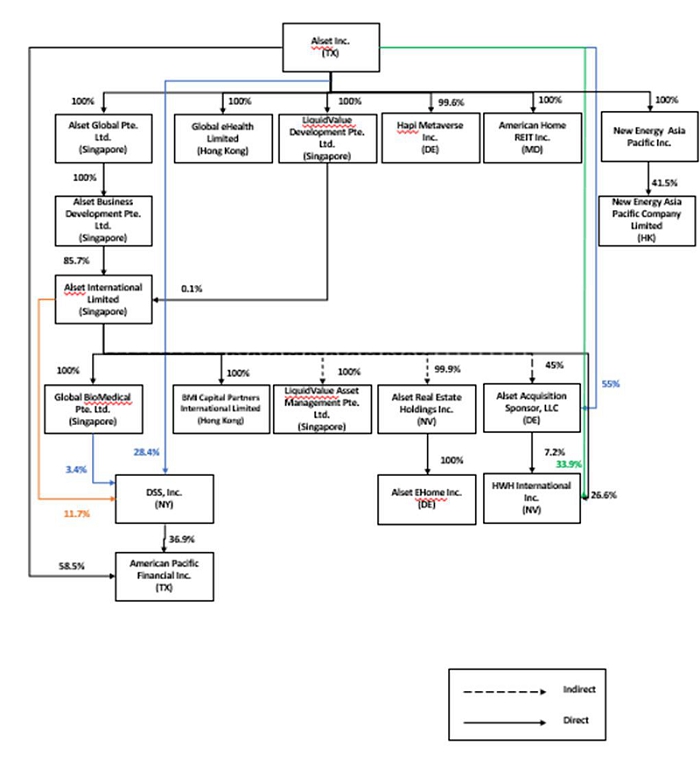
following chart illustrates the current corporate structure of our key operating entities:
Our
Current Operations
Real
Estate
Property
Development Business
Our
property development business is primarily conducted through our indirect subsidiary, Alset Real Estate Holdings Inc. (“Alset RE
Holdings”), a 99.9%-owned U.S. subsidiary of Alset International, which owns, operates and manages real estate development projects
with a focus on land subdivision developments. We generally contract out all real estate development activities, working with engineers,
surveyors, architects and general contractors through each phase, including planning, design and construction. Once the contractors complete
the land development, we then sell the developed lots to builders for the construction of new homes. Where possible, we have attempted
to pre-sell these lots before they are fully developed. Alset RE Holdings’ main asset is a subdivision development project near
Houston, Texas (known as Lakes at Black Oak).
Our
property development business is headquartered in Bethesda, Maryland. For the years ended December 31, 2025 and 2024, our property development
business accounted for 0% and 79% of our total revenues, respectively.
On
March 17, 2023, 150 CCM Black Oak Ltd. entered into a Purchase and Sale Agreement (the “DH Purchase and Sale Agreement”)
with Davidson Homes, LLC, an Alabama limited liability company (“Davidson”). Pursuant to the terms of the DH Purchase and
Sale Agreement, the Seller had agreed to sell approximately 189 single-family detached residential lots developed within section 2 of
Lakes at Black Oak project. The sale of the first 94 lots closed on May 30, 2023. The sale of remaining lots closed on January 4, 2024.
On
November 13, 2023, 150 CCM Black Oak Ltd. entered into two Contracts for Purchase and Sale and Escrow Instructions (each a “2023
Agreement,” collectively, the “2023 Agreements”) with Century Land Holdings of Texas, LLC. Pursuant to the terms of
one of the aforementioned 2023 Agreements, the Seller has agreed to sell approximately 142 single-family detached residential lots (the
“Section 4 Agreement”) comprising a section of a residential community at the Lakes at Black Oak. Pursuant to the other 2023
Agreement, the Seller has agreed to sell 63 single-family detached residential lots (the “Alset Villas Agreement”) in the
city of Magnolia, Texas. In 2021, our subsidiary Alset EHome Inc. acquired approximately 19.5 acres of partially developed land near
Houston, Texas which was used to develop a community named Alset Villas (“Alset Villas”). The sale of the first 70 lots closed
on July 1, 2024 generating approximately $3.8 million. The sale of the remaining 72 lots at Lakes at Black Oak closed on October 10,
2024 generating approximately $3.9 million. The sale of 63 lots at Alset Villas closed on December 16, 2024 generating approximately
$3.8 million.
The
Company has retained four model lots within Section 1 of the property. The Company intends to enter into contract-build agreements with
local, regional or national builders to construct single-family, for rent homes. These elevations and floor plans will be carefully selected
to suit the for-rent tenants and/or for-sale customers. The Company will also reserve the right to sell these homes in the event this
is deemed to be the highest and best use in the marketplace. The Company expects to complete these homes within the next twelve months.
Reorganization
of Property Development Business and Spin-off
On
August 1, 2025, the Company’s indirect majority-owned subsidiary Winning Catering Group, Inc. (then known as LiquidValue Development
Inc., or “LVD”) entered into a Contribution Agreement with Alset Real Estate Holdings Inc., its wholly owned subsidiary (“Alset
Real Estate Holdings”). Pursuant to the terms of the Contribution Agreement, LVD agreed to transfer its ownership of all of the
issued and outstanding shares of Alset EHome Inc., the company that owned substantially all of the assets and liabilities of LVD, to
Alset Real Estate Holdings. On August 18, 2025, LVD completed the distribution of substantially all of its assets to holders of its common
stock as of August 15, 2025, in the form of a one-time special dividend (the “Distribution”). The Distribution consisted
of all of the issued and outstanding shares of Alset Real Estate Holdings Inc., having an aggregate fair market value of approximately
$34.8 million as of the date of Distribution, and constituting substantially all of LVD’s net asset value. LVD shareholders received
shares on a pro rata basis, based on the number of shares of the LVD’s common stock. Following this transaction, LVD had no material
operations or sources of revenue and would be considered a shell company. Because of the Contribution Agreement and the Distribution,
the Company’s ownership interest in Alset Real Estate Holdings Inc. mirrors its ownership interest in LVD at the time of the Distribution.
Therefore, the Company’s ownership interest in Alset EHome Inc. and its real estate business remains unchanged following the transactions
described above.
On
September 22, 2025, LiquidValue Development Inc. changed its name to “Winning Catering Group, Inc.” in anticipation of a
planned merger pursuant to an Acquisition Agreement and Plan of Merger (the “Acquisition Agreement”) entered into on May
30, 2025 (such merger has not yet closed as of the date hereof). The Acquisition Agreement was entered into by LVD with (i) SeD Intelligent
Home Inc., a Nevada corporation, the majority shareholder of LVD and an indirect majority-owned subsidiary of the Company (“SeD”);
(ii) LVD Merger Corp., a Nevada corporation and wholly owned subsidiary of LVD (the “Merger Sub”); (iii) Winning Catering
Management Limited, a British Virgin Islands corporation (“Winning Group”); (iv) Winning Holdings Limited, a British Virgin
Islands corporation (“Winning Holdings”); and (iv) Pure Talent Group Limited, a British Virgin Islands corporation (“PTGL”
and collectively, the “Parties”). Pursuant to the terms of the Acquisition Agreement, the Merger Sub will merge with and
into Winning Group (the “Merger”), with Winning Group surviving the Merger. Following the Merger, Winning Group will become
a wholly owned subsidiary of LVD. In connection with the Merger and as part of the transaction structure, the Parties also agreed that:
3,754,897,728 new fully paid, non-assessable shares of LVD’s common stock will be issued to Winning Holdings and 234,681,108 shares
will be issued to PTGL. At the closing of these transactions, (i) Winning Holdings will own 80% of the issued and outstanding shares
of LVD; (ii) SeD and other existing stockholders will retain 15% of the LVD’s shares; and (iii) PTGL will own 5% of LVD’s
shares. Winning Group’s principal line of business is Wing Nin, a Hong Kong food and beverage brand. Renowned for its cart noodles,
a Hong Kong staple, Wing Nin sells customizable bowls featuring a choice of noodle bases, a wide array of toppings, and a rich homemade
spicy curry sauce. Wing Nin began as a street vendor in the 1960s and has expanded in recent years. Today, Wing Nin has thirteen locations
across Hong Kong.
Home
Rental Business
In
recent years, the Company expanded its real estate portfolio to single family rental houses. During 2022 and 2021 the Company signed
multiple purchase agreements to acquire 20 and 112 homes, respectively, in Montgomery and Harris Counties, Texas. By December 31, 2022,
the acquisition of all 132 homes was completed with an aggregate purchase cost of $30,998,258. All of these purchased homes are properties
of our rental business.
On
December 9, 2022, Alset Inc. entered into an agreement with Alset EHome Inc. and Alset International Limited pursuant to which Alset
Inc. agreed to reorganize the ownership of its home rental business. Previously, Alset Inc. and certain majority-owned subsidiaries collectively
owned 132 single-family rental homes in Texas, of which 112 were owned by subsidiaries of Alset EHome Inc. Alset Inc. owns 85.8% of Alset
International Limited, and Alset International Limited indirectly owns approximately 99.9% of Alset EHome Inc.
The
closing of the transaction contemplated by this agreement was completed on January 13, 2023. Pursuant to this agreement, the Company
has become the direct owner of American Home REIT Inc. (“AHR”) and its subsidiaries that collectively own these 112 homes,
instead of such homes being owned indirectly through Alset International Limited’s subsidiaries.
Alset
EHome Inc. sold AHR to Alset Inc. for a total consideration of $26,250,933, including the forgiveness of debt in the amount of $13,900,000,
a promissory note in the amount of $11,350,933 and a cash payment of $1,000,000. This purchase price represents the book value of AHR
as of November 30, 2022.
The
closing of this transaction was approved by the shareholders of Alset International Limited. Certain members of Alset Inc.’s Board
of Directors and management are also members of the Board of Directors and management of each of Alset International Limited and Alset
EHome Inc.
As
part of our commitment to advancing smart and healthy sustainable living, we installed Tesla PV solar panels and Powerwalls in approximately
96 of the 132 single-family rental homes. In addition, we added technologies at many of the single-family rental homes such as (i) smart
solar, thermostat, and energy usage controls; (ii) smart lighting controls; (iii) smart locks and security; and (iv) smart home automation
devices. We believe these and other technologies will be attractive to renters.
The
Company has entered into a property management agreement with the property managers under which the property managers generally oversee
and direct the leasing, management and advertising of the properties in our portfolio, including collecting rents and acting as liaison
with the tenants. The Company pays its property managers a monthly property management fee per property unit and a leasing fee.
Potential
Future Projects
In
addition to our main projects, we are embarking on residential development activities in partnership with U.S. homebuilders, and have
commenced discussions to acquire smaller U.S. residential development projects. These projects may be within both the for-sale and for-rent
markets. We consider projects in diverse regions across the United States, and maintain longstanding relationships with local owners,
brokers, attorneys and lenders to source projects. We will continue to focus on off-market deals and raise appropriate financing for
attractive development opportunities. We believe these initiatives will provide a set of solutions to stabilize the long-term revenue
associated with property development in the United States and create new ancillary service opportunities and revenue from this business.
Digital
Transformation Technology
Our
digital transformation technology business unit is committed to enabling enterprises to engage in a digital transformation by providing
support, implementation and development services with various technologies including blockchain, e-commerce, social media, artificial
intelligence customer service applications and metaverse services. We commenced our technology business in 2015 through Hapi Metaverse
Inc. (“Hapi Metaverse”), our 99.6% owned subsidiary. Its technology platform focuses on business-to-business, or B2B, solutions,
such as communications and workflow, through instant messaging, international calling, social media and e-commerce. Hapi Metaverse’s
investment into Value Exchange International Inc. (“VEII”) expanded our offering to retail business digital transformation
such as supermarket and chain stores. Hapi Metaverse is now the largest stockholder of VEII.
Through
Hapi Metaverse, we have successfully implemented several strategic platform developments for clients, including a mobile front-end solution
for network marketing, a hotel e-commerce platform for a company in Asia and a real estate agent management platform in China. We have
also enhanced our technological integration capability to include artificial intelligence in the area of customer service, augmented
reality and the metaverse.
While
focusing on development and integration services by building white label mobile applications for e-commerce and community engagement
such as direct marketing and affiliate marketing, VEII has been working on I.T. Services for major retailers in Asia for retail solutions
integration.
We
believe that the increasing deployment of the technology, both in membership engagement as well as in the retail industry, will allow
for feedback from customers, and help us build a robust and scalable software. Adding latest technological framework, such as A.I. and
Metaverse, allows the Company to enhance our clients’ digital transformation journey with better consumer engagement and analytics.
Biohealth
Business
With
populations aging and a growing focus on healthcare issues, biohealth science has become increasingly vital. We entered the biomedical
and healthcare market by forming our biohealth division, which is engaged in developing, researching, testing, manufacturing, licensing
and distributing (through retail, direct selling, network marketing and e-commerce) biohealth products and services. We strive to leverage
our scientific know-how and intellectual property rights to provide solutions to pending healthcare issues.
In
October 2019, the Company expanded its biohealth segment into the Korean market through one of the subsidiaries of HWH International
Inc., HWH World Inc. (“HWH World”). HWH World is in the business of sourcing and distributing dietary supplements and other
health products through its network of members in the Republic of Korea (“South Korea”). HWH World generates product sales
via its direct sale model as products are sold to its members. Through the use of a Hapi Gig platform that combines e-commerce, social
media and a customized rewards system, HWH World equips, trains and empowers its members.
On
April 23, 2025, the Company completed the sale of HWH World Inc. by Health Wealth Happiness Pte. Ltd. (“HWHPL”) to AES Group
Inc. (“AES”), a Korean entity. The sale was consummated under a term sheet signed on April 20, 2025, pursuant to which the
Company agreed to transfer its 100% equity interest in HWHKOR to AES. In exchange, AES agreed to issue new shares, representing 19.9%
of the enlarged share capital of AES to the Company upon closing. Total of $384,356 gain was generated from this deal and recorded in
the Company’s statement of operations.
As
of December 31, 2024, the Company held a 39.7% ownership in Impact BioMedical Inc. (“Impact BioMedical”). Impact BioMedical
is focused on discovery, development, and commercialization of products and technologies to address unmet needs in human healthcare and
wellness for specialty biopharmaceuticals, antivirals, antimicrobials, consumer healthcare, and wellness products in the United States.
Impact BioMedical is listed on NYSE American (NYSE: IBO). Between March 31, 2025 and April 4, 2025, the Company and its subsidiaries
Alset International Limited and Global Biomedical Pte. Ltd. collectively sold the Company’s entire equity interest in Impact Biomedical
Inc. consisting of 4,568,165 shares of Impact’s common stock. The disposition of the Impact stock was made through several sales
on the market through a broker. These transactions generated total proceeds of $4,184,575 and resulted in a recognized loss of $2,439,264.
Other
Business Activities
In
addition to our three principal business activities, we oversee several smaller other business activities at the present time, which
we believe complement our three principal businesses.
BMI
Capital Partners. Alset International’s wholly-owned Hong Kong subsidiary, BMI Capital Partners International Limited provides
consultancy services on corporate restructuring efforts, debt restructuring efforts and capital markets related corporate actions, including
potential stock exchange listings.
Alset
F&B. The Company, through Alset F&B One Pte. Ltd. (“Alset F&B One”) and Alset F&B (PLQ) Pte. Ltd.
(“Alset F&B PLQ”) each acquired a restaurant franchise licenses at the end of 2021 and 2022 respectively. These licenses
allow Alset F&B One and Alset F&B PLQ each to operate a Killiney Kopitiam restaurants in Singapore. Killiney Kopitiam, founded
in 1919, is a Singapore-based chain of mass-market, traditional kopitiam style service cafes selling traditional coffee and tea, along
with a range of local delicacies such as Curry Chicken, Laksa, Mee Siam, and Mee Rebus. In the second quarter of 2024, the Company ceased
operations of its subsidiary Alset F&B (PLQ) Pte. Ltd.
Hapi
Cafes. The Company, through Hapi Cafe Inc. (“HCI-T”), an indirect majority-owned subsidiary of the Company, commenced
operation of two cafés during 2022 and 2021, which are located in Singapore and South Korea.
The
cafes are operated by subsidiaries of HCI-T, namely Hapi Cafe SG Pte. Ltd. (“HCSG”) in Singapore and Hapi Cafe Korea Inc.
(“HCKI”) in Seoul, South Korea. Hapi Cafes are distinctive lifestyle café outlets that strive to revolutionize the
way individuals dine, work and live, by providing a conducive environment for everyone to relish the four facets – health and wellness,
fitness, productivity, and recreation all under one roof. On September 13, 2025, the Company ceased operations of its subsidiary Hapi
Café Korea Inc.
In
2023 the Company incorporated new subsidiaries Guangdong LeFu Wealth Investment Consulting Co., Ltd. (f.k.a. Shenzhen Leyouyou Catering
Management Co., Ltd.) and Dongguan Leyouyou Catering Management Co., Ltd. in the People’s Republic of China. These companies are
principally engaged in the food and beverage business in Mainland China.
Additionally,
through its subsidiary Hapi Group HK Limited (f.k.a. MOC HK Limited), the Company was focusing on operating café business in Hong
Kong. The café was closed on September 16, 2024.
During
the years ended on December 31, 2025 and 2024, the revenue from the other business activities described above was approximately 48% and
7% of the total revenue, respectively.
American
Pacific Financial Inc. (“APF”) APF is a financial network holding company focused on acquiring equity positions in
(i) undervalued commercial bank(s), bank holding companies and nonbanking licensed financial companies operating in the United States,
South East Asia, Taiwan, Japan and South Korea, and (ii) companies engaged in—nonbanking activities closely related to banking,
including loan syndication services, mortgage banking, trust and escrow services, banking technology, loan servicing, equipment leasing,
problem asset management, SPAC (special purpose acquisition company) consulting services, and advisory capital raising services.
Acquisition
of New Energy Asia Pacific Inc. On December 13, 2023 the Company entered into a term sheet with Chan Heng Fai (the “Seller”),
the Chairman of the Board of Directors, Chief Executive Officer and largest stockholder of the Company. The Company had agreed to purchase
from the Seller all of the issued and outstanding shares of New Energy Asia Pacific Inc. (“NEAPI”), a corporation incorporated
in the State of Nevada, for the consideration of $103,750,000, to be paid in the form of a convertible promissory note to be issued to
the Seller. NEAPI owns 41.5% of the issued and outstanding shares of New Energy Asia Pacific Limited (“New Energy”), a Hong
Kong corporation.
The
parties mutually agreed to revise this agreement, and on May 8, 2025, the Company and the Seller entered into an Amended Term Sheet (the
“Amended Term Sheet”). Under the terms of the Amended Term Sheet, the Company agreed to purchase from the Seller all of the
outstanding shares of NEAPI through a stock purchase agreement for a purchase price of $83,000,000 in the form of a promissory note convertible
into newly issued shares of the Company’s common stock (the “Convertible Note”). The Convertible Note had an interest
rate of 1% per annum. Under the terms of the Convertible Note, the Seller was able to convert any outstanding principal and interest
into shares of the Company’s common stock at $3.00 per share upon ten (10) days’ notice prior to maturity of the Convertible
Note five (5) years from the date of the Amended Term Sheet, and upon maturity of the Convertible Note any outstanding principal and
accrued interest accrued thereunder would automatically be converted into shares of the Company’s common stock at the conversion
rate.
New
Energy focuses on distributing all-electric versions of special-purpose and transportation vehicles, charging stations and batteries.
The Company intends for this to be a strategic move, in line with the Company’s commitment to advancing sustainable and eco-friendly
solutions for the future. The Seller is a member of the Board of Directors of New Energy and is a stockholder of New Energy.
The
closing of the transactions contemplated by the Amended Term Sheet occurred on July 23, 2025. Additionally, on July 23, 2025, Mr. Chan converted the entire balance of the $83,000,000 Convertible Note into 27,666,667 restricted
shares of the Company’s common stock.
Investing
Activities. The Company operates a portfolio of trading securities with the objective of generating profits from short-term fluctuations
in market prices. The portfolio is actively managed, and securities are bought and sold with the intent to realize gains from price movements
within a short-term horizon.
Agreements
to Sell Stock of HWH International Inc.
On
November 21, 2023, Alset International Limited entered into two Stock Purchase Agreements (each, a “Stock Purchase Agreement,”
collectively the “Stock Purchase Agreements”), with each of Teh Wing Kwan, a citizen of Singapore, and Massive Brilliant
Limited, a Hong Kong limited company (each an “Investor,” collectively, the “Investors”), the terms of each Stock
Purchase Agreement being substantially the same. Pursuant to the terms of the Stock Purchase Agreements, Alset International Limited
agreed to sell 640 shares (the “Shares”) of the Common Stock of HWH International Inc., a Nevada corporation and a majority
owned subsidiary of the Company (“HWH International”), to each Investor. The consideration for each of the two purchases
of stock was $8,000,000 paid through the issuance of a promissory note made to Alset International Limited by each Investor.
Each
Investor also entered into a Security Agreement, dated as of November 21, 2023. Security interest in the brokerage account into which
each investor deposited the Shares (the “Collateral”) shall in each case serve as security for the Investor’s repayment
of their respective promissory note, and repossession of such Collateral by Alset International Limited shall be the sole recourse for
non-payment.
Certain
members of the Company’s Board of Directors and management are also members of the Board of Directors and management of each of
Alset International Limited and HWH International.
On
January 9, 2024, HWH International and Alset Capital Acquisition Corp., a Delaware corporation (“Alset Capital”) closed their
merger as contemplated by an agreement and plan of merger (the “Merger Agreement”). The closing of the Merger Agreement resulted
in HWH International surviving the merger as a wholly owned subsidiary of Alset Capital (the “Merger”), and Alset Capital
changing its name to HWH International Inc. (“New HWH”).
The
total consideration paid at the closing of the merger by New HWH to HWH International shareholders was 12,500,000 shares of New HWH common
stock. Alset International Limited owned the majority of the outstanding shares of HWH International at the time of the business combination,
and received 10,900,000 shares of New HWH as consideration for its shares of HWH International.
Upon
the closing of the sale of HWH International to Alset Capital, each of the Investors received 6.4% of the consideration for such sale,
in the form of 800,000 shares of New HWH apiece.
Sales
and Marketing
We
focus our corporate marketing efforts on increasing brand awareness, communicating the advantages of our various platforms and generating
qualified leads for our sales team. Our corporate marketing plan is designed to continually elevate awareness of our brand and generate
demand for our offerings. We rely on a number of channels in this area, including digital advertising, email marketing, social media,
affiliate marketing and broad-based media, as well as through various strategic partnerships. We maintain our website at https://www.alsetinc.com,
and our various operating subsidiaries maintain individual websites, many of which are accessible through our main website.
Each
of our businesses has developed a field sales force in their geographic markets. These sales force teams are responsible for identifying
and managing individual sales opportunities in their respective regions.
Competition
The
businesses in which we participate, real estate, digital transformation technology and biohealth, are each highly competitive.
Existing
and future competitors may introduce products and services in the same markets we serve, and competing products or services may have
better performance, lower prices, better functionality and broader acceptance than our products. Our competitors may also add features
to their products or services similar to features that presently differentiate our product and service offerings from theirs. This competition
could result in decreased sales and increased marketing expenses, thereby materially reducing our operating margins, and could harm our
ability to grow, or cause us to lose market share. Some of our competitors and potential competitors supply a wide variety of products
and services, and have well-established relationships with our current and prospective customers.
Most,
if not all, of our current and potential competitors may have significantly greater resources or better competitive positions in certain
product segments, geographic regions or user demographics than we do. These factors may allow our competitors to respond more effectively
than us to new or emerging technologies and changes in market conditions. By way of example, in our real estate business, some of our
competitors already have the advantage of having created vertically integrated businesses, while other competitors have broader and deeper
relationships with sources of financing. Other competitors in our real estate business may have more substantial ties and experience
in geographical areas in which we operate.
Our
competitors may develop products, features or services that are similar to ours or that achieve greater acceptance, may undertake more
far-reaching and successful product development efforts or marketing campaigns, or may adopt more aggressive pricing policies. This is
particularly relevant for our digital transformation technology business. Certain competitors could use strong or dominant positions
in one or more markets to gain competitive advantage against us in our target market or markets. As a result, our competitors may acquire
and engage customers or generate revenue at the expense of our own efforts.
Protection
of Proprietary Technology
We
rely on a combination of patent, trademark, copyright and trade secret laws in the United States and other jurisdictions, as well as
confidentiality procedures and contractual provisions, to protect our proprietary information, technology and brands.
We
protect our proprietary information and technology, in part, by generally requiring our employees to enter into agreements providing
for the maintenance of confidentiality and the assignment of rights to inventions made by them while employed by us. We also may enter
into non-disclosure and invention assignment agreements with certain of our technical consultants to protect our confidential and proprietary
information and technology. We cannot assure that our confidentiality agreements with our employees and consultants will not be breached,
that we will be able to effectively enforce these agreements, that we will have adequate remedies for any breach of these agreements,
or that our trade secrets and other proprietary information and technology will not be disclosed or will otherwise be protected.
We
also rely on contractual and license agreements with third parties in connection with their use of our technology and services. There
is no guarantee that such parties will abide by the terms of such agreements or that we will be able to adequately enforce our rights.
Protection of confidential information, trade secrets and other intellectual property rights in the markets in which we operate and compete
is highly uncertain and may involve complex legal questions. We cannot completely prevent the unauthorized use or infringement of our
confidential information or intellectual property rights as such prevention is inherently difficult. Costly and time-consuming litigation
could be necessary to enforce and determine the scope of our confidential information and intellectual property protection.
Government
Regulation
Like
many similarly diversified companies, our operations are subject to routine regulation by governmental agencies. Much of this regulation
will affect us indirectly, inasmuch as, and to the extent that, it affects our customers more directly. A summary of the laws and regulations
that might affect our customers is set forth below.
Real
Estate Business. The development of our real estate projects will require us to comply with federal, state and local environmental
regulations. In connection with this compliance, our real estate acquisition and development projects will require environmental studies.
To date, we have spent approximately $71,431 on environmental studies and compliance. Such costs were reflected in capitalized construction
costs in our financial statements and subsequently expensed.
The
cost of complying with governmental regulations is significant and will increase if we add additional real estate projects, become involved
in homebuilding in the future and are required to comply with certain due diligence procedures related to third party lenders.
At
the present time, we believe that we have all of the material government approvals that we need to conduct our business as currently
conducted. We are subject to periodic local permitting that must be addressed, but we do not anticipate that such requirements for government
approval will have a material impact on our business as presently conducted. We are required to comply with government regulations and
to make filings from time to time with various government entities. Such work is typically handled by outside contractors we retain.
Digital
Transformation Technology Business. Companies conducting business on the Internet are subject to a number of foreign and domestic
laws and regulations. In addition, laws and regulations relating to user privacy, freedom of expression, content, advertising, information
security and intellectual property rights are being debated and considered for adoption by many countries throughout the world. Online
businesses face risks from some of the proposed legislation that could be passed in the future.
The
adoption of any laws or regulations that adversely affect the growth, popularity or use of the Internet, including laws impacting Internet
neutrality, could decrease the demand for our services and increase our cost of doing business. As we expand internationally, government
regulation concerning the Internet, and in particular, network neutrality, may be nascent or non-existent. Within such a regulatory environment,
coupled with potentially significant political and economic power of local network operators, we could experience discriminatory or anti-competitive
practices that could impede our growth, cause us to incur additional expense or otherwise negatively affect our business.
In
the United States, laws relating to the liability of providers of online services for activities of their users and other third parties
are currently being tested by a number of claims, which include actions for libel, slander, invasion of privacy and other tort claims,
unlawful activity, copyright and trademark infringement, and other theories based on the nature and content of the materials searched,
the ads posted, or the content generated by users. Certain foreign jurisdictions are also testing the liability of providers of online
services for activities of their users and other third parties. Any court ruling that imposes liability on providers of online services
for activities of their users and other third parties could harm our licensees’ businesses, and thus, indirectly, our business.
Biohealth
Business. Our businesses are subject to varying degrees of governmental regulation in the countries in which our operations are
conducted, and the general trend is toward increasingly stringent regulation. In the United States, the drug, device and cosmetic industries
have long been subject to regulation by various federal and state agencies, primarily as to product safety, efficacy, manufacturing,
advertising, labeling and safety reporting. The exercise of broad regulatory powers by the U.S. Food and Drug Administration, or FDA,
continues to result in increases in the amounts of testing and documentation required for FDA approval of new drugs and devices and a
corresponding increase in the expense of product introduction. Similar trends are also evident in major markets outside of the United
States. The new medical device regulatory framework and the new privacy regulations in Europe are examples of such increased regulation.
The
costs of human health care have been and continue to be a subject of study, investigation and regulation by governmental agencies and
legislative bodies around the world. In the United States, attention has been focused on drug prices and profits and programs that encourage
doctors to write prescriptions for particular drugs, or to recommend, use or purchase particular medical devices. Payers have become
a more potent force in the market place and increased attention is being paid to drug and medical device pricing, appropriate drug and
medical device utilization and the quality and costs of health care generally. The regulatory agencies under whose purview we operate
have administrative powers that may subject it to actions such as product withdrawals, recalls, seizure of products and other civil and
criminal sanctions. In some cases, our subsidiaries may deem it advisable to initiate product recalls.
In
addition, business practices in the health care industry have come under increased scrutiny, particularly in the United States, by government
agencies and state attorneys general, and resulting investigations and prosecutions carry the risk of significant civil and criminal
penalties.
Further,
we rely on global supply chains, and production and distribution processes, that are complex, are subject to increasing regulatory requirements,
and may be faced with unexpected changes that may affect sourcing, supply and pricing of materials used in our products. These processes
also are subject to lengthy regulatory approvals.
As
described above, certain of our businesses are subject to compliance with laws and regulations of U.S. federal and state governments,
non-U.S. governments, their respective agencies and/or various self-regulatory organizations or exchanges relating to, among other things,
disclosure and the privacy of client information, and any failure to comply with these regulations could expose us to liability and/or
damage our reputation. Our businesses have operated for many years within a legal framework that requires us to monitor and comply with
a broad range of legal and regulatory developments that affect our activities. However, additional legislation, changes in rules promulgated
by self-regulatory organizations or changes in the interpretation or enforcement of existing laws and rules, either in the United States
or elsewhere, may directly affect our mode of operation and profitability.
Rigorous
legal and compliance analysis of our businesses is endemic to our culture and risk management. Management of each of our businesses supervise
our compliance personnel, who are responsible for addressing all regulatory and compliance matters that affect our activities. We strive
to maintain a culture of compliance through the use of policies and procedures, including a code of ethics, electronic compliance systems,
testing and monitoring, communication of compliance guidance and employee education and training. Our compliance policies and procedures
address a variety of regulatory and compliance matters such as the handling of material non-public information, personal securities trading,
marketing practices, gifts and entertainment, valuation of investments, recordkeeping, potential conflicts of interest, the allocation
of corporate opportunities, collection of fees and expense allocation.
We
also monitor the information barriers that we maintain between the public and private sides of our businesses. We believe that our various
businesses’ access to the intellectual knowledge and contacts and relationships that reside throughout our firm benefits all of
our businesses. To maximize that access without compromising compliance with our legal and contractual obligations, our compliance group
oversees and monitors the communications between groups that are on the private side of our information barrier and groups that are on
the public side, as well as between different public side groups. Our compliance group also monitors contractual obligations that may
be impacted and potential conflicts that may arise in connection with these inter-group discussions.
Facilities
We
manage our worldwide business from our principal executive offices located in Bethesda, Maryland, in a leased space of approximately
2,059 square feet, under a lease that expires in 2027. We also maintain leased spaces in Singapore, Hong Kong, South Korea, China and
Taiwan through leased spaces aggregating approximately 25,000 square feet, under leases expiring on various dates from May 2026 to April
2029. The leases have rental rates ranging from $1,321 to $23,020 per month. Our total rent expense under these office leases was $793,279
and $1,192,776 in 2025 and 2024, respectively. We expect total rent expense to be approximately $598,372 under office leases in 2026.
We believe our present office space and locations are adequate for our current operations and for near-term planned expansion.
Employees
As
of March 31, 2026, we had a total of 48 full-time employees. In addition to our full-time employees, we occasionally hire part-time employees
and independent contractors to assist us in various operations, including food and beverage services, real estate, research and product
development and production.
Our
future success will depend in part on our ability to attract, retain and motivate highly qualified technical and sales personnel for
whom competition is intense. Our employees are not represented by any collective bargaining unit. We believe our relations with employees
and contractors are good.
Additional
Information
The
Company is subject to the information requirements of the Exchange Act, and, in accordance therewith, files annual, quarterly, and special
reports, proxy statements and other information with the Commission. The Commission maintains an Internet website at http://www.sec.gov
that contains reports, proxy and information statements and other information regarding issuers that file electronically with the Commission.
The periodic reports, proxy statements and other information that the Company files with the Commission are available for inspection
on the Commission’s website free of charge as soon as reasonably practicable after they are electronically filed with or furnished
to the Commission.
The
Company maintains a website at https://www.alsetinc.com where you may also access these materials free of charge. We have included our
website address as an inactive textual reference only and the information contained in, and that can be accessed through, our website
is not incorporated into and is not part of this report on Form 10-K.
Item
1A. Risk Factors.
An
investment in our common stock involves a high degree of risk. You should carefully consider the risks described below and the other
information in this Report before making a decision to invest in our common stock. If any of the following risks and uncertainties develop
into actual events, our business, results of operations and financial condition could be adversely affected. In those cases, the trading
price of our common stock could decline and you may lose all or part of your investment. As a “smaller reporting company”,
the Company is not required to provide the information required by this item, but below are the risk factors the Company believes investors
should consider before purchasing any of the Company’s securities.
Risks
Related to Our Company
Management
has identified a material weakness in the design and effectiveness of our internal controls, which, if not remediated, could affect the
accuracy and timeliness of our financial reporting and result in misstatements in our financial statements.
In
connection with the preparation of our Report on Form 10-K, an evaluation was carried out by management, with the participation of our
Co-Chief Executive Officers and Co-Chief Financial Officers, of the effectiveness of our disclosure controls and procedures (as defined
in Rules 13a-15(e) and 15d-15(e) under the Securities Exchange Act of 1934 (the “Exchange Act”) as of December 31, 2025.
Disclosure controls and procedures are designed to ensure that information required to be disclosed in reports filed or submitted under
the Exchange Act is recorded, processed, summarized and reported within the time periods specified, and that such information is accumulated
and communicated to management, including the Co-Chief Executive Officers and Co-Chief Financial Officers, to allow timely decisions
regarding required disclosure.
During
evaluation of our disclosure controls and procedures as of December 31, 2025, conducted as part of our annual audit and preparation of
our annual financial statements, management conducted an evaluation of the effectiveness of the design and operations of our disclosure
controls and procedures and concluded that our disclosure controls and procedures were not effective. Management determined that on December
31, 2025, we had a material weakness that relates to the relatively small number of staff. This limited number of staff prevents us from
segregating duties within our internal control system and restricts our ability to timely evaluate the accuracy and completeness of our
financial statement disclosures.
This
material weakness, which remained unremedied by the Company as of December 31, 2025, could result in a misstatement to the accounts and
disclosures that would result in a material misstatement to our annual or interim consolidated financial statements that would not be
prevented or detected. If we do not remediate the material weakness or if other material weaknesses are identified in the future, we
may be unable to report our financial results accurately or to report them on a timely basis, which could result in the loss of investor
confidence and have a material adverse effect on our stock price as well as our ability to access capital and lending markets. We are
presently taking efforts to remediate this weakness.
Risks
Relating to Our Business
We
have a history of annual net losses which may continue and which may negatively impact our ability to achieve our business objectives.
For
the years ended December 31, 2025 and 2024, we had revenue of $4,470,875 and $21,115,899, respectively, and net losses of $49,350,566
and $4,165,816 in the years ended December 31, 2025 and 2024, respectively. Our failure to increase our revenues or improve our gross
margins will harm our business. We may not be able to achieve, sustain or increase profitability on a quarterly or annual basis in the
future. If our revenue grows more slowly than we anticipate, our gross margins fail to improve or our operating expenses exceed our expectations,
our operating results will suffer. The prices we charge for our properties, products and services may decrease, which would reduce our
revenues and harm our business. If we are unable to sell our properties, products and services at acceptable prices relative to our costs,
or if we fail to develop and introduce on a timely basis new products or services from which we can derive additional revenues, our financial
results will suffer.
We
cannot ensure the long-term successful operation of our business or the execution of our growth strategy.
Our
prospects must be considered in light of the risks, expenses and difficulties frequently encountered by growing companies in new and
rapidly evolving markets. We may meet many challenges including:
| ● |
establishing
and maintaining broad market acceptance of our products and services and converting that acceptance into direct and indirect sources
of revenue; |
| |
|
| ● |
establishing
and maintaining adoption of our technology on a wide variety of platforms and devices; |
| |
|
| ● |
timely
and successfully developing new products and services and increasing the features of existing products and services; |
| |
|
| ● |
developing
products and services that result in high degrees of customer satisfaction and high levels of customer usage; |
| |
|
| ● |
successfully
responding to competition, including competition from emerging technologies and solutions; |
| |
|
| ● |
developing
and maintaining strategic relationships to enhance the distribution, features, content and utility of our products and services;
and |
| |
|
| ● |
identifying,
attracting and retaining talented technical and sales services staff at reasonable market compensation rates in the markets in which
we operate. |
Our
growth strategy may be unsuccessful and we may be unable to address the risks we face in a cost-effective manner, if at all. If we are
unable to successfully address these risks our business will be harmed.
We
have a holding company ownership structure and will depend on distributions from our majority-owned and/or controlled operating subsidiaries
to meet our obligations. Contractual or legal restrictions applicable to our subsidiaries could limit payments or distributions from
them.
We
are a holding company and derive all of our operating income from, and hold substantially all of our assets through, our U.S. and foreign
subsidiaries, some of which are publicly held and traded. The effect of this structure is that we will depend on the earnings of our
subsidiaries, and the payment or other distributions to us of these earnings, to meet our obligations and make capital expenditures.
Provisions of U.S. and foreign corporate and tax law, like those requiring that dividends are paid only out of surplus, and provisions
of any future indebtedness, may limit the ability of our subsidiaries to make payments or other distributions to us. Certain of our subsidiaries
are minority owned and the assets of these companies are not included in our consolidated balance sheets. Additionally, in the event
of the liquidation, dissolution or winding up of any of our subsidiaries, creditors of that subsidiary (including trade creditors) will
generally be entitled to payment from the assets of that subsidiary before those assets can be distributed to us.
Our
significant ownership interests in public companies listed on limited public trading markets subjects us to risks relating to the sale
of their shares and the fluctuations in their stock prices.
We
own indirect interests in several publicly traded companies – most significantly, Alset International Limited, whose shares are
listed on the Singapore Stock Exchange, DSS, Inc., whose shares are listed on the NYSE American LLC Exchange, Sharing Services Global
Corporation, whose shares are quoted on the OTC Expert Market of the OTC Markets Group, Inc., Value Exchange International Inc., whose
shares are listed on OTC Expert Market of the OTC Markets Group, Inc., and HWH International Inc., whose shares are trading on the Nasdaq
Capital Market; (Winning Catering Group, Inc. and Hapi Metaverse Inc. are not currently traded on any exchange). The average trading
volume of the public shares is limited for some of these companies. In view of the limited public trading markets for some of these shares,
there can be no assurance that we would succeed in obtaining a price for these shares equal to the price quoted for such shares in their
respective trading markets at the time of sale or that we would not incur a loss on our shares should we determine to dispose our shareholding
in any of these companies in the future. Additionally, on an ongoing basis, fluctuations in the stock prices of these companies are likely
to be reflected in the market price of our common stock. Given the limited public trading markets in some of these public companies,
stock price fluctuations in our price may be significant.
General
political, social and economic conditions can adversely affect our business.
Demand
for our products and services depends, to a significant degree, on general political, social and economic conditions in our markets.
Worsening economic and market conditions, downside shocks, or a return to recessionary economic conditions could serve to reduce demand
for our products and services and adversely affect our operating results. In addition, an economic downturn could impact the valuation
and collectability of certain long-term receivables held by us. We could also be adversely affected by such factors as changes in foreign
currency rates and weak economic and political conditions in each of the countries in which we operate.
Disruptions
in the financial markets and uncertain economic conditions could adversely affect the value of our real estate investments.
Disruptions
in the financial markets could adversely affect the value of our real estate investments. Concerns over economic recession, interest
rate increases, policy priorities of the U.S. presidential administration, trade wars, labor shortages, or inflation may contribute to
increased volatility and diminished expectations for the economy and markets. Additionally, concern over geopolitical issues may also
contribute to prolonged market volatility and instability. For example, the conflict between Russia and Ukraine has led to disruption,
instability and volatility in global markets and industries. The U.S. government and other governments in jurisdictions have imposed
severe economic sanctions and export controls against Russia and Russian interests, have removed Russia from the SWIFT system, and have
threatened additional sanctions and controls. The impact of these measures, as well as potential responses to them by Russia, is unknown.
Such conditions could impact real estate fundamentals and result in lower occupancy, lower rental rates, and declining values in our
real estate portfolio and in the collateral securing our loan investments. As a result, the value of our property investments could decrease
below the amounts paid for such investments, the value of collateral securing our loans could decrease below the outstanding principal
amounts of such loans, and revenues from our properties could decrease due to fewer and/or delinquent tenants or lower rental rates.
These factors would significantly harm our revenues, results of operations, financial condition, business prospects and our ability to
make distributions to our stockholders.
We
have made and expect to continue to make acquisitions as a primary component of our growth strategy. We may not be able to identify suitable
acquisition candidates or consummate acquisitions on acceptable terms, which could disrupt our operations and adversely impact our business
and operating results.
A
primary component of our growth strategy has been to acquire complementary businesses to grow our Company. We intend to continue to pursue
acquisitions of complementary technologies, products and businesses as a primary component of our growth strategy to expand our operations
and customer base and provide access to new markets and increase benefits of scale. Acquisitions involve certain known and unknown risks
that could cause our actual growth or operating results to differ from our expectations. For example:
| ● |
we
may not be able to identify suitable acquisition candidates or to consummate acquisitions on acceptable terms; |
| ● |
we
may pursue international acquisitions, which inherently pose more risks than domestic acquisitions; |
| |
|
| ● |
we
compete with others to acquire complementary products, technologies and businesses, which may result in decreased availability of,
or increased price for, suitable acquisition candidates; |
| |
|
| ● |
we
may not be able to obtain the necessary financing, on favorable terms or at all, to finance any or all of our potential acquisitions;
and |
| |
|
| ● |
we
may ultimately fail to consummate an acquisition even if we announce that we plan to acquire a technology, product or business. |
We
may be unable to successfully integrate acquisitions, which may adversely impact our operations.
Acquired
technologies, products or businesses may not perform as we expect and we may fail to realize anticipated revenue and profits. In addition,
our acquisition strategy may divert management’s attention away from our existing business, resulting in the loss of key customers
or employees, and expose us to unanticipated problems or legal liabilities, including responsibility as a successor for undisclosed or
contingent liabilities of acquired businesses or assets.
If
we fail to conduct due diligence on our potential targets effectively, we may, for example, not identify problems at target companies
or fail to recognize incompatibilities or other obstacles to successful integration. Our inability to successfully integrate future acquisitions
could impede us from realizing all of the benefits of those acquisitions and could severely weaken our business operations. The integration
process may disrupt our business and, if new technologies, products or businesses are not implemented effectively, may preclude the realization
of the full benefits expected by us and could harm our results of operations. In addition, the overall integration of new technologies,
products or businesses may result in unanticipated problems, expenses, liabilities and competitive responses. The difficulties integrating
an acquisition include, among other things:
| ● |
issues
in integrating the target company’s technologies, products or businesses with ours; |
| |
|
| ● |
incompatibility
of marketing and administration methods; |
| |
|
| ● |
maintaining
employee morale and retaining key employees; |
| |
|
| ● |
integrating
the cultures of our companies; |
| |
|
| ● |
preserving
important strategic customer relationships; |
| |
|
| ● |
consolidating
corporate and administrative infrastructures and eliminating duplicative operations; and |
| |
|
| ● |
coordinating
and integrating geographically separate organizations. |
In
addition, even if the operations of an acquisition are integrated successfully, we may not realize the full benefits of the acquisition,
including the synergies, cost savings or growth opportunities that we expect. These benefits may not be achieved within the anticipated
time frame, or at all.
Acquisitions
which we complete may have an adverse impact on our results of operations.
Acquisitions
may cause us to:
| ● |
issue
common stock that would dilute our current stockholders’ ownership percentage; |
| |
|
| ● |
use
a substantial portion of our cash resources; |
| ● |
increase
our interest expense, leverage and debt service requirements if we incur additional debt to pay for an acquisition; |
| |
|
| ● |
assume
liabilities for which we do not have indemnification from the former owners; further, indemnification obligations may be subject
to dispute or concerns regarding the creditworthiness of the former owners; |
| |
|
| ● |
record
goodwill and non-amortizable intangible assets that are subject to impairment testing and potential impairment charges; |
| |
|
| ● |
experience
volatility in earnings due to changes in contingent consideration related to acquisition earn-out liability estimates; |
| |
|
| ● |
incur
amortization expenses related to certain intangible assets; |
| |
|
| ● |
lose
existing or potential contracts as a result of conflict-of-interest issues; |
| |
|
| ● |
become
subject to adverse tax consequences or deferred compensation charges; |
| |
|
| ● |
incur
large and immediate write-offs; or |
| |
|
| ● |
become
subject to litigation. |
Our
resources may not be sufficient to manage our expected growth; failure to properly manage our potential growth would be detrimental to
our business.
We
may fail to adequately manage our anticipated future growth. Any growth in our operations will place a significant strain on our administrative,
financial and operational resources and increase demands on our management and on our operational and administrative systems, controls
and other resources. We cannot assure you that our existing personnel, systems, procedures or controls will be adequate to support our
operations in the future or that we will be able to successfully implement appropriate measures consistent with our growth strategy.
As part of this growth, we may have to implement new operational and financial systems, procedures and controls to expand, train and
manage our employee base, and maintain close coordination among our technical, accounting, finance, marketing and sales teams. We cannot
guarantee that we will be able to do so, or that if we are able to do so, we will be able to effectively integrate them into our existing
staff and systems. There may be greater strain on our systems as we acquire new businesses, requiring us to devote significant management
time and expense to the ongoing integration and alignment of management, systems, controls and marketing. If we are unable to manage
growth effectively, such as if our sales and marketing efforts exceed our capacity to design and produce our products and services or
if new employees are unable to achieve performance levels, our business, operating results and financial condition could be materially
and adversely affected.
Our
officers will allocate some of their time to other business ventures including but not limited to subsidiaries of our Company, thereby
limiting the amount of time they are able to devote to our affairs. This potential time management conflict could have a negative impact
on our operations.
Several
of our officers and directors also serve as officers and directors of entities where we are the direct or indirect majority stockholder,
including but not limited to Alset International Limited, HWH International Inc., and Hapi Metaverse Inc. In addition, some of our officers
and directors also serve as officers and directors of other businesses, including businesses that we hold a non-majority positions in.
These officers may not commit their full time to our affairs, which may result in a conflict of interest in allocating their time between
our operations and the operations of our subsidiaries or other business ventures. These officers are not obligated to contribute any
specific number of hours per week to our affairs. While we do not believe that the time devoted to other affairs will undermine their
ability to fulfill their duties with respect to our Company, if the business affairs of our subsidiaries or other ventures require them
to devote substantial amounts of time to such affairs, it could limit their ability to devote time to our affairs which may have a negative
impact on our operations.
Our
officers, including our Chairman and Chief Executive Officer Chan Heng Fai, will allocate some of their time to HWH International Inc.,
thereby causing potential conflicts of interest in their determination as to how much time to devote to our affairs. This potential conflict
of interest could have a negative impact on our operations.
Rongguo
Wei, our Chief Financial Officer, also serves in this position for HWH International Inc. (“HWH International”), and Chan
Heng Fai, our Chairman, serves as a director and Chief Executive Officer of HWH International. These officers may not commit their full
time to our affairs, which may result in a conflict of interest in allocating their time between our operations and HWH International’s
operations. These officers are engaged in HWH International and are not obligated to contribute any specific number of hours per week
to our affairs. While we do not believe that the time devoted to HWH International will undermine their ability to fulfill their duties
with respect to our Company, if the business affairs of HWH International require them to devote substantial amounts of time to such
affairs, it could limit their ability to devote time to our affairs which may have a negative impact on our operations.
Our
international operations are subject to increased risks which could harm our business, operating results and financial condition.
In
addition to uncertainty about our ability to expand our international market position, there are risks inherent in doing business internationally,
including:
| ● |
trade
barriers, tariffs and changes in trade regulations; |
| |
|
| ● |
difficulties
in developing, staffing and simultaneously managing a large number of varying foreign operations as a result of distance, language
and cultural differences; |
| |
|
| ● |
the
need to comply with varied local laws and regulations; |
| |
|
| ● |
longer
payment cycles; |
| |
|
| ● |
possible
credit risk and higher levels of payment fraud; |
| |
|
| ● |
profit
repatriation restrictions and foreign currency exchange restrictions; |
| |
|
| ● |
political
or social unrest, economic instability or human rights issues; |
| |
|
| ● |
geopolitical
events, including acts of war and terrorism; |
| |
|
| ● |
import
or export regulations; |
| |
|
| ● |
compliance
with U.S. laws (such as the Foreign Corrupt Practices Act), and local laws prohibiting corrupt payments to government officials; |
| |
|
| ● |
laws
and business practices that favor local competitors or prohibit foreign ownership of certain businesses; and |
| |
|
| ● |
different
and more stringent data protection, privacy and other laws. |
Our
failure to manage any of these risks successfully could harm our international operations and our overall business, and results of our
operations.
If
we are unable to retain the services of Chan Heng Fai or if we are unable to successfully recruit qualified personnel, we may not be
able to continue operations.
Our
success depends to a significant extent upon the continued service of Chan Heng Fai, our founder, Chairman and Chief Executive Officer.
The loss of the services of Chan Heng Fai could have a material adverse effect on our growth, revenues and prospective business. If Chan
Heng Fai was to resign or we are unable to retain his services, the loss could result in loss of sales, delays in new product development
and diversion of management resources. We could face high costs and substantial difficulty in hiring a qualified successor and could
experience a loss in productivity while any such successor obtains the necessary training and experience. Chan Heng Fai has committed
that the majority of his time will be devoted to managing the affairs of our Company; however, Chan Heng Fai may engage in other business
ventures, including other technology-related businesses.
In
order to successfully implement and manage our businesses, we are also dependent upon successfully recruiting qualified personnel. In
particular, we must hire and retain experienced management personnel to help us continue to grow and manage each business, and skilled
engineering, product development, marketing and sales personnel to further our research and product development efforts. Competition
for qualified personnel is intense. If we do not succeed in attracting new personnel or in retaining and motivating our current personnel,
our business could be harmed.
If
we do not successfully develop new products and services, our business may be harmed.
Our
business and operating results may be harmed if we fail to expand our various product and service offerings (either through internal
product or capability development initiatives or through partnerships and acquisitions) in such a way that achieves widespread market
acceptance or that generates significant revenue and gross profits to offset our operating and other costs. We may not successfully identify,
develop and market new product and service offerings in a timely manner. If we introduce new products and services, they may not attain
broad market acceptance or contribute meaningfully to our revenue or profitability. Competitive or technological developments may require
us to make substantial, unanticipated capital expenditures in new products and technologies or in new strategic partnerships, and we
may not have sufficient resources to make these expenditures. Because the markets for many of our products and services are subject to
rapid change, we may need to expand and/or evolve our product and service offerings quickly. Delays and cost overruns could affect our
ability to respond to technological changes, evolving industry standards, competitive developments or customer requirements and harm
our business and operating results.
Your
investment return may be reduced if we are required to register as an investment company under the Investment Company Act; if we or our
majority-owned and/or controlled operating subsidiaries become an unregistered investment company, then we would need to modify our business
philosophy and/or make other changes to our asset composition.
Neither
we nor any of our majority-owned and/or controlled subsidiaries intend to register as an investment company under the Investment Company
Act of 1940. If we or our subsidiaries were obligated to register as investment companies, then we would have to comply with a variety
of regulatory requirements under the Investment Company Act that impose, among other things:
| ● |
limitations
on capital structure; |
| |
|
| ● |
restrictions
on specified investments; |
| |
|
| ● |
prohibitions
on transactions with affiliates; and |
| |
|
| ● |
compliance
with reporting, record keeping, voting, proxy disclosure and other rules and regulations that would significantly increase our operating
expenses. |
Under
the relevant provisions of Section 3(a)(1) of the Investment Company Act, an investment company is any issuer that:
| ● |
pursuant
to Section 3(a)(1)(A), is or holds itself out as being engaged primarily, or proposes to engage primarily, in the business of investing,
reinvesting or trading in securities (the “primarily engaged test”); or |
| |
|
| ● |
pursuant
to Section 3(a)(1)(C), is engaged or proposes to engage in the business of investing, reinvesting, owning, holding or trading in
securities and owns or proposes to acquire “investment securities” having a value exceeding 40% of the value of such
issuer’s total assets (exclusive of United States government securities and cash items) on an unconsolidated basis (the “40%
asset test”). “Investment securities” exclude United States government securities and securities of majority-owned
subsidiaries that are not themselves investment companies and are not relying on the exception from the definition of investment
company under Section 3(c)(1) or Section 3(c)(7) (relating to private investment companies). |
Neither
we nor any of our majority-owned and/or controlled subsidiaries should be required to register as an investment company under either
of the tests above. With respect to the 40% asset test, most of the entities through which we and our majority-owned and/or controlled
subsidiaries will own assets will in turn be majority-owned and/or controlled subsidiaries that will not themselves be investment companies
and will not be relying on the exceptions from the definition of investment company under Section 3(c)(1) or Section 3(c)(7) (relating
to private investment companies).
With
respect to the primarily engaged test, we, together with our majority-owned and/or controlled subsidiaries, are a holding company and
do not intend to invest or trade in securities. Rather, through our majority-owned and/or controlled subsidiaries, we will be primarily
engaged in the non-investment company businesses of these subsidiaries, namely, real estate, digital transformation technology and biohealth.
To
maintain compliance with the Investment Company Act, our majority-owned and/or controlled operating subsidiaries may be unable to sell
assets we would otherwise want them to sell and may need to sell assets we would otherwise wish them to retain. In addition, our subsidiaries
may have to acquire additional assets that they might not otherwise have acquired or may have to forego opportunities to buy minority
equity interests that we would otherwise want them to make and would be important to our business philosophy. Moreover, the SEC or its
staff may issue interpretations with respect to various types of assets that are contrary to our views and current SEC staff interpretations
are subject to change, which increases the risk of non-compliance and the risk that we may be forced to make adverse changes to our asset
composition. If we were required to register as an investment company but failed to do so, we would be prohibited from engaging in our
current business and criminal and civil actions could be brought against us. In addition, our contracts would be unenforceable unless
a court required enforcement and a court could appoint a receiver to take control of our Company and liquidate our business.
If
we do not adequately protect our intellectual property rights, we may experience a loss of revenue and our operations may be materially
harmed.
We
rely on and expect to continue to rely on a combination of confidentiality and license agreements with our employees, consultants and
third parties with whom we have relationships, as well as patent, trademark, copyright and trade secret protection laws, to protect our
intellectual property and proprietary rights. We cannot assure you that we can adequately protect our intellectual property or successfully
prosecute potential infringement of our intellectual property rights. Also, we cannot assure you that others will not assert rights in,
or ownership of, trademarks and other proprietary rights of ours or that we will be able to successfully resolve these types of conflicts
to our satisfaction. Our failure to protect our intellectual property rights may result in a loss of revenue and could materially harm
our operations and financial condition.
New
legislation, regulations or rules related to obtaining patents or enforcing patents could significantly increase our operating costs
and decrease our revenue.
We
spend a significant number of resources to enforce our patent assets. If new legislation, regulations or rules are implemented either
by Congress, the U.S. Patent and Trademark Office (the “USPTO”), any state or the courts that impact the patent application
process, the patent enforcement process or the rights of patent holders, these changes could negatively affect our expenses and revenue
and any reductions in the funding of the USPTO could negatively impact the value of our assets.
A
number of states have adopted or are considering legislation to make the patent enforcement process more difficult for non-practicing
entities, such as allowing such entities to be sued in state court and setting higher standards of proof for infringement claims. We
cannot predict what, if any, impact these state initiatives will have on the operation of our enforcement business. However, such legislation
could increase the uncertainties and costs surrounding the enforcement of our patented technologies, which could have a material adverse
effect on our business and financial condition.
In
addition, the U.S. Department of Justice has conducted reviews of the patent system to evaluate the impact of patent assertion entities
on industries in which those patents relate. It is possible that the findings and recommendations of the Department of Justice could
impact the ability to effectively license and enforce standards-essential patents and could increase the uncertainties and costs surrounding
the enforcement of any such patented technologies.
Finally,
new rules regarding the burden of proof in patent enforcement actions could significantly increase the cost of our enforcement actions,
and new standards or limitations on liability for patent infringement could negatively impact any revenue we might derive from such enforcement
actions.
For
our real estate business, the market for real estate is subject to fluctuations that may impact the value of the land or housing inventory
that we hold, which may impact the price of our common stock.
Investors
should be aware that the value of any real estate we own may fluctuate from time to time in connection with broader market conditions
and regulatory issues, which we cannot predict or control, including interest rates, the availability of credit, the tax benefits of
homeownership and wage growth, unemployment and demographic trends in the regions in which we may conduct business. Should the price
of real estate decline in the areas in which we have purchased land, the price at which we will be able to sell lots to home builders,
or if we build houses, the price at which we can sell such houses to buyers, will decline.
Zoning
and land use regulations impacting the land development and homebuilding industries may limit our activities and increase our expenses,
which would adversely affect our financial results.
We
must comply with zoning and land use regulations impacting the land development and home building industries. We will need to obtain
the approval of various government agencies to expand our operations into new areas and to commence the building of homes. Our ability
to gain the necessary approvals is not certain, and the expense and timing of approval processes may increase in ways that adversely
impact our profits.
Health
and safety incidents that occur in connection with our potential expansion into the homebuilding business could be costly with uninsured
losses.
If
we commence operations in the homebuilding business, we will be exposed to the danger of health and safety risks to our employees and
contractors. Health and safety incidents could result in the loss of the services of valued employees and contractors and expose us to
significant litigation and fines. Insurance may not cover, or may be insufficient to cover, such losses, and premiums may rise.
Adverse
weather conditions, natural disasters and man-made disasters may delay our real estate development projects or cause additional expenses.
The
land development operations which we currently conduct and the construction projects which we may become involved in at a later date
may be adversely impacted by unexpected weather and natural disasters, including storms, hurricanes, tornados, floods, blizzards, fires
and earthquakes. Man-made disasters including terrorist attacks, electrical outages and cyber-security incidents may also impact the
costs and timing of the completion of our projects. Cyber-security incidents, including those that result in the loss of financial or
other personal data, could expose us to litigation and reputational damage. If insurance is unavailable to us on acceptable terms, or
if our insurance is not adequate to cover business interruptions and losses from the conditions described above and similar incidents,
our results of operations will be adversely affected. In addition, damage to new homes caused by these conditions may cause our insurance
costs to increase.
We
may face liability for information displayed on or accessible via our website, and for other content and commerce-related activities,
which could reduce our net worth and working capital and increase our operating losses.
We
could face claims for errors, defamation, negligence or copyright or trademark infringement based on the nature and content of information
displayed on or accessible via our website, which could adversely affect our financial condition. Even to the extent that claims made
against us do not result in liability, we may incur substantial costs in investigating and defending such claims.
Our
insurance, if any, may not cover all potential claims to which we are exposed or may not be adequate to indemnify us for all liabilities
that may be exposed. Any imposition of liability that is not covered by insurance or is in excess of insurance coverage would reduce
our net worth and working capital and increase our operating losses.
Any
failure of our network could lead to significant disruptions in our businesses, which could damage our reputation, reduce our revenues
or otherwise harm our businesses.
All
of our businesses and, in particular, our digital transformation technology business unit, are dependent upon providing our customers
with fast, efficient and reliable services. A reduction in the performance, reliability or availability of our network infrastructure
may harm our ability to distribute our products and services to our customers, as well as our reputation and ability to attract and retain
customers and content providers. Our systems and operations are susceptible to, and could be damaged or interrupted by outages caused
by fire, flood, power loss, telecommunications failure, Internet or mobile network breakdown, earthquakes and similar events. Our systems
are also subject to human error, security breaches, power losses, computer viruses, break-ins, “denial of service” attacks,
sabotage, intentional acts of vandalism and tampering designed to disrupt our computer systems and network communications, and our systems
could be subject to greater vulnerability in periods of high employee turnover. A sudden and significant increase in traffic on our customers’
websites or demand from mobile users could strain the capacity of the software, hardware and telecommunications systems that we deploy
or use. This could lead to slower response times or system failures. Our failure to protect our network against damage from any of these
events could harm our business.
Public
scrutiny of Internet privacy and security issues may result in increased regulation and different industry standards, which could deter
or prevent us from providing our current products and solutions to our members and customers, thereby harming our business.
The
regulatory framework for privacy and security issues worldwide is evolving and is likely to remain in flux for the foreseeable future.
Practices regarding the collection, use, storage, display, processing, transmission and security of personal information by companies
offering online services have recently come under increased public scrutiny. The U.S. government, including the White House, the Federal
Trade Commission, the Department of Commerce and many state governments, are reviewing the need for greater regulation of the collection,
use and storage of information concerning consumer behavior with respect to online services, including regulation aimed at restricting
certain targeted advertising practices and collection and use of data from mobile devices. The Federal Trade Commission in particular
has approved consent decrees resolving complaints and their resulting investigations into the privacy and security practices of a number
of online, social media companies. Similar actions may also impact us directly.
Our
business, including our ability to operate and expand internationally or on new technology platforms, could be adversely affected if
legislation or regulations are adopted, interpreted, or implemented in a manner that is inconsistent with our current business practices
that may require changes to these practices, the design of our websites, mobile applications, products, features or our privacy policy.
In particular, the success of our business is expected to be driven by our ability to responsibly use the data that our members share
with us. Therefore, our business could be harmed by any significant change to applicable laws, regulations or industry standards or practices
regarding the storage, use or disclosure of data our members choose to share with us, or regarding the manner in which the express or
implied consent of consumers for such use and disclosure is obtained. Such changes may require us to modify our products and features,
possibly in a material manner, and may limit our ability to develop new products and features that make use of the data that we collect
about our members.
Particularly
with regard to our biohealth business, product reliability, safety and effectiveness concerns can have significant negative impact on
sales and results of operations, lead to litigation and cause reputational damage.
Concerns
about product safety, whether raised internally or by litigants, regulators or consumer advocates, and whether or not based on scientific
evidence, can result in safety alerts, product recalls, governmental investigations, regulatory action on the part of the FDA (or its
counterpart in other countries), private claims and lawsuits, payment of fines and settlements, declining sales and reputational damage.
These circumstances can also result in damage to brand image, brand equity and consumer trust in our products. Product recalls could
in the future prompt government investigations and inspections, the shutdown of manufacturing facilities, continued product shortages
and related sales declines, significant remediation costs, reputational damage, possible civil penalties and criminal prosecution.
Significant
challenges or delays in our innovation and development of new products, technologies and indications could have an adverse impact on
our long-term success.
Our
continued growth and success depend on our ability to innovate and develop new and differentiated products and services that address
the evolving health care needs of patients, providers and consumers. Development of successful products and technologies is also necessary
to offset revenue losses when our existing products lose market share due to various factors such as competition and loss of patent exclusivity.
We cannot be certain when or whether we will be able to develop, license or otherwise acquire companies, products and technologies, whether
particular product candidates will be granted regulatory approval, and, if approved, whether the products will be commercially successful.
We
pursue product development through internal research and development as well as through collaborations, acquisitions, joint ventures
and licensing or other arrangements with third parties. In all of these contexts, developing new products, particularly biotechnology
products, requires a significant commitment of resources over many years. Only a very few biopharmaceutical research and development
programs result in commercially viable products. The process depends on many factors, including the ability to discern patients’
and healthcare providers’ future needs; develop new compounds, strategies and technologies; achieve successful clinical trial results;
secure effective intellectual property protection; obtain regulatory approvals on a timely basis; and, if and when they reach the market,
successfully differentiate our products from competing products and approaches to treatment. New products or enhancements to existing
products may not be accepted quickly or significantly in the marketplace for healthcare providers, and there may be uncertainty over
third-party reimbursement. Even following initial regulatory approval, the success of a product can be adversely impacted by safety and
efficacy findings in larger real world patient populations, as well as market entry of competitive products.
Our
competitors may have greater financial and other resources than we do and those advantages could make it difficult for us to compete
with them.
Our
three principal businesses, real estate, digital transformation technology and biohealth activities are each highly competitive and constantly
changing. We expect that competition will continue to intensify. Increased competition may result in price reductions, reduced margins,
loss of customers, and changes in our business and marketing strategies, any of which could harm our business. Current and potential
competitors may have longer operating histories, greater name recognition, more employees and significantly greater financial, technical,
marketing, public relations and distribution resources than we do. In addition, new competitors with potentially unique or more desirable
products or services may enter the market at any time. The competitive environment may require us to make changes in our products, pricing,
licensing, services or marketing to maintain and extend our current brand and technology. Price concessions or the emergence of other
pricing, licensing and distribution strategies or technology solutions of competitors may reduce our revenue, margins or market share,
any of which will harm our business. Other changes we have to make in response to competition could cause us to expend significant financial
and other resources, disrupt our operations, strain relationships with partners, or release products and enhancements before they are
thoroughly tested, any of which could harm our operating results and stock price.
Since
some members of our board of directors are not residents of the United States and certain of our assets are located outside of the United
States, you may not be able to enforce a U.S. judgment for claims you may bring against such directors or assets.
Several
members of our senior management team, including Chan Heng Fai, have their primary residences and business offices in Asia, and a portion
of our assets and a substantial portion of the assets of these directors are located outside the United States. As a result, it may be
more difficult for you to enforce a lawsuit within the United States against these non-U.S. residents than if they were residents of
the United States. Also, it may be more difficult for you to enforce any judgment obtained in the United States against our assets or
the assets of our non-U.S. resident management located outside the United States than if these assets were located within the United
States. We cannot assure you that foreign courts would enforce liabilities predicated on U.S. federal securities laws in original actions
commenced in such foreign jurisdiction, or judgments of U.S. courts obtained in actions based upon the civil liability provisions of
U.S. federal securities laws.
We
may be required to record a significant charge to earnings if our real estate properties become impaired.
Our
policy is to obtain an independent third-party valuation for each major project in the United States to identify triggering events for
impairment. Our management may use a market comparison method to value other relatively small projects. In addition to the annual assessment
of potential triggering events in accordance with ASC 360 – Property Plant and Equipment (“ASC 360”), we apply a fair
value-based impairment test to the net book value assets on an annual basis and on an interim basis if certain events or circumstances
indicate that an impairment loss may have occurred.
Fluctuations
in foreign currency exchange rates affect our operating results.
A
portion of our revenues arises from international operations. Revenues generated and expenses incurred by our international subsidiaries
are often denominated in the currencies of the local countries. As a result, our consolidated U.S. dollar financial statements are subject
to fluctuations due to changes in exchange rates as the financial results of our international subsidiaries are translated from local
currencies into U.S. dollars. In addition, our financial results are subject to changes in exchange rates that impact the settlement
of transactions in non-local currencies.
The
effect of foreign exchange rate changes on the intercompany loans (under ASC 830), which mostly consist of loans from Singapore to the
United States and were approximately $28 million and $30 million on December 31, 2025 and 2024, respectively, are the reason for the
significant fluctuation of foreign currency transaction Gain or Loss on the Consolidated Statements of Operations and Other Comprehensive
Income. Because the intercompany loan balances between Singapore and United States will remain at approximately $28 million over the
next year, we expect this fluctuation of foreign exchange rates to still significantly impact the results of operations in 2026, especially
given that the foreign exchange rate may and is expected to be volatile. If the amount of intercompany loans is lowered in the future,
the effect will also be reduced. However, at this moment, we do not expect to repay the intercompany loans in the short term.
Our
international operations expose us to additional legal and regulatory risks, which could have a material adverse effect on our business,
results of operations and financial conditions.
At
the present time, the majority of our activities are conducted in the United States (particularly with regard to our real estate operations).
However, we also have operations worldwide through employees, contractors and agents, as well as those companies to which we outsource
certain of our business operations. Compliance with foreign and U.S. laws and regulations that apply to our international operations
increase our cost of doing business. These numerous and sometimes conflicting laws and regulations include, among others, labor relations
laws, tax laws, anti-competition regulations, import and trade restrictions, data privacy requirements, export requirements, and anti-bribery
and anti-corruption laws.
Our
business activities currently are subject to no particular regulation by governmental agencies in the United States or the other countries
in which we operate other than that routinely imposed on corporate businesses, and no such regulation is currently anticipated. As our
operations expand, we anticipate that we will need to comply with laws and regulations in additional jurisdictions.
There
is a risk that we may inadvertently breach some provisions which apply to us at the present time or which may apply to us in the future.
Violations of these laws and regulations could result in fines, criminal sanctions against us, our officers or our employees, requirements
to obtain export licenses, cessation of business activities in sanctioned countries, implementation of compliance programs, and prohibitions
on the conduct of our business. Violations of laws and regulations also could result in prohibitions on our ability to operate in one
or more countries and could materially damage our reputation, our ability to attract and retain employees, or our business, results of
operations and financial condition.
If
tariffs or other restrictions are placed on foreign imports or any related counter-measures are taken by other countries, our business
and results of operations could be harmed.
At
the present time, we do not sell any products produced in China and have no plans to commence manufacturing in China; however, this may
change at some point in the future. The current administration has put into place tariffs and other trade restrictions. The current or
future administrations may additionally alter trade agreements and terms between the United States and China, among other countries,
including limiting trade and/or imposing tariffs on imports from such countries. In addition, China, among others, has either threatened
or put into place retaliatory tariffs of their own. Should we commence manufacturing in China, and if tariffs or other restrictions are
placed on foreign imports, including on any of our products manufactured overseas for sale in the United States, or any related counter-measures
are taken by other countries, our business and results of operations may be materially harmed.
These
tariffs have the potential to significantly raise the cost of any products we may manufacture in China. In such a case, there can be
no assurance that we will be able to shift manufacturing and supply agreements to non-impacted countries, including the United States,
to reduce the effects of the tariffs. As a result, we may suffer margin erosion or be required to raise our prices, which may result
in the loss of customers, negatively impact our results of operations, or otherwise harm our business. Additionally, the imposition of
tariffs on products that we export to international markets could make such products more expensive compared to those of our competitors
if we pass related additional costs on to our customers, which may also result in the loss of customers, negatively impact our results
of operations, or otherwise harm our business.
We
will incur increased costs as a result of being a U.S. public company, and our management expects to devote substantial time to public
company compliance programs.
As
a public company, we incur significant legal, insurance, accounting and other expenses that we did not incur as a private company. The
Sarbanes-Oxley Act, the Dodd-Frank Wall Street Reform and Consumer Protection Act, Nasdaq Capital Market listing requirements and other
applicable securities rules and regulations impose various requirements on public companies. Our management and administrative staff
need to devote a substantial amount of time to comply with these requirements. For example, in connection with becoming a public company,
we need to adopt additional internal controls and disclosure controls and procedures and bear all of the internal and external costs
of preparing periodic and current public reports in compliance with our obligations under the securities laws. We intend to commit resources
to comply with evolving laws, regulations and standards, and this commitment will result in increased general and administrative expenses
and may divert management’s time and attention away from product development activities. If for any reason our efforts to comply
with new laws, regulations and standards differ from the activities intended by regulatory or governing bodies, regulatory authorities
may initiate legal proceedings against us and our business may be harmed.
Additionally,
in order to comply with the requirements of being a public company, we may need to undertake various actions, including implementing
new internal controls and procedures and hiring new accounting or internal audit staff. The Sarbanes-Oxley Act requires that we maintain
effective disclosure controls and procedures and internal control over financial reporting. We are continuing to develop and refine our
disclosure controls and other procedures that are designed to ensure that information required to be disclosed by us in the reports that
we file with the SEC is recorded, processed, summarized and reported within the time periods specified in the SEC’s rules and forms,
and that information required to be disclosed in reports under the Securities Exchange Act of 1934, as amended (the “Exchange Act”),
is accumulated and communicated to our principal executive and financial officers. Any failure to develop or maintain effective controls
could adversely affect the results of our periodic management evaluations. In the event that we are not able to demonstrate compliance
with the Sarbanes-Oxley Act, that our internal control over financial reporting is perceived as inadequate, or that we are unable to
produce timely or accurate consolidated financial statements, investors may lose confidence in our operating results and the price of
our common stock could decline. In addition, if we are unable to continue to meet these requirements, we could be subject to sanctions
or investigations by Nasdaq, the SEC or other regulatory authorities, and we may not be able to remain listed on the Nasdaq Capital Market.
Prior
to becoming a public company, we were not required to comply with the SEC’s rules that implement Section 404 of the Sarbanes-Oxley
Act, and therefore were not required to make a formal assessment of the effectiveness of our internal control over financial reporting
for that purpose. We are now required to comply with certain of these rules, which require management to certify financial and other
information in our quarterly and annual reports and provide an annual management report on the effectiveness of our internal control
over financial reporting commencing with our second annual report. This assessment needs to include the disclosure of any material weaknesses
in our internal control over financial reporting identified by our management or our independent registered public accounting firm. To
achieve compliance with Section 404 within the prescribed period, we are engaged in a costly and challenging process to document and
evaluate our internal control over financial reporting. In this regard, we need to continue to dedicate internal resources, potentially
engage outside consultants and adopt a detailed work plan to assess and document the adequacy of our internal control over financial
reporting. We also need to continue to improve our control processes as appropriate, validate through testing that our controls are functioning
as documented and implement a continuous reporting and improvement process for our internal control over financial reporting. Despite
our efforts, there is a risk that we will not be able to conclude, within the prescribed timeframe or at all, that our internal control
over financial reporting is effective as required by Section 404.
If
we are unable to address the weaknesses in our internal control over financial reporting, investors may lose confidence in our Company
and it could result in material errors in our financial statements.
We
have identified material weaknesses in our internal control over financial reporting. If we do not remediate the material weaknesses
in our internal control over financial reporting, we may not be able to accurately report our financial results or file our periodic
reports in a timely manner, which may cause investors to lose confidence in our reported financial information and may lead to a decline
in the market price of our common stock.
Our
business is subject to reporting requirements that continue to evolve and change, which could continue to require significant compliance
effort and resources.
Because
our common stock is publicly traded, we will be subject to certain rules and regulations of federal, state and financial market exchange
entities charged with the protection of investors and the oversight of companies whose securities are publicly traded. These entities,
including the Public Company Accounting Oversight Board (PCAOB), the SEC and the Nasdaq Capital Market, periodically issue new requirements
and regulations and legislative bodies also review and revise applicable laws. As interpretation and implementation of these laws and
rules and promulgation of new regulations continues, we will continue to be required to commit significant financial and managerial resources
and incur additional expenses to address such laws, rules and regulations, which could in turn reduce our financial flexibility and create
distractions for management.
Any
of these events, in combination or individually, could disrupt our business and adversely affect our business, financial condition, results
of operations and cash flows.
Risks
Related to Ownership of Our Common Stock
Our
stock price may be volatile and your investment could decline in value.
The
market price of our common stock may fluctuate substantially as a result of many factors, some of which are beyond our control. These
fluctuations could cause you to lose all or part of the value of your investment in our common stock. Factors that could cause fluctuations
in the market price of our common stock include the following:
| ● |
quarterly
variations in our results of operations; |
| |
|
| ● |
results
of operations that vary from the expectations of securities analysts and investors; |
| |
|
| ● |
results
of operations that vary from those of our competitors; |
| |
|
| ● |
changes
in expectations as to our future financial performance, including financial estimates by securities analysts; |
| |
|
| ● |
publication
of research reports about us or the industries in which we participate; |
| ● |
announcements
by us or our competitors of significant contracts, acquisitions or capital commitments; |
| |
|
| ● |
announcements
by third parties of significant legal claims or proceedings against us; |
| |
|
| ● |
changes
affecting the availability of financing for smaller publicly traded companies like us; |
| |
|
| ● |
regulatory
developments in the real estate, digital transformation technology or biohealth businesses; |
| |
|
| ● |
significant
future sales of our common stock, and additions or departures of key personnel; |
| |
|
| ● |
the
realization of any of the other risk factors presented in this Report; and |
| |
|
| ● |
general
economic, market and currency factors and conditions unrelated to our performance. |
In
addition, the stock market in general has experienced significant price and volume fluctuations that have often been unrelated or disproportionate
to operating performance of individual companies. These broad market factors may seriously harm the market price of our common stock,
regardless of our operating performance. In the past, following periods of volatility in the market price of a company’s securities,
securities class action litigation has often been instituted. A class action suit against us could result in significant liabilities
and, regardless of the outcome, could result in substantial costs and the diversion of our management’s attention and resources.
Investors
purchasing our common stock may be diluted by the issuance of stock options.
To
the extent stock options are issued pursuant to our 2025 Incentive Compensation Plan in the future and ultimately exercised, there will
be further dilution of the common stock. See “Dilution”.
Future
sales, or the perception of future sales, of a substantial amount of our shares of common stock could depress the trading price of our
common stock.
If
we or our stockholders sell substantial amounts of our shares of common stock in the public market or if the market perceives that these
sales could occur, the market price of shares of our common stock could decline. These sales may make it more difficult for us to sell
equity or equity-related securities in the future at a time and price that we deem appropriate, or to use equity as consideration for
future acquisitions.
As
of March 31, 2026, we have 250,000,000 shares of common stock authorized, and 38,895,830 shares of common stock outstanding.
If
securities or industry analysts do not publish or cease publishing research or reports about us, our business or our market, or if they
change their recommendations regarding our stock adversely, or if our actual results differ significantly from our guidance, our stock
price and trading volume could decline.
The
trading market for our common stock will be influenced by the research and reports that industry or securities analysts may publish about
us, our business, our market or our competitors. If any of the analysts who may cover us change their recommendation regarding our stock
adversely, or provide more favorable relative recommendations about our competitors, our stock price would likely decline. If any analyst
who may cover us were to cease coverage of our Company or fail to regularly publish reports on us, we could lose visibility in the financial
markets, which in turn could cause our stock price or trading volume to decline.
In
addition, from time to time, we may release earnings guidance or other forward-looking statements in our earnings releases, earnings
conference calls or otherwise regarding our future performance that represent our management’s estimates as of the date of release.
Some or all of the assumptions of any future guidance that we furnish may not materialize or may vary significantly from actual future
results. Any failure to meet guidance or analysts’ expectations could have a material adverse effect on the trading price or volume
of our stock.
Anti-takeover
provisions in our charter documents could discourage, delay or prevent a change in control of our Company and may affect the trading
price of our common stock.
Our
corporate documents and the Texas Business Organizations Code contain provisions that may enable our board of directors to resist a change
in control of our Company even if a change in control were to be considered favorable by you and other stockholders. These provisions
include:
| ● |
authorize
the issuance of “blank check” preferred stock that could be issued by our board of directors to help defend against a
takeover attempt; |
| |
|
| ● |
establish
that advance notice requirements for nominating directors and proposing matters to be voted on by stockholders at stockholder meetings
will be as provided in the bylaws; and |
| |
|
| ● |
provide
that stockholders are only entitled to call a special meeting upon written request by 50% of the outstanding common stock. |
In
addition, Section 21.606 of the Texas Business Organizations Code prohibits large stockholders, in particular those owning 20% or more
of our outstanding voting stock, from merging or consolidating with us within a three-year period immediately following the shareholder’s
acquisition of shares except under certain circumstances. These provisions and other provisions under Texas law could discourage, delay
or prevent a transaction involving a change in control of our Company. These provisions could also discourage proxy contests and make
it more difficult for you and other stockholders to elect directors of your choosing and cause us to take other corporate actions you
desire.
Concentration
of ownership of our common stock by our principal stockholder will limit new investors from influencing significant corporate decisions.
As
of March 31, 2026, our principal stockholder Chan Heng Fai owns approximately 90.5% of our outstanding shares of common stock. He will
be able to make decisions such as (i) making amendments to our certificate of incorporation and bylaws, (ii) whether to issue additional
shares of common stock and preferred stock, including to himself, (iii) employment decisions, including compensation arrangements, (iv)
whether to enter into material transactions with related parties, (v) election and removal of directors and (vi) any merger or other
significant corporate transactions. The interests of Chan Heng Fai may not coincide with our interests or the interests of other stockholders.
We
do not expect to pay any dividends on our common stock for the foreseeable future.
We
currently expect to retain all future earnings, if any, for future operation, expansion and debt repayment and have no current plans
to pay any cash dividends to holders of our common stock for the foreseeable future. Any decision to declare and pay dividends in the
future will be made at the discretion of our board of directors and will depend on, among other things, our operating results, financial
condition, cash requirements, contractual restrictions and other factors that our board of directors may deem relevant. In addition,
our ability to pay dividends may be limited by covenants of any existing and future outstanding indebtedness we or our subsidiaries incur.
As a result, you may not receive any return on an investment in our common stock unless you sell our common stock for a price greater
than that which you paid for it.
We
have 25,000,000 authorized unissued shares of preferred stock, and our board has the ability to designate the rights and preferences
of this preferred stock without your vote.
Our
certificate of incorporation authorizes our board of directors to issue “blank check” preferred stock and to fix the rights,
preferences, privileges and restrictions, including voting rights, of these shares, without further stockholder approval. The rights
of the holders of common stock will be subject to and may be adversely affected by the rights of holders of any preferred stock that
may be issued in the future. As indicated in the preceding risk factor, the ability to issue preferred stock without stockholder approval
could have the effect of making it more difficult for a third party to acquire a majority of the voting stock of our Company thereby
discouraging, delaying or preventing a change in control of our Company. We currently have no outstanding shares of preferred stock,
or plans to issue any such shares in the future.
Item
1B. Unresolved Staff Comments.
Not
applicable to smaller reporting companies.
Item
1C. Cybersecurity.
Risk
Management and Strategy
We
recognize the critical importance of developing, implementing, and maintaining robust cybersecurity measures to safeguard our information
systems and protect the confidentiality, integrity, and availability of our data.
Managing
Material Risks and Integrated Overall Risk Management
We
have strategically integrated cybersecurity risk management into our broader risk management framework to promote a company-wide culture
of cybersecurity risk management. This integration ensures that cybersecurity considerations are an integral part of our decision-making
processes at every level. Our management continuously evaluate and addresses cybersecurity risks in alignment with our business objectives
and operational needs.
Risks
from Cybersecurity Threats
We
have not encountered cybersecurity challenges that have materially impaired our operations or financial standing.
Cybersecurity
Governance
Our
Board considers cybersecurity risk as part of its risk oversight function and has delegated to the Audit Committee (the “Committee”)
oversight of cybersecurity, data privacy and other information technology risks. The Committee oversees management’s implementation
of our cybersecurity risk management program and cybersecurity risk exposures, and the steps taken by management to monitor and mitigate
cybersecurity risks. The Committee is composed of members of our board of directors with diverse expertise, which has prepared them to
oversee our cybersecurity risks.
The
Committee receives periodic reports from management on our cybersecurity risks. In addition, management updates the Committee, as necessary,
regarding any material cybersecurity incidents, as well as any incidents with lesser impact potential.
The
Committee reports to the Board regarding its activities, including those related to cybersecurity. The Board also receives briefings
from management on our cybersecurity risk management program.
Our
management team, including our Chief Executive Officer, is responsible for assessing and managing our material risks from cybersecurity
threats. The team has primary responsibility for our overall cybersecurity risk management program and supervises efforts to prevent,
detect, mitigate and remediate cybersecurity risks and incidents through various means, which may include briefings from internal security
consultants; threat intelligence and other information obtained from governmental, public or private sources, including external consultants
which may be engaged by us; and alerts and reports produced by security tools deployed in the information technology environment. Our
management team’s experience includes monitoring the cybersecurity landscape for new risks and best practices, developing and executing
cybersecurity strategies, overseeing related governance policies, testing compliance with applicable technical standards, remediating
known risks and leading employee training programs.
Item
2. Properties.
Our
executive offices are located at 4800 Montgomery Lane, Suite 210, Bethesda, MD 20814, and our telephone number is (301) 971-3955.
Lakes
at Black Oak
The
Lakes at Black Oak property is located in Montgomery County in Magnolia, Texas. This property is located east of FM 2978 via Standard
Road to Dry Creek Road and South of the Woodlands, one of the most successful, fastest growing master planned communities in Texas. This
residential land development initially consisted of approximately 162 acres. On January 13, 2021, 150 CCM Black Oak, Ltd. purchased an
approximately 6.3-acre tract of land in Montgomery County. The Company has sold off residential lots at this location. 150 CCM Black
Oak, Ltd. is the primary developer responsible for all infrastructure development. This property is included in Harris County Improvement
District #17.
The
Company has retained four model lots within Section 1 of the property. The Company intends to enter into contract-build agreements with
local, regional or national builders to construct single-family, for rent homes. These elevations and floor plans will be carefully selected
to suit the for-rent tenants and/or for-sale customers. The Company will also reserve the right to sell these homes in the event this
is deemed to be the highest and best use in the marketplace. The Company expects to complete these homes within the next twelve months.
Alset
Villas
In
2021, our subsidiary Alset EHome Inc. acquired approximately 19.5 acres of partially developed land near Houston, Texas which was used
to develop a community named Alset Villas (“Alset Villas”). Alset EHome Inc. was developing 63 lots at Alset Villas during
2023. On November 13, 2023 Alset EHome Inc. entered into a Contract for Purchase and Sale and Escrow Instructions with Century Land Holdings
of Texas, LLC for the sale of all 63 lots. The sale closed in December of 2024.
Rental
Properties
Investments
in Single-Family Residential Properties
During
2021 and 2022 the Company signed multiple purchase agreements to acquire 132 homes in Montgomery and Harris Counties, Texas. By December
31, 2022, the acquisition of the 132 homes was completed with an aggregate purchase cost of $30,998,258.
In
the first 96 of the 132 rental homes that were acquired, as a part of our commitment to advancing smart and healthy sustainable living,
we installed Tesla PV solar panels and Powerwalls. In addition, we added technologies at many of the single-family rental homes such
as (i) smart solar, thermostat, and energy usage controls; (ii) smart lighting controls; (iii) smart locks and security; and (iv) smart
home automation devices. We believe these and other technologies will be attractive to renters.
Rental
of Model Houses
In
May 2023, the Company entered into a lease agreement with Rausch Coleman Homes for one of its model houses located in Montgomery County,
Texas. The lease was terminated in February 2025. In the last quarter of 2025, the management procured a new tenant to occupy the premises,
after the office used for real estate sales was converted back to a garage.
On
July 14, 2023, 150 CCM Black Oak, Ltd. entered into a model home lease agreement with Davidson Homes, LLC (“Davidson”). On
August 3, 2023, 150 CCM Black Oak, Ltd. entered into a development and construction agreement with Davidson Homes, LLC to build a model
house located in Montgomery County, Texas. On January 4, 2024, 150 CCM Black Oak, Ltd. sent $220,076 to Davidson as reimbursement for
final construction cost and the contractor’s fee. The model home lease commenced on January 1, 2024, the lease term is twenty-four
(24) full months and annual base rent equals to twelve percentage (12%) of the total of the final cost of construction and the contractor’s
fee.
Pursuant
to the lease agreement and once Davidson Homes sold their last remaining lots, the agreement expired as of January 31, 2026. As outlined
in an amendment to the agreement, Davidson notified management that it would proceed with converting the sales office back to garages
at their expense on or before April 30, 2026. Management will direct the property management and leasing company to begin marketing the
home on a for-rent basis 15-30 days prior to the projected completion. Davidson will continue to pay monthly rent until substantial completion
of the tenant improvements to the leased premises.
Item
3. Legal Proceedings
The
Company is not a party to any pending legal proceedings, and no such proceedings are known to be contemplated.
There
are no material proceedings to which any director, officer or affiliate of the Company, or any owner of record or beneficially of more
than five percent of any class of voting securities of the Company, or any associate of any such director, officer, affiliate of the
Company, or security holder is a party adverse to the Company or any of its subsidiaries or has a material interest adverse to the Company
or any of its subsidiaries.
Item
4. Mine Safety Disclosures
Not
applicable.
PART
II
Item
5. Market for Company’s Common Equity, Related Stockholder Matters and Small Business Issuer Purchases of Equity Securities
Market
Information
Since
November 24, 2020, the principal market on which our common stock trades is the Nasdaq Capital Market. The Company’s common stock
initially traded under the symbol “HFEN.” In connection with our name change from “HF Enterprises Inc.” to “Alset
EHome International Inc.”, and later to “Alset Inc.”, our symbol was changed to “AEI.”
Prior
to our listing on the Nasdaq Capital Market, there was no public trading market for our securities.
Holders
As
of March 31, 2026, the Company had five (5) shareholders of record. Such number does not include shareholders holding shares in nominee
or “street name”.
Dividends
Since
inception, we have not paid any dividends on our common stock. We currently do not anticipate paying any cash dividends in the foreseeable
future on our common stock. Although we intend to retain our earnings, if any, to finance the exploration and growth of our business,
our board of directors will have the discretion to declare and pay dividends in the future. Payment of dividends in the future will depend
upon our earnings, capital requirements, and other factors, which our board of directors may deem relevant.
Securities
Authorized for Issuance under Equity Compensation Plans
Under
our 2018 Incentive Compensation Plan (the “2018 Plan”), adopted by our board of directors and holders of a majority of our
outstanding shares of common stock in September 2018, 25,000 shares of common stock (subject to certain adjustments) were reserved for
issuance upon exercise of stock options and grants of other equity awards. No options or other equity awards have been granted under
the 2018 Plan. The reservation of shares under the Incentive Compensation Plan was cancelled in May 2021. The 2018 Plan was replaced
by the 2025 Plan as of March 17, 2025. On February 13, 2025, our Board and Majority Shareholders approved and ratified the 2025 Plan,
covering up to 2,147,024 shares of common stock. The purpose of the 2025 Plan is to advance the interests of the Company and our related
corporations by enhancing the ability of the Company to attract and retain qualified employees, consultants, officers, and directors,
by creating incentives and rewards for their contributions to the success of the Company and its related corporations. The 2025 Plan
is administered by our Board or by the Compensation Committee. The following awards may be granted under the 2025 Plan: Options, Restricted
Awards, Other Stock-Based Awards. On April 15, 2025, the Board awarded the Company’s Chairman and Chief Executive Officer, Chan
Heng Fai, 1,000,000 restricted shares of the Company’s common stock (the “Shares”). The Shares were granted to Mr.
Chan as compensation for services rendered to the Company pursuant to the terms of the 2025 Plan. Under the terms and conditions of the
award agreement, the Shares may not be sold, assigned, transferred, pledged, encumbered or otherwise disposed of prior to April 15, 2026.
Performance
Graph
Not
applicable to smaller reporting companies.
Recent
Sales of Unregistered Securities; Use of Proceeds from Registered Securities
Not
applicable.
Purchases
of Equity Securities by the Issuer and Affiliated Purchasers
| Period | |
(a) Total number of shares (or units) purchased | | |
(b) Average price paid per share (or unit) | | |
(c) Total number of shares (or units) purchased as part of publicly announced plans or programs | | |
(d) Maximum number (or approximate dollar value) of shares (or units) that may yet be purchased under the plans or programs | |
| October 1 – October 31, 2025 | |
| 159,545 | | |
$ | 2.8141 | | |
| 159,545 | | |
$ | 515,613 | |
| November 1 – November 30, 2025 | |
| 47,225 | | |
$ | 2.6384 | | |
| 47,225 | | |
$ | 388,927 | |
| December 1 – December 31, 2025 | |
| - | | |
$ | - | | |
| - | | |
$ | 388,927 | |
| Total*** | |
| 206,770 | | |
$ | 1.4005 | | |
| 206,770 | | |
| | |
*On
June 23, 2025, the Company issued a press release announcing that the Company’s Board of Directors approved a new stock repurchase
program authorizing the repurchase of up to $1,000,000 of its common stock.
**On
September 29, 2025, the Company’s Board of Directors approved an increase to the Company’s existing stock repurchase program.
Under the Company’s existing stock repurchase agreement, the Company had, to date, bought back 284,462 shares of the Company’s
common stock, for approximately $392,000, including certain fees. The amendment to the stock repurchase program authorized the Company
to repurchase up to an additional $1,000,000 of the Company’s common stock, subject to market conditions, contractual restrictions
and other factors (in addition to the amounts already spent).
Repurchases
were able to be made under the plan until the $1,000,000 made available was spent or until December 31, 2025. The plan expired on December
31, 2025.
Item
6. [Reserved]
Item
7. Management’s Discussion and Analysis of Financial Condition and Results of Operations.
This
Form 10-K contains certain forward-looking statements within the meaning of the Private Securities Litigation Reform Act of 1995. For
this purpose, any statements contained in this Form 10-K that are not statements of historical fact including, without limitation, statements
under “Item 7. Management’s Discussion and Analysis of Financial Condition and Results of Operations” regarding the
Company’s financial position, business strategy and the plans and objectives of management for future operations, may be deemed
to be forward-looking statements. Without limiting the foregoing, words such as “may”, “will”, “expect”,
“believe”, “anticipate”, “estimate” or “continue” or comparable terminology are intended
to identify forward-looking statements. These statements by their nature involve substantial risks and uncertainties, and actual results
may differ materially depending on a variety of factors, many of which are not within our control. These factors include but are not
limited to economic conditions generally and in the industries in which we may participate; competition within our chosen industry, including
competition from much larger competitors; technological advances and failure to successfully develop business relationships. Such forward-looking
statements are based on the beliefs of management, as well as assumptions made by, and information currently available to, the Company’s
management. Actual results could differ materially from those contemplated by the forward-looking statements as a result of certain factors
detailed in our filings with the SEC.
The
following discussion and analysis of our financial condition and results of operations should be read in conjunction with the financial
statements and the notes thereto contained elsewhere in this Report. Certain information contained in the discussion and analysis set
forth below includes forward-looking statements that involve risks and uncertainties.
Business
Overview
We
are a diversified holding company principally engaged through our subsidiaries in the development of EHome communities and other real
estate, financial services, digital transformation technologies, biohealth activities and consumer products with operations in the United
States, Singapore, Hong Kong, Australia, South Korea, the People’s Republic of China and Taiwan. We manage our three principal
businesses primarily through our 85.8% owned subsidiary, Alset International Limited, a public company traded on the Singapore Stock
Exchange (“Alset International”). Through this subsidiary (and indirectly, through other public and private U.S. and Asian
subsidiaries), we are actively developing real estate projects near Houston, Texas in our real estate segment. In our digital transformation
technology segment, we focus on serving business-to-business (B2B) needs in e-commerce, collaboration and social networking functions.
Our biohealth segment includes the sale of consumer products.
Additionally,
we have ownership interests outside of Alset International, including a 36.9% equity interest in American Pacific Financial, Inc., a
43.6% equity interest in DSS Inc. (“DSS”), an indirect 45.8% equity interest in Value Exchange International, Inc., a
29.0% equity interest in Sharing Services Global Corporation, and a 41.5% equity interest in New Energy Asia Pacific Company Limited. American Pacific Financial, Inc. is a financial network holding company.
DSS is a multinational company operating businesses with five divisions: product packaging, biotechnology, direct marketing, commercial
lending, and securities and investment management. DSS Inc. is listed on the NYSE American (NYSE: DSS). Value Exchange International,
Inc. is a provider of information technology services for businesses, and is traded on the OTC Expert Market (OTC: VEII). Sharing Services
Global Corporation (OTC: SHRG), is a publicly traded company dedicated to building shareholder value by developing or acquiring businesses,
products and technologies in the direct selling industry and other industries that augment the Company’s product and services portfolio,
business competencies, and geographic reach.
We
generally acquire majority and/or control stakes in innovative and promising businesses that are expected to appreciate in value over
time. Our emphasis is on building businesses in industries where our management team has in-depth knowledge and experience, or where
our management can provide value by advising on new markets and expansion. We have at times provided a range of global capital and management
services to these companies in order to gain access to Asian markets. We have historically favored businesses that improve an individual’s
quality of life or that improve the efficiency of businesses through technology in various industries. We believe our capital and management
services provide us with a competitive advantage in the selection of strategic acquisitions, which creates and adds value for our Company
and our stockholders.
Additionally,
the Company operates a portfolio of trading securities with the objective of generating profits from short-term fluctuations in market
prices. The portfolio is actively managed, and securities are bought and sold with the intent to realize gains from price movements within
a short-term horizon.
Operating
segments are defined as components of an enterprise about which separate financial information is available that is evaluated regularly
by the chief operating decision makers (the “CODMs”), or decision–making group, in deciding how to allocate resources
and in assessing performance. The Company’s chief operating decision makers are the two Co-CEOs, who review and assess the performance
of the Company as a whole. The Company reports its segment information to reflect the manner in which the CODMs review and assess performance.
The Company has four operating segments based on the products and services we offer, which include three of our principal businesses
– real estate, digital transformation technology and biohealth – as well as a fourth category consisting of certain other
business activities. In determination of segments, the Company, together with its CODMs, considers factors that include the nature of
business activities, allocation of resources and management structure.
The
primary financial measures used by the CODMs to evaluate performance and allocate resources are net income (loss) and operating income
(loss). The CODMs use net income (loss) and operating income (loss) to evaluate the performance of the Company’s ongoing operations
and as part of the Company’s internal planning and forecasting processes. Information on net income (loss) and operating income
(loss) is disclosed in the Consolidated Statements of Income. Segment expenses and other segment items are provided to the CODMs on the
same basis as disclosed in the Consolidated Statements of Income.
The
CODMs do not evaluate performance or allocate resources based on segment assets.
Our
Revenue Model
Our
total revenue for the years ended December 31, 2025, and 2024, was $4,470,875 and $21,115,899, respectively. Our net losses for the years
ended December 31, 2025, and 2024, were $49,350,566 and $4,165,816, respectively.
We
currently recognize revenue from the sale of our subdivision development properties, rental homes, the sale of our biohealth products,
food and beverage business, and other activities. Sales of real properties accounted for approximately 0%, revenue from home rentals
accounted for approximately 52% and revenue from other activities accounted for approximately 48% of our total revenue in the year ended
December 31, 2025. Sales of real properties accounted for approximately 79%, revenue from home rentals accounted for approximately 14%
and revenue from other activities accounted for approximately 7% of our total revenue in the year ended December 31, 2024.
From
a geographical perspective, we recognized 52% and 93% of our total revenue in the years ended December 31, 2025, and 2024, respectively,
in the United States. 1% and 0% of our revenue in 2025 and 2024, respectively, was recognized from our sales in South Korea. 42% and
7% of our revenue in 2025 and 2024, respectively, was recognized from our sales in Singapore. 5% and 0% of our revenue in 2025 and 2024,
respectively, was recognized from our sales in Taiwan.
We
believe that, on an ongoing basis, revenue generated from our property development business will decline as a percentage of our total
revenue, as we expect to experience greater revenue contribution from our rental business, digital transformation technology, biohealth
businesses, food and beverage business and future business acquisitions.
Matters
that May or Are Currently Affecting Our Business
In
addition to the matters described above, the primary challenges and trends that could affect or are affecting our financial results include:
| ● |
Our
ability to improve our revenue through cross-selling and revenue-sharing arrangements among our diverse group of companies; |
| |
|
| ● |
Our
ability to identify complementary businesses for acquisition, obtain additional financing for these acquisitions, if and when needed,
and profitably integrate them into our existing operations; |
| |
|
| ● |
Our
ability to attract competent and skilled technical and sales personnel for each of our businesses at acceptable compensation levels
to manage our overhead; and |
| |
|
| ● |
Our
ability to control our operating expenses as we expand each of our businesses and product and service offerings. |
Summary
of Significant Accounting Policies
Basis
of Presentation and Principles of Consolidation
Our
consolidated financial statements have been prepared in accordance with accounting principles generally accepted in the United States
of America (“U.S. GAAP”). The consolidated financial statements include all accounts of the Company and its majority owned
and controlled subsidiaries. The Company consolidates entities in which it owns more than 50% of the voting common stock and controls
operations. All intercompany transactions and balances among consolidated subsidiaries have been eliminated.
Use
of Estimates and Critical Accounting Estimates and Assumptions
The
preparation of financial statements in conformity with U.S. GAAP requires management to make estimates and assumptions that affect the
reported amounts of assets and liabilities and disclosure of contingent assets and liabilities at the dates of the financial statements
and the reported amounts of revenues and expenses during the reporting periods. Significant estimates made by management include, but
are not limited to, allowance for doubtful accounts, recoverability and useful lives of property and equipment, valuation of real
estate assets, allocation of development costs and capitalized interest to sold lots, the valuation allowance of deferred taxes, contingencies
and equity compensation. Actual results could differ from those estimates.
In
our property development business, land acquisition costs are allocated to each lot based on the area method, the size of the lot compared
to the total size of all lots in the project. Development costs and capitalized interest are allocated to lots sold based on the total
expected development and interest costs of the completed project and allocating a percentage of those costs based on the selling price
of the sold lot compared to the expected sales values of all lots in the project.
If
allocation of development costs and capitalized interest based on the projection and relative expected sales value is impracticable,
those costs would be allocated based on area method.
When
the Company purchases properties but does not receive the assessment information from the county, the Company allocates the values between
land and building based on the data of similar properties. The Company makes appropriate adjustments once the assessment from the county
is received. At the same time, any necessary adjustments to depreciation expense are made in the income statement.
Revenue
Recognition and Cost of Sales
The
following represents a disaggregation of our revenue recognition policies by segment:
Real
Estate
●
Property Sales. Part of the Company’s real estate business is land development. The Company purchases land and develops
it into residential communities. The developed lots are sold to builders (customers) for the construction of new homes. The builders
enter into a sales contract with the Company before they take the lots. The prices and timeline are determined and agreed upon in the
contract. The builders do the inspections to make sure all conditions and requirements in contracts are met before purchasing the lots.
A detailed breakdown of the five-step process for the revenue recognition of the Lakes at Black Oak and Alset Villas projects, which
represented approximately 0% and 79% of the Company’s revenue in the years ended on December 31, 2025 and 2024, respectively, is
as follows:
Identify
the contract with a customer. The Company has signed agreements with the builders for developing the raw land to ready to build lots.
The contract has agreed upon prices, timelines, and specifications for what is to be provided.
Identify
the performance obligations in the contract. Performance obligations of the Company include delivering developed lots to the customer,
which are required to meet certain specifications that are outlined in the contract. The customer inspects all lots prior to accepting
title to ensure all specifications are met.
Determine
the transaction price. The transaction price per lot is fixed and specified in the contract. Any subsequent change orders or price changes
are required to be approved by both parties.
Allocate
the transaction price to performance obligations in the contract. Each lot is considered to be a separate performance obligation, for
which the specified price in the contract is allocated to.
Recognize
revenue when (or as) the entity satisfies performance obligation. The builders do the inspections to make sure all conditions/requirements
are met before taking title of lots. The Company recognizes revenue at a point in time when title is transferred. The Company does not
have further performance obligations or continuing involvement once title is transferred. Revenue is recognized at a point in time.
●
Rental Revenue. The Company leases real estate properties to its tenants under leases that are predominately classified as operating
leases, in accordance with ASC 842, Leases (“ASC 842”). Real estate rental revenue is comprised of minimum base rent and
revenue from the collection of lease termination fees.
Rent
from tenants is recorded in accordance with the terms of each lease agreement on a straight-line basis over the initial term of the lease.
Rental revenue recognition begins when the tenant controls the space and continues through the term of the related lease. Generally,
at the end of the lease term, the Company provides the tenant with a one-year renewal option, including mostly the same terms and conditions
provided under the initial lease term, subject to rent increases.
The
Company defers rental revenue related to lease payments received from tenants in advance of their due dates. These amounts are presented
within deferred revenues and other payables on the Company’s consolidated balance sheets.
Rental
revenue is subject to an evaluation for collectability on several factors, including payment history, the financial strength of the tenant
and any guarantors, historical operations and operating trends of the property, and current economic conditions. If our evaluation of
these factors indicates that it is not probable that we will recover substantially all of the receivable, rental revenue is limited to
the lesser of the rental revenue that would be recognized on a straight-line basis (as applicable) or the lease payments that have been
collected from the lessee. Differences between rental revenue recognized and amounts contractually due under the lease agreements are
credited or charged to straight-line rent receivable or straight-line rent liability, as applicable. For the years ended December 31,
2025 and 2024, the Company did not recognize any deferred revenue and collected all rents due.
●
Cost of Sales. Land acquisition costs are allocated to each lot based on the area method, the size of the lot comparing to the
total size of all lots in the project. Development costs and capitalized interest are allocated to lots sold based on the total expected
development and interest costs of the completed project and allocating a percentage of those costs based on the selling price of the
sold lot compared to the expected sales values of all lots in the project.
If
allocation of development costs and capitalized interest based on the projection and relative expected sales value is impracticable,
those costs could also be allocated based on area method, the size of the lot comparing to the total size of all lots in the project.
Cost
of rental revenue consists primarily of the costs associated with management and leasing fees to our management company, repairs and
maintenance, depreciation and other related administrative costs. Utility expenses are paid directly by tenants.
Other
Businesses
●
Food and Beverage. The Company, through Alset F&B One Pte. Ltd. (“Alset F&B One”) and Alset F&B (PLQ)
Pte. Ltd. (“Alset F&B PLQ”), each acquired a restaurant franchise licenses at the end of 2021 and 2022 respectively.
These licenses will allow Alset F&B One and Alset F&B PLQ each to operate a Killiney Kopitiam restaurant in Singapore. Killiney
Kopitiam, founded in 1919, is a Singapore-based chain of mass-market, traditional kopitiam style service cafes selling traditional coffee
and tea, along with a range of local delicacies such as Curry Chicken, Laksa, Mee Siam, and Mee Rebus. In the second quarter of 2024,
the Company ceased operations of its subsidiary Alset F&B PLQ.
The
Company, through Hapi Café Inc. (“HCI-T”), commenced operation of two cafés during 2022 and 2021, which are
located in Singapore and South Korea (“Hapi Cafes”).
The
cafes are operated by subsidiaries of HCI-T, namely Hapi Café SG Pte. Ltd. in Singapore and Hapi Café Korea Inc. in Seoul,
South Korea. Hapi Cafes are distinctive lifestyle café outlets that strive to revolutionize the way individuals dine, work, and
live, by providing a conducive environment for everyone to relish the four facets – health and wellness, fitness, productivity,
and recreation all under one roof. On September 13, 2025, the Company ceased operations of its subsidiary Hapi Café Korea Inc.
In
2023 the Company incorporated new subsidiaries Guangdong LeFu Wealth Investment Consulting Co., Ltd. (f.k.a. Shenzhen Leyouyou Catering
Management Co., Ltd.) and Dongguan Leyouyou Catering Management Co., Ltd. in the People’s Republic of China. These companies will
be principally engaged in the food and beverage business in Mainland China.
Additionally,
through its subsidiary Hapi Group HK Limited (f.k.a. MOC HK Limited), the Company is focusing on operating café business in Hong
Kong. This business was acquired on October 5, 2022. During the acquisition, a goodwill of $60,343 had been generated for the Company.
The café was closed on September 16, 2024 and the goodwill was impaired during the year ended December 31, 2024.
The
revenue earned from Food and Beverage businesses for the years ended December 31, 2025 and 2024 were $1,641,605 and $1,507,715, respectively.
●
Remaining performance obligations. As of December 31, 2025 and 2024, there were no remaining performance obligations or continuing
involvement, as all service obligations within the other business activities segment have been completed.
Real
Estate Assets
Real
estate assets are recorded at cost, except when acquired real estate assets meet the definition of a business combination in accordance
with ASC 805, “Business Combinations,” which are recorded at fair value. Interest, property taxes, insurance and other incremental
costs (including salaries) directly related to a project are capitalized during the construction period of major facilities and land
improvements. The capitalization period begins when activities to develop the parcel commence and ends when the asset constructed is
completed. The capitalized costs are recorded as part of the asset to which they relate and are reduced when lots are sold. The Company
did not capitalize construction costs in the years ended December 31, 2025 and 2024.
The
Company’s policy is to obtain an independent third-party valuation for each major project in the United States as part of our assessment
of identifying potential triggering events for impairment. Management may use the market comparison method to value other relatively
small projects. In addition to the annual assessment of potential triggering events in accordance with ASC 360 – Property Plant
and Equipment (“ASC 360”), the Company applies a fair value-based impairment test to the net book value assets on an
annual basis and on an interim basis if certain events or circumstances indicate that an impairment loss may have occurred.
The
Company did not record impairment on any of its projects during the years ended on December 31, 2025 and 2024.
The
Company did not have any real estate property under development as of December 31, 2025 or December 31, 2024.
Results
of Operations
Summary
of Consolidated Statements of Operations and Other Comprehensive Loss for the Years Ended December 31, 2025 and 2024
| | |
Years Ended December 31, | |
| | |
2025 | | |
2024 | |
| Revenue | |
$ | 4,470,875 | | |
$ | 21,115,899 | |
| Operating Expenses | |
| (19,621,458 | ) | |
| (25,232,975 | ) |
| Other (Expenses) Income | |
| (33,767,897 | ) | |
| 102,046 | |
| Income Tax Expense | |
| (432,086 | ) | |
| (150,786 | ) |
| Net Loss | |
$ | (49,350,566 | ) | |
$ | (4,165,816 | ) |
Revenue
The
following table sets forth period-over-period changes in revenues for each of our reporting segments:
| | |
Years Ended December 31, | | |
Change | |
| | |
2025 | | |
2024 | | |
Dollars | | |
Percentage | |
| Real Estate | |
$ | 2,829,270 | | |
$ | 19,608,184 | | |
$ | (16,778,914 | ) | |
| -86 | % |
| Digital Transformation Technology | |
| 172 | | |
| - | | |
| 172 | | |
| 100 | % |
| Other | |
| 1,641,433 | | |
| 1,507,715 | | |
| 133,718 | | |
| 9 | % |
| Total revenue | |
$ | 4,470,875 | | |
$ | 21,115,899 | | |
$ | (15,645,266 | ) | |
| -79 | % |
Revenue
was $4,470,875 and $21,115,899 for the years ended December 31, 2025 and 2024, respectively. The decrease in property sales in 2025 caused
lower revenue in this period.
In
late 2022 and early 2023, the Company entered into three contracts with builders to sell multiple lots from its Lakes at Black Oak project.
The sales contemplated by these contracts were contingent on certain conditions which the parties to such contracts had to meet and were
expected to generate approximately $23 million of funds from operations, not including certain expenses that the Company was required
to pay. The sale of 335 lots closed in the first six months of 2023 generating approximately $18.1 million revenue. The sale of remaining
lots closed on January 4, 2024 generating approximately $5.0 million revenue.
On
November 13, 2023, the Company entered into two contracts with builders to sell multiple lots from its Lakes at Black Oak and Alset Villa
projects. The closing of these transactions depended on the satisfaction of certain conditions. The sale of the first 70 lots closed
on July 1, 2024 generating approximately $3.8 million and the sale of the 72 lots closed on October 10, 2024 generating approximately
$3.9 million. The sale of lots in Alset Villa project closed on December 17, 2024 generating approximately $3.8 million.
Revenue
from the rental business was $2,829,270 and $2,891,807 for the years ended December 31, 2025 and 2024, respectively. The Company expects
that the revenue from this business will continue to increase as we acquire more rental houses and successfully rent them.
The
category described as “Other” includes corporate and financial services, food and beverage business and new venture businesses.
“Other” includes certain costs that are not allocated to the reportable segments, primarily consisting of unallocated corporate
overhead costs, including administrative functions not allocated to the reportable segments from global functional expenses.
The
financial services, food and beverage businesses and new venture businesses are small and diversified, and accordingly they are not separately
addressed as independent categories. In the years ended December 31, 2025 and 2024, the revenue from other businesses was $1,641,433
and $1,507,715, respectively, generated mainly by Korean, Taiwanese and Singaporean café shops and restaurants.
Operating
Expenses
The
following table sets forth period-over-period changes in cost of sales for each of our reporting segments:
| | |
Years Ended December 31, | | |
Change | |
| | |
2025 | | |
2024 | | |
Dollars | | |
Percentage | |
| Real Estate | |
$ | 2,580,462 | | |
$ | 12,034,348 | | |
$ | (9,453,886 | ) | |
| -79 | % |
| Digital Transformation Technology | |
| 247 | | |
| - | | |
| 223 | | |
| 100 | % |
| Biohealth | |
| - | | |
| 3,370 | | |
| (3,370 | ) | |
| -100 | % |
| Other | |
| 641,206 | | |
| 744,906 | | |
| (103,700 | ) | |
| -14 | % |
| Total cost of sales | |
$ | 3,221,915 | | |
$ | 12,782,624 | | |
$ | (9,560,709 | ) | |
| -75 | % |
Cost
of sales decreased from $12,782,624 in the year ended December 31, 2024 to $3,221,915 in the year ended December 31, 2025, as a result
of the decrease in the number of lots sold in the Lakes at Black Oak project. Capitalized construction expenses, finance costs and land
costs are allocated to sales.
The
gross margin decreased from $8,333,275 to $1,248,960 in the years ended December 31, 2024 and 2025, respectively. The decrease of gross
margin was caused by the decrease in the number of lots sold in the Lakes at Black Oak project.
The
following table sets forth period-over-period changes in operating expenses for each of our reporting segments:
| | |
Years Ended December 31, | | |
Change | |
| | |
2025 | | |
2024 | | |
Dollars | | |
Percentage | |
| Real Estate | |
$ | 3,467,772 | | |
$ | 1,793,188 | | |
$ | 1,674,584 | | |
| 93 | % |
| Digital Transformation Technology | |
| 590,995 | | |
| 616,403 | | |
| (25,408 | ) | |
| -4 | % |
| Biohealth | |
| 1,366,561 | | |
| 1,076,095 | | |
| 290,466 | | |
| 27 | % |
| Other | |
| 10,974,215 | | |
| 8,964,666 | | |
| 2,009,549 | | |
| 22 | % |
| Total operating expenses | |
$ | 16,399,543 | | |
$ | 12,450,351 | | |
$ | 3,949,191 | | |
| 32 | % |
The
increase of operating expenses in the twelve months ended December 31, 2025 compared to the same period of 2024 was mostly caused by
increase in bonus payments to executives and professional fees.
Other
(Expense) Income
In
the year ended December 31, 2025, the Company had other expense of $33,767,897 compared to other income of $102,046 in the year
ended December 31, 2024. The changes in realized and unrealized gain/loss on securities investment and impairment of equity method
investment are the primary reasons for the volatility in these two periods. Realized loss on securities investment was $3,208,972 in
year ended December 31, 2025, compared to $461,247 gain in the year ended December 31, 2024. Unrealized loss on securities
investment was $2,451,237 in year ended December 31, 2025, compared to $942,213 loss in the year ended December 31, 2024. Additionally, in 2025 the Company impaired $30,185,404 of equity method investment.
Net
Loss
In
the year ended December 31, 2025, the Company had net loss of $49,350,566 compared to net loss of $4,165,816 in the year ended December
31, 2024.
Liquidity
and Capital Resources
Our
real estate assets have decreased to $29,620,952 as of December 31, 2025, from $30,695,669 as of December 31, 2024. This decrease reflects
depreciation expenses on the rental properties.
Our
cash has decreased from $27,243,787 as of December 31, 2024 to $25,184,990 as of December 31, 2025. Our liabilities increased from $6,563,126
at December 31, 2024 to $6,923,965 at December 31, 2025. Our total assets have increased to $136,587,114 as of December 31, 2025 from
$96,761,977 as of December 31, 2024 due to purchasing equity investments.
On
April 17, 2019, SeD Maryland Development LLC entered into a Development Loan Agreement with Manufacturers and Traders Trust Company (“M&T
Bank”) in the principal amount not to exceed at any one time outstanding the sum of $8,000,000, with a cumulative loan advance
amount of $18,500,000. The line of credit bore interest rate on LIBOR plus 375 basis points. SeD Maryland Development LLC was also provided
with a Letter of Credit (“L/C”) Facility in an aggregate amount of up to $900,000. The L/C commission is 1.5% per annum on
the face amount of the L/C. Other standard lender fees apply in the event the L/C is drawn down. The loan is a revolving line of credit.
The L/C Facility is not a revolving loan, and amounts advanced and repaid may not be re-borrowed. Repayment of the Loan Agreement was
secured by a $2,600,000 collateral fund and a Deed of Trust issued to the Lender on the property owned by SeD Maryland. On March 15,
2022, approximately $2,300,000 was released from collateral, leaving approximately $300,000 as collateral for outstanding letters of
credit. On December 14, 2023 and February 11, 2026, approximately $201,751 and $107,991, respectively, was released from collateral for
outstanding letters of credit.
On
November 13, 2023, 150 CCM Black Oak Ltd. (the “Seller”), a Texas Limited Partnership, entered into two Contracts for Purchase
and Sale and Escrow Instructions (each an “Agreement,” collectively, the “Agreements”) with Century Land Holdings
of Texas, LLC, a Colorado limited liability company (the “Buyer”). Pursuant to the terms of one of the aforementioned Agreements,
the Seller has agreed to sell approximately 142 single-family detached residential lots (the “Section 4 Agreement”) comprising
a section of a residential community in the city of Magnolia, Texas known as the “Lakes at Black Oak.” Pursuant to the other
Agreement, the Seller has agreed to sell 63 single-family detached residential lots (the “Alset Villas Agreement”) in the
city of Magnolia, Texas. In 2021, our subsidiary Alset EHome Inc. acquired approximately 19.5 acres of partially developed land near
Houston, Texas which was used to develop a community named Alset Villas (“Alset Villas”). Alset EHome was in the process
of developing the 63 lots at Alset Villas in 2023. The closing of the transactions described above depended on the satisfaction of certain
conditions. The sale of the first 70 lots closed on July 1, 2024 generating approximately $3.8 million and the sale of the 72 lots closed
on October 10, 2024 generating approximately $3.9 million. The sale of lots in Alset Villa project closed on December 17, 2024 generating
approximately $3.8 million.
Additionally,
the Company is entitled to receive certain developer reimbursements for the Lakes at Black Oak and Alset Villas projects.
The
management believes that the available cash on hand, available debt and equity financing are sufficient to fund our operations for at
least the next 12 months.
Summary
of Cash Flows for the Years Ended December 31, 2025 and 2024
| | |
Years Ended December 31, | |
| | |
2025 | | |
2024 | |
| Net cash (used in) provided by operating activities | |
$ | (5,927,532 | ) | |
$ | 5,156,047 | |
| Net cash provided by investing activities | |
$ | 2,250,903 | | |
$ | 17,468,306 | |
| Net cash provided by (used in) financing activities | |
$ | 1,100,198 | | |
$ | (21,419,083 | ) |
Cash
Flows from Operating Activities
Net
cash used in operating activities was $5,927,532 in the year ended December 31, 2025, as compared to net cash provided by operating activities
of $5,156,047 in the same period of 2024. Purchase of trading securities was the main reason for the cash used in operating activities
during 2025. Property sales from the Lakes at Black Oak project in 2024 were the main reason for the cash provided by operating activities
in that period.
Cash
Flows from Investing Activities
Net
cash provided by investing activities was $2,250,903 in the year 2025, as compared to net cash provided by investing activities of $17,468,306
in the same period of 2024. In the year ended December 31, 2025 we invested $40,000 in investment securities, issued $2,325,489 in promissory
notes to related parties, purchased $175,464 of fixed assets, sold related party equity security investments for $4,184,575 and received
a repayment of a loan from related party of $607,281. In the year ended December 31, 2024 we invested $814,158 in investment securities,
issued $3,029,758 in promissory notes ($1,811,881 of which was to related parties) and withdrew $21,102,871 cash for redemptions.
Cash
Flows from Financing Activities
Net
cash provided by financing activities was $1,110,198 in the year ended December 31, 2025, compared to net cash used of $21,419,083 the
year ended December 31, 2024. Cash provided by financing activities in the year 2025 is primarily related to the issuance of Common Stock
of $2,614,983. Cash used in financing activities in the year 2024 is primarily related to the repayment of Class A Common Stock of $21,102,871
and repayment of note payable of $446,260.
Equity
Security Investments
Investment
Securities at Fair Value
The
Company commonly holds investments in equity securities with readily determinable fair values, equity investments without readily determinable
fair values, investments accounted for under the equity method, and investments at cost. Certain of the Company’s investments in
marketable equity securities and other securities are long-term, strategic investments in companies that are in various stages of development.
The
Company accounts for certain of its investments in equity securities in accordance with ASU 2016-01 Financial Instruments—Overall
(Subtopic 825- 10): Recognition and Measurement of Financial Assets and Financial Liabilities (“ASU 2016-01”). In accordance
with ASU 2016-01, the Company records all equity investments with readily determinable fair values at fair value calculated by the publicly
traded stock price at the close of the reporting period.
Amarantus
BioScience Holdings (“AMBS”) is a publicly traded company. The Company does not have significant influence over AMBS as the
Company holds approximately 4.3% of the common shares of AMBS. The stock fair value is determined by quoted stock prices.
On
April 12, 2021, the Company acquired 6,500,000 common shares of Value Exchange International, Inc. (“Value Exchange International”
or “VEII”), an OTC listed company, for an aggregate subscription price of $650,000. On October 17, 2022 the Company purchased
additional 7,276,163 common shares of VEII for an aggregate purchase price of $1,743,734. On September 6, 2023, the Company converted
$1,300,000 of VEII loan into 7,344,632 common shares. After these transactions, the Company owns approximately 45.8% of VEII and exercises
significant influence over it. Our Chief Executive Officer, Chan Heng Fai, is also an owner of the common stock of VEII (not including
any common shares we hold). Additionally, certain members of our board of directors serve as directors of Value Exchange International.
The stock’s fair value is determined by quoted stock prices.
On
January 27, 2023, the Company and New Electric CV Corporation (together with the Company, the “Lenders”) entered into a Convertible
Credit Agreement (the “1st Credit Agreement”) with VEII. The 1st Credit Agreement provides VEII with
a maximum credit line of $1,500,000 with simple interest accrued on any advances of the money under the 1st Credit Agreement
at 8%. The 1st Credit Agreement grants conversion rights to each Lender. Each Advance shall be convertible, in whole or in
part, into shares of VEII’s Common Stock at the option of the Lender who made that Advance (being referred to as a “Conversion”),
at any time and from time to time, at a price per share equal the “Conversion Price”. In the event that a Lender elects to
convert any portion of an Advance into shares of VEII Common Stock in lieu of cash payment in satisfaction of that Advance, then VEII
would issue to the Lender five (5) detachable warrants for each share of VEII’s Common Stock issued in a Conversion (“Warrants”).
Each Warrant will entitle the Lender to purchase one (1) share of Common Stock at a per-share exercise price equal to the Conversion
Price. The exercise period of each Warrant will be five (5) years from date of issuance of the Warrant. On February 23, 2023, the Company’s
subsidiary Hapi Metaverse Inc. loaned VEII $1,400,000 (the “Loan Amount”). The Loan Amount can be converted into shares of
VEII pursuant to the terms of the 1st Credit Agreement for a period of three years. There is no fixed price for the derivative
security until Hapi Metaverse converts the Loan Amount into shares of VEII Common Stock.
On
September 6, 2023, the Company converted $1,300,000 of the principal amount loaned to VEII into 7,344,632 shares of VEII’s Common
Stock. Under the terms of the 1st Credit Agreement, Hapi Metaverse received Warrants to purchase a maximum of 36,723,160 shares
of VEII’s Common Stock at an exercise price of $0.1770 per share. Such warrants expire five (5) years from date of their issuance.
On
December 14, 2023, Hapi Metaverse entered into a Convertible Credit Agreement (“2nd Credit Agreement”) with VEII.
On December 15, 2023, the Company loaned VEII $1,000,000. The 2nd Credit Agreement was amended pursuant to an agreement dated
December 19, 2023. Under the 2nd Credit Agreement, as amended, this amount can be converted into VEII’s Common Shares
pursuant to the terms of the 2nd Credit Agreement for a period of three years. In the event that Hapi Metaverse converts this
loan into shares of VEII’s Common Stock, the conversion price shall be $0.045 per share. In the event that Hapi Metaverse elects
to convert any portion of the loan into shares of VEII’s Common Stock in lieu of cash payment in satisfaction of that loan, then
VEII will issue to Hapi Metaverse five (5) detachable warrants for each share of VEII’s Common Stock issued in a conversion (“Warrants”).
Each Warrant will entitle the Company to purchase one (1) share of VEII’s Common Stock at a per-share exercise price equal to the
Conversion Price. The exercise period of each Warrant will be five (5) years from date of issuance of the Warrant. At the time of this
filing, the Company has not converted the Loan Amount.
Our
Chairman, Chan Heng Fai and a member of the Board of Directors of Hapi Metaverse, Lum Kan Fai Vincent, are both members of the Board
of Directors of VEII. In addition to Mr. Chan, three other members of the Board of Directors of Alset Inc. are also members of the Board
of Directors of VEII (Wong Shui Yeung, Wong Tat Keung and Lim Sheng Hon, Danny). The Company currently owns a total of 21,179,275 shares
(representing approximately 45.8%) of VEII.
The
Company has a portfolio of trading securities. The objective is to generate profits on short-term differences in market prices. The Company
does not have significant influence over any trading securities in our portfolio and fair value of these trading securities are determined
by quoted stock prices.
The
Company has elected the fair value option for the equity securities noted below that would otherwise be accounted for under the equity
method of accounting. DSS Inc., HIPH World Inc. (f.k.a. American Premium Water Corporation and New Electric CV Corporation, “HIPH”),
Value Exchange International Inc., Sharing Services Global Corp. (“SHRG”) and Impact Biomedical Inc. (“Impact”)
are publicly traded companies and fair value is determined by quoted stock prices. The Company has (or had, in the case of Impact) significant
influence but does not have a controlling interest in these investments, and therefore, the Company’s investment could be accounted
for under the equity method of accounting or under fair value accounting.
The
Company has significant influence over DSS as we owned approximately 43.6% of the common stock of DSS as of December 31, 2025, and our
Chief Executive Officer, Chan Heng Fai, is an owner of additional common stock of DSS (not including any common or preferred shares we
hold). In addition, our Chief Executive Officer is the Chairman of the Board of Directors of DSS. Apart from Chan Heng Fai, two other
members of the Board of Directors of Alset Inc. are also members of the Board of Directors of DSS (Chan Tung Moe, our Co-Chief Executive
Officer, a son of Chan Heng Fai, and Lim Sheng Hon, Danny). The Company did not have a controlling interest and therefore the Company’s
investment would be accounted for under equity method accounting or we could elect the fair value option accounting.
The
Company has significant influence over HIPH as our Chief Executive Officer, Chan Heng Fai, is the majority owner of the common stock
of HIPH (not including any common shares we hold). The Company did not have a controlling interest and therefore the Company’s
investment would be accounted for under equity method accounting or we could elect the fair value option accounting.
The
Company has significant influence over SHRG as the Company holds approximately 29.0% of the common shares of SHRG, our Chief Executive
Officer holds a director and chairman position on SHRG’s Board of Directors and three of the directors of the Company are the directors
of SHRG. Additionally, our Chief Executive Officer is a significant stockholder of SHRG shares.
The
Company had significant influence over Impact as the Company held approximately 39.7% of the common shares of Impact as of December 31,
2024. The Company sold all its shareholding in Impact during first four months of 2025.
The
Company has elected the fair value options for the equity securities noted above that would otherwise be accounted for under the equity
method of accounting to better match the measurement of assets and liabilities in the Consolidated Statements of Operations. DSS, VEII,
SHRG and Impact are publicly traded companies and fair value of these equity investments is determined by the quoted stock prices. On
December 31, 2025 and 2024, the fair value (calculated by market trading prices on the end dates of the periods) of total held equity
stock of DSS, VEII, SHRG and Impact was $3,696,579 and $11,028,405, respectively.
On
July 17, 2020, the Company purchased 122,039,000 shares, approximately 0.5% ownership, and 1,220,390,000 warrants with an exercise price
of $0.0001 per share, from HIPH, for an aggregated purchase price of $122,039. We value HIPH warrants under level 3 category through
a Black Scholes option pricing model and the fair value of the warrants from HIPH were $860,342 as of July 17, 2020, the purchase date
and $973 as of December 31, 2025 and 2024.
The
changes in the fair values of the investment were recorded directly to accumulated other comprehensive income (loss). Due to the inherent
uncertainty of these estimates, these values may differ materially from the values that would have been used had a ready market for these
investments existed.
Investment
Securities at Cost
Investments
in equity securities without readily determinable fair values are measured at cost minus impairment adjusted by observable price changes
in orderly transactions for the identical or a similar investment of the same issuer. These investments are measured at fair value on
a nonrecurring basis when there are events or changes in circumstances that may have a significant adverse effect. An impairment loss
is recognized in the consolidated statements of comprehensive income equal to the amount by which the carrying value exceeds the fair
value of the investment.
On
September 8, 2020, the Company’s indirect subsidiary, Hapi Robot Pte. Ltd. (f.k.a. Impact Biohealth Pte. Ltd.), acquired 1,666
shares, approximately 1.45% ownership, from Nervotec Pte Ltd (“Nervotec”), a private company, at the purchase price of $36,628.
The Company applied ASC 321 and measured Nervotec at cost, less any impairment, plus or minus changes resulting from observable price
changes in orderly transactions for an identical or similar investment of the same issuer. As of December 31, 2024, the value of the
investment in Nervotec is $589, as the Company wrote off $37,287 of this investment. As of December 31, 2025, the value of the investment
is $0 as the Company written of the remaining balance.
On
May 31, 2021, the Company’s indirect subsidiary, UBeauty Limited, invested $19,609 in K Beauty Research Lab Co., Ltd (“K
Beauty”) for 18% ownership. K Beauty was established for sourcing, developing and producing variety of Korea-made beauty products
as well as Korea - originated beauty contents for the purpose of distribution to HWH’s membership distribution channel.
On
April 25, 2024, the Company entered into a binding term sheet (the “Term Sheet”) through its subsidiary Health Wealth Happiness
Pte Ltd. (“HWHPL”) outlining a joint venture with Chen Ziping, an experienced entrepreneur in the travel industry, and Chan
Heng Fai, the Company’s Executive Chairman, as a part of the Company’s strategy of building its travel business in Asia.
The joint venture company (referred to here as the “JVC”) is known as HapiTravel Holding Pte. Ltd. The JVC was incorporated
in July 2024 and is owned by: (a) HWHPL holds 19% of the shares in the JVC; (b) Chan Heng Fai holds 11%; and (c) the remaining 70% of
the shares in the JVC are held by Chen Ziping.
On
April 23, 2025, the Company completed the sale of HWH World Inc.(“HWHKOR”) by Health Wealth Happiness Pte. Ltd. (“HWHPL”)
to AES Group Inc. (“AES”), a Korean entity. The sale was consummated under a term sheet signed on April 20, 2025, pursuant
to which the Company agreed to transfer its 100% equity interest in HWHKOR to AES. In exchange, AES agreed to issue new shares, representing
19.9% of the enlarged share capital of AES to the Company upon closing. Total of $384,356 gain was generated from this deal and recorded
in the Company’s statement of operations. The disposal of HWHKOR had immaterial effect on the Company’s consolidated financial
statements and the deconsolidation did not meet the criteria for presentation as discontinued operations under ASC 205-20.
There
has been no indication of impairment or changes in observable prices via transactions of similar securities and is still carried at a
cost.
Investment
Securities under Equity Method Accounting
The
Company accounts for equity investments in certain entities with significant influence under equity-method accounting. Under this method,
the Group’s pro rata share of income (loss) from investment is recognized in the consolidated statements of comprehensive income.
Dividends received reduce the carrying amount of the investment. When the Company’s share of loss in an equity-method investee
equals or exceeds its carrying value of the investment in that entity, the equity method investment can be reduced below zero based on
losses if the Company either be liable for the obligations of the investee or provide for losses in excess of the investment when imminent
return to profitable operations by the investee appears to be assured. Otherwise, the Company does not recognize its share of equity
method losses exceeding its carrying amount of the investment. Equity-method investment is reviewed for impairment by assessing if the
decline in market value of the investment below the carrying value is other-than-temporary. In making this determination, factors are
evaluated in determining whether a loss in value should be recognized. These include consideration of the intent and ability of the Group
to hold investment and the ability of the investee to sustain an earnings capacity, justifying the carrying amount of the investment.
Impairment losses are recognized in other expense when a decline in value is deemed to be other-than-temporary.
American
Medical REIT Inc.
LiquidValue
Asset Management Pte. Ltd. (“LiquidValue”), a subsidiary of the Company owns 16.4% of American Medical REIT Inc. (“AMRE”),
a company concentrating on medical real estate. AMRE acquires state-of-the-art, purpose-built healthcare facilities and leases them to
leading clinical operators with dominant market share under secure triple net leases. AMRE targets hospitals (both Critical Access and
Specialty Surgical), Physician Group Practices, Ambulatory Surgical Centers, and other licensed medical treatment facilities. Chan Heng
Fai, our CEO, is the executive chairman and director of AMRE. DSS, of which we own 43.6% and have significant influence over, owns 80.4%
of AMRE. Therefore, the Company has significant influence on AMRE. The Company’s share of losses from AMRE exceeded the carrying
amount of the investment, and as a result, the Company suspended recognition of additional losses. The Company will resume recognizing
its share of losses only to the extent that it subsequently becomes obligated to fund the investee’s losses or the investee returns
to profitability and the Company’s share of earnings exceeds its previously unrecognized losses.
American
Pacific Financial, Inc.
The
Company owns 36.9% of the shares of the common stock of American Pacific Financial, Inc., formerly known as American Pacific Bancorp,
Inc. (“APF”). APF is organized for the purposes of being a financial network holding company, focused on providing commercial
loans and on acquiring equity positions in (i) undervalued commercial bank(s), bank holding companies and nonbanking licensed financial
companies operating in the United States, South East Asia, Taiwan, Japan and South Korea, and (ii) companies engaged in—nonbanking
activities closely related to banking, including loan syndication services, mortgage banking, trust and escrow services, banking technology,
loan servicing, equipment leasing, problem asset management, SPAC (special purpose acquisition company) consulting, and advisory capital
raising services. The Company elected to apply the equity method accounting to its investment in APF, as the Company retains significant
influence over APF. During the year ended December 31, 2025 the investment loss was $1,812,898. During the year ended December 31, 2024
the investment loss was $3,205,094. As of December 31, 2025 and 2024, the investment in APF was $2,408,398 and $4,221,296, respectively.
Sentinel
Brokers Company Inc.
The
Company’s indirect subsidiary, SeD Capital Pte Ltd (“SeD Capital”), owns 39.8 shares (8.8%) of the Common Stock of
Sentinel Brokers Company Inc. (“Sentinel”). Sentinel is a broker-dealer operating primarily as a fiduciary intermediary,
facilitating institutional trading of municipal and corporate bonds as well as preferred stock, and is registered with the Securities
and Exchange Commission, is a member of the Financial Industry Regulatory Authority, Inc. (“FINRA”), and is a member of the
Securities Investor Protection Corporation (“SIPC”). The Company has significant influence over Sentinel as our CEO holds
a director position on Sentinel’s Board of Directors. Additionally, DSS, of which we own 43.6% and have significant influence over,
owns 91.24% of Sentinel. During the years ended December 31, 2025 and 2024, the investment loss in Sentinel was $107,680 and $15,013,
respectively. Investment in Sentinel was $2,070 and $109,750 at December 31, 2025 and 2024, respectively.
New
Energy Asia Pacific Company Limited
On
May 22, 2025, the Company entered into the Stock Purchase Agreement dated with Chan Heng Fai, pursuant to which the Company purchased
from Mr. Chan all of the outstanding shares of New Energy Asia Pacific Inc. (“NEAPI”) for a purchase price of $83,000,000
in the form of a promissory note convertible into newly issued shares of the Company’s common stock. NEAPI owns 41.5% of the issued
and outstanding shares of New Energy Asia Pacific Company Limited (“New Energy”), a Hong Kong corporation. New Energy focuses
on distributing all-electric versions of special-purpose and transportation vehicles, charging stations and batteries. During the year
ended December 31, 2025, the Company recognized its equity in loss of investee in New Energy of $212,246.
During
the year ended December 31, 2025, the Company recognized an impairment charge of approximately $30.1 million related to its investment
in New Energy. The impairment was recognized after management determined that the decline in fair value below carrying value was other-than-temporary,
based on factors including:
| ● | delays
in the execution and commercialization of New Energy’s taxi delivery projects; |
| ● | revised
cash flow projections, including slower ramp-up and longer implementation timelines; and |
| ● | changes
in market conditions in the distributed energy sector, including broader global geopolitical
uncertainty. |
The
Company valued its investment using a discounted cash flow methodology based on updated assumptions. The impairment primarily reflects delays in execution and cash flow realization, rather than a fundamental change in
business outlook.
Accordingly,
the Company reduced the carrying amount of the investment to its estimated fair value of approximately $52.7 million as of December 31,
2025.
Investment
in Debt Securities
Debt
securities are reported at fair value, with unrealized gains and losses (other than impairment losses) recognized in accumulated other
comprehensive income or loss. Realized gains and losses on debt securities are recognized in the net income in the condensed consolidated
statements of comprehensive income. The Company monitors its investments for other-than-temporary impairment by considering factors including,
but not limited to, current economic and market conditions, the operating performance of the companies including current earnings trends
and other company-specific information.
Impact
of Inflation
We
believe that inflation has not had a material impact on our results of operations for the years ended December 31, 2025 and 2024. We
cannot assure you that future inflation will not have an adverse impact on our operating results and financial condition.
Impact
of Foreign Exchange Rates
The
effect of foreign exchange rate changes on the intercompany loans (under ASC 830), which mostly consist of loans from Singapore to the
United States and which were approximately $28 million and $30 million on December 31, 2025 and 2024, respectively, are the reason for
the significant fluctuation of foreign currency transaction Gain or Loss on the Consolidated Statements of Operations and Other Comprehensive
Income. Because the intercompany loan balances between Singapore and United States will remain at approximately $28 million over the
next year, we expect this fluctuation of foreign exchange rates to still significantly impact the results of operations in the year 2026,
especially given that the foreign exchange rate may and is expected to be volatile. If the amount of intercompany loan is lowered in
the future, the effect will also be reduced. However, at this moment, we do not expect to repay the intercompany loans in the short term.
Controls
and Procedures
We
are not currently required to maintain an effective system of internal controls as defined by Section 404 of the Sarbanes-Oxley Act.
Only in the event that we are deemed to be a large accelerated filer or an accelerated filer.
Management
is responsible for the preparation and fair presentation of the financial statements included in this Report. The financial statements
have been prepared in conformity with accounting principles generally accepted in the United States of America and reflect management’s
judgment and estimates concerning effects of events and transactions that are accounted for or disclosed.
Management
is also responsible for establishing and maintaining adequate internal control over financial reporting. Our internal control over financial
reporting includes those policies and procedures that pertain to our ability to record, process, summarize and report reliable data.
Management recognizes that there are inherent limitations in the effectiveness of any internal control over financial reporting, including
the possibility of human error and the circumvention or overriding of internal control. Accordingly, even effective internal control
over financial reporting can provide only reasonable assurance with respect to financial statement presentation. Further, because of
changes in conditions, the effectiveness of internal control over financial reporting may vary over time.
In
order to ensure that our internal control over financial reporting is effective, management regularly assesses controls and did so most
recently for its financial reporting as of December 31, 2024. This assessment was based on criteria for effective internal control over
financial reporting described in the Internal Control Integrated Framework issued by the Committee of Sponsoring Organizations (COSO)
of the Treadway Commission. In connection with management’s evaluation of the effectiveness of our Company’s internal control
over financial reporting as of December 31, 2024, management determined that our Company did not maintain effective controls over financial
reporting due to having a limited staff. This limited number of staff prevents us from segregating duties within our internal control
system; and restricts our ability to timely evaluate the accuracy and completeness of our financial statement disclosures. Management
determined that the ineffective controls over financial reporting constitute a material weakness. To remediate such weaknesses, we plan
to appoint additional qualified personnel with financial accounting, GAAP and SEC experience.
This
Report does not include an attestation report of our registered public accounting firm regarding internal control over financial reporting.
Management’s report was not subject to attestation by our registered public accounting firm pursuant to temporary rules of the
SEC that permit us to provide only management’s report in this Report.
Nasdaq
Compliance
On
May 13, 2025, the Company received a notification letter from the Listing Qualifications Department of The Nasdaq Stock Market LLC (“Nasdaq”)
notifying the Company that, because the closing bid price for the Company’s common stock listed on Nasdaq was below $1.00 for 30
consecutive trading days, the Company no longer meets the minimum bid price requirement for continued listing on The Nasdaq Capital Market
under Nasdaq Marketplace Rule 5550(a)(2), requiring a minimum bid price of $1.00 per share (the “Minimum Bid Price Requirement”).
The
notification had no immediate effect on the listing of the Company’s common stock. In accordance with Nasdaq Marketplace Rule 5810(c)(3)(A),
the Company was given a period of 180 calendar days from May 13, 2025, or until November 10, 2025, to regain compliance with the Minimum
Bid Price Requirement.
On
July 17, 2025, the Company received notice from Nasdaq that the Nasdaq Listing Qualifications Staff had determined that the Company regained
compliance with Nasdaq’s minimum $1 bid price per share requirement. While the Company has regained compliance with the Minimum
Bid Price Requirement, there can be no assurance that the Company will be able to maintain compliance with the Minimum Bid Price Requirement
in the future.
Item
7A. Quantitative and Qualitative Disclosures About Market Risk
Not
applicable to smaller reporting companies.
Item
8. Financial Statements
Alset
Inc. and Subsidiaries
CONSOLIDATED
FINANCIAL STATEMENTS
December
31, 2025 and 2024
Table
of Contents
REPORT
OF INDEPENDENT REGISTERED PUBLIC ACCOUNTING FIRM
To
the Board of Directors and Stockholders of
Alset
Inc. and Subsidiaries
Opinion
on the Consolidated Financial Statements
We
have audited the accompanying consolidated balance sheet of Alset Inc. and its subsidiaries (collectively, the “Company”)
as of December 31, 2025, and the related consolidated statement of operations and other comprehensive loss, consolidated statement of
changes in stockholders’ equity, and consolidated statements of cash flows for the year ended December 31, 2025, including the
related notes (collectively referred to as the “consolidated financial statements”). In our opinion, the consolidated financial
statements present fairly, in all material respects, the financial position of the Company as of December 31, 2025 and the results of
its operations and its cash flow for the year ended December 31, 2025, in conformity with accounting principles generally accepted in
the United States of America.
Basis
for Opinion
These
consolidated financial statements are the responsibility of the Company’s management. Our responsibility is to express an opinion
on the Company’s consolidated financial statements based on our audit. We are a public accounting firm registered with the Public
Company Accounting Oversight Board (United States) (PCAOB) and are required to be independent with respect to the Company in accordance
with the U.S. federal securities laws and the applicable rules and regulations of the Securities and Exchange Commission and the PCAOB.
We
conducted our audit in accordance with the standards of the PCAOB. Those standards require that we plan and perform the audit to obtain
reasonable assurance about whether the consolidated financial statements are free of material misstatement, whether due to error or fraud.
The Company is not required to have, nor were we engaged to perform, an audit of its internal control over financial reporting. As part
of our audit, we are required to obtain an understanding of internal control over financial reporting, but not for the purpose of expressing
an opinion on the effectiveness of the Company’s internal control over financial reporting. Accordingly, we express no such opinion.
Our
audit included performing procedures to assess the risks of material misstatement of the consolidated financial statements, whether due
to error or fraud, and performing procedures that respond to those risks. Such procedures included examining, on a test basis, evidence
regarding the amounts and disclosures in the consolidated financial statements. Our audit also included evaluating the accounting principles
used and significant estimates made by management, as well as evaluating the overall presentation of the consolidated financial statements.
We believe that our audit provide a reasonable basis for our opinion.
Emphasis
of Matter
The
Company has significant transactions with related parties which are described in Notes 7 of the consolidated financial statements. Transactions
involving related parties cannot be presumed to be carried out on an arm’s length basis, as the requisite condition of competitive,
free market dealings may not exist.
Critical
Audit Matters
Critical
audit matters are matters arising from the current year audit of the consolidated financial statements that were communicated or required
to be communicated to the audit committee and that (1) relate to accounts or disclosures that are material to the financial statements
and (2) involved our especially challenging, subjective, or complex judgments. The communication of critical audit matters does not alter
in any way our opinion on the financial statements, taken as a whole, and we are not, by communicating the critical audit matters below,
providing separate opinions on the critical audit matters or on the accounts or disclosures to which they relate.
Investments
in Real Estate
As
disclosed in Note 5 to the consolidated financial statements, the Company owns real estate properties through their subsidiaries with
a net book value of approximately $29,620,952. We identified the valuation of the real estate to be a critical audit matter.
The
principal consideration for our determination of management’s assessment of impairment of the real estate as a critical audit matter
is the high degree of subjective auditor judgment associated with evaluating management’s determination of impairment of the real
estate properties, which is primarily due to the complexity of the valuation models used and the sensitivity of the underlying significant
assumptions. The key assumptions used within the valuation models included site valuations and various approaches such as cost, sales
comparison, etc. The calculated fair values are sensitive to changes in these key assumptions.
How
the Critical Audit Matter was addressed in the Audit
Our
audit procedures related to the determination of the fair value of the real estate properties included the following, among others:
| a) | We
obtained management’s rollforward of investments in real estate from December 31, 2024,
to December 31, 2025 and tested any material additions or disposals as applicable by vouching
to supporting documents. |
| b) | We
obtained third party valuation reports from management that assess the fair value of the properties. |
| c) | We
assessed the qualifications, competence
and objectivity of management engaged third-party specialist. |
| d) | We
engaged a valuation firm to review the valuation reports provided by management to determine
if the reports were reasonable and acceptable based on the methodologies used by management’s
third-party valuation firm. We also assessed the qualifications and competence of the valuation
firm. |
| e) | We
compared the net book value of the real estate properties to the fair values of the properties
per the third-party valuation specialist to determine if the carrying value is less than
fair value and impairment was addressed properly. |
| f) | We
assessed the sufficiency of the Company’s disclosure of its accounting for these real
estate properties included in Notes 5. |
Evaluation
of Equity Method Investment for Impairment
As
disclosed in Notes 7 to the consolidated financial statements, the Company holds equity method investment through its subsidiaries with
a net book value of $52,705,000. We identified the value of equity method investment to be a critical audit matter.
The
principal consideration for our determination of management’s assessment of impairment of the equity method investment as a critical
audit matter is the high degree of subjective auditor judgment associated with evaluating management’s analysis, which is primarily
due to the subjectivity of management’s qualitative and quantitative assumptions. The conclusion of the impairment analysis is
sensitive to changes in these key assumptions.
How
the Critical Audit Matter was addressed in the Audit
Our
audit procedures related to the evaluation of the equity method investment for impairment included the following, among others:
| a) | We
obtained management’s rollforward of equity method investments from December 31, 2024,
to December 31, 2025 and tested any material additions and disposals by vouching to agreements. |
| b) | We
obtained third party valuation report from management that assess the fair value of the equity interest. |
| c) | We
assessed the qualifications, competence
and objectivity of management engaged third-party specialist. |
| d) | We
compared the net book value of the equity method investment to the fair value per the third-party
valuation specialist to determine if the carrying value is less than fair value and impairment
was addressed properly. |
| e) | We
assessed the sufficiency of the Company’s disclosure of its accounting for these equity
method investments included in Note 7. |
/s/
HTL International, LLC
We
have served as the Company’s auditor since 2025
Houston, Texas
March
31, 2026
REPORT
OF INDEPENDENT REGISTERED PUBLIC ACCOUNTING FIRM
To
the Board of Directors and Stockholders of
Alset
Inc. and Subsidiaries
Bethesda,
Maryland
Opinion
on the Financial Statements
We
have audited the accompanying consolidated balance sheet of Alset Inc. and Subsidiaries, (the “Company”) as of December 31,
2024, and the related consolidated statements of operations and comprehensive loss, changes in stockholders’ equity, and cash flows
for the year ended December 31, 2024, and the related notes (collectively referred to as the consolidated financial statements). In our
opinion, the consolidated financial statements present fairly, in all material respects, the financial position of the Company as of
December 31, 2024 and the results of its operations and its cash flows for the year ended December 31, 2024, in conformity with accounting
principles generally accepted in the United States of America.
Basis
for Opinion
These
consolidated financial statements are the responsibility of the Company’s management. Our responsibility is to express an opinion
on the Company’s consolidated financial statements based on our audit. We are a public accounting firm registered with the Public
Company Accounting Oversight Board (United States) (PCAOB) and are required to be independent with respect to the Company in accordance
with the U.S. federal securities laws and the applicable rules and regulations of the Securities and Exchange Commission and the PCAOB.
We
conducted our audit in accordance with the standards of the PCAOB. Those standards require that we plan and perform the audit to obtain
reasonable assurance about whether the consolidated financial statements are free of material misstatement, whether due to error or fraud.
The Company is not required to have, nor were we engaged to perform, an audit of its internal control over financial reporting. As part
of our audit, we are required to obtain an understanding of internal control over financial reporting, but not for the purpose of expressing
an opinion on the effectiveness of the Company’s internal control over financial reporting. Accordingly, we express no such opinion.
Our
audit included performing procedures to assess the risks of material misstatement of the consolidated financial statements, whether due
to error or fraud, and performing procedures that respond to those risks. Such procedures included examining, on a test basis, evidence
regarding the amounts and disclosures in the consolidated financial statements. Our audit also included evaluating the accounting principles
used and significant estimates made by management, as well as evaluating the overall presentation of the consolidated financial statements.
We believe that our audit provides a reasonable basis for our opinion.
Emphasis
of Matter
The
Company has significant transactions with related parties which are described in Note 7 of the consolidated financial statements. Transactions
involving related parties cannot be presumed to be carried out on an arm’s length basis, as the requisite condition of competitive,
free market dealings may not exist.

GRASSI
& CO., CPAs, P.C.
We
served as the Company’s auditor from 2022 to 2025.
Jericho,
New York
March
31, 2025
Alset
Inc. and Subsidiaries
Consolidated
Balance Sheets
| | |
December 31, 2025 | | |
December 31, 2024 | |
| Assets: | |
| | | |
| | |
| Current Assets: | |
| | | |
| | |
| Cash and Cash Equivalents | |
$ | 25,184,990 | | |
$ | 27,243,787 | |
| Restricted Cash | |
| 107,982 | | |
| 939,939 | |
| Account Receivables, Net | |
| 57,002 | | |
| 75,646 | |
| Other Receivables, Net | |
| 2,354,100 | | |
| 6,251,219 | |
| Note Receivables - Related Parties, Net | |
| 1,478,463 | | |
| 1,679,822 | |
| Convertible Note Receivables - Related Parties, Net | |
| 512,579 | | |
| - | |
| Convertible Note Receivables at Fair Value - Related Party | |
| 636,334 | | |
| 1,782,376 | |
| Prepaid Expense | |
| 182,276 | | |
| 207,483 | |
| Inventory | |
| 6,215 | | |
| 4,913 | |
| Investment in Securities at Fair Value | |
| 14,683,317 | | |
| 4,673,530 | |
| Investment in Securities at Fair Value - Related Party | |
| - | | |
| 12,342,624 | |
| Investment in Securities at Fair Value | |
| - | | |
| 12,342,624 | |
| Investment in Securities at Cost | |
| - | | |
| 17,462 | |
| Investment in Equity Method Securities | |
| - | | |
| 4,331,046 | |
| Deposits | |
| 75,108 | | |
| 210,495 | |
| Total Current Assets | |
| 45,278,366 | | |
| 59,760,342 | |
| | |
| | | |
| | |
| Real Estate - Rental Properties, Net | |
| 29,620,952 | | |
| 30,695,669 | |
| Property and Equipment, Net | |
| 477,912 | | |
| 594,623 | |
| Operating Lease Right-Of-Use Assets, Net | |
| 494,957 | | |
| 1,468,913 | |
| Deposits | |
| 212,119 | | |
| 272,281 | |
| Convertible Note Receivables at Fair Value - Related Party | |
| 1,617,770 | | |
| - | |
| Investment in Securities at Fair Value - Related Party | |
| 3,751,343 | | |
| - | |
| Investment in Securities at Cost | |
| 18,227 | | |
| - | |
| Investment in Equity Method Securities | |
| 55,115,468 | | |
| - | |
| Other Receivables - Long Term, Net | |
| - | | |
| 3,970,149 | |
| Total Assets | |
$ | 136,587,114 | | |
$ | 96,761,977 | |
| | |
| | | |
| | |
| Liabilities and Stockholders’ Equity: | |
| | | |
| | |
| Current Liabilities: | |
| | | |
| | |
| Accounts Payable and Accrued Expenses | |
$ | 5,041,818 | | |
$ | 3,605,863 | |
| Deferred Revenue | |
| - | | |
| - | |
| Operating Lease Liabilities | |
| 578,916 | | |
| 531,885 | |
| Notes Payable | |
| 290,889 | | |
| 1,323,059 | |
| Notes Payable - Related Parties | |
| 21,508 | | |
| 15,794 | |
| Notes Payable | |
| 21,508 | | |
| 15,794 | |
| Total Current Liabilities | |
| 5,933,131 | | |
| 5,476,601 | |
| | |
| | | |
| | |
| Long-Term Liabilities: | |
| | | |
| | |
| Operating Lease Liabilities | |
| 332,035 | | |
| 993,284 | |
| Notes Payable | |
| 658,799 | | |
| 93,241 | |
| Total Liabilities | |
| 6,923,965 | | |
| 6,563,126 | |
| | |
| | | |
| | |
| Commitments and Contingencies (Note 14) | |
| - | | |
| - | |
| | |
| | | |
| | |
| Stockholders’ Equity: | |
| | | |
| | |
| Preferred Stock, $0.001 par value; 25,000,000 shares authorized, none issued and outstanding | |
| - | | |
| - | |
| Common Stock, $0.001 par value; 250,000,000 shares authorized; 39,401,786 and
9,235,119 shares issued on December 31, 2025 and 2024, respectively; 38,895,830 and 9,235,119 shares outstanding on December 31, 2025 and 2024, respectively | |
| 39,402 | | |
| 9,235 | |
| Additional Paid in Capital | |
| 421,138,522 | | |
| 334,023,233 | |
| Treasury Stock at Cost (505,956 and 0 shares on December 31, 2025 and 2024, respectively) |
|
|
(1,004,875 |
) |
|
|
- |
|
| Accumulated Deficit | |
| (299,266,482 | ) | |
| (251,851,540 | ) |
| Accumulated Other Comprehensive Income (Loss) | |
| 168,802 | | |
| (849,862 | ) |
| Total Alset Inc. Stockholders’ Equity | |
| 121,075,369 | | |
| 81,331,066 | |
| Non-controlling Interests | |
| 8,587,780 | | |
| 8,867,785 | |
| Total Stockholders’ Equity | |
| 129,663,149 | | |
| 90,198,851 | |
| | |
| | | |
| | |
| Total Liabilities and Stockholders’ Equity | |
$ | 136,587,114 | | |
$ | 96,761,977 | |
See
accompanying notes to consolidated financial statements.
Alset
Inc. and Subsidiaries
Consolidated
Statements of Operations and Other Comprehensive Loss
For
the Years Ended December 31, 2025 and 2024
| | |
2025 | | |
2024 | |
| | |
| | |
| |
| Revenue | |
| | | |
| | |
| Rental | |
$ | 2,829,270 | | |
$ | 2,891,807 | |
| Property | |
| - | | |
| 16,716,377 | |
| Other | |
| 1,641,605 | | |
| 1,507,715 | |
| Total Revenue | |
| 4,470,875 | | |
| 21,115,899 | |
| Operating Expenses | |
| | | |
| | |
| Cost of Sales | |
| 3,221,915 | | |
| 12,782,624 | |
| General and Administrative | |
| 15,009,471 | | |
| 10,837,251 | |
| Impairments and Credit Loss Expense | |
| 1,390,072 | | |
| 1,613,100 | |
| Total Operating Expenses | |
| 19,621,458 | | |
| 25,232,975 | |
| | |
| | | |
| | |
| Loss from Operations | |
| (15,150,583 | ) | |
| (4,117,076 | ) |
| | |
| | | |
| | |
| Other (Expense) Income | |
| | | |
| | |
| Interest Income | |
| 2,700,580 | | |
| 491,414 | |
| Interest Income - Related Party | |
| 267,650 | | |
| 175,329 | |
| Interest Income | |
| 267,650 | | |
| 175,329 | |
| Interest Expense | |
| (54,549 | ) | |
| (112,075 | ) |
| Gain on Disposal of a Subsidiary | |
| 362,056 | | |
| - | |
| Foreign Exchange Transaction (Loss) Gain | |
| (1,930,505 | ) | |
| 3,039,135 | |
| Unrealized (Loss) Gain on Securities Investment | |
| (58,393 | ) | |
| 297,353 | |
| Unrealized Loss on Securities Investment - Related Party | |
| (2,392,844 | ) | |
| (1,239,566 | ) |
| Unrealized Loss on Securities Investment | |
| (2,392,844 | ) | |
| (1,239,566 | ) |
| Realized (Loss) Gain on Securities Investment | |
| (769,707 | ) | |
| 461,247 | |
| Realized Loss on Securities Investment - Related Party | |
| (2,439,265 | ) | |
| - | |
| Realized Loss on Securities Investment | |
| (2,439,265 | ) | |
| - | |
| Loss on Equity Method Investment | |
| (2,132,825 | ) | |
| (3,234,851 | ) |
| Impairment of Equity Method Investment |
|
|
(30,082,754 |
) |
|
|
- |
|
| Other Income, Net | |
| 2,762,659 | | |
| 224,060 | |
| Total Other (Expense) Income, Net | |
| (33,767,897 | ) | |
| 102,046 | |
| | |
| | | |
| | |
| | |
| | | |
| | |
| Income Tax Expense | |
| (432,086 | ) | |
| (150,786 | ) |
| | |
| | | |
| | |
| Net Loss | |
| (49,350,566 | ) | |
| (4,165,816 | ) |
| | |
| | | |
| | |
| Net Loss Attributable to Non-Controlling Interest | |
| (1,935,624 | ) | |
| (199,932 | ) |
| | |
| | | |
| | |
| Net Loss Attributable to Common Stockholders | |
$ | (47,414,942 | ) | |
$ | (3,965,884 | ) |
| | |
| | | |
| | |
| Net Loss | |
$ | (49,350,566 | ) | |
$ | (4,165,816 | ) |
| Other Comprehensive Gain (Loss) | |
| | | |
| | |
| Foreign Currency Translation Adjustment | |
| 1,699,153 | | |
| (4,480,570 | ) |
| Total Comprehensive Loss | |
| (47,651,413 | ) | |
| (8,646,386 | ) |
| | |
| | | |
| | |
| Less Comprehensive Loss Attributable to Non-controlling Interests | |
| (1,693,366 | ) | |
| (839,197 | ) |
| Total Comprehensive Loss Attributable to Common Shareholders | |
| (45,958,047 | ) | |
| (7,807,189 | ) |
| | |
| | | |
| | |
| Net Loss Per Share - Basic and Diluted | |
$ | (2.22 | ) | |
$ | (0.43 | ) |
| | |
| | | |
| | |
| Weighted Average Common Shares Outstanding - Basic and Diluted | |
| 21,359,650 | | |
| 9,235,119 | |
See
accompanying notes to consolidated financial statements.
Alset
Inc. and Subsidiaries
Consolidated
Statements of Stockholders’ Equity
For
Two Years Period Ended December 31, 2025
| | |
| | | |
| | | |
| |
|
|
|
| | |
| | | |
| | | |
| | | |
| | | |
| | |
| | |
| Common
Stock | | |
| Additional |
|
|
Treasury
| | |
| Accumulated
Other
| | |
| | | |
| Total
Alset | | |
| Non- | | |
| Total | |
| | |
| Shares | | |
| Par
Value
$0.001 | | |
| Paid
in
Capital |
|
|
Stock at
Cost
| | |
|
Comprehensive
Income | | |
| Accumulated
Deficit | | |
| Stockholders’
Equity | | |
| Controlling
Interests | | |
|
Stockholders’
Equity | |
| Balance at January 1, 2024 | |
| 9,235,119 | | |
$ | 9,235 | | |
$ | 332,455,457 |
|
|
|
- | | |
$ | 3,609,719 | | |
$ | (247,885,656 | ) | |
$ | 88,188,755 | | |
$ | 8,601,562 | | |
$ | 96,790,317 | |
| | |
| | | |
| | | |
| |
|
|
|
| | |
| | | |
| | | |
| | | |
| | | |
| | |
| Issuance of HWH Common Stock to EF Hutton for
Deferred Underwriting Compensation | |
| - | | |
| - | | |
| 1,098,952 |
|
|
|
- | | |
| - | | |
| - | | |
| 1,098,952 | | |
| 410,423 | | |
| 1,509,375 | |
| | |
| | | |
| | | |
| |
|
|
|
| | |
| | | |
| | | |
| | | |
| | | |
| | |
| Gain from SHRG Convertible Note and Warrants | |
| - | | |
| - | | |
| 211,091 |
|
|
|
- | | |
| - | | |
| - | | |
| 211,091 | | |
| 76,721 | | |
| 287,812 | |
| | |
| | | |
| | | |
| |
|
|
|
| | |
| | | |
| | | |
| | | |
| | | |
| | |
| Disposal of Hapi Travel Limited | |
| - | | |
| - | | |
| 257,733 |
|
|
|
- | | |
| - | | |
| - | | |
| 257,733 | | |
| - | | |
| 257,733 | |
| | |
| | | |
| | | |
| |
|
|
|
| | |
| | | |
| | | |
| | | |
| | | |
| | |
| Change in Non-Controlling Interest | |
| - | | |
| - | | |
| - |
|
|
|
- | | |
| (618,276 | ) | |
| - | | |
| (618,276 | ) | |
| 618,276 | | |
| - | |
| | |
| | | |
| | | |
| |
|
|
|
| | |
| | | |
| | | |
| | | |
| | | |
| | |
| Foreign Currency Translations | |
| - | | |
| - | | |
| - |
|
|
|
- | | |
| (3,841,305 | ) | |
| - | | |
| (3,841,305 | ) | |
| (639,265 | ) | |
| (4,480,570 | ) |
| | |
| | | |
| | | |
| |
|
|
|
| | |
| | | |
| | | |
| | | |
| | | |
| | |
| Net Loss | |
| - | | |
| - | | |
| - |
|
|
|
- | | |
| - | | |
| (3,965,884 | ) | |
| (3,965,884 | ) | |
| (199,932 | ) | |
| (4,165,816 | ) |
| | |
| | | |
| | | |
| |
|
|
|
| | |
| | | |
| | | |
| | | |
| | | |
| | |
| Balance at December 31, 2024 | |
$ | 9,235,119 | | |
$ | 9,235 | | |
$ | 334,023,233 |
|
|
$ |
- | | |
$ | (849,862 | ) | |
$ | (251,851,540 | ) | |
$ | 81,331,066 | | |
$ | 8,867,785 | | |
$ | 90,198,851 | |
| Balance | |
$ | 9,235,119 | | |
$ | 9,235 | | |
$ | 334,023,233 |
|
|
|
- | | |
$ | (849,862 | ) | |
$ | (251,851,540 | ) | |
$ | 81,331,066 | | |
$ | 8,867,785 | | |
$ | 90,198,851 | |
| | |
| | | |
| | | |
| |
|
|
|
| | |
| | | |
| | | |
| | | |
| | | |
| | |
| Issuance of Common Stock | |
| 29,166,667 | | |
| 29,167 | | |
| 84,175,833 |
|
|
|
- | | |
| - | | |
| - | | |
| 84,205,000 | | |
| - | | |
| 84,205,000 | |
| | |
| | | |
| | | |
| |
|
|
|
| | |
| | | |
| | | |
| | | |
| | | |
| | |
| Stock Based Compensation | |
| 1,000,000 | | |
| 1,000 | | |
| 839,000 | | |
| - | | |
| - | | |
| - | | |
| 840,000 | | |
| - | | |
| 840,000 | |
| | |
| | | |
| | | |
| |
|
|
|
| | |
| | | |
| | | |
| | | |
| | | |
| | |
| Issuance of HWH Common Stock & Warrants
exercise | |
| - | | |
| - | | |
| 2,036,597 |
|
|
|
- | | |
| - | | |
| - | | |
| 2,036,597 | | |
| 953,511 | | |
| 2,990,108 | |
| | |
| | | |
| | | |
| |
|
|
|
| | |
| | | |
| | | |
| | | |
| | | |
| | |
| Gain from SHRG Warrants | |
| - | | |
| - | | |
| 63,859 |
|
|
|
- | | |
| - | | |
| - | | |
| 63,859 | | |
| 23,273 | | |
| 87,132 | |
| | |
| | | |
| | | |
| |
|
|
|
| | |
| | | |
| | | |
| | | |
| | | |
| | |
| Acquisition of LEH Insurance Group LLC | |
| - | | |
| - | | |
| - |
|
|
|
- | | |
| - | | |
| - | | |
| - | | |
| (1,654 | ) | |
| (1,654 | ) |
| | |
| | | |
| | | |
| |
|
|
|
| | |
| | | |
| | | |
| | | |
| | | |
| | |
| Change in Non-Controlling Interest | |
| - | | |
| - | | |
| - |
|
|
|
- | | |
| (436,408 | ) | |
| - | | |
| (436,408 | ) | |
| 436,408 | | |
| - | |
| | |
| | | |
| | | |
| |
|
|
|
| | |
| | | |
| | | |
| | | |
| | | |
| | |
| Treasury Stock Buyback | |
| - | | |
| - | | |
| |
|
|
|
(1,004,875 | ) | |
| | | |
| | | |
| (1,004,875 | ) | |
| | | |
| (1,004,875 | ) |
| | |
| | | |
| | | |
| |
|
|
|
| | |
| | | |
| | | |
| | | |
| | | |
| | |
| Foreign Currency Translations | |
| - | | |
| - | | |
| - |
|
|
|
- | | |
| 1,455,072 | | |
| - | | |
| 1,455,072 | | |
| 244,081 | | |
| 1,699,153 | |
| | |
| | | |
| | | |
| |
|
|
|
| | |
| | | |
| | | |
| | | |
| | | |
| | |
| Net Loss | |
| - | | |
| - | | |
| - |
|
|
|
- | | |
| - | | |
| (47,414,942 | ) | |
| (47,414,942 | ) | |
| (1,935,624 | ) | |
| (49,350,566 | ) |
| Net Loss | |
| - | | |
| - | | |
| - |
|
|
|
- | | |
| - | | |
| (47,414,942 | ) | |
| (47,414,942 | ) | |
| (1,935,624 | ) | |
| (49,350,566 | ) |
| | |
| | | |
| | | |
| |
|
|
|
| | |
| | | |
| | | |
| | | |
| | | |
| | |
| Balance at December 31, 2025 | |
| 39,401,786 | | |
$ | 39,402 | | |
$ | 421,138,522 |
|
|
|
(1,004,875 | ) | |
| 168,802 | | |
$ | (299,266,482 | ) | |
$ | 121,075,369 | | |
$ | 8,587,780 | | |
$ | 129,663,149 | |
| Balance | |
| 39,401,786 | | |
$ | 39,402 | | |
$ | 421,138,522 |
|
|
|
(1,004,875 | ) | |
| 168,802 | | |
$ | (299,266,482 | ) | |
$ | 121,075,369 | | |
$ | 8,587,780 | | |
$ | 129,663,149 | |
See
accompanying notes to consolidated financial statements.
Alset
Inc. and Subsidiaries
Consolidated
Statements of Cash Flows
For
the Years Ended December 31, 2025 and 2024
| | |
2025 | | |
2024 | |
| | |
| | |
| |
| Cash Flows from Operating Activities | |
| | | |
| | |
| Net Loss from Operations | |
$ | (49,350,566 | ) | |
$ | (4,165,816 | ) |
| Adjustments to Reconcile Net Loss to Net Cash (Used in) Provided by Operating Activities: | |
| | | |
| | |
| Depreciation | |
| 1,198,649 | | |
| 1,228,136 | |
| Non-Cash Lease Expenses | |
| 691,912 | | |
| 1,185,489 | |
| Impairments and Credit Losses | |
| 1,390,072 | | |
| 1,613,100 | |
| Bad Debt write off | |
| 18,522 | | |
| - | |
| Gain on Sale of Stock of Subsidiary | |
| (362,056 | ) | |
| - | |
| Foreign Transaction Loss (Gain) | |
| 1,930,505 | | |
| (3,039,135 | ) |
| Stock Based Compensation | |
| 2,420,125 | | |
| - | |
| Unrealized Loss (Gain) on Securities Investment | |
| 58,393 | | |
| (297,353 | ) |
| Unrealized Loss on Securities Investment - Related Party | |
| 2,392,844 | | |
| 1,239,566 | |
| Realized Loss (Gain) on Securities Investment | |
| 769,707 | | |
| (461,247 | ) |
| Realized Loss on Securities Investment-Related Party | |
| 2,439,265 | | |
| - | |
| Loss on Equity Method Investment | |
| 2,132,825 | | |
| 3,234,851 | |
| Impairment on Equity Method Investment |
|
|
30,082,754 |
|
|
|
- |
|
| Changes in Operating Assets and Liabilities, net of acquisitions | |
| | | |
| | |
| Real Estate | |
| - | | |
| 10,366,766 | |
| Real Estate Reimbursement Receivable | |
| 8,115,074 | | |
| (2,010,341 | ) |
| Account Receivables | |
| 8,849 | | |
| 1,871 | |
| Other Receivable - Related Parties | |
| - | | |
| (330,733 | ) |
| Prepaid Expense | |
| 32,694 | | |
| 100,570 | |
| Deposits | |
| 215,042 | | |
| (12,107 | ) |
| Trading Securities | |
| (11,083,406 | ) | |
| (2,095,867 | ) |
| Inventory | |
| 412 | | |
| 336 | |
| Accounts Payable and Accrued Expenses | |
| 1,703,774 | | |
| (260,146 | ) |
| Deferred Revenue | |
| - | | |
| (2,100 | ) |
| Operating Lease Liabilities | |
| (732,922 | ) | |
| (1,139,793 | ) |
| Net Cash (Used in) Provided by Operating Activities | |
| (5,927,532 | ) | |
| 5,156,047 | |
| | |
| | | |
| | |
| Cash Flows from Investing Activities | |
| | | |
| | |
| Purchase of Fixed Assets | |
| (175,464 | ) | |
| (102,749 | ) |
| Purchase of Equity Interest of a Subsidiary | |
| (40,000 | ) | |
| (814,158 | ) |
| Advance to Related Party | |
| - | | |
| (550,000 | ) |
| Proceed from Sales of Investment in Securities at Fair Value - Related Party | |
| 4,184,575 | | |
| - | |
| Collection of Advance to Related Parties | |
| - | | |
| 467,107 | |
| Issuing Loan Receivable | |
| - | | |
| (1,217,877 | ) |
| Issuing Loan Receivable - Related Party | |
| (2,325,489 | ) | |
| (1,811,881 | ) |
| Collection of Loan Receivable - Related Party | |
| 607,281 | | |
| 151,096 | |
| Cash Withdrawn from Trust Account for Redemptions | |
| - | | |
| 21,102,871 | |
| Cash Withdrawn from Trust Account Available to the Company | |
| - | | |
| 243,897 | |
| Net Cash Provided by Investing Activities | |
| 2,250,903 | | |
| 17,468,306 | |
| | |
| | | |
| | |
| Cash Flows from Financing Activities | |
| | | |
| | |
| Proceeds from Common Stock Issuance | |
| 2,614,983 | | |
| - | |
| Buyback Treasury Stock | |
| (1,004,875 | ) | |
| - | |
| Proceeds from Note Payable | |
| 72,211 | | |
| 130,048 | |
| Repayment to Notes Payable | |
| (582,121 | ) | |
| (446,260 | ) |
| Repayment of Class A Common Stock | |
| - | | |
| (21,102,871 | ) |
| Net Cash Provided by (Used in) Financing Activities | |
| 1,100,198 | | |
| (21,419,083 | ) |
| | |
| | | |
| | |
| Net (Decrease) Increase in Cash and Cash Equivalents and Restricted Cash | |
| (2,576,431 | ) | |
| 1,205,270 | |
| Effects of Foreign Exchange Rates on Cash and Cash Equivalents | |
| (314,323 | ) | |
| (910,837 | ) |
| Cash and Cash Equivalents and Restricted Cash - Beginning of Period | |
| 28,183,726 | | |
| 27,889,293 | |
| Cash and Cash Equivalents and Restricted Cash- End of Period | |
$ | 25,292,972 | | |
$ | 28,183,726 | |
| | |
| | | |
| | |
| Cash | |
$ | 25,184,990 | | |
$ | 27,243,787 | |
| Restricted Cash | |
$ | 107,982 | | |
$ | 939,939 | |
| Total Cash and Restricted Cash | |
$ | 25,292,972 | | |
$ | 28,183,726 | |
| | |
| | | |
| | |
| Supplemental Disclosure of Cash Flow Information | |
| | | |
| | |
| Cash Paid for Interest | |
$ | 11,616 | | |
$ | 40,489 | |
| Cash Paid for Taxes | |
$ | 47,472 | | |
$ | - | |
| Non-Cash Investing and Financing Activities | |
| | | |
| | |
| Initial Recognition of ROU / Lease Liability | |
$ | 132,044 | | |
$ | 637,171 | |
| Promissory Notes Received in Exchange for Sale of HWH Common Stock to Investors | |
$ | - | | |
$ | 16,160,000 | |
| Issuance of HWH Common Stock to EF Hutton for Deferred Underwriting Compensation | |
$ | - | | |
$ | 1,509,375 | |
| Conversion of Ketomei Note Payable to Common Stock | |
$ | - | | |
$ | 310,796 | |
| Gain from SHRG Warrants and Convertible Notes | |
$ | 87,131 | | |
$ | 287,812 | |
| Gain on Disposal of Hapi Travel | |
$ | - | | |
$ | 257,733 | |
| Acquisition of NEAPI for Issued Shares |
|
$ |
83,000,000 |
|
|
$ |
- |
|
See
accompanying notes to consolidated financial statements.
Alset
Inc. and Subsidiaries
Notes
to Consolidated Financial Statements
December
31, 2025 and 2024
1.
NATURE OF OPERATIONS AND SUMMARY OF SIGNIFICANT ACCOUNTING POLICIES
Nature
of Operations
Alset
Inc. (the “Company” or “AEI”) was incorporated in the State of Delaware on March 7, 2018. AEI is a diversified
holding company principally engaged through its subsidiaries in the development of EHome communities and other real estate, financial
services, digital transformation technologies, biohealth activities and consumer products with operations in the United States, Singapore,
Hong Kong, Australia, South Korea, the People’s Republic of China and Taiwan. We manage a significant portion of our businesses
through our 85.8% owned subsidiary, Alset International Limited (“Alset International”), a public company traded on
the Singapore Stock Exchange.
As
of December 31, 2025 and 2024, the total outstanding common shares of the Company were 38,895,830 and 9,235,119, respectively.
The
Company has four operating segments based on the products and services we offer, which include three of our principal businesses –
real estate, digital transformation technology and biohealth – as well as a fourth category consisting of certain other business
activities.
Real
Estate
The
Company’s real estate segment is comprised of Alset Real Estate Holdings Inc. (“Alset RE Holdings”) and American Home
REIT Inc. (“AHR”).
In
2014, Alset International commenced operations developing property projects and participating in third-party property development projects.
Alset RE Holdings, a 99.9%-owned subsidiary of Alset International, owns, operates and manages real estate development projects with
a focus on land subdivision developments and home rental projects.
Development
activities are generally contracted out, including planning, design and construction, as well as other work with engineers, surveyors,
architects and general contractors. The developed lots are then sold to builders for the construction of new homes. Alset RE Holdings’
primary real estate project is a subdivision development project near Houston, Texas, known as Lakes at Black Oak.
Through
2022, the Company, mostly through AHR, purchased from builders 132 homes in different communities in Texas. The Company rents these homes
to tenants. The Company pursued this endeavor in part to improve cash flow and smooth out the inconsistencies of income in residential
land development. In 2025 and 2024 AHR was the owner of most of our single-family rental homes.
Digital
Transformation Technology
The
Company’s digital transformation technology segment is comprised of Hapi Metaverse Inc. and its subsidiaries. The Company’s
digital transformation technology business is involved in mobile application, product development and other businesses, providing information
technology services to end-users, service providers and other commercial users through multiple platforms. This technology platform consists
of instant messaging systems, social media, e-commerce and payment systems, direct marketing platforms, e-real estate, brand protection
and counterfeit and fraud detection. Hapi Metaverse Inc. (“Hapi Metaverse”), our 99.7%-owned subsidiary, focuses on business-to-business
solutions such as enterprise messaging and workflow. Through Hapi Metaverse, the Company has successfully implemented several strategic
platform developments for clients, including a mobile front-end solution for network marketing, a hotel e-commerce platform for Asia
and a real estate agent management platform in China.
Biohealth
The
Company’s biohealth segment is comprised of HWH International Inc. and its subsidiaries and is committed to both funding research
and developing and selling products that promote a healthy lifestyle.
In
October 2019, the Company expanded its biohealth segment into the Korean market through one of the subsidiaries of HWH International
Inc., HWH World Inc (“HWHKOR”). HWHKOR is in the business of sourcing and distributing dietary supplements and other health
products through its network of members in the Republic of Korea. HWH World generates product sales via its direct sale model as products
are sold to its members. Through the use of a Hapi Gig platform that combines e-commerce, social media and a customized rewards system,
HWH Korea equips, trains and empowers its members. We compete with numerous direct sales companies in South Korea. HWHKOR recognized
$0 and $0 in revenue in the years ended December 31, 2025 and 2024, respectively. As of December 31, 2025 and 2024, the deferred revenue
from biohealth segment was $0 and $0, respectively. On April 23, 2025, the Company completed the sale of HWHKOR by Health Wealth Happiness
Pte. Ltd. (“HWHPL”) to AES Group Inc. (“AES”), a Korean entity. The sale was consummated under a term sheet signed
on April 20, 2025, pursuant to which the Company agreed to transfer its 100% equity interest in HWHKOR to AES. In exchange, AES agreed
to issue new shares, representing 19.9% of the enlarged share capital of AES to the Company upon closing. Total of $384,356 gain was
generated from this deal and recorded in the Company’s statement of operations. The disposal of HWHKOR had immaterial effect on
the Company’s consolidated financial statements and the deconsolidation did not meet the criteria for presentation as discontinued
operations under ASC 205-20.
The
Company formerly held 39.7% ownership in Impact BioMedical Inc. (“Impact BioMedical”). Impact BioMedical is focused on discovery,
development, and commercialization of products and technologies to address unmet needs in human healthcare and wellness for specialty
biopharmaceuticals, antivirals, antimicrobials, consumer healthcare, and wellness products in the United States. Between March 31, 2025
and April 4, 2025, the Company and its subsidiaries Alset International Limited and Global Biomedical Pte. Ltd. collectively sold the
Company’s entire equity interest in Impact Biomedical Inc. (NYSE: IBO) (“Impact”) consisting of 4,568,165 shares of
Impact’s common stock. The disposition of the Impact stock was made through several sales on the market through a broker. These
transactions generated total proceeds of $4,184,575 and resulted in a recognized loss of $2,439,264.
Other
Business Activities
In
addition to the segments identified above, the Company provides corporate strategy and business development services, food and beverage
services, asset management services, corporate restructuring and leveraged buy-out expertise. These service offerings build relationships
with promising companies for potential future collaboration and expansion. We believe that our other business activities complement our
three principal businesses.
The
Company’s other business activities segment is primarily comprised of Alset International, SeD Capital Pte. Ltd., BMI Capital Partners
International Limited, Singapore Construction & Development Pte. Ltd. and food and beverage part of HWH International Inc.
The
Company, through Alset F&B One Pte. Ltd. (“Alset F&B One”) and Alset F&B (PLQ) Pte. Ltd. (“Alset F&B
PLQ”) each acquired a restaurant franchise licenses at the end of 2021 and 2022, respectively, both of which have since commenced
operations. These licenses will allow Alset F&B One and Alset F&B PLQ each to operate a Killiney Kopitiam restaurant in Singapore.
Killiney Kopitiam, founded in 1919, is a Singapore-based chain of mass-market, traditional kopitiam style service cafes selling traditional
coffee and tea, along with a range of local delicacies such as Curry Chicken, Laksa, Mee Siam, and Mee Rebus.
In
the second quarter of 2024, the Company ceased operations of its subsidiary Alset F&B (PLQ) Pte. Ltd. Due to the closure of this
subsidiary the Company wrote off $5,820 of fixed assets, which is included in general and administrative expenses and recorded a gain
on termination of lease of $246, which is included in other income on the Company’s Statement of Operations for the year ended
December 31, 2024.
The
Company, through Hapi Café Inc. (“HCI-T”), commenced operation of two cafés during 2022 and 2021, which are
located in Singapore and South Korea.
The
cafes are operated by subsidiaries of HCI-T, namely Hapi Café SG Pte. Limited (“HCSG”) in Singapore and Hapi Café
Korea Inc. (“HCKI”) in Seoul, South Korea. Hapi Cafes are distinctive lifestyle café outlets that strive to revolutionize
the way individuals dine, work, and live, by providing a conducive environment for everyone to relish the four facets – health
and wellness, fitness, productivity, and recreation all under one roof. On September 13, 2025, the Company ceased operations of its subsidiary
Hapi Café Korea Inc.
In
2023, the Company incorporated new subsidiaries Guangdong LeFu Wealth Investment Consulting Co., Ltd. (f.k.a. Shenzhen Leyouyou Catering
Management Co., Ltd.) and Dongguan Leyouyou Catering Management Co., Ltd. in the People’s Republic of China. These companies will
be principally engaged in the food and beverage business in Mainland China.
Additionally,
through its subsidiary Hapi Group HK Limited (f.k.a. MOC HK Limited), the Company is focusing on operating café business in Hong
Kong. This business was acquired on October 5, 2022. During the acquisition, a goodwill of $60,343 had been generated for the Company.
The café was closed on September 16, 2024 and the goodwill was impaired during the year ended December 31, 2024.
In
addition to above, the Company operates a portfolio of trading securities with the objective of generating profits from short-term fluctuations
in market prices. The portfolio is actively managed, and securities are bought and sold with the intent to realize gains from price movements
within a short-term horizon.
2.
SUMMARY OF SIGNIFICANT ACCOUNTING POLICIES
Basis
of Presentation and Principles of Consolidation
The
Company’s consolidated financial statements have been prepared in accordance with accounting principles generally accepted in the
United States of America (“U.S. GAAP”) and following the requirements of the Securities and Exchange Commission (“SEC”).
The
consolidated financial statements include all accounts of the Company and its majority owned and controlled subsidiaries. The Company
consolidates entities in which it owns more than 50% of the voting common stock and controls operations. All intercompany transactions
and balances among consolidated subsidiaries have been eliminated.
The
Company’s consolidated financial statements include the financial positions, results of operations and cash flows of the following
entities as of December 31, 2025 and 2024, as follows:
SCHEDULE OF SUBSIDIARIES
| Name
of subsidiary | |
State
or other
jurisdiction of incorporation or | |
Attributable
interest as of, | |
| consolidated
under AEI | |
organization | |
December
31, 2025 | | |
December
31, 2024 | |
| | |
| |
% | | |
% | |
| Alset Global Pte.
Ltd. | |
Singapore | |
| 100 | | |
| 100 | |
| Alset Business Development
Pte. Ltd. | |
Singapore | |
| 100 | | |
| 100 | |
| Global eHealth Limited | |
Hong Kong | |
| 100 | | |
| 100 | |
| Alset International Limited | |
Singapore | |
| 85.8 | | |
| 85.7 | |
| Singapore Construction &
Development Pte. Ltd. | |
Singapore | |
| 85.8 | | |
| 85.7 | |
| Singapore Construction Pte.
Ltd. | |
Singapore | |
| 85.8 | | |
| 85.7 | |
| Global BioMedical Pte. Ltd. | |
Singapore | |
| 85.8 | | |
| 85.7 | |
| Health Wealth Happiness Pte.
Ltd. | |
Singapore | |
| 62.5 | | |
| 81.1 | |
| SeD Capital Pte. Ltd. | |
Singapore | |
| 85.8 | | |
| 85.7 | |
| LiquidValue Asset Management
Pte. Ltd. | |
Singapore | |
| 85.8 | | |
| 85.7 | |
| Alset Solar Limited | |
Hong Kong | |
| 85.8 | | |
| 85.7 | |
| Alset F&B One Pte. Ltd. | |
Singapore | |
| 72.5 | | |
| 73.0 | |
| BMI Capital Partners International
Limited | |
Hong Kong | |
| 85.8 | | |
| 85.7 | |
| SeD Perth Pty Ltd | |
Australia | |
| 85.8 | | |
| 85.7 | |
| SeD Intelligent Home Inc. | |
United States of America | |
| 85.8 | | |
| 85.7 | |
| Winning Catering Group, Inc.
(f.k.a. LiquidValue Development Inc.) | |
United States of America | |
| 85.8 | | |
| 85.7 | |
| Alset EHome Inc. | |
United States of America | |
| 85.8 | | |
| 85.7 | |
| SeD USA, LLC | |
United States of America | |
| 85.8 | | |
| 85.7 | |
| 150 Black Oak GP, Inc. | |
United States of America | |
| 85.8 | | |
| 85.7 | |
| SeD Development USA Inc. | |
United States of America | |
| 85.8 | | |
| 85.7 | |
| 150 CCM Black Oak, Ltd. | |
United States of America | |
| 85.8 | | |
| 85.7 | |
| SeD Texas Home, LLC | |
United States of America | |
| 100 | | |
| 100 | |
| SeD Ballenger, LLC | |
United States of America | |
| 85.8 | | |
| 85.7 | |
| SeD Maryland Development,
LLC | |
United States of America | |
| 71.6 | | |
| 71.6 | |
| SeD Development Management,
LLC | |
United States of America | |
| 72.9 | | |
| 72.8 | |
| Hapi Metaverse Inc. | |
United States of America | |
| 99.6 | | |
| 99.6 | |
| HotApp BlockChain Pte. Ltd. | |
Singapore | |
| 99.6 | | |
| 99.6 | |
| HotApp International Limited | |
Hong Kong | |
| 99.6 | | |
| 99.6 | |
| UBeauty Limited | |
Hong Kong | |
| 85.8 | | |
| 85.7 | |
| HWH World Inc. | |
South Korea | |
| - | | |
| 81.1 | |
| BioHealth Water Inc. | |
United States of America | |
| 85.8 | | |
| 85.7 | |
| Hapi Robot Pte. Ltd. | |
Singapore | |
| 85.8 | | |
| 85.7 | |
| American Home REIT Inc. | |
United States of America | |
| 100 | | |
| 100 | |
| Hapi Cafe Inc. | |
Texas, United States of America | |
| 62.5 | | |
| 81.1 | |
| HWH (S) Pte. Ltd. | |
Singapore | |
| 85.8 | | |
| 85.7 | |
| LiquidValue Development Pte.
Ltd. | |
Singapore | |
| 100 | | |
| 100 | |
| LiquidValue Development Limited | |
Hong Kong | |
| 100 | | |
| 100 | |
| Alset F&B Holdings Pte.
Ltd. | |
Singapore | |
| 62.5 | | |
| 81.1 | |
| Credas Capital Pte. Ltd. | |
Singapore | |
| 64.3 | | |
| 64.2 | |
| Credas Capital GmbH | |
Switzerland | |
| 64.3 | | |
| 64.2 | |
| Smart Reward Express Limited | |
Hong Kong | |
| 99.6 | | |
| 49.8 | * |
| AHR Texas Two, LLC | |
United States of America | |
| 100 | | |
| 100 | |
| AHR Black Oak One, LLC | |
United States of America | |
| 85.8 | | |
| 85.7 | |
| AHR Texas Three, LLC | |
United States of America | |
| 100 | | |
| 100 | |
| Hapi Cafe Korea Inc. | |
South Korea | |
| 62.5 | | |
| 81.1 | |
| |
|
| | |
| |
| HWH International Inc. | |
Delaware, United States of
America | |
| - | ** | |
| 81.1 | |
| Alset Spac Group Inc. | |
United States of America | |
| 93.6 | | |
| 93.5 | |
| Hapi WealthBuilder Pte. Ltd. | |
Singapore | |
| 62.5 | | |
| 81.1 | |
| Hapi iRobot Pte. Ltd. | |
Singapore | |
| 62.5 | | |
| 81.1 | |
| HWH International Inc. | |
Nevada, United States of America | |
| 62.5 | | |
| 81.1 | |
| Hapi Cafe SG Pte. Ltd. | |
Singapore | |
| 62.5 | | |
| 81.1 | |
| Hapi Cafe Limited | |
Hong Kong | |
| 99.6 | | |
| 99.6 | |
| Hapi Group HK Limited | |
Hong Kong | |
| 99.6 | | |
| 99.6 | |
| AHR Texas Four, LLC | |
United States of America | |
| 100 | | |
| 100 | |
| Alset F&B (PLQ) Pte. Ltd. | |
Singapore | |
| - | | |
| 81.1 | |
| Hapi Robot Service Pte. Ltd. | |
Singapore | |
| 99.6 | | |
| 99.6 | |
| Guangdong LeFu Wealth Investment
Consulting Co., Ltd. | |
China | |
| 99.6 | | |
| 99.6 | |
| Dongguan Leyouyou Catering
Management Co., Ltd. | |
China | |
| 99.6 | | |
| 99.6 | |
| Robot Ai Trade Pte. Ltd. | |
Singapore | |
| - | | |
| 85.7 | |
| Ketomei Pte. Ltd. | |
Singapore | |
| 34.8 | * | |
| 39.7 | * |
| Hapi MarketPlace Inc. | |
United States of America | |
| - | | |
| 81.1 | |
| Hapi Café Co., Ltd. | |
Taiwan | |
| 99.6 | | |
| 99.6 | |
| Hapi Home Inc. | |
United States of America | |
| - | | |
| 81.1 | |
| Hapi Robot Inc. | |
United States of America | |
| 64.8 | | |
| 72.3 | |
| Hapi Café Sdn. Bhd. | |
Malaysia | |
| 62.5 | | |
| 81.1 | |
| L.E.H. Insurance Group, LLC | |
United States of America | |
| 62.5 | | |
| - | |
| Hapi Wealth Builder Limited | |
Hong Kong | |
| 62.5 | | |
| - | |
| LVD Merger Corp. | |
United States of America | |
| 85.8 | | |
| - | |
| Alset Real Estate Holdings
Inc. | |
United States of America | |
| 85.8 | | |
| - | |
| New Energy Asia Pacific Inc. | |
United States of America | |
| 100 | | |
| - | |
| Alset Robot Inc. | |
United States of America | |
| 68.2 | | |
| - | |
During
the years ended December 31, 2025 and 2024, the Company disposed of few subsidiaries which had no or very minimal activities. The disposal
of these entities had immaterial effect on the Company’s consolidated financial statements and their deconsolidation did not meet
the criteria for presentation as discontinued operations under ASC 205-20.
Use
of Estimates
The
preparation of consolidated financial statements in conformity with U.S. GAAP requires management to make estimates and assumptions that
affect the reported amounts of assets and liabilities and disclosure of contingent assets and liabilities at the dates of the consolidated
financial statements and the reported amounts of revenues and expenses during the reporting periods. Significant estimates made by management
include, but are not limited to, allowance for doubtful accounts, valuation of real estate assets, allocation of development costs and
capitalized interest to sold lots, fair value of the investments, the valuation allowance of deferred taxes, and contingencies. Actual
results could differ from those estimates.
In
our property development business, land acquisition costs are allocated to each lot based on the area method, the size of the lot compared
to the total size of all lots in the project. Development costs and capitalized interest are allocated to lots sold based on the total
expected development and interest costs of the completed project and allocating a percentage of those costs based on the selling price
of the sold lot compared to the expected sales values of all lots in the project.
If
allocation of development costs and capitalized interest based on the projection and relative expected sales value is impracticable,
those costs would be allocated based on area method.
When
the Company purchases properties but does not receive the assessment information from the county, the Company allocates the values between
land and building based on the data of similar properties. The Company makes appropriate adjustments once the assessment from the county
is received. At the same time, any necessary adjustments to depreciation expense are made in the income statement. During the years ended
December 31, 2025 and 2024, the Company did not make any adjustment between building and land nor to depreciation expenses.
Cash
and Cash Equivalents
The
Company considers all highly liquid investments with a maturity of three months or less at the date of acquisition to be cash equivalents.
Cash and cash equivalents include cash on hand and at the bank and short-term deposits with financial institutions that are readily convertible
to a known amount of cash and are subject to an insignificant risk of changes in values.
Restricted
Cash
As
a condition to the loan agreement with the Manufacturers and Traders Trust Company (“M&T Bank”), the Company was required
to maintain a minimum of $2,600,000 in an interest-bearing account maintained by the lender as additional security for the loans. The
fund was required to remain as collateral for the loan and outstanding letters of credit until the loan and letters of credit are paid
off in full and the loan agreement is terminated. The loan has expired during 2022 and only letters of credit were outstanding as of
December 31, 2025 and 2024. On March 15, 2022 approximately $2,300,000 was released from collateral. On December 14, 2023 additional
$201,751 was released from collateral. As of December 31, 2025 and 2024, the total balance of this account was $107,982 and $107,874,
respectively.
The
Company puts funds into a brokerage account specifically for equity investment. As of December 31, 2025 and 2024, the cash balance in
that brokerage account was $0 and $832,065, respectively.
Account
Receivables and Allowance for Credit Losses
Account
receivables is recorded at invoiced amounts net of an allowance for credit losses and do not bear interest. The allowance for credit
losses is the Company’s best estimate of the amount of probable credit losses in the Company’s existing accounts receivable.
The measurement and recognition of credit losses involve the use of judgment. Management’s assessment of expected credit losses
includes consideration of current and expected economic conditions, market and industry factors affecting the Company’s customers
(including their financial condition), the aging of account balances, historical credit loss experience, customer concentrations, customer
creditworthiness, and the existence of sources of payment. The Company also establishes an allowance for credit losses for specific receivables
when it is probable that the receivable will not be collected and the loss can be reasonably estimated. Account receivables considered
uncollectible are charged against the allowance after all means of collection have been exhausted and the potential for recovery is considered
remote. As of December 31, 2025 and 2024, the allowance for credit losses was an immaterial amount. The Company does not have any off-balance
sheet credit exposure related to its customers. As of December 31, 2025 and 2024, the balance of account receivables was $57,002 and
$75,646, respectively.
Other
Receivables and Allowance for Credit Losses
Other
receivables include developer reimbursements for Lakes at Black Oak and Alset Villas projects. The Company accrues reimbursement receivables based on amounts it expects
to receive from each respective development partner. Certain reimbursements received during
2025 included interest, and the related interest income of $2,444,365 is reflected in the consolidated statements of operations. When the actual cash received exceeds the amounts previously accrued, the
excess is recognized in other income. During the year ended December 31, 2025, the Company recorded $2.3 million in other income related
to such excess reimbursements. As of
December 31, 2025, $716,800 in reimbursement amounts remained outstanding and is included in other receivables on the consolidated balance
sheet.
The
Company records an allowance for credit losses based on previous collection experiences, the creditability of the organizations that
are supposed to reimburse us, the forecasts from the third-party engineering company and Moody’s credit ratings. The allowance
amount for these reimbursements was immaterial at December 31, 2025 and 2024.
Inventories
Inventories
are stated at the lower of cost or net realizable value. Cost is determined using the first-in, first-out method and includes all costs
in bringing the inventories to their present location and condition. Net realizable value is the estimated selling price in the ordinary
course of business less the estimated costs necessary to make the sale. As of December 31, 2025 and 2024, inventory consisted of finished
goods from subsidiaries of HWH International Inc. and Hapi Metaverse Inc. The Company continuously evaluates the need for reserve for
obsolescence and possible price concessions required to write-down inventories to net realizable value.
Investment
Securities
Investment
Securities at Fair Value
The
Company commonly holds investments in equity securities with readily determinable fair values, equity investments without readily determinable
fair values, investments accounted for under the equity method, and investments at cost. Certain of the Company’s investments in
marketable equity securities and other securities are long-term, strategic investments in companies that are in various stages of development.
The
Company accounts for certain of its investments in equity securities in accordance with ASU 2016-01 Financial Instruments—Overall
(Subtopic 825- 10): Recognition and Measurement of Financial Assets and Financial Liabilities (“ASU 2016-01”). In accordance
with ASU 2016-01, the Company records all equity investments with readily determinable fair values at fair value calculated by the publicly
traded stock price at the close of the reporting period.
Amarantus
BioScience Holdings (“AMBS”) is a publicly traded company. The Company does not have significant influence over AMBS as the
Company holds approximately 4.3% of the common shares of AMBS. The stock fair value is determined by quoted stock prices.
On
April 12, 2021, the Company acquired 6,500,000 common shares of Value Exchange International, Inc. (“Value Exchange International”
or “VEII”), an OTC listed company, for an aggregate subscription price of $650,000. On October 17, 2022 the Company purchased
additional 7,276,163 common shares of VEII for an aggregate purchase price of $1,743,734. On September 6, 2023, the Company converted
$1,300,000 of VEII loan into 7,344,632 common shares. After these transactions, the Company owns approximately 45.8% of VEII and exercises
significant influence over it. Our Chief Executive Officer, Chan Heng Fai, is also an owner of the common stock of VEII (not including
any common shares we hold). Additionally, certain members of our board of directors serve as directors of Value Exchange International.
The stock’s fair value is determined by quoted stock prices.
On
January 27, 2023, the Company and New Electric CV Corporation (together with the Company, the “Lenders”) entered into a Convertible
Credit Agreement (the “First Credit Agreement”) with VEII. The First Credit Agreement provides VEII with a maximum credit
line of $1,500,000 with simple interest accrued on any advances of the money under the First Credit Agreement at 8%. The First Credit
Agreement grants conversion rights to each Lender. Each Advance shall be convertible, in whole or in part, into shares of VEII’s
Common Stock at the option of the Lender who made that Advance (being referred to as a “Conversion”), at any time and from
time to time, at a price per share equal the “Conversion Price”. In the event that a Lender elects to convert any portion
of an Advance into shares of VEII Common Stock in lieu of cash payment in satisfaction of that Advance, then VEII would issue to the
Lender five (5) detachable warrants for each share of VEII’s Common Stock issued in a Conversion (“Warrants”). Each
Warrant will entitle the Lender to purchase one (1) share of Common Stock at a per-share exercise price equal to the Conversion Price.
The exercise period of each Warrant will be five (5) years from date of issuance of the Warrant. On February 23, 2023, the Company’s
subsidiary Hapi Metaverse Inc. loaned VEII $1,400,000 (the “Loan Amount”). The Loan Amount can be converted into shares of
VEII pursuant to the terms of the First Credit Agreement for a period of three years. There is no fixed price for the derivative security
until Hapi Metaverse converts the Loan Amount into shares of VEII Common Stock.
On
September 6, 2023, the Company converted $1,300,000 of the principal amount loaned to VEII into 7,344,632 shares of VEII’s Common
Stock. Under the terms of the First Credit Agreement, Hapi Metaverse received Warrants to purchase a maximum of 36,723,160 shares of
VEII’s Common Stock at an exercise price of $0.1770 per share. Such warrants expire five (5) years from date of their issuance.
On
December 14, 2023, Hapi Metaverse entered into a Convertible Credit Agreement (“Second Credit Agreement”) with VEII. On December
15, 2023, the Company loaned VEII $1,000,000. The Second Credit Agreement was amended pursuant to an agreement dated December 19, 2023.
Under the Second Credit Agreement, as amended, this amount can be converted into VEII’s Common Shares pursuant to the terms of
the Second Credit Agreement for a period of three years. In the event that Hapi Metaverse converts this loan into shares of VEII’s
Common Stock, the conversion price shall be $0.045 per share. In the event that Hapi Metaverse elects to convert any portion of the loan
into shares of VEII’s Common Stock in lieu of cash payment in satisfaction of that loan, then VEII will issue to Hapi Metaverse
five (5) detachable warrants for each share of VEII’s Common Stock issued in a conversion (“Warrants”). Each Warrant
will entitle the Company to purchase one (1) share of VEII’s Common Stock at a per-share exercise price equal to the Conversion
Price. The exercise period of each Warrant will be five (5) years from date of issuance of the Warrant. At the time of this filing, the
Company has not converted the Loan Amount.
Our
Chairman, Chan Heng Fai and a member of the Board of Directors of Hapi Metaverse, Lum Kan Fai Vincent, are both members of the Board
of Directors of VEII. In addition to Mr. Chan, three other members of the Board of Directors of Alset Inc. are also members of the Board
of Directors of VEII (Wong Shui Yeung, Wong Tat Keung and Lim Sheng Hon, Danny). The Company currently owns a total of 21,179,275 shares
(representing approximately 48.55%) of VEII.
The
Company has a portfolio of trading securities. The objective is to generate profits on short-term differences in market prices. The Company
does not have significant influence over any trading securities in our portfolio and fair value of these trading securities are determined
by quoted stock prices.
The
Company has elected the fair value option for the equity securities noted below that would otherwise be accounted for under the equity
method of accounting. DSS Inc., HIPH World Inc. (f.k.a. American Premium Water Corporation and New Electric CV Corporation, “HIPH”),
Value Exchange International Inc., Sharing Services Global Corp. (“SHRG”) and Impact Biomedical Inc. (“Impact”)
are publicly traded companies and fair value is determined by quoted stock prices. The Company has (or had, in the case of Impact) significant
influence but does not have a controlling interest in these investments, and therefore, the Company’s investment could be accounted
for under the equity method of accounting or under fair value accounting.
The
Company has significant influence over DSS as we owned approximately 43.6% of the common stock of DSS as of December 31, 2025, and our
Chief Executive Officer, Chan Heng Fai, is an owner of additional common stock of DSS (not including any common or preferred shares we
hold). In addition, our Chief Executive Officer is the Chairman of the Board of Directors of DSS. Apart from Chan Heng Fai, two other
members of the Board of Directors of Alset Inc. are also members of the Board of Directors of DSS (Chan Tung Moe, our Co-Chief Executive
Officer and a son of Chan Heng Fai, and Lim Sheng Hon, Danny). The Company did not have a controlling interest and therefore the Company’s
investment would be accounted for under equity method accounting or we could elect the fair value option accounting.
The
Company has significant influence over HIPH as the Company holds approximately 0.5% of the common shares of HIPH. Additionally, our Chief
Executive Officer, Chan Heng Fai, is the majority owner of the common stock of HIPH (not including any common shares we hold). The Company
did not have a controlling interest and therefore the Company’s investment would be accounted for under equity method accounting
or we could elect the fair value option accounting.
The
Company has significant influence over SHRG as the Company holds approximately 29.0% of the common shares of SHRG, our Chief Executive
Officer holds a director and chairman position on SHRG’s Board of Directors and three of the directors of the Company are the directors
of SHRG. Additionally, our Chief Executive Officer is a significant stockholder of SHRG shares.
The
Company had significant influence over Impact as the Company held approximately 39.7% of the common shares of Impact as of December
31, 2024. The Company sold all its shareholding in Impact during first four months of 2025.
The
Company has elected the fair value options for the equity securities noted above that would otherwise be accounted for under the equity
method of accounting to better match the measurement of assets and liabilities in the Consolidated Statements of Operations. DSS, VEII,
SHRG and Impact are publicly traded companies and fair value of these equity investments is determined by the quoted stock prices. On
December 31, 2025 and 2024, the fair value (calculated by market trading prices on the end dates of the periods) of total held equity
stock of DSS, VEII, SHRG and Impact was $3,696,579 and $11,028,405, respectively.
On
July 17, 2020, the Company purchased 122,039,000 shares, approximately 0.5% ownership, and 1,220,390,000 warrants with an exercise price
of $0.0001 per share, from HIPH, for an aggregated purchase price of $122,039. We value HIPH warrants under level 3 category through
a Black Scholes option pricing model and the fair value of the warrants from HIPH were $860,342 as of July 17, 2020, the purchase date
and $973 as of December 31, 2025 and 2024.
The
changes in the fair values of the investment were recorded directly to accumulated other comprehensive income (loss). Due to the inherent
uncertainty of these estimates, these values may differ materially from the values that would have been used had a ready market for these
investments existed.
Investment
Securities at Cost
Investments
in equity securities without readily determinable fair values are measured at cost minus impairment adjusted by observable price changes
in orderly transactions for the identical or a similar investment of the same issuer. These investments are measured at fair value on
a nonrecurring basis when there are events or changes in circumstances that may have a significant adverse effect. An impairment loss
is recognized in the consolidated statements of comprehensive income equal to the amount by which the carrying value exceeds the fair
value of the investment.
On
September 8, 2020, the Company acquired 1,666 shares, approximately 1.45% ownership, from Nervotec Pte Ltd (“Nervotec”),
a private company, at a purchase price of $36,628. The Company applied ASC 321 and measured Nervotec at cost, less any impairment, plus
or minus changes resulting from observable price changes in orderly transactions for an identical or similar investment of the same issuer.
As of December 31, 2024, the value of the investment in Nervotec is $589, as the Company wrote off $37,287 of this investment. As
of December 31, 2025, the value of the investment is $0 as the Company written of the remaining balance.
On
May 31, 2021, the Company’s indirect subsidiary, UBeauty Limited, invested $19,609 in K Beauty Research Lab Co., Ltd (“K
Beauty”) for 18% ownership. K Beauty was established for sourcing, developing and producing variety of Korea-made beauty products
as well as Korea - originated beauty contents for the purpose of distribution to HWH’s membership distribution channel.
On
April 25, 2024, the Company entered into a binding term sheet (the “Term Sheet”) through its subsidiary Health Wealth Happiness
Pte Ltd. (“HWHPL”) outlining a joint venture with Chen Ziping, an experienced entrepreneur in the travel industry, and Chan
Heng Fai, the Company’s Executive Chairman, as a part of the Company’s strategy of building its travel business in Asia.
The joint venture company (referred to here as the “JVC”) is known as HapiTravel Holding Pte. Ltd. The JVC was incorporated
in July 2024 and is owned by: (a) HWHPL will hold 19% of the shares in the JVC; (b) Chan Heng Fai will hold 11%; and (c) the remaining
70% of the shares in the JVC are to be held by Chen Ziping.
On
April 23, 2025, the Company completed the sale of HWH World Inc.(“HWHKOR”) by Health Wealth Happiness Pte. Ltd. (“HWHPL”)
to AES Group Inc. (“AES”), a Korean entity. The sale was consummated under a term sheet signed on April 20, 2025, pursuant
to which the Company agreed to transfer its 100% equity interest in HWHKOR to AES. In exchange, AES agreed to issue new shares,
representing 19.9% of the enlarged share capital of AES to the Company upon closing. Total of $384,356 gain was generated from
this deal and recorded in the Company’s statement of operations. The disposal of HWHKOR had immaterial effect on the Company’s
consolidated financial statements and the deconsolidation did not meet the criteria for presentation as discontinued operations under
ASC 205-20.
There
has been no indication of impairment or changes in observable prices via transactions of similar securities and is still carried at a
cost.
Investment
Securities under Equity Method Accounting
The
Company accounts for equity investments in certain entities with significant influence under equity-method accounting. Under this method,
the Group’s pro rata share of income (loss) from investment is recognized in the consolidated statements of comprehensive income.
Dividends received reduce the carrying amount of the investment. When the Company’s share of loss in an equity-method investee
equals or exceeds its carrying value of the investment in that entity, the equity method investment can be reduced below zero based on
losses if the Company either be liable for the obligations of the investee or provide for losses in excess of the investment when imminent
return to profitable operations by the investee appears to be assured. Otherwise, the Company does not recognize its share of equity
method losses exceeding its carrying amount of the investment. Equity-method investment is reviewed for impairment by assessing if the
decline in market value of the investment below the carrying value is other-than-temporary. In making this determination, factors are
evaluated in determining whether a loss in value should be recognized. These include consideration of the intent and ability of the Group
to hold investment and the ability of the investee to sustain an earnings capacity, justifying the carrying amount of the investment.
Impairment losses are recognized in other expense when a decline in value is deemed to be other-than-temporary.
American
Medical REIT Inc.
LiquidValue
Asset Management Pte. Ltd. (“LiquidValue”), a subsidiary of the Company owns 16.4% of American Medical REIT Inc. (“AMRE”),
a company concentrating on medical real estate. AMRE acquires state-of-the-art, purpose-built healthcare facilities and leases them to
leading clinical operators with dominant market share under secure triple net leases. AMRE targets hospitals (both Critical Access and
Specialty Surgical), Physician Group Practices, Ambulatory Surgical Centers, and other licensed medical treatment facilities. Chan Heng
Fai, our CEO, is the executive chairman and director of AMRE. DSS, of which we own 43.6% and have significant influence over, owns 80.4%
of AMRE. Therefore, the Company has significant influence on AMRE. The Company’s share of losses from AMRE exceeded the carrying
amount of the investment, and as a result, the Company suspended recognition of additional losses. The Company will resume recognizing
its share of losses only to the extent that it subsequently becomes obligated to fund the investee’s losses or the investee returns
to profitability and the Company’s share of earnings exceeds its previously unrecognized losses.
American
Pacific Financial, Inc.
The
Company owns 36.9% of the shares of the common stock of American Pacific Financial, Inc., formerly known as American Pacific Bancorp,
Inc. (“APF”). APF is organized for the purposes of being a financial network holding company, focused on providing commercial
loans and on acquiring equity positions in (i) undervalued commercial bank(s), bank holding companies and nonbanking licensed financial
companies operating in the United States, South East Asia, Taiwan, Japan and South Korea, and (ii) companies engaged in—nonbanking
activities closely related to banking, including loan syndication services, mortgage banking, trust and escrow services, banking technology,
loan servicing, equipment leasing, problem asset management, SPAC (special purpose acquisition company) consulting, and advisory capital
raising services. The Company elected to apply the equity method accounting to its investment in APF, as the Company retains significant
influence over APF. During the year ended December 31, 2025 the investment loss was $1,812,898. During the year ended December 31,
2024 the investment loss was $3,205,094. As of December 31, 2025 and 2024, the investment in APF was $2,408,398 and $4,221,296, respectively.
Sentinel
Brokers Company Inc.
The
Company’s indirect subsidiary, SeD Capital Pte Ltd (“SeD Capital”), owns 39.8 shares (8.76%) of the Common
Stock of Sentinel Brokers Company Inc. (“Sentinel”). Sentinel is a broker-dealer operating primarily as a fiduciary intermediary,
facilitating institutional trading of municipal and corporate bonds as well as preferred stock, and is registered with the Securities
and Exchange Commission, is a member of the Financial Industry Regulatory Authority, Inc. (“FINRA”), and is a member of the
Securities Investor Protection Corporation (“SIPC”). The Company has significant influence over Sentinel as our CEO holds
a director position on Sentinel’s Board of Directors. Additionally, DSS, of which we own 43.6% and have significant influence
over, owns 91.24% of Sentinel. During the years ended December 31, 2025 and 2024, the investment loss in Sentinel was $107,680 and
$15,013, respectively. Investment in Sentinel was $2,070 and $109,750 at December 31, 2025 and 2024, respectively.
New
Energy Asia Pacific Company Limited
On
May 22, 2025, the Company entered into the Stock Purchase Agreement dated with Chan Heng Fai, pursuant to which the Company purchased
from Mr. Chan all of the outstanding shares of New Energy Asia Pacific Inc. (“NEAPI”) for a purchase price of $83,000,000 in
the form of a promissory note convertible into newly issued shares of the Company’s common stock (the “Convertible Note”).
The Convertible Note bore a simple interest rate of 1% per annum. Under the terms of the Convertible Note, Mr. Chan was able to
convert any outstanding principal and interest into shares of the Company’s common stock at $3.00 per share prior to maturity
of the Convertible Note five (5) years from the date of the Convertible Note. On July 23, 2025, the date when the transaction was closed,
Mr. Chan converted the entire balance of the $83,000,000 Convertible Note into 27,666,667 restricted shares of the Company’s
common stock.
NEAPI
owns 41.5%
of the issued and outstanding shares of New Energy Asia Pacific Company Limited (“New Energy”), a Hong Kong corporation.
New Energy focuses on distributing all-electric versions of special-purpose and transportation vehicles, charging stations and batteries.
During the year ended December 31, 2025, the Company recognized its equity in loss of investee in New Energy of $212,246.
During
the year ended December 31, 2025, the Company recognized an impairment charge of approximately $30.1
million related to its investment in New Energy. The impairment
was recognized after management determined that the decline in fair value below carrying value was other-than-temporary, based on factors
including:
| ● | delays
in the execution and commercialization of New Energy’s taxi delivery projects; |
| ● | revised
cash flow projections, including slower ramp-up and longer implementation timelines; and |
| ● | changes
in market conditions in the distributed energy sector, including broader global geopolitical
uncertainty. |
The
Company valued its investment using a discounted cash flow methodology based on updated assumptions. The impairment primarily reflects delays in execution and cash flow realization, rather than a fundamental change in
business outlook.
Accordingly,
the Company reduced the carrying amount of the investment to its estimated fair value of approximately $52.7 million as of December 31,
2025.
Investment
in Debt Securities
Debt
securities are reported at fair value, with unrealized gains and losses (other than impairment losses) recognized in accumulated other
comprehensive income or loss. Realized gains and losses on debt securities are recognized in the net income in the condensed consolidated
statements of comprehensive income. The Company monitors its investments for other-than-temporary impairment by considering factors including,
but not limited to, current economic and market conditions, the operating performance of the companies including current earnings trends
and other company-specific information.
Deposits
Deposits
represent refundable rental deposits paid in connection with office and café leases. Deposits are classified as current assets
if the related lease agreements are scheduled to expire within twelve months from the balance sheet date. Deposits associated with leases
extending beyond twelve months are classified as noncurrent assets. As of December 31, 2025 and 2024, $75,108 and $210,495 of
deposits, respectively, were current and would be refundable within the next twelve months. As of December 31, 2025 and 2024, $212,119 and
$272,281 of deposits, respectively, were noncurrent.
Real
Estate Assets
Real
estate assets are recorded at cost, except when real estate assets are acquired that meet the definition of a business combination in
accordance with FASB ASC 805 - “Business Combinations”, which acquired assets are recorded at fair value. Interest,
property taxes, insurance and other incremental costs (including salaries) directly related to a project are capitalized during the construction
period of major facilities and land improvements. The capitalization period begins when activities to develop the parcel commence and
ends when the asset constructed is completed. The capitalized costs are recorded as part of the asset to which they relate and are reduced
when lots are sold. The Company did not capitalize construction costs during the years ended December 31, 2025 and 2024, respectively.
The
Company’s policy is to obtain an independent third-party valuation for each major project in the United States as part of our assessment
of identifying potential triggering events for impairment. Management may use the market comparison method to value other relatively
small projects. In addition to the annual assessment of potential triggering events in accordance with ASC 360 – Property Plant
and Equipment (“ASC 360”), the Company applies a fair value-based impairment test to the net book value assets on an
annual basis and on an interim basis if certain events or circumstances indicate that an impairment loss may have occurred.
The
Company did not record impairment on any of its projects during the years ended on December 31, 2025 and 2024.
Rental
Properties
Rental
properties are acquired with the intent to be rented to tenants. As of December 31, 2025 and 2024, the Company owned 132 homes. The aggregate
purchase cost of all the homes is $30,998,258. These homes are located in Montgomery and Harris Counties, Texas. All of these purchased
homes are properties of our rental business.
Investments
in Single-Family Residential Properties
The
Company accounts for its investments in single-family residential properties as asset acquisitions and records these acquisitions at
their purchase price. The purchase price is allocated between land, building, improvements and existing leases based upon their relative
fair values at the date of acquisition. The purchase price for purposes of this allocation is inclusive of acquisition costs which typically
include legal fees, title fees, property inspection and valuation fees, as well as other closing costs.
Building
improvements and buildings are depreciated over estimated useful lives of approximately 10 to 27.5 years, respectively, using the straight-line
method.
The
Company assesses its investments in single-family residential properties for impairment whenever events or changes in business circumstances
indicate that carrying amounts of the assets may not be fully recoverable. When such events occur, management determines whether there
has been impairment by comparing the asset’s carrying value with its fair value. Should impairment exist, the asset is written
down to its estimated fair value. The Company did not recognize any impairment losses during the years ended on December 31, 2025 and
2024.
Rental
of Model Houses
In
May 2023, the Company entered into a lease agreement for one of its model houses located in Montgomery County, Texas. The lease was terminated
in February 2025. In the last quarter of 2025, the management procured a new tenant to occupy the premises, after the office used for
real estate sales was converted back to a garage.
On
July 14, 2023, 150 CCM Black Oak, Ltd. entered into a model home lease agreement with Davidson Homes, LLC (“Davidson”). On
August 3, 2023, 150 CCM Black Oak, Ltd. entered into a development and construction agreement with Davidson Homes, LLC to build a model
house located in Montgomery County, Texas. On January 4, 2024, 150 CCM Black Oak Ltd sent $220,076 to Davidson as reimbursement for final
construction cost and the contractor’s fee. The model home lease commenced on January 1, 2024, lease term is twenty-four (24) full
months and annual base rent equals to twelve percentage (12%) of the total of the final cost of construction and the contractor’s
fee.
Revenue
Recognition and Cost of Sales
ASC
606 - Revenue from Contracts with Customers (“ASC 606”), establishes principles for reporting information about the
nature, amount, timing and uncertainty of revenue and cash flows arising from the entity’s contracts to provide goods or services
to customers. The Company adopted this new standard on January 1, 2018 under the modified retrospective method. The adoption of this
new standard did not have a material effect on our financial statements.
In
accordance with ASC 606, revenue is recognized when a customer obtains control of promised goods or services. The amount of revenue recognized
reflects the consideration to which the Company expects to be entitled to receive in exchange for these goods or services. The provisions
of ASC 606 include a five-step process by which the determination of revenue recognition, depicting the transfer of goods or services
to customers in amounts reflecting the payment to which the Company expects to be entitled in exchange for those goods or services. ASC
606 requires the Company to apply the following steps:
(1)
identify the contract with the customer; (2) identify the performance obligations in the contract; (3) determine the transaction price;
(4) allocate the transaction price to the performance obligations in the contract; and (5) recognize revenue when, or as, performance
obligations are satisfied.
The
following represents the Company’s revenue recognition policies by Segments:
Real
Estate
Property
Sales
Part
of the Company’s real estate business is land development. The Company purchases land and develops it for building into residential
communities. The developed lots are sold to builders (customers) for the construction of new homes. The builders enter a sales contract
with the Company before they take the lots. The prices and timeline are determined and agreed upon in the contract. The builders do the
inspections to make sure all conditions and requirements in contracts are met before purchasing the lots. A detailed breakdown of the
five-step process for the revenue recognition of the Lakes at Black Oak and Alset Villa projects, which represented approximately 0%
and 79% of the Company’s revenue in the years ended December 31, 2025 and 2024, respectively, is as follows:
| |
● |
Identify
the contract with a customer. |
The
Company has signed agreements with the builders for developing the raw land to ready to build lots. The agreements have agreed upon prices,
timelines, and specifications for what is to be provided.
| |
● |
Identify
the performance obligations in the contract. |
Performance
obligations of the Company include delivering developed lots to the customer, which are required to meet certain specifications that
are outlined in the contract. The customer inspects all lots prior to accepting title to ensure all specifications are met.
| |
● |
Determine
the transaction price. |
The
transaction price per lot is fixed and specified in the contract. Any subsequent change orders or price changes are required to be approved
by both parties.
| |
● |
Allocate
the transaction price to performance obligations in the contract. |
Each
lot or a group of lots is considered to be a separate performance obligation, for which the specified price in the contract is allocated
to.
| |
● |
Recognize
revenue when (or as) the entity satisfies a performance obligation. |
The
builders do the inspections to make sure all conditions/requirements are met before taking title of lots. The Company recognizes revenue
at a point in time when title is transferred. The Company does not have further performance obligations or continuing involvement once
title is transferred. Revenue is recognized at a point in time.
Rental
Revenue
The
Company leases real estate properties to its tenants under leases that are predominately classified as operating leases, in accordance
with ASC 842, Leases (“ASC 842”). Real estate rental revenue is comprised of minimum base rent and revenue from the collection
of lease termination fees.
Rent
from tenants is recorded in accordance with the terms of each lease agreement on a straight-line basis over the initial term of the lease.
Rental revenue recognition begins when the tenant controls the space and continues through the term of the related lease. Generally,
at the end of the lease term, the Company provides the tenant with a one-year renewal option, including mostly the same terms and conditions
provided under the initial lease term, subject to rent increases.
The
Company defers rental revenue related to lease payments received from tenants in advance of their due dates. These amounts are presented
within deferred revenues and other payables on the Company’s consolidated balance sheets.
Rental
revenue is subject to an evaluation for collectability on several factors, including payment history, the financial strength of the tenant
and any guarantors, historical operations and operating trends of the property, and current economic conditions. If our evaluation of
these factors indicates that it is not probable that we will recover substantially all of the receivable, rental revenue is limited to
the lesser of the rental revenue that would be recognized on a straight-line basis (as applicable) or the lease payments that have been
collected from the lessee. Differences between rental revenue recognized and amounts contractually due under the lease agreements are
credited or charged to straight-line rent receivable or straight-line rent liability, as applicable. In the year ended December 31, 2025
and 2024, the Company did not recognize any deferred revenue and collected all rents due.
Cost
of Sales
| |
● |
Cost
of Real Estate Sale |
All
of the costs of real estate sales are from our land development business. Land acquisition costs are allocated to each lot based on the
area method, the size of the lot comparing to the total size of all lots in the project. Development costs and capitalized interest are
allocated to lots sold based on the total expected development and interest costs of the completed project and allocating a percentage
of those costs based on the selling price of the sold lot compared to the expected sales values of all lots in the project.
If
allocation of development costs and capitalized interest based on the projection and relative expected sales value is impracticable,
those costs could also be allocated based on area method, the size of the lot comparing to the total size of all lots in the project.
Cost
of rental revenue consists primarily of the costs associated with management and leasing fees to our management company, repairs and
maintenance, depreciation and other related administrative costs. Utility expenses are paid directly by tenants.
Other
Businesses
Food
and Beverage
Revenue
is recognized when (or as) the Company transfers promised goods or services or catering service to its customers in amounts that reflect
the consideration to which the Company expects to be entitled to in exchange for those goods or services, which occurs when (or as) the
Company satisfies its contractual obligations and transfers over control of the promised goods or services or catering service to its
customers.
Cost
of Revenue
Cost
of revenue consists of cost of procuring finished goods from suppliers and related shipping and handling fees.
Stock-Based
Compensation
The
Company accounts for stock-based compensation to employees in accordance with ASC 718, “Compensation-Stock Compensation”.
ASC 718 requires companies to measure the cost of employee services received in exchange for an award of equity instruments, including
stock options, based on the grant date fair value of the award and to recognize it as compensation expense over the period the employee
is required to provide service in exchange for the award, usually the vesting period. Stock option forfeitures are recognized at the
date of employee termination. Effective January 1, 2019, the Company adopted ASU 2018-07 for the accounting of share-based payments granted
to non-employees for goods and services. During the years ended on December 31, 2025 and 2024, the Company recorded $2,420,125 and $0
as stock-based compensation expense, respectively.
Foreign
Currency
Functional
and reporting currency
Items
included in the financial statements of each entity in the Company are measured using the currency of the primary economic environment
in which the entity operates (“functional currency”). The financial statements of the Company are presented in U.S. dollars
(the “reporting currency”).
The
functional and reporting currency of the Company is the United States dollar (“U.S. dollar”). The financial records of the
Company’s subsidiaries located in Singapore, Hong Kong, Australia, South Korea, the People’s Republic of China, and Taiwan
are maintained in their local currencies, the Singapore Dollar (S$), Hong Kong Dollar (HK$), Australian Dollar (“AUD”), South
Korean Won (“KRW”), Chinese Yuan (CN¥) and Taiwan Dollar (“NT$”), which are also the functional currencies
of these entities.
Transactions
in foreign currencies
Transactions
in currencies other than the functional currency during the year are converted into functional currency at the applicable rates of exchange
prevailing when the transactions occurred. Transaction gains and losses are recognized in the statement of operations.
The
majority of the Company’s foreign currency transaction gains or losses come from the effects of foreign exchange rate changes on
the intercompany loans between Singapore entities and U.S. entities. The Company recorded $1,930,505 loss on foreign exchange during
the year ended on December 31, 2025 and $3,039,135 gain during the year ended on December 31, 2024. The foreign currency transactional
gains and losses are recorded in operations.
Translation
of consolidated entities’ financial statements
Monetary
assets and liabilities denominated in currencies other than the functional currency are translated into the functional currency at the
rates of exchange ruling at the balance sheet date. The Company’s entities with functional currency of S$, HK$, AUD, KRW, CN¥
and NT$, translate their operating results and financial positions into the U.S. dollar, the Company’s reporting currency. Assets
and liabilities are translated using the exchange rates in effect on the balance sheet date. Revenue, expense, gains and losses are translated
using the average rate for the year. Translation adjustments are reported as cumulative translation adjustments and are shown as a separate
component of comprehensive income (loss).
The
Company recorded other comprehensive gain of $1,699,153 from foreign currency translation for the year ended December 31, 2025 and $4,480,570
loss for the year ended December 31, 2024, in accumulated other comprehensive loss. The foreign currency transactional gains and losses
are recorded in operations.
Income
Taxes
US
Income Taxes
Income
tax expense represents the sum of the current tax expense and deferred tax expense.
Income
tax for current and prior periods is recognized at the amount expected to be paid to or recovered from the tax authorities, using the
tax rates and tax laws that have been enacted or substantially enacted by the balance sheet date.
Deferred
income tax is provided in full, using the liability method, on temporary differences at the balance sheet date between the tax bases
of assets and liabilities and their carrying amounts in the financial statements.
Deferred
tax assets and liabilities are recognized for all temporary differences, except:
| |
● |
Where
the deferred tax arises from the initial recognition of an asset or liability in a transaction that is not a business combination
and at the time of the transaction affects neither the accounting profit nor taxable profit or loss. |
| |
|
|
| |
● |
In
respect of temporary differences associated with investments in subsidiaries, where the timing of the reversal of the temporary differences
can be determined and it is probable that the temporary differences will not reverse in the foreseeable future; and |
| |
|
|
| |
● |
In
respect of deductible temporary differences and carry-forward of unutilized tax losses, if it is not probable that taxable profits
will be available against which those deductible temporary differences and carry-forward of unutilized tax losses can be utilized. |
The
carrying amount of deferred tax assets is reviewed at each balance sheet date and reduced to the extent that it is no longer probable
that sufficient taxable profit will be available to allow all or part of the deferred tax asset to be utilized. Unrecognized deferred
tax assets are reassessed at each balance sheet date and are recognized to the extent that it has become probable that future taxable
profit will allow the deferred tax asset to be utilized.
Deferred
tax assets and liabilities are measured at the tax rates that are expected to apply to the year when the asset is realized or the liability
is settled, based on tax rates and tax laws that have been enacted or substantively enacted at the balance sheet date.
Current
and deferred income tax are recognized as income or expense in the profit or loss, except to the extent that the tax arises from a business
combination or a transaction which is recognized either in other comprehensive income or directly in equity. Deferred tax arising from
a business combination is adjusted against goodwill on acquisition.
Deferred
tax assets and liabilities are offset if there is a legally enforceable right to offset current tax liabilities and assets and they relate
to income taxes levied by the same tax authorities on the same taxable entity, or on different tax entities, provided they intend to
settle current tax liabilities and assets on a net basis or their tax assets and liabilities will be realized simultaneously.
Deferred
income tax assets and liabilities are determined based on the estimated future tax effects of net operating loss and credit carry-forwards
and temporary differences between the tax basis of assets and liabilities and their respective financial reporting amounts measured at
the current enacted tax rates. The differences relate primarily to net operating loss carryforward from date of acquisition and to the
use of the cash basis of accounting for income tax purposes. The Company records an estimated valuation allowance on its deferred income
tax assets if it is more likely than not that these deferred income tax assets will not be realized.
The
Company recognizes a tax benefit from an uncertain tax position only if it is more likely than not that the tax position will be sustained
on examination by taxing authorities, based on the technical merits of the position. The tax benefits recognized in the consolidated
financial statements from such a position are measured based on the largest benefit that has a greater than 50% likelihood of being realized
upon ultimate settlement. The Company has not recorded any unrecognized tax benefits.
The
Company recognizes interest and penalties related to uncertain tax positions as a component of income tax expense in the consolidated
statements of operations. Accrued interest and penalties are included in the liability for unrecognized tax benefits in the consolidated
balance sheets. In the event that an uncertain tax position is resolved favorably, previously accrued interest and penalties are reversed
and recognized as a reduction to income tax expense.
As
of December 31, 2025, the Company has not recognized any interest or penalties related to uncertain tax positions in the consolidated
financial statements.
Income
Taxes in other countries
Significant
judgement is involved in determining the income taxes mainly in Singapore. There are certain transactions and computations for which
the ultimate tax determination is uncertain during the ordinary course of business. The Company recognizes liabilities for expected tax
liabilities based on estimates of whether additional taxes will be due. Where the final tax outcome of these matters is different from
the amounts that were initially recognized, such differences will impact the income tax and deferred tax provisions in the period in
which such determination is made.
Earnings
(Loss) per Share
The
Company presents basic and diluted earnings (loss) per share data for its common shares. Basic earnings (loss) per share is calculated
by dividing the profit or loss attributable to common stock shareholders of the Company by the weighted-average number of common shares
outstanding during the year, adjusted for treasury shares held by the Company.
Diluted
earnings (loss) per share is determined by adjusting the profit or loss attributable to common stock shareholders and the weighted-average
number of common shares outstanding, adjusted for treasury shares held, for the effects of all dilutive potential ordinary shares, which
comprise convertible securities, such as stock options, convertible bonds and warrants. At December 31, 2025 and 2024 there were 425,216
potentially dilutive warrants outstanding.
Fair
Value Measurements
ASC
820, Fair Value Measurement and Disclosures, defines fair value as the exchange price that would be received for an asset or paid
to transfer a liability (an exit price) in the principal or most advantageous market for the asset or liability in an orderly transaction
between market participants on the measurement date. This topic also establishes a fair value hierarchy which requires classification
based on observable and unobservable inputs when measuring fair value. There are three levels of inputs that may be used to measure fair
value:
Level
1: Observable inputs such as quoted prices (unadjusted) in an active market for identical assets or liabilities.
Level
2: Inputs other than quoted prices that are observable, either directly or indirectly. These include quoted prices for similar assets
or liabilities in active markets and quoted prices for identical or similar assets or liabilities in markets that are not active.
Level
3: Unobservable inputs that are supported by little or no market activity; therefore, the inputs are developed by the Company using estimates
and assumptions that the Company expects a market participant would use, including pricing models, discounted cash flow methodologies,
or similar techniques.
The
carrying value of the Company’s financial instruments, including cash and restricted cash, accounts receivable and accounts payable
and accrued expenses approximate fair value because of the short-term maturity of these financial instruments. The liabilities in connection
with the conversion and make-whole features included within certain of the Company’s notes payable and warrants are each classified
as a level 3 liability.
Non-controlling
Interests
Non-controlling
interests represent the equity in subsidiary not attributable, directly or indirectly, to shareholders of the Company, and are presented
separately in the Consolidated Statements of Operation and Other Comprehensive Loss, and within equity in the Consolidated Balance Sheets,
separately from equity attributable to shareholders of the Company.
On
December 31, 2025 and 2024, the aggregate non-controlling interests in the Company were $8,587,780 and $8,867,785, respectively.
Impairment
of Long-lived Assets
Real
Estate
Our
policy is to obtain an independent third-party valuation for each major project in the United States to identify triggering events for
impairment. Our management may use a market comparison method to value other relatively small projects. In addition to the annual assessment
of potential triggering events in accordance with ASC 360 – Property Plant and Equipment (“ASC 360”), we apply a fair
value-based impairment test to the net book value assets on an annual basis and on an interim basis if certain events or circumstances
indicate that an impairment loss may have occurred.
Goodwill
The
Company evaluates goodwill on an annual basis in the fourth quarter or more frequently, if the management believes indicators of impairment
exist. Such indicators could include, but are not limited to (1) a significant adverse change in legal factors or in business climate,
(2) unanticipated competition, or (3) an adverse action or assessment by a regulator. The Company first assesses qualitative factors
to determine whether it is more likely than not that the fair value of a reporting unit is less than its carrying amount, including goodwill.
If management concludes that it is more likely than not that the fair value of a reporting unit is less than its carrying amount, management
conducts a quantitative goodwill impairment test. The impairment test involves comparing the fair value of the applicable reporting unit
with its carrying value. The Company estimates the fair values of its reporting units using a combination of the income, or discounted
cash flows, approach and the market approach, which utilizes comparable companies’ data. If the carrying amount of a reporting
unit exceeds the reporting unit’s fair value, an impairment loss is recognized in an amount equal to that excess, limited to the
total amount of goodwill allocated to that reporting unit.
Loans
and Investments
The
Company evaluates loans and investments for impairment at each reporting date. For loans, impairment is recognized when it is probable
that the Company will be unable to collect all amounts due according to the contractual terms. For investments, an impairment loss is
recorded if the decline in fair value is considered other-than-temporary. Impairment losses are measured based on the difference between
the carrying amount and estimated fair value, with changes recognized in the consolidated statements of operations.
Property
and Equipment
The
Company reviews the carrying value of property and equipment for impairment whenever events and circumstances indicate that the carrying
value of an asset may not be recoverable from the estimated future cash flows expected to result from its use and eventual disposition.
In cases where undiscounted expected future cash flows are less than the carrying value, an impairment loss is recognized equal to an
amount by which the carrying value exceeds the fair value of assets. The factors considered by management in performing this assessment
include current operating results, trends, and prospects, as well as the effects of obsolescence, demand, competition, and other economic
factors.
Related
Party Transactions
The
Company accounts for related party transactions in accordance with ASC 850 (“Related Party Disclosures”). A party is considered
to be related to the Company if the party directly or indirectly or through one or more intermediaries, controls, is controlled by, or
is under common control with the Company. Related parties also include principal owners of the Company, its management, members of the
immediate families of principal owners of the Company and its management and other parties with which the Company may deal if one party
controls or can significantly influence the management or operating policies of the other to an extent that one of the transacting parties
might be prevented from fully pursuing its own separate interests. A party which can significantly influence the management or operating
policies of the transacting parties or if it has an ownership interest in one of the transacting parties and can significantly influence
the other to an extent that one or more of the transacting parties might be prevented from fully pursuing its own separate interests
is also a related party.
Recent
Accounting Pronouncements
In
December 2023, the FASB issued ASU No. 2023-09, Income Taxes (Topic 740) – Improvements to Income Tax Disclosures (“ASU 2023-09”).
ASU 2023-09 requires that an entity, on an annual basis, disclose additional income tax information, primarily related to the rate reconciliation
and income taxes paid. The amendment in the ASU is intended to enhance the transparency and decision usefulness of income tax disclosures.
The ASU’s amendments are effective for annual periods beginning after December 15, 2024. The Company adopted ASU 2023-09 for the
year ended December 31, 2025. The adoption of this ASU did not have a material impact on our consolidated financial statements.
Accounting pronouncements pending adoption
In
November 2024, the FASB issued ASU No. 2024-03 (“ASU 2024-03”), Income Statement - Reporting Comprehensive Income - Expense
Disaggregation Disclosures (Subtopic 220-40): Disaggregation of Income Statement Expenses, which is intended to improve disclosures about
public business entity’s expenses, primarily through additional disaggregation of income statement expenses. ASU 2024-03 is effective
for annual periods beginning after December 15, 2026, and interim periods beginning after December 15, 2027, with early adoption permitted.
The amendments in ASU 2024-03 should be applied either prospectively to financial statements issued for reporting periods after the effective
date or retrospectively to any or all prior periods presented in the financial statements. The Company is currently evaluating the ASU
to determine its impact on the Company’s disclosures.
In
November 2024, the FASB issued ASU 2024-04—Debt—Debt with Conversion and Other Options (Subtopic 470-20): Induced Conversions
of Convertible Debt Instruments (“ASU 2024-04”) to improve the relevance and consistency in the application of induced conversion
guidance in Subtopic 470-20, Debt—Debt with Conversion and Other Options. The amendments in ASU 2024-04 clarify the requirements
for determining whether certain settlements of convertible debt instruments should be accounted for as an induced conversion. The amendments
in ASU 2024-04 affect entities that settle convertible debt instruments for which the conversion privileges were changed to induce conversion.
The amendments in ASU 2024-04 are effective for all entities for annual reporting periods beginning after December 15, 2025, and interim
reporting periods within those annual reporting periods. Early adoption is permitted for all entities that have adopted the amendments
in ASU 2020-06. The amendments in ASU 2024-04 permit an entity to apply the new guidance on either a prospective or a retrospective basis.
The Company is currently evaluating the impact of the adoption of ASU 2024-04 on the Company’s financial position, results
of operations or cash flows.
3.
CONCENTRATIONS
The
Company maintains cash balances at various financial institutions in different countries. These balances are usually secured by the central
banks’ insurance companies. At times, these balances may exceed the insurance limits.
For
the year ended December 31, 2025, no single customer accounted for 10% or more of the Company’s property and development revenue.
For the year ended December 31, 2024, two customers accounted for approximately 30%, and 70% of the Company’s property and development
revenue.
4.
SEGMENTS
Operating
segments are defined as components of an enterprise about which separate financial information is available that is evaluated regularly
by the chief operating decision makers (the “CODMs”), or decision–making group, in deciding how to allocate resources
and in assessing performance. The Company’s chief operating decision makers are the two Co-CEOs, who review and assess the performance
of the Company as a whole. The Company reports its segment information to reflect the manner in which the CODMs review and assess performance.
The Company has four operating segments based on the products and services we offer, which include three of our principal businesses
– real estate, digital transformation technology and biohealth – as well as a fourth category consisting of certain other
business activities. In determination of segments, the Company, together with its CODMs, considers factors that include the nature of
business activities, allocation of resources and management structure.
The
primary financial measures used by the CODMs to evaluate performance and allocate resources are net income (loss) and operating income
(loss). The CODMs use net income (loss) and operating income (loss) to evaluate the performance of the Company’s ongoing operations
and as part of the Company’s internal planning and forecasting processes. Information on net income (loss) and operating income
(loss) is disclosed in the Consolidated Statements of Income. Segment expenses and other segment items are provided to the CODMs on the
same basis as disclosed in the Consolidated Statements of Income. Costs excluded from segment income (loss) before taxes and reported
as “Other” consist of corporate general and administrative activities which are not allocable to the four reportable segments.
The
CODMs do not evaluate performance or allocate resources based on segment assets.
The
following table summarizes the Company’s segment information for the following balance sheet dates presented, and for the years
ended December 31, 2025 and 2024:
SCHEDULE OF SEGMENT INFORMATION
| | |
Real Estate | | |
Digital
Transformation
Technology | | |
Biohealth
Business | | |
Other | | |
Total | |
| | |
| | |
| | |
| | |
| | |
| |
| Year Ended on December 31, 2025 | |
| | | |
| | | |
| | | |
| | | |
| | |
| Revenue | |
$ | 2,829,270 | | |
$ | 172 | | |
$ | - | | |
$ | 1,641,433 | | |
$ | 4,470,875 | |
| Cost of Sales | |
| (2,580,462 | ) | |
| (247 | ) | |
| - | | |
| (641,206 | ) | |
| (3,221,915 | ) |
| Gross Margin | |
| 248,808 | | |
| (75 | ) | |
| - | | |
| 1,000,227 | | |
| 1,248,960 | |
| Operating Expenses | |
| (3,467,772 | ) | |
| (590,995 | ) | |
| (1,366,561 | ) | |
| (10,974,215 | ) | |
| (16,399,543 | ) |
| Operating Income (Loss) | |
| (3,218,964 | ) | |
| (591,070 | ) | |
| (1,366,561 | ) | |
| (9,973,988 | ) | |
| (15,150,583 | ) |
| Other Income (Expense) | |
| (1,754,852 | ) | |
| (2,050,303 | ) | |
| (669,113 | ) | |
| (29,293,629 | ) | |
| (33,767,897 | ) |
| Net Income (Loss) Before Income Tax | |
$ | (4,973,816 | ) | |
$ | (2,641,373 | ) | |
$ | (2,035,674 | ) | |
$ | (39,267,617 | ) | |
$ | (48,918,480 | ) |
| | |
Real Estate | | |
Digital
Transformation
Technology | | |
Biohealth
Business | | |
Other | | |
Total | |
| | |
| | |
| | |
| | |
| | |
| |
| Year Ended on December 31, 2024 | |
| | | |
| | | |
| | | |
| | | |
| | |
| Revenue | |
$ | 19,608,184 | | |
$ | - | | |
$ | - | | |
$ | 1,507,715 | | |
$ | 21,115,899 | |
| Cost of Sales | |
| (12,034,348 | ) | |
| - | | |
| (3,370 | ) | |
| (744,906 | ) | |
| (12,782,624 | ) |
| Gross Margin | |
| 7,573,836 | | |
| - | | |
| (3,370 | ) | |
| 762,809 | | |
| 8,333,275 | |
| Operating Expenses | |
| (1,793,188 | ) | |
| (616,403 | ) | |
| (1,076,095 | ) | |
| (8,964,666 | ) | |
| (12,450,351 | ) |
| Operating Income (Loss) | |
| 5,780,648 | | |
| (616,403 | ) | |
| (1,079,465 | ) | |
| (8,201,857 | ) | |
| (4,117,076 | ) |
| Other Income (Expense) | |
| 1,522 | | |
| (2,947,968 | ) | |
| (139,737 | ) | |
| 3,188,229 | | |
| 102,046 | |
| Net Income (Loss) Before Income Tax | |
$ | 5,782,170 | | |
$ | (3,564,371 | ) | |
$ | (1,219,202 | ) | |
$ | (5,013,628 | ) | |
$ | (4,015,030 | ) |
5.
REAL ESTATE ASSETS
As
of December 31, 2025 and 2024, real estate assets consisted of the following:
SCHEDULE OF REAL ESTATE ASSETS
| Description | |
Land | | |
Building
& Improvements | | |
Other | | |
Accumulated
Depreciation | | |
Total
Net Carrying Amount | |
| Balance
at December 31, 2023 | |
$ | 6,060,083 | | |
$ | 27,477,467 | | |
$ | 310,173 | | |
$ | (2,077,337 | ) | |
$ | 31,770,386 | |
| Depreciation
Expense | |
| - | | |
| - | | |
| - | | |
| (1,074,717 | ) | |
$ | (1,074,717 | ) |
| Balance
at December 31, 2024 | |
$ | 6,060,083 | | |
$ | 27,477,467 | | |
$ | 310,173 | | |
$ | (3,152,054 | ) | |
$ | 30,695,669 | |
| Depreciation
Expense | |
| - | | |
| - | | |
| - | | |
| (1,074,717 | ) | |
$ | (1,074,717 | ) |
| Balance
at December 31, 2025 | |
$ | 6,060,083 | | |
$ | 27,477,467 | | |
$ | 310,173 | | |
$ | (4,226,771 | ) | |
$ | 29,620,952 | |
Single
family residential properties
As
of December 31, 2025 and 2024, the Company owns 132 Single Family Residential Properties (“SFRs”). The Company’s aggregate
investment in those SFRs was $31 million. Depreciation expense was $1,074,717 in years ended December 31, 2025 and 2024 and was included
in cost of sales. These homes are located in Montgomery and Harris Counties, Texas.
The
following table presents the summary of our SRFs as of December 31, 2025:
SUMMARY OF SINGLE FAMILY RESIDENTIAL PROPERTIES
| | |
Number of Homes | | |
Aggregate investment | | |
Average Investment per Home | |
| | |
| | | |
| | | |
| | |
| SFRs | |
| 132 | | |
$ | 31,388,691 | | |
$ | 237,793 | |
6.
NOTES PAYABLE
As
of December 31, 2025 and 2024, notes payable consisted of the following:
SCHEDULE OF NOTES PAYABLE
| | |
December 31, 2025 | | |
December 31, 2024 | |
| Motor Vehicle Loans | |
$ | 98,091 | | |
$ | 123,118 | |
| Loans for Operations | |
| 22,415 | | |
| 37,837 | |
| Promissory Note to D. Boral Capital LLC | |
| 829,182 | | |
| 1,255,345 | |
| Total notes payable | |
$ | 949,688 | | |
$ | 1,416,300 | |
M&T
Bank Loan
On
April 17, 2019, SeD Maryland Development LLC entered into a Development Loan Agreement with Manufacturers and Traders Trust Company (“M&T
Bank”) in the principal amount not to exceed at any one time outstanding the sum of $8,000,000, with a cumulative loan advance
amount of $18,500,000. The line of credit bore interest rate on LIBOR plus 375 basis points. SeD Maryland Development LLC was also provided
with a Letter of Credit (“L/C”) Facility in an aggregate amount of up to $900,000. The L/C commission is 1.5% per annum on
the face amount of the L/C. Other standard lender fees apply in the event the L/C is drawn down. The loan is a revolving line of credit.
The L/C Facility is not a revolving loan, and amounts advanced and repaid may not be re-borrowed. Repayment of the Loan Agreement is
secured by $2,600,000 collateral fund and a Deed of Trust issued to the Lender on the property owned by SeD Maryland. The loan expired
during 2022 and only L/C is outstanding as of December 31, 2025 and 2024. On March 15, 2022 approximately $2,300,000 was released from
collateral, leaving approximately $300,000 as collateral for outstanding letters of credit. On December 14, 2023 approximately $201,751
was released from collateral, leaving approximately $100,000 as collateral for outstanding letters of credit.
Promissory
Note to D. Boral Capital LLC
On
December 18, 2023, the Company’s subsidiary, HWH International Inc. entered into a Satisfaction and Discharge of Indebtedness Agreement
in connection with an underwriting agreement previously entered into by HWH and D. Boral Capital LLC (“D. Boral Capital”)
(previously known as EF Hutton LLC), a division of Benchmark Investments, LLC, under which in lieu of HWH tendering the full amount due
of $3,018,750,
the underwriters accepted a combination of $325,000
in cash paid upon the closing of Business Combination, 149,443
shares of the Company’s common stock and a $1,184,375
promissory note as full satisfaction. This agreement was effective
at the closing of Business Combination on January 9, 2024. The 149,443
shares were issued as of the price of $10.10,
totaling the amount of $1,509,375.
The fair value of the HWH shares at issuance on January 9, 2024 was $2.82
per share or $421,429.
No gain or loss was recognized upon issuance of the shares on January 9, 2024 as this was an adjustment to prior underwriting costs accounted
for in equity. The promissory note carries interest rate equal to SOFR (secured overnight financing rate for U.S. Government Securities
Business Day published by the Federal Reserve Bank of New York) plus a margin of one percent. The principal amount of the promissory
note and any accrued interest shall mature (i) partially in the event HWH completes an offering within one year of the date of the promissory
note, the amount of outstanding debt maturing being proportionate to the amount of proceeds of the future offering, or (ii) in partial
installments through October of 2028, the outstanding balance being paid annually until the balance owed is paid in full. As of December
31, 2024, the Company accrued $70,970 in
interest on the promissory note and owed $1,255,345 to
D. Boral Capital. The total due to D. Boral Capital as of December 31, 2025, is $829,182, which includes $710,625 in principal
and $118,557 in interest. The remaining principal will be repaid in three installments of $236,875 due in October of 2026, 2027,
and 2028.
7.
RELATED PARTY TRANSACTIONS
Purchase
Shares and Warrants from HIPH
On
July 17, 2020, the Company purchased 122,039,000 shares, approximately 0.5% ownership, and 1,220,390,000 warrants with an exercise price
of $0.0001 per share, from HIPH, for an aggregated purchase price of $122,039. We value HIPH warrants under level 3 category through
a Black Scholes option pricing model and the fair value of the warrants from HIPH was $973 as of December 31, 2025 and 2024.
Stock
Purchase Agreement with HWH
On
November 25, 2024, the Company entered into a stock purchase agreement with HWH pursuant to which the Company agreed to purchase 4,411,764 newly
issued shares of the HWH’s common stock for a purchase price of $0.68 per share.
On
December 24, 2024, the Company entered into a stock purchase agreement with HWH pursuant to which the Company agreed to purchase 1,300,000 newly
issued shares of the HWH’s common stock for a purchase price of $0.45 per share.
Stock
Purchase Agreement with DSS
On
December 10, 2024, the Company entered into a stock purchase agreement with DSS, pursuant to which the Company agreed to purchase 820,597
newly issued shares of DSS’s common stock for a total purchase price of $800,000 (representing a price of $0.9749 per share of
DSS common stock).
The
Company and its various subsidiaries are collectively the largest shareholder of DSS. The Company’s Chairman, Chief Executive Officer
and majority stockholder, Chan Heng Fai, is also the Executive Chairman of DSS and a significant stockholder of DSS.
Business
Combination of Alset Capital Acquisition Corp. and HWH International Inc.
On
January 9, 2024, two entities affiliated with Alset Inc. completed a previously announced transaction. On September 9, 2022, Alset Capital
entered into an agreement and plan of merger (the “Merger Agreement”) with our indirect subsidiary HWH International Inc.,
a Nevada corporation (“HWH-NV”) and HWH Merger Sub Inc., a Nevada corporation and a wholly owned subsidiary of Alset Capital
(“Merger Sub”). The Company and its 85.8% owned subsidiary Alset International own Alset Acquisition Sponsor, LLC, the sponsor
(the “Sponsor”) of Alset Capital.
Pursuant
to the Merger Agreement, on January 9, 2024, a Business Combination between Alset Capital and HWH-NV was effected through the merger
of Merger Sub with and into HWH-NV, with HWH-NV surviving the merger as a wholly owned subsidiary of Alset Capital (the “Merger”),
and Alset Capital changing its name to HWH International Inc. (“New HWH”).
The
total consideration paid at the closing of the Merger by New HWH to the HWH-NV shareholders was 12,500,000 shares of New HWH common stock.
Alset International owned the majority of the outstanding shares of HWH-NV at the time of the Business Combination, and received 10,900,000
shares of New HWH as consideration for its shares of HWH-NV.
New
HWH currently has 7,476,400 shares of common stock issued and outstanding following a reverse stock split in early 2025. Of these shares,
a total of 5,064,734 shares of New HWH common stock are now owned by the Sponsor, Alset International, and the Company directly. In addition,
the Sponsor owns warrants convertible into up to 47,375 shares of New HWH common stock upon exercise.
The
transaction described above was a transaction between entities under common control. In the transactions under common control, financial
statements and financial information were presented as of the beginning of the period as though the assets and liabilities had been transferred
at that date. The Company controlled both entities before and after the transaction and accordingly, the transaction had no effect on
the Company’s financial statements as the equity was eliminated in consolidation.
Convertible
Notes to Value Exchange
On
January 27, 2023, Hapi Metaverse Inc. and HIPH World Inc. (together with Hapi Metaverse Inc., the “Lenders”) entered into
a Convertible Credit Agreement (the “1st VEII Credit Agreement”) with VEII. The 1st VEII
Credit Agreement provides VEII with a maximum credit line of $1,500,000 with simple interest accrued on any advances of the money
under the 1st VEII Credit Agreement at 8%. The 1st VEII Credit Agreement grants conversion rights
to each Lender. Each Advance shall be convertible, in whole or in part, into shares of VEII’s Common Stock at the option of the
Lender who made that Advance (being referred to as a “Conversion”), at any time and from time to time, at a price per share
equal the “Conversion Price”. In the event that a Lender elects to convert any portion of an Advance into shares of VEII
Common Stock in lieu of cash payment in satisfaction of that Advance, then VEII would issue to the Lender five (5) detachable warrants
for each share of VEII’s Common Stock issued in a Conversion (“Warrants”). Each Warrant will entitle the Lender to
purchase one (1) share of Common Stock at a per-share exercise price equal to the Conversion Price. The exercise period of each Warrant
will be five (5) years from date of issuance of the Warrant. On February 23, 2023, Hapi Metaverse loaned VEII $1,400,000 (the “Loan
Amount”). The Loan Amount can be converted into shares of VEII pursuant to the terms of the 1st VEII Credit Agreement
for a period of three years. There is no fixed price for the derivative security until Hapi Metaverse converts the Loan Amount into shares
of VEII Common Stock.
On
September 6, 2023, Hapi Metaverse converted $1,300,000 of the principal amount loaned to VEII into 7,344,632 shares of
VEII’s Common Stock. Under the terms of the 1st VEII Credit Agreement, Hapi Metaverse received Warrants to purchase
a maximum of 36,723,160 shares of VEII’s Common Stock at an exercise price of $0.1770 per share. Such warrants expire
five (5) years from date of their issuance. On December 31, 2025 the fair value of the remaining $100,000 of convertible note and
warrants was $10,860 and $18,301, respectively. On December 31, 2024 the fair value of the remaining $100,000 of convertible
note and warrants was $24,283 and $1,299,973, respectively. (For further details on fair value valuation refer to Note 11. –
Investments Measured at Fair Value, Convertible Note Receivables).
On
December 14, 2023, Hapi Metaverse entered into a Convertible Credit Agreement (“2nd VEII Credit Agreement”)
with VEII. On December 15, 2023, Hapi Metaverse loaned VEII $1,000,000. The 2nd VEII Credit Agreement was amended pursuant
to an agreement dated December 19, 2023. Under the 2nd VEII Credit Agreement, as amended, this amount can be converted
into VEII’s Common Shares pursuant to the terms of the 2nd VEII Credit Agreement for a period of three years, until
December 14, 2026. The principal under the 2nd VEII Credit Agreement accrues simple interest at 8% per annum. In
the event that Hapi Metaverse converts this loan into shares of VEII’s Common Stock, the conversion price shall be $0.045 per
share. In the event that Hapi Metaverse elects to convert any portion of the loan into shares of VEII’s Common Stock in lieu of
cash payment in satisfaction of that loan, then VEII will issue to Hapi Metaverse five (5) detachable warrants for each share of VEII’s
Common Stock issued in a conversion (“Warrants”). Each Warrant will entitle Hapi Metaverse to purchase one (1) share of VEII’s
Common Stock at a per-share exercise price equal to the Conversion Price. The exercise period of each Warrant will be five (5) years
from date of issuance of the Warrant. The fair value of this convertible note on December 31, 2025 and 2024 was $377,925 and $447,480,
respectively. (For further details on fair value valuation refer to Note 11. – Investments Measured at Fair Value, Convertible
Note Receivables). At the time of this filing, the Company has not converted the Loan Amount.
On
July 15, 2024, the Company entered into a Convertible Credit Agreement (“3rd VEII Credit Agreement”) with
VEII for an unsecured credit line in the maximum amount of $110,000 (“2024 Credit Line”). Advances of the principal
under the 3rd VEII Credit Agreement accrue simple interest at 8% per annum. Each Advance under the 3rd VEII
Credit Agreement and all accrued interest thereon may, at the election of VEII, or the Company, be: (1) repaid in cash; (2) converted
into shares of VEII Common Stock; or (3) be repaid in a combination of cash and shares of VEII Common Stock. The principal amount of
each Advance under the 3rd VEII Credit Agreement is due and payable on the third (3rd) annual anniversary of the date
that the Advance is received by VEII along with any unpaid interest accrued on the principal (the “Advance Maturity Date”).
Prior to the Advance Maturity Date, unpaid interest accrued on any Advance shall be paid on the last business day of June and on the
last business day of December of each year in which the Advance is outstanding and not converted into shares of VEII Common Stock. Company
may prepay any Advance under the 3rd VEII Credit Agreement and interests accrued thereon prior to Advance Maturity Date
without penalty or charge. The fair value of this convertible note on December 31, 2025 and 2024 was $100,633 and $97,867, respectively.
(For further details on fair value valuation refer to Note 11. – Investments Measured at Fair Value, Convertible Note Receivables).
At the time of this filing, the Company has not converted the Loan Amount.
VEII
issued a Convertible Promissory Note (the “VEII Convertible Promissory Note”) for $30,000, dated as of March 28, 2025 to
Alset Inc. as consideration for a loan in the same amount. This amount can be converted into shares of VEII pursuant to the terms of
the VEII Convertible Promissory Note for a period of two years, until March 28, 2027. Interest on the outstanding balance of this Note
shall accrue at a rate of 5% per annum. In the event that Alset Inc. converts all or a portion of the indebtedness into shares of
VEII Common Stock, the conversion price shall be $0.0166 per share. The fair value of this convertible note on December 31, 2025
was $27,857. (For further details on fair value valuation refer to Note 11. – Investments Measured at Fair Value, Convertible Note
Receivables). At the time of this filing, the Company has not converted the Loan Amount.
Convertible
Notes to Sharing Services
On
January 17, 2024, the Company received a Convertible Promissory Note (the “1st SHRG Convertible Note”) from
Sharing Services Global Corp., an affiliate of the Company, in exchange for a $250,000 loan made by the Company to SHRG. The Company
may convert a portion or all of the outstanding balance due under the 1st SHRG Convertible Note into shares of SHRG’s
common stock at the average closing market price of SHRG stock within the last three (3) days from the date of conversion notice. The
1st SHRG Convertible Note bears a 10% interest rate and has a scheduled maturity six (6) months from the date of
the 1st SHRG Convertible Note, or July 17, 2024. The terms of the note and maturity date were subsequently extended.
The new maturity date of the 1st SHRG Convertible Note is November 5, 2026. The fair value of this 1st SHRG
Convertible Note on December 31, 2025 and 2024 was $258,409 and $468,093, respectively. (For further details on fair value valuation
refer to Note 11. – Investments Measured at Fair Value, Convertible Note Receivables). At the time of this filing, the Company
has not converted the Loan Amount.
On
March 20, 2024, HWH International Inc., a subsidiary of the Company, entered into a securities purchase agreement with SHRG, pursuant
to which HWH purchased from SHRG a (i) Convertible Promissory Note (the “2nd SHRG Convertible Note) in the amount
of $250,000, convertible into 148,810 shares of SHRG’s common stock at the option of HWH, and (ii) certain warrants exercisable
into 148,810 shares of SHRG’s common stock at an exercise price of $1.68 per share, the exercise period of the warrant
being five (5) years from the date of the securities purchase agreement, for an aggregate purchase price of $250,000. 2nd SHRG
Convertible Note bears a 6% interest rate and has scheduled maturity on March 20, 2027, three years from the date of the 2nd SHRG
Convertible Note. At the time of this filing, HWH has not converted any of the debt contemplated by the 2nd SHRG Convertible
Note nor exercised any of the warrants. On December 31, 2025 the fair value of the 2nd SHRG Convertible Note and warrants
was $227,909 and $12, respectively. On December 31, 2024, the fair value of the 2nd SHRG Convertible Note and warrants
was $212,708 and $13,272, respectively. (For further details on fair value valuation refer to Note 11. – Investments Measured
at Fair Value, Convertible Note Receivables).
On
May 9, 2024, HWH entered into a securities purchase agreement with SHRG, pursuant to which HWH purchased from SHRG a Convertible Promissory
Note (the “3rd SHRG Convertible Note”) in the amount of $250,000, convertible into 89,286 shares
of SHRG’s common stock at the option of HWH for an aggregate purchase price of $250,000. The 3rd SHRG Convertible
Note bears an 8% interest rate and has a scheduled maturity three years from the date of the 3rd SHRG Convertible
Note, May 9, 2027. Additionally, upon signing the 3rd SHRG Convertible Note, SHRG owns the Company commitment fee of 8%
of the principal amount, which will be paid either in cash or in common stock of SHRG, at the discretion of the Company. At the time
of this filing, HWH has not converted any of the debt contemplated by the 3rd SHRG Convertible Note. On December 31,
2025 and 2024, the fair value of the 3rd SHRG Convertible Note was $231,679 and $230,871, respectively. (For further
details on fair value valuation refer to Note 11. – Investments Measured at Fair Value, Convertible Note Receivables.)
On
June 6, 2024, HWH entered into a securities purchase agreement with SHRG, pursuant to which HWH purchased from SHRG a Convertible Promissory
Note (the “4th SHRG Convertible Note”) in the amount of $250,000, convertible into 89,286 shares
of SHRG’s common stock at the option of HWH for an aggregate purchase price of $250,000. The Convertible Note bears an 8%
interest rate and has a scheduled maturity three years from the date of the 4th SHRG Convertible Note, June 6, 2027.
Additionally, upon signing the 4th SHRG Convertible Note, SHRG owns the Company commitment fee of 8% of the principal
amount, $20,000 in total, which will be paid either in cash or in common stock of SHRG, at the discretion of the Company. At the
time of this filing, HWH has not converted any of the debt contemplated by the 4th SHRG Convertible Note. On December
31, 2025 and 2024, the fair value of the 4th SHRG Convertible Note was $230,393 and $212,865, respectively. (For
further details on fair value valuation refer to Note 11. – Investments Measured at Fair Value, Convertible Note Receivables.)
On
August 13, 2024, HWH entered into a securities purchase agreement with SHRG, pursuant to which HWH purchased from SHRG a Convertible
Promissory Note (the “5th SHRG Convertible Note”) in the amount of $100,000, convertible into 35,714 shares
of SHRG’s common stock at the option of the Company for an aggregate purchase price of $100,000. The 5th SHRG Convertible
Note bears an 8% interest rate and has a scheduled maturity three years from the date of the 5th SHRG Convertible
Note, August 13, 2027. Additionally, upon signing the 5th SHRG Convertible Note, SHRG owed the Company a commitment fee
of 8% of the principal amount, $8,000 in total, to be paid either in cash or in common stock of SHRG, at the discretion of
the Company. At the time of this filing, HWH has not converted any of the debt contemplated by the 5th SHRG Convertible
Note. On December 31, 2025 and 2024, the fair value of the 5th SHRG Convertible Note was $91,066 and $88,209, respectively.
(For further details on fair value valuation refer to Note 11. – Investments Measured at Fair Value, Convertible Note Receivables.)
On
January 15, 2025, HWH entered into a Loan Agreement (the “1st Loan Agreement”) with SHRG, under which HWH
provided a loan to SHRG in the amount of $150,000. HWH may convert a portion or all of the outstanding balance due under the loan into
shares of SHRG’s common stock at the average closing market price of SHRG stock within the last three (3) days from the date of
maturity of the 1st Loan Agreement, January 15, 2028. The 1st Loan Agreement bears an 8% interest
rate. At the time of this filing, HWH has not converted any of the debt contemplated by the 1st Loan Agreement. On December
31, 2025, the fair value of the 1st Loan Agreement was $160,941. (For further details on fair value valuation refer to
Note 11. – Investments Measured at Fair Value, Convertible Note Receivables.)
On
March 31, 2025, HWH entered into a securities purchase agreement with SHRG, pursuant to which SHRG issued a convertible promissory note
to HWH in the amount of $150,000 (the “6th SHRG Convertible Note”). The 6th SHRG Convertible
Note bears an 8% interest rate. The 6th SHRG Convertible Note is convertible into SHRG’s common stock at $0.80 per
share at HWH’s option until maturity three (3) years from the date of the securities purchase agreement, March 31, 2028. In addition,
SHRG granted HWH warrants exercisable into 937,500 shares of SHRG’s common stock. The warrants may be exercised for three
(3) years from the date of the securities purchase agreement at an exercise price of $0.85 per share, for an aggregate purchase
price of $796,875. At the time of this filing, HWH has not converted any of the debt contemplated by the 6th SHRG Convertible
Note nor converted any warrants. On December 31, 2025, the fair value of the 6th SHRG Convertible Note and warrants was
$127,260 and $75, respectively. (For further details on fair value valuation refer to Note 11. – Investments Measured at Fair
Value, Convertible Note Receivables.)
On
April 17, 2025, HWH entered into a Loan Agreement (the “2nd Loan Agreement”) with SHRG, under which HWH provided
a loan to SHRG in the amount of $250,000. The 2nd Loan Agreement bears an 8% interest rate and has maturity date
on April 17, 2026. Additionally, upon execution SHRG incurred a commitment fee representing 5% of the loan principal, $12,500.
On
April 21, 2025 HWH entered into a Loan Agreement (the “3rd Loan Agreement”) with SHRG, under which the Company
provided a loan to SHRG in the amount of $30,000. The maturity date of the 3rd Loan Agreement is April 21, 2026.
The Loan Agreement bears an 10% interest rate.
On
June 27, 2025, HWH entered into a securities purchase agreement with SHRG pursuant to which HWH purchased from SHRG a Convertible Promissory
Note (the “7th SHRG Convertible Note”) in the amount of $60,000, convertible into 10,000,000 shares
of SHRG’s common stock at the option of HWH for an aggregate purchase price of $60,000, Additionally, upon signing the 7th SHRG
Convertible Note, SHRG owed the Company a commitment fee of 8% of the principal amount, $4,800 in total, to be paid either
in cash or in common stock of SHRG, at the discretion of HWH. The 7th SHRG Convertible Note bears an 8% interest
rate and has scheduled maturity on June 27, 2028. At the time of filing, HWH has not converted any of the debt contemplated by the
7th SHRG Convertible Note. On December 31, 2025, the fair value of the 7th SHRG Convertible Note was
$52,535. (For further details on fair value valuation refer to Note 11. – Investments Measured at Fair Value, Convertible Note
Receivables.)
On
September 17, 2025, HWH entered into a securities purchase agreement with SHRG, pursuant to which HWH purchased from SHRG a Convertible
Promissory Note (the “8th SHRG Convertible Note”) in the amount of $70,000, convertible into 11,666,667 shares
of SHRG’s common stock at HWH’s option for an aggregate purchase price of $70,000. The 8th SHRG Convertible Note
bears an 8% interest rate and has a scheduled maturity three years from the date of the note, September 17, 2028. Additionally,
upon signing the 8th SHRG Convertible Note, SHRG owed HWH a commitment fee of 8% of the principal amount, $5,600 in
total, to be paid either in cash or in common stock of SHRG, at HWH’s discretion. At the time of filing, HWH has not converted
any of the debt contemplated by the 8th SHRG Convertible Note. On December 31, 2025, the fair value of the 8th SHRG
Convertible Note was $59,621. (For further details on fair value valuation refer to Note 11. – Investments Measured at Fair Value,
Convertible Note Receivables.)
On
October 6, 2025, HWH entered into a securities purchase agreement with SHRG, pursuant to which HWH purchased from SHRG a Convertible
Promissory Note (the “9th SHRG Convertible Note”) in the amount of $200,000, convertible into 33,333,333 shares
of SHRG’s common stock at HWH’s option for an aggregate purchase price of $200,000. The 9th SHRG Convertible Note
bears an 8% interest rate and has a scheduled maturity three years from the date of the note, October 6, 2028. Additionally, upon
signing the 9th SHRG Convertible Note, SHRG owed HWH a commitment fee of 8% of the principal amount, $16,000 in
total, to be paid either in cash or in common stock of SHRG, at HWH’s discretion. At the time of filing, HWH has not converted
any of the debt contemplated by the 8th SHRG Convertible Note. On December 31, 2025, the fair value of the 9th SHRG
Convertible Note was $170,945. (For further details on fair value valuation refer to Note 11. – Investments Measured at Fair Value,
Convertible Note Receivables.)
On
December 10, 2025, HWH entered into a securities purchase agreement with SHRG, pursuant to which HWH purchased from SHRG a Convertible
Promissory Note (the “10th SHRG Convertible Note”) in the amount of $150,000, convertible into 25,000,000 shares
of SHRG’s common stock at HWH’s option for an aggregate purchase price of $150,000. The 10th SHRG Convertible
Note bears an 8% interest rate and has a scheduled maturity three years from the date of the note, December 10, 2028. Additionally,
upon signing the 10th SHRG Convertible Note, SHRG owed HWH a commitment fee of 8% of the principal amount, $12,000 in
total, to be paid either in cash or in common stock of SHRG, at HWH’s discretion. At the time of filing, HWH has not converted
any of the debt contemplated by the 8th SHRG Convertible Note. On December 31, 2025, the fair value of the 10th SHRG
Convertible Note was $126,081. (For further details on fair value valuation refer to Note 11. – Investments Measured at Fair Value,
Convertible Note Receivables.)
Advance
to Related Party
On
February 20, 2024, the Company sent $550,000 to Sentinel Brokers Company Inc. (“Sentinel”). The initial purpose of the transfer
was to invest in shares of this company. The transaction did not close as planned and $467,107 of the funds were returned, with $82,893
written off. The Company has significant influence over Sentinel as it holds 8.8% of outstanding shares of Sentinel and its CEO holds
a director position on Sentinel’s Board of Directors.
Acquisition
of L.E.H. Insurance Group, LLC
On
November 19, 2024, HWH entered definitive agreements to acquire a controlling 60% interest in L.E.H. Insurance Group, LLC (“LEH”).
The acquisition closed on February 27, 2025. This acquisition was facilitated through the purchase of shares from SHRG. LEH is a licensed
insurance agency representing over 600 insurance companies, serving as an independent advisor to businesses and individuals. LEH provides
personalized insurance solutions, offering expert guidance to meet the unique coverage needs of each customer. LEH is in the early stages
of its development, has no employees on its payroll, and is yet to turn a profit. The Company paid $75,000 for the acquisition and
recorded $74,024 of goodwill as result of the acquisition, which was immediately written off.
On
September 17, 2025, HWH entered into another definitive agreement to acquire the remaining 40% interest in L.E.H. Insurance Group,
LLC. The acquisition closed on August 27, 2025. This acquisition was facilitated through the purchase of shares from SHRG. The Company
paid $40,000 for the acquisition and recorded $45,003 of goodwill as result of the acquisition, which was immediately written
off.
As
of December 31, 2025, the Company impaired goodwill of $116,648 to $0, which was generated from net asset value during the acquisition.
Total impairment expenses were $116,648.
Apartment
Rental for the CEO
The
Company is renting an apartment in Singapore for its CEO and Chairman, Chan Heng Fai, as part of the compensation for his services. The
Company paid $20,908 deposit for the apartment and had expenses of $0 and $91,203 in the years ended December 31, 2025 and 2024, respectively.
The lease expired in September 2024 and the Company did not extend that lease.
Credit
Facility Agreement with HWH
On
April 14, 2025, the Company entered into an amendment (the “Amendment”) to the Credit Facility Agreement with HWH International
Inc. dated April 24, 2024, pursuant to which the Company provided HWH a line of credit facility (the “Credit Facility”) which
provides a maximum, aggregate credit line of up to $1,000,000. Under the terms of the Amendment, the date upon which each advance made
under the Credit Facility and all accrued but unpaid interest shall be due and payable was extended from April 24, 2025 to April 14,
2026. Further, pursuant to the Amendment, HWH released Alset International Limited from its obligations under its Letter of Continuing
Financial Support to HWH dated March 28, 2025. The terms of the Company’s Letter of Continuing Financial Support to HWH were not
altered by the Amendment.
Sale
of IBO Shares
Between
March 31, 2025 and April 4, 2025, the Company and its subsidiaries Alset International Limited and Global Biomedical Pte. Ltd. collectively
sold the Company’s entire equity interest in Impact Biomedical Inc. (NYSE: IBO) (“Impact”) consisting of 4,568,165 shares
of Impact’s common stock. The disposition of the Impact stock was made through several sales on the market through a broker. These
transactions generated total proceeds of $4,184,575 and resulted in a recognized loss of $2,439,264.
Acquisition
of New Energy Asia Pacific Inc.
On
December 13, 2023, the Company entered into a term sheet with Chan Heng Fai (the “Seller”), the Chairman of the Board of
Directors, Chief Executive Officer and largest stockholder of the Company. The Company had agreed to purchase from the Seller all of
the issued and outstanding shares of New Energy Asia Pacific Inc. (“NEAPI”), a corporation incorporated in the State of Nevada,
for the consideration of $103,750,000, to be paid in the form of a convertible promissory note to be issued to the Seller. NEAPI owns 41.5%
of the issued and outstanding shares of New Energy Asia Pacific Limited (“New Energy”), a Hong Kong corporation.
The
parties agreed to revise this agreement, and on May 8, 2025, the Company and the Seller entered into an Amended Term Sheet (the “Amended
Term Sheet”). Under the terms of the Amended Term Sheet, the Company agreed to purchase from the Seller all of the outstanding
shares of NEAPI through a stock purchase agreement for a purchase price of $83,000,000 in the form of a promissory note convertible
into newly issued shares of the Company’s common stock (the “Convertible Note”). The Convertible Note had an interest
rate of 1% per annum. Under the terms of the Convertible Note, the Seller was able to convert any outstanding principal and interest
into shares of the Company’s common stock at $3.00 per share upon ten (10) days’ notice prior to maturity of the
Convertible Note five (5) years from the date of the Amended Term Sheet, and upon maturity of the Convertible Note any outstanding principal
and accrued interest accrued thereunder would automatically be converted into shares of the Company’s common stock at the conversion
rate.
The closing of the transactions
contemplated by the Amended Term Sheet occurred on July 23, 2025.
During
the year ended December 31, 2025, the Company recognized its equity in loss of investee in New Energy of $212,246.
During
the year ended December 31, 2025, the Company recognized an impairment charge of approximately $30.1
million related to its investment in New Energy. The impairment
was recognized after management determined that the decline in fair value below carrying value was other-than-temporary, based on factors
including:
| ● | delays
in the execution and commercialization of New Energy’s taxi delivery projects; |
| ● | revised
cash flow projections, including slower ramp-up and longer implementation timelines; and |
| ● | changes
in market conditions in the distributed energy sector, including broader global geopolitical
uncertainty. |
The
Company valued its investment using a discounted cash flow methodology based on updated assumptions. The impairment primarily reflects delays in execution and cash flow realization, rather than a fundamental change in
business outlook.
Accordingly,
the Company reduced the carrying amount of the investment to its estimated fair value of approximately $52.7 million as of December 31,
2025.
Notes
Payable
Chan
Heng Fai provided an interest-free, due on demand advance to SeD Perth Pty. Ltd. for its general operations. On December 31, 2025 and
2024, the outstanding balance was $12,500 and $11,618, respectively.
Chan
Heng Fai provided an interest-free, due on demand advance to Hapi Metaverse Inc. for its general operations. As of December 31, 2025
and December 31, 2024, the outstanding balance was $4,168 and $4,176, respectively.
In
June and July 2025 Chan Heng Fai provided interest-free, due on demand advances to HWH International Inc. for its general operations.
As of December 31, 2025, the outstanding balance was $4,263.
Management
Fees
MacKenzie
Equity Partners, LLC, an entity owned by Charles MacKenzie, Chief Development Officer of the Company, has a consulting agreement with
a majority-owned subsidiary of the Company. Pursuant to an agreement entered into in June of 2022, as supplemented in August, 2023, the
Company’s subsidiary has paid $25,000 per month for consulting services. In addition, MacKenzie Equity Partners, LLC
has been paid certain bonuses, including a sum of $60,000 in June 2024, $75,000 in May 2025 and $120,000 in December 2025.
The
Company incurred expenses of $495,000 and $360,000 in the years ended December 31, 2025, and 2024, respectively, which in 2025
were expensed and in 2024 were capitalized as part of Real Estate on the balance sheet as the services relate to property and project
management. On December 31, 2025 and 2024, the Company owed this related party $39,529 and $27,535, respectively. These amounts
are included in Accounts Payable in the accompanying condensed consolidated balance sheets.
CA
Global Consulting Inc., an entity owned by Anthony Chan, the former Chief Operating Officer of the Company, had a consulting agreement
with the Company dated April 8, 2021, as amended on May 6, 2022. As of June 13, 2024, the Company terminated the consulting agreement
with CA Global Consulting Inc., and the Company ceased paying consulting fees in the amount of $15,000 per month. The Company incurred
expenses of $0 and $77,500 in the years ended December 31, 2025 and 2024, respectively.
Note
Receivable from a Related Party
On
August 31, 2023, Hapi Café Inc. and Ketomei Pte. Ltd. entered into a binding term sheet pursuant to which HCI agreed to lend Ketomei
up to $36,634 pursuant to a convertible loan, with a term of 12 months. After the initial 12 months, the interest on such loan will
be 3.5%. This loan was written off upon the acquisition of Ketomei in February 2024.
On
October 26, 2023, the same parties entered into another binding term sheet pursuant to which HCI agreed to lend Ketomei up to $37,876 pursuant
to a non- convertible loan, with a term of 12 months. After the initial 12 months, the interest on such loan will be 3.5%. This
loan was written off upon the acquisition of Ketomei in February 2024.
The
amount due from Ketomei at December 31, 2024 was $0.
On
February 20, 2024, HCI-T invested $312,064 for an additional 38.41% ownership interest in Ketomei by converting $312,064 of
convertible loan. The loan was impaired at the year ended of December 31, 2023, therefore, $312,064 was transferred from impairment
of convertible loan to impairment of equity method investment. After this additional investment, Hapi Cafe owns 55.65% (the Company
owns indirectly 45.5%) of Ketomei’s outstanding shares and Ketomei is consolidated into the financial statements of the Company
beginning on February 20, 2024.
On
October 13, 2021 BMI Capital Partners International Limited (“BMI”) entered into a loan agreement with Liquid Value Asset
Management Limited (“LVAML”), a subsidiary of DSS, pursuant to which BMI agreed to lend $3,000,000 to LVAML. The loan
has variable interest rate and matured on January 12, 2023, with automatic three-month extensions. The purpose of the loan is to
purchase a portfolio of trading securities by LVAM. BMI participates in the losses and gains from portfolio based on the calculations
included in the loan agreement. As of December 31, 2025 and 2024 LVAML owes the Company $33,036 and $463,995, respectively.
On
September 28, 2023 Alset International Limited (“Alset International”) entered into loan agreement with Value Exchange International
Inc., pursuant to which Alset International agreed to lend $500,000 to VEII. The loan carries simple annual interest rate of 8%.
As of December 31, 2024 the Company accrued $40,000 interest and VEII owed $550,000, to Alset International. The Company wrote off
this loan at March 31, 2025. The Company recognized an impairment on this loan as it was past due and, at that time, management determined
that VEII’s operating performance had deteriorated.
On
November 6, 2024, the Company’s subsidiary signed a loan agreement with HapiTravel Holding Pte. Ltd. (“HTHPL”) in the
amount of $137,658 at a rate of 5% per annum, the maturity date of which is on or before the second anniversary of the effective
date. During first quarter of 2025, the Company lent HTHPL additional $19,053. As of December 31, 2025 and 2024 the Company accrued $7,168 and
$1,018 interest, respectively, and impaired $139,514 at December 31, 2025. As of December 31, 2025 and 2024 HTHPL owed $25,789 and
$139,370, respectively, to the Company.
On
December 18, 2024, the Company’s subsidiary sold Hapi Travel Pte. Ltd. (“HTPL”) to HTHPL for a consideration of $834.
On
December 17, 2024, the Company’s subsidiary entered into a shares purchase agreement with HTHPL, pursuant to which the Company
sold 500,000 ordinary shares of Hapi Travel Limited (“HTL”), representing 100% of the issued and outstanding
share capital of HTL, in exchange for a promissory note in the amount of $82,635, which bears a 6% interest rate and has a scheduled
maturity two years from the date of the promissory note. As of December 31, 2025 and 2024, the Company accrued $4,839 and $190 interest,
respectively, and HTHPL repaid $17,248 in 2025. As of December 31, 2025 and 2024 HTHPL owed $70,043 and $82,635, respectively,
to the Company.
On
January 23, 2025 the Company’s subsidiary entered into loan agreement with New Energy Asia Pacific Company Limited (“New
Energy Asia”), pursuant to which the Company agreed to lend $69,326 to New Energy Asia. The loan carries simple annual interest
rate of 8% and is due on January 23, 2026. As of December 31, 2025 the Company accrued $5,197 interest and New Energy Asia
owed $74,614, to the Company.
On
July 18, 2025, the Company’s subsidiary signed a loan agreement with HapiTravel Holding Pte. Ltd in the amount of $279,027 at
a rate of 5% per annum, the maturity date of which is on or before the third anniversary of the effective date. As of December 31,
2025 the Company accrued $6,230 of interest. As of December 31, 2025 HTHPL owed $286,555 to the Company.
On
August 20, 2025, the Company entered into a securities purchase agreement with DSS pursuant to which the Company purchased from DSS a
Convertible Promissory Note (the “DSS Convertible Note”) in the amount of $500,000, convertible into shares of DSS’s
common stock at the Company’s option until maturity on July 31, 2028. The DSS Convertible Note bears interest at the Prime
Rate, which means the rate of interest quoted in the Wall Street Journal, Money Rates Section as the “Prime Rate.” At the
time of filing, the Company has not converted any of the debt contemplated by DSS Convertible Note. As of December 31, 2025 the Company
accrued $12,579 interest and DSS owed $512,579, to the Company.
On
August 22, 2025, the Company’s subsidiary paid a bill on behalf of Value Exchange International (Hong Kong) Limited (“VEIHK”),
a fellow subsidiary of VEII, in the amount of $34,190 as an interest-free loan, which is due on demand.
On
September 5, 2025, the Company’s subsidiary entered into a loan agreement with VEIHK, in the amount of $84,820 at a rate of 8%
per annum, the maturity date of which is on or before the three months of the effective date. The maturity date was subsequently extended
to September 4, 2026. As of December 31, 2025 the Company accrued $2,189 interest and VEIHK owed $87,009, to the Company.
On
October 1, 2025, the Company paid a bill on behalf of Value Exchange International Inc. in the amount of $7,500, which accrues 8% interest
rate and is due on demand. As of December 31, 2025 the Company accrued $150 interest and VEII owed $7,650, to the Company.
8.
EQUITY
The
Company has authorized share capital of 250,000,000 common shares and 25,000,000 preferred shares.
The
Company has designated 6,380 preferred shares as Series A Preferred Stock and 2,132 as Series B Preferred Stock.
Holders
of the Series A Preferred Stock shall be entitled to receive dividends equal, on an as-if-converted basis, to and in the same form as
dividends actually paid on shares of the Company’s common stock, par value $0.001 per share (“Common Stock”) when,
as and if paid on shares of Common Stock. Each holder of outstanding Series A Preferred Stock is entitled to vote equal to the number
of whole shares of Common Stock into which each share of the Series A Preferred Stock is convertible. Holders of Series A Preferred Stock
are entitled, upon liquidation of the Company, to receive the same amount that a holder of Series A Preferred Stock would receive if
the Series A Preferred Stock were fully converted into Common Stock.
Holders
of the Series B Preferred Stock shall be entitled to receive dividends equal, on an as-if-converted basis, to and in the same form as
dividends actually paid on shares of the Company’s common stock par value $0.001 per share (“Common Stock”) when, as
and if paid on shares of Common Stock. Each holder of outstanding Series B Preferred Stock is entitled to vote equal to the number of
whole shares of Common Stock into which each share of the Series B Preferred Stock is convertible. Holders of Series B Preferred Stock
are entitled, upon liquidation of the Company, to receive the same amount that a holder of Series B Preferred Stock would receive if
the Series B Preferred Stock were fully converted into Common Stock.
The
Company analyzed the Preferred stock and the embedded conversion option for derivative accounting consideration under ASC 815-15 “Derivatives
and Hedging” and determined that the conversion option should be classified as equity.
On
January 2, 2025, the Company entered into a securities purchase agreement with certain accredited investors (the “Purchasers”),
pursuant to which the Company agreed to sell and issue to the Purchasers an aggregate of 1,500,000 shares of common stock,
par value $0.001 per share, at a purchase price of $1.00 per share, in a registered direct offering (the “Offering”).
The Offering was made pursuant to the Company’s existing shelf registration statement filed with the Securities and Exchange Commission
(“Commission”) on April 11, 2022, and declared effective by the Commission on May 5, 2022. A prospectus supplement to the
Registration Statement was filed with the Commission on January 3, 2025. The closing of the Offering occurred on January 3, 2025. The
Company received net proceeds from the Offering of approximately $1,200,000, after deducting offering expenses payable of approximately
$300,000, including the placement agent fees. The Company used the net proceeds from the Offering for working capital and general corporate
purposes. In connection with the Offering, the Company entered into a Placement Agency Agreement with Aegis Capital Corp. (the “Placement
Agent”), as the exclusive placement agent in connection with the Offering. As compensation to the Placement Agent, the Company
paid the Placement Agent a cash fee of 7% of the aggregate gross proceeds raised in the Offering and reimbursed certain expenses
of the Placement Agent.
On
December 31, 2025, there were 39,401,786
common shares issued and 38,895,830 common shares outstanding.
The
following table summarizes the warrant activity for the year ended December 31, 2025.
SCHEDULE OF WARRANT ACTIVITY
| | |
Warrant for Common Shares | | |
Weighted Average Exercise Price | | |
Remaining Contractual Term (Years) | | |
Aggregate Intrinsic Value | |
| Warrants Outstanding as of December 31, 2024 | |
| 603,051 | | |
$ | 80.46 | | |
| 1.36 | | |
$ | - | |
| Warrants Vested and exercisable at December 31, 2024 | |
| 603,051 | | |
$ | 80.46 | | |
| 1.36 | | |
$ | - | |
| Granted | |
| - | | |
| - | | |
| | | |
| | |
| Exercised | |
| - | | |
| - | | |
| | | |
| | |
| Forfeited, cancelled, expired | |
| - | | |
| - | | |
| | | |
| | |
| Warrants Outstanding as of December 31, 2025 | |
| 603,051 | | |
$ | 80.46 | | |
| 0.36 | | |
$ | - | |
| Warrants Vested and exercisable at December 31, 2025 | |
| 603,051 | | |
$ | 80.46 | | |
| 0.36 | | |
$ | - | |
Issuance
of HWH Shares to D. Boral Capital
On
December 18, 2023, the Company’s subsidiary, HWH International Inc. entered into a Satisfaction and Discharge of Indebtedness Agreement
in connection with an underwriting agreement previously entered into by HWH and D. Boral Capital, a division of Benchmark Investments,
LLC, under which in lieu of HWH tendering the full amount due of $3,018,750, the underwriters accepted a combination of $325,000 in cash
paid upon the closing of the Business Combination, 149,443 shares of the Company’s common stock and a $1,184,375 promissory note
as full satisfaction. This agreement was effective at the closing of Business Combination on January 9, 2024. The 149,443 shares were
issued as of the price of $10.10, totaling the amount of $1,509,375. The fair value of the HWH shares at issuance on January 9, 2024
was $2.82 per share or $421,429. No gain or loss was recognized upon issuance of the shares on January 9, 2024 as this was an adjustment
to prior underwriting costs accounted for in equity.
Stock
Compensation
On
April 15, 2025, the Board of Directors of the Company awarded Chairman and Chief Executive Officer Chan Heng Fai 1,000,000 restricted
shares of the Company’s common stock (the “Shares”). The Shares were granted to Mr. Chan as a compensation for services
rendered to the Company pursuant to the Company’s 2025 Incentive Compensation Plan, as adopted on March 17, 2025. Under the terms
and conditions of the award, the Shares may not be sold, assigned, transferred, pledged, encumbered or otherwise disposed of until April
15, 2026. The Shares are not part of Mr. Chan’s regular annual compensation and will not be awarded on a regularly recurring basis.
As of the date of the issuance of the Shares, the fair value thereof was $840,000.
Issuance
of Shares for Equity Investment
The
Company entered into a Stock Purchase Agreement dated as of May 22, 2025 with Chan Heng Fai, pursuant to which the Company purchased
from Mr. Chan all of the outstanding shares of NEAPI for a purchase price of $83,000,000 in the form of a promissory note convertible
into newly issued shares of the Company’s common stock (the “Convertible Note”). The Convertible Note bore a simple
interest rate of 1% per annum. Under the terms of the Convertible Note, Mr. Chan was able to convert any outstanding principal and
interest into shares of the Company’s common stock at $3.00 per share prior to maturity of the Convertible Note five (5) years
from the date of the Convertible Note.
On
July 23, 2025, Mr. Chan converted the entire balance of the $83,000,000 Convertible Note into 27,666,667 restricted shares
of the Company’s common stock. Such securities were not registered under the Securities Act of 1933 and were issued pursuant to
the exemption under Section 4(2) of the Securities Act.
Stock
Repurchase Program
During
the year ended December 31, 2025, the Company repurchased 505,956 shares of its common stock for an aggregate purchase price
of approximately $1,004,875. The repurchased shares were recorded as treasury stock and accounted for under the cost method.
9.
ACCUMULATED OTHER COMPREHENSIVE (LOSS) INCOME
The
following is a summary of the changes in the balances of accumulated other comprehensive income, net of tax:
SCHEDULE OF CHANGES IN ACCUMULATED OTHER COMPREHENSIVE INCOME (LOSS), NET OF TAX
| | |
Unrealized
Gains and
Losses on
Security
Investment | | |
Foreign
Currency
Translations | | |
Change in
Minority
Interest | | |
Total | |
| Balance at January 1, 2025 | |
$ | (54,921 | ) | |
$ | (3,960,871 | ) | |
$ | 3,165,930 | | |
$ | (849,862 | ) |
| | |
| | | |
| | | |
| | | |
| | |
| Other Comprehensive (Loss) Income | |
| - | | |
| 1,455,072 | | |
| (436,408 | ) | |
| 1,018,664 | |
| | |
| | | |
| | | |
| | | |
| | |
| Balance at December 31, 2025 | |
$ | (54,921 | ) | |
$ | (2,505,799 | ) | |
$ | 2,729,522 | | |
$ | 168,802 | |
| | |
Unrealized
Gains and
Losses on
Security
Investment | | |
Foreign
Currency
Translations | | |
Change in
Minority
Interest | | |
Total | |
| Balance at January 1, 2024 | |
$ | (54,921 | ) | |
$ | (119,566 | ) | |
$ | 3,784,206 | | |
$ | 3,609,719 | |
| Balance | |
$ | (54,921 | ) | |
$ | (119,566 | ) | |
$ | 3,784,206 | | |
$ | 3,609,719 | |
| | |
| | | |
| | | |
| | | |
| | |
| Other Comprehensive Loss | |
| - | | |
| (3,841,305 | ) | |
| (618,276 | ) | |
| (4,459,581 | ) |
| Other Comprehensive (Loss) Income | |
| - | | |
| (3,841,305 | ) | |
| (618,276 | ) | |
| (4,459,581 | ) |
| | |
| | | |
| | | |
| | | |
| | |
| Balance at December 31, 2024 | |
$ | (54,921 | ) | |
$ | (3,960,871 | ) | |
$ | 3,165,930 | | |
$ | (849,862 | ) |
| Balance | |
$ | (54,921 | ) | |
$ | (3,960,871 | ) | |
$ | 3,165,930 | | |
$ | (849,862 | ) |
10.
LEASE INCOME
The
Company generally rents its SFRs under lease agreements with a term of one year. Future minimum rental revenue under existing leases
on our properties at December 31, 2025 in each calendar year through the end of their terms are as follows:
SCHEDULE OF FUTURE MINIMUM RENTAL PAYMENTS
| | |
| | |
| 2026 | |
$ | 1,479,924 | |
| 2027 | |
| 8,330 | |
| Total Future Receipts | |
$ | 1,488,254 | |
Property
Management Agreements
The
Company has entered into property management agreement with the property managers under which the property managers generally oversee
and direct the leasing, management and advertising of the properties in our portfolio, including collecting rents and acting as liaison
with the tenants. The Company pays its property managers a monthly property management fee for each property unit and a leasing fee.
For the years ended December 31, 2025 and 2024, property management fees incurred by the property managers were $142,560 and $141,480,
respectively. For the years ended December 31, 2025 and 2024, leasing fees incurred by the property managers were $70,630 and $74,940,
respectively.
11.
INVESTMENTS MEASURED AT FAIR VALUE
Financial
assets measured at fair value on a recurring basis are summarized below and disclosed on the consolidated balance sheets as of December
31, 2025 and 2024:
SCHEDULE OF FINANCIAL ASSETS MEASURED AT FAIR VALUE ON A RECURRING BASIS
| | |
Fair Value Measurement Using | | |
Amount at | |
| | |
Level 1 | | |
Level 2 | | |
Level 3 | | |
Fair Value | |
| December 31, 2025 | |
| | | |
| | | |
| | | |
| | |
| Assets | |
| | | |
| | | |
| | | |
| | |
| Investment Securities at Fair Value - Related Parties | |
$ | 3,683,925 | | |
$ | 48,115 | | |
$ | - | | |
$ | 3,732,040 | |
| Investment Securities at Fair Value - Third Parties | |
| 14,264,655 | | |
| 418,605 | | |
| - | | |
| 14,683,260 | |
| Warrants - HIPH | |
| - | | |
| - | | |
| 973 | | |
| 973 | |
| Warrants - VEII | |
| - | | |
| 18,301 | | |
| - | | |
| 18,301 | |
| Warrants - SHRG | |
| - | | |
| 87 | | |
| - | | |
| 87 | |
| Convertible Note Receivable - VEII | |
| - | | |
| 517,275 | | |
| - | | |
| 517,275 | |
| Convertible Note Receivable - SHRG | |
| - | | |
| 1,736,829 | | |
| - | | |
| 1,736,829 | |
| Total Investment in Securities at Fair Value | |
$ | 17,948,580 | | |
$ | 2,739,211 | | |
$ | 973 | | |
$ | 20,688,764 | |
| | |
Fair Value Measurement Using | | |
Amount at | |
| | |
Level 1 | | |
Level 2 | | |
Level 3 | | |
Fair Value | |
| December 31, 2024 | |
| | | |
| | | |
| | | |
| | |
| Assets | |
| | | |
| | | |
| | | |
| | |
| Investment Securities at Fair Value - Related Parties | |
$ | 3,565,089 | | |
$ | 7,463,324 | | |
$ | - | | |
$ | 11,028,413 | |
| Investment Securities at Fair Value - Third Parties | |
| 2,612,293 | | |
| 2,061,230 | | |
| - | | |
| 4,673,523 | |
| Warrants - HIPH | |
| - | | |
| - | | |
| 973 | | |
| 973 | |
| Warrants - VEII | |
| - | | |
| 1,299,973 | | |
| - | | |
| 1,299,973 | |
| Warrants - SHRG | |
| - | | |
| 13,272 | | |
| - | | |
| 13,272 | |
| Convertible Note Receivable - VEII | |
| - | | |
| 569,630 | | |
| - | | |
| 569,630 | |
| Convertible Note Receivable - SHRG | |
| - | | |
| 1,212,746 | | |
| - | | |
| 1,212,746 | |
| Total Investment in Securities at Fair Value | |
$ | 6,177,382 | | |
$ | 12,620,175 | | |
$ | 973 | | |
$ | 18,798,530 | |
Realized
loss on investment securities for the year ended December 31, 2025 was $3,208,972 and realized gain on investment securities for
the year ended December 31, 2024 was $461,247. Unrealized loss on securities investment was $2,451,237 and $942,213 in the
years ended December 31, 2025 and 2024, respectively. These gains and losses were recorded directly to net loss.
The
following chart shows details of the fair value of equity security investment at December 31, 2025 and December 31, 2024, respectively.
SCHEDULE OF FAIR VALUE OF EQUITY SECURITY INVESTMENT
| | |
Share price | | |
| | |
Market Value | | |
|
| | |
12/31/2025 | | |
Shares | | |
12/31/2025 | | |
Valuation |
| | |
| | |
| | |
| | |
|
| DSS (Related Party) | |
$ | 0.930 | | |
| 3,961,210 | | |
$ | 3,683,925 | | |
Investment in Securities at Fair Value |
| | |
| | | |
| | | |
| | | |
|
| Investment Securities at Fair Value - Third Parties | |
| | | |
| | | |
$ | 14,264,655 | | |
Investment in Securities at Fair Value |
| | |
| | | |
| | | |
| | | |
|
| | |
| Total Level 1 Equity Securities | | |
$ | 17,948,580 | | |
|
| | |
| | | |
| | | |
| | | |
|
| Holista | |
$ | 0.057 | | |
| 1,000 | | |
$ | 57 | | |
Investment in Securities at Fair Value |
| | |
| | | |
| | | |
| | | |
|
| HIPH World (Related Party) | |
$ | 0.000 | | |
| 354,039,000 | | |
$ | 35,404 | | |
Investment in Securities at Fair Value |
| | |
| | | |
| | | |
| | | |
|
| AMBS | |
$ | 0.000 | | |
| 20,000,000 | | |
$ | 0 | | |
Investment in Securities at Fair Value |
| | |
| | | |
| | | |
| | | |
|
| Value Exchange (Related Party) | |
$ | 0.001 | | |
| 21,179,275 | | |
$ | 10,590 | | |
Investment in Securities at Fair Value |
| | |
| | | |
| | | |
| | | |
|
| Sharing Services (Related Party) | |
$ | 0.023 | | |
| 89,732 | | |
$ | 2,064 | | |
Investment in Securities at Fair Value |
| | |
| | | |
| | | |
| | | |
|
| Investment Securities at Fair Value - Third Parties | |
| | | |
| | | |
$ | 418,605 | | |
Investment in Securities at Fair Value |
| | |
| | | |
| | | |
| | | |
|
| | |
| Total Level 2 Equity Securities | | |
$ | 466,720 | | |
|
| Nervotec | |
| N/A | | |
| 1,666 | | |
$ | 0 | | |
Investment in Securities at Cost |
| K Beauty | |
| N/A | | |
| 3,600 | | |
$ | 16,696 | | |
Investment in Securities at Cost |
| Ideal Food and Beverages | |
| N/A | | |
| 19,000 | | |
$ | 0 | | |
Investment in Securities at Cost |
| HapiTravel Holding | |
| N/A | | |
| 19,000 | | |
$ | 148 | | |
Investment in Securities at Cost |
| AES Group Co. Ltd. | |
| N/A | | |
| 398 | | |
$ | 1,382 | | |
Investment in Securities at Cost |
| | |
| | | |
| | | |
| | | |
|
| | |
| Total Equity Securities | | |
$ | 18,433,526 | | |
|
| |
|
Share
price |
|
|
|
|
|
Market
Value |
|
|
|
| |
|
12/31/2024 |
|
|
Shares |
|
|
12/31/2024 |
|
|
Valuation |
| |
|
|
|
|
|
|
|
|
|
|
|
| DSS
(Related Party) |
|
$ |
0.900 |
|
|
|
3,961,210 |
|
|
$ |
3,565,089 |
|
|
Investment
in Securities at Fair Value |
| |
|
|
|
|
|
|
|
|
|
|
|
|
|
|
| Trading
Stock |
|
|
|
|
|
|
|
|
|
$ |
2,612,293 |
|
|
Investment
in Securities at Fair Value |
| |
|
|
|
|
|
|
|
|
|
|
|
|
|
|
| |
|
|
Total
Level 1 Equity Securities |
|
|
$ |
6,177,382 |
|
|
|
| |
|
|
|
|
|
|
|
|
|
|
|
|
|
|
| Holista |
|
$ |
0.008 |
|
|
|
1,000 |
|
|
$ |
8 |
|
|
Investment
in Securities at Fair Value |
| |
|
|
|
|
|
|
|
|
|
|
|
|
|
|
| New
Electric CV (Related Party) |
|
$ |
0.000 |
|
|
|
354,039,000 |
|
|
$ |
0 |
|
|
Investment
in Securities at Fair Value |
| |
|
|
|
|
|
|
|
|
|
|
|
|
|
|
| AMBS |
|
$ |
0.000 |
|
|
|
20,000,000 |
|
|
$ |
0 |
|
|
Investment
in Securities at Fair Value |
| |
|
|
|
|
|
|
|
|
|
|
|
|
|
|
| Value
Exchange (related Party) |
|
$ |
0.035 |
|
|
|
21,179,275 |
|
|
$ |
749,746 |
|
|
Investment
in Securities at Fair Value |
| |
|
|
|
|
|
|
|
|
|
|
|
|
|
|
| Sharing
Services (Related Party) |
|
$ |
1.000 |
|
|
|
89,732 |
|
|
$ |
89,732 |
|
|
Investment
in Securities at Fair Value |
| |
|
|
|
|
|
|
|
|
|
|
|
|
|
|
| Impact
BioMedical (Related Party) |
|
$ |
1.450 |
|
|
|
4,568,165 |
|
|
$ |
6,623,838 |
|
|
Investment
in Securities at Fair Value |
| |
|
|
|
|
|
|
|
|
|
|
|
|
|
|
| Trading
Stock |
|
|
|
|
|
|
|
|
|
$ |
2,061,230 |
|
|
Investment
in Securities at Fair Value |
| |
|
|
|
|
|
|
|
|
|
|
|
|
|
|
| |
|
|
Total
Level 2 Equity Securities |
|
|
$ |
9,524,554 |
|
|
|
| Nervotec |
|
|
N/A |
|
|
|
1,666 |
|
|
$ |
589 |
|
|
Investment
in Securities at Cost |
| K
Beauty |
|
|
N/A |
|
|
|
3,600 |
|
|
$ |
16,733 |
|
|
Investment
in Securities at Cost |
| Ideal
Food and Beverages |
|
|
N/A |
|
|
|
19,000 |
|
|
$ |
0 |
|
|
Investment
in Securities at Cost |
| HapiTravel
Holding |
|
|
N/A |
|
|
|
19,000 |
|
|
$ |
140 |
|
|
Investment
in Securities at Cost |
| |
|
|
|
|
|
|
|
|
|
|
|
|
|
|
| |
|
|
Total
Equity Securities |
|
|
$ |
15,719,398 |
|
|
|
Changes
in the observable input values would likely cause material changes in the fair value of the Company’s Level 3 financial instruments.
A significant increase (decrease) in this likelihood would result in a higher (lower) fair value measurement.
The
table below provides a summary of the changes in fair value which are recorded through other income (loss), including net transfers in
and/or out of all financial assets measured at fair value on a recurring basis using significant unobservable inputs (Level 3) during
the years ended December 31, 2025 and 2024:
SCHEDULE OF CHANGE IN FAIR VALUE
| | |
Total | |
| Balance at January 1, 2024 | |
$ | 77,737 | |
| Impairment | |
| (77,307 | ) |
| Net loss | |
| 543 | |
| Balance at December 31, 2024 | |
$ | 973 | |
| Net gain | |
| - | |
| Net gain | |
| - | |
| Balance at December 31, 2025 | |
$ | 973 | |
Vector
Com Convertible Bond
On
February 26, 2021, the Company invested approximately $88,599 in the convertible note of Vector Com Co., Ltd (“Vector Com”),
a private company in South Korea. The interest rate is 2% per annum. The conversion price is approximately $21.26 per common
share of Vector Com. As of December 31, 2023, the Management estimated the fair value of the note to be $77,307. The Company wrote off
this loan at March 31, 2024.
Warrants
HIPH
On
July 17, 2020, the Company purchased 122,039,000 shares, approximately 0.5% ownership, and 1,220,390,000 warrants with an exercise price
of $0.0001 per share, from HIPH, for an aggregated purchase price of $122,039. During 2021, the Company exercised 232,000,000 of the
warrants to purchase 232,000,000 shares of HIPH for the total consideration of $232,000, leaving the balance of outstanding warrants
of 988,390,000 at December 31, 2021. The Company did not exercise any warrants during years ended December 31, 2025 and 2024. We value
HIPH warrants under level 3 category through a Black Scholes option pricing model and the fair value of the warrants from HIPH was $973
as of December 31, 2025 and 2024.
The fair value of the HIPH warrants under level 3 category as of December 31, 2025 and 2024 was calculated using a Black-Scholes valuation
model valued with the following weighted average assumptions:
SCHEDULE OF SIGNIFICANT INPUTS AND ASSUMPTIONS
| | |
December 31,
2025 | | |
December 31,
2024 | |
| Stock Price | |
$ | 0.0001 | | |
$ | 0.0001 | |
| Exercise Price | |
$ | 0.001 | | |
$ | 0.001 | |
| Risk-free Interest Rate | |
| 4.62 | % | |
| 4.62 | % |
| Annualized volatility | |
| 869.4 | % | |
| 869.4 | % |
| Dividend Yield | |
| 0.00 | | |
| 0.00 | |
| Year to Maturity | |
| 4.56 | | |
| 5.56 | |
VEII
On
September 6, 2023, the Company received warrants to purchase shares of VEII, a related party listed company. For further details on this
transaction, refer to Note 7 - Related Party Transactions, Note Receivable from a Related Party. As of December 31, 2025 and 2024,
the fair value of the warrants was $18,301 and $1,299,973, respectively. The Company did not exercise any warrants during the years ended
December 31, 2025 and 2024.
The
fair value of the VEII warrants under level 3 category as of December 31, 2025 and 2024 was calculated using a Black-Scholes valuation
model valued with the following weighted average assumptions:
SCHEDULE OF SIGNIFICANT INPUTS AND ASSUMPTIONS
| | |
December 31,
2025 | | |
December 31,
2024 | |
| Stock Price | |
$ | 0.0005 | | |
$ | 0.0354 | |
| Exercise Price | |
$ | 0.1770 | | |
$ | 0.1770 | |
| Risk-free Interest Rate | |
| 6.75 | % | |
| 7.50 | % |
| Annualized volatility | |
| 446.80 | % | |
| 458.92 | % |
| Dividend Yield | |
| 0.00 | | |
| 0.00 | |
| Year to Maturity | |
| 2.68 | | |
| 3.68 | |
SHRG
On
March 20, 2024, HWH International Inc., entered into a securities purchase agreement with SHRG, pursuant to which HWH purchased from
SHRG a (i) Convertible Promissory Note in the amount of $250,000, convertible into 148,810 shares of SHRG’s common stock
at the option of HWH, and (ii) certain warrants exercisable into 148,810 shares of SHRG’s common stock at an exercise
price of $1.68 per share, the exercise period of the warrant being five (5) years from the date of the securities purchase agreement,
for an aggregate purchase price of $250,000. At the time of this filing, HWH has not converted any of the debt contemplated by the Convertible
Note nor exercised any of the warrants. As of December 31, 2025 and 2024, the fair value of the warrants was $12 and $13,272, respectively.
The
fair value of the SHRG warrants under level 2 category as of December 31, 2025, was calculated using binomial option pricing model valued
with the following weighted average assumptions:
SCHEDULE OF SIGNIFICANT INPUTS AND ASSUMPTIONS
| | |
December 31,
2025 | | |
December 31,
2024 | |
| Stock Price | |
$ | 0.0230 | | |
$ | 1.0000 | |
| Exercise Price | |
$ | 1.6800 | | |
$ | 1.6800 | |
| Risk-free Interest Rate | |
| 3.56 | % | |
| 4.34 | % |
| Annualized volatility | |
| 390.99 | % | |
| 204.14 | % |
| Dividend Yield | |
| 0.00 | | |
| 0.00 | |
| Year to Maturity | |
| 3.21 | | |
| 4.21 | |
On
March 31, 2025, HWH entered into a securities purchase agreement with the SHRG, pursuant to which SHRG issued a convertible promissory
note to HWH in the amount of $150,000. This SHRG Convertible Note is convertible into SHRG’s common stock at $0.80 per share
at HWH’s option until maturity three (3) years from the date of the securities purchase agreement. In addition, SHRG granted HWH
warrants exercisable into 937,500 shares of SHRG’s common stock. The warrants may be exercised for three (3) years from
the date of the securities purchase agreement at an exercise price of $0.85 per share. At the time of this filing, HWH has not converted
any of the debt contemplated by the Convertible Note nor exercised any of the warrants. As of December 31, 2025, the fair value of the
warrants was $75.
The
fair value of the 937,500 SHRG warrants under level 2 category as of December 31, 2025, was calculated using binomial option pricing
model valued with the following weighted average assumptions:
SCHEDULE OF SIGNIFICANT INPUTS AND ASSUMPTIONS
| | |
December 31,
2025 | |
| Stock Price | |
$ | 0.0230 | |
| Exercise Price | |
$ | 0.8500 | |
| Risk-free Interest Rate | |
| 3.49 | % |
| Annualized volatility | |
| 390.99 | % |
| Dividend Yield | |
| 0.00 | |
| Year to Maturity | |
| 2.25 | |
Convertible
Note Receivables
The
Company has elected to recognize the convertible note receivables at fair value and therefore there was no further evaluation of embedded
features for bifurcation. The Company engaged third party valuation firm to perform the valuation of convertible notes. The fair value
of the convertible notes is calculated using the binomial tree model based on probability of remaining as straight debt using discounted
cash flow.
During
the year ended December 31, 2025, the Company reclassified “Investment in securities at fair value – related party,”
“Investment in security at cost,” “Investment in equity method securities” and some of “Convertible Note
Receivables at Fair Value – Related Party” from current assets to noncurrent assets in the consolidated balance sheet based
on management’s assessment of the expected holding period. This change in classification had no impact on the Company’s consolidated
statements of operations, cash flows, or shareholders’ equity.
The
following table presents summarized unaudited financial information for our investments that we elected the fair value option that would
otherwise be accounted for under the equity method of accounting.
SCHEDULE OF SUMMARIZED UNAUDITED FINANCIAL INFORMATION OF EQUITY METHOD INVESTMENTS
| | |
Summarized Financial Information | |
| | |
Assets | | |
Liabilities | | |
Net Loss | |
| December 31, 2025 | |
| | | |
| | | |
| | |
| HIPH | |
$ | 12,627,000 | | |
$ | 2,218,000 | | |
$ | (361,000 | ) |
| DSS* | |
$ | 92,123,000 | | |
$ | 66,015,000 | | |
$ | (13,449,000 | ) |
| VEII** | |
$ | 6,844,729 | | |
$ | 10,744,581 | | |
$ | (640,853 | ) |
| SHRG*** | |
$ | 6,257,230 | | |
$ | 10,470,791 | | |
$ | (2,869,424 | ) |
| | |
| | | |
| | | |
| | |
| December 31, 2024 | |
| | | |
| | | |
| | |
| HIPH | |
$ | 12,684,000 | | |
$ | 2,254,000 | | |
$ | (283,000 | ) |
| DSS | |
$ | 106,453,000 | | |
$ | 73,737,000 | | |
$ | (53,706,000 | ) |
| VEII** | |
$ | 6,844,729 | | |
$ | 10,744,581 | | |
$ | (640,853 | ) |
| SHRG*** | |
$ | 6,257,230 | | |
$ | 10,470,791 | | |
$ | (2,869,424 | ) |
12.
INCOME TAXES
US
Income Taxes
The
components of income tax expense and the effective tax rates for the years ended December 31, 2025 and 2024 are as follows:
SCHEDULE OF COMPONENTS OF INCOME TAX EXPENSE (BENEFIT)
| | |
2025 | | |
2024 | |
| | |
Year Ended December 31, | |
| | |
2025 | | |
2024 | |
| Current: | |
| | | |
| | |
| Federal | |
$ | 423,117 | | |
$ | 150,786 | |
| State | |
| - | | |
| - | |
| Foreign | |
| 8,969 | | |
| - | |
| Total Current | |
| 432,086 | | |
| 150,786 | |
| Deferred: | |
| | | |
| | |
| Federal | |
| 1,629,517 | | |
| (1,821,412 | ) |
| State | |
| 1,102,091 | | |
| (342,691 | ) |
| Total Deferred | |
| 2,731,608 | | |
| (2,164,103 | ) |
| Valuation Allowance | |
| (2,731,608 | ) | |
| 2,164,103 | |
| Total Income Tax Expense | |
$ | 432,086 | | |
$ | 150,786 | |
| | |
| | | |
| | |
| | |
| | | |
| | |
| Effective Income Tax Rate | |
| -0.9 | % | |
| -3.8 | % |
A
reconciliation of our income tax expense at federal statutory income tax rate of 21% to our income tax expense at the effective tax rate
is as follows:
SCHEDULE OF RECONCILIATION OF INCOME TAX
| | |
2025 | | |
2024 | |
| | |
Year Ended December 31, | |
| | |
2025 | | |
2024 | |
| Federal Statutory Tax Rate | |
| 21.0 | % | |
| 21.0 | % |
| Capitalized Construction Costs | |
| 0.0 | % | |
| 3.0 | % |
| Deferred Finance Costs | |
| 0.0 | % | |
| -0.6 | % |
| Miscellaneous Permanent Items | |
| -0.3 | % | |
| -1.4 | % |
| Non-Includible Foreign Entities Loss/(Income) | |
| -15.1 | % | |
| -27.4 | % |
| Valuation Allowance | |
| -6.5 | % | |
| 1.6 | % |
| Effective Income Tax Rate | |
| -0.9 | % | |
| -3.8 | % |
Deferred
tax assets consist of the following at December 31, 2025 and 2024:
SCHEDULE OF DEFERRED TAX ASSETS
| | |
2025 | | |
2024 | |
| Deferred Tax Assets: | |
| | | |
| | |
| Accrued Interest Expense | |
$ | 7,270,359 | | |
$ | 6,560,893 | |
| Accrued Expense | |
| 820,897 | | |
| 600,224 | |
| Accrued Other Income | |
| 3,793,383 | | |
| 1,596,154 | |
| Partnership Gain | |
| 13,175 | | |
| 13,175 | |
| Real Estate Impairment | |
| 114,433 | | |
| 114,432 | |
| Other Amortization | |
| 1,201,433 | | |
| 1,160,710 | |
| Unrealized Loss on Investment | |
| 11,641,988 | | |
| 10,351,184 | |
| Others | |
| 343,976 | | |
| 887,084 | |
| Net Operating Loss | |
| 3,400,924 | | |
| 1,096,627 | |
| Total Deferred Tax Assets: | |
$ | 28,600,568 | | |
$ | 22,380,483 | |
| | |
| | | |
| | |
| Deferred Tax Liabilities: | |
| | | |
| | |
| Accrued Interest Income | |
| (8,733,848 | ) | |
| (7,813,704 | ) |
| Accumulated Depreciation and Amortization | |
| (485,804 | ) | |
| (204,061 | ) |
| Capitalized Costs | |
| (3,102,417 | ) | |
| (2,185,216 | |
| Total Deferred Tax Assets: | |
$ | (12,322,069 | ) | |
$ | (10,202,981 | ) |
| | |
| | | |
| | |
| Deferred Tax Assets, Net | |
| 16,278,500 | | |
| 12,177,502 | |
| Less Valuation Allowance | |
| (16,278,500 | ) | |
| (12,177,502 | ) |
| Deferred Tax Asset c/f | |
$ | - | | |
$ | - | |
As
of December 31, 2025 and 2024, the Company has Federal and State net operating loss carry-forwards of approximately $26.1
million and $14.8
million, respectively. Of these amounts, approximately $15.0 million begin to expire in 2031, while approximately $11.1 million do
not expire and may be carried forward indefinitely. The full utilization of the deferred tax assets in the future is dependent upon
the Company’s ability to generate taxable income. Accordingly, a valuation allowance of an equal amount has been established.
During the year ended December 31, 2025, the valuation allowance increased by approximately $4.1 million.
As
of December 31, 2025, total tax payable is $371,845, including federal income tax payable of $371,845, and Maryland state income tax
payable of $0. As of December 31, 2024, total tax payable is $115,335, including federal income tax payable of $147,558, and
Maryland state income tax receivable of $32,223.
We
are subject to U.S. federal income tax as well as income tax of certain state jurisdictions. We have substantially concluded all U.S.
federal income tax and state tax matters through 2020. However, our federal tax returns for the years 2022 through 2024 remain open to
examination. State tax jurisdiction tax years remain open to examination as well, though we believe that any additional assessment would
be immaterial to the Consolidated Financial Statements.
Income
taxes – Other Countries
On
December 31, 2025 and 2024, foreign subsidiaries have tax losses of approximately $2.0 million and $1.4 million, respectively, which
are available for offset against future taxable profits, subject to the agreement of the tax authorities and compliance with the relevant
provisions. The deferred tax assets arising from these tax losses have not been recognized because it is not probable that future taxable
profits will be available to use these tax assets. The following charts show the details in different regions as of December 31, 2025
and 2024.
As
of December 31, 2025:
SCHEDULE OF OTHER COUNTRY INCOME TAXES
| | |
SG Companies | | |
HK Companies | | |
KR Companies | | |
AU Companies | | |
PRC Companies | | |
TW Companies | | |
MYS Companies | | |
Total | |
| Calculation: | |
| | | |
| | | |
| | | |
| | | |
| | | |
| | | |
| | | |
| | |
| Cumulative loss and other deferred tax assets before tax | |
$ | ) | |
$ | ) | |
$ | ) | |
$ | | |
$ | ) | |
$ | ) | |
$ | ) | |
$ | ) |
| Effective tax rates | |
| 17.00 | % | |
| 16.50 | % | |
| 25.00 | % | |
| 30.00 | % | |
| 25.00 | % | |
| 25.00 | % | |
| 17.00 | % | |
| - | |
| Tax at the domestic tax rates applicable to profits in the countries where the Company operates | |
$ | (904,117 | ) | |
$ | (588,424 | ) | |
$ | (84,007 | ) | |
$ | - | | |
$ | (190,213 | ) | |
$ | (267,844 | ) | |
$ | 1,371 | | |
$ | (2,033,234 | ) |
| | |
| | | |
| | | |
| | | |
| | | |
| | | |
| | | |
| | | |
| | |
| Adjustments: | |
| | | |
| | | |
| | | |
| | | |
| | | |
| | | |
| | | |
| | |
| Deferred tax assets not recognized | |
$ | 904,117 | | |
$ | 588,424 | | |
$ | 84,007 | | |
$ | - | | |
$ | 190,213 | | |
$ | 267,844 | | |
$ | (1,371 | ) | |
$ | 2,033,234 | |
| | |
| | | |
| | | |
| | | |
| | | |
| | | |
| | | |
| | | |
| | |
| Income tax expenses recognized in profit or loss | |
$ | - | | |
$ | - | | |
$ | - | | |
$ | - | | |
$ | - | | |
$ | - | | |
$ | - | | |
$ | - | |
As
of December 31, 2024:
| | |
SG Companies | | |
HK Companies | | |
KR Companies | | |
AU Companies | | |
PRC Companies | | |
TW Companies | | |
MYS Companies | | |
Total | |
| Calculation: | |
| | | |
| | | |
| | | |
| | | |
| | | |
| | | |
| | | |
| | |
| Cumulative loss and other deferred tax assets before tax | |
$ | ) | |
$ | ) | |
$ | ) | |
$ | | |
$ | ) | |
$ | ) | |
$ | ) | |
$ | ) |
| Effective tax rates | |
| 17.00 | % | |
| 16.50 | % | |
| 25.00 | % | |
| 30.00 | % | |
| 25.00 | % | |
| 25.00 | % | |
| 17.00 | % | |
| - | |
| Tax at the domestic tax rates applicable to profits in the countries where the Company operates | |
$ | (596,355 | ) | |
$ | (367,515 | ) | |
$ | (314,353 | ) | |
$ | - | | |
$ | (111,506 | ) | |
$ | (52,129 | ) | |
$ | (671 | ) | |
$ | (1,442,529 | ) |
| | |
| | | |
| | | |
| | | |
| | | |
| | | |
| | | |
| | | |
| | |
| Adjustments: | |
| | | |
| | | |
| | | |
| | | |
| | | |
| | | |
| | | |
| | |
| Deferred tax assets not recognized | |
$ | 596,355 | | |
$ | 367,515 | | |
$ | 314,353 | | |
$ | - | | |
$ | 111,506 | | |
$ | 52,129 | | |
$ | 671 | | |
$ | 1,442,529 | |
| | |
| | | |
| | | |
| | | |
| | | |
| | | |
| | | |
| | | |
| | |
| Income tax expenses recognized in profit or loss | |
$ | - | | |
$ | - | | |
$ | - | | |
$ | - | | |
$ | - | | |
$ | - | | |
$ | - | | |
$ | - | |
13.
LEASES
Leases
The
Company leases offices in Maryland, Singapore, Hong Kong, South Korea, China and Taiwan through leased spaces aggregating approximately 25,000 square
feet, under leases expiring on various dates from May 2026 to April 2029. The leases have rental rates ranging from $1,321 to $23,020 per
month. Our total rent expense under these leases was $793,279 and $1,192,776 in the years ended December 31, 2025 and 2024,
respectively. The total cash paid for rent under these leases was $668,178 and $1,202,866 in the years ended December 31, 2025
and 2024, respectively. The following table outlines the details of lease terms:
SCHEDULE OF OPERATING AND RENEWED LEASE TERMS RENTAL
| Office
Location |
|
Lease
Term as of December 31, 2025 |
| Singapore
- AI |
|
June
2023 to May 2026 |
| Singapore
– F&B |
|
October
2024 to September 2027 |
| Singapore
– Hapi Cafe |
|
July
2024 to June 2026 |
| South
Korea – Hapi Cafe |
|
March
2024 to February 2027 |
| Bethesda,
Maryland, USA |
|
April
2024 to March 2027 |
| China
- Office |
|
March
2023 – March 2027 |
| China
- Shop |
|
June
2024 to April 2029 |
| Taiwan
- Cafe |
|
May
2024 to October 2027 |
| Taiwan
- Office |
|
August
2024 to August 2026 |
| Hong
Kong - Office |
|
February
2025 to January 2028 |
The
Company adopted ASU No. 2016-02, Leases (Topic 842) (“ASU 2016-02”) to recognize a right-of-use asset and a lease liability
for all the leases with terms greater than twelve months. We elected the practical expedient to not recognize operating lease right-of-use
assets and operating lease liabilities for lease agreements with terms of 12 months or less. Operating lease right-of-use assets and
operating lease liabilities are recognized based on the present value of the future minimum lease payments over the lease term at commencement
date. As our leases do not provide a readily determinable implicit rates, we estimate our incremental borrowing rates to discount the
lease payments based on information available at lease commencement. Our incremental borrowings rates are at a range from 2.59% to 7.22%
per annum in 2025 and 2024, which were used as the discount rates. At December 31, 2025 the weighted average remaining lease term is
1.63 years and weighted average discount rate is 3.77%. The balances of operating lease right-of-use assets and operating lease liabilities
as of December 31, 2025 were $494,957 and $910,951. The balances of operating lease right-of-use assets and operating lease liabilities
as of December 31, 2024 were $1,468,913 and $1,525,169, respectively.
The
table below summarizes future payments due under these leases as of December 31, 2024.
For
the Twelve Months Ended December 31:
SCHEDULE OF LEASE PAYMENTS
| | |
| | |
| 2026 | |
$ | 598,372 | |
| 2027 | |
| 295,099 | |
| 2028 | |
| 62,889 | |
| 2029 | |
| 10,498 | |
| Total Minimum Lease Payments | |
| 966,858 | |
| Less: Effect of Discounting | |
| (55,907 | ) |
| Present Value of Future Minimum Lease Payments | |
| 910,951 | |
| Less: Current Obligations under Leases | |
| (578,916 | ) |
| Long-term Lease Obligations | |
$ | 332,035 | |
Impairment
of Right-of-Use Assets
As
of December 31, 2025, the Company recorded impairment on right-of-use assets of $392,733 under operating expenses. Management evaluated
the operational results and identified that the Company’s F&B business has continued to incur losses and is not expected to
generate profit in the foreseeable future. Therefore, the Company impaired the right-of-use assets of $399,615 for those locations during
the year ended December 31, 2025. The difference between impairment loss and decrease of right-of-use assets of $6,882 is related to
the foreign exchange translation impact.
Security
Deposits
Our
rental-home lease agreements require tenants to provide a one-month security deposits. The property management company collects all security
deposits and maintains them in a trust account. The Company also has obligation to refund these deposits to the renters at the time of
lease termination. As of December 31, 2025 and 2024, the security deposits held in the trust account were $293,135 and $303,518, respectively.
14. COMMITMENTS AND CONTINGENCIES
From
time to time the Company may be named in claims arising in the ordinary course of business. Currently, no legal proceedings, government
actions, administrative actions, investigations or claims are pending against the Company or involve the Company that, in the opinion
of management, could reasonably be expected to have a material adverse effect on its business and financial condition. For all periods
presented, the Company was not a party to any pending material litigation or other material legal proceedings.
15.
SUBSEQUENT EVENTS
The
Company has evaluated all subsequent events and transactions through March 31, 2026, the date that the consolidated financial statements
were available to be issued and noted no subsequent events requiring financial statement recognition or disclosure other than noted below:
Securities
Purchase Agreement with SHRG
On
January 2, 2026, HWH International Inc. entered into a securities purchase agreement with Sharing Services Global Corporation, pursuant
to which SHRG issued a convertible promissory note to the Company in the amount of $40,000, the indebtedness thereunder being convertible
into 6,666,667 shares of SHRG common stock at HWH’s option until maturity of the convertible note three (3) years from the
date of the securities purchase agreement.
On
January 8, 2026, the Company entered into a securities purchase agreement with Sharing Services Global Corporation, pursuant to which
SHRG issued a convertible promissory note to the Company in the amount of $120,000, the indebtedness thereunder being convertible into
SHRG common stock at $0.006 per share at HWH’s option until maturity of the convertible note three (3) years from the date of the
securities purchase agreement.
On
February 4, 2026, the Company entered into a securities purchase agreement with Sharing Services Global Corporation, pursuant to which
SHRG issued a convertible promissory note to the Company in the amount of $125,000, the indebtedness thereunder being convertible into
SHRG common stock at $0.006 per share at HWH’s option until maturity of the convertible note three (3) years from the date of the
securities purchase agreement with an 8% interest per annum and commitment fee of 8% of the principal amount.
Securities
Purchase Agreement with DSS, Inc.
On March 26, 2026, Alset International Limited (“AIL”),
a majority-owned subsidiary of Alset Inc. (the “Company”) entered into a securities purchase agreement (the “SPA”)
with DSS, Inc., a New York company (“DSS”) pursuant to which AIL will loan DSS $2,450,000, in exchange for a convertible promissory
note (the “Note”) and warrants to purchase 16,554,055 shares of DSS common stock (the “Warrants”). The Note, SPA,
and Warrants are collectively referred to herein as the “Transaction Documents.”
The closing of the transactions
contemplated by the Transaction Documents is contingent upon certain closing conditions, including the approval of DSS’ stockholders.
The Note will bear a simple interest
rate of 3% per annum. Under the terms of the Note, AIL may convert any outstanding principal and interest into shares of DSS common stock
at $0.74 per share upon notice prior to maturity of the Note five (5) years from the date of thereof.
The Warrants to be issued to AIL
are to purchase up to 16,554,055 shares of DSS common stock at an exercise price of $0.93 per share. The Warrants expire on their fifth
anniversary.
The Company holds a significant
equity interest in DSS directly and through its subsidiaries. The Company and DSS are related parties under the common control of the
Company’s Chairman and Chief Executive Officer, Chan Heng Fai, who is also the Chairman of DSS. Chan Tung Moe, a director and Co-Chief
Executive Officer of the Company, is also a director of DSS. Lim Sheng Hon Danny, a director and officer of the Company, is also a director
of DSS. Three of the Company’s independent directors, Joanne Wong Hiu Pan, Wong Shui Yeung, and William Wu are also directors of
DSS. The Transaction Documents were approved by the Company’s Board of Directors and Audit Committee. Chan Heng Fai and Chan Tung
Moe, members of the Company’s Board of Directors, recused themselves from all deliberation and voting regarding the Transaction
Documents.
Item
9. Changes in and Disagreements with Accountants on Accounting and Financial Disclosure.
On July 2, 2025, the Board of
Directors of the Company dismissed Grassi & Co., CPAs, P.C. (“Grassi”) as its independent registered public accounting
firm at the recommendation of the Audit Committee. Grassi’s audit report on the Company’s financial statements for the years
ended December 31, 2024 and 2023 did not contain an adverse opinion or a disclaimer of opinion and was not qualified or modified as to
uncertainty, audit scope or accounting principles. During the year ended December 31, 2024, and during the subsequent interim period preceding
the date of dismissal, there were (i) no disagreements with Grassi on any matter of accounting principles or practices, financial statement
disclosure or auditing scope or procedure, and (ii) no reportable events (as that term is defined in Item 304(a)(1)(v) of Regulation S-K).
On July 2, 2025, the Company
engaged HTL International, LLC (“HTL”) as its independent registered public accounting firm for the Company’s fiscal
year ending December 31, 2025. The decision to engage HTL was recommended by the Company’s Audit Committee and approved by the
Company’s Board of Directors.
Item
9A. Controls and Procedures.
Evaluation
of Disclosure Controls and Procedures
In
connection with the preparation of our Report on Form 10-K, an evaluation was carried out by management, with the participation of our
Chief Executive Officers and Chief Financial Officers, of the effectiveness of our disclosure controls and procedures (as defined in
Rules 13s-15(b), 13a-15(e) and 15d-15(e) under the Securities Exchange Act of 1934 (Exchange Act) as of December 31, 2025. Disclosure
controls and procedures are designed to ensure that information required to be disclosed in reports filed or submitted under the Exchange
Act is recorded, processed, summarized and reported within the time periods specified, and that such information is accumulated and communicated
to management, including the Chief Executive Officers and Chief Financial Officers, to allow timely decisions regarding required disclosure.
During
evaluation of disclosure controls and procedures as of December 31, 2025 conducted as part of our annual audit and preparation of our
annual financial statements, management conducted an evaluation of the effectiveness of the design and operations of our disclosure controls
and procedures and concluded that our disclosure controls and procedures were ineffective for those reasons set forth below.
Management’s
Annual Report on Internal Control over Financial Reporting
Management
is responsible for the preparation and fair presentation of the financial statements included in this annual report. The financial statements
have been prepared in conformity with accounting principles generally accepted in the United States of America and reflect management’s
judgment and estimates concerning effects of events and transactions that are accounted for or disclosed.
Management
is also responsible for establishing and maintaining adequate internal control over financial reporting. Our internal control over financial
reporting includes those policies and procedures that pertain to our ability to record, process, summarize and report reliable data.
Management recognizes that there are inherent limitations in the effectiveness of any internal control over financial reporting, including
the possibility of human error and the circumvention or overriding of internal control. Accordingly, even effective internal control
over financial reporting can provide only reasonable assurance with respect to financial statement presentation. Further, because of
changes in conditions, the effectiveness of internal control over financial reporting may vary over time.
In
order to ensure that our internal control over financial reporting is effective, management regularly assesses controls and did so most
recently for its financial reporting as of December 31, 2025. This assessment was based on criteria for effective internal control over
financial reporting described in the Internal Control Integrated Framework issued by the Committee of Sponsoring Organizations (COSO)
of the Treadway Commission. In connection with management’s evaluation of the effectiveness of the Company’s internal control
over financial reporting as of December 31, 2025, management determined that the Company did not maintain effective controls over financial
reporting due to limited staff. This limited number of staff prevents us from segregating duties within our internal control system and
restricts our ability to timely evaluate the accuracy and completeness of our financial statement disclosures. Management determined
that the ineffective controls over financial reporting constitute a material weakness.
The
Company has limited accounting personnel, and as such, is unable to properly segregate duties relating to the Company’s internal
controls over financial reporting.
Additionally,
well-defined accounting policies and procedures have not been established and many financial close procedures, including period-end review
and reconciliations, did not occur on a timely basis or failed to identify material adjustments.
This
annual report filed on Form 10-K does not include an attestation report of the Company’s registered public accounting firm regarding
internal control over financial reporting. Management’s report was not subject to attestation by our registered public accounting
firm pursuant to temporary rules of the Securities and Exchange Commission that permit us to provide only management’s report in
this annual report.
Changes
in Internal Control over Financial Reporting
We
continue taking steps to enhance and improve the design of our internal controls over financial reporting. During the period covered
by this Annual Report on Form 10-K, we have not been able to completely remediate the material weaknesses identified above. To remediate
such weaknesses, we plan to appoint additional qualified personnel with financial accounting, GAAP, and SEC experience.
Item
9B. Other Information.
Bonus Payments
On December 26, 2025, one of the Company’s subsidiaries
resolved to pay our Chairman and Chief Executive Officer, Chan Heng Fai, a bonus in addition to existing compensatory arrangements. On
January 16, 2026, Mr. Chan received a bonus of $950,000 from BMI Capital Partners International Limited.
On December 26, 2025, one of the Company’s subsidiaries
resolved to pay Chan Tung Moe, our Co-Chief Executive Officer and a member of our Board, a bonus in addition to existing compensatory
arrangements. On January 5, 2026, Chan Tung Moe received a bonus of $950,000 from Alset International Limited.
An entity owned by Charles MacKenzie, Chief Development
Officer of the Company, was also paid a bonus of $120,000 in addition to other, monthly compensation arrangements.
Insider
Trading Arrangements
During
the quarterly period ended December 31, 2025, none of our directors or officers (as defined in Rule 16a-1(f) promulgated under the Exchange
Act) adopted or terminated any “Rule 10b5-1 trading arrangement” or any “non-Rule 10b5-1 trading arrangement,”
as each term is defined in Item 408 of Regulation S-K.
Item
9C. Disclosure Regarding Foreign Jurisdictions That Prevent Inspections.
Not
applicable
PART
III
Item
10. Directors, Executive Officers and Corporate Governance.
The
following table sets forth the names and ages of our executive officers, directors, director nominees and key employees, and their positions
with us, as of March 31, 2026:
| Name |
|
Age |
|
Position(s) |
| Chan
Heng Fai |
|
81 |
|
Founder,
Chairman of the Board and Chief Executive Officer |
| Chan
Tung Moe |
|
47 |
|
Co-Chief
Executive Officer and Director |
| Lui
Wai Leung Alan |
|
55 |
|
Co-Chief
Financial Officer |
| Rongguo
Wei |
|
54 |
|
Co-Chief
Financial Officer |
| Wong
Tat Keung |
|
55 |
|
Director |
| William
Wu |
|
59 |
|
Director |
| Wong
Shui Yeung |
|
55 |
|
Director |
| Lim
Sheng Hon Danny |
|
34 |
|
Director |
| Joanne
Wong Hiu Pan |
|
49 |
|
Director |
| Charles
MacKenzie |
|
55 |
|
Chief
Development Officer |
| Michael
Gershon |
|
54 |
|
Chief
Legal Officer |
The
mailing address for each of the officers and directors named above is c/o of the Company at: 4800 Montgomery Lane, Suite 210, Bethesda,
MD, 20814.
The
principal occupations for the past five years of each of our executive officers, directors, director nominees and key employees are as
follows:
Executive
Officers and Directors
Chan
Heng Fai founded our company and has served as our Chairman of the Board and Chief Executive Officer since inception. Mr. Chan is
an expert in banking and finance, with 45 years of experience in these industries. He has restructured numerous companies in various
industries and countries during the past 40 years.
Mr.
Chan has served as a director of the Company’s subsidiary, Alset International Limited, an SGX listed company, since May 2013,
has served as its Chief Executive Officer since April 2014 and as its Chairman of the Board since June 2017. Mr. Chan has served as a
director of the Company’s subsidiary, Hapi Metaverse Inc. since October 2014 and as its Chairman of the Board since July 2021.
Mr. Chan has served as a director of the Company’s subsidiary, Winning Catering Group, Inc. (formerly known as LiquidValue Development
Inc.) since January 2017 and has served as its Chairman of the Board since December 2017. Mr. Chan has served as a director of DSS, Inc.,
a NYSE listed company, since January 2017 and has served as its Chairman of the Board since March 2019. Mr. Chan has served as Chairman
of the Board of the Company’s subsidiary, HWH International Inc., a Nasdaq listed company, since October 2021, served as its Chief
Executive Officer from October 2021 to January 2024 and since October 2025. Mr. Chan has served as a director of Value Exchange International,
Inc., an OTC Markets listed company, since December 2021. Mr. Chan has served as a director of Impact BioMedical, Inc., a Nasdaq listed
company, since March of 2025. Mr. Chan has served as non-executive director of True Partner Capital Holding Limited, a HKSE listed company,
since June 2025.
Mr.
Chan was the Executive Chairman of China Gas Holdings Limited, an HKSE listed company, an investor and operator of city gas pipeline
infrastructure in China from 1997 to 2002. Mr. Chan served as director of Skywest Ltd., a public Australian airline company from 2005
to 2006. Mr. Chan was the Managing Director of SingHaiyi Group Ltd. (now known as SingHaiyi Group Pte. Ltd.), a Singapore property development
company formerly listed on the SGX, from March 2003 to September 2013. Mr. Chan served as a director of Heng Fai Enterprises Limited
(now known as Zensun Enterprises Limited), an HKSE listed company, an investment holding company, from September 1992 to 2015, and as
the Managing Chairman from 1995 to 2015. Mr. Chan served as a director of Global Medical REIT Inc., a NYSE listed company, a healthcare
facility real estate company, from December 2013 to July 2015. Mr. Chan served as a director of RSI International Systems, Inc. (now
known as ARCpoint Inc.), a TSXV listed company, the developer of RoomKeyPMS, a web-based property management system, from June 2014 to
February 2019. Mr. Chan served as director of Holista CollTech Ltd., an ASX listed company, from July 2013 until June 2021. Mr. Chan
served as a director of OptimumBank Holdings, Inc. from June 2018 until April 2022. Mr. Chan served as a director of Sharing Services
Global Corporation, an OTC Markets listed company, from April 2020 to July 2025 and served as its Chairman of the Board from July 2021
to July 2025.
Mr.
Chan has committed that the majority of his time will be devoted to managing the affairs of our company and its subsidiaries; however,
Mr. Chan may engage in other business ventures.
As
our founder, Chairman, Chief Executive Officer and our largest stockholder, Mr. Chan leads the board and guides our company. Mr. Chan
brings extensive real estate and digital transformation technology knowledge to our company and a deep background in growth companies,
emerging markets, mergers and acquisitions, and capital market activities. His service as the Chairman of the Board and Chief Executive
Officers creates a critical link between management and the board.
Chan
Tung Moe has served as Co-Chief Executive Officer of the Company since July 2021 and as a member of the Board since October 2022.
Mr. Moe Chan has a diverse background and experience in the fields of property, hospitality, investment, technology and consumer finance.
Mr.
Moe Chan served as the Chief Development Officer of the Company’s subsidiary, Alset International Limited, from August 2020 until
March 2021 when he was appointed as the Co-Chief Executive Officer of Alset International Limited. Mr. Moe Chan has served as an Executive
Director of Alset International Limited since December 2020. Mr. Moe Chan has served as a director of DSS, Inc., an NYSE listed company,
since September 2020.
Previously,
Mr. Moe Chan was the Group Chief Operating Officer of Heng Fai Enterprises Ltd (now known as Zensun Enterprises Limited), a HKSE listed
company. Mr. Moe Chan was responsible for Heng Fai Enterprises Ltd’s global business operations consisting of REIT ownership and
management, property development, hotels and hospitality, as well as property and securities investment and trading. Prior to that, Mr.
Moe Chan was an Executive Director and the Chief of Project Development of SingHaiyi Group Ltd. (now known as SingHaiyi Group Pte. Ltd.),
a Singapore property development company formerly listed on the SGX.
Mr.
Moe Chan holds a Master’s Degree in Business Administration with honors from the University of Western Ontario, a Master’s
Degree in Electro-Mechanical Engineering with honors and a Bachelor’s Degree in Applied Science with honors from the University
of British Columbia. Chan Tung Moe is the son of Chan Heng Fai.
The
board of directors appointed Chan Tung Moe in recognition of his extensive knowledge of real estate and ability to assist the Company
in expanding its business.
Wong
Tat Keung joined the Board of Directors of our Company in November 2020. Since 2010, Mr. Wong has served as the director of Aston
Wong CPA Limited. Mr. Wong has served as a member of the Board of Directors of HWH International Inc. since January 2022. He has been
an independent non-executive director of Alset International since January 2017. Mr. Wong has served as a director of Value Exchange
International Inc., an OTC Markets listed company, since April 2022. Mr. Wong has been an independent non-executive director of Roma
Group Limited, a valuation and technical advisory firm, since March 2016, and has served as an independent non-executive director of
Lerthai Group Limited, a property, investment, management and development company, since December 2018. Previously, he served as the
director and sole proprietor of Aston Wong & Co., a registered certified public accounting firm, from January 2006 to February 2010.
From January 2005 to December 2005, he was a Partner at Aston Wong, Chan & Co., Certified Public Accountants. From April 2003 to
December 2004, he served at Gary Cheng & Co., Certified Public Accountants as Audit Senior. He served as an Audit Junior to Supervisor
of Hui Sik Wing & Co., certified public accountants from April 1993 to December 1999. He served as an independent non-executive director
of SingHaiyi from July 2009 to July 2013 and ZH Holdings from December 2009 to July 2015. Mr. Wong is a Certified Public Accountant admitted
to practice in Hong Kong. He is a Fellow Member of Association of Chartered Certified Accountants and an Associate Member of the Hong
Kong Institute of Certified Public Accountants. He holds a Master in Business Administration degree (financial services) from the University
of Greenwich, London, England.
Mr.
Wong demonstrates extensive knowledge of complex, cross-border financial, accounting and tax matters highly relevant to our business,
as well as working experience in internal corporate controls, making him well-qualified to serve as an independent member of the board.
Mr. Wong serves on our Audit Committee, Nominations and Corporate Governance Committee and Compensation Committee.
William
Wu joined the Board of Directors of our Company in November 2020. Mr. Wu, age 58, has served as the Responsible Officer for Corporate
Finance and Assets Management of Investment Banking at Glory Sun Securities Limited since January 2019. Mr. Wu has served as a member
of the Board of Directors of HWH International Inc. since January 2022. Mr. Wu has served as an independent non-executive director of
JY Grandmark Holdings Limited since November 2019. Mr. Wu previously served as the Executive Director and the Chief Executive Officer
of Power Financial Group Limited from November 2017 to January 2019. Mr. Wu has served as a member of the Board of Directors of DSS,
Inc. since October 2019. Mr. Wu has served as a director of Asia Allied Infrastructure Holdings Limited since February 2015. Mr. Wu previously
served as a director and the Chief Executive Officer of RHB Hong Kong Limited from April 2011 to October 2017. Mr. Wu served as the Chief
Executive Officer of SW Kingsway Capital Holdings Limited (now known as Sunwah Kingsway Capital Holdings Limited) from April 2006 to
September 2010. Mr. Wu holds a Bachelor of Business Administration degree and a Master of Business Administration degree of Simon Fraser
University in Canada. He was qualified as a chartered financial analyst of The Institute of Chartered Financial Analysts in 1996.
Mr.
Wu previously worked for a number of international investment banks and possesses over 29 years of experience in the investment banking,
capital markets, institutional broking and direct investment businesses. He is a registered license holder to carry out Type 6 (advising
on corporate finance) and Type 9 (asset management) regulated activities under the Securities and Futures Ordinance (Chapter 571 of the
Laws of Hong Kong).
Mr.
Wu demonstrates extensive knowledge of complex, cross-border financial matters highly relevant to our business, making him well-qualified
to serve as an independent member of the board. Mr. Wu serves on our Audit Committee, Nominations and Corporate Governance Committee
and Compensation Committee.
Wong
Shui Yeung joined the Board of Directors of our Company in November 2021. Mr. Wong is a practicing member and fellow member of
Hong Kong Institute of Certified Public Accountants and holds a bachelor’s degree in business administration. He has over 25
years’ experience in accounting, auditing, corporate finance, corporate investment and development, and company secretarial
practice. Mr. Wong has served as an independent non-executive director of Alset International Limited since June 2017, the shares of
which are listed on the Catalist Board of the Singapore Stock Exchange. Mr. Wong is the Chairman of the Audit and Risk Management
Committee and the Remuneration Committee of Alset International Limited. Mr. Wong has served as a member of the Board of Directors
of HWH International Inc. since January 2022. Mr. Wong has served as a member of the Board of Directors of Value Exchange
International Inc. since April 2022, the shares of which are listed on OTC Markets. Mr. Wong has served as a member of the Board of
Directors of DSS, Inc. since July 2022, the shares of which are listed on the NYSE. Mr. Wong was an independent non-executive director of First Credit Finance Group Limited from February 2024 to January
2026, the shares of which were listed on the HKSE.
Mr.
Wong’s knowledge of complex, cross-border financial, accounting and tax matters highly relevant to our business, as well as working
experience in internal corporate controls, qualify him to serve as an independent member of the board. Mr. Wong serves on our Audit Committee,
Nominations and Corporate Governance Committee and Compensation Committee.
Lim
Sheng Hon Danny joined the Company as an Executive Director in October 2022. Mr. Lim has served as the Senior Vice President, Business
Development and as an Executive Director of the Company’s subsidiary, Alset International Limited, an SGX listed company since
2020. Mr. Lim has served as a director of DSS, Inc., an NYSE listed company, since October 2023. Mr. Lim has served as the Chief Operating
Officer and as the Chief Strategic Officer of the Company’s subsidiary HWH International Inc., a Nasdaq listed company, since February
2024, and as a member of its board of directors since October 2025. Mr. Lim has served as a director of Value Exchange International
Inc., an OTC Markets listed company, since December 2023. Mr. Lim has over 9 years of experience in business development, merger &
acquisitions, corporate restructuring and strategic planning and execution. Mr. Lim manages business development efforts for Alset International
Limited, focusing on corporate strategic planning, merger and acquisition and capital markets activities. Mr. Lim oversees and ensures
the executional efficiency of the Group and facilitates internal and external stakeholders on the implementation of the Group’s
strategies. Mr. Lim liaises with corporate partners or investment prospects for potential working/investment collaborations, and operational
subsidiaries locally and overseas to augment close parent-subsidiary working relationship. Mr. Lim graduated from Singapore Nanyang Technological
University with a Bachelor’s Degree with Honors in Business, specializing in Banking and Finance.
The
board of directors appointed Mr. Lim in recognition of his extensive knowledge of our Company and its subsidiaries and his ability to
assist the Company in expanding its business.
Joanne
Wong Hiu Pan currently serves as Director and Responsible Officer of BMI Funds Management Limited, a Financial Advisor in Hong Kong.
In October 2022, she became a director of Alset Inc. Ms. Wong also serves as Director of A-link Services Limited, a consulting company
that brings together professionals with rich experience in different fields to provide the most suitable solutions to meet the needs
of different clients. In addition, Ms. Wong also serves as Senior Consultant of Global Intelligence Trust, which provides professional
trust service to individual, corporate and institutional customers. Ms. Wong has served as a member of the Board of Directors of DSS,
Inc., a NYSE listed company, since July of 2022. Ms. Wong graduated from the Chinese University of Hong Kong Faculty of Science with
a Bachelor’s degree in 1999.
Lui
Wai Leung Alan has been our Co-Chief Financial Officer since March 2018. With extensive expertise in corporate finance, strategic
planning, and treasury management, Mr. Lui plays a significant role in driving the Company’s financial performance. He oversees
financial and management reporting, financing operations, and treasury investments, ensuring the Company maintains a robust financial
position. A key part of his responsibilities is assessing operational effectiveness and internal controls to ensure the Company adheres
to the highest standards of governance and efficiency. Mr. Lui has served as the Chief Financial Officer of the Company’s subsidiary,
Alset International Limited, an SGX listed company, since November 2016. Mr. Lui has served as an Executive Director of Alset International
Limited since July 2020. Mr. Lui has served as a director and Chief Financial Officer of the Company’s subsidiary, BMI Capital
Partners International Ltd., a Hong Kong investment consulting company, since October 2016. Mr. Lui has served as the Co-Chief Financial
Officer of the Company’s subsidiary, Winning Catering Group, Inc. (formerly known as LiquidValue Development Inc.) since December
2017 and has served as the Co-Chief Financial Officer of the Company’s subsidiary, Alset EHome Inc. since October 2017. Mr. Lui
has served as Chief Financial Officer of the Company’s subsidiary, Hapi Metaverse Inc. since May 2016. He gained over a decade
of experience as a Financial Controller at an HKSE-listed company, where he honed his expertise in financial leadership and corporate
strategy. Mr. Lui is a certified practicing accountant in Australia and received a Bachelor’s degree in Business Administration
from the Hong Kong Baptist University.
Rongguo
Wei has been our Co-Chief Financial Officer since March 2018. Mr. Wei has served as the Chief Financial Officer of Winning Catering
Group, Inc. (formerly known as LiquidValue Development Inc.) since March 2017. Mr. Wei has also served as the Chief Financial Officer
of HWH International Inc. since October 2021. Mr. Wei is a finance professional with nearly 20 years of experience working in public
and private corporations in the United States. As the Chief Financial Officer of SeD Development Management LLC, Mr. Wei is responsible
for oversight of all finance, accounting, reporting and taxation activities for that company. Prior to joining SeD Development Management
LLC in August 2016, Mr. Wei worked for several different U.S. multinational and private companies including serving as Controller at
American Silk Mill, LLC, a textile manufacturing and distribution company, from August 2014 to July 2016, serving as a Senior Financial
Analyst at Air Products & Chemicals, Inc., a manufacturing company, from January 2013 to June 2014, and serving as a Financial/Accounting
Analyst at First Quality Enterprise, Inc., a personal products company, from 2011 to 2012. Mr. Wei served as a member of the Board Directors
of Amarantus Bioscience Holdings, Inc., a biotech company, from February to May 2017, and has served as the Chief Financial Officer of
that company from February 2017 until November 2017. Before Mr. Wei came to the United States, he worked as an equity analyst at Hong
Yuan Securities, an investment bank in Beijing, China, concentrating on industrial and public company research and analysis. Mr. Wei
is a certified public accountant and received his Master of Business Administration from the University of Maryland and a Master of Business
Taxation from the University of Minnesota. Mr. Wei also holds a Master in Business degree from Tsinghua University and a Bachelor’s
degree from Beihang University.
Charles
MacKenzie was appointed our Chief Development Officer in December 2019. Mr. MacKenzie has served as a member of the Board of Directors
of Winning Catering Group, Inc. (formerly known as LiquidValue Development Inc.) since December 2017. He has served as the Chief Executive
Officer-United States of Alset EHome Inc. since April 2020 and has served as the Chief Development Officer for SeD Development Management,
a subsidiary of Alset EHome Inc., since July 2015. Mr. MacKenzie has also served as a member of the Board of Directors of Alset EHome
Inc. since October 2017. He was previously the Chief Development Officer for Inter-American Development (IAD), a subsidiary of Heng Fai
Enterprises Limited (now known as Zensun Enterprises Limited) from April 2014 to June 2015. Mr. MacKenzie is the Founder and President
of MacKenzie Equity Partners, specializing in mixed-use real estate investments since 2006, and served in various brokerage and development
roles with MacKenzie Commercial Real Estate Services from 1997 to 2006. Mr. MacKenzie was also the owner of Smartbox Portable Storage,
a residential moving and storage company, from October 2006 to a successful sale in February 2017. Mr. MacKenzie focuses on acquisitions
and development of residential and mixed-use projects within the United States. Mr. MacKenzie specializes in site selection, contract
negotiations, marketing and feasibility analysis, construction and management oversight, building design and investor relations. Mr.
Mackenzie has developed over 1,300 residential units including single family homes, multifamily, and senior living dwellings totaling
more than $110 million and over 650,000 square feet of commercial real estate valued at over $100 million. Mr. MacKenzie received a B.A.
and graduate degree from St. Lawrence University, where he served on Board of Trustees from 2003 to 2007.
Key
Employees
Michael
Gershon has been our Chief Legal Officer since October 2018. Mr. Gershon has served as the Chief Legal Officer of our subsidiary
SeD Development Management LLC since April 2019 and from February 2017 until April 2019 served as Associate Corporate Counsel of that
subsidiary. Prior to joining our Company, Mr. Gershon served as an attorney adviser with the Division of Corporation Finance at the U.S.
Securities and Exchange Commission from November 2015 until November 2016 and served as an associate at the law firm of Wuersch &
Gering LLP from August 2004 until January 2015. Mr. Gershon received a B.A. degree in economics from Boston College and a J.D. from Georgetown
University Law Center.
Code
of Ethics
We
have adopted a written code of ethics that applies to all of our directors, officers and employees in accordance with the rules of the
Nasdaq Capital Market and the SEC. We have adopted as a part of our code of ethics an insider trading policy which prohibits directors,
officers, and employees of our Company from using or sharing confidential information relating to the company for stock trading purposes.
We have posted a copy of our code of ethics on our Company website, and we intend to post amendments to this code, or any waivers of
its requirements, on our Company website.
Conflicts
of Interest
We
comply with applicable state law with respect to transactions (including business opportunities) involving potential conflicts. Applicable
state corporate law requires that all transactions involving our Company and any director or executive officer (or other entities with
which they are affiliated) are subject to full disclosure and approval of the majority of the disinterested independent members of our
Board of Directors, approval of the majority of our stockholders or the determination that the contract or transaction is intrinsically
fair to us. More particularly, our policy is to have any related party transactions (i.e., transactions involving a director, an officer
or an affiliate of our Company) be approved solely by a majority of the disinterested independent directors serving on the Board of Directors.
Corporate
Governance
There
have been no changes in any state law or other procedures by which security holders may recommend nominees to our board of directors.
Insider
Trading Policy
On
March 19, 2025 we adopted an insider trading policy and procedures governing the purchase, sale, and/or other dispositions of our securities
by directors, officers and employees, which are reasonably designed to promote compliance with insider trading laws, rules and regulations,
and applicable Nasdaq listing standards (the “Insider Trading Policy”).
Board
Committees
Our
Board of Directors has an Audit Committee, a Nominations and Corporate Governance Committee and a Compensation Committee. Each of these
committees is currently composed of Wong Tat Keung, William Wu and Wong Shui Yeung.
Our
Audit Committee and Compensation Committee will each comply with the listing requirements of the Nasdaq Marketplace Rules. At least one
member of the Audit Committee will be an “audit committee financial expert,” as that term is defined in Item 407(d)(5)(ii)
of Regulation S-K, and each member will be “independent” as that term is defined in Rule 5605(a) of the Nasdaq Marketplace
Rules. Wong Tat Keung, the Chairman of our Audit Committee, is an audit committee financial expert. Our Board of Directors has determined
that each of Wong Tat Keung, William Wu, Wong Shui Yeung and Joanne Wong Hiu Pan is independent.
Indemnification
of Directors and Executive Officers
The
Texas Business Organizations Code (TBOC) provides for, under certain circumstances, the indemnification of our officers, directors, employees
and agents against liabilities that they may incur in such capacities. A summary of the circumstances in which such indemnification provided
for is contained herein.
Texas
law permits a corporation to indemnify a director or former director, against judgments and expenses reasonably and actually incurred
by the person in connection with a proceeding if the person: (i) acted in good faith, (ii) reasonably believed, in the case of conduct
in the person’s official capacity, that the person’s conduct was in the corporation’s best interests, and otherwise,
that the person’s conduct was not opposed to the corporation’s best interests, and (iii) in the case of a criminal proceeding,
did not have a reasonable cause to believe the person’s conduct was unlawful.
If,
however, the person is found liable to the corporation, or is found liable on the basis he received an improper personal benefit, then
indemnification under Texas law is limited to the reimbursement of reasonable expenses actually incurred and no indemnification will
be available if the person is found liable for: (i) willful or intentional misconduct in the performance of the person’s duty to
the corporation, (ii) breach of the person’s duty of loyalty owed to the enterprise, or (iii) an act or omission not committed
in good faith that constitutes a breach of a duty owed by the person to the corporation.
Our
certificate of formation provides that no director of the corporation shall be liable to the corporation or its stockholders for monetary
damages for an act or omission in the director’s capacity as a director. However, the certificate of formation does not eliminate
or limit the liability of a director to the extent the director is found liable under applicable law for (i) a breach of the director’s
duty of loyalty to the corporation or its stockholders, (ii) an act or omission not in good faith that constitutes a breach of duty of
the director to the corporation or involves intentional misconduct or a knowing violation of law, (iii) a transaction from which the
director received an improper benefit, regardless of whether the benefit resulted from an action taken within the scope of the director’s
duties, or (iv) an act or omission for which the liability of a director is expressly provided by an applicable statute.
If
the TBOC or other applicable law is amended to authorize corporate action further eliminating or limiting the liability of directors,
then the liability of a director of the corporation will be eliminated or limited to the fullest extent permitted by the TBOC or other
applicable law, as amended. Any repeal or modification of our certificate of formation by the stockholders of the corporation shall not
adversely affect any right or protection of a director of the corporation existing at the time of such repeal or modification.
Our
bylaws provide that any person who was or is a party or is threatened to be made a party to any threatened, pending, or completed action
or other proceeding (whether civil, criminal, administrative, arbitrative, or investigative), including any appeal thereof, or any inquiry
or investigation that could lead to such an action or proceeding, by reason of the fact that he or she is or was a director or officer
of our Company or is or was serving at the request of our Company as a partner, director, officer, venturer, proprietor, trustee, employee,
administrator, or agent of another entity, organization or an employee benefit plan, shall be indemnified and held harmless by our Company
to the fullest extent permitted by the TBOC.
If
the TBOC is amended, substituted, or replaced, only to the extent that such amendment, substitution, or replacement permits the Company
to provide broader indemnification rights than the TBOC permitted the Company to provide prior to such amendment, substitution, or replacement,
against all judgments (including arbitration awards), court costs, penalties, settlements, fines, excise, and other similar taxes and
reasonable attorneys’ fees actually incurred by the covered person in connection with such proceeding. The right to indemnification
in this our bylaws continues as to a covered person who has ceased to be a director, officer, or delegate and shall inure to his or her
heirs, executors, or administrators.
Insofar
as indemnification for liabilities arising under the Securities Act may be permitted to directors, officers or persons controlling us
pursuant to the foregoing provisions, or otherwise, we have been advised that in the opinion of the SEC, such indemnification is against
public policy as expressed in the Act and is, therefore, unenforceable.
At
present, we do not maintain directors’ and officers’ liability insurance in order to limit the exposure to liability for
indemnification of directors and officers, including liabilities under the Securities Act; however, we are in the process of obtaining
such insurance.
Item
11. Executive Compensation.
Summary
Compensation Table
The
following table sets forth the cash and non-cash compensation awarded to or earned by: (i) each individual who served as the principal
executive officer and principal financial officer of our Company during the years ended December 31, 2025 and 2024; and (ii) each other
individual that served as an executive officer of our Company at the conclusion of the years ended December 31, 2025 and 2024 and who
received more than $100,000 in the form of salary and bonus during such year. We have included the information for certain individuals
who were employed and compensated by Alset International Limited or its subsidiaries. Such compensation was paid solely for services
rendered to such subsidiary. For purposes of this Report, these individuals are collectively the “named executive officers”
of our Company.
| |
|
Year |
|
|
Salary |
|
|
Bonus |
|
|
|
Stock
Awards |
|
|
Option
Awards |
|
|
Non-equity
Incentive Plan Compensation |
|
|
Non-qualified
Deferred Compensation Earnings |
|
|
All
Other Compensation |
|
|
Total |
|
| Chan
Heng Fai |
|
2025 |
|
|
$ |
466,817 |
|
|
|
950,000 |
(2) |
|
|
2,420,000 |
(3) |
|
|
|
|
|
|
|
|
|
|
|
|
|
|
|
|
|
$ |
3,836,817 |
|
| Chairman
and Chief Executive Officer (1) |
|
2024 |
|
|
$ |
448,430 |
|
|
|
|
|
|
|
|
|
|
|
|
|
|
|
|
|
|
|
|
|
|
|
|
|
|
$ |
448,430 |
|
| |
|
|
|
|
|
|
|
|
|
|
|
|
|
|
|
|
|
|
|
|
|
|
|
|
|
|
|
|
|
|
|
|
|
|
|
| Chan
Tung Moe |
|
2025 |
|
|
$ |
314,898 |
|
|
|
950,000 |
(5) |
|
|
|
|
|
|
|
|
|
|
|
|
|
|
|
|
|
|
|
|
|
$ |
1,264,898 |
|
| Director
and Co-Chief Executive Officer (4) |
|
2024 |
|
|
$ |
293,640 |
|
|
|
83,141 |
|
|
|
|
|
|
|
|
|
|
|
|
|
|
|
|
|
|
|
|
|
|
$ |
376,781 |
|
| |
|
|
|
|
|
|
|
|
|
|
|
|
|
|
|
|
|
|
|
|
|
|
|
|
|
|
|
|
|
|
|
|
|
|
|
| Lui
Wai Leung Alan |
|
2025 |
|
|
$ |
188,607 |
|
|
|
|
|
|
|
|
|
|
|
|
|
|
|
|
|
|
|
|
|
|
|
|
|
|
$ |
188,607 |
|
| Co-Chief
Financial Officer (6) |
|
2024 |
|
|
$ |
199,326 |
|
|
|
|
|
|
|
|
|
|
|
|
|
|
|
|
|
|
|
|
|
|
|
|
|
|
$ |
199,326 |
|
| |
|
|
|
|
|
|
|
|
|
|
|
|
|
|
|
|
|
|
|
|
|
|
|
|
|
|
|
|
|
|
|
|
|
|
|
| Rongguo
Wei |
|
2025 |
|
|
$ |
247,356 |
|
|
|
|
|
|
|
|
|
|
|
|
|
|
|
|
|
|
|
|
|
|
|
|
|
|
$ |
247,356 |
|
| Co-Chief
Financial Officer |
|
2024 |
|
|
$ |
232,073 |
|
|
|
|
|
|
|
|
|
|
|
|
|
|
|
|
|
|
|
|
|
|
|
|
|
|
$ |
232,073 |
|
| |
|
|
|
|
|
|
|
|
|
|
|
|
|
|
|
|
|
|
|
|
|
|
|
|
|
|
|
|
|
|
|
|
|
|
|
| Charles
MacKenzie |
|
2025 |
|
|
|
|
|
|
|
|
|
|
|
|
|
|
|
|
|
|
|
|
|
|
|
|
|
|
$ |
495,000 |
|
|
$ |
495,000 |
|
| Chief
Development Officer (7) |
|
2024 |
|
|
|
|
|
|
|
|
|
|
|
|
|
|
|
|
|
|
|
|
|
|
|
|
|
|
$ |
360,000 |
|
|
$ |
360,000 |
|
(1)
Chan Heng Fai is compensated by Alset International Limited.
(2)
On April 15, 2025, the Board awarded the Company’s Chairman and Chief Executive Officer, Chan Heng Fai, 1,000,000 restricted shares
of the Company’s common stock (the “AEI Shares”). The AEI Shares were granted to Mr. Chan as compensation for services
rendered to the Company pursuant to the terms of the 2025 Plan. Under the terms and conditions of the award agreement, the AEI Shares
may not be sold, assigned, transferred, pledged, encumbered or otherwise disposed of prior to April 15, 2026. On November 26, 2025, the
Board of Directors of HWH International Inc. (“HWH”), the Company’s subsidiary, awarded the Chan Heng Fai 1,000,000
restricted shares of the HWH’s common stock (the “HWH Shares”). The HWH Shares were granted to Mr. Chan as compensation
for services rendered to HWH pursuant to the terms of HWH’s 2025 Incentive Compensation Plan. The HWH Shares are not part of Mr.
Chan’s regular annual compensation and will not be awarded on a regularly recurring basis. The combined value of the awards from
the Company and HWH is deemed to be $2,420,125.
(3) On December 26, 2025, one of the Company’s
subsidiaries resolved to pay Chan Heng Fai a bonus in addition to existing compensatory arrangements. On January 16, 2026, Mr. Chan received
a bonus of $950,000 from BMI Capital Partners International Limited.
(4)
Chan Tung Moe is compensated by Alset International Limited and Alset Business Development Pte. Ltd., the Company’s subsidiary.
(5) On December 26, 2025, one of the Company’s
subsidiaries resolved to pay Chan Tung Moe a bonus in addition to existing compensatory arrangements. On January 5, 2026, Chan Tung Moe
received a bonus of $950,000 from Alset International Limited.
(6)
Lui Wai Leung Alan is compensated by Alset International Limited.
(7)
Charles MacKenzie is compensated by a subsidiary of our Company pursuant to a consulting agreement in connection with our subsidiary’s
real estate projects. Mr. MacKenzie has served as our Chief Development Officer since December of 2019.
Employment
and Consulting Agreements
On
February 8, 2021, the Company and the Company’s subsidiary Alset Business Development Pte. Ltd. entered into an Executive Employment
Agreement (the “Employment Agreement”) with the Company’s Chairman and Chief Executive Officer, Chan Heng Fai. Pursuant
to the Employment Agreement, Mr. Chan’s compensation will include a fixed salary of $1 per month and two bonus payments each year
consisting of: (i) one payment equal to Five Percent (5%) of the growth in market capitalization the Company experiences in any year;
and (ii) one payment equal to Five Percent (5%) of the growth in net asset value the Company experiences in any year. In each case, such
payment is to be calculated within seven (7) days of December 31st of each year. Such bonus payments shall be paid in cash or the Company’s
common stock, at the election of Mr. Chan.
The
Company and Alset Business Development Pte. Ltd. entered into a Supplement to the Executive Employment Agreement (the “Supplement”)
with Chan Heng Fai on December 13, 2021. This Supplement amended the Employment Agreement. Pursuant to the Employment Agreement, the
term of the Employment Agreement was to end on December 31, 2025. The Supplement has amended the Employment Agreement to extend its expiration
until December 31, 2030.
This
Supplement also provides that if there is a change of control at the Company, Chan Heng Fai shall be entitled to cash payment equal to
the amount he would have been owed through the term of the Employment Agreement (as extended by the Supplement). Such payment shall be
calculated based on the highest annual amount paid to Chan Heng Fai through the date of such change of control. In addition, if Chan
Heng Fai is terminated, pursuant to the Supplement, Chan Heng Fai shall be entitled to cash payment equal to the amount he would have
been owed through the term of the Employment Agreement (as extended by the Supplement), calculated as described above.
Chan
Heng Fai is paid SGD $1 (USD $.78) per month by Alset International Limited. Mr. Chan’s current employment agreement with Alset
International Limited, dated as of December 10, 2021, provides that Mr. Chan shall continue to be paid SGD $1.00 per month, and shall
be entitled to receive a bonus equal to 5% of the market capitalization growth of Alset International and 5% of the annual NAV increase
of Alset International. The term of this agreement was made effective to March 25, 2020 and shall end on March 24, 2030. If Alset International
terminates the appointment of Mr. Chan (subject to certain exceptions), Alset International shall be obliged to compensate Mr. Chan with
a severance payment which will be equivalent to the total remuneration that would have been paid to Mr. Chan as if he had completed his
term as the Chief Executive Officer of Alset International (“Severance Payment”). In the event there is a change in control
of Alset International, Mr. Chan shall be granted with the option to continue his appointment with Alset International. If Mr. Chan decides
not to continue with the appointment, Alset International shall be obliged to compensate Mr. Chan an amount equivalent to the Severance
Payment. The Severance Payment shall be for the balance of the tenure of his term and shall be computed based on the highest annual remuneration,
including salaries, incentive payments and performance bonus paid to Mr. Chan in the previous years prior to the termination of the appointment.
Such Severance Payment shall be paid in cash only.
On
July 1, 2021, the Company and its subsidiary Alset Business Development Pte. Ltd. entered into Executive Employment Agreement with the
Company’s Co-CEO, Chan Tung Moe. Based on the agreement, Chan Tung Moe’s compensation included a fixed salary of $10,000
per month. In addition, Chan Tung Moe was paid a signing bonus of $60,000. Chan Tung Moe is the son of the Chief Executive Officer, Chairman
and majority shareholder, Chan Heng Fai. Chan Tung Moe is also compensated by Alset International Limited for his services. Chan
Tung Moe’s salary from Alset International Limited is currently SGD $18,554 per month.
Our
Chief Development Officer Charles MacKenzie is compensated by a subsidiary of our Company pursuant to a consulting agreement in connection
with our subsidiary’s real estate projects.
Anthony
S. Chan served as the Chief Operating Officer of the Company from February 2022 until March 2024. Mr. Chan served as a consultant to
the Company from April of 2021 until June 2024. Mr. Chan was compensated pursuant to the terms of a consulting agreement entered into
between the Company and CA Global Consulting Inc., pursuant to which the Company paid Anthony S. Chan’s company $15,000 per month.
2018
Incentive Compensation Plan
Our
2018 Plan was designed to serve as an incentive for attracting and retaining qualified and motivated employees, officers, directors,
consultants and other persons who provide services to us. The compensation committee of our board of directors had the authority to administer
and interpret the 2018 Plan and was authorized to grant stock options and other equity awards thereunder to all eligible employees of
our company, including non-employee consultants to our company and directors.
The
2018 Plan provides for the granting of “incentive stock options” (as defined in Section 422 of the Code), non-statutory stock
options, stock appreciation rights, restricted stock, restricted stock units, deferred stock, dividend equivalents, bonus stock and awards
in lieu of cash compensation, other stock-based awards and performance awards. Options may be granted under the 2018 Plan on such terms
and at such prices as determined by the compensation committee of the board, except that the per share exercise price of the stock options
cannot be less than the fair market value of our common stock on the date of the grant. Each option will be exercisable after the period
or periods specified in the stock option agreement, but all stock options must be exercised within ten years from the date of grant.
Options granted under the 2018 Plan are not transferable other than by will or by the laws of descent and distribution. The compensation
committee of the board has the authority to amend or terminate the 2018 Plan, provided that no amendment shall be made without stockholder
approval if such stockholder approval is necessary to comply with any tax or regulatory requirement. Unless terminated sooner, the 2018
Plan will terminate ten years from its effective date. The 2018 Plan also provides that no participant may receive stock options or other
awards under the 2018 Plan that in the aggregate equal more than 30% of all options or awards issued over the life of the 2018 Plan.
During the term of the 2018 Plan, we did not issue any stock options to officers, directors or employees.
None
of the 25,000 shares issuable under the 2018 Plan have been issued, and the Company does not plan to issue these or any additional shares
under the 2018 Plan.
The
reservation of shares under the Incentive Compensation Plan was cancelled in May 2021. The 2018 Plan was replaced by the 2025 Plan as
of March 17, 2025.
2025
Incentive Compensation Plan
On
February 13, 2025, our Board and Majority Shareholders approved and ratified the Company’s 2025 Incentive Compensation Plan (the
“2025 Plan”), covering up to 2,147,024 shares of common stock. The purpose of the 2025 Plan is to advance the interests of
the Company and our related corporations by enhancing the ability of the Company to attract and retain qualified employees, consultants,
officers, and directors, by creating incentives and rewards for their contributions to the success of the Company and its related corporations.
The 2025 Plan is administered by our Board or by the Compensation Committee. The 2025 Plan was put into effect on March 17, 2025. The
following awards may be granted under the 2025 Plan:
Options
Options
to purchase common stock may be incentive stock options meeting the requirements of Section 422 of the Code, or nonqualified options
which are not eligible for such tax-favored treatment. Up to 20% of our outstanding shares, representing 2,147,024 shares of common stock,
may be issued pursuant to incentive stock options under the 2025 Plan. Incentive stock options will conform with the statutory and regulatory
requirements specified pursuant to Section 422 of the Code, as in effect on the date such incentive stock option is granted. Incentive
stock options may not be granted under the 2025 Plan after February 13, 2035, and may only be granted to employees of the Company or
one of its subsidiaries. If options intended to be incentive stock options are granted to a participant in excess of the $100,000 annual
limitation set forth in Section 422(d)(1) of the Code, the options will be incentive stock options to the maximum extent allowed and
will be nonqualified stock options as to any excess over that limitation. Incentive stock options must expire not more than 10 years
from the date of grant. The 2025 Plan does not specify a maximum term for nonqualified options. The exercise price per share must be
not less than 100% of the fair market value of a share of common stock on the date the option is granted for both incentive stock options
and nonqualified options. Incentive stock options granted to a participant holding more than 10% of the common stock must expire not
more than five years from the date of grant, and the exercise price per share must be not less than 110% of the fair market value of
a share of common stock on the date the option is granted.
Restricted
Awards
Restricted
Awards may take the form of restricted shares. Restricted shares are shares of common stock which are subject to such limitations as
the Board, or Compensation Committee deems appropriate, including, but not limited to, restrictions on sale or transfer. Additionally,
restricted shares may be subject to forfeiture in the event the recipient terminates employment or service as a director or consultant
during a specified period, or fails to meet designated performance goals, if any. Stock certificates representing restricted shares are
issued in the name of the recipient but are held by the Company until the expiration of any restrictions, at which time the restrictive
legends are removed from the stock certificates. Beginning with the date of issuance of restricted shares and prior to forfeiture, the
recipient is entitled to the rights of a stockholder with respect to such shares, including voting and dividend rights. Shares issued
as stock dividends will be subject to the same restrictions as the related restricted shares.
Other
Stock-Based Awards
The
Board, or Compensation Committee may grant other awards that involve payments or grants of shares of common stock or are measured by
or in relation to shares of common stock. The 2025 Plan provides flexibility to design new types of stock-based or stock-related awards
to attract and retain employees, directors and consultants in a competitive environment.
The
Board had delegated administrative authority with respect to the 2025 Plan to the Compensation Committee. The 2025 Plan will remain in
effect until February 13, 2035, or, if earlier, when awards have been granted covering all available shares under the 2025 Plan or the
2025 Plan is otherwise terminated by the Board. The Board may terminate the 2025 Plan at any time, but any such termination will not
affect any outstanding awards. The Board may also amend the 2025 Plan from time to time, provided that no amendment may be made without
stockholder approval if such approval is required by applicable law or the requirements of an applicable stock exchange or registered
securities association.
Director
Compensation
The
following table sets forth the cash and non-cash compensation awarded to or earned by the members of our Board of Directors during the
fiscal year ended December 31, 2025, except for Chan Heng Fai and Moe Tung Chan, whose information is set forth in the summary compensation
table above:
| Name | |
Directors’ Fee | | |
Salary | | |
Consultation Fee | | |
Bonus | | |
Total Compensation | |
| Wong Tat Keung (1) | |
$ | 53,341 | | |
| | | |
| | | |
| | | |
$ | 53,341 | |
| William Wu (2) | |
$ | 30,000 | | |
| | | |
| | | |
| | | |
$ | 30,000 | |
| Wong Shui Yeung (3) | |
$ | 53,341 | | |
| | | |
| | | |
| | | |
$ | 53,341 | |
| Lim Sheng Hon Danny (4) | |
$ | - | | |
| 214,425 | | |
| 30,000 | | |
| | | |
$ | 244,425 | |
| Joanne Wong Hiu Pan | |
$ | 20,000 | | |
| | | |
| | | |
| | | |
$ | 20,000 | |
(1)
Wong Tat Keung is compensated as a member of the Board of Directors of Alset International, HWH International Inc. and a member of the
Company’s Board of Directors.
(2)
William Wu is compensated as a member of the Board of Directors HWH International Inc. and a member of the Company’s Board of Directors.
(2)
Wong Shui Yeung is compensated as a member of the Board of Directors of Alset International, HWH International Inc. and a member of the
Company’s Board of Directors.
(3)
Sheng Hon Danny Lim is compensated as an employee of Alset International and as a consultant to the Company.
We
intend to compensate each non-employee director through annual stock option grants and by paying a quarterly cash fee. Chan Heng Fai
is compensated by our subsidiary, Alset International, for his services as an officer and director of that company. Certain members of
our Board of Directors are currently compensated by Alset International for their services as directors of that company. Our Board of
Directors reviews director compensation annually and adjusts it according to then current market conditions and good business practices.
Our
Board of Directors sets the annual cash compensation for the independent members of our Board of Directors. In 2025 and 2024 the compensation
to members of our Board of Directors was $5,000 per quarter. In addition to their current compensation, independent members of the Board
of Directors are paid an additional payment of $2,000 for each Board or Board Committee meeting that such independent member shall attend
during the fiscal year.
Certain
of our directors are compensated for services on the Board of Directors of companies in which we are a shareholder, including but not
limited to DSS, Inc., which compensates Mr. Wu.
Item
12. Security Ownership of Certain Beneficial Owners and Management and Related Stockholder Matters.
Securities
Authorized for Issuance under Equity Compensation Plans
EQUITY
COMPENSATION PLAN INFORMATION
| Plan category | |
Number of securities to be issued upon exercise of outstanding options, warrants and rights | | |
Weighted-average exercise price of outstanding options, warrants and rights | | |
Number of securities remaining available for future issuance under equity compensation plans (excluding securities reflected in column (a)) | |
| Equity compensation plans approved by security holders | |
| | | |
| | | |
| 1,147,024 | |
| Equity compensation plans not approved by security holders | |
| | | |
| | | |
| - | |
| Total | |
| | | |
| | | |
| 1,147,024 | |
Security
Ownership
The
following table and accompanying footnotes set forth certain information with respect to the beneficial ownership of our common stock
as of March 31, 2026, referred to in the table below as the “Beneficial Ownership Date,” by:
| ●
|
each
person who is known to be the beneficial owner of 5% or more of the outstanding shares of our common stock; |
| ●
|
each
member of our board of directors, director nominees and each of our named executive officers individually; and |
| ●
|
all
of our directors, director nominees and executive officers as a group. |
Beneficial
ownership is determined in accordance with the rules of the SEC. In computing the number of shares beneficially owned by a person and
the percentage ownership of that person, shares of common stock subject to stock options or warrants held by that person that are currently
exercisable or exercisable within 60 days of the Beneficial Ownership Date and shares of restricted stock subject to vesting until the
occurrence of certain events, are deemed outstanding, but are not deemed outstanding for computing the percentage ownership of any other
person (however, neither the stockholder nor the directors and officers listed below own any stock options or warrants to purchase shares
of our common stock at the present time). The percentages of beneficial ownership are based on 38,895,830 shares of common stock outstanding
as of the Beneficial Ownership Date.
To
our knowledge, except as set forth in the footnotes to this table and subject to applicable community property laws, each person named
in the table has sole voting and investment power with respect to the shares set forth opposite such person’s name.
| Name and Address (1) | |
Number of Common Shares Beneficially Owned | | |
Percentage of Outstanding Common Shares | |
| Chan Heng Fai (2) | |
| 35,198,409 | | |
| 90.5 | % |
| Chan Tung Moe | |
| 0 | | |
| 0.0 | % |
| Lui Wai Leung Alan | |
| 0 | | |
| 0.0 | % |
| Rongguo Wei | |
| 0 | | |
| 0.0 | % |
| Wong Tat Keung | |
| 0 | | |
| 0.0 | % |
| William Wu | |
| 0 | | |
| 0.0 | % |
| Wong Shui Yeung | |
| 0 | | |
| 0.0 | % |
| Lim Sheng Hon Danny | |
| 0 | | |
| 0.0 | % |
| Joanne Wong Hiu Pan | |
| 0 | | |
| 0.0 | % |
| Charles MacKenzie | |
| 0 | | |
| 0.0 | % |
| All Directors and Officers (11 individuals) | |
| 35,198,409 | | |
| 90.5 | % |
| |
(1) |
Except
as otherwise indicated, the address of each of the persons in this table is c/o Alset Inc., 4800 Montgomery Lane, Suite 210, Bethesda,
Maryland 20814. |
| |
|
|
| |
(2) |
Includes
31,322,903 shares of common stock held by Chan Heng Fai and 3,875,506 shares of common stock held by HFE Holdings Limited, of which
Chan Heng Fai has sole voting and investment power with respect to such shares. |
Change
of Control
The
Company is not aware of any arrangement which may at a subsequent date result in a change in control of the Company.
Item
13. Certain Relationships and Related Transactions, and Director Independence.
Policies
and Procedures for Transactions with Related Persons
Our
board of directors intends to adopt a written related person transaction policy to set forth the policies and procedures for the review
and approval or ratification of related person transactions. Related persons include any executive officer, director or a holder of more
than 5% of our common stock, including any of their immediate family members and any entity owned or controlled by such persons. Related
person transactions refer to any transaction, arrangement or relationship, or any series of similar transactions, arrangements or relationships
in which (i) we were or are to be a participant, (ii) the amount involved exceeds $120,000, and (iii) a related person had or will have
a direct or indirect material interest. Related person transactions include, without limitation, purchases of goods or services by or
from the related person or entities in which the related person has a material interest, indebtedness, guarantees of indebtedness, and
employment by us of a related person, in each case subject to certain exceptions set forth in Item 404 of Regulation S-K under the Securities
Act.
We
expect that the policy will provide that in any related person transaction, our audit committee and board of directors will consider
all of the available material facts and circumstances of the transaction, including: the direct and indirect interests of the related
persons; in the event the related person is a director (or immediate family member of a director or an entity with which a director is
affiliated), the impact that the transaction will have on a director’s independence; the risks, costs and benefits of the transaction
to us; and whether any alternative transactions or sources for comparable services or products are available. After considering all such
facts and circumstances, our audit committee and board of directors will determine whether approval or ratification of the related person
transaction is in our best interests. For example, if our audit committee determines that the proposed terms of a related person transaction
are reasonable and at least as favorable as could have been obtained from unrelated third parties, it will recommend to our board of
directors that such transaction be approved or ratified. In addition, if a related person transaction will compromise the independence
of one of our directors, our audit committee may recommend that our board of directors reject the transaction if it could affect our
ability to comply with securities laws and regulations or Nasdaq listing requirements.
Transactions
and Relationships with Directors, Officers and 5% Stockholders
Equity
Award
On
April 15, 2025, the Board of Directors of Alset Inc. awarded the Company’s Chairman and Chief Executive Officer, Chan Heng Fai,
1,000,000 restricted shares of the Company’s common stock (the “Shares”). The Shares were granted to Mr. Chan as compensation
for services rendered to the Company pursuant to the terms of the Company’s 2025 Incentive Compensation Plan, as adopted on March
17, 2025. Under the terms and conditions of the Award Agreement, the Shares may not be sold, assigned, transferred, pledged, encumbered
or otherwise disposed of prior to April 15, 2026.
Notes
Payable
Chan
Heng Fai provided an interest-free, due on demand advance to SeD Perth Pty. Ltd. for its general operations. On December 31, 2025 and
2024, the outstanding balance was $12,500 and $11,618, respectively.
Chan
Heng Fai provided an interest-free, due on demand advance to Hapi Metaverse Inc. for its general operations. As of December 31, 2025
and 2024, the outstanding balance was $4,168 and $4,177, respectively
In
June and July 2025 Chan Heng Fai provided interest-free, due on demand advances to HWH International Inc. for its general operations.
As of December 31, 2025, the outstanding balance was $4,263.
Management
Fees
MacKenzie
Equity Partners, LLC, an entity owned by Charles MacKenzie, Chief Development Officer of the Company, has a consulting agreement with
a majority-owned subsidiary of the Company. Pursuant to an agreement entered into in June of 2022, as supplemented in August, 2023, the
Company’s subsidiary has paid $25,000 per month for consulting services. In addition, MacKenzie Equity Partners, LLC has been paid
certain bonuses, including a sum of $60,000 in June 2024, $75,000 in May 2025 and $120,000 in December 2025.
The
Company incurred expenses of $495,000 and $360,000 in the years ended December 31, 2025 and 2024, respectively, which in 2025 were expensed
and in 2024 were capitalized as part of Real Estate on the balance sheet as the services relate to property and project management. On
December 31, 2025 and 2024, the Company owed this related party $39,529 and $27,535, respectively. These amounts are included in Accounts
Payable in the accompanying condensed consolidated balance sheets.
Note
Receivable from a Related Party Company
On
August 31, 2023, Hapi Café Inc. and Ketomei Pte. Ltd. entered into a binding term sheet pursuant to which HCI agreed to lend Ketomei
up to $36,634 pursuant to a convertible loan, with a term of 12 months. After the initial 12 months, the interest on such loan will be
3.5%. This loan was written off upon the acquisition of Ketomei in February 2024.
On
October 26, 2023, the same parties entered into another binding term sheet pursuant to which HCI agreed to lend Ketomei up to $37,876
pursuant to a non- convertible loan, with a term of 12 months. After the initial 12 months, the interest on such loan will be 3.5%. This
loan was written off upon the acquisition of Ketomei in February 2024.
The
amount due from Ketomei at December 31, 2024 was $0.
On
February 20, 2024, HCI-T invested $312,064 for an additional 38.41% ownership interest in Ketomei by converting $312,064 of convertible
loan. The loan was impaired at the year ended of December 31, 2023, therefore, $312,064 was transferred from impairment of convertible
loan to impairment of equity method investment. After this additional investment, Hapi Cafe owns 55.65% (the Company owns indirectly
45.5%) of Ketomei’s outstanding shares and Ketomei is consolidated into the financial statements of the Company beginning on February
20, 2024.
On
October 13, 2021 BMI Capital Partners International Limited (“BMI”) entered into a loan agreement with Liquid Value Asset
Management Limited (“LVAML”), a subsidiary of DSS, pursuant to which BMI agreed to lend $3,000,000 to LVAML. The loan has
variable interest rate and matured on January 12, 2023, with automatic three-month extensions. The purpose of the loan is to purchase
a portfolio of trading securities by LVAM. BMI participates in the losses and gains from portfolio based on the calculations included
in the loan agreement. As of December 31, 2025 and 2024 LVAML owes the Company $33,036 and $463,995, respectively.
On
September 28, 2023 Alset International Limited (“Alset International”) entered into loan agreement with Value Exchange International
Inc., pursuant to which Alset International agreed to lend $500,000 to VEII. The loan carries simple annual interest rate of 8%. As of
December 31, 2024 the Company accrued $40,000 interest and VEII owed $550,000, to Alset International. The Company wrote off this loan
at March 31, 2025. The Company recognized an impairment on this loan as it was past due and, at that time, management determined that
VEII’s operating performance had deteriorated.
On
November 6, 2024, the Company’s subsidiary signed a loan agreement with HapiTravel Holding Pte. Ltd. (“HTHPL”) in the
amount of $137,658 at a rate of 5% per annum, the maturity date of which is on or before the second anniversary of the effective date.
During first quarter of 2025, the Company lent HTHPL additional $19,053. As of December 31, 2025 and 2024 the Company accrued $7,168
and $1,018 interest, respectively, and impaired $139,514 at December 31, 2025. As of December 31, 2025 and 2024 HTHPL owed $25,789 and
$139,514, respectively, to the Company.
On
December 18, 2024, the Company’s subsidiary sold Hapi Travel Pte. Ltd. (“HTPL”) to HTHPL for a consideration of $834.
On
December 17, 2024, the Company’s subsidiary entered into a shares purchase agreement with HTHPL, pursuant to which the Company
sold 500,000 ordinary shares of Hapi Travel Limited (“HTL”), representing 100% of the issued and outstanding share capital
of HTL, in exchange for a promissory note in the amount of $82,635, which bears a 6% interest rate and has a scheduled maturity two years
from the date of the promissory note. As of December 31, 2025 and 2024, the Company accrued $4,839 and $190 interest, respectively, and
HTHPL repaid $17,248 in 2025. As of December 31, 2025 and 2024 HTHPL owed $70,043 and $82,635, respectively, to the Company.
On
January 23, 2025 the Company’s subsidiary entered into loan agreement with New Energy Asia Pacific Company Limited (“New
Energy Asia”), pursuant to which the Company agreed to lend $69,326 to New Energy Asia. The loan carries simple annual interest
rate of 8% and is due on January 23, 2026. As of December 31, 2025 the Company accrued $5,197 interest and New Energy Asia owed $74,614,
to the Company.
On
July 18, 2025, the Company’s subsidiary signed a loan agreement with HapiTravel Holding Pte. Ltd in the amount of $279,027 at a
rate of 5% per annum, the maturity date of which is on or before the third anniversary of the effective date. As of December 31, 2025
the Company accrued $6,230 of interest. As of December 31, 2025 HTHPL owed $286,555 to the Company.
On
August 20, 2025, the Company entered into a securities purchase agreement with DSS pursuant to which the Company purchased from DSS a
Convertible Promissory Note (the “DSS Convertible Note”) in the amount of $500,000, convertible into shares of DSS’s
common stock at the Company’s option until maturity on July 31, 2028. The DSS Convertible Note bears interest at the Prime Rate,
which means the rate of interest quoted in the Wall Street Journal, Money Rates Section as the “Prime Rate.” At the time
of filing, the Company has not converted any of the debt contemplated by DSS Convertible Note. As of December 31, 2025 the Company accrued
$12,579 interest and DSS owed $512,579, to the Company.
On
August 22, 2025, the Company’s subsidiary paid a bill on behalf of Value Exchange International (Hong Kong) Limited (“VEIHK”),
a fellow subsidiary of VEII, in the amount of $34,190 as an interest-free loan, which is due on demand.
On
September 5, 2025, the Company’s subsidiary entered into a loan agreement with VEIHK, in the amount of $84,820 at a rate of 8%
per annum, the maturity date of which is on or before the three months of the effective date. The maturity date was subsequently extended
to September 4, 2026. As of December 31, 2025 the Company accrued $2,189 interest and VEIHK owed $87,009, to the Company.
On
October 1, 2025, the Company paid a bill on behalf of Value Exchange International Inc. in the amount of $7,500, which accrues 8% interest
rate and is due on demand. As of December 31, 2025 the Company accrued $150 interest and VEII owed $7,650, to the Company.
Consummation
of the Merger of Alset Capital Acquisition Corp. and HWH International Inc.
On
January 9, 2024, two entities affiliated with Alset Inc. completed a previously announced transaction. On September 9, 2022, Alset Capital
entered into an agreement and plan of merger (the “Merger Agreement”) with our indirect subsidiary HWH International Inc.,
a Nevada corporation (“HWH-NV”) and HWH Merger Sub Inc., a Nevada corporation and a wholly owned subsidiary of Alset Capital
(“Merger Sub”). The Company and its 85.8% owned subsidiary Alset International own Alset Acquisition Sponsor, LLC, the sponsor
(the “Sponsor”) of Alset Capital.
Pursuant
to the Merger Agreement, on January 9, 2024, a Business Combination between Alset Capital and HWH-NV was effected through the merger
of Merger Sub with and into HWH-NV, with HWH-NV surviving the merger as a wholly owned subsidiary of Alset Capital (the “Merger”),
and Alset Capital changing its name to HWH International Inc. (“New HWH”).
The
total consideration paid at the closing of the Merger by New HWH to the HWH-NV shareholders was 12,500,000 shares of New HWH common stock.
Alset International owned the majority of the outstanding shares of HWH-NV at the time of the Business Combination, and received 10,900,000
shares of New HWH as consideration for its shares of HWH-NV.
New
HWH had 6,476,400 shares of common stock issued and outstanding following a 1-for-5 reverse stock split of New HWH common stock on February
24, 2025. Of these shares, a total of 5,064,734 shares of New HWH common stock are now owned by the Sponsor, Alset International, and
the Company directly. In addition, the Sponsor owns warrants convertible into up to 47,375 shares of New HWH common stock upon exercise.
The
transaction described above was a transaction between entities under common control. In the transactions under common control, financial
statements and financial information were presented as of the beginning of the period as though the assets and liabilities had been transferred
at that date. The Company controlled both entities before and after the transaction and accordingly, the transaction had no effect on
the Company’s financial statements as the equity was eliminated in consolidation.
Stock
Purchase Agreements and Debt Conversion Agreements
On
September 24, 2024, HWH entered into two (2) debt conversion agreements with creditors (each an “Agreement,” or collectively,
the “Agreements”): (i) Alset International Limited (which is HWH’s majority stockholder); and (ii) Alset Inc. (which
in turn is Alset International Limited’s majority stockholder). Each Agreement converts debt owed by HWH to the respective creditor
into shares of HWH’s common stock.
Under
the terms of their respective Agreements, Alset Inc. converted $300,000 of HWH’s debt into 476,190 shares of HWH’s common
stock, and Alset International Limited converted $3,501,759 of HWH’s debt into 5,558,347 shares of HWH’s common stock. Under
the Agreements, the debt conversions resulted in the issuance of newly issued shares of HWH’s common stock. The price at which
the debt conversion was fixed was set at $0.63 per share of HWH common stock. Cumulatively, the newly issued shares contemplated by the
Agreements represented 6,034,537 new shares of HWH’s common stock.
On
September 26, 2024, Alset Inc. entered into a Stock Purchase Agreement (the “Stock Purchase Agreement”) with the Company’s
majority owned subsidiary, Alset International Limited. Pursuant to the Stock Purchase Agreement, the Company will purchase 6,500,000
shares (the “Shares”) of HWH International Inc. (the Nasdaq-listed company). As consideration for the Shares, the Company
will issue a secured promissory note to Alset International Limited in the original principal amount of $4,095,000 (the “Promissory
Note”). The Promissory Note bears an interest rate of 5% per annum and a maturity date of September 26, 2026, and will be secured
by collateral specified in a security agreement (the “Security Agreement”), between the Company and Alset International Limited.
Our
Chairman, Chief Executive Officer and majority stockholder, Chan Heng Fai, is also the Chairman and Chief Executive Officer of Alset
International Limited and the Chairman of HWH. In addition, certain other members of our board are also officers and/or directors of
Alset International Limited and HWH.
The
closing of the transactions described above was contingent upon the approval of the stockholders of Alset International Limited and the
satisfaction of other closing conditions and closed on November 20, 2024.
On
November 25, 2024, Alset Inc. entered into a stock purchase agreement with HWH, pursuant to which the Company agreed to purchase 4,411,764
shares of HWH’s common stock for a purchase price of $0.68 per share. The Company is the majority shareholder of HWH, and immediately
prior to the effectiveness of the stock purchase agreement, the Company directly and through its subsidiaries owned 86.6% of the issued
and outstanding shares of HWH common stock. Following this investment, the Company directly and through its subsidiaries owned 88.8%
of the issued and outstanding shares of HWH common stock.
Our
Chairman, Chief Executive Officer and majority stockholder, Chan Heng Fai, is also the Chairman of HWH. In addition, certain other members
of our board are also officers and/or directors of HWH.
This
investment is intended to support the growth and development of HWH. The Company believes that this investment of additional funds into
HWH is in the best interests of each of HWH and the Company.
Convertible Notes from Value Exchange
On
January 27, 2023, Hapi Metaverse Inc. and HIPH World Inc. (together with Hapi Metaverse Inc., the “Lenders”) entered into
a Convertible Credit Agreement (the “1st VEII Credit Agreement”) with VEII. The 1st VEII Credit Agreement
provides VEII with a maximum credit line of $1,500,000 with simple interest accrued on any advances of the money under the 1st
VEII Credit Agreement at 8%. The 1st VEII Credit Agreement grants conversion rights to each Lender. Each Advance shall be
convertible, in whole or in part, into shares of VEII’s Common Stock at the option of the Lender who made that Advance (being referred
to as a “Conversion”), at any time and from time to time, at a price per share equal the “Conversion Price”.
In the event that a Lender elects to convert any portion of an Advance into shares of VEII Common Stock in lieu of cash payment in satisfaction
of that Advance, then VEII would issue to the Lender five (5) detachable warrants for each share of VEII’s Common Stock issued
in a Conversion (“Warrants”). Each Warrant will entitle the Lender to purchase one (1) share of Common Stock at a per-share
exercise price equal to the Conversion Price. The exercise period of each Warrant will be five (5) years from date of issuance of the
Warrant. On February 23, 2023, Hapi Metaverse loaned VEII $1,400,000 (the “Loan Amount”). The Loan Amount can be converted
into shares of VEII pursuant to the terms of the 1st VEII Credit Agreement for a period of three years. There is no fixed
price for the derivative security until Hapi Metaverse converts the Loan Amount into shares of VEII Common Stock.
On
September 6, 2023, Hapi Metaverse converted $1,300,000 of the principal amount loaned to VEII into 7,344,632 shares of VEII’s Common
Stock. Under the terms of the 1st VEII Credit Agreement, Hapi Metaverse received Warrants to purchase a maximum of 36,723,160
shares of VEII’s Common Stock at an exercise price of $0.1770 per share. Such warrants expire five (5) years from date of their
issuance. On December 31, 2025 the fair value of the remaining $100,000 of convertible note and warrants was $10,860 and $18,301, respectively.
On December 31, 2024 the fair value of the remaining $100,000 of convertible note and warrants was $24,283 and $1,299,973, respectively.
(For further details on fair value valuation refer to Note 11. – Investments Measured at Fair Value, Convertible Note Receivables).
On
December 14, 2023, Hapi Metaverse entered into a Convertible Credit Agreement (“2nd VEII Credit Agreement”) with
VEII. On December 15, 2023, Hapi Metaverse loaned VEII $1,000,000. The 2nd VEII Credit Agreement was amended pursuant to an
agreement dated December 19, 2023. Under the 2nd VEII Credit Agreement, as amended, this amount can be converted into VEII’s
Common Shares pursuant to the terms of the 2nd VEII Credit Agreement for a period of three years, until December 14, 2026.
The principal under the 2nd VEII Credit Agreement accrues simple interest at 8% per annum. In the event that Hapi Metaverse
converts this loan into shares of VEII’s Common Stock, the conversion price shall be $0.045 per share. In the event that Hapi Metaverse
elects to convert any portion of the loan into shares of VEII’s Common Stock in lieu of cash payment in satisfaction of that loan,
then VEII will issue to Hapi Metaverse five (5) detachable warrants for each share of VEII’s Common Stock issued in a conversion
(“Warrants”). Each Warrant will entitle Hapi Metaverse to purchase one (1) share of VEII’s Common Stock at a per-share
exercise price equal to the Conversion Price. The exercise period of each Warrant will be five (5) years from date of issuance of the
Warrant. The fair value of this convertible note on December 31, 2025 and 2024 was $377,925 and $447,480, respectively. (For further
details on fair value valuation refer to Note 11. – Investments Measured at Fair Value, Convertible Note Receivables). At the time
of this filing, the Company has not converted the Loan Amount.
On
July 15, 2024, the Company entered into a Convertible Credit Agreement (“3rd VEII Credit Agreement”) with VEII
for an unsecured credit line in the maximum amount of $110,000 (“2024 Credit Line”). Advances of the principal under the
3rd VEII Credit Agreement accrue simple interest at 8% per annum. Each Advance under the 3rd VEII Credit Agreement
and all accrued interest thereon may, at the election of VEII, or the Company, be: (1) repaid in cash; (2) converted into shares of VEII
Common Stock; or (3) be repaid in a combination of cash and shares of VEII Common Stock. The principal amount of each Advance under the
3rd VEII Credit Agreement is due and payable on the third (3rd) annual anniversary of the date that the Advance is received
by VEII along with any unpaid interest accrued on the principal (the “Advance Maturity Date”). Prior to the Advance Maturity
Date, unpaid interest accrued on any Advance shall be paid on the last business day of June and on the last business day of December
of each year in which the Advance is outstanding and not converted into shares of VEII Common Stock. Company may prepay any Advance under
the 3rd VEII Credit Agreement and interests accrued thereon prior to Advance Maturity Date without penalty or charge. The
fair value of this convertible note on December 31, 2025 and 2024 was $100,633 and $97,867, respectively. (For further details on fair
value valuation refer to Note 11. – Investments Measured at Fair Value, Convertible Note Receivables). At the time of this filing,
the Company has not converted the Loan Amount.
VEII
issued a Convertible Promissory Note (the “VEII Convertible Promissory Note”) for $30,000, dated as of March 28, 2025 to
Alset Inc. as consideration for a loan in the same amount. This amount can be converted into shares of VEII pursuant to the terms of
the VEII Convertible Promissory Note for a period of two years, until March 28, 2027. Interest on the outstanding balance of this Note
shall accrue at a rate of 5% per annum. In the event that Alset Inc. converts all or a portion of the indebtedness into shares of VEII
Common Stock, the conversion price shall be $0.0166 per share. The fair value of this convertible note on December 31, 2025 was $27,857.
(For further details on fair value valuation refer to Note 11. – Investments Measured at Fair Value, Convertible Note Receivables).
At the time of this filing, the Company has not converted the Loan Amount.
The
Company currently owns a total of 21,179,275 shares (representing approximately 45.8%) of VEII.
Our
founder, Chairman and Chief Executive Officer, Chan Heng Fai, and another member of the Board of Directors of Hapi Metaverse, Lum Kan
Fai Vincent, are both members of the Board of Directors of VEII. In addition to Mr. Chan, two other members of the Board of Directors
of Alset Inc. are also members of the Board of Directors of VEII (Wong Shui Yeung and Wong Tat Keung).
Acquisition
of New Energy Asia Pacific Inc.
On
December 13, 2023 the Company entered into a term sheet with Chan Heng Fai (the “Seller”), the Chairman of the Board of Directors,
Chief Executive Officer and largest stockholder of the Company. The Company had agreed to purchase from the Seller all of the issued
and outstanding shares of New Energy Asia Pacific Inc. (“NEAPI”), a corporation incorporated in the State of Nevada, for
the consideration of $103,750,000, to be paid in the form of a convertible promissory note to be issued to the Seller. NEAPI owns 41.5%
of the issued and outstanding shares of New Energy Asia Pacific Limited (“New Energy”), a Hong Kong corporation.
The
parties mutually agreed to revise this agreement, and on May 8, 2025, the Company and the Seller entered into an Amended Term Sheet (the
“Amended Term Sheet”). Under the terms of the Amended Term Sheet, the Company agreed to purchase from the Seller all of the
outstanding shares of NEAPI through a stock purchase agreement for a purchase price of $83,000,000 in the form of a promissory note convertible
into newly issued shares of the Company’s common stock (the “Convertible Note”). The Convertible Note had an interest
rate of 1% per annum. Under the terms of the Convertible Note, the Seller was able to convert any outstanding principal and interest
into shares of the Company’s common stock at $3.00 per share upon ten (10) days’ notice prior to maturity of the Convertible
Note five (5) years from the date of the Amended Term Sheet, and upon maturity of the Convertible Note any outstanding principal and
accrued interest accrued thereunder would automatically be converted into shares of the Company’s common stock at the conversion
rate.
New
Energy focuses on distributing all-electric versions of special-purpose and transportation vehicles, charging stations and batteries.
The Company intends for this to be a strategic move, in line with the Company’s commitment to advancing sustainable and eco-friendly
solutions for the future. The Seller is a member of the Board of Directors of New Energy and is a stockholder of New Energy.
The
closing of the transactions contemplated by the Amended Term Sheet occurred on July 23, 2025.
Convertible Notes from Sharing Services Global Corp.
On
January 17, 2024, the Company received a Convertible Promissory Note (the “1st SHRG Convertible Note”) from Sharing
Services Global Corp., an affiliate of the Company, in exchange for a $250,000 loan made by the Company to SHRG. The Company may convert
a portion or all of the outstanding balance due under the 1st SHRG Convertible Note into shares of SHRG’s common stock
at the average closing market price of SHRG stock within the last three (3) days from the date of conversion notice. The 1st
SHRG Convertible Note bears a 10% interest rate and has a scheduled maturity six (6) months from the date of the 1st SHRG
Convertible Note, or July 17, 2024. The terms of the note and maturity date were subsequently extended. The new maturity date of the
1st SHRG Convertible Note is November 5, 2026. The fair value of this 1st SHRG Convertible Note on December 31,
2025 and 2024 was $258,409 and $468,093, respectively. (For further details on fair value valuation refer to Note 11. – Investments
Measured at Fair Value, Convertible Note Receivables). At the time of this filing, the Company has not converted the Loan Amount.
On
March 20, 2024, HWH International Inc., a subsidiary of the Company, entered into a securities purchase agreement with SHRG, pursuant
to which HWH purchased from SHRG a (i) Convertible Promissory Note (the “2nd SHRG Convertible Note) in the amount of
$250,000, convertible into 148,810 shares of SHRG’s common stock at the option of HWH, and (ii) certain warrants exercisable into
148,810 shares of SHRG’s common stock at an exercise price of $1.68 per share, the exercise period of the warrant being five (5)
years from the date of the securities purchase agreement, for an aggregate purchase price of $250,000. 2nd SHRG Convertible
Note bears a 6% interest rate and has scheduled maturity on March 20, 2027, three years from the date of the 2nd SHRG Convertible
Note. At the time of this filing, HWH has not converted any of the debt contemplated by the 2nd SHRG Convertible Note nor
exercised any of the warrants. On December 31, 2025 the fair value of the 2nd SHRG Convertible Note and warrants was $227,909
and $12, respectively. On December 31, 2024, the fair value of the 2nd SHRG Convertible Note and warrants was $212,708 and
$13,272, respectively. (For further details on fair value valuation refer to Note 11. – Investments Measured at Fair Value, Convertible
Note Receivables).
On
May 9, 2024, HWH entered into a securities purchase agreement with SHRG, pursuant to which HWH purchased from SHRG a Convertible Promissory
Note (the “3rd SHRG Convertible Note”) in the amount of $250,000, convertible into 89,286 shares of SHRG’s
common stock at the option of HWH for an aggregate purchase price of $250,000. The 3rd SHRG Convertible Note bears an 8% interest
rate and has a scheduled maturity three years from the date of the 3rd SHRG Convertible Note, May 9, 2027. Additionally, upon
signing the 3rd SHRG Convertible Note, SHRG owns the Company commitment fee of 8% of the principal amount, which will be paid
either in cash or in common stock of SHRG, at the discretion of the Company. At the time of this filing, HWH has not converted any of
the debt contemplated by the 3rd SHRG Convertible Note. On December 31, 2025 and 2024, the fair value of the 3rd SHRG
Convertible Note was $231,679 and $230,871, respectively. (For further details on fair value valuation refer to Note 11. – Investments
Measured at Fair Value, Convertible Note Receivables.)
On
June 6, 2024, HWH entered into a securities purchase agreement with SHRG, pursuant to which HWH purchased from SHRG a Convertible Promissory
Note (the “4th SHRG Convertible Note”) in the amount of $250,000, convertible into 89,286 shares of SHRG’s
common stock at the option of HWH for an aggregate purchase price of $250,000. The Convertible Note bears an 8% interest rate and has
a scheduled maturity three years from the date of the 4th SHRG Convertible Note, June 6, 2027. Additionally, upon signing
the 4th SHRG Convertible Note, SHRG owns the Company commitment fee of 8% of the principal amount, $20,000 in total, which
will be paid either in cash or in common stock of SHRG, at the discretion of the Company. At the time of this filing, HWH has not converted
any of the debt contemplated by the 4th SHRG Convertible Note. On December 31, 2025 and 2024, the fair value of the 4th
SHRG Convertible Note was $230,383 and $212,865, respectively. (For further details on fair value valuation refer to Note 11. –
Investments Measured at Fair Value, Convertible Note Receivables.)
On
August 13, 2024, HWH entered into a securities purchase agreement with SHRG, pursuant to which HWH purchased from SHRG a Convertible
Promissory Note (the “5th SHRG Convertible Note”) in the amount of $100,000, convertible into 35,714 shares of
SHRG’s common stock at the option of the Company for an aggregate purchase price of $100,000. The 5th SHRG Convertible
Note bears an 8% interest rate and has a scheduled maturity three years from the date of the 5th SHRG Convertible Note, August
13, 2027. Additionally, upon signing the 5th SHRG Convertible Note, SHRG owed the Company a commitment fee of 8% of the principal
amount, $8,000 in total, to be paid either in cash or in common stock of SHRG, at the discretion of the Company. At the time of this
filing, HWH has not converted any of the debt contemplated by the 5th SHRG Convertible Note. On December 31, 2025 and 2024,
the fair value of the 5th SHRG Convertible Note was $91,066 and $88,209, respectively. (For further details on fair value
valuation refer to Note 11. – Investments Measured at Fair Value, Convertible Note Receivables.)
On
January 15, 2025, HWH entered into a Loan Agreement (the “1st Loan Agreement”) with SHRG, under which HWH provided
a loan to SHRG in the amount of $150,000. HWH may convert a portion or all of the outstanding balance due under the loan into shares
of SHRG’s common stock at the average closing market price of SHRG stock within the last three (3) days from the date of maturity
of the 1st Loan Agreement, January 15, 2028. The 1st Loan Agreement bears an 8% interest rate. At the time of this
filing, HWH has not converted any of the debt contemplated by the 1st Loan Agreement. On December 31, 2025, the fair value
of the 1st Loan Agreement was $160,941. (For further details on fair value valuation refer to Note 11. – Investments
Measured at Fair Value, Convertible Note Receivables.)
On
March 31, 2025, HWH entered into a securities purchase agreement with SHRG, pursuant to which SHRG issued a convertible promissory note
to HWH in the amount of $150,000 (the “6th SHRG Convertible Note”). The 6th SHRG Convertible Note bears
an 8% interest rate. The 6th SHRG Convertible Note is convertible into SHRG’s common stock at $0.80 per share at HWH’s
option until maturity three (3) years from the date of the securities purchase agreement, March 31, 2028. In addition, SHRG granted HWH
warrants exercisable into 937,500 shares of SHRG’s common stock. The warrants may be exercised for three (3) years from the date
of the securities purchase agreement at an exercise price of $0.85 per share, for an aggregate purchase price of $796,875. At the time
of this filing, HWH has not converted any of the debt contemplated by the 6th SHRG Convertible Note nor converted any warrants.
On December 31, 2025, the fair value of the 6th SHRG Convertible Note and warrants was $127,260 and $75, respectively. (For
further details on fair value valuation refer to Note 11. – Investments Measured at Fair Value, Convertible Note Receivables.)
On
April 17, 2025, HWH entered into a Loan Agreement (the “2nd Loan Agreement”) with SHRG, under which HWH provided
a loan to SHRG in the amount of $250,000. The 2nd Loan Agreement bears an 8% interest rate and has maturity date on April
17, 2026. Additionally, upon execution SHRG incurred a commitment fee representing 5% of the loan principal, $12,500.
On
April 21, 2025 HWH entered into a Loan Agreement (the “3rd Loan Agreement”) with SHRG, under which the Company
provided a loan to SHRG in the amount of $30,000. The maturity date of the 3rd Loan Agreement is April 21, 2026. The Loan
Agreement bears an 10% interest rate.
On
June 27, 2025, HWH entered into a securities purchase agreement with SHRG pursuant to which HWH purchased from SHRG a Convertible Promissory
Note (the “7th SHRG Convertible Note”) in the amount of $60,000, convertible into 10,000,000 shares of SHRG’s
common stock at the option of HWH for an aggregate purchase price of $60,000, Additionally, upon signing the 7th SHRG Convertible
Note, SHRG owed the Company a commitment fee of 8% of the principal amount, $4,800 in total, to be paid either in cash or in common stock
of SHRG, at the discretion of HWH. The 7th SHRG Convertible Note bears an 8% interest rate and has scheduled maturity on June
27, 2028. At the time of filing, HWH has not converted any of the debt contemplated by the 7th SHRG Convertible Note. On December
31, 2025, the fair value of the 7th SHRG Convertible Note was $52,535. (For further details on fair value valuation refer
to Note 11. – Investments Measured at Fair Value, Convertible Note Receivables.)
On
September 17, 2025, HWH entered into a securities purchase agreement with SHRG, pursuant to which HWH purchased from SHRG a Convertible
Promissory Note (the “8th SHRG Convertible Note”) in the amount of $70,000, convertible into 11,666,667 shares
of SHRG’s common stock at HWH’s option for an aggregate purchase price of $70,000. The 8th SHRG Convertible Note
bears an 8% interest rate and has a scheduled maturity three years from the date of the note, September 17, 2028. Additionally, upon
signing the 8th SHRG Convertible Note, SHRG owed HWH a commitment fee of 8% of the principal amount, $5,600 in total, to be
paid either in cash or in common stock of SHRG, at HWH’s discretion. At the time of filing, HWH has not converted any of the debt
contemplated by the 8th SHRG Convertible Note. On December 31, 2025, the fair value of the 8th SHRG Convertible
Note was $59,621. (For further details on fair value valuation refer to Note 11. – Investments Measured at Fair Value, Convertible
Note Receivables.)
On
October 6, 2025, HWH entered into a securities purchase agreement with SHRG, pursuant to which HWH purchased from SHRG a Convertible
Promissory Note (the “9th SHRG Convertible Note”) in the amount of $200,000, convertible into 33,333,333 shares
of SHRG’s common stock at HWH’s option for an aggregate purchase price of $200,000. The 9th SHRG Convertible Note
bears an 8% interest rate and has a scheduled maturity three years from the date of the note, October 6, 2028. Additionally, upon signing
the 9th SHRG Convertible Note, SHRG owed HWH a commitment fee of 8% of the principal amount, $16,000 in total, to be paid
either in cash or in common stock of SHRG, at HWH’s discretion. At the time of filing, HWH has not converted any of the debt contemplated
by the 8th SHRG Convertible Note. On December 31, 2025, the fair value of the 9th SHRG Convertible Note was $170,945.
(For further details on fair value valuation refer to Note 11. – Investments Measured at Fair Value, Convertible Note Receivables.)
On
December 10, 2025, HWH entered into a securities purchase agreement with SHRG, pursuant to which HWH purchased from SHRG a Convertible
Promissory Note (the “10th SHRG Convertible Note”) in the amount of $150,000, convertible into 25,000,000 shares
of SHRG’s common stock at HWH’s option for an aggregate purchase price of $150,000. The 10th SHRG Convertible
Note bears an 8% interest rate and has a scheduled maturity three years from the date of the note, December 10, 2028. Additionally, upon
signing the 10th SHRG Convertible Note, SHRG owed HWH a commitment fee of 8% of the principal amount, $12,000 in total, to
be paid either in cash or in common stock of SHRG, at HWH’s discretion. At the time of filing, HWH has not converted any of the
debt contemplated by the 8th SHRG Convertible Note. On December 31, 2025, the fair value of the 10th SHRG Convertible
Note was $126,081. (For further details on fair value valuation refer to Note 11. – Investments Measured at Fair Value, Convertible
Note Receivables.)
Acquisition
of L.E.H. Insurance Group, LLC
On
November 19, 2024, HWH entered definitive agreements to acquire a controlling 60% interest in L.E.H. Insurance Group, LLC (“LEH”).
The acquisition closed on February 27, 2025. This acquisition was facilitated through the purchase of shares from SHRG. LEH is a licensed
insurance agency representing over 600 insurance companies, serving as an independent advisor to businesses and individuals. LEH provides
personalized insurance solutions, offering expert guidance to meet the unique coverage needs of each customer. LEH is in the early stages
of its development, has no employees on its payroll, and has yet to turn a profit. The Company paid $75,000 for the acquisition and recorded
$77,480 of goodwill as result of the acquisition, which was immediately written off.
On
September 17, 2025, HWH entered into another definitive agreement to acquire the remaining 40% interest in L.E.H. Insurance Group, LLC.
The acquisition closed on August 27, 2025. This acquisition was facilitated through the purchase of shares from SHRG. The Company paid
$40,000 for the acquisition.
Credit
Facility Agreement with HWH
On
April 14, 2025, the Company entered into an amendment (the “Amendment”) to the Credit Facility Agreement with HWH International
Inc. dated April 24, 2024, pursuant to which the Company provided HWH a line of credit facility (the “Credit Facility”) which
provides a maximum, aggregate credit line of up to $1,000,000. Under the terms of the Amendment, the date upon which each advance made
under the Credit Facility and all accrued but unpaid interest shall be due and payable was extended from April 24, 2025 to April 14,
2026. Further, pursuant to the Amendment, HWH released Alset International Limited from its obligations under its Letter of Continuing
Financial Support to HWH dated March 28, 2025. The terms of the Company’s Letter of Continuing Financial Support to HWH were not
altered by the Amendment.
Indemnification
Agreements
We
intend to enter into an indemnification agreement with each of our directors and executive officers. The indemnification agreements and
bylaws require us to indemnify our directors and executive officers to the fullest extent permitted by Texas law. See “Indemnification
of Directors and Executive Officers.”
Item
14. Principal Accounting Fees and Services
The
following table indicates the fees paid by us for services performed for the years ended December 31, 2025, and 2024:
| | |
Year Ended December 31, 2025 (HTL) | | |
Year Ended December 31, 2024 (Grassi) | |
| | |
| | |
| |
| Audit Fees | |
$ | 52,000 | | |
$ | 268,178 | |
| Audit-Related Fees | |
$ | - | | |
$ | - | |
| Tax Fees | |
$ | - | | |
$ | 6,165 | |
| All Other Fees | |
$ | - | | |
$ | - | |
| Total | |
$ | 52,000 | | |
$ | 274,343 | |
Audit
Fees. This category includes the aggregate fees billed for professional services rendered by the independent auditors
during the years ended December 31, 2025 and December 31, 2024 for the audit of our financial statements and review of our Form 10-Qs.
Audit-Related
Fees. This category includes the aggregate fees billed for professional services rendered by the independent auditors during
the years ended December 31, 2025 and December 31, 2024 for services performed in relation to valuations of convertible notes receivable
and additional services the auditors performed per request of the foreign auditor of one of our subsidiaries.
Tax
Fees. This category includes the aggregate fees billed for tax compliance services.
All
Other Fees. This category includes the aggregate fees billed for all other services, exclusive of the fees disclosed above,
rendered during the year ended December 31, 2025 and December 31, 2024.
On
January 13, 2024, the Company engaged Grassi & Co., CPAs, P.C. (“Grassi”) as its independent registered public accounting
firm for the Company’s fiscal year ending December 31, 2024. The decision to engage Grassi was recommended by the Company’s
Audit Committee and approved by the Company’s Board of Directors.
On July 2, 2025, the Board of Directors of the Company dismissed Grassi as its independent registered public accounting firm at the recommendation
of the Audit Committee.
On
July 2, 2025, the Company engaged HTL International, LLC (“HTL”) as its independent registered public accounting firm for
the Company’s fiscal year ending December 31, 2025. The decision to engage HTL was recommended by the Company’s Audit Committee
and approved by the Company’s Board of Directors.
PART
IV
Item
15. Exhibit and Financial Statement Schedules
(a)(1)
List of Consolidated Financial Statements included in Part II hereof:
Consolidated Balance Sheets at December 31, 2025 and 2024
Consolidated Statements of Operations and Other Comprehensive Loss for the Years Ended December 31, 2025 and 2024
Consolidated Statements of Stockholders’ Equity for the Years Ended December 31, 2025 and 2024
Consolidated Statements of Cash Flows for the Years Ended December 31, 2025 and 2024
(a)(2)
List of Financial Statement schedules included in Part IV hereof:
None.
(a)(3)
Exhibits
The
following exhibits are filed with this Report or incorporated by reference:
| Exhibit |
|
No. Description |
| 1.1 |
|
Underwriting Agreement, dated November 23, 2020, incorporated herein by reference to Exhibit 1.1 to the Company’s Current Report on Form 8-K filed with the Securities and Exchange Commission on November 27, 2020. |
| 1.2 |
|
Underwriting Agreement dated May 10, 2021 with Aegis Capital Corp., incorporated by reference to Exhibit 10.1 on Form 8-K filed with the SEC on May 13, 2021. |
| 1.3 |
|
Underwriting Agreement, dated as of July 27, 2021, by and between Alset EHome International Inc. and Aegis Capital Corp., as representative of the underwriters named therein, incorporated by reference to Exhibit 1.1 on Form 8-K filed with the SEC on July 30, 2021. |
| 1.4 |
|
Underwriting Agreement, dated as of December 5, 2021, incorporated herein by reference to Exhibit 1.1 to the Company’s Current Report on Form 8-K filed with the Securities and Exchange Commission on December 8, 2021. |
| 1.5 |
|
Underwriting Agreement by and between the Company and Aegis Capital Corp., dated February 6, 2023., incorporated herein by reference to Exhibit 1.1 on Form 8-K filed with the SEC on February 8, 2023. |
| 2.1 |
|
Certificate of Merger, incorporated herein by reference to Exhibit 3.5 to the Company’s Current Report on Form 8-K filed with the Securities and Exchange Commission on February 11, 2021. |
| 2.2 |
|
Agreement and Plan of Merger dated as of September 6, 2022, by and between Alset EHome International Inc. and Alset, Inc., incorporated herein by reference to Exhibit 2.1 to the Company’s Current Report on Form 8-K filed with the Securities and Exchange Commission on September, 6, 2022. |
| 3.1 |
|
Certificate of Incorporation of HF Enterprises Inc., incorporated herein by reference to Exhibit 3.1 to the Company’s Registration Statement on Form S-1, filed with the Securities and Exchange Commission on December 23, 2019. |
| 3.2 |
|
Bylaws of HF Enterprises Inc., incorporated herein by reference to Exhibit 3.2 to the Company’s Registration Statement on Form S-1, filed with the Securities and Exchange Commission on December 23, 2019. |
| 3.3 |
|
Second Amended and Restated Certificate of Incorporation of HF Enterprises Inc., incorporated herein by reference to Exhibit 3.3 to the Company’s Registration Statement on Form S-1, filed with the Securities and Exchange Commission on December 23, 2019. |
| 3.4 |
|
Third Amended and Restated Certificate of Incorporation of HF Enterprises Inc., incorporated herein by reference to Exhibit 3.4 to the Company’s Registration Statement on Form S-1/A, filed with the Securities and Exchange Commission on July 30, 2020. |
| 3.5 |
|
Certificate of Amendment, incorporated by reference to Exhibit 3.1 on Form 8-K filed with the SEC on May 4, 2021. |
| 3.6 |
|
Certificate of Designation of the Company’s Series A Convertible Preferred Stock, incorporated by reference to Exhibit 3.1 on Form 8-K filed with the SEC on May 4, 2021. |
| 3.7 |
|
Certificate of Designation of the Company’s Series B Convertible Preferred Stock, incorporated by reference to Exhibit 3.1 on Form 8-K filed with the SEC on May 12, 2021. |
| 3.8 |
|
Certificate of Amendment, incorporated by reference to Exhibit 3.1 on Form 8-K filed with the SEC on June 14, 2021. |
| 3.9 |
|
Texas Certificate of Merger, filed on September 7, 2022 incorporated herein by reference to Exhibit 3.1 to the Company’s Current Report on Form 8-K filed with the Securities and Exchange Commission on September 12, 2022. |
| 3.10 |
|
Delaware Certificate of Merger, filed on September 12, 2022 incorporated herein by reference to Exhibit 3.2 to the Company’s Current Report on Form 8-K filed with the Securities and Exchange Commission on September 12, 2022. |
| 3.11 |
|
Restated Certificate of Formation of Alset, Inc. incorporated herein by reference to Exhibit 3.3 to the Company’s Current Report on Form 8-K filed with the Securities and Exchange Commission on September 12, 2022. |
| 3.12 |
|
Bylaws of Alset Inc. incorporated herein by reference to Exhibit 3.4 to the Company’s Current Report on Form 8-K filed with the Securities and Exchange Commission on September 12, 2022. |
| 3.13 |
|
Certificate of Amendment to Certificate of Formation, incorporated herein by reference to Exhibit 3.1 to the Company’s Current Report on Form 8-K filed with the SEC on December 12, 2022. |
| 4.1 |
|
Form of Representative’s Warrant, incorporated herein by reference to Exhibit 4.1 to the Company’s Current Report on Form 8-K filed with the Securities and Exchange Commission on November 27, 2020. |
| 4.2 |
|
Form of Pre-funded Warrant, incorporated by reference to Exhibit 4.1 to the Company’s Current Report on Form 8-K filed with the SEC on May 14, 2021. |
| 4.3 |
|
Form of Series A Warrant, incorporated by reference to Exhibit 4.2 to the Company’s Current Report on Form 8-K filed with the SEC on May 14, 2021. |
| 4.4 |
|
Form of Series B Warrant, incorporated by reference to Exhibit 4.3 to the Company’s Current Report on Form 8-K filed with the SEC on May 14, 2021. |
| 4.5 |
|
Warrant Agent Agreement (including the terms of the Pre-funded Warrant), incorporated by reference to Exhibit 4.1 to the Company’s Current Report on Form 8-K filed with the SEC on July 30, 2021. |
| 4.6 |
|
Representative’s Warrant incorporated by reference to Exhibit 4.1 to the Company’s Current Report on Form 8-K filed with the SEC on July 30, 2021. |
| 4.7 |
|
Form of Pre-funded Warrant, incorporated by reference to Exhibit 4.8 to the Company’s Registration Statement on Form S-1, filed with the SEC on December 1, 2021. |
| 4.8 |
|
Form of Pre-funded Warrant, incorporated herein by reference to Exhibit 4.2 to the Company’s Current Report on Form 8-K filed with the Securities and Exchange Commission on December 8, 2021. |
| 4.9 |
|
Description of Capital Stock. |
| 5.1 |
|
Opinion of Travis Heuszel, incorporated by reference to Exhibit 5.1 to the Company’s Current Report on Form 8-K filed with the Securities and Exchange Commission on January 3, 2025. |
| 10.1 |
|
HF Enterprises Inc. 2018 Incentive Compensation Plan, incorporated herein by reference to Exhibit 10.1 to the Company’s Registration Statement on Form S-1, filed with the Securities and Exchange Commission on December 23, 2019. |
| 10.2 |
|
Executive Employment Agreement, by and between Alset EHome International Inc., Alset Business Development Pte. Ltd. (formerly known as Hengfai Business Development Pte. Ltd.) and Chan Heng Fai, dated as of February 8, 2021, incorporated herein by reference to Exhibit 10.1 to the Company’s Current Report on Form 8-K, filed with the Securities and Exchange Commission on February 12, 2021. |
| 10.3 |
|
Executive Employment Agreement, by and between Alset EHome International Inc., Alset Business Development Pte. Ltd. (formerly known as Hengfai Business Development Pte. Ltd.) and Chan Tung Moe, dated as of July 1, 2021, incorporated by reference to Exhibit 10.1 on Form 8-K filed with the SEC on July 7, 2021. |
| 10.4 |
|
Supplement to the Executive Employment Agreement, by and between Alset EHome International Inc., Alset Business Development Pte. Ltd. (formerly known as Hengfai Business Development Pte. Ltd.) and Chan Heng Fai, dated as of December 13, 2021 incorporated by reference to Exhibit 10.1 on Form 8-K filed with the SEC on December 17, 2021. |
| 10.5 |
|
Amendment to Executive Employment Agreement, by and between Alset EHome International Inc., Alset Business Development Pte. Ltd. (formerly known as Hengfai Business Development Pte. Ltd.) and Chan Heng Fai, dated as of January 26, 2022, incorporated by reference to Exhibit 10.1 to the Company’s Current Report on Form 8-K filed with the Securities and Exchange Commission on February 1, 2022. |
| 10.6 |
|
Service Agreement for Chief Executive Officer, between Alset International Limited and Chan Heng Fai, dated as of December 10, 2021, incorporated by reference to Exhibit 10.52 to the Company’s Annual Report on Form 10-K filed with the Securities and Exchange Commission on March 31, 2022. |
| 10.7 |
|
Consulting Agreement, dated June 23, 2022, by and between SeD Development Management LLC and MacKenzie Equity Partners, LLC., incorporated by reference to Exhibit 10.1 to the Company’s Quarterly Report on Form 10-Q filed with the Securities and Exchange Commission on August 15, 2022 |
| 10.8 |
|
Amendment No. 1 to Assignment and Assumption Agreement, dated July 12, 2022, by and between Alset International Limited and DSS, Inc., incorporated by reference to Exhibit 10.3 to Form 8-K filed with the SEC on July 14, 2022. |
| 10.9 |
|
Addendum to Consulting Agreement, by and between Alset EHome International Inc. and CA Global Consulting Inc., dated as of May 6, 2022, incorporated by reference to Exhibit 10.1 to the Company’s Quarterly Report on Form 10-Q filed with the Securities and Exchange Commission on November 14, 2022. |
| 10.10(1)(2) |
|
Contract for Purchase and Sale and Escrow Instructions, dated as of October 28, 2022, by and between 150 CCM Black Oak, LTD and Century Land Holdings of Texas, LLC, incorporated by reference to Exhibit 10.57 to the Company’s annual report on Form 10-K filed with the Securities and Exchange Commission on March 31, 2023. |
| 10.11(2) |
|
First Amendment to Contract for Purchase and Sale and Escrow Instructions, dated as of November 28, 2022, by and between 150 CCM Black Oak, LTD and Century Land Holdings of Texas, LLC, incorporated by reference to Exhibit 10.58 to the Company’s annual report on Form 10-K filed with the Securities and Exchange Commission on March 31, 2023. |
| 10.12(1)(2) |
|
Purchase and Sale Agreement, dated March 16, 2023, between 150 CCM Black Oak, LTD and Rausch Coleman Homes Houston, LLC, incorporated by reference to Exhibit 10.1 to the Company’s Current Report on Form 8-K filed with the Securities and Exchange Commission on March 28, 2023. |
| 10.13(1)(2) |
|
Contract of Sale, dated March 17, 2023, between 150 CCM Black Oak, LTD and Davidson Homes, LLC, incorporated by reference to Exhibit 10.1 to the Company’s Current Report on Form 8-K filed with the Securities and Exchange Commission on March 28, 2023. |
| 10.14 |
|
Term Sheet, dated December 13, 2023, by and between Alset Inc. and Chan Heng Fai, incorporated by reference to Exhibit 10.1 to the Company’s Current Report on Form 8-K filed with the Securities and Exchange Commission on December 14, 2023. |
| 10.15 |
|
Stock Purchase Agreement, dated as of November 21, 2023, between Alset International Limited and Wing Kwan, incorporated by reference to Exhibit 10.1 to the Company’s Current Report on Form 8-K filed with the Securities and Exchange Commission on November 22, 2023. |
| 10.16 |
|
Secured Promissory Note, dated as of November 21, 2023, incorporated by reference to Exhibit 10.2 to the Company’s Current Report on Form 8-K filed with the Securities and Exchange Commission on November 22, 2023. |
| 10.17 |
|
Security Agreement, dated as of November 21, 2023, between Alset International Limited and Teh Wing Kwan, incorporated by reference to Exhibit 10.3 to the Company’s Current Report on Form 8-K filed with the Securities and Exchange Commission on November 22, 2023. |
| 10.18 |
|
Stock Purchase Agreement, dated as of November 21, 2023, between Alset International Limited and Massive Brilliant Limited, incorporated by reference to Exhibit 10.4 to the Company’s Current Report on Form 8-K filed with the Securities and Exchange Commission on November 22, 2023. |
| 10.19 |
|
Secured Promissory Note, dated as of November 21, 2023, incorporated by reference to Exhibit 10.5 to the Company’s Current Report on Form 8-K filed with the Securities and Exchange Commission on November 22, 2023. |
| 10.20 |
|
Security Agreement, dated as of November 21, 2023, between Alset International Limited and Massive Brilliant Limited, incorporated by reference to Exhibit 10.6 to the Company’s Current Report on Form 8-K filed with the Securities and Exchange Commission on November 22, 2023. |
| 10.21(1)(2) |
|
Contract for Purchase and Sale and Escrow Instructions, dated as of November 13, 2023, between 150 CCM Black Oak, Ltd. and Century Land Holdings of Texas, LLC, incorporated by reference to Exhibit 10.1 to the Company’s Current Report on Form 8-K filed with the Securities and Exchange Commission on November 17, 2023. |
| 10.22(1)(2) |
|
Contract for Purchase and Sale and Escrow Instructions, dated as of November 13, 2023, between 150 CCM Black Oak, Ltd. and Century Land Holdings of Texas, LLC, incorporated by reference to Exhibit 10.2 to the Company’s Current Report on Form 8-K filed with the Securities and Exchange Commission on November 17, 2023. |
| 10.23 |
|
Stock Purchase Agreement dated September 26, 2024, between the Company and Alset International Limited, incorporated by reference to Exhibit 10.1 to the Company’s Current Report on Form 8-K filed with the Securities and Exchange Commission on September 27, 2024. |
| 10.24 |
|
Promissory Note dated September 26, 2024, incorporated by reference to Exhibit 10.2 to the Company’s Current Report on Form 8-K filed with the Securities and Exchange Commission on September 27, 2024. |
| 10.25 |
|
Security Agreement dated September 26, 2024, between the Company and Alset International Limited, incorporated by reference to Exhibit 10.3 to the Company’s Current Report on Form 8-K filed with the Securities and Exchange Commission on September 27, 2024. |
| 10.26 |
|
Stock Purchase Agreement with HWH International Inc. dated November 25, 2024, incorporated by reference to Exhibit 10.1 to the Company’s Current Report on Form 8-K filed with the Securities and Exchange Commission on November 26, 2024. |
| 10.27 |
|
Stock Purchase Agreement with DSS, Inc. dated December 10, 2024, incorporated by reference to Exhibit 10.1 to the Company’s Current Report on Form 8-K filed with the Securities and Exchange Commission on December 16, 2024. |
| 10.28 |
|
Form of Securities Purchase Agreement by and between Alset Inc. and the Purchasers, incorporated by reference to Exhibit 10.1 to the Company’s Current Report on Form 8-K filed with the Securities and Exchange Commission on January 3, 2025. |
| 10.29 |
|
Placement Agency Agreement between the Company and Aegis Capital Corp. dated January 2, 2025, incorporated by reference to Exhibit 10.2 to the Company’s Current Report on Form 8-K filed with the Securities and Exchange Commission on January 3, 2025. |
| 10.30 |
|
Incentive Compensation Plan Stock Award Agreement, dated April 15, 2025, incorporated by reference to Exhibit 10.1 to the Company’s Current Report on Form 8-K filed with the Securities and Exchange Commission on April 17, 2025. |
| 10.31 |
|
Amended Term Sheet, between Alset Inc. and Chan Heng Fai, dated as of May 8, 2025, incorporated by reference to Exhibit 10.1 to the Company’s Current Report on Form 8-K filed with the Securities and Exchange Commission on May 14, 2025. |
| 10.32 |
|
Stock Purchase Agreement, between Alset Inc. and Chan Heng Fai, dated as of May 22, 2025, incorporated by reference to Exhibit 10.1 to the Company’s Current Report on Form 8-K filed with the Securities and Exchange Commission on May 22, 2025. |
| 10.33 |
|
Convertible Note, between Alset Inc. and Chan Heng Fai, incorporated by reference to Exhibit 10.2 to the Company’s Current Report on Form 8-K filed with the Securities and Exchange Commission on May 22, 2025. |
| 10.34 |
|
Securities Purchase Agreement, between Alset International Limited and DSS, Inc., dated as of March 26, 2026, incorporated by reference to Exhibit 10.1 to the Company’s Current Report on Form 8-K filed with the Securities and Exchange Commission on March 30, 2026. |
| 10.35 |
|
Form of Convertible Promissory Note, between Alset International Limited and DSS, Inc., incorporated by reference to Exhibit 10.2 to the Company’s Current Report on Form 8-K filed with the Securities and Exchange Commission on March 30, 2026.
|
| 10.36 |
|
Form of Common Stock Purchase Warrant of DSS, Inc., incorporated by reference to Exhibit 10.3 to the Company’s Current Report on Form 8-K filed with the Securities and Exchange Commission on March 30, 2026. |
| 14.1 |
|
Code of Conduct, incorporated herein by reference to Exhibit 14.1 to the Company’s Registration Statement on Form S-1, filed with the Securities and Exchange Commission on December 23, 2019. |
| 14.2 |
|
Code of Ethics for the CEO and Senior Financial Officers, incorporated herein by reference to Exhibit 14.2 to the Company’s Registration Statement on Form S-1, filed with the Securities and Exchange Commission on December 23, 2019. |
| 16.1 |
|
Letter from Grassi & Co., CPAs, P.C., incorporated by reference to Exhibit 16.1 to the Company’s Current Report on Form 10-K filed with the Securities and Exchange Commission on July 2, 2025. |
| 19.1** |
|
Insider Trading Policy |
| 21* |
|
Subsidiaries of the Company. |
| 23.1* |
|
Consent of Grassi & Co., CPAs, P.C. |
| 31.1a* |
|
Certification of Chief Executive Officer Pursuant to Rules 13a-14(a) and 15d-14(a) under the Securities Exchange Act of 1934, as Adopted Pursuant to Section 302 of the Sarbanes-Oxley Act of 2002. |
| 31.1b* |
|
Certification of Co-Chief Executive Officer Pursuant to Rules 13a-14(a) and 15d-14(a) under the Securities Exchange Act of 1934, as Adopted Pursuant to Section 302 of the Sarbanes-Oxley Act of 2002. |
| 31.2a* |
|
Certification of Co-Chief Financial Officer Pursuant to Rules 13a-14(a) and 15d-14(a) under the Securities Exchange Act of 1934, as Adopted Pursuant to Section 302 of the Sarbanes-Oxley Act of 2002. |
| 31.2b* |
|
Certification of Co-Chief Financial Officer Pursuant to Rules 13a-14(a) and 15d-14(a) under the Securities Exchange Act of 1934, as Adopted Pursuant to Section 302 of the Sarbanes-Oxley Act of 2002. |
| 32.1** |
|
Certification of Chief Executive Officer and Chief Financial Officers Pursuant to 18 U.S.C. Section 1350, as Adopted Pursuant to Section 906 of the Sarbanes-Oxley Act of 2002. |
| 97.1 |
|
Clawback Policy of Alset Inc., incorporated herein by referenced to Exhibit 97.1 to the Company’s Annual Report on Form 10-K, filed with the Securities and Exchange Commission on April 1, 2024. |
| 99.1 |
|
2025 Incentive Compensation Plan (Incorporated by Reference in the Company’s Definitive Information Statement Pursuant to Section 14(c) of the Securities Exchange Act of 1934, filed by the Company with the SEC on February 24, 2025). |
| 99.2* |
|
Audited Financial Statements of New Energy Asia Pacific Inc. for the year ended December 31, 2025 |
| 101.INS |
|
Inline XBRL Instance Document |
| 101.SCH |
|
Inline XBRL Taxonomy Extension Schema Document |
| 101.CAL |
|
Inline XBRL Taxonomy Extension Calculation Linkbase Document |
| 101.DEF |
|
Inline XBRL Taxonomy Extension Definition Linkbase Document |
| 101.LAB |
|
Inline XBRL Taxonomy Extension Label Linkbase Document |
| 101.PRE |
|
Inline XBRL Taxonomy Extension Presentation Linkbase Document |
| 104 |
|
Cover Page Interactive Data File (embedded within the Inline
XBRL document) |
*
Filed herewith.
**
Furnished herewith.
(1)
Certain of the exhibits and schedules to this Exhibit have been omitted in accordance with Regulation S-K Item 601(a)(5). The Registrant
agrees to furnish a copy of all omitted exhibits and schedules to the SEC upon its request.
(2)
Portions of this exhibit (indicated by asterisks) have been omitted under rules of the SEC permitting the confidential treatment of select
information. The Registrant agrees to furnish a copy of all omitted information to the SEC upon its request.
Item
16. Form 10-K Summary
None.
SIGNATURES
Pursuant
to the requirements of Section 13 or 15(d) of the Securities Exchange Act of 1934, the registrant has duly caused this report to be signed
on its behalf by the undersigned, thereunto duly authorized.
| |
Alset
Inc. |
| |
|
|
| Dated:
March 31, 2026 |
By: |
/s/
Rongguo (Ronald) Wei |
| |
Name: |
Rongguo
(Ronald) Wei |
| |
Title:
|
Co-Chief
Financial Officer |
Pursuant
to the requirements of the Securities Exchange Act of 1934, this report has been signed below by the following persons on behalf of the
registrant and in the capacities and on the dates indicated.
| Signature |
|
Title |
|
Date |
| |
|
|
|
|
| /s/
Chan Heng Fai |
|
Chief
Executive Officer, Director |
|
March
31, 2026 |
| Chan
Heng Fai |
|
(Principal
Executive Officer) |
|
|
| |
|
|
|
|
| /s/
Chan Tung Moe |
|
Chief
Executive Officer, Director |
|
March
31, 2026 |
| Chan
Tung Moe |
|
(Principal
Executive Officer) |
|
|
| |
|
|
|
|
| /s/
Lui Wai Leung Alan |
|
Co-Chief
Financial Officer |
|
March
31, 2026 |
| Lui
Wai Leung Alan |
|
(Principal
Financial Officer and Principal Accounting Officer) |
|
|
| |
|
|
|
|
| /s/
Rongguo (Ronald) Wei |
|
Co-Chief
Financial Officer |
|
March
31, 2026 |
| Rongguo
(Ronald) Wei |
|
(Principal
Financial Officer and Principal Accounting Officer) |
|
|
| |
|
|
|
|
| /s/
Wong Tat Keung |
|
Director |
|
March
31, 2026 |
| Wong
Tat Keung |
|
|
|
|
| |
|
|
|
|
| /s/
William Wu |
|
Director |
|
March
31, 2026 |
| William
Wu |
|
|
|
|
| |
|
|
|
|
| /s/
Wong Shui Yeung |
|
Director |
|
March
31, 2026 |
| Wong
Shui Yeung |
|
|
|
|
| |
|
|
|
|
| /s/
Lim Sheng Hon Danny |
|
Director |
|
March
31, 2026 |
| Lim
Sheng Hon Danny |
|
|
|
|
| |
|
|
|
|
| /s/
Joanne Wong Hiu Pan |
|
Director |
|
March
31, 2026 |
| Joanne
Wong Hiu Pan |
|
|
|
|