Performance Graph
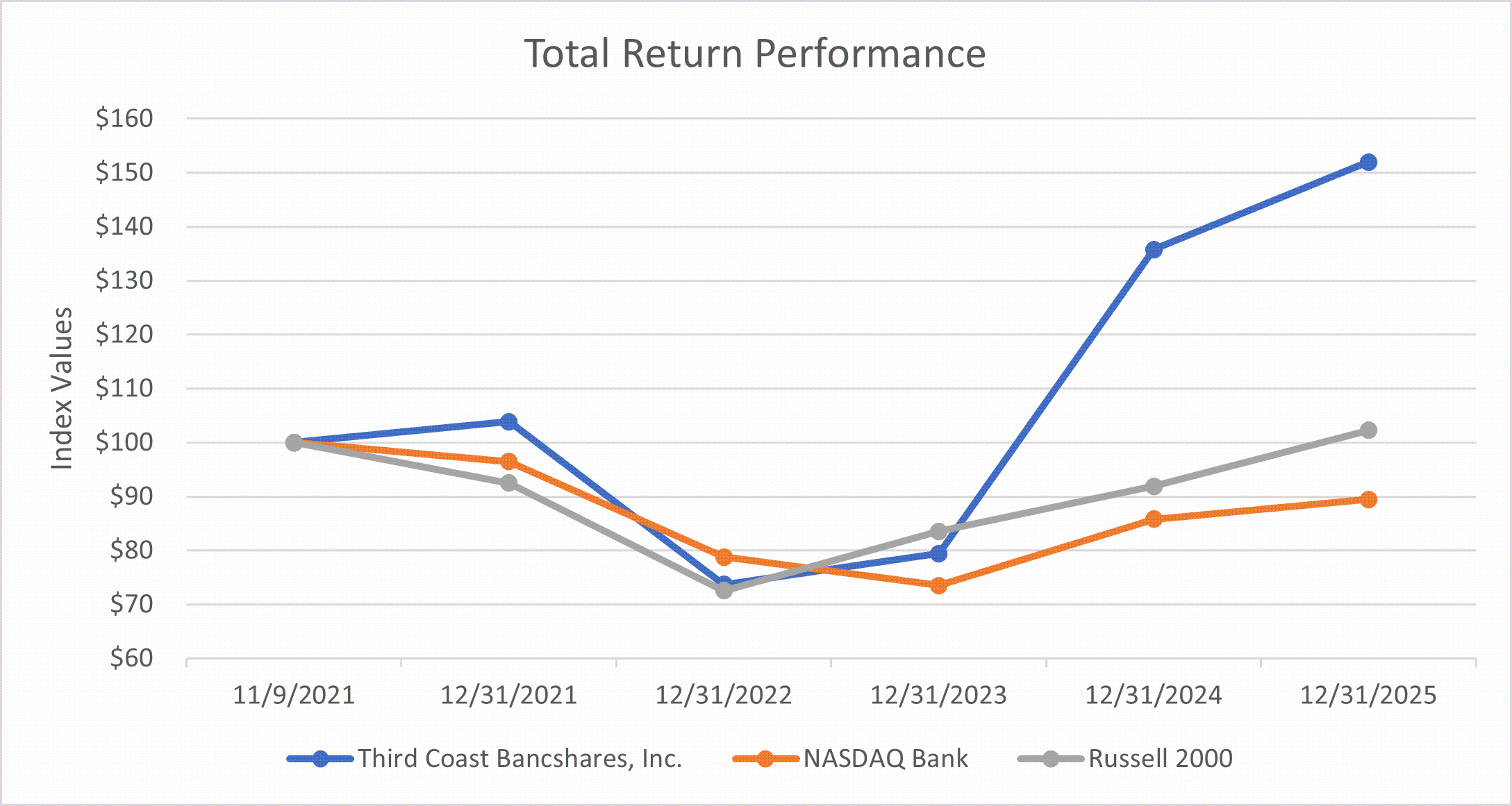
The following performance graph compares the cumulative total shareholder return on the Company’s common stock for the period beginning at the close of trading on November 9, 2021 (the end of the first day of trading of TCBX common stock on the Nasdaq Global Select Market) and the last trading date of each year from 2021 to 2025, with the cumulative total return of the Russell 2000 Index (RUT) and the NASDAQ Bank Index (IXBK) for the same periods. Cumulative total return is computed by dividing the difference between the Company's share price at the end and the beginning of the measurement period by the share price at the beginning of the measurement period. The performance graph assumes $100 is invested on November 9, 2021, in the Company’s common stock and each of the indices. Historical stock price performance for the Company’s common stock is not necessarily indicative of future stock performance. This performance graph and related information shall not be deemed “soliciting material” or to be “filed” with the SEC for purposes of Section 18 of the Exchange Act, or incorporated by reference into any future SEC filing, except as shall be expressly set forth by specific reference in such filing.
|
|
|
|
|
|
|
|
|
|
|
|
|
|
|
|
|
|
|
|
|
|
|
|
|
|
|
11/9/2021 |
|
|
12/31/2021 |
|
|
12/31/2022 |
|
|
12/31/2023 |
|
|
12/31/2024 |
|
|
12/31/2025 |
|
Third Coast Bancshares, Inc. |
|
$ |
100.00 |
|
|
$ |
103.88 |
|
|
$ |
73.69 |
|
|
$ |
79.45 |
|
|
$ |
135.75 |
|
|
$ |
151.98 |
|
NASDAQ Bank |
|
$ |
100.00 |
|
|
$ |
96.48 |
|
|
$ |
78.76 |
|
|
$ |
73.51 |
|
|
$ |
85.81 |
|
|
$ |
89.43 |
|
Russell 2000 |
|
$ |
100.00 |
|
|
$ |
92.50 |
|
|
$ |
72.56 |
|
|
$ |
83.51 |
|
|
$ |
91.88 |
|
|
$ |
102.25 |
|
Item 6. [Reserved]
Item 7. Management’s Discussion and Analysis of Financial Condition and Results of Operations.
The following discussion and analysis of our financial condition and results of operations should be read in conjunction with our consolidated financial statements and the accompanying notes thereto included in this Annual Report on Form 10-K (this “Form 10-K”). Unless we state otherwise or the context otherwise requires, references in this Form 10-K to “we,” “our,” “us,” and the “Company” refer to Third Coast Bancshares, Inc., a Texas corporation, and its consolidated subsidiaries, references in this Form 10-K to the “Bank” refer to Third Coast Bank, a Texas banking association and our wholly owned bank subsidiary, and references in this Form 10-K to “TCCC” refer to Third Coast Commercial Capital, Inc., a Texas corporation and wholly owned subsidiary of the Bank.
The following discussion contains “forward-looking statements” that reflect our future plans, estimates, beliefs and expected performance. We caution that assumptions, expectations, projections, intentions or beliefs about future events may, and often do, vary from actual results and the differences can be material. See “Cautionary Note Regarding Forward-Looking Statements” and the risk factors and other cautionary statements described under the heading “Risk Factors” included in Item 1A of this Form 10-K. We do not undertake any obligation to publicly update any forward-looking statements except as otherwise required by applicable law.
Overview
We are a bank holding company headquartered in Humble, Texas and operated through our wholly owned subsidiary, the Bank, and the Bank’s wholly owned subsidiary, TCCC. We focus on providing commercial banking solutions to small- and medium-sized businesses and professionals with operations in our markets. Our market expertise, coupled with a deep understanding of our customers’ needs, allows us to deliver tailored financial products and services. Following the completion of our merger with Keystone Bancshares, Inc., a Texas corporation (“Keystone”), discussed below, we currently operate twenty-two branches, with ten branches in the Greater Houston market, three branches in the Dallas-Fort Worth market, seven branches in the Austin-San Antonio market, one branch in Ballinger, Texas, and one branch in Detroit, Texas. As of December 31, 2025, we had, on a consolidated basis, total assets of $5.34 billion, total loans of $4.39 billion, total deposits of $4.63 billion and total shareholders’ equity of $531.0 million.
As a bank holding company that operates through one segment, community banking, we generate most of our revenue from interest on loans, and customer service and loan fees. We incur interest expense on deposits and other borrowed funds, as well as noninterest expense, such as salaries and employee benefits and occupancy expenses. We analyze our ability to maximize income generated from interest-earning assets and control the interest expenses of our liabilities, measured as net interest income, through our net interest margin and net interest spread. Net interest income is the difference between interest income on interest-earning assets, such as loans and interest-bearing time deposits in other banks, and interest expense on interest-bearing liabilities, such as deposits and borrowings, which are used to fund those assets. Net interest margin is a ratio calculated as net interest income divided by average interest-earning assets. Net interest spread is the difference between average rates earned on interest-earning assets and average rates paid on interest-bearing liabilities.
Changes in market interest rates and the interest rates we earn on interest-earning assets or pay on interest-bearing liabilities, as well as in the volume and types of interest-earning assets, interest-bearing liabilities and noninterest-bearing liabilities, are usually the largest drivers of periodic changes in net interest spread, net interest margin and net interest income. Fluctuations in market interest rates are driven by many factors, including governmental monetary policies, inflation, deflation, macroeconomic developments, changes in unemployment, the money supply, political and international conditions and conditions in domestic and foreign financial markets. Periodic changes in the volume and types of loans in our loan portfolio are affected by, among other factors, economic and competitive conditions in Texas, as well as developments affecting the real estate, technology, financial services, insurance, transportation, manufacturing and energy sectors within our target markets and throughout the state of Texas.
Keystone Merger
On February 1, 2026, we completed our merger with Keystone, the parent company of Keystone Bank, SSB (“Keystone Bank”), a Texas state savings bank, pursuant to the terms of the Agreement and Plan of Reorganization, dated as of October 22, 2025, by and among the Company, Arch Merger Sub, Inc. (“Merger Sub”), a Texas corporation and a wholly owned subsidiary of the Company, and Keystone (the “Merger Agreement”). Pursuant to the Merger Agreement, on February 1, 2026, Merger Sub merged with and into Keystone (the “Merger”), with Keystone surviving as a wholly owned subsidiary of the Company. Immediately following the Merger, Keystone merged with and into the Company, with the Company surviving the merger (the “Second Step Merger”). Immediately following the Second Step Merger, Keystone Bank merged with and into the Bank, with the Bank surviving the merger. The total aggregate consideration payable in the Merger was approximately 2.6 million shares of our common stock and $20 million in cash.
Registration of Securities Issued in Private Placement
The Company filed a Registration Statement on Form S-3 with the SEC on September 25, 2024 registering the resale from time to time by the securityholders named therein of the shares of Series A Preferred Stock and warrants to purchase an aggregate of 175,000 shares of the Company's common stock (or, at the election of the warrant holder in accordance with the terms of the warrant agreement, Series B Preferred Stock or non-voting common stock of the Company) (the “Preferred Warrants”)), issued to such securityholders in the private placement completed on September 30, 2022 and the securities issuable upon conversion of shares of