UNITED STATES
SECURITIES AND EXCHANGE COMMISSION
Washington, D.C. 20549
FORM 10-K
(MARK ONE)
☒ ANNUAL REPORT PURSUANT TO SECTION 13 OR 15(d) OF THE SECURITIES EXCHANGE ACT OF 1934
For the fiscal year ended December 31, 2025
☐ TRANSITION REPORT PURSUANT TO SECTION 13 OR 15(d) OF THE SECURITIES EXCHANGE ACT OF 1934
For the transition period from to
Commission file number: 001-39630
MOONLAKE IMMUNOTHERAPEUTICS
(Exact Name of Registrant as Specified in Its Charter)
| | | | | | | | |
Cayman Islands | | 98-1711963 |
(State or Other Jurisdiction of Incorporation) | | (IRS Employer Identification No.) |
| | |
Dorfstrasse 29, 6300, Zug Switzerland | | N/A |
(Address of principal executive offices) | | (ZIP Code) |
41 415108022
(Registrant’s Telephone Number, Including Area Code)
Securities registered pursuant to Section 12(b) of the Act:
| | | | | | | | | | | | | | |
Title of each class | | Trading Symbol(s) | | Name of each exchange on which registered |
Class A ordinary share, par value $0.0001 per share | | MLTX | | The Nasdaq Capital Market |
Securities registered pursuant to Section 12(g) of the Act: None
Indicate by check mark if the Registrant is a well-known seasoned issuer, as defined in Rule 405 of the Securities Act. Yes ☐ No ☒
Indicate by check mark if the Registrant is not required to file reports pursuant to Section 13 or 15(d) of the Act. Yes ☐ No ☒
Indicate by check mark whether the Registrant (1) has filed all reports required to be filed by Section 13 or 15(d) of the Securities Exchange Act of 1934 during the preceding 12 months (or for such shorter period that the registrant was required to file such reports), and (2) has been subject to such filing requirements for the past 90 days. Yes ☒ No ☐
Indicate by check mark whether the Registrant has submitted electronically every Interactive Data File required to be submitted pursuant to Rule 405 of Regulation S-T (§232.405 of this chapter) during the preceding 12 months (or for such shorter period that the registrant was required to submit such files). Yes ☒ No ☐
Indicate by check mark whether the Registrant is a large accelerated filer, an accelerated filer, a non-accelerated filer, a smaller reporting company or an emerging growth company. See definitions of “large accelerated filer”, “accelerated filer”, “smaller reporting company”, and “emerging growth company” in Rule 12b-2 of the Exchange Act.
Large accelerated filer ☒ Accelerated filer ☐
Non-accelerated filer ☐ Smaller reporting company ☐
Emerging growth company ☐
If an emerging growth company, indicate by check mark if the Registrant has elected not to use the extended transition period for complying with any new or revised financial accounting standards provided pursuant to Section 13(a) of the Exchange Act. ☐
Indicate by check mark whether the Registrant has filed a report on and attestation to its management’s assessment of the effectiveness of its internal control over financial reporting under Section 404(b) of the Sarbanes-Oxley Act (15 U.S.C. 7262(b)) by the registered public accounting firm that prepared or issued its audit report. ☒
If securities are registered pursuant to Section 12(b) of the Act, indicate by check mark whether the financial statements of the Registrant included in the filing reflect the correction of an error to previously issued financial statements. ☐
Indicate by check mark whether any of those error corrections are restatements that required a recovery analysis of incentive-based compensation received by any of the Registrant’s executive officers during the relevant recovery period pursuant to §240.10D-1(b). ☐
Indicate by check mark whether the registrant is a shell company (as defined in Rule 12b-2 of the Exchange Act). Yes ☐ No ☒
The aggregate market value of the voting and non-voting common equity held by non-affiliates of the Registrant, based on the closing price of the ordinary shares on The Nasdaq Capital Market (“Nasdaq”) on June 30, 2025, the last business day of the Registrant’s most recently completed second fiscal quarter, was approximately $1.34 billion. Ordinary shares held by each officer and director and by each person who is known to own 10% or more of the outstanding ordinary shares have been excluded in that such persons may be deemed to be affiliates of the Registrant. This determination of affiliate status is not necessarily a conclusive determination for other purposes.
As of February 1, 2026, there were 71,727,875 Class A Ordinary Shares, $0.0001 par value (the “Class A Ordinary Shares”), and no Class C Ordinary Shares, $0.0001 par value (the “Class C Ordinary Shares”), issued and outstanding.
DOCUMENTS INCORPORATED BY REFERENCE
Portions of the registrant’s definitive proxy statement relating to its 2026 Annual Meeting of Shareholders, to be held on or about June 4, 2026, are incorporated by reference into Part III of this Annual Report on Form 10-K where indicated. Such proxy statement will be filed with the U.S. Securities and Exchange Commission within 120 days after the end of the fiscal year to which this report relates.
MOONLAKE IMMUNOTHERAPEUTICS
FORM 10-K FOR THE YEAR ENDED DECEMBER 31, 2025
TABLE OF CONTENTS
| | | | | | | | |
| | Page |
PART I | | |
| | |
| | |
| | |
| | |
| | |
| | |
| | |
PART II | | |
| | |
| | |
| | |
| | |
| | |
| | |
| | |
| | |
| | |
PART III | | |
| | |
| | |
| | |
| | |
| | |
PART IV | | |
| | |
| | |
| | |
MOONLAKE IMMUNOTHERAPEUTICS
FORM 10-K FOR THE YEAR ENDED DECEMBER 31, 2025
Note on Forward-Looking Statements
This Annual Report on Form 10-K contains forward-looking statements. We intend such forward-looking statements to be covered by the safe harbor provisions for forward-looking statements contained in Section 27A of the Securities Act of 1933, as amended, and Section 21E of the Securities Exchange Act of 1934, as amended (the “Exchange Act”). All statements other than statements of historical fact contained in this Annual Report on Form 10-K, including without limitation, statements regarding the following, are forward-looking statements: our future results of operations and financial position, our expectations regarding industry trends, the sufficiency of our cash and cash equivalents, anticipated sources and uses of cash, the anticipated investments in our business, our business strategy, the plans and objectives of management for future operations and capital expenditures, and other information referred to in “Business”, “Risk Factors” and “Management’s Discussion and Analysis of Financial Condition and Results of Operations”. These statements involve known and unknown risks, uncertainties and other important factors that may cause our actual results, performance or achievements to be materially different from any future results, performance or achievements expressed or implied by the forward-looking statements. In some cases, you can identify forward-looking statements by terms such as “may”, “will”, “should”, “expect”, “plan”, “anticipate”, “could”, “intend”, “target”, “project”, “contemplate”, “believe”, “estimate”, “predict”, “potential”, “might”, “possible”, or “continue” or the negative of these terms or other similar expressions. The forward-looking statements in this Annual Report on Form 10‑K are only predictions. We have based these forward-looking statements largely on our current expectations and projections about future events and financial trends that we believe may affect our business, financial condition and results of operations. Some of the information contained in this discussion and analysis or set forth elsewhere in this Annual Report on Form 10-K contain forward-looking statements that reflect our plans and strategy for our business and related financing as well as expectations regarding the timing of regulatory submissions and potential commercialization for SLK. Our actual results and the timing of events could differ materially from those anticipated in the forward-looking statements.
These forward-looking statements are subject to a number of important risks, uncertainties and other factors that could cause actual results to differ materially from those in the forward-looking statements expressed or implied in this Annual Report on Form 10-K. Such risks, uncertainties and other factors include, among others, the risks, uncertainties and factors set forth in “Risk Factors”, and the following risks, uncertainties and factors:
•our success in retaining or recruiting, or changes required in, our officers, key employees or directors;
•factors relating to our business, operations and financial performance, including, but not limited to:
•we are substantially dependent on the success of our novel tri-specific Nanobody®, Sonelokimab (“SLK”, also known as M1095/ALX 0761), which we license from Merck Healthcare KGaA, Darmstadt, Germany, an affiliate of Merck KGaA, Darmstadt, Germany (“MHKDG”);
•our ability to obtain regulatory approval for our products, and any related restrictions or limitations of any approved products;
•competition and competitive pressures from other global companies in the industries in which we operate;
•we have incurred significant losses since inception, and we expect to incur significant losses for the foreseeable future and may not be able to achieve or sustain profitability in the future;
•our ability to manage our growth effectively;
•the impact of adverse business and economic conditions including inflationary pressures, general economic slowdown or a recession, fluctuating interest rates, new or increased tariffs and other barriers to trade, changes in fiscal and monetary policy or government budget dynamics, and the prospect of a shutdown of the U.S. federal government;
•while we have initiated and completed clinical trials, we have no products approved for commercial sale;
•we require substantial additional capital to finance our operations, and if we are unable to raise such capital when needed or on acceptable terms, we may be forced to delay, reduce, and/or eliminate one or more of our development programs or future commercialization efforts;
•our ability to renew existing contracts;
•our limited operating history;
•our ability to respond to general economic conditions;
MOONLAKE IMMUNOTHERAPEUTICS
FORM 10-K FOR THE YEAR ENDED DECEMBER 31, 2025
•securities litigation following periods of volatility in the marketplace or our share price; and
•the ability to adequately protect our intellectual property rights.
New risk factors emerge from time to time and it is not possible to predict all such risks, nor can we assess the impact of all such risks on our business or the extent to which any factor or combination of factors may cause actual results to differ materially from those contained in any forward-looking statements. Forward-looking statements are not guarantees of performance. You should not put undue reliance on these statements, which speak only as of the date hereof. All forward-looking statements attributable to us or persons acting on our behalf are expressly qualified in their entirety by the foregoing cautionary statements. We undertake no obligation to update or revise publicly any forward-looking statements, whether as a result of new information, future events or otherwise, except as required by law.
There may be other factors that may cause our actual results to differ materially from the forward-looking statements, including factors disclosed in “Risk Factors” and “Management’s Discussion and Analysis of Financial Condition and Results of Operations”. You should read this Annual Report on Form 10-K and the documents that we reference herein completely and with the understanding that our actual future results may be materially different from what we expect. We qualify all of our forward-looking statements by these cautionary statements.
MOONLAKE IMMUNOTHERAPEUTICS
FORM 10-K FOR THE YEAR ENDED DECEMBER 31, 2025
PART I
In this Annual Report on Form 10-K, unless the context otherwise requires or where otherwise indicated, references to “MoonLake”, “we”, “us”, “our”, “our Company”, “the Company” and “our business” refer to MoonLake Immunotherapeutics and its consolidated subsidiaries following the Business Combination (as defined herein) and to Helix Acquisition Corp. (“Helix”) prior to the Business Combination.
Item 1. Business
Overview
We are a clinical stage biotechnology company advancing therapies to address significant unmet needs in inflammatory skin and joint diseases. We are currently a single asset company focused on the development of SLK, a novel tri-specific IL-17A and IL-17F inhibiting Nanobody, that we exclusively licensed from MHKDG and that has the potential, based on response levels seen in clinical trials, to drive disease modification in dermatology and rheumatology patients.
SLK is a proprietary Nanobody that was discovered by Ablynx N.V., Belgium, a Sanofi company (“Ablynx”), and previously studied by MHKDG and Avillion LLP (“Avillion”) under a 2017 co-development agreement. The terms “Nanobody” and “Nanobodies” used herewith are registered trademarks of Ablynx. Nanobodies are able to bind selectively to a specific antigen with high affinity. Nanobodies have a fraction of the molecular weight compared to traditional antibodies. They offer a number of potential advantages over traditional monoclonal antibodies, including the potential to create multivalent molecules with enhanced ability to penetrate inflamed tissue, especially when containing an additional albumin binding domain such as SLK, an easier manufacturing process and a higher thermostability.
We currently develop SLK in inflammatory diseases in dermatology and rheumatology where the pathophysiology is known to be driven by IL-17A and IL-17F. This group of diseases comprises our current target diseases, hidradenitis suppurativa (“HS”), psoriatic arthritis (“PsA”), axial spondyloarthritis (“axSpA”), palmoplantar pustulosis (“PPP”), and several other inflammatory conditions, including psoriasis (“PsO”). Our current target diseases affect millions of people worldwide, and we believe there is a need for improved treatment options. We believe that SLK has a differentiated mechanism of action and that its purposefully designed molecular characteristics, including its small size and its albumin binding site, facilitate deep tissue penetration in the skin and joints. We envision SLK as a key therapeutic alternative in our initial target indications and potentially in multiple other IL-17 driven inflammatory conditions.
HS Trials and Plans for Commercial Launch
In May 2022, we initiated a Phase 2b trial of SLK in patients with moderate-to-severe HS (the MIRA trial (M1095-HS-201)), and in June 2023, we announced positive top-line results from this trial, which met its primary endpoint of Hidradenitis Suppurativa Clinical Response (“HiSCR”) 75 with 43% of patients treated with SLK 120mg achieving such response at week 12. In October 2023, we announced positive 24-week top-line results showing that the maintenance treatment with SLK led to further improvements in HiSCR75 response rates and other clinically relevant outcomes in patients with moderate-to-severe HS. In February 2024, we announced the successful outcome of our end-of-Phase 2 interactions with the U.S. Food and Drug Administration (“FDA”), as well as positive feedback from our interactions with the E.U. European Medicines Agency (“EMA”), with both regulatory bodies supporting our proposed approach for advancing our Phase 3 program of SLK in HS. In May 2024, we announced the screening of the first patients in the Phase 3 VELA-1 (M1095-HS-301) and VELA-2 trials (M1095-HS-302). In April 2025, we announced completion of enrollment of the VELA program and presented baseline characteristics of enrolled patients. In September 2025, we announced primary endpoint data from the VELA-1 and VELA-2 clinical trials. In the combined VELA program, patients treated with SLK experienced a clinically meaningful and statistically significant improvement across all primary and key secondary endpoints using both pre-specified strategies (p<0.001). In VELA-1, SLK achieved statistical significance for all primary and key secondary endpoints using both pre-specified strategies (HiSCR75, delta to placebo of 17%, p<0.001). 34% of patients treated with SLK 120mg achieved a HiSCR75 response at the week 16 primary endpoint. In VELA-2, response rates associated with SLK were similar to those observed in VELA-1 (HiSCR75 response of 34%), but a higher-than-expected placebo arm precluded the study from achieving statistical significance in the week 16 primary endpoint using the composite strategy (HiSCR75, delta to placebo of 9%, p=0.053). Impact on HS lesions, including draining tunnels, was matched by improvements in all key Patient Reported
MOONLAKE IMMUNOTHERAPEUTICS
FORM 10-K FOR THE YEAR ENDED DECEMBER 31, 2025
PART I
Outcomes (“PROs”), such as quality-of-life and pain scores, that are meaningful for HS patients and their treating physicians. The safety profile of SLK was consistent with previously reported studies with no new safety signals observed. This included the absence of new signals in key events of interest with IL-17A and F therapies such as Suicidal Ideation and Behavior, hepatic events, Inflammatory Bowel Disease (“IBD”) and non-infectious diarrhea, Major Adverse Cardiovascular Events (“MACE”), and Eczema and Dermatitis. In February 2026, we presented an interim analysis of the long-term data from the VELA trials, which indicated that monthly maintenance treatment with SLK can lead to further improvements in clinically relevant outcomes in patients with moderate-to-severe HS, including an as-observed HiSCR75 response rate of 69% in VELA-1 (n=104) and 67% in VELA 2 (n=123) after 52 weeks of treatment with SLK 120mg. The VELA trials are expected to continue to week 52, followed by an open-label extension for up to two years (the VELA-OLE trial (M1095-HS-303)). We expect the full one-year data of VELA-1 and VELA-2 to become available in the second quarter of 2026. In parallel, we are conducting a Phase 3 trial of SLK in adolescent patients with HS (the VELA-TEEN trial (M1095-HS-304)), which we initiated in January 2025. In February 2026, we presented an interim analysis of the VELA-TEEN clinical trial which showed that 67% of patients achieved a HiSCR75 response at week 16 (n=21). We expect to complete the VELA-TEEN clinical trial in mid-2026.
In November 2025, we were granted a Type B meeting with the FDA to discuss adequacy of the current clinical evidence package of SLK in HS to support a Biologics License Application (“BLA”) and in January 2026, we announced positive feedback from this interaction, confirming that we may establish substantial evidence of effectiveness (“SEE”) without additional clinical trials in HS. The FDA specifically advised to include the results of the MIRA trial together with the results of the VELA trials in the submission to establish SEE. Based on the positive feedback, we expect to submit a BLA for SLK in adult and adolescent HS in the second half of 2026. Subject to FDA approval, we expect a first commercial launch in the United States in the second half of 2027.
PsA Trials
In December 2022, we initiated a Phase 2b trial in patients with active PsA (the ARGO trial (M1095-PSA-201)), and in November 2023, we announced positive top-line results from this trial, which met its primary endpoint of American College of Rheumatology (“ACR”) 50 with 46% of patients on 60mg SLK achieving such response at week 12. In March 2024, we announced positive 24-week data from the ARGO trial in PsA showing that continued treatment with SLK led to significant improvements across all key outcomes. In June 2024, we announced the successful outcome of our end-of-Phase 2 interactions with the FDA, as well as positive feedback from our interactions with the EMA, with both regulatory bodies supporting our proposed approach for advancing our Phase 3 program of SLK in PsA. In November 2024, we announced the screening of the first patients in the IZAR-1 trial (M1095-PSA-301) and IZAR-2 trial (M1095-PSA-302). In February 2026, we announced completion of enrollment for the IZAR-1 trial. We expect a readout of the primary and key secondary endpoints of the IZAR-1 clinical trial in mid-2026 and of the IZAR-2 clinical trial in the second half of 2026. In addition, in January 2025, we initiated another Phase 2 clinical trial of SLK in patients with PsA where we are applying novel imaging techniques (the P-OLARIS trial (M1095-snSpA-202)). We expect results of the P-OLARIS trial to become available at the end of 2026.
MOONLAKE IMMUNOTHERAPEUTICS
FORM 10-K FOR THE YEAR ENDED DECEMBER 31, 2025
PART I
PPP Trials
In November 2024, we initiated a Phase 2 trial in patients with PPP (the LEDA trial (M1095-PPP-201)) and in November 2025, we presented positive results of this trial, suggesting that SLK could provide clinically meaningful improvements in patients with PPP. Patients treated with SLK achieved a mean percent change from baseline in the Palmoplantar Pustular Psoriasis Area and Severity Index (“PPPASI”) of 64% at week 16, and 39% of patients achieved a ≥75% reduction in the PPPASI (“PPPASI75”). In February 2026, we announced that we received Fast Track designation from the FDA for SLK in moderate-to-severe PPP. We expect to commence a Phase 3 clinical trial in PPP in the third quarter of 2026.
axSpA Trials
In February 2025, we initiated a Phase 2 trial in patients with axSpA (the S-OLARIS trial (M1095-axSpA-202)) and in February 2026, we presented positive results of this trial, suggesting that SLK could provide clinically meaningful improvements in patients with axSpA. Of the patients (n=26) treated with SLK, 81% achieved an Assessment of Spondyloarthritis International Society 40 (“ASAS40”) response at week 12, showing at least 40% improvement and an absolute improvement of ≥2 units on a numerical rating scale (0 to 10) from baseline in at least three of the four key domains (Patient Global Assessment (“PGA”) of disease activity, total back pain, physical function, inflammation). More than 80% of patients have achieved a “clinically important improvement” as per ASDAS-CRP score by week 12, confirming the strong result in this clinically relevant endpoint.
PET and MRI imaging data collected as part of the clinical trial confirm a significant reduction in inflammation in the deep tissue of the spine and sacroiliac joint affected by axSpA in a pooled analysis comparing baseline to week 12. Additional objective biomarker and tissue analyses conducted as part of the clinical trial reinforce rapid and sustained effect of the treatment with SLK in axSpA patients. The safety profile of SLK in the S-OLARIS trial was consistent with previous trials with no new safety signals detected.
Additional Trials for Other Indications
SLK was also studied in a Phase 2b trial in PsO patients where it showed a significant improvement in the primary end point as compared with placebo and for which results were presented in peer-reviewed scientific publications and conferences. In addition, Phase 1 single ascending and multiple ascending dosing trials were previously completed.
Our Vision and Our Strategy
Our vision is to elevate treatment goals for inflammatory skin and joint diseases. Our strategy is centered on developing SLK as, to our knowledge, the first ever Nanobody in clinical development for our selected indications. We seek to accomplish this strategy by:
•Completing the development of SLK in our current focus indications, HS, PsA, axSpA and PPP — In HS, we expect to complete the one-year VELA-1 and VELA-2 trials in the second quarter of 2026, and the six-month VELA-TEEN trial in mid-2026. We expect to submit a BLA for treatment of adult and adolescent patients in the second half of 2026, based on our MIRA, VELA-1, VELA-2 and VELA-TEEN clinical trials, with a potential commercial launch in the United States in the second half of 2027. In PsA, we expect primary endpoint readouts from our IZAR-1, IZAR-2 and P-OLARIS clinical trials in mid-2026, second half of 2026 and end of 2026, respectively, and expect to seek regulatory approval after completion of these studies through submission of a supplemental BLA. In PPP, we expect to initiate a Phase 3 clinical trial in the third quarter of 2026. In axSpA, we announced positive results from our S-OLARIS clinical trial in February 2026 and are currently evaluating the next steps to complete the clinical development of SLK in this indication.
MOONLAKE IMMUNOTHERAPEUTICS
FORM 10-K FOR THE YEAR ENDED DECEMBER 31, 2025
PART I
•Strengthening the differentiation elements for future SLK patients — In parallel with our clinical trials, we conduct non-clinical research to continue refining our understanding of SLK/Nanobody biology and the potential impact in our selected therapeutic indications. This research will inform our clinical efforts and includes the study of SLK’s pharmacokinetics and pharmacodynamics in a variety of cellular, deep-tissue, and disease models (in vitro and in vivo), including exploration of tissue penetration and targeting of SLK in disease models. We expect these studies to provide a more complete picture of IL-17A and IL-17F regulation. We expect this work to more clearly differentiate SLK, a Nanobody, from monoclonal antibody-based treatment options, including other IL-17A and IL-17F inhibitors. We also expect this work to contribute to the furthering of our intellectual property.
•Preparing for commercialization of SLK — We have started preparing the BLA to seek approval of SLK in the United States in HS and adolescent HS. We expect to submit the BLA in the second half of 2026 after completion of the VELA program, and, subject to FDA approval, we expect a commercial launch in the United States in the second half of 2027. We plan to further invest in our commercial capabilities. We intend to continue to build out our marketing, access and pricing functions to prepare for commercial launches of SLK in our target indications. We also expect to establish a presence in the United States in 2026 to build the sales, marketing and distribution infrastructure to commercialize SLK.
•Building our manufacturing capabilities — We intend to continue investing in our manufacturing capabilities. We have executed technology transfers for drug substance and drug product to commercial scale contract manufacturing organizations (“CMOs”), and we have successfully manufactured Process Performance Qualification batches. We may pursue additional technology transfers to establish second sourcing and increase manufacturing capacity. We are also continuously investing in process improvements which are important in driving efficiency, maintaining high standards of quality control, and providing adequate access to our product candidates, if approved, for investigators, physicians, and patients. We started stock-piling drug substance as pre-launch inventory during the third quarter of 2025 and expect to continue doing so in 2026.
•Deepening our intellectual property portfolio to support our Nanobody technology and product candidates — We intend to continue extending our global intellectual property portfolio consisting of patents and patent applications, trade secrets, trademarks, and know-how to protect the product candidates developed from our Nanobody technology. We plan to expand our intellectual property portfolio as we continue to advance and develop existing product candidates.
•Broadening our portfolio — We believe that there are other indications beyond HS, PsA, axSpA and PPP where SLK has the potential to represent a differentiated therapeutic alternative and we may initiate clinical trials of SLK in such other indications. In addition, to further enhance our overall potential and provide increased optionality, we may supplement our current strategy with the in-licensing or acquisition of additional product candidates for clinical development (beyond SLK), rather than discovering such candidates ourselves. We believe that our management team is well-positioned to identify assets that have attractive risk/reward profiles and that can be rapidly advanced to market approval, supplemented by our expertise and capabilities.
Our Focus: Inflammatory Diseases Involving IL-17A and IL-17F
SLK is an inhibitor of IL-17A and IL-17F that modulates cytokine activity in a fashion that is founded in current understanding of the importance of IL-17 biology in inflammatory disease. IL-17 cytokines can potently promote inflammation and also play a role in protection against some infectious agents. The inflammatory effects of IL-17 can be targeted directly by blocking the cytokine or its receptor, or indirectly by blocking cytokines upstream of IL-17-producing cells. IL-17 contributes to various lesions that are produced by Th17 cells, one subset of helper T cells, by gamma delta (γδ) T cells, and by innate lymphoid cells. In healthy tissue, IL-17A is largely absent, but is significantly upregulated in inflamed lesions in our focus indications. While IL-17F is present in healthy and non-lesional tissue at detectably higher concentrations than IL-17A, it is also significantly upregulated in inflamed tissue in our focus indications. The current view is that IL-17F contributes to inflammatory conditions such as HS and PsA, which is why IL-17A and F inhibition could well exert an increased anti-inflammatory therapeutic potential compared to just IL-17A inhibition.
MOONLAKE IMMUNOTHERAPEUTICS
FORM 10-K FOR THE YEAR ENDED DECEMBER 31, 2025
PART I
Millions of people worldwide suffer from diseases in which overexpression of IL-17A and IL-17F are potentially implicated in the pathophysiology and we believe there are limited treatment options. Well-known diseases include HS, PsA, PsO, PPP, and axSpA among others. HS has an estimated worldwide prevalence of approximately 2%, though we believe it is currently underdiagnosed and undertreated with limited effective treatment options available. PsA and axSpA have an estimated worldwide prevalence of up to 1.0% and PPP has an estimated worldwide prevalence of 0.3%. Finally, PsO has an estimated worldwide prevalence of approximately 3%. Other diseases, where IL-17A and IL-17F play a role, will represent additional pools of diagnosed patients.
Our Pipeline
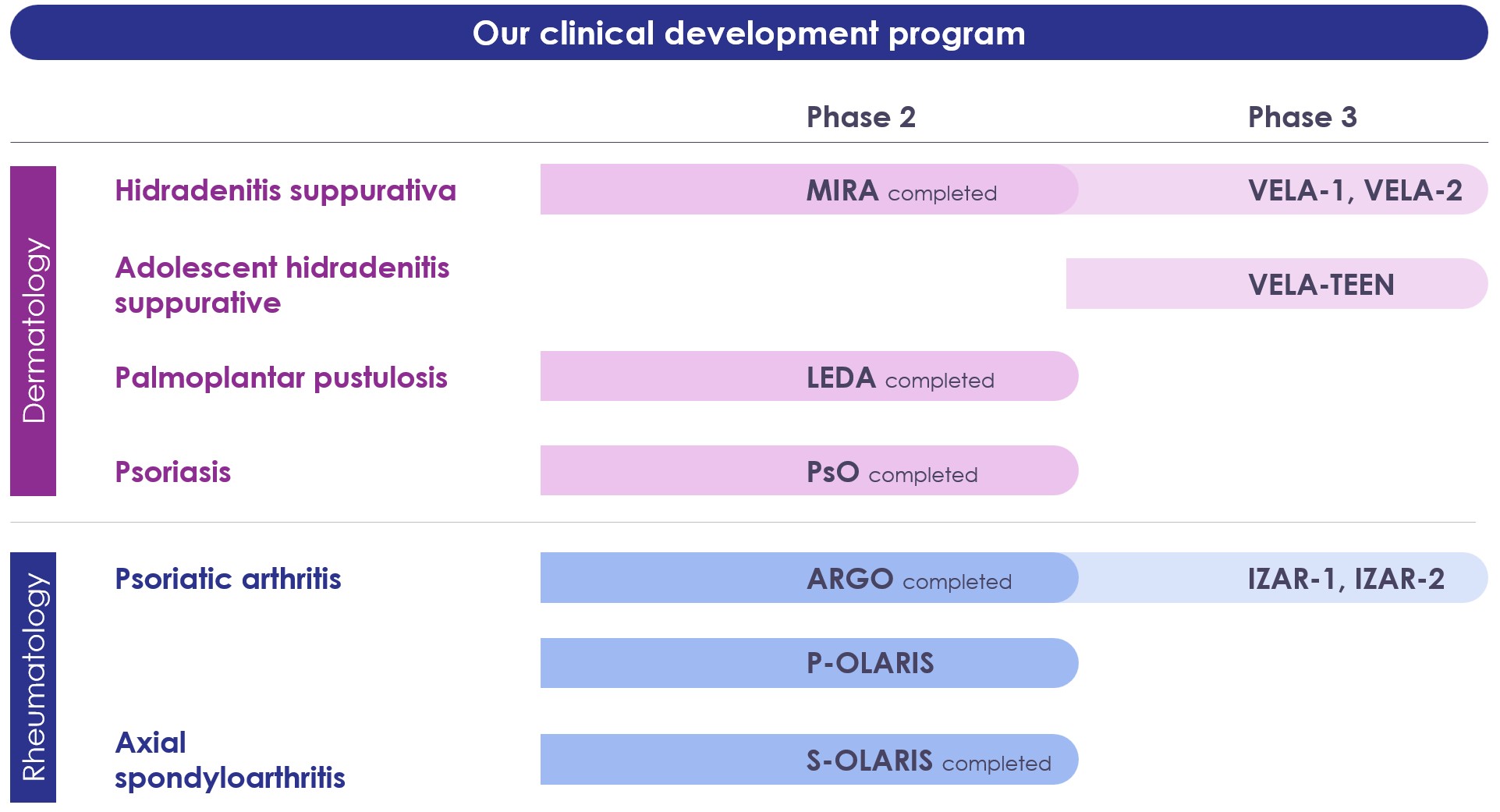
We are developing a portfolio of therapeutic indications for SLK (Figure 1).
Figure 1 — Overview of development pipeline for SLK
Clinical Development of SLK
Phase 2b Clinical Trial in HS: The MIRA Trial
The MIRA trial is a global, randomized, double-blind, placebo-controlled trial to evaluate the efficacy and safety of SLK, administered subcutaneously, in the treatment of adult patients with active moderate-to-severe HS. The trial recruited 234 patients, with the aim to evaluate two different doses of SLK (120mg and 240mg) with placebo control and adalimumab as an active reference arm. The primary endpoint of the trial is the percentage of participants achieving HiSCR75, defined as a ≥75% reduction in total abscess and inflammatory nodule count with no increase in abscess or draining tunnel count relative to baseline. The trial also evaluated a number of secondary endpoints, including the proportion of patients achieving HiSCR50, the change from baseline in International Hidradenitis Suppurativa Severity Score System (“IHS4”), the proportion of patients achieving a Dermatology Life Quality Index (“DLQI”) total score of ≤5, and the proportion of patients achieving at least 30% reduction from baseline in Numerical Rating Scale in the Patient’s Global Assessment of Skin Pain (“PGA Skin Pain”).
MOONLAKE IMMUNOTHERAPEUTICS
FORM 10-K FOR THE YEAR ENDED DECEMBER 31, 2025
PART I
In June 2023, the MIRA trial set a landmark milestone as the first placebo-controlled randomized trial in HS to use HiSCR75 as the primary endpoint which it met with a significantly greater proportion of patients treated with both SLK 120mg and 240mg achieving HiSCR75 compared to those on placebo at week 12. The primary analysis was based on a very stringent type of analysis for such trials, intent-to-treat non-responder imputation (“ITT-NRI”). Both doses performed similarly, with the 120mg dose providing the highest delta on HiSCR75 and HiSCR50. The 120mg dose achieved a 43% response rate on HiSCR75 and a 66% response rate on HiSCR50 at week 12.
In October 2023, 24-week results were presented, showing that ongoing treatment with SLK 120mg and 240mg dosed Q4W further increased HiSCR75 response rates compared to week 12. 57% of patients continuously treated with 120mg achieved a HiSCR75 response (more than 10 ppt improvement from week 12) and 38% achieved HiSCR90 (more than 14 ppt improvement versus week 12). The IHS4 score, which encompasses changes in all active HS lesions (nodules, abscesses, draining tunnels), decreased by 65% in patients treated with the 120mg maintenance dose.
Phase 3 Clinical Trials in HS: The VELA Program
The Phase 3 VELA program consists of two global, randomized, double-blind, placebo-controlled trials, the VELA-1 and VELA-2 trials, that are identical in design to evaluate the efficacy and safety of SLK, administered subcutaneously, in adult patients with active moderate-to-severe HS. Across VELA-1 and VELA-2, we enrolled a total of 838 patients. The primary endpoint is the percentage of participants achieving HiSCR75 at week 16. The trials also evaluate a number of secondary endpoints, including the proportion of patients achieving HiSCR50, the change from baseline in IHS4, the proportion of patients achieving a DLQI total reduction of ≥4, the proportion of patients achieving at least 50% reduction from baseline in Numerical Rating Scale in the PGA Skin Pain and complete resolution of Draining Tunnels. The trials compare a single 120mg dose of SLK to placebo with HiSCR75 reading out at week 16. From week 16, all patients receive the 120mg dose of SLK through to 48 weeks, with a last assessment at week 52, followed by an open-label extension for up to two years. The Phase 3 program used a protocol design consistent with the Phase 2 MIRA trial, which identified the optimal dose of SLK for HS. The VELA protocols and statistical analysis plans were prepared in accordance with regulatory agency advice and include two analysis strategies. The composite strategy for the VELA trials (also referred to as the primary estimand) is the primary statistical analysis. The protocol specifies the treatment policy strategy as the alternative method of handling intercurrent events to test the robustness of the VELA data. Results of the week 16 data were announced in September 2025.
In the combined Phase 3 VELA program, all endpoints reached statistical significance with p-values below 0.001, including lesion counts and PROs. SLK demonstrated the expected profile of response over time, with statistically significant HiSCR75 for both studies achieved as early as week 4. A preliminary analysis suggests that responses continue to improve beyond week 16 and that placebo patients crossing over at week 16 achieve similar responses to those originally randomized to the SLK 120mg arm, as of week 20 (pre-specified analysis).
In VELA-1, SLK achieved statistical significance for all primary and key secondary endpoints using both pre-specified strategies (HiSCR75, delta to placebo of 17%, p<0.001).
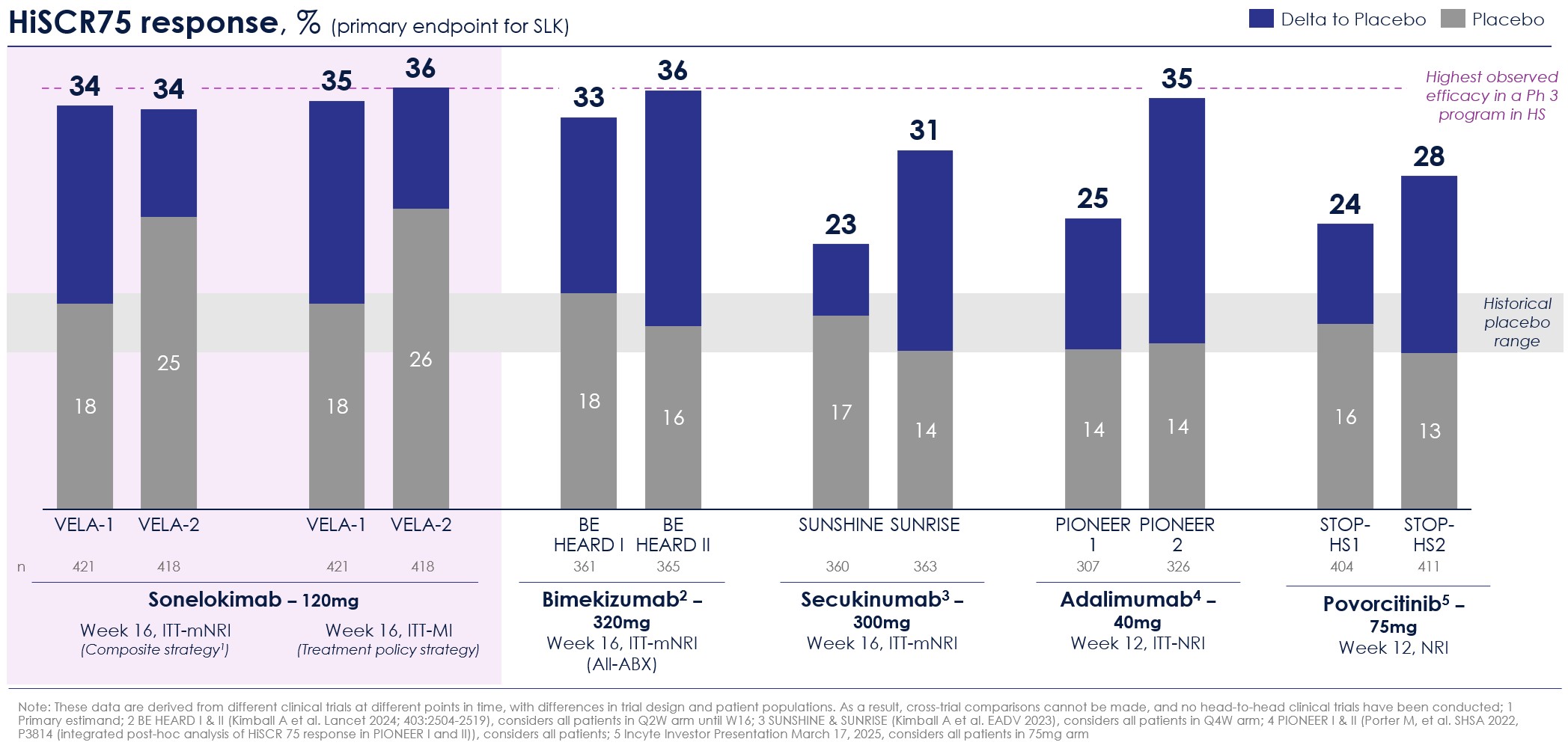
In VELA-2, intercurrent events in the higher-than-expected placebo arm precluded the study from achieving statistical significance in the week 16 primary endpoint using the composite strategy (HiSCR75, delta to placebo of 9%, p=0.053). Using the treatment policy strategy as per protocol, both VELA-1 and VELA-2 showed a statistically significant increase in the percentage of participants achieving HiSCR75 at week 16 and provided a clinically meaningful benefit. Response rates for SLK 120mg were consistent between the two trials, with 34.8% and 35.9% of patients in VELA-1 and VELA-2 achieving HiSCR75 at week 16, respectively. The placebo response rate in VELA-1 of 17.5% at week 16 was within the historical Phase 3 range of 13% to 18%. The placebo response rate in VELA-2 of 24.9% at week 16 was higher than expected.
MOONLAKE IMMUNOTHERAPEUTICS
FORM 10-K FOR THE YEAR ENDED DECEMBER 31, 2025
PART I
Figure 2 — HiSCR75 response rates across Phase 3 clinical trials in HS
Both VELA-1 and VELA-2 achieved p-values below 0.05 for all key secondary endpoints. This includes other lesion count based endpoints (HiSCR50 and IHS4-55). It also includes relevant PROs in HS. Around 30% of patients experienced a marked reduction of pain, as measured by an at least 3-point improvement in the worst pain NRS, in both VELA-1 and VELA-2 (p≤0.002). SLK showed a significant improvement of HS-specific Quality of Life (“HiSQOL”) score at week 16 (p<0.001), which was consistent between VELA-1 and VELA-2. Almost 60% of patients achieved a meaningful (4 points or more) improvement of DLQI, an approximately 20 percentage-point benefit over placebo (p≤0.001).
The safety profile of SLK was consistent with previously reported studies with no new safety signals observed. This includes the absence of new signals in key events of interest with IL-17A and F therapies: Suicidal Ideation and Behavior, hepatic events, IBD and non-infectious diarrhea, MACE and Eczema and Dermatitis.
The VELA program is conducted using a convenient sub-cutaneous dosing scheme with 1ml volume delivered every other week to week 6 in the induction phase (4 injections), and monthly from week 8 for maintenance, with no up-titration. This profile is matched by improvements of HS lesions, including draining tunnels, as well as in all key PROs, such as quality-of-life and pain scores, that are meaningful for HS patients and their treating physicians.
In February 2026, we presented an interim analysis of the long-term data from the VELA trials, which indicated that monthly maintenance treatment with SLK can lead to further improvements in clinically relevant outcomes in patients with moderate-to-severe HS, including an as-observed HiSCR75 response rate of 69% in VELA-1 (n=104) and 67% in VELA 2 (n=123) after 52 weeks of treatment with SLK 120mg. The VELA trials are expected to continue to week 52, followed by an open-label extension for up to two years. We expect the full one-year data of VELA-1 and VELA-2 to become available in the second quarter of 2026.
In November 2025, we were granted a Type B meeting with the FDA to discuss adequacy of the current clinical evidence package of SLK in HS to support a BLA and in January 2026, we announced positive feedback from this interaction, confirming that we may establish SEE without additional clinical trials in HS. In addition, FDA feedback confirms that we may establish SEE with a BLA consisting of data from our existing VELA-1, VELA-2 and MIRA trials. The FDA specifically advised us to include the results of the MIRA trial in the submission and to submit the results of the VELA-2 trial for the marketing application to inform the safety profile of SLK, regardless of decisions on
MOONLAKE IMMUNOTHERAPEUTICS
FORM 10-K FOR THE YEAR ENDED DECEMBER 31, 2025
PART I
its utility in establishing SEE. Based on the positive final official records of this Type B meeting, we will continue our plans for BLA submission for SLK in adult and adolescent HS in the second half of 2026. Subject to FDA approval, we expect a first commercial launch in the United States in the second half of 2027.
Phase 3 Clinical Trial in Adolescent HS: VELA-TEEN
The Phase 3 VELA-TEEN trial is an open-label, single-arm trial designed to evaluate SLK 120mg administered subcutaneously once every two weeks until week six and once every four weeks from week eight onwards. The trial aims to enroll 30-35 adolescents, aged 12-17, with moderate-to-severe HS, from U.S. sites experienced in clinical trials and pediatric dermatology. The primary trial phase will be 24 weeks with a primary endpoint evaluating the pharmacokinetics, safety, and tolerability of SLK. VELA-TEEN will also evaluate several secondary endpoints, including the proportion of patients achieving the higher clinical response measure of the HiSCR75, in addition to HiSCR50. Other outcomes are the change from baseline in the IHS4, which includes the quantitative measure of draining tunnels, and the proportion of patients achieving a meaningful reduction of the CDLQI and the PGA Skin Pain.
An interim analysis of the VELA-TEEN clinical trial showed that 67% of patients achieved a HiSCR75 response at week 16 (n=21). The safety profile of SLK in patients with adolescent HS was consistent with the results from the adult HS trial (VELA-1, VELA-2, and MIRA) and no new safety signals were observed.
Phase 2b Clinical Trial in PsA: the ARGO Trial
The ARGO trial is a global, randomized, double-blind, placebo-controlled trial to evaluate the efficacy and safety of SLK, administered subcutaneously, in the treatment of adult patients with active PsA. The trial was designed to evaluate different doses of SLK, with placebo control and adalimumab as an active reference arm. The primary endpoint of the trial is the percentage of participants achieving ≥50% improvement in signs and symptoms of disease from baseline, compared to placebo, as measured by ACR50 response. The trial also evaluates a number of secondary endpoints, including improvement compared to placebo in ACR20, complete skin clearance as measured by at least a 100% improvement in the Psoriasis Area and Severity Index (PASI100), physical function as measured by the Health Assessment Questionnaire-Disability Index, enthesitis as measured by the Leeds Enthesitis Index and pain as measured by the Patients Assessment of Arthritis Pain. Important composite scores, such as ACR50+PASI100, measuring both joint and skin improvement in the same patients were also studied.
In November 2023, the ARGO trial, which enrolled 207 patients, met its primary endpoint with a statistically significant greater proportion of patients treated with either SLK 60mg or 120mg (with induction) achieving an ACR50 response compared to those on placebo at week 12. Specifically, for the 60mg and 120mg doses with induction, respectively, 46% and 47% of patients treated with SLK achieved ACR50 (p<0.01 versus placebo); 78% and 72% of patients achieved ACR20; and 29% and 26% achieved ACR70. The primary analyses were based on a very stringent type of analysis for such trials, ITT-NRI. As expected, the 60mg dose without induction did not reach statistical significance, confirming the 60mg and 120mg with induction as the potential dose regimens to carry forward into Phase 3. All key secondary endpoints were met for the 60mg and 120mg doses with induction. The key secondary endpoint PASI90 was met for all doses with induction. 77% of patients treated with SLK 60mg achieved a PASI90 response at week 12 (ITT-NRI, p<0.001 versus placebo) and 58% achieved complete skin clearance (PASI100). PASI responses across dose arms were consistent with the previously reported Phase 2b data of SLK in moderate-to-severe plaque-type PsO, with the 120mg dose achieving the highest responses for PASI100 (close to 60% of patients at week 12, ITT-NRI) in patients with more severe skin lesions (PASI score ≥ 10 at baseline). Up to 33% of patients achieved both ACR50 and PASI100 at week 12. Other clinically relevant secondary endpoints, such as Minimal Disease Activity (MDA), the modified Nail Psoriasis Severity Index (mNAPSI), the Leeds Enthesitis Index (LEI) and the patient self-reported Psoriatic Arthritis Impact of Disease (PsAID-12), each show promising levels of response at week 12. Adalimumab was used as an active reference to validate responses across arms (not powered for statistical comparisons to active treatment). SLK 60mg and 120mg (with induction) numerically outperformed adalimumab on the primary endpoint and all key secondary endpoints, with the observed deltas further supporting the potential for SLK as a future leading therapy. The results suggest that, as early as week 12, SLK reaches levels of clinical response at or above those seen with other therapies tested in similarly stringent trials.
MOONLAKE IMMUNOTHERAPEUTICS
FORM 10-K FOR THE YEAR ENDED DECEMBER 31, 2025
PART I
The safety profile of SLK in the ARGO trial was consistent with previously reported studies with no new safety signals. Overall, SLK continued to show a favorable safety profile.
In March 2024, the ARGO trial demonstrated that the primary endpoint, ACR50, continued to improve from week 12 and exceeded 60% by week 24. The more rigorous ACR70 outcome was achieved by approximately 40% of patients by week 24. In addition, by week 24, over 80% and 60% of patients treated with SLK achieved PASI 90 and 100, respectively. Both doses of SLK yielded similar results. The responses surpassed those for adalimumab, the active reference arm in the study, and were also higher when indirectly compared to competitors using the same active reference arm as a standard.
Treatment with SLK resulted in unprecedented improvements in composite scores that reflect responses in different domains simultaneously. ACR50+PASI90 up to 59%, ACR 50+PASI 100 up to 52%, ACR 70+PASI 100 up to 48% and MDA up to 61% response. In all composite scores, SLK showed 16-29 ppt differences to the reference adalimumab arm, comparatively higher than competitors using the same reference arm. While the 60mg dose was found to be sufficient to reach high levels of response in the general trial population, the 120mg dose was found to improve responses further in specific patient sub-groups, which suggests two doses being carried over to Phase 3.
The safety profile of SLK was consistent with previous trials with no new safety signals detected. The discontinuation rate of the second part of ARGO remained low at 5%, in line with other SLK trials.
Phase 3 Clinical Trials in PsA: The IZAR Program
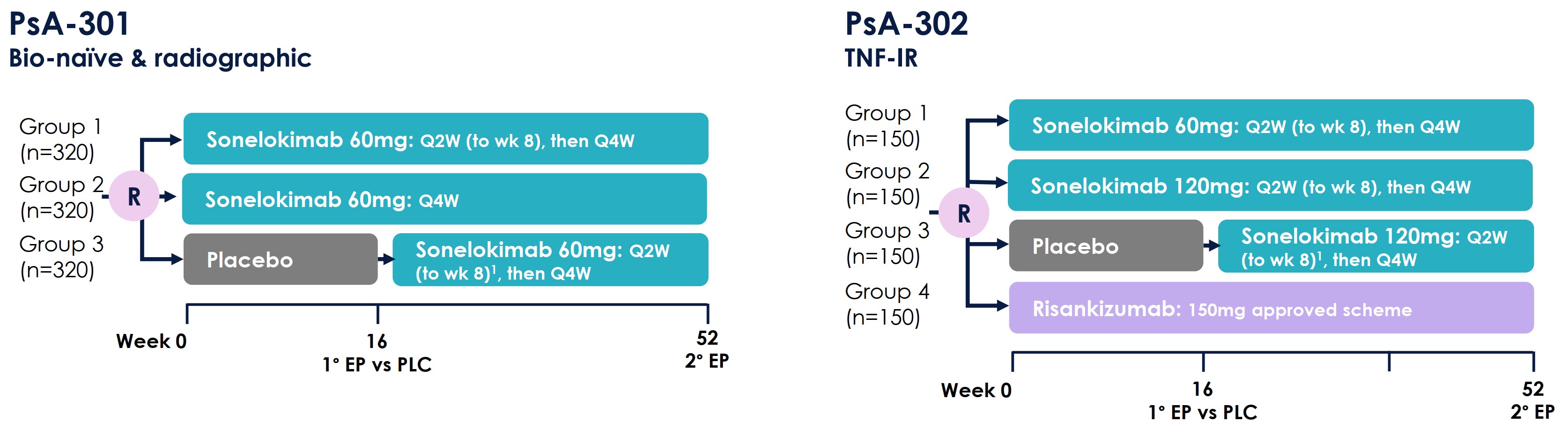
The IZAR program is expected to enroll approximately 1,500 adult patients across IZAR-1 and IZAR-2. Both are global, randomized, double-blind, placebo-controlled Phase 3 trials designed to evaluate the efficacy and safety of SLK compared with placebo in patients with active PsA, with a primary endpoint of superiority to placebo in ACR50 response at week 16. IZAR-1 enrolled biologic-naïve patients and includes an evaluation of radiographic progression, while IZAR-2 enrolls patients with an inadequate response to tumor necrosis factor-α inhibitors (TNF-IR) — reflecting patients commonly seen in clinical practice — and includes risankizumab, a monoclonal antibody that inhibits IL-23, as an active reference arm. Both trials are also designed to assess a range of secondary endpoints reflecting the multiple disease manifestations characteristic of PsA. These include skin, nail, and joint outcomes: ACR20 response at week 16, PASI90 response at week 16, vdHmTSS (van der Heijde modified Total Sharp Score) change from baseline at week 16, multidomain outcomes: MDA at week 16, and patient-reported outcome measures: HAQ-DI (Health Assessment Questionnaire-Disability Index (HAQ-DI) change from baseline at week 16, SF-36 PCS (short-form-36 Physical Component Summary) change from baseline at week 16.
The IZAR program will assess 60mg and 120mg doses of SLK (Figure 3). The readout of the primary endpoint for IZAR-1 is anticipated in mid-2026 and for IZAR-2 in the second half of 2026.
Figure 3 — Design of the Phase 3 IZAR program in PsA.
MOONLAKE IMMUNOTHERAPEUTICS
FORM 10-K FOR THE YEAR ENDED DECEMBER 31, 2025
PART I
Additional Phase 2 Clinical Trial in PsA: The P-OLARIS Trial
The P-OLARIS trial is an open-label imaging Phase 2 trial designed to explore the effects of SLK 60mg administered subcutaneously in 30 patients with seronegative spondyloarthritis which includes PsA. The primary endpoint is the change from baseline (CfB) in [68Ga]-FAPI-46 SUVmax signal overall and per indication at week 12, as detected by FAPI-PET/low-dose CT scan. In addition, several other endpoints will be assessed including clinical disease activity scores and patient-related outcomes. The trial also features a peripheral blood and tissue biomarker program. We expect the P-OLARIS trial to provide a more complete picture of SLK's benefit in patients with active PsA and thereby more clearly differentiate SLK, a Nanobody, from monoclonal antibody-based treatment options, including other IL-17A and IL-17F inhibitors. The first P-OLARIS patient was screened in October 2025 and dosed in November 2025. We expect the topline primary endpoint readout in the second half of 2026.
Phase 2 Clinical Trial in PPP: The LEDA Trial
The LEDA trial is a Phase 2 trial designed to evaluate the efficacy and safety of SLK 120mg administered subcutaneously in adult patients with PPP. The primary endpoint of the trial is percent change from baseline in PPPASI with important secondary endpoints including PPPASI75. The LEDA trial features an innovative translational research program using peripheral blood and tissue biomarkers as trial controls.
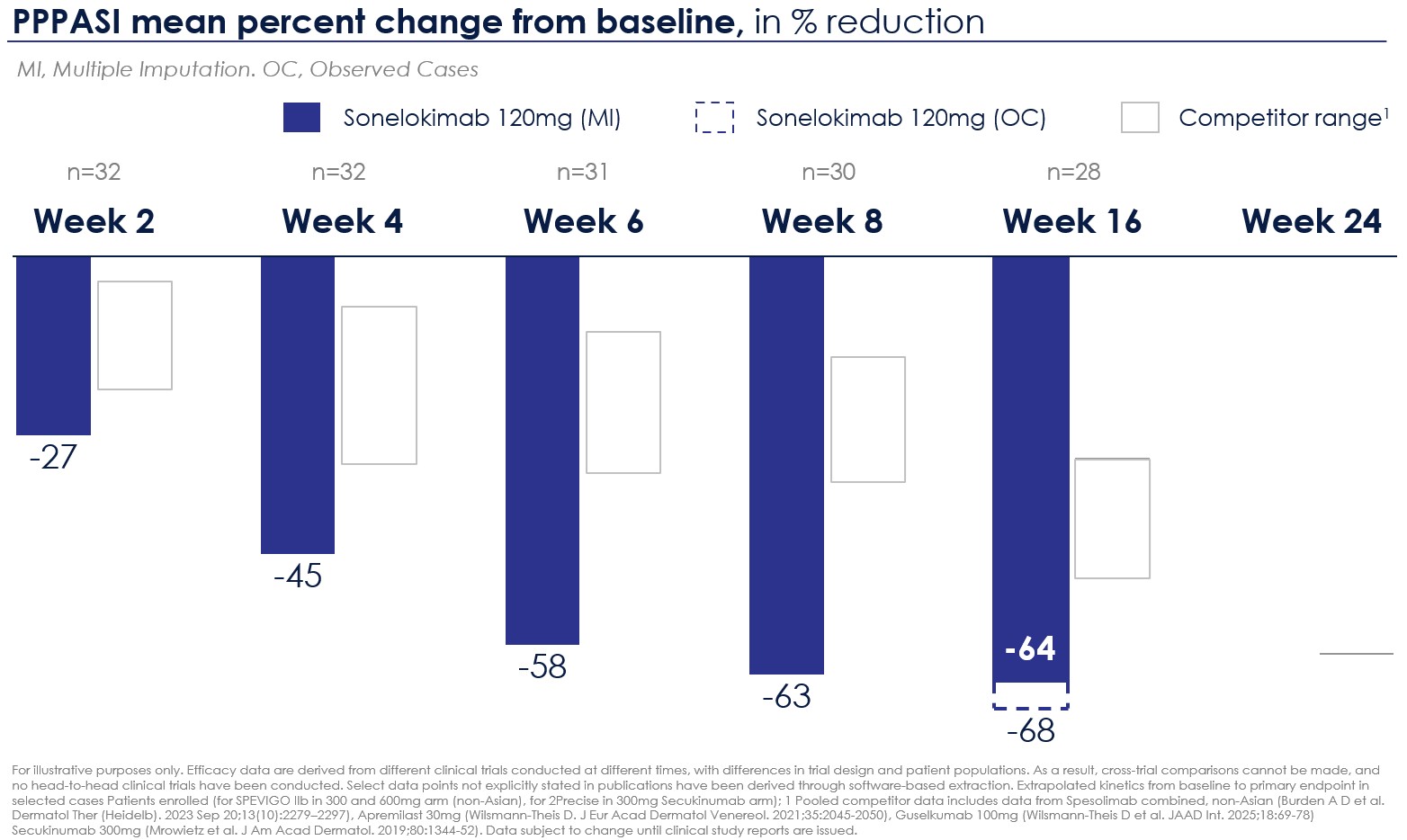
In November 2025, the Phase 2 LEDA clinical trial in PPP demonstrated clinically meaningful and statistically significant benefit for patients treated with SLK. Patients treated with SLK achieved a mean percent change from baseline in the PPPASI of 64% at week 16, and 39% of patients achieved a PPPASI75, suggesting that SLK could provide clinically meaningful improvements in this disease for which there are currently no approved therapies. The safety profile of SLK in the LEDA trial was consistent with previous trials with no new safety signals detected.
Figure 4 — PPPASI mean percent change from baseline in Phase 2 LEDA trial
MOONLAKE IMMUNOTHERAPEUTICS
FORM 10-K FOR THE YEAR ENDED DECEMBER 31, 2025
PART I
Phase 3 Clinical Trial in PPP
The Phase 3 program for PPP is an anticipated global, randomized, double-blind, placebo-controlled trial to evaluate the efficacy and safety of SLK in adult patients with chronic moderate-to-severe PPP. The trial is expected to enroll approximately 370 patients.
The proposed Phase 3 trial design will assess the SLK 120 mg dose administered subcutaneously every two weeks (“Q2W”) and every four weeks dosing, following an initial Q2W induction period, compared with placebo. The primary endpoint is the percentage of patients achieving a Palmoplantar Psoriasis Global Assessment score of 0 (clear with no signs of PPP) or 1 (almost clear with minimal residual signs of PPP) by week 12.
The trial will also assess a number of secondary endpoints, in line with those evaluated in the Phase 2 LEDA trial, including the proportion of patients achieving PPPASI75, PPPASI50, Pain Response, and a Minimally Clinically Important Difference (“MCID”) response in the DLQI.
An end-of-Phase 2 meeting with the FDA is planned for the first half of 2026, with patient enrolment expected to begin in the third quarter of 2026. In February 2026, we announced that the Dermatology Division of the FDA has granted Fast Track designation for SLK in moderate‑to‑severe PPP, supported by positive results from the Phase 2 LEDA trial. As a result, the Phase 3 program is expected to benefit from earlier and more frequent interactions with the FDA under the Fast Track framework, potentially enabling a more efficient development pathway.
Phase 2 Clinical Trial in axSpA: the S-OLARIS Trial
The S-OLARIS trial is an open-label imaging Phase 2 proof-of-concept trial aiming to investigate SLK 60mg administered subcutaneously in approximately 25 patients with active axSpA. The primary endpoint is the change from baseline at week 12 in the uptake of 18F-NaF in the sacroiliac joints and spine using PET in combination with MRI imaging. Throughout the trial, several other endpoints will be assessed including established clinical disease activity outcomes, scores related to physical function, spinal mobility, and enthesitis as well as PROs. The trial also includes an exploratory peripheral blood and tissue biomarker program.
In February 2026, the Phase 2 S-OLARIS trial in axSpA demonstrated a clinically meaningful and statistically significant benefit. Of the patients (n=26) treated with SLK, 81% achieved an Assessment of Spondyloarthritis International Society 40 (ASAS40) response at week 12, showing at least 40% improvement and an absolute improvement of ≥2 units on a numerical rating scale (0 to 10) from baseline in at least three of the four key domains (PGA of disease activity, total back pain, physical function, inflammation). More than 80% of patients have achieved a “clinically important improvement” as per ASDAS-CRP score by week 12, confirming the strong result in this clinically relevant endpoint.
PET and MRI imaging data collected as part of the clinical trial confirm a significant reduction in inflammation in the deep tissue of the spine and sacroiliac joint affected by axSpA in a pooled analysis comparing baseline to week 12. Additional objective biomarker and tissue analyses conducted as part of the clinical trial reinforce rapid and sustained effect of the treatment with SLK in axSpA patients. The safety profile of SLK in the S-OLARIS trial was consistent with previous trials with no new safety signals detected.
Clinical Development in Other Indications
Building on the strong data generated with SLK to date, we believe that there are other indications beyond HS, PsA, axSpA and PPP where SLK has the potential to represent a differentiated therapeutic alternative and we may initiate clinical trials of SLK in such other indications.
MOONLAKE IMMUNOTHERAPEUTICS
FORM 10-K FOR THE YEAR ENDED DECEMBER 31, 2025
PART I
Manufacturing
We do not own or operate manufacturing facilities and currently have no plans to establish any. We partner with third-party CMOs for both drug substance and finished drug product, through established contracts.
Our current drug substance supplier is Richter BioLogics GmbH & Co. KG (“Richter Biologics”) based in Bovenau, Germany. Effective July 1, 2021, we entered into a contract manufacturing agreement with Richter Biologics with respect to the manufacture of SLK. We may terminate the contract manufacturing agreement for convenience in accordance with the terms of the agreement. Either party may also terminate the contract manufacturing agreement with respect to an uncured breach by the other party in accordance with the terms of the agreement. The agreement includes confidentiality and intellectual property provisions to protect our proprietary rights related to our product candidates.
MHKDG produced the drug product supply for our MIRA and ARGO Phase 2 clinical trials. In 2022, we successfully transferred the drug product process to Vetter Pharma International GmbH as part of our strategy to ensure sufficient supply for potential commercialization following all regulatory and related requirements.
In May 2023, we entered into a collaboration agreement with SHL Medical to develop an autoinjector for clinical and potential subsequent commercial supply of SLK. Necessary pharmacokinetic and human factor studies were completed in 2025 to support the potential launch of SLK with the autoinjector as an approved device for administration of SLK.
Intellectual Property
As of December 31, 2025, we have the exclusive license to a patent family directed to Il-17 Nanobodies, including SLK, and methods of making and using the same derived from International Patent Application PCT/EP2012/058313, published as WO 2012/156219, entitled “Amino Acid Sequences Directed Against IL-17A, IL-17F and/or IL17-A/F and Polypeptides Comprising the Same”. Applications in this family have been filed in the United States, the European Patent Office (EPO), the Eurasian Patent Organization (EAPO), Australia, Brazil, Canada, Chile, China, Hong Kong, India, Israel, Japan, Korea, Malaysia, Mexico, New Zealand, Philippines, Singapore, and South Africa. To date, 24 patents have been issued, and several applications are pending. Three patents have been issued in the United States in this family thus far (U.S. Patent Nos. 10,017,568, 10,829,552 and 11,773,159), all three providing protection until May 2032, without taking into account any possible patent term adjustments or extensions and assuming payment of all appropriate maintenance, renewal, annuity and other governmental fees. There are several non-U.S. patents that have been granted or are pending in this family, all of which are expected to have similar expiration dates, absent any extensions that may be available through supplementary protection certificates or similar mechanisms. Additional data exclusivity rights may be applicable.
As of December 31, 2025, our patent portfolio also includes three patent families owned by us directed to uses of Nanobodies, including SLK. One family is derived from International Patent Application PCT/IB2023/054122, published as WO2023/203549, titled “Methods of Achieving Safe and Sustained Control of IL-17-Dependent Conditions in Subjects Responsive to Treatment with an Anti-IL 17A/F Nanobody”. The second family is derived from International Patent Application PCT/IB2024/053796, published as WO2024/218708, and titled “Biomarker-Based Treatment and Diagnostic Methods for IL-17-Dependent Conditions”. The third family consists of a provisional U.S. patent application, titled “Treatment and Diagnostic Methods for Pustular Non-Infectious Inflammatory Skin Conditions”. The pending patent applications from these families, if issued, have expected expiry dates of no earlier than between 2043 and 2044, not including any patent term extensions and/or patent term adjustments.
The Merck Healthcare KGaA (Darmstadt, Germany) License Agreement
On April 29, 2021, we entered into a license agreement with MHKDG (the “License Agreement”). The License Agreement is a sublicense of a license agreement between MHKDG and Ablynx, dated September 3, 2008 (the “Initial License Agreement”), pursuant to which MHKDG developed SLK, and subsequently acquired exclusive right and title to SLK, including the right to further develop and commercialize (and grant sublicenses to further develop and commercialize) SLK. Pursuant to the License Agreement, we acquired (i) a royalty- and milestone-bearing exclusive
MOONLAKE IMMUNOTHERAPEUTICS
FORM 10-K FOR THE YEAR ENDED DECEMBER 31, 2025
PART I
(even as to MHKDG), sublicensable right and license under MHKDG’s controlled patents, materials, and exclusive know-how to develop, manufacture, use, sell, offer for sale, export and import and otherwise commercialize SLK on a world-wide basis, (ii) a royalty- and milestone-bearing non-exclusive, sublicensable, right and sublicense under Ablynx’s and certain others’ controlled patents, materials, and know-how to develop, manufacture, use, sell, offer for sale, export and import and otherwise commercialize SLK on a world-wide basis, in each case subject to certain restrictions and compliance with the terms and conditions of the Initial License Agreement; and (iii) a royalty- and milestone-bearing non-exclusive, sublicensable right and sublicense under Research Cooperation Technologies (“RCT”) patents and know-how related to the manufacturing process using the underlying yeast strain Pichia pastoris, to develop, manufacture, use, sell, offer for sale, export and import and otherwise commercialize SLK on a world-wide basis, in each case subject to certain restrictions and compliance with the terms and conditions of the underlying license granted to MHKDG from RCT. Under the terms of the License Agreement, we have the first right to file, prosecute and maintain the licensed patents as well as the first right to attempt to resolve any third-party infringement.
The License Agreement includes a development plan, subject to specified periodic updates, which describes the plan for developing the licensed products in the initial target indications of HS and PsA, including the plan for conducting clinical trials to obtain regulatory approval in the major European markets, Japan, and the United States (the “Major Markets”). In accordance with the foregoing, we, among other requirements, are obligated to use commercially reasonable efforts to develop one licensed product in at least two indications, including initiating certain Phase 2 trials for the licensed product within a specified period following conclusion of the License Agreement, and launching and commercializing the same in each of the Major Markets within a certain period following receipt of regulatory approval in such respective markets.
The aggregate purchase price in respect of the License Agreement was $29.9 million and consisted of an upfront cash payment by us to MHKDG and an issuance of equity by us to MHKDG, representing a 9.9% ownership stake in our subsidiary, MoonLake Immunotherapeutics AG, a Swiss stock corporation (Aktiengesellschaft) registered with the commercial register of the Canton of Zug, Switzerland under the number CHE-433.093.536 (“MoonLake AG”), following such issuance. Subject to the terms of the License Agreement, milestone cash payments of up to EUR 299.6 million ($351.7 million using a December 31, 2025 exchange rate) are potentially payable, of which EUR 7.5 million ($8.1 million using the then applicable exchange rate) has been recognized as R&D expense to date. Future milestones will become payable upon regulatory filing acceptances in the US, in the European Union (“EU”) and Japan, first commercial sales in these geographies, and meeting certain annual thresholds in global net sales. In addition, the License Agreement requires us to pay royalties within the range of low to mid-teen percent of net sales. Our obligation to pay royalties are on a licensed product-by-licensed product and country-by-country basis and continue from the date of first commercial sale of a licensed product in a country until the later of (i) ten years from such first commercial sale of such licensed product in such country or (ii) the expiration or invalidation of the last remaining valid claim of a licensed patent covering such licensed product.
Unless sooner terminated, the term of the License Agreement continues until the expiration of the last-to-expire royalty term. Either party may terminate the License Agreement due to a material breach by the other party (subject to a cure period). We may terminate the License Agreement (i) at our convenience upon 90 days’ prior written notice to MHKDG following receipt by MHKDG of the required upfront payment or (ii) upon 90 days’ prior written notice to MHKDG if we have reasonable belief that the medical risk/benefit of SLK is unfavorable in light of the welfare of patients and not suitable for further development or commercialization. Obligations accrued prior to termination, such as milestone payments, will persist.
Concurrently with the License Agreement, on April 29, 2021, we also executed a Side Letter to the License Agreement with MHKDG, which provides that upon the termination of the Initial License Agreement, under the terms of the Initial License Agreement, for any reason, the License Agreement will be automatically assigned to Ablynx. Upon assignment to Ablynx, any intellectual property licensed to us by MHKDG, and the obligations and liability associated therewith, under the License Agreement, shall continue, provided that the continuing obligations and liability of MHKDG under the License Agreement shall be limited to only that intellectual property owned or held by MHKDG following termination of the Initial License Agreement.
MOONLAKE IMMUNOTHERAPEUTICS
FORM 10-K FOR THE YEAR ENDED DECEMBER 31, 2025
PART I
On May 12, 2023, we entered into an agreement with RCT and MHKDG, effective as of June 1, 2023, pursuant to which we were granted a royalty-bearing, nonexclusive, sublicensable right and license under RCT’s patents and know-how related to a manufacturing process using an underlying yeast strain, Pichia pastoris, to develop, manufacture, use, sell, offer for sale, and import and otherwise commercialize SLK on a world-wide basis, subject to certain restrictions. This agreement replaces our sublicense for similar rights under the License Agreement with MHKDG.
Government Regulation
The FDA and other regulatory authorities at federal, state and local levels, as well as in foreign countries, extensively regulate, among other things, the research, development, testing, manufacture, quality control, import, export, safety, effectiveness, labeling, packaging, storage, distribution, record keeping, approval, advertising, promotion, marketing, post-approval monitoring and post-approval reporting of biologics such as those we are developing. We, along with third-party contractors, will be required to navigate the various preclinical, clinical and commercial approval requirements of the governing regulatory agencies of the countries in which we wish to conduct studies or seek approval or licensure of our product candidates. Generally, before a new therapeutic product can be marketed, considerable data demonstrating a biological product candidate’s quality, safety, purity and potency, or a small molecule drug candidate’s quality, safety and efficacy, must be obtained, organized into a format specific for each regulatory authority, submitted for review and approved by the regulatory authority. For biological product candidates, potency is similar to efficacy and is interpreted to mean the specific ability or capacity of the product, as indicated by appropriate laboratory tests or by adequately controlled clinical data obtained through the administration of the product in the manner intended to effect a given result.
Failure to comply with the applicable U.S. requirements at any time during the product development process, approval process or post-marketing may subject an applicant to administrative or judicial sanctions. These sanctions could include, among other actions, the FDA’s refusal to approve pending applications from the sponsor, withdrawal of an approval, a clinical hold, untitled or warning letters, product recalls or market withdrawals, product seizures, total or partial suspension of production or distribution, injunctions, fines, refusals of government contracts, restitution, disgorgement and civil or criminal penalties. Any agency or judicial enforcement action could have a material adverse effect on our company and our products or product candidates.
U.S. Biologics Regulation
In the United States, biological products are subject to regulation under the Federal Food, Drug, and Cosmetic Act (the “FDCA”), the Public Health Service Act (“PHSA”), and other federal, state, local, and foreign statutes and regulations. The process of obtaining regulatory approvals and the subsequent compliance with appropriate federal, state, and local statutes and regulations requires the expenditure of substantial time and financial resources. Failure to comply with the applicable U.S. requirements at any time during the product development process, approval process or following approval may subject an applicant to administrative action and judicial sanctions. The process required by the FDA before biologic product candidates may be marketed in the United States generally involves the following:
•completion of preclinical laboratory tests and animal studies performed in accordance with the FDA’s current Good Laboratory Practices (“GLP”) regulation;
•submission to the FDA of an Investigational New Drug Application (“IND”), which must become effective before clinical trials may begin and must be updated annually or when significant changes are made;
•approval by an independent institutional review board (“IRB”), or ethics committee at each clinical site before the trial is commenced;
•manufacture of the proposed biologic candidate in accordance with Current Good Manufacturing Practices (“cGMPs”);
•performance of adequate and well-controlled human clinical trials in accordance with Good Clinical Practice (“GCP”) requirements to establish the safety, purity and potency of the proposed biologic product candidate for its intended purpose;
•preparation of and submission to the FDA of a BLA, after completion of all pivotal clinical trials;
•satisfactory completion of an FDA Advisory Committee review, if applicable;
•a determination by the FDA within 60 days of its receipt of a BLA to file the application for review;
MOONLAKE IMMUNOTHERAPEUTICS
FORM 10-K FOR THE YEAR ENDED DECEMBER 31, 2025
PART I
•satisfactory completion of an FDA pre-approval inspection of the manufacturing facility or facilities at which the proposed product is produced to assess compliance with cGMPs, and to assure that the facilities, methods and controls are adequate to preserve the biological product’s continued safety, purity and potency, and of selected clinical investigation sites to assess compliance with GCPs; and
•FDA review and approval of a BLA to permit commercial marketing of the product for particular indications for use in the United States.
Preclinical and Clinical Development
Prior to beginning any clinical trial with a product candidate in the United States, we must submit an IND to the FDA. An IND is a request for authorization from the FDA to administer an investigational new drug product to humans. The central focus of an IND submission is on the general investigational plan and the protocol or protocols for preclinical studies and clinical trials. The IND also includes results of animal and in vitro studies assessing the toxicology, pharmacokinetics, pharmacology and pharmacodynamic characteristics of the product, chemistry, manufacturing and controls information, and any available human data or literature to support the use of the investigational product. In April 2025, the FDA published a roadmap to reduce animal testing in preclinical safety studies, including those required in INDs, with scientifically validated new approach methodologies. An IND must become effective before human clinical trials may begin. The IND automatically becomes effective 30 days after receipt by the FDA, unless the FDA, within the 30-day period, raises safety concerns or questions about the proposed clinical trial. In such a case, the IND may be placed on clinical hold and the IND sponsor and the FDA must resolve any outstanding concerns or questions before the clinical trial can begin. Submission of an IND therefore may or may not result in FDA authorization to begin a clinical trial.
In addition to the IND submission process, supervision of human gene transfer trials includes evaluation and assessment by an institutional biosafety committee (“IBC”), a local institutional committee that reviews and oversees research utilizing recombinant or synthetic nucleic acid molecules at that institution. The IBC assesses the safety of the research and identifies any potential risk to public health or the environment and such review may result in some delay before initiation of a clinical trial.
Clinical trials involve the administration of the investigational product to human subjects under the supervision of qualified investigators in accordance with GCPs, which include the requirement that all research subjects provide their informed consent for their participation in any clinical study. Clinical trials are conducted under protocols detailing, among other things, the objectives of the study, the parameters to be used in monitoring safety and the effectiveness criteria to be evaluated. A separate submission to the existing IND must be made for each successive clinical trial conducted during product development and for any subsequent protocol amendments. Furthermore, an independent IRB for each site proposing to conduct the clinical trial must review and approve the plan for any clinical trial and its informed consent form before the clinical trial begins at that site, and must monitor the study until completed. Regulatory authorities, the IRB or the sponsor may suspend a clinical trial at any time on various grounds, including a finding that the subjects are being exposed to an unacceptable health risk or that the trial is unlikely to meet its stated objectives. Some studies also include oversight by an independent group of qualified experts organized by the clinical study sponsor, known as a data safety monitoring board, which provides authorization for whether or not a study may move forward at designated check points based on access to certain data from the study and may halt the clinical trial if it determines that there is an unacceptable safety risk for subjects or other grounds, such as no demonstration of efficacy. There are also requirements governing the reporting of ongoing preclinical studies and clinical trials and clinical study results to public registries.
For purposes of BLA approval, human clinical trials are typically conducted in three sequential phases that may overlap.
•Phase 1. The investigational product is initially introduced into healthy human subjects or patients with the target disease or condition. These studies are designed to test the safety, dosage tolerance, absorption, metabolism and distribution of the investigational product in humans, the side effects associated with increasing doses, and, if possible, to gain early evidence on effectiveness.
•Phase 2. The investigational product is administered to a limited patient population with a specified disease or condition to evaluate the preliminary efficacy, optimal dosages and dosing schedule and to identify possible
MOONLAKE IMMUNOTHERAPEUTICS
FORM 10-K FOR THE YEAR ENDED DECEMBER 31, 2025
PART I
adverse side effects and safety risks. Multiple Phase 2 clinical trials may be conducted to obtain information prior to beginning larger and more expensive Phase 3 clinical trials.
•Phase 3. The investigational product is administered to an expanded patient population to further evaluate dosage, to provide statistically significant evidence of clinical efficacy and to further test for safety, generally at multiple geographically dispersed clinical trial sites. These clinical trials are intended to establish the overall risk/benefit ratio of the investigational product and to provide an adequate basis for product approval.
In some cases, the FDA may require, or companies may voluntarily pursue, additional clinical trials after a product is approved to gain more information about the product. These so-called Phase 4 studies may be made a condition to approval of the BLA. Concurrent with clinical trials, companies may complete additional animal studies and develop additional information about the biological characteristics of the product candidate, and must finalize a process for manufacturing the product in commercial quantities in accordance with cGMP requirements. The manufacturing process must be capable of consistently producing quality batches of the product candidate and, among other things, must develop methods for testing the identity, strength, quality and purity of the final product, or for biologics, the safety, purity and potency. Additionally, appropriate packaging must be selected and tested and stability studies must be conducted to demonstrate that the product candidate does not undergo unacceptable deterioration over its shelf life.
A sponsor may choose, but is not required, to conduct a foreign clinical study under an IND. When a foreign clinical study is conducted under an IND, all IND requirements must be met unless waived. When the foreign clinical study is not conducted under an IND, the sponsor must ensure that the study complies with certain FDA regulatory requirements in order to use the study as support for an IND or application for marketing approval or licensure, including that the study was conducted in accordance with GCP, including review and approval by an independent ethics committee and use of proper procedures for obtaining informed consent from subjects, and the FDA is able to validate the data from the study through an onsite inspection if the FDA deems such inspection necessary. The GCP requirements encompass both ethical and data integrity standards for clinical studies.
BLA Submission and Review
Assuming successful completion of all required testing in accordance with all applicable regulatory requirements, the results of product development, nonclinical studies and clinical trials are submitted to the FDA as part of a BLA requesting approval to market the product for one or more indications. The BLA must include all relevant data available from pertinent preclinical studies and clinical trials, including negative or ambiguous results as well as positive findings, together with detailed information relating to the product’s chemistry, manufacturing, controls, and proposed labeling, among other things. Data can come from company-sponsored clinical studies intended to test the safety and effectiveness of the product, or from a number of alternative sources, including studies initiated and sponsored by investigators. The submission of a BLA requires payment of a substantial application user fee to the FDA, unless a waiver or exemption applies.
In addition, under the Pediatric Research Equity Act (“PREA”), a BLA or supplement to a BLA must contain data to assess the safety and effectiveness of the biological product candidate for the claimed indications in all relevant pediatric subpopulations and to support dosing and administration for each pediatric subpopulation for which the product is safe and effective. The Food and Drug Administration Safety and Innovation Act requires that a sponsor who is planning to submit a marketing application for a biological product that includes a new active ingredient, new indication, new dosage form, new dosing regimen or new route of administration submit an initial pediatric study plan within sixty days after an end-of-Phase 2 meeting or as may be agreed between the sponsor and FDA. Unless otherwise required by regulation, PREA does not apply to any biological product for an indication for which orphan designation has been granted, except that the PREA will apply to an original BLA for a new active ingredient that is orphan-designated if the biologic is a molecularly targeted cancer product intended for the treatment of an adult cancer and is directed at a molecular target that the FDA determines to be substantially relevant to the growth or progression of a pediatric cancer.
Within 60 days following submission of the application, the FDA reviews a BLA submitted to determine if it is substantially complete before the agency accepts it for filing. The FDA may refuse to file any BLA that it deems
MOONLAKE IMMUNOTHERAPEUTICS
FORM 10-K FOR THE YEAR ENDED DECEMBER 31, 2025
PART I
incomplete or not properly reviewable at the time of submission and may request additional information. In this event, the BLA must be resubmitted with the additional information. Once a BLA has been accepted for filing, the FDA’s goal is to review standard applications within ten months after the filing date, or, if the application qualifies for priority review, six months after the FDA accepts the application for filing. In both standard and priority reviews, the review process may also be extended by FDA requests for additional information or clarification. The FDA reviews a BLA to determine, among other things, whether a product is safe, pure and potent and the facility in which it is manufactured, processed, packed or held meets standards designed to assure the product’s continued safety, purity and potency. The FDA may convene an advisory committee to provide clinical insight on application review questions. The FDA is not bound by the recommendations of an advisory committee, but it considers such recommendations carefully when making decisions.
Before approving a BLA, the FDA will typically inspect the facility or facilities where the product is manufactured. The FDA will not approve an application unless it determines that the manufacturing processes and facilities are in compliance with cGMP requirements and adequate to assure consistent production of the product within required specifications. Additionally, before approving a BLA, the FDA will typically inspect one or more clinical sites to assure compliance with GCPs. If the FDA determines that the application, manufacturing process or manufacturing facilities are not acceptable, it will outline the deficiencies in the submission and often will request additional testing or information. Notwithstanding the submission of any requested additional information, the FDA ultimately may decide that the application does not satisfy the regulatory criteria for approval.
After the FDA evaluates a BLA and conducts inspections of manufacturing facilities where the investigational product and/or its drug substance will be produced, the FDA may issue an approval letter or a Complete Response letter. An approval letter authorizes commercial marketing of the product with specific prescribing information for specific indications. A Complete Response letter will describe all of the deficiencies that the FDA has identified in the BLA, except that where the FDA determines that the data supporting the application are inadequate to support approval, the FDA may issue the Complete Response letter without first conducting required inspections, testing submitted product lots and/or reviewing proposed labeling. In issuing the Complete Response letter, the FDA may recommend actions that the applicant might take to place the BLA in condition for approval, including requests for additional information or clarification. The FDA may delay or refuse approval of a BLA if applicable regulatory criteria are not satisfied, require additional testing or information and/or require post-marketing testing and surveillance to monitor safety or efficacy of a product.
If regulatory approval of a product is granted, such approval will be granted for particular indications and may entail limitations on the indicated uses for which such product may be marketed. For example, the FDA may approve the BLA with a Risk Evaluation and Mitigation Strategy (“REMS”) to ensure the benefits of the product outweigh its risks. A REMS is a safety strategy to manage a known or potential serious risk associated with a product and to enable patients to have continued access to such medicines by managing their safe use, and could include medication guides, physician communication plans, or elements to assure safe use, such as restricted distribution methods, patient registries and other risk minimization tools. The FDA also may condition approval on, among other things, changes to proposed labeling or the development of adequate controls and specifications. Once approved, the FDA may withdraw the product approval if compliance with pre- and post-marketing requirements is not maintained or if problems occur after the product reaches the marketplace. The FDA may require one or more Phase 4 post-market studies and surveillance to further assess and monitor the product’s safety and effectiveness after commercialization, and may limit further marketing of the product based on the results of these post-marketing studies.
Expedited Development and Review Programs
The FDA offers a number of expedited development and review programs for qualifying product candidates. The fast track program is intended to expedite or facilitate the process for reviewing new products that meet certain criteria. Specifically, new products are eligible for fast track designation if they are intended to treat a serious or life-threatening disease or condition and data demonstrate the potential to address unmet medical needs for the disease or condition. Fast track designation applies to the combination of the product and the specific indication for which it is being studied. The sponsor of a fast track product has opportunities for more frequent interactions with the review team during product
MOONLAKE IMMUNOTHERAPEUTICS
FORM 10-K FOR THE YEAR ENDED DECEMBER 31, 2025
PART I
development and, once a BLA is submitted, the product may be eligible for priority review. A fast track product may also be eligible for rolling review, where the FDA may consider for review sections of the BLA on a rolling basis before the complete application is submitted, if the sponsor provides a schedule for the submission of the sections of the BLA, the FDA agrees to accept sections of the BLA and determines that the schedule is acceptable, and the sponsor pays any required user fees upon submission of the first section of the BLA. We have received fast track designation for SLK for the treatment of moderate-to-severe PPP.
Additionally, products studied for their safety and effectiveness in treating serious or life-threatening diseases or conditions may receive accelerated approval upon a determination that the product has an effect on a surrogate endpoint that is reasonably likely to predict clinical benefit, or on a clinical endpoint that can be measured earlier than irreversible morbidity or mortality, that is reasonably likely to predict an effect on irreversible morbidity or mortality or other clinical benefit, taking into account the severity, rarity, or prevalence of the condition and the availability or lack of alternative treatments. As a condition of accelerated approval, the FDA will generally require the sponsor to perform adequate and well-controlled post-marketing clinical studies to verify and describe the anticipated effect on irreversible morbidity or mortality or other clinical benefit. Under the Food and Drug Omnibus Reform Act of 2022, the FDA may require, as appropriate, that such studies be underway prior to approval or within a specific time period after the date of approval for a product granted accelerated approval. Products receiving accelerated approval may be subject to expedited withdrawal procedures if the sponsor fails to conduct the required post-marketing studies or if such studies fail to verify the predicted clinical benefit. In addition, the FDA currently requires as a condition for accelerated approval pre-approval of promotional materials, which could adversely impact the timing of the commercial launch of the product.
In 2017, the FDA established a new regenerative medicine advanced therapy (“RMAT”) designation as part of its implementation of the 21st Century Cures Act (the “Cures Act”). The RMAT designation program is intended to fulfill the Cures Act requirement that the FDA facilitate an efficient development program for, and expedite review of, any drug that meets the following criteria: (i) the drug qualifies as a RMAT, which is defined as a cell therapy, therapeutic tissue engineering product, human cell and tissue product, or any combination product using such therapies or products, with limited exceptions; (ii) the drug is intended to treat, modify, reverse, or cure a serious or life-threatening disease or condition; and (iii) preliminary clinical evidence indicates that the drug has the potential to address unmet medical needs for such a disease or condition. RMAT designation provides all the benefits of breakthrough therapy designation, including more frequent meetings with the FDA to discuss the development plan for the product candidate and eligibility for rolling review and priority review.
Products granted RMAT designation may also be eligible for accelerated approval on the basis of a surrogate or intermediate endpoint reasonably likely to predict long-term clinical benefit, or reliance upon data obtained from a meaningful number of sites, including through expansion to additional sites. When appropriate, the FDA can permit fulfillment of post-approval requirements for an RMAT that has received accelerated approval through: the submission of clinical evidence, preclinical studies, clinical trials, patient registries or other sources of real world evidence such as electronic health records; the collection of larger confirmatory datasets; or post-approval monitoring of all patients treated with the therapy prior to approval.
A product intended to treat a serious or life-threatening disease or condition may also be eligible for breakthrough therapy designation to expedite its development and review. A product can receive breakthrough therapy designation if preliminary clinical evidence indicates that the product, alone or in combination with one or more other drugs or biologics, may demonstrate substantial improvement over existing therapies on one or more clinically significant endpoints, such as substantial treatment effects observed early in clinical development. The designation includes all of the fast track program features, as well as more intensive FDA interaction and guidance beginning as early as Phase 1 and an organizational commitment to expedite the development and review of the product, including involvement of senior managers.
Any marketing application for a biologic submitted to the FDA for approval, including a product with a fast track designation and/or breakthrough therapy designation, may be eligible for other types of FDA programs intended to expedite the FDA review and approval process, such as priority review and accelerated approval. A product is eligible
MOONLAKE IMMUNOTHERAPEUTICS
FORM 10-K FOR THE YEAR ENDED DECEMBER 31, 2025
PART I
for priority review if there is evidence it has the potential to provide a significant improvement in the treatment, diagnosis or prevention of a serious disease or condition. For original BLAs, priority review designation means the FDA’s goal is to take action on the marketing application within six months of the 60-day filing date (as compared to ten months under standard review).
Fast track designation, breakthrough therapy designation, RMAT designation and priority review do not change the standards for approval but may expedite the development or approval process. Even if a product qualifies for one or more of these programs, the FDA may later decide that the product no longer meets the conditions for qualification or decide that the time period for FDA review or approval will not be shortened.
Orphan Drug Designation and Exclusivity
Under the Orphan Drug Act of 1983, the FDA may grant orphan drug designation to a product candidate intended to treat a rare disease or condition, which is generally a disease or condition that affects fewer than 200,000 individuals in the United States, or 200,000 or more individuals in the United States for which there is no reasonable expectation that the cost of developing and making available in the United States a drug or biologic for this type of disease or condition will be recovered from sales in the United States for that product candidate. Orphan drug designation must be requested before submitting a BLA. After the FDA grants orphan drug designation, the identity of the therapeutic agent and its potential orphan use are disclosed publicly by the FDA. The orphan drug designation does not convey any advantage in, or shorten the duration of, the regulatory review or approval process.
If a product that has orphan drug designation subsequently receives the first FDA approval for the disease or condition for which it has such designation, the product is entitled to orphan drug exclusive approval (or exclusivity), which means that the FDA may not approve any other applications, including a full BLA, to market the same product for the same approved use or indication for seven years, except in limited circumstances, such as a showing of clinical superiority to the product with orphan drug exclusivity by means of greater effectiveness, greater safety or providing a major contribution to patient care or if the holder of the orphan drug exclusivity cannot assure the availability of sufficient quantities of the orphan drug to meet the needs of patients with the same use or indication for which the already-approved or licensed product was approved or licensed. Orphan drug exclusivity does not prevent the FDA from approving a different drug or biologic for the same disease or condition, or the same drug or biologic for a different disease or condition. Among the other benefits of orphan drug designation are tax credits for certain research and a waiver of the BLA application fee.
A designated orphan drug may not receive orphan drug exclusivity if it is approved for a use that is broader than the indication for which it received orphan drug designation. In addition, exclusive marketing rights in the United States may be lost if the FDA later determines that the request for designation was materially defective or if the manufacturer is unable to assure sufficient quantities of the product to meet the needs of patients with the rare disease or condition.
There is some uncertainty with respect to the FDA’s interpretation of the scope of orphan drug exclusivity. Historically, exclusivity was specific to the orphan indication for which the drug was approved. As a result, the scope of exclusivity was interpreted as preventing approval of a competing product. However, in 2021, the federal court in Catalyst Pharmaceuticals, Inc. v. Becerra suggested that orphan drug exclusivity covers the full scope of the orphan-designated “disease or condition” regardless of whether a drug obtained approval for a narrower use.
Regulation of Diagnostic Tests
Our product candidates may require use of a diagnostic to identify appropriate patient populations for our product candidates. These diagnostics, often referred to as companion diagnostics, are medical devices, often in vitro devices, which provide information that is essential for the safe and effective use of a corresponding drug. In the United States, the FDCA and its implementing regulations, and other federal and state statutes and regulations govern, among other things, medical device design and development, preclinical and clinical testing, premarket clearance or approval, registration and listing, manufacturing, labeling, storage, advertising and promotion, sales and distribution, export and import, and post-market surveillance. Unless an exemption applies, diagnostic tests require marketing clearance or
MOONLAKE IMMUNOTHERAPEUTICS
FORM 10-K FOR THE YEAR ENDED DECEMBER 31, 2025
PART I
approval from the FDA prior to commercial distribution. The two primary types of FDA marketing authorization applicable to a medical device are premarket notification, also called 510(k) clearance, and premarket approval (“PMA”). We expect that any companion diagnostic developed for our drug candidates will utilize the PMA pathway.
PMA applications must be supported by valid scientific evidence, which typically requires extensive data, including technical, preclinical, clinical and manufacturing data, to demonstrate to the FDA’s satisfaction the safety and effectiveness of the device. For diagnostic tests, a PMA application typically includes data regarding analytical and clinical validation studies. As part of its review of the PMA, the FDA will conduct a pre-approval inspection of the manufacturing facility or facilities to ensure compliance with the Quality Management System Regulation, which requires manufacturers to follow design, testing, control, documentation and other quality assurance procedures. FDA review of an initial PMA may require several years to complete. If the FDA evaluations of both the PMA application and the manufacturing facilities are favorable, the FDA will either issue an approval letter or an approvable letter, which usually contains a number of conditions that must be met in order to secure the final approval of the PMA. If the FDA’s evaluation of the PMA or manufacturing facilities is not favorable, the FDA will deny approval of the PMA or issue a not approvable letter. A not approvable letter will outline the deficiencies in the application and, where practical, will identify what is necessary to make the PMA approvable. The FDA may also determine that additional clinical trials are necessary, in which case the PMA approval may be delayed for several months or years while the trials are conducted and then the data submitted in an amendment to the PMA. Once granted, PMA approval may be withdrawn by the FDA if compliance with post approval requirements, conditions of approval or other regulatory standards is not maintained or problems are identified following initial marketing.
On August 6, 2014, the FDA issued a final guidance document addressing the development and approval process for “In Vitro Companion Diagnostic Devices.” According to the guidance, for novel drugs such as our product candidates, a companion diagnostic device and its corresponding drug or biologic should be approved or cleared contemporaneously by the FDA for the use indicated in the therapeutic product labeling. The guidance also explains that a companion diagnostic device used to make treatment decisions in clinical trials of a drug generally will be considered an investigational device, unless it is employed for an intended use for which the device is already approved or cleared. If used to make critical treatment decisions, such as patient selection, the diagnostic device generally will be considered a significant risk device under the FDA’s Investigational Device Exemption (“IDE”) regulations. Thus, the sponsor of the diagnostic device will be required to comply with the IDE regulations. According to the guidance, if a diagnostic device and a drug or biologic are to be studied together to support their respective approvals, both products can be studied in the same investigational study, if the study meets both the requirements of the IDE regulations and the IND regulations. The guidance provides that depending on the details of the study plan and subjects, a sponsor may seek to submit an IND alone, or both an IND and an IDE.
Post-Approval Requirements
Any products manufactured or distributed by us pursuant to FDA approvals are subject to pervasive and continuing regulation by the FDA, including, among other things, requirements relating to record-keeping, reporting of adverse experiences, periodic reporting, product sampling and distribution, and advertising and promotion of the product. As part of the manufacturing process, the manufacturer is required to perform certain tests on each lot of the product before it is released for distribution. After a BLA is approved for a biological product, the product also may be subject to official lot release. If the product is subject to official release by the FDA, the manufacturer submits samples of each lot of product to the FDA together with a release protocol showing a summary of the history of manufacture of the lot and the results of all of the manufacturer’s tests performed on the lot. The FDA also may perform certain confirmatory tests on lots of some products before releasing the lots for distribution by the manufacturer. In addition, the FDA conducts laboratory research related to the regulatory standards on the safety, purity, and potency or effectiveness of biologics. After approval, most changes to the approved product, such as adding new indications or other labeling claims, are subject to prior FDA review and approval. There also are continuing user fee requirements, under which the FDA assesses an annual program fee for each product identified in an approved BLA. Biologic manufacturers and their subcontractors are required to register their establishments with the FDA and certain state agencies, and are subject to periodic unannounced inspections by the FDA and certain state agencies for compliance with cGMPs, which impose certain procedural and documentation requirements upon us and our third-party manufacturers. Changes to the
MOONLAKE IMMUNOTHERAPEUTICS
FORM 10-K FOR THE YEAR ENDED DECEMBER 31, 2025
PART I
manufacturing process are strictly regulated, and, depending on the significance of the change, may require prior FDA approval before being implemented. FDA regulations also require investigation and correction of any deviations from cGMPs and impose reporting requirements upon us and any third-party manufacturers that we may decide to use. Accordingly, manufacturers must continue to expend time, money and effort in the area of production and quality control to maintain compliance with cGMPs and other aspects of regulatory compliance.
The FDA may withdraw approval if compliance with regulatory requirements and standards is not maintained or if problems occur after the product reaches the market. Later discovery of previously unknown problems with a product, including adverse events of unanticipated severity or frequency, or with manufacturing processes, or failure to comply with regulatory requirements, may result in revisions to the approved labeling to add new safety information; imposition of post-market studies or clinical studies to assess new safety risks; or imposition of distribution restrictions or other restrictions under a REMS program. Other potential consequences include, among other things:
•restrictions on the marketing or manufacturing of a product, complete withdrawal of the product from the market or product recalls;
•fines, warning letters or holds on post-approval clinical studies;
•refusal of the FDA to approve pending applications or supplements to approved applications, or suspension or revocation of existing product approvals;
•product seizure or detention, or refusal of the FDA to permit the import or export of products;
•consent decrees, corporate integrity agreements, debarment or exclusion from federal healthcare programs;
•mandated modification of promotional materials and labeling and the issuance of corrective information;
•the issuance of safety alerts, Dear Healthcare Provider letters, press releases and other communications containing warnings or other safety information about the product; or
•injunctions or the imposition of civil or criminal penalties.
The FDA closely regulates the marketing, labeling, advertising and promotion of biologics. A company can make only those claims relating to safety and efficacy, purity and potency that are approved by the FDA and in accordance with the provisions of the approved label. The FDA and other agencies actively enforce the laws and regulations prohibiting the promotion of off-label uses. Failure to comply with these requirements can result in, among other things, adverse publicity, warning letters, corrective advertising and potential civil and criminal penalties. Physicians may prescribe legally available products for uses that are not described in the product’s labeling and that differ from those tested by us and approved by the FDA. Such off-label uses are common across medical specialties. Physicians may believe that such off-label uses are the best treatment for many patients in varied circumstances. The FDA does not regulate the behavior of physicians in their choice of treatments. The FDA does, however, restrict manufacturer’s communications on the subject of off-label use of their products.
Biosimilars and Reference Product Exclusivity
The Affordable Care Act (“ACA”) includes a subtitle called the Biologics Price Competition and Innovation Act of 2009 (“BPCIA”), which created an abbreviated approval pathway for biological products that are highly similar, or “biosimilar”, to or interchangeable with an FDA-approved reference biological product. The FDA has issued several guidance documents outlining an approach to review and approval of biosimilars.
Biosimilarity, which requires that there be no clinically meaningful differences between the biological product and the reference product in terms of safety, purity, and potency, is generally shown through analytical studies, animal studies, and a clinical study or studies. Interchangeability requires that a product is biosimilar to the reference product and the product must demonstrate that it can be expected to produce the same clinical results as the reference product in any given patient and, for products that are administered multiple times to an individual, the biologic and the reference biologic may be alternated or switched after one has been previously administered without increasing safety risks or risks of diminished efficacy relative to exclusive use of the reference biologic. A product shown to be biosimilar or interchangeable with an FDA-approved reference biological product may rely in part on the FDA’s previous determination of safety and effectiveness for the reference product for approval, which can potentially reduce the cost and time required to obtain approval to market the product. Complexities associated with the larger, and often more
MOONLAKE IMMUNOTHERAPEUTICS
FORM 10-K FOR THE YEAR ENDED DECEMBER 31, 2025
PART I
complex, structures of biological products, as well as the processes by which such products are manufactured, pose significant hurdles to implementation of the abbreviated approval pathway that are still being worked out by the FDA.
The FDA has issued guidance documents intended to inform prospective applicants and facilitate the development of proposed biosimilars and interchangeable biosimilars, as well as to describe the FDA’s interpretation of certain statutory requirements added by the BPCIA.
Under the BPCIA, an application for a biosimilar product may not be submitted to the FDA until four years following the date that the reference product was first licensed by the FDA. In addition, the approval of a biosimilar product may not be made effective by the FDA until 12 years from the date on which the reference product was first licensed. During this 12-year period of exclusivity, another company may still market a competing version of the reference product if the FDA approves a full BLA for the competing product containing that applicant’s own preclinical data and data from adequate and well-controlled clinical trials to demonstrate the safety, purity and potency of its product. The BPCIA also created certain exclusivity periods for biosimilars approved as interchangeable products. At this juncture, it is unclear whether products deemed “interchangeable” by the FDA will, in fact, be readily substituted by pharmacies, which are governed by state pharmacy law.
A reference biologic is granted twelve years of exclusivity from the time of first licensure of the reference product. The first biologic product submitted under the abbreviated approval pathway that is determined to be interchangeable with the reference product has exclusivity against other biologics submitted under the abbreviated approval pathway for the lesser of (i) one year after the first commercial marketing, (ii) 18 months after approval if there is no legal challenge, (iii) 18 months after the resolution in the applicant’s favor of a lawsuit challenging the biologics’ patents if an application has been submitted, or (iv) 42 months after the application has been approved if a lawsuit is ongoing within the 42-month period.
A biological product can also obtain pediatric market exclusivity in the United States. Pediatric exclusivity, if granted, adds six months to existing exclusivity periods and patent terms. This six-month exclusivity, which runs from the end of other exclusivity protection or patent term, may be granted based on the voluntary completion of a pediatric study in accordance with an FDA-issued “Written Request” for such a study.
The BPCIA is complex and continues to be interpreted and implemented by the FDA. On December 20, 2020, Congress amended the PHSA as part of the COVID-19 relief bill to further simplify the biosimilar review process by making it optional to show that conditions of use proposed in labeling have been previously approved for the reference product, which used to be a requirement of the application. In addition, government proposals have sought to reduce the 12-year reference product exclusivity period. Other aspects of the BPCIA, some of which may impact the BPCIA exclusivity provisions, have also been the subject of recent litigation. As a result, the ultimate impact, implementation, and impact of the BPCIA is subject to significant uncertainty. As discussed below, the Inflation Reduction Act of 2022 (“IRA”) is a significant new law that intends to foster generic and biosimilar competition and to lower drug and biologic costs.
Patent Term Extension
In the United States, after a BLA is approved, owners of relevant drug patents may apply for up to a five-year patent extension, which permits patent term restoration as compensation for the patent term lost during the FDA regulatory process. The allowable patent term extension is typically calculated as one-half the time between, the latter of the effective date of an IND and issue date of the patent for which extension is sought, and the submission date of a BLA, plus the time between BLA submission date and the BLA approval date up to a maximum of five years. The time can be shortened if the FDA determines that the applicant did not pursue licensure with due diligence. The total patent term after the extension may not exceed 14 years from the date of product licensure. Only one patent applicable to a licensed biological product is eligible for extension and only those claims covering the product, a method for using it, or a method for manufacturing it may be extended and the application for the extension must be submitted prior to the expiration of the patent in question. However, we may not be granted an extension because of, for example, failing to exercise due diligence during the testing phase or regulatory review process, failing to apply within applicable deadlines, failing to apply prior to expiration of relevant patents or otherwise failing to satisfy applicable requirements.
MOONLAKE IMMUNOTHERAPEUTICS
FORM 10-K FOR THE YEAR ENDED DECEMBER 31, 2025
PART I
Some, but not all, foreign jurisdictions possess patent term extension or other additional patent exclusivity mechanisms that may be more or less stringent and comprehensive than those of the United States.
Other Healthcare Laws and Compliance Requirements
Pharmaceutical companies are subject to additional healthcare regulation and enforcement by the federal government and by authorities in the states and foreign jurisdictions in which they conduct their business. Such laws include, without limitation: the federal Anti-Kickback Statute (“AKS”); the federal False Claims Act (“FCA”); the Health Insurance Portability and Accountability Act of 1996 (“HIPAA”) and similar foreign, federal and state fraud, abuse and transparency laws.
The AKS prohibits, among other things, persons and entities from knowingly and willfully soliciting, receiving, offering or paying remuneration, to induce, or in return for, either the referral of an individual, or the purchase or recommendation of an item or service for which payment may be made under any federal healthcare program. The term remuneration has been interpreted broadly to include anything of value. The AKS has been interpreted to apply to arrangements between pharmaceutical manufacturers on one hand, and prescribers and purchasers on the other. The government often takes the position that to violate the AKS, only one purpose of the remuneration need be to induce referrals, even if there are other legitimate purposes for the remuneration. There are a number of statutory exceptions and regulatory safe harbors protecting some common commercial activities from AKS prosecution, but they are drawn narrowly and practices that involve remuneration, such as consulting agreements, for persons in a position to refer or recommend federally reimbursable healthcare business may be alleged to be intended to induce prescribing, purchasing or recommending, and may be subject to scrutiny if they do not qualify for an exception or regulatory safe harbor. Qualifying for a statutory exception or regulatory safe harbor requires satisfying all of the criteria for the exception or safe harbor. Our practices may not in all cases meet all of the criteria for protection under a statutory exception or regulatory safe harbor. Failure to meet all of the requirements of a particular applicable statutory exception or regulatory safe harbor does not make the conduct per se illegal under the AKS, but it does increase the risk of regulatory scrutiny. Ultimately, the legality of the arrangement will be evaluated on a case-by-case basis based on a cumulative review of all of its facts and circumstances. A person or entity does not need to have actual knowledge of the statute or specific intent to violate it in order to have committed a violation.
The FCA, which can be enforced through civil whistleblower or qui tam actions, prohibits, among other things, individuals or entities from knowingly presenting, or causing to be presented, claims for payment of federal government funds, including in federal healthcare programs, that are false or fraudulent. Pharmaceutical and other healthcare companies have been prosecuted under these laws for engaging in a variety of different types of conduct that caused the submission of false claims to federal healthcare programs. Under the AKS, for example, a claim resulting from a violation of the AKS is deemed to be a false or fraudulent claim for purposes of the FCA.
HIPAA created additional federal criminal statutes that prohibit, among other things, executing a scheme to defraud any healthcare benefit program, including private third-party payors, and making false statements relating to healthcare matters. A person or entity does not need to have actual knowledge of the healthcare fraud statute implemented under HIPAA or specific intent to violate the statute in order to have committed a violation.
The FDCA addresses, among other things, the design, production, labeling, promotion, manufacturing, and testing of drugs, biologics and medical devices, and prohibits such acts as the introduction into interstate commerce of adulterated or misbranded drugs or devices. The PHSA also prohibits the introduction into interstate commerce of unlicensed or mislabeled biological products.
The U.S. federal Physician Payments Sunshine Act requires certain manufacturers of drugs, devices, biologics and medical supplies for which payment is available under Medicare, Medicaid or the Children’s Health Insurance Program, with specific exceptions, to annually report to the Centers for Medicaid & Medicare Services (“CMS”) information related to payments or other transfers of value to various healthcare professionals including physicians, physician assistants, nurse practitioners, clinical nurse specialists, certified nurse anesthetists, certified nurse-midwives, and teaching hospitals, as well as ownership and investment interests held by physicians and their immediate family
MOONLAKE IMMUNOTHERAPEUTICS
FORM 10-K FOR THE YEAR ENDED DECEMBER 31, 2025
PART I
members. Beginning on January 1, 2023, California Assembly Bill 1278 requires California physicians and surgeons to notify patients of the Open Payments database established under the federal Physician Payments Sunshine Act.
We are also subject to federal price reporting laws and federal consumer protection and unfair competition laws. Federal price reporting laws require manufacturers to calculate and report complex pricing metrics to government programs, where such reported prices may be used in the calculation of reimbursement and/ or discounts on approved products. Federal consumer protection and unfair competition laws broadly regulate marketplace activities and activities that potentially harm consumers.
We are also subject to additional similar U.S. state and foreign law equivalents of each of the above federal laws, which, in some cases, differ from each other in significant ways, and may not have the same effect, thus complicating compliance efforts. If our operations are found to be in violation of any of such laws or any other governmental regulations that apply, we may be subject to penalties, including, without limitation, civil, criminal and administrative penalties, damages, fines, exclusion from government-funded healthcare programs, such as Medicare and Medicaid or similar programs in other countries or jurisdictions, integrity oversight and reporting obligations to resolve allegations of non-compliance, disgorgement, individual imprisonment, contractual damages, reputational harm, diminished profits and the curtailment or restructuring of our operations.
Data Privacy and Security
Numerous state, federal, and foreign laws govern the collection, dissemination, use, access to, confidentiality and security of personal information, including health-related information. In the United States, numerous federal and state laws and regulations, including state data breach notification laws, state health information privacy laws, and federal and state consumer protection laws and regulations, that govern the collection, use, disclosure, and protection of health-related and other personal information and could apply to our operations or the operations of our partners. For example, HIPAA, as amended by the Health Information Technology for Economic and Clinical Health Act (“HITECH”), and their respective implementing regulations impose data privacy, security, and breach notification obligations on certain health care providers, health plans, and health care clearinghouses, known as covered entities, as well as their business associates and their covered subcontractors that perform certain services that involve using, disclosing, creating, receiving, maintaining, or transmitting individually identifiable protected health information (“PHI”) for or on behalf of such covered entities. These requirements imposed by HIPAA and HITECH on covered entities and business associates include entering into agreements that require business associates protect PHI provided by the covered entity against improper use or disclosure, among other things; following certain standards for the privacy of PHI, which limit the disclosure of a patient’s past, present, or future physical or mental health or condition or information about a patient’s receipt of health care if the information identifies, or could reasonably be used to identify, the individual; ensuring the confidentiality, integrity, and availability of all PHI created, received, maintained, or transmitted in electronic form, to identify and protect against reasonably anticipated threats or impermissible uses or disclosures to the security and integrity of such PHI; and reporting of breaches of PHI to individuals and regulators.
Entities that are found to be in violation of HIPAA may be subject to significant civil, criminal, and administrative fines and penalties and/or additional reporting and oversight obligations if required to enter into a resolution agreement and corrective action plan with HHS to settle allegations of HIPAA non-compliance. A covered entity or business associate is also liable for civil money penalties for a violation that is based on an act or omission of any of its agents, which may include a downstream business associate, as determined according to the federal common law of agency. HITECH also increased the civil and criminal penalties applicable to covered entities and business associates and gave state attorneys general new authority to file civil actions for damages or injunctions in federal courts to enforce HIPAA and seek attorneys’ fees and costs associated with pursuing federal civil actions. To the extent that we submit electronic healthcare claims and payment transactions that do not comply with the electronic data transmission standards established under HIPAA and HITECH, payments to us may be delayed or denied.
In addition, state health information privacy laws, such as California’s Confidentiality of Medical Information Act and Washington’s My Health My Data Act, govern the privacy and security of health-related information, specifically, may apply even when HIPAA does not and impose additional requirements.
MOONLAKE IMMUNOTHERAPEUTICS
FORM 10-K FOR THE YEAR ENDED DECEMBER 31, 2025
PART I
Even when HIPAA and state health information privacy laws do not apply, according to the FTC and state attorneys general, violating consumers’ privacy rights or failing to take appropriate steps to keep consumers’ personal information secure may constitute unfair acts or practices in or affecting commerce in violation of Section 5(a) of the Federal Trade Commission Act and state consumer protection laws.
In addition, certain state laws, such as the California Consumer Privacy Act of 2018 (“CCPA”), as amended by the California Privacy Rights Act of 2020, govern the privacy and security of personal information, including health-related information in certain circumstances, some of which are more stringent than HIPAA in various ways. Numerous other states have passed similar laws, but many differ from each other in significant ways and may not have the same effect, thus complicating compliance efforts. The CCPA applies to personal data of consumers, business representatives, and employees, and imposes obligations on certain businesses that do business in California, including to provide specific disclosures in privacy notices, and affords rights to California residents in relation to their personal information. Health information falls under the CCPA’s definition of personal information where it identifies, relates to, describes, or is reasonably capable of being associated with or could reasonably be linked, directly or indirectly, with a particular consumer or household and is included under a new category of personal information, “sensitive personal information,” which is offered greater protection. The CCPA and numerous other comprehensive privacy laws that have passed or are being considered in other states, as well as at the federal and local levels, exempt PHI that is subject to HIPAA; and others exempt covered entities and business associates subject to HIPAA altogether, further complicating compliance efforts, and increasing legal risk and compliance costs for us and the third parties upon whom we rely.
Additionally, our use of artificial intelligence and machine learning may be subject to laws and evolving regulations regarding the use of artificial intelligence and machine learning, controlling for data bias, and antidiscrimination.
Failure to comply with these laws, where applicable, can result in the imposition of significant civil and/or criminal penalties and private litigation. Privacy and security laws, regulations, and other obligations are constantly evolving, may conflict with each other to complicate compliance efforts, and can result in investigations, proceedings, or actions that lead to significant civil and/or criminal penalties and restrictions on data processing.
Coverage and Reimbursement
In the United States and markets in other countries, patients generally rely on third-party payors to reimburse all or part of the costs associated with their treatment. Adequate coverage and reimbursement from governmental healthcare programs, such as Medicare and Medicaid, and commercial payors is critical to new product acceptance. Our ability to successfully commercialize our product candidates will depend in part on the extent to which coverage and adequate reimbursement for these products and related treatments will be available from government health administration authorities, private health insurers and other organizations. Even if coverage is provided, the approved reimbursement amount may not be high enough to allow it to establish or maintain pricing sufficient to realize a sufficient return on its investment. Government authorities and third-party payors, such as private health insurers and health maintenance organizations, decide which medications they will pay for and establish reimbursement levels.
Significant uncertainty exists as to the coverage and reimbursement status of any pharmaceutical or biological product for which we obtain regulatory approval. Sales of any product, if approved, depend, in part, on the extent to which such product will be covered by third-party payors, such as federal, state, and foreign government healthcare programs, commercial insurance and managed healthcare organizations, and the level of reimbursement, if any, for such product by third-party payors. Decisions regarding whether to cover any of our product candidates, if approved, the extent of coverage and amount of reimbursement to be provided are made on a plan-by-plan basis. Further, no uniform policy for coverage and reimbursement exists in the United States, and coverage and reimbursement can differ significantly from payor to payor. Third-party payors often rely upon Medicare coverage policy and payment limitations in setting their own reimbursement rates, but also have their own methods and approval process apart from Medicare determinations.
As a result, the coverage determination process is often a time-consuming and costly process that will require us to provide scientific and clinical support for the use of our product candidates to each payor separately, with no assurance
MOONLAKE IMMUNOTHERAPEUTICS
FORM 10-K FOR THE YEAR ENDED DECEMBER 31, 2025
PART I
that coverage and adequate reimbursement will be applied consistently or obtained in the first instance. Factors payors consider in determining reimbursement are based on whether the product is:
•a covered benefit under its health plan;
•safe, effective and medically necessary;
•cost-effective; and
•neither experimental nor investigational.
Third-party payors are increasingly challenging the prices charged for medical products and services, examining the medical necessity and reviewing the cost effectiveness of pharmaceutical or biological products, medical devices and medical services, in addition to questioning safety and efficacy. Adoption of price controls and cost-containment measures, and adoption of more restrictive policies in jurisdictions with existing controls and measures, could further limit sales of any product that receives approval. Decreases in third-party reimbursement for any product or a decision by a third-party not to cover a product could reduce physician usage and patient demand for the product.
For products administered under the supervision of a physician, obtaining coverage and adequate reimbursement may be particularly difficult because of the higher prices often associated with such drugs. Additionally, separate reimbursement for the product itself or the treatment or procedure in which the product is used may not be available, which may impact physician utilization. In addition, companion diagnostic tests require coverage and reimbursement separate and apart from the coverage and reimbursement for their companion pharmaceutical or biological products. Similar challenges to obtaining coverage and reimbursement, applicable to pharmaceutical or biological products, will apply to companion diagnostics.
In addition, the U.S. government, state legislatures and foreign governments have continued implementing cost-containment programs, including price controls, restrictions on coverage and reimbursement and requirements for substitution of generic products. The IRA provides CMS with significant new authorities intended to curb drug costs and to encourage market competition. For the first time, CMS will be able to directly negotiate prescription drug prices and to cap out-of-pocket costs. Each year, CMS will select and negotiate a preset number of high-spend drugs and biologics that are covered under Medicare Part B and Part D that do not have generic or biosimilar competition. On August 29, 2023, HHS announced the list of the first ten drugs subject to price negotiations. These price negotiations occurred in 2024. In January 2025, CMS announced a list of 15 additional Medicare Part D drugs that will be subject to price negotiations. The IRA also provides a new “inflation rebate” covering Medicare patients that took effect in 2023 and is intended to counter certain price increases in prescriptions drugs. The inflation rebate provision requires drug manufacturers to pay a rebate to the federal government if the price for a drug or biologic under Medicare Part B and Part D increases faster than the rate of inflation. To support biosimilar competition, beginning in October 2022, qualifying biosimilars may receive a Medicare Part B payment increase for a period of five years. Separately, if a biologic drug for which no biosimilar exists delays a biosimilar’s market entry beyond two years, CMS will be authorized to subject the biologics manufacturer to price negotiations intended to ensure fair competition. Notwithstanding these provisions, the IRA’s impact on commercialization and competition remains largely uncertain.
In addition, net prices for drugs may be reduced by mandatory discounts or rebates required by government healthcare programs or private payors and by any future relaxation of laws that presently restrict imports of drugs from countries where they may be sold at lower prices than in the United States. Increasingly, third-party payors are requiring that drug companies provide them with predetermined discounts from list prices and are challenging the prices charged for medical products. We cannot be sure that reimbursement will be available for any product candidate that we may commercialize and, if reimbursement is available, the level of reimbursement. In addition, many pharmaceutical manufacturers must calculate and report certain price reporting metrics to the government, such as average sales price, and best price. Penalties may apply in some cases when such metrics are not submitted accurately and timely. Further, these prices for drugs may be reduced by mandatory discounts or rebates required by government healthcare programs.
Finally, in some foreign countries, the proposed pricing for a drug must be approved before it may be lawfully marketed. The requirements governing drug pricing vary widely from country to country. For example, the EU provides options for its member states to restrict the range of medicinal products for which their national health insurance systems provide reimbursement and to control the prices of medicinal products for human use. To obtain reimbursement
MOONLAKE IMMUNOTHERAPEUTICS
FORM 10-K FOR THE YEAR ENDED DECEMBER 31, 2025
PART I
or pricing approval, some of these countries may require the completion of clinical trials that compare the cost effectiveness of a particular product candidate to currently available therapies. A member state may approve a specific price for the medicinal product or it may instead adopt a system of direct or indirect controls on the profitability of the company placing the medicinal product on the market. There can be no assurance that any country that has price controls or reimbursement limitations for pharmaceutical products will allow favorable reimbursement and pricing arrangements for any of our product candidates. Historically, products launched in the EU do not follow price structures of the United States and generally prices tend to be significantly lower.
Healthcare Reform
The United States and some foreign jurisdictions are considering or have enacted a number of reform proposals to change the healthcare system. There is significant interest in promoting changes in healthcare systems with the stated goals of containing healthcare costs, improving quality or expanding access. In the United States, the pharmaceutical industry has been a particular focus of these efforts and has been significantly affected by federal and state initiatives, including those designed to limit the pricing, coverage, and reimbursement of pharmaceutical and biopharmaceutical products, especially under government-funded health care programs, and increased governmental control of drug pricing.
The ACA, which was enacted in March 2010, substantially changed the way healthcare is financed by both governmental and private insurers in the United States, and significantly affected the pharmaceutical industry. The ACA contains a number of provisions of particular import to the pharmaceutical and biotechnology industries, including, but not limited to, those governing enrollment in federal healthcare programs, a new methodology by which rebates owed by manufacturers under the Medicaid Drug Rebate Program are calculated for drugs that are inhaled, infused, instilled, implanted or injected, and annual fees based on pharmaceutical companies’ share of sales to federal health care programs. Since its enactment, there have been judicial and Congressional challenges to certain aspects of the ACA, and we expect there will be additional challenges and amendments to the ACA in the future. For example, the IRA, among other things, extends enhanced subsidies for individuals purchasing health insurance coverage in ACA marketplaces through plan year 2025. The IRA also eliminates the “donut hole” under the Medicare Part D program beginning in 2025 by significantly lowering the beneficiary maximum out-of-pocket cost and creating a new manufacturer discount program.
Other legislative changes have been proposed and adopted since the ACA was enacted, including automatic aggregate reductions of Medicare payments to providers of on average 2% per fiscal year as part of the federal budget sequestration under the Budget Control Act of 2011. These reductions went into effect in April 2013 and, due to subsequent legislative amendments, will remain in effect until 2032 unless additional action is taken by Congress. In addition, the Bipartisan Budget Act of 2018, among other things, amended the Medicare Act (as amended by the ACA) to increase the point-of-sale discounts that manufacturers must agree to offer under the Medicare Part D coverage discount program from 50% to 70% off negotiated prices of applicable brand drugs to eligible beneficiaries during their coverage gap period, as a condition for the manufacturer’s outpatient drugs being covered under Medicare Part D.
Moreover, there has recently been heightened governmental scrutiny over the manner in which manufacturers set prices for their marketed products, which has resulted in several Congressional inquiries and proposed and enacted federal and state measures designed to, among other things, reduce the cost of prescription drugs, bring more transparency to product pricing, review the relationship between pricing and manufacturer patient programs, and reform government program reimbursement methodologies for drug products. For example, in May 2019, CMS adopted a final rule allowing Medicare Advantage Plans the option to use step therapy for Part B drugs, permitting Medicare Part D plans to apply certain utilization controls to new starts of five of the six protected class drugs, and requiring the Explanation of Benefits for Part D beneficiaries to disclose drug price increases and lower cost therapeutic alternatives, which went into effect on January 1, 2021. In May 2025, the Trump Administration renewed the idea of international reference pricing through an executive order entitled “Delivering Most-Favored-Nation Prescription Drug Pricing to American Patients,” which, among other things, directs the HHS and other agencies to communicate most-favored-nation price targets to pharmaceutical manufacturers to bring prices for U.S. patients in line with comparably developed nations and to facilitate direct-to-consumer purchasing programs. The HHS subsequently issued guidance indicating the MFN target
MOONLAKE IMMUNOTHERAPEUTICS
FORM 10-K FOR THE YEAR ENDED DECEMBER 31, 2025
PART I
price will be the lowest price paid in an Organisation for Economic Co-operation and Development country with a gross domestic product (“GDP”) per capita of at least 60% of the U.S. GDP per capital. In addition, in December 2025, CMS proposed new drug payment models to lower drug prices for Medicare beneficiaries; under the models, CMS would explore potential adjustments to Medicare drug inflation rebate calculations by comparison to international drug pricing information. It is currently unclear whether and to what extent these measures will be implemented and what impact any such implementation would have on our business.
Notwithstanding the IRA, continued legislative and enforcement interest exists in the United States with respect to specialty drug pricing practices. Specifically, we expect government authorities to continue pushing for transparency to drug pricing, reducing the cost of prescription drugs under Medicare, reviewing the relationship between pricing and manufacturer patient programs, and reforming government program reimbursement methodologies for drugs. Individual states in the United States have also become increasingly active in passing legislation and implementing regulations designed to control pharmaceutical and biological product pricing, including price or patient reimbursement constraints, discounts, restrictions on certain drug access and marketing cost disclosure and transparency measures, and designed to encourage importation from other countries and bulk purchasing. Legally mandated price controls on payment amounts by third-party payors or other restrictions could harm our business, financial condition, results of operations and prospects. In addition, regional healthcare authorities and individual hospitals are increasingly using bidding procedures to determine what pharmaceutical products and which suppliers will be included in their prescription drug and other healthcare programs. This could reduce the ultimate demand for its drugs or put pressure on its drug pricing, which could negatively affect our business, financial condition, results of operations and prospects.
Other Government Regulation Outside of the United States
In addition to regulations in the United States, we are subject to a variety of regulations in other jurisdictions governing, among other things, research and development, clinical trials, testing, manufacturing, safety, efficacy, quality control, labeling, packaging, storage, record keeping, distribution, reporting, export and import, advertising, marketing and other promotional practices involving biological products as well as authorization, approval as well as post-approval monitoring and reporting of our products. Because biologically sourced raw materials are subject to unique contamination risks, their use may be restricted in some countries.
Whether or not we obtain FDA approval for a product, we must obtain the requisite approvals from regulatory authorities in foreign countries prior to the commencement of clinical trials or marketing of the product in those countries. Certain countries outside of the United States have a similar process that requires the submission of a clinical trial application much like the IND prior to the commencement of human clinical trials.
The requirements and process governing the conduct of clinical trials, including requirements to conduct additional clinical trials, product licensing, safety reporting, post-authorization requirements, marketing and promotion, interactions with healthcare professionals, pricing and reimbursement may vary widely from country to country. No action can be taken to market any product in a country until an appropriate approval application has been approved by the regulatory authorities in that country. The current approval process varies from country to country, and the time spent in gaining approval varies from that required for FDA approval. In certain countries, the sales price of a product must also be approved. The pricing review period often begins after market approval is granted. Even if a product is approved by a regulatory authority, satisfactory prices may not be approved for such product, which would make launch of such products commercially unfeasible in such countries.
Regulation in the European Union
European Data Laws
The processing of personal data, including health-related personal data in the European Economic Area (“EEA”) is mainly governed by the provisions of the European General Data Protection Regulation (EU) 2016/679 (“GDPR”), and related data protection laws in individual EEA countries. In the United Kingdom (“UK”), the processing of personal data is mainly governed by the GDPR as incorporated into UK law pursuant to the European Union (Withdrawal) Act
MOONLAKE IMMUNOTHERAPEUTICS
FORM 10-K FOR THE YEAR ENDED DECEMBER 31, 2025
PART I
2018 (the “UK GDPR”). The GDPR and UK GDPR impose a number of strict obligations and requirements for the processing, including collecting, analyzing and transferring, of personal data of individuals in the EEA or in the UK, in particular with respect to health data from clinical trials and adverse event reporting. The GDPR and UK GDPR include requirements relating to the legal basis of the processing (such as consent of the individuals to whom the personal data relates), the information provided to the individuals prior to processing their personal data, the personal data breaches which may have to be notified to the national data protection authorities and data subjects, the measures to be taken when engaging processors, and obligations relating to the security and confidentiality of the personal data. EEA countries may also impose additional requirements in relation to the processing of health, genetic and biometric data through their national legislation.
In addition, the GDPR imposes specific restrictions on the transfer of personal data to countries outside of the EEA that are not considered by the European Commission (“EC”) to provide an adequate level of data protection. Appropriate safeguards are required to enable such transfers. Among the appropriate safeguards that can be used, the data exporter may use the standard contractual clauses (“SCCs”). When relying on the appropriate safeguards, data exporters, with the assistance of the data importers, are also required to conduct a transfer risk assessment to verify if anything in the law and/or practices of the third country may impinge on the effectiveness of the safeguards in the context of the transfer at stake and, if so, to identify and adopt supplementary measures that are necessary to bring the level of protection of the data transferred to the EU standard of essential equivalence. Where no supplementary measure is suitable, the data exporter should avoid, suspend or terminate the transfer. With regard to the transfer of data from the EEA to the United States, on July 10, 2023, the EC adopted its adequacy decision for the EU-US Data Privacy Framework. On the basis of the new adequacy decision, personal data can flow from the EEA to U.S. companies participating in the framework.
With regard to the transfer of data from the EEA to the UK, based on the EC's adequacy decision of June 28, 2021 and subsequent renewals, personal data may continue to flow freely from the EEA to the UK on the basis that the UK is deemed to provide an adequate level of data protection until December 27, 2031. The adequacy decisions will automatically expire unless renewed.
With respect to transfers from the UK to other countries, these transfers are also subject to specific transfer rules under the UK regime. These UK international transfer rules broadly mirror the EU GDPR rules.
On February 2, 2022, the UK Secretary of State laid before the UK Parliament the international data transfer agreement (“IDTA”) and the international data transfer addendum to the EC’s standard contractual clauses for international data transfers (“UK Addendum”) and a document setting out transitional provisions. The IDTA and UK Addendum came into force on March 21, 2022 and are the primary UK-approved mechanisms for putting in place appropriate safeguards for UK restricted transfers, subject to transitional arrangements for legacy SCCs. Regarding transfers from the UK to the EEA, the UK Information Commissioner’s Office (“ICO”) guidance indicates that organizations do not need new arrangements. With regard to the transfer of personal data from the UK to the United States, the UK government has adopted an adequacy decision for the UK Extension to the EU-US Data Privacy Framework, the UK-US Data Bridge, which came into force on October 12, 2023. The UK-US Data Bridge recognizes the United States as offering an adequate level of data protection where the recipient is a U.S. organization certified to the EU-US Data Privacy Framework and participating in the UK Extension to the EU-US Data Privacy Framework.
Failure to comply with the requirements of the GDPR or UK GDPR and the related national data protection laws of the EEA countries may result in significant monetary fines for noncompliance of up to €20 million or £17.5 million (as applicable), 4% of the total worldwide annual turnover (for higher-tier infringements). This is enforced by ICO and is entirely separate from fines under EU GDPR. In addition, violations of national laws can trigger additional, administrative penalties, investigations, corrective orders, temporary or definitive bans, and, in some jurisdictions, a number of criminal offenses for organizations and, in certain cases, their directors and officers, as well as civil liability claims from individuals whose personal data was processed.
Data protection authorities from the different EEA countries may still implement certain variations, enforce the GDPR and national data protection laws differently, and introduce additional national regulations and guidelines, which adds to the complexity of processing personal data in the EEA.
MOONLAKE IMMUNOTHERAPEUTICS
FORM 10-K FOR THE YEAR ENDED DECEMBER 31, 2025
PART I
Furthermore, there are specific requirements relating to processing health data from clinical trials, including public disclosure obligations provided in the EU Clinical Trials Regulation No. 536/2014 (“CTR”), EMA disclosure initiatives and voluntary commitments by industry. Failure to comply with these obligations could lead to government enforcement actions and significant penalties against us, harm to our reputation, and adversely impact our business and operating results.
Drug and Biologic Development Process
Regardless of where they are conducted, all clinical trials included in applications for marketing authorization (“MA”) for human medicines in the EU/EEA must have been carried out in accordance with EU regulations. This means that clinical trials conducted in the EU/EEA have to comply with EU clinical trial legislation but also that clinical trials conducted outside the EU/EEA have to comply with ethical principles equivalent to those set out in the EEA, including adhering to international good clinical practice and the Declaration of Helsinki.
The conduct of clinical trials in the EU is governed by the CTR, which entered into force on January 31, 2022. The CTR replaced the Clinical Trials Directive 2001/20/EC (“Clinical Trials Directive”) and introduced a complete overhaul of the existing regulation of clinical trials for medicinal products in the EU.
Under the CTR, a sponsor is able to submit a single application for approval of a clinical trial through a centralized EU clinical trials portal (the “CTIS”). One national regulatory authority (the reporting EU member state proposed by the applicant) will take the lead in validating and evaluating the application and will consult and coordinate with the other concerned EU member states. If an application is rejected, it may be amended and resubmitted through the EU clinical trials portal. If an approval is issued, the sponsor may start the clinical trial in all concerned member states. However, a concerned EU member state may in limited circumstances declare an “opt-out” from an approval and prevent the clinical trial from being conducted in such member state. The CTR also aims to streamline and simplify the rules on safety reporting, and introduces enhanced transparency requirements such as mandatory submission of a summary of the clinical trial results to the EU database, including a layperson's summary. Since January 31, 2023, submission of initial clinical trial applications via CTIS is mandatory and CTIS serves as the single entry point for submission of clinical trial-related information and data. As of January 31, 2025, all ongoing trials approved under the former Clinical Trials Directive need to comply with the CTR and have to be transitioned to CTIS.
Under the CTR, national laws, regulations, and the applicable GCP and GLP standards must also be respected during the conduct of the trials, including the International Council for Harmonization of Technical Requirements for Pharmaceuticals for Human Use (“ICH”) guidelines on Good Clinical Practice and the ethical principles that have their origin in the Declaration of Helsinki. Under the current regime, all suspected unexpected serious adverse reactions to the investigated drug that occur during the clinical trial must be reported to the National Competent Authority and to the Ethics Committees of the EU member state where they occur.
During the development of a medicinal product, the EMA and national regulators within the EU provide the opportunity for dialogue and guidance on the development program. At the EMA level, this is usually done in the form of scientific advice, which is given by the Committee for Medicinal Products for Human Use (“CHMP”) on the recommendation of the Scientific Advice Working Party (“SAWP”). A fee is incurred with each scientific advice procedure, but is significantly reduced for designated orphan medicines. Advice from the EMA is typically provided based on questions concerning, for example, quality (chemistry, manufacturing and controls testing), nonclinical testing and clinical studies, and pharmacovigilance plans and risk-management programs. Advice is not legally binding with regard to any future Marketing Authorization Application (“MAA”) of the product concerned.
Drug Marketing Authorization
In the EEA, after completion of all required clinical testing, pharmaceutical products may only be placed on the market after obtaining an MA. To obtain an MA of a drug under EU regulatory systems, an applicant can submit an MAA through, amongst others, a centralized or decentralized procedure.
MOONLAKE IMMUNOTHERAPEUTICS
FORM 10-K FOR THE YEAR ENDED DECEMBER 31, 2025
PART I
To be used or sold in the UK, a drug must have an effective MA granted by the Medicines and Healthcare Products Regulatory Agency (“MHRA”) under the Human Medicines Regulations 2012 (SI 2012/1916), as amended. MA applications are submitted electronically via the MHRA Submissions Portal. Under the MHRA's national assessment procedure, the MHRA generally aims to reach a decision within 210 "clock-on" days, excluding any "clock-stops" while the applicant prepares responses to MHRA questions.
On August 30, 2023, the MHRA published detailed guidance on its recently announced new International Recognition Procedure (“IRP”) for MAAs. The IRP applies since January 1, 2024, and replaces existing EU reliance procedures to apply for authorizations from seven international regulators (e.g. Health Canada, Swiss Medic, FDA, EMA, among others). The IRP allows medicinal products approved in other jurisdictions that meet certain criteria to undergo a fast-tracked MHRA review to obtain and/or update a MA in the UK. Applicants can submit initial MAAs to the IRP but the procedure can also be used throughout the lifecycle of a product for post-authorization procedures including line extensions, variations and renewals.
Centralized Authorization Procedure
The centralized procedure provides for the grant of a single MA that is issued by the EC following the scientific assessment of the application by the EMA that is valid for all EU member states as well as in the three additional EEA member states (Norway, Iceland, and Liechtenstein). The centralized procedure is compulsory for specific medicinal products, including for medicines developed by means of certain biotechnological processes, products designated as orphan medicinal products, advanced therapy medicinal products (gene therapy, somatic cell therapy, or tissue engineered medicines) and medicinal products with a new active substance indicated for the treatment of certain diseases (HIV/AIDS, cancer, neurodegenerative disorders, diabetes, auto-immune diseases and other immune dysfunctions, and viral diseases). For medicinal products containing a new active substance not yet authorized in the EEA before May 20, 2004 and indicated for the treatment of other diseases, medicinal products that constitute significant therapeutic, scientific or technical innovations or for which the grant of a MA through the centralized procedure would be in the interest of public health at EU level, an applicant may voluntarily submit an application for a MA through the centralized procedure.
Under the centralized procedure, the CHMP is responsible for conducting the initial assessment of a drug. The CHMP is also responsible for several post-authorization and maintenance activities, such as the assessment of modifications or extensions to an existing MA. Under the centralized procedure, the timeframe for the evaluation of an MAA by the EMA’s CHMP is, in principle, 210 days from receipt of a valid MAA. However, this timeline excludes clock stops, when additional written or oral information is to be provided by the applicant in response to questions asked by the CHMP, so the overall process typically takes a year or more, unless the application is eligible for an accelerated assessment. Accelerated evaluation might be granted by the CHMP in exceptional cases, when a medicinal product is expected to be of a major public health interest, particularly from the point of view of therapeutic innovation. Upon request, the CHMP can reduce the time frame to 150 days if the applicant provides sufficient justification for an accelerated assessment. The CHMP will provide a positive opinion regarding the application only if it meets certain quality, safety and efficacy requirements. This opinion is then transmitted to the EC, which has the ultimate authority for granting MA within 67 days after receipt of the CHMP opinion.
Decentralized Authorization Procedure
Medicines that fall outside the mandatory scope of the centralized procedure have three routes to authorization: (i) they can be authorized under the centralized procedure if they concern a significant therapeutic, scientific or technical innovation, or if their authorization would be in the interest of public health; (ii) they can be authorized under a decentralized procedure where an applicant applies for simultaneous authorization in more than one EU member state; or (iii) they can be authorized in an EU member state in accordance with that state’s national procedures and then be authorized in other EU countries by a procedure whereby the countries concerned agree to recognize the validity of the original, national MA (mutual recognition procedure).
MOONLAKE IMMUNOTHERAPEUTICS
FORM 10-K FOR THE YEAR ENDED DECEMBER 31, 2025
PART I
The decentralized procedure permits companies to file identical MA applications for a medicinal product to the competent authorities in various EU member states simultaneously if such medicinal product has not received marketing approval in any EU member state before. This procedure is available for pharmaceutical products not falling within the mandatory scope of the centralized procedure. The competent authority of a single EU member state, the reference member state, is appointed to review the application and provide an assessment report. The competent authorities of the other EU member states, the concerned member states, are subsequently required to grant a MA for their territories on the basis of this assessment. The only exception to this is where the competent authority of an EU member state considers that there are concerns of potential serious risk to public health, the disputed points are subject to a dispute resolution mechanism and may eventually be referred to the EC, whose decision is binding for all EU member states.
Risk Management Plan
All new MAAs must include a Risk Management Plan (“RMP”) describing the risk management system that the company will put in place and documenting measures to prevent or minimize the risks associated with the product. RMPs are continually modified and updated throughout the lifetime of the medicine as new information becomes available. An updated RMP must be submitted: (i) at the request of EMA or a national competent authority, or (ii) whenever the risk-management system is modified, especially as the result of new information being received that may lead to a significant change to the benefit-risk profile or as a result of an important pharmacovigilance or risk-minimization milestone being reached. The regulatory authorities may also impose specific obligations as a condition of the MA. Since October 20, 2023, all RMPs for centrally authorized products are published by the EMA, subject only to limited redactions.
MA Validity Period
MAs have an initial duration of five years. After these five years, the authorization may subsequently be renewed on the basis of a reevaluation of the risk-benefit balance. Once renewed, the MA is valid for an unlimited period unless the EC or the national competent authority decides, on justified grounds relating to pharmacovigilance, to proceed with only one additional five-year renewal. Applications for renewal must be made to the EMA at least nine months before the five-year period expires.
Any authorization which is not followed by the actual placing of the drug on the EU market (in case of centralized procedure) or on the market of the authorizing member state within three years after authorization ceases to be valid.
For the UK, the period of three years during which the drug has not been marketed in Great Britain will be restarted from the date of conversion to a Great Britain MA. Following Windsor Framework changes, which became effective January 1, 2025, European Commission Union authorizations are no longer valid in Northern Ireland and centrally authorized products are instead authorized by the MHRA under UK-wide marketing authorizations; existing licenses for product licensed by the MHRA that covers Great Britain only become geographically valid UK-wide while retaining their license number/prefix.
On the other hand, for the EU, in the case the drug has been marketed in the UK, the placing on the UK market before the end of the period starting when the UK left the EU on January 31, 2020 and ending on December 31, 2020 (the “Brexit Transition Period”) will be taken into account. If, after the end of the Brexit Transition Period, the drug is not placed on any other market of the remaining member states of the EU, the three year period will start running from the last date the drug was placed on the UK market before the end of the Brexit Transition Period.
Advanced Therapy Medicinal Products
In the EU, medicinal products, including advanced therapy medicinal products (“ATMPs”) are subject to extensive pre-and post-market regulation by regulatory authorities at both the EU and national levels. ATMPs comprise gene therapy products, somatic cell therapy products and tissue engineered products, which are genes, cells or tissues that have undergone substantial manipulation and that are administered to human beings in order to cure, diagnose or prevent diseases or regenerate, repair or replace a human tissue. Pursuant to Regulation (EC) No 1394/2007, the Committee for
MOONLAKE IMMUNOTHERAPEUTICS
FORM 10-K FOR THE YEAR ENDED DECEMBER 31, 2025
PART I
Advanced Therapies (“CAT”) is responsible in conjunction with the CHMP for the evaluation of ATMPs. The CHMP and CAT are also responsible for providing guidelines on ATMPs. These guidelines provide additional guidance on the factors that the EMA will consider in relation to the development and evaluation of ATMPs and include, among other things, the preclinical studies required to characterize ATMPs. Although such guidelines are not legally binding, compliance with them is often necessary to gain and maintain approval for product candidates.
In addition to the mandatory RMP, the holder of a MA for an ATMP must put in place and maintain a system to ensure that each individual product and its starting and raw materials, including all substances coming into contact with the cells or tissues it may contain, can be traced through the sourcing, manufacturing, packaging, storage, transport and delivery to the relevant healthcare institution where the product is used.
Data and Market Exclusivity
As in the United States, it may be possible to obtain a period of market and / or data exclusivity in the EU that would have the effect of postponing the entry into the marketplace of a competitor’s generic, hybrid or biosimilar product (even if the pharmaceutical product has already received a MA) and prohibiting another applicant from relying on the MA holder’s pharmacological, toxicological and clinical data in support of another MA for the purposes of submitting an application, obtaining MA or placing the product on the market. Innovative medicinal products, referred to as New Chemical Entities (“NCEs”) approved in the EU qualify for eight years of data exclusivity and 10 years of marketing exclusivity.
An additional non-cumulative one-year period of marketing exclusivity is possible if during the data exclusivity period (the first eight years of the 10-year marketing exclusivity period), the MA holder obtains an authorization for one or more new therapeutic indications that are deemed to bring a significant clinical benefit compared to existing therapies.
The data exclusivity period begins on the date of the product’s first MA in the EU. After eight years, a generic product application may be submitted, and generic companies may rely on the MA holder’s data. However, a generic product cannot launch until two years later (or a total of 10 years after the first MA in the EU of the innovator product), or three years later (or a total of 11 years after the first MA in the EU of the innovator product) if the MA holder obtains MA for a new indication with significant clinical benefit within the eight-year data exclusivity period. Additionally, another noncumulative one-year period of data exclusivity can be added to the eight years of data exclusivity where an application is made for a new indication for a well-established substance, provided that significant pre-clinical or clinical studies were carried out in relation to the new indication. Another year of data exclusivity may be added to the eight years, where a change of classification of a pharmaceutical product has been authorized on the basis of significant pre-trial tests or clinical trials (when examining an application by another applicant for or holder of market authorization for a change of classification of the same substance the competent authority will not refer to the results of those tests or trials for one year after the initial change was authorized).
Products may not be granted data exclusivity since there is no guarantee that a product will be considered by the EU’s regulatory authorities to include a NCE. Even if a compound is considered to be a NCE and the MA applicant is able to gain the prescribed period of data exclusivity, another company nevertheless could also market another version of the medicinal product if such company can complete a full MAA with their own complete database of pharmaceutical tests, preclinical studies and clinical trials and obtain MA of its product.
On April 26, 2023, the EC submitted a proposal for the reform of the European pharmaceutical legislation and negotiations are still ongoing. The timing for finalization of these negotiations and entry into force are unclear.
The current drafts envisage:
•a shortening of the periods of data exclusivity from eight to six years (with transferrable vouchers for an additional year of market protection as an incentive for the development of new antibiotics),
MOONLAKE IMMUNOTHERAPEUTICS
FORM 10-K FOR THE YEAR ENDED DECEMBER 31, 2025
PART I
•earlier regulatory guidance and extension of market exclusivity for orphan medicines (depending on certain conditions),
•four-year data exclusivity for additional indications of existing products, and
•rules governing the availability of products (including shortage prevention plans and some supply obligations for manufacturers).
Orphan Designation and Exclusivity
The criteria for designating an orphan medicinal product in the EU are similar in principle to those in the United States. The EMA grants orphan drug designation if the medicinal product is intended for the diagnosis, prevention or treatment of a life-threatening or chronically debilitating condition affecting no more than five in 10,000 persons in the EU (prevalence criterion). In addition, orphan drug designation can be granted if, for economic reasons, the medicinal product would be unlikely to be developed without incentives and if there is no other satisfactory method approved in the EU of diagnosing, preventing, or treating the condition, or if such a method exists, the proposed medicinal product is a significant benefit to patients affected by the condition. An application for orphan drug designation (which is not a MA, as not all orphan-designated medicines reach the authorization application stage) must be submitted first before an application for MA of the medicinal product is submitted. The applicant will receive a fee reduction for the MAA if the orphan drug designation has been granted, but not if the designation is still pending at the time the MA is submitted, and sponsors must submit an annual report to EMA summarizing the status of development of the medicine. Orphan drug designation does not convey any advantage in, or shorten the duration of, the regulatory review and approval process. Designated orphan medicines are eligible for conditional MA.
The EMA’s Committee for Orphan Medicinal Products (“COMP”) reassesses the orphan drug designation of a product in parallel with the review for a MA; for a product to benefit from market exclusivity it must maintain its orphan drug designation at the time of MA review by the EMA and approval by the EC. Additionally, any MA granted for an orphan medicinal product must only cover the therapeutic indication(s) that are covered by the orphan drug designation. Upon the grant of a MA, orphan drug designation provides up to ten years of market exclusivity in the orphan indication.
During the 10-year period of market exclusivity, with a limited number of exceptions, the regulatory authorities of the EU member states and the EMA may not accept applications for MA, accept an application to extend an existing MA or grant a MA for other similar medicinal products for the same therapeutic indication. A similar medicinal product is defined as a medicinal product containing a similar active substance or substances as contained in a currently authorized orphan medicinal product, and which is intended for the same therapeutic indication. An orphan medicinal product can also obtain an additional two years of market exclusivity for an orphan-designated condition when the results of specific studies are reflected in the Summary of Product Characteristics (“SmPC”) addressing the pediatric population and completed in accordance with a fully compliant Pediatric Investigation Plan (“PIP”). No extension to any supplementary protection certificate can be granted on the basis of pediatric studies for orphan indications.
The 10-year market exclusivity may be reduced to six years if, at the end of the fifth year, it is established that the product no longer meets the criteria for orphan designation, i.e. the condition prevalence or financial returns criteria under Article 3 of Regulation (EC) No. 141/2000 on orphan medicinal products. When the period of orphan market exclusivity for an indication ends, the orphan drug designation for that indication expires as well. Orphan exclusivity runs in parallel with normal rules on data exclusivity and market protection. Additionally, a MA may be granted to a similar medicinal product (orphan or not) for the same or overlapping indication subject to certain requirements.
In the UK, following the post-Brexit transition period, a system for incentivizing the development of orphan medicines was introduced. Overall, the requirements for orphan designation largely replicate the requirements in the EU and the benefit of market exclusivity has been retained. Products with an orphan designation in the EU can be considered for an orphan MA in Great Britain, and marketing authorizations granted for products that fulfil UK orphan criteria are valid UK-wide regardless of whether there is an EU orphan designation. The MHRA will review applications for orphan designation at the time of a MA, and will offer incentives, such as market exclusivity and full or partial refunds for MA
MOONLAKE IMMUNOTHERAPEUTICS
FORM 10-K FOR THE YEAR ENDED DECEMBER 31, 2025
PART I
fees to encourage the development of medicines in rare diseases. Separately, the MHRA has stated that it is considering updating its licensing framework for orphan medicines, with a draft framework expected by spring 2026.
Pediatric Development
In the EU, companies developing a new medicinal product are obligated to study their product in children and must therefore submit a PIP, together with a request for agreement to the EMA. The EMA issues a decision on the PIP based on an opinion of the EMA’s Pediatric Committee. Companies must conduct pediatric clinical trials in accordance with the PIP approved by the EMA, unless a deferral (e.g. until enough information to demonstrate its effectiveness and safety in adults is available) or waiver (e.g. because the relevant disease or condition occurs only in adults) has been granted by the EMA. The MAA for the medicinal product must include the results of all pediatric clinical trials performed and details of all information collected in compliance with the approved PIP, unless a waiver or a deferral has been granted, in which case the pediatric clinical trials may be completed at a later date. Medicinal products that are granted a MA on the basis of the pediatric clinical trials conducted in accordance with the approved PIP are eligible for a six month extension of the protection under a supplementary protection certificate (if any is in effect at the time of approval) or, in the case of orphan medicinal products, a two year extension of the orphan market exclusivity. This pediatric reward is subject to specific conditions and is not automatically available when data in compliance with the approved PIP are developed and submitted. An approved PIP is also required when a MA holder wants to add a new indication, medicinal form or route of administration for a medicine that is already authorized and covered by intellectual property rights.
In the UK, the MHRA has published guidance on the procedures for UK Paediatric Investigation Plans which, where possible, mirror the submission format and requirements of the EU system. From January 1, 2025, EU pediatric requirements are addressed via Windsor Framework categorization: for Category 2 products, both UK and EU pediatric requirements apply, and an EU-agreed PIP must also be in place (unless waived).
PRIME Designation
In March 2016, the EMA launched an initiative to facilitate development of product candidates in indications, often rare, for which few or no therapies currently exist. The Priority Medicines (“PRIME”) scheme is intended to encourage drug development in areas of unmet medical need and provides accelerated assessment of products representing substantial innovation reviewed under the centralized procedure. Products from small-and medium-sized enterprises may qualify for earlier entry into the PRIME scheme than larger companies on the basis of compelling non-clinical data and tolerability data from initial clinical trials. Many benefits accrue to sponsors of product candidates with PRIME designation, including but not limited to, early and proactive regulatory dialogue with the EMA, frequent discussions on clinical trial designs and other development program elements, and potentially accelerated MAA assessment once a dossier has been submitted. Importantly, once a candidate medicine has been selected for the PRIME scheme, a dedicated contact point and rapporteur from the CHMP or from CAT are appointed facilitating increased understanding of the product at EMA’s Committee level. A kick-off meeting with the CHMP/CAT rapporteur initiates these relationships and includes a team of multidisciplinary experts to provide guidance on the overall development plan and regulatory strategy. PRIME eligibility does not change the standards for product approval, and there is no assurance that any such designation or eligibility will result in expedited review or approval.
Post-Approval Regulation
Similar to the United States, both MA holders and manufacturers of medicinal products are subject to comprehensive regulatory oversight by the EMA, the EC and/or the competent regulatory authorities of the EU member states. This oversight applies both before and after grant of manufacturing licenses and MAs. It includes control of compliance with EU good manufacturing practices rules, manufacturing authorizations, pharmacovigilance rules and requirements governing advertising, promotion, sale, and distribution, recordkeeping, importing and exporting of medicinal products.
Failure by us or by any of our third-party partners, including suppliers, manufacturers and distributors to comply with EU laws and the related national laws of individual EU member states governing the conduct of clinical trials,
MOONLAKE IMMUNOTHERAPEUTICS
FORM 10-K FOR THE YEAR ENDED DECEMBER 31, 2025
PART I
manufacturing approval, MA of medicinal products and marketing of such products, both before and after grant of MA, statutory health insurance, bribery and anti-corruption or other applicable regulatory requirements may result in administrative, civil or criminal penalties.
These penalties could include delays or refusal to authorize the conduct of clinical trials or to grant MA, product withdrawals and recalls, product seizures, suspension, withdrawal or variation of the MA, total or partial suspension of production, distribution, manufacturing or clinical trials, operating restrictions, injunctions, suspension of licenses, fines and criminal penalties.
The holder of a MA for a medicinal product must also comply with EU pharmacovigilance legislation and its related regulations and guidelines, which entail many requirements for conducting pharmacovigilance, or the assessment and monitoring of the safety of medicinal products.
These pharmacovigilance rules can impose on holders of MAs the obligation to conduct a labor intensive collection of data regarding the risks and benefits of marketed medicinal products and to engage in ongoing assessments of those risks and benefits, including the possible requirement to conduct additional clinical studies or post-authorization safety studies to obtain further information on a medicine’s safety, or to measure the effectiveness of risk-management measures, which may be time consuming and expensive and could impact our profitability. MA holders must establish and maintain a pharmacovigilance system and appoint an individual qualified person for pharmacovigilance, who is responsible for oversight of that system. Key obligations include expedited reporting of suspected serious adverse reactions and submission of Periodic Safety Update Reports (“PSURs”), in relation to medicinal products for which they hold MAs. The EMA reviews PSURs for medicinal products authorized through the centralized procedure. If the EMA has concerns that the risk benefit profile of a product has varied, it can adopt an opinion advising that the existing MA for the product be suspended, withdrawn or varied. The agency can advise that the MA holder be obliged to conduct post-authorization Phase IV safety studies. If the EC agrees with the opinion, it can adopt a decision varying the existing MA. Failure by the MA holder to fulfill the obligations for which the EC’s decision provides can undermine the ongoing validity of the MA.
More generally, non-compliance with pharmacovigilance obligations can lead to the variation, suspension or withdrawal of the MA for the product or imposition of financial penalties or other enforcement measures.
The manufacturing process for pharmaceutical products in the EU is highly regulated and regulators may shut down manufacturing facilities that they believe do not comply with regulations.
Manufacturing requires a manufacturing authorization, and the manufacturing authorization holder must comply with various requirements set out in the applicable EU laws, regulations and guidance, including Directive 2001/83/EC, Directive 2003/94/EC (repealed by Directive 2017/1572 on January 31, 2022), Regulation (EC) No 726/2004 and the European Commission Guidelines for Good Manufacturing Practice (“GMP”). These requirements include compliance with EU GMP standards when manufacturing pharmaceutical products and active pharmaceutical ingredients, including the manufacture of active pharmaceutical ingredients outside of the EU with the intention to import the active pharmaceutical ingredients into the EU. Amendments or replacements of at least Directive 2001/83/EC and Regulation (EC) No 726/2004 are part of the reform proposal for European pharmaceutical legislation. Similarly, the distribution of pharmaceutical products into and within the EU is subject to compliance with the applicable EU laws, regulations and guidelines, including the requirement to hold appropriate authorizations for distribution granted by the competent authorities of the EU member states. The manufacturer or importer must have a qualified person who is responsible for certifying that each batch of product has been manufactured in accordance with GMP, before releasing the product for commercial distribution in the EU or for use in a clinical trial. Manufacturing facilities are subject to periodic inspections by the competent authorities for compliance with GMP.
On October 27, 2025, the Council of the European Union approved a framework for compulsory licensing of crisis-relevant products (including medicinal products) in crisis situations. While the proposal focuses on voluntary agreements with intellectual property rights holders, it includes rules on compulsory licensing as a measure of last resort upon activation / declaration of a crisis or emergency mode. The European Parliament has not yet voted on the proposal.
MOONLAKE IMMUNOTHERAPEUTICS
FORM 10-K FOR THE YEAR ENDED DECEMBER 31, 2025
PART I
Sales and Marketing Regulations
The advertising and promotion of our products is also subject to EU laws concerning promotion of medicinal products, interactions with physicians, misleading and comparative advertising and unfair commercial practices. In addition, other national legislation of individual EU member states may apply to the advertising and promotion of medicinal products and may differ from one country to another. These laws require that promotional materials and advertising in relation to medicinal products comply with the product’s SmPC as approved by the competent regulatory authorities. The SmPC is the document that provides information to physicians concerning the safe and effective use of the medicinal product. It forms an intrinsic and integral part of the MA granted for the medicinal product. Promotion of a medicinal product that does not comply with the SmPC is considered to constitute off-label promotion. All advertising and promotional activities for the product must be consistent with the approved SmPC and therefore all off-label promotion is prohibited. Direct-to-consumer advertising of prescription-only medicines is also prohibited in the EU. Violations of the rules governing the promotion of medicinal products in the EU could be penalized by administrative measures, fines and imprisonment. These laws may further limit or restrict the advertising and promotion of our products to the general public and may also impose limitations on its promotional activities with healthcare professionals. EU regulation with regards to dispensing, sale and purchase of medicines has generally been preserved in the UK following Brexit, through the Human Medicines Regulations. However, organizations wishing to sell medicines online need to register with the MHRA. Following Brexit, the requirements to display the common logo no longer apply to UK-based online sellers, except for those established in Northern Ireland.
Anti-Corruption Legislation
In the EU, interactions between pharmaceutical companies and physicians are also governed by strict laws, regulations, industry self-regulation codes of conduct and physicians’ codes of professional conduct both at EU level and in the individual EU member states. The provision of benefits or advantages to physicians to induce or encourage the prescription, recommendation, endorsement, purchase, supply, order or use of medicinal products is prohibited in the EU. The provision of benefits or advantages to physicians is also governed by the national anti-bribery laws of the EU member states. Violation of these laws could result in substantial fines and imprisonment.
Payments made to physicians in certain EU member states also must be publicly disclosed. Moreover, agreements with physicians must often be the subject of prior notification and approval by the physician’s employer, his/her regulatory professional organization, and/or the competent authorities of the individual EU member states. These requirements are provided in the national laws, industry codes, or professional codes of conduct, applicable in the individual EU member states. Failure to comply with these requirements could result in reputational risk, public reprimands, administrative penalties, fines or imprisonment. In the UK, the pharmaceutical sector is recognized as being particularly vulnerable to corrupt practices, some of which fall within the scope of the Bribery Act 2010. Due to the Bribery Act 2010’s far-reaching territorial application, the potential penalized act does not have to occur in the UK to become within its scope. If the act or omission does not take place in the UK, but the person’s act or omission would constitute an offense if carried out there and the person has a close connection with the UK, an offense will still have been committed. The Bribery Act 2010 is comprised of four offenses that cover (i) individuals, companies and partnerships that give, promise or offer bribes, (ii) individuals, companies and partnerships that request, agree to receive or accept bribes,(iii) individuals, companies and partnerships that bribe foreign public officials and (iv) companies and partnerships that fail to prevent persons acting on their behalf from paying bribes. The penalties imposed under the Bribery Act 2010 depend on the offence committed, harm and culpability and penalties range from unlimited fines to imprisonment for a maximum term of ten years and in some cases both.
Regulations in the UK and Other Markets
The UK formally left the EU on January 31, 2020 and EU laws now only apply to the UK in respect of Northern Ireland as laid out in the protocol on Ireland and Northern Ireland and as amended by the Windsor Framework sets out a long-term set of arrangements for the supply of medicines into Northern Ireland.
MOONLAKE IMMUNOTHERAPEUTICS
FORM 10-K FOR THE YEAR ENDED DECEMBER 31, 2025
PART I
The EU and the UK agreed on a trade and cooperation agreement (“TCA”), which includes provisions affecting the life sciences sector (including on customs and tariffs). There are some specific provisions concerning pharmaceuticals, including the mutual recognition of GMP, inspections of manufacturing facilities for medicinal products and GMP issued documents. The TCA does not, however, contain wholesale mutual recognition of UK and EU pharmaceutical regulations and product standards.
The UK government has adopted the Medicines and Medical Devices Act 2021 (the “MMDA”) to enable the UK’s regulatory frameworks to be updated following the UK’s departure from the EU. The MMDA introduces regulation-making, delegated powers covering the fields of human medicines, clinical trials of human medicines, veterinary medicines and medical devices. The MHRA has since been consulting on future regulations for medicines and medical devices in the UK.
For other countries outside of the EU, such as countries in Eastern Europe, Latin America or Asia, the requirements governing the conduct of clinical trials, product licensing, pricing and reimbursement vary from country to country. In all cases, again, the clinical trials must be conducted in accordance with GCP and the applicable regulatory requirements and the ethical principles that have their origin in the Declaration of Helsinki.
If we fail to comply with applicable foreign regulatory requirements, we may be subject to, among other things, fines, suspension of clinical trials, suspension or withdrawal of regulatory approvals, product recalls, seizure of products, operating restrictions and criminal prosecution.
Additional Regulation
In addition to the foregoing, local, state and federal laws, including in the United States and Israel, regarding such matters as safe working conditions, manufacturing practices, environmental protection, fire hazard control and hazardous substances, including the Occupational Safety and Health Act, the Resource Conservancy and Recovery Act and the Toxic Substances Control Act, affect our business. These and other laws govern our use, handling and disposal of various biological, chemical and radioactive substances used in, and wastes generated by, our operations. If our operations result in contamination of the environment or expose individuals to hazardous or biohazardous substances, we could be liable for damages, environmental remediation, and/or governmental fines. We believe that we are in material compliance with applicable environmental laws and occupational health and safety laws that continued compliance therewith will not have a material adverse effect on our business. We cannot predict, however, how changes in these laws may affect our future operations. We may incur significant costs to comply with such laws and regulations now or in the future.
Human Capital
Our Employees
We have grown to a team of approximately 130 employees as of December 31, 2025. Our employees are based in the following countries: Switzerland, the United Kingdom, Portugal and Belgium. Our highly qualified and experienced team includes scientists, physicians and professionals across clinical development, regulatory affairs, manufacturing, medical affairs, commercialization, finance and other important functions that are critical to our success. We also leverage certain external experts in drug development and corporate functions to provide flexibility for our business needs.
We expect to continue to hire additional employees in 2026 and beyond to expand our expertise and bandwidth across functions. We expect to establish a presence in the United States in 2026. We continue to evaluate our business needs and opportunities.
Our Culture
MOONLAKE IMMUNOTHERAPEUTICS
FORM 10-K FOR THE YEAR ENDED DECEMBER 31, 2025
PART I
We believe that the success of our human capital management investments is evidenced by our low employee turnover, a metric which is regularly reviewed by our board of directors (the “Board of Directors”) as part of its oversight of our human capital strategy.
Employee Engagement, Talent Development & Benefits.
We believe that our future success largely depends upon our continued ability to attract and retain highly skilled employees. We provide our employees with competitive salaries, bonuses, and opportunities for equity ownership.
Employee and Visitor Safety Protocols
We strive to follow applicable health and safety guidelines to protect the well-being of our employees and visitors.
Inclusion
Much of our success is rooted in our commitment to inclusion and equal employment opportunity. We value diversity at all levels. We believe that our business benefits from the different perspectives a diverse workforce brings, and we pride ourselves on having a strong, inclusive and positive culture based on our shared mission and values.
Our Corporate Information
We are a Cayman Islands exempted company and were originally incorporated on August 13, 2020 as a special purpose acquisition company under the name Helix Acquisition Corp., formed for the purpose of effecting a merger, share exchange, asset acquisition, share purchase, reorganization or similar business combination with one or more businesses. On April 5, 2022, we consummated such business combination with MoonLake Immunotherapeutics AG (“MoonLake AG”), a stock-based company incorporated in Switzerland in 2021, pursuant to that certain business combination agreement, dated October 4, 2021 (the “Business Combination Agreement”), by and among Helix, MoonLake AG, the existing equityholders of MoonLake AG set forth on the signature pages to the Business Combination Agreement and the equityholders of MoonLake AG that executed joinders to the Business Combination Agreement (collectively, the “ML Parties”), Helix Holdings LLC, a Cayman Islands limited liability company and the sponsor of Helix, and the representative of the ML Parties (such transactions contemplated by the Business Combination Agreement, collectively, the “Business Combination”). Pursuant to the Business Combination Agreement, MoonLake AG merged with and into Helix, with MoonLake AG as the surviving company in the Business Combination and, after giving effect to such Business Combination, MoonLake AG became our subsidiary. In connection with the consummation of the Business Combination, we changed our name from Helix Acquisition Corp. to MoonLake Immunotherapeutics. The Business Combination was accounted for as a reverse recapitalization, in accordance with accounting principles generally accepted in the United States of America (“US GAAP”). Our principal executive office is located in Dorfstrasse 29, 6300, Zug, Switzerland.
Available Information
Our website address is www.moonlaketx.com. The contents of, or information accessible through, our website are not part of this Annual Report on Form 10-K. We make our filings with the SEC, including our Annual Report on Form 10-K, Quarterly Reports on Form 10-Q, Current Reports on Form 8-K and all amendments to those reports, available free of charge on our website as soon as reasonably practicable after we file such reports with, or furnish such reports to, the SEC. The reference to our website address does not constitute incorporation by reference of the information contained on or available through our website, and you should not consider such information to be a part of this Annual Report on Form 10-K.
MOONLAKE IMMUNOTHERAPEUTICS
FORM 10-K FOR THE YEAR ENDED DECEMBER 31, 2025
PART I
Item 1A. Risk Factors
You should carefully consider the risks described below, as well as general economic and business risks and the other information in this Annual Report on Form 10-K. The occurrence of any of the events or circumstances described below or other adverse events could have a material adverse effect on our business, results of operations and financial condition and could cause the trading price of our common stock to decline. Additional risks or uncertainties not presently known to us or that we currently deem immaterial may also harm our business. Moreover, some of the factors, events and contingencies discussed below may have occurred in the past, but the disclosures below are not representations as to whether or not the factors, events or contingencies have occurred in the past and instead reflect our beliefs and opinions as to the factors, events, or contingencies that could materially and adversely affect us in the future.
Summary of Risk Factors
Investing in our common stock involves significant risks. You should carefully consider the risks described below before making a decision to invest in our common stock. If we are unable to successfully address these risks and challenges, our business, financial condition, results of operations, or prospects could be materially adversely affected. In such case, the trading price of our common stock would likely decline, and you may lose all or part of your investment. Below is a summary of some of the risks we face.
•We are substantially dependent on the success of SLK, and our ongoing and anticipated clinical trials of SLK may not be successful.
•Our business relies on certain licensing rights from MHKDG and RCT that can be terminated in certain circumstances. If we breach those agreements, or if we are unable to satisfy our diligence obligations under which we license rights to SLK from MHKDG, we could lose the ability to develop and commercialize SLK.
•We have incurred losses since inception, and we expect to incur significant losses for the foreseeable future and may not be able to achieve or sustain profitability in the future. We have not generated any revenue from SLK and may never generate revenue or become profitable.
•We have a limited operating history and have no products approved for commercial sale.
•We have never successfully completed the regulatory approval process for any of our product candidates and we may be unable to do so for any product candidates we acquire or develop.
•The results of preclinical testing and early clinical trials may not be predictive of the success of our later clinical trials, and the results of our clinical trials may not satisfy the requirements of the FDA, EMA, or other comparable foreign regulatory authorities.
•Preclinical and clinical development involves a lengthy and expensive process with uncertain outcomes, and results of earlier studies and trials may not be predictive of future clinical trial results.
•Preliminary, interim data from our clinical trials that we announce or publish may change as more patient data become available and are subject to audit and verification procedures.
•We may find it difficult to enroll patients in our clinical trials. If we experience delays or difficulties in the enrollment of patients in clinical trials, our successful completion of clinical trials or receipt of marketing approvals could be delayed or prevented.
•We face substantial competition, which may result in others discovering, developing, licensing or commercializing products before or more successfully than we do.
•SLK may have a safety profile that could prevent regulatory approval, marketing approval or market acceptance, or limit its commercial potential.
•If we are unable to raise capital when needed, or on acceptable terms, we may be forced to delay, reduce and/or eliminate one or more of our development programs or future commercialization efforts, which would have a negative impact on our business, prospects, operating results, and financial condition.
•We currently rely on third parties to produce and process SLK. Our business could be adversely affected if the third-party manufacturers fail to provide us with sufficient quantities of SLK or fail to do so at acceptable quality levels or prices.
•Our ability to protect our patents and other proprietary rights is uncertain, exposing us to the possible loss of competitive advantage.
MOONLAKE IMMUNOTHERAPEUTICS
FORM 10-K FOR THE YEAR ENDED DECEMBER 31, 2025
PART I
•Geopolitical events and global economic conditions, such as public health crises, the conflicts between Russia and Ukraine and in the Middle East, could seriously and adversely affect our preclinical studies and ongoing and anticipated clinical trials, business, financial condition and results of operations.
Risks Related to Our Limited Operating History, Business, Financial Condition, and Results of Operations
We have a limited operating history and have no products approved for commercial sale.
We are a clinical-stage company with limited operating history. To become and remain profitable, we must develop and eventually commercialize a product or products with significant market potential. This will require us to be successful in a range of challenging activities, including establishing our business model and key third-party relationships with payors, completing preclinical studies and clinical trials of our product candidates, obtaining marketing approval for these product candidates, manufacturing, marketing, selling those products for which we may obtain marketing approval and satisfying any post-marketing requirements.
Additional capital may not be available in sufficient amounts or on reasonable terms, if at all. The current market environment for small and midcap biotechnology companies like MoonLake, and broader macroeconomic factors may preclude us from successfully raising additional capital. For example, escalating trade tensions, elevated interest rates and regulatory uncertainty have caused significant market volatility in recent months, and particularly in the biotechnology and biopharmaceutical industries, which such volatility can have an adverse effect on the ability to raise capital.
We have no products approved for commercial sale and, since our inception, we have been incurring significant operating losses, and expect to incur significant losses in the foreseeable future. As with any clinical development, we cannot be certain that our planned clinical trials will begin or be completed on time or at all. In addition, we have not yet demonstrated an ability to obtain marketing approvals, manufacture a commercial-scale product or arrange for a third-party to do so on our behalf, or conduct sales, marketing and distribution activities necessary for successful product commercialization. Our ability to generate revenue depends on a number of factors, including, but not limited to, our ability to:
•successfully complete our ongoing and planned non-clinical and clinical studies for SLK;
•timely file and gain acceptance of IND applications for our programs in order to commence planned clinical trials or future clinical trials;
•successfully enroll subjects in, and complete, our ongoing and planned clinical trials;
•obtain data related to SLK and generated prior to the License Agreement, but not transferred from MHKDG, which may delay our development and commercialization;
•initiate and successfully complete all safety and efficacy studies required to obtain U.S. and foreign regulatory approval for our product candidates, and additional clinical trials or other studies beyond those planned to support the approval and commercialization of SLK;
•successfully demonstrate to the satisfaction of the FDA, EMA, or similar foreign regulatory authorities the safety and efficacy and acceptable risk to benefit profile of SLK or any future SLK product candidates;
•successfully manage the prevalence, duration and severity of potential side effects or other safety issues experienced with our product candidates, if any;
•obtain the timely receipt of necessary marketing approvals from the FDA, EMA and similar foreign regulatory authorities;
•establish commercial manufacturing capabilities or make arrangements with third-party manufacturers for clinical supply and commercial manufacturing;
•obtain and maintain patent and trade secret protection or regulatory exclusivity for our product candidates;
•launch commercial sales of our products, if and when approved, whether alone or in collaboration with others;
•obtain and maintain acceptance of the products, if and when approved, by patients, the medical community and third-party payors;
•position our product conducts to effectively compete with other therapies;
•obtain and maintain healthcare coverage and adequate reimbursement for our products;
•enforce and defend intellectual property rights and claims; and
MOONLAKE IMMUNOTHERAPEUTICS
FORM 10-K FOR THE YEAR ENDED DECEMBER 31, 2025
PART I
•maintain a continued acceptable safety profile of SLK following approval.
Due to the uncertainties and risks associated with these activities, we are unable to accurately and precisely predict the timing and amount of revenues, the extent of any further losses or if or when we might achieve profitability. Consequently, any predictions you make about our future success or viability may not be as accurate as they could be if we had a longer operating history. We may never succeed in these activities and, even if we succeed in commercializing SLK, we may never generate revenue that is significant enough to achieve profitability. If we do achieve profitability, we may not be able to sustain or increase profitability on a quarterly or annual basis and we may continue to incur substantial research and development and other expenditures to develop and market additional product candidates. Our failure to become and remain profitable could decrease the value of our shares and impair our ability to raise capital, maintain our research and development efforts, expand our business or continue our operations. Further, we may encounter unexpected expenses, challenges and complications from known and unknown factors.
We have incurred losses since inception, and we expect to incur significant losses for the foreseeable future and may not be able to achieve or sustain profitability in the future. We have not generated any revenue from SLK and may never generate revenue or become profitable.
Investment in biopharmaceutical product development is a highly speculative undertaking and entails substantial upfront capital expenditures and risk that any product candidate will fail to demonstrate adequate efficacy or an acceptable safety profile, gain regulatory approval and become commercially viable. We have no products approved for commercial sale, we have not generated any revenue from product sales to date, and we continue to incur research and development and other expenses related to our ongoing operations. We do not expect to generate product revenue unless or until we successfully complete clinical development and obtain regulatory approval from the FDA, EMA and similar foreign regulatory authorities of, and then successfully commercialize, SLK in one or more indications. We may never succeed in these activities and, even if we do, may never generate revenues that are significant or large enough to achieve profitability. If we are unable to generate sufficient revenue through the sale of SLK, we may be unable to continue operations without additional funding.
We have incurred net losses in each period since we commenced operations in 2021. Our net losses were $230.3 million for the year ended December 31, 2025. We expect to continue to incur significant losses for the foreseeable future. Our failure to become profitable would decrease the value of our Company and could impair our ability to raise capital, maintain our research and development efforts, expand our business and/or continue our operations. A decline in the value of our Company could also cause you to lose all or part of your investment.
If we are unable to raise capital when needed, or on acceptable terms, we may be forced to delay, reduce and/or eliminate one or more of our development programs or future commercialization efforts, which would have a negative impact on our business, prospects, operating results and financial condition.
Developing biopharmaceutical products is a very long, time-consuming, expensive and uncertain process that takes years to complete. We expect our expenses to increase in connection with our ongoing activities, particularly as we conduct clinical trials of, and seek marketing approval from the FDA, EMA, and similar foreign regulatory authorities for, SLK. Even if SLK is approved for commercial sale, we anticipate incurring costs associated with sales, marketing, manufacturing and distribution activities to launch SLK. Our expenses could increase beyond expectations if we are required by the FDA, EMA, or other regulatory agencies to perform preclinical studies or clinical trials in addition to those that we currently anticipate. Because the design and outcome of our planned and anticipated clinical trials are highly uncertain, we cannot reasonably estimate the actual amount of funding that will be necessary to successfully complete the development and commercialization of SLK. Our future capital requirements depend on many factors, including factors that are not within our control. Based on our current operating plan, we believe our existing cash, cash equivalents and short-term marketable securities, will be sufficient to fund our operations into the second half of 2027. This estimate is based on assumptions that may prove to be wrong, and we could use our available capital resources sooner than we currently expect.
Other than the Loan and Security Agreement (as defined below), we do not have any committed external sources of funds and adequate additional financing may not be available to us on acceptable terms, or at all. We may be required to seek additional funds sooner than planned through public or private equity offerings, debt financings, collaborations and licensing arrangements or other sources. Such financing may dilute our shareholders or the failure to obtain such financing may restrict
MOONLAKE IMMUNOTHERAPEUTICS
FORM 10-K FOR THE YEAR ENDED DECEMBER 31, 2025
PART I
our operating activities. To the extent that we raise additional capital through the sale of equity or convertible debt securities, your ownership interest will be diluted, and the terms may include liquidation or other preferences and anti-dilution protections that adversely affect your rights as a shareholder. Debt financing may result in the imposition of debt covenants, increased fixed payment obligations or other restrictions that may affect our business. If we raise additional funds through upfront payments or milestone payments pursuant to future collaborations with third parties, we may have to relinquish valuable rights to SLK, or grant licenses on terms that are not favorable to us. Our ability to raise additional capital may be adversely impacted by potential worsening global economic conditions and the recent disruptions to and volatility in the credit and financial markets in the United States and worldwide, including resulting from public health crises, the conflict between Russia and Ukraine or the conflicts in the Middle East. If our costs, in particular costs related to clinical development, manufacture and supply, were to become subject to significant inflationary pressures, it may adversely impact our business, operating results and financial condition. Our failure to raise capital as and when needed or on acceptable terms has in the past had, and in the future may have, a negative impact on our financial condition and our ability to pursue our business strategy, and we have in the past had to, and in the future may have to, delay, reduce the scope of, suspend or eliminate one or more of our research-stage programs, clinical trials or future commercialization efforts.
In our own required quarterly assessments, we may conclude that there is substantial doubt about our ability to continue as a going concern, and future reports from our independent registered public accounting firm may also contain statements expressing substantial doubt about our ability to continue as a going concern. If we seek additional financing to fund our business activities in the future and there remains substantial doubt about our ability to continue as a going concern, investors or other financing sources may be unwilling to provide additional funding on commercially reasonable terms or at all.
Our business relies on certain licensing rights from MHKDG and RCT that can be terminated in certain circumstances. If we breach those agreements, or if we are unable to satisfy our diligence obligations under which we license rights to SLK from MHKDG, we could lose the ability to develop and commercialize SLK.
Our ability to continue to develop and commercialize SLK is dependent on the use of certain intellectual property that is licensed to us by MHKDG and RCT. These licenses are granted pursuant to agreements setting forth certain terms and condition for maintaining such licenses. In the event that the terms and conditions are not met, the licenses are at risk of being revoked and the granting process may be terminated. Our primary license agreement is the License Agreement. See “Business — The Merck Healthcare KGaA (Darmstadt, Germany) License Agreement”.
On April 29, 2021, we entered into the License Agreement, a worldwide exclusive license agreement with MHKDG, for certain intellectual property covering SLK and to sublicense certain rights licensed to MHKDG to (i) develop and commercialize products containing SLK; and (ii) manufacture SLK using the underlying yeast strain Pichia pastoris. If there is any dispute between us and MHKDG regarding our rights under the License Agreement, including if we disagree with MHKDG’s comments to our development plan for SLK or if we are unable to make our milestone obligations, our ability to develop and commercialize SLK may be adversely affected. Any uncured, material breach by us under the License Agreement could result in our loss of exclusive rights to SLK and may lead to a complete termination of our product development efforts for SLK.
We also have diligence obligations under the License Agreement, including: (a) developing one licensed product in at least two indications; (b) launching and commercializing one product in seven major markets, including with pricing approval if required for commercialization, within 12 months of receiving regulatory approval in the respective market; (c) securing within six months of the effective date of the exclusive license a contract research facility; and (d) initiating two Phase 2 clinical trials for a product within 12 months of the effective date of the exclusive license, taking into account any regulatory requirements from the FDA, EMA or other regulatory authorities, of which we satisfied upon the initiation of our MIRA and ARGO trials. We have not yet demonstrated our ability to obtain regulatory approvals, manufacture a commercial scale product, or arrange for a third-party to do so on our behalf, or conduct sales and marketing activities necessary for successful commercialization. Due to the uncertainties and risks associated with these activities, we may not be successful in meeting these diligence obligations within the required timeframes, and may lose the ability to develop and commercialize SLK.
On May 12, 2023, we entered into an agreement with RCT and MHKDG, effective as of June 1, 2023, pursuant to which we were granted a royalty-bearing, nonexclusive, sublicensable right and license under RCT’s patents and know-how related to a manufacturing process using an underlying yeast strain, Pichia pastoris, to develop, manufacture, use, sell, offer for sale, and
MOONLAKE IMMUNOTHERAPEUTICS
FORM 10-K FOR THE YEAR ENDED DECEMBER 31, 2025
PART I
import and otherwise commercialize SLK on a world-wide basis, subject to certain restrictions. This agreement replaces our sublicense for similar rights under the License Agreement with MHKDG.
Due to the significant resources required for the development of SLK, we must prioritize the pursuit of treatments for certain indications. We may expend our limited resources to pursue a particular indication and fail to capitalize on indications that may be more profitable or for which there is a greater likelihood of success.
We are developing therapies for patients with inflammatory skin and joint diseases with unmet needs. In particular, we are developing a portfolio of therapeutic indications for SLK, and are initially focused on the development of SLK in inflammatory diseases including HS, PsA, axSpA and PPP. In May 2022, we initiated our MIRA trial, and in June 2023, we announced positive top-line results from this trial. In May 2024, following positive end-of-Phase 2 interactions with the FDA and positive feedback from the EMA, we started enrollment in the Phase 3 VELA-1 and VELA-2 trials. In September 2025, we announced primary endpoint data from these trials. In November 2025, we were granted a Type B meeting with the FDA to discuss adequacy of the current clinical evidence package of SLK to support a BLA. In January 2026, we announced positive feedback from this interaction, confirming that we may establish substantial evidence of effectiveness without additional clinical trials in HS. In February 2026, we presented an interim analysis of the long-term data from the VELA trials, which will continue to week 52 followed by an open-label extension for up to two years. In December 2022, we initiated our ARGO trial, and in March 2024, we announced full 24-week data from the ARGO trial. In June 2024, we announced the successful outcome of our end-of-Phase 2 interactions with the FDA, as well as positive feedback from our interactions with the EMA, with both regulatory bodies supporting our proposed approach for advancing to Phase 3 with the IZAR program. In November 2024, we announced the screening of the first patients in the IZAR-1 and IZAR-2 trials. In February 2026, we announced completion of enrollment for the IZAR-1 trial.
Our decisions concerning the allocation of research, development, collaboration, management and financial resources toward particular indications may not lead to the development of any viable commercial product and may divert resources away from opportunities for other indications that later prove to have greater commercial potential or a greater likelihood of success. The primary endpoints for the Phase 2 trials for the therapeutic indications of HS and PsA were the therapeutic scores of the HiSCR and ACR, respectively. The primary endpoints of such trials were met and SLK demonstrated meaningful increases in such therapeutic scores. However, there is no guarantee that the results will be replicated in Phase 3 studies. For example, in the VELA-2 trial, a higher-than-expected placebo arm precluded the study from achieving statistical significance in the week 16 primary endpoint using composite strategy. In addition, although SLK achieved statistical significance for all primary and secondary endpoints in the VELA-1 trial, there is no guarantee that such results or results from other Phase 3 studies, like the IZAR-1 and IZAR-2 trials, will lead to market acceptance or commercial success of SLK, if approved. Even if SLK receives marketing approval, it may not achieve commercial success. If we do not accurately evaluate the commercial potential or target market for SLK, we may relinquish valuable rights to SLK through future collaboration, licensing or other royalty arrangements in cases in which it would have been more advantageous for us to retain sole development and commercialization rights. We may make incorrect determinations regarding the viability or market potential of SLK or misread trends in our industry.
We may be required to take write-downs or write-offs, restructuring and impairment or other charges that could have a significant negative effect on our financial condition, results of operations and stock price, which could cause you to lose some or all of your investment.
We may be required to later write-down or write-off assets, restructure our operations, or incur impairment or other charges that could result in losses. Even though these charges may be non-cash items and not have an immediate impact on our liquidity, the fact that we report charges of this nature could contribute to negative market perceptions about us or our securities. In addition, charges of this nature may cause us to violate net worth or other covenants to which we may be subject. Accordingly, any shareholders could suffer a reduction in the value of their shares. Such shareholders are unlikely to have a remedy for such reduction in value unless they are able to successfully claim that the reduction was due to the breach by our officers or directors of a duty of care or other fiduciary duty owed to them.
The only principal assets of our Company are cash and our interest in MoonLake AG, and accordingly we will depend on distributions from MoonLake AG to pay taxes and expenses.
MOONLAKE IMMUNOTHERAPEUTICS
FORM 10-K FOR THE YEAR ENDED DECEMBER 31, 2025
PART I
We are a holding company and have no material assets other than cash and our ownership of Class V shares in MoonLake AG and common shares in MoonLake AG. As such, we have no independent means of generating revenue or cash flow, besides interest income on cash held depository institutions, if any, and our ability to pay taxes and operating expenses or declare and pay dividends in the future, if any, will be dependent upon the financial results and cash flows of MoonLake AG and its subsidiaries, and distributions we receive from MoonLake AG. There can be no assurance that MoonLake AG and its subsidiaries will generate sufficient profits and/or cash flow to distribute funds to us, or that applicable laws and contractual restrictions, including negative covenants in any debt agreements of MoonLake AG or its subsidiaries, will permit such distributions.
Distributions by MoonLake AG to the Company are subject to a Swiss federal dividend withholding tax at the statutory rate of 35%, unless and to the extent that such distributions constitute a repayment of duly reported capital contributions. Under the current structure, we are not entitled to any relief from Swiss federal dividend withholding tax, such that MoonLake AG will be required to deduct the Swiss federal dividend withholding tax at the statutory rate of 35% and that such tax deduction will result in a final tax burden for the Company. If our place of management is relocated to Switzerland such withholding tax on distributions from MoonLake AG to us may be eliminated (although such relocation would result in Swiss withholding taxes applying on distributions from us to our shareholders; depending on the specific shareholder, such shareholder may be entitled to a full or partial relief or credit for such Swiss withholding tax). There can be no assurances that our place of management will be relocated or that such withholding tax will be reduced or eliminated.
If the market opportunities for our approved product candidates, if any, are smaller than we expect, it could materially and adversely affect our financial condition and results of operation.
If the market opportunity for our products, if approved, is smaller than we expect, we may never become or remain profitable nor generate sufficient revenue growth to sustain our business even if we obtain significant market share for them. The potentially addressable patient population for our products may be limited or may not be amenable to treatment with our products, and new patients may become increasingly difficult to identify or access, which would adversely affect our results of operations and our business.
Even if SLK or other compounds we may develop are successful in clinical trials and receive regulatory approvals, we or our collaboration partners may not be able to successfully commercialize them.
The development and ongoing clinical trials for SLK and other compounds we may develop may not be successful and, even if they are, the resulting products may never be successfully developed into commercial products or gain market acceptance among physicians, patients, healthcare payors or the medical community. Even if we are successful in our clinical trials and in obtaining other regulatory approvals, our products may not reach or remain in the market for a number of reasons including ineffectiveness, harmful side effects, difficulty in scaling manufacturing, political and legislative changes, or competition from other existing or future alternatives. In addition, we currently have limited commercialization expertise, including sales, marketing or distribution capabilities. Advancing SLK through Phase 3 development and regulatory approval will require us to expand commercialization preparation activities and incur related expenses before we obtain final trial results and know whether the VELA-1, VELA-2, VELA-TEEN, IZAR-1 and IZAR-2 trials will support regulatory approval. If we are unable to adequately prepare the market for the potential future commercialization of SLK, we may not be able to generate product revenue once marketing authorization is obtained.
If we are unable or decide not to establish internal sales, marketing and distribution capabilities, we will pursue collaborative arrangements regarding the sales and marketing of our products, however, there can be no assurance that we will be able to establish or maintain such collaborative arrangements on commercially reasonable terms, or if we are able to do so, that they will have effective sales forces. Any revenue we receive will depend upon the efforts of such third parties, which may not be successful. We may have little or no control over the marketing and sales efforts of such third parties and our revenue from product sales may be lower than if we had commercialized our product candidates ourselves. We also face competition in our search for third parties to assist us with the sales and marketing efforts of our product candidates.
MOONLAKE IMMUNOTHERAPEUTICS
FORM 10-K FOR THE YEAR ENDED DECEMBER 31, 2025
PART I
The Loan and Security Agreement contains certain covenants that could adversely affect our operations and, if an event of default were to occur, we could be forced to repay any outstanding indebtedness sooner than planned and possibly at a time when we do not have sufficient capital to meet this obligation.
Pursuant to the loan and security agreement (the “Loan and Security Agreement”) we entered in March 2025 with Hercules Capital Inc. and certain of its affiliates, we have pledged substantially all of our assets, subject to customary exceptions. Additionally, the Loan and Security Agreement contains certain affirmative and negative covenants that could prevent us from taking certain actions without the consent of our lenders. These covenants may limit our flexibility in operating our business and our ability to take actions that might be advantageous to us and our shareholders. The Loan and Security Agreement also contains customary affirmative and negative covenants that, among other things, limit our ability, subject to certain exceptions, to incur indebtedness, grant liens, enter into a merger or consolidation, enter into transactions with affiliates, or sell all or a portion of our property, business or assets. The Loan and Security Agreement contains customary events of default. Upon the occurrence and continuation of an event of default, all amounts due under the Loan and Security Agreement become (in the case of an insolvency or bankruptcy event), or may become (in the case of all other events of default and at the option of Hercules Capital, Inc.), immediately due and payable. If an event of default under the Loan and Security Agreement should occur, we could be required to immediately repay any outstanding indebtedness. If we are unable to repay such debt, the lenders would be able to foreclose on the secured collateral, including our cash accounts, and take other remedies permitted under the Loan and Security Agreement. Even if we are able to repay any indebtedness on an event of default, the repayment of these sums may significantly reduce our working capital and impair our ability to operate as planned.
Risks Related to Product Development
We have never successfully completed the regulatory approval process for any of our product candidates and we may be unable to do so for any product candidates we acquire or develop.
We have not yet demonstrated our ability to successfully obtain regulatory approvals, manufacture a commercial scale product, or arrange for a third-party to do so on our behalf, or conduct sales and marketing activities necessary for successful commercialization. If we are required to conduct additional preclinical studies or clinical trials of SLK beyond those that we currently contemplate, if we are unable to successfully complete clinical trials of SLK or other testing, or if the results of these trials or tests are not positive or are only modestly positive or if there are safety concerns, we may:
•be delayed in obtaining regulatory approval from the FDA, EMA or other regulatory authorities for our product candidates;
•not obtain regulatory approval at all and lose our right and ability under our license from MHKDG to further develop and commercialize SLK;
•obtain regulatory approval for indications or patient populations that are not as broad as intended or desired;
•continue to be subject to post-marketing testing requirements from the FDA, EMA or other regulatory authorities; or
•experience having the product removed from the market after obtaining regulatory approval.
We are substantially dependent on the success of SLK, and our ongoing and anticipated clinical trials of SLK may not be successful.
Our future success is substantially dependent on our ability to successfully develop SLK for future marketing approval, and then successful commercialization. We are investing a majority of our efforts and financial resources into the research and development of SLK. In HS, we expect to complete the one-year VELA-1 and VELA-2 trials in the second quarter of 2026, and the six-month VELA-TEEN trial in mid-2026. We expect to submit a BLA for treatment of adult and adolescent patients in the second half of 2026, based on our MIRA, VELA-1, VELA-2 and VELA-TEEN clinical trials, with a potential commercial launch in the United States in the second half of 2027. In PsA, we expect primary endpoint readouts from our IZAR-1, IZAR-2 and P-OLARIS clinical trials in mid-2026, second half of 2026 and end of 2026, respectively, and expect to seek regulatory approval after completion of these studies through submission of a supplemental BLA. In PPP, we presented positive results from our LEDA clinical trial in November 2025, and announced receipt of Fast Track designation by the FDA in February 2026. We expect to initiate a Phase 3 clinical trial in the third quarter of 2026. In axSpA, we announced positive
MOONLAKE IMMUNOTHERAPEUTICS
FORM 10-K FOR THE YEAR ENDED DECEMBER 31, 2025
PART I
results from our S-OLARIS clinical trial in February 2026 and are currently evaluating the next steps to complete the clinical development of SLK in this indication.
SLK may require additional clinical development, evaluation of clinical, preclinical and manufacturing activities, marketing approval in multiple jurisdictions, substantial investment and significant marketing efforts before we generate any revenues from product sales. We are not permitted to market or promote SLK before we receive marketing approval from the FDA, EMA and comparable foreign regulatory authorities, and we may never receive such marketing approvals.
The success of SLK will depend on a variety of factors. We do not have complete control over many of these factors, including certain aspects of clinical development and the regulatory submission process, potential threats to our intellectual property rights and the manufacturing, marketing, distribution and sales efforts of any third parties with whom we choose to collaborate in the future. Accordingly, we cannot assure you that we will ever be able to generate revenue through the sale of SLK, even if approved. If we are not successful in commercializing SLK, or are significantly delayed in doing so, our business will be materially harmed.
We may find it difficult to enroll patients in our clinical trials. If we experience delays or difficulties in the enrollment of patients in clinical trials, our successful completion of clinical trials or receipt of marketing approvals could be delayed or prevented.
We may not be able to initiate or continue clinical trials for SLK if we are unable to locate and enroll a sufficient number of eligible patients to participate in these trials. Patient enrollment may be affected by various factors, including if our competitors have ongoing clinical trials for product candidates that are under development for the same indications as SLK, and patients instead enroll in such clinical trials. Our inability to enroll a sufficient number of patients would result in significant delays in completing clinical trials or receipt of marketing approvals and increased development costs or may require us to abandon one or more clinical trials altogether.
The results of preclinical testing and early clinical trials may not be predictive of the success of our later clinical trials, and the results of our clinical trials may not satisfy the requirements of the FDA, EMA, or other comparable foreign regulatory authorities.
We will be required to demonstrate with substantial evidence through well-controlled clinical trials that SLK is safe and efficacious before we can seek marketing approvals for commercial sale. Demonstrations of efficacy or an acceptable safety profile in prior preclinical studies and earlier stage clinical trials of SLK does not mean that future clinical trials will yield the same results. For instance, we do not know whether SLK will perform in future clinical trials as SLK has performed in preclinical studies and prior clinical trials conducted by us, MHKDG, Avillion or Ablynx. SLK may fail to demonstrate in later-stage clinical trials sufficient safety and efficacy to the satisfaction of the FDA, EMA, and other comparable foreign regulatory authorities despite having progressed through preclinical studies and earlier stage clinical trials. Regulatory authorities may also limit the scope of later-stage trials until we have demonstrated satisfactory safety or efficacy results in preclinical studies or earlier-stage trials, which could prevent us from conducting the clinical trials we currently anticipate. There is no guarantee that the FDA, EMA, and other comparable foreign regulatory authorities will consider the data obtained from prior SLK trials sufficient to allow us to initiate our planned clinical trials within the timelines we anticipate, or at all. Even if we are able to initiate our planned clinical trials on schedule, there is no guarantee that we will be able to complete such trials on the timelines we anticipate or that such trials will produce positive results. Any limitation on our ability to conduct clinical trials could delay or prevent regulatory approval or limit the size of the patient population that can be treated by SLK, if approved.
Preclinical and clinical development involves a lengthy and expensive process with uncertain outcomes, and results of earlier studies and trials may not be predictive of future clinical trial results.
Before obtaining marketing approval from regulatory authorities for commercialization of SLK, we must complete clinical trials to demonstrate the safety and efficacy of SLK in humans and in selected diseases. Our clinical trials may not be conducted as planned or completed on schedule, if at all, and a failure of one or more clinical trials can occur at any stage. The outcome of preclinical studies and prior clinical trials may not be predictive of the success of later clinical trials, and the outcome of preclinical studies and prior clinical trials for a product candidate for a particular indication may not be predictive
MOONLAKE IMMUNOTHERAPEUTICS
FORM 10-K FOR THE YEAR ENDED DECEMBER 31, 2025
PART I
of the success of preclinical studies and clinical trials for the same product candidate for a different indication. In HS, we expect to complete the one-year VELA-1 and VELA-2 trials in the second quarter of 2026, and the six-month VELA-TEEN trial in mid-2026, but we may not observe positive results from such trials. We expect to submit a BLA for treatment of adult and adolescent patients in the second half of 2026, based on our MIRA, VELA-1, VELA-2 and VELA-TEEN clinical trials, with a potential commercial launch in the United States in the second half of 2027. In PsA, we expect primary endpoint readouts from our IZAR-1, IZAR-2 and P-OLARIS clinical trials in mid-2026, second half of 2026 and end of 2026, respectively, and to seek regulatory approval after completion of these studies through submission of a supplemental BLA. In PPP, we presented positive results from our LEDA clinical trial in November 2025 and announced receipt of Fast Track designation by the FDA in February 2026. We expect to initiate a Phase 3 clinical trial in the third quarter of 2026, which may not yield a favorable outcome. In axSpA, we announced positive results from our S-OLARIS clinical trial in February 2026 and are currently evaluating the next steps to complete the clinical development of SLK in this indication. Unexpectedly favorable results of comparator arms in any trial could lead to unfavorable comparisons to SLK. Moreover, preclinical and clinical data are often susceptible to varying interpretations and analyses, and many companies that have believed their product candidates performed satisfactorily in preclinical studies and clinical trials have nonetheless failed to obtain marketing approval of their product candidates.
We cannot guarantee that any clinical trials will be initiated or conducted as planned or completed on schedule, if at all. We also cannot be sure that submission of an IND or similar application will result in the FDA, EMA, or other regulatory authority, as applicable, allowing clinical trials to begin in a timely manner, if at all. Moreover, even if these trials begin, issues may arise that could cause regulatory authorities to suspend or terminate such clinical trials. Events that may prevent successful or timely initiation or completion of clinical trials include: inability to generate sufficient preclinical, toxicology or other in vivo or in vitro data to support the initiation or continuation of clinical trials; delays in reaching a consensus with regulatory authorities on study design or implementation of the clinical trials; delays or failure in obtaining regulatory authorization to commence a trial; delays in reaching agreement on acceptable terms with prospective contract research organizations (“CROs”) and clinical trial sites, the terms of which can be subject to extensive negotiation and may vary significantly among different CROs and clinical trial sites; delays in identifying, recruiting and training suitable clinical investigators; delays in obtaining required IRB approval at each clinical trial site; delays in manufacturing, testing, releasing, validating or importing/exporting sufficient stable quantities of SLK for use in clinical trials or the inability to do any of the foregoing; failure by our CROs, other third parties or us to adhere to clinical trial protocols; failure to perform in accordance with the FDA’s or any other regulatory authority’s GCPs or applicable regulatory guidelines in other countries; changes to the clinical trial protocols; clinical sites deviating from trial protocol or dropping out of a trial; changes in regulatory requirements and guidance that require amending or submitting new clinical protocols; selection of clinical endpoints that require prolonged periods of observation or analyses of resulting data; transfer of manufacturing processes to larger-scale facilities operated by a CMO and delays or failure by our CMOs or us to make any necessary changes to such manufacturing process; and third parties being unwilling or unable to satisfy their contractual obligations to us.
We could also encounter delays if a clinical trial is suspended or terminated by us, by the IRBs of the institutions in which such clinical trials are being conducted, by the Data Safety Monitoring Board, if any, for such clinical trial or by the FDA or other regulatory authorities. Such authorities may suspend or terminate a clinical trial due to a number of factors, including failure to conduct the clinical trial in accordance with regulatory requirements or our clinical trial protocols, inspection of the clinical trial operations or trial site by the FDA, EMA, or other regulatory authorities resulting in the imposition of a clinical hold, unforeseen safety issues or adverse side effects, failure to demonstrate a benefit from SLK, changes in governmental regulations or administrative actions or lack of adequate funding to continue the clinical trial. If we are required to conduct additional clinical trials or other testing of SLK beyond those that we currently contemplate, if we are unable to successfully complete clinical trials of SLK, if the results of these trials are not positive or are only moderately positive or if there are safety concerns, our business and results of operations may be adversely affected and we may incur significant additional costs.
Preliminary, interim data from our clinical trials that we announce or publish may change as more patient data become available and are subject to audit and verification procedures.
From time to time, we may publicly disclose preliminary data from our preclinical studies and clinical trials, which are based on a preliminary analysis of then-available data, and the results and related findings and conclusions are subject to change following a more comprehensive review of the data. We might also make assumptions, estimations, calculations and
MOONLAKE IMMUNOTHERAPEUTICS
FORM 10-K FOR THE YEAR ENDED DECEMBER 31, 2025
PART I
conclusions as part of our analyses of these data without the opportunity to fully and carefully evaluate complete data. As a result, the preliminary results that we report may differ from future results of the same studies, or different conclusions or considerations may qualify such results, once additional data have been received and fully evaluated or subsequently made subject to audit and verification procedures.
From time to time, we may also disclose interim data from our preclinical studies and clinical trials. Interim data are subject to the risk that one or more of the clinical outcomes may materially change as patient enrollment continues and more patient data become available or as patients from our clinical trials continue other treatments. Further, others, including regulatory agencies, may not accept or agree with our assumptions, estimates, calculations, conclusions or analyses or may interpret or weigh the importance of data differently, which could impact the value of the particular program, the approvability or commercialization of SLK and our company in general. In addition, the information we choose to publicly disclose regarding a particular preclinical study or clinical trial is based on what is typically extensive information, and you or others may not agree with what we determine is material or otherwise appropriate information to include in our disclosure. If the preliminary, or interim data that we report differ from actual results, or if others, including regulatory authorities, disagree with the conclusions reached, our ability to obtain approval for, and commercialize, SLK may be harmed, which could harm our business, operating results, prospects or financial condition.
We face substantial competition, which may result in others discovering, developing, licensing or commercializing products before or more successfully than we do.
We face substantial competition from major pharmaceutical companies and biotechnology companies worldwide. Many of our competitors have significantly greater financial, technical and human resources. Smaller and early-stage companies may also prove to be significant competitors, particularly through collaborative arrangements with large and established companies. As a result, our competitors may discover, develop, license or commercialize products before or more successfully than we do.
In particular, pharmaceutical companies that develop and/or market products for the indications we are pursuing, including HS and PsA, are likely to represent substantial competition. These include companies developing and/or marketing IL-17A inhibitors (such as Novartis AG, Eli Lilly and Co, Zura Bio Ltd and LEO Pharma), IL-23 inhibitors (such as AbbVie, Janssen, Sun Pharmaceutical and Almirall), IL-12/23 inhibitors (including Janssen), TNF alpha inhibitors (such as AbbVie, Pfizer, Janssen and UCB), TYK2 inhibitors (such as Bristol Myers Squibb), JAK inhibitors (such as AbbVie, Incyte and Pfizer), IL1a/IL1b inhibitors (such as Abbvie and Avalo Therapeutics), OX40L inhibitors (such as Sanofi), and IRAK4 degraders (such as Kymera Therapeutics Inc). It also includes UCB as the development and commercializing company for bimekizumab, the only other IL-17A and IL-17F inhibitor beyond SLK that has received approval or is in late-stage clinical development of which we are aware. Other IL-17A and IL-17F inhibitors are in earlier development stages, including molecules being developed by Protagonist Therapeutics, Inc., Oruka Therapeutics, Inc. and Scinai Immunotherapeutics Ltd. While SLK represents a novel mechanism of action, all of the above mechanisms are also of potential therapeutic use in one or more other indications that we are or may be pursuing. If SLK does not offer sustainable advantages over competing products, we may otherwise not be able to successfully compete against current and future competitors.
Our competitors may obtain regulatory approval of their products more rapidly than we may or may obtain patent protection or other intellectual property rights that limit our ability to develop or commercialize SLK. Our competitors may also develop drugs that are more effective, more convenient, more widely used and less costly or have a better safety profile than SLK and these competitors may also be more successful than us in manufacturing and marketing their products.
Furthermore, we also face competition more broadly across the market for existing cost-effective and reimbursable inflammatory skin and joint disease treatments. SLK, if approved, may compete with these existing drug and other therapies but may not be competitive with them in price. We expect that if SLK is approved, it will be priced at a significant premium over generic, including branded generic, or biosimilar products. In particular, the availability of biosimilar products of adalimumab and in the future secukinumab may intensify competition. As a result, obtaining market acceptance of, and gaining significant share of the market for, SLK will pose challenges.
MOONLAKE IMMUNOTHERAPEUTICS
FORM 10-K FOR THE YEAR ENDED DECEMBER 31, 2025
PART I
SLK may have a safety profile that could prevent regulatory approval, marketing approval or market acceptance, or limit its commercial potential.
Patients in previous SLK trials have experienced adverse events, including oral Candida. If SLK is associated with undesirable side effects or has unexpected characteristics in preclinical studies or clinical trials when used alone or in combination with other approved products or INDs, we may need to interrupt, delay or abandon SLK’s development or limit development to more narrow uses or subpopulations in which such potential undesirable side effects or other characteristics may be less prevalent, less severe or more acceptable from a risk-benefit perspective. Treatment-related side effects could also affect patient recruitment or the ability of enrolled patients to complete the trial or result in potential product liability claims. Any of these occurrences may prevent us from achieving or maintaining market acceptance of SLK and may adversely affect our business, financial condition and prospects significantly. For details of the current understanding of the SLK safety profile, see the section entitled “Business”.
Additionally, after SLK may receive marketing approval, we or others may later identify undesirable side effects or adverse events caused by SLK. In such cases, regulatory authorities may suspend, limit or withdraw approvals of SLK or seek an injunction against its manufacture or distribution, require additional warnings on the label, including “boxed” warnings, or issue safety alerts, require press releases or other communications containing warnings or other safety information about SLK, require us to change the way SLK is administered or conduct additional clinical trials or post-approval studies, require us to create a REMS which could include a medication guide outlining the risks of such side effects for distribution to patients, impose fines, injunctions or criminal penalties. We could also be sued and held liable for harm caused to patients, and our reputation may suffer. Any of these events could prevent us from achieving or maintaining market acceptance of SLK, if approved, and could seriously harm our business.
Geopolitical events and global economic conditions, such as public health crises, the conflicts between Russia and Ukraine and in the Middle East, could seriously and adversely affect our preclinical studies and ongoing and anticipated clinical trials, business, financial condition and results of operations.
As a result of global economic conditions, including new or increased tariffs imposed by the U.S. government and potential retaliatory measures by foreign governments and other barriers to trade, especially in light of recent executive orders made by the presidential administration, trade and other international disputes, inflation and fluctuating interest rates, slower growth or recession, tighter credit, volatility in financial markets, high unemployment, labor availability constraints, public health crises, significant natural disasters, including as a result of climate change, changes to fiscal and monetary policy or government budget dynamics, particularly in the pharmaceutical and biotech areas, political and military conflict, including the conflicts between Russia and Ukraine and in the Middle East, we may in the future experience disruptions that could seriously harm our business. In addition, in September 2025, the United States announced the imposition of up to 100% tariffs on imported branded or patented pharmaceuticals, subject to certain exceptions. There remains substantial uncertainty as to when such tariffs may go into effect and whether such tariffs would apply to the importation of active pharmaceutical ingredients or bulk drug products that are intended for use in clinical trials and, more generally, about the duration of existing tariffs, tariff levels, implementation of announced tariffs, litigation challenging tariffs and whether additional tariffs or retaliatory actions may be imposed, modified or suspended. Other potential disruptions include but are not limited to: delays or difficulties in enrolling patients in, initiating or expanding our clinical trials, including delays or difficulties with clinical site initiation and recruiting clinical site investigators and clinical site staff; increased rates of patients withdrawing from our clinical trials following enrollment as a result of certain health conditions or being forced to quarantine; interruption of key clinical trial activities, such as clinical trial site data monitoring and efficacy, safety and translational data collection, processing and analyses, due to limitations on travel imposed; recommendations by federal, state or local governments, employers and others or interruptions of clinical trial subject visits, which may impact the collection and integrity of subject data and clinical trial endpoints; diversion of healthcare resources away from the conduct of clinical trials, including the diversion of hospitals serving as our clinical trial sites and hospital staff supporting the conduct of our clinical trials; delays or disruptions in preclinical experiments and IND-enabling studies due to restrictions of on-site staff and unforeseen circumstances at CROs and vendors; interruption or delays in the operations of the FDA, EMA, and comparable foreign regulatory authorities including delays in receiving approval from local regulatory authorities to initiate our planned clinical trials; interruption of, or delays in receiving, supplies of SLK from our CMOs due to staffing shortages, raw materials shortages, production slowdowns or stoppages and disruptions in delivery systems; and limitations on employee or other resources that would otherwise be focused on the conduct of our clinical trials and preclinical work, including because of
MOONLAKE IMMUNOTHERAPEUTICS
FORM 10-K FOR THE YEAR ENDED DECEMBER 31, 2025
PART I
sickness of employees or their families, the desire of employees to avoid travel or contact with large groups of people, an increased reliance on working from home, school closures or mass transit disruptions.
Geopolitical events and global economic conditions may also affect the ability of the FDA, EMA, and other regulatory authorities to perform routine functions. If such concerns prevent the FDA, EMA, or other regulatory authorities from conducting their regular inspections, reviews or other regulatory activities, it could significantly impact the ability of the FDA, EMA, or other regulatory authorities to timely review and process our regulatory submissions, which could have a material adverse effect on our business.
Risks Related to Regulatory Process and Other Legal Compliance Matters
The regulatory approval processes of the FDA, EMA, and other comparable foreign regulatory authorities are complex, time-consuming and inherently unpredictable. If we are not able to obtain, or if there are delays in obtaining, required regulatory approvals for SLK, we may not be able to commercialize, or may be delayed in commercializing, SLK, and our ability to generate revenue will be materially impaired.
The process of obtaining regulatory approvals in the United States, the EU, and other jurisdictions is complex, expensive and typically takes many years following commencement of clinical trials, if approval is obtained at all, and can vary substantially based upon a variety of factors, including the type, complexity and novelty of the product candidates involved. We cannot commercialize SLK in the United States without first obtaining regulatory approval from the FDA. Similarly, we cannot commercialize SLK outside of the United States without obtaining regulatory approval from comparable foreign regulatory authorities. Before obtaining regulatory approvals for the commercial sale of SLK, we must demonstrate through complex and expensive preclinical studies and clinical trials that SLK is both safe and effective for each targeted indication. Securing regulatory approval also requires the submission of information about the drug manufacturing process to, and inspection of manufacturing facilities by, the relevant regulatory authorities. Further, SLK may not be effective, may be only moderately effective or may prove to have undesirable or unintended side effects, toxicities or other characteristics that may preclude our obtaining marketing approval. The FDA, EMA, and comparable foreign regulatory authorities have discretion in the approval process and may refuse to accept any application or may decide that our data are insufficient for approval and require additional preclinical, clinical or other data. SLK could be delayed in receiving, or fail to receive, regulatory approval for many reasons, including: the FDA, EMA, or comparable foreign regulatory authorities may disagree with the design or implementation of our clinical trials; we may be unable to demonstrate to the satisfaction of the FDA, EMA, or comparable foreign regulatory authorities that SLK is safe and effective for its proposed indication; the results of clinical trials may not meet the level of statistical significance required by the FDA, EMA, or comparable foreign regulatory authorities for approval; serious and unexpected drug-related side effects may be experienced by participants in our clinical trials or by individuals using drugs similar to SLK; we may be unable to demonstrate that SLK’s clinical and other benefits outweigh its safety risks; the FDA, EMA or comparable foreign regulatory authorities may disagree with our interpretation of data from preclinical studies or clinical trials; the data collected from clinical trials of SLK may not be acceptable or sufficient to support the submission of a BLA or other submission or to obtain regulatory approval in the United States or elsewhere, and we may be required to conduct additional clinical trials; the FDA, EMA, or the applicable foreign regulatory authority may disagree regarding the formulation, labeling and/or the specifications of SLK; the FDA, EMA, or comparable foreign regulatory authorities may fail to approve the manufacturing processes or facilities of third-party manufacturers with which we contract for clinical and commercial supplies; and the approval policies or regulations of the FDA, EMA, or comparable foreign regulatory authorities may significantly change in a manner rendering our clinical data insufficient for approval. Thus, the approval requirements for SLK are likely to vary by jurisdiction such that success in one jurisdiction is not necessarily predictive of success elsewhere. Further, the FDA and comparable foreign regulatory authorities may undergo leadership changes, change their policies, issue additional regulations or revise existing regulations, or take other actions, which may impact our clinical development plans or prevent or delay approval of our product candidates under development on a timely basis. Such policy or regulatory changes could impose additional requirements upon us that could delay our ability to obtain approvals and increase the costs of compliance.
Of the large number of drugs in development, only a small percentage successfully complete the FDA, EMA, or foreign regulatory approval processes and are commercialized. The lengthy approval process as well as the unpredictability of future
MOONLAKE IMMUNOTHERAPEUTICS
FORM 10-K FOR THE YEAR ENDED DECEMBER 31, 2025
PART I
clinical trial results may result in our failing to obtain regulatory approval to market SLK, which would significantly harm our business, results of operations and prospects.
If we were to obtain approval, regulatory authorities may approve SLK for fewer or more limited indications than we request, including failing to approve the most commercially promising indications, may grant approval contingent on the performance of costly post-marketing clinical trials, or may approve SLK with a label that does not include the labeling claims necessary or desirable for the successful commercialization of SLK. If we are not able to obtain, or if there are delays in obtaining, required regulatory approvals for SLK, we may not be able to commercialize, or may be delayed in commercializing, SLK and our ability to generate revenue could be materially impaired.
We will be subject to extensive ongoing regulatory obligations and continued regulatory review, which may result in significant additional expense and we may be subject to penalties if we fail to comply with regulatory requirements or experience unanticipated problems with SLK.
Any regulatory approvals that we may receive for SLK will require the submission of reports to regulatory authorities and surveillance to monitor the safety and efficacy of SLK, may contain significant limitations related to use restrictions for specified age groups, warnings, precautions or contraindications, and may include burdensome post-approval study or risk management requirements. In addition, if the FDA, EMA, or comparable foreign regulatory authorities approve SLK, SLK and the activities associated with its development and commercialization, including its design, testing, manufacture, safety, efficacy, recordkeeping, labeling, storage, approval, advertising, promotion, sale, distribution, import and export will be subject to comprehensive regulation by the FDA and other regulatory agencies in the United States and by the EMA in the EU and comparable foreign regulatory authorities. These requirements include submissions of safety and other post-marketing information and reports, registration, as well as on-going compliance with cGMPs and GCPs for any clinical trials that we conduct following approval. In addition, manufacturers of drug products and their facilities are subject to continual review and periodic, unannounced inspections by the FDA, EMA, and other regulatory authorities for compliance with cGMPs.
If we or a regulatory authority discover previously unknown problems with SLK, such as adverse events of unanticipated severity or frequency, or problems with the facilities where SLK is manufactured, a regulatory authority may impose restrictions on SLK, the manufacturing facility or us, including requiring recall or withdrawal of SLK from the market or suspension of manufacturing, restrictions on our ability to conduct clinical trials, including full or partial clinical holds on ongoing or planned trials, restrictions on the manufacturing process, warning or untitled letters, civil and criminal penalties, injunctions, product seizures, detentions or import bans, voluntary or mandatory publicity requirements and imposition of restrictions on operations, including costly new manufacturing requirements. The occurrence of any event or penalty described above may inhibit our ability to commercialize SLK and generate revenue and could require us to expend significant time and resources in response and could generate negative publicity.
The FDA’s, EMA’s and other regulatory comparable authorities’ policies may change and additional government regulations may be enacted that could prevent, limit, delay, increase the cost or risks of obtaining regulatory approval of our product candidates, or change our continuing compliance obligations, including if as a result new or more costly or difficult to achieve clinical trial or manufacturing quality requirements are imposed. If we are slow or unable to adapt to changes in existing requirements or the adoption of new requirements or policies, or if we are not able to maintain regulatory compliance, we may lose any regulatory approval that we may have obtained, which would adversely affect our business, prospects and ability to achieve or sustain profitability. We also cannot predict the likelihood, nature or extent of government regulation that may arise from future legislation or administrative or executive action, either in the United States or abroad.
Disruptions at the FDA, the SEC and other government agencies and regulatory authorities caused by funding shortages or global health concerns could hinder their ability to hire and retain key leadership and other personnel, prevent new products and services from being developed or commercialized in a timely manner or otherwise prevent those agencies from performing normal business functions on which the operation of our business may rely, which could negatively impact our business.
The ability of the FDA to review regulatory filings and our ability to commence human clinical trials can be affected by a variety of factors, including government budget and funding levels, ability to hire and retain key personnel and accept the
MOONLAKE IMMUNOTHERAPEUTICS
FORM 10-K FOR THE YEAR ENDED DECEMBER 31, 2025
PART I
payment of user fees, and statutory, regulatory and policy changes, disruptions caused by government shutdowns and public health crises. There have been mass layoffs of federal government employees since the start of the presidential administration in January 2025, the full impact of which is unclear at this time. Average review times at the agency have fluctuated in recent years as a result. In addition, government funding of the SEC, and other government agencies on which our operations may rely, including those that fund research and development activities is subject to the political process, which is inherently fluid and unpredictable. Furthermore, the presidential administration has made and is expected to continue to make changes in the leadership of various U.S. federal regulatory agencies and changes to U.S. federal government policy that have led to, in some cases, legal challenges and uncertainty around the funding, functioning and policy priorities of the U.S. federal regulatory agencies, including the FDA.
Disruptions at the FDA and other agencies or comparable foreign regulatory authorities, may also slow the time necessary for the review and approval of applications for clinical trial or marketing authorization, which would adversely affect our business. For example, in recent years, including in 2018 and 2019, the U.S. government shut down several times and certain regulatory agencies, such as the FDA and the SEC, had to furlough critical employees and stop critical activities. Additionally, action by the new Trump Administration to limit federal agency budgets or personnel may result in reductions to the FDA’s budget, employees, and operations, which may lead to slower response times and longer review periods, potentially affecting our ability to progress development of our product candidates or obtain regulatory approval for our product candidates. If a prolonged government shutdown occurs, it could significantly impact the ability of the FDA to timely review and process our regulatory submissions, which could have a material adverse effect on our business. Further, future government shutdowns could impact our ability to access the public markets and obtain necessary capital in order to properly capitalize and continue our operations.
We are unable to predict the extent to which the presidential administration may impose or seek to impose leadership or policy changes at the FDA or changes to rules and policies impacting our business and operations. For example, there can be no assurance that the FDA will implement or continue the plan it announced in December 2025 to change its default evidentiary requirement from two clinical trials to one clinical trial for new drug approvals. It is unclear how these executive actions or other potential actions by the federal government will impact the FDA or other regulatory authorities that oversee our business. Government proposals to reduce or eliminate budgetary deficits may include reduced allocations to the FDA and other related government agencies. These budgetary pressures may reduce the FDA’s ability to perform its responsibilities, which could result in delays in our clinical trial timelines. If a significant reduction in the FDA’s workforce occurs, the FDA’s budget is significantly reduced or a prolonged government shutdown occurs, it could significantly impact the ability of the FDA to timely review and process our regulatory submissions or take other actions critical to the development or manufacturing of our product candidates, which could have a material adverse effect on our business.
If a prolonged government shutdown occurs, or if global health concerns prevent the FDA or other regulatory authorities from conducting their regular inspections, reviews, or other regulatory activities, it could significantly impact the ability of the FDA or other regulatory authorities to timely review and process our regulatory submissions, which could have a material adverse effect on our business.
Due to unfavorable pricing regulations and/or third-party coverage and reimbursement policies, we may not be able to offer SLK at competitive prices which would seriously harm our business.
Our ability to successfully commercialize SLK also will depend in part on the extent to which reimbursement for SLK and related treatments will be available from government health administration authorities, private health insurers and other organizations. Government authorities and other third-party payors, such as private health insurers and health maintenance organizations, decide which medications they will pay for and establish reimbursement levels.
Failure to comply with the laws and regulations prohibiting the promotion of off-label uses can result in, among other things, adverse publicity, warning letters, corrective advertising and potential civil and criminal penalties.
The FDA, EMA, and other regulatory agencies actively enforce the laws and regulations prohibiting the promotion of off-label uses. If SLK is approved and we are found to have improperly promoted off-label uses of SLK, we may become subject to significant liability. See the section titled “Business — Government Regulation”. If we cannot successfully manage the
MOONLAKE IMMUNOTHERAPEUTICS
FORM 10-K FOR THE YEAR ENDED DECEMBER 31, 2025
PART I
promotion of SLK, if approved, we could become subject to significant liability, which would materially adversely affect our business and financial condition.
Our employees, independent contractors, consultants, commercial collaborators, principal investigators, CROs, suppliers and vendors may engage in misconduct or other improper activities, including noncompliance with regulatory standards and requirements.
We are exposed to the risk that our employees, independent contractors, consultants, commercial collaborators, principal investigators, CROs, suppliers and vendors acting for or on our behalf may engage in misconduct or other improper activities. We have adopted a code of conduct to more closely reflect our operations, but it is not always possible to identify and deter misconduct by these parties and the precautions we take to detect and prevent this activity may not be effective in controlling unknown or unmanaged risks or losses or in protecting us from governmental investigations or other actions or lawsuits stemming from a failure to comply with these laws or regulations.
Our business operations and current and future arrangements with investigators, healthcare professionals, consultants, third-party payors, patient organizations and customers will be subject to applicable healthcare regulatory laws, which could expose us to penalties.
Our business operations and current and future arrangements with investigators, healthcare professionals, consultants, third-party payors, patient organizations and customers may expose us to broadly applicable fraud and abuse and other healthcare laws and regulations. These laws may constrain the business or financial arrangements and relationships through which we conduct our operations, including how we research, market, sell and distribute SLK, if approved.
Ensuring that our internal operations and future business arrangements with third parties comply with applicable healthcare laws and regulations will involve substantial costs. Healthcare providers, physicians and third-party payors play a primary role in the recommendation and prescription of any product candidates for which we obtain regulatory approval. Our future arrangements with third-party payors may expose us to broadly applicable fraud and abuse and other healthcare laws and regulations that may constrain the business or financial arrangements and relationships through which we market, sell and distribute our product candidates for which we obtain regulatory approval. See the section titled “Business — Government Regulation” for a more detailed description of the laws that may affect our ability to operate.
The healthcare system is under significant financial pressure to reduce costs, which could reduce payment and reimbursement rates for drugs.
Throughout the world and particularly in the United States, the healthcare system is under significant financial pressure to reduce costs. The price of pharmaceuticals has been a topic of considerable public discussion that could lead to price controls or other price-limiting strategies by payors that have the effect of lowering payment and reimbursement rates for drugs or otherwise making the commercialization of pharmaceuticals less profitable. Many federal, state and foreign legislatures have considered, and adopted, healthcare policies intended to curb rising healthcare costs, such as the Inflation Reduction Act of 2022, which, among other provisions, included several measures intended to lower the cost of prescription drugs and related healthcare reforms or the EU's Pharmaceutical Strategy of 2020. Cost-containment measures that we could face may include, among other measures: requirements for pharmaceutical companies to negotiate prescription drug prices with government healthcare programs; controls on government-funded reimbursement for drugs; new or increased requirements to pay prescription drug rebates to government healthcare programs, including if drug prices increase at a higher rate than inflation; controls on healthcare providers; challenges to or limits on the pricing of drugs, including pricing controls or limits or prohibitions on reimbursement for specific products through other means; requirements to try less expensive products or generics before a more expensive branded product; and public funding for cost effectiveness research, which may be used by government and private third-party payors to make coverage and payment decisions. Political, economic and regulatory developments may further complicate developments in healthcare systems and pharmaceutical drug pricing. These developments could, for example, impact our potential licensing agreements as commercial and collaborative partners may also consider the impact of these pressures on their licensing strategies.
Any new laws or regulations that have the effect of imposing additional costs or regulatory burden on pharmaceutical manufacturers, or otherwise negatively affect the industry, could adversely affect our ability to successfully commercialize
MOONLAKE IMMUNOTHERAPEUTICS
FORM 10-K FOR THE YEAR ENDED DECEMBER 31, 2025
PART I
our product candidates. The implementation of any price controls, caps on prescription drugs or price transparency requirements could adversely affect our business, operating results and financial condition.
Pharmaceutical and biological product marketing is subject to substantial regulation in the United States and EU, and any failure by us or our future commercial and collaborative partners to comply with applicable statutes or regulations can adversely affect our business.
Any marketing activities associated with our product candidates, if approved for commercialization, will be subject to numerous federal, state and equivalent foreign laws governing the marketing and promotion of pharmaceutical and biological products. The FDA and EMA regulate post-approval promotional labeling and advertising in the United States and EU, respectively, to ensure that they conform to statutory and regulatory requirements. In addition to FDA and EMA restrictions, the marketing of prescription drugs is subject to laws and regulations prohibiting fraud and abuse under government healthcare programs. Similarly, many states have similar statutes or regulations that apply to items and services reimbursed under Medicaid and other state programs, and, in some states, such statutes or regulations apply regardless of the payor. In addition, government authorities may also seek to hold us responsible for any failure of our future commercialization or collaborative partners to comply with applicable statutes or regulations. If we, or our commercial or collaborative partners, fail to comply with applicable FDA or EMA regulations or other laws or regulations relating to the marketing of our product candidates, if approved for commercialization, we could be subject to criminal prosecution, civil penalties, seizure of products, injunctions and exclusion of our product candidates from reimbursement under government programs, as well as other regulatory or investigatory actions against our future product candidates, our commercial or collaborative partners or us.
If we fail to comply with environmental, health and safety laws and regulations, we could become subject to fines or penalties or incur costs that could have a material adverse effect on the success of our business.
We and our external partners are subject to complex environmental, health and safety laws and regulations, including those governing laboratory procedures, the handling, use, storage, treatment and disposal of hazardous materials and wastes, and the rehabilitation of contaminated sites. Our operations, including those performed by our external partners, may involve the use of hazardous and flammable materials, including chemicals and biological and radioactive materials. In addition, we and/or our external partners may incur substantial costs in order to comply with current or future environmental, health and safety laws and regulations. These current or future laws and regulations may impair our research, development or commercialization efforts. Failure to comply with these laws and regulations also may result in substantial fines, penalties or other sanctions.
We are subject to laws and regulations related to privacy, data protection, information security and consumer protection across different markets where we conduct our business. Our actual or perceived failure to comply with such obligations could harm our business.
We are subject to laws and regulations related to, among other things, privacy, data protection, information security and consumer protection across different markets where we conduct our business. Such laws and regulations are constantly evolving and changing and are likely to remain uncertain for the foreseeable future. Our actual or perceived failure to comply with such obligations could have an adverse effect on our business, operating results and financial operations. Complying with these numerous, complex, and often changing regulations is expensive and difficult, and failure to comply with any data protection, privacy laws or data security laws or any security incident or breach involving the potential or actual misappropriation, loss or other unauthorized processing, use or disclosure of sensitive or confidential patient, consumer or other personal information, whether by us, one of our collaborators or another third-party, could adversely affect our business, financial condition, and results of operations, including but not limited to investigation costs, material fines and penalties, compensatory, special, punitive, and statutory damages, litigation, consent orders regarding our privacy and security practices, requirements that we provide notices, credit monitoring services, and/or credit restoration services or other relevant services to impacted individuals, adverse actions against our licenses to do business, reputational damage and injunctive relief.
The collection and use of personal health data and other personal data in the EU is governed by the provisions of the GDPR, which became applicable in May 2018, and related data protection laws in individual EU member states. The GDPR imposes a number of strict obligations and restrictions on the ability to process (processing includes collecting, analyzing and
MOONLAKE IMMUNOTHERAPEUTICS
FORM 10-K FOR THE YEAR ENDED DECEMBER 31, 2025
PART I
transferring) personal data of individuals, including with respect to health data from clinical trials and adverse event reporting. The GDPR includes requirements relating to the legal basis of the processing (such as consent of the individuals to whom the personal data relates), the information provided to the individuals prior to processing their personal data, the personal data breaches which may have to be notified to national data protection authorities and data subjects, the measures to be taken when engaging processors, and the security and confidentiality of the personal data. EU member states may also impose additional requirements in relation to health, genetic and biometric data through their national legislation.
The GDPR also imposes specific restrictions on the transfer of personal data to countries outside of the EEA that are not considered by the EU Commission to provide an adequate level of data protection. Appropriate safeguards are required to enable such transfers. Among the appropriate safeguards that can be used, the data exporter may use the SCCs, as updated in 2021. In this respect, when relying on SCCs, the data exporters are required to conduct a transfer risk assessment to verify if anything in the law and/or practices of the third country may impinge on the effectiveness of the SCCs in the context of the transfer at stake and, if so, to identify and adopt supplementary measures that are necessary to bring the level of protection of the data transferred to the EU standard of essential equivalence. Where no supplementary measure is suitable, the data exporter should avoid, suspend or terminate the transfer. With regard to the transfer of personal data from the EEA to the United States, on July 10, 2023, the European Commission adopted its adequacy decision for the EU-US Data Privacy Framework. On the basis of the new adequacy decision, personal data can flow from the EEA to United States companies participating in the framework. With regard to the transfer of data from the EU to the United Kingdom, on June 28, 2021, the EC adopted two adequacy decisions for the UK – one under the GDPR and the other for the Law Enforcement Directive. Personal data may now freely flow between the EEA and the UK since the UK is deemed to have an adequate data protection level for purposes of the EU regime. However, the adequacy decisions include a ‘sunset clause’ which entails that the decisions will automatically expire four years after their entry into force, unless renewed.
Failure to comply with the requirements of the GDPR and the related national data protection laws of the EU member states may result in significant monetary fines for noncompliance of up to €20 million or 4% of the annual global turnover of the noncompliant company, whichever is greater, other administrative penalties and a number of criminal offenses for organizations and, in certain cases, their directors and officers, as well as civil liability claims from individuals whose personal data was processed. Data protection authorities from the different EU member states may still implement certain variations, enforce the GDPR and national data protection laws differently, and introduce additional national regulations and guidelines, which adds to the complexity of processing personal data in the EU.
Furthermore, there are specific requirements relating to processing health data from clinical trials, including public disclosure obligations provided in the EU CTR, EMA disclosure initiatives and voluntary commitments by industry. Failing to comply with these obligations could lead to government enforcement actions and significant penalties against us, harm to our reputation, and adversely impact our business and operating results.
Additionally, following the UK’s withdrawal from the EEA, known as Brexit, companies also have to comply with the UK’s data protection laws (including the GDPR, as incorporated into UK national law), the latter regime having the ability to impose fines up to the greater of £17.5 million or 4% of global turnover. Furthermore, transfers from the UK to other countries are subject to UK international transfer rules, which broadly mirror the EU GDPR rules. Personal data may however freely flow from the UK to the EEA since the EEA is deemed to have an adequate data protection level for purposes of the UK regime. With regard to the transfer of personal data from the UK to the United States, from October 12, 2023, businesses in the UK can start to transfer personal data to US organizations certified to the “UK Extension to the EU-US Data Privacy Framework” under the UK GDPR, without the need for further safeguards. On March 21, 2022, the international data transfer agreement (IDTA) and the international data transfer addendum to the EC’s standard contractual clauses for international data transfers (Addendum), and a document setting out transitional provisions came into force and replaced the old EU SCCs for purposes of the UK regime.
Furthermore, processing of personal data in Switzerland is governed by restrictive regulations, in particular the Federal Act on Data Protection (the “FDAP”), of September 25, 2020, as revised by the new FDAP, which came into force on the September 1, 2023. The FDAP is wide-ranging in scope and imposes numerous requirements on companies that process personal data, including requirements relating to processing health and other sensitive data, obtaining consent of the individuals to whom the personal data relates, providing information to individuals regarding data processing activities, implementing safeguards to protect the security and confidentiality of personal data and taking certain measures when
MOONLAKE IMMUNOTHERAPEUTICS
FORM 10-K FOR THE YEAR ENDED DECEMBER 31, 2025
PART I
engaging processors. Breaches of or non-compliance with applicable data protection regulations and professional secrecy obligations could result in fines, or, under certain circumstances, criminal sanctions.
The collection and use of personal health data and other personal data in the US is governed by various federal and state laws, including comprehensive state privacy laws (including CCPA), data breach notification laws, health privacy laws (such as HIPAA and state health privacy laws), federal and state consumer protection laws, and Section 5 of the FTC Act. Failure to comply with these laws can result in fines (including statutory damages for certain privacy laws), third-party liabilities, regulatory inquiries and enforcement, legal fees, and legal claims.
Finally, we cannot assure that our third-party service providers with access to our or our customers’, suppliers’, trial patients’ and employees’ personally identifiable, personal information, personal data, and other sensitive or confidential information will not breach contractual obligations imposed by us, or that they will not experience data security breaches or attempts thereof, which could have a corresponding effect on our business, including putting us in breach of our obligations under privacy laws and regulations and/or which could in turn adversely affect our business, results of operations, and financial condition. We cannot assure that our contractual measures and our own privacy and security-related safeguards will protect us from the risks associated with the third-party processing, use, storage, and transmission of such information. Any of the foregoing could have a material adverse effect on our business, financial condition, results of operations, and prospects.
We are subject to certain U.S. and foreign anti-corruption, anti-money laundering, export control, sanctions, and other trade laws and regulations. We can face serious consequences for violations.
Among other matters, U.S. and foreign anti-corruption, anti-money laundering, export control, sanctions, and other trade laws and regulations, prohibit companies and their employees, agents, clinical research organizations, legal counsel, accountants, consultants, contractors, and other partners from authorizing, promising, offering, providing, soliciting, or receiving directly or indirectly, corrupt or improper payments or anything else of value to or from recipients in the public or private sector. Violations of these laws can result in substantial criminal fines and civil penalties, imprisonment, the loss of trade privileges, debarment, tax reassessments, breach of contract and fraud litigation, reputational harm, and other consequences. We have direct or indirect interactions with officials and employees of government agencies or government-affiliated hospitals, universities, and other organizations. We also expect our non-U.S. activities to increase in time. We engage third parties for clinical trials and to obtain necessary permits, licenses, patent registrations, and other regulatory approvals and we can be held liable for the corrupt or other illegal activities of our personnel, agents, or partners, even if we do not explicitly authorize or have prior knowledge of such activities.
The Cayman Islands Economic Substance Act may affect our operations.
The Cayman Islands has recently enacted the International Tax Co-operation (Economic Substance) Act (As Revised) (the “Cayman Economic Substance Act”). The Cayman Economic Substance Act generally requires legal entities domiciled or registered in the Cayman Islands and carrying out specific “relevant activities” to have demonstrable substance in the Cayman Islands. The Cayman Economic Substance Act was introduced by the Cayman Islands to ensure that it meets its commitments to the EU, as well as its obligations under the OECD’s global Base Erosion and Profit Shifting initiatives. We are required to comply with the Cayman Economic Substance Act. As we are a Cayman Islands company, compliance obligations include filing annual notifications for the Company, which need to state whether the Company is carrying out any relevant activities and, if so, whether we have satisfied economic substance tests to the extent required under the Cayman Economic Substance Act. As it is a relatively new regime, it is anticipated that the Cayman Economic Substance Act will evolve and be subject to further clarification and amendments. We may need to allocate additional resources to keep updated with these developments, and may have to make changes to our operations in order to comply with all requirements under the Cayman Economic Substance Act. Failure to satisfy these requirements may subject us to penalties under the Cayman Economic Substance Act. The Cayman Islands Tax Information Authority shall impose a penalty of CI$10,000 (or US$12,500) on a relevant entity for failing to satisfy the economic substance test or CI$100,000 (or US$125,000) if it is not satisfied in the subsequent financial year after the initial notice of failure. Following failure after two consecutive years the Grand Court of the Cayman Islands may make an order requiring the relevant entity to take specified action to satisfy the economic substance test or ordering it that it is defunct or be struck off.
MOONLAKE IMMUNOTHERAPEUTICS
FORM 10-K FOR THE YEAR ENDED DECEMBER 31, 2025
PART I
Current and future legislation may increase the difficulty and cost for us, and any collaborators, to obtain marketing approval of and commercialize our drug candidates and affect the prices we, or they, may obtain.
Heightened governmental scrutiny over the manner in which manufacturers set prices for their marketed drug products has resulted in several recent Congressional inquiries and proposed and enacted federal and state legislation designed to, among other things, bring more transparency to product pricing, review the relationship between pricing and manufacturer patient programs, and reform government program reimbursement methodologies for products. We expect that additional state and federal healthcare reform measures may be adopted in the future, any of which could limit the amounts that federal and state governments will pay for healthcare therapies, which could result in reduced demand for our drug candidate, if approved for commercial use, or additional pricing pressures. On August 16, 2022, President Biden signed into law the IRA, which, among other provisions, included several measures intended to lower the cost of prescription drugs and related healthcare reforms. We cannot be sure whether additional legislation or rulemaking related to the IRA will be issued or enacted, or what impact, if any, such changes will have on the profitability of any of our drug candidates, if approved for commercial use, in the future.
We may be subject to adverse legislative or regulatory tax changes that could negatively impact our financial condition.
The rules governing U.S. federal, state and local income taxation are constantly under review and modification by persons involved in the legislative process and by the Internal Revenue Service (“IRS”) and the U.S. Treasury Department. Changes to tax laws, including those with potential retroactive application, could adversely affect us or our shareholders. We regularly assess the potential impact of various tax reform proposals and modifications to existing tax treaties in jurisdictions where we have operations to understand their potential effect on our business and any assumptions we have made about our future taxable income. However, we cannot predict whether any specific proposals will be enacted, the terms of any such proposals or what effect, if any, such proposals would have on our financial conditions or our shareholders, if they were to be enacted.
For example, beginning in 2022, the Tax Cuts and Jobs Act eliminated the previously available option to immediately deduct research and development expenditures and instead requires taxpayers to amortize them generally over five years for research activities conducted in the United States and over 15 years for research activities conducted outside the United States. On July 4, 2025, the U.S. Congress enacted the One Big Beautiful Bill Act, which includes a provision restoring the immediate deductibility of domestic research and development expenditures. The impact of this newly enacted law on our tax position will depend on how the provision is implemented and interpreted by the IRS and other regulatory authorities. In addition, we have no assurance as to whether, when and how this provision may be subject to further amendment or repeal. Such changes, among others, may adversely affect our effective tax rate, results of operation and financial condition.
Risks Related to Employee Matters, Managing Our Growth and Other Risks Related to Our Business
We are dependent on our key personnel and anticipate hiring new key personnel. If we are not successful in attracting and retaining qualified personnel, we may not be able to successfully implement our business strategy.
Our ability to compete in the highly competitive biotechnology and pharmaceutical industries depends upon our ability to attract and retain qualified managerial, scientific and medical personnel. We are dependent on our managerial, scientific and medical personnel, including our Chief Executive Officer, our Chief Scientific Officer, and our Chief Financial Officer. If we do not succeed in attracting and retaining qualified personnel, it could materially adversely affect our business, financial condition and results of operations. We could in the future have difficulty attracting and retaining experienced personnel and may be required to expend significant financial resources in our employee recruitment and retention efforts. Furthermore, we are dependent on our ability to attract, hire, relocate and retain qualified managerial, scientific and medical personnel from jurisdictions other than Switzerland, the United Kingdom and Portugal. Therefore, Swiss, British and Portuguese immigration requirements have a significant influence on our human resources planning. Immigration applications can take several months or more to be finalized. If we are unable to complete the requisite visa applications, either as a result of changing requirements or otherwise, our ability to successfully implement our business strategy could suffer, which could have a material adverse effect on our business, financial condition, results of operations and prospects. We intend to establish a presence in the United States in order to build the sales, marketing and distribution infrastructure to commercialize SLK. Certain of the locations that we are considering for such presence are headquarters to many other biopharmaceutical
MOONLAKE IMMUNOTHERAPEUTICS
FORM 10-K FOR THE YEAR ENDED DECEMBER 31, 2025
PART I
companies and many academic and research institutions. Competition for skilled personnel in such locations is intense and may limit our ability to hire and retain highly qualified personnel on acceptable terms or at all.
In order to successfully implement our plans and strategies, we will need to grow the size of our organization and we may experience difficulties in managing this growth.
We expect to experience significant growth in the number of our employees and the scope of our operations, particularly in the areas of medical affairs, marketing, sales, market access and pricing and, potentially, others. To manage our anticipated future growth, we must continue to implement and develop our managerial, operational and financial systems, expand our facilities and continue to recruit and train additional qualified personnel. Due to the limited experience of our management team in managing a company with such anticipated growth, we may not be able to effectively manage the expansion of our operations or recruit and train additional qualified personnel.
A cybersecurity incident or failure in our information technology and storage systems or those of third parties upon whom we rely could significantly disrupt the operation of our business and adversely impact our financial condition.
Our ability to execute our business plan and maintain operations depends on the continued and uninterrupted performance of our information technology (“IT”) systems or those of third parties upon whom we rely. IT systems are vulnerable to risks and damages from a variety of sources, including telecommunications or network failures, malicious human acts, and natural disasters (such as a tornado, an earthquake, or a fire). Moreover, despite network security and back-up measures, some of our and our vendors’ servers are potentially vulnerable to physical or electronic break-ins, including cyber-attacks, computer viruses, and similar disruptive problems. The techniques used by criminal elements to attack computer systems are increasingly sophisticated, change frequently, and may originate from less regulated and remote areas of the world. In addition, the use of artificial intelligence by cybercriminals may increase the frequency and severity of cybersecurity attacks, including against us or the third parties on which we rely. As a result, we may not be able to address these techniques proactively or implement adequate preventative measures. If the IT systems are compromised, we could be subject to fines, damages, litigation, and enforcement actions, and we could lose trade secrets, the occurrence of which could harm our business. Despite precautionary measures designed to prevent unanticipated problems that could affect the IT systems, sustained or repeated system failures that interrupt our ability to generate and maintain data could adversely affect our ability to operate our business. In addition, the failure of our systems, maintenance problems, upgrading or transitioning to new platforms, or a cybersecurity incident could result in delays and reduce efficiency in our operations. Remediation of such problems could result in significant, unplanned capital investments.
Furthermore, parties in our supply chain may be operating from single sites, increasing their vulnerability to natural disasters or other sudden, unforeseen, and severe adverse events. If such an event were to affect our supply chain, it could have a material adverse effect on our business.
Our internal computer systems, or those of any of our CROs, manufacturers, other contractors or consultants or potential future collaborators, may fail or suffer security or data privacy breaches or other unauthorized or improper access to, use of, or destruction of our proprietary or confidential data, employee data or personal data, which could result in additional costs, loss of revenue, significant liabilities, harm to our brand and material disruption of our operations.
Despite the implementation of security measures in an effort to protect systems that store our information, given their size and complexity and the increasing amounts of information maintained on our internal information technology systems and those of our third-party CROs, other contractors (including sites performing our clinical trials) and consultants, these systems are potentially vulnerable to breakdown or other damage or interruption from service interruptions, system malfunction, natural disasters, terrorism, war and telecommunication and electrical failures, as well as security breaches from inadvertent or intentional actions by our employees, contractors, consultants, business partners and/or other third parties, or from ransomware and other cyber-attacks by malicious third parties, which may compromise our system infrastructure or lead to the loss, destruction, alteration or dissemination of, or damage to, our data. In addition, techniques used to obtain unauthorized access to networks in which data is stored or through which data is transmitted change frequently and generally are not recognized until launched against a target. As a result, we may be unable to anticipate these techniques or implement adequate preventative measures to prevent such an event. Further, cybersecurity breaches or other cybersecurity incidents may allow hackers access to our preclinical compounds, strategies, discoveries, trade secrets, and/or other confidential
MOONLAKE IMMUNOTHERAPEUTICS
FORM 10-K FOR THE YEAR ENDED DECEMBER 31, 2025
PART I
information. Additionally, sensitive data could be leaked, disclosed, or revealed as a result of or in connection with our employees’, personnel’s, vendors’ or partners’ use of generative AI technologies. To the extent that any disruption or cybersecurity incident were to result in a loss, destruction, unavailability, alteration or dissemination of, or damage to, our data or applications, or for it to be believed or reported that any of these occurred, we could incur liability, including under laws and regulations governing the protection of protected health information and other personal data, and reputational damage and the development and commercialization of SLK could be delayed. The risk of a cybersecurity incident or other informational technology disruption, particularly through cyber-attacks, has generally increased as the number, intensity and sophistication of attempted attacks and intrusions from around the world have increased.
Further, our insurance policies may not be adequate to compensate us for the potential losses arising from any such disruption in, or failure or security breach of, our systems or third-party systems where information important to our business operations or commercial development is stored. The successful assertion of one or more large claims against us that exceeds our available insurance coverage or results in changes to our insurance policies (including premium increases or the imposition of large deductible or co-insurance requirements), could have an adverse effect on our business. In addition, we cannot be sure that any existing insurance coverage and coverage for errors and omissions will continue to be available on acceptable terms or that our insurers will not deny coverage as to any future claim.
Any failure or perceived failure by us or our employees, representatives, contractors, consultants, collaborators, or other third-party service providers to comply with our data privacy, security, protection, or confidentiality, or to respond to any data security incidents, breaches or other unauthorized access, acquisition, or disclosure of sensitive information (including, without limitation personal information), may result in additional cost and/or liability to us, including costs from governmental investigations, enforcement actions, regulatory fines, litigation, costs of doing business, or damage to our reputation. Any of these events could cause harm to our reputation, business, financial condition, or operational results.
Risks Related to Reliance on Third Parties
We currently rely, and plan to rely in the future, on third parties to conduct and support our preclinical studies and clinical trials. If these third parties do not properly and successfully carry out their contractual duties or meet expected deadlines, we may not be able to obtain regulatory approval of or commercialize SLK.
We have utilized and plan to continue to utilize and depend upon independent investigators and collaborators, such as medical institutions, CROs, CMOs and strategic partners, to conduct and support our preclinical studies and clinical trials under agreements with us. We will rely heavily on these third parties over the course of our preclinical studies and clinical trials, and we control only certain aspects of their activities. As a result, we will have less direct control over the conduct, timing and completion of these preclinical studies and clinical trials and the management of data developed through preclinical studies and clinical trials than would be the case if we were relying entirely upon our own staff. Nevertheless, we are responsible for ensuring that each of our studies and trials is conducted in accordance with the applicable protocol, legal, regulatory and scientific standards, and our reliance on these third parties does not relieve us of our regulatory responsibilities. We and our third-party contractors and CROs are required to comply with GCP regulations, which are regulations and guidelines enforced by the FDA and comparable foreign regulatory authorities for product candidates in clinical development. If we or any of these third parties fail to comply with applicable GCP regulations, the clinical data generated in our clinical trials may be deemed unreliable and the FDA, EMA, or comparable foreign regulatory authorities may require us to perform additional clinical trials before approving our marketing applications. We cannot assure you that upon inspection by a given regulatory authority, such regulatory authority will determine that any of our clinical trials comply with GCP regulations, even if responsibilities have been outlined in agreements with external partners, such as CROs. In addition, our clinical trials must be conducted with product produced under cGMP regulations. Our failure to comply with these regulations may require us to repeat clinical trials, which would delay the regulatory approval process. Moreover, our business may be implicated if any of these third parties violate federal or state fraud and abuse or false claims laws and regulations or healthcare privacy and security laws.
Any third parties conducting our clinical trials will not be our employees and, except for remedies available to us under our agreements with such third parties, we cannot control whether they devote sufficient time and resources to SLK. These third
MOONLAKE IMMUNOTHERAPEUTICS
FORM 10-K FOR THE YEAR ENDED DECEMBER 31, 2025
PART I
parties may also have relationships with other commercial entities, including our competitors, for whom they may also be conducting clinical trials or other product development activities, which could affect their performance on our behalf. If these third parties do not successfully carry out their contractual duties or obligations or meet expected deadlines, if they need to be replaced, or if the quality or accuracy of the clinical data they obtain is compromised due to the failure to adhere to our clinical protocols or regulatory requirements or for other reasons, our clinical trials may be extended, delayed or terminated and we may not be able to complete development of, obtain regulatory approval of or successfully commercialize SLK.
We currently rely on third parties to produce and process SLK. Our business could be adversely affected if the third-party manufacturers fail to provide us with sufficient quantities of SLK or fail to do so at acceptable quality levels or prices.
We do not currently own or operate any facility that may be used to produce SLK (including any drug substance or finished drug product) and must currently rely on CMOs to produce them for us. We have not yet caused SLK to be manufactured in a commercially validated and registered process and may not be able to do so.
We do not control the manufacturing process of, and are completely dependent on, our contract manufacturing partners for compliance with cGMP requirements and any other regulatory requirements of the FDA or other regulatory authorities for the manufacture of SLK. Beyond periodic audits, we have no control over the ability of our CMOs to maintain adequate quality control, quality assurance and qualified personnel. If the FDA, EMA, or a comparable foreign regulatory authority does not approve these facilities for the manufacture of SLK or if it withdraws any approval in the future, we may need to find alternative manufacturing facilities, which would require the incurrence of significant additional costs and materially and adversely affect our ability to develop, obtain regulatory approval for or market SLK, if approved. Similarly, our failure, or the failure of our CMOs, to comply with applicable regulations could result in sanctions being imposed on us, including fines, injunctions, civil penalties, delays, suspension or withdrawal of approvals, license revocation, seizures or recalls of SLK, operating restrictions and criminal prosecutions, any of which could significantly and adversely affect supplies of SLK and harm our business and results of operations.
Moreover, if any CMOs on which we will rely fail to manufacture quantities of SLK at quality levels necessary to meet regulatory requirements and at a scale sufficient to meet anticipated demand at a cost that allows us to achieve profitability, our business, financial condition and prospects could be materially and adversely affected. Our business could be similarly affected by business disruptions to our third-party providers with potential impacts on our future revenue and financial condition and our costs and expenses. Each of these risks could delay or prevent the completion of our clinical trials or the approval of SLK by the FDA, result in higher costs or adversely impact commercialization of SLK.
Moreover, we have not yet completed the development of the autoinjector device for SLK, which includes the conduct of pharmacokinetic and human factor studies, and may not be able to do.
We may, in the future, form or seek collaborations or strategic alliances or enter into licensing arrangements, and we may not realize the benefits of such collaborations, alliances or licensing arrangements.
We may, in the future, form or seek strategic alliances, create joint ventures or collaborations, or enter into licensing arrangements with third parties that we believe will complement or augment our development and commercialization efforts with respect to SLK and/or our Company more broadly. Any of these relationships may require us to increase our near and long-term expenditures, issue securities that dilute our existing shareholders or disrupt our management and business.
Risks Related to Our Intellectual Property
Our ability to protect our patents and other proprietary rights is uncertain, exposing us to the possible loss of competitive advantage.
We rely upon a combination of patents, trademarks, trade secret protection and confidentiality agreements to protect the intellectual property related to SLK and our technologies and to prevent third parties from copying and surpassing our achievements, thus eroding our competitive position in our market. Our success depends in large part on our ability to obtain
MOONLAKE IMMUNOTHERAPEUTICS
FORM 10-K FOR THE YEAR ENDED DECEMBER 31, 2025
PART I
and maintain patent protection for SLK and its uses, components, formulations, methods of manufacturing and methods of treatment, as well as our ability to operate without infringing on or violating the proprietary rights of others. We own and have licensed rights to patent applications and pending patent applications, and expect to continue to file patent applications in the United States and abroad related to our novel discoveries and technologies that are important to our business.
The patent position of biotechnology and pharmaceutical companies generally is highly uncertain, involves complex legal and factual questions and has in recent years been the subject of much litigation. As a result, the issuance, scope, validity, enforceability and commercial value of our patent rights are highly uncertain. Our pending and future patent applications may not result in patents being issued which protect our technology or drug candidates or which effectively prevent others from commercializing competitive technologies and drug candidates. The patent examination process may require us or our licensors to narrow the scope of the claims of our or our licensors’ pending and future patent applications, which may limit the scope of patent protection that may be obtained. Accordingly, even if we or our licensors are able to obtain patents, the patents might be substantially narrower than anticipated. Thus, there is no assurance as to the degree and range of protections any of our patents, if issued, may afford us or whether patents will be issued. We cannot assure you that all of the potentially relevant prior art relating to our patents and patent applications has been found. If such prior art exists, it can invalidate a patent or prevent a patent application from being issued as a patent.
We enjoy only limited geographical protection with respect to certain patents and may not be able to protect our intellectual property rights throughout the world.
We may not be able to protect our intellectual property rights throughout the world and the legal systems in certain countries may not favor enforcement or protection of patents, trade secrets and other intellectual property. Filing, prosecuting and defending patents on SLK worldwide would be prohibitively expensive and our intellectual property rights in some foreign jurisdictions can be less extensive than those in the United States. We have licensed patents in the most relevant countries but may not be able to obtain patents in all jurisdictions even if we apply for them. Our competitors may operate in countries where we do not have patent protection and can freely use our technologies and discoveries in such countries to the extent such technologies and discoveries are publicly known or disclosed in countries where we do have patent protection or pending patent applications. Our pending and future patent applications may not result in patents being issued. Any issued patents may not afford sufficient protection of SLK or its intended uses against competitors, nor can there be any assurance that the patents issued will not be infringed, designed around, invalidated by third parties, or effectively prevent others from commercializing competitive technologies, products or product candidates. Further, even if these patents are granted, they may be difficult to enforce.
In addition, many countries have compulsory licensing laws under which a patent owner may be compelled to grant licenses to third parties. Many countries also limit the enforceability of patents against government agencies or government contractors. In these countries, the patent owner may have limited remedies, which could materially diminish the value of such patent. If we or any of our licensors is forced to grant a license to third parties with respect to any patents relevant to our business, our competitive position may be impaired, and our business and financial condition may be adversely affected.
Obtaining and maintaining our patent protection depends on compliance with various procedural, document submission, fee payment and other requirements imposed by governmental patent agencies, and our patent protection could be reduced or eliminated if we fail to comply with these requirements.
Periodic maintenance and annuity fees on any issued patent are due to be paid to the United States Patent and Trademark Office (“USPTO”) and foreign patent agencies over the lifetime of a patent. In addition, the USPTO and other foreign patent agencies require compliance with a number of procedural, documentary, fee payment, and other similar provisions during the patent application process. While an inadvertent failure to make payment of such fees or to comply with such provisions can in many cases be cured by payment of a late fee or by other means in accordance with the applicable rules, there are situations in which such non-compliance will result in the abandonment or lapse of the patent or patent application, and the partial or complete loss of patent rights in the relevant jurisdiction. Non-compliance events that could result in abandonment or lapse of a patent or patent application include failure to respond to official actions within prescribed time limits, and non-payment of fees and failure to properly legalize and submit formal documents within prescribed time limits. If we or our licensors fail to maintain the patents and patent applications covering our drug candidates or if we or our licensors otherwise allow our patents or patent applications to be abandoned or lapse, our competitors might be able to enter the market, which
MOONLAKE IMMUNOTHERAPEUTICS
FORM 10-K FOR THE YEAR ENDED DECEMBER 31, 2025
PART I
would hurt our competitive position and could impair our ability to successfully commercialize our drug candidates in any indication for which they are approved.
Issued patents covering one or more of our drug candidates could be found invalid or unenforceable.
Any issued patents that we may license or own covering SLK could be narrowed or found invalid or unenforceable if challenged in court or before administrative bodies in the United States or abroad, including the USPTO. Also, patent terms, including any extensions or adjustments that may or may not be available to us, may be inadequate to protect our competitive position with respect to SLK for an adequate amount of time, and we may be subject to claims challenging the inventorship, validity, enforceability of our patents and/or other intellectual property. Finally, changes in U.S. patent law, or laws in other countries, could diminish the value of patents in general, thereby impairing our ability to protect SLK. Further, if we encounter delays in our clinical trials or delays in obtaining regulatory approval, the period of time during which we could market SLK under patent protection would be reduced. Thus, the patents that we own and license may not afford us any meaningful competitive advantage.
Moreover, we or our licensors may be subject to a third-party pre-issuance submission of prior art to the USPTO or become involved in opposition, derivation, revocation, reexamination, inter partes review, post-grant review or interference proceedings challenging our patent rights or the patent rights of others. An adverse determination in any such submission, proceeding or litigation could reduce the scope of, or invalidate, our patent rights, allow third parties to commercialize our technology or SLK and compete directly with us, without payment to us, or result in our inability to manufacture or commercialize drugs without infringing third-party patent rights. If the breadth or strength of protection provided by our patents and patent applications is threatened, regardless of the outcome, it could dissuade companies from collaborating with us to license, develop or commercialize SLK. In addition to seeking patents for some of our technology and SLK, we may also rely on trade secrets, including unpatented know-how, technology and other proprietary information, to maintain our competitive position. Any disclosure, either intentional or unintentional, by our employees, the employees of third parties with whom we share our facilities or third-party consultants and vendors that we engage to perform research, clinical trials or manufacturing activities, or misappropriation by third parties (such as through a cybersecurity breach) of our trade secrets or proprietary information could enable competitors to duplicate or surpass our technological achievements, thus eroding our competitive position in our market. In order to protect our proprietary technology and processes, we rely in part on confidentiality agreements with our collaborators, employees, consultants, outside scientific collaborators and sponsored researchers and other advisors. These agreements may not effectively prevent disclosure of confidential information and may not provide an adequate remedy in the event of unauthorized disclosure of confidential information. As our organization grows, so does the risk of unauthorized disclosure of confidential information. We may need to share our proprietary information, including trade secrets, with future business partners, collaborators, contractors and others located in countries at heightened risk of theft of trade secrets, including through direct intrusion by private parties or foreign actors and those affiliated with or controlled by state actors. In addition, while we undertake efforts to protect our trade secrets and other confidential information from disclosure, others may independently discover trade secrets and proprietary information, and in such cases, we may not be able to assert any trade secret rights against such party. Enforcing a claim that a party illegally obtained and is using our trade secrets is challenging and the outcome is unpredictable. In addition, courts outside of the U.S. may be less willing to protect trade secrets. Costly and time-consuming litigation could be necessary to enforce and determine the scope of our proprietary rights and failure to obtain or maintain trade secret protection could adversely affect our competitive business position.
We may be subject to damages resulting from claims that we or our employees have wrongfully used or disclosed confidential information of our competitors or are in breach of non-competition or non-solicitation agreements with our competitors.
As is common in the biotechnology and pharmaceutical industries, we employ individuals and engage the services of consultants who previously worked for other biotechnology or pharmaceutical companies, including our competitors or potential competitors. Although no claims against us are currently pending, we may be subject to claims that these employees or we have inadvertently or otherwise used or disclosed trade secrets or other proprietary information of their former employers, or that our consultants have used or disclosed trade secrets or other proprietary information of their former or current clients. Litigation may be necessary to defend against these claims. If we fail in defending any such claims, in addition to paying monetary damages, we may lose valuable intellectual property rights or personnel. Even if we are
MOONLAKE IMMUNOTHERAPEUTICS
FORM 10-K FOR THE YEAR ENDED DECEMBER 31, 2025
PART I
successful in defending against such claims, litigation or other legal proceedings relating to intellectual property claims may cause us to incur significant expenses, and could distract our technical and management personnel from their normal responsibilities. In addition, there could be public announcements of the results of hearings, motions or other interim proceedings or developments, and, if securities analysts or investors perceive these results to be negative, it could have a substantial adverse effect on the price of our Class A Ordinary Shares. This type of litigation or proceeding could substantially increase our operating losses and reduce our resources available for development activities. We may not have sufficient financial or other resources to adequately conduct such litigation or proceedings.
Some of our competitors may be able to absorb the costs of such litigation or proceedings more effectively than we can. Uncertainties resulting from the initiation and continuation of patent litigation or other intellectual property related proceedings could adversely affect our ability to compete in the marketplace.
Patent terms may be inadequate to protect our competitive position with respect to SLK for an adequate amount of time.
Patents have a limited lifespan. In the United States, if all maintenance fees are timely paid, the natural expiration of a patent is generally 20 years from its earliest U.S. non-provisional filing date. Various extensions may be available, but the life of a patent, and the protection it affords, is limited. Even if patents covering SLK are obtained, once the patent life has expired, we may be subject to competition from competitive products, including generics or biosimilars. Given the amount of time required for the development, testing and regulatory review of new product candidates, patents protecting such candidates might expire before or shortly after such candidates are commercialized. As a result, our owned and licensed patent portfolio may not provide us with sufficient rights to exclude others from commercializing products similar or identical to ours.
If we do not obtain patent term extension in the United States under the Hatch-Waxman Act and in foreign countries under similar legislation, thereby potentially extending the term of our marketing exclusivity for SLK, our business may be materially harmed.
In the United States, the patent term of a patent that covers an FDA-approved drug may be eligible for limited patent term extension, which permits patent term restoration as compensation for the patent term lost during the FDA regulatory review process. The Drug Price Competition and Patent Term Restoration Act of 1984, also known as the Hatch-Waxman Act, permits a patent term extension of up to five years beyond the expiration of the patent. The length of the patent term extension is related to the length of time the drug is under regulatory review. Patent extension cannot extend the remaining term of a patent beyond a total of 14 years from the date of product approval, and only one patent applicable to an approved drug may be extended and only those claims covering the approved drug, a method for using it, or a method for manufacturing it may be extended. Similar provisions are available in the EU and certain other non-United States jurisdictions to extend the term of a patent that covers an approved drug. While, in the future, if and when SLK receives FDA approval, we expect to apply for patent term extensions on patents covering SLK, there is no guarantee that the applicable authorities will agree with our assessment of whether such extensions should be granted, and even if granted, the length of such extensions. We may not be granted patent term extension either in the United States or in any foreign country because of, for example, failing to exercise due diligence during the testing phase or regulatory review process, failing to apply within applicable deadlines, failing to apply prior to expiration of relevant patents or otherwise failing to satisfy applicable requirements. Moreover, the term of extension, as well as the scope of patent protection during any such extension, afforded by the governmental authority could be less than we request. If we are unable to obtain any patent term extension or the term of any such extension is less than we request, our competitors may obtain approval of competing products following the expiration of our patent rights, and our business, financial condition, results of operations and prospects could be materially harmed.
It is possible that we will not succeed in obtaining patent term extension under the Hatch-Waxman Act for a U.S. patent covering SLK that we may identify even where that patent is eligible for patent term extension, or if we obtain such an extension, it may be for a shorter period than we had sought. Further, for our licensed patents, we may not have the right to control prosecution, including filing with the USPTO, a petition for patent term extension under the Hatch-Waxman Act. Thus, if one of our licensed patents is eligible for patent term extension under the Hatch-Waxman Act, we may not be able to control whether a petition to obtain a patent term extension is filed, or obtained, from the USPTO.
MOONLAKE IMMUNOTHERAPEUTICS
FORM 10-K FOR THE YEAR ENDED DECEMBER 31, 2025
PART I
Also, we may be unable to obtain patents covering SLK that contain one or more claims that satisfy the requirements for listing in the Approved Drug Products with Therapeutic Equivalence Evaluations (the “Orange Book”). Even if we submit a patent for listing in the Orange Book, the FDA may decline to list the patent, or a manufacturer of generic drugs may challenge the listing. If SLK is approved and a patent covering SLK is not listed in the Orange Book, a manufacturer of generic drugs would not have to provide advance notice to us of any abbreviated new drug application filed with the FDA to obtain permission to sell a generic version of SLK.
Changes to patent laws in the United States and other jurisdictions could diminish the value of patents in general, thereby impairing our ability to protect SLK.
Changes in either the patent laws or interpretation of patent laws in the United States, including patent reform legislation such as the Leahy-Smith America Invents Act (the “Leahy-Smith Act”) could increase the uncertainties and costs surrounding the prosecution of our owned and in-licensed patent applications and the maintenance, enforcement or defense of our owned and in-licensed issued patents. The Leahy-Smith Act includes a number of significant changes to United States patent law. These changes include provisions that affect the way patent applications are prosecuted, redefine prior art, provide more efficient and cost-effective avenues for competitors to challenge the validity of patents, and enable third-party submission of prior art to the USPTO during patent prosecution and additional procedures to challenge the validity of a patent at USPTO-administered post-grant proceedings, including post-grant review, inter partes review, and derivation proceedings. Also, under the Leahy-Smith Act, the United States transitioned from a first-to-invent to a first-to-file system in which, assuming that the other statutory requirements for patentability are met, the first inventor to file a patent application will be entitled to the patent on an invention regardless of whether a third-party was the first to invent the claimed invention. Foreign counterparts to this law are also not uniform, and there is no worldwide policy governing the subject matter and scope of claims granted in a pharmaceutical or biotechnology patent. As such, the Leahy-Smith Act and its implementation could increase the uncertainties and costs surrounding the prosecution of our patent applications and the enforcement or defense of our issued patents, all of which could have a material adverse effect on our business, financial condition, results of operations and prospects.
In addition, the patent positions of companies in the development and commercialization of biologics and pharmaceuticals are particularly uncertain. Recent U.S. Supreme Court rulings have narrowed the scope of patent protection available in certain circumstances and altered the rights of patent owners in certain situations. This combination of events has created uncertainty with respect to the validity and enforceability of patents once obtained. Depending on future legislation by the U.S. Congress, decisions by the federal courts and the USPTO, the laws and regulations governing patents could change in unpredictable ways that could have a material adverse effect on our patent rights and our ability to protect, defend and enforce our patent rights in the future. Similarly, changes in the patent laws of other jurisdictions could adversely affect our ability to obtain and effectively enforce our patent rights, which would have a material adverse effect on our business and financial condition.
We may not identify relevant third-party patents or may incorrectly interpret the relevance, scope or expiration of a third-party patent, which might adversely affect our ability to develop and market SLK.
We cannot guarantee that any of our patent searches or analyses, including the identification of relevant patents, the scope of patent claims or the expiration of relevant patents, are complete or thorough, nor can we be certain that we have identified each and every third-party patent and pending application in the United States and abroad that is relevant to or necessary for the commercialization of SLK in any jurisdiction. The scope of a patent claim is determined by an interpretation of the law, the written disclosure in a patent and the patent’s prosecution history. Our interpretation of the relevance or the scope of a patent or a pending application may be incorrect. Our determination of the expiration date of any patent in the United States or abroad that we consider relevant may be incorrect. Our failure to identify and correctly interpret relevant patents may negatively impact our ability to develop and market SLK.
In addition, because some patent applications in the United States may be maintained in secrecy until the patents are issued, patent applications in the United States and many foreign jurisdictions are typically not published until 18 months after filing, and publications in the scientific literature often lag behind actual discoveries, we cannot be certain that others have not filed patent applications for technology covered by our issued patents or our pending applications, or that we were the first to invent the technology. Our competitors may have filed, and may in the future file, patent applications covering SLK or
MOONLAKE IMMUNOTHERAPEUTICS
FORM 10-K FOR THE YEAR ENDED DECEMBER 31, 2025
PART I
technology similar to ours. Any such patent application may have priority over our patent applications or patents, which could require us to obtain rights to issued patents covering such technologies.
We may be subject to claims challenging the inventorship of our patents and other intellectual property.
We generally enter into confidentiality and intellectual property assignment agreements with our employees, consultants, and contractors. These agreements generally provide that inventions conceived by the party in the course of rendering services to us will be our exclusive property. However, those agreements may not be honored and may not effectively assign intellectual property rights to us. Moreover, there may be some circumstances, where we are unable to negotiate for such ownership rights.
We may be subject to claims that former employees, collaborators or other third parties have an interest in our patents or other intellectual property as an inventor or co-inventor. The failure to name the proper inventors on a patent application can result in the patents issuing thereon being unenforceable. Inventorship disputes may arise from conflicting views regarding the contributions of different individuals named as inventors, the effects of foreign laws where foreign nationals are involved in the development of the subject matter of the patent, conflicting obligations of third parties involved in developing SLK or as a result of questions regarding co-ownership of potential joint inventions. Litigation may be necessary to resolve these and other claims challenging inventorship and/or ownership. Alternatively, or additionally, we may enter into agreements to clarify the scope of our rights in such intellectual property. If we fail in defending any such claims, in addition to paying monetary damages, we may lose valuable intellectual property rights, such as exclusive ownership of, or right to use, valuable intellectual property. Such an outcome could have a material adverse effect on our business. Even if we are successful in defending against such claims, litigation could result in substantial costs and be a distraction to management and other employees.
We may be subject to patent infringement claims or may need to file claims to protect our intellectual property, which could result in substantial costs and liability and prevent us from commercializing SLK.
Because the intellectual property landscape in the biotechnology industry is rapidly evolving and is interdisciplinary, it is difficult to conclusively assess our freedom to operate without infringing on or violating third-party rights. If a third-party successfully brings a claim against us, we may be required to pay substantial damages, be forced to abandon SLK and/or seek a license from the patent holder. In addition, any intellectual property claims (e.g. patent infringement or trade secret theft) brought against us, whether or not successful, may cause us to incur significant legal expenses and divert the attention of our management and key personnel from other business concerns. We cannot be certain that patents owned or licensed by us will not be challenged by others in the course of litigation. Some of our competitors may be able to absorb the costs of complex intellectual property litigation more effectively than we can. In addition, any uncertainties resulting from the initiation and continuation of any litigation could have a material adverse effect on our ability to raise funds and on the market price of our Class A Ordinary Shares.
Competitors may infringe or otherwise violate our patents, trademarks, copyrights or other intellectual property. To counter infringement or other violations, we may be required to file claims, which can be expensive and time-consuming. Any such claims could provoke these parties to assert counterclaims against us, including claims alleging that we infringe their patents or other intellectual property rights. In addition, in a patent infringement proceeding, a court or administrative body may decide that one or more of the patents we assert is invalid or unenforceable, in whole or in part, construe the patent’s claims narrowly or refuse to prevent the other party from using the technology at issue on the grounds that our patents do not cover the technology. Similarly, if we assert trademark infringement claims, a court or administrative body may determine that the marks we have asserted are invalid or unenforceable or that the party against whom we have asserted trademark infringement has superior rights to the marks in question. In such a case, we could ultimately be forced to cease use of such marks. In any intellectual property litigation, even if we are successful, any award of monetary damages or other remedy we receive may not be commercially valuable.
Further, we may be required to protect our patents through procedures created to challenge the validity of a patent at the USPTO. An adverse determination in any such submission or proceeding could reduce the scope or enforceability of, or invalidate, our patent rights, which could adversely affect our competitive position. Because of a lower evidentiary standard in USPTO proceedings compared to the evidentiary standard in United States federal courts necessary to invalidate a patent
MOONLAKE IMMUNOTHERAPEUTICS
FORM 10-K FOR THE YEAR ENDED DECEMBER 31, 2025
PART I
claim, a third-party could potentially provide evidence in a USPTO proceeding sufficient for the USPTO to hold a claim invalid even though the same evidence would be insufficient to invalidate the claim if first presented in a district court action.
In addition, if SLK is found to infringe the intellectual property rights of third parties, these third parties may assert infringement claims against our future licensees and other parties with whom we have business relationships and we may be required to indemnify those parties for any damages they suffer as a result of these claims, which may require us to initiate or defend protracted and costly litigation on behalf of licensees and other parties regardless of the merits of such claims. If any of these claims succeed, we may be forced to pay damages on behalf of those parties or may be required to obtain a license for SLK.
Furthermore, because of the substantial amount of discovery required in connection with intellectual property litigation or other legal proceedings relating to our intellectual property rights, there is a risk that some of our confidential information could be compromised by disclosure during this type of litigation or other proceedings.
We license patent rights from third-party owners and thus our rights to develop and commercialize our technology and product candidates are subject, in part, to the terms and conditions of licenses granted to us by others.
We are a party to certain licenses, including with our licensor with MHKDG, that provide us rights to intellectual property that are necessary or useful for SLK and its respective components, formulations, methods of manufacturing and methods of treatment. These license agreements require us to satisfy certain obligations and, if these agreements are terminated (e.g., as a result of our failure to satisfy such obligations), our technology and our business could be adversely affected.
We may also enter into additional licenses to third-party intellectual property in the future; however, we may not be able to obtain such licenses on economically feasible terms or other reasonable terms and conditions, or at all. Additionally, we may not have the right to control the preparation, filing, prosecution, maintenance, enforcement, and defense of patents and patent applications covering the technology that we license from third parties. In those instances, we cannot be certain that these patents and patent applications will be prepared, filed, prosecuted, maintained, enforced, and defended in a manner consistent with the best interests of our business. If our licensors fail to prosecute, maintain, enforce, and defend such patents, or lose rights to those patents or patent applications, the rights we have licensed may be reduced or eliminated, and our right to develop and commercialize any of our products that are subject of such licensed rights could be adversely affected.
If we, or our licensors, are not able to obtain and maintain patent protection for any products that we develop and for our technology, or if the scope of the patent protection obtained is not sufficiently broad, our competitors could develop and commercialize products and technology similar or substantially identical to ours, which could adversely affect our competitive business position and harm our business prospects. Even if patents are issued in respect of these patent applications, we or our licensors may determine not to pursue litigation against other companies that are infringing these patents, or may not be able to pursue such litigation at a reasonable cost or in a timely manner.
Our license from MHKDG may be subject to retained rights.
MHKDG retains certain rights under its license agreement with us, including the right to use the underlying technology for noncommercial academic and research use, to publish general scientific findings from research related to the technology, and to make customary scientific and scholarly disclosures of information relating to the technology. It is difficult to monitor whether MHKDG limits its use of the technology to these uses, and we could incur substantial expenses to enforce our rights to our licensed technology in the event of misuse.
We may not be able to effectively secure first-tier technologies when competing against other companies or investors.
Our future success may require that we acquire patent rights and know-how to new or complimentary technologies. However, we compete with a substantial number of other companies that may also compete for technologies we desire. In addition, many venture capital firms and other institutional investors, as well as other biotechnology companies, invest in companies seeking to commercialize various types of emerging technologies. Many of these companies have greater financial, scientific and commercial resources than us. Therefore, we may not be able to secure the technologies we desire. Furthermore, should any commercial undertaking by us prove to be successful, there can be no assurance competitors with greater financial resources will not offer competitive products and/or technologies.
MOONLAKE IMMUNOTHERAPEUTICS
FORM 10-K FOR THE YEAR ENDED DECEMBER 31, 2025
PART I
Numerous factors may limit any potential competitive advantage provided by our intellectual property rights.
The degree of future protection afforded by our intellectual property rights, whether owned or in-licensed, is uncertain because intellectual property rights have limitations, and may not adequately protect our business, provide a barrier to entry against our competitors or potential competitors, or permit us to maintain our competitive advantage. Moreover, if a third-party has intellectual property rights that cover the practice of our technology, we may not be able to fully exercise or extract value from our intellectual property rights. The factors that may limit any potential competitive advantage provided by our intellectual property rights include:
•pending patent applications that we own or license may not lead to issued patents;
•patents, should they issue, that we own or license, may not provide us with any competitive advantages, or may be challenged and held invalid or unenforceable;
•others may be able to develop and/or practice technology that is similar to our technology or aspects of our technology but that is not covered by the claims of any of our owned or in-licensed patents, should any such patents issue;
•third parties may compete with us in jurisdictions where we do not pursue and obtain patent protection;
•we (or our licensors) might not have been the first to make the inventions covered by a pending patent application that we own or license;
•we (or our licensors) might not have been the first to file patent applications covering a particular invention;
•others may independently develop similar or alternative technologies without infringing our intellectual property rights;
•we may not be able to obtain and/or maintain necessary licenses on reasonable terms or at all;
•we may develop patents that could expire prior to or shortly after commencing commercialization of a product;
•third parties may assert an ownership interest in our intellectual property and, if successful, such disputes may preclude us from exercising exclusive rights, or any rights at all, over that intellectual property;
•we may not be able to maintain the confidentiality of our trade secrets or other proprietary information;
•we may not develop or in-license additional proprietary technologies that are patentable; and
•the patents of others may have an adverse effect on our business.
Should any of these events occur, they could significantly harm our business and results of operation.
If approved, our product candidates that are regulated as biologics may face competition from biosimilars approved through an abbreviated regulatory pathway.
The Biologics Price Competition and Innovation Act of 2009 (the “BPCIA”), was enacted as part of the ACA to establish an abbreviated pathway for the approval of biosimilar and interchangeable biological products. The regulatory pathway establishes legal authority for the FDA to review and approve biosimilar biologics, including the possible designation of a biosimilar as “interchangeable” based on its similarity to an approved biologic. Under the BPCIA, a reference biological product is granted 12 years of data exclusivity from the time of first licensure of the product, and the FDA will not accept an application for a biosimilar or interchangeable product based on the reference biological product until four years after the date of first licensure of the reference product. In addition, the approval of a biosimilar product may not be made effective by the FDA until 12 years from the date on which the reference product was first licensed. During this 12-year period of exclusivity, another company may still develop and receive approval of a competing biologic, so long as their BLA does not reply on the reference product, sponsor’s data or submit the application as a biosimilar application. The law is complex and is still being interpreted and implemented by the FDA. As a result, its ultimate impact, implementation, and meaning are subject to uncertainty, and any new policies or processes adopted by the FDA could have a material adverse effect on the future commercial prospects for our biological products.
We believe that SLK approved in the United States as a biological product under a BLA should qualify for the 12-year period of exclusivity. However, there is a risk that this exclusivity could be shortened due to congressional action or otherwise, or that the FDA will not consider the subject product candidates to be reference products for competing products, potentially creating the opportunity for biosimilar competition sooner than anticipated. Moreover, the extent to which a biosimilar, once approved, will be substituted for any one of the reference products in a way that is similar to traditional generic substitution for non-biological products is not yet clear, and will depend on a number of marketplace and regulatory factors that are still
MOONLAKE IMMUNOTHERAPEUTICS
FORM 10-K FOR THE YEAR ENDED DECEMBER 31, 2025
PART I
developing. The approval of a biosimilar of our product candidates could have a material adverse impact on our business due to increased competition and pricing pressure.
Risks Related to Our Class A Ordinary Shares
The price of our shares has been, and may continue to be volatile, and you could lose all or part of your investment.
The trading price of our Class A Ordinary Shares has been and may continue to be highly volatile and is subject to wide fluctuations in response to various factors, some of which are beyond our control, including the factors discussed in this “Risk Factors” section and elsewhere in this Annual Report on Form 10-K. The realization of any of these factors has had and may continue to have an adverse impact on the market price of our Class A Ordinary Shares. For example, escalating trade tensions, elevated interest rates and regulatory uncertainty have caused significant market volatility in recent months, and particularly in the biotechnology and biopharmaceutical industries.
In addition, the stock market in general, and the market for biotechnology companies in particular, have experienced price and volume fluctuations that have often been unrelated or disproportionate to the operating performance of these companies. Class action securities litigation, if instituted, could result in substantial costs and diversion of management attention and resources, which could significantly harm our profitability and reputation. In addition, broad market and industry factors may negatively affect the market price of our Class A Ordinary Shares, regardless of our actual operating performance. The market price for our Class A Ordinary Shares may be influenced by many factors, including:
•the success of competitive products or technologies;
•results of clinical trials of our product candidates or those of our competitors;
•regulatory or legal developments in the United States and other countries;
•developments or disputes concerning patent applications, issued patents or other proprietary rights;
•the recruitment or departure of key personnel;
•the level of expenses related to any of our programs and product candidates or preclinical and clinical development programs;
•the results of our efforts to discover, develop, acquire or in-license additional product candidates or products;
•actual or anticipated changes in estimates as to financial results, development timelines or recommendations by securities analysts;
•variations in our financial results or those of companies that are perceived to be similar to us;
•market conditions in the pharmaceutical and biotechnology sectors;
•significant market volatility in recent months, particularly in the biotechnology and biopharmaceutical industries, caused by escalating trade tensions, elevated interest rates and regulatory uncertainty;
•general economic, industry and market conditions; and
•the other factors described in this “Risk Factors” section.
If our share price is volatile, we may be subject to securities litigation, which is expensive and could divert management attention.
Securities class action litigation has often been instituted against companies following periods of volatility in the market price of a company’s securities. Such class action lawsuits have been initiated against us, and we may become subject to additional securities class action lawsuits in the future. Additional information on such class action lawsuits is discussed in Item 3 “Legal Proceedings”. This type of litigation, if instituted, could result in substantial costs and a diversion of management’s attention and resources, which would materially adversely affect our business, financial condition and results of operation.
Sales of our Class A Ordinary Shares, or the perception that such sales may occur, may cause the market price of the Class A Ordinary Shares to decline significantly, even if our business is doing well.
Sales, or the perception in the market that the holders of a large number of shares intend to sell shares, could reduce the market price of our Class A Ordinary Shares. As restrictions on resale end and registration statements (filed to provide for the resale of such shares from time to time) are available for use, the sale or possibility of sale of these shares could have the
MOONLAKE IMMUNOTHERAPEUTICS
FORM 10-K FOR THE YEAR ENDED DECEMBER 31, 2025
PART I
effect of increasing the volatility in our share price or the market price of the Class A Ordinary Shares could decline if the holders of currently restricted shares sell them or are perceived by the market as intending to sell them.
Our principal shareholders and management own a significant percentage of our stock and are able to exert significant influence over matters subject to shareholder approval.
As of December 31, 2025, our executive officers, directors, holders of 5% or more of our capital stock and their respective affiliates beneficially own a significant portion of our outstanding voting common stock. These shareholders, acting together, may be able to impact matters requiring shareholder approval. They may be able to impact elections of directors, amendments of our organizational documents or approval of any merger, sale of assets or other major corporate transaction. This may prevent or discourage unsolicited acquisition proposals or offers for our capital stock that you may feel are in your best interest as one of our shareholders. The interests of this group of shareholders may not always coincide with your interests or the interests of other shareholders and they may act in a manner that advances their best interests and not necessarily those of other shareholders, including seeking a premium value for their shares, and might affect the prevailing market price for our Class A Ordinary Shares.
Anti-takeover provisions in our organizational documents could delay or prevent a change of control.
Certain provisions of our Memorandum and Articles of Association (the “Memorandum”) and Cayman Islands Law may have an anti-takeover effect and may delay, defer or prevent a merger, acquisition, tender offer, takeover attempt or other change of control transaction that a shareholder might consider in its best interest, including those attempts that might result in a premium over the market price for the shares held by our members.
These provisions provide for, among other things:
•establishing a classified Board of Directors;
•allowing the Board of Directors to issue one or more series of preference shares;
•establishing advance notice for nominations of directors by members and for members to include matters to be considered at general meetings;
•eliminating the ability of members to fill vacancies on the Board of Directors;
•establishing advance notice requirements for nominations for election to the Board of Directors or for proposing matters that can be acted upon by at our annual general meetings;
•permitting the Board of Directors to establish the number of directors;
•eliminating the ability of members to call general meetings or act by written consent;
•requiring a special resolution to amend the Memorandum; and
•limit the jurisdictions in which certain shareholder litigation may be brought.
These anti-takeover provisions could make it more difficult for a third-party to acquire our Company, even if the third-party’s offer may be considered beneficial by many of our shareholders. As a result, our shareholders may be limited in their ability to obtain a premium for their shares. These provisions could also discourage proxy contests and make it more difficult for you and other shareholders to elect directors of your choosing and to cause us to take other corporate actions you desire.
Our indemnification obligations to our officers and directors may result in a significant cost to us and hurt the interests of our shareholders.
Cayman Islands law does not limit the extent to which a company’s memorandum and articles of association may provide for indemnification of officers and directors, except to the extent any such provision may be held by the Cayman Islands courts to be contrary to public policy, such as to provide indemnification against willful default, willful neglect, actual fraud or the consequences of committing a crime. The Memorandum provides for indemnification of our officers and directors to the maximum extent permitted by law, including for any liability incurred in their capacities as such, except through their own actual fraud, willful default or willful neglect. We purchased a policy of directors’ and officers’ liability insurance that insures our officers and directors against the cost of defense, settlement or payment of a judgment in some circumstances and insures us against our obligations to indemnify our officers and directors. We have entered into indemnification agreements with each of our directors and executive officers that obligate us to indemnify, hold harmless, exonerate, and to advance
MOONLAKE IMMUNOTHERAPEUTICS
FORM 10-K FOR THE YEAR ENDED DECEMBER 31, 2025
PART I
expenses as incurred, to the fullest extent permitted under applicable law, from damage arising from the fact that such person is or was an officer or director of our Company or its subsidiaries.
Our indemnification obligations may discourage shareholders from bringing a lawsuit against our officers or directors for breach of their fiduciary duty. These provisions also may have the effect of reducing the likelihood of derivative litigation against our officers and directors, even though such an action, if successful, might otherwise benefit us and our shareholders. Furthermore, a shareholder’s investment may be adversely affected to the extent we pay the costs of settlement and damage awards against our officers and directors pursuant to these indemnification provisions.
Because we do not anticipate paying any cash dividends on our capital stock in the foreseeable future, capital appreciation, if any, will be your sole source of gain.
We have never declared or paid cash dividends on its capital stock. We currently intend to retain all of our future earnings, if any, to finance the growth and development of our business. In addition, the terms of any future debt agreements may preclude us from paying dividends. As a result, capital appreciation, if any, of our Class A Ordinary Shares will be your sole source of gain for the foreseeable future.
Future issuances of debt securities and equity securities may adversely affect our Company, including the market price of our Class A Ordinary Shares and may be dilutive to existing shareholders.
There is no assurance that we will not incur debt or issue equity ranking senior to the Class A Ordinary Shares. Those securities will generally have priority upon liquidation. Such securities also may be governed by an indenture or other instrument containing covenants restricting its operating flexibility. Additionally, any convertible or exchangeable securities that we issue in the future may have rights, preferences and privileges more favorable than those of Class A Ordinary Shares. Separately, additional financing may not be available on favorable terms, or at all. Because our decision to issue debt or equity in the future will depend on market conditions and other factors beyond our control, we cannot predict or estimate the amount, timing, nature or success of our future capital raising efforts. As a result, future capital raising efforts may reduce the market price of Class A Ordinary Shares and be dilutive to existing shareholders.
General Risk Factors
We may become a foreign private issuer within the meaning of the rules under the Exchange Act, and as such we would be exempt from certain provisions applicable to U.S. domestic public companies.
We may become a “foreign private issuer” as defined in Rule 3b-4 promulgated under the Exchange Act. If we do become a foreign private issuer, we would be exempt from certain rules and regulations in the United States that are applicable to U.S. domestic issuers, including:
•the rules under the Exchange Act requiring the filing with the SEC of quarterly reports on Form 10-Q or current report on Form 8-K;
•the section of the Exchange Act regulating the solicitation of proxies, consents or authorizations in respect of a security registered under the Exchange Act;
•the section of the Exchange Act requiring directors, officers and 10% holders to file public reporting of their stock ownership and trading activities and imposing liability on insiders who profit from trades made in a short period of time; and
•the selective disclosure rules under Regulation FD restricting issuers from selectively disclosing material nonpublic information.
Accordingly, the information we would be required to file with or furnish to the SEC as a foreign private issuer is less extensive and less frequent as compared to the information required to be filed with the SEC by U.S. domestic issuers.
In addition, if we become a foreign private issuer whose securities are listed on Nasdaq, we would be permitted to, and may elect to, follow certain home country corporate governance practices in lieu of the requirements of the Nasdaq Rules pursuant
MOONLAKE IMMUNOTHERAPEUTICS
FORM 10-K FOR THE YEAR ENDED DECEMBER 31, 2025
PART I
to Nasdaq Rule 5615(a)(3). Certain corporate governance practices in the Cayman Islands, which is our home country, may differ significantly from the Nasdaq corporate governance listing standards applicable to U.S. domestic issuers and may afford our shareholders less protection than they otherwise would enjoy under the Nasdaq corporate governance listing standards applicable to U.S. domestic issuers. We would be required to disclose any significant ways in which our corporate governance practices differ from those followed by U.S. domestic issuers under Nasdaq corporate governance listing standards in an annual report on Form 20-F filed with the SEC or on our website.
Item 1B. Unresolved Staff Comments
None.
Item 1C. Cybersecurity
In the ordinary course of our business, we collect, use, store, and transmit digitally large amounts of confidential, sensitive, proprietary, personal, and health-related information. The secure maintenance of this information and our information technology systems is important to our operations and business strategy. To this end, we have implemented processes designed to assess, identify, and manage risks from potential unauthorized occurrences on or through our information technology systems that may result in adverse effects on the confidentiality, integrity, and availability of these systems and the data residing therein. These processes are managed and monitored by a dedicated information technology team, which is led by our Associate Vice President of IT, and include mechanisms, controls, technologies, systems, and other processes designed to prevent or mitigate data loss, theft, misuse, or other security incidents or vulnerabilities affecting the data and maintain a stable information technology environment. For example, we perform daily vulnerability scans on our endpoints; we have a dedicated security operations center (“SOC”), which is run by a third-party; and we conduct data recovery testing, security audits, and ongoing risk assessments, including due diligence on our key vendors, CROs, and other contractors and suppliers. We also conduct regular employee trainings on cyber and information security, among other topics. In addition, we consult with outside advisors and experts, including our SOC, on a regular basis to assist with assessing, identifying, and managing cybersecurity risks, including to anticipate future threats and trends, and their impact on the Company’s risk environment. Recently, we implemented a Data Loss Prevention (“DLP”) solution designed to identify, monitor, and protect sensitive information from unauthorized access, transfer, or exfiltration. Our DLP controls provide real time detection and alerting for anomalous data movement, enforce policies governing the use and sharing of confidential and personal information, and help confirm that data remains protected across endpoints, cloud applications, email, and other communication channels. These capabilities, combined with ongoing monitoring and periodic policy reviews, are designed to mitigate risks associated with data leakage, insider threats, and accidental or malicious misuse of sensitive information.
Our Associate Vice President of IT, who reports directly to the Chief Financial Officer and has over 10 years of experience managing information technology and cybersecurity matters and holds various EC-Council certifications including “Certified Chief Information Security Officer”, “Certified Ethical Hacker” and “Computer Hacking Forensic Investigator”, together with our senior leadership team, is responsible for assessing and managing cybersecurity risks. We consider cybersecurity, along with other significant risks that we face, within our overall enterprise risk management framework. Since the beginning of the last fiscal year, we have not identified risks from known cybersecurity threats, including as a result of any prior cybersecurity incidents, that have materially affected us, but we face certain ongoing cybersecurity risks threats that, if realized, are reasonably likely to materially affect us. Additional information on cybersecurity risks we face is discussed in Part I, Item 1A, “Risk Factors”, under the headings “A cybersecurity incident or failure in our information technology and storage systems or those of third parties upon whom we rely could significantly disrupt the operation of our business and adversely impact our financial condition” and “Our internal computer systems, or those of any of our CROs, manufacturers, other contractors or consultants or potential future collaborators, may fail or suffer security or data privacy breaches or other unauthorized or improper access to, use of, or destruction of our proprietary or confidential data, employee data or personal data, which could result in additional costs, loss of revenue, significant liabilities, harm to our brand and material disruption of our operations.”
MOONLAKE IMMUNOTHERAPEUTICS
FORM 10-K FOR THE YEARLY ENDED DECEMBER 31, 2025
PART I
The Board of Directors, as a whole and at the committee level, has oversight for the most significant risks facing us and for our processes to identify, prioritize, assess, manage, and mitigate those risks. The Audit Committee, which is comprised solely of independent directors, has been designated by our Board of Directors to oversee cybersecurity risks. The Audit Committee receives regular updates on cybersecurity and information technology matters and related risk exposures from our Chief Financial Officer, as well as our Associate Vice President of IT. The Board of Directors also receives updates from management and the Audit Committee on cybersecurity risks on at least an annual basis.
Item 2. Properties
Our corporate headquarters are located in Zug, Switzerland, where we occupy approximately 4,000 square feet of office space under two open-ended office lease agreements. We use this facility for administrative purposes. In addition, we have facilities in Cambridge, UK, where we occupy approximately 6,000 square feet of office space under a 3-year term agreement set to expire in October 2026. This facility serves as working space primarily for our research and development teams. Lastly, we have facilities in Porto, Portugal, where we occupy approximately 3,900 square feet of office space under a 3-year initial term agreement set to expire in October 2026, with two extendable periods of 3 years each, the first of which we expect to exercise through October 2029, and approximately 2,000 square feet of office space under a 2-year initial term agreement set to expire in October 2026, with two extendable periods of 3 years each, the first of which we expect to exercise through October 2029. These facilities serve as working space for our general and administrative teams. We believe that our facilities are sufficient to meet our current needs. We also believe we will be able to obtain additional space, as needed, on commercially reasonable terms.
Item 3. Legal Proceedings
From time to time, we may become involved in legal proceedings arising in the ordinary course of our business. Regardless of outcome, litigation can have an adverse impact on us due to defense and settlement costs, diversion of management resources, negative publicity, reputational harm and other factors, and there can be no assurances that favorable outcomes will be obtained.
On October 15, 2025, a lawsuit captioned Bridgewood v. MoonLake Immunotherapeutics, et al., Case No. 1:25-cv-8500 (the “Bridgewood Action”) was filed in the United States District Court for the Southern District of New York, naming the Company, its Chief Executive Officer, and its Chief Financial Officer as defendants. The Bridgewood Action was purportedly brought on behalf of a class of all investors who purchased or otherwise acquired the Company’s common stock between March 10, 2024, through September 29, 2025 (the “Class Period”). The complaint alleged claims under Sections 10(b) and 20(a) of the Securities Exchange Act of 1934, as amended (“Exchange Act”), based on allegedly false or misleading statements related to the clinical benefits and prospects of SLK. The lawsuit sought unspecified damages and other relief. On October 22, 2025, the plaintiff voluntarily dismissed without prejudice the Bridgewood Action.
On October 17, 2025, a second putative class action captioned Peters v. MoonLake Immunotherapeutics, et al., Case No. 1:25-cv-8612 (the “Peters Action” and, together with the Bridgewood Action, the “Class Actions”) was filed in the United States District Court for the Southern District of New York (the “Court”). The Peters Action names the same defendants, contains identical allegations of alleged violations of the Exchange Act, covers the same Class Period, and seeks the same relief as the Bridgewood Action. On January 6, 2026, the Court appointed lead plaintiff and lead counsel.
The defendants deny the allegations of wrongdoing in the Class Actions and intend to vigorously defend against the claims. The Company is unable to predict the ultimate outcome of the Peters Action and therefore cannot estimate the reasonably possible loss or range of loss, if any, that may result from the lawsuit.
Item 4. Mine Safety Disclosures
Not applicable.
MOONLAKE IMMUNOTHERAPEUTICS
FORM 10-K FOR THE YEAR ENDED DECEMBER 31, 2025
PART II
Item 5. Market for Registrant’s Common Equity, Related Stockholder Matters and Issuer Purchases of Equity Securities
Market Information
Our Class A Ordinary Shares are currently listed on the Nasdaq Capital Market (“Nasdaq”) and trade under the symbol “MLTX”.
Holders
As of February 1, 2026, there were seven holders of record of our Class A Ordinary Shares.
Dividend Policy
We have not paid any cash dividends on our ordinary shares to date and do not intend to pay any cash dividends for the foreseeable future. The payment of cash dividends in the future will be dependent upon our revenues and earnings, if any, capital requirements and general financial condition. The payment of any cash dividends is within the discretion of our Board of Directors.
Purchases of Equity Securities by the Issuer and Affiliated Purchasers
None.
Recent Sales of Unregistered Securities
None.
Performance Graph
The following is not deemed “filed” with the Securities and Exchange Commission and is not to be incorporated by reference into any filing we make under the Securities Act of 1933, as amended, whether made before or after the date hereof and irrespective of any general incorporation by reference language in such filing.
The graph below compares the cumulative total shareholder return of $100 (and the reinvestment of any dividends thereafter) on April 6, 2022 (the first day our shares traded on Nasdaq following our consummation of the Business Combination in (i) our Class A Ordinary Shares, (ii) the Nasdaq Composite Index and (iii) the Nasdaq Biotechnology Index. The share price performance reflected in the graph below is not necessarily indicative of future performance.
MOONLAKE IMMUNOTHERAPEUTICS
FORM 10-K FOR THE YEAR ENDED DECEMBER 31, 2025
PART II
Item 6. Reserved
MOONLAKE IMMUNOTHERAPEUTICS
FORM 10-K FOR THE YEAR ENDED DECEMBER 31, 2025
PART II
Item 7. Management’s Discussion and Analysis of Financial Condition and Results of Operations
You should read the following discussion and analysis of our financial condition and results of operations together with our financial statements and the related notes and other financial information included elsewhere in this Annual Report on Form 10-K. This discussion and analysis contain forward-looking statements based upon our current plans and expectations that involve risks, uncertainties and assumptions, such as statements regarding our plans, objectives, expectations, intentions and beliefs. Our actual results and the timing of events could differ materially from those anticipated as a result of various factors, including those set forth under the section titled “Risk Factors” and included elsewhere in this Annual Report on Form 10-K. You should carefully read the sections titled “Note on Forward-Looking Statements” and “Risk Factors” to gain an understanding of the important factors that could cause actual results to differ materially from the results described below.
A discussion regarding our results of operations for the year ended December 31, 2024 compared to December 31, 2023 can be found under Part II - Item 7 of our Annual Report on Form 10-K for the year ended December 31, 2024, which was filed with the Securities and Exchange Commission (“SEC”) on February 26, 2025.
Overview
We are a clinical stage biotechnology company advancing therapies to address significant unmet needs in inflammatory skin and joint diseases. We are currently a single asset company focused on the development of Sonelokimab (“SLK”), a novel tri-specific IL-17A and IL-17F inhibiting Nanobody, that we exclusively licensed from Merck Healthcare KGaA, Darmstadt, Germany, an affiliate of Merck KGaA, Darmstadt, Germany (“MHKDG”) and that has the potential, based on response levels seen in clinical trials, to drive disease modification in dermatology and rheumatology patients.
SLK is a proprietary Nanobody that was discovered by Ablynx N.V., Belgium, a Sanofi company (“Ablynx”), and previously studied by MHKDG and Avillion LLP (“Avillion”) under a 2017 co-development agreement. The terms “Nanobody” and “Nanobodies” used herewith are registered trademarks of Ablynx. Nanobodies are able to bind selectively to a specific antigen with high affinity. Nanobodies have a fraction of the molecular weight compared to traditional antibodies. They offer a number of potential advantages over traditional monoclonal antibodies, including the potential to create multivalent molecules with enhanced ability to penetrate inflamed tissue, especially when containing an additional albumin binding domain such as SLK, an easier manufacturing process and a higher thermostability.
We currently develop SLK in inflammatory diseases in dermatology and rheumatology where the pathophysiology is known to be driven by IL-17A and IL-17F. This group of diseases comprises our current target diseases, hidradenitis suppurativa (“HS”), psoriatic arthritis (“PsA”), axial spondyloarthritis (“axSpA”), palmoplantar pustulosis (“PPP”), and several other inflammatory conditions, including psoriasis (“PsO”). Our current target diseases affect millions of people worldwide, and we believe there is a need for improved treatment options. We believe that SLK has a differentiated mechanism of action and that its purposefully designed molecular characteristics, including its small size and its albumin binding site, facilitate deep tissue penetration in the skin and joints. We envision SLK as a key therapeutic alternative in our initial target indications and potentially in multiple other IL-17 driven inflammatory conditions.
HS Trials and Plans for Commercial Launch
In May 2022, we initiated a Phase 2b trial of SLK in patients with moderate-to-severe HS (the MIRA trial (M1095-HS-201)), and in June 2023, we announced positive top-line results from this trial, which met its primary endpoint of Hidradenitis Suppurativa Clinical Response (“HiSCR”) 75 with 43% of patients treated with SLK 120mg achieving such response at week 12. In October 2023, we announced positive 24-week top-line results showing that the maintenance treatment with SLK led to further improvements in HiSCR75 response rates and other clinically relevant outcomes in patients with moderate-to-severe HS. In February 2024, we announced the successful outcome of our end-of-Phase 2 interactions with the U.S. Food and Drug Administration (“FDA”), as well as positive feedback from our interactions with the E.U. European Medicines Agency (“EMA”), with both regulatory bodies supporting our proposed
MOONLAKE IMMUNOTHERAPEUTICS
FORM 10-K FOR THE YEAR ENDED DECEMBER 31, 2025
PART II
approach for advancing our Phase 3 program of SLK in HS. In May 2024, we announced the screening of the first patients in the Phase 3 VELA-1 (M1095-HS-301) and VELA-2 trials (M1095-HS-302). In April 2025, we announced completion of enrollment of the VELA program and presented baseline characteristics of enrolled patients. In September 2025, we announced primary endpoint data from the VELA-1 and VELA-2 clinical trials. In the combined VELA program, patients treated with SLK experienced a clinically meaningful and statistically significant improvement across all primary and key secondary endpoints using both pre-specified strategies (p<0.001). In VELA-1, SLK achieved statistical significance for all primary and key secondary endpoints using both pre-specified strategies (HiSCR75, delta to placebo of 17%, p<0.001). 34% of patients treated with SLK 120mg achieved a HiSCR75 response at the week 16 primary endpoint. In VELA-2, response rates associated with SLK were similar to those observed in VELA-1 (HiSCR75 response of 34%), but a higher-than-expected placebo arm precluded the study from achieving statistical significance in the week 16 primary endpoint using the composite strategy (HiSCR75, delta to placebo of 9%, p=0.053). Impact on HS lesions, including draining tunnels, was matched by improvements in all key Patient Reported Outcomes (“PROs”), such as quality-of-life and pain scores, that are meaningful for HS patients and their treating physicians. The safety profile of SLK was consistent with previously reported studies with no new safety signals observed. This included the absence of new signals in key events of interest with IL-17A and F therapies such as Suicidal Ideation and Behavior, hepatic events, Inflammatory Bowel Disease (“IBD”) and non-infectious diarrhea, Major Adverse Cardiovascular Events (“MACE”), and Eczema and Dermatitis. In February 2026, we presented an interim analysis of the long-term data from the VELA trials, which indicated that monthly maintenance treatment with SLK can lead to further improvements in clinically relevant outcomes in patients with moderate-to-severe HS, including an as-observed HiSCR75 response rate of 69% in VELA-1 (n=104) and 67% in VELA 2 (n=123) after 52 weeks of treatment with SLK 120mg. The VELA trials are expected to continue to week 52, followed by an open-label extension for up to two years (the VELA-OLE trial (M1095-HS-303)). We expect the full one-year data of VELA-1 and VELA-2 to become available in the second quarter of 2026. In parallel, we are conducting a Phase 3 trial of SLK in adolescent patients with HS (the VELA-TEEN trial (M1095-HS-304)), which we initiated in January 2025. In February 2026, we presented an interim analysis of the VELA-TEEN clinical trial which showed that 67% of patients achieved a HiSCR75 response at week 16 (n=21). We expect to complete the VELA-TEEN clinical trial in mid-2026.
In November 2025, we were granted a Type B meeting with the FDA to discuss adequacy of the current clinical evidence package of SLK in HS to support a Biologics License Application (“BLA”) and in January 2026, we announced positive feedback from this interaction, confirming that we may establish substantial evidence of effectiveness (“SEE”) without additional clinical trials in HS. The FDA specifically advised to include the results of the MIRA trial together with the results of the VELA trials in the submission to establish SEE. Based on the positive feedback, we expect to submit a BLA for SLK in adult and adolescent HS in the second half of 2026. Subject to FDA approval, we expect a first commercial launch in the United States in the second half of 2027.
PsA Trials
In December 2022, we initiated a Phase 2b trial in patients with active PsA (the ARGO trial (M1095-PSA-201)), and in November 2023, we announced positive top-line results from this trial, which met its primary endpoint of American College of Rheumatology (“ACR”) 50 with 46% of patients on 60mg SLK achieving such response at week 12. In March 2024, we announced positive 24-week data from the ARGO trial in PsA showing that continued treatment with SLK led to significant improvements across all key outcomes. In June 2024, we announced the successful outcome of our end-of-Phase 2 interactions with the FDA, as well as positive feedback from our interactions with the EMA, with both regulatory bodies supporting our proposed approach for advancing our Phase 3 program of SLK in PsA. In November 2024, we announced the screening of the first patients in the IZAR-1 trial (M1095-PSA-301) and IZAR-2 trial (M1095-PSA-302). In February 2026, we announced completion of enrollment for the IZAR-1 trial. We expect a readout of the primary and key secondary endpoints of the IZAR-1 clinical trial in mid-2026 and of the IZAR-2 clinical trial in the second half of 2026. In addition, in January 2025, we initiated another Phase 2 clinical trial of SLK in patients with PsA where we are applying novel imaging techniques (the P-OLARIS trial (M1095-snSpA-202)). We expect results of the P-OLARIS trial to become available at the end of 2026.
MOONLAKE IMMUNOTHERAPEUTICS
FORM 10-K FOR THE YEAR ENDED DECEMBER 31, 2025
PART II
PPP Trials
In November 2024, we initiated a Phase 2 trial in patients with PPP (the LEDA trial (M1095-PPP-201)) and in November 2025, we presented positive results of this trial, suggesting that SLK could provide clinically meaningful improvements in patients with PPP. Patients treated with SLK achieved a mean percent change from baseline in the Palmoplantar Pustular Psoriasis Area and Severity Index (“PPPASI”) of 64% at week 16, and 39% of patients achieved a ≥75% reduction in the PPPASI (“PPPASI75”). In February 2026, we announced that we received Fast Track designation from the FDA for SLK in moderate-to-severe PPP. We expect to commence a Phase 3 clinical trial in PPP in the third quarter of 2026.
axSpA Trials
In February 2025, we initiated a Phase 2 trial in patients with axSpA (the S-OLARIS trial (M1095-axSpA-202)) and in February 2026, we presented positive results of this trial, suggesting that SLK could provide clinically meaningful improvements in patients with axSpA. Of the patients (n=26) treated with SLK, 81% achieved an Assessment of Spondyloarthritis International Society 40 (“ASAS40”) response at week 12, showing at least 40% improvement and an absolute improvement of ≥2 units on a numerical rating scale (0 to 10) from baseline in at least three of the four key domains (Patient Global Assessment (“PGA”) of disease activity, total back pain, physical function, inflammation). More than 80% of patients have achieved a “clinically important improvement” as per ASDAS-CRP score by week 12, confirming the strong result in this clinically relevant endpoint.
PET and MRI imaging data collected as part of the clinical trial confirm a significant reduction in inflammation in the deep tissue of the spine and sacroiliac joint affected by axSpA in a pooled analysis comparing baseline to week 12. Additional objective biomarker and tissue analyses conducted as part of the clinical trial reinforce rapid and sustained effect of the treatment with SLK in axSpA patients. The safety profile of SLK in the S-OLARIS trial was consistent with previous trials with no new safety signals detected.
Additional Trials for Other Indications
SLK was also studied in a Phase 2b trial in PsO patients where it showed a significant improvement in the primary end point as compared with placebo and for which results were presented in peer-reviewed scientific publications and conferences. In addition, Phase 1 single ascending and multiple ascending dosing trials were previously completed.
Financial summary
We do not have any product candidates approved for commercial sale, and we have not generated any revenue from product sales. Our ability to generate revenue sufficient to achieve profitability will depend on the successful development and eventual commercialization of SLK in one or more indications, which we expect to take a number of years. We expect to continue to incur substantial expenses and operating losses for at least the next two years as we continue the development of SLK and prepare for commercial launches. We expect that operating losses will fluctuate notably from year to year depending on the timing of our planned clinical development programs, efforts to achieve regulatory approval, and planned marketing and sales expenditures leading up to a commercial launch.
As of December 31, 2025, we had $334.5 million in cash and cash equivalents. Based on our current operating plans and the Loan and Security Agreement (as defined below), we believe that our existing cash, cash equivalents and short-term marketable securities, together amounting to $394.0 million, will be sufficient to fund our operating expenses and capital expenditure requirements into the second half of 2027.
MOONLAKE IMMUNOTHERAPEUTICS
FORM 10-K FOR THE YEAR ENDED DECEMBER 31, 2025
PART II
Financial Operations Overview
Revenue
To date, we have not generated any revenue from product sales. If our development efforts for SLK are successful and result in regulatory approval or new license agreements with third parties, we may generate revenue in the future from product sales or milestone payments. However, there can be no assurance as to when we will generate such revenue, if at all.
Operating Expenses
Research and Development Expenses
Research and development expenses consist primarily of costs incurred for our research activities, including third-party license fees and efforts relating to the development of SLK. We expense research and development costs as incurred, which include:
•employee-related expenses, including salaries, bonuses, benefits, share-based compensation, and other related costs for those employees involved in research and development efforts;
•external research and development expenses incurred under agreements with Clinical Research Organizations (“CROs”) as well as consultants that conduct our research program and development services;
•costs incurred under collaboration agreements;
•costs related to manufacturing material for our research program, clinical studies, and pre-launch inventory;
•costs related to compliance with regulatory requirements; and
•facilities, depreciation and other allocated expenses, which include direct and allocated expenses for rent, utilities and insurance.
We estimate research and clinical trial expenses based on the services performed pursuant to contracts with research institutions, CROs, and Clinical Manufacturing Organizations (“CMOs”) that conduct and manage research studies and clinical trials on our behalf based on actual time and expenses incurred by them or probable achievement of milestone events that are associated with contractually agreed milestone payments.
We account for advance payments for goods and services that will be used in future research and development activities as expenses when the services have been performed or when the goods have been received rather than when the payment is made.
We do not allocate employee costs, facilities costs, including depreciation, or other indirect costs to specific programs because these costs are deployed across multiple programs and, as such, are not separately classified. We use internal resources primarily for managing our research program, clinical development, and manufacturing activities.
The successful development of SLK is highly uncertain. We expect to incur considerable research and development expenses for the foreseeable future as we continue the development and manufacturing partnerships for SLK, conduct research activities and potentially expand our pipeline by pursuing additional indications for SLK or including new product candidates in our portfolio. We cannot determine with certainty the timing of initiation, the duration, or the completion costs of current or future research studies and clinical trials of SLK due to the inherently unpredictable nature of research activities and clinical development. Clinical development timelines, the probability of success and the development costs can differ materially from expectations. We anticipate that we will make determinations as to which indications to pursue and how much funding to direct to each indication on an ongoing basis in response to the results of ongoing and future research studies and clinical trials, regulatory developments, and our ongoing assessments as to each indication’s commercial potential.
Any changes in the outcome of any of these variables with respect to the development of SLK could mean a notable change in the costs and timing associated with its development. We may never succeed in achieving regulatory approval for SLK. We may obtain unexpected results from our clinical trials. We may elect to discontinue, delay or modify
MOONLAKE IMMUNOTHERAPEUTICS
FORM 10-K FOR THE YEAR ENDED DECEMBER 31, 2025
PART II
clinical trials or focus on other product candidates. For example, if the FDA, the EMA, or another regulatory authority were to delay our planned start of clinical trials or require us to conduct clinical trials or other testing beyond those that we currently expect or if we experience delays in enrollment in any of our planned clinical trials, we could be required to expend additional financial resources and time on the completion of SLK’s clinical development.
General and Administrative Expenses
General and administrative expense (“G&A”) consists primarily of employee related costs, including salaries, bonuses, benefits, share-based compensation and other related costs for our executive and administrative functions. G&A expense also includes professional services, including legal, accounting and audit services and other consulting fees, as well as facility costs not otherwise included in research and development expenses, insurance and other general administrative expenses.
Based on our strategy, there are a number of factors that we expect will impact the level of research and development expenses, G&A expenses, and capital expenditures incurred by the business.
These factors include:
•Completing the development of SLK in our current focus indications, HS, PsA, axSpA and PPP — We expect to incur considerable research and development expenses, and G&A expenses as we: (i) conduct clinical trials for SLK including the ongoing Phase 3 clinical trials in HS, PsA and adolescent HS, the ongoing Phase 2 clinical trial in PsA, and potential future Phase 3 clinical trials in PPP and axSpA; (ii) attract, hire and retain additional clinical, scientific, quality control, and administrative personnel; and (iii) add clinical, operational, financial and management information systems and personnel.
•Strengthening the differentiation elements for future SLK patients — In parallel with our clinical trials, we expect to incur additional research expenditures as we conduct non-clinical research to continue refining our understanding of SLK/Nanobody biology and the potential impact in our selected therapeutic indications.
•Preparing for commercialization of SLK — We have started preparing the BLA to seek approval of SLK in the United States in HS and adolescent HS. We expect to incur research and development expense, and G&A expenses in this process, as we make milestone and commercial payments under the In-License Agreement, dated April 29, 2021, by and between MoonLake AG and MHKDG (the "In-License Agreement") (based on regulatory filing acceptances, first commercial sales, and aggregate annual net sales) and as we establish a sales, marketing and distribution infrastructure to commercialize SLK including establishing a presence in the United States. We expect to submit the BLA in the second half of 2026 after completion of the VELA program, and, subject to FDA approval, we expect a commercial launch in the United States in the second half of 2027.
•Building our manufacturing capabilities — We do not own or operate manufacturing facilities, and currently have no plans to establish any. We partner with third-party CMOs for both drug substance and finished drug product. We obtain our supplies from these manufacturers based on purchase orders. Therefore, we expect to incur research and development costs for the purchase of our supplies on an as needed basis to conduct our clinical trials. We have executed technology transfers for drug substance and drug product to commercial scale CMOs, and we have successfully manufactured Process Performance Qualification batches, but we may pursue additional technology transfers and process improvements. This is designed to allow us to scale up while SLK is in clinical development and advance potential commercial requirements. The improvement of our manufacturing capabilities will be important in driving efficiency, maintaining high standards of quality control, and ensuring that investigators, physicians, and patients have adequate access to our product candidates, if approved. We began stock-piling drug substance as pre-launch inventory during the third quarter of 2025 and expect to continue doing so in 2026.
•Deepening our intellectual property portfolio to support our Nanobody technology and product candidates — We expect to continue to incur additional research and development expenditures as we continue extending our global intellectual property portfolio consisting of patents and patent applications, trade secrets, trademarks, and know-how to protect the product candidates developed from our Nanobody technology. We
MOONLAKE IMMUNOTHERAPEUTICS
FORM 10-K FOR THE YEAR ENDED DECEMBER 31, 2025
PART II
plan to expand our intellectual property portfolio as we continue to advance and develop existing product candidates.
•Broadening our portfolio — We believe that there are other indications beyond HS, PsA, axSpA and PPP where SLK has the potential to represent a differentiated therapeutic alternative and we may initiate clinical trials of SLK in such other indications. In addition, to further enhance our overall potential and provide increased optionality, we may supplement our current strategy with the in-licensing or acquisition of additional product candidates for clinical development (beyond SLK), rather than discovering such candidates ourselves, which would lead to additional research and development expenses, G&A expenses, and capital expenditures.
•Granting share-based compensation awards and vesting of existing plans — We expect to continue to grant awards to selected employees, directors and non-employees pursuant to the MoonLake Immunotherapeutics 2022 Equity Incentive Plan. Further, we expect to continue to incur share-based compensation charges in connection with the above-mentioned plan and the vesting of awards made under MoonLake AG’s Employee Share Participation Plan.
We also expect to incur additional IT, legal, accounting, leasing, and other expenses as we continue to grow our business. Our net losses may fluctuate significantly from quarter-to-quarter and year-to-year, depending on the timing of our clinical trials and our expenditures on other research and development activities.
We expect our existing cash and cash equivalents to be sufficient to advance the development of SLK in multiple indications, including the above-mentioned clinical trials in HS, PsA, adolescent HS, PPP and axSpA, and to submit a BLA for SLK. Clinical development involves a lengthy and expensive process with uncertain outcomes and is subject to risks described in Item 1A. Risk Factors, including that our non-clinical studies or clinical trials may not be conducted as planned or completed on schedule and may not satisfy the requirements of the FDA, EMA, or other comparable foreign regulatory authorities. If we are required to conduct additional preclinical studies or clinical trials of SLK beyond those that we currently contemplate, if we are delayed or unable to successfully complete clinical trials of SLK or other testing, or if the results of these trials or tests are not positive or are only modestly positive or if there are safety concerns, we may require additional funding. Moreover, we will require additional capital to commercialize SLK and to discover, develop, obtain regulatory approval and commercialize any future product candidates, as applicable. We expect to finance future cash needs through public or private equity, additional debt, or product collaborations. Additional capital may not be available in sufficient amounts or on reasonable terms, if at all. The current market environment for small biotechnology companies, like us, and broader macroeconomic factors may preclude us from successfully raising additional capital.
If we do not raise additional capital, we may not be able to expand our operations or otherwise capitalize on our business opportunities, our business and financial condition will be negatively impacted and we may need to: significantly delay, scale back or discontinue research and discovery efforts and the development or commercialization of SLK or any other product candidates or cease operations altogether; seek strategic alliances for research and development programs when we otherwise would not, or at an earlier stage than we would otherwise desire or on terms less favorable than might otherwise be available; or relinquish, or license on unfavorable terms, our rights to technologies or SLK or any other product candidates that we otherwise would seek to develop or commercialize ourselves.
Foreign Currency
Our functional currency is the U.S. dollar. Balances and transactions denominated in foreign currencies are converted as follows: monetary assets and liabilities are translated using exchange rates in effect at the balance sheet dates and non-monetary assets and liabilities are translated at historical exchange rates. Income and expenses are translated at the daily exchange rate on the respective transaction date.
Gains or losses from foreign currency transactions are included in the consolidated statements of operations and comprehensive loss in “Other income, net”. We recognized a net foreign currency transaction gain of $599 thousand for the year ended December 31, 2025, a net foreign currency transaction loss of $42 thousand for the year ended December 31, 2024, and a net foreign currency transaction gain of $151 thousand for the year ended December 31, 2023.
MOONLAKE IMMUNOTHERAPEUTICS
FORM 10-K FOR THE YEAR ENDED DECEMBER 31, 2025
PART II
Results of Operations
Comparison of the years ended December 31, 2025 and 2024
| | | | | | | | | | | | | | | | | | | | | | | | | | | | | | |
(in thousands, except percentages) | | | | | | Year Ended December 31, 2025 | | Year Ended December 31, 2024 | | Change | | Change % |
Operating expenses | | | | | | | | | | | | |
Research and development | | | | | | $ | (202,862) | | | $ | (112,771) | | | $ | (90,091) | | | 79.9 | % |
General and administrative | | | | | | (41,972) | | | (30,320) | | | (11,652) | | | 38.4 | % |
Total operating expenses | | | | | | (244,834) | | | (143,091) | | | (101,743) | | | 71.1 | % |
Operating loss | | | | | | (244,834) | | | (143,091) | | | (101,743) | | | 71.1 | % |
| | | | | | | | | | | | |
| | | | | | | | | | | | |
| | | | | | | | | | | | |
Interest expense | | | | | | (7,248) | | | — | | | (7,248) | | | 100.0 | % |
Other income, net | | | | | | 22,372 | | | 22,129 | | | 243 | | | 1.1 | % |
Loss before income tax | | | | | | (229,710) | | | (120,962) | | | (108,748) | | | 89.9 | % |
| | | | | | | | | | | | |
Income tax expense | | | | | | (611) | | | (282) | | | (329) | | | 116.4 | % |
Net loss | | | | | | (230,321) | | | (121,244) | | | (109,077) | | | 90.0 | % |
| | | | | | | | | | | | |
Net unrealized gain (loss) on marketable securities and short-term investments | | | | | | (5,123) | | | 2,686 | | | (7,809) | | | (290.7) | % |
| | | | | | | | | | | | |
Actuarial gain (loss) on employee benefit plans | | | | | | 641 | | | (87) | | | 728 | | | (836.8) | % |
Other comprehensive income (loss) | | | | | | (4,482) | | | 2,599 | | | (7,081) | | | (272.5) | % |
Comprehensive loss | | | | | | $ | (234,803) | | | $ | (118,645) | | | $ | (116,158) | | | 97.9 | % |
Research and Development
Research and development expenses were $202.9 million for the year ended December 31, 2025, compared to $112.8 million for the year ended December 31, 2024. The increase of $90.1 million, or 79.9%, is primarily related to an increase of $54.5 million in expenses pertaining to clinical development trials with CROs, including the Phase 3 VELA program in HS and the Phase 3 IZAR program in PsA, as well as the additional trials in adolescent HS (the VELA-TEEN trial), PPP (the LEDA trial), axSpA (the S-OLARIS trial) and PsA (the P-OLARIS trial), an increase of $21.6 million in manufacturing, supply and logistics expenses through CMOs, which is primarily related to the production of stockpiled pre-launch inventory, and increases of $5.5 million and $4.7 million in personnel-related costs and consulting expenses, respectively, to support our research and development efforts.
General and Administrative
General and administrative expenses were $42.0 million for the year ended December 31, 2025, compared to $30.3 million for the year ended December 31, 2024. The increase of $11.7 million, or 38.4%, is primarily related to an increase of $7.0 million in personnel-related costs, an increase of $3.2 million in expenses for advisory and professional services, both to support organizational growth, an increase of $1.4 million in legal expenses to support the Loan and
MOONLAKE IMMUNOTHERAPEUTICS
FORM 10-K FOR THE YEAR ENDED DECEMBER 31, 2025
PART II
Security Agreement, and an increase of $0.7 million in market research expenses. These increases were partially offset by a decrease of $0.7 million for insurance expenses.
Interest Expense
Interest expense was $7.2 million for the year ended December 31, 2025, compared to $nil for the year ended December 31, 2024. The interest expense during the current period is related to recognized interest on the Loan and Security Agreement.
Other Income, Net
Other income, net was $22.4 million for year ended December 31, 2025, compared to $22.1 million for the year ended December 31, 2024. The increase of $0.2 million, or 1.1%, is primarily related to an increase of $0.6 million in net currency gains, partially offset by a decrease of $0.5 million in realized interest on cash held in banks and cash investments in short-term marketable debt securities.
Income Tax Expense
Income tax expense was $0.6 million for the year ended December 31, 2025, compared to $0.3 million for the year ended December 31, 2024. The expense for each period is related to corporate income tax of our subsidiaries in the United Kingdom and Portugal.
Other Comprehensive Income (Loss)
Other comprehensive loss was $4.5 million for the year ended December 31, 2025, compared to other comprehensive income of $2.6 million for the year ended December 31, 2024. The decrease in other comprehensive income of $7.1 million, or (272.5)%, is primarily related to the reclassification of unrealized gains from investments in short-term marketable debt securities recorded in accumulated other comprehensive income to other income, net during the year ended December 31, 2025.
Liquidity and Capital Resources
We have no products approved for commercial sale, have not generated any revenue from product sales, and cannot guarantee when or if we will generate any revenue from product sales.
We expect our expenses and capital requirements to remain consistent with our current spending levels as we continue to:
•contract with third parties, including CROs and CMOs, to support the clinical trials of SLK, including trials in HS, PsA, adolescent HS, PPP and axSpA, and to produce pre-launch inventory;
•conduct other research and development activities related to SLK;
•prepare for regulatory filing and commercialization of SLK;
•attract, hire and retain additional management, scientific and administrative personnel;
•maintain, protect and expand our intellectual property portfolio, including patents, trade secrets and know how;
•implement operational, financial and management information systems; and
•operate as a public company.
For the year ended December 31, 2025, we incurred a loss of $230.3 million, which includes non-cash items such as share-based compensation expense of $12.9 million, and cash outflow from operations of $196.0 million. As of December 31, 2025, we had a total of $394.0 million in cash, cash equivalents and short-term marketable securities. Based on our current operating plans and the Loan and Security Agreement, we believe our available cash, cash
MOONLAKE IMMUNOTHERAPEUTICS
FORM 10-K FOR THE YEAR ENDED DECEMBER 31, 2025
PART II
equivalents, and short-term marketable securities will be sufficient to fund our operating expenses and capital expenditure requirements into the second half of 2027.
We expect to incur notable expenses and operating losses for at least the next two years, assuming we continue the clinical development of, and seek regulatory approval for, our product candidate under an in-licensing agreement. It is expected that operating losses will fluctuate significantly from year to year due to the timing of clinical development programs, efforts to achieve regulatory approval, and sales and marketing efforts. We may require additional funding to bring our product candidate to market and support our continuing operations. In addition, with a change in the presidential administration in 2025, there has been an economic policy shift towards increasing tariffs, which in turn has led and could lead to further retaliatory tariffs. These may have the potential to impact expenses as well as our ability to, if ever, generate revenue or maintain profitability. Until such time that we can generate significant revenue from product sales or other sources, if ever, we expect to finance our operations through the sale of equity, debt financings, or other capital sources, which may include income from collaborations, strategic partnerships, or marketing, distribution, licensing or other strategic arrangements with third parties, or from grants. If we are unable to acquire additional capital or resources, we will be required to modify our operational plans to fund our operating expense requirements. Refer to “Risk Factors—Risks Related to Our Limited Operating History, Business, Financial Condition, and Results of Operations” in this Annual Report on Form 10-K for further details related to the risk of raising additional capital to fund our operations.
Term Loan Facility
In March 2025, we entered into a loan and security agreement (the “Loan and Security Agreement”) with Hercules Capital, Inc. (“Hercules”) and certain of its affiliates (collectively with Hercules, the “Lenders”) for an aggregate principal amount of $500.0 million, of which $300.0 million was fully committed subject to achievement of milestones (the “Credit Facility”). An initial tranche of $75.0 million (the “Tranche 1 Loan”) was funded under the Loan and Security Agreement on March 31, 2025. In addition to the Tranche 1 Loan, the Credit Facility provides for additional tranches as follows:
a.Subject to our announcement that the VELA-1 and VELA-2 Phase 3 studies of SLK in adult patients with moderate to severe hidradenitis suppurativa each achieved their protocol-specified primary endpoint with SLK having demonstrated an acceptable safety profile (the “Tranche 2 Milestone”), a second tranche with additional term loans in an aggregate principal amount of up to $125.0 million, available on the Tranche 2 Milestone achievement date through the earlier of (i) 30 days following such date and (ii) December 31, 2025,
b.Subject to our announcement that the IZAR-1 and IZAR-2 Phase 3 studies of SLK in patients with active psoriatic arthritis each achieved their protocol-specified primary endpoint with SLK having demonstrated an acceptable safety profile (the “Tranche 3 Milestone”), a third tranche with additional term loans in an aggregate principal amount of up to $50.0 million, available on the Tranche 3 Milestone achievement date through the earlier of (i) 60 days following such date and (ii) September 15, 2026,
c.Subject to our achievement of the Tranche 2 Milestone and Tranche 3 Milestone and the FDA’s acceptance of the Company’s submission of a BLA for SLK (collectively, the “Tranche 4 Milestone”), a fourth tranche with additional term loans in an aggregate principal amount of up to $50.0 million, available on the Tranche 4 Milestone achievement date through the earlier of (i) 60 days following such date and (ii) March 15, 2027, and
d.Subject to approval by the Lenders in their discretion, a fifth tranche of additional term loans in an aggregate principal amount of up to $200.0 million.
On September 28, 2025, we announced the primary endpoint results of the VELA-1 and VELA-2 Phase 3 studies. While VELA-1 met the primary endpoint, a higher-than-expected placebo response at week 16 precluded VELA-2 from meeting the pre-specified primary endpoint and, as a result, we did not achieve the Tranche 2 and Tranche 4 Milestones, reducing the committed amount under the Loan and Security agreement by $175.0 million. As of December 31, 2025, we had $250.0 million of remaining undrawn tranches, representing the aggregate principle amount available to be drawn under the Credit Facility.
MOONLAKE IMMUNOTHERAPEUTICS
FORM 10-K FOR THE YEAR ENDED DECEMBER 31, 2025
PART II
The Credit Facility matures on April 1, 2030 (the “Maturity Date”) and bears interest at an annual rate equal to the greater of (i) prime rate as reported in The Wall Street Journal plus 1.45% and (ii) 8.45% with the initial interest rate equal to 8.95%. As of December 31, 2025, the Credit Facility bears interest at 8.45%. This rate is subject to a 0.25% reduction upon achievement of the FDA’s approval of a BLA for SLK. Certain additional commitment and undrawn amount fees are also payable in connection with the Credit Facility.
The Credit Facility does not provide for scheduled amortization payments during the term. All principal will be due on the Maturity Date. We may, at our option at any time, prepay all loans under the Credit Facility by paying the principal balance, plus accrued and unpaid interest, subject to (i) a prepayment premium equal to a range of 2.0% to 0.0% and (ii) an end of term charge equal to a range of 6.95% to 4.25%, each based on when the prepayment occurs. If the Credit Facility is repaid in full as a result of a change of control of the Company, the prepayment premium shall be waived.
The Loan and Security Agreement allows for us to satisfy a portion of the cash interest payments by capitalizing such interest payments as payment-in-kind (“PIK”). No PIK interest relating to the term loan has been recorded and included in the consolidated balance sheets as of December 31, 2025.
All obligations under the Loan and Security Agreement will be secured on a first-priority basis, subject to certain exceptions, by security interests in substantially all of our assets and our material subsidiaries, including our intellectual property, and will be guaranteed by our material subsidiaries, including foreign subsidiaries, subject to certain exceptions.
The Loan and Security Agreement contains customary covenants, such as financial covenants and certain events of default after which loans under the Credit Facility may be due and payable immediately. We were in compliance with all covenants as of December 31, 2025.
On February 20, 2026 (the “Amendment Date”), we executed a first amendment to the Loan and Security Agreement (the “Amendment”), pursuant to which the parties agreed to, among other things, revise available tranches, milestone dates, and financial covenants, resulting in $25.0 million drawn as a second tranche upon execution of the Amendment, and up to $400.0 million remaining available as future tranches.
We are permitted to use the proceeds of the Credit Facility for working capital and general corporate purposes of the Company and our subsidiaries.
Equity Offerings
At-the-Market Offerings
On May 11, 2023, we entered into a Sales Agreement (the “May 2023 Sales Agreement”) with Leerink Partners LLC (formerly known as SVB Securities LLC) (“Leerink Partners”), through which we could issue and sell up to $200.0 million of our Class A Ordinary Shares (the “May 2023 ATM Shares”), through Leerink Partners as sales agent. The May 2023 ATM Shares to be sold under the May 2023 Sales Agreement, if any, would be issued and sold pursuant to our shelf registration statement on Form S-3 (File No. 333-271546), which was declared effective by the SEC on May 9, 2023, and a prospectus supplement thereto filed with the SEC on May 11, 2023.
On June 27, 2023, we reduced the maximum aggregate offering amount of our Class A Ordinary Shares that could be issued and sold under the May 2023 Sales Agreement to $0 and no longer intend to sell Class A Ordinary Shares under the May 2023 Sales Agreement unless we file a further prospectus supplement indicating an amount of shares proposed to be sold.
On August 31, 2023, we entered into a Sales Agreement with Leerink Partners (the “August 2023 Sales Agreement” and together with the May 2023 Sales Agreement, the “Sales Agreements”), through which we could issue and sell up
MOONLAKE IMMUNOTHERAPEUTICS
FORM 10-K FOR THE YEAR ENDED DECEMBER 31, 2025
PART II
to $350.0 million of our Class A Ordinary Shares (the “August 2023 ATM Shares”), through Leerink Partners as sales agent. The August 2023 ATM Shares to be sold under the August 2023 Sales Agreement, if any, would be issued and sold pursuant to our shelf registration statement on Form S-3 (File No. 333-274286), which was declared effective by the SEC on September 11, 2023, and a prospectus supplement thereto filed with the SEC on August 31, 2023. As of December 31, 2025, there was $265.0 million remaining for future sales under the August 2023 ATM Sales Agreement.
For the year ended December 31, 2024, we sold 914,828 Class A Ordinary Shares through the Sales Agreements for net proceeds of $52.5 million after deducting sales agent's commissions and transaction costs. For the three months and year ended December 31, 2025, there were no sales under the August 2023 Sales Agreement.
Public Offering of Class A Ordinary Shares
On June 27, 2023, we entered into an underwriting agreement with Leerink Partners and Guggenheim Securities LLC as the representatives of the underwriters named therein to issue and sell 8,000,000 Class A Ordinary Shares at a public offering price of $50.00 per share (the “2023 Offering”). In addition, we granted the underwriters an option for a period of 30 days to purchase up to an additional 1,200,000 Class A Ordinary Shares at the public offering price less the underwriting discounts and commissions (the “Option”), and such Option was exercised in full by the underwriters.
The 2023 Offering closed on June 30, 2023, and net proceeds, including proceeds from the exercise in full by the underwriters of the Option, were $436.7 million, after deducting the underwriting discounts and commissions and the offering expenses in the amount of $23.3 million.
Following the completion of the 2023 Offering, we opted to direct a substantial portion of the net proceeds to MoonLake Immunotherapeutics AG, a Swiss stock corporation (Aktiengesellschaft) registered with the commercial register of the Canton of Zug, Switzerland under the number CHE-433.093.536 (“MoonLake AG”). This was executed as a two-step process: (i) we acquired the remaining 22,756 common shares in MoonLake AG (“MoonLake AG Common Shares”) held in treasury through a share purchase and assignment agreement formally executed on July 09, 2023 ($38.9 million) and (ii) additional funds were contributed to MoonLake AG’s capital reserves through a cash contribution agreement formally executed on July 10, 2023 ($275 million). A stamp duty tax of $2.8 million was levied on the aforementioned capital contribution which we have classified as cash flows from financing activities in order to correctly mirror the underlying nature of the transaction.
On March 8, 2024, we executed a similar transaction as a two-step process: (i) we acquired 501 MoonLake AG Common Shares held in treasury through a share purchase and assignment agreement ($0.8 million) and (ii) we contributed an additional $150.0 million of funds to MoonLake AG's capital reserves through a cash contribution. A stamp duty tax of $1.5 million, net of refund received, was levied on the capital contribution which we have classified as cash flows from financing activities in order to correctly mirror the underlying nature of the transaction. The aforementioned increase in treasury shares occurred during the three months ended March 31, 2024 as a result of an employee termination entitling MoonLake AG to repurchase such employee's unvested shares (501 MoonLake AG Common Shares and 16,853 Class C Ordinary Shares) previously awarded as part of a share-based compensation program. Since the shares were subsequently sold to MoonLake, the corresponding Class C Ordinary Shares were canceled.
On November 5, 2025, we entered into an underwriting agreement with Leerink Partners as the underwriter, to issue and sell 7,142,857 Class A Ordinary Shares at a public offering price of $10.50 per share (the “2025 Offering”). The 2025 Offering closed on November 6, 2025, and net proceeds from the 2025 Offering were $72.4 million, after deducting the underwriting discounts, commissions, and offering expenses in the amount of $2.6 million.
Cash Flows
The following table summarizes our cash flows for the periods indicated.
MOONLAKE IMMUNOTHERAPEUTICS
FORM 10-K FOR THE YEAR ENDED DECEMBER 31, 2025
PART II
| | | | | | | | | | | | | | | | | | | | | | | | | | |
| | | | | | |
(in thousands) | | Year Ended December 31, 2025 | | Year Ended December 31, 2024 | | Change | | Change % |
Net cash used in operating activities | | $ | (196,007) | | | $ | (116,587) | | | $ | (79,420) | | | 68.1 | % |
Net cash provided by (used in) investing activities | | 202,992 | | (205,596) | | $ | 408,588 | | | (198.7) | % |
Net cash provided by financing activities | | 145,997 | | 51,312 | | 94,685 | | | 184.5 | % |
Effect of movements in exchange rates on cash held | | 1,109 | | 128 | | 981 | | 766.4 | % |
Net increase (decrease) in cash and cash equivalents | | $ | 154,091 | | | $ | (270,743) | | | $ | 424,834 | | | (156.9) | % |
Cash Flows from Operating Activities
We did not generate any cash inflows from our operating activities. Our cash flows from operating activities are significantly influenced by our use of cash for operating expenses and working capital requirements, and we have historically experienced negative cash flows from operating activities as we invested in clinical research and related development.
Net cash used in operating activities was $196.0 million and $116.6 million for the year ended December 31, 2025 and 2024, respectively. The increase of net cash used in operating activities of $79.4 million was primarily driven by the increase in net loss of $109.1 million, a decrease in cash from changes in accrued expenses and other current liabilities of $2.6 million and an increase in cash paid for changes in other non-current assets of $0.6 million. The increase in cash used was partially offset by a decrease in cash paid for changes in prepaid expenses of $13.5 million and an increase in cash from changes in trade and other payables of $13.4 million.
Cash Flows from Investing Activities
During the year ended December 31, 2025, net cash provided by investing activities was $203.0 million, consisting predominantly of $468.4 million in proceeds received from maturities of short-term marketable debt securities, partially offset by $265.4 million related to the purchase of short-term marketable debt securities. During the year ended December 31, 2024, net cash used in investing activities was $205.6 million, consisting predominantly of $350.3 million related to the purchase of short-term marketable debt securities, partially offset by $145.2 million in proceeds received from maturities of short-term marketable debt securities with original maturities longer than three months.
Cash Flows from Financing Activities
During the year ended December 31, 2025, net cash provided by financing activities was $146.0 million consisting primarily of $73.0 million in net proceeds from the Loan and Security Agreement and $72.4 million in net proceeds from the shares sold under the 2025 Offering. During the year ended December 31, 2024, net cash provided by financing activities was $51.3 million consisting primarily of $52.5 million in net proceeds from the shares sold under the August 2023 Sales Agreement.
Contractual Obligations and Commitments
The following summarizes our significant contractual obligations and other obligations as of December 31, 2025, which we generally expect to satisfy with cash on hand and the maturity of short-term marketable debt securities:
MOONLAKE IMMUNOTHERAPEUTICS
FORM 10-K FOR THE YEAR ENDED DECEMBER 31, 2025
PART II
| | | | | | | | | | | | | | | | | | | | | | | | | | |
(in thousands) | | Total | | Less than 1 year | | 1 to 5 Years | | More than 5 years |
Purchase obligations(1) | | $ | 204,934 | | | $ | 141,706 | | $ | 63,228 | | | $ | — | |
Lease commitments(2) | | 1,666 | | 1,272 | | 394 | | $ | — | |
Long-term debt obligations(3) | | 107,517 | | 5,880 | | 101,637 | | $ | — | |
Total contractual obligations | | $ | 314,117 | | | $ | 148,857 | | | $ | 165,259 | | | $ | — | |
____________
(1) Purchase obligations refer to an agreement to purchase goods or services that is enforceable and legally binding on the Company that specifies all significant terms. The figures presented primarily relate to contractual commitments towards contract manufacturing and contract research organizations.
(2) We have committed ourselves to five leases, with terms that commenced on November 1, 2021, October 9, 2023, October 13, 2023, January 15, 2024, and September 8, 2024. These future lease commitments relate to the office leases for our headquarters in Zug, Switzerland, Cambridge, United Kingdom, and Porto, Portugal, and reflect minimum payments due.
(3) We have committed ourselves to a long-term debt obligation, with a term that commenced on March 31, 2025. This debt obligation relates to the Loan and Security Agreement and reflects the expected payments due, including principal repayment, interest payments, and an end of loan term charge.
Critical Accounting Policies and Estimates
The preparation of the consolidated financial statements in accordance with U.S. GAAP requires us to make judgments, estimates and assumptions that affect the reported amounts of assets, liabilities, expenses and related disclosures. We continually evaluate these judgments, estimates and assumptions based on the most recently available information, our own historical experience and various other assumptions that we believe to be reasonable under the circumstances. Since the use of estimates is an integral component of the financial reporting process, actual results could differ from our expectations as a result of changes in estimates.
An accounting policy is considered critical if it requires an accounting estimate to be made based on assumptions about matters that are highly uncertain at the time such an estimate is made, and if different accounting estimates that reasonably could have been used, or changes in the accounting estimates that are reasonably likely to occur periodically, could materially impact the financial statements. Accordingly, these are the policies we believe are the most critical to aid in fully understanding and evaluating our financial condition, results of operations, and cash flows.
Acquisitions
We evaluate acquisitions of assets and other similar transactions to assess whether or not the transaction should be accounted for as a business combination or asset acquisition by first assessing whether substantially all of the fair value of the gross assets acquired is concentrated in a single identifiable asset or group of similar identifiable assets. The In-License Agreement for the SLK program has been accounted for as an asset purchase on the basis that there were no tangible assets acquired or liabilities assumed by us under the In-License Agreement and substantially all of the fair value of the gross assets acquired related to the in-process research and development expenditure (“IPR&D”) of SLK. IPR&D represents incomplete technologies we acquire, which at the time of acquisition, are still under development and have no alternative future use.
Share-Based Compensation
We measure all share-based awards granted to employees, directors and non-employees based on the fair value on the date of grant and recognize compensation expense of those awards over the requisite service period, which is generally the vesting period of the respective award. Forfeitures are accounted for as they occur. We grant share options and restricted share awards that are subject to either service or performance-based vesting conditions.
MOONLAKE IMMUNOTHERAPEUTICS
FORM 10-K FOR THE YEAR ENDED DECEMBER 31, 2025
PART II
We classify share-based compensation expense in our consolidated statements of operations and comprehensive loss in the same manner in which the award recipient’s payroll costs are classified or in which the award recipient’s service payments are classified.
All awards granted under our various share-based compensation plans are classified as equity-settled share-based arrangements and depending on the relevant equity plan, are settled with shares of MoonLake or MoonLake AG, as applicable.
Prior to the completion of the transactions (the “Business Combination”) contemplated by that certain Business Combination Agreement, dated October 4, 2021 (the “Business Combination Agreement”), by and among the Company (formerly Helix Acquisition Corp. (“Helix”)), MoonLake AG, the existing equityholders of MoonLake AG set forth on the signature pages to the Business Combination Agreement and the equityholders of MoonLake AG that executed joinders to the Business Combination Agreement (collectively, the “ML Parties”), Helix Holdings LLC, a Cayman Islands limited liability company and the sponsor of Helix, and the representative of the ML Parties, given that there had been no public market for MoonLake AG Common Shares, the estimated fair value of MoonLake AG Common Shares was determined by reference to separate market-based transactions involving the sale of its shares to two third-party investors that were not considered related parties to us or MHKDG.
Subsequent to the closing of the Business Combination, the fair value of each MoonLake AG Common Share granted is determined based on the closing price of MoonLake's Class A Ordinary Shares as reported by Nasdaq on the date of grant and multiplied by 33.638698.
The fair value of each option grant is estimated on the date of grant using the Black-Scholes option pricing model, which requires inputs based on certain subjective assumptions, including the expected share price volatility, the expected term of the award, the risk-free interest rate, and expected dividends.
We estimate our expected share price volatility based on the historical volatility of publicly traded peer companies and expect to continue to do so until such time as we have adequate historical data regarding the volatility of our own traded share price. The expected term of options granted has been determined based on the expected period that share-based awards are expected to be outstanding. The risk-free interest rate is determined by reference to the U.S. Treasury yield curve in effect at the time of grant of the award for time periods approximately equal to the expected term of the award. Expected dividend yield is based on the fact that we have never paid cash dividends on MoonLake AG Common Shares and do not expect to pay any cash dividends in the foreseeable future.
Recoverability of Deferred Tax Assets
In assessing the recoverability of our deferred tax assets, we considered whether it was more likely than not that some or all of our deferred tax assets will be realized. The ultimate realization of deferred tax assets is dependent upon the generation of future taxable income during the periods in which those temporary differences become deductible. We considered the scheduled reversal of deferred tax liabilities, the seven-year expiry of tax losses carried forward under Swiss tax legislation, projected future taxable income (including the risks associated with the completion of the development and obtaining regulatory approvals to commercialize the product), and tax planning strategies in making this assessment. Based on the weight of all evidence, we determined that it is not more likely than not that the net deferred tax assets will be realized. A valuation allowance has been recorded against the full amount of the deferred tax assets.
Research and Development Contract Costs and Accruals
As part of the process of preparing our financial statements, we are required to estimate our accrued research and development expenses. This process involves reviewing open contracts and purchase orders, communicating with our applicable personnel to identify services that have been performed on our behalf and estimating the level of service performed and the associated costs incurred for the service when we have not yet been invoiced or otherwise notified of actual costs. The majority of our service providers invoice us in arrears for services performed, on a pre-determined
MOONLAKE IMMUNOTHERAPEUTICS
FORM 10-K FOR THE YEAR ENDED DECEMBER 31, 2025
PART II
schedule or when contractual milestones are met; however, some require advance payments. We make estimates of our accrued expenses as of each balance sheet date in the consolidated financial statements based on facts and circumstances known to us at that time. We periodically confirm the accuracy of the estimates with the service providers and make adjustments if necessary. Examples of estimated accrued research and development expenses include fees paid to:
•vendors, including research laboratories, in connection with preclinical development activities;
•CROs and investigative sites in connection with preclinical studies and clinical trials; and
•CMOs in connection with drug substance and drug product formulation of preclinical studies, clinical trial materials, and pre-launch inventory.
We base our expenses related to preclinical studies and clinical trials on our estimates of the services received and efforts expended pursuant to quotes and contracts with multiple research institutions and CROs that supply, conduct and manage preclinical studies and clinical trials on our behalf. The financial terms of these agreements are subject to negotiation, vary from contract to contract, and may result in uneven payment flows. There may be instances in which payments made to our vendors will exceed the level of services provided and result in a prepayment of the expense. Payments under some of these contracts depend on factors such as the successful enrollment of patients and the completion of clinical trial milestones. In accruing service fees, we estimate the time period over which services will be performed and the level of effort to be expended in each period. If the actual timing of the performance of services or the level of effort varies from the estimate, we adjust the accrual or the prepaid expense accordingly. Although we do not expect our estimates to be materially different from amounts actually incurred, our understanding of the status and timing of services performed relative to the actual status and timing of services performed may vary and may result in reporting amounts that are too high or too low in any particular period.
Recently Issued Accounting Pronouncements
Refer to Note 2 — Basis of Presentation and Significant Accounting Policies to the consolidated financial statements included in Part IV, Item 15 of this Form 10-K for more information about recent accounting pronouncements, the timing of their adoption, and our assessment to the extent it has been made, of their potential impact on our financial condition, our results of operations, and cash flows.
Item 7A. Quantitative and Qualitative Disclosures About Market Risk
As of December 31, 2025, we have cash and cash equivalents and short-term marketable securities of $394.0 million, which consist primarily of bank deposits and certificates of deposit. The investments in these financial instruments are made in accordance with an investment policy which specifies the categories, allocations and ratings of securities permissible for investment. The primary objective of the investment activities is non-trading related and instead to preserve principal as well as maximizing income received without significantly increasing risk.
To minimize any inherent market risk, we maintain a diverse and highly liquid portfolio which includes cash, cash equivalents, and short-term investment securities available-for-sale in a variety of securities including certificates of deposit, all with various maturity dates. The fair value of the cash, cash equivalents, and short-term investments would not be significantly affected by either an increase or decrease in interest rates due to the short-term maturities of these instruments. Since they are classified as “available-for-sale”, no gains or losses are recognized in the consolidated statements of operations and comprehensive loss due to changes in interest rates unless such securities are sold prior to maturity or declines in fair value are due to credit losses. We have the ability to hold all such investments until maturity. A hypothetical 10% change in interest rates during any of the periods presented would not have had a material effect on our financial results or financial condition as of December 31, 2025.
As of December 31, 2025, we had $74.1 million in variable rate debt outstanding. The Tranche 1 Loan, which had a principal balance of $75.0 million, matures in April 2030, with interest-only monthly payments. The Tranche 1 Loan
MOONLAKE IMMUNOTHERAPEUTICS
FORM 10-K FOR THE YEAR ENDED DECEMBER 31, 2025
PART II
bears interest at a floating rate equal to 8.45% as of December 31, 2025, calculated as the greater of: (i) the prime rate as reported in the Wall Street Journal plus 1.45% and (ii) 8.45%. A hypothetical 1% change in interest rate during any of the periods presented would not have had a material effect on our financial results or financial condition as of December 31, 2025.
We do not hold or issue derivatives, derivative commodity instruments, or other financial instruments for speculative trading purposes.
Item 8. Financial Statements and Supplementary Data
The financial statements required to be filed pursuant to this Item 8 are appended to this Annual Report on Form 10-K. An index of those financial statements is found in Item 15, Exhibits and Financial Statement Schedules, of this Annual Report on Form 10-K.
Item 9. Changes in and Disagreements with Accountants on Accounting and Financial Disclosure
None.
Item 9A. Controls and Procedures
Evaluation of Disclosure Controls and Procedures
We maintain disclosure controls and procedures designed to ensure that information required to be disclosed by us in our reports filed under the Exchange Act is recorded, processed, summarized and reported within the time period specified in the SEC's rules and forms, and that such information is accumulated and communicated to our management, including our Chief Executive Officer and Chief Financial Officer, as appropriate, to allow timely decisions regarding required disclosures.
As of December 31, 2025, our management, under the supervision and with the participation of our Chief Executive Officer and Chief Financial Officer, has evaluated the effectiveness of our disclosure controls and procedures (as defined in Rules 13a-15(e) and 15d-15(e) of the Securities Exchange Act). Based on that evaluation, our Chief Executive Officer and Chief Financial Officer have concluded that, as of December 31, 2025, our disclosure controls and procedures were effective at the reasonable assurance level.
Management’s Annual Report on Internal Control Over Financial Reporting
Our management is responsible for establishing and maintaining adequate internal control over financial reporting (as defined in Rules 13a-15(f) under the Exchange Act). Internal control over financial reporting is a process designed under the supervision and with the participation of our management, including our Chief Executive Officer and our Chief Financial Officer, to provide reasonable assurance regarding the reliability of financial reporting and the preparation of financial statements for external purposes in accordance with U.S. generally accepted accounting principles.
As of December 31, 2025, our management assessed the effectiveness of our internal control over financial reporting using the criteria set forth by the Committee of Sponsoring Organizations of the Treadway Commission in Internal Control - Integrated Framework (2013 Framework). Based on this assessment, our management concluded that our internal control over financial reporting was effective as of December 31, 2025.
MOONLAKE IMMUNOTHERAPEUTICS
FORM 10-K FOR THE YEAR ENDED DECEMBER 31, 2025
PART II
The effectiveness of our internal control over financial reporting as of December 31, 2025 has been audited by Baker Tilly US, LLP, an independent registered public accounting firm, as stated in their report which is included in Item 15, Exhibits and Financial Statements Schedules, of this Annual Report on Form 10-K.
Changes in Internal Control over Financial Reporting
There were no changes in our internal control over financial reporting (as defined in Rules 13a-15(e) and 15d-15(e) of the Securities Exchange Act) during the three months ended December 31, 2025, that have materially affected, or are reasonably likely to materially affect, our internal control over financial reporting.
Inherent Limitations on Effectiveness of Controls and Procedures
The effectiveness of any system of internal control over financial reporting is subject to inherent limitations, including the exercise of judgment in designing, implementing, operating, and evaluating the controls and procedures, and the inability to eliminate misconduct completely. In designing and evaluating our disclosure controls and procedures, management recognizes that any controls and procedures, no matter how well designed and operated, can provide only reasonable assurance of achieving the desired control objectives. In addition, the design of disclosure controls and procedures must reflect the fact that there are resource constraints, and that management is required to apply judgment in evaluating the benefits of possible controls and procedures relative to their costs. Lastly, projections of any evaluation of effectiveness to future periods are subject to the risk that controls may become inadequate because of changes in conditions, or that the degree of compliance with the policies or procedures may deteriorate.
Item 9B. Other Information
Trading Arrangements
On October 26, 2025, Dr. Kristian Reich, the Chief Scientific Officer of the Company, terminated a trading plan that was originally adopted on June 26, 2025. This plan was intended to satisfy the affirmative defense of Rule 10b5-1(c) and provided for the sale, subject to certain conditions, of up to 300,000 Class A Ordinary Shares through March 31, 2026.
On December 10, 2025, Mr. Matthias Bodenstedt, the Chief Financial Officer of the Company, terminated a trading plan that was originally adopted on June 17, 2025. This plan was intended to satisfy the affirmative defense of Rule 10b-1(c) and provided for the sale, subject to certain conditions, of up to 300,000 Class A Ordinary Shares through March 31, 2026.
On December 10, 2025, Mr. Bodenstedt, the Chief Financial Officer of the Company, adopted a trading plan intended to satisfy the affirmative defense of Rule 10b-1(c). Mr. Bodenstedt's plan provides for the sale, subject to certain conditions, of up to 385,870 Class A Ordinary Shares through December 31, 2026.
During the three months ended December 31, 2025, no other director or Section 16 officer of the Company adopted or terminated any “Rule 10b5-1 trading arrangement” or “non-Rule 10b5-1 trading arrangement”, as each term is defined in Item 408(a) of Regulation S-K.
Item 9C. Disclosure Regarding Foreign Jurisdictions that Prevent Inspections
Not applicable.
MOONLAKE IMMUNOTHERAPEUTICS
FORM 10-K FOR THE YEAR ENDED DECEMBER 31, 2025
PART III
Item 10. Directors, Executive Officers and Corporate Governance
The information required by this Item 10 is incorporated herein by reference to information in our proxy statement for our 2026 Annual General Meeting of Shareholders (the “2026 Proxy Statement”), which we expect to be filed with the SEC within 120 days of the end of our fiscal year ended December 31, 2025, including under the headings “Election of Directors”, “Corporate Governance”, “Insider Trading Policy”, “Executive Officers” and, as applicable, “Delinquent Section 16(a) Reports”.
We have adopted a Code of Business Conduct and Ethics (the “Code of Ethics”) that applies to all of our directors, officers and employees, including our principal executive, principal financial and principal accounting officers, or persons performing similar functions. Our Code of Ethics is posted on our website located at https://ir.moonlaketx.com/, under “Corporate Governance”. We intend to disclose future amendments to certain provisions of the Code of Ethics, and waivers of the Code of Ethics granted to executive officers and directors, on the website within four business days following the date of the amendment or waiver.
Item 11. Executive Compensation
The information required by this Item 11 is incorporated herein by reference to information in the 2026 Proxy Statement, including under the headings “Compensation Committee Interlocks”, “Director Compensation”, “Executive Compensation” and “Report of the Compensation Committee”.
Item 12. Security Ownership of Certain Beneficial Owners and Management and Related Stockholder Matters
The information required by this Item 12 is incorporated herein by reference to information in the 2026 Proxy Statement, including under the heading “Certain Information About Our Ordinary Shares”.
Item 13. Certain Relationships and Related Transactions, and Director Independence
The information required by this Item 13 is incorporated herein by reference to information in the 2026 Proxy Statement, including under the headings “Corporate Governance” and “Certain Relationships and Related Party Transactions”.
Item 14. Principal Accountant Fees and Services
The information required by this Item 14 is incorporated herein by reference to information in the 2026 Proxy Statement, including under the heading “Ratification of Independent Auditor Selection”.
MOONLAKE IMMUNOTHERAPEUTICS
FORM 10-K FOR THE YEAR ENDED DECEMBER 31, 2025
PART IV. FINANCIAL INFORMATION
s
Item 15. Exhibits and Financial Statement Schedules
The following documents are filed as part of this report:
(a) Financial Statements:
(b) Financial Statement Schedules:
All financial statement schedules have been omitted because they are not applicable, not required, or the information required is shown in the financial statements or the notes thereto.
MOONLAKE IMMUNOTHERAPEUTICS
FORM 10-K FOR THE YEAR ENDED DECEMBER 31, 2025
PART IV. FINANCIAL INFORMATION
(c) Exhibits.
The following exhibits are filed as part of, or incorporated by reference into, this Annual Report on Form 10-K.
| | | | | | | | |
No. | | Description of Exhibit |
2.1† | | |
3.1 | |
|
4.1* | | |
10.1 | | |
10.2 | | |
10.3 | | |
10.4 | | |
10.5 | | |
10.6 | | |
10.7†# | | |
10.8†# | | |
10.9 | | |
10.10†# | | |
10.11 | | |
10.12# | | |
MOONLAKE IMMUNOTHERAPEUTICS
FORM 10-K FOR THE YEAR ENDED DECEMBER 31, 2025
PART IV. FINANCIAL INFORMATION
| | | | | | | | |
10.13+ | | |
10.14+ | | |
10.15+ | | |
10.16+ | | |
10.17+ | | |
10.18+ | | |
10.19+ | | |
10.20†+ | | |
10.21+ | | |
10.22+ | | |
10.23+ | | |
10.24+ | | |
10.25+ | | |
10.26+ | | |
10.27+ | | |
19.1* | | |
21.1 | | |
23.1* | | |
24.1* | | Power of Attorney (included on the signature page to this Annual Report on Form 10-K). |
31.1* | | |
31.2* | | |
32.1** | | |
MOONLAKE IMMUNOTHERAPEUTICS
FORM 10-K FOR THE YEAR ENDED DECEMBER 31, 2025
PART IV. FINANCIAL INFORMATION
| | | | | | | | |
32.2** | | |
97.1 | | |
101.INS* | | Inline XBRL Instance Document. |
101.SCH* | | Inline XBRL Taxonomy Extension Schema Document. |
101.CAL* | | Inline XBRL Taxonomy Extension Calculation Linkbase Document. |
101.DEF* | | Inline XBRL Taxonomy Extension Definition Linkbase Document. |
101.LAB* | | Inline XBRL Taxonomy Extension Label Linkbase Document. |
101.PRE* | | Inline XBRL Taxonomy Extension Presentation Linkbase Document. |
104* | | Cover Page Interactive Data File (formatted as Inline XBRL and contained in Exhibit 101). |
* Filed herewith.
** Furnished.
† The annexes, schedules, and certain exhibits to this Exhibit have been omitted pursuant to Item 601(a)(5).
+ Indicates a management contract or compensatory plan.
# Portions of the Exhibit have been omitted because they are both (i) customarily and actually treated as private and confidential and (ii) not material.
Item 16. Form 10-K Summary
None.
MOONLAKE IMMUNOTHERAPEUTICS
FORM 10-K FOR THE YEAR ENDED DECEMBER 31, 2025
SIGNATURES
Pursuant to the requirements of Section 13 or 15(d) of the Securities Exchange Act of 1934, as amended, the Registrant has duly caused this Report to be signed on its behalf by the undersigned thereunto duly authorized.
| | | | | | | | | | | | | | |
| | | MOONLAKE IMMUNOTHERAPEUTICS |
| | | | |
| | | | /s/ Dr. Jorge Santos da Silva |
Date: | February 25, 2026 | | Name: | Dr. Jorge Santos da Silva |
| | | Title: | Chief Executive Officer |
| | | | (Principal Executive Officer) |
| | | | |
| | | | /s/ Matthias Bodenstedt |
Date: | February 25, 2026 | | Name: | Matthias Bodenstedt |
| | | Title: | Chief Financial Officer |
| | | | (Principal Financial and Accounting Officer) |
POWER OF ATTORNEY
KNOW ALL PERSONS BY THESE PRESENTS, that each person whose signature appears below hereby constitutes and appoints Dr. Jorge Santos da Silva and Matthias Bodenstedt, and each of them, the true and lawful attorneys-in-fact and agents of the undersigned, with full power of substitution and resubstitution, for and in the name, place and stead of the undersigned, to sign in any and all capacities (including, without limitation, the capacities listed below), this Annual Report on Form 10-K, any and all amendments thereto, and to file the same, with all exhibits thereto, and all other documents in connection therewith, with the Securities and Exchange Commission, and hereby grants to such attorneys-in-fact and agents, and each of them, full power and authority to do and perform each and every act and anything necessary to be done to enable the registrant to comply with the provisions of the Securities Exchange Act and all the requirements of the Securities and Exchange Commission, as fully to all intents and purposes as the undersigned might or could do in person, hereby ratifying and confirming all that said attorneys-in-fact and agents, or any of them, or their or his or her substitute, or substitutes, may lawfully do or cause to be done by virtue hereof.
Pursuant to the requirements of the Securities Exchange Act of 1934, as amended, this Report has been signed below by the following persons on behalf of the Registrant in the capacities and on the dates indicated.
| | | | | | | | | | | | | | |
Name | | Title | | Date |
/s/ Dr. Jorge Santos da Silva | |
Chief Executive Officer; Director | | February 25, 2026 |
Dr. Jorge Santos da Silva | | (Principal Executive Officer) | | |
/s/ Matthias Bodenstedt | |
Chief Financial Officer | | February 25, 2026 |
Matthias Bodenstedt | | (Principal Financial and Accounting Officer) | | |
/s/ Simon Sturge | |
Chairperson; Director | | February 25, 2026 |
Simon Sturge | | | | |
MOONLAKE IMMUNOTHERAPEUTICS
FORM 10-K FOR THE YEAR ENDED DECEMBER 31, 2025
SIGNATURES
| | | | | | | | | | | | | | |
/s/ Spike Loy | | Director | | February 25, 2026 |
Spike Loy
| | | | |
/s/ Catherine Moukheibir | |
Director | | February 25, 2026 |
Catherine Moukheibir | | | | |
/s/ Dr. Andrew Phillips | |
Director | | February 25, 2026 |
Dr. Andrew Phillips | | | | |
/s/ Dr. Ramnik Xavier | |
Director | | February 25, 2026 |
Dr. Ramnik Xavier | | | | |
MOONLAKE IMMUNOTHERAPEUTICS
INDEX TO FINANCIAL STATEMENTS
MOONLAKE IMMUNOTHERAPEUTICS
REPORT OF INDEPENDENT REGISTERED PUBLIC ACCOUNTING FIRM
To the Shareholders and the Board of Directors of MoonLake Immunotherapeutics
Opinions on the Financial Statements and Internal Control over Financial Reporting
We have audited the accompanying consolidated balance sheets of MoonLake Immunotherapeutics and its subsidiaries (the "Company") as of December 31, 2025 and 2024, the related consolidated statements of operations and comprehensive loss, changes in equity, and cash flows, for each of the three years in the period ended December 31, 2025, and the related notes (collectively referred to as the "consolidated financial statements"). We also have audited the Company’s internal control over financial reporting as of December 31, 2025, based on criteria established in Internal Control – Integrated Framework (2013) issued by the Committee of Sponsoring Organizations of the Treadway Commission (COSO).
In our opinion, the consolidated financial statements referred to above present fairly, in all material respects, the consolidated financial position of the Company as of December 31, 2025 and 2024, and the consolidated results of its operations and its cash flows for each of the three years in the period ended December 31, 2025, in conformity with accounting principles generally accepted in the United States of America. Also in our opinion, the Company maintained, in all material respects, effective internal control over financial reporting as of December 31, 2025, based on criteria established in Internal Control – Integrated Framework (2013) issued by COSO.
Basis for Opinions
The Company’s management is responsible for these consolidated financial statements, for maintaining effective internal control over financial reporting, and for its assessment of the effectiveness of internal control over financial reporting, included in the accompanying Management’s Annual Report on Internal Control Over Financial Reporting. Our responsibility is to express an opinion on the Company's consolidated financial statements and an opinion on the Company’s internal control over financial reporting based on our audits. We are a public accounting firm registered with the Public Company Accounting Oversight Board (United States) ("PCAOB") and are required to be independent with respect to the Company in accordance with the U.S. federal securities laws and the applicable rules and regulations of the Securities and Exchange Commission and the PCAOB.
We conducted our audits in accordance with the standards of the PCAOB. Those standards require that we plan and perform the audits to obtain reasonable assurance about whether the consolidated financial statements are free of material misstatement, whether due to error or fraud and whether effective internal control over financial reporting was maintained in all material respects.
Our audits of the consolidated financial statements included performing procedures to assess the risks of material misstatement of the consolidated financial statements, whether due to error or fraud, and performing procedures to respond to those risks. Such procedures included examining, on a test basis, evidence regarding the amounts and disclosures in the consolidated financial statements. Our audits also included evaluating the accounting principles used and significant estimates made by management, as well as evaluating the overall presentation of the consolidated financial statements. Our audit of internal control over financial reporting included obtaining an understanding of internal control over financial reporting, assessing the risk that a material weakness exists, and testing and evaluating the design and operating effectiveness of internal control based on the assessed risk. Our audits also included performing such other procedures as we considered necessary in the circumstances. We believe that our audits provide a reasonable basis for our opinions.
Definition and Limitations of Internal Control Over Financial Reporting
A company's internal control over financial reporting is a process designed to provide reasonable assurance regarding the reliability of financial reporting and the preparation of financial statements for external purposes in accordance with generally accepted accounting principles. A company's internal control over financial reporting includes those policies and procedures that (1) pertain to the maintenance of records that, in reasonable detail, accurately and fairly reflect the transactions and dispositions of the assets of the company; (2) provide reasonable assurance that transactions are
MOONLAKE IMMUNOTHERAPEUTICS
REPORT OF INDEPENDENT REGISTERED PUBLIC ACCOUNTING FIRM
recorded as necessary to permit preparation of financial statements in accordance with generally accepted accounting principles, and that receipts and expenditures of the company are being made only in accordance with authorizations of management and directors of the company; and (3) provide reasonable assurance regarding prevention or timely detection of unauthorized acquisition, use, or disposition of the company's assets that could have a material effect on the financial statements.
Because of its inherent limitations, internal control over financial reporting may not prevent or detect misstatements. Also, projections of any evaluation of effectiveness to future periods are subject to the risk that controls may become inadequate because of changes in conditions, or that the degree of compliance with the policies or procedures may deteriorate.
Critical Audit Matter
Critical audit matters are matters arising from the current period audit of the consolidated financial statements that were communicated or required to be communicated to the audit committee and that: (1) relate to accounts or disclosures that are material to the financial statements and (2) involved our especially challenging, subjective, or complex judgments. We determined that there are no critical audit matters.
/s/ Baker Tilly US, LLP
Santa Clara, California
February 25, 2026
We have served as the Company’s auditor since 2021.
MOONLAKE IMMUNOTHERAPEUTICS
CONSOLIDATED BALANCE SHEETS
| | | | | | | | | | | | | | |
(in thousands, except share and per share data) | | December 31, 2025 | | December 31, 2024 |
Assets | | | | |
Current assets | | | | |
Cash and cash equivalents | | $ | 334,517 | | $ | 180,426 |
Short-term marketable debt securities | | 59,451 | | 267,601 |
| | | | |
| | | | |
Other receivables | | 4,869 | | 2,844 |
Prepaid expenses | | 22,857 | | 23,418 |
| | | | |
Total current assets | | 421,694 | | 474,289 |
| | | | |
Non-current assets | | | | |
Operating lease right-of-use assets | | 1,566 | | 2,922 |
Property and equipment, net | | 577 | | 722 |
| | | | |
| | | | |
| | | | |
| | | | |
Other non-current assets | | 596 | | — |
Total non-current assets | | 2,739 | | 3,644 |
Total assets | | $ | 424,433 | | | $ | 477,933 |
| | | | |
Liabilities and Equity | | | | |
Current liabilities | | | | |
Trade and other payables | | $ | 29,553 | | | $ | 8,992 | |
Accrued expenses and other current liabilities | | 14,691 | | 12,099 |
Short-term portion of operating lease liabilities | | 1,234 | | 1,372 |
| | | | |
| | | | |
| | | | |
Total current liabilities | | 45,478 | | 22,463 |
| | | | |
Non-current liabilities | | | | |
Long-term debt | | 74,100 | | — |
Long-term portion of operating lease liabilities | | 374 | | 1,458 |
Pension liability | | — | | 621 |
| | | | |
Total non-current liabilities | | 74,474 | | 2,079 |
Total liabilities | | 119,952 | | 24,542 |
Commitments and contingencies (Note 16) | | | | |
| | | | |
Shareholders' equity | | | | |
| | | | |
| | | | |
| | | | |
Class A Ordinary Shares: $0.0001 par value per share; 500,000,000 shares authorized; 71,373,579 shares issued and outstanding as of December 31, 2025, 63,077,431 shares issued and outstanding as of December 31, 2024 | | 7 | | 6 |
Class C Ordinary Shares: $0.0001 par value per share; 100,000,000 shares authorized; no shares issued and outstanding as of December 31, 2025, 841,269 shares issued and outstanding as of December 31, 2024 | | — | | — |
| | | | |
| | | | |
| | | | |
Additional paid-in capital | | 766,781 | | 677,415 |
Accumulated deficit | | (462,911) | | (235,593) |
Accumulated other comprehensive income | | 604 | | 4,997 |
Total shareholders’ equity | | 304,481 | | 446,825 |
Noncontrolling interests | | — | | 6,566 |
Total equity | | 304,481 | | 453,391 |
Total liabilities and equity |
| $ | 424,433 | | $ | 477,933 |
The accompanying Notes are an integral part of these Consolidated Financial Statements.
MOONLAKE IMMUNOTHERAPEUTICS
CONSOLIDATED STATEMENTS OF OPERATIONS AND COMPREHENSIVE LOSS
| | | | | | | | | | | | | | | | | | | | | | |
(in thousands, except share and per share data) | | | | | | Year Ended December 31, 2025 | | Year Ended December 31, 2024 | | Year Ended December 31, 2023 |
| | | | | | | | | | |
| | | | | | | | | | |
| | | | | | | | | | |
Operating expenses | | | | | | | | | | |
Research and development | | | | | | $ | (202,862) | | $ | (112,771) | | $ | (31,802) |
General and administrative | | | | | | (41,972) | | (30,320) | | (22,321) |
Total operating expenses | | | | | | (244,834) | | (143,091) | | (54,123) |
Operating loss | | | | | | (244,834) | | (143,091) | | (54,123) |
| | | | | |
| | | | |
Interest expense | | | | | | (7,248) | | — | | — |
Other income, net | | | | | | 22,372 | | 22,129 | | 10,138 |
| | | | | | | | | | |
| | | | | | | | | | |
| | | | | | | | | | |
Loss before income tax | | | | | | (229,710) | | (120,962) | | (43,985) |
| | | | | |
| | | | |
Income tax expense | | | | | | (611) | | (282) | | (94) |
Net loss | | | | | | $ | (230,321) | | $ | (121,244) | | $ | (44,079) |
Of which: net loss attributable to controlling interests shareholders | | | | | | (227,318) | | (118,936) | | (36,007) |
Of which: net loss attributable to noncontrolling interests shareholders | | | | | | (3,003) | | (2,308) | | (8,072) |
| | | | | |
| | | | |
Net unrealized gain (loss) on marketable securities and short-term investments | | | | | | (5,123) | | 2,686 | | 2,330 |
| | | | | | | | | | |
Actuarial gain (loss) on employee benefit plans | | | | | | 641 | | (87) | | (336) |
Other comprehensive income (loss) | | | | | | (4,482) | | 2,599 | | 1,994 |
Comprehensive loss | | | | | | $ | (234,803) | | $ | (118,645) | | $ | (42,085) |
Comprehensive loss attributable to controlling interests shareholders | | | | | | (231,730) | | (116,383) | | (34,511) |
Comprehensive loss attributable to noncontrolling interests | | | | | | (3,073) | | (2,262) | | (7,574) |
| | | | | |
| | | | |
Weighted-average number of Class A Ordinary Shares, basic and diluted | | | | | | 64,463,889 | | 62,870,237 | | 49,122,534 |
Basic and diluted net loss per share attributable to controlling interests shareholders | | | | | | $ | (3.53) | | $ | (1.89) | | $ | (0.73) |
| | | | | | | | | | |
| | | | | | | | | | |
| | | | | | | | | | |
The accompanying Notes are an integral part of these Consolidated Financial Statements.
MOONLAKE IMMUNOTHERAPEUTICS
CONSOLIDATED STATEMENTS OF CHANGES IN EQUITY
| | | | | | | | | | | | | | | | | | | | | | | | | | | | | | | | | | |
| Class A Ordinary Shares | | Class C Ordinary Shares | Additional Paid-In Capital | Accumulated Deficit | Accumulated Other Comprehensive Income | Total Shareholders' Equity | Noncontrolling Interests | Total Equity |
(in thousands except share data) | Shares | Amount | | | Shares | Amount |
| | | | | | | | | | | | |
| | | | | | | | | | | | |
Balance at January 1, 2023 | 38,977,600 | | $ | 4 | | | | 13,723,511 | | $ | 1 | | $ | 129,193 | | $ | (80,650) | | $ | 351 | | $ | 48,899 | | $ | 19,868 | | $ | 68,767 | |
Issuance of Class A Ordinary Shares under the 2023 Offering, net of transaction costs | 10,270,818 | | 1 | | | | — | | — | | 482,453 | | — | | — | | 482,454 | | — | | 482,454 | |
Capital injection from MoonLake to MoonLake AG | — | | — | | | | — | | — | | (60,062) | | — | | 1 | | (60,061) | | 57,310 | | (2,751) | |
Conversion of MoonLake Class C Ordinary Shares into Class A Ordinary Shares | 11,218,035 | | 1 | | | | (11,218,035) | | (1) | | 52,479 | | — | | 510 | | 52,989 | | (52,989) | | — | |
Share-based compensation under the Employee Share Participation Plan, Employee Stock Option Plan, MoonLake Immunotherapeutics 2022 Equity Incentive Plan, and reverse vesting of Restricted Founder Shares | — | | — | | | | — | | — | | 5,907 | | — | | — | | 5,907 | | 1,199 | | 7,106 | |
Refund of stamp duty fees | — | | — | | | | — | | — | | (1) | | — | | — | | (1) | | 1 | | — | |
Net loss for the year ended December 31, 2023 | — | | — | | | | — | | — | | — | | (36,007) | | — | | (36,007) | | (8,072) | | (44,079) | |
Other comprehensive income | — | | — | | | | — | | — | | — | | — | | 1,496 | | 1,496 | | 498 | | 1,994 | |
Balance at December 31, 2023 | 60,466,453 | | $ | 6 | | | | 2,505,476 | | $ | — | | $ | 609,969 | | $ | (116,657) | | $ | 2,358 | | $ | 495,676 | | $ | 17,815 | | $ | 513,491 | |
| | | | | | | | | | | | |
| | | | | | | | | | | | |
| | | | | | | | | | | | |
| | | | | | | | | | | | |
| | | | | | | | | | | | |
The accompanying Notes are an integral part of these Consolidated Financial Statements.
MOONLAKE IMMUNOTHERAPEUTICS
CONSOLIDATED STATEMENTS OF CHANGES IN EQUITY
| | | | | | | | | | | | | | | | | | | | | | | | | | | | | | | | | | |
| Class A Ordinary Shares | | Class C Ordinary Shares | Additional Paid-In Capital | Accumulated Deficit | Accumulated Other Comprehensive Income | Total Shareholders' Equity | Noncontrolling Interests | Total Equity |
(in thousands except share data) | Shares | Amount | | | Shares | Amount |
Balance at January 1, 2024 | 60,466,453 | | $ | 6 | | | | 2,505,476 | | $ | — | | $ | 609,969 | | $ | (116,657) | | $ | 2,358 | | $ | 495,676 | | $ | 17,815 | | $ | 513,491 | |
Issuance of Class A Ordinary Shares, net of transaction costs | 914,828 | | — | | | | — | | — | | 52,540 | | — | | — | | 52,540 | | — | | 52,540 | |
Capital injection from MoonLake to MoonLake AG net of stamp duty fee refund | — | | — | | | | — | | — | | (4,577) | | — | | — | | (4,577) | | 3,058 | | (1,519) | |
Conversion of MoonLake Class C Ordinary Shares into Class A Ordinary Shares | 1,647,354 | | — | | | | (1,647,354) | | — | | 11,873 | | — | | 86 | | 11,959 | | (11,959) | | — | |
Share-based compensation under the Employee Share Participation Plan and MoonLake Immunotherapeutics 2022 Equity Incentive Plan | — | | — | | | | — | | — | | 7,255 | | — | | — | | 7,255 | | 27 | | 7,282 | |
Buyback of unvested MoonLake AG Common Shares by MoonLake AG into treasury following an employee contract termination | — | | — | | | | — | | — | | 113 | | — | | 1 | | 114 | | (114) | | — | |
Cancellation of MoonLake Class C Ordinary Shares following an employee contract termination in MoonLake AG | — | | — | | | | (16,853) | | — | | — | | — | | — | | — | | — | | — | |
Options exercised under the Moonlake Immunotherapeutics 2022 Equity Incentive Plan | 48,796 | | — | | | | — | | — | | 242 | | — | | — | | 242 | | — | | 242 | |
Net loss for the year ended December 31, 2024 | — | | — | | | | — | | — | | — | | (118,936) | | — | | (118,936) | | (2,308) | | (121,244) | |
Other comprehensive income | — | | — | | | | — | | — | | — | | — | | 2,552 | | 2,552 | | 47 | | 2,599 | |
Balance at December 31, 2024 | 63,077,431 | | $ | 6 | | | | 841,269 | | $ | — | | $ | 677,415 | | $ | (235,593) | | $ | 4,997 | | $ | 446,825 | | $ | 6,566 | | $ | 453,391 | |
The accompanying Notes are an integral part of these Consolidated Financial Statements.
MOONLAKE IMMUNOTHERAPEUTICS
CONSOLIDATED STATEMENTS OF CHANGES IN EQUITY
| | | | | | | | | | | | | | | | | | | | | | | | | | | | | | | | |
| Class A Ordinary Shares | Class C Ordinary Shares | Additional Paid-In Capital | Accumulated Deficit | Accumulated Other Comprehensive Income | Total Shareholders' Equity | Noncontrolling Interests | Total Equity |
(in thousands except share data) | Shares | Amount | Shares | Amount |
Balance at January 1, 2025 | 63,077,431 | | $ | 6 | | 841,269 | | $ | — | | $ | 677,415 | | $ | (235,593) | | $ | 4,997 | | $ | 446,825 | | $ | 6,566 | | $ | 453,391 | |
Share-based compensation under the Employee Share Participation Plan and MoonLake Immunotherapeutics 2022 Equity Incentive Plan | — | | — | | — | | — | | 12,858 | | — | | — | | 12,858 | | 40 | | 12,898 | |
Conversion of MoonLake Class C Ordinary Shares into Class A Ordinary Shares | 841,269 | | — | | (841,269) | | — | | 3,505 | | — | | 19 | | 3,524 | | (3,524) | | — | |
Options exercised and converted under the Employee Stock Option Plan, net of stamp duty fee | 93,347 | | — | | — | | — | | 129 | | — | | — | | 129 | | (9) | | 120 | |
Options exercised under the MoonLake Immunotherapeutics 2022 Equity Incentive Plan | 27,149 | | — | | — | | — | | 480 | | — | | — | | 480 | | — | | 480 | |
Issuance of Restricted Stock Awards under the MoonLake Immunotherapeutics 2022 Equity Incentive Plan | 191,526 | | — | | — | | — | | — | | — | | — | | — | | — | | — | |
Issuance of Class A Ordinary Shares under the 2025 Offering, net of transaction costs | 7,142,857 | | 1 | | — | | — | | 72,394 | | — | | — | | 72,395 | | — | | 72,395 | |
Net loss for the year ended December 31, 2025 | — | | — | | — | | — | | — | | (227,318) | | — | | (227,318) | | (3,003) | | (230,321) | |
Other comprehensive loss | — | | — | | — | | — | | — | | — | | (4,412) | | (4,412) | | (70) | | (4,482) | |
Balance at December 31, 2025 | 71,373,579 | | $ | 7 | | — | | $ | — | | $ | 766,781 | | $ | (462,911) | | $ | 604 | | $ | 304,481 | | $ | — | | $ | 304,481 | |
The accompanying Notes are an integral part of these Consolidated Financial Statements.
MOONLAKE IMMUNOTHERAPEUTICS
CONSOLIDATED STATEMENTS OF CASH FLOWS
| | | | | | | | | | | | | | | | | |
(in thousands) | Year Ended December 31, 2025 | | Year Ended December 31, 2024 | | Year Ended December 31, 2023 |
Cash flow from operating activities | | | | | |
Net loss | $ | (230,321) | | $ | (121,244) | | $ | (44,079) |
Adjustments to reconcile net loss to net cash used in operating activities: | | | | | |
Depreciation and amortization | 2,616 | | 1,385 | | 370 |
Share-based compensation expense | 12,898 | | 7,282 | | 7,106 |
Net periodic pension benefit (gain) loss for the qualified pension plan | (58) | | 1 | | (85) |
Other non-cash items | (1,020) | | (227) | | 128 |
Changes in operating assets and liabilities: | | | | | |
Other receivables | (2,025) | | (1,786) | | (840) |
| | | | | |
| | | | | |
Operating lease right-of-use assets | — | | (6) | | (66) |
Prepaid expenses | 561 | | (12,893) | | (6,346) |
Other non-current assets | (587) | | — | | — |
Trade and other payables | 20,560 | | 7,155 | | 1,583 |
Operating lease liabilities | (1,222) | | (1,423) | | (222) |
Accrued expenses and other current liabilities | 2,591 | | 5,169 | | (327) |
| | | | | |
| | | | | |
Net cash flow used in operating activities | (196,007) | | (116,587) | | (42,778) |
| | | | | |
Cash flow from investing activities | | | | | |
Purchase of short-term marketable debt securities | (265,374) | | (350,279) | | (175,733) |
Proceeds from maturities of short-term marketable debt securities | 468,401 | | 145,203 | | 150,833 |
Purchase of property and equipment | (35) | | (520) | | (284) |
Net cash flow provided by (used in) investing activities | 202,992 | | (205,596) | | (25,184) |
| | | | | |
Cash flow from financing activities | | | | | |
| | | | | |
Proceeds from long-term debt, net of issuance costs | 73,022 | | — | | — |
Issuance of Class A Ordinary Shares, net of transaction costs | 72,395 | | 52,540 | | 482,454 |
Stamp duty on capital injection from MoonLake to MoonLake AG | — | | (1,470) | | (2,753) |
Proceeds from options exercised under the MoonLake Immunotherapeutics 2022 Equity Incentive Plan | 480 | | 242 | | — |
| | | | | |
Proceeds from options exercised under Employee Stock Option Plan | 100 | | — | | — |
| | | | | |
| | | | | |
| | | | | |
| | | | | |
| | | | | |
| | | | | |
Net cash flow provided by financing activities | 145,997 | | 51,312 | | 479,701 |
| | | | | |
Effect of movements in exchange rates on cash held | 1,109 | | 128 | | (76) |
Net change in cash and cash equivalents | 154,091 | | (270,743) | | 411,663 |
| | | | | |
Cash and cash equivalents, beginning of period | 180,426 | | 451,169 | | 39,506 |
Cash and cash equivalents, end of period | $ | 334,517 | | $ | 180,426 | | $ | 451,169 |
| | | | | |
Supplementary disclosure of cash flow information: | | | | | |
Cash paid for interest | $ | 5,059 | | $ | — | | $ | — |
| | | | | |
Non-cash operating lease right-of-use assets obtained in exchange for lease obligations | — | | 555 | | 3,638 |
The accompanying Notes are an integral part of these Consolidated Financial Statements.
MOONLAKE IMMUNOTHERAPEUTICS
NOTES TO CONSOLIDATED FINANCIAL STATEMENTS
Note 1 — Overview of the Company
Corporate Information
MoonLake Immunotherapeutics (“the Company” or “MoonLake”) is a clinical stage biotechnology company advancing therapies to address significant unmet needs in inflammatory skin and joint diseases. MoonLake Immunotherapeutics is currently a single asset company focused on the development of Sonelokimab (“SLK”), a novel tri-specific IL-17A and IL-17F inhibiting Nanobody that has the potential, based on response levels seen in clinical trials, to drive disease modification in dermatology and rheumatology patients. The Company's Class A Ordinary Shares are listed on the Nasdaq Capital Market (the “Nasdaq”) under the trading symbol “MLTX”.
The Company, a Cayman Islands exempted company was originally incorporated on August 13, 2020 under the name Helix Acquisition Corp. (“Helix”) as a special purpose acquisition company, formed for the purpose of effecting a merger, share exchange, asset acquisition, share purchase, reorganization, or similar business combination with one or more businesses. On April 5, 2022 Helix consummated such business combination with MoonLake Immunotherapeutics AG ("MoonLake AG"), a stock-based company incorporated in Switzerland in 2021, pursuant to that certain business combination agreement, dated October 4, 2021 (the “Business Combination Agreement”), by and among Helix, MoonLake AG, the existing equityholders of MoonLake AG set forth on the signature pages to the Business Combination Agreement and the equityholders of MoonLake AG that executed joinders to the Business Combination Agreement (collectively, the “ML Parties”), Helix Holdings LLC, a Cayman Islands limited liability company and the sponsor of Helix, and the representative of the ML Parties (such transactions contemplated by the Business Combination Agreement, collectively, the “Business Combination”). Pursuant to the Business Combination Agreement, Helix changed its name from “Helix Acquisition Corporation” to “MoonLake Immunotherapeutics", and MoonLake AG merged with and into Helix, with MoonLake AG as the surviving company in the Business Combination and, after giving effect to such Business Combination, MoonLake AG became a wholly-owned subsidiary of the Company. For financial accounting and reporting purposes, MoonLake AG was deemed the accounting acquirer and Helix was treated as the accounting acquiree, and the Business Combination was accounted for as a reverse recapitalization, in accordance with accounting principles generally accepted in the United States of America (“U.S. GAAP”).
Note 2 — Basis of Presentation and Significant Accounting Policies
Basis of Presentation
The accompanying consolidated financial statements include those of the Company and its subsidiaries, MoonLake AG, a Swiss stock corporation (Aktiengesellschaft) registered with the commercial register of the Canton of Zug, Switzerland under the number CHE-433.093.536, MoonLake Immunotherapeutics Ltd., a private limited company incorporated in the United Kingdom, and MNLK Immunotherapeutics, Unipessoal Lda, a private limited company incorporated in Portugal, after elimination of all intercompany accounts and transactions. The accompanying consolidated financial statements and notes hereto have been prepared in conformity with U.S. GAAP. Any reference in these notes to applicable guidance is meant to refer to the authoritative U.S. GAAP as found in the Accounting Standards Codification (“ASC”) and Accounting Standards Updates (“ASU”) of the Financial Accounting Standards Board (“FASB”).
All amounts are presented in U.S. Dollar (“$”), unless otherwise indicated. The term and “CHF” refer to the legal currency of Switzerland, "GBP" refers to the legal currency of the United Kingdom, and “€” and "Euro" refer to the legal currency of Portugal.
MOONLAKE IMMUNOTHERAPEUTICS
NOTES TO CONSOLIDATED FINANCIAL STATEMENTS
Use of Estimates
The preparation of financial statements in conformity with U.S. GAAP requires the Company to make judgments, estimates and assumptions that affect the reported amounts of assets and liabilities at the date of the financial statements and the reported amounts of expenses. Items of significance for the Company relate to:
•determining assumptions used in estimating the fair value of share-based compensation;
•estimating the recoverability of the deferred tax asset; and
•estimating the amount of accruals in connection with the completion of clinical trial milestones.
The Company bases its judgments and estimates on various factors and information, which may include, but are not limited to, the Company’s forecasts and future plans, current economic conditions and observable market-based transactions of its own shares, the results of which form the basis for making judgments about the carrying value of assets and liabilities and recorded amounts of expenses that are not readily apparent from other sources. To the extent there are material differences between the Company’s estimates and the actual results, the Company’s future results of operation may be affected.
Segment Information
The Company operates as a single operating segment. The Company’s chief operating decision maker ("CODM"), its Chief Executive Officer, manages the Company’s operations on a stand-alone basis for the purposes of allocating resources, and assessing financial performance.
Cash and Cash Equivalents
The Company considers all highly liquid investments with an original maturity of three months or less at the date of purchase to be cash equivalents. Cash and cash equivalents are recorded at cost, which approximates fair value. The Company considers $nil and $59.7 million of short-term marketable debt securities in the form of eurocommercial papers and certificates of deposit to be cash equivalents as of December 31, 2025 and 2024, respectively.
Marketable Securities and Short-Term Investments
The Company invests in short-term marketable securities in the form of debt securities. At the time of purchase, the Company assesses whether such debt security should be classified as held-to-maturity or available-for-sale debt securities.
Debt securities are classified as held-to-maturity when the Company has the positive intent and ability to hold the securities to maturity. Held-to-maturity debt securities are carried at amortized cost, adjusted for accretion of discounts or amortization of premiums to maturity computed under the effective interest method. Such accretion or amortization is included in “Other income, net”. Marketable debt securities not classified as held-to-maturity are classified as available-for-sale and reported at fair value.
Net unrealized gains and losses on available-for-sale debt securities are excluded from the determination of earnings and are instead recognized in the “Accumulated other comprehensive income” component of shareholders’ equity until realized. Realized gains and losses on available-for-sale debt securities are computed based upon the historical cost of these securities, using the specific identification method.
Interest income is recognized when earned. Realized gains and losses are included in "Other income, net" and the cost of securities sold is determined using the specific-identification method.
Marketable debt securities are classified as either “Cash and cash equivalents” or “Short‑term marketable debt securities” according to their original maturity at the time of acquisition. Changes in unrealized gains and losses
MOONLAKE IMMUNOTHERAPEUTICS
NOTES TO CONSOLIDATED FINANCIAL STATEMENTS
pertaining to cash equivalent securities are added back into the consolidated statements of cash flows as those are excluded from the determination of earnings but impact the cash and cash equivalents position.
The Company estimates credit losses expected over the life of financial assets based on historical experience, current conditions and reasonable and supportable forecasts. There is no material impact to the consolidated financial statements given the investments are highly liquid thereby carrying negligible credit loss risk and are all held with reputable companies with a low risk of default.
Concentration of Credit Risk
Financial instruments that potentially subject the Company to concentration of credit risk consist of cash accounts in large financial institutions which, at times, may exceed the CHF 100,000 deposit protection limit in Switzerland, the $250,000 Federal Deposit Insurance Corporation deposit insurance coverage limit in the United States, the GBP 85,000 Financial Services Compensation Scheme deposit protection limit in the United Kingdom, or the €100,000 Fundo de Garantia de Depósitos deposit protection limit in Portugal. The Company believes it is not exposed to significant credit risk due to the financial strength of the depository institutions in which the cash and cash equivalents are held. Additionally, the Company ensures further protection against credit risk by diversifying its cash holdings across a variety of credit institutions, thereby minimizing the potential impact of any adverse events on a single institution. Further, the Company's investment strategy for cash (in excess of current business requirements) is set to invest in short-term marketable debt securities. Management actively monitors credit risk in the investment portfolio. Credit risk exposures are controlled in accordance with policies approved by the board of directors to identify, measure, monitor and control credit risks.
Fair Value Measurements
Fair value is defined as the price that would be received to sell an asset or paid to transfer a liability in an orderly transaction between market participants at the measurement date.
There are three levels of inputs to fair value measurements:
•Level 1, meaning the use of quoted prices for identical instruments in active markets;
•Level 2, meaning the use of quoted prices for similar instruments in active markets or quoted prices for identical or similar instruments in markets that are not active or are directly or indirectly observable; and
•Level 3, meaning the use of unobservable inputs. Observable market data is used when available.
Transfers between Levels 1, 2 or 3 within the fair value hierarchy are recognized at the end of the reporting period when the respective transaction occurred.
Long-Term Debt
Long-term debt is recognized as the amount of cash proceeds received plus the accreted present value of the End of Term Charge (as defined in the Loan and Security Agreement, as defined in Note 4 — Debt), less the unamortized End of Term Charge, debt issuance costs, and debt discount. It is subsequently reported at amortized cost. Interest expense is calculated using the effective interest method and any difference between the proceeds (net of unamortized debt discount, debt issuance costs, End of Term Charge, and accreted present value of End of Term Charge) and the principal amount is recognized through interest expense over the estimated life of the related debt. For the undrawn term loan tranches, allocated issuance costs are recorded as deferred charges - long-term debt, which is included in "Other non-current assets" on the Company’s consolidated balance sheets until drawn. In the case of a milestone event not being met or the tranche availability window expiring undrawn, the deferred asset will be recorded as interest expense on the Company's consolidated statements of operations and comprehensive loss.
MOONLAKE IMMUNOTHERAPEUTICS
NOTES TO CONSOLIDATED FINANCIAL STATEMENTS
Leases
The Company determines if an arrangement is or contains a lease at contract inception. For these arrangements, it is evaluated if the arrangement involves an identified asset that is physically distinct or whether the Company has the right to substantially all of the capacity of an identified asset that is not physically distinct. In arrangements that involve an identified asset, there is also judgment in evaluating if the Company has the right to direct the use of that asset.
MoonLake does not have any finance leases. As of December 31, 2025, the Company has five operating leases related to the office spaces located in (i) Dorfstrasse 29, 6300, Zug, Switzerland (comprised of two leases), (ii) 95 Regent Street, CB2 1AW, Cambridge, England, United Kingdom, and (iii) Rua Manuel Pinto de Azevedo 860, 4150-335, Porto, Portugal (comprised of two leases). The operating leases are recognized over a straight-line basis over the lease term commencing on the date the Company has the right to use the leased property. Right-of-use assets and lease liabilities are measured at the lease commencement date based on the present value of the remaining lease payments over the lease term, determined using the discount rate for the lease at the commencement date. Because the rate implicit in the leases is not readily determinable, the Company uses the incremental borrowing rate as the discount rate, which approximates the interest rate at which the Company could borrow on a collateralized basis with similar terms and payments and in similar economic environments.
Leases with an initial term of 12 months or less and that do not have the option to purchase the underlying asset are not recorded on the consolidated balance sheets, with lease expense for these leases recognized on a straight-line basis over the lease term commencing on the date the Company has the right to use the leased property.
Property and Equipment
Property and equipment, net is stated at cost, net of accumulated depreciation. Depreciation is computed using the straight-line method based on the estimated useful lives of three to five years. As of December 31, 2025, property and equipment, net relates to information technology, office equipment, and leasehold improvements.
Impairment of Long-Lived Assets
The Company reviews all long-lived assets, which consist of operating lease right-of-use assets, and property and equipment, whenever events or changes in circumstance indicate that these assets may not be recoverable. When evaluating long-lived assets, if the Company concludes that the estimated undiscounted cash flows attributable to the assets are less than their carrying value, the Company recognizes an impairment loss based on the excess of the carrying amount of the assets over their respective fair values, which could adversely affect its results of operations. There was no impairment of long-lived assets for the years ended December 31, 2025, 2024, and 2023.
Research and Development Contract Costs and Accruals
Research and development expenses include employee payroll, consulting, contract research, and contract manufacturing costs attributable to research and development activities and manufacturing of pre-launch inventory, which are expensed as incurred.
Upfront payments and milestone payments made for the licensing of technology are expensed as research and development expenses in the period in which it is probable that a liability has been incurred. Advance payments for goods or services to be received in the future for use in research and development activities are recorded as prepaid expenses. The prepaid amounts are expensed as the related goods are delivered or the services are performed.
The Company has entered into various research and development contracts with companies both inside and outside of the United States. These agreements are generally cancellable, and related payments are recorded as research and development expenses as incurred. The Company records accruals for estimated ongoing research costs. When
MOONLAKE IMMUNOTHERAPEUTICS
NOTES TO CONSOLIDATED FINANCIAL STATEMENTS
evaluating the adequacy of the accrued liabilities, the Company analyzes progress of the studies or trials, including the phase or completion of events, invoices received and contracted costs. Estimates are made in determining the accrued balances at the end of any reporting period based on facts and circumstances known at the time. Actual results could differ from the Company’s estimates. The Company’s historical accrual estimates have not been materially different from the actual costs.
Pre-Launch Inventory
Prior to obtaining regulatory approval of a product candidate, the Company may incur production costs to support the commercial launch of such product. Until the date at which regulatory approval has been received or it is considered probable, and the future economic benefit is expected to be realized, all such costs are recorded as research and development expenses as incurred.
A number of factors are considered in incurring such expenses, including the current status in the regulatory approval process, potential impediments to the approval process such as safety or efficacy, anticipated R&D initiatives that could impact the indication in which the compound will be used, viability of commercialization, marketplace trends, and the shelf life of the compound.
Share-Based Compensation
The Company recognizes compensation expense based on estimated fair values for all stock-based payment awards made to eligible employees, members of the board of directors and independent contractors that are expected to vest.
The valuation of stock option awards is determined at the date of grant using the Black-Scholes option pricing model. The Black-Scholes option pricing model requires the Company to make assumptions and judgments about the inputs used in the calculations, such as the fair value of the common stock, expected term, expected volatility of the Company’s common stock, risk-free interest rate and expected dividend yield. The valuation of restricted stock awards is measured by the fair value of the Company’s common stock on the date of the grant.
For all stock options granted, the Company calculated the expected term as the period that share-based awards are expected to be outstanding. The estimate of expected volatility is based on comparative companies’ volatility within the Company's industry. The risk-free rate is based on the yield available on United States Treasury zero-coupon issues corresponding to the expected term of the award.
The fair value of the common stock granted under the ESPP (as defined in Note 14 — Share-Based Compensation) was historically estimated by management with reference to the market-based transaction with its Series A investors, as there was no public market for the common stock.
Share-based payment arrangements are accounted for under the fair value method. Total compensation is measured at grant date, based on the fair value of the award at that date, and recorded in earnings over the period the employees are required to render service. The Company recognizes compensation cost only for those awards expected to meet the service conditions on a straight-line basis over the requisite service period of the award.
Foreign Currency
The functional currency of the Company and its subsidiaries is the U.S. dollar. Balances and transactions denominated in foreign currencies are converted as follows: monetary assets and liabilities are translated using exchange rates in effect at the balance sheet dates and non-monetary assets and liabilities are translated at historical exchange rates. Income and expenses are translated at the daily exchange rate on the respective transaction date.
MOONLAKE IMMUNOTHERAPEUTICS
NOTES TO CONSOLIDATED FINANCIAL STATEMENTS
Gains or losses from foreign currency transactions are included in the consolidated statements of operations and comprehensive loss in "Other income, net". The Company recognized a net foreign currency transaction gain of $599 thousand for the year ended December 31, 2025, a net foreign currency transaction loss of $42 thousand for the year ended December 31, 2024, and a net foreign currency transaction gain of $151 thousand for the year ended December 31, 2023.
Income Taxes
The Company accounts for income taxes by using the asset and liability method of accounting for income taxes. Deferred tax assets and liabilities are recognized for the future tax consequences attributable to differences between the financial statement carrying amounts of existing assets and liabilities and their respective tax bases. A valuation allowance is recorded to the extent it is more likely than not that all or a portion of the Company's deferred tax assets will not be realized. Deferred tax assets and liabilities are measured using enacted tax rates expected to apply to taxable income in the years in which those temporary differences are expected to be recovered or settled. The effect on deferred tax assets and liabilities of a change in tax rates is recognized in operations in the period that includes the enactment date.
Net Loss per Class A Ordinary Shares
Basic net loss per Class A Ordinary Share is calculated using the two-class method under which earnings are allocated to both Class A Ordinary Shares and participating securities. Basic net loss per share is calculated by dividing the net loss attributable to Class A Ordinary Shares by the weighted-average number of Class A Ordinary Shares outstanding for the period. The diluted net loss per Class A Ordinary Share is computed by dividing the net loss using the weighted-average number of Class A Ordinary Shares and, if dilutive, potential Class A Ordinary Shares outstanding during the period.
In periods in which the Company reports a net loss attributable to shareholders of Class A Ordinary Shares, diluted net loss per share attributable to shareholders of Class A Ordinary Shares is the same as basic net loss per share attributable to shareholders of Class A Ordinary Shares, since dilutive Class A Ordinary Shares are not assumed to be outstanding if their effect is anti-dilutive.
Acquisitions
The Company evaluates acquisitions of assets and other similar transactions to assess whether or not the transaction should be accounted for as a business combination or asset acquisition by first assessing whether substantially all of the fair value of the gross assets acquired is concentrated in a single identifiable asset or group of similar identifiable assets. On April 29, 2021, MoonLake AG entered into an in-licensing agreement (the “In-License Agreement”) with Merck Healthcare KGaA, Darmstadt, Germany (“MHKDG”) to acquire the Sonelokimab program (the “SLK Program”) and determined that substantially all of the fair value of the gross assets acquired related to IPR&D of SLK. Therefore, this transaction was accounted for as an asset acquisition. IPR&D represents incomplete technologies that the Company acquires, which at the time of acquisition, are still under development and have no alternative future use. The fair value of such technologies is expensed upon acquisition.
Contingent consideration payments (for example milestone payments due upon the occurrence of a specific event) in asset acquisitions are recognized in the period in which it is probable that a liability has been incurred (unless the contingent consideration meets the definition of a derivative, in which case the amount becomes part of the cost in the asset acquired). Upon recognition of the contingent consideration payment, the amount is expensed if it relates to IPR&D or capitalized if it relates to a developed product which is generally considered to be when clinical trials have been completed and regulatory approval obtained.
Future royalty payments due on net sales will be recognized in cost of goods sold when net sales are recognized.
MOONLAKE IMMUNOTHERAPEUTICS
NOTES TO CONSOLIDATED FINANCIAL STATEMENTS
Pensions
The Company accounts for pension assets and liabilities, which requires the recognition of the funded status of pension plans in the Company’s consolidated balance sheets. The liability in respect to defined benefit pension plans is the projected benefit obligation calculated annually by independent actuaries using the projected unit credit method. The projected benefit obligation represents the actuarial present value of the estimated future payments required to settle the obligation that is attributable to employee services rendered before that date. Service costs for such pension plans, represented in the net periodic pension benefit cost, are included in the personnel expenses of the various functions where the employees are engaged. The other components of net benefit cost are included in the consolidated statements of operations and comprehensive loss separately from the service cost component, in “Other income, net.” Plan assets are recorded at their fair value.
Gains or losses arising from plan curtailments or settlements are accounted for at the time they occur. Any net pension asset is limited to the present value of the future economic benefits available to the Company in the form of refunds from the plan or expected reductions in future contributions to the plan. Actuarial gains and losses arising from differences between the actual and the expected return on plan assets are recognized in "Accumulated other comprehensive income".
Recently Adopted Accounting Pronouncements
In December 2023, the FASB issued ASU 2023-09, Income Taxes - Improvements to Income Taxes Disclosure, which amends guidance on to enhance the transparency and decision usefulness of income tax disclosures by disaggregating information about a reporting entity's effective tax rate reconciliation as well as additional information on income taxes paid. It is effective for fiscal years beginning after December 15, 2024. The Company adopted a prospective application of ASU 2023-09 during the year ended December 31, 2025. Refer to Note 15 — Income Taxes for the inclusion of new disclosures required.
Recently Issued Accounting Pronouncements Not Yet Adopted
In November 2024, the FASB issued ASU 2024-03, Income Statement - Reporting Comprehensive Income - Expense Disaggregation Disclosure, which requires a public entity to disclose additional information about specific expense categories in the notes to financial statements on an annual and interim basis. It is effective for fiscal years beginning after December 15, 2026, and interim periods within fiscal years beginning after December 15, 2027. In January 2025, the FASB issued ASU 2025-01 to clarify that all public entities, including non-calendar year-end entities, should adopt the disclosure requirements of ASU 2024-03. The Company is currently evaluating the impact this will have on its consolidated financial statements and related disclosures.
Prior Period Reclassification
The amortization expense in the consolidated statements of cash flows in prior periods has been reclassified to conform with the current period presentation. The amortization expense was reclassified from "Other non-cash items" to “Depreciation and amortization” for the year ended December 31, 2023. The change did not have any impact on the net cash flow used in operating activities.
Note 3 — Risks and Liquidity
Going Concern, Liquidity and Capital Resources
MoonLake is subject to risks common to companies in the biopharmaceutical industry, and the Company believes that changes in any of the following areas could have a material adverse effect on the Company's future financial position or
MOONLAKE IMMUNOTHERAPEUTICS
NOTES TO CONSOLIDATED FINANCIAL STATEMENTS
results of operations: ability to obtain future financing, regulatory approval and market acceptance of, and reimbursement for, product candidates, performance of third-party contract research organizations and manufacturers upon which the Company relies, protection of the Company's intellectual property, litigation or claims against the Company based on intellectual property, patent, product, regulatory, clinical or other factors, and the Company's ability to attract and retain employees necessary to support its growth.
The Company is dependent on third-party manufacturers to supply products for research and development activities in its programs and for eventual commercialization. In particular, the Company relies and expects to continue to rely on a small number of manufacturers to supply the Company with its requirements for the active pharmaceutical ingredients and formulated drugs related to these programs. These programs could be adversely affected by a significant interruption in the supply of active pharmaceutical ingredients and formulated drugs.
The Company's ability to generate revenue sufficient to achieve profitability will depend on the successful development and eventual commercialization of SLK in one or more indications, which is expected to take a number of years. The Company expects to continue to incur substantial expense and operating losses for at least the next two years as the Company continues the development of SLK and prepares for commercial launches. It is expected that operating losses will fluctuate notably from year to year depending on the timing of the Company's planned clinical development programs, efforts to achieve regulatory approval, and planned marketing and sales expenditures leading up to a commercial launch.
The Company incurred a loss of $230.3 million for the year ended December 31, 2025. As of December 31, 2025, the Company’s current assets exceeded its current liabilities by $376.2 million.
As of December 31, 2025, the Company had $334.5 million of cash and cash equivalents. Based on the Company's current operating plan and the Loan and Security Agreement as defined in Note 4 — Debt, management believes that the Company has sufficient capital to fund its operations and capital expenditures into the second half of 2027.
Note 4 – Debt
On March 31, 2025 (the “Closing Date”), MoonLake as a guarantor entered into a loan and security agreement (the “Loan and Security Agreement”) with its subsidiary, MoonLake AG, as borrower, the lenders party thereto (the “Lenders”), and Hercules Capital, Inc., as the administrative and collateral agent for itself and the Lenders. The Loan and Security Agreement provides a non-dilutive senior secured term loan facility (the “Credit Facility”) of up to an aggregate principal amount of $500.0 million. The Credit Facility matures on April 1, 2030 and bears interest at an annual rate equal to the greater of (i) prime rate as reported in The Wall Street Journal plus 1.45% and (ii) 8.45%, subject to a 0.25% reduction upon achievement of the U.S. Food and Drug Administration's (“FDA”) approval of a Biologics License Application (“BLA”) for SLK.
The Credit Facility comprises:
a.A first tranche (the “Tranche 1 Loan”) in an aggregate principal amount of $75.0 million fully funded on the Closing Date,
b.Subject to MoonLake’s announcement that the VELA-1 and VELA-2 Phase 3 studies of SLK in adult patients with moderate to severe hidradenitis suppurativa each achieved their protocol-specified primary endpoint with SLK having demonstrated an acceptable safety profile (the “Tranche 2 Milestone”), a second tranche with additional term loans in an aggregate principal amount of up to $125.0 million, available on the Tranche 2 Milestone achievement date through the earlier of (i) 30 days following such date and (ii) December 31, 2025,
c.Subject to MoonLake's announcement that the IZAR-1 and IZAR-2 Phase 3 studies of SLK in patients with active psoriatic arthritis each achieved their protocol-specified primary endpoint with SLK having demonstrated an acceptable safety profile (the “Tranche 3 Milestone”), a third tranche (the “Tranche 3 Loan”)
MOONLAKE IMMUNOTHERAPEUTICS
NOTES TO CONSOLIDATED FINANCIAL STATEMENTS
with additional term loans in an aggregate principal amount of up to $50.0 million, available on the Tranche 3 Milestone achievement date through the earlier of (i) 60 days following such date and (ii) September 15, 2026,
d.Subject to the Company’s achievement of the Tranche 2 Milestone and Tranche 3 Milestone and the FDA’s acceptance of the Company’s submission of a BLA for SLK (collectively, the “Tranche 4 Milestone”), a fourth tranche with additional term loans in an aggregate principal amount of up to $50.0 million, available on the Tranche 4 Milestone achievement date through the earlier of (i) 60 days following such date and (ii) March 15, 2027, and
e.Subject to approval by the Lenders’ in their discretion, a fifth tranche (the "Tranche 5 Loan") of additional term loans in an aggregate principal amount of up to $200.0 million.
On September 28, 2025, the Company announced the primary endpoint results of the VELA-1 and VELA-2 Phase 3 studies. While VELA-1 met the primary endpoint, a higher-than-expected placebo response at week 16 precluded VELA-2 from meeting the pre-specified primary endpoint and, as a result, the Company did not achieve the Tranche 2 and Tranche 4 Milestones. As of December 31, 2025, the Company had $250.0 million of remaining undrawn tranches, representing the aggregate principal amount available to be drawn under the Credit Facility.
As of December 31, 2025, the Company's carrying value of long-term debt and recognized deferred charges on the consolidated balance sheet consists of the following:
| | | | | | | | | | | | | | | | | | | | | | |
(in thousands) | | | | | | | | | | | | | | | | |
Non-current liabilities | | | December 31, 2025 | | | | | | | | | | | | | |
| | | | | | | | | | | | | | | | |
Principal amount | | | $ | 75,000 | | | | | | | | | | | | | | |
Accreted present value of End of Term Charge | | | 3,618 | | | | | | | | | | | | | | |
Unamortized End of Term Charge | | | (2,837) | | | | | | | | | | | | | | |
Unamortized debt issuance cost | | | (958) | | | | | | | | | | | | | | |
Unamortized debt discount | | | (723) | | | | | | | | | | | | | | |
Carrying value | | | $ | 74,100 | | | | | | | | | | | | | | |
| | | | | | | | | | | | | | | | |
Non-current assets | | | | | | | | | | | | | | | | |
Deferred charges - long-term debt | | | $ | 587 | | | | | | | | | | | | | | |
Total | | | $ | 587 | | | | | | | | | | | | | | |
The effective interest rate is 10.41% and the Company recognized interest expense of $7.2 million on the Loan and Security Agreement for the year ended December 31, 2025. A portion of the debt issuance costs related to the undrawn third and fifth tranches were recognized as deferred charges until drawn. The debt issuance costs related to the second and fourth tranches have been recognized as interest expense in the current period.
The Company may prepay advances in whole at any time subject to a prepayment charge. Upon repayment of all term loans on or after April 1, 2027, the Company is further required to pay an additional charge equal to 6.95% for the Tranche 1 Loan and any draws under the Tranche 3 Loan; 4.25% for any draw under the Tranche 5 Loan, and if repayment occurs prior to 24 months, the charge applied will be 4.25% ("End of Term Charge"). As of December 31, 2025, the End of Term Charge is accrued at 6.95% of the Tranche 1 Loan balance and is recorded at present value as an addition to the long-term debt in non-current liabilities whereas the unamortized portion is recorded as contra non-current liabilities. The unamortized contra-liability will be amortized and the present value will be accreted up to the future value over the loan term as interest expense. The Tranche 1 Loan has a maturity requirement of $75.0 million due in 2030, with no other principal payments due for each of the five years following the date of the latest consolidated balance sheets presented. Additional fees will be payable in connection with the Credit Facility upon drawing of future tranches.
MOONLAKE IMMUNOTHERAPEUTICS
NOTES TO CONSOLIDATED FINANCIAL STATEMENTS
The Loan and Security Agreement allows for the Company to satisfy a portion of the cash interest payments by capitalizing such interest payments as payment-in-kind (“PIK”). No PIK interest relating to the term loan has been recorded and included in the consolidated balance sheet as of December 31, 2025.
The Loan and Security Agreement contains customary covenants, such as financial covenants and certain events of default after which loans under the Credit Facility may be due and payable immediately. The Company was in compliance with all covenants as of December 31, 2025.
All obligations under the Loan and Security Agreement will be secured on a first-priority basis, subject to certain exceptions, by security interests in substantially all assets of the Company and material subsidiaries of the Company, including its intellectual property, and will be guaranteed by material subsidiaries of the Company, including foreign subsidiaries, subject to certain exceptions.
Refer to Note 18 — Subsequent Events for further discussion on the amendment to the Loan and Security Agreement subsequent to the year ended December 31, 2025.
Note 5 — Fair Value Measurements
The following table presents information about the Company's short-term marketable debt securities measured at fair value on a recurring basis and indicate the level in the fair value hierarchy in which the Company classifies the fair value measurement:
| | | | | | | | | | | | | | | | |
(in thousands) | | December 31, 2025 | December 31, 2024 |
| | Level 2 | | Total | Level 2 | Total |
Eurocommercial Papers | | $ | — | | | $ | — | | $ | 207,701 | | $ | 207,701 | |
Certificates of Deposit | | 59,451 | | | 59,451 | | 119,583 | | 119,583 | |
Total | | $ | 59,451 | | | $ | 59,451 | | $ | 327,284 | | $ | 327,284 | |
Cash and accounts payable approximate their fair values as of December 31, 2025 and 2024, due to their short-term nature. Pension plan assets fair value is determined based on Level 2 inputs. The fair value of the long-term debt is estimated using the net present value of the payments, discounted at an interest rate that is consistent with a market interest rate, which is a Level 2 input as it is not actively traded. As of December 31, 2025, long-term debt of $74.1 million is reported at amortized cost which approximates the fair value.
Note 6 — Investments
The fair value and amortized cost of investments in short-term marketable debt securities by major security type as of December 31, 2025 and 2024 are as follows:
MOONLAKE IMMUNOTHERAPEUTICS
NOTES TO CONSOLIDATED FINANCIAL STATEMENTS
| | | | | | | | | | | | | | | | | | | | | | | | | | |
(in thousands) | | December 31, 2025 |
| | Amortized cost | | Gross unrealized gains | | Gross unrealized losses | | Fair value |
| | | | | | | | |
Certificates of Deposit | | 59,166 | | | 285 | | | — | | | 59,451 | |
Total | | $ | 59,166 | | | $ | 285 | | | $ | — | | | $ | 59,451 | |
| | | | | | | | |
Of which classified within short-term marketable debt securities | | 59,166 | | | 285 | | | — | | | 59,451 | |
| | | | | | | | | | | | | | | | | | | | | | | | | | |
(in thousands) | | December 31, 2024 |
| | Amortized cost | | Gross unrealized gains | | Gross unrealized losses | | Fair value |
Eurocommercial Papers | | $ | 204,572 | | | $ | 3,129 | | | $ | — | | | $ | 207,701 | |
Certificates of Deposit | | 117,305 | | | 2,278 | | | — | | | 119,583 | |
Total | | $ | 321,877 | | | $ | 5,407 | | | $ | — | | | $ | 327,284 | |
Of which classified within cash and cash equivalents | | 59,311 | | | 372 | | | — | | | 59,683 | |
Of which classified within short-term marketable debt securities | | 262,566 | | | 5,035 | | | — | | | 267,601 | |
The following table presents the changes in fair values of the Company’s short-term marketable debt securities, classified as Level 2 financial assets, and recognized in “Accumulated other comprehensive income” for the years ended December 31, 2025, 2024 and 2023, respectively:
| | | | | | | | | | | | | | | | | | | | |
(in thousands) | | Year Ended December 31, 2025 | | Year Ended December 31, 2024 | | Year Ended December 31, 2023 |
Beginning balance | | $ | 5,407 | | | $ | 2,721 | | | $ | 391 | |
Other comprehensive income before reclassifications | | 10,299 | | | 16,433 | | | 8,751 | |
Amounts reclassified from accumulated other comprehensive income | | (15,422) | | | (13,747) | | | (6,421) | |
Ending balance | | $ | 284 | | | $ | 5,407 | | | $ | 2,721 | |
As of December 31, 2025, the Company’s marketable debt securities maturities are all due within one year.
MOONLAKE IMMUNOTHERAPEUTICS
NOTES TO CONSOLIDATED FINANCIAL STATEMENTS
Note 7 — Prepaid Expenses
| | | | | | | | | | | |
(in thousands) | December 31, 2025 | | December 31, 2024 |
Non-clinical research and clinical development services | $ | 17,362 | | $ | 14,136 |
Supply and manufacturing services | 3,494 | | 7,716 |
Insurance | 886 | | 1,113 |
Other prepayments | 1,115 | | 453 |
| | | |
| | | |
| | | |
| | | |
Total | $ | 22,857 | | $ | 23,418 |
Note 8 — Trade and Other Payables
| | | | | | | | | | | |
(in thousands) | December 31, 2025 | | December 31, 2024 |
Research and development services | $ | 16,381 | | $ | 5,081 |
Supply and manufacturing fees payable | 12,045 | | 3,597 |
Consulting and advisory services | 672 | | 39 |
Legal advisory services | 90 | | 93 |
| | | |
| | | |
Other payables | 365 | | 182 |
Total | $ | 29,553 | | $ | 8,992 |
Note 9 — Accrued Expenses and Other Current Liabilities
| | | | | | | | | | | |
(in thousands) | December 31, 2025 | | December 31, 2024 |
Supply and manufacturing services | $ | 6,618 | | | $ | 4,474 | |
Research and development services and license fees | 4,225 | | | 2,022 | |
Bonuses and related employee compensation expenses | 2,324 | | | 4,237 | |
Tax liabilities | 1,094 | | | 642 | |
Consultant and other fees | 266 | | | 586 | |
Legal fees | 164 | | 138 |
| | | |
Total | $ | 14,691 | | $ | 12,099 |
Note 10 — Leases
In August 2021, the Company entered into an open-ended office lease agreement, effective November 1, 2021, to lease approximately 2,300 square feet of space on the last two floors of the building located at Dorfstrasse 29, 6300 Zug, Switzerland. In December 2023, the contract was extended, leading to a new estimated effective duration of the lease period of 3 years, with expected expiration in January 2027.
On October 9, 2023, the Company entered into an office lease agreement, effective as of October 9, 2023, to lease approximately 3,900 square feet of office space on the fifth floor of the building located at Rua Manuel Pinto de
MOONLAKE IMMUNOTHERAPEUTICS
NOTES TO CONSOLIDATED FINANCIAL STATEMENTS
Azevedo 860, 4150-335, Porto, Portugal. This lease has a 3-year initial term, with two extendable periods of 3 years each. The Company expects to exercise the first available option and extend this lease through October 2029.
On October 13, 2023, the Company entered into an office lease agreement, effective as of October 16, 2023, to lease approximately 6,000 square feet of office space on the first floor of the building located at 95 Regent Street, CB2 1AW, Cambridge, England, United Kingdom. This lease has a 3-year term agreement and is set to expire in October 2026.
On December 12, 2023, the Company entered into an open-ended office lease agreement, effective as of January 15, 2024, to lease approximately 1,700 square feet of additional office space at its existing corporate headquarters located at Dorfstrasse 29, 6300 Zug, Switzerland. The Company estimated the duration of the lease at inception and determined a 3-year term.
On August 14, 2024, the Company entered into an office lease agreement, effective as of September 8, 2024, to lease approximately 2,000 square feet of additional office space at its existing office located at Rua Manuel Pinto de Azevedo 860, 4150-335, Porto, Portugal. This lease has a 2-year initial term, with two extendable periods of 3 years each. The Company currently expects that this lease will be extended until October 2029.
The weighted average remaining lease term and weighted average discount rate for the operating leases as of December 31, 2025 and 2024 were as follows:
| | | | | | | | | | | |
| December 31, 2025 | | December 31, 2024 |
Weighted average remaining lease term | 22 months | | 29 months |
Weighted average discount rate | 4.6 | % | | 4.7 | % |
The future minimum annual lease payments under these operating leases as of December 31, 2025 are as follows:
| | | | | | | | |
(in thousands) | | |
Fiscal Year | | Amount |
2026 | | $ | 1,272 |
2027 | | 147 |
2028 | | 147 |
2029 | | 100 |
Thereafter | | — |
Total lease payments | | 1,666 |
Less imputed interest | | (58) |
Total lease liabilities | | 1,608 |
Less: Short-term portion of operating lease liabilities | | (1,234) |
Long-term portion of operating lease liabilities | | $ | 374 |
Operating cash outflows for amounts included in the measurement of lease liabilities were $1,555 thousand, $1,475 thousand and $422 thousand for the years ended December 31, 2025, 2024 and 2023, respectively.
The Company recorded the following lease and variable lease expenses for the years ended December 31, 2025, 2024 and 2023:
MOONLAKE IMMUNOTHERAPEUTICS
NOTES TO CONSOLIDATED FINANCIAL STATEMENTS
| | | | | | | | | | | | | | | | | |
(in thousands) | Year Ended December 31, 2025 | | Year Ended December 31, 2024 | | Year Ended December 31, 2023 |
Operating lease expense | $ | 1,460 | | | $ | 1,424 | | | $ | 400 | |
Variable lease expense (1) | 54 | | 16 | | | — | |
Total lease expense | $ | 1,514 | | $ | 1,440 | | $ | 400 |
Note 11 — Employee Benefit Plans
The Company operates a defined benefit pension plan in Switzerland (“the Plan”) and a defined contribution pension plan in the United Kingdom, in accordance with local regulations and practices. As of December 31, 2025, the Plan covers the Company’s employees in Switzerland with benefits in the event of death, disability, retirement, or termination of employment.
A summary of the changes in projected benefit obligations (“PBO”) and plan assets is presented below:
| | | | | | | | | | | | | | | | | |
(in thousands) | Year Ended December 31, 2025 | | Year Ended December 31, 2024 | | Year Ended December 31, 2023 |
Beginning PBO | $ | 2,921 | | | $ | 2,494 | | | $ | 1,322 | |
Service cost | 331 | | | 281 | | | 123 | |
Interest cost | 33 | | | 33 | | | 31 | |
Contributions by plan participants | 342 | | | 260 | | | 200 | |
Actuarial (gain) losses | (430) | | 41 | | 488 |
| | | | | |
Benefits paid | 891 | | 11 | | 230 |
Foreign currency exchange rates changes | 469 | | (199) | | 208 |
Plan amendment | — | | — | | (108) |
Ending PBO | $ | 4,557 | | $ | 2,921 | | $ | 2,494 |
| | | | | | | | | | | | | | | | | |
(in thousands) | Year Ended December 31, 2025 | | Year Ended December 31, 2024 | | Year Ended December 31, 2023 |
Beginning fair value of plan assets | $ | 2,300 | | | $ | 1,911 | | | $ | 1,040 | |
Expected return on plan assets | 81 | | | 60 | | | 37 | |
Return on plan assets above (below) expected return | 197 | | | (47) | | | 49 | |
Contributions by the employer | 342 | | | 260 | | | 200 | |
Contributions by plan participants | 342 | | 260 | | 200 |
| | | | | |
Benefits paid | 891 | | 11 | | 230 |
Foreign currency exchange rates changes | 413 | | (155) | | 155 |
Ending fair value of plan assets | $ | 4,566 | | $ | 2,300 | | $ | 1,911 |
Amounts recorded on the consolidated balance sheets:
MOONLAKE IMMUNOTHERAPEUTICS
NOTES TO CONSOLIDATED FINANCIAL STATEMENTS
| | | | | | | | | | | |
(in thousands) | December 31, 2025 | | December 31, 2024 |
Fair value of plan assets | $ | 4,566 | | | $ | 2,301 | |
Present value of projected benefit obligation | (4,557) | | (2,921) |
Funded status | $ | 9 | | $ | (620) |
Amounts recorded in "Accumulated other comprehensive income":
| | | | | | | | | | | | | | | | | |
(in thousands) | Year Ended December 31, 2025 | | Year Ended December 31, 2024 | | Year Ended December 31, 2023 |
Actuarial (gain) loss beginning of year | $ | 322 | | | $ | 235 | | | $ | (102) | |
Actuarial (gain) loss of current year | (639) | | 87 | | 444 |
Amortization | (13) | | (10) | | — |
Prior service (cost) credit recognized in current year | 11 | | 10 | | (107) |
Total | $ | (319) | | $ | 322 | | $ | 235 |
Weighted average assumptions used to calculate the projected benefit obligation are summarized in the table below:
| | | | | | | | | | | | | | | | | |
| December 31, 2025 | | December 31, 2024 |
Discount rate | 1.35% | p.a. | | 1.00% | p.a. |
Expected return on plan assets | 3.20% | p.a. | | 2.70% | p.a. |
Inflation | 0.70% | p.a. | | 1.00% | p.a. |
Long-term expected rate of salary increase | 1.20% | p.a. | | 1.50% | p.a. |
Service cost of $331 thousand, $281 thousand, and $123 thousand was recognized in the net periodic benefit cost for the years ended December 31, 2025, 2024, and 2023, respectively.
The allocation of plan assets is presented below:
| | | | | | | | | | | |
| December 31, 2025 | | December 31, 2024 |
Equities | 38.00 | % | | 34.00 | % |
Bonds | 22.00 | % | | 32.00 | % |
Mortgages | 5.00 | % | | 4.00 | % |
Liquidity | 1.00 | % | | 1.00 | % |
Real estate | 24.00% | | 26.00% |
Alternative investments | 7.00% | | 3.00% |
Infrastructure | 3.00% | | —% |
The fair value of plan assets is determined based on Level 2 inputs. As all members of the Plan are active, no future expected benefit payments are currently being made and are not foreseen to occur within the next ten years. For fiscal year 2026, the Company presently anticipates contributing an estimated amount of $342 thousand to fund the Plan.
MOONLAKE IMMUNOTHERAPEUTICS
NOTES TO CONSOLIDATED FINANCIAL STATEMENTS
Note 12 — Shareholders’ Equity
Class A Ordinary Shares
As of December 31, 2025, there were 71,373,579 Class A Ordinary Shares issued and outstanding. The Company is authorized to issue up to 500,000,000 Class A Ordinary Shares, par value $0.0001 per share. Holders of Class A Ordinary Shares are entitled to one vote for each share.
Class C Ordinary Shares
As of December 31, 2025, there were no Class C Ordinary Shares issued and outstanding. The Company is authorized to issue up to 100,000,000 Class C Ordinary Shares, with a par value $0.0001 per share. Each Class C Ordinary Share entitles the holders thereof to one vote per share, but carries no economic rights.
At the closing of the Business Combination, MoonLake, MoonLake AG, and the ML Parties entered into a Restated and Amended Shareholders' Agreement (the “A&R Shareholders' Agreement”). With the intent to approximate the rights, obligations and restrictions that an ML Party would enjoy if it were a holder of Class A Ordinary Shares, the A&R Shareholders’ Agreement (i) imposed certain transfer and other restrictions on the ML Parties, (ii) provided for the waiver of certain statutory rights and (iii) established certain mechanics whereby MoonLake and each of the ML Parties were able to effect the conversion of MoonLake AG Common Shares and Class C Ordinary Shares into a number of Class A Ordinary Shares as defined by the Business Combination Agreement equal to 33.638698 (the "Exchange Ratio"). During the year ended December 31, 2023, pursuant to the A&R Shareholders’ Agreement, 333,486 MoonLake AG Common Shares and 11,218,035 Class C Ordinary Shares were converted into 11,218,035 Class A Ordinary Shares. During the year ended December 31, 2024, pursuant to the A&R Shareholders’ Agreement, 48,972 MoonLake AG Common Shares and 1,647,354 Class C Ordinary Shares were converted into 1,647,354 Class A Ordinary Shares. During the year ended December 31, 2025, pursuant to the A&R Shareholders’ Agreement, 25,009 MoonLake AG Common Shares and 841,269 Class C Ordinary Shares were converted into 841,269 Class A Ordinary Shares. As of December 31, 2025, all remaining issued and outstanding Class C Ordinary Shares had been converted into Class A Ordinary Shares. The A&R Shareholders' Agreement automatically terminated with the last conversion on December 19, 2025. The foregoing description of the A&R Shareholders’ Agreement is not complete and is qualified in its entirety by reference to, and should be read in connection with, the full text of the A&R Shareholders’ Agreement filed as an exhibit on the Company's Current Report on Form 8-K filed with the SEC on April 11, 2022.
Equity Offerings
At-the-Market Offering
On May 11, 2023, the Company entered into a Sales Agreement (the “May 2023 Sales Agreement”) with Leerink Partners LLC (formerly known as SVB Securities LLC) (“Leerink Partners”), through which the Company could issue and sell up to $200.0 million of its Class A Ordinary Shares (the “May 2023 ATM Shares”), through Leerink Partners as its sales agent. The May 2023 ATM Shares to be sold under the May 2023 Sales Agreement, if any, would be issued and sold pursuant to the Company's shelf registration statement on Form S-3 (File No. 333-271546), which was declared effective by the SEC on May 9, 2023, and a prospectus supplement thereto filed with the SEC on May 11, 2023.
On June 27, 2023, the Company reduced the maximum aggregate offering amount of its Class A Ordinary Shares that could be issued and sold under the May 2023 Sales Agreement to $0 and no longer intends to sell Class A Ordinary Shares under the May 2023 Sales Agreement unless the Company files a further prospectus supplement indicating an amount of shares proposed to be sold.
MOONLAKE IMMUNOTHERAPEUTICS
NOTES TO CONSOLIDATED FINANCIAL STATEMENTS
On August 31, 2023, the Company entered into a Sales Agreement with Leerink Partners (the “August 2023 Sales Agreement” and, together with the May 2023 Sales Agreement, the “Sales Agreements”), through which the Company could issue and sell up to $350.0 million of its Class A Ordinary Shares (the “August 2023 ATM Shares”), through Leerink Partners as its sales agent. The August 2023 ATM Shares to be sold under the August 2023 Sales Agreement, if any, would be issued and sold pursuant to the Company’s shelf registration statement on Form S-3 (File No. 333-274286), which was declared effective by the SEC on September 11, 2023, and a prospectus supplement thereto filed with the SEC on August 31, 2023. As of December 31, 2025, there was $265.0 million remaining for future sales under the August 2023 ATM Sales Agreement.
For the year ended December 31, 2024, the Company sold 914,828 Class A Ordinary Shares through the Sales Agreements for net proceeds of $52.5 million after deducting sales agent's commissions and transaction costs. For the three months and year ended December 31, 2025, there were no sales under the August 2023 Sales Agreement.
Public Offerings of Class A Ordinary Shares
On June 27, 2023, the Company entered into an underwriting agreement with Leerink Partners and Guggenheim Securities LLC as the representatives of the underwriters named therein, to issue and sell 8,000,000 Class A Ordinary Shares at a public offering price of $50.00 per share (the “2023 Offering”). In addition, the Company granted the underwriters an option for a period of 30 days to purchase up to an additional 1,200,000 Class A Ordinary Shares at the public offering price less the underwriting discounts and commissions (the “Option”), and such Option was exercised in full by the underwriters. The 2023 Offering closed on June 30, 2023, and net proceeds, including proceeds from the exercise in full by the underwriters of the Option, were $436.7 million, after deducting the underwriting discounts, commissions, and offering expenses in the amount of $23.3 million.
Following the completion of the 2023 Offering, the Company opted to direct a substantial portion of the net proceeds to MoonLake AG. This was executed as a two-step process: (i) the Company acquired the remaining 22,756 MoonLake AG Common Shares held in treasury through a share purchase and assignment agreement formally executed on July 09, 2023 ($38.9 million) and (ii) the Company contributed additional funds to MoonLake AG’s capital reserves through a cash contribution agreement formally executed on July 10, 2023 ($275 million). A stamp duty tax of $2.8 million was levied on the aforementioned capital contribution which the Company has classified as cash flows from financing activities in order to correctly mirror the underlying nature of the transaction.
On March 8, 2024, the Company executed a similar transaction as a two-step process: (i) the Company acquired 501 MoonLake AG Common Shares held in treasury through a share purchase and assignment agreement ($0.8 million) and (ii) the Company contributed an additional $150.0 million of funds to MoonLake AG's capital reserves through a cash contribution. A stamp duty tax of $1.5 million, net of refund received, was levied on the capital contribution which the Company has classified as cash flows from financing activities in order to correctly mirror the underlying nature of the transaction. The aforementioned increase in treasury shares occurred during the three months ended March 31, 2024 as a result of an employee termination entitling MoonLake AG to repurchase such employee's unvested shares (501 MoonLake AG Common Shares and 16,853 Class C Ordinary Shares) previously awarded as part of a share-based compensation program. Since the shares were subsequently sold to MoonLake, the corresponding Class C Ordinary Shares were canceled.
On November 5, 2025, the Company entered into an underwriting agreement with Leerink Partners as the underwriter, to issue and sell 7,142,857 Class A Ordinary Shares at a public offering price of $10.50 per share (the “2025 Offering”). The 2025 Offering closed on November 6, 2025, and net proceeds were $72.4 million, after deducting the underwriting discounts, commissions, and offering expenses in the amount of $2.6 million.
MOONLAKE IMMUNOTHERAPEUTICS
NOTES TO CONSOLIDATED FINANCIAL STATEMENTS
Options Exercised under the Equity Incentive Plan
In the years ended December 31, 2025 and 2024, certain participants exercised their stock options under the Equity Incentive Plan (as defined below in Note 14 — Share-Based Compensation) for an aggregate of 27,149 and 48,796 Class A Ordinary Shares and total cash consideration of $480 thousand and $242 thousand, respectively.
There were no options exercised in the year ended December 31, 2023.
Note 13 — Net Loss per Share
The following table sets forth the net loss per share calculations for the years ended December 31, 2025, 2024, and 2023:
| | | | | | | | | | | | | | | | | | | | | | | | |
(in thousands, except share and per share data) | | | | Year Ended December 31, 2025 | | Year Ended December 31, 2024 | | Year Ended December 31, 2023 |
Numerator | | | | | | | | | | |
Net loss attributable to controlling interests shareholders | | | | | | $ | (227,318) | | $ | (118,936) | | $ | (36,007) |
| | | | | | | | | | |
Denominator | | | | | | | | | | |
Total weighted average number of outstanding shares | | | | | | 64,463,889 | | 62,870,237 | | 49,122,534 |
| | | | | | | | | | |
Net loss per share – basic and diluted | | | | | | $ | (3.53) | | $ | (1.89) | | $ | (0.73) |
There were 2,348,038, 972,476, and 312,400 common stock equivalents outstanding in the form of stock options and restricted stock awards under the Equity Incentive Plan (as defined below in Note 14 — Share-Based Compensation) as of December 31, 2025, 2024, and 2023, respectively, that have been excluded from the calculation of net loss per share – diluted as their effect would be anti-dilutive.
Class C Ordinary Shares have been excluded from the weighted average number of outstanding shares used to calculate the net loss per share – basic and diluted as they do not carry economic rights.
Note 14 — Share-Based Compensation
As of December 31, 2025, the Company had the following share-based compensation arrangements:
a.Restricted Founder Shares (as defined below) – created in April 2021 by MoonLake AG (fully vested as of April 2023);
b.The Employee Share Participation Plan (“ESPP”) – created in July 2021 by MoonLake AG;
c.The Employee Stock Option Plan (“ESOP”) – created in July 2021 by MoonLake AG (fully vested as of January 2024);
d.MoonLake Immunotherapeutics 2022 Equity Incentive Plan ("Equity Incentive Plan") – created in April 2022 by MoonLake.
The purpose of the arrangements is to attract and retain the best available personnel and to provide participants with additional incentive to increase their efforts on behalf and in the best interest of the Company and its subsidiaries. The reference to “Common Shares” refers to shares in MoonLake AG.
MoonLake AG's compensation plans are settled with its Common Shares and with a number of Class C Ordinary Shares of the Company, determined by multiplying the number of Common Shares by the Exchange Ratio. The owners of
MOONLAKE IMMUNOTHERAPEUTICS
NOTES TO CONSOLIDATED FINANCIAL STATEMENTS
Common Shares have the right to exchange their Common Shares for a number of Class A Ordinary Shares derived using the Exchange Ratio. In the event MoonLake AG shareholders elect to exchange their Common Shares, such MoonLake AG shareholder forfeits a number of Class C Ordinary Shares equal to the number of Class A Ordinary Shares issued (refer to Note 12 — Shareholders’ Equity - Class C Ordinary Shares).
As of January 1, 2024, the Company executed the conversion of the majority of the outstanding ESOP awards into an equivalent number of Equity Incentive Plan option awards that are settled with Class A Ordinary Shares, thereby eliminating the intermediary right to the exchange step noted above. From an accounting perspective, there is no underlying modification to the economic, control or legal rights of the awards, including vesting terms and conditions, exercise price and accounting classification. This is purely an administrative change as opposed to an accounting modification whereby the plan issuer is amended from MoonLake AG to MoonLake Immunotherapeutics. Consequently, there is no incremental fair value generated following the conversion and therefore no incremental expense recorded. Any remaining unvested compensation expense will be recorded over the remaining vesting period of the original awards, thereby resulting in no change to the consolidated financial statements if the conversion had not occurred.
As a result of this administrative conversion, the two plans which remain active as of December 31, 2025 are the ESPP and Equity Incentive Plan, whereas the Restricted Founder Shares and ESOP are fully vested as of April 2023 and January 2024, respectively.
For the years ended December 31, 2025, 2024, and 2023, the Company has recognized an increase in equity in the consolidated balance sheets due to share-based compensation expense in the consolidated statements of operations and comprehensive loss of $12.9 million, $7.3 million, and $7.1 million, respectively. The share-based compensation expense was mainly driven by the aforementioned two active share-based compensation plans and programs:
| | | | | | | | | | | | | | | | | | | | |
(in thousands) | | | | | | |
Compensation Plan | | Year Ended December 31, 2025 | | Year Ended December 31, 2024 | | Year Ended December 31, 2023 |
MoonLake AG Restricted Founder Shares | | $ | — | | | $ | — | | | $ | 1,574 | |
ESPP | | 2,940 | | | 2,933 | | | 3,353 |
| | | | | | |
| | | | | | |
ESOP | | (18) | | | — | | | 974 | |
| | | | | | |
| | | | | | |
Equity Incentive Plan | | 9,976 | | | 4,349 | | | 1,205 |
Total share-based compensation expense | | $ | 12,898 | | | $ | 7,282 | | | $ | 7,106 | |
Of which: included in research and development expense | | 3,938 | | | 1,971 | | | 1,525 | |
Of which: included in general and administrative expense | | 8,960 | | | 5,311 | | | 5,581 | |
The Company expects that all future employee awards will be made under the Equity Incentive Plan. As of December 31, 2025, 1,836,618 Class A Ordinary Shares from the authorized pool of 4,353,948 Class A Ordinary Shares remain available for future grants, and 2,156,512 Class A Ordinary Shares are reserved for issuance upon exercise of stock options granted under the Equity Incentive Plan.
Restricted Founder Shares 2021-2023 - MoonLake AG
On April 28, 2021, the shareholders’ agreement between the co-founders, the Series A investors and MoonLake AG imposed a reverse vesting condition on 90% of the total 110,000 Common Shares (the equivalent of 3,700,257 Class C Ordinary Shares) held by each of the three co-founders. Therefore, 99,000 Common Shares (the equivalent of 3,330,231
MOONLAKE IMMUNOTHERAPEUTICS
NOTES TO CONSOLIDATED FINANCIAL STATEMENTS
Class C Ordinary Shares) held by each of the co-founders were subject to these restrictions and considered unvested (the “Restricted Founder Shares”). The Restricted Founder Shares vested on the 28th of each month at a rate of 4.166% over a period of two years until April 28, 2023. In the event of a termination of the contractual relationship of the relevant co-founder before the end of the vesting period, MoonLake AG in first priority, or any third-party designated by it, and the other shareholders in second priority pro rata to their shareholdings, had an option to purchase all or a pro rata portion of the leaver shares that remained unvested on the effective day of the termination at nominal value of CHF 0.10.
Employee Share Participation Plan 2021-2026 - MoonLake AG
The ESPP grants will vest 25% on each anniversary of the grant date. In the event of a termination of contractual relationship between the Company and the entitled employee, the awards can be deemed forfeited by MoonLake AG if certain conditions are met. Awards feature an accelerated vesting condition linked to a “Change of Control”, defined as any transfer of shares that results in the proposed acquirer holding more than 50% of the then issued share capital of MoonLake AG or the Company, as the case may be, where all the outstanding awards (whether currently outstanding or granted in the future) will be deemed fully vested.
| | | | | | | | | | | |
ESPP | Number of Shares | | Weighted-Average Grant Date Fair Value |
Awards unvested as of January 1, 2025 | 319,769 | | $ | 10.00 |
| | | |
| | | |
Awards vested for the year ended December 31, 2025 | (293,867) | | 10.00 |
Awards unvested as of December 31, 2025 | 25,902 | | $ | 10.00 |
As of December 31, 2025, MoonLake AG had $0.1 million of total unrecognized compensation expense related to the ESPP that will be recognized over the weighted average period of 0.05 years. All ESPP awards, including those unvested, have been converted to Class A Ordinary Shares.
Employee Stock Option Plan 2021-2025 - MoonLake AG
The ESOP grants vested 25% on each anniversary of the grant date. In the event of a termination of the contractual relationship between the Company and the entitled employee, options could be forfeited by MoonLake AG if certain conditions were met. The awards featured an accelerated vesting condition linked to a “Change of Control”, defined as any transfer of shares that resulted in the proposed acquirer holding more than 50% of the then issued share capital of MoonLake AG or the Company, as the case may be, where all the outstanding awards (whether currently outstanding or granted in the future) would have been deemed fully vested.
| | | | | | | | | | | | | | | | | | | | | | | |
ESOP | Number of Options | | Weighted-Average Exercise Price | | Aggregate Intrinsic Value (in thousands) | | Weighted-Average Remaining Contractual Term (in years) |
Awards outstanding as of January 1, 2025 | 98,393 | | $ | 1.50 | | $ | 5,180 | | 6.73 |
Awards exercised for the year ended December 31, 2025 | (93,347) | | 1.30 | | n/a | | n/a |
Awards forfeited for the year ended December 31, 2025 | (5,046) | | 5.25 | | n/a | | n/a |
Awards outstanding as of December 31, 2025 | — | | $ | — | | $ | — | | $ | — |
| | | | | | | |
MOONLAKE IMMUNOTHERAPEUTICS
NOTES TO CONSOLIDATED FINANCIAL STATEMENTS
| | | | | |
Weighted average assumptions for the awards issued during the year ended December 31, 2023(4) |
Estimated fair value of the option on the grant date using Black-Scholes model ($) | 25.53 |
Exercise price ($) | 37.11 |
Expected term of the award on the grant date (years) (1) | 6 |
Expected volatility of the share price (2) | 75% |
Risk-free interest rate (3) | 4% |
Expected dividend rate | —% |
(1) The expected term represents the period that share-based awards are expected to be outstanding. (2) The expected volatility was derived from the historical stock volatilities of comparable peer public companies within the Company’s industry. (3) The risk-free interest rate is based on the U.S. Treasury yield curve in effect at the measurement date with maturities approximately equal to the expected term. (4) The issued awards include awards that were converted from the ESOP to the EIP as of January 1, 2024. |
MoonLake Immunotherapeutics 2022 Equity Incentive Plan
On April 5, 2022 (the “Effective Date”), the Company created the Equity Incentive Plan to promote and closely align the interests of employees, officers, non-employee directors and other service providers of MoonLake Immunotherapeutics and its shareholders by providing share-based compensation and other performance-based compensation.
The Equity Incentive Plan provides for the grant of options, stock appreciation rights, restricted stock units, restricted stock, and other share-based awards and for incentive bonuses, which may be paid in cash, Common Shares or a combination thereof, as determined by the compensation committee of the board of directors or such other committee as designated by the board of directors to administer the Equity Incentive Plan. The Equity Incentive Plan shall remain available for the grant of awards until the 10th anniversary of the Effective Date.
| | | | | | | | | | | | | | | | | | | | | | | |
Equity Incentive Plan (Options) | Number of Options | | Weighted-Average Exercise Price | | Aggregate Intrinsic Value (in thousands) | | Weighted-Average Remaining Contractual Term (in years) |
Awards outstanding as of January 1, 2025 | 972,476 | | $ | 24.94 | | $ | 28,588 | | 8.18 |
Awards granted for the year ended December 31, 2025 | 1,358,127 | | 26.44 | | n/a | | n/a |
Awards exercised for the year ended December 31, 2025 | (27,149) | | 17.68 | | n/a | | n/a |
Awards forfeited for the year ended December 31, 2025 | (146,942) | | 42.87 | | n/a | | n/a |
Awards outstanding as of December 31, 2025 | 2,156,512 | | $ | 24.76 | | $ | 3,700 | | 8.52 |
Awards exercisable as of December 31, 2025 | 622,487 | | $ | 16.77 | | $ | 3,222 | | 6.31 |
The aggregate intrinsic value represents the difference between the exercise price and the selling price received by option holders upon the exercise of stock options during the period.
The total intrinsic value of options exercised was $0.9 million and $2.3 million for the years ended December 31, 2025 and 2024, respectively. No options were exercised for the year ended December 31, 2023.
MOONLAKE IMMUNOTHERAPEUTICS
NOTES TO CONSOLIDATED FINANCIAL STATEMENTS
As of December 31, 2025, the Company had $23.6 million of total unrecognized compensation expense related to options under the Equity Incentive Plan that will be recognized over the weighted average period of 2.58 years.
| | | | | | | | | | | | | | | | | |
Weighted average assumptions for the awards issued during | Year Ended December 31, 2025 | | Year Ended December 31, 2024(4) | | Year ended December 31, 2023 |
Estimated fair value of the option on the grant date using Black-Scholes model ($) | 18.08 | | 31.82 | | 25.58 |
Exercise price ($) | 26.44 | | 46.36 | | 37.22 |
Expected term of the award on the grant date (years) (1) | 6 | | 6 | | 6 |
Expected volatility of the share price (2) | 75% | | 75% | | 75% |
Risk-free interest rate (3) | 4.0% | | 4.3% | | 4% |
Expected dividend rate | —% | | —% | | —% |
(1) The expected term represents the period that share-based awards are expected to be outstanding. (2) The expected volatility was derived from the historical stock volatilities of comparable peer public companies within the Company’s industry. (3) The risk-free interest rate is based on the U.S. Treasury yield curve in effect at the measurement date with maturities approximately equal to the expected term. (4) The issued awards exclude awards that were converted from the ESOP to the EIP as of January 1, 2024. |
| | | | | | | | | | | |
Equity Incentive Plan (Restricted Stock Awards) | Number of Shares | | Weighted-Average Grant Date Fair Value |
Awards unvested as of January 1, 2025 | — | | $ | — |
Awards granted for the year ended December 31, 2025 | 191,526 | | 41.77 |
| | | |
| | | |
Awards unvested as of December 31, 2025 | 191,526 | | $ | 41.77 |
| | | | | |
Weighted average assumptions for the awards issued during the nine months ended December 31, 2025 |
Estimated fair value of Common Shares on the grant date ($) | 41.77 |
As of December 31, 2025, the Company had $6.3 million of total unrecognized compensation expense related to restricted stock awards under the Equity Incentive Plan that will be recognized over the weighted average period of 3.17 years.
Note 15 — Income Taxes
The Company's effective tax rate (“ETR”) was (0.3)%, (0.2)%, and (0.3)% for the years ended December 31, 2025, 2024, and 2023, respectively. The Company is not aware of any items that would cause the quarterly or period-to-date ETR to be significantly different from the Company's annual ETR. The difference between the income tax provision that would be derived by applying the statutory rate to the Company's loss before income taxes and the income tax provision recorded was primarily attributable to the change in the valuation allowance. The Company continues to incur losses for the Cayman Island and Swiss entity and its ability to utilize the deferred tax asset related to the tax losses is not considered more likely than not.
The Company's main operating affiliate, MoonLake AG, is subject to taxation in the Canton of Zug, Switzerland. For the years ended December 31, 2025, 2024, and 2023, the Company did not incur any significant income tax expense or benefit, as the Company incurred tax losses and provided a full valuation allowance.
MOONLAKE IMMUNOTHERAPEUTICS
NOTES TO CONSOLIDATED FINANCIAL STATEMENTS
The components of loss before income tax were as follows:
| | | | | | | | | | | | | | | | | | | | |
(in thousands) | | Year Ended December 31, 2025 | | Year Ended December 31, 2024 | | Year Ended December 31, 2023 |
Switzerland | | $ | (229,118) | | $ | (120,417) | | $ | (43,470) |
Foreign | | (592) | | | (545) | | | (515) | |
Total | | $ | (229,710) | | $ | (120,962) | | $ | (43,985) |
The reconciliation of taxes at the federal statutory rate to the Company’s provision for income taxes is as follows:
| | | | | | | | | | | | | | |
| | Year Ended December 31, 2025 |
(in thousands, except percentages) | | Amount | | Percent |
Statutory federal income tax rate(1) | | $ | (19,525) | | | 8.5 | % |
State and local income tax, net of federal income tax effect(2) | | 455 | | | (0.2) | % |
| | | | |
Changes in valuation allowance | | 19,238 | | | (8.4) | % |
Nontaxable or nondeductible expense | | 217 | | (0.1) | % |
Other adjustments | | 226 | | (0.1) | % |
Effective tax rate | | $ | 611 | | (0.3)% |
| | | | |
(1) The statutory income tax rate utilized is the federal (national) Switzerland tax rate which is the Company's country of domicile. (2) Cantonal & local taxes in the Canton of Zug comprise 100% of this category. |
Below is a tabular rate reconciliation previously disclosed for the years ended December 31, 2024 and 2023:
| | | | | | | | | | | | | | |
| Year Ended December 31, 2024 | Year Ended December 31, 2023 |
Statutory income tax rate | | 11.8 | % | | 11.8 | % |
Effect of income taxed at different rates | | (0.3) | % | | (0.4) | % |
Changes in prior year estimates | | — | % | | (0.5) | % |
Utilization of unrecognized losses | | — | % | | 0.6 | % |
Changes in valuation allowance | | (11.3) | % | | 0.5 | % |
Nondeductible expense | | (0.5)% | | (12.3)% |
Total | | (0.2)% | | (0.3)% |
Significant components of the Company’s deferred tax assets (liabilities) were:
MOONLAKE IMMUNOTHERAPEUTICS
NOTES TO CONSOLIDATED FINANCIAL STATEMENTS
| | | | | | | | | | | | | | |
(in thousands) | | December 31, 2025 | | December 31, 2024 |
Intangible assets | | $ | 4,437 | | $ | 4,491 |
Defined benefit plan | | — | | | 74 | |
Lease liabilities | | 37 | | | 64 | |
Net operating loss carry forward | | 47,241 | | | 20,373 | |
Total deferred tax assets | | 51,715 | | | 25,002 | |
Operating lease right-of-use assets | | (37) | | | (70) |
Defined benefit plan | | (1) | | | — |
Total deferred tax liabilities | | (38) | | | (70) |
Total deferred tax assets (net) | | 51,677 | | | 24,932 |
Valuation allowance | | (51,677) | | | (24,932) | |
Total deferred tax (net) | | $ | — | | $ | — |
As of December 31, 2025, the Company’s net deferred tax assets before valuation allowance were $51.7 million. In assessing the realizability of its deferred tax assets, the Company considers whether it is more likely than not that some portion or all of its deferred tax assets will not be realized. The ultimate realization of deferred tax assets is dependent upon the generation of future taxable income during the periods in which those temporary differences become deductible. The Company considers the scheduled reversal of deferred tax liabilities, projected future taxable income, and tax planning strategies in making this assessment. Based on the weight of all evidence, the Company has determined that it is not more likely than not that the net deferred tax assets will be realized. Therefore, a valuation allowance of $51.7 million has been recorded against the deferred tax assets.
As of December 31, 2025, MoonLake AG had net operating losses of approximately $403.5 million of which $12.6 million will expire in 2028, $44.0 million will expire in 2029, $115.3 million will expire in 2031, and $231.6 million will expire in 2032.
The Company’s net operating losses will not be subject to any limitation due to change in ownership according to Swiss Income Tax Law.
The Company has no unrecognized tax benefits and does not expect that uncertain tax benefits will change significantly in the next twelve months.
Cash paid for income taxes, net of refunds, during the year ended December 31, 2025 was $799 thousand, of which, $598 thousand was paid to the United Kingdom and $201 thousand was paid to Portugal.
Cash paid for income taxes, net of refunds, during the year ended December 31, 2024 and 2023 was $147 thousand and $42 thousand, respectively.
Note 16 — Commitments and Contingencies
Commitments
The Company has entered into agreements as of December 31, 2025 primarily regarding the clinical and non-clinical development services with contract research organizations (“CROs”), as well as supply and logistics services with contract manufacturing organizations, for the advancement of SLK. As of December 31, 2025, the total committed expense under these agreements amounted to $204.9 million.
The Company's In-License Agreement with MHKDG includes contractual milestone payments related to the achievement of pre-specified research, development, regulatory and commercialization events and indemnification
MOONLAKE IMMUNOTHERAPEUTICS
NOTES TO CONSOLIDATED FINANCIAL STATEMENTS
provisions, which are common in such agreements. Pursuant to the agreements, the Company is obligated to make research and development and regulatory milestone payments upon the occurrence of certain events. Subject to the terms of the license, additional milestone payments of up to €299.6 million ($351.7 million using a December 31, 2025 exchange rate) are potentially payable upon satisfying specific milestones related to regulatory filing acceptance, first commercial sales, and aggregate annual net sales. The milestone payments are payable in cash. Milestone payments due prior to obtaining regulatory approval will be recorded as research and development expense upon determination that a milestone payment is probable to occur. Milestone payments due after obtaining regulatory approval will be capitalized when and if incurred. The Company will use commercially reasonable efforts to cause the milestones to occur. However, if the Company reasonably determines that a technical failure or commercial failure has occurred with respect to all or a part of the SLK Program, the Company, at its sole discretion, can terminate all or part of the SLK Program. As of December 31, 2025, the Company made a total of €7.5 million ($8.1 million using the then applicable exchange rate) in additional milestone payments.
In addition, on May 12, 2023, MoonLake AG entered into an agreement with Research Cooperation Technologies, Inc. (“RCT”) and MHKDG, effective as of June 1, 2023, pursuant to which the Company was granted a royalty-bearing, nonexclusive, sublicensable right and license under RCT’s patents and know-how related to a manufacturing process using an underlying yeast strain, Pichia pastoris, to develop, manufacture, use, sell, offer for sale, and import and otherwise commercialize SLK on a world-wide basis, subject to certain restrictions. This agreement replaces the Company’s sublicense for similar rights under the In-License Agreement. In the aggregate, the Company is required to pay royalties within the range of low to mid-teen percent of net sales under the aforementioned agreements with MHKDG and RCT.
Royalties will be recognized in the consolidated statements of operations and comprehensive loss when net sales are recognized.
Note 17 — Segment Information
The Company operates as a single operating segment, focusing exclusively on the research, development, and eventual commercialization of its product. As the entire Company is centered around these activities, all consolidated parts of the Company are reviewed and analyzed as part of one segment.
As of December 31, 2025, the Company's single operating segment had not generated revenue from any programs or services. The accounting policies of the segment are the same as those described in the Note 2 — Basis of Presentation and Significant Accounting Policies section. The measure of segment assets is reported on the consolidated balance sheets as total assets. The measure of segment profit or loss is reported on the consolidated statement of operations and comprehensive loss as net loss. The CODM uses this as a starting point alongside significant non-cash items and working capital changes to evaluate cash burn and determine financial sustainability, cost management patterns and overall business viability as the clinical trials progress. The CODM also uses this to manage operations and ensure the most efficient use of Company resources against current budgets, alignment with strategic goals and preparation of future forecasts.
Significant Segment Expenses
The measure of significant segment expenses is reported in the accompanying consolidated statements of operations and comprehensive loss as "Research and development" and "General and administrative" for the years ended December 31, 2025, 2024, and 2023, respectively.
MOONLAKE IMMUNOTHERAPEUTICS
NOTES TO CONSOLIDATED FINANCIAL STATEMENTS
Non-cash share-based compensation is reported in Note 14 — Share-Based Compensation for the years ended December 31, 2025, 2024, and 2023. Non-cash depreciation and amortization for the years ended December 31, 2025, 2024, and 2023 was $2.6 million, $1.4 million, and $0.4 million, respectively.
Geographical Data
Long-lived assets, consisting of property and equipment, net, and operating lease right-of-use assets by geographical area as of December 31, 2025 and 2024 are as follows:
| | | | | | | | | | | | | | |
(in thousands) | | | | |
Country | | December 31, 2025 | | December 31, 2024 |
Switzerland | | $ | 322 | | $ | 610 |
United Kingdom | | 804 | | | 1,777 | |
Portugal | | 1,017 | | | 1,257 | |
Total | | $ | 2,143 | | | $ | 3,644 |
Note 18 — Subsequent Events
The Company has evaluated events subsequent to the balance sheet date through the date the financial statements were issued and determined that the following subsequent event requires disclosure in the financial statements.
On February 20, 2026 (the “Amendment Date”), the Company executed a first amendment to the Loan and Security Agreement (the “Amendment”), pursuant to which the parties agreed to, among other things, revise available tranches, milestone dates, and financial covenants, resulting in $25.0 million drawn as a second tranche upon execution of the Amendment, and up to $400.0 million remaining available as future tranches.
Additional information about the Amendment is set forth in the Company's Current Report on Form 8-K filed with the U.S. Securities and Exchange Commission on February 23, 2026.
F-35