UNITED STATES

SECURITIES AND EXCHANGE COMMISSION

Washington, D.C. 20549


FORM 10-K


(Mark One)

ANNUAL REPORT PURSUANT TO SECTION 13 OR 15(d) OF THE SECURITIES EXCHANGE ACT OF 1934

For the fiscal year ended December 31, 2025

OR

TRANSITION REPORT PURSUANT TO SECTION 13 OR 15(d) OF THE SECURITIES EXCHANGE ACT OF 1934 FOR THE TRANSITION PERIOD FROM TO

Commission File Number 001-42301


FRONTVIEW REIT, INC.

(Exact name of Registrant as specified in its Charter)


Maryland

93-2133671

(State or other jurisdiction of

incorporation or organization)

(I.R.S. Employer

Identification No.)

3131 McKinney Avenue

Suite L10

Dallas, Texas

75204

(Address of principal executive offices)

(Zip Code)

Registrant’s telephone number, including area code: (214) 796-2445


Securities registered pursuant to Section 12(b) of the Act:


Title of each class


Trading

Symbol(s)


Name of each exchange on which registered

Common Stock, $0.01 par value


FVR


The New York Stock Exchange

Securities registered pursuant to Section 12(g) of the Act: None

Indicate by check mark if the Registrant is a well-known seasoned issuer, as defined in Rule 405 of the Securities Act. YES No

Indicate by check mark if the Registrant is not required to file reports pursuant to Section 13 or 15(d) of the Act. YES No

Indicate by check mark whether the Registrant: (1) has filed all reports required to be filed by Section 13 or 15(d) of the Securities Exchange Act of 1934 during the preceding 12 months (or for such shorter period that the Registrant was required to file such reports), and (2) has been subject to such filing requirements for the past 90 days. Yes NO

Indicate by check mark whether the Registrant has submitted electronically every Interactive Data File required to be submitted pursuant to Rule 405 of Regulation S-T (§232.405 of this chapter) during the preceding 12 months (or for such shorter period that the Registrant was required to submit such files). Yes NO

Indicate by check mark whether the registrant is a large accelerated filer, an accelerated filer, a non-accelerated filer, smaller reporting company, or an emerging growth company. See the definitions of “large accelerated filer,” “accelerated filer,” “smaller reporting company,” and “emerging growth company” in Rule 12b-2 of the Exchange Act.


Large accelerated filer

Accelerated filer


Non-accelerated filer

Smaller reporting company


Emerging growth company


If an emerging growth company, indicate by check mark if the registrant has elected not to use the extended transition period for complying with any new or revised financial accounting standards provided pursuant to Section 13(a) of the Exchange Act.

Indicate by check mark whether the registrant has filed a report on and attestation to its management’s assessment of the effectiveness of its internal control over financial reporting under Section 404(b) of the Sarbanes-Oxley Act (15 U.S.C. 7262(b)) by the registered public accounting firm that prepared or issued its audit report.

If securities are registered pursuant to Section 12(b) of the Act, indicate by check mark whether the financial statements of the registrant included in the filing reflect the correction of an error to previously issued financial statements.

Indicate by check mark whether any of those error corrections are restatements that required a recovery analysis of incentive-based compensation received by any of the registrant’s executive officers during the relevant recovery period pursuant to §240.10D-1(b).

Indicate by check mark whether the Registrant is a shell company (as defined in Rule 12b-2 of the Exchange Act). YES NO

The aggregate market value of voting and non-voting common equity held by non-affiliates of the registrant of June 30, 2025 was approximately $243.5 million based on the closing sale price of the registrant’s Common Stock on that day as reported by the New York Stock Exchange. Excludes shares of the registrant’s Common Stock held as of such date by officers and directors that the registrant has concluded are or were affiliates of the registrant. Exclusion of such shares should not be construed to indicate that the holder of any such shares possesses the power, direct or indirect, to direct or cause the direction of the management or policies of the registrant or that such person is controlled by or under common control with the registrant.

The number of shares of Registrant’s Common Stock outstanding as of February 20, 2026 was 22,313,005.


DOCUMENTS INCORPORATED BY REFERENCE


Part III, Items 10, 11, 12, 13, and 14 of this annual report incorporate by reference certain specific portions of FrontView REIT, Inc.’s definitive proxy statement for its 2026 Annual Meeting of Stockholders, which will be filed with the Securities and Exchange Commission no later than 120 days after the end of the registrant’s fiscal year. Only those portions of the proxy statement that are specifically incorporated by reference herein shall constitute a part of this Annual Report on Form 10-K.
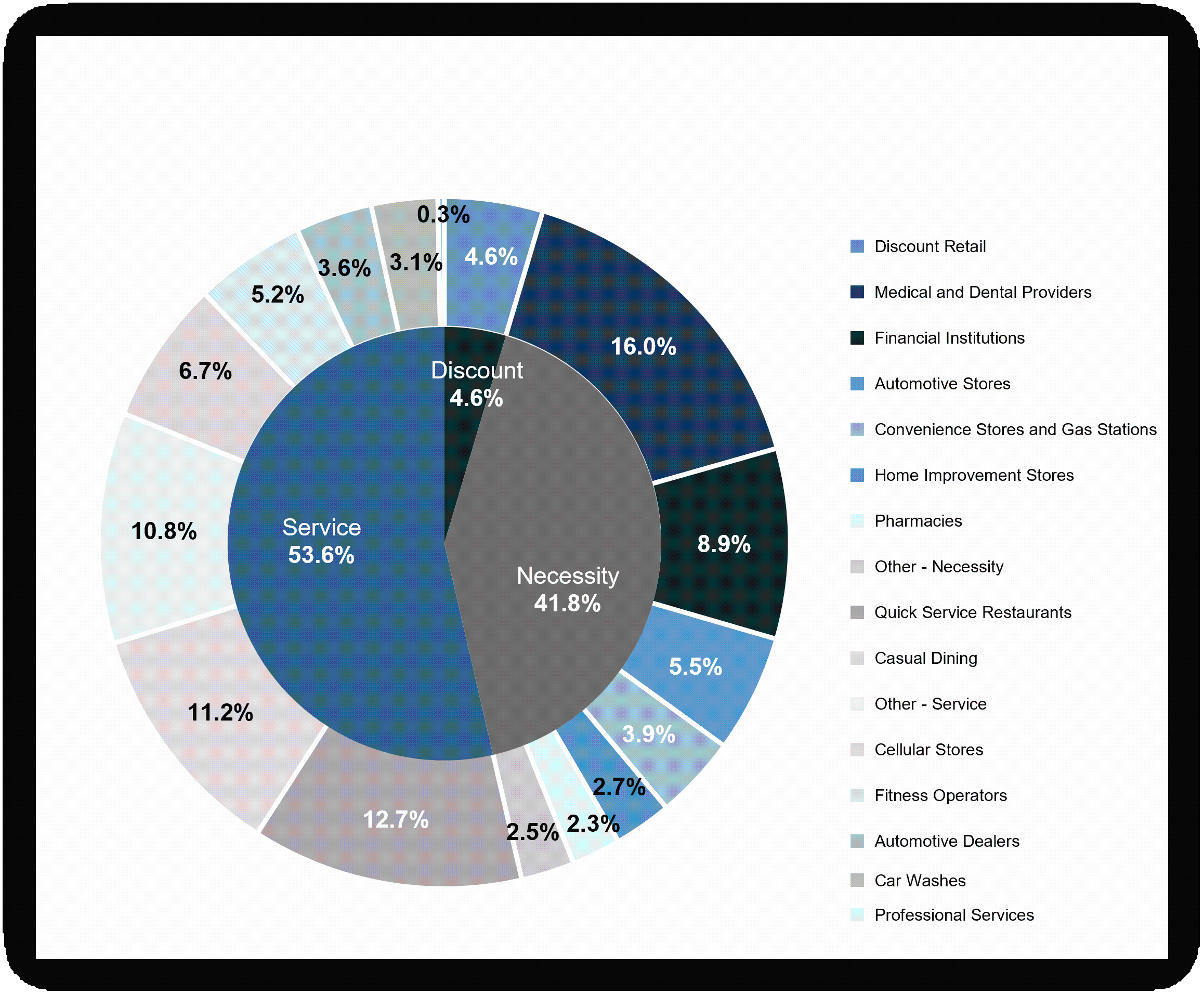


Table of Contents


Page

PART I

Item 1.

Business

3

Item 1A.

Risk Factors

14

Item 1B.

Unresolved Staff Comments

43

Item 1C.

Cybersecurity

43

Item 2.

Properties

44

Item 3.

Legal Proceedings

44

Item 4.

Mine Safety Disclosures

44

PART II

Item 5.

Market for Registrant’s Common Equity, Related Stockholder Matters and Issuer Purchases of Equity Securities

45

Item 6.

Reserved

46

Item 7.

Management’s Discussion and Analysis of Financial Condition and Results of Operations

47

Item 7A.

Quantitative and Qualitative Disclosures About Market Risk

61

Item 8.

Financial Statements and Supplementary Data

62

Item 9.

Changes in and Disagreements With Accountants on Accounting and Financial Disclosure

96

Item 9A.

Controls and Procedures

96

Item 9B.

Other Information

96

Item 9C.

Disclosure Regarding Foreign Jurisdictions that Prevent Inspections

96

PART III

Item 10.

Directors, Executive Officers and Corporate Governance

97

Item 11.

Executive Compensation

97

Item 12.

Security Ownership of Certain Beneficial Owners and Management and Related Stockholder Matters

97

Item 13.

Certain Relationships and Related Transactions, and Director Independence

97

Item 14.

Principal Accounting Fees and Services

97

PART IV

Item 15.

Exhibits and Financial Statement Schedules

98

Item 16.

Form 10-K Summary

99


Cautionary Note Regarding Forward-Looking Statements

This Annual Report on Form 10-K contains forward-looking statements, which reflect our current views regarding our business, financial performance, growth prospects and strategies, market opportunities, and market trends, that are intended to be made pursuant to the safe harbor provisions of Section 27A of the Securities Act of 1933, as amended (the “Securities Act”) and Section 21E of the Securities Exchange Act of 1934, as amended (the “Exchange Act”). Forward-looking statements include all statements that are not historical facts. In some cases, you can identify these forward-looking statements by the use of words such as “outlook,” “believes,” “expects,” “potential,” “continues,” “may,” “will,” “should,” “could,” “seeks,” “approximately,” “projects,” “predicts,” “intends,” “plans,” “estimates,” “anticipates,” or the negative version of these words or other comparable words. All of the forward-looking statements included in this Annual Report on Form 10-K are subject to various risks and uncertainties. Assumptions relating to the foregoing involve judgments with respect to, among other things, future economic, competitive and market conditions, and future business decisions, all of which are difficult or impossible to predict accurately and many of which are beyond our control. Although we believe that the expectations reflected in such forward-looking statements are based on reasonable assumptions, our actual results, performance, and achievements could differ materially from those expressed in or by the forward-looking statements and may be affected by a variety of risks and other factors. Accordingly, there are or will be important factors that could cause actual outcomes or results to differ materially from such forward-looking statements.

Important factors that could cause results to differ materially from the forward-looking statements are described in Item 1. “Business,” Item 1A. “Risk Factors,” and Item 7. “Management’s Discussion and Analysis of Financial Condition and Results of Operations” in this Annual Report on Form 10-K. The “Risk Factors” section should not be construed as exhaustive and should be read in conjunction with other cautionary statements included elsewhere in this Annual Report on Form 10-K.

You are cautioned not to place undue reliance on any forward-looking statements included in this Annual Report on Form 10-K. All forward-looking statements are made as of the date of this Annual Report on Form 10-K and the risk that actual results, performance, and achievements will differ materially from the expectations expressed in or referenced by this Annual Report on Form 10-K will increase with the passage of time. We undertake no obligation to publicly update or review any forward-looking statement, whether as a result of new information, future developments, or otherwise, except as required by law.

Regulation FD Disclosures

We use any of the following to comply with our disclosure obligations under Regulation FD: U.S. Securities and Exchange Commission (“SEC”) filings, press releases, public conference calls, or our website. We routinely post important information on our website at www.frontviewreit.com, including information that may be deemed material. We encourage our shareholders and others interested in our company to monitor these distribution channels for material disclosures. Our website address is included in this Annual Report on Form 10-K as a textual reference only and the information on the website is not incorporated by reference in this Annual Report on Form 10-K.

Explanatory Note and Certain Defined Terms

Unless the context otherwise requires, the following terms and phrases are used throughout this Annual Report on Form 10-K as described below:

“50/50 Joint Venture” means the joint venture previously held by our Predecessor and entities representing certain Canadian investors for the ownership of 54 properties;
“ABS Notes” means the $264.0 million net-lease mortgage notes, dated December 9, 2019 and among the Predecessor, 50/50 Joint Venture and the Indenture Trustee.
“Adjusted SOFR” means the referenced SOFR rate plus an adjustment of 0.10% based on market convention at the time of entering into our Revolving Credit Facility and Term Loan;
“Annualized Base Rent” or “ABR” means the annualized contractual cash rent due for the last month of the reporting period, and adjusted to remove rent from properties sold during the month and to include a full month of contractual cash rent for properties acquired during the last month of the reporting period;
“Canadian Investment Entities” means the intermediate entities through which Canadian investors will hold interests in the OP that will be issued pursuant to the REIT Contribution Transactions;
“Contribution Agreements” means (i) the Contribution Agreement, dated as of the closing date of our initial public offering, by and between certain individual investors in our Predecessor and the OP, (ii) the Contribution Agreement, dated as of closing date of our initial public offering, by and between the individual investors in one of the Subsidiary REITs and the OP, (iii) the Contribution Agreement, dated as of the closing date of our initial public offering, by and between one of the Canadian Investment Entities and the OP, and (iv) the Contribution Agreement, dated as of the closing date of our initial public offering, by and between the other Canadian Investment Entity and the OP;

1


“CPI” means the Consumer Price Index for All Urban Consumers (CPI-U): U.S. City Average, All Items, as published by the U.S. Bureau of Labor Statistics, or other similar index which is a measure of the average change over time in the prices paid by urban consumers for a market basket of consumer goods and services;
“Internalization” means the internalization of the external management team, assets and functions previously performed for our Predecessor by our external manager and its affiliates, pursuant to the terms of the Internalization Agreement, which closed contemporaneously with the closing of our initial public offering;
“Occupancy” or a specified percentage of our portfolio that is “occupied” or “leased” means as of a specified date (i) the number of properties that are subject to a signed lease divided by (ii) the total number of properties in our portfolio;
“Predecessor” means NADG NNN Property Fund LP, a Delaware limited partnership, and its subsidiaries;
“Properties” means individual building properties (small or large formats) leased to one or more tenants that are in locations with direct frontage on high-traffic roads that are visible to consumers;
“REIT Contribution Transactions” means the contributions of the interests in entities within our Predecessor's private REIT fund structure that directly or indirectly own our Predecessor's properties pursuant to the terms of the Contribution Agreements, which closed contemporaneously with the closing of our initial public offering;
“Revolving Credit Facility” means our $250.0 million unsecured revolving credit facility under the Credit Agreement that became effective concurrently with the completion of our initial public offering;
“Series A Convertible Preferred Stock” means $75.0 million of Series A Convertible Perpetual Preferred Stock that was signed on November 12, 2025 with a delayed draw feature.
“SOFR” means the Secured Overnight Financing Rate, which is the applicable reference rate for borrowings under the Company’s Revolving Credit Facility and Term Loan. SOFR durations used by the Company include daily simple SOFR and 1-month term SOFR, representing published market rates;
“Term Loan” means our $200.0 million unsecured term loan under the Credit Agreement that became effective concurrently with the completion of our initial public offering; and
“we,” “our,” “us,” “FrontView,” and “Company” mean FrontView REIT, Inc., a Maryland corporation, together with its consolidated subsidiaries, including the OP, after giving effect to the REIT Contribution Transactions and Internalization, except where it is clear from the context that the term only means FrontView REIT, Inc. before giving effect to such transactions.

2


PART I

Item 1. Business.

BUSINESS AND PROPERTIES

Our Company

FrontView is an internally-managed net-lease real estate investment trust (“REIT”) that is experienced in acquiring, owning and managing properties with frontage that are net leased to a diversified group of tenants. We have selected the name “FrontView” to reflect our unique “real estate first” investment strategy. This approach targets properties with frontage located in prominent retail areas that can attract multiple tenants and can have replaceable rents. Our target properties have direct frontage on high-traffic roads, ensuring high visibility to consumers with adaptable spaces that can typically work for various usages. We are a growing net-lease REIT and own a well-diversified portfolio of 303 properties with direct frontage across 37 U.S. states as of December 31, 2025. FrontView's tenants typically include service-oriented businesses, such as medical and dental providers, quick service restaurants, casual dining, other service providers, financial institutions, cellular stores, automotive stores, fitness operators, discount retail, convenience stores and gas stations, automotive dealers, car washes, home improvement stores, other necessity tenants, pharmacies, as well as professional services tenants.

We typically invest in net-leased properties located in larger populated markets, within active retail corridors, and in areas with direct visibility on high-traffic roads. We believe our tenants value the prominent location of our properties for their core business operations. In addition, our tenants are able to retain operational control of their strategically important locations through long-term net leases.

As of December 31, 2025, our portfolio comprised approximately 2.7 million rentable square feet of operational space and was highly diversified based on tenant, industry, and geography. As of December 31, 2025, our properties were located in 37 U.S. states, with no single state exceeding 14.9% of our ABR with 78.1% of our properties in the top 100 MSAs. Our portfolio’s occupancy rate was 98.7% as of December 31, 2025. Our properties were leased to 321 tenants that represented 155 different brands, with no single tenant brand accounting for more than 3.51% of our ABR. As of December 31, 2025, approximately 34.8% of our tenants had an investment-grade credit rating. As of December 31, 2025, approximately 97.3% of our leases (based on ABR) had contractual rent escalations, including the option terms. As of December 31, 2025, the ABR weighted average remaining term of our leases was approximately 7.4 years, excluding renewal options. As of December 31, 2025, no more than 11.1% of our rental revenue was derived from leases that expire in any single year prior to 2030. For the year ended December 31, 2025, we had total rental revenues of $66.5 million, a net loss of $5.6 million and funds from operations (“FFO”) of $26.1 million.

Our History

FrontView REIT, Inc. was formed on June 23, 2023 as a Maryland corporation and is the successor to the Predecessor, a private net lease company formed in 2016 that focused on outparcel acquisitions. FrontView Operating Partnership LP (the “OP”), is the entity through which the Company conducts its business and owns all of the Company’s properties either directly or indirectly through subsidiaries. Upon the closing of the initial public offering (“IPO”), the Company is the sole managing member of the OP. The units not owned by the Company in the OP are referred to as OP Units or non-controlling interests.

On October 2, 2024, the Company, through a series of REIT Contribution Transactions and completion of the Internalization, created an umbrella partnership real estate investment trust (“UPREIT”) structure with a publicly-traded REIT that is internally managed and owns all of its assets and conducts all of its business through the OP.

On October 3, 2024, the Company completed its IPO on the New York Stock Exchange (“NYSE”) under the symbol “FVR” and issued 13,200,000 shares of Common Stock at an initial public offering price of $19.00 per share (the “IPO Price”). As part of the IPO, the underwriters were granted an option, exercisable within 30 days from October 3, 2024, to purchase up to an additional 1,980,000 shares of Common Stock at the IPO Price, less underwriting discounts and commissions. On October 23, 2024, the underwriters partially exercised their option by purchasing an additional 1,090,846 shares of common stock. The Company received total net proceeds of $271.5 million, net of transaction costs and underwriting discounts of $24.1 million.

Our Real Estate Investment Portfolio

To achieve an appropriate risk-adjusted return, we seek to maintain a highly diversified portfolio of properties located in prominent areas with direct frontage on high-traffic roads that are visible to consumers. We aim to ensure diversity across geographic locations, tenants, and brands, and to enable cross-diversification within each category. We discuss below our portfolio diversification based on several different metrics and information provided as of December 31, 2025.

3


Diversification by Tenant Brand

We typically seek tenants that operate service-oriented businesses, such as restaurants, automotive, medical and dental providers, financial institutions, cellular stores, general retail, fitness, car wash, gas and convenience, other service, necessity, and discount concepts typically leased to national and regional brands and franchisees. As of December 31, 2025, our properties were occupied by 321 tenants that operated 155 different brands, with no single tenant brand accounting for more than 3.51% of our ABR.

The following table sets forth information with respect to each of our top tenant brands (based on ABR) as of December 31, 2025:

#


Tenant concepts


# of leases


% of ABR


Investment grade rated

1


Dollar Tree


14


3.51

 %


Yes

2


Verizon


10


2.85

 %


Yes

3


Fast Pace Urgent Care


8


2.80

 %


4


Raising Canes


6


2.39

 %


5


LA Fitness


3


2.14

 %


6


Oak Street Health


6


2.11

 %


7


Dick's


1


2.07

 %


Yes

8


IHOP


7


1.97

 %


9


Mammoth Car Wash


6


1.95

 %


10


Bank of America


5


1.90

 %


Yes

11


LA-Z-Boy


3


1.83

 %


12


Adams Auto Group


2


1.74

 %


13


AT&T


6


1.70

 %


Yes

14


T-Mobile


9


1.66

 %


Yes

15


Chili's


3


1.57

 %


16


PNC Bank


5


1.56

 %


Yes

17


CVS


3


1.44

 %


Yes

18


Range USA


2


1.40

 %


19


Wells Fargo


3


1.39

 %


Yes

20


Advance Auto Parts


7


1.36

 %


21


St. Joseph Hospice


2


1.35

 %


22


Heartland Dental


5


1.31

 %


23


Lowe's Home Improvement


1


1.19

 %


Yes

24


Charles Schwab


1


1.13

 %


Yes

25


VASA Fitness


1


1.12

 %


26


Aspen Dental


5


1.08

 %


27


Parachute Plasma


2


1.06

 %


28


WSS


2


1.03

 %


Yes

29


Wendy's


5


1.02

 %


30


Wellnow


4


1.01

 %


31


Walmart


1


1.00

 %


Yes

32


Best Buy


1


0.97

 %


Yes

33


Andy's Frozen Custard


4


0.97

 %


34


Burger King


4


0.96

 %


35


Edge Fitness


1


0.96

 %


36


Chase Bank


3


0.96

 %


Yes

37


Floor & Decor


1


0.95

 %


38


Applebee's


3


0.92

 %


39


Walgreens


2


0.91

 %


40


Stop & Shop Gas


3


0.90

 %


Yes

41


Dollar General


4


0.87

 %


Yes

42


Sleep Number


3


0.77

 %


43


Avis


1


0.76

 %


44


Chuy's Mexican


2


0.75

 %


Yes

45


Texas Roadhouse


2


0.75

 %


46


Take 5 Oil Change


5


0.73

 %


47


Exxon


2


0.73

 %


48


Chipotle


4


0.72

 %


4


49


Auto Saavy


1


0.71

 %


50


Physicians Immediate Care


2


0.67

 %


51


Harbor Freight


2


0.64

 %


52


O'Reilly Auto Parts


4


0.63

 %


Yes

53


AutoZone


3


0.63

 %


Yes

54


WellMed


1


0.62

 %


Yes

55


Planet Fitness


1


0.61

 %


56


McAlister's Deli


3


0.61

 %


57


7 Brew


3


0.58

 %


58


Starbucks


4


0.57

 %


Yes

59


Circle K


2


0.55

 %


Yes

60


Fulton Bank


1


0.53

 %


Yes

61


Longhorn Steakhouse


2


0.52

 %


Yes

62


FitzMark


1


0.52

 %


63


Trinity Medical Center


1


0.51

 %


64


Panera Bread


2


0.51

 %


Yes

65


Miller's Ale House


1


0.50

 %


66


Ted's Café Escondido


1


0.49

 %


67


Taco Bell


2


0.47

 %


68


Xfinity


2


0.47

 %


Yes

69


Grifols


1


0.47

 %


70


Hooters


2


0.46

 %


71


Buffalo Wild Wings


1


0.46

 %


72


Saltgrass Steakhouse


1


0.46

 %


73


Sonic


3


0.46

 %


74


Jared


2


0.45

 %


Yes

75


Byrider


1


0.42

 %


76


Mattress Firm


2


0.42

 %


77


Staples


1


0.41

 %


78


Arby's


2


0.40

 %


79


7-Eleven


2


0.40

 %


Yes

80


Quick Clean Carwash


1


0.40

 %


81


Caliber Collision


1


0.40

 %


82


Caliber Car Wash


1


0.40

 %


83


Delta Community Credit Union


1


0.39

 %


84


Diamonds Direct


1


0.39

 %


Yes

85


Southern Immediate Urgent Care


1


0.38

 %


86


BP


1


0.38

 %


87


Rise


1


0.37

 %


88


Big Blue Swim School


1


0.36

 %


89


Meineke


2


0.36

 %


90


Chuck E Cheese


1


0.35

 %


91


Pizza Hut


2


0.35

 %


92


UTMB Health


1


0.35

 %


Yes

93


Skechers


1


0.34

 %


94


Friendly's


1


0.34

 %


95


Smokey Bones


1


0.34

 %


96


Slim Chickens


1


0.33

 %


97


Sherwin Williams


2


0.32

 %


Yes

98


Hook & Reel


1


0.31

 %


99


Olive Garden


1


0.30

 %


Yes

100


Mavis Discount Tire


1


0.30

 %


101


Hops N Drops


1


0.30

 %


102


Trophy Fuel & Wash


1


0.29

 %


103


City Barbeque


1


0.29

 %


104


Citizens Bank


1


0.29

 %


Yes

5


105


AMERA Gas Station


1


0.29

 %


106


Roots Oil


1


0.28

 %


107


H&R Block


1


0.28

 %


Yes

108


Action Behavior Centers


1


0.27

 %


109


National Tire & Battery


1


0.27

 %


110


pOpshelf


1


0.26

 %


Yes

111


Stanton Optical


1


0.26

 %


112


HTeaO


2


0.25

 %


113


My Eyelab


1


0.25

 %


114


Express Oil


1


0.25

 %


115


Wing Daddy’s


1


0.24

 %


116


American Family Care


1


0.24

 %


117


Consumers Credit Union


1


0.24

 %


118


Jiffy Lube


1


0.23

 %


119


Strickland Brothers


1


0.22

 %


120


Take 5 Car Wash


1


0.22

 %


121


Banner Health


1


0.22

 %


Yes

122


Twin Peaks


1


0.22

 %


123


Aaron's


1


0.22

 %


124


BMO


1


0.22

 %


Yes

125


MedExpress Urgent Care


1


0.21

 %


Yes

126


Republic Bank


1


0.21

 %


127


Sage Dental


1


0.20

 %


128


McDonalds


1


0.19

 %


Yes

129


Long John Silvers


1


0.19

 %


130


Panda Express


1


0.18

 %


131


Urgent Team


1


0.18

 %


132


America's Best


1


0.18

 %


133


Chicken Salad Chick


1


0.18

 %


134


MOD Pizza


1


0.17

 %


135


Elias Diamonds


1


0.16

 %


136


Zip Car Wash


1


0.15

 %


137


Go Health


1


0.15

 %


138


Popeyes


1


0.15

 %


139


Bojangles


1


0.14

 %


140


Granny's


1


0.14

 %


141


Valero


1


0.13

 %


142


Nothing Bundt Cakes


1


0.13

 %


143


Jimmy John's


1


0.12

 %


144


Tumbleweed, Inc.


1


0.11

 %


145


Dunkin Donuts


1


0.11

 %


146


Church's Chicken


1


0.11

 %


147


Falafel King


1


0.11

 %


148


Tropical Smoothie


1


0.10

 %


149


Firehouse Subs


1


0.09

 %


150


Valvoline


1


0.09

 %


151


Auto Glass Now


1


0.06

 %


152


Miracle Ear


1


0.06

 %


153


Marquette Bank


1


0.05

 %


154


Regions Banks ATM


1


0.02

 %


Yes

155


By Gollys


2


0.00

 %


Total Portfolio


321


100.0

 %


6


Diversification by Tenant Industry

The following chart shows a breakdown of our ABR by the tenant industries that comprised our portfolio as of December 31, 2025:

Industry Pie Chart


img33915134_0.gif

7


Diversification by Geography

As of December 31, 2025, our properties were located in 37 U.S. states, with no single state exceeding 14.9% of our ABR. The following table sets forth information with respect to geographic diversification by state in our portfolio (based on ABR) as of December 31, 2025:


(in thousands, except for # of properties and percentages)


State


# of properties


Square feet


% of ABR


IL


37


379


14.9

%

TX


24


151


8.3

%

GA


22


157


7.3

%

NC


15


193


6.0

%

FL


14


135


4.9

%

OH


21


125


4.8

%

VA


15


90


4.6

%

IN


15


79


4.2

%

TN


12


95


4.2

%

PA


8


145


4.0

%

NY


8


242


3.4

%

SC


10


87


2.8

%

MO


9


55


2.7

%

OK


10


50


2.5

%

AL


9


40


2.4

%

MN


7


72


2.3

%

MD


6


43


2.3

%

MI


8


49


2.2

%

AZ


6


40


2.2

%

LA


4


47


1.9

%

KS


6


37


1.8

%

NJ


8


43


1.8

%

ME


3


186


1.7

%

KY


8


40


1.6

%

CT


2


5


0.7

%

MS


2


13


0.7

%

CO


2


10


0.5

%

UT


2


22


0.5

%

NE


2


20


0.5

%

NV


1


4


0.4

%

AR


1


3


0.4

%

WI


1


10


0.3

%

ID


1


6


0.3

%

RI


1


1


0.3

%

SD


1


10


0.2

%

MA


1


2


0.2

%

WV


1


1


0.2

%

Total


303


2,687


100.0

%

Property Acquisitions

Our acquisitions team presents potential transactions to the Real Estate Investment Committee for approval. Subsequent to December 31, 2024, the board of directors approved revisions to the thresholds that the Real Estate Investment Committee is required to approve. The Real Estate Investment Committee is now responsible for approving (i) the acquisition or disposition of any single property greater than $5.0 million, (ii) the acquisition of properties in the aggregate amount up to $150.0 million in any one calendar quarter, and (iii) the disposition of properties in an aggregate amount up to $30.0 million in any one calendar quarter, in each case, prior to consulting with our board of directors. Further, the Real Estate Investment Committee is responsible for recommending that the full board of directors approve, (i) individual property acquisitions or dispositions that exceed $25.0 million in value, (ii) the acquisition of

8


properties that exceed an aggregate amount of $150.0 million in any one calendar quarter and (iii) disposition of properties that exceed an aggregate amount of $30.0 million in any one calendar quarter.

Our Leases

Lease Maturity

Our portfolio was 98.7% leased as of December 31, 2025. Our cash flows from operations are primarily generated through our real estate investment portfolio and the monthly lease payments received under our leases with our tenants. As of December 31, 2025, the ABR weighted average remaining term of our leases was approximately 7.4 years, excluding renewal options. As of December 31, 2025, no more than 11.1% of our rental revenue was derived from leases that expire in any single year prior to 2030.

Substantially all of our leases are net, meaning our tenants are generally obligated to pay customary operating expenses associated with the leased property (such as real estate taxes, insurance, maintenance, certain repairs and capital costs).

The following table presents certain information as of December 31, 2025 based on lease expirations by year.


(in thousands, except for percentages, rent per square foot, and # of leases)


Year


ABR


% of ABR


Square feet


Rent per square foot


# of Leases


2026


$

2,131


3.4

%


70


$

30.44


14


2027


$

6,963


11.1

%


385


$

18.09


34


2028


$

3,764


6.0

%


135


$

27.88


26


2029


$

5,681


9.0

%


187


$

30.38


30


2030


$

6,103


9.7

%


186


$

32.81


31


2031


$

5,489


8.7

%


182


$

30.16


33


2032


$

5,007


8.0

%


394


$

12.71


22


2033


$

3,406


5.4

%


91


$

37.43


20


2034


$

3,947


6.3

%


175


$

22.55


20


Thereafter


$

20,361


32.4

%


831


$

24.50


89


New Leases (1)


$


%


11


$


2


Total


$

62,852


100.0

%


2,647


$

23.74


321


(1)
Represents new leases where rent has not commenced.


We typically purchase properties that are subject to existing long-term net leases with a variety of remaining lease years (initial terms of 10 years or more at lease signing that often have renewal options as well). Substantially all of our leases are net leases, meaning our tenant generally is obligated to pay customary operating expenses associated with the leased property (such as real estate taxes, insurance, maintenance, and in many cases, certain repairs and capital costs, subject to caps and exclusions in leases). For the year ended December 31, 2025, we incurred an aggregate of approximately $1.8 million of expenses not reimbursed or paid for by our tenants.

Approximately 97.3% of our leases (based on ABR) have rent escalations, including the options terms, and generally ranging from 1.0% to 3.0% annually.


In general, when negotiating a new lease or an amendment to an existing lease in connection with an acquisition, redevelopment or new development, we seek to negotiate, among other things, relatively long lease terms and tenant renewal options; market rents; annual rent escalation provisions; landlord-favorable going dark, assignment, change of control provisions; limited or no exclusive or co-tenancy clauses that favor the tenant, and obligations for certain tenants and certain guarantors to periodically provide us with financial information.

We may seek to use master lease structures where it fits market practice in the particular property type, pursuant to which we seek to lease multiple properties to an individual tenant on an all or none basis. In a master lease structure, a tenant is responsible for a single lease payment relating to the entire portfolio of leased properties, as opposed to multiple lease payments relating to individually leased properties. The master lease structure prevents a tenant from “cherry picking” locations, where it unilaterally gives up underperforming properties while maintaining its leasehold interest in well-performing properties.


9


Competition

The market for properties with frontage and other properties in the U.S. is highly competitive. We compete for tenants to occupy our properties in all of our markets with other owners and operators of commercial real estate, as well as owner-occupied businesses. We compete based on a number of factors that include but are not limited to location, market and trade area, demographics, rental rates, security, tenant type and credit, suitability of the property’s design and configuration to prospective tenants’ needs, land size, building size, and the manner in which the property is operated and marketed. The number of competing properties in a particular market could have a material effect on our occupancy levels, rental rates, and the operating expenses of certain of our properties.

In addition, we compete for acquisition opportunities with a diverse group of other entities engaged in real estate investment activities to locate suitable properties to acquire and purchasers to buy our properties. These competitors include other REITs, private and institutional real estate investors, sovereign wealth funds, banks, mortgage bankers, insurance companies, investment banking firms, lenders, specialty finance companies, individuals, brokers, developers, tenants, family offices, and other entities. Competition from third-party real estate investors and other REITs may limit the number of suitable investment opportunities available to us. It also may result in higher prices, lower yields, and a narrower spread of yields over our borrowing costs, making it more difficult for us to acquire new investments on attractive terms.

Human Capital

As of December 31, 2025, we employed 22 full-time employees comprised of professional employees engaged in origination, underwriting, closing, accounting and financial reporting, portfolio and asset management, capital markets, and other corporate activities essential to our business. In addition, we have an outsourcing agreement with North American Asset Management Corp. (“NAAM”), an affiliate of our Predecessor. NAAM provides us with services limited to (i) property accounting and (ii) human resources support.

Our commitment to our employees is central to our ability to continue to deliver strong performance and financial results for our stockholders and other stakeholders. We are as passionate about our people as we are about real estate. We seek to create and cultivate an engaging work environment for our employees, which allows us to attract, retain, and develop top talent to manage our business. To do that, we believe it is essential that we develop and maintain a culture that lives up to our values of performance excellence, integrity, respect, leadership, humility, and transparency. We are committed to providing our employees with an environment that is free from discrimination and harassment, that respects and honors their differences and unique life experiences, and that enables every employee the opportunity to develop and excel in their role and reach their full potential. We believe that we have created a collaborative, creative workplace where people with unique talents can flourish, where their opinions are valued, and where their contributions are rewarded.

We have focused on building a diverse team and will continue with this methodology as our team expands. Our work environment reflects a high regard for employees’ health and safety, both physically and emotionally. In addition, we hold the highest standards to ensure we use accurate and transparent accounting methods, pursues integrity and diversity and are accountable to our stockholders, partners, investors and lenders.

As part of our commitment to our employees, we are focused on the following:

Career Development. We strive to create an engaging work experience that allows for career development and related opportunities. We offer numerous opportunities for our employees to engage in personal and professional development, including participating in industry conferences and networking events, individual leadership and management training, lunch and learn meetings with our senior management team, training events (e.g., underwriting, real estate fundamentals, cybersecurity, ethics, harassment, computer skills), and other opportunities. We work hard to find new talent early in their career, provide extensive training on procedures and systems unique to us with a goal to promote from within. Senior management annual performance reviews strive to create pay equity amongst equal level employees regardless of age or background.
Employee Wellness. We believe our employees are our most valuable asset and their individual and group contributions will drive our performance and success. As a result, we are focused on and invest in our team’s overall health, wellness, and engagement. We expect to employ certain strategies and initiatives to support our employees’ well-being, including, among other things, competitive employee health and other benefits, transparent communications between senior executives and employees, opportunities to participate in social events, including family-friendly corporate events, fitness classes, flexible work schedules, and access to other health resources.
Community Engagement. Giving back to our communities is important to us and our employees. We encourage volunteer opportunities and fundraising initiatives throughout the year that provide our employees with civic involvement. Our community engagement efforts are led by our employees and can include various volunteer opportunities, civic involvement with non-profit organizations, and corporate donations.

10


Principal Executive Offices

Our principal executive offices are located at 3131 McKinney Avenue, Suite L10, Dallas, TX 75204 and our telephone number is (214) 796-2445. We believe that our offices are adequate for our present and currently planned future operations and that adequate additional space will be available if needed in the future.

Insurance

Our tenants are generally required to maintain liability and property insurance coverage for the properties they lease from us pursuant to our leases. These leases generally require our tenants to name us (and any of our lenders that have a mortgage on the property leased by the tenant) as additional insureds on their liability policies and additional named insureds and/or loss payees (or mortgagee, in the case of our lenders) on their property policies. Depending on the location of the property, losses of a catastrophic nature, such as those caused by casualty, earthquakes and floods, may be covered by insurance policies that are held by our tenant with limitations such as large deductibles or co-payments that a tenant may not be able to meet. In addition, losses of a catastrophic nature, such as those caused by wind/hail, rain, hurricanes, earthquakes, vandalism, terrorism or acts of war, may be uninsurable or not economically insurable. In the event there is damage to our properties that is not covered by insurance and such properties are subject to recourse indebtedness, we will continue to be liable for the indebtedness, even if these properties are irreparably damaged.

In addition to being a named insured on our tenants’ liability policies, we separately maintain commercial general liability coverage and, in certain instances, general or specific (e.g., flood) property-level insurance coverage on certain properties or pursuant to the terms of certain of our leases. We also maintain property coverage on all untenanted properties and other property coverage as may be required by our lenders, which are not required to be carried by our tenants under our leases.

Regulation

General

Our investments are subject to various laws, ordinances, and regulations, including, among other things, fire and safety requirements, zoning regulations, land use controls, and environmental controls relating to air and water quality, noise pollution, and indirect environmental impacts. We believe that we have the permits and approvals necessary under current law to operate our investments.

Americans with Disabilities Act

Under Title III of the ADA, and rules promulgated thereunder, in order to protect individuals with disabilities, public accommodations must remove architectural and communication barriers that are structural in nature from existing places of public accommodation to the extent “readily achievable.” In addition, under the ADA, alterations to a place of public accommodation or a commercial facility are to be made so that, to the maximum extent feasible, such altered portions are readily accessible to and usable by disabled individuals. The “readily achievable” standard takes into account, among other factors, the financial resources of the affected site and the owner, lessor or other applicable person.

Compliance with the ADA, as well as other federal, state, and local laws, may require modifications to properties we currently own or may purchase, or may restrict renovations of those properties. A significant portion of our leases provide that the landlord is responsible for any modifications required to cause the properties to comply with the ADA, and the costs of compliance with the ADA are typically excluded from common area expenses that can be passed through to the tenants. If changes are required to cause those properties to comply with the ADA, we would be required to expend our own funds to comply therewith without reimbursement by tenants, which could materially and adversely affect us. If changes are required at properties where the tenants are responsible for compliance with the ADA, but those changes involve greater expenditures than anticipated or if the changes must be made on a more accelerated basis than anticipated, the ability of our tenants to cover costs could be adversely affected and we could be required to expense our own funds to cause the properties to comply with the ADA, which could materially and adversely affect us. Failure to comply with these laws or regulations could result in the imposition of fines or an award of damages to private litigants, as well as the incurrence of the costs of making modifications to attain compliance, and future legislation could impose additional obligations or restrictions on our properties. Although our tenants are generally responsible for all maintenance and repairs of the property pursuant to our lease, including compliance with the ADA and other similar laws or regulations, we could be held liable as the owner of the property for a failure of one of our tenants to comply with these laws or regulations.

11


Tax Regulation

We elected to be taxed as a REIT under the Internal Revenue Code of 1986, (as amended, the “Code”) beginning with our short taxable year ending December 31, 2024. We believe that as of such date we have been organized and have operated in a manner to qualify for taxation as a REIT for U.S. federal income tax purposes. We intend to continue to be organized and operate in such a manner. In order to qualify as a REIT, we are required under the Code, among other things, to distribute annually at least 90% of our REIT taxable income, determined without regard to the dividends paid deduction and excluding any net capital gain. In addition, we will be subject to income tax at the corporate rate on undistributed taxable income to the extent that we distribute less than 100% of our REIT taxable income, determined without regard to the dividends paid deduction and including any net capital gain. As a result of our distribution requirements, we rely, in part, on third-party sources to fund our capital needs. Additionally, if we were to lose REIT status we would face significant tax consequences that would substantially reduce our cash available for distribution to our stockholders.

Environmental Matters

Federal, state, and local environmental laws and regulations regulate, and impose liability for, releases of hazardous or toxic substances into the environment. Under various of these laws and regulations, a current or previous owner, operator or tenant of real estate may be required to investigate and clean up or otherwise address hazardous or toxic substances, hazardous wastes or petroleum product releases or threats of releases at the property, and may be held liable to a government entity or to third parties for property damage and for investigation, clean-up, and monitoring costs incurred by those parties in connection with the actual or threatened contamination. These laws may impose clean-up responsibility and liability without regard to fault, or whether or not the owner, operator, or tenant knew of or caused the presence of the contamination. The liability under these laws may be joint and several for the full amount of the investigation, clean-up, and monitoring costs incurred or to be incurred or actions to be undertaken, although a party held jointly and severally liable may seek to obtain contributions from other identified, solvent, responsible parties of their fair share toward these costs. These costs may be substantial and can exceed the value of the property. In addition, some environmental laws may create a lien on the contaminated site in favor of the government for damages and costs it incurs in connection with the contamination. As the owner of real estate, we also may be liable under common law to third parties for damages and injuries resulting from environmental contamination emanating from the real estate. The presence of contamination, or the failure to properly remediate contamination, on a property may adversely affect the ability of the owner, operator or tenant to sell or rent that property or to borrow using the property as collateral and may adversely impact our investment in that property.

Some of our properties contain, have contained, or are adjacent to or near other properties that have contained or currently contain storage tanks for the storage of petroleum products or other hazardous or toxic substances, such as perchloroethylene or other chemicals used in dry cleaning facilities. Similarly, some of our properties currently are or were used in the past for commercial or industrial purposes that involve or involved the use of petroleum products or other hazardous or toxic substances, or are adjacent to or near properties that have been or are used for similar commercial or industrial purposes. These operations create a potential for the release of petroleum products or other hazardous or toxic substances, and we could potentially be required to pay to clean up any contamination whether occurring on-site or on off-site if such substances have migrated from our properties. Further, we note that these past and current uses may prevent the use of the affected properties for certain uses in the future. In addition, environmental laws regulate a variety of activities that can occur on a property, including the storage of petroleum products or other hazardous or toxic substances, air emissions, water discharges, and exposure to lead-based paint. Such laws may impose fines or penalties for violations and may require permits or other governmental approvals to be obtained for the operation of a business involving such activities. Any of the foregoing matters could have a material adverse effect on us.

Environmental laws also govern the presence, maintenance, and removal of ACM. Federal regulations require building owners and those exercising control over a building’s management to identify and warn, through signs and labels, of potential hazards posed by workplace exposure to installed ACM in their building. The regulations also have employee training, record keeping, and due diligence requirements pertaining to ACM. Significant fines can be assessed for violation of these regulations. As a result of these regulations, building owners and those exercising control over a building’s management may be subject to an increased risk of personal injury lawsuits by workers and others exposed to ACM. The regulations may affect the value of a building containing ACM in which we have invested. Federal, state, and local laws and regulations also govern the removal, encapsulation, disturbance, handling, and/or disposal of ACM when those materials are in poor condition or in the event of construction, remodeling, renovation, or demolition of a building. These laws may impose liability for improper handling or a release into the environment of ACM and may provide for fines to, and for third parties to seek recovery from, owners or operators of real properties for personal injury or improper work exposure associated with ACM.

12


When excessive moisture accumulates in buildings or on building materials, mold growth may occur, particularly if the moisture problem remains undiscovered or is not addressed over a period of time. Some molds may produce airborne toxins or irritants. Indoor air quality issues can also stem from inadequate ventilation, chemical contamination from indoor or outdoor sources, and other biological contaminants such as pollen, viruses, and bacteria. Indoor exposure to airborne toxins or irritants above certain levels can be alleged to cause a variety of adverse health effects and symptoms, including allergic or other reactions. As a result, the presence of significant mold or other airborne contaminants at any of our properties could require us to undertake a costly remediation program to contain or remove the mold or other airborne contaminants from the affected property or increase indoor ventilation. In addition, the presence of significant mold or other airborne contaminants could expose us to liability from our tenants, employees of our tenants, or others if property damage or personal injury occurs.

Before completing any property acquisition, we typically obtain environmental assessments in order to identify potential environmental concerns at the property. These assessments are carried out in accordance with the Standard Practice for Environmental Site Assessments (ASTM Practice E 1527-21) as set by ASTM International, formerly known as the American Society for Testing and Materials, and generally include a physical site inspection, a review of relevant federal, state, and local environmental and health agency database records, one or more interviews with appropriate site-related personnel, review of the property’s chain of title, and review of historical aerial photographs and other information on past uses of the property. These assessments are limited in scope. However, if recommended in the initial Phase I environmental site assessments, we may undertake additional assessments, such as soil and/or groundwater sampling or other limited subsurface investigations and ACM or mold surveys, to test for substances of concern. A prior owner or operator of a property or historical operations at or near our properties may have created a material environmental condition that is not known to us or the independent consultants preparing the site assessments. Material environmental conditions may have arisen after the review was completed or may arise in the future, and future laws, ordinances, or regulations may impose material additional environmental liability. We have obtained environmental insurance policies to insure against potential environmental risk or loss on certain properties in our initial portfolio, subject to each policy’s coverage conditions and limitations. Under certain circumstances we may obtain environmental insurance policies to insure against potential environmental risk or loss on additional properties, depending on the type of property, the availability and cost of the insurance, and various other factors we deem relevant. Our ultimate liability for environmental conditions may exceed the policy limits on any environmental insurance policies we obtain.

Generally, our leases require the lessee to comply with environmental law and provide that the lessee will indemnify us for any loss or expense we incur as a result of lessee’s violation of environmental law or the presence, use or release of hazardous materials on our property attributable to the lessee. If our lessees do not comply with environmental law, or we are unable to enforce the indemnification obligations of our lessees, our results of operations would be adversely affected. Our leases generally require the landlord or a third-party to undertake remediation for the presence, use or release of hazardous materials on our property by the landlord or by any party other than the lessee, provided that the lessee was not responsible for the contamination of the property. Of that subset of leases, most do not permit the landlord to pass the costs of remediation through to the tenant(s), and some permit the applicable to terminate the lease if remediation is not completed within a certain timeframe or if the tenant’s use of its premises is interrupted for a certain period of time. If we are required to undertake remediation or if a tenant is permitted to terminate its lease, we could be materially and adversely affected.

We cannot predict what other environmental legislation or regulations will be enacted in the future, how existing or future laws or regulations will be administered or interpreted, or what environmental conditions may be found to exist on the properties in the future. Compliance with existing and new laws and regulations may require us or our tenants to spend funds to remedy environmental problems. If we or our tenants were to become subject to significant environmental liabilities, we could be materially and adversely affected.

Implications of Being an Emerging Growth Company

We are an emerging growth company, as defined in the JOBS Act, and as such we are eligible to take advantage of certain exemptions from various reporting requirements that are applicable to other public companies that are not emerging growth companies, including, but not limited to, not being required to comply with the auditor attestation requirements of Section 404 of the Sarbanes-Oxley Act, reduced disclosure obligations regarding executive compensation in our periodic reports and proxy statements, and exemptions from the requirements of holding a nonbinding advisory vote on executive compensation and stockholder approval of any golden parachute payments not previously approved. The JOBS Act permits an emerging growth company such as us to take advantage of an extended transition period to comply with new or revised accounting standards applicable to public companies. We have elected to take advantage of this extended transition period. As a result of this election, our financial statements may not be comparable to companies that comply with public company effective dates for such new or revised standards. We may elect to comply with public company effective dates at any time, and such election would be irrevocable pursuant to Section 107(b) of the JOBS Act.

13


We expect to remain an “emerging growth company” until the earliest to occur of (i) the last day of the fiscal year during which we have total annual gross revenue of $1.235 billion or more (subject to adjustment for inflation), (ii) the last day of the fiscal year following the fifth anniversary of the first sale of our Common Stock pursuant to an effective registration statement, (iii) the date on which we have, during the previous three-year period, issued more than $1.0 billion in non-convertible debt, or (iv) the date on which we are deemed to be a “large accelerated filer.”

Company Information

Our filings with the SEC, including our annual reports on Form 10-K, quarterly reports on Form 10-Q, current reports on Form 8-K, and amendments to those reports, filed or furnished pursuant to Section 13(a) or 15(d) of the Exchange Act, as well as our proxy statements, are accessible free of charge at https://investor.frontviewreit.com as soon as reasonably practicable after we electronically file such material with, or furnish it to, the SEC. You may access materials we file with the SEC through the EDGAR database at the SEC’s website at http://www.sec.gov.

We have adopted our Code of Ethics and Business Conduct Policy to ensure that our business is conducted in accordance with the highest moral, legal, and ethical standards by our officers, directors, and employees. The Code of Ethics and Business Conduct Policy is available on our website at https://investor.frontviewreit.com, together with the charters of the Board of Director’s, Audit Committee, Compensation Committee, and Nominating and Corporate Governance Committee, as well as other corporate governance policies and documents. Amendments to, and waivers granted to our directors and executive officers under our Code of Ethics and Business Conduct Policy, if any, will be posted in this area of our website. Copies of these materials are available in print to any stockholder who requests them. Stockholders should direct such requests in writing to Investor Relations Department, FrontView REIT, Inc., 3131 McKinney Avenue, Suite L10, Dallas, TX 75204. Investors may also call (214) 796-2445.

Item 1A. Risk Factors.

The following are some of the risks and uncertainties that could cause our actual results to differ materially from those presented in our forward-looking statements. You should consider carefully the risks described below and the other information in this Annual Report on Form 10-K, including our consolidated financial statements and the related notes. The risks and uncertainties described below are not the only ones we face but do represent those risks and uncertainties that we believe are material to us. Additional risks and uncertainties not presently known to us or that we currently deem immaterial may also harm our business.

Summary Risk Factors

Properties involve significant risks of tenant defaults and tenant vacancies, which could materially and adversely affect us.
We have limited opportunities to increase rents under our long-term leases with tenants, which could impede our growth and materially and adversely affect us.
Our financial results have and may continue to fluctuate in the future, which makes predicting our revenues, costs and expenses difficult, and any volatility in our future financial results could materially and adversely affect us.
We may not be able to achieve growth through acquisitions at a rate that is comparable to our historical results, which could materially and adversely affect us.
We may not be able to effectively manage our growth and any failure to do so could materially and adversely affect us.
As we continue to acquire properties pursuant to our growth strategy, our portfolio may become less diversified which could materially and adversely affect us.
The departure of any of our key personnel with long-standing business relationships could materially and adversely affect us.
Our portfolio is concentrated in certain states and MSAs and any adverse developments and/or economic downturns in these geographic markets could materially and adversely affect us.
Our portfolio of properties is also concentrated in certain tenant brands and industries, and any adverse developments relating to one or more of these brands or industries could materially and adversely affect us.
Our portfolio of properties is concentrated among tenants with non-investment grade credit ratings, and any adverse developments affecting the credit of these tenants could materially and adversely affect us.
The decrease in demand for restaurant properties may materially and adversely affect us.
We may be unable to renew leases, re-lease properties as leases expire, or lease vacant spaces on favorable terms or at all, which, in each case, could materially and adversely affect us.

14


Our business is subject to significant re-leasing risk, particularly for specialty properties that are suitable for only one use, which could materially and adversely affect us.
We could face issues related to condemnation, government taking, environmental contamination or damage and or destruction of our properties for a number of different reasons.
We may experience tenant defaults, particularly from tenants that do not have an investment grade credit rating, which could materially and adversely affect us.
Our business may be adversely affected by changes in U.S. trade policy, including the imposition of tariffs and resulting effects.
Security breaches and other technology disruptions could disrupt our operations, compromise our confidential information or information systems and expose us to liability, which could materially and adversely affect us.
The use of artificial intelligence, including the potential risk of use of AI by cybercriminals, presents risks and challenges that may adversely impact our business and operative results or that of our tenants.
Increases in interest rates may decrease the value of our properties, which could materially and adversely affect us.
Inflation may materially and adversely affect us and our tenants, which could materially and adversely affect us.
As of December 31, 2025, we had approximately $314.3 million principal balance of indebtedness outstanding (net of fees), which may expose us to the risk of default under our debt obligations.
We have made mortgage loans to certain buyers of our properties and any default under such loans could materially and adversely affect our results of operations and financial condition.
Market conditions could adversely affect our ability to refinance existing indebtedness on acceptable terms or at all, which could materially and adversely affect us.
An increase in market interest rates could increase our interest costs on existing and future debt and could adversely affect our stock price, and a decrease in market interest rates could lead to additional competition for the acquisition of real estate, any of which could materially and adversely affect us.
Our Revolving Credit Facility and Delayed Draw Term Loan contain various covenants which, if not complied with, could accelerate our repayment obligations, thereby materially and adversely affecting us.
We are a holding company with no direct operations and rely on funds received from the OP to pay liabilities.
Failure to qualify as a REIT would materially and adversely affect us and the value of our Common Stock.
The market price and trading volume of shares of our Common Stock may be volatile.
We may not be able to make distributions to our stockholders at the times or in the amounts we expect, or at all.
Increases in market interest rates may result in a decrease in the value of shares of our Common Stock.
The rights of the holders of our Common Stock are limited by and subordinate to the rights of the holders of the Series A Preferred Stock and these rights may have a material adverse effect on the per-share trading price of our Common Stock.
We have issued and may continue to issue Series A Preferred Stock that rank senior to our Common Stock in priority of dividend payment and upon liquidation, dissolution or winding up of or the Company and redemption rights upon the occurrence of certain events, and we cannot be certain that additional financing will be available on reasonable terms when needed, or at all, which could seriously harm our business.

Risks Related to Our Business and Properties

Properties involve significant risks of tenant defaults and tenant vacancies, which could materially and adversely affect us.

Our portfolio consists of properties that are leased to one or more tenants, most of which are in a single building. As a result, our success depends on our tenants for substantially all of our revenue. The ability of our tenants to meet their obligations to us, including their obligations to pay rent, maintain certain insurance coverage, pay real estate taxes, and maintain the properties in a manner so as not to jeopardize their operating licenses or regulatory status depends on the performance of their business and industry, as well as general market and economic conditions, which are outside of our control. At any given time, any tenant may experience a downturn in its business that may weaken its operating results or the overall financial condition of individual properties or its business as a whole. As a result, a tenant may fail to make rental payments when due, decline to extend a lease upon its expiration, become insolvent, or

15


declare bankruptcy. The financial failure of, or default in payment by, an individual tenant under its lease is likely to cause a significant or complete reduction in our rental revenue from that property, increased expenses incurred by that property, and a reduction in the value of the property. We may also experience difficulty or a significant delay in re-leasing or selling such property. The occurrence of one or more tenant defaults could materially and adversely affect us.

We have limited opportunities to increase rents under our long-term leases with tenants, which could impede our growth and materially and adversely affect us.

We typically purchase properties that are subject to existing long-term net leases with a variety of remaining lease years (initial lease terms of 10 years or more that often have renewal options as well). As of December 31, 2025, the ABR weighted average remaining term of our leases was approximately 7.4 years, excluding renewal options. As of December 31, 2025, approximately 97.3% of our leases (based on ABR) had contractual rent escalations, including the options terms, with an ABR weighted average minimum increase of approximately 1.7%, as follows: (i) approximately 96.3% of our leases (based on ABR) contained fixed annual rent increases or periodic escalations over the term of the lease (e.g., a 10% increase every five years), (ii) approximately 1.0% of our leases (based on ABR) contained annual lease escalations based on increases in the CPI, and (iii) the remaining approximately 2.7% of our leases (based on ABR) did not contain rent escalation provisions. However, these built-in increases may be less than what we otherwise could achieve in the market. Most of our leases contain rent escalators that increase rent at a fixed amount on fixed dates, which may be less than prevailing market rates over the lease duration. For those leases that contain rent escalators based on CPI changes, our rent increases during periods of low inflation or deflation may be less than what we otherwise could achieve in the market. As a result, the long-term nature of our leases could impede our growth and materially and adversely affect us.

The weighted average remaining term of our leases is 7.4 years, excluding renewal options, which will require us to undertake more re-leasing efforts that could materially and adversely affect us.

The weighted average remaining term of our leases is 7.4 years, excluding renewal options, which is shorter than some other publicly-traded net-lease REITs. Because any of our tenants may not renew their lease, we anticipate our rental revenues may be affected by declines in market rental rates more quickly than if our leases were for longer terms. Additionally, short-term leases may result in the turnover of our tenants sooner than our competitors. Consequently, we may need to undertake re-leasing efforts sooner and at shorter intervals than our competitors. The associated costs with these re-leasing efforts, which may, among other things, include repositioning costs, repair costs and re-tenanting costs, and the time our management team spends on the foregoing, may materially and adversely affect us.

Our financial results have and may continue to fluctuate in the future, which makes predicting our revenues, costs and expenses difficult, and any volatility in our future financial results could materially and adversely affect us.

Our quarterly and annual operating results have and may continue to fluctuate for a variety of reasons, including as a result of changes in the volume of real estate transactions, the availability of acquisition financing, capitalization rates, interest rates, competition, rental rates and other factors. If our financial results continue to fluctuate, our operations could be materially and adversely affected. As a result, our financial results that we report on a quarterly basis may not meet investors’ expectations and could materially and adversely affect us.

We may not be able to achieve growth through acquisitions at a rate that is comparable to our historical results, which could materially and adversely affect us.

Our growth strategy depends significantly on acquiring new properties. From inception in 2016 to December 31, 2025, our team has acquired more than $912.4 million of net-leased real estate, net of dispositions. Our ability to continue to grow requires us to identify and complete acquisitions that meet our investment criteria and depends on general market and economic conditions.

Changes in the volume of real estate transactions, the availability of acquisition financing, capitalization rates, interest rates, competition, market conditions or other factors may negatively impact our acquisition opportunities in 2025 and beyond. If we are unable to achieve growth through acquisitions at a rate that is comparable to our historical results, it could materially and adversely affect us. Furthermore, our acquisition volume within each year has not always been consistent on a quarterly basis, nor can we guarantee

16


it will be consistent in the future. As a result, our acquisition results that we report on a quarterly basis may not meet investors’ expectations and could materially and adversely affect us.

We have experienced net losses for the past four years and we may experience additional net losses in the future.

We recorded net losses of approximately $5.6 million and $31.2 million for the years ended December 31, 2025 and 2024, respectively. We may continue to experience net losses in the future, which could have a material adverse effect on our business, financial condition and results of operations.

We may not achieve the total returns we expect from our future acquisitions, which could materially and adversely affect us.

As we pursue our growth strategy, we may encounter increasingly difficult market conditions that place downward pressure on the total returns we can achieve on our investments. In 2024 and 2025, we experienced an increase in the cost of capital to finance our acquisitions, which may continue in the foreseeable future. In addition, as part of our strategy, we may pursue investments with lower capitalization rates, which are safer but more expensive investments. Accordingly, our future acquisitions may have lower returns on equity than our acquisitions completed in 2022 and earlier. To the extent that our future growth is achieved through acquisitions that yield lower returns, it could materially and adversely affect us. In addition, if we fund future acquisitions with equity issuances, the dilutive impact could outweigh the benefits of acquisitions that achieve lower returns, which also could materially and adversely affect us.

We may not be able to obtain acquisition financing or obtain other capital from third-party sources on favorable terms, or at all, which could materially and adversely affect our growth prospects and our business.

In order to qualify as a REIT, we are required under the Code, among other things, to distribute annually at least 90% of our REIT taxable income, determined without regard to the dividends paid deduction and excluding any net capital gain. In addition, we will be subject to income tax at the corporate rate on undistributed taxable income to the extent that we distribute less than 100% of our REIT taxable income, determined without regard to the dividends paid deduction and including any net capital gain. Because of these distribution requirements, we may not be able to fund future capital needs, including any necessary acquisition financing, or repay debt obligations from operating cash flow. Consequently, we expect to rely, in part, on third-party sources to fund our capital needs. We may not be able to obtain the financing on favorable terms or at all. Our access to third-party sources of capital depends, in part, on:

general market conditions, including, but not limited to, credit availability, marketplace liquidity, inflation and increasing and/or fluctuating interest rates;
the market’s perception of our growth potential;
our current cash and debt levels;
our current and expected future earnings;
the composition and performance of our portfolio;
our cash flow and cash distributions; and
the market price per share of our Common Stock.

If we cannot obtain capital from third-party sources, we may not be able to acquire individual tenant net-leased properties when strategic opportunities exist, meet the capital and operating needs of our existing properties, or satisfy our debt service obligations, any of which could materially and adversely affect us.

We may not be able to effectively manage our growth and any failure to do so could materially and adversely affect us.

We have grown rapidly and our growth strategy depends significantly on continued growth through acquisitions. Our future operating results will depend on our ability to effectively manage this growth. To accomplish this, we will need to:

invest in enhanced operational systems that can scale as our portfolio grows in size, including recent investments in updated systems;
attract, integrate, and retain operations personnel as our Company grows in complexity, including our recent hires of additional employees that could add to our expenses; and
identify, supervise and/or implement a number of suitable third-parties to provide services to us.

We cannot provide any assurance that we will be able to effectively manage our growth, which could materially and adversely affect us.

17


As we continue to acquire properties pursuant to our growth strategy, our portfolio may become less diversified which could materially and adversely affect us.

In pursuing our growth strategy, we may acquire properties that cause our portfolio to become less diversified based on tenants, brands or geographic reach. If our portfolio becomes less diverse in any respect, our business may become subject to greater risk, including tenant bankruptcies, adverse industry trends, and economic downturns in a particular industry or geographic area. As a result, if any such risks of a less diversified portfolio are realized, we could be materially and adversely affected.

We face increasing competition for acquiring properties from publicly traded REITs and companies, private institutional investors and business operators that may or may not have greater resources than we do, which could materially and adversely affect us.

The market for and other properties in the United States is highly competitive. We are facing increasing competition for properties from a diverse group of other entities engaged in real estate investment activities, including publicly traded and privately held REITs, public companies, private institutional real estate investors, sovereign wealth funds, banks, mortgage bankers, insurance companies, investment banking firms, lenders, specialty finance companies, individuals, family offices and other entities. In addition, we face competition for acquisition opportunities from business operators that prefer to own, rather than lease space. Some of our competitors are larger and may have considerably greater financial, technical, leasing, underwriting, marketing, and other resources than we do. Some competitors may have a lower cost of capital and access to funding sources that may not be available to us. In addition, other competitors may have higher risk tolerances or different risk assessments and may not be subject to the same operating constraints, including maintaining REIT status or maintaining lower yield requirements. This competition may result in fewer acquisitions, higher prices, lower yields, less desirable properties, and acceptance of greater risk. As a result, we cannot provide any assurance that we will be able to successfully execute our growth strategy. Any failure to grow through acquisitions as a result of the increasing competition we face could materially and adversely affect us.

We face significant competition for tenants, which could materially and adversely affect us, including our occupancy, rental rates, and results of operations.

We compete for tenants to occupy our properties in all of our markets with numerous developers, owners, and operators of properties, as well as owner occupied businesses, many of which own properties in the same markets in which our properties are located. If our competitors offer space at rental rates below current market rates or below the rental rates we currently charge our tenants, we may lose existing or potential tenants or we may be pressured to reduce our rental rates or to offer more substantial rent abatements, tenant improvements, early termination rights, or below-market renewal options to retain tenants when our leases expire. Competition for tenants could decrease the rental rates we achieve and/or negatively impact the occupancy rates of our properties, which could materially and adversely affect us.

The departure of any of our key personnel with long-standing business relationships could materially and adversely affect us.

Our success and our ability to manage anticipated future growth depend, in large part, upon the efforts of our key personnel, particularly Mr. Stephen Preston, our Chief Executive Officer. Mr. Preston has extensive market knowledge and relationships and exercise substantial influence over our operational, financing, acquisition, and disposition activity. If we lost his services, our network of external relationships and resources would be materially diminished.

Our senior management team has significant net-lease real estate, acquisition, development, finance, and capital markets experience, including working together since 2016 to collectively build our portfolio and manage our operations from the ground up. Our senior management team has a strong investment track record with long-standing experience with properties beginning in 1999. During this time, our team has developed a reputation as a proven and focused buyer of properties. The departure of our Chief Executive Officer or any other member of our senior management team, or our inability to attract and retain highly qualified personnel, could adversely affect our business, diminish our investment opportunities, and weaken our relationships with lenders, business partners, existing and prospective tenants, and industry personnel, which could materially and adversely affect us.

Tenant demand for properties may decline, which could materially and adversely affect us.

Tenant demand for properties historically has been adversely affected by, among other things, weakness in the national, regional and local economies, including in regions in which we operate, the adverse financial condition of our tenants, consolidation in the industries in which our tenants operate and an excess amount of properties in some markets and rents and operational costs that make unattractive to tenants. Any of these conditions may arise in the future and are likely to negatively affect demand for properties and could materially and adversely affect us.

18


Our portfolio is concentrated in certain states and MSAs and any adverse developments and/or economic downturns in these geographic markets could materially and adversely affect us.

As of December 31, 2025, approximately 41.4% of our ABR came from properties in our top five states: Illinois (14.9%), Texas (8.3%), Georgia (7.3%), North Carolina (6.0%), and Florida (4.9%). Also, as of December 31, 2025 approximately 30.4% of our ABR came from properties in our top five MSAs: the Chicago area (13.9%), the Atlanta area (6.7%), the Dallas-Fort Worth area (3.3%), the Philadelphia area (3.3%) and the Richmond area (3.1%). These geographic concentrations could adversely affect our operating performance if conditions become less favorable in any of the states or markets within which we have a concentration of properties. We can provide no assurance that any of our markets will grow, will not experience adverse developments, or that underlying real estate fundamentals will be favorable to owners and operators of service-oriented businesses, such as restaurants, cellular stores, financial institutions, automotive stores and dealers, medical and dental providers, pharmacies, convenience and gas stores, car washes, home improvement stores, grocery stores, professional services as well as general retail tenants. A downturn in the economy in the states or regions in which we have a concentration of properties, or markets within such states or regions including MSAs, or a slowdown in the demand for our tenants’ businesses caused by adverse economic, regulatory, or other conditions could adversely affect our tenants’ operating businesses in those states, regions or MSAs and impair their ability to pay rent to us, which, in turn could materially and adversely affect us.

Our portfolio of properties is also concentrated in certain tenant brands and industries, and any adverse developments relating to one or more of these brands or industries could materially and adversely affect us.

As of December 31, 2025, approximately 16.0% of our ABR came from medical and dental providers, 12.7% from QSR tenants, 11.2% from casual dining tenants, 10.8% from other service oriented tenants, and 8.9% from financial institutions. Any adverse developments in one or more of these industries could materially and adversely affect us. For example, labor shortages, wages, including changes in the minimum wage, supply chain issues and general operational costs have particularly affected the restaurant, healthcare services and automotive sectors. Changes in technology could impact the viability of many of our tenant industries. In addition, we are subject to increased risks related to the concentration of specific restaurant brands such as IHOP, Wendy’s and Chili’s. If our QSR, full-service restaurant, banking, medical and dental, cellular or automotive tenants suffer weakening demand for their goods or services, it could adversely affect their ability to meet their rent and other obligations under their leases with us. It also may be difficult and expensive to re-tenant an property designed for a particular industry with a new tenant that operates in an industry requiring a different property type. As a result, any adverse developments in one or more of our concentrated industries could materially and adversely affect us.

Our portfolio of properties is concentrated among tenants with non-investment grade credit ratings, and any adverse developments affecting the credit of these tenants could materially and adversely affect us.

As of December 31, 2025, approximately 65.2% of our tenants had a credit rating below investment-grade, or were unrated, as a percentage of our ABR. Any adverse developments in the business or prospects of these tenants could materially and adversely affect us. For example, according to S&P Global Ratings Credit Research and Insights, as of September 30, 2023, in every year since 1981 speculative-grade rated companies defaulted at higher rates than investment-grade rated companies. Similarly, in Moody’s Investor Services Annual Corporate Default Study: Corporate Default and Recover Rates, 1920-2015, the cumulative five-year average default rate is linearly correlated with a company’s credit rating. If tenants with credit ratings below investment-grade, or tenants without credit ratings, suffer weakening demand for their goods or services, it could adversely affect their ability to meet their rent and other obligations under their leases with us. As a result, any adverse developments to one or more of our tenants that have credit ratings below investment-grade, or tenants without credit ratings, could materially and adversely affect us.

Our assessment that many of our tenants’ businesses are e-commerce resistant may prove to be incorrect, which could materially and adversely affect us.

Our tenants, including restaurants, pharmacies, financial institutions, convenience and gas stores, general retail stores, and other industries are increasingly affected by ecommerce and changes in customer buying habits, including the delivery or curbside pick-up of items ordered online. Many retail tenants sell goods that have historically been less likely to be purchased online (such as restaurants, pharmacies, automotive stores and dealers and gas stations), however, the continuing increase in ecommerce sales in all retail categories (including online orders for immediate delivery or pick-up in store) may cause retailers to adjust the size or number or character of retail locations in the future or close stores. Changes in shopping trends as a result of the growth in ecommerce may affect the profitability of retailers, including our tenants, that do not adapt to changes in market conditions. We cannot predict with certainty what consumers will want, what future retail spaces for properties will look like, or how much revenue will be generated at traditional brick and mortar. If we or our tenants are unable to anticipate and respond promptly to trends in the market (such as space for a drive through or curbside pickup), we may be materially and adversely affected.

19


The decrease in demand for restaurant properties may materially and adversely affect us.

As of December 31, 2025, tenants in the restaurant industry represented approximately 23.9% of our ABR. In the future, we may acquire additional restaurant properties. Accordingly, decreases in the demand for restaurant properties may have a greater adverse effect on us than if we had fewer investments in this industry. The market for restaurant properties has been, and could continue to be, adversely affected by weakness in the national, regional, and local economies, the adverse financial condition of some large restaurant companies, the ongoing consolidation in the restaurant industry, local, state or federal mandated closures or occupancy changes and the excess amount of restaurant properties in a number of markets. For example, in recent years a number of companies in the restaurant industry have declared bankruptcy, gone out of business, or significantly reduced the number of their locations. As a result, we have experienced, and expect to continue to experience, challenges with some of our restaurant tenants, and have recorded asset impairments, which were immaterial on a consolidated basis, on certain assets as a result of increased credit losses.

To the extent that these conditions continue in the restaurant industry, they are likely to negatively affect market rents for such properties and could materially and adversely affect us.

If one or more of our top 20 tenant brands, which together represented approximately 39.3% of our ABR as of December 31, 2025, suffers a downturn in their business, it could materially and adversely affect us.

As of December 31, 2025, our top 20 tenant brands together represented approximately 39.3% of our ABR. Our largest tenant brand is Dollar Tree, which leased 14 properties that in the aggregate represent approximately 3.5% of our ABR as of December 31, 2025. One or more of our top 20 tenant brands may experience a material business downturn weakening their financial position and resulting in their failure to make timely rent payments and/or default under their leases. Further, many of our tenant brands, like Verizon, operate more than one property. Any financial difficulties experienced by a tenant brand that operates multiple properties, whether resulting from macroeconomic conditions, management performance or other causes, could also affect other properties operated by that tenant brand. As a result, if one or more of our top 20 tenant brands suffers a downturn, it could materially and adversely affect us.

We may be unable to renew leases, re-lease properties as leases expire, or lease vacant spaces on favorable terms or at all, which, in each case, could materially and adversely affect us.

Our results of operations depend on our ability to continue to successfully lease our properties, including renewing expiring leases, re-leasing properties as leases expire, leasing vacant space, optimizing our tenant mix, or leasing properties on more economically favorable terms. As of December 31, 2025, 14 leases representing approximately 3.4% of our ABR are scheduled to expire during 2026 and 34 leases representing approximately 11.1% of our ABR are scheduled to expire during 2027. Current tenants may decline, or may not have the financial resources available, to renew their current leases, and we cannot assure you that leases that are renewed will have terms that are as economically favorable to us as the expiring lease terms. If our tenants do not renew their leases as they expire, we cannot provide any assurance that we will be able to find new tenants at rental rates equal to or above the current average rental rates or that substantial rent abatements, leasing commissions, tenant improvement allowances, early termination rights, or below-market renewal options will not be required to attract new tenants. We may experience significant costs in connection with re-leasing a significant number of our properties, which could materially and adversely affect us. As of December 31, 2025, four of our properties remained unoccupied. We may experience difficulties in leasing these vacant spaces on favorable terms or at all. Any failure to renew leases, re-lease properties as leases expire, or lease vacant space could materially and adversely affect us.

Our business is subject to significant re-leasing risk, particularly for specialty properties that are suitable for only one use, which could materially and adversely affect us.

The loss of a tenant, either through lease expiration or tenant bankruptcy or insolvency, may require us to spend significant amounts of capital to renovate and or reposition the property before it is suitable for a new tenant and cause us to incur significant costs. In particular, our specialty properties are designed for a particular type of tenant or tenant use. If tenants of specialty properties do not renew or default on their leases, we may not be able to re-lease such properties without substantial capital improvements, which may require significant cost and time to complete. Alternatively, we may not be able to re-lease or sell the property without such improvements or may be required to reduce the rent or selling price significantly. These re-leasing risks could materially and adversely affect us. Further, certain of the current specialty uses may prevent future use of such properties for other purposes. For example, the use of a property as a gas station or car wash may prevent such property from being used for food and beverage service in the future.

We could face issues related to condemnation, government taking, environmental contamination or damage and or destruction of our properties for a number of different reasons.

There are risks that our properties could be damaged or destructed as the result of fire, casualty, terrorism war or other reasons, including natural disasters such as inclement weather, hurricanes, tornados, rain and wind to name a few. In addition, government agencies can condemn or take all or part of a property for many reasons, including road widening or utility construction which could adversely impact our parking counts, access and other factors that could place us in default under our leases. Environmental issues and

20


cleanup related costs, whether caused by our tenants, prior owners or tenants or other third parties can adversely impact tenancies and the viability of our properties and the costs or responsibilities can also extend beyond the properties or land we own.

We may experience tenant defaults, particularly from tenants that do not have an investment grade credit rating, which could materially and adversely affect us.

We depend on the ability of our tenants to meet their obligations to pay rent to us due under our lease for substantially all of our revenue. As of December 31, 2025, approximately 34.8% of our ABR came from tenants that had an investment grade credit rating. A portion of our properties are leased to unrated tenants. Our investments in properties leased to such tenants may have a greater risk of default than investments in properties leased to investment grade tenants. The ability of an unrated tenant to meet its rent and other obligations under its lease with us may be subject to greater risk than our tenants that have an investment grade rating. There can be no assurance that our tenants will make their payments and not default on their obligations to us. As a result, a tenant may fail to make rental payments when due, decline to extend a lease upon its expiration, fail to maintain the property or otherwise pay its required expenses under the terms of the lease, become insolvent, or declare bankruptcy. An actual or anticipated tenant default, bankruptcy, or vacancy, or speculation in the press or investment community about an actual or anticipated tenant default, bankruptcy, or vacancy may also negatively affect our share price or result in fluctuations in the market price or trading volume of shares of our common stock. When we invest in properties where the tenant does not have a publicly available credit rating, we use certain credit-assessment tools as well as our own estimates of the tenant’s credit rating which includes reviewing the tenant’s financial information (e.g., financial ratios, net worth, revenue, cash flows, leverage, and liquidity, if applicable). Our methods, however, may not adequately assess the risk of an investment and, if our assessment of credit quality proves to be inaccurate, we may be subject to defaults and investors may view our cash flows as less stable. If one or more of our tenants defaults, it could have a material adverse effect on us.

Our underwriting and risk management procedures that we use to evaluate a tenant’s credit risk may fail, or otherwise not accurately reflect the risk of our investment, which could materially and adversely affect us.

Our underwriting and risk management procedures that we use to evaluate a tenant’s credit risk may not be sufficient to identify tenant problems in a timely manner or at all. For tenants without published financial data, it can be difficult to properly monitor or manage changes in credit quality, increasing the possibility of credit risk within the portfolio. Tenant credit ratings, public or implied, however, are only one component of how we assess the risk of tenant insolvency. We also use our own internal estimate of the likelihood of an insolvency or default, based on the regularly monitored performance of our properties and rent collections, our assessment of a tenant’s financial health, including profitability, liquidity, indebtedness, and leverage profile, and our assessment of the health and performance of a tenant’s particular industry. If our assessment of credit quality proves to be inaccurate, we may experience one or more tenant defaults, which could have a material adverse effect on us.

Any failure of one or more tenants to provide accurate or complete financial information could prevent us from identifying tenant problems that could materially and adversely affect us.

We rely on information from our tenants to determine a potential tenant’s credit risk as well as for on-going risk management. As of December 31, 2025, approximately 32.9% of our ABR came from tenants that were required to periodically provide us with specified financial information and approximately 41.0% of our ABR came from tenants that were not required to provide us with specified financial information under the terms of our lease, but were required to file financial statements publicly, either through SEC filings or otherwise. Ratings or conclusions derived from both credit-assessment tools and our internal teams rely on such information provided to us by our tenants and prospective tenants without independent verification on our part, and we are at risk to the extent the estimates and judgments that were made by the party preparing the financial information are not reliable or appropriate. A tenant’s failure to provide appropriate information may interfere with our ability to accurately evaluate a potential tenant’s credit risk or determine an existing tenant’s default risk, the occurrence of either could materially and adversely affect us.

If one or more of our tenants declares bankruptcy or becomes insolvent, then we may encounter significant difficulties in navigating those bankruptcy proceedings, which could materially and adversely affect us.

If a tenant, or the guarantor of a lease of a tenant, commences, or has commenced against it, a bankruptcy proceeding, we may be unable to collect all sums due to us under that tenant’s lease or be forced to “take back” a property as a result of a default or a rejection of a lease by a tenant in a bankruptcy proceeding. If a tenant becomes bankrupt or insolvent, federal law may prohibit us from evicting such tenant based solely upon such bankruptcy or insolvency. In addition, a bankrupt or insolvent tenant may be authorized to reject and terminate its lease or leases with us. Any claims against such bankrupt tenant for unpaid future rent would be subject to statutory limitations that would likely result in our receipt of rental revenues that are substantially less than the contractually specified rent we are owed under the lease or leases. Any or all of the lease obligations of our tenants, or any guarantor of our tenants, could be subject to a bankruptcy proceeding which may bar our efforts to collect pre-bankruptcy debts from these entities or their properties, unless we are able to obtain an enabling order from the bankruptcy court. If our lease is rejected by a tenant in bankruptcy, we may only have a general unsecured claim against the tenant and may not be entitled to any further payments under the lease. In addition, one or more tenants may

21


be partnerships or limited liability companies. Under certain circumstances, the bankruptcy of the general partner in a partnership or a member of a limited liability company may result in the dissolution of such partnership or limited liability company. The dissolution of a tenant structured as a partnership or a limited liability company, the winding-up of its affairs and the distribution of its assets could result in a default on the related lease. We may also be unable to re-lease a terminated or rejected space or to re-lease it on comparable or more favorable terms. A bankruptcy proceeding could hinder or delay our efforts to collect past due balances and ultimately preclude collection of these sums, resulting in a decrease or cessation of rental payments, which could materially and adversely affect us.

Some of our leases may require us to pay or reimburse tenants for property-related expenses, which could materially and adversely affect us.

Under the terms of some of our leases, we may be required to pay or reimburse specified expenses of the property, such as the costs of roof and structural repairs, real estate taxes, insurance, certain non-structural repairs, maintenance, off-site improvements, and remediation activities (unless necessitated by the tenant), especially if a property becomes vacant. In addition, under some of our leases, the tenant reimbursement obligations for costs related to the operation of the property are subject to caps and exclusions contained within the underlying lease. For the year ended December 31, 2025, we incurred a total of approximately $1.8 million of non-reimbursable expenses. If, however, our properties incur significant expenses in the future that must be paid by us under the terms of our leases, our business, financial condition and results of operations may be adversely affected and the amount of cash available to meet expenses and to make distributions to our stockholders and unitholders may be reduced.

Some of our tenants operate their businesses under franchise or license agreements, which, if terminated or not renewed prior to the expiration of their leases with us, would likely impair their ability to pay us rent, which could materially and adversely affect us.

As of December 31, 2025, approximately 10.8% of our tenants operated their businesses under franchise or license agreements. Generally, these franchise agreements have terms that end earlier than the respective expiration dates of our leases with these tenants. In addition, a tenant’s rights as a franchisee or licensee typically may be terminated by the franchisor or licensor and the tenant may be precluded from competing with the franchisor or licensor upon termination. Usually, we have no notice or cure rights with respect to a tenant’s termination and have no rights to assignment of any such franchise agreement. A franchisor’s or licensor’s termination or refusal to renew a franchise or license agreement would likely have a material adverse effect on the ability of the tenant to make payments under its lease, which could materially and adversely affect us.

Our business may be adversely affected by changes in U.S. trade policy, including the imposition of tariffs and resulting effects.

Changes in U.S. trade policy may have an adverse impact on our business and results of operations resulting from potential negative effects on the operations of our tenants and/or acquisition opportunities. In connection with the adoption of a new approach to its trade policy, the U.S. government has indicated its willingness to take certain actions, including renegotiating or terminating certain existing bilateral or multi-lateral trade agreements, the imposition of tariffs on certain foreign goods or an increase in existing tariffs, and the imposition of additional trade restrictions. In March and April 2025, the U.S. government imposed tariffs on goods exported from a significant number of countries, which have and are expected to continue to result in retaliatory measures on U.S. goods. Further, several of the announcements of tariffs by the U.S. government have been followed by announcements of limited exemptions and temporary pauses. These developments have caused substantial uncertainty and volatility in the global markets.

While these developments should not directly affect the Company because of the nature of our operations, they could negatively impact the operations of our tenants to the extent they import or export goods in connection with the operation of their respective businesses, which could in turn negatively impact the ability of our tenants to fulfill their contractual obligations pursuant to our leases, including the payment of rent, which could adversely affect our business.

Security breaches and other technology disruptions could disrupt our operations, compromise our confidential information or information systems and expose us to liability, which could materially and adversely affect us.

Information security risks generally have increased significantly in recent years due to the increased technological sophistication and activities of perpetrators of cyber-attacks. Our business involves the storage and transmission of numerous classes of sensitive and confidential information, including intellectual property, tenants’ information, private information about our stockholders and our employees, and financial and strategic information about us. We face cybersecurity risks that include, among other things: theft, unauthorized monitoring, release, misuse, loss, destruction or corruption of confidential and highly restricted data; malware; ransomware; denial of service attacks; phishing and other social engineering compromises; unauthorized access to relevant systems; compromises to networks or devices; or operational disruption or failures in the physical infrastructure or operating systems of our information systems. We also face risks from significant disruptions of our information systems, including external networks and systems hosted by third-party service providers. As artificial intelligence (“AI”) technologies become more advanced, cybercriminals are developing more sophisticated attack methods. Such methods include the use of AI to automate and enhance phishing schemes, create advanced malware, and carry out more effective cyberattacks. AI-driven cyber threats could be harder to detect and counteract,

22


which may pose significant risks to our data security and the integrity of our information systems. If such AI-enhanced cyberattacks are successful, they could lead to substantial data breaches, loss of sensitive and confidential information, and significant financial and reputational damage. The risk of a security breach or disruption, particularly through cyber-attack or cyber-intrusion, including by company insiders, computer hackers, foreign governments, and cyber terrorists, has generally increased as the number, intensity, and sophistication of attacks and intrusions from around the world have increased. If we fail to assess and identify cybersecurity risks associated with our operations, we may become increasingly vulnerable to such risks. Additionally, the measures we have implemented to prevent security breaches and cyber incidents may not be effective. The theft, destruction, loss, misappropriation, or release of sensitive or confidential information, or interference with or disruptions of our networks and related systems or those of third parties on which we rely, could result in business disruption, negative publicity, reputational damage, increased cybersecurity protection, insurance costs and compliance costs, violation of privacy laws, loss of tenants, potential liability, litigation, regulatory actions, and competitive disadvantage. Laws and regulations governing data privacy are constantly evolving. Many of these laws and regulations contain detailed requirements regarding collecting and processing personal information, restrict the use and storage of such information, require notification in the event of a data breach, and govern the effectiveness of consumer consent. Any of the above risks could materially and adversely affect us.

The use of artificial intelligence presents risks and challenges that may adversely impact our business and operating results or that of our tenants.

We may adopt and integrate generative artificial intelligence and machine learning (collectively, “AI”) tools into our operations to enhance efficiencies and streamline existing systems. However, the deployment and maintenance of AI tools may entail substantial risks. While these tools hold promise in optimizing processes and driving efficiencies, as with many technological innovations, they also pose inherent risks. These include, but are not limited to, the potential for inaccuracy, bias, intellectual property infringement, or misappropriation, as well as concerns regarding data privacy and cybersecurity. Any of the above risks could materially and adversely affect us.

Our properties may be subject to impairment charges which could materially and adversely affect us, including our financial condition.

We routinely evaluate our real estate investments for impairment indicators. The judgment regarding the existence of impairment indicators is based on factors such as market conditions and tenant performance. For example, the early termination of, or default under, a lease by a tenant may lead to an impairment charge. Since our investment focus is on properties leased to one or two tenants, the financial failure of, or other default by, tenants under their lease(s) may result in a significant impairment loss. If we determine that an impairment has occurred, we would be required to make a downward adjustment to the net carrying value of the property, which could have a material adverse effect on our results of operations in the period in which the impairment charge is recorded. Negative developments in the real estate market may cause management to reevaluate the business and macro-economic assumptions used in its impairment analysis. Changes in management’s assumptions based on actual results may have a material impact on the Company’s financial statements. See “Management’s Discussion and Analysis of Financial Condition and Results of Operations-Critical Accounting Policies and Estimates-Impairment of Long-Lived Assets” for a discussion of real estate impairment charges.

We face risks associated with repositioning or construction of real estate projects, which may materially and adversely affect us.

From time to time we expect to engage in repositioning or construction of real estate projects and will therefore face significant risks relating to such activities. We must rely on expected rental income, expense projections and estimates of the fair market value of a property upon completion of repositioning or construction when determining a property’s most economical use. If our projections are inaccurate, or we may pay too much for a property, our return on capital could suffer. Additionally, we may incur costs for construction or repositioning of properties that exceed our original estimates due to factors beyond our control, including, among other things, increased material costs, labor costs, material shortages, supply chain delays or disruptions, or unanticipated technical difficulties. Any occurrence of these events could impact our ability to achieve the expected value of a repositioning or construction project, including, among other things, because of our inability to timely deliver properties in a way that meets tenant needs or because market rents may not increase sufficiently to compensate for the increase in construction or repositioning costs. We may even suspend repositioning or construction projects after construction has begun due to changes in economic conditions or other factors, and this may result in the write-off of costs, payment of additional costs or increases in overall costs if the development project is ever restarted. To the extent any of these events occur, such events may materially and adversely affect us.

Changes in accounting and reporting standards may materially and adversely affect us.

From time to time the FASB and the SEC may change the financial accounting and reporting standards or their interpretation and application of these standards that will govern the preparation of our financial statements. These changes could materially and adversely affect our reported financial condition and results of operations. In some cases, we could be required to apply a new or revised standard retroactively, resulting in restating prior period financial statements. Similarly, these changes could materially and adversely affect our tenants’ reported financial condition or results of operations and affect their preferences regarding leasing real estate.

23


We may acquire properties or portfolios of properties through tax deferred contribution transactions, which could result in stockholder dilution and limit our ability to sell such assets and materially and adversely affect us.

In the future, we may acquire properties or portfolios of properties through tax deferred contribution transactions in exchange for OP Units, which may result in stockholder dilution. This acquisition structure may have the effect of, among other things, reducing the amount of tax depreciation we could deduct over the tax life of the acquired properties, and may require that we agree to protect the contributors’ ability to defer recognition of taxable gain through restrictions on our ability to dispose of the acquired properties and/or the allocation of debt to the contributors to maintain their tax bases. These restrictions could limit our ability to sell certain assets of the OP at a time, or on terms, that would be favorable absent such restrictions. As a result, any acquisitions we complete using OP Units could result in stockholder dilution and limit our ability to subsequently sell such assets, which could materially and adversely affect us.

Certain provisions of our leases or loan agreements may be unenforceable, which could materially and adversely affect us.

Our rights and obligations with respect to the leases at our properties, mortgage loans, or other loans are governed by written agreements. A court could determine that one or more provisions of such agreements are unenforceable, such as a particular remedy, a loan prepayment provision or a provision governing our security interest in the underlying collateral of a borrower or lessee. We could be materially and adversely impacted if this were to happen with respect to an asset or group of assets.

We may become subject to litigation, which could materially and adversely affect us.

In the future, we may become subject to litigation, including, but not limited to, claims relating to our operations, past and future securities offerings, corporate transactions, and otherwise in the ordinary course of business. Some of these claims may result in significant defense costs and potentially significant judgments against us, some of which are not, or cannot be, insured against. We generally intend to vigorously defend ourselves. However, we cannot be certain of the ultimate outcomes of any claims that may arise in the future. Resolution of these types of matters may require us to pay significant fines, judgments, or settlements, which, if uninsured, or if the fines, judgments, and settlements exceed insured levels, could materially and adversely impact us, including our earnings and cash flows. Some litigation matters and/or their resolution may adversely affect the availability or cost of some of our insurance coverage, which could materially and adversely impact us, expose us to increased risks that would be uninsured, and materially and adversely impact our ability to attract directors and officers.

We previously identified a material weakness and a significant deficiency in our internal control over financial reporting and may identify additional material weaknesses or significant deficiencies in the future, which could materially and adversely affect us and our ability to accurately and timely report our financial results.

As defined in standards established by the PCAOB, a “material weakness” is a deficiency, or a combination of deficiencies, in internal control over financial reporting, such that there is a reasonable possibility that a material misstatement of our annual or interim financial statements will not be prevented or detected on a timely basis. The identified material weakness required adjustments to our financial statements during the audit. The PCAOB defines “significant deficiency” as a deficiency, or a combination of deficiencies, in internal control over financial reporting, that results in more than a remote likelihood that a misstatement of the financial statements that is more than inconsequential will not be prevented or detected. While a significant deficiency is considered less severe than a material weakness, it is important enough to merit attention by those responsible for oversight of financial reporting, including the audit committee of a company's board of directors.

If we identify any future material weaknesses or significant deficiencies, we could experience decreased investor confidence in the accuracy and completeness of our financial reports and public disclosures, civil litigation, or investigations by the SEC or other regulatory authorities, and we could fail to meet our reporting obligations, which could materially and adversely affect us.

The costs of environmental contamination or liabilities related to environmental laws may materially and adversely affect us.

There may be known or unknown environmental liabilities associated with properties we previously owned, currently own, or may acquire in the future. Under various federal, state, and local laws and regulations relating to the environment, as a current or former owner or operator of real property, we may be liable for costs and damages resulting from environmental matters, including the presence or discharge of hazardous or toxic substances, waste, or petroleum products at, on, in, under or migrating from such property, including costs to investigate or clean up such contamination and liability for personal injury, property damage, or harm to natural resources. Laws and regulations governing environmental contamination change and we may be, subject to liability by virtue of these changes. Certain uses of some properties may have a heightened risk of environmental liability because of the hazardous materials used in performing services on those properties, such as industrial properties, car washes, gasoline stations, or auto parts and auto service businesses using petroleum products, paint, machine solvents, and other hazardous materials. Our due diligence team typically undertakes customary environmental diligence prior to our acquisition of any property, including obtaining Phase I environmental site assessments. The Phase I environmental site assessments are limited in scope and therefore may not reveal all environmental conditions affecting a property.

24


For example, Phase I environmental assessments do not include soil sampling or subsurface investigations. Therefore, there could be undiscovered environmental liabilities on the properties we own.

The known or potential presence of hazardous substances on a property may adversely affect our ability to sell, lease, or improve the property, or to borrow using the property as collateral. In addition, environmental laws may create liens on contaminated properties in favor of the government for damages and costs it incurs to address such contamination. Moreover, if contamination is discovered on our properties, environmental laws may impose restrictions on the manner in which they may be used or which businesses may be operated, and these restrictions may require substantial expenditures.

Our environmental liabilities may include property and natural resources damage, personal injury, investigation, and clean-up costs, among other potential environmental liabilities. These costs could be substantial. Although we obtain insurance for environmental liability in excess of tenant indemnification for certain properties that are deemed to warrant coverage, our insurance may be insufficient to address any particular environmental situation and we may be unable to continue to obtain insurance for environmental matters, at a reasonable cost or at all, in the future. If our environmental liability insurance is inadequate, we may become subject to material losses for environmental liabilities. Our ability to receive the benefits of any environmental liability insurance policy will depend on the financial stability of our insurance company and the position it takes with respect to our insurance policies. If we were to become subject to significant environmental liabilities, we could be materially and adversely affected.

Although our leases generally require our tenants to operate in compliance with all applicable federal, state, and local environmental laws, ordinances, and regulations, and to indemnify us against any environmental liabilities arising from the tenants’ activities on the property, we could nevertheless be subject to liability as a current or previous owner of real estate, including strict liability, by virtue of our ownership interest and may be required to remove or remediate hazardous or toxic substances on, under, or in a property. Further, there can be no assurance that our tenants, or the guarantor of a lease, could or would satisfy their indemnification obligations under their leases. We may face liability regardless of our knowledge of the contamination, the timing of the contamination, the cause of the contamination, or the party responsible for the contamination of the property. Our leases generally require the landlord or a third-party to undertake remediation for the presence, use or release of hazardous materials on the property by the landlord or by any party other than the lessee, provided that the lessee was not responsible for the contamination of the property. Of that subset of leases, most do not permit the landlord to pass the costs of remediation through to the tenant, and some permit the tenant to terminate the lease and seek reimbursement of the tenant’s unamortized development costs if remediation is not completed within a certain timeframe or if the tenant’s use of its premises is interrupted for a certain period of time. If we are required to undertake remediation or if a tenant is permitted to terminate its lease, we could be materially and adversely affected. The cost of compliance, remediation or defense against claims from a contaminated property could materially and adversely affect us.

We could become subject to liability for asbestos-containing building materials in the buildings on our property, which could cause us to incur additional expenses.

Some of our properties may contain, or may have contained, asbestos-containing building materials. Environmental, health, and safety laws require that owners or operators of or employers in buildings with ACM properly manage and maintain these materials, adequately inform or train those who may come into contact with ACM, and undertake special precautions, including removal or other abatement, in the event that ACM is disturbed during building maintenance, renovation, or demolition. These laws may impose fines and penalties on employers, building owners, or operators for failure to comply with these laws. In addition, third parties may seek recovery from employers, owners, or operators for personal injury associated with exposure to asbestos. If we become subject to any of these penalties or other liabilities as a result of ACM at one or more of our properties, it could have a material adverse effect on us.

Our properties may contain or develop harmful mold or suffer from other adverse conditions, which could lead to liability for adverse health effects and costs of remediation.

When excessive moisture accumulates in buildings or on building materials, mold growth may occur, particularly if the moisture problem remains undiscovered or is not addressed over a period of time. Certain uses of our properties are more susceptible to giving rise to mold. Some molds may produce airborne toxins or irritants. Indoor air quality issues also can stem from inadequate ventilation, chemical contamination from indoor or outdoor sources and other biological contaminants such as pollen, viruses, and bacteria. Indoor exposure to airborne toxins or irritants above certain levels can be alleged to cause a variety of adverse health effects and symptoms, including allergic or other reactions. As a result, the presence of significant mold or other airborne contaminants at any of our properties could require us to undertake a costly remediation program to contain or remove the mold or other airborne contaminants from the affected property or increase indoor ventilation. In addition, the presence of significant mold or other airborne contaminants could expose us to liability from our tenants, employees of our tenants, and others if property damage or personal injury occurs. Thus, conditions related to mold or other airborne contaminants could have a material adverse effect on us.

25


Risks Related to Investments in Real Estate

Our operating results are affected by economic and regulatory changes that impact the commercial real estate market in general, which could materially and adversely affect us.

Our core business is the ownership of properties that are net leased on a long-term basis to businesses generally in the restaurant, cellular store, financial institution, automotive store and dealer, medical and dental provider, pharmacy, convenience and gas store, car wash, home improvement store, grocery stores, professional services and general retail sectors. Accordingly, our performance is subject to risks generally attributable to the ownership of properties, including:

inability to collect rents from tenants due to financial hardship, including bankruptcy, financial difficulties, or lease defaults by tenants;
changes in global, national, regional, or local economic, demographic, or real estate market conditions in the markets in which we operate, including the supply and demand for individual tenant properties in the restaurant, cellular store, financial institution, automotive store and dealer, medical and dental provider, pharmacy, convenience and gas store, car wash, home improvement store, professional services and general retail sectors;
competition from other properties;
changes in consumer trends and preferences that affect the demand for products and services offered by our tenants;
inability to lease or sell properties upon expiration or termination of existing leases and renewal of leases at lower rental rates;
the subjectivity of real estate valuations and changes in such valuations over time;
the illiquid nature of real estate compared to most other financial assets;
changes in laws, government rules, regulations, and fiscal policies, including changes in tax, real estate, environmental, access closure or changes, condemnation proceedings and zoning laws;
changes in interest rates and availability of financing, including changes in the terms of available financing such as more conservative loan-to-value requirements and shorter debt maturities;
unexpected expenditures relating to age of building, quality of construction, construction defects and physical or weather-related damage to properties;
labor shortages, supply chain issues and increased material and labor costs;
the potential risk of functional obsolescence of properties over time;
acts of terrorism and war;
pandemics and natural disasters;
acts of God and other factors beyond our control; and
increased competition for real property acquisitions targeted by our investment strategy.

The factors described above are out of our control, and we are unable to predict future changes in such factors. Any negative changes in these factors may cause the value of our real estate to decline, which could materially and adversely affect us.

Global and U.S. financial markets and economic conditions may materially and adversely affect us.

A significant portion of our portfolio is leased to tenants operating businesses that rely on discretionary consumer spending. The success of most of these businesses depends on the willingness of consumers to use discretionary income to purchase their products or services. Our results of operations are sensitive to changes in the overall economic conditions that impact our tenants’ financial condition and leasing practices and a downturn in the economy could cause consumers to reduce their discretionary spending, which could result in tenant bankruptcies or otherwise have an adverse impact on our tenants’ ability to successfully manage their businesses and pay us amounts due under our lease agreements, thereby materially and adversely affecting us. Accordingly, adverse economic conditions such as the imposition of tariffs and their resulting effects, high unemployment levels, fluctuations in interest rates, a decrease in available financing, high inflation, labor and workforce shortages, supply chain issues, tax rates, and fuel and energy costs may have an impact on the results of operations and financial conditions of our tenants. During periods of economic slowdown or recession, rising interest rates and declining demand for real estate may result in a general decline in rents or an increased incidence of defaults under existing leases. A lack of demand for properties could adversely affect our ability to maintain our current tenants and gain new tenants, which may affect our growth and results of operations. Accordingly, a decline in economic conditions could materially and adversely affect us.

26


Our real estate investments are illiquid, which could materially and adversely affect us, including our financial condition and cash flows.

Because real estate investments are relatively illiquid, our ability to adjust our portfolio promptly in response to economic, financial, investment, or other conditions may be limited. Return of capital and realization of gains, if any, from an investment generally will occur upon disposition or refinancing of the underlying property. We may be unable to realize our investment objective by sale, other disposition, or refinancing at attractive prices within any given period of time, or we may otherwise be unable to complete any exit strategy. In particular, these risks could arise from weakness in or even the lack of an established market for a property, changes in the financial condition or prospects of prospective purchasers, changes in national or international economic conditions, and changes in laws, regulations, or fiscal policies of the jurisdiction in which the property is located. Further, certain significant expenditures generally do not change in response to economic or other conditions, such as (i) debt service, (ii) real estate taxes, and (iii) operating and maintenance costs. The inability to dispose of a property at an acceptable price or at all, as well as the combination of variable revenue and relatively fixed expenditures may result, under certain market conditions, in reduced earnings and could materially and adversely affect us, including our financial condition and cash flows.

Increases in interest rates may decrease the value of our properties, which could materially and adversely affect us.

During periods of increasing interest rates, real estate valuations have generally decreased as a result of rising capitalization rates, which tend to be positively correlated with interest rates. Consequently, prolonged periods of higher interest rates may negatively impact the valuation of our portfolio which could materially and adversely affect us.

Inflation may materially and adversely affect us and our tenants, which could materially and adversely affect us.

As of December 2025, the CPI rose 2.7% year over year before seasonal adjustment. Federal policies and recent global events, such as high housing costs, rising food and energy prices, increases in costs for services and upward pressure from tariffs, may have exacerbated, and may continue to exacerbate, increases in the CPI.

A sustained or further increase in inflation could have a negative impact on variable-rate debt we and our tenants currently have or that we or our tenants may incur in the future. During times when inflation is greater than the increases in rent provided by many of our leases, rent increases will not keep up with the rate of inflation. Because tenants are typically required to pay all property operating expenses, increases in property-level expenses at our leased properties generally do not affect us. However, increased operating expenses at vacant properties and the properties for which we are responsible for reimbursing tenants for a limited number of specified expenses could cause us to incur additional operating expenses, which could increase our exposure to inflation. Increased costs may have an adverse impact on our tenants if increases in their operating expenses exceed increases in revenue, which may adversely affect the tenants’ ability to pay rent owed to us, which in turn could materially and adversely affect us. Inflation may also have an adverse effect on consumer spending, which could impact our tenants’ revenues and their ability to pay rent owed to us. Any of these factors could materially and adversely affect us.

Natural disasters, terrorist attacks, other acts of violence or war, or other catastrophic events could materially and adversely affect us.

Natural disasters, terrorist attacks, other acts of violence or war, or other catastrophic events (e.g., hurricanes, floods, earthquakes, or other types of natural disasters or wars or other acts of violence) could cause damage to our properties, materially interrupt our business operations (or those of our tenants), cause consumer confidence and spending to decrease, or result in increased volatility in the U.S. and worldwide financial markets and economy. Such occurrences also could result in or prolong an economic recession in the United States. We own properties in regions that have historically been impacted by natural disasters and it is probable such regions will continue to be impacted by such events. If a disaster occurs, we could suffer a complete loss of capital invested in, and any profits expected from, the affected properties. Any of these occurrences could materially and adversely affect us.

We face risks associated with climate change, which could materially and adversely affect us.

As a result of climate change, our properties in certain markets could experience increases in storm intensity, flooding, drought, wildfires, rising sea levels, and extreme temperatures. The potential physical impacts of climate change on our properties are uncertain and would be particular to the geographic circumstances in areas in which we own property. Over time, these conditions could result in volatile or decreased demand for certain of our properties or, in extreme cases, the inability of our tenants to operate the properties at all. Climate change may also have indirect effects on our business by increasing the cost of insurance (or making insurance unavailable), increasing the cost of energy at our properties, or requiring us to spend funds to repair and protect our properties against such risks. In addition, we also face business trend-related climate risks as investors, employees and other stakeholders are increasingly taking into account ESG factors, including climate risks. Our reputation and investor relationships could be damaged as a result of our involvement with certain industries or assets associated with activities perceived to be causing or exacerbating climate change, as well as any decisions

27


we make to continue to conduct or change our activities in response to considerations relating to climate change. Moreover, compliance with new laws or regulations related to climate change, including compliance with “green” building codes, water use measures or other laws or regulations relating to reduction of carbon footprints, greenhouse gas emissions or land use, may require us to make improvements to our existing properties or increase taxes and fees assessed on us or our properties. Any of these occurrences could materially and adversely impact us.

Our inability to effectively monitor and respond to the rapid and ongoing developments and expectations regarding our ESG practices may materially and adversely affect us.

There is an increasing focus from certain investors and other stakeholders concerning corporate responsibility, specifically related to ESG factors. Some investors may use these factors to guide their investment strategies and, in some cases, may choose not to invest in our securities if they believe our policies relating to corporate responsibility are inadequate. Third-party providers of corporate responsibility ratings and reports on companies have increased in number, resulting in varied and in some cases inconsistent standards. In addition, the criteria by which companies’ corporate responsibility practices are assessed are evolving, which could result in greater expectations of us and cause us to undertake costly initiatives to satisfy such new criteria. Alternatively, if we elect not to or are unable to satisfy such new criteria or do not meet the criteria of a specific third-party provider, some investors may conclude that our policies with respect to corporate responsibility are inadequate. We may face reputational damage in the event that our corporate responsibility procedures or standards do not meet the standards set by various constituencies. Furthermore, if our competitors’ corporate responsibility performance is perceived to be greater than ours, potential or current investors may elect to invest with our competitors instead. In addition, in the event that we communicate certain initiatives and goals regarding ESG matters, we could fail, or be perceived to fail, in our achievement of such initiatives or goals, or we could be criticized for the scope of such initiatives or goals. If we fail to satisfy any of the expectations of third-party providers of corporate responsibility ratings, investors, tenants and other stakeholders, or our initiatives are not executed as planned, our reputation and financial results could be materially and adversely affected.

Insurance on our properties may not adequately cover all losses and any uninsured losses could materially and adversely affect us.

Our tenants are generally required to maintain comprehensive insurance coverage for the properties they lease from us pursuant to our net leases. Pursuant to such leases, our tenants are generally required to name us (and any of our lenders that have a mortgage on the property leased by the tenant) as additional insureds on their liability policies and additional named insureds and/or loss payees (or mortgagee, in the case of our lenders) on their property policies. To the extent that our tenants do not name us as additional insureds on their liability policies, this may create a risk for us regarding coverage for any losses or liabilities associated with such properties. Additionally, most tenants are required to maintain casualty coverage and most are required to carry limits at 100% of replacement cost, although some of our leases allow tenants to self-insure their insurance obligations for casualty losses. Depending on the location of the property, losses of a catastrophic nature, such as those caused by casualty, earthquakes and floods, may be covered by insurance policies that are held by our tenant with limitations such as large deductibles or co-payments that a tenant may not be able to meet. In addition, losses of a catastrophic nature, such as those caused by wind/hail, hurricanes, terrorism, or acts of war, may be uninsurable or not economically insurable. In the event there is damage to our properties that is not covered by insurance and such properties are subject to recourse indebtedness, we will continue to be liable for the indebtedness, even if these properties are irreparably damaged. In addition, if uninsured damage to a property occurs or a loss exceeds policy limits and we do not have adequate cash to fund repairs, we may be forced to sell the property at a loss or to borrow capital to fund the repairs.

Inflation, changes in building codes and ordinances, environmental considerations, and other factors, including terrorism or acts of war, may make any insurance proceeds we receive insufficient to repair or replace a property if it is damaged or destroyed. In that situation, the insurance proceeds received may not be adequate to restore our economic position with respect to the affected real property. Also, if we experience a substantial or comprehensive loss of one of our properties, we may not be able to rebuild such property to its existing specifications without significant capital expenditures which may exceed any amounts received pursuant to insurance policies, as reconstruction or improvement of such a property would likely require significant upgrades to meet zoning and building code requirements. The loss of our capital investment in or anticipated future returns from our properties due to material uninsured losses could materially and adversely affect us.

Our costs of compliance with laws and regulations may require us or our tenants to make unanticipated expenditures that could reduce the investment return of our stockholders.

All real property and the operations conducted on real property are subject to numerous federal, state, and local laws and regulations. We cannot predict what laws or regulations will be enacted in the future, how future laws or regulations will be administered or interpreted, or how future laws or regulations will affect us or our properties. For example, we may be required to make substantial capital expenditures to comply with applicable fire and safety regulations, building codes, the ADA, environmental regulations, and other land use regulations, and may be required to obtain approvals from various authorities with respect to our properties, including prior to acquiring a property or when undertaking improvements of any of our existing properties. Compliance with new laws or

28


regulations, or stricter interpretation of existing laws, may require us or our tenants to incur significant expenditures, impose significant liability, restrict or prohibit business activities, and could materially and adversely affect us.

Compliance with the ADA may require us to make unanticipated expenditures that could materially and adversely affect us.

Our properties are subject to the ADA. Under the ADA, all public accommodations must meet federal requirements related to access and use by disabled persons. Compliance with the ADA requirements could require removal of access barriers and non-compliance could result in imposition of fines by the U.S. government or an award of damages to private litigants, or both. While our tenants are obligated by law to comply with the ADA and typically obligated under our leases to cover costs associated with compliance, if required changes involve greater expenditures than anticipated or if the changes must be made on a more accelerated basis than anticipated, the ability of our tenants to cover costs could be adversely affected. We could be required to expend our own funds to comply with the provisions of the ADA, which could materially and adversely affect us.

Compliance with fire, safety, environmental, and other regulations may require us to make unanticipated expenditures that could materially and adversely affect us.

We are required to operate our properties in compliance with fire and safety regulations, building codes, environmental regulations, and other land use regulations, as they may be adopted by governmental agencies and bodies and become applicable to our properties. We may be required to make substantial capital expenditures to comply with those requirements and may be required to obtain approvals from various authorities with respect to our properties, including prior to acquiring a property or when undertaking improvements of any of our existing properties. We cannot assure you that existing laws and regulatory policies will not materially and adversely affect us or the timing or cost of any future acquisitions or improvements, or that additional regulations will not be adopted that increase such delays or result in additional costs. Additionally, failure to comply with any of these requirements could result in the imposition of fines by governmental authorities or awards of damages to private litigants. While we intend to only acquire properties that we believe are currently in substantial compliance with all regulatory requirements, these requirements may change and new requirements may be imposed which would require significant unanticipated expenditures by us and could materially and adversely affect us.

We may obtain only limited warranties when we acquire a property and may only have limited recourse if our acquisitions subject us to unknown liabilities.

The seller of a property often sells the property in its “as is” condition on a “where is” basis and “with all faults,” without any warranties of merchantability or fitness for a particular use or purpose. In addition, purchase agreements may contain only limited warranties, representations and indemnifications that will survive for only a limited period after the closing. The acquisition of, or purchase of, properties with limited warranties increases the risk that we may lose some or all of our invested capital in the property, lose rental income from that property or may be subject to unknown liabilities with respect to such properties.

Risks Related to Debt Financing

As of December 31, 2025, we had approximately $314.3 million principal balance of indebtedness outstanding (net of fees), which may expose us to the risk of default under our debt obligations.

As of December 31, 2025, we had approximately $314.3 million of total debt outstanding (net of fees), consisting of borrowings under our Revolving Credit Facility and Term Loan with a variable interest rate of SOFR plus 1.15% and a maturity date of October 2027. We have incurred, and plan to incur in the future, financing through borrowings under an acquisition line, our Revolving Credit Facility, our Term Loan, and mortgage loans secured by some or all of our properties. In some cases, the mortgage loans we incur are guaranteed by us, the OP, or both. We may also borrow funds if necessary to satisfy the requirement that we distribute to stockholders as dividends at least 90% of our annual REIT taxable income (computed without regard to the dividends paid deduction and our net capital gain), or otherwise as is necessary or advisable to assure that we maintain our qualification as a REIT for U.S. federal income tax purposes. Our level of debt and the limitations imposed on us by our debt agreements could have significant adverse consequences, including the following:

our cash flow may be insufficient to meet our required principal and interest payments;
cash interest expense and financial covenants relating to our indebtedness, including covenants in our Revolving Credit Facility and Term Loan restrict us from paying distributions if a default or event of default exists, other than distributions required to maintain our REIT status, may limit or eliminate our ability to make distributions to holders of our Common Stock;
we may be unable to borrow additional funds as needed or on favorable terms, which could, among other things, adversely affect our ability to capitalize upon investment opportunities or meet operational needs;

29


we may be unable to refinance our indebtedness at maturity or the refinancing terms may be less favorable than the terms of our original indebtedness;
because a portion of our debt bears interest at variable rates, increases in interest rates would increase our interest expense;
we may be unable to hedge floating rate debt, counterparties may fail to honor their obligations under any hedge agreements we enter into, such agreements may not effectively hedge interest rate fluctuation risk, and, upon the expiration of any hedge agreements we enter into, we would be exposed to then-existing market rates of interest and future interest rate volatility;
we may be forced to dispose of properties, possibly on unfavorable terms or in violation of certain covenants to which we may be subject;
we may default on our obligations and the lenders or mortgagees may foreclose on our properties or our interests in the entities that own the properties that secure their loans and receive an assignment of rents and leases;
any foreclosures by lenders of our properties could create taxable income without accompanying cash proceeds, which could hinder our ability to meet the REIT distribution requirements imposed by the Code;
we may be restricted from accessing some of our excess cash flow after debt service if certain of our tenants fail to meet certain financial performance metric thresholds;
fluctuations in interest rates and available liquidity in the marketplace;
we may violate restrictive covenants in our loan documents, which would entitle the lenders to accelerate our debt obligations; and
our default under any loan with cross default provisions could result in a default on other indebtedness.

The occurrence of any of these events could materially and adversely affect us.

Market conditions could adversely affect our ability to refinance existing indebtedness on acceptable terms or at all, which could materially and adversely affect us.

We use external financing to refinance indebtedness as it matures and to partially fund our acquisitions. Credit markets may experience significant price volatility, displacement, and liquidity disruptions, including the bankruptcy, insolvency, or restructuring of certain financial institutions. As a result, we may be unable to fully refinance maturing indebtedness with new indebtedness, which could materially and adversely affect us. Furthermore, if prevailing interest rates or other factors at the time of refinancing result in higher interest rates upon refinancing, then the interest expense relating to that refinanced indebtedness would increase. Currently, our Revolving Credit Facility and Term Loan carry variable interest rates and are scheduled to mature in October 2027. We cannot assure you that we will be able to refinance our debt on acceptable terms, or at all, and any inability to refinance will materially and adversely affect us. Higher interest rates on newly incurred debt may negatively impact us as well. If interest rates increase, our interest costs and overall costs of capital will increase, which could materially and adversely affect us and our ability to make distributions to our stockholders.

In addition, we have entered into hedging arrangements and may enter into additional hedging arrangements in the future. Our hedging arrangements may include interest rate swaps, caps, floors and other interest rate hedging contracts. Our hedging arrangements could reduce, but may not eliminate, the impact of rising interest rates, and they could expose us to the risk that other parties to our hedging arrangements will not perform or that the agreements relating to our hedges may not be enforceable.

Our debt obligations may make it difficult to meet the REIT distribution requirements and avoid entity-level taxes.

To qualify as a REIT, we generally must distribute to our stockholders at least 90% of our REIT taxable income each year (computed without regard to the dividends paid deduction and our net capital gain) and we will be subject to corporate income tax on our undistributed taxable income to the extent that we distribute less than 100% of our REIT taxable income each year (computed without regard to the dividends paid deduction). In addition, we will be subject to a 4% nondeductible excise tax on the amount, if any, by which distributions paid by us in any calendar year are less than the sum of 85% of our ordinary income, 95% of our capital gain net income and 100% of our undistributed income from prior years. Payments of principal on our borrowings, which are not deductible for tax purposes, may leave us with insufficient cash resources to make the distributions to our stockholders necessary to maintain our REIT status and avoid the payment of income and excise taxes. Furthermore, foreclosures could create taxable income without accompanying cash proceeds, which also could hinder our ability to meet those REIT distribution requirements and avoid those entity-level taxes.

30


An increase in market interest rates could increase our interest costs on existing and future debt and could adversely affect our stock price, and a decrease in market interest rates could lead to additional competition for the acquisition of real estate, any of which could materially and adversely affect us.

Interest rates are highly sensitive to many factors that are beyond our control, including general economic conditions and policies of various governmental and regulatory agencies and, in particular, the Federal Reserve Board. Interest rate increases would increase our interest costs for any new debt and our variable rate debt obligations we have, which could, in turn, make the financing of any acquisition more expensive as well as lower our current period earnings. Rising interest rates could limit our ability to refinance existing debt when it matures or cause us to pay higher interest rates upon refinancing. In addition, an increase in interest rates could decrease the access third parties have to credit, thereby decreasing the amount they are willing to pay to lease our assets and consequently limiting our ability to reposition our portfolio promptly in response to changes in economic or other conditions. Furthermore, the dividend yield on shares of our Common Stock, as a percentage of the price of such shares, will influence the price of our Common Stock. Thus, an increase in market interest rates may lead prospective purchasers of our shares to expect a higher dividend yield, which could adversely affect the market price of our Common Stock.

In addition, decreases in interest rates may lead to additional competition for the acquisition of real estate due to a reduction in desirable alternative income-producing investments. Increased competition for the acquisition of real estate may lead to a decrease in the yields on real estate we have targeted for acquisition. In such circumstances, if we are not able to offset the decrease in yields by obtaining lower interest costs on our borrowings, our results of operations will be adversely affected.

Consequently, increases or decreases in market interest rates could materially and adversely affect us.

Disruptions in the financial markets and deteriorating economic conditions could adversely affect our ability to obtain debt financing on commercially reasonable terms and adversely impact our ability to implement our investment strategy and achieve our investment objectives.

The United States and global financial markets have experienced significant volatility and disruption in the past. Recent increases in interest rates have and may continue to adversely affect acquisition yields. During the mid-2000s, there was a widespread tightening in overall credit markets, devaluation of the assets underlying certain financial contracts, and increased borrowing by governmental entities. The turmoil in the capital markets resulted in constrained equity and debt capital available for investment in the real estate market, resulting in fewer buyers seeking to acquire properties, increases in capitalization rates, and lower property values. While capital has generally become more available, future events or sustained negative conditions may also reduce the availability of financing, make financing terms less attractive, as well as impact the value of our investments in properties. If sufficient sources of external financing are not available to us on cost effective terms, we could be forced to limit our planned business activities or take other actions to fund our business activities and repayment of debt such as selling assets or reducing our cash distributions. Uncertainty in the credit markets could also negatively impact our ability to make acquisitions, make it more difficult or impossible for us to sell properties, or adversely affect the price we receive for properties that we do sell, as prospective buyers may experience increased costs of debt financing or difficulties in obtaining debt financing.

We may incur mortgage debt on our properties, which may subject us to certain risks, and the occurrence of any such risk could materially and adversely affect us.

We may incur mortgage debt on a particular property, especially if we believe the property’s projected cash flow is sufficient to service the mortgage debt. In addition, incurring mortgage debt may increase the risk of loss since defaults on indebtedness secured by a property may result in foreclosure actions initiated by lenders and our loss of the property securing the loan that is in default. For U.S. federal income tax purposes, a foreclosure of any of our properties would be treated as a sale of the property for a purchase price equal to the outstanding balance of the debt secured by the mortgage. If the outstanding balance of the debt secured by the mortgage exceeds our tax basis in the property, we would recognize taxable income on foreclosure but would not receive any of the proceeds. We may give full or partial guarantees to lenders to the OP or its affiliates. If we give a guaranty on behalf of the OP, we will be responsible to the lender for satisfaction of the debt if it is not paid by the OP. If any mortgages contain cross-collateralization or cross-default provisions, there is a risk that more than one of our real properties may be affected by a default. If any of our properties are foreclosed upon due to a default, we could be materially and adversely affected.

We have made mortgage loans to certain buyers of our properties and any default under such loans could materially and adversely affect our results of operations and financial condition.

We have in the past, and may in the future continue to, make mortgage loans to extend financing to certain buyers of our properties. We are at a risk of loss on these loans, including losses as a result of defaults on such loans. A default by a borrower on its loan payments to us that would prevent us from earning interest or receiving a return of the principal of our loan could materially and adversely affect our results of operations and financial condition. In the event of a default, we may also experience delays in enforcing our rights as

31


lender and may incur substantial costs in collecting the amounts owed to us. In the event we have to foreclose on a property, the amount we receive from the foreclosure sale of the property may be inadequate to fully pay the amounts owed to us by the borrower and our costs incurred to foreclose, repossess and sell the property.

Failure to hedge effectively against interest rate changes may materially and adversely affect us.

To reduce our exposure to variable-rate debt, we have entered into interest rate swap agreements to fix the rate of interest as a hedge against interest rate fluctuations on floating-rate debt. These arrangements involve risks and may not be effective in reducing our exposure to interest rate changes. In addition, the counterparties to any hedging arrangements we enter into may not honor their obligations. Failure to hedge effectively against changes in interest rates relating to the interest expense of our future floating-rate borrowings may materially and adversely affect us.

Our $250.0 million Revolving Credit Facility and $200.0 million Term Loan bear interest at floating rates based on SOFR plus an applicable margin. The inability or any inefficiency in market participants ability to hedge SOFR-based transactions or the illiquidity or relative illiquidity in the market for SOFR-based instruments may increase the costs associated with SOFR-based debt instruments or our ability to hedge our exposure to floating interest rates.

Our Revolving Credit Facility and Term Loan contain various covenants which, if not complied with, could accelerate our repayment obligations, thereby materially and adversely affecting us.

We are subject to various financial and operational covenants and financial reporting requirements pursuant to the agreements we have entered into governing our Revolving Credit Facility and Term Loan. These covenants require us to, among other things, maintain certain financial ratios, including leverage, fixed charge coverage, and debt service coverage, among others. As of December 31, 2025, we believe we were in compliance with all such covenants. Our continued compliance with these covenants depends on many factors and could be impacted by current or future economic conditions, and thus there are no assurances that we will continue to comply with these covenants. Failure to comply with these covenants would result in a default which, if we were unable to cure or obtain a waiver from the lenders, could accelerate our repayment obligations and thereby have a material and adverse impact on us.

Further, these covenants, as well as any additional covenants to which we may be subject in the future because of additional borrowings, could cause us to forego investment opportunities, reduce or eliminate distributions to our holders of our Common Stock, or obtain financing that is more expensive than financing we could obtain if we were not subject to the covenants. Additionally, these restrictions may adversely affect our operating and financial flexibility and may limit our ability to respond to changes in our business or competitive environment, all of which may materially and adversely affect us.

Risks Related to Our Organizational Structure

Our charter contains provisions, including ownership and transfer restrictions, that may delay, discourage, or prevent a takeover or change of control transaction that could otherwise result in a premium price to our stockholders.

Our charter contains various provisions that are intended to facilitate our qualification as a REIT. For example, our charter restricts the direct or indirect ownership by one person or entity to no more than 9.8% of the value of our then outstanding shares of capital stock and no more than 9.8% of the value or number of shares, whichever is more restrictive, of our then outstanding shares of Common Stock unless exempted by our board of directors. This restriction may discourage a change of control of us and may deter individuals or entities from making tender offers for shares of our Common Stock on terms that might be financially attractive to stockholders or which may cause a change in our management. In addition to deterring potential change of control transactions that may be favorable to our stockholders, these provisions may also decrease our stockholders’ ability to sell their shares of our Common Stock. As a result, these charter provisions may negatively impact the market price of our Common Stock.

We have issued, and may in the future issue, preferred stock or separate classes or series of common stock, which could adversely affect the holders of our Common Stock.

Our charter authorizes us to issue up to 500,000,000 shares of capital stock, including up to 450,000,000 shares of Common Stock and up to 50,000,000 shares of preferred stock, $0.01 par value per share (“preferred stock”), and our board of directors, without any action by our stockholders, may amend our charter from time to time to increase or decrease the aggregate number of shares or the number of shares of any class or series of stock that we have authority to issue. Holders of shares of our Common Stock do not have preemptive rights to acquire any shares issued by us in the future.

On November 12, 2025, we entered into an investment agreement with Maewyn FVR II LP, Rebound Investment, LP and Petrus Special Situations Fund, L.P. (collectively, the “Purchasers”) and agreed to issue and sell to the Purchasers a total of 750,000 shares of a new series of Series A Convertible Preferred Stock, par value $0.01 per share. In addition, our board of directors may classify or reclassify any unissued shares of our Common Stock or preferred stock and establish the preferences, rights, and powers of any such stock. As a result, our board of directors could authorize the issuance of preferred stock or separate classes or series of common stock

32


with terms and conditions that could have priority, with respect to distributions and amounts payable upon our liquidation, over the rights of our Common Stock. The terms of our Series A Preferred Stock provide the Purchasers with dividend rights, conversion rights and other preferences, and may include governance or other rights that could influence matters submitted to our board of directors or stockholders. The issuance of shares of such preferred or separate classes or series of common stock, including our outstanding Series A Preferred Stock, could dilute the value of an investment in shares of our Common Stock and in the case of certain series of preferred equity securities, create a priority interest for holders of such series of preferred equity securities. The issuance of shares of preferred stock or a separate class or series of common stock could provide the holders thereof with specified dividend payments and payments upon liquidation prior to or senior to those of the Common Stock, and could also have the effect of delaying, discouraging, or preventing a change in control of us, including an extraordinary transaction (such as a merger, tender offer, or sale of all or substantially all of our assets) that might provide a premium price for holders of our Common Stock.

Termination of our employment agreements with certain members of our senior management team could be costly.

The employment agreements that we entered into with certain members of our senior management team provide that if their employment with us terminates under certain circumstances (including in connection with a change in control of our Company), we may be required to pay them significant amounts of severance compensation, thereby making it costly to terminate their employment.

In the event the executive’s termination of employment by the Company without “cause,” by the executive for “good reason” or due to the executive’s death or “disability” (as such terms are defined in the Employment Agreement) outside of the period beginning three months prior to or and ending 24 months following a change in control of the Company (the “Change in Control Window”), the executive is entitled to receive: (i) accrued benefits consisting of unpaid base salary and accrued but unused vacation or paid time off through the date of termination, reimbursement for all reasonable out-of-pocket business expenses incurred and paid by the executive through date of termination, and vested benefits under Company benefit plans (collectively, the “Accrued Benefits”); (ii) a lump sum payment equal to (a) in the case of termination by the Company without “cause” or by the employee for “good reason,” two times in the case of Mr. Preston, one and one-half times, in the case of Mr. Revol, or one times, in the case of Mr. Ireland, the sum of the executive’s base salary and two-year average annual bonus and (b) in the case of termination due to death or “disability,” one and one-half times, in the case of Messrs. Preston and Revol, or one times, in the case of Mr. Ireland, the sum of the executive’s base salary and two-year average annual bonus; (iii) any earned but unpaid annual bonus for the prior calendar year; (iv) an amount equal to the executive’s target bonus for the year of termination, prorated through the date of termination; (v) reimbursement for the executive’s health insurance continuation coverage at the active-employee rate for 18 months, in the case of Messrs. Preston and Revol, or 12 months, in the case of Mr. Ireland; and (vi) full vesting of any outstanding equity awards that are subject solely to time-based vesting conditions.

In the event of the executive’s termination of employment by the Company without cause or by the executive for good reason during the Change in Control Window, the executive is entitled to receive: (i) the Accrued Benefits; (ii) a lump sum payment equal to three times the sum of the base salary and two-year average annual bonus, in the case of Messrs. Preston and Revol, or two times the sum of the executive’s base salary and two-year average annual bonus, in the case of Mr. Ireland; (iii) any earned but unpaid annual bonus for the prior calendar year; (iv) an amount equal to the executive’s target bonus for the year of termination, prorated through the date of termination; (v) payment for the executive’s health insurance continuation coverage at the active-employee rate for 24 months, in the case of Messrs. Preston and Revol, or 18 months, in the case of Mr. Ireland; and (vi) full vesting of any outstanding equity awards that are subject solely to time-based vesting conditions.

Also in the event of a change in control of the Company, if any of the payments or benefits provided for under the Employment Agreement or otherwise payable to the executive would constitute “parachute payments” within the meaning of Section 280G of the Code and would be subject to the related excise tax under Section 4999 of the Code, then the executive will be entitled to receive either the full payment of such payments and benefits or a reduced amount of payments and benefits, where the reduced amount would result in no portion of the payments or benefits being subject to the excise tax, whichever results in the greater amount of after-tax benefits being retained by the executive.

In the event of the executive’s termination of employment by the Company for cause, or the executive voluntarily terminates employment (without good reason), the executive will be entitled to receive the Accrued Benefits.

All the severance payments and benefits are conditioned on the executive executing and not revoking a general release of claims for the benefit of the Company and the executive’s continued compliance with the restrictive covenants set forth in the Employment Agreements.

The severance payments included in our employment agreements described above could be costly.

We may experience adverse consequences as a result of the Internalization.

In connection with the closing of the initial public offering, we completed the Internalization, through which we acquired the affiliates of North American Realty Services LLLP (“NARS”) that previously performed external advisory and management services

33


for our Predecessor and the assets reasonably necessary to operate and manage our business. In connection with the Internalization, we onboarded certain employees of NARS or its affiliates, including our entire senior management team, assumed certain contractual relationships, including the assumption of an office lease and certain operating liabilities, and terminated the contractual relationship with NARS and its affiliates. There is no guarantee that the Internalization will be successful or achieve the results in the timeframe we expect or at all.

In addition, as a self-managed REIT, we may encounter unforeseen costs, expenses, and difficulties associated with providing these services on a self-advised basis, which may materially and adversely affect us. While we no longer bear the costs of the various fees and expenses we previously paid to affiliates of NARS under our management arrangement, our direct expenses include general and administrative costs, including legal, accounting, employee compensation and benefits, and other expenses related to corporate governance, including SEC reporting and compliance.

Our ability to recover any loss that we may suffer as a result of the REIT Contribution Transactions and Internalization may be limited.

In connection with the closing of the initial public offering, we entered into the Internalization Agreement and the Contribution Agreements, which contain customary representations and warranties. The representations and warranties of our counterparties to the Contribution Agreements did not survive the closing of the REIT Contribution Transactions and any alleged inaccuracies in or breaches of these representations and warranties, including those made to us, will not serve as the basis for any post-closing indemnification claims. The representations and warranties of our counterparties to the Internalization Agreement will survive until six months following the closing of the Internalization and any alleged inaccuracies in or breaches of these representations and warranties, including those made to us, will serve as the basis for any post-closing indemnification claims, which are subject to a cap and minimum amount to make such claims. There can be no assurance that we would be able to successfully recover any loss that we may suffer arising from a breach of a representation or warranty under the Internalization Agreement, and as a result, we may be materially adversely affected.

Our board of directors may change our investment and financing policies without stockholder approval, which could materially and adversely alter the nature of an investment in us.

The methods of implementing our investment policies and strategy may vary as new real estate development trends emerge, new investment techniques are developed, and market conditions evolve. Our investment and financing policies are exclusively determined by our board of directors and the Real Estate Investment Committee, which is comprised of two members, including our Chief Executive Officer. Accordingly, our stockholders do not control these policies. Further, our organizational documents do not limit the amount or percentage of indebtedness, funded or otherwise, that we may incur. Our board of directors and Real Estate Investment Committee may alter or eliminate our current policy on borrowing at any time without stockholder approval. If this policy changed, we could become more highly leveraged, which could result in an increase in our debt service costs and obligations. Higher leverage also increases the risk of default on our obligations. In addition, a change in our investment policies, including the manner in which we allocate our resources across our portfolio or the types of assets in which we seek to invest, may increase our exposure to interest rate risk, real estate market fluctuations, and liquidity risk. Changes to our policies with regard to the foregoing could materially and adversely affect us.

Our rights and the rights of our stockholders to take action against our directors and officers are limited.

Maryland law provides that a director of a Maryland corporation will not have any liability as a director if he or she performs his or her duties in good faith, in a manner he or she reasonably believes to be in our best interests and with the care that an ordinary prudent person in a like position would use under similar circumstances. A director who performs his or her duties in accordance with the foregoing standards should not be liable to us or any other person for failure to discharge his or her obligations as a director. Our charter eliminates the liability of our directors and officers to us and our stockholders for money damages to the maximum extent permitted by Maryland law. Therefore, our directors and officers are subject to monetary liability resulting only from:

actual receipt of an improper personal benefit or profit in money, property, or services; or
active and deliberate dishonesty by the director or officer that was established by a final judgment as being material to the cause of action adjudicated.

As a result, we and our stockholders have rights against our directors and officers that are more limited than might otherwise exist. Accordingly, in the event that actions taken by any of our directors or officers impede the performance of our Company, your and our ability to recover damages from such director or officer will be limited. Our charter also requires us to indemnify and advance expenses to our directors and our officers for actions taken by them in those and certain other capacities subject to any limitations under Maryland law or in our charter.

34


Moreover, we have entered into separate indemnification agreements with each of our directors and executive officers. As a result, we and our stockholders may have more limited rights against these persons than might otherwise exist absent these provisions in our charter. In addition, we may be obligated to fund the defense costs incurred by these persons in some cases, which would reduce the cash available for distributions.

Our bylaws designate specific courts in Baltimore, Maryland and the federal district courts of the United States as the exclusive forum for certain litigation that may be initiated by our stockholders, which could limit our stockholders’ ability to obtain a favorable judicial forum for disputes with us.

Our bylaws provide that, unless we consent in writing to the selection of an alternative forum, the Circuit Court for Baltimore City, Maryland, or, if that court does not have jurisdiction, the United States District Court for the District of Maryland, will be the sole and exclusive forum for (a) any Internal Corporate Claim, as such term is defined in the MGCL, or any successor provision thereof, and any action or proceeding asserting any Internal Corporate Claim, including without limitation: (i) any derivative action or proceeding brought on our behalf (ii) any claim, or any action or proceeding asserting a claim, based on an alleged breach of any duty owed by any director or officer or other employee of ours to us or to our stockholders; or (iii) any claim, or any action or proceeding asserting a claim, against us or any director or officer or other employee of ours arising under or pursuant to any provision of the MGCL, our charter or our bylaws; or (b) any action or proceeding asserting a claim against us or any director or officer or other employee of ours that is governed by the internal affairs doctrine. These exclusive forum provisions will not apply to suits brought to enforce a duty or liability created by the Securities Act, the Exchange Act, or any other claim for which federal courts have exclusive jurisdiction. Furthermore, our bylaws provide that, unless we consent in writing to the selection of an alternative forum, the federal district courts of the United States of America shall be the exclusive forum for any action or proceeding asserting claims arising under the Securities Act, including all causes of action asserted against any defendant to such action or proceeding. The exclusive forum provision could limit a stockholder’s ability to bring a claim in a judicial forum that it finds favorable for disputes with us or our directors, officers or other employees, which could discourage such lawsuits against us and our directors, officers and other employees. Alternatively, if a court were to find the exclusive forum provision contained in our bylaws to be inapplicable or unenforceable in an action, we could incur additional costs associated with resolving such action in other jurisdictions.

We are a holding company with no direct operations and rely on funds received from the OP to pay liabilities.

We are a holding company and conduct substantially all of our operations through the OP. We do not have, apart from an indirect interest in the OP, any independent operations. As a result, we rely on distributions from the OP to pay any distributions we might declare on shares of our Common Stock. We will also rely on distributions from the OP to meet any of our obligations, including any tax liability (to the extent applicable) on taxable income allocated to us from the OP. In addition, because we are a holding company, your claims as stockholders are structurally subordinated to all existing and future liabilities and obligations (whether or not for borrowed money) of the OP and its subsidiaries. Therefore, in the event of our bankruptcy, liquidation, or reorganization, our assets and those of the OP and its subsidiaries will be able to satisfy the claims of our stockholders only after all of our, the OP and its subsidiaries’ liabilities and obligations have been paid in full.

Our UPREIT structure may result in potential conflicts of interest between the interests of our stockholders and limited partners in the OP, which may materially and adversely impede business decisions that could benefit our stockholders.

Conflicts of interest could arise in the future as a result of the relationships between us and our affiliates, on the one hand, and the OP or any future member thereof, on the other. Our directors and officers have duties to our Company under applicable Maryland law in connection with the management of our Company. At the same time, we, as the general partner of the OP, will have fiduciary duties and obligations to the OP and its limited partners under Delaware law and the OP Agreement in connection with the management of the OP. Our fiduciary duties and obligations, as the general partner of the OP and its limited partners may come into conflict with the duties of our directors and officers to our Company.

While we intend to avoid situations involving conflicts of interest, there may be situations in which the interests of the OP may conflict with our interests. Our activities specifically authorized by or described in the OP Agreement may be performed by us, directly or indirectly, and will not, in any case or in the aggregate, be deemed a breach of the OP Agreement or any duty owed by us to the OP or any of their respective limited partners. In exercising our authority under the OP Agreement, we may, but are under no obligation to, take into account the tax consequences of any action we take. We and the OP have no liability to a limited partner under any circumstances as a result of an income tax liability incurred by such limited partner as a result of an action (or inaction) by us pursuant to our authority under the OP Agreement.

The OP Agreement provides that the general partner will not be liable to the OP, its limited partners, or any other person bound by the OP Agreement for monetary damages for losses sustained, liabilities incurred, or benefits not derived by the OP or any of its limited partners, except for liability for the general partner’s gross negligence or willful misconduct. Moreover, the OP Agreement provide that the OP, as applicable, is required to indemnify us, the direct or indirect general partner, our affiliates, and certain related persons, and

35


any of our officers, stockholders, directors, employees, representatives, or agents from and against any and all claims that relate to the operations of the OP, except if (i) the act was committed in bad faith, (ii) the act was the result of active and deliberate dishonesty and was material to the cause of action involved, or (iii) it personally gained in fact a financial income or other advantage to which it was not entitled under law.

We are an “emerging growth company,” and we cannot be certain if the reduced SEC reporting requirements applicable to emerging growth companies will make our Common Stock less attractive to investors, which could make the market price and trading volume of our Common Stock more volatile and decline significantly.

We are an “emerging growth company” as defined in the JOBS Act. We will remain an “emerging growth company” until the earliest to occur of (i) the last day of the fiscal year during which we have total annual gross revenue of $1.235 billion or more (subject to adjustment for inflation), (ii) the last day of the fiscal year following the fifth anniversary of the first sale of our Common Stock pursuant to an effective registration statement, (iii) the date on which we have, during the previous three-year period, issued more than $1.0 billion in non-convertible debt, or (iv) the date on which we are deemed to be a “large accelerated filer.” We intend to take advantage of exemptions from various reporting requirements that are applicable to most other public companies, whether or not they are classified as “emerging growth companies,” including, but not limited to, an exemption from the provisions of Section 404(b) of Sarbanes-Oxley requiring that our independent registered public accounting firm provide an attestation report on the effectiveness of our internal control over financial reporting. An attestation report by our auditor would require additional procedures by them that could detect problems with our internal control over financial reporting that are not detected by management. If our system of internal control over financial reporting is not determined to be appropriately designed or operating effectively, it could require us to restate financial statements, cause us to fail to meet reporting obligations, and cause investors to lose confidence in our reported financial information, all of which could lead to a significant decline in the market price of our Common Stock. The JOBS Act also provides that an “emerging growth company” can take advantage of the extended transition period provided in the Securities Act, for complying with new or revised accounting standards. We have elected to take advantage of this extended transition period. As a result of this election, our financial statements may not be comparable to companies that comply with public company effective dates for such new or revised standards. We may elect to comply with public company effective dates at any time, and such election would be irrevocable pursuant to Section 107(b) of the JOBS Act. We cannot predict if investors will find our Common Stock less attractive because we intend to rely on certain of these exemptions and benefits under the JOBS Act. If some investors find our Common Stock less attractive as a result, there may be a less active, liquid, and/or orderly trading market for our Common Stock and the market price and trading volume of our Common Stock may be more volatile and decline significantly.

The value of an investment in our Common Stock may be reduced if we or any of our subsidiaries are required to register as an investment company under the Investment Company Act and, if we are subject to registration under the Investment Company Act, we will not be able to continue our business.

Neither we, the OP, nor any of our subsidiaries intend to register as an investment company under the Investment Company Act. If we were obligated to register as an investment company, we would have to comply with a variety of substantive requirements under the Investment Company Act that would impose significant and onerous limitations on our operations, as well as require us to comply with various reporting, record keeping, voting, proxy disclosure, and other rules and regulations that would significantly alter our operations and significantly increase our operating expenses.

We believe that we, the OP, and the subsidiaries of the OP do not and will not fall within the definition of “investment company” under Section 3(a)(1) of the Investment Company Act as we intend to invest primarily in real property through our wholly or majority-owned subsidiaries. Accordingly, we believe that we and the OP are and will be primarily engaged in the non-investment company business of such subsidiaries and therefore will not fall within the aforementioned definition of “investment company.”

To ensure that neither we nor any of our subsidiaries, including the OP, are required to register as an investment company, each entity may be unable to sell assets that it would otherwise want to sell and may need to sell assets that it would otherwise wish to retain. In addition, we, the OP, or our subsidiaries may be required to acquire additional income- or loss-generating assets that we might not otherwise acquire or forego opportunities to acquire interests in companies that we would otherwise want to acquire. Although we, the OP, and our subsidiaries intend to monitor our portfolio periodically and prior to each acquisition and disposition, any of these entities may not be able to remain outside the definition of investment company or maintain an exclusion from the definition of investment company. If we, the OP, or our subsidiaries are required to register as an investment company but fail to do so, the unregistered entity would be prohibited from engaging in our business, and criminal and civil actions could be brought against such entity. In addition, the contracts of such entity would be unenforceable unless a court required enforcement, and a court could appoint a receiver to take control of the entity and liquidate its business.

36


U.S. Federal Income Tax Risks

Failure to qualify as a REIT would materially and adversely affect us and the value of our Common Stock.

We elected to qualify to be taxed as a REIT under Sections 856 through 860 of the Code and the applicable U.S. Treasury regulations, which contain the requirements for qualifying as a REIT and we refer to those requirements in this Form 10-K as the “REIT Requirements,” commencing with our short taxable year ending December 31, 2024. We believe that we have been organized and have operated in a manner to qualify for taxation as a REIT for U.S. federal income tax purposes commencing with such year. We intend to continue to operate as a REIT in the future, but we cannot provide an assurance that we have been or will be able to do so. If we lose our REIT status, we will face significant tax consequences that would substantially reduce our cash available for distribution to our stockholders for each of the years involved because:

we would not be allowed a deduction for distributions to stockholders in computing our taxable income and would be subject to U.S. federal income tax at the corporate rate;
we could be subject to increased state and local income taxes;
unless we are entitled to relief under applicable statutory provisions of the Code, we (and our successor) could not elect to be taxed as a REIT for four taxable years following the year during which qualification was lost; and
for the five years following re-election of REIT status, upon a taxable disposition of an asset owned as of such re-election, we would be subject to corporate level tax with respect to any built-in gain inherent in such asset at the time of re-election.

Any such corporate tax liability could be substantial and would reduce our cash available for, among other things, our operations and distributions to stockholders. If this occurs, we may need to borrow funds or liquidate some of our properties in order to pay any applicable taxes. However, if we fail to qualify as a REIT, we will not be required to make distributions to our stockholders. As a result of all these factors, our failure to qualify as a REIT also could impair our ability to execute our growth strategy and raise capital, and could materially and adversely affect the trading price of our Common Stock.

Qualification as a REIT involves the application of technical and complex Code provisions for which there are only limited judicial and administrative interpretations. The determination of various factual matters and circumstances not entirely within our control may affect our ability to qualify as a REIT. In order to qualify as a REIT, we must satisfy a number of REIT Requirements, including requirements regarding the ownership of our stock, requirements regarding the composition of our assets and a requirement that at least 75% and 95% of our gross income in any year must be derived from qualifying sources, such as “rents from real property.” Also, we must make distributions to stockholders aggregating annually at least 90% of our REIT taxable income, computed without regard to the dividends paid deduction and our net capital gain. In addition, legislation, new regulations, administrative interpretations, or court decisions may materially and adversely affect our investors, our ability to qualify as a REIT for U.S. federal income tax purposes, or the desirability of an investment in a REIT relative to other investments.

The OP owns all of the common units of two subsidiary REITs (the “Subsidiary REITs”). One Subsidiary REIT elected to be taxed as a REIT, beginning with its taxable year ended December 31, 2016. The other Subsidiary REIT elected to be taxed as a REIT, beginning with its taxable year ended December 31, 2021. If either of the Subsidiary REITs failed to qualify as a REIT, or fails to continue to qualify as a REIT in the future, that Subsidiary REIT would face the same tax consequences described above. In addition, the failure of either of the Subsidiary REITs to qualify as a REIT may prevent us from qualifying as a REIT.

Even if we qualify and remain qualified as a REIT for U.S. federal income tax purposes, we may be subject to other tax liabilities that reduce our cash flow and our ability to make distributions to our stockholders.

Even if we qualify and remain qualified as a REIT for U.S. federal income tax purposes, we may still be subject to some U.S. federal, state, and local income, property, and excise taxes on our income or property. For example:

In order to qualify as a REIT, we must distribute annually at least 90% of our REIT taxable income to our stockholders (computed without regard to the dividends paid deduction and our net capital gain), and to the extent that we satisfy the distribution requirement but distribute less than 100% of our REIT taxable income (computed without regard to the dividends paid deduction and including our net capital gain), we will be subject to U.S. federal corporate income tax on the undistributed income, as well as applicable state and local income taxes.
If we should fail to distribute, or fail to be treated as having distributed, with respect to each calendar year at least the sum of (i) 85% of our REIT ordinary income for such year, (ii) 95% of our REIT capital gain net income for such year, and (iii) any undistributed taxable income from prior periods, we would be subject to a 4% nondeductible excise tax on the excess of such required distribution over the sum of (a) the amounts actually distributed and (b) the amounts we retained and upon which we paid U.S. federal income tax at the corporate level.

37


If we have (i) net income from the sale or other disposition of “foreclosure property” that is held primarily for sale to customers in the ordinary course of business or (ii) other non-qualifying net income from foreclosure property, we will be subject to tax at the U.S. federal corporate income tax rate on such income. To the extent that income from “foreclosure property” is otherwise qualifying income for purposes of the 75% gross income test, this tax is not applicable.
If we have net income from prohibited transactions (which are, in general, certain sales or other dispositions of property held primarily for sale to customers in the ordinary course of business, other than sales of foreclosure property and sales that qualify for certain statutory safe harbors), such income will be subject to a 100% tax.
We may be subject to tax on gain recognized in a taxable disposition of assets acquired from a non-REIT C corporation by way of a carryover basis transaction, when such gain is recognized on a disposition of an asset during a five-year period beginning on the date on which we acquired the asset. To the extent of any “built-in gain,” such gain will be subject to U.S. federal income tax at the federal corporate income tax rate. Built-in gain means the excess of (i) the fair market value of the asset as of the beginning of the applicable recognition period over (ii) our adjusted basis in such asset as of the beginning of such recognition period.

Similarly, even if the Subsidiary REITs remain qualified as REITs for U.S. federal income tax purposes, they may be subject to the same U.S. federal, state and local income, property, and excise taxes on their income or property. In addition, the earnings of our taxable REIT subsidiaries (each, a “TRS) are subject to U.S. federal corporate income tax, and state and local income tax in the jurisdictions in which they operate.

If the OP fails to qualify as a partnership for U.S. federal income tax purposes, we would cease to qualify as a REIT and suffer other adverse consequences.

We believe that the OP will be treated as a partnership for U.S. federal income tax purposes. As a partnership, the OP would generally not be subject to U.S. federal income tax on its income. Instead, for U.S. federal income tax purposes, if the OP is treated as a partnership, each of its partners, including us, would be allocated, and may be required to pay tax with respect to, such partner’s share of its income. The OP may be required to determine and pay an imputed underpayment of tax (plus interest and penalties) resulting from an adjustment of the OP’s items of income, gain, loss, deduction, or credit at the partnership level. We cannot assure you that the IRS will not challenge the status of the OP or any other applicable subsidiary in which we own an interest as a disregarded entity or partnership for U.S. federal income tax purposes, or that a court would not sustain such a challenge. If the IRS were successful in treating the OP or any such other subsidiary as an entity taxable as a corporation for U.S. federal income tax purposes, we would fail to meet the gross income tests and certain of the asset tests applicable to REITs and, accordingly, we would cease to qualify as a REIT. Also, the failure of the OP or any applicable subsidiary to qualify as a disregarded entity or partnership could cause it to become subject to U.S. federal and state corporate income tax, which would reduce significantly the amount of cash available for debt service and for distribution to its partners, including us.

To satisfy the REIT distribution requirements, we may be forced to take certain actions to raise funds if we have insufficient cash flow which could materially and adversely affect us and the trading price of our Common Stock.

To qualify as a REIT, we generally must distribute to our stockholders at least 90% of our REIT taxable income each year, computed without regard to the dividends paid deduction and our net capital gain, and we will be subject to corporate income tax on our undistributed taxable income to the extent that we distribute less than 100% of our REIT taxable income each year and including our net capital gain, computed without regard to the dividends paid deduction. In addition, we will be subject to a 4% nondeductible excise tax on the amount, if any, by which distributions paid by us in any calendar year are less than the sum of 85% of our ordinary income, 95% of our capital gain net income and 100% of our undistributed income from prior years. In order to satisfy these distribution requirements to maintain our REIT status and avoid the payment of income and excise taxes, we may need to take certain actions to raise funds if we have insufficient cash flow, such as borrowing funds, raising additional equity capital, selling a portion of our assets or finding another alternative to make distributions to our stockholders. We may be forced to take those actions even if the then-prevailing market conditions are not favorable for those actions. This situation could arise from, among other things, differences in timing between the actual receipt of cash and recognition of income for U.S. federal income tax purposes, or the effect of non-deductible capital expenditures or other non-deductible expenses, the creation of reserves, or required debt or amortization payments. Such actions could increase our costs and reduce the value of our Common Stock. These sources, however, may not be available on favorable terms or at all. Our access to third-party sources of capital depends on a number of factors, including the market’s perception of our growth potential, our current debt levels, the market price of our Common Stock, and our current and potential future earnings. We cannot assure you that we will have access to such capital on favorable terms at the desired times, or at all, which may cause us to curtail our investment activities and/or to dispose of assets at inopportune times, and could materially and adversely affect us and the trading price of our Common Stock.

38


Further, to qualify as a REIT, we must also satisfy tests on an ongoing basis concerning, among other things, the sources of our income, nature of our assets, and the amounts we distribute to our stockholders. We may be required to make distributions to stockholders at times when it would be more advantageous to reinvest cash in our business or when we do not have funds readily available for distribution. Compliance with the REIT Requirements may hinder our ability to operate solely on the basis of maximizing profits.

The ownership of our TRSs, and any other TRS we form, are subject to limitations, and our transactions with our TRSs, and any other TRS we form, may cause us to be subject to a 100% penalty tax on certain income or deductions if those transactions are not conducted on arm’s-length terms.

Overall, no more than 20% (for taxable years beginning on or before December 31, 2025) or 25% (for taxable years beginning after December 31, 2025) of the value of a REIT’s assets may consist of stock or securities of one or more TRSs. The Code also imposes a 100% excise tax on certain transactions between a TRS and its parent REIT that are not conducted on an arm’s-length basis. It is our policy to evaluate material intercompany transactions and to attempt to set the terms of such transactions so as to achieve substantially the same result as they believe would have been the case if they were unrelated parties. As a result, we believe that all material transactions between and among us and the entities in which we own a direct or indirect interest have been and will be negotiated and structured as arm’s-length transactions and that the potential application of the 100% excise tax will not have a material effect on us. There can be no assurance, however, that we will be able to comply with the TRS limitation or to avoid application of the 100% excise tax.

The IRS may treat sale-leaseback transactions as loans, which could jeopardize our REIT status or require us to make an unexpected distribution.

We have purchased properties and leased them back to the sellers of such properties, and may do so in the future. The IRS may take the position that certain of these sale-leaseback transactions that we treat as leases are not “true leases” but are, instead, financing arrangements or loans for U.S. federal income tax purposes.

If a sale-leaseback transaction were so re-characterized, the Subsidiary REITs and we might fail to satisfy the REIT asset tests, the income tests, or distribution requirements and consequently the Subsidiary REITs and we could lose REIT status effective with the year of re-characterization unless the Subsidiary REITs and we elect to make additional distributions to maintain REIT status. The primary risk relates to the disallowance of deductions for depreciation and cost recovery relating to such property, which could affect the calculation of REIT taxable income and could cause the Subsidiary REITs and us to fail the REIT distribution requirement that requires a REIT to distribute at least 90% of its REIT taxable income, computed without regard to the dividends paid deduction and any net capital gain. In this circumstance, the Subsidiary REITs and we may elect to distribute additional dividends of the increased taxable income so as not to fail the REIT distribution test. This distribution would be paid to all stockholders at the time of declaration rather than the stockholders that held our shares in the taxable year affected by the re-characterization.

Dividends payable by REITs do not qualify for the reduced tax rates available for some dividends.

The maximum U.S. federal income tax rate applicable to income from “qualified dividends” payable to U.S. stockholders that are individuals, trusts, and estates is 20%. Ordinary dividends payable by REITs, however, generally are not eligible for the 20% rate applicable to “qualified dividends” except to the extent the REIT dividends are attributable to “qualified dividends” received by the REIT itself or generally attributable to income upon which we (or a Predecessor) have paid U.S. federal corporate income tax. However, for non-corporate U.S. stockholders, ordinary dividends payable by REITs that are not designated as capital gain dividends or treated as “qualified dividends” generally are eligible for a deduction of 20% of the amount of such ordinary REIT dividends. The deduction, if allowed in full, equates to a maximum effective U.S. federal income tax rate on ordinary REIT dividends of 29.6%, based on currently applicable rates. More favorable rates will nevertheless continue to apply for regular corporate “qualified dividends.” Although these rules do not adversely affect the taxation of REITs or dividends payable by REITs, to the extent that the 20% rate continues to apply to regular corporate qualified dividends, investors who are individuals, trusts and estates may regard investments in REITs to be relatively less attractive than investments in the stocks of non-REIT corporations.

The tax imposed on REITs engaging in “prohibited transactions” may limit our ability to engage in transactions which would be treated as sales for U.S. federal income tax purposes.

A REIT’s net income from prohibited transactions is subject to a 100% penalty tax. In general, prohibited transactions are sales or other dispositions of property, other than foreclosure property, held primarily for sale to customers in the ordinary course of business. Although we do not intend to hold any properties that would be characterized as held for sale to customers in the ordinary course of our business, unless a sale or disposition qualifies under certain statutory safe harbors, such characterization is a factual determination and no guarantee can be given that the IRS would agree with that characterization of those properties or that we will always be able to make use of the available safe harbors.

39


Complying with the REIT Requirements may limit our ability to hedge effectively and may cause us to incur tax liabilities.

The REIT provisions of the Code substantially limit our ability to hedge our assets and liabilities. Any income from a hedging transaction that we enter into to manage the risk of interest rate changes with respect to borrowings made or to be made to acquire or carry real estate assets, or from certain terminations of such hedging positions, does not constitute “gross income” for purposes of the 75% or 95% gross income tests that apply to REITs, provided that certain identification requirements are met. To the extent that we enter into other types of hedging transactions or fail to properly identify such transaction as a hedge, the income is likely to be treated as non-qualifying income for purposes of the 75% and 95% gross income tests. As a result of these rules, we may be required to limit our use of advantageous hedging techniques or implement those hedges through a TRS. This could increase the cost of our hedging activities because any TRS in which we own an interest may be subject to tax on its income or gains or expose us to greater risks associated with changes in interest rates than we would otherwise want to bear. In addition, losses in any TRS in which we own an interest will generally not provide any tax benefit, except that such losses may only be carried forward and may only be deducted against 80% of future taxable income in such TRS.

Complying with the REIT Requirements may force us to liquidate or forgo otherwise attractive investments.

To qualify as REITs, the Subsidiary REITs and we must continually satisfy tests concerning, among other things, the nature and diversification of its assets, the sources of its income, and the amounts it distributes to its stockholders. In connection with the internalization transaction in connection with our IPO we were treated as having acquired substantial amounts of goodwill that may not qualify for the 75% asset test. Compliance with these limitations, particularly given the goodwill that we acquired in the Internalization, may hinder our ability to make, and, in certain cases, maintain ownership of certain attractive investments that might not qualify for the 75% asset test. If any Subsidiary REIT or we fail to comply with the REIT asset test requirements at the end of any calendar quarter, it must correct the failure within 30 days after the end of the calendar quarter or qualify for certain statutory relief provisions to avoid losing its REIT qualification and suffering adverse tax consequences. As a result, we may be required to liquidate or forgo otherwise attractive investments in order to satisfy the asset and income tests or to qualify under certain statutory relief provisions. These actions could have the effect of reducing our income, increasing our income tax liability, and reducing amounts available for distribution to our stockholders. In addition, we may be required to make distributions to stockholders at disadvantageous times or when we do not have funds readily available for distribution, and may be unable to pursue investments (or, in some cases, forego the sale of such investments) that would be otherwise advantageous to the Subsidiary REITs and us in order to satisfy the REIT Requirements. Accordingly, satisfying the REIT Requirements could materially and adversely affect us. Moreover, if we are compelled to liquidate our investments to meet any of these asset, income, or distribution tests, or to repay obligations to our lenders, we may be unable to comply with one or more of the REIT Requirements or may be subject to a 100% tax on any resulting gain if such sales constitute prohibited transactions.

Changes to the U.S. federal income tax laws could have a material and adverse effect on us and our stockholders.

There may be changes in U.S. federal tax laws, regulations, rules, and judicial and administrative interpretations applicable to us, our subsidiaries and their businesses, the effect of which cannot be predicted. Our stockholders and prospective investors are urged to consult with their own tax advisors with respect to the status of legislative, regulatory, or administrative developments and proposals and their potential effect on an investment in shares of our Common Stock.

Risks Related to Ownership of Our Common Stock

The market price and trading volume of shares of our Common Stock may be volatile.

The market price of shares of our Common Stock may fluctuate. In addition, the trading volume in shares of our Common Stock may fluctuate and cause significant price variations to occur. Historically, these changes frequently appear to occur without regard to the operating performance of the affected companies. Hence, the price of our Common Stock could fluctuate based upon factors that have little or nothing to do with us in particular. If the market price of shares of our Common Stock declines significantly, you may be unable to resell your shares of our Common Stock at or above the public offering price. We cannot assure you that the market price of shares of our Common Stock will not fluctuate or decline significantly, including a decline below the public offering price, in the future.

Some of the factors that could negatively affect our share price or result in fluctuations in the market price or trading volume of shares of our Common Stock include:

actual or anticipated declines in our quarterly operating results or distributions;
changes in government regulations;
changes in laws affecting REITs and related tax matters;
the announcement of new contracts by us or our competitors;
reductions in our FFO, adjusted funds from operations (“AFFO”), or earnings estimates;
publication of research reports about us or the real estate industry;
increases in market interest rates that lead purchasers of shares of our Common Stock to demand a higher yield;

40


future equity issuances, or the perception that they may occur, including issuances of Common Stock upon exercise or vesting of Awards under the 2024 Equity Incentive Plan or redemption of OP Units;
changes in market valuations of similar companies;
adverse market reaction to any increased indebtedness we incur in the future;
additions or departures of key management personnel;
actions by institutional stockholders;
differences between our actual financial and operating results and those expected by investors and analysts;
changes in analysts’ recommendations or projections;
speculation in the press or investment community; and
the realization of any of the other risk factors presented in this report.

In the past, securities class action litigation has often been instituted against companies following periods of volatility in the price of their common stock. This type of litigation could result in substantial costs and divert our management’s attention and resources, which could have a material adverse effect on our cash flows, our ability to execute our business strategy, and our ability to make distributions to our stockholders.

We may not be able to make distributions to our stockholders at the times or in the amounts we expect, or at all.

We intend to make cash distributions to our stockholders in amounts such that all or substantially all of our taxable income in each year, subject to adjustments, is distributed. However, we may not be able to continue to generate sufficient cash flow from our properties to permit us to make the distributions we expect. Our ability to continue to make distributions in the future may be adversely affected by the risk factors described in this report. We can provide no assurance that we will be able to make or maintain distributions and certain agreements relating to our indebtedness may, under certain circumstances, limit or eliminate our ability to make distributions to holders of our Common Stock. For instance, our credit agreement contains provisions that restrict us from paying distributions if an event of default exists, other than distributions required to maintain our REIT status. We can give no assurance that rents from our properties will increase, or that future acquisitions of real properties or other investments will increase our cash available for distributions to stockholders. In addition, any distributions will be authorized at the sole discretion of our board of directors, and the form, timing, and amount, if any, will depend upon a number of factors, including our actual and projected results of operations, FFO, AFFO, liquidity, cash flows and financial condition, the revenue we actually receive from our properties, our operating expenses, our debt service requirements, our capital expenditures, prohibitions and other limitations under our financing arrangements, our REIT taxable income, the annual REIT distribution requirements, applicable law, and such other factors as our board of directors deems relevant.

Distributions are expected to be based upon our FFO, AFFO, financial condition, cash flows and liquidity, debt service requirements, and capital expenditure requirements for our properties. If we do not have sufficient cash available for distributions, we may need to fund the shortage out of working capital or borrow to provide funds for such distributions, which would reduce the amount of proceeds available for real estate investments and increase our future interest costs. Our inability to make distributions, or to make distributions at expected levels, could result in a decrease in trading price of our Common Stock.

We may change the dividend policy for our Common Stock in the future.

The decision to declare and pay dividends on our Common Stock, as well as the form, timing, and amount of any such future dividends, will be at the sole discretion of our board of directors and will depend on our earnings, cash flows, liquidity, financial condition, capital requirements, contractual prohibitions or other limitations under our indebtedness, the annual distribution requirements under the REIT provisions of the Code, state law, and such other factors as our board of directors considers relevant. Any change in our dividend policy could have a material adverse effect on the market price of our Common Stock.

Increases in market interest rates may result in a decrease in the value of shares of our Common Stock.

One of the factors that will influence the price of shares of our Common Stock will be the distribution yield on shares of our Common Stock (as a percentage of the price of shares of our Common Stock) relative to market interest rates. An increase in market interest rates, which are currently at low levels relative to historical rates, may lead prospective purchasers of shares of our Common Stock to expect a higher distribution yield and higher interest rates would likely increase our borrowing costs and potentially decrease funds available for distribution. Thus, higher market interest rates could cause the per share trading price of our Common Stock to decrease.

There may be future dilution to earnings related to shares of our Common Stock.

The market price of shares of our Common Stock could decline as a result of issuances or sales of a large number of shares of our Common Stock in the market or the perception that such issuances or sales could occur. Additionally, future issuances or sales of

41


substantial amounts of shares of our Common Stock may be at prices below the initial public offering price of the shares of our Common Stock and may result in further dilution in our earnings and FFO per share and/or materially and adversely impact the per share trading price of our Common Stock.

The rights of the holders of our Common Stock are limited by and subordinate to the rights of the holders of the Series A Preferred Stock and these rights may have a material adverse effect on the per-share trading price of our Common Stock.

The holders of shares of the Series A Preferred Stock have rights and preferences generally senior to those of the holders of our Common Stock. The existence of these senior rights and preferences may have a material adverse effect on the per-share trading price of shares of our Common Stock. These rights are more fully set forth in the Articles Supplementary governing our Series A Preferred Stock and include but are not limited to: (i) dividend rights, (ii) rights on liquidation, winding-up or dissolution of us and (iii) redemption rights upon the occurrence of certain events.

We have issued and may continue to issue Series A Preferred Stock that rank senior to our Common Stock in priority of dividend payment and upon liquidation, dissolution or winding up of or the Company and redemption rights upon the occurrence of certain events, and we cannot be certain that additional financing will be available on reasonable terms when needed, or at all, which could seriously harm our business.

On February 10, 2026, we issued a total of 250,000 shares of Series A Preferred Stock to the Purchasers, and we will be required to issue an additional 500,000 shares of Series A Preferred Stock to the Purchasers in one or more additional closings to occur on or before November 12, 2026. The holders of the Series A Preferred Stock are entitled to a quarterly distribution payable in arrears on January 15, April 15, July 15 and October 15 of each year in cash. The Series A Preferred Stock rank senior to our Common Stock with respect to priority of such dividend payments, as well as to rights upon liquidation, dissolution or winding up of us and redemption rights upon the occurrence of certain events. As a result, distributions on the Series A Preferred Stock may limit our ability to make distributions to holders of our Common Stock. Holders of shares of our Common Stock bear the risk that our future issuances of equity securities, including additional fundings of the Series A Preferred Stock, will dilute the ownership interest of existing holders of our Common Stock, and may materially adversely affect our results of operations and the per-share trading price of our Common Stock.

In addition, our ability to draw on our Series A Preferred Stock relies on the Purchasers’ continued operation and ability to fund. If we are unable to obtain additional financing on favorable terms, it could materially and adversely affect us.

Future offerings of debt, which would be senior to shares of our Common Stock upon liquidation, and/or preferred equity securities that may be senior to shares of our Common for purposes of distributions or upon liquidation, may materially and adversely affect the market price of shares of our Common Stock.

In the future, we may attempt to increase our capital resources by making additional offerings of debt or preferred equity securities (or causing the OP to issue debt securities). Upon liquidation, holders of our debt securities and preferred stock and lenders with respect to other borrowings will receive distributions of our available assets prior to our stockholders. Additionally, any convertible or exchangeable securities that we issue in the future may have rights, preferences, and privileges more favorable than those of our Common Stock and may result in dilution to owners of our Common Stock. Our stockholders are not entitled to preemptive rights or other protections against dilution. Our preferred stock, if issued, could have a preference on liquidating distributions or a preference on distribution payments that could limit our right to make distributions to our stockholders. Because our decision to issue securities in any future offering will depend on market conditions and other factors beyond our control, we cannot predict or estimate the amount, timing, or nature of our future offerings. Our stockholders bear the risk of our future offerings reducing the per share trading price of our Common Stock.

Sales of substantial amounts of our Common Stock in the public markets, or the perception that they might occur, could reduce the price of our Common Stock.

Prior to the initial public offering, our Common Stock was not listed on any national securities exchange and the ability of stockholders to liquidate their investments was limited. As a result, there may be increased demand to sell shares of our Common Stock when shares of our Common Stock owned by the contributing investors are listed on the NYSE and freely tradable. A large volume of sales of shares (or short sales) of our Common Stock (whether they are shares of Common Stock that were issued in the initial public offering, shares of Common Stock that are held by contributing investors upon the closing of the REIT Contribution Transactions, or shares of Common Stock issued upon redemption of OP Units) could decrease the prevailing market price of our Common Stock and could impair our ability to raise additional capital through the sale of equity securities in the future. Even if a substantial number of sales of our Common Stock are not affected, the mere perception of the possibility of these sales could depress the market price of our Common Stock and have a negative effect on our ability to raise capital in the future.

42


The shares of our Common Stock that we sold in the initial public offering may be resold immediately in the public market unless they are held by “affiliates,” as that term is defined in Rule 144 of the Securities Act. The Common Stock and OP Units issued as consideration in connection with the Internalization are “restricted securities” within the meaning of Rule 144 under the Securities Act and may not be sold in the absence of registration under the Securities Act unless an exemption from registration is available, including the exemptions contained in Rule 144. Certain of our existing stockholders (as well as our directors and officers) have agreed, subject to certain exceptions, not to sell or otherwise dispose of any of their shares of Common Stock or OP Units through April 1, 2025, except with the prior written consent of the representatives of the underwriters. Sales of a substantial number of such shares upon expiration of the lock-up agreements, the perception that such sales may occur, or early release of these agreements, could cause the market price of our Common Stock to fall or make it more difficult for you to sell your shares of our Common Stock at a time and price that you deem appropriate.

Sales of substantial amounts of our capital stock in the public markets may dilute your voting power and your ownership interest in us.

Our charter provides that we may issue up to 450,000,000 shares of Common Stock and 50,000,000 shares of preferred stock, $0.01 par value per share. Moreover, under Maryland law and as provided in our charter, a majority of our entire board of directors has the power to amend our charter to increase or decrease the aggregate number of shares of stock or the number of shares of stock of any class or series that we are authorized to issue without stockholder approval. Future issuances of shares of our Common Stock, securities convertible or exchangeable into Common Stock, or shares of our preferred stock may dilute the ownership interest of the holders of our Common Stock. Because our decision to issue additional equity or convertible or exchangeable securities in any future offering will depend on market conditions and other factors beyond our control, we cannot predict or estimate the amount, timing or nature of our future issuances. In addition, we are not required to offer any such securities to existing stockholders on a preemptive basis. Therefore, it may not be possible for existing stockholders to participate in such future issuances, which may dilute the existing stockholders’ interests in us.

The holders of outstanding OP Units have the right to have their OP Units exchanged for cash or (at our option) shares of Common Stock and any disclosure of such exchange or the subsequent sale (or any disclosure of an intent to enter into such an exchange or subsequent sale) of such shares of Common Stock may cause volatility in our stock price.

The exchange of OP Units for Common Stock, including OP Units granted to certain directors, executive officers and other employees, or the issuance of our Common Stock or OP Units in connection with future property, portfolio or business acquisitions, or the perception that such exchanges might occur, could adversely affect the market price of our Common Stock. In addition, the existence of shares of our Common Stock reserved for issuance under the 2024 Equity Incentive Plan may adversely affect the terms upon which we may be able to obtain additional capital through the sale of equity securities. Future issuances of shares of our Common Stock may also be dilutive to existing stockholders. Any of these events may materially and adversely affect the market price of our Common Stock.

Item 1B. Unresolved Staff Comments.

None.

Item 1C. Cybersecurity.


Risk Management and Strategy


Cybersecurity Processes


We have implemented various information security processes designed to identify, assess, and manage material risks from cybersecurity threats to our critical computer networks, third-party hosted services, communications systems, hardware and software, and our critical data, including sensitive and confidential information (including intellectual property and tenant and property-related information) that is proprietary, strategic, or competitive in nature (“Information Systems and Data”). Our information security processes are overseen by an outsourced IT Manager, with oversight from our Chief Operating Officer, who works to help identify, assess, and manage the Company’s cybersecurity threats and risks by monitoring and evaluating our threat environment using various methods. We have implemented and maintain technical, physical, and organizational measures and processes designed to manage and mitigate material risks from cybersecurity threats to our Information Systems and Data, including with respect to incident response, network security controls, access controls, periodic back-ups of data, and employee training addressing awareness of cybersecurity risks and how to detect certain cyberattacks. Some of these measures and processes involve the assistance of additional third-party service providers. For example, we rely on third-party service providers to assist us with our employee phishing testing and cybersecurity awareness training.


43


Risk Assessment


Our assessment and management of material risks from cybersecurity threats are integrated into the Company’s overall risk management processes. For example, the Company’s overall risk management processes include an assessment of risks posed to data that is critical to our business operations (e.g., to support financial reporting, process payroll, and collect and maintain property and lease information).


Third Party Risk Management


We use third-party service providers to perform a variety of functions throughout our business, including application providers and hosting companies. The Company has implemented a risk-based approach designed to help identify and mitigate cybersecurity threats associated with the use of third-party service providers, including an assessment of the security protocols of certain service providers. Depending on the nature of the services provided, the sensitivity of the Information Systems and Data at issue, and the identity of the provider, our third-party service provider risk management process involves different levels of assessment designed to identify cybersecurity risks associated with the provider and imposes contractual obligations related to cybersecurity on the provider.


Cyber Threats


As of the date of this Report, we have not identified risks from cybersecurity threats, including as a result of any prior cybersecurity incident, that has materially affected us, or is reasonably likely to affect us, including our business strategy, results of operations, or financial condition. For a description of the risks from cybersecurity threats that we face, see our risk factors under Part 1. Item 1A. Risks Related to our Business and Properties - Security breaches and other technology disruptions could disrupt our operations, compromise our confidential information or information systems and expose us to liability, which could materially and adversely affect us.


Governance


Our board of directors addresses the Company’s cybersecurity risk management as part of its general risk oversight function, and has delegated responsibility to the audit committee for overseeing the Company’s cybersecurity risk management processes, including oversight and mitigation of risks from cybersecurity threats. The audit committee reviews the processes developed by management to assess, monitor, manage, and mitigate risks from cybersecurity threats to the Company. The audit committee will review our cybersecurity processes and cybersecurity threats, and will brief the entire board of directors on these processes and threats, in each case on at least an annual basis.


Our cybersecurity risk assessment and management processes are overseen by our Chief Operating Officer and the IT Manager, who has worked in various roles responsible for securing networks, hardware, and other application systems. Our outsourced IT team is responsible for hiring appropriate personnel, helping to integrate cybersecurity risk considerations into the Company’s overall risk management strategy, and communicating key priorities to relevant personnel.


Our cybersecurity incident response processes are designed to escalate cybersecurity incidents to members of management depending on the circumstances, including senior management. The Company has identified and designated a group of Company employees as members of a cybersecurity incident response team, which includes the Chief Financial Officer. This team is intended to help the Company mitigate and remediate cybersecurity incidents of which they are notified. In addition, the Company’s incident response process also requires reporting to the audit committee about certain cybersecurity incidents.

Item 2. Properties.

Please refer to Item 1. “Business” of this Annual Report on Form 10-K for information concerning our properties.

From time to time, we are subject to various lawsuits, claims, and other legal proceedings that arise in the ordinary course of our business. We are not currently a party to legal proceedings that we believe would reasonably be expected to have a material adverse effect on our business, financial condition, or results of operations. We are not aware of any material legal proceedings to which we or any of our subsidiaries are a party or to which any of our property is subject, nor are we aware of any such legal proceedings contemplated by government agencies.

Item 4. Mine Safety Disclosures.

Not applicable.

44


PART II

Item 5. Market for Registrant’s Common Equity, Related Stockholder Matters and Issuer Purchases of Equity Securities.

Market Information

Our Common Stock is traded on the New York Stock Exchange under the ticker symbol “FVR.”

Stockholders

As of February 20, 2026 there were approximately 264 holders of record of our Common Stock. However, because many of our shares of Common Stock are held by brokers and other institutions on behalf of shareholders, we believe there are considerably more beneficial holders of our Common Stock than record holders.

We intend to pay regular quarterly dividends to our stockholders, although all future distributions will be declared and paid at the discretion of the our board of directors, and their form, timing and amount, if any, will depend upon a number of factors, including our actual and projected results of operations, liquidity, cash flows and financial condition, our REIT taxable income, the annual REIT distribution requirements, applicable law, including restrictions on distributions under Maryland law, and such other factors as our board of directors deems relevant. The holders of OP Units are entitled to an equal distribution per each OP Unit held as of each record date.

Unregistered Sales of Equity Securities and Use of Proceeds from Registered Securities

Use of Proceeds from Initial Public Offering

In October 2024, the Company issued and sold 13,200,000 shares of common stock in the IPO, at a public offering price of $19.00 per share and on October 23, 2024 the Company issued and sold an additional 1,090,846 shares of common stock pursuant to the partial exercise by the underwriters of their over-allotment option to purchase additional shares at the same public offering price.

The offer and sale of all the shares in the IPO, inclusive of the underwriters’ partial exercise of their over-allotment option, were registered under the Securities Act pursuant to a registration statement on Form S-11 (File No. 333- 282015), as amended, which was declared effective by the SEC on October 1, 2024. Morgan Stanley & Co. LLC, J.P. Morgan Securities LLC, Wells Fargo Securities, LLC and BofA Securities, Inc. acted as joint book-running managers for the offering. The IPO commenced on October 1, 2024 and terminated upon the closing of the sale of shares to the underwriters pursuant to their partial exercise of their over-allotment option on October 23, 2024. Upon completion of the IPO, inclusive of the underwriters' partial exercise of their over-allotment option, we received approximately $248.0 million in net proceeds, after deducting underwriting discounts and commissions and other offering expenses payable by us of approximately $5.2 million. No payments for any expenses were made directly or indirectly to (i) any of our officers or directors or their associates, (ii) any persons owning 10% or more of any class of our equity securities or (iii) any of our affiliates.

There has been no material change in the expected use of the net proceeds from our IPO as described in our final prospectus, dated October 1, 2024, filed with the SEC pursuant to Rule 424(b) relating to our registration statement on Form S-11. We used $159.9 million of the net proceeds to fully repay the outstanding borrowings and accrued interest under our then existing revolving credit agreement and $16.0 million of the proceeds to fully repay the outstanding principal and accrued interest associated with our then existing term loan.

Equity Compensation Plan Information

The information concerning our Equity Compensation Plan will be included in the Proxy Statement to be filed relating to our 2026 Annual Meeting of Stockholders and is incorporated herein by reference.

Performance Graph

The following graph is a comparison of the cumulative total return of shares of our Common Stock, the S&P 500, and the MCSI US REIT Index. The graph assumes that $100 was invested on December 31, 2024, in each of shares of our Common Stock, the S&P 500 and the MCSI US REIT Index, and that all dividends were reinvested. There can be no assurance that the performance of our shares will continue in line with the same or similar trends depicted in the graph below. The MCSI US REIT Index is a free float-adjusted market capitalization index that is comprised of equity REITs. The index is based on MSCI USA Investable Market Index (IMI), its parent index, which captures large, mid, and small capitalization securities. While funds used in this benchmark typically target institutional investors and have characteristics that differ from us (including differing fees), we feel that the MCSI US REIT Index is an appropriate and accepted index for the purpose of evaluating returns on investments in direct real estate funds.

45


img33915134_1.gif


December 31, 2024


March 31, 2025


June 30, 2025


September 30, 2025


December 31, 2025


FrontView REIT


100.00


71.76


68.51


79.48


86.82


S&P 500


100.00


102.21


106.27


98.26


105.71


MSCI US REIT Index


100.00


99.63


97.83


101.28


98.44


The information in this “Performance Graph” section is not “soliciting material,” is not deemed “filed” with the SEC, and is not to be incorporated by reference into any of our filings under the Securities Act or the Exchange Act, whether made before or after the date hereof and irrespective of any general incorporation language contained in such filing, except as shall be expressly set forth by specific reference in such filing.

Item 6. [Reserved]

46


Item 7. Management’s Discussion and Analysis of Financial Condition and Results of Operations.

Except where the context suggests otherwise, as used in this Annual Report on Form 10-K, the terms FVR,” “we, us, our, and our company refer to FrontView REIT, Inc., a Maryland corporation incorporated on June 23, 2023, and, as required by context, FrontView Operating Partnership LP, a Delaware limited partnership, which we refer to as the or our OP”, and to their respective subsidiaries.

The following Management’s Discussion and Analysis of Financial Condition and Results of Operations (“MD&A”) is intended to help the reader understand our results of operations and financial condition. This MD&A is provided as a supplement to, and should be read in conjunction with, our Consolidated Financial Statements and the accompanying Notes to the Consolidated Financial Statements appearing in Item 8 “Financial Statements and Supplemental Data” in this Annual Report on Form 10-K.

Overview

We are an internally-managed net-lease REIT that is experienced in acquiring, owning and managing properties with frontage that are net leased to a diversified group of tenants. We are a growing net-lease REIT and owned a well-diversified portfolio of 303 properties across 37 U.S. states as of December 31, 2025. Our tenants include service-oriented businesses, such as medical and dental providers, quick service restaurants, casual dining, financial institutions, cellular stores, automotive stores, automotive services, convenience stores and gas stations, general retail, discount retail, automotive dealers, fitness operators, car washes, pharmacies, home improvement stores, as well as professional services tenants.

We currently derive a majority of our revenue from rents received from individual tenants of each of our properties in our portfolio. Our properties are typically leased under long-term net leases. As of December 31, 2025, we had ABR of $62.9 million with a weighted average remaining term of our leases was approximately 7.4 years, excluding renewal options. Approximately 97.3% of our leases (based on ABR) had contractual rent escalations, including, in some cases, pursuant to option terms. As of December 31, 2025, we had 321 tenants that represented 155 different brands. Our top 10 tenant brands (based on ABR) represented approximately 23.7% of our portfolio ABR as of December 31, 2025.

In connection with our initial public offering on October 2, 2024, we completed the Internalization pursuant to which we began directly employing employees and entered into employment agreements with each of our named executive officers. In addition, the Internalization eliminated the management and other fees and carried interest provisions that were previously paid by our Predecessor. The historical results of operations for our Predecessor through October 2, 2024, include the payment of management fees that we no longer pay following the Internalization and do not include the direct compensation expense, or other asset management, acquisition or general and administrative expenses not previously incurred based upon our externally managed structure.

As of December 31, 2025, we had total debt of $315.5 million, Net Debt of $302.0 million, a Net Debt to Annualized Adjusted EBITDAre ratio of 5.6x and a Fixed Charge Coverage Ratio of 3.6x. Net Debt, Annualized Adjusted EBITDAre and Fixed Charge Coverage Ratio are non-GAAP financial measures, and Annualized Adjusted EBITDAre is calculated based upon EBITDA, EBITDAre, and Adjusted EBITDAre, each of which is also a non-GAAP financial measure. Refer to Non-GAAP Measures below for further details concerning our calculation of non-GAAP measures and reconciliations to the comparable GAAP measure.

Factors that Affect Our Results of Operations and Financial Condition

Our results of operations and financial condition are affected by numerous factors, many of which are beyond our control. Key factors that impact our results of operations and financial condition include rental rates, lease renewals and occupancy, land values, acquisition volume, tenant growth, demand, expansion, construction costs, net-lease terms, market liquidity, financing arrangements and leverage, property dispositions, general and administrative expenses, inflation, interest rates, consumer confidence, the overall economic environment and the financial strength of our tenants.

Rental Rates

Our ability to grow rental revenue from our existing portfolio will depend on our ability to realize the rental escalations built into our leases and execute lease renewals and lease extensions. As of December 31, 2025, approximately 97.3% of our leases (based on ABR) had contractual rent escalations, including, in some cases, pursuant to options terms, with an ABR weighted average annual minimum increase of approximately 1.7%. As of December 31, 2025, approximately 96.3% of our leases (based on ABR) contained fixed annual rent increases or periodic escalations over the term of the lease (e.g. a 10% increase every five years), approximately 1.0% of our leases (based on ABR) contained annual lease escalations based on increases in the CPI, and the remaining approximately 2.7% of our leases (based on ABR) did not contain rent escalation provisions. During periods of inflation, our fixed rent increases may not keep pace with the rate of inflation while the limited number of our leases that include CPI-based increases may fare better. Conversely, during periods where inflation is more limited, our leases with fixed rate increases may fare better than our leases with CPI-based increases.

47


Property Dispositions

From time to time, we may seek to sell any of our properties, in particular, where we believe the risk profile may have changed and become misaligned with our then current portfolio acquisition objectives. We also may selectively decide to sell properties that no longer meet one or more of our investment criteria or that may be sold opportunistically. The resulting gains or losses on any future dispositions may materially impact our operating results. The recognition of a gain or loss on the sale of real estate varies from transaction to transaction based on fluctuations in asset prices and demand in the real estate market at the time a property is listed for sale. As of December 31, 2025, we have sold 47 properties since inception.

Lease Renewals and Occupancy

As of December 31, 2025, the weighted average remaining term of our leases was approximately 7.4 years, excluding renewal options. The stability of the rental revenue generated by our properties depends principally on our tenants’ ability to pay rent and our ability to collect rent, our ability to renew expiring leases or re-lease space upon the expiration or other termination of leases, our ability to lease properties that become vacant and maintain or increase rental rates at our leased properties. To the extent our properties become vacant, including through casualty, condemnation, weather and environmental contamination, we would forego rental income while remaining responsible for the payment of property taxes, insurance, maintenance and other related costs and maintaining the property until it is re-leased, which could negatively impact our operating results. As of December 31, 2025, we had four vacant properties.

Acquisition Volume

Our historical growth in revenues and earnings has been achieved through rent escalations associated with existing in-place leases, coupled with rental income generated from property acquisitions. Our ability to grow revenue will depend, to a significant degree, on our ability to acquire additional properties. Our ability to grow requires us to identify and complete acquisitions that meet our investment criteria. Changes in capitalization rates, interest rates, inflation, market competition, economic changes, property inventory, and other factors may impact our acquisition opportunities in the future. Market conditions may also impact the total returns we can achieve on our investments. Our acquisition volume also depends on our ability to successfully access third-party debt and equity financing to fund our capital needs. As of December 31, 2025, we have bought 350 properties since inception.

Net-Lease Terms

Substantially all of our leases are net leases pursuant to which our tenants generally are obligated to pay customary expenses associated with the leased property such as real estate taxes, insurance, maintenance and repairs, and in many cases capital costs. Some leases contain exceptions that require us to pay specified expenses such as the cost of roof, parking lot, heating, ventilation and air conditioning and structure and non-structural repairs and replacement costs, off-site improvements, lease covenants affecting off-site property, and remediation activities (unless necessitated by the tenant), as well as costs related to the operation of a property in excess of certain caps contained within the underlying lease. In certain instances, a landlord’s reimbursement obligation may include reimbursing the tenant for the unamortized costs of certain expenses incurred by the tenant for the development of the premises. In some leases, this type of reimbursement obligation is triggered by the default of the landlord under the lease, but other leases require reimbursement of the tenant due to circumstances outside of the landlord’s control. For the year ended December 31, 2025, we incurred approximately $1.8 million in aggregate of expenses that were not tenant obligations. To the extent that our properties experience an increase in roof and structure, capital or other repairs or costs for which we are contractually responsible under some leases, it could negatively impact our future operating results. In addition, an increase in the number of leases in which we are responsible for some or all of these expenses could negatively influence our future operating results.

Interest Expense

As of December 31, 2025, our debt capital was comprised of a floating rate Term Loan and a floating rate Revolving Credit Facility. Accordingly, we are subject to interest rate risk. During the year ended December 31, 2025, we entered into interest rate swap agreements to manage interest rate exposure on both the Term Loan and Revolving Credit Facility. Refer to the discussion in the Derivative Instruments and Hedging Activities section below for further details. We also expect to continue to incur debt in the future in order to fund future acquisitions, which we expect will increase the amount of interest expense we incur. In addition, although we plan to manage our total floating-rate debt exposure, changes in the interest rate environment could either increase or decrease our weighted average interest rate in the future or impact any refinancing initiatives, which could also result in principal reduction requirements and ultimate refinancing risks. Any changes to our debt structure, including borrowings under our Revolving Credit Facility and Term Loan, or debt financing associated with property acquisitions, could materially influence our operating results.

48


Property Management and Asset Management Fees

Following completion of the Internalization, we no longer pay property management and asset management fees that were previously paid by our Predecessor, which historically increased as the size of our portfolio grew.

General and Administrative Expenses

Following completion of the Internalization, our general and administrative expenses include direct employee compensation costs for our 22 employees as of December 31, 2025. In addition, our general and administrative expenses include certain professional fees, consulting, portfolio servicing costs, board costs, public company expenses, increased audit, tax and other costs, insurance costs, and other general and administrative expenses not previously incurred by our Predecessor based upon its externally managed structure.

Impact of Inflation

Our rental revenues may be impacted by inflation. Approximately 96.3% of our leases (based on ABR) contain rent escalators that increase rent at a fixed amount and may not be sufficient during periods of inflation. As of December 31, 2025, leases that contributed approximately 1.0% of our leases (based on ABR), contained rent escalators based on increases in CPI and the associated increases in rental revenue may be limited during periods of low inflation. The impact of inflation on our property and operating expenses is mitigated since substantially all of our leases are net leases, and property-level expenses are generally paid for or reimbursed to us by our tenants. Some leases contain exceptions that require us to pay specified expenses such as the cost of roof, parking lot, heating, ventilation, and air-conditioning, and structure and non-structural repairs and replacement costs, off-site improvements, lease covenants affecting off-site property, and remediation activities (unless necessitated by the tenant), as well as costs related to the operation of a property in excess of certain caps contained within the underlying lease. To the extent we bear the cost of such expense, in certain cases, warranties are in place to help mitigate future significant capital outlays, though typically such warranties only cover certain limited items and do not provide comprehensive coverage. Inflation and increased costs may also have an adverse impact on our tenants’ businesses and their creditworthiness.

Tenant Bankruptcies

Adverse economic conditions, in addition to general economic downturns, particularly those that affect the markets in which our properties are located, or downturns in our tenants’ industries could impair our tenants’ ability to meet their lease obligations to us and our ability to renew expiring leases or re-lease space. In particular, the bankruptcy or deterioration of operational performance of one or more of our tenants could adversely affect our ability to collect rents from such tenant and maintain our portfolio’s occupancy.

49


Results of Operations

The following discussion includes the results of our operations for the periods presented.

Year Ended December 31, 2025, the Period from October 3, 2024 to December 31, 2024, and the Predecessor Period from January 1, 2024 to October 2, 2024.


Successor


Successor


Predecessor


For the year ended December 31,


Period from October 3 through December 31,


Period from January 1 through October 2,


(in thousands)


2025


2024


2024


Revenues


Rental revenues


$

66,526


$

15,165


$

44,497


Interest income on mortgage loans


350


Other income


239


12


243


Total revenues


67,115


15,177


44,740


Operating expenses


Depreciation and amortization


33,107


7,468


21,581


Property operating expenses


9,741


2,170


5,742


Property management fees


1,561


Asset management fees


3,124


General and administrative expenses


12,935


2,787


2,122


Total operating expenses


55,783


12,425


34,130


Other expenses (income)


Interest expense


18,016


3,452


19,896


Gain on sale of real estate


(11,926

)


(337

)

Impairment loss


10,455


3,891


591


Income taxes


350


231


349


Total other expenses


16,895


7,574


20,499


Operating loss


(5,563

)


(4,822

)


(9,889

)

Internalization expense


(16,498

)

Net loss


$

(5,563

)


$

(4,822

)


$

(26,387

)

Rental Revenues


Successor


Successor


Predecessor


For the year ended December 31,


Period from October 3 through December 31,


Period from January 1 through October 2,


(in thousands)


2025


2024


2024


Rental revenues:


Contractual rental amounts billed


$

61,199


$

12,869


$

38,894


Reimbursable income


7,698


1,760


4,418


Adjustment to recognize contractual rental amounts on a straight-line basis


621


322


971


Variable rental amounts earned


350


378


1,555


Above/below market lease amortization, net


(3,342

)


(164

)


(1,341

)

Total rental revenues


$

66,526


$

15,165


$

44,497


Rental revenues totaled $66.5 million during the year ended December 31, 2025, $15.2 million during the period from October 3, 2024 to December 31, 2024 and $44.5 million during the Predecessor period from January 1, 2024 to October 2, 2024. The increase is due to (i) recognizing a full year of revenue for all acquisitions made during 2024 and (ii) growth of our real estate portfolio through 24 net property acquisitions in 2024.

Reimbursable income totaled $7.7 million during the year ended December 31, 2025, $1.8 million during the period from October 3, 2024 to December 31, 2024 and $4.4 million during the Predecessor period from January 1, 2024 to October 2, 2024. The increase was mainly due to the growth in properties and property expense recovered from tenants during the year ended December 31, 2025.

50


Variable rental amounts earned totaled $0.4 million during the year ended December 31, 2025, $0.4 million during the period from October 3, 2024 to December 31, 2024 and $1.6 million during the Predecessor period from January 1, 2024 to October 2, 2024. The decrease was attributable to lease termination fees received for certain properties.

Interest income on mortgage loans during the year ended December 31, 2025 totaled $0.4 million. The increase relates to seller financing in connection with the sale of certain properties in 2025.

Operating Expenses

Depreciation and amortization

Depreciation and amortization totaled $33.1 million during the year ended December 31, 2025, $7.5 million during the period from October 3, 2024 to December 31, 2024 and $21.6 million during the Predecessor period from January 1, 2024 to October 2, 2024. The increase in depreciation and amortization was primarily due to the growth of our real estate portfolio through acquisitions during the quarter ended December 31, 2024.

Property operating expenses

Property operating expenses totaled $9.7 million during the year ended December 31, 2025, $2.2 million during the period from October 3, 2024 to December 31, 2024 and $5.7 million during the Predecessor period from January 1, 2024 to October 2, 2024. The increase was mainly due to the growth in our portfolio. Substantially all of our leases are net leases pursuant to which our tenants generally are obligated to pay customary expenses associated with the leased property such as real estate taxes, insurance, maintenance and repairs, and in many cases capital costs. For the year ended December 31, 2025, we incurred $1.8 million in aggregate of expenses that were not tenant obligations, which includes non-recurring legal costs and property operating expenses incurred on vacant properties.

Property management and Asset management fees

Property management and asset management fees during the Predecessor period from January 1, 2024 to October 2, 2024 totaled $1.6 million and $3.1 million, respectively. On October 2, 2024, the completion of the Internalization terminated the agreements for property management and asset management fees. Following the completion of the Internalization, we no longer pay property management and asset management fees.

General and administrative expenses

General and administrative expenses during the year ended December 31, 2025 totaled $12.9 million, $2.8 million during the period from October 3, 2024 to December 31, 2024 and $2.1 million during the Predecessor period from January 1, 2024 to October 2, 2024. Changes in general and administrative expenses were primarily due to the (i) internalization of management and (ii) recognition of a full year of general and administrative expenses. During the year ended December 31, 2025, general and administrative expenses was mainly comprised of the recognition of $5.0 million in employee compensation and $2.3 million in stock-based compensation. We also incurred $1.6 million in non-recurring expenses mainly attributable to executive leadership changes and structuring costs, $1.1 million associated with audit and tax services and $0.3 million in director fees.

Other expenses (income)

Interest expense

Interest expense during the year ended December 31, 2025 totaled $18.0 million, $3.5 million during the period from October 3, 2024 to December 31, 2024 and $19.9 million during the Predecessor period from January 1, 2024 to October 2, 2024. The decrease is primarily due to an increase of $1.0 million in net cash received from interest rate hedges and a decrease in interest rates during 2025. As of December 31, 2025 and 2024, the weighted average interest rate was 4.87% and 5.65%, respectively.

Gain on sale of real estate

Gain on sale of real estate during the year ended December 31, 2025 totaled $11.9 million and $0.3 million during the Predecessor period from January 1, 2024 to October 2, 2024. During the year ended December 31, 2025, a total of 36 properties were sold at a net gain of approximately $7.0 million. We received proceeds for the expropriation of a portion of two properties for a net gain of approximately $4.7 million. Additionally, we sold a partial interest of one property for a net gain of approximately $0.2 million. During the year ended December 31, 2024, we sold five properties at a net gain of approximately $0.3 million.

51


Impairment loss

The following table presents the impairment for the respective periods:


Successor


Successor


Predecessor


For the year ended December 31,


Period from October 3 through December 31,


Period from January 1 through October 2,


(in thousands, except number of properties)


2025


2024


2024


Number of properties


21


3


1


Carrying value prior to impairment loss


$

44,662


$

8,933


$

1,961


Fair value


34,207


5,042


1,370


Impairment loss


$

10,455


$

3,891


$

591


Impairment loss during the year ended December 31, 2025 totaled $10.5 million relating to 21 properties, $3.9 million relating to three properties during the period from October 3, 2024 to December 31, 2024 and $0.6 million relating to one property during the Predecessor period from January 1, 2024 to October 2, 2024. The amount of impairment fluctuates each period based on existing facts and circumstances. The increase in impairment loss is primarily driven by the increased level of property dispositions. Vacant properties were also sold to facilitate the redeployment of capital into income-producing assets.

Liquidity and Capital Resources

Liquidity/REIT Requirements

Liquidity is a measure of our ability to meet potential cash requirements, including our ongoing commitments to repay debt, fund our operations, acquire properties, make distributions to our stockholders, and other general business needs. As a REIT, we are required to distribute to our stockholders at least 90% of our taxable income determined without regard to the dividends paid deduction and excluding net capital gain, on an annual basis. As a result, it is unlikely that we will be able to retain substantial cash balances to meet our liquidity needs from our annual taxable income. Instead, we expect to meet our liquidity needs primarily by relying upon external sources of capital, such as borrowings under our debt facilities or additional equity or preferred offerings or other capital raises, which would all be subject to a number of market and other factors in order to be successfully accessible.

Short-term Liquidity Requirements

Our short-term liquidity requirements consist primarily of funds necessary to pay for our operating expenses, including our general and administrative expenses as well as interest payments on our outstanding debt and to pay distributions. Since our portfolio has had a historically strong occupancy level and substantially all of our leases are net leases, we do not currently anticipate making significant capital expenditures or incurring other significant property operating costs (unless vacancies adjust beyond historical norms) that would materially adversely impact short-term financial liquidity. We expect to meet our short-term liquidity requirements primarily from cash and cash equivalents balances, net cash provided by operating activities, and borrowings under our Revolving Credit Facility and Term Loan or through the issuance of debt or equity instruments subject to market conditions.

Long-term Liquidity Requirements

Our long-term liquidity requirements consist primarily of funds necessary to repay debt and to invest in additional revenue generating properties. Debt capital is provided through our Revolving Credit Facility and Term Loan, as well as potentially through the issuance of debt and equity instruments subject to market conditions and Company operating performance. The source and mix of our debt capital in the future will be impacted by market conditions. We plan to prudently balance our debt portfolio with a combination of fixed and floating rate debt and will evaluate opportunities to hedge certain interest rate risk where appropriate.

We expect to meet our long-term liquidity requirements primarily from borrowings under our Revolving Credit Facility and Term Loan, any future debt and equity financings, and proceeds from limited sales of our properties. Our ability to access these capital sources may be impacted by unfavorable market conditions, particularly in the debt and equity capital markets and the real estate market in general, that are outside of our control. In addition, our success will depend on our operating performance, our borrowing restrictions, our degree of leverage, market perceptions of the Company, our access to debt, equity or other capital instruments and other factors. Our acquisition growth strategy significantly depends on our ability to obtain acquisition-financing on favorable terms. We seek to reduce the risk that long-term debt capital may be unavailable to us by strengthening our balance sheet by investing in real estate with creditworthy tenants and lease guarantors, and by maintaining an appropriate mix of debt and equity capitalization.

Capital Resources

As a new publicly traded REIT we plan to access the public equity markets to maintain an appropriate mix of debt and equity in line with our leverage policy, primarily through follow-on equity offerings and eventually through an at-the-market common equity

52


offering program. We anticipate that the net proceeds from any public offerings will be used to repay debt, fund acquisitions, and for other general corporate purposes.

Financing Strategy

Our long-term financing strategy is to maintain a leverage profile that creates operational flexibility and generates superior risk-adjusted returns for our stockholders. We finance our operations and investments using a variety of methods, including available unrestricted cash balances, property operating revenue, proceeds from property dispositions, available borrowings under our Revolving Credit Facility and Term Loan, common and preferred stock issuances, and debt securities issuances, including mortgage indebtedness and senior unsecured debt. We determine the amount of equity and debt financing to be used when acquiring an asset by evaluating our cost of equity capital, terms available in the credit markets (such as interest rate, repayment provisions and maturity) and our assessment of the particular asset’s risk.

We may issue common stock when we believe that our share price is at a level that allows the offering proceeds to be accretively invested into additional properties, to permanently finance properties that were financed by our Revolving Credit Facility or Term Loan, or to repay outstanding debt at or before maturity.

Series A Convertible Preferred Stock

On November 12, 2025, the Company entered into an investment agreement to issue up to 750,000 shares of Series A Convertible Preferred Stock, par value $0.01 per share, at an issue price of $100.00 per share, for aggregate gross proceeds of up to $75.0 million. The Series A Preferred Stock will accumulate cumulative dividends (“Regular Dividends”) at a rate (the “Regular Dividend Rate”) per annum equal to 6.75% on the liquidation preference thereof. The dividend rate will increase to 8% on the date that is four years after the last date on which the Series A Preferred Stock is issued pursuant to the Investment Agreement and will increase by an additional 2% on each subsequent anniversary thereafter up to a total of 12%. Regular dividends on the Series A Preferred Stock will be payable if, as and when authorized by the Company’s board of directors or any duly authorized committee thereof, to the extent not prohibited by law, quarterly in arrears on January 15, April 15, July 15 and October 15 of each year. Declared Regular Dividends will be payable solely in cash. In the event that any accumulated Regular Dividend is not authorized and paid on the applicable Regular Dividend payment date, then additional dividends (“Defaulted Regular Dividends”) will accumulate on the amount of such unpaid Regular Dividend, compounded quarterly at the Regular Dividend Rate.

Shares of the Series A Preferred Stock will be entitled to participate on an as-converted basis in any dividend declared and paid on (i) the Common Stock, subject to certain exceptions, including a regular quarterly cash dividend that does not exceed 75% of AFFO per share for the applicable quarter, and (ii) the OP Units of the OP that is not also declared and paid as a dividend on the Series A Preferred Stock pursuant to clause (ii). In addition, so long as any shares of Series A Preferred Stock remain outstanding, unless full Regular Dividends, including any Defaulted Regular Dividends thereon, have been declared and paid in cash, the Company will be prohibited from declaring or paying any dividends on any junior stock, OP Units or dividend parity stock, and the Company and its subsidiaries will be prohibited from repurchasing, redeeming or otherwise acquiring for value any junior stock or OP Units, in each case subject to certain exceptions.

For so long as any shares of the Series A Preferred Stock are outstanding, the affirmative vote of either (i) holders of Series A Preferred Stock and holders of each class or series of voting parity stock, if any, representing at least a majority of the combined outstanding voting power of the Series A Preferred Stock and such voting parity stock, if any, or (ii) Maewyn FVR II LP (the “Maewyn Purchaser”), will be required to (i) amend, modify or repeal any provision of the Company’s charter in a manner that adversely affects the special rights, preferences or voting powers of the Series A preferred stock, or (ii) (x) amend or modify the Company’s charter to authorize or create, or to increase the number of authorized shares of, any dividend parity stock, liquidation parity stock, dividend senior stock or liquidation senior stock or (y) authorize, create or issue any structurally senior equity at subsidiaries of the Company existing as of the date of the Initial Closing, subject to certain exceptions. Until such time as the Maewyn Purchaser beneficially owns (determined in accordance with Rule 13d-3 under the Securities Exchange Act of 1934, as amended) less than 3.5% of the Common Stock (including, for the avoidance of doubt, the number of shares of Common Stock that would be issuable upon the conversion of all outstanding shares of Series A Preferred Stock or the number of shares of Common Stock that would be issuable upon exercise of the Warrants, as applicable, held by the Maewyn Purchaser) on a fully diluted basis, any majority consent must include the Maewyn Purchaser.

Each holder of Series A Preferred Stock will have the right, at its option, to convert its Series A Preferred Stock, in whole or in part, into shares of Common Stock, at any time. The number of shares of Common Stock into which a share of Series A Preferred Stock will convert at any time will equal the then-effective conversion rate. The conversion rate of the Series A Preferred Stock will initially be set at 5.88235 shares of Common Stock, based on an implied conversion price of $17.00 per share of Common Stock. In the event of a “change of control” where the per share consideration to be paid on the Common Stock (the “Change of Control Price”) is less than the then-effective conversion price, the conversion rate will be adjusted so that the number of shares of Common Stock

53


into which a share of Series A Preferred Stock will convert will equal the liquidation preference divided by the Change of Control Price. The conversion rate is also subject to customary anti-dilution adjustments, including in the event of any stock split, stock dividend, recapitalization or similar events or certain anti-dilutive offerings. The conversion rate may not be adjusted prior to the receipt of stockholder approval if such adjustment would result in a conversion price less than the average closing price for the Common Stock for the five trading days immediately preceding the signing of the Investment Agreement.

Subject to certain conditions described below, the Company may, at its option, convert the outstanding shares of Series A Preferred Stock, in whole or in part, into shares of Common Stock if, during the 30 consecutive trading days immediately preceding the date the Company notifies holders of the Series A Preferred Stock of the election to convert, the volume weighted average price of the Common Stock exceeds 117.5% of the conversion price. The Company will not exercise its right to mandatorily convert shares of Series A Preferred Stock unless certain liquidity conditions with regard to the shares of Common Stock to be issued upon such conversion are satisfied. The Company may, at its option, convert all of the outstanding shares of Series A Preferred Stock into shares of Common Stock in the event of a “change of control” transaction.

If a Purchaser fails to cure any default of its obligation to purchase shares of Series A Preferred Stock pursuant to any subsequent funding request for a period of 30 calendar days following the date notice is sent by the Company of the default, such Purchaser, if it still holds shares of Series A Preferred Stock, or any holder that acquires shares of Series A Preferred Stock directly or indirectly from such Purchaser (such Purchaser or other holder, a “Terminating Holder”), will have 10 calendar days to elect to convert all of its outstanding shares of Series A Preferred Stock, after which time such Terminating Holder’s right to submit shares of Series A Preferred Stock will terminate. In addition, if such Terminating Holder does not elect to convert its shares of Series A Preferred Stock during such 10-day period, the Company will then have the option to redeem such Terminating Holder’s shares of Series A Preferred Stock at any time.

As of December 31, 2025 no Series A Convertible Preferred Stock had been issued and we have $75.0 million of available capacity.

Description of Existing Debt Outstanding

The following is a summary of the material provisions of our Revolving Credit Facility and Term Loan.

Revolving Credit Facility

Upon closing of our IPO, a group of lenders, including JPMorgan Chase Bank, N.A. acting as administrative agent, provided commitments for our Revolving Credit Facility, allowing borrowings of up to $250.0 million, including $20.0 million available for issuance of letters of credit. Our Revolving Credit Facility has an initial maturity in October 2027 together with two 12-month extension options, subject to certain conditions, including payment of a 0.125% fee on the aggregate outstanding amount of the revolving commitments.

The Revolving Credit Facility contains a commitment fee of 0.15% per annum if average daily usage in such quarter is over 50% of total revolving commitments and 0.25% per annum if average daily usage in such quarter is equal to or less than 50% of total revolving commitments. Borrowings under our Revolving Credit Facility will bear interest at floating rates based on SOFR plus an applicable margin based on our leverage ratio ranging between 1.20% and 1.75% per annum. On September 16, 2025, the Company amended the Revolving Credit Facility to remove the 10 basis points credit spread adjustment applicable to Adjusted SOFR. On October 24, 2025, the Company amended the Revolving Credit Facility to adjust the applicable margin based on the Company's leverage ratio. As of December 31, 2025, the applicable margin was 1.15%

The Revolving Credit Facility contains an applicable facility fee based on our credit rating ranging between 0.125% and 0.30% per annum. As of December 31, 2025, the applicable facility fee was 0.30%.

As of December 31, 2025, we have $134.5 million of available capacity under our Revolving Credit Facility.

Term Loan

Upon closing of our IPO, a group of lenders, including JPMorgan Chase Bank, N.A. as administrative agent, provided commitments for our Term Loan, allowing borrowings of up to $200.0 million. Our Term Loan is available to be drawn until October 2025 and has an initial maturity of October 2027 together with two 12-month extension options, at our election, subject to certain conditions including payment of a 0.125% fee on the aggregate outstanding principal amount of the Term Loan. On December 30, 2024, we borrowed $200.0 million from the Term Loan to repay our ABS Notes when they matured in December 2024. Our Term Loan includes a ticking fee of 0.20% per annum on the average daily amount of unfunded term loan commitments.

Borrowings under our Term Loan bear interest at floating rates based on SOFR plus an applicable margin based on our leverage ratio ranging between 1.20% and 1.75% per annum. On September 16, 2025, the Company amended the Term Loan to remove the 10

54


basis points credit spread adjustment applicable to Adjusted SOFR. On October 24, 2025, the Company amended the Term Loan to adjust the applicable margin based on the Company's leverage ratio. As of December 31, 2025, the applicable margin was 1.15%.

Covenants

We are subject to various covenants and financial reporting requirements pursuant to our Revolving Credit Facility and Term Loan. The table below summarizes the applicable financial covenants. If a default or event of default exists, either through default on payments or breach of covenants, we may be restricted from paying dividends to our stockholders in excess of dividends required to maintain our REIT qualification. As of December 31, 2025, we believe we were in compliance with our covenants.

Covenants


Required

Total leverage ratio


≤ 60%

Adjusted EBITDA to fixed charges ratio


≥ 1.50 to 1.00

Secured leverage ratio


≤ 40%

Unencumbered NOI to unsecured interest expense ratio


≥ 1.75 to 1.00

Unsecured leverage ratio


≤ 60%

Tangible net worth


≥ 380,032

Contractual Obligations

The following table provides information with respect to our contractual commitments and obligations as of December 31, 2025. Refer to the discussion in the Liquidity and Capital Resources section above for further discussion over our short and long-term obligations.

(in thousands)


Year of Maturity


Revolving Credit Facility (1)


Term Loan (1)


Interest Expense (2)


Dividend (3)


Commitments to Fund Investments (4)


Total


2026


$


$


$

14,885


$

6,121


$

20,106


$

41,112


2027


115,500


200,000


10,855


326,355


2028


2029


2030


Thereafter


Total


$

115,500


$

200,000


$

25,740


$

6,121


$

20,106


$

367,467


(1)
Our Revolving Credit Facility and Term Loan contain two 12-month extension options subject to certain conditions, including the payment of an extension fee equal to 0.125% of the commitments.
(2)
Interest expense is projected based on the outstanding borrowings and interest rates in effect as of December 31, 2025. This amount includes the impact of interest rate swap agreements.
(3)
Amounts include dividends declared as of December 31, 2025 of $0.215 per Common Stock and OP Unit. Future undeclared dividends are excluded.
(4)
Amounts include acquisitions under contract.

Derivative Instruments and Hedging Activities

We are exposed to interest rate risk arising from changes in interest rates on any floating-rate borrowings that we make under our Revolving Credit Facility and Term Loan or other debt or capital instruments that bear interest. Borrowings under our Revolving Credit Facility and Term Loan will bear interest at floating rates based on SOFR plus an applicable margin. Accordingly, fluctuations in market interest rates may increase or decrease our interest expense, which will in turn, decrease or increase our net income and cash flow.

On March 3, 2025, we entered into interest rate swap agreements to manage interest rate risk exposure on the Term Loan. The aggregate notional amount of these contracts is $200.0 million, and they mature in March 2028. The interest rate swap agreements utilized by us effectively modify our exposure to interest rate risk by converting a portion of our floating-rate debt to a fixed rate of 4.814%, including the applicable margin of 1.15% as of December 31, 2025, thus reducing the impact of interest-rate changes on future interest expense. The agreements involve the receipt of floating-rate amounts in exchange for fixed-rate interest payments over the life of the agreement without an exchange of the underlying principal amount.

On September 10, 2025, we entered into five sequential interest rate swap agreements to manage interest rate risk exposure on the Revolving Credit Facility, with the first interest rate swap agreement effective September 12, 2025. Each agreement is structured to commence immediately following the maturity of the preceding agreement. The aggregate notional amount on these contracts is $100.0 million, and they mature in six-month intervals, with the final maturity in March 2028. The interest rate swap agreements utilized by us

55


effectively modifies our exposure to interest rate risk by converting a portion of our floating-rate debt to a weighted average fixed rate of 3.220%, reducing the impact of interest-rate changes on future interest expense. The agreements involve the receipt of floating-rate amounts in exchange for fixed-rate interest payments over the life of the agreement without an exchange of the underlying principal amount.

In the future, we may attempt to manage our interest rate risk by entering into further interest rate swaps or other hedging arrangements. Under these agreements, we will receive monthly payments from the counterparties equal to the related variable interest rates multiplied by the outstanding notional amounts. In turn, we pay the counterparties each month an amount equal to a fixed interest rate multiplied by the related outstanding notional amounts. The intended net impact of these transactions is that we pay a fixed interest rate on our variable-rate borrowings. We have not entered, and do not intend to enter, into derivative or interest rate transactions for speculative purposes.

Cash Flows

Cash and cash equivalents totaled $13.5 million as of December 31, 2025, $5.1 million as of December 31, 2024 and $12.5 million as of October 2, 2024. The table below shows information concerning cash flows for the year ended December 31, 2025, the period from October 3, 2024 to December 31, 2024 and Predecessor period from January 1, 2024 to October 2, 2024:


Successor


Successor


Predecessor


For the year ended December 31,


Period from October 3 through December 31,


Period from January 1 through October 2,


(in thousands)


2025


2024


2024


Net cash provided by operating activities


$

42,132


$

2,685


$

17,844


Net cash (used in) provided by investing activities


(56,301

)


(105,103

)


7,934


Net cash provided by (used in) financing activities


22,593


95,045


(30,440

)

Net increase (decrease) in cash and cash equivalents


$

8,424


$

(7,373

)


$

(4,662

)

Net cash provided by operating activities for the year ended December 31, 2025 totaled $42.1 million, $2.7 million for the period from October 3, 2024 to December 31, 2024 and $17.8 million for the Predecessor period from January 1, 2024 to October 2, 2024. The increase in net cash provided by operating activities was mainly due to growth in our real estate portfolio, increase in rental revenues and decrease in interest expense.

Net cash used in investing activities for the year ended December 31, 2025 totaled $56.3 million and $105.1 million for the period from October 3, 2024 to December 31, 2024. Net cash provided by investing activities for the Predecessor period from January 1, 2024 to October 2, 2024 was $7.9 million. The decrease was due to increased dispositions in the year ended December 31, 2025. During the year ended December 31, 2025, there were 36 properties sold. For the period from January 1, 2024 to October 2, 2024, there were five properties sold.

Net cash provided by financing activities for the year ended December 31, 2025 totaled $22.6 million and $95.0 million for the period from October 3, 2024 to December 31, 2024. Net cash used in financing activities for the Predecessor period from January 1, 2024 to October 2, 2024 was $30.4 million. The decrease in net cash provided by financing activities was mainly due to the proceeds received from the IPO issuance on October 3, 2024.

Non-GAAP Financial Measures

Our reported results and net earnings per diluted share are presented in accordance with GAAP. We also disclose FFO, AFFO, EBITDA, EBITDAre, adjusted EBITDAre, Annualized Adjusted EBITDAre, Adjusted NOI, Annualized Adjusted NOI, Adjusted Cash NOI, Annualized Adjusted Cash NOI, Net Debt and Fixed Charge Coverage Ratio, each of which are non-GAAP measures. We believe these non-GAAP financial measures are industry measures used by analysts and investors to compare the operating performance of REITs.

We compute FFO in accordance with the standards established by the Board of Governors of the National Association of Real Estate Investment Trusts (“Nareit”). Nareit defines FFO as GAAP net income or loss adjusted to exclude net gains (losses) from sales of certain depreciated real estate assets, depreciation and amortization expense from real estate assets, gains and losses from change in control, and impairment charges related to certain previously depreciated real estate assets. To derive AFFO, we modify the Nareit computation of FFO to include other adjustments to GAAP net income related to certain non-cash or non-recurring revenues and expenses, including straight-line rents, cost of debt extinguishments, amortization of lease intangibles, amortization of debt issuance costs, amortization of net mortgage premiums, (gain) loss on interest rate swaps and other non-cash interest expense, realized gains or losses on foreign currency transactions, Internalization expenses, structuring and public company readiness costs, extraordinary items, and other specified non-cash items. We believe that such items are not a result of normal operations and thus we believe excluding such

56


items assists management and investors in distinguishing whether changes in our operations are due to growth or decline of operations at our properties or from other factors.

Our leases typically include cash rents that increase through lease escalations over the term of the lease. Our leases do not typically include significant front-loading or back-loading of payments, or significant rent-free periods. Therefore, we find it useful to evaluate rent on a contractual basis as it allows for comparison of existing rental rates to market rental rates. We further exclude costs or gains recorded on the extinguishment of debt, non-cash interest expense and gains, the amortization of debt issuance costs, net mortgage premiums, and lease intangibles, realized gains and losses on foreign currency transactions, Internalization expenses, and structuring and public company readiness costs, as these items are not indicative of ongoing operational results. We use AFFO as a measure of our performance when we formulate corporate goals.

FFO is used by management, investors, and analysts to facilitate meaningful comparisons of operating performance between periods and among our peers, primarily because it excludes the effect of real estate depreciation and amortization and net gains on sales, which are based on historical costs and implicitly assume that the value of real estate diminishes predictably over time, rather than fluctuating based on existing market conditions. We believe that AFFO is a useful supplemental measure for investors to consider because it will help them to better assess our operating performance without the distortions created by one-time cash and non-cash revenues or expenses. FFO and AFFO may not be comparable to similarly titled measures employed by other REITs, and comparisons of our FFO and AFFO with the same or similar measures disclosed by other REITs may not be meaningful. FFO and AFFO should not be considered alternatives to net income as a performance measure or to cash flows from operations, as reported on our statement of cash flows, or as a liquidity measure, and should be considered in addition to, and not in lieu of, GAAP financial measures.

Neither the SEC nor any other regulatory body has passed judgment on the acceptability of the adjustments to FFO that we use to calculate AFFO. In the future, the SEC, Nareit or another regulatory body may decide to standardize the allowable adjustments across the REIT industry and in response to such standardization we may have to adjust our calculation and characterization of AFFO accordingly.

The following is a reconciliation of net loss (which is the most comparable GAAP measure) to FFO and AFFO:

Reconciliation of net loss to FFO and AFFO


Successor


Successor


Predecessor (1)


For the year ended December 31,


Period from October 3 through December 31,


Period from January 1 through October 2,


(unaudited, in thousands, except per share amounts)


2025


2024


2024


Net loss


$

(5,563

)


$

(4,822

)


$

(26,387

)

Depreciation on real property and amortization of real estate intangibles (2)


33,107


7,468


21,581


Gain on sale of real estate


(11,926

)


(337

)

Impairment loss


10,455


3,891


591


Funds from Operations (“FFO”)


$

26,073


$

6,537


$

(4,552

)

Diluted Weighted Average Shares Outstanding


27,840


27,578


FFO per share


$

0.94


$

0.24


$


Straight-line rent adjustments


(621

)


(322

)


(971

)

Amortization of financing transaction and discount costs


1,603


1,588


3,145


Amortization of above/below market lease intangibles (3)


3,342


164


1,341


Stock-based compensation


2,328


608


Lease termination fees (4)


(342

)


(1,384

)

Adjustment for structuring and public company readiness costs


386


662


487


Adjustment for internalization expenses


16,498


Other non-recurring expenses (5)


1,611


84


Adjusted Funds from Operations (“AFFO”)


$

34,722


$

8,979


$

14,564


Diluted Weighted Average Shares Outstanding


27,840


27,578


AFFO per share


$

1.25


$

0.33


$


(1)
The Company determined that per share amounts in the Predecessor period would not be meaningful to users of this filing, given the different unitholders in the Predecessor.
(2)
Includes write-offs of intangibles of $2.5 million for the year ended December 31, 2025, $0.3 million for the period from October 3, 2024 to December 31, 2024 and $0.3 million for the Predecessor period from January 1, 2024 to October 2, 2024.
(3)
Includes write-offs of $0.9 million for the year ended December 31, 2025, $(0.3) million for the period from October 3, 2024 to December 31, 2024.

57


(4)
In 2025, lease termination fees are not adjusted for AFFO purposes. 2024 AFFO figures included an adjustment for lease termination fees.
(5)
Other non-recurring expenses include one-time legal expenses related to corporate agreements including amendments to credit facilities and OP structure, severance charges, deal pursuit costs and other non-recurring items.


We compute EBITDA as earnings before interest, income taxes and depreciation and amortization. EBITDA is a measure commonly used in our industry. We believe that this ratio provides investors and analysts with a measure of our leverage that includes our operating results unaffected by the differences in capital structures, capital investment cycles and useful life of related assets compared to other companies in our industry. In 2017, Nareit issued a white paper recommending that companies that report EBITDA also report EBITDAre in financial reports. We compute EBITDAre in accordance with the definition adopted by Nareit. Nareit defines EBITDAre as EBITDA (as defined above) excluding gains (loss) from the sales of depreciable property and provisions for impairment on investment in real estate. We believe EBITDA and EBITDAre are useful to investors and analysts because they provide important supplemental information about our operating performance exclusive of certain non-cash and other costs.

EBITDA and EBITDAre are not measures of financial performance under GAAP, and our EBITDA and EBITDAre may not be comparable to similarly titled measures of other companies. You should not consider our EBITDA and EBITDAre as alternatives to net income or cash flows from operating activities determined in accordance with GAAP.

We compute adjusted EBITDAre as EBITDAre for the applicable quarter, as adjusted to (i) reflect all investment and disposition activity that took place during the applicable quarter as if each transaction had been completed on the first day of the quarter, (ii) exclude certain GAAP income and expense amounts that we believe are infrequent and unusual in nature because they relate to unique circumstances or transactions that had not previously occurred and which we do not anticipate occurring in the future, (iii) eliminate the impact of lease termination fees from certain of our tenants, and (iv) exclude non-cash stock-based compensation expense. Annualized Adjusted EBITDAre is calculated by multiplying adjusted EBITDAre for the applicable quarter by four, which we believe provides a meaningful estimate of our current run rate for all of our investments as of the end of the most recently completed quarter given the contractual nature of our long-term net leases. You should not unduly rely on this measure as it is based on assumptions and estimates that may prove to be inaccurate. Our actual reported EBITDAre for future periods may be significantly different from our Annualized Adjusted EBITDAre.

Adjusted EBITDAre and Annualized Adjusted EBITDAre are not measurements of performance under GAAP, and our Adjusted EBITDAre and Annualized Adjusted EBITDAre may not be comparable to similarly titled measures of other companies. You should not consider our Adjusted EBITDAre and Annualized Adjusted EBITDAre as alternatives to net income or cash flows from operating activities determined in accordance with GAAP.

Adjusted Net Operating Income (“NOI”) and Adjusted Cash NOI are non-GAAP financial measures which we use to assess our operating results. We compute Adjusted NOI as Adjusted EBITDAre and exclude general and administration expenses. We further adjust Adjusted NOI for non-cash revenue components of straight-line rent and other amortization expense to derive Adjusted Cash NOI. We believe Adjusted NOI and Adjusted Cash NOI provide useful and relevant information because they reflect only those income and expense items that are incurred at the property level.

Adjusted NOI and Adjusted Cash NOI are not measurements of financial performance under GAAP and may not be comparable to similarly titled measures of other companies. You should not consider our measures as alternatives to net income or cash flows from operating activities determined in accordance with GAAP.

Annualized Adjusted NOI is calculated by multiplying Adjusted NOI for the applicable quarter by four and Annualized Adjusted Cash NOI is calculated by multiplying Adjusted Cash NOI for the applicable quarter by four. We believe these annualized figures provide a meaningful estimate of our current run rate for all of our investments as of the end of the most recently completed quarter given the contractual nature of our long-term net leases. You should not unduly rely on these measures as they are based on assumptions and estimates that may prove to be inaccurate. Our actual reported NOI for future periods may be significantly different from our Annualized Adjusted NOI and Annualized Adjusted Cash NOI.

58


The following table reconciles net loss (which is the most comparable to GAAP measure) to EBITDA, EBITDAre, Adjusted EBITDAre, Adjusted NOI and Adjusted Cash NOI:

Reconciliation of net loss to EBITDA, EBITDAre, Adjusted EBITDAre, Adjusted NOI and Adjusted Cash NOI


Three months ended December 31,


(unaudited, in thousands)

2025


Net loss


(5,243

)

Depreciation and amortization


8,029


Interest expense


4,308


Income taxes


2


EBITDA


7,096


Gain on sale of real estate


(2,682

)

Impairment loss


5,498


EBITDAre


9,912


Adjustment for current period investment activity (1)


449


Adjustment for current period disposition activity (1)


(62

)

Adjustment for non-cash compensation expense


763


Adjustment to exclude non-recurring expenses (2)


534


Adjustment to exclude net write-offs of accrued rental income


340


Adjustment to exclude write-offs of amortization of intangibles


1,494


Adjusted EBITDAre


13,430


General and administrative, net of non-recurring


2,408


Adjusted Net Operating Income (“NOI”)


15,838


Straight-line rental revenue, net


(521

)

Adjusted Cash NOI


15,317


Annualized EBITDAre


39,648


Annualized Adjusted EBITDAre


53,720


Annualized Adjusted NOI


63,352


Annualized Adjusted Cash NOI


61,268


(1)
Reflects an adjustment to give effect to all investments and dispositions during the quarter as if they had been acquired or disposed of as of the beginning of the period.
(2)
Reflects an adjustment to exclude non-recurring expenses including structuring and public company readiness costs, legal one-time expenses, severance charges and other non-recurring income or expenses.


59


Net Debt is a non-GAAP financial measure. We define Net Debt as our Gross Debt less cash and cash equivalent. The ratios of Net Debt to EBITDAre and Net Debt to Annualized Adjusted EBITDAre represent Net Debt as of the end of the applicable period divided by EBITDAre or Annualized Adjusted EBITDAre for the period, respectively. We believe that these ratios are useful to investors and analysts because they provide information about Gross Debt less cash and cash equivalents, which could be useful to repay debt, compared to our performance as measured using EBITDAre and Annualized Adjusted EBITDAre, which are described above.

The following table reconciles total debt (which is the most comparable GAAP measure) to Net Debt, and presents the ratios of Net Debt to EBITDAre and Net Debt to Annualized Adjusted EBITDAre:

Reconciliation of total debt to Net Debt and ratio of Net Debt to Annualized EBITDAre, Net Debt to Annualized Adjusted EBITDAre and Fixed Charge Coverage Ratio


As of December 31,


(unaudited, in thousands)


2025


Debt


Term Loan


$

200,000


Revolving Credit Facility


115,500


Gross Debt


315,500


Cash and cash equivalents


(13,518

)

Net Debt


$

301,982


Leverage ratios:


Net Debt to Annualized EBITDAre


7.6x


Net Debt to Annualized Adjusted EBITDAre


5.6x


The Adjusted EBITDA to Fixed Charge Ratio is the ratio of Adjusted EBITDA to fixed charges as of the last day of any fiscal quarter. Adjusted EBITDA is computed as net income adjusted for depreciation and amortization, interest expense, income tax expense, extraordinary or nonrecurring items, fees in connection with debt financing, acquisitions and dispositions and capital markets transactions, non-cash items and equity in net income of unconsolidated subsidiaries minus a reserve for replacements with respect to certain properties. Fixed charges are computed on a consolidated basis as interest expense (excluding amortization of fees paid in cash and discounts and premiums on debt), plus regularly scheduled principal repayments of debt (excluding any balloon or similar payments), plus any preferred dividends payable in cash.

The Annualized Fixed Charges is calculated by multiplying fixed charges for the applicable quarter by four. The Fixed Charge Coverage Ratio is the ratio of Annualized Adjusted EBITDAre to Annualized Fixed Charges. We believe this ratio is useful to investors and analysts as it is used to evaluate our liquidity and ability to obtain financing.

The following table summarizes our fixed charges, and presents Annualized Fixed Charges to Annualized Adjusted EBITDAre:


As of December 31,


(unaudited, in thousands)

2025


 Interest expense

$

4,308


 Non-cash interest


(404

)

 Fixed charges


3,904


 Annualized fixed charges

$

15,616


 Fixed Charge Coverage Ratio

3.6x


Critical Accounting Policies and Estimates

The preparation of the historical consolidated financial statements in conformance with GAAP requires management to make estimates and assumptions that are subjective in nature and affect the reported amounts of assets, liabilities, revenues, and expenses as well as other disclosures in the consolidated financial statements. We base our estimates on historical experience and on various other assumptions believed to be reasonable under the circumstances. On an ongoing basis, management evaluates its estimates and assumptions, however, our actual results could differ materially from our estimates. A summary of our significant accounting policies is included in Note 2—Accounting Policies for Financial Statements, contained in the consolidated financial statements included elsewhere in this Form 10-K. Management believes the following critical accounting policies affect its more significant estimates and assumptions used in the preparation of our consolidated financial statements.


60


Purchase Price Allocation of Acquired Properties

Upon acquisition of real estate held for investment considered to be an asset acquisition, we capitalized the purchase price (including related acquisition costs) as part of the cost basis. We allocate the purchase price between land, buildings and improvements, site improvements, and identifiable intangible assets and liabilities such as amounts related to in-place leases and origination costs acquired, above- and below-market leases, based upon their fair values. The allocation of the purchase price requires judgment and significant estimates. The fair value of the land and building assets is determined on an as-if-vacant basis.

Above- and below-market leases are based upon a comparison between existing leases upon acquisition and current market rents for similar real estate. The fair value of above- and below-market leases is equal to the aggregate present value of the spread between the contract and the market rate of each of the in-place leases over their remaining term. The fair values of in-place leases and origination costs are determined based on the estimates of carrying costs during the expected lease-up periods and costs that would be incurred to put the existing leases in place under the same market terms and conditions.

We use multiple sources to estimate fair value, including information obtained about each property as a result of our pre-acquisition due diligence and marketing and leasing activities. We also consider information and other factors that impact the determination of fair value such as market conditions, industry conditions that the tenant operates in, characteristics of the real estate (e.g., location, size, value of comparative rental rates, traffic count) and tenant credit profile.

Impairment of Long-Lived Assets

Long-lived assets are reviewed for impairment whenever events or changes in circumstances indicate that the carrying value of an asset may not be recoverable. If such impairment is present, an impairment loss is recognized based on the excess of the carrying amount of the asset over its fair value. The net recoverable amount represents the undiscounted estimated future cash flow expected to be earned from the long-lived asset. In the case of real estate, the undiscounted estimated future cash flows are based on expected cash flows from the use and eventual disposition of the property. We estimate fair value using data such as operating income, estimated capitalization rates or multiples, and with regards to assets held for sale, negotiated selling price, less estimated costs of disposal.

Impact of Recent Accounting Pronouncements

For information on the impact of recent accounting pronouncements on our business, see Note 2 of the Notes to the Consolidated Financial Statements included in this Form 10-K.

Item 7A. Quantitative and Qualitative Disclosures About Market Risk.

We are exposed to interest rate risk arising from changes in interest rates on any floating-rate borrowings we make under our Revolving Credit Facility or Term Loan or other debt or other capital instruments that bear interest. Borrowings under our Revolving Credit Facility and Term Loan will bear interest at floating rates based on SOFR plus an applicable margin. Accordingly, fluctuations in market interest rates may increase or decrease our interest expense, which will in turn, decrease or increase our net income and cash flow. During the year ended December 31, 2025, we entered into interest rate swap agreements to manage interest rate exposure on both the Term Loan and Revolving Credit Facility. Refer to the discussion in the Derivative Instruments and Hedging Activities section above for further details. Our interest rate risk management strategy is intended to stabilize cash flow requirements by maintaining interest rate swaps to convert certain variable-rate debt to a fixed rate. We have not entered, and do not intend to enter, into derivative or interest rate transactions for speculative purposes. Refinancing of any of our debt instruments would also be subject to market conditions at the time of such refinancing and our operational performance, which could require principal paydowns and equity injections due to limited financing sources being available at the time.

As of December 31, 2025 and December 31, 2024, our financial instruments were not exposed to significant market risk due to foreign currency exchange risk.

61


Item 8. Financial Statements and Supplementary Data.

INDEX TO CONSOLIDATED FINANCIAL STATEMENTS


Report of Independent Registered Public Accounting Firm (PCAOB ID No. 185)

63

Consolidated Balance Sheets

64

Consolidated Statements of Operations and Comprehensive Loss

65

Consolidated Statements of Equity

66

Consolidated Statements of Cash Flows

67

Notes to Consolidated Financial Statements

69

Schedule III

86

Schedule IV

95


62


Report of Independent Registered Public Accounting Firm


To the Stockholders and the Board of Directors
FrontView REIT, Inc.:

Opinion on the Consolidated Financial Statements

We have audited the accompanying consolidated balance sheets of FrontView REIT, Inc. and subsidiaries (the Company) as of December 31, 2025 and 2024, the related consolidated statements of operations and comprehensive loss, equity, and cash flows for the year ended December 31, 2025 and for the periods from October 3, 2024 through December 31, 2024 (Successor period), and the period from January 1, 2024 through October 2, 2024 (Predecessor period), and the related notes and financial statement schedules III to IV (collectively, the consolidated financial statements). In our opinion, the consolidated financial statements present fairly, in all material respects, the financial position of the Company as of December 31, 2025 and 2024, and the results of its operations and its cash flows for the year ended December 31, 2025 and for the period from October 3, 2024 through December 31, 2024 (Successor period) and the period from January 1, 2024 through October 2, 2024 (Predecessor period), in conformity with U.S. generally accepted accounting principles.

Basis for Opinion

These consolidated financial statements are the responsibility of the Company’s management. Our responsibility is to express an opinion on these consolidated financial statements based on our audits. We are a public accounting firm registered with the Public Company Accounting Oversight Board (United States) (PCAOB) and are required to be independent with respect to the Company in accordance with the U.S. federal securities laws and the applicable rules and regulations of the Securities and Exchange Commission and the PCAOB.

We conducted our audits in accordance with the standards of the PCAOB. Those standards require that we plan and perform the audit to obtain reasonable assurance about whether the consolidated financial statements are free of material misstatement, whether due to error or fraud. The Company is not required to have, nor were we engaged to perform, an audit of its internal control over financial reporting. As part of our audits, we are required to obtain an understanding of internal control over financial reporting but not for the purpose of expressing an opinion on the effectiveness of the Company’s internal control over financial reporting. Accordingly, we express no such opinion.

Our audits included performing procedures to assess the risks of material misstatement of the consolidated financial statements, whether due to error or fraud, and performing procedures that respond to those risks. Such procedures included examining, on a test basis, evidence regarding the amounts and disclosures in the consolidated financial statements. Our audits also included evaluating the accounting principles used and significant estimates made by management, as well as evaluating the overall presentation of the consolidated financial statements. We believe that our audits provide a reasonable basis for our opinion.

/s/ KPMG LLP

We have served as the Company’s auditor since 2023.

Dallas, Texas
February 25, 2026


63


FRONTVIEW REIT, INC.

CONSOLIDATED BALANCE SHEETS

(in thousands, except share and per share amounts)


December 31,
2025


December 31,
2024


ASSETS


Real estate held for investment, at cost


Land


$

329,478


$

332,944


Buildings and improvements


417,393


386,462


Total real estate held for investment, at cost


746,871


719,406


Less accumulated depreciation


(48,204

)


(40,398

)

Real estate held for investment, net


698,667


679,008


Assets held for sale


12,493


5,898


Mortgage loans receivable


10,324


Cash and cash equivalents


13,518


5,094


Intangible lease assets, net


99,489


114,868


Other assets


19,952


16,941


Total assets


$

854,443


$

821,809


LIABILITIES AND EQUITY


Liabilities


Debt, net


$

314,251


$

266,538


Intangible lease liabilities, net


14,474


14,735


Accounts payable and accrued liabilities


32,494


17,858


Total liabilities


361,219


299,131


Equity


FrontView REIT, Inc. equity


Common Stock, $0.01 par value 450,000,000 shares authorized, 22,111,165 shares issued and outstanding as of December 31, 2025


221


173


Additional paid-in capital


420,024


331,482


Accumulated deficit


(28,149

)


(6,834

)

Accumulated other comprehensive loss


(901

)


Total FrontView REIT, Inc. equity


391,195


324,821


Non-controlling interests


102,029


197,857


Total equity


493,224


522,678


Total liabilities and equity


$

854,443


$

821,809


The accompanying notes are an integral part of these consolidated financial statements.

64


FRONTVIEW REIT, INC.

CONSOLIDATED STATEMENTS OF OPERATIONS AND COMPREHENSIVE LOSS

(in thousands, except share and per share amounts)


Successor


Successor


Predecessor (1)


For the year ended December 31,


Period from October 3 through December 31,


Period from January 1 through October 2,


2025


2024


2024


Revenues


Rental revenues


$

66,526


$

15,165


$

44,497


Interest income on mortgage loans


350


Other income


239


12


243


Total revenues


67,115


15,177


44,740


Operating expenses


Depreciation and amortization


33,107


7,468


21,581


Property operating expenses


9,741


2,170


5,742


Property management fees


1,561


Asset management fees


3,124


General and administrative expenses


12,935


2,787


2,122


Total operating expenses


55,783


12,425


34,130


Other expenses (income)


Interest expense


18,016


3,452


19,896


Gain on sale of real estate


(11,926

)


(337

)

Impairment loss


10,455


3,891


591


Income taxes


350


231


349


Total other expenses


16,895


7,574


20,499


Operating loss


(5,563

)


(4,822

)


(9,889

)

Internalization expense


(16,498

)

Net loss


(5,563

)


(4,822

)


(26,387

)

Less: Net loss attributable to convertible non-controlling preferred interests


7,171


Less: Net loss attributable to non-controlling interests


1,734


1,825


Net loss attributable to NADG NNN Property Fund LP (Predecessor) and to FrontView REIT, Inc. (Successor)


$

(3,829

)


$

(2,997

)


$

(19,216

)

Weighted average number of common shares outstanding


Basic


19,755,810


16,258,728


Diluted


27,839,861


27,577,692


Net loss per share attributable to common stockholders


Basic


$

(0.22

)


$

(0.19

)


$


Diluted


$

(0.22

)


$

(0.19

)


$


Comprehensive loss


Net loss


$

(5,563

)


$

(4,822

)


$

(26,387

)

Other comprehensive loss


Change in fair value of interest rate swaps


(1,427

)


Comprehensive loss


(6,990

)


(4,822

)


(26,387

)

Less: Comprehensive loss attributable to convertible non-controlling preferred interests


7,171


Less: Comprehensive loss attributable to non-controlling interests


2,260


1,825


Comprehensive loss attributable to NADG NNN Property Fund LP (Predecessor) and to FrontView REIT, Inc. (Successor)


$

(4,730

)


$

(2,997

)


$

(19,216

)

(1)
The Company determined that earnings per unit in the Predecessor period would not be meaningful to users of this filing, given the different unitholders in the Predecessor.


The accompanying notes are an integral part of these consolidated financial statements.

65


FRONTVIEW REIT, INC.

CONSOLIDATED STATEMENTS OF EQUITY

(in thousands, except share amount)


Common Stock


Additional Paid-in Capital


Accumulated Deficit


Accumulated Other Comprehensive Loss


Non-controlling Interests


Partners' Capital


Total Equity


Balances, December 31, 2023 (Predecessor)


$


$


$


$


$


$

197,071


$

197,071


Accretion of non-controlling interests


(12,071

)


(12,071

)

Distributions


(1,512

)


(1,512

)

Net loss


(19,216

)


(19,216

)

Balances, October 2, 2024 (Predecessor)


164,272


164,272


REIT contribution transactions


18


40,675


244,850


(164,272

)


121,271


Issuance of 14,290,846 shares of Common Stock


143


271,383


271,526


Conversion of OP Units to shares of Common Stock


12


25,600


(25,612

)


Offering costs, discounts, and commissions


(24,060

)


(24,060

)

Stock-based compensation


608


608


Distributions declared


(3,837

)


(2,264

)


(6,101

)

Distributions declared to Preferred Units


(16

)


(16

)

Reallocation of non-controlling interests


17,276


(17,276

)


Net loss


(2,997

)


(1,825

)


(4,822

)

Balances, December 31, 2024 (Successor)


173


331,482


(6,834

)


197,857


522,678


Conversion of OP Units to shares of Common Stock


48


99,323


(99,371

)


Stock-based compensation, net


1,963


1,963


Distributions declared


(17,486

)


(6,909

)


(24,395

)

Distributions declared to Preferred Units


(32

)


(32

)

Reallocation of non-controlling interests


(12,744

)


12,744


Change in fair value of interest rate swaps


(901

)


(526

)


(1,427

)

Net loss


(3,829

)


(1,734

)


(5,563

)

Balances, December 31, 2025 (Successor)


$

221


$

420,024


$

(28,149

)


$

(901

)


$

102,029


$


$

493,224


The accompanying notes are an integral part of these consolidated financial statements.

66


FRONTVIEW REIT, INC.

CONSOLIDATED STATEMENTS OF CASH FLOWS

(in thousands)


Successor


Successor


Predecessor


For the year ended December 31,


Period from October 3 through December 31,


Period from January 1 through October 2,


2025


2024


2024


CASH FLOWS FROM OPERATING ACTIVITIES


Net loss


$

(5,563

)


$

(4,822

)


$

(26,387

)

Adjustments to reconcile net loss to net cash provided by operating activities:


Depreciation and amortization


33,107


7,370


21,579


Amortization of above/below market leases


3,342


164


1,341


Amortization of organization costs


100


Amortization of financing transaction and discount costs


1,603


1,588


3,145


Amortization of software costs


35


8


25


Net cash received from derivative settlements


1,007


Non-cash rental revenue adjustments


(499

)


(237

)


(970

)

Gain on sale of real estate


(11,926

)


(337

)

Stock-based compensation, net


1,963


608


Internalization expense


16,498


Impairment loss


10,455


3,891


591


Changes in operating assets and liabilities:


Other assets


(1,529

)


(285

)


214


Accounts payable and accrued liabilities


10,137


(5,700

)


2,145


Net cash provided by operating activities


42,132


2,685


17,844


CASH FLOWS FROM INVESTING ACTIVITIES


Acquisition fees paid


(523

)

Acquisition of real estate held for investment


(125,419

)


(104,184

)


Deposits on real estate held for investment


305


(438

)


(350

)

Deferred leasing costs and other additions to real estate held for investment


(2,256

)


(629

)


(1,103

)

Principal collections on mortgage loans receivable


900


Net proceeds from sale of real estate


65,228


148


9,931


Net proceeds from expropriation


4,953


Additions to software costs


(12

)


(21

)

Net cash (used in) provided by investing activities


(56,301

)


(105,103

)


7,934


CASH FLOWS FROM FINANCING ACTIVITIES


Contributions from non-controlling convertible preferred interests


108


Proceeds from issuance of Common Stock, net of $18,896 of offering costs, discounts, and commissions


252,500


Proceeds from debt


57,000


268,500


Repayment of debt


(10,000

)


(419,466

)


(20,913

)

Financing transaction costs


(4,804

)


(416

)

Deferred offering costs


(2,843

)

Cash distributions paid to stockholders


(16,569

)


(1,500

)

Cash distributions paid to Preferred Unit holders


(32

)


(16

)


(12

)

Cash distributions paid to non-controlling convertible preferred interests


(1,669

)


(4,864

)

Cash distributions paid to non-controlling interests


(7,806

)


Net cash provided by (used in) financing activities


22,593


95,045


(30,440

)

Net increase (decrease) in cash and cash equivalents during the period


8,424


(7,373

)


(4,662

)

Cash and cash equivalents, beginning of period


5,094


12,467


17,129


Cash and cash equivalents, end of period


$

13,518


$

5,094


$

12,467


The accompanying notes are an integral part of these consolidated financial statements.

67


Successor


Successor


Predecessor


For the year ended December 31,


Period from October 3 through December 31,


Period from January 1 through October 2,


2025


2024


2024


SUPPLEMENTAL DISCLOSURE OF CASH FLOW INFORMATION:


Cash paid for interest


$

14,911


$

2,701


$

16,531


Non-cash disclosures of non-cash investing and financing activities:


Accrued real estate development and improvement costs


$

5,010


$

1,594


$

1,627


Accrued deferred leasing fees


$

314


$

224


$

559


Accrued deferred offering costs


$

1,429


$

391


$

225


Increase in mortgage loan receivable in exchange for sale of real estate


$

11,224


$


$


OP Units issued as consideration for Internalization


$


$

17,698


$


Reclassification of non-controlling preferred interests to non-controlling interests


$


$

103,725


$


Reclassification of partners' capital to non-controlling interests


$


$

82,733


$


Reclassification of partners' capital to Common Stock and additional paid-in capital


$


$

40,693


$


Conversion of OP Units to Common Stock and additional paid-in capital


$

99,371


$

25,612


$


Distributions payable to convertible non-controlling preferred interests


$


$


$

1,669


Distributions payable


$

6,121


$

6,101


$


The accompanying notes are an integral part of these consolidated financial statements.

68


FRONTVIEW REIT, INC.

NOTES TO CONSOLIDATED FINANCIAL STATEMENTS

1. BUSINESS DESCRIPTION

All amounts expressed in these consolidated financial statements are in United States (“U.S.”) currency.

FrontView REIT, Inc. (the “Company” or “Successor”) was formed on June 23, 2023 as a Maryland corporation and elected to be taxed as a real estate investment trust (“REIT”) commencing with its short taxable year ended December 31, 2024. FrontView Operating Partnership LP (the “OP”) is the entity through which the Company conducts its business and owns all of the Company's properties either directly or indirectly through subsidiaries. Upon the closing of the initial public offering ("IPO") on October 3, 2024, the Company is the sole general partner of the OP. The units not owned by the Company in the OP are referred to as OP Units or non-controlling interests.

The Company is an internally-managed net-lease REIT that acquires, owns and manages primarily properties with frontage that are net leased to a diversified group of tenants. The Company is differentiated by an investment approach focused on properties that are in prominent locations with direct frontage on high-traffic roads that are highly visible to consumers. As of December 31, 2025, the Company owned a well-diversified portfolio of 303 properties with direct frontage across 37 U.S. states.

NADG NNN Property Fund LP (the “Predecessor”) was formed on January 6, 2016, to provide investors with the opportunity to invest in a portfolio of high quality, primarily single tenant net leased properties located in the U.S. NADG NNN Operating LP (the “Sub OP”) was the entity through which the Predecessor conducted its business and owned (either directly or through subsidiaries) all of the Predecessor’s properties. The Predecessor had a 72.89% ownership interest in the Sub OP prior to the formation transactions on October 2, 2024 described below. The remaining ownership in the Sub OP were held as convertible non-controlling preferred interests (“Sub OP Preferred Units”).

Prior to October 2, 2024, the Predecessor was externally managed by North American Realty Services LLLP (“NARS”) and affiliates. NARS and the Predecessor were related parties (see Note 15) and the Company’s CEO and COO were employees of NARS.

Formation Transactions

On October 2, 2024, the Predecessor effected a 250-for-1 split with no fractional units being issued that was approved by the Predecessor's general partner and executive committee, on its then outstanding 30,078 common units. After adjusting for the split, the Predecessor had 7,519,500 common units outstanding.

On October 2, 2024, the Company, through a series of REIT contribution transactions and completion of the internalization of the external management functions (“Internalization”), created an umbrella partnership real estate investment trust (“UPREIT”) structure with a publicly-traded REIT that is internally managed and owns all of its assets and conducts all of its business through the OP. Pursuant to the contribution agreements, (1) common unit holders of the Predecessor (or the owners of such holders) exchanged their common units (or interest in such holders) for OP Units or common stock, $0.01 per value per share (“Common Stock”) of the Company on a one-for-one basis and (2) Sub OP Preferred Unit holders (or the owners of such holders) exchanged their interests in the Sub OP (or interest in such holders) for OP Units.

The following table summarizes the outstanding equity and economic ownership interest of the Company:


December 31, 2025


December 31, 2024


Shares of Common Stock


OP Units


Total Diluted Shares


Shares of Common Stock


OP Units


Total Diluted Shares


Ownership Interest


22,111,165


5,766,866


27,878,031


17,290,663


10,532,163


27,822,826


Percent Ownership of OP


79.3

%


20.7

%


100.0

%


62.1

%


37.9

%


100.0

%


2. ACCOUNTING POLICIES FOR FINANCIAL STATEMENTS

Basis of Presentation and Principles of Consolidation

These consolidated financial statements have been prepared in accordance with accounting principles generally accepted in the United States of America (“GAAP”) and with the rules and regulations of the U.S. Securities and Exchange Commission (the “SEC”). The consolidated financial statements include the financial position, results of operations and cash flows of the Company and subsidiaries in which it has a controlling financial interest. All intercompany amounts have been eliminated in consolidation and the Company’s net income is reduced by the portion of net income attributable to non-controlling interests.

69


Generally, a controlling financial interest reflects ownership of a majority of the voting interests. The Company consolidates a voting interest entity in which it has a controlling financial interest and a variable interest entity (“VIE”) if it possesses both the power to direct the activities of the VIE that most significantly affects its economic performance, and (a) is obligated to absorb the losses that could be significant to the VIE or (b) holds the right to receive benefits from the VIE that could be significant to the VIE. The Company has concluded that the OP is a VIE and consolidates its interest in the OP as the Company is deemed to be the primary beneficiary. The portion of the OP not owned by the Company is presented as non-controlling interests as of December 31, 2025 and 2024.

Use of Estimates

The preparation of these consolidated financial statements in conformity with GAAP requires management to make estimates and assumptions that affect the amounts of assets and liabilities and the disclosure of contingent assets and liabilities at the date of these consolidated financial statements, and the reported amounts of revenues and expenses during the reporting period. The most significant assumptions and estimates relate to the valuation of real estate and related intangible assets and liabilities upon acquisition, including the assessment of impairments, as well as depreciable lives, and the collectability of trade receivables. On an on-going basis, the Company's chief operating decision makers review the estimates and assumptions. These estimates are based on historical experience and various other assumptions that the Company's chief operating decision makers believes to be reasonable under the circumstances. Actual results could differ from those estimates.

Real Estate Held for Investment

Real estate held for investment is stated at cost, less accumulated depreciation and impairment losses. Upon acquisition of real estate held for investment considered to be an asset acquisition, the purchase price and related acquisition costs (collectively, “the purchase price”) is capitalized as part of the cost basis. The purchase price is allocated between land, buildings and improvements, site improvements, and identifiable intangible assets and liabilities such as amounts related to in-place leases and origination costs acquired, above- and below-market leases, based upon their relative fair values. The allocation of the purchase price requires judgment and significant estimates. When making estimates of fair values for purposes of allocating the purchase price, the Company utilizes a number of sources, including real estate valuations prepared by an independent valuation firm. The Company also considers information and other factors, including market conditions, the industry the tenant operates in, characteristics of the real estate; e.g., location, size, demographics, value and comparative rental rates; and tenant credit profile. Additionally, the Company considers information obtained about each property from its pre-acquisition due diligence, marketing and leasing activities in estimating the fair value of the tangible and intangible assets and liabilities acquired. Based on these inputs for measuring and allocating the fair value of real estate acquisitions, the Company utilizes both Level 2 observable market data and Level 3 unobservable inputs that reflect the Company’s own internal assumptions.

The fair values of the land and building assets are determined on an as-if-vacant basis.

Above- and below-market leases are based upon a comparison between existing leases upon acquisition and current market rents for similar real estate. The fair value of above- and below-market leases is equal to the aggregate present value of the spread between the contract and the market rate of each of the in-place leases over their remaining term. The values of the above- and below-market leases are amortized to rental revenues over the remaining term of the related leases.

The fair values of in-place leases and origination costs are determined based on the estimates of carrying costs during the expected lease-up periods and costs that would be incurred to put the existing leases in place under the same market terms and conditions.

In the event a tenant terminates its lease, the unamortized portion of the related intangible values is written off immediately.

Depreciation and amortization are calculated using the straight-line method over the estimated useful lives of the asset:

Asset


Estimated useful lives

Buildings and improvements


15 – 54 years

Site improvements


2 – 27 years

Tenant improvements


Shorter of the lease term or useful life

In-place leases and origination costs


Remaining lease term

Leasing fees


Remaining lease term

Above- and below-market leases


Remaining lease term

Repairs and maintenance are charged to operations as incurred; major renewals and betterments that extend the useful life or improve the operating capacity of the asset are capitalized.

Assets Held for Sale

The Company classifies assets held for sale when all of the following criteria are met: (1) management commits to a plan to sell the property, (2) the property is available for immediate sale in its present condition, subject only to terms that are usual and customary for sale of real estate properties, (3) an active program to locate a buyer and conduct other actions required to complete the sale has been initiated, (4) the sale of the property is probable and is expected to qualify as a completed sale, (5) the property is

70


actively marketed for sale at a price that is reasonable in relation to its fair value, and (6) actions required to complete the sale indicate that it is unlikely that any significant changes will be made or that the plan to sell will be withdrawn.

For properties classified as held for sale, the Company suspends depreciation and amortization of the real estate properties, including the related intangible lease assets and liabilities, as well as straight-line revenue recognition of the associated lease. Properties held for sale are carried at the lower of cost or fair value, less estimated selling costs. If the estimated fair value less selling costs is lower than the carrying value, the difference will be recorded as an impairment on assets held for sale in the consolidated statements of operations and comprehensive loss. The Company estimated the fair value of the assets held for sale using Level 2 and Level 3 inputs based on the negotiated selling price, less costs of disposal, received from a third party and a capitalized fair value approach, less costs of disposal, based on market rents and capitalization rates from comparable transactions, respectively. The results of operations for properties disposed of or classified as held for sale were not reclassified as discontinued operations as these events are a normal part of the Company’s operations and do not represent strategic shifts in the Company’s operations.

Impairment of Long-lived Assets

Long-lived assets are reviewed for impairment whenever events or changes in circumstances indicate that the carrying value of an asset may not be recoverable. The net recoverable amount represents the undiscounted estimated future cash flow expected to be earned from the long-lived asset. In the case of real estate, the undiscounted estimated future cash flows are based on expected cash flows from the use and eventual disposition of the property. The review of anticipated cash flows involves subjective assumptions of estimated occupancy, rental rates and residual value. If such impairment is present, an impairment loss is recognized based on the excess of the carrying amount of the asset over its fair value.

All investments in real estate are subject to elements of risk and are affected by, but not limited to, the general prevailing economic conditions, local real estate markets, supply and demand for leased premises, competition and governmental laws and other requirements.

The Company determined the fair value measurement using a range of significant unobservable fair value level inputs, including broker market information and recent comparable sales transactions.

The following table summarizes the Company's impairment for the respective periods:


Successor


Successor


Predecessor


For the year ended December 31,


Period from October 3 through December 31,


Period from January 1 through October 2,


(in thousands, except number of properties)


2025


2024


2024


Number of properties


21


3


1


Impairment loss


$

10,455


$

3,891


$

591


Revenue Recognition and Accounts Receivable

The Company accounts for leases in accordance with ASC 842, Leases (“ASC 842”). For property related contracts that contain leases, revenue is recognized when the lessee takes possession of or controls the physical use of the leased assets. At the time of lease assumption or inception of a new lease, including new leases that arise from amendments, the Company assesses the terms and conditions of the lease to determine the property lease classification.

A lease is classified as an operating lease if none of the following criteria are met: (i) ownership transfers to the lessee at the end of the lease term, (ii) the lessee has a purchase option that is reasonably expected to be exercised, (iii) the lease term is for a major part of the economic life of the leased property, (iv) the present value of the future lease payments and any residual value guaranteed by the lessee that is not already reflected in the lease payments equals or exceeds substantially all of the fair value of the leased property, and (v) the leased property is of such a specialized nature that it is expected to have no future alternative use to the Company at the end of the lease term. If one or more of these criteria are met, the lease will generally be classified as a sales-type lease, unless the lease contains a residual value guarantee from a third party other than the lessee, in which case, it would be classified as a direct financing lease under certain circumstances.

As of December 31, 2025 and 2024, all of the Company's leases with tenants are accounted for as operating leases. Minimum rents are recognized on a straight-line basis over the term of the respective leases and reasonably certain renewal periods. The difference between rental revenue recognized and the cash rent due under the provisions of the lease is recorded as deferred rent receivable and included as a component of other assets in the consolidated balance sheets. If the Company determines that collectibility of the lease payments is not probable, the Company records an adjustment to rental revenues to reduce the outstanding receivables where collectibility is not probable including deferred rent receivables. Future revenue recognized is limited to amounts paid by the lessee.

The Company's property leases have been classified as operating leases and some have scheduled rent increases throughout the lease term. The Company's leases typically provide the tenant with one or more multi-year renewal options to extend their leases, subject to generally the same terms and conditions, including rent increases, consistent with the initial lease term.

71


Variable rental amounts include rent increases that are based on changes in the Consumer Price Index (“CPI”), percentage rent or lease terminations. Variable rental amounts are not recognized until the specific events that trigger the variable payments have occurred.

For the years ended December 31, 2025 and 2024, the Company had no individual tenants or common franchises that accounted for more than 10% of rental revenues, excluding lease termination fees.

In accordance with ASC 842, provisions for uncollectible rent are recorded as an offset to rental revenues in the accompanying consolidated statements of operations and comprehensive loss.

Mortgage Loans Receivable

The Company provided seller-financing to the acquirers of certain real estate property sales. As of December 31, 2025, the Company had four mortgage loans receivables in its portfolio.

The full gain on sale of the properties is recognized at the time of disposition. Interest income associated with the mortgage loans receivable is recognized when earned. The Company evaluates its loan receivable balances, including accrued interest, for potential credit losses by analyzing the credit of the borrower, the remaining time to maturity of the loan, collateral value and quality, and other relevant factors. Allowance is recorded when management determines that full recovery of the contractually specified payments of principal and interest is doubtful.

Cash and Cash Equivalents

Cash and cash equivalents comprise amounts held in operating bank and money market accounts.

Financing Transaction and Discount Costs

Financing transaction costs incurred in connection with obtaining debt are deferred and amortized over the term of the related debt. For any debt acquired at a discount, where the fair value of debt is less than the carrying amount, the fair value discount is amortized over the term of the related debt using the effective interest method. The amortization of financing transaction costs and fair value discount is charged to interest expense on the accompanying consolidated statements of operations and comprehensive loss. The unamortized balance of deferred financing transaction costs associated with the Revolving Credit Facility and Term Loan are reported within other assets and debt, net, respectively, in the consolidated balance sheets.

Derivative Instruments

The Company uses derivative instruments to manage exposure to interest rates. The Company does not enter into derivatives for trading or speculative purposes.

All derivatives are recognized at fair value on the Company’s consolidated balance sheets. The accounting for gains and losses resulting from changes in fair value depends on the use of the derivative and whether it is designated and qualifies for hedge accounting. The Company formally documents the relationship of the hedge with the hedged item as well as the risk-management strategy for all designated hedges. Both at inception and on an ongoing basis, the hedging instrument is assessed as to its effectiveness, when applicable. If and when a derivative is determined not to be highly effective as a hedge, the underlying hedged transaction is no longer likely to occur, or the derivative is terminated, hedge accounting is discontinued.

The Company is subject to the credit risk of the counterparties to derivative instruments. Counterparties include a number of major banks and financial institutions. The Company manages individual counterparty exposure by monitoring the credit rating of the counterparty and the size of financial commitments and exposures between the Company and the counterparty.

Certain interest rate swap agreements are qualified and designated as cash flow hedges. The effective portion of the fair value unrealized gain or loss on cash flow hedges is reported as a component of Accumulated other comprehensive income (“AOCI”) with offsetting amounts recorded in the Company’s consolidated balance sheets depending on the position and the duration of the contract. The gain or loss on the derivative instrument due to the change in fair value is reclassified into earnings in the same period or periods during which the hedged transaction affects earnings. If a derivative is deemed to be ineffective, the change in fair value of the derivative is recognized directly in earnings.

Initial Public Offering Costs

Prior to the close of the IPO on October 3, 2024, the Predecessor incurred and capitalized certain direct, incremental legal, professional, accounting and other third-party fees in connection with the IPO. The deferred IPO costs were offset against IPO proceeds, and reclassified as a component of additional paid-in capital on the consolidated balance sheets and consolidated statements of equity upon consummation of the offering.


72


Non-Controlling Interests

Non-controlling interests represent the interests held in the OP of 20.7% as of December 31, 2025, by third parties and related parties involved in the Internalization which are accounted for as a separate component of equity.

The Company periodically adjusts the carrying value of non-controlling interests to reflect their share of the book value of the OP. Such adjustments are recorded to additional paid-in capital as a reallocation of non-controlling interests in the consolidated statements of equity.

The OP units may be redeemed at the option of the holder or through certain change of control transactions and liquidation events. Approval of the Company’s Board of Directors would be required to effect any change in control transaction or liquidation event and the Company has the right to reject any redemption request received from OP unitholders. Additionally, the Company has the right to settle any approved redemption request of OP units through the issuance of Common Stock or cash, at the option of the Company. Therefore, the OP units are classified within permanent equity. The redemption value of OP units is calculated based on the market value of the Company’s Common Stock or the approved tender offer in the event of a change of control transaction.

Stock-Based Compensation

The Company has issued restricted stock units (“RSUs”) under its 2024 Omnibus Equity and Incentive Plan (“Equity and Incentive Plan”). The Company accounts for stock-based incentives in accordance with ASC 718, Compensation - Stock Compensation, which requires that such compensation expense be recognized based on the awards estimated grant date fair value. The value of such awards is recognized as compensation expense in general and administrative expenses in the consolidated statements of operations and comprehensive loss over the appropriate vesting period on a straight-line basis or at the cumulative amount vested at each balance sheet date, if greater. The Company records forfeitures during the period in which they occur by reversing all previously recorded stock compensation expense associated with the forfeited shares. Dividends declared on RSUs issued under the Equity and Incentive Plan are recorded as cumulative distributions in excess of retained earnings in the consolidated balance sheets.

Income Taxes

The Company has elected to be treated as a REIT under Sections 856 to 860 of the Internal Revenue Code of 1986, as amended (the “Code”) and expects to continue to qualify as a REIT. To qualify as a REIT, the Company is subject to various requirements including that it generally must distribute at least 90% of its taxable income (other than net capital gain) to its shareholders as dividends. As a REIT, the Company will be subject to federal income tax on its undistributed REIT taxable income (including net capital gain) and to a 4% non-deductible excise tax on any amount by which distributions it pays with respect to any calendar year are less than the sum of (1) 85% of its ordinary income, (2) 95% of its capital gain net income and (3) 100% of its undistributed taxable income from prior years. The Company intends to operate in such a manner so as to qualify as a REIT, but no assurance can be given that the Company will operate in a manner so as to qualify as a REIT. If the Company fails to meet these requirements, it could be subject to federal income tax on all of the Company’s taxable income at regular corporate rates for that year. The Company would not be able to deduct distributions paid to shareholders in any year in which it fails to qualify as a REIT. Additionally, the Company will also be disqualified from electing to be taxed as a REIT for the four taxable years following the year during which qualification was lost, unless the Company is entitled to relief under specific statutory provisions. As of December 31, 2025, the Company believes it is in compliance with all applicable REIT requirements.

The Company intends to distribute 100% of its taxable income on an annual basis and, therefore, would not be required to pay any federal income tax on its own taxable income.

The Company is subject to state and local income or franchise taxes in certain jurisdictions in which some of its properties are located and records these within income taxes in the accompanying consolidated statements of operations and comprehensive loss.

Taxable income from certain non-REIT activities is managed through TRS and is subject to applicable federal, state, and local income and margin taxes. The Company had no significant taxes associated with its TRS for the years ended December 31, 2025 and 2024.

The Company and certain of its subsidiaries (including the Predecessor) are required to file income tax returns with U.S. federal and state taxing authorities. As of December 31, 2025, the Company’s U.S. federal and state income tax returns remain subject to examination by the respective taxing authorities for the 2023 and 2024 tax years, and the Predecessor’s U.S. federal and state income tax returns remain subject to examination by the respective taxing authorities for the 2021 through 2024 tax years.

Earnings Per Share

Earnings per common share have been computed pursuant to the guidance in ASC 260, Earnings Per Share, which requires the classification of the Company’s unvested shares of restricted Common Stock, which contain rights to receive non-forfeitable dividends as participating securities requiring the two-class method of computing earnings per share. The two-class method is an earnings allocation formula that determines earnings per share for each class of Common Stock and participating securities according to dividends declared (or accumulated) and participation rights in undistributed earnings. In accordance with the

73


two-class method, the Company's calculation of earnings per share excludes the income attributable to unvested shares of restricted Common Stock from the numerator of the calculation and the weighted average shares of Common Stock and potentially dilutive securities in accordance with the treasury stock method and /or if converted method. Basic earnings (loss) per share is computed by dividing net income (loss) available to common shareholders by the weighted average number of outstanding shares during the period. Diluted earnings (loss) per share gives effect to all dilutive potential common shares outstanding during the period. Due to their anti-dilutive effect, the calculation of diluted net loss per share for the periods presented do not include the unvested restricted stock units.

Concentration of Credit Risk

Credit risk arises from the potential that a counterparty will fail to perform its obligations. The Company is not exposed to significant credit risk as the Company maintains a number of diverse tenants which mitigates the credit risk.

Segment Reporting

The Company currently operates in a single reportable segment, which includes the acquisition, leasing, mortgage loan financing and ownership of net leased properties. The consolidated totals represent the aggregated results of the Company's single reportable operating segment. The Company's chief operating decision maker (“CODM”) is the Company's executive management team, which consists of the Chief Executive Officer and Chief Financial Officer. The CODM assesses, measures, and reviews the operating and financial results at the consolidated level for the entire portfolio and therefore, each property or property type is not considered an individual operating segment. The Company does not evaluate the results of operations based on geography, size, or property type.

Fair Value Measurement

ASC 820 defines fair values as the price that would be received for an asset or paid to transfer a liability (an exit price) in the principal or most advantageous market for the asset or liability in an orderly transaction between market participants on the measurement date. ASC 820 also establishes a three-tier fair value hierarchy, which prioritizes the inputs used in measuring fair value. In instances, where the determination of the fair value measurement is based on inputs from more than one level of the fair value hierarchy, the entire fair value measurement is classified based on the lowest-level input.

The hierarchy is measured in three levels based on the reliability of inputs:

Level 1 – Quoted prices that are available in active markets for identical assets or liabilities.

Level 2 – Pricing inputs other than quoted prices in active markets, such as quoted prices for similar assets or liabilities; quoted prices in markets that are not active; or other inputs that are observable or can be corroborated by observable market data for substantially the full term of the assets or liabilities.

All the Company's debt and interest rate swap agreements are classified within Level 2 of the fair value hierarchy.

The fair value of the Company’s debt was estimated using recent secondary markets, recent financing transactions, estimates of the fair value of the property that serves as collateral for such debt, historical risk premiums for loans of comparable quality, current SOFR and discounted estimated future cash payments to be made on such debt. The discount rates estimated reflect the Company’s judgment as to the approximate current lending rates for loans with similar maturities and assumes that the debt is outstanding through maturity.

The Company measures the fair value of its interest rate swap agreements using the market standard methodology of netting the discounted future fixed cash receipts (or payments) and the discounted expected variable cash payments (or receipts). The variable cash payments (or receipts) are based on an expectation of future interest rates derived from the observable market interest rate curves.

Level 3 – Unobservable inputs that are supported by little or no market activity and that are significant to the fair value of the assets or liabilities.

The following table summarizes the carrying amount reported in the consolidated balance sheets and the Company's estimate of the fair value of debt:

(in thousands)

December 31,
2025


December 31,
2024


Carrying amount


$

315,500


$

268,500


Fair value


315,656


268,500


The Company has financial instruments which include cash and cash equivalents, other assets, mortgage loans receivable, and accounts payable and accrued liabilities, which are carried at amortized cost and approximate their fair value unless otherwise noted.

74


Reclassification of Prior Year Presentation

Certain prior year amounts have been reclassified for consistency with the current year presentation. These reclassifications had no effect on the reported results of operations. An adjustment has been made to the consolidated statements of operations and comprehensive loss for the years ended December 31, 2025 and 2024, to present separate line items under revenue.

Subsequent Events

The Company evaluates subsequent events for disclosure in these consolidated financial statements through the date of which these consolidated financial statements were available to be issued.

Recent Accounting Pronouncements

As an emerging growth company, the Company has generally elected to opt into the extended transition period for non-public business entities for new or revised accounting standards. The Company continuously evaluates the potential impact of recently released accounting standards to ensure compliance.

In November 2024, the FASB issued ASU 2024-03, “Income Statement - Reporting Comprehensive Income - Expense Disaggregation Disclosures (Subtopic 220-40): Disaggregation of Income Statement Expenses.” This ASU enhances expense disclosures on both an annual and interim basis by requiring public business entities to disclose additional information about specific expense categories in the notes to the consolidated financial statements. This ASU requires public entities to disclose, in a tabular format, purchases of inventory, employee compensation, depreciation, intangible asset amortization and depletion, as applicable, for each income statement line item that contains those expenses. Specific expenses, gains and losses that are already disclosed under existing GAAP are also required to be included in the disaggregated income statement expense line-item disclosures, and any remaining amounts will need to be described qualitatively. Additionally, the ASU requires disclosure of the total amount of selling expenses and the entity’s definition of selling expenses. This ASU is effective for fiscal years beginning after December 15, 2026 and for interim periods within fiscal years beginning after December 15, 2027. The Company is evaluating the impact of adopting this ASU.

In November 2025, the FASB issued ASU 2025-09, “Derivatives and Hedging (Topic 815): Hedge Accounting Improvements (ASU 2025-09)”. This ASU expands eligibility of risk components for hedge designation, clarifies the presentation and disclosure requirements for hedging relationships, and simplifies the assessment of hedge effectiveness. For entities other than public business entities, this ASU is effective for annual periods beginning after December 15, 2027, including interim periods within those fiscal years. The Company is currently evaluating the potential impact of the guidance and potential additional disclosures required.


In December 2025, the FASB issued ASU 2025-11, “Interim Reporting (Topic 270): Narrow-Scope Improvements (ASU 2025-11)”. This ASU is intended to clarify and improve certain aspects of interim financial reporting, including the requirements for interim disclosures and the application of recognition and measurement guidance in interim periods. For entities other than public business entities, this ASU is effective for interim reporting periods within annual reporting periods beginning after December 15, 2028. The Company is currently evaluating the potential impact of the guidance and potential additional disclosures required.


3. REAL ESTATE HELD FOR INVESTMENT AND LEASE ARRANGEMENTS

The Company acquires, owns, and manages net-leased properties with frontage. The leases are generally net leases, where the tenants are generally responsible for the payment of real estate taxes, insurance premiums and maintenance costs related to the leased property. The leases have been classified as operating leases and generally provide for limited increases in rent as a result of fixed increases, increases in CPI, or increases in tenant’s sales volume.

As of December 31, 2025 and 2024, the Company had a portfolio of 303 and 307 real estate properties, respectively. The average remaining lease term, excluding renewal options, for real estate properties owned by the Company as of December 31, 2025 and 2024 was approximately 6.9 years and 7.4 years, respectively.

During the year ended December 31, 2025, the Company acquired 32 properties for an aggregate purchase price (including acquisition costs) of $125.4 million. All of the properties acquired during the year ended December 31, 2025, were leased at acquisition with an average remaining lease term of approximately 11.5 years.

During the year ended December 31, 2024, the Company acquired 29 properties for an aggregate purchase price of $104.2 million. The majority of properties acquired during the year ended December 31, 2024, were leased at acquisition with an average remaining lease term of approximately 11.3 years.


75


The acquisitions were all accounted for as asset acquisitions. The Company allocated the purchase price of these properties to the fair values of the assets and liabilities assumed, which is summarized in the following table:

(in thousands)

December 31, 2025


December 31, 2024


Land

$

33,644


$

28,597


Buildings


71,455


51,138


Site improvements


7,178


8,423


Other assets


122


340


Intangible assets:


Above-market leases


2,560


7,311


In-place leases and origination costs


14,350


10,846


129,309


106,655


Liabilities assumed:


Below-market leases intangible liabilities


(3,745

)


(1,649

)

Accounts payable and accrued liabilities


(145

)


(822

)

Purchase price (including acquisition costs)

$

125,419


$

104,184


During the year ended December 31, 2025, the Company sold 36 real estate properties for $78.1 million. The Company received net proceeds of $73.8 million from the property sales, including $9.0 million of mortgage loans receivable, after paying closing costs of $4.3 million and recorded a gain on sale of $7.0 million. The aggregate cost and associated accumulated depreciation and amortization of the properties sold, at the date of sale, was $78.4 million and $11.6 million, respectively.

During the year ended December 31, 2025, the Company received proceeds for the expropriation from the state for a portion of real estate from two properties for $5.4 million. The Company received net proceeds of $5.0 million from the expropriation from the state, after paying closing costs of $0.4 million and recorded a gain on sale of $4.7 million. The aggregate cost of the portion of the properties that was expropriated was $0.3 million.

During the year ended December 31, 2025, the Company sold a partial interest in one real estate property for $2.8 million. The company received net proceeds of $2.6 million from the sale, including $2.2 million of mortgage loan receivable, after paying closing costs of $0.2 million and recorded a gain on sale of $0.2 million. The aggregate cost of the partial interest, at the date of the sale was $2.4 million.

During the year ended December 31, 2024, the Company sold five real estate properties for $11.0 million. The Company received net proceeds of $10.1 million after paying closing costs of $0.9 million and recorded a gain on sale of $0.3 million. The aggregate cost and associated accumulated depreciation and amortization of the properties sold, at the date of sales, were $10.2 million and $0.7 million, respectively.

The depreciation expense on real estate held for investment was as follows:


Successor


Successor


Predecessor


For the year ended December 31,


Period from October 3 through December 31,


Period from January 1 through October 2,


(in thousands)


2025


2024


2024


Depreciation


$

14,876


$

3,146


$

8,853


The following table summarizes amounts reported as rental revenues on the accompanying consolidated statements of operations and comprehensive loss:


Successor


Successor


Predecessor


For the year ended December 31,


Period from October 3 through December 31,


Period from January 1 through October 2,


(in thousands)


2025


2024


2024


Rental revenues:


Contractual rental amounts billed


$

61,199


$

12,869


$

38,894


Reimbursable income


7,698


1,760


4,418


Adjustment to recognize contractual rental amounts on a straight-line basis


621


322


971


Variable rental amounts earned


350


378


1,555


Above/below market lease amortization, net


(3,342

)


(164

)


(1,341

)

Total rental revenues


$

66,526


$

15,165


$

44,497


76


Total estimated future minimum rents to be received under non-cancelable leases in effect as of December 31, 2025, are as follows:

(in thousands)


December 31, 2025


2026


$

61,910


2027


58,201


2028


52,883


2029


49,259


2030


44,402


Thereafter


247,203


$

513,858


Since lease renewal periods are exercisable at the option of the tenant, the above amounts only include future lease payments due during the initial lease terms. Such amounts exclude any potential variable rent increases that are based on changes in the CPI or future variable rents which may be received under the leases based on a percentage of the tenant’s gross sales.

4. MORTGAGE LOANS RECEIVABLE

In connection with the sales of certain real estate properties, the Company provided seller-financing to the acquirers. The loan-to-value (LTV) of the mortgage loans receivables range from 73.1% to 87.1%, and the interest rates and other terms and conditions were consistent with market standards. The Company recognized the full gain on sale of the properties in the amount of $0.4 million. Given the LTV's noted above, and that the mortgage loans receivable are fully collateralized by the underlying properties, no allowance for the mortgage loans receivable was recorded at December 31, 2025. Interest income associated with these mortgage loans receivable is recognized when earned.

The following is a summary of the Company's mortgage loans receivable portfolio as of December 31, 2025:

(in thousands, except number of properties and percentages)


Loan Type


Monthly Payment (1)


Number of Secured Properties


Effective Interest Rate


Stated Interest Rate


Maturity Date


December 31, 2025


Mortgage


I/O


1


7.9%


7.9%


11-Jun-28


$

1,734


Mortgage


I/O


1


7.6%


8.1%


30-Jun-29


5,400


Mortgage


I/O


1


8.0%


8.0%


25-Aug-28


2,240


Mortgage


P + I


1


6.5%


6.5%


14-Dec-30


950


Total mortgage loans receivables


$

10,324


(1)
I/O: Interest Only; P+I: Principal and Interest.


5. INTANGIBLE ASSETS AND LIABILITIES

The following is a summary of intangible lease assets and liabilities and related accumulated amortization:

(in thousands)
As of December 31, 2025


Cost


Accumulated Amortization


Net Book Value


Intangible lease assets:


In-place leases and origination costs


$

137,104


$

68,185


$

68,919


Above-market leases


48,151


24,001


24,150


Leasing fees


7,399


979


6,420


Total intangible lease assets


$

192,654


$

93,165


$

99,489


Intangible lease liabilities:


Below-market leases


$

27,140


$

12,666


$

14,474


Total intangible lease liabilities


$

27,140


$

12,666


$

14,474


77


(in thousands)
As of December 31, 2024


Cost


Accumulated Amortization


Net Book Value


Intangible lease assets:


In-place leases and origination costs


$

138,256


$

60,773


$

77,483


Above-market leases


51,871


21,385


30,486


Leasing fees


7,235


336


6,899


Total intangible lease assets


$

197,362


$

82,494


$

114,868


Intangible lease liabilities:


Below-market leases


$

25,607


$

10,872


$

14,735


Total intangible lease liabilities


$

25,607


$

10,872


$

14,735


The amortization and net adjustment to rental revenue of intangible lease assets and liabilities was as follows:


Successor


Successor


Predecessor


For the year ended December 31,


Period from October 3 through December 31,


Period from January 1 through October 2,


(in thousands)


2025


2024


2024


Amortization:


Amortization of in-place leases and leasing fees


$

17,831


$

4,224


$

12,726


Net adjustment to rental revenue:


Above-market and below-market leases


$

3,342


$

164


$

1,341


The remaining weighted average amortization period for the Company’s intangible assets and liabilities as of December 31, 2025 and 2024 by category are as follows:

Years remaining as at


December 31, 2025


December 31, 2024


In-place leases and origination costs


9.9


9.1


Leasing fees


11.2


12.0


Above-market leases


7.3


8.2


Below-market leases


11.0


10.5


The estimated future amortization expense for intangible lease assets, net of intangible lease liabilities, are as follows:

(in thousands)


In-place leases and origination costs


Leasing fees


Above-market leases


Below-market leases


December 31, 2025


2026


$

13,231


$

697


$

4,915


$

(2,689

)


$

16,154


2027


10,807


677


4,265


(2,203

)


13,546


2028


7,806


671


3,876


(1,308

)


11,045


2029


6,620


649


3,320


(1,210

)


9,379


2030


5,615


574


1,968


(1,076

)


7,081


Thereafter


24,840


3,152


5,806


(5,988

)


27,810


$

68,919


$

6,420


$

24,150


$

(14,474

)


$

85,015


6. DEBT, NET


As of December 31, 2025


(in thousands, except interest rate)


Note


Maturity


Interest Rate


Revolving Credit Facility


(a)


3-Oct-2027


SOFR + 1.15% *


$

115,500


Term Loan


(b)


3-Oct-2027


SOFR + 1.15% *


200,000


Unamortized financing transaction costs, Term Loan


(1,249

)


$

314,251


* The approximate SOFR rate at December 31, 2025 was 3.71%.


As of December 31, 2024


(in thousands, except interest rate)


Note


Maturity


Interest Rate


Revolving Credit Facility


(a)


3-Oct-2027


Adjusted SOFR + 1.20% **


$

68,500


Term Loan


(b)


3-Oct-2027


Adjusted SOFR + 1.20% **


200,000


Unamortized financing transaction costs, Term Loan


(1,962

)


$

266,538


** The approximate SOFR rate at December 31, 2024 was 4.37%, plus a 10 basis point adjustment (“Adjusted Term SOFR”).

78


As of December 31, 2025 and 2024, the weighted average interest rate was 4.87% and 5.65%, respectively.

The aggregate principal repayment of the Company’s debt, excluding the unamortized financing transaction costs of $1.2 million due in each of the years under the remaining term, are as follows:

(in thousands)


December 31, 2025


2026


$


2027


315,500


(a) Revolving Credit Facility

On October 3, 2024, the Company entered into a credit facility agreement with JPMorgan Chase Bank, N.A., which provides for an unsecured revolving line of credit of $250.0 million, including $20.0 million available for issuance of letters of credit (the “Revolving Credit Facility”). The Revolving Credit Facility has a three-year term expiring on October 3, 2027, with two 12-month extensions, subject to certain conditions including payment of 0.125% fee on the aggregate outstanding amount of the revolving commitments. Borrowings under the Revolving Credit Facility bear interest at floating rates based on Adjusted SOFR plus an applicable margin based on the Company's leverage ratio ranging between 1.20% and 1.75% per annum. On September 16, 2025, the Company amended the Revolving Credit Facility to remove the 10 bps credit spread adjustment applicable to Adjusted SOFR. On October 24, 2025, the Company amended the Revolving Credit Facility to adjust the applicable margin based on the Company's leverage ratio. As of December 31, 2025 and 2024, the applicable margin was 1.15% and 1.20%, respectively. The Revolving Credit Facility contains a commitment fee of 0.15% per annum if average daily usage in such quarter is over 50% of total revolving commitments. The commitment fee is payable quarterly in arrears on the first day of each calendar quarter and is included in interest expense on the accompanying consolidated statements of operations and comprehensive loss.

(b) Term Loan

On October 3, 2024, the Company entered into a credit facility agreement with JPMorgan Chase Bank N.A. as administrative agent that provided commitments for an unsecured term loan, allowing borrowings of up to $200.0 million (the “Term Loan”). The Term Loan is available to be drawn until October 2025 and has an initial maturity of October 3, 2027, with two 12-month extensions, subject to certain conditions including payment of a 0.125% fee on the aggregate outstanding principal amount of the Term Loan. The Term Loan bears interest at floating rates based on Adjusted SOFR plus an applicable margin based on the Company's leverage ratio ranging between 1.20% and 1.75% per annum. On September 16, 2025, the Company amended the Term Loan to remove the 10 bps credit spread adjustment applicable to Adjusted SOFR. On October 24, 2025, the Company amended the Term Loan to adjust the applicable margin based on the Company's leverage ratio. As of December 31, 2025 and 2024, the applicable margin was 1.15% and 1.20%, respectively.

Debt Covenants

The Company is subject to various financial and operational covenants and financial reporting requirements pursuant to its Revolving Credit Facility and Term Loan agreements. These covenants require the Company to maintain certain financial ratios. As of December 31, 2025 and 2024, the Company believes it was in compliance with all of its loan covenants. If a default or event of default exists, either through default on payments or breach of covenants, we may be restricted from paying dividends to our stockholders in excess of dividends required to maintain our REIT qualification.

7. INTEREST RATE SWAPS

The Company uses derivative instruments to manage exposures to interest rates arising in connection with its outstanding debt arrangements. The Company has established policies and procedures that govern the risk management of these exposures. Both at inception and on an ongoing basis, the derivative instruments that qualify for hedge accounting are assessed as to their effectiveness, when applicable.

The Company is subject to the credit risk of counterparties to derivative instruments. Counterparties include a number of major banks and financial institutions. None of the concentrations of risk with an individual counterparty was considered significant as of December 31, 2025. The Company does not expect any counterparties to fail to meet their obligations. The Company records derivatives in the consolidated balance sheets at fair value.

Cash Flow Hedge

On March 3, 2025, the Company entered into interest rate swap agreements to manage interest rate risk exposure on the Term Loan. The aggregate notional amount of these contracts is $200.0 million, and they mature in March 2028. The interest rate swap agreements utilized by the Company effectively modify the Company’s exposure to interest rate risk by converting a portion of the Company’s floating-rate debt to a fixed rate of 4.814%, including the applicable margin of 1.15% as of December 31, 2025, thus reducing the impact of interest-rate changes on future interest expense. The agreements involve the receipt of floating-rate amounts in exchange for fixed-rate interest payments over the life of the agreement without an exchange of the underlying principal amount.

79


On September 10, 2025, the Company entered into five sequential interest rate swap agreements to manage interest rate risk exposure on the Revolving Credit Facility, with the first interest rate swap agreement effective September 12, 2025. Each agreement is structured to commence immediately following the maturity of the preceding agreement. The aggregate notional amount on these contracts is $100.0 million, and they mature in six-month intervals, with the final maturity in March 2028. The interest rate swap agreements utilized by the Company effectively modify the Company’s exposure to interest rate risk by converting a portion of the Company’s floating-rate debt to a weighted average fixed rate of 3.220%, reducing the impact of interest-rate changes on future interest expense. The agreements involve the receipt of floating-rate amounts in exchange for fixed-rate interest payments over the life of the agreement without an exchange of the underlying principal amount.

The above interest rate swap agreements are designated and qualify as a cash flow hedge and as such, the gain or loss on the derivative instruments due to the change in fair value is reported as a component of AOCI and reclassified into earnings in the same period or periods during which the hedged transaction affects earnings. If a derivative is deemed to be ineffective, the change in fair value of the derivative is recognized directly in earnings. The Company did not have any ineffectiveness related to cash flow hedges during the year ended December 31, 2025.

The cash inflows and outflows associated with the Company’s interest rate swap agreements designated as cash flow hedges are classified in cash flows from operating activities in the accompanying consolidated statements of cash flows.

The Company expects a gain of $0.6 million, net of tax, related to interest rate swap agreements to be reclassified from AOCI to earnings over the next 12 months as the hedged transactions are realized.

The effects of designated cash flow hedges on the Company’s consolidated statements of operations and comprehensive loss consisted of the following for the year ended December 31, 2025:


Amount of Gain (Loss) Recognized in OCI on Derivative (Effective Portion)

Location of Gain (Loss) Reclassified from Accumulated OCI into Income (Effective Portion)

Amount of Gain Reclassified from Accumulated OCI into Income (Effective Portion)


(in thousands)
Derivatives in Cash Flow Hedging Relationships


2025


2025


For the year ended December 31,


Interest rate swaps


$

(420

)


Interest expense, net


$

1,007


The table below shows the fair value and location of the derivatives recognized in the Company’s consolidated balance sheets:


Derivative Assets


Fair Value as of


(in thousands)
Derivatives Designated as Hedging Instruments:


Balance Sheet Location


December 31, 2025


Interest rate swaps


 Other assets


$

332


Derivative Liabilities


Fair Value as of


(in thousands)
Derivatives Designated as Hedging Instruments:


Balance Sheet Location


December 31, 2025


Interest rate swaps


 Accounts payable and accrued liabilities


$

(1,759

)


8. EQUITY

On October 3, 2024, the Company completed its IPO and issued 13,200,000 shares of Common Stock at an initial public offering price of $19.00 per share (“IPO Price”) and received net proceeds of $233.9 million, which were net of underwriter fees and commissions of $16.9 million. As part of the IPO, the underwriters were granted an option, exercisable within 30 days from October 3, 2024, to purchase up to an additional 1,980,000 shares of Common Stock at the IPO Price, less underwriting discounts and commissions. On October 23, 2024, the underwriters partially exercised their option by purchasing an additional 1,090,846 shares of Common Stock. The Company received net proceeds of $19.3 million, which were net of underwriter fees and commissions of $1.4 million.

Pursuant to the Company's Articles of Incorporation (the “Charter”), the Company is authorized to issue an aggregate of 450,000,000 shares of Common Stock with a par value of $0.01 per share and 50,000,000 shares of preferred stock with a par value of $0.01 per share. The Company's Board of Directors, without any action by our stockholders, may amend the Company's Charter from time to time to increase or decrease the aggregate number of shares or the number of shares of any class or series of stock that the Company has authority to issue.

80


The shares of the Company’s Common Stock entitle the holders to one vote per share on all matters upon which stockholders are entitled to vote, to receive dividends and other distributions as authorized by the Board of Directors in accordance with the Maryland General Corporation Law, and to all rights of the stockholder pursuant to the Maryland General Corporation Law.

Dividends

During the year ended December 31, 2025, the Board of Directors declared the following Common Stock and OP Unit quarterly dividends:

(in thousands, except per share amounts)


For the year ended December 31, 2025

Declaration Date


Dividend per Share


Record Date


Total Amount


Payment Date

18-Mar-2025


$

0.215


31-Mar-2025


$

6,178


15-Apr-2025

13-May-2025


0.215


30-Jun-2025


6,102


15-Jul-2025

12-Aug-2025


0.215


30-Sep-2025


6,126


15-Oct-2025

11-Nov-2025


0.215


31-Dec-2025


6,121


15-Jan-2026


$

0.860


$

24,527

(1)


(1) Excludes $0.1 million of dividends related to stock-based compensation awards that were forfeited and expensed during the year ended December 31, 2025.

During the year ended December 31, 2024, the Board of Directors declared the following Common Stock and OP Unit quarterly dividends:

(in thousands, except per share amounts)


For the year ended December 31, 2024

Declaration Date


Dividend per Share


Record Date


Total Amount


Payment Date

12-Nov-2024


$

0.215


31-Dec-2024


$

6,101


15-Jan-2025


$

0.215


$

6,101


9. SERIES A CONVERTIBLE PREFERRED STOCK

On November 12, 2025, the Company entered into an investment agreement with certain institutional investors pursuant to which the Company agreed to sell 750,000 shares of Series A Convertible Preferred Stock, par value $0.01 per share (the “Series A Preferred Stock”), at a price of $100.00 per share, for gross proceeds of $75.0 million (the “Investment Agreement”).The sale of Series A Preferred Stock will occur in multiple tranches.

The Series A Preferred Stock accrues cumulative dividends at an initial annual rate of 6.75% and are payable quarterly in arrears, if, as and when declared by the Board of Directors.

Each share of Series A Preferred Stock is convertible, at the option of the holder at any time, into shares of Common Stock at an initial conversion rate of 5.88235 shares of Common Stock per preferred share, representing an implied conversion price of $17.00 per share, subject to customary anti‑dilution adjustments.The Company may, at its option at any time that is two years after the last issuance date of Series A Preferred Stock, subject to certain conditions, convert Series A Preferred Stock into shares of Common Stock, if the volume weighted average price of the Common Stock exceeds 117.5% of the conversion price during the thirty consecutive trading days immediately prior to the date the Company notifies holders of its election to convert.

The Company may, at its option, convert Series A Preferred Stock into shares of Common Stock in the event of a “change of control” transaction. In a change of control where the per share consideration to be paid on Common Stock (the “Change of Control Conversion Price”) is less than the then-effective conversion price, the conversion rate will be adjusted so that the number of shares of Common Stock into which a share of Series A Preferred Stock will convert will equal the liquidation preference of $100.00 per share of Series A Preferred Stock (“Liquidation Preference”) divided by the Change of Control Conversion Price.

The Company may redeem the Series A Preferred Stock at any time, subject to certain conditions, beginning three years after the last issuance date of Series A Preferred Stock, at a cash redemption price per share equal to the Liquidation Preference plus accrued and unpaid regular dividends. In addition to the cash redemption price, the Company will issue a warrant to each holder (other than a Terminating Holder (as defined in the Articles Supplementary)) representing the right to purchase, at an exercise price equal to the Series A Preferred Stock conversion price as of the business day before the redemption date, a number of shares of Common Stock equal to the aggregate Liquidation Preference of the shares of Series A Preferred Stock to be redeemed divided by such conversion price. The Series A Preferred Stock is not redeemable at the option of the holders.

In the event of a voluntary or involuntary liquidation, dissolution, or winding up of the Company, each share of Series A Preferred Stock entitles the holder to receive, prior to any distributions to junior stock and subject to the rights of any senior stock and the rights of the Company's creditors, the greater of (i) the Liquidation Preference per share plus accrued and unpaid regular

81


dividends, and (ii) the amount such holder would have received had such share been converted into Common Stock on the payment date.

As of December 31, 2025 no Series A Preferred Stock had been issued.

10. NON-CONTROLLING INTERESTS

In connection with the REIT contribution transactions and Internalization, non-controlling interests are comprised of the Predecessor's common units, the convertible non-controlling preferred interests (Sub OP Preferred Units), OP units issued in the Internalization (see Note 11), and Preferred Units.

The OP Units are economically equivalent to the Company's Common Stock and, subject to certain restrictions, are redeemable into the Company's Common Stock at the option of the respective unit holders on a one-for-one basis. Holders of the OP Units do not have voting rights in the Company. The OP Units are redeemable at the option of the holder, in which case however, the Company may issue Common Stock or cash, at the Company’s election. Therefore, the OP Units are considered to be permanent equity. Redemption of OP Units held by non-controlling interest holders are recorded by reducing non-controlling interest at historical cost basis with a corresponding increase in Common Stock and additional paid-in capital.

For the years ended December 31, 2025 and 2024, there were 4,765,297 OP Units and 1,222,507 OP Units redeemed, respectively which the Company settled by issuing 4,765,297 and 1,222,507 shares of Common Stock, respectively.

11. INTERNALIZATION

On October 2, 2024, the Company completed the Internalization and the Company's management team and corporate staff, who were previously employed by NARS, became employees of a subsidiary of the OP. The management and other fees in the Predecessor's Sub OP agreement were terminated, and the Company acquired the assets necessary to operate and manage the portfolio of properties. The purchase price of the Internalization was 931,490 OP Units with a fair value of $17.7 million. This was allocated to:

(a) Termination of the management arrangement of $16.5 million, which is included in internalization expense on the year ended December 31, 2024 consolidated statements of operations and comprehensive loss;

(b) Assembled work force of $1.2 million, which is included in other assets in the accompanying consolidated balance sheets;

(c) Right-of-use lease asset and liability of an operating lease of office space of $0.6 million, which are included in other assets and accounts payable and accrued liabilities, respectively, in the accompanying consolidated balance sheets.

For the years ended December 31, 2025 and 2024, the Company recorded amortization of the assembled work force of $0.4 million and $0.1 million, respectively. This is included in depreciation and amortization in the accompanying consolidated statements of operations and comprehensive loss.

12. STOCK-BASED COMPENSATION

During the year ended December 31, 2025, 79,952 shares of RSUs vested, with 19,797 shares of common stock valued at $0.3 million withheld to pay applicable required employee statutory withholding taxes on the vesting date. The shares withheld for taxes were returned to the share reserve and are available for future issuance in accordance with provisions of the Equity and Incentive Plan.

The only stock-based compensation granted by the Company were service-based RSUs. The total amount of stock-based compensation expense recognized in general and administrative expenses in the accompanying consolidated statements of operations and comprehensive loss was $2.3 million for the year ended December 31, 2025, excluding $0.3 million withheld to pay for applicable required employee statutory withholding taxes on the vesting date, and $0.6 million for the period from October 3 through December 31, 2024. As of December 31, 2025 and 2024, the remaining unamortized stock-based compensation expense totaled $7.7 million and $10.0 million, respectively, and these awards are expected to be recognized over a remaining weighted average period of 1.9 years and 2.5 years, respectively. Stock-based compensation expense is recognized on a straight-line basis over the total requisite service period for the entire award.

Pursuant to the Equity and Incentive Plan, the Company made service-based grants of RSUs to certain employees and non-employee directors. The RSUs have no rights as a common stockholder, but have dividend equivalent rights equal to the cash dividends paid with respect to the corresponding number of common shares to be issued in respect of the RSUs. The vesting terms of these grants are specific to the individual grant, with a maximum term of 5 years, are subject to the holder's continued service through the applicable vesting dates and the terms of the individual grant agreements. The grant date fair value of service-based RSUs were based on the market price per share of the Company's Common Stock on the grant date or on the 10-day volume weighted average price per share of the Company's Common Stock on the grant date.

82


The following table presents information about the Company's RSU activity:


Successor


Successor


For the year ended December 31,


Period from October 3 through December 31,


2025


2024


(in thousands, except per share amounts)


Number of Shares


Weighted Average Grant Date Fair Value per Share


Number of Shares


Weighted Average Grant Date Fair Value per Share


Unvested RSU grants outstanding as of beginning of period


556


$

19.00


$


Granted during the period


507


12.97


557


19.00


Vested during the period


(80

)


19.00


Forfeited during the period


(392

)


16.60


(1

)


19.00


Unvested RSU grants outstanding as of end of period


591


$

15.42


556


$

19.00


13. EARNINGS PER SHARE

The following table summarizes the components used in the calculation of basic and diluted earnings per share (“EPS”):


Successor


Successor


For the year ended December 31,


Period from October 3 through December 31,


(in thousands, except per share amounts)

2025


2024


Basic earnings:


Net loss attributable to FrontView REIT, Inc. common
   shareholders

$

(3,829

)


$

(2,997

)

Less: loss allocated to participating unvested restricted stock units


(583

)


(120

)

Net earnings used to compute basic earnings per common share

$

(4,412

)


$

(3,117

)


Diluted earnings:


Net loss used to compute basic earnings per common share

$

(4,412

)


$

(3,117

)

Add: net loss attributable to non-controlling interests


(1,734

)


(1,825

)

Net earnings used to compute diluted earnings per common share

$

(6,146

)


$

(4,942

)


Weighted average number of common shares outstanding


20,407


16,815


Less: weighted average unvested restricted stock units (1)


(651

)


(556

)

Weighted average number of common shares outstanding used in
   basic earnings per common share


19,756


16,259


Add: effects of convertible OP Units (2)


8,084


11,319


Weighted average number of common shares outstanding used in
   diluted earnings per common share


27,840


27,578


Basic and Diluted earnings per share

$

(0.22

)


$

(0.19

)

(1)
Represents the weighted average effects of 591 and 556 outstanding unvested restricted stock units of Common Stock as of December 31, 2025 and 2024, respectively, which will be excluded from the computation of earnings per share until they vest.
(2)
Represents the weighted average effects of 5,767 and 10,532 OP Units outstanding at December 31, 2025 and 2024, respectively.


83


14. OTHER ASSETS


(in thousands)


December 31, 2025


December 31, 2024


Accounts receivable, net


$

2,944


$

1,960


Deferred rent receivables


9,590


8,969


Fair value of interest rate swaps


332


Deferred offering costs


2,180


Deferred financing transaction costs, net


1,562


2,452


Prepaid expenses and other assets


3,344


3,560


Total other assets


$

19,952


$

16,941


15. RELATED PARTY TRANSACTIONS

Predecessor transactions

Related parties consist of the Predecessor’s general partner, their employees, officers, directors and parties related to them and entities under their control. In addition to disclosures elsewhere in these consolidated financial statements:

(a)
For the period from January 1, 2024 through October 2, 2024, the Predecessor incurred asset management fees of $3.1 million, and property management fees and direct costs of $1.6 million, payable to NARS.
(b)
On October 2, 2024, the Company completed the Internalization and issued 931,490 OP Units as consideration (See Note 11).

Successor transactions

(a)
For the year ended December 31, 2025, the Company incurred outsourcing service fees of $0.5 million to North American Asset Management Corp., an affiliate of the Predecessor. For the period from October 3, 2024 through December 31, 2024, the Company incurred outsourcing service fees of $0.1 million. The services are limited to property accounting and human resources support.

16. INCOME TAXES

For federal income tax purposes, distributions to stockholders are characterized as ordinary dividends, capital gain distributions, or return of capital distributions. Return of capital distributions will reduce stockholders' basis in their shares, but not below zero. The following table shows the character of the Company's common stock distributions paid on a percentage basis:


For the year ended December 31,


Character of Distributions

2025


2024


Ordinary dividends


53.4

%


38.7

%

Return of capital distributions


46.6

%


61.3

%


100.0

%


100.0

%


17. CONTINGENCIES

Litigation

From time to time, the Company is a party to various litigation matters incidental to the conduct of the Company’s business. While the resolution of such matters cannot be predicted with certainty, based on currently available information, the Company does not believe that the final outcome of any of these matters will have a material effect on its consolidated balance sheets, consolidated statements of operations and comprehensive loss or liquidity.

Environmental matters

As an owner of real estate property, the Company is subject to various U.S. federal, state and municipal laws related to environmental matters. These laws could hold the Company liable for the costs of removal and remediation of certain hazardous substances or wastes released or deposited on or in its properties or disposed of at other locations. The failure to remove or remediate such substances, if any, could adversely affect the Company’s ability to sell its real estate or to borrow using real estate as collateral and could potentially result in claims or other proceedings against the Company. The Company engages third party consultants to review the environmental condition of such property as part of its due diligence review prior to acquisition and is not aware of any material non-compliance with environmental laws at any of its properties.

84


Property and acquisition related

In the normal course of business, the Company enters into various types of commitments to purchase real estate properties or fund development projects. These commitments are generally subject to the Company’s customary due diligence process and, accordingly, a number of specific conditions must be met before the Company is obligated to purchase the properties.

As of December 31, 2025, the Company did not have any material commitments that could not be funded for re-leasing costs, recurring capital expenditures, non-recurring building improvements, or similar types of costs.

18. SUBSEQUENT EVENTS

The Company identified the following events subsequent to December 31, 2025 that are not recognized in the accompanying consolidated financial statements:

(a)
On January 15, 2026, the Company paid distributions in the aggregate amount of $6.1 million.
(b)
On February 10, 2026, the Company completed an initial issuance of $25.0 million of Series A Preferred Stock per the terms of the Investment Agreement.
(c)
On February 24, 2026, the Board of Directors declared a quarterly distribution of $0.215 per share on the Company's Common Stock and OP Units and $0.906 per share on the Series A Preferred Stock for the quarter ended March 31, 2026, which will be payable on or before April 15, 2026 to stockholders and unitholders of record as of March 31, 2026.

85


SCHEDULE III – REAL ESTATE ASSETS AND ACCUMULATED DEPRECIATION AS OF

DECEMBER 31, 2025

(in thousands)


Initial Costs to Company (1)


Cost Capitalized
Subsequent to Acquisition


Gross Amount at Which Carried at
Close of Period


Life on which

Industry


City


State


Land


Buildings and
Improvements


Land


Buildings and
Improvements


Impairment


Land


Buildings and
Improvements


Total (2)


Accumulated
Depreciation


Construction/
Renovation Year


Date
Acquired


Depreciation
is Computed

Quick Service Restaurants


Mechanicsville


VA


$

698


$

1,331


$


$

450


$


$

698


$

1,781


$

2,479


$

(359

)


1996


6/27/2018


2-54 years

Casual Dining


Midwest City


OK


1,159


2,467


336


1,159


2,803


3,962


(892

)


2002


3/31/2016


2-54 years

Convenience Stores and Gas Stations


Trenton


NJ


744


561


744


561


1,305


(129

)


1985


6/27/2018


2-54 years

Cellular Stores


Martinsville


IN


143


219


143


219


362


(54

)


2016


5/19/2016


2-54 years

Financial Institutions


Hickory Hills


IL


128


128


128


2004


6/28/2018


2-54 years

Cellular Stores


Terre Haute


IN


347


459


347


459


806


(141

)


2015


5/31/2016


2-54 years

Quick Service Restaurants


Lawrence


KS


658


733


658


733


1,391


(166

)


1997


6/29/2018


2-54 years

Casual Dining (4)


Gulf Shores


AL


2,239


2,239


2,239


2007


6/15/2016


2-54 years

Home Improvement Stores


St. Ann


MO


648


813


648


813


1,461


(192

)


2016


6/29/2018


2-54 years

Casual Dining


Naperville


IL


1,020


2,071


1,020


2,071


3,091


(646

)


1991


7/29/2016


2-54 years

Automotive Stores


Salt Lake


UT


195


400


195


400


595


(195

)


2004


8/17/2016


2-54 years

Quick Service Restaurants


Raleigh


NC


378


908


378


908


1,286


(291

)


1971


8/23/2016


2-54 years

Quick Service Restaurants


Elkhart


IN


1,086


1,955


1,086


1,955


3,041


(457

)


2018


10/19/2018


2-54 years

Quick Service Restaurants


Westworth


TX


1,028


1,082


1,028


1,082


2,110


(315

)


2016


11/4/2016


2-54 years

Quick Service Restaurants


Fredericksburg


VA


438


732


438


732


1,170


(198

)


2012


11/6/2018


2-54 years

Casual Dining


Oklahoma City


OK


1,171


1,304


1,171


1,304


2,475


(515

)


2015


11/28/2016


2-54 years

Quick Service Restaurants


Crystal Lake


IL


941


805


941


805


1,746


(204

)


1980


11/13/2018


2-54 years

Casual Dining


Tinley Park


IL


1,002


2,443


1,002


2,443


3,445


(787

)


2004


12/5/2016


2-54 years

Casual Dining


Clarksville


IN


721


1,694


168


721


1,862


2,583


(390

)


1978


12/11/2018


2-54 years

Casual Dining


Henderson


NV


1,020


1,574


1,020


1,574


2,594


(455

)


2000


12/30/2016


2-54 years

Casual Dining


Dayton


OH


828


1,471


828


1,471


2,299


(377

)


2003


12/11/2018


2-54 years

Casual Dining


Rosemont


IL


2,360


2,561


2,360


2,561


4,921


(733

)


2001


2/10/2017


2-54 years

Casual Dining


Florence


KY


768


1,327


768


1,327


2,095


(368

)


2004


12/11/2018


2-54 years

Other - Service


Shakopee


MN


590


613


590


613


1,203


(183

)


2016


2/6/2017


2-54 years

Other - Service


Conyers


GA


1,222


1,538


1,222


1,538


2,760


(515

)


2000


4/25/2017


2-54 years

Automotive Stores


Snellville


GA


596


906


596


906


1,502


(236

)


1997


12/12/2018


2-54 years

Casual Dining


Knoxville


TN


2,766


2,766


2,766


2012


5/18/2017


2-54 years

Casual Dining


Mishawaka


IN


895


1,550


895


1,550


2,445


(386

)


2002


12/20/2018


2-54 years

Casual Dining


Olathe


KS


2,059


2,059


2,059


2017


6/27/2017


2-54 years

Financial Institutions


Chicago


IL


1,226


2,117


1,226


2,117


3,343


(484

)


1979


6/29/2017


2-54 years

Casual Dining


Baton Rouge


LA


1,033


1,802


1,033


1,802


2,835


(635

)


2009


7/7/2017


2-54 years

Car Washes


Scottsdale


AZ


2,636


2,636


2,636


1970


7/26/2017


2-54 years

Casual Dining


Cincinnati


OH


674


1,034


674


1,034


1,708


(456

)


2015


8/14/2017


2-54 years

Quick Service Restaurants


Overland Park


KS


1,094


1,094


1,094


2007


8/31/2017


2-54 years

Casual Dining


Irving


TX


1,107


1,670


1,107


1,670


2,777


(402

)


2002


12/28/2018


2-54 years

Quick Service Restaurants


San Antonio


TX


1,563


1,683


1,563


1,683


3,246


(656

)


2015


1/31/2017


2-54 years

Casual Dining


Columbus


OH


1,575


1,120


1,575


1,120


2,695


(348

)


2000


2/6/2019


2-54 years

Financial Institutions


Midlothian


VA


2,041


2,041


2,041


2009


2/8/2019


2-54 years

Financial Institutions


Midlothian


VA


2,654


2,654


2,654


2009


2/8/2019


2-54 years

Casual Dining


Chesterfield


VA


2,017


2,017


2,017


2009


2/15/2019


2-54 years

Quick Service Restaurants


Country Club Hills


IL


793


1,325


793


1,325


2,118


(313

)


2007


3/29/2019


2-54 years

86


Initial Costs to Company (1)


Cost Capitalized
Subsequent to Acquisition


Gross Amount at Which Carried at
Close of Period


Life on which

Industry


City


State


Land


Buildings and
Improvements


Land


Buildings and
Improvements


Impairment


Land


Buildings and
Improvements


Total (2)


Accumulated
Depreciation


Construction/
Renovation Year


Date
Acquired


Depreciation
is Computed

Medical and Dental Providers


Bloomington


MN


$

625


$

1,242


$


$


$


$

625


$

1,242


$

1,867


$

(250

)


2018


4/18/2019


2-54 years

Cellular Stores


Snellville


GA


1,118


1,085


1,118


1,085


2,203


(243

)


2012


4/30/2019


2-54 years

Quick Service Restaurants


Chester


VA


475


656


475


656


1,131


(159

)


2006


6/19/2019


2-54 years

Quick Service Restaurants


Mechanicsville


VA


450


498


450


498


948


(121

)


2009


6/19/2019


2-54 years

Automotive Stores


Melrose Park


IL


764


946


60


764


1,006


1,770


(247

)


2014


7/17/2019


2-54 years

Casual Dining


Surprise


AZ


1,100


1,011


1,100


1,011


2,111


(233

)


2000


7/18/2019


2-54 years

Other - Necessity (4)


Rochester


NY


8,230


292


8,230


292


8,522


(44

)


2002


9/26/2019


2-54 years

Quick Service Restaurants


Springfield


MO


632


621


632


621


1,253


(188

)


1998


9/27/2019


2-54 years

Pharmacies


Durham


NC


3,440


3,440


3,440


2000


10/11/2019


2-54 years

Financial Institutions


Glendale Heights


IL


2,851


2,851


2,851


2002


10/17/2019


2-54 years

Cellular Stores


Park Ridge


IL


1,579


1,854


1,579


1,854


3,433


(342

)


1965


10/29/2019


2-54 years

Quick Service Restaurants


Bolingbrook


IL


1,322


1,322


1,322


2006


10/29/2019


2-54 years

Casual Dining


Winston Salem


NC


549


1,389


549


1,389


1,938


(361

)


1996


12/5/2019


2-54 years

Convenience Stores and Gas Stations


Mesa


AZ


1,095


1,095


1,095


1995


12/9/2019


2-54 years

Medical and Dental Providers


Sun City


AZ


920


937


920


937


1,857


(182

)


1982


12/9/2019


2-54 years

Discount Retail


Loganville


GA


491


826


491


826


1,317


(196

)


1996


12/9/2019


2-54 years

Quick Service Restaurants


Chicago Ridge


IL


600


2,768


600


2,768


3,368


(599

)


2015


12/9/2019


2-54 years

Financial Institutions


Louisville


KY


1,378


1,001


1,378


1,001


2,379


(206

)


2002


12/9/2019


2-54 years

Other - Service


Charlotte


NC


380


524


380


524


904


(143

)


2015


12/9/2019


2-54 years

Automotive Stores


Charlotte


NC


670


753


670


753


1,423


(179

)


2015


12/9/2019


2-54 years

Automotive Stores


Millville


NJ


633


1,159


633


1,159


1,792


(237

)


2007


12/9/2019


2-54 years

Discount Retail


Newark


NJ


600


2,327


600


2,327


2,927


(416

)


2015


12/9/2019


2-54 years

Convenience Stores and Gas Stations


Farmingville


NY


2,603


2,603


2,603


2013


12/9/2019


2-54 years

Medical and Dental Providers


Glen Cove


NY


1,150


469


140


1,150


609


1,759


(141

)


1962


12/9/2019


2-54 years

Pharmacies


Douglassville


PA


2,144


3,121


2,144


3,121


5,265


(596

)


2006


12/9/2019


2-54 years

Convenience Stores and Gas Stations


Philadelphia


PA


2,287


2,287


2,287


1996


12/9/2019


2-54 years

Casual Dining


Willow Grove


PA


525


3,603


525


3,603


4,128


(830

)


2012


12/9/2019


2-54 years

Convenience Stores and Gas Stations


Warwick


RI


1,332


1,332


1,332


2011


12/9/2019


2-54 years

Medical and Dental Providers


Galveston


TX


960


1,569


960


1,569


2,529


(301

)


2014


12/9/2019


2-54 years

Convenience Stores and Gas Stations


Fredericksburg


VA


1,931


1,931


1,931


2010


12/9/2019


2-54 years

Pharmacies


Richmond


VA


1,352


1,596


1,352


1,596


2,948


(343

)


1998


12/9/2019


2-54 years

Cellular Stores


Willow Grove


PA


2,090


2,439


2,090


2,439


4,529


(379

)


2017


12/9/2019


2-54 years

Discount Retail


Capitol Heights


MD


370


1,340


14


370


1,354


1,724


(233

)


2014


12/9/2019


2-54 years

Car Washes


Atlanta


GA


1,974


1,581


1,974


1,581


3,555


(257

)


2010


4/9/2020


2-54 years

Car Washes


Kennesaw


GA


909


915


909


915


1,824


(178

)


2008


4/9/2020


2-54 years

Financial Institutions


Streamwood


IL


1,375


1,375


1,375


2019


4/13/2020


2-54 years

Medical and Dental Providers


Memphis


TN


493


2,166


493


2,166


2,659


(395

)


1994


6/15/2020


2-54 years

Quick Service Restaurants


Hanover Park


IL


601


975


601


975


1,576


(175

)


1992


7/10/2020


2-54 years

Automotive Stores


Joliet


IL


1,010


1,062


1,010


1,062


2,072


(193

)


2008


7/13/2020


2-54 years

87


Initial Costs to Company (1)


Cost Capitalized
Subsequent to Acquisition


Gross Amount at Which Carried at
Close of Period


Life on which

Industry


City


State


Land


Buildings and
Improvements


Land


Buildings and
Improvements


Impairment


Land


Buildings and
Improvements


Total (2)


Accumulated
Depreciation


Construction/
Renovation Year


Date
Acquired


Depreciation
is Computed

Quick Service Restaurants


Ashtabula


OH


$

262


$

931


$


$


$


$

262


$

931


$

1,193


$

(181

)


2019


8/5/2020


2-54 years

Home Improvement Stores


Sugar Hill


GA


345


648


345


648


993


(122

)


1997


8/24/2020


2-54 years

Financial Institutions


Cumming


GA


1,080


1,984


1,080


1,984


3,064


(305

)


2007


8/25/2020


2-54 years

Financial Institutions


Canton


MI


1,699


1,699


1,699


2007


9/1/2020


2-54 years

Convenience Stores and Gas Stations


Plainfield


NJ


1,449


1,112


(1,458

)


568


535


1,103


(166

)


2010


9/4/2020


2-54 years

Medical and Dental Providers


Midlothian


VA


582


1,179


582


1,179


1,761


(209

)


2017


9/9/2020


2-54 years

Medical and Dental Providers


Cloud


FL


826


1,159


826


1,159


1,985


(182

)


2019


9/23/2020


2-54 years

Medical and Dental Providers


Tallahassee


FL


924


869


924


869


1,793


(134

)


2019


9/23/2020


2-54 years

Quick Service Restaurants


Norman


OK


1,275


1,150


1,275


1,150


2,425


(182

)


2013


9/25/2020


2-54 years

Automotive Stores


Cordova


TN


512


617


13


512


630


1,142


(123

)


1993


9/28/2020


2-54 years

Medical and Dental Providers


Cleveland


OH


693


1,955


693


1,955


2,648


(329

)


1994


9/29/2020


2-54 years

Automotive Stores


Louisville


KY


387


237


387


237


624


(69

)


1997


9/30/2020


2-54 years

Quick Service Restaurants


Louisville


KY


507


1,129


100


507


1,229


1,736


(197

)


1999


9/30/2020


2-54 years

Casual Dining


Louisville


KY


152


723


152


723


875


(136

)


1988


9/30/2020


2-54 years

Cellular Stores


Dallas


TX


2,198


1,392


2,198


1,392


3,590


(219

)


1995


10/19/2020


2-54 years

Financial Institutions


Milford


CT


2,375


2,375


2,375


2010


10/21/2020


2-54 years

Casual Dining


Scarborough


ME


1,901


1,901


1,901


2008


10/27/2020


2-54 years

Home Improvement Stores


Scarborough


ME


4,746


4,746


4,746


2006


10/27/2020


2-54 years

Automotive Stores


Brown Mills


NJ


1,096


1,096


1,096


2009


11/2/2020


2-54 years

Automotive Stores


Holiday


FL


1,102


1,102


1,102


2019


11/13/2020


2-54 years

Medical and Dental Providers


Pearland


TX


835


887


835


887


1,722


(154

)


2009


12/15/2020


2-54 years

Quick Service Restaurants


Toledo


OH


1,939


1,939


1,939


1992


12/18/2020


2-54 years

Other - Service


Toledo


OH


182


1,027


182


1,027


1,209


(146

)


1995


12/18/2020


2-54 years

Medical and Dental Providers


Cincinnati


OH


400


960


400


960


1,360


(140

)


1949


1/25/2021


2-54 years

Quick Service Restaurants


Stephenville


TX


676


680


676


680


1,356


(107

)


2019


1/10/2021


2-54 years

Quick Service Restaurants


San Angelo


TX


158


1,258


158


1,258


1,416


(198

)


2019


2/4/2021


2-54 years

Other - Service


Greenville


SC


1,318


1,529


1,318


1,529


2,847


(215

)


2021


2/24/2021


2-54 years

Medical and Dental Providers


Norman


OK


533


864


533


864


1,397


(129

)


2020


3/22/2021


2-54 years

Cellular Stores


Acworth


GA


756


1,219


756


1,219


1,975


(186

)


2016


3/29/2021


2-54 years

Financial Institutions


Forest Park


OH


1,988


1,988


1,988


2006


4/12/2021


2-54 years

Car Washes


Northport


AL


1,080


928


1,080


928


2,008


(137

)


2011


4/26/2021


2-54 years

Car Washes


Tuscaloosa


AL


970


997


970


997


1,967


(141

)


2008


4/26/2021


2-54 years

Cellular Stores


Dalton


GA


587


973


587


973


1,560


(148

)


1980


4/27/2021


2-54 years

Other - Service


Dayton


OH


845


975


845


975


1,820


(134

)


2020


4/30/2021


2-54 years

Other - Necessity


Owensboro


KY


1,622


1,622


1,622


2020


5/20/2021


2-54 years

Casual Dining


Mays Landing


NJ


795


1,850


795


1,850


2,645


(308

)


1994


5/21/2021


2-54 years

Automotive Stores


Essexville


MI


79


920


79


920


999


(119

)


2011


5/28/2021


2-54 years

Quick Service Restaurants


Mobile


AL


593


1,058


593


1,058


1,651


(140

)


2020


6/2/2021


2-54 years

Financial Institutions


Lansdale


PA


908


1,811


908


1,811


2,719


(225

)


2007


7/8/2021


2-54 years

Medical and Dental Providers


Addison


IL


1,006


1,162


1,006


1,162


2,168


(160

)


1977


7/16/2021


2-54 years

88


Initial Costs to Company (1)


Cost Capitalized
Subsequent to Acquisition


Gross Amount at Which Carried at
Close of Period


Life on which

Industry


City


State


Land


Buildings and
Improvements


Land


Buildings and
Improvements


Impairment


Land


Buildings and
Improvements


Total (2)


Accumulated
Depreciation


Construction/
Renovation Year


Date
Acquired


Depreciation
is Computed

Quick Service Restaurants


Palos Heights


IL


$

720


$

1,108


$


$


$


$

720


$

1,108


$

1,828


$

(155

)


2020


7/28/2021


2-54 years

Automotive Stores


Woodstock


GA


940


924


940


924


1,864


(128

)


2011


8/10/2021


2-54 years

Automotive Stores


Allison Park


PA


697


1,074


697


1,074


1,771


(140

)


2012


8/10/2021


2-54 years

Convenience Stores and Gas Stations


Augusta


SC


818


1,549


818


1,549


2,367


(199

)


2002


8/12/2021


2-54 years

Car Washes


Knoxville


TN


1,798


1,455


1,798


1,455


3,253


(195

)


2010


8/20/2021


2-54 years

Car Washes


Knoxville


TN


1,040


1,839


1,040


1,839


2,879


(234

)


2019


8/20/2021


2-54 years

Medical and Dental Providers


East Point


GA


249


813


249


813


1,062


(115

)


1997


8/23/2021


2-54 years

Automotive Stores


Norwalk


OH


353


683


20


353


703


1,056


(101

)


2001


9/2/2021


2-54 years

Cellular Stores


Greenville


NC


801


1,005


801


1,005


1,806


(138

)


2011


10/20/2021


2-54 years

Medical and Dental Providers


Allen Park


MI


669


752


669


752


1,421


(91

)


2020


10/27/2021


2-54 years

Casual Dining


McAllen


TX


1,287


2,313


1,287


2,313


3,600


(329

)


2011


11/4/2021


2-54 years

Automotive Stores


Fayetteville


NC


1,249


297


1,249


297


1,546


(39

)


2021


11/8/2021


2-54 years

Discount Retail


Auburn


ME


681


2,044


226


681


2,270


2,951


(317

)


1997


11/12/2021


2-54 years

Cellular Stores


Smyrna


GA


1,072


1,374


1,072


1,374


2,446


(202

)


2008


11/19/2021


2-54 years

Pharmacies


Ocala


FL


977


2,176


977


2,176


3,153


(296

)


2002


11/19/2021


2-54 years

Quick Service Restaurants


Mount Airy


NC


494


947


494


947


1,441


(155

)


1990


11/30/2021


2-54 years

Quick Service Restaurants


Hurst


TX


930


1,558


930


1,558


2,488


(205

)


2016


12/2/2021


2-54 years

Quick Service Restaurants


Okemos


MI


678


1,986


678


1,986


2,664


(232

)


2016


12/2/2021


2-54 years

Cellular Stores


Woodstock


GA


1,948


2,372


1,948


2,372


4,320


(321

)


1993


12/7/2021


2-54 years

Medical and Dental Providers


Ridgeland


MS


591


2,602


591


2,602


3,193


(312

)


2021


12/9/2021


2-54 years

Quick Service Restaurants


Dyersburg


TN


291


2,463


291


2,463


2,754


(293

)


1998


12/10/2021


2-54 years

Pharmacies


Salem


VA


1,425


2,783


1,425


2,783


4,208


(326

)


1956


12/17/2021


2-54 years

Automotive Stores


Lorain


OH


419


648


21


419


669


1,088


(92

)


2004


12/20/2021


2-54 years

Other - Service


Eagan


MN


2,758


5,344


2,758


5,344


8,102


(751

)


2006


12/22/2021


2-54 years

Automotive Stores


Independence


MO


780


708


780


708


1,488


(85

)


2021


12/22/2021


2-54 years

Quick Service Restaurants


Memphis


TN


1,029


1,657


1,029


1,657


2,686


(201

)


1999


12/23/2021


2-54 years

Cellular Stores


Greenville


MS


107


1,035


5


107


1,040


1,147


(153

)


2000


12/23/2021


2-54 years

Cellular Stores


McAllen


TX


1,579


1,404


1,579


1,404


2,983


(184

)


2014


12/27/2021


2-54 years

Automotive Stores


Abeline


TX


525


874


29


525


903


1,428


(117

)


2006


12/30/2021


2-54 years

Automotive Stores


Harlingen


TX


441


968


32


441


1,000


1,441


(140

)


2004


12/30/2021


2-54 years

Medical and Dental Providers


Champaign


IL


1,440


2,603


1,440


2,603


4,043


(311

)


2011


1/19/2022


2-54 years

Medical and Dental Providers


Liverpool


NY


656


1,272


656


1,272


1,928


(160

)


2021


1/28/2022


2-54 years

Convenience Stores and Gas Stations


Fairfield


CT


733


861


733


861


1,594


(116

)


2013


2/8/2022


2-54 years

Home Improvement Stores


Anderson


SC


570


919


570


919


1,489


(115

)


2007


2/10/2022


2-54 years

Other - Service


Burnsville


MN


1,846


1,846


1,846


2006


2/11/2022


2-54 years

Discount Retail


West Columbia


SC


546


936


546


936


1,482


(138

)


1996


3/2/2022


2-54 years

Cellular Stores


Toledo


OH


697


944


697


944


1,641


(152

)


1976


3/2/2022


2-54 years

Quick Service Restaurants


Naperville


IL


751


1,009


751


1,009


1,760


(116

)


2017


3/8/2022


2-54 years

Home Improvement Stores


Bloomington


IL


1,226


2,034


(447

)


1,043


1,770


2,813


(275

)


1991


3/8/2022


2-54 years

Medical and Dental Providers


Conway


SC


565


1,080


65


565


1,145


1,710


(127

)


2016


3/9/2022


2-54 years

89


Initial Costs to Company (1)


Cost Capitalized
Subsequent to Acquisition


Gross Amount at Which Carried at
Close of Period


Life on which

Industry


City


State


Land


Buildings and
Improvements


Land


Buildings and
Improvements


Impairment


Land


Buildings and
Improvements


Total (2)


Accumulated
Depreciation


Construction/
Renovation Year


Date
Acquired


Depreciation
is Computed

Medical and Dental Providers


St. Cloud


FL


$

1,270


$

2,270


$


$


$


$

1,270


$

2,270


$

3,540


$

(244

)


2015


3/30/2022


2-54 years

Casual Dining


Hagerstown


MD


1,553


1,553


1,553


2000


4/4/2022


2-54 years

Quick Service Restaurants


Hagerstown


MD


1,383


1,383


1,383


2000


4/4/2022


2-54 years

Medical and Dental Providers


Amherst


NY


717


1,187


717


1,187


1,904


(140

)


2020


4/21/2022


2-54 years

Other - Service


Naperville


IL


1,240


2,519


1,240


2,519


3,759


(303

)


2005


5/2/2022


2-54 years

Financial Institutions


York


PA


600


3,684


600


3,684


4,284


(320

)


1920


8/29/2022


2-54 years

Automotive Dealers


Charlotte


NC


1,360


1,978


1,360


1,978


3,338


(224

)


2007


9/23/2022


2-54 years

Automotive Dealers


Charlotte


NC


5,165


5,393


5,165


5,393


10,558


(852

)


2015


9/23/2022


2-54 years

Quick Service Restaurants


Hilliard


OH


2,541


2,541


2,541


1995


10/5/2022


2-54 years

Home Improvement Stores


Springfield


PA


6,288


6,288


6,288


1956


11/22/2022


2-54 years

Cellular Stores


Port Richey


FL


1,458


783


1,458


783


2,241


(95

)


2011


2/21/2023


2-54 years

Medical and Dental Providers


Freeport


NY


2,257


4,198


2,257


4,198


6,455


(322

)


2023


3/31/2023


2-54 years

Medical and Dental Providers


Englewood


OH


864


1,552


864


1,552


2,416


(152

)


2023


4/13/2023


2-54 years

Discount Retail


Panama City


FL


1,297


950


1,297


950


2,247


(156

)


2004


4/17/2023


2-54 years

Medical and Dental Providers


Salem


OH


324


1,851


324


1,851


2,175


(137

)


2023


4/21/2023


2-54 years

Financial Institutions


Overland Park


KS


905


2,496


905


2,496


3,401


(253

)


1988


4/25/2023


2-54 years

Automotive Stores


Lynchburg


VA


891


408


33


891


441


1,332


(43

)


2022


5/2/2023


2-54 years

Medical and Dental Providers


Dayton


OH


480


1,722


480


1,722


2,202


(216

)


2020


5/11/2023


2-54 years

Medical and Dental Providers


Hoover


AL


530


873


44


530


917


1,447


(86

)


2022


5/11/2023


2-54 years

Discount Retail


Kissimmee


FL


1,041


949


1,041


949


1,990


(92

)


2013


5/15/2023


2-54 years

Casual Dining


Crystal Lake


IL


1,868


1,184


1,868


1,184


3,052


(199

)


1999


5/15/2023


2-54 years

Other - Necessity


Easley


SC


248


2,722


248


2,722


2,970


(289

)


2021


5/18/2023


2-54 years

Quick Service Restaurants


Kansas City


MO


538


768


538


768


1,306


(88

)


2019


5/25/2023


2-54 years

Other - Service


Venice


FL


1,233


1,696


1,233


1,696


2,929


(129

)


2005


6/14/2023


2-54 years

Automotive Dealers


Indianapolis


IN


1,310


2,266


1,310


2,266


3,576


(304

)


2008


6/22/2023


2-54 years

Car Washes


Hiram


GA


1,977


1,268


1,977


1,268


3,245


(110

)


2023


6/28/2023


2-54 years

Other - Necessity


Orem


UT


1,266


1,552


1,266


1,552


2,818


(191

)


2022


7/14/2023


2-54 years

Discount Retail


Burlington


NC


722


1,352


722


1,352


2,074


(128

)


2022


8/2/2023


2-54 years

Fitness Operators


Schaumburg


IL


1,859


1,464


1,859


1,464


3,323


(238

)


2022


8/2/2023


2-54 years

Medical and Dental Providers


Hoover


AL


947


1,540


947


1,540


2,487


(114

)


1970


8/4/2023


2-54 years

Medical and Dental Providers


Marshall


TX


249


1,440


249


1,440


1,689


(133

)


2008


8/14/2023


2-54 years

Casual Dining


Fort Wayne


IN


729


1,668


729


1,668


2,397


(164

)


1997


8/14/2023


2-54 years

Casual Dining


Reynoldsburg


OH


678


1,348


678


1,348


2,026


(141

)


1990


9/7/2023


2-54 years

Quick Service Restaurants


Clinton Township


MI


577


1,136


577


1,136


1,713


(109

)


2021


9/11/2023


2-54 years

Automotive Dealers


Pinellas Park


FL


2,196


1,442


2,196


1,442


3,638


(181

)


1971


9/15/2023


2-54 years

Quick Service Restaurants


North Richland Hills


TX


664


9


801


664


810


1,474


(24

)


2024


10/10/2023


2-54 years

Quick Service Restaurants


Tulsa


OK


695


295


695


295


990


(45

)


1988


10/20/2023


2-54 years

Quick Service Restaurants


Kansas City


MO


1,167


1,952


1,167


1,952


3,119


(119

)


2017


10/20/2023


2-54 years

Quick Service Restaurants


Murfreesboro


TN


773


746


773


746


1,519


(72

)


2007


10/20/2023


2-54 years

90


Initial Costs to Company (1)


Cost Capitalized
Subsequent to Acquisition


Gross Amount at Which Carried at
Close of Period


Life on which

Industry


City


State


Land


Buildings and
Improvements


Land


Buildings and
Improvements


Impairment


Land


Buildings and
Improvements


Total (2)


Accumulated
Depreciation


Construction/
Renovation Year


Date
Acquired


Depreciation
is Computed

Financial Institutions


Houston


TX


$

3,340


$

1,931


$


$


$


$

3,340


$

1,931


$

5,271


$

(103

)


1994


10/20/2023


2-54 years

Professional Services


Kansas City


MO


1,615


991


1,615


991


2,606


(68

)


1990


10/20/2023


2-54 years

Convenience Stores and Gas Stations


Murfreesboro


TN


1,197


583


1,197


583


1,780


(55

)


1992


10/20/2023


2-54 years

Other - Service


Blue Springs


MO


1,127


2,389


1,127


2,389


3,516


(136

)


2013


10/20/2023


2-54 years

Convenience Stores and Gas Stations


Covington


KY


2,064


666


2,064


666


2,730


(57

)


1992


10/20/2023


2-54 years

Automotive Stores


Toledo


OH


616


900


616


900


1,516


(145

)


2017


10/20/2023


2-54 years

Quick Service Restaurants


Del City


OK


919


895


109


919


1,004


1,923


(77

)


2011


10/20/2023


2-54 years

Car Washes


Glenpool


OK


1,027


1,101


1,027


1,101


2,128


(91

)


2004


10/20/2023


2-54 years

Casual Dining


Anderson


IN


670


1,193


670


1,193


1,863


(112

)


2005


10/20/2023


2-54 years

Casual Dining


Oklahoma City


OK


1,376


2,219


1,376


2,219


3,595


(172

)


2017


10/20/2023


2-54 years

Convenience Stores and Gas Stations


Trenton


NJ


2,074


1,073


2,074


1,073


3,147


(76

)


1991


10/20/2023


2-54 years

Automotive Stores


Richmond


VA


805


398


805


398


1,203


(28

)


2018


10/20/2023


2-54 years

Quick Service Restaurants


Lakeville


MN


840


711


840


711


1,551


(93

)


2003


10/20/2023


2-54 years

Quick Service Restaurants


Mankato


MN


554


1,055


554


1,055


1,609


(110

)


2002


10/20/2023


2-54 years

Quick Service Restaurants


Columbus


GA


641


525


641


525


1,166


(56

)


2006


10/20/2023


2-54 years

Other - Service


Troy


MI


1,167


1,055


1,167


1,055


2,222


(145

)


2013


10/20/2023


2-54 years

Casual Dining


Norton Shores


MI


679


1,841


679


1,841


2,520


(148

)


2017


10/20/2023


2-54 years

Quick Service Restaurants


Bolingbrook


IL


929


1,932


929


1,932


2,861


(146

)


2018


10/20/2023


2-54 years

Quick Service Restaurants


Concord


NC


960


1,087


960


1,087


2,047


(88

)


2016


10/20/2023


2-54 years

Quick Service Restaurants


Wichita


KS


807


776


807


776


1,583


(60

)


2008


10/20/2023


2-54 years

Cellular Stores


Hampton


VA


2,852


2,403


2,852


2,403


5,255


(122

)


2016


10/20/2023


2-54 years

Quick Service Restaurants


Louisville


KY


995


500


995


500


1,495


(82

)


1989


10/20/2023


2-54 years

Quick Service Restaurants


Clarksville


IN


978


504


978


504


1,482


(63

)


1989


10/20/2023


2-54 years

Quick Service Restaurants


Baton Rouge


LA


514


391


514


391


905


(40

)


1974


10/20/2023


2-54 years

Quick Service Restaurants


Fort Wayne


IN


610


1,375


610


1,375


1,985


(96

)


2006


10/20/2023


2-54 years

Quick Service Restaurants


Evergreen Park


IL


1,306


1,964


1,306


1,964


3,270


(129

)


2017


10/20/2023


2-54 years

Convenience Stores and Gas Stations


Allen


TX


1,266


918


1,266


918


2,184


(78

)


1998


10/20/2023


2-54 years

Quick Service Restaurants


Fort Worth


TX


1,087


898


1,087


898


1,985


(62

)


2017


10/20/2023


2-54 years

Medical and Dental Providers


Canton


GA


847


1,225


847


1,225


2,072


(88

)


2018


10/20/2023


2-54 years

Medical and Dental Providers


Venice


FL


1,017


689


1,017


689


1,706


(98

)


1990


10/20/2023


2-54 years

Medical and Dental Providers


Erie


CO


836


1,266


836


1,266


2,102


(91

)


2017


10/20/2023


2-54 years

Other - Service


Manchester


MO


1,865


4,049


1,865


4,049


5,914


(287

)


2020


10/20/2023


2-54 years

Other - Service


Waldorf


MD


1,845


3,497


1,845


3,497


5,342


(267

)


2002


10/20/2023


2-54 years

Other - Service


Phoenix


AZ


1,700


1,649


1,700


1,649


3,349


(105

)


1961


10/25/2024


2-54 years

Medical and Dental Providers


Calera


AL


748


1,623


748


1,623


2,371


(46

)


2000


11/12/2024


2-54 years

Medical and Dental Providers


Oneonta


AL


886


1,265


886


1,265


2,151


(37

)


2024


11/12/2024


2-54 years

Medical and Dental Providers


Mountain Home


AR


722


1,462


722


1,462


2,184


(42

)


2000


11/12/2024


2-54 years

Medical and Dental Providers


Angola


IN


398


1,608


398


1,608


2,006


(45

)


2006


11/12/2024


2-54 years

91


Initial Costs to Company (1)


Cost Capitalized
Subsequent to Acquisition


Gross Amount at Which Carried at
Close of Period


Life on which

Industry


City


State


Land


Buildings and
Improvements


Land


Buildings and
Improvements


Impairment


Land


Buildings and
Improvements


Total (2)


Accumulated
Depreciation


Construction/
Renovation Year


Date
Acquired


Depreciation
is Computed

Medical and Dental Providers


Salem


IN


$

315


$

1,527


$


$


$


$

315


$

1,527


$

1,842


$

(43

)


1993


11/12/2024


2-54 years

Medical and Dental Providers


Vincennes


IN


342


1,757


342


1,757


2,099


(49

)


1980


11/12/2024


2-54 years

Medical and Dental Providers


Manchester


TN


314


3,107


314


3,107


3,421


(87

)


1972


11/12/2024


2-54 years

Discount Retail


West Columbia


SC


331


1,659


331


1,659


1,990


(84

)


2006


11/15/2024


2-54 years

Fitness Operators


Glendale Heights


IL


1,731


8,473


1,731


8,473


10,204


(422

)


2000


11/22/2024


2-54 years

Fitness Operators


Crestwood


IL


589


2,607


589


2,607


3,196


(109

)


1993


11/22/2024


2-54 years

Fitness Operators


Matteson


IL


827


2,589


827


2,589


3,416


(182

)


1980


11/22/2024


2-54 years

Medical and Dental Providers


Orland Park


IL


789


3,816


789


3,816


4,605


(216

)


2000


11/25/2024


2-54 years

Medical and Dental Providers


Bristol


TN


322


2,134


322


2,134


2,456


(58

)


2011


11/26/2024


2-54 years

Automotive Stores


Milford


MA


1,221


659


1,221


659


1,880


(26

)


1980


12/3/2024


2-54 years

Financial Institutions


Reisterstown


MD


1,447


1,447


1,447


2009


12/3/2024


2-54 years

Financial Institutions


Atlanta


GA


5,244


2,060


5,244


2,060


7,304


(60

)


2008


12/5/2024


2-54 years

Other - Service


Mesa


AZ


1,760


2,348


1,760


2,348


4,108


(114

)


2000


12/9/2024


2-54 years

Cellular Stores


Defiance


OH


281


1,033


281


1,033


1,314


(27

)


2023


12/13/2024


2-54 years

Cellular Stores


Ahoskie


NC


416


735


416


735


1,151


(26

)


1987


12/13/2024


2-54 years

Medical and Dental Providers


Lafayette


LA


530


4,311


530


4,311


4,841


(99

)


2016


12/13/2024


2-54 years

Medical and Dental Providers


Shreveport


LA


1,047


3,173


1,047


3,173


4,220


(103

)


2014


12/13/2024


2-54 years

Discount Retail


Warner Robins


GA


298


1,013


298


1,013


1,311


(75

)


1983


12/18/2024


2-54 years

Medical and Dental Providers


San Angelo


TX


805


2,500


805


2,500


3,305


(111

)


1994


12/18/2024


2-54 years

Discount Retail


Hastings


NE


359


1,419


359


1,419


1,778


(62

)


2024


12/20/2024


2-54 years

Cellular Stores


York


SC


455


1,026


455


1,026


1,481


(35

)


1995


12/23/2024


2-54 years

Convenience Stores and Gas Stations


Pelzer


SC


1,172


875


1,172


875


2,047


(42

)


1992


12/31/2024


2-54 years

Convenience Stores and Gas Stations


Boise


ID


3,106


1,784


3,106


1,784


4,890


(59

)


1972


12/31/2024


2-54 years

Discount Retail


Tifton


GA


441


1,350


441


1,350


1,791


(95

)


2005


12/31/2024


2-54 years

Casual Dining


McAllen


TX


483


1,348


483


1,348


1,831


(47

)


2024


1/6/2025


2-54 years

Automotive Stores


Charleston


WV


841


693


841


693


1,534


(19

)


2024


1/10/2025


2-54 years

Financial Institutions


Ocala


FL


1,241


946


1,241


946


2,187


(44

)


1990


1/14/2025


2-54 years

Other - Service


Topeka


KS


1,026


3,831


1,026


3,831


4,857


(124

)


2024


1/15/2025


2-54 years

Automotive Stores


Northlake


IL


587


788


587


788


1,375


(33

)


1968


1/23/2025


2-54 years

Automotive Stores


Oak Lawn


IL


468


353


468


353


821


(18

)


1961


1/23/2025


2-54 years

Financial Institutions


Edgewater


MD


2,394


2,394


2,394


2004


1/29/2025


2-54 years

Discount Retail


Blair


NE


397


1,842


397


1,842


2,239


(70

)


2024


1/31/2025


2-54 years

Discount Retail


Vermillion


SD


290


1,674


290


1,674


1,964


(63

)


2024


1/31/2025


2-54 years

Medical and Dental Providers


Charleston


IL


517


3,483


517


3,483


4,000


(74

)


2024


2/11/2025


2-54 years

Medical and Dental Providers


Vincennes


IN


1,304


2,445


1,304


2,445


3,749


(74

)


1971


2/11/2025


2-54 years

Automotive Stores


Euclid


OH


474


1,002


474


1,002


1,476


(38

)


1987


2/12/2025


2-54 years

Discount Retail


Stigler


OK


197


1,603


197


1,603


1,800


(56

)


2024


2/12/2025


2-54 years

92


Initial Costs to Company (1)


Cost Capitalized
Subsequent to Acquisition


Gross Amount at Which Carried at
Close of Period


Life on which

Industry


City


State


Land


Buildings and
Improvements


Land


Buildings and
Improvements


Impairment


Land


Buildings and
Improvements


Total (2)


Accumulated
Depreciation


Construction/
Renovation Year


Date
Acquired


Depreciation
is Computed

Quick Service Restaurants


Muncie


IN


$

379


$

928


$


$


$


$

379


$

928


$

1,307


$

(26

)


2023


2/25/2025


2-54 years

Discount Retail


Whitewater


WI


395


2,058


395


2,058


2,453


(71

)


2024


2/27/2025


2-54 years

Fitness Operators


Crystal Lake


IL


784


5,693


784


5,693


6,477


(242

)


1992


3/19/2025


2-54 years

Other - Service


Southgate


MI


574


3,586


574


3,586


4,160


(79

)


2022


3/21/2025


2-54 years

Medical and Dental Providers


Myrtle Beach


SC


732


2,651


732


2,651


3,383


(77

)


2001


4/7/2025


2-54 years

Financial Institutions


St. Charles


IL


679


838


679


838


1,517


(29

)


1978


5/15/2025


2-54 years

Other - Necessity


Chattanooga


TN


1,015


2,258


1,015


2,258


3,273


(110

)


1967


5/28/2025


2-54 years

Discount Retail


Mission


TX


297


1,188


297


1,188


1,485


(33

)


2007


6/12/2025


2-54 years

Automotive Dealers


Marietta


GA


1,399


4,409


120


1,399


4,529


5,928


(315

)


1993


6/30/2025


2-54 years

Discount Retail


Bourbonnais


IL


140


1,659


140


1,659


1,799


(33

)


2024


7/3/2025


2-54 years

Fitness Operators


West Melbourne


FL


3,316


6,549


3,316


6,549


9,865


(100

)


2015


8/11/2025


2-54 years

Financial Institutions


Waukegan


IL


599


2,249


599


2,249


2,848


(18

)


2007


9/5/2025


2-54 years

Other - Service


Chester


VA


2,071


4,394


2,071


4,394


6,465


(21

)


2025


11/5/2025


2-54 years

Other - Service


Durham


NC


6,086


9,997


6,086


9,997


16,083


(84

)


2001


11/14/2025


2-54 years

Quick Service Restaurants


Jacksonville


FL


1,062


847


1,062


847


1,909


(5

)


2023


11/25/2025


2-54 years

Medical and Dental Providers


Dallas


TX


1,489


2,374


1,489


2,374


3,863


(6

)


2004


12/3/2025


2-54 years

Medical and Dental Providers


Dallas


TX


1,048


3,751


1,048


3,751


4,799


(12

)


2024


12/4/2025


2-54 years

Automotive Stores


Marshall


TX


456


2,566


456


2,566


3,022


2019


12/12/2025


2-54 years

Cellular Stores


Chickasha


OK


905


631


905


631


1,536


2018


12/19/2025


2-54 years


$

330,542


$

415,156


$


$

3,078


$

(1,905

)


$

329,478


$

417,393


$

746,871


$

(48,204

)


(1)
The initial cost to the Company represents the original purchase price of the property (see Note 3).
(2)
The aggregate cost of real estate owned as of December 31, 2025 for U.S. federal income tax purposes was approximately $790.0 million (unaudited).
(3)
This schedule excludes properties that are classified as assets held for sale as of December 31, 2025.
(4)
This real estate asset comprises of two properties.

See accompanying report of independent registered public accounting firm.

93


SCHEDULE III – REAL ESTATE ASSETS AND ACCUMULATED DEPRECIATION AS OF

DECEMBER 31, 2025 – (continued)

(in thousands)


Change in total real estate and accumulated depreciation:


For the year ended December 31,


2025


2024


Real estate


Balance at beginning of the year


$

719,406


$

647,180


Additions during the year:


Acquisitions


112,277


88,158


Building improvements


1,114


682


Deductions during the year:


Cost of real estate sold


(63,447

)


(6,894

)

Classified as assets held for sale


(13,237

)


(5,712

)

Impairment loss


(9,242

)


(4,008

)

Balance at end of the year


$

746,871


$

719,406


Accumulated depreciation


Balance at beginning of the year


$

40,398


$

28,734


Additions during the year:


Depreciation expense


14,876


11,999


Deductions during the year:


Cost of real estate sold


(6,114

)


(238

)

Classified as assets held for sale


(956

)


(97

)

Balance at end of the year


$

48,204


$

40,398


See accompanying report of independent registered public accounting firm.

94


SCHEDULE IV – MORTGAGE LOANS ON REAL ESTATE

AS OF DECEMBER 31, 2025

(in thousands)


Description and
Industry


Number of Secured Properties


State


Interest Rate


Final Maturity Date


Periodic
Payment
Terms
(1)


Final Payment Terms


Prior Liens


Outstanding Face Amount of Mortgages


Carrying Amount of Mortgages


Principal amount of loans subject
to delinquent principal or interest

Mortgage loans receivable:


Medical and Dental Providers


1


Arizona


7.9%


11-Jun-28


I/O


Balloon of
$
1.7 million


None


$

1,734


$

1,734


None

Automotive Stores


1


Florida


8.1%


30-Jun-29


I/O


Balloon of
$
5.4 million


None


5,400


5,400


None

Convenience Stores and Gas Stations


1


Illinois


8.0%


25-Aug-28


I/O


Balloon of
$
2.2 million


None


2,240


2,240


None

Convenience Stores and Gas Stations


1


New Jersey


6.5%


14-Dec-30


P+I


Balloon of
$
0.9 million


None


950


950


None


$

10,324


$

10,324


(1) I/O: Interest Only; P+I: Principal and Interest

The following shows changes in carrying amounts of mortgage loans receivable, net during the year ended December 31, 2025:


Year Ended December 31,


(in thousands)


2025


Balance, beginning of year


$


Additions:


New mortgage loans receivable


11,224


Deductions:


Repayment of mortgage loans receivable


(900

)

Balance, end of year


$

10,324


95


Item 9. Changes in and Disagreements With Accountants on Accounting and Financial Disclosure.

Not applicable.

Item 9A. Controls and Procedures.

Evaluation of Disclosure Controls and Procedures

We maintain disclosure controls and procedures (as defined in Rules 13a-15(e) and 15d-15(e) of the Exchange Act), that are designed to ensure that information required to be disclosed in our Exchange Act reports is recorded, processed, summarized, and reported within the time periods specified in the SEC’s rules and forms, and that such information is accumulated and communicated to our management, including our Chief Executive Officer and Chief Financial Officer, as appropriate, to allow timely decisions regarding required disclosure. As of and for the year ended December 31, 2025, we carried out an evaluation of the effectiveness of the design and operation of our disclosure controls and procedures, under the supervision and with the participation of management, including our Chief Executive Officer and Chief Financial Officer. Based on the foregoing, our Chief Executive Officer and Chief Financial Officer concluded that our disclosure controls and procedures were effective and were operating at a reasonable assurance level.


Management’s Annual Report on Internal Control over Financial Reporting

Management is responsible for the design, implementation, and maintenance of effective internal control over financial reporting, as defined in Rules 13a-15(f) and 15d-15(f) under the Securities Exchange Act of 1934. Our internal control over financial reporting is designed to provide reasonable assurance regarding the reliability of financial reporting and the preparation of financial statements in accordance with U.S. generally accepted accounting principles. This system is developed and overseen by our Chief Accounting Officer, with oversight from our Board of Directors.

Internal control over financial reporting is subject to inherent limitations and may not prevent or detect all misstatements. In addition, the effectiveness of internal controls in future periods may be affected by changes in operating conditions or by the degree of compliance with established policies and procedures.

With the assistance of a third-party professional consulting firm, management evaluated the effectiveness of our internal control over financial reporting and concluded that our internal control over financial reporting was effective as of December 31, 2025.

Changes in Internal Control Over Financial Reporting

There have been no changes in our internal control over financial reporting during the year ended December 31, 2025 that have materially affected, or are reasonably likely to materially affect, our internal control over financial reporting.


Item 9B. Other Information.

Not applicable.

Item 9C. Disclosure Regarding Foreign Jurisdictions that Prevent Inspections.

Not applicable.

96


PART III

Item 10. Directors, Executive Officers and Corporate Governance.

The information required by this Item will be included in the definitive proxy statement and is incorporated herein by reference. The Company will file such definitive proxy statement with the SEC pursuant to Regulation 14A no later than 120 days after the end of the Company’s 2025 fiscal year covered by this Annual Report on Form 10-K.

Item 11. Executive Compensation.

The information required by this Item will be included in the definitive proxy statement and is incorporated herein by reference. The Company will file such definitive proxy statement with the SEC pursuant to Regulation 14A no later than 120 days after the end of the Company’s 2025 fiscal year covered by this Annual Report on Form 10-K.

Item 12. Security Ownership of Certain Beneficial Owners and Management and Related Stockholder Matters.

The information required by this Item will be included in the definitive proxy statement and is incorporated herein by reference. The Company will file such definitive proxy statement with the SEC pursuant to Regulation 14A no later than 120 days after the end of the Company’s 2025 fiscal year covered by this Annual Report on Form 10-K.

Item 13. Certain Relationships and Related Transactions, and Director Independence.

The information required by this Item will be included in the definitive proxy statement and is incorporated herein by reference. The Company will file such definitive proxy statement with the SEC pursuant to Regulation 14A no later than 120 days after the end of the Company’s 2025 fiscal year covered by this Annual Report on Form 10-K.

Item 14. Principal Accounting Fees and Services.

The information required by this Item will be included in the definitive proxy statement and is incorporated herein by reference. The Company will file such definitive proxy statement with the SEC pursuant to Regulation 14A no later than 120 days after the end of the Company’s 2025 fiscal year covered by this Annual Report on Form 10-K.

97


PART IV

Item 15. Exhibits, Financial Statement Schedules.

Financial Statements

See Item 8. “Financial Statements and Supplementary Data” of this Annual Report on Form 10-K.

Financial Statement Schedules

See Item 8. “Financial Statements and Supplementary Data” of this Annual Report on Form 10-K. All other schedules are omitted because they are not applicable or because the required information is shown in the financial statements or the notes thereto.

Exhibit Index


Exhibit

Number

Description

3.1


Articles of Amendment and Restatement of FrontView REIT, Inc. (filed as Exhibit 3.1 to the Company’s Registration Statement on Form S-11 filed September 9, 2024 and incorporated herein by reference).

3.2


Amended and Restated Bylaws of FrontView REIT, Inc. (filed as Exhibit 3.2 to the Company's Registration Statement on Form S-11/A filed September 24, 2024 and incorporated herein by reference).

4.1


Description of the Company’s Securities (filed as Exhibit 4.1 to the Company’s Annual Report on Form 10-K filed March 20, 2025 and incorporated herein by reference).

4.2


Form of Indenture (filed as Exhibit 4.5 to the Company's Registration Statement on Form S-3 filed December 8, 2025 and incorporated herein by reference).

10.1


Amended and Restated Partnership Agreement of FrontView Operating Partnership LP, dated as of October 3, 2024 (filed as Exhibit 10.1 to the Company’s Current Report on Form 8-K filed October 7, 2024 and incorporated herein by reference).

10.2+


FrontView REIT, Inc. 2024 Omnibus Equity and Incentive Plan (incorporated by reference to Exhibit 99.1 to the Company’s Registration Statement on Form S-8, filed on October 4, 2024).

10.3+


Employment Agreement with Stephen Preston, dated as of October 3, 2024 (filed as Exhibit 10.7 to the Company’s Current Report on Form 8-K filed October 7, 2024 and incorporated herein by reference).

10.4+


Employment Agreement by and among FrontView REIT Inc, FrontView Operating Partnership LP, FrontView Employee Sub, LLC, and Pierre Revol, effective July 21, 2025 (filed as Exhibit 10.1 to the Company’s Current Report on Form 8-K filed June 30, 2025 and incorporated herein by reference).

10.5+


Employment Agreement with Drew Ireland, dated as of October 3, 2024 (filed as Exhibit 10.9 to the Company’s Current Report on Form 8-K filed October 7, 2024 and incorporated herein by reference).

10.7


Form of Indemnification Agreement, between FrontView REIT, Inc. and each of its officers and directors (incorporated by reference to Exhibit 10.15 to the Company’s Registration Statement on Form S-11, filed on September 9, 2024).

10.8


Amended and Restated Internalization Agreement, dated as of July 10, 2024, by and among FrontView REIT, Inc., FrontView Operating Partnership LP, NADG NNN Property Fund LP, NADG NNN Operating LP, NADG (US) LLLP, NADG (US), Inc., NADG NNN Property Fund GP, LLLP, NADG NNN Operating GP, LLLP and North American Realty Services, LLLP (filed as Exhibit 10.2 to the Company’s Registration Statement on Form S-11/A filed September 30, 2024 and incorporated herein by reference).

10.9


Amended and Restated Outsourcing Agreement, dated as of September 27, 2024, by and between FrontView Operating Partnership LP and North American Asset Management Corp. (filed as Exhibit 10.20 to the Company’s Registration Statement on Form S-11/A filed September 27, 2024 and incorporated herein by reference).

10.10


Credit Agreement, dated as of September 6, 2024, by and among FrontView Operating Partnership LP, as borrower, JPMorgan Chase Bank, N.A., as administrative agent, and the other lenders and agents party thereto (filed as Exhibit 10.19 to the Company’s Registration Statement on Form S-11 filed September 9, 2024 and incorporated herein by reference).

10.11


Amendment No. 1 to Credit Agreement, dated as of December 19, 2024, by and among FrontView Operating Partnership LP, as borrower, FVR Subsidiary OP LP, as borrower, JPMorgan Chase Bank, N.A., as administrative agent, and the other lenders and agents party thereto.(filed as Exhibit 10.11 to the Company’s Annual Report on Form 10-K filed March 20, 2025 and incorporated herein by reference).

10.12


Amendment No. 2 to Credit Agreement, dated as of September 16, 2025, by and among FrontView Operating Partnership LP, as borrower, FVR Subsidiary OP LP, as borrower, JPMorgan Chase Bank, N.A., as administrative

98


agent, and the other lenders and agents party thereto (filed as Exhibit 10.1 to the Company’s Quarterly Report on Form 10-Q filed November 13, 2025 and incorporated herein by reference).

10.13*


Amendment No. 3 to Credit Agreement, dated as of October 24, 2025, by and among FrontView Operating Partnership LP, as borrower, FVR Subsidiary OP LP, as borrower, JPMorgan Chase Bank, N.A., as administrative agent, and the other lenders and agents party thereto.

10.14


Waiver to Credit Agreement, dated as of September 26, 2024, by and among FrontView Operating Partnership LP, the Lenders signatory thereto, and JPMorgan Chase Bank, N.A., as Administrative Agent. (filed as Exhibit 10.12 to the Company’s Annual Report on Form 10-K filed March 20, 2025 and incorporated herein by reference).

10.15


Amendment to Waiver to Credit Agreement, dated as of December 6, 2024, by and among FrontView Operating Partnership LP, the Lenders signatory thereto, and JPMorgan Chase Bank, N.A., as Administrative Agent. (filed as Exhibit 10.13 to the Company’s Annual Report on Form 10-K filed March 20, 2025 and incorporated herein by reference).

10.16**


Investment Agreement, dated as of November 12, 2025, by and among FrontView REIT, Inc. and Maewyn FVR II LP, Rebound Investment, LP and Petrus Special Situations Fund, L.P. (filed as Exhibit 10.1 to the Company’s Current Report on Form 8-K filed November 18, 2025 and incorporated herein by reference).

10.17***


Investor Rights Agreement, dated as of November 12, 2025, by and among FrontView REIT, Inc. and Maewyn FVR II LP, Rebound Investment, LP and Petrus Special Situations Fund, L.P. (filed as Exhibit 10.2 to the Company’s Current Report on Form 8-K filed November 18, 2025 and incorporated herein by reference).

19.1


Insider Trading Policy of FrontView REIT, Inc. (filed as Exhibit 19.1 to the Company’s Annual Report on Form 10-K filed March 20, 2025 and incorporated herein by reference).

21.1*


List of Subsidiaries of FrontView REIT, Inc.

23.1*


Consent of KPMG LLP, Independent Registered Public Accounting Firm

31.1*

Certification of Chief Executive Officer Pursuant to Rules 13a-14(a) or 15d-14(a) under the Securities Exchange Act of 1934, as amended, as adopted Pursuant to Section 302 of the Sarbanes-Oxley Act of 2002.

31.2*

Certification of Chief Financial Officer Pursuant to Rules 13a-14(a) and 15d-14(a) under the Securities Exchange Act of 1934, as amended, as adopted Pursuant to Section 302 of the Sarbanes-Oxley Act of 2002.

32.1*

Certification of Chief Executive Officer Pursuant to 18 U.S.C. Section 1350, as adopted Pursuant to Section 906 of the Sarbanes-Oxley Act of 2002.

32.2*

Certification of Chief Financial Officer Pursuant to 18 U.S.C. Section 1350, as adopted Pursuant to Section 906 of the Sarbanes-Oxley Act of 2002.

97.1


FrontView REIT, Inc. Clawback Policy (filed as Exhibit 97.1 to the Company’s Annual Report on Form 10-K filed March 20, 2025 and incorporated herein by reference).

101.INS

Inline XBRL Instance Document – the instance document does not appear in the Interactive Data File because XBRL tags are embedded within the Inline XBRL document.

101.SCH


Inline XBRL Taxonomy Extension Schema With Embedded Linkbase Documents.

104


Cover Page Interactive Data File (embedded within the Inline XBRL document).


* Filed herewith.

** Certain portions of this exhibit have been omitted pursuant to Item 601(b)(10)(iv) of Regulation S-K because they are both (i) not material to investors and (ii) is the type that the registrant treats as private or confidential. Certain schedules or similar attachments to this exhibit have been omitted pursuant to Item 601(a)(5) of Regulation S-K. The Company agrees to furnish an unredacted copy of this exhibit and its materiality and privacy or confidentiality analyses to the SEC upon request.

*** Certain portions of this exhibit have been omitted pursuant to Item 601(b)(10)(iv) of Regulation S-K because they are both (i) not material to investors and (ii) is the type that the registrant treats as private or confidential. The Company agrees to furnish an unredacted copy of this exhibit and its materiality and privacy or confidentiality analyses to the SEC upon request.

+ Management contract or compensatory plan or arrangement.

Item 16. Form 10-K Summary

None.

99


SIGNATURES

Pursuant to the requirements of Section 13 or 15(d) of the Securities Exchange Act of 1934, as amended, the Registrant has duly caused this Report to be signed on its behalf by the undersigned, thereunto duly authorized.


FRONTVIEW REIT, INC.

Date: February 25, 2026

By:

/s/ Stephen Preston

Stephen Preston

Chairman, Chief Executive Officer and President

(Principal Executive Officer)


Pursuant to the requirements of the Securities Exchange Act of 1934, as amended, this Report has been signed below by the following persons on behalf of the Registrant in the capacities and on the dates indicated.


Name

Title

Date


/s/ Charles Fitzgerald


 Director


 February 25, 2026

Charles Fitzgerald


/s/ Elizabeth Frank


 Director


 February 25, 2026

Elizabeth Frank


/s/ Noelle LeVeaux


 Director


 February 25, 2026

Noelle Leveaux


/s/ Daniel Swanstrom


 Director


 February 25, 2026

Daniel Swanstrom


/s/ Robert S. Green

 Director

 February 25, 2026

Robert S. Green


/s/ Ernesto Perez

 Director

 February 25, 2026

Ernesto Perez

/s/ Pierre Revol

 Chief Financial Officer

(Principal Financial Officer)

 February 25, 2026

Pierre Revol


/s/ Sean Fukumura

 Chief Accounting Officer

(Principal Accounting Officer)

 February 25, 2026

Sean Fukumura


100