UNITED
STATES
SECURITIES
AND EXCHANGE COMMISSION
Washington,
D.C. 20549
FORM
10-K
| ☒ |
ANNUAL
REPORT PURSUANT TO SECTION 13 OR 15(d) OF THE SECURITIES EXCHANGE ACT OF 1934 |
For
the fiscal year ended December 31, 2025
| ☐ |
TRANSITION
REPORT PURSUANT TO SECTIONS 13 OR 15(d) OF THE SECURITIES EXCHANGE ACT OF 1934 |
For
the transition period from__________ to ___________
Commission
file number 001-42687
XCF
GLOBAL, INC.
(Exact
name of registrant as specified in its charter)
| Delaware |
|
33-4582264 |
(State
or other jurisdiction of
incorporation or organization) |
|
(I.R.S.
Employer
Identification No.) |
2500
City West Blvd, Suite 150-138
Houston,
Texas
|
|
77042
|
| (Address
of principal executive offices) |
|
(Zip
Code) |
(346)
630-4724
(Registrant’s
telephone number, including area code)
(Former
name or former address, if changed since last report)
SECURITIES
REGISTERED PURSUANT TO SECTION 12(b) OF THE ACT:
| Title
of each class |
|
Trading
Symbol(s) |
|
Name
of each exchange on which registered |
| Class
A Common Stock, par value $0.0001 per share |
|
SAFX |
|
The Nasdaq Capital
Market |
SECURITIES
REGISTERED PURSUANT TO SECTION 12(g) OF THE ACT:
None
Indicate
by check mark if the registrant is a well-known seasoned issuer, as defined in Rule 405 of the Securities Act. Yes ☐ No ☒
Indicate
by check mark if the registrant is not required to file reports pursuant to Section 13 or Section 15(d) of the Exchange Act. Yes ☐
No ☒
Indicate
by check mark whether the Registrant (1) has filed all reports required to be filed by Section 13 or 15(d) of the Securities Exchange
Act of 1934 during the preceding 12 months (or for such shorter period that the Registrant was required to file such reports), and (2)
has been subject to such filing requirements for the past 90 days. Yes ☒ No ☐
Indicate
by check mark whether the registrant has submitted electronically every Interactive Data File required to be submitted pursuant to Rule
405 of Regulation S-T (§ 232.405 of this chapter) during the preceding 12 months (or for such shorter period that the registrant
was required to submit such files). Yes ☒ No ☐
Indicate
by check mark whether the registrant is a large accelerated filer, an accelerated filer, a non-accelerated filer, smaller reporting company,
or an emerging growth company. See the definitions of “large accelerated filer,” “accelerated filer,” “smaller
reporting company,” and “emerging growth company” in Rule 12b-2 of the Exchange Act.
| ☐ |
Large
accelerated filer |
☐ |
Accelerated
filer |
| ☒ |
Non-accelerated
filer |
☒ |
Smaller
reporting company |
| |
☒ |
Emerging
growth company |
If
an emerging growth company, indicate by check mark if the registrant has elected not to use the extended transition period for complying
with any new or revised financial accounting standards provided pursuant to Section 13(a) of the Exchange Act.
Indicate
by check mark whether the registrant has filed a report on and attestation to its management’s assessment of the effectiveness
of its internal control over financial reporting under Section 404(b) of the Sarbanes-Oxley Act (15 U.S.C. 7262(b)) by the registered
public accounting firm that prepared or issued its audit report. ☐
If
securities are registered pursuant to Section 12(b) of the Act, indicate by check mark whether the financial statements of the registrant
included in the filing reflect the correction of an error to previously issued financial statements. ☐
Indicate
by check mark whether any of those error corrections are restatements that required a recovery analysis of incentive-based compensation
received by any of the registrant’s executive officers during the relevant recovery period pursuant to §240.10D-1(b). ☐
Indicate
by check mark whether the registrant is a shell company (as defined in Exchange Act Rule 12b-2). Yes ☐ No ☒
The
aggregate market value of the voting and non-voting common equity stock held by non-affiliates of the registrant, was approximately $95,482,000
computed based upon a last sales price of $1.76 as reported by the Nasdaq Capital Market as of June 30, 2025.
As
of March 25, 2026, there were 275,448,688 shares of the registrant’s Class A Common Stock outstanding.
TABLE
OF CONTENTS
FORWARD
LOOKING STATEMENTS AND CERTAIN CONSIDERATIONS
This
report, along with other documents that are publicly disseminated by us, contains or might contain forward-looking statements within
the meaning of the Securities Exchange Act of 1934, as amended (the “Exchange Act”). All statements included in this
report and in any subsequent filings made by us with the Securities and Exchange Commission (the “SEC”) other than
statements of historical fact, that address activities, events or developments that we or our management expect, believe or anticipate
will or may occur in the future are forward-looking statements. These statements represent our reasonable judgment on the future based
on various factors and using numerous assumptions and are subject to known and unknown risks, uncertainties and other factors that could
cause our actual results and financial position to differ materially. We claim the protection of the safe harbor for forward-looking
statements provided in the Private Securities Litigation Reform Act of 1995, Section 27A of the Securities Act of 1933, as amended (the
“Securities Act”) and Section 21E of the Exchange Act. Examples of forward-looking statements include: (i) statements
regarding the company’s expectations with respect to future performance and anticipated financial impacts of the recently completed
Business Combination, (ii) projections of revenue, earnings, capital structure and other financial items, (iii) statements of our plans
and objectives, (iv) statements of expected future economic performance, and (v) assumptions underlying statements regarding us or our
business. Forward-looking statements can be identified by, among other things, the use of forward-looking language, such as “believes,”
“expects,” “estimates,” “may,” “will,” “should,” “could,” “seeks,”
“plans,” “intends,” “anticipates” “outlook,” “continues,” “approximately,”
“predicts,” “estimates,” “projects,” or “scheduled to” or the negatives of those terms,
or other variations of those terms or comparable language, or by discussions of strategy or other intentions.
Forward-looking
statements are subject to known and unknown risks, uncertainties and other factors that could cause the actual results to differ materially
from those contemplated by the statements. The forward-looking information is based on various factors and was derived using numerous
assumptions. Important factors that could cause our actual results to be materially different from the forward-looking statements include
the following risks and other factors discussed under the Item 1A “Risk Factors” in this Annual Report on Form 10-K. These
factors include:
| ● | changes
in domestic and foreign business, market, financial, political, regulatory and legal conditions; |
| ● | unexpected
increases in our expenses, including manufacturing and operating expenses and interest expenses,
as a result of potential inflationary pressures, changes in interest rates and other factors; |
| ● | the
occurrence of any event, change or other circumstances that could give rise to the termination
of negotiations and any agreements with regard to our offtake arrangements; |
| ● | the
risk that the proposed transaction between the Company, XCF, DEVS and EEME is not consummated; |
| ● | the
outcome of any legal proceedings that may be instituted against the parties to the Business
Combination or others; |
| ● | our
ability to continue to meet Nasdaq’s continued listing standards; |
| ● | our
ability to integrate the operations of New Rise and implement its business plan on its anticipated
timeline; |
| ● | our
ability to raise financing to fund our operations and business plan and the terms of any
such financing; |
| ● | the
New Rise Reno production facility’s ability to produce the anticipated quantities of
SAF without interruption or material changes to the SAF production process; |
| ● | the
New Rise Reno production facility’s ability to produce renewable diesel in commercial
quantities without interruption during the ongoing SAF ramp-up process; |
| ● | our
ability to resolve current disputes between our New Rise subsidiary and its landlord with
respect to the ground lease for the New Rise Reno facility; |
| ● | our
ability to resolve current disputes between our New Rise subsidiary and its primary lender
with respect to loans outstanding that were used in the development of the New Rise Reno
facility; |
| ● | payment
of fees, expenses and other costs related to the completion of the Business Combination and
the New Rise acquisitions; |
| ● | the
risk of disruption to our current plans and operations as a result of the consummation of
the Business Combination and the proposed transaction between the Company, XCF, DEVS and EEME; |
| ● | our
ability to recognize the anticipated benefits of the Business Combination, the New Rise
acquisitions and proposed transaction between the Company, XCF, DEVS and EEME, which may be affected by, among other things, competition, our ability to grow
and manage growth profitably, maintain relationships with customers and suppliers and retain
our management and key employees; |
| ● | changes
in applicable laws or regulations; |
| ● | risks
related to extensive regulation, compliance obligations and rigorous enforcement by federal,
state, and non-U.S. governmental authorities; |
| ● | the
possibility that we may be adversely affected by other economic, business, and/or competitive
factors; |
| ● | the
availability of tax credits and other federal, state or local government support; |
| ● | risks
relating to our and New Rise’s key intellectual property rights, including the possible
infringement of their intellectual property rights by third parties; |
| ● | the
risk that our reporting and compliance obligations as a publicly traded company divert management
resources from business operations; |
| ● | the
effects of increased costs associated with operating as a public company; and |
| ● | various
factors beyond management’s control, including general economic conditions and other
risks, uncertainties and factors set forth in our filings with the SEC, including the risk factors contained herein and filings
we make with the SEC in the future. |
While
forward-looking statements reflect the Company’s good faith beliefs, they are not guarantees of future performance. The Company
disclaims any obligation to publicly update or revise any forward-looking statement to reflect changes in underlying assumptions or factors,
new information, data or methods, future events or other changes after the date of this proxy statement, except as required by applicable
law. You should not place undue reliance on any forward-looking statements, which are based only on information currently available to
the Company.
PART
I
ITEM
1. BUSINESS.
This
description contains certain forward-looking statements that involve risks and uncertainties. Our actual results could differ materially
from the results discussed in the forward-looking statements as a result of certain of the risks set forth herein. We assume no obligation
to update any forward-looking statements contained herein.
Overview
Unless
otherwise stated herein or unless the context otherwise requires, the terms “we,” “us,” “our,”
“XCF,” and the “Company” refer to XCF Global, Inc. (formerly known as Focus Impact BH3 NewCo, Inc.),
a Delaware corporation, after giving effect to the Business Combination between Focus Impact BH3 Acquisition Company, a Delaware corporation
(“Focus Impact”), Focus Impact BH3 NewCo, Inc., a Delaware corporation (“NewCo”), Focus Impact
BH3 Merger Sub 1, LLC, a Delaware limited liability company and wholly owned subsidiary of NewCo (“Merger Sub 1”),
Focus Impact BH3 Merger Sub 2, Inc., a Delaware corporation and wholly owned subsidiary of NewCo (“Merger Sub 2”),
and XCF Global Capital, Inc., a Nevada corporation (“Legacy XCF”), on June 6, 2025.
Legacy
XCF was incorporated on January 20, 2023, for the purpose of making investments in renewable energy assets and production facilities.
XCF has completed acquisitions in Nevada, Florida, and North Carolina as the foundation for the Company’s first production of sustainable
aviation fuel (“SAF”), a synthetic kerosene derived from waste- and residue-based feedstocks such as waste oils and
fats, green and municipal waste, and non-food crops and, currently, blended with conventional Jet-A fuel. XCF is committed to reducing
the world’s carbon footprint by meeting the growing demand for renewable fuels and will concentrate on the production of clean-burning,
sustainable biofuels, principally SAF. Though we are focused on promoting and accelerating the decarbonization of the aviation industry
through SAF, we may, opportunistically, produce other renewable products such as renewable diesel, a renewable fuel, and bio-based glycerol,
also known as natural glycerin, which is used in healthcare, food, and cosmetics industries. We believe there is a market opportunity
in the aviation and renewable fuel sectors as a result of a combination of regulatory support, industry-led demand, and end-user commitment.
The actual market environment may evolve differently from our expectations and is subject to a variety of external forces such as government
regulation and technological development that may impact the market opportunity. XCF intends to build a nationwide portfolio of SAF and
renewable fuels production facilities that use waste- and residue-based feedstocks at competitive production costs. We also intend to
implement a fully integrated business model from feedstock supply and production to marketing and sales of SAF and renewable fuels. XCF
is currently one of the few publicly traded renewable fuels companies primarily focused on SAF and renewable fuels in the United States,
with the stated intention to be a majority SAF producer, distinguishing itself from peers that are predominantly legacy crude oil refiners.
Our
intention is to scale and operate clean fuel production facilities engineered to the highest levels of compliance, reliability, and quality.
Our initial operations include the New Rise Reno Renewables LLC (“New Rise Reno”) renewable fuel production facility.
Legacy XCF completed acquisitions of New Rise SAF Renewables, LLC (“New Rise SAF”) and New Rise Renewables, LLC (“New
Rise Renewables”) (collectively, New Rise SAF and New Rise Renewables are referred to as “New Rise”) on
January 23, 2025 and February 19, 2025 respectively. Herein, we refer to the acquisitions of New Rise SAF and New Rise Renewables as
the “New Rise Acquisitions”. Legacy XCF also owns dormant biodiesel plants in Fort Myers, FL and Wilson, NC that it
is considering to further build-out and reconstruct into SAF, renewable fuels, and/or associated SAF-related infrastructure. The Company is
continuing to evaluate the role of each of the Fort Myers, Florida and Wilson, North Carolina facilities within XCF’s broader SAF
and renewable fuel value chain.
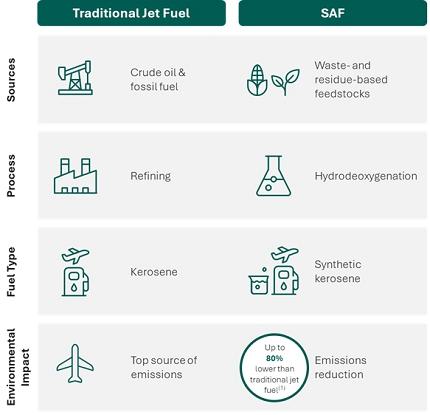
Blended
with conventional Jet-A fuel, SAF is a “drop-in fuel” which means it can be used in existing aircraft and aviation infrastructure
without the need for modification. Publications by a variety of industry organizations and experts, for example a thought leader piece
with Air bp global aviation sustainability director posted on the BP p.l.c. (“BP”) website and publications from the
IATA estimate that SAF can reduce lifecycle greenhouse gas emissions by up to 80% compared to conventional jet fuel; this estimated reduction
in greenhouse gas emissions is based on factors that impact the ultimate reduction in greenhouse gas emissions for a given SAF product
including the feedstock used, the production method employed, and the supply chain to the airport. In a recent study by the EPA on Atmospheric
Concentrations of Greenhouse Gases, global atmospheric concentrations of carbon dioxide, methane, nitrous oxide, and certain manufactured
greenhouse gases have all risen significantly over the last few hundred years. Further, the EPA has noted that the combustion of fossil
fuels such as gasoline and diesel to transport people and goods was the largest source of CO2 emissions in 2022, accounting for 35% of
total U.S. CO2 emissions and 28% of total U.S. greenhouse gas emissions.
XCF
intends to generate revenue and contribute to clean energy in the transportation sector by selling renewable fuels, primarily SAF, produced
at the Company’s SAF production facilities. XCF primarily intends to sell both “neat” or unblended SAF and blended
SAF:
| ● | Neat
SAF is used to describe SAF that has not been blended with conventional Jet-A fuel meeting
ASTM Standard D7566. SAF is a direct replacement for fossil jet fuel (conventional jet fuel
currently used in the aviation industry), made from renewable raw materials. As previously
stated, industry experts including Air bp and IATA indicate that SAF can reduce CO2 emissions
by up to 80% over the fuel’s life cycle compared to using fossil jet fuel depending
on factors such as the feedstock used, the production method employed, and the supply chain
to the airport; and |
| ● | Blended
SAF refers to a blended fuel containing a blend ratio of both neat SAF and Jet-A fuel
meeting ASTM Standard D1655. Because neat SAF has a lower carbon intensity (“CI”)
than Jet-A, blended fuel has a lower CI level than pure Jet-A. CI is a measure of carbon
dioxide and other greenhouse gases (CO2e) per unit of activity. According to the U.S. Department
of Energy, neat SAF can be blended with Jet-A at different levels with limits between 10%
and 50% depending on production pathway and feedstock. Airlines who purchase SAF currently
utilize blended SAF at ratios between 90/10 and 70/30 (Jet-A : neat SAF); the maximum blend
ratio is 50/50 (Jet-A : neat SAF). |
(1)
BP “What is Sustainable Aviation Fuel?”
The
Company may also opportunistically evaluate the production of other sustainable renewable fuels, including but not limited to renewable
diesel and biodiesel.
The
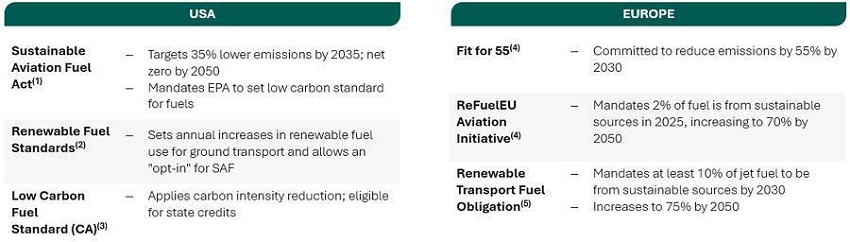
need for energy is a necessity and will not be eliminated in the near future. However, due to the cumulative harmful impacts of fossil
fuels on our environment, how the world sources its energy is expected to evolve. The transportation sector, one of the largest contributors
to GHG emissions according to the EPA, has recognized its role in climate change and has begun to seek alternative energy sources from
renewable and sustainable fuels. Specifically, the aviation industry, which, according to the International Energy Agency (“IEA”),
accounted for 2.5% of global energy-related CO2 emissions in 2023, is making progress to reduce emissions. Key milestones include:
| ● | In
2022, the 184 member states of the International Civil Aviation Organization (ICAO) adopted
a long-term global aspirational goal of net zero carbon emissions from international aviation
by 2050; |
| ● | In
2022, the United States announced important tax credits and a competitive grant program under
the Inflation Reduction Act, which will allocate $3.3 billion to scaling up SAF production,
with the aim of meeting the 3 billion gallons milestone set by the SAF Grand Challenge by
2030; and |
| ● | In
the European Union, the European Parliament and European Council reached an agreement in
2023 on the rules of ReFuelEU Aviation on the schedule of minimum SAF blend-in shares, with
sub-targets for synthetic fuels, through 2050. |
As
calls for sustainability growth and global demand for renewable energy accelerates, XCF believes it can capitalize upon the scale of this
market opportunity and expand at a pace for the foreseeable future. The Company’s ability to capitalize on the market opportunity
and implement its plan is dependent on its ability to raise capital necessary for capital investments and operate its facilities efficiently.
Air
bp also indicates that pricing for SAF has been higher than conventional jet fuel primarily due to production costs and availability
of sustainable feedstocks. Nevertheless, governments and airlines around the world are setting targets to use SAF, as a number of experts,
including McKinsey & Company have expressed their belief that SAFs are the most viable near-term option for decreasing aviation-related
emissions. The United States is leveraging a combination of loan and grant programs and tax incentives as state and federal governments
have taken the lead in stimulating the demand for and adoption of SAF. These efforts have provided significant tailwinds for both SAF
supply and demand thus driving a need for new plants and increased production. These incentives, however, may change or be revoked.
XCF
Project Pipeline and Growth Plan
In
the near term, XCF plans to operate and develop four projects for the production of SAF or associated SAF-related infrastructure.
The Company intends to generate revenues from the sale of its SAF products to offtake partners, which include energy companies, fuel
wholesalers and brokers, airlines, or fixed-based operators (“FBOs”). The existing facility in Reno, Nevada,
which we refer to as New Rise Reno, was converted to SAF production in October 2024 and we currently expect to achieve commercial
production of SAF at nameplate capacity as early as the second quarter of 2026. A second facility that we intend to build in Reno,
Nevada, adjacent to New Rise Reno (“New Rise Reno 2”), is currently expected to come online in 2028. Our ability
to bring future sites online on the intended timeline, if at all, is dependent on our ability to raise and deploy necessary funding
capital and effectively manage the project buildout timeline, of which there can be no assurances. Total anticipated annual
production output of neat SAF, assuming the projects develop as expected and on time, is expected to be 80 million gallons per year
by the end of 2028. Realizing these output assumptions is dependent on various factors, including our ability to raise and deploy
necessary funding capital and effectively manage the project buildout timeline and our ability to manage the feedstock supply chain
and efficiently operate the facilities , of which there can be no assurances. We believe this rolling expansion strategy allows the
Company to bring new supply to the market in parallel with the anticipated increase in demand for SAF in the second half of the
decade yet also affords the Company the option to opportunistically pivot to other renewable products or related infrastructure
facilities depending on environment and market conditions.
| ● | New
Rise Reno - Our current hydrotreating technology is capable of treating 130 thousand
gallons of feedstock per day or approximately 44 million gallons of feedstock per year. Once our facility is upgraded this year,
factoring of finished product yields of ~86%, as it compares to feedstock input, and required
maintenance downtime of ~26 days per year, we expect New Rise Reno to have a nameplate production
capacity of approximately 112 thousand gallons of finished product per day or approximately
38 million gallons per year of neat SAF. |
| ● | New
Rise Reno 2 - We expect new construction of New Rise Reno 2 to use similar hydrotreating technology as New
Rise Reno with an additional 8,400 gallons per day being able to be treated. As a result,
estimated feedstock hydrotreating capabilities would be 139 thousand gallons of feedstock per
day or approximately 47 million gallons of feedstock per year. After factoring in finished
product yields of ~86% and required maintenance downtime of ~26 days per year, we expect
the New Rise Reno 2 production facility to have a nameplate production capacity of approximately
119 thousand gallons of neat SAF per day or approximately 40 million gallons of finished
product per year. |
| ● | Fort
Myers and Wilson - The Company is continuing to evaluate the role of each of the Fort
Myers, Florida and Wilson, North Carolina facilities within XCF’s broader SAF and biofuels
value chain. We are considering whether to further build-out and reconstruct these sites into SAF, renewable
fuels, and/or associated SAF-related infrastructure. |
New
Rise Reno (Reno, Nevada)
In
2023, Legacy XCF began analyzing acquisition targets within the renewable fuels space, which included New Rise Renewables and New Rise
Renewables SAF. New Rise Renewables owns and operates the New Rise Reno production facility, which sits on 10 acres of land in the Tahoe
Reno Industrial Center (TRI) in Reno, NV; this site is not considered a Tier 1 Renewable Chemical Investment Tax Credit (ITC) area. The
facility has rail access and is adjacent to I-80, a major interstate highway. At that time, New Rise Renewables was in the process of
bringing its New Rise Reno facility online as a renewable diesel production facility. New Rise Renewables SAF is the adjacent plot next
to the current New Rise Reno facility that is expected to be constructed into a SAF facility. Because New Rise Renewables, LLC had a Supply and Offtake Agreement (the “P66 Agreement”) with Phillips 66, the New Rise Reno plant was nearing completion and commencing operations, and the adjacent plot was primed
for development, Legacy XCF began negotiations to purchase the outstanding membership interests of New Rise Renewables, LLC.
On
December 8, 2023, Legacy XCF entered into the New Rise Renewables Membership Interest Purchase Agreement (the “New Rise Renewables
MIPA”) with RESC Renewables Holdings, LLC (“RESC Renewables”) for an aggregate purchase price of $1.1 billion,
less acquired liabilities of approximately $112.5 million, to acquire all of the issued and outstanding membership interests in New Rise
Renewables. In October 2024, we filed a premerger notification with the FTC to comply with the Hart-Scott-Rodino Antitrust Improvements
Act of 1976, as amended. On November 15, 2024, the thirty-day waiting period expired.
On
February 19, 2025, Legacy XCF completed the acquisition of New Rise Renewables subject to additional post-closing conditions. On February
19, 2025, the aggregate purchase price of $1.1 billion was reduced by $118,700,000, which represented principal and interest on New Rise
Renewable’s outstanding debt obligations to a financial institution and two notes payable to Legacy XCF. As a result, RESC Renewables
was issued 88,126,200 shares of Legacy XCF common stock in exchange for its membership units. In connection with a consulting agreement
between RESC Renewables and GL Part SPV I, LLC (“GL”), GL was entitled to receive 4,406,310 shares of the Legacy XCF
common stock issued to RESC Renewables. In addition, pursuant to the New Rise Renewables MIPA, Legacy XCF issued a convertible promissory
note to RESC Renewables in principal amount of $100,000,000. The entire principal amount of the promissory note was held by RESC Renewables
prior to the merger with Focus Impact BH3 Acquisition Corp.
On
May 30, 2025, the aggregate purchase price was updated to reflect actual New Rise liabilities of $126,700,000 compared to $118,700,000
in connection with the initial closing on February 19, 2025. As a result, the total shares issued in connection with the acquisition
were adjusted to be 87,331,951 of Legacy XCF common stock, of which RESC Renewables received 82,965,533 and GL received 4,366,598 shares
of Legacy XCF common stock.
At
the closing of the Business Combination the 82,965,533 shares of Legacy XCF common stock issued to RESC Renewables and the 4,366,598
shares of Legacy XCF common stock issued to GL were automatically converted into shares of XCF Class A common stock at an exchange ratio
of approximately 0.68627. The 82,965,533 Legacy XCF shares converted into 56,936,990 shares of XCF Class A common stock and the 3,693,830
shares converted into 2,996,678 shares of XCF Class A common stock upon closing.
The
New Rise Reno production facility functions as XCF’s flagship SAF production facility. The facility employs a two-stage
process including pretreatment and hydrotreatment. Through the use of a pretreatment process, it is expected that New Rise Reno will
be able to use a variety of waste- and residue-based feedstocks to produce SAF and other renewable fuels such as renewable diesel.
The conversion of New Rise Reno to SAF production was managed by Encore DEC, LLC (“Encore”), one of the
engineering, procurement, and construction (“EPC”) companies that was subcontracted to build New Rise Reno and
which is 100% owned by Randy Soule. Mr. Soule is currently XCF’s second largest shareholder. Because the required facility
infrastructure is similar for both renewable diesel and SAF production, pretreatment, electrical, water, railcar and other
infrastructure were already in place from the original construction of the facility. As a result, the New Rise Reno facility was
efficiently converted into a SAF production facility without bearing greenfield construction costs. RESC Renewables Holdings, LLC,
the sole member of New Rise Renewables provided necessary capital to New Rise Reno to convert the facility to SAF and incurred
approximately $17 million in construction costs related to the conversion. The facility underwent testing and produced 20,000
gallons of neat SAF in November 2024.
In
February 2025, New Rise Reno began its ramp-up process. The ramp-up process, a critical phase for all new fuel facilities, is the period
after commissioning when a new fuel facility works to optimize its production gradually from initial test runs to full, nameplate capacity.
During the initial production runs, the facility produced neat SAF at approximately 50% production capacity. Until SAF production is
at nameplate capacity, New Rise Reno is not deemed to be an operating facility and classifies as under construction until final project
acceptance under New Rise’s license agreement with Axens North America under the original intention of the SAF conversion, such as meeting ASTM 7566 specifications for synthetic blending component
standards to be blended with conventional jet fuel. Such
final project acceptance has not yet been completed.
While
ramp-up processes are being undertaken and until final plant acceptance, management has made the determination to temporarily produce
and sell renewable diesel, a byproduct of SAF production, which can be achieved at approximately 2,000 barrels per day, which is approximately
20% below nameplate capacity, and without any additional modifications to the facility. In May 2025, New Rise Reno began selling renewable
diesel under its Supply and Offtake Agreement with Phillips 66 (the “P66 Agreement”).
We
currently expect to meet SAF production at nameplate capacity as early as the second quarter of 2026, although we cannot assure you
when SAF production will resume, and when it does resume, when or whether the New Rise Reno production facility will be able to produce
SAF at full capacity. Any delay beyond the second quarter of 2026 in our ability to resume SAF production and/or any delay in our ability
to operate the New Rise Reno production facility at full nameplate capacity for SAF production will adversely affect our revenues and
profitability. From April through the end of December 2025, New Rise Reno produced, in aggregate, approximately 5.8 million gallons of
neat SAF, renewable diesel, and renewable naphtha.
Since
the initial production of renewable diesel, our New Rise Reno production facility has experienced repeated maintenance-related
downtime that has required additional maintenance capital expenditures and other unanticipated operating expenses. These disruptions
have limited our ability to operate at expected levels and delayed our efforts to achieve full production capacity. Although
management has taken steps to address these issues, there can be no assurance as to when or whether the Reno facility will
consistently operate at or near 100% production capacity for renewable diesel. Continued downtime, additional maintenance
requirements, or the inability to achieve stable full-capacity operations could materially and adversely affect our revenues,
profitability, and liquidity.
The
New Rise Reno facility has rail access which serves as an entry and exit point for receiving feedstock directly at the plant and delivering
SAF to off-takers. Once feedstock arrives by rail at the on-site spur, it is transported directly from rail cars into storage tanks at
the facility’s tank farm. New Rise Reno has the ability to store up to 1.5 million gallons of feedstock at its on-site tank farm
with additional storage available on the rail spur.
On
May 23, 2017, New Rise Reno entered into the P66 Agreement, a supply and offtake agreement with Phillips 66 whereby Phillips 66 would
sell to New Rise Reno 100% of the feedstocks required for the production of renewable diesel at the New Rise Reno facility and purchase
from New Rise Reno 100% of the renewable diesel produced at the facility. Under terms of the agreement, feedstock is supplied to New
Rise Reno at spot pricing plus transportation, terminal, and logistics expenses plus a per gallon fee. For the sale of renewable diesel,
Phillips 66 purchases 100% of the renewable diesel at a price per gallon based on current index prices for renewable diesel and other
tax-based credits.
In
May 2024, New Rise Reno and Phillips 66 entered into an addendum to the P66 Agreement, with an initial term of five years from the commencement
date of September 1,2024, that extends the supply and offtake agreement to include feedstocks for renewable products and the sale of
renewable products produced by New Rise Reno, including SAF, to Phillips 66. Under the amended terms of the agreement, the terms of the
feedstock price remain unchanged to the original agreement and P66 will charge New Rise Reno for transportation and logistics costs,
and terminal, storage, blending and distribution fees to bring the renewable products to market. At the end of the initial five-year
term, the agreement shall automatically renew for two successive additional periods of five years, unless otherwise terminated according
to the terms, bringing the total duration of the agreement to a potential term of 15 years. At present, this is the only supply and offtake
agreement for XCF’s current or planned production facilities. Other than the P66 Agreement, XCF and New Rise Reno do not have other
feedstock supply or SAF off-take agreements in place.
October
1, 2025, New Rise Reno entered into an additional amendment to the P66 Agreement. The amendment modifies certain operational provisions
of the Agreement, including clarifying that Phillips 66 retains title to feedstock while such feedstock is stored at the New Rise facility
and that title transfers to New Rise only when the feedstock exits storage tanks and enters process units for conversion. The amendment
also specifies New Rise’s obligations to maintain flow-metering equipment, provide daily inventory reports to Phillips 66, and
conduct monthly reconciliations of volumes, and grants Phillips 66 a continuing right, exercisable upon written notice, to require reloading
of feedstock from storage tanks into railcars. New Rise must, at its expense, maintain equipment and procedures to perform the reverse-flow
operation described in the Amendment and permit Phillips 66 reasonable access to inspect related equipment and operations.
New
Rise Reno 2 (Reno, Nevada)
On
December 8, 2023, Legacy XCF also entered into the New Rise SAF Renewables MIPA, (the New Rise SAF Renewables MIPA and the New Rise Renewables
MIPA are referred to herein as the “MIPAs”) to acquire all of the issued and outstanding membership interests in New
Rise SAF Renewables Limited Liability Company from Randy Soule and GL Part SPV I, LLC for an aggregate purchase price of $200.0 million.
In October 2024, we filed a premerger notification with the FTC to comply with the Hart-Scott-Rodino Antitrust Improvements Act of 1976,
as amended. On November 15, 2024, the thirty-day waiting period expired. Our acquisition of New Rise SAF was completed on January 23,
2025. At closing, the aggregate purchase price of $200 million was reduced by $12.7 million, which represented Legacy XCF’s five
times liquidation preference for its preferred membership units. As a result, Randy Soule was issued 15,036,170 shares of Legacy XCF
common stock in exchange for his membership units, and GL was issued 3,693,830 shares of Legacy XCF common stock in exchange for its
membership units and after consideration of its five times liquidation preference. Total consideration at closing was approximately $187.3
million or 18,730,000 shares of Legacy XCF common stock.
At
the closing of the Business Combination, the 15,036,170 shares of Legacy XCF common stock issued to Randy Soule and the 3,693,830 shares
of Legacy XCF common stock issued to GL were automatically converted into shares of XCF Class A common stock at an exchange ratio of
approximately 0.68627. The 15,036,170 Legacy XCF shares converted into 10,318,915 shares of XCF Class A common stock and the 3,693,830
shares converted into 2,534,975 shares of XCF Class A common stock upon closing.
This
acquisition resulted in Legacy XCF owning a 10-acre plot adjacent to the New Rise Reno production facility. XCF intends to leverage
the pretreatment, electrical, water, rail spur, and other infrastructure at the existing New Rise Reno facility to build an
additional SAF facility at New Rise Reno 2. As an adjacent site, we expect New Rise Reno 2 will be able to share in the existing
utilities and transportation infrastructure already built. Since the lines, pipes, rail track, and other related infrastructure have
already been constructed, we expect New Rise Reno 2 will be able to link into existing infrastructure rather than complete a full
ground-up build. As we intend to utilize the same pre-treatment and hydrotreatment technology at New Rise Reno 2 that is currently
in place at New Rise Reno, New Rise Reno 2 will utilize the same feedstocks as New Rise Reno. New Rise Reno 2 is anticipated to have
estimated construction costs of $300 million and will take approximately 28 months to complete from the date construction begins. We
anticipate beginning engineering work in 2026 with SAF production to begin in 2028, all dependent on our ability to raise and deploy necessary funding capital
and effectively manage the project buildout timeline, of which there can be no assurances. XCF expects that New Rise Reno 2 could produce an
additional 40 million gallons of neat SAF annually.
XCF
will search for experienced EPC subcontractors to manage the construction of New Rise Reno 2. We may elect to use a service provider
to provide operating and maintenance services for the New Rise Reno 2 SAF facility to provide critical operating and maintenance
services to operate New Rise Reno 2. XCF intends to attempt to extend its existing supply and offtake agreement with Phillips 66 to
the New Rise Reno 2 facility. The Company, however, may also pursue long-term offtake agreements with similar offtake partners,
airlines, or FBOs and may also opportunistically pursue alternative feedstock suppliers. Currently, XCF does not have supply and
offtake agreements for the New Rise Reno 2 production facility.
Fort
Myers (Fort Myers, Florida) and Wilson (Wilson, North Carolina)
On
October 31, 2023, Legacy XCF entered into an asset purchase agreement with Good Steward Biofuels, LLC to acquire a biodiesel plant in
Fort Myers, Florida, which we refer to as Fort Myers. Consideration for the purchase was paid at closing by our issuance of 9,800,000
shares of Legacy XCF common stock. The aggregate purchase price was $100.0 million, less $2.0 million in notes payable and loans assumed
by Legacy XCF, using a stock price conversion factor of $10.00 per share.
At
the closing of the Business Combination, the 9,800,000 shares of Legacy XCF common stock issued to Good Steward were automatically converted
into shares of XCF common stock at an exchange ratio of approximately 0.68627. The 9,800,000 Legacy XCF shares converted into 6,725,474
shares of XCF Class A common stock upon closing.
On
October 31, 2023, Legacy XCF also entered into an asset purchase agreement with Southeast Renewables, LLC to acquire a biodiesel plant
in Wilson, North Carolina, which we refer to as Wilson, for an aggregate purchase price of $100.0 million. Consideration for the purchase
was paid at closing by our delivery of a convertible promissory note in the principal amount of $23.0 million and issuance of 7,700,000
shares of Legacy XCF common stock. On December 29, 2023, Legacy XCF and Southeast Renewables, LLC entered into a note purchase agreement
to convert the $23.0 million in principal outstanding and $297,425 in accrued interest at a conversion factor of $10.00 per share into
2,329,743 common stock shares.
At
the closing of the Business Combination, the 7,700,000 shares and 2,329,743 shares of Legacy XCF common stock issued to Southeast Renewables
were automatically converted into shares of XCF Class A common stock at an exchange ratio of approximately 0.68627. The 7,700,000 and
2,329,743 Legacy XCF shares converted into 5,284,301 and 1,598,839 shares of XCF Class A common stock upon closing.
Both
Fort Myers and Wilson are dormant biodiesel facilities, potentially strategically positioned to service the South Atlantic, East
South Central, and Middle Atlantic markets.
| ● | Fort
Myers - The Fort Myers site is a 7-acre site that is leased from the Florida Department
of Agriculture and was originally built to produce biodiesel and glycerin, a byproduct from
biodiesel production. The Fort Myers site is located near I-75 on Florida’s Gulf Coast;
this jurisdiction is not a Tier 1 ITC area. |
| ● | Wilson
- Located in a Tier 1 ITC area near I-587 and I-95, the Wilson site is within 500 miles of
New York City and Atlanta, GA, and 600 miles of Nashville, TN. This centric location enables
Wilson to serve as an East Coast conduit as the business expands. The Wilson site is 3.75-acre site that was originally built to produce biodiesel and glycerin. |
We
are considering whether to further build-out and reconstruct the Fort Myers and Wilson sites into SAF, renewable fuels, and/or associated SAF-related
infrastructure though environmental, market conditions, and other factors may ultimately indicate an alternative use is more advantageous.
If both Fort Myers and Wilson are reconstructed to produce SAF, it is expected to take approximately 36 months to complete from the date
construction commences with anticipated construction costs of approximately $350 million per site. The Company is preparing to commission
a suitability analysis for each site to determine the optimal use case for each site, ensuring the highest possible accretion to revenue
and net profit.
Supply
and Offtake Agreements
On
May 23, 2017, New Rise Reno entered into the P66 Agreement whereby Phillips 66 would sell to New Rise Reno 100% of the feedstocks required
for the production of renewable diesel at the New Rise Reno facility and purchase from New Rise Reno 100% of the renewable diesel produced
at the facility. Under terms of the agreement, feedstock is supplied to New Rise Reno at spot pricing plus transportation, terminal,
and logistics expenses plus a per gallon fee. For the sale of renewable diesel, Phillips 66 purchases 100% of the renewable diesel at
a price per gallon based on current index prices for renewable diesel and other tax-based credits.
In
May 2024, New Rise Reno and Phillips 66 entered into an addendum to the P66 Agreement, with an initial term of five years from the commencement
date of September 1,2024, that extends the supply and offtake agreement to include feedstocks for renewable products and the sale of
renewable products produced by New Rise Reno to Phillips 66. Under the amended terms of the agreement, the terms of the feedstock price
remain unchanged to the original agreement and P66 will charge New Rise Reno for transportation and logistics costs, and terminal, storage,
blending and distribution fees to bring the renewable products to market. At the end of the initial five-year term, unless otherwise
terminated according to the terms, the agreement shall automatically renew for two successive additional periods of five years, bringing
the total duration of the agreement to a potential term of 15 years. At present, this is the only supply and offtake agreement for XCF’s
current or planned production facilities. Other than the P66 Agreement, XCF and New Rise Reno do not have other feedstock supply or SAF
off-take agreements in place.
In
addition, the addendum to the P66 Agreement permits New Rise Reno to continue to engage in sales and business development activities.
For sales to a third-party that result in a premium to the price provided in the P66 Agreement, New Rise Reno and Phillips 66 will share
in the price premium 77% and 23% respectively. Phillips 66 will remain responsible for blending and logistics services for sales to a
third-party as well. Management is currently engaged in discussions with and has submitted proposals to multiple partners regarding SAF
offtake.
In
October 2025, New Rise Reno and Phillips 66 entered into an addendum to the P66 Agreement. The amendment enhances operational clarity
and improves XCF’s working capital efficiency by modifying key feedstock handling and title-transfer provisions. By aligning title
transfer with the production process, the amendment shortens XCF’s working capital cycle by approximately 10 days, thereby strengthening
the company’s liquidity position. The amendment modifies certain operational provisions of the P66 Agreement, including clarifying
that Phillips 66 retains title to feedstock while such feedstock is stored at the New Rise facility and that title transfers to New Rise
Reno only when the feedstock exits storage tanks and enters process units for conversion. The amendment also specifies New Rise Reno’s
obligations to maintain flow-metering equipment, provide daily inventory reports to Phillips 66, and conduct monthly reconciliations
of volumes, and grants Phillips 66 a continuing right, exercisable upon written notice, to require reloading of feedstock from storage
tanks into railcars.
The
amendment also establishes enhanced operational and reporting procedures. New Rise Reno will maintain flow-metering equipment and provide
daily inventory reports and monthly reconciliations to Phillips 66, ensuring continuous visibility into feedstock management. Except
as expressly amended, all other terms and conditions of the original P66 Agreement remain unchanged and in full force and effect.
Future
Expansion
XCF
intends to leverage the selected technology stack and site design, configuration, and layout of its New Rise Reno production facility
as a model for future sites.
We
believe this site design requires less area to build a production facility and can be efficiently replicated as modular design
allows for rapid expansion. The New Rise Reno site has four modules - feedstock receiving, pretreatment, hydrotreatment, and
finished goods (neat SAF) offtake. The feedstock receiving and finished goods offtake modules have direct access to both rail and
truck ports. This design increases operational efficiency because it facilitates direct unloading of feedstock for production and
direct loading of SAF onto customers’ trucks or rail tanks. By directly unloading feedstock and finished goods rather than
storing them for extended periods, the facility requires a smaller sized tank farm, thereby reducing the size of the facility and
increasing the speed of construction. However, while we intend to have the New Rise Reno serve as the model, future sites will
be designed on a case-by-case basis as facility designs will consider geographic opportunities and limitations; other operations
related considerations will be addressed during feasibility studies and final investment decision (“FID”)
analysis.
XCF
will consider both greenfield developments and facility conversion projects. The Company intends to prioritize future development in
locales with favorable regulatory policies, in Tier 1 Renewable Chemical ITC areas in Trade Association for Commercial Property Assessed
Clean Energy (C-PACE) approved states. XCF intends to regularly review its site selection criteria in concert with the evolving market
dynamics, the unique and specific needs of each potential project, and frequent changes in local, state, and/or federal policies.
International
Expansion
XCF
intends to grow its international expansion strategy focused on accelerating the deployment of sustainable aviation fuel through
capital-efficient partnerships. On October 9, 2025, XCF entered into a binding term sheet with New Rise Australia Pty. Ltd. We
believe this approach leverages the Company’s proprietary facility design and process configurations, enabling regional
partners to develop and operate renewable fuel projects while XCF retains ownership of its intellectual property. The model is
structured with the goal of aligning long-term interests through equity participation, licensing-based revenue streams, and selective governance
involvement. This framework is intended to support scalable growth in priority markets while maintaining a disciplined, asset-light
approach to global expansion.
Business
Combination
On
March 11, 2024, Focus Impact, NewCo, Merger Sub 1, Merger Sub 2, and Legacy XCF entered into the Business Combination Agreement,
pursuant to which Focus Impact agreed to combine with Legacy XCF in a series of transactions that would result in NewCo becoming a
publicly traded company (collectively, the “Business Combination”). On June 6, 2025 (the “Closing
Date”), the parties to the Business Combination Agreement completed the Business Combination. In connection with the
closing of the Business Combination, NewCo changed its name to “XCF Global, Inc.” The terms of the Business Combination
Agreement provided that the Business Combination would be completed on the Closing Date in two steps, with (i) Focus Impact merging
with and into Merger Sub 1 (the “NewCo Merger”), with Merger Sub 1 surviving the NewCo Merger as a direct wholly
owned subsidiary of NewCo and (ii) immediately following the NewCo Merger, Merger Sub 2 merging with and into XCF (the
“Company Merger”), with XCF surviving the Company Merger as a direct wholly owned subsidiary of NewCo. Pursuant
to the terms of the Business Combination Agreement: in connection with the completion of the NewCo Merger (i) each share of Focus
Impact Class A common stock, par value $0.0001 per share outstanding immediately prior to the effectiveness of the NewCo Merger was
converted into the right to receive one share of XCF Class A common stock, par value $0.0001 per share (“XCF Common
Stock”) (rounded down to the nearest whole share), (ii) each share of Focus Impact Class B common stock, par value $0.0001
per share outstanding immediately prior to the effectiveness of the NewCo Merger was converted into the right to receive one share
of XCF Common Stock and (iii) each warrant of Focus Impact outstanding immediately prior to the effectiveness of the NewCo Merger
was converted into the right to receive one XCF Warrant, with XCF assuming Focus Impact’s rights and obligations under the
existing warrant agreement; and in connection with the completion of the Company Merger, each share of common stock of XCF
outstanding immediately prior to the effectiveness of the Company Merger was converted into the right to receive shares of XCF
Common Stock (rounded down to the nearest whole share) determined in accordance with the Business Combination Agreement based on a
pre-money equity value of XCF of $1,750,000,000, subject to adjustments for net debt and transaction expenses, and a price of $10.00
per share of XCF Common Stock.
At
the closing of the Business Combination, NewCo issued an aggregate of 142,120,364 shares of XCF Common Stock to equity holders of XCF
in exchange for their equity interests in XCF. Subsequent to the Closing, XCF Global, Inc. issued an additional 10,268 shares to account
for final closing balances bringing to the total issued aggregate shares in connection with the closing of the Business Combination to
be 142,130,632 shares of XCF Common Stock. In addition, pursuant to certain non-redemption agreements between Focus Impact and certain
Focus Impact stockholders (the “Non-Redeeming Stockholders”), the Non-Redeeming Stockholders received 622,109 shares
of XCF Common Stock at the closing of the Business Combination. An aggregate of 1,200,000 shares of XCF Common Stock were also issued
at the closing of the Business Combination to Polar Multi-Strategy Master Fund, pursuant to the terms of a subscription agreement, dated
as of November 3, 2025 between Focus Impact and Polar Multi-Strategy Master Fund.
As
of the closing of the Business Combination and after giving effect to the NewCo Merger and Company Merger, XCF had approximately 149.3
million shares of XCF Common Stock outstanding. On a fully diluted basis, calculated using the treasury stock method and assuming the
net exercise of all warrants that are in-the-money based on the closing price of Focus Impact on June 6, 2025, the fully diluted share
count was approximately 157.8 million shares. The fully diluted share count does not include any out-of-the-money warrants. This share
count is provided solely for the purpose of estimating market capitalization and may differ from accounting treatment under GAAP or from
other financial metrics used in our public filings.
Proposed
Transaction with Southern, DEVS and EEME
On
January 26, 2026, XCF, entered into a binding term sheet (the “Term Sheet”) with Southern Energy Renewables, Inc.,
a Louisiana corporation (“Southern”), DevvStream Corp., an Alberta corporation (“DEVS”), and EEME
Energy SPV I LLC (“EEME”), which sets forth the principal terms and conditions of a proposed business combination
and related financing transactions (collectively, the “Proposed Transaction”). Pursuant to the Term Sheet, and subject
to the finalization of mutually agreeable merger structure and definitive transaction documents and ultimately the satisfaction of certain
closing conditions, it is expected that Southern and DEVS will each merge with wholly-owned subsidiaries of XCF, with Southern and DEVS
surviving, and their respective stockholders receiving shares of Common Stock of XCF, resulting in Southern and DEVS becoming wholly-owned
subsidiaries of XCF.
In
connection with and to support the Proposed Transaction and subject to the terms and conditions set forth in the Term Sheet, XCF agreed
to invest $10 million to convert and build out its New Rise Reno facility for SAF blending and related corporate purposes (the “Plant
Conversion”), to be funded through the sale by XCF to EEME of $10 million of Common Stock; provided that in no event shall
XCF issue to EEME, nor shall EEME (i) acquire more than 41,639,170 shares of XCF’s common stock pursuant to this Term Sheet or
(ii) acquire or to otherwise become, directly or indirectly, a “beneficial owner” (within the meaning of Section 13(d) of
the Exchange Act and the rules and regulations promulgated thereunder) of a number of shares of Common Stock in excess of 19.99% of the
issued and outstanding shares of Common Stock as of the date hereof until such time as XCF has obtain stockholder approval for such issuance
(the “Share Cap”), which XCF obtained on March 6, 2026. Subsequent to the execution of the Term Sheet, EEME has purchased
69,000,000 shares of Common Stock for $6,900,000. The issuance and sale to EEME of the remaining 31,000,000 shares of Common Stock is
expected to be consummated periodically during the period ending during the week of March 31, 2026, but there can be no assurances
in this regard. EEME is expected to have customary demand and piggy-back registration rights and will not be subject to any lock-up
or other transfer restrictions (other than as imposed by applicable securities laws or underwriters.) EEME’s obligation to acquire
such shares is independent of the remainder of the proposed Transaction contemplated by the Term Sheet. The offer and sale of the shares
of XCF common stock to EEME, will be made in reliance upon Section 4(a)(2) under the Securities Act, or upon such other exemption
or exclusion from the registration requirements of the Securities Act as may be available with respect to any or all of the transactions
with the EEME to be made under the Term Sheet.
On March
6, 2026, XCF held a Special Meeting of Shareholders (the “Special Meeting”). At the Special Meeting, the Shareholders approved
the potential issuance of 19.99% or more of XCF’s issued and outstanding Common Stock as of January 26, 2026 to a single investor,
thus removing the Share Cap.
The
Term Sheet provides that the Board of Directors of XCF (the “Board”) post-closing will be comprised of four members
designated by XCF (including XCF’s Chief Executive Officer, Chris Cooper, as chair), two members designated by Southern, and one
member designated by DEVS.
The
Term Sheet includes customary provisions regarding definitive agreements, including that the business combination agreement and related
agreements will contain customary representations, warranties, covenants, indemnities, limitations on indemnity, termination provisions,
and other terms typical for transactions of this nature.
The
Term Sheet further provides for certain interim covenants and restrictions, including, but not limited to, that (so long as EEME continues
funding under the schedule) XCF will not issue securities under its equity line of credit without EEME’s approval, neither XCF
nor DEVS will effect any reverse split without EEME’s prior written consent, and neither XCF, Southern, nor DEVS (or their affiliates)
will sell shares to brokers for naked short coverage.
The
Term Sheet is governed by Delaware law, contains customary confidentiality provisions, and will remain in effect until the earliest of:
180 days after its date, execution of definitive agreements, mutual written termination, termination by XCF for failure by EEME to timely
fund per the schedule, termination by any party based on unsatisfactory due diligence, or termination by any party to fulfill fiduciary
duties in respect of a superior offer.
There
can be no assurance that any of the foregoing conditions will be satisfied or waived, that the definitive agreements necessary to
consummate the Proposed Transaction will be entered into, or that the Proposed Transaction will be consummated on the terms
described herein or at all. The closing the Proposed Transaction, including the satisfaction of the closing conditions, are subject
to numerous factors, many of which are outside the control of XCF, including market conditions, regulatory approvals, the actions of
third parties, the ability of the parties to negotiate and execute definitive agreements, and the achievement of specified
operational and financial milestones, including certain conditions that depend on the business performance and operating results of
XCF. Although the Term Sheet provides that certain provisions are binding on the parties, it does not obligate the parties to
consummate the Proposed Transaction, and the Term Sheet reflects preliminary, non-final terms that remain subject to further
negotiation, modification, and approval by the applicable boards of directors and special committees and may be terminated in
accordance with its terms, including in circumstances involving an alleged breach. Any such termination, or a failure by the parties
to agree on definitive documentation, could result in disputes or litigation relating to the interpretation, enforceability, or
performance of the binding provisions of the Term Sheet, which could be costly, time-consuming, divert management attention, and
adversely affect the financial condition or liquidity of one or more of the parties, including their ability to pursue or defend
such claims. Accordingly, investors should not place undue reliance on the consummation of the Proposed Transaction or on the
achievement of any related milestones or financial thresholds. Moreover, even if the Proposed Transaction is consummated, the
parties may never achieve the purpose of the Proposed Transaction and the market value the parties are aiming to achieve may never
materialize. See “Risk Factors”.
Competitive
Strengths and Advantages: XCF’s Full Suite of Capabilities
In
addition to New Rise Reno, XCF has several projects in the pipeline and intends to capitalize on an early mover advantage and strong
regulatory and market tailwinds for sustainable fuels to become a leading producer of SAF in the United States. XCF believes it has
the opportunity to leverage repeatable site design, proven technologies, flexible and versatile feedstock requirements, and a
variety of financing sources to build a strong foundation for realizing its planned growth model.
Early
Mover Advantage
XCF
is currently one of the few publicly traded renewable fuels companies primarily focused on SAF in the United States, with the stated
intention to be a majority SAF producer, distinguishing itself from peers that are predominantly legacy crude oil refiners. The Company
holds a strategic early-mover advantage with commercial production of SAF currently expected to begin as early as the second quarter
of 2026, and a production facility design that can be replicated.
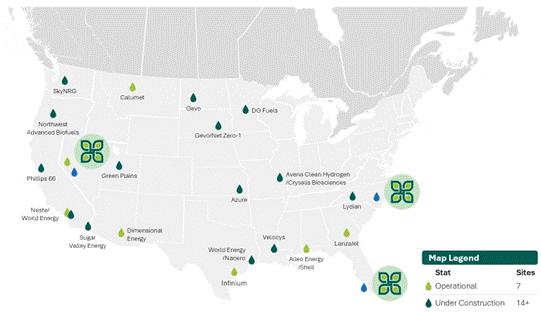
The
current competitive landscape for SAF production facilities in North America is illustrated in the graphic below, which shows SAF production
facilities that are currently operational (producing SAF), that are currently under construction, and that are proposed or under development
(pre-construction).
Source:
Argus SAF Capacity Map, June 2025
Reliable,
Proven Technologies
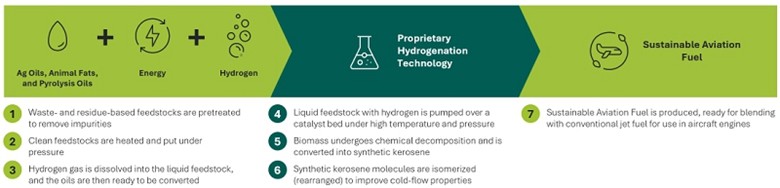
XCF
uses a two-stage production process, using pretreated feedstock with the established hydrotreated and isomerization of esters and fatty
acids (HEFA) pathway. The HEFA pathway is a process for refining vegetable oils, waste oils, or fats into SAF through hydroprocessing
and isomerization, which removes sulfur, oxygen, nitrogen and metals from the feedstock.
Pretreatment
is a key stage of the production process in that it allows facilities to react to changes in feedstock market conditions and de-risk
the supply chain even in times of high volatility. Additionally, pretreated feedstocks support a longer catalyst life which results in
less frequent shutdowns for catalyst changeout. A pretreatment stage is already in place at New Rise Reno. XCF intends to employ a pretreatment
stage at each facility or, depending on realized expansion plans, develop a regional pretreatment hub for its feedstock.
There
are multiple technology pathways to produce SAF approved by ASTM International (“ASTM”), a global organization that develops
and provides standards for various industries and applications. ASTM is an international standards organization that produces standards
for SAF, among other things. XCF uses the HEFA pathway, due to the lower capital costs, reliability, and the availability of feedstocks
which are close in energy density to fossil fuels. HEFA, approved in June 2011, is a proven technology currently in use at multiple advanced
biofuel refineries worldwide to produce SAF and renewable diesel. While SAF has multiple ASTM-approved pathways, HEFA-based SAF is the
only product that is commercially available today.
XCF
processes a variety of waste- and residue-based feedstocks into renewable fuels. These feedstocks, which are not suitable for direct
human consumption, include waste oils, agricultural residues, animal fats, and co-products from industrial agriculture. These feedstocks
are hydroprocessed under the HEFA pathway to break apart the long chain of fatty acids and subsequently hydro-isomerized and hydrocracked.
In this process, feedstock undergoes a hydrodeoxygenation process in which the removal of the oxygen atom from the reactant occurs in
the presence of hydrogen. Then, the hydrocarbons are cracked and isomerized, a refining process that alters the fundamental arrangement
of atoms in the molecule without adding or removing anything from the original material, to jet fuel chain length. The HEFA process is
similar to that used for hydrotreated renewable diesel production, only with a more intense cracking of the longer chain carbon molecules.
Airlines currently use SAF that is blended with fossil jet fuel. SAF that has not been blended with another fuel is referred to as “neat
SAF” which represents the end product produced by our production facilities. Currently, there are no specific mandates as to the
ratio of blended SAF that must be used by the aviation industry. XCF’s ability to sell blended SAF results in less neat SAF being
sold on a per gallon basis leading to the ability to earn additional revenues on a per gallon basis. XCF has had discussions with potential
offtake partners to provide Jet-A/SAF blends of 90/10 and 80/20. In 2011, ASTM put forth ASTM D7566 SAF (HEFA) that regulates blended
SAF ratios at a maximum ratio of 50/50.
Hydrogenation
is a key part of the SAF production process whereby a chemical reaction is created between molecular hydrogen and another element or
compound. The proprietary hydrogenation technology we use is licensed by New Rise Reno from Axens North America, a wholly-owned subsidiary
of IFPEN and one of the industry leaders in process and catalyst development with more than 3,000 industrial units under license. New
Rise Reno and Axens entered into a perpetual license agreement on Axens technology enables versatile hydrotreatment, boosts yields, and
facilitates longer catalyst life. In addition to the technology license, a guarantee agreement has also been executed. Axens’ technology
is in place at New Rise Reno and XCF intends to obtain similar licenses from Axens to utilize Axens’ technology at future sites.
On
December 9, 2020 New Rise Reno and Axens North America Inc. entered into a license agreement whereby New Rise Reno received the non-exclusive
right to utilize Axens’ liquid full hydrotreating technology and related process thereto, in exchange for a one-time license fee
of $1,050,000, consisting of: i) a project closing fee of $200,000, ii) a fee of $200,000 on project acceptance, which is not to exceed
four years after the effective date of the agreement, iii) $350,000 after one-year of operation following the acceptance date, iv) $200,000
after two years of operation following the acceptance date, and v) 100,000 after three years of operation following the acceptance date.
Under terms of the agreement, project acceptance is defined as the date that Axens has completed its performance tests, which includes
inspection of the Axens unit to check conformity with the process design and reactor inspection. In addition, acceptance will be confirmed
with an acceptance certificate issued between New Rise and Axens. To date, a total of $200,000 has been paid as part of the license agreement
and acceptance criteria has not yet been met. The license agreement does not require royalties paid to Axens North America, Inc. The
related license to use the Axens technology and process is effective so long as New Rise Reno continues to utilize the Axens process
and the related hydrotreating equipment. The license agreement is non-transferrable except that it may be assigned to an affiliate or
successor of the assigning party or upon written consent of the parties. Axens has the right to terminate the license agreement in the
event of New Rise’s uncured breaches of the agreement, including failures to make payment, use of Axens’ intellectual property
outside of the scope of the license and breaches of confidentiality obligations.
Production
Process
Versatile
Feedstock Base
Like
New Rise Reno, XCF intends that future production facilities will also have feedstock pretreatment equipment. This attribute affords
XCF the flexibility to utilize and/or shift to a variety of different low carbon intensity feedstocks due to the pretreatment technology
and Axens hydrotreater technology in use at New Rise Reno and intended to be deployed at future sites.
The
P66 Agreement includes the supply of feedstock and allows the Company to procure feedstock at spot-plus pricing. Currently, this agreement
covers 100% of feedstock requirements for New Rise Reno and is the only supply agreement for feedstocks that XCF currently has in place.
As we do not presently have other feedstock supply agreements in place, 100% of the current feedstock needs would be supplied by Phillips
66.
Commonly
used feedstock sources for production of renewable fuels from triglycerides, an ester derived from glycerol and three fatty acids which
are the main constituents of body fat in humans and other vertebrates, as well as vegetable fat, have been distillers corn oil (“DCO”),
refined, bleached and deodorized soybean oil (“RBD SBO”), canola oil, and waste oils such as used cooking oil, yellow
grease, and animal tallow (from meat processing). XCF processes a variety of waste- and residue-based feedstocks into renewable fuels.
These feedstocks, which are not suitable for direct human consumption, include waste oils, agricultural residues, animal fats, and co-products
from industrial agriculture. XCF has used DCO, a byproduct of U.S. ethanol production, to produce SAF and uses crude degummed soybean
oil, a co-product of the U.S. oilseed supply chain, to produce renewable diesel. The Renewable Fuel Standard (RFS) program and Low Carbon
Fuel Standard are major drivers for the demand for production of renewable fuels in the U.S. market which in turn leads to demand for
feedstock resources. A summary of these feedstocks according to a July 2023 publication by Burns McDonnell titled, “Renewable Diesel
Feedstocks: Considering Plant-and Animal-Based Options,” follows:
| ● | Animal
Fats: The processing of animals produces approximately 10 million pounds of triglycerides
as rendered animal fats annually. Historically, around one-third of these triglycerides are
used in the human food chain and in consumer products while one-third is used in animal feed,
and the final third, approximately 3.5 billion pounds, is used as a feedstock to produce
renewable fuels. |
| ● | Canola:
In North American, roughly 1 billion bushels of canola are produced per year. While around
~40% of the crop is exported, approximately 60% is crushed in North America to produce canola
meal and yielding around 3.3 billion pounds of oil. In 2022, the US Environmental Protection
Agency (“EPA”) approved a pathway for canola as a feedstock for renewable
fuel. |
| ● | Corn:
Approximately 14.5 billion bushels of corn are produced in the US and Canada annually making
it the largest available source of triglycerides. A 56-pound bushel of corn can yield approximately
2 pounds of oil, indicating a potential volume of 29 billion pounds of corn oil available
in the market. Per the USDA, roughly 40% of corn is processed into ethanol and is mixed into
renewable fuels today. New Rise previously used 100% DCO for renewable diesel production
due to the availability, economical price point, and higher purity than other fats, oils,
and greases currently on the market today. |
| ● | Soybean:
There are approximately 4.8 billion bushels of soybeans produced in the US and Canada annually.
Around 50% of this production is utilized domestically while the remaining volume is exported
as whole beans. Soybeans which are utilized domestically are crushed to produce soybean meal
for livestock use and soybean oil. A 60-pound bushel of soybeans can yield approximately
12 pounds of soybean oil. Approximately 60% of the oil is used in food and industrial applications
while approximately 40% of the oil produced, around 11 billion pounds, is used in the production
of renewable fuels. New crush capacity under construction in the U.S. is expected to increase
the percentage of soybeans used domestically which is intended to result in the availability
of additional supply to support growth in the demand for oil to produce renewable fuels. |
| ● | Waste
Oils: Waste oils, referred to as recycled or mixed oils in the referenced Burns McDonnell
publication, used as feedstocks for renewable fuel production include lower-quality fats
and oils such as used cooking oil, yellow grease, and other rendered products. These products
may have higher concentrations of triglyceride degradation, such as free fatty acids, ketones
and aldehydes or other materials identified as moisture, insoluble and unsaponifiables. While
these properties limit some commercial uses for these triglycerides, as recovered co-products,
they have low carbon intensity which makes them attractive as feedstocks for the production
of renewable fuels. |
As
part of its long-term strategy, XCF intends to build an integrated business model that includes feedstock supply and delivery to its
plants; XCF has identified strategic partnerships to facilitate this objective. Through vertical integration, XCF believes that it can
position itself to secure a reliable source of sustainable non-food feedstock volumes at competitive pricing. By working with strategic
partnerships, XCF expects to have the ability to purchase non-food feedstock crops, farm-direct and partner with underutilized crush
facilities and/or expand collection networks for used cooking oil and other waste and by-product oils. These initiatives are intended
to both reduce the overall feedstock cost to XCF’s production facilities and ensure reliable supply as competition for feedstocks
increases in the coming years.
Financing
Government
sponsored loans, grants, and other programs are part of a regulatory environment that supports the development of SAF facilities and
continued adoption of SAF by the aviation industry. Management has identified various government-sponsored programs which may provide
lower-cost financing and tax credits for some XCF facilities. Management is also actively engaged in discussions with multiple potential
investors regarding capital needed for the conversion of existing production facilities to SAF production and construction and conversions
of additional productions facilities. We intend to identify and apply for multiple financing options for these facilities, which includes
grants, loans and other financing arrangements as opportunities materialize in the near future.
Greater
Nevada Credit Union Loan
New
Rise Reno operates our existing production facility in Reno, Nevada. New Rise Reno has four notes payable outstanding, in aggregate principal
amount of $112,580,000, to Greater Nevada Credit Union (“GNCU”), as the successor to Jefferson Financial Federal Credit
Union (the “GNCU Loan”). The GNCU Loan was underwritten by certain guarantees issued by the United States Department
of Agriculture (the “USDA”) under the Biorefinery, Renewable Chemical and Biobased Product Manufacturing Assistance
Program, which guaranteed 100% of the principal amount of the notes evidencing the GNCU Loan (the “USDA Guaranty”).
Pursuant to the terms and conditions of the USDA Guaranty, the GNCU Loan is secured by a priority first lien on all assets of the project,
except for inventory and accounts receivable, which may be used by New Rise Reno for routine business purposes so long as New Rise Reno
is not in default of the GNCU Loan. The USDA must approve, inter alia, the accounts agreement, any issuance of additional debt by New
Rise Reno, the transfer or sale of New Rise Reno assets or collateral, lien priorities, the substitution, release or foreclosure on the
collateral, and GNCU’s exercise of any rights it has relating to the GNCU Loan, including those rights provided in the notes evidencing
the GNCU Loan and the other transaction documents relating to the GNCU Loan. In addition, New Rise Renewables is a guarantor of the GNCU
Loan.
On
March 28, 2025, counsel for GNCU and Greater Nevada Commercial Lending, LLC (the servicer for the GNCU Loan) provided notice to New Rise
Reno asserting that an event of default has occurred with respect to the GNCU Loan as a result of New Rise Reno’s failure to make
required minimum monthly payments. The letter also demands that New Rise Reno and New Rise take immediate steps to bring the GNCU Loan
current and to cure any and all other non-payment-related defaults that may exist, as well as a demand that New Rise Reno and New Rise
provide evidence sufficient for GNCU to determine that it remains secure and that the prospect of repayment of the GNCU Loan has not
been impaired by any material adverse change in New Rise Reno’s financial condition, or in the financial condition of New Rise,
as a guarantor of the GNCU Loan. GNCU has demanded that the GNCU Loan be brought current, including payment of all late charges, no later
than close of business on May 27, 2025. As of December 31, 2025, New Rise Reno has not made payment of the amounts demanded. As of December
31, 2025, the amount required to bring the GNCU Loan current is approximately $29,000,000 inclusive of principal and interest, excluding approximately
$2,700,000 of penalties/late charges.
GNCU’s
rights and remedies in connection with an event of default include acceleration of the unpaid principal amount of the GNCU Loan, and/or
possession, control, sale, and foreclosure on any collateral, including all rights and interests in and to the real property on which
the SAF production facility is located (including any after-acquired fixtures, equipment and improvements to the production facility)
under the terms of the Ground Lease by and between Twain GL XXVIII, LLC (“Twain”), as the landlord, and New Rise,
as the tenant, dated March 29, 2022 (the “Ground Lease”), which is discussed below under “Twain Ground Lease.”
GNCU would be obligated to obtain USDA approval in the event that GNCU seeks to exercise any rights it has under the GNCU Loan, including
GNCU’s rights prescribed in the notes evidencing the GNCU Loan and related loan documents (including any attempt to foreclose or
sell any collateral). The notes also permit GNCU to refrain from taking any action on any of the notes, collateral or any guarantee with
the approval of USDA.
On
August 6, 2025, GNCU counsel sent a letter to New Rise Reno notifying New Rise Reno of (1) additional events of default under the existing
loan documents relating to the GNCU Loan, (2) failure to timely cure the ongoing payment default on the GNCU Loan by the deadline set
forth in the demand to cure addressed to New Rise Reno dated March 3, 2025, and (3) the acceleration of the full unpaid balances of the
GNCU Loan pursuant to GNCU’s rights under the loan documents relating to the GNCU Loan. The acceleration notice indicated that
the amount owing as of August 5, 2025, excluding applicable fees, costs, and penalties, is $130,671,882. Subsequent to the notification,
counsel for the Company and counsel for GNCU engaged in discussions regarding the notification, and on August 27, 2025, the Company,
on behalf of New Rise Reno and GNCU entered into a Pre-Negotiation Letter outlining the terms under which the parties would engage in
discussions for the purpose of entering into letter agreements, meetings, conferences, and written communications with respect to the
outstanding default notice and balance due to GNCU. The Pre-Negotiation letter does not obligate any party to take any action with respect
to the GNCU Loan and GNCU expressly reserved its rights under the loan documents relating to the GNCU Loan.
On
August 27, 2025, the Company and New Rise Reno received a notice from GNCU withdrawing the August 6, 2025 notice of acceleration (the
“Notice of Withdrawal”). Besides withdrawing the notice of acceleration, the Notice of Withdrawal specifies that GNCU
does not withdraw, modify, or waive the notice of additional events of default and failure to timely cure ongoing payment default set
forth in the August 6, 2025 notice of acceleration, which conditions remain in effect. GNCU also does not withdraw or modify the March
6, 2025 demand to cure.
If
GNCU pursues one or more of its available remedies under the GNCU Loan, the notes and related loan documents and is successful in exercising
its possessory or foreclosure remedies, or is successful in obtaining a judgment requiring New Rise Reno, New Rise or XCF to pay penalties
and damages in addition to amounts New Rise Reno may owe under the GNCU Loan, such events would materially disrupt our operations and
impair our ability to generate revenue, and, in the case of GNCU taking possession of the facility and/or our assets, could result in
a temporary or permanent cessation of our operations at the New Rise Reno production facility. Any of these results would have a material
adverse effect on our business and financial condition and would materially impair our ability to execute our business plan. In addition,
the existence of defaults under the GNCU Loan and the Ground Lease could make it more difficult to us to obtain financing on acceptable
terms, or at all, which would materially impair our ability to execute our business plan.
XCF
is in active discussions with GNCU to resolve the matters addressed in GNCU’s notice to New Rise Reno, including the
possibility of a potential forbearance or modified loan payment schedule while XCF seeks and secures financing and ramps-up SAF
production so as to generate sufficient cash flows from operations to be able to make payments under the GNCU Loan, including any
past due loan payments and penalties. XCF is making minimal monthly payments to GNCU as a gesture to provide XCF temporary relief
until the New Rise Reno facility is upgraded in the second quarter of 2026. However, XCF is actively evaluating financing
alternatives with other financial institutions and investors that would allow the re-financing of the GNCU Loan and the Ground
Lease payments (as discussed below). However, there can be no assurance that we will be able to reach agreement with GNCU or Twain
to resolve these matters on acceptable terms, or at all, or obtain sufficient financing to allow us to re-finance the GNCU Loan and
Ground Lease payments and also execute our business plan.
Twain
Ground Lease
New
Rise Reno leases the land on which the New Rise Reno production facility is located pursuant to a ground lease evidenced by the Ground
Lease effective as of March 29, 2022, between Twain, as the landlord and New Rise Reno, as the tenant. Pursuant to the Ground Lease,
New Rise Reno is obligated to pay Twain base and supplemental rent quarterly in amounts set forth therein. The land was acquired by Twain
from New Rise Reno pursuant to the terms of a Purchase and Sale Agreement dated as of March 29, 2022, by and between Twain, as the buyer
and New Rise Reno, as the seller.
On
April 18, 2025, and April 30, 2025, counsel to Twain provided notice to New Rise Reno asserting that New Rise Reno is in default of
the terms of the Ground Lease for its failure to make certain payments that are due and owing thereunder. In the notices, Twain
sought immediate payment from New Rise Reno to cure the claimed default. These notices were in addition to prior correspondence
directed to New Rise Reno from counsel on behalf of Twain dated December 7, 2023, and June 21, 2024, also asserting to certain
defaults under the Ground Lease relating to failures to make required payments. The April 18, 2025, notice demanded payment by April
28, 2025, and the April 30, 2025, notice demanded immediate payment. As of the date of this filing, New Rise Reno has made minimal
monthly payments to Twain as a gesture to provide XCF temporary relief until the New Rise Reno facility is upgraded in the second
quarter of 2026. As of December 31, 2025, the amount required to satisfy the amounts owing under the Ground Lease totaled
approximately $29,000,000, comprised of (i) $18,400,000 of lease payments and (ii) $10,600,000 of late fees and penalties.
Twain’s
remedies in the case of an event to default under the Ground Lease include the right to terminate the lease, the right to bring an action
to recover the amount of all unpaid rent earned as of the date of termination or in the amount of all unpaid rent for the balance of
the term of the lease, and to seek any other amount necessary to compensate Twain for New Rise Reno’s failure to perform its obligations
under the Ground Lease. Twain’s available remedies also include the right to take possession of, operate, and/or relet the premises.
As discussed above regarding the GNCU Loan, Twain’s secured interests are subordinate to those of GNCU. If Twain were to exercise
its possessory or foreclosure remedies under the Ground Lease, it would need to seek approval from and coordinate with GNCU, which in
turn would need to consult with USDA. Alternatively, Twain could file a legal action against New Rise Reno, seeking all unpaid rent and
damages.
If
Twain pursues one or more of its available remedies under the Ground Lease and is successful in exercising its possessory or foreclosure
remedies, or is successful in obtaining a judgment requiring New Rise Reno or XCF to pay penalties and damages in addition to amounts
New Rise Reno may owe under the Ground Lease, such events would materially disrupt our operations and impair our ability to generate
revenue, and, in the case of Twain taking possession of the facility and/or our assets, could result in a temporary or permanent cessation
of our operations at the production facility. Any of these results would have a material adverse effect on our business and financial
condition and would materially impair our ability to execute our business plan. In addition, the existence of defaults under the GNCU
Loan and the Ground Lease could make it more difficult for us to obtain financing on acceptable terms, or at all, which would materially
impair our ability to execute our business plan. In addition, the existence of defaults under the Ground Lease and the GNCU Loan could
make it more difficult for us to obtain financing on acceptable terms, or at all, which would materially impair our ability to execute
our business plan.
Twain
Forbearance Agreement
On
June 11, 2025, XCF, New Rise Reno and Twain entered into a Forbearance Agreement (the “Twain Forbearance Agreement”),
pursuant to which Twain has agreed to forbear from exercising its rights and remedies under the Ground Lease and related documents and/or
applicable law with respect to any alleged defaults or alleged events of default until September 3, 2025, subject to certain conditions
and exceptions provided in the Twain Forbearance Agreement. In consideration of Twain’s forbearance, XCF issued 4,000,000 shares
of XCF Common Stock to Twain. The shares were registered for sale in the Form S-1A filed with the SEC on November 26, 2025. The net proceeds
of any sale of these shares are to be credited on a dollar-for-dollar basis against any remaining principal, interest, and penalties
owed by New Rise Reno to Twain.
As
discussed above with respect to the GNCU Loan, XCF is actively evaluating financing alternatives with other financial institutions and
investors that would allow the re-financing of the GNCU Loan and the Ground Lease payments. However, there can be no assurance that we
will be able to reach agreement with GNCU or Twain to resolve these matters on acceptable terms, or at all, or obtain sufficient financing
to allow us to re-finance the GNCU Loan and Ground Lease payments and also execute our business plan.
Southeast
Related Indebtedness
As
part of the acquisition of the Fort Myers and Wilson facilities, Legacy XCF assumed an unsecured debt of $2,200,000. As of the date of
this filing, the Company is in default under certain of these unsecured loan agreements due to the non-payment of scheduled principal
and/or interest amounts and although the holder hasn’t yet exercised its rights, it could call the note or take other action at
any time. The affected loans have an aggregate principal balance of approximately $1,700,000 and interest payable of approximately $609,000
and carry maturities ranging from 2021 to 2024. No payments have been made as of the date of this filing on these obligations.
The
Company is actively engaged in discussions with the affected lenders regarding potential amendments, forbearance arrangements, or restructuring
of the outstanding obligations, but there can be no assurance that such discussions will result in a favorable outcome or a waiver of
the existing defaults. As of the date of this filing, the lenders have not taken any formal enforcement actions.
These
defaults could result in a range of adverse consequences, including but not limited to:
| ● | The
acceleration of repayment obligations, at the lenders’ discretion; |
| ● | The
imposition of penalty interest rates or fees; |
| ● | Restrictions
on the Company’s ability to access future financing; and |
| ● | Negative
impacts on the Company’s credit profile and vendor relationships. |
The
Company’s ability to continue funding operations, meet upcoming working capital requirements, and pursue its strategic initiatives
is dependent on resolving the loan defaults, securing additional financing, and/or generating sufficient cash flows from operations.
The Company is exploring all available options to preserve liquidity, including equity financing, asset sales, or strategic partnerships.
XCF
Operations and Management
XCF
uses a combination of internal management and third-party service providers to manage the business and plant operations and may make
changes to its operations management model from time to time depending on business conditions. Management is primarily responsible for
feedstock acquisitions, off-take agreements, growth and acquisition strategy, execution of current business plans, financing of existing
and future projects, day-to-day plant operations and maintenance, and management of third-party service providers. Third-party service
providers are expected to be utilized for EPC services; however, the company may elect to engage third-party service providers to manage the day-to-day
plant operations and maintenance of future sites.
Encore
Encore
was one of the EPC companies that was subcontracted to build New Rise Reno. Encore managed the conversion of New Rise Reno to SAF production.
Encore is 100% controlled by Randy Soule, who is currently our second largest shareholder.
Encore
was responsible for:
| ● | Procurement
and installation of new equipment as it relates to construction projects; |
| ● | Procurement
of all structural materials, instruments, controls and programming for plant construction; |
| ● | Infrastructure
expansion and procurement of related equipment; and |
| ● | Overall
project management for related construction projects. |
XCF does not have any future plans to use Encore at
the New Rise Reno facility or any other projects.
Orion
Plant Services, Inc.
In
February 2024, we signed an operations and maintenance agreement with Orion Plant Services, Inc. (“Orion”). Orion’s
responsibilities included:
| ● | Monitoring
and operating the production facility; |
| ● | Monitoring
and troubleshooting any mechanical or electrical issues and taking necessary corrective actions; |
| ● | On-site
training to its employees; |
| ● | Plant
performance and improvement plans; |
| ● | Health
and safety compliance; |
| ● | Overall
project management and control; and |
| ● | Development
of training and facility procedures as it relates to facility setup, hiring and training,
tank farm and rail yard, utilities, hydrotreater, facility commissioning and maintenance
programs. |
In
Q4 2024, New Rise Reno terminated its agreement with Orion and directly hired the employees rather than utilize the service provider.
New Rise Reno currently manages day-to-day operations and maintenance at the New Rise Reno facility.
Market
Environment
Transportation
and Greenhouse Gas Emissions
The
transportation sector has been identified as a leading contributor of greenhouse gas emissions in the United States for the last three
decades. The “Inventory of U.S. Greenhouse Gas Emissions and Sinks (Inventory)” is an annual report published by the EPA
which tracks U.S. greenhouse gas emissions and sinks by source, economic sector, and greenhouse gas going back to 1990. Additionally,
the EPA uses the Greenhouse Gas Reporting Program (GHGRP) which requires reporting of greenhouse gas data and other relevant information
from large GHG emission sources, fuel and industrial gas suppliers, and CO2 injection sites in the United States; reported data is made
available in October of each year.
The
gasses covered by the latest Inventory report (2022) include carbon dioxide, methane, nitrous oxide, hydrofluorocarbons,
perfluorocarbons, sulfur hexafluoride, and nitrogen trifluoride. The national greenhouse gas inventory is submitted to the United
Nations in accordance with the Framework Convention on Climate Change. According to this report, the primary sources of greenhouse
gas emissions by economic sector in the U.S. are:
Transportation
(28.5%) - The transportation sector generates the largest share of greenhouse gas emissions. Greenhouse gas emissions from transportation
primarily come from burning fossil fuel for cars, trucks, ships, trains, and planes. Over 94% of the fuel used for transportation is
petroleum based, which includes primarily gasoline and diesel.
Electricity
production (25.0%) - Electric power generates the second largest share of greenhouse gas emissions and includes emissions from electricity
production used by other end use sectors. In 2022, 59% of electricity was produced from burning fossil fuels, mostly coal and natural
gas.
Industry
(23.0%) - Greenhouse gas emissions from industry primarily come from burning fossil fuels for energy, as well as greenhouse gas emissions
from certain chemical reactions necessary to produce goods from raw materials. If emissions from electricity use are allocated to the
industrial end-use sector, industrial activities account for a much larger share (~30%) of the U.S.’s greenhouse gas emissions.
Market
Opportunity and Demand for Renewable Fuels
The
market for renewable fuels is nascent but growing, though energy use in the industry is still dominated by liquid transportation fuels
derived from fossil, carbon-based raw materials. Through a combination of loan and grant programs and tax incentives, state and federal
government organizations have taken the lead in stimulating the demand for and adoption of SAF providing significant tailwinds for both
SAF supply and demand, driving a need for new plants and increased production. The transportation industry has responded by seeking sustainable
fuel alternatives and making commitments for incorporating SAF into their fuel programs with key milestones in 2030 and 2050.
According
to the U.S. Energy Information Administration (“EIA”), in 2023, petroleum products accounted for approximately 89%
of total U.S. transportation sector energy use. Biofuels contributed approximately 6%, most of which were blended with petroleum fuels
(gasoline, diesel fuel, and jet fuel). Gasoline, accounting for 52% of transportation energy use, is the dominant transportation fuel
in the United States, followed by distillate fuels (mostly diesel fuel) at 22% and jet fuel at 12%.
As
various industry bodies and governmental agencies have announced aspirational decarbonization targets by 2050, XCF believes that market
and political sentiment will continue to shift in favor of sustainability, significantly altering the mix of fuel consumption in favor
of renewable fuels. Decarbonization refers to the removal or reduction of carbon dioxide (CO2) output into the atmosphere.
The
renewable fuels that XCF will produce at its facilities are designed to meet the EPA’s Renewable Fuel Standard (RFS), which requires
a minimum volume of transportation fuels sold in the U.S. to contain renewable fuel to help reduce greenhouse gas emissions. The final
volume requirements under the EPA’s RFS are set forth below. On July 1, 2022, the EPA issued final Renewable Fuel Volume Requirements
for calendar years 2020, 2021, and 2022. On June 21, 2023, the EPA announced a final rule to establish RFS volumes for 2023, 2024, and
2025. The EPA Administrator has the discretion to determine the volume amounts for all fuel categories starting in 2023. These volume
mandates drive demand for renewable fuels. Decarbonization refers to the removal or reduction of carbon dioxide (CO2) output into the
atmosphere.
| | |
Renewable Fuel Volume Requirements 2020-2025 | |
| | |
(billion RINs) | |
| Year | |
2020 | | |
2021 | | |
2022 | | |
2023 | | |
2024 | | |
2025 | |
| Cellulosic Biofuel | |
| 0.51 | | |
| 0.56 | | |
| 0.63 | | |
| 0.84 | | |
| 1.09 | | |
| 1.38 | |
| Biomass-Based DieselA | |
| 2.43 | | |
| 2.43 | | |
| 2.76 | | |
| 2.82 | | |
| 3.04 | | |
| 3.35 | |
| Advanced Biofuel | |
| 4.63 | | |
| 5.05 | | |
| 5.63 | | |
| 5.94 | | |
| 6.54 | | |
| 7.33 | |
| Renewable Fuel | |
| 17.13 | | |
| 18.84 | | |
| 20.63 | | |
| 20.94 | | |
| 21.54 | | |
| 22.33 | |
| A. |
Biomass-Based
Diesel is given in billion gallons |
The
market for renewable fuels is also driven by the adoption of low-carbon fuel standards in certain states and Canadian provinces. Low-carbon
fuel standards programs establish levels of carbon intensity for transportation fuels and requires fuel providers to demonstrate that
the volume and type of fuel they supply for use in that state or province meets the carbon intensity level or standard that is established
for that year. Businesses such as XCF that create cleaner fuels will generate credits that can be sold to fuel users who must offset
deficits.
The
SAF Opportunity
According
to the IEA, in 2023, aviation accounted for 2.5% of global energy-related CO2 emissions, having grown faster in recent decades than rail,
road or shipping. While aviation has gradually become less energy intensive on a passenger per mile basis as aircraft have become more
efficient, efficiency gains can only go so far toward reaching climate goals. SAF allows for the decarbonization of the fuel without
requiring changes to the aircraft technology or other aviation related infrastructure. According to the IATA, SAF could contribute around
65% of the reduction in emissions needed by aviation to reach net zero CO2 emissions by 2050.
Commercial
aviation has developed largely due to the relatively high energy per unit mass of traditional fossil-based jet fuel, which can power
planes for the necessary durations and distances without adding unmanageable weight. To date, no other traditional energy source has
proved a viable substitute.
However,
recent engineering of SAF has produced a sustainable alternative chemically similar to traditional jet fuel which achieves the energy
density required to power large aircraft. This makes SAF a drop-in fuel, in that it seamlessly integrates with existing aviation infrastructure
without the need for modification and is easily blended with or used in place of traditional Jet-A. While there is no mandated or established
industry standard for the blend rate, the maximum Jet-A and SAF blend ratio is up to 50/50 (fossil jet fuel: neat SAF). We have the ability
to deliver neat SAF but we expect offtake partners to require a ratio of blended SAF. Notably, regulatory intervention or the establishment
of a common blend standard could impact the Company’s financial outlook. In 2011, ASTM put forth ASTM D7566 SAF (HEFA) that regulates
blended SAF ratios at a maximum ratio of 50/50. As SAF is produced from sustainable feedstocks, using SAF could drive significant reductions
in carbon emissions.
Due
to SAF’s promise as a viable substitute for fossil-based jet fuels, in 2021 the U.S. Department of Energy (DOE), the U.S. Department
of Transportation (DOT), the U.S. Department of Agriculture (USDA), and other federal government agencies announced the Sustainable Aviation
Fuel Grand Challenge, as part of a comprehensive strategy for scaling up new technologies to produce SAF on a commercial scale. The Challenge
aims to expand domestic consumption of SAF to 3 billion gallons per year by 2030 and 35 billion gallons per year by 2050 - projected
100% of aviation fuel demand - while achieving at least a 50% reduction in lifecycle greenhouse gas emissions. Recent EPA data shows
that approximately 5 million gallons of SAF were consumed in 2021 and over 14 million gallons in 2022. According to the Sustainable Aviation
Fuel Market Outlook (June 2024 update) by SkyRNG, SAF capacity announcements to date in the US are expected to produce 2.2 billion gallons
SAF by 2030 leaving a potential shortfall of around 800 million gallons of SAF for achieving the 2030 milestone.
As
this has propelled sustainability into key focus for the airline industry, multiple airlines around the world have announced near- and
medium-term goals for adopting SAF for use in meeting their sustainability targets as it relates to reducing greenhouse gas emissions.
In September 2025, the one world Alliance and member airlines, in partnership with Breakthrough Energy Ventures (BEV) announced the launch
of a new investment fund that seeks to accelerate the global development of long-term aviation fuel solutions that are cost effective,
scalable and have lower emissions than conventional fuels as part of its commitment to achieve net-zero carbon emissions by 2050. According
to IATA, in 2024, SAF accounted for 0.3% of global jet fuel production though many airlines have a target of 10% by 2030; the SAF Grand
Challenge’s goal of net zero by 2050 relies on SAF accounting for 65% of fuel. In the European Union (“EU”),
rules will require fuel suppliers to ensure that 2% of fuel made available at EU airports is SAF in 2025, rising to 6% in 2030, 20% in
2035, and gradually to 70% in 2050.
The
mission of The Sustainable Aviation Buyers Alliance (“SABA”) is to accelerate the path to net-zero aviation by driving
investment in high-integrity SAF, catalyzing new SAF production, technological innovation, and supporting member engagement in policy-making
efforts. Spearheaded by RMI and Environmental Defense Fund (EDF) and supported by its founding companies, the SABA aims to accelerate
the path to net zero aviation by driving investment in and adoption of SAF, which could substantially reduce emissions from air travel.
In
late 2022, ICAO member states adopted a long-term global aspirational goal (“LTAG”) to achieve net zero carbon emissions
from international aviation by 2050. The agreement aims to reduce emissions within the sector itself (i.e. directly from aviation activity,
as opposed to via offsetting emissions through purchase of credits). Although it remains non-binding and lacks intermediate goals, member
state governments are expected to produce action plans within their own national timeframe and capabilities.
According
to IATA, airlines will need 500 million tons (~165 billion gallons) of SAF annually by 2050, encompassing both biomass and power-to-liquid
sources, to achieve net zero carbon emissions. IATA reported that 2024 SAF production reached 1 million tons (~330 million gallons) of
SAF, requiring an approximately 27% annual growth rate to meet the 2050 target. Given the potential for even more countries to announce
targets or for blending to occur even in countries without targets in place, this estimated growth requirement could be conservative.
Blended
SAF, which is a blend of traditional Jet-A fuel and SAF, is used by airlines around the world as an alternative fuel option to traditional
100% Jet-A fuel for the purpose of reducing greenhouse gas emissions as described above. Airlines have taken meaningful steps to incorporate
SAF into their fuel purchasing programs. According to the ICAO, as of March 2026 there are over 180 airports around the world distributing
SAF and over 54 billion liters of SAF under offtake agreements.
XCF’s
Products
XCF
intends to sell renewable fuels such as SAF, renewable diesel, and renewable naphtha.
| ● | Fossil
jet fuel - refers to conventional jet fuel and is known as Jet-A under ASTM 1655. |
| ● | Neat
SAF - is an umbrella term that refers to multiple synthetic jet products meeting ASTM
Standard D7566. Commonly known production pathways include alcohol to jet (AtJ), Fischer-Tropsch
(FT), and hydroprocessed esters and fatty acids (HEFA), which all produce synthetic paraffinic
kerosene (SPK). These “neat SAF” pathways are where greatest emissions reductions
are found. |
| ● | Blended
SAF (or what many simply call SAF) - refers to a blended, finished fuel containing
a blend of neat SAF and Jet-A that meets ASTM Standard 1655. Neat SAF has a lower CI than
Jet-A, thus lowering the overall CI of the fuel. Airlines currently utilize blended SAF at
ratios of 90/10 or 80/20 (Jet-A : neat SAF); the maximum blend ratio is 50/50 (Jet-A : neat
SAF). |
| ● | Renewable
Diesel (RD) - refers to a drop-in diesel fuel produced from renewable feedstocks such
as waste oils, animal fats, and agricultural residues through processes like hydrotreating.
Renewable diesel is chemically identical to conventional petroleum-based diesel and meets
ASTM Standard D975. Unlike biodiesel (which is blended with petroleum diesel under ASTM D6751),
renewable diesel can be used as a direct substitute for fossil diesel in existing engines
and infrastructure without blending limits. |
| ● | Renewable
Naphtha - a byproduct of the production process for SAF and renewable diesel that is
chemically similar to petroleum-derived naphtha and can be used as a blending component in
gasoline or as a feedstock for producing renewable chemicals, plastics, and hydrogen. |
Under
the P66 Agreement, Phillips 66 shall purchase 100% of the neat SAF, renewable diesel, and renewable naphtha produced at New Rise Reno.
The P66 Agreement permits New Rise Reno to continue to engage in sales and business development activities. To the extent that we develop
new sales with FBOs or airlines directly, we may be required to deliver blended SAF which is ready for in-flight use. Although the blended
SAF ratio can be 10% to 50% compared to conventional jet fuel, XCF would benefit from a higher revenue per gallon on a neat SAF basis
due to differences in the amount of SAF used in the end product. Phillips 66, under the terms of the P66 Agreement, will provide the
blending and logistics services for these third-party customers.
Competitive
Environment
Our
current competitors primarily consist of:
| ● | Traditional
fossil fuel refiners that are diversifying their product mix and/or transitioning to a renewable
energy-led product portfolio; |
| ● | Technology-driven
companies who are pioneering various new pathways for SAF; and |
| ● | Production-focused
companies which license hydrotreating technology and excel in bringing sites online efficiently
and marketing SAF. |
The
current competitive environment in North America includes approximately 30 competitor production facilities, of which six are operational
sites, six are under construction, and 18 sites have been proposed or are under development and slated to come online by the end of 2030
or after. As sites take several years from development to first production, it is expected that this competitive set is representative
of how the market will evolve until approximately 2030. XCF has a project pipeline that includes a new site, New Rise Reno 2, which is
expected to come online in 2028, giving it an early mover advantage over the majority of the competition and the opportunity to bring
more supply to market as demand increases in the coming years.
A
brief overview of the businesses we currently believe to be our material competitors follows. These producers compete in the drop-in
renewable fuels market and may produce products in addition to SAF such as renewable diesel. Competitors’ businesses do not represent
a direct comparison to XCF whose business model currently focuses on SAF production utilizing the HEFA pathway. Some producers may be
developing new technologies and are not yet producing renewable fuels at commercial scale or may also have traditional refinery as a
core business. A brief overview of the SAF or renewable diesel production of the competitors includes:
Gevo,
Inc. (“GEVO”): Gevo produces SAF, renewable diesel, animal feed, and other low-carbon, bio-based raw materials.
According to the company’s website, the expected annual production output of Gevo’s ATJ60 facility in Lake Preston, South
Dakota is 60 million gallons per year of liquid hydrocarbons in the form of jet fuel and renewable gasoline. Total anticipated annual
neat SAF production output of XCF, assuming the timely completion of New Rise Reno 2, is expected to be 80 million gallons per year by
the end of 2028, of which New Rise Reno is expected to produce 38 million gallons per year.
LanzaJet,
Inc. (“LanzaJet”): LanzaJet, a subsidiary of LanzaTech, Inc. (LNZA), intends to produce low-carbon sustainable
aviation fuel and renewable diesel through its alcohol-to-jet (ATJ) technology. According to the company’s website, their Freedom
Pines ATJ facility completed construction in January 2024. The facility has nameplate capacity of 10 million gallons per year and is
expected to come online in 2025. Total anticipated annual neat SAF production output of XCF, assuming the timely completion of New Rise
Reno 2, is expected to be 80 million gallons per year by the end of 2028, of which New Rise Reno is expected to produce 38 million gallons
per year.
Montana
Renewables, LLC (“Montana Renewables”): Montana Renewables, a subsidiary of Calumet, Inc. (CLMT), is a producer
of SAF, renewable diesel, and renewable naphtha. According to the company’s website, annual production capacity for SAF is around
30 million gallons per year. In January 2025, the company was awarded a $1.44Bn DOE loan to fund expansion of its facility to an expected
300 million gallons per year; the facility is expected to run at approximately 50% capacity in 2026. Total anticipated annual neat SAF
production output of XCF, assuming the timely completion of New Rise Reno 2, is expected to be 80 million gallons per year by the end
of 2028, of which New Rise Reno is expected to produce 38 million gallons per year.
Neste
Ovi (“NESTE”): Neste claims to be the world’s leading producer of renewable diesel and SAF and a forerunner
in providing renewable feedstock solutions. In addition to renewable diesel and SAF, Neste produces a variety of other products. According
to the company’s website, output of global SAF production is expected to reach 1.5 million tons in 2025. Total anticipated annual
neat SAF production output of XCF, assuming the timely completion of New Rise Reno 2, is expected to be 80 million gallons per year by
the end of 2028, of which New Rise Reno is expected to produce 38 million gallons per year.
There
are several key factors which drive competition, namely price, production capacity, and location. As all neat SAF must meet ASTM D7566
standards, quality is less of a competitive advantage. In the future, however, as new pathways become commercially viable, fuels which
have lower CI scores may become available which could serve as a competitive advantage.
SAF
companies compete with other renewable fuels companies for feedstock. As the demand for SAF and other renewable fuels grows in the coming
years, access to a reliable supply of feedstock at a suitable price will likely become a key driver of success.
U.S.
Federal Income Tax Credits
In
addition to grants and loans, the United States federal government incentivizes the production of low-carbon transportation fuel and
sustainable aviation fuel through production tax credits (that can be used against income tax liabilities) pursuant to sections 40A,
40B, 6426, and 45Z (collectively, the “Tax Credits”) of the Code. Tax credits available under Code sections 40A and
40B expired at the end of 2024, and tax credits under Code section 45Z are available from 2025 through 2029 as extended under the One
Big Beautiful Bill Act.
The
Tax Credits are a key part of an energy policy environment that supports the development and production of sustainable aviation and transportation
fuel facilities. The Tax Credits can be monetized in various ways, including certain refundable provisions through the end of 2024, and
from 2025 through 2029, through tax equity financings or the sale of Tax Credits to certain purchasers. With respect to those facilities
eligible for Tax Credits in the years in which such credits are available (and, as relevant, for years in which the Tax Credits are extended
through Congressional action), the Company intends to monetize all available Tax Credits in an efficient manner to support the development,
construction, and ongoing operation of low-carbon transportation and sustainable aviation fuel facilities. In certain instances, depending
on the manner in which the Company monetizes Tax Credits, the Company may retain certain tax attributes associated with its facilities,
including depreciation, that can provide cashflow and timing benefits with respect to the Company’s federal income tax liabilities.
Clean
Fuel Production Tax Credit (45Z Credit) / Blenders and Renewable Diesel Tax Credit (40B /40A)
The
Tax Credits provide up to a $1 per gallon production tax credit for low-carbon transportation fuels and $1.75 per gallon tax credit for
SAF, indexed annually for inflation, currently scheduled to expire at the end of 2029.
The
45Z Credit is available from January 1, 2025 until December 31, 2029, as extended under the One Big Beautiful Bill Act. The value of
each credit increases inversely relative to the reduction in the fuel’s carbon intensity, measured in kilograms of CO2e per mmBTU.
Specifically, the value of the 45Z Credit begins with a baseline assumption that fuels have a maximum carbon intensity of 50 kilograms
of CO2e per mmBTU, and as that intensity approaches zero, the value of the credit increases, up to a certain cap, indexed for inflation.
For transportation fuels, the maximum 45Z Credit value is $1/gallon, assuming certain labor, wage and apprenticeship requirements are
satisfied (which the Company intends to comply with). This $1/gallon value is in part determined using the Greenhouse Gases, Regulated
Emissions, and Energy Use in Transportation (“GREET”) model. The GREET model is a tool that assesses a range of lifecycle
energy, emissions, and environmental impact challenges and that can be used to guide decision-making, research and development, and regulations
related to transportation and the energy sector. In its SAF application, the GREET model is used for determining carbon intensity, for
which the Treasury Department is obligated to publish tabular data taxpayers can rely upon for substantiating their CI scores. For SAF,
the maximum 45Z Credit value is $1.75/gallon until the end of 2025 and $1.00/gallon until the end of 2029, assuming certain labor, wage
and apprenticeship requirements are satisfied (which the Company intends to comply with), using the Carbon Offsetting and Reduction Scheme
for International Aviation, which has been adopted by the International Civil Aviation Organization (“CORSIA”) model
(or a similar model under the federal government’s Clean Air Act). For both transportation fuels and SAF, failure of the company
to comply with prevailing wage and apprenticeship requirements results in an 80% reduction in the 45Z Credit value.
The
GREET model is subject to change on a periodic basis, and while the 45Z Credit statutory language requires the publication of carbon
intensity tables for transportation fuels, there is uncertainty as to the version of GREET those tables will refer to, or how the tables
will vary over time, including during the credit period. Accordingly, there is a risk the 45Z Credit values will fluctuate during the
credit period, and that the Company may not be able to permanently rely on a version of carbon intensity tables in a GREET model. This
may result in uncertainty as to financing a project and measuring the magnitude of tax credits that the Company can monetize. In addition,
the market for SAF is currently developing, and models under CORSIA or other federally allowable rules are in a state of flux. Moreover,
the Section 45Z statute does not provide for SAF tables, suggesting taxpayers will be required to develop their own computations. Finally,
while the Section 45Z statute requires tables to be published for transportation fuels, there is no such requirement for SAF. Accordingly,
there is uncertainty as to transportation fuel credit values for purposes of Code section 45Z. Similarly, for other Fuels Credits, there
is no requirement to publish tables with credit values, resulting in potential uncertainty as to whether the IRS will respect a taxpayer’s
determination of the Fuels Credit value for any given tax year.
The
fuels tax credits under Code sections 40A and 40B (together, “40 Credits”), respectively, provided for $1.00 per gallon
for certain biodiesel fuels and $1.25 per gallon production tax credit for SAF. The 40 Credits expired on December 31, 2024. The Fuels
Credit under Code section 40B requires that the SAF produced, discounting that portion which is kerosene, have a GHG reduction percentage
of at least 50%. In contrast, the Fuels Credit under Code section 40A does not consider lifecycle GHG and accounting for the carbon intensity
score of fuel to determine the maximum credit achievable per gallon of fuel produced. Additionally, there is no requirement to publish
tables with credit values, resulting in potential uncertainty as to whether the IRS will respect a taxpayer’s determination of
the 40 Credits value for any given tax year. The 40 Credits expired at the end of 2024 and were replaced with the 45Z Credit.
In
addition to federal income tax incentives, the Company intends to manage its operations to qualify for additional federal and state regulatory
incentives as described below.
Renewable
Fuel Standard (RFS)
The
Renewable Fuel Standard (“RFS”) program was developed under the Energy Policy Act of 2005 as an amendment to the Clean
Air Act of 1970 (“CAA”). The Energy Independence and Security Act of 2007 (“EISA”) expanded the
RFS program to reduce greenhouse gas (“GHG”) emissions by expanding the use of renewable fuels. The RFS is a national
policy governed by the United States Environmental Protection Agency (“EPA”) in consultations with the USDA and the
Department of Energy (“DOE”). The program demands a specific volume of renewable fuel to substitute traditional petroleum-based
fuel for transportation.
To
satisfy the requirements of the RFS program, refiners or importers of petroleum fuels must either blend in sufficient volumes of renewable
fuels or obtain Renewable Identification Numbers (“RINs”) to meet the EPA’s Renewable Volume Obligation (“RVO”).
Each refiner’s or importer’s RVO is calculated by the EPA annually based on the CAA volume projections of gasoline and diesel
production for the year. The RVO is the volume a refiner or importer is obligated to sell based on the company’s total fuel sale.
To
generate RINs, a fuel producer needs to maintain significant data on the feedstock used to create the fuel. RINs are generated once a
producer generates a gallon of renewable fuel. In relation to SAF, once a renewable fuel source is blended with a non-renewable medium
at a blender, the RIN credit can be separated and sold to others or claimed by the blender if it has an RVO. Qualifying renewable fuels
are required to achieve reduction in GHG commissions compared to a petroleum-baseline metric from 2005 mandated by the EISA, although
facilities producing fuel before 2007 are not required to meet the GHG emissions reductions specified to generate RINs (the class of
RINs these facilities qualify for, however, is typically less valuable than the RINs we anticipate our fuels will generate). XCF currently
anticipates that its fuels will qualify to generate RINs specific to biomass-based diesel, and/or cellulosic biodiesels (both would also
qualify for the broader category of “renewable fuels”).
The
price of RIN credits is not fixed, but variable, depending on supply and demand dynamics. Demand for RINs is dependent upon the RVO requirements
set forth by the EPA, while supply is based on output of renewable fuel producers, which respond to costs of production. RINs are frequently
traded, with prices reflecting these dynamics.
With
the rise in global demand for non-food feedstocks, XCF expects to see an increase in the cost of SAF per gallon, which, XCF believes,
will directly raise the prices of RINs for sale.
On
the other hand, EPA’s latest RFS rules-announced in June of 2023-set annual volume requirements for 2023-2025 below biofuel production
trends, which would apply downward pressure on the prices of RINs. The limits set by the EPA in future years could also affect the financial
model with respect to price of RINs.
Low
Carbon Fuel Standard (LCFS)
Like
the RFS program, the LCFS tax credit focuses on decreasing the carbon intensity of California’s transportation fuel and providing
an increase in lower-carbon fuel alternatives to improve the quality of air. The LCFS program was initiated in 2009 by the California
Air Resource Board (“CARB”) and implemented in 2011. The program was amended and readopted in 2016 to address procedural
changes to its adoption process. CARB approved additional amendments in 2018 which strengthen the carbon-intensity (“CI”)
benchmarks through 2030, aligning with California’s 2030 GHG reduction target. The current LCFS regulation imposes a standard 20%
CI decline starting 2030. In December 2023, CARB proposed revisions to the LCFS regulation that will impose more stringent CI benchmarks
and tighten rules around eligibility of certain projects to generate LCFS credits. The LCFS allows for a lifecycle assessment of fuels
by measuring the GHG emissions associated with the production, transportation and use of the fuel. CI scores measure both the direct
and indirect effects of crop-based biofuels. Each CI represents grams of carbon dioxide equivalents per megajoule (gCO2e/MJ). The CI
score of each low-carbon fuel is compared to the declining CI benchmark for each year. Low-carbon fuels below the designated benchmark
generate a credit while fuels above generate a deficit. XCF, being a provider of transportation fuel, must demonstrate that the mix of
fuels delivered to California is compliant with the LCFS standards on an annual basis. XCF can utilize a variety of feedstocks including
but not limited to corn, soybean, and used cooking oils which generates a lower CI score in comparison to traditional petroleum-based
fuels. The CI benchmark score fluctuates annually, and fuel providers must meet the benchmark accordingly. For compliance purposes, a
deficit generator indicates the number of credits acquired is greater than or equal to the number of deficits accumulated. According
to the LCFS data dashboard, $2 billion worth of credit transactions were accounted for in 2018. To expand low-carbon initiatives, the
LCFS program is planning to create a Pacific-Coast collaborative with Washington, Oregon, and British Colombia. The trickle-down effect
of the LCFS credit is sparking interest for similar programs in other regions of the world such as Brazil and Canada.
On
June 27, 2025, the California Office of Administrative Law (OAL) approved the amended LCFS regulation, submitted by the California Air
Resources Board (CARB) to the OAL on May 16, 2025. Following OAL’s approval, CARB announced that the amendments would enter into
force in July 1, 2025. The amendments increase both the pre- and post-2030 stringency of the CI benchmarks. Specifically, they increase
the CI reduction targets from 20% to 30% by 20230, and aim for a 90% reduction by 2045, based on a 2010 baseline. The amendments establish,
among other things, a phased sustainability certification process for biomass and impose a cap on the issuance of credits for biomass-based
diesel produced from soybean, canola, or sunflower oil, limiting it to 20% of the total credits per producer.
To
monetize this credit, LCFS is tracked quarterly via CI scores. Once credits are calculated, the credits undergo a verification process
post credit generation. Thus, fuel producers and blenders must maintain transaction logs to maintain compliance with LCFS standards for
fuel pathway-based crediting. In August 2025, a 40 CI renewable diesel (RD) received approximately $0.31/gallon in California LCFS credit
value. For the month of December 2025, the average credit was $55 per metric tonne with 384 transfers and a total volume of 6,870,000
(credits – MTs) where MT is a metric tonne. The range for December was $46 to $96 per metric tonne. There are 264.172 gallons of
diesel in 1 MT. This converts to $.21 as the average price per gallon with a range for the month of $.17 to $.36.
Intellectual
Property
XCF
does not currently own any intellectual property material to its operations and instead plans to license existing technologies for the
operations of its plants. Currently, New Rise licenses Axens’ proprietary hydrogenation technology in renewable fuels production
at New Rise Reno. XCF intends to obtain similar licenses from Axens to utilize this technology at future sites.
Regulatory
Matters - Environmental and Compliance
As
a refiner of biofuels, XCF will be subject to federal, state and local environmental laws, regulations and permit conditions, including
those relating to the discharge of materials into the air, water and ground, the generation, storage, handling, use, transportation and
disposal of hazardous materials, and the health and safety of our employees. Environmental laws and regulations may, among other things:
| ● | Require
the installation of pollution control equipment; |
| ● | Restrict
the types, quantities and concentrations of various substances that can be released into
the environment in connection with SAF, or other production activities; and |
| ● | Require
preparation of an environmental assessment or an environmental impact statement. |
These
laws, regulations and permits impose legal obligations that are applicable to the operations of our facilities and may sometimes require
us to incur significant human resources and capital costs to remain compliant with existing regulations or conform to new ones. Environmental
laws and regulations change over time, and any such changes, more vigorous enforcement policies, or the discovery of currently unknown
conditions may require substantial expenditures to rectify and conform. Regulations and the compliance of such regulations may also require
us to make operational changes to limit actual or potential impacts to the environment; such changes could have a material impact on
our ability to produce fuels to previously realized specifications or volumes. A violation of these laws, regulations, permits or license
conditions could result in substantial fines, criminal sanctions, permit revocations and/or facility shutdowns.
New
laws, new interpretations of existing laws, increased governmental enforcement of environmental laws or other developments could require
us to make significant additional expenditures. Continued government and public emphasis on environmental issues can result in increased
future investments in environmental controls at our facilities which cannot be estimated now. Present and future environmental laws and
regulations applicable to our operations, more vigorous enforcement policies and discovery of currently unknown conditions could all
require us to make substantial expenditures which could materially impact the company.
Site
Development
In
connection with the conversion of New Rise Reno to a SAF facility, and the anticipated build-outs of New Rise Reno 2 and potential buildout of, Fort Myers
and Wilson, as well as any new site development projects, XCF is required to obtain various permits from government bodies to
commence new construction or the conversion of existing sites. We cannot be assured such permits will be received. Regulators could
make demands that increase our construction costs which might force us to obtain additional financing. Permit conditions could also
restrict or limit the extent of our intended site development initiatives. We cannot guarantee that we will be able to obtain or
comply with the terms of all necessary permits required for constructing a new SAF facility or complete the retrofit of a biodiesel
plant. Failure to obtain and comply with all applicable permits and licenses could disrupt site development initiatives by
postponing, delaying, and/or halting our construction and could subject us to future claims.
New
Rise Reno has received occupancy and operating permits for its buildings and facilities.
Operations
As
XCF is a producer and operator of renewable fuels production facilities, various permits from government bodies are required for SAF
production and operation of the SAF production facilities, and we cannot be assured such permits will be received. As a condition to
granting the permits necessary for operating our facilities, regulators could make demands that increase our operations costs, which
might force us to obtain additional financing or render our SAF product non-competitive. Permit conditions could also restrict or limit
the extent of our operations. We cannot guarantee that we will be able to obtain or comply with the terms of all necessary permits to
operate a SAF plant and engage in SAF production. Failure to obtain and comply with all applicable permits and licenses could halt production.
XCF will be required to be compliant with regulations relating to: Air Emissions, Water Discharge, Contamination, and Spills or Releases
of Hazardous Materials.
Air
Emissions
Our
air emissions are subject to the Clean Air Act (“CAA”), the CAA Amendments of 1990 and similar state and local laws
and associated regulations. Under the CAA, the EPA has promulgated National Emissions Standards for Hazardous Air Pollutants (“NESHAP”),
which could apply to our facilities if the emissions of hazardous air pollutants exceed certain thresholds. If a facility we operate
is authorized to emit hazardous air pollutants above the threshold level, then we might still be required to come into compliance with
another NESHAP at some future time. New or expanded facilities might be required to comply with both standards upon startup if they exceed
the hazardous air pollutant threshold.
In
addition to the costs for achieving and maintaining compliance with these laws, more stringent standards may also limit our operating
flexibility. Direct impacts may occur through the CAA’s permitting requirements and/or emission control and monitoring requirements
relating to specific air pollutants, as well as the requirement to maintain a risk management program to help prevent accidental releases
of certain regulated substances. Some or all of the regulations promulgated pursuant to the CAA, or any future promulgations of regulations,
may require the installation of controls or changes to the facilities to maintain compliance. The cost to implement new controls, equipment,
or changes to operations could be substantial.
New
Rise Reno has a Class II Operating Air Quality Permit issued by Bureau of Air Pollution Control under the Nevada Department of Conservation
and Natural Resources as it relates to the production of renewable diesel. New Rise Reno 2, Fort Myers and Wilson will also be subject
to the CAA and will need to comply with any CAA requirements with respect thereto.
Water
Discharge
The
facilities that XCF will operate will be subject to requirements under the Federal Water Pollution Control Act of 1972, as amended, also
known as the federal Clean Water Act (“CWA”), and analogous state laws impose restrictions and stringent controls
on the discharge of pollutants into the water affect our business. Such discharges are prohibited, except in accordance with the terms
of a permit issued by the EPA or the appropriate state agencies. Any unpermitted release of pollutants could result in penalties, as
well as significant remedial obligations. Notably, laws and their implementing regulations are subject to change and there can be no
assurance that such future costs will not be material.
New
Rise Reno currently has a general permit for stormwater discharges associated with industrial activity issued by the State of Nevada,
Division of Environmental Protection. As additional facilities are brought online, we will be required to comply with the CWA. New Rise
Reno 2, Fort Myers and Wilson will also be subject to the CWA and will need to obtain associated permits for water discharges as part
of the build-outs and ongoing operations of the related plants.
Contamination
XCF
may also be subject to potential liability for the investigation and cleanup of environmental contamination at each of the properties
that we own or operate and at off-site locations where we arrange for the disposal of hazardous wastes. If significant contamination
is identified at our properties in the future, costs to investigate and remediate this contamination and costs to investigate or remediate
associated damage could be significant. If any of these sites are subject to investigation and/or remediation requirements, we may be
strictly and jointly and severally responsible under the Comprehensive Environmental Response, Compensation and Liability Act (“CERCLA”),
Emergency Planning and Community Right-to-Know Act (“EPCRA”), or other environmental laws for all or part of the costs
of such investigation and/or remediation, and for damage to natural resources. XCF may also be subject to related claims by private parties
alleging property damage or personal injury due to exposure to hazardous or other materials at or from such properties. While costs to
address contamination or related third-party claims could be significant, based upon currently available information, we are not aware
of any such material contamination or third-party claims at New Rise, Fort Myers, or Wilson. Based on our current assessment of the environmental
and regulatory risks, we have not accrued any amounts for environmental matters as of December 31, 2025 at the aforementioned sites.
The ultimate costs of any liabilities that may be identified or the discovery of additional contaminants could materially adversely impact
our results of operation or financial condition. As additional production facilities are brought online, we will be required to comply
with related contamination rules.
Spills
or Releases of Hazardous Materials
Our
operations involve the storage, handling, transport and disposal of bulk materials, some of which contain oil, contaminants and other
regulated substances. The production and transportation of our products may result in spills or releases of hazardous substances, which
could result in claims from governmental authorities or third parties relating to actual or alleged personal injury, property damage,
or damage to natural resources. The response to such events is governed by the EPCRA which requires facilities to report the storage,
use, and release of hazardous chemicals to federal, state, and local governments and Section 103 of the CERCLA which mandates immediate
reporting of releases of hazardous substances exceeding reportable quantities to the National Response Center (“NRC”).
New
Rise Reno has a Site Pollution Incident Legal Liability insurance policy which provides coverage against some liabilities that result
from spills. Additionally, New Rise Reno’s general and umbrella liability policy coverage includes, but is not limited to, physical
damage to assets, employer’s liability, comprehensive general liability, automobile liability and workers’ compensation.
XCF, itself, does not carry environmental insurance. XCF believes that its insurance is adequate for the industry, but losses could occur
for uninsurable or uninsured risks or in amounts exceeding existing insurance coverage. The occurrence of events which result in significant
personal injury or damage to XCF’s property, natural resources or third parties that is not covered by insurance could have a material
adverse impact on the results of our operation and financial condition. We are not aware of any such material spills or releases of hazardous
substances that have resulted in government or third-party claims at New Rise, Fort Myers, or Wilson.
Properties
New
Rise Reno is our flagship production facility. New Rise leases the land on which the New Rise Reno facilities are located pursuant to
a ground lease evidenced by the Ground Lease effective as of March 29, 2022 between Twain GL XXVIII, LLC, as the landlord and New Rise
Renewables Reno, LLC, as the tenant. The land was acquired by Twain GL XXVIII, LLC from New Rise Renewables Reno, LLC pursuant to the
terms of a Purchase and Sale Agreement dated as of March 29, 2022, by and between Twain GL XXVIII, LLC, as the buyer and New Rise Renewables
Reno, LLC, as the seller. New Rise Renewables Reno, LLC is a wholly-owned subsidiary of New Rise Renewables. The material equipment,
fixtures, buildings and improvements attached or affixed to the land are owned by New Rise Renewables and New Rise Renewables Reno, LLC.
The purchase price for the land acquisition under the Purchase and Sale Agreement was $2,800,000. New Rise Renewables Reno, LLC’s
obligations under the Ground Lease are guaranteed by New Rise Renewables and Encore (a company wholly-owned by Randy Soule).
The
lease term is 99 years from the effective date of March 29, 2022. Rent is payable quarterly in advance in four equal installments on
the first business day of January, April, July, and October of every calendar year during the term. For 2025, total rent payments are
expected to be $10.7 million. Lease payments are comprised of base rent and supplemental rent. Base rent is calculated by multiplying
the “rent basis” by 7.28%, where the rent basis is an amount equal to equal to the amount of the “tenant improvement
allowance” paid by Twain GL XXVIII, LLC from time to time. No minimum tenant improvement allowance is required to be paid by Twain
GL XXVIII, LLC. Supplemental rent increases during the term of the lease. During the second, third and fourth years of the lease, the
supplemental rent is:
| ● | Lease
year 2: lease year 2 base rent x 2.48%; |
| ● | Lease
year 2: lease year 2 base rent x 2.48%; and |
| ● | Lease
year 4: (lease year 4 base rent x 2.48%) + (lease year 4 base rent x 2.48% x 102.48%) + (lease
year 4 base rent x 2.48% x 102.48%) + (lease year 4 base rent x 2.48% x 102.48% x 102.48%). |
For
the fifth lease year and continuing thereafter on the first day of each lease year , supplemental rent will be adjusted to an amount
equal to the sum of (i) 2.48% of the base rent for the immediately preceding applicable lease year plus (ii) 102.48%) of the supplemental
rent for the immediately preceding applicable lease year.
In
addition, beginning on the commencement of the sixth lease year and continuing thereafter every five years (each such 5-year period,
a “CPI Adjustment Period”) and continuing until the end of the lease term, Supplemental Rent also will be increased
on the first day of each CPI Adjustment Period by the percentage change in the CPI figure from (i) the commencement date for the first
CPI Adjustment Period (or the first day of the immediately preceding CPI Adjustment Period for all subsequent CPI Adjustment Periods)
to (ii) the last day of the fifth lease year for the first CPI Adjustment Period or the last day of the immediately preceding CPI Adjustment
Period for all subsequent CPI Adjustment Periods, if and only if, the percentage increase in the CPI figure during such CPI Adjustment
Period is greater than the percentage increase in Supplemental Rent during the same CPI Adjustment Period. For purposes of the lease,
“CPI” means The Consumer Price Index for All Urban Consumers (“CPI-U”) for the U.S. City Average for All
Items, as published by the Bureau of Labor Statistics of the U.S. Department of Labor (or if the publication of such Consumer Price Index
is discontinued, a comparable index similar in nature to the discontinued index which clearly reflects that diminution (or increase)
in the real value of the purchasing power of the U.S. dollar reported for the calendar year in question).
New
Rise Renewables Reno, LLC has the right to purchase Twain GL XXVIII, LLC’s interest in the premises. The right is exercisable following
March 29, 2024. In order to exercise the repurchase right, New Rise Renewables Reno, LLC must not be in default or breach of the lease
and must provide Twain GL XXVIII, LLC with written notice of its intent to exercise its right. The purchase price for the repurchase
is equal to the quotient of (i) aggregate Base Rent and Supplemental Rent for the current Lease Year in effect as of the date of the
notice of the intent to repurchase (as increased by the percentage change in the CPI figure from the commencement date for the first
CPI Adjustment Period or the first day of the immediately preceding CPI Adjustment Period for all subsequent CPI Adjustment Periods to
the last day of the month in which Twain GL XXVIII, LLC’s receives the notice, divided by (ii) a cap rate of 6.53%. If, however,
the repurchase occurs after the fifth year of the lease, the purchase price will be calculated based on the aggregate Base Rent and Supplemental
Rent payable during the fifth lease year.
The
transactions under the Purchase and Sale Agreement and the Ground Lease were determined to not qualify for sale/leaseback treatment.
Instead, the transactions have been treated as a financing arrangement. The financing liability is categorized as long-term liability
in the amount of $132,806,188 and $132,767,058 as of December 31, 2025 and December 31, 2024, respectively.
On April
18, 2025 and April 30, 2025, counsel to Twain provided notice to New Rise Reno asserting that New Rise Reno is in default of the terms
of the Ground Lease for its failure to make certain payments that are due and owing thereunder.
Legal
Proceedings
We
have been involved in various claims and legal actions that arose in the ordinary course of business and were not material to our operations
or financial results, and in the future we may be a party to various claims and routine litigation arising in the ordinary course of
business.
Greater
Nevada Credit Union Loan
New
Rise Reno has four notes payable outstanding, in aggregate principal amount of $112,580,000, to GNCU, as the successor to Jefferson Financial
Federal Credit Union. The GNCU Loan was underwritten by certain guarantees issued by the USDA under the Biorefinery, Renewable Chemical
and Biobased Product Manufacturing Assistance Program, which guaranteed 100% of the principal amount of the notes evidencing the GNCU
Loan. Pursuant to the terms and conditions of the USDA Guaranty, the GNCU Loan is secured by a priority first lien on all assets of the
project, except for inventory and accounts receivable, which may be used by New Rise Reno for routine business purposes so long as New
Rise Reno is not in default of the GNCU Loan. The USDA must approve, inter alia, the accounts agreement, any issuance of additional debt
by New Rise Reno, the transfer or sale of New Rise Reno assets or collateral, lien priorities, the substitution, release or foreclosure
on the collateral, and GNCU’s exercise of any rights it has relating to the GNCU Loan, including those rights provided in the notes
evidencing the GNCU Loan and the other transaction documents relating to the GNCU Loan. In addition, New Rise is a guarantor of the GNCU
Loan.
On
March 28, 2025, counsel for GNCU and Greater Nevada Commercial Lending, LLC (the servicer for the GNCU Loan) provided notice to New Rise
Reno asserting than an event of default has occurred with respect to the GNCU Loan as a result of New Rise Reno’s failure to make
required minimum monthly payments. The letter also demands that New Rise Reno and New Rise take immediate steps to bring the GNCU Loan
current and to cure any and all other non-payment-related defaults that may exist, as well as a demand that New Rise Reno and New Rise
provide evidence sufficient for GNCU to determine that it remains secure and that the prospect of repayment of the GNCU Loan has not
been impaired by any material adverse change in New Rise Reno’s financial condition, or in the financial condition of New Rise,
as a guarantor of the GNCU Loan. GNCU has demanded that the GNCU Loan be brought current, including payment of all late charges, no later
than close of business on May 27, 2025. As of the dated of filing of this Annual Report, New Rise Reno has not made payment of all the
amounts demanded. As of December 31, 2025, the amount required to bring the GNCU Loan current is approximately $29,000,000, inclusive
of principal and interest, excluding approximately $2,700,000 of penalties/late charges.
GNCU’s
rights and remedies in connection with an event of default include acceleration of the unpaid principal amount of the GNCU Loan, and/or
possession, control, sale, and foreclosure on any collateral, including all rights and interests in and to the real property on which
the SAF production facility is located (including any after-acquired fixtures, equipment and improvements to the production facility)
under the terms of the Ground Lease by and between Twain, as the landlord, and New Rise, as the tenant, dated March 29, 2022, which is
discussed below under “Twain Ground Lease.” GNCU would be obligated to obtain USDA approval in the event that GNCU seeks
to exercise any rights it has under the GNCU Loan, including GNCU’s rights prescribed in the notes evidencing the GNCU Loan and
related loan documents (including any attempt to foreclose or sell any collateral). The notes also permit GNCU to refrain from taking
any action on anu of the notes, the collateral or any guarantee with the approval of USDA.
If
GNCU pursues one or more of its available remedies under the GNCU Loan, the notes and related loan documents and is successful in exercising
its possessory or foreclosure remedies, or is successful in obtaining a judgment requiring New Rise Reno, New Rise or XCF to pay penalties
and damages in addition to amounts New Rise Reno may owe under the GNCU Loan, such events would materially disrupt our operations and
impair our ability to generate revenue, and, in the case of GNCU taking possession of the facility and/or our assets, could result in
a temporary or permanent cessation of our operations at the New Rise Reno production facility. Any of these results would have a material
adverse effect on our business and financial condition, and would materially impair our ability to execute our business plan. In addition,
the existence of defaults under the GNCU Loan and the Ground Lease could make it more difficult to us to obtain financing on acceptable
terms, or at all, which would materially impair our ability to execute our business plan.
XCF
is in active discussions with GNCU to resolve the matters addressed in GNCU’s notice to New Rise Reno, including the
possibility of a potential forbearance or modified loan payment schedule while XCF seeks and secures financing and ramps-up SAF
production so as to generate sufficient cash flows from operations to be able to make payments under the GNCU Loan, including any
past due loan payments and penalties. As of the date of this filing, XCF has made minimal monthly payments to GNCU as a gesture to
provide XCF temporary relief until the New Rise Reno facility is upgraded in the second quarter of 2026. However, XCF is actively
evaluating financing alternatives with other financial institutions and investors that would allow the re- financing of the GNCU
Loan and the Ground Lease payments (as discussed below). There can be no assurance that we will be able to reach agreement
with GNCU or Twain to resolve these matters on acceptable terms, or at all, or obtain sufficient financing to allow us to re-finance
the GNCU Loan and Ground Lease payments and also execute our business plan.
Twain
Ground Lease
New
Rise Reno leases the land on which the New Rise Reno production facility is located pursuant to a ground lease evidenced by the Ground
Lease effective as of March 29, 2022 between Twain, as the landlord and New Rise Reno, as the tenant. Pursuant to the Ground Lease, New
Rise Reno is obligated to pay Twain base and supplemental rent quarterly in amounts set forth therein. The land was acquired by Twain
from New Rise Reno pursuant to the terms of a Purchase and Sale Agreement dated as of March 29, 2022, by and between Twain, as the buyer
and New Rise Reno, as the seller.
On
April 18, 2025 and April 30, 2025, counsel to Twain provided notice to New Rise Reno asserting that New Rise Reno is in default of the
terms of the Ground Lease for its failure to make certain payments that are due and owing thereunder. In the notices, Twain sought immediate
payment from New Rise Reno to cure the claimed default. These notices were in addition to prior correspondence directed to New Rise Reno
from counsel on behalf of Twain dated December 7, 2023 and June 21, 2024, also asserting to certain defaults under the Ground Lease relating
to failures to make required payments. The April 18, 2025 notice demanded payment by April 28, 2025 and the April 30, 2025 notice demanded
immediate payment. As of the date of filing of this Annual Report, New Rise Reno has made minimal monthly payments to Twain as a gesture
to provide XCF temporary relief until the New Rise Reno facility is upgraded in the second quarter of 2026..
Twain’s
remedies in the case of an event to default under the Ground Lease include the right to terminate the lease, the right to bring an action
to recover the amount of all unpaid rent earned as of the date of termination or in the amount of all unpaid rent for the balance of
the term of the lease, and to seek any other amount necessary to compensate Twain for New Rise Reno’s failure to perform its obligations
under the Ground Lease. Twain’s available remedies also include the right to take possession of, operate, and/or relet the premises.
As discussed above regarding the GNCU Loan, Twain’s secured interests are subordinate to those of GNCU. If Twain were to exercise
its possessory or foreclosure remedies under the Ground Lease, it would need to seek approval from and coordinate with GNCU, which in
turn would need to consult with USDA. Alternatively, Twain could file a legal action against New Rise Reno, seeking all unpaid rent and
damages.
If
Twain pursues one or more of its available remedies under the Ground Lease and is successful in exercising its possessory or foreclosure
remedies, or is successful in obtaining a judgment requiring New Rise Reno or XCF to pay penalties and damages in addition to amounts
New Rise Reno may owe under the Ground Lease, such events would materially disrupt our operations and impair our ability to generate
revenue, and, in the case of Twain taking possession of the facility and/or our assets, could result in a temporary or permanent cessation
of our operations at the production facility. Any of these results would have a material adverse effect on our business and financial
condition, and would materially impair our ability to execute our business plan. In addition, the existence of defaults under the GNCU
Loan and the Ground Lease could make it more difficult to us to obtain financing on acceptable terms, or at all, which would materially
impair our ability to execute our business plan.
XCF
is in active discussions with Twain to resolve the matters addressed in Twain’s notices to New Rise Reno, including the possibility
of a potential forbearance or modified lease payment schedule while XCF seeks and secures financing and ramps-up SAF production so as
to generate sufficient cash flows from operations to be able to make payments under the Ground Lease, including any past due lease payments
and penalties. As discussed above with respect to the GNCU Loan, XCF is actively evaluating financing alternatives with other financial
institutions and investors that would allow the re-financing of the GNCU Loan and the Ground Lease payments. However, there can be no
assurance that we will be able to reach agreement with GNCU or Twain to resolve these matters on acceptable terms, or at all, or obtain
sufficient financing to allow us to re-finance the GNCU Loan and Ground Lease payments and also execute our business plan.
Polaris
In
March 2024, Polaris Processing, LLC (“Polaris”), which provided operations and maintenance services to New Rise Reno,
under an Operations and Maintenances Services Agreement dated May 10, 2022 (the “Services Agreement”), filed an arbitration
demand against New Rise Reno due to New Rise Reno’s failure to timely pay invoices and for hiring employees who were subject to
the Services Agreement’s non-solicitation provision. In April 2024, Polaris and New Rise Reno settled the disputes and as settlement,
New Rise Reno agreed to pay a lump sum settlement to Polaris in the amount of $1.70 million. Subsequent to the settlement, New Rise Reno
made all payments through its law firm for settlement of the outstanding amount. In September 2024, New Rise Reno was informed that approximately
$0.95 million in payments had not been received by Polaris and remained outstanding. Upon further investigation, New Rise Reno was informed
by their legal counsel that wire instruction information provided by their legal counsel was incorrect and compromised as a result of
a hack of the legal counsel’s computer system. New Rise Reno’s counsel is in the process of filing insurance claims to cover
the payment; however New Rise Reno remains liable for the outstanding payment that remains due to Polaris. On October 11, 2024, Polaris
filed a subsequent complaint against New Rise Reno requesting summary judgment on the remaining amount due. No amount has been recorded
on New Rise Reno’s balance sheet as it expects to be fully reimbursed by its legal counsel for this matter. However, we cannot
assure you that such reimbursement shall take place.
Human
Resources & Social Responsibility
Employees
Our
ability to attract and retain top talent is both a strategic advantage for the Company and a significant determinant of our success.
As of December 31, 2025, XCF, including New Rise Renewables, had a total of approximately 53 employees. We also occasionally engage independent
contractors to supplement our permanent workforce. None of our employees are represented by a labor union or covered by collective bargaining
agreements, and we have not experienced any work stoppages.
Diversity,
Equity, and Inclusion
XCF
is committed to Diversity, Equity and Inclusion. As a company that operates on a global scale, we work with a diverse array of colleagues,
customers, and communities. To maintain this environment, we fully observe all federal, state, and local laws regarding workplace discrimination,
harassment, and unlawful retaliation.
Health
& Safety
The
well-being of our employees, contractors, and surrounding communities are of the utmost importance to us. First and foremost, we recognize
the value of human life, and prioritize the health and safety of people. We know that for our business to thrive, our employees and customers
must be able to trust that the work environment and product are safe. Any health and safety incident involving biofuels may lead to restrictions
on the industry, which could result in difficulties obtaining permits and buyers. To mitigate this risk, we implement and maintain policies,
practices, and controls of the highest caliber to ensure we are not merely in compliance with health and safety regulations, but actively
pursuing the safest business possible.
Available
Information
Our
website is https://www.xcf.global. On our website we make available at no cost our annual reports on Form 10-K, quarterly reports on
Form 10-Q, current reports on Form 8-K and amendments to those reports filed or furnished as soon as reasonably practicable after we electronically
file such material with, or furnish them to, the SEC. The information contained on our website is not a part of this Annual Report on
Form 10-K.
ITEM
1A. RISK FACTORS.
An
investment in our common stock involves a high degree of risk. You should carefully consider the risks described below before making
an investment decision in our securities. These risk factors are effective as of the date of this Form 10-K and shall be deemed to be
modified or superseded to the extent that a statement contained in our future filings modifies or replaces such statement. All of these
risks may impair our business operations. The forward-looking statements in this Form 10-K involve risks and uncertainties and actual
results may differ materially from the results we discuss in the forward-looking statements. If any of the following risks actually occur,
our business, financial condition or results of operations could be materially adversely affected. In that case, the trading price of
our stock could decline, and you may lose all or part of your investment.
Risk
Factor Summary
The
below summary of risk factors provides an overview of many of the risks we are exposed to in the normal course of our business activities.
As a result, the below summary risks do not contain all of the information that may be important to you, and you should read the summary
risks together with the more detailed discussion of risks set forth following this section as well as elsewhere in this Annual Report.
Additional risks, beyond those summarized below or discussed elsewhere in this Annual Report, may apply to our activities or operations
as currently conducted or as we may conduct them in the future or in the markets in which we operate or may in the future operate. Consistent
with the foregoing, we are exposed to a variety of risks, including risks associated with the following:
| ● | Limited
operating history and Going Concern Uncertainty. We have not obtained sufficient
funding to execute our business plan and do not yet have sufficient revenue to meet our financial
obligations and fund our operations and business plan. |
| ● | Cash
Flow Constraints. We have experienced negative cash flow from operations and rely
on external capital sources-including convertible notes and equity-line financing-to fund
operations. |
| ● | Substantial
Indebtedness. We have substantial indebtedness and expect that at least part of our
future financing needs will involve incurring additional indebtedness, which could adversely
affect our financial flexibility and our competitive position |
| ● | Potential
Dilution. Future issuances of equity, including under the Helena ELOC Agreement,
could significantly dilute existing shareholders and adversely affect the market price of
our common shares. |
| ● | New
Rise Reno SAF Production. Any delay beyond the second quarter of 2026 in our ability
to resume SAF production will adversely affect our business. |
| ● | Reliance
on Licensed Technology. We rely on technology that is licensed to us and loss of
our rights to use this technology would adversely affect our ability to produce SAF. |
| ● | Feedstock
Reliance. We are currently reliant on [one/two] counterparties for the supply of
feedstock which could adversely affect our business if such parties are unable to deliver. |
| ● | Continued
Nasdaq Listing Compliance. If the Company fails to satisfy Nasdaq’s continued
listing requirements, Nasdaq may take steps to delist its Common Stock which may have a negative
effect on the price of our Common Stock. |
| ● | Proposed
Transaction. We have signed a Term Sheet that contemplates the consummation of a
three-party merger conditioned upon an agreed-upon merger structure and definitive transaction
documents. If the conditions to the proposed transaction are not met, the Term Sheet may
be terminated. |
Risks
Related to the Helena ELOC
It
is not possible to predict the actual number shares of our common stock, if any, we will sell under the ELOC Agreement to Helena or the
gross proceeds we will receive from such sales.
We
generally have the right to control the timing and amount of any sales of our common stock to Helena under the ELOC Agreement. Sales
of our common stock, if any, to Helena under the ELOC Agreement will depend upon market conditions and other factors to be determined
by us.
Because
the purchase price per share of our common stock to be paid by Helena will fluctuate based on the market price of our common stock at
the time we elect to sell our common stock, if any, to Helena pursuant to the ELOC Agreement, it is not possible for us to predict prior
to any such sales the number of our common stock that we will sell to under the ELOC Agreement, the purchase price per share that Helena
will pay for our common stock purchased from us under the Purchase Agreement, or the aggregate gross proceeds that we will receive from
those purchases by Helena under the ELOC Agreement. The number of shares of common stock ultimately offered for resale by Helena is dependent
upon the number of shares of our common stock, if any, we ultimately elect to sell to Helena under the ELOC Agreement. However, even
if we elect to sell our common stock to Helena pursuant to the ELOC Agreement, Helena may resell all, some or none of such shares at
any time or from time to time in its sole discretion and at different prices.
Any
issuance and sale by us under the ELOC Agreement, or the resale by Helena under the Helena Registration Statement of a substantial amount
of our common stock will cause additional dilution to our shareholders, which dilution may be substantial. The number of shares of common
stock ultimately offered for sale by Helena is dependent upon the number of shares of common stock, if any, we ultimately sell to Helena
under the ELOC Agreement.
The
sale and issuance of our common stock to Helena will cause dilution to our existing securityholders, and the resale of our common stock
acquired by Helena, or the perception that such resales may occur, could cause the price of our common stock to decrease.
The
purchase price per share of our common stock to be paid by Helena for our common stock that we may elect to sell to Helena under the
ELOC Agreement, if any, will fluctuate based on the market prices of our common stock at the time we elect to sell our common stock to
Helena pursuant to the ELOC Agreement. Depending on market liquidity at the time, resales of such our common stock by Helena may cause
the trading price of our common stock to decrease, and any such decrease could be substantial.
If
and when we elect to sell our common stock to Helena, sales of newly issued common stock by us to Helena will result in dilution to the
interests of existing holders of our common stock, which dilution may be substantial. Additionally, the sale of a substantial number
of shares of our common stock to Helena, or the anticipation of such sales, could make it more difficult for us to sell equity or equity-related
securities in the future at a time and at a price that we might otherwise wish to effect sales.
We
have broad discretion in the use of the net proceeds we receive from the sale of shares to Helena and may not use them effectively.
Our
management will have broad discretion in the application of the proceeds we receive from Helena and you will not have the opportunity
as part of your investment decision to assess whether our management is using the proceeds appropriately. Because of the number and variability
of factors that will determine our use of our proceeds from Helena under the ELOC Agreement, their ultimate use may vary substantially
from their currently intended use. The failure by our management to apply these funds effectively could result in financial losses that
could have a material adverse effect on our business and cause the price of our common stock to decline.
Risks
Relating to Our Operations, Business and Industry
We
have not obtained sufficient funding to execute our business plan and will need to raise substantial additional funding to meet our financial
obligations and fund our operations and business plan; we cannot assure you that such funding will be available to us on acceptable terms,
or at all. In addition, we have identified conditions that raise substantial doubt about our ability to continue as a going concern.
Implementing
our business plan and meeting our current and anticipated financial obligations will require us to obtain sufficient financing. As of
the date of this filing, we have not yet secured sufficient financing to fund either the near-term or long-term implementation of our
business plan or meet all of our current financial obligations. If we are unable to obtain sufficient financing for these needs, we may
be limited in our ability to implement our business plan in a timely manner or may need to delay or modify certain important elements
of our plan, which would have a material adverse effect on our business and results of operations. We cannot assure you that sufficient
financing will be available to us on favorable terms, or at all.
If
we are successful in raising additional funds by issuing equity securities or securities convertible into or exchangeable for equity
securities, dilution to existing stockholders will result, and such securities may have rights, preferences and privileges senior to
those of our Class A common stock. If we are able to secure debt financing, the terms of any debt arrangements may include restrictive
covenants or other terms that may impose burdens on our ability to operate.
Our
cash and cash equivalents as of December 31, 2025, on a consolidated basis, totaled $154,937. Based on our losses to date and limited
cash resources, our management has identified substantial doubt about our ability to continue as a going concern. The ability to continue
as a going concern is dependent upon our ability to raise sufficient funds to pay ongoing operating expenditures and meet financial obligations
over the next twelve months. Other than financing available under the ELOC Agreement and funding by EEME on the announced acquisition
of DevvStream & Southern Energy, we have no ongoing commitment from any source of capital to provide financing to us in the future,
and such available financing is not expected to be sufficient, either on its own or along with cash flow generated from our operations,
to fund our operations, existing commitments and implementation of our business plan.
The
substantial doubt as to our ability to continue as a going concern could limit our ability to obtain additional financing. In addition,
the perception that we may not be able to continue as a going concern may also make it more difficult to operate our business due to
concerns about our ability and the ability of our subsidiaries to meet our and their contractual obligations.
If
we are unable to continue as a going concern, either we, or our subsidiaries, or both may be forced to liquidate assets and the values
received in a liquidation or dissolution could be significantly lower than the values reflected in our financial statements. The financial
statements included herein do not include any adjustments to reflect the possible future effects of the recoverability and classification
of assets that might result from the outcome of this uncertainty and have been prepared on a basis that assumes that we will continue
as a going concern, as described in the notes to the financial statements included elsewhere herein.
Our
New Rise Reno production facility was recently converted to produce SAF and has experienced production issues in both renewable diesel
and SAF production that we are working to resolve, therefore no SAF or renewable diesel is being produced at the New Rise
Reno at this time. We currently expect SAF production to resume as early as the second quarter of
2026, although we cannot guarantee when SAF production will resume, or when or whether the Reno production facility will be able to
operate at full capacity. Any delay beyond the second quarter of 2026 in our ability to resume SAF production and/or any delay in our
ability in reaching or sustaining full capacity for SAF or renewable diesel production will adversely affect our revenues and profitability.
Our
current production facility in Reno, Nevada was converted to SAF production in October 2024 and began initial production of SAF and renewable
naphtha (a byproduct in SAF production) in February 2025. First deliveries of neat SAF and renewable naphtha produced at New Rise Reno
began in March 2025 under our existing Supply and Offtake Agreement with Phillips 66 (the “P66 Agreement”). From April through
the end of December 2025, New Rise Reno produced, in aggregate, approximately 5.8 million gallons of neat SAF, renewable diesel, and
renewable naphtha.
During
the initial phase of production ramp-up of SAF, the Reno production facility operated at approximately 50% capacity for SAF. Our New
Rise Reno team has been reviewing the catalyst processing for SAF to meet nameplate capacity. While ramp-up processes are being undertaken
and until final plant acceptance, management has made the determination to temporarily produce renewable diesel which can be achieved
at approximately 2,000 barrels per day, which is approximately 20% below nameplate capacity, and without any additional modifications
to the facility. New Rise Reno has sold and is expected to continue selling the renewable diesel to Phillips 66 under the P66 Agreement.
Since
the initial production of renewable diesel, our Reno production facility has experienced repeated maintenance-related downtime that has
required additional maintenance capital expenditures and other unanticipated operating expenses. These disruptions have limited our ability
to operate at expected levels and delayed our efforts to achieve full production capacity. Although management has taken steps to address
these issues, there can be no assurance as to when or whether the Reno facility will consistently operate at or near 100% production
capacity for renewable diesel. Continued downtime, additional maintenance requirements, or the inability to achieve stable full-capacity
operations could materially and adversely affect our revenues, profitability, and liquidity.
We
currently expect to resume SAF production as early as the second quarter of 2026, although we cannot assure you when SAF production will
resume, and when it does resume, when or whether the Reno production facility will be able to produce SAF at full capacity. Any delay
beyond the second quarter of 2026 in our ability to resume SAF production and/or any delay in our ability to operate the Reno production
facility at full nameplate capacity for SAF production will adversely affect our revenues and profitability.
We
currently plan to construct additional renewable fuels production and/or SAF-related infrastructure facilities in Nevada, Florida and
North Carolina. If construction of additional production facilities is delayed or any of the production facilities do not perform as
we expect once construction has been completed and commercial production has begun, our business and prospects will suffer.
Our
growth plan includes the construction of New Rise Reno 2, an additional SAF production facility in Reno, adjacent to our existing New
Rise Reno facility, and may include further build-out and reconstruction of our acquired production facilities in Fort Myers, Florida (“Fort
Myers”) and Wilson, North Carolina (“Wilson”), to produce SAF, renewable fuels and/or associated SAF-related infrastructure.
The
completion of these projects will require significant additional funding that may not be available on terms acceptable to us, or at all.
In addition, if adequate funding is available, completion of these projects are subject to risks typically associated with large capital
projects, including the need to identify and contract with capable engineering and construction firms and obtain necessary regulatory
approvals and permits, and the risks of unanticipated cost overruns or delays in project completion due to increases in costs of construction
materials, labor and other expenses, delays resulting from supply chain disruptions, permitting, severe weather, natural disasters, work
stoppages or labor disputes, and similar factors. New Rise Reno 2 is anticipated to have estimated construction costs of $300,000,000
and will take approximately 28 months to complete from the date construction commences. We anticipate beginning construction in 2026
with SAF production to begin around 2028. The Company currently owns dormant biodiesel plants located in Fort Myers, Florida and Wilson,
North Carolina that it intends to further build-out and reconstruct to SAF, renewable fuels and/or associated SAF-related infrastructure.
If both Fort Myers and Wilson are reconstructed to produce SAF, it is expected to take approximately 36 months to complete from the date
construction commences with anticipated construction costs of approximately $350,000,000 per site. We have not yet identified financing
for construction of these additional sites, but anticipate financing these construction projects through both debt and equity financing
in the future. Once completed, the ability of these facilities to meet our performance expectations is subject to the risks inherent
in converted and newly-constructed production facilities, including failure of the facilities to meet permitting or health and safety
standards and failure of the facilities to produce a SAF product to our specifications. In addition, the additional financial contribution
we expect from these additional production facilities, once they are brought online, is based on assumptions and estimates made without
the benefit of any operating history for these facilities producing commercial quantities of SAF.
If
we are unable to complete these projects at their expected costs or in a timely manner, or if these facilities fail to perform as we
expect once they are completed, our ability to generate revenue on our anticipated schedule and at the levels we expect will be impaired
and our financial condition, results of operations, or cash flows could be materially and adversely affected. Further, if these additional
facilities do not produce the anticipated financial contributions, our business and prospects will suffer.
If
we are unable to resolve New Rise Reno’s dispute with its landlord with regard to its ground lease for the New Rise Reno production
facility, and the landlord is successful in exercising its possessory or foreclosure remedies, or is successful in obtaining a judgment
requiring New Rise Reno or us to pay penalties and damages in addition to amounts New Rise Reno may owe under the ground lease, such
events would materially disrupt our operations and impair our ability to generate revenue, and, in the case of the landlord taking possession
of the facility and/or the related assets, could result in a temporary or permanent cessation of our operations at the production facility.
Our
existing New Rise Reno production facility is currently our only operating production facility and sole source of revenue from renewable
fuels production, and New Rise Reno leases the land on which the New Rise Reno production facility is located pursuant to a ground lease.
The landlord under the ground lease has provided notice to New Rise Reno asserting that New Rise Reno is in default of the terms of the
ground lease for its failure to make certain payments that are due and owing thereunder. The landlord’s remedies in the case of
an event of default include, among other things, the right to terminate the ground lease, the right to bring an action to recover the
amount of all unpaid rent earned as of the date of termination or in the amount of all unpaid rent for the balance of the term of the
lease, and the right to take possession of, operate, and/or relet the premises.
If
the landlord pursues one or more of its available remedies under the ground lease and is successful in exercising its possessory or foreclosure
remedies, or is successful in obtaining a judgment requiring New Rise Reno or us to pay penalties and damages in addition to amounts
New Rise Reno may owe under the ground lease, any one or combination of these events would materially disrupt our operations and impair
our ability to generate revenue, and, in the case of the landlord taking possession of the facility and/or related assets, could result
in a temporary or permanent cessation of our operations at the New Rise Reno production facility. Any of these results would have a material
adverse effect on our business and financial condition, and would materially impair our ability to execute our business plan. In addition,
the existence of a default under the ground lease could make it more difficult for us to obtain financing on acceptable terms, or at
all, which would materially impair our ability to execute our business plan.
If
we are unable to resolve New Rise Reno’s dispute with its primary lender with respect to loans outstanding that were used in the
development of the New Rise Reno facility, and the lender is successful in exercising its possessory or foreclosure remedies, or is successful
in obtaining a judgment requiring New Rise Reno or us to pay penalties and damages in addition to amounts New Rise Reno may owe to the
lender, such events would materially disrupt our operations and impair our ability to generate revenue, and, in the case of the lender
taking possession of the facility and/or the related assets, could result in a temporary or permanent cessation of our operations at
the production facility.
Our
existing New Rise Reno production facility is currently our only operating production facility and sole source of revenue from renewable
fuels production. The New Rise Reno facility’s development was financed through bank loans, and the lender has provided notice
to New Rise Reno asserting that New Rise Reno is in default of the terms of the loans for its failure to make certain payments that are
due and owing thereunder.
By
letter dated August 6, 2025 from counsel to the lender to New Rise Reno, the lender notified New Rise Reno of (1) additional events of
default under the existing loan documents relating to the loan, (2) failure to timely cure the ongoing payment default by the deadline
set forth in the demand to cure addressed to New Rise Reno dated March 3, 2025, and (3) the acceleration of the full unpaid balances
of the loan pursuant to the lender’s rights under the loan documents. The acceleration notice indicated that the amount owing as
of August 5, 2025, excluding applicable fees, costs, and penalties, is $130,671,882.10. Subsequent to the notification, our counsel and
counsel for the lender engaged in discussions regarding the notification, and on August 27, 2025, we, on behalf of New Rise Reno, and
the lender entered into a Pre-Negotiation Letter outlining the terms under which the parties would engage in discussions for the purpose
of entering into letter agreements, meetings, conferences, and written communications with respect to the outstanding default notice
and balance due to the lender. The Pre-Negotiation letter does not obligate any party to take any action with respect to the loan and
the lender expressly reserved its rights under the loan documents.
On
August 27, 2025, we, alongside New Rise Reno, received a notice from the lender withdrawing the August 6, 2025 notice of acceleration
(the “Notice of Withdrawal”). Besides withdrawing the notice of acceleration, the Notice of Withdrawal specifies that
the lender does not withdraw, modify, or waive the notice of additional events of default and failure to timely cure ongoing payment
default set forth in the August 6, 2025 notice of acceleration, which conditions remain in effect. The lender also does not withdraw
or modify the March 6, 2025 demand to cure.
The
lender’s remedies in the case of an event of default include, among other things, include acceleration of the unpaid principal
amount of the loans, and/or possession, control, sale, and foreclosure on any collateral, including all rights and interests in and to
the real property on which the New Rise Reno production facility is located (including any after-acquired fixtures, equipment and improvements
to the production facility).
If
the lender pursues one or more of its available remedies under the loans and is successful in exercising its possessory or foreclosure
remedies, or is successful in obtaining a judgment requiring New Rise Reno or us to pay penalties and damages in addition to amounts
New Rise Reno may owe under the loans, any one or combination of these events would materially disrupt our operations and impair our
ability to generate revenue, and, in the case of the lender taking possession of the facility and/or related assets, could result in
a temporary or permanent cessation of our operations at the New Rise Reno production facility. Any of these results would have a material
adverse effect on our business and financial condition, and would materially impair our ability to execute our business plan. In addition,
the existence of a default under the loans could make it more difficult to us to obtain financing on acceptable terms, or at all, which
would materially impair our ability to execute our business plan.
We
are involved in active discussions with the lender to resolve these matters, including the possibility of a potential forbearance or
modified lease payment schedule while we seek and secure financing and ramp-up production so as to generate sufficient cash flows from
operations to be able to make payments under the loans. However, we cannot assure you that we will be able to reach agreement with the
lender to resolve these matters on acceptable terms, or at all, or obtain sufficient financing to allow us to re-finance the loans and
also execute our business plan.
Our
management team does not have experience in the construction of SAF production facilities and has only limited experience in the
operation of a renewable fuels business, and will depend on services provided by professional and skilled service providers and
others in the renewable space.
As
of the date of this Annual Report, our management team has managed the conversion of New Rise Reno to SAF production but has not
managed the construction or conversion of additional renewable fuel production facilities, including facilities producing SAF. On
January 2, 2024, we entered into a contract with Encore DEC LLC, one of the EPC companies that was subcontracted to build New Rise
Reno, to manage the conversion of the facility to SAF. Prior to the fourth quarter of 2024, New Rise Reno utilized a qualified
service provider to provide operating and maintenance services. In the future, we may elect to use a service provider to provide
operating and maintenance services at our additional production facilities when those facilities come online. Encore is a company
100% controlled by Randy Soule, who is our second largest stockholder. Although Encore has constructed fuel production facilities in
the past and completed the conversion of the New Rise Reno production facility to SAF production, Encore has not constructed a new
SAF production facility or converted other existing production facilities to SAF production. Accordingly, we cannot be certain that
we will be able to produce SAF on our expected time schedule, or in an economic manner in commercial quantities or that we will be
able to successfully manage the other key aspects of the business, including obtaining feedstocks, entering into offtake
arrangements, managing customer and supplier relationships, managing environmental, health and safety matters and other aspects of a
renewable fuel business. If we are unable to produce SAF economically on a commercial scale or in commercial volumes, or we are
unable to manage other key aspects of our business, our business, financial condition, results of operations and prospects will be
materially and adversely affected, which could significantly reduce the value of our securities.
Our
LOIs and MOUs may not result in definitive agreements, commercial projects, or revenue.
We
frequently enter into non-binding letters of intent (“LOIs”), memoranda of understanding (“MOUs”), framework
agreements, and other preliminary arrangements with prospective acquisition targets, partners, customers, and licensees. These
arrangements are typically exploratory in nature and are subject to the negotiation and execution of definitive agreements,
completion of due diligence, internal approvals by the counterparty, regulatory or permitting processes, financing availability, and
other conditions outside our control. To date, several of the LOIs and MOUs we have announced have not yet resulted in definitive
agreements, and there can be no assurance that any current or future preliminary arrangements will progress to binding contracts or
commercial deployment.
Because
these preliminary agreements are non-binding, counterparties may unilaterally discontinue discussions, change strategic priorities, or
elect to pursue similar projects with other partners. If LOIs or MOUs do not advance to definitive agreements or commercial operations,
we may not realize the expected benefits of these potential projects, including anticipated licensing revenue, offtake opportunities,
equity participation, or regional expansion. We also have entered into certain binding LOIs and MOUs that, although they include terms
that are binding on us and the counterparties, anticipate that definitive agreements further defining the rights, responsibilities and
obligations of the parties will be negotiated and executed. Those definitive agreements may include terms and conditions that may impact
the value to us of the initial agreements as expressed in the binding LOIs and MOUs. Frequent announcements of preliminary agreements
that do not ultimately close may create expectations among investors and other stakeholders that we are unable to meet, which could negatively
impact our reputation, our ability to secure future partnerships, and the market price of our common stock.
Our
financial results are largely affected by the relationship, or margin, between the prices at which we sell renewable diesel and SAF and
the prices of feedstocks used in manufacturing renewable diesel and SAF.
The
cost of feedstocks and the prices at which we can ultimately sell renewable diesel and SAF depend on numerous factors beyond our control,
including supply and demand, which are subject to, among other things, production levels, competition, industry acceptance and use of
renewable diesel and SAF, economic factors impacting end-users of renewable diesel and SAF, and governmental policies and regulation.
The prices for feedstocks can fluctuate based on global, regional and local market conditions, and the prices of some of these feedstocks
can be cyclical and volatile which can reduce margins and have a significant impact on our revenues, operating income and cash flows.
We do not produce our own feedstocks and must purchase all of the feedstocks we require to produce renewable diesel and SAF.
On
May 23, 2017, New Rise Reno entered into the P66 Agreement whereby Phillips 66 would sell to New Rise Reno 100% of the feedstocks required
for the production of renewable diesel at the New Rise Reno facility and purchase from New Rise Reno 100% of the renewable diesel produced
at the facility, in both cases which is expected to be approximately 2,000 barrels per day; renewable diesel is a biofuel that is chemically
equivalent to petroleum diesel and can be used as a “drop-in fuel” which means it can be used in existing diesel engines
without the need for modification. Under terms of the agreement, feedstock is supplied to New Rise Reno at spot pricing plus transportation,
terminal, and logistics expenses plus a per gallon fixed fee. For the sale of renewable diesel, Phillips 66 purchases 100% of the renewable
diesel at a price per gallon based on current index prices for renewable diesel and other tax-based credits.
In
May 2024, New Rise Reno and Phillips 66 entered into an addendum to the P66 Agreement, with an initial term of five years from the commencement
date of September 1, 2024, that extends the supply and offtake agreement to include feedstocks for renewable products and the sale of
renewable products produced by New Rise Reno to Phillips 66. Under the amended terms of the agreement, the terms of the feedstock price
remain unchanged to the original agreement and P66 will charge New Rise Reno for transportation and logistics costs, and terminal, storage,
blending and distribution fees to bring the renewable products to market. At the end of the initial five-year term, the agreement shall
automatically renew for two successive additional periods of five years, unless otherwise terminated according to the terms, bringing
the total duration of the agreement to a potential term of 15 years. On October 1, 2025, New Rise Reno and Phillips 66 entered into an
amendment whereby New Rise Reno will no longer pay for the feedstock at the time of delivery. Phillips 66 will consign the feedstock
to new Rise Reno by delivering it into the tanks of New Rise Reno. Phillips 66 retains the right to have the feedstock reloaded onto
railcars for delivery to another location of Phillips 66 choosing. New Rise
Reno does not own the feedstock but bears the risk of loss should the material be damaged or destroyed. At present, this is the only
supply and offtake agreement for our current or planned production facilities. Other than the P66 Agreement, XCF and New Rise Reno do
not have other feedstock supply or SAF off-take agreements in place.
As
a result, we cannot control the cost of these feedstocks, and we could underestimate feedstock pricing and volume requirements. These
uncertainties could significantly affect our costs and our gross margin. We currently have an agreement with a third party to supply
all of our non-food feedstocks for our New Rise Reno facility, and while that agreement helps ensure the availability of feedstocks,
the price we pay is based on a mark-up of the spot price paid by the supplier to acquire the feedstocks. Although we believe that our
production process can work with multiple types of feedstocks in the event that prices of specific feedstocks fluctuate, we have not
produced SAF using non-food feedstocks and cannot guarantee that feedstocks are interchangeable for the production of SAF without requiring
significant alterations to our production processes. As part of our business plan, we intend to try to mitigate these risks by vertically
integrating our feedstock supply chain. However, until we are able to implement this intended vertical integration, we will be subject
to these, and other risks associated with obtaining feedstock from third parties. In addition, we may not be able to implement the intended
vertical integration or implement it to a degree where we are no longer substantially dependent on outside sources of feedstock supply.
Our
revenues and financial results will be largely affected by the prices at which we sell SAF, and volatility in the market price for SAF
could have a material adverse effect on our financial condition and results of operations.
SAF
is intended to replace or be mixed with petroleum-based conventional jet aviation fuel. Conventional jet aviation fuel is a commodity
product produced by many companies, and its pricing is largely determined in the commodities markets, with readily observable pricing.
In addition, prices of conventional jet fuel have been subject to fluctuations over time, some of which have been significant. SAF is
a newer jet aviation fuel for which there is no established commodities market and, accordingly, pricing of SAF is currently opaque.
If we are unable to sell SAF at a premium to the price of conventional jet aviation fuel, or if the price at which we are able to sell
SAF is subject to volatility that reduces our margins, then our revenues and profitability will likely be negatively affected.
The
price of our SAF product relative to the price of petroleum-based conventional jet aviation fuel may affect our revenues and profitability.
Our
revenue and profitability forecasts include, among other things, assumptions regarding the price at which our SAF product will be sold
and our cost of feedstocks used in the production of SAF. Although we believe the aviation industry is committed to using SAF in addition
to petroleum-based conventional jet aviation fuel, and government programs and concerns about the environmental impact of the use of
conventional jet aviation fuel will encourage or possibly mandate SAF use, the price of SAF relative to the price of conventional jet
aviation fuel will likely affect end-users’ willingness to purchase SAF at prices and in quantities that are consistent with our
expectations.
As
the SAF market is relatively new, well-established publicly available benchmarks and indices relating to current or historical SAF pricing
are not yet readily accessible. Further, to date, there is no derivatives market which could imply the price of SAF at any date in the
future. Due to the lack of observable market inputs, we have taken a more active approach to price discovery. Our assumptions regarding
the price of SAF are primarily based on conversations with other market participants, including airlines and commercial aviation groups.
While we utilize inputs from these market participants, we also test pricing levels through negotiations with potential buyers of the
SAF we plan to produce. We believe that SAF currently and historically has sold at a premium to conventional jet fuel due to the higher
cost of production, as well as the measurable value of the sustainability attributes of the fuel, also referred to as the “green
premium.”
Our
cost of production is driven by the cost of feedstocks. The hydrotreated esters and fatty acids (“HEFA”) pathway, the production
method in place at New Rise Reno, uses certain fats, oils, and greases as feedstocks which, as per the spot commodity markets, are more
expensive than conventional jet fuel. The HEFA pathway is a process for refining vegetable oils, waste oils, or fats into SAF through
hydroprocessing, which removes sulfur, oxygen, nitrogen and metals from the feedstock. As long as SAF production relies on these feedstocks,
we believe the price differential between SAF and conventional jet fuel will continue. Demand for the sustainability attributes of the
fuel has increased in part from corporate sustainability goals for reducing greenhouse gas (“GHG”) emissions. As each unit
of SAF represents a reduction in GHG or CO2 relative to conventional jet fuel, use of SAF can generate measurable progress towards achieving
such sustainability goals. As long as there is demand for sustainability, we believe the “green premium” will persist and
will continue to support a higher selling price for SAF.
If
there are decreases in the price of traditional petroleum-based jet aviation fuel or the value ascribed to sustainability or environmental
attributes related to SAF decrease, we may be required to reduce our SAF prices to remain competitive in the marketplace which may negatively
impact our profitability.
If
the availability of the feedstocks that will be used in our renewable diesel and SAF production declines or competition for those feedstocks
increases, we may experience delayed or reduced production or be required to attempt to raise the prices of our renewable diesel and
SAF product, either of which could reduce the demand for our renewable diesel and SAF products and our revenues.
Production
of our renewable diesel and SAF product will require large volumes of feedstocks. We cannot predict the future availability of any of
the types of feedstocks we intend to use in the production of renewable diesel and SAF necessary to produce products using our process
technologies. We may rely on a feedstock supply chain that involves both domestic and international sources, where, in many instances,
feedstock may need to be transported a significant distance to reach our production facilities. As a result, our feedstock supply chain
may be subject to a variety of potential disruptions, including freight handling and logistics failures, labor shortages or disruptions,
adverse weather conditions, natural disasters and road, rail and other infrastructure failures. Although we intend to develop a diverse
pool of feedstock suppliers to attempt to mitigate these risks, we cannot assure you that we will be successful in doing so or that the
use of multiple feedstock suppliers will sufficiently mitigate these risks. The supply of feedstocks also might be impacted by other
factors, including increased competition from other users of feedstocks producing renewable fuels or using these feedstocks for other
purposes, increases in the number of renewable diesel and SAF producers or the volume of renewable diesel and SAF being produced by current
producers or government policies and subsidies. The number of renewable fuels production facilities that are currently in production
or in the planning or construction phase continues to increase. As more plants are developed and go into production, and as more existing
plants expand their production capacities, there may not be an adequate supply of feedstock to satisfy demand. Declines in the availability
of the types of feedstocks we intend to use to produce renewable diesel and SAF could cause delays, reductions in production, or increases
in costs. These effects would result in reduced revenue and margin, and could also make it necessary for us to try to increase the price
of our renewable diesel and SAF product in order to maintain or increase our margin, which could reduce demand for our renewable diesel
and SAF product if customers are unwilling to pay the higher price. We believe that there is little or no correlation between the cost
of feedstock and the market price of renewable diesel and SAF and, therefore, we do not think it is likely that we will be able to pass
along increased feedstock costs to our customers in most cases. Under the P66 Agreement, Phillips 66 will provide us with all of our
feedstock requirements for New Rise Reno. Although that arrangement reduces some of our feedstock supply risk, we are subject to the
risk that our supplier does not meet its contractual obligations or that the pricing terms of the contract adversely affect our margins.
In addition, that agreement applies only to our existing New Rise Reno production facility, and we will need to arrange for other sources
of feedstock supply when we bring additional renewable diesel and SAF production facilities online.
Currently,
the P66 Agreement includes the obligation for Phillips 66 to provide and New Rise Reno to purchase 100% of the feedstocks required for
the production of renewable diesel and SAF at the New Rise Reno facility. In addition to securing feedstock from Phillips 66, our business
plan anticipates that we will vertically integrate our feedstock supply chain in an attempt to manage both the availability and the cost
of feedstocks in the future. However, until we are able to implement the intended vertical integration, we will be subject to these and
other risks associated with obtaining feedstock from third parties such as Phillips 66, and our efforts to vertically integrate may not
be successful.
We
are currently dependent on one counterparty for all of our feedstock requirements and for the purchase of all of the renewable diesel
and SAF we produce. Although we are pursuing feedstock supply and offtake arrangements with other counterparties to ensure that we have
both adequate sources of feedstock and buyers for the renewable diesel and SAF we produce, if we are unable to enter into additional
feedstock supply and offtake agreements, we may not achieve our expected revenue targets and our results of operations and financial
condition could be materially and adversely affected.
We
currently have a supply and offtake agreement with Phillips 66 through which Phillips 66 has agreed to supply all of our non-food feedstock
for our existing New Rise Reno production facility. We intend to purchase 100% of the feedstock for the New Rise Reno facility from Phillips
66 until we are able to identify additional sources of feedstock. At present, we do not have any other suppliers of feedstock for any
of its current or future facilities. Under the terms of the agreement, Phillips 66 is obligated to purchase 100% of the SAF or renewable
diesel production from our existing New Rise Reno facility. In addition, we are in the process of pursuing feedstock supply and offtake
arrangements with other potential counterparties in an effort to ensure adequate sources of feedstock and the purchase of all or substantially
all of our renewable diesel and SAF production from New Rise Reno on terms favorable to us. Counterparties may also require us to provide
prepayments, letters of credit, or other credit support, which could increase our costs and constrain liquidity, or may lack the ability
to provide. While we have had discussions with a number of potential counterparties, we have not yet entered into definitive offtake
agreements. If we are unable to secure supply agreements that ensure that all of our feedstock needs are met or offtake agreements for
the purchase of all or substantially all of our renewable diesel and SAF production from New Rise Reno, or if we are able to secure such
agreements but the counterparties fail to meet their obligations, we may not achieve our expected revenue targets. If this happens, our
results of operations and financial condition could be materially and adversely affected.
In
addition, we will need to enter into additional feedstock supply and offtake agreements for the SAF to be produced at New Rise Reno 2,
Fort Myers, Wilson and any other facilities we build or acquire in the future. If we are unable to secure supply agreements that ensure
that all of our feedstock needs are met or offtake agreements for the purchase of all or substantially all of our SAF produced at those
additional facilities, or if we are able to secure such agreements but the counterparties fail to meet their obligations, we may not
achieve our expected revenue targets and our results of operations and financial condition could be materially and adversely affected.
We
currently utilize a domestic feedstock sourcing strategy, relying on low carbon triglyceride feedstocks (such as distillers corn oil
and soybean oil) to produce SAF, renewable diesel, and renewable naphtha at its New Rise Reno facility.
The
current source of our feedstocks includes domestic sourcing subjecting the Company to key operational risks, including:
| ● | Feedstock
cost and availability fluctuations - market supply constraints, weather events, agricultural
policy changes (e.g. Renewable Fuel Standard adjustments), and competition from other industries
can significantly increase feedstock prices or restrict access; |
| ● | Contract
concentration risks - overreliance on limited suppliers or regions may disrupt feedstock
supply, impair production continuity, and increase costs; |
| ● | Logistical
and infrastructure vulnerabilities - domestic rural feedstock collection requires robust
logistics; disruptions in transportation networks or facility operations could impair feedstock
delivery; and |
| ● | Counterparty
performance risk - supplier bankruptcy, noncompliance, or regulatory violations could jeopardize
feedstock contracts and facility uptime. |
Any
inability to secure sufficient feedstock at competitive prices, or disruptions to the supply chain, could materially impair our operational
efficiency, margin profile, and overall financial performance.
Our
SAF production process depends, in part, on technology that is licensed to us. We do not control this technology, and any loss of our
rights to use this technology would adversely affect our ability to produce SAF.
New
Rise Reno and Axens North America Inc. (“Axens”) are parties to license agreement through which New Rise Reno received the
non-exclusive right to utilize Axens’ liquid full hydrotreating technology. This technology is instrumental in the hydrotreating
of feedstocks, a set of operations that remove sulfur and other impurities, to produce SAF and biofuels. In addition to the technology
license, Axens has given us a performance guarantee agreement with respect to its technology. We intend to utilize the same Axens technology
at future production sites. We rely on the licensed Axens technology in a key part of the process of producing SAF. We do not own or
control this technology, nor do we have any rights in the intellectual property underlying the licensed technology. Our rights to use
the technology we license are subject to the continuation of the license and our compliance with the terms of the license. Our license
agreement includes provisions allowing Axens to terminate the license under certain circumstances, and any termination of the license
would materially and adversely affect our ability to produce SAF. In addition, our rights to use Axens’ technology is subject to
the validity of Axens’ intellectual property rights. Any legal challenge to Axens’ rights to its intellectual property could
prevent Axens from continuing to license to us the technology that we need to operate our business.
The
license agreement calls for a one-time license fee of $1,050,000, consisting of a project closing fee of $200,000, a project acceptance
fee of $200,000 (dues on project acceptance, not to exceed four years after the effective date of the agreement (December 29, 2020)),
a $350,000 payment after one year of operation following the acceptance date, a $200,000 payment after two years of operation following
the acceptance date, and a $100,000 payment after three years of operation following the acceptance date. Under terms of the agreement,
project acceptance is defined as the date that Axens has completed its performance tests, which includes inspection of the Axens unit
to check conformity with the process design and reactor inspection. In addition, acceptance will be confirmed with an acceptance certificate
issued between New Rise and Axens. To date, a total of $200,000 has been paid as part of the license agreement and acceptance criteria
has not yet been met. The license agreement does not require any royalties to be paid to Axens. The license to use the Axens technology
and process is effective so long as New Rise Reno continues to utilize the Axens process and the related hydrotreating equipment. The
license agreement is non-transferable except that it may be assigned to an affiliate or successor of the assigning party upon mutual
written consent. Axens has the right to terminate the license agreement in the event of uncured breaches of the agreement, including
failures to make payment, use of Axens’ intellectual property outside of the scope of the license and breaches of confidentiality
obligations.
Our
revenues and financial results will depend on the continued adoption and use of SAF by airlines.
SAF
is a relatively new product and therefore is in the process of being adopted for use by airlines worldwide as an alternative to fossil
fuels for the purpose of reducing greenhouse gas emissions (“GHG”). Airlines currently utilize blended SAF at ratios between
90/10 to 70/30 (Jet-A : neat SAF), with a maximum blend ratio of 50/50 (Jet-A : neat SAF). Airlines can incorporate SAF into their fuel
purchasing program without the need to modify existing aircraft engines or fueling infrastructure. According to the Net Zero 2050: Sustainable
Aviation Fuels Fact Sheet published by the International Air Transport Association (“IATA”) in May 2024, certain governmental
and non-governmental organizations and certain airlines have set targets or have announced goals for SAF usage. Although these programs
may increase the adoption and use of SAF by airlines, if airlines elect to cease or slow their adoption of SAF for any reason, then the
demand for SAF will likely decline. Such a decline would reduce our revenues and could have a material adverse effect on our results
of operations and cash flows.
If
SAF turns out to be incompatible with or ineffective for existing aircraft, then demand for SAF could be reduced.
When
blended with conventional jet aviation fuel, SAF is intended to be a “drop-in fuel,” meant to be used in existing aircraft
engines and fueling infrastructure without the need for modification. However, the aviation industry has not yet universally adopted
SAF as a jet fuel for everyday use, due in part to potential concerns about its effectiveness and compatibility with existing aircraft.
Airlines have concerns that the use of SAF in their existing equipment could affect the functionality and therefore the safe operation
of aircraft. In addition, concerns have been expressed that the use of SAF could cause corrosion in airline engines or void manufacturer
warranties. While we believe that our SAF product is safe for use as a jet fuel, any safety incident or degradation of aircraft using
SAF could damage the entire SAF industry and lead to a significant reduction in demand for SAF. Such a reduction in demand would have
a material adverse effect on our business and financial results.
We
will be required to expend significant amounts for capital outlays and operating expenditures to operate our facilities. If we are unable
to complete capital projects at their expected costs or in a timely manner, or if the market conditions assumed in our project economics
deteriorate, our financial condition, results of operations, or cash flows could be materially and adversely affected.
Once
our facilities begin production, they may require unscheduled or scheduled downtime for unanticipated or anticipated maintenance or repairs
that are more frequent or more costly than our estimates of turnaround time and related expense for such maintenance or repairs. This
is particularly true during initial ramp-up periods, when production systems are being optimized for commercial-scale operations. For
example, New Rise Reno has already experienced certain periods of reduced throughput and downtime typical of commissioning and early-stage
operations. While such early interruptions are not uncommon in production facilities, they can impact near-term production and cash flow.
Although
we budget and forecast scheduled downtime for our facilities, actual scheduled and unscheduled maintenance could reduce our revenues
during the period of time that one or more of our facilities are not operating. The ramp-up of New Rise Reno to production of renewable
diesel and SAF on a commercial scale, the construction of New Rise Reno 2, the further build-out and reconstruction of the Fort Myers
and Wilson production facilities and the construction or SAF conversion of additional facilities we build or acquire in the future, and
the operation of those facilities as they come online involve significant uncertainties, including:
| ● | new
construction, conversions, improvements, maintenance or repairs to the facilities may not
perform at expected levels or adequately address production and maintenance needs; |
| ● | operating
costs of the facilities after the conversions, improvements, maintenance or repairs may be
higher than expected; |
| ● | the
yield and product quality produced by the converted, new or repaired facilities and equipment
may not meet our or our customers’ expectations and specifications; and |
| ● | further
modification or replacement of the facilities or equipment, or additional repairs to the
facilities or equipment, may be required to correct performance issues. |
Any
one or more of the above could adversely affect our financial condition, results of operations, or cash flows. In addition, delays in
making required changes or upgrades to, or in performing proper maintenance of, our production facilities, could subject us to fines
or penalties as well as affect our ability to maintain production at profitable levels. Further, we anticipate acquiring and modifying
other existing production facilities and possibly constructing new production facilities. Once those additional facilities begin production,
they will be subject to similar risks.
Our
failure to accurately forecast demand for our SAF product could result in unexpected shortfalls or surpluses that could negatively affect
our results of operations.
Our
business plan anticipates that one of the ways we will grow our business is through a combination of constructing new production facilities
and converting existing production facilities that we acquire to SAF production. Because of the length of time it takes to construct
new production facilities and upgrade existing production facilities so that they can produce SAF, we must make decisions regarding new
construction, acquisitions and production facilities upgrades well in advance of commercial production and sale of our SAF product from
those facilities. As a result, our ability to accurately forecast demand for our SAF product will be a critical factor in the success
of our growth plans. Our ability to accurately forecast demand can be adversely affected by a number of factors, many of which are outside
of our control, including actions by our competitors, changes in market conditions, changes in government policies, environmental factors
and adverse weather conditions. A shortfall or surplus in the supply of our SAF product may reduce our revenues, result in under-committing
or overcommitting capital resources, damage our reputation and otherwise harm our business, results of operations and financial condition.
Competitiveness
of our SAF product for aviation fuel use benefits in part from government economic incentives for renewable energy projects or other
related policies that could change.
The
competitiveness of our SAF product for aviation fuel use will benefit, in part, from federal, state and local government incentives,
including but not limited to RINs, LCFS credits in California and BTC, and other incentives to end users, distributors and manufacturers
of renewable energy products, which promote the use of renewable energy. These government economic incentives could be reduced or eliminated
altogether, or the categories of renewable energy qualifying for such government economic incentives could be changed. These renewable
energy program incentives are subject to regulatory oversight and could be administratively or legislatively changed in a manner that
could have a material adverse effect on our operations. Reductions in, changes to, or eliminations or expirations of governmental incentives
could result in decreased demand for, and lower revenues from, our SAF product. Further, our ability to generate revenue from the various
government economic incentives depends on our strict compliance with the applicable federal and state programs, which are complex and
can involve a significant degree of judgment. If the agencies that administer and enforce these programs disagree with our judgments,
otherwise determine that we are not in compliance, conduct reviews of our activities or make changes to the programs, then our ability
to generate revenue from the economic incentives could be temporarily restricted pending completion of reviews or as a penalty, permanently
limited or lost entirely, and we could also be subject to fines or other sanctions.
In
addition, we may be required to register our projects or qualify our products with the federal government, various states or other countries.
Although we believe we possess the necessary registrations for our planned operation of New Rise Reno, any cancellation or revocation
or inability to renew those registrations and any delays in obtaining additional registration or qualification of our projects or products
if needed could delay future revenues and could adversely affect our cash flows. We may also be required to obtain additional registrations,
qualifications or licenses relating to New Rise Reno 2, Fort Myers, Wilson or any other future production facility. Further, we may need
to make significant investments in our projects prior to receiving all registrations and/or qualifications. Failure of our projects or
products to qualify for government economic incentives could have a material adverse effect on our business.
Negative
attitudes toward renewable energy projects from the U.S. government, other lawmakers and regulators, other energy industry participants,
and activists could adversely affect our business, financial condition and results of operations.
Parties
with an interest in energy sources, including lawmakers, regulators, policymakers, other energy industry participants, environmental
and advocacy organizations or other activists may invest significant time and money in efforts to delay, repeal or otherwise negatively
influence regulations and programs that promote renewable energy. Many of these parties have substantially greater resources and influence
than we have. Further, changes in U.S. federal, state or local political, social or economic conditions, including a lack of legislative
focus on or inefficiencies within such programs and regulations, could result in their modification, delayed adoption or repeal. Any
failure to adopt, delay in implementing, expiration, repeal or modification of these programs and regulations, or the adoption of any
programs or regulations that encourage the use of other energy sources over renewable energy, could adversely affect our business, financial
condition and results of operations. Moreover, the current U.S. reliance on voluntary measures to incentivize SAF adoption may not be
as competitive as compared to mandates introduced in the European Union which could result in domestic SAF production decreasing available
supply and impacting the ability for U.S. airlines to adopt SAF.
Attitudes
toward SAF from airlines, governments, non-governmental organizations and others could reduce the demand for SAF.
Several
major airlines such as the member airlines of the oneworld Alliance have announced goals for adopting SAF for use in meeting their sustainability
targets as it relates to reducing greenhouse gas emissions. These goals were announced as a result of guidelines established by certain
governments and non-governmental organizations, such as the SAF Grand Challenge in the United States, Fit for 55 in the European Union,
and targets set by the International Air Transport Association (“IATA”). If these guidelines are scaled back, repealed, or
are believed to be insufficient to support demand creation, then airlines may consider revising their own targets for SAF adoption and/or
reduce their use of SAF. A change in sentiment and/or reduction in SAF usage would reduce the demand for our SAF product and negatively
affect our revenues and financial results.
The
construction of new production facilities and converting existing production facilities to produce SAF can take significant time to complete
and expose us to a variety of risks that may negatively affect our business, results of operations and anticipated returns on those projects.
Our
business plan anticipates that we will grow our business through a combination of constructing new production facilities and converting
existing production facilities that we acquire to SAF production. The process of constructing new production facilities and acquiring
and converting existing facilities, and integrating those facilities into our operations once construction or conversion has been completed,
involves numerous business, regulatory, environmental, political and legal risks and uncertainties, many of which are not fully within
our control. Our decisions to construct new production facilities or acquire existing facilities will be based on a variety of factors,
including our forecasts of the expected return on investment of the project, anticipated product demand and the political and regulatory
environments. These projects may take significant time to complete, during which time the market for our products, the competitive landscape,
conditions in the capital markets, the political and regulatory environment or other conditions may change from our expectations when
the determination was made to proceed with a project.
Additional
factors that could affect the success of our large capital projects include:
| ● | the
availability of new construction sites and existing facilities that meet our specifications,
including location and availability of adequate infrastructure; |
| ● | our
ability to complete the acquisition of appropriate sites for new construction and existing
production facilities; |
| ● | our
ability to finance the acquisition of such sites and the construction of new facilities on
those sites or modification of those existing facilities; |
| ● | governmental
or third-party challenges to, denials, or delays with respect to the issuance of requisite
regulatory approvals and/or obtaining or renewing permits, licenses, registrations and other
authorizations; |
| ● | our
ability to identify and contract with capable engineering and construction firms to construct
facilities at new sites, and upgrade existing sites that we acquire, to our specifications; |
| ● | unanticipated
cost overruns or delays in project completion due to increases in costs of construction materials,
labor and other expenses, delays resulting from supply chain disruptions, severe weather,
natural disasters, works stoppages or labor disputes, and other factors that may affect our
suppliers and vendors; and |
| ● | nonperformance
by, or disputes with, vendors, suppliers, contractors, or sub-contractors involved with a
project. |
If
we are unable to complete capital projects at their expected costs or in a timely manner, our financial condition, results of operations,
or cash flows could be materially and adversely affected. In addition, in most cases our revenues will not increase immediately upon
the expenditure of funds on a particular project. Moreover, we may construct facilities to capture anticipated future growth in demand
for SAF where such growth does not materialize to the extent or in the time frame that we anticipated. As a result, new capital investments
may not achieve our expected investment return, which could adversely affect our financial condition or results of operations.
We
continue to rely on the knowledge and involvement of several of our largest shareholders, and any lack of cooperation or failure to
perform on their part could adversely affect our operations and strategic flexibility.
We
continue to rely on Mr. Randall Soule and EEME, two of our largest shareholders for certain funding, operational support,
maintenance activities, and legacy knowledge of our New Rise Reno production facility, which they have gained through historical
involvement in its development. Mr. Soule previously owned and operated New Rise Renewables, LLC (the predecessor to XCF Global,
Inc.) through his ownership of RESC Renewables, LLC, and his wholly owned entity, Encore DEC, LLC served as the engineering
procurement and construction contractor for the construction and subsequent conversion of the facility. As mentioned above, GL Part SPV I, LLC,
GL Part SPV II, LLC, and EEME are all owned by Ms. Ladnier. Through the Proposed Transaction with EEME,
Southern, and DEVS, EEME has committed to purchase $10 million shares of XCF Common Stock at $0.10 per share.
Although
Mr. Soule and Mr. Singal do not serve as executive officers, employees, or directors of XCF Global, Inc. or its subsidiaries, we
continue to rely on their institutional knowledge, historical relationships with vendors and contractors, and operational familiarity
with the New Rise facility in a non-compensatory advisory capacity. Because of this reliance - coupled with their significant equity
ownership - both shareholders may continue to exert substantial influence over the Company’s operations, strategic decisions, and
commercial relationships.
If
Mr. Soule or Mr. Singal were to withdraw their support, restrict access to institutional knowledge, or pursue business activities
that compete with or conflict with the Company’s interests, our operations could be disrupted, our ability to manage vendor
relationships could be impaired, and our strategic flexibility could be adversely affected. While the Company is actively working to
integrate New Rise operations under direct management control and to mitigate this reliance, there can be no assurance that such
efforts will fully eliminate the associated risks.
If
we choose to produce renewable fuels other than, or in addition to, SAF, we may not achieve the financial results we anticipate achieving
through producing and selling only SAF.
Our
existing Reno production facility, New Rise Reno, and additional facilities that we construct or convert to SAF production also will
be capable of producing other renewable fuels, including renewable naphtha (a byproduct from SAF production), biodiesel, a renewable
energy source which can be made from vegetable oils, recycled cooking oil, and animal fats that is usually blended with petroleum diesel,
and renewable diesel, a biofuel that is chemically equivalent to petroleum diesel and can be used as a “drop-in fuel” which
means it can be used in existing diesel engines without the need for modification and transported in petroleum pipelines. During the
initial phase of production ramp-up of SAF, the Reno production facility operated at approximately 50% capacity. Our New Rise Reno team
has been reviewing the catalyst processing for SAF to meet nameplate capacity. While ramp-up processes are being undertaken and until
final acceptance, management has made the determination to temporarily produce renewable diesel which can be achieved at approximately
2,000 barrels per day, which is approximately 20% below nameplate capacity without any additional modifications to the facility. New
Rise Reno will sell the renewable diesel to Phillips 66 under the P66 Agreement. Although our current intention is to return to SAF production
and produce SAF exclusively at our production facilities, there may be circumstances similar to the temporary production of renewable
diesel at the New Rise Reno facility in which we determine to produce other renewable fuels in addition to, or instead of, SAF at some
or all of our facilities. Although many of the risks associated with production and sale of SAF also would apply to production and sale
of biodiesel, renewable diesel or other renewable fuels, there would also be additional risks associated with a change in our business
model and in the production of renewable fuels other than SAF. Those risks may materially and adversely affect our business, and we may
not achieve the financial results we anticipate if we sell products other than SAF.in which we determine to produce other renewable fuels
in addition to, or instead of, SAF at some or all of our facilities. Although many of the risks associated with production and sale of
SAF also would apply to production and sale of biodiesel, renewable diesel or other renewable fuels, there would also be additional risks
associated with a change in our business model and in the production of renewable fuels other than SAF. Those risks may materially and
adversely affect our business, and we may not achieve the financial results we anticipate if we sell products other than SAF.
We
compete in an industry characterized by rapidly advancing technologies and increasing competition, and our failure to successfully compete
with other companies in our industry may have a material adverse effect on our business, financial condition and results of operations
and market share.
Although
we believe that the number of producers of SAF products is currently limited, we expect that additional competitors will enter the market.
Existing competitors and new market entrants may have significant competitive advantages over us, including greater operational experience
and greater financial, research and development, manufacturing, management and marketing resources, more favorable access to feedstocks,
greater brand recognition and stronger historical relationships with their customers. Competition may increase as a result of greater
availability of capital for investment and increased interest in our industry as more companies seek to facilitate the development of
renewable fuel sources. Our competitors may succeed in developing, acquiring or licensing technologies that are more effective or less
costly than those we will use in the production of SAF. In addition, the products introduced by these competitors may be perceived by
customers as having advantages over our SAF product, in terms of quality, price, availability or any combination of those factors. Our
failure to successfully compete may have a material adverse effect on our business, financial condition and results of operations and
diminish our market share.
The
fuel and chemical industries are characterized by rapid and significant technological change. Our success may depend on our ability to
maintain a competitive position with respect to technological advances, as technological advances introduced or adopted by our competitors
and used in their SAF products may diminish demand for our SAF product. In addition, those technological advances may give our competitors
significant pricing advantages if those advances allow them to produce SAF products on a more efficient and cost-effective basis. If
we are unable to keep pace with technological change, our business, prospects and results of operations could be materially and adversely
affected.
Our
financial results could vary significantly from quarter to quarter and are difficult to predict.
Our
financial results could vary significantly from quarter to quarter because of a variety of factors, many of which are outside of our
control and are difficult to predict. As a result, comparing our results of operations on a period-to-period basis may not be meaningful.
In addition to the risk factors stated herein, other factors that could cause our quarterly results of operations to fluctuate include:
| ● | delays
or greater than anticipated expenses associated with constructing new production facilities
and upgrading existing production facilities that we acquire; |
| ● | fluctuations
in the prices or availability of the feedstocks required to produce our SAF product; |
| ● | changes
in the size and complexity of our organization, including our expanded operations as a public
company; |
| ● | timing
of our capital expenditures, particularly with respect to construction of new production
facilities and upgrading existing production facilities that we may acquire; |
| ● | changes
in general economic, industry and market conditions; |
| ● | business
interruptions, particularly in operations at our production facilities; |
| ● | the
development of new technologies or similar products by others and any effect on our pricing
or demand for our SAF product; and |
| ● | changes
in governmental, accounting and tax rules and regulations, environmental, health and safety
requirements, and other rules and regulations. |
Due
to these and other factors, our financial results for any quarterly or annual period may not meet our expectations or the expectations
of our investors and may not be meaningful indications of our future performance.
Economic
conditions and trends in the business cycles of the airline industry will impact our business and operating results.
The
primary end-users of SAF are companies operating fleets of jet aircraft, and, in particular, the commercial airlines industry. The overall
levels of demand for SAF are driven by fluctuations in levels of end-user demand, which depend in large part on general macroeconomic
conditions in the U.S. and globally. Most of the principal end-users of SAF are themselves heavily dependent on general economic conditions,
including the price of fuel and energy, availability of affordable credit and capital, interest rates and consumer confidence and spending
trends. Shifts in end-users businesses may result in significant fluctuations in demand, volumes, pricing and operating margins for our
products.
Unanticipated
problems at, or downtime impacting our facilities could have a material adverse effect on our results of operations.
Our
ability to process feedstocks will depend on our ability to efficiently operate our production facilities, including maximizing the total
time that such facilities are online and operational. Although we schedule and forecast regular downtime for maintenance, the occurrence
of significant unforeseen conditions or events in connection with the operation or maintenance of our production facilities, such as
the need to refurbish such facilities, complete capital projects at such facilities, shortages of workers or materials, adverse weather,
including, but not limited to lightning strikes, floods, hurricanes, tornadoes and earthquakes, equipment failures, fires, explosions,
fluid leaks, damage to or destruction of property and equipment associated therewith, environmental releases and/or damage, government
regulation changes affecting the use of such facilities, terrorist attacks, mechanical or physical failures of equipment, or other conditions
or events, could prevent us from operating our production facilities or could force to suspend production at such facilities down for
repairs, maintenance, refurbishment or upgrades for a significant period of time. In the event any of our facilities are offline for
an extended period of time, it could have a material adverse effect on our results of operations.
Unanticipated
problems or delays in building new production facilities or upgrading existing facilities that we acquire to the proper specifications
may harm our business and viability.
Our
future growth will depend in part on our ability to timely and economically complete construction of new production facilities and complete
planned acquisitions and related upgrades of acquired production facilities to be capable of producing SAF. The occurrence of significant
unforeseen conditions or events in connection with the construction of new production facilities or the upgrading of existing production
facilities that we acquire may require us to reconsider our growth plans. Construction costs for future facilities may increase to a
level that would make a new or acquired facility too expensive to complete or unprofitable to operate. Delays in completing new construction
or upgrades to existing facilities due to shortages of necessary materials, availability of qualified contractors and labor resources,
weather events and similar issues that can impact large-scale construction projects could prevent us from completing those projects in
a timely manner or could result in unexpected costs and needs for additional financing. These occurrences could have a material adverse
effect on our ability to increase our revenues and could also increase our expenses so as to adversely affect our financial condition.
Improvements
in or new discoveries of alternative energy products or production technologies and/or government mandated use of such products or technologies,
could have a material adverse effect on our financial condition and results of operations.
Our
business will depend on the demand for SAF. As a result, any new products that are developed that could compete with the SAF we produce,
including alternative versions of SAF that might be perceived as preferable to the SAF we will produce, or production technologies that
may permit competitors to produce SAF more efficiently and economically, or governmental mandates to use those alternative products or
production technologies or limit or prohibit our use of our production technologies could have a material adverse impact on our business,
financial condition and results of operations.
Our
business is subject to operational and safety risks, including the risk of personal injury to employees and others.
Our
operations involve risks such as equipment defects, malfunctions and failures, chemical releases, possible fires or explosions and other
risks that could potentially result in injury or death of employees and others, including employees of our service providers, a need
to shut down or reduce operation of facilities, increased operating expense and exposure to liability for personal injury, pollution
and other environmental damage, and property damage or destruction.
While
we will seek to minimize our exposure to such risks through comprehensive training, compliance and response and recovery programs, as
well as equipment maintenance programs, if we were to incur substantial liabilities in excess of any applicable insurance, our business,
results of operations and financial condition could be adversely affected. Any such incidents could also adversely affect our reputation.
In addition, a major operational failure, even if suffered by a competitor, may bring enhanced scrutiny and regulation of our industry,
which could result in increases in our operating expenses.
We
may be subject to citizen opposition and negative publicity due to public concerns over our operations and planned future operations,
which could have a material adverse effect on our business, financial condition or results of operations.
There
currently exists a high level of public concern over fuel production operations, including with respect to the location and operation
of transfer, processing and storage facilities. Part of our business strategy is to increase our production capacity through the construction
of new production facilities and the acquisition of existing production facilities to be upgraded to be capable of producing SAF. Zoning,
permit and licensing applications and proceedings, as well as regulatory enforcement proceedings, are all matters open to public scrutiny
and comment. Accordingly, from time to time we may be subject to citizen opposition and publicity which may damage our reputation and
delay or limit the planned expansion and development of future facilities or operations or impair our ability to renew existing permits,
any of which could prevent us from implementing our growth strategy and have a material adverse effect on our business, financial condition
or results of operations.
Our
insurance policies do not cover all losses, costs or liabilities that we may experience and if we cannot maintain adequate insurance
coverage, we will be unable to continue certain operations.
Our
business exposes us to various risks, including claims for causing damage to property and injuries to persons that may involve allegations
of negligence or professional errors or omissions. Such claims could be substantial. We believe that our current insurance coverage and
coverage we expect to be in place by the time of the completion of the New Rise acquisition is presently adequate and similar to the
coverage maintained by other similarly situated companies in the industry. If we are unable to obtain adequate or required insurance
coverage in the future, or if such insurance is not available at affordable rates, we could be in violation of our permit conditions
and other requirements of the environmental laws, rules and regulations under which we operate. Such violations could render us unable
to continue certain of our operations. These events could result in an inability to operate certain assets and significantly impair our
financial condition.
Notwithstanding
the above, our policies do not cover all of our potential losses, costs or liabilities. We could suffer losses for uninsurable or uninsured
risks, or in amounts in excess of our existing insurance coverage, which would significantly affect our financial performance. Our insurance
policies also will have deductibles and self-retention limits that could expose us to significant financial expense. Our ability to obtain
and maintain adequate insurance may be affected by conditions in the insurance market over which we have no control. In addition, because
key aspects of our operations will depend on our service providers, we may be exposed to additional risks in the event that our service
providers do not maintain adequate insurance coverage and, in the event of any adverse occurrence or loss, a third party may pursue claims
against us in addition to our service providers. The occurrence of an event that is not fully covered by insurance could have a material
adverse effect on our business, financial condition and results of operations. If adequate insurance coverage is not available or not
available on economically acceptable terms, our business would be materially and adversely affected.
The
litigation environment in which we operate poses a significant risk to our businesses.
We
have been involved, and may in the future become involved, from time to time in lawsuits in the ordinary course of our business. Although
we have not experienced any losses to date that have had a material adverse effect on us or our operation, we may experience negative
outcomes in such lawsuits in the future. Any such negative outcomes could have a material adverse effect on our business, liquidity,
financial condition and results of operations. We will evaluate litigation claims and legal proceedings to assess the likelihood of unfavorable
outcomes and to estimate, if possible, the amount of potential losses. Based on these assessments and estimates, we will establish reserves
and disclose the relevant litigation claims or legal proceedings, as appropriate. These assessments and estimates are based on the information
available to management at the time and involve a significant amount of judgment. Actual outcomes or losses may differ materially from
such assessments and estimates. The settlement or resolution of such claims or proceedings may have a material adverse effect on our
results of operations. In addition, judges and juries in certain jurisdictions have demonstrated a willingness to grant large verdicts,
including punitive damages, to plaintiffs in personal injury, property damage and other tort cases. We will use appropriate means to
contest litigation threatened or filed against us, but the litigation environment in these areas poses a significant business risk to
us and could cause a significant diversion of management resources and could have a material adverse effect on our financial condition,
results of operations and cash flows.
Our
information technology systems and the information technology systems of our service providers could suffer interruptions, failures or
breaches and our business operations could be disrupted, adversely affecting results of operations and our reputation.
Our
information technology systems, some of which are dependent on services provided by third parties, serve an important role in the operation
of our business. In addition, we are dependent on certain service providers to provide critical services for our operations, and the
information technology systems of our service providers also serve an important role in their operations. These systems could be damaged
or cease to function properly due to any number of causes, such as catastrophic events, power outages, security breaches, computer viruses
or cyber-based attacks. To date, neither we nor, to our knowledge, our critical service providers have been materially impacted by such
events. However, continually evolving threats mean that we and our third-party information technology systems service providers and our
operations service providers must continually evaluate and adapt our and their respective systems and processes and overall security
environment. Any future significant compromise or breach of data security, whether external or internal, or misuse of customer, supplier
or company data, could result in significant costs, operational disruptions, lost sales, fines, lawsuits, and damage to our reputation.
There is no guarantee that these measures will be adequate to safeguard against all data security breaches, system compromises or misuses
of data. In addition, as the regulatory environment related to information security, data collection and use, and privacy becomes increasingly
rigorous, with new and constantly changing requirements applicable to our business, compliance with those requirements could also result
in additional costs to us.
Competitors
that produce part or all of their own supply of feedstocks may have a competitive advantage over us.
We
will compete with many renewable fuels producers, including producers of biodiesel, renewable diesel and SAF, for available supplies
of feedstocks. We do not produce any of our feedstocks, however, some of our competitors now obtain, or may in the future obtain, a portion
or all of their feedstocks from their own production. Competitors that have their own feedstocks production may be better positioned
than we are to withstand feedstock shortages or periods of depressed prices for their products.
Our
growth strategy includes pursuing acquisitions of existing facilities, and our potential inability to successfully integrate new and
acquired facilities may adversely affect our financial results.
In
the future, we may seek to grow our business by acquiring or investing in existing facilities. Such acquisitions or investments may require
significant managerial attention, which may divert management from our other activities and may impair the operation of our existing
businesses. Any future acquisitions of businesses or facilities could entail a number of additional risks, including:
| ● | failing
to successfully integrate the acquired production facilities into our operations; |
| ● | incurring
significantly higher than anticipated capital expenditures and operating expenses; |
| ● | failing
to realize efficiencies, synergies and cost savings; |
| ● | failing
to maintain uniform standards, controls and policies across our production facilities; |
| ● | potentially
exposing to unanticipated liabilities; |
| ● | using
significant amounts of available cash, incurring significant debt and/or issuing a significant
amount of shares, resulting in dilution to our existing stockholders, in order to finance
construction or acquisition-related costs; and |
| ● | diverting
valuable management resources. |
Future acquisitions will require
us to raise capital, of which there can be no assurances, and may require that we incur debt, assume contingent liabilities or amortize
expenses related to intangible assets, any of which could harm our business.
We
may not successfully identify and complete acquisitions on favorable terms or achieve anticipated synergies relating to any acquisitions,
and such acquisitions could result in unforeseen operating difficulties and expenditures and require significant management resources.
We
regularly review potential acquisitions of existing production facilities and complementary businesses. However, we may be unable to
identify suitable acquisition candidates in the future. Even if we identify appropriate acquisition candidates, we may be unable to complete
or finance such acquisitions on favorable terms, if at all. In addition, the process of upgrading existing productions facilities to
our standards or integrating an acquired business into our existing business and operations may result in unforeseen expenditures and
operating difficulties.
Integration
of newly-acquired production facilities or businesses may also require significant management resources that otherwise would be available
for the ongoing development of our business. In addition, we may not realize the anticipated benefits of any acquisition and such transactions
may not generate the financial results we anticipated. Future acquisitions will require us to raise capital, of which there can be no assurances,
and could also require us to incur debt, assume contingent liabilities
or amortize expenses related to intangible assets, any of which could harm our business.
Our
ability to construct additional production facilities and acquire existing facilities may be adversely impacted by our outstanding indebtedness
and by the price of our stock.
Our
ability to finance the construction of additional production facilities and to make future acquisitions of production facilities, particularly
those that would be financed solely or in part through cash from operations, may be curtailed due to our obligations to make payments
of principal and interest on our outstanding indebtedness and any restrictions imposed in the terms of such indebtedness. We may not
have sufficient capital resources, now or in the future, and may be unable to raise sufficient additional debt or equity capital on terms
satisfactory to us, if at all, in order to meet our capital requirements for such acquisitions. In addition, the terms of our then-existing
indebtedness may include covenants that directly restrict, or have the effect of restricting, our ability to make certain capital expenditures
or undertake certain acquisitions while the indebtedness remains outstanding. In addition, our ability to use shares of our Class A common
stock as consideration for acquisitions or to finance new construction or acquisitions may be impacted by our stock price. The future
trading price of our Class A common stock could limit our willingness to use our equity as consideration, the willingness of sellers
to accept our shares or our ability to raise additional capital to fund acquisitions, and as a result could limit the size and scope
of our acquisition program. If we are unable to undertake new constructions or pursue acquisitions that we believe would enhance our
business or operations, the potential growth of our business and revenues may be adversely affected.
Our
acquisitions may expose us to unknown liabilities.
In
connection with any future acquisitions, we may also assume operational liabilities and environmental liabilities. Although we will endeavor
to accurately estimate and limit operational liabilities and environmental liabilities presented by any facilities or business we plan
to acquire, some liabilities, including ones that may exist only because of the past operations of an acquired facility or business,
may prove to be more difficult or costly to address than we estimate. It is also possible that government officials responsible for enforcing
environmental laws may believe an environmental liability is more significant than we then estimate, or that we will fail to identify
or fully appreciate an existing liability before we become legally responsible to address it. We may have no recourse, or only limited
recourse, to the former owners of such properties in the event such liabilities are present. As a result, if a liability were asserted
against us based upon ownership of an acquired property, we might be required to pay significant sums to settle it, which could adversely
affect our financial results and cash flow.
We
expect to need to raise additional capital in the future to support our operations, complete acquisitions and grow our business and our
ability to obtain the necessary funding is uncertain.
We
anticipate needing to raise additional capital to support the execution of our business plan, including our current and planned operations,
acquisitions and expansion plans. Such funding may not be available when needed or may not be available on favorable terms or at all.
If we raise additional funds in the future by issuing equity securities or securities convertible into or exchangeable for equity securities,
dilution to existing stockholders will result, and such securities may have rights, preferences and privileges senior to those of our
Class A common stock. Future funding may not be available on favorable terms, if at all. In addition, if we undertake debt financing,
the terms of any debt arrangements may include restrictive covenants or other terms that may impose burdens on our ability to operate.
If funding is insufficient at any time in the future and we are unable to generate sufficient revenue from our operations to fund our
operations, repay outstanding indebtedness, complete capital improvement projects consummate planned acquisitions, our results of operations,
prospects and the value of our securities could be adversely affected. As of the date of filing of this Annual Report, substantially
all of New Rise’s assets are subject to liens relating to New Rise’s existing financing agreements. Those liens are likely
to impact our ability to obtain additional debt financing and/or the terms available to us in connection with any debt financing.
Certain
significant stockholders of the Company are involved in litigation which could make it more difficult for the Company to obtain additional
funding.
Majique
Ladnier is the sole member of GL Part SPV I, LLC, GL Part SPV II, LLC and EEME Energy SPV I LLC and has sole voting and investment authority
over the shares of our common stock owned by those entities. Ms. Ladnier and her husband, Suneet Singal, are defendants to certain litigation
discussed below under the heading “Certain Litigation Involving GL’s Sole Member and a GL Related Party.” While
the Company is not a party to or involved in such litigation in any way, the Company may be indirectly affected by such litigation and
such litigation could have an adverse impact on the Company’s ability to obtain additional funding and/or the terms available to
us in connection with any such funding.
Uncertainty
and illiquidity in the capital markets may impair our ability to obtain equity or debt financing.
Our
ability to obtain equity or debt financing depends in large measure on the state of the capital markets, over which we have no control.
Our ability to access the capital markets may be restricted at a time when we would like, or need, access to those markets, which could
constrain our flexibility to react to changing economic and business conditions. In addition, the cost and availability of debt and equity
financing may be adversely impacted by unstable or illiquid market conditions. Protracted uncertainty and illiquidity in these markets
also could have an adverse impact on our lenders, or our customers, preventing them from meeting their obligations to us.
We
have substantial indebtedness and expect that at least part of our future financing needs will involve incurring additional indebtedness,
which could adversely affect our financial flexibility and our competitive position.
We
have a significant amount of outstanding indebtedness. In addition, we expect that at least part of our anticipated future financing
requirements will be funded by the issuance of debt securities, obtaining lines of credit or project-based debt financing or other arrangements
that will involve incurring additional indebtedness.
Our
indebtedness could have important consequences and significant effects on our business. For example, our indebtedness could:
| ● | increase
our vulnerability to adverse changes in general economic, industry and competitive conditions; |
| ● | require
us to commit a substantial portion of our cash flow from operations to make payments on our
indebtedness, which would reduce the availability of our cash flow to fund working capital,
capital expenditures and other general corporate purposes; |
| ● | limit
our ability to pursue certain business opportunities; |
| ● | make
it more difficult to satisfy our financial obligations; |
| ● | place
us at a competitive disadvantage compared to our competitors that have less debt obligations;
and |
| ● | limit
our ability to borrow additional funds for working capital, capital expenditures, capital
improvements, acquisitions, debt service requirements or execution of our business plan. |
We
are in default under certain unsecured loan agreements due to the non-payment of scheduled principal and/or interest amounts. Although
the holder has not yet exercised its rights, it could call the note or take other action at any time, which, in addition to penalty interest
rates and fees, could have a negative impact on our financial flexibility, access to future financing, and the Company’s credit
profile and relationships with vendors.
As
part of the acquisition of the Fort Myers and Wilson facilities, Legacy XCF assumed an unsecured debt of $2,200,000. As of the date of
this filing, the Company is in default under certain of these unsecured loan agreements due to the non-payment of scheduled principal
and/or interest amounts and although the holder hasn’t yet exercised its rights, it could call the note or take other action at
any time. The affected loans have an aggregate principal balance of approximately $1,700,000 and interest payable of approximately $500,000
and carry maturities ranging from 2021 to 2024. No payments have been made as of the date of this filing on these obligations.
The
Company is actively engaged in discussions with the affected lenders regarding potential amendments, forbearance arrangements, or restructuring
of the outstanding obligations, but there can be no assurance that such discussions will result in a favorable outcome or a waiver of
the existing defaults. As of the date of this filing, the lenders have not taken any formal enforcement actions.
If
we are unable to resolve the status of these defaults, there could be a range of adverse consequences, including, but not limited to:
| ● | The
acceleration of repayment obligations, at the lenders’ discretion; |
| ● | The
imposition of penalty interest rates or fees; |
| ● | Restrictions
on the Company’s ability to access future financing; and |
| ● | Negative
impacts on the Company’s credit profile and vendor relationships. |
The
Company’s ability to continue funding operations, meet upcoming working capital requirements, and pursue its strategic initiatives
is dependent on resolving the loan defaults, securing additional financing, and/or generating sufficient cash flows from operations.
There can be no guarantee that we will be able to do so in an efficient or timely manner, or at all. Our failure to resolve the loan
defaults could have a material adverse effect on our business, results of operations, financial condition, prospects and reputation.
If
we fail to retain our key personnel or if we fail to attract additional qualified personnel, we may not be able to achieve our anticipated
level of growth and our business could suffer.
We
are dependent upon the continued availability and commitment of our key management, including our Chief Executive Officer, Christopher
Cooper and William Dale, our Chief Financial Officer. The loss of any such members could negatively impact business operations. From
time to time, we will also need to identify and retain additional skilled management and specialized technical personnel to efficiently
operate the business. Recruiting and retaining qualified personnel is critical to our success and there can be no assurance of such success.
If we are not successful in attracting and retaining qualified personnel, our ability to execute our business plan and growth strategy
could be affected, which could have a material adverse impact on our profitability, results of operations and financial condition.
If
we are unable to manage our growth and expand our operations successfully, our reputation may be damaged and our business and results
of operations may be harmed.
Our
future success depends on our ability to manage the rapid growth anticipated in our business plan, including the growth we expect to
experience organically and through the construction of additional production facilities and acquisitions. Our ability to effectively
manage our anticipated growth and expansion of our operations will require us to do, among other things, the following:
| ● | effectively
scale our operations; |
| ● | enhance
our operational, financial and management controls and infrastructure, human resources policies,
and reporting systems and procedures; |
| ● | maintain
and expand our supplier, customer and vendor relationships; |
| ● | effectively
manage our key service providers; |
| ● | successfully
identify, recruit, hire, train, maintain, motivate and integrate additional employees; and |
| ● | effectively
manage and maintain our corporate culture. |
These
undertakings will require significant capital expenditures and allocation of valuable management and employee resources, and our growth
will continue to place a strain on our operational, financial and management infrastructure. Our future financial performance and our
ability to execute on our business plan will depend, in part, on our ability to effectively manage any future growth and expansion. There
are no guarantees we will be able to do so in an efficient or timely manner, or at all. Our failure to effectively manage growth and
expansion could have a material adverse effect on our business, results of operations, financial condition, prospects and reputation.
The
Company’s international growth strategy includes amongst other things licensing its proprietary modular facility design and intellectual
property to third parties.
We
intend to license its proprietary modular facility design and intellectual property to third parties in international jurisdictions.
While this model supports capital-efficient expansion and technology dissemination, it exposes the Company to several execution and operational
risks, including:
| ● | Regulatory
uncertainties in foreign markets - local permitting, environmental, tax, and trade regimes
may differ substantially from U.S. standards, potentially delaying development timelines
or increasing costs; |
| ● | Dependence
on partner performance - the success of licensed facilities hinges on the capabilities of
external licensees, over whom we may have limited oversight or control; |
| ● | Intellectual
property protection challenges - licensing in foreign jurisdictions can heighten risks of
unauthorized technology use or IP infringement; and |
| ● | Reputational
and financial exposure-any issues experienced by international licensees (e.g., delays, accidents,
regulatory violations) may negatively impact XCF’s reputation or expose it to contractual
liabilities. |
If
these risks materialize, the Company could encounter delays in international rollout, suffer financial losses, or incur additional costs-all
of which could adversely affect its growth objectives and financial condition.
If
we are unable to protect our intellectual property rights, or if others use our technology without authorization, our competitive position
could be materially harmed.
Our
success depends, in part, on our ability to protect proprietary technology, processes, and know-how relating to the design and operation
of SAF facilities. We rely on a combination of intellectual property protections, contractual rights, and trade secret safeguards to
maintain our competitive advantage. However, these measures may not prevent third parties, including potential competitors, from misappropriating
or independently developing similar technologies.
If
competitors, including other developers in Nevada or elsewhere, are able to use our modular design technology or related processes without
authorization, they may be able to build competing SAF facilities, eroding our market position and adversely affecting our revenues and
profitability. Defending our intellectual property rights may require us to engage in costly and time-consuming litigation or arbitration,
and we cannot assure you that we would prevail in such proceedings or that we could adequately prevent unauthorized use. In addition,
some jurisdictions may offer less robust intellectual property protections than the United States, limiting our ability to enforce our
rights globally.
Any
failure to adequately protect our intellectual property, or any unauthorized use by others, could materially and adversely impact our
competitive position, financial condition, and results of operations.
We
may be negatively impacted by inflation.
Increases
in inflation could impact the commodities markets generally, the overall demand for our products, our costs for feedstocks, labor, material
and services and the margins we are able to realize on our products, all of which could have an adverse impact on our business, financial
position and results of operations. Inflation has resulted in higher interest rates, and further increases in interest rates could adversely
affect our future ability to obtain financing or materially increase the cost of any additional financing.
Declines
in our anticipated profitability could result in the impairment of our assets.
We
will hold material amounts of long-lived assets on our balance sheet. A decline in expected profitability of one or more of production
facilities or a decline in the demand for SAF, could call into question the recoverability of our long-lived assets, and require us to
write down or write off these assets. Such an occurrence could have a material adverse effect on our results of operations and financial
position.
Risks
Related to Operating as a Public Company
Our
only material assets are our direct and indirect interests in Legacy XCF and its subsidiaries, and we are accordingly dependent upon
distributions from Legacy XCF and its subsidiaries to pay dividends and taxes and other expenses.
We
are a holding company and have no material assets other than our ownership interest in our wholly-owned subsidiary, Legacy XCF and XCF’s
subsidiaries. We have no independent means of generating revenue. We intend to cause our direct and indirect subsidiaries, including
Legacy XCF, to make distributions in an amount sufficient to cover all applicable taxes and other expenses payable and dividends, if
any, declared by it. The terms of any credit agreements or other borrowing arrangements we or our subsidiaries enter into in the future
may impose restrictions on the ability to pay dividends to us. To the extent that we need funds, and any of our direct or indirect subsidiaries
is restricted from making such distributions under these debt agreements or applicable law or regulation, or is otherwise unable to provide
such funds, it could materially adversely affect our liquidity and financial condition.
Our
management team has limited experience managing a public company.
Our
management team has limited experience managing a publicly traded company, interacting with public company investors and complying with
the increasingly complex laws pertaining to public companies. Our management team may not successfully or efficiently manage our transition
to being a public company that is subject to significant regulatory oversight and reporting obligations under the federal securities
laws and the continuous scrutiny of securities analysts and investors. These new obligations and constituents will require significant
attention from our executives and could divert their attention away from the day-to-day management of our business, which could harm
our business, results of operations and financial condition.
We
will incur significantly increased costs and devote substantial management time as a result of operating as a public company.
As
a public company, we will incur significant legal, accounting and other expenses that we did not incur prior to the completion of the
Business Combination. For example, we are subject to the reporting requirements of the Exchange Act, and will be required to comply with
the applicable requirements of the Sarbanes-Oxley Act and the Dodd-Frank Wall Street Reform and Consumer Protection Act, as well as rules
and regulations of the SEC and the Nasdaq, including the establishment and maintenance of effective financial and disclosure controls,
changes in corporate governance practices and required filing of annual, quarterly and current reports with respect to our business and
results of operations. Any failure to develop or maintain effective controls or any difficulties encountered in their implementation
or improvement could harm our results of operations or cause it to fail to meet our reporting obligations. We expect that our management
and other personnel will need to divert attention from operational and other business matters to devote substantial time to these public
company requirements. In particular, we expect to incur significant expenses and devote substantial management effort toward ensuring
compliance with the requirements of Section 404 of the Sarbanes-Oxley Act, which will increase when we are no longer an “emerging
growth company.”
We
also expect that operating as a public company will make it more expensive for us to obtain director and officer liability insurance,
and we may be required to accept reduced coverage or incur substantially higher costs to obtain the same or similar coverage. This could
also make it more difficult for us to attract and retain qualified people to serve on our board of directors, board committees or as
executive officers.
The
additional reporting and other obligations imposed by these rules and regulations will increase legal and financial compliance costs
and the costs of related legal, accounting and administrative activities. These increased costs will require us to divert a significant
amount of cash resources that could otherwise be used to expand our business and achieve strategic objectives. Advocacy efforts by stockholders
and third parties may also prompt additional changes in governance and reporting requirements, which could further increase our costs.
Legacy
XCF has identified material weaknesses in its internal control over financial reporting. If we are unable to remediate the material weaknesses,
or if we identify additional material weaknesses in the future or otherwise fail to maintain an effective system of internal control
over financial reporting , we may not be able to accurately or timely report our financial condition or results of operations, which
may adversely affect investor confidence in us and the market price of our Class A common stock.
While
Legacy XCF and its independent registered public accounting firm did not and were not required to perform an audit of its internal control
over financial reporting, in connection with the audit of Legacy XCF’s 2023 and 2024 financial statements, Legacy XCF identified
control deficiencies in the design and operation of Legacy XCF’s internal control over financial reporting that constitute material
weaknesses. A material weakness is a deficiency, or a combination of deficiencies, in internal control over financial reporting, such
that there is a reasonable possibility that a material misstatement of annual or interim financial statements will not be prevented or
detected in a timely manner.
For
Legacy XCF, the following material weaknesses were present at December 31, 2024 and have not been remediated as of December 31, 2025:
(a) lack of controls for the review and approval of journal entries and (b) lack of formal risk assessment process to reduce the risk
of material misstatement and (c) controls not designed to ensure the financial reporting process operates effectively, including the
accounting for the Business Combination and (d) inappropriate design and operation of IT general controls and (e) there were errors in
the calculation, presentation, and disclosure of deferred taxes.
The
Company is in the process of integrating New Rise into its overall internal control framework. For New Rise, the following
material weaknesses were present at December 31, 2024 and have not been remediated as of December 31, 2025: (a) lack of segregation
of duties within the accounting function and (b) inappropriate design and operation of IT general controls. As of December 31,
2025, the Company has remediated the previously reported material weakness for lack of a functioning audit committee as an Audit
Committee was established subsequent to the Business Combination. The Company has also put in place a related party transaction
policy and will require officers, directors and significant shareholders to certify related party relationships annually.
These
control deficiencies could result in a misstatement of its accounts or disclosures that would result in a material misstatement of financial
results that would not be prevented or detected, and accordingly, Legacy XCF determined that these control deficiencies constitute material
weaknesses.
We
are working to remediate the material weaknesses and taking steps to strengthen our internal control over financial reporting through
the hiring of additional appropriately skilled finance and accounting personnel with the requisite technical knowledge and skills, supported
by experienced third-party internal control advisors who will assist with the design and implementation of such internal control systems,
procedures and processes. These remediations may be costly and time consuming. We intend to take appropriate and reasonable steps to
remediate the material weaknesses through the implementation of a general ledger system, which will support appropriate journal entry
approvals, the development and implementation of a formal risk assessment process, and the development and implementation of a control
environment designed to ensure the financial information is accurate, complete, and recorded in the correct period. We will not be able
to fully remediate these control deficiencies until these steps have been completed and have been operating effectively for a sufficient
period of time.
We
cannot assure you that the measures we have taken to date and those we expect to take in the future will be sufficient to remediate the
material weaknesses or avoid the identification of additional material weaknesses in the future. If these steps do not remediate the
material weaknesses in a timely manner, there could continue to be a reasonable possibility that one or more of the material weaknesses
or other control deficiencies could result in a material misstatement of our annual or interim financial statements that would not be
prevented or detected on a timely basis, which could in turn cause the market price of our Class A common stock to decline significantly
and make raising capital more difficult. If we fail to remediate this material weakness, or if we fail to identify future material weaknesses
in internal control over financial reporting or fail to meet the demands that will be placed upon us as a public company, including the
requirements of Sarbanes-Oxley, we may be unable to accurately report our financial results or report them within the timeframes required
by law or stock exchange regulations. Failure to comply with Section 404 of Sarbanes-Oxley could also potentially subject us to sanctions
or investigations by the SEC or other regulatory authorities. If additional material weaknesses exist or are discovered in the future,
and we are unable to remediate any such material weakness, our reputation, results of operations and financial condition could suffer.
Our
business and operations could be negatively affected if we become subject to any securities litigation or shareholder activism, which
could cause us to incur significant expense, hinder execution of our business and growth strategy and adversely impact our stock price.
In
the past, following periods of volatility in the market price of a company’s securities, securities class action litigation has
often been brought against that company. Shareholder activism, which could take many forms or arise in a variety of situations, has been
increasing recently. Volatility in the stock price of our Class A common stock or other reasons may in the future cause us to become
the target of securities litigation or shareholder activism. Securities litigation and shareholder activism, including potential proxy
contests, could result in substantial costs and divert management’s and our directors’ attention and resources from our business.
Additionally, such securities litigation and shareholder activism could give rise to perceived uncertainties as to our future, adversely
affect our relationships with customers, suppliers and service providers, and could make it more difficult to attract and retain qualified
personnel. Also, we may be required to incur significant legal fees and other expenses related to any securities litigation and activist
shareholder matters, and our stock price could be subject to significant fluctuation or otherwise be adversely affected by the events,
risks and uncertainties of any securities litigation and shareholder activism.
Risks
Related to Ownership of Our Common Stock
The
price of our securities may be volatile and you could lose all or part of your investment as a result.
The
price of our securities may fluctuate due to a variety of factors, including:
| ● | changes
in the industry in which we operate; |
| ● | changes
in business or regulatory conditions, including new laws or regulations or new interpretations
of existing laws or regulations applicable to our business; |
| ● | changes
in accounting standards, policies, guidelines, interpretations or principles; |
| ● | results
of operations that vary from the expectations of securities analysts and investors, and variations
in results of operations of companies that are perceived to be similar to us; |
| ● | results
of operations that vary from those of our competitors; |
| ● | guidance,
if any, that we provide to the public, any changes in this guidance or our failure to meet
this guidance; |
| ● | actual
or anticipated changes in estimates as to financial results, development timelines or recommendations
by securities analysts; |
| ● | strategic
actions by us or our competitors; |
| ● | announcements
by us or our competitors of significant contracts, acquisitions, joint ventures, other strategic
relationships or capital expenditures or commitments; |
| ● | any
significant change in our management; |
| ● | the
development and sustainability of an active trading market for our securities; |
| ● | actions
by institutional or activist securityholders; |
| ● | additional
securities of ours being sold or issued into the market by us or the anticipation of such
sales; |
| ● | sales
of substantial amounts of our Class A common stock by our directors, executive officers or
significant stockholders or the perception that such sales could occur; |
| ● | the
volume of shares of our Class A common stock available for public sale; |
| ● | litigation
involving us, our industry, or both, or investigations by regulators into our operations
or those of our competitors; |
| ● | general
economic, industry and market conditions, such as the effects of the COVID-19 pandemic, recessions,
interest rates, inflation, international currency fluctuations, political instability and
acts of war or terrorism; and |
| ● | the
other factors described in this “Risk Factors” section. |
These
market and industry factors may materially reduce the market price of our securities regardless of our operating performance. Price volatility
also may be greater if the public float and trading volume of our Class A common stock is low.
In
addition, companies that have experienced volatility in the market price of their securities have frequently been the subject of securities
class action and shareholder derivative litigation. We could be the target of such litigation in the future. Class action and derivative
lawsuits, whether successful or not, could result in substantial costs, damage or settlement awards and a diversion of our management
resources and attention from running our business, which could materially harm our reputation, financial condition and results of operations.
An
active market for our securities may not develop, which would adversely affect the liquidity and price of our securities.
An
active trading market for our securities may never develop or, if developed, it may not be sustained. You may be unable to sell your
securities unless a market can be established and sustained.
We
may fail to meet our publicly announced guidance or other expectations about our business, which could cause the market price of our
securities to decline.
We
may, but are not obligated to, provide public guidance on our expected operating and financial results for future periods. Any such guidance
will consist of forward-looking statements, subject to the risks and uncertainties described herein and in our other public filings and
public statements. Correctly identifying key factors affecting business conditions and predicting future events is inherently an uncertain
process and our guidance may not be accurate due to a variety of factors. If our guidance is not accurate or varies from actual results,
or if we reduce our guidance for future periods, the market value of our Class A common stock could decline significantly.
If
securities or industry analysts do not publish research or reports about our business or publish negative reports about our business,
our share price and trading volume could decline.
The
trading market for our Class A common stock will depend on the research and reports that securities or industry analysts publish about
us or our business. We currently do not have any analyst coverage and may not obtain analyst coverage in the future. In the event we
obtain analyst coverage, we will not have any control over such analysts. The market price of our Class A common stock could decline
if our actual results are not consistent with analysts’ projections. If one or more of the analysts who cover us downgrade our
shares or change their opinion of our Class A common stock, our share price would likely decline. If one or more of these analysts cease
coverage of us or fail to regularly publish reports on us, we could lose visibility in the financial markets, which could cause our share
price or trading volume to decline.
We
do not intend to pay cash dividends for the foreseeable future.
We
intend to retain future earnings, if any, to finance the further development and expansion of our business and do not intend to pay cash
dividends for the foreseeable future. Any future determination to pay dividends will be at the discretion of our board of directors,
which may take into account a variety of factors, including our financial condition, results of operations, capital requirements and
business prospects, restrictions contained in future agreements and financing instruments, and such other factors as the board of directors
deems relevant. As a result, you may not receive any return on an investment in our Class A common stock unless you sell your Class A
common stock for a price greater than that which you paid for it.
We
qualify as an “emerging growth company.” The reduced public company reporting requirements applicable to emerging growth
companies may make our common stock less attractive to investors.
We
currently qualify as an “emerging growth company” under SEC rules. As an emerging growth company, we are permitted and plan
to rely on exemptions from certain disclosure requirements that are applicable to other public companies that are not emerging growth
companies including, but not limited to, not being required to comply with the auditor attestation requirements of Section 404 of the
Sarbanes-Oxley Act, reduced disclosure obligations regarding executive compensation in periodic reports and proxy statements, and exemptions
from the requirements of holding a nonbinding advisory vote on executive compensation and stockholder approval of any golden parachute
payments not previously approved. Further, Section 102(b)(1) of the JOBS Act exempts emerging growth companies from being required to
comply with new or revised financial accounting standards until private companies (that is, those that have not had a Securities Act
registration statement declared effective or do not have a class of securities registered under the Exchange Act) are required to comply
with the new or revised financial accounting standards. The JOBS Act provides that a company can elect to opt out of the extended transition
period and comply with the requirements that apply to non-emerging growth companies but any such election to opt out is irrevocable.
As a result, the information we provide to investors will be different than the information that is available with respect to other public
companies that are not emerging growth companies. If some investors find our Class A common stock less attractive as a result, there
may be a less active trading market for the Class A common stock and the market price may be more volatile.
We
will remain an “emerging growth company” until the earliest to occur of (i) the last day of the fiscal year (a) following
the fifth anniversary of the closing of the Business Combination, (b) in which we have total annual gross revenue of at least $1.235
billion or (c) in which we are deemed to be a “large accelerated filer,” which means the market value of our common equity
held by non-affiliates exceeds $700,000,000 as of the last business day of our prior second fiscal quarter, and (ii) the date on which
we have issued more than $1.0 billion in non-convertible debt during the prior three-year period. We currently intend to take advantage
of exemptions summarized above as long as we maintain “emerging growth company” status.
Future
resales of our Class A common stock may cause the market price of our securities to drop significantly.
A
substantial percentage of our outstanding shares are held by a small number of stockholders and our officers and directors and are not
subject to any “lock-up” agreement or other restriction on resale, other than certain restrictions imposed by the federal
securities laws. Pursuant to certain agreements we have with these and other holders of our securities, we are obligated to register
those shares for resale. Once those registration statements permitting such resales have become effective and are available for use,
the sale or possibility of sale of these shares could have the effect of increasing the volatility in the price of our Class A common
stock or the market price of our Class A common stock could decline if the holders of currently restricted shares sell them or are perceived
by the market as intending to sell them.
Our
directors, executive officers and principal stockholders have substantial control over us, which could limit other stockholders’
ability to influence the outcome of corporate matters and key transactions, including a change of control.
As
of the date of this Annual Report, our executive officers, directors and principal stockholders and their affiliates own approximately
209,328,553 shares of our Class A common stock, or approximately 71% of the outstanding shares of our Class A common stock, with EEME
and GL together owning approximately 37.3%. This significant concentration of ownership may have a negative impact on the trading price of our Class A common stock
because investors often perceive disadvantages in owning stock in companies with controlling stockholders. In addition, these stockholders
will be able to exercise a significant level of control over all matters requiring stockholder approval, including the election of directors
and the approval of mergers, acquisitions or other extraordinary transactions. They may also have interests that differ from yours and
may vote in a way with which you disagree and which may be adverse to our interests. This concentration of ownership may have the effect
of delaying, preventing or deterring a change of control of us, which could deprive our stockholders of an opportunity to receive a premium
for their Class A common stock as part of a sale of us and might ultimately affect the market price of our Class A common stock.
We
may issue additional shares of our Class A common stock, which would increase the number of shares eligible for future resale in the
public market and result in dilution to our stockholders.
We
may issue additional shares of Class A common stock or other equity securities of equal or senior rank, or securities that are convertible
into or exchangeable for our Class A common stock or senior equity securities in the future in connection with, among other things, capital
raising initiatives, future investments and acquisitions, or repayment of outstanding indebtedness, in most cases without stockholder
approval.
In
addition, pursuant to the XCF 2025 Equity Incentive Plan and 2025 Employee Stock Purchase Plan, we expect to issue additional shares
of Class A common stock, or securities exercisable for shares of Class A common stock. Once shares are issued pursuant to the 2025 Equity
Incentive Plan and 2025 Employee Stock Purchase Plan, those shares will become eligible for sale in the public market, subject to any
applicable vesting requirements, lockup agreements and other restrictions imposed by law. A total of 10,449,264 shares are reserved for
future issuance under the 2025 Equity Incentive Plan. A total of 1,000,000 shares are reserved for future issuance under the 2025 Employee
Stock Purchase Plan. We expect to file one or more registration statements on Form S-8 under the Securities Act to register shares of
Class A common stock or securities convertible into or exchangeable for our issued Class A common stock pursuant to the 2025 Equity Incentive
Plan and 2025 Employee Stock Purchase Plan. Any such Form S-8 registration statements will automatically become effective upon filing.
Accordingly, shares registered under such registration statements will be available for sale in the open market. The issuance of additional
shares or other equity securities of equal or senior rank would have the following effects:
| ● | existing
stockholders’ proportionate ownership interest in the company will decrease; |
| ● | the
number of shares eligible for resale in the public market will increase; |
| ● | the
amount of cash available per share, including for payment of dividends in the future, may
decrease; |
| ● | the
relative voting strength of each share of previously outstanding Class A common stock may
be diminished; and |
| ● | the
market price of our Class A common stock may decline. |
Delaware
law and our amended and restated certificate of incorporation and amended and restated bylaws contain certain provisions, including
anti-takeover provisions, which limit the ability of stockholders to take certain actions and could delay or discourage takeover attempts
that stockholders may consider favorable.
Our
amended and restated certificate of incorporation and amended and restated bylaws include, and the Delaware General Corporation Law (“DGCL”)
contains, provisions that could have the effect of rendering more difficult, delaying, or preventing an acquisition that stockholders
may consider favorable, including transactions in which stockholders might otherwise receive a premium for their shares. These provisions
could also limit the price that investors might be willing to pay in the future for shares of our common stock, and therefore depress
the trading price of our common stock. These provisions could also make it difficult for stockholders to take certain actions, including
electing directors who are not nominated by the incumbent members of the board of directors or taking other corporate actions, including
effecting changes in our management. Among other things, our amended and restated certificate of incorporation and amended and restated
bylaws include provisions:
| ● | establishing
a classified board of directors with three-year staggered terms, which could delay the ability
of stockholders to change the membership of a majority of the NewCo Board; |
| ● | authorizing
the board of directors to issue shares of preferred stock, including “blank check”
preferred stock and to determine the price and other terms of those shares, including preferences
and voting rights, without stockholder approval, which could be used to significantly dilute
the ownership of a hostile acquirer; |
| ● | prohibiting,
subject to the rights of the holders of any shares of preferred stock, stockholders from
taking any action by written consent; |
| ● | prohibiting,
subject to the rights of the holders of any shares of preferred stock, stockholders from
calling a special meeting of the stockholders; |
| ● | prohibiting
cumulative voting in the election of directors, which limits the ability of minority stockholders
to elect director candidates; |
| ● | providing
that directors may only be removed from the board for cause, upon the affirmative vote of
the holders of at least 66 2/3% of the voting power of all of the then outstanding shares
of the voting stock, voting together as a single class; |
| ● | requiring
stockholders to follow certain advance notice procedures to nominate candidates for election
to the board of directors or to propose matters to be acted upon at a stockholders’
meeting, which could preclude stockholders from bringing matters before annual or special
meetings of stockholders and delay changes in the board of directors, and may discourage
or deter a potential acquirer from conducting a solicitation of proxies to elect the acquirer’s
own slate of directors or otherwise attempting to obtain control of us; |
| ● | the
right of the board to elect a director to fill a vacancy created by the expansion of the
board or the resignation, death or removal of a director, which prevents stockholders from
being able to fill vacancies on the board; |
| ● | providing
that the board is expressly authorized to make, alter or repeal our bylaws, which may allow
the board to take additional actions to prevent an unsolicited takeover and inhibit the ability
of an acquirer to amend the bylaws to facilitate an unsolicited takeover attempt; |
| ● | requiring
the affirmative vote of holders of (i) (a) at least 66 2/3%, in case of certain provisions
or (b) a majority, in case of other provisions, of the voting power of all of the then outstanding
shares of the voting stock, voting together as a single class, to amend, alter, change or
repeal certain provisions of the certificate of incorporation; and (ii) (a) at least 66 2/3%,
in case of certain provisions, or (b) a majority, in case of other provisions, of the voting
power of all of the then outstanding shares of the voting stock, voting together as a single
class, to amend, alter, change or repeal certain provisions of the bylaws, which could preclude
stockholders from bringing matters before annual or special meetings of stockholders and
delay changes in the board and also may inhibit the ability of an acquirer to effect such
amendments to facilitate an unsolicited takeover attempt; and |
| ● | limiting
the liability of, and providing for the indemnification of, our directors and officers. |
These
provisions, alone or together, could delay or prevent hostile takeovers and changes in control or changes in the board or management.
Any
provision of the certificate of incorporation or bylaws or Delaware law that has the effect of delaying or preventing a change in control
could limit the opportunity for stockholders to receive a premium for their shares and could also affect the price that some investors
are willing to pay for our Class A common stock.
Our
amended and restated certificate of incorporation provides that the Court of Chancery of the State of Delaware and the federal district
courts of the United States of America will be the exclusive forums for substantially all disputes between us and our stockholders, which
could limit our stockholders’ ability to obtain a favorable judicial forum for disputes with us or our directors, officers, or
employees.
Our
amended and restated certificate of incorporation provides that, unless we consent in writing to the selection of an alternative forum,
(i) any derivative action or proceeding brought on behalf of us, (ii) any action asserting a claim of breach of a fiduciary duty owed
by any current or former director, officer, other employee, agent or stockholder of ours to us or our stockholders, or any claim for
aiding and abetting such alleged breach, (iii) any action asserting a claim against us or any current or former director, officer, other
employee, agent or stockholder of ours arising pursuant to any provision of the DGCL, our amended and restated certificate of incorporation
(as it may be amended or restated from time to time) or our amended and restated bylaws (as may be amended or restated from time to time)
or (iv) any action asserting a claim against us or any current or former director, officer, other employee, agent or stockholder of ours
governed by the internal affairs doctrine of the law of the State of Delaware or (v) any action to interpret, apply, enforce or determine
the validity of our certificate of incorporation shall, as to any action in the foregoing clauses (i) through (v), to the fullest extent
permitted by law, be solely and exclusively brought in the Delaware Court of Chancery; provided, however, that the foregoing shall not
apply to any claim (a) as to which the Delaware Court of Chancery determines that there is an indispensable party not subject to the
jurisdiction of the Delaware Court of Chancery (and the indispensable party does not consent to the personal jurisdiction of the Court
of Chancery within ten days following such determination), (b) which is vested in the exclusive jurisdiction of a court or forum other
than the Delaware Court of Chancery, or (c) arising under federal securities laws, including the Securities Act as to which the federal
district courts of the United States of America shall, to the fullest extent permitted by law, be the sole and exclusive forum. Notwithstanding
the foregoing, the provisions of our amended and restated certificate of incorporation will not apply to suits brought to enforce any
liability or duty created by the Exchange Act, or any other claim for which the federal district courts of the United States of America
shall be the sole and exclusive forum. While Section 22 of the Securities Act creates concurrent jurisdiction for federal and state courts
over all suits brought to enforce any duty or liability created by the Securities Act or the rules and regulations thereunder, Section
27 of the Exchange Act creates exclusive federal jurisdiction over all suits brought to enforce any duty or liability created by the
Exchange Act or the rules and regulations thereunder.
Any
person or entity purchasing or otherwise acquiring any interest in any shares of our capital stock shall be deemed to have notice of
and to have consented to the forum provisions in our amended and restated certificate of incorporation. If any action the subject matter
of which is within the scope of the forum provisions is filed in a court other than a court located within the State of Delaware (a “foreign
action”) in the name of any stockholder, such stockholder shall be deemed to have consented to: (x) the personal jurisdiction of
the state and federal courts located within the State of Delaware in connection with any action brought in any such court to enforce
the forum provisions (an “enforcement action”); and (y) having service of process made upon such stockholder in any such
enforcement action by service upon such stockholder’s counsel in the foreign action as agent for such stockholder.
This
choice-of-forum provision may limit a stockholder’s ability to bring a claim in a judicial forum that it finds favorable for disputes
with us or our directors, officers, stockholders, agents or other employees, which may discourage such lawsuits. We note that there is
uncertainty as to whether a court would enforce this provision, and the enforceability of similar choice of forum provisions in other
companies’ charter documents has been challenged in legal proceedings. Further, investors cannot waive compliance with the federal
securities laws and the rules and regulations thereunder. It is possible that a court could find these types of provisions to be inapplicable
or unenforceable, and if a court were to find this provision of our amended and restated certificate of incorporation inapplicable or
unenforceable with respect to one or more of the specified types of actions or proceedings, we may incur additional costs associated
with resolving such matters in other jurisdictions, which could materially and adversely affect our business, financial condition and
results of operations and result in a diversion of the time and resources of our management and board of directors.
The
Company’s failure to meet Nasdaq’s continued listing requirements could result in a delisting of its shares.
On
December 9, 2025, the Company received notice from the Listing Qualifications staff of The Nasdaq Stock Market LLC (“Nasdaq”)
that, because the closing bid price for the Company’s Common Stock had fallen below $1.00 per share for 30 consecutive trading
days, the Company no longer complies with the minimum bid price requirement for continued listing on the Nasdaq Capital Market under
Nasdaq Listing Rule 5550(a)(2) because the closing bid price of the Company’s Common Stock for the prior 30 consecutive business
days was lower than the minimum bid price requirement of $1.00 per share. The Company has until June 8, 2026 to regain compliance with
the minimum bid price requirement but could be eligible for an additional 180-day compliance period. There can be no assurance that the
Company will be able to regain compliance with the minimum bid price requirement or will otherwise be in compliance with other applicable
Nasdaq listing rules.
If
the Company fails to satisfy Nasdaq’s continued listing requirements, such as the corporate governance requirements or the minimum
closing bid price requirement, Nasdaq may take steps to delist its Common Stock. Such a delisting would likely have a negative effect
on the price of the Company’s Common Stock and would impair your ability to sell or purchase the Company’s Common Stock when
you wish to do so. In the event of a delisting, the Company can provide no assurance that any action taken by it to restore compliance
with listing requirements would allow its Common Stock to become listed again, stabilize the market price or improve the liquidity of
the Company’s Common Stock, prevent its Common Stock from dropping below Nasdaq’s minimum bid price requirement or prevent
future non-compliance with Nasdaq’s listing requirements.
Risks
Related to the Proposed Transaction
The
Term Sheet for the Proposed Transaction with EEME, Southern and DEVS is subject to the finalization of a mutually agreeable merger
structure and definitive transaction documents. If a merger structure is not agreed upon or definitive transaction documents are not
executed, the Proposed Transaction may be delayed or may not be completed and the applicable Term Sheet may be terminated in
accordance with its terms.
On
January 26, 2026, the Company entered into a binding term sheet with EEME, DevvStream Corp. and Southern to pursue the Proposed
Transaction. The Proposed Transaction would combine the parties into an integrated platform focused on SAF, environmental attribute
monetization, and related low-carbon fuel initiatives. The Term Sheet establishes a framework for negotiating definitive agreements,
which remain subject to further negotiation and approval by respective boards of directors. The Term Sheet also provides that the
consummation of the Proposed Transaction is conditional upon the continued listing of the Company’s Common Stock on
Nasdaq.
If
a merger structure is not agreed upon or no definitive documentation for the Proposed Transaction is entered into, the Term Sheet may
be terminated. No assurance can be given as to the timing of the execution of the definitive agreements or that any other conditions,
including the continued listing of the Company’s Common Stock on Nasdaq, pursuant to the Term Sheet will be satisfied. Accordingly,
there can be no assurance as to whether or when the Proposed Transaction will be completed.
Litigation
relating to the Proposed Transaction, if any, could delay or prevent the completion of the Proposed Transaction and result in substantial
costs to the Company.
Governmental
authorities or other third parties with appropriate standing may file litigation challenging the Proposed Transaction and seeking an
order enjoining or otherwise delaying or prohibiting the completion of the Proposed Transaction. If any such litigation is successful,
then such order may prevent the Proposed Transaction from being completed, or from being completed within the expected time frame. There
can be no assurance that the Company or any other defendants would be successful in the outcome of any potential future lawsuits. Even
if a lawsuit is without merit, it could result in substantial costs to the Company and divert management time and resources.
Failure
to complete the Proposed Transaction could negatively impact the Company.
If
the Proposed Transaction is not completed for any reason, the ongoing business and financial condition of the Company may be adversely
affected, including in the following ways:
| ● | the
Company may experience negative reactions from the financial markets, including negative
impacts on the market price of its common shares; |
| ● | the
Company may experience negative reactions from its suppliers, distributors, vendors, customers
or other third parties with whom it does business; |
| ● | the
Company may experience negative reactions from employees; |
| ● | the
Company will have incurred, and may continue to incur, significant costs relating to the
Proposed Transaction, such as investment banking, legal, accounting and financial advisor
fees and expenses, that it may not be able to recover; |
| ● | the
Company will have expended significant time and resources that could otherwise have been
spent on its existing business or the pursuant of other opportunities without realizing any
of the potential benefits associated with the Proposed Transaction; and |
| ● | the
Company may face litigation related to the failure to complete the Proposed Transaction.
|
In
addition, if the Term Sheet is terminated and the Company seeks an alternative transaction, there can be no guarantee that it will be
able to find or complete an alternative transaction on more attractive terms than the Proposed Transaction or at all.
The
Proposed Transaction, regardless of whether it is completed, will continue to divert resources from ordinary operations, which could
adversely affect the Company’s business.
The
Company has diverted the attention of management and other resources to the Proposed Transaction. Whether or not the Proposed Transaction
is completed, the pendency of the Proposed Transaction will continue to divert the attention of management and other resources from day-to-day
operations to the completion of the Proposed Transaction. This diversion of management attention and other resources could adversely
affect the Company’s ongoing business regardless of whether the Proposed Transaction is completed.
The
Company has incurred and expects to continue to incur significant costs related to the Proposed Transaction.
The
Company has incurred and expects to continue to incur a number of non-recurring costs associated with negotiating and completing the
Proposed Transaction. These costs and expenses have been, and will continue to be, significant. These costs and expenses include fees
paid or payable to financial, legal and accounting advisors, potential employment-related costs, filing fees, printing expenses and other
related charges. Some of these costs are payable by the Company regardless of whether the Proposed Transaction is completed. While the
Company has assumed that a certain level of expenses would be incurred in connection with the Proposed Transaction, there are many factors
beyond its control that could affect the total amount or the timing of these expenses. These costs and expenses could adversely impact
the Company’s financial condition and liquidity.
Uncertainties
associated with the Proposed Transaction could negatively impact the Company’s ability to attract, motivate and retain management
personnel and other key employees.
Hiring
qualified personnel can be competitive. Current and prospective employees of the Company may experience uncertainty about their future
role until strategies with regard to these employees are announced or executed, which may impair the Company’s ability to attract,
retain and motivate key management, sales, marketing, and other personnel prior to completion of the Proposed Transaction. Employee retention
may be particularly challenging as employees may experience uncertainty about their future roles with the combined company. If the Company
is unable to retain personnel, including key management personnel, it could face disruptions in its operations, loss of existing customers,
loss of key information, expertise or know-how, and unanticipated additional recruitment and training costs.
ITEM
1B. UNRESOLVED STAFF COMMENTS.
None.
ITEM
1C. CYBERSECURITY
Cybersecurity
Risk Management and Strategy
Our
management recognizes the impact that cybersecurity threats could have on our business operations, our compliance with regulations and
our reputation. We have identified cybersecurity as a critical business risk as part of our overall risk management strategy, which our
board of directors oversees.
We
have implemented an information security management system in accordance with our risk profile and business that is designed to protect
the Company, our employees, and our shareholders from cybersecurity threats. We have also developed an incident response policy and procedure
designed to facilitate the handling of cybersecurity incidents.
Our
cybersecurity risk management program aims to identify risks from cybersecurity threats. Our cybersecurity risk management program includes
a number of components, including informal self-assessments. Our managed security services provider helps us implement additional security
controls, including malware protection and network security tools. We take a risk-based approach to the evaluation of third-party vendors.
We
have not identified any cybersecurity incidents or threats that have materially affected us or are reasonably likely to materially affect
us, including our business strategy, results of operations, or financial condition. However, like other companies in our industry, we
and our third-party vendors have from time-to-time experienced threats and cybersecurity incidents that could affect our information
or systems. For more information, see Item 1A. Risk Factors.
Governance
Oversight of Cybersecurity Risk Management
The
Board of Directors and Audit Committee oversee the management of risks by the Company’s management. The Audit Committee is responsible
for reviewing the Company’s cybersecurity program and risks, as identified by Company management, and the steps that Company management
has taken to protect against threats to the Company’s assets including information systems and data security. The Audit Committee
will provide updates to the Board approximately annually.]
ITEM
2. PROPERTIES.
Our
corporate headquarters are located in Houston. We consider our current office space adequate for our current operations.
The
mailing address of our principal executive offices is 2500 City West Blvd, Suite 150-138, Houston, Texas 77042, and our telephone number
at such address is (346) 630-4724.
ITEM
3. LEGAL PROCEEDINGS.
We
have been involved in various claims and legal actions that arose in the ordinary course of business and were not material to our operations
or financial results, and in the future we may be a party to various claims and routine litigation arising in the ordinary course of
business. See legal proceeding discussion above under Item I. Business..
ITEM
4. MINE SAFETY DISCLOSURES.
Not
applicable.
PART
II
ITEM
5. MARKET FOR REGISTRANT’S COMMON EQUITY, RELATED SHAREHOLDER MATTERS AND ISSUER PURCHASES OF EQUITY SECURITIES.
Our
common stock is quoted on the Nasdaq Capital Market under the ticker symbol “SAFX”. The last price of our common stock as
reported on the Nasdaq Capital Market on March 25, 2026 was $0.36 per share. As of March 25, 2026, there were approximately 412 stockholders
of record of our common stock. This number does not include beneficial owners whose shares are held by nominees in street name such as
banks and brokerage firms.
Dividends
To
date, we have neither declared nor paid any dividends on our common stock nor do we anticipate that such dividends will be paid in the
foreseeable future. Rather, we intend to retain any earnings to finance the growth and development of our business. Any payment of cash
dividends on our common stock in the future will be dependent, among other things, upon our earnings, financial condition, capital requirements
and other factors which the Board of Directors deems relevant. In addition, restrictive covenants contained in any financing agreements
entered into in the future may preclude us from paying any dividends.
Unregistered
Sale of Equity Securities and Use of Proceeds
Not
applicable.
Stock
Repurchases in the Fourth Quarter
There
were no purchases of our common stock during the three months ended December 31, 2025.
ITEM
6. [RESERVED.]
Not
applicable.
ITEM
7. MANAGEMENT’S DISCUSSION AND ANALYSIS OF FINANCIAL CONDITION AND RESULTS OF OPERATIONS.
The
following information should be read in conjunction with the Financial Statements, including the notes thereto, included elsewhere in
this Form 10-K. This discussion contains certain forward-looking statements that involve risks and uncertainties. Our actual results
and the timing of certain events could differ materially from those discussed in these forward-looking statements as a result of certain
factors, including, but not limited to, those set forth herein and elsewhere in this Form 10-K.
Company
Overview
XCF,
formerly known as Focus Impact BH3 NewCo, Inc. was founded on March 6, 2024, for the purpose of effecting a merger, share exchange, asset
acquisition, share purchase, reorganization or similar business combination. Subsequent to the Business Combination, the name was changed
to XCF Global, Inc.
In
connection with the completion of the Business Combination, Legacy XCF became a wholly owned subsidiary of XCF. Legacy XCF was formed
in January 2023, was founded to develop, operate and invest in renewable energy assets and production facilities and will continue those
initiatives and business activities as the primary operating subsidiary of XCF. Throughout 2023, Legacy XCF identified acquisition targets
in Nevada, Florida, and North Carolina as the foundation for the Company’s first production of SAF, a synthetic kerosene derived
from waste- and residue-based feedstocks such as waste oils and fats, green and municipal waste, and non-food crops and, currently, blended
with conventional Jet-A fuel. We are committed to reducing the world’s carbon footprint by meeting the growing demand for renewable
fuels and will concentrate on the production of clean-burning, sustainable biofuels, principally SAF. Though we are focused on promoting
and accelerating the decarbonization of the aviation industry through SAF, we may, opportunistically, produce other renewable products
such as renewable diesel, a renewable fuel, and bio-based glycerol, also known as natural glycerin, which is used in healthcare, food,
and cosmetics industries. We believe there is a market opportunity in the aviation and renewable sectors as a result of a combination
of regulatory support, industry-led demand and end-user commitment. The actual market environment may evolve differently from our expectations
and is subject to a variety of external forces such as government regulation and technological development that may impact the market
opportunity. XCF intends to build a nationwide portfolio of SAF and renewable fuels production facilities that use waste-and residue-based
feedstocks at competitive production costs. We also intend to implement a fully integrated business model from feedstock supply and production
to marketing and sales of SAF. XCF is currently one of the few publicly traded renewable fuels companies primarily focused on SAF and
renewable fuels in the United States, with the stated intention to be a majority SAF producer, distinguishing itself from peers that
are predominantly legacy crude oil refiners.
We
intend to scale and operate clean fuel production facilities engineered to the highest levels of compliance, reliability, and quality.
The Company owns New Rise Reno Renewables LLC, which owns and operates a renewable fuels facility, New Rise Reno, in McCarren, Nevada.
In February 2025, New Rise Reno started its ramp-up process and began initial production of SAF and renewable naphtha (a byproduct in
SAF production). First deliveries of near SAF and renewable naphtha began in March 2025. During the initial phase of production ramp-up,
New Rise Reno production facility operated at approximately 50% of nameplate capacity. Until SAF production is at nameplate capacity,
New Rise Reno is not deemed to be an operating facility and classifies as under construction until final project acceptance under New
Rise’s license agreement with Axens North America under the original intention of the SAF conversion, such as meeting ASTM 7566
specifications for synthetic blending component standards to be blended with conventional jet fuel. Such final project acceptance has
not yet been completed.
While ramp-up processes are being undertaken and until final plant acceptance, management has made the determination
to temporarily produce and sell renewable diesel, a byproduct of SAF production, which can be achieved at approximately 2,000 barrels
per day, which is approximately 20% below nameplate capacity, and without any additional modifications to the facility. In May 2025,
New Rise Reno began selling renewable diesel under its Supply and Offtake Agreement with Phillips 66 (the “P66 Agreement”).
We
also own dormant biodiesel plants located in Fort Myers, Florida and Wilson, North Carolina that we are considering whether to further build-out and reconstruct
into SAF, renewable fuels and/or associated SAF-related infrastructure. The Company is continuing to evaluate the role of each of the
Fort Myers, Florida and Wilson, North Carolina facilities within our broader SAF and biofuels value chain.
Company
Formation and Initial Acquisitions
XCF,
formerly known as Focus Impact BH3 NewCo, Inc., was founded on March 6, 2024, for the purpose of effecting a merger, share exchange,
asset acquisition, share purchase, reorganization or similar business combination. Subsequent to the Business Combination, the name was
changed to XCF Global, Inc.
On
October 31, 2023, Legacy XCF entered into an asset purchase agreement with Southeast Renewables, LLC (“Southeast Renewables”)
to acquire its Wilson, North Carolina biodiesel plant assets for an aggregate purchase price of $100,000,000. Legacy XCF issued Southeast
Renewables 7,700,000 shares of Legacy XCF at an agreed conversion price of $10 per share ($77,000,000) and issued a convertible promissory
note (“Southeast Renewables Convertible Note”) in principal amount of $23,000,000, with a maturity date of October
31, 2024. The Southeast Renewables Convertible Note accrues interest at the per annum rate of 8%. The Southeast Renewables Convertible
Note can be converted into shares of Legacy XCF common stock based on the outstanding principal and interest, divided by the conversion
price. The conversion price prior to a change of control is $10, and subsequent to a change of control is equal to the volume weighted
average price of the shares of common stock for the 20 days prior to the notice of conversion.
On
December 29, 2023, Southeast Renewables exercised its right to convert the Southeast Renewables Convertible Note principal balance of
$23,000,000 plus accrued interest of $297,425 into 2,329,743 shares of Legacy XCF common stock.
At
the closing of the Business Combination, the 7,700,000 shares and 2,329,743 shares of Legacy XCF common stock issued to Southeast Renewables
were automatically converted into shares of XCF Class A common stock at an exchange ratio of approximately 0.68627. The 7,700,000 and
2,329,743 Legacy XCF shares converted into 5,284,301 and 1,598,839 shares of XCF Class A common stock upon closing.
On
October 31, 2023, Legacy XCF also entered into an asset purchase agreement with Good Steward Biofuels FL, LLC (“Good Steward”),
to acquire its Fort Myers, Florida biodiesel plant assets. Legacy XCF issued Southeast Renewables, the parent company of Good Steward,
9,800,000 shares of XCF common stock as partial consideration for the purchase, and also assumed certain liabilities, including a $356,426
loan made by GL to Southeast Renewables. GL was a shareholder of Legacy XCF and owns membership interests in Southeast Renewables. The
purchase price was $100,000,000 less $200,000 in notes payable, and loans assumed by Legacy XCF using a conversion price of $10 per share.
At
the closing of the Business Combination, the 9,800,000 shares of Legacy XCF common stock issued to Good Steward were automatically converted
into shares of XCF common stock at an exchange ratio of approximately 0.68627. The 9,800,000 Legacy XCF shares converted into 6,725,474
shares of XCF Class A common stock upon closing.
The
Wilson, North Carolina plant and Fort Myers, Florida plant have been non-operational for over three years and five years, respectively.
On
January 23, 2025, and February 19, 2025, Legacy XCF completed its acquisitions (the “Acquisition”) of New Rise SAF
Renewables Limited Liability Company, (“New Rise SAF”) and New Rise Renewables, LLC. (“New Rise Renewables”)
(collectively the “New Rise Entities”), which became wholly owned subsidiaries of Legacy XCF. New Rise Renewables,
a Delaware limited liability company, was formed on September 23, 2016, for the purpose of owning 100% of New Rise Reno. New Rise Renewables
is focused on producing renewable fuels to lower the world’s carbon footprint by meeting the growing demand for renewable fuels
and will concentrate on the production of clean-burning, sustainable biofuels, principally SAF. The New Rise Reno facility is built on
a 10-acre parcel located within McCarran, Nevada.
Recent
Developments
Proposed
Transaction with Southern, DEVS and EEME
On
January 26, 2026, XCF, entered into the term sheet with Southern, DEVS, and EEME, which sets forth the principal terms and conditions
of the Proposed Transaction. Pursuant to the Term Sheet, and subject to the finalization of mutually agreeable merger structure and definitive
transaction documents and ultimately the satisfaction of certain closing conditions, it is expected that Southern and DEVS will each
merge with wholly-owned subsidiaries of XCF, with Southern and DEVS surviving, and their respective stockholders receiving shares of
Common Stock of XCF, resulting in Southern and DEVS becoming wholly-owned subsidiaries of XCF.
In
connection with and to support the Proposed Transaction and subject to the terms and conditions set forth in the Term Sheet, XCF
agreed to invest $10 million to convert and build out its New Rise Reno facility for the Plant Conversion, to be funded through the
sale by XCF to EEME of $10 million of Common Stock; provided that in no event shall XCF issue to EEME, nor shall EEME (i) acquire
more than 41,639,170 shares of XCF’s common stock pursuant to this Term Sheet or (ii) acquire or to otherwise become, directly
or indirectly, a “beneficial owner” (within the meaning of Section 13(d) of the Exchange Act and the rules and
regulations promulgated thereunder) of a number of shares of Common Stock in excess of 19.99% of the issued and outstanding shares
of Common Stock as of the date hereof until such time as XCF has obtain stockholder approval for such issuance (the “Share
Cap”) which XCF obtained on March 6, 2026. Subsequent to the execution of the Term Sheet, EEME has purchased 69,000,000 million shares of Common Stock for
$6,900,000. The issuance and sale to EEME of the remaining 31,000,000 shares of Common Stock is expected to be consummated
periodically during the period ending the week of March 31, 2026, although there can be no assurances in this
regard. EEME is expected to have customary demand and piggy-back registration
rights and will not be subject to any lock-up or other transfer restrictions (other than as imposed by applicable securities laws or
underwriters.) EEME’s obligation to acquire such shares is independent of the remainder of the proposed Transaction
contemplated by the Term Sheet. The offer and sale of the shares of XCF common stock to EEME, will be made in reliance upon Section
4(a)(2) under the Securities Act, or upon such other exemption or exclusion from the registration requirements of the
Securities Act as may be available with respect to any or all of the transactions with the EEME to be made under the Term
Sheet.
On March 6, 2026, XCF held a Special Meeting of Shareholders, at which
the Shareholders approved the potential issuance of 19.99% or more of XCF’s issued and outstanding Common Stock to a single investor,
thus removing the Share Cap.
The
Term Sheet provides that the Board post-closing will be comprised of four members designated by XCF (including XCF’s Chief Executive
Officer, Chris Cooper, as chair), two members designated by Southern, and one member designated by DEVS.
The
Term Sheet includes customary provisions regarding definitive agreements, including that the business combination agreement and related
agreements will contain customary representations, warranties, covenants, indemnities, limitations on indemnity, termination provisions,
and other terms typical for transactions of this nature.
The
Term Sheet further provides for certain interim covenants and restrictions, including, but not limited to, that (so long as EEME continues
funding under the schedule) XCF will not issue securities under its equity line of credit without EEME’s approval, neither XCF
nor DEVS will effect any reverse split without EEME’s prior written consent, and neither XCF, Southern, nor DEVS (or their affiliates)
will sell shares to brokers for naked short coverage.
The
Term Sheet is governed by Delaware law, contains customary confidentiality provisions, and will remain in effect until the earliest of:
180 days after its date, execution of definitive agreements, mutual written termination, termination by XCF for failure by EEME to timely
fund per the schedule, termination by any party based on unsatisfactory due diligence, or termination by any party to fulfill fiduciary
duties in respect of a superior offer.
There
can be no assurance that any of the foregoing conditions will be satisfied or waived, that the definitive agreements necessary to consummate
the Proposed Transaction will be entered into, or that the Proposed Transaction will be consummated on the terms described herein or
at all. The closing the Proposed Transaction, including the satisfaction of the closing conditions, are subject to numerous factors,
many of which are outside the control of XCF, including market conditions, regulatory approvals, the actions of third parties, the ability
of the parties to negotiate and execute definitive agreements, and the achievement of specified operational and financial milestones,
including certain conditions that depend on the business performance and operating results of XCF. Although the Term Sheet provides that
certain provisions are binding on the parties, it does not obligate the parties to consummate the Proposed Transaction, and the Term
Sheet reflects preliminary, non-final terms that remain subject to further negotiation, modification, and approval by the applicable
boards of directors and special committees and may be terminated in accordance with its terms, including in circumstances involving an
alleged breach. Any such termination, or a failure by the parties to agree on definitive documentation, could result in disputes or litigation
relating to the interpretation, enforceability, or performance of the binding provisions of the Term Sheet, which could be costly, time-consuming,
divert management attention, and adversely affect the financial condition or liquidity of one or more of the parties, including their
ability to pursue or defend such claims. Accordingly, investors should not place undue reliance on the consummation of the Proposed Transaction
or on the achievement of any related milestones or financial thresholds. Moreover, even if the Proposed Transaction is consummated, the
parties may never achieve the purpose of the Proposed Transaction and the market value the parties are aiming to achieve may never materialize.
Financial
Overview
Results
of Operations – for the year ended December 31, 2025, and 2024
| | |
Year Ended | | |
Year Ended | |
| | |
December
31, 2025 | | |
December
31, 2024 | |
| Revenue | |
$ | 20,815,955 | | |
$ | - | |
| Cost of sales | |
| 24,586,068 | | |
| - | |
| Gross loss | |
| (3,770,113 | ) | |
| - | |
| Operating expenses: | |
| | | |
| | |
| | |
| | | |
| | |
| Operating expenses | |
| 7,010,223 | | |
| 2,987,852 | |
| General and administrative expenses | |
| 22,385,312 | | |
| 18,186,056 | |
| Severance expense | |
| 19,162,500 | | |
| - | |
| Professional fees | |
| 15,559,033 | | |
| - | |
| Total operating expenses | |
| 64,117,068 | | |
| 21,173,908 | |
| | |
| | | |
| | |
| Loss from operations | |
| (67,887,181 | ) | |
| (21,173,908 | ) |
| | |
| | | |
| | |
| Other income (expense) | |
| | | |
| | |
| Change in the fair value of note payable | |
| 4,567,951 | | |
| - | |
Change in the fair value of notes payable
related party
| |
| (514,709 | ) | |
| | |
| Change in fair value of warrants | |
| 209,916,200 | | |
| - | |
| Loss on issuance of debt | |
| (138,000 | ) | |
| - | |
| Loss on issuance of debt to related party | |
| (40,531,000 | ) | |
| - | |
| ELOC commitment fees | |
| (7,400,000 | ) | |
| - | |
| Unrealized loss on derivative asset | |
| (16,156,071 | ) | |
| - | |
| Realized gain on derivative asset | |
| 1,316,827 | | |
| | |
| Interest income (expense), net | |
| (9,155,274 | ) | |
| (2,930,889 | ) |
| Other income (expense),
net | |
| (13,975 | ) | |
| | |
| Total other income (expense) | |
| 141,891,949 | | |
| (2,930,889 | ) |
| | |
| | | |
| | |
| Net income (loss) | |
$ | 74,004,768 | | |
$ | (24,104,797 | ) |
| | |
| | | |
| | |
| Income
(loss) per common share, basic and diluted(1) | |
$ | 0.52 | | |
$ | - | |
| | |
| | | |
| | |
| Weighted average number
of common shares outstanding, basic and diluted(1) | |
| 142,298,067 | | |
| - | |
| 1 |
The
historical common equity structure was in the form of membership percentages, and no shares were issued. As such, reporting periods
prior to the year ended December 31, 2025 will not present share or per share data. |
Revenue
The
Company’s revenues are generated under an agreement with Phillips 66. Under the Phillips 66 agreement, the Company will sell renewable diesel, sustainable aviation fuel, renewable Naphtha,
(collectively, “renewable fuels”) and transfer Renewable Identification Numbers (“RIN”) and Low Carbon Fuel
Standard credits (“LCFS”) (collectively “environmental credits”) associated with the generation of the
renewable fuels.
Sale
of sustainable aviation fuel and Naphtha
As
discussed in Note 1, the Company is currently in the process of constructing plants to process non-food feedstock into renewable fuels.
While the Company owns several plants, none of the facilities have commenced production operations as of December 31, 2025. As the plants
were in the construction phase, all sales of sustainable aviation fuel and Naphtha are considered activities to bring the plant assets
to operating production; therefore, in accordance with ASC 360-10-30-1, sales of sustainable aviation fuel and Naphtha during the construction
phase before operational commencement occurs are capitalized as a reduction of the cost of the plant. For the years ended December 31,
2025, $2,741,987 of net sales of Naphtha and synthetic blended components were capitalized as a reduction of the cost of the plants,
respectively.
Sale
of renewable diesel and environmental credits
The
Company generates revenue from the sale of renewable diesel and transfer of related environmental credits under the contract with Phillips
66 when control is transferred to the customer. The amount of consideration to which the Company is entitled for the delivery of renewable
diesel and environmental credits is based on pricing established in the contract that is indexed to commodity market prices and quantities
sold. Revenue related to the sale of renewable energy and environmental credits is recognized at a point in time when control is transferred
to the associated customer. During the years ended December 31, 2025, and 2024, $20,815,955 and $0 was recognized from the sales of renewable
diesel, Naphtha and environmental credits.
Cost
of Sales
We
incurred $24,586,068 and $0 of cost of sales for the years ended December 31, 2025, and 2024, respectively. Cost of sales includes those
costs directly associated with the production of revenues, such as raw material consumed, freight costs, factory overhead, personnel
costs, and other direct production costs.
Operating
expenses
We
incurred $7,010,223 and $2,987,852 of operating costs for the years ended December 31, 2025, and 2024, respectively. Operating costs primarily
consist of plant utilities, repairs and maintenance, quality control and testing. The increase in operating costs is attributable to our New Rise facility starting production.
General
and Administrative Expenses
We
incurred $22,385,312 and $18,186,056 of general and administrative expenses during the years ended December 31, 2025, and 2024, respectively.
General and administrative expenses primarily consist of stock-based compensation, professional fees, payroll expenses, rent, and other
expenses. The expenses have increased due to a significant increase in the stock-based compensation and payroll cost during the year
ended December 31, 2025.
Severance
expense
We
incurred $19,162,500 and $0 severance expenses for the years ended December 31, 2025, and 2024, respectively. Severance expenses consist
of stock-based compensation that may be paid to former executives as part of their severance agreement.
Professional
fees
We
incurred $15,559,033 and $0 professional fees for the year ended December 31, 2025, and 2024, respectively. Professional fees primarily
consist of fees payable for transaction cost, consulting fees for transaction closing, legal fees, marketing consultancy, and other consultancy
expenses.
Change
in the fair value of notes payable
Change
in the fair value of note payable was $4,567,951 and $0, respectively, for the year ended December 31, 2025, and 2024. As a result of
the Business Combination that closed June 6, 2025, XCF assumed a note payable from Polar Multi-Strategy Master Fund (“Polar”)
of $1,200,000. The Company elected the fair value option for valuing this loan. From the date of Business Combination to period end,
the Company recognized a $4,567,951 gain due to the change in fair value of the Polar note and several other note payables. This change
is recorded within change in the fair value of note payable in the consolidated statements of operations.
Change
in the fair value of note payable related party was $(514,709) and $0, respectively, for the year ended December 31, 2025, and 2024.
Change
in fair value of warrants
Change
in the fair value of warrants was $209,916,200 and $0, respectively, for the year ended December 31, 2025, and 2024. In connection with
the closing of Business Combination, the Company assumed 11,500,000 outstanding public warrants (the “Public Warrants”) to
purchase an aggregate 11,500,000 shares of New XCF common stock at $11.50 and 6,400,000 outstanding private placement warrants (the “Private
Placement Warrants”) to purchase an aggregate 6,400,000 shares of New XCF common stock at $11.50. The total value of the liability
associated with the Public Warrants and Private Warrants was $121,900,000 and $88, 768,000, measured at fair value at the Closing Date.
The company has recognized a gain of $209,916,200 with the revaluation of these warrants.
Loss
on issuance of debt
Loss
on issuance of debt was $138,000 and $0, respectively, for the year ended December 31, 2025, and 2024.
Loss
on issuance of debt to related party
Loss
on issuance of debt to related party was $40,531,000 and $0, respectively, for the year ended December 31, 2025, and 2024. The loss was
recorded on a promissory note issued to GL which has been converted to shares of Class A common stock
ELOC
commitment fees
ELOC
commitment fees were $7,400,000 and $0, respectively, for the year ended December 31, 2025, and 2024. The expenses are paid for commitment
fees in connection with the ELOC Agreement with Helena for $50,000,000.
Unrealized
and Realized loss on derivative asset
On
May 30, 2025, New XCF, Legacy XCF, Randall Soule (“Soule”), in his individual capacity as a shareholder of Legacy XCF, and
Helena Global Investment Opportunities I Ltd (“Helena”) entered into a promissory note (the “Helena Note”) for
gross principal amount of $2,000,000. The Helena Note bears interest of $400,000, is unsecured, and is due at the earlier of (i) the
date that is three months from Helena’s disbursement of the loan, (ii) an event of default (as specified in the Helena Note), if
such note is then declared due and payable in writing by the holder or if a bankruptcy event occurs (in which case no written notice
from the holder is required) or (iii) in connection with future debt or equity issuances by New XCF or its subsidiaries. In connection
with the issuance of the Helena Note, Soule has agreed to transfer 2,840,000 shares of Legacy XCF common stock held by him to Helena,
representing the expected number of shares of Legacy XCF common stock that will be equal to 1,948,862 shares of New XCF Class A common
stock as of the closing of the Business Combination (the “Advanced Shares”). Upon Helena’s receipt of an aggregate
of $2,400,000 in (i) payments from New XCF and (ii) aggregate net proceeds from the sale of Advanced Shares, New XCF’s payment
obligations for principal and interest under the Helena Note will have been satisfied and Helena is obligated to return any remaining
Advanced Shares to Soule. If Helena shall have sold all of the Advanced Shares and not yet received at least $2,400,000 in net proceeds
from the sale thereof and in other payments from New XCF, New XCF shall remain responsible for payment of any shortfall, which shall
be payable as otherwise required under the terms of the Helena Note. As disclosed above with respect to the Helena Note, in connection
with the issuance of the Helena Note, Soule agreed to transfer 2,840,000 shares of Legacy XCF common stock held by him to Helena. The
Company and Soule entered into a letter agreement dated as of May 30, 2025 (the “Side Letter Forward” or “derivative
asset”), pursuant to which the Company agreed to issue Soule 2,840,000 shares of Legacy XCF common stock (“Replacement Shares”)
in consideration for Soule’s transfer of an equal number of shares to Helena. At issuance, the Company recorded the Replacement
Shares and the Side Letter Forward at their fair value. On July 1 and July 16, 2025, the Company received cash payment from Helena totaling
$2,249,381 for the remaining Advanced Shares, and in exchange the Company and Soule waived Helena’s obligation to return the those
remaining Advanced Shares. The Company remeasured the derivate asset and recorded an unrealized gain of $97,443 which was recorded within
unrealized loss on derivative asset in the consolidated statements of operations. The Company derecognized the derivative asset at the
settlement date fair value and recorded $1,316,827 of gain for the difference between the cash received and the fair value of the derivative
asset, which is recorded in realized gain on derivative asset. For the period ended December 31, 2025, the Company recognized a $16,156,071
loss on the Side Letter Forward, which is recorded in unrealized loss on derivative asset in the consolidated statement of operations.
As of December 31, 2025, the fair value of the derivative asset is $0.
Interest
income (expense), net
We
incurred $(9,155,274) and $(2,930,889) of interest income (expense), net for the year ended December 31, 2025, and 2024, respectively. Interest
expense consists of interest incurred on our convertible promissory notes and notes payable and late fees on the notes payable. For the
year ended December 31, 2025, the Company entered into additional convertible promissory notes and incurred late fees on financial liability
as compared to the year ended December 31, 2024, resulting in additional interest expense being incurred during the period.
Critical
Accounting Estimates and Policies
Our
financial statements are prepared in accordance with generally accepted accounting principles in the U.S. The preparation of our financial
statements and related disclosures requires us to make estimates and judgments that affect the reported amounts of assets, liabilities,
costs and expenses, and the disclosure of contingent assets and liabilities in our financial statements. We base our estimates on historical
experience, known trends and events and various other factors that we believe are reasonable under the circumstances, the results of
which form the basis for making judgments about the carrying values of assets and liabilities that are not readily apparent from other
sources. We evaluate our estimates and assumptions on an ongoing basis. Our actual results may differ from these estimates under different
assumptions or conditions.
While
our significant accounting policies are described in more detail in the notes to our financial statements, we believe that the following
accounting policies are those most critical to the judgments and estimates used in the preparation of our financial statements.
Inventory
Inventory
valuation requires management to make significant judgments and estimates regarding future demand, selling prices, product obsolescence,
and costs to sell inventory. These estimates are derived from historical results, current sales trends, forecasted demand, and anticipated
market conditions. Management reviews inventory balances periodically and records valuation allowances when inventory carrying amounts
exceed estimated net realizable value. Once recorded, inventory write-downs establish a new cost basis and are not subsequently reversed.
As
of December 31, 2025, the Company reported finished goods inventory of $337,971, net of reserves, and recorded inventory reserves of
$49,277, primarily related to finished goods. The Company did not hold any inventory as of December 31, 2024. Inventory balances and
related reserves may fluctuate in future periods as the Company expands operations and responds to changes in demand and market conditions.
Impairment
of Long-Lived Assets
Long-lived
assets, including construction in progress, are reviewed for impairment whenever events or changes in circumstances indicate that the
carrying amount of an asset may not be recoverable. The recoverability of assets to be held and used is measured by a comparison of the
carrying amount of an asset group to future net cash flows expected to be generated by the asset group. If an asset group is determined
not to be recoverable, the asset group’s carrying value is considered to be impaired. The impairment to be recognized is the amount
by which the carrying amount of the assets exceeds the fair market value of the assets and is allocated to individual assets in the asset
group on a relative fair value basis, not to be reduced below an individual asset’s fair value. During the year ended December
31, 2024, no triggering events were identified that would require a quantitative assessment. During the periods ended December 31, 2025,
and December 31, 2024, no impairment expense was recognized.
Income
Taxes
The Company’s accounting
for income taxes is considered a critical accounting policy due to the significant judgment required in evaluating deferred tax assets,
determining the need for valuation allowances, and estimating liabilities for uncertain tax positions. Deferred tax assets are recognized
for temporary differences and tax attributes to the extent management believes it is more likely than not that such assets will be realized.
Management regularly assesses
the realizability of deferred tax assets by evaluating historical and projected taxable income, the timing of future reversals of temporary
differences, and available tax planning strategies. Based on this assessment, valuation allowances are recorded or adjusted as necessary.
The Company also evaluates tax positions taken in filed tax returns and records reserves for uncertain tax positions when it is not more
likely than not that the position will be sustained upon examination. Changes in facts, circumstances, or assumptions underlying these
judgments could materially impact the Company’s income tax expense, effective tax rate, and deferred tax balances in future periods.
Construction
in progress (“CIP”)
We incur costs related to the
development and construction of our projects. Development costs are expensed as incurred. Once management concludes that construction
of a project is probable and sufficient development milestones have been achieved, certain directly attributable costs are capitalized
as construction in progress and depreciated over the useful life of the related asset once placed into service.
Determining whether a project
has reached the point at which construction is considered probable requires significant judgment and depends on factors such as regulatory
approvals, financing availability, project economics, and management’s intent and ability to proceed. If management’s judgments
regarding project viability change, capitalized costs could be written off, which could have a material adverse effect on our financial
results.
New
Accounting Pronouncements
Recently
Issued, Not Yet Adopted Accounting Pronouncements
In
November 2024, the FASB issued ASU 2024-03, “Income Statement—Reporting Comprehensive Income—Expense Disaggregation
Disclosures (Subtopic 220-40) – Disaggregation of Income Statement Expenses,” which requires additional disclosure about
specified categories of expenses included in relevant expense captions presented on the income statement. The amendments are effective
for annual periods beginning after December 15, 2026, and for interim periods within fiscal years beginning after December 15, 2027.
Early adoption is permitted. The amendments may be applied either prospectively or retrospectively. The Company is currently evaluating
this ASU to determine its impact on the Company’s disclosures.
In
November 2024, the FASB issued ASU 2024-04 (“ASU 2024-04”), Debt-Debt with Conversion and Other Options (Subtopic 470-20).
The guidance in ASU 2024-04 clarifies the requirements related to accounting for the settlement of a debt instrument as an induced conversion.
The standard is effective for fiscal years beginning after December 15, 2025, and interim periods within fiscal years beginning after
December 15, 2025, with early adoption permitted as of the beginning of a reporting period if the entity has also adopted ASU 2020-06
for that period. The Company is currently evaluating the impact that the adoption of ASU 2024-04 may have on its disclosures in its consolidated
financial statements.
Recently
Adopted Accounting Pronouncements
In
May 2025, the FASB issued ASU 2025-03 (“ASU 2025-03”), Business Combinations (Topic 805) and Consolidation (Topic 810), which
enhance the comparability of financial statements across entities engaging in acquisition transactions effected primarily by exchanging
equity interests when the legal acquiree meets the definition of a business. Specifically, under the amendments, acquisition transactions
in which the legal acquiree is a VIE will, in more instances, result in the same accounting outcomes as economically similar transactions
in which the legal acquiree is a voting interest entity. The amendments in this Update do not change the accounting for a transaction
determined to be a reverse acquisition or a transaction in which the legal acquirer is not a business and is determined to be the accounting
acquiree. The amendments are effective for fiscal years beginning after December 15, 2026, and interim reporting periods within those
annual reporting periods. The amendment should be applied prospectively to any acquisition transaction that occurs after the initial
application date. Early adoption is permitted as of the beginning of an interim or annual reporting period. The Company early adopted
the ASU 2025-03 as of January 1, 2025. The adoption of ASU 2025-03 did not have a material impact on its consolidated financial statements
as of December 31, 2025.
In
December 2023, the FASB issued ASU 2023-09 (“ASU 2023-09”), Income Taxes, which enhances the transparency of income tax disclosures
by expanding annual disclosure requirements related to the rate reconciliation and income taxes paid. The amendments are effective for
fiscal years beginning after December 15, 2024. Early adoption is permitted. The amendments should be applied on a prospective basis.
Retrospective application is permitted. The Company adopted ASU 2023-09 as of January 1, 2025. The adoption did not have a material impact
on its consolidated financial statements.
Liquidity
and Capital Resources
We
continually monitor and manage cash flow to assess the liquidity necessary to fund operations and capital projects. We manage our capital
resources and adjust them to take into account changes in economic conditions and the risk characteristics of the underlying assets.
To maintain or adjust our capital resources, we may, where necessary, control the amount of working capital, pursue financing or manage
the timing of our capital expenditures. As of December 31, 2025, we had a working capital deficit of $221,365,831 (current assets of
$27,648,607, less current liabilities of $249,014,438 These conditions raise substantial doubt about our ability
to continue as a going concern.
The
Company’s ultimate success is dependent on its ability to obtain additional financing and generate sufficient cash flow to
meet its obligations on a timely basis. The Company’s business will require significant capital to sustain operations and
significant investments to execute its long-term business plan. Additionally, the Company anticipates incurring significant expense
in connection with negotiating the Potential Transaction among the Company, DEVS, Southern and EEME, as well as integrating and
operating the combined companies should the Potential Transaction be consummated, of which there can be no assurances. Absent
generation of sufficient revenue from the execution of the Company’s long-term business plan, the Company will need to obtain
debt or equity financing, especially if the Company experiences downturns, delays in production, or other operating disruptions in
its business that are more severe or longer than anticipated, or if the Company experiences significant increases in expense levels
resulting from being a publicly-traded company or from operations. In addition, the Company’s business plan anticipates that
we will grow our business through a combination of acquiring and constructing new production facilities and converting existing
production facilities that we acquire to SAF production, all of which is anticipated to require us to raise capital, of which there
can be no assurances, and may require that we incur debt, assume contingent liabilities or amortize expenses related to intangible
assets, any of which could harm our business
Such additional debt or equity
financing may not be available to the Company on favorable terms, if at all. If we do raise additional capital through public or private
equity or convertible debt offerings, the ownership interest of our existing stockholders will be diluted, and the terms of these securities
may include liquidation or other preferences that adversely affect the rights of holders of our Class A common stock. If we raise additional
capital through debt financing, we may be subject to covenants limiting or restricting our ability to take specific actions, such as
incurring additional debt, making capital expenditures, or paying dividends.
Our
future capital requirements and the adequacy of available funds will depend on many factors, including those set forth in the section
titled “Risk Factors”.
Current
cash and cash equivalents as of December 31, 2025, excluding restricted cash, totaled $154,937. We do not believe cash on hand will be
adequate to satisfy obligations in the ordinary course of business over the next twelve months. Management has assessed the Company’s
ability to continue as a going concern. The Company’s ability to continue as a going concern is dependent upon its ability to raise
sufficient funds to pay ongoing operating expenditures and meet its obligations over the next twelve months. Based on this assessment,
there are material uncertainties about the business that may cast doubt about the Company’s ability to continue as a going concern.
The Company historically was able to obtain certain bridge financing from a significant shareholder (GL Part SPV I, LLC) and its affiliates
to fund its operations. Pursuant to the Term Sheet in the Proposed Transaction described above
with EEME, Southern, and DEVS, EEME, an affiliate of GL Part SPV I, LLC and GL Part PV II, LLC, has committed to invest $10,000,000 in
the Company. As of March 30, 2026, the Company has issued 69,000,000 shares of Common Stock to
EEME Energy for approximately $6,900,000. While the Company anticipates receiving the balance of such funds during the week of March 31,
2026, there can be no assurances in this regard. The Company is currently
actively seeking new sources of financing, which will enable the Company to meet its obligations for the twelve-month period from the
date the financial statements were available to be issued. The financial statements do not give effect to any adjustments that are required
to realize assets and discharge liabilities in other than the normal course of business and at amounts different from those reflected
in the financial statements. Such adjustments could be material.
Our
continuing operations are dependent upon our ability to obtain debt or equity financing until such time that we achieve profitable operations.
There can be no assurance that we will gain adequate market acceptance for our products or be able to generate sufficient gross margins
to reach profitability.
Since
our inception, we have incurred operating losses and have experienced negative cash flows from operations. We do not anticipate that
cash on hand will be adequate to satisfy our obligations in the ordinary course of business over the next 12 months. Based on this assessment,
we have material uncertainties about our business that may cast substantial doubt about our ability to continue as a going concern. Accordingly,
our ability to continue as a going concern is dependent upon our ability to raise sufficient funds to pay ongoing operating expenditures
and to meet our obligations. See further discussion related to our ability to continue as a going concern within “Item 7. Management’s
Discussion and Analysis of Financial Condition and Results of Operations - Critical Accounting Policies and Estimates.”
As
of December 31, 2025 and 2024, we had $159,232 and $413,006 in cash, respectively. We are actively managing current cash flows until
such time that we are profitable. The table below presents our cash flows during the years ended December 31, 2025 and 2024, respectively:
| | |
Years
Ended December
31, | |
| | |
2025 | | |
2024 | |
| Net cash used in operating activities | |
$ | (17,857,747 | ) | |
$ | (11,137,519 | ) |
| Net cash used in investing activities | |
| (1,563,317 | ) | |
| (28,918,084 | ) |
| Net cash provided by financing
activities | |
| 19,167,290 | | |
| 40,292,009 | |
| Net increase (decrease)
in cash and cash equivalents | |
$ | (253,774 | ) | |
$ | 236,406 | |
During
the years ended December 31, 2025 and 2024, cash used in operations was $17,857,747 and $11,137,519, respectively. The use of cash in
all periods primarily resulted from our net losses adjusted for non-cash items and changes in operating assets and liabilities.
During
the fiscal years ended December 31, 2025 and 2024, cash used in investing was $1,563,317 and $28,918,084, respectively. This primarily
consisted of purchases of property and equipment.
During
the years ended December 31, 2025 and 2024, cash provided by financing was $19,167,290 and $40,292,009, respectively. The net cash provided
by financing activities for the year ended December 31, 2025, was primarily from proceeds from related party note payable and proceeds
from borrowing.
Additional
details of our financing activities for the periods reflected in this report as well as certain information on our outstanding shares
is provided below:
Financings
We
have funded our business to date primarily from the issuance of our common stock and convertible debentures through private
placements, from proceeds from the exercises of warrants, from sales of renewable fuel and from loans from related
parties.
On
February 14, 2024, Legacy XCF and GL entered into a note purchase agreement pursuant to which $1,210,383 of principal amount of prior
loans were consolidated into one convertible promissory note issued by Legacy XCF in an equivalent principal amount, interest rate and
conversion terms. GL subsequently exercised its right to convert the $1,210,383 of principal and $9,487 in accrued interest into 1,219,870
shares of Legacy XCF common stock. At the closing of the Business Combination, the 1,219,870 Legacy XCF common stock issued to GL were
automatically converted into shares of XCF common stock at an exchange ratio of approximately 0.68627. The 1,219,870 Legacy XCF shares
converted into 837,164 shares of XCF Class A common stock upon closing.
On
February 26, 2024, Legacy XCF and GL entered into a note purchase agreement pursuant to which GL agreed to purchase, and XCF agreed to
sell and issue to GL a convertible promissory note in principal amount of $600,000. The unsecured, convertible note provided for an interest
rate of 10% per annum, with the principal amount plus any accrued interest convertible into shares of Legacy XCF common stock at a conversion
price of $1 per share. GL subsequently exercised its right to convert the $600,000 of principal and $164 in accrued interest into 600,164
shares of Legacy XCF common stock. At the closing of the Business Combination, the 600,164 Legacy XCF common stock issued to GL was automatically
converted into shares of XCF common stock at an exchange ratio of approximately 0.68627. The 600,164 Legacy XCF shares converted into
411,876 shares of XCF Class A common stock upon closing.
During
Q4 2024, Legacy XCF entered into four note purchase agreements pursuant to which GL agreed to purchase, and XCF agreed to sell and issue
to GL, four promissory notes in principal amounts of $2,000,000, $1,000,000, $1,090,000, and $250,000. The unsecured convertible notes
provided for an interest rate of 10% per annum, with the principal amount plus any accrued interest convertible into shares of Legacy
XCF common stock at a conversion price of $0.40 per share. GL subsequently exercised its right to convert the principal amounts of each
note into 5,000,000 shares, 2,500,000 shares, 2,725,000 shares, and 625,000 shares of Legacy XCF common stock, respectively, for each
principal amount noted above. No interest was accrued on the principal amounts of the notes. At the closing of the Business Combination,
the 5,000,000 shares, 2,500,000 shares, 2,725,000 shares and 625,000 shares, totaling 10,350,000 of Legacy XCF common stock issued to
GL were automatically converted into shares of XCF common stock at an exchange ratio of approximately 0.68627. The 10,350,000 Legacy
XCF shares converted into 7,102,924 shares of XCF Class A common stock upon closing.
On
January 14, 2025, Legacy XCF entered into two note purchase agreements pursuant to which GL agreed to purchase, and XCF agreed to sell
and issue to GL, two promissory notes in principal amounts of $200,000 and $138,333. The unsecured convertible notes provided for an
interest rate of 10% per annum, with the principal amount plus any accrued interest convertible into shares of Legacy XCF common stock
at a conversion price of $0.40 per share. GL subsequently exercised its right to convert the principal amounts of each note into 500,000
shares and 345,833 shares, respectively, for each principal amount noted above. No interest was accrued on the principal amounts of the
notes. At the closing of the Business Combination, the 500,000 and 345,833 shares, totaling 845,833 of Legacy XCF common stock issued
to GL were automatically converted into shares of XCF common stock at an exchange ratio of approximately 0.68627. The 845,833 Legacy
XCF shares converted into 580,472 shares of XCF Class A common stock upon closing.
On
January 14, 2025, Legacy XCF entered into a note purchase agreement with Sky MD, LLC (“Sky MD”) to which Sky MD agreed to
purchase, and XCF agreed to sell and issue to Sky MD, a promissory note in principal amount of $138,333. The unsecured, convertible note
provided for an interest rate of 10% per annum, with the principal amount plus any accrued interest convertible into shares of Legacy
XCF common stock at a conversion price of $0.40 per share. Sky MD subsequently exercised its right to convert the principal amount of
the note into 345,833 shares. No interest was accrued on the principal amount of the notes. At the closing of the Business Combination,
the 345,833 of Legacy XCF common stock issued to Sky MD were automatically converted into shares of XCF common stock at an exchange ratio
of approximately 0.68627. The 345,833 Legacy XCF shares converted into 237,336 shares of XCF Class A common stock upon closing.
On
January 14, 2025, Legacy XCF entered into a note purchase agreement with Focus Impact Partners, LLC (“Focus Impact Partners”)
pursuant to which Focus Impact Partners agreed to purchase, and Legacy XCF agreed to sell and issue to Focus Impact Partners, a promissory
note in principal amount of $150,000. The unsecured, convertible note provided for an interest rate of 10% per annum, with the principal
amount plus any accrued interest convertible into shares of Legacy XCF common stock at a conversion price of $0.40 per share. Focus Impact
Partners subsequently exercised its right to convert the principal amount of the note into 375,000 shares. No interest was accrued on
the principal amount of the note.
At
the closing of the Business Combination, the 375,000 shares of Legacy XCF common stock issued to Focus Impact Partners were automatically
converted into shares of XCF common stock at an exchange ratio of approximately 0.68627. The 375,000 Legacy XCF shares converted into
257,352 shares of XCF Class A common stock upon closing.
On
January 31, 2025, Legacy XCF and Innovativ Media Group, Inc. entered into a promissory note for $500,000. The promissory note bears interest
of $100,000, payable on the earliest of March 31, 2025, unless extended by mutual written consent of XCF and Innovativ Media Group, Inc.,
or upon an event of default. In connection with the issuance of the promissory note, Legacy XCF issued 250,000 shares of its common stock
to Innovativ Media Group, Inc. At the closing of the Business Combination, the 250,000 shares of Legacy XCF common stock issued to Innovativ
were automatically converted into shares of XCF common stock at an exchange ratio of approximately 0.68627. The 250,000 Legacy XCF shares
converted into 171,568 shares of XCF Class A common stock upon closing.
On
April 17, 2025, Legacy XCF and Innovativ entered into a first amendment to the Innovativ Promissory Note (the “Amended Innovativ
Promissory Note”) whereby the payment terms of the note were amended to the earliest of (i) 10 business days from the date
of XCF entering into a Qualified Financing Event and receiving proceeds therefrom, unless extended in writing by mutual consent of Legacy
XCF and Innovativ, or (ii) an event of default (as specified in the Amended Innovativ Promissory Note), if such note is then declared
due and payable in writing by Innovativ. A “Qualified Financing Event” under the Amended Innovativ Promissory Note means
the closing of any transaction or series of related transactions, including without limitation any equity or debt financing, that results
in gross proceeds to the Company of at least $15,000,000, and that directly or indirectly results in the Company’s refinancing,
repayment, or restructuring of any portion of its secured debt obligations, including through a refinancing, recapitalization, debt-for-equity
exchange, secured loan facility, or other similar financing arrangement; provided, however, that any such event shall not be deemed
a Qualified Financing Event unless, following the closing of such transaction(s), XCF maintains a minimum cash balance of at least $3,000,000
in its primary operating bank account, and each of the foregoing conditions is fully satisfied without waiver or modification, except
as may be expressly agreed to in writing by Innovativ and XCF. The Amended Innovativ Promissory Note also provides for additional one-time
interest payment on the note at a fixed rate of 12% or $60,000, which amount is in addition to the interest already payable on the original
note.
On
February 13, 2025, Legacy XCF and GL entered into a promissory note (the “February 2025 Promissory Note”) for the
gross principal amount of $1,200,000 with net proceeds from the note equal to $1,000,000. The February 2025 Promissory Note bears interest
of $200,000, is unsecured, and, under its initial terms, payment of the February 2025 Promissory Note was due at the earlier of (i) 30
days from the date of receipt of any customer payment paid to XCF, unless extended in writing by mutual consent of XCF and GL or (ii)
an event of default (as specified in the February 2025 Promissory Note), if such note is then declared due and payable in writing by
GL. In connection with the issuance of the February 2025 Promissory Note, Legacy XCF issued 200,000 shares of its common stock to GL.
At the closing of the Business Combination, the 200,000 shares of Legacy XCF common stock issued to Innovativ were automatically converted
into shares of XCF common stock at an exchange ratio of approximately 0.68627. The 200,000 Legacy XCF shares converted into 137,255 shares
of XCF Class A common stock upon closing.
On
April 17, 2025, Legacy XCF and GL entered into a first amendment to the February 2025 Promissory Note (the “Amended February
2025 Promissory Note”) whereby the payment terms of the note were amended to the earliest of (i) 10 business days from the
date of XCF entering into a Qualified Financing Event and receiving proceeds therefrom, unless extended in writing by mutual consent
of XCF and GL, or (ii) an event of default (as specified in the Amended February 2025 Promissory Note), if such note is then declared
due and payable in writing by GL. A “Qualified Financing Event” under the Amended February 2025 Promissory Note means the
closing of any transaction or series of related transactions, including without limitation any equity or debt financing, that results
in gross proceeds to the Company of at least $15,000,000 and that directly or indirectly results in the Company’s refinancing,
repayment, or restructuring of any portion of its secured debt obligations, including through a refinancing, recapitalization, debt-for-equity
exchange, secured loan facility, or other similar financing arrangement; provided, however, that any such event shall not be deemed
a Qualified Financing Event unless, following the closing of such transaction(s), XCF maintains a minimum cash balance of at least $3,000,000
in its primary operating bank account, and each of the foregoing conditions is fully satisfied without waiver or modification, except
as may be expressly agreed to in writing by GL and XCF.
On
April 17, 2025, Legacy XCF and GL entered into a promissory note (the “April 2025 Promissory Note”) for the gross
principal amount of $2,500,000. The April 2025 Promissory Note bears interest of $300,000, is unsecured, and is due at the earlier of
(i) 10 business days from the date of XCF entering into a Qualified Financing Event and receiving proceeds therefrom unless extended
in writing by mutual consent of XCF and GL, or (ii) an event of default (as specified in the April 2025 Promissory Note), if such note
is then declared due and payable in writing by GL. A “Qualified Financing Event” under the April 2025 Promissory Note means
the closing of any transaction or series of related transactions, including without limitation any equity or debt financing, that results
in gross proceeds to the Company of at least $15,000,000, and that directly or indirectly results in the Company’s refinancing,
repayment, or restructuring of any portion of its secured debt obligations, including through a refinancing, recapitalization, debt-for-equity
exchange, secured loan facility, or other similar financing arrangement; provided, however, that any such event shall not be deemed
a Qualified Financing Event unless, following the closing of such transaction(s), XCF maintains a minimum cash balance of at least $3,000,000
in its primary operating bank account, and each of the foregoing conditions is fully satisfied without waiver or modification, except
as may be expressly agreed to in writing by GL and XCF. In connection with the issuance of the April 2025 Promissory Note, Legacy XCF
issued 5,000,000 shares of its common stock to Innovativ based on assignment from GL. At the closing of the Business Combination, the
5,000,000 shares of Legacy XCF common stock issued to Innovativ were automatically converted into shares of XCF common stock at an exchange
ratio of approximately 0.68627. The 5,000,000 Legacy XCF shares converted into 3,431,364 shares of XCF Class A common stock upon closing.
Narrow
Road Capital Note
On
May 1, 2025, Legacy XCF and Narrow Road Capital, Ltd. entered into a promissory note (the “Narrow Road Note”) for
the gross principal amount of $700,000. The Narrow Road Note bears interest of $140,000, is unsecured, and is due at the earlier of (i)
September 30, 2025, or (ii) an event of default (as specified in the Narrow Road Note), if such note is then declared due and payable
in writing by the holder. In connection with the issuance of the Narrow Road Note, the holder has the right, but not the obligation,
to elect to receive up to 280,000 shares of common stock of the Legacy XCF, at any time on or before the earlier of (x) the repayment
of the Narrow Road Note in full, or (ii) six (6) months from issuance of the Narrow Road Note. This right lapses automatically if not
exercised by such date. If such share issuance occurs after the closing of the Business Combination transaction with Focus Impact, the
shares to be issued will be calculated based on the finalized conversion ratio applicable to shares of Legacy XCF in connection with
the Business Combination closing. Narrow Road elected to receive 500 shares on May 30, 2025. On September 10, 2025 Narrow Road elected
the right to receive the remaining outstanding 279,500 shares associated with the note which were convertible into 191,813 shares of
XCF Class A common stock.
Cribb
Note
On
May 14, 2025, Legacy XCF and Gregory Segars Cribb entered into a promissory note (the “Cribb Note”) for the gross
principal amount of $250,000. The Cribb Note bears interest of $50,000, is unsecured, and is due at the earlier of (i) September 30,
2025, or (ii) an event of default (as specified in the Cribb Note), if such note is then declared due and payable in writing by the holder.
In connection with the issuance of the Cribb Note, the holder has the right, but not the obligation, to elect to receive up to 100,000
shares of common stock of the Company, at any time on or before the earlier of (x) the repayment of the Cribb Note in full, or (ii) six
(6) months from issuance of the Cribb Note. This right lapses automatically if not exercised by such date. If such share issuance occurs
after the closing of the Business Combination transaction with Focus Impact, the shares to be issued will be calculated based on the
finalized conversion ratio applicable to shares of Legacy XCF in connection with the Business Combination closing. Gregory Segars Cribb
elected to receive 500 shares on May 30, 2025. On September 10, 2025 Gregory Segars Cribb elected the right to receive the remaining
outstanding 99,500 shares associated with the note were convertible into 68,214 shares of XCF Class A common stock.
ELOC
Agreement
On
May 30, 2025, Legacy XCF and XCF entered into an equity line of credit purchase agreement (the “ELOC Agreement”) with
Helena Global Investment Opportunities I Ltd (the “Investor”). Pursuant to the ELOC Agreement, following the completion
of the Business Combination, XCF will have the right to issue and to sell to the Investor from time to time, as provided in the ELOC
Agreement, up to $50,000,000 of Class A Common Stock of XCF, subject to the conditions set forth therein. As a commitment fee in connection
with the execution of the ELOC Agreement, Legacy XCF has issued 740,000 shares of Legacy XCF’s common stock to the Investor, representing
the expected number of shares of its common stock that will be equal to 500,000 shares of XCF Class A common stock as of the closing
of the Business Combination.
Helena
Note
On
May 30, 2025, Legacy XCF, XCF, Randall Soule, in his individual capacity as a shareholder of XCF (“Soule”), and Helena
Global Investment Opportunities I Ltd (“Helena”) entered into a promissory note (the “Helena Note”)
for gross principal amount of $2,000,000. The Helena Note bears interest of $400,000, is unsecured, and is due at the earlier of (i)
the date that is three months from Helena’s disbursement of the loan evidenced by the Helena Note, (ii) an event of default (as
specified in the Helena Note), if such note is then declared due and payable in writing by the holder or if a bankruptcy event occurs
(in which case no written notice from the holder is required) or (iii) in connection with future debt or equity issuances by XCF or its
subsidiaries. In connection with the issuance of the Helena Note, Soule has agreed to transfer 2,840,000 shares of Legacy XCF common
stock held by him to Helena, representing the expected number of shares of Legacy XCF common stock that will be equal to 2,000,000 shares
of XCF Class A common stock as of the closing of the business combination (the “Advanced Shares”). Upon Helena’s
receipt of an aggregate of $2,400,000 in (i) payments from XCF and (ii) aggregate net proceeds from the sale of Advanced Shares, XCF’s
payment obligations for principal and interest under the Helena Note will have been satisfied and Helena is obligated to return any remaining
Advanced Shares to Soule. If Helena shall have sold all of the Advanced Shares and not yet received at least $2,400,000 in net proceeds
from the sale thereof and in other payments from XCF, XCF shall remain responsible for payment of any shortfall, which shall be payable
as otherwise required under the terms of the Helena Note. As disclosed above with respect to the Helena Note, in connection with the
issuance of the Helena Note, Randall Soule agreed to transfer 2,840,000 shares of Legacy XCF common stock held by him to Helena.
The
Company and Mr. Soule entered into a letter agreement dated as of May 30, 2025 (the “Share Issuance Agreement”), pursuant
to which the Company agreed to issue Mr. Soule 2,840,000 shares of Legacy XCF common stock in consideration for Mr. Soule’s transfer
of an equal number of shares to Helena.
At
the closing of the Business Combination, the 2,840,000 shares of Legacy XCF common stock issued to Mr. Soule were automatically converted
into shares of XCF common stock at an exchange ratio of approximately 0.68627. The 2,840,000 Legacy XCF shares converted into 1,949,015
shares of XCF Class A common stock upon closing.
On
July 10, 2025, XCF and Helena entered into Amendment No. 1 to the Helena Note (“Helena Amendment No. 1”).
Pursuant to Helena Amendment No. 1, in exchange for a cash payment from Helena of $2,249,771, XCF and Soule waived Helena’s
obligation to return certain shares of the Company’s Class A common stock pursuant to Section 11.2 of the original Helena Note
. XCF and Mr. Soule agreed to amend the Share Issuance Agreement. Under the terms of the amendment, Mr. Soule has agreed to return
to XCF for cancellation of certain shares that had been issued to him pursuant to the Shares Issuance Agreement.
EEME
Energy
On
July 29, 2025, XCF and EEME Energy entered into a Convertible Note Purchase Agreement pursuant to which the Company agreed to issue and
sell up to $7,500,000 in aggregate principal amount of convertible promissory notes in one or more closings. In connection with the execution
of the Note Purchase Agreement, the Company also agreed to pay an arrangement fee and advisory fee to EEME Energy, which will be paid
through the issuance of 750,000 shares of the Company’s Class A common stock as it relates to the arrangement fee and 200,000 of
the Company’s Class A common stock as it relates to the advisory fee. EEME Energy has elected to convert in aggregate $6,000,000
of the Convertible Promissory Note (including any interest accrued thereon) into shares of common stock of XCF.
On
November 17, 2025, the Company and EEME Energy consummated a subsequent closing and issued a Note in the aggregate principal amount of
$1.2 million to EEME Energy. Also on November 17, 2025, EEME Energy elected to convert the entire outstanding principal of $1,200,000
and the interest payment conversion amount of $159,600 into Company’s Common stock and assigned the shares to a third-party (Innovativ
Media Group, Inc.). The conversion price was approximately $0.64 per share (5% discount to the 5-day variable weighted average price
of $0.67), resulting in the issuance of 2,131,823 shares of Common stock.
On
November 21, 2025, the Company issued 950,000 shares of Class A Common stock to EEME Energy as settlement for the arrangement fee and
advisory fee in connection with the Note Purchase Agreement.
As
of March 31, 2026, in connection with the Proposed Transaction described above and pursuant to the Term Sheet, the Company has issued
69,000,000 shares of Common Stock to EEME Energy for approximately $6,900,000.
Cohen
& Company Securities Note
On
July 7, 2025, Cohen & Company Securities, LLC (“CCS”) converted previously accrued $5,500,000 of success fees into a
promissory note (the “CCS Note”). The CCS Note bears interest of 10% per annum compounded monthly, is unsecured, and is due
December 31, 2026 (“Maturity Date”). Commencing on June 30, 2025, interest is payable in kind or cash at the election of
the Company by accruing such interest in arrears on the last day of each month. Beginning on September 6, 2025, and on each month thereafter
until Maturity Date, the Company shall pay $343,750 (each such payment, an “Amortization Payment”) to CCS. The Company may,
in its sole discretion, elect to pay all or any portion of the Amortization Payments or any interest due and payable on the Maturity
Date in Class A common stock. At the issuance date, the Company determined a fair value of $4,796,223 for the CCS Note. For the year
ended December 31, 2025, and 2024, the Company recognized a gain of $279,334 and $0, respectively, in fair value adjustments which is
recorded in change in the fair value of note payable in the consolidated statements of operations. As of December 31, 2025 the fair value
of the CCS Note was $5,220,666.
Skyfall
Capital and YBR Advisors
On
October 22, 2025, the Company entered into two promissory notes, one with Skyfall Capital Ltd. and another with YBR Advisors Inc.
Each note is in the principal amount of $560,000, for an aggregate principal amount of $1,120,000 (collectively, the
“Notes”). Each note includes an original issue discount of $60,000 resulting in net proceeds of $500,000 for each
note (or $1,000,000 in the aggregate). The Notes bear no interest except upon an event of default, at which point interest accrues
at 12% per annum on overdue amounts. The Notes mature three months from disbursement of the loan proceeds and are now in default. Disbursement is
conditioned upon the filing of a registration statement with the Securities and Exchange Commission registering shares of the
Company’s common stock issuable under the Purchase Agreement dated May 30, 2025, with Helena Global Investment Opportunities 1
Ltd. The Company is required to apply 50% of net proceeds from sales of common stock under the Purchase Agreement to repay the Notes
on a pro rata basis. The Notes also contain mandatory prepayment provisions requiring immediate repayment using proceeds from any
debt issuances other than permitted debt. For the year ended December 31, 2025, and 2024 the Company recognized a gain of $2,128 and
$0 respectively, in fair value adjustments which is recorded in change in the fair value of note payable in the consolidated
statements of operations. As of December 31, 2025 the fair value of the notes was $1,080,131.
Encore
DEC, LLC Payable Settlement
On
November 19, 2025, the Company, New Rise, a subsidiary of the Company, and Encore entered into a payable acknowledgement and
settlement agreement (the “Encore Agreement”), pursuant to which $28,000,000 of the then outstanding accounts
payable due to Encore will be settled through the issuance of shares of the Company’s Class A Common Stock. Encore provides
EPC services to the Company. Encore is 100% owned by Randy Soule, the second largest shareholder of the Company, and has provided
feedstock degumming hydrotreater off gas conservation system construction services and sustainable aviation fuel conversion services
to New Rise Reno.
Under
the Encore Agreement, the conversion price is equal to the higher of: (a) the closing price of the Company’s Class A Common Stock
on the trading day immediately preceding the agreement date, and (b) the average closing price over the five (5) trading days immediately
preceding the agreement date. The conversion price was determined to be $0.7613 per share and 36,779,193 shares of Class A Common Stock
have been issued to Encore. Immediately after the conversion, Randall Soule beneficially owns approximately 53.6% of the Company’s
outstanding Class A Common Stock inclusive of shares held directly, and indirectly through RESC Renewables Holdings and Encore DEC, LLC.
As a result, Ms. Soule may be deemed to have beneficial ownership of such shares and may be able to exert significant influence over
matters submitted to the Company’s stockholders.
GL
Part SPV I, LLC
Loan
Acknowledgement and Conversion Agreement
On
November 19, 2025, the Company, New Rise Reno and GL entered into a loan acknowledgement and conversion agreement (the “GL Loan
Agreement”) whereby GL has the right to convert $2,350,000 of the then outstanding loan payable to GL into shares of the Company’s
Class A Common Stock. GL is an existing shareholder of the Company and previously provided debt and loan financing to the Company and
its subsidiaries. Subsequent to the parties’ execution and delivery of the GL Loan Agreement, GL provided notice to the Company
of its intention to exercise its conversion right.
Under
the GL Loan Agreement, the conversion price is equal to the higher of: (a) the closing price of the Company’s Class A Common Stock
on the trading day immediately preceding the agreement date, and (b) the average closing price over the five (5) trading days immediately
preceding the agreement date. The conversion price was determined to be $0.7613 per share and 3,086,825 shares of Class A Common Stock
have been issued to GL.
GL
Amendment No. 1 to Form of Promissory Note
On
November 19, 2025, the Company, XCF Global Capital, Inc. and GL entered into an amendment to the form of promissory note dated April
17, 2025 (the “GL Amendment No. 1”) whereby GL has the right to convert $2,500,000 of the then outstanding principal
amount and $300,000 of interest due to GL into shares of the Company’s Class A Common Stock. Subsequent to the parties’ execution
and delivery of the GL Loan Agreement, GL provided notice to the Company of its intention to exercise its conversion right.
Under
the GL Amendment No. 1, the conversion price is equal to the higher of: (a) the closing price of the Company’s Class A Common Stock
on the trading day immediately preceding the agreement date, and (b) the average closing price over the five (5) trading days immediately
preceding the agreement date. The conversion price was determined to be $0.7613 per share and 3,677,919 shares of Class A Common Stock
have been issued to GL.
GL
Amendment No. 2 to Form of Promissory Note
On
November 19, 2025, the Company, XCF Global Capital, Inc. and GL entered into an amendment to the form of promissory note dated February
13, 2025 (the “GL Amendment No. 2”) whereby GL has the right to convert $1,200,000 of the then outstanding principal
amount and $240,000 of interest due to GL into shares of the Company’s Class A Common Stock. Subsequent to the parties’ execution
and delivery of the GL Loan Agreement, GL provided notice to the Company of its intention to exercise its conversion right.
Under
the GL Amendment No. 2, the conversion price is equal to the higher of: (a) the closing price of the Company’s Class A Common Stock
on the trading day immediately preceding the agreement date, and (b) the average closing price over the five (5) trading days immediately
preceding the agreement date. The conversion price was determined to be $0.7613 per share and 1,891,501 shares of Class A Common Stock
have been issued to GL.
Immediately
after the conversions pursuant to the GL Loan Agreement, the GL Amendment No. 1 and the GL Amendment No. 2, GL Part SPV I, LLC will be
deemed to beneficially own through itself, GL Part SPV II, LLC and EEME Energy SPV I, LLC, approximately 19.9% of the Company’s
outstanding Class A Common Stock.
GL
Part SPV I, LLC, is an entity affiliated with Majique Ladnier. Ms. Ladnier is the sole member of GL Part SPV I, LLC and is also the sole
member of two existing Company shareholders, GL Part SPV II, LLC and EEME Energy SPV I, LLC. On a pro forma basis, after giving effect
to the total shares that will be issuable at the time of conversion and the Proposed Transaction, GL Part SPV I, LLC, GL Part SPV II,
LLC and EEME Energy collectively hold 109,941,520 shares of the Company’s Class A Common Stock, representing approximately 37.3%
of the Company’s issued and outstanding shares of Class A Common Stock as of the date of this filing. As a result, Ms. Ladnier
may be deemed to have beneficial ownership of such shares and may be able to exert significant influence over matters submitted to the
Company’s stockholders.
Contractual
Obligations
The
Company has a long-term financial liability of $132,806,188 related to a real estate lease arrangement. There are no other long-term
debt obligations, capital lease obligations, operating lease obligations, purchase obligations, or long-term liabilities.
Off-Balance
Sheet Arrangements
We
have not entered into any material off-balance sheet arrangements such as guarantee contracts, contingent interests in assets transferred
to unconsolidated entities, derivative financial obligations, or with respect to any obligations under a variable interest equity arrangement.
Related
Party Transactions
Parties
are considered to be related if one party has the ability, directly or indirectly, to control the other party or exercise significant
influence over the other party in making financial and operating decisions. Related parties may be individuals or corporate entities.
EEME
Energy; Proposed Transaction
On
January 26, 2026, XCF, entered into the term sheet with Southern, DEVS, and EEME, which sets forth the principal terms and conditions
of the Proposed Transaction. Pursuant to the Term Sheet, and subject to the finalization of mutually agreeable merger structure and definitive
transaction documents and ultimately the satisfaction of certain closing conditions, it is expected that Southern and DEVS will each
merge with wholly-owned subsidiaries of XCF, with Southern and DEVS surviving, and their respective stockholders receiving shares of
Common Stock of XCF, resulting in Southern and DEVS becoming wholly-owned subsidiaries of XCF.
In
connection with and to support the Proposed Transaction and subject to the terms and conditions set forth in the Term Sheet, XCF agreed
to invest $10,000,000 to convert and build out its New Rise Reno facility for the Plant Conversion, to be funded through the sale by
XCF to EEME of $10 million of Common Stock; provided that in no event shall XCF issue to EEME, nor shall EEME (i) acquire more than 41,639,170
shares of XCF’s common stock pursuant to this Term Sheet or (ii) acquire or to otherwise become, directly or indirectly, a “beneficial
owner” (within the meaning of Section 13(d) of the Exchange Act and the rules and regulations promulgated thereunder) of a number
of shares of Common Stock in excess of 19.99% of the issued and outstanding shares of Common Stock as of the date hereof until such time
as XCF has obtained stockholder approval for such issuance (the “Share Cap”), which XCF obtained on March 6, 2026. Subsequent
to the execution of the Term Sheet, EEME has purchased 69,000,000 shares of Common Stock for $6,900,000. The issuance and sale to EEME
of the remaining 50,500,000 shares of Common Stock is expected to be consummated periodically. EEME is expected to have customary demand
and piggy-back registration rights and will not be subject to any lock-up or other transfer restrictions (other than as imposed by applicable
securities laws or underwriters.) EEME’s obligation to acquire such shares is independent of the remainder of the proposed Transaction
contemplated by the Term Sheet.
As
of March 30, 2026, in connection with the Proposed Transaction described above, the Company has issued 69,000,000 shares of Common Stock
to EEME Energy for approximately $6,900,000.
EEME Energy is an entity affiliated
with Majique Ladnier. Ms. Ladnier is the sole member of EEME Energy SPV I, LLC and is also the sole member of two of our existing stockholders,
GL Part SPV I, LLC and GL Part SPV II, LLC (together, the “GL Entities”). Immediately after the conversions pursuant
to the GL Loan Agreement, the GL Amendment No. 1 and the GL Amendment No. 2, GL Part SPV I, LLC, will be deemed to beneficially own through
itself, GL Part SPV II, LLC and EEME Energy SPV I, LLC, approximately 37.3% of the Company’s outstanding Class A Common Stock or
approximately 109,941,520 shares as of the date of this filing.
A definitive agreement on the
Proposed Transaction has not been reached as of the time of the filing of this Form 10-K and there can be no assurances in this regard,
as discussed above under “Risk Factors”.
Randy
Soule; RESC Renewables Holdings LLC; Encore DEC, LLC
New
Rise Acquisitions
On
December 8, 2023, Legacy XCF entered into the New Rise Renewables MIPA with RESC Renewables to acquire all of the issued and outstanding
membership interests of New Rise Renewables for an aggregate purchase price of $1,100,000,000 less acquired liabilities, comprised of
incurred indebtedness, of $112,580,000. Consideration for the purchase was paid at closing of the Acquisitions by delivery of a convertible
promissory note (the “New Rise Convertible Note”) in principal amount of $100,000,000 and issuance of 88,750,000 shares
of Legacy XCF common stock. The New Rise Convertible Note was non-interest bearing and had a maturity date of twelve months after the
date the note was issued in connection with the closing of the Acquisition. Once issued, the New Rise Convertible Note can be converted
into shares of Legacy XCF common stock based on the outstanding principal, divided by the conversion price. The New Rise Renewables MIPA
provides that the conversion price will be equal to the average price of the shares of common stock for the 10 days prior to and 10 days
subsequent to the notice of conversion. However, in connection with the execution of a Company Support Agreement by RESC and Randy Soule
subsequent to December 31, 2023, it was agreed that the conversion price would be set at $10 per share when the New Rise Convertible
Note is issued.
On
December 8, 2023, Legacy XCF also entered into the New Rise SAF Renewables MIPA with Randy Soule and GL Part SPV I, LLC to acquire all
the issued and outstanding membership interests of New Rise SAF Renewables for an aggregate purchase price of $200,000,000.
On
January 31, 2025, Legacy XCF issued a promissory note with a principal amount of $500,000 to Innovativ Media Group, Inc. as part of a
financing arrangement. Proceeds from the note were provided to New Rise Renewables as a note payable to Legacy XCF and will be included
as indebtedness of New Rise Renewables, which resulted in a reduction of the number of XCF shares issuable upon the closing of the New
Rise Renewables acquisition.
During
Q4 2024, Legacy XCF issued three convertible notes to GL Part SPV I, LLC in the amounts of $1,000,000, $1,090,000, and $250,000. Proceeds
from the convertible notes were utilized to purchase preferred membership units of New Rise SAF Renewables in the amounts of 100,000
preferred membership units, 109,000 preferred membership units, and 25,000 preferred membership units, respectively. On January 14, 2025,
Legacy XCF issued one convertible note to GL Part SPV I, LLC for $200,000. Proceeds from the convertible note were utilized to purchase
preferred membership units of New Rise SAF Renewables in the amount of 20,000 preferred membership units. The preferred membership units
had preferential treatment upon a liquidation event before any amounts are paid to the common membership units and receive five times
the amount contributed as capital. As a result, the total contributed capital of $2,540,000 was netted against the purchase price of
New Rise SAF by $12,700,000 upon closing. The transaction closed on January 23, 2025. At closing, Randy Soule was issued 15,036,170 shares
of Legacy XCF common stock in exchange for his membership units, and GL was issued 3,693,830 shares of Legacy XCF common stock in exchange
for its membership units and after consideration of its five times liquidation preference.
At
the closing of the Business Combination, the 15,036,170 shares of Legacy XCF common stock issued to Randy Soule and the 3,693,830 shares
of Legacy XCF common stock issued to GL were automatically converted into shares of XCF common stock at an exchange ratio of approximately
0.68627.
On
February 19, 2025, Legacy XCF completed the acquisition of New Rise Renewables subject to additional post-closing conditions. On February
19, 2025, the aggregate purchase price of $1.1 billion was reduced by $118,700,000, which represented principal and interest on New Rise
Renewable’s outstanding debt obligations to a financial institution and two notes payable to Legacy XCF. As a result, RESC was
issued 88,126,200 shares of Legacy XCF common stock in exchange for its membership units. In connection with a consulting agreement between
RESC and GL, GL was entitled to receive 4,406,310 shares of the Legacy XCF common stock issued to RESC. In addition, pursuant to the
New Rise Renewables MIPA, Legacy XCF issued a convertible promissory note to RESC in principal amount of $100,000,000, of which $51,746,680
in principal amount was subsequently assigned from RESC to Encore DEC, LLC, an entity 100% owned by Randy Soule, which was subsequently
cancelled on May 30, 2025. The entire principal amount of the promissory note was held by RESC prior to Business Combination.
On
May 30, 2025, the aggregate purchase price was updated to reflect actual New Rise liabilities of $126,700,000 compared to $118,700,000
in connection with the initial closing on February 19, 2025. As a result, the total shares issued in connection with the acquisition
were adjusted to be 87,331,951 of Legacy XCF common stock, of which RESC received 82,965,533 and GL received 4,366,598 shares of Legacy
XCF common stock.
At
the closing of the Business Combination the 82,965,533 shares of Legacy XCF common stock issued to RESC and the 4,366,598 shares of Legacy
XCF common stock issued to GL were automatically converted into shares of XCF common stock at an exchange ratio of approximately 0.68627.
The 82,965,533 Legacy XCF shares converted into 56,936,990 shares of XCF common stock and the 4,366,598 shares converted into 2,996,678
shares of XCF common stock upon closing.
Encore
DEC, LLC Payable Settlement
On
November 19, 2025, the Company, New Rise Reno, a subsidiary of the Company, and Encore entered into the Encore Agreement, pursuant to
which $28,000,000 of the then outstanding accounts payable due to Encore will be settled through the issuance of shares of the Company’s
Class A Common Stock. Encore provides EPC services to the Company. Encore is 100% owned by Randy Soule, the majority shareholder of the
Company, and has provided feedstock degumming hydrotreater off gas conservation system construction services and sustainable aviation
fuel conversion services to New Rise Reno.
Under
the Encore Agreement, the conversion price is equal to the higher of: (a) the closing price of the Company’s Class A Common Stock
on the trading day immediately preceding the agreement date, and (b) the average closing price over the five (5) trading days immediately
preceding the agreement date. The conversion price was determined to be $0.7613 per share and 36,779,193 shares of Class A Common Stock
have been issued to Encore. Immediately after the conversion, Randall Soule will beneficially own approximately 53.6% of the Company’s
outstanding Class A Common Stock inclusive of shares held directly, and indirectly through RESC Renewables Holdings and Encore DEC, LLC.
Encore
DEC, LLC Company Support Agreement
On
November 24, 2025, the Company and Encore entered into a Company Support Agreement (the “Encore Company Support Agreement”),
pursuant to which, Encore agreed not to transfer, sell, hedge, pledge, or otherwise dispose of 35% of Encore’s 36,779,193 beneficially
owned shares of Class A Common Stock of the Company (12,872,718 shares) until the earlier to occur of (a) the date the Company waives
the Encore Company Support Agreement and (b) six months from the date in which the registration statement registering the resale of Encore’s
shares became effective under the Securities Act of 1933, as amended. That registration statement became effective on December 2, 2025.
Helena
Note and Share Issuance
On
May 30, 2025, NewCo, Legacy XCF and Randy Soule, in his individual capacity as a shareholder of Legacy XCF
(“Soule”), entered into the Helena Note with Helena for gross principal amount of $2,000,000. In connection with
the issuance of the Helena Note, Randy Soule agreed to transfer 2,840,000 shares of his Legacy XCF common stock held by him to
Helena, representing the expected number of shares of Legacy XCF common stock that equaled to 2,000,000 shares of our common stock
at the closing of the Business Combination (the “Advanced Shares”). Pursuant thereto, upon Helena’s receipt
of an aggregate of $2,400,000 in (i) payments from us and (ii) aggregate net proceeds from the sale of Advanced Shares, our payment
obligations for principal and interest under the Helena Note will have been satisfied and Helena would have been obligated to return
any remaining Advanced Shares to Randall Soule. At the same time, Legacy XCF and Mr. Soule entered into a letter agreement (the
“Soule Agreement”), pursuant to which the Company agreed to issue Mr. Soule 2,840,000 shares of Legacy XCF common
stock in consideration for Mr. Soule’s transfer of an equal number of shares to Helena. However, on July 10, 2025, XCF, Mr.
Soule and Helena entered into Helena Amendment No. 1. Pursuant to Helena Amendment No. 1, in exchange for a cash payment from Helena
to XCF of $2,249,771.14, XCF and Mr. Soule waived Helena’s obligation to return certain shares pursuant to the terms of the
original Helena Note. Also on July 10, 2025, XCF and Mr. Soule agreed to amend the original Soule Agreement, with Mr. Soule agreeing
agreed to return to XCF for cancellation certain shares of our common stock issued to him pursuant to the original Soule
Agreement.
GL
Part SPV I, LLC
Convertible
Promissory Notes
During
2023, GL, a Legacy XCF stockholder and current holder of shares of our common stock, agreed to loan $202,383 to Legacy XCF for operating
capital. From January 1, 2024 to February 14, 2024, GL loaned an additional $1,008,000 to Legacy XCF. The loans made pursuant to the
applicable loan agreements were interest bearing at 10% per annum, unsecured, and convertible into shares of Legacy XCF common stock
at a conversion price equal to $1.00 per share. On February 14, 2024, Legacy XCF and GL entered into a note purchase agreement pursuant
to which $1,210,383 of the aggregate principal amount under the prior loans were consolidated into one convertible promissory note issued
by Legacy XCF in an equivalent principal amount, interest rate and conversion terms. GL subsequently exercised its right to convert the
$1,210,383 of principal and $9,487 in accrued interest into 1,219,870 shares of Legacy XCF common stock. On February 26, 2024, Legacy
XCF and GL entered into a note purchase agreement pursuant to which GL agreed to purchase, and Legacy XCF agreed to sell and issue to
GL, a convertible promissory note in the principal amount of $600,000. The convertible note provided for an interest rate of 10% per
annum, unsecured, with the principal amount plus any accrued interest convertible into shares of Legacy XCF common stock at a conversion
price equal to $1.00 per share. GL subsequently exercised its right to convert the $600,000 of principal and $164 in accrued interest
into 600,164 shares of Legacy XCF common stock. GL initially became an Legacy XCF stockholder through its purchase of 20,450,000 shares
of Legacy XCF common stock for an aggregate purchase price of $20,450 pursuant to a stock purchase agreement dated September 14, 2023.
Pursuant
to the transactions described above, GL owned an aggregate of 22,270,034 shares of Legacy XCF common stock.
During
Q4 2024, Legacy XCF and GL entered into four convertible promissory notes for principal amounts of $2 million, $1.0 million, $1.09 million
and $0.3 million. The convertible promissory notes bore interest at 10% per annum on the outstanding principal, were unsecured, and were
convertible into shares of Legacy XCF common stock at a conversion price of $0.40 per share. During Q4 2024, the convertible promissory
notes were converted into 5,000,000 shares, 2,500,000 shares, 2,725,000 shares and 625,000 shares of Legacy XCF common stock, respectively,
for the above principal amounts.
On
January 14, 2025, Legacy XCF and GL entered into two convertible promissory notes for principal amounts of $0.2 million and $0.14 million.
The convertible promissory notes bore interest at 10% per annum on the outstanding principal, were unsecured, and were convertible into
shares of Legacy XCF common stock at a conversion price of $0.40 per share. On January 14, 2025, the convertible promissory notes were
converted into 500,000 shares and 345,833 shares, respectively, for the above principal amounts.
After
conversion of the promissory notes described above, GL owned an aggregate of 33,965,867 shares of Legacy XCF common stock.
On
February 13, 2025, Legacy XCF and GL entered into the February 2025 Promissory Note for the gross principal amount of $1.2 million with
net proceeds from the note equal to $1.0 million. The February 2025 Promissory Note bears interest of $0.2 million, is unsecured, and,
under its initial terms, payment of the February 2025 Promissory Note was due at the earlier of (i) 30 days from the date of receipt
of any customer payment paid to Legacy XCF, unless extended in writing by mutual consent of Legacy XCF and GL or (ii) an event of default
(as specified in the February 2025 Promissory Note), if such note is then declared due and payable in writing by GL. In connection with
the issuance of the February 2025 Promissory Note, Legacy XCF issued 200,000 shares of its common stock to GL.
On
April 17, 2025, Legacy XCF and GL entered into the Amended February 2025 Promissory Note whereby the payment terms of the note were amended
to the earliest of (i) 10 business days from the date of XCF entering into a Qualified Financing Event and receiving proceeds therefrom,
unless extended in writing by mutual consent of Legacy XCF and GL, or (ii) an event of default (as specified in the Amended February
2025 Promissory Note), if such note is then declared due and payable in writing by GL. A “Qualified Financing Event” under
the Amended February 2025 Promissory Note means the closing of any transaction or series of related transactions, including without limitation
any equity or debt financing, that results in gross proceeds to the company of at least $15 million, and that directly or indirectly
results in the company’s refinancing, repayment, or restructuring of any portion of its secured debt obligations, including through
a refinancing, recapitalization, debt-for-equity exchange, secured loan facility, or other similar financing arrangement; provided,
however, that any such event shall not be deemed a Qualified Financing Event unless, following the closing of such transaction(s), Legacy
XCF maintains a minimum cash balance of at least $3 million in its primary operating bank account, and each of the foregoing conditions
is fully satisfied without waiver or modification, except as may be expressly agreed to in writing by GL and Legacy XCF.
All
of the Legacy XCF shares received by GL in these transactions were exchanged for shares of our common stock upon closing of the Business
Combination on the same terms as other holders of Legacy XCF common stock.
Loan
Acknowledgement and Conversion Agreement
On
November 19, 2025, the Company, New Rise Reno and GL entered into the GL Loan Agreement whereby GL has the right to convert $2,350,000
of the then outstanding loan payable to GL into shares of the Company’s Class A Common Stock. GL is an existing shareholder of
the Company and previously provided debt and loan financing to the Company and its subsidiaries. Subsequent to the parties’ execution
and delivery of the GL Loan Agreement, GL provided notice to the Company of its intention to exercise its conversion right.
Under
the GL Loan Agreement, the conversion price is equal to the higher of: (a) the closing price of the Company’s Class A Common Stock
on the trading day immediately preceding the agreement date, and (b) the average closing price over the five (5) trading days immediately
preceding the agreement date. The conversion price was determined to be $0.7613 per share and 3,086,825 shares of Class A Common Stock
have been issued to GL.
GL
Amendment No. 1 to Form of Promissory Note
On
November 19, 2025, the Company, XCF Global Capital, Inc. and the GL Amendment No. 1 whereby GL has the right to convert $2,500,000 of
the then outstanding principal amount and $300,000 of interest due to GL into shares of the Company’s Class A Common Stock. Subsequent
to the parties’ execution and delivery of the GL Loan Agreement, GL provided notice to the Company of its intention to exercise
its conversion right.
Under
the GL Amendment No. 1, the conversion price is equal to the higher of: (a) the closing price of the Company’s Class A Common Stock
on the trading day immediately preceding the agreement date, and (b) the average closing price over the five (5) trading days immediately
preceding the agreement date. The conversion price was determined to be $0.7613 per share and 3,677,919 shares of Class A Common Stock
have been issued to GL.
GL
Amendment No. 2 to Form of Promissory Note
On
November 19, 2025, the Company, XCF Global Capital, Inc. and GL entered into an amendment to the form of promissory note dated February
13, 2025 (the “GL Amendment No. 2”) whereby GL has the right to convert $1,200,000 of the then outstanding principal
amount and $240,000 of interest due to GL into shares of the Company’s Class A Common Stock. Subsequent to the parties’ execution
and delivery of the GL Loan Agreement, GL provided notice to the Company of its intention to exercise its conversion right.
Under
the GL Amendment No. 2, the conversion price is equal to the higher of: (a) the closing price of the Company’s Class A Common Stock
on the trading day immediately preceding the agreement date, and (b) the average closing price over the five (5) trading days immediately
preceding the agreement date. The conversion price was determined to be $0.7613 per share and 1,891,501 shares of Class A Common Stock
have been issued to GL.
Certain
Litigation Involving GL’s Sole Member and a GL Related Party
Majique
Ladnier is the sole member of GL Part SPV I, LLC, GL Part SPV II, LLC and EEME Energy SPV I LLC and has sole voting and investment authority
over the shares of our common stock owned by those entities. Ms. Ladnier is a defendant in a pending case in the United States District
Court for the Southern District of New York (FTE Networks, Inc. v. Suneet Singal; TTP8, LLC; First Capital Master Advisor, LLC; Majique
Ladnier; Danish Mir; Khawaja Zargham Bin Aamer; Thomas Coleman; Innovativ Media Group, Inc.; Joseph F. Cunningham; Peter K. Ghishan;
Stephen M. Goodwin; and Bruce M. Fahey). To our knowledge, no trial date has been set, and the defendants are awaiting the court’s
ruling on their motion to dismiss this action. FTE Networks, Inc. (“FTE”) alleges that the defendants engaged in conduct
detrimental to FTE and its shareholders, including fraud, racketeering conspiracy (RICO) and fraudulent inducement in the issuance of
FTE shares to certain of the defendants. We have been informed by Ms. Ladnier that she believes the allegations against her are unfounded
and is vigorously defending herself in this matter.
Ms.
Ladnier’s spouse, Suneet Singal, serves as a consultant to the GL entities and was a consultant to New Rise (on behalf of the GL entities). Mr.
Singal was a defendant in a case captioned Securities and Exchange Commission v. Suneet Singal, First Capital Real Estate Investments,
LLC, First Capital Real Estate Advisors LP, and First Capital Real Estate Trust Inc. The SEC’s complaint in this case, filed on
December 13, 2019, alleged that Singal and his entities engaged in two separate frauds relating to two public companies, First Capital
Real Estate Trust Inc. and First Capital Investment Corporation. In final judgments entered on July 23, 2021, without admitting or denying
the allegations in the complaint, Mr. Singal and the other defendants consented to be enjoined from violating the anti-fraud provisions
of Section 17(a) of the Securities Act of 1933 and Section 10(b) and Rule 10b-5 of the Securities Exchange Act of 1934. In addition,
the judgments further enjoin Singal from violating the anti-fraud provisions of Sections 206(1) and 206(2) of the Investment Advisers
Act of 1940, as well as Sections 36(a), 57(a) and Rule 17d-1 of the Investment Company Act of 1940. Mr. Singal and the other defendants
agreed to pay a total of $3.2 million in disgorgement and $676,400 in prejudgment interest, and Mr. Singal individually also agreed to
pay a civil monetary penalty of $3.2 million. Mr. Singal also consented to a bar for a period of 10 years from acting as an officer or
director of a public company.
Mr.
Singal is also a defendant in a pending case in the United States District Court for the Southern District of New York (FTE Networks,
Inc. v. Suneet Singal; TTP8, LLC; First Capital Master Advisor, LLC; Majique Ladnier; Danish Mir; Khawaja Zargham Bin Aamer; Thomas Coleman;
Innovativ Media Group, Inc.; Joseph F. Cunningham; Peter K. Ghishan; Stephen M. Goodwin; and Bruce M. Fahey). To our knowledge, no trial
date has been set, and the defendants are awaiting the court’s ruling on their motion to dismiss this action. FTE alleges that
the defendants engaged in conduct detrimental to FTE and its shareholders, including fraud, racketeering conspiracy (RICO) and fraudulent
inducement in the issuance of FTE shares to certain of the defendants. We have been informed by Mr. Singal that he believes the allegations
against him are unfounded and is vigorously defending himself in this matter.
Mr.
Singal is also a defendant in a case in the United States District Court for the Eastern District of California. The complaint in the
case alleged that Mr. Singal engaged in a scheme to make false representations in 2017 in order to induce financing companies to provide
funds to certain companies in the form of merchant cash advances, which alleged false representations involved Mr. Singal purportedly
claiming that he was the owner of a company that operated a chain of fast-food franchises when he did not, in fact, own that company.
A jury trial with respect to this case was held in June 2025 and the jury returned a verdict of guilty on wire fraud and mail fraud counts.
We understand that Mr. Singal has filed post-trial motions to set aside the verdict or seek a new trial.
New
Rise Acquisitions - Additional Share Acquisitions
GL
also acquired additional shares of Legacy XCF common stock in connection with the closing of the New Rise Acquisitions. Upon the closing
of the transactions contemplated by the New Rise Renewables MIPA, pursuant to an agreement between RESC and GL, GL received 4,435,000
shares of Legacy XCF common stock. Upon the closing of the transactions contemplated by the New Rise SAF Renewables MIPA, pursuant to
the terms of the New Rise SAF Renewables MIPA, GL received 3,693,830 shares of Legacy XCF common stock.
Fort
Myers and Wilson Transactions - Additional Share Acquisitions
GL
also had an indirect ownership interest in additional shares of Legacy XCF common stock through its ownership interest in Southeast Renewables,
LLC (“Southeast Renewables”), which were issued shares of Legacy XCF common stock in connection with XCF’s acquisitions
of certain assets from Southeast Renewables and Good Steward Biofuels FL, LLC (“Good Steward”).
On
October 31, 2023, XCF entered into an asset purchase agreement with Southeast Renewables to acquire certain assets related to its Wilson,
NC biodiesel plant for an aggregate purchase price of $100 million. Legacy XCF issued Southeast Renewables 7,700,000 shares of XCF at
an agreed conversion price of $10 per share ($77 million) and issued a convertible promissory note in principal amount of $23 million,
with a maturity date of October 31, 2024. The Southeast Renewables Convertible Note accrues interest at the per annum rate of 8%. The
Southeast Renewables Convertible Note can be converted into shares of Legacy XCF common stock based on the outstanding principal and
interest, divided by the conversion price. The conversion price prior to a change of control is $10, and subsequent to a change of control
is equal to the volume weighted average price of the shares of common stock for the 20 days prior to the notice of conversion.
In
addition, on October 31, 2023, Legacy XCF entered into an asset purchase agreement with Good Steward to acquire certain assets related
to its Fort Myers, FL biodiesel plant. Legacy XCF issued Southeast Renewables, the parent company of Good Steward, 9,800,000 shares of
Legacy XCF common stock as partial consideration for the purchase, and also assumed certain liabilities, including a $356,426 loan made
by GL to Southeast Renewables.
On
December 29, 2023, Southeast Renewables exercised its right to convert the Southeast Renewables Convertible Note principal balance of
$23 million plus accrued interest of $297,425 into 2,329,743 shares of Legacy XCF common stock.
GL
was a shareholder of Legacy XCF and held membership interests in Southeast Renewables. It is our understanding that Southeast Renewables
distributed some or all of the shares of Legacy XCF common stock received in these transactions, and when that distribution was completed,
GL is believed to have received 6,373,796 shares of Legacy XCF common stock from such distribution.
All
of the Legacy XCF shares received by GL in these transactions were exchanged for shares of our common stock upon closing of the Business
Combination on the same terms as other holders of Legacy XCF common stock.
EEME
Energy SPV I LLC Convertible Note Purchase Agreement
On
June 29, 2025, XCF and EEME Energy entered into a Convertible Note Purchase Agreement (the “Note Purchase Agreement”)
pursuant to which we agreed to issue and sell up to $7.5 million in aggregate principal amount of convertible promissory notes in one
or more closings. In connection with the execution of the Note Purchase Agreement, we also agreed to pay an arrangement fee and advisory
fee to EEME Energy, which will be paid through the issuance of 750,000 shares of our common stock as it relates to an arrangement fee
and 200,000 of our common stock as it relates to an advisory fee.
In
connection with our issuance of the notes to EEME Energy, we will pay to EEME Energy upfront interest equal to 13.3% of the principal
amount of the applicable notes. In lieu of our having any obligation to make cash interest payments under such notes, we and EEME Energy
agreed to settle the interest payment through a share conversion pursuant to which we are obligated to issue shares of our common stock
(the “Interest Payment Conversion Shares”) calculated by dividing (x) the amount of interest that would otherwise
be due and payable on the applicable notes at such notes’ maturity date (calculated as 13.3% of the principal amount of the applicable
note) by (y) the applicable conversion price.
EEME
Energy is an entity affiliated with Majique Ladnier. Ms. Ladnier is the sole member of EEME Energy SPV I, LLC and is also the sole
member of the GL Entities. Immediately after the conversions pursuant to the GL Loan Agreement, the GL Amendment No. 1 and the GL
Amendment No. 2, GL Part SPV I, LLC will be deemed to beneficially own through itself, GL Part SPV II, LLC and EEME Energy SPV I,
LLC, approximately 19.9% of the Company’s outstanding Class A Common Stock excluding any stock issued through the Proposed
Transaction mentioned above.
Consulting
Agreement with Focus Impact Partners
On
February 19, 2025, Legacy XCF and Focus Impact Partners, LLC (“Focus Impact Partners”) entered into a strategic consulting
agreement (the “Consulting Agreement”), pursuant to which Focus Impact Partners will provide Legacy XCF (and, XCF
following completion of the Business Combination) with certain consulting services. Under the terms of the Consulting Agreement, Focus
Impact Partners will receive an annual consulting fee of $1,500,000, which will be payable in monthly installments of $125,000 starting
with an initial payment on or prior to March 31, 2025 (pro-rated from February 19, 2025 through and including March 31, 2025). In addition
to the annual fee, the Consulting Agreement also provides that Focus Impact Partners is entitled to an additional consulting fee in connection
with any acquisition, merger, consolidation, business combination, sale, divestiture, financing, refinancing, restructuring or other
similar transaction for which Focus Impact Partners provides consulting services, the amount and terms of which will be subject to mutual
agreement between the company and Focus Impact Partners consistent with the market practice for such consulting services.
The
Consulting Agreement has a term of three years unless terminated early with at least 90 days advance notice and will be automatically
extended for successive one year periods at the end of each year unless either party provide a written notice to the other party of its
desire not to automatically extend at least 120 days prior to the end of each year during the term of the Consulting Agreement. If the
Consulting Agreement is terminated by us without “cause,” Focus Impact Partners is entitled to be paid any and all fees that
would be due and payable through the expiration of the then-current term of the Consulting Agreement as if it had not been so terminated.
Carl
Stanton, and Wray Thorn, co-founders of Focus Impact Partners, are founders of Focus Impact, the Sponsor in connection with the Business
Combination and served as directors of Focus Impact. Mr. Thorn currently serves as a member of our board of directors and Mr. Stanton
is a board observer.
Focus
Impact BHAC Sponsor, LLC Company Support Agreement
On
November 24, 2025, the Company and Focus Impact BHAC Sponsor, LLC (“Focus Impact”) entered into a Company Support
Agreement (the “Focus Impact Company Support Agreement”), pursuant to which, Focus Impact agreed not to transfer,
sell, hedge, pledge, or otherwise dispose of 100% of its 3,306,944 beneficially owned shares of Class A Common Stock of the Company until
the earlier to occur of (a) the date the Company waives the Focus Impact Company Support Agreement and (b) June 2, 2026 (six months from
the date on which the Registration Statement registering the resale of Focus Impact’s shares becomes effective under the Securities
Act of 1933, as amended.)
ITEM
7A. QUANTITATIVE AND QUALITATIVE DISCLOSURES ABOUT MARKET RISK.
As
a smaller reporting company, the Company is not required to provide the information required by this Item pursuant to Regulation S-K.
ITEM
8. FINANCIAL STATEMENTS AND SUPPLEMENTARY DATA.
The
Financial Statements are incorporated herein by reference to pages F-1 to F-32 at the end of this report and the supplementary data
is not applicable.
ITEM
9. CHANGES IN AND DISAGREEMENTS WITH ACCOUNTANTS ON ACCOUNTING AND FINANCIAL DISCLOSURE.
Not
Applicable.
ITEM
9A. CONTROLS AND PROCEDURES.
Disclosure
Controls and Procedures
Management’s
evaluation of the effectiveness of our disclosure controls and procedures as defined in Rules 13a-15(e) and 15d-15(e) of the Securities
Exchange Act was performed under the supervision and participation of our management, including our Chief Executive Officer and Chief
Financial Officer. The purpose of disclosure controls and procedures is to ensure that information required to be disclosed in the reports
filed or submitted under the Exchange Act is recorded, processed, summarized and reported within the time periods specified in the SEC’s
rules and forms, and that such information is accumulated and communicated to management, including our Chief Executive Officer and Chief
Financial Officer, to allow timely decisions regarding required disclosures.
Changes
in Internal Controls over Financial Reporting
Our
management, with the participation of our Chief Executive Officer and Chief Financial Officer, has concluded that there were no significant
changes in our internal controls over financial reporting that occurred during our last fiscal quarter that have materially affected,
or is reasonably likely to materially affect, our internal control over financial reporting.
Limitations
on the Effectiveness of Controls
Our
management, including our Chief Executive Officer and Chief Financial Officer, does not expect that our disclosure controls and internal
controls will prevent all errors and all fraud. A control system, no matter how well conceived and operated, can provide only reasonable,
not absolute, assurance that the objectives of the control system are met. Further, the design of a control system must reflect the fact
that there are resource constraints, and the benefits of controls must be considered relative to their costs. Because of the inherent
limitations in all control systems, no evaluation of controls can provide absolute assurance that all control issues and instances of
fraud, if any, within the Company have been detected. These inherent limitations include the realities that judgments in decision-making
can be faulty, and that breakdowns can occur because of a simple error or mistake. Additionally, controls can be circumvented by the
individual acts of some persons, by collusion of two or more people, or by management or board override of the control.
The
design of any system of controls also is based in part upon certain assumptions about the likelihood of future events, and there can
be no assurance that any design will succeed in achieving its stated goals under all potential future conditions; over time, controls
may become inadequate because of changes in conditions, or the degree of compliance with the policies or procedures may deteriorate.
Because of the inherent limitations in a cost-effective control system, misstatements due to error or fraud may occur and not be detected.
Management’s
Report on Internal Control over Financial Reporting
Based
on an evaluation as of December 31, 2025, our management, including the Chief Executive Officer and Chief Financial Officer, has concluded
that our disclosure controls and procedures (as defined in Rule 13a-15(e) under the Exchange Act) were not effective to provide reasonable
assurance because of a material weakness in our internal control over financial reporting as described below.
Material
Weakness
A
material weakness is a deficiency, or a combination of deficiencies, in internal control over financial reporting, such that there is
a reasonable possibility that a material misstatement of our annual or interim financial statements will not be prevented or detected
in a timely manner.
For
Legacy XCF, the following material weaknesses were present at December 31, 2024 and have not been remediated as of December 31, 2025: (a) lack of controls for the review and approval
of journal entries and (b) lack of formal risk assessment process to reduce the risk of material misstatement and (c) controls not
designed to ensure the financial reporting process operates effectively, including accounting for the Business Combination and (d) inappropriate design and operation of IT general
controls and (e) there were errors in the calculation, presentation, and disclosure of deferred taxes. Our remediation plans regarding material weaknesses are addressed below.
The
Company is in the process of integrating New Rise into its overall internal control framework. For New Rise, the following material
weaknesses were present at December 31, 2024 and have not been remediated as of December 31, 2025; (a) lack of segregation of duties
within the accounting function and and (b) inappropriate design and operation of IT general controls. As of December 31, 2025, the
Company has remediated the previously reported material weakness for lack of a functioning audit committee as an Audit Committee was established
subsequent to the Business Combination. The Company has also put in place a related party transaction
policy and will require officers, directors and significant shareholders to certify related party relationships annually.The above
material weakness did not result in a material misstatement of our consolidated financial statements, however, it could result in a
misstatement of our account balances or disclosures that would result in a material misstatement that would not be prevented or
detected.
Remediation
Activities
Management,
with the oversight of the Audit Committee, is currently taking actions to remediate the material weaknesses and is implementing additional
processes and controls to address the underlying causes associated with the material weaknesses described above. These efforts include:
| ● | To
alleviate the lack of a formal journal entry review and approval process, the Company will
be implementing Oracle NetSuite. We plan to utilize workflow steps to ensure all journal
entries are reviewed and approved before posting to the general ledger. |
| ● | To
alleviate the lack of a formal risk assessment the Company will establish a formalized governance program and
implement an appropriate risk assessment process at the board level. |
| ● | To
alleviate the material weakness that controls were not designed to ensure the financial reporting
process operates effectively, the Company has hired outside consultants to assist with technical
accounting and SEC reporting, and management has hired experienced accounting and finance
personnel to strengthen the internal accounting function. |
| ● | To
alleviate the material weakness related to IT general controls, the Company is in the process
of implementing Oracle NetSuite. The Company will also design and implement IT general controls
related to the Company’s financial reporting processes. |
| ● | To
alleviate the errors related to deferred taxes, the Company has hired outside tax consultants
to assist with the preparation of the tax provision. These additional resources along with
the new internal personnel hired will help ensure proper presentation and disclosure of taxes
in the consolidated financial statements. |
| ● | To
alleviate the lack of segregation of duties within the accounting function, the Company will
hire additional accounting personnel and implement Oracle NetSuite to configure workflow
approvals to address segregation of duties in the accounting processes. |
As
we progress through these remediation efforts, management is actively involved in ongoing assessments and reviews, with oversight from
the audit committee of our Board of Directors. Whenever additional enhancements are needed to further improve the control environment
and address material weaknesses, we perform assessments to determine their overall impact. We believe that these actions, collectively,
will remediate the material weaknesses identified. However, we will not be able to conclude that we have completely remediated the material
weaknesses until the applicable controls are fully implemented and operated for a sufficient period of time and management has concluded,
through formal testing, that the remediated controls are operating effectively. We will continue to monitor the design and effectiveness
of these and other processes, procedures, and controls and will make any further changes management deems appropriate.
ITEM
9B. OTHER INFORMATION.
| |
(a) |
None. |
| |
|
|
| |
(b) |
During
the year ended December 31, 2025, no director or Section 16 officer adopted or terminated any Rule 10b5-1 plan or non-Rule 10b5-1
trading arrangements. |
ITEM
9C. DISCLOSURE REGARDING FOREIGN JURISDICTIONS THAT PREVENT INSPECTIONS.
Not
Applicable
PART
III
ITEM
10. DIRECTORS, EXECUTIVE OFFICERS, AND CORPORATE GOVERNANCE.
The
information required by this item and not set forth below will be set forth in the sections headed “Election of Directors,”
“Executive Officers” and “Delinquent Section 16(a) Reports” in our definitive proxy statement for
our 2026 Annual Meeting of Stockholders (the “Proxy Statement”), to be filed with the SEC within 120 days after the end of
the fiscal year ended December 31, 2025 and is incorporated herein by reference.
ITEM
11. EXECUTIVE COMPENSATION.
The
information required by this item will be set forth in the section headed “Executive Compensation” in our Proxy Statement
and is incorporated herein by reference.
ITEM
12. SECURITY OWNERSHIP OF CERTAIN BENEFICIAL OWNERS AND MANAGEMENT AND RELATED STOCKHOLDER MATTERS.
The
information required by this item will be set forth in the section headed “Securities Authorized for Issuance Under Equity Compensation
Plans” and “Security Ownership of Certain Beneficial Owners and Management” in our Proxy Statement and is
incorporated herein by reference.
The
information required by Item 201(d) of Regulation S-K will be set forth in the section headed “Executive Compensation”
and “Information Regarding the Board of Directors and Corporate Governance” in our Proxy Statement and is incorporated
herein by reference.
ITEM
13. CERTAIN RELATIONSHIPS AND RELATED TRANSACTIONS, AND DIRECTOR INDEPENDENCE.
The
information required by this item will be set forth in the section headed “Transactions with Related Persons and Indemnification”
and “Information Regarding the Board of Directors and Corporate Governance” in our Proxy Statement and is incorporated
herein by reference.
ITEM
14. PRINCIPAL ACCOUNTANT FEES AND SERVICES.
The
information required by this item will be set forth in the section headed “Principal Accountant Fees and Services”
in our Proxy Statement and is incorporated herein by reference.
PART
IV
ITEM
15. EXHIBITS AND FINANCIAL STATEMENT SCHEDULES.
| (a) |
The
documents filed as part of this report are as follows: |
| 1. |
The
financial statements and accompanying report of independent registered public accounting firm are set forth immediately following
the signature page of this report on pages F-1 through F-32. |
| |
|
| 2. |
All
financial statement schedules are omitted because they are inapplicable, not required or the information is included elsewhere in
the financial statements or the notes thereto. |
| |
|
| 3. |
The
exhibits required to be filed by this report or able to be incorporated by reference are listed in the “Exhibit Index”
following the financial statements. |
Exhibits
required by Item 601 of Regulation S-K are submitted (or incorporated by reference) and listed in a separate section herein immediately
following the F pages under the heading “Exhibit Index” and are incorporated herein by reference. No exhibits in addition
to those previously filed or listed in item 15(a) (3) and filed herein.
ITEM
16. FORM 10-K SUMMARY
None.
SIGNATURES
Pursuant
to the requirements of Section 13 and 15(d) of the Securities Exchange Act of 1934, the registrant has duly caused this report
to be signed on its behalf by the undersigned, thereunto duly authorized.
Dated:
March 31, 2026
| XCF
GLOBAL, INC. |
|
| |
|
|
| By: |
/s/
Christopher Cooper |
|
| |
Christopher
Cooper
Chief
Executive Officer |
|
POWER
OF ATTORNEY
Each
of the undersigned officers and directors of XCF Global, Inc., hereby constitutes and appoints Christopher Cooper and William Dale, each
their true and lawful attorney-in-fact and agent, for them and in their name, place and stead, in any and all capacities, to sign their
name to any and all amendments to this Annual Report on Form 10-K, and other related documents, and to cause the same to be filed with
the Securities and Exchange Commission, granting unto said attorneys, full power and authority to do and perform any act and thing necessary
and proper to be done in the premises, as fully to all intents and purposes as the undersigned could do if personally present, and the
undersigned for himself hereby ratifies and confirms all that said attorneys shall lawfully do or cause to be done by virtue hereof.
Pursuant
to the requirements of the Securities Exchange Act of 1934, this report has been signed below by the following persons on behalf of the
registrant and in the capacities and on the dates indicated.
| Signature
|
|
Title |
|
Date |
|
|
|
|
|
|
| /s/
Christopher Cooper |
|
Chief
Executive Officer, Director
|
|
March 31, 2026 |
| Christopher
Cooper |
|
(Principal
Executive Officer) |
|
|
|
|
|
|
|
|
| /s/
William Dale |
|
Chief
Financial Officer
|
|
March 31, 2026 |
| William
Dale |
|
(Principal
Financial and Accounting Officer) |
|
|
|
|
|
|
|
|
| /s/
Wray Thorn |
|
Director |
|
March 31, 2026 |
| Wray
Thorn |
|
|
|
|
|
|
|
|
|
|
| /s/
Sanford Cockrell |
|
Director |
|
March 31, 2026 |
| Sanford
Cockrell |
|
|
|
|
|
|
|
|
|
|
| /s/
Si-Yeon Kim |
|
Director |
|
March 31, 2026 |
| Si-Yeon
Kim |
|
|
|
|
|
|
|
|
|
|
| /s/
Carter McCain |
|
Director |
|
March 31, 2026 |
| Carter
McCain |
|
|
|
|
|
| REPORT OF INDEPENDENT REGISTERED PUBLIC ACCOUNTING FIRM |
| |
Board of Directors
and Stockholders
XCF Global,
Inc. |
| |
Opinion
on the financial statements
We
have audited the accompanying consolidated balance sheets of XCF Global, Inc. (a Delaware
corporation) and subsidiaries (the “Company”) as of December 31, 2025 and 2024,
the related consolidated statements of operations, stockholders’ equity, and cash flows
for each of the two years in the period ended December 31, 2025, and the related notes (collectively
referred to as the “consolidated financial statements”). In our opinion, the
consolidated financial statements present fairly, in all material respects, the financial
position of the Company as of December 31, 2025 and 2024, and the results of its operations
and its cash flows for each of the two years in the period ended December 31, 2025, in conformity
with accounting principles generally accepted in the United States of America.
|
| |
Going
concern
The
accompanying financial statements have been prepared assuming the Company will continue as a going concern. As discussed in Note
1 to the financial statements, the Company has incurred operating losses since its inception and management expects operating losses
and negative cash flow to continue for the foreseeable future. These conditions, along with other matters as set forth in Note
1, raise substantial doubt about the Company’s ability to continue as a going concern. Management’s plans in regard
to these matters are also described in Note 1. The financial statements do not include any adjustments that might result from the
outcome of this uncertainty.
|
| |
Basis
for opinion
These
consolidated financial statements are the responsibility of the Company’s management. Our responsibility is to express an
opinion on the Company’s consolidated financial statements based on our audits. We are a public accounting firm registered
with the Public Company Accounting Oversight Board (United States) (“PCAOB”) and are required to be independent with
respect to the Company in accordance with the U.S. federal securities laws and the applicable rules and regulations of the Securities
and Exchange Commission and the PCAOB.
|
| |
| We conducted our audits in accordance with
the standards of the PCAOB. Those standards require that we plan and perform the audit to obtain reasonable assurance about whether
the financial statements are free of material misstatement, whether due to error or fraud. The Company is not required to have, nor
were we engaged to perform, an audit of its internal control over financial reporting. As part of our audits we are required to obtain
an understanding of internal control over financial reporting but not for the purpose of expressing an opinion on the effectiveness
of the Company’s internal control over financial reporting. Accordingly, we express no such opinion. |
| |
| Our audits included performing procedures
to assess the risks of material misstatement of the financial statements, whether due to error or fraud, and performing procedures
that respond to those risks. Such procedures included examining, on a test basis, evidence regarding the amounts and disclosures in
the financial statements. Our audits also included evaluating the accounting principles used and significant estimates made by management,
as well as evaluating the overall presentation of the financial statements. We believe that our audits provide a reasonable basis for
our opinion. |
| |
| /s/ GRANT THORNTON LLP |
| |
| We have served as the Company’s auditor since 2025. |
| |
Dallas,
Texas
March 31, 2026
|
| |
| PCAOB ID is 248 |
XCF
GLOBAL, INC.
CONSOLIDATED
BALANCE SHEETS
| | |
As of
December
31, | | |
As of
December
31, | |
| | |
2025 | | |
2024 | |
| ASSETS | |
| | | |
| | |
| Current assets | |
| | | |
| | |
| Cash and cash equivalents | |
$ |
154,937 | | |
$ | 407,182
| |
| Restricted cash | |
| 4,295 | | |
| 5,824
| |
| Accounts receivable | |
| 24,550,762 | | |
| -
| |
| Related party receivables | |
| 739,917 | | |
| -
| |
| Other receivable | |
| 1,076,080 | | |
| 950,000
| |
| Inventory, net | |
| 337,971 | | |
| - | |
| Other current assets | |
| 784,645 | | |
| 62,419
| |
| Total current assets | |
| 27,648,607 | | |
| 1,425,425
| |
| | |
| | | |
| | |
| Security Deposit | |
| 1,500,000 | | |
| 1,500,000 | |
| Property, plant and equipment | |
| 390,323,968 | | |
| 351,702,307 | |
| TOTAL ASSETS | |
$ |
419,472,575 | | |
$ | 354,627,732
| |
| | |
| | | |
| | |
| LIABILITIES AND STOCKHOLDERS’ EQUITY | |
| | | |
| | |
| Current liabilities | |
| | | |
| | |
| Accounts payable | |
$ |
40,277,568 | | |
$ | 8,474,052
| |
| Related party payable | |
| 16,701,982 | | |
| 38,932,248
| |
| Professional fees payable | |
| 10,542,379 | | |
| -
| |
| Loans payable to related party | |
| 593,231 | | |
| 2,350,000
| |
| Notes payable, current portion | |
| 121,915,613 | | |
| 110,304,484 | |
| Warrant liabilities | |
| 751,800 | | |
| -
| |
| Accrued expenses and other
current liabilities | |
| 58,231,865 | | |
| 20,364,663 | |
| Total current liabilities | |
| 249,014,438 | | |
| 180,425,447
| |
| | |
| | | |
| | |
| Financial liability, net
of closing costs | |
| 132,806,188
| | |
| 132,767,058 | |
| TOTAL LIABILITIES | |
$ |
381,820,626 | | |
$ | 313,192,505 | |
| | |
| | | |
| | |
| Commitments and contingencies (Note 11) | |
| - | | |
| - | |
| STOCKHOLDERS’ EQUITY | |
| | | |
| | |
| Preferred stock; $0.0001 par value, 50,000,000
shares authorized; none issued and outstanding as of December 31, 2025, and 2024, respectively | |
| - | | |
| - | |
| Common Stock; $0.0001 par value, 500,000,000
shares authorized; 206,473,533 and 140,227,818 shares issued and outstanding as of December 31, 2025, and 2024, respectively | |
| 20,646 | | |
| 140,228
| |
| Additional paid-in capital | |
| 54,356,988 | | |
| 70,313,190
| |
| Accumulated deficit | |
| (16,725,685 | ) | |
| (29,018,191)
| |
| TOTAL STOCKHOLDERS’
EQUITY | |
| 37,651,949 | | |
| 41,435,227
| |
| TOTAL LIABILITIES AND
STOCKHOLDERS’ EQUITY | |
$ |
419,472,575 | | |
$ |
354,627,732 | |
XCF
GLOBAL, INC.
CONSOLIDATED
STATEMENTS OF OPERATIONS
| | |
Year Ended | | |
Year Ended | |
| | |
December
31, 2025 | | |
December
31, 2024 | |
| Revenue | |
$ | 20,815,955 | | |
$ | - | |
| Cost of sales | |
| 24,586,068 | | |
| - | |
| Gross loss | |
| (3,770,113 | ) | |
| - | |
| Operating expenses: | |
| | | |
| | |
| | |
| | | |
| | |
| Operating expenses | |
| 7,010,223 | | |
| 2,987,852 | |
| General and administrative expenses | |
| 22,385,312 | | |
| 18,186,056 | |
| Severance expense | |
| 19,162,500 | | |
| - | |
| Professional fees | |
| 15,559,033 | | |
| - | |
| Total operating expenses | |
| 64,117,068 | | |
| 21,173,908 | |
| | |
| | | |
| | |
| Loss from operations | |
| (67,887,181 | ) | |
| (21,173,908 | ) |
| | |
| | | |
| | |
| Other income (expense) | |
| | | |
| | |
| Change in the fair value of note payable | |
| 4,567,951 | | |
| - | |
Change in the fair value of loans payable
related party
| |
| (514,709 | ) | |
| - | |
| Change in fair value of warrants | |
| 209,916,200 | | |
| - | |
| Loss on issuance of debt | |
| (138,000 | ) | |
| - | |
| Loss on issuance of debt to related party | |
| (40,531,000 | ) | |
| - | |
| ELOC commitment fees | |
| (7,400,000 | ) | |
| - | |
| Unrealized loss on derivative asset | |
| (16,156,071 | ) | |
| - | |
| Realized gain on derivative asset | |
| 1,316,827 | | |
| - | |
| Interest expense, net | |
| (9,155,274 | ) | |
| (2,930,889 | ) |
| Other income (expense),
net | |
| (13,975 | ) | |
| | |
| Total other income (expense) | |
| 141,891,949 | | |
| (2,930,889 | ) |
| | |
| | | |
| | |
| Net income (loss) | |
$ | 74,004,768 | | |
$ | (24,104,797 | ) |
| | |
| | | |
| | |
| Income
(loss) per common share, basic and diluted(1) | |
$ | 0.52 | | |
$ | - | |
| | |
| | | |
| | |
| Weighted average number
of common shares outstanding, basic and diluted(1) | |
| 142,298,067 | | |
| - | |
XCF
GLOBAL, INC.
CONSOLIDATED
STATEMENTS OF STOCKHOLDERS’ EQUITY
FOR
THE YEAR ENDED DECEMBER 31, 2025 and 2024
| |
|
| |
Shares | | |
Amount | | |
Capital | | |
Deficit) | | |
Total
Equity | |
| |
|
| |
For
the Year Ended December 31, 2025 | |
| |
|
| |
| | |
| | |
| | |
Retained | | |
| |
| |
|
| |
| | |
| | |
Additional | | |
Earnings | | |
| |
| |
|
| |
Common
Stock | | |
Paid in | | |
(Accumulated | | |
| |
| |
|
| |
Shares | | |
Amount | | |
Capital | | |
Deficit) | | |
Total
Equity | |
| BALANCE, December 31, 2024 |
- |
- | |
| 140,227,818 | | |
$ | 140,228 | | |
$ | 70,313,190 | | |
$ | (29,018,191 | ) | |
$ | 41,435,227 | |
| Recapitalization
(Note 1) |
|
| |
| 42,850,576 | | |
| 42,850 | | |
| (70,313,190 | ) | |
| (18,269,283 | ) | |
| (88,539,623 | ) |
| Recapitalization
(Note 1) |
|
| |
| (57,446,488 | ) | |
| (170,515 | ) | |
| 43,613,494 | | |
| (43,442,979 | ) | |
| - | |
| Issuance of common stock to FOCUS in connection
with the Business Combination |
|
| |
| 5,322,463 | | |
| 532 | | |
| (226,081,998 | ) | |
| - | | |
| (226,081,466 | ) |
| Common stock issued as compensation for ELOC
commitment fee |
|
| |
| 507,802 | | |
| 51 | | |
| 7,399,949 | | |
| - | | |
| 7,400,000 | |
| Common stock issued for conversion of loan
payable to related party |
|
| |
| 10,000,000 | | |
| 1,000 | | |
| 99,999,000 | | |
| - | | |
| 100,000,000 | |
| Common stock issued to settle Non-redemption
Agreements in connection with the Business Combination |
|
| |
| 622,109 | | |
| 62 | | |
| 1,239,938 | | |
| - | | |
| 1,240,000 | |
| Common stock issued in conjunction with loan
payable to related party |
|
| |
| 12,087,341 | | |
| 1,209 | | |
| 46,988,791 | | |
| - | | |
| 46,990,000 | |
| Common stock issued in conjunction with promissory
notes |
- |
- | |
| 399,458 | | |
| 39 | | |
| 199,960 | | |
| - | | |
| 199,999 | |
| Common stock issued as compensation for severance |
|
| |
| 600,000 | | |
| 60 | | |
| 13,199,940 | | |
| - | | |
| 13,200,000 | |
| Common stock issued as replacement shares to
Randy Soule |
|
| |
| 1,948,862 | | |
| 195 | | |
| 19,088,430 | | |
| - | | |
| 19,088,625 | |
| Common stock issued to EEME as advisory fees |
|
| |
| 950,000 | | |
| 95 | | |
| 1,424,905 | | |
| - | | |
| 1,425,000 | |
| Common stock issued to BTIG as merger advisory
fees |
|
| |
| 133,333 | | |
| 13 | | |
| 999,987 | | |
| - | | |
| 1,000,000 | |
| |
|
| |
| | | |
| | | |
| | | |
| - | | |
| | |
| Common stock issued to EEME in conjunction
with promissory note conversion |
|
| |
| 7,348,043 | | |
| 735 | | |
| 7,857,884 | | |
| - | | |
| 7,858,619 | |
| |
|
| |
| | | |
| | | |
| | | |
| | | |
| | |
| Common stock issued in conjunction with a consulting
agreement |
|
| |
| 62,754 | | |
| 6 | | |
| 47,994 | | |
| - | | |
| 48,000 | |
| ELOC at the market stock sales |
|
| |
| 2,150,000 | | |
| 215 | | |
| 861,013 | | |
| - | | |
| 861,228 | |
| Common stock issued to Encore, a related party,
to settle accounts payable |
|
| |
| 36,779,193 | | |
| 3,678 | | |
| 27,996,322 | | |
| - | | |
| 28,000,000 | |
| Additional shares issued in de-spac |
|
| |
| 10,268 | | |
| 1 | | |
| - | | |
| - | | |
| 1 | |
| Common stock issued to Polar in connection
with the Subscription Agreement |
|
| |
| 1,920,000 | | |
| 192 | | |
| 743,808 | | |
| - | | |
| 744,000 | |
| Stock based compensation associated with restricted
stock units |
|
| |
| - | | |
| - | | |
| 7,941,754 | | |
| - | | |
| 7,941,754 | |
| Non-employee share-based payments |
|
| |
| - | | |
| - | | |
| 835,818 | | |
| - | | |
| 835,818 | |
| Net income |
- |
- | |
| - | | |
| - | | |
| - | | |
| 74,004,768 | | |
| 74,004,768 | |
| Balance as of December 31, 2025 |
- |
- | |
| 206,473,533 | | |
$ | 20,646 | | |
$ | 54,356,988 | | |
$ | (16,725,685 | ) | |
$ | 37,651,949 | |
| | |
Members’
Contributions,
Net
of
Distributions | | |
Members’
Deficit | | |
Common
Stock
Shares | | |
Amount | | |
Additional
Paid in
Capital | | |
Accumulated
Deficit | | |
Total
Equity | |
| | |
Year
Ended December 31, 2024 | |
| | |
Members’
Contributions,
Net
of
Distributions | | |
Members’
Deficit | | |
Common
Stock
Shares | | |
Amount | | |
Additional
Paid in
Capital | | |
Accumulated
Deficit | | |
Total
Equity | |
| | |
| | |
| | |
| | |
| | |
| | |
| | |
| |
| Balance as of December 31, 2023 | |
$ | 35,737,914 | | |
$ | (6,027,934 | ) | |
| - | | |
$ | - | | |
$ | - | | |
$ | - | | |
$ | 29,709,980 | |
| Recapitalization (Note
1) | |
| (35,737,914 | ) | |
| 6,027,934 | | |
| 140,227,818 | | |
| 140,228 | | |
| 70,313,190 | | |
| (4,913,394 | ) | |
| 35,830,044 | |
| Net loss | |
| - | | |
| - | | |
| - | | |
| - | | |
| - | | |
| (24,104,797 | ) | |
| (24,104,797 | ) |
| Net income (loss) | |
| - | | |
| - | | |
| - | | |
| - | | |
| - | | |
| (24,104,797 | ) | |
| (24,104,797 | ) |
| Balance as of December 31, 2024 | |
$ | - | | |
$ | - | | |
| 140,227,818 | | |
$ | 140,228 | | |
$ | 70,313,190 | | |
$ | (29,018,191 | ) | |
$ | 41,435,227 | |
XCF
GLOBAL, INC.
CONSOLIDATED
STATEMENTS OF CASH FLOWS
| | |
December
31,
2025 | | |
December
31,
2024 | |
| | |
Year
Ended | |
| | |
December
31,
2025 | | |
December
31,
2024 | |
| Cash flows from operating
activities | |
| | | |
| | |
| Net income (loss) | |
$ | 74,004,768 | | |
$ | (24,104,797 | ) |
| Adjustments to reconcile net income (loss)
to net cash flows from operating activities | |
| | | |
| | |
| Stock-based compensation expense | |
| 8,777,574 | | |
| - | |
| Non-cash severance expense | |
| 19,162,500 | | |
| - | |
| Net realizable value adjustments | |
| 2,581,874 | | |
| - | |
| Change in fair value of notes payable | |
| (4,567,951 | ) | |
| - | |
| Change in fair value of loans payable to related
party | |
| 514,709 | | |
| - | |
| Amortization of debt discount | |
| 128,927 | | |
| - | |
| Fee shares to related party | |
| 1,425,095 | | |
| - | |
| Loss on issuance of debt | |
| 138,000 | | |
| - | |
| Loss on issuance of debt- related party | |
| 40,531,000 | | |
| - | |
| Conversion of NRA shares post deSPAC | |
| 1 | | |
| | |
| ELOC commitment fee expense | |
| 7,400,000 | | |
| - | |
| Change in fair value of warrant liabilities | |
| (209,916,200 | ) | |
| - | |
| Change in fair value of derivative asset | |
| 14,839,243 | | |
| - | |
| Changes in operating assets and liabilities: | |
| | | |
| | |
| Accounts receivable | |
| (19,948,508 | ) | |
| - | |
| Related party receivables | |
| (65,180 | ) | |
| (2,396,334 | ) |
| Inventories | |
| (2,919,845 | ) | |
| - | |
| Other current assets | |
| (585,348 | ) | |
| (1,526,541 | ) |
| Related party payable | |
| (7,285,995 | ) | |
| 10,315,014 | |
| Accounts payable | |
| 35,765,394 | | |
| 6,539,107 | |
| Professional fees payable | |
| 7,566,928 | | |
| - | |
| Accrued
expenses and other current liabilities | |
| 14,595,266 | | |
| 35,988 | |
| Net cash used in operating
activities | |
| (17,857,747 | ) | |
| (11,137,563 | ) |
| | |
| | | |
| | |
| Cash flows from investing
activities: | |
| | | |
| | |
| Cash acquired in Acquisition | |
| 220,897 | | |
| - | |
| Cash paid for operations plant | |
| - | | |
| (239,134 | ) |
| Purchase of property and equipment | |
| - | | |
| (28,678,950 | ) |
| Cash paid for construction
in progress | |
| (1,784,214 | ) | |
| - | |
| Net cash used in investing
activities | |
| (1,563,317 | ) | |
| (28,918,084 | ) |
| | |
| | | |
| | |
| Cash flows from financing
activities: | |
| | | |
| | |
| | |
| | | |
| | |
| Proceeds from member contributions | |
| 4,387,000 | | |
| 37,895,675 | |
| Proceeds from loan payable to related party | |
| 9,936,804 | | |
| 2,396,334 | |
| Proceeds from note payable | |
| 2,070,000 | | |
| - | |
| Payment of note payable | |
| (37,740 | ) | |
| - | |
| Proceeds from borrowing | |
| 1,950,000 | | |
| 500,000 | |
| Debt settlement | |
| (2 | ) | |
| - | |
| Repayment of borrowing | |
| - | | |
| (500,000 | ) |
| ELOC at the market stock
sales | |
| 861,228 | | |
| - | |
| Net cash provided by financing
activities | |
| 19,167,290 | | |
| 40,292,009 | |
| | |
| | | |
| | |
| Net decrease in cash,
cash equivalents and restricted cash | |
| (253,774 | ) | |
| 236,362 | |
| Cash, cash equivalents
and restricted cash at beginning of year | |
| 413,006 | | |
| 176,600 | |
| Cash, cash equivalents
and restricted cash at the end of year | |
$ | 159,232 | | |
$ | 413,006 | |
| Supplemental disclosure
of cash flow information | |
| | | |
| | |
| Cash paid for interest | |
| - | | |
| 6,592,639 | |
| | |
| | | |
| | |
| Supplemental disclosure
of noncash investing and financing activities | |
| | | |
| | |
| Capitalization of debt closing costs to construction
in progress | |
| 161,475 | | |
| 215,299 | |
| Issuance of common stock in exchange for members’
equity in Acquisition | |
| 1,060,619,510 | | |
| - | |
| Assumption of net assets (liabilities) in Acquisition | |
| (93,647,521 | ) | |
| - | |
| Issuance of membership units to settle related
party payables | |
| 500,000 | | |
| - | |
| Assumption of net assets (liabilities) from
Business Combination | |
| (226,081,466 | ) | |
| - | |
| Conversion of convertible note payable to related
parties into New XCF common stock | |
| 100,000,000 | | |
| - | |
| Issuance of common stock for ELOC commitment
fee | |
| 7,400,000 | | |
| - | |
| | |
| | | |
| | |
| Conversion of non redemption agreement | |
| 1,240,000 | | |
| - | |
| Fee shares to related party | |
| 1,425,000 | | |
| | |
| Interest capitalization on notes payable | |
| 11,720,829 | | |
| 4,505,441 | |
| Interest capitalization on financial liability | |
| 10,774,604 | | |
| 9,588,939 | |
| Convertible note issued for services from vendor | |
| 5,500,000 | | |
| - | |
XCF
GLOBAL, INC.
NOTES
TO CONSOLIDATED FINANCIAL STATEMENTS
NOTE
1. DESCRIPTION OF ORGANIZATION AND BUSINESS OPERATIONS
Description
of Business
XCF
Global, Inc. (“New XCF, the “Company”, or “we”), a Delaware corporation, formerly known as Focus Impact
BH3 NewCo, Inc., was founded on March 6, 2024, for the purpose of effecting a merger, share exchange, asset acquisition, share purchase,
reorganization or similar business combination. Subsequent to the Business Combination, the name was changed to XCF Global, Inc.
In
connection with the completion of the Business Combination described below under “Business Combination,” XCF Global
Capital, Inc., a Nevada corporation (referred to herein as “Legacy XCF”), became a wholly-owned subsidiary of New XCF. Legacy
XCF was formed in January 2023, and was founded, to develop, operate and invest in renewable energy assets and production facilities.
Throughout 2023, Legacy XCF identified acquisition targets in Nevada, Florida, and North Carolina as the foundation for the Company’s
first production of sustainable aviation fuel (“SAF”), a synthetic kerosene derived from waste- and residue-based feedstocks
such as waste oils and fats, green and municipal waste, and non-food crops and, currently, blended with conventional Jet-A fuel. We are
committed to reducing the world’s carbon footprint by meeting the growing demand for renewable fuels and will concentrate on the
production of clean-burning, sustainable biofuels, principally SAF. Though we are focused on promoting and accelerating the decarbonization
of the aviation industry through SAF, we may, opportunistically, produce other renewable products such as renewable diesel, a renewable
fuel, and bio-based glycerol, also known as natural glycerin, which is used in healthcare, food, and cosmetics industries. We believe
there is a market opportunity in the aviation and renewable sectors as a result of a combination of regulatory support, industry-led
demand and end-user commitment. The actual market environment may evolve differently from our expectations and is subject to a variety
of external forces such as government regulation and technological development that may impact the market opportunity. New XCF intends
to build a nationwide portfolio of SAF and renewable fuels production facilities that use waste- and residue-based feedstocks at competitive
production costs. We also intend to implement a fully integrated business model from feedstock supply and production to marketing and
sales of SAF. New XCF is currently one of the few publicly traded renewable fuels companies primarily focused on SAF and renewable fuels
in the United States, with the stated intention to be a majority SAF producer, distinguishing itself from peers that are predominantly
legacy crude oil refiners. We intend to scale and operate clean fuel production facilities engineered to the highest levels of compliance,
reliability, and quality. We also own dormant biodiesel plants located in Fort Myers, Florida and Wilson, North Carolina that we intend
to further build-out and reconstruct SAF, renewable fuels and/or associated SAF-related infrastructure. We are continuing to evaluate
the role of each of the Fort Myers, Florida and Wilson, North Carolina facilities within New XCF’s broader SAF and biofuels value
chain.
On
January 23, 2025 and February 19, 2025, Legacy XCF completed its acquisitions (the “Acquisition”) of New Rise SAF Renewables
Limited Liability Company, (“New Rise SAF”) and New Rise Renewables, LLC. (“New Rise Renewables”) (collectively
the “New Rise Entities”), which became wholly-owned subsidiaries of XCF Global Capital, Inc. (“Legacy XCF”).
New Rise Renewables, a Delaware limited liability company, was formed on September 23, 2016 for the purpose of owning 100% of New Rise
Renewables Reno, LLC (“New Rise Reno”). New Rise Renewables is focused on producing renewable fuels to lower the world’s
carbon footprint by meeting the growing demand for renewable fuels and will concentrate on the production of clean-burning, sustainable
biofuels, principally SAF. The New Rise Reno facility is built on a 10-acre parcel located within McCarran, Nevada. New Rise Reno’s
activities have primarily consisted of acquiring plant assets, infrastructure development and construction, and other pre-operational
expenditures. In February 2025, New Rise Reno began initial production of SAF and renewable naphtha (a byproduct in SAF production).
First deliveries of neat SAF and renewable naphtha began in March 2025. During the initial phase of production ramp-up, New Rise Reno
production facility operated at approximately 50% of nameplate capacity. Until SAF production is at nameplate capacity, New Rise Reno
is not deemed to be an operating facility and classifies as under construction until final project acceptance under New Rise’s
license agreement with Axens North America under the original intention of the SAF conversion. Such final project acceptance has not
yet been completed. While ramp-up processes are being undertaken and until final plant acceptance, management has made the determination
to temporarily produce and sell renewable diesel, a byproduct of SAF production, which can be achieved at approximately 2,000 barrels
per day, which is approximately 20% below nameplate capacity, and without any additional modifications to the facility. In May 2025,
New Rise Reno began selling renewable diesel under its Supply and Offtake Agreement with Phillips 66 (the “P66 Agreement”).
Business
Combination
On
March 11, 2024, Legacy XCF entered into a business combination agreement (the “Business Combination Agreement”) with Focus
Impact BH3 Acquisition Company (“Focus Impact”), Focus Impact BH3 Newco, Inc., (“NewCo”) a wholly owned subsidiary
of Focus Impact, Focus Impact BH3 Merger Sub 1, LLC, a wholly owned subsidiary of NewCo (“Merger Sub 1”), and Focus Impact
BH3 Merger Sub 2, Inc., a wholly owned subsidiary of NewCo (“Merger Sub 2”). The business combination was effected in two
steps: (a) Focus Impact merged with and into Merger Sub 1, with Merger Sub 1 being the surviving entity as a wholly owned subsidiary
of NewCo; and (b) immediately after, Merger Sub 2 merged with and into Legacy XCF, with Legacy XCF continuing as a wholly-owned subsidiary
of NewCo (these transactions, collectively, the “Business Combination”).
The
Business Combination closed on June 6, 2025 (the “Closing Date”). As a result of the Business Combination, NewCo, subsequently
changed its name to XCF Global, Inc. and became a new publicly-traded company on NASDAQ (Nasdaq: SAFX).
In
connection with the closing of the Business Combination:
| |
● |
All
shares of Class A common stock of Legacy XCF outstanding as of immediately prior to the Business Combination were cancelled and automatically
converted into the right to receive an aggregate 142,130,632 shares of New XCF Class A common stock, par value $0.0001 per share. |
| |
|
|
| |
● |
All
651,919 shares outstanding Focus Impact Class A and Class B common stock were cancelled and converted into shares of common stock
of New XCF on a one-for-one basis. |
| |
|
|
| |
● |
11,500,000
redeemable outstanding public warrants and 6,400,000 private placement warrants of Focus Impact representing the right to purchase
one share of Focus Impact Class A common stock were adjusted to represent the right to purchase one share of New XCF Class A common
stock at $11.50 per share. |
The
Business Combination was accounted for as a reverse recapitalization in accordance with US GAAP. Accordingly, Legacy XCF was deemed the
accounting acquirer (and legal acquiree) and NewCo was treated as the accounting acquiree (and legal acquirer).
Under
this method of accounting, the reverse recapitalization was treated as the equivalent of Legacy XCF issuing stock for the net assets
(liabilities) of Focus Impact, accompanied by a recapitalization. The net assets of Focus Impact are stated at historical cost, with
no goodwill or other intangible assets recorded. The consolidated assets, liabilities, and results of operations prior to the Business
Combination are those of Legacy XCF. All periods prior to the Business Combination have been retrospectively adjusted in accordance with
the Business Combination Agreement for the equivalent number of common shares outstanding immediately after the Business Combination
to effect the reverse recapitalization. Additionally, all outstanding convertible notes were adjusted in accordance with their terms,
which will, among other changes to the convertible note terms, result in proportionate adjustments being made to the number of shares
issuable upon exercise of such convertible notes and to the exercise and redemption prices of such convertible notes. The number of shares
for all periods prior to the Closing Date have been retrospectively decreased using the exchange ratio that was established (the “Exchange
Ratio”).
The
following table sets forth the assets and liabilities as of June 6, 2025, that were assumed in connection with the execution of the Business
Combination:
SCHEDULE OF FAIR VALUES OF THE ASSETS AND LIABILITIES
| | |
Focus
Impact | |
| Current assets: | |
| | |
| Loan receivable | |
$ | 2,000,000 | |
| Cash and cash
equivalents | |
| | |
| Related party receivables | |
| | |
| Receivable from New Rise
Renewables LLC | |
| | |
| Convertible
notes receivable | |
| | |
| Other
current assets | |
| 71,556 | |
| Total
current assets | |
| 2,071,556 | |
| Land | |
| | |
| Construction
in progress | |
| | |
| Total
assets acquired | |
$ | 2,071,556 | |
| Current liabilities: | |
| | |
| Non-redemption agreement | |
$ | 1,240,000 | |
| Professional fees payable | |
| | |
| Accrued interest on notes
payable | |
| | |
| Convertible
notes payable to related party (Note 9) | |
| | |
| Accrued expenses and other
current liabilities | |
| 7,686,531 | |
| Notes payable | |
| 8,558,492 | |
| Loan payable to related party | |
| | |
| Warrant
liabilities | |
| 210,668,000 | |
| Total
current liabilities assumed | |
$ | 228,153,023 | |
| | |
| | |
| Total
assets acquired and liabilities assumed | |
$ | (226,081,467 | ) |
In
connection with the Business Combination, we incurred a total of approximately $17,011,496 of transaction costs, consisting of legal
and other professional fees, of which $6,923,808 was recorded to additional paid-in capital, and $10,087,688 was recorded as an expense
in professional fees on the consolidated statements of operations. All contractual receivables are expected to be collected.
Conversion
of Convertible Note to related party
In
connection with the closing of the Business Combination, an outstanding Legacy XCF convertible note to related party with an aggregate
principal amount of $100,000,000 was converted into 10,000,000 shares of New XCF Class A common stock.
Public
Warrants and Private Placement Warrants
In
connection with the closing of the Business Combination, the Company assumed 11,500,000 outstanding public warrants (the “Public
Warrants”) to purchase an aggregate of 11,500,000 shares of Focus Impact Class A common stock at $11.50 per share, which were adjusted
to represent the right to purchase an aggregate of 11,500,000 shares of New XCF Class A common stock at $11.50 per share. The total value
of the liability associated with the Public Warrants was $121,900,000 measured at fair value at the Closing Date.
In
connection with the closing of the Business Combination, the Company assumed 6,400,000 outstanding private placement warrants (the “Private
Placement Warrants”) to purchase an aggregate of 6,400,000 of Focus Impact Class A common stock at $11.50 per share, which were
adjusted to represent the right to purchase an aggregate of 6,400,000 shares of New XCF Class A common stock at $11.50 per share. The
total value of the liability associated with the Private Placement Warrants was $88,768,000 at the Closing Date
The
Private Placement Warrants are identical to the Public Warrants underlying the units initially sold by Focus Impact, except that the
Private Placement Warrants: (i) will not be redeemable by the Company so long as they are held by the Former Sponsor or Sponsor (as defined
in the Private Placement Warrants and the Public Warrants) or any of its permitted transferees; (ii) may be exercised for cash or on
a cashless basis, so long as they are held by the Former Sponsor or Sponsor or any of its permitted transferees and (iii) are (including
the common stock issuable upon exercise of the Private Placement Warrants) entitled to registration rights. Additionally, the Former
Sponsor and Sponsor have agreed not to transfer, assign or sell any of the Private Placement Warrants, including the Class A common stock
issuable upon exercise of the Private Placement Warrants (except to certain permitted transferees), until 30 days after the completion
of the Initial Business Combination.
ELOC
Agreement
On
May 30, 2025, New XCF and Legacy XCF entered into an equity line of credit purchase agreement (the “ELOC Agreement”) with
Helena Global Investment Opportunities I Ltd (“Helena”). Pursuant to the ELOC Agreement, following the completion of the
Business Combination, New XCF will have the right to issue and to sell to Helena from time to time, as provided in the ELOC Agreement,
up to $50,000,000 of Class A common stock of New XCF, subject to the conditions set forth therein. At issuance, the fair value of the
ELOC Agreement was zero. As of December 31, 2025, the Company has sold 2,150,000 shares of Class A common stock raising $861,228 net
of commissions due Helena related to these At the Market (“ATM”) stock sales.
As
a commitment fee in connection with the execution of the ELOC Agreement, on May 31, 2025, Legacy XCF issued to Helena 740,000 shares
of Legacy XCF’s common stock (the “Commitment Shares”). The Commitment Shares were valued at $10.00 per share for a
total value of $7,400,000 which was recorded in ELOC commitment fees in the consolidated statements of operations. As of December 31,
2025, the Company has other receivable balance of $126,080 that reflects proceeds in transit from ELOC.
Reverse
Asset Acquisition
On
December 8, 2023, Legacy XCF and the owners of New Rise Renewables and New Rise SAF, entered into two agreements: (1) the Membership
Interest Purchase Agreement with New Rise SAF (“New Rise SAF MIPA”), and (2) the Membership Interest Purchase Agreement with
New Rise Renewables (the “New Rise Renewables MIPA,” and together with the New Rise SAF MIPA, the “MIPAs”). The
MIPAs facilitated the purchase of 100% of the equity in both New Rise Renewables and New Rise SAF by Legacy XCF, with both transactions
closing during the period ending March 31, 2025. The two transactions were consummated as follows:
| |
● |
On
January 23, 2025, the New Rise SAF acquisition closed when Legacy XCF transferred 18,730,000 shares of its common stock to Randy
Soule and GL Part I SPV, LLC (“GL”) – the two legacy membership interest holders of New Rise SAF – in exchange
for 100% of the outstanding membership interests of that entity. |
| |
|
|
| |
● |
On
February 19, 2025, the New Rise Renewables acquisition closed when Legacy XCF transferred 87,331,951 shares of its common stock to
RESC Renewables, LLC (“RESC”) and GL– the two legacy membership interest holders of New Rise Renewables –
and issued a $100,000,000 convertible promissory note dated February 19, 2025 (discussed in the “Convertible Promissory Note”
section below) to RESC in exchange for 100% of the outstanding membership interests of New Rise Renewables. |
The
exchange of equity interests between Legacy XCF and the New Rise Entities were executed in contemplation of one another and were treated
as a combined transaction, which resulted in the New Rise entities becoming wholly owned subsidiaries of Legacy XCF. The combined transaction
was accounted for as a reverse asset acquisition in accordance with Financial Accounting Standards Board (“FASB”) Accounting
Standards Codification (“ASC”) 805-50, “Business Combinations – Related Issues”. New Rise Entities are
considered the accounting acquirers and legal acquirees, and Legacy XCF is the legal acquirer and accounting acquiree.
As
a result of the Acquisition, the historical financial statements of the consolidated company prior to February 19, 2025, are those of
New Rise Renewables and New Rise SAF. The assets and liabilities of Legacy XCF were recorded at fair value as of the acquisition date.
The equity structure presented in the financial statements has been retroactively restated to reflect the legal capital structure of
Legacy XCF, including the shares issued to New Rise Renewables and New Rise SAF in connection with the acquisition. Prior to the recapitalization,
members of the New Rise entities contributed $4,887,000 in equity interests. Total
shares of Legacy XCF common stock outstanding immediately following the close of transaction were 183,078,394.
The
following table sets forth the fair values of the assets and liabilities as of February 19, 2025, that were assumed in connection with
the execution of the MIPAs:
SCHEDULE OF FAIR VALUES OF THE ASSETS AND LIABILITIES
| | |
Legacy
XCF | |
| Current assets: | |
| | |
| Cash and cash
equivalents | |
$ | 220,897 | |
| Related party receivables | |
| 674,737 | |
| Receivable from New Rise
Renewables LLC | |
| 1,939,974 | |
| Convertible
notes receivable | |
| 141,401 | |
| Total current assets | |
| 2,977,009 | |
| Land | |
| 179,000 | |
| Construction
in progress | |
| 10,763,059 | |
| Total
assets acquired | |
$ | 13,919,068 | |
| Current liabilities: | |
| | |
| Professional fees payable | |
$ | 2,975,451 | |
| Accrued expenses and other
current liabilities | |
| 191,677 | |
| Accrued interest on notes
payable | |
| 501,402 | |
| Notes payable | |
| 1,964,417 | |
| Loan payable to related
party | |
| 1,712,745 | |
| Convertible
notes payable to related party (Note 9) | |
| 100,000,000 | |
| Total
current liabilities assumed | |
| 107,345,692 | |
| Total
assets acquired and liabilities assumed | |
$ | (93,426,624 | ) |
The
results of operations for Legacy XCF are included in the consolidated financial statements from the date of acquisition forward. All
intercompany accounts and transactions have been eliminated in consolidation. All contractual receivables are expected to be collected.
Liquidity
and Going Concern
In
accordance with Accounting Standards Update, (“ASU”), 2014-15, Presentation of Financial Statements—Going Concern (Subtopic
205-40) (“ASC 205-40”), Management has the responsibility to evaluate whether conditions and/or events raise substantial
doubt about the Company’s ability to meet its future financial obligations as they become due within one year after the date that
the consolidated financial statements are issued. This evaluation requires management to perform two steps. First, management must evaluate
whether there are conditions and events that raise substantial doubt about the Company’s ability to continue as a going concern.
Second, if management concludes that substantial doubt is raised, management is required to consider whether it has plans in place to
alleviate that doubt. As required by ASC 205-40, this evaluation shall initially not take into consideration the potential mitigating
effects of plans that have not been fully implemented as of the date the consolidated financial statements are issued. Disclosures in
the notes to the consolidated financial statements are required if management concludes that substantial doubt exists or that its plans
alleviate the substantial doubt that was raised.
Since
inception through year end, the Company has incurred recurring losses from operations. The loss from operations was $67,887,181 and $21,173,908,
respectively, for the years ending December 31, 2025, and 2024. The Company had an accumulated deficit of $16,725,685, and current liabilities
of $249,014,438 as of December 31, 2025, and cash equivalents, excluding restricted cash, of $154,937. Management believes that operating
losses and negative operating cash flows will continue into the foreseeable future. These conditions raise substantial doubt about our
ability to continue as a going concern.
Our
ultimate success is dependent on our ability to obtain additional financing and generate sufficient cash flow to meet the Company’s
obligations on a timely basis. The business will require significant capital to sustain operations and significant investments to execute
the Company’s long-term business plan. Absent generation of sufficient revenue from the execution of the Company’s long-term
business plan, we will need to obtain debt or equity financing, especially if the Company experiences downturns in its business that
are more severe or longer than anticipated, or if we experience significant increases in expense levels resulting from being a publicly-traded
company or operations. Such additional debt or equity financing may not be available to the Company on favorable terms, if at all.
If
we are not able to secure adequate additional funding when needed, we will need to reevaluate the Company’s operating plan and
may be forced to make reductions in spending, extend payment terms with suppliers, liquidate assets where possible, or suspend or curtail
planned programs or cease operations entirely. These actions could materially impact our business, results of operations and future prospects.
There can be no assurance that in the event we require additional financing, such financing will be available on terms that are favorable,
or at all. Failure to generate sufficient cash flows from operations, raise additional capital or reduce certain discretionary spending
would have a material adverse effect on our ability to achieve its intended business objectives.
Therefore,
there is substantial doubt about our ability to continue as a going concern within one year after the date that the consolidated financial
statements are issued. The accompanying consolidated financial statements have been prepared assuming the Company will continue to operate
as a going concern, which contemplates the realization of assets and settlement of liabilities in the normal course of business. They
do not include any adjustments to reflect the possible future effects on the recoverability and classification of assets or the amounts
and classifications of liabilities that may result from uncertainty related to the Company’s ability to continue as a going concern.
NOTE
2. SUMMARY OF SIGNIFICANT POLICIES
Basis
of Presentation
The
accompanying consolidated financial statements for New XCF and its wholly-owned subsidiaries have been prepared in accordance with generally
accepted accounting principles in the United States of America (“U.S. GAAP”) and instructions to Form 10-K. All intercompany
balances and transactions have been eliminated in consolidation. In the Company’s opinion, all adjustments, consisting of normal
recurring adjustments, considered necessary for a fair presentation have been included.
Emerging
Growth Company Status
After
the closing of the Business Combination, the Company has elected to be an “emerging growth company,” as defined in Section
2(a) of the Securities Act of 1933, as amended (the “Securities Act”), as modified by the Jumpstart our Business Startups
Act of 2012, (the “JOBS Act”), and it may take advantage of certain exemptions from various reporting requirements that are
applicable to other public companies that are not emerging growth companies including, but not limited to, not being required to comply
with the auditor attestation requirements of Section 404 of the Sarbanes-Oxley Act, reduced disclosure obligations regarding executive
compensation in its periodic reports and proxy statements, and exemptions from the requirements of holding a nonbinding advisory vote
on executive compensation and stockholder approval of any golden parachute payments not previously approved.
Further,
Section 102(b)(1) of the JOBS Act exempts emerging growth companies from being required to comply with new or revised financial accounting
standards until private companies (that is, those that have not had a Securities Act registration statement declared effective or do
not have a class of securities registered under Securities Exchange Act of 1934, as amended (the “Exchange Act”) are required
to comply with the new or revised financial accounting standards. The JOBS Act provides that a company can elect to opt out of the extended
transition period and comply with the requirements that apply to non-emerging growth companies but any such election to opt out is irrevocable.
The Company has elected to opt out of the extended transition period and will adopt new or revised financial accounting standards upon
the effective dates for non-emerging growth companies This may make comparison of the Company’s consolidated financial statements
with another public company which is neither an emerging growth company nor an emerging growth company which has opted out of using the
extended transition period difficult or impossible because of the potential differences in accounting standards used.
Use
of Estimates
The
preparation of financial statements in conformity with U.S. GAAP requires management to make estimates and judgments that affect the
reported amounts of assets and liabilities, revenues and expenses, and related disclosures of contingent assets and liabilities. Such
estimates include the opening balance sheet fair values in connection with the Acquisition, allowance for credit losses, reserves for
net realizable value of inventory, useful lives of property, plant and equipment, the valuation of long-lived assets and their recoverability,
stock-based compensation, the valuation of warrant liabilities, the valuation of loans payable where the fair value option was elected,
the valuation of loans payable to related parties where the fair value option was elected, and accounting for income taxes and uncertain
tax positions. The Company bases its estimates on historical experience and also on assumptions that management considers reasonable.
The Company assesses these estimates on an ongoing basis; however, actual results could materially differ from these estimates.
Segments
Operating
segments as defined in ASC 280, “Segment Reporting”, are components of public entities that engage in business activities
from which they may earn revenues and incur expenses for which separate financial information is available and which is evaluated regularly
by the Company’s chief operating decision maker in deciding how to assess performance and allocate resources.
The
Company has one reportable segment: renewable fuels. The renewable fuels segment will derive revenues from selling renewable energy products
in the future once the Company’s plant facilities reach principal operations. The Company’s chief operating decision maker
is the senior executive committee that includes the Chief Executive Officer and Chief Financial Officer.
The
measures of segment profit or loss and total assets used by the chief operating decision maker to assess performance for the renewable
fuels segment and decide how to allocate resources is based on net income (loss) and total assets as reported on the consolidated statements
of operations and balance sheets, respectively. The significant expense categories, their amounts and other segment items that are regularly
provided to the chief operating decision maker are those that are reported in the Company’s consolidated statements of operations.
Cash,
Cash Equivalents and Restricted Cash
All
highly liquid temporary cash investments with original maturities of three months or less are cash equivalents. The Company reduces its
exposure to credit risk by maintaining its cash deposits with major financial institutions and monitoring their credit ratings. The Company
has not experienced any losses on these accounts and believes credit risk to be minimal. Restricted cash represents funds the Company
is required to set aside for debt servicing purposes.
The
Company reconciles cash, cash equivalents, and restricted cash reported in its consolidated balance sheets that aggregate to the beginning
and ending balances shown in the Company’s consolidated statements of cash flows as follows:
SCHEDULE OF CASH EQUIVALENTS AND RESTRICTED CASH
| | |
December 31, | | |
December 31, | |
| | |
2025 | | |
2024 | |
| Cash and cash equivalents | |
$ | 154,937 | | |
$ | 407,182 | |
| Restricted cash | |
| 4,295 | | |
| 5,824 | |
| Total
cash, cash equivalents and restricted cash | |
$ | 159,232 | | |
$ | 413,006 | |
Accounts
Receivable, net
Accounts
receivable, net, are reported at the invoiced amount, less an allowance for potential uncollectible amounts. The Company did not recognize
an allowance for uncollectible amounts as of December 31, 2025, or 2024.
Inventory
Inventories
are comprised of raw materials, work-in-process and finished goods, and are stated at the lower of cost or net realizable value. Cost
is determined using the weighted-average method. Management compares the cost of inventories with the net realizable value, and an allowance
is made to write down inventories to market value, if lower. Net realizable value is the estimated selling price in the ordinary course
of business, less predictable cost of completion and applicable selling expenses. The cost of inventories includes inbound freight costs.
On
October 1, 2025, New Rise Reno entered into Amendment No. 9 to the P66 Agreement. The amendment modifies certain operational provisions
of the P66 Agreement, including clarifying that Phillips 66 retains title to feedstock while such feedstock is stored at the New Rise
facility and that title transfers to New Rise only when the feedstock exits storage tanks and enters process units for conversion. The
amendment also grants Phillips 66 a continuing right, exercisable upon written notice, to require reloading of feedstock from storage
tanks into railcars. As a result of Amendment No. 9, the feedstock is not controlled by New Rise Reno until entering the process for
conversion and therefore, no raw material is recorded for the feedstock within storage at the New Rise Reno facility.
Property,
Plant and Equipment
Land,
machinery and equipment and operation plant are recorded at cost less accumulated depreciation. Depreciation of machinery and equipment
and operation plant is calculated on a straight-line basis over the estimated useful lives of the assets, which generally range from
three to thirty-nine years. Expenditures for renewals and betterments that extend the useful lives of or improve existing property or
equipment are capitalized. Expenditure on maintenance and repairs are expensed as incurred.
Depreciation
commences upon the machinery and equipment and operation plant being placed in service. As of December 31, 2025, no machinery, equipment
or operation plant had been placed in service and therefore there was no accumulated depreciation as of the balance sheet date.
Construction
in progress represents expenditures necessary to bring an asset, project, new facilities or equipment to the condition necessary for
its intended use and are capitalized and recorded at cost. Once completed and ready for its intended use, the asset is transferred to
property, plant and equipment to be depreciated or amortized.
Impairment
of Long-Lived Assets
The
Company reviews long-lived assets, including property, plant and equipment and finite-lived intangible assets, for impairment whenever
events or changes in circumstances indicate that the carrying amount of an asset group may not be recoverable. Recoverability is assessed
by comparing the carrying amount of the asset group to the undiscounted future cash flows expected to result from the use and eventual
disposition of the assets. If the carrying amount exceeds the undiscounted cash flows, an impairment loss is recognized for the amount
by which the carrying amount exceeds fair value, generally determined using discounted cash flow techniques or market participant assumptions.
The impairment to be recognized is the amount by which the carrying amount of the assets exceeds the fair market value of the assets
and is allocated to individual assets in the asset group on a relative fair value basis, not to be reduced below an individual asset’s
fair value. The Company operates in one reporting unit.
During
the years ended December 31, 2025, and 2024, no events were identified that would require a quantitative assessment. During the years
ending December 31, 2025, and 2024, no impairment expense was recognized.
Subscription
Agreement
On
November 3, 2023, Focus Impact entered into a subscription agreement (the “Subscription Agreement”) with Focus Impact BHAC
Sponsor, LLC and Polar Multi-Strategy Master Fund (“Polar”), pursuant to which Polar agreed to make certain capital contributions
to Focus Impact of up to $1,200,000 (the “Capital Contribution” or “Note Payable - Polar”) at the request of
Focus Impact. The Capital Contribution were to be repaid to Polar by Focus Impact within five (5) business days of Focus Impact’s
closing of the Business Combination (the “Closing”). Polar could elect to receive such repayment in cash or in shares of
Class A common stock of New XCF. Additionally, as stipulated by the Subscription Agreement, in consideration of the Capital Contribution
funded by Polar, 1,200,000 shares of New XCF Class A common stock was issued to Polar on the Closing Date (“Subscription Agreement
Shares – Polar”).
In
accordance with ASC 825, Focus Impact elected to record the Note Payable - Polar at fair value upon issuance and will remeasure the Note
Payable - Polar at fair value at each reporting period.
The
Note Payable - Polar was not settled at close of the Business Combination, and New XCF assumed the obligation. Pursuant to Section 1.5
and Section 1.6 of the Subscription Agreement, Polar gave notice to the Company, that as of June 17, 2025, the Company was in default
of the agreement (“the Default Date”). Since the default continued for a period of five business days from the Default Date
(the “Default”), the Company will issue 120,000 shares of common stock to Polar each month until the Default is cured (the
“Default Shares – Polar”). During the year ending December 31, 2025, the Company has issued 720,000 shares to Polar.
Derivative
Warrant Liabilities
The
Company accounts for warrants as either equity-classified or liability-classified instruments based on an assessment of the instruments’
specific terms and applicable authoritative guidance in FASB ASC 480, “Distinguishing Liabilities from Equity” (“ASC
480”), and ASC 815, “Derivatives and Hedging” (“ASC 815”). The assessment considers whether the instruments
are freestanding financial instruments pursuant to ASC 480, meet the definition of a liability pursuant to ASC 480, and whether the instruments
meet all of the requirements for equity classification under ASC 815, including whether the instruments are indexed to the Company’s
own common shares and whether the instrument holders could potentially require “net cash settlement” in a circumstance outside
of the Company’s control, among other conditions for equity classification. This assessment, which requires the use of professional
judgment, was conducted at the time of warrant issuance and as of each subsequent quarterly period end date while the instruments are
outstanding. The Company has concluded that the Public Warrants and Private Placement Warrants issued pursuant to the warrant agreements
qualify for liability accounting treatment and are recorded as derivative liabilities on the consolidated balance sheets and measured
at fair value at issuance and remeasured at each reporting date in accordance with ASC 820, “Fair Value Measurement”, with
changes in fair value recognized in the statements of operations in the period of change.
Derivative
Asset
The
Company evaluates all features contained in financing agreements to determine if there are any embedded derivatives that require separate
accounting from the underlying agreement. An embedded derivative that requires separation is accounted for as a separate asset or liability
from the host agreement. The derivative asset or liability is accounted for at fair value, with changes in fair value recognized in the
consolidated statement of operations. The Company determined that certain features under the Helena Note qualified as an embedded derivative.
The derivative asset is accounted for separately from the Helena Note at fair value.
Changes
in the fair value of derivatives that do not result in current-period cash settlements are non-cash operating items and are excluded
from the consolidated statements of cash flows. These non-cash gains and losses are reflected in the reconciliation of net income to
net cash provided by operating activities.
Revenue
The
Company recognizes revenue when control of the promised goods or services is transferred to its customers, in an amount that reflects
the consideration to which it expects to be entitled in exchange for the goods or services. To achieve that core principle, a five-step
approach is applied: (1) identify the contract with a customer, (2) identify the performance obligations in the contract, (3) determine
the transaction price, (4) allocate the transaction price to the performance obligations in the contract, and (5) recognize revenue allocated
to each performance obligation when the Company satisfies the performance obligation. A performance obligation is a promise in a contract
to transfer a distinct good or service to the customer and is the unit of account for revenue recognition.
Revenue
from the Company’s point in time product sales is recognized when products are transferred, or services are invoiced and control
transferred. The transfer of control occurs upon shipment or delivery of the product, as the customer accepts the product, has
title and significant risks and rewards of ownership of the product, physical possession of the product has been transferred, and we have
the right to payment. See Note 3, Revenues from Contracts with Customers.
The
Company is the principal in its customer contracts because it has control over the goods and services prior to them being transferred
to the customer, and as such, revenue is recognized on a gross basis. Sales taxes are excluded from revenues. Revenue is recognized net
of allowances for returns and any taxes collected from customers, which are subsequently remitted to governmental authorities.
Cost
of Sales
Cost
of sales includes those costs directly associated with the production of revenues, such as raw material consumed, freight costs, personnel
costs, and other direct production costs.
Stock-Based
Compensation
The
Company recognizes compensation expense for all stock-based payment arrangements over the requisite service period of the award and recognizes
forfeitures as they occur. For service and performance-based stock options, the Company determines the grant date fair value using the
Black-Scholes-Merton option pricing model, which requires the input of certain assumptions, including the expected life of the stock-based
payment award, stock price volatility and risk-free interest rate. For restricted stock units, the Company determines the grant date
fair value based on the closing market price of its Class A common stock on the date of grant.
Operating
Expenses
Operating
expenses are expensed as incurred and include plant utilities, repairs and maintenance, quality control and testing.
General
and Administrative
General
and administrative expenses are expensed as incurred. The Company’s general and administrative costs consist of personnel costs,
financial accounting consulting, legal and regulatory fees, marketing costs, website development costs, insurance costs, travel expenses
and hiring expenses.
Severance
Expense
Severance
expenses consist of stock-based compensation that may be paid to former executives as part of their severance agreement.
Income
Taxes
The
Company records income taxes under the asset and liability method, whereby deferred tax assets and liabilities are recognized based on
the future tax consequences attributable to temporary differences between the financial statements carrying amounts of existing assets
and liabilities and their respective tax bases, and attributable to operating loss and tax credit carryforwards. Accounting standards
regarding income taxes requires a reduction of the carrying amounts of deferred tax assets by a valuation allowance, if based on the
available evidence, it is more likely than not that such assets will not be realized. Accordingly, the need to establish valuation allowances
for deferred tax assets is assessed at each reporting period based on a “more likely than not” realization threshold. This
assessment considers, among other matters, the nature, frequency and severity of current and cumulative losses, forecasts of future profitability,
the duration of statutory carryforward periods, the Company’s experience with operating loss and tax credit carryforwards not expiring
unused, and tax planning alternatives.
Significant
judgment is required in evaluating the Company’s tax positions and determining its provision for income taxes. During the ordinary
course of business, there are many transactions and calculations for which the ultimate tax determination is uncertain. Accounting standards
regarding uncertainty in income taxes provides a two-step approach to recognizing and measuring uncertain tax positions. The first step
is to evaluate the tax position for recognition by determining if the weight of available evidence indicates it is more likely than not
that the position will be sustained on audit, including resolution of related appeals or litigation processes, if any. The second step
is to measure the tax benefit as the largest amount, which is more than 50% likely, based solely on the technical merits, of being sustained
on examinations. The Company considers many factors when evaluating and estimating its tax positions and tax benefits, which may require
periodic adjustments, and which may not accurately anticipate actual outcomes. The Company recognizes accrued interest and penalties
related to unrecognized tax benefits as income tax expense.
Net
Income (Loss) Per Common Share
Basic
net income (loss) per share is computed by dividing net income (loss) attributable to common stockholders (the numerator) by the weighted
average number of common shares outstanding for the period (the denominator). Diluted net income per common share attributable to common
shareholders is computed by dividing net income by the weighted average number of common shares outstanding during the period adjusted
for the dilutive effects of common stock equivalents. In periods when losses are reported, the weighted-average number of common shares
outstanding excludes common stock equivalents because their inclusion would be anti-dilutive.
Recently
Issued, Not Yet Adopted Accounting Pronouncements
In
November 2024, the FASB issued ASU 2024-03, “Income Statement—Reporting Comprehensive Income—Expense Disaggregation
Disclosures (Subtopic 220-40) – Disaggregation of Income Statement Expenses,” which requires additional disclosure about
specified categories of expenses included in relevant expense captions presented on the income statement. The amendments are effective
for annual periods beginning after December 15, 2026, and for interim periods within fiscal years beginning after December 15, 2027.
Early adoption is permitted. The amendments may be applied either prospectively or retrospectively. The Company is currently evaluating
this ASU to determine its impact on the Company’s disclosures.
In
November 2024, the FASB issued ASU 2024-04 (“ASU 2024-04”), Debt-Debt with Conversion and Other Options (Subtopic 470-20).
The guidance in ASU 2024-04 clarifies the requirements related to accounting for the settlement of a debt instrument as an induced conversion.
The standard is effective for fiscal years beginning after December 15, 2025, and interim periods within fiscal years beginning after
December 15, 2025, with early adoption permitted as of the beginning of a reporting period if the entity has also adopted ASU 2020-06
for that period. The Company is currently evaluating the impact that the adoption of ASU 2024-04 may have on its disclosures in its consolidated
financial statements.
In
September 2025, the FASB issued ASU 2025-07, Derivatives and Hedging (Topic 815) and Revenue from Contracts with Customers (Topic 606):
Scope Clarifications for Certain Contracts and Share-Based Consideration. The amendments refine the scope of ASC 815 by introducing a
new exception for certain non-exchange-traded contracts whose underlying variables are based on the operations or activities of one of
the contract parties, thereby reducing the number of arrangements requiring derivative accounting. The ASU also clarifies that share-based
noncash consideration received from a customer is accounted for under ASC 606, measured at fair value at contract inception and recognized
as revenue as performance obligations are satisfied, unless and until the instrument becomes subject to other applicable GAAP. ASU 2025-07
is effective for fiscal years beginning after December 15, 2025, including interim periods within those fiscal years. Early adoption
is permitted. The Company is currently evaluating the impact that the adoption of ASU 2024-07 may have on its disclosures in its consolidated
financial statements.
Recently
Adopted Accounting Pronouncements
In
May 2025, the FASB issued ASU 2025-03 (“ASU 2025-03”), Business Combinations (Topic 805) and Consolidation (Topic 810), which
enhance the comparability of financial statements across entities engaging in acquisition transactions effected primarily by exchanging
equity interests when the legal acquiree meets the definition of a business. Specifically, under the amendments, acquisition transactions
in which the legal acquiree is a VIE will, in more instances, result in the same accounting outcomes as economically similar transactions
in which the legal acquiree is a voting interest entity. The amendments in this Update do not change the accounting for a transaction
determined to be a reverse acquisition or a transaction in which the legal acquirer is not a business and is determined to be the accounting
acquiree. The amendments are effective for fiscal years beginning after December 15, 2026, and interim reporting periods within those
annual reporting periods. The amendment should be applied prospectively to any acquisition transaction that occurs after the initial
application date. Early adoption is permitted as of the beginning of an interim or annual reporting period. The Company early adopted
the ASU 2025-03 as of January 1, 2025. The adoption of ASU 2025-03 did not have a material impact on its consolidated financial statements
as of December 31, 2025.
In
December 2023, the FASB issued ASU 2023-09 (“ASU 2023-09”), Income Taxes, which enhances the transparency of income tax disclosures
by expanding annual disclosure requirements related to the rate reconciliation and income taxes paid. The amendments are effective for
fiscal years beginning after December 15, 2024. Early adoption is permitted. The amendments should be applied on a prospective basis.
Retrospective application is permitted. The Company adopted ASU 2023-09 as of January 1, 2025. The adoption did not have a material impact
on its consolidated financial statements.
NOTE
3. REVENUE FROM CONTRACTS WITH CUSTOMERS
The
Company’s revenues are generated under an agreement with Phillips 66, which is the only revenue contract the Company has entered.
Under the Phillips 66 agreement, the Company will sell renewable diesel, sustainable aviation fuel, renewable Naphtha, (collectively,
“renewable fuels”) and transfer Renewable Identification Numbers (“RIN”) and Low Carbon Fuel Standard credits
(“LCFS”) (collectively “environmental credits”) associated with the generation of the renewable fuels.
Sale
of sustainable aviation fuel and Naphtha
As
discussed in Note 1, the Company is currently in the process of constructing plants to process non-food feedstock into renewable fuels.
While the Company owns several plants, none of the facilities have commenced production operations as of December 31, 2025. As the plants
were in the construction phase, all sales of sustainable aviation fuel and Naphtha are considered activities to bring the plant assets
to operating production; therefore, in accordance with ASC 360-10-30-1, sales of sustainable aviation fuel and Naphtha during the construction
phase before operational commencement occurs are capitalized as a reduction of the cost of the plant. For the years ended December 31,
2025 and December 31, 2024, $2,741,987 and $0 of net sales of Naphtha and synthetic blended components were capitalized as a reduction
of the cost of the plants, respectively.
Sale
of renewable diesel and environmental credits
The
Company generates revenue from the sale of renewable diesel and transfer of related environmental credits under the contract with Phillips
66 when control is transferred to the customer. The amount of consideration to which the Company is entitled for the delivery of renewable
diesel and environmental credits is based on pricing established in the contract that is indexed to commodity market prices and quantities
sold. Revenue related to the sale of renewable energy and environmental credits is recognized at a point in time when control is transferred
to the customer. During the years ended December 31, 2025 and 2024, $20,815,955 and $0 was recognized from the sales of renewable diesel,
Naphtha and environmental credits, respectively.
The
table below presents the Company’s revenue disaggregated by revenue source.
SCHEDULE OF DISAGGREGATION BY REVENUE
| | |
December
31, 2025 | | |
December
31, 2024 | |
| Revenue service line: | |
| | | |
| | |
| Renewable diesel
products | |
$ | 11,271,665 | | |
$ | - | |
| Renewable diesel environmental
credits | |
| 9,412,944 | | |
| - | |
| Naphtha
product sales | |
| 131,346 | | |
| - | |
| Total
revenue | |
$ | 20,815,955 | | |
$ | - | |
NOTE
4. INVENTORY, NET
Inventory
consists of the following:
SCHEDULE OF INVENTORY
| | |
December 31, | | |
December 31, | |
| | |
2025 | | |
2024 | |
| Finished goods | |
$ | 337,971 | | |
$ | - | |
| Raw materials | |
| - | | |
| - | |
| Total
inventory, net | |
$ | 337,971 | | |
$ | - | |
As
of December 31, 2025, finished goods inventory is stated net of net realizable value adjustments of $49,277. There was no raw materials
inventory as of December 31, 2025.
NOTE
5. PROPERTY, PLANT AND EQUIPMENT
Property,
plant and equipment consist of the following:
SCHEDULE OF PROPERTY, PLANT AND EQUIPMENT
| | |
December 31, | | |
December 31, | |
| | |
2025 | | |
2024 | |
| Construction in progress | |
$ | 362,667,293 | | |
$ | 324,224,632 | |
| Land | |
| 1,704,675 | | |
| 1,260,000 | |
| Machinery and equipment | |
| 9,555,000 | | |
| 9,555,000 | |
| Operations plant | |
| 16,397,000 | | |
| 16,662,675 | |
| Total
property, plant and equipment | |
$ | 390,323,968 | | |
$ | 351,702,307 | |
NOTE
6. ACCRUED EXPENSES AND OTHER CURRENT LIABILITIES
Accrued
expenses and other current liabilities consist of the following:
SCHEDULE OF ACCRUED EXPENSES AND OTHER CURRENT LIABILITIES
| | |
December 31, | | |
December 31, | |
| | |
2025 | | |
2024 | |
| Accrued interest | |
$ | 49,989,414 | | |
$ | 19,362,859 | |
| Other accrued expenses | |
| 8,242,451 | | |
| 1,001,804 | |
| Accrued
expenses and other current liabilities | |
$ | 58,231,865 | | |
$ | 20,364,663 | |
NOTE
7. NOTES PAYABLE
Greater
Nevada Credit Union
As
of December 31, 2025, and December 31, 2024, the Company has four notes payable to Greater Nevada Credit Union (“GNCU”, and
collectively, the “GNCU Loan”) that are secured by substantially all of New Rise Reno’s assets located in McCarran,
Nevada. The loan was made in two tranches of $56,290,000 each. Each tranche is made up of a Note 1 for 80% of the tranche or $45,032,000
and a Note 2 for the remaining 20% or $11,258,000 of the tranche. The Note 1 in each tranche is guaranteed by the US Department of Agriculture
Rural Development and bears an interest rate of Wall Street Journal Prime Rate plus 2%. Note 2 in each tranche bears interest at Wall
Street Journal Prime Rate plus 7%. At December 31, 2025, the interest rates were 9.25% and 14.25% for Note 1 and Note 2, respectively.
At December 31, 2024, the interest rates were 10.00% and 15.00% for Note 1 and Note 2 within each tranche, respectively. All interest
is payable monthly. The maturity date for the GNCU Loan is December 6, 2037. The Company is currently in default on these notes due
to failure to make required minimum monthly payments and the outstanding balance has been classified as current on the consolidated
balance sheets.
In
connection with the issuance of the notes, the Company incurred direct costs and closing fees totaling $3,523,380. In accordance with
FASB ASC Topic 835-30, “Imputation of Interest”, these costs have been recognized as debt closing costs and are being amortized
over the term of the notes. During both periods ended December 31, 2025, and 2024, $176,169 of debt closing costs have been capitalized
as construction in progress, respectively. The balance of the GNCU Loan is presented net of the unamortized closing costs on the accompanying
consolidated balance sheets. As of December 31, 2025, and 2024, the gross notes payable balance was $112,580,000, which is presented
net of the unamortized closing costs on the notes of $2,099,347 and $2,275,516, respectively. As of December 31, 2025, and 2024, unpaid
accrued interest on the notes payable was $20,271,633 and $8,550,804, respectively. Total interest expense for the year ended December
31, 2025, and 2024, $11,720,829 and $8,550,804, respectively.
Miscellaneous
Notes
The
Company also assumed several promissory note agreements as part of the Acquisition that occurred in February 2025. The aggregate notes
payable balance was $1,964,282 and interest payable of $769,452 as of December 31, 2025. Interest on the promissory notes range from
8% - 12% per annum. Total interest expense for the year ended December 31, 2025, and 2024, was $309,746 and $0, respectively. Maturity
dates for these promissory notes are less than one year. One of the promissory notes is secured by the building and all equipment located
in the biodiesel plant in Fort Myers, Florida. These notes have matured and the notes are payable on demand. Additionally, the Company
elected the fair value option for measuring the fair value of one of its promissory notes assumed in the Acquisition. During the year
ended December 31, 2025, and 2024, the Company recognized a loss of $89,865 and $0, respectively, in fair value adjustments related to
the promissory note. The loss was recognized in other income (expense) in the consolidated statements of operations. As of December 31,
2025, the fair value of the promissory note was $589,865.
Narrow
Road Capital Note
On
May 10, 2025, Legacy XCF and Narrow Road Capital Ltd entered into a promissory note for gross principal amount of $700,000. The promissory
note bears interest of $140,000 , is unsecured, and is due at the earlier of (i) September 30, 2025 or (ii) an event of default
(as specified in the promissory note). In connection with the issuance of the promissory note, the holder had the right, but not the
obligation, to elect to receive up to 280,000, shares of Legacy XCF common stock equivalent to 192,141 Class A common stock of New XCF
if elected after the Business Combination. On each issuance date, the note and corresponding common stock shares were recognized at their
issuance date fair values and any difference, as compared to the cash proceeds received were recorded as a loss from issuance of debt
in the consolidated statements of operations. On November 21, 2025 the Company paid $140,000 in accrued interest. On October 8, 2025,
the Company issued 68,214 of New XCF Class A common shares. On November 21, 2025, the Company issued 102,233 New XCF Class A common shares.
Additionally, the Company elected the fair value option for measuring this promissory note. For the fair value calculation, the Company
assumed that the note would be retired at December 31, 2026. During the year ended December 31, 2025, and 2024, the Company recognized
a loss of $551,229 and $0, respectively, in fair value adjustments related to the promissory note. The gain was recognized in other income
(expense) in the consolidated statements of operations. As of December 31, 2025 the fair value of the note payable was $1,251,229.
Gregary
Segars Cribb Note
On
May 10, 2025, Legacy XCF and Gregory Segars Cribb entered into a promissory note for gross principal amount of $250,000. The promissory
note bears interest of $50,000, is unsecured, and is due at the earlier of (i) September 30, 2025 or (ii) an event of default (as specified
in the promissory note). In connection with the issuance of the promissory note, the holder had the right, but not the obligation, to
elect to receive up to 100,000 shares of Legacy XCF common stock equivalent to 68,622 Class A common stock of New XCF if elected after
the Business Combination. On each issuance date, the note and corresponding common stock shares were recognized at their issuance date
fair values and any difference, as compared to the cash proceeds received were recorded as a loss from issuance of debt in the consolidated
statements of operations. Additionally, the Company elected the fair value option for measuring this promissory note. During the year
ended December 31, 2025, and 2024, the Company recognized a loss of $152,181 and $0, respectively, in fair value adjustments related
to the promissory note. The gain was recognized in other income (expense) in the consolidated statements of operations. As of December
31, 2025, the fair value of the note payable was $402,181.
Helena
Global Investment Opportunities Note
On
May 30, 2025, New XCF, Legacy XCF, Randall Soule (“Soule”), in his individual capacity as a shareholder of Legacy XCF, and
Helena Global Investment Opportunities I Ltd (“Helena”) entered into a promissory note (the “Helena” or “Helena
Note”) for gross principal amount of $2,000,000. The Helena Note bears interest of $400,000, is unsecured, and is due at the earlier
of (i) the date that is three months from Helena’s disbursement of the loan, (ii) an event of default (as specified in the Helena
Note), if such note is then declared due and payable in writing by the holder or if a bankruptcy event occurs (in which case no written
notice from the holder is required) or (iii) in connection with future debt or equity issuances by New XCF or its subsidiaries. In connection
with the issuance of the Helena Note, Soule has agreed to transfer 2,840,000 shares of Legacy XCF common stock held by him to Helena,
representing the expected number of shares of Legacy XCF common stock that will be equal to 1,948,862 shares of New XCF Class A common
stock as of the closing of the Business Combination (the “Advanced Shares”). Upon Helena’s receipt of an aggregate
of $2,400,000 in (i) payments from New XCF and (ii) aggregate net proceeds from the sale of Advanced Shares, New XCF’s payment
obligations for principal and interest under the Helena Note will have been satisfied and Helena is obligated to return any remaining
Advanced Shares to Soule. If Helena shall have sold all of the Advanced Shares and not yet received at least $2,400,000 in net proceeds
from the sale thereof and in other payments from New XCF, New XCF shall remain responsible for payment of any shortfall, which shall
be payable as otherwise required under the terms of the Helena Note. As disclosed above with respect to the Helena Note, in connection
with the issuance of the Helena Note, Soule agreed to transfer 2,840,000 shares of Legacy XCF common stock held by him to Helena. The
Company and Soule entered into a letter agreement dated as of May 30, 2025 (the “Side Letter Forward” or “derivative
asset”), pursuant to which the Company agreed to issue Soule 2,840,000 shares of Legacy XCF common stock (“Replacement Shares”)
in consideration for Soule’s transfer of an equal number of shares to Helena. At issuance, the Company recorded the Replacement
Shares and the Side Letter Forward at their fair value. On July 1 and July 16, 2025, the Company received cash payment from Helena totaling
$2,249,381 for the remaining Advanced Shares, and in exchange the Company and Soule waived Helena’s obligation to return the those
remaining Advanced Shares. The Company remeasured the derivate asset and recorded an unrealized gain of $97,443 which was recorded within
unrealized loss on derivative asset in the consolidated statements of operation. The Company derecognized the derivative asset at the
settlement date fair value and recorded $1,316,827 of gain for the difference between the cash received and the fair value of the derivative
asset, which is recorded in realized gain on derivative asset. For the period ended December 31, 2025, the Company recognized a $16,156,071
loss on the Side Letter Forward, which is recorded in unrealized loss on derivative asset in the consolidated statement of operations.
As of December 31, 2025, the fair value of the derivative asset is $0.
As
part of the Business Combination, the Company assumed $2,400,000 notes payable with a related debt discount of $400,000. On June 18,
2025, the Helena Note was paid off and settled as Helena sold 783,501 of the Advanced Shares and received an amount in cash proceeds
equal to $2,400,000.
Polar
Note
As
a result of the Business Combination that closed June 6, 2025, the Company assumed a note payable from Polar with face value of $1.2
million. The Company elected the fair value option for valuing this loan and valued the loan at $6,480,632 at June 6, 2025. On October
8, 2025 and November 21, 2025, the Company assigned 480,000 and 240,000 shares for a total of 720,000 XCF New Class A shares. From the
date of Business Combination when the Note was originally valued at $6,480,632 to period end, the Company recognized a $5,042,024 gain
due to the change in fair value and is recorded within change in the fair value of note payable in the consolidated statements of operation.
As of December 31, 2025, the fair value of the note payable due to Polar was $1,438,609.
Cohen
& Company Securities Note
On
July 7, 2025, Cohen & Company Securities, LLC (“CCS”) converted previously accrued $5,500,000 of success fees into a
promissory note (the “CCS Note”). The CCS Note bears interest of 10% per annum compounded monthly, is unsecured, and is due
December 31, 2026 (“Maturity Date”). Commencing on June 30, 2025, interest is payable in kind or cash at the election of
the Company by accruing such interest in arrears on the last day of each month. Beginning on September 6, 2025, and on each month thereafter
until Maturity Date, the Company shall pay $343,750 (each such payment, an “Amortization Payment”) to CCS. The Company may,
in its sole discretion, elect to pay all or any portion of the Amortization Payments or any interest due and payable on the Maturity
Date in Class A common stock. At the issuance date, the Company determined a fair value of $4,796,223 for the CCS Note. During the year
ended December 31, 2025, and 2024, the Company recognized a gain of $279,334 and $0, respectively, in fair value adjustments which is
recorded in change in the fair value of note payable in the consolidated statements of operations. As of December 31, 2025 the fair value
of the CCS Note was $5,220,666.
Skyfall
Capital Ltd Note
On
October 22, 2025, the Company entered into a note for $560,000 with Skyfall Capital Ltd (“Skyfall”). The note was discounted
$60,000 with loan proceeds of $500,000. The note accrues interest at the default rate of 12% per annum after the maturity date set as
three months following the disbursement of the loan. The Company was not in default on this loan at December 31, 2025; however subsequent to December 31, 2025, the loan matured and is in default. During the year
ended December 31, 2025 the Company recognized a loss of $1,064 in fair value adjustments which is recorded in change in the fair value
of note payable in the consolidated statements of operations. As of December 31, 2025 the fair value of the Skyfall Note was $540,066.
YBR
Advisors, Inc. Note
On
October 22, 2025, the Company entered into a note for $560,000 with YBR Advisors Inc. (“YBR”). The note was discounted $60,000
with loan proceeds of $500,000. The note accrues interest at the default rate of 12% per annum after the maturity date set as three months
following the disbursement of the loan. The Company was not in default on this loan at December 31, 2025; however subsequent to December 31, 2025, the loan matured and is in default. During the year ended December
31, 2025 the Company recognized a loss of $1,064 in fair value adjustments which is recorded in change in the fair value of note payable
in the consolidated statements of operations. As of December 31, 2025 the fair value of the YBR Note was $540,066.
Notes
Summary
As
of December 31, 2025, future expected maturities of the Company’s notes payable are as follows:
SCHEDULE OF FUTURE MATURITIES NOTES PAYABLE
| | |
| December 31, 2025 | |
| 2026 | |
$ | 36,704,913 | |
| 2027 | |
| 5,364,139 | |
| 2028 | |
| 5,746,548 | |
| 2029 | |
| 6,194,706 | |
| 2030 | |
| 6,661,568 | |
| Thereafter | |
| 63,343,086 | |
| Total | |
$ | 124,014,960 | |
| Less: Current maturities | |
| (121,915,613 | ) |
| Less: Closing costs | |
| (2,099,347 | ) |
| Total
notes payable, net of current maturities, net of closing costs | |
$ | - | |
As
of December 31, 2025, and 2024, cumulative interest expense capitalized as part of construction in progress totaled $78,787,171 and $67,066,342,
respectively.
NOTE
8. FINANCIAL LIABILITY
Failed
Sale and Leaseback
In
March 2022, New Rise Reno engaged in a sale and leaseback transaction with Twain GL XXVIII, LLC (“Twain”) involving a 99-year
lease of property. The agreement provides for a mandatory repurchase clause. As a result, the transaction does not meet the criteria
for a sale and leaseback transaction and is instead treated as a financial liability by the Company. Encore DEC, LLC
(“Encore”), a related party is a guarantor for this financial liability. Encore is 100%
owned by Randy Soule who is the second largest shareholder of the Company.
The
financial liability is categorized as long-term liability and the amount due is $132,806,188 and $132,767,058 as of December 31, 2025,
and 2024, respectively, which is presented net of unamortized closing costs.
As
of December 31, 2025, and 2024, the Company’s financial liability is secured by substantially all of New Rise Reno’s assets
located in McCarran, Nevada. The financial liability bears interest equal to 7.28% (“Base Interest”) and is payable quarterly.
Additionally, the financial liability includes supplemental interest payments beginning June 30, 2023 equal to 2.48 % of the Base Interest,
with increases to 5.02%, 7.63%, and 10.30% of the Base Interest in the succeeding three years, respectively. Beginning in the sixth year
the supplemental interest will be adjusted on an annual basis in accordance with the Consumer Price Index (“CPI”). All rent
payments as per the lease agreement are classified as interest. Principal payment is not due in the first five years of the lease. Beginning
on the first day of the sixth year of the lease, on the first business day of each month of every calendar year during the term, tenant
shall pay to landlord in addition to Base Interest and supplemental interest, an amount equal to the prior calendar month’s gross
revenue generated at the project after deducting the following: (i) normal and customary operating expenses, (ii) Base Interest, (iii)
supplemental interest, (iv) any additional rent, and (v) debt service and other payments to lender under the leasehold encumbrance.
The
gross financial liability balance was $136,533,315 at December 31, 2025, and 2024, respectively, which is presented net of the unamortized
closing costs of $3,727,127 and $3,766,257, respectively, as of December 31, 2025, and 2024. At December 31, 2025, and 2024, unpaid accrued
interest and late fees on the financial liability was $29,030,990 and $10,812,055, respectively.
Additionally,
in connection with the issuance of this financial liability, the Company incurred direct costs and closing fees totaling $3,873,864.
These costs have been recognized as debt closing costs and are being amortized over the term of the financial liability. During the periods
ended December 31, 2025, and 2024, $39,130 and $39,130, respectively, of debt closing costs for each period have been capitalized as
construction in progress.
On
April 18, 2025, and April 30, 2025, the Company received notice that New Rise Reno is in default of the terms of the financial liability
for its failure to make certain payments that are due and owing thereunder. In the notices, Twain sought immediate payment from Reno
to cure the claimed default.
On
June 11, 2025, New XCF, New Rise Reno and the Twain entered into a forbearance agreement (“Forbearance Agreement”), pursuant
to which Twain has agreed to forbear from exercising its rights and remedies (i.e. to terminate and accelerate all payment) under the
lease and related documents and/or applicable law with respect to any alleged defaults or alleged events of default until September 3,
2025. In consideration of the forbearance, New XCF issued 4,000,000 shares of New XCF Class A common stock to the Twain (“Landlord
Shares”). The net proceeds of any sale of the shares are to be credited on a dollar-for-dollar basis against any remaining principal,
interest, and penalties owed by New Rise Reno. Although the Landlord Shares were legally issued by the Company on June 10, 2025 (“Forbearance
Date”), they are not considered issued for accounting purposes on the Forbearance Date since they represent the addition of embedded
settlement mechanisms to the financial liability and any excess Landlord Shares are required to be returned to the Company. The Company
evaluated the Forbearance Agreement under ASC 470-60, Troubled Debt Restructurings by Debtors, and concluded that the arrangement represents
a troubled debt restructuring of the financial liability because Twain granted concessions that it otherwise would not have considered
in light of the Company’s financial condition. As of the Forbearance Date, the total principal due on the financial liability was
$136,533,315 and the total interest and penalties due on the financial liability was $17,407,707. The Company concluded that the future
undiscounted cash payments required under the financial liability after the Forbearance Date are greater than its current carrying amount.
Accordingly, the Company did not recognize a restructuring gain.
NOTE
9. RELATED PARTY TRANSACTIONS
Related
Party Receivables
As
a result of the Acquisition, the Company assumed related party receivables of $728,218
due from Randy Soule, the second largest shareholder of the Company related to regulatory filing fees. Additionally, the related
party receivables balance includes immaterial advances to certain officers of the Company for travel and other expenses.
Related
Party Payable
Encore
DEC, LLC (“Encore”) provides Engineering, Procurement and Construction (“EPC”) services to the Company.
Encore is 100%
owned by Randy Soule, the second largest shareholder of the Company. During the year ended December 31, 2025, and 2024, Encore
provided feedstock degumming hydrotreater off gas conservation system construction services and sustainable aviation fuel conversion
services and the Company incurred costs of $0
and $0,
respectively, which were subsequently capitalized to CIP. During the period ended December 31, 2025, and 2024, Encore paid expenses
on behalf of New XCF and Legacy XCF totaling $142,000
and $51,732
(net of expense reimbursements to Encore), respectively. The outstanding payable balance to Encore as of December 31, 2025, and
2024, was $16,701,982
and $38,932,248,
respectively. The payable does not bear any interest rate and has no due date. The balance is considered payable upon demand and is
classified as current on the consolidated balance sheets. The Company expects to repay the balance upon generating the cash flow
through operations or financing activity. As of December 31, 2025, and 2024, cumulative purchases from Encore were included in
construction in progress totaled $103,473,847
and $96,412,822,
respectively.
Loans
Payable to Related Party
During
the year ended December 31, 2023, the Company entered into a loan payable with GL borrowing an aggregate of $2,350,000. The amount was
borrowed on various dates ranging from August 14, 2023 to November 20, 2023. As of December 31, 2025, and 2024, the balance due for this
loan was $2,350,000, and the amount is expected to be paid within one year. The payable does not bear an interest rate and has no due
date.
As
a result of the Acquisition that occurred in February 2025, the Company assumed an additional loan payable with GL of $1,200,000. The
Company has elected the fair value option for valuing this loan. The loan payable bears interest of $240,000, is unsecured, and is due
at the earlier of (i) 30 days from the date of receipt of any customer payment paid to the Company, unless extended in writing by mutual
consent or (ii) an event of default (as specified in the promissory note). During the year ended December 31, 2025, and 2024, the Company
recognized a loss of $240,000 and $0, respectively, in fair value adjustments related to the promissory note. Gains and losses are recognized
in other income (expense) in the consolidated statements of operations.
On
April 17, 2025, Legacy XCF and GL entered into a promissory note for gross principal amount of $2,500,000. The promissory note bears
interest of $300,000, is unsecured, and is due at the earlier of (i) 10 business days from the date of Legacy XCF entering into any transaction
or series of related transactions, including any equity or debt financing, that results in gross proceeds to the Company of at least
$15,000,000 and that directly or indirectly results in the Company’s refinancing, repayment, or restructuring of any portion of
its secured debt obligations (“Qualified Financing Event”), unless extended in writing by mutual consent of Legacy XCF and
GL or (ii) an event of default (as specified in the promissory note). In connection with the issuance of the promissory note, Legacy
XCF issued 3,431,096 shares of its common stock to parties assigned by GL. The Company elected the fair value option for measuring this
promissory note. On the issuance date, the note and its corresponding common stock were recognized at their issuance date fair values
and any difference, as compared to the cash proceeds received were recorded as a loss from issuance of debt in the consolidated statements
of operations. The Company recorded a loss on issuance of debt of $40,531,000 on the issuance date. During the year ending December 31,
2025, and 2024, the Company recognized a loss of $300,000 and $0 in fair value adjustments related to the promissory note. The loss was
recognized in other income (expense) in the consolidated statements of operations.
On
November 17, 2025, the Company converted the three notes to equity by issuing 8,656,245 Class A common shares.
The
Company also assumed an additional loan payable with GL of $356,426 as a result of the Acquisition. Interest on the loan accrues interest
at 10% per annum. The loan is already matured and is in default as per the loan agreement although the Company continues to accrue interest.
At December 31, 2025, this note had accrued interest of $77,340.
Convertible
Note Purchase Agreement with EEME Energy SPV I LLC
On
July 30, 2025 (the “Initial Closing”), the Company entered into the purchase agreement with EEME Energy SPV I LLC (“EEME
Energy”), pursuant to which it issued a convertible note for $2,000,000, which matures one year from the date of issuance and accrues
interest at 13.3% per annum. Additionally, on August 11, 2025, the Company issued an additional $4,000,000 convertible note under the
purchase agreement (the “Subsequent Closing”). Principal and interest are payable upon the maturity date, unless converted
into Class A common stock prior to the maturity date. The Company may sell additional notes to EEME Energy, provided that the aggregate
amount does not exceed $7,500,000, and the convertible notes can only be issued for up to one year from the Initial Closing. In connection
with the execution of the note purchase agreement, the Company agreed to pay 750,000 shares of the Company’s Class A common stock
as an arrangement fee and 200,000 of the Company’s Class A common stock as an advisory fee, which is payable at the Initial Closing
(collectively, the “Fee Shares to related party”). At issuance the Company recorded $1,425,000 in expenses for the Fee Shares
to related party. This expense was recorded in general and administrative expenses in the consolidated statements of operations. EEME
Energy has elected to convert an aggregate of $6,000,000 of the Convertible Promissory Note (including any interest accrued thereon)
into shares of Class A common stock of New XCF. The Company has elected the fair value option for valuing this note payable to related
party (the “EMEE Energy Note”). At the issuance date, the Company determined a fair value of $6,276,423. For the year ended
December 31, 2025, the Company recognized a gain of $25,291 in fair value adjustments related to the convertible note. Gains and losses
are recognized in other income (expense) in the consolidated statements of operations.
The
provisions of the notes, call for the conversion of the notes to shares at a discount to the 5-day VWAP (volume weighted average price)
of shares upon issuance. As a result, the Company recorded the fair value for this conversion feature (a derivative) of $187,396 and
$247,386 for the $2,000,000 and $4,000,000 notes, respectively.
On
October 6, 2025, the Company converted both notes to shares of Class A common stock. At the same time, the Company recorded a loss of
fair value on the derivatives associated with the $2,000,000 and $4,000,000 notes for $187,396 and $247,386.
On
November 17, 2025, the Company issued an additional $1,200,000 convertible note under the purchase agreement. The note would accrue interest
at 13.3% as in previous notes. The note was converted to equity shares of Class A common stock on November 17, 2025, the same day.
Convertible
Note Payable to Related Party
As
a result of the Acquisition that occurred in February 2025, the Company assumed a convertible note payable to related party of $100,000,000.
The convertible note was issued to RESC as part of the consideration of the Acquisition, bears no interest, and may be prepaid at par
without penalty at the Company’s discretion. The note was recorded at cost on the date of Acquisition. Upon closing of the Business
Combination, the note automatically converted into 10,000,000 shares of New XCF Class A common stock at a fixed conversion price of $10
per share.
NOTE
10. FAIR VALUE MEASUREMENTS
Assets
and liabilities recorded at fair value on a recurring basis in the balance sheets are categorized based upon the level of judgment associated
with the inputs used to measure their fair values. Fair value is defined as the exchange price that would be received for an asset or
paid to transfer a liability (an exit price) in the principal or most advantageous market for the asset or liability in an orderly transaction
between market participants on the measurement date. The Company utilizes valuation techniques that maximize the use of observable inputs
and minimize the use of unobservable inputs to the extent possible. The Company determines fair value based on assumptions that market
participants would use in pricing an asset or liability in the principal or most advantageous market.
When
considering market participant assumptions in fair value measurements, the following fair value hierarchy distinguishes between observable
and unobservable inputs, which are categorized in one of the following levels:
| |
● |
Level
1 inputs: Unadjusted quoted prices in active markets for identical assets or liabilities accessible to the reporting entity at the
measurement date. |
| |
|
|
| |
● |
Level
2 inputs: Other than quoted prices included in Level 1 inputs that are observable for the asset or liability, either directly or
indirectly, for substantially the full term of the asset or liability. |
| |
|
|
| |
● |
Level
3 inputs: Unobservable inputs for the asset or liability used to measure fair value to the extent that observable inputs are not
available, thereby allowing for situations in which there is little, if any, market activity for the asset or liability at the measurement
date. |
An
asset’s or liability’s fair value measurement level within the fair value hierarchy is based on the lowest level of any input
that is significant to the fair value measurement. The Company has various liabilities which it has elected the fair value option under
FASB ASC 825, “Financial Instruments”. These liabilities are classified as Level 3 due to the use of unobservable inputs
in the valuation of the liabilities. Gains and losses from the remeasurement of these liabilities are recorded in other income (expense)
within the condensed consolidated statements of operations.
The
following table sets forth the fair value of the Company’s financial assets and liabilities by level within the fair value hierarchy
as of December 31, 2025. There were no financial assets and liabilities recorded at fair value as of December 31, 2024.
SCHEDULE OF FINANCIAL ASSETS AND LIABILITIES RECORDED AT FAIR VALUE
| | |
Level
1 | | |
Level
2 | | |
Level
3 | | |
Total | |
| | |
At
December 31, 2025 | |
| | |
Level
1 | | |
Level
2 | | |
Level
3 | | |
Total | |
| Liabilities: | |
| | | |
| | | |
| | | |
| | |
| Note payable
(Note 7) | |
$ | - | | |
$ | - | | |
$ | 3,323,407 | | |
$ | 3,323,407 | |
| CCS Note (Note 7) | |
| - | | |
| - | | |
| 5,220,666 | | |
| 5,220,666 | |
| Public Warrants | |
| - | | |
| - | | |
| 483,000 | | |
| 483,000 | |
| Private Placement Warrants | |
| - | | |
| - | | |
| 268,800 | | |
| 268,800 | |
| Note
payable – Polar (Note 7) | |
| - | | |
| - | | |
| 1,438,609 | | |
| 1,438,609 | |
| Total
liabilities | |
$ | - | | |
$ | - | | |
$ | 10,734,481 | | |
$ | 10,734,481 | |
As of December 31,
2025, the notes measured at fair value and carrying value within Notes payable, current portion on the consolidated balance sheets
was $9,982,682 and $111,932,931, respectively. There were
no items measured at fair value during the year ended December 31, 2024.
The
following table summarizes the changes in fair value of the Company’s liabilities measured using Level 3 inputs for the year ended
December 31, 2025:
SCHEDULE
OF CHANGES IN FAIR VALUE OF THE COMPANY LIABILITIES MEASURED USING LEVEL 3 INPUTS
| | |
Beginning Balance | | |
Acquisitions & Issuances | | |
Payments | | |
Change in Fair Value | | |
Ending Balance | |
| | |
Year
Ended December 31, 2025 | |
| | |
Beginning Balance | | |
Acquisitions &
Issuances | | |
Payments | | |
Change
in Fair
Value | | |
Ending Balance | |
| Note
payable (Note 7) | |
$ | – | | |
$ | 2,788,000 | | |
$ | (37,740 | ) | |
$ | 535,407 | | |
$ | 3,323,407 | |
| CCS Note (Note 7) | |
| – | | |
| 4,796,223 | | |
| – | | |
| 424,443 | | |
| 5,220,666 | |
| Loan payable to related party (Note 9) | |
| – | | |
| 10,311,423 | | |
| (10,214,709 | ) | |
| (96,714 | ) | |
| – | |
| Public Warrants | |
| – | | |
| 121,900,000 | | |
| – | | |
| (121,417,000 | ) | |
| 483,000 | |
| Private Placement Warrants | |
| – | | |
| 88,768,000 | | |
| – | | |
| (88,499,200 | ) | |
| 268,800 | |
| Note payable – Polar
(Note 7) | |
| – | | |
| 6,480,632 | | |
| – | | |
| (5,042,024 | ) | |
| 1,438,609 | |
| Total | |
$ | – | | |
$ | 235,044,278 | | |
$ | (10,252,449 | ) | |
$ | (214,057,348 | ) | |
$ | 10,734,481 | |
| Total | |
$ | – | | |
$ | 235,044,278 | | |
$ | (10,252,449 | ) | |
$ | (214,057,348 | ) | |
$ | 10,734,481 | |
The
fair value of the Company’s liabilities recorded under the fair value option was estimated using Level 3 fair value measurements.
The significant inputs to the calculation of the fair value of liabilities recorded under the fair value option at issuance and December
31, 2025, were as follows:
SCHEDULE OF LIABILITIES RECORDED UNDER THE FAIR VALUE OPTION WAS ESTIMATED USING LEVEL 3 FAIR VALUE MEASUREMENTS
| | |
Year
Ended December 31, 2025 |
| | |
Note
Payable(1) | |
CCS
Note(1) | |
Loan
Payable to Related
Party(1) |
| Valuation Inputs: | |
| |
| |
|
| Expected term (in years) | |
0.25 – 1.00 | |
1.25 – 1.00 | |
0.25 – 1.00 |
| Risk-adjusted discount rate | |
11.89% | |
11.96% - 16.95% | |
11.89% - 17.38% |
Public
Warrants
The
Company initially valued the Public Warrants using a Monte Carlo simulation model, which is a Level 3 fair value measurement. Due to
the use of unobservable inputs and management judgment, the fair value measurement of Public Warrants is classified as Level 3 in the
fair value hierarchy under ASC 820. Changes in the fair value of Public Warrants are recognized in the consolidated statements of operations
within “Change in fair value of warrant liabilities.”
At
December 31, 2025, the Company valued the Public Warrants using the Black Scholes Merton valuation model, which is a Level 3 fair value
measurement. For the period ended December 31, 2025, the Company recognized a loss of $121,417,000 related to the remeasurement of the
Public Warrant liabilities.
The
key inputs into the models for the Public Warrants at December 31, 2025, were as follows:
SCHEDULE
OF KEY INPUTS INTO MODELS FOR PUBLIC WARRANTS
| Input | |
December
31,
2025 | |
| | |
| |
| Warrant exercise price | |
$ | 11.50 | |
| Risk-free rate | |
| 3.67 | % |
| Dividend yield | |
| 0.00 | % |
| Expected term (years) | |
| 4.4 | |
| Expected volatility | |
| 100.58 | % |
| Class A common stock price | |
$ | 0.27 | |
Private
Placement Warrants
The
Company initially valued the Private Placement Warrants using the Monte Carlo simulation model, which is a Level 3 fair value measurement.
Due to the use of unobservable inputs and management judgment, the fair value measurement of Private Placement Warrants is classified
as Level 3 in the fair value hierarchy under ASC 820. Changes in the fair value of Private Placement Warrants are recognized in the consolidated
statements of operations within “Change in fair value of warrant liabilities.”
At
December 31 2025, the Company valued the Private Placement Warrants using the Black Scholes Merton valuation model, which is a Level
3 fair value measurement. For the period ended December 31, 2025, the Company recognized a loss of $88,499,200 related to the remeasurement
of Private Placement Warrant liabilities.
The
key inputs into the models for the Private Placement Warrants were as follows:
SCHEDULE
OF KEY INPUTS INTO MODELS FOR PRIVATE PLACEMENT WARRANTS
| Input | |
December
31,
2025 | |
| | |
| |
| Warrant exercise price | |
$ | 11.50 | |
| Risk-free rate | |
| 3.67 | % |
| Dividend yield | |
| 0.00 | % |
| Expected term (years) | |
| 4.4 | |
| Expected volatility | |
| 100.58 | % |
| Class A common stock price | |
$ | 0.27 | |
Note
Payable - Polar
Initially,
the Note Payable - Polar was valued using a Monte Carlo simulation model. Subsequently, for December 31, 2025, the Company valued the
Note Payable – Polar using the Black Scholes Merton model. For the year ended December 31, 2025, the Company recognized a gain
of $5,042,023 related to the remeasurement of the Polar note payable.
The
key inputs into the model for the Note Payable – Polar were as follows:
SCHEDULE
OF KEY INPUTS INTO MODELS FOR NOTE PAYABLE
| Input | |
December
31,
2025 | |
| | |
| |
| Risk-free rate | |
| 3.48 | % |
| Expected term (years) | |
| 1.0 | |
| Class A common stock price | |
$ | 0.27 | |
The
carrying value of the Company’s cash and cash equivalents, restricted cash, accounts receivable, related party receivable, accounts
payable, professional fees payable, related party payables, and accrued expenses approximate their fair value because of the short-term
nature of these financial instruments.
Nonrecurring Fair Value Measurements
On May 30, 2025, New XCF, Legacy XCF, Randall Soule,
and Helena Global Investment Opportunities I Ltd. (“Helena”) entered into an unsecured promissory note with a gross principal
amount of $2.0 million and $0.4 million of interest (the “Helena Note”). In connection with the Helena Note, Mr. Soule transferred
2,840,000 shares of Legacy XCF common stock to Helena (the “Advanced Shares”). The Helena Note is satisfied upon Helena’s
receipt of an aggregate of $2.4 million from net proceeds from the sale of the Advanced Shares. Any excess Advanced Shares are required
to be returned by Helena, and any shortfall remains payable by New XCF.
Simultaneously, the Company entered into a side letter
agreement with Mr. Soule (the “Side Letter Forward”), pursuant to which the Company agreed to issue Mr. Soule 2,840,000 replacement
shares in exchange for his transfer of the Advanced Shares to Helena. The Side Letter Forward was accounted for as a derivative asset
and initially recorded at fair value, classified as a Level 3 instrument within the fair value hierarchy. The Company uses the intrinsic
value method to estimate the fair value of the derivative asset because the contract’s settlement is based on the fair value of
underlying equity instruments. The intrinsic value of the derivative asset is calculated as the difference between the shares expected
to be received by the Company and the shares to settle the Helena Note, multiplied by the price per share on a scenario based method using
the business combination share price.
In July 2025, the Company received aggregate cash
proceeds of $2,249,381 from Helena related to the remaining Advanced Shares, and Helena’s obligation to return those shares was
waived. The derivative asset was subsequently remeasured and settled, resulting in a realized gain and unrealized loss recognized in the
consolidated statements of operations of $1,316,827 and $16,156,071, respectively, for the year ended December 31, 2025.
NOTE
11. COMMITMENTS AND CONTINGENCIES
Legal
Matters
The
Company is periodically involved in litigation claims arising in the ordinary course of business. Legal fees and other costs associated
with such actions are expensed as incurred. In addition, the Company assesses, in conjunction with its legal counsel, the need to record
a liability for litigation and contingencies. The Company reserves costs relating to these matters when a loss is probable, and the amount
can be reasonably estimated.
In
March 2024, Polaris Processing, LLC (“Polaris”) filed an arbitration demand against New Rise Reno related to unpaid invoices
and alleged violations of a non-solicitation provision under an Operations and Maintenance Services Agreement. In April 2024, the parties
entered into a settlement agreement under which New Rise Reno agreed to pay Polaris $1,700,000.
Subsequent
to making the settlement payments through outside legal counsel, New Rise Reno was informed that approximately $950,000 of the payments
had not been received by Polaris and were misdirected due to a cybersecurity incident affecting outside legal counsel. New Rise Reno’s
legal counsel is in the process of pursuing insurance recovery for the misdirected funds. However, New Rise Reno remains obligated to
Polaris for the unpaid amount. In October 2024, Polaris filed a complaint seeking summary judgment for the unpaid amount.
As
of December 31, 2025 and 2024, the Company recorded a liability of $950,000 within accrued expenses and other current liabilities and
a corresponding other receivable of $950,000 for the amount expected to be recovered from New Rise Reno’s legal counsel. This matter
is expected to be resolved within the next twelve months.
NOTE
12. INCOME TAXES
The
Company accounts for its income taxes in accordance with ASC 740, “Incomes Taxes”, which requires recognition of deferred
tax assets and liabilities for future tax consequences attributable to differences between the financial statement carrying amounts of
existing assets and liabilities and their respective tax basis and tax credit carry forwards.
Deferred
tax assets and liabilities are measured using enacted tax rates expected to apply to taxable income in the years in which those temporary
differences are expected to be recovered or settled. The effect on deferred tax assets and liabilities of a change in tax rates is recognized
in operation in the period that includes the enactment date. The Company has a net operating loss carryforward, however, due to the uncertainty
of realization, the Company has provided a full valuation allowance for deferred tax assets resulting from this net operating loss carryforward.
Significant
components of our deferred tax assets and liabilities are as follows:
SCHEDULE
OF DEFERRED TAX ASSETS AND LIABILITIES
| | |
2025 | |
| Deferred tax assets | |
| | |
| Net operating loss (“NOL”)
carryforwards | |
| | |
| U.S. federal | |
$ | 20,461,846 | |
| Tax Credits | |
| | |
| Energy related tax credits | |
| 185,987 | |
| Goodwill | |
| 139,473,347 | |
| Property, Plant and Equipment | |
| 575,817 | |
| Stock Compensation | |
| 1,843,290 | |
| Other | |
| 2,412,094 | |
| Less: valuation allowance | |
| (164,952,382 | ) |
| Deferred tax assets, net of valuation allowance | |
| - | |
| | |
| | |
| Deferred tax liabilities | |
| - | |
| | |
| | |
| Total deferred tax liabilities | |
| - | |
| | |
| | |
| Net deferred tax liabilities | |
$ | - | |
As
of December 21, 2025, and 2024, the Company had federal net operating loss carryforwards of $97,437,361 and $0, respectively. Our net
operating loss carryforwards have an indefinite carryforward period.
We
may have experienced ownership changes as defined by Internal Revenue Code (“IRC”) Section 382 in 2025, and we are in the
process of preparing an analysis of the annual limitation on the utilization of our NOLs. We will continue to monitor trading activity
in our shares that may cause an additional ownership change, which may ultimately affect our ability to fully utilize our existing NOL
carryforwards.
For the year ended December
31, 2025, the Company recorded no current or deferred income tax expense or benefit. Deferred tax assets and liabilities, if any, are
measured using enacted tax rates expected to apply when temporary differences reverse. In 2024, the predecessor was not a tax paying
entity; therefore no 2024 amounts are presented in the accompanying tables. Management evaluates the realizability of deferred tax assets
and records a valuation allowance when it is more likely than not that some or all of the deferred tax assets will not be realized.
During
the year ended December 31, 2025, Legacy XCF acquired New Rise in a transaction accounted for as a reverse acquisition, the Acquisition.
As a result of the Acquisition, New Rise is treated as the accounting predecessor for financial reporting purposes.
Prior
to the Acquisition, New Rise was not a taxable reporting entity for U.S. federal and state income tax purposes. Upon consummation of
the Acquisition, New Rise became a taxable entity and recorded opening deferred tax assets and liabilities as of the acquisition date,
net of any valuation allowance.
As
a result of the Acquisition, New Rise experienced a tax basis refresh such that historical book-tax timing differences associated with
periods prior to the transaction are no longer applicable. Accordingly, deferred tax assets and liabilities recognized in connection
with the Acquisition relate to differences between (i) the book carrying amounts of the acquiree’s assets and liabilities and (ii)
the tax bases established as a result of the consideration exchanged in the transaction, together with other post-transaction temporary
differences and tax attribute carryforwards.
The
Company evaluated the realizability of deferred tax assets arising from (i) the change in New Rise’s tax status and (ii) the additional
deferred tax asset basis created in the Acquisition. Based on the weight of available positive and negative evidence, including the Company’s
cumulative loss position and expectations regarding the generation of future taxable income, management concluded that it is more likely
than not that the Company’s deferred tax assets will not be realized. Accordingly, the Company recorded a valuation allowance sufficient
to fully offset its deferred tax assets.
As
a result of maintaining a full valuation allowance, no income tax expense or benefit was recognized in the consolidated statements of
operations in connection with the change in tax status or the deferred tax impacts of the Acquisition. In addition, no amounts were recorded
to additional paid-in capital related to deferred tax assets arising from the transaction.
Due
to our cumulative loss position, historical net operating losses (“NOLs”), and other available evidence related to our ability
to generate taxable income, we have recorded a full valuation allowance against our net deferred tax assets as of December 31, 2025,
and December 31, 2024. Accordingly, we have not recorded a provision for federal income taxes during the year ended December 31, 2025.
During the year ended December 31, 2025, the Company recorded an increase in its valuation allowance of $164,952,382 due to continued
operating losses as reflected in the rate reconciliation table with the remaining increase of approximately $148,845,231 attributable
to deferred tax assets recognized in the Acquisition as a result of the change in New Rise’s filing status.
The
table below provides the updated requirements of ASU No. 2023-09 for 2025. See Note 2 for additional details on the adoption of
ASU No. 2023-09.
Our
income tax rates do not bear a customary relationship to statutory income tax rates. A reconciliation of the U.S. federal statutory income
tax rate of 21% to our effective income tax rate for the year ended December 31, 2025 is as follows:
SCHEDULE
OF INCOME TAX RATE AND TAX PROVISION
| | |
Amount | | |
Percent | |
| | |
Year
Ended December 31, 2025 | |
| | |
Amount | | |
Percent | |
| U.S. federal statutory tax rate | |
$ | 15,541,001 | | |
| 21 | % |
| State and local income taxes, net of federal
income tax effect | |
| - | | |
| - | |
| Tax credits | |
| (185,987 | ) | |
| (0.25 | )% |
| Changes in valuation allowance | |
| 16,107,151 | | |
| 21.77 | % |
| Nontaxable or nondeductible items | |
| | | |
| | |
| Loss on issuance of debt | |
| 8,511,510 | | |
| 11.50 | % |
| Change in fair value of
warrants | |
| (44,082,402 | ) | |
| (59.57 | )% |
| Unrealized loss on derivative asset | |
| 3,392,775 | | |
| 4.58 | % |
| Transaction costs | |
| 715,952 | | |
| 0.97 | % |
| Changes in unrecognized tax benefits | |
| | | |
| | |
| Other adjustments | |
| - | | |
| - | |
| Effective tax rate as
reported | |
$ | - | | |
| - | % |
NOTE
13. STOCKHOLDERS’ EQUITY
Authorized
Capital
The
Company is currently authorized to issue up to 500,000,000 shares of Class A common stock, par value $0.0001 per share, and 50,000,000
shares of preferred stock, par value $0.0001 per share. As of December 31, 2025, no preferred stock has been issued.
The
Company has reserved shares of Class A common stock for issuance related to the following as of December 31, 2025:
SCHEDULE OF RESERVED SHARES OF COMMON STOCK
| | |
| | |
| Warrants to purchase Class A common
stock | |
| 17,900,000 | |
| Employee stock purchase plan | |
| 1,000,000 | |
| RSUs, issued and outstanding | |
| 5,984,957 | |
| Stock options and RSUs,
authorized for future issuance | |
| 4,464,307 | |
| Total shares reserved | |
| 29,349,264 | |
Warrants
to Purchase Common Stock
In
connection with the closing of the Business Combination, all outstanding warrants to purchase Focus Impact common stock were converted
into rollover warrants to purchase New XCF Class A common stock. As of December 31,2025, there were 17,900,000 rollover warrants outstanding
to purchase Class A common stock.
Common
Stock
The
Company is currently authorized to issue up to 500,000,000
shares of Class A common stock with a par value of $0.0001.
In connection with the Business Combination, Focus Impact converted the 4,670,544
shares of Class A common stock and 651,919
shares of Class B common stock of Focus Impact into 5,322,463
of New XCF Class A common stock. For periods prior to the Business Combination as disclosed in Note 1 above, the reported share and
per share amounts have been retroactively converted by the exchange ratio of 0.6862.
As of December 31, 2025, and 2024, 206,473,533 and 140,227,818
shares of common stock were issued and outstanding, respectively. The holders of the Company’s common stock are entitled to
receive dividends equally when, as and if declared by the Board of Directors, out of funds legally available.
The
holders of the Company’s Class A common stock have sole voting rights, one vote for each share held of record, and are entitled
upon liquidation of the Company to share ratably in the net assets of the Company available for distribution after payment of all obligations
of the Company and after provision has been made with respect to each class of stock, if any, having preference over the Class A common
stock. The shares of Class A common stock are not redeemable and have no pre-emptive or similar rights.
Stock-Based
Compensation
On
June 6, 2025, the Company’s Board of Directors adopted and stockholders approved the 2025 Equity Incentive Plan (the “2025
Plan”). The 2025 Plan became effective immediately upon the closing of the Business Combination Agreement. The 2025 Plan provides
for the grant of incentive stock options (“ISO”), nonstatutory stock options (“NSO”), stock appreciation rights
(“SARs”), restricted stock awards (“RSA”), restricted stock unit awards (“RSU”), performance awards,
other awards, and cash awards. Each award is set forth in a separate agreement with the person who received the award which indicates
the type, terms and conditions of the award. Initially, a maximum number of 10,449,264 shares of New XCF Class A common stock may be
issued under the 2025 Plan. In addition, the number of shares of New XCF Class A common stock reserved for issuance under the 2025 Plan
will automatically increase on January 1 of each year, starting on January 1, 2026 and ending on (and including) January 1, 2034, in
an amount equal to five percent (5.0%) of the total number of shares of the Company’s Capital Stock outstanding on December 31
of the preceding year; provided, however, that the Board may act prior to January 1st of a given year to provide that the increase for
such year will be a lesser number of Shares.
There
was no equity plan in place for the year ending December 31, 2024.
A
summary of RSU activity for the year ended December 31, 2025, under the 2025 Plan is as follows:
SCHEDULE OF UNVESTED RESTRICTED STOCK UNITS ACTIVITY
| | |
| | |
Weighted Average | |
| | |
Number
of RSUs | | |
Grant
Date Fair
Value | |
| Unvested as of December 31, 2024 | |
| - | | |
$ | - | |
| Granted | |
| 5,334,000 | | |
| 7.27 | |
| Vested | |
| (105,833 | ) | |
| 22.00 | |
| Cancelled or forfeited | |
| (430,000 | ) | |
| 22.00 | |
| Unvested as of December 31, 2025 | |
| 4,789,167 | | |
$ | 12.03 | |
Stock-based
compensation expense
The
Company frequently makes awards on a laddered or graded basis. The Company has elected to amortize the award over a straight-line basis
over the requisite service period for the entire award (that is, over the requisite service period of the last separately vesting portion
of the award). Stock-based compensation expense of $7,941,754
was recognized for the year ended December 31, 2025. No
stock-based compensation expenses were recognized during the
year ended December 31, 2024. The stock-based compensation is recorded in general and administrative expense in the consolidated
statements of operations.
As
of December 31, 2025, there was a total of $43,792,746 of unrecognized stock-based compensation costs related to RSUs. Such compensation
cost is expected to be recognized over a weighted-average period of approximately 3.05 years.
Equity-based
contractor compensation
On
June 6, 2025, the Company’s board of directors adopted and stockholders approved the 2025 Equity Incentive Plan (the “2025
Plan”). The 2025 Plan became effective immediately upon the closing of the Business Combination Agreement. The 2025 Plan provided
among other things for the compensation of contractors, most of whom became employees at a later time, with equity shares in lieu of
cash compensation.
There
was no stock-based plan in effect for contractors for the year ended December 31, 2024.
A
summary of RSU activity for contractors for the year ended December 31, 2025, under the 2025 Plan is as follows:
SCHEDULE OF UNVESTED RESTRICTED STOCK UNITS ACTIVITY
| | |
| | |
Weighted Average | |
| | |
Number
of RSUs | | |
Grant
Date Fair
Value | |
| Unvested as of December 31, 2024 | |
| – | | |
$ | - | |
| Granted | |
| 1,080,957 | | |
| 1.61 | |
| Vested | |
| (387,062 | ) | |
| 1.61 | |
| Cancelled or forfeited | |
| – | | |
| | |
| Unvested as of December 31, 2025 | |
| 693,895 | | |
| 1.61 | |
Equity
based contractor compensation expense
Stock-based
compensation expense of $835,818 was recognized for the year ended December 31, 2025. No stock-based contractor compensation expenses
were recognized during the year ended December 31, 2024. The stock-based contractor compensation is recorded in general and administrative
expense in the consolidated statements of operations.
As
of December 31, 2025, there was a total of $901,247 of unrecognized contractor stock-based compensation costs related to RSUs. Such compensation
cost is expected to be recognized over a weighted-average period of approximately 2.44 years.
NOTE
14. EMPLOYEE STOCK PURCHASE PLAN
The
Company adopted an Employee Stock Purchase Plan (the “ESPP Plan”) in connection with the consummation of the Business Combination.
All qualified employees may voluntarily enroll to purchase the Company’s Class A common stock through payroll deductions at a price
equal to 85% of the lower of the fair market values of the stock of the offering periods or the applicable purchase date. As of December
31, 2025, 1,000,000 shares were reserved for future issuance under the ESPP Plan.
NOTE
15. EARNINGS PER SHARE
The
following table sets forth the computation of the Company’s basic and diluted net income (loss) per share attributable to common
stockholders for the year ended December 31, 2025:
SCHEDULE
OF EARNINGS (LOSS) PER SHARE BASIC AND DILUTED
| | |
Year Ended | |
| | |
December
31,
2025 | |
| Basic earnings per share: | |
| | |
| Net income
(loss) | |
$ | 74,004,768 | |
| Weighted-average
common shares outstanding | |
| 142,298,067 | |
| Basic earnings per
share | |
$ | 0.52 | |
| Diluted earnings per share: | |
| | |
| Net income (loss) | |
$ | 74,004,768 | |
| Weighted-average common
shares outstanding | |
| 142,298,067 | |
| Dilutive effect of common
share equivalents | |
| - | |
| Weighted-average
common shares outstanding, assuming dilution | |
| 142,298,067 | |
| Diluted earnings per
share | |
$ | 0.52 | |
The
following table presents the potential common shares outstanding that were excluded from the computation of diluted net earnings per
share of common stock as of the periods presented because including them would have been anti-dilutive:
SCHEDULE
OF COMPUTATION OF DILUTED NET EARNINGS (LOSS) PER SHARE OF COMMON STOCK
| | |
Year Ended | |
| | |
December
31,
2025 | |
| Common stock warrants | |
| 17,900,000 | |
| RSUs issued and outstanding | |
| 5,984,957 | |
| Total potential common
shares excluded from diluted net earnings per share | |
| 23,884,957 | |
NOTE
16. SIGNIFICANT CONTRACTS
Consulting
Agreement with Focus Impact Partners
On
February 19, 2025, Legacy XCF and Focus Impact Partners entered into a strategic consulting agreement (the “Consulting Agreement”),
pursuant to which Focus Impact Partners will provide Legacy XCF (and New XCF following completion of the Business Combination) with certain
consulting services. Under the terms of the Consulting Agreement, Focus Impact Partners will receive an annual consulting fee of $1,500,000,
which will be payable in monthly installments of $125,000 starting with an initial payment on or prior to June 30, 2025 (pro-rated from
February 19, 2025 through and including June 30, 2025). In addition to the annual fee, the Consulting Agreement also provides that Focus
Impact Partners is entitled to an additional consulting fee in connection with any acquisition, merger, consolidation, business combination,
sale, divestiture, financing, refinancing, restructuring or other similar transaction for which Focus Impact Partners provides consulting
services, the amount and terms of which will be subject to mutual agreement between the company and Focus Impact Partners consistent
with the market practice for such consulting services.
NOTE
17. CONCENTRATIONS
Credit
Risk
The
Company maintains its cash balances in financial institutions. The balances in the financial institutions are insured by the Federal
Deposit Insurance Corporation up to $250,000. At times, the Company’s cash balances may be in excess of the insured limit.
Customer
Concentrations
As
of December 31, 2025, the Company had one major customer that accounted for approximately 100% of its revenues totaling $20,815,955 for
the period ended December 31, 2025. The Company had one major customer that accounted for 100% of accounts receivable totaling $24,550,762
as of December 31, 2025. No revenue was recognized during the year ended December 31, 2024.
Vendor
Concentrations
As
of December 31, 2025, the Company had four major vendors that accounted for approximately 71% and $36,320,298 of accounts payable as
of December 31, 2025. As of December 31, 2024, the Company had two major vendors that accounted for approximately 69% and $5,857,729
of accounts payable. The Company expects to maintain these relationships with the vendors.
NOTE
18. SUBSEQUENT EVENTS
The
Company has evaluated all transactions through the date of the accompanying condensed consolidated financial statements were issued for
subsequent events disclosure or adjustment consideration.
Separation
Agreements
On
January 9, 2026, XCF entered into a Transition Agreement with Simon Oxley, the Company’s Chief Financial Officer effective immediately.
In consideration for certain covenants by Mr. Oxley, the Company granted 5,246,260 restricted stock units. The Company agreed to use
its commercially reasonable best efforts to file a registration statement covering the shares of Class A common stock, par value $0.0001
per share underlying the RSUs within ninety days following the date the shares underlying the RSUs are issued.
Business
Combination
On
January 26, 2026, XCF entered into a binding term sheet (the “Term Sheet”) with Southern Energy Renewables, Inc., a Louisiana
corporation (“Southern”), DevvStream Corp., an Alberta corporation (“DEVS”), and EEME Energy SPV I LLC (“EEME”),
which sets forth the principal terms and conditions of a proposed business combination and related financing transactions (collectively,
the “Proposed Transaction”). Pursuant to the Term Sheet, and subject to the finalization of mutually agreeable merger structure
and definitive transaction documents and ultimately the satisfaction of certain closing conditions, it is expected that Southern and
DEVS will each merge with wholly-owned subsidiaries of XCF, with Southern and DEVS surviving, and their respective stockholders receiving
shares of Class A common stock of XCF, par value $0.0001 per share, resulting in Southern and DEVS becoming wholly-owned subsidiaries
of XCF.
In
connection with and to support the Proposed Transaction, XCF agreed to invest $10,000,000 to convert and build out its New Rise Reno
facility for sustainable aviation fuel blending and related corporate purposes, to be funded through the sale by XCF to EEME of
$10,000,000 of Common Stock. Subsequently, EEME has purchased 69,000,000 shares of Common Stock for $6,900,000. The issuance and
sale to EEME of the remaining 31,000,000 shares of Common Stock is expected to be consummated periodically during the period ending
the week of March 31, 2026.
(b)
Exhibits.
| Exhibit
No. |
|
Description |
| 2.1+ |
|
Business
Combination Agreement, dated March 11, 2024, by and among Focus Impact, NewCo, Merger Sub 1, Merger Sub 2 and XCF (incorporated by
reference to Exhibit 2.1 to the Current Report on Form 8-K of Focus Impact BH3 Acquisition Company filed with the SEC on March 12,
2024) |
| 2.2 |
|
Amendment
No. 1 to the Business Combination Agreement, dated as of November 29, 2024, by and among Focus Impact, NewCo, Merger Sub 1, Merger
Sub 2 and XCF (incorporated by reference to Exhibit 2.1 to the Current Report on Form 8-K of Focus Impact BH3 Acquisition Company
filed with the SEC on December 5, 2024) |
| 2.3 |
|
Amendment
No. 2 to the Business Combination Agreement, dated as of April 4, 2025, by and among Focus Impact, NewCo, Merger Sub 1, Merger Sub
2 and XCF (incorporated by reference to Exhibit 2.1 to the Current Report on Form 8-K of Focus Impact BH3 Acquisition Company filed
with the SEC on April 7, 2025) |
| 2.4 |
|
Amendment
No. 3 to the Business Combination Agreement, dated as of April 4, 2025, by and among Focus Impact, NewCo, Merger Sub 1, Merger Sub
2 and XCF (incorporated by reference to Exhibit 2.1 to the Current Report on Form 8-K of Focus Impact BH3 Acquisition Company filed
with the SEC on June 3, 2025) |
| 2.5 |
|
Waiver
of Closing Conditions dated as of June 5, 2025, by and among Focus Impact, NewCo, Merger Sub 1, Merger Sub 2 and XCF (incorporated
by reference to Exhibit 2.1 to the Current Report on Form 8-K of Focus Impact BH3 Acquisition Company filed with the SEC on June
6, 2025) |
| 2.6 |
|
Membership
Interest Purchase Agreement by and among RESC Renewables Holdings, LLC and XCF Global Capital, Inc. (incorporated by reference to
Exhibit 10.24 to the Form S-4 Registration Statement of Focus Impact BH3 NewCo, Inc. and XCF Global Capital, Inc. initially filed
with the SEC on July 31, 2024) |
| 2.7 |
|
Membership
Interest Purchase Agreement by and among Randy Soule and GL Part I SPV, LLC and XCF Global Capital, Inc. (incorporated by reference
to Exhibit 10.25 to the Form S-4 Registration Statement of Focus Impact BH3 NewCo, Inc. and XCF Global Capital, Inc. initially filed
with the SEC on July 31, 2024) |
| 2.8 |
|
Security
Agreement-Pledge between XCF Global Capital, Inc. and RESC Renewables Holdings, LLC (incorporated by reference to Exhibit 10.26 to
the Form S-4 Registration Statement of Focus Impact BH3 NewCo, Inc. and XCF Global Capital, Inc. initially filed with the SEC on
July 31, 2024) |
| 2.9+ |
|
Asset
Purchase Agreement by and between XCF Global Capital, Inc. and Good Steward Biofuels FL, LLC (incorporated by reference to Exhibit
10.27 to the Form S-4 Registration Statement of Focus Impact BH3 NewCo, Inc. and XCF Global Capital, Inc. initially filed with the
SEC on July 31, 2024) |
| 2.10+ |
|
Asset
Purchase Agreement by and between XCF Global Capital, Inc. and Southeast Renewables LLC (incorporated by reference to Exhibit 10.28
to the Form S-4 Registration Statement of Focus Impact BH3 NewCo, Inc. and XCF Global Capital, Inc. initially filed with the SEC
on July 31, 2024) |
| Exhibit No. |
|
Description |
| 3.1 |
|
Amended
and Restated Certificate of Incorporation of XCF Global, Inc. (incorporated by reference to Exhibit 3.1 to the Current Report on
Form 8-K of XCF Global, Inc filed with the SEC on June 12, 2025) |
| 3.2 |
|
Amended
and Restated Bylaws of XCF Global, Inc. (incorporated by reference to Exhibit 3.2 to the Current Report on Form 8-K of XCF Global,
Inc filed with the SEC on June 12, 2025) |
| 4.1 |
|
Specimen
Class A Common Stock Certificate (incorporated by reference to Exhibit 4.1 to the Current Report on Form 8-K of XCF Global, Inc filed
with the SEC on June 12, 2025) |
| 4.2 |
|
Warrant
Agreement dated as of October 4, 2021 between Focus Impact BH3 Acquisition Company (formerly known as Crixus BH3 Acquisition Company)
and Continental Stock Transfer & Trust Company (incorporated by reference to Exhibit 4.1 to the Current Report on Form 8-K of
Focus Impact BH3 Acquisition Company filed with the SEC on October 7, 2021) |
| 4.3 |
|
Warrant
Assignment and Assumption Agreement (incorporated by reference to Exhibit 4.3 to the Current Report on Form 8-K of XCF Global, Inc
filed with the SEC on June 12, 2025) |
| 4.4 |
|
Description of Securities. |
| 10.1+** |
|
License
Agreement by and between Axens North America, Inc. and New Rise Renewables Reno, LLC (incorporated by reference to Exhibit 10.30
to the Form S-4 Registration Statement of Focus Impact BH3 NewCo, Inc. and XCF Global Capital, Inc. initially filed with the SEC
on July 31, 2024) |
| 10.2+** |
|
Operation
and Maintenance Agreement (Reno, Nevada Facilities) by and between Orion Plant Services, Inc., and New Rise Renewables Reno, LLC
(incorporated by reference to Exhibit 10.31 to the Form S-4 Registration Statement of Focus Impact BH3 NewCo, Inc. and XCF Global
Capital, Inc. initially filed with the SEC on July 31, 2024) |
| 10.3** |
|
Supply
and Offtake Agreement Between Ryze Renewables Reno, LLC and Phillips 66 Company (incorporated by reference to Exhibit 10.32 to the
Form S-4 Registration Statement of Focus Impact BH3 NewCo, Inc. and XCF Global Capital, Inc. initially filed with the SEC on July
31, 2024) |
| 10.4 |
|
Addendum
1 to Supply and Offtake Agreement Between Ryze Renewables Reno, LLC and Phillips 66 Company (incorporated by reference to Exhibit
10.33 to the Form S-4 Registration Statement of Focus Impact BH3 NewCo, Inc. and XCF Global Capital, Inc. initially filed with the
SEC on July 31, 2024) |
| 10.5 |
|
Addendum
2 to Supply and Offtake Agreement Between Ryze Renewables Reno, LLC and Phillips 66 Company (incorporated by reference to Exhibit
10.34 to the Form S-4 Registration Statement of Focus Impact BH3 NewCo, Inc. and XCF Global Capital, Inc. initially filed with the
SEC on July 31, 2024) |
| Exhibit No. |
|
Description |
| 10.6 |
|
Addendum
3 to Supply and Offtake Agreement Between Ryze Renewables Reno, LLC and Phillips 66 Company (incorporated by reference to Exhibit
10.35 to the Form S-4 Registration Statement of Focus Impact BH3 NewCo, Inc. and XCF Global Capital, Inc. initially filed with the
SEC on July 31, 2024) |
| 10.7 |
|
Addendum
4 to Supply and Offtake Agreement Between New Rise Renewables Reno, LLC (as successor to Ryze Renewables Reno, LLC) and Phillips
66 Company (incorporated by reference to Exhibit 10.36 to the Form S-4 Registration Statement of Focus Impact BH3 NewCo, Inc. and
XCF Global Capital, Inc. initially filed with the SEC on July 31, 2024) |
| 10.8 |
|
Addendum
5 to Supply and Offtake Agreement Between New Rise Renewables Reno, LLC (as successor to Ryze Renewables Reno, LLC) and Phillips
66 Company (incorporated by reference to Exhibit 10.37 to the Form S-4 Registration Statement of Focus Impact BH3 NewCo, Inc. and
XCF Global Capital, Inc. initially filed with the SEC on July 31, 2024) |
| 10.9** |
|
Addendum
6 to Supply and Offtake Agreement Between New Rise Renewables Reno, LLC (as successor to Ryze Renewables Reno, LLC) and Phillips
66 Company (incorporated by reference to Exhibit 10.38 to the Form S-4 Registration Statement of Focus Impact BH3 NewCo, Inc. and
XCF Global Capital, Inc. initially filed with the SEC on July 31, 2024) |
| 10.10** |
|
Addendum
7 to Supply and Offtake Agreement Between New Rise Renewables Reno, LLC (as successor to Ryze Renewables Reno, LLC) and Phillips
66 Company (incorporated by reference to Exhibit 10.39 to the Form S-4 Registration Statement of Focus Impact BH3 NewCo, Inc. and
XCF Global Capital, Inc. initially filed with the SEC on July 31, 2024) |
| 10.11+** |
|
Development
Services Contract for Sustainable Aviation Fuel Facility between New Rise SAF Renewables LLC and Encore Management and Consulting
LLC (incorporated by reference to Exhibit 10.40 to the Form S-4 Registration Statement of Focus Impact BH3 NewCo, Inc. and XCF Global
Capital, Inc. initially filed with the SEC on July 31, 2024) |
| 10.12+** |
|
Construction
Services Contract for Plant Conversion to ‘SAF’ (Sustainable Aviation Fuel) between New Rise Renewables Reno, LLC and
Encore DEC LLC (incorporated by reference to Exhibit 10.41 to the Form S-4 Registration Statement of Focus Impact BH3 NewCo, Inc.
and XCF Global Capital, Inc. initially filed with the SEC on July 31, 2024) |
| 10.13+** |
|
Purchase
and Sale Agreement by and between Twain GL XXVIII, LLC, as Buyer, and New Rise Renewables Reno, LLC (f/k/a Ryze Renewables Reno,
LLC), as Seller (incorporated by reference to Exhibit 10.42 to the Form S-4 Registration Statement of Focus Impact BH3 NewCo, Inc.
and XCF Global Capital, Inc. initially filed with the SEC on July 31, 2024) |
| 10.14+** |
|
Ground
Lease by and between Twain GL XXVIII, LLC, as Landlord and New Rise Renewables Reno, LLC, as Tenant (incorporated by reference to
Exhibit 10.43 to the Form S-4 Registration Statement of Focus Impact BH3 NewCo, Inc. and XCF Global Capital, Inc. initially filed
with the SEC on July 31, 2024) |
| Exhibit No. |
|
Description |
| 10.15+** |
|
Loan
Agreement, effective as of December 6, 2017, by and between Jefferson Financial Federal Credit Union, as Lender, Ryze Renewables
Reno, LLC, , as Borrower and Ryze Renewables, LLC, as Guarantor (incorporated by reference to Exhibit 10.44 to the Form S-4 Registration
Statement of Focus Impact BH3 NewCo, Inc. and XCF Global Capital, Inc. initially filed with the SEC on July 31, 2024) |
| 10.16 |
|
Promissory
Note 1A, dated December 6, 2017, by Ryze Renewables Reno, LLC, as maker, to Jefferson Financial Federal Credit Union, as lender (incorporated
by reference to Exhibit 10.45 to the Form S-4 Registration Statement of Focus Impact BH3 NewCo, Inc. and XCF Global Capital, Inc.
initially filed with the SEC on July 31, 2024) |
| 10.17 |
|
Promissory
Note 1B, dated December 6, 2017, by Ryze Renewables Reno, LLC, as maker, to Jefferson Financial Federal Credit Union, as lender (incorporated
by reference to Exhibit 10.46 to the Form S-4 Registration Statement of Focus Impact BH3 NewCo, Inc. and XCF Global Capital, Inc.
initially filed with the SEC on July 31, 2024) |
| 10.18 |
|
Promissory
Note 2A, dated December 6, 2017, by Ryze Renewables Reno, LLC, as maker, to Jefferson Financial Federal Credit Union, as lender (incorporated
by reference to Exhibit 10.47 to the Form S-4 Registration Statement of Focus Impact BH3 NewCo, Inc. and XCF Global Capital, Inc.
initially filed with the SEC on July 31, 2024) |
| 10.19 |
|
Promissory
Note 2B, dated December 6, 2017, by Ryze Renewables Reno, LLC, as maker, to Jefferson Financial Federal Credit Union, as lender (incorporated
by reference to Exhibit 10.48 to the Form S-4 Registration Statement of Focus Impact BH3 NewCo, Inc. and XCF Global Capital, Inc.
initially filed with the SEC on July 31, 2024) |
| 10.20 |
|
Convertible
Promissory Note dated November 15, 2024 between XCF Global Capital, Inc., as Maker, and GL Part SPV I, LLC, as Holder (incorporated
by reference to Exhibit 10.50 to the Form S-4 Registration Statement of Focus Impact BH3 NewCo, Inc. and XCF Global Capital, Inc.
initially filed with the SEC on July 31, 2024) |
| 10.21 |
|
Convertible
Promissory Note dated December 6, 2024 between XCF Global Capital, Inc., as Maker, and GL Part SPV I, LLC, as Holder (incorporated
by reference to Exhibit 10.51 to the Form S-4 Registration Statement of Focus Impact BH3 NewCo, Inc. and XCF Global Capital, Inc.
initially filed with the SEC on July 31, 2024) |
| 10.22 |
|
Convertible
Promissory Note dated December 31, 2024 between XCF Global Capital, Inc., as Maker, and GL Part SPV I, LLC, as Holder (incorporated
by reference to Exhibit 10.52 to the Form S-4 Registration Statement of Focus Impact BH3 NewCo, Inc. and XCF Global Capital, Inc.
initially filed with the SEC on July 31, 2024) |
| 10.23 |
|
Convertible
Promissory Note dated January 14, 2025 between XCF Global Capital, Inc., as Maker, and GL Part SPV I, LLC, as Holder (incorporated
by reference to Exhibit 10.53 to the Form S-4 Registration Statement of Focus Impact BH3 NewCo, Inc. and XCF Global Capital, Inc.
initially filed with the SEC on July 31, 2024) |
| Exhibit No. |
|
Description |
| 10.24 |
|
Convertible
Promissory Note dated January 14, 2025 between XCF Global Capital, Inc., as Maker, and Focus Impact Partners, LLC, as Holder (incorporated
by reference to Exhibit 10.54 to the Form S-4 Registration Statement of Focus Impact BH3 NewCo, Inc. and XCF Global Capital, Inc.
initially filed with the SEC on July 31, 2024) |
| 10.25 |
|
Convertible
Promissory Note dated January 14, 2025 between XCF Global Capital, Inc., as Maker, and Sky MD, LLC, as Holder (incorporated by reference
to Exhibit 10.55 to the Form S-4 Registration Statement of Focus Impact BH3 NewCo, Inc. and XCF Global Capital, Inc. initially filed
with the SEC on July 31, 2024) |
| 10.26 |
|
Promissory
Note dated February 13, 2025, between XCF Global Capital, Inc. as Maker, and GL Part SPV I, LLC, as Holder (incorporated by reference
to Exhibit 99.1 to the Current Report on Form 8-K of Focus Impact BH3 Acquisition Company filed with the SEC on February 21, 2025) |
| 10.27 |
|
Promissory
Note dated February 19, 2025 between XCF Global Capital, Inc. as Maker, and RESC Renewables Holdings, LLC, as Holder (incorporated
by reference to Exhibit 99.3 to the Current Report on Form 8-K of Focus Impact BH3 Acquisition Company filed with the SEC on February
21, 2025) |
| 10.28 |
|
Simon
Oxley Employment Term Sheet (incorporated by reference to Exhibit 10.56 to the Form S-4 Registration Statement of Focus Impact BH3
NewCo, Inc. and XCF Global Capital, Inc. initially filed with the SEC on July 31, 2024) |
| 10.29 |
|
Strategic
Consulting Agreement dated February 19, 2025, between XCF Global Capital, Inc. and Focus Impact Partners, LLC (incorporated by reference
to Exhibit 99.3 to the Current Report on Form 8-K of Focus Impact BH3 Acquisition Company filed with the SEC on February 21, 2025) |
| 10.30* |
|
Employment
Agreement dated February 14, 2025, between XCF Global Capital, Inc. and Mihir Dange (incorporated by reference to Exhibit 99.4 to
the Current Report on Form 8-K of Focus Impact BH3 Acquisition Company filed with the SEC on February 21, 2025) |
| 10.31* |
|
Employment
Agreement dated February 14, 2025, between XCF Global Capital, Inc. and Simon Oxley (incorporated by reference to Exhibit 99.5 to
the Current Report on Form 8-K of Focus Impact BH3 Acquisition Company filed with the SEC on February 21, 2025) |
| 10.32* |
|
Employment
Agreement dated February 14, 2025, between XCF Global Capital, Inc. and Gregory Surette (incorporated by reference to Exhibit 99.6
to the Current Report on Form 8-K of Focus Impact BH3 Acquisition Company filed with the SEC on February 21, 2025) |
| 10.33* |
|
Employment
Agreement dated February 14, 2025, between XCF Global Capital, Inc. and Gregory Savarese (incorporated by reference to Exhibit 99.7
to the Current Report on Form 8-K of Focus Impact BH3 Acquisition Company filed with the SEC on February 21, 2025) |
| 10.34* |
|
Employment
Agreement dated February 14, 2025, between XCF Global Capital, Inc. and Jae Ryu (incorporated by reference to Exhibit 99.8 to the
Current Report on Form 8-K of Focus Impact BH3 Acquisition Company filed with the SEC on February 21, 2025) |
| Exhibit No. |
|
Description |
| 10.35 |
|
First
Amendment, dated April 17, 2025, to Promissory Note dated February 13, 2025, between XCF Global Capital, Inc. as Maker, and GL Part
SPV I, LLC, as Holder (incorporated by reference to Exhibit 10.2 to the Current Report on Form 8-K of Focus Impact BH3 Acquisition
Company filed with the SEC on June 3, 2025) |
| 10.36 |
|
Promissory
Note dated April 17, 2025, between XCF Global Capital, Inc. as Maker, and GL Part SPV I, LLC, as Holder (incorporated by reference
to Exhibit 10.3 to the Current Report on Form 8-K of Focus Impact BH3 Acquisition Company filed with the SEC on June 3, 2025) |
| 10.37 |
|
Promissory
Note dated January 31, 2025, between XCF Global Capital, Inc. as Maker, and Innovativ Media Group, Inc., as Holder (incorporated
by reference to Exhibit 10.4 to the Current Report on Form 8-K of Focus Impact BH3 Acquisition Company filed with the SEC on June
3, 2025) |
| 10.38 |
|
First
Amendment, dated April 17, 2025, to Promissory Note dated January 31, 2025, between XCF Global Capital, Inc. as Maker, and Innovativ
Media Group, Inc., as Holder (incorporated by reference to Exhibit 10.5 to the Current Report on Form 8-K of Focus Impact BH3 Acquisition
Company filed with the SEC on June 3, 2025) |
| 10.39 |
|
Promissory
Note dated May 1, 2025, between XCF Global Capital, Inc. as Maker, and Narrow Road Capital, Ltd., as Holder (incorporated by reference
to Exhibit 10.6 to the Current Report on Form 8-K of Focus Impact BH3 Acquisition Company filed with the SEC on June 3, 2025) |
| 10.40 |
|
Promissory
Note dated May 14, 2025, between XCF Global Capital, Inc. as Maker, and Gregory Segars Cribb, as Holder (incorporated by reference
to Exhibit 10.7 to the Current Report on Form 8-K of Focus Impact BH3 Acquisition Company filed with the SEC on June 3, 2025) |
| 10.41 |
|
Purchase
Agreement dated May 30, 2025, by and between Helena Global Investment Opportunities I Ltd, Focus Impact BH3 NewCo, Inc. and XCF Global
Capital, Inc. (incorporated by reference to Exhibit 10.8 to the Current Report on Form 8-K of Focus Impact BH3 Acquisition Company
filed with the SEC on June 3, 2025) |
| 10.42 |
|
Promissory
Note dated May 30, 2025, by and between Focus Impact BH3 NewCo, Inc., aa Borrower, XCF Global Capital, Inc. and Helena Global Investment
Opportunities I Ltd (incorporated by reference to Exhibit 10.9 to the Current Report on Form 8-K of Focus Impact BH3 Acquisition
Company filed with the SEC on June 3, 2025) |
| 10.43 |
|
Share
Issuance Agreement dated as of May 30, 2025 between XCF Global Capital, Inc. and Randall Soule (incorporated by reference to Exhibit
10.10 to the Current Report on Form 8-K of Focus Impact BH3 Acquisition Company filed with the SEC on June 3, 2025) |
| 10.44* |
|
Employment
Agreement dated April 16, 2025, between XCF Global Capital, Inc. and Pamela M. Abowd (incorporated by reference to Exhibit 10.11
to the Current Report on Form 8-K of Focus Impact BH3 Acquisition Company filed with the SEC on June 3, 2025) |
| 10.45* |
|
Employment
Agreement dated February 14, 2025, between XCF Global Capital, Inc. and Jonathan Seeley. (incorporated by reference to Exhibit 10.12
to the Current Report on Form 8-K of Focus Impact BH3 Acquisition Company filed with the SEC on June 3, 2025) |
| Exhibit No. |
|
Description |
| 10.46 |
|
Addendum,
dated April 13, 2025, to Employment Agreement dated February 14, 2025, between XCF Global Capital, Inc. and Jonathan Seeley (incorporated
by reference to Exhibit 10.13 to the Current Report on Form 8-K of Focus Impact BH3 Acquisition Company filed with the SEC on June
3, 2025) |
| 10.47 |
|
Addendum,
dated April 13, 2025, to Employment Agreement dated February 14, 2025, between XCF Global Capital, Inc. and Gregory R. Surette (incorporated
by reference to Exhibit 10.14 to the Current Report on Form 8-K of Focus Impact BH3 Acquisition Company filed with the SEC on June
3, 2025) |
| 10.48 |
|
Addendum,
dated April 13, 2025, to Employment Agreement dated February 14, 2025, between XCF Global Capital, Inc. and Gregory P. Savarese (incorporated
by reference to Exhibit 10.15 to the Current Report on Form 8-K of Focus Impact BH3 Acquisition Company filed with the SEC on June
3, 2025) |
| 10.49 |
|
Separation
Agreement between XCF Global Capital, Inc. and Joseph F. Cunningham (incorporated by reference to Exhibit 10.16 to the Current Report
on Form 8-K of Focus Impact BH3 Acquisition Company filed with the SEC on June 3, 2025) |
| 10.50 |
|
Separation
Agreement between XCF Global Capital, Inc. and Stephen Goodwin (incorporated by reference to Exhibit 10.17 to the Current Report
on Form 8-K of Focus Impact BH3 Acquisition Company filed with the SEC on June 3, 2025) |
| 10.51 |
|
Registration
Rights Agreement dated as of June 6, 2025 by and among XCF Global, Inc., Focus Impact BHAC Sponsor, LLC, and the Core Equityholders
named therein (incorporated by reference to Exhibit 10.51 to the Current Report on Form 8-K of XCF Global, Inc filed with the SEC
on June 12, 2025) |
| 10.52 |
|
Resale
Shelf Registration Rights Agreement dated as of June 6, 2025 by and among XCF Global, Inc. and the Holders named therein (incorporated
by reference to Exhibit 10.52 to the Current Report on Form 8-K of XCF Global, Inc filed with the SEC on June 12, 2025) |
| 10.53 |
|
Agreement
Regarding Board Nomination Rights dated as of June 6, 2025 by and between XCF Global, Inc. and Focus Impact BHAC Sponsor, LLC (incorporated
by reference to Exhibit 10.53 to the Current Report on Form 8-K of XCF Global, Inc filed with the SEC on June 12, 2025) |
| 10.54 |
|
Form
of Voting Agreement (incorporated by reference to Exhibit 10.54 to the Current Report on Form 8-K of XCF Global, Inc filed with the
SEC on June 12, 2025) |
| 10.55 |
|
Form
of Director and Officer Indemnification Agreement (incorporated by reference to Exhibit 10.55 to the Current Report on Form 8-K of
XCF Global, Inc filed with the SEC on June 12, 2025) |
| 10.56 |
|
Form
of Lock-up Waiver Agreement (incorporated by reference to Exhibit 10.56 to the Current Report on Form 8-K of XCF Global, Inc filed
with the SEC on June 12, 2025) |
| 10.57* |
|
Employment
Agreement between XCF Global, Inc. and Mihir Dange (incorporated by reference to Exhibit 10.57 to the Current Report on Form 8-K
of XCF Global, Inc filed with the SEC on June 12, 2025) |
| 10.58* |
|
Employment
Agreement between XCF Global, Inc. and Simon Oxley (incorporated by reference to Exhibit 10.58 to the Current Report on Form 8-K
of XCF Global, Inc filed with the SEC on June 12, 2025) |
| Exhibit No. |
|
Description |
| 10.59* |
|
Employment
Agreement between XCF Global, Inc. and Gregory Surette (incorporated by reference to Exhibit 10.59 to the Current Report on Form
8-K of XCF Global, Inc filed with the SEC on June 12, 2025) |
| 10.60* |
|
Employment
Agreement between XCF Global, Inc. and Gregory Savarese (incorporated by reference to Exhibit 10.60 to the Current Report on Form
8-K of XCF Global, Inc filed with the SEC on June 12, 2025) |
| 10.61* |
|
Employment
Agreement between XCF Global, Inc. and Pamela Abowd (incorporated by reference to Exhibit 10.61 to the Current Report on Form 8-K
of XCF Global, Inc filed with the SEC on June 12, 2025) |
| 10.62* |
|
Employment
Agreement between XCF Global, Inc. and Jae Ryu (incorporated by reference to Exhibit 10.62 to the Current Report on Form 8-K of XCF
Global, Inc filed with the SEC on June 12, 2025) |
| 10.63* |
|
2025
Equity Incentive Plan (incorporated by reference to Exhibit 10.63 to the Current Report on Form 8-K of XCF Global, Inc filed with
the SEC on June 12, 2025) |
| 10.64* |
|
2025
Employee Stock Purchase Plan (incorporated by reference to Exhibit 10.64 to the Current Report on Form 8-K of XCF Global, Inc filed
with the SEC on June 12, 2025) |
| 10.65* |
|
Employment
Agreement between XCF Global, Inc. and Jonathan Seeley (incorporated by reference to Exhibit 10.65 to the Current Report on Form
8-K of XCF Global, Inc filed with the SEC on June 12, 2025) |
| 10.66 |
|
Forbearance
Agreement by and between Twain GL XXVIII, LLC, New Rise Renewables Reno, LLC and XCF Global, Inc. (incorporated by reference to Exhibit
10.66 to the Current Report on Form 8-K of XCF Global, Inc filed with the SEC on June 12, 2025) |
| 10.67 |
|
Amendment
No. 1, dated as of July 10, 2025, to Promissory Note dated May 30, 2025, by and between Focus Impact BH3 NewCo, Inc., aa Borrower,
XCF Global Capital, Inc. and Helena Global Investment Opportunities I Ltd (incorporated by reference to Exhibit 10.1 to the Current
Report on Form 8-K of XCF Global, Inc filed with the SEC on July 10, 2025) |
| 10.68 |
|
Amendment
dated July 10, 2025 Share Issuance Agreement dated as of May 30, 2025 between XCF Global Capital, Inc. and Randall Soule (incorporated
by reference to Exhibit 10.2 to the Current Report on Form 8-K of XCF Global, Inc filed with the SEC on July 10, 2025) |
| 10.69 |
|
Convertible
Note Purchase Agreement, dated as of July 29, 2025 by and between XCF Global, Inc. and EEME Energy SPV I LLC (incorporated by reference
to Exhibit 10.1 to the Current Report on Form 8-K of XCF Global, Inc filed with the SEC on August 01, 2025) |
| 10.70 |
|
Promissory
Note between XCF Global, Inc. and Skyfall Capital Ltd dated October 22, 2025 (incorporated by reference to Exhibit 10.1 to the Current
Report on Form 8-Kof XCF Global, Inc. filed with the SEC on October 27, 2025) |
| Exhibit No. |
|
Description |
| 10.71 |
|
Promissory
Note between XCF Global, Inc. and YBR Advisors Inc. dated October 22, 2025 (incorporated by reference to Exhibit 10.2 to the Current
Report on Form 8-Kof XCF Global, Inc. filed with the SEC on October 27, 2025) |
| 10.72* |
|
Employment
Agreement between Christopher Cooper and XCF Global, Inc. (incorporated by reference to Exhibit 10.1 to the Current Report on Form
8-K filed with the SEC on November 12, 2025) |
| 10.73** |
|
Addendum
9 to Supply and Offtake Agreement Between New Rise Renewables Reno, LLC (as successor to Ryze Renewables Reno, LLC) and Phillips
66 Company |
| 10.74 |
|
Summary
Indicative Term Sheet (Binding) XCF Global, Inc. and New Rise Australia Pty. Ltd. dated as of October 9, 2025 |
| 10.75 |
|
Amendment
No. 1 to Promissory Note dated as of November 19, 2025, by and between XCF Global Capital, Inc. and GL Part SPV I, LLC (incorporated
by reference to Exhibit 10.4 to the Current Report on Form 8-K filed with the SEC on November 26, 2025) |
| 10.76 |
|
Amendment
No. 2 to Promissory Note dated as of November 19, 2025, by and between XCF Global Capital, Inc. and GL Part SPV I, LLC (incorporated
by reference to Exhibit 10.5 to the Current Report on Form 8-K filed with the SEC on November 26, 2025) |
| 10.77 |
|
Loan
Acknowledgment and Conversion Agreement dated as of November 19, 2025 by and between XCF Global, Inc., New Rise Renewables Reno,
LLC and GL Part SPV I, LLC (incorporated by reference to Exhibit 10.3 to the Current Report on Form 8-K filed with the SEC on November
26, 2025) |
| 10.78 |
|
Payable
Acknowledgment and Settlement Agreement dated as of November 19, 2025 by and among XCF Global, Inc., New Rise Renewables Reno LLC
and Encore DEC, LLC (incorporated by reference to Exhibit 10.1 to the Current Report on Form 8-K filed with the SEC on November 26,
2025) |
| 10.79 |
|
Encore
Company Support Agreement Dated November 24, 2025 (incorporated by reference to Exhibit 10.2 to the Current Report on Form 8-K filed
with the SEC on November 26, 2025) |
| 10.80 |
|
Focus
Impact Company Support Agreement Dated November 24, 2025 (incorporated by reference to Exhibit 10.6 to the Current Report on Form
8-K filed with the SEC on November 26, 2025) |
| 10.81 |
|
Transaction
Term Sheet, dated as of January 26, 2026, by and among XCF Global, Inc., Southern Energy Renewables, Inc., DevvStream Corp. and EEME
Energy SPV I LLC (incorporated by reference to Exhibit 10.1 to the Current Report on Form 8-K filed with the SEC on January 26, 2026) |
| 14.1 |
|
Code
of Ethics and Business Conduct (incorporated by reference to Exhibit 14.1 to the Current Report on Form 8-K of XCF Global, Inc filed
with the SEC on June 12, 2025) |
| 19.1 |
|
Insider
Trading Policy (incorporated by reference to Exhibit 19.1 to the Current Report on Form 8-K of XCF Global, Inc filed with the SEC
on June 12, 2025) |
| 21.1 |
|
List
of Subsidiaries (incorporated by reference to Exhibit 21.1 to the Current Report on Form 8-K of XCF Global, Inc filed with the SEC
on June 12, 2025) |
| 24.1 |
|
Powers of Attorney (included on signature page) |
| 31.1 |
|
Certification
of Principal Executive Officer pursuant to Rule 13a-14 and Rule 15d-14(a), promulgated under the Securities and Exchange Act of 1934,
as amended. |
| 31.2 |
|
Certification
of Principal Financial Officer pursuant to Rule 13a-14 and Rule 15d-14(a), promulgated under the Securities and Exchange Act of 1934,
as amended. |
| 32.1 |
|
Certification
pursuant to 18 U.S.C. Section 1350, as adopted pursuant to Section 906 of the Sarbanes-Oxley Act of 2002 (Chief Executive Officer).
*** |
| 32.2 |
|
Certification
pursuant to 18 U.S.C. Section 1350, as adopted pursuant to Section 906 of the Sarbanes-Oxley Act of 2002 (Chief Financial Officer).
*** |
| 97.1 |
|
Clawback Policy |
| 101.INS |
|
Inline
XBRL Instance Document |
| 101.SCH |
|
Inline
XBRL Taxonomy Extension Schema |
| 101.CAL |
|
Inline
XBRL Taxonomy Extension Calculation Linkbase |
| 101.DEF |
|
Inline
XBRL Taxonomy Extension Definition Linkbase |
| 101.LAB |
|
Inline
XBRL Taxonomy Extension Label Linkbase |
| 101.PRE |
|
Inline
XBRL Taxonomy Extension Presentation Linkbase |
| 104 |
|
Cover
Page Interactive Data File (embedded within the Inline XBRL document). |
| + |
|
Certain
of the exhibits and schedules to this exhibit have been omitted in accordance with Regulation S-K Item 601(a)(5). The Registrant
agrees to furnish a copy of all omitted exhibits and schedules to the SEC upon its request. |
| * |
|
Executive
management contract or compensatory plan or arrangement. |
| ** |
|
Pursuant
to Item 601(b)(10) of Regulation S-K, portions of this exhibit have been omitted (indicated by “[***]”) as the registrant
has determined that the omitted information (i) is not material and (ii) the type of information that the registrant customarily
and actually treats as private or confidential. |
| *** |
|
Furnished
herewith and not deemed to be “filed” for purposes of Section 18 of the Securities Exchange Act of 1934, as amended (the
“Exchange Act”), and shall not be deemed to be incorporated by reference into any filing under the Securities Act of
1933, as amended, or the Exchange Act (whether made before or after the date of the Form 10-K), irrespective of any general incorporation
language contained in such filing. |