Table of Contents

UNITED STATES

SECURITIES AND EXCHANGE COMMISSION

WASHINGTON, D.C. 20549

FORM 10-K

ANNUAL REPORT PURSUANT TO SECTION 13 OR 15(d) OF THE SECURITIES EXCHANGE ACT OF 1934

For the fiscal year ended November 30, 2025

OR

TRANSITION REPORT PURSUANT TO SECTION 13 OR 15(d) OF THE SECURITIES EXCHANGE ACT OF 1934

For the transition period from                  to

Commission File Number: 001-42811

Elite Express Holding Inc.

(Exact name of registrant as specified in its charter)

Delaware

  ​ ​ ​

99-2516128

(State or other jurisdiction of
incorporation or organization)

(I.R.S. Employer

Identification No.)

23046 Avenida De La Carlota, Suite 600

Laguna Hills, CA 92653

(Address of principal executive offices) (Zip Code)

(949) 758-0650

(Registrant’s telephone number, including area code)

Securities registered pursuant to Section 12(b) of the Act:

Title of each Class

  ​ ​ ​

Trading Symbol(s)

  ​ ​ ​

Name of each exchange on which registered

Class A Common Stock

ETS

The Nasdaq Stock Market LLC

Securities Registered Pursuant to Section 12(g) of the Act: None

Indicate by check mark if the registrant is a well-known seasoned issuer, as defined in Rule 406 of the Securities Act. Yes No

Indicate by check mark if the registrant is not required to file reports pursuant to Section 13 or Section 15(d) of the Act. Yes No

Indicate by check mark whether the registrant (1) has filed all reports required to be filed by Sections 13 or 15(d) of the Securities Exchange Act of 1934 during the preceding 12 months (or for such shorter period that the registrant was required to file such reports), and (2) has been subject to such filing requirements for the past 90 days. Yes No

Indicate by check mark whether the registrant has submitted electronically every Interactive Data File required to be submitted pursuant to Rule 405 of Regulation S-T (§232.405 of this chapter) during the preceding 12 months (or for such shorter period that the registrant was required to submit such files.) Yes No

Indicate by check mark whether the registrant is a large accelerated filer, an accelerated filer, a non-accelerated filer, a smaller reporting company, or an emerging growth company. See the definitions of “large accelerated filer,” “accelerated filer,” “smaller reporting company,” and “emerging growth company” in Rule 12b-2 of the Exchange Act. (Check one)

Large accelerated filer

Accelerated filer

Non-accelerated filer

Smaller reporting company

Emerging growth company

If an emerging growth company, indicate by check mark if the registrant has elected not to use the extended transition period for complying with any new or revised financial accounting standards provided pursuant to Section 13(a) of the Exchange Act.

Indicate by check mark whether the registrant has filed a report on and attestation to its management’s assessment of the effectiveness of its internal control over financial reporting under Section 404(b) of the Sarbanes-Oxley Act (15 U.S.C. 7262(b)) by the registered public accounting firm that prepared or issued its audit report.

If securities are registered pursuant to Section 12(b) of the Act, indicate by check mark whether the financial statements of the registrant included in the filing reflect the correction of an error to previously issued financial statements.

Indicate by check mark whether any of those error corrections are restatements that required a recovery analysis of incentive-based compensation received by any of the registrant’s executive officers during the relevant recovery period pursuant to §240.10D-1(b).

Indicate by check mark whether the registrant is a shell company (as defined in Rule 12b-2 of the Exchange Act). Yes No

The aggregate market value of the common equity held by non-affiliates of the registrant was $2,420,601 based upon the market price of $0.494 per share on February 26, 2026. As of February 26, 2026, 12,550,005 shares of Class A common stock, par value $0.000001 per share, were issued and outstanding.

Indicate the number of shares outstanding of each of the registrant’s classes of common stock as of the latest practicable date.

At February 26, 2026, the number of shares of the registrant’s Class A common stock and Class B common stock outstanding was 12,550,005 and 4,166,667, respectively.

DOCUMENTS INCORPORATED BY REFERENCE: None

Table of Contents

TABLE OF CONTENTS


Page

PART I


3

Item 1.

Business

3

Item 1A.

Risk Factors

14

Item 1B.

Unresolved Staff Comments

27

Item 1C.

Cybersecurity

27

Item 2.

Properties

28

Item 3.

Legal Proceedings

28

Item 4.

Mine Safety Disclosures

29


PART II


Item 5.

Market for Registrant’s Common Equity, Related Stockholder Matters and Issuer Purchases of Equity Securities

29

Item 6.

[Reserved]

29

Item 7.

Management’s Discussion and Analysis of Financial Condition and Results of Operations

30

Item 7A.

Quantitative and Qualitative Disclosures About Market Risk

40

Item 8.

Financial Statements and Supplementary Data

40

Item 9.

Changes in and Disagreements with Accountants on Accounting and Financial Disclosure

41

Item 9A.

Controls and Procedures

41

Item 9B.

Other Information

43

Item 9C.

Disclosure Regarding Foreign Jurisdictions that Prevent Inspections

43


PART III


43

Item 10.

Directors, Executive Officers and Corporate Governance

43

Item 11.

Executive Compensation

47

Item 12.

Security Ownership of Certain Beneficial Owners and Management and Related Stockholder Matters

50

Item 13.

Certain Relationships and Related Transactions, and Director Independence

52

Item 14.

Principal Accountant Fees and Services

53


PART IV


54

Item 15.

Exhibits and Financial Statement Schedules.

54

Item 16.

Form 10-K Summary

56


SIGNATURES


57

i

Table of Contents

Cautionary Statement Concerning Forward-Looking Statements and Risk Factors Summary

Certain statements in this Annual Report on Form 10-K (this “Annual Report”) constitute “forward-looking statements” within the meaning of the Private Securities Litigation Reform Act of 1995. These forward-looking statements include, among other things, statements regarding our business, financial condition, results of operations, cash flows, strategies, and prospects. These forward-looking statements may be identified by terminology such as “likely,” “may,” “will,” “should,” “expects,” “plans,” “anticipates,” “believes,” “estimates,” “predicts,” “potential” or “continue,” or the negative of such terms and other comparable terminology. Although we believe that the expectations reflected in the forward-looking statements contained in this Annual Report are reasonable, we cannot guarantee future results. Our forward-looking statements speak only as of the date of this report or as of the date they are made, and we undertake no obligation to publicly update any forward-looking statements, whether as a result of new information, future events or otherwise.

The forward-looking statements contained in this Annual Report are based on our current expectations and beliefs concerning future developments and their potential effects. These statements involve known and unknown risks, uncertainties (some of which are beyond our control) and other factors that may cause the actual results, performance or achievements of the Company to be materially different from those expressed or implied by the forward-looking statements. These risks and uncertainties include, but are not limited to, the items in the following list, which also summarize some of the principal risks relating to the Company and its business:

the adverse impact of recent inflationary pressures, including increases in fuel costs, global economic conditions and events related to these conditions;
general economic and business conditions, which may affect demand for commercial, infrastructure, and residential construction, and adverse effects of major epidemics or pandemics on our business;
our ability to successfully implement our operating strategy;
our ability to successfully identify, manage and integrate acquisitions;
changes in foreign trade policies and other factors beyond our control;
our ability to maintain effective internal controls necessary to provide reliable financial reports;
governmental requirements and initiatives, including those related to mortgage lending, financing or deductions, funding for public or infrastructure construction, land usage, and environmental, health, and safety matters;
our ability to maintain favorable relationships with third parties who supply us with equipment and essential supplies;
our ability to retain key personnel and maintain satisfactory labor relations;
disruptions, uncertainties or volatility in the credit markets that may limit our, our suppliers’ and our customers’ access to capital;
personal injury, property damage, results of litigation, proceedings, adverse rulings, and other claims and insurance coverage issues;
our substantial indebtedness and the restrictions imposed on us by the terms of our indebtedness;
our ability to monitor, protect and reduce disruptions to our information technology systems from cybersecurity threats and incidents;
other factors as described below in the section entitled “Risk Factors.”

1

Table of Contents

In this Annual Report, unless the context otherwise requires, “we,” “us,” “our” and the “Company” refer (i) prior to the consummation of the reorganization transactions on October 25, 2024 described in “Item 1. Business—Corporate History and Structure,” to JAR Transportation Inc, a California general stock corporation and (ii) after the consummation of the reorganization transactions on October 25, 2024 described in “Item 1. Business—Corporate History and Structure,” to Elite Express Holding Inc., a Delaware corporation and its subsidiary, JAR Transportation Inc, and other subsidiaries if any. References to “Predecessor” are to JAR Transportation Inc prior to October 26, 2024 and “Successor” are to Elite Express Holding Inc. and its subsidiary, JAR Transportation Inc, after October 25, 2024. For further information, see “Item 1. Business—Corporate History and Structure.”

Numerical figures included this Annual Report may have been subject to rounding adjustments. Accordingly, numerical figures shown as totals in various tables may not be arithmetic aggregations of the figures that precede them.

Certain Definitions

Unless otherwise indicated or the context requires otherwise, references this Annual Report to:

“AI” are to artificial intelligence;
“Bylaws” are to our bylaws, as amended;
“Certificate of Incorporation” are to our certificate of incorporation, as amended;
“Class A common stock” are to our shares of Class A common stock, par value $0.000001 per share;
“Class B common stock” are to our shares of Class B common stock, par value $0.000001 per share;
“common stock” are to our shares of Class A common stock and Class B common stock combined;
“ETS” are to Elite Express Holding Inc., a Delaware corporation;
“Exchange Act” are to the Securities Exchange Act of 1934, as amended;
“FedEx” are to Federal Express Corporation;
“JAR” or “operating entity” are to JAR Transportation Inc, a California corporation;
“preferred stock” are to our shares of preferred stock, par value $0.000001 per share, none of which are issued and outstanding;
“SEC” are to the United States Securities and Exchange Commission;
“Securities Act” are to the Securities Act of 1933, as amended;
“U.S.”, “US” or “United States” are to United States of America, its territories, its possessions and all areas subject to its jurisdiction;
“U.S. dollars,” “$,” and “dollars” are to the legal currency of the United States; and
“we,” “us,” “our,” “our Company,” or the “Company” are to ETS and its subsidiary, JAR, and other subsidiaries, as the case may be.

2

Table of Contents

PART I

Item 1. Business

Overview

We are a holding company incorporated in Delaware. Through our wholly owned subsidiary, JAR Transportation Inc, a California-based operating entity, we specialize in last-mile delivery services within California. Our core business focuses on retrieving packages from distribution hubs and ensuring their prompt and secure delivery to recipients’ doorsteps. Committed to innovation and efficiency, our mission is to optimize last-mile logistics by providing efficient, reliable, and innovative delivery solutions.

As of the date of this annual report, we employ approximately 26 full-time staff, including approximately 20 drivers. Our fleet consists of approximately 23 trucks and trailers. We provide exclusive pickup and delivery services within our designated service area, covering approximately 1,665.28 square miles. We utilize GroundCloud, a leading logistics software, during our course of business, for route optimization, driver management, and compliance monitoring. Additionally, we are actively expanding our investment in advanced technologies to enhance our scalability, automate our operations, and drive our data-driven decision-making. On an average day, we complete between 1,100 to 1,700 stops, facilitating the pickup and delivery of approximately 1,800 to 2,500 packages. During peak seasons, our daily stops rise to an estimated 2,000, allowing us to meet heightened demand with efficiency and reliability.

For the year ended November 30, 2025 (Successor), we reported total revenue of $2,665,948 and incurred a net loss of $2,185,987. For the period from December 1, 2023 to October 25, 2024 (Predecessor), we reported a total revenue of $2,192,893 and a net loss of $77,735. For the period from October 26, 2024 to November 30, 2024 (Successor), we reported total revenue of $251,049 and a net loss of $300,703. During this period, 100% of our revenue was derived from our subsidiary’s last-mile delivery services to our sole customer, FedEx.

Our Industry

We mainly compete in the route delivery industry, which has several material barriers of entry, including:

Substantial time and capital investment. Establishing a robust and efficient logistics network requires substantial financial and time commitments. This includes investments in employee recruitment and training, software procurement and maintenance, regulatory compliance, and the acquisition of transportation assets such as trucks, vans, and bikes.
Technological proficiency. Operational efficiency and customer satisfaction rely on: (i) advanced technologies, including route optimization software, real-time tracking systems, and automated dispatching software, (ii) continuous investments in technology training, and (iii) continuous efforts in developing, maintaining, and upgrading the technological infrastructure to keep pace with the industrial changes and challenges.
Regulatory barriers. It could be both time-consuming and costly to comply with various local, state, and federal regulations related to transportation, safety, and data privacy. For further information on the relevant laws and regulations, see “Item 1. Business—Regulations.”
Balancing service quality and cost efficiency. Customers expect fast, reliable, and seamless delivery services at competitive prices. Maintaining a reputation and gaining customer trust while optimizing costs in a competitive market presents an ongoing challenge.
Effective Management. Strong leadership and strategic decision-making are critical for aligning operations with market demands and driving long-term success.

As of the date of this annual report, we primarily operate and compete in California. Our competitors range from large multinational corporations to regional service providers, including Amazon Logistics, Aramex, DHL, DoorDash, DPD, Grubhub, Postmates, UPS,

3

Table of Contents

USPS, and certain regional logistics companies. We believe the route delivery industry is highly competitive, with key competitive factors including:

Price Pressure. Customers that need delivery services can easily switch service providers due to low replacement costs, leading to intense price competition.
Service quality. Speed and reliability are critical factors that influence customer decisions when selecting a delivery provider.
Technology adoption. Companies that fail to implement advanced technologies, such as AI-powered route optimization or real-time tracking systems, will risk falling behind more tech-savvy competitors.
Financial resources. We believe the e-commerce boom has attracted a surge of large companies entering into the parcel delivery industry, such as Uber Eats, DoorDash, and Instacart. These large companies usually have significantly greater financial resources and revenue streams than smaller competitors.
Regional specialization. Local or regional providers often cater to niche markets, such as medical supplies or perishable goods, enabling them to carve out specialized segments and compete effectively against larger players.
Seasonal Demand. Peak periods, such as holidays, create intense competition for limited resources, including drivers, vehicles, and fulfillment centers. Scalability and efficient resource allocation become critical competitive factors during these times.

Our Services

For the reporting period from December 1, 2022 to November 30, 2025, and as of the date of this annual report, 100% of our revenue was derived from providing last-mile delivery services.

As of the date of this annual report, we have approximately 26 full-time employees, including approximately 20 drivers, and we own a fleet of approximately 23 vehicles consisting of trucks and trailers.

We operate seven days a week, typically from 6:00 am to 11:00 pm. Our designated service area, where we provide exclusive pickup and delivery services to our customer, spans approximately 1,665.28 square miles. On an average day, our operations include 1,100 to 1,700 stops, with around 1,800 to 2,500 packages to be picked up and delivered per day on average. However, during peak seasons, we estimate that we make approximately 2,000 stops on a daily basis. Our pickup and delivery process generally follows a structured sequence of steps to ensure efficiency and reliability.

Package Pickup

We collect packages for delivery from designated locations assigned by our customer, load packages into our vehicles, and implement necessary safety measures to ensure secure storage and handling throughout the delivery process.

To manage fluctuations in service demand, we receive package volume forecasts from our customer, usually one week before the service day. Based on these forecasts, we strategically plan and allocate our trucks and drivers to ensure adequate service capacity. To optimize delivery routes, particularly during peak seasons, we utilize Fedex-assigned GroundCloud software on all of our delivery trucks. Powered by AI, GroundCloud enhances operational efficiency by monitoring driving conditions, detecting risky and unsafe driving behaviors, and optimizing delivery routes in real time. As of the date of this annual report, our subscription to GroundCloud is set to renew automatically.

Package Transportation

We optimize transportation routes, assign drivers efficiently to their respective workloads, monitor real-time delivery status, and maximize efficient delivery by relying on the operation team’s expertise and leveraging advanced technology. Each of our delivery vehicles is equipped with GPS and route navigation systems to enhance accuracy and efficiency. We transport packages from distribution centers to the address specified or designated for each package. Unlike a predetermined package delivery sequence, our drivers determine their own routes and delivery sequence based on real-time traffic conditions and their personal experience in their service area, supplemented by route recommendations from the installed navigation technology.

4

Table of Contents

Package Delivery

Delivery recipients are able to track their shipment status in real-time through the tracking system. Our delivery team is professionally trained to ensure packages are delivered to the correct address and interact positively with delivery recipients. To minimize mis-deliveries, we utilize GroundCloud, a navigation and support software that assists our drivers throughout their routes. Since commencing operations, we have experienced three misdelivery incidents. If a complaint is filed with FedEx, FedEx will notify us and we will conduct an internal review. Drivers identified as responsible will receive additional training to mitigate the risk of recurrence.

Post-Delivery Feedback

We maintain detailed logs that track each driver’s total stops, packages delivered, estimated speed, driving distance, and overall drive time. These records help us evaluate service performance and operational efficiency. We actively address customer feedback, inquiries, and complaints, taking prompt action to investigate and resolve any reported issues.

Our Customer

For the reporting period from December 1, 2022, to November 30, 2025, and as of the date of this annual report, FedEx was our sole customer, accounting for 100% of our revenue. As an independent contractor for FedEx, we provide last-mile delivery service, bridging the gap between FedEx and the final delivery recipients. FedEx has designated us as the exclusive service provider in certain service regions in California spanning approximately 1,665.28 square miles.

Material Terms of Customer Engagement

We entered into an Independent Service Provider Agreement with FedEx. The material terms of the current agreement include the following: (i) we agree to provide package pickup and delivery services to FedEx with our own vehicles and our own employees, and we retain exclusive authority to determine the best means to meet the expectations and demands of shippers and recipients, including complete discretion over and responsibility for route design, delivery sequence, type and number of equipment, and staffing and personnel decisions, consistent with other terms of the agreement; (ii) we have the exclusive right and obligation to provide pickup and delivery services that serve both businesses and residential recipients in certain contracted service areas, which areas may be redefined by written agreements of both parties; (iii) our employees providing the services must satisfy certain appearance, safety, qualification, legal, and regulatory requirements; (iv) our delivery vehicles must satisfy certain size, type, color, maintenance, inspection, legal, and regulatory requirements; (v) the right, title, and interest in and to data and information accessed through, created in the use of, or made available in connection with the provision of the services will remain the exclusive property of FedEx and no right in or to such data is granted, transferred, or assigned to the Company; (vi) we derive revenue from both fixed service charges and activity-based charges incurred under the agreement, with average weekly revenue of approximately $67,623 during peak season and $48,645 during off-peak season. The charges are incurred and paid on a weekly basis and typically include (a) weekly service coverage (fixed weekly service charges), (b) pickup and delivery stop charges and e-commerce stop charges (activity-based charges for each stop), (c) package charges (activity-based charges for picking up or delivering each package when making a stop), (d) surge stop charges (activity-based charges for each stop that exceeds the daily stop threshold specified in the agreement), (e) brand promotion charges for using FedEx’s logos and marks on employee apparel and vehicles during the provision of the services, and (f) large package mix charges (activity-based charges based on the percentage of large packages delivered), etc.; and (vii) the term of this agreement commenced on October 12, 2024 and will continue through February 20, 2026, unless terminated earlier or extended. This agreement may be terminated without cause at any time by mutual written agreement, or with cause or for changed circumstances by either party. Both parties agree there is no obligation or expectation for the entry into a subsequent agreement at the expiration of this agreement, nor is there any guarantee of, or right to, a subsequent agreement. A revised new agreement was updated and commenced on February 21, 2026 by the Company and FedEx, with a term through January 1, 2027.

Customer Retention

We have maintained a stable relationship with FedEx for the reported periods. To retain FedEx’s business, we focus on the following strategies:

Meeting Performance Metrics. We consistently aim to meet key performance metrics such as on-time delivery rates, package handling accuracy, and customer satisfaction. We use real-time analytics tools to monitor performance and take corrective actions promptly.

5

Table of Contents

Fostering Strong Communication. We maintain a steady relationship with our customer by keeping open and transparent communication with regional managers and operations teams of our customer and proactively addressing concerns or issues before they escalate and demonstrate a commitment to continuous improvement.
Investing in Workforce Excellence. We invest in workforce excellence by providing regular training to drivers and staff to ensure compliance with service standards and enhance professionalism.
Optimizing Operational Efficiency. We optimize operational efficiency by leveraging technology to improve route planning, reduce fuel costs, and enhance delivery speed, and implementing preventive maintenance programs for vehicles to minimize downtime and ensure reliability.
Scaling Flexibility for Peak Seasons. We scale flexibly for peak seasons by maintaining a roster of part-time or gig drivers who can be activated during peak seasons and maintaining cooperation with subcontractors or other parties for temporary support during high-demand periods.
Ensuring Compliance and Safety. We ensure compliance and safety by regularly auditing operations to ensure compliance with safety and operational guidelines, and using GPS tracking and other tools to monitor and improve driver behavior.

Our Suppliers

For the reporting period from December 1, 2022 to October 25, 2024 (Predecessor), our main supplier was ARCO, which supplies fuels and independently accounted for approximately 17% of our total operating costs. For the period from October 26, 2024 to November 30, 2024 (Successor), we transitioned to Robinson Oil Corp. as our main fuel supplier to obtain more favorable pricing. Robinson Oil Corp. independently accounted for approximately 14% of our total operating costs for such period. For the year ended November 30, 2025, Robinson Oil Corp. independently accounted for approximately 15% of our total operating costs. These major suppliers were not our related parties. If we lose our major supplier of fuels, we believe it will not have a material adverse impact on our business because of the availability of gas stations and relatively low replacement costs.

Our Competitive Strengths

We believe the following competitive advantages are essential for our success and distinguish us from our competitors.

Service Capacity

Since inception, we have dedicated significant time and capital to building and maintaining our service capacity. See “Item 1. Business—Our Services”. We estimate that it will take approximately two to three years to scale operations to match our current capabilities. The costs range from $2 million to $3 million, covering expenses such as employee recruitment, employee training, truck procurement, software procurement, and compliance maintenance. Of this total, $1 million to $1.5 million is expected to be allocated to truck procurement.

Service Quality

We adhere to strict industrial and contractual standards to maintain high service quality. For example, our delivery staff must meet certain appearance, safety, qualification, and other requirements. Our vehicles for the provision of delivery service must satisfy specific size, type, color, and other requirements. By upholding these rigorous standards, we have been able to maintain a stable relationship with our sole customer for the reported periods. We are committed to improving the reliability and efficiency of our services while ensuring compliance with applicable regulatory requirements. See “Item 1. Business—Regulations.” There have not been any occurrences, warnings, or notifications of non-compliance of our Company with regard to any applicable laws and regulations as of the date of this annual report.

Operating Independence

We operate with full autonomy over our logistics. This includes the recruitment and deployment of our drivers, management and maintenance of vehicles and other equipment, and coordination of deliveries within our service areas. We believe this independence provides us with flexibility in our business operations and enhances our ability to respond to changes and challenges.

6

Table of Contents

Relative Exclusivity in the Service Areas

Our sole customer, FedEx, has designated us as the exclusive service provider in certain service regions. This relative exclusivity in serving our customer reduces direct competition within these designated areas and enables us to focus on optimizing operational efficiency, streamlining delivery routes, reducing vehicle mileage, and improving delivery timelines within our designated zones.

Predictable Revenue Model

FedEx was our only customer for the reported periods. According to our agreement with FedEx, we derive revenue from both fixed service charges and activity-based charges, and the charges are incurred and paid on a weekly basis. See “Item 1. Business—Our Customer.” We believe our revenue from such an arrangement is relatively stable and predictable, resulting in relatively stable cash flows and low risk of bad debts.

Safety Maintenance

We are committed to ensuring the security of people, protecting vehicles from unauthorized entry and use, and preventing theft, loss, damage, destruction, or delay in the handling, transporting, and storing of packages. All of our employees undergo comprehensive training based on our customer’s and our own requirements upon employment and are subject to safety tests and evaluations prior to being permitted to deliver packages independently. All of our vehicles are subject to regular and comprehensive inspections by certified mechanics covering tire checks, wheel inspection, and engine oil inspection. Additionally, all vehicles are subject to regular safety inspections conducted by the station managers, including tire and brake checks. Packages are treated in strict accordance with the proper safety standards depending on the package types.

Professional Management

Our management team has extensive industry and management experience. Each member of our team has, on average, more than a decade of management experience, along with comprehensive knowledge in areas such as financial management, accounting matters, project management, strategy development, customer relationship maintenance, and operational execution. See “Item 10. Directors, Executive Officers and Corporate Governance.”

Growth Strategies

Our growth strategies focus on acquisition/scale expansion, cost optimization, and technological innovation. These strategies are designed to strengthen our competitive position, broaden our market reach, and enhance our operational efficiency and are presented as follows in order of priority.

Expansion of Delivery Routes

We plan to expand our last-mile delivery routes, which are expected to deliver the following three benefits. First, by strategically acquiring new delivery routes, particularly in high-demand metropolitan and suburban areas, we expect to expand our market share and service volume. This expansion will help us to increase revenue and spread fixed costs over a larger volume, ultimately improving profitability. Second, expanding our route network is anticipated to enable us to secure contracts with new customers, such as large e-commerce platforms, retailers, and logistic providers, thereby diversifying our customer base and enhancing our revenue streams. Third, acquiring additional routes in close proximity will help to streamline logistics, optimize delivery sequences, and reduce travel time, fuel consumption, and vehicle wear. This will further improve efficiency and reduce operational costs.

In addition to expanding last-mile delivery, which features relatively short distances, in the long run, we also plan to acquire long-haul trucks to enter the long-haul logistics market. This diversification will enable us to add new revenue by managing the entire logistics chain, from regional distribution centers to last-mile hubs. This service diversification is expected to create a more comprehensive network that can serve clients needing end-to-end logistics solutions, potentially accelerating delivery timelines and capturing additional market share.

As of the date of this annual report, we are actively seeking new delivery routes with the goal of expanding our service areas and exploring connections with potential customers who require last-mile delivery services.

7

Table of Contents

Among our future plans and investments, expanding our delivery routes is our priority. Accordingly, the net proceeds raised from our initial offering are expected to be primarily allocated toward equity acquisitions, asset acquisitions, and other strategic investments in businesses that serve customers requiring last-mile delivery services, enabling us to expand our service area and customer base. As of the date of this annual report, approximately $1.5 million of the proceeds has been used for the development of our Route X application and related research and development activities, as well as for working capital and general corporate purposes. Although we have not yet entered into definitive agreements with new customers, expanding our customer base and service network remains a primary focus of our growth strategy.

Operational Optimization

We aim to further optimize our operations and maximize our cost-effectiveness by implementing the following measures. First, with expanded route coverage, we have adopted and will continue utilizing flexible staffing models, including part-time drivers and seasonal hires, to efficiently handle fluctuating delivery demands. Additionally, data-driven scheduling helps align workforce needs with package volume. Second, we plan to invest in robust financial systems that streamline payroll, expense tracking, and budgeting. These enhancements will improve cost control and provide greater financial visibility to support our business growth. Third, we remain committed to investing in employee development and retention. Competitive wages and benefits help us attract and retain skilled drivers, reducing turnover and ensuring a reliable workforce.

As of the date of this annual report, we have already implemented several of these optimization measures and will continue refining our operations to enhance overall efficiency.

App Development

We have partnered with a third-party developer to create an interactive app platform that connects third-party drivers with merchants seeking route delivery services. Once developed, this platform will enable us to search for delivery opportunities based on our drivers’ geographic location, while merchants can post delivery requests and select drivers based on factors such as experience, availability, and vehicle type. The platform is expected to generate revenue by facilitating these connections between drivers and merchants. Funding for the app’s development comes from our own resources, and approximately 5% of the net proceeds from our initial public offering will be allocated for ongoing maintenance and upgrades. The first version of this APP is available for testing. We expect to launch the app platform in the near future.

Eco-friendly Transition

As environmental concerns and sustainability trends continue to drive change, we are committed to adopt eco-friendly delivery solutions, such as electric vehicles, bikes, and carbon-neutral delivery methods. We believe this initiative is essential for both the future of our business and the long-term health of the environment. Transitioning to electric vehicles (EVs) offers several strategic advantages: (i) moving from fuel-based vehicles to electric vehicles has the potential to lower fuel costs and mitigate the volatility associated with fluctuating fuel prices. While the initial investment in electric vehicles is higher, the long-term savings in fuel, maintenance, and tax incentives are expected to deliver substantial financial benefits; (ii) as consumer preferences increasingly favor sustainability, our commitment to eco-friendly practices enhance our appeal to environmentally conscious consumers and corporations. This alignment is anticipated to strengthen our reputation as a forward-thinking company dedicated to reducing its carbon footprint, further positioning us a preferred partner in the market place; and (iii) electric vehicles generally require less maintenance than traditional fuel vehicles, resulting in lower repair costs and reduced downtime. We believe that the longer lifespan of the electric vehicles will also contribute to lower overall costs and improve fleet availability, ensuring reliable service for our customers.

To facilitate this transition, we are engaging with electric vehicle dealers and negotiating pricing. We have purchased three electric trucks as of the date of this annual report, and we plan to deploy additional electric vehicles as our operations expand and capital resources permit.

Technology and Automation

We believe that advances in technology, such as AI-powered customized logistic software and autonomous vehicles, will revolutionize the logistics industry. We plan to invest in suitable AI technologies to further optimize delivery routes and operations. For example, we intend to engage AI solution providers for intelligent vehicles, to develop customized logistics software tailored to our specific needs. Such solutions are expected to integrate advanced features, such as comprehensive vehicle tracking, digital fleet

8

Table of Contents

management, intelligent dispatching, and data-driven analytics. By leveraging real-time data, AI-powered monitoring, and predictive maintenance, such technologies are expected to enhance operational efficiency, improve maintenance, optimize delivery schedules, and support data-driven decision-making based on seasonal and demand-based trends. These innovations will contribute to the sustainable development of our fleet. Additionally, we recognize the long-term potential of autonomous vehicle technology. While not yet commercially reliable, when available, autonomous vehicle will offer substantial cost savings and scalability. Self-driving trucks can reduce the reliance on human drivers for long-haul routes, helping to address both high labor costs and staffing challenges. Furthermore, AI-optimized autonomous vehicles can be utilized to enable real-time route adjustments, reduce idle time, conserve fuel or battery life, and ensure more cost-efficient and faster deliveries.

Our plan is to gradually update our delivery system by integrating customized AI technology developed by third-party providers and expect to integrate autonomous vehicles within the next three to five years.

Intellectual Property

Our future business success may materially dependent on protecting our intellectual property (“IP”) rights, including those related to our ROUTE X mobile application (the “APP”), a key asset supporting our last-mile delivery operations. The original prototype of ROUTE X, including its source code, functional design and associated IP, is exclusively owned by us. We have engaged third-party service providers to perform development, upgrade, regional adaptation and other research and development (“R&D”) work for the APP, with our agreements stipulating that all deliverables generated from such services will vest in us exclusively upon full payment, and that the third parties shall indemnify us for any third-party IP infringement claims related to the deliverables. Our dedicated operations team maintains regular and detailed communication with these third-party service providers to align on specific business requirements, detailed upgrade plans and R&D milestones for the APP and other proprietary technology projects, ensuring the R&D direction is consistent with our overall business development objectives.

Notwithstanding these contractual provisions and the established communication mechanism with third parties, material uncertainties regarding our IP rights and the commercial application timeline of our R&D results remain. We cannot guarantee the full enforceability of these IP assignment and indemnification terms in all circumstances, nor can we ensure that third-party service providers will not breach their contractual obligations related to IP confidentiality and ownership. We have not yet filed any patent, trademark or copyright applications for the upgraded and regionally adapted versions of ROUTE X and our other in-development proprietary technologies, and our current IP protection relies on trade secret laws and contractual restrictions, which are inherently subject to risks of unauthorized access, use or misappropriation of our confidential technical and business information. Additionally, we face the risk that third parties may assert IP infringement claims against our upgraded ROUTE X, regional adaptation deliverables or other R&D outputs, and defending against such claims—even meritless ones—could result in significant legal costs, divert management and operational resources, and delay the potential commercialization of these technologies in target regions.

Furthermore, we do not warrant that the developed ROUTE X platform, upgraded software, regionally adapted deliverables or other R&D products will be promptly launched and integrated into our actual business operations. The timeline for their commercial application is highly dependent on the scale expansion of our last - mile delivery business and the advancement of our market coverage in target regions (Hong Kong and Singapore), as well as the effective promotion and execution of our operations team in aligning R&D outcomes with on - the - ground business needs. Beyond these core factors, the application timeline is also subject to a range of additional material uncertainties, including but not limited to: the technical maturity of R&D outputs and their compatibility with our existing operational systems, which may require iterative testing, bug debugging and rectification to meet our agreed acceptance standards; compliance with evolving local regulatory frameworks in target regions, including data protection, online safety and transportation industry - specific rules, which may necessitate further customizations to our technologies; the third - party service providers’ resource allocation, project execution capabilities and adherence to agreed delivery timelines, as unforeseen delays in third - party deliverables will directly impact our deployment schedule; the availability of our internal financial, human and technical resources for the onboarding, training and operational support of new R&D products; the results of pilot testing of these technologies in real - world operational scenarios, which may necessitate further refinements prior to full - scale rollout; and unforeseeable force majeure events or changes in our business requirements that may extend the R&D, testing or deployment process. Any adverse outcome related to these IP uncertainties, or any material delay in the commercial application of our R&D results due to the aforementioned factors, could have a material negative impact on our business, financial condition and results of operations.

9

Table of Contents

Our Employees

The tables below provide a breakdown of our employees by type and function as of November 30, 2025.


Full-time

Number of employees

26


Administration

Finance

Legal

Operation

Logistics

Number of employees

1

1

1

1

22

In addition, as of the date of this annual report, we have approximately 26 full-time employees, including approximately 20 drivers. We believe the attraction, development, and retention of skilled employees contribute to our long-term success. To attract talent, we offer market-aligned wages, allow employees a certain degree of flexibility in work shifts to accommodate personal needs, and provide incentives for new hires and current employees who refer qualified candidates with appropriate skills. In addition to cash compensation, we offer complementary benefits, including performance-based bonuses, short-term disability insurance, unemployment insurance, as well as medical insurance and 401(k) retirement plans for select employees.

We recruit and select employees based on certain key criteria, mainly including (i) relevant previous experience in package delivery, courier services, or logistics, and familiarity with last-mile delivery operations or routes in a similar service area, (ii) technical skills and proficiency in using GPS devices, route optimization software, and mobile delivery apps, and basic understanding of vehicle maintenance, (iii) a clean and verifiable driving record, free of major infractions such as driving under the influence or reckless driving, and the possession of a valid driver’s license appropriate for the type of delivery vehicle, and (iv) safety awareness, assessed by whether the candidate demonstrates a commitment to adhering to all traffic and workplace safety regulations, and participation in safety training programs or certifications.

To enhance our workforce excellence, we provide comprehensive onboarding training for new drivers, focusing on route optimization, safety protocols, and customer service. Promotions and pay raises are awarded based on performance milestones. Our training programs are designed in accordance with the FedEx-issued safety guide. Our station managers and experienced drivers take turns conducting in-person training sessions for new drivers. Additionally, new drivers must complete online training and pass assessments on GroundCloud. We are committed to fostering a strong culture of safety. Prior to each driver commencing their deliveries, they must successfully complete multiple tests and assessments to ensure they meet our rigorous standards.

There is no collective bargaining agreement that covers our employees. For the 2025 fiscal year, we have not experienced any interruptions of operations or work stoppages due to labor disagreements or disputes. We strive to maintain positive labor relations through open communication and proactive conflict resolution measures.

Insurance

We maintain certain insurance policies to safeguard against risks and unexpected events. For example, we have non-trucking liability insurance, workers’ compensation, and employment practices liability insurance, with each insurance coverage category being subject to limitations as provided by the insurance policies. We believe our current insurance coverage is adequate for our business requirements and is consistent with customary industry practice. We renegotiate and renew our insurance contracts annually. We do not anticipate any difficulty in renewing contracts we currently maintain on the same terms. We purchased directors’ and officers’ liability insurance on August 21, 2025. During the reporting periods included in this annual report, we did not make any material insurance claims in relation to our business.

Seasonality

Our business is generally subject to seasonal fluctuations. We usually generate more revenue in October and from mid-November to late December each year. We believe that such seasonality is mainly because our customer has higher service demands during the holiday seasons. Historically, the revenue generated during our peak seasons is estimated to account for approximately 10% to 12% of our annual revenue.

10

Table of Contents

Corporate History and Structure

We have conducted the following corporate restructuring steps:

On May 27, 2020, JAR Transportation Inc was incorporated under the laws of the State of California as a general stock corporation;
On April 3, 2024, our holding company, Elite Express Holding Inc., was incorporated under the laws of the State of Delaware as a corporation;
On October 25, 2024, Elite Express Holding Inc. completed the acquisition of the 100% equity interest in JAR Transportation Inc; and
On December 19, 2024, our stockholders and board of directors approved to effect a reverse stock split with respect to the issued and outstanding shares of both our Class A common stock and Class B common stock, in each case at a ratio of one for six, such that every holder of Class A common stock shall receive one share of Class A common stock for every six shares of Class A common stock held, and every holder of Class B common stock shall receive one share of Class B common stock for every six shares of Class B common stock held. Unless the context suggests otherwise, all references to our Class A common stock and Class B common stock in the annual report take into account the effect of such reverse stock split.

The following diagram illustrates our corporate structure as of the date of this annual report. For details of our principal stockholders’ ownership, please refer to the beneficial ownership table in the section captioned “Principal Stockholders.”
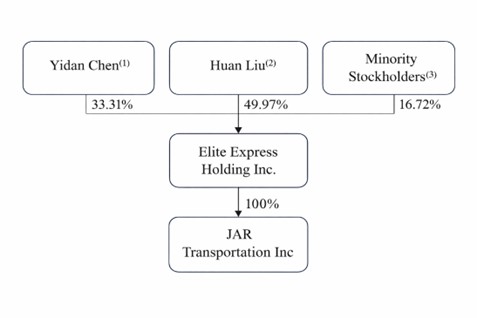
Graphic

Notes: All percentages reflect the voting ownership interests instead of the equity interests held by each of our stockholders given that each holder of shares of Class A common stock is entitled to one vote per share and each holder of shares of Class B common stock is entitled to 15 votes per share.

(1)Represents 1,666,667 shares of Class B common stock held by Yidan Chen, our Chief Executive Officer and Director, as of the date of this annual report.
(2)Represents 2,500,000 shares of Class B common stock held by Huan Liu, our Chairman of the Board of Directors, as of the date of this annual report.

11

Table of Contents

(3)Represents an aggregate of 12,550,005 shares of Class A common stock held by 14 corporate and individual stockholders, each one of which holds less than 5% of our voting ownership interests.

Regulations

Regulations Related to Transportation and Safety

Our package transportation services are regulated by the Department of Transportation (DOT) and its agencies, including the Federal Motor Carrier Safety Administration (FMCSA), the Federal Highway Administration, and the National Highway Traffic Safety Administration. These agencies oversee our delivery business through regulations on operations, safety, insurance, and hazardous materials. Additionally, ground transportation also falls under state regulations with respect to operations, safety, and insurance. The transportation of hazardous materials in the U.S. is subject to regulation by the DOT’s Pipeline and Hazardous Materials Safety Administration.

We also must comply with FMCSA safety and fitness regulations, including those relating to drug and alcohol testing and hours of service for drivers. Such matters as the weight and dimensions of equipment also fall under federal and state regulations.

The Federal Aviation Administration Authorization Act of 1994 limited states’ authority to regulate the rates, routes, or services of most motor carriers. States may now only exercise jurisdiction over safety and insurance. The Company is registered in those states that require registration.

The Postal Reorganization Act of 1970 created the U.S. Postal Service as an independent establishment of the executive branch of the federal government, and created the Postal Rate Commission, an independent agency, to recommend postal rates. The Postal Accountability and Enhancement Act of 2006 amended the 1970 Act to give the re-named Postal Regulatory Commission revised oversight authority over many aspects of the U.S. Postal Service, including postal rates, product offerings and service standards. We sometimes participate in proceedings before the Postal Regulatory Commission in an attempt to facilitate compliance with fair competition requirements for competitive services.

Our transportation is also subject to compliance with cargo-security and transportation regulations issued by the U.S. Department of Homeland Security, including oversight by the Transportation Security Administration in the U.S.

Our transportation vehicles are subject to regulation under the California Vehicle Code. Pursuant to applicable law, we are required to register all vehicles used in our delivery operations and pay the corresponding fees. Any individual operating our vehicles on public highways must hold a valid commercial driver’s license in compliance with legal requirements. Additionally, our vehicles are subject to regulations governing safe operation, including, but not limited to, driver hours of service, equipment standards, fuel containers, fueling procedures, inspection and maintenance requirements, recordkeeping, and accident reporting. Our vehicles must also comply with statutory size and weight restrictions.

We are also subject to regulations enforced by the California Highway Patrol (CHP) concerning vehicle inspections, driver logs, load securement, and overall safety compliance. Pursuant to Title 13 of the California Code of Regulations, our vehicles and related records are subject to inspection by the California Highway Patrol to ensure compliance with applicable safety and operational requirements.

Furthermore, we are subject to California Occupational Safety and Health (Cal/OSHA) regulations, which require compliance with vehicle safety standards, driver protection measures, and ergonomic guidelines. Under these regulations, we are required to provide written notice to employees if they have been or are being exposed to toxic materials or harmful physical agents at concentrations or levels exceeding those permitted by applicable standards, orders, or special orders, along with details of the corrective actions being taken. Additionally, we must ensure that workplaces, storerooms, personal service rooms, and passageways are maintained in a clean, orderly, and sanitary condition.

Regulations Related to Data Privacy

We are subject to laws and regulations relating to privacy and data protection. For example, the California Consumer Privacy Act (CCPA) of 2018, which came into effect in January of 2020, gives California residents data privacy rights, including allowing consumers to opt out of certain data sharing with third parties, and provides an additional cause of action for data breaches. Moreover, the California Privacy Rights Act, which went into effect on January 1, 2023, significantly modified the California Consumer Privacy Act of 2018, and imposed additional data privacy and protection obligations on certain companies doing business in California.

12

Table of Contents

The collection, use, retention, and sharing of consumers’ personal information in connection with our business operations are regulated under the CCPA. Our collection and processing of consumer personal information must align with the reasonable expectations of consumers, as defined under the law. Additionally, we are required to establish and maintain clear and accessible mechanisms for consumers to submit CCPA requests and provide consent. These mechanisms must be designed to be easily understandable and executable, free from misleading language or interactive elements, and without impairing or interfering with the consumer’s ability to make informed choices.

Regulations Related to Environmental Protection

We are subject to federal, state and local environmental laws and regulations across our operations. These laws and regulations cover a variety of matters such as disclosures, operations and processes, including, but not limited to: properly storing, handling and disposing of waste materials; complying with laws regarding clean air, including those governing emissions; protecting against and appropriately responding to spills and releases and communicating the presence of reportable quantities of hazardous materials to local responders.

In October 2023, the California Air Resources Board’s Advanced Clean Fleets (“ACF”) regulation became effective, requiring certain fleets to transition medium- and heavy-duty vehicles to zero-emission vehicles (“ZEVs”) under phased purchase schedules and milestone options. While the regulation provides flexibility, including purchase exemptions under specified conditions, there is no assurance that exemption relief will be granted in all cases. Although certain medium- and heavy-duty ZEVs are certified and available in the market, availability of suitable ZEV replacements for all current fleet vehicles may remain limited, and supporting charging infrastructure may not yet be sufficient across our terminal network to operate a fully electric fleet. We plan to replace several gasoline-powered trucks with EVs and will assess the cost-effectiveness of further ZEV adoption. We also continue to monitor applicable incentives and developments affecting the ACF regulation, including ongoing legal and regulatory actions.

Regulations Related to Labor

Our U.S. employees are covered by the National Labor Relations Act of 1935, as amended (the “NLRA”). Under the NLRA, employees can unionize in small, localized groups, and government-led mediation is not a required step in the negotiation process.

The U.S. Congress has, in the past, considered adopting changes in labor laws that would make it easier for unions to organize units of our employees.

Our employees are also protected under the California Labor Code, which imposes various requirements on employers, including those related to wages, hours, working conditions, and workers’ compensation insurance. We are required to compensate our employees in a timely manner, provide mandated meal and rest periods, and comply with regulations governing minimum wages, working hours, and days of work. Noncompliance with these requirements may result in legal liability. As required by the State of California Department of Industrial Relations, we are required to post information related to wages, hours and working conditions in an area frequented by employees where it may be easily read during the workday.

Additionally, we are subject to the California Occupational Safety and Health Act of 1973, which mandates that we maintain a safe and healthful working environment for all employees. We are required to provide a workplace that meets applicable safety and health standards. Failure by our company, our management, or supervisors to comply with these obligations may result in penalties, fines, or other liabilities.

We are subject to numerous federal, state and local laws and regulations governing employee health and safety. Compliance with changing laws and regulations from time to time could result in materially increased operating costs and capital expenditures, and negatively impact our ability to attract and retain employees.

Available Information

We make our Annual Report on Form 10-K, Quarterly Reports on Form 10-Q, Current Reports on Form 8-K and amendments to those reports filed or furnished pursuant to Section 13(a) or 15(d) of the Securities Exchange Act of 1934, as amended (the “Exchange Act”), available free of charge on our website as soon as reasonably practicable after such materials are filed with or furnished to the Securities and Exchange Commission (“SEC”). To obtain any of this information, go to our investor relations website, https://www.eliteexpressholding.com, and select “SEC Filings”.

13

Table of Contents

Item 1A. Risk Factors

Risks Relating to Our Business and Industry

Our business is heavily dependent on FedEx, making us vulnerable to changes in our relationship with FedEx.

Our business model is heavily dependent on FedEx. For the reporting periods from December 1, 2022, to November 30, 2025, and as of the date of this annual report, FedEx has been our sole customer to which we provided pickup and delivery service. This heavy dependence on FedEx makes our business vulnerable if our relationship with FedEx deteriorates or if FedEx significantly reduces the demand for our service. We are exploring connections with potential customers who require last-mile delivery service, but we have not yet entered into any definitive agreements for securing new customers. The impact of a significant customer on our revenue and profitability can vary based on a number of factors, including: contractual volume amounts; pricing terms; e-commerce or other industry trends, including those related to the holiday season; business combinations and the overall growth of a customer’s underlying business; as well as any disruptions to a customer’s business. A significant customer could choose to divert all or a portion of its business with us to one of our competitors, demand pricing concessions, request enhanced services that increase our costs, or develop its own logistics capabilities that result in a loss of relationship with us. In addition, certain contractual arrangements with a significant customer can increase the vulnerability of our business. For example, we usually enter into contracts with FedEx for a duration of approximately one year and such contracts generally provide that (i) there is no obligation or expectation for entry into a subsequent contract at the expiration of a contract; and (ii) the contract includes certain termination rights of either party upon the occurrence of certain events or without cause by mutual agreement at any time. If all or a portion of our business relationship with a significant customer were to terminate or significantly change, this could materially adversely affect us.

Our revenue recognition and financial reporting depend on information generated by FedEx systems, and limitations in our ability to obtain assurance regarding the completeness and accuracy of that information (including related controls) could adversely affect our business and our SEC reporting.

A substantial majority of our revenue is generated under our Independent Service Provider arrangement with FedEx, and our revenue recognition process depends on information produced and maintained through systems controlled by FedEx. We rely on FedEx-generated reporting and weekly service statements to verify workload activity (such as completed stops and packages handled), confirm pricing components (including certain variable charges and adjustments), and support our billing and collection processes. As a result, the completeness, accuracy, and timeliness of information provided through FedEx systems and related reporting mechanisms can affect the amount and timing of revenue we recognize and may result in revenue adjustments or delays in revenue recognition. If information generated by FedEx systems is incomplete, inaccurate, delayed, or otherwise not available when needed, we could be required to delay revenue recognition, record revenue adjustments, increase reserves, or restate prior period financial statements, any of which could materially adversely affect our business, results of operations, and financial condition.

In addition, because certain information used in our revenue process is generated by systems not controlled by us, our ability to evaluate and rely on that information may depend on our ability to obtain sufficient assurance regarding the controls supporting those systems (including through service organization control reporting, customer-provided information, or alternative procedures). Specifically, we have requested but have not been able to obtain Service Organization Control (SOC) 1 Type I or Type II reports addressing controls over financial reporting at FedEx, or SOC 2 reports addressing security, availability, and confidentiality of FedEx systems. The absence of these reports represents a material internal control deficiency that limits our ability to independently verify the design and operating effectiveness of FedEx’s IT controls over the data used in our revenue recognition process. If we are unable to obtain sufficient assurance on a timely basis, our independent registered public accounting firm may require additional procedures to obtain sufficient appropriate audit evidence, which could increase audit costs, delay completion of our audit, and could adversely affect the timing of our SEC filings. Any failure to maintain effective internal control over financial reporting could also adversely affect investor confidence and the trading price of our securities.

Our business depends on our ability to attract new customers and retain and provide services to our existing customer. Any decline in customer acquisition or retention would harm our business.

Our business depends upon our ability to attract new customers, and maintain and expand our relationship with our existing customer. To retain the business of our only customer FedEx, we have committed to consistently meeting performance metrics and optimizing our operations. See “Item 1. Business—Our Customer” for further details. We need to add new customers to grow our business. If our only customer terminates or does not renew its business relationship with us, or renews its service contract on less favorable terms or

14

Table of Contents

for fewer services, and we do not acquire replacement customers or otherwise grow our customer base, our business and results of operations will be materially and adversely affected.

Our business depends on our ability to provide consistently high-quality services.

Our ability to attract and retain customers is dependent in part on our ability to provide high-quality services. As of the date of this annual report, we adhere to rigorous industrial and contractual standards to ensure our service quality. For example, our employees providing delivery service must satisfy certain appearance, safety, qualification, and other requirements. Our vehicles for the provision of delivery service must satisfy specific size, type, color, and other requirements. See “Item 1. Business—Our Competitive Strengths.” As we continue to grow our business and improve our offerings, we will face challenges related to providing high-quality services at scale, such as heightened risks of theft, loss, damage, destruction, or delay in the handling, transporting, and storing of packages, rude conduct and speeding violations of our drivers, and severe traffic accidents. Any failure to maintain high-quality services, or a market perception that we do not maintain high-quality services, could harm our reputation and adversely affect our ability to scale our business, our financial condition, and results of operations.

We experience significant seasonal fluctuations in our business.

Our business is highly dependent on consumer spending habits. We are susceptible to changes in consumer activity over the course of the calendar year. For example, consumer activity is impacted by sales during holiday seasons. Sales during holiday seasons generally lead to increased volume of online purchases and increased order volume in our services. Our estimated daily operations are 1,100 to 1,700 stops, with around 1,800 to 2,500 packages to be picked up and delivered per day on average. However, during peak seasons, we estimate to make approximately 2,000 stops on a daily basis. See “Item 1. Business—Our Services.” We seek to address seasonality by making advance forecasts and allocating our resources accordingly. Our resource allocation measures may include temporary hiring of additional drivers and flexible routing strategies for delivery. Seasonality has caused and will likely continue to cause fluctuations in our financial results on a quarterly basis. In addition, other seasonal trends may develop and the existing seasonal trends that we experience may become more pronounced and contribute to greater fluctuations in our results of operations as we continue to scale and our growth slows. As such, we may not accurately forecast our results of operations and we may not be able to adjust or plan quickly enough if our revenue is less than expected, causing our results of operations to fail to meet our expectations or the expectations of investors.

If we fail to recruit or retain capable drivers or other qualified employees, we may be unable to maintain our service quality.

We depend on the skills and continued service of capable drivers and other qualified employees for the provision of pickup and delivery service. We regularly hire part-time and seasonal workers. Labor costs are a significant component of our cost structure as of the date of this annual report. See our consolidated financial statements and related notes included elsewhere in this annual report for further details. We must be able to attract, develop and retain skillful and qualified workforce. If we are unable to hire, properly train or retain qualified employees, we could experience decreased service quality, higher labor costs, reduced revenues, regulatory noncompliance, customer losses and diminution of our company culture. Our ability to control labor costs has in the past been, and is expected to continue to be, subject to numerous factors, including labor-related contractual obligations, turnover, training costs, regulatory changes, market pressures, inflation, unemployment levels and healthcare and other benefit costs. While we invest in regular training programs to improve our workforce and offer benefit programs, it may not fully eliminate the risk of employee turnover. Our inability to retain experienced and motivated employees may materially adversely affect us.

Changing fuel and energy prices, and interruptions in supplies of these commodities could materially adversely affect us.

Fuel and energy costs have a significant impact on our operations and account for a material percentage of our cost structure as of the date of this annual report. See our consolidated financial statements and related notes included elsewhere in this annual report for further details. We require significant quantities of fuel for our delivery vehicles and are exposed to the risks associated with variations in the market price for petroleum products, including gasoline. We seek to mitigate our exposure to changing fuel prices through exploring the adoption of electric vehicles to reduce our dependency on fuel. There can be no assurance that this strategy will be effective. If we are unable to maintain or increase our fuel surcharges, higher fuel costs could materially adversely impact our operating results. Even if we are able to offset changes in fuel costs with surcharges, high fuel surcharges may result in an overall reduction in service volume, revenue and profitability. Moreover, we could experience a disruption in energy supplies as a result of weather-related events, natural disasters, political disruptions or wars involving oil-producing countries, economic sanctions imposed against oil-producing countries or specific industry participants, changes in governmental policy concerning fuel production,

15

Table of Contents

transportation, taxes, or marketing, changes in refining capacity, environmental concerns, cyberattacks, public and investor sentiment, or other factors beyond our control, which could have a material adverse effect on us.

Our business involves safety risks and the materialization of such risks will affect our business operations and financial results.

Our business centers around transportation and involves inherent safety risks, which may not be eliminated through implementing the current risk management policies and control measures, such as safety inspections on our vehicles and safety awareness training for our drivers. The provision of delivery service may present risks and dangers, such as improper operation of vehicles, vehicle or equipment failure and other issues arising from driving. The materialization of any of such risks may result in personal injury, business disruption or negative impact on our business.

Our industry is rapidly evolving. We expect to continue to face significant competition, which could materially adversely affect us.

Our industry continues to rapidly evolve, including demands for faster deliveries, increased visibility into shipments, and development of other services. We expect to continue to face significant competition. As of the date of this annual report, we mainly operate and compete in the State of California. We face competition from companies of various operational scales, which include Amazon Logistics, Aramex, DHL, DoorDash, DPD, Grubhub, Postmates, UPS, USPS, and certain regional service providers. New technologies may also create additional sources of competition. Competitors have cost, operational and organizational structures that differ from ours and may offer services or pricing terms that we are not willing or able to offer. Competitors may improve their financial capacity and strengthen their competitive positions as a result of transportation market growth. Business combinations could also result in competitors providing a wider variety of services and products at competitive prices, which could also materially adversely affect us. If we do not appropriately respond to competitive pressures, including replacing any lost volume or maintaining our profitability, we could be materially adversely affected.

Systems failures and technological interruptions could adversely affect our business.

We implement information technology systems to facilitate the provision of our services and to process, transmit, and store information in relation to our operations. For example, we employ software, which provides GPS and route navigation functionality and is developed by third parties and licensed to us, to help optimize delivery routes, particularly during peak seasons. These information technology systems may be vulnerable to interruption due to a variety of events beyond control, including but not limited to, natural disasters, telecommunications failures, computer viruses, hacking and other security issues. Any material interruptions or failures in these information technology systems could cause disruptions in business operations and may require a significant investment to update, remediate or replace with alternate systems. The costs and potential problems associated with supporting, maintaining, remediating and upgrading the existing information technology systems, or with implementing new systems, may severely disrupt our business operations.

We may use AI in our business, and challenges with properly managing its use could result in reputational harm, competitive harm, and legal liability, and adversely affect our results of operations.

We may incorporate AI solutions into our offerings, services, and features, or in support of internal business operations, and these applications may become important in our operations over time. Our competitors or other third parties may incorporate AI into their products more quickly or more successfully than us, which could impair our ability to compete effectively and adversely affect our results of operations. Additionally, if the content, analyses, or recommendations that AI applications assist in producing are or are alleged to be deficient, inaccurate, inappropriate, or biased, or if the use of AI results in, or is alleged to have resulted in, the infringement of the intellectual property of third parties, we may be subject to legal claims or liability and our business, financial condition, and results of operations may be adversely affected. The use of AI applications may result in data leakage or unauthorized exposure of data, including confidential business information, the personal data of end users, or other sensitive information. Such leakage or unauthorized exposure of data related to our use of AI applications could result in legal claims or liability or otherwise adversely affect our reputation and results of operations. AI also presents emerging ethical issues and if our use of AI becomes controversial, we may experience brand or reputational harm, competitive harm, or legal liability. The rapid evolution of AI, including potential government regulation of AI, may require significant resources to develop, test, and maintain our offerings, services, and features to help us implement AI in a manner that complies with applicable laws and regulations and ethically in order to minimize unintended, harmful impact.

16

Table of Contents

We have a limited operating history in an evolving industry, which makes it difficult to evaluate our future prospects and may increase the risk that we will not be successful.

We launched operations on May 27, 2020. We have incurred operating losses in the past. We incurred $208,390 in net loss for the year ended November 30, 2023 (Predecessor), $77,735 in net loss from December 1, 2023 to October 25, 2024 (Predecessor), and $300,703 in net loss from October 26, 2024 to November 30, 2024 (Successor). During the year ended November 30, 2025, we incurred $2,036,926 in net loss. We cannot guarantee that we will generate sufficient revenue to offset our operating costs. If we cannot successfully earn revenue at a rate that exceeds the operational costs associated with our service, we will not be able to achieve or sustain profitability or generate positive cash flow on a sustained basis.

Our limited operating history and our evolving business make it difficult to evaluate our future prospects and the risks and challenges we may encounter. These risks and challenges include our ability to:

accurately forecast our revenue and plan our operating expenses;
increase the number of and retain existing customers;
successfully compete with current and future competitors;
successfully expand our business in existing markets and categories and enter new markets and categories;
successfully integrate acquired technologies and businesses into our own;
anticipate and respond to macroeconomic changes and changes in the markets in which we operate, including with respect to inflation and other fluctuations in prices such as gasoline and fuel costs;
maintain and enhance the value of our reputation and brand;
adapt to rapidly evolving trends in the ways corporate customers and individual consumers interact with technology;
avoid interruptions or disruptions in our service;
develop and maintain a scalable, high-performance infrastructure that can efficiently and reliably handle increased service demand;
hire, integrate, motivate, and retain talented technology, customer service, and other personnel;
effectively manage growth in our personnel and operations; and
effectively manage our costs related to our operations.

If we fail to address the risks and difficulties that we face, including those associated with the challenges listed above as well as those described elsewhere in this “Risk Factors” section, our business, financial condition, and results of operations could be adversely affected. Further, because we have limited historical financial data and operate in a rapidly evolving market, any predictions about our future results of operations may not be as accurate as they would be if we had a longer operating history or operated in a more predictable market. If our assumptions regarding these risks and uncertainties, which we use to plan and operate our business, are incorrect or change, or if we do not address these risks successfully, our business, financial condition, and results of operations could be adversely affected.

If we fail to manage our growth or execute our strategies and future plans effectively, we may not be able to take advantage of market opportunities or meet the demand of our customers.

We expect our business to grow in terms of scale and diversity of operations. In addition, we plan to execute certain growth strategies to strengthen our competitive position, broaden market reach, and enhance operational efficiency. See “Item 1. Business—Growth Strategies.” Such expansions will increase the complexity of our operations and may cause strain on our managerial, operational, and

17

Table of Contents

financial resources. We must continue to hire, train, and effectively manage new employees. The expansion of our services will also require us to maintain consistency in the quality of our services so that our market reputation is not damaged by any deviations in quality, whether actual or perceived.

Our future results of operations also depend largely on our ability to execute our future plans successfully. In particular, our continued growth may subject us to the following additional challenges and constraints:

we face challenges in responding to evolving industry standards and government regulation that impact our business and industry in general;
the technological or operational challenges may arise from the new services;
the execution of our future plans will be subject to the availability of funds to support the relevant capital investment and expenditures; and
the successful execution of our strategies is subject to factors beyond our control, such as general market conditions, and economic and political developments in the United States and globally.

All of these endeavors involve risks and will require significant management, financial, and human resources. We cannot assure you that we will be able to effectively manage our growth or to implement our strategies successfully. There is no assurance that the investment to be made by our Company as contemplated under our future plans will be successful and generate the expected return. Additionally, our revenue is substantially dependent on the pricing structure established by FedEx under our ISP Agreement, including both fixed weekly service charges and activity-based pricing components. FedEx has the unilateral right to adjust these service fees and pricing terms, and such adjustments may have a negative impact on our financial performance. For example, in October 2024, FedEx reduced our weekly fixed service fees by approximately 10.1%. Future reductions in service fees, changes in the revenue mix, or unfavorable modifications to pricing terms could materially reduce our revenue and profitability, and there can be no assurance that we will be able to offset such reductions through operational efficiencies or volume increases. If we are not able to manage our growth or execute our strategies effectively, or at all, or if FedEx implements pricing changes that adversely affect our compensation structure, our business, results of operations, and prospects may be materially and adversely affected.

Our inability to effectively integrate any acquired businesses and realize the anticipated benefits of any acquisitions, joint ventures, strategic alliances or dispositions could materially adversely affect us.

From time to time we may acquire businesses, form joint ventures and strategic alliances, and dispose of operations. See “Item 1. Business.” Whether we realize the anticipated benefits from these transactions depends, in part, upon successful integration between the businesses involved, the performance of the underlying operations, capabilities or technologies and the management of the acquired operations. Accordingly, our financial results could be materially adversely affected by our failure to effectively integrate acquired operations, unanticipated performance or other issues or transaction-related charges.

Any acquisitions and investments that we make could require significant management attention, disrupt our business, result in dilution to our stockholders, and could adversely affect our business, operating results, and financial condition.

Our failure to close transactions with acquisition targets for which we may invest significant time and resources or other potential acquisition targets could have a material adverse effect on our financial condition and cash flows. In addition, even if consummated, the anticipated benefits of any acquisition or investment may not be realized, and we may be exposed to unknown risks, any of which could adversely affect our business, results of operations and financial condition, including risks arising from:

ineffectiveness or incompatibility of acquired businesses or services;
potential loss of key employees of the acquired business;
inability to maintain key business relationships and reputation of the acquired business;
diversion of management attention from other business concerns;

18

Table of Contents

litigation arising from the acquisition or the activities of the acquired business, including claims from terminated employees, customers, former stockholders or other third parties;
assumption of contractual obligations that contain terms that are not beneficial to us, require us to license or waive intellectual property rights, or increase our risk of liability;
complications in the integration of acquired businesses or diminished prospects;
failure to generate the expected financial results related to an acquisition on a timely manner or at all; and
failure to accurately forecast the impact of an acquisition transaction, and implementation or remediation of effective controls, procedures, and policies for acquired businesses.

To fund any future acquisitions, we may pay cash or issue additional shares of our Class A common stock or securities convertible into or exchangeable for shares of our Class A common stock, which could dilute our stockholders or diminish our cash reserves. Borrowing to fund any acquisitions would result in increased fixed obligations and could also subject us to covenants or other restrictions that could limit our ability to effectively run our business.

If we are unable to secure sufficient financing when needed, our ability to execute our business plan as outlined in this annual report will be impaired, which may negatively impact our business and prospects.

Sustaining our ongoing operations and propelling future growth requires a significant investment in capital assets, coupled with sufficient working capital. In particular, as a growing company, we expect to require additional capital to finance our operations, make strategic investments, or respond to market conditions. There can be no assurance that we will be able to obtain the necessary financing to support our growth plans on favorable terms or at all. Factors beyond our control, such as unfavorable market conditions, general economic downturns, or investor sentiment, may make it challenging for us to secure additional funding. In the event we are unable to obtain additional financing, we may have to significantly limit, or even terminate, our primary operations, or delay, reduce, or eliminate certain of our planned operations, resulting in a complete loss of investment for our stockholders. Our inability to obtain financing on acceptable terms when needed may have a material adverse effect on our business, results of operations, financial condition, and prospects.

Our business could be disrupted by catastrophic events.

Occurrence of any catastrophic event, including pandemics such as COVID-19, earthquake, fire, flood, tsunami, climate change, or other weather event, power loss, telecommunications failure, software or hardware malfunctions, cyberattacks, war or terrorist attacks, could result in lengthy interruptions in our services. In addition, acts of terrorism could cause disruptions to the internet, the electric grid or the economy as a whole. If the transportation routes or supply chains were to be negatively impacted as a result of a natural disaster or other catastrophic event, our ability to deliver our services to our customers would be impaired. If we are unable to develop adequate plans to ensure that our business functions continue to operate during and after a disaster and to execute successfully on those plans in the event of a disaster or emergency, our business could be harmed.

Our business and results of operations may be harmed by the misconduct of authorized employees that have access to important assets of our Company such as bank accounts and confidential information.

During the course of our business operations, some of our employees have access to certain valuable assets of our Company, such as bank accounts and confidential information. In the event of misconduct by such authorized employees, our Company could suffer significant losses. Employee misconduct may include misappropriating bank accounts, falsifying bank records, improper use or disclosure of confidential information to the public or our competitors, and failure to comply with our internal policies or with federal or state laws or regulations regarding the use and safeguarding of classified or other protected information, and any other applicable laws or regulations. Although we have implemented policies, procedures, and controls to regulate employee conduct, these precautions may not prevent all intentional or negligent misconduct, and as a result, we could face unknown risks or losses. Furthermore, such unethical, unprofessional, or even criminal behavior by employees could damage our reputation, result in fines, penalties, restitution, or other damages, and lead to the loss of current and future customers, all of which would adversely affect our business, financial condition, and results.

19

Table of Contents

We may be the subject of detrimental conduct by third parties, which could have a negative impact on our reputation.

We may be the target of anti-competitive, harassing, or other detrimental conduct by third parties including our competitors. Such conduct may include complaints, anonymous or otherwise, to regulatory agencies regarding our operations, accounting, business relationships, business prospects, and business ethics. Additionally, anyone may post false allegations online against us on an anonymous basis. We may be subject to government or regulatory investigation as a result of such third-party conduct and may be required to expend significant time and incur substantial costs to address such third-party conduct, and there can be no assurance that each of the allegations will be refuted conclusively within a reasonable period of time, or at all. Our business may also be materially negatively affected as a result of such public dissemination of anonymous allegations or malicious statements.

If we fail to attract, recruit, or retain our key personnel, including our executive officers, senior management, and key employees, our ongoing operations and growth could be affected.

Our success depends, to a large extent, on the efforts of our key personnel, including our executive officers, senior management, and other key employees who have valuable experience, knowledge, and connections in our industry. There is no assurance that these key personnel will not voluntarily terminate their employment with us. We have purchased the directors’ and officers’ liability insurance. The loss of any of our key personnel could be detrimental to our ongoing operations. Our success will also depend on our ability to attract and retain qualified personnel to manage our existing operations as well as our future growth. We may not be able to successfully attract, recruit, or retain key personnel, and this could adversely impact our financial condition, operating results, and business prospects.

Certain of the Company’s executive officers work with other companies and organizations and such other positions may create conflicts of interest in the future.

Some of the Company’s executive officers are subject to potential conflicts of interest due to their management, advisory or directorship positions with other companies or organizations. For example, Ms. Yidan Chen, our Chief Executive Officer, has agreed to devote approximately 40 hours per week to the Company’s business, but will devote as much time as necessary in excess of 40 hours. Ms. Yidan Chen also works part-time in a consulting or advisory capacity for SYC Properties LLC for approximately 2 to 3 hours per week. While we believe that the Company will not encounter any issue as a result of such additional roles or responsibilities, the duties to such businesses or organizations may compete for such persons’ full attention to the Company’s business; accordingly, they may have conflicts of interest in allocating time between the separate business activities.

The external commitments and any future commitments of our officers to other companies may potentially divert time and attention away from the strategic and operational needs of our Company. Their divided focus could lead to delays in decision-making, hinder effective communication within our organization, give rise to potential conflicts of interest, and introduce a divergence in priorities, consequently impacting the overall efficacy of leadership. Additionally, the potential for conflicting interests arising from commitments to multiple entities may pose challenges in aligning those officers’ priorities with the long-term goals and interests of our Company, thereby introducing an element of uncertainty and potential disruption to our operations. We acknowledge and will address these complexities as needed to ensure that our officers effectively balance their responsibilities and fulfill their commitments to our Company while maintaining transparency and integrity in their various roles. Failure to do so may adversely affect our business, financial conditions, and results of operations.

We may not maintain adequate insurance, which could expose us to significant costs and business disruption.

We maintain certain insurance policies to safeguard against risks and unexpected events. See “Item 1. Business—Insurance.” However, there can be no assurance that such insurance coverage will always be available or will always be sufficient to cover any damages resulting from any kind of claims. In addition, there are certain types of risks that may not be covered by our insurance policies, such as war, force majeure events, or certain business interruptions. Claims that are not covered by the policies or the failure to renew the insurance policies may materially adversely affect our business, financial condition, and results of operations.

Legal, Regulatory, and Compliance Risks

We are exposed to potential regulatory and compliance risks.

Our operations are subject to various regulatory and safety requirements. For example, we are subject to complex and stringent transportation, environmental, security, labor, employment, safety, privacy, disclosure and data protection and other governmental

20

Table of Contents

laws, regulations and policies, at the federal, state and local levels. Non-compliance or changes in these regulations, including those affecting transportation, labor practices, or environmental standards, could result in legal liabilities, fines, or disruptions to our services.

Our business is subject to complex and evolving laws and regulations regarding data protection.

There has recently been heightened regulatory and enforcement focus relating to the collection, use, retention, transfer, and processing of personal data in the U.S. (at both the state and federal level), including the California Privacy Rights Act, and other similar laws that have been or will be enacted by other jurisdictions. In addition, in the U.S., there has been increased legislative and regulatory activity related to AI and the risks and challenges AI poses. An actual or alleged failure to comply with applicable U.S. data protection laws, regulations, or other data protection standards may expose us to litigation (including, in some instances, class action litigation), fines, sanctions, or other penalties, which could harm our reputation and adversely affect our business, results of operations, and financial condition. This regulatory environment is increasingly challenging, based on discretionary factors, and difficult to predict. Consequently, compliance with all applicable regulations at the federal, state and local levels may present material obligations and risks to our business, including significantly expanded compliance burdens, costs, and enforcement risks; require us to make extensive system or operational changes; or adversely affect the cost or attractiveness of the services we offer. All of these evolving compliance and operational requirements, as well as the uncertain interpretation and enforcement of laws, impose significant costs and regulatory risks that are likely to increase over time.

We may be affected by global climate change or by legal, regulatory, or market responses to such change.

Concern over climate change, including the effect of global warming, has led to significant U.S. legislative and regulatory efforts to limit greenhouse gas (“GHG”) emissions, including our vehicle engine emissions. Increasingly, state and local governments are also considering environmental-related regulatory and reporting requirements. Compliance with such regulation and the associated potential cost is complicated by the fact that various regions are following different approaches to the regulation and reporting of climate change and other environmental matters. Increased regulation and reporting obligations regarding GHG emissions, especially vehicle engine emissions, could impose substantial taxes, fees, and other costs on us. These include an increase in the cost of the fuel and other energy we may purchase, investments required to obtain electricity capacity, and capital and impairment costs associated with updating or replacing our vehicles or infrastructure prematurely. Until the timing, scope, and extent of such possible regulation becomes known, we cannot predict its effect on our cost structure or our operating results. It is reasonably possible, however, that it could materially increase our operating expenses and have an adverse direct or indirect effect on our business, if instituted.

We may also incur additional expenses as a result of U.S. regulators requiring additional disclosures regarding GHG emissions and other environmental matters. Moreover, even without such regulation, increased awareness and any adverse publicity in the marketplace about the GHGs emitted by companies in the transportation industries could harm our reputation, reduce customer demand for our services, and increase our liability.

We maintain significant physical operations. Increases in operational security requirements impose substantial costs on us and we could be the target of an attack or have a security breach, which could materially adversely affect us.

As a result of concerns about global terrorism and homeland security, various levels of the U.S. governments have adopted and may adopt additional heightened security requirements, resulting in significantly increased operating costs. Regulatory and legislative requirements may change periodically in response to evolving threats. We cannot determine the effect that any new requirements will have on our operations, cost structure or operating results, and new rules or other future security requirements may significantly increase our operating costs and reduce operating efficiencies. Regardless of our compliance with security requirements or our own security measures, we could also be the target of an attack or security breaches could occur, which could materially adversely affect one or more of our operations, or our business.

Non-compliance with laws and regulations on the part of any third parties with which we conduct business could expose us to legal expenses, compensation to third parties, penalties, and disruptions of our business, which may adversely affect our results of operations and financial performance.

Customers or other third parties with which we conduct business may be subject to regulatory penalties or punishments because of their regulatory compliance failures or infringement upon other parties’ legal rights, which may, directly or indirectly, disrupt our business. We cannot be certain whether such third parties have violated any regulatory requirements or infringed or will infringe any other parties’ legal rights, which could expose us to legal expenses or compensation to third parties, or both.

21

Table of Contents

We, therefore, cannot rule out the possibility of incurring liabilities or suffering losses due to any non-compliance by third parties. There is no assurance that we will be able to identify irregularities or non-compliance in the business practices of third parties with which we conduct business, or that such irregularities or non-compliance will be corrected in a prompt and proper manner. Any legal liabilities and regulatory actions affecting third parties involved in our business may affect our business activities and reputation, and may in turn affect our business, results of operations, and financial performance.

Moreover, regulatory penalties or punishments against our business stakeholders such as third-party service providers, whether or not resulting in any legal or regulatory implications upon us, may nonetheless cause business interruptions or even suspension of these business stakeholders, which could in turn disrupt our usual course of business and result in material negative impact on our business operations, results of operation and financial condition.

We may from time to time be subject to claims, controversies, lawsuits, and legal proceedings, which could adversely affect our business, prospects, results of operations, and financial condition.

From time to time, we may be involved in various claims, controversies, lawsuits, legal proceedings, or regulatory inquiries that arise in the ordinary course of business involving labor and employment, wage and hour, and other matters. See “Item 3. Legal Proceedings.” We expect that the number and significance of these potential disputes or claims may increase as our business expands and our Company grows larger. Contractual provisions and insurance coverage may not cover potential claims and may not be adequate to indemnify us for all liabilities we may face. Any claims against us, whether meritorious or not, could be time consuming, result in costly litigation, require significant amounts of management time, and result in the diversion of significant operational resources. Litigation is inherently unpredictable, and the results of any claims may have a material adverse effect on our business, financial condition, results of operations, and prospects. In addition, negative publicity regarding claims or judgments made against our Company may damage our reputation and may result in a material adverse impact on us.

We are subject to various U.S. anti-corruption laws, and any failure to comply with such laws, and any laws to which we may become subject, whether in existence now or hereafter, could harm our business, financial condition, and results of operations.

We are subject to various U.S. anti-corruption laws, such as the U.S. Foreign Corrupt Practices Act of 1977, as amended (the “FCPA”), as well as other similar anti-bribery and anti-kickback laws and regulations. These laws and regulations generally prohibit companies and their employees and intermediaries, from directly or indirectly authorizing, offering, or providing improper payments or benefits to government officials and other recipients for improper purposes. The FCPA also requires public companies to make and keep books and records that accurately and fairly reflect the transactions of the corporation and to devise and maintain an adequate system of internal accounting controls. We anticipate that our exposure for violating these laws will increase as we continue to expand our presence, and any failure to comply with such laws could harm our business, financial condition, and results of operations.

Provisions in our Bylaws could limit our stockholders’ ability to obtain a favorable judicial forum for disputes with us or our directors, officers or employees.

Our Bylaws provide that, unless we consent in writing to the selection of an alternative forum, the federal district courts of the United States of America shall be the sole and exclusive forum for the resolution of any complaint asserting a cause of action arising under the Securities Act. Any person or entity purchasing or otherwise acquiring any interest in any of our securities shall be deemed to have notice of and to have consented to this provision.

Under the Securities Act, federal and state courts have concurrent jurisdiction over all suits brought to enforce any duty or liability created by the Securities Act. We believe the forum selection provision in our Bylaws may benefit us by providing increased consistency in the application of federal securities laws by judges, particularly experienced in resolving corporate disputes, efficient administration of cases on a more expedited schedule relative to other forums and protection against the burdens of multi-forum litigation. However, this provision may have the effect of discouraging lawsuits against us and/or our directors, officers and employees as it may limit any stockholder’s ability to bring a claim in a judicial forum that such stockholder finds favorable for disputes with us or our directors, officers or employees. The enforceability of similar choice of forum provisions in other companies’ charter documents has been challenged in legal proceedings, and it is possible that, in connection with any applicable action brought against us, a future court could find the choice of forum provision contained in our Bylaws to be inapplicable or unenforceable in such action. If a court were to find the choice of forum provision contained in our Bylaws to be inapplicable or unenforceable in an action, we may incur additional costs associated with resolving such action in other jurisdictions, which could adversely affect our business, financial condition or results of operations. Furthermore, investors cannot waive compliance with the federal securities laws and rules and regulations promulgated thereunder.

22

Table of Contents

Trading Risks

We are not currently in compliance with Nasdaq’s minimum bid price requirement, and if we fail to regain compliance, our common stock may be delisted from The Nasdaq Capital Market, which could materially and adversely affect the market price and liquidity of our common stock and our ability to raise capital.

On October 31, 2025, we received a notification letter from the Listing Qualifications Department of The Nasdaq Stock Market LLC (“Nasdaq”) informing us that, for the prior 30 consecutive business days, the closing bid price of our Class A common stock was below $1.00 per share, which is the minimum closing bid price required for continued listing on The Nasdaq Capital Market pursuant to Nasdaq Listing Rule 5550(a)(2). Although the notice has no immediate effect on the listing of our common stock, our continued listing is subject to our compliance with Nasdaq’s listing requirements.

In accordance with Nasdaq Listing Rule 5810(c)(3)(A), we have been provided a compliance period of 180 calendar days, until April 29, 2026, to regain compliance with the minimum bid price requirement. To regain compliance, the closing bid price of our common stock must be at least $1.00 per share for a minimum of 10 consecutive business days, unless Nasdaq staff exercises its discretion to require a longer period.

If we do not regain compliance during this compliance period, we may be eligible for an additional 180-day period to regain compliance, provided that we meet the applicable market value of publicly held shares requirement and all other applicable initial listing standards for The Nasdaq Capital Market, other than the minimum bid price requirement, and notify Nasdaq of our intent to cure the deficiency, including by effecting a reverse stock split if necessary. There can be no assurance that we will be eligible for, or granted, any additional compliance period, or that we will be able to regain compliance within the applicable timeframes.

If we fail to regain compliance with the minimum bid price requirement within the applicable compliance periods, including any extensions that may be granted, our common stock would be subject to delisting from Nasdaq. A delisting could materially and adversely affect the market price and liquidity of our common stock, limit investors’ ability to trade our securities, reduce analyst coverage and institutional investor interest, and impair our ability to raise additional capital. If our common stock were delisted, it may trade on an over-the-counter market, where trading may be more limited and quotations less reliable, which could further adversely affect the value and liquidity of our common stock.

The price of our Class A common stock could be subject to rapid and substantial volatility.

There have been instances of extreme stock price run-ups followed by rapid price declines and strong stock price volatility with recent initial public offerings, especially among those with relatively smaller public floats. As a relatively small-capitalization company with a relatively small public float, we may experience greater stock price volatility, extreme price run-ups, lower trading volume, and less liquidity than large-capitalization companies. In particular, our Class A common stock may be subject to rapid and substantial price volatility, low volumes of trades, and large spreads in bid and ask prices. Such volatility, including any stock run-ups, may be unrelated to our actual or expected operating performance and financial condition or prospects, making it difficult for prospective investors to assess the rapidly changing value of our Class A common stock.

In addition, if the trading volumes of our Class A common stock are low, persons buying or selling in relatively small quantities may easily influence the price of our Class A common stock. This low volume of trades could also cause the price of our Class A common stock to fluctuate greatly, with large percentage changes in price occurring in any trading day session. Holders of our Class A common stock may also not be able to readily liquidate their investment or may be forced to sell at depressed prices due to low volume trading. Broad market fluctuations and general economic and political conditions may also adversely affect the market price of our Class A common stock. As a result of this volatility, investors may experience losses on their investment in our Class A common stock. A decline in the market price of our Class A common stock also could adversely affect our ability to issue additional shares of Class A common stock or other of our securities and our ability to obtain additional financing in the future. No assurance can be given that an active market in our Class A common stock will develop or be sustained. If an active market does not develop, holders of our Class A common stock may be unable to readily sell the shares of Class A common stock they hold or may not be able to sell at all.

23

Table of Contents

Our Certificate of Incorporation and Bylaws, as well as Delaware law, contain provisions that could discourage acquisition bids or merger proposals, which may adversely affect the market price of our Class A common stock and could deprive our investors of the opportunity to receive a premium for their shares.

Our Certificate of Incorporation authorizes our board of directors to issue preferred stock without stockholder approval in one or more series, designate the number of shares constituting any series, and fix the rights, preferences, privileges and restrictions thereof, including dividend rights, voting rights, rights and terms of redemption, redemption price or prices and liquidation preferences of such series. If our board of directors elects to issue preferred stock, it could be more difficult for a third party to acquire us. In addition, some provisions of our Certificate of Incorporation and Bylaws could make it more difficult for a third party to acquire control of us, even if the change of control would be beneficial to our stockholders. These provisions include:

providing that all vacancies, including newly created directorships, may, except as otherwise required by law or, if applicable, the rights of holders of a series of preferred stock, only be filled by the affirmative vote of a majority of directors then in office;
permitting special meetings of our stockholders to be called only by our Chief Executive Officer, the chairman of our board of directors and our board of directors pursuant to a resolution adopted by the affirmative vote of a majority of the total number of authorized directors whether or not there exist any vacancies in previously authorized directorships;
subject to the rights of the holders of shares of any series of our preferred stock, requiring the affirmative vote of the holders of at least a majority in voting power of all then outstanding common stock entitled to vote generally in the election of directors, voting together as a single class, to remove any of all of the directors from office at any time;
prohibiting cumulative voting in the election of directors;
establishing advance notice provisions for stockholder proposals and nominations for elections to our board of directors to be acted upon at meetings of stockholders; and
providing that our board of directors is expressly authorized to adopt, or to alter or repeal our Bylaws.

Anti-takeover provisions in our articles of incorporation and Bylaws and under Delaware law could prevent or delay an acquisition of us, which may be beneficial to our stockholders, and may prevent attempts by our stockholders to replace or remove our current management.

If we fail to implement and maintain an effective system of internal controls, we may fail to meet our reporting obligations or be unable to accurately report our results of operations or prevent fraud, and investor confidence and the market price of our Class A common stock may be materially and adversely affected.

Prior to the Company’s initial public offering in August 2025 (the “IPO”), we were a private company with limited accounting personnel and other resources with which to address our internal controls and procedures. Our management has not completed an assessment of the effectiveness of our internal controls over financial reporting, and our independent registered public accounting firm has not conducted an audit of our internal control over financial reporting. In the course of auditing our consolidated financial statements for the years ended November 30, 2024, we identified a material weakness in our internal control over financial reporting and other control deficiencies as of November 30, 2024. A “material weakness” is a deficiency, or a combination of deficiencies, in internal control over financial reporting, such that there is a reasonable possibility that a material misstatement of the company’s annual or interim financial statements will not be prevented or detected on a timely basis. The material weakness identified to date relate to the Company’s lack of an internal review function to monitor the control execution, which may lead to material audit adjustments to the financial statements.

Following the identification of this material weakness, we plan to take remedial measures including (i) setting up additional financial procedures and entity-level controls as well as engaging an external consulting firm as necessary to assist us with the assessment of Sarbanes-Oxley compliance requirements and improvement of overall internal control; and (ii) appointing independent directors and strengthening corporate governance.

Specifically, upon our IPO, we assembled a core finance team consisting of a Chief Financial Officer and a financial controller, both of whom possess deep expertise in U.S. GAAP and rich experience in accounting for U.S. public companies. During this fiscal year,

24

Table of Contents

we experienced certain personnel changes within our finance function, including the resignation of the Chief Financial Officer and select other finance team members. These personnel changes create potential risks to the effectiveness of the Company’s internal control over financial reporting (“ICFR”), including risks related to the consistent application of accounting policies, the timely and accurate execution of financial reporting processes, and the seamless handoff of key financial oversight responsibilities. Notwithstanding the personnel changes, our finance team continues to include personnel holding Certified Public Accountant (“CPA”) credentials and other highly experienced financial professionals with deep knowledge of the Company’s accounting policies, financial reporting processes, and compliance requirements under US GAAP and SEC rules. The Company has taken proactive measures to mitigate the risks, including the formal reassignment of key finance responsibilities, the implementation of enhanced cross-reviews of financial reporting outputs, and the reinforcement of documented accounting and financial reporting procedures. To date, these personnel changes have not had a material adverse impact on the effectiveness of our ICFR, In parallel, the Company’s finance team is also in the process of developing and implementing financial procedures and entity-level controls designed to achieve and maintain effective internal control over financial reporting. These efforts include the design and execution of robust financial closing policies and procedures, as well as the institution of an effective internal review process. To further strengthen our financial reporting function and control framework, the Company plans to implement additional remedial measures as necessary, including (i) enhancing U.S. GAAP accounting and financial reporting training for its accounting and financial reporting personnel; (ii) hiring more qualified accounting personnel with relevant U.S. GAAP and SEC reporting experience, and (iii) engaging an external consulting firm to assist our assessment of Sarbanes-Oxley compliance requirements and improvement of our overall internal control.

In addition, Mr. Huaqin He, one of our three independent directors, is a professor at the College of Life Sciences of Fujian Agriculture and Forestry University with a major expertise in data analytics and systematic research, which can support the Company’s development in digital logistics, operational optimization, and technology-driven decision-making. Another independent director, Ms. Huanhuan Tian, has extensive experience in financial management, auditing, IPO preparation, and corporate compliance.

Implementation of these measures may not fully address the material weakness in our internal control over financial reporting. Our failure to correct the material weakness or our failure to discover and address any other material weaknesses or control deficiencies could result in inaccuracies in our financial statements and could also impair our ability to comply with applicable financial reporting requirements and related regulatory filings on a timely basis. As a result, our business, financial condition, results of operations, and prospects, as well as the trading price of our Class A common stock, may be materially and adversely affected. Moreover, ineffective internal control over financial reporting significantly hinders our ability to prevent fraud.

We are a public company in the United States subject to the Sarbanes-Oxley Act of 2002. Section 404 of the Sarbanes-Oxley Act of 2002 will require that we include a report of management on our internal control over financial reporting in our annual report on Form 10-K beginning with our annual report for the fiscal year ending November 30, 2025. However, our auditors will not be required to formally attest to the effectiveness of our internal control over financial reporting pursuant to Section 404 until we are no longer a smaller reporting company. Our management may conclude that our internal control over financial reporting is not effective. Moreover, even if our management concludes that our internal control over financial reporting is effective, our independent registered public accounting firm, after conducting its own independent testing, may issue a report that is qualified, if it is not satisfied with our internal controls or the level at which our controls are documented, designed, operated, or reviewed, or if it interprets the relevant requirements differently from us. In addition, after we become a public company, our reporting obligations may place a significant strain on our management, operational, and financial resources and systems for the foreseeable future. We may be unable to complete our evaluation testing and any required remediation in a timely manner.

We will incur substantial increased costs as a result of being a public company.

As a public company, we will incur significant legal, accounting, and other expenses as a public company that we did not incur as a private company. These additional costs could negatively affect our financial results. The Sarbanes-Oxley Act of 2002, as well as rules subsequently implemented by the SEC and Nasdaq, impose various requirements on the corporate governance practices of public companies.

Compliance with these laws, rules, and regulations increases our legal and financial compliance costs and makes some corporate activities more time-consuming and costlier. These laws, regulations, and standards are subject to varying interpretations and, as a result, their application in practice may evolve over time as new guidance is provided by regulatory and governing bodies. We intend to invest resources to comply with evolving laws, regulations, and standards, and this investment may result in increased general and administrative expenses and a diversion of management’s time and attention from revenue-generating activities to compliance activities. In addition, we will incur additional costs associated with our public company reporting requirements. It may also be more difficult for us to find qualified persons to serve on our board of directors or as executive officers.

25

Table of Contents

We are an “emerging growth company,” as defined in the JOBS Act and will remain an emerging growth company until the earlier of (1) the last day of the fiscal year (a) following the fifth anniversary of the completion of the IPO, (b) in which we have total annual gross revenue of at least $1.235 billion, or (c) in which we are a large accelerated filer, which means the market value of our Class A common stock that is held by non-affiliates exceeds $700 million as of the prior May 31, and (2) the date on which we have issued more than $1.0 billion in non-convertible debt during the prior three-year period. An emerging growth company may take advantage of specified reduced reporting and other requirements that are otherwise applicable generally to public companies. These provisions include exemption from the auditor attestation requirement under Section 404 in the assessment of the emerging growth company’s internal control over financial reporting and permission to delay adopting new or revised accounting standards until such time as those standards apply to private companies.

After we are no longer an “emerging growth company,” or until five years following the completion of our initial public offering, whichever is earlier, we expect to incur significant additional expenses and devote substantial management effort toward ensuring compliance with the requirements of Section 404 and the other rules and regulations of the SEC. For example, as a public company, we have been required to increase the number of independent directors and adopt policies regarding internal controls and disclosure controls and procedures.

We are currently evaluating and monitoring developments with respect to these rules and regulations, and we cannot predict or estimate with any degree of certainty the amount of additional costs we may incur or the timing of such costs.

We may not be able to maintain the listing of our Class A common stock on The Nasdaq Capital Market.

Although our shares of Class A common stock are approved for listing on The Nasdaq Capital Market, there can be no assurance that we will be able to maintain the listing standards of that exchange, which includes requirements that we maintain our stockholders’ equity, total value of shares of Class A common stock held by unaffiliated stockholders, and market capitalization above certain specified levels. If we fail to conform to the Nasdaq listing requirements on an ongoing basis, our Class A common stock might cease to trade on The Nasdaq Capital Market, and may move to the OTCQB or OTC Pink Markets operated by OTC Markets Group, Inc. These quotation services are generally considered to be markets that are less efficient and that provide less liquidity in the shares of Class A common stock than The Nasdaq Capital Market.

If securities or industry analysts do not publish research or reports about our business, or if they publish a negative report regarding our Class A common stock, the price of our Class A common stock and trading volume could decline.

Any trading market for our Class A common stock may depend in part on the research and reports that industry or securities analysts publish about us or our business. We do not have any control over these analysts. If one or more of the analysts who cover us downgrade us, the price of our Class A common stock would likely decline. If one or more of these analysts cease coverage of our Company or fail to regularly publish reports on us, we could lose visibility in the financial markets, which could cause the price of our Class A common stock and the trading volume to decline.

The dual-class structure of our common stock has the effect of concentrating voting control with those stockholders who hold our Class B common stock. This ownership will limit or preclude your ability to influence corporate matters, including the election of directors, amendments to our organizational documents, and a change in control, merger, consolidation, sale of all or substantially all of our assets, or other major corporate transactions requiring shareholder approval.

Our Class B common stock has fifteen votes per share, and our Class A common stock has one vote per share. Our chairman of the Board of Directors, Mr. Huan Liu, and our Chief Executive Officer and Director, Ms. Yidan Chen collectively hold all of the issued and outstanding shares of our Class B common stock. Mr. Huan Liu and Ms. Yidan Chen each holds approximately 33.31% and 49.97% of the voting power of our outstanding capital stock, respectively, and together they hold approximately 83.28% of the voting power of our outstanding capital stock. Therefore, Mr. Huan Liu and Ms. Yidan Chen, individually or together, are able to exert significant influence on matters requiring stockholder approval. This includes the election of directors, amendments to our organizational documents, and approval of major corporate transactions such as a change in control, merger, consolidation, or the sale of assets. They may, individually or together, have interests that differ from yours and may vote in a way with which you disagree and which may be adverse to your interests. This concentrated control may have the effect of delaying, preventing, or deterring a change in control of our Company, could deprive our stockholders of an opportunity to receive a premium for their capital stock as part of a sale of our Company and might ultimately affect the market price of our Class A common stock.

26

Table of Contents

Our Bylaws provide that the affirmative vote of a majority of the voting power of shares present in person or represented by proxy at a stockholders’ meeting and entitled to vote on a matter generally shall be the act of the stockholders, except under certain specified circumstances and except as otherwise provided by applicable law, the rules and regulations of any stock exchange applicable to the Company or our Certificate of Incorporation. Future transfers by the holders of Class B common stock will generally result in those shares converting into shares of Class A common stock, subject to limited exceptions, such as certain transfers effected for estate planning or charitable purposes. As long as Mr. Huan Liu and Ms. Yidan Chen, individually or collectively, hold more than 50% of the voting power of the company, they will continue to control the outcome of matters submitted to stockholders for approval. For information about our dual-class structure of our common stock, see the section titled “Description of Share Capital.”

We are an “emerging growth company” and a “smaller reporting company” under the JOBS Act, and we cannot be certain if the reduced disclosure requirements applicable to emerging growth companies and smaller reporting companies will make our Class A common stock less attractive to investors.

We are an “emerging growth company” and a “smaller reporting company” as defined in the JOBS Act, and we may take advantage of certain exemptions from various reporting requirements that are applicable to other public companies that are not “emerging growth companies” and “smaller reporting companies” including, but not limited to, not being required to comply with the auditor attestation requirements of Section 404 of the Sarbanes-Oxley Act, reduced disclosure obligations regarding executive compensation in our periodic reports and proxy statements, and exemptions from the requirements of holding a nonbinding advisory vote on executive compensation and stockholder approval of any golden parachute payments not previously approved.

In addition, Section 107 of the JOBS Act also provides that an “emerging growth company” can take advantage of the extended transition period provided in Section 7(a)(2)(B) of the Securities Act for complying with new or revised accounting standards. In other words, an “emerging growth company” can delay the adoption of certain accounting standards until those standards would otherwise apply to private companies. We have elected to take advantage of the extended transition period for complying with new or revised accounting standards.

We will remain an “emerging growth company” until the last day of the fiscal year following the fifth anniversary of the date of the first sale of our Class A common stock pursuant to an effective registration statement under the Securities Act, although we will lose that status sooner if our revenue exceeds $1.235 billion, if we issue more than $1 billion in non-convertible debt in a three-year period, or if the market value of our Class A common stock that is held by non-affiliates exceeds $700 million as of the last day of our most recently completed second fiscal quarter.

We may continue to be a smaller reporting company even after we are no longer an emerging growth company. We may take advantage of certain of the scaled disclosures available to smaller reporting companies and will be able to take advantage of these scaled disclosures for so long as (i) the market value of our Class A common stock held by non-affiliates is equal to or less than $250 million as of the last business day of the most recently completed second fiscal quarter, or (ii) our annual revenue is equal to or less than $100 million during the most recently completed fiscal year and the market value of our Class A common stock held by non-affiliates is equal to or less than $700 million as of the last business day of the most recently completed second fiscal quarter.

We cannot predict if investors will find our Class A common stock less attractive because we may rely on these exemptions. If some investors find our Class A common stock less attractive as a result, there may be a less active trading market for our Class A common stock and our stock price may be more volatile. In addition, taking advantage of reduced disclosure obligations may make comparison of our financial statements with other public companies difficult or impossible. If investors are unable to compare our business with other companies in our industry, we may not be able to raise additional capital as and when we need it, which may materially and adversely affect our financial condition and results of operations.

Item 1B. Unresolved Staff Comments.

None.

Item 1C. Cybersecurity.

Risk Management and Strategy

We have implemented processes for assessing, identifying and managing material risks from cybersecurity threats and monitoring the prevention, detection, mitigation and remediation of material cybersecurity incidents. We assess risks arising from cybersecurity

27

Table of Contents

threats against our information systems that may result in adverse effects on our information systems or any information residing therein. We conduct periodic assessments to identify such cybersecurity threats.

Following these risk assessments, we re-design, implement, and maintain reasonable safeguards to mitigate identified risks and reasonably address any identified gaps in existing safeguards. We regularly monitor and test our safeguards and regularly conduct training for our employees on these safeguards in collaboration with the administrative department and management. Primary responsibility for assessing, monitoring and managing our cybersecurity risks rests with our IT department, which manages the risk assessment and mitigation process.

As of the date of this annual report, we have not experienced any material cybersecurity incidents or identified any material cybersecurity threats that have affected or are reasonably likely to materially affect us, our business strategy, results of operations or financial condition.

Governance

Our Company’s Board of Directors has oversight responsibility for the Company’s overall risk management, including cybersecurity risks, and has not delegated oversight authority for cybersecurity risks to any committee. Our management, led by our Chief Executive Officer and Chief Financial Officer, is responsible for assessing, identifying and managing material cybersecurity risks and threats to our Company and the prevention, mitigation and remediation of material cybersecurity incidents and risks. Our Chief Executive Officer, as the management representative, reports to the Board of Directors on an annually basis with respect to the status and updates of any material cybersecurity risks our Company may face and on disclosure concerning cybersecurity matters in our annual report on Form 10-K.

In the 2025 fiscal year, we did not experience any cybersecurity threats that have materially affected or are reasonably likely to materially affect our business strategy, results of operations, or financial condition. However, we face potential cybersecurity threats that, if realized, would materially affect us. These threats include but are not limited to ransomware and malware attacks, and compromised business email and other social engineering threats. Our service providers, suppliers, customers and business partners also face similar cybersecurity risks, which could have an adverse impact on our business. Additional information on cybersecurity risks we face is discussed in Part I, Item 1A, “Risk Factors - While we are not aware of any data breach in the past, future cyberattacks, computer viruses or any failure to adequately maintain security and prevent unauthorized access to our information technology system or data could result in a disruption of our business operations and materially adversely affect our reputation, financial condition and operating results.”

Item 2. Properties

Our principal executive office is located in 23046 Avenida de la Carlota, Suite 600, Laguna Hills, CA 92653. Our office space covers an area of approximately 320 square feet, with a term from January 14, 2025 to January 31, 2026, renewed for another year to January 31, 2027. The lease will automatically renew for another year unless we provide notification for lease termination at least three months prior to the end of the current term with no binding obligation to renew. We plan to renew the lease in accordance with its terms when needed. As of the date of this annual report, we have no reason to believe that this lease agreement will not be renewed upon the expiration of the current term. We believe our office space is adequate for the time being. However, there may be a need to secure additional office space in the future should it better serve our requirements.

Item 3. Legal Proceedings

In February 2025, Pablo Aguero (a former employee of JAR, our subsidiary) filed a workers’ compensation claim with the California Workers’ Compensation Appeals Board (WCAB Case No: ADJ20520242). This claim relates to his employment in or around May 2023, prior to our acquisition of JAR. While the WCAB filing does not specify a monetary demand, Pablo Aguero previously issued a pre-litigation demand letter asserting claims totaling approximately $46,600. Pursuant to the terms of the stock purchase agreement for the acquisition of JAR, liabilities arising from pre-closing employment matters remain the responsibility of the sellers. Accordingly, the claim is currently being handled by the sellers and legal counsel designated by JAR’s employment practices liability insurance carrier. We have requested their assistance in responding to subpoenas issued in connection with the WCAB proceeding, which seek personnel and payroll records related to Pablo Aguero, and they are currently in the process of providing the requested documents. Based on the information available to date, the Company does not anticipate that the outcome of this proceeding will have a material impact on our business or financial condition.

28

Table of Contents

In June 2025, Rafael Perez Linarez (a former employee of JAR, our subsidiary) filed a workers’ compensation claim with the California Workers’ Compensation Appeals Board (WCAB Case No: unassigned). This claim relates to his employment from around July 2020 to June 2022, prior to our acquisition of JAR. Pursuant to the terms of the stock purchase agreement for the acquisition of JAR, liabilities arising from pre-closing employment matters remain the responsibility of the sellers. No cost estimates are currently available.

In June 2025, Elma Asusena Oliveros filed a workers’ compensation claim with the California Workers’ Compensation Appeals Board (WCAB Case No: ADJ21112337). This claim relates to her employment from around May 2025. As of the date of this annual report, this matter has been referred to our workers’ compensation insurance carrier and no cost estimates are currently available.

In July 2025, Joseph McNeal (a former employee of JAR, our subsidiary) filed a workers’ compensation claim with the California Workers’ Compensation Appeals Board (WCAB Case No: ADJ21061503). This claim relates to his employment from October 2024 to April 2025. The Company has responded to related subpoenas. No cost estimates are currently available.

In January 2026, the Company received a demand letter from a former employee of JAR, the Company’s subsidiary, asserting certain employment-related claims. No legal proceeding has been initiated in connection with this matter. The Company has reached an agreement in principle to settle the claims. The Company does not believe this matter is material to its financial condition or results of operations.

From time to time, we may become a party to various other legal or administrative proceedings arising in the ordinary course of our business, including actions with respect to intellectual property infringement, breach of contract, and labor and employment claims. We are currently not a party to any material lawsuits, and we are not aware of any threats of lawsuits against us that are anticipated to have a major impact on our business. Litigation or any other legal or administrative proceeding, regardless of the outcome, is likely to result in substantial cost and diversion of resources, including the management’s time and attention.

Item 4. Mine Safety Disclosures

Not applicable.

Item 5. Market for Registrant’s Common Equity, Related Stockholder Matters and Issuer Purchases of Equity Securities

Market Information

Our Class A common stock is currently listed on the Nasdaq Capital Market under the ticker symbol “ETS.” As of February 26, 2026, there were 14 holders of record of shares of our Class A common stock. A substantially greater number of holders of Class A common stock are “street name” or beneficial holders, whose shares of record are held by banks, brokers, and other financial institutions. As a result, we are unable to estimate the total number of stockholders represented by the record holders of our Class A common stock.

Dividend Policy

As of the date of this annual report, we have not paid any cash dividends on our common stock, and our board of directors intends to continue a policy of retaining earnings, if any, for use in our operations, though we may change this policy in the future. We are organized under the Delaware General Corporation Law, which prohibits the payment of a dividend if the corporation’s capital is less than the capital represented by all outstanding shares having a preference upon the distribution of assets. Any determination by our board of directors to pay dividends in the future to stockholders will be dependent upon our operational results, financial condition, capital requirements, business projections, general business conditions, statutory and regulatory restrictions, and any other factors deemed appropriate by our board of directors.

Issuer Purchases of Equity Securities

Neither the Company nor any affiliated purchaser has purchased any shares or other units of any class of the Company’s equity securities registered by the Company pursuant to Section 12 of the Securities Exchange Act during the fiscal year ended November 30, 2025.

Item 6. [Reserved]

29

Table of Contents

Item 7. Management’s Discussion and Analysis of Financial Condition and Results of Operations

Overview

We are a holding company incorporated in Delaware. Through our wholly owned subsidiary, JAR, a California-based operating entity, we specialize in last-mile delivery services within California. Our core business focuses on retrieving packages from distribution hubs and ensuring their prompt and secure delivery to recipients’ doorsteps. Committed to innovation and efficiency, our mission is to optimize last-mile logistics by providing efficient, reliable, and innovative delivery solutions.

As of the date of this report, we employ approximately 26 full-time staff, including approximately 20 drivers. Our fleet consists of approximately 23 trucks and trailers. We provide exclusive pickup and delivery services within our designated service area, covering approximately 1,665.28 square miles. We utilize GroundCloud, a leading logistics software, during our course of business, for route optimization, driver management, and compliance monitoring. Additionally, we are actively expanding our investment in advanced technologies to enhance our scalability, automate our operations, and drive our data-driven decision-making. On an average day, we complete between 1,100 to 1,700 stops, facilitating the pickup and delivery of approximately 1,800 to 2,500 packages. During peak seasons, our daily stops rise to an estimated 2,000, allowing us to meet heightened demand with efficiency and reliability.

Currently, we pick up packages from the distribution hubs of FedEx and deliver them to recipients within designated service areas. While FedEx has been our only customer under an Independent Service Provider (“ISP”) agreement, we are actively exploring opportunities to expand our customer base, diversify our revenue streams and strengthen our market presence.

The holding company, prior to the acquisition of JAR on October 25, 2024 (the “Acquisition Date”), did not have any active business operations.

Key Factors Affecting Our Results of Operations

Our results of operations are influenced by several interrelated factors that reflect the dynamic nature of our business environment. The following are the key factors that impact our performance:

E-Commerce Growth: We believe the rapid growth of e-commerce is a driving force behind the increased demand for last-mile delivery services. As consumer habits continue to shift toward online shopping, we anticipate benefitting from rising delivery volumes. Meeting customer expectations for fast and reliable service requires ongoing investments in technology and operational capacity.
Labor Costs and Workforce Management: Labor costs are one of the largest components of our cost structure, accounting for approximately 50% or more of our total costs through November 30, 2025. Retaining a skilled and motivated workforce is critical to maintaining service quality. We strive to mitigate these challenges by optimizing staffing models, including employing part-time and gig workers during peak demand periods, and investing in workforce training and retention programs to improve driver efficiency and reduce turnover.
Fuel Costs and Operational Efficiency: Fuel costs are another significant component of our cost of revenue and fluctuations in fuel prices can directly affect our profitability. We managed fuel expenses through standard route planning and operational adjustments on or prior to the Acquisition Date. To further enhance efficiency, we have implemented route optimization strategies aimed at reducing mileage and improving fuel efficiency. In addition, we are exploring the integration of electric vehicles to reduce our reliance on traditional fuel sources and align with our sustainability objectives.
Seasonal Demand and Resource Scaling: Peak seasons, such as the holiday period, account for a substantial portion of our annual revenue. Managing this demand requires precise planning and execution, including the temporary hiring of additional drivers, flexible routing strategies, and leveraging the FedEx DRO system, a predictive tool to anticipate delivery patterns. Successfully navigating these high-demand periods is essential to maintaining our reputation and customer relationships.
Technology Investments: We utilize GroundCloud, a leading logistics software, for route optimization, driver management, and compliance monitoring. While continuing to leverage this system, we are also expanding our investments in advanced technologies to enhance operational scalability, data-driven decision-making, and automation. By continuously evaluating and adopting innovative solutions, we aim to enhance efficiency, improve service reliability, and optimize operational costs.

30

Table of Contents

These ongoing investments in logistics technology are expected to strengthen our capacity to manage growing delivery volumes and position us for long-term success.
Customer Concentration and Diversification: As of the date of this report, 100% of our revenue is derived from FedEx. While this partnership provides operational stability, it also exposes us to risks associated with customer dependency. To mitigate these risks, we are actively exploring opportunities to partner with additional carriers and expand our customer base, which we believe will diversify our revenue streams and reduce dependency on a single client.
Capital Investments in Infrastructure: Sustained growth depends on strategic investments in vehicles, the transition to electric vehicle, and operational infrastructure, which includes tools and software that support our operations. We focused primarily on maintaining existing operations prior to the Acquisition Date. Following the Acquisition Date, we are adopting a more proactive investment strategy to expand capacity, enhance efficiency, and integrate advanced logistics solutions. These investments support our ability to scale operations, meet customer expectations, and enhance operational efficiency. While these expenditures may impact short-term profitability, they are essential for long-term success.

Results of Operations

Comparison of Results of Operations for the Fiscal year ended November 30, 2025 (Successor) and November 30, 2024 (Combined):

  ​ ​ ​

For the Period From

  ​ ​ ​

For the Period From

  ​ ​ ​

  ​ ​ ​


October 26, 2024 to

December 1, 2023 to

For the Year Ended

  ​ ​ ​

For the Year Ended


November 30, 2024

October 25, 2024

November 30, 2024

November 30, 2025


(Successor)

(Predecessor)

(Combined)

(Successor)

Change


Amount

  ​ ​ ​

%  

Amount

  ​ ​ ​

%  

Amount

  ​ ​ ​

%  

Amount

  ​ ​ ​

%  

Amount

  ​ ​ ​

%

Revenue

$

251,049


10.3

%

$

2,192,893


89.7

%

$

2,443,942


100.0

%

$

2,665,948


100.0

%

$

222,006


9.1

%

Cost of Revenue


  ​


  ​


  ​


  ​


  ​


  ​


  ​


  ​


  ​


  ​

Cost of service


34,740


1.5

%  


172,228


7.0

%


206,968


8.5

%  


253,091


9.5

%


46,123


22.3

%

Cost of labor


183,703


7.5

%  


1,106,231


45.3

%


1,289,934


52.8

%  


1,461,088


54.8

%


171,154


13.3

%

Depreciation and Amortization


25,323


1.0

%  


220,858


9.0

%


246,181


10.1

%  


254,306


9.5

%


8,125


3.3

%

Fuel


42,776


1.8

%  


368,108


15.1

%


410,884


16.8

%  


402,750


15.1

%


(8,134)


(2.0)

%

Maintenance and repairs


15,597


0.6

%  


258,481


10.6

%


274,078


11.2

%  


276,502


10.4

%


2,424


0.9

%

Total cost of revenue


302,139


12.4

%  


2,125,906


87.0

%


2,428,045


99.4

%  


2,647,737


99.3

%


219,692


9.0

%

Gross Profit (Loss)


(51,090)


(2.1)

%  


66,987


2.7

%


15,897


0.6

%  


18,211


0.7

%


2,314


14.6

%  

General and administrative expenses


291,716


11.9

%


122,462


5.0

%


414,178


16.9

%


1,599,284


60.0

%


1,185,106


286.1

%

R&D Expenses


922,772


34.6

%


922,772


100.0

%

Total operating expenses


291,716


11.9

%  


122,462


5.0

%


414,178


16.9

%  


2,522,056


94.6

%


2,107,878


508.9

%

Loss from Operations


(342,806)


(14.0)

%  


(55,475)


(2.3)

%


(398,281)


(16.3)

%  


(2,503,845)


(93.9)

%


(2,105,564)


528.7

%

Other Income (Expenses)


  ​


  ​


  ​


  ​


  ​


  ​


  ​


  ​


  ​


  ​

Interest expenses


(27,808)


(1.1)

%


(27,808)


(1.1)

%


191,475


7.2

%


219,283


788.6

%

Other income


5,164


0.2

%


5,164


0.2

%


21,285


0.8

%


16,121


312.2

%

Total other expenses


(22,644)


(0.9)

%


(22,644)


(0.9)

%


212,760


8.0

%


235,404


1,039.6

%

Loss before Income Tax Benefit


(342,806)


(14.0)

%


(78,119)


(3.2)

%


(420,925)


(17.2)

%


(2,291,085)


(85.9)

%


(1,870,160)


(444.3)

%

Income Tax Benefit


(42,103)


(1.7)

%


(384)


(42,487)


(1.7)

%


(105,098)


(3.9)

%


(62,611)


147.4

%

Net Loss

$

(300,703)


(12.3)

%

$

(77,735)


(3.2)

%

$

(378,438)


(15.5)

%

$

(2,185,987)


(82.0)

%

$

(1,807,549)


477.6

%

Revenue

Our revenue is structured into two main categories: (i) fixed revenue, which includes weekly service charges, branding-related reimbursements, and peak season surcharges, and (ii) activity-based revenue, which includes charges based on the number of stops, packages delivered, e-commerce orders, fuel surcharges, and other variable components.

31

Table of Contents

For the fiscal year ended November 30, 2025 (Successor), we generated total revenue of $2,665,948, representing an increase of $222,006, or 9.1%, compared with $2,443,942 for the fiscal year ended November 30, 2024. On a combined basis, this figure includes both the Predecessor period (December 1, 2023 to October 25, 2024) and the Successor period (October 26, 2024 to November 30, 2024), following the Company’s acquisition of JAR Transportation Inc. These increases were primarily attributable to higher volume-based activity revenue, particularly from e-commerce deliveries, which offset the decline in fixed weekly service fees and other Pickup and Delivery activities. This growth reflects our ongoing improvements in operational execution, including optimized route allocation and enhanced workforce scheduling under the FedEx ISP framework.

In support of these revenue trends, our daily operations typically involve handling a high volume of delivery stops and packages. Based on management estimates, average volumes during regular and peak periods are currently as follows:

Metric

  ​ ​ ​

Average Volume

  ​ ​ ​

Peak Season Volume

Daily Delivery Stops


1,100 to 1,700


Over 2,000

Daily Packages Delivered


1,800 to 2,500


Approximately 2,700

While the Company’s revenue for the year ended November 30, 2025 remained relatively consistent with and increased slightly compared to the prior year, management believes that certain operational factors contributed meaningfully to revenue performance in the fiscal year 2025. These included:

Increased volume of e-commerce deliveries during the peak holiday season, leading to higher activity-based revenues;
A consistent base of fixed weekly service charges from uninterrupted route operations;
Volume-based surcharges such as fuel and surge stop charges, reflecting seasonal demand variability;
Effective route fulfillment and workforce continuity.

These dynamics supported topline performance despite the limited duration of Successor operations and reflect our ability to maintain continuity in service while integrating acquired operations.

The table below sets forth a breakdown of revenue components for the periods indicated:

  ​ ​ ​

For the Period From

  ​ ​ ​

For the Period From

  ​ ​ ​

  ​ ​ ​


October 26, 2024 to

December 1, 2023 to

For the Year Ended

For the Year Ended

November 30, 2024

October 25, 2024

November 30, 2024

November 30, 2025

(Successor)

(Predecessor)

(Combined)

(Successor)


Amount

  ​ ​ ​

%


Amount

  ​ ​ ​

%


Amount

  ​ ​ ​

%


Amount

  ​ ​ ​

%

Fixed:


  ​


  ​


  ​


  ​


  ​


  ​


  ​


  ​

Weekly service charges

$

57,698


23.0

%

$

585,731


26.7

%

$

643,429


26.3

%

$

584,991


21.9

%

Branding-related


3,560


1.4

%


36,540


1.7

%


40,100


1.6

%


36,805


1.4

%

Peak Service Charges


4,575


1.8

%


10,675


0.5

%


15,250


0.6

%


22,250


0.8

%

Subtotal:

$

65,833


26.2

%


632,946


28.9

%


698,779


28.6

%


644,046


24.1

%

Activity-based:


  ​


  ​


  ​


  ​


  ​


  ​


  ​


  ​

Stops


34,940


13.9

%


343,785


15.7

%


378,725


15.5

%


414,918


15.6

%

Packages


4,568


1.8

%


56,676


2.6

%


61,244


2.5

%


61,514


2.3

%

E-Commerce


108,958


43.4

%


862,751


39.3

%


971,709


39.8

%


1,137,266


42.7

%

Large packages


6,269


2.5

%


58,958


2.7

%


65,227


2.7

%


74,183


2.8

%

Fuel Surcharge


26,634


10.6

%


182,821


8.3

%


209,455


8.6

%


291,627


10.9

%

Surge Stops


3,661


1.5

%


26,844


1.2

%


30,505


1.2

%


38,274


1.4

%

Subtotal:


185,030


73.7

%


1,531,835


69.9

%


1,716,865


70.2

%


2,017,782


75.7

%

Other P&D


186


0.1

%


28,112


1.3

%


28,298


1.2

%


4,120


0.2

%

Total Revenue

$

251,049


100.0

%

$

2,192,893


100.0

%

$

2,443,942


100.0

%

$

2,665,948


100.0

%

For the year ended November 30, 2025, total fixed revenue was $644,046, accounting for approximately 24.1% of total revenue. For the year ended November 30, 2024, the combined fixed revenue totaled $698,779, accounting for approximately 28.6% of total

32

Table of Contents

combined revenue. The decrease of $54,733, or 7.8% primarily due to reduced baseline compensation under our updated service contract. Starting in October 2024, FedEx adjusted its weekly fixed service fees downward 10.1% and increase its activity-based pricing standards based on its operational strategies, Stop Charge for 7.7%, Fuel Surcharge for 34.5%, and E-Commerce Stop Charge for 6.0%. Pursuant to our agreement with FedEx dated October 12, 2024, our weekly fixed service fees will remain unchanged from October 2024 through February 2026.

For the year ended November 30, 2025, total activity-based revenue accounted for $2,017,782, or 75.7% of total revenue up from a combined revenue of $1,716,865, or 70.2% of total revenue in the same period of the prior year. This growth reflects the increased pricing standard instituted by FedEx, and our continued emphasis on operational throughput under the FedEx ISP structure, especially during periods of heightened delivery demand.

Among all revenue categories, e-commerce deliveries and weekly service charges remained the two largest contributors to our total revenue for both fiscal year ended November 30, 2025 (Successor) and November 30, 2024 on combined basis.

E-commerce deliveries generated $1,137,266 in revenue during the fiscal year ended November 30, 2025 (Successor), or 42.7% of total revenue. E-commerce deliveries contributed a total of $971,709, or 39.8% of combined revenue for the year ended November 30, 2024. This included $108,958 recognized during the Successor period (October 26, 2024 to November 30, 2024) and $862,751 during the Predecessor period (December 1, 2023 to October 25, 2024). The increases were primarily driven by increased standard pricing, sustained residential delivery demand and route density improvements within our assigned FedEx service areas. E-commerce deliveries represented the largest revenue component in all reported periods.
Weekly service charges totaled $584,991, or 21.9% of total revenue, for the fiscal year ended November 30, 2025 (Successor). Weekly service charges amounted to a combined amount of $643,429, or 26.3% of total combined revenue for the year ended November 30, 2024. The declines of $58,438, or 9.1% were primarily attributable to the decrease in the baseline contractual rates under our updated ISP agreement with FedEx. Although the dollar amounts decreased, these fixed service charges continued to provide a stable recurring revenue base that provided some predictability in our operating model. Our weekly service charges are expected to maintain stable until February 20, 2026, and will increase in the new agreement starting from February 21, 2026.

Cost of Revenue

The table below summarizes the total cost of revenue and its components for the interim periods presented:

  ​ ​ ​

For the Period From

  ​ ​ ​

For the Period From

  ​ ​ ​

  ​ ​ ​


October 26, 2024 to

December 1, 2023 to

For the Year Ended

For the Year Ended

November 30, 2024

October 25, 2024

November 30, 2024

November 30, 2025

(Successor)

(Predecessor)

(Combined)

(Successor)


Amount

  ​ ​ ​

%

Amount

  ​ ​ ​

%


Amount

  ​ ​ ​

%


Amount

  ​ ​ ​

%

Cost of Service

$

34,740


11.5

%

$

172,228


8.1

%

$

206,968


8.5

%

$

253,091


9.6

%

Cost of Labor


183,703


60.8


1,106,231


52.0


1,289,934


53.2


1,461,088


55.2

Maintenance and repair


15,597


5.2


258,481


12.2


274,078


11.3


276,502


10.4

Depreciation and Amortization


25,323


8.4


220,858


10.4


246,181


10.1


254,306


9.6

Fuel expenses


42,776


14.1


368,108


17.3


410,884


16.9


402,750


15.2

Total Cost of revenue

$

302,139


100.0

%

$

2,125,906


100.0

%

$

2,428,045


100.0

%

$

2,647,737


100.0

%

For the three months ended November 30, 2025 (Successor), our cost of revenue was $683,891, or 96.3% of total revenue, compared with $599,251, or 95.2%, for the three months ended November 30, 2024 (Predecessor). This slight increase was primarily due to higher labor costs, which were partially offset by lower fuel and maintenance and repair fees.

For the fiscal year ended November 30, 2025 (Successor), our cost of revenue was $2,647,737, or 99.3% of total revenue. Total cost of revenue for the prior period was $2,428,045, or 99.4%, including a cost of revenue of $302,139 for the Successor period (October 26, 2024 to November 30, 2024) and $2,125,906 during the Predecessor period (December 1, 2023 to October 25, 2024), representing an increase of $219,692, or 9.0%. This increase was mainly driven by higher labor and service costs.

The cost of revenue consists of labor, fuel, depreciation and amortization, service and maintenance related expenses. Overall, our cost of main operations has been well managed compared to revenue growth, reflecting our continuously improving operational

33

Table of Contents

management capabilities. Each component of our cost of revenue impacted the overall cost structure during the fiscal year ended November 30, 2025 (Successor) and the fiscal year ended November 30, 2024 (Predecessor), as discussed below:

Cost of Service: For the fiscal year ended November 30, 2025 (Successor), cost of service totaled $253,091, or 9.6% of total cost of revenue. For the fiscal year ended November 30, 2024, cost of service expenses amounted to $206,968, with $172,228 incurred during the Predecessor period and $34,740 during the Successor period. These increases were primarily attributable to higher insurance premiums and technology-related upgrades, including route management software and the replacement and data usage of handheld scanner devices.
Cost of Labor: Cost of labor expenses remained the largest component of our costs of revenue. Labor expenses for the fiscal year ended November 30, 2025 (Successor) totaled $1,461,088, or 55.2% of total cost of revenues. Labor expenses for the combined period of fiscal year 2024 were $1,289,934, including $1,106,231 in the Predecessor period and $183,703 in the Successor period, representing 53.2% of total cost of revenues for the fiscal year ended November 30, 2024 (Predecessor). These increases reflected higher service volume and staffing adjustments driven by increased activity-based service.
Maintenance and Repair: Maintenance and repair was $276,502 during the fiscal year ended November 30, 2025 (Successor). Maintenance and repair costs for the combined period of fiscal year 2024 totaled $274,078, including $258,481 in the Predecessor period and $15,597 in the Successor period. The cost of maintenance and repair reflected higher deferred maintenance activities performed during the post-acquisition period in the first quarter of 2025, partially offset by decreased maintenance expenditures in the following quarter of 2025, realizing stable level for all the reporting periods.
Depreciation and Amortization: For the fiscal year ended November 30, 2025 (Successor), depreciation and amortization totaled $254,306, up $8,125 or 3.3%, over the comparable period. Depreciation and amortization expenses for the combined period of fiscal year 2024 were $246,181, including $220,858 in the Predecessor period and $25,323 in the Successor period. Amortization of intangible assets, which we recorded after the JAR acquisition, accounted for the major increase while depreciation remained decreased as we disposal some gas-driven vehicles.
Fuel: For the fiscal year ended November 30, 2025 (Successor), fuel expense decreased by $8,134, or 2.0%, to $402,750 primarily due to more efficient fuel utilization and lower average mileage per route, and with new electric trucks in operation for fiscal year 2025. Fuel expenses for the combined period of fiscal year 2024 totaled $410,884, with $368,108 incurred during the Predecessor period and $42,776 during the Successor period

Gross Profit

For the fiscal year ended November 30, 2025 (Successor), we recorded a gross profit of $18,211, or 0.7% of total revenue, compared with a gross profit of $15,897, or 0.6% of total revenue for the fiscal year ended November 30, 2024 (Predecessor). For the period from October 26, 2024 to November 30, 2024 (Successor), we reported a gross loss of $51,090 and combined with the Predecessor’s gross profit of $66,987 for the period from December 1, 2023 to October 25, 2024 (Predecessor), the combined gross profit for fiscal year 2024 was $15,897. The increase of $2,314, or 14.6% was primarily driven by the increase in activity-based operations.

General and Administrative Expenses

The following table sets forth the breakdown of our general and administrative expenses for the periods presented.

For the period from

For the period from

Total for Year

Year Ended


October 26, 2024

December 1, 2023

Ended

November 30,

Year over Year


to November 30, 2024

to October 25, 2024

November 30, 2024

2025

Change

  ​ ​ ​

(Successor)

  ​ ​ ​

(Predecessor)

  ​ ​ ​

(Combined)

  ​ ​ ​

(Successor)

  ​ ​ ​

Amount

  ​ ​ ​

%


General and administrative expenses

Professional fees

$

101,872

$

78,020

$

179,892

$

1,076,461

$

896,569


498.4

%

Payroll expense


399,776


399,776


100.0

%

Others


189,844


44,442


234,286


123,047


(111,239)


(47.5)

%

Total general and administrative expenses

$

291,716

$

122,462

$

414,178

$

1,599,284

$

1,185,106


286.1

%

34

Table of Contents

For the three months ended November 30, 2025 (Successor), general and administrative expenses were $1,022,303, compared with $305,879 for the three months ended November 30, 2024 (Predecessor), representing an increase of $716,424, or 234.2%. The current period included $761,806 in legal and accounting fees, primarily related to audit services, financial reporting, and regulatory compliance related to our IPO and as being public company. We also recorded $171,234 in payroll expenses associated with personnel supporting corporate governance, internal controls, and administrative operations that were not incurred in the comparable Predecessor period. Other categories, such as systems support and general office expenses, remained stable relative to the current operational scope.

For the fiscal year ended November 30, 2025 (Successor), general and administrative expenses were $1,599,284, representing an increase of $1,185,106, or 286.1% on a year over year basis. General and administrative expenses totaled $414,178 for the year ended November 30, 2024, consisting of $291,716 incurred during the Successor period (October 26, 2024 to November 30, 2024) and $122,462 incurred during the Predecessor period (December 1, 2023 to October 25, 2024). The increase was mainly driven by more professional fees and human resource expensed as being a public company.

Research and Development Expense

  ​ ​ ​

For the period from

  ​ ​ ​

For the period from

  ​ ​ ​

Total for Year

  ​ ​ ​

  ​ ​ ​


October 26, 2024

December 1, 2023

Ended

Year Ended

Year over Year


to November 30, 2024

to October 25, 2024

November 30, 2024

November 30, 2025

Change


  ​ ​ ​

(Successor)

  ​ ​ ​

(Predecessor)

  ​ ​ ​

(Combined)

  ​ ​ ​

(Successor)

  ​ ​ ​

Amount

  ​ ​ ​

%

Research and Development Expenses


  ​


  ​


  ​


  ​


  ​


  ​

APP used for online operation


922,772


922,772


100.0

%

Total R&D

$

$

$

$

922,772

$

922,772


100.0

%

To enhance the management of our operations, expand our customer base and generate new business lines, we have developed and launched our own online software. This B2B delivery aggregation platform connects small and medium-sized merchants with independent drivers for fixed or long-term routes. During fiscal year 2025, expense related to R&D activities were $922,722, while there was no such expenses for the compared period.

Other Income (Expenses)

Interest income (expense)

Interest income was $191,475 for the fiscal year ended November 30, 2025 (Successor), compared with an interest expense of $27,808, for the fiscal year ended November 30, 2024 (Predecessor), including $nil for the period from October 26, 2024 to November 30, 2024 (Successor) and $27,808 for the period from December 1, 2023, to October 25, 2024 (Predecessor). These increases of interest income primarily attributable to increased proceeds we raised in our IPO.

Other Income (expense)

Other income for the fiscal year ended November 30, 2025 (Successor) was $21,285, compared with $5,164 for the fiscal year ended November 30, 2024 (Predecessor). Other income recorded in the year period of 2025 consisted mainly of net commission income from stock purchase agreements with two independent last-mile delivery service providers. On January 18, 2025, we entered into separate stock purchase agreements with two last-mile delivery service providers, Wandun Enterprise Inc (“Wandun”) and WJ Management Inc (“WJ”), along with all of their respective stockholders, to acquire the 100% equity interest in each company. Amendment No. 1 to both agreements was executed on February 7, 2025 and the stock purchase agreements were terminated on March 28, 2025. The terminations were primarily driven by the fact that, following our assumption of operational control, the financial performance of the target businesses did not meet our expectations. The income we earned under these agreements during the time they were in force was recognized as other income.

Income Tax Benefit

Our income tax benefit was $105,098, for the fiscal year ended November 30, 2025 (Successor). Our income tax benefit was $42,103 for the period from October 26, 2024 to November 30, 2024 (Successor) and $384 for the period from December 1, 2023 to October 25, 2024 (Predecessor), resulting in a total benefit of $42,487 for the year ended November 30, 2024. This increase in tax

35

Table of Contents

benefit was mainly driven by a significantly larger loss before income taxes incurred during the fiscal year ended November 30, 2025 (Successor).

Net Loss

As a result of the above factors, for the fiscal year ended November 30, 2025 (Successor), we reported a net loss of $2,185,987, compared with a net loss for the fiscal year ended November 30, 2024 (combined) of $378,438. For the period from October 26, 2024, to November 30, 2024 (Successor), we reported a net loss of $300,703, while net loss for the period from December 1, 2023, to October 25, 2024 (Predecessor) was $77,735,

Liquidity and Capital Resources

In assessing our liquidity, we monitor and analyze our cash on-hand, our ability to generate sufficient revenue, the collection of our accounts receivable, our ability to obtain additional financial support in the future, and our operating and capital expenditure commitments. As of November 30, 2025, we reported cash of $1,308,529 and working capital of $12,017,462, attribute majorly to our IPO completed in August 2025.

In August 2024, we sold 1,000,000 shares of Class A common stock at a price of $0.90 per share. The gross proceeds amounted to $0.9 million. All proceeds were received prior to November 30, 2024.

During fiscal year ended November 30, 2025, we also received capital contributions of $630,000 from two shareholders.

On August 20, 2025, we completed our initial public offering (“IPO”) resulting in net proceeds of approximately $13.7 million, after deducting underwriting discounts and commissions and offering expenses payable by us.

Our future capital requirements will depend on many factors, including the rate of revenue growth, the timing and amount of cash received from customers, the expansion of sales and marketing activities, the timing and cost of new service efforts, and the success of its efforts to expand business with its current client and to acquire additional businesses. If additional resources are required, we may issue additional equity or debt securities. The sale of additional equity or equity-linked securities could result in further dilution to stockholders. Incurring additional debt would increase our debt service obligations and could impose operating and financial covenants that may limit our operations. Further, financing may not be available in amounts or on terms that are acceptable to us, or it may not be available at all.

Cash Flows for the Fiscal year ended November 30, 2025(Successor) and November 30, 2024(Combined)

The following table summarizes our cash flows for the periods presented:

  ​ ​ ​

For the Period from

  ​ ​ ​

For the Period from

  ​ ​ ​

October 26, 2024 to

December 1, 2023 to

For the Year Ended

November 30, 2024

October 25, 2024

November 30, 2025

(Successor)

(Predecessor)

(Successor)

Net cash provided by (used in) operating activities

$

(174,836)

$

203,775

$

(2,819,786)

Net cash used in investing activities


(899,669)


(10,086,136)

Net cash provided by (used in) financing activities


1,239,000


(194,995)


14,044,294

Net increase in cash

$

164,495

$

8,780

$

1,138,372

Operating Activities

Net cash used in operations was $2,819,786 for the fiscal year ended November 30, 2025 (Successor) compared with net cash provided by operations of $28,939 during the fiscal year ended November 30, 2024 (Predecessor). The change was primarily due to the increase in net loss, largely attributable to legal and accounting service fees, payrolls expense incurred for the Company’s IPO and being a public company and purchase of D&O insurance.

Net cash used in operation was $174,836 for the period from October 26, 2024 to November 30, 2024 (Successor). This was primarily driven by a net loss of $300,703, largely attributable to acquisition-related costs and professional fees incurred in connection with the purchase of JAR Transportation. In addition, working capital fluctuations contributed to the operating cash outflow, including an increase in prepaid expenses and other current assets of $93,260, which reflected third-party vendor deposits, and certain transitional

36

Table of Contents

costs following the acquisition. These were partially offset by a $272,193 increase in other payables and accrued liabilities, mainly consisting of accrued professional service fees associated with the acquisition.

For the period from December 1, 2023 to October 25, 2024 (Predecessor) cash provided by operating activities was $203,775. The cash inflow was primarily due to non-cash depreciation expense of $220,858, and a $57,433 reduction in accounts receivable, as the business streamlined its billing and collection cycle under the ISP Agreement. The underlying net loss of $77,735 during this period was mitigated by these favorable working capital movements and non-cash items.

Investing Activities

Net cash used in investment was $10,086,136 for the fiscal year ended November 30, 2025 (Successor) due to purchase of new electronic vehicles and cash used in short-term loan for interest earning purpose to maximize the funds raised through the IPO process, prior to their allocation to specific projects, as disclosed in our prospectus.

Net cash used in investing activities totaled $899,669 for the period from October 26, 2024 to November 30, 2024 (Successor), primarily due to the acquisition consideration paid to previous stockholders of JAR of cash acquired.

For the period from December 1, 2023 to October 25, 2024 (Predecessor) cash used in investing activities was nil.

Financing Activities

Net cash provided by financing activities amounted to $14,044,294 for the fiscal year ended November 30, 2025 (Successor), mainly contributed by proceeds from our IPO.

Net cash provided by financing activities amounted to $1,239,000 for the period from October 26, 2024 to November 30, 2024 (Successor), which included capital contributions from a stockholder of $589,000 and proceeds from issuance of common stock of $650,000.

Net cash used in financing activities amounted to $194,995 for the period from December 1, 2023 to October 25, 2024 (Predecessor), which mainly included repayments of long-term borrowings of $205,452.

Contractual Obligations and Other Commitments

We have no long-term fixed contractual obligations or commitments as of November 30, 2025.

Off-Balance Sheet Arrangements

We did not have during the period presented, and we do not currently have, any off-balance sheet financing arrangements as defined under the rules and regulations of the SEC, or any relationships with unconsolidated entities or financial partnerships, including entities sometimes referred to as structured finance or special purpose entities, that were established for the purpose of facilitating off-balance sheet arrangements or other contractually narrow or limited purposes.

Going Concern Consideration

Our liquidity position and ability to sustain operations for at least the next 12 months have been carefully evaluated as part of management’s going concern assessment.

We have incurred net losses and negative cash flows since inception. For the fiscal year ended November 30, 2025, we reported a net loss of $2.2 million and used $2.8 million of cash in operating activities. As of November 30, 2025, we had an accumulated deficit of $2.5 million. These conditions raise substantial doubt about our ability to continue as a going concern. On August 20, 2025, We completed our initial public offering (“IPO”) resulting in net proceeds of approximately $13.7 million, after deducting underwriting discounts and commissions and offering expenses payable by us. Our management believes that the current cash and cash equivalents, including the net proceeds from the IPO, will be sufficient to fund its operating and capital expenditure requirements in excess of the next 12 months from the issuance date of these financial statements. Further, Management’s plans to address a future liquidity shortfall and alleviate doubt about our ability to continue as a going concern are primarily based on the use of the net proceeds from the IPO, as described in the final prospectus dated August 22, 2025.

37

Table of Contents

Critical Accounting Policies and Estimates

We prepare our financial statements in conformity with the accounting principles generally accepted in the U.S. (“U.S. GAAP”), which require us to make judgments, estimates, and assumptions that affect our reported amount of assets, liabilities, revenue, costs and expenses, and any related disclosures. Although there were no material changes made to the accounting estimates and assumptions in the past fiscal year, we continually evaluate these estimates and assumptions based on the most recently available information, our own historical experience and various other assumptions that we believe to be reasonable under the circumstances. Since the use of estimates is an integral component of the financial reporting process, actual results could differ from our expectations as a result of changes in our estimates.

We believe the following critical accounting policies involve the most significant estimates and judgments used in the preparation of our consolidated financial statements.

Uses of estimates

In preparing the consolidated financial statements in conformity with U.S. GAAP, management makes estimates and assumptions that affect the reported amounts of assets and liabilities and disclosure of contingent assets and liabilities at the date of the consolidated financial statements and the reported amounts of revenue and expenses during the reporting period. These estimates are based on information as of the date of the consolidated financial statements. Significant estimates required to be made by management include, but are not limited to, the allowance for credit losses of accounts receivables, useful lives of plant and equipment, the recoverability of long-lived assets, impairment of goodwill, and revenue recognition. Actual results could differ from those estimates.

Fair value of financial instruments

Fair value is defined as the price that would be received to sell an asset or paid to transfer a liability in an orderly transaction between market participants at the measurement date. A three-level fair value hierarchy prioritizes the inputs used to measure fair value. The hierarchy requires entities to maximize the use of observable inputs and minimize the use of unobservable inputs. The three levels of input used to measure fair value are as follows:

Level 1 — inputs to the valuation methodology are quoted prices (unadjusted) for identical assets or liabilities in active markets.
Level 2 — inputs to the valuation methodology include quoted prices for similar assets and liabilities in active markets, quoted market prices for identical or similar assets in markets that are not active, inputs other than quoted prices that are observable and inputs derived from or corroborated by observable market data.
Level 3 — inputs to the valuation methodology are unobservable.

Unless otherwise disclosed, the fair value of the Company’s financial instruments, including cash, accounts receivable, prepaid expenses and other current assets, accounts payable, due to a related party, other payables and other current liabilities, approximate the fair value of the respective assets and liabilities as of November 30, 2025 and November 30, 2024, based upon the short-term nature of the assets and liabilities.

Business Combinations

Business combinations are accounted for using the acquisition method of accounting. Amounts paid for an acquisition are allocated to the assets acquired and liabilities assumed based on their fair values at the date of acquisition. The accounting for business combinations requires estimates and judgment in determining the fair value of assets acquired, liabilities assumed, and contingent consideration transferred, if any, regarding expectations of future cash flows of the acquired business, and the allocation of those cash flows to the identifiable intangible assets. The determination of fair value is based on management’s estimates and assumptions, as well as other information compiled by management, including valuations that utilize customary valuation procedures and techniques. If actual results differ from these estimates, the amounts recorded in the financial statements could result in a possible impairment of intangible assets and goodwill. Consideration transferred in a business acquisition is measured at the fair value as of the date of acquisition. Acquisition-related expenses are expensed when incurred.

38

Table of Contents

Income Taxes

Income taxes are accounted for using the asset and liability method, as prescribed under ASC 740, Income Taxes (“ASC 740”). Deferred tax assets and liabilities are recognized for the future tax consequences attributable to temporary differences between the financial statement carrying amounts of assets and liabilities and their respective tax bases.

Prior to JAR Acquisition, as an S-Corporation, the Predecessor was not subject to federal corporate income taxation, and its taxable income, deductions, and credits were passed through to its stockholders. the Predecessor was subject to the California corporate franchise tax under RTC § 23802, which requires S-Corporations to pay the greater of a minimum tax of $800 or 1.5% of net taxable income derived from California sources. In accordance with ASC 740-10-15-4, deferred tax assets and liabilities were recognized for state-level temporary differences and net operating loss (“NOL”) carryforwards. Following the JAR Acquisition, the Predecessor became a wholly owned subsidiary of the Company, and a C-Corporation, and is subject to corporate income taxation under the Internal Revenue Code and applicable state tax laws.

ASC 740 requires a tax position to meet a recognition threshold before it is recognized in the financial statements. We assess uncertain tax positions based on management’s evaluation of whether a tax benefit is more likely than not to be sustained upon examination by tax authorities. This assessment includes consideration of any potential appeals or litigation processes based on the technical merits of the tax position. Because significant assumptions and judgments are involved in determining whether a tax benefit is more likely than not to be sustained, actual results may differ from estimates under different assumptions or conditions. We recognize interest and penalties related to unrecognized tax benefits as part of the income tax provision in the consolidated statements of income.

Impairment of Long-Lived Assets

We review long-lived assets to be held-and-used for impairment whenever events or changes in circumstances indicate that the carrying amount of the assets may not be recoverable. If an impairment indicator is present, we evaluate recoverability by comparing the carrying amount of the asset group to the sum of the undiscounted expected future cash flows over the remaining useful life of the asset group. If the carrying amount exceeds the recoverable amount, an impairment loss is measured as the amount by which the carrying amount exceeds the fair value of the asset. We estimate fair value using the expected future cash flow discounted at a rate consistent with the risks associated with the recovery of the assets. Based on the above analysis, no impairment loss was recognized for the period from October 26, 2024 through November 30, 2024 (Successor), the period from December 1, 2023 through October 25, 2024, and the year ended November 30, 2025 (Successor).

Revenue recognition

ASC 606 establishes principles for reporting information about the nature, amount, timing, and uncertainty of revenue and cash flows arising from contracts with customers. The core principle requires an entity to recognize revenue to depict the transfer of goods or services to customers in an amount that reflects the consideration it expects to receive in exchange for those goods or services as performance obligations are satisfied. ASC 606 applies a five-step model for revenue recognition, which requires the Company to: (i) identify the contract with the customer, (ii) identify the performance obligations in the contract, (iii) determine the transaction price, including variable consideration to the extent that it is probable that a significant future reversal will not occur, (iv) allocate the transaction price to the respective performance obligations in the contract, and (v) recognize revenue when (or as) the Company satisfies the performance obligation.

The Company is engaged in providing last-mile delivery services as an Independent Service Provider (ISP) for FedEx and provides logistics solutions primarily in the United States. The Company coordinates with FedEx for the transport of goods pursuant to FedEx’s instructions and the end-recipient’s designated destination (the end-recipient is FedEx’s customer, not the Company’s). Once the goods arrive at the end-recipient’s designated destination, the end-recipient acknowledges the delivery note—this confirmation serves as evidence of the Company’s completion of delivery services for FedEx, and the transfer of control of the service obligation to FedEx is deemed complete, marking the successful fulfillment of the logistics services for FedEx. The Company derives all revenue from both fixed service charges and activity-based charges under its ISP Agreement with FedEx. Performance obligations under the ISP Agreement include (i) weekly continuous service coverage for designated service areas (fixed weekly service charges), (ii) execution of delivery and pickup stops for FedEx (stop charges and e-commerce stop charges), (iii) handling and delivering packages for FedEx (package charges, including e-commerce and large package deliveries), and (iv) compliance with FedEx’s brand and branding requirements (apparel and vehicle branding fees).Revenue is recognized as follows:

39

Table of Contents

Over Time: Fixed weekly service charges and branding-related revenue (e.g., apparel and vehicle branding) are recognized evenly over the contractual service period, as the Company satisfies the performance obligation of continuous service coverage and branding compliance over time for FedEx.
Point-in-Time: Activity-based revenue, including stop charges, package charges, and fuel surcharges, is recognized upon completion of the respective performance obligation (e.g., completing a delivery or pickup stop for FedEx and obtaining the end-recipient’s delivery confirmation). Recognition of this revenue is further subject to verification and confirmation of the actual completed activity volume by FedEx via its proprietary systems, consistent with the terms of the ISP Agreement.

Each service task assigned by FedEx (including stop execution and package delivery) is a distinct component of the overall performance obligations under the ISP Agreement; the aggregate of these tasks constitutes the single ongoing performance obligation of providing last-mile delivery services to FedEx as an ISP. The transaction price under the ISP Agreement is determined based on mutually negotiated fixed and variable charges (Negotiated Charges) between the Company and FedEx, documented in the ISP Agreement’s Schedule C and related attachments. The fixed component (weekly service charges) is set at the inception of the rate term; the variable component (activity-based charges) is tied to the actual volume of services completed (e.g., number of stops, packages handled) and includes fuel surcharges that adjust weekly based on market fuel prices. There are no rebates, returns, or other material variable consideration provisions outside of the agreed activity-based charges. As FedEx is the Company’s sole counterparty, there is no prepayment requirement from customers; the Company and FedEx settle service fees based on FedEx’s official confirmation of the actual completed service volume for each settlement period. Since the fixed and activity-based charges under the ISP Agreement are explicitly tied to separate, distinct performance obligations (continuous service coverage vs. per-unit activity execution), no allocation of the transaction price is required under ASC 606. For activity-based revenue, It is recognized at a point in time when control of the service (for FedEx) is transferred and the delivery is completed to the end-recipient’s designated destination, as evidenced by the end-recipient’s signature on the delivery note and subsequent verification by FedEx. Transit periods for individual delivery tasks typically do not exceed one month, and the Company and FedEx settle all service fees on a regular contractual basis. The Company has a contractual credit term with FedEx for service fee settlement, with standard payment terms of one week.

Revenue is presented on a gross basis, as the Company acts as the principal in the transaction with FedEx. This conclusion is based on the following considerations: i) the Company manages all aspects of the last-mile delivery process for FedEx and exercises full control over the delivery service before transferring the completed service to FedEx; ii) the Company has the contractual right to negotiate all fixed and activity-based charges (Negotiated Charges) with FedEx and bears the operational and market risks associated with service delivery (e.g., fluctuations in labor, fuel, and equipment costs); iii) The Company is primarily responsible for fulfilling the promise to provide delivery services in meeting FedEx’s service requirements and FedEx’s customer (end-recipient) delivery expectations, including resolving delivery-related complaints and assuming liability for service failures.

Item 7A. Quantitative and Qualitative Disclosures About Market Risk.

We do not believe we have material exposure to market risk from changes in interest rates, foreign currency exchange rates, or commodity prices. We do not engage in hedging activities or use derivative instruments.

Item 8. Financial Statements and Supplementary Data

Our Consolidated Financial Statements and The Report of Independent Registered Public Accounting Firm are included in this Form 10-K on pages F-1 through F- 24.

40

Table of Contents

Item 9. Changes in and Disagreements with Accountants on Accounting and Financial Disclosure

On November 25, 2025, the board of directors of the Company approved, and the audit committee of the Board later approved, the dismissal of Golden Eagle CPAs LLC (“Golden Eagle”) and the engagement of Audit Alliance LLP (“Audit Alliance”) to serve as the independent registered public accounting firm of the Company for the fiscal year ending November 30, 2025, effective November 30, 2025.

Golden Eagle was the Company’s independent registered public accounting firm from October 15, 2024 to November 30, 2025. Golden Eagle’s reports on the consolidated financial statements of Elite Express Holding, Inc. included in the Company’s filings—specifically, the consolidated balance sheet of Elite Express Holding, Inc. as of November 30, 2024 (Successor Company) and the balance sheet of JAR Transportation Inc. as of November 30, 2023 (Predecessor Company), and the related consolidated statements of operations, changes in stockholders’ equity (deficit), and cash flows for the period from October 26, 2024 to November 30, 2024 (Successor Company), for the period from December 1, 2023 to October 25, 2024 (Predecessor Company), and for the year ended November 30, 2023 (Predecessor Company)—did not contain an adverse opinion or a disclaimer of opinion, and were not qualified or modified as to uncertainty, audit scope, or accounting principles. During the Company’s two most recent fiscal years and the subsequent interim period through November 30, 2025, there were no disagreements with Golden Eagle on any matter of accounting principles or practices, financial statement disclosure, or auditing scope or procedure, which disagreements, if not resolved to Golden Eagle’s satisfaction, would have caused Golden Eagle to make reference to the subject matter of the disagreement in connection with its report on the Company’s financial statements for such periods. Furthermore, during the Company’s two most recent fiscal years and the subsequent interim period through November 30, 2025, there were no “reportable events” as that term is described in Item 304(a)(1)(v) of Regulation S-K, other than the material weaknesses reported by management in the Risk Factors section of the Company’s registration statement on Form S-1 (File No. 333-286965), as amended.

The Company has provided Golden Eagle with a copy of the above disclosure and requested that Golden Eagle furnish a letter addressed to the U.S. Securities and Exchange Commission (the “Commission”) stating whether or not it agrees with the above statements. A copy of Golden Eagle’s letter dated December 4, 2025 was filed as Exhibit 16.1 to the Company’s Current Report on Form 8-K filed on December 4, 2025.

During the Company’s two most recent fiscal years and through November 30, 2025, neither the Company nor anyone on its behalf consulted Audit Alliance with respect to any matters or reportable events set forth in Item 304(a)(2)(i) and (ii) of Regulation S-K.

Item 9A. Controls and Procedures

Disclosure Controls and Procedures

We maintain disclosure controls and procedures (as defined in Rules 13a-15(e) and 15d-15(e) of the Exchange Act) that are designed to provide reasonable assurance that information required to be disclosed in our Exchange Act reports is recorded, processed, summarized and reported within the time periods specified in the SEC’s rules and forms, and that such information is accumulated and communicated to our management, including our Chief Executive Officer and Chief Financial Officer, as appropriate, to allow timely decisions regarding required disclosure. In designing and evaluating the disclosure controls and procedures, we recognize that no controls and procedures, no matter how well designed and operated, can provide absolute assurance of achieving the desired control objectives.

In accordance with Rules 13a-15(b) and 15d-15(b) of the Exchange Act, management, under the supervision and with the participation of our Chief Executive Officer and Chief Financial Officer, carried out an evaluation of the effectiveness of our disclosure controls and procedures as of November 30, 2025 and identified one material weakness and two significant deficiencies in our internal control over financial reporting as of November 30, 2025. Based on the evaluation described above and in light of the material weakness and significant deficiencies identified, management has concluded that our disclosure controls and procedures were not effective as of November 30, 2025. A “material weakness” is a deficiency, or a combination of deficiencies, in internal control over financial reporting, such that there is a reasonable possibility that a material misstatement of the company’s annual or interim financial statements will not be prevented or detected on a timely basis. A “significant deficiency” is a deficiency, or combination of deficiencies, in internal control over financial reporting that is less severe than a material weakness yet important enough to merit

41

Table of Contents

attention by those responsible for oversight of the Company’s financial reporting. The material weakness and significant deficiencies identified are as follows:

Insufficient Management Review Controls Over Financial Reporting Processes. The Company lacks sufficient management review controls to monitor the execution of financial reporting processes and to detect and prevent potential material misstatements in the financial statements. This material weakness relates to the Company’s lack of an adequate internal review function to monitor control execution, which may lead to material audit adjustments to the financial statements.

Lack of Dedicated Personnel with Specialized US GAAP Reporting Expertise. The Company’s finance team includes personnel with Certified Public Accountant (“CPA”) credentials and extensive financial reporting experience; however, the Company does not currently have dedicated personnel with specialized expertise in U.S. Generally Accepted Accounting Principles (“US GAAP”) financial statement preparation and disclosure, particularly with respect to complex accounting standards. This deficiency arises from recent personnel changes in the finance function, including the resignation of the Chief Financial Officer, and the Company’s size and resource constraints as a small business.

Inability to Obtain SOC 2 Report from FedEx. The Company’s revenue recognition process, financial reporting, and operational activities are fully dependent on proprietary systems owned and maintained by FedEx (the Company’s key counterparty), including FedEx Software, leased Scanners, and the MyGroundBizAccount platform. These systems are critical to the Company’s ability to track service activity, confirm workload, verify pricing, and fulfill its financial reporting obligations. As of the end of the reporting period, the Company has been unable to obtain a Service Organization Control (“SOC”) 2 report from FedEx. A SOC 2 report assesses the effectiveness of FedEx’s controls over the security, availability, and confidentiality of its systems-controls that are critical to ensuring the reliability of the data generated by FedEx’s systems and used by the Company in its financial reporting. This deficiency impairs the Company’s ability to independently verify the effectiveness of FedEx’s controls over the systems that are core to the Company’s financial reporting process. Without a SOC 2 report, the Company cannot fully assess the security, availability, or confidentiality of FedEx’s systems, which increases the risk of: (i) inaccurate, incomplete, or untimely data (e.g., workload counts, pricing information) used in revenue recognition and financial reporting; (ii) system outages or data breaches that disrupt the Company’s financial reporting process; and (iii) the Company’s independent registered public accounting firm being unable to obtain sufficient appropriate audit evidence regarding the reliability of FedEx system-generated data, which could result in a scope limitation in the audit of the Company’s financial statements.

Neither of the two significant deficiencies has resulted in a material misstatement of the Company’s consolidated financial statements for the reporting period.

Following the identification of the material weakness and two significant deficiencies described above, we are taking comprehensive remedial measures to strengthen our internal control over financial reporting. The Company’s finance team is in the process of developing and implementing financial procedures and entity-level controls designed to achieve and maintain effective internal control over financial reporting. These efforts include the design and execution of robust financial closing policies and procedures, as well as the institution of an effective internal review process to monitor control execution. The Company is also actively engaging with FedEx to request access to Service Organization Control (SOC) 1 and SOC 2 reports to obtain independent assurance over controls supporting FedEx’s systems that affect the Company’s revenue recognition process; however, there is no guarantee that FedEx will provide such reports in a timely manner, or at all. To further strengthen our financial reporting function and control framework, the Company plans to implement additional remedial measures as necessary, including (i) enhancing U.S. GAAP accounting and financial reporting training for its accounting and financial reporting personnel; (ii) hiring more qualified accounting personnel with relevant U.S. GAAP and SEC reporting experience; and (iii) engaging an external consulting firm to assist our assessment of Sarbanes-Oxley compliance requirements and improvement of our overall internal control.

In addition, Mr. Huaqin He, one of our three independent directors, is a professor at the College of Life Sciences of Fujian Agriculture and Forestry University with a major expertise in data analytics and systematic research, which can support the Company’s development in digital logistics, operational optimization, and technology-driven decision-making. Another independent director, Ms. Huanhuan Tian, has extensive experience in financial management, auditing, IPO preparation, and corporate compliance.

The implementation of the remedial measures described above may not fully address the material weakness or significant deficiencies in our internal control over financial reporting. Our failure to correct these control deficiencies could result in inaccuracies in our financial statements and could impair our ability to comply with applicable financial reporting requirements and related regulatory filings on a timely basis.

42

Table of Contents

Internal Control Over Financial Reporting

Other than the material weakness determination described above and the Company’s remediation activities in connection therewith, there have been no changes in our internal control over financial reporting during the most recent fiscal quarter, that has materially affected, or is reasonably likely to materially affect, our internal control over financial reporting.

Item 9B. Other Information

(a) None.

(b) The Company has adopted insider trading policies and procedures designed to promote compliance with applicable insider trading laws and regulations that govern transactions in the Company’s securities by its directors, officers, and employees. The insider trading policy was adopted on May 2, 2025.

Item 9C. Disclosure Regarding Foreign Jurisdictions that Prevent Inspections

Not applicable.

PART III

Item 10. Directors, Executive Officers and Corporate Governance

Set forth below is information concerning our current directors and executive officers as of the filing date of this annual report, followed by information concerning individuals who served as directors or executive officers during the fiscal year ended November 30, 2025 but are no longer serving in those capacities.

Current Directors and Executive Officers

The following table sets forth the name, age, and position of each individual currently serving as a director or executive officer of the Company as of the filing date of this annual report:

Name

  ​ ​

Age

  ​ ​ ​

Position(s)

Yidan Chen


53


Chief Executive Officer, President, Director, and Interim Chief Financial Officer

Huan Liu


44


Director and Chairman of the Board of Directors

Huanhuan Tian

41

Independent Director

Huaqin He

57

Independent Director

Jianing Lu

42

Independent Director

Changes in Directors and Executive Officers During Fiscal Year 2025

The following individuals served as directors or executive officers during the fiscal year ended November 30, 2025 but are no longer serving in those capacities:

Shenrui Yin served as Chief Executive Officer and Director from the beginning of the fiscal year (December 1, 2024) until his resignation effective January 7, 2025. Mr. Yin's resignation was for personal reasons. The Board appointed Yidan Chen to succeed Mr. Yin as Chief Executive Officer, President, and Director effective January 7, 2025.

Robert Cook served as Chief Financial Officer from November 1, 2024 (prior to the beginning of the fiscal year) until his resignation effective December 15, 2025. On December 10, 2025, Mr. Cook submitted a letter of resignation indicating his intention to resign as the Company's CFO, effective December 15, 2025. Mr. Cook advised the Company that his resignation was due to personal reasons and not a result of any disagreement with the Company on any matter related to its operations, policies, or practices. The Board appointed Yidan Chen to serve as Interim Chief Financial Officer effective December 15, 2025 while the Board conducts a search for a permanent CFO.

Francis A. Braun III served as an independent director from the beginning of the fiscal year (December 1, 2024) until his resignation effective October 28, 2025. On October 24, 2025, Mr. Braun notified the Company of his intention to resign from his position as an

43

Table of Contents

independent director of the Board. On October 28, 2025, the Nominating and Corporate Governance Committee of the Board recommended, and the Board approved and appointed, Mr. Huaqin He to serve as the Company's independent director, filling the vacancy created by Mr. Braun's departure.

Adam Eilenberg served as an independent director from the beginning of the fiscal year (December 1, 2024) until his resignation effective November 24, 2025. On November 24, 2025, Mr. Eilenberg notified the Company of his intention to resign from his position as an independent director of the Board. On the same date, November 24, 2025, the Nominating and Corporate Governance Committee of the Board recommended, and the Board approved and appointed, Mr. Jianing Lu to serve as the Company's independent director, filling the vacancy created by Mr. Eilenberg's departure.

Ninoslav Vasic served as an independent director from the beginning of the fiscal year (December 1, 2024) until his resignation effective December 1, 2025. On December 1, 2025, Mr. Vasic notified the Company of his intention to resign from his position as an independent director of the Board. On December 2, 2025, the Nominating and Corporate Governance Committee of the Board recommended, and the Board approved and appointed, Ms. Huanhuan Tian to serve as the Company's independent director, filling the vacancy created by Mr. Vasic's departure.

Biographical Information of Current Officers and Directors

The following is a brief biography of each of our current executive officers and directors.

Yidan Chen currently serves as our Chief Executive Officer, President, Director, and Interim Chief Financial Officer. Ms. Chen was appointed Chief Executive Officer, President, and Director effective January 7, 2025, succeeding Shenrui Yin. She was appointed Interim Chief Financial Officer effective December 15, 2025, succeeding Robert Cook. Ms. Chen is a U.S. citizen with over 25 years of experience in investment management and executive leadership, dedicated to exploring and expanding business opportunities between China and the United States. As the founder and manager of SYC Properties LLC since January 2019, Ms. Chen has been responsible for the management of overall business operations, including strategy development, financial oversight, and operational execution. From January 2019 to September 2022, Ms. Chen served as an assistant to the president at Princeton LL Actuarial Consulting LLC, where she was responsible for providing strategic support to the President in business operations, client relations, and project management, coordinating cross-functional teams, and analyzing operational data to identify opportunities for efficiency improvements. From October 2010 to January 2019, Ms. Chen served as the chairman of the board at Beijing Langchen Architectural Decoration Engineering Co. Ltd., and was responsible for managing an architectural decoration firm, spearheading construction projects, and building and maintaining long-term client relationships. From August 1997 to October 2010, Ms. Chen served as the vice general manager at Beijing Mason Investment Co., Ltd., and was responsible for directing strategic investment initiatives, overseeing financial planning and operational management for high-value projects, supervising employees, and establishing strong partnerships with stakeholders. Ms. Chen received her bachelor’s degree in Horticulture from Southwest Agricultural University in 1993. We believe Ms. Chen has the requisite qualifications to serve as our Director because of her vast experience in managing companies and her unique vision in seeking investment opportunities.

Huan Liu currently serves as our Director and Chairman of the Board of Directors. Mr. Liu has served in this capacity since June 2024. As the founder and CEO of Cheetah Net, Mr. Liu is responsible for the management of day-to-day operations and high-level strategizing and business planning, as well as implementing proposed plans and evaluating the success of the company in achieving its objectives since 2016. From 2014 to 2015, as the founder and chief executive officer at Xinyongjia LLC., he was responsible for developing the business intelligence tool for tracking and managing business spending reports. From 2012 to 2013, Mr. Liu served as the senior investment manager at Beijing Wanze Investment Management Co. Ltd. and was responsible for leading the asset team with accountability for business planning, valuation and optimizing net operating income to drive investment returns, developing investment strategies and managing end-to-end investment process, and evaluating and implementing initiatives to drive investment performance. Mr. Liu received his master’s degree in Finance from the International Business School at Brandeis University in 2012, and his bachelor’s degree in Finance and Law from Harbin Engineering University in 2005. We believe Mr. Liu has the requisite qualifications to serve as our Director because he has extensive experience in business development, investor relations, and corporate administration, including management of internal controls.

Jianing Lu currently serves as our Independent Director. Mr. Lu was appointed to the Board effective November 24, 2025. Mr. Lu has served as a senior legal specialist at Yizanpu (Beijing) Technology Co., Ltd since March 2015 and he earned a Bachelor of Laws from Jilin University in 2005 and a Master of Laws in Economic Law from China University of Political Science and Law in 2009. The Company believes Mr. Lu is qualified to serve as the Company’s director because he has years of corporate legal experience across governance, compliance, and board support; he offers expertise in legal due diligence, financing transactions, and intellectual property

44

Table of Contents

that is expected to strengthen risk-assessment capabilities; and he has experience in dispute resolution and internal compliance processes that will support the Company’s governance and operational development.

Huanhuan Tian currently serves as our Independent Director. Ms. Tian was appointed to the Board effective December 2, 2025. Ms. Tian has served as the chief financial officer at Beijing Weibanyinqi Management Consulting Co., Ltd. since 2015 where she has provided corporate financial management and consulting services. Ms. Tian earned a Bachelor’s degree in auditing from Shanghai University of Finance and Economics in 2006 and a Master of Business Administration from Central University of Finance and Economics in 2015. The Company believes Ms. Tian is qualified to serve as the Company’s director due to her years of experience in financial management, auditing, IPO preparation, and corporate compliance.

Huaqin He currently serves as our Independent Director. Mr. He was appointed to the Board effective October 28, 2025. Mr. He has worked as a professor at the College of Life Sciences of Fujian Agriculture and Forestry University since November 2007 where he has fulfilled professorial duties including teaching and mentorship, and engaged in international academic collaboration as a visiting scholar. He received his Ph.D. in Agronomy from Fujian Agriculture and Forestry University in 2004. The Company believes Mr. He is qualified to serve as the Company’s director due to his expertise in data analytics and systematic research, which can support the Company’s development in digital logistics, operational optimization, and technology-driven decision-making.

Family Relationships

There is no family relationship among any directors, executive officers, or persons nominated to become directors or executive officers.

Involvement in Certain Legal Proceedings

To the best of our knowledge, none of our directors, director appointees, or executive officers have, during the past 10 years, been involved in any legal proceedings described in subparagraph (f) of Item 401 of Regulation S-K.

Board of Directors

Our board of directors currently consists of five directors, three of whom are “independent” within the meaning of the corporate governance standards of the Nasdaq listing rules and meet the criteria for independence set forth in Rule 10A-3 of the Exchange Act. Our three independent directors are Huanhuan Tian, Huaqin He, and Jianing Lu.

Leadership Structure and Risk Oversight

Our board of directors actively manages the Company’s risk oversight process and receives periodic reports from management on areas of material risk to the Company, including operational, financial, legal, and regulatory risks. The audit committee will assist the board of directors with its oversight of the Company’s major financial risk exposures. While an audit committee will be responsible for evaluating certain risks and overseeing the management of those risks, the entire board of directors will continue to be regularly informed about the risks.

Committees of the Board of Directors

We have established three committees under the board of directors: an audit committee, a compensation committee, and a nominating and corporate governance committee. The charters for each of these committees have been adopted by our current board of directors. Our independent directors serve on each of the committees. Each committee’s members and functions are described below.

Audit Committee. Our audit committee consists of Jianing Lu, Huaqin He, and Huanhuan Tian. Huanhuan Tian is the chairperson of our audit committee. We have determined that Jianing Lu, Huaqin He, and Huanhuan Tian satisfy the “independence” requirements of the Nasdaq listing rules and Rule 10A-3 under the Exchange Act. Our board of directors has also determined that both Huaqin He and Huanhuan Tian qualify as audit committee financial experts within the meaning of the SEC rules or possess financial sophistication within the meaning of the Nasdaq listing rules. The audit committee oversees our accounting and financial reporting processes and the audits of the financial statements of our company. The audit committee is responsible for, among other things:

appointing the independent auditors and pre-approving all auditing and non-auditing services permitted to be performed by the independent auditors;

45

Table of Contents

reviewing with the independent auditors any audit problems or difficulties and management’s response;
discussing the annual audited financial statements with management and the independent auditors;
reviewing the adequacy and effectiveness of our accounting and internal control policies and procedures and any steps taken to monitor and control major financial risk exposures;
reviewing and approving all proposed related party transactions;
meeting separately and periodically with management and the independent auditors; and
monitoring compliance with our code of business conduct and ethics, including reviewing the adequacy and effectiveness of our procedures to ensure proper compliance.

Compensation Committee. Our compensation committee consists of Jianing Lu, Huaqin He, and Huanhuan Tian. Huaqin He is the chairperson of our compensation committee. We have determined that Jianing Lu, Huaqin He, and Huanhuan Tian satisfy the “independence” requirements of the Nasdaq listing rules and Rule 10C-1 under the Exchange Act. The compensation committee assists the board in reviewing and approving the compensation structure, including all forms of compensation, relating to our directors and executive officers. Our chief executive officer may not be present at any committee meeting during which his or her compensation is deliberated. The compensation committee is responsible for, among other things:

reviewing and approving the total compensation package for our most senior executive officers;
approving and overseeing the total compensation package for our executives other than the most senior executive officers;
reviewing periodically and approving any long-term incentive compensation or equity plans;
selecting compensation consultants, legal counsel or other advisors after taking into consideration all factors relevant to that person’s independence from management; and
reviewing programs or similar arrangements, annual bonuses, employee pension, and welfare benefit plans.

Nominating and Corporate Governance Committee. Our nominating and corporate governance committee consists of Jianing Lu, Huaqin He, and Huanhuan Tian. Jianing Lu is the chairperson of our nominating and corporate governance committee. We have determined that Jianing Lu, Huaqin He, and Huanhuan Tian satisfy the “independence” requirements of the Nasdaq listing rules. The nominating and corporate governance committee assists the board of directors in selecting individuals qualified to become our directors and in determining the composition of the board and its committees. The nominating and corporate governance committee is responsible for, among other things:

identifying and recommending nominees for election or re-election to our board of directors or for appointment to fill any vacancy;
reviewing annually with our board of directors its current composition in light of the characteristics of independence, age, skills, experience and availability of service to us;
identifying and recommending to our board of the directors the directors to serve as members of committees;
advising the board periodically with respect to significant developments in the law and practice of corporate governance as well as our compliance with applicable laws and regulations, and making recommendations to our board of directors on all matters of corporate governance and on any corrective action to be taken; and
monitoring compliance with our code of business conduct and ethics, including reviewing the adequacy and effectiveness of our procedures to ensure proper compliance.

46

Table of Contents

Code of Business Conduct and Ethics

Our current board of directors has adopted a code of business conduct and ethics, applicable to all of our directors, officers, and employees. To obtain any of this information, go to our investor relations website, https://www.eliteexpressholding.com, and select “Governance Documents.”

Conflicts of Interest

Our officers and directors have agreed to present any business opportunities presented to them in their capacity as a director or officer of our company to us.

In general, officers and directors of a corporation incorporated under the laws of the State of Delaware are required to present business opportunities to a corporation if:

the corporation could financially undertake the opportunity;
the opportunity is within the corporation’s line of business; and
it would not be fair to our company and its stockholders for the opportunity not to be brought to the attention of the corporation.

Accordingly, as a result of multiple business affiliations, our officers and directors may have similar legal obligations relating to presenting business opportunities meeting the above-listed criteria to multiple entities. Our current officers and directors believe that there are no material conflicts of interest that exist or may arise from their outside business relationships, and their outside business activities are in non-competing industries.

Item 11. Executive Compensation

The following table sets forth, for the fiscal year from December 1, 2024 to November 30, 2025 (Successor), the dollar value of all cash and noncash compensation earned by or paid to our named executive officers, which consists of all individuals who served as our principal executive officer or principal financial officer at any time during the fiscal year, and our other most highly compensated executive officers who were serving as executive officers at fiscal year-end. The compensation amounts shown reflect actual compensation earned during the periods each individual served in their respective capacities, and are not annualized for partial-year service.

47

Table of Contents

Summary Compensation Table

  ​ ​ ​

  ​ ​ ​

  ​ ​ ​

  ​ ​ ​

  ​ ​ ​

  ​ ​ ​

  ​ ​ ​

  ​ ​ ​

  ​ ​ ​

Non-Equity

Non-Qualified

Name

Incentive

Deferred

and

Stock

Option

Plane

Compensation

All Other

Principal

Salary

Bonus

Awards

Awards

Compensation

Earnings

Compensation

Totals

Position

Year

($)

($)

($)

($)

($)

($)

($)(2)

($)

Yidan Chen, Chief Executive Officer, Chief Financial Officer, and Director


2025


52,846


52,846

Shenrui Yin, Former Chief Executive Officer and Director(1)


2025


0


0

Robert Cook, Chief Financial Officer(2)


2025


37,500


37,500

Huan Liu, Chairman of the Board and Director


2025


28,056


28,056

Huaqin He, Director


2025


1,028


1,028

Francis A. Braun III, Director(3)


2025


10,000


10,000

Jianing Lu, Director


2025


194


194

Adam Eilenberg, Director(4)


2025


10,000


10,000

Huanhuan Tian, Director


2025


0


0

Ninoslav Vasic, Director(5)


2025


5,667


5,667

(1)Shenrui Yin served as our Chief Executive Officer and Director from December 1, 2024 (the beginning of the fiscal year) until his resignation effective January 7, 2025. Mr. Yin received no compensation during his brief period of service in fiscal year 2025. Yidan Chen was appointed Chief Executive Officer, President, and Director effective January 7, 2025 and continues to serve in those capacities. The compensation shown for Ms. Chen reflects amounts earned from January 7, 2025 through November 30, 2025.

(2)

Robert Cook served as the Company’s Chief Financial Officer from November 1, 2024 through his resignation effective December 15, 2025. The compensation shown for Mr. Cook reflects amounts earned during the fiscal year ended November 30, 2025 only, and does not include any amounts earned in December 2025 or separation payments. Yidan Chen was appointed Interim Chief Financial Officer effective December 15, 2025 and continues to serve in that capacity. Ms. Chen's compensation in her capacity as CEO is shown separately; she receives no additional compensation for serving as Interim CFO.

(3)

Francis A. Braun III served as an independent director from December 1, 2024 (the beginning of the fiscal year) until his resignation effective October 28, 2025. The compensation shown reflects amounts earned during his period of service. Huaqin He was appointed as an independent director effective October 28, 2025 to fill the vacancy. Mr. He's compensation is shown separately.

(4)

Adam Eilenberg served as an independent director from December 1, 2024 (the beginning of the fiscal year) until his resignation effective November 24, 2025. The compensation shown reflects amounts earned during his period of service. Jianing Lu was appointed as an independent director effective November 24, 2025 to fill the vacancy. Mr. Lu's compensation is shown separately.

(5)

Ninoslav Vasic served as an independent director from December 1, 2024 (the beginning of the fiscal year) until his resignation effective December 1, 2025. The compensation shown reflects amounts earned during his period of service through November 30, 2025 (the end of the fiscal year). Huanhuan Tian was appointed as an independent director effective December 2, 2025 to fill the vacancy. Because Ms. Tian was appointed after the fiscal year end, she received no compensation during fiscal year 2025.

Employment Agreements with Our Named Executive Officers

We have entered into an employment agreement with Yidan Chen, our Chief Executive Officer. We previously entered into an employment agreement with Robert Cook, our former Chief Financial Officer, which was terminated upon his resignation effective December 15, 2025. A summary of the terms of each of these employment agreements is set forth below. Currently, the annual compensation of each of the executive officers is fixed by the board of directors. The named executive officers are also entitled to participate in the Company’s benefit plans, which such benefits are generally available to all full-time employees.

Employment Agreement with Yidan Chen

On January 7, 2025, we entered into an employment agreement with Yidan Chen. Pursuant to her employment agreement, effective January 7, 2025, Ms. Chen serves as the Chief Executive Officer of our Company for an employment term of three years, responsible

48

Table of Contents

for overseeing the operations of all divisions in our Company. As consideration for her services, Ms. Chen is entitled to a base salary of $60,000 per year. The agreement will automatically renew unless terminated by either party. The agreement may be terminated upon mutual written consent of Ms. Chen and our Company. Ms. Chen may terminate the agreement (a) upon prior written notice to our Company or (b) immediately if Ms. Chen is subject to materially diminished duties or responsibilities, provided that the retention of a replacement CEO by our Company shall not constitute diminished duties or responsibilities. We may terminate the agreement (i) without prior notice and without further obligation for reasons of just cause, such as fraud, theft, conviction of a felony, improper or dishonest action, or significant acts of misconduct, on the part of Ms. Chen or any of her agents providing services to our Company, and (ii) without just cause upon seven days’ written notice to Ms. Chen.

Employment Agreement with Robert Cook

On November 1, 2024, we entered into an employment agreement with Robert Cook. Pursuant to his employment agreement, Mr. Cook served as the Chief Financial Officer of our Company from November 1, 2024 until his resignation effective December 15, 2025.

In connection with Mr. Cook’s resignation, on December 15, 2025, with approval of the Board, the Company entered into a Letter Agreement and General Release with Mr. Cook, which sets forth the terms of his separation from service with the Company (the “Resignation Agreement”). Pursuant to the terms of the Resignation Agreement, Mr. Cook will resign as an officer and employee of the Company effective on December 15, 2025. Mr. Cook also agrees to abide by certain confidentiality, non-disparagement, and other obligations set forth in the Resignation Agreement, and to release any and all claims against the Company and its affiliates and related parties that in any way relate to his employment and association with the Company. Mr. Cook will be entitled to the following in exchange for his covenants and releases under the terms of the Resignation Agreement: base compensation in the amount of $3,461.54 and a one-time separation payment of $5,000.

Outstanding Equity Awards at the Fiscal Year-End

Our named executive officers do not hold any equity awards as of the date of this annual report.

Equity Incentive Plans

As of the date of this annual report, we do not have any equity incentive plans.

Compensation of Directors

Our Company has not yet implemented a formal compensation plan for our directors but plans to do so.

Offer Letter to Our Directors

We have entered certain director offer letters with our directors, Yidan Chen, Huan Liu, Huaqin He, and Jianing Lu. A summary of the terms of the offer letters are set forth below.

Offer Letter to Yidan Chen

In addition to the employment agreement with Yidan Chen mentioned above, we also issued an offer letter to her on January 7, 2025. Under the terms of the offer letter, Ms. Chen is entitled to, to the maximum extent, provided under applicable law, indemnification against any expenses, including reasonable attorney’s fees, judgments, fines, settlements, and other legally permissible amounts, incurred in connection with any proceeding arising out of or related to Ms. Chen’s performance of her duties.

Offer Letter to Huan Liu

Pursuant to the offer letter between us and Huan Liu, dated June 29, 2024, Mr. Liu is entitled to (i) cash compensation of US$100,000 per year, starting on the date of effectiveness of our registration statement on Form S-1; and (ii) to the maximum extent provided under applicable law, indemnification against any expenses, including reasonable attorney’s fees, judgments, fines, settlements, and other legally permissible amounts, incurred in connection with any proceeding arising out of or related to Mr. Liu’s performance of his duties.

49

Table of Contents

Offer Letter to Huaqin He

Pursuant to the offer letter between us and Huaqin He, dated October 28, 2025, Mr. He is entitled to (i) cash compensation of US$10,000 per year, which shall be paid on a six-month basis; and (ii) to the maximum extent provided under applicable law, indemnification against any expenses, including reasonable attorney’s fees, judgments, fines, settlements, and other legally permissible amounts, incurred in connection with any proceeding arising out of or related to Mr. He’s performance of his duties.

Offer Letter to Huanhuan Tian

Pursuant to the offer letter between us and Huanhuan Tian, dated December 2, 2025, Ms. Tian is entitled to (i) cash compensation of US$10,000 per year, which shall be paid on a six-month basis; and (ii) to the maximum extent provided under applicable law, indemnification against any expenses, including reasonable attorney’s fees, judgments, fines, settlements, and other legally permissible amounts, incurred in connection with any proceeding arising out of or related to Ms. Tian’s performance of her duties.

Offer Letter to Jianing Lu

Pursuant to the offer letter between us and Jianing Lu, dated November 24, 2025, Mr. Lu is entitled to (i) cash compensation of US$10,000 per year, which shall be paid on a six-month basis; and (ii) to the maximum extent provided under applicable law, indemnification against any expenses, including reasonable attorney’s fees, judgments, fines, settlements, and other legally permissible amounts, incurred in connection with any proceeding arising out of or related to Mr. Lu’s performance of his duties.

Item 12. Security Ownership of Certain Beneficial Owners and Management and Related Stockholder Matters

The following table sets forth information with respect to the beneficial ownership, within the meaning of Rule 13d-3 under the Exchange Act, of our Class A common stock and Class B common stock as of the date of this annual report, and as adjusted to reflect the sale of the Class A common stock for:

each of our directors and named executive officers; and
each person known to us to own beneficially more than 5% of our common stock.

Beneficial ownership includes voting or investment power with respect to the securities. Except as indicated below, and subject to applicable community property laws, the persons named in the table have sole voting and investment power with respect to all common stock shown as beneficially owned by them. Percentage of beneficial ownership of each listed person is based on 12,750,005 shares of Class A common stock and 4,166,667 shares of Class B common stock outstanding as of the date of this annual report.

50

Table of Contents

Information with respect to beneficial ownership has been furnished by each director, named executive officer, or beneficial owner of 5% or more of our Class A or Class B common stock. Beneficial ownership is determined in accordance with the rules of the SEC and generally requires that such person have voting or investment power with respect to the securities. In computing the number of shares of common stock beneficially owned by persons listed below and the percentage ownership of such persons, shares of common stock underlying options, warrants, or convertible securities held by each such person that are exercisable or convertible within 60 days of the date of this annual report are outstanding, but are not outstanding for computing the percentage ownership of any other person.

  ​ ​ ​

Class A

  ​ ​ ​

Class B

  ​ ​ ​


Common Stock

Common Stock


Beneficially

Beneficially


Owned

Owned

Voting Power


Number

  ​ ​ ​

%  

Number

  ​ ​ ​

%  

%

Directors and Executive Officers(1):


  ​


  ​


  ​


  ​


  ​

Yidan Chen


%

1,666,667


40.00

%

33.31

%

Huan Liu


%

2,500,000


60.00

%

49.97

%

Huaqin He


Huanhuan Tian


Jianing Lu


  ​


  ​


  ​


  ​


  ​

All directors and executive officers as a group (six individuals):


%

4,166,667


100

%

83.28

%

5% Stockholders:


  ​


  ​


  ​


  ​


  ​

Apex Management Limited(2)


766,667


6.11

%


1.02

%

Ping Capital Holdings Ltd(3)


766,667


6.11

%


1.02

%

Grand Bright International Holdings Limited(4)


766,667


6.11

%


1.02

%

Dongsheng Zhou


766,667


6.11

%


1.02

%

Hillhouse Venture Capital Limited(5)


766,667


6.11

%


1.02

%

Hawkeyes Investment Ltd(6)


766,667


6.11

%


1.02

%

Shouqian Jiang


766,667


6.11

%


1.02

%

Jiping Yin


766,667


6.11

%


1.02

%

Zhaoxia Song


516,667


4.12

%


0.69

%

Centurion Tech Holdings Limited(7)


500,000


3.98

%


0.67

%

Eternal Blessing Holdings Limited(8)


500,000


3.98

%


0.67

%

Notes:

(1)Unless otherwise indicated, the business address of each of the individuals is, 23046 Avenida De La Carlota, Suite 600, Laguna Hills CA 92653, the United States.
(2)The number of shares of Class A common stock beneficially owned represents 766,667 shares of Class A common stock held by Apex Management Limited, a British Virgin Islands company, which is 100% owned by Jianhui Li. The registered address of Apex Management Limited is Vistra Corporate Services Centre, Wickhams Cay II, Road Town, Tortola, VG1110, the British Virgin Islands.
(3)The number of shares of Class A common stock beneficially owned represents 766,667 shares of Class A common stock held by Ping Capital Holdings Ltd, a British Virgin Islands company, which is 100% owned by Ping Hu. The registered address of Ping Capital Holdings Ltd is Vistra Corporate Services Centre, Wickhams Cay II, Road Town, Tortola, VG1110, the British Virgin Islands.
(4)The number of shares of Class A common stock beneficially owned represents 766,667 shares of Class A common stock held by Grand Bright International Holdings Limited, a British Virgin Islands company, which is 100% owned by Weishu Guo. The registered address of Grand Bright International Holdings Limited is Vistra Corporate Services Centre, Wickhams Cay II, Road Town, Tortola, VG1110, the British Virgin Islands.
(5)The number of shares of Class A common stock beneficially owned represents 766,667 shares of Class A common stock held by Hillhouse Venture Capital Limited, a British Virgin Islands company, which is 100% owned by Shuqin Ma. The registered address of Hillhouse Venture Capital Limited is Vistra Corporate Services Centre, Wickhams Cay II, Road Town, Tortola, VG1110, the British Virgin Islands.

51

Table of Contents

(6)The number of shares of Class A common stock beneficially owned represents 766,667 shares of Class A common stock held by Hawkeyes Investment Ltd, a British Virgin Islands company, which is 100% owned by Qingyu Han. The registered address of Hawkeyes Investment Ltd is Vistra Corporate Services Centre, Wickhams Cay II, Road Town, Tortola, VG1110, the British Virgin Islands.
(7)The number of shares of Class A common stock beneficially owned represents 500,000 shares of Class A common stock held by Centurion Tech Holdings Limited, a British Virgin Islands company, which is 100% owned by Ruiping Yin. The registered address of Centurion Tech Holdings Limited is Craigmuir Chambers, Road Town, Tortola, VG 1110, British Virgin Islands.
(8)The number of shares of Class A common stock beneficially owned represents 500,000 shares of Class A common stock held by Eternal Blessing Holdings Limited, a British Virgin Islands company, which is 100% owned by Haiying Wen. The registered address of Eternal Blessing Holdings Limited is Craigmuir Chambers, Road Town, Tortola, VG 1110, British Virgin Islands.

We are not aware of any arrangement that may, at a subsequent date, result in a change of control of our Company.

Item 13. Certain Relationships and Related Transactions, and Director Independence

Material Transactions with Related Parties

The relationship and the nature of related party transactions are summarized as follows:

Name of related parties

  ​ ​ ​

Relationship with the Company

Raymond June


Former President and former stockholder of JAR

Huan Liu


Chairman of the Board of Directors

Centurion Tech Holdings Limited


Stockholder

Eternal Blessing Holdings Limited


Stockholder

Grand Bright International Holdings Limited


Stockholder

Due to Related Parties

Amount due to a related party represents funds borrowed from the Company’s Chairman of the Board of Directors, Mr. Huan Liu, to support investing activities, specifically for ETS’s acquisition of JAR. These payables are unsecured, non-interest bearing, and due on demand. During the period from October 26, 2024 through November 30, 2024 (Successor), the Company borrowed an aggregate of $100,088 from Mr. Huan Liu, either directly or through his third-party business contacts on behalf of Mr. Huan Liu. During this period, the Company made repayments to Mr. Huan Liu in the amount of $71,050. Subsequently, on December 2, 2024, the Company received an additional $120,000 from Mr. Huan Liu again through his third-party business contacts on behalf of Mr. Huan Liu, which was fully repaid as of the date of this annual report. On February 3, 2025, the Company made an additional $5,000 repayment to Mr. Huan Liu. As a result of these transactions, the balance due to Mr. Huan Liu was $24,038. On September 4, 2025, the Company repaid $24,038 to Mr. Huan Liu, in full settlement of the outstanding borrowing. As a result, the balance of such borrowing was reduced to $0 as of the date of this annual report.

During the period from October 26, 2024 to November 30, 2024, the Company received capital contribution of $589,000 from two shareholders, which included $300,000 from one shareholder Grand Bright International Holdings Limited and $289,000 from Mr. Huan Liu with fund received from his third-party business contacts on behalf of Mr. Huan Liu. During the six months ended May 31, 2025, the Company received capital contributions of $480,000 from two shareholders, which included $430,000 from one shareholder, Grand Bright International Holding Ltd. And $50,000 from Mr. Huan Liu through its third-party business contactors on his behalf.

On June 17, 2025, the Company received a capital contribution of $100,000 from one shareholder, Apex Management Limited.

Stockholder Loan for Litigation Settlement

On November 20, 2023, JAR entered into a secured loan agreement with Mr. Raymond June, a stockholder of JAR for a principal amount of $166,847, with an annual interest rate of 7.0%. The loan is secured by JAR’s plant and equipment and accounts receivable, and required 60 monthly payments of $3,303.77, beginning December 20, 2023. The loan was used to fund the settlement of a class-action lawsuit (see Note 13- Commitments and Contingencies to our consolidated financial statements included elsewhere in this Report).

52

Table of Contents

During the six months ended May 31, 2024 (Predecessor), JAR made loan repayments of $136,561, including principal and interest of $119,890 and $16,671, respectively.

On November 22, 2024, the Company and JAR entered into a second amended stock purchase agreement, establishing October 25, 2024, as the effective acquisition date. In accordance with the agreement, previous JAR’s owner fully repaid the remaining balance of the stockholder loan prior to the closing of the transaction in November 2024. As a result, no balances remained outstanding as of November 30, 2024.

Business Loan Guarantees

Between August 2020 and January 2022 (Predecessor period), JAR entered into multiple secured term loan agreements with three financial institutions to finance vehicle acquisitions. These included six separate term loans from 1st Source Bank, six from Ford Motor Credit Company, and four from Community Wide Federal Credit Union. The aggregate principal amount of these borrowings was approximately $845,588. Mr. Raymond June, the former president and stockholder of JAR, personally provided unlimited guarantees in connection with eleven of the above loans at the time of origination, with an aggregate principle amount of $544,394.

In connection with the acquisition of JAR by the Company on October 25, 2024, the outstanding balances of these loans were fully repaid at carrying value by JAR’s former stockholders, and the personal guarantees provided by Mr. June were released prior to the closing of the transaction.

Item 14. Principal Accountant Fees and Services

Principal Accountant Fees

The following table presents fees for professional services provided by our independent registered public accounting firm for the years ended November 30, 2025 and 2024, respectively:

The following table shows the fees billed aggregate to the Company for the periods shown:

  ​ ​ ​

Fiscal Year

  ​ ​ ​

Fiscal Year

2025

2024

Audit Fees (1)

$

220,000

$

260,000

Audit-Related Fees (2)


14,800


Tax Fees (3)


53,540


All Other Fees (4)


25,000


Total Fees

$

313,340

$

260,000

(1)Audit Fees. Audit services include work performed for the audit of our financial statements and the review of financial statements included in our quarterly reports, as well as work that is normally provided by the independent registered public accounting firm in connection with statutory and regulatory filings.
(2)Audit-related services. Audit-related services are for assurance and related services that are reasonably related to the performance of the audit or review of our financial statements and are not covered above under “audit services.”
(3)Tax services. Tax services include all services performed by the independent registered public accounting firm’s tax personnel for tax compliance, tax advice and tax planning.
(4)All other Fees. All other fees are those services and/or travel expenses not described in the other categories. The SEC requires that before our independent registered public accounting firm is engaged by us to render any auditing or permitted non-audit related service, the engagement be either: (i) approved by our audit committee or (ii) entered into pursuant to pre-approval policies and procedures established by the audit committee, provided that the policies and procedures are detailed as to the particular service, the audit committee is informed of each service, and such policies and procedures do not include delegation of the audit committee’s responsibilities to management.

Audit Committee Pre-Approval Policies

Before Audit Alliance LLP was engaged by the Company to render audit or non-audit services, the engagement was pre-approved by the Company’s audit committee. All services rendered by Audit Alliance LLP have been so pre-approved.

53

Table of Contents

PART IV

Item 15. Exhibits, Financial Statement Schedules.

(a) Financial Statements

1.Financial Statements—See Index to Consolidated Financial Statements at Part II, Item 8 on page F-1 of this Form 10-K.
2.All financial statement schedules are omitted because they are not applicable, not material or the required information is shown in the financial statements or notes thereto.
3.See the accompanying Index to Exhibits filed as a part of this Form 10-K, which list is incorporated by reference in this Item.

(b) See the accompanying Index to Exhibits filed as a part of this Form 10-K.

(c) Other schedules are not applicable.

INDEX TO EXHIBITS

Incorporated by Reference
(Unless Otherwise Indicated)

Exhibit
Number

  ​ ​ ​

Exhibit Title

  ​ ​ ​

Form

  ​ ​ ​

File

  ​ ​ ​

Exhibit

  ​ ​ ​

Filing Date

3.1

Amended and Restated Certificate of Incorporation

S-1

333-286965

3.1

May 5, 2025

3.2

Amended and Restated Bylaws

S-1

333-286965

3.2

May 5, 2025

4.1

Specimen Stock Certificate

S-1

333-286965

4.1

May 5, 2025

10.1

Employment Agreement dated January 7, 2025 by and between Yidan Chen, the Registrant’s CEO, and the Registrant

S-1

333-286965

10.1

May 5, 2025

10.2

Employment Agreement dated November 1, 2024 by and between Robert Cook, the Registrant’s CFO, and the Registrant

S-1

333-286965

10.2

May 5, 2025

10.3

Form of Indemnification Agreement by and between the Registrant’s directors or officers and the Registrant

S-1

333-286965

10.3

May 5, 2025

10.4

Director Offer Letter dated June 29, 2024 by and between Huan Liu, the Registrant’s chairman of the board of directors, and the Registrant

S-1

333-286965

10.4

May 5, 2025

10.5

Director Offer Letter dated January 23, 2025 by and between Francis A. Braun III, the Registrant’s director, and the Registrant

S-1

333-286965

10.5

May 5, 2025

10.6

Director Offer Letter dated January 22, 2025 by and between Ninoslav Vasic, the Registrant’s director, and the Registrant

S-1

333-286965

10.6

May 5, 2025

10.7

Director Offer Letter dated December 10, 2024 by and between Adam Eilenberg, the Registrant’s director, and the Registrant

S-1

333-286965

10.7

May 5, 2025

54

Table of Contents

10.8

Director Offer Letter dated January 7, 2025 by and between Yidan Chen, the Registrant’s director, and the Registrant

S-1

333-286965

10.8

May 5, 2025

10.9

Independent Service Provider Agreement by and between FedEx and the Registrant, dated October 12, 2024

S-1

333-286965

10.9

May 5, 2025

10.10

Consulting Agreement by and between WJ Management Inc and the Registrant, dated September 16, 2024, amended on January 14, 2025

S-1

333-286965

10.10

May 5, 2025

10.11

Commission Fee Agreement by and between WJ Management Inc and the Registrant, dated September 16, 2024

S-1

333-286965

10.11

May 5, 2025

10.12

Stock purchase agreement by and among JAR, JAR stockholders and the Registrant, dated September 16, 2024, as amended on November 1, 2024 and November 22, 2024

S-1

333-286965

10.12

May 5, 2025

10.15

Secured Loan Agreement by and between JAR and Mr. Raymond June, dated November 20, 2023

S-1

333-286965

10.15

May 5, 2025

10.17

Director Offer Letter dated October 28, 2025 by and between Huaqin He and the Company

8-K

001-42811

10.1

October 29, 2025

10.18

Indemnification Agreement dated October 28, 2025 by and between Huaqin He and the Company

8-K

001-42811

10.2

October 29, 2025

10.19

Director Offer Letter dated November 24, 2025 by and between Jianing Lu and the Company

8-K

001-42811

10.1

November 26, 2025

10.20

Indemnification Agreement dated November 24, 2025 by and between Jianing Lu and the Company

8-K

001-42811

10.2

November 26, 2025

10.21

Resignation Agreement dated December 15, 2025 by and between the Company and Robert Cook

8-K

001-42811

10.1

December 16, 2025

10.22

Director Offer Letter dated December 2, 2025 by and between Huanhuan Tian and the Company

8-K

001-42811

10.1

December 4, 2025

16.1

Letter, dated December 4, 2025, from Golden Eagle addressed to the Commission

8-K

001-42811

16.1

December 4, 2025

19.1

Insider Trading Policy

Filed herewith

31.1

Certification of Principal Executive Officer pursuant to Section 302 of the Sarbanes-Oxley Act of 2002

Filed herewith

31.2

Certification of Principal Financial Officer pursuant to Section 302 of the Sarbanes-Oxley Act of 2002

Filed herewith


55

Table of Contents

32.1*

Certification of Principal Executive Officer pursuant to 18 U.S.C. 1350, as adopted pursuant to Section 906 of the Sarbanes-Oxley Act of 2002

Furnished herewith


32.2*

Certification of Principal Financial Officer pursuant to 18 U.S.C. 1350, as adopted pursuant to Section 906 of the Sarbanes-Oxley Act of 2002

Furnished herewith


101.INS

Inline XBRL Instance Document

Filed herewith


101.SCH

Inline XBRL Taxonomy Extension Schema Document

Filed herewith


101.CAL

Inline XBRL Taxonomy Extension Calculation Linkbase Document

Filed herewith


101.DEF

Inline XBRL Taxonomy Extension Definition Linkbase Document

Filed herewith


101.LAB

Inline XBRL Taxonomy Extension Label Linkbase Document

Filed herewith


101.PRE

Inline XBRL Taxonomy Extension Presentation Linkbase Document

Filed herewith


104

Cover Page Interactive Data File (formatted as Inline XBRL and contained in Exhibit 101)

Filed herewith

*In accordance with Item 601(b)(32)(ii) of Regulation S-K and SEC Release No. 34-47986, the certifications furnished in Exhibits 32.1 and 32.2 herewith are deemed to accompany this Form 10-K and will not be deemed filed for purposes of Section 18 of the Exchange Act. Such certifications will not be deemed to be incorporated by reference into any filings under the Securities Act or the Exchange Act.

Item 16. Form 10-K Summary

None.

56

Table of Contents

SIGNATURES

Pursuant to the requirements of the Securities Exchange Act of 1934, the registrant has duly caused this report to be signed on its behalf by the undersigned hereunto duly authorized.

Date: February 27, 2026

Elite Express Holding Inc.

By:

/s/ Yidan Chen

Yidan Chen

Chief Executive Officer, President, Director and
Chief Financial Officer

Power of Attorney

KNOW ALL PERSONS BY THESE PRESENTS, that each person whose signature appears below hereby constitutes and appoints Yidan Chen as his or her true and lawful attorney-in-fact and agent with full power of substitution, for him or her in any and all capacities, to sign any and all amendments to this Annual Report on Form 10-K, and to file the same, with all exhibits thereto, and other documents in connection therewith, with the Securities and Exchange Commission, granting unto said attorney-in-fact and agent full power and authority to do and perform each and every act and thing requisite and necessary to be done in connection therewith, as fully to all intents and purposes as he or she might or could do in person, hereby ratifying and confirming that said attorney-in-fact and agent, or any of them or their or his or her substitute or substitutes, may lawfully do or cause to be done by virtue hereof.

Pursuant to the requirements of the Securities Exchange Act of 1934, this report has been signed below by the following persons on behalf of the registrant and in the capacities and on the dates indicated.

Signature

  ​ ​ ​

Title

  ​ ​ ​

Date

/s/ Yidan Chen

Chief Executive Officer, President, Director
and Interim Chief Financial Officer

February 27, 2026

Name: Yidan Chen

(Principal Executive Officer and Principal Financial and Accounting Officer)

/s/ Huan Liu

Chairman of the Board of Directors

February 27, 2026

Name: Huan Liu

/s/ Huanhuan Tian

Independent Director

February 27, 2026

Name: Huanhuan Tian

/s/ Jianing Lu

Independent Director

February 27, 2026

Name: Jianing Lu

/s/ Huaqin He

Independent Director

February 27, 2026

Name: Huaqin He

57

Table of Contents

ELITE EXPRESS HOLDING INC.

INDEX TO CONSOLIDATED FINANCIAL STATEMENTS

TABLE OF CONTENTS

  ​ ​ ​

Page

Report of Independent Registered Public Accounting Firm (PCAOB ID:3487)

F-3

Report of Independent Registered Public Accounting Firm (PCAOB ID:7154)

F-4

Consolidated Balance Sheets as of November 30, 2025 and 2024

F-5

Consolidated Statements of Operations for the Years Ended November 30, 2025 and 2024

F-6

Consolidated Statements of Changes in Stockholders’ Equity for the Years Ended November 30, 2025 and 2024

F-7

Consolidated Statements of Cash Flows for the Years Ended November 30, 2025 and 2024

F-8

Notes to the Consolidated Financial Statements

F-9-F-25

F-2

Table of Contents

REPORT OF INDEPENDENT REGISTERED PUBLIC ACCOUNTING FIRM

To the Board of Directors and Shareholders of Elite Express Holding, Inc.

Opinion on the Financial Statements

We have audited the accompanying consolidated balance sheets of Elite Express Holding, Inc. and its subsidiary (the “Company”) as of November 30, 2025, the related consolidated statements of operations, changes in stockholders’ equity and cash flows of the years ended November 30, 2025 and the related notes (collectively referred to as the “consolidated financial statements”). In our opinion, the consolidated financial statements present fairly, in all material respects, the financial position of the Company as of November 30, 2025, and the results of its operations and its cash flows of the years ended November 30, 2025 in conformity with accounting principles generally accepted in the United States of America (“U.S. GAAP”).

Basis for Opinion

These consolidated financial statements are the responsibility of the Company’s management. Our responsibility is to express an opinion on the Company’s consolidated financial statements based on our audits. We are a public accounting firm registered with the Public Company Accounting Oversight Board(United States) (“PCAOB”) and are required to be independent with respect to the Company in accordance with the U.S. federal securities laws and the applicable rules and regulations of the Securities and Exchange Commission and the PCAOB.

We conducted our audits in accordance with the standards of the PCAOB and in accordance with auditing standards generally accepted in the United States of America. Those standards require that we plan and perform the audits to obtain reasonable assurance about whether the consolidated financial statements are free of material misstatements, whether due to error or fraud. The Company is not required to have, nor were we engaged to perform, an audit of its internal control over financial reporting. As part of our audits we are required to obtain an understanding of internal control over financial reporting but not for the purpose of expressing an opinion on the effectiveness of the Company’s internal control over financial reporting. Accordingly, we express no such opinion.

Our audits included performing procedures to assess the risks of material misstatement of the consolidated financial statements, whether due to error or fraud, and performing procedures that respond to those risks. Such procedures included examining, on a test basis, evidence regarding the amounts and disclosures in the consolidated financial statements. Our audits also included evaluating the accounting principles used and significant estimates made by management, as well as evaluating the overall presentation of the consolidated financial statements. We believe that our audits provide a reasonable basis for our opinion.

/s/ Audit Alliance LLP

We have served as the Company’s auditor since 2025.

Singapore

February 27, 2026

F-3

Table of Contents

REPORT OF INDEPENDENT REGISTERED PUBLIC ACCOUNTING FIRM

To Board of Directors and stockholders of
Elite Express Holding, Inc.

Opinion on the Financial Statements

We have audited the accompanying consolidated balance sheet of Elite Express Holding, Inc. (the “Company”) as of November 30, 2024 (Successor Company) and balance sheet of Jar Transportation Inc. as of November 30, 2023 (Predecessor Company), the related consolidated statements of operations, changes in stockholders ‘equity (deficit) and cash flow for the period from October 26, 2024 to November 30, 2024 (Successor Company), and for the period from December 1, 2023 to October 25, 2024 (Predecessor Company) and for the year ended November 30, 2023 (Predecessor Company), and the related notes (collectively referred to as the “consolidated financial statements”). In our opinion, the consolidated financial statements present fairly, in all material respects, the financial position of the Company as of November 30, 2024 (Successor Company) and as of November 30, 2023 (Predecessor Company), and the results of its operations and its cash flow for the period from October 26, 2024 to November 30, 2024 (Successor Company) and for the period from December 1, 2023 to October 25, 2024 (Predecessor Company) and for the year ended November 30, 2023 (Predecessor Company), in conformity with accounting principles generally accepted in the United States of America.

Basis for Opinion

These consolidated financial statements are the responsibility of the Company’s management. Our responsibility is to express an opinion on the Company’s financial statements based on our audits. We are a public accounting firm registered with the Public Company Accounting Oversight Board (United States) (“PCAOB”) and are required to be independent with respect to the Company in accordance with the U.S. federal securities laws and the applicable rules and regulations of the Securities and Exchange Commission and the PCAOB.

We conducted our audit in accordance with the standards of the PCAOB. Those standards require that we plan and perform the audit to obtain reasonable assurance about whether the financial statements are free of material misstatement, whether due to error or fraud. The Company is not required to have, nor were we engaged to perform, an audit of its internal control over financial reporting. As part of our audit, we are required to obtain an understanding of internal control over financial reporting but not for the purpose of expressing an opinion on the effectiveness of the Company’s internal control over financial reporting. Accordingly, we express no such opinion.

Our audit included performing procedures to assess the risks of material misstatement of the financial statements, whether due to error or fraud, and performing procedures that respond to those risks. Such procedures included examining, on a test basis, evidence regarding the amounts and disclosures in the financial statements. Our audits also included evaluating the accounting principles used and significant estimates made by management, as well as evaluating the overall presentation of the financial statements. We believe that our audits provide a reasonable basis for our opinion.

/s/ Golden Eagle CPAs LLC

We have served as the Company’s auditor since 2024.

Bedminster, New Jersey

February 20, 2025, except for Notes 4,7, 12 and 14 as to which the date is April 3, 2025 and Notes 8 and 9 as to which the date is May 5, 2025.

F-4

Table of Contents

ELITE EXPRESS HOLDING INC. & SUBSIDIARY

CONSOLIDATED BALANCE SHEETS

  ​ ​ ​

Successor

  ​ ​ ​

Successor

As of November 30,

As of November 30,

2025

  ​

2024

ASSETS


  ​


  ​

CURRENT ASSETS:


  ​


  ​

Cash and cash equivalents

$

1,308,529

$

170,157

Accounts receivable


72,582


56,485

Loans receivable

9,999,811

Prepaid D&O insurance

102,443

Prepaid expenses and other current assets


898,191


113,260

TOTAL CURRENT ASSETS


12,381,556


339,902

NONCURRENT ASSETS:


Plant and equipment


167,008


279,790

Intangible assets


487,600


542,800

Goodwill


668,858


668,858

TOTAL ASSETS

$

13,705,022

$

1,831,350

LIABILITIES AND STOCKHOLDERS’ EQUITY


CURRENT LIABILITIES:


Accounts payable

$

20,918

$

21,000

Due to a related party


29,038

Insurance premium financing payable

71,470

Tax payable


2,400


800

Other payables and other current liabilities


418,367


297,822

TOTAL CURRENT LIABILITIES


513,155


348,660

NONCURRENT LIABILITY:


Deferred tax liability


106,698

TOTAL LIABILITIES


513,155


455,358

COMMITMENTS AND CONTINGENCIES


STOCKHOLDERS’ EQUITY


Common stock, $0.000001 par value, 1,000,000,000 shares authorized; 12,916,672 and 16,716,672 shares issued and outstanding as of November 30, 2024 and November 30, 2025, respectively, including: *


Class A common stock, $0.000001 par value - 900,000,000 shares authorized; 8,750,005 and 12,550,005 shares issued and outstanding as of November 30, 2024 and November 30, 2025, respectively


13


9

Class B common stock, $0.000001 par value - 100,000,000 shares authorized, 4,166,667 shares issued and outstanding


4


4

Additional paid-in capital


15,686,846


1,684,988

Accumulated deficit


(2,494,996)


(309,009)

TOTAL STOCKHOLDERS’ EQUITY


13,191,867


1,375,992

TOTAL LIABILITIES AND STOCKHOLDERS’ EQUITY

$

13,705,022

$

1,831,350

*Retrospectively adjusted for the reverse split of the Company’s common stock at a ratio of 1-for-6, which took effect on December 23, 2024 (the “Reverse Stock Split”). See also Note 12.

The accompanying notes are an integral part of these consolidated financial statements.

F-5

Table of Contents

ELITE EXPRESS HOLDING INC. & SUBSIDIARY

CONSOLIDATED STATEMENT OF OPERATIONS

Successor

Successor

Predecessor

For the Period from

For the Period from

For the Years

October 26, 2024 to

December 1, 2023 to

  ​ ​ ​

Ended November

  ​

November 30, 2024

  ​ ​ ​

October 25, 2024

30, 2025

  ​

  ​

Corrected

Corrected

REVENUE

$

2,665,948

$

251,049

$

2,192,893

COST OF REVENUE


Cost of service


253,091


34,740


172,228

Cost of labor


1,461,088


183,703


1,106,231

Depreciation and amortization


254,306


25,323


220,858

Fuel


402,750


42,776


368,108

Maintenance and repairs


276,502


15,597


258,481

Total cost of revenue


2,647,737


302,139


2,125,906

GROSS PROFIT (LOSS)


18,211


(51,090)


66,987

OPERATING EXPENSES


General and administrative expenses


1,599,284


291,716


122,462

R&D expenses

922,772

Total operating expenses


2,522,056


291,716


122,462

LOSS FROM OPERATIONS


(2,503,845)


(342,806)


(55,475)

OTHER INCOME (EXPENSE)


Interest income (expense)


191,475


(27,808)

Other income


21,285


5,164

Total other income (expense)


212,760


(22,644)

LOSS BEFORE INCOME TAX BENEFIT


(2,291,085)


(342,806)


(78,119)

Income tax benefit


(105,098)


(42,103)


(384)

NET LOSS

$

(2,185,987)

$

(300,703)

$

(77,735)

Loss per common share - basic and diluted

$

(0.16)

$

(0.02)

$

Weighted average shares - basic and diluted*


13,968,179


12,916,672


*Retrospectively adjusted for the reverse split of the Company’s common stock at a ratio of 1-for-6, which took effect on December 23, 2024 (the “Reverse Stock Split”). See Note 12.

The accompanying notes are an integral part of these consolidated financial statements

F-6

Table of Contents

ELITE EXPRESS HOLDING INC. & SUBSIDIARY

CONSOLIDATED STATEMENT OF CHANGES IN STOCKHOLDERS’ EQUITY

FOR THE YEARS ENDED NOVEMBER 30 2025 AND 2024

  ​ ​ ​

Common Stock

Class A

Class B

Additional

Total

Common

Common

 paid-in

Subscription

Accumulated

Stockholders’

  ​ ​ ​

stock

  ​ ​ ​

Amount

  ​ ​ ​

stock

  ​ ​ ​

Amount

  ​ ​ ​

capital

  ​ ​ ​

Receivable

  ​ ​ ​

Deficit

  ​ ​ ​

Equity

Balance, November 30, 2023 (Predecessor)


330,000

$

330,000


$

$

22,000

$

(9,873)

$

(302,165)

$

39,962

Capital Contributions from stockholders


10,457


10,475

Net loss for the period

(77,735)

(77,735)

Cumulative Effect of Change in Accounting Principle


(4,637)


(4,637)

Balance, October 25, 2024 (Predecessor)


330,000

$

330,000


$

$

22,000

$

584

$

(384,537)

$

(31,953)

Common Stock

  ​ ​ ​

Class A

  ​ ​ ​

  ​ ​ ​

Class B

  ​ ​ ​

  ​ ​ ​

Additional

  ​ ​ ​

  ​ ​ ​

  ​ ​ ​

Total

Common

Common

 paid-in

Subscription

Accumulated

Stockholders’

  ​ ​ ​

stock

  ​ ​ ​

Amount

  ​ ​ ​

stock

  ​ ​ ​

Amount

  ​ ​ ​

capital

  ​ ​ ​

Receivable

  ​ ​ ​

Deficit

  ​ ​ ​

Equity

Balance, October 26, 2024 (Successor)


8,750,000

$

9


4,166,667

$

4

$

1,095,988

$

(650,000)

$

(8,306)

$

437,695

Stock issuance

650,000

650,000

Capital Contributions from a stockholder


589,000


589,000

Fraction shares issued due to reverse stock split


5


Net loss for the period


(300,703)


(300,703)

Balance, November 30, 2024 (Successor)


8,750,005

$

9


4,166,667

$

4

$

1,684,988

$

$

(309,009)

$

1,375,992

Stock issuance through initial public offering of offering fees $1,482,060 and deferred offering costs $346,078


3,800,000


4


13,371,858

13,371,862

Capital Contributions from a shareholder


630,000


630,000

Net loss for the year


(2,185,987)


(2,185,987)

Balance, November 30, 2025 (Successor)


12,550,005

$

13


4,166,667

$

4

$

15,686,846

$

$

(2,494,996)

$

13,191,867

*Retrospectively adjusted for the reverse split of the Company’s common stock at a ratio of 1-for-6, which took effect on December 23, 2024 (the “Reverse Stock Split”). See Note 12.

The accompanying notes are an integral part of these consolidated financial statements.

F-7

Table of Contents

ELITE EXPRESS HOLDING INC. & SUBSIDIARY

CONSOLIDATED STATEMENT OF CASH FLOWS

Successor

  ​ ​ ​

Successor

  ​ ​ ​

Predecessor

For the Period from

For the Period from

For the Years

October 26, 2024 to

December 1, 2023 to

Ended November

November 30, 2024

October 25, 2024

30, 2025

Corrected

  ​

Corrected

Cash flows from operating activities:


  ​


  ​

Net loss

$

(2,185,987)

$

(300,703)

$

(77,735)

Adjustments to reconcile net loss to net cash provided by (used in) operating activities:


Amortization of intangible assets


55,200


9,200


Depreciation of plant and equipment


199,106


16,122


220,858

Accrued interest income


(179,309)


Deferred tax benefit


(106,698)


(42,903)


1,016

Accrued current income tax expense


1,600


Changes in operating assets and liabilities:


(Decrease) increase in accounts receivable


(16,097)


(56,485)


57,433

Increase in prepaid D&O insurance


(102,443)


Increase in prepaid expenses and other current assets


(605,623)


(93,260)


(1,000)

(Decrease) increase in accounts payable


(82)


21,000


(Decrease) increase in other payables and other current liabilities

120,546

272,193

3,203

Net cash provided by (used in) operating activities


(2,819,786)


(174,836)


203,775

Cash flows from investing activities:


  ​


  ​


  ​

Acquisition of business of cash acquired


(899,669)


Purchase of plant and equipment


(86,325)


Loans made to non-related companies


(9,999,811)


Net cash used in investing activities


(10,086,136)


(899,669)


Cash flows from financing activities:

Proceeds from issuance of common stock under private placement agreement


650,000


Capital contributions from stockholders


630,000


589,000


Payment of deferred offering costs


(346,078)


Repayment of borrowings from related parties

(29,038)

Net proceeds from Initial Public Offering

13,717,940

Borrowing from a related party


(205,452)

Borrowing from premium finance


142,197


Repayment to premium finance


(70,727)


Stockholders’ withdraw


10,457

Net cash provided by (used in) financing activities


14,044,294


1,239,000


(194,995)

Net increase in cash


1,138,372


164,495


8,780

Cash, beginning of period


170,157


5,662


54,712

Cash, end of period

$

1,308,529

$

170,157

$

63,492

Supplemental cash flow information


Cash paid for income taxes

$

1,600

$

$

1,000

Cash paid for interest

1,740

27,808

The accompanying notes are an integral part of these audited condensed consolidated financial statements.

F-8

Table of Contents

ELITE EXPRESS HOLDING INC. (SUCCESSOR) AND JAR TRANSPORTATION INC (PREDECESSOR)

NOTES TO AUDITED CONDENSED CONSOLIDATED FINANCIAL STATEMENTS

NOTE 1 — ORGANIZATION AND BUSINESS DESCRIPTION

Elite Express Holding Inc. (“ETS” or the “Company”) was incorporated on April 3, 2024, under the laws of the State of Delaware. The Company is a holding entity that was formed for the purpose of acquiring JAR Transportation Inc (“JAR”).

JAR was incorporated in the State of California on May 27, 2020 under Subchapter S of the Internal Revenue Code. The Company operated as an Independent Service Provider (“ISP”) for Federal Ground Package System, Inc. (“FXG”), providing last-mile package delivery services. As part of FedEx Corporation’s “One FedEx” consolidation, effective June 1, 2024, FXG merged into Federal Express Corporation (“FedEx”). JAR’s ISP contract with FXG remained in place until October 12, 2024, after which the subsequent agreement was signed with FedEx. Unless otherwise specified, references to “FedEx” in this document include FXG for periods before October 12, 2024, and Federal Express Corporation thereafter.

On October 25, 2024, the Company acquired all issued and outstanding shares of JAR for a total consideration of $1,367,169 in cash, pursuant to a stock purchase agreement dated September 16, 2024 along with Amendment No.2 to stock purchase agreement dated November 22, 2024 (the “JAR Acquisition”). As of October 25, 2024, JAR ceased to be an S-Corporation and became a wholly owned subsidiary of ETS, a C-Corporation. Refer to Note 7. Acquisition, for additional information.

References to “Successor” or “Successor Company” relate to the financial position and results of operations of the Company after the JAR Acquisition. References to “Predecessor” or “Predecessor Company” refer to the financial position and results of operations of JAR.

The Company operates exclusively within the State of California. As an ISP, the Company is granted relative exclusivity in certain service areas by FedEx, which minimizes direct competition within those regions and enables the Company to focus on operational efficiency and service quality.

Details of the subsidiaries of the Company as of the reporting date are set out below:

  ​ ​ ​

Date of

  ​ ​ ​

State of

  ​ ​ ​

% of

  ​ ​ ​

Name of Entity

Incorporation

Incorporation

Ownership

Principal Activities

Elite Express Holding Inc.


April 3, 2024


Delaware


Parent

Holding company

Subsidiary of the parent:


  ​


  ​


  ​


  ​

JAR Transportation Inc


May 27, 2020


California


100

%

Route business operator and provider of last-mile delivery services

NOTE 2 — SUMMARY OF SIGNIFICANT ACCOUNTING POLICIES

Basis of presentation

The accompanying consolidated financial statements have been prepared in accordance with the accounting principles generally accepted in the U.S. (the “U.S. GAAP”) and pursuant to the rules and regulations of the U.S. Securities and Exchange Commission (the “SEC”). The accompanying consolidated financial statements include the financial statements of the Company and its wholly owned subsidiary. All inter-company balances and transactions are eliminated upon consolidation.

Principal of Consolidation

The consolidated financial statements include the financial statements of the Company and its subsidiaries, which include the California-registered entities directly owned by the Company. All transactions and balances among the Company and its subsidiaries have been eliminated upon consolidation. The results of subsidiaries acquired or disposed of are recorded in the consolidated income statements from the effective date of acquisition or up to the effective date of disposal, as appropriate.

F-9

Table of Contents

A subsidiary is an entity in which (i) the Company directly or indirectly controls more than 50% of the voting power; or (ii) the Company has the power to appoint or remove the majority of the members of the board of directors or to cast a majority of votes at the meetings of the board of directors or to govern the financial and operating policies of the investee pursuant to a statute or under an agreement among the shareholders or equity holders.

Uses of estimates

The preparation of financial statements in conformity with U.S. GAAP requires management to make estimates and assumptions that affect the reported amounts of assets and liabilities, disclosures of contingent assets and liabilities on the date of the financial statements, and the reported amounts of revenue and expenses during the reporting period. Actual results could differ from those estimates. On an ongoing basis, management reviews these estimates and assumptions using the currently available information. Changes in facts and circumstances may cause the Company to revise its estimates. In accordance with ASC 250, the changes in estimates will be recognized in the same period of changes in facts and circumstances. The Company bases its estimates on past experiences and on various other assumptions that are believed to be reasonable, the results of which form the basis for making judgments about the carrying values of assets and liabilities. Estimates are used when accounting for items and matters including, but not limited to, the allowance for credit losses of accounts receivables and loans receivable, useful lives of plant and equipment, the recoverability of long-lived assets, impairment of goodwill, and revenue recognition.

Risks and Uncertainties

The operations of the Company are located in the U.S., with its business activities primarily focused on route delivery services as an ISP for FedEx. Accordingly, the Company’s business, financial condition, and results of operations may be influenced by economic, regulatory, and operational environments in the U.S., as well as the general state of the U.S. economy. The Company’s results may be subject to the following risks and uncertainties:

The Company generates 100% of its revenue from FedEx, its sole customer. Any material change in the terms of the agreement, service demand, or the relationship itself could adversely affect the Company’s financial performance.
The route delivery industry is competitive, and the Company faces competition from both large national service providers and smaller regional operators. Changes in competitive dynamics may impact pricing, service demand, and profitability.
Seasonal demand fluctuations, particularly during peak periods such as holidays, may create challenges in resource allocation and operational scalability, potentially affecting the Company’s performance.
The Company is subject to various local, state, and federal transportation regulations. Changes in these regulations, or non-compliance with them, may result in increased costs or disruptions to operations.
The Company’s operations may also be affected by external events such as natural disasters, extreme weather conditions, and other events beyond its control, which could disrupt delivery schedules and operations.

Cash and cash equivalents

Cash includes cash at banks that can be added to or withdrawn without limitation and time deposits with banks or other financial institutions with maturity periods of 90 days (three months) or less.

Accounts receivable, Other receivable, and Loans Receivable

The Company adopted Accounting Standards Update (“ASU”) 2016-13 Financial Instruments — Credit Losses (Topic 326): Measurement of Credit Losses on Financial Instruments (Accounting Standards Codification (“ASC”) 326). This standard replaced the incurred loss methodology with an expected loss methodology that is referred to as the current expected credit loss (“CECL”) methodology. CECL requires an estimate of credit losses for the remaining estimated life of the financial asset using historical experience, current conditions, and reasonable and supportable forecasts and generally applies to financial assets measured at amortized cost, including loan receivables and held-to-maturity debt securities, and some off-balance sheet credit exposures such as unfunded commitments to extend credit. Financial assets measured at amortized cost will be presented at the net amount expected to be collected by using an allowance for credit losses. In addition, CECL made changes to the accounting for available-for-sale debt securities. One such change is to require credit losses to be presented as an allowance rather than as a write-down on available-for-sale debt securities

F-10

Table of Contents

if management does not intend to sell and does not believe that it is more likely than not they will be required to sell. Other receivables and loans receivable arise from transactions with non-trade customers.

Accounts receivable represent amounts due to the Company upon the completion of performance obligations for last-mile delivery services. Revenue is recognized in accordance with the Company’s revenue recognition policy, as verified by the Weekly Independent Service Provider Charge Statement. Payments are typically received within two days of invoicing, and the Company does not extend credit or maintain significant outstanding receivables. The Company reviews the accounts receivable on a periodic basis and makes allowances when there is doubt as to the collectability of individual balances. In evaluating the collectability of individual receivable balances, the Company considers many factors, including historical losses, the age of the receivable balance, the customer’s historical payment patterns, its current credit-worthiness and financial condition, and current market conditions and economic trends. Accounts are written off against the allowance after all means of collection have been exhausted and the potential for recovery is considered remote. As of November 30, 2025 and November 30, 2024, no allowance for credit losses was recorded, as all outstanding balances were considered fully collectible.

Plant and equipment

Plant and equipment is stated at cost less accumulated depreciation and impairment charges, if any. Expenditures for maintenance and repairs, which do not materially extend the useful lives of the assets, are charged to expense as incurred. Depreciation is calculated primarily based on the straight-line method over the estimated useful lives of the assets:

Equipment

  ​ ​ ​

Estimated useful life

Vehicles

5 years

Impairment of Long-lived Assets

The Company reviews long-lived assets to be held-and-used for impairment whenever events or changes in circumstances indicate that the carrying amount of the assets may not be recoverable. If an impairment indicator is present, the Company evaluates recoverability by comparing the carrying amount of the asset group to the sum of the undiscounted expected future cash flow over the remaining useful life of the asset group. If the carrying amount exceeds the recoverable amount, an impairment loss is measured as the amount by which the carrying amount exceeds the fair value of the asset. The Company estimates fair value using the expected future cash flows discounted at a rate consistent with the risks associated with the recovery of the assets. Based on the above analysis, no impairment loss was recognized for the year ended November 30, 2025 (Successor).

Fair value of financial instruments

Fair value is defined as the price that would be received to sell an asset or paid to transfer a liability in an orderly transaction between market participants at the measurement date. A three-level fair value hierarchy prioritizes the inputs used to measure fair value. The hierarchy requires entities to maximize the use of observable inputs and minimize the use of unobservable inputs. The three levels of inputs used to measure fair value are as follows:

Level 1 — inputs to the valuation methodology are quoted prices (unadjusted) for identical assets or liabilities in active markets.
Level 2 —  inputs to the valuation methodology include quoted prices for similar assets and liabilities in active markets, quoted market prices for identical or similar assets in markets that are not active, inputs other than quoted prices that are observable and inputs derived from or corroborated by observable market data.
Level 3 — inputs to the valuation methodology are unobservable.

Unless otherwise disclosed, the fair value of the Company’s financial instruments, including cash equivalents, accounts receivable, loans receivable, and other current assets, accounts payable, due to a related party, loans payable, other payables and other current liabilities, approximate the fair value of the respective assets and liabilities as of November 30, 2025 and November 30, 2024, based upon the short-term nature of the assets and liabilities.

F-11

Table of Contents

Prepaid Insurance and Premium Financing

The Company obtains certain insurance coverage through premium financing arrangements. Under these arrangements, the financing company pays the insurance premiums directly to the insurance carrier on behalf of the Company, and the Company is obligated to repay the financing company in periodic installments, including interest.

At inception, the full amount of the insurance premium is recorded as prepaid insurance within prepaid expenses and other current assets on the consolidated balance sheets, with a corresponding premium financing payable recorded within current liabilities. Prepaid insurance is amortized to insurance expense on a straight-line basis over the coverage period of the related policies. Interest incurred on the financing arrangement is recognized separately as interest expense as incurred.

Business Combinations

Business combinations are accounted for using the acquisition method of accounting in accordance with ASC 805, Business Combinations. Amounts paid for an acquisition are allocated to the assets acquired and liabilities assumed based on their fair values at the date of acquisition. The accounting for business combinations requires estimates and judgment in determining the fair value of assets acquired, liabilities assumed, and contingent consideration transferred, if any, regarding expectations of future cash flows of the acquired business, and the allocation of those cash flows to the identifiable intangible assets. The determination of fair value is based on management’s estimates and assumptions, as well as other information compiled by management, including valuations that utilize customary valuation procedures and techniques. If actual results differ from these estimates, the amounts recorded in the financial statements could result in a possible impairment of intangible assets and goodwill. Consideration transferred in a business acquisition is measured at the fair value as of the date of acquisition. Acquisition-related expenses are expensed when incurred.

Goodwill and indefinite-lived intangible assets acquired in a business combination are not amortized but are tested for impairment at least annually, or more frequently if events or changes in circumstances indicate that the carrying value may not be recoverable, in accordance with ASC 350, Intangibles—Goodwill and Other.

Goodwill and Intangible Assets

The Company records goodwill as the excess of the consideration transferred over the fair value of net assets acquired in business combinations. Goodwill was recognized in connection with the acquisition of JAR on October 25, 2024 (See Note 7, “Acquisition”). Goodwill is not amortized but is tested for impairment annually at the reporting unit level or more frequently if events or changes in circumstances indicate that it may be impaired. The Company has an option to first assess qualitative factors to determine whether it is necessary to perform the two-step quantitative goodwill impairment test. In the qualitative assessment, the Company considers primary factors such as industry and market considerations, overall financial performance of the reporting unit which is described in more detail below, and other specific information related to the operations. Based on the qualitative assessment, if it is more likely than not that the fair value of each reporting unit is less than the carrying amount, the quantitative impairment test is performed.

The Company tests goodwill and intangible assets that are not subject to amortization for impairment annually on November 30, and the Company’s goodwill impairment review involves the following steps: 1) qualitative assessment – evaluate qualitative factors to determine whether it is more likely than not that the fair value of a reporting unit is less than its carrying amount, including goodwill. The factors the Company considers include, but are not limited to, macroeconomic conditions, industry and market considerations, cost factors, financial performance, and events specific to that reporting unit. If, or when, the Company determines it is more likely than not that the fair value of a reporting unit is less than the carrying amount, including goodwill, the Company would then change to the quantitative method; 2) quantitative method –the Company performs the quantitative fair value test by comparing the fair value of a reporting unit with its carrying amount and an impairment charge is measured as the amount by which the carrying amount exceeds the reporting unit’s fair value; however, the loss recognized should not exceed the total amount of goodwill allocated to that reporting unit. The Company has one reporting unit. Impairment is measured as the amount by which the carrying amount of the reporting unit exceeds its fair value, not to exceed the carrying value of goodwill. No impairment of goodwill was recorded for the year ended November 30, 2025 (Successor).

F-12

Table of Contents

The Company’s intangible asset consists of the customer relationship acquired as part of the JAR Acquisition. The asset is amortized on a straight-line basis over the estimated useful life, as outlined below:

Intangible assets

  ​ ​ ​

Estimated useful life

Customer Relationship

10 years

Revenue recognition

ASC 606 establishes principles for reporting information about the nature, amount, timing, and uncertainty of revenue and cash flows arising from contracts with customers. The core principle requires an entity to recognize revenue to depict the transfer of goods or services to customers in an amount that reflects the consideration it expects to receive in exchange for those goods or services as performance obligations are satisfied. ASC 606 applies a five-step model for revenue recognition, which requires the Company to: (i) identify the contract with the customer, (ii) identify the performance obligations in the contract, (iii) determine the transaction price, including variable consideration to the extent that it is probable that a significant future reversal will not occur, (iv) allocate the transaction price to the respective performance obligations in the contract, and (v) recognize revenue when (or as) the Company satisfies the performance obligation.

The Company is engaged in providing last-mile delivery services as an Independent Service Provider (ISP) for FedEx and provides logistics solutions primarily in the United States. The Company coordinates with FedEx for the transport of goods pursuant to FedEx’s instructions and the end-recipient’s designated destination (the end-recipient is FedEx’s customer, not the Company’s). Once the goods arrive at the end-recipient’s designated destination, the end-recipient acknowledges the delivery note—this confirmation serves as evidence of the Company’s completion of delivery services for FedEx, and the transfer of control of the service obligation to FedEx is deemed complete, marking the successful fulfillment of the logistics services for FedEx. The Company derives all revenue from both fixed service charges and activity-based charges under its ISP Agreement with FedEx. Performance obligations under the ISP Agreement include (i) weekly continuous service coverage for designated service areas (fixed weekly service charges), (ii) execution of delivery and pickup stops for FedEx (stop charges and e-commerce stop charges), (iii) handling and delivering packages for FedEx (package charges, including e-commerce and large package deliveries), and (iv) compliance with FedEx’s brand and branding requirements (apparel and vehicle branding fees).

Revenue is recognized as follows:

Over Time: Fixed weekly service charges and branding-related revenue (e.g., apparel and vehicle branding) are recognized evenly over the contractual service period, as the Company satisfies the performance obligation of continuous service coverage and branding compliance over time for FedEx.
Point-in-Time: Activity-based revenue, including stop charges, package charges, and fuel surcharges, is recognized upon completion of the respective performance obligation (e.g., completing a delivery or pickup stop for FedEx and obtaining the end-recipient’s delivery confirmation). Recognition of this revenue is further subject to verification and confirmation of the actual completed activity volume by FedEx via its proprietary systems, consistent with the terms of the ISP Agreement.

Each service task assigned by FedEx (including stop execution and package delivery) is a distinct component of the overall performance obligations under the ISP Agreement; the aggregate of these tasks constitutes the single ongoing performance obligation of providing last-mile delivery services to FedEx as an ISP. The transaction price under the ISP Agreement is determined based on mutually negotiated fixed and variable charges (Negotiated Charges) between the Company and FedEx, documented in the ISP Agreement’s Schedule C and related attachments. The fixed component (weekly service charges) is set at the inception of the rate term; the variable component (activity-based charges) is tied to the actual volume of services completed (e.g., number of stops, packages handled) and includes fuel surcharges that adjust weekly based on market fuel prices. There are no rebates, returns, or other material variable consideration provisions outside of the agreed activity-based charges. As FedEx is the Company’s sole counterparty, there is no prepayment requirement from customers; the Company and FedEx settle service fees based on FedEx’s official confirmation of the actual completed service volume for each settlement period. Since the fixed and activity-based charges under the ISP Agreement are explicitly tied to separate, distinct performance obligations (continuous service coverage vs. per-unit activity execution), no allocation of the transaction price is required under ASC 606. For activity-based revenue, It is recognized at a point in time when control of the service (for FedEx) is transferred and the delivery is completed to the end-recipient’s designated destination, as evidenced by the end-recipient’s signature on the delivery note and subsequent verification by FedEx. Transit periods for individual delivery tasks typically do not exceed one month, and the Company and FedEx settle all service fees on a regular contractual basis. The Company has a contractual credit term with FedEx for service fee settlement, with standard payment terms of one week.

F-13

Table of Contents

Revenue is presented on a gross basis, as the Company acts as the principal in the transaction with FedEx. This conclusion is based on the following considerations: i) the Company manages all aspects of the last-mile delivery process for FedEx and exercises full control over the delivery service before transferring the completed service to FedEx; ii) the Company has the contractual right to negotiate all fixed and activity-based charges (Negotiated Charges) with FedEx and bears the operational and market risks associated with service delivery (e.g., fluctuations in labor, fuel, and equipment costs); iii) The Company is primarily responsible for fulfilling the promise to provide delivery services in meeting FedEx’s service requirements and FedEx’s customer (end-recipient) delivery expectations, including resolving delivery-related complaints and assuming liability for service failures.

Cost of revenue

Cost of revenue primarily includes direct expenses incurred to fulfill the Company’s obligations under the ISP Agreement with FedEx. These costs consist of (i) driver compensation and benefits; (ii) depreciation and amortization expenses; (iii) fuel expenses; (iv) vehicle maintenance and leasing expenses; (v) insurance premiums related to vehicle and liability coverage, and (vi) other operational expenses such as route management systems, uniforms, and branding compliance. All expenses are directly attributable to the Company’s delivery operations and are recognized in the same period as the corresponding revenue.

Concentration of Credit Risk

The Company is exposed to a concentration of credit risk due to its reliance on a single customer, FedEx, which accounted for 100% of the Company’s revenue for all periods presented in this report. Accounts receivable are unsecured and derived from revenue earned under the Company’s ISP Agreement with FedEx. The Company’s accounts receivable are typically collected within two days of invoicing, and no allowance for credit loss was recorded as of November 30, 2025, and November 30, 2024. The Company’s reliance on FedEx represents a significant concentration of revenue and accounts receivable. This concentration reflects the Company’s business model as an exclusive service provider to FedEx under its ISP Agreement.

Income Taxes

Income taxes are accounted for using the asset and liability method, as prescribed under ASC 740, Income Taxes (“ASC 740”). Deferred tax assets and liabilities are recognized for the future tax consequences attributable to temporary differences between the financial statement carrying amounts of assets and liabilities and their respective tax bases.

Prior to its acquisition by the Company, JAR (the Predecessor), as an S-Corporation, was not subject to federal corporate income tax, and its taxable income, deductions, and credits were passed through to its stockholders. The Predecessor was subject to the California corporate franchise tax under RTC § 23802, which requires S-Corporations to pay the greater of a minimum tax of $800 or 1.5% of net taxable income derived from California sources. In accordance with ASC 740-10-15-4, deferred tax assets and liabilities were recognized for state-level temporary differences and net operating loss (“NOL”) carryforwards. Following the Acquisition, the Predecessor became a wholly owned subsidiary of the Company, a C-Corporation, and is subject to corporate income tax under the Internal Revenue Code and applicable state tax laws.

ASC 740 requires a tax position to meet a recognition threshold before it is recognized in the financial statements. The Company assesses uncertain tax positions based on management’s evaluation of whether a tax benefit is more likely than not to be sustained upon examination by tax authorities. This assessment includes consideration of any potential appeals or litigation processes based on the technical merits of the tax position. Because significant assumptions and judgments are involved in determining whether a tax benefit is more likely than not to be sustained, actual results may differ from estimates under different assumptions or conditions. The Company recognizes interest and penalties related to unrecognized tax benefits as part of the income tax provision in the consolidated statements of operations.

Loss per share

The Company computes loss per share (“EPS”) in accordance with ASC 260, “Earnings per Share” (“ASC 260”). ASC 260 requires companies with complex capital structures to present basic and diluted EPS. Basic EPS is measured as net income divided by the weighted average common shares outstanding for the period. Diluted EPS presents the dilutive effect on a per share basis of potential common shares (e.g., convertible securities, options, and warrants) as if they had been converted at the beginning of the periods presented, or issuance date, if later. Potential common shares that have an anti-dilutive effect (i.e., those that increase income per share or decrease loss per share) are excluded from the calculation of diluted EPS. For the year ended November 30, 2025, there were no dilutive shares outstanding.

F-14

Table of Contents

Net losses for the Predecessor incurred during the same period ended November 30, 2024, were entirely allocable to Predecessor members. Additionally, due to the impact of the JAR Acquisition, the Company’s capital structure for the Predecessor and Successor periods is not comparable. As a result, the presentation of loss per share for the periods prior to such transaction is not meaningful and only the loss per share for periods subsequent to the JAR Acquisition are presented herein.

Related parties and transactions

The Company identifies related parties, and accounts for and discloses related party transactions in accordance with ASC 850, “Related Party Disclosures” and other relevant ASC standards.

Parties, which can be a corporation or individual, are considered to be related if the Company has the ability, directly or indirectly, to control the other party or exercise significant influence over the other party in making financial and operational decisions. Companies are also considered to be related if they are subject to common control or common significant influence.

Transactions between related parties commonly occurring in the normal course of business are considered to be related party transactions. Transactions between related parties are considered to be related party transactions even though they may not be given accounting recognition.

Segment reporting

An operating segment is a component of the Company that engages in business activities from which it may earn revenue and incur expenses and is identified on the basis of the internal financial reports that are provided to and regularly reviewed by the Company’s chief operating decision maker in order to allocate resources and assess performance of the segment.

In accordance with ASC 280, Segment Reporting, operating segments are defined as components of an enterprise about which separate financial information is available that is evaluated regularly by the chief operating decision maker (“CODM”), in deciding how to allocate resources and in assessing performance. The Company’s revenue segments have similar economic characteristics, and they are managed as a single business unit. The Company uses the “management approach” in determining reportable operating segments. The management approach considers the internal organization and reporting used by the Company’s chief operating decision maker for making operating decisions and assessing performance as the source for determining the Company’s reportable segments. The Company’s CODM has been identified as the chief executive officer (the “CEO”), who reviews consolidated results when making decisions about allocating resources and assessing performance of the Company. The Company has determined that there is only one reportable operating segment.

Cumulative Effect of Change in Accounting Principle

Effective December 1, 2022, JAR adopted the accrual basis of accounting, transitioning from the cash basis previously used for financial reporting. This change was implemented in preparation for compliance with U.S. GAAP reporting requirements and was applied retrospectively in accordance with ASC 250, Accounting Changes and Error Corrections.

The cumulative effect of this accounting change was recognized in retained earnings as of December 1, 2022, with additional adjustments recorded in the year ended November 30, 2023 (Predecessor) to finalize the transition. The key adjustments included:

Accounts Receivable Recognition – Revenue was adjusted to reflect earned but unpaid amounts, increasing assets.
Interest Payable Recognition – Previously unrecorded interest obligations were recognized as liabilities.
Payroll Liabilities – Accrued but unpaid wages and benefits were properly recorded.
Reversal of Goodwill Amortization – The Company previously amortized goodwill under tax-based accounting, which is not permitted under GAAP. This amortization was reversed, increasing retained earnings.

The cumulative effect of these changes was as follows:

December 1, 2022 (Predecessor): $238,567 decrease in retained earnings due to the initial application of accrual accounting.

F-15

Table of Contents

For the year ended November 30, 2023 (Predecessor), an additional adjustment of $4,637 was recorded as a reduction to retained earnings to finalize the transition.
For the year ended November 30, 2024 (Successor), an additional adjustment of $2,204 was recorded as a reduction to retained earnings to finalize the transition.

Recent Accounting Pronouncements

The Company considers the applicability and impact of all ASUs. Management periodically reviews new accounting standards that are issued. Under the Jumpstart Our Business Startups Act of 2012, as amended (the “JOBS Act”), the Company meets the definition of an emerging growth company and has elected the extended transition period for complying with new or revised accounting standards, which delays the adoption of these accounting standards until they would apply to private companies.

In November 2024, the FASB issued ASU 2024-03, Income Statement – Reporting Comprehensive Income – Expense Disaggregation Disclosures (Subtopic 220-40): Disaggregation of Income Statement Expenses (“ASU 2024-03”), which requires the disaggregation of certain expense captions into specified categories in disclosures within the notes to the consolidated financial statements to provide enhanced transparency into the expense captions presented on the face of the statement of operations and comprehensive income. ASU 2024-03 is effective for annual reporting periods beginning after December 15, 2026, with early adoption permitted, and may be applied either prospectively or retrospectively to financial statements issued for reporting periods after the effective date of ASU 2024-03 or retrospectively to any or all prior periods presented in the financial statements. On January 6, 2025, FASB issued ASU 2025-01 that clarifies for non-calendar year-end entities the interim effective date of ASU 2024-03. Public business entities are required to adopt the guidance in Update 2024-03 in annual reporting periods beginning after December 15, 2026, and interim periods within annual reporting periods beginning after December 15, 2027. The Company is currently evaluating the impact that the adoption of ASU 2024-03 will have on its related disclosures.

In January 2025, the FASB issued ASU 2025-01 Income Statement-Reporting Comprehensive Income – Expense Disaggregation Disclosures (Subtopic 220-40). The FASB issued ASU 2024-03 on November 4, 2024-03 states that the amendments are effective for public business entities for annual reporting periods beginning after December 15, 2026, and interim reporting periods beginning after December 15, 2027. Following the issuance of ASU 2024-03, the FASB was asked to clarify the initial effective date for entities that do not have an annual reporting period that ends on December 31 (referred to as non-calendar year-end entities). Because of how the effective date guidance was written, a non-calendar year-end entity may have concluded that it would be required to initially adopt the disclosure requirements in ASU 2024-03 in an interim reporting period, rather than in annual reporting period. The FASB’s intent in the basis for conclusions of ASU 2024-03 is clear that all public business entities should initially adopt the disclosure requirements in the first annual reporting period beginning after December 15, 2026, and interim reporting periods within annual reporting periods beginning after December 15, 2027.

In March 2025, the FASB issued ASU 2025-02—Liabilities (405): Amendments to SEC Paragraphs Pursuant to SEC Staff Accounting Bulletin No. 122. The amendments in this Update are effective immediately and on a fully retrospective basis to annual periods beginning after December 15, 2024. The Company is currently evaluating the effect of adoption of this standard to its consolidated financial statements and disclosures.

In July 2025, the FASB issued ASU No. 2025-05, Financial Instruments — Credit Losses (Topic 326): Measurement of Credit Losses for Accounts Receivable and Contract Assets. The amendment provides (1) all entities with a practical expedient to assume that current conditions as of the balance sheet date do not change for the remaining life of the assets and (2) entities other than public business entities with an accounting policy election to consider collection activity after the balance sheet date when estimating expected credit losses for current accounts receivable and current contract assets arising from transactions accounted for under Topic 606. This guidance is effective for annual reporting periods beginning after December 15, 2025 and interim reporting periods within those annual reporting periods. Early adoption is permitted. The Company is currently evaluating the impact of the above new accounting pronouncements or guidance on the combined financial statements.

In September 2025, the FASB issued ASU 2025-06, Intangibles - Goodwill and Other - Internal-use Software: Targeted Improvements to the Accounting for Internal-use Software which amends the guidance in ASC 350-40, Intangibles-Goodwill and Other-Internal-Use Software. The amendments modernize the recognition and disclosure framework for internal-use software costs, removing the previous “development stage” model and introducing a more judgment-based approach. ASU 2025-06 is effective for fiscal years beginning after December 15, 2027 with early adoption permitted. The Company is currently evaluating the impact of this standard on its consolidated financial statements and related disclosures.

F-16

Table of Contents

The Company’s management does not believe that any other recently issued, but not yet effective, authoritative guidance, if currently adopted, would have a material impact on the Company’s financial statement presentation or disclosures.

NOTE 3 — ACCOUNTS RECEIVABLE

Accounts receivable consists of the following:

  ​ ​ ​

Successor

  ​ ​ ​

Successor

As of November 30,

As of November 30,

2025

2024

Accounts receivable

$

72,582

$

56,485

As of the issuance date of this report, the November 30, 2025, and November 30, 2024, accounts receivable balances have been fully collected.

NOTE 4 — LOANS RECEIVABLE

Loans receivable consists of the following:

  ​ ​ ​

Successor

  ​ ​ ​

Successor

As of November 30, 2025

As of November 30, 2024

Working funds to third party companies-principles

$

9,999,811

$

Loans receivable

$

9,999,811

$

Loans receivable are mainly used for short-term funding to support some unrelated business partners in testing new ventures and to earn interest income from these loans. During fiscal 2025, the Company entered into a series of short-term loan agreements with third parties, each with an annual interest rate of 8% and the maturity dates of the loans are due in May 2026. Each loan is secured by an irrevocable personal unlimited joint and several liability guarantee provided by the shareholders or chief executive officers of the respective borrowing parties, which serves as a credit enhancement measure for the receivables. The primary objective of these agreements was to optimize the return on proceeds from IPOs prior to allocating funds to specific items, as outlined in the Company’s prospectuses.

NOTE 5 — PREPAID EXPENSES AND OTHER CURRENT ASSETS

Prepaid expenses and other current assets consist of the following:

  ​ ​ ​

Successor

  ​ ​ ​

Successor

As of November 30, 2025

As of November 30, 2024

Other prepaid insurance

$

1,803

$

Professional services


167,067


110,000

Prepayment for R&D service

500,000

Interest accrued

179,309

Other current assets


50,012


3,260

Total Prepaid expenses and other current assets

$

898,191

$

113,260

NOTE 6 — PLANT AND EQUIPMENT

Plant and equipment, consists of the following:

  ​ ​ ​

Successor

  ​ ​ ​

Successor

As of November 30,

As of November 30,

2025

2024

Vehicles

$

382,237

$

295,912

Subtotal


382,237


295,912

Less: accumulated depreciation


(215,229)


(16,122)

Plant and equipment

$

167,008

$

279,790

F-17

Table of Contents

As of October 25, 2024, upon closing of the JAR Acquisition, the Successor revalued its vehicles to a fair value of $295,912. No additional asset transfers occurred post-acquisition, and the Predecessor’s vehicles, with a historical cost of $1,137,130, were fully retained.

Depreciation expense was $199,106 for the year ended November 30, 2025 (Successor), and $16,122 for the period from October 26, 2024 through November 30, 2024 (Successor), and $220,858 for the period from December 1, 2023 through October 25, 2024 (Predecessor).

NOTE 7 — ACQUISITION

On September 16, 2024, the Company entered into a Stock Purchase Agreement (“Purchase Agreement”) to acquire 100% of JAR with the total gross price of $1,475,000 as specified in the original Purchase Agreement. In accordance with the terms of the Purchase agreement, the Company made an initial payment of $44,250 (“First Payment”) to the Escrow Account within three days after the Purchase Agreement was signed. The Company subsequently made payment of $398,250 (“Second Payment”) on October 22, 2024. Following these payments, the transaction terms were revised through two amendments. Following revisions in the first amendment, the final consideration was reduced to $1,367,169. Pursuant to the second amendment, the stock transfer date was set as October 25, 2024, which is considered the acquisition date for accounting purposes under ASC 805, Business Combinations (“ASC 805”). The Company made two additional payments totaling $899,669 (“Third and Fourth Payments”) after the acquisition date of October 25, 2024 and prior to the transaction’s official closing date of December 3, 2024. The remaining $25,000, which is contractually due within thirty days of the first anniversary of the Fourth Payment, has been accrued and included in the total purchase consideration recognized in connection with the acquisition.

The Company and JAR were unrelated parties. There was no common control between the Company and JAR prior to JAR’s acquisition by the Company. Immediately after the acquisition date on October 25, 2024, the Company took control of JAR in accordance with the Purchase Agreement. No members of JAR remain in governance or management positions in the Company post-acquisition. Based on the above factors, the Company assessed the appropriate accounting treatment under ASC 805 and concluded that the Company is the accounting acquirer. JAR became a 100% owned subsidiary of the Company after the acquisition date of October 25, 2024.

As part of the transaction structure, certain assets and liabilities, including cash, accounts receivable, and outstanding debt, were excluded from the acquisition and remained the responsibility of the sellers of JAR. The Acquisition was accounted for as a business combination using the purchase method of accounting. In accordance with ASC 805, the purchase price was allocated to the acquired assets and assumed liabilities based on their estimated fair values at the acquisition date.

The Company completed the initial purchase price allocation for the acquisition of JAR as of October 25, 2024. Assets (vehicles) acquired were recorded at estimated fair values as of the acquisition date based on management’s estimates, available information, and supportable assumptions that management considered reasonable. No liabilities were assumed per the Purchase Agreement.

As part of the purchase price allocation, a deferred tax liability (“DTL”) was recognized for the basis difference in the acquired identifiable intangible asset—customer relationships. In accordance with ASC 805-740-25-3, no DTL was recognized for the reported amount of goodwill that is not deductible for tax purposes. The recognition of the DTL related to customer relationships resulted in a corresponding increase in goodwill, as required under ASC 805. Although the Company recognized a portion of DTL and goodwill based on its initial assessment, the valuation process is ongoing, and the final purchase price allocation, including the measurement of goodwill and deferred taxes, may be subject to further adjustments. The Company will continue to evaluate and refine the allocation based on additional information obtained during the measurement period in accordance with ASC 805.

The allocation of the purchase price to the major classes of assets as of October 25, 2024 is as follows:

Plant and equipment

  ​ ​ ​

295,912

Customer relationship


552,000

Deferred tax liabilities


(149,601)

Goodwill


668,858

Total purchase consideration

$

1,367,169

The fair value of customer relationship was determined using assumptions that are representative of those typically used by a market participant in estimating fair value.

F-18

Table of Contents

The fair value of the identified intangible asset, i.e. customer relationship, and its estimated average useful life as of November 30, 2025 and November 30, 2024 are as follows:

As of November 30,

As of November 30,

Average

 2025

 2024

Useful Life

  ​ ​ ​

Successor

  ​ ​ ​

Successor

  ​ ​ ​

(in Years)

Customer relationship

$

552,000

$

552,000


8.83

Less: accumulated amortization


(64,400)


(9,200)


  ​

Total intangible assets

$

487,600

$

542,800


  ​

Amortization expense was $55,200 for the year ended November 30, 2025 (Successor), and $9,200 for the period from October 26, 2024 through November 30, 2024 (Successor).

NOTE 8 — OTHER PAYABLES AND OTHER CURRENT LIABILITIES

A summary of the Company’s other payables and other liabilities:

  ​ ​ ​

Successor

  ​ ​ ​

Successor

As of November 30,

As of November 30,

  ​ ​ ​

2025

  ​ ​ ​

2024

Compensation payable

$

87,357

$

66,633

Credit card


38,526


26,081

Other accrued expense


292,484


205,108

Total other payables and other liabilities

$

418,367

$

297,822

NOTE 9 — INSURANCE PREMIUM FINANCING PAYABLE

A summary of the Company’s insurance premium financing payable is listed as follows:

Lender

  ​ ​ ​

As of November 30, 2025

  ​ ​ ​

As of November 30, 2024

  ​ ​ ​

Interest rate


Successor

Successor


First Insurance Funding

$

71,470

$


7.35

%

Total Insurance premium financing payable

$

71,470

$


On August 26, 2025, the Company entered into a premium finance agreement with First Insurance Funding, whereby the Company was loaned a total principal amount of $142,197.35 for the purpose of funding the Company’s D&O insurance policy. This loan bears an interest rate of 7.35% per annum, and is repayable in 9 monthly installments of principal and interest through May 2026. As at November 30, 2025, a principal amount of $71,470.38 remains outstanding. Related prepaid insurance at November 30, 2025 of $102,443 is included in Prepaid D&O insurance.

Interest Expense on Insurance Premium Financing Payable

During the year ended November 30, 2025, the Company recognized $1,740 interest expense associated with its insurance premium financing payable.

F-19

Table of Contents

NOTE 10 — INCOME TAXES

The Company and its operating subsidiary in the United States are subject to the tax law of the United States. The Company elected to file income taxes as a corporation for the tax year ended November 30, 2024.

(i)The components of the income tax provision were as follows:

  ​ ​ ​

Successor

  ​

  ​

Successor

  ​

Predecessor

For the

For the

For the year

Period from

Period from

Ended

October 26, 2024 to

December 1, 2023 to

November 30,

November 30,

October 25,

2025

2024

2024

Current tax provision


  ​


  ​


  ​

Federal

$

$

$

State


1,600


800


800


1,600


800


800

Deferred tax benefit


Federal


(72,992)


(29,350)


(1,184)

State


(33,706)


(13,553)


(106,698)


(42,903)


(1,184)

Income tax benefit

$

(105,098)

$

(42,103)

$

(384)

(ii)Reconciliations of the statutory income tax rate to the effective income tax rate were as follows:

  ​ ​ ​

Successor

  ​ ​ ​

Successor

  ​ ​ ​

Predecessor


For the Period

For the Period


For the year

from October

from December


Ended

26, 2024 to

1, 2023 to


November 30,

November 30,

October 25,


2025

2024

2024


Federal statutory tax rate


21.0

%  

21.0

%  

%

State statutory tax rate

(0.1)

%  

3.0

%  

%  

Non-deductible expenses

(2.9)

%  

(11.7)

%  

0.5

%  

Return to Provision

(0.9)

%  

%  

%  

Other


(0.2)

%  

%  

%

Change in valuation allowance


(12.3)

%  

%  

%

Effective tax rate


4.6

%  

12.3

%  

0.5

%

(iii)Deferred tax liabilities were composed of the following:

  ​ ​ ​

Successor

  ​ ​ ​

Successor

As of November 30,

As of November 30,

2025

2024

Deferred tax assets:


  ​


  ​

Net operating loss carry-forwards


551,538


40,265

Depreciation expense


2,400

Less: Valuation allowance


(410,994)


Total deferred tax assets


140,544


42,665

Deferred tax liabilities:


Customer relationship recognized upon JAR Acquisition


(136,448)


(149,363)

Depreciation expense


(4,095)


Total deferred tax liabilities


(140,544)


(149,363)

Total deferred tax assets (liabilities)

$

$

(106,698)

F-20

Table of Contents

Valuation Allowance

The Company recognizes income taxes using the asset and liability method. Management establishes deferred tax assets and liabilities for temporary differences between the financial reporting basis and the tax basis of assets and liabilities, using the tax rates expected to be in effect when the temporary differences reverse. Deferred tax assets are also recognized for tax attributes such as net operating loss carryforwards. Realization of the Company’s gross deferred tax asset depends on its ability to generate sufficient taxable income of the appropriate character within the carryforward periods of the jurisdictions in which the net operating and capital losses, deductible temporary differences and credits are generated. In assessing its ability to realize deferred tax assets, the Company considers all available evidence and records valuation allowances to reduce deferred tax assets to the amounts that management concludes are more-likely-than-not to be realized. As of November 30, 2025, the Company believes that a valuation allowance is required. As of November 30, 2024, no valuation allowance was required as the Company was in a net deferred tax liability position.

Uncertain Tax Position

The Company recognizes income tax benefits associated with uncertain tax positions, when, in management’s judgment, it is more likely than not that the position will be sustained upon examination by a taxing authority. For a tax position that meets the more likely than not recognition threshold, management initially and subsequently measures the tax benefit as the largest amount judged to have a greater than 50% likelihood of being realized upon ultimate settlement with the taxing authority. The Company has concluded that there are no uncertain tax positions requiring recognition in its financial statements as of November 30, 2025.

State Income Tax

To the extent there is state nexus based on sales, location of employees, inventory, and/or other property, a tax provision is prepared and recorded. In 2025, the Company identified nexus in California.

For the year ended November 30, 2025 (Successor), the Company recorded a tax benefit of $105,098. For the period from October 26, 2024 to November 30, 2024 (Successor) and for the period from December 1, 2023 to October 25, 2024 (Predecessor), the Company recorded a tax benefit of $42,103 and $384, respectively.

NOTE 11 — CONCENTRATIONS

Credit risk

As of November 30, 2025 and November 30, 2024, $1.2 million and $0.2 million of the Company’s cash was on deposit at financial institutions in the U.S. and insured by the Federal Deposit Insurance Corporation (FDIC) subject to applicable insurance limits. The standard insurance amount is $250,000 per depositor, per insured bank, for each account ownership category. The bank deposits exceeding the standard insurance amount will not be covered. The Company’s total unprotected cash held in banks amounted to approximately $0.5 million and $nil as of November 30, 2025 and November 30, 2024, respectively. The Company has not experienced any losses in such accounts.

As of November 30, 2025 and November 30, 2024, $0.1 million and $nil of the Company’s cash was on deposit at financial institutions in the Hong Kong, respectively. Per Hong Kong regulations, the maximum insured bank deposit amount is HKD 800,000 for each financial institution. The Company’s total unprotected cash held in banks amounted to $nil and $nil as of November 30, 2025 and November 30, 2024, respectively. The Company has not experienced any losses in such accounts.

Accounts receivable are unsecured and derived entirely from revenue earned under the Company’s ISP Agreement with FedEx.

Concentrations

The Company’s sole customer, FedEx, accounted for 100% of the Company’s revenue for the year ended November 30, 2025 (Successor) and for the period from October 26, 2024 to November 30, 2024 (Successor) and for the period from December 1, 2023 to October 25, 2024 (Predecessor). Accordingly, all of the accounts receivable are derived from FedEx. The Company’s revenue and accounts receivable concentration is consistent with its business model as an exclusive service provider under the ISP Agreement with FedEx.

F-21

Table of Contents

NOTE 12 — STOCKHOLDERS’ EQUITY

Common Stock

The Company was incorporated on April 3, 2024, under the laws of the State of Delaware. Under the Company’s amended and restated articles of incorporation on December 19, 2024, the total authorized number of shares of common stock is 1,000,000,000 with a par value of $0.000001, which consists of 900,000,000 shares of Class A common stock and 100,000,000 shares of Class B common stock. The Company also has the authority to issue 5,000,000 shares of preferred stock as deemed necessary with a par value per share equal to the par value per share of the Class A common stock. Holders of Class A common stock and Class B common stock have the same rights except for voting and conversion rights. With respect to matters requiring the votes of stockholders, each share of Class A common stock is entitled to one vote, and each share of Class B common stock is entitled to 15 votes. Class B common stock is convertible into Class A common stock at any time after issuance at the option of the holder on a one-to-one basis. Class A common stock is not convertible into shares of any other class. The numbers of authorized and outstanding common stock have been retroactively adjusted to reflect the 1-for-6 reverse stock split effected on December 23, 2024, as if it had occurred at the beginning of all periods presented. All per-share amounts in the financial statements have also been adjusted accordingly.

On August 27, 2024, the Company entered into two separate subscription agreements with two investors, Eternal Blessing Holdings Limited and Centurion Tech Holdings Limited (the “Investors”), whereby the Company agreed to sell, and each Investor agreed to purchase, 500,000 shares of Class A common stock at a purchase price of $0.90 per share. The gross proceeds from each subscription agreement were $450,000, respectively, resulting in total gross proceeds of $900,000. As of November 30, 2024, all proceeds were fully received by the Company.

During the period from October 26, 2024 to November 30, 2024, the Company received a capital contribution of $589,000 from two shareholders, consisting of $300,000 from one shareholder, Grand Bright International Holdings Limited, and $289,000 from Mr. Huan Liu through his third-party business contacts on his behalf.

During the year ended November 30, 2025, the Company received capital contributions of $630,000 from three shareholders, which included $430,000 from Grand Bright International Holdings Ltd., $50,000 from Mr. Huan Liu though his third-party business contacts on his behalf and $150,000 from Apex Management Limited.

On August 22, 2025, the Company closed its IPO of 3,800,000 shares of Class A common stock at a public offering price of $4.00 per share, for gross proceeds of approximately $15.2 million, before deducting underwriting discounts and offering expenses. The net proceeds to the Company from the IPO were approximately $13.7 million. The shares of Class A common stock were approved to list on the Nasdaq Capital Market and commenced trading under the ticker symbol “ETS” on August 21, 2025. On August 20, 2025, the Company entered into an underwriting agreement with Dominari Securities LLC, as representative (the “Representative”) of the several underwriters. The Company also granted the Underwriters a 45-day option to purchase up to 570,000 additional shares of Class A Common Stock on the same terms and conditions for the purpose of covering any over-allotments in connection with the IPO.

Reverse Stock Split

On December 19, 2024, the Company’s board of directors approved and adopted the Amended and Restated Certificate of Incorporation, pursuant to Sections 242 and 245 of the Delaware General Corporation Law (DGCL), which authorized a reverse stock split at a ratio of one share of new common stock for each six shares of old common stock. The Company subsequently filed the Amended and Restated Certificate of Incorporation with the State of Delaware, and the Reverse Stock Split became effective at 12:00 AM, Eastern Time, on December 23, 2024. All share information included in the financial statements has been retrospectively adjusted to reflect the Reverse Stock Split as if it had occurred at the beginning of the earliest period presented. Immediately after the reverse stock split, there were 8,750,005 shares of Class A common stock and 4,166,667 shares of Class B common stock issued and outstanding.

As of November 30, 2025, there were 12,550,005 shares of Class A common stock and 4,166,667 shares of Class B common stock issued and outstanding.

F-22

Table of Contents

NOTE 13 — COMMITMENTS AND CONTINGENCIES

Lease commitments

The total future minimum lease payments of short-term lease under the non-cancellable operating lease with respect to the office as of November 30, 2025 are payable as follows:

  ​ ​ ​

Lease Commitment

Within 1 year

$

11,624

Contingencies

From time to time, the Company may be a party to various legal actions arising in the ordinary course of business. The Company accrues expenses associated with these matters when they become probable and the amount can be reasonably estimated. Legal expenses incurred in connection with loss contingencies are expensed as incurred.

In February 2025, Pablo Aguero (a former employee of JAR, the subsidiary, the “Applicant”) filed a workers’ compensation claim with the California Workers’ Compensation Appeals Board (WCAB Case No: ADJ20520242). This claim relates to his employment in or around May 2023, prior to the acquisition of JAR. While the WCAB filing does not specify a monetary demand, the Applicant previously issued a pre-litigation demand letter asserting claims totaling approximately $46,600. Pursuant to the terms of the stock purchase agreement for the acquisition of JAR, liabilities arising from pre-closing employment matters remain the responsibility of the sellers. Accordingly, the claim is currently being handled by the sellers and legal counsel designated by JAR’s employment practices liability insurance carrier. The Company has requested their assistance in responding to subpoenas issued in connection with the WCAB proceeding, which seek personnel and payroll records related to the Applicant, and they are currently in the process of providing the requested documents. Based on the information available to date, the Company does not anticipate that the outcome of this proceeding will have a material impact on the Company’s business or financial condition.

In June 2025, Rafael Perez Linarez (a former employee of JAR, our subsidiary) filed a workers’ compensation claim with the California Workers’ Compensation Appeals Board (WCAB Case No: unassigned). This claim relates to his employment from around July 2020 to June 2022, prior to our acquisition of JAR. Pursuant to the terms of the stock purchase agreement for the acquisition of JAR, liabilities arising from pre-closing employment matters remain the responsibility of the sellers. The Company has requested their assistance in responding to subpoenas issued in connection with the WCAB proceeding, which seek personnel and payroll records related to the Applicant, and they are currently in the process of providing the requested documents. Based on the information available to date, the Company does not anticipate that the outcome of this proceeding will have a material impact on the Company’s business or financial condition.

In June 2025, Elma Asusena Oliveros filed a workers’ compensation claim with the California Workers’ Compensation Appeals Board (WCAB Case No: ADJ21112337). This claim relates to her employment from around May 2025. As of the date of this annual report, this matter has been referred to our workers’ compensation insurance carrier. The Company has requested their assistance in responding to subpoenas issued in connection with the WCAB proceeding, which seek personnel and payroll records related to the Applicant, and they are currently in the process of providing the requested documents. Based on the information available to date, the Company does not anticipate that the outcome of this proceeding will have a material impact on the Company’s business or financial condition.

In July 2025, Joseph McNeal (a former employee of JAR, our subsidiary) filed a workers’ compensation claim with the California Workers’ Compensation Appeals Board (WCAB Case No: ADJ21061503). This claim relates to his employment from October 2024 to April 2025. The Company has responded to related subpoenas. The Company has requested their assistance in responding to subpoenas issued in connection with the WCAB proceeding, which seek personnel and payroll records related to the Applicant, and they are currently in the process of providing the requested documents. Based on the information available to date, the Company does not anticipate that the outcome of this proceeding will have a material impact on the Company’s business or financial condition.

In January 2026, the Company received a demand letter from a former employee of JAR, the Company’s subsidiary, asserting certain employment-related claims. No legal proceeding has been initiated in connection with this matter. The Company has reached an agreement in principle to settle the claims. The Company does not believe this matter is material to its financial condition or results of operations.

F-23

Table of Contents

As of November 30, 2025, the Company did not have any other material legal claims or litigation that, individually or in aggregate, could have a material adverse impact on the Company’s audited condensed consolidated financial position, results of operations, and cash flows.

NOTE 14 — RELATED PARTY TRANSACTIONS

a. Nature of relationship with related parties

Name

  ​ ​ ​

Relationship with Our Company

Mr. Huan Liu

Chairman of the Board of Directors

Mr. Raymond June

Former President and former stockholder of JAR

Centurion Tech Holdings Limited

Stockholder

Eternal Blessing Holdings Limited

Stockholder

Grand Bright International Holdings Ltd

Stockholder

b. Due to a related party

Amount due to a related party represents funds borrowed from the Company’s Chairman of the Board of Directors, Mr. Huan Liu, to support its operating working capital and investing activities, specifically for the acquisition of JAR. These payables are unsecured, non-interest bearing, and due on demand. During the period from October 26, 2024 through November 30, 2024 (Successor), the Company borrowed an aggregate of $100,088 from Mr. Huan Liu, either directly or through his third-party business contacts on his behalf. The funds were primarily used for investing activities related to the acquisition of JAR. The Company also made repayments to Mr. Huan Liu in the amount of $71,050. Subsequently, on December 2, 2024, the Company received additional funding of $120,000 from Mr. Huan Liu again through his third-party business contacts on his behalf, which was fully repaid. During the year ended November 30, 2025, the Company made an additional $29,038 repayment to Mr. Huan Liu. As a result of these transactions, the balance due to Mr. Huan Liu was nil as of November 30, 2025.

c. Capital contribution from shareholders

During the year ended November 30, 2025, the Company received a capital contribution of $630,000 from three shareholders, which included $430,000 from one shareholder, Grand Bright International Holding Ltd., $50,000 from Mr. Huan Liu through his third-party business contacts on his behalf and $150,000 from Apex Management Limited.

F-24

Table of Contents

d. Stockholder Loan for Litigation Settlement

On November 20, 2023, JAR entered into a secured loan agreement with a stockholder for a principal amount of $166,847, at an annual interest rate of 7.0%. The loan was secured by JAR’s plant and equipment and accounts receivable, and required 60 monthly payments of $3,303.77, beginning December 20, 2023. The loan was used to fund the settlement of a class-action lawsuit.

During the nine months ended August 31, 2024 (Predecessor), JAR made loan repayments of $200,242, including principal and interest of $176,335 and $23,907, respectively.

On November 22, 2024, the Company and JAR entered into a second amended stock purchase agreement, establishing October 25, 2024, as the effective acquisition date. In accordance with the agreement, the remaining balance of the stockholder loan was fully repaid prior to closing of the transaction in November 2024, and no related party balances remained outstanding as of November 30, 2024.

e. Business Loan Guarantees

Between August 2020 and January 2022 (Predecessor period), JAR entered into multiple secured term loan agreements with three financial institutions to finance vehicle acquisitions. The aggregate principal amount of these borrowings was approximately $845,588. Mr. Raymond June, former president and stockholder of JAR, personally provided unlimited guarantees in connection with most of the above loans at the time of origination, with an aggregate principle amount of $544,394. The guaranteed amounts included the full principal balance as well as any accrued interest associated with the respective borrowings.

In connection with the acquisition of JAR by the Company on October 25, 2024, the outstanding balances of these loans were fully repaid at carrying value by JAR’s former stockholders, and the personal guarantees provided by Mr. June were released prior to the closing of the transaction.

NOTE 15 — SUBSEQUENT EVENTS

The Company has evaluated subsequent events from December 1, 2025 through February 27, 2026. Based on this evaluation, the Company has determined that no subsequent events have occurred that require recognition or disclosure in the consolidated financial statements for the year ended November 30, 2025.

F-25