UNITED STATES
SECURITIES AND EXCHANGE COMMISSION
WASHINGTON, D.C. 20549
(Mark One)
☐ REGISTRATION STATEMENT PURSUANT TO SECTION 12(b) OR (g) OF THE SECURITIES EXCHANGE ACT OF 1934
OR
☒ ANNUAL REPORT PURSUANT TO SECTION 13 OR 15(d) OF THE SECURITIES EXCHANGE ACT OF 1934
For the fiscal year ended December 31, 2025
OR
☐ TRANSITION REPORT PURSUANT TO SECTION 13 OR 15(d) OF THE SECURITIES EXCHANGE ACT OF 1934
OR
☐ SHELL COMPANY REPORT PURSUANT TO SECTION 13 OR 15(d) of the Securities Exchange Act of 1934
Date of event requiring this shell company report
For the transition period from __________ to __________
Commission file number 001-35223
BioLineRx Ltd.
(Exact name of Registrant as specified in its charter)
Translation of Registrant’s name into English
|
Israel
|
|
2 HaMa’ayan Street
Modi’in 7177871, Israel
|
|
(Jurisdiction of incorporation or organization)
|
|
(Address of principal executive offices)
|
Philip A. Serlin
+972 (8) 642-9100
+972 (8) 642-9101 (facsimile)
phils@biolinerx.com
2 HaMa’ayan Street
Modi’in 7177871, Israel
(Name, Telephone, E-mail and/or Facsimile number and Address of Company Contact Person)
Securities registered or to be registered pursuant to Section 12(b) of the Act:
|
Title of each class
|
|
Name of each exchange on which registered
|
|
American Depositary Shares, each representing 600 ordinary shares, par value NIS 0.10 per share
|
|
Nasdaq Capital Market
|
|
|
|
|
|
Ordinary shares, par value NIS 0.10 per share
|
|
Nasdaq Capital Market*
|
*Not for trading; only in connection with the registration of American Depositary Shares.
Securities registered or to be registered pursuant to Section 12(g) of the Act.
None
(Title of Class)
Securities for which there is a reporting obligation pursuant to Section 15(d) of the Act.
None
(Title of Class)
Indicate the number of outstanding shares of each of the issuer’s classes of capital or common stock as of March 8, 2026: 2,610,814,390 ordinary shares
Indicate by check mark if the registrant is a well-known seasoned issuer, as defined in Rule 405 of the Securities Act.
Yes ☐ No ☒
If this report is an annual or transition report, indicate by check mark if the registrant is not required to file reports pursuant to Section 13 or 15(d) of the Securities Exchange Act of 1934.
Yes ☐ No ☒
Note - Checking the box above will not relieve any registrant required to file reports pursuant to Section 13 or 15(d) of the Securities Exchange Act of 1934 from their obligations under those Sections.
Indicate by check mark whether the registrant (1) has filed all reports required to be filed by Section 13 or 15(d) of the Securities Exchange Act of 1934 during the preceding 12 months (or for such shorter period that the registrant was required to file such reports), and (2) has been subject to such filing requirements for the past 90 days.
Yes ☒ No ☐
Indicate by check mark whether the registrant has submitted electronically every Interactive Data File required to be submitted pursuant to Rule 405 of Regulation S-T (§232.405 of this chapter) during the preceding 12 months (or for such shorter period that the registrant was required to submit and post such files).
Yes ☒ No ☐
Indicate by check mark whether the registrant is a large accelerated filer, an accelerated filer, a non-accelerated filer, or an emerging growth company. See definition of “large accelerated filer,” “accelerated filer,” and “emerging growth company” in Rule 12b-2 of the Exchange Act.
|
Large accelerated filer ☐
|
Accelerated filer ☐
|
Non-accelerated filer ☒
|
Emerging growth company ☐
|
If an emerging growth company that prepares its financial statements in accordance with U.S. GAAP, indicate by check mark if the registrant has elected not to use the extended transition period for complying with any new or revised financial accounting standards† provided pursuant to Section 13(a) of the Exchange Act. ☐
The term “new or revised financial accounting standard” refers to any update issued by the Financial Accounting Standards Board to its Accounting Standards Codification after April 5, 2012.
Indicate by check mark whether the registrant has filed a report on and attestation to its management’s assessment of the effectiveness of its internal control over financial reporting under Section 404(b) of the Sarbanes-Oxley Act (15 U.S.C. 7262(b)) by the registered public accounting firm that prepared or issued its audit report. ☐
If securities are registered pursuant to Section 12(b) of the Act, indicate by check mark whether the financial statements of the registrant included in the filing reflect the correction of an error to previously issued financial statements. ☐
Indicate by check mark whether any of those error corrections are restatements that required a recovery analysis of incentive-based compensation received by any of the registrant’s executive officers during the relevant recovery period pursuant to §240.10D-1(b). ☐
Indicate by check mark which basis of accounting the registrant has used to prepare the financial statements included in this filing:
|
U.S. GAAP ☐
|
International Financial Reporting Standards as issued by the International Accounting Standards Board ☒
|
Other ☐
|
If “Other” has been checked in response to the previous question, indicate by check mark which financial statement item the registrant has elected to follow. N/A
Item 17 ☐ Item 18 ☐
If this is an annual report, indicate by check mark whether the registrant is a shell company (as defined in Rule 12b-2 of the Exchange Act).
Yes ☐ No ☒
|
TABLE OF CONTENTS |
|
|
|
|
|
|
1
|
| |
|
|
|
1
|
| |
|
|
|
1
|
| |
|
|
|
1
|
| |
|
|
|
35
|
| |
|
|
|
68
|
| |
|
|
|
68
|
| |
|
|
|
79
|
| |
|
|
|
101
|
| |
|
|
|
104
|
| |
|
|
|
105
|
| |
|
|
|
106
|
| |
|
|
|
118
|
| |
|
|
|
118
|
| |
|
|
|
121
|
| |
|
|
|
121
|
| |
|
|
|
121
|
| |
|
|
|
122
|
| |
|
|
|
122
|
| |
|
|
|
122
|
| |
|
|
|
122
|
| |
|
|
|
123
|
| |
|
|
|
123
|
| |
|
|
|
123
|
| |
|
|
|
123
|
| |
|
|
|
124
|
| |
|
|
|
124
|
| |
|
|
|
125
|
| |
|
|
|
125
|
| |
|
|
|
125
|
| |
|
|
|
125
|
| |
|
|
|
126
|
| |
|
|
|
129
|
INTRODUCTION
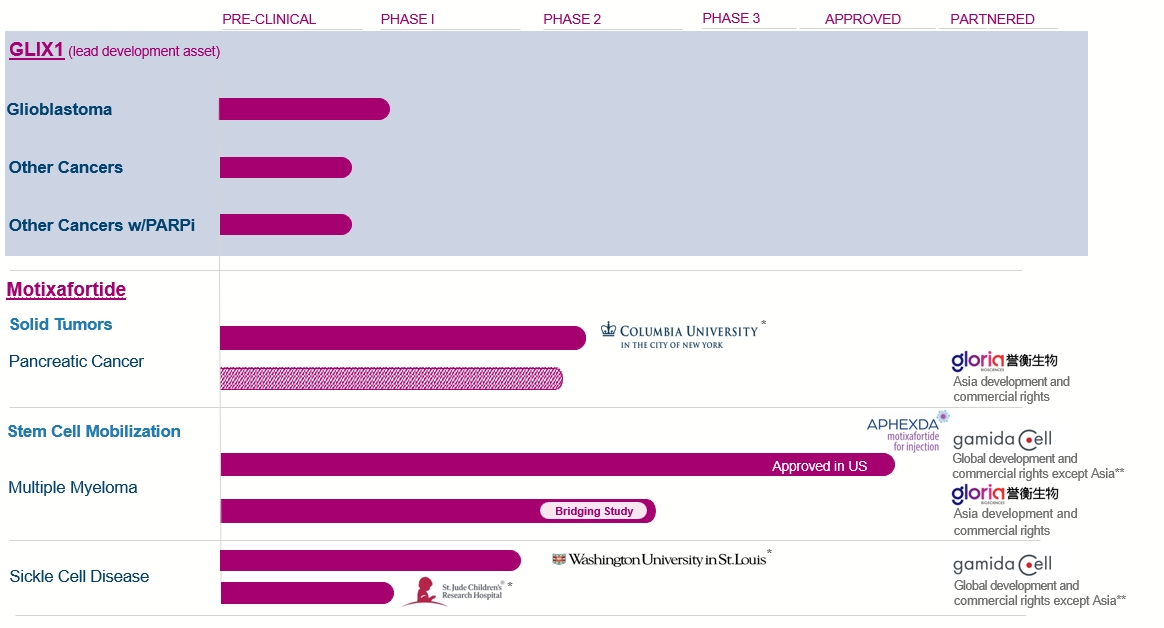
We are a biopharmaceutical company pursuing life-changing therapies
in oncology and rare diseases. Our first approved product, APHEXDA® (motixafortide), a novel peptide for the treatment of stem-cell
mobilization and solid tumors, with an indication in the United States for stem cell mobilization for autologous transplantation in multiple
myeloma, is being developed and commercialized by Ayrmid Pharma Ltd., or Ayrmid (globally, excluding Asia) and Auspex Bioscience (Guangzhou)
Co., Ltd. (formerly Guangzhou Gloria Biosciences Co., Ltd.), or Gloria (in Asia). We are also advancing the development of motixafortide
for patients with pancreatic cancer and other solid tumors outside of Asia.
In September 2025, we entered into a collaboration transaction
with Hemispherian AS, or Hemispherian, a Norwegian biotech company focused on small molecule cancer therapeutics, for the development,
clinical evaluation and commercialization of GLIX1, Hemispherian’s lead drug candidate, a first-in-class, oral, small molecule targeting
DNA damage response in glioblastoma, or GBM, and other cancers.
Our ordinary shares have been trading on the Tel Aviv Stock
Exchange, or TASE, under the symbol “BLRX” since February 2007, and our American Depositary Shares, or ADSs, have been traded
on the Nasdaq Capital Market, or Nasdaq, also under the symbol “BLRX,” since July 2011.
Unless otherwise indicated, all references to “BioLineRx,”
the “Company,” “us,” “we” and “our” refer to BioLineRx Ltd., an Israeli company, and its
consolidated subsidiaries. References to “ordinary shares”, “ADSs”, “warrants” and “share capital”
refer to the ordinary shares, ADSs, warrants and share capital, respectively, of BioLineRx.
We use “APHEXDA” when referring to our FDA approved
drug and “motixafortide” when referring to our development of APHEXDA for additional indications. We refer to the license
agreements with Ayrmid and Gloria as the Ayrmid License Agreement and Gloria License Agreement, respectively and the collaboration agreement
with Hemispherian, as the Collaboration Agreement.
References to “U.S. dollars”, “dollars”,
“USD”, and “$” are to currency of the United States of America, and references to “NIS” are to New
Israeli Shekels. References to “ordinary shares” are to our ordinary shares, no par value. We report financial information
under IFRS Accounting Standards, or IFRS, as issued by the International Accounting Standards Board, or IASB. The functional and presentation
currency of the Company in this annual report on Form 20-F for the year ended December 31, 2025, or the Annual Report on Form 20-F, is
the U.S. dollar.
Unless otherwise indicated, U.S. dollar translations of NIS amounts
presented in this Annual Report on Form 20-F are translated using the rate of NIS 3.19 to $1.00, the exchange rate reported by the Bank
of Israel on December 31, 2025.
On January 30, 2025,
we effected a change in the ratio of our ADSs to ordinary shares from one ADS representing 15 ordinary shares to a new ratio of one ADS
representing 600 ordinary shares. For ADS holders, the ratio change had the same effect as a one-for-forty reverse ADS split. All ADS
and related option and warrant information presented in this Annual Report on Form 20-F have been retroactively adjusted to reflect the
reduced number of ADSs and the increase in the ADS price which resulted from this action. Unless otherwise indicated, in this Annual Report
on Form 20-F fractional ADSs have been rounded to the nearest whole number.
Forward-Looking Statements
Some of the statements under the sections entitled “Item
3. Key Information - Risk Factors,” “Item 4. Information on the Company” and “Item 5. Operating and Financial
Review and Prospects” and elsewhere in this Annual Report on Form 20-F constitute forward-looking statements. These include statements
regarding management's expectations, beliefs and intentions regarding, among other things, the potential benefits of GLIX1 and motixafortide,
the potential success of our out-licensing and collaboration agreements, expectations and commercial potential of GLIX1 and motixafortide,
as well as its potential investigational uses, expectations with regard to clinical trials of GLIX1 and motixafortide, the plans and objectives
of management for future operations, and statements as to results of operations or of financial condition, expected capital needs and
expenses. These statements involve known and unknown risks, uncertainties and other factors that may cause our actual results, performance
or achievements to be materially different from any future results, performance or achievements expressed or implied by the forward-looking
statements. In some cases, you can identify forward-looking statements by terms including “anticipates,” “believes,”
“could,” “estimates,” “expects,” “intends,” “may,” “plans,” “potential,”
“predicts,” “projects,” “should,” “will,” “would,” and similar expressions
intended to identify forward-looking statements. Forward-looking statements reflect our current views with respect to future events and
are based on assumptions, and are subject to risks and uncertainties. In addition, the section of this Annual Report on Form 20-F entitled
“Item 4. Information on the Company” contains information obtained from independent industry and other sources that we have
not independently verified. You should not put undue reliance on any forward-looking statements. Our actual results could differ materially
from those discussed in the forward-looking statements. Unless we are required to do so under U.S. federal securities laws or other applicable
laws, we do not intend to update or revise any forward-looking statements. Readers are encouraged to consult the Company’s filings
made on Form 6-K, which are periodically filed with or furnished to the SEC.
Factors that could cause our actual results to differ materially
from those expressed or implied in such forward-looking statements include, but are not limited to:
|
• |
the clinical development, commercialization and market acceptance of GLIX1 and motixafortide including the degree and pace of market
uptake of APHEXDA for the mobilization of hematopoietic stem cells for autologous transplantation in multiple myeloma patients;
|
|
• |
the initiation, timing, progress and results of our preclinical studies, clinical trials and other therapeutic candidate development
efforts; |
|
• |
our ability to advance GLIX1 and motixafortide into clinical trials or to successfully complete our preclinical studies or clinical
trials; |
|
• |
whether the clinical trial results for GLIX1 and motixafortide will be predictive of real-world results; |
|
• |
our receipt of regulatory approvals for GLIX1 and motixafortide and the timing of other regulatory filings and approvals; |
|
• |
whether access to GLIX1 and motixafortide is achieved in a commercially viable manner and whether GLIX1 and motixafortide receives
adequate reimbursement from third-party payors; |
|
• |
our ability to establish, manage, and maintain corporate collaborations, as well as the ability of our collaborators to execute on
their development and commercialization plans; |
|
• |
our ability to integrate new therapeutic candidates and new personnel, as well as new collaborations; |
|
• |
the interpretation of the properties and characteristics of our therapeutic candidates and of the results obtained with our therapeutic
candidates in preclinical studies or clinical trials; |
|
• |
the implementation of our business model and strategic plans for our business and therapeutic candidates; |
|
• |
the scope of protection that we are able to establish and maintain for intellectual property rights covering our therapeutic candidates
and our ability to operate our business without infringing the intellectual property rights of others; |
|
• |
estimates of our expenses, future revenues, capital requirements and our need for and ability to access sufficient additional financing;
|
|
• |
risks related to changes in healthcare laws, rules and regulations in the United States or elsewhere; |
|
• |
competitive companies, technologies and our industry; |
|
• |
our ability to maintain the listing of our ADSs on Nasdaq; |
|
• |
statements as to the impact of the political and security situation in Israel on our business which may exacerbate the magnitude
of the factors discussed above; and |
|
• |
those factors referred to in “Item 3.D. Risk Factors,” “Item 4. Information on the Company,” and “Item
5. Operating and Financial Review and Prospects”, as well as in this Annual Report on Form 20-F generally. |
PART I.
ITEM 1. IDENTITY OF DIRECTORS,
SENIOR MANAGEMENT AND ADVISERS
Not applicable.
ITEM 2. OFFER STATISTICS AND
EXPECTED TIMETABLE
Not applicable.
ITEM 3. KEY INFORMATION
A. [Reserved]
B. Capitalization and Indebtedness
Not applicable.
C. Reasons for the Offer and Use of Proceeds
Not applicable.
D. Risk Factors
You should carefully consider the risks we describe below, in addition
to the other information set forth elsewhere in this Annual Report on Form 20-F, including our consolidated financial statements and the
related notes beginning on page F-1, before deciding to invest in our ordinary shares and ADSs. These material risks could adversely impact
our results of operations, possibly causing the trading price of our ordinary shares and ADSs to decline, and you could lose all or part
of your investment.
Summary Risk Factors
Investing in our securities involves a high degree of risk, as
fully described below. The principal factors and uncertainties that make investing in our ordinary shares risky include, among others:
Risks Related to Our Financial Condition and Capital Requirements
|
|
•
|
We have incurred significant losses since inception and expect to incur additional losses in the future
and may never be profitable.
|
|
|
•
|
We cannot assure investors that our existing cash and investment balances will be sufficient to meet our
future capital requirements.
|
|
|
•
|
If we default under our secured loan agreement with BlackRock EMEA Venture and Growth Lending (previously
Kreos Capital VII Aggregator SCSP), or BlackRock, all or a portion of our assets could be subject to forfeiture.
|
|
|
•
|
Management has concluded that there is substantial doubt about our ability to continue as a going concern,
which could prevent us from obtaining new financing on reasonable terms or at all.
|
Risks Related to Our Business and Regulatory Matters
|
|
•
|
We have earned limited revenues to date and we may never achieve profitability. |
|
• |
GLIX1, motixafortide, or any other therapeutic candidate that may receive marketing
approval in the future, may fail to achieve the degree of market acceptance by physicians, patients, third-party payors and others in
the medical community necessary for commercial success and the market opportunity for GLIX1, motixafortide or any other therapeutic candidate
may be smaller than our estimates. |
|
|
•
|
If we, our licensees or our collaborators are unable to obtain and/or maintain U.S.
and/or foreign regulatory approval for our therapeutic candidates, in a timely manner or at all, we will be unable to commercialize our
therapeutic candidates. |
|
|
•
|
We, our licensees, and our collaborators may not obtain additional marketing approvals
for motixafortide in other indications or initial approval for GLIX1 or any other therapeutic candidates we may develop in the future.
|
|
|
•
|
Clinical trials involve a lengthy and expensive process with an uncertain outcome,
and results of earlier studies and trials may not be predictive of future trial results.
|
|
• |
Even if we obtain regulatory approvals, GLIX1, motixafortide and any other therapeutic candidate that we
may develop in the future will be subject to ongoing regulatory review and if we fail to comply with continuing U.S. and applicable foreign
regulations, we could lose those approvals and our business would be seriously harmed.
|
|
|
•
|
We generally rely on third parties to conduct our preclinical studies and clinical
trials and to provide other services, and those third parties may not perform satisfactorily, including by failing to meet established
deadlines for the completion of such services.
|
|
|
•
|
We recently entered into and may in the future rely on out-licensing arrangements
for late-stage development, marketing or commercialization of our therapeutic candidates.
|
|
|
• |
If we cannot meet requirements under our in-license agreements, we could lose the
rights to our therapeutic candidates, which could have a material adverse effect on our business.
|
|
|
•
|
We have partnered with and may seek to partner with third-party collaborators with
respect to the development and commercialization of motixafortide, and we may not succeed in establishing and maintaining collaborative
relationships, which may significantly limit our ability to develop and commercialize our therapeutic candidates successfully, if at all.
|
|
|
•
|
If competitors develop and market therapeutics that are more effective, safer or less
expensive than our current or future therapeutic candidates, our prospects will be negatively impacted.
|
|
|
•
|
GLIX1, motixafortide, or any other therapeutic candidate that we, our licensees are
able to commercialize, may become subject to unfavorable pricing regulations, third-party payor reimbursement practices or healthcare
reform initiatives, any of which could harm our business.
|
|
|
•
|
We rely upon third-party manufacturers to produce therapeutic supplies for the clinical
trials, and commercialization, of GLIX1 and motixafortide. If we manufacture any therapeutic candidates in the future, we will be required
to incur significant costs and devote significant efforts to establish and maintain manufacturing capabilities.
|
Risks Related to Our Industry
|
|
• |
Healthcare reforms and related reductions in pharmaceutical pricing, reimbursement and coverage by government
authorities and third-party payors may adversely affect our business. |
|
|
•
|
If third-party payors do not adequately reimburse customers for any of our therapeutic candidates that
are approved for marketing, they might not be purchased or used, and our revenues and profits will not develop or increase.
|
|
|
•
|
Our business has a substantial risk of clinical trial and product liability claims. If we are unable to
obtain and maintain appropriate levels of insurance, a claim could adversely affect our business.
|
|
|
•
|
Significant disruptions of our information technology systems or breaches of our data security could adversely
affect our business.
|
|
|
•
|
We deal with hazardous materials and must comply with environmental, health and safety laws and regulations,
which can be expensive and restrict how we do business.
|
|
|
•
|
We have in the past, and may in the future, become subject to litigation or claims arising in or outside
the ordinary course of business that could negatively affect our business operations and financial condition.
|
Risks Related to Intellectual Property
|
|
•
|
Our access to most of the intellectual property associated with our therapeutic candidates
results from in-license and collaboration agreements with biotechnology companies and a university, the termination of which would prevent
us from commercializing the associated therapeutic candidates. |
Risks Related to our Ordinary Shares and ADSs
|
|
•
|
Our business, operating results and growth rates may be adversely affected by current or future unfavorable
economic and market conditions and adverse developments with respect to financial institutions and associated liquidity risk.
|
|
|
•
|
The market prices of our ordinary shares and ADSs are subject to fluctuation, which could result in substantial
losses by our investors.
|
|
|
•
|
Future sales of our ordinary shares or ADSs could reduce the market price of our ordinary shares and ADSs.
|
|
|
•
|
Raising additional capital by issuing securities may cause dilution to existing shareholders.
|
|
|
•
|
If we fail to comply with the continued listing requirements of the Nasdaq, our ADSs may be delisted and
the price of our ADSs and our ability to access the capital markets could be negatively impacted.
|
Risks Related to our Operations in Israel
|
|
•
|
We conduct a substantial part of our operations in Israel and therefore our results may be adversely affected
by political, economic and military instability in Israel and its region.
|
|
|
• |
Provisions of Israeli law may delay, prevent or otherwise impede a merger with, or an acquisition of, our
company, which could prevent a change of control, even when the terms of such a transaction are favorable to us and our shareholders.
|
|
|
•
|
It may be difficult to enforce a U.S. judgment against us and our officers and directors in Israel or the
United States, or to serve process on our officers and directors.
|
|
|
• |
Your rights and responsibilities as a shareholder will be governed by Israeli law, which may differ in
some respects from the rights and responsibilities of shareholders of U.S. companies. |
Risks Related to Our Financial Condition and Capital Requirements
We have incurred significant losses since inception
and expect to incur additional losses in the future and may never be profitable.
We are a biopharmaceutical company pursuing life-changing therapies
in oncology and rare diseases. Our first approved product is APHEXDA (motixafortide), a novel peptide for the treatment of stem-cell mobilization
and solid tumors which, on September 8, 2023, was approved by the FDA for use in combination with filgrastim (G-CSF) to mobilize hematopoietic
stem cells to the peripheral blood for collection and subsequent autologous transplantation in patients with multiple myeloma. In October
2023, we out-licensed the rights to motixafortide for all indications in substantially all of Asia and in November 2024, we out-licensed
the global rights (other than in Asia) to motixafortide for all indications, other than solid tumors. As a result of the November 2024
transaction, we shut down our independent commercialization activities in the United States and refocused our operations on development
activities in Israel in the fields of oncology and rare diseases, at a significantly reduced annual cash burn rate. In September 2025
we entered into a collaboration with Hemispherian for the development, clinical evaluation and commercialization of GLIX1, a first-in-class,
oral, small molecule targeting DNA damage response in glioblastoma and other solid tumors.
Since our incorporation, we have been mainly focused on research
and development. We have incurred losses since inception, principally as a result of research and development and general administrative
expenses and, between 2022 and 2024, sales and marketing in support of the launch and direct commercialization of APHEXDA. We recorded
net losses of $60.6 million in 2023, $9.2 million in 2024, and $2.0 million in 2025. As of December 31, 2025, we had an accumulated deficit
of $401 million. While we generate revenue from royalties on product sales of APHEXDA and have the potential to generate additional revenue
from milestone payments, these have not been at a level to sustain our operations and there can be no assurance that significant revenue
from product sales of APHEXDA will ever be generated or that milestones will be met. As a result, we expect to continue to incur significant
expenses and sustain net losses for the foreseeable future as we continue our planned development activities for GLIX1 and motixafortide
in other indications.
We cannot assure investors
that our existing cash and investment balances will be sufficient to meet our future capital requirements.
As of December 31, 2025, we held $20.9 million of cash, cash equivalents
and short-term bank deposits. Based on our current projected cash requirements, we believe that our existing cash and investment balances
will be sufficient to meet our capital requirements into the first half of 2027. We have funded our operations primarily through public
and private offerings of our securities, payments received under our strategic licensing and collaboration arrangements and interest earned
on investments. The adequacy of our available funds to meet our operating and capital requirements will depend on many factors, including:
royalty and milestone payments from our license agreements with Ayrmid and Gloria, the number, breadth, progress and results of our research,
product development and clinical programs; the costs and timing of obtaining regulatory approvals for any of our therapeutic candidates;
the terms and conditions of in-licensing and out-licensing therapeutic candidates; and costs incurred in enforcing and defending our patent
claims and other intellectual property rights.
While we expect to continue to explore alternative financing sources,
including the possibility of future securities offerings and government funding, we cannot be certain that in the future these liquidity
sources will be available when needed on commercially reasonable terms or at all, or that our actual cash requirements will not be greater
than anticipated. We expect to also continue to seek to finance our operations through other sources, including out-licensing arrangements
for the development and commercialization of our therapeutic candidates or other partnerships or joint ventures, as well as grants from
government agencies and foundations. If we are unable to obtain future financing through the methods we describe above or through other
means, we may be unable to complete our business objectives and may be unable to continue operations, which would have a material adverse
effect on our business and financial condition.
If we default under our
secured loan agreement with BlackRock, all or a portion of our assets could be subject to forfeiture.
In September 2022, we entered into a secured loan agreement, or
the Loan Agreement, with BlackRock, under which BlackRock agreed to provide the Company with access to term loans in an aggregate principal
amount of up to $40 million in three tranches as follows: (a) a loan in the aggregate principal amount of up to $10 million, (b) a loan
in the aggregate principal amount of up to $20 million, available for drawdown upon achievement of certain milestones and until April
1, 2024, and (c) a loan in the aggregate principal amount of up to $10 million, available for drawdown upon achievement of certain milestones
and until October 1, 2024. We drew down the initial tranche of $10 million following execution of the agreement in September 2022 and
we drew down the second tranche of $20 million in April 2024, following fulfilment of the requisite milestones. We did not draw down the
third tranche.
In November 2024, in connection with the Ayrmid License Agreement
(as defined below), we entered into an amendment, or the Amendment, to the Loan Agreement with BlackRock, pursuant to which, (i) we agreed
to make aggregate payments of $16.5 million, as partial repayment of the loan to BlackRock and in lieu of future revenue-based payments,
which were fully cancelled, (ii) effective December 1, 2024, we agreed to pay the remaining amounts outstanding under the loan (in principal
and interest) over a three year period ending December 1, 2027, and (iii) our minimum cash balance requirement under the Loan Agreement
was reduced to $4 million. In addition, pursuant to the Amendment, 10% of any future milestone payments received by us from the out-licensing
agreements through December 1, 2027 will be used to repay outstanding loan principal, and the repayments in (ii) above will be adjusted
accordingly. All other terms of the Loan Agreement remain the same.
Our ability to make the scheduled payments under the Loan Agreement
or to refinance our debt obligations with BlackRock depends on numerous factors including, but not limited to, the amount of our cash
reserves, our capital requirements and our ability to raise additional capital. We may be unable to maintain a level of cash reserves
sufficient to permit us to pay the principal and accrued interest on the loan. If our cash reserves, cash flows and capital resources
are insufficient to fund our debt obligations to BlackRock, we may be required to seek additional capital, restructure or refinance our
indebtedness, or delay or abandon our research and development projects or other capital expenditures, which could have a material adverse
effect on our business, financial condition, prospects or results of operations. There is no assurance that we would be able to take any
of such actions, or that such actions would permit us meet our scheduled debt obligations under the BlackRock loan agreement. If we default
on the Loan Agreement and are unable to cure the default pursuant to the terms of the Loan Agreement or are unable to repay or refinance
the loan when due, BlackRock could take possession of any or all assets in which it holds a security interest, and dispose those assets
to the extent necessary to pay off the debts, which would have a material adverse effect on our business, financial condition, prospects
or results of operations.
Management has concluded
that there is substantial doubt about our ability to continue as a going concern, which could prevent us from obtaining new financing
on reasonable terms or at all.
We have incurred significant losses and negative cash flows from
operations and have an accumulated deficit that raises substantial doubt about our ability to continue as a going concern. Our audited
consolidated financial statements for the year ended December 31, 2025 were prepared under the assumption that we would continue our operations
as a going concern. Our independent registered public accounting firm has included a “going concern” explanatory paragraph
in its report on our financial statements for the year ended December 31, 2025. If we are unable to improve our liquidity position, by,
among other things, raising capital through public or private offerings or reducing our expenses, we may exhaust our cash resources and
will be unable to continue our operations. If we cannot continue as a viable entity, our shareholders would likely lose most or all of
their investment in us.
Risks Related to Our Business and Regulatory Matters
We have earned limited revenues
to date. We may never achieve profitability.
We are a biopharmaceutical company pursuing life-changing therapies
in oncology and rare diseases. To date, we have generated only limited revenues from sales of APHEXDA. Our ability to generate revenues
from sales of APHEXDA and achieve profitability will be dependent on the ability of the licensees under the Gloria License Agreement (as
defined below) and the Ayrmid License Agreement to successfully commercialize the licensed products and the ability of any future partners
or licenses to successfully commercialize any other product candidates that we may develop, in-license or acquire in the future.
Our revenues from motixafortide or any product candidate for which
regulatory approval is obtained will be dependent, in part, upon the size of the markets in the territories for which we gain regulatory
approval, the accepted price for the product, the ability to get reimbursement at any price, and the terms and conditions of our commercialization
agreement with our partner for that territory. While we retain the right to potentially meaningful milestones or royalty payments under
the Gloria License Agreement and the Ayrmid License Agreement, it could take many years before such milestones are achieved, resulting
in such royalty payments being made, if at all.
The timing and amount of any milestone and royalty payments we
may receive from our licensees, as well as the commercial success of our products will depend on, among other things, the efforts, allocation
of resources, negotiation of pricing and reimbursement and successful commercialization of our products by our licensees. As a result,
even if we generate product revenues, we may not become profitable and may need to obtain additional funding to continue operations.
GLIX1, motixafortide, or
any other therapeutic candidate that may receive marketing approval in the future, may fail to achieve the degree of market acceptance
by physicians, patients, third-party payors and others in the medical community necessary for commercial success and the market opportunity
for GLIX1, motixafortide or any other therapeutic candidate may be smaller than our estimates.
GLIX1, motixafortide or any other therapeutic candidate that may
be approved in the future by the appropriate regulatory authorities for marketing and sale, may fail to gain sufficient market acceptance
by physicians, patients, third-party payors and others in the medical community. Physicians are often reluctant to switch their patients
from existing therapies even when new and potentially more effective or convenient treatments enter the market. APHEXDA competes with
the standard of care using stem cell mobilization and its generic versions.
Efforts to educate the medical community and third-party payors
on the benefits of APHEXDA over its competition have required significant resources and may not ultimately be successful. If GLIX1, motixafortide,
or any other therapeutic candidate that may be approved in the future for marketing and sale in the future, does not achieve an adequate
level of market acceptance, we may not generate significant revenues and we may not become profitable. The degree of market acceptance
of GLIX1, motixafortide, or any other therapeutic candidate that may be approved in the future, will depend on a number of factors, including:
|
|
•
|
the advantages of the treatment compared to competitive therapies;
|
| |
•
|
the number of competitors approved for similar uses;
|
|
|
•
|
the relative promotional effort and marketing success of us as compared with our competitors;
|
|
|
•
|
how the product is positioned in physician treatment guidelines and pathways;
|
| |
•
|
the prevalence and severity of any side effects;
|
| |
• |
the efficacy and safety of the product; |
| |
|
|
| |
• |
our ability to offer the product for sale at competitive reimbursement; |
| |
|
|
| |
• |
the product’s tolerability, convenience and ease of administration compared to alternative treatments;
|
| |
|
|
| |
• |
the willingness of the target patient population to try, and of physicians to prescribe, the product;
|
| |
|
|
| |
• |
limitations or warnings, including use restrictions, contained in the product’s approved labeling;
|
| |
|
|
| |
• |
the strength of sales, marketing and distribution support; |
| |
|
|
| |
• |
the timing of market introduction of our approved products as well as competitive products; |
| |
|
|
| |
• |
adverse publicity about the product or favorable publicity about competitive products; |
| |
|
|
| |
• |
potential product liability claims; |
| |
|
|
| |
• |
changes in the standard of care for the targeted indications of the product; and |
| |
|
|
| |
• |
availability and amount of coverage and reimbursement from government payors, managed care plans and other
third-party payors. |
In addition, the potential market opportunities for GLIX1, motixafortide
and any other therapeutic are difficult to estimate precisely. Our estimates of the potential market opportunities are predicated on many
assumptions, including industry knowledge and publications, third-party research reports and other surveys. While we believe that our
internal assumptions are reasonable, these assumptions involve the exercise of significant judgment on the part of our management, are
inherently uncertain and the reasonableness of these assumptions has not been assessed by an independent source. If any of the assumptions
prove to be inaccurate, the actual markets for our therapeutic candidate could be smaller than our estimates of the potential market opportunities.
Even if a therapeutic candidate
receives marketing approval, we or others may later discover that the product is less effective than previously believed or causes undesirable
side effects that were not previously identified, which could compromise our ability or that of any collaborators to market the product,
and could cause regulatory authorities to take certain regulatory actions.
It is possible that our clinical trials may indicate an apparent
positive effect of a therapeutic candidate that is greater than the actual positive effect, if any, or alternatively fail to identify
undesirable side effects. For example, despite the recent FDA marketing approval of APHEXDA in the United States, we, or others, including
our licensees, may discover that APHEXDA is less effective or tolerable than previously believed. If we, or others, discover that a product
is less effective than previously believed or causes undesirable side effects that were not previously identified, any of the following
adverse events could occur:
|
|
•
|
regulatory authorities may withdraw their approval of the product or seize the product;
|
|
|
•
|
we, or any of our licensees or collaborators, may be required to recall the product,
change the way the product is administered or conduct additional clinical trials;
|
|
|
•
|
additional restrictions may be imposed on the marketing of, or the manufacturing processes
for, the particular product;
|
|
|
•
|
we, or any of our licensees or collaborators, may be subject to fines, injunctions
or the imposition of civil or criminal penalties;
|
|
|
•
|
regulatory authorities may require the addition of labeling or warning statements,
such as a “black box” warning or a contraindication;
|
|
|
•
|
we, or any of our collaborators, may be required to create a Medication Guide outlining
the risks of the previously unidentified side effects for distribution to physicians, health care professionals and patients;
|
|
|
•
|
we could be sued and held liable for harm caused to patients;
|
|
|
•
|
physicians and patients may stop using our product; and
|
|
|
•
|
our reputation may suffer. |
Any of these events could harm our business and operations and could negatively impact
the market price of our ordinary shares and/or ADSs.
If we, our licensees or
our collaborators are unable to obtain and/or maintain U.S. and/or foreign regulatory approval for our therapeutic candidates in a timely
manner or at all, we will be unable to commercialize our therapeutic candidates.
While we recently shut down our independent commercialization activities
in the United States and refocused our operations on development activities in Israel in the fields of oncology and rare diseases, we
continue to advance the development of motixafortide in solid tumors for all territories other than Asia and are advancing the development
of GLIX1 under the Collaboration Agreement. GLIX1, motixafortide, and any other therapeutic candidate we develop will require additional,
time-consuming and costly development efforts, by us or by our collaborators, prior to commercial sale, including preclinical studies,
clinical trials and approval by the FDA and/or applicable foreign regulatory authorities. All therapeutic candidates are prone to the
risks of failure that are inherent in pharmaceutical product development, including the possibility that the therapeutic candidate will
not be shown to be sufficiently safe and/or effective for approval by regulatory authorities. In addition, we cannot assure you that any
such products that are approved will be manufactured or produced economically, successfully commercialized or widely accepted in the marketplace,
or will be more effective than other commercially available alternatives.
In the United States, we are required to submit a New Drug Application,
or NDA, to obtain FDA approval before marketing any of our current or future therapeutic candidates. An NDA must include extensive preclinical
and clinical data and supporting information to establish the therapeutic candidate’s safety, purity and potency, or efficacy, for
each desired indication. The NDA must also include information regarding the product’s pharmacology, toxicology, chemistry, manufacture
and manufacturing controls. Obtaining approval of an NDA is a lengthy, expensive and uncertain process, and approval may not be obtained.
Upon submission of an NDA, the FDA must make an initial determination that the application is sufficiently complete to accept the submission
for filing. We cannot be certain that any submissions will be accepted for filing and review by the FDA, or ultimately be approved. The
FDA may require that we conduct additional clinical or preclinical trials, or take other actions before it will approve or reconsider
any application we make. If the FDA requires additional studies or data, we will incur increased costs and delays in the marketing approval
process, which may require us to expend more resources than we have available. In addition, the FDA may not consider any additional information
to be complete or sufficient to support approval.
Any delay in obtaining, or the failure to obtain, required regulatory
approvals will materially and adversely affect our ability to generate future revenues from a particular therapeutic candidate. Any regulatory
approval to market a product may be subject to limitations on the indicated uses for which we may market the product or may impose restrictive
conditions of use, including cautionary information, thereby limiting the size of the market for the product. We and our collaborators,
as applicable, also are, and will be, subject to numerous foreign regulatory requirements that govern the conduct of clinical trials,
manufacturing and marketing authorization, pricing and third-party reimbursement. The foreign regulatory approval process includes all
the risks associated with the FDA approval process that we describe above, as well as risks attributable to the satisfaction of foreign
requirements. Approval by the FDA does not ensure approval by regulatory authorities outside the United States. Foreign jurisdictions
may have different approval processes than those required by the FDA and may impose additional testing requirements for our therapeutic
candidates.
We, our licensees and our
collaborators may not obtain additional marketing approvals for motixafortide or initial approval for GLIX1 or any other therapeutic candidates
we may develop in the future.
We, our licensees or our collaborators may not obtain additional
marketing approvals for motixafortide or initial approval for GLIX1 or any other therapeutic candidate that we may develop in the future.
It is possible that the FDA or comparable foreign regulatory agencies may refuse to accept for substantive review any future application
that we, a licensee or a collaborator may submit to market and sell our therapeutic candidates, or that any such agency may conclude after
review of our, our licensee’s or collaborator’s data that such application is insufficient to obtain marketing approval of
our therapeutic candidate.
If the FDA or other comparable foreign regulatory agency does not
accept or approve any future application to market and sell any therapeutic candidate, such regulators may require that we conduct additional
clinical trials, preclinical studies or manufacturing validation studies and submit that data before they will reconsider our application.
Depending on the extent of these or any other required trials or studies, approval of any application that we submit may be delayed by
several years, or may require us, our licensee or our collaborator to expend more resources than we or they have available. It is also
possible that additional trials or studies, if performed and completed, may not be considered sufficient by the FDA or other foreign regulatory
agency to approve our applications for marketing and commercialization.
Any delay in obtaining, or an inability to obtain, marketing approvals
would prevent us, our licensees or collaborators from commercializing GLIX1 or motixafortide in other jurisdictions and indications or
any other therapeutic candidate that we may develop in the future and generating revenues. If any of these outcomes occur, we would not
be eligible for certain milestone and royalty revenue under our license agreements, our licensees could terminate our license agreements
and we may be forced to abandon our development efforts, any of which could significantly harm our business.
Clinical trials involve a lengthy and expensive
process with an uncertain outcome, and results of earlier studies and trials may not be predictive of future trial results.
Clinical trials are expensive and complex, can take many years
and have uncertain outcomes. We cannot necessarily predict whether we or any licensee will encounter problems with any of the completed,
ongoing or planned clinical trials that will cause us, any licensee or regulatory authorities to delay or suspend clinical trials, or
to delay the analysis of data from completed or ongoing clinical trials. In addition, because some of our clinical trials are investigator-initiated
studies (i.e., we are not the study sponsor), we may have less control over these studies. We estimate that certain of our clinical trials
will continue for several years, but they may take significantly longer to complete. Failure can occur at any stage of the testing, and
we may experience numerous unforeseen events during, or as a result of, the clinical trial process that could delay or prevent commercialization
of our current or future therapeutic candidates, including, but not limited to:
|
•
|
delays in securing clinical investigators or trial sites for the clinical trials;
|
| |
• |
delays in obtaining institutional review board and other regulatory approvals to commence a clinical trial;
|
| |
|
|
|
|
• |
slower-than-anticipated patient recruitment and enrollment; |
| |
|
|
|
|
• |
negative or inconclusive results from clinical trials; |
| |
|
|
|
|
• |
unforeseen safety issues; |
| |
|
|
|
|
• |
uncertain dosing issues; |
| |
|
|
|
|
• |
an inability to monitor patients adequately during or after treatment; and |
| |
|
|
|
|
• |
problems with investigator or patient compliance with the trial protocols. |
A number of companies in the pharmaceutical and biotechnology industries,
including those with greater resources and experience than us, have suffered significant setbacks in advanced clinical trials, even after
seeing promising results in earlier clinical trials. Despite the results reported in earlier clinical trials for our therapeutic candidates,
we do not know whether any Phase 3 or other clinical trials we or our licensees may conduct will demonstrate adequate efficacy and safety
to result in regulatory approval to market any therapeutic candidate. For example, we previously investigated the treatment of motixafortide
for acute myeloid leukemia, AML, and following an interim analysis of a Phase 2b trial in which the investigational arm of motixafortide
combined with cytarabine did not demonstrate a statistically significant effect in the study’s primary endpoint, we terminated the
study. Nevertheless, we continue to believe in the relevance of CXCR4 as a viable target in other AML treatment lines, such as rr/AML
and induction treatment. If later-stage clinical trials of any therapeutic candidate do not produce favorable results, our ability to
obtain regulatory approval for the therapeutic candidate may be adversely impacted, which will have a material adverse effect on our business,
financial condition and results of operations.
Even if we obtain regulatory
approvals, GLIX1, motixafortide and any other therapeutic candidate that we may develop in the future will be subject to ongoing regulatory
review and if we fail to comply with continuing U.S. and applicable foreign regulations, we could lose those approvals and our business
would be seriously harmed.
Even if therapeutics we or any licensee or collaborator develops
receive regulatory approval, we or any licensee, as applicable, will be subject to ongoing reporting obligations, and any approved products
and the manufacturing operations for such products will be subject to continuing regulatory review, including FDA inspections. The outcome
of this ongoing review may result in the withdrawal of a product from the market, the interruption of the manufacturing operations and/or
the imposition of labeling and/or marketing limitations. Since many more patients are exposed to a drug product following its marketing
approval, serious but infrequent adverse reactions that were not observed in clinical trials may be observed during the commercial marketing
of the product. In addition, the manufacturer and the manufacturing facilities we or our licensees, as applicable, will use to produce
any therapeutic candidate will be subject to periodic review and inspection by the FDA and other similar foreign regulators. Later discovery
of previously unknown problems with any product, manufacturer or manufacturing process, or failure to comply with regulatory requirements,
may result in actions such as:
|
|
•
|
restrictions on such product, manufacturer or manufacturing process;
|
|
|
•
|
warning letters from the FDA or other regulatory authorities;
|
|
|
•
|
withdrawal of the product from the market; |
|
|
• |
suspension or withdrawal of regulatory approvals; |
|
|
• |
refusal to approve pending applications or supplements to approved applications that we or our licensees
submit; |
| |
|
|
| |
• |
voluntary or mandatory recall; |
| |
|
|
| |
• |
fines; |
| |
|
|
|
|
• |
refusal to permit the import or export of our products; |
| |
|
|
|
|
• |
product seizure or detentions; |
| |
|
|
|
|
• |
injunctions or the imposition of civil or criminal penalties; or |
| |
|
|
| |
• |
adverse publicity. |
If we, or any licensee, supplier, third-party contractor, partner
or clinical investigator is slow to adapt, or are unable to adapt, to changes in existing regulatory requirements or the adoption of new
regulatory requirements or policies, we or any licensee may lose marketing approval for any of our products, if any of our therapeutic
products are approved, resulting in decreased or lost revenue from milestones, product sales or royalties.
We generally rely on third
parties to conduct our preclinical studies and clinical trials and to provide other services, and those third parties may not perform
satisfactorily, including by failing to meet established deadlines for the completion of such services.
We do not have the ability to conduct certain preclinical studies
and clinical trials independently for GLIX1 and motixafortide, and we rely on third parties, such as contract laboratories, contract research
organizations, medical institutions, clinical investigators and other collaborators to conduct these studies and clinical trials. Our
reliance on these third parties limits our control over these activities. The collaborators may not assign as great a priority to our
clinical development programs or pursue them as diligently as we would if we were undertaking such programs directly. Accordingly, these
collaborators may not complete activities on schedule, or may not conduct the studies or our clinical trials in accordance with regulatory
requirements or with our trial design. If these third parties do not successfully carry out their contractual duties or meet expected
deadlines, or if their performance is substandard, we may be required to replace them or add more sites to the studies. Although we believe
that there are a number of other third-parties that we could engage to continue these activities, replacement of these third parties will
result in delays and/or additional costs. As a result, our efforts to obtain regulatory approvals for, and to commercialize GLIX1, motixafortide
and any other therapeutic candidate that we may develop in the future may be delayed. The collaborators may also have relationships with
other commercial entities, some of whom may compete with us. If the collaborators assist our competitors, our competitive position may
be harmed.
In addition, our ability to bring future products to market depends
on the quality and integrity of data that we present to regulatory authorities in order to obtain marketing authorizations. Although we
attempt to audit and control the quality of third-party data, we cannot guarantee the authenticity or accuracy of such data, nor can we
be certain that such data has not been fraudulently generated. The failure of these third parties to carry out their obligations would
materially adversely affect our ability to develop and market new products and implement our strategies.
We entered into out-licensing
arrangements with Gloria and Ayrmid and may in the future rely on additional out-licensing or collaboration arrangements for later-stage
development, marketing or commercialization.
We entered into out-licensing arrangements with Gloria and Ayrmid
and may in the future rely on additional out-licensing arrangements for
later-stage development, marketing or commercialization. Dependence on out-licensing arrangements subjects us to a number of risks, including
the risk that:
|
|
• |
we have limited control over the amount and timing of resources that a licensee devotes
to our therapeutic candidate; |
|
|
•
|
a licensee or collaborator may experience financial difficulties; |
|
|
•
|
a licensee may fail to secure adequate commercial supplies of our therapeutic candidate
upon marketing approval, if at all;
|
|
|
•
|
our future revenues depend heavily on the efforts of a licensee;
|
|
|
•
|
business combinations or significant changes in a licensee’s business strategy
may adversely affect the licensee’s willingness or ability to complete its obligations under any arrangement with us; |
|
|
•
|
a licensee could move forward with a competing therapeutic candidate developed either
independently or in collaboration with others, including our competitors; and
|
|
|
•
|
out-licensing arrangements are often terminated or allowed to expire, which would
delay the development and may increase the development costs of our therapeutic candidates.
|
Under the Gloria License Agreement, the planned stud of motixafortide
in China under the Gloria License Agreement for PDAC is currently not advancing according to schedule and it is unclear when such study
will be initiated, if at all.
If we or any licensee breaches or terminates its agreement with
us, or if any licensee otherwise fails to conduct its development and commercialization activities in a timely manner or there is a dispute
about their obligations, we may need to seek other licensees or collaborators, or we may have to develop our own internal sales and marketing
capability.
Our dependence on a licensee’s experience and the rights
of a licensee or collaborator will limit our flexibility in considering alternative out-licensing or collaborator arrangements for any
therapeutic candidate. Any failure to successfully develop these arrangements or failure by a licensee or collaborator to successfully
develop or commercialize any therapeutic candidate in a competitive and timely manner will have a material adverse effect on the commercialization
of any therapeutic candidate.
We have partnered with and
may seek to partner with third-party collaborators with respect to the development and commercialization of both GLIX1 and motixafortide
and for any other therapeutic candidate and we may not succeed in establishing and maintaining collaborative relationships, which may
significantly limit our ability to develop and commercialize our therapeutic candidates successfully, if at all.
We collaborate with third parties with respect to the development
of motixafortide for certain indications and may in the future seek a partner for other indications or other therapeutic candidates. In
September 2025, we entered into a collaboration with Hemispherian for the development, clinical evaluation and commercialization of GLIX1.
We may compete with many other companies if we seek additional partners for GLIX1 and motixafortide and for any other therapeutic candidate
and we may not be able to compete successfully against those companies. If we are not able to enter into additional collaboration arrangements
for GLIX1 and motixafortide and for any other therapeutic candidate, we would be required to undertake and fund further development, clinical
trials, manufacturing and commercialization activities solely at our own expense and risk. If we are unable to finance and/or successfully
execute those expensive activities, or we delay such activities due to capital availability, our business could be materially and adversely
affected, and potential future product launch could be materially delayed, be less successful, or we may be forced to discontinue clinical
development of these therapeutic candidates. Furthermore, if we are unable to enter into a commercial agreement for the development and
commercialization of GLIX1 and motixafortide and for any other therapeutic candidate, then this could have a material adverse effect on
our business, financial condition or results of operations.
The process of establishing and maintaining collaborative relationships
is difficult, time-consuming and involves significant uncertainty, including:
|
|
•
|
a collaboration partner may shift its priorities and resources away from our therapeutic
candidates due to a change in business strategies, or a merger, acquisition, sale or downsizing;
|
|
|
•
|
a collaboration partner may seek to renegotiate or terminate their relationships with
us due to unsatisfactory clinical results, manufacturing issues, a change in business strategy, a change of control or other reasons;
|
|
|
•
|
a collaboration partner may cease development in therapeutic areas which are the subject
of our strategic collaboration;
|
|
|
•
|
a collaboration partner may not devote sufficient capital or resources towards our
therapeutic candidates;
|
|
|
•
|
a collaboration partner may change the success criteria for a therapeutic candidate,
thereby delaying or ceasing development of such candidate;
|
|
|
•
|
a significant delay in initiation of certain development activities by a collaboration
partner will also delay payment of milestones tied to such activities, thereby impacting our ability to fund our own activities;
|
|
|
•
|
a collaboration partner could develop a product that competes, either directly or
indirectly, with our therapeutic candidate;
|
|
|
•
|
a collaboration partner with commercialization obligations may not commit sufficient
financial or human resources to the marketing, distribution or sale of a product; |
|
|
•
|
a collaboration partner with manufacturing responsibilities may encounter regulatory,
resource or quality issues and be unable to meet demand requirements;
|
|
|
•
|
a partner may exercise a contractual right to terminate a strategic alliance;
|
|
|
•
|
a dispute may arise between us and a partner concerning the research, development
or commercialization of a therapeutic candidate resulting in a delay in milestones, royalty payments or termination of an alliance and
possibly resulting in costly litigation or arbitration which may divert management attention and resources; and
|
|
|
•
|
a partner may use our products or technology in such a way as to invite litigation
from a third party.
|
Any collaborative partners may in the future shift their priorities
and resources away from our therapeutic candidates or seek to renegotiate or terminate their relationships with us. If any collaborator
fails to fulfill its responsibilities in a timely manner, or at all, our research, clinical development, manufacturing or commercialization
efforts related to that collaboration could be delayed or terminated, or it may be necessary for us to assume responsibility for expenses
or activities that would otherwise have been the responsibility of our collaborator. If we are unable to establish and maintain collaborative
relationships on acceptable terms or to successfully transition terminated collaborative agreements, we may have to delay or discontinue
further development of one or more of our therapeutic candidates, undertake development and commercialization activities at our own expense
or find alternative sources of capital.
If we cannot meet requirements
under our in-license and collaboration agreements, we could lose the rights to any of our therapeutic candidates, which could have a material
adverse effect on our business.
We depend on in-licensing and collaboration agreements with third
parties to maintain the intellectual property rights to some of our therapeutic candidates. We have in-licensed rights from Biokine Therapeutics
Ltd., or Biokine, with respect to our motixafortide therapeutic candidate; and from Innovative Pharmaceutical Concepts, Inc., or IPC,
with respect to our BL-5010 therapeutic candidate. Additionally, we entered into a collaboration with Hemispherian for the development,
clinical evaluation and commercialization of GLIX1. See “Item 4.B. Information on the Company - Business Overview - In-Licensing
Agreements.” Our in-license and collaboration agreements require us to make payments and satisfy performance obligations in order
to maintain our rights under these agreements. For example, under the Collaboration Agreement with Hemispherian, we are required to invest
$5 million in Tetragon Biosciences Ltd., or Tetragon, a newly created company formed to develop GLIX1, within 36 months of the entry into
of the Collaboration Agreement, and failure to do so may result in a reduction of our equity interest or trigger repurchase rights in
favor of Hemispherian. Our in-license agreements generally remain in effect until the expiration, under the applicable agreement, of all
the licensing, royalty and sublicense revenue obligations to the applicable licensors, determined on a product-by-product and country-by-country
basis while our collaboration agreement with Hemispherian is based on specific business, financial, or procedural milestones. In addition,
we are responsible for the cost of filing and prosecuting certain patent applications and maintaining certain issued patents licensed
to us. Previously, in June 16, 2024, Biokine filed a complaint with the District Court of Jerusalem against us. The complaint alleged
breach of contract and a purported failure to make certain payments to Biokine under our in-licensing agreement with Biokine for motixafortide.
The lawsuit sought compensatory damages in the amount of approximately $7.2 million and declaratory judgment. The parties agreed to address
the matter through binding arbitration and in February 2026, the arbitrator issued a final award in our favor denying all claims asserted
against us and awarding us expenses, including legal fees. See “Item 8. Financial Information - Biokine Claim.” If we do not
meet our obligations under our in-license and collaboration agreements in a timely manner, we could lose the rights to our proprietary
technology, which could have a material adverse effect on our business, financial condition and results of operations. For more information,
see “Item 3.D - Key Information - Risks Related to our Intellectual Property - Our access to most
of the intellectual property associated with our therapeutic candidates results from in-license and collaboration agreements with biotechnology
companies, the termination of which would prevent us from commercializing the associated therapeutic candidates.
We depend on our ability
to identify and in-license technologies and therapeutic candidates.
We employ a number of methods to identify therapeutic candidates
that we believe are likely to achieve commercial success. In certain instances, disease-specific third-party advisors evaluate therapeutic
candidates as we deem necessary. However, there can be no assurance that our internal research efforts or our screening system will accurately
or consistently select among various therapeutic candidates those that have the highest likelihood to achieve, and that ultimately achieve,
commercial success. As a result, we may spend substantial resources developing therapeutic candidates that will not achieve commercial
success, and we may not advance those therapeutic candidates with the greatest potential for commercial success. For example, we terminated
development of AGI-134 and in connection therewith, in June 2025, we sold our wholly-owned subsidiary, Agalimmune, to a third party for
future potential royalty consideration, in the event that such third party successfully brings an Agalimmune product to the market in
the future.
An important element of our strategy is maintaining relationships
with universities, medical institutions and biotechnology companies in order to in-license potential therapeutic candidates. We may not
be able to maintain relationships with these entities, and they may elect not to enter into in-licensing agreements with us or to terminate
existing agreements. The existence of global companies with significantly greater resources than we have may increase the competition
with respect to the in-licensing of promising therapeutic candidates. We may not be able to acquire licenses on commercially reasonable
terms or at all. Failure to license or otherwise acquire necessary technologies could materially and adversely affect our business, financial
condition and results of operations.
If competitors develop and
market products that are more effective, safer or less expensive than our current or future therapeutic candidates, our prospects will
be negatively impacted.
The life sciences industry is highly competitive, and we and our
licensees face significant competition from many pharmaceutical, biopharmaceutical and biotechnology companies that are researching and
marketing products designed to address the indications for which we are currently developing GLIX1 or motixafortide or for which we may
develop therapeutic candidates in the future. Specifically, we are aware of other companies that currently market and/or are in the process
of developing products that address stem cell mobilization, solid malignancies and skin lesions. In particular, during 2023, the last
to expire patent for Mozobil and uses thereof, the standard of care for stem cell mobilization expired and as a consequence there are
several generic versions on the market. Successful commercialization of APHEXDA will in part require that our licensees are able to overcome
competition from Mozobil and its generic versions.
Any therapeutic candidates that we successfully develop and commercialize
will compete with existing therapies and new therapies that may become available in the future. The key competitive factors affecting
the success of each therapeutic candidate, if approved, is likely to be their safety, efficacy, convenience, price, the level of proprietary
and generic competition, and the availability of coverage and reimbursement from government and other third‑party payors. APHEXDA
sales will suffer, or the commercial opportunity may be reduced or eliminated if competitors develop and commercialize products that are
safer or more effective, have fewer or less severe side effects, or are more convenient or less expensive than any products that we may
develop. Competitors may also obtain FDA or other regulatory approval for their therapeutic candidates more rapidly than we or our licensees
may be able to do so for any existing or new therapeutic candidates of ours, which could result in their establishing a strong market
position before we are able to enter the market.
Mergers and acquisitions in the biotechnology and pharmaceutical
industries may result in even more resources being concentrated in favor of our competitors. Additionally, many competitors have greater
experience in product discovery and development, obtaining FDA and other regulatory approvals and commercialization capabilities, which
may provide them with a competitive advantage. If we or our licensees are not able to compete effectively, our business will not grow
and our financial condition and operations will suffer.
An important element of our strategy for identifying future products
is maintaining relationships with universities, medical institutions and biotechnology companies in order to in-license potential therapeutic
candidates, and we compete with respect to this in-licensing with a number of global pharmaceutical companies. The presence of these global
companies with significantly greater resources than we have may increase the competition with respect to the in-licensing of promising
therapeutic candidates. Our failure to license or otherwise acquire necessary technologies could materially and adversely affect our business,
financial condition and results of operations.
GLIX1, motixafortide or
any other therapeutic candidate that we or our licensees are able to commercialize, may become subject to unfavorable pricing regulations,
third-party payor reimbursement practices or healthcare reform initiatives, any of which could harm our business.
The commercial success of GLIX1, motixafortide and any other therapeutic
candidate will depend substantially, both domestically and abroad, on the extent to which product costs will be paid by third-party payors,
including government health care programs and private health insurers. There is significant uncertainty related to third-party payor coverage
and reimbursement of newly approved drugs. Marketing approvals, pricing and reimbursement for new drug products vary widely from country
to country. Some countries require approval of the sale price of a drug before it can be marketed. In many countries, the pricing review
period begins after marketing or product licensing approval is granted. In some foreign markets, prescription pharmaceutical pricing remains
subject to continuing governmental control even after initial approval is granted. As a result, we or our licensees might obtain marketing
approval for a product in a particular country but then be subject to price regulations that delay commercial launch of the product, possibly
for lengthy time periods, which may negatively impact the revenues we are able to generate from the sale of the product in that country.
Adverse pricing limitations may hinder our ability to recoup our or their investment in one or more therapeutic candidates, even if our
therapeutic candidates obtain marketing approval.
Patients who are provided with medical treatment for their conditions
generally rely on third-party payors to reimburse all or part of the costs associated with their treatment. Therefore, our ability, and
the ability of any licensees to successfully commercialize any of our therapeutic candidates will depend in part on the extent to which
coverage and adequate reimbursement for these products and related treatments will be available from third-party payors. Third-party payors
decide which medications they will cover and establish reimbursement levels. The healthcare industry is acutely focused on cost containment,
both in the United States and elsewhere. Government authorities and other third-party payors have attempted to control costs by limiting
coverage and the amount of reimbursement for particular medications, which could affect the ability to sell APHEXDA profitably. These
payors may not view APHEXDA as cost-effective, and coverage and reimbursement may not be available to customers or may not be sufficient
to allow our products to be marketed on a competitive basis. Cost-control initiatives could cause us or our licensees to decrease the
price we might establish, which could result in lower than anticipated product revenues. If the prices for our products, if any, decrease
or if governmental and other third-party payors do not provide coverage or adequate reimbursement, our prospects for revenue and profitability
will suffer.
There may also be delays in obtaining coverage and reimbursement
for newly approved drugs, such as APHEXDA, and coverage may be more limited for APHEXDA than for other drug products with similar indications
approved by the FDA or comparable foreign regulatory authorities. Moreover, eligibility for reimbursement does not imply that any therapeutic
will be paid for in all cases or at a rate that covers our costs, including research, development, manufacture, sale and distribution.
Reimbursement rates may vary, for example, according to the use of the product and the clinical setting in which it is used. Reimbursement
rates may also be based on reimbursement levels already set for lower cost treatments or may be incorporated into existing payments for
other services.
In addition, increasingly, third-party payors are requiring higher
levels of evidence of the benefits and clinical outcomes of new technologies and are challenging the prices charged. We cannot be sure
that coverage will be available for any therapeutic candidate that we, or third parties, commercialize and, if available, that the reimbursement
rates will be adequate. Further, the net reimbursement for products may be subject to additional reductions if there are changes to laws
that presently restrict imports of products from countries where they may be sold at lower prices than in the United States. An inability
to promptly obtain coverage and adequate payment rates from both government-funded and private payors for any therapeutic candidate for
which we obtain regulatory approval could significantly harm our operating results and our overall financial condition.
We rely upon third-party
manufacturers to produce therapeutic supplies of GLIX1 and motixafortide. If we manufacture any therapeutic candidates in the future,
we will be required to incur significant costs and devote significant efforts to establish and maintain manufacturing capabilities.
We do not currently have laboratories that are compliant with cGMP
and therefore cannot independently manufacture drug products for our current clinical trials or commercialization. We rely on third-party
manufacturers, including Ayrmid if it takes over manufacturing, to produce the therapeutic supplies that enable us to perform clinical
trials and supply commercial scale product. We have limited personnel with experience in drug product manufacturing and we lack the resources
and capabilities to manufacture any of our therapeutic candidates on a commercial scale. The manufacture of pharmaceutical products requires
significant expertise and capital investment, including the development of advanced manufacturing techniques and process controls. Manufacturers
of pharmaceutical products often encounter difficulties in production, particularly in scaling up initial production. These problems include
difficulties with production costs and yields and quality control, including stability of the therapeutic candidate.
We do not currently have any long-term agreements with third-party
manufacturers that guarantee the supply of therapeutic supplies and we rely on single source suppliers. When we require additional supplies
to complete our clinical trials or for commercialization, we may be unable to enter into agreements for clinical or commercial supply,
as applicable, with third-party manufacturers, or may be unable to do so on acceptable terms.
Reliance on third-party manufacturers entails risks to which we
would not be subject if we manufactured therapeutic candidates ourselves, including:
|
|
•
|
reliance on the third party for regulatory compliance and quality assurance;
|
|
|
•
|
limitations on supply availability resulting from capacity and scheduling constraints
of the third parties;
|
|
|
•
|
impact on our reputation in the marketplace if manufacturers of our products, once
commercialized, fail to meet customer demands;
|
|
|
•
|
the possible breach of the manufacturing agreement by the third party because of factors
beyond our control; and
|
|
|
•
|
the possible termination or nonrenewal of the agreement by the third party, based
on its own business priorities, at a time that is costly or inconvenient for us.
|
The failure of any of our contract manufacturers to maintain high manufacturing standards
could result in injury or death of clinical trial participants or patients being treated with our products. Such failure could also result
in product liability claims, product recalls, product seizures or withdrawals, delays or failures in testing or delivery, cost overruns
or other problems, which would have a material adverse effect on our business, financial condition and results of operations.
Our contract manufacturers
are, and will be, subject to FDA and other comparable agency regulations.
Our contract manufacturers are, and will be, required to adhere
to FDA regulations setting forth current good manufacturing practices, or cGMP, for drugs. These regulations cover all aspects of the
manufacturing, testing, quality control and recordkeeping relating to our therapeutic candidates. Our manufacturers may not be able to
comply with applicable regulations. Our manufacturers are and will be subject to unannounced inspections by the FDA, state regulators
and similar regulators outside the United States. The failure of our third-party manufacturers to comply with applicable regulations could
result in the imposition of sanctions on us, including fines, injunctions, civil penalties, failure of regulatory authorities to grant
marketing approval of our therapeutic candidates, delays, suspension or withdrawal of approvals, license revocation, seizures or recalls
of our candidates or products, operating restrictions and criminal prosecutions, any of which could significantly and adversely affect
regulatory approval and supplies of our therapeutic candidates, and materially and adversely affect our business, financial condition
and results of operations.
Our business could suffer
if we are unable to attract and retain key employees.
Our success depends upon the continued service and performance
of our senior management and other key personnel. The loss of the services of these personnel could delay or prevent the successful completion
of our planned clinical trials or the commercialization of our therapeutic candidates or otherwise affect our ability to manage our company
effectively and to carry out our business plan. We do not maintain key-man life insurance. Although we have entered into employment agreements
with all of the members of our senior management team, members of our senior management team may resign at any time subject to prior notice
as applicable. High demand exists for senior management and other key personnel in the pharmaceutical industry. There can be no assurance
that we will be able to continue to retain and attract such personnel.
Our growth and success also depend on our ability to attract and
retain highly qualified scientific, technical, sales, managerial and finance personnel. We experience intense competition for qualified
personnel, and the existence of non-competition agreements between prospective employees and their former employers may prevent us from
hiring those individuals or subject us to suit from their former employers. While we attempt to provide competitive compensation packages
to attract and retain key personnel, many of our competitors are likely to have greater resources and more experience than we have, making
it difficult for us to compete successfully for key personnel. If we cannot attract and retain sufficiently qualified technical employees
on acceptable terms, we may not be able to develop competitive products. Further, any failure to effectively integrate new personnel could
prevent us from successfully growing our company.
Scrutiny of sustainability
and environmental, social, and governance, or ESG, initiatives could increase our costs or otherwise adversely impact our business.
Public companies have recently faced scrutiny related to ESG practices
and disclosures from certain investors, capital providers, shareholder advocacy groups, other market participants and other stakeholder
groups. Such scrutiny may result in increased costs, enhanced compliance or disclosure obligations, or other adverse impacts on our business,
financial condition or results of operations. If our ESG practices and reporting do not meet investor or other stakeholder expectations,
we may be subject to investor or regulator engagement regarding such matters. Our failure to comply with any applicable ESG rules or regulations
could lead to penalties and adversely impact our reputation, access to capital and employee retention. Such ESG matters may also impact
our third-party contract manufacturers and other third parties on which we rely, which may augment or cause additional impacts on our
business, financial condition, or results of operations.
Risks Related to Our Industry
Healthcare reforms and related
reductions in pharmaceutical pricing, reimbursement and coverage by governmental authorities and third-party payors may adversely affect
our business.
The continuing increase in expenditures for healthcare has been
the subject of considerable government attention, particularly as public resources have been stretched by financial and economic crises
in the United States, Western Europe and elsewhere. Both private health insurance funds and government health authorities continue to
seek ways to reduce or contain healthcare costs, including by reducing or eliminating coverage for certain products and lowering reimbursement
levels. In many countries and regions, including the United States, Western Europe, Israel, Russia, certain countries in Central and Eastern
Europe and several countries in Latin America, pharmaceutical prices are subject to new government policies designed to reduce healthcare
costs. These changes frequently adversely affect pricing and profitability and may cause delays in market entry. We cannot predict which
additional measures may be adopted or the impact of current and additional measures on the marketing, pricing and demand for our approved
products, if any of our therapeutic products are approved.
Significant developments that may adversely affect pricing in the
United States include (i) the enactment of federal healthcare reform laws and regulations, including the Medicare Prescription Drug Improvement
and Modernization Act of 2003 and the ACA, and (ii) trends in the practices of managed care groups and institutional and governmental
purchasers, including the impact of consolidation of our customers. In 2022, the IRA, established the Medicare Drug Price Negotiation
Program which permits the government to negotiate “maximum fair” drug prices for certain high expenditure, single source drugs
and biologics. As of January 1, 2026, 10 drugs now have Medicare-negotiated pricing with a second set of 15 drugs selected for price negotiation,
and whose prices will take effect in 2027. However, the IRA’s impact on the pharmaceutical industry in the United States remains
uncertain, in part because multiple large pharmaceutical companies and other stakeholders have initiated federal lawsuits against CMS
arguing the program is unconstitutional for a variety of reasons, among other complaints. Those lawsuits are currently ongoing.
There have also been several recent U.S. Congressional inquiries
and proposed and enacted federal and state legislation designed to, among other things, bring more transparency to drug pricing, review
the relationship between pricing and manufacturer patient programs, reduce the cost of drugs under Medicare, and reform government program
reimbursement methodologies for drugs. On September 24, 2020, the FDA released a final rule providing guidance for states to build and
submit importation plans for drugs from Canada. In 2025, HHS began implementation of “Most Favored Nation” drug pricing by
setting the Medicare price of single-source brand drugs without generic or biosimilar competition to the lowest price available in wealthy
countries with a per capita GDP of at least 60% of that in the United States.
Changes to the healthcare system enacted as part of healthcare
reform in the United States, as well as the increased purchasing power of entities that negotiate on behalf of Medicare, Medicaid, and
private sector beneficiaries, may result in increased pricing pressure by influencing, for instance, the reimbursement policies of third-party
payors. Healthcare reform legislation has increased the number of patients who would have insurance coverage for our approved products,
if any of our therapeutic products are approved, but provisions such as the assessment of a branded pharmaceutical manufacturer fee and
an increase in the amount of the rebates that manufacturers pay for coverage of their drugs by Medicaid programs may have an adverse effect
on us. It is uncertain how current and future reforms in these areas will influence the future of our business operations and financial
condition, as federal, state and foreign governmental authorities are likely to continue efforts to control the price of drugs and reduce
overall healthcare costs. These efforts could have an adverse impact on our ability to market products and generate revenues in the United
States and foreign countries.
If third-party payors do
not adequately reimburse customers for any of our therapeutic candidates that are approved for marketing, they might not be purchased
or used, and our revenues and profits will not develop or increase.
Our revenues and profits will depend heavily upon the availability
of adequate reimbursement for the use of our approved candidates, if any, from governmental or other third-party payors, both in the United
States and in foreign markets. Reimbursement by a third-party payor may depend upon a number of factors, including the third-party payor’s
determination that the use of an approved product is:
|
|
•
|
a covered benefit under its health plan; |
|
|
•
|
safe, effective and medically necessary; |
|
|
•
|
appropriate for the specific patient; |
|
|
•
|
cost-effective; and
|
|
|
•
|
neither experimental nor investigational. |
Obtaining reimbursement approval for a product from each government
or other third-party payor is a time-consuming and costly process that could require us or our licensees to provide supporting scientific,
clinical and cost-effectiveness data for the use of our products to each payor. Even when a payor determines that a product is eligible
for reimbursement, the payor may impose coverage limitations that preclude payment for some uses that are approved by the FDA or comparable
foreign regulatory authorities. Reimbursement rates may vary according to the use of the product and the clinical setting in which it
is used, may be based on payments allowed for lower-cost products that are already reimbursed, may be incorporated into existing payments
for other products or services, and may reflect budgetary constraints and/or imperfections in Medicare, Medicaid or other data used to
calculate these rates.
Regardless of the impact of the ACA on us, the U.S. government,
other governments and commercial payors have shown significant interest in pursuing healthcare reform and reducing healthcare costs. Any
government-adopted reform measures could cause significant pressure on the pricing of healthcare products and services, including those
biopharmaceuticals currently being developed by us or our licensees, in the United States and internationally, as well as the amount of
reimbursement available from governmental agencies or other third-party payors. The continuing efforts of the U.S. and foreign governments,
insurance companies, managed care organizations and other payors to contain or reduce healthcare costs may compromise our ability to set
prices at commercially attractive levels for our products that we may develop, which in turn could adversely impact how much or under
what circumstances healthcare providers will prescribe or administer our products, if approved. Changes in healthcare policy, such as
the creation of broad limits for diagnostic products, could substantially diminish the sale of or inhibit the utilization of diagnostic
tests, increase costs, divert management’s attention and adversely affect our ability to generate revenues and achieve consistent
profitability. This could materially and adversely impact our business by reducing our ability to generate revenue, raise capital, obtain
additional collaborators and market our products, if approved.
Further, the Centers for Medicare and Medicaid Services, or CMS,
frequently change product descriptors, coverage policies, product and service codes, payment methodologies and reimbursement values. The
IRA will modify selected drugs and biologics through negotiation of a fair maximum pricing for CMS. Third-party payors often follow Medicare
coverage policy and payment limitations in setting their own reimbursement rates, and both CMS and other third-party payors may have sufficient
market power to demand significant price reductions.
Our business has a substantial
risk of clinical trial and product liability claims. If we are unable to obtain and maintain appropriate levels of insurance, a claim
could adversely affect our business.
Our business exposes us to significant potential clinical trial
and product liability risks that are inherent in the development, manufacturing and sales and marketing of human therapeutic products.
Claims could be made against us based on the use of our therapeutic candidates in clinical trials and in marketed products. In addition,
we have a cyber insurance policy with a coverage amount of $5.0 million per each claim and in the aggregate. However, our insurance may
not provide adequate coverage against potential liabilities. Furthermore, clinical trial and product liability insurance are becoming
increasingly expensive. As a result, we may be unable to maintain current amounts of insurance coverage or to obtain additional or sufficient
insurance at a reasonable cost to protect against losses that could have a material adverse effect on us. If a claim is brought against
us, we might be required to pay legal and other expenses to defend the claim, as well as damage awards beyond the coverage of our insurance
policies resulting from a claim brought successfully against us. Furthermore, whether or not we are ultimately successful in defending
any claims, we might be required to direct significant financial and managerial resources to such defense, and adverse publicity is likely
to result.
Significant disruptions
of our information technology systems or breaches of our data security could adversely affect our business.
A significant invasion, interruption, destruction or breakdown
of our information technology systems and/or infrastructure by persons with authorized or unauthorized access could negatively impact
our business and operations. We could experience business interruption, information theft and/or reputational damage from cyber-attacks
or cyber-intrusions over the Internet, computer viruses, malware, natural disasters, terrorism, war, telecommunication and electrical
failures, and attachments to emails. Any of the foregoing may compromise our systems and lead to data leakage either internally or at
our third-party providers. The risk of a security breach or disruption, particularly through cyber-attacks or cyber-intrusion, including
by computer hackers, foreign governments and cyber terrorists, has generally increased as the number, intensity and sophistication of
attempted attacks and intrusions from around the world have increased. If such an event were to occur and cause interruptions in our operations,
it could result in a material disruption of our product development programs. For example, the loss of clinical trial data from completed
or ongoing or planned clinical trials could result in delays in our regulatory approval efforts and significantly increase our costs to
recover or reproduce the data. Our systems have been, and are expected to continue to be, the target of malware and other cyber-attacks.
Although we have invested in measures to reduce these risks, we cannot assure you that these measures will be successful in preventing
compromise and/or disruption of our information technology systems and related data.
We deal with hazardous materials
and must comply with environmental, health and safety laws and regulations, which can be expensive and restrict how we do business.
Our activities and those of our third-party manufacturers on our
behalf involve the controlled storage, use and disposal of hazardous materials, including microbial agents, corrosive, explosive and flammable
chemicals, as well as cytotoxic, biologic, radio-labeled and other hazardous compounds. We and our manufacturers are subject to U.S. federal,
state, local, Israeli and other foreign laws and regulations governing the use, manufacture, storage, handling and disposal of these hazardous
materials. Although we believe that our safety procedures for handling and disposing of these materials comply with the standards prescribed
by these laws and regulations, we cannot eliminate the risk of accidental contamination or injury from these materials. In addition, if
we develop a manufacturing capacity, we may incur substantial costs to comply with environmental regulations and would be subject to the
risk of accidental contamination or injury from the use of hazardous materials in our manufacturing process.
In the event of an accident, government authorities may curtail
our use of these materials and interrupt our business operations. In addition, we could be liable for any civil damages that result, which
may exceed our financial resources and may seriously harm our business. Although our Israeli insurance program covers certain unforeseen
sudden pollutions, we do not maintain a separate insurance policy for any of the foregoing types of risks. In addition, although the general
liability section of our life sciences policy covers certain unforeseen, sudden environmental issues, pollution in the United States and
Canada is excluded from the policy. In the event of environmental discharge or contamination or an accident, we may be held liable for
any resulting damages, and any liability could exceed our resources. In addition, we may be subject to liability and may be required to
comply with new or existing environmental laws regulating pharmaceuticals or other medical products in the environment.
We have in the past, and
may in the future, become subject to litigation or claims arising in or outside the ordinary course of business that could negatively
affect our business operations and financial condition.
We have in the past, and may in the future, become subject to litigation
or claims arising in or outside the ordinary course of business (other than intellectual property infringement actions) that could negatively
affect our business operations and financial condition, including securities class actions which are typically expensive to defend. Such
claims and litigation proceedings may be brought by third parties, including our competitors, advisors, service providers, partners or
collaborators, employees, and governmental or regulatory bodies. Any claims and lawsuits, and the disposition of such claims and lawsuits,
could be time-consuming and expensive to resolve, divert management attention and resources, and lead to attempts on the part of other
parties to pursue similar claims. We may not be able to determine the amount of any potential losses and other costs we may incur due
to the inherent uncertainties of litigation and settlement negotiations. In the event we are required or decide to pay amounts in connection
with any claims or lawsuits, such amounts could be significant and could have a material adverse impact on our liquidity, business, financial
condition and results of operations. In addition, depending on the nature and timing of any such dispute, a resolution of a legal matter
could materially affect our future operating results, our cash flows or both. Additionally, we may be unable to maintain our existing
directors’ and officers’ liability insurance in the future at satisfactory rates or adequate coverage amounts and may incur
significant increases in insurance costs.
Risks Related to Intellectual Property
Our access to most of the
intellectual property associated with our therapeutic candidates results from in-license and collaboration agreements with biotechnology
companies, the termination of which would prevent us from commercializing the associated therapeutic candidates.
We do not conduct our own initial research with respect to the
identification of our therapeutic candidates. Instead, we rely upon research and development work conducted by third parties as the primary
source of our therapeutic candidates. As such, we have obtained our rights to our therapeutic candidates through in-licensing and collaboration
agreements entered into with biotechnology companies that invent and own or jointly own with us the intellectual property underlying our
candidates. There is no assurance that such agreements or rights will not be terminated or expire due to a material breach of the agreements,
such as a failure on our part to achieve certain progress milestones, funding obligations or other requirements set forth in the terms
of the agreements, or due to the loss of the rights to the underlying intellectual property by any of our licensors or collaborators.
For example, under the Collaboration Agreement with Hemispherian, we are required to invest $5 million in Tetragon within 36 months of
the entry into of the Collaboration Agreement, and failure to do so may result in a reduction of our equity interest or trigger repurchase
rights in favor of Hemispherian. There is no assurance that we will be able to renew or renegotiate an in-licensing agreement on acceptable
terms if and when the agreement terminates. We cannot guarantee that any agreement is enforceable or will not be terminated or converted
into a non-exclusive license in the future. The termination of any in-license or collaboration agreement or our inability to enforce our
rights under any such agreement would materially and adversely affect our ability to commercialize certain of our therapeutic candidates.
We currently have in-licensing and collaboration agreements relating
to our therapeutic candidates that are in development or are being commercialized. In 2012, we in-licensed the rights to motixafortide
under a license agreement from Biokine. Under the license agreement for motixafortide, we are obligated to make commercially reasonable,
good faith efforts to sublicense or commercialize motixafortide for fair consideration. In 2007, we in-licensed the rights to BL-5010
under a license agreement with IPC. Under the BL-5010 license agreement, we are obligated to use commercially reasonable efforts to develop
the licensed technology in accordance with a specified development plan, including meeting certain specified diligence goals. In 2025,
we entered into a Collaboration Agreement with Hemispherian for the development of GLIX1 via Tetragon. Under the Collaboration Agreement,
we are responsible for managing and implementing Tetragon’s activities and overseeing its operations, budget, and expenses.
Each of the foregoing in-licensing agreements, or the obligation
to pay royalties thereunder, will generally remain in effect until the expiration, under the applicable agreement, of all the licensing,
royalty and sublicense revenue obligations to the applicable licensors, determined on a product-by-product and country-by-country basis.
We may terminate the motixafortide in-licensing agreement upon 90 days’ prior written notice to Biokine. We may terminate the BL-5010
in-licensing agreement upon 30 days’ prior written notice to IPC. Any party to any of the foregoing in-licensing agreements may
terminate the respective agreement for material breach by the other party if the breaching party is unable to cure the breach within an
agreed-upon period, generally 30 days to 90 days, after receiving written notice of the breach from the non-breaching party. With
respect to GLIX1, the Collaboration Agreement may be terminated under certain circumstances, including cessation of operations or failure
to meet funding obligations. The termination or expiration of any of these agreements, or our inability to enforce our rights thereunder,
could prevent us from commercializing the associated therapeutic candidates and would have a material adverse effect on our business,
financial condition, and results of operations.
Patent protection for our
products is important and uncertain.
Our success depends, in part, on our ability, and the ability of
our licensees and licensors to obtain patent protection for any therapeutic candidate, maintain the confidentiality of our trade secrets
and know-how, operate without infringing on the proprietary rights of others and prevent others from infringing our proprietary rights.
We try to protect our proprietary position by, among other things,
filing U.S., European, Japanese, Chinese, Israeli and other patent applications related to our proprietary products, technologies, inventions
and improvements that may be important to the continuing development of our therapeutic candidates. As of March 8, 2026, we owned or exclusively
licensed for use within our field of business 20 patent families that collectively contain 141 granted patents, 3 allowed patent applications
and 97 pending patent applications relating to motixafortide, BL-5010 and GLIX1.
Because the patent position of biopharmaceutical companies involves
complex legal and factual questions, we cannot predict the validity and enforceability of patents with certainty. Our issued patents and
the issued patents of our licensees or licensors may not provide us with any competitive advantages or may be held invalid or unenforceable
as a result of legal challenges by third parties. Thus, any patents that we own or license from others may not provide any protection
against competitors. Our pending patent applications, those we may file in the future or those we may license from third parties may not
result in patents being issued. If these patents are issued, they may not provide us with proprietary protection or competitive advantages
against competitors with similar technology. The degree of future protection to be afforded by our proprietary rights is uncertain because
legal means afford only limited protection and may not adequately protect our rights or permit us to gain or keep our competitive advantage.
Patent rights are territorial; thus, the patent protection we do
have will only extend to those countries in which we have issued patents. Even so, the laws of certain countries do not protect our intellectual
property rights to the same extent as do the laws of the United States. For example, the patent laws of China and India are relatively
new and are not as developed as are older, more established patent laws of other countries. Competitors may successfully challenge our
patents, produce similar drugs or products that do not infringe our patents, or produce drugs in countries where we have not applied for
patent protection or that do not respect our patents. Furthermore, it is not possible to know the scope of claims that will be allowed
in published applications and it is also not possible to know which claims of granted patents, if any, will be deemed enforceable in a
court of law.
Our technology may infringe the rights of third parties. The nature
of claims contained in unpublished patent filings around the world is unknown to us and it is not possible to know which countries patent
holders may choose for the extension of their filings under the Patent Cooperation Treaty, or other mechanisms. Any infringement by us
of the proprietary rights of third parties may have a material adverse effect on our business, financial condition and results of operations.
If we are unable to protect the confidentiality of our trade secrets
or know-how, such proprietary information may be used by others to compete against us.
We rely on a combination of patents, trade secrets, know-how, technology,
trademarks and regulatory exclusivity to maintain our competitive position. We generally try to protect trade secrets, know-how and technology
by entering into confidentiality or non-disclosure agreements with parties that have access to it, such as our licensees, employees, contractors
and consultants. We also enter into agreements that purport to require the disclosure and assignment to us of the rights to the ideas,
developments, discoveries and inventions of our employees, advisors, research collaborators, contractors and consultants while we employ
or engage them. However, these agreements can be difficult and costly to enforce or may not provide adequate remedies. Any of these parties
may breach the confidentiality agreements and willfully or unintentionally disclose our confidential information, or our competitors might
learn of the information in some other way. The disclosure to, or independent development by, a competitor of any trade secret, know-how
or other technology not protected by a patent could materially adversely affect any competitive advantage we may have over any such competitor.
To the extent that any of our employees, advisors, research collaborators,
contractors or consultants independently develop, or use independently developed, intellectual property in connection with any of our
projects, disputes may arise as to the proprietary rights to this type of information. If a dispute arises with respect to any proprietary
right, enforcement of our rights can be costly and unpredictable, and a court may determine that the right belongs to a third party.
Legal proceedings or third-party
claims of intellectual property infringement may require us to spend substantial time and money and could prevent us from developing or
commercializing products.
The development, manufacture, use, offer for sale, sale or importation
of therapeutic candidates may infringe on the claims of third-party patents. A party might file an infringement action against us. The
cost to us of any patent litigation or other proceeding, even if resolved in our favor, could be substantial. Some of our competitors
may be able to sustain the costs of such litigation or proceedings more effectively because of their substantially greater financial resources.
Uncertainties resulting from the initiation and continuation or defense of a patent litigation or other proceedings could have a material
adverse effect on our ability to compete in the marketplace. Patent litigation and other proceedings may also absorb significant management
time. Consequently, we are unable to guarantee that we will be able to manufacture, use, offer for sale, sell or import our therapeutic
candidates in the event of an infringement action. At present, we are not aware of pending or threatened patent infringement actions against
us.
In the event of patent infringement claims, or to avoid potential
claims, we may choose or be required to seek a license from a third party and would most likely be required to pay license fees or royalties
or both. These licenses may not be available on acceptable terms, or at all. Even if we were able to obtain a license, the rights may
be non-exclusive, which could potentially limit our competitive advantage. Ultimately, we could be prevented from commercializing a therapeutic
candidate or be forced to cease some aspect of our business operations if, as a result of actual or threatened patent infringement claims,
we are unable to enter into licenses on acceptable terms. This inability to enter into licenses could harm our business significantly.
At present, we have not received any written demands from third parties that we take a license under their patents nor have we received
any notice form a third party accusing us of patent infringement.
Our license agreements with our licensees contain, and any contract
that we enter into with licensees in the future will likely contain, indemnity provisions that obligate us to indemnify the licensee against
any losses arising from infringement of third-party intellectual property rights. In addition, our in-license agreements contain provisions
that obligate us to indemnify the licensors against any damages arising from the development, manufacture and use of products developed
on the basis of the in-licensed intellectual property.
We may be subject to other
patent-related litigation or proceedings that could be costly to defend and uncertain in their outcome.
In addition to infringement claims against us, we may in the future
become a party to other patent litigation or proceedings, including interference or re-examination proceedings filed with the U.S. Patent
and Trademark Office or opposition proceedings in other foreign patent offices regarding intellectual property rights with respect to
our products and technology, as well as other disputes regarding intellectual property rights with licensees, licensors or others with
whom we have contractual or other business relationships. Post-issuance oppositions are not uncommon and we, our licensee or our licensor
will be required to defend these opposition procedures as a matter of course. Opposition procedures may be costly, and there is a risk
that we may not prevail.
We may be subject to damages resulting from claims that we or our
employees or contractors have wrongfully used or disclosed alleged trade secrets of their former employers.
Many of our employees and contractors were previously employed
at universities or other biotechnology or pharmaceutical companies, including our competitors or potential competitors. Although no claims
against us are currently pending, we may be subject to claims that we or any employee or contractor has inadvertently or otherwise used
or disclosed trade secrets or other proprietary information of his or her former employers. Litigation may be necessary to defend against
these claims. If we fail in defending such claims, in addition to paying monetary damages, we may lose valuable intellectual property
rights or personnel. A loss of key research personnel or their work product could hamper or prevent our ability to commercialize certain
therapeutic candidates, which could severely harm our business, financial condition and results of operations. Even if we are successful
in defending against these claims, litigation could result in substantial costs and be a distraction to management.
Risks Related to Our Ordinary Shares and ADSs
There can be no assurance
that we will not be classified as a “passive foreign investment company,” or PFIC, for U.S. federal income tax purposes in
the current taxable year or may become one in any subsequent taxable year. There generally would be negative tax consequences for U.S.
taxpayers that are holders of our ordinary shares if we are or were to become a PFIC.
We will be treated as a PFIC for U.S. federal income tax purposes
in any taxable year in which either (i) at least 75% of our gross income is “passive income” or (ii) on average at least 50%
of our assets by value produce passive income or are held for the production of passive income. Passive income for this purpose generally
includes, among other things, certain dividends, interest, royalties, rents and gains from commodities and securities transactions and
from the sale or exchange of property that gives rise to passive income. Passive income also includes amounts derived by reason of the
temporary investment of funds, including those raised in a public offering. In determining whether a non-U.S. corporation is a PFIC, a
proportionate share of the income and assets of each corporation in which it owns, directly or indirectly, at least a 25% interest (by
value) is taken into account. We believe that we may have been a PFIC for the year ended December 31, 2025. Although we have not determined
whether we will be a PFIC for our taxable year ending December 31, 2026, or in any subsequent year, our operating results for any such
years may cause us to be a PFIC. Because PFIC status is determined annually and is based on our income, assets and activities for the
entire taxable year, it is not possible to determine with certainty whether we will be characterized as a PFIC for the 2026 taxable year
until after the close of the year, and there can be no assurance that we will not be classified as a PFIC in any future year. If we are
a PFIC for our taxable year ending December 31, 2025, or any subsequent year, and a U.S. Investor (as defined below) does not make an
election to treat us as a “qualified electing fund,” or QEF, or make a “mark-to-market” election, then “excess
distributions” to a U.S. Investor, and any gain realized on the sale or other disposition of our ordinary shares or ADSs will be
subject to special rules. Under these rules: (i) the excess distribution or gain would be allocated ratably over the U.S. Investor’s
holding period for the ordinary shares (or ADSs, as the case may be); (ii) the amount allocated to the current taxable year and any period
prior to the first day of the first taxable year in which we were a PFIC would be taxed as ordinary income; and (iii) the amount allocated
to each of the other taxable years would be subject to tax at the highest rate of tax in effect for the applicable class of taxpayer for
that year, and an interest charge for the deemed deferral benefit would be imposed with respect to the resulting tax attributable to each
such other taxable year. In addition, if the U.S. Internal Revenue Service, or the IRS, determines that we are a PFIC for a year with
respect to which we have determined that we were not a PFIC, it may be too late for a U.S. Investor to make a timely QEF or mark-to-market
election. U.S. Investors who hold our ordinary shares or ADSs during a period when we are a PFIC will be subject to the foregoing rules,
even if we cease to be a PFIC in subsequent years, subject to exceptions for U.S. Investors who made a timely QEF or mark-to-market election.
A U.S. Investor can make a QEF election by completing the relevant portions of and filing IRS Form 8621 in accordance with the instructions
thereto. A QEF election generally may not be revoked without the consent of the IRS. Upon request, we intend to annually furnish U.S.
Investors with information needed in order to complete IRS Form 8621 (which form would be required to be filed with the IRS on an annual
basis by the U.S. Investor) and to make and maintain a valid QEF election for any year in which we are a PFIC. There is no assurance,
however, that we will have timely knowledge of our status as a PFIC, or that the information that we provide will be adequate to allow
U.S. Investors to make a QEF election. See also “Item 10. Additional Information-E. Taxation-Certain Material U.S. Federal Income
Tax Considerations.”
Our business, operating
results and growth rates may be adversely affected by current or future unfavorable economic and market conditions and adverse developments
with respect to financial institutions and associated liquidity risk.
Our business depends on the economic health of the global economies.
If the conditions in the global economies remain uncertain or continue to be volatile, or if they deteriorate, including as a result of
the impact of military conflict, terrorism or other geopolitical events, our business, operating results and financial condition may be
materially adversely affected. Economic weakness, inflation and increases in interest rates, limited availability of credit, liquidity
shortages and constrained capital spending have at times in the past resulted, and may in the future result, in challenging and delayed
sales cycles, slower adoption of new technologies and increased price competition, and could negatively affect our ability to forecast
future periods, which could result in an inability to satisfy demand for our products and a loss of market share.
In addition, increases in inflation raise our costs for commodities,
labor, materials and services and other costs required to grow and operate our business, and failure to secure these on reasonable terms
may adversely impact our financial condition. Additionally, increases in inflation, along with the uncertainties geopolitical developments
and global supply chain disruptions, have caused, and may in the future cause, global economic uncertainty and uncertainty about the interest
rate environment, which may make it more difficult, costly or dilutive for us to secure additional financing. A failure to adequately
respond to these risks could have a material adverse impact on our financial condition, results of operations or cash flows.
There can be no assurance that future credit and financial market
instability and a deterioration in confidence in economic conditions will not occur. Our general business strategy may be adversely affected
by any such economic downturn, liquidity shortages, volatile business environment or continued unpredictable and unstable market conditions.
If the current equity and credit markets deteriorate, or if adverse developments are experienced by financial institutions, it may cause
short-term liquidity risk and also make any necessary debt or equity financing more difficult, more costly, more onerous with respect
to financial and operating covenants and more dilutive. Failure to secure any necessary financing in a timely manner and on favorable
terms could have a material adverse effect on our growth strategy, financial performance and market price of our ordinary shares and ADSs
and could require us to alter our operating plans. In addition, there is a risk that one or more of our service providers, financial institutions,
manufacturers, suppliers and other partners may be adversely affected by the foregoing risks, which could directly affect our ability
to attain our operating goals on schedule and on budget.
The market prices of our
ordinary shares and ADSs are subject to fluctuation, which could result in substantial losses by our investors.
The stock market in general and the market prices of our ordinary
shares on the TASE, and ADSs on Nasdaq, in particular, are subject to fluctuation, and changes in these prices may be unrelated to our
operating performance. We expect that the market prices of our ordinary shares and ADSs will continue to be subject to wide fluctuations.
The market price of our ordinary shares and ADSs are and will be subject to a number of factors, including:
|
|
• |
announcements of technological innovations or new products by us or others; |
| |
|
|
|
|
• |
announcements by us of significant acquisitions, strategic partnerships, in-licensing, out-licensing, joint
ventures or capital commitments; |
| |
|
|
|
|
• |
expiration or terminations of licenses, research contracts or other collaboration agreements; |
| |
|
|
|
|
• |
public concern as to the safety of drugs we, our licensees or others develop; |
| |
|
|
| |
• |
general market conditions; |
| |
|
|
|
|
• |
the volatility of market prices for shares of biotechnology companies generally; |
| |
|
|
|
|
• |
success of research and development projects; |
| |
|
|
|
|
• |
departure of key personnel; |
| |
|
|
|
|
• |
developments concerning intellectual property rights or regulatory approvals; |
| |
|
|
|
|
• |
variations in our and our competitors’ results of operations; |
|
|
• |
changes in earnings estimates or recommendations by securities analysts, if our ordinary shares or ADSs
are covered by analysts; |
| |
|
|
|
|
• |
statements about the Company made in the financial media or by bloggers on the Internet; |
| |
|
|
|
|
• |
statements made about drug pricing and other industry-related issues by government officials; |
| |
|
|
|
|
• |
changes in government regulations or patent decisions; |
| |
|
|
| |
• |
developments by our licensees; and |
| |
|
|
|
|
• |
general market conditions and other factors, including factors unrelated to our operating performance.
|
These factors and any corresponding price fluctuations may materially
and adversely affect the market price of our ordinary shares and ADSs, and result in substantial losses by our investors. See also Risk
Factors-Risks Related to our Ordinary Shares and ADSs - “Our business, operating results and growth
rates may be adversely affected by current or future unfavorable economic and market conditions and adverse developments with respect
to financial institutions and associated liquidity risk.”
Additionally, market prices for securities of biotechnology and
pharmaceutical companies historically have been very volatile. The market for these securities has from time to time experienced significant
price and volume fluctuations for reasons unrelated to the operating performance of any one company. Following periods of market volatility,
shareholders have often instituted securities class action litigation, and in the past, we have been party to securities class action
litigations. See “Item 8.A-Financial Information-Legal Proceedings” for additional information. Such securities litigation
or any additional securities litigation could have a substantial cost and divert resources and attention of management from our business,
even if we are successful.
Our ordinary shares are traded on the TASE and our ADSs are listed
on Nasdaq. Trading in our securities on these markets takes place in different currencies (dollars on Nasdaq and NIS on the TASE), and
at different times (resulting from different time zones, and different public holidays in the United States and Israel). The trading prices
of our securities on these two markets may differ due to these factors, the factors listed above, or other factors. Any decrease in the
price of our securities on one of these markets could cause a decrease in the trading price of our securities on the other market.
Future sales of our ordinary
shares or ADSs could reduce the market price of our ordinary shares and ADSs.
Substantial sales of our ordinary shares or ADSs, either on the
TASE or on Nasdaq, may cause the market price of our ordinary shares or ADSs to decline. Sales by us or our securityholders of substantial
amounts of our ordinary shares or ADSs, or the perception that these sales may occur in the future, could cause a reduction in the market
price of our ordinary shares or ADSs.
As of March 8, 2026, as a result of previous financings, we had
(A) warrants outstanding (i) for the purchase of 1,596 ADSs at an exercise price of $564.00 per ADS, (ii) for the purchase of 277,273
ADSs at an exercise price of $46.00 per ADS, (iii) for the purchase of 17,045 ADSs at an exercise price of $55.00 per ADS, (iv) for the
purchase of 187,500 ADSs at an exercise price of $32.00 per ADS, (v) for the purchase of 205,893 ADSs at an exercise price of $23.60 per
ADS, (vi) for the purchase of 1,250,000 ADSs at an exercise price of $8.00 per ADS, and (vii) for the purchase of 62,500 ADSs at an exercise
price of $10.00 per ADS, and (B) pre-funded warrants outstanding for the purchase of 82,357 ADSs at an exercise price of $0.004 per ADS.
On September 3, 2021, we entered into an offering agreement, or
the HCW Offering Agreement, with H.C. Wainwright & Co., LLC, or HCW, pursuant to which we may offer and sell, at our option, up to
$25.0 million of our ADSs through an “at-the-market” equity program under which HCW agreed to act as sales agent. As of March
8, 2026, we have sold 825,010 of our ADSs for total gross proceeds of approximately $9.6 million under the ATM program. Under General
Instruction I.B.5 to Form F-3 (also known as the baby shelf rule), we may currently sell up to $4.5 million under the ATM program.
As of March 8, 2026, in the framework of our Share Incentive Plan,
there are outstanding options, restricted share units, or RSUs, and performance share units, or PSUs, (granted to directors, employees
and consultants) for the purchase of 326,293,200 ordinary shares (equivalent to 543,822 ADSs) with a weighted average exercise price of
$0.03 per ordinary share (equivalent to $20.35 per ADS).
The issuance of any additional ordinary shares, any additional
ADSs, or any securities that are exercisable for or convertible into our ordinary shares or ADSs, may have an adverse effect on the market
price of our ordinary shares and ADSs and will have a dilutive effect on our shareholders.
Raising additional capital
by issuing securities may cause dilution to existing shareholders.
We expect that we will need to raise substantial future capital
to continue to complete clinical development and commercialize our products and therapeutic candidates and to conduct the research and
development and clinical and regulatory activities necessary to bring our therapeutic candidates to market. Our future capital requirements
will depend on many factors, including:
| |
• |
the failure to obtain regulatory approval, in a timely manner or at all, or achieve
commercial success of our therapeutic candidates; |
| |
|
|
| |
• |
our success in effecting out-licensing arrangements with third parties; |
| |
|
|
| |
• |
our success in establishing other out-licensing or co-development arrangements;
|
| |
|
|
| |
• |
the success of our licensees in selling products that utilize our technologies;
|
| |
|
|
| |
• |
the results of our preclinical studies and clinical trials for our earlier-stage therapeutic
candidates, and any decisions to initiate clinical trials if supported by the preclinical results; |
| |
|
|
| |
• |
the costs, timing and outcome of regulatory review of our therapeutic candidates that
progress to clinical trials; |
| |
|
|
| |
• |
the costs of establishing or acquiring specialty sales, marketing and distribution
capabilities, if any of our therapeutic candidates are approved, and we decide to commercialize them ourselves; |
| |
|
|
| |
• |
the costs of preparing, filing and prosecuting patent applications, maintaining and
enforcing our issued patents and defending intellectual property-related claims; |
| |
|
|
| |
• |
the extent to which we acquire or invest in businesses, products or technologies and
other strategic relationships; and |
| |
|
|
| |
• |
the costs of financing unanticipated working capital requirements and responding to
competitive pressures. |
If we raise additional funds through licensing arrangements with
third parties, we may have to relinquish valuable rights to our therapeutic candidates or grant licenses on terms that are not favorable
to us. If we raise additional funds by issuing equity or convertible debt securities, we will reduce the percentage ownership of our then-existing
shareholders, and these securities may have rights, preferences or privileges senior to those of our existing shareholders. See also “-
Future sales of our ordinary shares or ADSs could reduce the market price of our ordinary shares and ADSs.”
As a foreign private issuer,
we follow certain home country corporate governance practices instead of applicable Nasdaq requirements, which may result in less protection
than is accorded to investors under rules applicable to domestic issuers.
As a foreign private issuer, we are permitted to follow certain
home country corporate governance practices instead of those otherwise required under the Listing Rules of the Nasdaq Stock Market, or
the Nasdaq Rules, for U.S. domestic issuers. For instance, we follow home country practice in Israel with regard to, among other things,
director nomination procedure, approval of compensation of officers, and quorum at shareholders’ meetings. In addition, we will
follow our home country law, instead of the Nasdaq Rules, which require that we obtain shareholder approval for certain dilutive events,
such as for the establishment or amendment of certain equity-based compensation plans, an issuance that will result in a change of control
of the company, certain transactions other than a public offering involving issuances of a 20% or more interest in the company and certain
acquisitions of the stock or assets of another company. Following our home country governance practices as opposed to the requirements
that would otherwise apply to a U.S. company listed on Nasdaq may provide less protection than is accorded to investors under the Nasdaq
Rules applicable to U.S. domestic issuers. See “Item 16G - Corporate Governance - Nasdaq Listing Rules and Home Country Practices.”
In addition, as a foreign private issuer, we are exempt from the
rules and regulations under the U.S. Securities Exchange Act of 1934, as amended, or the Exchange Act, related to the furnishing and content
of proxy statements. While our officers and directors are, effective March 18, 2026, required to make insider reports under Section 16(a)
of the Exchange Act, our principal shareholders are exempt from the reporting under Section 16(a) of the Exchange Act, and our directors,
officers and principal shareholders continue to be exempt from the short-swing profit recovery provisions contained in Section 16(b) of
the Exchange Act. In addition, we are not required under the Exchange Act to file annual, quarterly and current reports and financial
statements with the SEC as frequently or as promptly as domestic companies whose securities are registered under the Exchange Act.
If we fail to comply
with the continued listing requirements of the Nasdaq Capital Market, our ADSs may be delisted and the price of our ADSs and our ability
to access the capital markets could be negatively impacted.
Our ADSs are listed on the Nasdaq Capital Market. As such, we are
required to meet the continued listing requirements of the Nasdaq Capital Market and other Nasdaq rules, including minimum bid price,
minimum market value of publicly held shares, minimum shareholders’ equity (or other financial metrics), corporate governance requirements,
and timely filing of periodic reports with the SEC. In particular, we are required to maintain a minimum bid price for our ADSs of $1.00
per ADS and in the past, we have fallen out of compliance with this listing standard although we subsequently regained compliance.
On January 26, 2026, Nasdaq filed a rule proposal with the SEC
that would permit the immediate suspension and delisting of a company listed on the Nasdaq Capital Market if its market value of listed
securities remains below $5 million for 30 consecutive business days. As of the date of this Annual Report, our market value of listed
securities is above $5 million; however, if this rule were to go into effect and we are unable to maintain our market value of listed
securities above $5 million, we would become subject to immediate suspension and delisting.
If we do not meet the minimum bid price requirement or other continued
listing requirements, our ADSs could be delisted. A delisting of our ADSs from Nasdaq could materially reduce the liquidity of our ADSs
and result in a corresponding material reduction in the price of our ADSs. In addition, delisting could harm our ability to raise capital
through alternative financing sources on terms acceptable to us, or at all, and may result in the potential loss of confidence by investors,
employees and fewer business development opportunities and strategic alternatives. There can be no assurance that our ADSs, if delisted
from the Nasdaq Capital Market in the future, would be listed on a national securities exchange, a national quotation service, the Over-The-Counter
Markets or the pink sheets. Delisting from the Nasdaq Capital Market, or even the issuance of a notice of potential delisting, would also
result in negative publicity, make it more difficult for us to raise additional capital, adversely affect the market liquidity of our
ADSs, reduce security analysts’ coverage of us and diminish investor, supplier and employee confidence. Additionally, the threat
of delisting or the delisting of our ADSs from the Nasdaq Capital Market could reduce the number of investors willing to hold or acquire
our ADSs, thereby further restricting our ability to obtain equity financing, and it could reduce our ability to retain, attract and motivate
our directors, officers and employees. In addition, as a consequence of any such delisting, our ADS price could be negatively affected
and our shareholders would likely find it more difficult to sell, or to obtain accurate quotations as to the prices of, our ADSs.
Risks Related to Our Operations in Israel
We conduct our operations
in Israel and therefore, may be adversely affected by political, geopolitical, economic and military instability in Israel and its region.
Our headquarters and principal executive offices, development,
and some of our suppliers and third-party contractors are located in central Israel. In addition, all of our employees and officers and
the majority of our directors are residents of Israel. Accordingly, political, geopolitical, economic and military conditions in Israel
and the surrounding region may directly affect our business could harm our results of operations and could make it more difficult for
us to raise capital.
Since the establishment of the State of Israel in 1948, a number
of armed conflicts have occurred between Israel and its neighboring countries and militia groups, including Hamas (an Islamist terrorist
militia and political group that controls the Gaza Strip) and Hezbollah (an Islamist terrorist militia and political group based in Lebanon)
and other terrorist organizations active in the region. These conflicts have involved missile strikes, hostile infiltrations and terrorism
against civilian targets in various parts of Israel, which have negatively affected business conditions in Israel.
In October 7, 2023, Hamas terrorists infiltrated Israel’s
southern border from the Gaza Strip and conducted a series of attacks on civilian and military targets. Hamas also launched extensive
rocket attacks on the Israeli population and industrial centers located along Israel’s border with the Gaza Strip and in other areas
within the State of Israel. These attacks resulted in extensive deaths, injuries and kidnapping of civilians and soldiers. Following the
attack, Israel’s security cabinet declared war against Hamas and, as a result of attacks by Hezbollah along Israel’s northern
border with Lebanon that commenced following the commencement of the war with Hamas, launched attacks against Hezbollah in Lebanon. Israel
was subsequently involved in military conflicts with Hamas, Hezbollah, and Iran, both directly and through Iranian proxies such as the
Houthi movement in Yemen and armed groups in Iraq and other terrorist organizations. Additionally, following the fall of the Assad regime
in Syria, Israel conducted limited military operations targeting the Assad-led Syrian army, Iranian military assets, and infrastructure
linked to Hezbollah and other Iran-supported groups. In November 2024, a ceasefire agreement was reached with Hezbollah in Lebanon.
In June 2025, in light of continued nuclear threats and intelligence
assessments, Israel launched a military operation directly targeting military and nuclear infrastructure inside Iran, aimed at disrupting
Iran's capacity to coordinate or launch further hostilities against Israel and to degrade its nuclear program. In response, Iran launched
multiple waves of drones and ballistic missiles at Israeli cities. While most of these attacks were intercepted, several caused civilian
deaths and casualties, as well as some damage to infrastructure and property. A ceasefire was declared between Israel and Iran in June
2025 after 12 days of hostilities.
In October 2025, a ceasefire in the conflict with Hamas came into
effect; however, the situation remains fragile, with isolated incidents of fighting.
On February 28, 2026, Israel and the United States commenced coordinated
military air strikes against targets in Iran, including military and strategic infrastructure in response to ongoing regional tensions
and recent escalations involving Iran’s nuclear and military activities. In response, Iran launched retaliatory attacks against
Israel, targeting major cities and strategic sites, which are ongoing. While most of these attacks have been intercepted to date, some
have resulted in civilian casualties and damage to property. Subsequently, Hezbollah launched attacks against Israel in retaliation
for the killing of Ali Hosseini Khamenei, the Supreme Leader of Iran, and in response, Israel launched attacks against Lebanon and Israeli
ground forces have entered into Southern Lebanon, and hostilities between Israel and Hezbollah are ongoing. Iran subsequently began
launching retaliatory strikes on U.S. and other targets in Kuwait, Qatar, Saudi Arabia, United Arab Emirates, Bahrain. The Israeli
government has declared a state of emergency, and the situation remains highly unstable, with ongoing exchanges of fire and heightened
risk of further escalation. Regional and international responses are ongoing, and the risk of broader conflict in the Middle East has
increased.
In connection with the Israeli security cabinet’s declaration
of war against Hamas, several hundred thousand Israeli military reservists were drafted to perform immediate military service. None of
our employees were called up for active duty; however, any renewed military actions, restrictions, or government-imposed measures could
adversely affect our business, prospects, financial condition and results of operations. As of March 8, 2026, we had 20 full-time and
4 part-time employees, all of whom are located in Israel.
Our commercial insurance does not cover losses that may occur as
a result of events associated with war and terrorism. Although the Israeli government currently covers the reinstatement value of direct
damages that are caused by terrorist attacks or acts of war, we cannot assure you that this government coverage will be maintained or
that it will sufficiently cover our potential damages. Any losses or damages incurred by us could have a material adverse effect on our
business and financial condition. Any armed conflicts or political instability in the region would likely negatively affect business conditions
and could harm our results of operations.
The continuation of the war and the recent conflicts also led to
a deterioration of certain indicators of Israel’s economic standing, for instance, international credit rating agencies have lowered
Israel’s credit rating. Credit rating agencies could further lower Israel’s credit rating in the future, which could disrupt
the business environment in Israel and make investors hesitant to invest or transact business in Israel.
In addition, several organizations and countries may restrict doing
business with Israel and Israeli companies, including economic boycotts. The interruption or curtailment of trade between Israel and its
present trading partners could adversely affect our business, financial condition and results of operations.
Further, political instability in Israel or any negative changes
in the political environment, may individually or in the aggregate adversely affect the Israeli economy and, in turn, our business, financial
condition, results of operations and growth prospects.
The continued hostilities between Israel and its neighbors and
any future armed conflict, terrorist activity or political instability in Israel or the region could adversely affect our operations in
Israel and adversely affect the market price of our ordinary shares and ADSs.
Due to a significant portion
of our expenses and revenues being denominated in non-dollar currencies, our results of operations may be harmed by currency fluctuations.
Our reporting and functional currency is the U.S. dollar. However,
we pay a significant portion of our expenses in NIS, and we expect this to continue. If the dollar materially depreciates against the
NIS in the future, then the U.S. dollar cost of our operations in Israel would increase and our results of operations could be materially
and adversely affected. Although the revenues from our current out-licensing and co-development arrangements are payable in dollars and
we expect our revenues from any future licensing arrangements to be denominated primarily in dollars, we are exposed to currency fluctuation
risks relating to the recording of our revenues in currencies other than the U.S. dollar. From time to time, we engage in currency hedging
transactions to decrease the risk of financial exposure from fluctuations in the exchange rates of the currencies mentioned above in relation
to the dollar. These measures, however, may not adequately protect us from material adverse effects.
Before we in-licensed motixafortide,
Biokine had received Israeli government grants for motixafortide research and development. Under our agreement with Biokine, we are required
to abide with terms of these grants, which require us, in addition to payment of royalties, to satisfy specified conditions in order to
transfer the manufacture of products and transfer technologies outside of Israel and to make additional payments in addition to repayment
of the grants.
Before we in-licensed motixafortide, Biokine had received $2.7
million in funding for the project from the Israel Innovation Authority, or the IIA (formerly the Office of the Chief Scientist of Israel’s
Ministry of Economy and Industry, or the OCS). As a condition for the IIA’s consent to our in-licensing of motixafortide, we were
required to agree to abide by any obligations resulting from such funding under the Israeli Encouragement of Industrial Research, Development
and Technological Innovation Law, 1984, and related regulations, as amended (the Research Law). Under the Research Law and the terms of
IIA grants, royalties on the revenues derived from sales of products (and associated services) developed with IIA funding are payable
to the Israeli government, generally at the rate of 3% (and at an increased rate under certain circumstances, as described below). The
obligation to make these royalty payments terminates upon repayment of the amount of grants, linked to the U.S. dollar, plus interest
(in accordance with IIA regulations), which amount may be increased under certain circumstances, as described below.
Under the Research Law, the transfer or license to third parties
outside of Israel of know-how or technologies developed under IIA-funded programs, or the transfer to third parties outside of Israel
of manufacturing or rights to manufacture based on IIA-funded know-how, requires the consent of the IIA in certain circumstances, and
may result in increased payments to the IIA. Specifically, for the transfer of manufacturing outside of Israel, royalty payments can be
up to three times the amount of the IIA grants received, linked, plus interest, and the royalty repayment rate may increase. For the transfer
of IIA-funded know-how outside of Israel, the payment may be up to six times the amount of the IIA grants, linked, plus interest. In connection
with the IIA’s approval of the out-licensing transactions with Gloria and Ayrmid, the IIA determined that we are required to pay
the IIA 3.9% on any sub-license consideration, up to six times the IIA grant, linked, plus interest. Additionally, in December 2024, we
received IIA approval to transfer the manufacturing of motixafortide outside of Israel, which requires us to pay the IIA 4% of proceeds
on any direct product sales, up to three times the IIA grant, linked plus interest. As of December 31, 2025, $1.3 million in aggregate
royalties had been paid to the IIA on account of the motixafortide program and there was a contingent liability to the IIA (including
interest) of $2.5 million (without taking into account the potential repayment requirement of up to six times the amount as detailed above).
In any event, under our agreement with Biokine, we have a full right of offset for amounts payable to the IIA for the motixafortide program
from any payments that we may owe to Biokine in the future.
Should we wish to further out-license motixafortide in the future,
there is no assurance that we will be able to obtain the IIA’s consent on terms acceptable to us, or at all. Even following the
full repayment of IIA grants, we must nevertheless continue to comply with the requirements of the Research Law. If we fail to comply
with any of the conditions and restrictions imposed by the Research Law and regulations and guidelines thereunder, or by the specific
terms of the IIA grants, we may be required to refund any IIA grants that Biokine previously received together with interest and penalties,
and, in certain circumstances, may be subject to criminal charges. In any event, under our agreement with Biokine, we have a full right
of offset for amounts payable to the IIA for the motixafortide program from any payments that we may owe to Biokine in the future.
Provisions of Israeli law
and our Articles of Association may delay, prevent or otherwise impede a merger with, or an acquisition of, our company, which could prevent
a change of control, even when the terms of such a transaction are favorable to us and our shareholders.
Israeli corporate law regulates mergers, requires tender offers
for acquisitions of shares above specified thresholds, requires special approvals for transactions involving directors, officers or significant
shareholders and regulates other matters that may be relevant to these types of transactions. For example, a merger may not be consummated
unless at least 50 days have passed from the date that a merger proposal was filed by each merging company with the Israel Registrar of
Companies and at least 30 days from the date that the shareholders of both merging companies approved the merger. In addition, a majority
of each class of securities of the target company must approve a merger. Moreover, a tender offer for all of a company’s issued
and outstanding shares can only be completed if the acquirer receives the approval of at least 95% of the issued share capital (provided
that a majority of the offerees that do not have a personal interest in such tender offer shall have approved the tender offer, except
that if the total votes to reject the tender offer represent less than 2% of the company’s issued and outstanding share capital,
in the aggregate, approval by a majority of the offerees that do not have a personal interest in such tender offer is not required to
complete the tender offer). Furthermore, the shareholders, including those who indicated their acceptance of such a tender offer, may,
at any time within six months following the completion of the tender offer, claim that the consideration for the acquisition of the shares
did not reflect their fair market value and petition an Israeli court to alter the consideration for the acquisition accordingly (unless
the acquirer stipulated in its tender offer that a shareholder that accepts the offer may not seek appraisal rights, and the acquirer
or the company published all required information with respect to the tender offer prior to the date indicated for response to the tender
offer).
Furthermore, Israeli tax considerations may make potential transactions
unappealing to us or to our shareholders, such as for those whose country of residence does not have a tax treaty with Israel exempting
such shareholders from Israeli tax. For example, Israeli tax law does not recognize tax-free share exchanges to the same extent as U.S.
tax law. With respect to mergers, Israeli tax law allows for tax deferral in certain circumstances but makes the deferral contingent on
the fulfilment of numerous conditions, including, in some cases, a holding period of two years from the date of the transaction during
which sales and dispositions of shares of the participating companies are subject to certain restriction. Moreover, with respect to certain
share swap transactions, the tax deferral is limited in time, and when such time expires, the tax becomes payable, even if no actual disposition
of the shares has occurred.
Further, our Articles of Association, as amended and currently
in effect, or our Articles of Association provide that our directors (other than external directors, if any) are elected on a staggered
basis, such that a potential acquirer cannot readily replace our entire board of directors at a single annual general shareholder meeting;
rather, at least two annual meetings of shareholders will generally be required to effect a change in a majority of our board of directors.
Any amendment to the provision in our Articles of Association dividing our directors into three classes and certain related provisions
requires a vote of the holders of at least 65% of the shares represented at the meeting and voting on the matter.
These and other similar provisions could delay, prevent or impede
an acquisition of us or our merger with another company, even if such an acquisition or merger would be beneficial to us or to our shareholders.
It may be difficult
to enforce a U.S. judgment against us and our officers and directors in Israel or the United States, to
assert U.S. securities laws claims in Israel or to serve process on our officers and directors.
We are incorporated in Israel. All of our executive officers and
the majority of our directors reside outside of the United States, and a significant portion of our assets and most of the assets of such
executive officers and directors are located outside of the United States. Therefore, a judgment obtained against us or any of our executive
officers and directors in the United States, including a judgment based on the civil liability provisions of the U.S. federal securities
laws, may not be collectible in the United States. It also may be difficult for you to effect service of process on these persons in the
United States or to assert U.S. securities law claims in original actions instituted in Israel or obtain a judgment based on the civil
liability provisions of U.S. federal securities laws. Israeli courts may refuse to hear a claim against us or our non-U.S. officers and
directors based on an alleged violation of U.S. securities laws reasoning that Israel is not the most appropriate forum in which to bring
such a claim. In addition, even if an Israeli court agrees to hear such a claim, it may determine that Israeli law and not U.S. law is
applicable to the claim. If U.S. law is found to be applicable, the content of applicable U.S. law must be proven as a fact by expert
witnesses, which can be a time consuming and costly process. Certain matters of procedure will also be governed by Israeli law. There
is little binding case law in Israel that addresses the matters described above. Additionally, Israeli courts might not enforce judgments
obtained in the United States against us or our non-U.S. directors and executive officers, which may make it difficult to collect on judgments
rendered against us or our non-U.S. officers and directors.
Your rights and responsibilities
as a shareholder will be governed by Israeli law, which may differ in some respects from the rights and responsibilities of shareholders
of U.S. companies.
We are incorporated under Israeli law. The rights and responsibilities
of the holders of our ordinary shares are governed by our Articles of Association and Israeli law. These rights and responsibilities differ
in some respects from the rights and responsibilities of shareholders in typical U.S.-based corporations. In particular, pursuant to the
Companies Law, a shareholder of an Israeli company has a duty to act in good faith and in a customary manner toward the company and other
shareholders, and to refrain from abusing its power in the company, including, among other things, in voting at the general meeting of
shareholders on amendments to a company’s articles of association, increases in a company’s authorized share capital, mergers
and acquisitions and interested party transactions requiring shareholder approval under the Companies Law, as well as a general duty to
refrain from discriminating against other shareholders. In addition, a controlling shareholder and a shareholder who knows that it possesses
the power to determine the outcome of a shareholder vote or to appoint or prevent the appointment of a director or executive officer in
the company or has other powers toward the company, has a duty of fairness toward the company. Israeli law does not define the substance
of this duty of fairness and there is limited case law available to assist us in understanding the nature of these duties or the implications
of these provisions. These provisions may be interpreted to impose additional obligations and liabilities on holders of our ordinary shares
that are not typically imposed on shareholders of U.S. corporations.
ITEM 4. INFORMATION ON THE
COMPANY
A. History and Development of the Company
Our legal and commercial name is BioLineRx Ltd. We are a company
limited by shares organized under the laws of the State of Israel. Our principal executive offices are located at 2 HaMa’ayan Street,
Modi’in 7177871, Israel, and our telephone number is +972 (8) 642-9100.
Following the entry into the collaboration with Hemispherian, we
currently own 40% of Tetragon, the newly created company formed to develop GLIX1, with the remaining 60% owned by Hemispherian. Tetragon
is considered our partially owned subsidiary.
Our wholly owned subsidiary, BioLineRx USA, Inc., was incorporated
in Delaware on January 4, 2008, and is currently inactive.
We were founded in 2003 by leading institutions in the Israeli
life sciences industry. We completed our initial public offering in Israel in February 2007 and our ordinary shares are traded on the
TASE under the symbol “BLRX.” In July 2011, we listed our ADSs on Nasdaq and they are traded under the symbol “BLRX.”
In March 2017, we acquired Agalimmune a private U.K.-based company
and in June 2025, we sold Agalimmune, to a third party for future potential royalty consideration.
Our capital expenditures for each of the years ended December 31,
2024 and 2025 were immaterial and were $0.3 million for the year ended December 31, 2023. Our current capital expenditures involve acquisitions
of laboratory equipment, computers and communications equipment.
The SEC maintains an Internet site that contains reports, proxy
and information statements, and other information regarding issuers like BioLineRx that file electronically with the SEC. The address
of that site is www.sec.gov. We maintain a corporate
website at www.biolinerx.com. Information contained
on or accessible through our website is not a part of this Annual Report on Form 20-F, and the inclusion of our website address herein
is an inactive textual reference only.
We use our website (http://www.biolinerx.com)
as a channel of distribution of Company information. The information we post through this channel may be deemed material. Accordingly,
investors should monitor our website, in addition to following our press releases, SEC filings and public conference calls and webcasts.
The contents of our website are not, however, a part of this Annual Report on Form 20-F.
B. Business Overview
We are a biopharmaceutical company pursuing life-changing therapies
in oncology and rare diseases. Our first approved product, APHEXDA® (motixafortide), a novel peptide for the treatment of stem-cell
mobilization and solid tumors, with an indication in the United States for stem cell mobilization for autologous transplantation
in multiple myeloma, is being developed and commercialized by Ayrmid Pharma Ltd. (globally, excluding Asia) and Gloria, (in Asia). We
are also advancing the development of motixafortide for patients with pancreatic cancer and other solid tumors outside of Asia.
In October 2023, we out-licensed the rights to motixafortide for
all indications in substantially all of Asia to Gloria, and in November 2024, we out-licensed the global rights (other than in Asia) to
motixafortide for all indications, other than solid tumors, to Ayrmid. As a result of the November 2024 transaction, we shut down our
independent commercialization activities in the United States and refocused our operations on development activities in Israel in the
fields of oncology (including solid tumors) and rare diseases, at a significantly reduced annual cash burn rate.
We have retained the rights to develop motixafortide across all
solid tumor indications, in all territories other than Asia, including in PDAC, for which an investigator-initiated Phase 2b trial, sponsored
by Columbia University, and supported equally by us and Regeneron, is ongoing at a relatively minimal cost to us. We expect this program
to continue to advance without any significant expense to us.
In September 2025, we entered into a collaboration transaction
with Hemispherian a Norwegian biotech company focused on small molecule cancer therapeutics, for the development, clinical evaluation
and commercialization of GLIX1, Hemispherian’s lead drug candidate, a first-in-class, oral, small molecule targeting DNA damage
response in glioblastoma, or GBM, and other cancers. Under the terms of the Collaboration Agreement, development of GLIX1 is being carried
out by Tetragon.
A key pillar of our growth strategy is to in-license additional
assets in the fields of oncology and rare diseases – areas where significant unmet medical needs remain and where innovative therapies
can have a transformative impact on patient lives. We are committed to identifying and advancing therapeutic candidates that demonstrate
clear differentiation from currently available treatments, offering the potential for superior efficacy, improved safety, and novel mechanisms
of action. We have generated our pipeline through a systematic process of asset identification, rigorous scientific and clinical validation,
and disciplined in-licensing. We believe this methodical approach allows us to select candidates with a high probability of both therapeutic
and commercial success. Drawing on our substantial experience in asset scouting and evaluation and executing transactions structured with
back-ended, success-based consideration, we are seeking to secure assets with modest upfront payments, while aligning incentives with
our partners and maintaining a focus on cost-effective clinical development programs. With our deep expertise, strategic focus, and prudent
financial management, we believe we are uniquely positioned to bring forward novel therapies that can redefine standards of care and deliver
significant value to patients, healthcare providers, and stakeholders.
Our longer-term vision is to develop innovative assets with significant
potential value whose development costs have been offset by the royalties and milestones from our existing motixafortide partnerships.
We aim to continue pursuing new partnerships on these programs to create additional value for our shareholders.
The table below summarizes key information about our products and
our clinical programs:
In September 2025, we entered into a collaboration transaction
with Hemispherian for the development, clinical evaluation and commercialization of GLIX1, a first-in-class, oral, small molecule targeting
DNA damage response in glioblastoma and other solid tumors. GLIX1, Hemispherian’s lead drug candidate, is initially being developed
as a potential treatment for newly diagnosed and recurrent GBM.
GBM is the most common and aggressive form of primary brain cancer.
The current standard of care (SoC) treatment was established in 2005, with only limited further advancements since. Treatment includes
surgical resection, followed by radiotherapy, and concomitant and adjuvant chemotherapy (Temozolomide), yet most patients will succumb
to their disease within less than 18 months (median OS of 12-18 months). GBM occurs at all ages, but peaks in the fifth and sixth decades
of life, with an increasing incidence in light of the aging global population. The current standard of care (SoC) for newly diagnosed
GBM, established in 2005, consists of surgical resection followed by radiotherapy and treatment with temozolomide (TMZ). While the addition
of TMZ to radiotherapy has demonstrated a marginal improvement in overall survival—14.6 months with TMZ compared to 12.1 months
without—this benefit is primarily observed in patients whose tumors have a methylated MGMT promoter, a subgroup that comprises only
approximately 30% of GBM patients. There is currently no established standard of care for patients with recurrent GBM, further highlighting
the urgent need for new therapeutic options in this patient population. New and better treatments are desperately needed aiming at improving
survival, maintaining quality of life and delaying tumor progression and symptoms.
The annual incidence of GBM is expected to be approximately 18,500
patients in the U.S. and approximately 13,400 across the EU5 (France, Germany, Italy, Spain and the United Kingdom) by 2030. Based
on our estimates, we believe the total addressable market for newly diagnosed and recurrent GBM in the U.S., Germany, UK, France, Italy
and Spain will reach approximately $3.7 billion by 2030.
GLIX1 is a first-in-class therapeutic agent with a novel mechanism
of action that targets DNA damage repair by restoring Ten-Eleven Translocation 2 (TET2) activity, making it applicable to a broad range
of cancers. DNA methylation and demethylation are essential processes for normal cellular function. TET2 is a key enzyme responsible
for initiating the DNA demethylation cycle, which results in the formation of single-stranded DNA breaks that are well tolerated in healthy
cells. In cancer cells, however, hypermethylation in certain regions is a common feature, and TET2 activity is frequently inhibited by
oncometabolites, leading to increased DNA methylation in close genomic proximity. Restoration of TET2 activity in these cancer cells generates
numerous single-stranded DNA breaks at heavily methylated regions, which are subsequently converted into double-stranded DNA breaks. This
overwhelms the DNA repair capacity of the cancer cells, ultimately resulting in cell death. This mechanism underpins the therapeutic rationale
for targeting TET2 activity in cancers characterized by reduced TET2 activity.
Preclinical studies of GLIX1 have demonstrated its ability to restore
TET2 activity in cancer cells, resulting in increased levels of 5-hydroxymethylcytosine (5hmC) and the induction of double-stranded DNA
breaks, ultimately leading to cancer cell death. In tumor tissue, GLIX1 treatment was associated with a significant increase in 5hmC levels
compared to controls (p<0.001), confirming the compound’s on-target activity. Immunohistochemical analyses further showed that
restoration of 5hmC in cancer cells led to the accumulation of DNA damage markers and apoptosis. GLIX1 exhibited high potency, as reflected
by low IC50 values, across a variety of cancer cell lines. Importantly, GLIX1 demonstrated strong synergy with PARP inhibitors (PARPi),
sensitizing homologous recombination (HR)-proficient cancer cells to PARPi therapy. This finding suggests that GLIX1 may substantially
expand the population of patients who could benefit from PARP inhibitor-based regimens, beyond the small subset of HR-deficient cancers
currently addressed by these agents.
GBM was selected as the initial clinical indication for GLIX1 based
on several lines of evidence. GBM and other high-grade gliomas are characterized by significantly reduced 5hmC levels and increased DNA
methylation compared to healthy brain tissue. GLIX1 demonstrated efficacy in orthotopic GBM xenograft models, with treated animals showing
marked tumor reduction compared to controls. Additionally, GLIX1 was effective in cell lines resistant to TMZ, the current standard of
care, addressing a critical unmet need as more than half of GBM patients are TMZ-resistant due to unmethylated MGMT promoter status. Pharmacokinetic
studies in healthy mice showed that GLIX1 achieves good blood-brain barrier penetration following oral administration, with favorable
brain and plasma exposure profiles. Collectively, we believe these results support the advancement of GLIX1 into clinical development
for GBM and potentially other cancers with reduced TET2 activity or high HR proficiency. GBM has been selected as the initial target indication,
with data from this setting expected to support further development of GLIX1 in central nervous system malignancies as well as additional
cancer types.
An IND application was cleared by the FDA in August 2025, and a
Phase 1/2 study is expected to initiate in Q1 2026. GLIX1 has also been granted Orphan Drug Designation by both the FDA and the European
Medicines Agency, or EMA, underscoring the substantial unmet need in this indication. Further development in other solid tumors is being
planned.
The open-label dose escalation Phase 1 part of the trial is expected to recruit up to
30 patients with recurrent and progressive GBM and other high-grade gliomas. The objective of this part is to establish a maximum tolerated
dose (MTD) and/or a recommended dose based on safety, PK/PD and preliminary efficacy. Data from the Phase 1 part of the trial is
anticipated in H1 2027. The Phase 2a expansion part of the trial is planned to include various population cohorts including GBM (newly
diagnosed and/or recurrent), as well as additional cancers with/without SOC (e.g., PARP inhibitors). These cohorts are planned to provide
preliminary efficacy, PD assessments and dose optimization to provide the basis for a rapid and effective advanced clinical development
program. Data from the Phase 2 part of the trial is planned in H1 2028.
Motixafortide is a novel, short peptide that functions as a high-affinity
antagonist for CXCR4, for the treatment of stem cell mobilization and solid tumors. CXCR4 is expressed by normal hematopoietic cells and
overexpressed in various human cancers where its expression correlates with disease severity. CXCR4 is a chemokine receptor that mediates
the homing and retention of hematopoietic stem cells, or HSCs, in the bone marrow, and also mediates tumor progression, angiogenesis (growth
of new blood vessels in the tumor), metastasis (spread of tumor to other organs) and survival. Before “motixafortide” was
approved by the World Health Organization, or WHO, in 2019 as an International Nonproprietary Name, this therapeutic candidate was known
as “BL-8040.” In October 2021, we received WHO approval of the United States Adopted Name, or USAN, “motixafortide.”
The FDA-approved trade or brand name of motixafortide is APHEXDA.
Inhibition of CXCR4 by motixafortide leads to the mobilization
of HSCs from the bone marrow to the peripheral blood, enabling their collection for subsequent autologous or allogeneic transplantation
in cancer and other patients requiring the mobilization of HSCs. Clinical data has demonstrated the ability of motixafortide to mobilize
higher numbers of long-term engrafting HSCs (CD34+CD38-CD45RA-CD90+CD49f+) as compared to G-CSF.
Motixafortide also mobilizes cancer cells from the bone marrow,
detaching them from their survival signals and sensitizing them to chemotherapy. In addition, motixafortide has demonstrated a direct
anti-cancer effect by inducing apoptosis (cell death) and inhibiting proliferation in various cancer cell models (multiple myeloma, non-Hodgkin’s
lymphoma, leukemia, non-small-cell lung carcinoma, neuroblastoma and melanoma).
In the field of immuno-oncology, motixafortide mediates infiltration
of effector T-cells while reducing immune suppressor cells (Tregs and MDSCs) in the tumor microenvironment, or TME.
The following is a summary of our motixafortide principal development activities.
Stem cell mobilization
Multiple Myeloma
In September 2023, the FDA approved motixafortide in combination
with G-CSF to mobilize hematopoietic stem cells to the peripheral blood for collection and subsequent autologous transplantation in patients
with multiple myeloma. In March 2025, marketing authorization with the FDA was transferred to Ayrmid.
In November 2023, we initiated pivotal bridging study preparation
activities with Gloria, our Asia partner, to support potential approval and commercialization of motixafortide in stem-cell mobilization
in China. In February 2024, an IND was filed with the Center for Drug Evaluation of the National Medical Products Administration, which
was approved in May 2024. The study in China was originally planned to commence in the first half of 2025 and was initiated in November
2025, with data approximately 18 months later.
In March 2023, we entered into a clinical collaboration with Washington
University School of Medicine in St. Louis to advance a Phase 1 clinical trial in which motixafortide would be evaluated as a monotherapy
and in combination with natalizumab (VLA-4 inhibitor), as novel regimens to mobilize CD34+ hematopoietic stem cells (HSC) for gene therapies
in Sickle Cell Disease. The proof-of-concept investigator-initiated study planned to enroll ten adults with a diagnosis of SCD that were
receiving automated red blood cell exchanges via apheresis. The trial’s primary objective was to assess the safety and tolerability
of motixafortide alone and in combination with natalizumab in SCD patients, defined by dose-limiting toxicities. Secondary objectives
included determining the number of CD34+ hematopoietic stem and progenitor cells (HSPCs) mobilized via leukapheresis; and determining
the pharmacokinetics of CD34+ HSPCs mobilization to peripheral blood in response to motixafortide alone and motixafortide plus natalizumab
in SCD patients. The study began in 2023 and was completed during 2025. Following the out-licensing of motixafortide to Ayrmid, the study
was continued under the Ayrmid License Agreement. Final results from the study were presented in a poster presentation at the 67th American
Society of Hematology (ASH) Annual Meeting in December 2025. A summary of the published abstract is set forth below.
Ten subjects were enrolled (median age 29.5 yrs, 50% male, 90%
SS). Motixafortide alone and in combination with natalizumab were safe and well tolerated. Common adverse events were transient and included
Grade 1-2 injection site and systemic reactions (pruritic – 90%; tingling/pain – 80%; urticaria – 40%). No Grade 4 adverse
events, dose limiting toxicities or complicated vaso-occlusive crises were observed.
Motixafortide alone, and in combination with natalizumab, resulted
in robust CD34+ HSC mobilization to the peripheral blood, or PB. Motixafortide alone mobilized a median of 189 CD34+ cells/μl (range
77-690) to the PB at 10-14 hours post motixafortide administration, with a median 4.22x10⁶ CD34+
cells/kg as part of a single blood volume collection, projecting the collection of 16.9x10⁶ HSCs
in a normal, single-day four-blood-volume apheresis collection session. Motixafortide in combination with natalizumab mobilized a median
of 312 CD34+ cells/μl (range 117-447) at 14 hours post motixafortide administration, with median 4.89x10⁶ CD34+
cells/kg collected as part of a single blood volume collection, projecting the collection of 19.6x10⁶ CD34+
HSCs in a single-day four-blood -volume apheresis collection session. In two subjects with prior plerixafor mobilization, motixafortide
alone, and in combination with natalizumab led to 2.7-2.8 fold higher PB CD34+ cells/μl and 2.8-3.2 fold higher CD34+ cells/kg, respectively.
Moreover, while all SCD subjects mobilized well, two phenotypic SCD subgroups were identified with distinct mobilization kinetics, “super”
(n=4) and “standard” (n=6) mobilizers. Motixafortide mobilized significantly higher CD34+ HSCs in super vs standard mobilizers
(median 481 vs 132 CD34+ cells/μl) (p<0.0001), while with motixafortide in combination with natalizumab the difference in super
vs standard was not significant (p=0.1156).
In conclusion, this first-in-human trial demonstrated the potential
of motixafortide alone, and in combination with natalizumab, as novel G-CSF-free regimens to safely optimize HSC mobilization in SCD (median
CD34+ cells/μl: plerixafor=73, motixafortide=189, motixafortide+natalizumab=312).
In May 2024, we announced that we entered into a multi-center Phase
1 clinical trial sponsored by St. Jude Children’s Research Hospital, Inc. to evaluate motixafortide for the mobilization of CD34+
hematopoietic stem cells (HSCs) used in the development of gene therapies for patients with SCD. Investigators in the trial from
St. Jude Children’s Research Hospital, Inc. and two other clinical sites have extensive SCD gene therapy clinical development experience
and are recognized leaders in the field. Following the out-licensing of motixafortide to Ayrmid, the study is being continued under the
Ayrmid License Agreement. The first patient in the study was dosed in February 2025 and data is expected in 2026.
In January 2016, we entered into a clinical collaboration with
MSD (a tradename of Merck & Co., Inc., Kenilworth, New Jersey) in the field of cancer immunotherapy. Based on this collaboration,
in September 2016 we initiated a Phase 2a study, known as the COMBAT/KEYNOTE-202 study, focusing on evaluating the mechanism of action
and safety of motixafortide in combination with KEYTRUDA® (pembrolizumab),
MSD’s anti-PD-1 therapy, in 37 patients with metastatic PDAC. The study was an open-label, multicenter, single-arm trial designed
to evaluate the mechanism of action, safety and tolerability, and clinical response of the combination of these therapies. The mechanistic
evaluation consisted of multiple pharmacodynamic parameters, including the ability to improve infiltration of T-cells into the tumor and
their reactivity. Top-line results showed that the dual combination demonstrated encouraging disease control and overall survival in patients
with metastatic pancreatic cancer. In addition, assessment of patient biopsies supported motixafortide’s ability to induce infiltration
of tumor-reactive T-cells into the tumor, while reducing the number of immune regulatory cells.
In July 2018, we announced the expansion of the COMBAT/KEYNOTE-202
study under the collaboration to include a triple combination arm investigating the safety, tolerability and efficacy of motixafortide,
KEYTRUDA® and chemotherapy. We initiated this
arm of the trial in December 2018. In February 2020, we completed the recruiting of a total of 43 patients for the study and in December
2020, we announced the final results of the study. The results of the study showed substantial improvement as compared to comparable historical
results of other pancreatic cancer studies across all study endpoints. Of the 38 evaluable patients, median overall survival was 6.5 months,
median progression free survival was 4.0 months, confirmed overall response rate was 13.2%, overall response rate was 21.2% and disease
control rate was 63.2%. The combination was generally well tolerated, with a safety profile consistent with the individual safety profile
of each component alone; adverse event and severe adverse event profiles were as expected with chemotherapy-based treatment regimens.
In October 2020, we announced that motixafortide will be tested
in combination with the anti-PD-1 cemiplimab (LIBTAYO®)
and standard-of-care chemotherapy (gemcitabine and nab-paclitaxel) in first-line PDAC. This investigator-initiated Phase 2, single-arm
study (CheMo4METPANC), led by Columbia University and supported equally by BioLineRx and Regeneron, initially enrolled 11 PDAC patients
in a pilot phase. In September 2023, we reported preliminary data from the pilot phase of the study. As of July 2023, of those 11 patients,
seven patients (64%) experienced a partial response (PR), of which six (55%) are now confirmed PRs, with one patient experiencing resolution
of the hepatic (liver) metastatic lesion. Three patients (27%) experienced stable disease, resulting in a disease control rate of
91%. These findings compare favorably to historic partial response and disease control rates of 23% and 48%, respectively, reported
with the chemotherapy combination of gemcitabine and nab-paclitaxel. In May 2025, we reported updated results from the pilot phase, indicating
that four of 11 patients remained progression free after more than one year. Two patients underwent definitive treatment for mPDAC –
one had complete resolution of all radiologically detected liver lesions and underwent definitive radiation to the primary pancreatic
tumor, and one had a sustained partial response and underwent pancreaticoduodenectomy with pathology demonstrating a complete response.
An analysis of pre- and on-treatment biopsies and peripheral blood mononuclear cells (PBMCs) also revealed that CD8+ T-cell tumor infiltration
increased across all eleven patients treated with the motixafortide combination.
Based on the preliminary data from the pilot phase, the planned
single-arm study was amended to a significantly larger, randomized multi-center study, with a new planned total of 108 patients. The amended
Phase 2b study is evaluating the combination of motixafortide, PD-1 inhibitor cemiplimab, and standard of care chemotherapies gemcitabine
and nab-paclitaxel, versus gemcitabine and nab-paclitaxel alone. The trial's primary endpoint is progression free survival, and a pre-specified
interim futility analysis will be conducted when 40% of progression free survival events are observed, which is planned for 2026. Secondary
objectives include safety, response rate, disease control rate, duration of clinical benefit and overall survival. In February 2024, the
first patient was dosed, with full enrollment planned in 2027.
We have also been advancing plans in collaboration with Gloria,
our Asia partner, for a Phase 2b randomized study assessing motixafortide in combination with the PD-1 inhibitor zimberelimab and standard-of-care
chemotherapy as first-line treatment in patients with metastatic pancreatic cancer. IND submission and protocol finalization was planned
for the first half of 2025. However, Gloria is not currently advancing this study according to schedule and it is unclear when such study
will be initiated, if at all. There can be no assurance that Gloria will meet its obligations under the Gloria License Agreement.
In addition to the above, from time to time a number of Company-sponsored
and investigator-initiated studies may be conducted in a variety of indications, to support the interest of the scientific and medical
communities in exploring additional uses for motixafortide. These studies serve to potentially further elucidate the mechanism of action
for motixafortide, generate data about motixafortide’s potential use in other indications, and inform the life-cycle management
process of motixafortide. The results of studies such as these are presented from time to time at relevant professional conferences.
Motixafortide has been granted three Orphan Drug Designations by
the FDA: for use to mobilize HSCs from the bone marrow to peripheral blood for collection in autologous or allogeneic transplantation
(granted in July 2012); for the treatment of AML (granted in September 2013); and for the treatment of pancreatic cancer (granted in February
2019). Orphan Drug Designation is granted to therapeutics intended to treat rare diseases or conditions that affect not more than 200,000
people in the United States (or diseases or conditions that affect more than 200,000 people but where there is no reasonable expectation
that the product development cost will be recovered from product sales in the United States). If an Orphan Drug-Designated product subsequently
receives FDA approval for the disease or condition for which it was designated, the product is entitled to a seven-year marketing exclusivity
period, which means that the FDA may not approve any other applications to market the same drug for the same indication, except in very
limited circumstances (such as a showing of clinical superiority to the product with orphan exclusivity by means of greater effectiveness,
greater safety or providing a major contribution to patient care or in instances of drug supply issues), for seven years. In addition,
Orphan Drug Designation enables sponsors to apply for certain federal grants and tax credits for clinical trials and provides an exemption
from the Prescription Drug User Fee so long, as the sponsor’s annual revenue is below $50,000,000.
In January 2020, the EMA granted an Orphan Drug Designation to
motixafortide for the treatment of pancreatic cancer. In addition, in December 2023, the EMA granted Orphan Drug Designation to motixafortide
for treatment of patients undergoing hematopoietic stem cell transplantation. The EMA grants orphan medicinal product designation to investigational
drugs intended to treat, prevent or diagnose a life-threatening or chronically debilitating disease affecting fewer than five in 10,000
people in the EU and for which no satisfactory treatment is available or, if such treatment exists, the medicine must be of significant
benefit to those affected by the condition. Orphan medicinal product designation provides regulatory and financial incentives for companies
to develop and market therapies, including ten years of market exclusivity, protocol assistance, fee reductions and EU-funded research.
Our commercialized, legacy therapeutic product, BL-5010, is a customized,
proprietary pen-like applicator containing a novel, acidic, aqueous solution for the non-surgical removal of skin lesions. It offers an
alternative to painful, invasive and expensive removal treatments including cryotherapy, laser treatment and surgery. Since the treatment
is non-invasive, it poses minimal infection risk and eliminates the need for anesthesia, antiseptic precautions and bandaging. The pre-filled
device controls and standardizes the volume of solution applied to a lesion, ensuring accurate administration directly on the lesion and
preventing both accidental exposure of the healthy surrounding tissue and unintentional dripping. It has an ergonomic design, making it
easy to handle, and has been designed with a childproof cap. BL-5010 is applied topically on a skin lesion in a treatment lasting a few
minutes with the pen-like applicator and causes the lesion to gradually dry out and fall off within one to four weeks.
In December 2014, we entered into an exclusive out-licensing arrangement
with Perrigo Company plc, or Perrigo, for the rights to BL-5010 for over-the-counter, or OTC, indications in Europe, Australia and additional
selected countries. In March 2016, Perrigo received CE Mark approval for BL-5010 as a novel OTC treatment for the non-surgical removal
of warts. The commercial launch of products for treatment of this first OTC indication (warts/verrucas) commenced in Europe in the second
quarter of 2016. Since then, Perrigo has invested in improving the product and during 2019 launched an improved version of the product
in several European countries. In March 2020, we agreed that Perrigo could relinquish its license rights for certain countries that had
been included in its territory according to the original license agreement, and was also no longer obligated to develop, obtain regulatory
approval for, and commercialize products for a second OTC indication. In turn, in March 2020, we agreed with our licensor of the rights
to BL-5010, Innovative Pharmaceutical Concepts (IPC) Inc., or IPC, to return to IPC those license rights no longer out-licensed to Perrigo
as a result of the agreement described in the preceding sentence, in consideration of the payment to us of royalties or fees on sublicense
receipts.
Expanding our Product Portfolio
Following entry into the Gloria License Agreement and the Ayrmid
License Agreement as well as the shutdown of our U.S. commercial operations, we have refocused our operations on development activities
in Israel in the fields of oncology and rare diseases, at a significantly reduced annual cash burn rate.
We are continuing to advance the development of motixafortide for
patients with pancreatic cancer and other solid tumors.
In addition, as part of our future growth strategy, we intend to
pursue additional in-licensing opportunities as well as other strategic transactions such as co-development agreements, acquisitions,
and technology partnerships, to expand and diversify our product pipeline. We will specifically target innovative therapeutic candidates
that complement our existing portfolio and align with our core expertise in oncology and rare disease. Through these strategic in-licensing
efforts, we aim to enhance shareholder value while advancing our mission of bringing novel therapies to patients in need.
Out-Licensing Agreements
Out Licensing of Motixafortide in All Territories Except Asia
On November 20, 2024, we entered into a license agreement, or the
Ayrmid License Agreement with Ayrmid pursuant to which we granted to Ayrmid an exclusive, transferable, royalty-bearing, sublicensable
license with respect to the intellectual property rights and know-how associated with motixafortide, in order to commercialize motixafortide
across all indications, except solid tumor indications, in all territories other than Asia, or collectively, the Ayrmid Territory.
Pursuant to the terms of the Ayrmid License Agreement, Ayrmid
paid a non-refundable $10 million upfront payment and we are entitled to up to $87 million of certain commercial and sales milestones
based on defined sales targets of motixafortide in the Ayrmid Territory. Additionally, we are eligible to receive tiered double-digit
royalties (ranging from 18-23%) on aggregate net sales of motixafortide on a country-by-country basis until the longer of (i) fifteen
years from the date of the first sale of motixafortide by Ayrmid in such country, (ii) the last to expire of any licensed patents with
respect to motixafortide in such country, (iii) the expiration of regulatory exclusivity in such country and (iv) the expiration of motixafortide’s
orphan drug status, if any, in such country, it being noted that such royalties may be subject to reduction in certain specific circumstances.
In connection with the Ayrmid License Agreement, we and Ayrmid
also entered into a manufacturing and supply agreement, or the Supply Agreement, according to which we will supply motixafortide to Ayrmid
during the term of the Ayrmid License Agreement, on a cost-plus basis, for both commercial and development supply. Furthermore, the Supply
Agreement provides Ayrmid with “step-in rights” with respect to the manufacture and supply of motixafortide upon the occurrence
of certain trigger events. In addition, we and Ayrmid entered into a transition services agreement pursuant to which we agreed to provide
Ayrmid with certain services related to the development and commercialization of motixafortide within the Ayrmid Territory during a defined
transition period, on a cost basis.
The Ayrmid License Agreement will continue on a country-by-country
basis in the Ayrmid Territory until the expiration of the royalty term or earlier termination thereof. The Ayrmid License Agreement may
also be terminated by either party in the case of a material breach or bankruptcy. Further, if our license agreement with Biokine Therapeutics
Ltd., or the Upstream License, is terminated in whole or in part, the Ayrmid License Agreement will immediately terminate. In such event,
Ayrmid will have the right to enter into a direct license agreement with the licensor of such Upstream License on substantially similar
terms.
Following the Ayrmid License Agreement, we shut down our commercial
operations in the United States and undertook certain cost-cutting and workforce reduction measures. As a result, we have significantly
reduced our expenditures and as of the date of this Annual Report on Form 20-F have 24 full-time employees and 4 part-time employees.
Out Licensing of Motixafortide in Asia
On August 27, 2023, we entered into the Gloria License Agreement,
with Hong Seng Technology Limited, or HST, and Gloria, and/or with HST, the Gloria Licensee, pursuant to which we granted HST an exclusive,
royalty-bearing, sublicensable license with respect to the intellectual property rights and know-how associated with motixafortide in
order to develop and commercialize motixafortide in Asia (other than Israel and certain other countries), or the Gloria Territory, and
to engage and authorize Gloria to perform services under the Gloria License Agreement in the Territory.
Pursuant to the terms of the Gloria License Agreement, the Gloria
Licensee made a $15 million upfront payment in October 2023, upon the closing of the transaction. We are entitled to up to $49 million
based on the achievement of certain development and regulatory milestones in China and Japan, and up to $197 million in sales milestones
based on defined sales targets of motixafortide in the Gloria Territory. Additionally, we are eligible to receive tiered, double-digit
royalties (ranging from 10-20%), on aggregate net sales of motixafortide in the Gloria Territory payable on a country-by-country basis
until the longer of (i) fifteen years from the date of the first sale of motixafortide by Licensee, (ii) the last to expire valid claim
of any licensed patents with respect to motixafortide in such country and (iii) the expiration of motixafortide’s orphan drug status
in such country. The royalties payable by Gloria Licensee to us are to be reduced by 50% following the end of the initial royalty term
and are also to be reduced upon the occurrence of certain events, including, on a country-by-country basis, the entry of a generic product
in such country.
The Gloria License Agreement includes various development obligations
for the Gloria Licensee pursuant to an agreed-upon development plan, including the execution of a registrational study in stem-cell mobilization
and the execution of a randomized Phase 2b study in first-line pancreatic adenocarcinoma.
Out-Licensing Agreement with Perrigo
See “—Our Product Portfolio— BL-5010.
Collaboration Agreement with Hemispherian
On September 29, 2025, we entered into a collaboration with Hemispherian
for the development, clinical evaluation and commercialization of GLIX1, a first-in-class, oral, small molecule targeting DNA damage response
in glioblastoma and other solid tumors. As part of the collaboration, (i) we and Hemispherian entered into a Collaboration and Shareholders
Agreement, or the Collaboration Agreement, which governs the ownership, governance, funding, administration, and related operational and
commercial terms of Tetragon Biosciences, Ltd, a newly-created company owned by us and Hemispherian, or Tetragon, and (ii) Hemispherian
and Tetragon entered into an Asset Transfer Agreement (the “ATA”), pursuant to which Hemispherian transferred to Tetragon
certain intellectual property, regulatory filings, know-how, and related assets primarily in respect of GLIX1, Hemispherian’s lead
compound, or the Transferred Assets. The transactions closed on the same day.
Pursuant to the Collaboration Agreement, Hemispherian will initially
hold 60% of the issued share capital of Tetragon, and we will hold the remaining 40%. As consideration for Hemispherian’s contribution
of the Transferred Assets, we agreed to invest $5 million in Tetragon, or the Threshold Amount, within 36 months as of the date of the
Collaboration Agreement, in tranches according to a development plan, which period may be extended by an additional six months upon the
occurrence of certain events as specified in the Collaboration Agreement, or the Threshold Term. If we do not invest the full Threshold
Amount by the end of the Threshold Term, Hemispherian will have the right to repurchase, for nominal consideration, a pro rata portion
of the Company’s shares in Tetragon corresponding to the unfunded portion of the Threshold Amount.
Following the investment of the Threshold Amount, we may make additional
investments in Tetragon. For each incremental $1 million invested by us beyond the Threshold Amount, we will be entitled to an additional
1% equity interest, up to an aggregate maximum ownership of 70%. Following the attainment of a 50% stake by us in Tetragon, Hemispherian
will have the right to co-invest alongside us on the same terms in order to maintain a 50% ownership stake in Tetragon.
Furthermore, under the terms of the Collaboration Agreement, we
will be responsible for managing and implementing Tetragon’s activities and overseeing Tetragon’s operations, budget, and
expenses. Following the closing, Tetragon will pay Hemispherian a monthly advisory fee of $80,000 for a period of 24 months or until the
termination of Tetragon, whichever occurs first.
The Collaboration Agreement provides for the establishment of a
board of directors of Tetragon as well as a steering committee with joint representation from both us and Hemispherian. We hold the deciding
vote in the event of any deadlock on either of such corporate bodies. In addition, the Collaboration Agreement includes restrictions on
the transfer of shares of Tetragon by us and Hemispherian, requiring the consent of the other party, subject to certain exceptions, including
transfers to permitted transferees or transfers in connection with a merger or acquisition transaction. The Collaboration Agreement further
provides a bring-along right, which may be exercised by a simple majority of the shareholders and the board of directors, subject to the
consent rights described above.
Tetragon has a first look right, as well as a right of first refusal,
on other assets in Hemispherian’s pipeline for defined periods specified in the ATA.
The ATA and the Collaboration Agreement contain customary representations
and warranties, indemnification and other provisions customary for transactions of this nature. In addition, we have provided an indemnification
to Hemispherian in an amount of up to 50% of Hemispherian’s potential tax liability in Israel arising from the unlikely event of
the payment of future dividend distributions by Tetragon to its shareholders, net of amounts recoverable under any double tax treaties
available to Hemispherian.
The Collaboration Agreement and the ATA include termination events,
including failure to fund the Threshold Amount within the Threshold Term, or prolonged inability of Tetragon to operate due to insufficient
financial resources.
We have in-licensed and intend to continue to in-license development,
production and marketing rights from selected research and academic institutions in order to capitalize on the capabilities and technology
developed by these entities. We also seek to obtain technologies that complement and expand our existing technology base by entering into
license agreements with pharmaceutical and biotechnology companies. When entering into in-license agreements, we generally seek to obtain
unrestricted sublicense rights consistent with our primarily partner-driven strategy. We are generally obligated under these agreements
to diligently pursue product development, make development milestone payments, pay royalties on any product sales and make payments upon
the grant of sublicense rights. We generally insist on the right to terminate any in-license for convenience upon prior written notice
to the licensor.
The scope of payments we are required to make under our in-licensing
agreements is comprised of various components that are paid commensurate with the progressive development and commercialization of our
drug products.
Our in-licensing agreements generally provide for the following
types of payments:
|
|
• |
Revenue sharing payments. These are payments to be made to licensors with respect
to revenue we receive from sub-licensing to third parties for further development and commercialization of our drug products. These payments
are generally fixed at a percentage of the total revenues we earn from these sublicenses. |
|
|
• |
Milestone payments. These payments are generally linked to the successful achievement
of milestones in the development and approval of drugs, such Phases 1, 2 and 3 of clinical trials and approvals of NDAs, and achievement
of sales milestones. |
|
|
• |
Royalty payments. To the extent we elect to complete the development, licensing and
marketing of a therapeutic candidate, we are generally required to pay our licensors royalties on the sales of the end drug product. These
royalty payments are generally based on the net revenue from these sales. In certain instances, the rate of the royalty payments decreases
upon the expiration of the drug’s underlying patent and its transition into a generic drug. |
|
|
• |
Additional payments. In addition to the above payments, certain of our in-license
agreements provide for a one-time or periodic payment that is not linked to milestones. Periodic payments may be paid until the commercialization
of the product, either by direct sales or sublicenses to third parties. Other agreements provide for the continuation of these payments
even following the commercialization of the licensed drug product. |
The following are descriptions of our in-licensing agreements associated
with our therapeutic candidates. In addition to the in-licensing agreements discussed herein, we have entered into other in-licensing
arrangements in connection with our therapeutic candidates in clinical, advanced preclinical and feasibility stages.
In September 2012, we in-licensed the rights to motixafortide under
a license agreement with Biokine. Pursuant to the agreement, Biokine granted us an exclusive, worldwide, sublicensable license to develop,
manufacture, market and sell certain technology relating to a short peptide that functions as a high-affinity antagonist for CXCR4 and
the uses thereof.
There were no upfront payments due under the agreement. We are
obligated to pay a monthly development fee of $27,500 for certain development services that Biokine has committed to provide to us under
the agreement. The payment of this monthly fee is required to continue until March 2029.
We are responsible for paying all development costs incurred by
the parties in carrying out the development plan.
The agreement also grants us the right to grant sublicenses for
the licensed technology. In the case of a sublicense, we were initially required to pay Biokine a payment of 40% of the amounts we receive
as consideration in connection with a sublicense, including royalties, license fees, milestone payments, license maintenance fees and
equity, or the Sublicense Receipts. In October 2018, the agreement was amended to reduce the payments associated with sublicensing to
20% of Sublicense Receipts, in return for the payment by us of $10 million in cash plus $5 million in our restricted ADSs. Biokine is
also eligible to receive up to a total of $2.5 million in future milestone payments. In the case of self-commercialization, we are obligated
to make royalty payments of 10% of net sales, subject to certain limitations.
Before we in-licensed motixafortide, Biokine had received funding
for the project from the IIA, and as a condition to IIA giving its consent to our in-licensing of motixafortide, we were required to agree
to abide by any obligations resulting from such funding. However, we have the right to offset the full amount of any royalty payments
payable to the IIA from any payments otherwise due to Biokine as sublicensing royalties as described above.
We are obligated under the agreement with Biokine to make commercially
reasonable, good faith efforts to sublicense or commercialize motixafortide for fair consideration.
We have the first right to prepare, file, prosecute and maintain
any patent applications and patents, in respect of the licensed technology and any part thereof, at our expense, provided that we are
required to consult with Biokine regarding patent prosecution and patent maintenance. In addition, we have the right to take action in
the prosecution, prevention, or termination of any patent infringement of the licensed technology. We are responsible for all the expenses
of any patent infringement suit that we bring, including any expenses incurred by Biokine in connection with such suits, with such expenses
reimbursable from any sums recovered in such suit or in the settlement thereof for. After such reimbursement, if any funds remain, both
we and Biokine are each entitled to a certain percentage of any remaining sums.
The agreement will remain in effect until the expiration of all
of our royalty and sublicense revenue obligations to Biokine, determined on a product-by-product and country-by-country basis. We may
terminate the agreement for any reason on 90 days’ prior written notice to Biokine. Either party may terminate the agreement for
a material breach by the other party if the breaching party is unable to cure the breach within 30 days after receiving written notice
of the breach from the non-breaching party. With respect to any termination for a material breach, if the breach is not susceptible to
cure within the stated period and the breaching party uses diligent, good faith efforts to cure such breach, the stated period will be
extended by an additional 30 days. In addition, either party may terminate the agreement upon the occurrence of certain bankruptcy events.
Termination of the agreement will result in a loss of all of our
rights to the drug and the licensed technology, which will revert to Biokine. In addition, any sublicense of ours will terminate provided
that, upon such termination and at the request of the sublicensee, Biokine will be required to enter into a separate license agreement
with the sublicensee on substantially the same terms as those contained in the applicable sublicense agreement.
In November 2007, we in-licensed the rights to develop and commercialize
BL-5010 under a license agreement with IPC. Under the agreement, IPC granted us an exclusive, worldwide, sublicensable license to develop,
manufacture, market and sell certain technology relating to an acid-based formulation for the non-surgical removal of skin lesions and
the uses thereof. We are obligated to use commercially reasonable efforts to develop the licensed technology in accordance with a specified
development plan, including meeting certain specified diligence goals. We are required to make low, single-digit royalty payments on the
net sales of the licensed technology if we manufacture and sell it on our own, subject to certain limitations. Our royalty payment obligations
are payable on a product-by-product and country-by-country basis, until the last to expire of any patent included within the licensed
technology in such country. We also have the right to grant sublicenses for the licensed technology and are required to pay IPC a payment,
within our standard range of sublicense receipt consideration, based on the revenues we receive as consideration in connection with any
sublicensing, development, manufacture, marketing, distribution or sale of the licensed technology.
The license agreement remains in effect until the expiration of
all of our license, royalty and sublicense revenue obligations to IPC, determined on a product-by-product and country-by-country basis,
unless we terminate the license agreement earlier. We may terminate the license agreement for any reason on 30 days’ prior written
notice. Either party may terminate the agreement for material breach if the breach is not cured within 30 days after written notice from
the non-breaching party. If the breach is not susceptible to cure within the stated period and the breaching party uses diligent, good
faith efforts to cure such breach, the stated period will be extended by an additional 30 days. In addition, either party may terminate
the agreement upon the occurrence of certain bankruptcy events.
Termination of the agreement will result in a loss of all of our
rights to the licensed technology, which would revert to IPC. In addition, any sublicense of the licensed technology will terminate provided
that, upon termination, at the request of the sublicensee, IPC is required to enter into a license agreement with the sublicensee on substantially
the same terms as those contained in the sublicense agreement.
Intellectual Property
Our success depends in part on our ability to obtain and maintain
proprietary protection for our therapeutic candidates, technology and know-how, to operate without infringing the proprietary rights of
others and to prevent others from infringing our proprietary rights. Our policy is to seek to protect our proprietary position by, among
other methods, filing U.S. and foreign patent applications related to our proprietary technology, inventions and improvements that are
important to the development of our business. We also rely on trade secrets, know-how and continuing technological innovation, as well
as on regulatory exclusivity, such as Orphan Drug designation or new chemical entity, or NCE, protection to develop and maintain our proprietary
position.
Patents
As of March 8, 2026, we owned or exclusively licensed for use within
our field of business 21 patent families that collectively contain 141 granted patents, 3 allowed patent applications and 97 pending patent
applications relating to the three candidates listed below. We are also pursuing patent protection for other drug candidates in our pipeline.
Patents related to our therapeutic candidates may provide future competitive advantages by providing exclusivity related to the composition
of matter, formulation, and method of administration of the applicable compounds and could materially improve the value of our therapeutic
candidates. The patent positions for our three therapeutic candidates are described below and include both issued patents and pending
patent applications we own or exclusively license. We vigorously defend our intellectual property to preserve our rights and gain the
benefit of our investment.
|
|
• |
The motixafortide drug product composition of matter and methods of manufacturing
thereof are covered by a granted U.S. patent and patent applications pending in the USA (two applications received notice of allowance).
Israel, Europe, Japan, Canada, Australia, China, India, Mexico, Brazil, Hong-Kong and Korea. The patents, if granted, will expire in December
2041, not including any applicable patent term extension, which may add an additional term of up to five years for the U.S. patents. We
also have an exclusive license to a patent family that covers motixafortide combined with a PD1 antagonist for the treatment of cancer.
Patents of this family have been granted in the U.S., Israel, Australia, China, India, Mexico and Hong Kong; and member patent applications
are pending in Australia, Hong Kong, Europe, China, Canada, India, Israel and Brazil. The granted U.S. patent and patents to issue in
the future based on pending patent applications in this family will expire in 2036, not including any applicable patent term extension.
In addition, we have an exclusive license to nineteen other patent families pending or granted worldwide directed to methods of synthesis
of motixafortide and methods of use of motixafortide either alone or in combination with other drugs for the treatment of certain types
of cancer and other indications. Furthermore, we have Orphan Drug status for AML, pancreatic cancer and stem cell mobilization, as well
as data exclusivity protection afforded to motixafortide as an NCE. |
|
|
• |
With respect to BL-5010, we have an exclusive license to a patent family directed
to a novel applicator uniquely configured for applying the BL-5010 composition to targeted skin tissue safely and effectively. Patents
in this family have been granted in the U.S., Europe, Israel, Japan, China, Australia and New Zealand. The patents will expire in 2033-2034.
|
| |
• |
With respect to GLIX1 Tetragon owns the following: (i) the use of GLIX1 for treating
cancer of the central nervous system, e.g., glioblastoma, is covered by patents granted in the United States, Europe, China, Japan and
eight other countries. The term of these patents will expire in 2040; (ii) the use of GLIX1 for treating cancer, in which cytidine deaminase
(CDA) is not over-expressed, is covered by patents granted in Europe and Japan. A member patent application has been allowed in the United
States, while other member applications are pending in China and other countries. The term of the patents, if granted, will expire in
2040; (iii) the use of GLIX1 for treating chronic myelogenous leukemia (CML) is covered by member applications pending in Europe and Korea.
The term of the patents, if granted, will expire in 2040; and (iv) the use of GLIX1 in combination with a PARP inhibitor, for treating
HR-proficient cancers is covered by patent applications pending in the United States, Europe, Japan, China, Canada, Australia, Mexico,
Brazil, Korea and Israel. The term of the patents, if granted, will expire in 2044. |
The patent positions of companies like ours are generally uncertain
and involve complex legal and factual questions. Our ability to maintain and solidify our proprietary position for our technology will
depend on our success in obtaining effective claims and enforcing those claims once granted. We do not know whether any of our patent
applications or those patent applications that we license will result in the issuance of any patents. Our issued patents and those that
may issue in the future, or those licensed to us, may be challenged, narrowed, circumvented or found to be invalid or unenforceable, which
could limit our ability to stop competitors from marketing related products or the length of term of patent protection that we may have
for our products. Neither we nor our licensors can be certain that we were the first to invent the inventions claimed in our owned or
licensed patents or patent applications. In addition, our competitors may independently develop similar technologies or duplicate any
technology developed by us, and the rights granted under any issued patents may not provide us with any meaningful competitive advantages
against these competitors. Furthermore, because of the extensive time required for development, testing and regulatory review of a potential
product, it is possible that, before any of our products can be commercialized, any related patent may expire or remain in force for only
a short period following commercialization, thereby reducing any advantage of the patent.
Trade Secrets
We may rely, in some circumstances, on trade secrets to protect
our technology. However, trade secrets can be difficult to protect. We seek to protect our proprietary technology and processes, in part,
by confidentiality agreements and assignment of invention agreements with our employees, consultants, scientific advisors and contractors.
We also seek to preserve the integrity and confidentiality of our data and trade secrets by maintaining physical security of our premises
and physical and electronic security of our information technology systems. While we have confidence in these individuals, organizations
and systems, such agreements or security measures may be breached, and we may not have adequate remedies for any breach. In addition,
our trade secrets may otherwise become known or be independently discovered by competitors.
Trademarks
We also rely on protection available under trademark laws. As of
March 8, 2026, we have registered textual trademarks for “APHEXDA” in Israel, Australia, Brazil, Canada, China, EU, UK, Japan,
Republic of Korea and the USA, as well as registered logo marks for “APHEXDA” in Israel, Australia, Brazil, China, EU, UK,
Japan, Republic of Korea and the USA. We also have the same pending logo trademark in Canada. We further have registered textual trademarks
for “BioLineRx” in the USA and registered logo marks for “BioLineRx” in Israel and the USA, and a pending national
application for the textual trademark “BioLineRx” in the USA (subject to approval of a transformation request). We also claim
common law protections for other marks we use in our business. Competitors and other companies could adopt similar marks or try to prevent
us from using our marks, consequently impeding our ability to build brand identity and possibly leading to customer confusion.
Manufacturing
With respect to GLIX1, we rely on contract manufacturers for clinical
and pre-clinical development. For motixafortide, we also rely on contract manufacturers for clinical development and fulfillment of our
obligations under the Ayrmid License Agreement and Gloria License Agreement. We are currently in the process of transferring responsibility
for manufacturing of motixafortide to Ayrmid. In addition, under the Gloria License Agreement, the Gloria Licensee may in the future serve
as an additional source for the manufacture of motixafortide. Nevertheless, we will still retain the right to manufacture motixafortide
in the future for our own clinical development and future commercialization in the indications and territories where we have retained
rights. Given the long lead times and cost of establishing additional manufacturing sites, we expect that the manufacture of GLIX1 and
motixafortide will occur at single contract manufacturers for the foreseeable future. Our manufacturing partners have a limited number
of facilities in which our therapeutic candidates can be produced.
Our laboratories are located in our headquarters in Modi’in,
Israel, and are in part compliant with FDA regulations setting forth current good laboratory practices, or GLP. While our bioanalytical
laboratory complies with these regulations, the chemistry and formulation laboratories, as well as the analytical laboratories, are limited
in manufacturing scale and resources and therefore are intended to support our projects for research and development activities only.
These laboratories are not compliant with current good manufacturing practices, or cGMP. Hence, we cannot independently manufacture drug
substances or drug products for our current clinical trials or for commercial distribution.
Our current and any future third-party manufacturers, their facilities
and all lots of drug substance and drug products used in our clinical trials and commercial sales are required to be in compliance with
cGMP. The cGMP regulations include requirements relating to organization of personnel, buildings and facilities, equipment, control of
components and drug product containers and closures, production and process controls, packaging and labeling controls, holding and distribution,
laboratory controls, records and reports, and returned or salvaged products. The manufacturing facilities for our products must meet cGMP
requirements and FDA satisfaction before any product is approved and we can manufacture commercial products. Our current and any future
third-party manufacturers are also subject to periodic inspections of facilities by the FDA and other authorities, including procedures
and operations used in the testing and manufacture of our products to assess our compliance with applicable regulations.
Failure to comply with statutory and regulatory requirements subjects
a manufacturer to possible legal or regulatory action, including refusal to approve pending applications, license suspension or revocation,
withdrawal of an approval, imposition of a clinical hold or termination of clinical trials, warning letters, untitled letters, cyber letters,
modification of promotional materials or labeling, product recalls, product seizures or detentions, refusal to allow imports or exports,
total or partial suspension of production or distribution, debarment, injunctions, fines, consent decrees, additional reporting requirements
and oversight if we become subject to a corporate integrity agreement or similar agreements to resolve allegations of non-compliance with
these laws, refusals of government contracts and new orders under existing contracts, exclusion from participation in federal and state
healthcare programs, restitution, disgorgement or civil or criminal penalties, including fines and individual imprisonments.
Contract Research Organizations
We outsource certain preclinical and clinical development activities
to CROs, which meet FDA or European Medicines Agency regulatory standards. We create and implement the drug development plans and, during
the preclinical and clinical phases of development, manage the CROs according to the specific requirements of the therapeutic candidate
under development.
Competition
The life science industry is intensely competitive. We face potential
competition from both large and small pharmaceutical and biotechnology companies, academic institutions, governmental and public and private
research institutions. Many of these organizations have substantially greater financial, technical, manufacturing and marketing resources
than we do. In certain cases, our competitors may also be able to use alternative technologies that do not infringe upon our patents to
formulate the active materials in our therapeutic candidates. They may, therefore, bring to market products that are able to compete with
our candidates, or other products that we may develop in the future.
Any therapeutic candidates that we successfully develop and commercialize
will compete with existing therapies and new therapies that may become available in the future. The key competitive factors affecting
the success of each therapeutic candidate, if approved, is likely to be their safety, efficacy, convenience, price, the level of proprietary
and generic competition, and the availability of coverage and reimbursement from government and other third‑party payors. Our competitors
may also obtain FDA or other regulatory approval for their therapeutic candidates more rapidly than we may be able to do so for any existing
or new product candidates of ours, which could result in their establishing a strong market position before we are able to enter the market.
GLIX1
Glioblastoma
In the field of glioblastoma (GBM), therapeutic candidates compete
indirectly with a small number of established modalities. In newly diagnosed GBM, the backbone therapeutic regimen remains temozolomide
chemotherapy. In addition, Novocure’s Tumor Treating Fields (TTFields) device, Optune®, is FDA-approved for maintenance in
combination with temozolomide. Oncologists have limited options for recurrent GBM. Bevacizumab (Avastin® and biosimilars) is FDA-approved
for adult patients with GBM that has progressed following prior therapy. Local therapy with the GLIADEL® wafer (carmustine implant)
is also indicated as an adjunct to surgery for recurrent GBM.
Blood-brain barrier constraints, profound heterogeneity, and an
immunosuppressive microenvironment have historically limited the impact of systemic immunotherapies, with mutational biomarkers such as
MSI-H being rare in GBM. Multiple agents are being evaluated, some in late-stage or pivotal development, including radiotherapeutics Reyobiq
by Plus Therapeutics and TLX-101 by Telix, cancer vaccines TVI-Brain-1 by TVAX Biomedical and IGV-001 by Imvax and GSK’s PARP inhibitor
niraparib. In addition, multiple agents are being evaluated within the GBM AGILE adaptive platform trial, such as AstraZeneca’s
ATM inhibitor AZD-1390, Vigeo Therapeutics’ thrombospondin agonist VT-1021, Biohaven’s troriluzole, and Polaris’ arginine-deprivation
therapy pegargiminase.
GBM has shown a high attrition rate, with multiple failures across
mechanisms to improve survival endpoints. Examples include VAL-083 by Kintara Therapeutics and regorafenib by Bayer), which were evaluated
in the GBM AGILE trial, underscoring the persistent difficulty of converting early signals into registrational success.
TET2 landscape
The competitive landscape of TET2 agonists is sparse. Most notably,
GLIX1 competes mechanistically with ONR-001 by Oniria Therapeutics, a preclinical allosteric TET2 activator developed against treatment-resistant
colorectal cancer, melanoma and other hematologic and solid tumors. In addition, Vitamin C (ascorbic acid) is a co-factor of TET enzymes
and can enhance TET2-dependent activity. In the clinic, high-dose Vitamin C is explored in multiple cancer indications, largely by academic
investigators. Industry-sponsored clinical developments in oncology include General Oncology that combine low-dose Vitamin C with other
therapies in advanced BRCA or PALB2-mutated metastatic cancer pancreatic and breast cancer. In addition, Vitamin C treatment is tested
clinically in cancer-associated and other diseases. For instance, late-stage fixed-dose combinations that include Vitamin C are developed
by Quercis Pharma, testing isoquercetin-based Kinisoquin in preventing cancer-associated thrombosis, and Renovion, testing ARINA-1 to
prevent bronchiolitis obliterans syndrome.
Motixafortide
Stem cell mobilization
Motixafortide competes directly with Mozobil® (plerixafor),
which is marketed by Sanofi Genzyme as a stem cell mobilizer for autologous stem cell transplantation. During the third quarter of 2023,
Mozobil’s last-to-expire U.S. listed patent expired. As a result, several companies have launched generic formulations of plerixafor
at prices substantially lower than Mozobil, including Dr. Reddy’s Laboratories Ltd., Teva Pharmaceuticals USA, Inc., MSN Laboratories
Private Ltd., Eugia Pharma Specialities Ltd., Amneal EU Ltd., Gland Pharma Ltd., Hetero Labs Ltd and Meitheal Pharmaceuticals, Inc.
The competitive development pipeline in stem cell mobilization
is currently limited, but we are aware of Exicure’s burixafor in combination with propranolol and G-CSF, which is under clinical
investigation for stem cell mobilization in multiple myeloma and may compete with motixafortide in the future.
CXCR4 landscape
A new CXCR4 inhibitor, XOLREMDI®, was approved by the FDA
in 2024 for WHIM syndrome and has recently entered late-stage clinical trials for chronic neutropenia. We are also aware of other CXCR4
inhibitors in various stages of development, including burixafor being developed by Exicure for stem cell mobilization in multiple myeloma
and PTX-9908 being developed by TCM Biotech in hepatocellular carcinoma. Other approaches include radiotherapeutics targeting CXCR4-expressing
cells for various cancer indications, including those being developed by PentixaPharm.
Pancreatic cancer
Immuno-oncology is an area of significant interest in the pharmaceutical
market, particularly immuno-oncology combination therapies. Thousands of immuno-oncology combination treatments are currently being tested
in clinical trials that aim to transform scientific innovation into practice-changing cancer drugs.
In the field of pancreatic ductal adenocarcinoma (PDAC), motixafortide
competes indirectly with the few currently approved treatments for PDAC. Motixafortide is believed to modulate the effector/suppressor
cell ratio toward a proinflammatory profile, which may act synergistically with checkpoint inhibitor agents to enhance the anti-tumor
activity of infiltrated T cells. In the first-line setting, gemcitabine in combination with Abraxane® or the FOLFIRINOX regimen are
the current standards of care. In February 2024, Ipsen’s Onivyde® obtained approval in first-line metastatic PDAC as part of
the NALIRIFOX regimen based on the Phase III NAPOLI-3 trial.
Oncologists have limited options among existing therapies for second-line
metastatic patients. Onivyde® is FDA-approved in combination with 5-FU and leucovorin for patients previously treated with gemcitabine-based
therapy. LYNPARZA® is approved for maintenance treatment of germline BRCA-mutated metastatic pancreatic cancer (approximately 7%
of all cases). Recently, BIZENGRI® gained accelerated approval as a second-line treatment for patients with NRG1 fusions (less than
1% of all cases).
Multiple targeted, biomarker-specific treatments have been approved
across solid tumors. These include Merck’s KEYTRUDA® for MSI-H/dMMR cancers (approximately 1% of all pancreatic cancer cases)
and ENHERTU® for HER2-positive solid tumors (approximately 2-6% of PDAC) following prior systemic treatment.
We are aware of late clinical-stage development in metastatic PDAC
by other companies, including daraxonrasib, a RAS inhibitor by Revolution Medicines, and quemliclustat from Arcus Biosciences. In China,
several advanced antibody modalities have entered late-stage development, including assets targeting Claudin 18.2-positive tumors and
PD-1-directed bispecifics.
In recent years, there have been multiple clinical failures of
compounds for advanced PDAC, most notably FibroGen’s pamrevlumab, Erytech’s eryaspase, and Astellas’ zolbetuximab. Despite
a busy early-stage clinical pipeline, there are only a few Phase III and approved assets, demonstrating a high attrition rate in PDAC.
BL-5010
BL-5010 competes with a variety of approved destructive and non-destructive
treatments for skin lesions. Both Endwarts® (Meda
Health) and Eskata® (Aclaris therapeutics) are
medical device-based treatments marketed for removal of warts.
Government Regulation
We operate in a highly controlled regulatory environment. Stringent
regulations establish requirements relating to analytical, toxicological and clinical standards and protocols in respect of the testing
of pharmaceuticals and medical devices. Regulations also cover research, development, manufacturing and reporting procedures, both pre-
and post-approval. In many markets, especially in Europe, marketing and pricing strategies are subject to national legislation or administrative
practices that include requirements to demonstrate not only the quality, safety and efficacy of a new product, but also its cost-effectiveness
relating to other treatment options. Failure to comply with regulations can result in stringent sanctions, including product recalls,
withdrawal of approvals, seizure of products and criminal prosecution.
Before obtaining regulatory approvals for the commercial sale of
our therapeutic candidates, we or our licensees must demonstrate through preclinical studies and clinical trials that our therapeutic
candidates are safe and effective. Historically, the results from nonclinical studies and early clinical trials often have not accurately
predicted results of later clinical trials. In addition, a number of pharmaceutical products have shown promising results in early clinical
trials but subsequently failed to establish sufficient safety and efficacy results to obtain necessary regulatory approvals. We have incurred
and will continue to incur substantial expense for, and devote a significant amount of time to, preclinical studies and clinical trials.
Many factors can delay the commencement and rate of completion of clinical trials, including the inability to recruit patients at the
expected rate, the inability to follow patients adequately after treatment, the failure to manufacture sufficient quantities of materials
used for clinical trials, and the emergence of unforeseen safety issues and governmental and regulatory delays. If a therapeutic candidate
fails to demonstrate safety and efficacy in clinical trials, this failure may delay development of other therapeutic candidates and hinder
our ability to conduct related preclinical studies and clinical trials. Additionally, as a result of these failures, we may also be unable
to find additional licensees or obtain additional financing.
Governmental authorities in all major markets require that a new
pharmaceutical product or medical device be approved or exempted from approval before it is marketed, and have established high standards
for technical appraisal, which can result in an expensive and lengthy approval process. The time to obtain approval varies by country.
In the past, it generally took from six months to four years from the application date, depending upon the quality of the results produced,
the degree of control exercised by the regulatory authority, the efficiency of the review procedure and the nature of the product. Some
products are never approved. In recent years, there has been a trend towards shorter regulatory review times in the United States as well
as certain European countries, despite increased regulation and higher quality, safety and efficacy standards.
Historically, different requirements by different countries’
regulatory authorities have influenced the submission of applications. However, a trend toward harmonization of drug and medical device
approval standards, starting in individual countries in Europe and then in the EU as a whole, in Japan, the United Kingdom and in the
United States under the aegis of what is now known as the International Council on Harmonisation, or ICH (created as the International
Conference on Harmonisation in 1990), is gradually narrowing these differences. In many cases, compliance with ICH standards can help
avoid duplication of non-clinical and clinical trials and enable companies to use the same basis for submissions to each of the respective
regulatory authorities. The adoption of the Common Technical Document format by the ICH has greatly facilitated use of a single regulatory
submission for seeking approval in the ICH regions and many other countries worldwide.
Summaries of the United States, EU, United Kingdom and Israeli regulatory processes
follow below.
United States
In the United States, drugs are subject to rigorous regulation
by the FDA. The U.S. Federal Food, Drug and Cosmetic Act, or FDCA, and other federal and state statutes and regulations govern, among
other things, the research, development, testing, manufacture, storage, record-keeping, packaging, labeling, adverse event reporting,
advertising, promotion, marketing, distribution and import and export of pharmaceutical products. Failure to comply with the applicable
U.S. requirements may subject us to stringent administrative or judicial sanctions, such as agency refusal to approve pending applications,
warning letters, product recalls, product seizures, total or partial suspension of production or distribution, injunctions or criminal
prosecution.
Unless a drug is exempt from the NDA process or the Biologics License
Application, or BLA, process or subject to another regulatory procedure, the steps required before a drug may be marketed in the United
States include:
|
|
• |
completion of preclinical laboratory tests, animal studies and formulation development;
|
|
|
• |
submission to the FDA of an Investigational New Drug, or IND, application to conduct human clinical testing;
|
|
|
• |
completion of adequate and well controlled clinical trials to determine the safety and efficacy of the
drug for each indication as well as to establish the exposure levels;
|
|
|
• |
submission to the FDA of an application for marketing approval;
|
|
|
• |
satisfactory completion of an FDA inspection of the manufacturing facility or facilities at which the drug
is manufactured; and |
|
|
• |
FDA review and approval of the drug and drug labeling for marketing.
|
Preclinical studies include laboratory evaluation of product chemistry,
toxicity, formulation and stability, as well as animal studies. For preclinical studies conducted in the United States, and certain studies
carried out outside the United States, we submit the results of the nonclinical studies, together with manufacturing information and analytical
results, to the FDA as part of an IND, which must become effective before we may commence human clinical trials.
Clinical Trials (INDs)
Clinical trials involve the administration of the investigational
drug to people under the supervision of qualified investigators in accordance with the principles of good clinical practice, or GCP. We
conduct clinical trials under protocols detailing the trial objectives, the parameters to be used in monitoring safety, and the effectiveness
criteria to be evaluated. We must submit each U.S. study protocol to the FDA as part of an IND. An IND will automatically become effective
30 days after receipt by the FDA, unless before that time the FDA raises concerns or questions about issues such as the conduct of the
trials as outlined in the IND. In such a case, the IND sponsor and the FDA must resolve any outstanding FDA concerns or questions before
clinical trials can proceed. Submission of an IND does not always result in the FDA allowing clinical trials to commence and the FDA may
halt a clinical trial if unexpected safety issues surface or the study is not being conducted in compliance with applicable requirements.
The FDA may refuse to accept an IND for review if applicable regulatory
requirements are not met. Moreover, the FDA may delay or prevent the start of clinical trials if the manufacturing of the study drug fails
to meet cGMP requirements or the clinical trials are not adequately designed. Such government regulation may delay or prevent the study
and marketing of potential products for a considerable time period and may impose costly procedures upon a manufacturer’s activities.
In addition, the FDA may, at any time, impose a clinical hold on ongoing clinical trials. If the FDA imposes a clinical hold, clinical
trials cannot continue without FDA authorization and then only under terms authorized by the FDA.
Success in early-stage clinical trials does not assure success
in later-stage clinical trials. Results obtained from clinical activities are not always conclusive and may be susceptible to varying
interpretations that could delay, limit or prevent regulatory approval. Even if a therapeutic candidate receives regulatory approval,
later discovery of previously unknown problems with a product may result in restrictions on the product or even withdrawal of marketing
approval for the product.
Foreign clinical trials may or may not be conducted under an IND.
However, their safety assessments should be submitted annually.
We conduct clinical trials typically in three sequential phases
(1-3), but the phases may overlap or be combined. An institutional review board, or IRB, must review and approve each trial before it
can begin. Phase 1 includes the initial administration of a tested drug to a small number of humans. These trials are closely monitored
and may be conducted in patients but are usually conducted in healthy volunteer subjects. These trials are designed to determine the metabolic
and pharmacologic actions of the drug in humans and the side effects associated with increasing doses as well as, if possible, to gain
early evidence of effectiveness. Phase 2 usually involves trials in a limited patient population to evaluate dosage tolerance and appropriate
dosage, identify possible adverse effects and safety risks and preliminarily evaluate the efficacy of the drug for specific indications.
Phase 3 trials are large trials used to further evaluate clinical efficacy and test further for safety by using the drug in its final
form in an expanded patient population. There can be no assurance that we or our licensees will successfully complete Phase 1, Phase 2
or Phase 3 testing with respect to any therapeutic candidate within any specified period of time, if at all. Furthermore, clinical trials
may be suspended at any time on various grounds, including a finding that the subjects or patients are being exposed to an unacceptable
health risk. We and our licensees perform some of our nonclinical and clinical testing outside of the United States. The acceptability
of the results of our preclinical and clinical testing by the FDA will be dependent upon adherence to applicable U.S. and foreign standards
and requirements, including GLP, GCP and the Declaration of Helsinki for protection of human subjects.
Marketing Applications (NDAs and BLAs)
After successful completion of the required clinical testing, an
NDA, or in the case of certain biological products, a BLA, is prepared and submitted to the FDA. FDA approval of the NDA or BLA is required
before product marketing may begin in the United States. The NDA/BLA must include the preclinical and clinical testing results and a compilation
of detailed information relating to the product’s pharmacology, toxicology, chemistry, manufacture and manufacturing controls. The
cost of preparing and submitting an NDA may be substantial. Under U.S. federal law, the submission of NDAs is generally subject to substantial
application user fees, and the manufacturer and/or sponsor under an NDA approved by the FDA is also subject to annual product and establishment
user fees. These fees are typically increased annually.
The FDA has 60 days from its receipt of an NDA/BLA to determine
whether the application will be accepted for filing based on the FDA threshold determination that the application is sufficiently complete
to permit substantive review. Once the submission is accepted for filing, the FDA begins an in-depth review of the submitted application.
Under U.S. federal law, the FDA has agreed to certain performance goals in the review of NDAs/BLAs. Most such applications for non-priority
drug products are to be reviewed within 10 months following acceptance of the application for filing. The review process may be significantly
extended by FDA requests for additional information or clarification or if the applicant submits a major amendment during the review.
The FDA may also refer applications to an advisory committee, typically a panel that includes clinicians and other experts, for review,
evaluation and a recommendation as to whether the application should be approved. This often, but not exclusively, occurs for novel drug
products or drug products that present difficult questions of safety or efficacy. The FDA is not bound by the recommendation of an advisory
committee.
Before approving an application, the FDA typically will inspect
the facility or facilities where the product is manufactured. The FDA will not approve the application unless the FDA determines that
the product is manufactured in substantial compliance with cGMP. If the FDA determines that the NDA or BLA is supported by adequate data
and information, the FDA may issue an approval letter. During review, the FDA may request additional information via an information request,
or IR letter, or state deficiencies via a deficiency letter, or DR letter. Upon compliance with the conditions stated, the FDA will typically
issue an approval letter. An approval letter authorizes commercial marketing of the drug with specific prescribing information for specific
indications. As a condition of approval, the FDA may require additional trials or post-approval testing and surveillance to monitor the
drug’s safety or efficacy, the adoption of risk evaluation and mitigation strategies, and may impose other conditions, including
labeling and marketing restrictions on the use of the drug, which can materially affect its potential market and profitability. Once granted,
product approvals may be withdrawn if compliance with regulatory standards for manufacturing and quality control are not maintained or
if additional safety problems are identified following initial marketing.
If the FDA’s evaluation of the NDA or BLA submission or manufacturing
processes and facilities is not favorable, the FDA may refuse to approve the NDA or BLA and may issue a complete response letter. The
complete response letter, or CRL, indicates that the review cycle for an application is complete and that the application is not ready
for approval. The complete response letter will describe specific deficiencies and, when possible, will outline recommended actions the
applicant might take in order to place the application in condition for approval. Following receipt of a CRL, the company may submit additional
information and start a new review cycle, withdraw the application or request a hearing. Failure to take any of the above actions may
result in the FDA considering the application withdrawn following one year from issuance of the CRL. In such cases, the FDA will notify
the company and the company will have 30 days to respond and request an extension of time in which to resubmit the application. The FDA
may grant reasonable requests for extension. If the company does not respond within 30 days of the FDA’s notification, the application
will be considered withdrawn. Even with submission of additional information for a new review cycle, the FDA ultimately may decide that
the application does not satisfy the regulatory criteria for approval.
The Pediatric Research Equity Act, or PREA, requires NDAs and BLAs
(or supplements) for a new active ingredient, new indication, new dosage form, new dosing regimen or new route of administration to contain
results assessing the safety and efficacy for the claimed indication in all relevant pediatric subpopulations. Data to support dosing
and administration also must be provided for each pediatric subpopulation for which the drug is safe and effective. The FDA may grant
deferrals for the submission of results or full or partial waivers from the PREA requirements (for example, if the product is ready for
approval in adults before pediatric studies are complete, if additional safety data is needed, among others). In addition, under the Best
Pharmaceuticals for Children Act, or BPCA, the FDA may issue a written request to the company to conduct clinical trials in the pediatric
population that are related to the moiety and expand on the claimed indication. The studies are voluntary but may award the company with
6 months of marketing exclusivity if conducted according to good scientific principles and address the written request. Finally, a sponsor
can request that a product that must be studied under PREA to be studied also under the BPCA to allow the sponsor to be eligible for six-months
of pediatric exclusivity. The pediatric studies requested under BPCA are usually more extensive and would generally also fulfill the PREA
requirement; however, even if the sponsor does not complete the studies outlined in the BPCA written request, it is still required to
complete any studies required under PREA.
Post-Marketing Requirements
Once an NDA or BLA is approved, the drug sponsor will be subject
to certain post-approval requirements, including requirements for adverse event reporting, submission of periodic reports, manufacturing,
labeling, packaging, advertising, promotion, distribution, record-keeping and other requirements. For example, the approval may be subject
to limitations on the uses for which the product may be marketed or conditions of approval, or contain requirements for costly post-marketing
testing and surveillance to monitor the safety or efficacy of the product or require the adoption of risk evaluation and mitigation strategies.
In addition, the FDA requires the reporting of any adverse effects observed after the approval or marketing of a therapeutic candidate
and such events could result in limitations on the use of such approved product or its withdrawal from the marketplace. Also, some types
of changes to the approved product, such as manufacturing changes and labeling claims, are subject to further FDA review and approval.
Additionally, the FDA strictly regulates the promotional claims that may be made about prescription drug products. In particular, the
FDA requires substantiation of any claims of superiority of one product over another including, in many cases, requirements that such
claims be proven by adequate and well controlled head-to-head clinical trials. To the extent that market acceptance of our therapeutic
candidates may depend on their superiority over existing products, any restriction on our ability to advertise or otherwise promote claims
of superiority, or any requirements to conduct additional expensive clinical trials to provide proof of such claims, could negatively
affect the sales of our therapeutic candidates and our costs.
Orphan Drug Designation
The Orphan Drug Act, or ODA, provides for granting special status
to a drug or biological product to treat a rare disease or condition (i.e., a disease or condition that affects fewer than 200,000 individuals
in the United States), or a disease or condition that affects more than 200,000 individuals in the United States but where there is no
reasonable expectation that the product development cost will be recovered from product sales in the United States, upon request of a
sponsor. This status is referred to as orphan designation (or sometimes “orphan status”). For a therapeutic candidate to qualify
for orphan designation, both the candidate and the disease or condition must meet certain criteria specified in the ODA’s implementing
regulations (set forth at 21 CFR Part 316). Orphan designation qualifies the sponsor of the candidate for various development incentives
of the ODA, including tax credits for qualified clinical testing, waiver of NDA/BLA user fees and eligibility for seven-year marketing
exclusivity, referred to as orphan exclusivity upon marketing approval. The granting of an orphan designation request does not alter the
standard regulatory requirements and process for obtaining marketing approval. Safety and effectiveness of a candidate must still be established
through adequate and well-controlled studies.
Expedited Programs for Serious Conditions
The FDA has put in place four programs intended to facilitate and
expedite development and review of a new drug intended to address an unmet medical need in the treatment of a serious or life-threatening
condition: fast track designation, breakthrough therapy designation, accelerated approval and priority review designation. Each program
offers the sponsor a defined set of opportunities such as expedited development and review, intensive FDA guidance during development,
marketing approval based on an effect on a surrogate endpoint or an intermediate clinical endpoint that is reasonably likely to predict
the drug’s clinical benefit, and a shorter time for review of marketing application. Fast Track and Breakthrough Therapy designations
may be requested during development, while Accelerated Approval and Priority Review relate to the marketing approval stage.
European
Union/European Economic Area
Clinical Trials
Within the European Union (EU) and the European Economic Area (EEA),
which is composed of the 27 member states of the EU plus Norway, Iceland and Liechtenstein, the authorization of clinical trials occurs
at member state level. The European Medicines Agency, or EMA, plays a key role in ensuring that GCP standards are applied across the European
Economic Area, or EEA, in cooperation with the member states. It also manages a database of clinical trials carried out in the EU.
Clinical trials in the EU are regulated under Regulation (EU) 536/2014
(CTR), as amended on April 5, 2022. As opposed to the previous Directive 2001/20/EC (CTD), which as an EU directive was not directly applicable
in the member states, the CTR (as an EU regulation) has immediate effect for the whole EU and did not have to be transposed into national
law. While national laws implementing the CTD varied to a great extent, the CTR provides for a significant further harmonization of the
law governing clinical trials in the EU. After significant delay, the CTR became applicable on January 31, 2022. The CTR now harmonizes
the assessment and supervision processes for clinical trials throughout the EU via the Clinical Trials Information System (CTIS), which
includes a centralized EU portal and database for clinical trials. From 31 January 2023 onwards, clinical trial sponsors need to apply
to start a clinical trial via CTIS. Additionally, CTIS is used to coordinate the assessment between Member States, handle regulatory queries,
and communicate the respective national decisions to the sponsor. Therefor CTIS ensures the harmonized and transparent approval system
envisaged by the CTR. In accordance with the CTR, the Data submitted, will be published in the EU database. From 31 January 2025, any
trials previously approved under the CTD that continue to run after such date will need to comply with CTR and their sponsors must have
recorded the required information on such trials in CTIS. The CTR provides inter alia:
|
|
• |
Consistent rules for conducting clinical trials throughout the EU;
|
|
|
• |
Making information on the authorization, conduct and results of each clinical trial carried out in the
EU publicly available; |
|
|
• |
Harmonized electronic submission and assessment process for clinical trials conducted in multiple member
states;
|
|
|
• |
Improved collaboration, information sharing and decision-making between and within member states;
|
|
|
• |
Increased transparency of information on clinical trials; and
|
|
|
• |
Higher standards of safety for all participants in EU clinical trials, also ensured through compliance
with Good Clinical Practice (GCP).
|
The authorization of a clinical trial (Phase 1-3) in an EU member
state requires the submission of a clinical trial application (CTA) via the EU Portal, CTIS. The application will be reviewed by the competent
authorities of the member states where the trial is supposed to take place. The application and approval process is conducted by the member
states under the cooperation system set forth in the CTR. Particularities under member states’ national law still apply to some
extent. In general, the CTA should include, among other documents, the study protocol, results of the nonclinical studies and manufacturing
information and analytical results. A detailed list is listed in Annex I of the CTR. Also, the sponsor has to suggest one of the concerned
member states as reporting member state. The concerned member state may, within three days of submission of the application, raise objections
to the proposal or declare their willingness to act as the reporting member state. The reporting member state is designated no later than
six days after submission. The reporting member state validates the application within ten days and requests additional documentation
if it is incomplete. The sponsor has ten days (max.) to supply the requested documents. The reporting Member State decides on the completeness
of the application within five days. Once validation has been successful, the evaluation phase begins. The CTR aims at speeding up the
validation and review of clinical trial applications and therefore provides strict deadlines.
Marketing Authorization Procedures
A medicinal product may only be placed on the market in the EEA
if it has obtained a marketing authorization according to the applicable EU and/or member state law. A marketing authorization may either
be granted in a national procedure, or in a coordinated procedure of several member states pursuant to Directive 2001/83/EC, as amended
on January 1, 2025, or under the centralized EU procedure in accordance with Regulation (EC) No. 726/2004, as amended on January 28, 2022.
Depending on the nature of the medicinal product, several different legal frameworks of the EU and the member states may be relevant for
the market clearance.
Centralized Procedure (CP)
The Centralized Procedure according to Regulation 726/2004/EC (as
amended on January 28, 2022) allows a marketing authorization holder to market the medicine and make it available to patients and healthcare
professionals throughout the entire EEA on the basis of a single marketing authorization, granted by the European Commission based on
the opinion of the Committee for Medicinal Products for Human Use (CHMP), which is responsible for the scientific assessment, acting in
its capacity as the European Licensing Authority on the advice of the EMA. The EMA is the administrative body responsible for coordinating
the existing scientific resources available in the member states for evaluation, supervision and pharmacovigilance of medicinal products.
The marketing authorization needs to be renewed after 5 years, after which it is often valid indefinitely. Therefor a re-evaluation of
the risk-benefit balance is necessary for the renewal. A renewal application must be submitted to the Agency at the latest 9 months
before the expiry date of the MA. The MA validity period is calculated from the date of notification of the Commission Decision.
Certain medicinal products (e.g., products derived from biotechnology,
advanced-therapy medicinal products, orphan medicinal products and medicinal products for human use, which contain an active substance
authorized in the European Union after May 20, 2004 and which are intended for the treatment of AIDS, cancer, neurodegenerative disorders,
diabetes, auto-immune diseases and other immune dysfunctions or viral diseases) must be authorized centrally. The centralized authorization
procedure is optional for other medicinal products if they contain a new active substance which on May 20, 2002 was not authorized in
the European Union, or if the applicant shows that the medicinal product concerned constitutes a significant therapeutic, scientific or
technical innovation or that the granting of authorization is in the interest of patients in the European Union. For each application
submitted to the EMA for scientific assessment, the EMA is required to ensure that the opinion of the Committee for Medicinal Products
for Human Use, or CHMP, is given within 210 days after receipt of a valid application or within 150 days by means of an accelerated procedure
(excluding clock stops); the review period can be extended. If the opinion is positive, the EMA is required to send the opinion to the
European Commission, which is responsible for preparing the decision granting a marketing authorization. If the initial opinion of the
CHMP is negative, the applicant is afforded an opportunity to seek a re-examination of the opinion. The CHMP is required to re-examine
its opinion within 60 days following receipt of the request by the applicant. A refusal of a centralized marketing authorization constitutes
a prohibition on placing the given medicinal product on the market in the EU. The European Commission is further empowered to suspend,
revoke, or withdraw an authorization where safety concerns arise or where regulatory requirements have been breached. Any post‑authorization
changes must be implemented in compliance with the procedural requirements laid down in Commission Regulation (EC) No 1234/2008.
The EMA’s Committee for Advanced Therapies (CAT) is responsible
for assessing the quality, safety and efficacy of advanced therapy medicinal products (ATMP). ATMP include gene therapy medicinal products,
somatic cell therapy medicinal products and tissue engineered medicinal products. The main responsibility of the CAT is to prepare a draft
opinion on an application for marketing authorization for an ATMP candidate that is submitted to the EMA. The EMA’s Committee for
Medicinal Products for Human Use (CHMP) then provides a final opinion regarding the application for marketing authorization. The European
Commission grants or refuses marketing authorization after the CHMP has delivered its opinion. ATMP are further regulated under Regulation
(EC) No 1394/2007 on advanced therapy medicinal products, as amended on July 26, 2024 and Directive 2001/83/EC on medicinal products for
human use, as amended on January 1, 2025.
National Authorization Procedure
A National Authorization Procedure is used when applying for a
marketing authorization in one individual EEA state. The national procedure can only be used if the medicinal product does not already
have a marketing authorization in another EEA state. The national authorization has validity for five years. After this period the authorization
can be renewed for another five years.
Mutual Recognition Procedure (MRP)
The mutual recognition procedure (Art. 28 Directive 2004/27/EC)
can be used if a medicinal product already has a marketing authorization in one EEA member state, and the authorization holder would like
to extend the authorization to other member states. An application for mutual recognition may be addressed to one or more EEA countries.
The country in which the national marketing authorization has been granted acts as the “Reference Member State,” and the other
countries concerned (Concerned Member States) can, upon successful completion of the procedure, recognize the marketing authorization.
To this end, the marketing authorization holder shall request the Reference Member State either to prepare an assessment report on the
product or, if necessary, to update any existing assessment report. The assessment time is 180 days plus 30 days.
If the Member State concerned considers that the recognition of
an authorization would pose a risk to public health, it shall notify the other Member States so that, if necessary, with the involvement
of the Coordination Group for Mutual Recognition and Decentralised Procedures – Human (CMDh), measures can be taken to resolve the
conflict and enable the authorization to be recognized.
Decentralized Procedure (DCP)
The decentralized procedure (introduced by Directive 2004/27/EU)
is used in cases where the medicinal product has not received a marketing authorization in the EU at the time of application. It allows
the common assessment of an application submitted simultaneously to several member states. One of the member states will take the lead
in evaluating the application as Reference Member State to facilitate agreement with the Concerned Member States and the grant of a national
marketing authorization in all of these member states. To this end, the Reference Member State conducts a detailed review and prepares
a draft assessment report, a draft assessment report, a draft summary of product characteristics and a draft of the labelling and package
leaflet and shall send these documents to the Concerned Member States to provide comments. The assessment time is 210 days plus 30 days.
Upon successful completion of the authorization procedure, the medicinal product will receive uniform national approval in the member
states concerned.
Manufacturing Requirements
Any medicinal product placed on the market in the EEA must be manufactured
in accordance with the principles of good manufacturing practice as set out in Directive EC2017/1572 supplementing Directive 2001/83/EC
of the European Parliament and of the Council as regards the principles and guidelines of good manufacturing practice for medicinal products
for human use for human use and Volume 4 of the “Rules Governing Medicinal Products in the European Community”. Directive
2017/1572/EU has replaced Directive 2003/94/EC. Directive 2003/94/EC will still be applicable to clinical trials conducted in accordance
with the former regime under transitional provisions. Furthermore, distribution of medicinal products in the EU is subject to Directive
2001/83/EC and current guidance on good distribution practice, or GDP. Additionally, an official manufacturing license is required before
production can commence. Moreover, EU law requires the clinical results in support of clinical safety and efficacy to be based upon clinical
trials conducted in the EU in compliance with the requirements of the CTR and Directive 2005/28/EC, which implement good clinical practice
in the conduct of clinical trials on medicinal products for human use. Clinical trials conducted outside the EU and used to support applications
for marketing within the EU must have been conducted in a way consistent with the principles set out in the CTR or if conducted prior
to 31 January 2022, its predecessor Directive 2001/20/EC. The conduct of a clinical trial in the EU requires, pursuant to the CTR, authorization
by the relevant national competent authority where a trial takes place, and an ethics committee to have issued a favorable opinion in
relation to the arrangements for the trial. It also requires that the sponsor of the trial, or a person authorized to act on his behalf
in relation to the trial, be established in the EU. The GMP requirements also apply tp investigational medicinal products and must be
released by a qualified person.
Law Relating to Pediatric Research
Regulation (EC) 1901/2006 (as amended by Regulation (EC) 1902/2006
and Regulation (EU) 2019/5), or the Pediatric Regulation, was adopted on December 12, 2006. This Regulation governs the development of
medicinal products for human use in order to meet the specific therapeutic needs of the pediatric population (children aged 0 to 17 years).
It requires any application for marketing authorization made after July 26, 2008 in respect of a medicinal product not authorized in the
EU on January 26, 2007, the time the Regulation entered into force, to include studies in children conducted in accordance with a pediatric
investigation plan agreed to by the relevant European authorities. The approval authority may reject an application for approval or restrict
the approval if the paediatric investigation plan has not been complied with and no exemption applies. The results of the studies will
be published in the CTIS. This does not apply if the product is subject to an agreed waiver or deferral or if the product is excluded
from the scope of Regulation 1901/2006, which is the case for inter alia generics, homeopathic
and traditional (herbal) medicinal products. Waivers can be granted in certain circumstances where pediatric studies are not required
or desirable. Deferrals can be granted in certain circumstances where the initiation or completion of pediatric studies should be deferred
until appropriate studies in adults have been performed. Moreover, this regulation imposes the same obligation from January 26, 2009 on
an applicant seeking approval of a new indication, pharmaceutical form or route of administration for a product already authorized and
still protected by a supplementary protection certificate granted under Regulation (EC) no. 469/2009 or its precursor Regulation (EEC)
1768/92 by a patent that qualifies for the granting of such a supplementary protection certificate. The pediatric Regulation 1901/2006
also provides, subject to certain conditions, a reward for performing such pediatric studies, regardless of whether the pediatric results
provided resulted in the grant of a pediatric indication. This reward comes in the form of an extension of six months to the supplementary
protection certificate granted in respect of the product, unless the product is subject to Orphan Drug designation, in which case the
10-year market exclusivity period for such orphan products is extended to 12 years. If any of the non-centralized procedures for marketing
authorization have been used, the six-month extension of the supplementary protection certificate is only granted if the medicinal product
is authorized in all member states. Where the product is no longer covered by a patent or supplementary protection certificate, the applicant
may make a separate application for a Pediatric Use Marketing Authorization, or PUMA, which, on approval, will provide eight years’
protection for data and 10 years’ marketing protection for the pediatric results.
Post-authorization Obligations
An authorization to market a medicinal product in the EU carries
with it an obligation to comply with many post-authorization regulations relating to the marketing and other activities of authorization
holders. These may include requirements relating to provision of a risk management plan and provision of annual periodic safety update
reports, carrying out of post-authorization efficacy studies and/or post-authorization safety studies, maintenance of a pharmacovigilance
system master file, adverse event reporting, signal detection and management and other pharmacovigilance activities conducted under an
established quality system, advertising, packaging and labelling, patient package leaflets, and distribution. These obligations also include
reporting side effects via EudraVigilance. The regulations frequently operate within a criminal law framework, and failure to comply with
the requirements may not only affect the authorization, but also can lead to financial and other sanctions levied on the company in question
and responsible officers. As an example, the mandatory designation of a Qualified Person for Pharmacovigilance (QPPV) constitutes a requirement
whose breach can be subject to sanctions, EU pharmacovigilance legislation has been significantly modified by the Pharmacovigilance Directive,
Directive 2010/84/EU (as amended on January 20, 2011) which amended the legal framework of pharmacovigilance for medicines marketed within
the EU provided in Regulation (EC) No 726/2004 with respect to EU authorized medicinal products and in Directive 2001/83/EC with respect
to nationally authorized medicinal products (including those authorized through the mutual recognition and decentralized systems). Furthermore,
EU good pharmacovigilance practice (GVP) rules apply. With the amended pharmacovigilance requirements, the financial and organizational
burden on market authorization holders increased significantly, such as the obligation to maintain a pharmacovigilance system master file
that applies to all holders of marketing authorizations granted in accordance with Directive 2001/83/EC (as amended on January 1, 2025)
or Regulation (EC) No 726/2004 (as amended on January 28, 2022). Marketing authorization holders must furthermore collect data on adverse
events associated with use of the authorized product outside the scope of the authorization. Pharmacovigilance for biological products
and medicines with a new active substance is strengthened by subjecting their authorization to additional monitoring activities. The EMA
specifies the medicinal products concerned in the “List of Medicinal Products under Additional Monitoring”, which must be
regularly updated and reviewed. This ensures that safety‑relevant information is collected more quickly and that risks can be identified
and managed at an early stage.
Another relevant aspect in the EU regulatory framework is the “sunset
clause”: a provision leading to the cessation of the validity of any marketing authorization if it is not followed by marketing
within three years or, if marketing is interrupted for a period of three consecutive years.
Data Privacy in the EU
The EU has a strict regime on data privacy under the General Regulation
on Data Protection, Regulation 2016/679 (GDPR), as amended on May 4, 2016, that has become applicable on May 25, 2018. The GDPR as an
EU regulation does not have to be implemented into member states’ national law but applies directly in all member states. It applies
to companies with an establishment in the European Economic Area (EEA) that includes the 27 member states of the EU and Norway, Iceland
and Liechtenstein. Furthermore, the GDPR applies to companies not located in the EEA but processing personal data of individuals located
in the EEA (e.g., through online business). The GDPR implements stringent operational requirements for controllers of personal data, including,
for example, obligations to justify the collection, use and other processing of personal data (e.g., based on the individual’s consent),
to notify the individuals concerned about data processing activities, to protect all processed personal data through appropriate technical
and organizational measures, and to implement a data protection compliance management. Furthermore, the GDPR defines high data security
and compliance standards for the transfer of personal data to third countries, including the U.S. In addition, the GDPR requires companies
to carry out a data protection impact assessment, appoint a data protection officer, report data breaches to the supervisory authority,
and notify the individuals affected. Where personal data is processed by third‑party companies, these processors must be contractually
obligated to comply with the provisions of the GDPR. Data subjects also have the right to request the deletion of their data or the restriction
of processing, which has implications for data retention and overall compliance.
The operational requirements under the GDPR are even stricter in
case of sensitive personal data, such as health or genetic data, that typically have to be stored in a pseudonymized (i.e., key-coded)
manner. The GDPR provides that EU member states may in certain areas deviate from GDPR standards which results in varying laws and regulations
at member states level. The applicable data protection laws in the EEA may limit our ability to share and otherwise process personal data.
If our business falls below the GDPR standards, we may be subject to severe administrative fines up to 20,000,000 or up to 4 % of the
total worldwide annual turnover of our preceding financial year, if greater, and other administrative penalties including criminal liability,
which may be onerous and adversely affect our business, financial condition, results of operations and prospects. Failure to comply with
the GDPR and related laws may also give risk to increased risk of private actions, including a new form of class action that is available
under the GDPR.
Israel
Israel Ministry of the Environment - Toxin Permit
In accordance with the Israeli Dangerous Substances Law - 1993,
the Israeli Ministry of the Environment is required to grant a permit in order to use toxic materials. Because we utilize toxic materials
in the course of operation of our laboratories, we were required to apply for a permit to use these materials. Our current toxin permit
will remain in effect until August 2031.
Clinical Testing in Israel
In order to conduct clinical testing on humans in Israel, special
authorization must first be obtained from the ethics committee and the head of the medical center in which the clinical studies are planned
to be conducted, as required under the Guidelines for Clinical Trials in Human Subjects implemented pursuant to the Israeli Public Health
Regulations (Clinical Trials in Human Subjects), as amended from time to time, and other applicable legislation. These regulations require
authorization by the institutional ethics committee and the head of the medical center. Israeli Ministry of Health, except for certain
circumstances, is required to approve each trial as well. The institutional ethics committee must, among other things, evaluate the anticipated
benefits that are likely to be derived from the project to determine if it justifies the risks and inconvenience to be inflicted on the
human subjects, and the committee must ensure that adequate protection exists for the rights and safety of the participants as well as
the accuracy of the information gathered in the course of the clinical testing. Since we intend to perform a portion of the clinical studies
on certain of our therapeutic candidates in Israel, we will be required to obtain authorization from the ethics committee and head of
medical center of each institution in which we intend to conduct our clinical trials, and in most cases, from the Israeli Ministry of
Health.
Other Countries
In addition to regulations in the United States, the EU and Israel,
we and our collaborators are subject to numerous and a variety of regulatory requirements of other countries and jurisdictions regarding
quality, safety and efficacy governing, among other things, clinical trials, marketing authorization, manufacturing, commercial sales
and distribution of drugs in other countries. Whether or not our products receive approval from the FDA, approval of such products must
be obtained by the comparable regulatory authorities of countries other than the United States before we or our collaborators can commence
clinical trials, manufacturing or marketing of the product in those countries. The approval process varies from country to country and
may involve additional product testing and additional administrative review periods. As a result, the time may be longer or shorter than
that required for FDA approval. The requirements governing the conduct of clinical trials and product licensing vary greatly from country
to country. Regulatory approval in one country or jurisdiction does not ensure regulatory approval in another, but a failure or delay
in obtaining regulatory approval in one country or jurisdiction may negatively impact the regulatory process in others.
Related Matters
From time to time, legislation is drafted, introduced and passed
in governmental bodies that could significantly change the statutory provisions governing the approval, manufacturing and marketing of
products regulated by the FDA or EMA and other applicable regulatory bodies to which we are subject. In addition, regulations and guidance
are often revised or reinterpreted by the national agency in ways that may significantly affect our business and our therapeutic candidates.
It is impossible to predict whether such legislative changes will be enacted, whether FDA or EMA regulations, guidance or interpretations
will change, or what the impact of such changes, if any, may be. We may need to adapt our business and therapeutic candidates and products
to changes that occur in the future.
Pharmaceutical Coverage, Pricing and Reimbursement
Significant uncertainty exists as to the coverage and reimbursement
status of products approved by the FDA and other government authorities. Sales of products will depend, in part, on the extent to which
third-party payors, including government health programs in the United States such as Medicare and Medicaid, commercial health insurers
and managed care organizations, provide coverage, and establish adequate reimbursement levels for, such products. The process for determining
whether a payor will provide coverage for a product may be separate from the process for setting the price or reimbursement rate that
the payor will pay for the product once coverage is approved. Third-party payors are increasingly challenging the prices charged, examining
the medical necessity, and reviewing the cost-effectiveness of medical products and services and imposing controls to manage costs. Third-party
payors may limit coverage to specific products on an approved list, or formulary, which might not include all of the approved products
for a particular indication.
In order to secure coverage and reimbursement for any product that
might be approved for sale, a company may need to conduct expensive pharmacoeconomic, health outcome studies in order to demonstrate the
medical necessity, quality of life benefits, and cost-effectiveness of the product, in addition to the costs required to obtain FDA or
other comparable regulatory approvals. Nonetheless, product candidates may not be considered medically necessary or cost effective in
light of cost-benefit analysis. Additionally, a payor’s decision to provide coverage for a drug product does not imply that an adequate
reimbursement rate will be approved. Further, one payor’s determination to provide coverage for a drug product does not assure that
other payors will also provide coverage for the drug product. Third-party reimbursement may not be sufficient to maintain price levels
high enough to realize an appropriate return on investment in product development.
The containment of healthcare costs also has become a priority
of federal, state and foreign governments and the prices of drugs have been a focus in this effort. Governments have shown significant
interest in implementing cost-containment programs, including price controls, restrictions on reimbursement and requirements for substitution
of generic products. Adoption of price controls and cost-containment measures, and adoption of more restrictive policies in jurisdictions
with existing controls and measures, could further limit our net revenue and results. Coverage policies and third-party reimbursement
rates may change at any time. Even if favorable coverage and reimbursement status is attained for one or more products for which a company
or its collaborators receive regulatory approval, less favorable coverage policies and reimbursement rates may be implemented in the future.
Outside the United States, ensuring adequate coverage and payment
for our therapeutic candidates will face challenges. Pricing of prescription pharmaceuticals is subject to governmental control in many
countries. Pricing negotiations with governmental authorities can extend well beyond the receipt of regulatory marketing approval for
a product and may require us to conduct studies that compare the cost effectiveness of our product candidates or products to other available
therapies. The conduct of such studies could be expensive and result in delays in our commercialization efforts.
Pricing and reimbursement schemes vary widely from country to country.
Some countries provide that drug products may be marketed only after a reimbursement price has been agreed. Some countries may require
the completion of additional studies that compare the cost-effectiveness of a particular drug candidate to currently available therapies
in order to obtain reimbursement. For example, the European Union provides options for its member states to restrict the range of drug
products for which their national health insurance systems provide reimbursement and to control the prices of medicinal products for human
use. European Union member states may approve a specific price for a drug product, or it may instead adopt a system of direct or indirect
controls on the profitability of the company placing the drug product on the market. Other member states allow companies to fix their
own prices for drug products but monitor and control company profits and issue guidance to prescribers. The downward pressure on health
care costs in general, particularly prescription drugs, has become intense. As a result, increasingly high barriers are being erected
to the entry of new products. In addition, reference pricing and cross-border imports from low-priced markets exert competitive pressure
that may reduce pricing within a country. Any country that has price controls or reimbursement limitations for drug products may not allow
favorable reimbursement and pricing arrangements.
Other Healthcare Laws and Regulation
Healthcare providers and third-party payors play a primary role
in the recommendation and prescription of drug products that are granted regulatory approval. Arrangements with providers, consultants,
third-party payors and customers are subject to broadly applicable fraud and abuse and other healthcare laws and regulations that may
constrain our business and/or financial arrangements. Such restrictions under applicable federal and state healthcare laws and regulations
include the following:
|
• |
the federal Anti-Kickback Statute, which prohibits, among other things, persons and
entities from knowingly and willfully soliciting, offering, receiving or providing remuneration (including any kickback, bribe or rebate),
directly or indirectly, in cash or in kind, to induce or reward either the referral of an individual for, or the purchase, lease or order
of, any good or service, for which payment may be made, in whole or in part, under a federal healthcare program such as Medicare and Medicaid;
|
|
|
• |
the federal civil and criminal false claims laws, including the civil False Claims
Act, and civil monetary penalties laws, which prohibit individuals or entities from, among other things, knowingly presenting, or causing
to be presented, to the federal government, claims for payment that are false or fraudulent or making a false statement to avoid, decrease
or conceal an obligation to pay money to the federal government;
|
|
|
• |
the federal Health Insurance Portability and Accountability Act of 1996, or HIPAA,
which created additional federal criminal laws that prohibit, among other things, knowingly and willingly executing, or attempting to
execute, a scheme or making false statements in connection with the delivery of or payment for health care benefits, items, or services;
|
|
|
• |
HIPAA, as amended by the Health Information Technology for Economic and Clinical Health
Act and its implementing regulations, which also imposes obligations, including mandatory contractual terms, with respect to safeguarding
the privacy, security and transmission of individually identifiable health information on covered entities and their business associates
that associates that perform certain functions or activities that involve the use or disclosure of protected health information on their
behalf;
|
|
|
• |
the Foreign Corrupt Practices Act, or FCPA, which prohibits companies and their intermediaries
from making, or offering or promising to make improper payments to non-U.S. officials for the purpose of obtaining or retaining business
or otherwise seeking favorable treatment;
the Civil Monetary Penalty Act of 1981 imposes penalties against any person or entity
that, among other things, is determined to have presented or caused to be presented a claim to a federal health care program that the
person knows or should know is for an item or service that was not provided as claimed or is false or fraudulent, or offering or transferring
remuneration to a federal health care beneficiary that a person knows or should know is likely to influence the beneficiary’s decision
to order or receive items or services reimbursable by the government from a particular provider or supplier; |
|
|
• |
the federal transparency requirements known as the federal Physician Payments Sunshine
Act, under the Patient Protection and Affordable Care Act, as amended by the Health Care Education Reconciliation Act, or collectively
the ACA, which requires certain manufacturers of drugs, devices, biologics and medical supplies for which payment is available under Medicare,
Medicaid, or the Children’s Health Insurance Program, with specific exceptions, to report annually to the Centers for Medicare &
Medicaid Services, or CMS, within HHS, information related to payments and other transfers of value to certain healthcare providers and
teaching hospitals and information regarding ownership and investment interests held by physicians and their immediate family members;
and
|
|
|
• |
analogous state and foreign laws and regulations, such as state anti-kickback and
false claims laws, which may apply to healthcare items or services that are reimbursed by non-governmental third-party payors, including
private insurers. |
Some state laws require pharmaceutical companies to comply with
the pharmaceutical industry’s voluntary compliance guidelines and the relevant compliance guidance promulgated by the federal government
in addition to requiring drug manufacturers to report information related to payments to physicians and other health care providers or
marketing expenditures. State and foreign laws also govern the privacy and security of health information in some circumstances, many
of which differ from each other in significant ways and often are not preempted by HIPAA, thus complicating compliance efforts.
U.S. Healthcare Reform
A primary trend in the U.S. healthcare industry and elsewhere is
cost containment. Government authorities and other third-party payors have attempted to control costs by limiting coverage and the amount
of reimbursement for particular medical products. For example, in March 2010, the ACA was enacted, which, among other things, increased
the minimum Medicaid rebates owed by most manufacturers under the Medicaid Drug Rebate Program; introduced a new methodology by which
rebates owed by manufacturers under the Medicaid Drug Rebate Program are calculated for drugs that are inhaled, infused, instilled, implanted
or injected; extended the Medicaid Drug Rebate Program to utilization of prescriptions of individuals enrolled in Medicaid managed care
plans; imposed mandatory discounts for certain Medicare Part D beneficiaries as a condition for manufacturers’ outpatient drugs
coverage under Medicare Part D; subjected drug manufacturers to new annual fees based on pharmaceutical companies’ share of sales
to federal healthcare programs; created a new Patient Centered Outcomes Research Institute to oversee, identify priorities in and conduct
comparative clinical effectiveness research, along with funding for such research; and established the Center for Medicare & Medicaid
Innovation at the CMS to test innovative payment and service delivery models to lower Medicare and Medicaid spending.
We expect that future changes or additions to the ACA, the Medicare
and Medicaid programs, and changes stemming from other healthcare reform measures, especially with regard to healthcare access, financing
or other legislation in individual states, could have a material adverse effect on the healthcare industry in the United States. For example,
the American Rescue Plan Act of 2021 eliminated the statutory Medicaid drug rebate cap, currently set at 100% of a drug’s average
manufacturer price, beginning on January 1, 2024.
Additionally, on December 20, 2019, the Further Consolidated Appropriations
Act for 2020 was signed into law (P.L. 116-94) and includes a piece of bipartisan legislation called the Creating and Restoring Equal
Access to Equivalent Samples Act of 2019, or the CREATES Act. The CREATES Act aims to address the concern articulated by both the FDA
and others in the industry that some brand manufacturers have improperly restricted the distribution of their products, including by invoking
the existence of a REMS for certain products, to deny generic product developers access to samples of brand products. Because generic
product developers need samples of an RLD to conduct certain comparative testing required by the FDA, some have attributed the inability
to timely obtain samples as a cause of delay in the entry of generic products. To remedy this concern, the CREATES Act establishes a private
cause of action that permits a generic product developer to sue the brand manufacturer to compel it to furnish the necessary samples on
“commercially reasonable, market-based terms.” Whether and how generic product developments will use this new pathway, as
well as the likely outcome of any legal challenges to provisions of the CREATES Act, remain highly uncertain and its potential effects
on any of our future commercial products are unknown.
In August 2022, President Biden signed into the law the Inflation
Reduction Act of 2022, or the IRA. The IRA has multiple provisions that may impact the prices of drug products that are both sold into
the Medicare program and throughout the United States. Starting in 2023, a manufacturer of a drug or biological product covered by Medicare
Parts B or D must pay a rebate to the federal government if the drug product’s price increases faster than the rate of inflation.
This calculation is made on a drug product by drug product basis and the amount of the rebate owed to the federal government is directly
dependent on the volume of a drug product that is paid for by Medicare Parts B or D. Additionally, starting in payment year 2026, CMS
will negotiate drug prices annually for a select number of single source Part D drugs without generic or biosimilar competition. CMS will
also negotiate drug prices for a select number of Part B drugs starting for payment year 2028. If a drug product is selected by CMS for
negotiation, it is expected that the revenue generated from such drug will decrease. CMS has begun to implement these new authorities
and entered into the first set of agreements with pharmaceutical manufacturers for negotiated prices of 10 products, which became applicable
for payment year 2026. However, the IRA’s impact on the pharmaceutical industry in the United States remains uncertain, in part
because multiple large pharmaceutical companies and other stakeholders (e.g., the U.S. Chamber of Commerce) have initiated federal lawsuits
against CMS arguing the program is unconstitutional for a variety of reasons, among other complaints. Those lawsuits are currently ongoing.
To date, President Trump has signed an Executive Order to require
drug prices to be transparent. In addition, the President reversed certain policies by the Biden Administration. President Trump eliminated:
Medicare $2 drug list model, cell and gene therapy access model to improve high-cost drugs for Medicaid enrollees, and accelerate clinical
evidence model for new drug. Additionally, in 2025, HHS began implementation of “Most Favored Nation” drug pricing by setting
the Medicare price of single-source brand drugs without generic or biosimilar competition to the lowest price available in wealthy countries
with a per capita GDP of at least 60% of that in the United States. It is not clear what additional changes may be implemented, but President
Trump does want disclosure of transparency in prices.
Individual states in the United States have also increasingly passed
legislation and implemented regulations designed to control pharmaceutical product pricing, including price or patient reimbursement constraints,
discounts, restrictions on certain product access and marketing cost disclosure and transparency measures, and, in some cases, designed
to encourage importation from other countries and bulk purchasing. For example, in recent years, several states have formed prescription
drug affordability boards (PDABs). Much like the IRA’s drug price negotiation program, these PDABs have attempted to implement upper
payment limits (UPLs) on drugs sold in their respective states in both public and commercial health plans. In August 2023, Colorado’s
PDAB announced a list of five prescription drugs that would undergo an affordability review. The effects of these efforts remain uncertain
pending the outcomes of several federal lawsuits challenging state authority to regulate prescription drug payment limits. In December
2020, the U.S. Supreme Court held unanimously that federal law does not preempt the states’ ability to regulate pharmaceutical benefit
managers, or PBMs, and other members of the healthcare and pharmaceutical supply chain, an important decision that may lead to further
and more aggressive efforts by states in this area. The Federal Trade Commission (FTC) in mid-2022 also launched sweeping investigations
into the practices of the PBM industry that could lead to additional federal and state legislative or regulatory proposals targeting such
entities’ operations, pharmacy networks, or financial arrangements. On February 3, 2026, Congress enacted the Consolidated Appropriations
Act of 2026, which limits the fees charged by PBMs, as well as requiring PBMs to fully pass through manufacturer rebates to a Medicare
Part D plan sponsor. Significant efforts to change the PBM industry as it currently exists in the U.S. may affect the entire pharmaceutical
supply chain and the business of other stakeholders, including pharmaceutical product developers like us.
We expect that additional foreign, federal and state healthcare
reform measures will be adopted in the future, any of which could limit the amounts that federal and state governments will pay for healthcare
products and services, which could result in limited coverage and reimbursement and reduced demand for our products, once approved, or
additional pricing pressures.
Israeli Government Programs
Israel Innovation Authority
Before we in-licensed motixafortide, Biokine had received $2.7
million in funding for the project from the IIA (formerly the OCS). As a condition for the IIA’s consent to our in-licensing of
motixafortide, we were required to agree to abide by any obligations resulting from such funding under the Israeli Encouragement of Industrial
Research, Development and Technological Innovation Law, 1984, and related regulations, as amended (the Research Law). Under the Research
Law and the terms of IIA grants, royalties on the revenues derived from sales of products (and associated services) developed with IIA
funding are payable to the Israeli government, generally at the rate of 3% (and at an increased rate under certain circumstances, as described
below). The obligation to make these royalty payments terminates upon repayment of the amount of grants, linked to the U.S. dollar, plus
interest (in accordance with IIA regulations), which amount may be increased under certain circumstances, as described below.
Under the Research Law, the transfer or license to third parties
outside of Israel of know-how or technologies developed under IIA-funded programs, or the transfer to third parties outside of Israel
of manufacturing or rights to manufacture based on IIA-funded know-how, requires the consent of the IIA in certain circumstances, and
may result in increased payments to the IIA. Specifically, for the transfer of manufacturing outside of Israel, royalty payments can be
up to three times the amount of the IIA grants received, linked, plus interest, and the royalty repayment rate may increase. For the transfer
of IIA-funded know-how outside of Israel, the payment may be up to six times the amount of the IIA grants, linked, plus interest. In connection
with the IIA’s approval of the out-licensing transactions with Gloria and Ayrmid, the IIA determined that we are required to pay
the IIA 3.9% on any sub-license consideration, up to six times the IIA grant, linked, plus interest. Additionally, in December 2024, we
received IIA approval to transfer the manufacturing of motixafortide outside of Israel, which requires us to pay the IIA 4% of proceeds
on any direct product sales, up to three times the IIA grant, linked plus interest. As of December 31, 2025, $1.3 million in aggregate
royalties had been paid to the IIA on account of the motixafortide program and there was a contingent liability to the IIA (including
interest) of $2.5 million (without taking into account the potential repayment requirement of up to six times the amount as detailed above).
In any event, under our agreement with Biokine, we have a full right of offset for amounts payable to the IIA for the motixafortide program
from any payments that we may owe to Biokine in the future.
Should we wish to further out-license motixafortide in the future,
there is no assurance that we will be able to obtain the IIA’s consent on terms acceptable to us, or at all. Even following the
full repayment of IIA grants, we must nevertheless continue to comply with the requirements of the Research Law. If we fail to comply
with any of the conditions and restrictions imposed by the Research Law and regulations and guidelines thereunder, or by the specific
terms of the IIA grants, we may be required to refund any IIA grants that Biokine previously received together with interest and penalties,
and, in certain circumstances, may be subject to criminal charges. In any event, under our agreement with Biokine, we have a full right
of offset for amounts payable to the IIA for the motixafortide program from any payments that we may owe to Biokine in the future.
Environmental Matters
We are subject to various environmental, health and safety laws
and regulations, including those governing air emissions, water and wastewater discharges, noise emissions, the use, management and disposal
of hazardous, radioactive and biological materials and wastes and the cleanup of contaminated sites. We believe that our business, operations
and facilities are being operated in compliance, in all material respects, with applicable environmental and health and safety laws and
regulations. Based on information currently available to us, we do not expect environmental costs and contingencies to have a material
adverse effect on us. The operation of our facilities, however, entails risks in these areas. Significant expenditures could be required
in the future if we are required to comply with new or more stringent environmental or health and safety laws, regulations or requirements.
See “Business - Government Regulation and Funding - Israel Ministry of Environment - Toxin Permit.”
C. Organizational Structure
Our corporate structure consists of BioLineRx Ltd., one wholly
owned subsidiary, BioLineRx USA, Inc. and we own 40% of the shares of Tetragon.
D. Property, Plant and Equipment
We are headquartered in Modi’in, Israel. We entered into
a lease agreement in August 2014, for an aggregate of 1,663 square meters (approximately 17,900 square feet) of space. Monthly rent is
NIS 137,000 (approximately $39,700), including maintenance fees and parking. The initial term of the lease expired in June 2020, and we
exercised our options to extend the lease through June 30, 2028. We have the option to extend the lease for one additional period of two
years, at a 5% increase to the preceding lease payment amount.
This facility houses both our administrative and research operations
and our central laboratory. The central laboratory consists of approximately 380 square meters (approximately 4,200 square feet) and includes
a bioanalytical laboratory, a formulation laboratory and a tissue culture laboratory. Our bioanalytical laboratory has received GLP certification.
ITEM 4A. UNRESOLVED STAFF
COMMENTS
None.
ITEM 5. OPERATING AND FINANCIAL
REVIEW AND PROSPECTS
You should read the following discussion of our financial condition
and results of operations in conjunction with the financial statements and the notes thereto included elsewhere in this Annual Report
on Form 20-F. The following discussion contains forward-looking statements that reflect our plans, estimates and beliefs. Our actual results
could differ materially from those discussed in the forward-looking statements. Factors that could cause or contribute to these differences
include those discussed below and elsewhere in this Annual Report on Form 20-F, particularly those in “Item 3. Key Information -
Risk Factors.” Our discussion and analysis for the year ended December 31, 2024 can be found in Item 5. “Operating and Financial
Review and Prospects” of our Annual Report on Form 20-F for the fiscal year ended December 31, 2024, filed with the SEC on March
31, 2025 (File No. 001-35223).
We are a biopharmaceutical company pursuing life-changing therapies
in oncology and rare diseases. Our first approved product, APHEXDA® (motixafortide), a novel peptide for the treatment of stem-cell
mobilization and solid tumors, with an indication in the United States for stem cell mobilization for autologous transplantation
in multiple myeloma, is being developed and commercialized by Ayrmid Pharma Ltd., or Ayrmid, (globally, excluding Asia) and Gloria, (in
Asia). We are also advancing the development of motixafortide for patients with pancreatic cancer and other solid tumors outside of Asia.
In October 2023, we out-licensed the rights to motixafortide for
all indications in substantially all of Asia to Gloria, and in November 2024, we out-licensed the global rights (other than in Asia) to
motixafortide for all indications, other than solid tumors, to Ayrmid. As a result of the November 2024 transaction, we shut down our
independent commercialization activities in the United States and refocused our operations on development activities in Israel in the
fields of oncology (including solid tumors) and rare diseases, at a significantly reduced annual cash burn rate.
We have retained the rights to develop motixafortide across all solid tumor indications,
in all territories other than Asia, including in PDAC, for which an investigator-initiated Phase 2b trial, sponsored by Columbia University,
and supported equally by us and Regeneron, is ongoing at a relatively minimal cost to us. We expect this program to continue to advance
without any significant expense to us.
In September 2025, we entered into a collaboration transaction with Hemispherian AS,
or Hemispherian, a Norwegian biotech company focused on small molecule cancer therapeutics, for the development, clinical evaluation
and commercialization of GLIX1, Hemispherian’s lead drug candidate, a first-in-class, oral, small molecule targeting DNA damage
response in GBM, and other cancers.
A key pillar of our growth strategy is to in-license additional
assets in the fields of oncology and rare diseases – areas where significant unmet medical needs remain and where innovative therapies
can have a transformative impact on patient lives. We are committed to identifying and advancing therapeutic candidates that demonstrate
clear differentiation from currently available treatments, offering the potential for superior efficacy, improved safety, and novel mechanisms
of action. We have generated our pipeline through a systematic process of asset identification, rigorous scientific and clinical validation,
and disciplined in-licensing. We believe this methodical approach allows us to select candidates with a high probability of both therapeutic
and commercial success. Drawing on our substantial experience in asset scouting and evaluation and executing transactions structured with
back-ended, success-based consideration, we are seeking to secure assets with modest upfront payments, while aligning incentives with
our partners and maintaining a focus on cost-effective clinical development programs. With our deep expertise, strategic focus, and prudent
financial management, we believe we are uniquely positioned to bring forward novel therapies that can redefine standards of care and deliver
significant value to patients, healthcare providers, and stakeholders.
Our longer-term vision is to develop innovative assets with significant
potential value whose development costs have been offset by the royalties and milestones from our existing motixafortide partnerships.
We aim to continue pursuing new partnerships on these programs to create additional value for our shareholders.
A. Operating Results
History of Losses
Since our inception in 2003, we have generated significant losses.
As of December 31, 2025, we had an accumulated deficit of $401 million. We expect to continue to generate losses in connection with our
research and development activities relating to our pipeline of therapeutic candidates until we reach commercial profitability, if ever.
Such research and development activities are budgeted to expand over time and will require further resources if we are to be successful.
As a result, we expect to continue to incur operating losses and we expect to need to obtain additional funds to further pursue our research
and development programs.
We have funded our operations primarily through the sale of equity
securities (both in public and private offerings), payments received under our strategic licensing and collaboration arrangements, funding
received from the Israel Innovation Authority, or IIA, debt financing, and interest earned on investments. We expect to continue to fund
our operations over the next several years through our existing cash resources, potential future milestone and royalty payments that we
may receive from our existing out-licensing agreements, primarily royalties from the commercialization of APHEXDA by Ayrmid, potential
future upfront, milestone or royalty payments that we may receive from Gloria and any other out-licensing transaction, interest earned
on our investments, and additional capital to be raised through public or private equity offerings or debt financings. As of December
31, 2025, we had $20.9 million of cash, cash equivalents and short-term bank deposits.
Revenues
Our revenues to date have been generated primarily from upfront
and milestone payments under out-licensing agreements and between the fourth quarter of 2023 and November 2024, and revenues from product
sales of APHEXDA.
We expect our revenues, if any, for the next several years to be
derived primarily from future royalties on product sales, primarily royalties paid by Ayrmid from the commercialization of APHEXDA in
stem cell mobilization in the U.S. and potential milestone payments from the license agreements with Ayrmid and Gloria.
Cost of Revenues
Our cost of revenues to date have consisted of sub-license payments
to the licensors in respect of upfront and milestone payments associated with out-licensing agreements, costs associated with the manufacture
of APHEXDA and royalty payments to the licensor with respect to direct product sales of APHEXDA. Prior to receiving FDA approval for APHEXDA
in September 2023, we expensed all manufacturing and material costs as research and development expenses.
We expect our cost of revenues, if any, for the next several years
to be derived primarily from sub-license payments to the licensors in respect of out-licensing agreements and other potential collaboration
arrangements, including future royalties on product sales from such out-licensing agreements.
Research and Development
Our research and development expenses consist primarily of salaries
and related personnel expenses, fees paid to external service providers, up-front and milestone payments under our license agreements,
patent-related legal fees, costs of preclinical studies and clinical trials, drug and laboratory supplies and costs for facilities and
equipment. We primarily use external service providers to manufacture our therapeutic candidates for clinical trials and for the majority
of our preclinical and clinical development work. We charge all research and development expenses to operations as they are incurred.
We expect our research and development expenses to remain one of our primary expenses in the near future as we continue to develop GLIX1,
motixafortide and additional assets we may in license.
The following table identifies our current major research and development projects:
|
Project |
Status |
Expected Near Term Milestones |
|
GLIX1 |
1. |
IND cleared by the FDA in August 2025; preparations ongoing for upcoming initiation of Phase 1/2a study
in GBM and other cancers |
1. |
Phase 1/2a study expected to initiate in Q1 2026 |
|
Motixafortide |
2. |
FDA approval received on September 8, 2023 for stem-cell mobilization in multiple myeloma patients.
|
2. |
Out-licensed to Ayrmid in November 2024; five-year long-term follow-up of GENESIS patients ongoing
|
|
3. |
Reported preliminary data in September 2023 from single-arm pilot phase of the investigator-initiated Phase
2 combination trial in first-line PDAC. Of 11 patients with metastatic pancreatic cancer enrolled, 7 patients (64%) experienced partial
response (PR), of which 6 (55%) were confirmed PRs with one patient experiencing resolution of the hepatic (liver) metastatic lesion.
3 patients (27%) experienced stable disease, resulting in a disease control rate of 91%. Based on these encouraging preliminary results,
study was substantially revised to a multi-institution, randomized Phase 2b trial of 108 patients. In May 2025, reported updated results
from the pilot phase indicating that four of 11 patients remained progression free after more than one year. Two patients underwent definitive
treatment for mPDAC – one had complete resolution of all radiologically detected liver lesions and underwent definitive radiation
to the primary pancreatic tumor, and one had a sustained partial response and underwent pancreaticoduodenectomy with pathology demonstrating
a complete response. An analysis of pre- and on-treatment biopsies and peripheral blood mononuclear cells (PBMCs) also revealed that CD8+
T-cell tumor infiltration increased across all eleven patients treated with the motixafortide combination. |
3. |
First patient dosed in randomized study in February 2024. Interim futility analysis planned for 2026
and full enrollment projected for 2027*
|
|
4. |
Phase 1 study for gene therapies in SCD (with Washington University School of Medicine in St. Louis)**,
which was initiated in December 2023 |
4. |
Study completed during 2025. Final results from the study were presented at ASH Annual Meeting in December
2025. A summary of the published abstract is disclosed in this report above – see “Motixafortide”, “Stem cell
mobilization”, “Sickle Cell Disease” |
|
5. |
Phase 1 study for gene therapies in SCD (with St. Jude Children’s Research Hospital, Inc.)**
|
5. |
First patient dosed in February 2025, with data planned in 2026* |
|
6. |
IND approved in China for initiation of pivotal bridging study in SCM under license agreement with Gloria
|
6. |
First patient dosed in December 2025 |
|
7. |
Phase 2b randomized study in first-line PDAC in China under license agreement with Gloria |
7. |
IND submission and protocol finalization is currently delayed*** |
| * |
These studies are investigator-initiated studies; therefore, the timelines are ultimately controlled by the independent investigators
and are subject to change. |
| ** |
Study to be continued under the Ayrmid License Agreement |
| *** |
The planned study of motixafortide in China under the Gloria License Agreement is currently not advancing according to schedule and
it is unclear when such study will be initiated, if at all. |
We expect that a large percentage of our research and development
expenses in the future will be incurred in support of our current and future clinical and pre-clinical development projects. Clinical
development timelines, the probability of success and development costs can differ materially from expectations. We expect to continue
to test GLIX1, motixafortide and any other therapeutic candidates in preclinical studies for toxicology, safety and efficacy, and to conduct
additional clinical trials for each such candidate. If we are not able to enter into an out-licensing arrangement with respect to any
therapeutic candidate prior to the commencement of later stage clinical trials, we may fund the trials for the therapeutic candidate ourselves.
Our future research and development expenses will depend on the
clinical success of GLIX1, motixafortide (in solid tumor indications) and on other potential therapeutic candidates, as well as ongoing
assessments of each therapeutic candidate’s commercial potential. In addition, we cannot forecast with any degree of certainty which
therapeutic candidates may be subject to future out-licensing arrangements, when such out-licensing arrangements will be secured, if at
all, and to what degree such arrangements would affect our development plans and capital requirements.
As we obtain results from clinical trials, we may elect to discontinue
or delay clinical trials for certain therapeutic candidates or projects in order to focus our resources on more promising therapeutic
candidates or projects. Completion of clinical trials by us or our licensees may take several years or more, but the length of time generally
varies according to the type, complexity, novelty and intended use of a therapeutic candidate.
The cost of clinical trials may vary significantly over the life
of a project as a result of differences arising during clinical development, including, among others:
|
|
•
|
the number of sites included in the clinical trials;
|
|
|
•
|
the length of time required to enroll suitable patients;
|
|
|
•
|
the number of patients that participate, and are eligible to participate, in the clinical
trials;
|
|
|
•
|
the duration of patient follow-up;
|
|
|
•
|
whether the patients require hospitalization or can be treated on an outpatient basis;
|
|
|
•
|
the development stage of the therapeutic candidate; and
|
|
|
•
|
the efficacy and safety profile of the therapeutic candidate.
|
The lengthy process of completing clinical trials and seeking regulatory
approval for our therapeutic candidates requires expenditure of substantial resources. Any failure or delay in completing clinical trials,
or in obtaining regulatory approvals, could cause a delay in generating product revenue and cause our research and development expenses
to increase and, in turn, have a material adverse effect on our operations. Due to the factors set forth above, we are not able to estimate
with any certainty when we would recognize any net cash inflows from our projects.
Sales and Marketing Expenses
In 2023 and 2024, sales and marketing expenses consisted primarily
of compensation for employees in commercialization, marketing and business development functions. Other significant costs included
marketing and communication materials, market access activities, professional fees for outside market research and consulting, and legal
services related to compliance and to potential business development transactions.
Following the license agreement with Ayrmid and the termination
of our commercialization activities in the U.S., we experienced a significant reduction in sales and marketing expenses and, during the
year ended December 31, 2025, we did not incur any sales and marketing expenses. We expect that any future sales and marketing expenses
will be primarily related to business development.
General and Administrative Expenses
General and administrative expenses consist primarily of compensation
for employees in executive and operational functions, including accounting, finance, legal, investor relations, information technology,
and human resources. Other significant general and administration costs include facilities costs, professional fees for outside accounting
and legal services, travel costs, insurance premiums, depreciation and a provision for doubtful accounts receivable when relevant.
Non-Operating Expense and Income
Non-operating expense and income includes fair-value adjustments
of liabilities on account of the warrants issued in equity financings we carried out in February 2019, September 2022 April 2024, November
2024 and January 2025. These fair-value adjustments are highly influenced by our share price at each period end (revaluation date). Non-operating
expense and income also includes issuance expenses under the “at-the-market” offering agreement, or ATM Agreement, between
us and HCW entered into in September 2021, and the pro-rata share of issuance expenses from the placements related to the warrants. Net
sales-based royalties from the license agreement with Perrigo have also been included as part of non-operating income, as the out-licensed
product is not an integral part of our strategy, and the amounts are not material.
Financial Expense and Income
Financial expense and income consist of interest earned on our
cash, cash equivalents and short-term bank deposits; interest expense related to our loans from BlackRock, bank fees and other transactional
costs. In addition, it may also include gains/losses on foreign exchange hedging transactions, which we carry out from time to time to
protect against a portion of our NIS-denominated expenses (primarily compensation) in relation to the dollar.
Critical Accounting Policies and Estimates
Our consolidated financial statements are prepared in conformity
with IFRS, as issued by the IASB. In preparing our consolidated financial statements, we make judgements, estimates and assumptions about
the application of our accounting policies which affect the reported amounts of assets, liabilities, revenue and expenses. Our critical
accounting judgements and sources of estimation uncertainty are described in Note to our consolidated financial statements, which are
included elsewhere in this Annual Report on Form 20-F.
Impairment
of indefinite-lived intangible assets
We perform impairment reviews of intangible assets not subject
to amortization on an annual basis, or more frequently if events or changes in circumstances indicate a potential impairment.
The recoverable amount is determined using discounted cash flow calculations. The analysis
estimates the future cash flows we expect to derive from the asset, incorporates expectations about possible variations in the amount
or timing of those future cash flows, as well as the uncertainty inherent in the asset, and the risk-adjusted cash flows are then discounted
using our estimated post-tax weighted average cost of capital, or WACC. The main estimates used in calculating the recoverable amount
include the WACC estimation and the amounts and timing of projected future cash flows. Such amounts and timing are influenced by the expected
outcome of development activities, the probability of success and timing in gaining regulatory approval, size of the potential market
and our specific market share, either via direct sales or a potential out-licensing deal.
Accrued Expenses
We are required to estimate accrued expenses as part of our process
of preparing financial statements. This process involves estimating the level of service performed on our behalf and the associated cost
incurred in instances where we have not been invoiced or otherwise notified of actual costs. Examples of areas in which subjective judgments
may be required include costs associated with services provided by contract organizations for commercialization, clinical trials, and
preclinical development. We account for expenses associated with these external services by determining the total cost of a given study
based on the terms of the related contract. We accrue for costs incurred as the services are being provided by monitoring the status of
the trials and the invoices received from our external service providers. In the case of clinical trials, the estimated cost normally
relates to the projected costs of treating the patients in our trials, which we recognize over the estimated term of the trial according
to the number of patients enrolled in the trial on an ongoing basis, beginning with patient enrollment. As actual costs become known to
us, we adjust our accruals.
Investments in Financial Assets
The primary objective of our investment activities is to preserve
principal while maximizing the income that we receive from our investments without significantly increasing risk and loss. Our investments
are exposed to market risk due to fluctuations in interest rates, which may affect our interest income and the fair market value of our
investments. We manage this exposure by performing ongoing evaluations of our investments. Due to the short-term maturities of our investments
to date, their carrying value has always approximated their fair value.
A financial asset is classified in this category if our management
has designated it as a financial asset upon initial recognition, because it is managed, and its performance is evaluated, on a fair-value
basis in accordance with a documented risk management or investment strategy. Our investment policy with regard to excess cash, as adopted
by our board of directors, is composed of the following objectives: (i) preserving investment principal; (ii) providing liquidity; and
(iii) providing optimum yields pursuant to the policy guidelines and market conditions. The policy provides detailed guidelines as to
the securities and other financial instruments in which we are allowed to invest. In addition, in order to maintain liquidity, investments
are structured to provide flexibility to liquidate at least 50% of all investments within 15 business days. Information about these assets,
including details of the portfolio and income earned, is provided internally on a quarterly basis to our key management personnel and
on a semi-annual basis to the Investment Monitoring Committee of our board of directors. Any divergence from this investment policy requires
approval from our board of directors.
Share-based Compensation
We account for share-based compensation arrangements in accordance
with the provisions of IFRS 2. IFRS 2 requires companies to recognize share compensation expense for awards of equity instruments based
on the grant-date fair value of those awards (with limited exceptions). The cost is recognized as compensation expense over the life of
the instruments, based upon the grant-date fair value of the equity or liability instruments issued. The fair value of our share-based
compensation grants is computed as of the grant date based on the Black-Scholes model, using the standard parameters established in that
model including estimates relating to volatility of our shares/ADSs, risk-free interest rates, estimated life of the equity instruments
issued and the market price of our shares/ADSs. As our ordinary shares/ADSs are publicly traded on the TASE or Nasdaq, we do not need
to estimate their fair market value. Rather, we use the actual closing market price of our ordinary shares/ADSs on the date of grant,
as reported by the TASE or Nasdaq.
Warrants
In connection with a loan transaction entered into with BlackRock
in October 2018, we issued a warrant to purchase 1,596 ADSs at an exercise price of $564.00 per ADS. The warrant is exercisable for a
period of ten years from the date of issuance. Since the exercise price was not deemed to be fixed, the warrant is not qualified for classification
as an equity instrument and has therefore been classified as a non-current financial liability.
In connection with an underwritten public offering we completed
in January 2021, we issued warrants to purchase 17,989 ADSs at an exercise price of $120.00 per ADS. The warrants are exercisable for
a period of five years from the date of issuance. The warrants have been classified as shareholder’s equity and expired January
2026.
In connection with a registered direct offering we completed in
September 2022, we issued warrants to purchase 340,909 ADSs at an exercise price of $46.00 per ADS, of which warrants to purchase 63,637
have been exercised. The warrants are exercisable for a period of five years from the date of issuance. Since the exercise price of those
warrants were not deemed to be fixed, the warrants are not qualified for classification as an equity instrument and have therefore been
classified as a non-current financial liability. We also issued warrants to purchase 17,045 ADSs at an exercise price of $55.00 per ADS.
The warrants are exercisable for a period of five years from the date of issuance and have been classified as shareholder’s equity.
In connection with a registered direct offering we completed in
April 2024, we issued warrants to purchase 187,500 ADSs at an exercise price of $32.00 per ADS, of which none of these warrants have been
exercised to date. The warrants are exercisable for a period of five years from the date of issuance. Since the exercise price of those
warrants were not deemed to be fixed, the warrants are not qualified for classification as an equity instrument and have therefore been
classified as a non-current financial liability.
In connection with a registered direct offering we completed in
November 2024, we issued warrants to purchase 205,893 ADSs at an exercise price of $23.60 per ADS, of which none of these warrants have
been exercised to date, and pre-funded warrants to purchase 308,749 ADSs at an exercise price of $0.004 per ADS, of which warrants to
purchase 124,982 have been exercised. The warrants are exercisable for a period of four years from the date of issuance and the pre-funded
warrants will not expire until exercised in full. Since the exercise price of the warrants were not deemed to be fixed, the warrants are
not qualified for classification as an equity instrument and have therefore been classified as a non-current financial liability. The
pre-funded warrants have been classified as equity instruments.
In connection with a registered direct offering we completed in
January 2025, we issued warrants to purchase 1,250,000 ADSs at an exercise price of $8.00 per ADS, of which none of these warrants have
been exercised to date, and pre-funded warrants to purchase 391,697 ADSs at an exercise price of $7.996 per ADS, of which all of the warrants
had been exercised. The warrants are exercisable for a period of five years from the date of issuance and the pre-funded warrants will
not expire until exercised in full. We also issued placement agent warrants to purchase 62,500 ADSs at an exercise price of $10.00 per
ADS. The warrants are exercisable for a period of five years from the date of issuance. Since the exercise price of the warrants were
not deemed to be fixed, the warrants are not qualified for classification as an equity instrument and have therefore been classified as
a non-current financial liability. The pre-funded warrants have been classified as equity instruments.
Results of Operations - Overview
Comparison of the Year Ended December 31, 2025 to the Year Ended
December 31, 2024
Revenues
Revenues for the year ended December 31, 2025 were $1.2 million,
a decrease of $27.7 million, compared to $28.9 million for the year ended December 31, 2024. The significant decrease in revenues in 2025
from 2024 reflects the one-time revenues recorded in 2024 relating to the out-licensing transaction with Gloria during the fourth quarter
of 2023, as well as the change in our operations following the out-licensing of APHEXDA to Ayrmid during the fourth quarter of 2024.
The revenues in 2025 reflect the royalties paid by Ayrmid from
the commercialization of APHEXDA in stem cell mobilization in the U.S. The revenues in 2024 primarily reflect a portion of the up-front
payment received by us under the Gloria License Agreement and a milestone payment achieved under the Gloria License Agreement, which collectively
amounted to $15.0 million, as well as the up-front payment received by us under the Ayrmid License Agreement and $6.0 million of net revenues
from product sales of APHEXDA in the United States.
Cost of revenues
Cost of revenues for the year ended December 31, 2025 were $0.2
million, a decrease of $9.1, compared to $9.3 million for the year ended December 31, 2024. The cost of revenues in 2025 reflects sub-license
fees on royalties paid by Ayrmid from the commercialization of APHEXDA in stem cell mobilization in the U.S. The cost of revenues in 2024
primarily reflects the amortization of intangible assets, sub-license fees on the up-front payment received by us for the Ayrmid License
Agreement, sub-license fees accrued on a milestone payment recorded under the Gloria License Agreement, as well as royalties on net product
sales of APHEXDA in the U.S. and cost of goods sold on product sales.
Research and development expenses
Research and development expenses for the year ended December 31, 2025 were $8.1 million,
a decrease of $1.1 million, or 11.5% compared to $9.2 million for the year ended December 31, 2024. The decrease resulted primarily from
lower expenses related to motixafortide due to the out-licensing of U.S. rights to Ayrmid, as well as a decrease in payroll and share-based
compensation, primarily due to a decrease in headcount, offset by expenses related to initiation of the GLIX1 project.
Sales and marketing expenses
There were no sales and marketing expenses in 2025 compared to $23.6 million for the
year ended December 31, 2024. The decrease resulted from the shutdown of U.S. commercial operations in the fourth quarter of 2024 following
the Ayrmid out-licensing transaction.
General and administrative expenses
General and administrative expenses for the year ended December
31, 2025 were $3.1 million, a decrease of $3.2 million, or 50.3% compared to $6.3 million for the year ended December 31, 2024. The decrease
resulted primarily from the reversal of a provision for doubtful accounts following receipt of an overdue milestone payment from Gloria,
as well as a decrease in payroll and share-based compensation, primarily due to a decrease in headcount, and a decrease in a number of
general and administrative expenses.
Impairment of intangible assets
We did not record an impairment of intangible assets in 2025, compared
to a $1.0 impairment of intangible assets for the year ended December 31, 2024. This non-cash expense in 2024 reflects the impairment
of the remaining rights related to motixafortide in solid tumor indications.
Non-operating income (expense), net
We recognized net non-operating income of $8.1 million for the
year ended December 31, 2025 compared to net non-operating income of $18.4 million for the year ended December 31, 2024. Non-operating
income for the periods primarily relates to fair-value adjustments of warrant liabilities on our balance sheet, as a result of changes
in our share price, offset by warrant offering expenses.
Financial income (expense), net
We recognized net financial income of $0.2 million for the year
ended December 31, 2025 compared to net financial expenses of $7.3 million for the year ended December 31, 2024. Net financial income
for 2025 relates to investment income earned on our bank deposits and gains on foreign currency (primarily NIS) cash balances due to the
appreciation of the NIS against the U.S. dollar during the period, partially offset by interest paid on loans. Net financial expenses
for 2024 primarily relate to interest paid on loans, which increased in 2024 due to a one-time $4.0 million charge to interest expense
in connection with the November 2024 amendment to our loan agreement with BlackRock (as described in Note 10 to our consolidated financial
statements), partially offset by investment income earned on our bank deposits.
B. Liquidity and Capital Resources
Since our inception, we have funded our operations primarily through
public and private offerings of our equity securities, payments received under our strategic licensing and collaboration arrangements,
interest earned on investments, debt financing and funding previously received from the IIA. As of December 31, 2025, we held $20.9
million of cash, cash equivalents and short-term bank deposits. We have invested substantially all our available cash funds in short-term
bank deposits.
In September 2021, we entered into the ATM Agreement with HCW pursuant
to which we may offer and sell, at our option, up to $25.0 million of our ADSs through an at-the-market equity program under which HCW
agreed to act as sales agent. As of the issuance date of this report, we have sold 825,010 of our ADSs for total gross proceeds of approximately
$9.6 million under the ATM program. Under General Instruction I.B.5 to Form F-3 (also known as the baby shelf rule), we may currently
sell up to $4.5 million under the ATM program.
Loan Agreements with BlackRock
In September 2022, we entered into a secured Loan Agreement with
BlackRock EMEA Venture and Growth Lending (previously Kreos Capital VII Aggregator SCSP), or BlackRock, under which BlackRock agreed to
provide us with access to term loans in an aggregate principal amount of up to $40 million in three tranches, or the Loans. We drew down
the initial tranche of $10 million following execution of the agreement in September 2022 and we drew down the second tranche of $20 million
in April 2024, following fulfilment of the requisite milestones. The third tranche was available for drawdown until October 1, 2024, upon
achievement of certain milestones, but was not drawn down.
In November 2024, in connection with the Ayrmid License Agreement,
we entered into the Loan Amendment to the Loan Agreement with BlackRock, pursuant to which, (i) we agreed to make aggregate payments of
$16.5 million, as partial repayment of the Loans and in lieu of future revenue-based payments, which were fully cancelled, (ii) effective
December 1, 2024, we agreed to pay the remaining amounts outstanding under the Loans (in principal and interest) over a three year period
ending December 1, 2027, and (iii) our minimum cash balance requirement under the Loan Agreement was reduced from $10 million to $4 million.
In addition, pursuant to the Loan Amendment, 10% of any future milestone payments received by us from the out-licensing agreements through
December 1, 2027 will be used to repay principal of the Loans, and the repayments in (ii) above will be adjusted accordingly. All other
terms of the Loan Agreement remain the same.
Interest on each tranche of the Loans accrues at a fixed rate of
9.5% per annum from the drawdown date until repayment in full of the tranche.
We may prepay all, but not less than all, of the outstanding balance
of any of the Loans. In connection with any prepayment, we will also pay an end of loan payment equal to 5% of the amount of each tranche
drawn down upon the final repayment of each such tranche, or the End of Loan Payment, and any other unpaid fees or costs, if any.
The Loans are subject to mandatory accelerated repayment provisions
that require repayment of the outstanding principal amount of the Loans, and all accrued and unpaid interest thereon, upon the occurrence
of an event of default, subject to certain limitations and cure rights. In addition, in the event of acceleration upon an event of default
(a) we will be required to pay the aggregate of the monthly interest payments scheduled to be paid by the Company for the period from
the date of acceleration to the expiry of the applicable Loan, in each case discounted from the applicable monthly repayment date to the
date of prepayment at the rate of 2% per annum and (b) the End of Loan Payment.
Outstanding borrowings under the Loan Agreement are secured by
(a) a first priority fixed charge over certain assets and intellectual property of the Company, as well as all shares held by the Company
in BioLineRx USA, Inc., or the Fixed Charge, (b) a first priority floating charge over all our assets as of the date of the Loan Agreement
or thereafter acquired, other than the assets charged under the Fixed Charge or as otherwise specifically excluded pursuant to the terms
of the floating charge, and (c) subject to the provisions of the Fixed Charge, a security interest in our intellectual property.
The Loan Agreement contains customary representations and warranties,
indemnification provisions in favor of the Lender, events of default and affirmative and negative covenants, including, among others,
covenants that limit or restrict the Company’s ability to, among other things, incur additional indebtedness, merge or consolidate,
make acquisitions, pay dividends or other distributions or repurchase equity, and dispose of assets, in each case subject to certain exceptions.
The Company has also granted BlackRock certain information rights.
Cash Flows
Net cash used in operating activities was $8.1 million for the
year ended December 31, 2025, compared with net cash used in operating activities of $43.9 million for the year ended December 31, 2024.
The $35.8 million decrease in net cash used in operating activities in 2025 was primarily the result of a significant decrease
in operating expenses following the transaction with Ayrmid in the fourth quarter of 2024.
Net cash used in investing activities was $8.6 million for the
year ended December 31, 2025, compared to net cash provided by investing activities of $29.4 million for the year ended December 31, 2024.
The changes in cash flows from investing activities relate primarily to investments in, and maturities of, short-term bank deposits.
Net cash provided by financing activities was $8.9 million for
the year ended December 31, 2025, compared to net cash provided by financing activities of $20.7 million for the year ended December 31,
2024. The net cash provided by financing activities in 2025 primarily reflects the net proceeds of the registered direct offering and
net proceeds from the ATM facility, offset by repayments of the loan from BlackRock and the repayments of lease liabilities. Net
cash provided by financing activities in 2024 primarily reflects the net proceeds of a loan from BlackRock and the net proceeds of a registered
direct offering of our ADSs in April 2024, offset by repayments of the loan from BlackRock and the repayments of lease liabilities.
Funding Requirements
We have incurred
accumulated losses in the amount of $401 million through December 31, 2025, and we expect to continue incurring losses and negative cash
flows from operations until the cash flows from our strategic partnerships and collaborations reach a level to offset our ongoing development
costs. In this regard, management monitors rolling forecasts of our liquidity reserves on the basis of anticipated cash flows and seeks
to maintain liquidity balances at levels that are sufficient to meet its needs. Our cash flow projections are subject to various risks
and uncertainties concerning their fulfilment, and these factors and the risk inherent in our operations, which management has concluded
indicate that a material uncertainty exists, may cast significant doubt on our ability to continue as a going concern. Similarly, our
independent registered public accounting firm included a “going concern” explanatory paragraph in its report on our financial
statements as of and for the year ended December 31, 2025.
Developing drugs and conducting clinical trials is expensive and
we will need to raise substantial additional funds to achieve our strategic objectives. Based on our current projected cash requirements,
we believe that our existing cash and investment balances and other sources of liquidity, including royalties received from Ayrmid from
product sales of APHEXDA and milestone payments from our license agreements with Ayrmid and Gloria, will be sufficient to meet our capital
requirements into the first half of 2027. We expect to also continue to seek to finance our operations through other sources, including
out-licensing arrangements for the development and commercialization of our therapeutic candidates or other partnerships or collaborations,
public and private offerings of our equity securities, as well as grants from government agencies and foundations. Our future capital
requirements will depend on many factors, including:
| |
• |
the progress and costs of our preclinical studies, clinical trials and other research and development activities; |
| |
• |
the scope, prioritization and number of our clinical trials and other research and development programs; |
| |
• |
the amount of revenues we receive, if any, under our collaboration or licensing arrangements; |
| |
• |
the costs of the development and expansion of our operational infrastructure; |
| |
• |
the costs and timing of obtaining regulatory approval of our therapeutic candidates; |
| |
• |
our success in effecting out-licensing arrangements with third parties; |
| |
• |
the ability of our collaborators and licensees to achieve development milestones, marketing approval and other events or developments
under our collaboration and out-licensing agreements; |
| |
• |
the costs of filing, prosecuting, enforcing and defending patent claims and other intellectual property rights; |
| |
• |
the costs and timing of securing manufacturing arrangements for clinical or commercial production; |
| |
• |
the costs of establishing sales and marketing capabilities or contracting with third parties to provide these capabilities for us;
|
| |
• |
the costs of acquiring or undertaking development and commercialization efforts for any future therapeutic candidates; |
| |
• |
the magnitude of our general and administrative expenses; |
| |
• |
interest and principal payments on the loan from BlackRock; |
| |
• |
any cost that we may incur under current and future licensing arrangements relating to our therapeutic candidates; and |
If funds are not available, we may be required to delay, reduce the scope of, or eliminate
one or more of our research or development programs.
Contractual Obligations
We are party to contractual obligations involving commitments to make payments to third
parties. Our contractual obligations primarily consist of lease payments, a commitment to invest in Tetragon and purchase order obligations.
Premises leasing obligations represent our commitment for future lease payments under the lease agreement for our facilities in Modi’in,
Israel. The total future payments for our premises leasing obligations on December 31, 2025 were approximately $1.6 million which is due
through June 2030. Purchase order obligations amounted to $2.4 million as of December 31, 2025. Under the Collaboration Agreement, we
agreed to invest $5 million in Tetragon over 36 months (beginning September 2025) in tranches according to a development plan (subject
to extension for an additional six months in certain circumstances). As of December 31, 2025, we invested $1.2 million in Tetragon. For
additional details regarding our contractual obligations, see Note 14 to our audited financial statements included in this Annual Report
on Form 20-F.
In addition, under our in-licensing agreements, we are obligated
to make certain payments to our licensors upon the achievement of agreed-upon milestones and receipt of royalties. We are unable at this
time to estimate the actual amount or timing of the costs we will incur in the future under these agreements. Some of the in-licensing
agreements are accompanied by consulting, support and cooperation agreements, pursuant to which we are required to pay the licensors a
fixed monthly amount, over a period stipulated in the applicable agreement, for their assistance in the continued research and development
under the applicable license. All of our in-licensing agreements are terminable at-will by us upon prior written notice of 30 to 90 days.
We are unable at this time to estimate the actual amount or timing of the costs we will incur in the future under these agreements. See
“Item 4. Information on the Company - Business Overview - In-Licensing Agreements.”
C. Research and Development, Patents and Licenses
For our research and development policies, see “Item 4.B.
- Information on the Company - Business Overview - Our Strategy.” For information regarding patents, see “Item 4.B. - Information
on the Company -Business Overview - Intellectual Property.” For information regarding licenses, see “Item 4.B. - Information
on the Company - Business Overview - Collaboration and Out-Licensing Arrangements” and “Item 4.B. - Information on the Company
- Business Overview - In-Licensing Agreements.”
D. Trend Information
We are a biopharmaceutical company pursuing life-changing therapies
in oncology and rare diseases. To date, we have generated only limited direct product revenues from independent commercialization activities,
following the regulatory approval for APHEXDA (motixafortide) in September 2023. In October 2023, we out-licensed the rights to motixafortide
for all indications in substantially all of Asia, and in November 2024, we out-licensed the global rights (other than in Asia) to motixafortide
for all indications, other than solid tumors. As a result of the November 2024 transaction, we shut down our independent commercialization
activities in the United States and refocused our operations on development activities in Israel in the fields of oncology (including
solid tumors) and rare diseases, at a significantly reduced annual cash burn rate. Our ability to generate revenues from commercialization
and achieve profitability will be subject to Gloria License Agreement and the Ayrmid License Agreement and depend on our commercialization
partners’ ability to successfully commercialize products, including any of our current product and product candidates, and other
product candidates that we may develop, in-license or acquire in the future. As such, it is not possible for us to predict with any degree
of accuracy any known trends, uncertainties, demands, commitments or events that are reasonably likely to have a material effect on our
net sales or revenues, income from continuing operations, profitability, liquidity or capital resources, or that would cause reported
financial information to not necessarily be indicative of future operating results or financial conditions. However, to the extent possible,
certain trends, uncertainties, demands, commitments and events are in this “Operating and Financial Review and Prospects.”
E. Critical Accounting Estimates
Our consolidated financial statements are prepared in conformity
with IFRS, as issued by the IASB. In preparing our consolidated financial statements, we make judgements, estimates and assumptions about
the application of our accounting policies which affect the reported amounts of assets, liabilities, revenue and expenses. Our critical
accounting judgements and sources of estimation uncertainty are described in Note 2 to our consolidated financial statements, which are
included elsewhere in this Annual Report on Form 20-F.
ITEM 6. DIRECTORS, SENIOR
MANAGEMENT AND EMPLOYEES
A. Executive Officers and Directors
The following table sets forth information for our executive officers
and directors as of March 8, 2026. Unless otherwise stated, the address for our directors and officers is c/o BioLineRx Ltd., 2 HaMa’ayan
Street, Modi’in 7177871, Israel.
|
Name |
|
Age |
|
Position(s) |
|
|
|
|
|
|
Philip A. Serlin, CPA, MBA |
|
65 |
|
Chief Executive Officer |
| |
|
|
|
|
|
Mali Zeevi, CPA |
|
50 |
|
Chief Financial Officer |
| |
|
|
|
|
|
Ella Sorani, Ph.D. |
|
58 |
|
Chief Development Officer |
| |
|
|
|
|
|
Aharon Schwartz, Ph.D. (1) |
|
83 |
|
Chairman of the Board of Directors, Class III Director |
| |
|
|
|
|
|
Rami Dar, MBA (1)(2)(3)(4) |
|
69 |
|
Class I Director |
| |
|
|
|
|
|
B.J. Bormann, Ph.D. (1)(3) |
|
67 |
|
Class II Director |
| |
|
|
|
|
|
Raphael Hofstein, Ph.D. (1)(2)(3) |
|
76 |
|
Class II Director |
| |
|
|
|
|
|
Avraham Molcho, M.D. (1)(2)(3) |
|
68 |
|
Class I Director |
| |
|
|
|
|
|
Sandra Panem, Ph.D. (1)(4) |
|
79 |
|
Class III Director |
| |
|
|
|
|
|
Shaoyu Yan, Ph.D. |
|
61 |
|
Class III Director |
| |
|
|
|
|
|
Gal Cohen (1) |
|
53 |
|
Class I Director |
|
|
(1) |
Independent director under applicable Nasdaq Capital Market, as affirmatively determined by our board of
directors. |
|
|
|
|
|
(2) |
A member of our audit committee. |
|
|
|
|
|
(3) |
A member of our compensation committee. |
|
|
|
|
|
(4) |
A member of our investment monitoring committee |
Philip A. Serlin, CPA, MBA,
has served as our Chief Executive Officer since October 2016. From May 2009 to October 2016, Mr. Serlin served as our Chief Financial
and Operating Officer. From January 2008 to August 2008, Mr. Serlin served as the Chief Financial Officer and Chief Operating Officer
of Kayote Networks Inc. From January 2006 to December 2007, Mr. Serlin served as the Chief Financial Officer of Tescom Software Systems
Testing Ltd., an IT services company publicly traded in both Tel Aviv and London. Mr. Serlin’s background also includes senior positions
at Chiaro Networks Ltd. and at Deloitte, where he was head of the SEC and U.S. Accounting Department at the National Office in Tel Aviv,
as well as seven years at the SEC at its Washington, D.C., headquarters. Mr. Serlin is a certified public accountant and holds a B.Sc.
degree in accounting from Yeshiva University and a Master’s degree in economics and public policy from The George Washington University.
Mali Zeevi, CPA, has served
as our Chief Financial Officer since October 2016. Prior to becoming Chief Financial Officer, Ms. Zeevi served as our Senior Director
of Finance and Reporting beginning in 2011 and as our Director of Finance and Reporting beginning in 2009. Before
joining BioLineRx, Ms. Zeevi was employed by Tescom Software Systems Testing Ltd., her last position there being Vice President Finance.
Ms. Zeevi also served as a certified public accountant at Kesselman & Kesselman, a member firm of PricewaterhouseCoopers International
Limited. Ms. Zeevi is a certified public accountant and holds a B.A. degree in business and accountancy from the College of Management
Academic Studies in Israel.
Ella Sorani, Ph.D., has
served as our Chief Development Officer since January 2021. From February 2017 to December 2020, Dr. Sorani served as our Vice President
Research and Development. Before joining BioLineRx, from 2000 through 2016, Dr. Sorani served in a number of management positions in the
global R&D division at Teva Pharmaceutical Industries Ltd. In her most recent position as Senior Director and Global Project Leader,
Dr. Sorani led the development of one of Teva’s leading innovative late-stage compounds. Dr. Sorani holds a B.Sc. degree in chemistry
and an M.Sc. degree and Ph.D. in pharmacology, all from Tel Aviv University.
Aharon Schwartz, Ph.D.,
has served as the Chairman of our board of directors since 2004. Dr. Schwartz served in a number of positions at Teva from 1975 through
2011, the most recent being Vice President, Head of Teva Innovative Ventures from 2008. Dr. Schwartz is currently a member of the board
of directors of Protalix Ltd. (NYSE American:PLX). Dr. Schwartz also works as an independent consultant. Dr. Schwartz received his Ph.D.
in organic chemistry from the Weizmann Institute of Science, an M.Sc. degree in organic chemistry from the Technion - Institute of Technology
and a B.Sc. degree in chemistry and physics from the Hebrew University of Jerusalem. In addition, Dr. Schwartz holds a Ph.D. from the
Hebrew University of Jerusalem in the history and philosophy of science.
Rami Dar, MBA, has served
on our board of directors (as an external director, within the meaning of the Companies Law, until March 25, 2024) since July 2022 and
as a member of our Audit Committee and Compensation Committee since such time and has served as a member of our Investment Monitoring
Committee since July 2022. Mr. Dar has served as a board member of BetterSeeds Ltd. since November 2023 and served as a board member of
Nordia Springs since March 2020. From 2018 to 2023, Mr. Dar served as chairman of Novolog Ltd. (TLV: NVLG). From 2002 to 2019, Mr. Dar
served as Chief Executive Officer of Hazera Seeds Ltd. (formerly Hazera Genetics), a leading global seed company, and prior to that, from
1998 to 2002, served in various management positions at Teva Pharmaceuticals Ltd., including as Business Development Executive from 2001
to 2002, Chief Executive Officer of Teva Medical Ltd., from 1998 to 2001, and Chief Executive Officer of Teva Pharmaceuticals Ltd. Israel
from 1995 to 1998. Mr. Dar holds a B.A. degree in economics and philosophy and an M.A. degree in economics, both from the Hebrew University
of Jerusalem, Israel, and an Executive M.B.A. from Columbia University, New York, USA.
BJ Bormann, Ph.D., has
served on our board of directors since August 2013 and on our Compensation Committee since 2022. Dr. Bormann previously served as the
Vice President of Translational Science and Network Alliances at The Jackson Laboratory, a non-profit organization focused on the genetic
basis of disease. Dr. Bormann was previously the Chief Executive Officer of Supportive Therapeutics, LLC, a Boston-based company that
is developing two molecules for use in the supportive care of oncology patients. In the past several years Dr. Bormann has held executive
positions in several biotechnology companies including NanoMedical Systems (Austin, Texas), Harbour Antibodies (Rotterdam, The Netherlands)
and Pivot Pharmaceuticals (PVTF: OTC listed). Prior to these engagements, Dr. Bormann was Senior Vice President responsible for world-wide
alliances, licensing and business development at Boehringer Ingelheim Pharmaceuticals, Inc. from 2007 to 2013. From 1996 to 2007, Dr.
Bormann served in a number of positions at Pfizer, Inc., the last one being Vice President of Pfizer Global Research and Development and
world-wide Head of Strategic Alliances. Dr. Bormann serves on the board of directors of various companies, including Xeris BioPharma,
Inc (Nasdaq:XERS) and NanoMedical Systems (private). Dr. Bormann received her Ph.D. in biomedical science from the University of Connecticut
Health Center and her B.Sc. degree from Fairfield University in biology. Dr. Bormann completed postdoctoral training at Yale Medical School
in the department of pathology.
Raphael Hofstein, Ph.D.,
has served on our board of directors since 2003, our Audit Committee since 2007 and our Compensation Committee since 2012. Dr. Hofstein
served as the President and Chief Executive Officer of MaRS Innovation (a commercialization company for 15 of Toronto’s universities,
institutions and research institutes plus the MaRS Discovery District) from June 2009 to March 2020. From 2000 through June 2009, Dr.
Hofstein was the President and Chief Executive Officer of Hadasit Medical Research Services and Development Ltd., or Hadasit, the technology
transfer company of Hadassah University Hospitals. Dr. Hofstein has served as chairman of the board of directors of Hadasit since 2006.
Prior to joining Hadasit, Dr. Hofstein was the President of Mindsense Biosystems Ltd. and the Business Unit Director of Ecogen Inc. and
has held a variety of other positions, including manager of R&D and chief of immunochemistry at the International Genetic Science
Partnership. Dr. Hofstein serves on the board of directors of numerous companies. Dr. Hofstein received his Ph.D. and M.Sc. degree from
the Weizmann Institute of Science, and his B.Sc. degree in chemistry and physics from the Hebrew University of Jerusalem. Dr. Hofstein
completed postdoctoral training at Harvard Medical School in both the departments of biological chemistry and neurobiology.
Avraham Molcho, M.D., has
served on our board of directors since 2010 (as an external director, within the meaning of the Companies Law, until March 25, 2024) and
on our Audit Committee since 2010. In addition, Dr. Molcho has served on our Compensation Committee since 2012. Dr. Molcho is the co-founder
of Biolojic Design Ltd., a technology platform that encourages human antibody discovery. In 2012, Dr. Molcho became the co-founder of
Ayana Pharma Ltd. (formerly DoxoCure), a privately-held company engaged in the manufacturing of liposome-based therapeutics. Dr. Molcho
served as Ayana’s Chief Executive Officer and director until 2019. From 2006 through 2008, Dr. Molcho served as the Chief Executive
Officer and Chairman of Neovasc Medical, a privately-held Israeli medical device company. From 2006 until 2019, Dr. Molcho was a venture
partner at Forbion Capital Partners, a Dutch life sciences venture capital firm. From 2001 through 2006, Dr. Molcho was a managing director
and the head of life sciences of Giza Venture Capital and, in that capacity, was involved in the founding of our company. Dr. Molcho was
also the Deputy Director General of Abarbanel Mental Health Center, the largest acute psychiatric hospital in Israel, from 1999 to 2001.
Dr. Molcho holds an M.D. from Tel Aviv University School of Medicine and an MBA degree from Tel-Aviv University Recanati Business School.
Sandra Panem, Ph.D., has
served on our board of directors since February 2014 and on our Investment Monitoring Committee since 2010. Dr. Panem served as a managing
partner at Cross Atlantic Partners, from 2000 2023. Dr. Panem is also co-founder and President of NeuroNetworks Fund, a not-for-profit
venture capital fund focusing on epilepsy, schizophrenia and autism. From 1994 to 1999, Dr. Panem was President of Vector Fund Management,
the then asset management affiliate of Vector Securities International. Prior thereto, Dr. Panem served as Vice President and Portfolio
Manager for the Oppenheimer Global BioTech Fund, a mutual fund that invested in public and private biotechnology companies. Previously,
Dr. Panem was Vice President at Salomon Brothers Venture Capital, a fund focused on early and later-stage life sciences and technology
investments. Dr. Panem was also a Science and Public Policy Fellow in economic studies at the Brookings Institution, and an Assistant
Professor of Pathology at the University of Chicago. Previously, Dr. Panem served on numerous boards of public and private companies,
including Acorda Therapeutics, Inc. (Nasdaq:ACOR). Martek Biosciences (Nasdaq:MATK), IBAH Pharmaceuticals (Nasdaq:IBAH), Confluent Surgical,
Molecular Informatics and Labcyte, Inc. Dr. Panem received a B.S. degree in biochemistry and a Ph.D. in microbiology from the University
of Chicago.
Shaoyu Yan, Ph.D., has
served on our board of directors since November 2023. Dr. Yan has over 30 years’ experience in drug research and development, manufacturing,
and management, including more than 15 years working with pharmaceutical companies, contract research organizations and marketing authorization
holders under regulation of National Medical Products Administration of China (NMPA). Since March 2020, Dr. Yan has served as an executive
vice president and head of R&D and manufacturing at Gloria Biosciences Co. Ltd. From February 2014 to December 2019, Dr. Yan served
as the senior director and senior research fellow of the oncology and immunology business unit at WuXi AppTec (Shanghai) Co., Ltd. (SHA:
603259). Prior to these roles, Dr. Yan held positions, including at various academic institutions, including: senior research scientist
at the department of thoracic and cardio surgery and pharmaceutical development center of the University of Texas’s MD Anderson
Cancer Center from June 2006 to December 2013; visiting scholar and research scientist of the faculty of pharmaceutical sciences at Kyushu
University from August 2001 to August 2002; deputy director in the institute of medical raw materials at Tianjin Pharmaceutical Group
Corp. and director and co-founder at the Shenyang Huiming Institute of Chinese Traditional Medicine from May 1995 to August 1998. Dr.
Yan received a Ph.D in pharmaceutical science and M.Sc. degree in pharmaceutics from Shenyang Pharmaceutical University, and a B.Sc. degree
from Jilin University in polymer chemistry. Dr. Yan completed his postdoctoral training in the field of pharmacology and biochemistry
from Michael E. DeBakey Department of Surgery at Baylor College of Medicine from February 2003 to June 2006. Dr. Yan was appointed to
serve as a Class III director by our board of directors pursuant to the securities purchase agreement that we entered into with HST and
Gloria in August 2023. See “Item 7B. Major Shareholders and Related Party Transactions - Related Party Transactions - Gloria License
Agreement and Securities Purchase Agreement.”
Gal Cohen, MBA, has served
on our board of directors since December 2023. Mr. Cohen serves on the boards of directors of Ayana Pharma Ltd. and Silver Castle Holdings
Ltd (TASE: SLCL) and from April 2020 to February 2024, served as Chairman of the board of directors and Chief Executive Officer of Quark
Pharmaceuticals, Inc. From November 2006 to May 2019, Mr. Cohen served as President and Chief Executive Officer of MediWound Ltd., leading
the development of their innovative biological drug for burn treatment up to marketing authorization and commercialization in numerous
international markets, as well as their initial public offering on Nasdaq. Prior to that, from 2004 to 2006, Mr. Cohen served as Director
of Strategic Business Planning and New Ventures at Teva Pharmaceuticals Ltd. From 2000 to 2004, Mr. Cohen served at Teva’s Global
Products Division as Project Manager for the launch of Copaxone® in Europe and numerous other countries, and from 1998 to 2000, he
led projects at Teva’s Corporate Industrial Engineering Department. Mr. Cohen holds a B.Sc. degree in Industrial Engineering and
Management (cum laude) from the Technion-Israel Institute of Technology and an M.B.A. degree (cum
laude) from Tel Aviv University.
B. Compensation
Directors and Officer Agreements
We have entered into written employment agreements with each of
our executive officers, the terms of which are consistent with the provisions of our Compensation Policy for Executives and Directors,
or Compensation Policy, which was approved most recently by our shareholders in June 2025. All of these agreements contain customary provisions
regarding noncompetition, confidentiality of information and assignment of inventions. However, the enforceability of the noncompetition
provisions may be limited under applicable law.
In addition, we have entered into agreements with each executive
officer and director exculpating them, to the fullest extent permitted by law, from liability to us for damages caused to us as a result
of a breach of duty of care, and undertaking to indemnify each of them to the fullest extent permitted by law, to the extent that these
liabilities are not covered by directors’ and officers’ liability insurance. The terms of these agreements and of our directors’
and officers’ liability insurance are consistent with the provisions of the Compensation Policy. See “Item 6.C - Directors,
Senior Management and Employees - Board Practices - Exculpation, insurance and indemnification of office holders.”
Compensation of Directors and Senior Management
The following table presents in the aggregate all compensation
we paid to all of our directors and senior management as a group for the year ended December 31, 2025. The table does not include any
amounts we paid to reimburse any such persons for costs incurred in providing us with services during this period.
|
|
|
Salaries, fees,
commissions
and bonuses |
|
|
Pension,
retirement,
options and
other similar benefits |
|
|
|
|
(in thousands of U.S. dollars) |
|
|
All directors and senior management as a group, consisting of 13 persons |
|
|
1,295
|
|
|
|
577
|
|
The following table presents information regarding the compensation
costs of our three executive officers in the year ended December 31, 2025. All amounts reported reflect the cost to the Company as recognized
in our financial statements for the year ended December 31, 2025.
|
Name and Position |
|
Salary(1)
|
|
|
Social Benefits(2)
|
|
|
Bonuses(3)
|
|
|
Value of
Share-Based
Compensation(4)
|
|
|
All Other
Compensation(5)
|
|
|
Total |
|
|
|
|
(in thousands of U.S. dollars) |
|
|
Philip A. Serlin
Chief Executive Officer |
|
|
296 |
|
|
|
93 |
|
|
|
148 |
|
|
|
81 |
|
|
|
23 |
|
|
|
641 |
|
|
Mali Zeevi
Chief Financial Officer |
|
|
195 |
|
|
|
57 |
|
|
|
73 |
|
|
|
12 |
|
|
|
23
|
|
|
|
360 |
|
|
Ella Sorani
Chief Development Officer |
|
|
221 |
|
|
|
59 |
|
|
|
83 |
|
|
|
12 |
|
|
|
23
|
|
|
|
397 |
|
|
|
(1) |
Amounts shown for 2025 reflect a 10% base salary reduction agreed to by management
during the first three quarters of 2025; base salaries were reinstated to their prior levels effective as of the fourth quarter of 2025.
|
|
|
(2)
|
“Social Benefits” include payments to the National Insurance Institute,
advanced education funds, managers’ insurance and pension funds, vacation pay and recuperation pay as mandated by Israeli law.
|
|
|
(3) |
Does not include annual bonuses for 2025, which remain subject to the approval of
the Company’s compensation committee and board of directors. |
| |
|
|
|
|
(4)
|
Consists of amounts recognized as share-based compensation expense on the Company’s
statement of comprehensive loss for the year ended December 31, 2025.
|
|
|
(5) |
“All Other Compensation” includes automobile-related expenses pursuant to the Company’s
automobile leasing program, telephone, basic health insurance and holiday presents. |
As approved by our shareholders at the annual general meeting held
in 2022, our directors are entitled to cash compensation of $30,000 per annum, $1,200 for each board or committee meeting attended in
person, $720 for each board or committee meeting attended via telephone or videoconference, $600 for participation by written consent
and $3,000 for membership of each committee of the Board of Directors, and in the case of the Chairman of the Board of Directors, such
fees in amounts that are 50% higher than the foregoing fees, in each case provided that such fees do not exceed the maximum amounts payable
to external directors from time to time by us under the Israeli Companies Regulations (Rules Regarding Compensation and Expense Reimbursement
of External Directors), 2000 and the Israeli Companies Regulations (Relief for Companies whose Securities are Listed for Trading Outside
of Israel), 2000. During the first three quarters of 2025, directors’ fees were reduced by 25% at the directors’ initiative;
the directors’ fees were reinstated to their prior levels effective as of the fourth quarter of 2025. For the year ended December
31, 2025, we recorded $45,000 on account of cash compensation paid to the Chairman of our Board of Directors, Dr. Aharon Schwartz, and
a $98,000 equity-based compensation expense for equity-based compensation granted to Dr. Schwartz.
For information concerning our equity compensation plan, see “-
Beneficial Ownership of Executive Officers and Directors - Equity Compensation Plan.”
There are currently no arrangements or understandings between us,
on the one hand, and any of our directors, on the other hand, providing for benefits upon termination of their service as directors of
our Company.
C. Board Practices
Board of Directors
According to the Companies Law, the management of our business
is vested in our board of directors. Our board of directors may exercise all powers and may take all actions that are not specifically
granted to our shareholders. Our executive officers are responsible for our day-to-day management and have individual responsibilities
established by our board of directors. Executive officers are appointed by and serve at the discretion of our board of directors, subject
to any applicable employment agreements we have entered into with the executive officers.
According to our Articles of Association, our board of directors
must consist of at least five and not more than 10 directors, including external directors under Israeli law (if any). Currently, our
board of directors consists of eight directors. Our board of directors has determined that each of our directors other than Mr. Yan is
an “independent director” under Nasdaq Listing Rules.
Under our Articles of Association, as amended at our annual general
meeting of shareholders held in August 2023, our directors (other than external directors, if any) are divided into three classes with
staggered three-year terms. Each class of directors consists, as nearly as possible, of one-third of the total number of directors constituting
the entire board of directors. At each annual general meeting of our shareholders beginning in 2024, the election or re-election of directors
following the expiration of the term of office of the directors of that class of directors will be for a term of office that expires on
the third annual general meeting following such election or re-election. Each director (other than external directors, if any) holds office
until the third annual general meeting of our shareholders and until his or her successor is duly appointed, unless the tenure of such
director expires earlier pursuant to the Companies Law, or unless removed from office as described below.
Our directors are divided among three classes as follows:
|
|
• |
the Class I directors, consisting of Dr. Avraham Molcho, Mr. Rami Dar and Gal Cohen, will hold office until
our annual general meeting of shareholders to be held in 2027;
|
|
|
• |
the Class II directors, consisting of Dr. B.J. Bormann and Dr. Raphael Hofstein, will hold office until
our annual general meeting of shareholders to be held in 2028; and
|
|
|
• |
the Class III directors, consisting of Dr. Sandra Panem, Dr. Aharon Schwartz and Dr. Shaoyu Yan, will hold
office until our annual general meeting of shareholders to be held in 2026.
|
In accordance with the exemption available to foreign private issuers
under applicable Nasdaq Rules, we do not follow the requirements of the Nasdaq Rules with regard to the process of nominating directors,
and instead follow Israeli law and practice, in accordance with which our board of directors is authorized to recommend to our shareholders
director nominees for election, and, in some circumstances, our shareholders may nominate candidates for election as directors by the
shareholders’ general meeting.
In addition, our board of directors may appoint directors (other
than external directors) to fill vacancies on our board of directors, including if the number of directors is below the maximum number
of directors who may serve as provided in our Articles of Association, for a term of office equal to the remaining period of the term
of office of the director(s) whose office(s) has been vacated, or in case of a vacancy due to the number of directors serving being less
than the maximum number stated in our Articles of Association, until the next annual general meeting of our shareholders for the class
he or she has been assigned by our board of directors.
Under the Companies Law, our board of directors must determine
the minimum number of directors who are required to have financial and accounting expertise. Under applicable regulations, a director
with financial and accounting expertise is a director who, by reason of his or her education, professional experience and skill, has a
high level of proficiency in and understanding of business accounting matters and financial statements. He or she must be able to thoroughly
comprehend the financial statements of the listed company and initiate debate regarding the manner in which financial information is presented.
In determining the number of directors required to have such expertise, a company’s board of directors must consider, among other
things, the type and size of the company and the scope and complexity of its operations. Our board of directors has determined that we
require at least one director with the requisite financial and accounting expertise. Our board of directors has determined that Rami Dar
has such financial and accounting expertise.
Chairperson of the Board.
Under the Companies Law, a person cannot hold the role of both chairperson of the board of directors and chief executive officer of a
public company, without shareholder approval by a special majority and for periods of time not exceeding three years each. Furthermore,
a person who is directly or indirectly subordinate to a chief executive officer of a public company may not serve as the chairperson of
the board of directors of that company and the chairperson of the board of directors of a public company may not otherwise serve in any
other capacity in that company or a subsidiary of that company other than as a director or the chairperson of the board of directors of
such a subsidiary.
External Directors
Under the Companies Law, the board of directors of Israeli companies
whose shares are publicly traded, including companies with shares listed on Nasdaq, are required to include at least two external directors
who meet the qualification requirements in the Companies Law. However, pursuant to the Israeli Companies Regulations (Relief for Companies
whose Securities are Listed for Trading Outside of Israel) - 2000, or the Relief Regulations, companies that do not have a controlling
shareholder (within the meaning of the Companies Law), whose shares are listed on an exchange outside Israel or are dual listed on the
TASE and a foreign exchange referenced in the second or third addendum to the Israeli Securities Law, 5728-1968, or the Israeli Securities
Law (which include, among others, the Nasdaq), such as us, may, subject to certain conditions, “opt out” from the Companies
Law requirements to appoint external directors and related Companies Law rules concerning the composition of the audit committee and compensation
committee of the board of directors (other than the gender diversification rule under the Companies Law, which requires the appointment
of a director from the other gender if at the time of appointment of a director all members of the board of directors are of the same
gender).
On March 25, 2024, in accordance with the Relief Regulations, our
board of directors elected to “opt out” from the Companies Law requirement to appoint external directors and related Companies
Law rules concerning the composition of the audit committee and compensation committee of the board of directors, effective immediately.
Under the Relief Regulations, the exemption from such Companies Law requirements will continue to be available to us so long as: (i) we
do not have a “controlling shareholder” (as such term is defined under the Companies Law), (ii) our shares are traded on an
exchange outside Israel or dual listed on the TASE and certain foreign stock exchanges, including the Nasdaq, and (iii) we comply with
the director independence requirements and the audit committee and compensation committee composition requirements under U.S. laws (including
applicable Nasdaq Rules) applicable to U.S. domestic issuers.
Audit Committee
In accordance with the Relief Regulations described above, on March
25, 2024, our board of directors elected to “opt out” from the Companies Law requirement to appoint external directors and
related rules concerning the composition of the audit committee and compensation committee, effective immediately. Under such exemption,
among other things, the composition of our audit committee must comply with the requirements of SEC and Nasdaq rules.
The Nasdaq Rules require us to establish an audit committee comprised
of at least three members, all of whom must be independent directors under the respective “independence” requirements of the
SEC and Nasdaq, each of whom is financially literate and one of whom has accounting or related financial management expertise at senior
levels within a company.
Our Audit Committee is currently comprised of Mr. Rami Dar, Dr.
Avraham Molcho and Dr. Raphael Hofstein. Mr. Rami Dar serves as the Chairperson of the Audit Committee. Our board of directors has determined
that Mr. Rami Dar (Chairperson) qualifies as an audit committee financial expert as defined by the rules of the SEC and Nasdaq. Our board
of directors has determined that each member of our audit committee is “independent” as such term is defined in Rule 10A-3(b)(1)
under the Exchange Act, which is different from the test for independence of board and committee members under the Nasdaq Rules.
Our board of directors adopted an audit committee charter that
added to the responsibilities of our Audit Committee under the Companies Law, setting forth the responsibilities of the audit committee
consistent with the rules of the SEC and the Nasdaq Rules, including the following:
|
|
•
|
oversight of the company’s independent registered public accounting firm and
recommending the engagement, compensation or termination of engagement of our independent registered public accounting firm to our board
of directors in accordance with Israeli law;
|
|
|
•
|
recommending the engagement or termination of the office of our internal auditor;
and
|
|
|
•
|
reviewing and pre-approving the terms of audit and non-audit services provided by
our independent auditors.
|
Our Audit Committee provides assistance to our board of directors
in fulfilling its legal and fiduciary obligations in matters involving our accounting, auditing, financial reporting, internal control
and legal compliance functions by pre-approving the services performed by our independent accountants and reviewing their reports regarding
our accounting practices and systems of internal control over financial reporting. Our Audit Committee also oversees the audit efforts
of our independent accountants and takes those actions it deems necessary to satisfy itself that the accountants are independent of management.
Pursuant to the Companies Law, the audit committee of a company shall be responsible for: (i) determining whether there are delinquencies
in the business management practices of a company, including in consultation with an internal auditor or independent auditor, and making
recommendations to the company’s board of directors to improve such practices; (ii) determining whether to approve certain related
party transactions (including compensation of office holders or transactions in which an office holder has a personal interest and whether
such transaction is material or otherwise an extraordinary transaction); (iii) where the company’s board of directors approves the
work plan of the internal auditor, examining such work plan before its submission to the board of directors and proposing amendments thereto;
(iv) examining internal controls and the internal auditor’s performance, including whether the internal auditor has sufficient resources
and tools to dispose of its responsibilities (taking into consideration the special needs and size of a company); (v) examining the scope
of the auditor’s work and compensation and submitting its recommendation with respect thereto to the corporate body considering
the appointment thereof (either the board of directors or the general meeting of shareholders); and (vi) establishing procedures for the
handling of employees’ complaints as to the management of the business and the protection to be provided to such employees. The
responsibilities of the audit committee under the Companies Law also include the following matters: (i) the establishment of procedures
to be followed in respect of related party transactions with a controlling shareholder (whether or not it is an extraordinary transaction),
which may include, where applicable, the establishment of a competitive process for such transaction, under the supervision of the audit
committee, or individual, or other committee or body selected by the audit committee, in accordance with criteria determined by the audit
committee; and (ii) to determine procedures for approving certain related party transactions with a controlling shareholder, which having
been determined by the audit committee not to be extraordinary transactions, were also determined by the audit committee not to be negligible
transactions. Under the Companies Law, the approval of the audit committee is required for specified actions and transactions with office
holders and controlling shareholders. See “- Approval of Related Party Transactions under Israeli Law.”
Compensation Committee
In accordance with the Relief Regulations described above, on March
25, 2024, our board of directors elected to “opt out” from the Companies Law requirement to appoint external directors and
related rules concerning the composition of the audit committee and compensation committee, effective immediately. Under such exemption,
among other things, the composition of our compensation committee must comply with the requirements of the Nasdaq Rules.
Under the Nasdaq Rules, we are required to maintain a compensation
committee consisting of at least two directors, each of whom is an independent director within the meaning of the Nasdaq Rules.
Our Compensation Committee is currently comprised of Mr. Rami Dar, Dr. Avraham Molcho,
Dr. Raphael Hofstein and Dr. B.J Bormann. Dr. Avraham Molcho serves as the Chairperson of our Compensation Committee. Our board of directors
has determined that each member of our compensation committee is independent under the Nasdaq Rules, including the additional independence
requirements applicable to the members of a compensation committee.
The responsibilities of the compensation committee include the
following:
|
|
•
|
to make recommendations to the board of directors for its approval of (i) a compensation
policy for office holders, (ii) once every three years whether to extend the then current compensation policy (approval of either a new
compensation policy or the continuation of an existing compensation policy must, in any case, occur every three years); and (iii) periodic
updates to the compensation policy which may be required from time to time. In addition, the compensation committee is required to periodically
examine the implementation of the compensation policy; and
|
|
|
•
|
to approve transactions relating to terms of office and employment of company office
holders that require the approval of the compensation committee pursuant to the Companies Law (including determining whether the compensation
terms of a candidate for chief executive officer of the company need not be brought to approval of the shareholders).
|
In addition, our Compensation Committee makes recommendations to
the board of directors regarding equity compensation (with the board also approving the compensation of our executive officers) and administers
our share incentive plan.
Compensation Policy
Under the Companies Law, the board of directors of a publicly traded
company is required to adopt a compensation policy according to which the compensation of the company’s office holders will be determined.
The compensation policy must be approved at least once every three years by the board of directors, after considering the recommendations
of the compensation committee, and subject to limited exceptions, by the shareholders of the company by a majority vote of the shares
present and voting at a shareholder meeting on the matter, subject to a certain special majority requirement, or the Special Majority
for Compensation, as set forth in the Companies Law, pursuant to which one of the following must be met:
|
• |
the majority of the votes voted in favor includes at least a majority of all the votes
of shareholders who are not controlling shareholders of the company and shareholders who do not have a personal interest in the compensation
policy, present and voting on the matter (excluding abstentions); or |
|
|
•
|
the total of opposing votes from among the shareholders who are non-controlling shareholders
and shareholders who do not have a personal interest in the matter does not exceed 2% of all the voting rights in the company.
|
Nonetheless, even if the shareholders of the company do not approve
the compensation policy, the board of directors may still approve the compensation policy, provided that the compensation committee and,
thereafter, the board of directors determine, based on detailed, documented, reasons and after further discussion of the compensation
policy, that despite the objection of shareholders, the approval of the compensation policy is in the best interests of the company.
Our current Compensation Policy was approved at the annual general
meeting of our shareholders held in June 2025, and may be in effect for up to three years. Below is a summary discussion of the main provisions
of our Compensation Policy:
The Compensation Policy includes (among other things) a framework
for establishing the terms of office and employment of our office holders, a recoupment policy and guidelines with respect to the structure
of the variable pay of our office holders.
Compensation is considered performance-based to the extent that
a direct link is maintained between compensation and performance and that rewards are consistent with long-term stakeholder value creation.
At the company level, we analyze the overall compensation trends of the market in order to make informed decisions about our compensation
approach.
According to the Compensation Policy, the fixed components of our
office holder compensation will be examined at least every two years and compared to the market. Our board of directors may change the
amount of the fixed components for one or more of our executives after receiving a recommendation for such from our Compensation Committee,
provided such change is within the limits determined by the Compensation Policy and subject to applicable law. The change may be made
if our board of directors concludes that such a change would promote our goals, operating plans and objectives and after taking into account
the business and legal implications of the proposed change and its impact on our internal labor relations. Any such changes are subject
to formal approval by the relevant parties. Under Israeli law, our board of directors has the authority to approve a change in the incentive
structure of all executive officers, including the chief executive officer, up to an immaterial amount. The fixed component of compensation
remunerates the specific role covered and scope of responsibilities and reflects the experience and skills required for each position,
as well as the level of excellence demonstrated and the overall quality of the office holder’s contribution to our business. The
weighting of fixed compensation within the overall package is designed to reduce the risk of excessively risk-oriented behavior, to discourage
initiatives focused on short-term results which might jeopardize our mid and long-term business sustainability and value creation, and
to allow us a flexible compensation approach. We offer our employees benefit plans based on common practice in the local labor market
of the office holder.
Variable components of compensation are determined with an aim
at creating maximum alignment between the Compensation Policy and our operating plan and objectives. Variable components of compensation
are primarily based on measurable long-term criteria, except that a non-material portion of variable compensation may be based on qualitative
non-measurable criteria which focus on the office holder’s contribution to the Company. Our variable compensation aims to remunerate
for achievements by directly linking pay to performance outcomes in the short and long term. To strengthen the alignment of shareholder
interests and the interests of management and employees, performance measurements reflect our actual results overall, as well as that
of the individual office holder. To support the aforementioned principles, we provide two types of variable compensation: short-term -
annual bonuses; and long-term - equity compensation.
Annual bonuses are based on achievement of the business goals set
out in our annual operating plan approved by the board of directors at the beginning of each year. The operating plan encompasses all
aspects of our activities and as such sets the business targets for each member of the management team. Consequently, our Compensation
Committee and board of directors should be able to judge the suitability of a bonus payment by deliberating retrospectively at year end
and comparing actual performance and target achievements against the forecasted operating plan. The annual bonus mechanism will be directly
tied to meeting objectives - both our business objectives and the office holder’s personal objectives. The board of directors’
satisfaction with the officer’s performance will also affect the bonus amount. Annual bonus payments are subject to the limitations
set out in the Compensation Policy and are also subject to the discretion of our Compensation Committee and approval by the board of directors.
In order to maintain some measure of flexibility, after calculating the compensation amount, the board of directors may exercise discretion
about the final amount of the bonus but may not increase the recommended bonus amount by more than 25%.
Equity-based compensation may be granted in any form permitted
under our share incentive plan in effect from time to time and shall be made in accordance with the terms of such share incentive plan.
Equity-based compensation to office holders shall be granted from time to time and be individually determined and awarded according to
the performance, prior business experience, qualifications, role and the personal responsibilities of each officer. The vesting period
will generally be four years, with the vesting schedule to be determined in accordance with market compensation trends. Our policy is
to grant equity-based compensation with exercise prices at market value. Furthermore, in order to create a ceiling for the variable compensation:
(1) the aggregate value of annual grants to any one office holder (based on the Black Scholes calculation as of the date of grant) will
be no more than the higher of 2% of our market capitalization at the end of the measurement period or $1.5 million; and (2) it is our
intention that the maximum outstanding equity awards under our share incentive plan will not exceed 12% of our total fully-diluted share
capital. Our board of directors may, following approval by our Compensation Committee, make provisions with respect to the acceleration
of the vesting period of any office holder’s awards, including, without limitation, in connection with a corporate transaction involving
a change of control (subject to any other approvals required by applicable law).
We have also established a defined ratio between the variable and
the fixed components of compensation, as well as a maximum amount for all variable components as of the date on which they are paid (or
as of the grant date for non-cash variable equity components), and subject to the limitations on variable compensation components which
are set out in the Compensation Policy. In all events, the weight of all the variable components (out of the total compensation amount
which is to be granted for any year) will not be greater than 80% for each office holder and may vary from one office holder to the other.
According to the Companies Law, our Compensation Policy provides
that in the event of an accounting restatement, we shall be entitled to recover from office holders’ bonus compensation granted,
earned or vested based on a pre-accounting restatement of our financial results in the amount of the excess over what would have been
paid under the accounting restatement, with a three-year look-back period. However, the compensation recovery will not be triggered in
the event of a financial restatement required due to changes in applicable financial reporting standards. In addition, in November 2023
we adopted an Executive Officer Clawback Policy in accordance with the rules of the SEC and Nasdaq, a copy of which is attached as Exhibit
97.1 to this Annual Report on Form 20-F.
All compensation arrangements of office holders are to be approved
in the manner prescribed by applicable law. Our Compensation Committee will review the Compensation Policy on an annual basis, and monitor
its implementation, and recommend to our board of directors and shareholders to amend the Compensation Policy as it deems necessary from
time to time.
Investment Monitoring Committee
Our board of directors has established an Investment Monitoring
Committee which currently consists of the following four members: our directors Dr. Sandra Panem (Chairperson) and Mr. Rami Dar; Ms. Mali
Zeevi, our Chief Financial Officer; and Mr. Raziel Fried, our Treasurer and Budgetary Control Director. The role of the Investment Monitoring
Committee includes providing recommendations to our board of directors regarding investment guidelines and performing an on-going review
of the fulfillment of established investment guidelines. The Investment Monitoring Committee convenes for meetings in accordance with
our needs, but in any event at least twice per year.
Internal Auditor
Under the Companies Law, the board of directors of an Israeli public
company must appoint an internal auditor recommended by the audit committee and nominated by the board of directors. An internal auditor
may not be:
|
|
•
|
a person (or a relative of a person) who holds more than 5% of the company’s
shares;
|
|
|
•
|
a person (or a relative of a person) who has the power to appoint a director or the
general manager of the company;
|
|
|
•
|
an executive officer or director of the company (or a relative thereof); or
|
|
|
•
|
a member of the company’s independent accounting firm.
|
The role of the internal auditor is to examine, among other things, our compliance with
applicable law and orderly business procedures. The audit committee is required to oversee the activities and to assess the performance
of the internal auditor as well as to approve the internal auditor’s work plan. Our internal auditor is Dana Gottesman-Erlich, a
partner at BDO Israel.
Fiduciary Duties and Approval of Related Party Transactions
under Israeli Law
Fiduciary duties of office holders
The Companies Law imposes a duty of care and a duty of loyalty
on all office holders of a company. The duty of care of an office holder is based on the duty of care set forth in connection with the
tort of negligence under the Israeli Torts Ordinance (New Version) 5728-1968. This duty of care requires an office holder to act with
the degree of care with which a reasonable office holder in the same position would have acted under the same circumstances.
The duty of care includes a duty to use reasonable means, in light of the circumstances, to obtain:
|
|
•
|
information on the advisability of a given action brought for his or her approval
or performed by virtue of his or her position; and
|
|
|
•
|
all other important information pertaining to these actions.
|
The duty of loyalty requires an office holder to act in good faith and for the benefit
of the company, and includes the duty to:
|
|
•
|
refrain from any act involving a conflict of interest between the performance of his
or her duties in the company and his or her other duties or personal affairs;
|
|
|
•
|
refrain from any activity that is competitive with the business of the company;
|
|
|
•
|
refrain from exploiting any business opportunity of the company for the purpose of
gaining a personal advantage for himself or herself or others; and
|
|
|
•
|
disclose to the company any information or documents relating to the company’s
affairs which the office holder received as a result of his or her position as an office holder.
|
We may approve an act performed in breach of the duty of loyalty
of an office holder provided that the office holder acted in good faith, the act or its approval does not harm the company, and the office
holder discloses his or her personal interest, as described below.
Disclosure of personal interests of an office holder
The Companies Law requires that an office holder promptly disclose
to the company any personal interest that he or she may have and all related material information or documents relating to any existing
or proposed transaction by the company, and in any event no later than the first meeting of the board of directors at which the transaction
is considered. An office holder is not, however, obliged to disclose a personal interest and related information if the personal interest
of the office holder derives solely from the personal interest of his or her relative in a transaction that is not considered an extraordinary
transaction (as defined in the Companies Law).
The term personal interest is defined under the Companies Law to
include the personal interest of a person in an action or transaction of a company, including the personal interest of such person’s
relative or the interest of any entity in which the person or any of his/her relatives serves as a director or the chief executive officer,
owns at least 5% of its issued share capital or its voting rights or has the right to appoint a director or the chief executive officer,
but excluding a personal interest stemming solely from the ownership of shares in such entity. A personal interest includes the personal
interest of a person for whom the office holder holds a voting proxy and the personal interest of the office holder voting as a proxy,
even if the shareholder granting the proxy has no personal interest in the approval of the matter.
Under the Companies Law, an extraordinary transaction is defined
as any of the following:
|
|
•
|
a transaction other than in the ordinary course of business;
|
|
|
•
|
a transaction that is not on market terms; or
|
| |
• |
a transaction that may have a material impact on the company’s profitability, assets or liabilities.
|
Under the Companies Law, once an office holder has complied with
the disclosure requirement described above, a company may approve a transaction between the company and the office holder or a third party
in which the office holder has a personal interest, or approve an action by the office holder that would otherwise be deemed a breach
of duty of loyalty. However, a company may not approve a transaction or action that is adverse to the company’s interest or that
is not performed by the office holder in good faith.
A director who has a personal interest in a matter that is considered
at a meeting of the board of directors or the audit committee may generally not be present at the meeting or vote on the matter unless
a majority of the directors or members of the audit committee have a personal interest in the matter, or, unless the chairman of the audit
committee or board of directors (as applicable) determines that he or she should be present to present the transaction that is subject
to approval. If a majority of the directors have a personal interest in the matter, such matter also requires approval of the shareholders
of the company.
Approval of transactions with officer
holders
Under the Companies Law, unless the articles of association of
a company provide otherwise, a transaction with an office holder or with a third party in which the office holder has a personal interest
that is not an extraordinary transaction and an action of an office holder that would otherwise be deemed a breach of duty of loyalty
that may have a material impact on a company’s profitability, assets or liabilities, requires approval by the board of directors.
Our Articles of Association do not provide otherwise. If the transaction or action considered is (i) an extraordinary transaction or (ii)
an action of an office holder that would otherwise be deemed a breach of duty of loyalty and may have a material impact on a company’s
profitability, assets or liabilities, then audit committee approval is required prior to approval by the board of directors.
Approval of compensation of office holders
Executive officers other than
the Chief Executive Officer. The compensation of an office holder in a public company who is neither a director nor the chief executive
officer generally requires approval by the (i) compensation committee; and (ii) the board of directors. Approval of terms of office and
employment for such officers which do not comply with the compensation policy may nonetheless be approved, in special circumstances, subject
to two cumulative conditions: (i) the compensation committee and thereafter the board of directors, approved the terms after having taken
into account the various considerations and mandatory requirements set forth in the Companies Law with respect a compensation policy,
and (ii) the shareholders of the company have approved the terms by the Special Majority for Compensation . However, if the shareholders
do not approve a compensation arrangement with an executive officer that is inconsistent with the company’s compensation policy,
a company’s compensation committee and board of directors, may, in special circumstances approve the compensation despite shareholder
objection, provided that the compensation committee and thereafter the board of directors have determined to approve the compensation
based on detailed reasoning, after each having re- discussed the terms of compensation, and after examining the objection of the shareholders.
Chief Executive Officer.
The compensation of a chief executive officer in a public company generally requires approval by the (i) compensation committee; (ii)
the board of directors; and (iii) the shareholders of the company by the Special Majority for Compensation. Approval of the compensation
terms of a chief executive officer which do not comply with the compensation policy may nonetheless be approved, in special circumstances,
subject to two cumulative conditions: (i) the compensation committee and thereafter the board of directors, approved the terms after having
taken into account the various considerations and mandatory requirements set forth in the Companies Law with respect to a compensation
policy and (ii) the shareholders of the company have approved the terms by means of the Special Majority for Compensation . However, a
company’s compensation committee and board of directors, may, in special circumstances approve the compensation of a chief executive
officer (who is not a director) that is not approved by shareholders despite shareholder objection, provided that the company’s
compensation committee and thereafter the board of directors have determined to approve the compensation, based on detailed reasoning,
after each having re-discussed the terms of office and employment, and after examining the objection of the shareholders. In addition,
the compensation committee may exempt from shareholder approval the compensation terms of a candidate for the office of chief executive
officer where such officer has no prior business relationship with the controlling shareholder or the company, if it has found, based
on detailed reasons, that bringing the compensation to the approval of the shareholders would impede the employment of such candidate
by the company, provided that the terms of office and employment are in accordance with the company’s compensation policy.
Directors. The compensation
of a director (who is not the chief executive officer) of a public company generally requires approval by the (i) compensation committee;
(ii) the board of directors; and (iii) unless exempted under regulations promulgated under the Companies Law, the shareholders of the
company. Approval of terms of the compensation of directors of a company which do not comply with the compensation policy may nonetheless
be approved, in special circumstances, subject to two cumulative conditions: (i) the compensation committee and thereafter the board of
directors, approved the terms after having taken into account the various considerations and mandatory requirements set forth in the Companies
Law with respect to a compensation policy and (ii) the shareholders of the company have approved the terms by means of the Special Majority
for Compensation.
With respect to compensation of an officer (including a chief
executive officer) or director who is also a controlling shareholder, see “- Disclosure of personal
interests of a controlling shareholder and approval of transactions.”
Disclosure of personal interests of a controlling shareholder and
approval of certain transactions
Under the Companies Law, the disclosure requirements that apply
to an office holder also apply to a controlling shareholder of a public company. In the context of a transaction involving a shareholder
of the company, the definition of “controlling shareholder” also includes shareholders that hold 25% or more of the voting
rights if no other shareholder owns more than 50% of the voting rights in the company (and the holdings of two or more shareholders which
each have a personal interest in such matter will be aggregated for the purposes of determining such threshold), but excludes a shareholder
whose power derives solely from his or her position as a director of the company or from any other position with the company. For this
purpose, the holdings of all shareholders who have a personal interest in the approval of the same transaction will be aggregated.
Under the Companies Law, extraordinary transactions with a controlling
shareholder or in which a controlling shareholder has a personal interest, including a private placement in which a controlling shareholder
has a personal interest, as well as transactions for the provision of services, whether directly or indirectly, by a controlling shareholder
or his or her relative, or a company such controlling shareholder controls, require the approval of the audit committee, the board of
directors and the shareholders, in that order. Transactions concerning the compensation terms of a controlling shareholder or a controlling
shareholder’s relative, whether as an office holder or an employee, require the approval of the compensation committee, the board
of directors and the shareholders, in that order. The shareholder approval must meet one of the following requirements:
|
|
•
|
at least a majority of the shares held by shareholders who have no personal interest in the matter who
are present and voting at the meeting must be voted in favor of approving the transaction, excluding abstentions; or
|
|
|
• |
the shares voted by shareholders who have no personal interest in the matter who are present and vote against
the transaction represent no more than 2% of the voting rights in the company. |
The terms of service and employment of a controlling shareholder
approved by the compensation committee and board of directors shall be in accordance with the compensation policy of the company. Nonetheless,
the compensation committee and the board of directors may, in special circumstances, approve a compensation arrangement of a controlling
shareholder that does not comply with the company’s compensation policy, provided that (i) the compensation committee and, thereafter,
the board of directors approve such terms, based on, among other things, the considerations and mandatory requirements with respect to
a compensation policy set forth in the Companies Law and (ii) the shareholders have approved the terms by means of the Special Majority
for Compensation.
To the extent that any such transaction with a controlling shareholder
is for a period extending beyond three years, approval, in the same manner described above, is required once every three years, unless,
with respect to transactions not involving the receipt of services or compensation can be approved for a longer term, the audit committee
determines that the duration of the transaction for such longer term is reasonable given the related circumstances.
Pursuant to regulations promulgated under the Israeli Companies
Law, certain transactions, including with respect to compensation, with a controlling shareholder or his or her relative, or with directors
or other office holders, that would otherwise require approval of a company’s shareholders may be exempt from shareholder approval
under certain conditions.
Approval of Significant Private Placements
Under the Companies Law, a significant private placement of securities
requires approval by the board of directors and the shareholders by a simple majority. A private placement is considered a significant
private placement if it will cause a person to become a controlling shareholder (within the meaning of the Companies Law) or if all of
the following conditions are met: (i) the securities issued amount to 20% or more of the company’s outstanding voting rights before
the issuance; (ii) some or all of the consideration is other than cash or listed securities or the transaction is not on market terms;
and (iii) the transaction will increase the relative holdings of a shareholder who holds 5% or more of the company’s outstanding
share capital or voting rights or that will cause any person to become, as a result of the issuance, a holder of more than 5% of the company’s
outstanding share capital or voting rights. However, pursuant to the Relief Regulations, the foregoing shareholder approval requirements
shall not apply to a company whose shares are listed on an exchange outside Israel or dual listed on the TASE and a foreign exchange referenced
in the second or third addendum to the Israeli Securities Law (which include, among others, the Nasdaq), if the law of the foreign jurisdiction
sets forth requirements regarding the approval of private placements and the company complies with such requirements as they apply to
companies incorporated in such foreign jurisdiction.
Duties of Shareholders
Under the Companies Law, a shareholder has a duty to act in good
faith and in an acceptable manner in exercising its rights and performing its obligations to the company and other shareholders, and must
refrain from abusing its power in the company, including, among other things, voting at general meetings of shareholders on the following
matters:
|
|
• |
an amendment to the articles of association; |
|
|
•
|
an increase in the company’s authorized share capital;
|
|
|
•
|
a merger; and
|
|
|
•
|
the approval of related party transactions and acts of office holders that require shareholder approval
under the Companies Law.
|
A shareholder also has a general duty to refrain from discriminating
against other shareholders.
The remedies generally available upon a breach of contract will
also apply to a breach of the above-mentioned duties, and in the event of discrimination against other shareholders, additional remedies
are available to the injured shareholder.
In addition, a controlling shareholder, any shareholder that knows
that its vote can determine the outcome of a shareholder vote and any shareholder that, under a company’s articles of association,
has the power to appoint or prevent the appointment of an office holder, or has another power with respect to a company, is under a duty
to act with fairness towards the company. The Companies Law does not describe the substance of this duty of fairness except to state that
the remedies generally available upon a breach of contract will also apply in the event of a breach of the duty to act with fairness,
taking the shareholder’s position in the company into account.
Exculpation, insurance and indemnification of office holders
Under the Companies Law, a company may not exculpate an office
holder from liability for a breach of the duty of loyalty. An Israeli company may exculpate an office holder in advance from liability
to the company, in whole or in part, for damages caused to the company as a result of a breach of duty of care, but only if a provision
authorizing such exculpation is included in its articles of association. Our Articles of Association include such a provision. An Israeli
company may not exculpate a director from liability arising out of a prohibited dividend or distribution to shareholders.
An Israeli company may indemnify an office holder in respect of
the following liabilities and expenses incurred for acts performed as an office holder, either pursuant to an undertaking given by the
company in advance of an event or following an event, provided a provision authorizing such indemnification is contained in its articles
of association:
|
• |
monetary liability imposed on him or her in favor of another person pursuant to a
judgment, including a settlement or arbitrator’s award approved by a court. However, if an undertaking to indemnify an office holder
with respect to such liability is provided in advance, then such an undertaking must be limited to events which, in the opinion of the
board of directors, can be foreseen based on the company’s activities when the undertaking to indemnify is given, and to an amount
or according to criteria determined by the board of directors as reasonable under the circumstances, and such undertaking shall detail
the abovementioned foreseen events and amount or criteria; |
|
|
•
|
reasonable litigation expenses, including attorneys’ fees, incurred by the office
holder (i) as a result of an investigation or proceeding instituted against him or her by an authority authorized to conduct such investigation
or proceeding, provided that (1) no indictment was filed against such office holder as a result of such investigation or proceeding; and
(2) no financial liability was imposed upon him or her as a substitute for the criminal proceeding as a result of such investigation or
proceeding or, if such financial liability (such as a criminal penalty) was imposed, it was imposed with respect to an offense that does
not require proof of criminal intent and (ii) in connection with a monetary sanction;
|
|
|
•
|
a monetary liability imposed on an office holder in favor of an injured party at an Administrative Procedure
(as defined below) pursuant to Section 52(54)(a)(1)(a) of the Israeli Securities Law;
|
|
|
•
|
expenses incurred by an office holder or certain compensation payments made to an
injured party that were instituted against an office holder in connection with an Administrative Procedure under the Israeli Securities
Law, including reasonable litigation expenses and reasonable attorneys’ fees; and
|
|
|
•
|
reasonable litigation expenses, including attorneys’ fees, incurred by the office
holder or imposed by a court in proceedings instituted against him or her by the company, on its behalf or by a third party or in connection
with criminal proceedings in which the office holder was acquitted or as a result of a conviction for an offense that does not require
proof of criminal intent.
|
An “Administrative Procedure” is defined as a procedure
pursuant to chapters H3 (Monetary Sanction by the Israeli Securities Authority), H4 (Administrative Enforcement Procedures of the Administrative
Enforcement Committee) or I1 (Arrangement to prevent Procedures or Interruption of procedures subject to conditions) to the Israeli Securities
Law, which may result in sanctions, including monetary sanctions and certain restrictions on serving as a director or senior officer of
a public company for certain periods of time.
An Israeli company may insure an office holder against the following
liabilities incurred for acts performed as an office holder if and to the extent provided in the company’s articles of association:
|
|
•
|
a breach of duty of loyalty to the company, provided that the office holder acted in good faith and had
a reasonable basis to believe that the act would not prejudice the company;
|
|
|
•
|
a breach of duty of care to the company or to a third party, including a breach arising out of the negligent
(but not intentional or reckless) conduct of the office holder;
|
|
|
•
|
a financial liability imposed on the office holder in favor of a third party;
|
|
|
•
|
a monetary liability imposed on the office holder in favor of an injured party in an Administrative Procedure
pursuant to Section 52(54)(a)(1)(a) of the Israeli Securities Law; and
|
|
|
• |
expenses, including reasonable litigation expenses and reasonable attorneys’ fees, incurred by an
office holder in connection with an Administrative Procedure instituted against him or her pursuant to certain provisions of the Israeli
Securities Law. |
An Israeli company may not indemnify, exculpate or insure an office
holder against any of the following, and any provision in a company’s articles of association which allows for any of the following
is invalid:
|
|
•
|
a breach of duty of loyalty, except for indemnification and insurance for a breach of the duty of loyalty
to the company to the extent that the office holder acted in good faith and had a reasonable basis to believe that the act would not prejudice
the company;
|
|
|
•
|
a breach of duty of care committed intentionally or recklessly, excluding a breach arising out of the negligent
conduct of the office holder;
|
|
|
•
|
an act or omission committed with intent to derive illegal personal benefit; or
|
|
|
•
|
a fine, monetary sanction or forfeit levied against the office holder.
|
Under the Companies Law and the regulations promulgated thereunder,
exculpation, indemnification and insurance of office holders must be approved by the compensation committee and the board of directors
and, with respect to the chief executive officer and a director, also by the shareholders. See “- Approval of Related Party Transactions
under Israeli Law.” However, under regulations promulgated under the Companies Law, the insurance of office holders shall not require
shareholder approval and may be approved by only the compensation committee, if the engagement terms are determined in accordance with
the company’s compensation policy, that compensation policy was approved by the shareholders by the same special majority required
to approve a compensation policy, and provided that the insurance policy is on market terms and the insurance policy is not likely to
materially impact the company’s profitability, assets or obligations.
Our Articles of Association permit us to exculpate, indemnify and
insure our office holders to the fullest extent permitted by law. We have entered into agreements with each of our directors and executive
officers exculpating them, to the fullest extent permitted by law, from liability to us for damages caused to us as a result of a breach
of duty of care, and undertaking to indemnify them to the fullest extent permitted by law. The indemnification for a monetary liability
imposed in favor of another person pursuant to a judgment, including a settlement or arbitrator’s award approved by a court, is
limited to events determined as foreseeable by the board of directors based on our activities, and to an amount determined by the board
of directors as reasonable under the circumstances. The maximum indemnification amount for all office holders, cumulatively, for one or
more of such events, shall be equal to the higher of (i) 25% of our total shareholders’ equity as reflected in our audited annual
financial statements for the year preceding the year in which the event for which the indemnity is sought occurred, and (ii) $5 million.
The terms of such agreements are consistent with the provisions of our Compensation Policy that was approved by our shareholders in June
2025. However, in the opinion of the SEC, indemnification of office holders for liabilities arising under the Securities Act is against
public policy and therefore unenforceable.
Our office holders are currently covered by a directors’
and officers’ liability insurance policy. The terms of such directors’ and officers’ insurance are consistent with the
provisions of our current Compensation Policy that was approved by our shareholders in June 2025.
As of the date of this Annual Report on Form 20-F, except as disclosed
in Item 8.A below, no claims have been filed under our directors’ and officers’ liability insurance policy, there is no pending
litigation or proceeding against any of our directors or officers as to which indemnification is being sought, nor are we aware of any
pending or threatened litigation that may result in claims for indemnification by any director or officer.
D. Employees
As of March 8, 2026, we had 20 full-time employees and 4 part-time
employees, all of whom are employed in Israel. Of our employees, 10 hold M.D. or Ph.D. degrees.
|
|
|
December 31, |
|
|
|
|
2023 |
|
|
2024 |
|
|
2025 |
|
|
|
|
|
|
|
|
|
|
|
|
|
Management and administration |
|
|
12 |
|
|
|
8 |
|
|
|
7 |
|
|
Research and development |
|
|
29 |
|
|
|
19 |
|
|
|
17 |
|
|
Commercialization and business development |
|
|
38 |
|
|
|
1 |
|
|
|
- |
|
|
Total |
|
|
79 |
|
|
|
28 |
|
|
|
24 |
|
While none of our employees are party to any collective bargaining
agreements, in Israel we are subject to certain labor statutes and national labor court precedent rulings, as well as to certain provisions
of the collective bargaining agreements between the Histadrut (General Federation of Labor in Israel) and the Coordination Bureau of Economic
Organizations and/or the Industrialists’ Association which are applicable to our employees by virtue of expansion orders issued
in accordance with relevant labor laws by the Israel Ministry of Labor and Welfare, and which apply such agreement provisions to our employees
even though they are not directly part of a union that has signed a collective bargaining agreement. The laws and labor court rulings
that apply to our employees principally concern the minimum wage laws, procedures for dismissing employees, determination of severance
pay, leaves of absence, sick pay and other conditions for employment. The expansion orders which apply to our employees principally concern
the requirement for length of the workday and work week, mandatory contributions to a pension fund, annual recreation allowance, travel
expenses payment and other conditions of employment. We generally provide our employees with benefits and working conditions beyond the
required minimums.
We have never experienced any employment-related work stoppages
and believe our relationship with our employees is good.
E. Share Ownership
See “Item 7.A. Major Shareholders” below.
Equity Compensation Plan
2003 Amended and Restated Share Incentive Plan
In 2003, we adopted the BioLineRx Ltd. 2003 Share Incentive Plan,
or the Plan. In August 2013, our board of directors approved certain amendments to the Plan and extended the term of the Plan until November
2023, and the Plan was renamed as the BioLineRx Ltd. 2003 Amended and Restated Share Incentive Plan. In January 2016, our board of directors
approved amendments to the Plan in order to permit the granting RSUs and PSUs to eligible grantees. In November 2023, our board of directors
approved a six-month extension of the term of the Plan until May 2024 and, in May 2024, our board of directors approved a further extension
until May 2044. References below to the “Plan” refer to the Plan as amended in August 2013, January 2016, November 2023, and
May 2024.
The Plan provides for the granting of options, ordinary shares,
RSUs and PSUs to our directors, employees, consultants and service providers, and to the directors, employees, consultants and service
providers of our subsidiaries and affiliates. The Plan provides for equity grants to be made at the determination of our board of directors
in accordance with applicable law. As of March 8, 2026, options to purchase 264,303,600 ordinary shares or 440,506 ADSs, an aggregate
29,366,400 PSUs or 48,944 ADSs and an aggregate of 32,623,200 RSUs or 54,372 ADSs were outstanding under the Plan.
From time to time, our board of directors has approved an increase
in the number of shares reserved for the purpose of equity grants pursuant to the Plan. As of March 8, 2026, 233,830,200 million ordinary
shares, which may be represented by 0.4 million ADSs, were reserved for future issuance under the Plan.
The Plan is administered by our board of directors for the purposes
of making equity grants and approving the terms of those grants, including, exercise price (in the case of options), vesting schedule,
acceleration of vesting and the other matters necessary in the administration of the Plan. Equity grants made under the Plan to eligible
employees and office holders who are Israeli residents are made under Section 102 of the Israeli Income Tax Ordinance [New Version], 5721-1961,
or the Israeli Tax Ordinance, pursuant to which the securities granted must be allocated or issued to a trustee and be held in trust for
two years from the date of grant. Under Section 102 of the Israeli Tax Ordinance, any tax payable by an employee from the grant of securities
or the exercise of options or vesting of RSUs or PSUs is deferred until the transfer of the securities (or ordinary shares issued upon
the exercise of options or the vesting of RSUs or PSUs) by the trustee to the employee or upon the sale of the securities or ordinary
shares, as the case may be, and gains may qualify to be taxed as capital gains at a rate equal to 25%, subject to compliance with specified
conditions.
Options and RSUs granted under the Plan generally vest over four
years. Options generally expire 10 years from the grant date. If we terminate an employee’s employment or service for cause, all
of the grantee’s vested and unvested equity awards expire immediately from the time of delivery of the notice of discharge, unless
determined otherwise by the compensation committee or the board of directors. Upon termination of employment or service for any other
reason other than for cause, vested options may be exercised within three months of the termination date or if termination of employment
or service is due to death or disability of the employee, but in no event after the expiration date of the awards, within 12 months following
such death or disability, in each case unless otherwise determined by the compensation committee or the board of directors. Vested options
which are not exercised and unvested options, RSUs or PSUs return to the pool of reserved ordinary shares under the Plan for future grants.
The right to receive ordinary shares pursuant to PSUs granted under the Plan will vest upon the achievement of certain performance goals
to be established by the board of directors.
In the event of a merger, consolidation, reorganization or similar
transaction or our voluntary liquidation or dissolution, all of our unexercised vested equity grants and any unvested equity grants will
be automatically terminated. However, in the event of a change of control, or merger, consolidation, reorganization or similar transaction
resulting in the acquisition of at least 50% of our voting power, or the sale or transfer of all or substantially all of our outstanding
shares assets, the equity grants then outstanding may be assumed or substituted for an appropriate number of shares of each class of shares
or other securities and/or assets of the successor company in such transaction (or a parent or subsidiary or another affiliate of such
successor company) as were distributed to our shareholders in respect of the transaction. In addition to the foregoing, our board of directors
has approved the inclusion in the option agreements of the Company’s officers of a provision for accelerated vesting of options
if both a change of control of the Company occurs and, following such change of control, the officer’s employment is terminated
or there is a significant demotion in the officer’s new job or position.
F. Disclosure of a registrant’s
action to recover erroneously awarded compensation.
There was no erroneously awarded compensation that was required
to be recovered pursuant to the BioLineRx Ltd. Executive Officer Clawback Policy during the fiscal year ended December 31, 2025.
ITEM 7. MAJOR SHAREHOLDERS
AND RELATED PARTY TRANSACTIONS
A. Major Shareholders
The following table sets forth information with respect to the
beneficial ownership of our ordinary shares as of March 8, 2026 by:
|
|
●
|
each of our directors and senior management;
|
|
|
●
|
all of our directors and senior management as a group; and
|
|
|
●
|
each person (or group of affiliated persons) known by us to be the beneficial owner
of 5% or more of the outstanding ordinary shares.
|
The following table sets forth information regarding the beneficial
ownership of our outstanding ordinary shares as of March 18, 2026 of each of our current directors and executive officers individually
and as a group. The percentages shown are based on 2,610,814,390 ordinary shares issued and outstanding as of March 18, 2026. Beneficial
ownership is determined in accordance with the rules of the SEC and generally includes voting power or investment power with respect to
securities. All ordinary shares subject to options currently exercisable or exercisable into ordinary shares within 60 days of March 18,
2026, and underlying RSUs and PSUs that shall vest within 60 days of March 18, 2026, are deemed to be outstanding and beneficially owned
by the shareholder holding such options, RSUs or PSUs for the purpose of computing the number of shares beneficially owned by such shareholder.
Such shares are also deemed outstanding for purposes of computing the percentage ownership of the person holding the option, RSU or PSU.
They are not, however, deemed to be outstanding and beneficially owned for the purpose of computing the percentage ownership of any other
shareholder.
| |
|
Number of |
|
|
|
|
|
|
|
Ordinary Shares |
|
|
|
|
|
|
|
Beneficially |
|
|
Percent of |
|
|
|
|
Held |
|
|
Class |
|
|
|
|
|
|
|
|
|
|
5% or Greater Shareholder |
|
|
|
|
|
|
|
|
|
|
|
|
|
|
|
Hong Seng Technology Limited(1)
|
|
|
102,437,055 |
|
|
|
3.9 |
% |
|
|
|
|
|
|
|
|
|
|
|
Directors |
|
|
|
|
|
|
|
|
|
|
|
|
|
|
|
|
|
|
|
Aharon Schwartz(2)
|
|
|
6,981,600 |
|
|
|
* |
|
|
B.J. Bormann(3) |
|
|
3,276,600 |
|
|
|
* |
|
|
Rami Dar(4) |
|
|
2,827,800 |
|
|
|
* |
|
|
Raphael Hofstein(5)
|
|
|
3,276,600 |
|
|
|
* |
|
|
Avraham Molcho(6)
|
|
|
3,276,600 |
|
|
|
* |
|
|
Sandra Panem(7) |
|
|
3,267,600 |
|
|
|
* |
|
|
Shaoyu Yan |
|
|
- |
|
|
|
|
|
|
Gal Cohen (8)
|
|
|
1,027,800 |
|
|
|
* |
|
|
|
|
|
|
|
|
|
|
|
|
Executive officers |
|
|
|
|
|
|
|
|
|
|
|
|
|
|
|
|
|
|
|
Philip A. Serlin(9)
|
|
|
18,226,800 |
|
|
|
* |
|
|
Mali Zeevi(10) |
|
|
4,746,000 |
|
|
|
* |
|
|
Ella Sorani(11) |
|
|
4,697,400 |
|
|
|
* |
|
|
All directors and executive officers as a group (11 persons)(12)
|
|
|
51,613,800 |
|
|
|
1.94 |
% |
|
|
(1)
|
Based on Schedule 13D filed with the SEC on October 26, 2023. According to the Schedule 13D, includes 170,728
ADS, representing 102,437,055 ordinary shares held by Hong Seng Technology Limited. Lepu (Hong Kong) Co., Limited holds 66.67% equity
interest of Hong Seng Technology Limited. Lepu Holdings Limited holds 99.5% equity interest of Lepu (Hong Kong) Co., Limited. Lepu Medical
(Europe) Cooperatief U.A. holds 100% equity interest of Lepu Holdings Limited. Lepu Medical Technology (Beijing) Co., Ltd. holds 99.95%
equity interest of Lepu Medical (Europe) Cooperatief U.A. Lepu Medical Technology (Beijing) Co., Ltd. is a company publicly listed on
Shenzhen Stock Exchange in the PRC (300003.SZ).
|
|
|
(2)
|
Includes 3,705,000 ordinary shares and 3,276,600 ordinary shares issuable upon exercise of outstanding
options currently exercisable or exercisable within 60 days of March 18, 2026. Does not include 1,027,200 ordinary shares issuable upon
exercise of outstanding options that are not exercisable within 60 days of March 18, 2026.
|
|
|
(3)
|
Includes 3,276,600 ordinary shares issuable upon exercise of outstanding options currently exercisable
or exercisable within 60 days of March 18, 2026. Does not include 1,027,200 ordinary shares issuable upon exercise of outstanding options
that are not exercisable within 60 days of March 18, 2026.
|
|
|
(4)
|
Includes 2,827,800 ordinary shares issuable upon exercise of outstanding options currently exercisable
or exercisable within 60 days of March 18, 2026. Does not include 1,027,200 ordinary shares issuable upon exercise of outstanding options
that are not exercisable within 60 days of March 18, 2026.
|
|
(5) |
Includes 3,276,600 ordinary shares issuable upon exercise of outstanding options currently exercisable
or exercisable within 60 days of March 18, 2026. Does not include 1,027,200 ordinary shares issuable upon exercise of outstanding options
that are not exercisable within 60 days of March 18, 2026.
|
|
|
(6)
|
Includes 3,276,600 ordinary shares issuable upon exercise of outstanding options currently exercisable
or exercisable within 60 days of March 18, 2026. Does not include 1,027,200 ordinary shares issuable upon exercise of outstanding options
that are not exercisable within 60 days of March 18, 2026. |
|
|
(7)
|
Includes 3,276,600 ordinary shares issuable upon exercise of outstanding options currently exercisable
or exercisable within 60 days of March 18, 2026. Does not include 1,027,200 ordinary shares issuable upon exercise of outstanding options
that are not exercisable within 60 days of March 18, 2026.
|
|
|
(8)
|
Includes 1,027,800 ordinary shares issuable upon exercise of outstanding options currently exercisable
or exercisable within 60 days of March 18, 2026. Does not include 1,027,200 ordinary shares issuable upon exercise of outstanding options
that are not exercisable within 60 days of March 18, 2026. |
|
|
(9)
|
Includes 171,600 ordinary shares and 18,055,200 ordinary shares issuable upon exercise of outstanding options
and PSUs currently exercisable or exercisable within 60 days of March 18, 2026. Does not include 1,123,800 ordinary shares issuable upon
exercise of outstanding options and PSUs that are not exercisable within 60 days of March 18, 2026. |
|
|
(10)
|
Includes 328,200 ordinary shares and 4,417,800 ordinary shares issuable upon exercise of outstanding options
and PSUs currently exercisable or exercisable within 60 days of March 18, 2026. Does not include 24,570,600 ordinary shares issuable upon
exercise of outstanding options and PSUs that are not exercisable within 60 days of March 18, 2026. |
|
|
(11)
|
Includes 66,600 ordinary shares and 4,631,400 ordinary shares issuable upon exercise
of outstanding options and PSUs currently exercisable or exercisable within 60 days of March 18, 2026. Does not include 24,569,400 ordinary
shares issuable upon exercise of outstanding options and PSUs that are not exercisable within 60 days of March 18, 2026.
|
|
|
(12)
|
See footnotes (2)-(11) for certain information regarding beneficial ownership. |
To our knowledge, other than as disclosed in the table above, our
other filings with the SEC and this Annual Report on Form 20-F, there has been no significant change in the percentage ownership held
by any major shareholder since January 1, 2023.
None of our shareholders has different voting rights from other shareholders. We are
not aware of any arrangement that may, at a subsequent date, result in a change of control of our company.
Record Holders
Bank of New York Mellon, or BNY, is the holder of record for the Company’s American
Depositary Receipt program, pursuant to which each ADS represents 600 ordinary shares. As of March 8, 2026, BNY held 1,920,795,000 ordinary
shares representing 73.6% of our issued share capital held at that date. Certain of these ordinary shares were held by brokers or other
nominees. As a result, the number of holders of record or registered holders in the United States is not representative of the number
of beneficial holders or of the residence of beneficial holders.
B. Related Party Transactions
The following is a description of the material terms of those transactions
with related parties to which we, or our subsidiaries, have been a party since January 1, 2025.
Agreements with Directors and Officers
Employment Agreements
We have entered into employment agreements with each of our executive
officers. See “Item 6.B. Directors, Senior Management and Employees - Compensation.”
Options, Restricted Share Units and Performance Share Units
We have granted, from time to time, options to purchase our ordinary
shares, RSUs and PSUs, to our executive officers and directors. We describe our share incentive plan under “Item 6.E. Directors,
Senior Management and Employees-Share Ownership-Equity Compensation Plan.
Exculpation, Insurance and Indemnification
Our Articles of Association and Compensation Policy approved by
our shareholders permit us to exculpate, indemnify and insure our directors and office holders to the fullest extent permitted by law.
We have entered into agreements with each of our office holders exculpating them, to the fullest extent permitted by law, from liability
to us for damages caused to us as a result of a breach of duty of care, and undertaking to indemnify them to the fullest extent permitted
by law, to the extent that these liabilities are not covered by insurance. We have obtained directors’ and officers’ liability
insurance for each of our officers and directors. See “Item 6. C - Directors, Senior Management and Employees - Board Practices
- Exculpation, insurance and indemnification of office holders.”
Gloria License Agreement and Securities Purchase Agreement
On August 27, 2023, we entered into the Gloria License Agreement
with HST and Gloria, collectively, the Purchaser Party, pursuant to which we granted HST an exclusive, royalty-bearing, sublicensable
license with respect to the intellectual property rights and know-how associated with motixafortide in order to develop and commercialize
motixafortide in Asia (other than Israel and certain other countries) and to engage and authorize Gloria to perform services under the
Gloria License Agreement in such territory. In connection with the Gloria License Agreement, on August 27, 2023, we also entered into
a securities purchase agreement with HST and Gloria pursuant to which we agreed to sell and issue to HST, in a private placement, an aggregate
of 170,728 of our ADSs. Aggregate gross proceeds from the sale were approximately $14.6 million. In connection with the closing of the
private placement, Dr. Shaoyu Yan, a nominee of HST, was appointed to our board of directors to serve as one of our Class III directors
until our annual general meeting of shareholders to be held in 2026. The appointment was made effective in November 2023. In addition,
effective as of the annual general meeting to be held in 2026 and for so long as the Purchaser Party is the owner of at least 5% of our
issued and outstanding ordinary shares, the Purchaser Party shall have the right, but not the obligation, to nominate one person for election
by our shareholders to serve as a member of our board of directors, provided that such nominee provides the requisite certifications required
for appointment as a director of a public company under Israeli law.
C. Interests of Experts and Counsel
Not applicable.
ITEM 8. FINANCIAL INFORMATION
A. Consolidated Statements and other Financial Information
See “Item 18. Financial Statements.”
Legal Proceedings
Biokine Claim
On June 16, 2024, Biokine filed a complaint with the District Court
of Jerusalem against us. The complaint alleged breach of contract and a purported failure to make certain payments to Biokine under our
in-licensing agreement with Biokine for motixafortide. The lawsuit originally sought compensatory damages in the amount of approximately
$6.5 million and a declaratory judgment in favor of Biokine. We filed a statement of defense on November 17, 2024. In November 2024, the
parties entered into an agreement to refer the dispute to arbitration, and the claim was withdrawn. During the first quarter of 2025,
Biokine filed an updated complaint under the arbitration, increasing the damages to the amount of approximately $7.2 million.
In February 2026, the arbitrator issued a final award in favor
of us denying all claims asserted against us and awarding us expenses, including legal fees.
Dividend Distributions
We have never declared or paid cash dividends to our shareholders.
Currently we do not intend to pay cash dividends. We currently intend to reinvest any future earnings in developing and expanding our
business. Any future determination relating to our dividend policy will be at the discretion of our board of directors and will depend
on a number of factors, including future earnings, our financial condition, operating results, contractual restrictions, capital requirements,
business prospects, applicable Israeli law and other factors our board of directors may deem relevant. Israeli law limits the distribution
of cash dividends to the greater of retained earnings or earnings generated over the two most recent years (referred to as the “profit
test”), in either case provided that we reasonably believe that the dividend will not render us unable to meet our existing and
foreseeable obligations when due (referred to as the “solvency test”). Notwithstanding the foregoing, in the event that a
company does meet the profit test, dividends may be paid with the approval of a court, provided that the court is convinced that the company
meets the solvency test. However, in accordance with the Relief Regulations, as a company whose shares are dual listed on the TASE and
a foreign exchange referenced in the second or third addendum to the Israeli Securities Law (which include, among others, the Nasdaq),
our board of directors may resolve to distribute a dividend by way of a share repurchase program (buy-back) if the company does not meet
the profit test without seeking the approval of the court, subject to the following: (i) the company meets the solvency test; and (ii)
we provide a notice to certain creditors regarding our intention to distribute a dividend by way of a share repurchase program in accordance
with the notice requirements set forth in the Relief Regulations and no such creditor submits an objection within 30 days of the notice
(otherwise, court approval would be required for such distribution in accordance with the requirements of the Companies Law). For information
regarding taxation of dividends, see “Item 10E. Additional Information - Taxation - Israeli Tax Considerations.”
B. Significant Changes
None.
ITEM 9. THE OFFER AND LISTING
A. Offer and Listing Details
Our ADSs have been trading on Nasdaq under the symbol “BLRX”
since July 2011. Our ordinary shares have been trading on the TASE under the symbol “BLRX” since February 2007.
B. Plan of Distribution
Not applicable.
C. Markets
Our ADSs trade on Nasdaq under the symbol “BLRX.” Our
ordinary shares trade on the TASE under the symbol “BLRX.”
D. Selling Shareholders
Not applicable.
E. Dilution
Not applicable.
F. Expenses of the Issue
Not applicable.
ITEM 10. ADDITIONAL INFORMATION
A. Share Capital
Not applicable.
B. Articles of Association
A copy of our Articles of Association is attached as Exhibit 1.1
to this Annual Report on Form 20-F. Other than as set forth below, the information called for by this Item is set forth in Exhibit 2.2
to this Annual Report on Form 20-F and is incorporated by reference into this Annual Report on Form 20-F.
Board of Directors
See “Item 6. Directors, Senior Management and Employees - C. Board Practices.”
Borrowing Powers
Pursuant to the Companies Law and our Articles of Association,
our board of directors may exercise all powers and take all actions that are not required under law or under our Articles of Association
to be exercised or taken by our shareholders, including the power to borrow money for company purposes.
Shareholder Meetings
Under the Companies Law, annual general meetings of shareholders
are required to be held at least once in every calendar year (within 15 months after the last preceding annual general meeting of shareholders).
All general meetings other than the annual meeting of shareholders are referred to in our Articles of Association as extraordinary meetings.
The Companies Law provides that an extraordinary general meeting
of shareholders may be called by the board of directors as it deems fit. In addition, the board of directors is required to convene an
extraordinary general meeting of shareholders upon the written request of (i) two or more directors or 25% of the directors in office,
or (ii) one or more shareholders holding, in the aggregate, at least (a) 5% of the issued share capital and 1% of the voting rights; or
(b) 5% of the voting rights of the company.
The Companies Law requires that resolutions regarding the following
matters must be passed at a general meeting of our shareholders:
|
|
•
|
amendments to our Articles of Association;
|
|
|
•
|
appointment, termination or the terms of service of our auditors;
|
|
|
•
|
appointment of external directors (if applicable);
|
|
|
•
|
approval of certain related party transactions;
|
|
|
•
|
increases or reductions of our authorized share capital;
|
|
|
• |
the exercise of our board of directors’ powers by a general meeting, if our
board of directors is unable to exercise its powers and the exercise of any of its powers is required for our proper management.
|
Shareholders entitled to participate and vote at our general meetings
are the shareholders of record on a date to be determined by the board of directors, which, according to the Relief Regulations, as a
company dual listed on the TASE and the Nasdaq, may be between 4 and 60 days prior to the date of the meeting.
Under the Companies Law, shareholder meetings generally require
prior notice of not less than 21 days or, with respect to certain matters, such as election of directors and affiliated party transactions,
not less than 35 days. Only shareholders of record as reflected on our share register at the close of business on the date fixed by the
board of directors as the record date determining the then shareholders who will be entitled to vote, shall be entitled to notice of,
and to vote, in person or by proxy, at a general meeting and any postponement or adjournment thereof.
C. Material Contracts
We have not entered into any material contract within the two years
prior to the date of this Annual Report on Form 20-F, other than contracts entered into in the ordinary course of business, or as otherwise
described elsewhere in this Annual Report on Form 20-F.
D. Exchange Controls
There are currently no Israeli governmental laws, decrees or regulations
that restrict or affect our import or export of capital, including the availability of cash and cash equivalents for use by us and our
wholly owned subsidiaries, or the remittance of dividends, interest or other payments to non-resident holders of our securities, except
for shareholders who are subjects of countries that are, or have been, in a state of war with Israel or otherwise as set forth under “Item
10E. Additional Information - Taxation.”
E. Taxation
The following description is not intended to constitute a complete
analysis of all tax consequences relating to the ownership or disposition of our ordinary shares or ADSs, both referred to in this Item
10E as the ordinary shares. You should consult your own tax advisor concerning the tax consequences of your particular situation, as well
as any tax consequences that may arise under the laws of any state, local, non-U.S., including Israeli, or other taxing jurisdiction.
Israeli Tax Considerations
The following is a summary of the material Israeli tax laws applicable
to us. This section also contains a discussion of material Israeli tax consequences concerning the ownership and disposition of our shares.
This summary does not discuss all the aspects of Israeli tax law that may be relevant to a particular investor in light of his or her
personal investment circumstances or to some types of investors subject to special treatment under Israeli law. Examples of this kind
of investor include residents of Israel or traders in securities who are subject to special tax regimes not covered in this discussion.
To the extent that this discussion is based on new tax legislation that has not yet been subject to judicial or administrative interpretation,
we cannot assure you that the appropriate tax authorities or the courts will accept the views expressed in this discussion. The discussion
below is subject to change, including due to amendments under Israeli law or changes to the applicable judicial or administrative interpretations
of Israeli law, which change could affect the tax consequences described below.
General Corporate Tax Structure in Israel
Israeli companies are generally subject to corporate tax on their
taxable income. The regular corporate tax rate in Israel is 23% for the year 2018 and thereafter. Capital gains derived by an Israeli
company are now generally subject to tax at the same rate as the corporate tax rate.
As of December 31, 2025, the tax loss carryforwards of BioLineRx
were approximately $381 million with no expiration date.
Taxation of Israeli Individual
Shareholders on Receipt of Dividends. Israeli residents who are individuals are generally subject to Israeli income tax for dividends
paid on our ordinary shares (other than a pro-rata distribution of bonus shares or share dividends) at a rate of either 25% or 30%, if
the recipient of such dividend is a substantial shareholder (as defined below) at the time of distribution or at any time during the preceding
12-month period.
Taxation of Israeli Resident Corporations
on Receipt of Dividends. Israeli resident corporations are generally exempt from Israeli corporate tax for dividends paid on our
ordinary shares.
Taxation of Non-Israeli Shareholders
on Receipt of Dividends. Non-residents of Israel (individuals or corporations) are generally subject to Israeli income tax on the
receipt of dividends paid on our ordinary shares at the rate of 25% (or 30% if such person is a “substantial shareholder”
at the time receiving the dividend or on any date in the 12 months preceding such date), which tax will be withheld at the source, unless
a lower rate is provided in the Israeli Tax Ordinance and/or regulations promulgated thereunder or under a tax treaty between Israel and
the shareholder’s country of residence and subject to the receipt in advance of a valid certificate from the Israeli Tax Authorities.
Under the U.S.-Israel Tax Treaty (the “Treaty”), Israeli
withholding tax on dividends paid to a U.S. resident for treaty purposes may not, in general, exceed 25%. Where the recipient is a U.S.
corporation owning 10% or more of the voting stock of the paying corporation during the part of the paying corporation’s taxable
year which precedes the date of payment of the dividend and during the whole of its prior taxable year (if any) and the dividend is not
paid from the profits of a Benefited Enterprise, the Israeli tax withheld may not exceed 12.5%, subject to certain conditions.
A “substantial shareholder” is generally a person who
alone, or together with his relative or another person who collaborates with him on a regular basis, holds, directly or indirectly, at
least 10% of any of the “means of control” of the corporation. “Means of control” generally include the right
to vote, receive profits, nominate a director, a general manager of the company or holders of similar offices in other bodies of persons,
receive assets upon liquidation, or instruct someone who holds any of the aforesaid rights regarding the manner in which he or she is
to exercise such right(s), and all regardless of the source of such right.
A non-resident of Israel who receives dividends from which tax
was withheld is generally exempt from the duty to file returns in Israel in respect of such income, provided that: (1) such income was
not derived from a business conducted in Israel by the taxpayer (2) the taxpayer has no other taxable sources of income in Israel with
respect to which a tax return is required to be filed and (3) the taxpayer is not obliged to pay excess tax.
Payers of dividends on our shares, including the Israeli stockbroker
effectuating the transaction or the financial institution through which the securities are held, are required, subject to any of the foregoing
exemptions, reduced tax rates and the demonstration of a shareholder of his, her or its foreign residency, to withhold taxes upon the
distribution of dividends at a rate of 25%, provided that the shares are registered with a nominee company.
Taxation of Capital Gains.
Israeli law imposes a capital gains tax on the sale or exchange of any capital assets by residents of Israel, as defined for Israeli tax
purposes, and on the sale or exchange of assets located in Israel, including shares in Israeli companies, by non-residents of Israel,
unless a specific exemption is available pursuant to the Israeli Tax Ordinance or the regulations thereunder or unless a tax treaty between
Israel and the shareholder’s country of residence provides otherwise and subject to the receipt in advance of a valid certificate
from the Israeli Tax Authorities. The law distinguishes between real capital gain and inflationary surplus. The inflationary surplus is
a portion of the total capital gain that is equivalent to the increase of the relevant asset’s purchase price which is attributable
to the increase in the Israeli consumer price index or, in certain circumstances, a foreign currency exchange rate, between the date of
purchase and the date of sale. The real capital gain is the excess of the total capital gain over the inflationary surplus. The inflationary
surplus is generally exempt from tax.
Capital Gains Taxes Applicable
to Israeli Resident Shareholders. An individual is subject to a tax at a rate of 25% on real capital gains derived from the sale
of shares, as long as the individual is not a substantial shareholder at the time of sale or at any time during the 12-month period preceding
the company’s issuance of the shares.
An individual who is a substantial shareholder at the time of sale
or at any time during the preceding 12-month period is subject to tax at a rate of 30% in respect of real capital gains derived from the
sale of shares issued by the company in which he or she is a substantial shareholder. Individual shareholders dealing in securities in
Israel are taxed at their marginal tax rates applicable to business income (up to 47% from 2017).
Real capital gains derived by an Israeli company are generally
subject to tax at the same rate as the corporate tax rate (currently 23%).
Capital Gains Taxes Applicable
to Non-Israeli Resident Shareholders. Shareholders that are not Israeli residents are generally exempt from Israeli capital gains
tax on any gains derived from the sale, exchange or disposition of our ordinary shares, provided that such shareholders did not acquire
their ordinary shares prior to our initial public offering on the TASE and such gains were not derived from a permanent establishment
or business activity of such shareholders in Israel. However, non-Israeli corporations will not be entitled to the foregoing exemptions
if one or more Israeli residents (a) have a controlling interest of more than 25% in such non-Israeli corporation or (b) are the beneficiaries
of or are entitled to 25% or more of the revenues or profits of such non-Israeli corporation, whether directly or indirectly.
In addition, under the Treaty, the sale, exchange or disposition
of our ordinary shares by a shareholder who is a U.S. resident (for purposes of the Treaty) holding the ordinary shares as a capital asset
is exempt from Israeli capital gains tax unless (1) the shareholder holds, directly or indirectly, shares representing 10% or more of
our voting capital during any part of the 12-month period preceding such sale, exchange or disposition; (2) the capital gains arising
from such sale are attributable to a permanent establishment of the shareholder located in Israel; (3) a shareholder who is an individual
and is present in Israel for a period or periods aggregating 183 days or more during a taxable year. In either case, the sale, exchange
or disposition of ordinary shares would be subject to Israeli tax, to the extent applicable (subject to the receipt in advance of a valid
certificate from the Israeli tax authorities); however, under the Treaty, the U.S. resident would be permitted to claim a credit for the
tax against the U.S. federal income tax imposed with respect to the sale, exchange or disposition, subject to the limitations in U.S.
laws applicable to foreign tax credits. The Treaty does not cover U.S. state or local taxes.
Shareholders may be required to demonstrate that they are exempt
from tax on their capital gains in order to avoid withholding at source at the time of sale.
The purchaser, the Israeli stockbrokers or financial institution
through which the shares are held are obliged, subject to the above mentioned exemptions, to withhold tax upon the sale of securities
on the amount of the consideration paid upon the sale of the securities (or on the real capital gain realized on the sale, if known),
at the rate of 25% in respect of an individual or at a corporate rate in respect of a corporation (23%).
Upon the sale of securities traded on a stock exchange, a detailed
return, including a computation of the tax due, must be filed and an advance payment must be paid on January 31 and July 31 of every tax
year in respect of sales of securities made within the previous six months (or within 30 days of the sale if the seller is not otherwise
required to file a tax return in Israel). However, if all tax due was withheld at source according to applicable provisions of the Israeli
Tax Ordinance and regulations promulgated thereunder, the aforementioned return need not be filed and no advance payment must be paid.
Capital gain is also reportable on the annual income tax returns.
Excess Tax. Individuals
who are subject to tax in Israel (whether such individual is an Israeli resident or non-Israeli resident) are also subject to an additional
tax on taxable income exceeding a certain threshold in a tax year (NIS 721,560 for 2024, 2025 and 2026), at the rate of 3% on any such
taxable income prior to January 1, 2025 and commencing January 1, 2025, at the rate of 3% of any such active taxable income and 5% of
any such passive taxable income. For this purpose, passive taxable income includes taxable capital gains from the sale of securities and
taxable income from interest and dividends, subject to the provisions of an applicable double tax treaty.
Estate and gift tax. Israeli
law presently does not impose estate or gift taxes.
Certain Material U.S. Federal Income Tax Considerations
The following is a general summary of certain material U.S. federal
income tax considerations relating to the purchase, ownership and disposition of our ordinary shares and ADSs by U.S. Investors (as defined
below) that are initial purchasers of such ordinary shares or ADSs and that hold such ordinary shares or ADSs as capital assets for U.S.
federal income tax purposes (generally, property held for investment). This summary is based on the Internal Revenue Code of 1986, as
amended, or the Code, the regulations of the U.S. Department of the Treasury issued pursuant to the Code, or the Treasury Regulations,
the Treaty, and administrative and judicial interpretations thereof, all as in effect on the date hereof and all of which are subject
to change, possibly with retroactive effect, or to different interpretation. No ruling has been sought from the IRS with respect to any
U.S. federal income tax consequences described below, and there can be no assurance that the IRS or a court will not take a contrary position.
This summary is for general information only and does not address all of the tax considerations that may be relevant to specific U.S.
Investors in light of their particular circumstances or to U.S. Investors subject to special treatment under U.S. federal income tax law
(such as, without limitation, banks, insurance companies, tax-exempt entities, retirement plans, regulated investment companies, partnerships,
dealers in securities, brokers, real estate investment trusts, grantor trusts, persons who acquire our ordinary shares through the exercise
or cancellation of employee stock options or otherwise as compensation for their services, certain former citizens or residents of the
United States, persons who acquire our ordinary shares or ADSs as part of a straddle, hedge, conversion transaction or other integrated
investment, persons that have a “functional currency” other than the Dollar, persons that own (or are deemed to own, indirectly
or by attribution) 10% or more of our ordinary shares or ADSs (by vote or value), persons subject to special tax accounting rules under
section 451(b), or persons that generally mark their securities to market for U.S. federal income tax purposes). This summary does not
address any U.S. state or local or non-U.S. tax considerations, any U.S. federal estate, gift or alternative minimum tax considerations
or any additional U.S. federal tax consequences other than U.S. federal income tax consequences.
As used in this summary, the term “U.S. Investor” means
a beneficial owner of our ordinary shares or ADSs that is, for U.S. federal income tax purposes, (i) an individual citizen or resident
of the United States, (ii) a corporation, or other entity taxable as a corporation for U.S. federal income tax purposes, created or organized
in or under the laws of the United States, any state thereof, or the District of Columbia, (iii) an estate the income of which is subject
to U.S. federal income tax regardless of its source or (iv) a trust with respect to which a court within the United States is able to
exercise primary supervision over its administration and one or more U.S. persons have the authority to control all of its substantial
decisions, or a trust that has validly elected to be treated as a U.S. person for U.S. federal income tax purposes, whose status as a
U.S. person is not overwritten by an applicable tax treaty.
If an entity treated as a partnership for U.S. federal income tax
purposes holds our ordinary shares or ADSs, the tax treatment of such entity and each person treated as a partner thereof will generally
depend upon the status and activities of the entity and such person. An investor that is treated as a partnership for U.S. federal income
tax purposes should consult its own tax advisor regarding the U.S. federal income tax considerations applicable to it and its partners
of the purchase, ownership and disposition of its ordinary shares or ADSs.
Prospective investors should be aware that this summary does not
address the tax consequences to investors who are not U.S. Investors. Prospective investors should consult their own tax advisors as to
the particular tax considerations applicable to them relating to the purchase, ownership and disposition of their ordinary shares or ADSs,
including the applicability of U.S. federal, state and local tax laws and non-U.S. tax laws.
Ownership of ADSs
For U.S. federal income tax purposes, we expect that a holder of
ADSs generally should be treated as the owner of the ordinary shares represented by such ADSs. As a result, gain or loss is generally
not expected to be recognized on account of exchanges of ordinary shares for ADSs, or of ADSs for ordinary shares.
Taxation of U.S. Investors
The discussions under “- Distributions,” and under “- Sale, Exchange
or Other Disposition of Ordinary Shares or ADSs” below assumes that we will not be treated as a passive foreign investment company,
or PFIC, for U.S. federal income tax purposes. We believe that we may have been a PFIC for the year ended December 31, 2025. Although
we have not determined whether we will be a PFIC for our taxable year ending December 31, 2026, or in any subsequent year, our operating
results for any such years may cause us to be a PFIC. For a discussion of the rules that would apply if we are treated as a PFIC,
see the discussion under “- Passive Foreign Investment Company.”
Distributions. We have
no current plans to pay dividends. To the extent we pay any dividends, a U.S. Investor will be required to include in gross income as
a taxable dividend the amount of any distributions made on the ordinary shares or ADSs, including the amount of any Israeli taxes withheld,
when actually or constructively received, to the extent that those distributions are paid out of our current or accumulated earnings and
profits as determined for U.S. federal income tax purposes. Any distributions in excess of our earnings and profits will be applied against
and will reduce the U.S. Investor’s tax basis in its ordinary shares or ADSs and to the extent they exceed that tax basis, will
be treated as gain from the sale or exchange of those ordinary shares or ADSs. We do not intend to calculate our earnings and profits
under U.S. federal income tax principles. Therefore, a U.S. Investor should expect that a distribution will be treated as a dividend even
if that distribution would otherwise be treated as a non-taxable return of capital or as capital gain under the rules described above.
If we were to pay dividends to holders of our ordinary shares, we expect to pay such dividends in NIS; however, dividends paid to holders
of our ADSs will be paid in dollars. A dividend paid in NIS, including the amount of any Israeli taxes withheld, will be includible in
a U.S. Investor’s income as a dollar amount calculated by reference to the exchange rate in effect on the date such dividend is
received, regardless of whether the payment is in fact converted into dollars. If the dividend is converted to dollars on the date of
receipt, a U.S. Investor generally will not recognize a foreign currency gain or loss. However, if the U.S. Investor converts the NIS
into dollars on a later date, the U.S. Investor must include, in computing its income, any gain or loss resulting from any exchange rate
fluctuations. The gain or loss will be equal to the difference between (i) the dollar value of the amount included in income when the
dividend was received and (ii) the amount received on the conversion of the NIS into dollars. Such gain or loss will generally be ordinary
income or loss and United States source for U.S. foreign tax credit purposes. U.S. Investors should consult their own tax advisors regarding
the tax consequences to them if we pay dividends in NIS or any other non-U.S. currency.
Subject to certain significant conditions and limitations, including
potential limitations under the Treaty, any Israeli taxes paid on or withheld from distributions from us and not refundable to a U.S.
Investor may be credited against the investor’s U.S. federal income tax liability or, alternatively, may be deducted from the investor’s
taxable income. This election is made on a year-by-year basis and applies to all foreign taxes paid by a U.S. Investor or withheld from
amounts paid to a U.S. Investor that year. Dividends paid on the ordinary shares or ADSs generally will constitute income from sources
outside the United States and be categorized as “passive category income” or, in the case of some U.S. Investors, as “general
category income” for U.S. foreign tax credit purposes.
As a result of recent changes to the U.S. foreign tax credit rules,
a withholding tax may need to satisfy certain additional requirements in orders to be considered a creditable tax for a U.S. investor.
We have not determined whether these requirements have been met and, accordingly, no assurance can be given that any withholding tax on
dividends paid by us will be creditable. Since the rules governing foreign tax credits are complex, U.S. Investors should consult their
own tax advisor regarding the availability of foreign tax credits in their particular circumstances.
Dividends paid on the ordinary shares and ADSs will not be eligible
for the “dividends-received” deduction generally allowed to corporate U.S. Investors with respect to dividends received from
U.S. corporations.
Distributions treated as dividends that are received by an individual
U.S. Investor from “qualified foreign corporations” generally qualify for a reduced maximum tax rate so long as certain holding
period and other requirements are met. A non-U.S. corporation (other than a PFIC for the taxable year in which the dividend is paid or
the preceding taxable year) generally will be considered to be a qualified foreign corporation (i) if it is eligible for the benefits
of a comprehensive tax treaty with the United States which the Secretary of Treasury of the United States determines is satisfactory for
purposes of this provision and which includes an exchange of information program, or (ii) with respect to any dividend it pays on stock
which is readily tradable on an established securities market in the United States. Any dividend paid by us in a taxable year in which
we are a PFIC (or with respect to which we were a PFIC in the preceding taxable year) will be subject to tax at regular ordinary income
rates. As mentioned above, we believe we may have been a PFIC for our 2025 taxable year and have not determined whether we will be a PFIC
for our 2026 taxable year. U.S. Investors should consult their own tax advisors regarding the availability of the lower rate for dividends
paid with respect to our ordinary shares and ADSs.
The additional 3.8% Medicare tax (described below) may apply to
dividends received by certain U.S. Investors who meet certain modified adjusted gross income thresholds.
Sale, Exchange or Other Disposition
of Ordinary Shares and ADSs. Subject to the discussion under “- Passive Foreign Investment Company” below, a U.S. Investor
generally will recognize capital gain or loss upon the sale, exchange or other taxable disposition of ordinary shares or ADSs in an amount
equal to the difference between the amount realized on the sale, exchange or other taxable disposition and the U.S. Investor’s adjusted
tax basis in such ordinary shares or ADSs. This capital gain or loss will be long-term capital gain or loss if the U.S. Investor’s
holding period in the ordinary shares or ADSs exceeds one year. Preferential tax rates for long-term capital gain will apply to individual
U.S. Investors. The deductibility of capital losses is subject to limitations. The gain or loss will generally be income or loss from
sources within the United States for U.S. foreign tax credit purposes, subject to certain possible exceptions under the Treaty. The additional
3.8% Medicare tax (described below) may apply to gains recognized upon the sale, exchange, or other taxable disposition of our ordinary
shares or ADSs by certain U.S. Investors who meet certain modified adjusted gross income thresholds.
U.S. Investors should consult their own tax advisors regarding
the U.S. federal income tax consequences of receiving currency other than Dollars upon the disposition of ordinary shares or ADSs.
Medicare Tax. In addition,
certain U.S. persons, including individuals, estates and trusts, will be subject to an additional 3.8% Medicare tax, or net investment
income tax, on unearned income. For individuals, the additional Medicare tax applies to the lesser of (i) “net investment income”
or (ii) the excess of “modified adjusted gross income” over $200,000 ($250,000 if married and filing jointly or $125,000 if
married and filing separately). “Net investment income” generally equals the taxpayer’s gross investment income reduced
by the deductions that are allocable to such income. Investment income generally includes passive income such as interest, dividends,
annuities, royalties, rents, and capital gains. U.S. Investors are urged to consult their own tax advisors regarding the implications
of the additional Medicare tax resulting from their ownership and disposition of ordinary shares or ADSs.
Passive Foreign Investment Company
In general, a corporation organized outside the United States will
be treated as a PFIC for U.S. federal income tax purposes in any taxable year in which either (i) at least 75% of its gross income is
“passive income” or (ii) on average at least 50% of its assets by value produce passive income or are held for the production
of passive income. Passive income for this purpose generally includes, among other things, certain dividends, interest, royalties, rents
and gains from commodities and securities transactions and from the sale or exchange of property that gives rise to passive income. Passive
income also includes amounts derived by reason of the temporary investment of funds, including those raised in the public offering. Assets
that produce or are held for the production of passive income may include cash, even if held as working capital or raised in a public
offering, as well as marketable debt securities and other assets that may produce passive income. In determining whether a non-U.S. corporation
is a PFIC, a proportionate share of the income and assets of each corporation in which it owns, directly or indirectly, at least a 25%
interest (by value) is taken into account.
Under the tests described above, whether or not we are a PFIC will
be determined annually based upon the composition of our income and the composition and valuation of our assets, all of which are subject
to change.
We believe that we may have been a PFIC for the year ended December 31, 2025. Although
we have not determined whether we will be a PFIC for our taxable year ending December 31, 2026, or in any subsequent year, our operating
results for any such years may cause us to be a PFIC. Because the PFIC determination is highly fact intensive and made at the end of each
taxable year, there can be no assurance that we will not be a PFIC for taxable year ending December 31, 2026 or in any subsequent year.
[Upon request, we intend to annually inform U.S. Investors if we and any of our subsidiaries were a PFIC with respect to the preceding
year.]
U.S. Investors should be aware of certain tax consequences of investing
directly or indirectly in us if we are a PFIC. A U.S. Investor is subject to different rules depending on whether the U.S. Investor makes
an election to treat us as a “qualified electing fund,” known as a QEF election, for the first taxable year that the U.S.
Investor holds ordinary shares or ADSs, which is referred to in this disclosure as a “timely QEF election,” makes a “mark-to-market”
election with respect to the ordinary shares or ADSs (if such election is available) or makes neither election.
QEF Election. A U.S. Investor
who makes a timely QEF election, referred to in this disclosure as an “Electing U.S. Investor,” with respect to us must report
for U.S. federal income tax purposes his pro rata share of our ordinary earnings and net capital gain, if any, for our taxable year that
ends with or within the taxable year of the Electing U.S. Investor. The “net capital gain” of a PFIC is the excess, if any,
of the PFIC’s net long-term capital gains over its net short-term capital losses. The amount so included in income generally will
be treated as ordinary income to the extent of such Electing U.S. Investor’s allocable share of the PFIC’s ordinary earnings
and as long-term capital gain to the extent of such Electing U.S. Investor’s allocable share of the PFIC’s net capital gains.
Such Electing U.S. Investor generally will be required to translate such income into Dollars based on the average exchange rate for the
PFIC’s taxable year with respect to the PFIC’s functional currency. Such income generally will be treated as income from sources
outside the United States for U.S. foreign tax credit purposes. Amounts previously included in income by such Electing U.S. Investor under
the QEF rules generally will not be subject to tax when they are distributed to such Electing U.S. Investor. The Electing U.S. Investor’s
tax basis in ordinary shares or ADSs generally will increase by any amounts so included under the QEF rules and decrease by any amounts
not included in income when distributed.
An Electing U.S. Investor will be subject to U.S. federal income
tax on such amounts for each taxable year in which we are a PFIC, regardless of whether such amounts are actually distributed to such
Electing U.S. Investor. However, an Electing U.S. Investor may, subject to certain limitations, elect to defer payment of current U.S.
federal income tax on such amounts, subject to an interest charge. If an Electing U.S. Investor is an individual, any such interest will
be treated as non-deductible “personal interest.”
Any net operating losses or net capital losses of a PFIC will not
pass through to the Electing U.S. Investor and will not offset any ordinary earnings or net capital gain of a PFIC recognized by Electing
U.S. Investors in subsequent years.
So long as an Electing U.S. Investor’s QEF election with
respect to us is in effect with respect to the entire holding period for ordinary shares or ADSs, any gain or loss recognized by such
Electing U.S. Investor on the sale, exchange or other disposition of such ordinary shares or ADSs generally will be long-term capital
gain or loss if such Electing U.S. Investor has held such ordinary shares or ADSs for more than one year at the time of such sale, exchange
or other disposition. Preferential tax rates for long-term capital gain will apply to individual U.S. Investors. The deductibility of
capital losses is subject to limitations.
A U.S. Investor makes a QEF election by completing the relevant
portions of and filing IRS Form 8621 in accordance with the instructions thereto. A QEF election generally may not be revoked without
the consent of the IRS. [Upon request, we intend to annually furnish U.S. Investors with information needed in order to complete IRS Form
8621 (which form would be required to be filed with the IRS on an annual basis by the U.S. Investor) and to make and maintain a valid
QEF election for any year in which we are a PFIC.] There is no assurance, however, that we will have timely knowledge of our status as
a PFIC, or that the information that we provide will be adequate to allow U.S. Investors to make a QEF election. A QEF election will not
apply to any taxable year during which we are not a PFIC but will remain in effect with respect to any subsequent taxable year in which
we become a PFIC. Each U.S. Investor is encouraged to consult its own tax advisor with respect to tax consequences of a QEF election with
respect to us.
Mark-to-Market Election.
Alternatively, if our ordinary shares or ADSs are treated as “marketable stock,” a U.S. Investor would be allowed to make
a “mark-to-market” election with respect to our ordinary shares or ADSs, provided the U.S. Investor completes and files IRS
Form 8621 in accordance with the relevant instructions and related Treasury Regulations. If that election is made, the U.S. Investor generally
would include as ordinary income in each taxable year the excess, if any, of the fair market value of the ordinary shares or ADSs at the
end of the taxable year over such investor’s adjusted tax basis in the ordinary shares or ADSs. Thus, the U.S. Investor may recognize
taxable income without receiving any cash to pay its tax liability with respect to such income. The U.S. Investor would also be permitted
an ordinary loss in respect of the excess, if any, of the U.S. Investor’s adjusted tax basis in the ordinary shares or ADSs over
their fair market value at the end of the taxable year, but only to the extent of the net amount previously included in income as a result
of the mark-to-market election. A U.S. Investor’s tax basis in the ordinary shares or ADSs would be adjusted to reflect any such
income or loss amount. Gain realized on the sale, exchange or other disposition of the ordinary shares or ADSs would be treated as ordinary
income, and any loss realized on the sale, exchange or other disposition of the ordinary shares or ADSs would be treated as ordinary loss
to the extent that such loss does not exceed the net mark-to-market gains previously included in income by the U.S. Investor, and any
loss in excess of such amount will be treated as capital loss. Amounts treated as ordinary income will not be eligible for the favorable
tax rates applicable to qualified dividend income or long-term capital gains.
Generally, stock will be considered marketable stock if it is “regularly
traded” on a “qualified exchange” within the meaning of applicable Treasury Regulations. A class of stock is regularly
traded on an exchange during any calendar year during which such class of stock is traded, other than in de
minimis quantities, on at least 15 days during each calendar quarter. To be marketable stock, our ordinary shares or ADSs must
be regularly traded on a qualifying exchange (i) in the United States that is registered with the SEC or a national market system established
pursuant to the Exchange Act or (ii) outside the United States that is properly regulated and meets certain trading, listing, financial
disclosure and other requirements. A mark-to-market election will not apply to our ordinary shares or ADSs held by a U.S. Investor for
any taxable year during which we are not a PFIC, but will remain in effect with respect to any subsequent taxable year in which we become
a PFIC unless our ordinary shares or ADSs cease to be marketable. A mark-to-market election generally may not be revoked without the consent
of the IRS. Such election will not apply to any PFIC subsidiary that we own. Each U.S. Investor is encouraged to consult its own tax advisor
with respect to the availability and tax consequences of a mark-to-market election with respect to our ordinary shares or ADSs.
Default PFIC Rules. A U.S.
Investor who does not make a timely QEF election or a mark-to-market election, referred to in this disclosure as a “Non-Electing
U.S. Investor,” will be subject to special rules with respect to (a) any “excess distribution” (generally, the portion
of any distributions received by the Non-Electing U.S. Investor on the ordinary shares or ADSs in a taxable year in excess of 125% of
the average annual distributions received by the Non-Electing U.S. Investor in the three preceding taxable years, or, if shorter, the
Non-Electing U.S. Investor’s holding period for the ordinary shares or ADSs), and (b) any gain realized on the sale or other disposition
of such ordinary shares or ADSs. Under these rules:
|
|
•
|
the excess distribution or gain would be allocated ratably over the Non-Electing U.S.
Investor’s holding period for the ordinary shares or ADSs;
|
|
|
•
|
the amount allocated to the current taxable year and any year prior to us becoming
a PFIC would be taxed as ordinary income; and
|
|
|
•
|
the amount allocated to each of the other taxable years would be subject to tax at
the highest rate of tax in effect for the applicable class of taxpayer for that year, and an interest charge for the deemed deferral benefit
would be imposed with respect to the resulting tax attributable to each such other taxable year.
|
If a Non-Electing U.S. Investor who is an individual dies while
owning our ordinary shares or ADSs, the Non-Electing U.S. Investor’s successor would be ineligible to receive a step-up in tax basis
of the ordinary shares or ADSs. Non-Electing U.S. Investors are encouraged to consult their tax advisors regarding the application of
the PFIC rules to their specific situation.
A Non-Electing U.S. Investor who wishes to make a QEF election
for a subsequent year may be able to make a special “purging election” pursuant to Section 1291(d) of the Code. Pursuant to
this election, a Non-Electing U.S. Investor would be treated as selling his or her ordinary shares or ADSs for fair market value on the
first day of the taxable year for which the QEF election is made. Any gain on such deemed sale would be subject to tax under the rules
for Non-Electing U.S. Investors as discussed above. Non-Electing U.S. Investors are encouraged to consult their tax advisors regarding
the availability of a “purging election” as well as other available elections.
To the extent a distribution on our ordinary shares or ADSs does
not constitute an excess distribution to a Non-Electing U.S. Investor, such Non-Electing U.S. Investor generally will be required to include
the amount of such distribution in gross income as a dividend to the extent of our current or accumulated earnings and profits (as determined
for U.S. federal income tax purposes) that are not allocated to excess distributions. The tax consequences of such distributions are discussed
above under “- Taxation of U.S. Investors - Distributions.” Each U.S. Investor is encouraged to consult its own tax advisor
with respect to the appropriate U.S. federal income tax treatment of any distribution on our ordinary shares or ADSs.
If we are treated as a PFIC for any taxable year during the holding
period of a Non-Electing U.S. Investor, we will continue to be treated as a PFIC for all succeeding years during which the Non-Electing
U.S. Investor is treated as a direct or indirect Non-Electing U.S. Investor even if we are not a PFIC for such years. A U.S. Investor
is encouraged to consult its tax advisor with respect to any available elections that may be applicable in such a situation, including
the “deemed sale” election of Section 1298(b)(1) of the Code. In addition, U.S. Investors should consult their tax advisors
regarding the IRS information reporting and filing obligations that may arise as a result of the ownership of shares in a PFIC, including
IRS Form 8621.
We may invest in the equity of foreign corporations that are PFICs
or may own subsidiaries that own PFICs. U.S. Investors will be subject to the PFIC rules with respect to their indirect ownership interests
in such PFICs, such that a disposition of the shares of the PFIC or receipt by us of a distribution from the PFIC generally will be treated
as a deemed disposition of such shares or the deemed receipt of such distribution by the U.S. Investor, subject to taxation under the
PFIC rules. There can be no assurance that a U.S. Investor will be able to make a QEF election or a mark-to-market election with respect
to PFICs in which we invest. Each U.S. Investor is encouraged to consult its own tax advisor with respect to tax consequences of an investment
by us in a corporation that is a PFIC.
The U.S. federal income tax rules relating to
PFICs are complex. U.S. Investors are urged to consult their own tax advisors with respect to the purchase, ownership and disposition
of ordinary shares or ADSs, any elections available with respect to such ordinary shares or ADSs and the IRS information reporting obligations
with respect to the purchase, ownership and disposition of ordinary shares or ADSs.
Certain Reporting Requirements
Certain U.S. Investors may be required to file IRS Form 926, Return
by U.S. Transferor of Property to a Foreign Corporation, reporting transfers of cash or other property to us and information relating
to the U.S. Investor and us. Substantial penalties may be imposed upon a U.S. Investor that fails to comply.
Certain U.S. Investors owning “specified foreign financial
assets” with an aggregate value in excess of $50,000 on the last day of the taxable year or $75,000 at any time during the taxable
year (or such higher dollar amount as may be prescribed by applicable IRS guidance) may be required to file IRS Form 8938, Statement of
Specified Foreign Financial Assets, with respect to such assets with their tax returns. “Specified foreign financial assets”
generally include any financial accounts maintained by foreign financial institutions, as well as any of the following held for investment
and not held in accounts maintained by financial institutions: (i) stocks and securities issued by non-U.S. persons, which may include
the ordinary shares or ADSs, (ii) financial instruments and contracts held for investment that have non-U.S. issuers or counterparties
and (iii) interests in foreign entities. The IRS has issued guidance exempting “specified foreign financial assets” held in
a financial account from reporting under this provision (although the financial account itself, if maintained by a foreign financial institution,
may remain subject to this reporting requirement). U.S. Investors are urged to consult their tax advisors regarding the application of
these requirements to their ownership of the ordinary shares or ADSs.
If we are treated as a PFIC, U.S. Investors generally are required
to file annual tax returns (including on IRS Form 8621) containing such information as the U.S. Treasury requires (whether or not a mark-to-market
election is or has been made). A U.S. Investor that is not otherwise required to file a U.S. tax return must still file IRS Form 8621
in accordance with the instructions for the Form. Failure to file IRS Form 8621 for each applicable taxable year may result in substantial
penalties and the statute of limitations on the assessment and collection of U.S. federal income taxes of such U.S. Investor for the related
taxable year may not close until three years after the date on which the required information is filed. U.S. Investors should consult
their tax advisors regarding the IRS information reporting and filing obligations that may arise as a result of the ownership of shares
in a PFIC, including IRS Form 8621.
Backup Withholding Tax and Information Reporting Requirements
Generally, information reporting requirements will apply to distributions
on our ordinary shares or ADSs or proceeds on the disposition of our ordinary shares or ADSs paid within the United States (and, in certain
cases, outside the United States) to U.S. Investors other than certain exempt recipients, such as corporations. Furthermore, backup withholding
may apply to such amounts if the U.S. Investor fails to (i) provide a correct taxpayer identification number, (ii) report interest and
dividends required to be shown on its U.S. federal income tax return, or (iii) make other appropriate certifications in the required manner.
U.S. Investors who are required to establish their exempt status generally must provide such certification on IRS Form W-9.
Backup withholding is not an additional tax. Amounts withheld as
backup withholding from a payment may be credited against a U.S. Investor’s U.S. federal income tax liability and such U.S. Investor
may obtain a refund of any excess amounts withheld by timely filing the appropriate claim for refund with the IRS and furnishing any required
information in a timely manner.
U.S. Investors should consult their own tax advisors concerning
the tax consequences relating to the purchase, ownership and disposition of the ordinary shares or ADSs.
F. Dividends and Paying Agents
Not applicable.
G. Statement by Experts
Not applicable.
H. Documents on Display
We are currently subject to the information and periodic reporting
requirements of the Exchange Act, and file periodic reports and other information with the SEC through its electronic data gathering,
analysis and retrieval (EDGAR) system. Our filings with the SEC are available to the public through the SEC’s website at www.sec.gov.
Our SEC filings are also generally available on the ISA’s website at wwyw.magna.isa.gov.il
and the TASE’s website at http://www.maya.tase.co.il.
As a foreign private issuer, we are exempt from the rules under
the Exchange Act related to the furnishing and content of proxy statements. In addition, while our officers and directors and are, effective
March 18, 2026, required to make insider reports under Section 16(a) of the Exchange Act, our principal shareholders
are exempt from the reporting under Section 16(a) of the Exchange Act, and our directors, officers and principal shareholders
continue to be exempt from the short-swing profit recovery provisions contained in Section 16(b) of the Exchange Act. Furthermore,
we are not required under the Exchange Act to file annual, quarterly and current reports and financial statements with the SEC as frequently
or as promptly as U.S. companies whose securities are registered under the Exchange Act.
We maintain a corporate website at www.biolinerx.com.
Information contained on, or that can be accessed through, our website does not constitute a part of this Annual Report on Form 20-F.
We have included our website address in this Annual Report on Form 20-F solely as an inactive textual reference.
I. Subsidiary Information
Not applicable.
J. Annual Report to Security Holders
Not applicable.
ITEM 11. QUANTITATIVE AND
QUALITATIVE DISCLOSURE ON MARKET RISK
Our consolidated financial statements are prepared in conformity
with IFRS, as issued by the IASB. We are exposed to a variety of risks in the ordinary course of our business, including, but not limited
to, interest rate risk, foreign exchange risk, liquidity risk and credit risk, as discussed below. We regularly assess each of these risks
to minimize any adverse effects on our business as a result of those factors. See Note 3 to our consolidated financial statements, which
are included elsewhere in this Annual Report on Form 20-F, for further discussion of our exposure to these risks.
Risk of Interest Rate Fluctuation
Our investments consist primarily of cash, cash equivalents and
short-term bank deposits. We may also invest in investment-grade marketable securities with maturities of up to three years, including
commercial paper, money market funds, and government/non-government debt securities. The primary objective of our investment activities
is to preserve principal, while maximizing the income that we receive from our investments without significantly increasing risk and loss.
Our investments are exposed to market risk due to fluctuation in interest rates, which may affect our interest income and the fair market
value of our investments. We manage this exposure by performing ongoing evaluations of our investments. Due to the short-term maturities
of our investments to date, their carrying value has always approximated their fair value. It is our policy to hold investments to maturity
in order to limit our exposure to interest rate fluctuations.
Foreign Currency Exchange Risk
Our reporting and functional currency is the dollar. However, we
pay a significant portion of our expenses in NIS, and we expect this to continue. If the dollar materially depreciates against the NIS
in the future, then the U.S. dollar cost of our operations in Israel would increase and there may be a negative impact on our results
of operations. Although the revenues from our current out-licensing and co-development arrangements are payable in dollars and we expect
our revenues from future any licensing arrangements to be denominated primarily in dollars, we are exposed to the currency fluctuation
risks relating to the recording of our revenues in currencies other than dollars. To date, fluctuations in the exchange rates have not
materially affected our results of operations or financial condition for the periods under review.
From time to time, we have engaged in currency hedging transactions
to decrease the risk of financial exposure from fluctuations in the exchange rates of our principal operating currencies, and we may continue
to do so in the future. These measures, however, may not adequately protect us from the material adverse effects of such fluctuations.
ITEM 12. DESCRIPTION OF SECURITIES OTHER THAN
EQUITY SECURITIES
A. Debt Securities
Not applicable.
B. Warrants and Rights
Not applicable.
C. Other Securities
Not applicable.
D. American Depositary Shares
Set forth below is a summary of some of the material terms of the
deposit agreement among BioLineRx, The Bank of New York Mellon as depositary, or the Depositary, and the owners and holders from time
to time of our ADSs.
Description of the ADSs
Each of our ADSs represents 600 of our ordinary shares deposited
with the principal Tel Aviv office of Bank Leumi Le-Israel, as Custodian for the Depositary. Our ADSs trade on Nasdaq.
The form of the deposit agreement for the ADS and the form of American
Depositary Receipt (ADR) that represents an ADS have been incorporated by reference as exhibits to this Annual Report on Form 20-F. Copies
of the deposit agreement are available for inspection at the principal office of The Bank of New York Mellon, located at 101 Barclay Street,
New York, New York 10286.
Charges of Depositary
We will pay the fees, reasonable expenses and out-of-pocket charges
of the Depositary and those of any registrar only in accordance with agreements in writing entered into between us and the Depositary
from time to time. The following charges shall be incurred by any party depositing or withdrawing ordinary shares or by any party surrendering
ADRs or to whom ADRs are issued (including, without limitation, issuance pursuant to a stock dividend or stock split declared by us or
an exchange of stock regarding the ADRs or deposited ordinary shares or a distribution of ADRs pursuant to the terms of the deposit agreement):
|
|
• |
taxes and other governmental charges; |
| |
• |
any applicable transfer or registration fees; |
| |
|
|
|
|
• |
certain cable, telex and facsimile transmission charges as provided in the deposit agreement; |
| |
|
|
|
|
• |
any expenses incurred in the conversion of foreign currency; |
| |
|
|
|
|
• |
a fee of $5.00 or less per 100 ADSs (or a portion thereof) for the execution and delivery of ADRs and the
surrender of ADRs, including if the deposit agreement terminates; |
| |
|
|
|
|
• |
a fee of $.01 or less per ADS (or portion thereof) for any cash distribution made pursuant to the deposit
agreement; |
| |
|
|
|
|
• |
a fee for the distribution of securities pursuant to the deposit agreement; |
| |
|
|
|
|
• |
in addition to any fee charged for a cash distribution, a fee of $.01 or less per ADS (or portion thereof)
per annum for depositary services; |
| |
|
|
| |
• |
a fee for the distribution of proceeds of rights that the Depositary sells pursuant to the deposit agreement;
and |
| |
|
|
|
|
• |
any other charges payable by the Depositary, any of the Depositary’s agents, or the agents of the
Depositary’s agents in connection with the servicing of ordinary shares or other Deposited Securities. |
The Depositary may own and deal in our securities and in ADSs.
The Depositary collects its fees for delivery and surrender of
ADSs directly from investors depositing shares or surrendering ADSs for the purpose of withdrawal or from intermediaries acting for them.
The Depositary collects fees for making distributions to investors by deducting those fees from the amounts distributed or by selling
a portion of distributable property to pay the fees. The Depositary may collect its annual fee for depositary services by deduction from
cash distributions or by directly billing investors or by charging the book-entry system accounts of participants acting for them. The
Depositary may collect any of its fees by deduction from any cash distribution payable (or by selling a portion of securities or other
property distributable) to ADS holders that are obligated to pay those fees. The Depositary may generally refuse to provide fee-attracting
services until its fees for those services are paid.
From time to time, the Depositary may make payments to us to reimburse
us for costs and expenses generally arising out of establishment and maintenance of the ADS program, waive fees and expenses for services
provided to us by the Depositary or share revenue from the fees collected from ADS holders. In performing its duties under the deposit
agreement, the Depositary may use brokers, dealers, foreign currency dealers or other service providers that are owned by or affiliated
with the Depositary and that may earn or share fees, spreads or commissions.
The Depositary may convert currency itself or through any of its
affiliates and, in those cases, acts as principal for its own account and not as agent, advisor, broker or fiduciary on behalf of any
other person and earns revenue, including, without limitation, transaction spreads, that it will retain for its own account. The revenue
is based on, among other things, the difference between the exchange rate assigned to the currency conversion made under the deposit agreement
and the rate that the Depositary or its affiliate receives when buying or selling foreign currency for its own account. The Depositary
makes no representation that the exchange rate used or obtained in any currency conversion under the deposit agreement will be the most
favorable rate that could be obtained at the time or that the method by which that rate will be determined will be the most favorable
to ADS holders, subject to the Depositary’s obligations under the deposit agreement. The methodology used to determine exchange
rates used in currency conversions is available upon request.
Liability of Holders for Taxes, Duties or Other Charges
Any tax or other governmental charge with respect to ADSs or any
deposited ordinary shares represented by any ADS shall be payable by the holder of such ADS to the Depositary. The Depositary may refuse
to effect transfer of such ADS or any withdrawal of deposited ordinary shares represented by such ADS until such payment is made, and
may withhold any dividends or other distributions or may sell for the account of the holder any part or all of the deposited ordinary
shares represented by such ADS and may apply such dividends or distributions or the proceeds of any such sale in payment of any such tax
or other governmental charge and the holder of such ADS shall remain liable for any deficiency.
ITEM 13. DEFAULTS, DIVIDENDS
ARREARAGES AND DELINQUENCIES
Not applicable.
ITEM 14. MATERIAL MODIFICATIONS
TO THE RIGHTS OF SECURITY HOLDERS AND USE OF PROCEEDS
Not applicable.
ITEM 15. CONTROLS AND PROCEDURES
|
a.
|
Disclosure Controls and Procedures
|
We have performed an evaluation of the effectiveness of our disclosure
controls and procedures that are designed to ensure that the material financial and non-financial information required to be disclosed
to the SEC is recorded, processed, summarized and reported timely. Based on our evaluation, our Chief Executive Officer, or the CEO, and
the Chief Financial Officer, or the CFO, have concluded that our disclosure controls and procedures (as defined in Rules 13a-15(e) and
15d-15(e) of the Exchange Act) as of the end of the period covered by this report are effective. Notwithstanding the foregoing, there
can be no assurance that our disclosure controls and procedures will detect or uncover all failures of persons within the Company to disclose
material information otherwise required to be set forth in our reports.
|
b.
|
Management’s Annual Report on Internal
Control over Financial Reporting
|
Our management is responsible for establishing and maintaining
adequate internal control over financial reporting, as such term is defined in Rule 13a-15(f) promulgated under the Exchange Act. Our
internal control system was designed to provide reasonable assurance to our management and board of directors regarding the reliability
of financial reporting and the preparation and fair presentation of published financial statements for external purposes in accordance
with generally accepted accounting principles. All internal control systems, no matter how well designed, have inherent limitations. Therefore,
even those systems determined to be effective can provide only reasonable assurance with respect to financial statement preparation and
presentation and may not prevent or detect misstatements. Also, projections of any evaluation of effectiveness to future periods are subject
to the risk that controls may become inadequate because of changes in conditions, or that the degree of compliance with policies or procedures
may deteriorate.
Our management, including the CEO and CFO, conducted an evaluation,
pursuant to Rule 13a-15(c) promulgated under the Exchange Act, of the effectiveness, as of the end of the period covered by this Annual
Report on Form 20-F, of its internal control over financial reporting based on the framework in Internal
Control-Integrated Framework issued by the Committee of Sponsoring Organizations of the Treadway Commission (2013). Based on the
results of this evaluation, management concluded that our internal control over financial reporting was effective as of December 31, 2025.
|
c.
|
Attestation Report of Registered Public Accounting
Firm
|
Not applicable (we are exempt from this requirement due to our status under the Exchange
Act as a non-accelerated filer as of the current time).
|
d.
|
Changes in Internal Control over Financial
Reporting
|
There were no changes in our internal control over financial reporting
that occurred during the year ended December 31, 2025 that have materially affected, or are reasonably likely to materially affect, our
internal control over financial reporting.
ITEM 16. [RESERVED]
ITEM 16A. AUDIT COMMITTEE
FINANCIAL EXPERTS
Our board of directors has determined that Mr. Rami Dar is an audit
committee financial expert. Mr. Dar is one of our independent directors for the purposes of the Nasdaq Rules.
ITEM 16B. CODE OF ETHICS
In July 2011, our board of directors adopted a Code of Business
Conduct and Ethics, or the Code of Conduct, that applies to all our employees, including without limitation our CEO, CFO and controller.
Our Code of Conduct may be viewed on our website at www.biolinerx.com.
The information contained on or through our website, or any other website referred to herein, is not incorporated by reference into this
Annual Report on Form 20-F. A copy of our Code of Conduct may be obtained, without charge, upon a written request addressed to our investor
relations department, 2 HaMa’ayan Street, Modi’in 7177871, Israel (Telephone no. +972-8-642-9100) (e-mail: info@BioLineRx.com).
ITEM 16C. PRINCIPAL ACCOUNTANT
FEES AND SERVICES
Fees Paid to Independent Registered Public Accounting Firm
The following table sets forth, for each of the years indicated,
the fees billed by Kesselman & Kesselman, a member firm of PricewaterhouseCoopers International Ltd., our independent registered public
accounting firm.
|
|
|
Year Ended December 31, |
|
|
|
|
2024 |
|
|
2025 |
|
|
Services Rendered |
|
(in thousands of U.S. dollars) |
|
|
|
|
|
|
|
|
|
|
Audit Fees(1) |
|
|
160 |
|
|
|
140 |
|
|
Audit-Related Fees(2)
|
|
|
40 |
|
|
|
26 |
|
|
Tax Fees(3) |
|
|
41 |
|
|
|
22 |
|
|
Total |
|
|
211 |
|
|
|
188 |
|
| |
(1) |
Audit fees consist of services that would normally be provided in connection with statutory and regulatory
filings or engagements, including services that generally only the independent accountant can reasonably provide. |
| |
|
|
| |
(2) |
Audit-related services relate to reports to the IIA and services in connection with a public listing or
offering. |
| |
|
|
| |
(3) |
Tax fees relate to tax planning and advice in connection with certain transactions. |
Our Audit Committee, in accordance with its charter, reviews and
pre-approves all audit services and permitted non-audit services (including the fees and other terms) to be provided by our independent
auditors.
ITEM 16D. EXEMPTIONS FROM
THE LISTING STANDARDS FOR AUDIT COMMITTEES
Not applicable.
ITEM 16E. PURCHASES OF EQUITY
SECURITIES BY THE ISSUER AND AFFILIATED PURCHASERS
Not applicable.
ITEM 16F. CHANGE IN REGISTRANT’S
CERTIFYING ACCOUNTANT
Not applicable.
ITEM 16G. CORPORATE GOVERNANCE
The Nasdaq Rules permit listed companies that are foreign private
issuers, such as us, to follow home country practice in lieu of the corporate governance provisions specified by the Nasdaq Rules with
limited exceptions.
In accordance with Israeli law and practice and subject to the
exemption set forth in Rule 5615 of the Nasdaq Rules, we have elected to follow the provisions of the Companies Law, rather than the Nasdaq
Rules, with respect to the following requirements:
|
|
• |
Distribution of periodic reports to shareholders.
Under Israeli law, a public company whose shares are traded on the TASE, is not required to distribute periodic reports directly to shareholders
and the generally accepted business practice in Israel is not to distribute such reports to shareholders but to make such reports publicly
available through a public website. We will only mail such reports to shareholders upon request. In addition, we make our audited financial
statements available to our shareholders at our offices. |
|
|
•
|
Quorum. While the Nasdaq Rules require that
the quorum for purposes of any meeting of the holders of a listed company’s common voting stock, as specified in the company’s
bylaws, be no less than 33 1/3% of the company’s outstanding common voting stock, as permitted under the Companies Law, our Articles
of Association provide that a quorum of two or more shareholders holding at least 25% of the voting rights in person or by proxy is required
for commencement of business at a general meeting (and, with respect to an adjourned meeting, a quorum consists of any number of shareholders
present in person or by proxy).
|
|
|
•
|
Nomination of Directors. We follow Israeli
corporate governance practices instead of the requirements of the Nasdaq Rules with regard to the nomination committee and director nomination
procedures. Israeli law and practice does not require director nominations to be made by a nominating committee of our board of directors
consisting solely of independent directors, as required under the Nasdaq Rules. In accordance with Israeli law and practice, directors
are recommended by our board of directors for election by our shareholders (other than directors elected by our board of directors to
fill a vacancy), and certain of our shareholders may nominate candidates for election as directors by the general meeting of shareholders
in accordance with the Companies Law and our Articles of Association.
|
|
|
•
|
Compensation of Officers. We follow Israeli
law and practice with respect to the approval of officer compensation, pursuant to which transactions with office holders regarding their
terms of office and employment generally require the approval of the compensation committee, the board of directors and under certain
circumstances (such as if the officer is a director or controlling shareholder) the shareholders, either in accordance with our compensation
policy or, in special circumstances in deviation therefrom, taking into account certain considerations set forth in the Companies Law.
See “Item 6.C- Directors, Senior Management and Employees - Board Practices - Compensation Committee” for information regarding
the Compensation Committee, and “Item 6.C - Directors, Senior Management and Employees - Approval of Related Party Transactions
under Israeli Law” for information regarding the approvals required with respect to approval of terms of office and employment of
office holders, pursuant to the Companies Law.
|
|
|
•
|
Approval of Related Party Transactions. We
follow Israeli law and practice with respect to the approval of interested party acts and transactions, as set forth in sections 268 to
275 of the Companies Law, and the regulations promulgated thereunder, which generally require the approval of the audit committee, the
board of directors and, under certain circumstances (such as if the transaction is with a controlling shareholder or another party in
which the controlling shareholder has a personal interest) the shareholders, as may be applicable, for specified transactions. See “Item
6.C- Directors, Senior Management and Employees -Board Practices - Approval of Related Party Transactions under Israeli Law” for
information regarding the approvals required with respect to approval of related party transactions pursuant to the Companies Law.
|
|
|
•
|
Shareholder Approval. We intend to seek shareholder
approval for all corporate actions requiring such approval in accordance with the requirements of the Companies Law, which are different
or in addition to the requirements for seeking shareholder approval under Nasdaq Listing Rule 5635, rather than seeking approval for corporation
actions in accordance with such listing rules.
|
|
|
• |
Equity Compensation Plans. We do not necessarily
seek shareholder approval for the establishment of, and amendments to, stock option or equity compensation plans (as set forth in Nasdaq
Listing Rule 5635(c)), as such matters are not subject to shareholder approval under Israeli law and practice. However, any equity-based
compensation arrangement with a director or the chief executive officer or the material amendment of such an arrangement must be approved
by our Compensation Committee, board of directors and shareholders, in that order. |
Except as stated above, we currently intend to comply with the
rules generally applicable to U.S. domestic companies listed on Nasdaq. We may in the future decide to use the foreign private issuer
exemption with respect to some or all of the other Nasdaq corporate governance rules. Following our home country governance practices,
as opposed to the requirements that would otherwise apply to a company listed on Nasdaq, may provide less protection than is accorded
to investors under Nasdaq listing requirements applicable to domestic issuers. For more information, see “Item 3.D - Key Information
- Risks Related to our Ordinary Shares and ADSs - As a foreign private issuer, we follow certain home
country corporate governance practices instead of applicable Nasdaq requirements, which may result in less protection than is accorded
to investors under rules applicable to domestic issuers.”
ITEM 16H. MINE SAFETY DISCLOSURE
Not applicable.
ITEM 16I. DISCLOSURE REGARDING
FOREIGN JURISDICTIONS THAT PREVENT INSPECTIONS
Not applicable.
ITEM 16J. INSIDER TRADING POLICIES
We have adopted a statement of trading policies that governs the trading in our securities by our directors, officers, employees and certain other covered persons, and which is reasonably designed to promote compliance with applicable insider trading laws, rules and regulations, and the Nasdaq Rules. A copy of the Insider Trading Policy is included as Exhibit 11.1 to this Annual Report on Form 20-F. In addition, with regard to any trading in our own securities, it is our policy to comply with the federal securities laws and the applicable exchange listing requirements.
ITEM 16K. CYBERSECURITY
Risk management and strategy
We have developed and maintain a cybersecurity risk management program that focuses primarily on securing and safeguarding computer systems, networks, cloud services, business applications and data and that is integrated in our overall risk management strategy and framework. We have implemented protocols to protect against cyber threats and ensure the containment and security of sensitive business data, including ongoing security reviews of critical systems, continuous monitoring of event data, and employee training programs, which processes are aligned with our overall business and operational goals and strategies. Our risk assessment occurs on an ongoing basis and covers identification of risks that could act against the company’s objectives as well as specific risks related to a compromise to the security of data.
We engage a third party to provide operational support for cybersecurity risks. This forms a critical part of our risk management strategy, facilitating effective management and mitigation of risks, and ensuring adherence to applicable regulatory and industry standards.
Overall, we believe that we have established a robust framework for confidentiality, integrity, and availability of information, adhering to relevant security standards, practices, and compliance requirements. In addition, we maintain insurance to help protect against risks associated with cybersecurity threats. As of the date of this report, we do not believe that any risks from cybersecurity threats have materially affected, or are reasonably likely to materially affect, us, including our business strategy, results of operations, or financial condition. However, despite our efforts, we cannot eliminate all risks from cybersecurity threats, or provide assurances that we have not experienced an undetected cybersecurity incident. For more information about these risks, please see “Item 3.D. Key Information - Risk Factors - Risks Related to Our Industry - Significant disruptions of our information technology systems or breaches of our data security could adversely affect our business.” in this Annual Report on Form 20-F.
Governance
Our audit committee oversees our cybersecurity program and helps guide our strategy for managing cybersecurity risks in the context of our overall risk management system. Our cybersecurity program is managed by our Chief Financial Officer and our internal IT team, who is responsible for leading enterprise-wide cybersecurity strategy, protocols, framework, standards and processes. The Chief Financial Officer reports to our board of directors, as well as our Chief Executive Officer and other members of senior management as appropriate.
ITEM 17. FINANCIAL STATEMENTS
The Registrant has responded to Item 18 in lieu of responding to this Item.
ITEM 18. FINANCIAL STATEMENTS
See the financial statements beginning on page F-1. The following financial statements are filed as part of this Annual Report on Form 20-F together with the report of the independent registered public accounting firm.
ITEM 19. EXHIBITS
|
Exhibit
Number
|
|
Exhibit Description
|
|
|
|
|
|
|
|
|
|
|
|
|
|
|
|
|
|
|
|
|
|
|
|
|
|
|
|
|
|
|
|
|
|
|
|
|
|
|
|
|
|
|
|
|
|
|
|
|
|
|
|
|
|
|
|
|
|
|
|
|
|
|
|
|
|
|
|
|
|
|
|
|
|
|
|
|
|
|
|
|
|
|
|
|
|
|
|
|
|
|
|
|
|
|
|
|
|
|
|
|
|
|
|
|
|
|
|
|
|
|
|
|
|
|
|
|
|
|
|
|
|
|
|
|
|
|
|
|
|
|
|
|
|
|
|
|
|
|
|
|
|
|
|
|
|
|
|
|
|
|
|
|
|
|
|
|
|
|
|
|
|
|
|
|
|
|
|
|
|
|
|
|
|
|
|
|
|
|
|
|
| 13.1* |
|
|
| 13.2* |
|
|
|
|
|
|
|
|
|
|
|
101
|
|
The following financial information from BioLineRx Ltd.’s Annual Report on Form 20-F for the fiscal year ended December 31, 2025 formatted in Inline XBRL (Extensible Business Reporting Language): (i) Consolidated Statements of Financial Position at December 31, 2025 and 2024; (ii) Consolidated Statements of Comprehensive Loss for the years ended December 31, 2025, 2024 and 2023; (iii) Statements of Changes in Equity for the years ended December 31, 2025, 2024 and 2023; (iv) Consolidated Cash Flow Statements for the years ended December 31, 2025, 2024 and 2023; and (v) Notes to the Consolidated Financial Statements.
|
|
†
|
Portions of this exhibit have been omitted and filed separately with the Securities and Exchange Commission pursuant to a confidential treatment request.
|
|
(1)
|
Incorporated by reference to the Registrant’s Annual Report on Form 20-F filed on February 23, 2021.
|
|
(2)
|
Incorporated by reference to Exhibit 1 of the Registration Statement on Form F-6EF (No. 333-218969) filed by the Bank of New York Mellon on June 26, 2017 with respect to the Registrant’s American Depositary Shares.
|
|
(3)
|
Incorporated by reference to the Registrant’s Annual Report on Form 20-F filed on March 23, 2017.
|
|
(4)
|
Incorporated by reference to the Registrant’s Registration Statement on Form 20-F (No. 001-35223) filed on July 1, 2011.
|
|
(5)
|
Incorporated by reference to the Registrant’s Annual Report on Form 20-F filed on March 10, 2016.
|
|
(6)
|
Incorporated by reference to the Registrant’s Annual Report on Form 20-F/A filed on May 31, 2016.
|
|
(7)
|
Incorporated by reference to the Registrant’s Form 6-K filed on October 3, 2018.
|
|
(8)
|
Incorporated by reference to the Registrant’s Form 6-K filed on May 23, 2025.
|
|
(9)
|
Incorporated by reference to the Registrant’s Annual Report on Form 20-F filed on March 12, 2020.
|
|
(10)
|
Incorporated by reference to the Registrant’s Annual Report on Form 20-F filed on March 23, 2015.
|
|
(11)
|
Incorporated by reference to the Registrant’s Annual Report on Form 20-F/A filed on September 22, 2015.
|
|
(12)
|
Incorporated by reference to the Registrant’s Form 6-K filed on February 7, 2019.
|
|
(13)
|
Incorporated by reference to the Registrant’s Form 6-K filed on January 21, 2021.
|
|
(14)
|
Incorporated by reference to the Registrant’s Form 6-K filed on September 3, 2021.
|
|
(15)
|
Incorporated by reference to the Registrant’s Form 6-K filed on September 15, 2022.
|
|
(16)
|
Incorporated by reference to the Registrant’s Form 6-K filed on September 21, 2022.
|
|
(17)
|
Incorporated by reference to the Registrant’s Annual Report on Form 20-F filed on March 16, 2022.
|
|
(18)
|
Incorporated by reference to the Registrant’s Form 6-K filed on August 30, 2023.
|
|
(19)
|
Incorporated by reference to the Registrant’s Annual Report on Form 20-F filed on March 26, 2024.
|
|
(20)
|
Incorporated by reference to the Registrant’s Form 6-K filed on April 1, 2024.
|
|
(21)
|
Incorporated by reference to the Registrant’s Form 6-K filed on November 21, 2024.
|
|
(22)
|
Incorporated by reference to the Registrant’s Form 20-F filed on March 31, 2025.
|
| |
|
|
(23)
|
Incorporated by reference to the Registrant’s Form 6-K filed on January 7, 2025.
|
| |
|
|
(24)
|
Incorporated by reference to the Registrant’s Form 6-K filed on September 29, 2025.
|
SIGNATURES
The Registrant hereby certifies that it meets all of the requirements for filing on Form 20-F and that it has duly caused and authorized the undersigned to sign this annual report on its behalf.
|
|
BIOLINERX LTD.
|
|
|
|
|
|
|
|
|
By:
|
/s/ Philip A. Serlin
|
|
|
|
|
Philip A. Serlin
|
|
|
|
|
Chief Executive Officer
|
|
Date: March 23, 2026
BioLineRx Ltd.
INDEX TO FINANCIAL STATEMENTS:
|
|
Page
|
|
(PCAOB name: Kesselman & Kesselman C.P.A.s and PCAOB ID No. 1309)
|
F-2
|
|
CONSOLIDATED FINANCIAL STATEMENTS:
|
|
|
|
F-4
|
|
|
F-5
|
|
|
F-6
|
|
|
F-7
|
|
|
F-9
|
Report of Independent Registered Public Accounting Firm
To the Board of Directors and Shareholders of BioLineRx Ltd.
Opinion on the Financial Statements
We have audited the accompanying consolidated statements of financial position of BioLineRx Ltd. and its subsidiaries (the “Company”) as of December 31, 2025 and 2024, and the related consolidated statements of comprehensive loss, changes in equity and cash flows for each of the three years in the period ended December 31, 2025, including the related notes (collectively referred to as the “consolidated financial statements”). In our opinion, the consolidated financial statements present fairly, in all material respects, the financial position of the Company as of December 31, 2025 and 2024 and the results of its operations and its cash flows for each of the three years in the period ended December 31, 2025 in conformity with IFRS Accounting Standards as issued by the International Accounting Standards Board.
Substantial Doubt about the Company’s Ability to Continue as a Going Concern
The accompanying consolidated financial statements have been prepared assuming that the Company will continue as a going concern. As discussed in Note 1(c) to the consolidated financial statements, the Company has suffered recurring losses from operations and has cash outflows from operating activities that indicate that a material uncertainty exists that may cast significant doubt (or raise substantial doubt as contemplated by PCAOB standards) about its ability to continue as a going concern. Management’s plans in regard to these matters are also described in Note 1(c). The consolidated financial statements do not include any adjustments that might result from the outcome of this uncertainty.
Basis for Opinion
These consolidated financial statements are the responsibility of the Company’s management. Our responsibility is to express an opinion on the Company’s consolidated financial statements based on our audits. We are a public accounting firm registered with the Public Company Accounting Oversight Board (United States) (PCAOB) and are required to be independent with respect to the Company in accordance with the U.S. federal securities laws and the applicable rules and regulations of the Securities and Exchange Commission and the PCAOB.
We conducted our audits of these consolidated financial statements in accordance with the standards of the PCAOB. Those standards require that we plan and perform the audits to obtain reasonable assurance about whether the consolidated financial statements are free of material misstatement, whether due to error or fraud. The Company is not required to have, nor were we engaged to perform, an audit of its internal control over financial reporting. As part of our audits we are required to obtain an understanding of internal control over financial reporting but not for the purpose of expressing an opinion on the effectiveness of the Company's internal control over financial reporting. Accordingly, we express no such opinion.
Our audits included performing procedures to assess the risks of material misstatement of the consolidated financial statements, whether due to error or fraud, and performing procedures that respond to those risks. Such procedures included examining, on a test basis, evidence regarding the amounts and disclosures in the consolidated financial statements. Our audits also included evaluating the accounting principles used and significant estimates made by management, as well as evaluating the overall presentation of the consolidated financial statements. We believe that our audits provide a reasonable basis for our opinion.
Critical Audit Matters
The critical audit matter communicated below is a matter arising from the current period audit of the consolidated financial statements that was communicated or required to be communicated to the audit committee and that (i) relates to accounts or disclosures that are material to the consolidated financial statements and (ii) involved our especially challenging, subjective, or complex judgments. The communication of critical audit matters does not alter in any way our opinion on the consolidated financial statements, taken as a whole, and we are not, by communicating the critical audit matter below, providing a separate opinion on the critical audit matter or on the accounts or disclosures to which it relates.
Intellectual Property Impairment Assessment
As described in Notes 4 and 8 to the consolidated financial statements, the Company's intangible assets relating to its intellectual property associated with BL-8040 used for development services were $10.2 million as of December 31, 2025. Management conducts an annual impairment test, or more frequently if events or circumstances indicate that the carrying value of the intellectual property may be impaired. Potential impairment is identified by comparing the recoverable amount of the intellectual property to its carrying value. Value in use to the Company is estimated by management using a discounted cash flow model. Management's cash flow projections included significant judgments and assumptions relating to the weighted average cost of capital and the amount and timing of projected future cash flows.
The principal considerations for our determination that performing procedures relating to the intellectual property impairment assessment is a critical audit matter are (i) the significant judgment by management in developing the weighted average cost of capital and the amount and timing of projected future cash flows; (ii) a high degree of auditor judgment, subjectivity, and effort in performing procedures and evaluating management’s significant assumptions related to the weighted average cost of capital and the amount and timing of projected future cash flows ; and (iii) the audit effort involved the use of professionals with specialized skill and knowledge.
Addressing the matter involved performing procedures and evaluating audit evidence in connection with forming our overall opinion on the consolidated financial statements. These procedures included among others: (i) testing management’s process for developing the value in use estimate; (ii) evaluating the appropriateness of the discounted cash flow model used by management; (iii) testing the completeness, accuracy, and relevance of underlying data used in the discounted cash flow model; and (iv) evaluating the reasonableness of the significant assumptions used by management, related to the weighted average cost of capital and the amount and timing of projected future cash flows. Evaluating management’s assumptions related to the weighted average cost of capital and the amount and timing of projected future cash flows involved evaluating whether the assumptions used by management were reasonable considering the consistency with external market and industry data. Professionals with specialized skill and knowledge were used to assist in evaluating (i) the appropriateness of the discounted cash flow model and (ii) the reasonableness of the weighted average cost of capital assumption.
|
/s/ Kesselman & Kesselman
|
|
Certified Public Accountants (Isr.)
|
|
A member firm of PricewaterhouseCoopers International Ltd.
|
Tel Aviv, Israel
March 23, 2026
We have served as the Company's auditor since 2003.
BioLineRx Ltd.
CONSOLIDATED STATEMENTS OF FINANCIAL POSITION
| |
|
|
|
|
|
|
| |
|
|
|
|
|
|
|
|
|
| |
|
|
|
|
|
|
|
Assets
|
|
|
|
|
|
|
|
|
|
|
CURRENT ASSETS
|
|
|
|
|
|
|
|
|
|
|
Cash and cash equivalents
|
|
|
5
|
|
|
|
10,436
|
|
|
|
3,250
|
|
|
Short-term bank deposits
|
|
|
6
|
|
|
|
9,126
|
|
|
|
17,626
|
|
|
Trade receivables
|
|
|
|
|
|
|
2,476
|
|
|
|
46
|
|
|
Prepaid expenses
|
|
|
|
|
|
|
443
|
|
|
|
201
|
|
|
Other receivables
|
|
|
20a
|
|
|
|
1,478
|
|
|
|
410
|
|
|
Inventory
|
|
|
|
|
|
|
3,145
|
|
|
|
2,148
|
|
|
Total current assets
|
|
|
|
|
|
|
27,104
|
|
|
|
23,681
|
|
| |
|
|
|
|
|
|
|
|
|
|
|
|
|
NON-CURRENT ASSETS
|
|
|
|
|
|
|
|
|
|
|
|
|
|
Property and equipment, net
|
|
|
7
|
|
|
|
386
|
|
|
|
160
|
|
|
Right-of-use assets, net
|
|
|
9
|
|
|
|
967
|
|
|
|
696
|
|
|
Intangible assets, net
|
|
|
8
|
|
|
|
10,449
|
|
|
|
16,368
|
|
|
Total non-current assets
|
|
|
|
|
|
|
11,802
|
|
|
|
17,224
|
|
|
Total assets
|
|
|
|
|
|
|
38,906
|
|
|
|
40,905
|
|
| |
|
|
|
|
|
|
|
|
|
|
|
|
|
Liabilities and equity
|
|
|
|
|
|
|
|
|
|
|
|
|
|
CURRENT LIABILITIES
|
|
|
|
|
|
|
|
|
|
|
|
|
|
Current maturities of long-term loan
|
|
|
10
|
|
|
|
4,479
|
|
|
|
4,479
|
|
|
Accounts payable and accruals:
|
|
|
|
|
|
|
|
|
|
|
|
|
|
Trade
|
|
|
20b
|
|
|
|
5,583
|
|
|
|
3,493
|
|
|
Other
|
|
|
20b
|
|
|
|
3,131
|
|
|
|
1,743
|
|
|
Current maturities of lease liabilities
|
|
|
9
|
|
|
|
522
|
|
|
|
234
|
|
|
Warrants
|
|
|
11c
|
|
|
|
1,691
|
|
|
|
2,174
|
|
|
Total current liabilities
|
|
|
|
|
|
|
15,406
|
|
|
|
12,123
|
|
| |
|
|
|
|
|
|
|
|
|
|
|
|
|
NON-CURRENT LIABILITIES
|
|
|
|
|
|
|
|
|
|
|
|
|
|
Long-term loan, net of current maturities
|
|
|
10
|
|
|
|
8,958
|
|
|
|
4,460
|
|
|
Lease liabilities
|
|
|
9
|
|
|
|
1,081
|
|
|
|
977
|
|
|
Total non-current liabilities
|
|
|
|
|
|
|
10,039
|
|
|
|
5,437
|
|
| |
|
|
|
|
|
|
|
|
|
|
|
|
|
COMMITMENTS AND CONTINGENT LIABILITIES
|
|
|
14
|
|
|
|
|
|
|
|
|
|
|
Total liabilities
|
|
|
|
|
|
|
25,445
|
|
|
|
17,560
|
|
| |
|
|
|
|
|
|
|
|
|
|
|
|
|
EQUITY
|
|
|
11
|
|
|
|
|
|
|
|
|
|
|
Equity attributable to owners of the Company:
|
|
|
|
|
|
|
|
|
|
|
|
|
|
Ordinary shares
|
|
|
|
|
|
|
38,097
|
|
|
|
73,428
|
|
|
Share premium
|
|
|
|
|
|
|
353,693
|
|
|
|
327,584
|
|
|
Warrants
|
|
|
|
|
|
|
5,367
|
|
|
|
3,686
|
|
|
Capital reserve
|
|
|
|
|
|
|
17,547
|
|
|
|
15,916
|
|
|
Other comprehensive loss
|
|
|
|
|
|
|
(1,416
|
)
|
|
|
(1,416
|
)
|
|
Accumulated deficit
|
|
|
|
|
|
|
(399,827
|
|
|
|
(401,002
|
|
|
Total equity attributable to owners of the Company
|
|
|
|
|
|
|
13,461
|
|
|
|
18,196
|
|
|
Non-controlling interest
|
|
|
|
|
|
|
-
|
|
|
|
5,149
|
|
|
Total equity
|
|
|
|
|
|
|
13,461
|
|
|
|
23,345
|
|
|
Total liabilities and equity
|
|
|
|
|
|
|
38,906
|
|
|
|
40,905
|
|
The accompanying notes are an integral part of the consolidated financial statements.
F - 4
BioLineRx Ltd.
CONSOLIDATED STATEMENTS OF COMPREHENSIVE LOSS
| |
|
|
|
|
|
|
| |
|
|
|
|
|
|
|
|
|
|
|
|
| |
|
|
|
|
|
|
| |
|
|
|
|
|
|
|
|
|
|
|
|
|
REVENUES:
|
|
|
|
|
|
|
|
|
|
|
|
|
|
License revenues
|
|
|
15, 16
|
|
|
|
4,610
|
|
|
|
22,917
|
|
|
|
1,180
|
|
|
Product sales, net
|
|
|
|
|
|
|
190
|
|
|
|
6,023
|
|
|
|
-
|
|
|
Total revenues
|
|
|
|
|
|
|
4,800
|
|
|
|
28,940
|
|
|
|
1,180
|
|
|
COST OF REVENUES
|
|
|
20c
|
|
|
|
(3,692
|
|
|
|
(9,263
|
|
|
|
(230
|
|
|
GROSS PROFIT
|
|
|
|
|
|
|
1,108
|
|
|
|
19,677
|
|
|
|
950
|
|
|
RESEARCH AND DEVELOPMENT EXPENSES
|
|
|
20d
|
|
|
|
(12,519
|
)
|
|
|
(9,149
|
)
|
|
|
(8,093
|
)
|
|
SALES AND MARKETING EXPENSES
|
|
|
20e
|
|
|
|
(25,270
|
)
|
|
|
(23,605
|
)
|
|
|
-
|
|
|
GENERAL AND ADMINISTRATIVE EXPENSES
|
|
|
20f
|
|
|
|
(6,310
|
)
|
|
|
(6,321
|
)
|
|
|
(3,144
|
)
|
|
IMPAIRMENT OF INTANGIBLE ASSETS
|
|
|
8
|
|
|
|
(6,703
|
|
|
|
(1,010
|
|
|
|
-
|
|
|
OPERATING LOSS
|
|
|
|
|
|
|
(49,694
|
)
|
|
|
(20,408
|
)
|
|
|
(10,287
|
)
|
|
NON-OPERATING INCOME (EXPENSES), NET
|
|
|
20g
|
|
|
|
(10,819
|
)
|
|
|
18,435
|
|
|
|
8,077
|
|
|
FINANCIAL INCOME
|
|
|
20h
|
|
|
|
2,068
|
|
|
|
1,871
|
|
|
|
1,464
|
|
|
FINANCIAL EXPENSES
|
|
|
20i
|
|
|
|
(2,169
|
|
|
|
(9,119
|
|
|
|
(1,280
|
|
|
LOSS AND COMPREHENSIVE LOSS
|
|
|
|
|
|
|
(60,614
|
|
|
|
(9,221
|
|
|
|
(2,026
|
|
| |
|
|
|
|
|
|
|
|
|
|
|
|
|
|
|
|
|
ATTRIBUTION OF LOSS AND COMPREHENSIVE LOSS
|
|
|
|
|
|
|
|
|
|
|
|
|
|
|
|
|
|
To owners of the Company
|
|
|
|
|
|
|
(60,614
|
)
|
|
|
(9,221
|
)
|
|
|
(1,175
|
)
|
|
To non-controlling interests
|
|
|
|
|
|
|
|
|
|
|
-
|
|
|
|
(851
|
|
| |
|
|
|
|
|
|
(60,614
|
|
|
|
(9,221
|
|
|
|
(2,026
|
|
| |
|
|
|
|
|
|
|
|
|
|
|
|
|
|
|
|
| |
|
|
|
|
|
|
|
|
LOSS PER ORDINARY SHARE – BASIC AND DILUTED ATTRIBUTABLE
TO OWNERS OF THE COMPANY
|
|
|
13
|
|
|
|
(0.06
|
|
|
|
(0.01
|
|
|
|
(0.00
|
|
| |
|
|
|
|
|
|
|
|
|
|
|
|
|
|
|
|
|
WEIGHTED AVERAGE NUMBER OF SHARES USED IN CALCULATION
OF BASIC AND DILUTED LOSS PER ORDINARY SHARE
|
|
|
13
|
|
|
|
963,365,525
|
|
|
|
1,198,107,761
|
|
|
|
2,465,272,604
|
|
The accompanying notes are an integral part of the consolidated financial statements.
BioLineRx Ltd.
STATEMENTS OF CHANGES IN EQUITY
| |
|
Equity attributable to owners of the Company
|
|
|
|
|
|
|
|
| |
|
|
|
|
|
|
|
|
|
|
|
|
|
|
|
|
|
|
|
|
|
|
|
|
| |
|
|
|
|
|
|
|
BALANCE AT JANUARY 1, 2023
|
|
|
922,959
|
|
|
|
27,100
|
|
|
|
338,976
|
|
|
|
1,408
|
|
|
|
14,765
|
|
|
|
(1,416
|
)
|
|
|
(329,992
|
)
|
|
|
-
|
|
|
|
50,841
|
|
|
CHANGES IN 2023:
|
|
|
|
|
|
|
|
|
|
|
|
|
|
|
|
|
|
|
|
|
|
|
|
|
|
|
|
|
|
|
|
|
|
|
|
|
|
Issuance of share capital, net
|
|
|
124,955
|
|
|
|
3,242
|
|
|
|
10,847
|
|
|
|
-
|
|
|
|
-
|
|
|
|
-
|
|
|
|
-
|
|
|
|
-
|
|
|
|
14,089
|
|
|
Warrants exercised
|
|
|
38,182
|
|
|
|
1,000
|
|
|
|
5,559
|
|
|
|
-
|
|
|
|
-
|
|
|
|
-
|
|
|
|
-
|
|
|
|
-
|
|
|
|
6,559
|
|
|
Employee stock options exercised
|
|
|
493
|
|
|
|
13
|
|
|
|
45
|
|
|
|
-
|
|
|
|
(31
|
)
|
|
|
-
|
|
|
|
-
|
|
|
|
-
|
|
|
|
27
|
|
|
Employee stock options expired
|
|
|
-
|
|
|
|
-
|
|
|
|
55
|
|
|
|
-
|
|
|
|
(55
|
)
|
|
|
-
|
|
|
|
-
|
|
|
|
-
|
|
|
|
-
|
|
|
Share-based compensation
|
|
|
-
|
|
|
|
-
|
|
|
|
-
|
|
|
|
-
|
|
|
|
2,321
|
|
|
|
-
|
|
|
|
-
|
|
|
|
-
|
|
|
|
2,321
|
|
|
Comprehensive loss for the year
|
|
|
|
|
|
|
|
|
|
|
|
|
|
|
|
|
|
|
|
|
|
|
|
|
|
|
(60,614
|
|
|
|
|
|
|
|
(60,614
|
|
|
BALANCE AT DECEMBER 31, 2023
|
|
|
1,086,589
|
|
|
|
31,355
|
|
|
|
355,482
|
|
|
|
1,408
|
|
|
|
17,000
|
|
|
|
(1,416
|
)
|
|
|
(390,606
|
)
|
|
|
-
|
|
|
|
13,223
|
|
|
CHANGES IN 2024:
|
|
|
|
|
|
|
|
|
|
|
|
|
|
|
|
|
|
|
|
|
|
|
|
|
|
|
|
|
|
|
|
|
|
|
|
|
|
Issuance of share capital, pre-funded warrants and warrants, net
|
|
|
174,322
|
|
|
|
4,712
|
|
|
|
(3,060
|
)
|
|
|
6,650
|
|
|
|
-
|
|
|
|
-
|
|
|
|
-
|
|
|
|
-
|
|
|
|
8,302
|
|
|
Pre-funded warrants exercised
|
|
|
74,989
|
|
|
|
2,009
|
|
|
|
682
|
|
|
|
(2,691
|
)
|
|
|
-
|
|
|
|
-
|
|
|
|
-
|
|
|
|
-
|
|
|
|
-
|
|
|
Employee stock options exercised
|
|
|
770
|
|
|
|
21
|
|
|
|
50
|
|
|
|
-
|
|
|
|
(49
|
)
|
|
|
-
|
|
|
|
-
|
|
|
|
-
|
|
|
|
22
|
|
|
Employee stock options expired
|
|
|
-
|
|
|
|
-
|
|
|
|
539
|
|
|
|
-
|
|
|
|
(539
|
)
|
|
|
-
|
|
|
|
-
|
|
|
|
-
|
|
|
|
-
|
|
|
Share-based compensation
|
|
|
-
|
|
|
|
-
|
|
|
|
-
|
|
|
|
-
|
|
|
|
1,135
|
|
|
|
-
|
|
|
|
-
|
|
|
|
-
|
|
|
|
1,135
|
|
|
Comprehensive loss for the year
|
|
|
|
|
|
|
|
|
|
|
|
|
|
|
|
|
|
|
|
|
|
|
|
|
|
|
(9,221
|
|
|
|
|
|
|
|
(9,221
|
|
|
BALANCE AT DECEMBER 31, 2024
|
|
|
1,336,670
|
|
|
|
38,097
|
|
|
|
353,693
|
|
|
|
5,367
|
|
|
|
17,547
|
|
|
|
(1,416
|
)
|
|
|
(399,827
|
)
|
|
|
-
|
|
|
|
13,461
|
|
|
CHANGES IN 2025:
|
|
|
|
|
|
|
|
|
|
|
|
|
|
|
|
|
|
|
|
|
|
|
|
|
|
|
|
|
|
|
|
|
|
|
|
|
|
Issuance of share capital, pre-funded warrants and warrants, net
|
|
|
978,340
|
|
|
|
27,273
|
|
|
|
(22,260
|
)
|
|
|
501
|
|
|
|
-
|
|
|
|
-
|
|
|
|
-
|
|
|
|
-
|
|
|
|
5,514
|
|
|
Pre-funded warrants exercised
|
|
|
295,804
|
|
|
|
8,058
|
|
|
|
(5,876
|
)
|
|
|
(2,182
|
)
|
|
|
-
|
|
|
|
-
|
|
|
|
-
|
|
|
|
-
|
|
|
|
-
|
|
|
Employee stock options expired
|
|
|
-
|
|
|
|
-
|
|
|
|
2,027
|
|
|
|
-
|
|
|
|
(2,027
|
)
|
|
|
-
|
|
|
|
-
|
|
|
|
-
|
|
|
|
-
|
|
|
Share-based compensation
|
|
|
-
|
|
|
|
-
|
|
|
|
-
|
|
|
|
-
|
|
|
|
396
|
|
|
|
-
|
|
|
|
-
|
|
|
|
-
|
|
|
|
396
|
|
|
Non-controlling interest
|
|
|
-
|
|
|
|
-
|
|
|
|
-
|
|
|
|
-
|
|
|
|
-
|
|
|
|
-
|
|
|
|
-
|
|
|
|
6,000
|
|
|
|
6,000
|
|
|
Comprehensive loss for the year
|
|
|
|
|
|
|
|
|
|
|
|
|
|
|
|
|
|
|
|
|
|
|
|
|
|
|
(1,175
|
|
|
|
(851
|
|
|
|
(2,026
|
|
|
BALANCE AT DECEMBER 31, 2025
|
|
|
|
|
|
|
|
|
|
|
|
|
|
|
|
|
|
|
|
|
|
|
(1,416
|
|
|
|
(401,002
|
|
|
|
|
|
|
|
|
|
The accompanying notes are an integral part of the consolidated financial statements.
BioLineRx Ltd.
CONSOLIDATED STATEMENTS OF CASH FLOWS
| |
|
|
|
| |
|
|
|
|
|
|
|
|
|
| |
|
|
|
|
CASH FLOWS - OPERATING ACTIVITIES
|
|
|
|
|
|
|
|
|
|
|
Loss
|
|
|
(60,614
|
)
|
|
|
(9,221
|
)
|
|
|
(2,026
|
)
|
|
Adjustments required to reflect net cash used in operating activities (see appendix below)
|
|
|
38,006
|
|
|
|
(34,652
|
|
|
|
(6,048
|
|
|
Net cash used in operating activities
|
|
|
(22,608
|
|
|
|
(43,873
|
|
|
|
(8,074
|
|
| |
|
|
|
|
|
|
|
|
|
|
|
|
|
CASH FLOWS - INVESTING ACTIVITIES
|
|
|
|
|
|
|
|
|
|
|
|
|
|
Investments in short-term deposits
|
|
|
(47,588
|
)
|
|
|
(26,350
|
)
|
|
|
(36,644
|
)
|
|
Maturities of short-term deposits
|
|
|
49,329
|
|
|
|
55,778
|
|
|
|
28,126
|
|
|
Purchase of property and equipment
|
|
|
(116
|
)
|
|
|
(53
|
)
|
|
|
(25
|
)
|
|
Purchase of intangible assets
|
|
|
(181
|
|
|
|
(1
|
|
|
|
(2
|
|
|
Net cash provided by (used in) investing activities
|
|
|
1,444
|
|
|
|
29,374
|
|
|
|
(8,545
|
|
| |
|
|
|
|
|
|
|
|
|
|
|
|
|
CASH FLOWS - FINANCING ACTIVITIES
|
|
|
|
|
|
|
|
|
|
|
|
|
|
Issuance of share capital, pre-funded warrants and warrants, net of issuance costs
|
|
|
14,089
|
|
|
|
16,357
|
|
|
|
13,894
|
|
|
Exercise of warrants
|
|
|
2,928
|
|
|
|
-
|
|
|
|
-
|
|
|
Employee stock options exercised
|
|
|
27
|
|
|
|
22
|
|
|
|
-
|
|
|
Proceeds from long-term loan, net of issuance costs
|
|
|
-
|
|
|
|
19,223
|
|
|
|
-
|
|
|
Repayments of loan
|
|
|
(1,543
|
)
|
|
|
(14,433
|
)
|
|
|
(4,498
|
)
|
|
Repayments of lease liabilities
|
|
|
(445
|
|
|
|
(511
|
|
|
|
(512
|
|
|
Net cash provided by financing activities
|
|
|
15,056
|
|
|
|
20,658
|
|
|
|
8,884
|
|
| |
|
|
|
|
|
|
|
|
|
|
|
|
|
INCREASE (DECREASE) IN CASH AND CASH EQUIVALENTS
|
|
|
(6,108
|
)
|
|
|
6,159
|
|
|
|
(7,735
|
)
|
|
CASH AND CASH EQUIVALENTS - BEGINNING OF YEAR
|
|
|
10,587
|
|
|
|
4,255
|
|
|
|
10,436
|
|
|
EXCHANGE DIFFERENCES ON CASH AND CASH EQUIVALENTS
|
|
|
(224
|
|
|
|
22
|
|
|
|
549
|
|
|
CASH AND CASH EQUIVALENTS - END OF YEAR
|
|
|
4,255
|
|
|
|
10,436
|
|
|
|
3,250
|
|
The accompanying notes are an integral part of the consolidated financial statements.
BioLineRx Ltd.
CONSOLIDATED STATEMENTS OF CASH FLOWS
| |
|
|
|
| |
|
|
|
|
|
|
|
|
|
| |
|
|
|
|
APPENDIX
|
|
|
|
|
|
|
|
|
|
| |
|
|
|
|
|
|
|
|
|
|
Adjustments required to reflect net cash used in operating activities:
|
|
|
|
|
|
|
|
|
|
|
Income and expenses not involving cash flows:
|
|
|
|
|
|
|
|
|
|
|
Depreciation and amortization
|
|
|
1,384
|
|
|
|
4,065
|
|
|
|
523
|
|
|
Loss on disposal of property and equipment
|
|
|
-
|
|
|
|
-
|
|
|
|
25
|
|
|
Exchange differences on cash and cash equivalents
|
|
|
224
|
|
|
|
(22
|
)
|
|
|
(549
|
)
|
|
Fair value adjustments of warrants
|
|
|
11,054
|
|
|
|
(18,965
|
)
|
|
|
(8,599
|
)
|
|
Share-based compensation
|
|
|
2,321
|
|
|
|
1,135
|
|
|
|
396
|
|
|
Interest and exchange differences on short-term deposits
|
|
|
15
|
|
|
|
185
|
|
|
|
18
|
|
|
Interest on loan
|
|
|
1,148
|
|
|
|
(1,126
|
)
|
|
|
-
|
|
|
Warrant issuance costs
|
|
|
-
|
|
|
|
669
|
|
|
|
702
|
|
|
Exchange differences on lease liabilities
|
|
|
(42
|
)
|
|
|
(31
|
)
|
|
|
177
|
|
|
Intangible assets impairment
|
|
|
6,703
|
|
|
|
1,010
|
|
|
|
-
|
|
|
Loss on abandonment of right-of-use asset
|
|
|
-
|
|
|
|
246
|
|
|
|
-
|
|
| |
|
|
22,807
|
|
|
|
(12,834
|
|
|
|
(7,307
|
|
| |
|
|
|
|
|
|
|
|
|
|
|
|
|
Changes in operating asset and liability items:
|
|
|
|
|
|
|
|
|
|
|
|
|
|
Decrease (increase) in trade receivables
|
|
|
(358
|
)
|
|
|
(2,118
|
)
|
|
|
2,430
|
|
|
Decrease (increase) in inventory
|
|
|
(1,953
|
)
|
|
|
(1,192
|
)
|
|
|
997
|
|
|
Decrease (increase) in prepaid expenses and other receivables
|
|
|
(959
|
)
|
|
|
(43
|
)
|
|
|
1,310
|
|
|
Increase (decrease) in accounts payable and accruals
|
|
|
5,512
|
|
|
|
(5,508
|
)
|
|
|
(3,478
|
)
|
|
Increase (decrease) in contract liabilities
|
|
|
12,957
|
|
|
|
(12,957
|
|
|
|
-
|
|
| |
|
|
15,199
|
|
|
|
(21,818
|
|
|
|
1,259
|
|
| |
|
|
38,006
|
|
|
|
(34,652
|
|
|
|
(6,048
|
|
|
Supplemental information on interest received in cash
|
|
|
2,020
|
|
|
|
1,992
|
|
|
|
1,153
|
|
|
Supplemental information on interest paid in cash
|
|
|
1,111
|
|
|
|
10,387
|
|
|
|
1,268
|
|
| |
|
|
|
|
|
|
|
|
|
|
|
|
|
Supplemental information on non-cash transactions:
|
|
|
|
|
|
|
|
|
|
|
Changes in right-of-use asset and lease liabilities
|
|
|
149
|
|
|
|
327
|
|
|
|
(57
|
|
|
Fair value of exercised warrants (portion related to accumulated fair value adjustments)
|
|
|
3,631
|
|
|
|
-
|
|
|
|
-
|
|
|
Intangible asset acquired in connection with GLIX1 collaboration transaction
|
|
|
-
|
|
|
|
-
|
|
|
|
6,000
|
|
The accompanying notes are an integral part of the consolidated financial statements.
BioLineRx Ltd.
NOTES TO THE CONSOLIDATED FINANCIAL STATEMENTS
NOTE 1 – GENERAL INFORMATION
BioLineRx Ltd. (“BioLineRx”), headquartered in Modi’in, Israel, was incorporated and commenced operations in April 2003. BioLineRx and its subsidiaries (collectively, the “Company”) are engaged in the development (primarily in clinical stages) and commercialization of therapeutics, with a focus on the fields of oncology and hematology.
The Company’s American Depositary Shares (“ADSs”) are traded on the NASDAQ Capital Market, and its ordinary shares are traded on the Tel Aviv Stock Exchange. Each ADS represents 600 ordinary shares.
The Company has one wholly owned subsidiary, BioLineRx USA, Inc., incorporated in the U.S., which had been engaged in commercialization activities associated with the launch of motixafortide for stem-cell mobilization in the U.S., and which is now substantially inactive since the end of 2024 (see below). In addition, the Company is the controlling shareholder of Tetragon Biosciences Ltd. (“Tetragon”), a company incorporated in Israel in September 2025 for the development and commercialization of GLIX1, a clinical-stage, first-in-class, oral, small molecule targeting DNA damage response in glioblastoma and other cancers (see below and Note 17).
In September 2023, the U.S. Food and Drug Administration (“FDA”) approved motixafortide in stem cell mobilization for autologous transplantation for multiple myeloma patients, and the Company began to independently commercialize motixafortide in the U.S.
In October 2023, the Company out-licensed the rights to motixafortide for all indications in substantially all of Asia, and in November 2024, the Company out-licensed the global rights (other than in Asia) to motixafortide for all indications, other than solid tumors. In connection with the November 2024 transaction, the Company shut down its independent commercialization activities in the U.S., and entered into an agreement to repay a substantial portion of its outstanding debt, as well as restructure the remaining debt balance. Following these actions, the Company refocused its operations on development activities in Israel in the fields of oncology (including solid tumors) and rare diseases, at a significantly reduced annual cash burn rate.
F - 9
BioLineRx Ltd.
NOTES TO THE CONSOLIDATED FINANCIAL STATEMENTS
NOTE 1 – GENERAL INFORMATION (cont.)
On October 7, 2023, an unprecedented invasion was launched against Israel from the Gaza Strip by terrorists from the Hamas terrorist organization that infiltrated Israel’s southern border and other areas within the country, attacking civilians and military targets while simultaneously launching extensive rocket attacks on the Israeli civilian population. These attacks resulted in extensive deaths, injuries and the kidnapping of civilians and soldiers. In response, the Security Cabinet of the State of Israel declared war against Hamas, with commencement of a military campaign against the terrorist organization, in parallel to its continued rocket and terror attacks. Since the commencement of these events, there have been additional active hostilities, including with Hezbollah in Lebanon, the Houthi movement controlling parts of Yemen, and with Iran. It is also possible that other terrorist organizations, including Palestinian military organizations in the West Bank, will join the hostilities. On October 9, 2025, Israel, Hamas, the US, and other counties in the region agreed to a framework for a ceasefire in Gaza between Israel and Hamas.
In addition, in response to ongoing Iranian aggression and support of proxy attacks against Israel, on June 13, 2025, Israel conducted a series of preemptive defensive air strikes in Iran targeting Iran’s nuclear program and military commanders. While a ceasefire was reached in June 2025 following 12 days of hostilities, on February 28, 2026, the United States and Israel launched coordinated military strikes against Iran, including attacks on strategic military infrastructure and leadership targets, with the stated aim of degrading Iran’s capacity to conduct or support hostile operations against them. In response, Iran has fired missiles and drones toward population centers and military installations in Israel, Europe and neighboring countries in the Gulf region, and also launched counter-strikes against U.S. forces and allied bases throughout the Gulf region. Continued military escalation, retaliatory actions, or broader regional involvement may adversely affect economic conditions, disrupt markets, and create uncertainty that could negatively impact our business, financial condition and results of operations.
The length and severity of the current conflicts in Gaza, Lebanon, Iran and the broader region is unknown at this time, and there can be no assurance that certain ceasefires will hold or that military activities and hostilities will not continue to exist at varying levels of intensity. Any or all of these situations may potentially escalate in the future to more violent events or a greater regional conflict.
The Company’s headquarters and principal development operations are located in the State of Israel. In addition, all of its key employees, officers and directors are residents of Israel. The ongoing war and other hostilities in Israel have not, to date, materially impacted the Company’s business or operations. Nevertheless, since these are events beyond the Company’s control, their continuation or cessation may affect the Company’s operations. The Company continues to monitor its ongoing activities and will make any needed adjustments to ensure continuity of its business, while supporting the safety and well-being of its employees.
F - 10
BioLineRx Ltd.
NOTES TO THE CONSOLIDATED FINANCIAL STATEMENTS
NOTE 1 – GENERAL INFORMATION (cont.)
The Company has incurred accumulated losses in the amount of $401 million through December 31, 2025, and it expects to continue incurring losses and negative cash flows from operations until the cash flows from its strategic partnerships reach a level to offset its ongoing development costs. In this regard, Company management monitors rolling forecasts of the Company’s liquidity reserves on the basis of anticipated cash flows and seeks to maintain liquidity balances at levels that are sufficient to meet its needs. Management believes that the Company’s current cash and other resources will be sufficient to fund its projected cash requirements into the first half of 2027.
The Company’s cash flow projections are subject to various risks and uncertainties concerning their fulfilment, and these factors and the risks inherent in the Company’s operations indicate that a material uncertainty exists that may cast significant doubt (or raise substantial doubt as contemplated by PCAOB standards) on the Company’s ability to continue as a going concern. These consolidated financial statements have been prepared assuming that the Company will continue as a going concern and do not include any adjustments that might result from the outcome of this uncertainty.
Management’s plans include the realization of capital inflows from its strategic partnerships and, if and when required, raising capital through the issuance of debt or equity securities. There are no assurances, however, that the Company will be successful in obtaining the level of financing needed for its operations. If the Company is unsuccessful in realizing the potential cash flows from its strategic partnerships and/or in raising capital, it may need to reduce activities, or curtail or cease operations.
| |
d. |
Change in ratio of ADSs
|
On January 30, 2025, the Company effected a change in the ratio of its ADSs to ordinary shares, from one ADS representing 15 ordinary shares to a new ratio of one ADS representing 600 ordinary shares. All ADSs and per ADSs amounts in these financial statements have been retroactively adjusted as if the change in ratio had been effected at the earliest date of these financial statements.
| |
e. |
Approval of consolidated financial statements
|
The consolidated financial statements of the Company for the year ended December 31, 2025 were approved by the Board of Directors on March 18, 2026, and signed on its behalf by the Chairman of the Board, the Chief Executive Officer and the Chief Financial Officer.
F - 11
BioLineRx Ltd.
NOTES TO THE CONSOLIDATED FINANCIAL STATEMENTS
NOTE 2 – MATERIAL ACCOUNTING POLICIES
| |
a. |
Basis of presentation and consolidation
|
Basis of preparation
The Company’s consolidated financial statements as of December 31, 2024 and 2025, and for each of the three years in the period ended December 31, 2025, have been prepared in accordance with IFRS® Accounting Standards as issued by the International Accounting Standards Board (“IASB®”) (hereinafter “IFRS”). The material accounting policies described below have been applied on a consistent basis for all years presented.
The consolidated financial statements have been prepared on the basis of historical cost, subject to adjustment of warrant liabilities to their fair value through profit or loss.
The preparation of financial statements in conformity with IFRS requires management to make estimates, judgments and assumptions that may affect the reported amounts of assets, liabilities, equity and expenses, as well as the related disclosures of contingent assets and liabilities, in the process of applying the Company’s accounting policies.
Areas involving a higher degree of judgment or complexity, or areas where assumptions and estimates are material to the consolidated financial statements, are disclosed in Note 4. Actual results may differ materially from estimates and assumptions used by the Company’s management.
Basis of consolidation
Subsidiaries are entities controlled by the Company. Control exists when the Company has power over the investee, is exposed or has rights to variable returns from its involvement with the investee, and has the ability to use its power to affect those returns. Subsidiaries are consolidated from the date on which control is obtained and are deconsolidated from the date control ceases. The financial statements of subsidiaries are prepared for the same reporting period as the parent company using consistent accounting policies.
All intercompany balances, transactions, income and expenses, and unrealized gains and losses arising from intra-group transactions are eliminated in full upon consolidation
Non-controlling interests
Non-controlling interests represent the portion of equity in subsidiaries not attributable, directly or indirectly, to the shareholders of the parent. Non-controlling interests are presented in the consolidated statement of financial position within equity, separately from the equity attributable to the owners of the parent.
Profit or loss and each component of other comprehensive income are attributed to the owners of the parent and to the non-controlling interests, even if this results in the non-controlling interests having a deficit balance.
Changes in the Company’s ownership interest in a subsidiary that do not result in a loss of control are accounted for as equity transactions. Any difference between the amount by which the non-controlling interests are adjusted, and the fair value of the consideration paid or received, is recognized directly in equity and attributed to the owners of the parent.
F - 12
BioLineRx Ltd.
NOTES TO THE CONSOLIDATED FINANCIAL STATEMENTS
NOTE 2 – MATERIAL ACCOUNTING POLICIES (cont.)
| |
b. |
Functional and reporting currency
|
The functional and reporting currency in these financial statements is the U.S. dollar (“dollar”, “USD” or “$”), which is the primary currency of the economic environment in which the Company operates. Foreign currency transactions are translated into the functional currency using the exchange rates at the dates of the transactions. Foreign exchange gains and losses resulting from the settlement of such transactions and from the translation of monetary assets and liabilities denominated in foreign currencies at year-end exchange rates are generally recognized in profit or loss.
Inventory is measured at the lower of cost or net realizable value. The cost of inventories includes purchase costs, packaging and labeling costs, and other costs incurred in bringing the inventories to their present location and condition. Net realizable value is the estimated selling price of the inventories in the ordinary course of business, less the estimated costs necessary to make the sale. Inventory is written down for estimated obsolescence based upon management assumptions about future demand, expiration due date and market conditions.
| |
d. |
Property and equipment
|
Property and equipment are stated at historical cost less depreciation. Historical cost includes expenditures that are directly attributable to acquisition of the items. Assets are depreciated by the straight-line method over the estimated useful lives of the assets, provided that Company management believes the residual values of the assets to be negligible, as follows:
| |
%
|
|
Computers and communications equipment
|
33
|
|
Office furniture and equipment
|
6
|
|
Laboratory equipment
|
15
|
Leasehold improvements are amortized by the straight-line method over the shorter of the lease term or the estimated useful life of the improvements.
F - 13
BioLineRx Ltd.
NOTES TO THE CONSOLIDATED FINANCIAL STATEMENTS
NOTE 2 – MATERIAL ACCOUNTING POLICIES (cont.)
The Company applies the cost method of accounting for initial and subsequent measurements of intangible assets. Under this method of accounting, intangible assets are carried at cost less any accumulated amortization and any accumulated impairment losses.
Intellectual property
The Company recognizes in its financial statements intellectual property developed by the Company to the extent that the conditions stipulated in paragraph j. below are met. Intellectual property acquired by the Company is initially measured at cost. Intellectual property used by the Company for development purposes and not yet generating revenues is not amortized and is tested annually for impairment. See f. below.
Computer software
Acquired computer software licenses are capitalized based on the costs incurred to acquire and bring to use the specific software. These costs are amortized over the estimated useful lives of the software (5 years).
| |
f. |
Impairment of non-financial assets
|
Impairment of intellectual property is required when the Company decides to terminate or suspend the development of a project based on such intellectual property. In addition, the Company performs impairment reviews on an annual basis, or more frequently if events or changes in circumstances indicate a potential impairment. Property and equipment, as well as computer software, are tested for impairment whenever events or changes in circumstances indicate that the carrying amount may not be recoverable. An impairment loss is recognized equal to the amount by which the asset’s carrying amount exceeds its recoverable amount. The recoverable amount is the higher of an asset’s fair value, less costs to sell and the asset’s value in use to the Company. See Note 8 for information about an impairment loss recorded in 2023 in connection with the decision to terminate the AGI-134 project, as well as an impairment loss recorded in 2024 in connection with the remaining rights to motixafortide in solid tumor indications.
F - 14
BioLineRx Ltd.
NOTES TO THE CONSOLIDATED FINANCIAL STATEMENTS
NOTE 2 – MATERIAL ACCOUNTING POLICIES (cont.)
Receipts in respect of ordinary warrants are classified as equity to the extent that they confer the right to purchase a fixed number of shares for a fixed exercise price. In the event that the exercise price or the numbers of shares to be issued are not deemed to be fixed, the ordinary warrants are classified as a derivative financial liability. This liability is initially recognized at its fair value on the date the contract is entered into and subsequently accounted for at fair value at each reporting date. The fair value changes are charged to non-operating income and expense on the statement of comprehensive loss. Issuance costs allocable to ordinary warrants classified as a liability are also recorded as non-operating expense on the statement of comprehensive loss.
Pre-funded warrants are classified in shareholders’ equity, with initial recognition at fair value on the date issued, using the same valuation assumptions as ordinary warrants.
Borrowings are initially recognized at fair value, net of transaction costs incurred. Borrowings are subsequently measured at amortized cost. Any difference between the proceeds (net of transaction costs) and the redemption amount is recognized in profit or loss over the period of the borrowings using the effective interest method.
With respect to the long-term loan (see Note 10), a financial liability was recognized for each tranche upon drawdown. Upon initial recognition, the effective interest rate was calculated by estimating the future cash flows, including loan principal repayments, interest and royalties, if any. The royalty feature did not meet the definition of a derivative, was not classified separately, and was not measured separately, since it was an integral part of the loan terms and conditions and could not be transferred or settled separately from the loan.
Determining the weighted effective interest rate requires certain judgments and estimations regarding the timing and amount of the Company’s future revenues. The loans are subsequently measured at amortized cost. Furthermore, revisions to the estimated amounts or timing of future cash flows, if necessary, may result in an adjustment of the amortized cost of the loan to reflect the present value of actual and revised estimated contractual cash flows, discounted using the original effective interest rate. This adjustment was recognized in profit or loss as financial income or expense.
Borrowings are classified as current liabilities unless the Company has an unconditional right to defer settlement of the liability for at least 12 months subsequent to the reporting period.
F - 15
BioLineRx Ltd.
NOTES TO THE CONSOLIDATED FINANCIAL STATEMENTS
NOTE 2 – MATERIAL ACCOUNTING POLICIES (cont.)
The Company accounts for contract revenue in accordance with IFRS 15, “Revenue from Contracts with Customers.”
IFRS 15 introduces a five-step model for recognizing revenue from contracts with customers, as follows:
| |
• |
identify the contract with a customer;
|
| |
• |
identify the performance obligations in the contract;
|
| |
• |
determine the transaction price;
|
| |
• |
allocate the transaction price to the performance obligations in the contract; and
|
| |
• |
recognize revenue when (or as) the entity satisfies a performance obligation.
|
Revenues from selling products
In September 2023, the FDA approved motixafortide in stem cell mobilization for autologous transplantation for multiple myeloma patients, and shortly thereafter, the Company began to independently commercialize motixafortide in the U.S. These activities terminated in November 2024, as a result of the out-licensing transaction entered into with Ayrmid Ltd. (see Note 16) and the shutdown of the Company’s U.S. commercial operations. The information below relates to the period during which the Company carried out direct sales activities.
The Company sells products mainly to wholesale distributors. Gross revenues are recognized at a point in time when control over the product is transferred to the distributors (upon delivery), at the gross selling price. The net revenues reflect gross revenues, reduced by amounts attributable to distributor fees, as well as accruals of chargebacks, rebates and returns.
The specific considerations the Company uses in estimating these amounts relating to variable consideration are as follows:
| |
1. |
Distribution fees - The Company pays distribution fees to its three main distributors. The distribution fees are paid based on contractually determined rates from the gross consideration. When the service is received and the products sold to distributors, it is recognized as a reduction of revenues in the period the related revenues from the sale of products are recognized.
|
| |
2. |
Rebates and patient discount programs - The Company offers various rebate and patient discount programs, which results in discounted prescriptions to qualified patients. The Company estimates the allowance for these rebates, based on the estimated utilization of the rebate and discount programs, at the time the revenues are recognized. These estimates are recognized as a reduction of revenues.
|
| |
3. |
Product returns - The Company offers customers a right of return as part of the distributor agreements. The Company estimates the amount of product sales that may be returned by its customers and records this estimate as a reduction of revenues at the time of sale, based on estimates of product returns based on its own sales information, its visibility into the inventory remaining in the distribution channel, and product dating.
|
F - 16
BioLineRx Ltd.
NOTES TO THE CONSOLIDATED FINANCIAL STATEMENTS
NOTE 2 – MATERIAL ACCOUNTING POLICIES (cont.)
Revenues from licensing agreement
According to IFRS 15, performance obligations are a promise to provide a distinct good or service or a series of distinct goods or services. Goods and services that are not distinct are bundled with other goods or services in the contract until a bundle of goods or services that is distinct is created. A good or service promised to a customer is distinct if the customer can benefit from the good or service, either on its own or together with other resources that are readily available to the customer, and the entity’s promise to transfer the good or service to the customer is separately identifiable from other promises in the contract.
IFRS 15 defines the ‘Transaction Price’ as the amount of consideration to which the entity expects to be entitled in exchange for transferring the promised goods or services to a customer.
In accordance with IFRS 15, the Company identified a number of performance obligations (components) in the contract – in respect of which revenue will be recognized separately for each component.
The following assumptions were taken into account, as part of the revenue recognition process:
| |
1) |
Development milestones: Variable payments, contingent on achieving additional milestones, are included in the transaction price based on the most likely amount method. Amounts included in the transaction price are recognized only when it is highly probable that a material reversal of cumulative revenues will not occur, usually upon achievement of the specific milestone, in accordance with the relevant agreement.
|
| |
2) |
Sales-based royalties and sales-based milestones are recognized as the related sale occurs, due to the specific exception of IFRS 15 for sales-based royalties from licensing of intellectual properties.
|
For more information, see Notes 15 and 16.
| |
j. |
Research and development expenses
|
Research expenses are charged to profit or loss as incurred. As of December 31, 2025, the Company has not yet capitalized development expenses.
F - 17
BioLineRx Ltd.
NOTES TO THE CONSOLIDATED FINANCIAL STATEMENTS
NOTE 2 – MATERIAL ACCOUNTING POLICIES (cont.)
The Company operates an equity-settled, share-based compensation plan, under which it grants equity instruments (options, restricted stock units and performance stock units) of the Company as additional consideration for services from employees and service providers. The fair value of the employee services received in exchange for the grant of the equity instruments is recognized as an expense. The total amount to be expensed is determined by reference to the fair value of the equity instruments granted including any market performance conditions (for example, the Company’s share price).
Non-market performance and service conditions are included in assumptions about the number of equity instruments that are expected to vest. Performance stock unit expenses are recognized only if it is probable that the performance condition will be achieved.
The basic loss per share is calculated by dividing the loss attributable to the holders of ordinary shares by the weighted average number of ordinary shares, including pre-funded warrants, outstanding during the year.
The diluted loss per share is calculated by adjusting the weighted average number of outstanding ordinary shares, assuming conversion of all dilutive potential shares. The Company’s dilutive potential shares consist of warrants issued to investors, as well as equity instruments granted to employees and service providers. The dilutive potential shares were not taken into account in computing loss per share in 2023, 2024 and 2025, as their effect would have been anti-dilutive.
The calculation of diluted loss per share for the years ended December 31, 2023, 2024 and 2025 does not include 369,484,579, 568,205,319 and 1,538,622,579 of shares underlying options and warrants, respectively, because the effect would be anti-dilutive.
F - 18
BioLineRx Ltd.
NOTES TO THE CONSOLIDATED FINANCIAL STATEMENTS
NOTE 2 – MATERIAL ACCOUNTING POLICIES (cont.)
The Company’s leases include property and motor vehicle leases.
At the commencement date, the Company measures the lease liability at the present value of the lease payments that are not paid at that date. Simultaneously, the Company recognizes a right-of-use asset in the amount of the lease liability.
Since the interest rate implicit in the lease cannot be readily determined, the Company uses the Company’s incremental borrowing rate.
The lease term is the non-cancellable period for which the Company has the right to use an underlying asset, together with both the periods covered by an option to extend the lease, if the Company is reasonably certain to exercise that option, and periods covered by an option to terminate the lease, if the Company is reasonably certain not to exercise that option.
After the commencement date, the Company measures the right-of-use asset applying the cost model, less any accumulated depreciation and any accumulated impairment losses and adjusted for any remeasurement of the lease liability.
Assets are depreciated by the straight-line method over the estimated useful lives of the right of use assets or the lease period, whichever is shorter, as follows:
| |
Years
|
|
Property
|
11
|
|
Motor vehicles
|
3
|
| |
i. |
New International Financial Reporting Standards, amendments to standards and new interpretations
|
New standards and interpretations not yet adopted
IFRS 18, Presentation and Disclosure in the Financial Statements
This standard replaces the international accounting standard IAS 1, “Presentation of Financial Statements.” As part of the new disclosure requirements, companies will be required to present new defined subtotals in the statements of income, as follows: (1) operating profit and (2) profit before financing and tax. In addition, income statement items will be classified into three defined categories: operating, investment and financing. The standard also includes a requirement to provide separate disclosure in the financial statements regarding the use of management-defined performance measures (“non-GAAP measures”), and specific instructions were added for the grouping and splitting of items in the financial statements and in the notes to the financial statements. IFRS 18 is effective for annual reporting periods beginning on or after January 1, 2027, with an option for early adoption. The Company is currently evaluating this guidance to determine the impact it may have on its consolidated financial statement disclosures.
F - 19
BioLineRx Ltd.
NOTES TO THE CONSOLIDATED FINANCIAL STATEMENTS
NOTE 3 – FINANCIAL INSTRUMENTS AND FINANCIAL RISK MANAGEMENT
Based on assessments by Company management, the Company’s exposure to credit risk as of December 31, 2025, is immaterial (see Note 3b). The activities of the Company expose it to market risk, primarily as a result of currency risk.
The Company’s Finance Department is responsible for carrying out risk management activities in accordance with policies approved by its Board of Directors. In this regard, the Finance Department identifies, defines and assesses financial risk in close cooperation with other Company departments. The Board of Directors provides written guidelines for overall risk management, as well as written policies dealing with specific areas, such as exchange rate risk, interest rate risk, credit risk, use of financial instruments and investment of excess cash.
| |
1) |
Concentration of currency risk
|
The Company’s activities are partly denominated in non-dollar currencies (primarily the New Israeli Shekel, or “NIS,” and the Euro), which exposes the Company to risks resulting from changes in exchange rates.
The effect of fluctuations in various exchange rates on the Company’s income and equity is as follows:
| |
|
|
|
| |
|
|
|
|
Value on
|
|
|
|
|
|
|
|
|
|
|
|
|
|
|
|
|
|
|
|
|
|
| |
|
|
|
|
NIS-linked balances:
|
|
|
|
|
|
|
|
|
|
|
|
|
|
|
|
|
Cash and cash equivalents
|
|
|
(179
|
)
|
|
|
(94
|
)
|
|
|
1,974
|
|
|
|
104
|
|
|
|
219
|
|
|
Short term deposit
|
|
|
(86
|
)
|
|
|
(45
|
)
|
|
|
943
|
|
|
|
50
|
|
|
|
105
|
|
|
Other receivables
|
|
|
(7
|
)
|
|
|
(3
|
)
|
|
|
72
|
|
|
|
4
|
|
|
|
8
|
|
|
Trade payables
|
|
|
19
|
|
|
|
10
|
|
|
|
(206
|
)
|
|
|
(11
|
)
|
|
|
(23
|
)
|
|
Other payables
|
|
|
87
|
|
|
|
46
|
|
|
|
(962
|
|
|
|
(51
|
|
|
|
(107
|
|
|
Total NIS-linked balances
|
|
|
(166
|
|
|
|
(86
|
|
|
|
1,821
|
|
|
|
96
|
|
|
|
202
|
|
|
Euro-linked trade payables
|
|
|
(107
|
|
|
|
(56
|
|
|
|
(1,177
|
|
|
|
62
|
|
|
|
131
|
|
|
Total
|
|
|
(273
|
|
|
|
(142
|
|
|
|
|
|
|
|
|
|
|
|
|
|
| |
|
|
|
| |
|
|
|
|
Value on
|
|
|
|
|
|
|
|
|
|
|
|
|
|
|
|
|
|
|
|
|
|
| |
|
|
|
|
NIS-linked balances:
|
|
|
|
|
|
|
|
|
|
|
|
|
|
|
|
|
Cash and cash equivalents
|
|
|
(87
|
)
|
|
|
(45
|
)
|
|
|
955
|
|
|
|
50
|
|
|
|
106
|
|
|
Other receivables
|
|
|
(52
|
)
|
|
|
(27
|
)
|
|
|
568
|
|
|
|
30
|
|
|
|
63
|
|
|
Trade payables
|
|
|
115
|
|
|
|
60
|
|
|
|
(933
|
)
|
|
|
(67
|
)
|
|
|
(141
|
)
|
|
Other payables
|
|
|
154
|
|
|
|
81
|
|
|
|
(1,495
|
|
|
|
(89
|
|
|
|
(188
|
|
|
Total NIS-linked balances
|
|
|
130
|
|
|
|
69
|
|
|
|
(905
|
|
|
|
(76
|
|
|
|
(160
|
|
|
Euro-linked trade payables
|
|
|
(83
|
|
|
|
(44
|
|
|
|
(919
|
|
|
|
48
|
|
|
|
102
|
|
|
Total
|
|
|
|
|
|
|
|
|
|
|
(1,824
|
|
|
|
(28
|
|
|
|
(58
|
|
The Company also maintains cash and cash equivalent balances in other currencies in amounts that are not material.
F - 20
BioLineRx Ltd.
NOTES TO THE CONSOLIDATED FINANCIAL STATEMENTS
NOTE 3 – FINANCIAL INSTRUMENTS AND FINANCIAL RISK MANAGEMENT (cont.)
| |
1) |
Concentration of currency risk (cont.)
|
| |
|
|
Set forth below is information on the linkage of monetary items:
| |
|
|
|
|
|
|
| |
|
|
|
|
|
|
|
|
|
|
|
|
|
|
|
|
|
|
| |
|
|
|
|
|
|
|
Assets:
|
|
|
|
|
|
|
|
|
|
|
|
|
|
|
|
|
|
|
|
Current assets:
|
|
|
|
|
|
|
|
|
|
|
|
|
|
|
|
|
|
|
|
Cash and cash equivalents
|
|
|
9,428
|
|
|
|
955
|
|
|
|
53
|
|
|
|
973
|
|
|
|
1,974
|
|
|
|
303
|
|
|
Short-term bank deposits
|
|
|
9,126
|
|
|
|
-
|
|
|
|
-
|
|
|
|
16,683
|
|
|
|
943
|
|
|
|
-
|
|
|
Other receivables
|
|
|
819
|
|
|
|
568
|
|
|
|
91
|
|
|
|
338
|
|
|
|
72
|
|
|
|
-
|
|
| |
|
|
19,373
|
|
|
|
1,523
|
|
|
|
144
|
|
|
|
17,994
|
|
|
|
2,989
|
|
|
|
303
|
|
|
Liabilities:
|
|
|
|
|
|
|
|
|
|
|
|
|
|
|
|
|
|
|
|
|
|
|
|
|
|
Current liabilities:
|
|
|
|
|
|
|
|
|
|
|
|
|
|
|
|
|
|
|
|
|
|
|
|
|
|
Current maturities of long-term loan
|
|
|
4,479
|
|
|
|
-
|
|
|
|
-
|
|
|
|
4,479
|
|
|
|
-
|
|
|
|
-
|
|
|
Accounts payable and accruals:
|
|
|
|
|
|
|
|
|
|
|
|
|
|
|
|
|
|
|
|
|
|
|
|
|
|
Trade
|
|
|
3,549
|
|
|
|
933
|
|
|
|
1,101
|
|
|
|
1,993
|
|
|
|
206
|
|
|
|
1,294
|
|
|
Other
|
|
|
1,636
|
|
|
|
1,495
|
|
|
|
-
|
|
|
|
781
|
|
|
|
962
|
|
|
|
-
|
|
|
Non-current liabilities
|
|
|
|
|
|
|
|
|
|
|
|
|
|
|
|
|
|
|
|
|
|
|
|
|
|
Long-term loan, net of current maturities
|
|
|
8,958
|
|
|
|
-
|
|
|
|
-
|
|
|
|
4,460
|
|
|
|
-
|
|
|
|
-
|
|
| |
|
|
18,622
|
|
|
|
2,428
|
|
|
|
1,101
|
|
|
|
11,713
|
|
|
|
1,168
|
|
|
|
1,294
|
|
|
Net balance
|
|
|
751
|
|
|
|
(905
|
|
|
|
(957
|
|
|
|
6,281
|
|
|
|
1,821
|
|
|
|
(991
|
|
F - 21
BioLineRx Ltd.
NOTES TO THE CONSOLIDATED FINANCIAL STATEMENTS
NOTE 3 – FINANCIAL INSTRUMENTS AND FINANCIAL RISK MANAGEMENT (cont.)
| |
2) |
Fair value of financial instruments
|
As of December 31, 2025, the financial instruments of the Company consist of non-derivative assets and liabilities (primarily working capital items, deposits, and current and long-term loans), as well as warrants classified as a liability.
With regard to non-derivative assets and liabilities, given their nature, the fair value of the financial instruments included in working capital is generally close or identical to their carrying amount, as the effect of discounting is immaterial.
With regard to the warrants classified as a current financial liability, see Note 11c. With regard to long-term loans, see Note 10.
| |
3) |
Exposure to market risk and management thereof
|
In the opinion of Company management, the market risk to which the Company is exposed is primarily related to currency risk exposure, as mentioned above.
Company management does not consider interest rate risk to be material, as the Company holds deposits whose fair value and/or cash flows are not materially affected by changes in interest rates.
Credit risk is managed at the Company level. These risks relate to cash and cash equivalents, bank deposits, trade receivables, and other receivables.
The Company’s cash, cash equivalents and short-term bank deposits at December 31, 2024, and 2025 were deposited with highly rated major Israeli and U.S. banks. In the Company’s opinion, the credit risk associated with these balances is remote.
The Company considers its maximum exposure to credit risk to be as follows:
| |
|
|
|
| |
|
|
|
|
|
|
| |
|
|
|
|
Assets:
|
|
|
|
|
|
|
|
Cash and cash equivalents
|
|
|
10,436
|
|
|
|
3,250
|
|
|
Short-term bank deposits
|
|
|
9,126
|
|
|
|
17,626
|
|
|
Trade receivables
|
|
|
2,476
|
|
|
|
46
|
|
|
Other receivables
|
|
|
1,478
|
|
|
|
410
|
|
|
Total
|
|
|
23,516
|
|
|
|
21,332
|
|
F - 22
BioLineRx Ltd.
NOTES TO THE CONSOLIDATED FINANCIAL STATEMENTS
NOTE 3 – FINANCIAL INSTRUMENTS AND FINANCIAL RISK MANAGEMENT (cont.)
Company management monitors rolling forecasts of the Company’s liquidity reserves on the basis of anticipated cash flows and seeks to maintain the liquidity balances at a level that is sufficient to meet its needs.
Although the Company has succeeded in generating revenues from a number of out-licensing transactions, as well as the commercialization of its lead program, motixafortide, during 2024, it cannot determine with reasonable certainty if and when it will become profitable on a current basis. Management believes that the Company’s current cash and other resources will be sufficient to fund its projected cash requirements into the first half of 2027. However, in the event that the Company does not begin to generate sustainable cash flows from its operating activities in the future, the Company will need to carry out significant cost reductions and/or raise additional funding. See also Note 1c regarding the material uncertainty that may cast significant doubt about the Company’s ability to continue as a going concern.
| |
d. |
Fair value of financial instruments
|
The different levels of valuation of financial instruments are defined as follows:
|
Level 1
|
Quoted prices (unadjusted) in active markets for identical assets or liabilities.
|
| |
|
|
Level 2
|
Inputs, other than quoted prices included within level 1 that are observable for the asset or liability, either directly (as prices) or indirectly (derived from prices).
|
| |
|
|
Level 3
|
Inputs for the asset or liability that are not based on observable market data (unobservable inputs).
|
The Company utilizes valuation techniques that maximize the use of observable inputs and minimize the use of unobservable inputs to the extent possible, and also considers counterparty credit risk, in its assessment of fair value. The fair value of the financial instruments included in the working capital of the Company, as well as the long-term loan, is usually identical or close to their carrying value, as the effect of discounting is immaterial. The fair value of the warrants is based on Level 3 measurements.
The fair value of the warrants, calculated based on the Black-Scholes model, was $2,174,000 as of December 31, 2025.
For more information on the parameters used to value the warrants, see Note 11c.
F - 23
BioLineRx Ltd.
NOTES TO THE CONSOLIDATED FINANCIAL STATEMENTS
NOTE 3 – FINANCIAL INSTRUMENTS AND FINANCIAL RISK MANAGEMENT (cont.)
| |
e. |
Changes in financial liabilities with cash flows included in financing activities
|
| |
|
|
|
|
|
|
|
|
|
| |
|
|
|
|
Balance as of January 1, 2023
|
|
|
10,168
|
|
|
|
4,509
|
|
|
|
14,677
|
|
|
Changes during the year 2023:
|
|
|
|
|
|
|
|
|
|
|
|
|
|
Principal and interest payments
|
|
|
(1,543
|
)
|
|
|
-
|
|
|
|
(1,543
|
)
|
|
Amounts recognized through profit and loss
|
|
|
1,148
|
|
|
|
11,054
|
|
|
|
12,202
|
|
|
Share premium resulting from exercise of warrants
|
|
|
-
|
|
|
|
(3,631
|
|
|
|
(3,631
|
|
|
Balance as of December 31, 2023
|
|
|
9,773
|
|
|
|
11,932
|
|
|
|
21,705
|
|
|
Changes during the year 2024:
|
|
|
|
|
|
|
|
|
|
|
|
|
|
Net proceeds
|
|
|
19,223
|
|
|
|
8,724
|
|
|
|
27,947
|
|
|
Principal and interest payments
|
|
|
(22,795
|
)
|
|
|
-
|
|
|
|
(22,795
|
)
|
|
Amounts recognized through profit and loss
|
|
|
7,236
|
|
|
|
(18,965
|
|
|
|
(11,729
|
|
|
Balance as of December 31, 2024
|
|
|
13,437
|
|
|
|
1,691
|
|
|
|
15,128
|
|
|
Changes during the year 2025:
|
|
|
|
|
|
|
|
|
|
|
|
|
|
Net proceeds
|
|
|
-
|
|
|
|
9,082
|
|
|
|
9,082
|
|
|
Principal and interest payments
|
|
|
(5,568
|
)
|
|
|
-
|
|
|
|
(5,568
|
)
|
|
Amounts recognized through profit and loss
|
|
|
1,070
|
|
|
|
(8,599
|
|
|
|
(7,529
|
|
|
Balance as of December 31, 2025
|
|
|
8,939
|
|
|
|
2,174
|
|
|
|
11,113
|
|
| |
f. |
Fair value measurement of warrants using significant unobservable inputs (level 3)
|
The following table presents the changes in level 3 instruments for the years ended December 31, 2023, 2024 and 2025:
| |
|
|
|
| |
|
|
|
|
Balance as of January 1, 2023
|
|
|
4,509
|
|
|
Changes during 2023:
|
|
|
|
|
|
Exercises
|
|
|
(3,631
|
)
|
|
Changes in fair value through profit and loss
|
|
|
11,054
|
|
|
Balance as of December 31, 2023
|
|
|
11,932
|
|
|
Changes during 2024:
|
|
|
|
|
|
Issuances
|
|
|
8,724
|
|
|
Changes in fair value through profit and loss
|
|
|
(18,965
|
) |
|
Balance as of December 31, 2024
|
|
|
1,691
|
|
|
Changes during 2025:
|
|
|
|
|
|
Issuances
|
|
|
9,082
|
|
|
Changes in fair value through profit and loss
|
|
|
(8,599
|
|
|
Balance as of December 31, 2025
|
|
|
|
|
F - 24
BioLineRx Ltd.
NOTES TO THE CONSOLIDATED FINANCIAL STATEMENTS
NOTE 4 – CRITICAL ACCOUNTING ESTIMATES AND JUDGMENTS
As part of the financial reporting process, Company management is required to make estimates that affect the value of assets, liabilities, income, expenses and certain disclosures included in the Company’s consolidated financial statements. By their very nature, such accounting estimates are subjective and complex and consequently may differ from actual results. The estimates are continually evaluated and adjusted based on historical experience and other factors, including expectation of future events that are believed to be reasonable under the circumstances.
Below are the critical accounting estimates used in the preparation of the financial statements that required Company management to make assumptions involving significant uncertainty.
Impairment of indefinite-lived intangible assets
As mentioned in Notes 2e and 2f, the Company performs impairment reviews of intangible assets not subject to amortization on an annual basis, or more frequently if events or changes in circumstances indicate a potential impairment.
The recoverable amount is determined using discounted cash flow calculations. The analysis estimates the future cash flows the Company expects to derive from the asset, incorporates expectations about possible variations in the amount or timing of those future cash flows, as well as the uncertainty inherent in the asset, and the risk-adjusted cash flows are then discounted using the Company’s estimated post-tax weighted average cost of capital (“WACC”). The main estimates used in calculating the recoverable amount include the WACC estimation and the amounts and timing of projected future cash flows. Such amounts and timing are influenced by the expected outcome of development activities, the probability of success and timing in gaining regulatory approval, size of the potential market and the Company’s specific market share, either via direct sales or a potential out-licensing deal.
In light of the Company’s decision to terminate AGI-134, the value of its intangible asset was written off in its entirety in 2023.
As a result of an impairment review of its remaining rights to motixafortide in solid tumor indications in the fourth quarter of 2024, the Company recorded an impairment loss (see Note 8).
As of December 31, 2025, the Company has concluded that the value of its intangible assets is higher than their carrying value.
F - 25
BioLineRx Ltd.
NOTES TO THE CONSOLIDATED FINANCIAL STATEMENTS
NOTE 5 – CASH AND CASH EQUIVALENTS
| |
|
|
|
| |
|
|
|
|
|
|
| |
|
|
|
| |
|
|
|
|
|
|
|
Cash on hand and in bank
|
|
|
944
|
|
|
|
632
|
|
|
Short-term bank deposits
|
|
|
9,492
|
|
|
|
2,618
|
|
| |
|
|
10,436
|
|
|
|
3,250
|
|
The short-term bank deposits included in cash and cash equivalents bear interest at annual rates of between 0.7% and 4.9%.
NOTE 6 – SHORT-TERM BANK DEPOSITS
The short-term bank deposits are primarily in dollars and bear interest at annual rates of between 4.20% and 5.82%.
F - 26
BioLineRx Ltd.
NOTES TO THE CONSOLIDATED FINANCIAL STATEMENTS
NOTE 7 – PROPERTY AND EQUIPMENT
Set forth below are the composition of property and equipment and the related accumulated depreciation, grouped by major classifications:
| |
|
|
|
|
|
|
|
|
|
| |
|
Balance at
|
|
|
Additions
|
|
|
Deletions
|
|
|
Balance at
|
|
|
Balance at
|
|
|
Additions
|
|
|
Deletions
|
|
|
Balance at
|
|
|
|
|
| |
|
beginning
|
|
|
during
|
|
|
during
|
|
|
end of
|
|
|
beginning
|
|
|
during
|
|
|
during
|
|
|
end of
|
|
|
|
|
| |
|
|
|
|
|
|
|
|
|
|
|
|
|
|
|
|
|
|
|
|
|
|
|
|
|
|
|
|
|
|
| |
|
|
|
|
|
|
|
|
|
|
Composition in 2025
|
|
|
|
|
|
|
|
|
|
|
|
|
|
|
|
|
|
|
|
|
|
|
|
|
|
|
|
|
|
|
|
Office furniture and equipment
|
|
|
251
|
|
|
|
-
|
|
|
|
42
|
|
|
|
209
|
|
|
|
191
|
|
|
|
27
|
|
|
|
41
|
|
|
|
177
|
|
|
|
60
|
|
|
|
32
|
|
|
Computers and communications equipment
|
|
|
467
|
|
|
|
25
|
|
|
|
161
|
|
|
|
331
|
|
|
|
291
|
|
|
|
70
|
|
|
|
138
|
|
|
|
223
|
|
|
|
176
|
|
|
|
108
|
|
|
Laboratory equipment
|
|
|
1,571
|
|
|
|
-
|
|
|
|
-
|
|
|
|
1,571
|
|
|
|
1,525
|
|
|
|
26
|
|
|
|
-
|
|
|
|
1,551
|
|
|
|
46
|
|
|
|
20
|
|
|
Leasehold improvements
|
|
|
2,036
|
|
|
|
-
|
|
|
|
-
|
|
|
|
2,036
|
|
|
|
1,932
|
|
|
|
104
|
|
|
|
-
|
|
|
|
2,036
|
|
|
|
104
|
|
|
|
-
|
|
| |
|
|
4,325
|
|
|
|
25
|
|
|
|
203
|
|
|
|
4,147
|
|
|
|
3,939
|
|
|
|
227
|
|
|
|
179
|
|
|
|
3,987
|
|
|
|
386
|
|
|
|
160
|
|
F - 27
BioLineRx Ltd.
NOTES TO THE CONSOLIDATED FINANCIAL STATEMENTS
NOTE 8 – INTANGIBLE ASSETS
Intellectual property included the following intangible assets acquired by the Company:
| |
- |
$6.7 million primarily related to AGI-134. In December 2023, the Company made a decision to terminate the development of AGI-134 and, accordingly, an impairment loss for the full amount of the related intellectual property was recorded in the 2023 financial statements.
|
| |
- |
$15.0 million associated with BL-8040 were recorded following an amendment to the in-licensing agreement with Biokine Therapeutics Ltd. (“Biokine”). This amendment reduced the payments owed by the Company on sublicense receipts (as defined in the license agreement) from 40% to 20%. This intellectual property is amortized proportionally with the revenues recognized from the licensing transaction with HST and Gloria in Asia (see Note 15), and with Ayrmid for the rest of the world (excluding solid tumors) (see Note 16). During the period of self-commercialization in the U.S. of motixafortide in 2024, this intellectual property was amortized in accordance with the lifespan of the patents in the U.S. In addition, as a result of an impairment review of its remaining rights to motixafortide in solid tumor indications in the fourth quarter of 2024, the Company recorded an impairment loss of $1.0 million. Sensitivity tests on impairment of the remaining rights to motixafortide in solid tumor indications were carried out as of December 31, 2025, by increasing the WACC by 0.5% and by decreasing the annual growth rate of new cases by 0.5%. Such changes, if realized, would not have a material effect on the carrying amount of the motixafortide intellectual property. As of December 31, 2025, the net book value of the intangible assets associated with BL-8040 amounted to $10.2 million.
|
| |
- |
$6.0 million associated with the acquisition of GLIX1, pursuant to the collaboration transaction and asset transfer agreement with Hemispherian AS (see Note 17).
|
As of December 31, 2025, the Company has concluded that the value of its intangible assets is higher than their carrying value.
F - 28
BioLineRx Ltd.
NOTES TO THE CONSOLIDATED FINANCIAL STATEMENTS
NOTE 8 – INTANGIBLE ASSETS (cont.)
Set forth below are the composition of intangible assets and the related accumulated depreciation, grouped by major classifications:
| |
|
|
|
|
|
|
|
|
|
|
Accumulated depreciation and impairment
|
|
|
|
|
| |
|
Balance at
|
|
|
Additions
|
|
|
Deletions
|
|
|
Disposal
|
|
|
Balance at
|
|
|
Balance at
|
|
|
Additions
|
|
|
Deletions
|
|
|
Impairment
|
|
|
Balance at
|
|
|
|
|
| |
|
beginning
|
|
|
during
|
|
|
during
|
|
|
during
|
|
|
end of
|
|
|
beginning
|
|
|
during
|
|
|
during
|
|
|
during
|
|
|
end of
|
|
|
|
|
| |
|
|
|
|
|
|
|
|
|
|
|
|
|
|
|
|
|
|
|
|
|
|
|
|
|
|
|
|
|
|
|
|
|
|
|
|
| |
|
|
|
|
|
|
|
|
|
|
|
|
|
|
|
|
Composition in 2024
|
|
|
|
|
|
|
|
|
|
|
|
|
|
|
|
|
|
|
|
|
|
|
|
|
|
|
|
|
|
|
|
|
|
|
|
|
|
Intellectual property
|
|
|
21,342
|
|
|
|
-
|
|
|
|
-
|
|
|
|
3,323
|
|
|
|
18,019
|
|
|
|
6,799
|
|
|
|
-
|
|
|
|
-
|
|
|
|
1,010
|
|
|
|
7,809
|
|
|
|
10,210
|
|
|
|
|
|
Computer software
|
|
|
982
|
|
|
|
1
|
|
|
|
185
|
|
|
|
-
|
|
|
|
798
|
|
|
|
671
|
|
|
|
73
|
|
|
|
185
|
|
|
|
-
|
|
|
|
559
|
|
|
|
239
|
|
|
|
|
| |
|
|
22,324
|
|
|
|
1
|
|
|
|
185
|
|
|
|
3,323
|
|
|
|
18,817
|
|
|
|
7,470
|
|
|
|
73
|
|
|
|
185
|
|
|
|
1,010
|
|
|
|
8,368
|
|
|
|
10,449
|
|
|
|
|
|
Composition in 2025
|
|
|
|
|
|
|
|
|
|
|
|
|
|
|
|
|
|
|
|
|
|
|
|
|
|
|
|
|
|
|
|
|
|
|
|
|
|
|
|
|
|
|
|
|
|
|
|
|
Intellectual property
|
|
|
18,019
|
|
|
|
6,000
|
|
|
|
6,700
|
|
|
|
-
|
|
|
|
17,319
|
|
|
|
7,809
|
|
|
|
-
|
|
|
|
6,700
|
|
|
|
-
|
|
|
|
1,109
|
|
|
|
10,210
|
|
|
|
16,210
|
|
|
Computer software
|
|
|
798
|
|
|
|
2
|
|
|
|
4
|
|
|
|
-
|
|
|
|
796
|
|
|
|
559
|
|
|
|
82
|
|
|
|
3
|
|
|
|
-
|
|
|
|
638
|
|
|
|
239
|
|
|
|
158
|
|
| |
|
|
18,817
|
|
|
|
6,002
|
|
|
|
6,704
|
|
|
|
-
|
|
|
|
18,115
|
|
|
|
8,368
|
|
|
|
82
|
|
|
|
6,703
|
|
|
|
-
|
|
|
|
1,747
|
|
|
|
10,449
|
|
|
|
16,368
|
|
F - 29
BioLineRx Ltd.
NOTES TO THE CONSOLIDATED FINANCIAL STATEMENTS
NOTE 9 – LEASES
| |
|
|
|
|
|
|
|
|
|
| |
|
Balance at
|
|
|
Additions
|
|
|
Deletions
|
|
|
Balance at
|
|
|
Balance at
|
|
|
Additions
|
|
|
Deletions
|
|
|
Balance at
|
|
|
|
|
| |
|
beginning
|
|
|
during
|
|
|
during
|
|
|
end of
|
|
|
beginning
|
|
|
during
|
|
|
during
|
|
|
end of
|
|
|
|
|
| |
|
|
|
|
|
|
|
|
|
|
|
|
|
|
|
|
|
|
|
|
|
|
|
|
|
|
|
|
|
|
| |
|
|
|
|
|
|
|
|
|
|
Composition in 2025
|
|
|
|
|
|
|
|
|
|
|
|
|
|
|
|
|
|
|
|
|
|
|
|
|
|
|
|
|
|
|
|
Property
|
|
|
1,551
|
|
|
|
-
|
|
|
|
-
|
|
|
|
1,551
|
|
|
|
810
|
|
|
|
135
|
|
|
|
-
|
|
|
|
945
|
|
|
|
741
|
|
|
|
606
|
|
|
Motor vehicles
|
|
|
456
|
|
|
|
-
|
|
|
|
196
|
|
|
|
260
|
|
|
|
230
|
|
|
|
79
|
|
|
|
139
|
|
|
|
170
|
|
|
|
226
|
|
|
|
90
|
|
| |
|
|
2,007
|
|
|
|
-
|
|
|
|
196
|
|
|
|
1,811
|
|
|
|
1,040
|
|
|
|
214
|
|
|
|
139
|
|
|
|
1,115
|
|
|
|
967
|
|
|
|
696
|
|
| |
|
Balance at
|
|
|
Additions
|
|
|
Deletions
|
|
|
Interest expense
|
|
|
Exchange differences
|
|
|
Payments
|
|
|
Balance at
|
|
| |
|
beginning
|
|
|
during
|
|
|
during
|
|
|
during
|
|
|
during
|
|
|
during
|
|
|
end of
|
|
| |
|
|
|
|
|
|
|
|
|
|
|
|
|
|
|
|
|
|
|
|
|
| |
|
|
|
|
|
|
|
Composition in 2025
|
|
|
|
|
|
|
|
|
|
|
|
|
|
|
|
|
|
|
|
|
|
|
Property
|
|
|
1,409
|
|
|
|
-
|
|
|
|
-
|
|
|
|
176
|
|
|
|
174
|
|
|
|
596
|
|
|
|
1,163
|
|
|
Motor vehicles
|
|
|
194
|
|
|
|
-
|
|
|
|
71
|
|
|
|
10
|
|
|
|
17
|
|
|
|
102
|
|
|
|
48
|
|
| |
|
|
1,603
|
|
|
|
-
|
|
|
|
71
|
|
|
|
186
|
|
|
|
191
|
|
|
|
698
|
|
|
|
1,211
|
|
F - 30
BioLineRx Ltd.
NOTES TO THE CONSOLIDATED FINANCIAL STATEMENTS
NOTE 9 – LEASES (cont.)
| |
C. |
Additional disclosures
|
| |
1) |
The Company leases its premises in Israel under a lease agreement entered into in August 2014. Payments under the lease commenced in June 2015, and the initial term of the lease expired in June 2020. The lease agreement includes three options to extend the lease through June 30, 2030 in the aggregate, each at a 5% increase to the preceding lease payment amount. The Company exercised its first and second options to extend the lease through June 30, 2028, and is currently making monthly lease payments of approximately $30,000. In addition to the monthly lease payments, the Company also pays building monthly maintenance charges of approximately $9,700.
|
| |
2) |
The Company has entered into lease agreements in connection with a number of vehicles. The lease periods are generally for three years. The annual lease fees, linked to the CPI, are approximately $215,000. To secure the terms of the lease agreements, the Company has prepaid two months of lease payments to the leasing companies.
|
| |
3) |
As of December 31, 2025, minimum future rental payments (taking into consideration the aforementioned extension periods) under the leases are as follows:
|
|
|
|
|
|
|
|
|
|
|
|
|
| |
|
|
|
|
|
2026
|
|
|
|
332
|
|
|
|
106
|
|
|
|
438
|
|
|
2027
|
|
|
|
348
|
|
|
|
21
|
|
|
|
369
|
|
|
2028
|
|
|
|
348
|
|
|
|
-
|
|
|
|
348
|
|
|
2029-2030
|
|
|
|
523
|
|
|
|
-
|
|
|
|
523
|
|
| |
|
|
|
|
1,551
|
|
|
|
127
|
|
|
|
1,678
|
|
Extension and termination options are included in the property lease. These are used to maximize operational flexibility in terms of managing the assets used in the Company’s operations. The substantial majority of extension and termination options are exercisable solely by the Company and not by the lessors.
F - 31
BioLineRx Ltd.
NOTES TO THE CONSOLIDATED FINANCIAL STATEMENTS
NOTE 10 – LONG-TERM LOAN
In September 2022, the Company entered into a loan agreement with BlackRock EMEA Venture and Growth Lending (previously Kreos Capital VII Aggregator SCSP) (“BlackRock”), with an aggregate principal amount of up to $40 million comprised of three tranches of up to $10 million, $20 million and $10 million. The Company drew down the initial tranche of $10 million following execution of the loan agreement in September 2022, and it drew down the second tranche of $20 million in April 2024, following fulfilment of the requisite milestones. The third tranche was available for drawdown until October 1, 2024, upon the achievement of certain milestones. No drawdown was made by the indicated date, and thus, availably of the third tranche under the facility was cancelled.
Each tranche of the loan carried a pre-defined interest-only payment period, followed by a loan principal amortization period of up to 36 months subsequent to the interest-only period. The interest-only periods were subject to possible extension based on certain pre-defined milestones. Borrowings under the financing bear interest at a fixed annual rate of 9.5% (~11.0%, including associated cash fees). As security for the loan, BlackRock received a first-priority secured interest in all Company assets, including intellectual property, and the Company undertook to maintain a $10 million minimum cash balance. In addition, BlackRock was entitled to mid-to-high single-digit revenue-based payments on motixafortide sales in the U.S., up to a pre-defined cap.
In November 2024, in connection with the Ayrmid License Agreement, the Company entered into an amendment to the loan Agreement with BlackRock. Pursuant to the amendment: (i) the Company made a payment of $16.5 million as partial repayment of the loan to BlackRock and in lieu of future revenue-based payments, which were fully cancelled, (ii) effective December 1, 2024, the Company began to pay the remaining amounts outstanding under the loan (in principal and interest) over a three-year period ending December 1, 2027, and (iii) the Company’s minimum cash balance requirement under the Loan Agreement was reduced to $4 million. In addition, pursuant to the amendment, 10% of any future milestone payments received by the Company from its out-licensing agreements through December 1, 2027 will be used to repay outstanding loan principal, and the repayments in (ii) above will be adjusted accordingly. All other terms of the Loan Agreement remain the same.
The above amendment met the criteria in IFRS 9 regarding a substantial modification of the terms of a financial liability. In accordance with this paragraph, such modification is to be accounted for as the extinguishment of the original financial liability and the recognition of a new financial liability, with the difference between the carrying amount of the derecognized financial liability, versus any consideration paid plus any new liability undertaken, recorded as interest expense or income in the statement of comprehensive loss. Accordingly, the above amendment resulted in approximately $4.0 million of interest expense in the fourth quarter of 2024.
F - 32
BioLineRx Ltd.
NOTES TO THE CONSOLIDATED FINANCIAL STATEMENTS
NOTE 11 – EQUITY
The Company’s share capital is composed of ordinary shares, par value NIS 0.10 per share, as follows:
| |
|
Number of Ordinary Shares
|
|
| |
|
|
|
| |
|
|
|
|
|
|
| |
|
|
|
|
|
|
|
Authorized share capital
|
|
|
5,000,000,000
|
|
|
|
20,000,000,000
|
|
| |
|
|
|
|
|
|
|
|
|
Issued and paid-up share capital
|
|
|
1,336,670,575
|
|
|
|
2,610,814,390
|
|
| |
|
|
|
| |
|
|
|
| |
|
|
|
|
|
|
| |
|
|
|
|
|
|
|
Authorized share capital (in NIS)
|
|
|
500,000,000
|
|
|
|
2,000,000,000
|
|
| |
|
|
|
|
|
|
|
|
|
Issued and paid-up share capital (in NIS)
|
|
|
133,667,057
|
|
|
|
261,081,439
|
|
| |
|
|
|
|
|
|
|
|
|
Issued and paid-up share capital (in USD)
|
|
|
38,096,940
|
|
|
|
73,428,375
|
|
| |
b. |
Rights related to shares
|
The ordinary shares confer upon their holders voting and dividend rights and the right to receive assets of the Company upon its liquidation. As of December 31, 2024 and 2025, all outstanding share capital consisted of ordinary shares.
F - 33
BioLineRx Ltd.
NOTES TO THE CONSOLIDATED FINANCIAL STATEMENTS
NOTE 11 – EQUITY (cont.)
| |
c. |
Changes in the Company’s equity
|
| |
1) |
In September 2022, the Company completed a registered direct offering of 340,909 ADSs at a price of $44.00 per ADS. The Company also issued to investors in the offering unregistered warrants to purchase 340,909 ADSs. The warrants are exercisable immediately, expire five years from the date of issuance and have an exercise price of $46.00 per ADS. In addition, the Company granted to the placement agent in the offering, as part of the placement fee, warrants to purchase 17,045 ADSs. These warrants are exercisable immediately, expire five years from the date of issuance and have an exercise price of $55.00 per ADS. Gross proceeds from the offering totaled $15.0 million, with net proceeds of $13.5 million, after deducting fees and expenses. The offering consideration allocated to the placement agent warrants amounted to $0.4 million.
The warrants issued to the investors have been classified as a financial liability due to a net settlement provision. This liability was initially recognized at its fair value on the issuance date and is subsequently accounted for at fair value at each balance sheet date. The fair value changes are charged to non-operating income and expense in the statement of comprehensive loss.
The fair value of the warrants is computed using the Black-Scholes option pricing model. The fair value of the warrants upon issuance was computed based on the then-current price of an ADS, a risk-free interest rate of 3.62%, and an average standard deviation of 82.5%. The gross consideration initially allocated to the investor warrants amounted to $9.1 million,
with total issuance costs initially allocated to the warrants amounting to $0.8 million.
The fair value of the warrants amounted to $24,000 as of December 31, 2025 (December 31, 2024 - $478,000), and was based on the then current price of an ADS, a risk-free interest rate of 3.47%, an average standard deviation of 101.32%, and on the remaining contractual life of the warrants.
The changes in fair value for the years ended December 31, 2024 and 2025 of $11,427,000 and $454,000 respectively, have been recorded as non-operating income in the statement of comprehensive loss.
As of December 31, 2025, 63,636 of these warrants had been exercised.
The placement agent warrants have been classified in shareholders’ equity, with initial recognition at fair value on the date issued, using the same assumptions as the investor warrants.
|
| |
2) |
In August 2023, the Company entered into a securities purchase agreement, pursuant to which the Company sold in a private placement an aggregate of 170,728 ADSs of the Company, at a purchase price of $85.44 per ADS. Aggregate gross proceeds from the sale amounted to $14.6 million, with related issuance costs amounting to approximately $0.9 million. Pursuant to IFRS 15, approximately $12.0 million of gross proceeds and $0.7 million of issuance costs were recognized as equity (see Note 15).
|
F - 34
BioLineRx Ltd.
NOTES TO THE CONSOLIDATED FINANCIAL STATEMENTS
NOTE 11 – EQUITY (cont.)
| |
c. |
Changes in the Company’s equity (cont.)
|
| |
|
|
| |
3) |
In April 2024, the Company completed a registered direct offering of 187,500 ADSs at a price of $32.00 per ADS. The Company also issued to investors in the offering unregistered warrants to purchase 187,500 ADSs. The warrants are exercisable immediately, expire five years from the date of issuance and have an exercise price of $32.00 per ADS. Gross proceeds from the offering totaled $6.0 million, with net proceeds of $5.4 million, after deducting fees and expenses.
The warrants have been classified as a financial liability due to a net settlement provision. This liability was initially recognized at its fair value on the issuance date and is subsequently accounted for at fair value at each balance sheet date. The fair value changes are charged to non-operating income and expense in the statement of comprehensive loss.
The fair value of the warrants is computed using the Black-Scholes option pricing model and is determined by using a level 3 valuation technique. The fair value of the warrants upon issuance was computed based on the then-current price of an ADS, a risk-free interest rate of 4.21%, and an average standard deviation of 84.7%. The fair value initially allocated to the investor warrants amounted to $6,250,000, with total issuance costs initially allocated to the warrants amounting to $642,000.
Due to a difference between the fair value at initial recognition and the transaction price (“day 1 loss”), upon initial recognition, the fair value of the warrants was adjusted by the amount of $250,000, to reflect the unrecognized day 1 loss. Following initial recognition, the unrecognized day 1 loss of the warrants is being amortized over its contractual life.
The fair value of the warrants amounted to $171,000 as of December 31, 2025 (December 31, 2024 - $679,000), and was based on the then current price of an ADS, a risk-free interest rate of 3.55%, an average standard deviation of 94%, and on the remaining contractual life of the warrants.
The changes in fair value for the years ended December 31, 2024 and 2025 of 5,571,000 and $298,000 respectively, have been recorded as a non-operating income in the statement of comprehensive loss.
As of December 31, 2025, none of these warrants had been exercised.
|
F - 35
BioLineRx Ltd.
NOTES TO THE CONSOLIDATED FINANCIAL STATEMENTS
NOTE 11 – EQUITY (cont.)
| |
c. |
Changes in the Company’s equity (cont.)
|
| |
|
|
| |
4) |
In November 2024, the Company completed a registered direct offering to certain funds associated with Highbridge Capital Management LLC (“Highbridge”) of 103,037 ADSs and 308,749 pre-funded warrants to purchase ADSs. Each ADS and pre-funded warrant was sold at a purchase price of $21.86 and $21.85, respectively. The Company also issued to the investors unregistered ordinary warrants to purchase an aggregate of 205,893 ADSs. Gross proceeds from the offering totaled $9.0 million, with net proceeds of $8.9 million, after deducting fees and expenses. See Note 16.
The pre-funded warrants are exercisable immediately, do not expire until exercised in full, and have an exercise price of $0.004 per ADS. The ordinary warrants are exercisable immediately, expire four years from the date of issuance, and have an exercise price of $23.60 per ADS.
A holder of the pre-funded or ordinary warrants cannot exercise such warrants if the holder, together with its affiliates, would beneficially own in excess of 4.99% of the outstanding share capital of the Company immediately after giving effect to such exercise.
The ordinary warrants have been classified as a financial liability due to a net settlement provision. This liability was initially recognized at its fair value on the issuance date and is subsequently accounted for at fair value at each balance sheet date. The fair value changes are charged to non-operating income and expense in the statement of comprehensive loss.
The pre-funded warrants have been classified in shareholders’ equity, with initial recognition at fair value on the date issued, using the same assumptions as the ordinary warrants.
The fair value of the ordinary warrants is computed using the Black-Scholes option pricing model. The fair value of the ordinary warrants upon issuance was computed based on the then-current price of an ADS, a risk-free interest rate of 4.19%, and an average standard deviation of 84.5%. The gross consideration initially allocated to ordinary warrants amounted to $2,721,000, with total issuance costs initially allocated to the ordinary warrants amounting to $27,000.
The fair value of the ordinary warrants amounted to $102,000 as of December 31, 2025 (December 31,2024- $745,000) and was based on the then current price of an ADS, a risk-free interest rate of 3.55%, an average standard deviation of 96%, and on the remaining contractual life of the ordinary warrants.
The changes in fair value for the years ended December 31, 2024 and 2025 of $1,976,000 and $643,000 respectively, have been recorded as non-operating income in the statement of comprehensive loss.
As of December 31, 2025, 226,392 of the pre-funded warrants had been exercised, and none of the ordinary warrants had been exercised.
|
F - 36
BioLineRx Ltd.
NOTES TO THE CONSOLIDATED FINANCIAL STATEMENTS
NOTE 11 – EQUITY (cont.)
| |
c. |
Changes in the Company’s equity (cont.)
|
| |
|
|
| |
5) |
In January 2025, the Company completed a registered direct offering to certain institutional investors of 858,303 ADSs and 391,697 pre-funded warrants to purchase ADSs. Each ADS and pre-funded warrant was sold at a purchase price of $8.00 and $7.996, respectively. The Company also issued to investors in the offering unregistered ordinary warrants to purchase an aggregate of 1,250,000 ADSs. The pre-funded warrants are exercisable immediately, do not expire until exercised in full, and have an exercise price of $0.004 per ADS. The ordinary warrants are exercisable immediately, expire five years from the date of issuance, and have an exercise price of $8.00 per ADS. A holder of the pre-funded or ordinary warrants cannot exercise such warrants if the holder, together with its affiliates, would beneficially own in excess of 4.99% (or 9.99% at the election of the holder) of the outstanding share capital of the Company immediately after giving effect to such exercise.
In addition, the Company granted to the placement agent in the offering, as part of the placement fee, warrants to purchase 62,500 ADSs. These warrants are exercisable immediately, expire five years from the date of issuance and have an exercise price of $10.00 per ADS. The offering consideration allocated to the placement agent warrants amounted to $0.5 million.
Gross proceeds from the offering totaled $10.0 million, with net proceeds of $8.9 million, after deducting fees and expenses.
The investors’ ordinary warrants have been classified as a financial liability due to a net settlement provision. This liability was initially recognized at its fair value on the issuance date and is subsequently accounted for at fair value at each balance sheet date. The fair value changes are charged to non-operating income and expense in the statement of comprehensive loss.
The pre-funded warrants have been classified in shareholders’ equity. The fair value of the ordinary warrants is computed using the Black-Scholes option pricing model and is determined by using a level 3 valuation technique. The fair value of the ordinary warrants upon issuance was computed based on the then-current price of an ADS, a risk-free interest rate of 4.41%, and an average standard deviation of 90.2%. The fair value initially allocated to the investor ordinary warrants amounted to $10.4 million, with total issuance costs initially allocated to the ordinary warrants amounting to $0.7 million.
Due to a difference between the fair value at initial recognition and the transaction price (“Day 1 loss”), upon initial recognition, the fair value of the ordinary warrants was adjusted by the amount of $1.4 million, to reflect the unrecognized day 1 loss. Following initial recognition, the unrecognized day 1 loss of the warrants is being amortized over its contractual life.
|
F - 37
BioLineRx Ltd.
NOTES TO THE CONSOLIDATED FINANCIAL STATEMENTS
NOTE 11 – EQUITY (cont.)
| |
c. |
Changes in the Company’s equity (cont.)
|
| |
|
The fair value of the ordinary warrants amounted to $1,878,000 as of December 31, 2025, and was based on the then current price of an ADS, a risk-free interest rate of 3.64%, an average standard deviation of 91.0%, and on the remaining contractual life of the warrants.
The changes in fair value for the year ended December 31, 2025 of $7,204,000, have been recorded as non-operating income in the statement of comprehensive loss.
As of December 31, 2025, all of the pre-funded warrants had been exercised, and none of the ordinary warrants had been exercised.
In accordance with IFRS 2, the placement agent warrants have been classified in shareholders’ equity, with initial recognition at fair value on the date issued, using the same assumptions as the investor warrants.
|
F - 38
BioLineRx Ltd.
NOTES TO THE CONSOLIDATED FINANCIAL STATEMENTS
NOTE 11 – EQUITY (cont.)
| |
d. |
Share purchase agreement
|
In September 2021, the Company entered into an ATM sales agreement with H.C. Wainwright & Co., LLC (“HCW”), pursuant to which the Company is entitled, at its sole discretion, to offer and sell through HCW, acting as sales agent, ADSs having an aggregate offering price of up to $25.0 million throughout the period during which the ATM facility remains in effect. The Company agreed to pay HCW a commission of 3.0% of the gross proceeds from the sale of ADSs under the facility. During 2025, 772,264 ADSs were sold under the program for total net proceeds of $5.0 million. From the effective date of the agreement through the issuance date of this report, 825,010 ADSs have been sold under the program for total net proceeds of $9.2 million.
| |
1) |
Share Incentive plan – general
|
In 2003, the Company adopted the 2003 Share Incentive Plan (the “Plan”). The Plan provides for the granting of stock options and ordinary shares to the Company’s employees, directors, consultants and other service providers. Options are issued at the determination of the Board of Directors in accordance with applicable law. The options are generally exercisable for a ten -year period, and the grants generally vest over a four -year period. In 2013, the Company’s Board of Directors approved amendments to the Plan to take into account changes in laws and regulations that had occurred since its adoption and to extend the term of the plan until November 2023. In 2016, the Board of Directors approved amendments to the Plan to allow for the grant of restricted stock units (“RSUs”) and performance stock units (“PSUs”). In 2022, the Board approved certain amendments to the Plan in order to conform the Plan to U.S. tax regulations for the benefit BioLineRx USA, Inc. employees. In November 2023, the Company’s Board of Directors approved extension of the Plan through May 2024, and subsequently further approved extension of the Plan through May 2044.
PSUs are RSUs that are linked to any one or more performance goals (in addition to, or in lieu of, time-based vesting terms) determined appropriate by the Board of Directors. The specific performance goals, as well as the time period associated with achieving such goals, are approved by the Board and are set forth in the grantee’s grant agreement. To date, each PSU grant has had between three to five performance goals on which vesting is based, each such goal being either a specified Company milestone and or the success of a specific project, with vesting of 20-40% on the achievement of each goal. The tranche of PSUs associated with a given milestone expires 12 months after the target date established for that milestone. As of December 31, 2025, 8,787,600 PSUs were vested in accordance with their original terms.
F - 39
BioLineRx Ltd.
NOTES TO THE CONSOLIDATED FINANCIAL STATEMENTS
NOTE 11 – EQUITY (cont.)
| |
e. |
Share-based payments (cont.)
|
| |
|
|
| |
1) |
Share Incentive plan – general (cont.)
|
As of December 31, 2025, there were 326,757,000 ordinary shares issuable upon the exercise of outstanding equity instruments under the Plan.
Company employees and directors in Israel are granted options under Section 102 of the Israeli Income Tax Ordinance (the “Ordinance”), primarily under the “capital gains” track. Israeli non-employees of the Company (consultants and other service providers) are granted options under Section 3(i) of the Ordinance. All non-Israeli employees and non-employees of the Company are granted options as non-qualifies.
As of December 31, 2025, there were 233.4 million remaining authorized but unissued ordinary shares in the pool reserved for future share-based incentive grants.
| |
2) |
Employee share incentive plan:
|
The following table contains additional information concerning equity instruments granted to employees and directors under the existing share incentive plans.
| |
|
|
|
| |
|
|
|
|
|
|
|
|
|
| |
|
|
|
|
Weighted average exercise price
(in NIS)
|
|
|
|
|
|
Weighted average exercise price
(in NIS)
|
|
|
|
|
|
Weighted average exercise price
(in NIS)
|
|
|
Outstanding at beginning of year
|
|
|
89,871,858
|
|
|
|
0.44
|
|
|
|
150,429,825
|
|
|
|
0.32
|
|
|
|
141,634,245
|
|
|
|
0.32
|
|
|
Granted
|
|
|
64,855,380
|
|
|
|
0.18
|
|
|
|
23,190,000
|
|
|
|
0.20
|
|
|
|
212,760,000
|
|
|
|
0.01
|
|
|
Expired
|
|
|
(1,379,640
|
)
|
|
|
0.68
|
|
|
|
(3,825,990
|
)
|
|
|
0.53
|
|
|
|
(24,310,920
|
)
|
|
|
0.25
|
|
|
Forfeited
|
|
|
(2,424,535
|
)
|
|
|
0.21
|
|
|
|
(27,389,565
|
)
|
|
|
0.23
|
|
|
|
(18,116,325
|
)
|
|
|
0.25
|
|
|
Exercised
|
|
|
(493,238
|
|
|
|
0.22
|
|
|
|
(770,025
|
|
|
|
0.14
|
|
|
|
-
|
|
|
|
-
|
|
|
Outstanding at end of year*
|
|
|
|
|
|
|
|
|
|
|
|
|
|
|
|
|
|
|
311,967,000
|
|
|
|
|
|
|
Exercisable at end of year
|
|
|
|
|
|
|
|
|
|
|
88,080,600
|
|
|
|
|
|
|
|
81,825,600
|
|
|
|
|
|
| |
* |
As of December 31, 2023, 2024 and 2025 includes 12,219,465, 4,010,670 and 8,126,400 respectively, PSUs at an exercise price of 0.10 NIS (par value of ordinary shares) for which performance obligations have not been met. As of December 31, 2025 includes additional 21,240,000 PSUs at a zero exercise price, for which performance obligations have not been met.
|
F - 40
BioLineRx Ltd.
NOTES TO THE CONSOLIDATED FINANCIAL STATEMENTS
NOTE 11 – EQUITY (cont.)
| |
e. |
Share-based payments (cont.)
|
| |
|
|
| |
2) |
Employee share incentive plan (cont.):
|
The total consideration received from the exercise of equity instruments during 2023, 2024 and 2025 was not material.
Set forth below is data regarding the range of exercise prices and weighted-average remaining contractual life (in years) for the equity instruments outstanding at the end of each of the years indicated.
| |
|
|
|
|
| |
|
|
|
|
|
|
|
Range of
exercise prices
(in NIS)
|
|
|
Number
of options outstanding
|
|
|
Weighted average remaining contractual life (in yrs.)
|
|
|
Number
of options outstanding
|
|
|
Weighted average remaining contractual life (in yrs.)
|
|
|
Up to 0.49
|
|
|
|
114,352,425
|
|
|
|
8.07
|
|
|
|
288,520,200
|
|
|
|
9.07
|
|
|
0.5-0.99
|
|
|
|
15,104,100
|
|
|
|
6.54
|
|
|
|
12,576,000
|
|
|
|
4.96
|
|
|
1.00-2.00
|
|
|
|
11,727,795
|
|
|
|
4.57
|
|
|
|
10,423,800
|
|
|
|
2.82
|
|
|
2.01-3.4
|
|
|
|
449,925
|
|
|
|
3.18
|
|
|
|
447,000
|
|
|
|
1.17
|
|
| |
|
|
|
141,634,245
|
|
|
|
7.60
|
|
|
|
311,967,000
|
|
|
|
8.68
|
|
The fair value of equity instruments granted to employees through December 31, 2025 has been determined using the Black-Scholes option-pricing model. These values are based on the following assumptions as of the applicable grant dates:
| |
|
|
|
|
|
|
Expected dividend yield
|
0%
|
|
0%
|
|
0%
|
|
Expected volatility
|
69%
|
|
73%
|
|
93%
|
|
Risk-free interest rate
|
4%
|
|
4%
|
|
4%
|
|
Expected life of options (in years)
|
6
|
|
6
|
|
6
|
The remaining unrecognized deferred compensation expense as of December 31, 2025 was $1.2 million. This amount will be expensed over the remaining vesting period of the equity instruments.
F - 41
BioLineRx Ltd.
NOTES TO THE CONSOLIDATED FINANCIAL STATEMENTS
NOTE 11 – EQUITY (cont.)
| |
e. |
Share-based payments (cont.)
|
| |
3) |
Stock options to consultants
|
From inception through December 31, 2025, the Company has issued to consultants options for the purchase of 17,836,200 ordinary shares at a weighted average exercise price of 0.36 NIS per share.
The options to consultants generally vest over four years and may be exercised for periods of between five and ten years. As of December 31, 2025, 14,790,000 options to consultants were outstanding with a weighted average exercise price of NIS 0.03 per share and a weighted average contractual life of 9.8 years.
Company management estimates the fair value of the options granted to consultants based on the value of services received over the vesting period of the applicable options. The value of such services (primarily in respect of clinical advisory services) is estimated based on the additional cash compensation the Company would need to pay if such options were not granted. The value of services recorded in each of the years 2023, 2024 and 2025 was not material.
NOTE 12 – TAXES ON INCOME
The taxable income of BioLineRx Ltd. and Tetragon is taxed at the standard Israeli corporate tax rate, which was 23% for all years included in these financial statements.
| |
b. |
Tax loss carryforwards
|
As of December 31, 2025, the tax loss carryforwards of BioLineRx Ltd. were approximately $381 million. The tax loss carryforwards have no expiration date.
In accordance with Israeli tax regulations, the tax returns filed by BioLineRx Ltd. through the 2020 tax year are considered final.
F - 42
BioLineRx Ltd.
NOTES TO THE CONSOLIDATED FINANCIAL STATEMENTS
NOTE 12 – TAXES ON INCOME (cont.)
The Company has not recognized any deferred tax assets in the financial statements, as it does not expect to generate taxable income in the foreseeable future. The reported tax on the Company’s income before taxes differs from the theoretical amount that would arise using the weighted average tax rate applicable to income of the consolidated entities as follows:
| |
|
|
|
| |
|
|
|
|
|
|
|
|
|
| |
|
|
|
|
in USD
|
|
|
|
|
|
in USD
|
|
|
|
|
|
in USD
|
|
| |
|
|
|
|
|
|
|
|
|
|
|
|
|
|
|
|
|
|
|
Loss before taxes
|
|
|
23.0
|
|
|
|
(60,614
|
|
|
|
23.0
|
|
|
|
(9,221
|
|
|
|
23.0
|
|
|
|
(2,026
|
|
| |
|
|
|
|
|
|
|
|
|
|
|
|
|
|
|
|
|
|
|
|
|
|
|
|
|
Theoretical tax benefit
|
|
|
|
|
|
|
(13,941
|
)
|
|
|
|
|
|
|
(2,121
|
)
|
|
|
|
|
|
|
(466
|
)
|
|
Disallowed deductions (tax exempt income):
|
|
|
|
|
|
|
|
|
|
|
|
|
|
|
|
|
|
|
|
|
|
|
|
|
|
Loss (gain) on adjustment of warrants to fair value
|
|
|
|
|
|
|
2,542
|
|
|
|
|
|
|
|
(4,056
|
)
|
|
|
|
|
|
|
(1,978
|
)
|
|
Share-based compensation
|
|
|
|
|
|
|
534
|
|
|
|
|
|
|
|
261
|
|
|
|
|
|
|
|
91
|
|
|
Impairment of intangible asset
|
|
|
|
|
|
|
1,542
|
|
|
|
|
|
|
|
232
|
|
|
|
|
|
|
|
-
|
|
|
Other
|
|
|
|
|
|
|
11
|
|
|
|
|
|
|
|
11
|
|
|
|
|
|
|
|
11
|
|
|
Increase in taxes for tax losses and timing differences incurred in the reporting year for which deferred taxes were not created
|
|
|
|
|
|
|
9,312
|
|
|
|
|
|
|
|
5,673
|
|
|
|
|
|
|
|
2,342
|
|
|
Taxes on income for the reported year
|
|
|
|
|
|
|
-
|
|
|
|
|
|
|
|
-
|
|
|
|
|
|
|
|
-
|
|
NOTE 13 – LOSS PER SHARE
The following table contains the data used in the computation of the basic loss per share:
| |
|
Year ended December 31,
|
|
| |
|
|
|
|
|
|
|
|
|
| |
|
|
|
|
Loss attributed to ordinary shares
|
|
|
(60,614
|
|
|
|
(9,221
|
|
|
|
(2,026
|
|
| |
|
|
|
| |
|
|
|
|
Number of shares used in basic calculation
|
|
|
963,366
|
|
|
|
1,198,108
|
|
|
|
2,465,273
|
|
| |
|
|
|
|
|
|
|
|
|
|
|
|
| |
|
|
|
|
Basic and diluted loss per ordinary share
|
|
|
(0.06
|
|
|
|
(0.01
|
|
|
|
(0.00
|
|
The number of shares used in the 2024 and 2025 basic calculations includes 12,052 and 49,279 pre-funded warrants, respectively.
Outstanding options, RSUs, PSUs and ordinary warrants have been excluded from the calculation of the diluted loss per share for all years presented, since their effect was anti-dilutive.
F - 43
BioLineRx Ltd.
NOTES TO THE CONSOLIDATED FINANCIAL STATEMENTS
NOTE 14 – COMMITMENTS AND CONTINGENT LIABILITIES
| |
1) |
Obligation to pay royalties to the State of Israel
|
Royalties may be payable to the State of Israel (represented by the Israel Innovation Authority, or IIA), on proceeds from the sale or license of products whose development was supported by grants from the IIA. Such royalties are generally 3% in the first three years from initial repayment, 4% of sales in the three subsequent years and 5% of sales in the seventh year until repayment of 100% of the grants (linked to the dollar) received, plus annual interest at the 12-month SOFR rate as published on the first trading day of each calendar year. Under certain circumstances, the royalty rate is calculated according to a formula based on the ratio of participation by the IIA in the project to the project’s total accumulated costs.
Other than motixafortide (see next paragraph), the Company does not have any royalty obligation in respect of products supported by the IIA.
In connection with the in-licensing of motixafortide from Biokine Therapeutics Ltd. (“Biokine”), and as a condition to IIA consent to the transaction, the Company agreed to abide by any obligations resulting from funds previously received by Biokine from the IIA. The contingent liability to the IIA assumed by the Company relating to this transaction amounts to $2.5 million as of December 31, 2025. In this regard, and in connection with the out-licensing transactions with Gloria (see Note 15) and with Ayrmid (see Note 16), as well as with the direct sales of motixafortide in the U.S. during the period from product launch through the transaction with Ayrmid, the royalty rate agreed with the IIA for motixafortide consideration received is 3.9% for sub-license consideration and 4% for direct product sales. The Company has a full right of offset for amounts payable to the IIA from all payments due to Biokine in the future.
In connection with the development of therapeutic compounds, the Company may enter into in-licensing agreements with academic institutions, research institutions and companies (the “licensors”). Pursuant to these licensing agreements, the Company generally obtains the rights for one or more therapeutic compounds in pre-clinical and early clinical stages of development, in order to continue development of the compounds through more advanced stages of development and, subsequently, to manufacture, distribute and market the drugs or to out-license the development, manufacturing and commercialization rights to third parties.
F - 44
BioLineRx Ltd.
NOTES TO THE CONSOLIDATED FINANCIAL STATEMENTS
NOTE 14 – COMMITMENTS AND CONTINGENT LIABILITIES (cont.)
| |
2) |
Licensing agreements (cont.)
|
| |
|
|
The licenses that have been granted to the Company are broad and comprehensive, and generally include various provisions and usage rights as follows: (i) territorial scope of the license (global); (ii) term of the license (unrestricted but not shorter than the life of the patent); and (iii) development of the therapeutic compound (allowing the Company to perform all development activities on its own, or by outsourcing under Company supervision, as well as out-licensing development under the license to other companies, subject to the provisions of the licensing agreements).
According to the provisions of the licensing agreements, the intellectual property rights in the development of any licensed technology, through the date the applicable license agreement is effective, remain with the licensor, while the rights in products and/or other deliverables developed by the Company after the license is granted belong to the Company. In cases where the licensor has a claim to an invention that was jointly developed with the Company, the licensor also co-owns the related intellectual property. In any event, the scope of the license also covers these intellectual property rights.
In addition, the Company generally undertakes in the licensing agreements to protect registered patents resulting from developments under the various licenses, to promote the registration of patents covering new developments in cooperation with the licensor, and to bear responsibility for all related costs. Pursuant to the various agreements, the Company generally works to register the various patents on a broad basis worldwide, and if the Company decides not to initiate or continue a patent registration proceeding in a given country, the Company is required to notify the applicable licensor to this effect, and the licensor is entitled to take action for registration of the patent in such country.
The consideration paid pursuant to the licensing agreements generally includes several components that may be payable over the license period and that relate, inter alia, to the progress made in research and development activities, as well as commercial success, as follows: (a) a one-time, up-front payment and/or periodic payments; (b) payments through the early stages of development (i.e., through the end of phase 2); (c) payments upon the achievement of milestones necessary for advancing to phase 3; (d) payments from the end of a successful phase 3 trial through approval of the therapeutic compound; and e) royalties on sales of the final product resulting from development under the license or including any component thereof, generally less than 5% of the Company’s net sales of the product, although in specific instances (for example, with regard to motixafortide, where the royalty rate on net sales directly commercialized by the Company payable to Biokine is 10%) the royalty rate has been higher or lower than this range. In instances where the Company has out-licensed the product for further development, the Company pays a percentage of the net consideration received from the licensee (“Sublicense Receipts”) to the upstream licensor that generally range from 20% to 29.5% of such consideration, although in specific instances the percentage paid has been higher or lower than this range. These Sublicense Receipts generally take the place of most or all of the milestone and royalty payments set forth in (b) through (e) above.
F - 45
BioLineRx Ltd.
NOTES TO THE CONSOLIDATED FINANCIAL STATEMENTS
NOTE 14 – COMMITMENTS AND CONTINGENT LIABILITIES (cont.)
| |
2) |
Licensing agreements (cont.)
|
| |
|
|
The license agreements may be cancelled by the licensor only in specific circumstances, generally upon the occurrence of one of the following events: (a) the Company’s failure to meet certain milestones stipulated in the applicable license agreement and appended timetables; (b) default, insolvency, receivership, liquidation, etc., of the Company that is not imposed and/or lifted within the timeframe stipulated in the license agreement; and (c) fundamental breach of the license agreement that is not corrected within the stipulated timeframe. The Company may generally cancel a license agreement with prior notice of 30 to 90 days, due to unsuccessful development or any other cause.
Some of the license agreements have been accompanied by consulting, support and cooperation agreements, pursuant to which the Company may be committed to pay the various licensers a fixed monthly amount over the period stipulated in the agreement for their assistance in the continued research and development under the license.
| |
3) |
Commitments in respect of Biokine
|
In accordance with the license agreement of motixafortide with Biokine (as amended), the Company is required to pay Biokine a payment of 20% of amounts received as consideration in connection with any sublicensing or sale of the licensed technology. Biokine is also eligible to receive up to a total of $2.5 million in future milestone payments. Subject to certain limitations, if the Company independently sells products related to motixafortide, the Company will pay Biokine a royalty payment of 10% of net sales.
The Company’s outstanding open purchase order commitments as of December 31, 2025 amounted to $2.4 million.
F - 46
BioLineRx Ltd.
NOTES TO THE CONSOLIDATED FINANCIAL STATEMENTS
NOTE 14 – COMMITMENTS AND CONTINGENT LIABILITIES (cont.)
To secure the Company’s lease obligation on its Israeli premises, the Company has provided a bank guarantee in the amount of $100,000 for the benefit of the lessor, which remains outstanding as of December 31, 2025.
| |
c. |
Contingent liabilities
|
In June 2024, Biokine Therapeutics Ltd. (“Biokine”), filed a complaint with the District Court of Jerusalem against the Company. The complaint alleged breach of contract and a purported failure to make certain payments to Biokine under the Company’s in-licensing agreement with Biokine for motixafortide. The lawsuit sought compensatory damages in the amount of approximately $6.5 million and a declaratory judgment in favor of Biokine. The Company filed a statement of defense in November 2024. In November 2024, the Company and Biokine entered into an agreement to refer the dispute to binding arbitration, and the claim was withdrawn. During the first quarter of 2025, Biokine filed an updated complaint under the arbitration, increasing the damages to the amount of approximately $7.2 million.
In February 2026, the arbitrator issued a final decision in the case, denying all claims asserted by Biokine against the Company, and awarding the Company expenses, including legal fees.
F - 47
BioLineRx Ltd.
NOTES TO THE CONSOLIDATED FINANCIAL STATEMENTS
NOTE 15 – LICENSE AND SECURITIES PURCHASE AGREEMENTS – HST/GLORIA
In October 2023, the Company closed on a license agreement (the “Gloria License Agreement”) with Hong Seng Technology Limited (“HST”) and Auspex Bioscience (Guangzhou) Co., Ltd. (formerly Guangzhou Gloria Biosciences Co., Ltd.) (“Gloria” and together with HST, the “Gloria Licensee”), pursuant to which the Company granted HST an exclusive, royalty-bearing, sublicensable license to develop and commercialize motixafortide in Asia (other than Israel and certain other countries) (collectively, the “Gloria Territory”) and to engage and authorize Gloria to perform services under the Gloria License Agreement in the Gloria Territory. In addition, the Company granted the Gloria Licensee a first offer right with respect to the grant of certain rights in motixafortide outside of the Gloria Territory.
Pursuant to the terms of the Gloria License Agreement, the Gloria Licensee paid an upfront payment of $15 million, which was received by the Company at closing. The Company is also entitled to up to $49 million based on the achievement of certain development and regulatory milestones in China and Japan, and up to $197 million in sales milestones based on defined sales targets of motixafortide in the Gloria Territory. In addition, the Company is eligible to receive tiered double-digit royalties (ranging from 10-20%), on a country-by-country basis until the longer of (i) fifteen years from the date of the first sale of motixafortide by the Gloria Licensee, (ii) the last to expire valid claim of any licensed patents with respect to motixafortide in such country and (iii) the expiration of motixafortide’s orphan drug status in such country. The royalties payable by Gloria Licensee are to be reduced by 50% following the end of the initial royalty term and are also to be reduced upon the occurrence of certain events, including, on a country-by-country basis, the entry of a generic product in such country.
In addition, in October 2023, the Company closed on a securities purchase agreement (the “Gloria Purchase Agreement”) with HST and Gloria, pursuant to which the Company issued in a private placement an aggregate of 170,728 ADSs of the Company, at a purchase price of $85.44 per ADS. Aggregate gross proceeds from the sale were approximately $14.6 million, with related issuance costs amounting to approximately $0.9 million. No warrants were issued in the transaction.
In accordance with IFRS 15, both agreements have been treated as a single unit of account, with the consideration combined and subsequently allocated between the Gloria Purchase Agreement and the Gloria License Agreement. Of the total consideration amounting to $29.6 million, $12.0 million were allocated to the Purchase Agreement, and $17.6 million were allocated to the Gloria License Agreement. Costs in the amount of $0.7 million directly attributable to the Purchase Agreement were recognized as a reduction in equity.
The Company identified the following performance obligations in the contract, each to be recognized separately: (1) stem-cell mobilization (“SCM”) license; (2) SCM support services; and (3) pancreatic cancer (“PDAC”) license and related support services.
With regard to PDAC, the Company determined that the license, together with the associated support services, should be combined into a single performance obligation, since the Licensee cannot benefit from the license without the associated support services. The support services are highly specialized for the licensed product in this indication. Licensing rights for other indications and related support were deemed immaterial.
F - 48
BioLineRx Ltd.
NOTES TO THE CONSOLIDATED FINANCIAL STATEMENTS
NOTE 15 – LICENSE AND SECURITIES PURCHASE AGREEMENTS – HST/GLORIA (cont.)
The fixed transaction price has been allocated among the performance obligations based on similar price offers received by the Company, with the assistance of a valuation specialist. The variable consideration related to the performance obligations was not taken into account in the fixed transaction price due to uncertainty.
Revenue has been recognized in the Company’s financial statements as follows:
| |
a. |
Revenue for the SCM license was recognized in the fourth quarter of 2023, upon transfer of control over the license to the licensee, in the amount of $2.0 million.
|
| |
b. |
Revenue from providing the SCM support services has been recognized using the input method, which is based on costs incurred and labor hours expended, resulting in straight-line revenue recognition for the year ended December 31, 2024 totaling $0.1 million.
|
| |
c. |
Revenue from the PDAC performance obligation has been recognized over time, with the percentage of completion determined based on support hours incurred, with a total amount of $15.5 million recognized through the end of 2024.
|
Based on the above methodology, as well as the achievement of a specific regulatory milestone, the Company recognized revenues from the license agreement of $4.6 million and $15.0 million for the years ended December 31, 2023 and 2024, respectively. Due to a delay in payment of $2.4 million to be received from the Gloria Licensee during 2024, a provision for doubtful accounts receivable in the amount of $0.8 million was recorded in the fourth quarter of 2024. This amount was subsequently collected in 2025 and the provision was reversed.
NOTE 16 – LICENSE AND SECURITIES PURCHASE AGREEMENTS – AYRMID/HIGHBRIDGE
In November 2024, the Company entered into a license agreement (the “Ayrmid License Agreement”) with Ayrmid Pharma Ltd. (the “Ayrmid Licensee”), pursuant to which the Company granted the Ayrmid Licensee an exclusive, transferable, royalty-bearing, sublicensable license with respect to the intellectual property rights and know-how associated with motixafortide, to commercialize motixafortide across all indications, except solid tumor indications, in all territories other than Asia (collectively, the “Ayrmid Territory”).
Pursuant to the terms of the Ayrmid License Agreement, the Company received a non-refundable $10 million upfront payment and is entitled to up to $87 million of certain commercial and sales milestones based on defined sales targets of motixafortide in the Ayrmid Territory. Additionally, the Company is eligible to receive tiered double-digit royalties (ranging from 18-23%) on aggregate net sales of motixafortide on a country-by-country basis until the longer of (i) fifteen years from the date of the first sale of motixafortide by the Ayrmid Licensee in such country, (ii) the last to expire of any licensed patents with respect to motixafortide in such country, (iii) the expiration of regulatory exclusivity in such country and (iv) the expiration of motixafortide’s orphan drug status, if any, in such country, it being noted that such royalties may be subject to reduction in certain specific circumstances.
F - 49
BioLineRx Ltd.
NOTES TO THE CONSOLIDATED FINANCIAL STATEMENTS
NOTE 16 – LICENSE AND SECURITIES PURCHASE AGREEMENTS – AYRMID/HIGHBRIDGE (cont.)
In connection with the Ayrmid License Agreement, the Company and the Ayrmid Licensee also entered into a manufacturing and supply agreement (the “Supply Agreement”), according to which the Company has committed to supply motixafortide to the Ayrmid Licensee during the term, on a cost-plus basis, for both commercial and development supply. Furthermore, the Supply Agreement provides the Ayrmid Licensee with “step-in rights” with respect to the manufacture and supply of motixafortide upon the occurrence of certain trigger events.
The Ayrmid License Agreement will continue on a country-by-country basis in the Ayrmid Territory until the expiration of the royalty term or earlier termination thereof. The Ayrmid License Agreement may also be terminated by either party in the case of a material breach or bankruptcy.
Concurrent with the above transaction, the Company completed a registered direct offering with gross proceeds of $9.0 million to certain funds associated with Highbridge, a related party to Ayrmid (see Note 11c(4)).
In accordance with IFRS 15, both transactions have been treated as a single unit of account, with the consideration combined and subsequently allocated between the Ayrmid License agreement and the registered direct offering. Of the total consideration amounting to $19.0 million, $7.8 million were allocated to the Ayrmid License Agreement, and $11.2 million were allocated to the registered direct offering. Costs in the amount of $0.1 million directly attributable to the registered direct offering were recognized as a reduction in equity. The proceeds allocated to the ordinary warrants in the registered direct offering were measured with reference to their fair value as financial instruments issued to a customer.
The consideration allocated to the Ayrmid License Agreement of $7.8 million was attributed to a single material performance obligation – i.e., the granting of the license to commercialize and develop motixafortide in the Ayrmid Territory. Accordingly, revenue from the license of $7.8 million was recognized during the fourth quarter of 2024, upon transfer of control over the Ayrmid License to the licensee. Sales-based milestone payments and royalties based on motixafortide net sales are subject to the “royalties exception” of IFRS 15 and are recognized as revenue when the related sale occurs. Total royalties based on motixafortide net sales in 2025 amounted to $1.2 million.
F - 50
BioLineRx Ltd.
NOTES TO THE CONSOLIDATED FINANCIAL STATEMENTS
NOTE 17 – AGREEMENT WITH HEMISPHERIAN FOR DEVELOPMENT OF GLIX1
In September 2025, the Company entered into a collaboration transaction with Hemispherian AS, a Norwegian corporation (“Hemispherian”), for the development, clinical evaluation and commercialization of GLIX1, a first-in-class, oral, small molecule targeting DNA damage response in glioblastoma and other solid tumors. As part of the transaction, (i) the Company and Hemispherian entered into a Collaboration and Shareholders Agreement (the “Agreement with Hemispherian”), which governs the ownership, governance, funding, administration, and related operational and commercial terms of a new company (Tetragon) established by the Company and Hemispherian, and (ii) Hemispherian and Tetragon entered into an Asset Transfer Agreement (the “ATA”), pursuant to which Hemispherian transferred to Tetragon certain intellectual property, regulatory filings, know-how, and related assets primarily in respect of GLIX1, Hemispherian’s lead compound (the “Transferred Assets”).
In consideration for the transfer of the Transferred Assets, Hemispherian received 60% of the issued share capital of Tetragon. In consideration for the Company’s commitment to invest $5 million in Tetragon (the “Threshold Amount”) within 36 months as of the date of the Agreement with Hemispherian, the Company received 40% of the issued share capital of Tetragon. Such threshold amount is to be paid in tranches according to a development plan, and the 36-month period may be extended by an additional six months upon the occurrence of certain events as specified in the Agreement with Hemispherian (the “Threshold Term”). If the Company does not invest the full Threshold Amount by the end of the Threshold Term, Hemispherian will have the right to repurchase, for nominal consideration, a pro rata portion of the Company’s shares in Tetragon corresponding to the unfunded portion of the Threshold Amount. As of December 31, 2025, the Company had invested $1.2 million of the Threshold Amount.
Following the investment of the Threshold Amount, the Company may make additional investments in Tetragon. For each incremental $1 million invested by the Company beyond the Threshold Amount, the Company will be entitled to an additional 1% equity interest, up to an aggregate maximum ownership of 70%. Following the attainment of a 50% stake by the Company in Tetragon, Hemispherian will have the right to co-invest alongside the Company on the same terms in order to maintain a 50% ownership stake in Tetragon.
Furthermore, under the terms of the Agreement with Hemispherian, the Company will be responsible for managing and implementing Tetragon’s activities and overseeing its operations, budget, and expenses. Following the closing, Tetragon will pay Hemispherian a monthly advisory fee of $80,000 for a period of 24 months or until the termination of the collaboration, whichever occurs first.
The Agreement with Hemispherian provides for the establishment of a board of directors of Tetragon as well as a steering committee with joint representation from both the Company and Hemispherian. The Company holds the deciding vote in the event of any deadlock on either of such corporate bodies and, accordingly, is the controlling shareholder of Tetragon. Tetragon has a first-look right, as well as a right of first refusal, on other assets in Hemispherian’s pipeline for defined periods specified in the ATA.
The ATA and the Agreement with Hemispherian contain customary representations and warranties, indemnification and other provisions customary for transactions of this nature. The ATA and Agreement with Hemispherian also include termination events, including failure to fund the Threshold Amount within the Threshold Term, or prolonged inability of Tetragon to operate due to insufficient financial resources.
In connection with the ATA and Agreement with Hemispherian, an intangible asset in the amount of $6.0 million was recorded in respect of the GLIX1 molecule at fair value, against a minority interest in the same amount.
F - 51
BioLineRx Ltd.
NOTES TO THE CONSOLIDATED FINANCIAL STATEMENTS
NOTE 18 – TRANSACTIONS AND BALANCES WITH RELATED PARTIES
Transactions with related parties
Expenses:
| |
|
|
|
| |
|
|
|
|
|
|
|
|
|
| |
|
|
|
|
Benefits to related parties:
|
|
|
|
|
|
|
|
|
|
|
Compensation and benefits to senior management, including benefit component of equity instrument grants
|
|
|
3,155
|
|
|
|
2,396
|
|
|
|
1,398
|
|
|
Compensation and benefits to directors, including benefit component of equity instrument grants
|
|
|
587
|
|
|
|
415
|
|
|
|
473
|
|
Regarding transactions and balances related to Gloria, see Note 15.
Key management compensation
Key management includes directors and executive officers. The compensation paid or payable to key management for services during each of the years indicated is presented below.
| |
|
|
|
| |
|
|
|
|
|
|
|
|
|
| |
|
|
|
|
Salaries and other short-term employee benefits
|
|
|
2,425
|
|
|
|
2,018
|
|
|
|
1,425
|
|
|
Post-employment benefits
|
|
|
256
|
|
|
|
394
|
|
|
|
116
|
|
|
Other long-term benefits
|
|
|
31
|
|
|
|
29
|
|
|
|
32
|
|
|
Share-based compensation
|
|
|
1,030
|
|
|
|
370
|
|
|
|
298
|
|
| |
|
|
3,742
|
|
|
|
2,811
|
|
|
|
1,871
|
|
NOTE 19 – SEGMENT REPORTING
The Company operates in a single reportable operating segment – the development and commercialization of therapeutics. Its corporate headquarters and development activities are in Israel, while its revenues stem from activities carried out in the U.S. and Asia (primarily Greater China). In this regard, product sales relate to the Company’s direct commercialization activities in the U.S. from October 2023 through November 2024, while license revenues relate to outlicensing agreements entered into in Asia and in the U.S. in October 2023 and November 2024, respectively. Set forth below is a breakdown of revenues from external parties by geographic region.
| |
|
|
|
| |
|
|
|
|
|
|
|
|
|
| |
|
|
|
|
China
|
|
|
4,610
|
|
|
|
14,957
|
|
|
|
-
|
|
|
U.S.
|
|
|
190
|
|
|
|
13,983
|
|
|
|
1,180
|
|
| |
|
|
4,800
|
|
|
|
28,940
|
|
|
|
1,180
|
|
Substantially all of the Company’s non-current assets are located in Israel. See Notes 15 and 16 for information on customers representing 10% or more of total revenues.
F - 52
BioLineRx Ltd.
NOTES TO THE CONSOLIDATED FINANCIAL STATEMENTS
NOTE 20 – SUPPLEMENTARY FINANCIAL STATEMENT INFORMATION
| |
|
December 31,
|
|
| |
|
|
|
|
|
|
| |
|
|
|
|
Government institutions
|
|
|
455
|
|
|
|
33
|
|
|
Advance payments
|
|
|
91 |
|
|
|
- |
|
|
Other
|
|
|
932
|
|
|
|
377
|
|
| |
|
|
1,478
|
|
|
|
410
|
|
| |
b. |
Accounts payable and accruals
|
| |
|
|
|
| |
|
|
|
|
|
|
| |
|
|
|
|
1) Trade:
|
|
|
|
|
|
|
|
Accounts payable:
|
|
|
|
|
|
|
|
Overseas
|
|
|
4,250
|
|
|
|
2,814
|
|
|
In Israel
|
|
|
1,333
|
|
|
|
679
|
|
| |
|
|
5,583
|
|
|
|
3,493
|
|
|
2) Other:
|
|
|
|
|
|
|
|
|
|
Payroll and related expenses
|
|
|
1,993
|
|
|
|
523
|
|
|
Accrued expenses
|
|
|
707
|
|
|
|
372
|
|
|
Accrual for vacation and recreation pay
|
|
|
431
|
|
|
|
310
|
|
|
Other
|
|
|
-
|
|
|
|
538
|
|
| |
|
|
3,131
|
|
|
|
1,743
|
|
The carrying amounts of accounts payable and accruals approximate their fair value, as the effect of discounting is not material.
F - 53
BioLineRx Ltd.
NOTES TO THE CONSOLIDATED FINANCIAL STATEMENTS
NOTE 20 – SUPPLEMENTARY FINANCIAL STATEMENT INFORMATION (cont.)
| |
|
|
|
| |
|
|
|
|
|
|
|
|
|
| |
|
|
|
|
License fees and royalties payable to licensor
|
|
|
3,027
|
|
|
|
3,024
|
|
|
|
230
|
|
|
Direct costs related to license revenues
|
|
|
203
|
|
|
|
2,605
|
|
|
|
-
|
|
|
Amortization of intangible asset
|
|
|
450
|
|
|
|
3,323
|
|
|
|
-
|
|
|
Cost of product sales
|
|
|
12
|
|
|
|
311
|
|
|
|
-
|
|
| |
|
|
3,692
|
|
|
|
9,263
|
|
|
|
230
|
|
| |
d. |
Research and development expenses
|
| |
|
|
|
| |
|
|
|
|
|
|
|
|
|
| |
|
|
|
|
Research and development services
|
|
|
4,603
|
|
|
|
3,170
|
|
|
|
3,118
|
|
|
Payroll and related expenses
|
|
|
4,452
|
|
|
|
3,524
|
|
|
|
2,982
|
|
|
Lab, occupancy and telephone
|
|
|
969
|
|
|
|
1,102
|
|
|
|
855
|
|
|
Professional fees
|
|
|
935
|
|
|
|
273
|
|
|
|
390
|
|
|
Share-based compensation
|
|
|
760
|
|
|
|
451
|
|
|
|
104
|
|
|
Depreciation and amortization
|
|
|
583
|
|
|
|
431
|
|
|
|
495
|
|
|
Other
|
|
|
217
|
|
|
|
198
|
|
|
|
149
|
|
| |
|
|
12,519
|
|
|
|
9,149
|
|
|
|
8,093
|
|
| |
e. |
Sales and marketing expenses
|
| |
|
|
|
| |
|
|
|
|
|
|
|
|
|
| |
|
|
|
|
Payroll and related expenses
|
|
|
8,868
|
|
|
|
12,224
|
|
|
|
-
|
|
|
Medical Affairs
|
|
|
4,824
|
|
|
|
2,891
|
|
|
|
-
|
|
|
Marketing
|
|
|
4,091
|
|
|
|
2,041
|
|
|
|
-
|
|
|
Travel
|
|
|
986
|
|
|
|
1,506
|
|
|
|
-
|
|
|
Office-related expenses
|
|
|
1,923
|
|
|
|
1,477
|
|
|
|
-
|
|
|
Business Analytics
|
|
|
1,005
|
|
|
|
1,264
|
|
|
|
-
|
|
|
Market Access
|
|
|
1,606
|
|
|
|
701
|
|
|
|
-
|
|
|
Professional fees
|
|
|
745
|
|
|
|
627
|
|
|
|
-
|
|
|
Share-based compensation
|
|
|
751
|
|
|
|
98
|
|
|
|
-
|
|
|
Depreciation and amortization
|
|
|
314
|
|
|
|
330
|
|
|
|
-
|
|
|
Loss on abandonment of right-of-use asset
|
|
|
-
|
|
|
|
246
|
|
|
|
-
|
|
|
Other
|
|
|
157
|
|
|
|
200
|
|
|
|
-
|
|
| |
|
|
25,270
|
|
|
|
23,605
|
|
|
|
-
|
|
F - 54
BioLineRx Ltd.
NOTES TO THE CONSOLIDATED FINANCIAL STATEMENTS
NOTE 20 – SUPPLEMENTARY FINANCIAL STATEMENT INFORMATION (cont.)
| |
f. |
General and administrative expenses
|
| |
|
|
|
| |
|
|
|
|
|
|
|
|
|
| |
|
|
|
|
Payroll and related expenses
|
|
|
2,117
|
|
|
|
2,000
|
|
|
|
1,407
|
|
|
Professional fees
|
|
|
2,028
|
|
|
|
1,991
|
|
|
|
1,290
|
|
|
Insurance
|
|
|
939
|
|
|
|
808
|
|
|
|
603
|
|
|
Share-based compensation
|
|
|
780
|
|
|
|
585
|
|
|
|
292
|
|
|
Depreciation
|
|
|
37
|
|
|
|
10
|
|
|
|
28
|
|
|
Provision for doubtful accounts receivable
|
|
|
-
|
|
|
|
800
|
|
|
|
(800
|
)
|
|
Other
|
|
|
409
|
|
|
|
127
|
|
|
|
324
|
|
| |
|
|
6,310
|
|
|
|
6,321
|
|
|
|
3,144
|
|
| |
g. |
Non-operating income (expenses), net
|
| |
|
|
|
| |
|
|
|
|
|
|
|
|
|
| |
|
|
|
|
Changes in fair value of warrants
|
|
|
(11,054
|
)
|
|
|
18,965
|
|
|
|
8,599
|
|
|
Issuance costs
|
|
|
-
|
|
|
|
(669
|
)
|
|
|
(702
|
)
|
|
Other
|
|
|
235
|
|
|
|
139
|
|
|
|
180
|
|
| |
|
|
(10,819
|
|
|
|
18,435
|
|
|
|
8,077
|
|
| |
|
|
|
| |
|
|
|
|
|
|
|
|
|
| |
|
|
|
|
Interest income
|
|
|
2,007
|
|
|
|
1,820
|
|
|
|
1,124
|
|
|
Exchange differences, net
|
|
|
61
|
|
|
|
51
|
|
|
|
340
|
|
| |
|
|
2,068
|
|
|
|
1,871
|
|
|
|
1,464
|
|
| |
|
|
|
| |
|
|
|
|
|
|
|
|
|
| |
|
|
|
|
Interest expense
|
|
|
2,144
|
|
|
|
9,074
|
|
|
|
1,251
|
|
|
Bank commissions
|
|
|
25
|
|
|
|
45
|
|
|
|
29
|
|
| |
|
|
2,169
|
|
|
|
9,119
|
|
|
|
1,280
|
|
F - 55