UNITED STATES
SECURITIES AND EXCHANGE COMMISSION
WASHINGTON, D.C. 20549
FORM 20-F
| ☐ |
REGISTRATION STATEMENT PURSUANT TO SECTION 12(b) OR 12(g) OF THE SECURITIES EXCHANGE ACT OF 1934
|
OR
| ☒ |
ANNUAL REPORT PURSUANT TO SECTION 13 OR 15(d) OF THE SECURITIES EXCHANGE ACT OF 1934
For the fiscal year ended December 31, 2025
|
OR
| ☐ |
TRANSITION REPORT PURSUANT TO SECTION 13 OR 15(d) OF THE SECURITIES EXCHANGE ACT OF 1934
For the transition period from ____________________ to ____________________
|
OR
| ☐ |
SHELL COMPANY REPORT PURSUANT TO SECTION 13 OR 15(d) OF THE SECURITIES EXCHANGE ACT OF 1934
|
Commission file number: 001-40065
IM Cannabis Corp.
(Exact name of Registrant as specified in its charter)
British Columbia, Canada
(Jurisdiction of incorporation or organization)
3606 – 833 Seymour Street, Vancouver, British Columbia V6B 0G4
(Address of principal executive offices)
Oren Shuster, +972-544-331-111, oren@imcannabis.com
3606 – 833 Seymour Street, Vancouver, British Columbia V6B 0G4
(Name, Telephone, E-Mail and/or Facsimile number and Address of Company Contact Person)
Securities registered or to be registered pursuant to Section 12(b) of the Act:
|
Title of each class
|
|
Trading Symbol
|
|
Name of each exchange on which registered
|
|
Common Shares, no par value
|
|
IMCC
|
|
The Nasdaq Capital Market
|
Securities registered or to be registered pursuant to Section 12(g) of the Act: N/A
Securities for which there is a reporting obligation pursuant to Section 15(d) of the Act: None
Indicate the number of outstanding shares of each of the issuer’s classes of capital or common stock as of the close of the period covered by the annual report: 5,894,812 Common Shares
Indicate by check mark if the Company is a well-known seasoned issuer, as defined in Rule 405 of the Securities Act.
Yes ☐ No ☒
If this report is an annual or transition report, indicate by check mark if the Company is not required to file reports pursuant to Section 13 or 15(d) of the Securities Exchange Act of 1934.
Indicate by check mark whether the Company (1) has filed all reports required to be filed by Section 13 or 15(d) of the Securities Exchange Act of 1934 during the preceding 12 months (or such shorter period that the Company was required to file such reports), and (2) has been subject to such filing requirements for the past 90 days.
Yes ☒ No ☐
Indicate by check mark whether the Company has submitted electronically every Interactive Data File required to be submitted pursuant to Rule 405 of Regulation S-T (§232.405 of this chapter) during the preceding 12 months (or for such shorter period that the Company was required to submit and post such files).
Yes ☒ No ☐
Indicate by check mark whether the Company is a large accelerated filer, an accelerated filer, a non-accelerated filer or an emerging growth company. See the definitions of “large accelerated filer,” “accelerated filer,” and “emerging growth company” in Rule 12b-2 of the Exchange Act.
|
Large accelerated filer ☐
|
|
Accelerated filer ☐
|
|
Non-accelerated filer ☒
|
|
Emerging growth company ☒
|
If an emerging growth company that prepares its financial statements in accordance with U.S. GAAP, indicate by check mark if the registrant has elected not to use the extended transition period for complying with any new or revised financial accounting standards provided pursuant to Section 13(a) of the Exchange Act. ☐
Indicate by check mark whether the registrant has filed a report on and attestation to its management’s assessment of the effectiveness of its internal control over financial reporting under Section 404(b) of the Sarbanes-Oxley Act (15 U.S.C. 7262(b)) by the registered public accounting firm that prepared or issued its audit report. ☐
If securities are registered pursuant to Section 12(b) of the Act, indicate by check mark whether financial statements of the registrant included in the filing reflect the correction of an error to previously issued financial statements. ☐
Indicate by check mark whether any of those error corrections are restatements that required a recovery analysis of incentive-based compensation received by any of the registrant’s executive officers during the relevant recovery period pursuant to §240.10D-1(b). ☐
Indicate by check mark which basis of accounting the Company has used to prepare the financial statements included in this filing:
|
U.S. GAAP ☐
|
International Financial Reporting Standards as issued By the International Accounting Standards Board ☒
|
Other ☐
|
If “Other” has been checked in response to previous question, indicate by check mark which financial statement item the Company has elected to follow.
Item 17 ☐ Item 18 ☐
If this is an annual report, indicate by check mark whether the Company is a shell company (as defined in Rule 12b-2 of the Exchange Act).
Yes ☐ No ☒
TABLE OF CONTENTS
|
|
5
|
|
|
6
|
|
|
8
|
|
|
|
|
11 |
|
|
|
|
11 |
|
|
|
|
11 |
|
|
A. |
[Reserved] |
11 |
|
B. |
Capitalization and Indebtedness |
11 |
|
C. |
Reasons for the Offer and Use of Proceeds |
11 |
|
D. |
Risk Factors |
11 |
|
|
|
|
46
|
|
A. |
History and Development of the Company |
46
|
|
B. |
Business Overview |
48
|
|
C. |
Organizational Structure |
62
|
|
D. |
Property, Plants and Equipment |
63
|
|
|
|
|
63
|
|
|
|
|
64
|
| |
A. |
Operating Results |
64
|
| |
B. |
Liquidity and capital resources |
64
|
| |
C. |
Research and development, patents and licenses, etc |
64
|
| |
D. |
Trend Information |
64 |
| |
E. |
Critical Accounting Estimates |
65
|
|
|
|
|
67
|
|
A. |
Directors and Senior Management |
67
|
|
B. |
Compensation |
69
|
|
C. |
Board Practices |
82
|
|
D. |
Employees |
89
|
|
E. |
Share Ownership |
89
|
|
F. |
Disclosure of a registrant’s action to recover erroneously awarded compensation |
89
|
|
|
|
|
90
|
|
|
A. |
Major Shareholders |
90
|
|
B. |
Related Party Transactions |
92
|
|
C. |
Interests of Experts and Counsel |
93
|
|
|
|
|
93
|
|
A. |
Consolidated Statements and Other Financial Information |
93
|
|
B. |
Significant Changes |
98
|
|
|
|
|
98
|
|
A. |
Offer and Listing Details |
98
|
|
B. |
Plan of Distribution |
98
|
|
C. |
Markets |
98
|
|
D. |
Selling Shareholders |
99
|
|
E. |
Dilution |
99
|
|
F. |
Expenses of the Issue |
99
|
|
|
|
|
99
|
|
A. |
Share Capital |
99
|
|
B. |
Memorandum and Articles of Association |
99
|
|
C. |
Material Contracts |
103
|
|
D. |
Exchange Controls |
103
|
|
E. |
Taxation |
104
|
|
F. |
Dividends and Paying Agents |
112
|
|
G. |
Statement by Experts |
112
|
|
H. |
Documents on Display |
112
|
|
I. |
Subsidiary Information |
113
|
|
J. |
Annual Report to Security Holders |
113
|
|
|
|
|
113
|
|
|
|
|
113
|
|
|
|
|
113
|
|
|
|
|
113 |
|
|
|
|
113 |
|
A. |
Disclosure Controls and Procedures |
113 |
|
B. |
Management’s Annual Report on Internal Control Over Financial Reporting |
114
|
|
C. |
Attestation Report of the Registered Public Accounting Firm………………………………………………
|
114
|
|
D. |
Changes in Internal Controls Over Financial Reporting |
115
|
|
|
|
|
115
|
|
|
|
|
115
|
|
|
|
|
115
|
|
|
|
|
116
|
|
|
|
|
116
|
|
|
|
|
116
|
|
|
|
|
117
|
|
|
|
|
117
|
|
|
|
|
117
|
|
|
|
|
118
|
|
|
|
|
118
|
| |
|
Risk Management and Strategy |
|
| |
|
Governance |
|
|
|
|
|
120
|
|
|
|
|
120
|
|
|
|
|
121
|
IM CANNABIS CORP.
INTRODUCTION
In this annual report on Form 20-F (this “Annual
Report”), “Company,” “IMC,”
“we”, “us” and “our”
refer to IM Cannabis Corp., and its consolidated subsidiaries.
Information contained in this Annual Report is given as of December 31, 2025, our
fiscal year end, unless otherwise specifically stated.
Market and industry data used throughout this Annual Report were obtained from various
publicly available sources. Although we believe that these independent sources are generally reliable, the accuracy and completeness of
such information are not guaranteed and have not been verified by us.
This Annual Report contains trademarks, trade names and service marks, which are the
property of their respective owners. Solely for convenience, trademarks, trade names and service marks referred to in this Annual Report
may appear without the ®, ™ or SM symbols, but such references are not intended to indicate, in any way, that we will not assert,
to the fullest extent permitted under applicable law, our rights or the right of the applicable licensor to these trademarks, trade names
and service marks. We do not intend our use or display of other parties’ trademarks, trade names or service marks to imply, and
such use or display should not be construed to imply a relationship with, or endorsement or sponsorship of us by, these other parties.
Statements made in this Annual Report concerning the contents of any contract, agreement
or other document are summaries of such contracts, agreements or documents and are not complete descriptions of all of their terms. If
we file any of these documents as an exhibit to this Annual Report, you may read the document itself for a complete description of its
terms.
Unless otherwise indicated and except for per share data and the information contained
under “Item 6B. Compensation”, all dollar figures in this Annual Report are expressed
in thousands and all references in this Annual Report to: (i) “dollars” or “CAD”
or “$” are to Canadian dollars; (ii) “USD”
or “US$” are to United States of America (“U.S.”
or “United States”) dollars; (iii) “NIS”
are to New Israeli Shekels; and (iv) “€” or to “Euros”
are to Euros. All intercompany balances and transactions were eliminated on consolidation. Common shares, stock options, units, prefunded
warrants, warrants, and prices, are not expressed in thousands. Our reporting currency and functional currency is the Canadian dollar.
The CAD to USD exchange rate as of December 31, 2025 was 0.7286.
On July 12, 2024, we effected a 6-for-1 consolidation of our issued and outstanding
common shares, no par value per share (“Common Shares”) (the “July
2024 Consolidation”). All references to Common Shares, and securities issuable into Common Shares in this Annual Report,
other than in documents dated prior to July 12, 2024, that are incorporated by reference in this Annual Report, reflect post-July 2024
Consolidation amounts unless otherwise indicated or the context otherwise requires. All documents dated prior to July 12, 2024, that are
incorporated by reference in this Annual Report reflect pre-July 2024 Consolidation amounts unless otherwise indicated or the context
otherwise requires.
This Annual Report should be read in conjunction with our audited consolidated financial
statements and the notes thereto as of and for the years ended December 31, 2025 and 2024 (the “2025
Annual Financial Statements”) and the accompanying management’s discussion and analysis for the years ended December
31, 2025 and 2024 (the “2025 Annual MD&A”).
The 2025 Annual Financial Statements were prepared by management in accordance with
the International Financial Reporting Standards (“IFRS”) as issued by the International
Accounting Standards Board. IFRS requires management to make certain judgments, estimates and assumptions that affect the reported amount
of assets and liabilities at the date of the 2025 Annual Financial Statements and the amount of revenue and expenses incurred during the
reporting period. The results of operations for the periods reflected herein are not necessarily indicative of results that may be expected
for future periods.
The 2025 Annual Financial Statements include the accounts of the Company and its consolidated
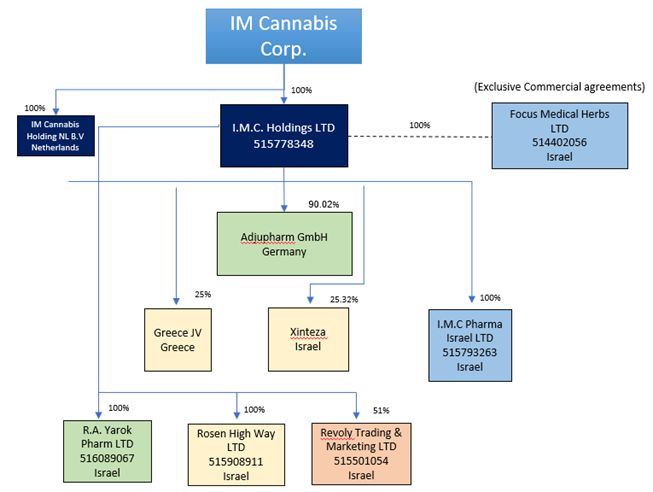
subsidiaries, including , among others, the following entities:
|
Legal Entity |
Jurisdiction |
Relationship with the Company |
|
I.M.C. Holdings Ltd. (“IMC Holdings”)
|
Israel |
Wholly-owned subsidiary |
|
I.M.C. Pharma Ltd. (“IMC Pharma”)
|
Israel |
Wholly-owned subsidiary of IMC Holdings |
|
Focus Medical Herbs Ltd. (“Focus")(1)
|
Israel |
Wholly-owned subsidiary of IMC Holdings |
|
R.A. Yarok Pharm Ltd. (“Pharm Yarok”)
|
Israel |
Wholly-owned subsidiary of IMC Holdings |
|
Rosen High Way Ltd. (“Rosen High Way”)
|
Israel |
Wholly-owned subsidiary of IMC Holdings |
|
Rivoly Trading and Marketing Ltd. d/b/a Vironna Pharm (“Vironna”)
|
Israel |
Subsidiary of IMC Holdings |
|
Adjupharm GmbH (“Adjupharm”)
|
Germany |
Subsidiary of IMC Holdings |
|
Trichome Financial Corp. (“Trichome")
(2) |
Canada |
Former wholly-owned subsidiary |
|
Xinteza API Ltd (“Xinteza”)
|
Israel |
Subsidiary of IMC Holdings |
|
Shiran Societe Anonyme (“Greece”)
|
Greece |
Subsidiary of IMC Holdings |
|
IM Cannabis Holding NL B.V Netherlands (“IMC
Holdings NL”) |
Netherlands |
Wholly-owned subsidiary of IMC Holdings |
|
(1) |
Effective February 26, 2024, IMC Holdings exercised its option to acquire a 74% ownership stake in Focus, and effective May 26, 2025,
IMC Holdings acquired the remaining 26% from Ewave Group Ltd. |
|
(2) |
Discontinued operations. |
Please see Exhibit 8.1 to this Annual Report for a complete list of our subsidiaries.
In this Annual Report, unless otherwise indicated, all references to: (i) “Company
Subsidiaries” are to the Israeli Subsidiaries and Adjupharm, (ii) “Israeli Operations”
are to IMC Holdings and the Israeli Subsidiaries as defined below (iii) “Trichome”
are to Trichome Financial Corp. and its subsidiaries. As of the date of this Annual Report “Israeli
Subsidiaries” means IMC Holdings, IMC Pharma, Focus, Pharm Yarok, Rosen High Way, Vironna and Xinteza.
CAUTIONARY
NOTE REGARDING FORWARD-LOOKING STATEMENTS
Certain information included in this Annual Report on Form 20-F may be deemed to be
“forward-looking statements,” within the meaning of the U.S. Private Securities Litigation Reform Act of 1995 and applicable
Canadian securities laws, including statements under Item 3.D. “Risk Factors,” Item 5 “Operating and Financial Review
and Prospects,” Item 4 “Information on the Company” and elsewhere in this Annual Report.
Forward-looking statements include statements that are not historical facts and involve
assumptions, expectations and projections regarding future events, conditions or results of operations. Forward-looking statements are
often (but not always) identified by words and phrases such as “may,” “will,” “would,” “could,”
“should,” “expect,” “anticipate,” “estimate,” “plan,” “intend,”
“project,” “forecast,” “target,” “outlook,” “potential,” “continue,”
“believe,” and similar expressions (including the negative of such terms). These words and similar expressions are intended
to identify forward-looking statements but are not the only means of identifying forward-looking statements.
Forward-looking statements are based on management’s current expectations, estimates,
projections, beliefs and assumptions based on currently available information and management’s assessment of historical trends,
current conditions and expected future developments. Although we believe that the expectations and assumptions reflected in the forward-looking
statements are reasonable as of the date of this Annual Report, forward-looking statements involve known and unknown risks, uncertainties
and other factors that may cause actual results, performance or achievements to differ materially from those expressed or implied herein.
Important factors that could cause actual results to differ materially from those
expressed or implied by such forward-looking statements include, among others, the risks described under “Item 3.D. Risk Factors”
and elsewhere in this Annual Report, including: regulatory and licensing compliance in Israel and Germany; changes in laws, regulations
and enforcement practices affecting cannabis; import/export restrictions and product quality requirements; pricing pressure and competitive
dynamics; supply chain disruptions and the reliability of third-party suppliers, logistics and distribution partners; liquidity, financing
and going-concern-related risks; foreign exchange, interest rate and inflation risks; geopolitical and security developments; cybersecurity,
privacy and information technology (“IT”)-related risks; and general economic and market
conditions. Readers are urged to carefully review and consider the disclosures made throughout this Annual Report, which are designed
to advise interested parties of the risks and other factors that may affect our business, financial condition, results of operations and
prospects.
Forward-looking statements are not guarantees of future performance, and undue reliance
should not be placed on such statements. Forward-looking statements speak only as of the date they are made (or such other date as may
be specified), and we do not undertake any obligation to publicly update or revise any forward-looking statements, whether as a result
of new information, future events or otherwise, except as required by applicable law, including applicable U.S. federal securities laws
and applicable Canadian securities laws.
Forward-looking statements in this Annual Report may include, but are not limited
to, statements regarding:
|
• |
our business objectives and milestones and the anticipated timing of execution; |
|
• |
the performance of our business, strategies and operations; |
|
• |
our intentions to expand our business, operations, sales channels, distribution, delivery and storage capacity; |
|
• |
our ability to reach to medical cannabis patients and address their ongoing needs and preferences; |
|
• |
the competitive conditions of the cannabis industry and the growth of medical or adult-use recreational cannabis markets in the jurisdictions
in which we operate; |
|
• |
our ability to maintain or grow our market share and maintain our competitive advantages; |
|
• |
our focus on providing premium cannabis products and strengthening our brands and commercial position; |
|
• |
demand trends and momentum in our Israeli and Germany operations; |
|
• |
the benefits of our retail presence, distribution capabilities, data-driven insights and third-party partnerships; |
|
• |
expectations regarding recurring sales and operating efficiencies; |
|
• |
anticipated cost savings from our reorganization and the timing thereof; |
|
• |
the impact of the Regulations Amendment (as defined herein) and other regulatory developments; |
|
• |
our ability to achieve profitability, improve margins and manage liquidity; |
|
• |
the number of patients in Israel licensed by the Israeli Ministry of Health (“MOH”)
to consume medical cannabis and the number of patients paying out-of-pocket for medical cannabis products in Germany; |
|
• |
the anticipated decriminalization or legalization of adult-use recreational cannabis in Israel and Germany; |
|
• |
our operating budget and the assumptions underlying it; |
|
• |
our ability to continue as a going concern; |
|
• |
the outcome of legal proceedings; |
|
• |
the continued listing of our Common Shares on the Nasdaq Stock Market LLC (“Nasdaq”);
|
|
• |
our ability to maintain, renew and extend cannabis licenses; |
|
• |
our anticipated operating cash requirements and future financing needs; |
|
• |
our expectations regarding revenue, expenses, profit margins and operations; and |
|
• |
our entry into, and development of, new lines of business; |
|
• |
future opportunities for growth in Israel, Germany and Europe. |
CAUTIONARY NOTE REGARDING FUTURE ORIENTED FINANCIAL INFORMATION
This Annual Report may contain (or incorporate by reference) “future-oriented
financial information” (“FOFI”) and/or “financial outlook” within
the meaning of applicable Canadian securities laws. FOFI and financial outlook are each a form of forward-looking information (“FLI”)
that relates to prospective financial performance, financial position or cash flows based on assumptions about future economic conditions
and courses of action. FOFI is presented in the format of historical financial statements, whereas a financial outlook is not presented
in the format of historical financial statements.
Any FOFI and/or financial outlook contained in this Annual Report is provided to assist
readers in understanding management’s current expectations and plans relating to our future operations, prospects and financial
performance (including, where applicable, expectations regarding revenues, margins, profitability, liquidity, capital resources, operating
costs, capital expenditures and other financial measures). Such information is provided for the purpose described in the disclosure in
which it appears and may not be appropriate for any other purpose.
FOFI and financial outlook are based on estimates and assumptions that management
believes are reasonable as of the date(s) on which such information is prepared (or, if no such date is specified, as of the date of this
Annual Report). Such assumptions may include without limitation (and as applicable to the particular FOFI/financial outlook): those discussed
under “Cautionary Note Regarding Forward-Looking Statements” above; assumptions regarding
product pricing and product mix; patient demand and market growth trends in Israel, Germany and other relevant jurisdictions; timing and
scope of regulatory developments and compliance requirements; ability to obtain, maintain and renew required licenses, certifications
and approvals; availability, cost and reliability of supply, manufacturing, storage, logistics and distribution arrangements (including
third-party relationships); foreign exchange rates; inflation and interest rates; taxation rates; general and administrative expenses;
operating cost estimates (including labor, utilities and energy); capital expenditure requirements; and the absence of material adverse
changes in economic, political, geopolitical and security conditions in the markets in which we operate.
FOFI and financial outlook are inherently more uncertain than historical information
because they are based on management’s best judgment and assumptions about future events and circumstances and are subject to significant
business, economic, competitive, regulatory and other risks and uncertainties. Actual results are likely to vary from any FOFI or financial
outlook, and such variation may be material. Accordingly, readers are cautioned not to place undue reliance on any FOFI or financial outlook
contained in (or incorporated by reference into) this Annual Report.
The material risk factors that could cause actual results to differ materially from
any FOFI or financial outlook, and the material factors and assumptions used to develop such FOFI or financial outlook, include those
described under “Item 3.D. Risk Factors,” “Item 5. Operating and Financial Review and
Prospects,” and elsewhere in this Annual Report (and in the documents incorporated by reference, if applicable). Such risk
factors include, without limitation, risks relating to regulatory and licensing compliance in Israel and Germany; changes in cannabis
laws and related enforcement priorities; the execution, timing and completion of strategic transactions, including potential divestitures
and entry into new lines of business, as well as the integration and performance of any such new operations; import/export restrictions
and product quality requirements; pricing pressure and competitive dynamics; reliance on supply, manufacturing and distribution arrangements
(including third parties); liquidity, financing and capital markets risks; macroeconomic and geopolitical developments; and operational,
IT, cybersecurity and privacy risks.
To the extent required by applicable law, including applicable Canadian securities
laws, we will update or revise previously disclosed material FLI (including any material FOFI and/or financial outlook) in the circumstances
and in the manner required by such laws. Except as required by applicable law, we undertake no obligation to publicly update or revise
any FOFI or financial outlook, whether as a result of new information, future events or otherwise.
Summary Risk Factors
Our business is subject to numerous risks, as more fully described in “Item
3.D. Risk Factors” immediately following this summary. You should read these risks
in full before you invest in our securities. The following is a summary of such risks.
Risks Related to Our Financial Condition and
Capital Requirements
|
• |
We have incurred significant losses since our inception and anticipate that we will incur continued losses;
|
|
• |
We have generated insufficient revenues from product sales and may never be profitable; |
|
• |
If our operational cash flows continue to be negative, we may be required to fund future operations with
alternative financing options such as offerings of shares; |
|
• |
We may not be able to secure the funds necessary to implement our strategies; |
|
• |
In pursuit of new opportunities in the cannabis industry, we may fail to select appropriate investment
candidates and negotiate acceptable arrangements; |
|
• |
Unfavorable divestments could have a material adverse effect on us; and
|
|
• |
We are subject to the inherent liquidity risk that we will not be able
to pay our financial obligations as they become due; |
Risks Related to Our Product Development
and Regulations
|
• |
Regulatory authorities in Israel may determine that we are in contravention of Israeli cannabis regulations;
|
|
• |
Our operations are subject to various laws, regulations and guidelines, and any potential noncompliance
could cause our business, financial condition and results of operations to be adversely affected; |
|
• |
Our operations are subject to a variety of laws, regulations, and guidelines, to which any changes could
have a material adverse effect on our business, results of operations, financial condition and prospects; |
|
• |
Failure to meet target production capacity may result in a material adverse effect on our business, financial
condition; and
|
|
• |
Our operations are subject to environmental and occupational safety laws and regulations,
any failure to comply with such laws and regulations could have a material adverse effect on us; and |
Risks Related to Our Business
and Industry
|
• |
Our ability to produce, store, import, distribute and sell cannabis and derivative products is dependent
on licensing and any failure to maintain such licenses would have a material adverse impact; |
|
• |
Increased competition could materially and adversely affect our business, financial condition and results
of operations; |
|
• |
We are vulnerable due to the results of the “Anti-Dumping” investigation into cannabis imports
from Canada that could have a material adverse effect on our business; |
|
• |
We rely on business licenses, permits and approvals and the failure to maintain those could have a material
adverse effect on our business, financial condition and results of the operations; |
|
• |
We rely on key business inputs and any failure to secure required supplies and services or to do so on
appropriate terms could also have a material adverse effect on our business, financial condition, and operating results; |
|
• |
We rely upon the ability, judgment, discretion and good faith of key personnel, and the inability to attract,
develop, motivate and retain highly qualified employees could have a material adverse effect on our business, financial condition and
results of operations; |
|
• |
Future acquisitions or dispositions could result in the failure to realize anticipated benefits of such
transactions; |
|
• |
The failure to design, develop or maintain effective internal controls may affect our ability to prevent
fraud, detect material misstatements, and fulfill reporting obligations. |
|
• |
The insurance purchased by the us cannot cover all risks that we are exposed to, and any uninsured amounts
of liabilities incurred by our member(s) may be paid directly by such members; and
|
|
• |
Our products face an inherent risk of exposure to product liability claims, regulatory
action and litigation if such products are alleged to have caused significant loss or injury; |
Risks Related to Ownership of
Our Securities
|
• |
Our principal shareholders, officers and directors beneficially own approximately 23.4% of our Common
Shares, and therefore be able to exert significant control over matters submitted to shareholders’ approval; We may issue additional
securities in the future, which may dilute our shareholder’s holdings. |
|
• |
The possible lack of liquidity of securities may cause difficulty for security holders to re-sell securities
at desired prices; |
|
• |
Loss of foreign private issuer status under United States securities laws could increase our regulatory
and compliance costs; and
|
|
• |
We may be a “passive
foreign investment company” (“PFIC”), for U.S. federal income tax purposes in
the current taxable year or become a PFIC in the future. There generally would be negative tax consequences for U.S. taxpayers that are
holders of the Common Shares if we are a PFIC. |
Risks Related to Intellectual Property
|
• |
We use intellectual property protections to protect our products, brands and technologies. Maintaining
such protections and paying any costs attributed to the enforcement of such protections does not completely eliminate the risk of litigation,
which may result in a material adverse effect on our business, financial condition, results of operations and prospects. |
Risks Related to Israeli Law and Our Operations
in Israel
|
• |
We are vulnerable to the political, economic, legal, social, regulatory, and military conditions
affecting Israel and the Middle East that could have a material adverse effect on our business, results of operations, financial condition
and our prospects. |
Risks Related to Enforceability of Civil Liabilities
|
• |
It may be difficult to enforce a U.S. judgment against us, our officers and directors in Israel or the
United States, or to assert U.S. securities laws claims in Israel or serve process on our officers and directors; and |
|
• |
Since we are incorporated in British Columbia and substantially all of our directors and officers reside
outside the United Stated, and some outside Canada, it may be difficult in the United States to enforce civil liabilities against us based
solely upon the federal securities laws of the United States. Similarly, it may be difficult to enforce civil liabilities against our
directors and officers residing outside of Canada. |
PART I
ITEM 1.
IDENTITY OF DIRECTORS, SENIOR MANAGEMENT AND ADVISERS
Not applicable.
ITEM 2.
OFFER STATISTICS AND EXPECTED TIMETABLE
Not applicable.
ITEM 3.
KEY INFORMATION
A.
[Reserved]
B.
Capitalization and Indebtedness
Not applicable.
C.
Reasons for the Offer and Use of Proceeds
Not applicable.
D.
Risk Factors
Our business, financial condition, results of operations and prospects are subject
to significant risks and uncertainties, including risks inherent in our industry and other factors beyond our control.
The risks described below are not the only ones we are facing. Additional risks not
currently known to us, or that we currently consider immaterial, may also adversely affect our business, operations, financial results
or prospects. In addition, there are risks associated with an investment in our securities.
The risks and uncertainties below are not the only risks and uncertainties facing
us. Additional risks and uncertainties not presently known to us or that we currently consider immaterial may also impair our business,
operations and future prospects, cause the price of our securities to decline and cause future results to differ materially from those
described herein.
If any of the following risks actually occur, our business financial condition and
results of operations could be materially adversely affected, and the trading price of our securities could decline, and holders may lose
all or part of their investment.
This Annual Report also contains forward-looking statements that involve risks and
uncertainties. Our results could materially differ from those anticipated in these forward-looking statements, as a result of certain
factors including the risks described below and elsewhere in this Annual Report and our other filings with the U.S. Securities and Exchange
Commission (the “SEC”) and SEDAR+ filings. See “Cautionary Note Regarding Forward-Looking
Statements” above.
Risks Relating to Our Financial Conditions and Capital Requirements
We have incurred significant losses since our
inception and anticipate that we will incur continued losses for the foreseeable future
We are an international cannabis company focused on providing premium cannabis products
to medical patients in Israel and Germany, two prominent countries in the global medical cannabis industry. We have funded our operations
to date primarily through offerings of shares, warrants and convertible debentures.
We have only a limited operating history upon which you can evaluate our business
and prospects. In addition, we have limited experience and have not yet demonstrated an ability to successfully overcome many of the risks
and uncertainties frequently encountered by companies in new and rapidly evolving fields, particularly in the cannabis industry. To date,
we have generated revenues from the sale of our products (see “Item 5. Operating and Financial
Review and Prospects” for additional information). We have incurred losses in each year since our inception, including operating
losses of $11,587 thousand and $10,234 thousand for the years ended December 31, 2025 and 2024, respectively. As of December 31,
2025, we had an accumulated deficit of $270,210 thousand.
Until we generate sufficient revenues, if ever, we expect to satisfy our future cash needs through debt
or equity financing. We cannot be certain that additional funding will be available to us on acceptable terms, if at all. If funds are
not available, we may be required to delay, reduce the scope of, or eliminate research or development plans for, or commercialization
efforts with respect to our products.
Furthermore, in addition to our operating expenses, we expect to incur costs associated
with operating as a public company subject to United States federal and Canadian securities laws, rules and regulations. As a result,
we expect to continue to incur significant and increasing operating losses for the foreseeable future. Because of the numerous risks and
uncertainties associated with developing a cannabis product, we are unable to predict the extent of any future losses or when we will
become profitable, if at all.
The regulatory marketing approvals that we currently have are insufficient to generate
significant revenue. Therefore, we expect to continue to incur significant losses until we are able to meaningfully commercialize our
products, which we may not be successful in achieving. We anticipate that our expenses will increase substantially if and as we:
|
• |
are subject to receipt of applicable regulatory approvals and changes in applicable regulations and laws; |
|
• |
continue operations in Israel, which is vulnerable to security and military conditions due to heightened tension in the Middle East.
For more information, see “Risks Related to Israeli Law and Our Operations in Israel” –
“We are vulnerable to the political, economic, legal, social, regulatory, and military conditions affecting Israel and the Middle
East that could have a material adverse effect on our business, results of operations, financial condition and our prospects”
in this “Risk Factors” Section. |
|
• |
Continue the research and development of our products; |
|
• |
Seek regulatory and marketing approval for our products; |
|
• |
Seek to attract and retain skilled personal; |
|
• |
Create additional infrastructure to support our operations as a public company and our planned future commercialization efforts;
|
|
• |
Experience any delays or encounter issues with respect to the above. |
The amount of any future operating losses will depend, in part, on the rate of our
future expenditures and our ability to obtain funding through sales, equity or debt financings, strategic collaborations or grants. Even
if we obtain regulatory approval to market our product, our future revenues will depend on the market size (geographic and indication-specific)
in which any such product receives approval and our ability to achieve sufficient market acceptance, competition, pricing, reimbursement
from third-party payors for our product or any future product candidates. Further, the operating losses that we incur may fluctuate significantly
from quarter to quarter and year to year, such that a period-to-period comparison of our results of operations may not be a good indication
of our future performance. Other unanticipated costs may also arise.
We have generated insufficient revenues from
product sales and may never be profitable
In order to generate significant revenue, we will need to obtain additional regulatory
approvals in jurisdictions within which we already have certain regulatory approvals and also in jurisdictions in which we currently have
no regulatory approvals to market our product.
Our product has regulatory approvals that allow us to market it in certain geographical
areas and for specific indications (see “Item 4.B. Business Overview – Government Regulations” for additional information).
However, even with these regulatory approvals in place, we have yet to generate significant revenues.
In addition to our dependency on receiving adequate regulatory approvals to market
our products to our target market (geographic and indication-specific), our ability to generate significant revenues and achieve profitability
also depends on our success in many areas, including but not limited to:
|
• |
finance our operations and the import of cannabis to Israel and Germany; |
|
• |
establish and maintain supply and, if applicable, manufacturing relationships with third parties that can provide, in both amount
and quality, adequate products to support development and the market demand for our products, and any future products; |
|
• |
any delays and disruptions we encounter in our supply chains; |
|
• |
the stability of the operations of our suppliers and service providers, and our relationship with them; |
|
• |
maintain sufficient average selling price for our products and the revenues margin we generate; |
|
• |
enter into agreements with commercial partners; |
|
• |
obtain market acceptance to our products and any future products; |
|
• |
accurately identifying demand for our products and any future products; |
|
• |
launch and commercialize any products for which we obtain regulatory and marketing approval; |
|
• |
address any competing technological and market developments that impact our products and their usage; |
|
• |
negotiate favorable terms in any collaboration, licensing or other arrangements into which we may ener and perform our obligations
under such collaborations; |
|
• |
divest our cannabis operations and retain our existing pharmacy business in Israel; |
|
• |
diversifying into a new business line, unrelated to the legacy cannabis business or the existing pharmacy business in Israel;
|
|
• |
attract, hire and retain qualified personnel; and |
|
• |
any changes in applicable regulations and laws; |
In addition, even if we were to receive all of the regulatory approvals that we may
seek to receive, our expenses could increase beyond expectations if we are required by the FDA, or other regulatory agencies, domestic
or foreign, to change our manufacturing processes or assays or to perform studies in addition to those that we currently anticipate.
Further, if we are not able to generate significant revenues from the sale of our
approved products, we may be forced to curtail or cease our operations. Due to the numerous risks and uncertainties involved in product
development, it is difficult to predict the timing or amount of increased expenses, or when, or if, we will be able to achieve or maintain
profitability.
If our operational cash flows continue to be
negative, we may be required to fund future operations with alternative financing options such as offerings of shares.
During the year ended December 31, 2025, we had negative cash flows from operating
activities. There is no assurance that we will generate positive cash flows from its future operating activities. If operational cash
flows continue to be negative, we may be required to fund future operations with alternative financing options such as offerings of shares.
We may not be able to secure the funds necessary
to implement our strategies, which could cause significant delays in carrying out business objectives or result in a material adverse
effect on our, financial condition, operational results and prospects.
There is no assurance that we will be able to secure the funds necessary to implement
its strategies. Additional debt incurred by us from engagements such as major acquisitions may us debt level to increase and result in
difficulties in completing or negotiating future debt financings. Any triggering of credit defaults or failure to raise capital by us
may cause significant delays in carrying out business objectives or result in a material adverse effect on our business, financial condition,
operational results and prospects.
We may not be able to continue as a going concern.
Our current operating budget includes various assumptions concerning the level and timing of cash receipts
from sales and cash outlays for operating expenses and capital expenditures, including cost saving plans and restructuring actions taken
in 2022, 2023, 2024 and 2025. We are managing our cash flow daily and will look for external funding for our operations. Our board of
directors (the “Board”) approved a cost saving plan, implemented in whole or in part,
to allow us to continue our operations and meet our cash obligations. The cost saving plan consists of cost reduction due to efficiencies
and synergies, which include mainly the following steps: discontinuing operation of loss-making activities, reduction in payroll and headcount,
reduction in compensation paid to key management personnel (including layoffs of key executives), operational efficiencies and reduced
capital expenditures.
These conditions raise substantial doubt about our ability to continue as a going
concern. Our consolidated financial statements as of and for the three years ended December 31, 2025 do not include any adjustments relating
to the recoverability and classification of assets or liabilities that might be necessary should we be unable to continue as a going concern.
We are subject to certain credit exposure.
We do not have significant credit risk with respect to customers.
All cash and cash equivalents are placed with major Israeli and Germany financial institutions.
Loan receivable credit risk is managed by each loan separately
according to our procedures and control relating to the borrower’s credit risk management. At the end of each period, the individual
loan values are assessed based on a credit risk analysis.
The expected credit loss analysis is generally based on management’s
understanding of the borrower’s experience/integrity, financial health, business plans, capacity, products, customers, contracts,
competitive advantages/disadvantages, and other pertinent factors when assessing credit risk. This would also include the assessment of
the borrower’s forecasts as well as taking into consideration any security and/or collateral we have on the outstanding balance.
Conflict and political instability could negatively
affect our revenues and capital markets activity
Recent volatility in global markets due to market participants' reactions to, and
uncertainty surrounding, the magnitude and timing of government and central bank action to be taken in response to geopolitical tension
in the Middle East as well as Russia's ongoing presence in Ukraine has resulted in a decline in the level of activity in the financial
markets. Continued market volatility or uncertainty related to actions taken or to be taken by central banks, a decline in the global
macroeconomic outlook, including as a result of Russia's ongoing presence in Ukraine, conflict in the Middle East, and increased geopolitical
tensions worldwide and the threat, or outbreak of more widespread armed conflict in Eastern Europe or in the Middle East could cause financial
market activity to continue to decrease, which would negatively affect our revenues and capital markets activity.
We are also vulnerable to political, economic, legal, regulatory, and military conditions
affecting Israel and the broader Middle East region. Armed conflicts between Israel and its neighbouring countries and territories occur
periodically in the region and have recently intensified, leading to heightened uncertainty and operational risks, which may adversely
affect our business, results of operations and financial condition. In addition, we may be adversely affected by other events or factors
affecting Israel such as the interruption or curtailment of trade between Israel and its trading partners, or any restrictions or pressure
on our partners, customers or others to prevent or discourage them from doing business activities with Israel or Israeli businesses, a
significant downturn in the economic or financial condition of Israel, a significant downgrading of Israel’s internal credit rating,
labour disputes civil unrest, heightened domestic protests, and political instability, including riots, uprisings and government failures.
Restrictive laws or policies directed towards Israel or Israeli businesses could have a material adverse effect on our business, results
of operations, financial condition and prospects.
Any armed conflicts, terrorist activities or political instability in the region could
adversely affect our business conditions, limit our ability to operate effectively, could harm our results of operations, and could make
it more difficult for us to raise capital. Parties with whom we do business may decline to travel to Israel during periods of heightened
unrest or tension, forcing us to make alternative arrangements when necessary in order to meet our business partners face to face. In
addition, the political and security situation in Israel may result in parties with whom we have agreements involving performance in Israel
claiming that they are not obligated to perform their commitments under those agreements pursuant to force majeure provisions in such
agreements. Further, in the past, the State of Israel and Israeli companies have been subjected to economic boycotts. Several countries
still restrict business with the State of Israel and with Israeli companies. The increasing momentum of international movements advocating
for economic disengagement from Israel, including corporate divestment and trade restrictions, may have an adverse impact on our operating
results, financial condition or the expansion of our business.
Furthermore, under Israeli law, citizens and permanent residents of Israel are obligated
to perform military reserve duty for extended periods of time and are subject to being called to active duty at any time under emergency
circumstances. In response to increased hostilities, there have been periods of significant call-ups of military reservists. The recent
conflict escalation has led to an unprecedented number of reservists being drafted, which could disrupt business continuity and impact
key personnel availability.
Political risk in the markets in which we operate
could have a material adverse effect on our business, financial condition, operating results and prospects.
Political risk is an additional risk that we may be exposed to when operating in Israel
and Europe markets. Examples of political risk include without limitation social unrest, threats or occurrences of war, organized crime,
political instability, changes of government and changes in taxation policies in domestic and international markets and jurisdictions
in which we operate.
While we actively analyze risks and developments in markets that it currently or will
participate in, there is no assurance that unpredicted impacts will not occur. Depending on the magnitude of such unpredicted impacts,
there may be a material adverse effect on our business, financial condition, operating results, and prospects.
We may not be able to effectively or successfully
address macroeconomic risks and uncertainties or successfully implement operating strategies to mitigate the impact of such risks and
uncertainties, which could materially harm our business.
Global economies are currently experiencing elevated inflation which could curtail
levels of economic activity, including in our primary production markets. This inflation is predominantly driven by costs of goods as
input costs continue to increase with the overall increase in costs caused by several external factors including but not limited to general
uncertainties caused by global supply chain constrictions and rising energy prices. As such, delivery and distribution costs, utility
costs and other necessary supplies at an economic cost cannot be assured. These are integral requirements for our business and it is reasonable
to expect that inflation, supply shortages or increases in demand could impact our future economic performance and competitiveness, as
it may entail a meaningful increase in costs for various goods and services that we may not be able to pass onto patients or customers.
In addition, our operations could be affected by the economic context should interest rates, inflation or unemployment levels reach levels
that consumer trends and spending and, consequently, impact our sales and profitability. We may not be able to effectively or successfully
address such risks and uncertainties or successfully implement operating strategies to mitigate the impact of such risks and uncertainties.
In the event that we fail to do so, such failure could materially harm our business.
In pursuit of new opportunities in the cannabis industry, we may
fail to select appropriate investment candidates and negotiate acceptable arrangements, which could adversely affect our ability to enter
into new investments.
As part of our business strategy, we seek new opportunities in the cannabis industry.
In pursuit of such opportunities, we may fail to select appropriate investment candidates and negotiate acceptable arrangements. We cannot
provide assurance that we can complete any investment that we pursue or are pursuing, on favorable terms, or that any investment completed
will ultimately benefit us. In addition, our capital solutions may not attract a following in the cannabis industry. In the event that
we choose to raise debt capital to finance any acquisition or other arrangement, our leverage will be increased. In addition, the introduction
of new tax laws or regulations, or accounting rules or policies, or rating agency policies, or changes to, or differing interpretations
of, or application of, existing tax laws or regulations or accounting rules or policies or rating agency policies, could make the productivity
and services offered by us less attractive to entities in which we hold an equity interest (“Investees”). Such changes could
adversely affect our ability to enter into new investments.
Unfavorable divestments could have a material
adverse effect on us.
In certain circumstances, we may decide, or be required, to divest any of our direct
or indirect interests in certain Investees. In particular, if any of these entities in which we hold an equity interest violate any applicable
laws and regulations, we may be required to divest our indirect or direct interest in such entity or risk significant fines, penalties,
administrative sanctions, convictions or settlements.
We may also decide to divest our cannabis operations while retaining only our existing
pharmacy business in Israel and diversifying into a new business line, unrelated to the legacy cannabis business or the existing pharmacy
business in Israel.
There is no assurance that these divestitures will be completed on terms favorable
to us, or at all. Any opportunities resulting from these divestitures, and the anticipated effects of these divestitures on us may never
be realized, or may not be realized to the extent we anticipate. Any required divestiture or an actual or perceived violation of applicable
laws or regulations could have a material adverse effect on us, including our reputation and ability to conduct business, our holdings
(directly or indirectly) in the relevant entity, the listing of our securities on applicable stock exchanges, our financial position,
operating results, profitability or liquidity or the market price of our Common Shares. In addition, it is difficult for us to estimate
the time or resources that may be required for the investigation of any such matters or their final resolution because, in part, the time
and resources that may be needed are dependent on the nature and extent of any information requested by the applicable authorities involved,
and such time or resources could be substantial.
Our cash flows and ability to pursue future
business and expansion opportunities are dependent on the earnings of our subsidiaries and Investees and the distribution of those earnings
to us.
IMC is a holding company. Substantially all of our operating assets are the capital
stock of its Subsidiaries and arrangements with entities in which we hold an equity interest. Substantially all of our business is conducted
through Subsidiaries or entities in which we hold an equity interest, which are separate legal entities. Consequently, our cash flows
and ability to pursue future business and expansion opportunities are dependent on the earnings of these entities and the distribution
of those earnings to us. The ability of these entities to pay dividends and other distributions will depend on their operating results
and will be subject to applicable laws and regulations which require that solvency and capital standards be maintained by such companies
and contractual restrictions contained in the instruments governing their debt. In the event of a bankruptcy, liquidation or reorganization
of any of our Subsidiaries, holders of indebtedness and trade creditors will generally be entitled to payment of their claims from the
assets of those subsidiaries before any assets are made available for distribution to us.
Our debtors may default on payments owed to
us.
We may be owed current or long-term debts such as accounts receivables over the course
of our operations. As a result, we may be exposed to the risk of debtor defaults on payments as they come due. We make no guarantee on
the level of credit risk that we will hold at any given time but intend to minimize this risk as determined by the Board.
We are subject to the inherent
liquidity risk that we will not be able to pay our financial obligations as they become due.
In light of our recent negative cash flows, we monitor liquidity risk carefully and
plan our liquid holdings strategically to avoid any payment defaults. Our liquidity risk is the risk that we will not be able to meet
our financial obligations as they become due. We manage our liquidity risk by reviewing our capital requirements on an ongoing basis.
Based on our working capital position as of December 31, 2025, management considers liquidity risk to be high.
There is a risk that losses will
be incurred by us if there is an adverse shift in exchange rates or increases in prevailing interest rates.
Market risk is the risk that the fair value or future cash flows of a financial instrument
will fluctuate because of changes in market prices. Market risk includes exchange rate risk and interest rate risk.
Exchange rate risk is the risk of loss arising from changes to foreign exchange rates.
As we are a party to certain international contracts that require us to make or receive payments in foreign currencies, there is a risk
that losses will be incurred if there is an adverse shift in exchange rates.
Interest rate risk pertains to the risk of loss arising from changes in prevailing
interest rates. Any increases in prevailing interest rates may increase interest expenses paid by us on any long-term debt.
We are dependent upon the global
capital markets to raise capital by equity or debt financing.
An economic downturn of the global capital markets has been shown to make the raising
of capital by equity or debt financing more difficult. We will be dependent upon the capital markets to raise additional financing in
the future, while we continue to develop our operations. As such, we are subject to liquidity risks in meeting its development and future
operating cost requirements in instances where cash positions are unable to be maintained or appropriate financing is unavailable. These
factors may impact our ability to raise equity or obtain loans and other credit facilities in the future and on terms favorable to us
and our management. If uncertain market conditions persist, our ability to raise capital could be jeopardized, which could have an adverse
impact on our operations and the trading price of our securities.
Future crises may be precipitated by any number of causes, including natural disasters,
public health crises, geopolitical instability, war, natural disasters, changes to energy prices or sovereign defaults. These factors
may impact our ability to obtain equity or debt financing in the future and, if obtained, on terms favorable to us. Increased levels of
volatility and market turmoil can adversely impact our operations and the value, and the price of the Common Shares could be adversely
affected.
In addition, there is a risk that one or more of our current service providers may
themselves be adversely impacted by difficult economic circumstances, which could have a material adverse effect on our business, financial
condition, results of operations and prospects.
Risks Related to Our Product Development and Regulations
The regulatory authorities in Israel may determine
that we are in contravention of Israeli cannabis regulations.
There is a risk that regulatory authorities in Israel may determine that we are in
contravention of Israeli cannabis regulations. Namely, prior approval of the Israeli Medical Cannabis Agency (“IMCA”)
is required for any shareholder owning 5% or more of an Israeli company licensed to engage in cannabis-related activities. Any contravention
of Israeli cannabis regulations could jeopardize the good standing of our licenses. Such a determination may adversely affect our ability
to conduct sales and marketing activities and could have a material adverse effect on our, operating results or financial condition.
We are subject to governmental regulations
in the markets in which we operate. Any delays in obtaining, or failure to obtain regulatory approvals could significantly delay the development
of markets and products and could have a material adverse effect on our business, results of operations, financial condition and prospects.
Our cannabis-related business and our activities are heavily regulated in all jurisdictions
where we carry our business. Our operations are subject to various laws, regulations and guidelines by governmental authorities, particularly
the MOH, and the Federal Opium Agency of Germany’s Federal Institute for Drugs and Medical Devices in Germany (“BfArM”),
relating to the grow, propagate, manufacture, marketing, management, transportation, storage, distribution, sale, pricing and disposal
of dried and fresh cannabis, cannabis plants and seeds, edible cannabis, cannabis extracts, clones and plants and cannabis extracts. Our
operations are also subject to laws and regulations relating to health and safety, insurance coverage, the conduct of operations and the
protection of the environment.
Israel – MOH Regulation
Laws and regulations, applied generally, grant government agencies and self-regulatory
bodies broad administrative discretion over the activities of the Israeli Subsidiaries and Focus, which can include the power to limit
or restrict business activities, the import and export of cannabis products and the imposition of additional quality criteria and disclosure
requirements on the products and services provided by Israeli Subsidiaries and Focus. Achievement of the Israeli Subsidiaries and
Focus business objectives are contingent, in part, upon compliance with regulatory requirements enacted by these governmental authorities
and obtaining all regulatory approvals, where necessary, for the production and sale of its products.
We cannot predict the time required for the Israeli Subsidiaries or Focus to secure
all appropriate regulatory approvals for the products and activity, or the extent of testing and documentation that may be required by
governmental authorities. Any delays in obtaining, or failure to obtain regulatory approvals would significantly delay the development
of markets and products and could have a material adverse effect on our business, results of operations, financial condition and prospects.
Failure to comply with the laws and regulations applicable to its operations may lead
to possible sanctions including the revocation or imposition of additional conditions on licenses to operate the Israeli Subsidiaries and/or
the Focus business, the suspension or expulsion from a particular market or jurisdiction or
of its key personnel, and the imposition of fines and censures. To the extent that there are changes to the existing laws and regulations
or the enactment of future laws and regulations that affect the sale or offering of the Israeli Subsidiaries and/or Focus
products or services in any way, this could have a material adverse effect on our business, results of operations, financial condition
and prospects.
Germany – BfArM
Regulation
On March 10, 2017, the German federal government enacted bill Bundestag- Drucksache
18/8965 – Law amending narcotics and other regulations that amended existing narcotics legislation to recognize cannabis as a form
of medicine and allow for the importation and domestic cultivation of medical cannabis products. Under the subsequent updated legislation,
cannabis was listed in Annex 3 to the Federal Narcotics Act (“BtMG”) as a “marketable
narcotic suitable for prescription” until the Medical Cannabis Act (“MedCanG”)
came into force on April 1, 2024. Since then, medical cannabis has no longer been subject to the BtMG but to the MedCanG. With regard
to medical cannabis, the cultivation, production, distribution, exportation, transit and importation are currently legal in Germany, subject
to regulations and licensing requirements. At the same time as the MedCanG, the Consumer Cannabis Act (“KCanG”)
also came into force on April 1, 2024. Operations involving adult-use recreational cannabis products became legal under certain conditions
defined in the KCanG. Until the KCanG came into force, legalization in Germany applied only to cannabis for medicinal purposes under state
control in accordance with the Narcotic Convention. This development has its origins in the fact that the former German government has
declared in the coalition agreement at the end of 2021 its intention to open the German market also in the adult-use recreational market.
In October 2022, a key points paper on the controlled supply of cannabis to adults for consumption purposes, although a restructuring
of the existing regulatory framework on cannabis in general was also discussed, published by the former cabinet, which was submitted to
the European Union Commission for a preliminary legal examination. In this respect, the Federal Government issued a declaration of interpretation
with regard to existing international agreements governing the adult-use recreational cannabis usage and submitted a draft law to the
European Union Commission within the framework of a notification.
After a long political debate, the German Bundestag approved the federal government's
draft law "on the controlled use of cannabis" (BT Drs. 20/8704, BT Drs. 20/8763, BT-Drs. 20/10426) on Friday, February 23, 2024. The draft
law (BT Drs. 20/8704) then came into force on April 1, 2024. An adjustment has already been made by Article 1 of the Act of June 20, 2024
(BGBl. 2024 I No. 207). Some components of the KCanG, which deal with so-called consumer cannabis, came into force on 1 July 2024 (such
as the possibility to apply for a permission to grow by and distribute recreational cannabis to members of a cultivation association.
The entry into force of the law also had direct consequences for medical cannabis, which is the subject matter of Art. 2 (Medical Cannabis
Act - MedCanG) and 3 (BtMG) of the law. Since the KCanG and MedCanG came into force, cannabis is no longer a narcotic by definition and
is therefore no longer subject to the BtMG. The definition in Annex 3 of the BtMG was be replaced by that in Section 2 MedCanG: "Cannabis
for medical purposes: plants, flowers and other parts of plants belonging to the genus Cannabis that are grown for medical purposes under
state control in accordance with Articles 23 and 28(1) of the Single Convention on Narcotic Drugs of 1961 of March 30, 1961 (Federal Law
Gazette 1973 II p. 1354), as well as delta-9-tetrahydrocannabinol including dronabinol and preparations of all the aforementioned substances".
However, the narcotics regulations were replaced by comparable regulations and authorisations. The Federal Institute for Drugs and Medical
Devices (BfArM) remains responsible for the latter as a higher federal authority. From a regulatory perspective, medical cannabis remains
a medicinal product or an active pharmaceutical ingredient, meaning that the requirements under medicinal product law will remain in place.
As a result, the marketing of irradiated products continues to require a marketing authorisation in accordance with the Ordinance on Medicinal
Products Treated with Radioactive or Ionising Radiation (AMRadV). Only the narcotics licence pursuant to Section 3 BtMG is replaced by
a new licence pursuant to the MedCanG (see Section 1), which, however, largely corresponds to the previous provisions of the BtMG regarding
the application process and general regulations. However, there are the following differences that are new since the entry into force:
Medical cannabis no longer has to be stored and transported like a narcotic. The corresponding safety precautions no longer apply, meaning
that compliance with the provisions of pharmaceutical law is sufficient. The so-called semi-annual reports are replaced by annual reports.
The requirements for the person responsible for medical cannabis are slightly reduced compared to those for narcotics. A prescription
of medical cannabis is possible without the need to use the form for prescription for narcotics. A normal prescription is sufficient.
However, it is likely to be of great importance that the cultivation of medicinal
cannabis based on Section 17 MedCanG is no longer subject to public tenders, but like the trading licence, it is ultimately subject to
a two-stage authorisation (at state level regarding the pharmaceutical regulations and at federal level with regard to the fact that it
is medicinal cannabis).
Medical cannabis in Germany must comply with the corresponding monographs of the German
and European Pharmacopoeia (“Ph. Eur.”). The Ph. Eur. Suppl. 11.5 contains the
new Ph. Eur. Monograph on cannabis flowers and the new Ph. Eur. Monograph on Cannabidiol (“CBD”).
With the entry into force of Suppl. 11.5 of the national edition of the Ph. Eur. on April 1, 2025, the monograph 'Cannabis flowers / Cannabis
flos [3028]' contained therein became legally binding from this date. The previous monograph 'Cannabis flowers' of the German Pharmacopoeia
was deleted with the last edition of the DAB. The new monograph on cannabis flowers includes Starting materials for the production of
extracts, medicinal products that can be prescribed as such (herbal medicinal products) that are taken by patients by inhalation or oral
administration. There are not entirely irrelevant changes compared to the German monograph. The Committee on Herbal Medicinal Products
(“HMPC”) as the European Medicines Agency’s (EMA) committee responsible for compiling
and assessing scientific data on herbal substances, preparations and combinations, announced that in view of uniform EU quality requirements
(including with respect to import and export of cannabis), further Ph. Eur. Cannabis monographs are in preparation.
All BtMG permit applications had to specify the strains and estimated quantities of
medical cannabis involved and any subsequent changes had to be reported to the Federal Opium Agency of Germany, whereby varieties and
quantities no longer appear on the permit, even if these are to be specified in the application. The same applies regarding Sections 7,
8 MedCanG in relation to the authorisation to trade in medical cannabis, although it is now apparent that no expected annual quantities
are to be specified. However, it can be assumed that the BfArM nevertheless enquire about these due to the (albeit somewhat reduced compared
to the BtMG) reporting obligations in Sections 16 and 17 MedCanG and the Foreign Narcotics Trade Regulation, which remains applicable
(see Section 14 MedCanG).
CBD is neither a real subject to the KCanG nor to the MedCanG. Only in Section 1 No.
3 KCanG is there a definition, in Section 1 No. 8 b) KCanG the exemption of CBD from the term cannabis and in Section 2 para. 2 No. 1
KCanG the exemption from the prohibition of extraction of the cannabis plant, which permits the extraction of CBD, even if it does not
contain any further regulations on CBD in isolation. With regard to synthetic CBD, a different set of regulations is important: the handling
of cannabimimetics/synthetic cannabinoids is prohibited in accordance with Section 2 of the Annex in conjunction with Section 3 of the
New Psychoactive Substances Act (NpSG). Product-specific regulations relating to CBD can be found in other regulations. Thus, Annex 1
of the Ordinance on the Prescription of Medicinal Products stipulates that CBD is in principle subject to prescription but does not specify
a minimum quantity or a specific dosage form. If we look at the food sector, a distinction is made between products that naturally contain
CBD and those that consist of or contain extracted CBD; the European Commission considers the latter to be novel foods under Regulation
(EU) 2015/2283, which require authorisation before being placed on the market. Although applications for such authorisation have been
submitted, the European Commission believes that they contain at least insufficient data on safety in food use, meaning that none of the
applications can currently lead to authorisation. Against this background, various products containing CBD can be found on the German
market. There are currently various court decisions that problematize CBD in foods (especially food supplements) and in cosmetics (especially
mouth oil). On the one hand, CBD is regarded as a potential active pharmaceutical ingredient (API) to be used in medicinal products or
as a novel food subject to authorisation and therefore unsuitable for a safe use in a foodstuff, and on the other hand as unsuitable for
cosmetic use in the mouth, as CBD would ultimately be consumed in this case (like a foodstuff and therefore to be regarded as foodstuff).
CBD is therefore sometimes declared as a flavoring in foods, as flavorings are excluded from the scope of the Novel Food Regulation. Nevertheless,
there are already decisions that exclude suitability as a flavoring in individual cases.
Cultivation in Germany
and Distribution of Medical Cannabis Cultivated in Germany
In the past, the Federal Opium Agency of Germany’s BfArM formed a cannabis division
(the “Cannabis Agency”) to oversee cultivation, harvesting, processing, quality control,
storage, packaging and distribution to wholesalers, pharmacists and manufacturers. The Cannabis Agency also regulated pricing of German-produced
medical cannabis products and served as an intermediary of medical cannabis product sales between manufacturers, wholesalers and pharmacies
on a non-profit basis so far. In late 2018, the Cannabis Agency issued a call for tenders to award licenses for local medical cannabis
cultivation and distribution of German-cultivated medical cannabis products (the “German Local Tender”). The Cannabis Agency
served as an intermediary in the supply chain between such cultivation and distribution. In April 2019, three licenses for local cultivation
were granted. In consequence three companies in Germany received the permission to cultivate on behalf of the Cannabis Agency of the BfArM.
Since the entry into force of the MedCanG, the granting of licences for domestic cultivation
is no longer subject to tendering but governed by §§ 4 et seq. MedCanG. The previously time-consuming tendering and awarding
of contracts for the domestic cultivation of cannabis for medical purposes by the Cannabis Agency and the subsequent purchase and distribution
of the domestic harvest yields by the Cannabis Agency from the economic operators determined during the tendering procedure are no longer
necessary. Ultimately, only the corresponding licences in accordance with the MedCanG and - from implementation of manufacturing steps
relevant under pharmaceutical law - the AMG are required in compliance with the respective conditions and the associated regulations.
Import volumes and procedures
regarding Medical Cannabis
The past and present regime permits the importation of cannabis plants and plant parts
for medicinal purposes under state control subject to the requirements under the Narcotic Convention, according to which, Germany must
estimate the expected demand of medical cannabis products for medical and research purposes for the following year and report such estimates
to the International Narcotics Control Board. In September 2025, Germany already reached the maximum import quota of 122 tonnes of
medical cannabis approved by the International Narcotics Control Board. The BfArM was therefore temporarily suspending new import licences
until the quota was increased.
As a prerequisite to obtaining a German import license, the supplier must grow and
harvest in compliance with EU-GACP-Guidelines and manufacture in compliance with EU-GMP-Guidelines and certifications, or alternatively,
it is a pure EU-GACP product, and the EU-GMP manufacturing steps then take place in Germany. With regard to imports from third countries
and the associated testing and assessment of EU GMP compliance, the relevant pharmaceutical regulations are in force, which also provide
for on-site inspections by the EU authorities, provided that no MRA or similar is in force for the specific product type. All medical
cannabis products imported to Germany must derive from plant material cultivated in a country whose regulations comply with Art. 23 and
38 of the Narcotic Single Convention and must comply with the relevant and applicable monographs described in the German and European
pharmacopeias.
Dispensing Exclusively
via Pharmacies
Medical cannabis products imported pursuant to an import license under the MedCanG
and AMG permits are sold exclusively to pharmacies for final dispensing to patients on a prescription basis as ‘magistral preparations’,
a term used in Europe to refer to medical products prepared in a pharmacy in accordance with a medical prescription for an individual
patient. Magistral preparations require certain manufacturing steps in the pharmacy. Such manufacturing steps of the pharmacist typically
include the testing and dosing of pre-packaged cannabis inflorescences (typically referred to as “flos”), medical cannabis
products for oral administration (dronabinol), medical cannabis products for inhalation upon evaporation, and medical cannabis-infused
teas. In addition to magistral preparations, medical cannabis products are also marketable as pre-packaged, licensed drugs (e.g. Sativex®).
Telemedicine and Mail-order-Pharmacies
According to the Federal Ministry of Health (“BMG”),
the aforementioned increase in import volumes is due to a rise in the number of prescriptions for self-payers, which are not covered by
statutory health insurance. Only a very slight increase has been observed in statutory health insurance funds, which does not reflect
the increase in imports to this extent.
In order to prevent these developments in prescribing practice, the BMG drafted a
bill to amend the MedCanG (RefE)1 in July 2025. Such legislation
amendment was then approved by the German Federal Cabinet on October 8, 20252
and provides for a significant tightening of the MedCanG with regard to the prescription and dispensing of medical cannabis. In the draft,
the BMG justifies this necessity with the need to ensure a secure supply of medicines and patient safety. On the one hand, the BMG expresses
concerns about the growing use of telemedicine platforms, since it believes that prescriptions for medical cannabis are often issued there
without personal contact. The BMG assumes that prescriptions are regularly issued solely on the basis of a questionnaire and sent via
(cooperating) mail-order pharmacies. In the view of the ministry, this could cause risks as cannabis flowers for medical purposes are
prescribed as a magistral formulation and in consequence without a marketing authorisation. For this reason, according to RefE, Section
3 Med-CanG shall stipulate that the prescription of cannabis flowers would require in-person physician consultation (e.g. in a doctor's
office or during a home visit). This shall apply to both: initial prescriptions and repeat prescriptions, for which personal contact between
doctor and patient must have taken place within the last four quarters. Furthermore, the distribution of cannabis flowers for medical
purposes within Germany by mail-order would be prohibited, while delivery only would be permitted. If implemented, these changes could
materially adversely affect our German operations, including by limiting distribution channels and reducing patient accessibility, which
may, in return, negatively impact revenues and operating results.
1
RefE, Entwurf eines Gesetzes zur Änderung des Medizinal-Cannabisgesetze des Bundesministeriums für Gesundheit vom 14.7.2025.
2
Gesetzesentwurf der Bundesregierung eines Ersten Gesetzes zur Änderung des Medizinal-Cannabisgesetzes vom 8.10.2025.
For clarification: cross-border dispatch has always been prohibited under the World
Postal Convention. The change would only affect dispatch within Germany. Pharmacies would only be able to deliver using their own employees
as couriers.
However, it should be noted that this drastic complication of prescribing could have
significant consequences for certain patient groups. The purpose of telemedicine is precisely to further develop healthcare by providing
treatment options, especially for patients in rural areas. The BMG describes precisely these points on its website3.
For this reason, there are also dissenting voices with regard to the RefE. It therefore remains to be seen whether and to what extent
the legislative changes envisaged in the RefE will ultimately be implemented in the MedCanG. This will be decided in the further course
of the proceedings.
If the legislative changes are actually adopted as decided by the Federal Cabinet,
this would affect not only the patients mentioned above, but also providers of telemedicine services and mail-order pharmacies in particular.
Our business and operating results may be hindered
by applicable restrictions on promotion marketing and advertising activities imposed by regulatory authorities.
The development of our business and operating results may be hindered by applicable
restrictions on promotion marketing and advertising activities imposed by the MOH or BfArM. If we are unable to effectively market our
products and compete for market share, or if the costs of compliance with government legislation and regulation cannot be absorbed through
the selling price for our products, our sales and operating results could be adversely affected.
Our operations are subject to various laws,
regulations and guidelines, and any potential noncompliance could cause our business, financial condition and results of operations to
be adversely affected.
Our operations are subject to various laws, regulations and guidelines. We endeavor
to comply and endeavor to cause the entities in which we hold an equity interest to comply with all relevant laws, regulations and guidelines.
However, there is a risk that the interpretation of laws, regulations and guidelines, including, but not limited to applicable stock exchange
rules and regulations, by us and these entities may differ from each other, and we and these entities operations may not be in compliance
with such laws, regulations and guidelines. Any potential noncompliance could cause our business, financial condition and results of operations
to be adversely affected. Further, any amendment to or replacement of cannabis legislations and applicable rules and regulations governing
the activities of such entities may cause adverse effects to our operations. The risks to our business associated with the decision to
amend or replace cannabis legislation and regulation, could reduce the addressable market for our products and could materially and adversely
affect our business, financial condition and results of operations.
We and the entities in which we hold an equity interest incur ongoing costs and obligations
related to regulatory compliance. Failure to comply with applicable laws and regulations may result in enforcement actions thereunder,
including orders issued by regulatory or judicial authorities causing operations to cease or be curtailed, and may include corrective
measures requiring capital expenditures or remedial actions. Parties may be liable for civil or criminal fines or penalties imposed for
violations of applicable laws or regulations. Amendments to current laws, regulations and permitting requirements, or more stringent application
of existing laws or regulations, may have a material adverse impact on our and/or our Investees, resulting in increased capital expenditures
or production costs, reduced levels of cannabis production or abandonment or delays in the development of facilities which could have
a material adverse effect on our business, results of operations and financial condition.
3
Abrufbar unter https://www.bundesgesundheitsministerium.de/service/begriffe-von-a-z/t/telemedizin.html
The introduction of new tax laws, regulations or rules, or changes to, or differing
interpretations of, or application of, existing tax laws, regulations or rules in any of the countries in which we invest could result
in an increase in our taxes, or other governmental charges, duties or impositions. No assurance can be given that new tax laws, regulations
or rules will not be enacted or that existing tax laws, regulations or rules will not be changed, interpreted or applied in a manner which
could result in our profits being subject to additional taxation or which could otherwise have a material adverse effect on us.
Our operations are subject to a variety of
laws, regulations, and guidelines, and any changes to such laws, regulations or guidelines could have a material adverse effect on our
business, results of operations, financial condition and prospects.
Our operations are subject to a complex and evolving framework of laws, regulations
and guidelines relating to, among other things, the marketing, acquisition, cultivation, manufacture, management, distribution (including
import and export), transportation, storage, sale and disposal of cannabis and cannabis-related products. We are also subject to laws
and regulations relating to health and safety, insurance coverage, the conduct of operations, and environmental protection.
Any changes in applicable laws, regulations or guidelines, or in the interpretation
or enforcement thereof, that are beyond our control could have a material adverse effect on our business, results of operations, financial
condition and prospects. In particular, changes in laws, regulations or guidelines relating to medical cannabis could negatively affect
our ability to operate in certain jurisdictions, delay or prevent the receipt of required regulatory approvals, or significantly delay
the development of our markets and products.
Failure to comply with applicable laws, regulations or guidelines could result in
sanctions, fines, censures, suspension or revocation of licenses or permits, restrictions on our operations, or expulsion from particular
markets or jurisdictions, any of which could materially and adversely affect our business, results of operations, financial condition
and prospects.
Failure to meet target production capacity
may result in a material adverse effect on our business, financial condition.
Our sales capabilities are subject to estimates in target production capacity. These
estimates may prove to be inaccurate due to uncontrollable external factors such as genetic drifts in strain of plants grown and general
difficulties in estimating growth of cannabis plants and also unexpected delays in product supply by third party cultivation partners
and importation due to reasons related to regulation and the supplier and operational constrains. Any adverse misalignments between the
target production capacity and actual production capacity may result in a material adverse effect on our business, financial condition.
Our operations are subject to environmental
and occupational safety laws and regulations, any failure to comply with such environmental and occupational safety laws and regulations
could have a material adverse effect on our business, results of operations and financial condition.
Our operations are subject to environmental and occupational safety laws and regulations
in certain jurisdictions, concerning, among other things, emissions and discharges to water, air and land, the handling and disposal of
hazardous and nonhazardous materials and wastes, and employee health and safety. We incur ongoing costs and obligations related to compliance
with environmental and employee health and safety matters. Any failure to comply or maintain compliance with environmental and occupational
safety laws and regulations may result in additional costs for corrective measures, penalties or restrictions on manufacturing operations
and could have a material adverse effect on our business, results of operations and financial condition.
Our products could have certain side effects if not taken as directed
or if taken by an end user that has certain known or unknown medical conditions.
If the products we sell are not perceived to have the effects intended by the end
user, its business may suffer. There is little long-term data with respect to efficacy, unknown side effects and/or interaction with individual
human biochemistry of various cannabis products. As a result, our products could have certain side effects if not taken as directed or
if taken by an end user that has certain known or unknown medical conditions.
Risks Related to Our Business and Industry
Our ability to produce, store, import, distribute
and sell cannabis and derivative products in Israel and Germany is dependent on licensing and any failure to maintain the respective licenses
would have a material adverse impact on our business, financial condition and operating results.
Israel – Reliance
on the Israeli Licenses
Our ability to produce, store, import, distribute and sell cannabis in Israel is dependent
on the Israeli Subsidiaries and Focus maintaining the Israeli Licenses with the IMCA. Failure to comply with the requirements or any failure
to maintain the Israeli Licenses would have a material adverse impact on our business, financial condition and operating results. There
can be no guarantees that the IMCA will extend or renew any of Israeli Licenses as necessary or, if it extended or renewed, that
any of the Israeli Licenses will be extended or renewed on the same or similar terms. Should the IMCA not extend or renew any of
Israeli Licenses or should it renew any of the Israeli Licenses on different terms, the business, financial condition and results of our
operations would be materially adversely affected.
Germany – Reliance
on the Adjupharm Licenses
Our ability to produce and distribute cannabis through Adjupharm’s certification
as an EU-GMP and EU-GDP producer and distributor in Germany with wholesale, narcotics handling, manufacturing, procurement, storage and
distribution authority is granted by German regulatory authorities. Failure to comply with the requirements of the BfArM issued licenses
or any failure to maintain their respective licenses would have a material adverse impact on our business, financial condition and operating
results.
We rely on licensed facilities in Israel and
Germany to conduct our operations and any adverse changes or developments affecting such facilities could have a material adverse effect
on our, financial condition, results of operations and prospects.
Israel – Reliance
on our Facilities
The Israeli Pharmacies
The Israeli Licenses are specific to each respective Israeli facility holding such
license and therefore, both the license and the Israeli facilities must remain in good standing for each of our pharmacies, Vironna and
R.A Pharm Yarok (the “Israeli Pharmacies”) to be able to conduct the Israeli cannabis
activities authorized thereunder. Adverse changes or developments affecting any of our Israeli facilities, including but not limited to
the failure to maintain all requisite regulatory and ancillary permits and licenses, the failure to comply with state or municipal regulations,
or a breach of security, could have a material adverse effect on our business, financial condition, results of operations and prospects.
Any breach of any lease agreement relevant to the operations of the Israeli Pharmacies
or any failure to renew such lease agreements, on materially similar or more favorable terms, may also have a material adverse effect
on our business, financial condition, results of operations and prospects.
Germany – Reliance
on the German Logistics Center
Our EU-GMP logistics centre in Germany (the “German Logistics
Center”) allows Adjupharm to manage all aspects of its supply chain including the production, the repackaging and distribution
of bulk medical cannabis. Any breach of regulatory requirements, including any failure to comply with recommendations or requirements
arising from inspections by government regulators, could also have an impact on Adjupharm’s ability to maintain the licenses and/or
keep the German Logistics Center in good standing, and to continue operating it under the licenses, could have a material adverse effect
on our business, financial condition, results of operations and prospects.
In Germany and in Israel, we rely on various
supply and distribution agreements with third-parties, such as cannabis cultivators, packaging suppliers, service providers and distribution
partners. The loss of such suppliers and/or service providers and/or distributors and/or their timely service would have a material adverse
effect on our business and operational results.
Israel – Supply,
Manufacture and Distribution Agreements
The Israeli Subsidiaries rely on and are substantially dependent on various supply
agreements with third-party cannabis cultivators in Israel and Canada, imported cannabis products, manufacture and packaging agreements
and distribution agreements to fulfill the supply requirements of its distribution and sales agreements with pharmacies in the Israeli
medical cannabis market. The Israeli Subsidiaries acquire cannabis from third parties in amounts sufficient to operate its business. However,
there can be no assurance that there will continue to be a supply of cannabis available for us to purchase to operate or expand. Additionally,
the price of cannabis and other inputs may rise which would increase the cost of goods. If any suppliers fail to supply any contracted
materials to the Israeli Subsidiaries, the Israeli Subsidiaries may fail to meet purchase commitments from their distribution partners.
If we were unable to acquire the cannabis or other inputs required to operate or expand or to do so on favorable terms or fail to maintain
the manufacture agreements with IMC-GMP manufacture companies, it could have a material adverse impact on our business, financial condition
and results of operations. If any of our suppliers fails to provide inputs meeting our quality standards, it may need to source cannabis
or other inputs from other suppliers, which may result in additional costs and delay in the delivery of its products and services to distributors,
pharmacies and patients. There is no assurance that suppliers will be able to supply and deliver the required materials to us in a timely
manner or that the materials they supply to us will not be defective or substandard. Any delay in the delivery of materials, or any defect
in the materials, supplied to us may materially and adversely affect or delay its production schedule and affect its product quality.
Consequently, we rely on the suppliers of such supply agreements to provide necessary cannabis products to the Israeli Subsidiaries. If
we cannot secure cannabis of similar quality and at reasonable prices from alternative suppliers in a timely manner, or at all, the Israeli
Subsidiaries may not be able to deliver its products to distributors, pharmacies or patients
on time with the required quality. The various suppliers and distributors may elect, at any time, to breach or otherwise cease to participate
in supply, service or distribution agreements, or other relationships, upon which our operations rely. Loss of its suppliers, service
providers or distributors or their timely service would have a material adverse effect on our business and operational results.
Germany – Reliance
on Supply and Distribution Agreements in Germany
Adjupharm relies on its sales and distribution agreements to supply IMC-branded products
to distribution partners in Germany, which are then distributed to German pharmacies for sales to medical cannabis patients and on direct
sales by Adjupharm of IMC-branded products to German pharmacies.
Adjupharm relies on supply agreements with cannabis cultivators and producers to meet
the demands of their respective sales agreements with distribution partners and pharmacies. Consequently, we rely on the suppliers of
such supply agreements to provide necessary cannabis products to Adjupharm. If any suppliers fail to supply any contracted materials to
Adjupharm, Adjupharm may fail to meet purchase commitments from their distribution partners and this could result a material adverse effect
on our business, financial and operational results.
Increased competition could materially and
adversely affect our business, financial condition and results of operations.
We may face intense competition from other companies or groups of companies, some
of which can be expected to have more financial resources, industry, manufacturing and marketing experience than us. Because of the early
stage of the industry in which we operate, as well as evolving legislation and governmental initiatives in several jurisdictions, we expect
to face additional competition from new entrants in the jurisdictions in which we currently operate or are contemplating operations. If
the number of users of medical cannabis products in Israel and Europe increases, the demand for products in such areas will increase and
we expect that competition will become more intense, as current and future competitors begin to offer an increasing number of diversified
products and pricing strategies. Increased competition by larger and better-financed competitors could materially and adversely affect
our business, financial condition and results of operations.
The cannabis industry is undergoing rapid growth
and substantial change, which has resulted in an increase in competitors, consolidation and formation of strategic relationships that
could cause a material adverse effect on our business, financial condition, results of operations and our prospects.
The cannabis industry is undergoing rapid growth and substantial change, which has
resulted in an increase in competitors, consolidation and formation of strategic relationships. It is possible that industry maturation
could create larger companies that may have increased geographic scope. Such acquisitions or other consolidating transactions could harm
us in several ways, including the loss of strategic partners (if they are acquired by or enter into relationships with a competitor),
customers, or revenue and market share, all of which could harm our operating results. Our operating results could also be harmed if we
were forced to expend greater resources to meet new or additional competitive threats. Additional competition from larger, better-financed
competitors with geographic advantages could outcompete us by placing downward pressure on retail prices for products and services. This
could ultimately cause a material adverse effect on our business, financial condition, results of operations and our prospects.
We are vulnerable due
to the results of the “Anti-Dumping” investigation into cannabis imports from Canada that could have a material adverse effect
on our business.
We are exposed to risks from an ongoing "Anti-Dumping" investigation by the Israeli
Ministry of Economy and Industry into cannabis imports from Canada. The investigation, initiated in January 2024, examines potential harm
to local producers and has led to various procedural extensions and legal challenges. In July 2024, a preliminary decision found evidence
of dumping but did not impose temporary guarantees, prompting local growers to challenge this in court—ultimately without success.
In November 2024, the Israeli Ministry of Economy and Industry recommended tax levies on Canadian imports, with non-cooperative companies
facing a 175% tax, while cooperating importers would see lower rates starting at 2%. We have actively responded, presenting arguments
to the advisory committee to the Israeli Ministry of Economy (the "Advisory Committee") and engaging
in legal proceedings to mitigate potential impacts. In April 2025, the Israeli Ministry of Treasury ruled over the Israeli Ministry of
Economy and Industry’s recommendation to pose tax levies on Canadian cannabis imports. Such decision was later approved by the Israeli
Attorney General in July 2025.
Our facilities are subject to the risk of theft
of our product and other security breaches, which could have an adverse effect on our business, financial condition, results of operations
and our prospects.
Due to the nature of our products and the limited legal channels for distribution,
the Israeli Pharmacies and the German Logistics Center is subject to the risk of theft of our product and other security breaches. A security
breach in any one of our facilities and external cultivation, manufacturing and storage facilities possessing of our products could result
in a significant loss of available product and as a result decrease in sales, revocation of cannabis licenses, exposure to additional
liability under applicable regulations and to potentially costly litigation or increased expenses relating to insurance premiums and other
resolutions and future prevention of security breaches, any of which could have an adverse effect on our business, financial condition,
results of operations and prospects.
In Israel, we store products in the Israeli Pharmacies and other pharmacies not owned
by us, including with Israeli trade houses, and external service providers such as cultivation, manufacturing, and storage partners. In
addition, in Germany, we store products in the German Logistics Center before distribution. Pursuant to the applicable Israeli and German
licensing requirements, the Israeli Subsidiaries and Adjupharm are required to maintain certain standards of storage for cannabis products.
The risk of inventory theft from these facilities is mitigated by the Israeli Subsidiaries and Adjupharm through the implementation of
the security measures required under applicable laws, such as usage of qualified storage units, designated storage locations, locked storage
vaults, access control, security cameras, and alert systems. Notwithstanding such security measures, any breaches of security may result
in losses of inventory, potential litigation, and increased costs to bolster security and insurance, which may, in turn, have an adverse
effect on our business, financial condition, results of operations and our prospects.
We rely on business licenses, permits and approvals
and the failure to maintain any of these licenses, permits and approvals could have a material adverse effect on our business, financial
condition and results of the operations.
We are dependent on ancillary business licenses, permits and approvals granted by
government authorities or other third parties in order to operate effectively including, without limitation, building permits, municipal
permits, third-party licenses including distributors and suppliers, and foreign trade licenses. Should we fail to maintain any of these
licenses, permits and approvals, or should we fail to renew any of such licenses, permits and approvals on materially similar or more
favorable terms, our business, financial condition and results of the operations may be subject to a material adverse effect.
Violations of securities laws
and breaches of fiduciary duty could result in civil liability, fines, sanctions, or the suspension or revocation of our right to carry
on our existing business.
Given the nature of our business, we may from time to time be subject to claims or
complaints from investors or others in the normal course of business. The legal risks facing us, our directors, officers, employees, or
agents in this respect include potential liability for violations of securities laws or breach of fiduciary duty. Violations of securities
laws and breach of fiduciary duty could result in civil liability, fines, sanctions, or the suspension or revocation of our right to carry
on our existing business. We may incur significant costs in connection with such potential liabilities.
Any failure to successfully manage growth,
integrate potential acquired businesses and diversify our business may result in a material adverse effect on our business, financial
condition, operating results and prospects.
We may be subject to growth related risks including capacity constraints and pressure
on our internal systems and controls. Our ability to manage growth effectively will require us to continue to implement and improve our
operational and financial systems and to expand, train and manage our employee base. If we are unable to deal with this growth, any negative
impact may have a material adverse effect on our business, financial condition, results of operation and prospects.
Additionally, we may decide to divest certain of our cannabis operations while retaining
our existing pharmacy business in Israel, and also consider diversifying into a new business line, unrelated to the legacy cannabis business
or our existing pharmacy business in Israel, including in the defense sector. There is no certainty as to our ability to retain our existing
pharmacy business in Israel successfully, nor to our success in diversifying into a new business line, or completing any such strategic
transactions on acceptable terms, or at all, which could have a negative impact and a material adverse effect on our business, financial
condition, results of operations and prospects.
The evaluation and pursuit of such potential divestitures and new business opportunities
may divert management’s attention and resources from our existing operations and may involve significant costs and uncertainties.
If completed, such transactions may expose us to new operational, regulatory and competitive risks, including risks associated with operating
in industries in which we have limited or no prior experience, and we may not realize the anticipated benefits of such transactions
In addition, the realization of the benefits of past and future acquisitions made
by us depend in part on successfully consolidating functions and integrating and leveraging operations, procedures and personnel in a
timely and efficient manner as well as our ability to share knowledge and realize revenues, synergies and other growth opportunities from
combining the acquired businesses and operations with our. The integration of acquired businesses may depend on a number of factors, including
without limitation: (i) the input of substantial management effort, time and resources; (ii) the successful incorporation of key personnel
from acquired companies for post-acquisition periods. Any failure in successfully integrating acquired businesses may result in a material
adverse effect on our business, financial condition, operating results and prospects. The risks we face in connection with a potential
acquisition include:
|
● |
diversion of management time and focus from operating our business to addressing acquisition integration challenges; |
|
● |
coordination of research and development and sales and marketing functions; |
|
● |
retention of employees from the acquired company; |
|
● |
cultural challenges associated with integrating employees from the acquired company into our organization; |
|
● |
integration of the acquired company's accounting, management information, human resources, and other administrative systems;
|
|
● |
the need to implement or improve controls, procedures, and policies at a business that prior to the acquisition may have lacked effective
controls, procedures, and policies; |
|
● |
potential write-offs of intangible assets or other assets acquired in transactions that may have an adverse effect on our operating
results in a given period; |
|
● |
liability for activities of the acquired company before the acquisition, including patent and trademark infringement claims, violations
of laws, commercial disputes, tax liabilities, and other known and unknown liabilities; and |
|
● |
litigation or other claims in connection with the acquired company, including claims from terminated employees, consumers, former
stockholders, or other third parties. |
The failure to secure suppliers or distribution
partners could have a material adverse effect on our business, financial condition, results of operations and prospects.
Our success depends on our ability to secure suppliers and distribution partners.
There are many factors which could impact our ability to secure suppliers and distribution partners, including but not limited to IMC
and other brand awareness, our ability to continually produce desirable and effective cannabis products, compliance with regulatory requirements
in connection with import and export of cannabis products, and the successful implementation of new partnership plans. The failure to
secure suppliers or distribution partners could have a material adverse effect on our business, financial condition, results of operations
and prospects.
We rely on key business inputs and any failure
to secure required supplies and services or to do so on appropriate terms could also have a material adverse effect on our business, financial
condition, and operating results.
Our business is dependent on a number of key inputs and their related costs including
raw materials and supplies related to our growing and distribution operations as well as electricity, water, and other utilities. Any
significant interruption or negative change in the availability or economics of the supply chain for key inputs (e.g. rising energy costs)
could cause a material adverse effect on our business, financial condition, and operating results. Any failure to secure required supplies
and services or to do so on appropriate terms could also have a material adverse effect on our business, financial condition, and operating
results.
The failure to effectively compete
in our markets and introduce new product offerings may cause a material adverse effect on our business, results of operations, financial
condition and prospects.
In addition to being subject to general business risks applicable to a business involving
an agricultural product and a regulated consumer product, we will need to make investments in our business strategy. These investments
include the procurement of raw material, new cannabis strains supplier and distributor outreach projects, marketing efforts and research
and development projects. We expect that competitors will undertake similar investments to compete with it. Competitive conditions, third-party
partner preferences, patient requirements and spending patterns in this industry and market are relatively unknown and may have unique
circumstances that differ from other existing industries and markets and contribute to unsuccessful future business development or expansion
efforts by us or other undesirable consequences. As a result, we may not be successful in our efforts to secure suppliers or distribution
partners or to develop new cannabis products and produce and distribute these cannabis products. In addition, these activities may require
significantly more resources than we currently anticipate in order to be successful.
Any new cannabis products that we develop or distribute may be subject to time-intensive
regulatory approval procedures that might delay any release schedules or lead to adverse market conditions that might affect product profitability.
We may ultimately fail to effectively bring new product offerings to market for reasons that include, but are not limited to, stringent
regulatory approval procedures. Any inability to introduce new product offerings may cause a material adverse effect on our business,
results of operations, financial condition and prospects.
We rely on international third-party
transportation services to deliver and receive product-related shipments, which may cause delays and impact our profitability.
We rely on international third-party transportation services to deliver and receive
product-related shipments. In the process of the deliveries, time delays, labor strikes, Iron Swords War (as defined below) related issues,
product storage issues or other logistical problems may occur and force late delivery or receipt of items or receipt of damaged items.
Such delays, receipt of damaged items or other logistical problems may cause a material adverse effect on our business, operations or
financial condition. Rising costs associated with courier services used by us may also adversely impact our business and our ability to
operate profitably.
In addition, any breach of security of the products’ package during the possession
of the third-party transportation service may result in violations of regulations regarding possession of cannabis products and thus may
have a material adverse effect on our business, financial condition and operating results.
Strategic alliances that we enter into could
present unforeseen integration obstacles or costs, may not enhance our business, and may involve risks that could adversely affect us.
We may enter into further strategic alliances with third parties that we believe will
complement or augment our existing business. Our ability to complete strategic alliances is dependent upon, and may be limited by, the
availability of suitable candidates and capital. In addition, strategic alliances could present unforeseen integration obstacles or costs,
may not enhance our business, and may involve risks that could adversely affect us, including significant amounts of management time that
may be diverted from investment activities operations to pursue and complete such transactions or maintain such strategic alliances. Future
strategic alliances could result in the incurrence of additional debt, costs and contingent liabilities, and there can be no assurance
that future strategic alliances will achieve the expected benefits to our business or that we will be able to consummate future strategic
alliances on satisfactory terms, or at all.
While we conduct due diligence with respect to Investees, there are risks inherent
in any investment. Specifically, there could be unknown or undisclosed risks or liabilities of Investees for which we are not or will
not be sufficiently indemnified. Any such unknown, undisclosed or unmitigated risks or liabilities could materially and adversely affect
our financial performance and results of operations. We could encounter additional transaction and enforcement related costs or other
factors such as the failure to realize all of the benefits from our investments. Any of the foregoing risks and uncertainties could have
a material adverse effect on our business, financial condition and results of operations.
We rely upon the ability, judgment, discretion
and good faith of key personnel, and the inability to attract, develop, motivate and retain highly qualified employees could have a material
adverse effect on our business, financial condition and results of operations.
We have relied upon the ability, judgment, discretion and good faith of its executive
management team. Our future success depends on its continuing ability to attract, develop, motivate and retain highly qualified employees,
especially its key personnel. If we were to lose any members of the executive management or key employees, any inability to find suitable
replacements at reasonable costs may have a material adverse effect on our business, financial condition and results of operations. Further,
certain of our key personnel are subject to a security clearance by IMCA. There is no assurance that any of our key personnel who presently
or may in the future require a security clearance will be able to obtain or renew such clearances or that new personnel who require a
security clearance will be able to obtain one. A failure by any of those individuals to maintain or renew his or her security clearance,
could result in a material adverse effect on our business, financial condition and results of operations. In addition, if any such individual
leaves us, and we are unable to find a suitable replacement that has a security clearance required by applicable law, or at all, there
could occur a material adverse effect on our, financial condition and results of operations.
We rely on international advisors and consultants
for our operations in foreign countries.
The legal, regulatory, tax and accountant requirements in the foreign countries in
which we may invest or operate in with respect to the cultivation and sale of cannabis, banking systems and controls, as well as local
business culture and practices are different from those in Israel and Germany. Our officers and directors must rely, to a great extent,
on local legal and financial counsels and consultants in order to keep abreast of material legal, regulatory and governmental developments
as they pertain to and affect our business operations, and to assist with governmental relations. We must rely, to some extent, on those
members of management and the Board who have previous experience working and conducting business in these countries, if any, in order
to enhance our understanding of and appreciation for the local business culture and practices. We also rely on the advice of local experts
and professionals in connection with current and new regulations that develop in respect of the cultivation and sale of cannabis as well
as in respect of banking, financing, labour, litigation and tax matters in these jurisdictions. Any developments or changes in such legal,
regulatory or governmental requirements or in local business practices are beyond our control. The impact of any such changes may cause
a material adverse effect to our business, financial condition, operating results and our prospects.
Foreign market participation subjects us to
the global capital markets and government authorities, which could have a material adverse effect on our business, financial condition
and results of operations.
Global capital markets have also recently experienced extreme volatility which may,
in conjunction with the factors set out above and despite the actions of government authorities, contribute to a worsening of general
economic conditions including, rising interest rates, high levels of inflation and unemployment, the unavailability of credit or the devaluation
of currencies. Unexpected changes in these factors and financial market and economic conditions could affect our financial condition,
profitability and cash flows, and may also have a negative effect on our valuation of, and our ability to exit or partially divest from,
investment positions. Depending on conditions, we may incur substantial realized and unrealized losses in future periods, all of which
may materially adversely affect our results of operations and the value of any investment in us.
We continue to monitor developments and policies in the foreign markets in which it
operates or invests and assess the impact thereof to its operations; however, such developments cannot be accurately predicted. The realization
of any of these risks may significantly impair our local operations and have a material adverse effect on our business, financial condition
and results of operations.
These risks may also limit or disrupt our strategic alliances or investments, restrict
the movement of funds, increase our costs, or result in the deprivation of contract rights or the taking of property by nationalization
or expropriation without fair compensation, and may have a material adverse effect on our financial position and/or results of operations.
In addition, our enforcement of our legal rights in foreign countries, including rights to exploit properties or utilize permits and licenses
and contractual rights may not be recognized by the court systems in such foreign countries or enforced in accordance with the rule of
law.
Future acquisitions or dispositions could result
in the failure to realize anticipated benefits of such transactions.
Material acquisitions, dispositions and other strategic transactions involve a number
of risks, including but not limited to the potential disruption of our ongoing business, distraction of management, we may become more
financially leveraged, the failure to realize anticipated benefits of those transactions fully or at all, or may take longer to realize
than expected, and loss or reduction of control over certain of our assets.
Despite our due diligence efforts, the presence of one or more material liabilities
of an acquired company that are unknown to us at the time of acquisition could have a material adverse effect on our business, results
of operations, prospects and financial condition. A strategic transaction may result in a significant change in the nature of our, operations
and strategy. In addition, we may encounter unforeseen obstacles or costs in implementing a strategic transaction or integrating any acquired
business into ours.
In addition, our strategic transaction decisions are based on the economic assessments
made by us and our external advisors. Such economic assessments involve a series of assumptions regarding factors such as future cannabis
prices, production requirements, expected revenue growth, cash flow and financing requirements, future capital expenditures and operating
costs. Many of these factors are subject to change and are beyond our control. In addition, future acquisition or international expansion
could require us to incur a number of up-front expenses, including those associated with obtaining regulatory approvals, as well as additional
ongoing expenses, including those associated with infrastructure, buildout, staff and regulatory compliance. If there is any significant
negative change in any of these factors, we may experience a material adverse effect on our business, financial condition, operating results
and our prospects.
Foreign expansion efforts and operations could
subject us to additional business risks, and the potential failure of our operating infrastructure to support such expansions could result
in operational failures and regulatory fines or sanctions.
Our expansion into foreign jurisdictions is subject to additional business risks,
including new or unexpected risks or could significantly increase our exposure to one or more existing risk factors, including economic
instability, changes in laws and regulations, and the effects of competition, as well as operational, regulatory, compliance and reputational
and foreign exchange rate risk. The failure of our operating infrastructure to support such expansions could result in operational failures
and regulatory fines or sanctions. Additionally, there is no guarantee that we will be able to realize any of the anticipated benefits
of any transactions related to our expansion strategy.
We currently have no U.S. operations.
We and, to our knowledge, the entities in which we hold an equity interest do not
currently engage in any U.S. cannabis-related activities as defined in Canadian Securities Administrators’ Staff Notice 51-352 (Revised)
- Issuers with U.S. Marijuana-Related Activities (“CSA Staff
Notice 51-352”). To date, we have caused the entities in which we hold an equity interest to only conduct business and invest
in entities in federally-legal jurisdictions by including appropriate representations, warranties and covenants in its agreements with
Investees. However, an entity in which we hold an equity interest may breach such obligations. Any such violation of such obligation would
result in a breach of the applicable agreement and, accordingly, may have a material adverse effect on our business, operations and financial
condition.
However, as of the date of this annual report, we are actively evaluating certain
strategic opportunities to expand our operations into the U.S. cannabis market. This initiative follows President Donald Trump's executive
order signed on December 18, 2025, which directs the Attorney General to expedite the rescheduling of marijuana from Schedule I to Schedule
III under the Controlled Substances Act, recognizing its medical benefits while maintaining federal oversight.
To advance our U.S. entry strategy and assess potential divestitures of our businesses
in Germany and Israel, we have engaged SSC Advisors to act as our financial advisors. The advisors are expected to provide customary financial
advisory services, including strategic guidance on potential U.S. cannabis market entry, the identification of potential partners or acquirors,
and management of any transaction processes related to our German and Israeli operations.
Our management team may have limited experience
managing a U.S. reporting company.
Most members of our management team may not have experience managing a publicly traded
company in the United States, interacting with public company investors and complying with the increasingly complex laws pertaining to
public companies in the United States. Although we were also a public company in Canada, our management team may not successfully or efficiently
manage our transition to being a public company in the United States that is subject to significant regulatory oversight and reporting
obligations under the U.S. federal securities laws and the continuous scrutiny of securities analysts and investors. These obligations
and constituents will require significant attention from our senior management and could divert their attention away from the day-to-day
management of our business, which could adversely affect our business, financial condition, results of operations and prospects.
We are subject to risks inherent in the agricultural
business.
Our business involves the growing of cannabis products by third party suppliers, which
are agricultural products. As such, the business is subject to the risks inherent in the agricultural business, such as pests, plant diseases
and similar agricultural risks. Although, the third-party cultivators our partners with carefully monitor the growing conditions with
trained personnel and applicable equipment, there can be no assurance that natural elements will not have a material adverse effect on
the production of its products and results of operations. Any decline in production could have a material adverse effect on our business,
operating results or financial condition.
Illegal market competition in the cannabis
market could have a material adverse effect on our business, operating results and prospects
As a participant of the cannabis market in international jurisdictions with varying
regulations, we may be subject to competition from entities that conduct illegal cannabis business operations. Such entities may resort
to competitive measures such as producing products with prohibited concentrations of Delta-9 tetrahydrocannabinol (“THC”)
and industrial Hemp-based cannabidiol (“CBD”) or producing imitations of our products
without our authorization or endorsement. If demand for these illegal products increases and local governments fail to regulate markets
accordingly, we may experience a material adverse effect on our business, operating results and our prospects.
Consumer perception of our products can be
significantly influenced by scientific research or findings, regulatory investigations, litigation, media attention and other publicity
regarding the consumption of medical cannabis products.
We believe the medical cannabis industry is highly dependent upon consumer perception
regarding the safety, efficiency and quality of the medical cannabis products produced. Consumer perception of our products can be significantly
influenced by scientific research or findings, regulatory investigations, litigation, media attention and other publicity regarding the
consumption of medical cannabis products.
There can be no assurance that future scientific research, findings, regulatory proceedings,
litigation, media attention or other research findings or publicity will be favorable to the medical cannabis market or any particular
product, or consistent with earlier publicity.
Future research reports, findings, regulatory proceedings, litigation, media attention
or other publicity that are perceived as less favorable than, or that question, earlier research reports, findings or publicity could
have a material adverse effect on the demand for products bearing the brands marketed and sold by usp and the business, results of operations,
financial condition, prospects and our cash flows.
Further, adverse publicity reports or other media attention regarding the safety,
efficacy and quality of medical cannabis products in general, or our products specifically, or associating the consumption of medical
cannabis products with illness or other negative effects or events, could have a material adverse effect. Such adverse publicity reports
or other media attention could arise even if the adverse effects associated with such products resulted from consumers’ failure
to consume such products appropriately or as directed.
Reputational risk to third parties could result
in the failure to establish or maintain business relationships.
The parties outside of the cannabis industry with which we do business may perceive
that they are exposed to reputational risk as a result of our cannabis business activities. Failure to establish or maintain business
relationships could have a material adverse effect on our business, financial condition, results of operations and our prospects.
The failure of our IT systems or a component
of IT systems could, depending on the nature of any such failure, adversely impact our financial condition, operating results and reputation.
Our operations will depend, in part, on how well we and our supply and distribution
partners protect networks, equipment, IT systems (“IT Systems”) and software against
damage from a number of threats, including, but not limited to, cable cuts, damage to physical plants, natural disasters, intentional
damage and destruction, fire, power loss, hacking, computer viruses, vandalism and theft. Our operations also will depend on the timely
maintenance, upgrade and replacement of networks, equipment, IT Systems and software, as well as pre-emptive expenses to mitigate the
risks of failures. Any of these and other events could result in information system failures, delays and/or increase in capital expenses.
The failure of IT Systems or a component of IT Systems could, depending on the nature of any such failure, adversely impact our financial
condition, operating results and reputation.
Cybersecurity risks could adversely impact
our financial condition, operating results and reputation.
Our information systems and its third-party service providers and vendors are vulnerable
to increasing threat of continually evolving cybersecurity risks, resulting in data breaches and data losses. These risks arising from
events including without limitation malware, computer viruses, employee error, extortion, malfeasance, system errors, and hacking. In
order to minimize the risk of these events from occurring, we are performing timely maintenance, upgrade and replacement of networks,
equipment, IT systems and software and other protective measures. However, any failure or delay in maintaining, upgrading or replacing
such systems and software could materially increase the risk of cybersecurity incident and data breach or data loss, and we may experience
operational delays, information system failures, and/or increases in capital expenses. Ultimately, our business, financial condition,
operating results and reputation may be impacted adversely by such occurrences.
On October 30, 2024, we became aware that our third-party IT services provider was
subject to a cybersecurity attack by an Iranian threat actor group and that as a result we were also exposed due the attack. Our immediate
investigation, conducted in collaboration with both the affected IT service provider and our cybersecurity service provider (who also
serves as our Chief Information Security Officer), determined that the source of potential unauthorized access was limited to an external
system managed by another third-party service provider.
Upon discovery of this incident, we promptly implemented our incident response protocol,
including: (1) initiating a comprehensive forensic investigation; (2) disconnecting and securing the affected third-party system; (3)
engaging external forensic IT specialists to evaluate the nature and scope of the attack; and (4) notifying the relevant regulatory authority
regarding the limited exposure of certain employee information (both current and former).
Based on the investigation's findings, we concluded that: (i) no unauthorized parties
gained access to our internal systems; (ii) no patient data was compromised; (iii) no sensitive information was disclosed; and (iv) our
internal network remains free of malicious actors.
We concluded that this cybersecurity incident has not materially affected, and is
not reasonably likely to materially affect, our business strategy, results of operations, or financial condition. We continue to enhance
our cybersecurity protocols and third-party risk management framework to mitigate potential future threats.
Additionally, we have not identified risks from any other known cybersecurity threats,
including as a result of any prior cybersecurity incidents, that have materially affected or are reasonably likely to materially affect
us, including our operations, business strategy, results of operations, or financial condition.
Although we have not experienced any material losses to date relating to cybersecurity-attacks
or other information security breaches, but there can be no assurance that we will not incur such material losses in the future. Our risk
and exposure to these matters cannot be fully mitigated because of, among other things, the evolving nature of these threats. As a result,
cyber security and the continued development and enhancement of controls, processes and practices designed to protect systems, computers,
software, data and networks from attack, damage or unauthorized access is a priority. As cyber threats continue to evolve, we may be required
to expend additional resources to modify or enhance protective measures or to investigate and remediate any security vulnerabilities.
Any theft of personal information about our
patients and customers or privacy breach could have a material adverse effect on our business, financial condition and results of operations.
We collect and store certain personal information about our patients and customers
and are responsible for protecting that information from privacy breaches. A privacy breach may occur through certain threats, including,
without limitation, procedural or process failure, IT malfunction, or deliberate unauthorized intrusions, computer viruses, and cyber-attacks.
Theft of data for competitive purposes is an ongoing risk whether perpetrated via employee collusion or negligence or through deliberate
cyber-attack. Any such theft or privacy breach would have a material adverse effect on our business, financial condition, and results
of operations.
In addition, there are several Israeli and German federal and provincial laws, rules
and regulations protecting the privacy and confidentiality of certain patient health information, and private information including patient
records, and employee information, and restricting the collection, use transfer, storage, disposal and disclosure of that protected information.
The interpretation and enforcement of such laws and regulations are uncertain, are subject to change and may require us to incur substantial
costs to monitor and implement compliance with any additional requirements.
In the EU’s General Data Protection Regulation (“GDPR”)
governs the collection and use of personal data in the EU. The GDPR, which is wide-ranging in scope, will impose several requirements
relating to the consent of the individuals to whom the personal data relates, the information provided to the individuals, the security
and confidentiality of the personal data, data breach notification and the use of third-party processors in connection with the processing
of the personal data. The GDPR also imposes strict rules on the transfer of personal data out of the EU to the U.S., enhances enforcement
authority and imposes large penalties for noncompliance, including the potential for fines of up to EUR 20 thousand or four percent of
the annual global revenues of the infringer, whichever is greater. In addition, certain breaches of the GDPR may result in regulatory
investigations, reputational damage and civil lawsuits including class action lawsuits. In the State of Israel, privacy rights and obligations
are mainly regulated under the Protection of Privacy Law, 5741-1981 (the “Israeli
Privacy Law”) and the regulations promulgated thereunder (mainly the Protection of Privacy
(Data Security) Regulations, 5777-2017 and the Protection of Privacy (Transfer of Data Abroad)
Regulations, 5761-2001) (the “Israeli Privacy Regulations”). Under the Israeli
Privacy Law, ‘information’ and ‘sensitive information’ includes information such as those related to a person’s
health, personality, intimate affairs, financial condition, faith and opinions. The Israeli Privacy Law impose obligations related to
database registration, notice, disclosure and use restrictions on an ‘owner’ of a database, and the Israeli Privacy Regulations
set forth the security measurements to be implemented and the rules related to the transfer of personal information. Violation of the
Israeli Privacy Law could lead to a criminal investigation or an administrative enforcement procedure on behalf of the Israeli Privacy
Protection Authority, as well as an administrative fine imposed pursuant to the Administrative Offenses
Law, 5746-1985. In addition, legal remedies such as statutory compensation of up to NIS 50thousand are available to successful
claimants of privacy violations.
Additional jurisdictions in which we operate or in which we may enter in the future,
also have data privacy and security laws and regulations that govern the collection, use, disclosure, transfer, storage, disposal, and
protection of sensitive personal information. The interpretation and enforcement of such laws and regulations are uncertain, are subject
to change and may require us to incur substantial costs to monitor and implement compliance with any additional requirements. Failure
to comply with data protection laws and regulations could result in government enforcement actions, litigation and/or adverse publicity
and could negatively affect our operating results, business and prospects.
The price of cannabis products is affected
by numerous factors beyond our control.
The cannabis industry is a margin-based business in which gross profits depend on
the excess of sales prices over costs. Consequently, profitability is sensitive to fluctuations in wholesale and retail prices caused
by changes in supply (which itself depends on other factors such as weather, fuel, equipment and labour costs, shipping costs, economic
situation, government regulations and demand), taxes, government programs and policies for the cannabis industry (including price controls
and wholesale price restrictions that may be imposed by government agencies responsible for the sale of cannabis), and other market conditions,
all of which are factors beyond our control. Our operating income may be significantly and adversely affected by a decline in the price
of cannabis products and will be sensitive to changes in the price of cannabis products and the overall condition of the cannabis industry,
as our profitability is directly related to the price of cannabis products. The price of cannabis products is affected by numerous factors
beyond our control. Any price decline may have a material adverse effect on our business, financial condition and results of operations.
Fraudulent or illegal activity may cause a
material adverse effect on our business, reputation, financial condition, and results of operations.
Our employees, independent contractors and consultants may expose us to additional
risk if they engage in fraudulent or other illegal activity prohibited by relevant laws. Although we have set preventative measures in
place to minimize such fraud or illegal activities from occurring, there is no guarantee that the measures will be effective. If the measures
fail and fraud or illegal activities take place, we may be subject to lawsuits for failure to comply with regulations and be ordered to
pay such penalties as prescribed by the court if found to be in violation. Thus, the occurrence of fraud or illegal activities may cause
a material adverse effect on our business, reputation, financial condition and results of operations.
Corruption and anti-bribery law violations
could cause severe penalties and other consequences that may have a material adverse effect on its business, reputation, financial condition
and results of operations.
Our business is subject to applicable anti-corruption or anti-bribery laws to which
we are or may become subject, which generally prohibit companies and employees from engaging in bribery or other prohibited payments to
foreign officials for the purpose of obtaining or retaining business. In addition, we are subject to the anti-bribery laws of any other
countries in which we conduct business now or in the future. Our employees or other agents may, without our knowledge and despite our
efforts, engage in prohibited conduct under our policies and procedures and anti-bribery laws for which we may be held responsible. Our
policies mandate compliance with these anti-corruption and anti-bribery laws. However, there can be no assurance that our internal control
policies and procedures will always protect us from recklessness, fraudulent behaviour, dishonesty or other inappropriate acts committed
by our affiliates, employees, contractors or agents. If our employees or other agents are found to have engaged in such practices, we
could suffer severe penalties and other consequences that may have a material adverse effect on our business, reputation, financial condition
and results of operations.
The failure to design, develop or maintain
effective internal controls may affect our ability to prevent fraud, detect material misstatements, and fulfill reporting obligations.
Effective internal controls are required for us to provide reasonable assurance that
our financial results and other financial information are accurate and reliable. Any failure to design, develop or maintain effective
controls, or difficulties encountered in implementing, improving or remediation lapses in internal controls may affect our ability to
prevent fraud, detect material misstatements, and fulfill our reporting obligations. As a result, investors may lose confidence in our
ability to report timely, accurate and reliable financial and other information, which may expose us to certain legal or regulatory actions,
thus negatively impacting its business and financial condition, including the liquidity and/or market value of its securities.
A judgment against us in excess of available
insurance coverage could have a material adverse effect on us in terms of damages awarded and negatively impact our reputation.
We maintain various types of insurance which may include product liability insurance,
errors and omission insurance, directors and officers’ insurance, trustees’ insurance, property coverage and general commercial
insurance. There is no assurance that claims will not exceed the limits of available coverage, that any insurer will remain solvent or
willing to continue providing insurance coverage with sufficient limits or at a reasonable cost; or, that any insurer will not dispute
coverage of certain claims due to ambiguities in the policies. A judgment against us in excess of available coverage could have a material
adverse effect on us in terms of damages awarded and negatively impact our reputation.
The insurance purchased by the us cannot cover
all risks that we are exposed to, and any uninsured amounts of liabilities incurred by our member(s) may be paid directly by such members.
The insurance purchased by us cannot cover all risks that we are exposed to. Additionally,
some insurance policies are outside of budget limitations and are therefore elected to be excluded. There is no guarantee that any insurance
coverage maintained by any of our member(s) will sufficiently cover any or all liabilities incurred by that member. Any uninsured amounts
of liabilities incurred by our member(s) may be paid directly by such members. Accordingly, such direct payments may have a material adverse
effect on our business, results of operations, and financial condition.
Our products face an inherent risk of exposure
to product liability claims, regulatory action and litigation if such products are alleged to have caused significant loss or injury.
Adjupharm and the Israeli Subsidiaries are importers, distributors and/or sellers
of products designed to be ingested or inhaled by humans. Such products face an inherent risk of exposure to product liability claims,
regulatory action and litigation if such products are alleged to have caused significant loss or injury. In addition, the manufacture
and sale of such products involve the risk of injury or loss to consumers or patients due to tampering by unauthorized third parties,
product contamination, unauthorized use by consumers or patients or other third parties. Previously unknown adverse reactions resulting
from human consumption of cannabis products alone or in combination with other medications or substances could occur.
We may be subject to various product liability claims, including, among others, that
products manufactured, imported, distributed, stored or sold by us or bearing one of our brands caused injury, illness or loss, include
inadequate instructions for use or include inadequate warnings concerning possible side effects or interactions with other substances.
A product liability claim or regulatory action against us could result in increased costs, could adversely affect our reputation with
our clients, patients and consumers generally, and could have a material adverse effect on our results of operations and financial condition.
There can be no assurances that we will be able to obtain or maintain product liability
insurance on acceptable terms or with adequate coverage against potential liabilities. Such insurance is expensive and may not be available
in the future on acceptable terms, or at all. The inability to obtain sufficient insurance coverage on reasonable terms or to otherwise
protect against potential product liability claims could prevent or inhibit the commercialization of our products.
Our members and/or representatives are or may
become parties to litigation from time to time in the ordinary course of business that could adversely affect our business.
Certain members and/or representatives of us are parties to certain legal proceedings
or investigations and certain legal proceedings as described in “Legal Proceedings”
below. Should such members and/or representatives fail to receive favorable decisions at
the conclusion of these legal proceedings or incur significant costs in litigation thereof, our business, financial condition or operating
results may be subject to a material adverse effect.
Our members and/or representatives are or may become parties to litigation from time
to time in the ordinary course of business that could adversely affect our business. Should any litigation in which our members and/or
representatives become involved be determined against such members and/or representatives, such a decision could adversely affect our
ability to continue operating and the market price for the Common Shares and/or warrants. Even if such members and/or representatives
are involved in litigation and win, the litigation process can consume our significant resources.
A failure of our quality control systems could
result in significant costs incurred in replacing, destroying or repurposing defective inventory, providing replacement products to our
customers or recalling such products.
The quality and safety of our products and products purchased from third party suppliers
are critical to the success of our business and operations. As such, it is imperative that our (and our service providers’) quality
control systems operate effectively and successfully. Quality control systems can be negatively impacted by the design of the quality
control systems, the quality training program, and adherence by employees to quality control guidelines. Although we strive to ensure
that it and all of its service providers have implemented and adhere to high calibre quality control systems, we could experience a significant
failure or deterioration of such quality control systems. A failure of our quality control systems could result in significant costs incurred
in replacing, destroying or repurposing defective inventory, providing replacement products to our customers or recalling such products.
We may be unable to meet customer demand and may lose customers who have to purchase alternative brands or products. In addition, consumers
may lose confidence in our brands whether affected or not and such brand reputation may be materially damaged. Any loss of sales volume
from a contamination event may affect our ability to fulfill our contractual obligations. During this time, our competitors may benefit
from an increased market share that could be difficult and costly to regain.
If our products are recalled due to an alleged
product defect or for any other reason, we could be required to incur the unexpected expense of the recall and any legal proceedings that
might arise in connection with the recall and may lose a significant amount of sales.
Manufacturers and distributors of products are sometimes subject to the recall or
return of their products for a variety of reasons, including product defects, such as contamination, unintended harmful side effects or
interactions with other substances, packaging safety and inadequate or inaccurate labeling disclosure. If products are recalled due to
an alleged product defect or for any other reason, we could be required to incur the unexpected expense of the recall and any legal proceedings
that might arise in connection with the recall.
We may lose a significant amount of sales and may not be able to replace those sales
at an acceptable margin or at all. In addition, a product recall may require significant management attention.
Although we have detailed procedures in place for testing finished products, there
can be no assurance that any quality, potency or contamination problems will be detected in time to avoid unforeseen product recalls,
regulatory action or lawsuits. Additionally, if one of our significant brands were subject to recall, the image of that brand and us could
be harmed. A recall for any one of the foregoing reasons could lead to decreased demand for our products and could have a material adverse
effect on our results of operations and financial condition. Additionally, product recalls may lead to increased scrutiny of our operations
by the applicable regulatory body, including but not limited to MOH or BfArM or other regulatory agencies, requiring further management
attention and potential legal fees and other expenses.
Inaccuracies in forecasting market conditions
could have a material adverse effect on our business, financial condition and results of operations.
Our sales forecasts are largely dependent on our own market research. There is no
assurance pertaining to the accuracy of our predictions regarding the cannabis industry. Any assumptions made in producing forecasts may
be inaccurate as a result of external factors that are unpredictable to us. Such inaccuracies could have a material adverse effect on
our business, financial condition and results of operations.
Our business may be negatively impacted by
catastrophic events, natural disasters, severe weather and disease.
Our business may be negatively impacted by a number of events that are beyond our
control, including cyber-attacks, energy blackouts, pandemics, terrorist attacks, acts of war, earthquakes, hurricanes, tornados, fires,
floods, ice storms or other catastrophic events. Further, we rely on certain suppliers and distribution partners whose businesses may
be impacted by the occurrence of any of the foregoing events. Catastrophic events can evolve rapidly and their impacts can be difficult
to predict. There can be no assurance that the occurrence of a catastrophic event or the associated consequences will not disrupt our
operations, ability to carry on business or supply and distribution chains. In addition, liquidity and volatility, credit availability,
market and financial conditions and cannabis cultivation, supply and distribution conditions, among other critical factors to our business,
could change at any time as a result. These events and any associated consequences may cause a material adverse effect on the business,
financial condition and results of operations of the Group. A catastrophic event, including an outbreak of infectious disease, a pandemic
or a similar health threat, such as the COVID-19 pandemic, or fear of any of the foregoing, could adversely impact us and our ability
to maintain normal operations.
We are subject to a variety of anti-money laundering
laws and regulations.
We are subject to a variety of laws and regulations domestically and internationally
that involve money laundering, financial recordkeeping and proceeds of crime, including any related or similar rules, regulations or guidelines,
issued, administered or enforced by governmental authorities internationally. In the event that any of our investments, or any proceeds
thereof, any dividends or distributions therefrom, or any profits or revenues accruing from such investments were found to be contrary
to money laundering legislation, such transactions may be viewed as proceeds of crime under one or more of the statutes noted above or
any other applicable legislation. This could restrict have a material adverse effect on our business, financial condition and results
of operations.
We may not be able to effectively enforce security
over underlying assets, which could have a material adverse effect on us.
There is no guarantee that we will be able to effectively enforce any guarantees,
indemnities or other security interests we may have. Should a bankruptcy or other similar event occur that precludes an investee from
performing its obligations under an agreement with any member of us, we would have to enforce its security interest. In the event that
the investee has insufficient assets to pay its liabilities, it is possible that other liabilities will be satisfied prior to the liabilities
owed to us. In addition, bankruptcy or other similar proceedings are often a complex, lengthy and expensive process, the outcome of which
may be uncertain and could result in a material adverse effect on us.
If we are unable to enforce our security interests due to any reasons including regulatory
reasons related to its cannabis activity, there may be a material adverse effect on us.
We, our officers and directors may be subject
to various potential conflicts of interest, which could adversely affect Company operations.
We may be subject to various potential conflicts of interest because of the fact that
some of its officers and directors may be engaged in a range of business activities. In some cases, the executive officers and directors
may have fiduciary obligations associated with these business interests that interfere with their ability to devote time to us and our
affairs, and that could adversely affect our operations. These business interests could require significant time and attention of our
executive officers and directors. In addition, we may also become involved in other transactions which conflict with the interests of
our directors and officers who may from time to time deal with persons, firms, institutions or corporations with which we may be dealing,
or which may be seeking investments similar to those we desire. The interests of these persons could conflict with our interests.
In addition, from time to time, these persons may be competing with us for available
investment opportunities. Conflicts of interest, if any, will be subject to the procedures and remedies provided under applicable laws.
In particular, in the event that such a conflict of interest arises at a meeting of directors, a director who has such a conflict will
abstain from voting for or against the approval of such participation or such terms. In accordance with applicable laws, directors are
required to act honestly, in good faith and in our best interests.
Risks Related to the Ownership or Our Securities
Our principal shareholders, officers and directors
currently beneficially own approximately 23.4% of our Common Shares. They will therefore be able to exert significant control over matters
submitted to our shareholders for approval.
As of March 30, 2026, our principal shareholders, officers and directors beneficially
own approximately 23.40% of our Common Shares. This significant concentration of share ownership may adversely affect the trading price
for our Common Shares because investors often perceive disadvantages in owning shares in companies with controlling shareholders. As a
result, these shareholders, if they acted together, could significantly influence or even unilaterally approve matters requiring approval
by our shareholders, including the election of directors and the approval of mergers or other business combination transactions. The interests
of these shareholders may not always coincide with our interests or the interests of other shareholders.
Each director, officer, employee, insider or person is subject to the following guidelines and has the
individual responsibility to comply with these guidelines and applicable securities laws. The guidelines set forth herein are guidelines
only, and appropriate judgment should be exercised in connection with any trade in IM Cannabis’ securities:
Insider Trading Reporting
It is the personal duty of each of the directors, officers and other insiders of IM
Cannabis and its subsidiaries to file insider change of ownership reports with the SEC and insider reports under Canadian securities legislation
following any trade or other change in holdings of securities of IM Cannabis (including the exercise of any or settlement of compensation
securities) in accordance with U.S. and Canadian securities laws. IM Cannabis assists directors and officers with the filing procedures
by providing administrative support. This administrative support does not remove individual responsibility to file insider reports in
a timely and accurate fashion.
Currently, insider reports must be filed promptly after a change in direct or indirect
beneficial ownership of, or control or direction over, IM Cannabis’ securities, which may be required within five or two calendar
days under Canadian and U.S. securities rules, respectively. Insider trading reports may be filed electronically.
It is each insider’s personal responsibility to determine if they are a “reporting
insider” in Canada as defined in National Instrument 55-104 - Insider Reporting Requirements and
Exemptions (“NI 55-104”) and, therefore, are required to file insider reports
in Canada. Each insider should review the complete definition of “reporting insider” in NI 55-104 in making such determination.
Early Warning System
In addition to the above insider reporting, early warning disclosure must be made
in Canada in accordance with National Instrument 62-104 – Take-Over Bids and Issuer Bids
(“NI 62-104”) when a person or company acquires ownership or control of 10% or more
of a class of outstanding securities IM Cannabis, and subsequent early warning disclosure must be made upon, among other things: (i) increases
and decreases in ownership thresholds of 2% or more of a class of outstanding securities of IM Cannabis, or (ii) if there is a change
in a material fact contained in the most recently filed early warning report. The specific content of the early warning disclosure and
timing for the same is prescribed under NI 62-104 and National Instrument 62-103 – The Early Warning
System and Related Take-Over Bid and Insider Reporting Issues. It is their responsibility to ensure that you meet all early warning
reporting obligations.
There can be no assurances that income tax
laws or the interpretation thereof in any of the jurisdictions in which we operate will not be changed or interpreted or administered
in a manner which adversely affects us and our shareholders.
We are subject to the provisions of the ITA12 and to review by CRA13. We file its
annual tax compliance based on its interpretation of the Income Tax Act (the “ITA”)
and Canada Revenue Agency’s (the “CRA”) guidance. There is no certainty that
our returns and tax position will be accepted by CRA as filed. Any difference between our tax filings and CRA’s final assessment
could impact our results and financial position.
There can be no assurance that income tax laws or the interpretation thereof in any
of the jurisdictions in which we operate will not be changed or interpreted or administered in a manner which adversely affects us and
our shareholders. In addition, there is no assurance that CRA will agree with the manner in which we calculate taxes payable or that any
of the other tax agencies will not change their administrative practices to the detriment of us or our shareholders.
We are subject to the rules of the Nasdaq Capital Market.
Our Common Shares began trading on Nasdaq on March 1, 2021 and we are subject to the rules and regulations
of Nasdaq.
Further, in order to maintain compliance with all continued listing requirements, we pay legal, accounting
and compliance fees to advisors and regulatory organizations and will have to continue to pay additional fees if our Common Shares remain
listed on Nasdaq. Any changes to rules, regulations policies or guidelines issued by regulatory authorities may impact any such fees paid
and increase the risk of non-compliance. There is no assurance that we will be able to comply with the applicable Nasdaq continued listing
standards within any projected timeframes, or at all, and maintain listing status on either Nasdaq.
On April 9, 2025, we received a deficiency letter from the Listing Qualifications Department of The Nasdaq,
notifying us that we were not in compliance with Nasdaq Listing Rule 5550(b) (the “Stockholders’
Equity Requirement”) which require us to maintain a minimum of $2.5 million in stockholders’ equity, $35 million market
value of listed securities, or net income of $500,000 from continuing operations in the most recently completed fiscal year, or in two
of the three most recently completed fiscal years. On May 23, 2025, we submitted a plan to regain compliance (the “Compliance
Plan”). Based on the Compliance Plan, on June 25, 2025, we received a letter from Nasdaq, notifying us that Nasdaq determined
to grant us an extension of time to regain compliance with the Stockholder’s Equity Requirement until October 6, 2025. On September
4, 2025, we received notice from Nasdaq that we had regained compliance with the Stockholders’ Equity Requirement.
Any failure to maintain compliance with applicable continued listing requirements and regulations
may result in the delisting of our Common Shares from Nasdaq. Such events may have material adverse effects on our business and financial
condition. For more information, please see “
Item 4A. History and Development of the Company –
Important Events in the Development of the Business from January 1, 2025, to the date of this Annual Report”.
Significant sales of our listed securities
could depress the market price of our securities and impair our ability to raise capital.
Sales of a substantial number of Common Shares or other equity-related securities
in the public markets by us or by our shareholders could depress the market price of our securities and impair our ability to raise capital
through the sale of additional equity securities. We cannot predict the effect that future sales of Common Shares or other equity-related
securities would have on the market price of the Common Shares. The price of the Common Shares could be affected by possible sales of
the Common Shares by hedging or arbitrage trading activity.
We may issue additional securities in the future,
which may dilute our shareholder’s holdings.
We have issued a significant number of Common Shares and we may do so in the future.
Common Shares to be issued in future equity offerings could cause the market price of our Common Shares to decline and could have an adverse
effect on our earnings per share if and when we become profitable. In addition, future sales of our Common Shares or other securities
in the public markets, or the perception that these sales may occur, could cause the market price of our Common Shares to decline, and
could materially impair our ability to raise capital through the sale of additional securities.
The market price of our Common Shares could decline due to sales, or the announcements
of proposed sales, of a large number of Common Shares in the market. Such sales or the perception that these sales could occur could also
depress the market price of our Common Shares and impair our ability to raise capital through the sale of additional equity securities
or make it more difficult or impossible for us to sell equity securities in the future at a time and price that we deem appropriate. We
cannot predict the effect that future sales of Common Shares or other equity-related securities would have on the market price of our
Common Shares.
In addition, we may issue additional securities in the future, which may dilute a
shareholder’s holdings, or a holder of a convertible security’s underlying relative interest, in us. Our Articles permit the
issuance of an unlimited number of Common Shares, and shareholders will have no pre-emptive rights in connection with any such further
issuance. Our directors have discretion to determine the price and the terms of further issuances, subject to applicable stock exchange
policies. Moreover, additional Common Shares will be issued by us on the full exercise of stock options, restricted share units and warrants,
issued or to be issued by us in the future, and the exercise of any resulting convertible securities of such as applicable
We have not paid any dividends on the outstanding
Common Shares and maintains no current intention to declare dividends in the foreseeable future.
We have not paid any dividends on the outstanding Common Shares, and we maintain no
current intention to declare dividends on the Common Shares in the foreseeable future. Any decision to pay dividends on the Common Shares
in the future will be at the discretion of the Board and will depend on, among other things, our results of operations, current and anticipated
cash requirements and surplus, financial condition, any future contractual restrictions and financing agreement covenants, solvency tests
imposed by corporate law and other factors that the Board may deem relevant.
The market price of our Common Shares and warrants
may fluctuate, which may have a material adverse effect on our operations, financial condition and operating results.
The market price of the Common Shares and warrants may fluctuate to a wide degree
as a result of a number of factors, including without limitation market conditions, financial analyst predictions, changes in law, press
releases and public filings, operational activity and results and competitor activity. Overall, such factors, whether related or unrelated
to our operational performance, may cause a temporary or non-temporary negative pressure on prices of our securities or assets. If the
negative pressure on prices arising from these factors persist, impairment losses may be recorded and we could experience a material adverse
effect on its operations, financial condition and operating results.
The possible lack of liquidity of securities
may cause difficulty for security holders to re-sell securities at desired prices.
Despite the listing of the Common Shares on Nasdaq, there is no guarantee to security
holders that the securities will be sufficiently liquid to any degree without a substantial decrease in price, particularly if selling
significant quantities within a short time frame. Accordingly, there is a possibility that a lack of liquidity may cause difficulty for
security holders to re-sell securities at desired prices.
We are a foreign private issuer under United
States Securities Laws.
We are a “foreign private issuer”, as defined in Rule 405 under the Securities
Act of 1933, as amended (the “U.S. Securities Act”), and Rule 3b-4 under the Securities
Exchange Act of 1934, as amended (the “Exchange Act”). It is therefore not subject
to the same requirements that are imposed upon U.S. domestic issuers by the United States Securities and Exchange Commission (the “SEC”).
Under the Exchange Act, we are subject to reporting obligations that, in certain respects, are less detailed and less frequent than those
of U.S. domestic reporting companies. As a result, we do not file the same reports that a U.S. domestic issuer would file with the SEC,
although we are required to file with or furnish to the SEC the continuous disclosure documents that we are required to file in Canada
under Canadian securities laws.
For example, our officers and directors are exempt from Section 16 reporting requirements
through an exemption available to Canadian organized entities, and as an foreign private issuer, our principal shareholders are not subject
to such reporting requirements. In addition, our officers, director and principal shareholders are exempt from the short-swing profit
recovery provisions of Section 16 of the Exchange Act. Therefore, our shareholders may not know on as timely a basis when our principal
shareholders purchase or sell Common Shares. Accordingly, our shareholders may not know on as timely a basis as with U.S. domestic issuers
when our officers, directors and principal shareholders purchase or sell their Common Shares, as the reporting deadlines under the corresponding
Canadian insider reporting requirements are longer (five days to report).
As a foreign private issuer, we are exempt from the rules and regulations under the
Exchange Act related to the furnishing and content of proxy statements. We are also exempt from Regulation FD, which prohibits issuers
from making selective disclosures of material non-public information. While we comply with the corresponding requirements relating to
proxy statements and disclosure of material non-public information under Canadian securities laws, these requirements differ from those
under the Exchange Act and Regulation FD and shareholders should not expect to receive the same information at the same time as such information
is provided by U.S. domestic companies. In addition, we may not be required under the Exchange Act to file annual and quarterly reports
with the SEC as promptly as U.S. domestic companies whose securities are registered under the Exchange Act.
In addition, as a foreign private issuer, we have the option to follow certain Canadian
corporate governance practices, except to the extent that such laws would be contrary to U.S. securities laws, and provided that we disclose
the requirements it is not following and describes the Canadian practices we follow instead. We may in the future elect to follow home
country practices in Canada with regard to certain corporate governance matters. As a result, our shareholders may not have the same protections
afforded to shareholders of U.S. domestic companies that are subject to all corporate governance requirements.
Loss of foreign private issuer status under
United States securities laws could increase our regulatory and compliance costs.
In order to maintain our status as a foreign private issuer, a majority of the Common
Shares must be either directly or indirectly owned by non-residents of the U.S. unless we also satisfy one of the additional requirements
necessary to preserve this status. We may in the future lose its foreign private issuer status if a majority of our Common Shares are
held in the U.S. and if we fail to meet the additional requirements necessary to avoid loss of its foreign private issuer status. The
regulatory and compliance costs under U.S. federal securities laws as a U.S. domestic issuer may be significantly more than the costs
incurred as a foreign private issuer. If we are not a foreign private issuer, we would not be eligible to use the Multijurisdictional
Disclosure System or other foreign issuer forms and would be required to file periodic and current reports and registration statements
on U.S. domestic issuer forms with the SEC, which are more detailed and extensive than the forms available to a foreign private issuer.
In addition, we would lose the ability to rely upon exemptions from Nasdaq corporate governance requirements that are available to foreign
private issuers.
Loss of emerging growth company status under
United States securities laws could increase our regulatory and compliance costs.
We are an “emerging growth company” as defined in section 3(a) of the
Exchange Act (as amended by the JOBS Act, enacted on April 5, 2012), and we will continue to qualify as an emerging growth company until
the earliest to occur of: (a) the last day of the fiscal year during which we have total annual gross revenues of US$1.235 billion (as
such amount is indexed for inflation every five years by the SEC) or more; (b) the last day of our fiscal year following the fifth anniversary
of the date of the first sale of our common equity securities pursuant to an effective registration statement under the U.S. Securities
Act; (c) the date on which we have, during the previous three year period, issued more than US$1.0 billion in non-convertible debt; and
(d) the date on which we are deemed to be a “large accelerated filer”, as defined in Rule 12b–2 under the Exchange Act.
We will qualify as a large accelerated filer (and would cease to be an emerging growth company) at such time when on the last business
day of its second fiscal quarter of such year the aggregate worldwide market value of its common equity held by non-affiliates will be
US$700 million or more.
For so long as we remain an emerging growth company, we are permitted to and intend
to rely upon exemptions from certain disclosure requirements that are applicable to other public companies that are not emerging growth
companies. These exemptions include not being required to comply with the auditor attestation requirements of Section 404 of the Sarbanes-Oxley
Act. We cannot predict whether investors will find the Common Shares less attractive because we rely upon certain of these exemptions.
If some investors find the Common Shares less attractive as a result, there may be a less active trading market for the Common Shares
and the Common Share price may be more volatile. On the other hand, if we no longer qualify as an emerging growth company, we would be
required to divert additional management time and attention from our development and other business activities and incur increased legal
and financial costs to comply with the additional associated reporting requirements, which could negatively impact our business, financial
condition and results of operations.
We operate in multiple jurisdictions and are
subject to currency fluctuations.
We currently have assets and operations in Israel and Germany and transacts business
in such jurisdictions and in additional jurisdictions such as Canada in the local currency. As of December 31, 2025, a portion of our
financial assets and liabilities held in NIS, Euros, Canadian and U.S. dollars consist of cash and cash equivalents. Our objective in
managing our foreign currency risk is to minimize our net exposure to foreign currency cash flows by transacting, to the greatest extent
possible, with third parties as applicable. Our objective in managing its foreign currency risk is to minimize its net exposure to foreign
currency cash flows by transacting, to the greatest extent possible, with third parties in NIS. We do not currently use foreign exchange
contracts to hedge our exposure of our foreign currency cash flows as management has determined that this risk is not significant at this
point of time. Currency fluctuations could have a material adverse effect on our business, financial condition and results of operations.
Our shareholding in other entities is subject
to price fluctuations.
Our investments in unlisted shares are sensitive to the market price risk arising
from uncertainties about the future value of these investments. We manage the price risk through diversification and tight management
attention. The Board reviews and approves all decisions related to investments in shares.
We may be a “passive foreign investment
company,” or PFIC, for U.S. federal income tax purposes in the current taxable year or become a PFIC in the future. There generally
would be negative tax consequences for U.S. taxpayers that are holders of the Common Shares if we are a PFIC.
We believe that we may have been a PFIC for the tax year ended December 31, 2025.
Based on current business plans and financial expectations, there is a possibility that we will be classified as a PFIC for the 2026 tax
year and we may continue to be treated as a PFIC in the future. The determination of whether we are a PFIC is made on an annual basis
and will depend on the composition of our income and assets from time to time. We will be treated as a PFIC for U.S. federal income tax
purposes in any taxable year in which either (1) at least 75% of our gross income is “passive income” or (2) on average at
least 50% of our assets by value produce passive income or are held for the production of passive income. Passive income for this purpose
generally includes, among other things, certain dividends, interest, royalties, rents and gains from commodities and securities transactions
and from the sale or exchange of property that gives rise to passive income. Passive income also includes amounts derived by reason of
the temporary investment of funds, including those raised in a public offering. In determining whether a non-U.S. corporation is a PFIC,
a proportionate share of the income and assets of each corporation in which it owns, directly or indirectly, at least a 25% interest (by
value) is taken into account. The tests for determining PFIC status are applied annually, and it is difficult to make accurate projections
of future income and assets which are relevant to this determination. In addition, our PFIC status may depend in part on the market value
of the Common Shares. Accordingly, there can be no assurance that we currently are not or will not become a PFIC in the future. If we
are a PFIC in any taxable year during which a U.S. taxpayer holds the Common Shares, such U.S. taxpayer would be subject to certain adverse
U.S. federal income tax rules. In particular, if the U.S. taxpayer did not make an election to treat us as a “qualified electing
fund”, or QEF, or make a “mark-to-market” election, then “excess distributions” to the U.S. taxpayer, and
any gain realized on the sale or other disposition of the Common Shares by the U.S. taxpayer: (1) would be allocated ratably over the
U.S. taxpayer’s holding period for the Common Shares; (2) the amount allocated to the current taxable year and any period prior
to the first day of the first taxable year in which we were a PFIC would be taxed as ordinary income; and (3) the amount allocated to
each of the other taxable years would be subject to tax at the highest rate of tax in effect for the applicable class of taxpayer for
that year, and an interest charge for the deemed deferral benefit would be imposed with respect to the resulting tax attributable to each
such other taxable year. In addition, if the U.S. Internal Revenues Service (the “IRS”),
determines that we are a PFIC for a year with respect to which we have determined that we were not a PFIC, it may be too late for a U.S.
taxpayer to make a QEF or mark-to-market election. U.S. taxpayers that have held the Common Shares during a period when we were a PFIC
will be subject to the foregoing rules, even if we cease to be a PFIC in subsequent years, subject to exceptions for U.S. taxpayer who
made a timely QEF or mark-to-market election. A U.S. taxpayer can make a QEF election by completing the relevant portions of and filing
IRS Form 8621 in accordance with the instructions thereto. We do not intend to notify U.S. taxpayers that hold the Common Shares if we
believe we will be treated as a PFIC for any taxable year in order to enable U.S. taxpayers to consider whether to make a QEF election.
In addition, we do not intend to furnish such U.S. taxpayers annually with information needed in order to complete IRS Form 8621 and to
make and maintain a valid QEF election for any year in which we or any of our subsidiaries are a PFIC. U.S. taxpayers that hold the Common
Shares are strongly urged to consult their tax advisors about the PFIC rules, including tax return filing requirements and the eligibility,
manner, and consequences to them of making a QEF or mark-to-market election with respect to the Common Shares in the event that we are
a PFIC (see “Item 10.E. Taxation–Certain Material U.S. Federal Income Tax Considerations--Passive Foreign Investment Company,
or PFIC Rules, in our 2024 Annual Report for additional information).
Risks Related to Intellectual Property
We use intellectual property protections such
as trademarks, trade secrets and contractual confidentiality obligations in order to protect our products, brands and technologies. Maintaining
such protections across multiple jurisdictions and paying any cost attributed to the enforcement of intellectual property protection can
result in high costs to us. In addition, the possession of intellectual property protections does not completely eliminate the risk of
litigation, which may result in a material adverse effect on our business, financial condition, results of operations and prospects.
We use intellectual property protections such as trademarks, trade secrets and contractual
confidentiality obligations in order to protect our products, brands and technologies. The administrative task of maintaining such protections
across multiple jurisdictions can result in high costs to us. We would also be required to pay for any costs attributed to the enforcement
of intellectual property protections. In addition, in any infringement proceeding, some or all of our intellectual property rights or
other proprietary know-how, may be found invalid, unenforceable, anti-competitive or not infringed. An adverse result in any litigation
or defense proceedings could create the risk of invalidation or narrow interpretation of our affected intellectual property rights. Such
results could cause a material adverse effect on our business, financial condition, results of operations and prospects.
Furthermore, the possession of intellectual property protections does not completely
eliminate the risk of litigation. Even with such protections properly registered, we are still vulnerable to infringement claims and would
be liable for the costs of defending such claims. If the claims succeed, we would be liable for the costs of the resulting court orders
and may need to negotiate licensing of the intellectual property rights from third-party owners.
In addition, despite any intellectual property protections in place, unauthorized
parties may attempt to replicate or otherwise obtain and use our trademarks, know-how, trade secrets, products or technology. Identifying
unauthorized use of intellectual property rights is difficult as we may be unable to effectively monitor and evaluate the products being
distributed by its competitors, including parties such as illegal distributers, and the processes used to produce such products. We make
no assurance that we will successfully identify unauthorized replication, acquisition or use of our trademarks, know-how, trade secrets,
products, or technology before the effects of such actions cause a material adverse effect on our business, financial condition, results
of operation and prospects.
Risks Related to Israeli Law and Our Operations in Israel
We are vulnerable to the political, economic,
legal, social, regulatory, and military conditions affecting Israel and the Middle East that could have a material adverse effect on our
business, results of operations, financial condition and our prospects.
Armed conflicts between Israel and its neighboring countries and territories have
occurred periodically and may continue in the future. The hostilities that began in October 2023 and subsequent regional developments
led to heightened security concerns, economic disruption and volatility in Israel and the broader Middle East. Although ceasefire arrangements
have been reached and certain emergency restrictions have been lifted, tensions in the region remain elevated and the risk of renewed
or expanded hostilities cannot be ruled out.
Regional instability, including potential escalation involving Israel, Iran, Hezbollah
or other regional actors, or broader geopolitical involvement by additional countries, could disrupt supply chains, restrict access to
ports and airspace, limit the availability of personnel, affect currency stability, increase insurance and logistics costs, and negatively
impact capital markets. Such events may adversely affect our ability to import products and raw materials, distribute products, maintain
adequate inventory levels, or access financing on favorable terms, if at all.
Political instability, changes in government policies, or shifts in regulatory priorities
in Israel may also adversely affect our operations. Changes relating to medical cannabis regulation, taxation, import and export controls,
healthcare reimbursement policies or public health priorities could materially impact our revenues and profitability. In addition, economic
downturns, credit rating downgrades, labor disputes, social unrest or other macroeconomic developments in Israel may adversely affect
consumer demand and business conditions.
Under Israeli law, citizens and permanent residents of Israel are generally obligated
to perform military reserve duty and may be called to active duty under emergency circumstances. Extended reserve call-ups, including
of key personnel, could disrupt our operations and adversely affect productivity.
In addition, Israel and Israeli companies have in the past been subject to economic
boycotts and trade restrictions. Certain countries restrict business dealings with Israel or Israeli companies. Any expansion of such
restrictions or increased political pressure on our customers, suppliers or partners to curtail business with Israeli companies could
adversely affect our operations.
Any deterioration in Israel’s political, economic or security situation, whether
due to renewed hostilities, regional instability, macroeconomic pressures or other factors, may have a material adverse effect on our
business, financial condition, results of operations and prospects.
Risks Related to Enforceability of Civil Liabilities
It may be difficult to enforce a U.S. judgment
against us, our officers and directors named in this Annual Report in Israel or the United States, or to assert U.S. securities laws claims
in Israel or serve process on our officers and directors.
Not all of our directors or officers are residents of the United States and most of
their and our assets are located outside the United States. Service of process upon us or our non-U.S. resident directors and officers
may be difficult to obtain within the United States. We have been informed by our legal counsel in Israel that it may be difficult to
assert claims under U.S. securities laws in original actions instituted in Israel or obtain a judgment based on the civil liability provisions
of U.S. federal securities laws. Israeli courts may refuse to hear a claim based on a violation of U.S. securities laws against us or
our non-U.S. officers and directors because Israel may not be the most appropriate forum to bring such a claim. In addition, even if an
Israeli court agrees to hear a claim, it may determine that Canadian law and not U.S. law is applicable to the claim. If U.S. law is found
to be applicable, the content of applicable U.S. law must be proved as a fact, which can be a time-consuming and costly process. Certain
matters of procedure will also be governed by Canadian law. There is little binding case law in Israel addressing the matters described
above. Additionally, Israeli courts might not enforce judgments obtained in the United States against us or our non-U.S. our directors
and executive officers, which may make it difficult to collect on judgments rendered against us or our non-U.S. officers and directors.
Moreover, an Israeli court will not enforce a non-Israeli judgment if it was given
in a state whose laws do not provide for the enforcement of judgments of Israeli courts (subject to exceptional cases), if its enforcement
is likely to prejudice the sovereignty or security of the State of Israel, if it was obtained by fraud or in the absence of due process,
if it is at variance with another valid judgment that was given in the same matter between the same parties, or if a suit in the same
matter between the same parties was pending before a court or tribunal in Israel at the time the foreign action was brought.
Because we are a corporation incorporated in
British Columbia and substantially all of our directors and officers reside outside the United Stated, and some reside outside Canada,
it may be difficult for investors in the United States to enforce civil liabilities against us based solely upon the federal securities
laws of the United States. Similarly, it may be difficult for Canadian investors to enforce civil liabilities against our directors and
officers residing outside of Canada.
We are a corporation incorporated under the laws of British Columbia with our principal
place of business in Vancouver, Canada. Substantially all of our directors and officers are located outside the United States, and some
are located outside Canada and all or a substantial portion of our assets and those of such persons are located outside the United States.
Consequently, it may be difficult for U.S. investors to effect service of process within the United States upon us or our directors or
officers who are not residents of the United States, or to realize in the United States upon judgments of courts of the United States
predicated upon civil liabilities under the Securities Act. Investors should not assume that Canadian courts: (1) would enforce judgments
of U.S. courts obtained in actions against us or such persons predicated upon the civil liability provisions of the U.S. federal securities
laws or the securities or blue-sky laws of any state within the United States or (2) would enforce, in original actions, liabilities against
us or such persons predicated upon the U.S. federal securities laws or any such state securities or blue-sky laws.
Similarly, some of our directors and officers are residents of countries other than
Canada, and all or a substantial portion of the assets of such persons are located outside Canada. As a result, it may be difficult for
Canadian investors to initiate a lawsuit within Canada against these non-Canadian residents. In addition, it may not be possible for Canadian
investors to collect from these non-Canadian residents’ judgments obtained in courts in Canada predicated on the civil liability
provisions of securities legislation of certain of the provinces and territories of Canada. It may also be difficult for Canadian investors
to succeed in a lawsuit in the United States, based solely on violations of Canadian securities laws.
In addition, certain of our directors hold citizenship in jurisdictions outside of
Canada and Israel. For example, Eli Zamir holds Bulgarian citizenship, and Asaf Itzchaik, Moti Marcus and Alon Dayan each hold Portuguese
citizenship. To the extent any of our directors or officers are located in, or subject to the jurisdiction of, such countries, there is
uncertainty as to whether courts in those jurisdictions would recognize or enforce judgments of U.S. or Canadian courts obtained against
such persons predicated upon the civil liability provisions of the securities laws of the United States or Canada, or whether such courts
would entertain original actions brought in those jurisdictions based on such laws.
ITEM 4.
INFORMATION ON THE COMPANY
A.
History and Development of the Company
IM Cannabis Corp. was incorporated on March 7, 1980 under the Business
Corporations Act (British Columbia) (the “BCBCA”) under the name “Nirvana
Oil & Gas Ltd.” We changed our name to “Nirvana Industries Ltd.” on October 6, 1986; then to “Consolidated
Nirvana Industries Ltd.” on February 22, 1989; then to “Navasota Resources Ltd.” on June 2, 1995, then to Anglo Aluminum
Corp.” on January 25, 2010; then to Navasota Resources Inc. on July 12, 2013 and to our current name “IM Cannabis Corp.”
on October 4, 2019.
Our Common Shares currently trade on the Nasdaq Capital Market under the symbol “IMCC.”
Our Common Shares and certain warrants previously traded on the Canadian Securities Exchange (the “CSE”) until June 2, 2025.
Our registered office is located at 833 Seymour Street, Suite 3606, Vancouver, British
Columbia, V6B 0G4, Canada. Our principal executive offices are located at Kibbutz Glil Yam, Israel.
On July 12, 2024, we completed a 6-for-1 consolidation of our Common Shares in connection
with regaining compliance with Nasdaq’s continued listing requirements. All share numbers in this Annual Report reflect the July
2024 Consolidation unless otherwise indicated.
On February 26, 2024, IMC Holdings exercised its option to acquire a 74% ownership
interest in Focus held by Oren Shuster and Rafael Gabay, following approval by the IMCA. On May 23, 2025, our disinterested shareholders
approved the acquisition of the remaining 26% interest in Focus (the “Focus Transaction”).
The purchase price was satisfied through the issuance of Common Shares. Following completion of the Focus Transaction, Focus became our
wholly owned subsidiary. On May 23, 2025, our shareholders approved certain related party matters in connection with the Focus Transaction.
We are an “emerging growth company,” as defined in Section 2(a) of
the Securities Act of 1933, as amended (the “Securities Act”), as modified by the JOBS
Act. As such, we are eligible to, and intend to, take advantage of certain exemptions from various reporting requirements applicable to
other public companies that are not “emerging growth companies” such as not being required to comply with the auditor attestation
requirements of Section 404 of the Sarbanes-Oxley Act of 2002 (the “Sarbanes-Oxley Act”).
We could remain an “emerging growth company” for up to five years, or until the earliest of (a) the last day of the first
fiscal year in which our annual gross revenues exceeds $1.235 billion, (b) the date that we become a “large accelerated
filer” as defined in Rule 12b-2 under the U.S. Securities Exchange Act of 1934, as amended (the “Exchange
Act”), which would occur if the market value of our Ordinary Shares that is held by non-affiliates exceeds $700 million
as of the last business day of our most recently completed second fiscal quarter, or (c) the date on which we have issued more than
$1 billion in nonconvertible debt during the preceding three-year period.
The SEC maintains an Internet site at http://www.sec.gov
that contains reports, proxy, information statements, and other information regarding issuers that file electronically with the SEC. Our
website is https://www.imcannabis.com. Information contained on, or that can be accessed
through, our website does not constitute a part of this Annual Report on Form 20-F and is not incorporated by reference herein. For more
information regarding the Company, please see our profile on the System for Electronic Document Analysis and Retrieval plus (“SEDAR+”)
at www.sedarplus.ca and on the Electronic Data Gathering, Analysis, and Retrieval system
("EDGAR") at www.sec.gov.
We are a foreign private issuer as defined by the rules under the Securities Act and
the Exchange Act. Our status as a foreign private issuer also exempts us from compliance with certain laws and regulations of the SEC
and certain regulations of the Nasdaq Stock Market, including the proxy rules, the short-swing profits recapture rules, and certain governance
requirements such as independent director oversight of the nomination of directors and executive compensation. In addition, we are not
required to file annual, quarterly and current reports and financial statements with the SEC as frequently or as promptly as U.S. domestic
companies registered under the Exchange Act.
In 2024 and 2025, our capital expenditures amounted to $13 thousand and $156 thousand, respectively. Our
current capital expenditures primarily relate to packaging facilities and equipment in Germany, as well as computers, software, and office
improvements in Israel and in Germany, and we expect to finance these expenditures primarily from cash on hand.
Legal and Regulatory Background
Israeli law requires prior approval by the IMCA, a unit of the MOH, of the identity
of any shareholder owning 5% or more of an Israeli company licensed by the IMCA to engage in cannabis-related activities in Israel. For
a number of reasons, including the opportunity to leverage a network of multiple Israeli licensed producers cultivating under the IMC
brand, and in contemplation of a “go-public transaction” to geographically diversify our share ownership, IMC Holdings restructured
its organization on April 2, 2019 (the “IMC Restructuring”) resulting in the divestiture
to Oren Shuster and Rafael Gabay of its interest in Focus, which is licensed by the IMCA to engage in cannabis-related activity in Israel.
Pursuant to an option agreement, entered into on April 2, 2019, between IMC Holdings
and Focus (the “Focus Agreement”), IMC Holdings retains an option with Messrs. Shuster
and Gabay to re-acquire the interest sold in Focus at its sole discretion and in accordance with Israeli cannabis regulations, within
10 years of the IMC Restructuring date. The Focus Agreement sets an aggregate exercise price of NIS 765.67 per share of Focus, totaling
NIS 2,756 thousand, equivalent to the price paid by Messrs. Shuster and Gabay for the acquired interests in Focus at the time of the IMC
Restructuring. On November 30, 2023, IMC Holdings exercised its option to purchase the 74% interest in Focus held by Oren Shuster and
Rafael Gabay by submitting a request to IMCA, which approved the transaction on February 25, 2024. IMC Holdings provided all necessary
information and filed all required notices with the tax authorities according to applicable law. On February 26, 2024, concurrently with
the exercise of IMC Holdings' option, Ewave Group Ltd. exercised its option to receive Mr. Tal Tregerman's 26% holding in Focus in lieu
of loan repayment, in accordance with the loan agreement between the parties. IMC Holdings intends to purchase the remaining 26% holding
in Focus from Ewave Group Ltd, pending all necessary organizational and regulatory approvals.
As part of the IMC Restructuring, on April 2, 2019, IMC Holdings and Focus entered
into the IP Agreement (as defined below), as amended on January 1, 2021, which provides for Focus’s obligation to use the IMC brand
for the sale of any cannabis plant and/or cannabis product produced by Focus, either alone or together with other sub-contractors engaged
by Focus through the IP Agreement. On February 26, 2024 the parties to the IP Agreement executed a cancellation note, thereby cancelling
the IP Agreement as of the signing date.
Focus is also obligated through a services agreement, dated April 2, 2019, and amended
on January 1, 2021, (the “Focus Services Agreement”)
to use IMC Holdings for certain management and consulting services including: (a) business development services; (b) marketing services;
(c) strategic advisory services; (d) locating potential collaborations on a worldwide basis; and (e) financial analysis services through
the Focus Services Agreement. Under the Focus Services Agreement, the parties apply an arm’s length markup on total costs, on a
quarterly basis, in accordance with a transfer pricing analysis to be updated from time to time, as consideration for the provision of
such services.
In addition, Rosen and Pharm Yarok signed a services agreement to use IMC Holdings
for certain services such as administrative, financial, legal, and headquarters services. In consideration for the services Rosen and
Pharm Yarok shall pay IMC Holdings on a quarterly basis (unless agreed otherwise by the Parties) an amount equal to an arm’s length
calculation as determined from time to time. The charges for the services provided by IMC Holdings will be allocated based on Key Performance
Indicators.
B.
Business Overview
We are an international cannabis company focused on the importation, distribution
and sale of medical cannabis products to medical patients in Israel and Germany. Following the regulatory reforms affecting cannabis access
in Germany on April 1, 2024, the cannabis market has experienced growth, especially within the medical sector, as access for new patients
has become easier. Since such time, we have shifted our focus and resources to concentrate on the burgeoning cannabis market in Germany.
We leverage a cross-border supply chain and distribution infrastructure.
Activities in Israel
In Israel, we import, distribute and sell cannabis to local medical patients by operating
medical cannabis retail pharmacies, online platforms, distribution center and logistical hubs operating through IMC Holdings’ subsidiaries.
These activities are conducted in accordance with applicable Israeli regulatory requirements. We also maintain certain proprietary genetics
through third-party cultivation facilities in Israel.
We continue offer medical cannabis products under our brands in Israel. We offer medical
cannabis patients medical cannabis products through strategic alliances with suppliers.
Throughout 2024 and 2025, we implemented several strategic measures in Israel to enhance
operational efficiency, reduce costs, and improve overall business performance. These initiatives included optimizing logistics and distribution,
streamlining workforce and facilities, and adapting to challenges arising from geopolitical events.
Key actions taken during 2024 and 2025 include:
|
• |
engagement of a new third-party processing facility. |
|
• |
changes to shipping and distribution service providers. |
|
• |
reductions in headcount and closure of certain trading activities.
adjustments to operations in response to logistical disruptions associated with regional hostilities. |
We operate in the retail segment. We, through IMC Holdings, hold two licensed pharmacies,
each selling medical cannabis products to patients: (i) Vironna, a pharmacy in the Arab consumer segment, and (ii) Pharm Yarok, a large
pharmacy in the Sharon plain area and a big call center handling deliveries for Pharm Yarok in the country (collectively, the “Israeli
Pharmacies”).
We also operate home-delivery services and an online retail platform under the name
“Pharm Yarok”, which includes a customer service center. On April 9, 2024, Pharm Yarok entered into a strategic distribution
agreement with Vessel Brand Inc. (“Vessel”), a subsidiary of Flora Growth Corp., a
global consumer-packaged goods leader and pharmaceutical distributor, headquartered in Carlsbad, CA, pursuant to which certain cannabis
accessory products are offered in Israel. We believe our retail operations support our distribution activities and provide insights into
patient purchasing patterns.
Activities in Germany
IMC has been operating through Adjupharm, its German subsidiary, since 2019.
Our focus in Germany is to import cannabis from its supply partners, which are then
sold through our own IMC branded products, as well as exclusive ultra premium Canadian cannabis brands, with which we have signed strategic
licensing agreements.
In 2025, we continued to develop our supply chain and distribution infrastructure
in Germany.
Our German operations are underpinned by the logistics and processing facility in
Germany operated by Adjupharm, which holds the required EU-GMP authorizations to conduct repackaging, stability testing and batch release
activities.
On March 4, 2022, Adjupharm received a revised EU-GMP license permitting it to engage
in additional production, cannabis testing and release activities. The license also allows Adjupharm to repackage bulk cannabis, to perform
stability studies and offer such services to third parties.
On March 17, 2024, Adjupharm entered into a supply agreement with GlassHouse Botanics
Inc. (“GlassHouse Botanics”), an EU-GMP certified supplier, to supply medical cannabis
products for distribution in Germany. Under German law, medical cannabis products distributed to pharmacies must comply with EU-GMP standards.
On April 4, 2024, Adjupharm entered into an international trademark licensing agreement
with Avant Brands Inc. (the “Avant Licensing Agreement”), pursuant to which Adjupharm
obtained the exclusive right to market the BLK MKT™ brand in the German medical cannabis market. Pursuant to the Avant Licensing
Agreement, Avant’s subsidiary licenses the BLK MKT™ brand to Adjupharm for use on certain medical cannabis products cultivated
by Avant and exported to Germany.
Significant Corporate Developments
Canadian Restructuring Proceedings
In November 2022, certain of our former Canadian subsidiaries commenced proceedings
under the Companies’ Creditors Arrangement Act (Canada) (the “CCAA”). In connection
with the CCAA proceedings, our Canadian operations were wound down, and a monitor was appointed by the Ontario Superior Court of Justice.
The CCAA proceedings were terminated on September 14, 2023. Following the termination of the CCAA proceedings, we ceased material Canadian
operating activities and focused our operations on Israel and Germany.
Focus Transaction
On February 26, 2024, IMC Holdings Ltd., our wholly owned subsidiary, exercised its
option to acquire a 74% ownership interest in Focus held by certain shareholders, following approval from the Israeli Medical Cannabis
Agency. On May 23, 2025, our disinterested shareholders approved the acquisition of the remaining 26% interest in Focus. In connection
with the Focus Transaction, and in order to preserve cash, we settled the purchase price of NIS 818,740 through the issuance of 128,818
Common Shares at a deemed price of C$2.44 per share, based on the ten-day volume weighted average trading price prior to shareholder approval.
The shares issued were subject to applicable Canadian hold periods and U.S. securities law restrictions. Following completion of the Focus
Transaction on May 26, 2025, Focus became a wholly owned subsidiary.
Telecana Divestiture
On January 5, 2025, IMC Holdings entered into an agreement with a third party pursuant
to which it sold all of its contractual rights under the Telecana convertible loan agreement for total consideration of NIS 350,000. As
a result of this transaction, we no longer hold rights to acquire an ownership interest in Telecana Ltd.
Material Credit Facilities
We maintain credit facilities with Israeli financial institutions to support working
capital needs. Focus and certain of our subsidiaries are parties to a credit facility with Bank Mizrahi-Tefahot Ltd., which has been amended
from time to time. As of December 31, 2025, outstanding borrowings under this facility totaled approximately $2,003 thousand. The facility
contains customary financial covenants. In addition, our subsidiary IMC Holdings has entered into loan arrangements with non-financial
institutions from time to time to support liquidity. For a discussion of our liquidity position and related risks, see “Item 5.
Operating and Financial Review and Prospects — Liquidity and Capital Resources.”
Principal Products and Brands
The IMC brand has established its reputation in Israel for quality and consistency
over the past 15 years. We maintain a portfolio of strains sold under the IMC umbrella from which popular medical cannabis dried flowers
and full-spectrum cannabis extracts are produced.
Israeli Medical Cannabis Business
We offer a range of cannabis products in Israel, including dried flower and full-spectrum
extracts, through our branded portfolio and licensed third-party brands.
Brands under the IMC Cannabis Portfolio in Israel:
|
- |
The Craft Collection – IMC brand’s premium product line with indoor-grown, hand-dried
and hand-trimmed high-THC cannabis flowers. The Craft Collection includes exotic and unique cannabis strains such as Sup.S. |
|
- |
The Top-Shelf Collection – IMC’s premium product line which offers indoor-grown,
high-THC cannabis flowers with strains such as Lemon Rocket, Diesel Drift, Tropicana Gold, Lucy Dreamz, Santa Cruz, Or’enoz, and
Banjo. Inspired by the 1970's cannabis culture in America, the Top-Shelf Collection targets the growing segment of medical patients who
are cannabis culture enthusiasts. |
|
- |
The Signature Collection – IMC brand’s high-quality product line with greenhouse-grown
or indoor grown, high-THC cannabis flowers. The Signature Collection currently includes well known proprietary cannabis dried flowers
such as Chemchew, Rockabye, FLO OG, Roma T15, Roma T20, Karma lada, Sydney, MOTORBRTH and B.F LMO, which are all indoor-grown flowers.
|
|
- |
The Full Spectrum Extracts – IMC brand’s full spectrum, strain-specific cannabis
extracts, which includes high-THC Roma®T20 oil and OIL GLTO 33. |
|
- |
Roma® Product Portfolio – IMC's Roma® portfolio
also includes oils. IMC’s Roma® strain is a high-THC medical cannabis flower that offers a therapeutic continuum and is known
for its strength and longevity of effect. |
|
- |
BLKMKT™ – this brand is our second Canadian brand. It is a super-premium product
line with indoor-grown, hand-dried and hand-trimmed high-THC cannabis flowers. The BLKMKT™ includes BLK MLK, YA HEMI, PURPLE RAIN,
JEALOUSY, Hemi GLTO, RAINBOW P, GUVA BOBA, Sunsets.rudel, Park fire OG and Up side down C. |
|
- |
LOT420 – this brand launched in Israel in
the second quarter of 2023, with super-premium indoor-grown cannabis with high-THC imported
from Canada. The LOT420 brand includes GLTO 33, Apps and Bans and O.C. We
ceased selling Atomic APP. |
|
- |
The PICO collection (minis) - Under the BLKMKT™ and LOT420 brands, we launched in 2023
a new type of product (small flowers), which is a super-premium indoor-grown cannabis imported from Canada with high-THC. The PICO collection
includes the following products: PICO PURPLE RAIN, PICO YA HEMI, PICO JEALOUSY, Pico upside Down, PICO RAIN BOW, Pico California love,
PICO BLK MLK and PICO Bacio Glto. |
|
- |
Flower – In the second quarter of 2024, we launched a super-premium indoor-grown cannabis
with high-THC imported from Canada. The Flower brand includes cannabis strains called California Love and Face Sherb. |
German Medical Cannabis Business
In Germany, we operate through Adjupharm GmbH and distribute medical cannabis products
to licensed pharmacies.
We believe our sourcing experience, regulatory expertise and established supply chain
relationships support our position in the German medical cannabis market.
In Germany, we initially focused on distributing IMC-branded products, including dried
flower and full-spectrum extracts. In the second half of 2024, we expanded our portfolio to include a mid-market brand, “Selected”
by IMC, as well as BLKMKT™, an ultra-premium Canadian brand.
The following strains were sold in Germany during 2024: Purple Grape, Outdoor OG,
Black Russian, Somango, Blue Dream, Jokerz, Tropicana Banana, Gelato 41, Grapple Pie, Rose Gold Runtz, Peppermint, El Chivo 20, Coco No4,
Cherry Dosidos, Rainbow Pie, BLK MLK.
New Product Offerings
Our strategy for new products varies between the various geographies in which we operate,
given that each market is at a different stage of development with respect to regulatory regimes, patient and customer preferences, and
adoption rates.
Israel
In the second quarter of 2025, we launched 17 new cannabis strains in Israel, across
5 different brands.
Germany
In the second quarter of 2025, we launched 4 new cannabis strains in Germany, within
the Token brand.
Revenue
The following table presents revenue, in thousands of Canadian dollars, for each product
category that accounted for 15% or more of our total consolidated revenue for the fiscal years ended December 31, 2025, 2024 and 2023.
The amounts include (i) sales to entities in which we hold an investment accounted for under the equity method; (ii) sales to third-party
customers, other than those referred to in (i); and (iii) sales or transfers to controlling shareholders.
|
Revenues from Continuing Operations - By Product Type
(in thousands of Canadian dollars) |
|
Financial Year |
Medical Cannabis Products |
Other Products |
Total |
|
2025 |
$53,186 |
$1,545 |
$54,731 |
|
2024 |
$51,355 |
$2,696 |
$54,031 |
|
2023 |
$44,246 |
$4,558 |
$48,804 |
|
Revenues from Continuing Operations - By Geographic Market
(in thousands of Canadian dollars) |
|
Financial Year |
Israel |
Germany |
Total |
|
2025 |
$18,383 |
$36,348 |
$54,731 |
|
2024 |
$38,523 |
$15,508 |
$54,031 |
|
2023 |
$43,316 |
$5,488 |
$48,804 |
Competitive Conditions
The medical cannabis industry in which we operate is highly competitive. Cannabis
companies compete primarily on a regional basis, and competition may vary significantly by jurisdiction.
We face competition in Israel from similar established medical cannabis brands and
manufacturers in the domestic market.
Our business European operations compete with other entities licensed to cultivate, produce, import and
distribute medical cannabis products in the applicable jurisdictions. In Germany, Adjupharm competes with a number of licensed manufacturers
and distributors, including established operators and new market entrants. Competitors range from well-capitalized multinational businesses
with substantial operations and revenues to smaller or newer market entrants.
Intangible Properties
We rely on the licensing of our brand in Israel and in Germany to expand our market
presence and offer branding, marketing and other related services to participants in the Israeli and German medical cannabis industry.
We may also seek to leverage the IMC brand to facilitate the distribution of cannabis products in additional international markets, subject
to applicable regulatory approvals.
We own and license trademarks and trade secrets that allow us to serve a range of
cannabis industry participants.
“IMC” is a registered trade name and trademark registered in Israel (valid
through May 2027) and in Germany and Portugal through registration with the World Intellectual Property Organization (valid through November
2027). In Canada, the IMC trademark was registered on September 26, 2022 for use in connection with various food supplements, vitamins,
minerals and proteins and is valid through September 26, 2026.
In February 2022, we completed the registration of the medical cannabis brand strain
“ROMA” as a trade name in Israel which is valid through July 2031. In addition, in December 5, 2022, we registered the trademark
“I AM Cannabis” in Israel, which is valid through December 2031.
There is no material seasonality to our business.
Government Regulations
To operate our business, we must abide by applicable medical cannabis laws in those
countries in which it operates, namely Israel and Germany. Each jurisdiction has unique laws and regulations on the propagation, cultivation,
production, distribution, use, import and export of medical cannabis products and the current regulatory frameworks continue to evolve.
We cooperate with the regulatory authorities in those jurisdictions in which it operates to ensure that it is at all times in full compliance
with applicable laws, rules and regulations.
Israel
In Israel, cannabis is currently defined as a “dangerous drug” according
to the Dangerous Drugs Ordinance (“DDO”) and the 1961 Single Convention on Narcotic
Drugs (“Narcotics Convention”), to which Israel is a signatory. However, both the DDO
and Narcotics Convention allow for the use of cannabis for medical or research purposes under a supervised and controlled regime. The
competent regulatory authority in Israel in all matters concerning the oversight, control and regulation of cannabis for medical production,
consumption, and research in Israel is the IMCA, established by Government Res. No. 3069. The production, distribution and consumption
of adult-use recreational cannabis products is currently illegal in Israel.
Patient Medical Consumption
The use of cannabis is allowed for patients and for medical purposes, in respect of
certain medical conditions, under a special approval of the MOH. Procedure 106 of the IMCA sets out a list of medical conditions that
are allowed to be treated with medical cannabis products. Such authorized medical conditions are examined and updated from time to time,
and include, among others, cancer, pain, nausea, seizures, muscle spasms, epilepsy, Tourette syndrome, multiple sclerosis, amyotrophic
lateral sclerosis, and post-traumatic stress disorder.
In August 2023, the MOH’s Medical Cannabis Unit implemented a comprehensive
reform to enhance patient access to medical cannabis. A significant change was the removal of the prior requirement for patients to undergo
up to three years of conventional treatments before qualifying for medical cannabis. This update allows patients with certain medical
conditions, such as cancer, epilepsy, and post-traumatic stress disorder, to receive medical cannabis treatments more promptly.
Licensing and Authorization
for Commercial Activities in the Medical Cannabis Field
In December 2017, the IMCA issued regulations that standardized the licensing process
for any cannabis related activity (the “Road Map”). Pursuant to the Road Map, each
operation in the medical cannabis field, including the propagation, cultivation, products manufacturing, storage and distribution to licensed
pharmacies, and distribution from licensed pharmacies to licensed patients, requires compliance with the provisions of applicable laws,
including the procurement of an appropriate license under the DDO from the IMCA and the maintenance of such license in good standing.
Cannabis licenses may not be transferred, exchanged or assigned without the prior approval of the IMCA. The licenses are valid for a period
of up to 3 years and can be renewed with the approval of the IMCA only.
The IMCA has issued a set of directives containing procedures and requirements for
applicants for cannabis related activity licenses and has authorized certain entities to issue official certificates upon compliance with
such directives. These directives include (i) Directive 150 (GSP Standard certification); (ii) Directive 151 (GAP Standard certification);
(iii) Directive 152 (GMP Standard certification); and (iv) Directive 153 (GDP Standard certification). Regular and periodic examinations
are conducted for licensed entities, in order to ensure compliance with the analytical standards and the level of quality required during
each of the phases of production and distribution of medical cannabis.
The IMCA has introduced reforms to streamline the licensing process for medical cannabis
activities. These reforms aim to reduce bureaucratic hurdles and encourage growth within the medical cannabis industry. For more information
see "Regulatory Reform from Licenses to Prescriptions for Medical Treatment of Cannabis" below.
Medical Cannabis Imports
and Exports
The narcotic convention governs the import and export of cannabis between member countries
(the “Narcotic Convention”). Since Israel is a member country, any export and import
of cannabis is subject to the Narcotic Convention.
In October 2020, the IMCA issued an updated procedure, titled
“Guidelines for Approval of Applications for Importation of Dangerous Drug of Cannabis Type for Medical Use and for Research”
(“Procedure 109”), describing the application requirements for cannabis import licenses
for medical and research purposes. Therefore, each import of medical cannabis is to be approved by the IMCA issuing a specific import
permit for each imported shipment, rather than a general license for import. An application for import of medical cannabis can be submitted
by an entity licensed by the IMCA for the conduct of medical cannabis related activity. The Israeli government approved the export of
pharmaceutical-grade cannabis and cannabis-based products on January 27, 2019, and in December 2020, the IMCA published guidelines for
the medical cannabis export permit application process.
Legalization of Adult-Use
Recreational Cannabis and CBD for Non-Medical Purposes in Israel
Currently, adult-use recreational cannabis use in Israel and CBD for non-medical use
is illegal. In November 2020, an Israeli government committee responsible for advancing the cannabis market reform published a report
supporting and recommending the legalization of adult-use recreational cannabis in Israel. The Israeli parliament dissolved since then
without applying the committee’s’ recommendations and all legislative initiatives were suspended. However, the new government,
formed on June 13, 2021, declared, and settled in the coalition agreement, its commitment to legalization of adult-use recreational cannabis.
Since the formation of the new government, several legislative initiatives were filed, including for the decriminalization of the possession
of cannabis for individual recreational adult-use and the legalization of CBD for non-medical use. In February 2022, a Ministry of Health
committee contemplated the legality of CBD and published its recommendation that CBD should be excluded from the DDO. The main recommendations
of the committee were adopted by the Minister of Health, however, to date, the Minister has not enacted an order directing that CBD be
removed from the DDO. On April 1, 2022, new regulations came into force which deemed the previously criminal offences of cannabis possession
and use for self-consumption into administrative offences, which do not impact a criminal record, and limited the penalty to a monetary
fine only.
As of March 2026, adult-use recreational cannabis remains illegal in Israel. However,
there have been ongoing discussions and legislative efforts toward decriminalization and potential legalization. In recent years, the
government has shown interest in reforming cannabis laws, but full legalization has not yet been achieved.
Previous Regime and Price
Control
Until September 2019, under the previous regime, patients licensed
for consumption of medical cannabis products by the IMCA received all of their medical cannabis products authorized under their respective
licenses at a fixed monthly price of NIS 370, regardless of each patient’s authorized amount. Since September 2019, under the new
regime, licenses to patients were no longer entitling them for such fixed monthly price. However, some medical cannabis patient licenses
granted under the previous regime remain valid, entitling their holders to receive medical cannabis products pursuant to the price controls
and supplier restrictions of the former regime. All licenses under the previous regime which allowed patients to receive medical cannabis
at a fixed monthly price expired in Q1 2022. Under the current regime, patients obtain medical cannabis products through licensed pharmacies,
with prices varying based on the product and quantity purchased.
Regulatory Reform from
Licenses to Prescriptions for Medical Treatment of Cannabis
In August 2022, the MOH published a draft outline of the transition
reform from licenses to prescriptions for medical treatment of cannabis (the “Proposed Outline”).
On June 13, 2023, the health committee of the Knesset approved The Dangerous Drugs Regulations (Amendment), 2023 (hereinafter referred
to as the "Regulations Amendment"), which entail a model change from issuing licenses to prescriptions
permits following the publication of the Proposed Outline. The Regulations Amendment allows accessibility and significant bureaucratic
relief for patients. The purpose of the new prescription model is to enable qualified specialist doctors (excluding general practitioner,
family physician, internal physician and pediatrician) to write prescriptions for medical cannabis for patients under the supervision
of health care providers (widely known as Kupat Holim), without requiring a usage license from the Ministry of Health.
The main changes in the Regulations Amendment are: (i) any specialized
doctor can issue permits without the need for specialized training; (ii) the permits for the use of cannabis will be in the form of prescriptions,
and not in the form of licenses from the MOH as the current framework requires; (iii) cannabis products can be sold in any pharmacy, and
not only in pharmacies that have received a special permit from the IMCA and a license from the MOH. The Regulations Amendment will come
into effect within 180 days from the date of their publication. To the best of our knowledge, the indications approved as part of the
Regulations Amendment encompass various conditions, such as oncological diseases, active inflammatory bowel disease, AIDS, Multiple Sclerosis,
Parkinson's disease, Tourette syndrome, epilepsy, autism, and dementia.
On December 8, 2023, we announced a 3-month delay of the anticipated
medical cannabis reform announced by the Israeli ministry of health on August 7, 2023. Due to the Iron Swords War, the anticipated implementation
of the medical cannabis regulatory reform, originally scheduled for December 29, 2023, has been postponed by three months. The new regulations
were designed to alleviate many of the stringent restrictions in the sector, thereby enhancing access to medical cannabis for patients.
On April 1, 2024, we announced the implementation of the medical
cannabis regulatory reform in Israel as of April 1, 2024 (the “April 2024 Regulatory Reform”).
The April 2024 Regulatory Reform will be implemented in phases, as approved, and announced by the MOH. The key aspects of the initial
phase, which commenced in April 2024, are as follows:
|
1. |
Change in the prescription process: patients with a wide range of diseases and medical conditions from Oncology to Parkinsons will
no longer be required to obtain a license to receive medical cannabis. Patients will receive a prescription similar to those for other
prescription medications. Pain and PTSD are not included in the April 2024 Regulatory Reform yet. |
|
2. |
Medical cannabis will now be prescribed through the HMO's, Israel's public healthcare system: until the April 2024 Regulatory Reform,
cannabis could not be prescribed through the HMO's which cover the majority of the Israeli population. |
|
3. |
The number of prescribing physicians is expected to increase: as of today, HMO physicians, who are dully trained and certified within
their field of expertise, can prescribe medical cannabis as a first line treatment, as opposed to a last resort, based on medical discretion
for the approved indications. |
|
4. |
The cost for prescription is anticipated to be reduced: the Ministry of Health limited the cost for a medical cannabis prescription.
|
“Anti-Dumping”
investigation into cannabis imports from Canada
A notice on the Israeli Government’s website dated January 18, 2024,
was addressed to 10 different Canadian cannabis producers: Village Farms International, Organigram Holdings, Tilray Canada, Hexo Corp
(owned by Tilray), The Green Organic Dutchman, Canopy Growth Corporation, SNDL Inc., Cronos Group, Auxly Cannabis Group, Decibel Cannabis,
and all the medical cannabis manufacturers in Canada who export their goods to Israel.
The Commissioner for Trade Levies at the Ministry of Economy and Industry (the “MEI
Commissioner”), announced by virtue of his authority according to Section 24(d) of the Law on Trade Levies and Defence Measures,
5591 – 1991, of his decision to open an investigation on his own initiative into the import of cannabis from Canada, after he found
that special circumstances of actual damage exist or the probability of actual damage to the local manufacturing industry and a causal
link between the imported imports and said damage. The notice also included a letter sent to Michael Mancini, the Chief Commercial Counselor
with the Embassy of Canada, informing them of the investigation, dated January 15, 2024.The Ministry of Economy and Industry issued a
formal notice to the public to respond to questionnaires regarding the "Anti-Dumping" investigation.
Further to several requests received from the parties and in accordance with section
27(b) of the Law on Trade Levies and Defense Measures, 1991 which states that "The Commissioner may, for special reasons that shall be
recorded, extend the period specified in subsection (a) by an additional period that shall not exceed 30 days." (the emphasis is not in
the original), the MEI Commissioner decided that special conditions exist for extending the deadline for the submission of the required
materials as part of the investigation into the export of medical cannabis to Israel from Canada for 10 days until March 10, 2024, Due
to constraints presented by the parties following the Iron Swords War, mainly significant delays in the preparation of the materials due
to the absence of many workers as part of the extensive recruitment in Israel for the reserve service at this time and due to the unique
complexity of the Israeli cannabis market where many players are required to submit data both as producers and importer. On March 10,
2024, we submitted the relevant questionnaires regarding its subsidiaries Focus and IMC Pharma, which are included in the investigation
and for its subsidiaries Focus Medical Herbal Ltd, IMC Pharma Ltd and Rosen Highway.
On June 18, 2024, the Ministry of Economy and Industry announced that it has decided
to postpone the final deadline for obtaining its preliminary decision until July 18, 2024.
On July 10, 2024, the MEI Commissioner published a preliminary decision regarding
the investigation and findings determining that there is dumping and consequent injury, on the basis of best information available. We
are evaluating the preliminary decision and its potential impact on us and our subsidiaries. Focus Medical Herbs Ltd. And IMC Pharma Ltd.
submitted their response on August 23, 2024.
As part of the preliminary decision, the MEI Commissioner determined that a temporary guarantee is not
necessary at this stage, and we are now awaiting the MEI Commissioner final decision. This decision must be approved by the Ministry of
Economy’s Director General, following consultation with the Ministry of Finance’s Budgets Director. The local growers have
filed an administrative petition against the MEI Commissioner’s decision not to impose a temporary guarantee. We submitted a request
to the court to join the petition to argue against the claims of the local growers. A hearing on the petition has not yet been scheduled.
On November 10, 2024, the MEI Commissioner published the final report on the investigation
into cannabis imports from Canada, recommending the imposition of tax levies. According to the recommendations, a tax of 175% will be
imposed on cannabis imports from Canadian companies that did not cooperate with the investigation, while major importers that participated
will be subject to lower tax rates, starting at 2% and increasing incrementally. We are currently reviewing these recommendations and
considering steps to prevent or mitigate the final decision.
On November 24, 2024, we submitted a formal response to the advisory committee, which
is responsible for developing and submitting recommendations to the Minister of Treasury prior to the minister's final decision in this
regard. It is currently uncertain when the advisory committee will conclude its deliberations or what outcome can be anticipated at this
stage.
On December 11, 2024, the Advisory Committee held its first meeting where we participated
and presented its arguments against the imposition of dumping tax. The Advisory Committee has not yet sent its recommendations to the
Minister of Treasury nor published any recommendations. Following the first meeting, we sent a letter to the Advisory Committee, presenting
both new and existing arguments for consideration before the Committee submits its recommendations to the Minister of Treasury.
On January 26, 2025, the Jerusalem District Court held a hearing on the administrative
petition filed by the local growers seeking to impose a temporary guarantee. The judge recommended that the local growers withdraw their
petition. The local growers subsequently submitted their consent to withdraw the petition without costs being imposed. The parties must
submit their response regarding the request to waive costs by February 4, 2025.
On February 4, 2025, we submitted its response, stating that it is not waiving costs
from the local growers. Following this, the Court decided to close the petition without costs.
On April 10, 2025, the Minister of Economy and Industry, Mr. Nir Barkat, decided to
fully adopt the recommendations of the Public Advisory Committee and impose an anti-dumping tax of up to 165% on imported medical cannabis
flowers from Canada, for a period of four years. The tax is intended to assist Israeli growers against unfair competition from imported
Canadian cannabis sold at dumped prices, which threatens the viability of the local industry. The tax will take effect following the approval
of the Minister of Treasury and the Finance Committee of the Knesset (the Israeli Parliament). Minister Barkat's decision followed a complex
process, during which he was temporarily barred from involvement due to a conflict of interest. Efforts to assign the matter to another
minister were unsuccessful, and Barkat ultimately resumed responsibility and made the decision amid strong lobbying efforts both for and
against the tax.
On April 24, 2025, the Minister of Treasury issued his final decision, rejecting Minister
Barkat's decision to impose anti-dumping levies on cannabis imports from Canada. The Minister of Treasury's decision was based on a comprehensive
review of the investigation findings, the Commissioner’s recommendation, the advisory committee’s conclusions, the position
of the Competition Authority, the Ministry of Health’s views, and additional public comments. After hearing all relevant parties,
including local growers and importers, and consulting with Ministry of Finance experts, the Minister concluded that imposing the levy
would harm the macroeconomic development of the local cannabis market and the broader Israeli economy. He emphasized that the cannabis
sector is still developing, that competition has significantly improved product quality and reduced prices, and that maintaining competitive
pressure from imports is essential for the industry’s healthy growth and global competitiveness.
Nonetheless, on April 29, 2025, the Minister of Economy and Industry issued his final
decision, rejecting the objections raised against the imposition of the anti-dumping levy. In his statement, the Minister concluded that
the objections did not meet the legal standards set by applicable law and the Attorney General’s guidelines. He further stated that,
in the absence of any substantive legal refusal submitted within the statutory timeframe, there was no basis to delay or prevent the imposition
of the levy. Accordingly, he decided to proceed with promoting the anti-dumping tax. However, pursuant to the Trade Levies and Defense
Measures Law, the final authority on whether to impose such levies lies with the Minister of Treasury. In light of this, and in response
to the apparent contradiction between the decisions of the Minister of Economy and the Minister of Treasury, we have sent formal letters
to the Attorney General of the Government and to the Legal Advisor of the Knesset, requesting their determination that the Minister of
Economy's decision to proceed despite the Minister of Treasury’s rejection is not in accordance with the law.
Germany
On March 10, 2017, the German federal government enacted bill Bundestag- Drucksache
18/8965 – Law amending narcotics and other regulations that amended existing narcotics legislation to recognize cannabis as a form
of medicine and allow for the importation and domestic cultivation of medical cannabis products.
Under the updated legislation, cannabis is listed in Annex 3 to the BtMG as a “marketable
narcotic suitable for prescription”. Until the KCanG came into force on 1 April 2024, legalization in Germany applied only to cannabis
for medicinal purposes under state control in accordance with the Narcotic Convention.
Currently, the production, distribution, exportation and importation of medical cannabis
products in Germany is legal, subject to regulations and licensing requirements. Operations involving adult-use recreational cannabis
products became legal under certain conditions defined in the KCanG. This development has its origins in the fact that the former German
government has declared in the coalition agreement at the end of 2021 its intention to open the German market to the adult-use recreational
market.
In October 2022, a key points paper on the controlled supply of cannabis to adults
for consumption purposes, although a restructuring of the existing regulatory framework on cannabis in general was also discussed, was
published by the former cabinet, which was submitted to the European Union Commission for a preliminary legal examination. In this respect,
the German federal government issued a declaration of interpretation with regard to existing international agreements governing the adult-use
recreational cannabis usage and submitted a draft law to the European Union Commission within the framework of a notification.
After a long political debate, the German Bundestag approved the federal government's
draft law "on the controlled use of cannabis" (BT Drs. 20/8704, BT Drs. 20/8763, BT-Drs. 20/10426) on Friday, 23 February 2024. The draft
law (BT Drs. 20/8704) then came into force on 1 April 2024. An adjustment has already been made by Article 1 of the Act of 20 June 2024
(BGBl. 2024 I No. 207). Some components of the KCanG, which deal with so-called consumer cannabis, came into force on 1 July 2024 (such
as the possibility to apply for a permission to grow by and distribute recreational cannabis to members of a cultivation association.
The entry into force of the law also had direct consequences for medicinal cannabis, which is the subject matter of Art. 2 (Medical Cannabis
Act - MedCanG) and 3 (BtMG) of the law.
With the entry into force, cannabis is no longer a narcotic by definition and is therefore
no longer subject to the BtMG. The definition in Annex 3 of the BtMG was replaced by the Section 2 in MedCanG: "Cannabis
for medical purposes: plants, flowers and other parts of plants belonging to the genus Cannabis that are grown for medical purposes under
state control in accordance with Articles 23 and 28(1) of the Single Convention on Narcotic Drugs of 1961 of 30 March 1961 (Federal Law
Gazette 1973 II p. 1354), as well as delta-9-tetrahydrocannabinol including dronabinol and preparations of all the aforementioned substances".
However, the narcotics regulations were replaced by comparable regulations and authorisations. The BfArM will remain responsible for the
latter as a higher federal authority.
From a regulatory perspective, medicinal cannabis remains a medicinal product or an
active pharmaceutical ingredient, meaning that the requirements under medicinal product law will remain in place. As a result, the marketing
of irradiated products continues to require a marketing authorisation in accordance with the Ordinance on Medicinal Products Treated with
Radioactive or Ionising Radiation. Only the narcotics licence pursuant to Section 3 BtMG is replaced by a new licence pursuant to the
MedCanG (see Section 1), which, however, largely corresponds to the previous provisions of the BTMG regarding the application process
and general regulations. However, there are the following differences that are new due to the entry into force: Medicinal cannabis no
longer has to be stored and transported like a narcotic. The corresponding safety precautions no longer apply, meaning that compliance
with the provisions of pharmaceutical law is sufficient. The so-called semi-annual reports will be replaced by annual reports. The requirements
for the person responsible for medicinal cannabis are slightly reduced compared to those for narcotics. A prescription of medicinal cannabis
is possible without the need to use the form for prescription for narcotics. A normal prescription is sufficient.
However, it is likely to be of great importance that the cultivation of medicinal
cannabis based on Section 17 MedCanG is no longer subject to public tenders, but - like the trading licence - is ultimately subject to
a two-stage authorisation (at state level regarding the pharmaceutical regulations and at federal level with regard to the fact that it
is medicinal cannabis).
Medical cannabis in Germany must comply with the corresponding monographs of the German
and Ph. Eur.
The Ph. Eur. Suppl. 11.5 contains the new Ph. Eur. Monograph on cannabis flowers and
the new Ph. Eur. Monograph on CBD. With the entry into force of Suppl. 11.5 of the national edition of the Ph. Eur. on April 1, 2025,
the monograph 'Cannabis flowers / Cannabis flos [3028]' contained therein became legally binding from this date. The previous monograph
'Cannabis flowers' of the German Pharmacopoeia was deleted with the last edition of the DAB. The new monograph on cannabis flowers includes
Starting materials for the production of extracts, medicinal products that can be prescribed as such (herbal medicinal products) that
are taken by patients by inhalation or oral administration. There are not entirely irrelevant changes compared to the German monograph.
The Committee on HMPC as the European Medicines Agency’s (EMA) committee responsible for compiling and assessing scientific data
on herbal substances, preparations and combinations, announced that in view of uniform EU quality requirements (including with respect
to import and export of cannabis), further Ph. Eur. Cannabis monographs are in preparation.
All BtMG permit applications has to specify the strains and estimated quantities of
medical cannabis involved and any subsequent changes had to be reported to the Federal Opium Agency of Germany. The same applies regarding
Sections 7, 8 of MedCanG in relation to the authorisation to trade in medicinal cannabis, although it is now apparent that no expected
annual quantities are to be specified. However, it can be assumed that the BfArM nevertheless requires these due to the (albeit somewhat
reduced compared to the BtMG) reporting obligations in Sections 16 and 17 of MedCanG and the Foreign Narcotics Trade Regulation, which
remains applicable (see Section 14 of MedCanG).
CBD is neither a real subject to the KCanG nor to the MedCanG. Only in Section 1 No.
3 KCanG is there a definition and in Section 1 No. 8 b) KCanG the exemption of CBD from the term cannabis and in Section 2 para. 2 No.
1 KCanG the exemption from the prohibition of extraction of the cannabis plant, which permits the extraction of CBD, even if it does not
contain any further regulations on CBD in isolation. With regard to synthetic CBD, a different set of regulations is important: the handling
of cannabimimetics/synthetic cannabinoids is prohibited in accordance with Section 2 of the Annex in conjunction with Section 3 of the
New Psychoactive Substances Act. Product-specific regulations relating to CBD can be found in other regulations. Thus, Annex 1 of the
“Ordinance on the Prescription of Medicinal Products” stipulates that CBD is in principle subject to prescription but does
not specify a minimum quantity or a specific dosage form.
If we examine the food sector, a distinction is made between products that naturally
contain CBD and those that consist of or contain extracted CBD; the European Commission considers the latter to be novel foods under Regulation
(EU) 2015/2283, which requires authorisation before being placed on the market. Although applications for such authorisation have been
submitted, the European Commission believes that they contain at least insufficient data on safety in food use, meaning that none of the
applications can currently lead to authorisation. Against this background, various products containing CBD can be found on the German
market. There are currently various court decisions that problematize CBD in foods (especially food supplements) and in cosmetics (especially
mouth oil). On the one hand, CBD is regarded as a medicinal product or as a novel food subject to authorisation and therefore unsuitable
for use in a foodstuff, and on the other hand as unsuitable for cosmetic use in the mouth, as CBD would ultimately be consumed in this
case (like a foodstuff and therefore to be regarded as foodstuff).
Cultivation in Germany
and Distribution of Medical Cannabis Cultivated in Germany
In the past, the Federal Opium Agency of BfArM formed the Cannabis Agency to oversee
cultivation, harvesting, processing, quality control, storage, packaging and distribution to wholesalers, pharmacists and manufacturers.
The Cannabis Agency also regulated pricing of German-produced medical cannabis products and served as an intermediary of medical cannabis
product sales between manufacturers, wholesalers and pharmacies on a non-profit basis so far. In late 2018, the Cannabis Agency issued
a call for tenders to award licenses for local medical cannabis cultivation and distribution of German-cultivated medical cannabis products.
The Cannabis Agency serves as an intermediary in the supply chain between such cultivation and distribution. In April 2019, three licenses
for local cultivation were granted. As a result, three companies in Germany received permission to cultivate cannabis on behalf of the
Cannabis Agency of the BfArM.
With the entry into force of the MedCanG, the granting of licences for domestic cultivation
is no longer subject to tendering but governed by §§ 4 et seq. MedCanG. The previously time-consuming tendering and awarding
of contracts for the domestic cultivation of cannabis for medical purposes by the Cannabis Agency and the subsequent purchase and distribution
of the domestic harvest yields by the Cannabis Agency from the economic operators determined during the tendering procedure are no longer
necessary. Ultimately, only the corresponding licences in accordance with the MedCanG and the AMG are required in compliance with the
respective conditions and the associated regulations.
Import volumes and procedures
The current regime permits the importation of cannabis plants and plant parts for
medicinal purposes under state control subject to the requirements under the Narcotic Convention, according to which, Germany must estimate
the expected demand of medical cannabis products for medical and research purposes for the following year and report such estimates to
the International Narcotics Control Board. In September 2025, Germany already reached the maximum import quota of 122 tonnes of medical
cannabis approved by the International Narcotics Control Board. The BfArM was therefore temporarily suspending new import licences until
the quota was increased.
As a prerequisite to obtaining a German import license, the supplier must grow and
harvest in compliance with EU-GACP-Guidelines and manufacture in compliance with EU-GMP-Guidelines and certifications, or alternatively,
it is a pure EU-GACP product, and the EU-GMP manufacturing steps then take place in Germany. With regard to imports from third countries
and the associated testing and assessment of EU GMP compliance, the relevant pharmaceutical regulations remain in force, which also provide
for on-site inspections by the EU authorities, provided that no MRA or similar is in force for the specific product type. All medical
cannabis products imported to Germany must derive from plant material cultivated in a country whose regulations comply with the Narcotic
Convention and must comply with the relevant monographs described in the German and European pharmacopeias.
Dispensing Exclusively
via Pharmacies
Medical cannabis products imported under an import license issued under the MedCanG
and AMG permits are sold exclusively to pharmacies for final dispensing to patients on a prescription basis as ‘magistral preparations’,
a term used in Europe to refer to medical products prepared in a pharmacy in accordance with a medical prescription for an individual
patient. Magistral preparations require certain manufacturing steps in the pharmacy. Such manufacturing steps of the pharmacist typically
include the testing and dosing of pre-packaged cannabis inflorescences (typically referred to as “flos”), medical cannabis
products for oral administration (dronabinol), medical cannabis products for inhalation upon evaporation, and medical cannabis-infused
teas. In addition to magistral preparations, medical cannabis products are also marketable as pre-packaged, licensed drugs (e.g. Sativex®).
Telemedicine and Mail-order-Pharmacies
According to the Federal Ministry of Health (BMG), the aforementioned increase in
import volumes is due to a rise in the number of prescriptions for self-payers, which are not covered by statutory health insurance. Only
a very slight increase has been observed in statutory health insurance funds, which does not reflect the increase in imports to this extent.
In order to prevent these developments in prescribing practice, the BMG drafted a
bill to amend the MedCanG (RefE)4 in July 2025.Such legislation
amendment was then approved by the German Federal Cabinet on October 8, 20255
and provides for a significant tightening of the MedCanG with regard to the prescription and dispensing of medical cannabis. In the draft,
the BMG justifies this necessity with the need to ensure a secure supply of medicines and patient safety. On the one hand, the BMG expresses
concerns about the growing use of telemedicine platforms, since it believes that prescriptions for medical cannabis are often issued there
without personal contact. The BMG assumes that prescriptions are regularly issued solely on the basis of a questionnaire and sent via
(cooperating) mail-order pharmacies. In the view of the ministry, this could cause risks as cannabis flowers for medical purposes are
prescribed as a magistral formulation and in consequence without a marketing authorisation. For this reason, according to RefE, Section
3 Med-CanG shall stipulate that the prescription of cannabis flowers would require in-person physician consultation (e.g. in a doctor's
office or during a home visit). This shall apply to both: initial prescriptions and repeat prescriptions, for which personal contact between
doctor and patient must have taken place within the last four quarters. Furthermore, the distribution of cannabis flowers for medical
purposes within Germany by mail-order would be prohibited, while delivery only would be permitted. If implemented, these changes could
materially adversely affect our German operations, including by limiting distribution channels and reducing patient accessibility, which
may, in return, negatively impact revenues and operating results.
For clarification: cross-border dispatch has always been prohibited under the World
Postal Convention. The change would only affect dispatch within Germany. Pharmacies would only be able to deliver using their own employees
as couriers.
However, it should be noted that this drastic complication of prescribing could have
significant consequences for certain patient groups. The purpose of telemedicine is precisely to further develop healthcare by providing
treatment options, especially for patients in rural areas. The BMG describes precisely these points on its website.6
For this reason, there are also dissenting voices with regard to the RefE. It therefore remains to be seen whether and to what extent
the legislative changes envisaged in the RefE will ultimately be implemented in the MedCanG. This will be decided in the further course
of the proceedings.
If the legislative changes are actually adopted as decided by the Federal Cabinet,
this would affect not only the patients mentioned above, but also providers of telemedicine services and mail-order pharmacies in particular.
U.S. Cannabis-Related
Activities
We do not engage in any U.S. cannabis-related activities as defined in Canadian Securities
Administrators Staff Notice 51-352 (Revised) – Issuers with U.S. Marijuana-Related Activities.
However, as of the date of this Annual Report, we are actively evaluating certain strategic opportunities to expand our operations into
the U.S. cannabis market. This initiative follows President Donald Trump's executive order signed on December 18, 2025, which directs
the Attorney General to expedite the rescheduling of marijuana from Schedule I to Schedule III under the Controlled Substances Act, recognizing
its medical benefits while maintaining federal oversight.
To advance our U.S. entry strategy and assess potential divestitures of our businesses in Germany and Israel,
we have engaged SSC Advisors to act as our financial advisors. The advisors are expected to provide customary financial advisory services,
including strategic guidance on potential U.S. cannabis market entry, the identification of potential partners or acquirors, and management
of any transaction processes related to our German and Israeli operations.
4
RefE, Entwurf eines Gesetzes zur Änderung des Medizinal-Cannabisgesetze des Bundesministeriums für Gesundheit vom 14.7.2025.
5
Gesetzesentwurf der Bundesregierung eines Ersten Gesetzes zur Änderung des Medizinal-Cannabisgesetzes vom 8.10.2025.
6
Abrufbar unter https://www.bundesgesundheitsministerium.de/service/begriffe-von-a-z/t/telemedizin.html
Economic Dependence
In Israel, we are substantially dependent on several categories of commercial agreements
to ensure the continuity of our operations and maintain our revenues, including:
The intellectual property agreement dated April 2, 2019, as amended on January 1,
2021, between IMC Holdings and Focus (the “Focus IP
Agreement”) and the services agreement dated April 2, 2019 and as amended on January 1, 2021, between IMC Holdings and Focus,
whereby IMC Holdings derives economic benefit from Focus and whereby Focus (i) uses the IMC brand on an exclusive basis for the sale of
cannabis products; and (ii) engages IMC Holdings to provide certain management and consulting services.
As a result of this commercial relationship, we were dependent on Focus maintaining
its licenses and any ancillary licenses required to conduct operations in the Israeli medical cannabis industry. On February 26, 2024,
the parties to the Focus IP Agreement executed a cancellation note, thereby cancelling the Focus IP Agreement as of the signing date.
In addition, Rosen and Pharm Yarok signed a services agreement to use IMC Holdings
for certain services such as administrative, financial, legal, and headquarters services. In consideration for the services Rosen and
Pharm Yarok shall pay IMC Holdings on a quarterly basis (unless agreed otherwise by the Parties) an amount equal to an arm’s length
calculation as determined from time to time. The allocation of charges is based on agreed key performance indicators and cost-sharing
methodologies.
For additional information on potential risks arising from our economic dependence
on Focus, its commercial and supply agreements with third parties and its pharmacy operations, see “Risk
Factors” above.
In Germany, Adjupharm is substantially dependent on the supply, sales and distribution
agreements with suppliers, German distributors, and pharmacies. Any failure to maintain the
Adjupharm License in good standing could have a material adverse effect on our business, financial condition and results of operations.
For additional information on potential risks arising from our dependence on Adjupharm’s operations, see “Risk
Factors” above.
C.
Organizational Structure
We have one wholly-owned subsidiary, I.M.C. Holdings Ltd. (referred herein as IMC
Holdings), incorporated in the State of Israel.
IMC Holdings has five wholly owned subsidiaries: I.M.C. Pharma Ltd. (referred herein
as IMC Pharma), incorporated in the State of Israel; Focus Medical Herbs Ltd. (referred herein as Focus), incorporated in the State of
Israel; R.A. Yarok Pharm Ltd. (referred herein as Pharm Yarok), incorporated in the State of Israel; and Rosen High Way Ltd. (referred
herein as Rosen High Way), incorporated in the State of Israel; and IM Cannabis Holding NL B.V Netherland (referred herein as IMC
Holdings NL), incorporated in Netherland.
IMC Holdings also has four additional subsidiaries: Rivoly Trading and Marketing Ltd.
d/b/a Vironna Pharm (referred herein as Vironna), incorporated in the State of Israel; Adjupharm GmbH (referred herein as Adjupharm),
incorporated in Germany; Xinetza API Ltd. (referred herein as Xinetza), incorporated in the State of Israel; and Shiran Societe Anonyme
(referred herein as Greece), incorporated in Greece.
The following chart illustrates our subsidiaries:
The proportion of voting power aligns with the proportion of interest held, as shown
in the chart above.
D.
Property, Plants and Equipment
Total depreciated cost of property, plants and equipment as at December 31, 2025 was
$3,711, compared to $3,730 as at December 31, 2024, representing a decrease of $19 or 1%.
Additional information set forth under Note 9 to the 2025 Annual Financial Statements.
IMC Holdings leases a 358 square-meter facility in Kibutz Glil Yam for administrative
activities. The lease agreement will expire on September 1, 2026 and will be renewed upon agreement between the parties.
IMC Holdings sub leases the facility to Ewave Nadlan International Investments Ltd,
a subsidiary of Ewave Group owned by Mr. Oren Shuater and Refael Gabay, pursuant to a sublease arrangement.
Pharm Yarok is leasing a 177.83 square-meter facility in Netanya for pharmacy’s
selling activities. The lease will expire on December 26, 2026.
The approximately 8,000 square feet German Logistics Center, which Adjupharm owns,
allows Adjupharm to manage all aspects of its supply chain, including the production, repackaging and distribution of bulk medical cannabis.
ITEM 4A.
UNRESOLVED STAFF COMMENTS
Not applicable.
Item 5.
Operating and Financial Review and Prospects.
A.
Operating Results
See the Management's Discussion and Analysis of the Company for the year ended December
31, 2025 incorporated by reference into this Form 20-F as Exhibit 15.4.
B.
Liquidity and Capital Resources
See the Management's Discussion and Analysis of the Company for the year ended December
31, 2025 incorporated by reference into this Form 20-F as Exhibit 15.4.
C.
Research and Development, Patents and Licenses, etc.
For a discussion of our licenses, see “Item
4.B. Business Overview”. For a description of our research and development programs and the amounts that we have incurred
overthe last two years, please see “Item 5.A. Operating Results— Operating Expenses—Research
and Development Expenses” and “Item 5.A. Results of Operations— Comparison of
the year ended December 31, 2025 to the year ended December 31, 2024— Research and Development Expenses, net.”
The following describes certain aspects of our operational activities and regulatory
licenses in our principal markets, which support our research, product development and commercialization efforts.
Israel
We are concentrating on leveraging our skilled sourcing team and strategic alliances
with Canadian suppliers and imports medical cannabis from third-party licensed facilities in Canada. We continue to import cannabis products
and supply medical cannabis to patients through licensed pharmacies in Israel. To supplement growing demand, we continue our relationships
with third-party cultivation facilities in Israel for the propagation and cultivation of our existing proprietary genetics and for the
development of new products.
In addition, we operate through our subsidiaries who obtained a license from the IMCA
to, among others, import cannabis products and supply medical cannabis to patients in Israel.
Pursuant to the applicable Israeli cannabis regulations, following the import of medical
cannabis, medical cannabis products are packaged by contracted GMP licensed producers of medical cannabis. The packaged medical cannabis
products are then sold by us under our brands to local Israeli pharmacies and, where permitted, to patients directly or through contracted
distributors.
Germany
We continue to expand our presence in the German market by forging partnerships with
pharmacies and distributors across the country and developing Adjupharm and its German Logistics Center as our European hub. Adjupharm
sources its supply of medical cannabis for the German market from various EU-GMP certified European, Canadian and South African suppliers.
The German Logistics Center is EU-GMP certified, which has enabled the upgrading of Adjupharm’s production technology and the increase
of its storage capacity to accommodate its anticipated growth. Adjupharm has a certification for primary repackaging, making it one of
a handful of companies in Germany fully licenced to repack bulk medical cannabis.
Adjupharm currently holds wholesale, narcotics handling, manufacturing, procurement,
storage, distribution, and import/export licenses granted to it by the applicable German regulatory authorities.
D.
Trend Information
In each of the markets in which we operate, we must navigate evolving customer and
patient trends in order to continue to be competitive with other suppliers of medical cannabis products.
In Israel, the number of licensed medical patients continues to increase and stood
at approximately 137,900 as of February 2026, according to publicly available data. This figure is expected to grow in the coming years
and may further benefit from regulatory change liberalizing the cannabis market in Israel. Moreover, the acquisitions of the Israeli Pharmacies
positioned IM Cannabis as a large distributor of medical cannabis in Israel. As the Israeli cannabis market has become increasingly competitive,
the ability to import premium cannabis from Canada is a key determinant of our success in Israel.
We are exposed to risks from an ongoing "Anti-Dumping" investigation by the Israeli
Ministry of Economy and Industry into cannabis imports from Canada. The investigation, initiated in January 2024, examines potential harm
to local producers and has led to various procedural extensions and legal challenges. In July 2024, a preliminary decision found evidence
of dumping but did not impose temporary guarantees, prompting local growers to challenge this in court—ultimately without success.
In November 2024, the Israeli Ministry of Economy and Industry recommended tax levies on Canadian imports, with non-cooperative companies
facing a 175% tax, while cooperating importers would see lower rates starting at 2%. We have actively responded, presenting arguments
to the Advisory Committee and engaging in legal proceedings to mitigate potential impacts. In April 2025, the Israeli Ministry of Treasury
ruled over the Israeli Ministry of Economy and Industry’s recommendation to pose tax levies on Canadian cannabis imports. Such decision
was later approved by the Israeli Attorney General in July 2025. However, If such levies are imposed in the future, they could materially
increase our cost of goods sold for imported products and adversely affect our operating results and liquidity. For additional information
on potential risks arising from the "Anti-Dumping" investigation, see “Risk Factors”
above.
The German medical cannabis market has developed more slowly in recent years, primarily
due to difficulties faced by patients in obtaining prescriptions and securing insurance reimbursement. In April 2024, legislation reforming
certain aspects of cannabis regulation was approved by the German Bundestag and became effective. Following these developments, we have
observed an increase in patients purchasing medical cannabis products on an out-of-pocket basis. We expect that continued regulatory
developments may contribute to increased demand; however, there can be no assurance regarding the pace or extent of market expansion.
Other than as disclosed here and elsewhere in this Annual Report, we are not aware
of any trends, uncertainties, demands, commitments or events for the period from January 1, 2025 to December 31, 2025 that are reasonably
likely to have a material adverse effect on our net revenues, income from continuing operations, profitability, liquidity or capital resources,
or that would cause our reported financial information not necessarily to be indicative of future operating results or financial condition.
For a discussion of trends, see “Item 4.B. Business Overview”.
E.
Critical Accounting Estimates
The consolidated financial statements have been prepared in accordance with IFRS as
issued by the IASB and interpretations of the IFRS Interpretations Committee. The preparation of these financial statements requires management
to make judgments, estimates and assumptions that affect the reported amounts of assets and liabilities, the disclosure of contingent
assets and liabilities at the reporting date, and the reported amounts of revenues and expenses during the reporting period. Actual results
may differ from these estimates.
We consider an accounting estimate to be “critical” if it requires significant
judgment and if changes in assumptions could materially affect our consolidated financial statements. The significant accounting policies
are described in the notes to our consolidated financial statements. The following discussion supplements those disclosures by highlighting
the accounting estimates and judgments that we believe are most critical.
Functional currency and foreign currency translation
Management has determined that our functional currency is the Canadian dollar. This
determination requires judgment and is based on the currency of the primary economic environment in which we generate and expend cash.
Changes in the relative significance of our operations, cash flows and financing arrangements among jurisdictions could result in changes
to this conclusion. See Note 2D in the 2025 Annual Financial Statements.
Fair value measurements (Level 3)
We measure certain financial instruments at fair value, and where quoted market prices
are not available, fair value is determined using valuation techniques that incorporate unobservable inputs. These valuations involve
significant estimation uncertainty due to the use of unobservable inputs, including discount rates, expected volatility, credit risk and
liquidity assumptions. During the year ended December 31, 2025, key inputs included volatility rate of 67.72%. Change in this assumption
could materially affect the estimated fair values. A 10% increase in the volatility rate would increase the fair value of these instruments
by approximately $106. See Note 3K in the 2025 Annual Financial Statements.
Inventory valuation
Inventories are measured at the lower of cost and net realizable value, which requires
estimates regarding future selling prices, demand, and the realizability of certain inventory items. These estimates are subject to uncertainty
due to changes in market demand, pricing and regulatory conditions. During the year ended December 31, 2025, inventory write-downs have
not been recorded. See Note 4A in the 2025 Annual Financial Statements.
Goodwill and intangible asset impairment
Goodwill and certain intangible assets are assessed for impairment at least annually,
or when indicators of impairment exist. This assessment requires management to estimate future cash flows, including projected revenues,
margins and long-term growth rates, and to select appropriate discount rates for the relevant cash-generating units. These estimates are
inherently uncertain and are based on management’s expectations of future operating performance and market conditions. During the
year ended December 31, 2025, the discount rates applied ranged from 19.07%-21.86% for the Israeli CGU, discount rate of 18.64% for the
German CGU and long-term growth rate of 1.5% for both Israeli and German CGUs. A 1% increase in the discount rate and a 1% decrease in
the long-term growth rate, would result in a decrease in the estimated recoverable amount of the cash-generating units and could result
in an impairment charge of approximately $1,814. See Note 4A in the 2025 Annual Financial Statements.
Provisions and legal contingencies
We evaluate legal and other contingencies and recognize provisions when a present
obligation exists and a reliable estimate can be made. These matters are inherently uncertain and may involve significant judgment. Outcomes
could differ from management’s estimates. See Note 3L in the 2025 Annual Financial Statements.
Going concern
Our financial statements have been prepared on a going concern basis. Management’s
going concern assessment involves judgment regarding forecasts of cash flows, available financing, and the timing and magnitude of expenditures.
These forecasts are inherently uncertain and are based on assumptions regarding future revenues, operating costs and the availability
and timing of additional financing. Management’s assessment is based on a forecast period of 12 months from issuance. If actual
results differ from these assumptions, the Company may be required to seek additional financing or take other measures to sustain operations.
These conditions raise substantial doubt about our ability to continue as a going concern. The consolidated financial statements do not
include adjustments that would be required if we were unable to continue as a going concern. See Note 1D in the 2025 Annual Financial
Statements.
ITEM 6.
DIRECTORS, SENIOR MANAGEMENT AND EMPLOYEES
A.
Directors and Senior Management
The following table sets forth certain information with respect to our executive officers
and directors as of the date of this Annual Report:
|
Name |
Position(s) with us |
Age |
Other Directorships |
Date of Initial Appointment |
|
Oren Shuster(4)
|
Chief Executive Officer and Director |
57 |
IMC Holdings;
Focus;
Pharm Yarok;
Rosen High Way;
IMC Pharma;
IMC Farms;
Ewave Group Ltd (“Ewave”) and its subsidiaries; |
October 11, 2019 |
|
Asi Levi |
Chief Financial Officer |
46 |
- |
December 11, 2025 |
|
Oz Adler |
Chairman of the Board |
39 |
Elbit Imaging Ltd;
Clearmind Inc;
Rail Vision Ltd;
Jeffs’ Brands Ltd; and
Polyrizon Ltd. |
July 7 ,2025 |
|
Alon Dayan |
Director |
50 |
SciSparc Ltd; and
ViewBix Inc. |
December 31, 2025 |
|
Assaf Yitzhaik(1)
|
Director |
53 |
Rani Zim Shopping Centers Ltd;
Gix Internet Ltd;
Clearmind Medicine Inc;
Save Foods Inc;
Jeffs’ Brands Ltd;
Plyrizon Ltd; and
Plentify Ltd; |
September 15, 2025 |
|
Einat Zakariya(1)(2)(3)
|
Director |
55 |
-
|
September 1, 2022 |
|
Eli Zamir(1)(2)
|
Director |
56 |
Newmed Energy |
September 15, 2025 |
|
Moti Marcus(1)(2)(3)
|
Director |
63 |
- |
September 12, 2022 |
|
Richard Balla |
Chief Executive Officer of Adjupharm, a wholly owned subsidiary of the Company
|
40 |
- |
March 21, 2019 |
Notes
| (1) |
Member of the Audit Committee. |
| (2) |
Member of the Compensation Committee |
| (3) |
Member of the Governance and Nomination Committee. |
The following are biographies of our directors and executive officers:
Oren Shuster
Mr. Shuster has served as our Chief Executive Officer since October 2019, founder and director of IMC Holdings
since 2018, founder and director of Focus since 2010 and founder of Ewave and its subsidiaries. Mr. Shuster was appointed as Executive
Chairman effective June 5, 2024.
Asi Levi
Mr. Levi has over 15 years of experience in finance and controlling roles, including
serving as Chief Financial Officer of Water Ways Technologies Inc. and DekelOil CI, part of Dekel Agri-Vision Plc and as Controller of
SciSparc Ltd. and A2Z Cust2Mate Solutions Corp. He has overseen fundraising efforts and handled financial planning, budgeting, and cash
flow management in compliance with international financial reporting standards (IFRS) and other standards.
Oz Adler
Mr. Adler currently serves as the Chief Executive Officer and Chief Financial Officer
of SciSparc Ltd., a pharmaceutical company specializing in cannabinoid-based therapeutics, and as Chief Executive Officer of Neurothera
Labs Inc. He also serves as director in Clearmind Inc. since September 2021, a director in Rail Vision Ltd since May 2022, a director
in Jeff’s Brands Ltd, since August 2022 and as director in Polyrizon Ltd. since October 2024. He has also held senior finance roles
at Medigus Ltd., where he advised on initial public offering readiness and public filings, and began his career at Ernst & Young Israel,
managing audits of public companies listed on TASE and North American markets. Throughout his career, Mr. Adler has led global strategic
initiatives, capital raises, investor relations, and cross-border M&A activities. Mr. Adler is a Certified Public Accountant
(CPA) and holds a B.A. in Business Management and Accounting from the College of Management in Rishon LeZion.
Alon Dayan
Mr. Dayan, who is currently the Chief Executive Officer of KeepZone AI Inc., a position
he has held since 2025, brings over 15 years of executive experience in the homeland security technology sector, with a proven track record
of founding and scaling innovative companies focused on systems integration, secure communications, and international business development.
As the founder and Chief Executive Officer of L1-Systems Ltd. since 2014, Mr. Dayan has led complex projects in homeland security solutions,
intelligence systems and telecommunications, forging strategic partnerships for L1-Systems Ltd. across Latin America, Eastern Europe,
and Western Europe. He serves as a Director at Scanary Ltd. (since 2024), SciSparc Ltd. (since 2021), and ViewBix Inc. (since 2019). In
addition, he is the Chief Executive Officer of Keepzone AI Inc., since 2025. His earlier roles include Chief Executive Officer of Virtual
Crypto Technologies Inc., where he spearheaded product development and global sales for cryptocurrency ATM technologies, and Business
Development Manager at Elbit Systems Ltd., managing defense electronics sales to government and enterprise clients. Mr. Dayan holds a
B.A. in Electrical and Electronic Engineering from Ariel University, Israel.
Assaf Yitzhaik
Mr. Yitzhaik is a seasoned businessman with over three decades of experience in retail
and real estate. He is the owner of ASI Glasses, a long-established optics and optometry business in Israel, and maintains extensive real
estate holdings both in Israel and abroad. Throughout his career, Mr. Yitzhaik has developed comprehensive financial literacy and a deep
practical understanding of financial statements, budget management, and internal control systems. To further solidify his corporate expertise,
he has successfully completed a formal Directors and Senior Officers Training Course, providing him with a robust foundation in corporate
governance, regulatory compliance, and the fiduciary duties of board members. Mr. Yitzhaik currently serves as a director of several publicly
traded companies, including Gix Internet Ltd., Rani Zim Shopping Centers Ltd., Save Foods, Inc., Plentify Ltd., Polyrizon Ltd., and Clearmind
Medicine Inc. His extensive hands-on business experience, combined with his formal training, equips him with the critical analytical skills
and professional judgment necessary for effective service as a member of an Audit Committee.
Einat Zakariya
Ms. Zakariya is an accomplished executive with over 30 years of management experience, having served as
a chief executive officer, senior executive, and business owner. Since 2018, she has been the chief executive officer and partner of Liv
Collection, a subsidiary of Ewave Holdings Ltd. Previously, she served as the chief executive officer and partner in The Promised Land,
a subsidiary of Ewave Nadlan International Investments Ltd., from 2014 to 2018. With extensive expertise in the hotel industry and real
estate business, Ms. Zakariya has led negotiations with capital investors and institutional partners, as well as overseeing development,
marketing, and sales. She has also played a key role in managing teams and designing compensation and incentive structures. As a director
for various companies, she has been actively involved in shaping compensation strategies, salary benchmarking, and developing bonus mechanisms,
providing valuable insights into executive compensation policies and practices.
Eli Zamir
Mr. Zamir brings extensive expertise in finance, capital markets, and public company governance. He has
served as chief executive officer of an underwriting firm, chief financial officer of a public real estate company, and raised significant
institutional capital for private equity funds and public offerings. Mr. Zamir also serves as director at leading companies
including NewMed Energy (since November 2024) and Invest Pro Ltd. (since 2017). He currently serves as the chief executive officer of
Jeff's Brands Ltd. and continues to advise and lead M&A and financing activities in the renewable energy sector in Europe.
Moti Marcus
Mr. Marcus has served as the Chief Executive Officer of Packer Quality Metals Ltd.,
one of Israel’s largest metal processing companies, from 2020 to
2023. Mr. Marcus served as the Chief Executive Officer China Motors Ltd. From 2024 to 2025 Mr. Marcus is an experienced executive and
manager, having worked on outlining business strategies, executive strategies, financial management, mergers and acquisitions, and restructuring.
Mr. Marcus completed his bachelor’s degree in economics and accounting at Bar Ilan University and Tel Aviv University and his master’s
degree in business management and finance at Bar Ilan University.
Richard Balla
Mr. Balla currently serves as the Chief Executive Officer of Adjupharm GmBH since
2018. Previously, Mr. Balla acted as a founder, early-stage shareholder, advisor, and director of multiple international companies in
the pharmaceutical and medical cannabis sectors. Before his entrepreneurial career, Mr. Balla served as Head of Market and Product Development
at ACA Müller Pharma AG, one of the first and leading parallel import companies in Germany. Mr. Balla holds a Bachelor of Business
Administration degree from Gewerbe-Akademie Konstan.
Family Relationships
There are no family relationships among any of our executive officers or directors.
Arrangements for Election of Directors and Members of Management
There are no arrangements or understanding with major shareholders, customers, suppliers
or others, pursuant to which any person referred to above was selected as a director or member of senior management.
B.
Compensation
Compensation Discussion and Analysis
Introduction
The purpose of this Compensation Discussion and Analysis is to provide information about our philosophy,
objectives and processes regarding executive compensation. This disclosure is intended to communicate compensation provided to: (i) our
Chief Executive Officer (“CEO”); (ii) our Chief Financial Officer (“CFO”);
(iii) each of the three most highly compensated executive officers, including any of its subsidiaries, or the three most highly compensated
individuals acting in a similar capacity, other than the CEO and CFO , as at the end of the most recently completed financial year whose
total compensation was, individually, more than C$150,000; and (iv) each individual who would be a Named Executive Officer (as defined
herein) under paragraph (iii) but for the fact that the individual was neither our executive officer or our subsidiaries, nor acting in
a similar capacity, as at December 31, 2025, (collectively, the “Named Executive Officers”)
and (v) the directors . During the year ended December 31, 2025, our Named Executive Officers were as follows:
|
(1) |
Oren Shuster, CEO, Executive Chairman and a director; |
|
(3) |
Oz Adler, Chairman of the Board; |
|
(4) |
Richard Balla, Chief Executive Officer of Adjupharm, a wholly owned subsidiary of the Company;
|
|
(5) |
Michal Lebovitz Nissimov, former General Counsel and Secretary;
|
|
(6) |
Uri Birenberg, former CFO. |
Compensation Philosophy and Objectives
The executive compensation program adopted by us and applied
to our executive officers is designed to attract and retain qualified and experienced executives who will contribute to the success .
The executive compensation program attempts to ensure that the compensation of the senior executive officers provides a competitive base
compensation package and a strong link between corporate performance and compensation. Senior executive officers are motivated through
the program to enhance long-term shareholder value and rewarded for their yearly individual contribution in the context of overall annual
corporate performance.
Elements of Compensation
The compensation paid to executive officers in any year consists
of three primary components:
We believe that making a significant portion of executive officers’
compensation based on long-term incentives supports our executive compensation philosophy, as these forms of compensation allow those
most accountable for our long-term success to acquire and hold Common Shares.
For the year ended December 31, 2025, the Board determined and
administered all executive compensation based on recommendations by our compensation committee (the “Compensation
Committee”).
The key features of these three primary components of compensation
are discussed below:
Base salary recognizes the value of an individual to us based
on his or her role, skill, performance, contributions, leadership and potential. It is critical in attracting and retaining executive
talent in the markets in which we compete for talent. Base salaries for executive officers are reviewed annually. Any change in the base
salary of an executive officer is generally determined by an assessment of such executive’s performance, a consideration of competitive
compensation levels in companies similar to us and a review of our performance as a whole and the role such executive officer played in
such corporate performance.
Cash bonuses for the executive officers are determined by reference
to our actual performance relative to objectives and individual contributions toward such performance. All awards made to executive officers
are subject to the review and approval of the Compensation Committee and Board and are examined in absolute terms as well as in relation
to peer company performance. We currently do not have an established cash bonus plan or defined key performance indicators (“KPIs”)
in place; however, the Compensation Committee is in the process of developing these frameworks for future implementation.
Long term incentives, such as Awards (as such term is defined
in the Equity Incentive Plan), are intended to focus management’s attention on corporate performance over a period of time longer
than one year in recognition of long-term horizons for return on investments and strategic decisions. The number of Awards given to each
executive officer is determined by his or her position, past contribution and potential future contributions to us as well as the number
and terms of Awards previously granted to the executive officer. The securities-based awards granted under the equity incentive plan for
the Company (the “Equity Incentive Plan” or “Securities
Based Compensation Arrangements”) are reviewed by the Compensation Committee. The Compensation Committee determines a meaningful
level of Awards for our executive officers. The number of Awards are also influenced by the number of officers and key employees in the
current year and the likelihood of grants in future years to officers and key employees.
Other than the Securities Based Compensation Arrangements, we
do not have any other long-term incentive plans pursuant to which securities or cash compensation is intended to serve as an incentive
for performance over a period greater than one financial year.
Effective March 31, 2025, the Board adopted the Equity Incentive Plan, which was ratified and approved
by disinterested shareholders at our annual general and special meeting held on May 23, 2025. The Equity Incentive Plan replaced the stock
option plan of the Company (the “Stock Option Plan”) and restricted share unit award
plan of the Company (the “RSU Plan” and together with the Stock Option Plan, the “Predecessor
Plans”). As at the date hereof, there are 28,269 Common Shares reserved for issuance pursuant to stock options (“Options”)
issued under the Stock Option Plan (the “Predecessor Options”) and there are no Common
Shares reserved for issuance pursuant to restricted share units (“RSUs”) issued under
the RSU Plan. No further awards will be granted under the Predecessor Plans. The Stock Option Plan continues to exist but only for the
purpose of governing the terms of Predecessor Options that were granted under the Stock Option Plan prior to the adoption of the Equity
Incentive Plan.
Subject to any required Regulatory Approvals (as such term is defined in the Equity
Incentive Plan) and, if applicable, shareholder approval required by a Regulatory Authority, Awards may be granted under the Equity Incentive
Plan until the Equity Incentive Plan terminates in accordance with its terms.
Pursuant to the Equity Incentive Plan, the Board may grant Awards to eligible
persons as determined by the Equity Incentive Plan. Awards under the Equity Incentive Plan include Options, Stock Awards (as such term
is defined in the Equity Incentive Plan) and RSUs. Award holders resident in Israel are subject to the Sub‑Plan for Award Holders
in Israel (as such terms are defined in the Equity Incentive Plan).
The aggregate number of Common Shares which may be made available for issuance under
the Equity Incentive Plan will not exceed with respect to the number of Common Shares issuable pursuant to all Awards, 20% of the total
number of issued and outstanding Common Shares from time to time.
Summary of the Equity Incentive Plan
The following is a summary of the principal terms of the Equity Incentive Plan, which
is qualified in its entirety by the full text of the Equity Incentive Plan, a copy of which is attached as Schedule “B” to
our management information circular dated March 31, 2025 and available under our SEDAR+ profile at www.sedarplus.ca.
Capitalized terms in this section not otherwise defined, have their meanings ascribed to them in the Equity Incentive Plan.
|
• |
The aggregate number of Common Shares issuable pursuant to all Awards shall not exceed 20% of the issued
and outstanding Common Shares at the time of granting Awards (on a non-diluted basis). |
|
• |
If any Award expires or otherwise terminates for any reason without having been exercised, vested or purchased
(as applicable) in full, the Common Shares in respect of such expired or terminated Award shall again be available for the purposes of
granting Awards pursuant to the Equity Incentive Plan. |
|
• |
Subject to the provisions of the Equity Incentive Plan, the Board, or its delegate, shall have authority
to interpret the Equity Incentive Plan and all Award agreements entered into in connection with the grant of Awards under the Equity Incentive
Plan, to define the terms used in the Equity Incentive Plan and in all Award agreements entered into thereunder, to prescribe, amend and
rescind the terms of the Equity Incentive Plan and to make all other determinations necessary or advisable for the administration of the
Equity Incentive Plan. |
|
• |
The price per share at which any Common Share which is the subject of an Option may be purchased (the “Option
Exercise Price”) will be established by the Board, or its delegate, subject to the rules of the regulatory authorities having
jurisdiction over our securities, provided that the Option Exercise Price shall not be less than the greater of $0.05, and the closing
market prices of the underlying securities on (a) the trading day prior to the date of grant of the Options, and (b) the date of grant
of the Options. The term of each Option will be fixed by the Board, or its delegate, and set out in the applicable Award Certificate,
subject to compliance with the Equity Incentive Plan and applicable securities laws and stock exchange policies. |
|
• |
Options granted pursuant to the Equity Incentive Plan shall be exercisable at such times and on the occurrence
of such events, and be subject to such restrictions and conditions, as the Board, or its delegate, shall in each instance approve, which
need not be the same for each grant or for each Awardee. Without limiting the foregoing, the Board, or its delegate, may permit the exercise
of an Option through either a cashless exercise mechanism or net exercise mechanism pursuant to the terms of the Equity Incentive Plan.
|
|
• |
Awards may be granted to Awardees as compensation for employment or consulting services or services as
a director or officer and may entitle Awardees to receive, for no additional cash consideration, Common Shares upon specific time or other
vesting conditions being met as determined by the Board, or its delegate. The value of Awards is influenced by the fair market value of
the underlying Common Shares, as determined by the Board, or its delegate, pursuant to the terms of the Equity Incentive Plan.
|
|
• |
If an Award expires, terminates or is cancelled within or immediately after a Black‑Out, the holder
may elect to extend the term to the date that is 10 business days after the last day of the Black‑Out. |
|
• |
The maximum number of Common Shares which may be issued to any one Awardee, who is a Related Party may
not exceed: (a) within any 12-month period under the Equity Incentive Plan is 5% of the number of Common Shares outstanding (on a fully-diluted
basis) from time to time; and (b) at any time under the Equity Incentive Plan is 5% of the Common Shares outstanding on a fully-diluted
basis from time to time, in each case unless shareholder approval is obtained pursuant to the Regulatory Rules. |
|
• |
The maximum number of Common Shares which may be issuable to all Investor Relations Service Providers within
any 12-month period under the Equity Incentive Plan shall not exceed 2% of the number of Common Shares outstanding. |
|
• |
The maximum number of Common Shares which may be issuable to all Related Persons at any time under the
Equity Incentive Plan shall not exceed (a) 15% of the Common Shares outstanding on a fully-diluted basis from time to time; and (b) within
any 12 month period under the Equity Incentive Plan 15% of the number of outstanding Common Shares on a fully-diluted basis from time
to time, in each case unless shareholder approval is obtained pursuant to the Regulatory Rules. All Awards granted under the Equity Incentive
Plan must be granted in accordance with the Equity Incentive Plan’s requirements and applicable Regulatory Rules, including where
securityholder approval is required if, after the grant, the fully‑diluted thresholds for Related Person(s) would be exceeded.
|
|
• |
In the event of an Award Holder’s death, any Vested Options pass to the Personal Representative and
are exercisable on or before the earlier of (i) one year following the date of death and (ii) the applicable Expiry Date. In addition,
any unvested RSUs or Stock Awards previously credited to the Award Holder’s account will be cancelled, and vested RSUs or Stock
Awards will be paid to the Award Holder’s estate, with any settlement or redemption to occur within 12 months following the termination
date. Unless the Board, or its delegate, determines otherwise, Awards held by or exercisable by a Personal Representative shall continue
to vest in accordance with any Vesting schedule. |
|
• |
If an Award Holder ceases to hold the position for which an Option was granted (other than by reason of
death or Disability), the Expiry Date of the Option is generally the earlier of (i) the original Expiry Date and (ii) 90 days after the
cessation date; however, if the Award Holder resigns, the Expiry Date is generally 30 days after the cessation date (in each case unless
otherwise determined by the Board, or its delegate, and expressly provided in the Award Certificate). For greater certainty, any unvested
Options are immediately cancelled and forfeited to the Company for no consideration. |
|
• |
Where an Award Holder is terminated for cause, the Expiry Date of the Option is the cessation date, and
any unvested Options are immediately cancelled and forfeited to the Company for no consideration. |
|
• |
Upon the occurrence of a Triggering Event, the Board, or its delegate, may, without the consent of Award
Holders, (i) cause all or a portion of Awards to terminate, (ii) cause Awards to be exchanged for stock awards of another corporation,
and/or (iii) cause Awards or portions thereof to become immediately exercisable, in each case as the Board, or its delegate, determines
and subject to any required Regulatory Approvals. If the Board, or its delegate, wishes to cause all or a portion of Awards to terminate
on the occurrence of a Triggering Event, it must give written notice to the applicable Award Holders not less than 10 days prior to consummation
of the Triggering Event to permit exercise or purchase of the Vested portion of Awards prior to termination. |
|
• |
Subject to any required Regulatory Approvals, the Board, or its delegate, may amend the Equity Incentive
Plan or any existing Award; however, if an amendment to an existing Award would (i) materially decrease the rights or benefits of an Award
Holder or (ii) materially increase the obligations of an Award Holder, the Board, or its delegate, must also obtain the written consent
of the Award Holder, unless otherwise excepted by the Equity Incentive Plan. |
Risk Analysis
The Board and Compensation Committee considered risks associated with executive compensation
and do not believe that our executive compensation policies and practices encourage its executive officers to take inappropriate or excessive
risks. Aside from a fixed base salary, Named Executive Officers are compensated through the granting of Security Based Compensation Arrangements,
which are compensation that is both “at risk” and associated with long-term value creation. The value of such compensation
is dependent upon shareholder return over Security Based Compensation Arrangement vesting periods which reduces the incentive for executives
to take inappropriate or excessive risks as their long-term compensation is at risk.
Under the stock trading policy we adopted on November 26, 2020,
as amended from time to time, executive officers and directors are strongly discouraged but are not prohibited from purchasing financial
instruments; however, we do not have any policies which prohibit the purchase of financial instruments that are designed to hedge or offset
a decrease in market value of equity securities granted as compensation.
Performance Graph
The following graph compares the cumulative total shareholder return by comparing
a $100 investment in Common Shares on December 31, 2020, to the cumulative shareholder return of the CSE Composite Index for the same
period, assuming the reinvestment of cash distributions and/or dividends:
|
December 31, 2020 |
December 31, 2021 |
December 31, 2022 |
December 31, 2023 |
December 31, 2024 |
December 31, 2025 |
|
IM Cannabis Corp. |
$100.00 |
$42.03 |
$1.29 |
$0.46 |
$0.54 |
$0.23 |
|
CSE Composite Index |
$100.00 |
$171.57 |
$132.1 |
$41.3 |
$33.71 |
$35.07 |
The trend in the above performance graph does not correlate to the trend of the compensation
paid to the Named Executive Officers. As described under "Elements of Compensation", based salaries
reflect each Named Executive Officer's primary duties and responsibilities and are set at levels based on responsibility, experience and
expertise as well as subjective factors such as leadership. We believe that management must be compensated a minimum base salary for the
value of the services provided, irrespective of our Common Share price performance. Pursuant to our Security Based Compensation Arrangements,
we have Awards to our Named Executive Officers , each form a significant portion of compensation, and therefore the total compensation
for the Named Executive Officers is directly affected by decreases or increases in the price of our Common Shares as the value of such
Awards changes as our Common Share price changes.
Share-Based and Option-Based Awards
We recognize the importance of share-based and Option-based awards for retaining employees
and keeping them motivated. New grants to employees are made based on the role and position of the employee, with consideration given
to the limits imposed by our Securities Based Compensation Arrangements. The role of the Compensation Committee is to review management’s
recommendations and provide feedback related to security-based compensation.
Compensation Governance
The Compensation Committee
The Compensation Committee is responsible for, among other things,
developing and monitoring our overall approach to compensation issues and implementing and administering a system of compensation that
provides for competitive Compensation.
The Compensation Committee conducts an annual review of our compensation
issues and practices, including corporate goals and objectives relative to the compensation of our CEO and other senior officers, and
makes a comprehensive set of recommendations to the Board during each calendar year.
The Compensation Committee is currently comprised of:
|
1. |
Einat Zakariya (Chair); |
each of whom is considered “independent” as determined
under Rule 5605(a)(2) of the Nasdaq Stock Market Rules and as defined in National Instrument 52-110 - Audit Committees (“NI
52-110”).
We have affirmatively determined that each member of the Compensation
Committee qualifies as independent under Nasdaq rules applicable to board members generally and to Compensation Committee members.
Under Nasdaq rules, Compensation Committee members must satisfy the additional independence criteria set forth in Rule 10C-1 of the Exchange
Act and the rules of Nasdaq. To be considered independent for purposes of Rule 10C-1 of the Exchange Act and under the rules of Nasdaq,
the board of directors must affirmatively determine that the member of the Compensation Committee is independent, including a consideration
of all factors specifically relevant to determining whether the director has a relationship to us which is material to that director’s
ability to be independent from management in connection with the duties of a Compensation Committee member, including, but not limited
to: (i) the source of compensation of such director, including any consulting, advisory or other compensatory fee paid by us to such director;
and (ii) whether such director is affiliated with us, our subsidiary or an affiliate of a subsidiary . In addition, each expected member
of the compensation committee is a “non-employee directors” as defined in Rule 16b-3 of the Exchange Act.
In determining the members of the Compensation Committee, the
Board looks at each director’s past experience and strives to include a range of skills and experiences to ensure that the members
act independently and think analytically about our compensation practices.
Einat Zakariya
Ms. Zakariya has been actively involved in discussions on compensation
strategies, salary benchmarking, and the development of bonus mechanisms in her role as a director for various companies. Her extensive
leadership experience enables her to provide valuable insights into executive compensation policies and practices.
Eli Zamir
Mr. Zamir brings extensive expertise in finance, capital markets, and public companies governance. In the
past, Mr. Zamir has served as chief executive officer of an underwriting firm, chief financial officer of a public real estate company,
and raised significant institutional capital for private equity funds and public offerings. Mr. Zamir has also served as a directors at
companies such as Formula Systems Ltd, Synopsys Israel Ltd, Solterra Energy Ltd, and NewMed Energy – L.P.. Mr. Zamir currently
serves as the chief executive officer of Jeff's Brands Ltd. and continues to advise and lead mergers and acquisitions, and financing activities
in the general sector in Europe. Mr. Zamir has served as a member in compensation committees in several companies and currently serves
as a member of the compensation committee in NewMed Energy – L.P.
Moti Marcus
Mr. Marcus brings over 40 years of experience as chief financial officer and deputy chief executive officer
of Diplomat, a leading company, and chief executive officer of several prominent companies in the Israeli economy. He has also served
as a director in multiple organizations, where he played a key role in developing compensation and bonus structures. Mr. Marcus has led
initiatives to design compensation frameworks aligned with adjusted bonuses and has established KPIs to ensure effective executive remuneration.
His extensive financial and managerial expertise, combined with his hands-on experience in structuring executive compensation, contributes
significantly to the Compensation Committee's decision-making process.
Together, the Compensation Committee members leverage their extensive
experience in executive leadership, corporate governance, and financial management to assess and determine the suitability of our compensation
policies and practices. During meetings of the Compensation Committee, their primary goal is to ensure that the compensation provided
to the Named Executive Officers and other senior officers and executives, and directors, are determined with regard to our overall business
strategies and objectives, such that the financial interest of the executive officers are aligned with the financial interest of shareholders,
and to ensure that their compensation is fair and reasonable and sufficient to attract and retain qualified and experienced executives.
In the past, we used the benchmark method to determine the compensation
for its directors and executive officers. Under the benchmark method, more than ten similar companies were reviewed to ensure that compensation
to directors and executive officers is within the market range. In the past financial year, we have not formally conducted benchmarking
against a peer group; however, we plan to utilize this method once again in the future.
Executive Compensation – Related Fees
In November 2024, we engaged J.T.G human resource consultation Ltd. (“Zviran”)
to provide guidance on management and director compensation. As part of their engagement with us, Zviran provides key services in executive
compensation analysis and policy development, including:
| • |
Salary Benchmarking for Management Positions – Conducting a comparative analysis of
executive salary levels based on a tailored sample of companies. This includes the CEO and senior management positions, with a breakdown
of base salary, bonuses, and equity compensation. |
| • |
Compensation Analysis for International Operations – Assessing salary levels for executives
in Adjupharm, using MERCER and Accumulate market data. This includes benchmarking compensation components such as base salary, bonuses,
and equity grants. |
| • |
Equity Grant Policy Review – Evaluating our equity compensation strategy for Board members
and executives, including grant methods, frequency, and valuation. |
| • |
Equity Compensation Policy Development – Establishing an equity-based compensation framework,
including: |
|
o |
Defining a capital compensation strategy. |
|
o |
Structuring an allocation model for existing and new employees, from the CEO and Board members downward. |
|
o |
Setting guidelines for equity content and reallocation policies. |
|
o |
Developing a multi-year allocation plan; and |
|
o |
Supporting Compensation Committee approval processes. |
Through these services, Zviran assists us in maintaining a competitive and structured
executive compensation framework aligned with industry's best practices. Zviran’s engagement with we are strictly limited to the
services outlined above. No other services have been provided to us by Zviran. Any additional services that Zviran, its advisors, or any
of its affiliates may provide to us at the request of management must receive prior approval from the Board or Compensation Committee. We
will pay Zviran approximately NIS 70 thousand and (CA $ 27) for these services.
Executive Compensation – Related Fees
Summary Compensation Table
The following table sets out all direct and indirect compensation
paid by us for, or in connection with, services provided to us and our subsidiaries for our three most recently completed financial years
in respect of our CEO, CFO and our Named Executive Officers:
|
Name and Principal
Position |
Year |
|
Share-
Based
Awards
($) |
Option-Based
Awards
($)(2)
|
Non-Equity Incentive Plan
Compensation
($) |
Pension
Value
($) |
All Other
Compensation
($)(3)
|
Total
Compensation
($) |
|
Annual Incentive Plans |
Long-Term Incentive Plans |
|
Oren Shuster(4)
CEO, Executive
Chairman and Director |
2025 |
526,397 |
Nil |
Nil |
Nil |
Nil |
Nil |
Nil |
526,397 |
|
2024 |
484,697 |
Nil |
45,591 |
Nil |
Nil |
Nil |
Nil |
530,288 |
|
2023 |
476,266 |
Nil |
331,802 |
Nil |
Nil |
Nil |
Nil |
818,068 |
|
Asi Levi(5)
CFO |
2025 |
12,455 |
Nil |
Nil |
Nil |
Nil |
Nil |
Nil |
12,455 |
|
Uri Birenberg(6)
Former CFO |
2025 |
384,701 |
Nil |
Nil |
Nil |
Nil |
Nil |
Nil |
384,701 |
|
2024 |
330,238 |
Nil |
Nil |
Nil |
Nil |
Nil |
26,064 |
356,302 |
|
2023 |
73,558 |
Nil |
Nil |
Nil |
Nil |
Nil |
Nil |
73,558 |
Richard Balla
Chief Executive Officer of Adjupharm
|
2025 |
192,000 |
Nil |
Nil |
96,000 |
Nil |
Nil |
29,133 |
317,133 |
|
2024 |
193,608 |
Nil |
Nil |
88,908 |
Nil |
Nil |
31,035 |
313,551 |
|
2023 |
175,385 |
Nil |
Nil |
87,692 |
Nil |
Nil |
30,895 |
293,972 |
|
Michal Lebovitz Nissimov
Former General Counsel and
Secretary(7)
|
2025 |
242,509 |
Nil |
Nil |
Nil |
Nil |
Nil |
Nil |
242,509 |
|
2024 |
192,877 |
Nil |
828 |
Nil |
Nil |
Nil |
Nil |
193,705 |
|
2023 |
119,088 |
Nil |
1,099 |
Nil |
Nil |
Nil |
Nil |
120,187 |
|
Marc Lustig, former
Executive Chairman(8)
|
2024 |
22,400 |
Nil |
Nil |
Nil |
Nil |
Nil |
Nil |
22,400 |
|
2023 |
129,920 |
79,959 |
Nil |
Nil |
Nil |
Nil |
Nil |
209,879 |
|
Oz Adler, Executive Chairman(9)
|
2025 |
36,293 |
Nil |
Nil |
Nil |
Nil |
Nil |
Nil |
36,293 |
Notes:
|
(1) |
Each of Messrs. Shuster, Levi, Birenberg, Fisher, and Mrs. Lebovitz Nissimov received
their compensation in NIS and Mr. Balla received his compensation in Euros. All salaries were converted to CAD pursuant to the average
Bank of Canada rate for the applicable fiscal year. |
|
(2)
|
We used the Black-Scholes pricing model as the methodology to calculate the grant
date fair value, and relied on the following the key assumptions and estimates for each calculation under the following assumptions: (i)
risk free interest rate of 0.42% to 4.21% (ii) expected dividend yield of 0%; (iii) expected volatility of 76.28% to 82.31%; and (iv)
a term of 2 to 10 years. The Black-Scholes pricing model was used to estimate the fair value as it is the most accepted methodology.
|
|
(3)
|
All other compensation includes cash bonuses.
|
|
(4)
|
Oren Shuster, through Ewave, a company in which
he controls, entered into a consulting agreement with us pursuant to which he is paid NIS 108,350 plus VAT per month (approximately $43,900
plus tax per month) in consideration of his services as CEO. Mr. Shuster did not earn consideration for his role as Chairman and nor as
a director of us during the fiscal years ended December 31, 2025, 2024 and 2023. |
|
(5) |
Mr. Levi was appointed as our CFO effective December 11, 2025. |
|
(6)
|
Mr. Birenberg was appointed our CFO effective October 10, 2023 and served as our CFO
until January 5, 2026. |
|
(7) |
Michal Lebovitz Nissimov was appointed as our General Counsel and Secretary effective
April 14, 2023 and served as our General Counsel and Secretary until January 15, 2026. |
|
(8) |
21,949 Warrants are held by Marc Lustig. Mr. Lustig resigned from his role as a director
effective June 5, 2024. |
|
(9) |
Mr. Adler was appointed as our Chairman of the Board effective July 7, 2025.
|
Outstanding Option-Based Awards and Share-Based
Awards
The following table is a summary of all outstanding Option-based
awards and share-based awards of our CEO, CFO and our Named Executive Officers as of December 31, 2025:
| |
Option-based
Awards |
|
Name |
Number of securities underlying unexercised
Options
(#)(1)
|
Option exercise price
($) |
Option expiration date |
Value of unexercised
in-the-money Options
($)(2)
|
|
Oren Shuster |
21,875 |
3.00 |
October 4, 2026 |
Nil |
|
Asi Levi |
Nil |
Nil |
Nil |
Nil |
|
Uri Birenberg
(Former CFO) |
Nil |
Nil |
Nil |
Nil |
|
Oz Adler |
Nil |
Nil |
Nil |
Nil |
|
Richard Balla |
625 |
96.00 |
July 30, 2029 |
Nil |
|
Michal Lebovitz Nissimov
(Former General Counsel and Secretary) |
500 |
3.00 |
October 4, 2026 |
Nil |
Notes:
| (1) |
Each Option entitles the holder to purchase one Common Share. |
| (2) |
As of December 31, 2025, the closing price of the Common Shares, was US$1.39 per Common Share. |
Incentive Plan Awards – Value Vested
or Earned During the Year
The following table sets forth for each Named Executive Officer,
the value of Option-based awards and share-based awards that vested during the year ended December 31, 2025, and the value of non-equity
incentive plan Compensation earned during the year ended December 31, 2025:
|
Name |
Option-based awards – Value
vested during the year
($)(1)
|
Share-based awards – Value
vested
during the year ($) |
Non-equity incentive plan
compensation – Value earned
during the year
($) |
|
Oren Shuster |
69 |
Nil |
Nil |
|
Asi Levi |
Nil |
Nil |
Nil |
|
Uri Birenberg |
Nil |
Nil |
Nil |
|
Oz Adler |
Nil |
Nil |
Nil |
|
Richard Balla |
Nil |
Nil |
Nil |
|
Michal Lebovitz Nissimov |
2 |
Nil |
Nil |
Notes:
|
(1) |
As of December 31, 2025, the closing price of the Common Shares was US$1.39 per Common Share. |
PENSION PLAN BENEFITS
There are no pension plan benefits in place for our Named Executive Officers or our
directors.
TERMINATION AND CHANGE OF CONTROL BENEFITS
Other than described below, no Named Executive Officer has entered into an arrangement
with us or a our subsidiary that provide for payments to the Named Executive Officers in connection with any termination or change of
control beyond any payment that a Named Executive Officer may be entitled to pursuant to applicable employment standard law:
Oren Shuster
Effective January 15, 2018, we and Ewave entered into a management services agreement
(the “Shuster Agreement”) pursuant to which Oren Shuster was engaged to provide CEO
services to us. Mr. Shuster is employed and compensated by Ewave. Pursuant to the terms and conditions of the Shuster Agreement, Ewave
charges a monthly fee of NIS 108,350 plus VAT (approximately $43,900 plus tax per month). Either
party may terminate the agreement at any time for any reason upon three months’ notice with continuing payments during such notice
period. We, through our subsidiary, may terminate the agreement forthwith for cause without notice.
DIRECTOR COMPENSATION
The objective of our compensation program for directors is to attract and retain members
of the Board of a quality and nature that will enhance our sustainable profitability and growth. Director compensation is intended to
provide an appropriate level of remuneration considering the experience, responsibilities, time requirements and accountability of their
roles.
Director Compensation Table
The following table sets out certain information respecting the
compensation paid to our directors who were not our CEO, CFO or our Named Executive Officers during the year ended December 31, 2025:
|
Name(1)
|
Fees
earned ($)(2)
|
Share-based
awards
($) |
Option-based
awards ($)(3)
|
Non-equity incentive plan compensation
($) |
Pension value
($) |
All other
compensation ($) |
Total
($) |
|
Oz Adler(4)
|
36,293 |
Nil |
Nil |
Nil |
Nil |
Nil |
36,293 |
|
Brian Schinderle(5)
|
54,799 |
Nil |
Nil |
Nil |
Nil |
Nil |
54,799 |
|
Moti Marcus(6)
|
80,635 |
Nil |
Nil |
Nil |
Nil |
Nil |
80,635 |
|
Einat Zakariya(8)
|
76,054 |
Nil |
Nil |
Nil |
Nil |
Nil |
76,054 |
|
Shmulik Arbel |
44,373 |
Nil |
Nil |
Nil |
Nil |
Nil |
44,373 |
|
Alon Dayan(8)
|
Nil |
Nil |
Nil |
Nil |
Nil |
Nil |
Nil |
|
Eli Zamir(9)
|
24,150 |
Nil |
Nil |
Nil |
Nil |
Nil |
24,150 |
|
Assaf Yitzhaik(10)
|
24,150 |
Nil |
Nil |
Nil |
Nil |
Nil |
24,150 |
Notes:
| (1) |
Each of Mr. Marcus Ms. Zakariya and Mr. Arbel received their compensation in NIS and Mr. Schinderle received his compensation in
USD. All salaries were converted to CAD pursuant to the average Bank of Canada rate for the applicable fiscal year. L5 Capital received
their fees in CAD. |
| (2) |
Other than with respect to Mr. Lustig, each director was entitled to a $13,750 payment per quarter for their role as a director .
For each Audit Committee meeting, the Chair received a $1,500 payment and each other member received a $1,000 payment and for each of
the Compensation Committee and Governance and Nomination Committee meetings, the Chair received a $1,200 payment and each other member
received a $700 payment. |
| (3) |
We used the Black-Scholes pricing model as the methodology to calculate the grant date fair value and relied on the following key
assumptions and estimates for each calculation under the following assumptions: (i) risk free interest rate of 3.23% (ii) expected dividend
yield of 0%; (iii) expected volatility of 128.1% to 137.34%; and (iv) a term of 2 years. The Black-Scholes pricing model was used to estimate
the fair value as it is the most accepted methodology. |
| (4) |
Mr. Adler was appointed as director and Chairman of the Board on September 15, 2025. |
| (5) |
Mr. Schinderle resigned from the Board effective September 15, 2025. As a director, Mr. Schinderle received compensation through
Solidum Capital Advisors LLC. |
| (6) |
Mr. Marcus receives compensation through Marcus Management Services Ltd. |
| (7) |
Mr. Arbel resigned from the Board effective September 15, 2025. As a director, Mr. Arbel received additional compensation for his
services as an adviser to us. This compensation was received in NIS and converted to CAD pursuant to the average Bank of Canada rate for
the applicable fiscal year. |
| (8) |
Mr. Dayan was appointed as director on December 31, 2025. |
| (9) |
Mr. Zamir was appointed as director on September 15, 2025. |
| (10) |
Mr. Yitzhaik was appointed as director on September 15, 2025. |
Directors’ Outstanding Option-Based
Awards and Share-Based Awards
The following table sets forth for each of our directors, other
than directors who currently serve as our CEO, CFO, or are our Named Executive Officers, all share-based awards and Option-based awards
outstanding at the end of the year ended December 31, 2025:
| |
Option-based
Awards |
Share-based
Awards |
|
Name |
Number of
securities
underlying
unexercised
Options
(1)
(#) |
Option exercise price
($) |
Option expiration
date |
Value
of unexercised
in-the-money
Options(2)
($) |
Number of
shares or
units of
shares that
have not vested
(#) |
Market or
payout value of
share-based
awards that
have not
vested
($) |
Market or
payout value of
vested share-
based awards
not paid out or
distributed
($) |
|
Oz Adler |
Nil |
N/A |
N/A |
Nil |
Nil |
N/A |
N/A |
|
Brian Schinderle |
1,500 |
3.00 |
October 4, 2026 |
Nil |
Nil |
Nil |
Nil |
|
Moti Marcus |
1,500 |
3.00 |
October 4, 2026 |
Nil |
Nil |
Nil |
Nil |
|
Einat Zakariya |
1,500 |
3.00 |
October 4, 2026 |
Nil |
Nil |
Nil |
Nil |
|
Shmulik Arbel |
Nil |
N/A |
N/A |
Nil |
Nil |
N/A |
N/A |
|
Marc Lustig |
Nil |
N/A |
N/A |
Nil |
Nil |
N/A |
N/A |
|
Alon Dayan |
Nil |
N/A |
N/A |
Nil |
Nil |
N/A |
N/A |
|
Assaf Yitzhaik |
Nil |
N/A |
N/A |
Nil |
Nil |
N/A |
N/A |
|
Eli Zamir |
Nil |
N/A |
N/A |
Nil |
Nil |
N/A |
N/A |
Notes:
| (1) |
Each Option entitles the holder to purchase one Common Share. |
|
(2) |
The closing price of the Common Shares as at December 31, 2025 was US$1.39 per Common Share.
|
Directors’ Incentive Plan Awards –
Value Vested or Earned During the Year
The following table sets forth for each of our directors, other
than directors who are also currently Named Executive Officers, the value of Option-based awards and share-based award that vested during
the year ended December 31, 2025, and the value of non-equity incentive plan compensation earned during the year ended December 31, 2025
|
Name |
Option-based awards – Value
vested during the year(1)
($) |
Share-based awards – Value
vested
during the year ($) |
Non-equity incentive plan
compensation – Value earned during
the year
($) |
|
Brian Schinderle |
62 |
Nil |
Nil |
|
Moti Marcus |
62 |
Nil |
Nil |
|
Einat Zakariya |
62 |
Nil |
Nil |
|
Assaf Yitzahik |
NA |
NA |
NA |
|
Eli Zamir |
NA |
NA |
NA |
Note:
|
(1) |
The closing price of the Common Shares as of December 31, 2025 was US$1.39 per Common Share. |
C.
Board Practices
Overview
By ordinary resolution of our shareholders, held on May 23, 2025, the number of directors
was set at five and the Board currently consists of seven directors. Five out of our seven directors were elected and appointed to hold
office until the earlier of the next annual general meeting of our shareholders or until his or her office is vacated, in accordance with
the articles of the Company (the “Articles”) and BCBCA, while the remaining two were
elected by the Board by ordinary resolution. The directors may, from time to time, appoint such officers as the directors determine and
the directors may, at any time, terminate any such appointment. Please also refer to “Directors
and Senior Management” above for further details regarding the periods of service of each of our current directors and officers.
Other than as disclosed under “Item 6.B. Compensation”
above, we did not have any service contracts with any of our independent directors.
The Board views effective corporate governance as an essential element for the effective
and efficient operation of ours. We believe that effective corporate governance improves corporate performance and benefits all of its
shareholders. The following statement of corporate governance practices sets out the Board’s review of our governance practices
relative to Form 58-101F1 under National Instrument 58-101 – Disclosure of Corporate Governance
Practices (“NI 58-101”) and National Policy 58-201 – Corporate
Governance Guidelines (“NP 58-201”).
Board
The Board is responsible for supervising the management of our business and affairs.
The independent directors, as such term is defined in NI 58-101 and NI 52-110 and Rule 5605(a)(2) of the Nasdaq rules, are Moti Marcus,
Einat Zakariya, Oz Adler, Asaf Itschaik, Alon Dayan and Eli Zamir. Oren Shuster is not an -independent
director by virtue of his role as our Chief Executive Officer. Accordingly, a majority of the Board, as currently constituted is independent.
The Board facilitates its exercise of independent supervision through regular meetings, including meetings of the independent directors
held without management present.
The information regarding how long each director has served as a director can be found
under “Item 6.A. Directors and Senior Management.”
The attendance of each director at Board meetings and committee meetings, since the
beginning of the most recently completed financial year, was as follows:
|
Name of Director |
Board |
Audit Committee |
Compensation Committee |
Special Committee |
|
Oz Adler |
8/19 |
1/7 |
NA |
N/A |
|
Oren Shuster |
19/19 |
1/7 |
NA |
N/A |
|
Moti Marcus |
19/19 |
7/7 |
NA |
1/1 |
|
Einat Zakariya |
18/19 |
6/7 |
2/2 |
N/A |
|
Brian Schinderle(2)
|
13/19 |
5/7 |
NA |
N/A |
|
Shmulik Arbel(3)
|
12/19 |
1/7 |
NA |
N/A |
|
Alon Dayan(4)
|
NA |
NA |
NA |
N/A |
|
Assaf Yitzahik(5)
|
6/19 |
2/7 |
2/2 |
1/1 |
|
Eli Zamir(6)
|
6/19 |
2/7 |
2/2 |
1/1 |
Notes:
| (1) |
Marc Lustig resigned as Executive Chairman and a director effective June 5, 2024. |
| (2) |
Brian Schinderle resigned as a director effective September 15, 2025. |
| (3) |
Shmulik Arbel resigned as a director effective September 15, 2025. |
| (4) |
Alon Dayan was appointed as director effective December 31, 2025. |
| (5) |
Assaf Yitzhaik was appointed as director effective September 15, 2025. |
| (6) |
Eli Zamir was appointed as director effective September 15, 2025. |
In addition to the meetings referenced above, there were numerous informal meetings
between management and the committees. Previously, when the Board had more than one independent director, the independent directors did
not hold regularly scheduled meetings at which non-independent directors and members of management are not present. However, the Board
believes that appropriate structures and procedures are in place to ensure that it can function independently of management and the Board
periodically holds independent sessions at the end of Board meetings. When the Board had more than one independent director, the independent
directors were in frequent informal communication with one another.
The Board believes that it functions independently of management and reviews its procedures
on an ongoing basis to ensure that it is functioning independently of management. The Board meets without management present, as circumstances
require. If conflicts arise, interested parties are precluded from voting on matters in which they may have an interest. Considering the
guidelines contained in NP 58-201, the Board convenes meetings, as deemed necessary, of the independent directors, at which non-independent
directors and members of management are not in attendance (when the Board previously had more than one independent director). The
Board is of the opinion that no formal leadership of independent directors is required given the size of the Board and the ability of
the independent directors to convene meetings of independent directors.
The Board has plenary power to manage and supervise the management of our business
and affairs and to act in our best interests. The Board is responsible for our overall stewardship and approves all significant decisions
that affect us before they are implemented, as well as overseeing the implementation of such decisions and reviewing the results thereof.
Any related party transaction, as such term is defined in Multilateral Instrument 61-101 – Protection
of Minority Shareholders in Special Transactions (“MI 61-101”), is subject to
review by the independent directors or an independent committee thereof in accordance with the BCBCA .
In order to exercise their duties appropriately, the Board may at any time retain
outside financial, legal or other advisors at our expense. In addition, any director may, subject to the approval of the Governance and
Nomination Committee, retain an outside financial, legal or other advisor at the expense .
The roles and responsibilities of the Chairman of the Board is set out in the Mandate
of the Board. The Board has not developed written position descriptions for the chair of each Board committee. The persons acting as chairs
of Board committees have the experience and expertise necessary to assess the role they must play in the context of a public company.
We have adopted a position description for the CEO, summarized as follows.
CEO Position Description
The CEO is responsible for leading our business and affairs through the development
and implementation of plans, policies, values, strategies, specific goals and budgets for our growth and operation with the objective
of maximizing our long-term success and creating shareholder value. The CEO will report directly to the Board and shall respect the Board’s
independence and discuss all major corporate commitments and strategies with the Board before they are undertaken. In fulfilling their
responsibilities, the CEO shall foster a corporate culture that promotes and encourages high ethical and moral standards, individual integrity
and compliance with applicable laws and regulations and policies implemented by us that further such objectives.
Specific Responsibilities
The CEO is specifically responsible for:
|
(a) |
overseeing that our day-to-day business affairs are appropriately managed and taking steps to maintain and enhance an effective senior
management team reporting to the CEO; |
|
(b) |
recommending to the Board our financial and operating goals and objectives and, following approval by the Board thereof, consistently
striving to achieve such goals and objectives; |
|
(c) |
formulating, and presenting to the Board for approval, long-term business plans, strategies and policies having the objective of
maximizing our long-term success and the creation of shareholder value; |
|
(d) |
together with other senior management, as are appropriate, developing and recommending to the Board annual business plans and budgets
that support our long term business plans and strategies; |
|
(e) |
developing and implementing, with our senior management, plans, strategies, budgets and policies necessary to achieve our goals and
objectives; |
|
(f) |
supervising, maintaining and deploying our resources – human, financial or otherwise – with the purpose and objective
of achieving our operating goals and objectives; |
|
(g) |
keeping the Board informed in a timely and candid manner of our progress towards the achievement of its strategic and operational
goals and objectives and of all material deviations from the goals, objectives, plans, strategies, budgets or policies established by
the Board; |
|
(h) |
overseeing, evaluating and taking steps to enhance, where necessary, the integrity and reliability of our internal controls, including
its management information systems and financial reporting, and establishing, maintaining, designing and evaluating disclosure controls
and procedures for us; |
|
(i) |
identifying and managing business risks we faced, including overseeing the design and implementation of appropriate systems and procedures
to effectively monitor, manage and mitigate such risks; |
|
(j) |
ensuring that the Board has regular exposure to our senior management and overseeing the development and succession of our senior
management team; |
|
(k) |
evaluating the performance of our senior management and making recommendations with respect to their compensation; |
|
(l) |
maintaining a positive and ethical work climate that is conducive to attracting, retaining and motivating a diverse group of top-quality
employees at all levels; |
|
(m) |
serving as our principal spokesperson and ensuring that information communicated to the public fairly portrays our position and that
timely and continuous disclosure of our obligations are met; |
|
(n) |
representing us in a such a way so as to enhance and maintain our reputation and to promote positive relationships with shareholders,
suppliers, contractors, clients, service providers, strategic partners, creditors, financial institutions, local communities, all levels
of government and the media; and |
|
(o) |
fulfilling all other responsibilities as assigned by the Board, in the manner expected by the Board. |
In addition, the CEO has the responsibilities specified in their employment agreement
with us.
Other Reporting Issuer Experience
Other than as disclosed under “Item 6.A. Directors
and Senior Management” above, none of our directors are currently directors of other reporting issuers (or equivalent) in
a jurisdiction of Canada or a foreign jurisdiction.
Orientation and Continuing Education of Board Members
We currently do not have any formal orientation or continuing education programs in
place for new directors, though it is encouraged for all members. Board meetings are sometimes held at our facilities, with some directors
residing in Israel attending in person, while others participate via Zoom, and are combined with tours and presentations by management
and employees to give the Board additional insight into our business. In addition, management makes itself available for discussion with
all Board members. Management does provide regular reporting, both on our business and opportunities, as well industry trends and opportunities.
Ethical Business Conduct
The Board is of the view that the fiduciary duties placed on individual directors
pursuant to corporate legislation and the common law, and the conflict-of-interest provisions under corporate legislation which restricts
an individual director’s participation in decisions of the Board in which the director has an interest, are sufficient to ensure
that the Board operates independently of management and in our best interests. In addition, the Board adopted a Code of Business Conduct
and Code of Ethics, which applies to all Company’s personnel, including all members of the Board, to conduct all Company’s
affairs in accordance with all applicable laws, rules and regulations of the jurisdictions in which it does business. Refer to Item 16.B
– “Code of Ethics” for additional information.
The Code of Business Conduct and Code of Ethics are available on SEDAR+ at www.sedarplus.ca
and on our website at https://investors.imcannabis.com/corporate-governance/governance-documents.
The Board monitors compliance with the Code of Business Conduct and Code of Ethics by requiring that all of our employees and executive
officers certify that they have read, understood and agreed to be bound by the Code of Business Conduct and Code of Ethics.
Nomination of Directors
The size of the Board is reviewed annually when the Governance and Nomination Committee
considers the number of directors to recommend for election at the annual general meeting of shareholders. The Governance and Nomination
Committee takes into account the number of directors required to carry out the Board duties effectively and to maintain a diversity of
view and experience.
Compensation of Directors and Officers
For more information of our compensation practices, please see the section entitled
“Item 6.B. Compensation” above.
The Compensation Committee reviews and determines the compensation of directors and
officers. The Compensation Committee is comprised entirely of independent directors and meets at least annually to establish, administer
and evaluate the compensation philosophy, policies and plans for directors and officers regarding director and executive compensation.
The Compensation Committee reviews the performance and determines the compensation of the CEO based on criteria, including our performance
and accomplishment of long-term strategic objectives. The Compensation Committee further reviews each individual officer’s performance
and determines compensation that is comparable to similarly situated officers in comparable companies. The full text of the Compensation
Committee charter is posted on our website at https://investors.imcannabis.com/corporate-governance/governance-documents
Other Board Committees
As of the date hereof, our standing committees are the Audit Committee, Compensation
Committee and Governance and Nomination Committee.
Audit Committee
Pursuant to NI 52-110, we are required to
have an audit committee comprised of not less than three directors, a majority of whom are not our officers, control persons or employees
or our affiliate. NI 52-110 requires us to disclose annually certain information concerning the constitution of its audit committee and
its relationship with its independent auditor.
We have affirmatively determined that each member of the Audit Committee qualifies
as independent under Nasdaq rules applicable to board members generally and to audit committee members. Under Nasdaq rules,
audit committee members must satisfy the additional independence criteria set forth in Rule 10A-3 of the Securities Exchange Act of 1934,
as amended (the “Exchange Act”), and the rules of Nasdaq. In order to be considered independent for purposes of Rule 10A-3
of the Exchange Act and under the rules of Nasdaq, a member of an audit committee of a listed company may not, other than in his or her
capacity as a member of the committee, the Board, or any other Board committee: (1) accept, directly or indirectly, any consulting, advisory,
or other compensatory fee from the listed company or any of its subsidiaries; or (2) be an affiliated person of the listed company or
any of its subsidiaries.
Audit Committee’s
Charter
The Board is responsible for reviewing and approving the unaudited interim financial
statements, and annual audited financial statements, together with other of our financial information and for ensuring that Management
fulfills our financial reporting responsibilities. The Audit Committee assists the Board in fulfilling this responsibility. The Audit
Committee meets with management to review the financial reporting process, unaudited interim financial statements, and annual audited
financial statements, together with other of our financial information. The Audit Committee reports its findings to the Board for its
consideration in approving the unaudited interim financial statements, and annual audited financial statements, together with other of
our financial information for issuance to the shareholders.
The Audit Committee meets regularly on a quarterly basis. The members of the Audit
Committee do not have fixed terms and are appointed and replaced from time to time by the Board.
Pursuant to NI 52-110, the Audit Committee is required to have a charter. The full
text of the Audit Committee’s charter is posted on our website at https://investors.imcannabis.com/corporate-governance/governance-documents.
Composition of the Audit
Committee
The members of the Audit Committee are:
|
Name |
Independence(1)
|
Financial
Literacy(2) |
|
Moti Marcus (Chair) |
Independent |
Financially literate |
|
Asaf Yitzhaik |
Independent |
Financially literate |
|
Eli Zamir |
Independent |
Financially literate |
Notes:
| 1. |
Within the meaning of subsection 1.4 of NI 52-110 and as determined under Exchange Act Rule 10A-3 and Rule 5605(a)(2) of the
Nasdaq Stock Market Rules. |
| 2. |
Within the meaning of subsection 1.6 of NI 52-110, Item 407(d)(5)(ii)-(iii) of Regulation S-K under the Exchange Act) and Rule 5605(c)(2)(A)
of the Nasdaq Stock Market Rules. |
Relevant Education and
Experience
For information on the relevant education and experience of each Audit Committee member,
please see the section entitled “Item 6.A. Directors and Senior Management”.
Audit Committee Oversight
At no time since the commencement of our most recently completed fiscal year was a
recommendation of the Audit Committee to nominate or compensate an external auditor not adopted by the Board.
Reliance on Certain Exemptions
At no time since the commencement of our most recently completed fiscal year have
we relied on an exemption from the provisions of NI 52-110.
For a discussion of the Audit Committee’s pre-approval policies and procedures,
see “Item 16C.”
Compensation Committee
For information of our compensation practices, please see the sections entitled “Compensation
of Directors and Officers” and “Item 6.B. Compensation”.
Governance and Nomination Committee
The purpose of the Governance and Nomination Committee is to develop and monitor our
approach to:
|
(i) |
matters of governance; and |
|
(ii) |
the nomination of directors to the Board. |
The current members of the Governance and Nomination Committee are:
|
Name |
Independence(1)
|
|
Einat Zakariya (Chair) |
Independent |
|
Oren Shuster |
Non - Independent |
|
Moti Marcus |
Independent |
The Governance and Nomination Committee is not comprised of entirely independent directors
as determined under Rule 5605(a)(2) of the Nasdaq Stock Market Rules and as defined in NI 52-110; however, the Governance and Nomination
Committee monitors best practices for governance and annually reviews our governance practices and disclosures to ensure that it continues
to exemplify high standards of corporate governance. The Governance and Nomination Committee reviews the Mandate of the Board, the charters
of each of the committees, and the methods and processes by which the directors fulfill their respective duties and responsibilities to
ensure that they meet all applicable regulatory requirements and best practices. The full text of the Governance and Nomination Committee
charter is posted on our website at https://investors.imcannabis.com/corporate-governance/governance-documents
Assessment of Directors, the Board and Board Committees
The Board acts in accordance with the Mandate of the Board, Audit Committee charter,
Compensation Committee charter and Governance and Nomination Committee charter, as applicable, to monitor the adequacy of information
given to directors, the communications between the Board and management, and the strategic direction and processes of the Board and its
committees to satisfy themselves that the Board, its committees, and its individual directors are performing effectively. A copy of the
Mandate of the Board is posted on our website at https://investors.imcannabis.com/corporate-governance/governance-documents
Policies Regarding the Representation of Women on the Board
We do not have a written policy relating to the identification and nomination of women
directors. When considering and recommending qualified director nominees, the Governance and Nomination Committee evaluates all candidates
on their skills and experience in the context of what the Board as a whole requires to be effective, taking the background and diversity,
including gender, of all directors and nominees into consideration.
Consideration of the Representation of Women in the Director Identification
and Selection Process
The Governance and Nomination Committee goes through a rigorous process when considering
a director nominee, including an evaluation of the skills and experience of the current directors, determining the gaps in skills and
experience that exist and finding potential candidates to fill those gaps and round out the skills and experience of the Board as a whole.
Diversity (including the representation of women on the Board and in executive officer positions) is a factor considered in determining
the optimal composition of the Board. The final recommendation for nomination or appointment to the Board has been based on the best combination
of skills and experience for the position, with due regard for the benefits of diversity on the Board.
Consideration Given to the Representation of Women in Executive
Officer Appointments
The Board encourages the consideration of women who have the necessary skills, knowledge,
experience, and character when considering new potential candidates for executive officer positions.
Issuer’s Targets Regarding the Representation of Women on
the Board and in Executive Officer Positions
The Board does not have specific targets in respect of appointing women to the Board
and in respect of executive officer appointments.
Number of Women on the Board and in Executive Officer Positions
As of the date of this Annual Report there is one woman on the Board and two in an
Executive Officer position.
D.
Employees
The following table sets forth the number of employees we had at the end of each fiscal
period:
|
|
|
|
|
|
|
|
|
Fiscal 2023 |
|
95 |
|
- |
|
95 |
|
Fiscal 2024 |
|
55 |
|
- |
|
55 |
|
Fiscal 2025 |
|
44 |
|
- |
|
44 |
None of our employees are members in a labor union.
The following table sets forth the number of employees we had at the end of each fiscal
period per geographic location:
|
|
|
Israel
|
|
|
|
|
|
|
|
Fiscal 2023 |
|
77 |
|
18 |
|
- |
|
95 |
|
Fiscal 2024 |
|
35 |
|
20 |
|
- |
|
55 |
|
Fiscal 2025 |
|
21 |
|
23 |
|
- |
|
44 |
E.
Share Ownership
As of the date of this Annual Report, our directors and executive officers, as a group,
beneficially own an aggregate of 908,550 Common Shares, on an undiluted basis, and 1,174,673 Common
Shares on a partially diluted basis, representing approximately 14.88% and 19.21%, respectively,
of our outstanding Common Shares.
Detailed information regarding the beneficial ownership of our directors and executive
officers is set forth in “Item 7.A. – Major Shareholders.”
We maintain Securities-Based Compensation Arrangements pursuant to which options and
restricted share units may be granted to directors, officers and employees. Except for such arrangements, we do not maintain any other
equity arrangements involving employees in our capital structure. For additional information, see “Item
6.B. – Compensation.”
F.
Disclosure of a registrant’s action to recover erroneously awarded compensation
Not applicable.
ITEM 7.
MAJOR SHAREHOLDERS AND RELATED PARTY TRANSACTIONS
A.
Major Shareholders
The following table provides information with respect to the beneficial
ownership of our Common Shares as of March 30, 2026:
|
• |
each person, or group of affiliated persons, known by us to beneficially own five percent (5%) or more of any class of our shares;
|
|
• |
each of our Named Executive Officers; |
|
• |
each of our directors; and |
|
• |
all of our directors and executive officers as a group. |
Beneficial ownership is determined in accordance with the rules of the SEC. These
rules generally attribute beneficial ownership of securities to persons who possess sole or shared voting power or investment power with
respect to those securities and include shares that can be acquired within 60 days after March 30, 2026.
The percentage ownership information shown in the table is based on 6,223,323 Common Shares outstanding
as of March 30, 2026. Each Common Share has one vote per share. For further information regarding the voting rights of Common Shares,
see Exhibit 2.1, “Description of Securities”.
Except as otherwise indicated, all persons listed below have sole voting and investment
power with respect to the shares beneficially owned by them, subject to applicable community property laws. The information is not necessarily
indicative of beneficial ownership for any other purpose.
In computing the number of shares beneficially owned by a person and the percentage
ownership of that person, we deemed outstanding shares subject to Options and Warrants held by that person that are immediately exercisable
or exercisable within 60 days of March 30, 2026. We did not deem these shares outstanding, however, for the purpose of computing the percentage
ownership of any other person. The information in the table below is based on information known to us or ascertained by us from public
filings made by the shareholders. Except as otherwise indicated, addresses of the directors, executive officers and named beneficial owners
are in our care at 3606 – 833 Seymour Street, Vancouver, British Columbia V6B 0G4.
For additional information regarding the options reported in the following table, see “Item
6.B. Compensation-Executive Compensation-Outstanding Equity Awards at Fiscal Year End”.
|
Name of Beneficial Holder |
Number of Common Shares Beneficially Held |
Number of Common Shares Underlying Options |
Option Exercise Price
($) |
Option Expiration Date |
Restricted Share Units |
Debentures |
Warrants |
Total Convertible Securities |
Percentage of Common Shares Beneficially Held Undiluted |
Percentage of Common Shares Beneficially Held Partially Diluted
|
|
Holders of more than 5% of our voting securities: |
|
Oren Shuster*(1)
|
898,350 |
21,875 |
3.00 |
October 4, 2026 |
Nil |
46,512 |
194,111 |
262,498(1)
|
14.72% |
19.02% |
|
Rafael Gabay(2)
|
518,525 |
Nil |
Nil |
Nil |
Nil |
46,396 |
194,087 |
240,483 |
8.49% |
12.43% |
|
Directors and senior management who are not 5% holders: |
|
Oz Adler* |
Nil |
Nil |
Nil |
Nil |
Nil |
Nil |
Nil |
Nil |
Nil |
Nil |
|
Alon Dayan* |
Nil |
Nil |
Nil |
Nil |
Nil |
Nil |
Nil |
Nil |
Nil |
Nil |
|
Asi Levi |
Nil |
Nil |
Nil |
Nil |
Nil |
Nil |
Nil |
Nil |
Nil |
Nil |
|
Assaf Yitzhaik* |
Nil |
Nil |
Nil |
Nil |
Nil |
Nil |
Nil |
Nil |
Nil |
Nil |
|
Einat Zakariya* |
10,200 |
1,500 |
3.00 |
October 4, 2026 |
Nil |
Nil |
Nil |
1,500 |
** |
** |
|
Eli Zamir* |
Nil |
Nil |
Nil |
Nil |
Nil |
Nil |
Nil |
Nil |
Nil |
Nil |
|
Moti Marcus* |
Nil |
1,500 |
3.00 |
October 4, 2026 |
Nil |
Nil |
Nil |
1,500 |
Nil |
** |
|
Richard Balla |
Nil |
625 |
96.00 |
July 30, 2029 |
Nil |
Nil |
Nil |
625 |
Nil |
** |
|
All directors and senior management as a group (8 persons): |
| |
908,550 |
21,875 |
|
|
Nil |
46,512 |
194,111 |
266,292 |
15.41% |
19.93% |
*Indicates director of the Company
** Less than 1%
Notes:
| (1) |
769,532 Common Shares and 194,111 Warrants are held by Oren Shuster directly and 128,818 Common Shares are held indirectly through
Ewave, a privately-held entity of which Mr. Shuster owns and controls 50% of the outstanding voting rights. Mr. Shuster also holds 46,512
convertible debentures. |
| (2) |
518,500 Common Shares and 194,087 Warrants are held by Rafael Gabay directly and 25 Common Shares are held indirectly by Ewave, a
privately-held entity of which Mr. Gabay owns and controls 50% of the outstanding voting rights. Mr. Gabay also holds 46,396 convertible
debentures. |
Changes in Percentage Ownership by Major Shareholders
The major changes in the last three years in the percentage ownership of individuals
who beneficially own 5% of the outstanding voting rights attached to our Common Shares were:
During fiscal years 2024 and 2025, Oren Shuster, Marc Lustig and Rafael Gabay exercised
control or direction over 5% or more of the voting rights attached to the outstanding Common Shares , but they did so in greater percentage.
Over the course of 2025, and as of the date of this Annual Report, the beneficial
ownership percentage of Oren Shuster, March Lustig and Rafael Gabay decreased from 37.55% to 23.21%, while Marc Lustig is no longer a
beneficial owner of 5% of our outstanding Common Shares.
Our security holders who beneficially own five percent (5%) or more of any class of
our shares do not have different voting rights.
Record Holders
As of March 30, 2026, there were 20 holders of record of our Common Shares.
The number of holders of record does not include beneficial owners whose Common Shares are held in street name by brokers and other nominees.
The number of holders of record also does not include holders whose shares may be held in trust by other entities.
We do not have any other equity arrangements for involving employees in our capital,
except for the grant of Options and RSUs pursuant to our Securities Based Compensation Arrangements at the discretion of the Board. Refer
to “Item 6.B. - Compensation,” for the
details of the options held by our directors and executive officers as at December 31, 2025 and for a detailed description of our Securities
Based Compensation Arrangements.
We are a publicly owned company, and our Common Shares are owned by Canadian residents,
United States residents, and residents of other countries. To our knowledge, we are not directly owned or controlled by another corporation,
any foreign government or any other natural or legal person(s), whether severally or jointly. We are not aware of any arrangement, the
operation of which may result in a change of control of us.
B.
Related Party Transactions
Approval of Related Party Transactions
All related party transactions are reviewed and approved by our Board of Directors
or an independent committee thereof in accordance with applicable corporate governance requirements and, where applicable, MI 61-101.
Unless applicable exemptions from the requirements of MI 61-101 apply, related party transactions are subject to formal valuation and
minority shareholder approval. Minority shareholder approval excludes the votes of any interested party or related parties of an interest
party from the votes counted in the shareholder approval.
Employment and Management Agreements
We have entered into written employment or service agreements with certain of our
executive officers. These agreements contain customary provisions regarding confidentiality, assignment of inventions and, where applicable,
non-competition, subject to applicable law. We have also entered into indemnification agreements with our directors and officers and maintain
directors’ and officers’ liability insurance.
Effective January 15, 2018, we and Ewave entered into a management services agreement
(the “Shuster Agreement”) pursuant to which Oren Shuster provides services as our Chief
Executive Officer. Mr. Shuster is employed and compensated by Ewave. Pursuant to the Shuster Agreement, Ewave charges a monthly fee of
NIS 108,350 plus VAT (approximately $43,900 plus tax per month). Either party may terminate the agreement upon three months’ prior
notice, during which payments continue. We may terminate the agreement immediately for cause without notice. Ewave, which is jointly owned
by Mr. Shuster and Rafael Gabay, is a related party to us.
Equity Compensation
See Item 6B – “Compensation” for a description of our Securities-Based Compensation Arrangements.
Transactions Since January 1, 2023
For purposes of this section, related parties include (i) our directors and executive
officers; (ii) beneficial owners of 10% or more of our voting power; (iii) entities controlled by such persons; and (iv) other persons
or entities meeting the definition of a related party under applicable securities laws and IFRS.
IMC Holdings leases a 358 square-meter facility in Kibutz Glil Yam for administrative
activities. Since August 2024, IMC Holdings sub leases the facility to Ewave Nadlan International Investments Ltd, a subsidiary
of Ewave Group owned by Mr. Oren Shuater and Refael Gabay, pursuant to a sublease arrangement.
On April 2, 2019, IMC Holdings and Focus entered into the Focus Agreement, pursuant to which IMC Holdings
obtained an option to acquire all ordinary shares of Focus held by Messrs. Shuster and Gabay. Following IMCA approval on February 26,
2024, IMC Holdings acquired 74% of Focus. On September 2024, the Board engaged an independent third-party valuator to determine the purchase
price of the remaining 26% interest. The purchase price was determined to be NIS 818,740 (the “Focus
Purchase Price”). To preserve cash, we agreed to settle the Focus Purchase Price through the issuance of 128,818 Common Shares
at a deemed price of C$2.44 per share, equal to the ten-day VWAP on the CSE prior to shareholder approval. The Common shares were subject
to a four-month and one-day hold period and applicable U.S. Securities Act legends.
Certain insiders participated in tranches of the LIFE Concurrent Offering and LIFE
Offering in 2023. These transactions constituted related party transactions under MI 61-101, and we relied on applicable exemptions based
on the relative size of insider participation.
On October 12, 2023, Mr. Shuster loaned NIS 500 (approximately $170) to IMC Holdings.
The transaction constituted a related party transaction under MI 61-101. We relied on available exemptions based on the size of the transaction
relative to our market capitalization.
On November 12, 2024, we completed a debt settlement in the amount of US$560,000 with
Mr. Shuster in connection with personal guarantees he had provided for certain of our loan obligations. The independent members of our
Board obtained an independent valuation of the benefit derived from such guarantees. To settle this amount and preserve cash, we issued
110,576 Common Shares and 152,701 pre-funded warrants at a deemed price of C$2.88. The warrants were subsequently exercised following
disinterested shareholder approval for Mr. Shuster to become a Control Person.
On May 27, 2025, we completed a non-brokered private placement of secured convertible
debentures for aggregate proceeds of C$2,301,174.70. The debentures mature on May 26, 2026 and are convertible at C$2.61 per Common Share.
Mr. Shuster and Rafael Gabay participated in the offering, subscribing for C$260,935.40
and C$260,278.70, respectively.
We are party to indemnification arrangements with certain directors and officers in
connection with prior acquisitions.
Other than the transactions described above and compensation paid in the ordinary
course to key management personnel, we had no other material related party transactions during the period covered by this Annual Report.
C.
Interests of Experts and Counsel
Not applicable.
ITEM 8.
FINANCIAL INFORMATION
A.
Consolidated Statements and Other Financial Information
See “Item 18. Financial Statements.”
Dividend Distribution Policy
We have never declared or paid any dividends on our outstanding Common Shares and
we have no current intention to declare dividends on our Common Shares in the foreseeable future. Any decision to pay dividends on our
Common Shares in the future will be at the discretion of the Board and will depend on, among other things, our results of operations,
current and anticipated cash requirements and surplus, financial condition, any future contractual restrictions and financing agreement
covenants, solvency tests imposed by corporate law and other factors that the Board may deem relevant.
Legal Proceedings
We are involved, or has been involved in certain legal proceedings, as further described
below. Litigation has been, and is expected to be, costly and time-consuming and could divert the attention of management and key personnel
from our business operations. Although we intend to vigorously defend ourselves against any pending claims, and future claims that may
occur, we cannot assure that we will succeed in defending any of these claims and that the judgments will not be upheld against us. If
we are unsuccessful in our defense of these claims or unable to settle the claims in a manner satisfactory to us, we may be faced with
outcomes that could have a material adverse effect on our and our financial condition. Except for as otherwise disclosed below, there
are no material outstanding legal proceedings or regulatory actions to which we are party, nor, to Company’s knowledge, are there
any such proceedings or actions contemplated.
Class Action T.Z. 35676-08-19
Tel Aviv - Jaffa District Court
On August 19, 2019, a motion for approval of a class action was filed with the Tel
Aviv - Jaffa District Court against 17 companies operating in the field of medical cannabis in Israel, including Focus (“T.Z.
Motion”). The applicant alleged that the defendants did not accurately label the concentration of active ingredients in certain
products. The total damages claimed in the motion were estimated at approximately NIS 685.740 million.
The defendants denied the allegations and argued, among other things, that the conditions
for certification of a class action were not met. Following various procedural steps, including amendments to the motion and evidentiary
proceedings, the parties reached an agreed solution.
On July 24, 2023, the court approved the parties’ agreed request to dismiss
the proceeding. Pursuant to such resolution, the defendants agreed to pay an aggregate nominal value of NIS 70 to the applicant and NIS
40 to the applicant’s counsel.
COVID-19 Test Kits Claim,
District Court of Stuttgart
On November 19, 2021, Adjupharm filed a statement of claim (the “Claim”)
to the District Court of Stuttgart (the “Stuttgart Court”) against Stroakmont & Atton Trading GmbH (“Stroakmont
& Atton”), its shareholders and managing directors regarding a debt owed by Stroakmont & Atton to Adjupharm of approximately
EUR 948 thousand for COVID-19 test kits purchased by Stroakmont & Atton from Adjupharm in May 2021. The Claim was served on December
2, 2021. In January 2022, Stroakmont & Atton filed its statement of defense to the Stuttgart Court in which it essentially stated
two main arguments for defense:
|
• |
The contractual party of the Company was not the Stroakmont & Atton. The contract with Stroakmont & Atton was only concluded
as a sham transaction in order to cover up a contract with a company named Uniclaro GmbH (“Uniclaro”). Therefore, Stroakmont
& Atton is not the real purchaser rather than Uniclaro. |
|
• |
The Company allegedly placed an order with Uniclaro for a total of 4.3 million Clongene COVID-19 tests, of which Uniclaro claims
to have a payment claim against the Company for a partial delivery of 380,400 Clongene COVID-19 tests in a total amount of EUR 941,897.
Uniclaro has assigned this alleged claim against the Company to Stroakmont & Atton Trading GmbH, and Stroakmont & Atton Trading
GmbH has precautionary declared a set-off against the Company’s claim. |
On March 22, 2022, Adjupharm filed a response to Stroakmont & Atton’s statement
of defense and rejected both allegations with a variety of legal arguments and facts and also offered evidence to the contrary in the
form of testimony from the witnesses in question.
The burden of proof for both allegations lies with the opponents and they offered
evidences to the court in the form of testimony from certain witnesses.
A court hearing with witnesses was held on January 11, 2023 and February 22, 2023,
where witnesses testified. According to the court the witnesses were not able to provide the required evidence for the allegation regarding
the sham transaction with Stroakmont. On April 5, 2023, Stuttgart Court announced its decision (the “Test Kits Judgment”)
and sentenced Stroakmont to pay to Adjupharm EUR 948 thousand plus interest of 5% above the German basis rate since May 8, 2021. In addition,
Stroakmont was sentences to pay Adjupharm EUR 7 thousand plus interest at 5% above the German basis rate since December 14, 2021.
The directors of Stroakmont, Mr. Simic and Mr. Lapeschi, were not sentenced and in
this respect, the COVID-19 Test Kit Claim was dismissed against them with regard to their personal liability. Adjupharm shall pay
2/3 of the Stuttgart Court expenses and the out-of-court expenses of Mr. Simic and Mr. Lapeschi. Stroakmont shall bear 1/3 of the Stuttgart
Court expenses and 1/3 of the out-of-court expenses of Adjupharm. The remaining out-of-court expenses shall be borne by each party.
Furthermore, the court did not decide on the counterclaims from an alleged order by
Adjupharm for 4.3 million Clongene tests due to a set-off prohibition. This set-off prohibition follows from a jurisdiction agreement
concluded between Adjupharm and Uniclaro, which determined the courts in Hamburg to be the competent court to decide about such allegations.
The judgment is not final. An Appeal by Stroakmont & Atton was not successful.
Adjupharm initiated enforcement measurements and pledged the bank account of Stroakmont & Atton, however there is no information about
the possible amount in the bank account.
In the meantime, after the pledge of the bank account, Stroakmont & Atton filed
for insolvency proceedings and the court ordered not to transfer any pledged amount to Adjupharm until an insolvency administrator is
appointed and will decide about the further steps in the insolvency proceedings. According to the information available to us the insolvency
proceedings were not commenced yet and an insolvency administrator was not yet appointed.
Uniclaro vs. Adjupharm
On December 22, 2022, Uniclaro filed a statement of claim against Adjupharm with the
district court in Hamburg, pursuant to which Uniclaro is claiming the purchase price for 300,000 COVID-19 rapid tests in the total amount
of approximately EUR 1,046 thousand (approximately $1,540), including VAT, which Uniclaro has in its storage.
Uniclaro alleged in this lawsuit that Adjupharm placed an order for 4.3 million Covid-19
rapid tests of the brand “Clongene”. Furthermore, Uniclaro claims that the order was placed verbally on March 23, 2021 and
that Adjupharm has already paid for a portion of these tests and received them, but not yet the entire 4.3 million tests. They reserve
the right to extend the lawsuit for the remaining amount (which they did not specify).
On February 23, 2023, the Company provided its statement of defense to the court. The statement of defense
contains similar arguments to reject the allegations in this respect as in the court proceedings in Stuttgart about the counterclaims.
On February 14, 2024, a court hearing took place before the district court of Hamburg,
at which the court first heard the managing directors of Uniclaro and Adjupharm.
On April 24, 2024, the Regional Court of Hamburg announced its decision under which
(i) Adjupharm was not sentenced. Uniclaro's lawsuit for payment of approximately EUR 1,046 thousand in exchange for delivery of 300,000
Clungene tests was dismissed and (ii) Uniclaro is sentenced to pay Adjupharm approximately EUR 54 thousand plus interest at a rate of
5% above the German basis rate since January 17, 2023.
The judgement is not yet final. Uniclaro has appealed the judgment and applied for
the judgment to be overturned and to sentence Adjupharm in accordance with Uncilaro's original application to pay the amount of approximately
EUR 1,046 thousand (including VAT) in exchange for 300,000 Covid-19 rapid. Furthermore, Uniclaro has requested in its appeal to dismiss
Adjupharm's counterclaim.
On January 15, 2026, a court hearing took place before the High Court of Justice of
Hamburg. The attorney of Uniclaro did not arrive to the court hearing, hence the court dismissed the appeal and issued a default judgment
against Uniclaro. According to this judgment the initial judgment of the Regional Court of Hamburg on behalf of Adjupharm was confirmed
and the appeal was dismissed.
On January 29, 2026, Uniclaro objected against the default judgment and requested
to continue the proceedings.
The High Court of Justice of Hamburg will have now to appoint a new court hearing
to decide about the objection and whether the default judgment will remain in place.
At this stage, management cannot assess the chances of the claim advancing or the
potential outcome of these proceedings. Thus, no provision has been recorded.
Focus Facility Planning
and Construction Legal Proceedings
On July 11, 2021, we were informed that on June 30, 2021, a claim (the “Claim”)
was filed in the Beer Sheva Magistrate Court (the “BSMC”) by the municipal planning
and construction committee for the southern Israel against Focus, certain of its directors and officers, including Oren Shuster and Rafael
Gabay, and certain landowners, alleging deficiencies in permitting construction of Focus’s cultivation facility in Sde Avraham,
Israel (the “Focus Facility”)
On December 6, 2021, the defendants filed a motion request for dismissal the indictment
on the ground of “defense of justice”. The municipal committee filed its response and the defendants subsequently filed a
reply. As of that time, no decision has been rendered on the motion.
A hearing initially scheduled for December 1, 2021 was postponed several times
to allow the parties to engage in settlement discussions. The hearing was ultimately held on June 22, 2023 before the Honorable Judge
Orit Kertz, during which the parties were directed to continue negotiations and make diligent efforts to reach a settlement by August
14, 2023, with the municipal committee’s counsel responsible for updating the court on any progress. Subsequent proceedings were
postponed, and a further hearing was scheduled for December 28, 2023.
On January 2, 2024, we announced that the proceedings had concluded on December 28,
2023. Focus was found liable, and a fine of $129 was imposed and fully paid in 2024. The Focus Facility, which was the subject of the
proceedings, had been closed in June 2022 as part of our strategic shift toward import and sales operations.
Canadian Restructuring
In August 2022, we initiated a restructuring of our Canadian operations (the “Canadian
Restructuring”), which included cost-reduction measures and the divestiture and wind-down of certain subsidiaries.
On August 5, 2022, we completed the sale of all of the issued and outstanding shares
of SublimeCulture Inc. (“Sublime”), a wholly owned subsidiary of the John A. Cannabis
Company (the “TJAC”), on an “as is, where is” basis for nominal consideration.
The transaction included of the transfer of Sublime’s lease obligations and related operations. We also ceased cultivation activities
in our Antigonish, Nova Scotia facility. =
On November 7, 2022, we announced our intention to exit from the Canadian cannabis
market and focus on our core operations in Israel and Germany.
Our Canadian operations were conducted through Trichome and its subsidiaries. Trichome
commenced proceedings under the CCAA, and on November 7, 2022, the Ontario Superior Cour of Justice (Commercial List) (the “ONSC”)
granted an initial order (the “Trichome Initial Order”), including a stay of proceedings
and the appointment of KSV Restructuring Inc. as monitor.
In connection with the CCAA proceedings, TJAC, as borrower, certain Trichome entities
as guarantors, and a lender entered into a debtor in-possession financing agreement (the “DIP Agreement”),
pursuant to which a credit facility of up to $4,875 was made available to fund working capital requirements during the proceeding.
On January 9, 2023, the ONSC approved a sale and investment solicitation process
(the “SISP”) and a stalking horse share purchase agreement. No qualified bids were
received under the SISP, and the stalking horse agreement was subsequently terminated. The lender
thereafter limited funding to amounts required for an orderly wind-down of operations.
On April 6, 2023, the ONSC approved a reverse vesting transaction pursuant to a share
purchase agreement (the “Canadian Share Purchase Agreement”),
under which certain Canadian subsidiaries (the “Purchased Entities”) were sold to an
arm’s length purchaser for consideration of approximately $3,375, plus certain deferred consideration. In connection with the
transaction, specified assets, liabilities and operations remained with the Purchased Entities, and all other assets and liabilities were
transferred to residual entities retained by Trichome. The transaction closed on April 6, 2023.
Following completion of the transaction, we exited our Canadian operations and classified
such operations as discontinued. The CCAA proceedings were terminated on September 14, 2023.
On September 29, 2023, Trichome filed for bankruptcy, and a trustee was appointed.
A first meeting of creditors was held on October 17, 2023.
As of the date of this Annual Report, there are no remaining material liabilities
to us or to our consolidated subsidiaries related to the former Canadian operations, other than tax obligations of approximately $839
arising from a prior debt settlement. The CCAA proceedings and related matters were limited to Trichome and its subsidiaries and did not
involve our operations in Israel or Germany.
The Regional Labor Court
- Tel Aviv (Bat Yam) 17419-04-23
On May 10, 2023, we received notice that a former employee filed a claim with the
Regional Labor Court – Tel Aviv (Bat Yam) against three entities, including us.
On April 4, 2024, we filed our statement of defense. A preliminary hearing was held
on May 6, 2024. Following the hearing, the plaintiff filed an amended claim, which reduced the claimed amount, added an additional defendant
and included requests for certain documents. On January 21, 2025, the court granted the plaintiff’s document requests, and we have
since provided the requested materials. A subsequent hearing was held on June 19, 2025.
The claim remains at an early stage, and we are continuing to evaluate the allegations. At this time, we
are unable to assess the likelihood of an adverse outcome or to reasonably estimate any potential loss. Accordingly, no provision has
been recorded in our financial statements.
35 Oak Holdings Ltd –
Statement of Claim
On November 17, 2023, we received a copy of the 35 Oak Statement of Claim that was
filed in the ONSC by 35 Oak Holdings Ltd., MW Investments Ltd., 35 Oak Street Developments Ltd., Michael Wiener, Kevin Weiner, William
Weiner, Lily Ann Goldstein-Weiner, in their capacity as trustees of the Weiner Family Foundation (collectively the "MYM
Shareholder Plaintiffs") against us and our Board and officers, (collectively, the "MYM Defendants").
MYM Shareholder Plaintiffs claims that the MYM Defendants made misrepresentations
in its disclosures prior to our transaction with MYM in 2021, as well as oral misrepresentations. The MYM Shareholder Plaintiffs are claiming
damages that amount to approximately $15,000 and aggravated, exemplary and punitive damages in the amount of $1,000.
IM Cannabis has reviewed the complaint and believes that the allegations are without
merit.
IM Cannabis, together with some of the Defendants brought, on February 22, 2024, a
preliminary motion to strike out several significant parts of the claim. Following prolonged discussions and negotiations with the plaintiffs,
the MYM Shareholder Plaintiffs narrowed their claim, provided further particulars of it, and agreed to resolve the motion on consent.
The Plaintiffs have agreed to discontinue or dismiss their claims against a number of the individual defendants. Their claim will only
continue against IM Cannabis, MYM Neutraceuicals Inc., Michael Ruscetta, and Howard Stienberg.
IM Cannabis delivered a Statement of Defence by March 23, 2026, as did Messrs. Steinberg
and Ruscetta.
Given the preliminary stage of this action, it is too early to opine on the merits
of the claim or whether it is more likely than not to result in an outflow of funds to us and if so, how much.
We plan to vigorously defend itself against the allegations. At this stage, our management
cannot assess the chances of the claim advancing or the potential outcome of this these proceedings.
B.
Significant Changes
Except as otherwise disclosed in this Annual Report, there have been no significant
changes in our financial condition since the most recent audited consolidated financial statements for the year ended December 31, 2025.
ITEM 9.
THE OFFER AND LISTING
A.
Offer and Listing Details
Our Common Shares are listed and have been trading on Nasdaq under the symbol “IMCC”
since March 1, 2021.
Our Common Shares and certain warrants of us previously traded on the CSE from November
5, 2019, and November 19, 2019, respectively, until June 2, 2025.
B.
Plan of Distribution
Not applicable.
C.
Markets
See Item 9.A. - Offer
and Listing Details.
D.
Selling Shareholders
Not applicable.
E.
Dilution
Not applicable.
F.
Expenses of the Issue
Not applicable.
ITEM 10.
ADDITIONAL INFORMATION
A.
Share Capital
Not applicable.
B.
Memorandum and Articles of Association
A copy of the Articles is attached as Exhibit 1.1 to this Annual Report. The information
called for by this Item is set forth in Exhibit 1.1 to this Annual Report on Form 20-F and is incorporated by reference into this Annual
Report.
Incorporation
See Item 4.A. – Name, Address and Incorporation.
Objects and Purposes
Our Articles do not contain a description of our objects and purposes.
Directors
Article 16 of the Articles deals with a directors’ disclosable interest (as
defined in the BCBCA) in contracts or transactions into which we have entered or proposes to enter. Article 16.2 provides that a director
who holds such a disclosable interest is not entitled to vote on any directors’ resolution to approve such contract or transaction,
unless all the directors have a disclosable interest in that contract or transaction, in which case any or all of those directors may
vote on such resolution.
Pursuant to the BCBCA, a director holds a disclosable interest in a contract or transaction
if (a) the contract or transaction is material to us, (b) we have entered, or propose to enter, into the contract or transaction, (c)
either the director has a material interest in the contract or transaction or the director is a director or senior officer of, or
has a material interest in, a person who has a material interest in the contract or transaction and (d) the interest is known by the director
or reasonably ought to have been known. Pursuant to the BCBCA, a director does not have a disclosable interest in a number of prescribed
situations, including without limitation in respect of a contract or transaction merely because the contract or transaction relates to
the remuneration of the director in that person’s capacity as a director.
The directors may act notwithstanding any vacancy in the Board, but if we have fewer directors in office
than the number set pursuant to the Articles as the quorum of directors, the directors may only act for the purpose of appointing directors
up to that number or of summoning a meeting of shareholders for the purpose of filling any vacancies on the Board or, subject to the BCBCA,
for any other purpose. The quorum necessary for the transaction of the business of the directors is deemed to be set at a majority of
the directors or, if the number of directors is set at one, is deemed to be set at one director, and that director may constitute a meeting.
Article 8 of the Articles deals with borrowing powers. We, if authorized by the directors,
may: (1) borrow money in the manner and amount, on the security, from the sources and on the terms and conditions that they consider appropriate;
(2) issue bonds, debentures and other debt obligations either outright or as security for any liability or obligation of us or any other
person and at such discounts or premiums and on such other terms as they consider appropriate; (3) guarantee the repayment of money by
any other person or the performance of any obligation of any other person; and (4) mortgage, charge, whether by way of specific or floating
charge, grant a security interest in, or give other security on, the whole or any part of our present and future assets and undertaking
.
Qualifications of Directors
The Articles do not specify a retirement age for directors.
Directors are not required to own any Common Shares .
Section 124 of the BCBCA provides that an individual is not qualified to become or
act as a director of a company if that individual is:
|
1. |
under the age of 18 years; |
|
2. |
found by a court, in Canada or elsewhere, to be incapable of managing the individual’s own affairs, unless a court, in Canada
or elsewhere, subsequently finds otherwise; |
|
3. |
an undischarged bankrupt; or |
|
4. |
convicted in or out of the Province of British Columbia of an offence in connection with the promotion, formation or management of
a corporation or unincorporated business, or of an offence involving fraud, unless: |
|
a. |
the court orders otherwise; |
|
b. |
5 years have elapsed since the last to occur of: |
|
i. |
the expiration of the period set for suspension of the passing of sentence without a sentence having been passed; |
|
ii. |
the imposition of a fine; |
|
iii. |
the conclusion of the term of any imprisonment; and |
|
iv. |
the conclusion of the term of any probation imposed; or |
|
c. |
a pardon was granted or issued, or a record suspension ordered, under the Criminal Records Act (Canada) and the pardon or record
suspension, as the case may be, has not been revoked or ceased to have effect. |
A director who ceases to be qualified to act as a our director must promptly resign.
Section 120 of the BCBCA provides that every company must have at least one director,
and a public company must have at least three directors.
Rights, Preference and
Restrictions attaching to the Common Shares
Authorized Share Structure
The Corporation is authorized to issue an unlimited number of Common Shares.
Dividend Rights
Subject to the BCBCA, the directors may from time to time declare and authorize payment
of such dividends as they may deem advisable. No notice is required for the payment of dividends, the directors may set a date as
the record date for the purpose of determining shareholders entitled to receive payment of a dividend. The record date must not precede
the date on which the dividend is to be paid by more than two months. If no record date is set, the record date is 5:00 p.m. (Vancouver
time) on the date on which the directors pass the resolution declaring the dividend. Dividends are to be paid on a pro rata basis, paid
according to the number of Common Shares held.
Voting Rights
Holders of Common Shares are entitled to receive notice of any meeting of shareholders
, to attend such meeting and on a vote by show of hands, are entitled to one vote on a matter at such meeting and, on a poll, are entitled
to one vote in respect of each Common Share held by that shareholder, and may exercise that vote either in person or by proxy.
Rights to Share in our
Profits
The directors may from time to time capitalize any of our retained earnings or surplus
and may from time-to-time issue, as fully paid, shares or any of our bonds, debentures or other securities as a dividend representing
the retained earnings or surplus or any part of the retained earnings or surplus so capitalized or any part thereof.
Rights to Share in any
Surplus in the Event of Liquidation
The Common Shares do not carry any right to share in a surplus in the event of liquidation.
Redemption Provisions
There are no rights of redemptions in the Articles. Although, if we retain a share which we have redeemed,
purchased or otherwise acquired, we may sell, gift or otherwise dispose of the share, but, while such share is held by us, we:
(1) are not entitled to vote the share at a meeting of our shareholders;
(2) must not pay a dividend in respect of the share; and
(3) must not make any other distribution in respect of the share.
Sinking Fund Provisions
There are no sinking fund provisions attaching to Common Shares.
Liability to Further
Capital Calls
The Common Shares do not carry any liability to further capital calls by us.
Discriminatory Provisions
The Common Shares do not carry any provisions discriminating against any existing
or prospective holder of Common Shares as a result of such shareholder owning a substantial number of Common Shares.
Procedures to Change the Rights of Shareholders
The rights of our shareholders may be altered only with the approval of the holders
of a majority of the Common Shares voted at a meeting of our shareholders called and held in accordance with the Articles and applicable
law.
Shareholder Meetings
The Articles provide provides that: (i) a general meeting of shareholders may
be held in or outside of British Columbia as determined by a resolution of the directors or electronically in accordance with the BCBCA;
(ii) we must hold an annual general meeting of shareholders once every calendar year and not later than 15 months after the last preceding
annual general meeting; (iii) for the purpose of determining shareholders entitled to receive notice of or vote at a meeting of shareholders,
the directors may set a date as the record date for that determination, provided that such date shall not precede the date on which the
meeting is to be held by more than 2 months and, in the case of a general meeting requisitioned by shareholders under the BCBCA, by more
than 4 months or, pursuant to Article 10.6 of the Articles, be less than 21 days before the date on which the meeting is to be held for
so long as we are a public company; and (iv) a quorum for the transaction of business at a meeting of shareholders is two persons who
are, or who represent by proxy, shareholders who, in the aggregate, hold at least 5% of Common Shares entitled to vote at the meeting,.
Pursuant to the BCBCA, the holders of not less than 5% of the issued shares entitled
to vote at a meeting may requisition the directors to call a meeting of shareholders for the purpose of transacting any business that
may be transacted at a general meeting. The court may, pursuant to the BCBCA, on its own motion or on the application , upon the application
of a director or the application of a shareholder entitled to vote at the meeting: (a) order that a meeting of shareholders be called,
held and conducted in a manner that the court considers appropriate; and (b) give directions it considers necessary as to the call, holding
and conduct of the meeting.
Limitations on Ownership
of Securities
Except as provided in the Investment Canada Act, there are no limitations specific
to the rights of non-Canadians to hold or vote the Common Shares under the laws of Canada or the Province of British Columbia or in our
constating documents.
Change in Control
There are no provisions in our constating documents or under applicable corporate
law that would have the effect of delaying, deferring or preventing a change in the control , or that would operate with respect to any
proposed merger, acquisition or corporate restructuring involving us or any of our subsidiaries.
Ownership Threshold
For as long as we remain a reporting issuer (as defined under the Securities Act (British
Columbia)), there are no provisions in our constating documents or under applicable corporate law requiring share ownership to be disclosed.
Securities legislation in Canada requires that shareholder ownership (as well as ownership of an interest in, or right or obligation associated
with, a related financial instrument of our security) must be disclosed once a person becomes a reporting insider as such term is defined
in National Instrument 55-104 – Insider Reporting Requirements and Exemptions, which includes
a director or officer of the reporting issuer or any person who beneficially owns or has control or direction over, directly or indirectly,
securities of a reporting issuer carrying more than 10% of the voting rights attached to all the reporting issuer’s outstanding
voting securities on a partially diluted basis. This threshold is higher than the 5% threshold under U.S. securities legislation at which
stockholders must report their share ownership.
Changes to Capital
There are no conditions imposed by the Articles governing changes in the capital where
such conditions are more significant than is required by the corporate laws of the Province of British Columbia for as long as we are
a public company. Otherwise, Article 25.3 of the Articles provides that if we cease to be a public company and statutory reporting company
provisions do not apply, no share or designated security may be sold, transferred or otherwise disposed of without the consent of the
directors and the directors are not required to give any reason for refusing to consent to any such sale, transfer or other disposition.
Description of Capital
Structure
Our authorized share structure consists of an unlimited number of Common Shares without par value, of which
6,223,323 Common Shares were issued and outstanding as of the date of this Annual Report. All of the issued Common Shares are fully paid
and non-assessable common shares in the authorized share structure. We do not own any of its Common Shares.
C.
Material Contracts
We have not entered into any material contract within the two years prior to the date
of this Annual Report,other than contracts entered into in the ordinary course of business, as otherwise described herein in “Item
4.A. History and Development of the Company” above, “Item 4.B. Business Overview” above, “Item 6.C Board Practices–
Indemnification,” “Item 6.E Share Ownership – Equity Incentive Plan,” “Item 7.A. Major Shareholders,”
or “Item7.B. Related Party Transactions,” or as otherwise described below:
|
• |
Focus IP Agreement and Cancellation Note: The intellectual property agreement dated
April 2, 2019, as amended on January 1, 2021, between IMC Holdings and Focus, and the related services agreement dated April 2, 2019,
as amended on January 1, 2021, pursuant to which IMC Holdings derived economic benefits from Focus and Focus (i) used the IMC brand on
an exclusive basis for the sale of cannabis products; and (ii) engaged IMC Holdings to provide certain management and consulting services.
On February 26, 2024, the parties executed a cancellation note terminating the Focus IP Agreement as of such date. |
|
• |
Telecana Loan Agreement: On November 29, 2022, IMC Holdings entered into a convertible loan
agreement (the “Telecana Loan Agreement”) with Telecana Ltd. (“Telecana”)
and its sole shareholder, pursuant to which IMC Holdings loaned an aggregate of NIS 1,545 thousand (approximately C$605 thousand) in installments
between January and May 2023. Pursuant to the Telecana Loan Agreement, subject to approval from the IMCA, the loan may be converted into
51% of the share capital of Telecana upon the earlier of (i) receipt of a preliminary license from the IMCA, or (ii) at the sole discretion
of IMC Holdings. |
|
• |
Kadimastem Term Sheet and Loan Agreement: On February 28, 2024, we entered into a non-binding
term sheet (the “Kadimastem Term Sheet”) and a loan agreement (the “Kadimastem
Loan Agreement”) with Kadimastem Ltd., in connection with a proposed business combination that would have constituted a reverse
merger. Under the Kadimastem Loan Agreement, Kadimastem agreed to provide a loan of up to $650 thousand to IMC Holdings, secured by certain
assets and a personal guarantee by our Chief Executive Officer. On May 28, 2024, we announced the termination of the Kadimastem Term Sheet.
Pursuant to a separation agreement, the outstanding loan of $300 thousand was repaid with accrued interest by July 31, 2024. |
|
• |
Oranim Pharmacy Acquisition and Termination: On March 28, 2022, IMC Holdings acquired 51%
of the rights in the Oranim Pharm Partnership (the “Oranim Pharmacy Acquisition”).
On April 16, 2024, we announced that we would not complete the remaining installment payments, and as a result transferred the 51% interest
back to the seller. On July 8, 2024, the parties executed a cancellation agreement addressing the transfer of shares and related matters.
|
D.
Exchange Controls
Canada has no system of exchange controls. There are no Canadian governmental laws,
decrees, or regulations relating to restrictions on the repatriation of our capital or earnings to non-resident investors. There are no
laws in Canada or exchange control restrictions affecting the remittance of dividends or other payments made by us in the ordinary course
to non-resident holders of the Common Shares by virtue of their ownership of such Common Shares, except as discussed below in under “Item
10.E. - Taxation”.
There is no limitation imposed by Canadian law or by the charter or other constituent documents of the
Company on the right of a non-resident to hold or vote Common Shares. However, the Competition Act
(Canada) and the Investment Canada Act (Canada) have rules regarding certain acquisitions of shares
by certain persons, including non-residents, along with other requirements under that legislation.
E.
Taxation
Certain Material U.S. Federal Income Tax Considerations
The following is a general summary of certain material U.S. federal income tax considerations
applicable to a U.S. Holder (as defined below) arising from and relating to the acquisition, ownership, and disposition of Common Shares
acquired pursuant to the offering.
This summary is for general information purposes only and does not purport to be a
complete analysis or listing of all potential U.S. federal income tax considerations that may apply to a U.S. Holder arising from and
relating to the acquisition, ownership, and disposition of Common Shares. In addition, this summary does not take into account the individual
facts and circumstances of any particular U.S. Holder that may affect the U.S. federal income tax consequences to such U.S. Holder, including,
without limitation, specific tax consequences to a U.S. Holder under an applicable income tax treaty. Accordingly, this summary is not
intended to be, and should not be construed as, legal or U.S. federal income tax advice with respect to any U.S. Holder. This summary
does not address the U.S. federal alternative minimum, U.S. federal estate and gift, U.S. state and local, and non-U.S. tax consequences
to U.S. Holders of the acquisition, ownership, and disposition of Common Shares. In addition, except as specifically set forth below,
this summary does not discuss applicable tax reporting requirements. Each prospective U.S. Holder is urged to consult its own tax advisor
regarding the U.S. federal income, U.S. federal alternative minimum, U.S. federal estate and gift, U.S. state and local, and non-U.S.
tax consequences relating to the acquisition, ownership, and disposition of Common Shares.
No ruling from the Internal Revenue Service (the “IRS”)
has been requested, or will be obtained, regarding the U.S. federal income tax consequences of the acquisition, ownership, and disposition
of Common Shares. This summary is not binding on the IRS, and the IRS is not precluded from taking a position that is different from,
and contrary to, the positions taken in this summary. In addition, because the authorities on which this summary are based are subject
to various interpretations, the IRS and the U.S. courts could disagree with one or more of the conclusions described in this summary.
Scope of this Summary
This summary is based on the Internal Revenue Code of 1986, as amended (the “Code”),
Treasury Regulations (whether final, temporary, or proposed), published rulings of the IRS, published administrative positions of the
IRS, the Convention Between Canada and the United States of America with Respect to Taxes on Income and on Capital, signed September 26,
1980, as amended (the “Canada-U.S. Tax Convention”), and U.S. court decisions that
are applicable, and, in each case, as in effect, as of the date of this document. Any of the authorities on which this summary is based
could be changed in a material and adverse manner at any time, and any such change could be applied retroactively. This summary does not
discuss the potential effects, whether adverse or beneficial, of any proposed legislation.
For purposes of this summary, the term “U.S. Holder” means a beneficial
owner of Common Shares acquired pursuant to the offering that is for U.S. federal income tax purposes:
|
• |
an individual who is a citizen or resident of the United States; |
|
• |
a corporation (or other entity treated as a corporation for U.S. federal income tax purposes) organized under the laws of the United
States, any state thereof or the District of Columbia; |
|
• |
an estate whose income is subject to U.S. federal income taxation regardless of its source; or |
|
• |
a trust that (i) is subject to the primary supervision of a court within the United States and the control of one or more U.S. persons
for all substantial decisions or (ii) has a valid election in effect under applicable Treasury Regulations to be treated as a U.S. person.
|
This summary does not address the U.S. federal income tax considerations applicable
to U.S. Holders that are subject to special provisions under the Code, including, but not limited to, U.S. Holders that: (a) are tax-exempt
organizations, qualified retirement plans, individual retirement accounts, or other tax-deferred accounts; (b) are financial institutions,
underwriters, insurance companies, real estate investment trusts, or regulated investment companies; (c) are broker-dealers, dealers,
or traders in securities or currencies that elect to apply a mark-to-market accounting method; (d) have a “functional currency”
other than the U.S. dollar; (e) own Common Shares as part of a straddle, hedging transaction, conversion transaction, constructive sale,
or other arrangement involving more than one position; (f) acquire Common Shares in connection with the exercise of employee stock options
or otherwise as compensation for services; (g) hold Common Shares other than as a capital asset within the meaning of Section 1221 of
the Code (generally, property held for investment purposes); (h) are required to accelerate the recognition of any item of gross income
with respect to Common Shares as a result of such income being recognized on an applicable financial statement; or (i) own, have owned
or will own (directly, indirectly, or by attribution) 10% or more of the total combined voting power or value of the outstanding shares
. This summary also does not address the U.S. federal income tax considerations applicable to U.S. Holders who are: (a) U.S. expatriates
or former long-term residents of the U.S.; (b) persons that have been, are, or will be a resident or deemed to be a resident in Canada
for purposes of the Tax Act; (c) persons that use or hold, will use or hold, or that are or will be deemed to use or hold Common Shares
in connection with carrying on a business in Canada; (d) persons whose Common Shares constitute “taxable Canadian property”
under the Tax Act; or (e) persons that have a permanent establishment in Canada for the purposes of the Canada-U.S. Tax Convention. U.S.
Holders that are subject to special provisions under the Code, including, but not limited to, U.S. Holders described immediately above,
should consult their own tax advisor regarding the U.S. federal income, U.S. federal alternative minimum, U.S. federal estate and gift,
U.S. state and local, and non-U.S. tax consequences relating to the acquisition, ownership, and disposition of Common Shares.
If an entity or arrangement that is classified as a partnership (or other “pass-through”
entity) for U.S. federal income tax purposes holds Common Shares, the U.S. federal income tax consequences to such entity and the partners
(or other owners) of such entity generally will depend on the activities of the entity and the status of such partners (or owners). This
summary does not address the tax consequences to any such partner (or owner). Partners (or other owners) of entities or arrangements that
are classified as partnerships or as “pass-through” entities for U.S. federal income tax purposes should consult their own
tax advisors regarding the U.S. federal income tax consequences arising from and relating to the acquisition, ownership, and disposition
of Common Shares.
Ownership and Disposition of Common Shares
The following discussion is subject in its entirety to the rules described below under
the heading “Passive Foreign Investment Company Rules”.
Taxation of Distributions
A U.S. Holder that receives a distribution, including a constructive distribution,
with respect to a Common Share will be required to include the amount of such distribution in gross income as a dividend (without reduction
for any foreign income tax withheld from such distribution) to the extent of the current or accumulated “earnings and profits”
, as computed for U.S. federal income tax purposes. To the extent that a distribution exceeds the current and accumulated “earnings
and profits” , such distribution will be treated first as a tax-free return of capital to the extent of a U.S. Holder’s tax
basis in the Common Shares and thereafter capital gain to the extent of the excess over the U.S. Holder’s tax basis, Capital gain
will be taxed in the manner described below at “Sale or Other Taxable Disposition of Common Shares”.
We may not maintain the calculations of its earnings and profits in accordance with U.S. federal income tax principles, and each U.S.
Holder may have to assume that any distribution by us with respect to the Common Shares will constitute dividend income. Dividends received
on Common Shares by corporate U.S. Holders generally will not be eligible for the “dividends received deduction”. Subject
to applicable limitations and provided we are eligible for the benefits of the Canada-U.S. Tax Convention or the Common Shares are readily
tradable on a United States securities market, dividends paid by us to non-corporate U.S. Holders, including individuals, generally will
be eligible for the preferential tax rates applicable to long-term capital gains for dividends, provided certain holding period and other
conditions are satisfied, including that we are not be classified as a PFIC in the tax year of distribution or in the preceding tax year.
The dividend rules are complex, and each U.S. Holder should consult its own tax advisor regarding the application of such rules.
Sale or Other Taxable Disposition of Common
Shares
A U.S. Holder will recognize gain or loss on the sale or other taxable disposition
of Common Shares in an amount equal to the difference, if any, between (a) the amount of cash plus the fair market value of any property
received and (b) such U.S. Holder’s tax basis in such Common Shares sold or otherwise disposed of. Any such gain or loss generally
will be capital gain or loss, which will be long-term capital gain or loss if, at the time of the sale or other disposition, such Common
Shares are held for more than one year.
Preferential tax rates apply to long-term capital gains of a U.S. Holder that is an
individual, estate, or trust. Deductions for capital losses are subject to significant limitations under the Code.
Passive Foreign Investment Company (“PFIC”) Rules
If we were a PFIC for any year during a U.S. Holder’s holding period, then certain
potentially adverse rules would affect the U.S. federal income tax consequences to a U.S. Holder resulting from the acquisition, ownership,
and disposition of Common Shares. We believe that we were a PFIC for the tax year ended December 31, 2025, and based on current business
plans and financial expectations, we expect to be a PFIC for the 2026 tax year. If we are a PFIC in the taxable year in which a U.S. Holder
first invests in us, the adverse rules described below will apply indefinitely unless we no longer is a PFIC in a subsequent taxable year
and the U.S. Holder makes a timely “purging election” as described below. No opinion of legal counsel or ruling from the Internal
Revenue Service (“IRS”) concerning our status as a PFIC has been obtained or is currently
planned to be requested. However, PFIC classification is fundamentally factual in nature, generally cannot be determined until the close
of the tax year in question, and is determined annually. In addition, the analysis depends, in part, on the application of complex U.S.
federal income tax rules, which are subject to differing interpretations.
General PFIC Rules
In any year in which we are classified as a PFIC, a U.S. Holder will be required to
file an annual report with the IRS containing such information as Treasury Regulations and/or other IRS guidance may require. In addition
to penalties, a failure to satisfy such reporting requirements may result in an extension of the time period during which the IRS can
assess a tax. U.S. Holders should consult their own tax advisors regarding the requirements of filing such information returns under these
rules, including the requirement to file an IRS Form 8621 annually.
We generally will be a PFIC if, after the application of certain “look-through”
rules with respect to subsidiaries in which we hold at least 25% of the value of such subsidiary, for a tax year, (a) 75% or more of our
gross income for such tax year is passive income (the “income test”) or (b) 50% or
more of the value of our assets either produce passive income or are held for the production of passive income (the “asset
test”), based on the quarterly average of the fair market value of such assets. “Gross income” generally includes
all sales revenues less the cost of goods sold, plus income from investments and from incidental or outside operations or sources, and
“passive income” generally includes, for example, dividends, interest, certain rents and royalties, certain gains from the
sale of stock and securities, and certain gains from commodities transactions. Active business gains arising from the sale of commodities
generally are excluded from passive income if substantially all of a foreign corporation’s commodities are stock in trade or inventory,
depreciable property used in a trade or business or supplies regularly used or consumed in the ordinary course of its trade or business,
and certain other requirements are satisfied.
If we were a PFIC in any tax year during which a U.S. Holder held Common Shares, and
subject to a U.S. Holder making a “QEF Election” or “Mark-to-Market Election” as described below, such holder
generally would be subject to special rules with respect to “excess distributions” made by us on the Common Shares and with
respect to gain from the disposition of Common Shares. An “excess distribution” generally is defined as the excess of distributions
with respect to the Common Shares received by a U.S Holder in any tax year over 125% of the average annual distributions such U.S. Holder
has received from us during the shorter of the three preceding tax years, or such U.S. Holder’s holding period for the Common Shares.
Generally, a U.S. Holder would be required to allocate any excess distribution or gain from the disposition of the Common Shares ratably
over its holding period for the Common Shares. Such amounts allocated to the year of the disposition or excess distribution would be taxed
as ordinary income, and the preferential tax rates applicable to capital gains or dividends received on our Common Shares would not be
available. In addition, amounts allocated to prior tax years would be taxed as ordinary income at the highest tax rate in effect for each
such year and an interest charge would apply at a rate applicable to underpayments. These adverse tax consequences would not apply to
a pension or profit-sharing trust or other tax-exempt organization that did not borrow funds or otherwise utilize leverage in connection
with its acquisition of Common Shares. In addition, if a non-electing U.S. Holder who is an individual dies while owning our Common Shares,
such U.S. Holder’s successor generally would not receive a step-up in tax basis with respect to such Common Shares, but instead
would have a tax basis equal to the lower of the fair market value of such Common Shares or the decedent’s tax basis in such Common
Shares.
QEF Election
The tax consequences described above upon a PFIC determination may be mitigated if
a U.S. Holder makes a timely “qualified electing fund” election (a “QEF election”)
with respect to its interest in the PFIC, provided we provide the U.S Holder with the necessary information regarding its ordinary earnings
and net capital gain. Consequently, if we are classified as a PFIC, it would likely be advantageous for a U.S. Holder to elect to treat
the investment as a “qualified electing fund” (a “QEF”) with respect to
such U.S. Holder in the first year in which it holds Common Shares. If a U.S. Holder makes a timely QEF election with respect to us, the
electing U.S. Holder would be required in each taxable year that we are considered to be a PFIC to include in gross income (i) as ordinary
income, the U.S. Holder’s pro rata share our ordinary earnings and (ii) as capital gain, the U.S. Holder’s pro rata share
of the net capital gain (if any) , whether or not the ordinary earnings or net capital gain are distributed. An electing U.S. Holder’s
basis in its Common Shares will be increased to reflect the amount of any taxed but undistributed income. Distributions of income that
had previously been taxed will result in a corresponding reduction of basis in the Common Shares and will not be taxed again as distributions
to the U.S. Holder. Gain realized from the sale of our Common Shares covered by a QEF election would be taxed as a capital gain and the
denial of the basis step-up at death described above would not apply. Generally, a QEF election must be made by the U.S. Holder in a timely
filed tax return for the first taxable year in which the U.S. Holder held our Common Shares that includes the close of our taxable year
for which we met the PFIC gross income test or asset test. A separate QEF election would need to be made for any of our subsidiaries that
are classified as a PFIC. A QEF election is made on IRS Form 8621.
The U.S. federal income tax on any gain from the disposition of Common Shares or from
the receipt of Excess Distributions may be greater than the tax that would apply if a timely QEF election is made. If we do not provide
the required information with regard to the QEF election, U.S. Holders will not be able to make a QEF election and will, subject to the
discussion of the mark-to-market election below, continue to be subject to the general PFIC rules as described above. U.S. Holders are
urged to consult their own tax advisors regarding the advisability and availability of making a QEF election with respect to us.
Mark-to-Market Election
Alternatively, if we were to be classified as a PFIC, a U.S. Holder could also avoid
certain of the general PFIC rules described above by making a timely mark-to-market election on Form 8621 (instead of a QEF election),
provided the Common Shares are treated as regularly traded on a qualified exchange or other market within the meaning of the applicable
Treasury regulations. U.S. Holders are urged to consult their own tax advisers regarding the potential availability and consequences of
a mark-to-market election. A U.S. Holder who makes the mark-to-market election generally must include as ordinary income each year the
increase in the fair market value of the Common Shares and deduct from gross income the decrease in the value of such shares during each
of its taxable years, but with losses limited to the amount of previously recognized net gains. The U.S. Holder’s tax basis in the
Common Shares would be adjusted to reflect any income or loss recognized as a result of the mark-to-market election. If a mark-to-market
election with respect to our Common Shares is in effect on the date of a U.S. Holder’s death, the tax basis of the Common Shares
in the hands of a U.S. Holder who acquired them from a decedent will be the lesser of the decedent’s tax basis or the fair market
value of the Common Shares. Any gain from a sale, exchange or other disposition of the Common Shares in any taxable year in which we are
a PFIC (i.e., when we meet the gross income test or asset test described above) would be treated as ordinary income and any loss from
a sale, exchange or other disposition would be treated first as an ordinary loss (to the extent of any net mark-to-market gains previously
included in income) and thereafter as a capital loss. If we cease to be a PFIC, any gain or loss recognized by a U.S. Holder on the sale
or exchange of the Common Shares would be classified as a capital gain or loss. The Common Shares should be marketable stock as long as
they are listed on the Nasdaq Capital Market and are regularly traded. A mark-to-market election will not apply to the Common Shares for
any taxable year during which we are not a PFIC but will remain in effect with respect to any subsequent taxable year in which we again
become a PFIC. Such election will not apply to any subsidiary that we own. Accordingly, a U.S. Holder may continue to be subject to the
PFIC rules with respect to any lower-tier PFICs notwithstanding the U.S. Holder’s mark-to-market election.
Purging Election
If we are a PFIC at any time when a U.S. Holder holds our Common Shares, we will generally
continue to be treated as a PFIC with respect to the U.S. Holder for all succeeding years during which the U.S. Holder holds our Common
Shares even if we cease to meet the PFIC gross income test or asset test in a subsequent year. However, if we cease to meet these tests,
a U.S. Holder can avoid the continuing impact of the PFIC rules by making a special election (a Purging Election) to recognize gain by
making a “deemed sale” election with respect to all of the U.S. Holder’s Common Shares and have such Common Shares deemed
to be sold at their fair market value on the last day of the last taxable year during which we were a PFIC. Under another type of purging
election, we will be deemed to have made a distribution to the U.S. Holder of such U.S. Holder’s pro rata share of our earnings
and profits as determined for U.S. federal income tax purposes. In order for the U.S. Holder to make this second election, we must also
be determined to be a “controlled foreign corporation” as defined by the U.S. Tax Code (which may not be the case, but please
see the Controlled Foreign Corporation section below). The shareholder makes a purging election under Code section 1298(b)(1) and regulations
section 1.1298–3 on IRS Form 8621 attached to the shareholder’s tax return (including an amended return), or requests the
consent of the IRS Commissioner to make a late election under Code section 1298(b)(1) and regulations section 1.1298–3(e) (late
purging election) on Form 8621-A. In addition, for a U.S. Holder making such an election, a new holding period would be deemed to begin
for our Common Shares for purposes of the PFIC rules. After the Purging Election, the Common Shares with respect to which the Purging
Election was made will not be treated as shares in a PFIC unless we subsequently again become a PFIC.
Each U.S. person who is a shareholder of a PFIC generally must file an annual report (on IRS Form 8621)
with the IRS containing certain information, and the failure to file such report could result in the imposition of penalties on such U.S.
person and in the extension of the statute of limitations with respect to federal income tax returns filed by such U.S. person.
U.S. Holders should be aware that, for each tax year, if any, that we are a PFIC,
we can provide no assurances that it will satisfy the record keeping requirements or make available to U.S. Holders the information such
U.S. Holders require to make a QEF Election with respect to us or any subsidiary that also is classified as a PFIC. U.S. Holders should
consult their own tax advisors regarding the potential application of the PFIC rules to the ownership and disposition of Common Shares,
and the availability of certain U.S. tax elections under the PFIC rules.
Additional Tax Considerations
Controlled Foreign Corporation
Code section 958(b)(4) was repealed by the Tax Cuts and Jobs Act, effective for tax
years of foreign corporations beginning after December 31, 2017, and ending on or before December 31, 2025. On July 4, 2025, the One Big
Beautiful Bill Act ("OBBBA") was signed into law, which, among other changes, reinstated Code section 958(b)(4) for tax years of foreign
corporations beginning after December 31, 2025. Because the reinstatement is not effective until tax years beginning after December 31,
2025, the analysis below applies to the entire 2025 tax year.
During the period in which Code section 958(b)(4) was repealed, it was possible to
“accidentally” create a controlled foreign corporation (“CFC”) without
having a direct or indirect United States shareholder because stock could beattributed downward to a U.S. person (e.g., a partnership,
corporation, trust, or estate) owned by such foreign person. We believe that certain case law along with the legislative intent of the
repeal may substantiate that we were not a CFC for the 2025 tax year, although it is possible that the IRS may disagree. Specifically,
the Senate Finance Committee explanation stated that the repeal of section 958(b)(4) was not intended to cause a foreign corporation to
be treated as a CFC with respect to a U.S. shareholder as a result of attribution of ownership under section 318(a)(3) to a U.S.
person that is not a related person (within the meaning of section 954(d)(3)) to such U.S. shareholder. Additionally, the Tax Court case
of Nettie Miller v. Commissioner stands for the premise that reading the current rules
strictly could result in an absurd result, Rev. Rul. 74-605concluded that a subsidiary could not be attributed ownership of its direct
or indirect parent corporations because doing so would violate regulation section 1.318-1(b)(1), which provides that “a corporation
shall not be considered to own its own stock.
For tax years beginning after December 31, 2025, Code section 958(b)(4) will prevent
stock owned by a foreign person from being attributed downward to a U.S. person owned by such foreign person. As a result, going forward,
we do not expect to be treated as a CFC solely as a result of downward attribution from our foreign shareholders to our U.S. subsidiary.
It should be noted, however, that the foregoing analysis may not extend to our non-U.S.
subsidiaries. As such, any U.S. Holders that own 10 percent or more of the total combined voting power of all classes of stock entitled
to vote , or 10 percent or more of the total value of shares of all classes our stock should consider whether the overlap rules for CFCs
and PFICs apply to them pursuant to Code section 1297(d) when determining their U.S. tax obligations for us or any of our non-U.S. subsidiaries.
U.S. Holders should consult their own tax advisors regarding the application of this rule since the attribution rules related to ownership
are very complex.
Additional Tax on Passive Income
Certain U.S. Holders that are individuals, estates and trusts whose income exceeds
certain thresholds will be required to pay a 3.8% surtax on “net investment income” including, among other things, dividends,
and net gain from disposition of property (other than property held in certain trades or businesses). U.S. Holders should consult their
own tax advisors regarding the application, if any, of this tax on their ownership and disposition of Common Shares.
Receipt of Foreign Currency
The amount of any distribution paid to a U.S. Holder in foreign currency, or on the
sale, exchange, or other taxable disposition of Common Shares, generally will be equal to the U.S. dollar value of such foreign currency
based on the exchange rate applicable on the date of receipt (regardless of whether such foreign currency is converted into U.S. dollars
at that time). A U.S. Holder will have a basis in the foreign currency equal to its U.S. dollar value on the date of receipt. Any U.S.
Holder who converts or otherwise disposes of the foreign currency after the date of receipt may have a foreign currency exchange gain
or loss that would be treated as ordinary income or loss, and generally will be U.S. source income or loss for foreign tax credit purposes.
Different rules apply to U.S. Holders who use the accrual method of tax accounting. Each U.S. Holder should consult its own U.S. tax advisor
regarding the U.S. federal income tax consequences of receiving, owning, and disposing of foreign currency.
Foreign Tax Credit
Subject to the PFIC rules discussed above, a U.S. Holder that pays (whether directly
or through withholding) Canadian income tax with respect to dividends paid on the Common Shares generally will be entitled, at the election
of such U.S. Holder, to receive either a deduction or a credit for such Canadian income tax. Generally, a credit will reduce a U.S. Holder’s
U.S. federal income tax liability on a dollar-for-dollar basis, whereas a deduction will reduce a U.S. Holder’s income that is subject
to U.S. federal income tax. This election is made on a year-by-year basis and applies to all foreign taxes paid (whether directly or through
withholding) by a U.S. Holder during a year.
Complex limitations apply to the foreign tax credit, including the general limitation
that the credit cannot exceed the proportionate share of a U.S. Holder’s U.S. federal income tax liability that such U.S. Holder’s
“foreign source” taxable income bears to such U.S. Holder’s worldwide taxable income. In applying this limitation, a
U.S. Holder’s various items of income and deduction must be classified, under complex rules, as either “foreign source”
or “U.S. source.” Generally, dividends paid by a foreign corporation should be treated as foreign source for this purpose,
and gains recognized on the sale of stock of a foreign corporation by a U.S. Holder should be treated as U.S. source for this purpose,
except as otherwise provided in an applicable income tax treaty, and if an election is properly made under the Code. However, the amount
of a distribution with respect to the Common Shares that is treated as a “dividend” may be lower for U.S. federal income tax
purposes than it is for Canadian federal income tax purposes, resulting in a reduced foreign tax credit allowance to a U.S. Holder. In
addition, this foreign tax credit limitation is calculated and applied separately with respect to specific categories of income. The foreign
tax credit rules are complex, and each U.S. Holder should consult its own U.S. tax advisor regarding the foreign tax credit rules.
Backup Withholding and Information Reporting
Under U.S. federal income tax law and Treasury Regulations, certain categories of
U.S. Holders must file information returns with respect to their investment in, or involvement in, a foreign corporation. For example,
U.S. return disclosure obligations (and related penalties) are imposed on individuals who are U.S. Holders that hold certain specified
foreign financial assets in excess of certain threshold amounts. The definition of specified foreign financial assets includes not only
financial accounts maintained in foreign financial institutions, but also, unless held in accounts maintained by a financial institution,
any stock or security issued by a non-U.S. person, any financial instrument or contract held for investment that has an issuer or counterparty
other than a U.S. person and any interest in a foreign entity. U. S. Holders may be subject to these reporting requirements unless their
Common Shares are held in an account at certain financial institutions. Penalties for failure to file certain of these information returns
are substantial. U.S. Holders should consult their own tax advisors regarding the requirements of filing information returns, including
the requirement to file an IRS Form 8938.
Payments made within the United States or by a U.S. payor or U.S. middleman, of dividends on, and proceeds
arising from the sale or other taxable disposition of, Common Shares will generally be subject to information reporting and backup withholding
tax, at the rate of 24%, if a U.S. Holder (a) fails to furnish such U.S. Holder’s correct U.S. taxpayer identification number (generally
on Form W-9), (b) furnishes an incorrect U.S. taxpayer identification number, (c) is notified by the IRS that such U.S. Holder has previously
failed to properly report items subject to backup withholding tax, or (d) fails to certify, under penalty of perjury, that such U.S. Holder
has furnished its correct U.S. taxpayer identification number and that the IRS has not notified such U.S. Holder that it is subject to
backup withholding tax. However, certain exempt persons generally are excluded from these information reporting and backup withholding
rules. Backup withholding is not an additional tax. Any amounts withheld under the U.S. backup withholding tax rules generally will be
allowed as a credit against a U.S. Holder’s U.S. federal income tax liability, if any, or will be refunded, if such U.S. Holder
furnishes required information to the IRS in a timely manner.
The discussion of reporting requirements set forth above is not intended to constitute
a complete description of all reporting requirements that may apply to a U.S. Holder. A failure to satisfy certain reporting requirements
may result in an extension of the time period during which the IRS can assess a tax, and under certain circumstances, such an extension
may apply to assessments of amounts unrelated to any unsatisfied reporting requirement. Each U.S. Holder should consult its own tax advisor
regarding the information reporting and backup withholding rules.
THE ABOVE SUMMARY IS NOT INTENDED TO CONSTITUTE A COMPLETE ANALYSIS
OF ALL TAX CONSIDERATIONS APPLICABLE TO U.S. HOLDERS WITH RESPECT TO THE ACQUISITION, OWNERSHIP, AND DISPOSITION OF COMMON SHARES. U.S.
HOLDERS SHOULD CONSULT THEIR OWN TAX ADVISORS AS TO THE TAX CONSIDERATIONS APPLICABLE TO THEM IN THEIR OWN PARTICULAR CIRCUMSTANCES.
Certain Canadian Federal Income Tax Considerations
The following summary describes, as of the date of this Annual Report, the material
Canadian federal income tax considerations generally applicable to a shareholder who is a beneficial owner of our Common Shares and who,
at all relevant times, for the purposes of the application of the Income Tax Act (Canada) and
the Income Tax Regulations (collectively, the “Canadian
Tax Act”), (1) is not, and is not deemed to be, resident in Canada for purposes of the Canadian Tax Act and any applicable
income tax treaty or convention; (2) deals at arm’s length with us; (3) is not affiliated with us; (4) does not use or hold, and
is not deemed to use or hold, Common Shares in a business or part of a business carried on in Canada; (5) has not entered into, with respect
to the Common Shares, a “derivative forward agreement”, as that term is defined in the Canadian Tax Act and (6) holds the
Common Shares as capital property (a “Non-Canadian Holder”). This summary does not
apply to a Non-Canadian Holder that is an insurer carrying on an insurance business in Canada and elsewhere or an “authorized foreign
bank”, as that term is defined in the Canadian Tax Act. Such Non-Canadian Holders should consult their own tax advisors for advice
having regards to their particular circumstances.
This summary is based on the current provisions of the Canadian Tax Act and the Canada-United
States Tax Convention (1980), as amended (the “Canada-U.S. Tax Treaty”), and an understanding
of the current administrative policies and assessing practices of the Canada Revenue Agency published in writing prior to the date hereof.
It takes into account all specific proposals to amend the Canadian Tax Act and the Canada-U.S. Tax Treaty, publicly announced by or on
behalf of the Minister of Finance (Canada) prior to the date hereof (the “Proposed Amendments”)
and assumes that all Proposed Amendments will be enacted in the form proposed. However, no assurances can be given that the Proposed Amendments
will be enacted as proposed, or at all. This summary does not otherwise take into account or anticipate any changes in law or administrative
policy or assessing practice whether by legislative, regulatory, administrative or judicial decision or action nor does it take into account
tax legislation or considerations of any province, territory or foreign jurisdiction, which may differ from those discussed herein.
This summary is of a general nature only and is not, and is not
intended to be, legal or tax advice to any particular shareholder, and no representations with respect to the income tax consequences
to any particular shareholder are made. This summary is not exhaustive of all Canadian federal income tax considerations. Accordingly,
you should consult your own tax advisor with respect to your particular circumstances.
Generally, for purposes of the Canadian Tax Act, all amounts relating to the acquisition,
holding or disposition of the Common Shares must be converted into Canadian dollars based on the exchange rate quoted by the Bank of Canada
on the date such amount arose or such other rate of exchange as is acceptable to the Minister of National Revenue (Canada).
Dividends
Dividends paid or credited on the Common Shares or deemed to be paid or credited on
the Common Shares to a Non-Canadian Holder will be subject to Canadian withholding tax at the rate of 25% on the gross amount of the dividend,
subject to any reduction in the rate of withholding to which the Non-Canadian Holder is entitled under any applicable income tax treaty
or convention between Canada and the country in which the Non-Canadian Holder is resident. For example, under the Canada-U.S. Tax Treaty,
where dividends on the Common Shares are considered to be paid to or derived by a Non-Canadian Holder that is a beneficial owner of the
dividends and is a U.S. resident for the purposes of, and is entitled to the full benefits of, the Canada-U.S. Tax Treaty, the applicable
rate of Canadian withholding tax is generally reduced to 15%. We will be required to withhold the applicable withholding tax from any
dividend and remit it to the Canadian government for the Non-Canadian Holder’s account. Non-Canadian Holders are urged to consult
their own advisors to determine their entitlement to relief under an applicable income tax treaty or convention.
Dispositions
A Non-Canadian Holder will not be subject to tax under the Canadian Tax Act on any
capital gain realized on a disposition or deemed disposition of a Common Share, unless the Common Share is “taxable Canadian property”
to the Non-Canadian Holder for purposes of the Canadian Tax Act at the time of disposition and the Non-Canadian Holder is not entitled
to relief under an applicable income tax treaty or convention between Canada and the country in which the Non-Canadian Holder is resident.
Generally, the Common Shares will not constitute “taxable Canadian property”
to a Non-Canadian Holder at a particular time provided that the Common Shares are listed at that time on a “designated stock exchange”
(as defined in the Canadian Tax Act), which currently includes the CSE and the Nasdaq, unless at any particular time during the 60-month
period that ends at that time the following two conditions are met concurrently:
|
• |
at least 25% of the issued shares of any class or series of our capital stock was owned by or belonged to any combination of
(a) the Non-Canadian Holder, (b) persons with whom the Non-Canadian Holder does not deal at arm’s length for purposes of the Canadian
Tax Act, and (c) partnerships in which the Non-Canadian Holder or a person described in (b) holds a membership interest directly or indirectly
through one or more partnerships, and |
|
• |
more than 50% of the fair market value of the Common Shares was derived, directly or indirectly, from one or any combination of:
(i) real or immoveable property situated in Canada, (ii) “Canadian resource properties” (as that term is defined in the Canadian
Tax Act), (iii) “timber resource properties” (as that term is defined in the Canadian Tax Act) or (iv) options in respect
of, or interests in, or for civil law rights in, a property described in any of the foregoing whether or not the property exists.
|
Notwithstanding the foregoing, in certain circumstances, Common Shares could be deemed
to be “taxable Canadian property” to a Non-Canadian Holder. Non-Canadian Holders whose Common
Shares are, or may constitute, “taxable Canadian property” should consult their own tax advisors.
F.
Dividends and Paying Agents
Not applicable.
G.
Statement by Experts
Not applicable.
H.
Documents on Display
Any statement in this Annual Report about any of our contracts or other documents
is not necessarily complete. If the contract or document is filed as an exhibit to this Annual Report, the contract or document is deemed
to modify the description contained in this Annual Report. Readers must review the exhibits themselves for a complete description of the
contract or document.
We are subject to the informational requirements of the Exchange Act and file reports
and other information with the SEC. The SEC maintains a website that contains reports, proxy and information statements and other information
regarding registrants that file electronically with the SEC at http://www.sec.gov.
We are required to file reports and other information with the securities commissions
in Canada because we are a reporting issuer in all of the provinces and territories in Canada. You are invited to read and copy any reports,
statements or other information, other than confidential filings, that we file with the Canadian securities commissions. These filings
are also electronically available from SEDAR+, the Canadian equivalent of EDGAR.
Copies of our material contracts are kept at our registered office.
I.
Subsidiary Information
Not applicable.
J.
Annual Report to Security Holders
Not applicable.
ITEM 11.
QUANTITATIVE AND QUALITATIVE DISCLOSURES ABOUT MARKET RISK
We are exposed to a number of financial risks arising through the normal course of
business, including market risk, interest rate risk, foreign currency risk, credit risk, and liquidity risk. Please see Note 23 of the
2025 Annual Financial Statements.
ITEM 12.
DESCRIPTION OF SECURITIES OTHER THAN EQUITY SECURITIES
Not applicable.
PART II
ITEM 13.
DEFAULTS, DIVIDEND ARREARAGES AND DELINQUENCIES
Not applicable.
ITEM 14.
MATERIAL MODIFICATIONS TO THE RIGHTS OF SECURITY HOLDERS AND USE OF PROCEEDS
A. to D.
None.
E.
Use of Proceeds
Not applicable.
ITEM 15.
CONTROLS AND PROCEDURES
A.
Disclosure Controls and Procedures
As of the end of the period covered by this Annual Report, we carried out an evaluation,
under the supervision of our CEO and CFO, of the effectiveness of our disclosure controls and procedures (as defined in Rules 13a-15(e)
and 15d-15(e) of the Exchange Act). Based upon that evaluation, our CEO and CFO have concluded that, as of the end of the period covered
by this Annual Report, our disclosure controls and procedures are effective to ensure that information required to be disclosed by us
in reports that we file or submit under the Exchange Act is (i) recorded, processed, summarized and reported within the time periods specified
in SEC rules and forms, and (ii) accumulated and communicated to our management, including its principal executive officer and principal
financial officer, to allow timely decisions regarding required disclosure.
While our principal executive officer and principal financial officer believe that
our disclosure controls and procedures provide a reasonable level of assurance that they are effective, they do not expect that our disclosure
controls and procedures or internal control over financial reporting will prevent all errors or fraud. A control system, no matter how
well conceived or operated, can provide only reasonable, not absolute, assurance that the objectives of the control system are met.
The Iron Swords War has impacted us primarily through operational and supply chain
disruptions, as well as heightened geopolitical risks. While management has not identified material weaknesses in controls and procedures,
enhanced oversight measures have been implemented to monitor potential risks. The conflict has not resulted in direct exposure to the
affected regions, but indirect risks, including supply chain constraints and economic uncertainties, remain under review. We will continue
to evaluate any necessary financial disclosures related to these impacts.
B.
Management’s Annual Report on Internal Control Over Financial Reporting
Management is responsible for establishing and maintaining adequate internal control
over financial reporting, as defined in Rule 13a-15(f) under the Exchange Act. Our management has employed a framework consistent with
Exchange Act Rule 13a-15(c), to evaluate our internal control over financial reporting described below. A company's internal control over
financial reporting is a process designed to provide reasonable assurance regarding the reliability of financial reporting and the preparation
of financial statements for external purposes in accordance with generally accepted accounting principles.
A company's internal control over financial reporting includes those policies
and procedures that (i) pertain to the maintenance of records that, in reasonable detail, accurately and fairly reflect the transactions
and dispositions of our assets; (ii) provide reasonable assurance that transactions are recorded as necessary to permit preparation of
financial statements in accordance with generally accepted accounting principles, and our receipts and expenditures are being made only
in accordance with authorizations of our management and directors; and (iii) provide reasonable assurance regarding prevention or timely
detection of unauthorized acquisition, use, or disposition of our assets that could have a material effect on the financial statements.
It should be noted that a control system, no matter how well conceived or operated, can only provide reasonable assurance, not absolute
assurance, that the objectives of the control system are met. Also, projections of any evaluation of effectiveness to future periods are
subject to the risk that controls may become inadequate because of changes in conditions, or that the degree of compliance with policies
and procedures may deteriorate.
Management, including the CEO and CFO, is responsible for establishing and maintaining
adequate internal control over financial reporting, and has used the 2013 framework issued by the Committee of Sponsoring Organizations
of the Treadway Commission (the "2013 COSO Framework") to evaluate the effectiveness of our controls. Based
on this evaluation, management concluded that our internal control over financial reporting was effective as of December 31, 2025, and
provided a reasonable assurance of the reliability of our financial reporting and preparation of financial statements.
C.
Attestation Report of Registered Public Accounting Firm
This Annual Report does not include an attestation report of our registered public
accounting firm because emerging growth companies are exempt from this requirement for so long as they remain emerging growth companies.
D.
Changes in Internal Controls Over Financial Reporting
There were no changes in our internal controls over financial reporting identified
in connection with the evaluation required by paragraph (d) of 17 CFR 240.13a-15 or 240.15d-15 that occurred during the period covered
by this Annual Report that has materially affected, or is reasonably likely to materially affect, our internal control over financial
reporting.
ITEM 16A.
AUDIT COMMITTEE FINANCIAL EXPERT
The members of our Audit Committee include Moti Marcus, Assaf Yitzhaik and Eli Zamir,
who are external directors and “independent” as such term is defined under Nasdaq Stock Market Rules. The Board has determined
that Moti Marcus qualifies as the Audit Committee’s financial expert (as defined in Item 407(d)(5)(ii) of Regulation S-K under the
Exchange Act) and as a financially sophisticated audit committee member under Rule 5605(c)(2)(A) of the Nasdaq Stock Market Rules;
and (ii) is independent (as determined under Exchange Act Rule 10A-3 and Rule 5605(a)(2) of the Nasdaq Stock Market Rules).
The SEC has indicated that the designation or identification of a person as an audit
committee financial expert does not make such person an “expert” for any purpose, impose any duties, obligations or liability
on such person that are greater than those imposed on members of the audit committee and the Board who do not carry this designation or
identification, or affect the duties, obligations or liability of any other member of the audit committee or Board.
ITEM 16B.
CODE OF ETHICS
On November 26, 2020, we have adopted a Code of Business Conduct and Code of Ethics
that applies to directors, officers and employees of, and consultants to, the Company. The Code of Business Conduct and Code of Ethics
is posted on our website at https://investors.imcannabis.com/corporate-governance/governance-documents. Information contained on,
or that can be accessed through, our website does not constitute a part of this annual report on Form 20-F and is not incorporated by
reference herein. If we make any amendment to the Code of Business Conduct and Ethics or grant any waivers, including any implicit waiver,
from a provision of the code, we will disclose the nature of such amendment or waiver on our website to the extent required by the rules
and regulations of the SEC including the instructions to Item 16B of Form 20-F. The Code of Business Conduct and Code of Ethics meets
the requirements for a “code of ethics” within the meaning of that term in General Instruction 16B(b) of Form 20-F.
All waivers of the Code of Business Conduct and Code of Ethics with respect to any
of the employees, officers or directors covered by it will be promptly disclosed as required by applicable securities rules and regulations.
During the fiscal year ended December 31, 2025, we did not waive or implicitly waive any provision of the Code of Business Conduct and
Code of Ethics with respect to any of our principal executive officer, principal financial officer, principal accounting officer or controller,
or persons performing similar functions.
ITEM 16C.
PRINCIPAL ACCOUNTANT FEES AND SERVICES
Pre-Approval Policies
and Procedures
The Audit Committee pre-approves all audit services to be provided to us
by our independent auditors. Non-audit services that are prohibited from being provided by our independent auditors under applicable
law may not be pre-approved. In addition, prior to the granting of any pre-approval, the Audit Committee must be satisfied
that the performance of the services in question will not compromise the independence of the independent auditors. All non-audit services
performed by our independent auditors for the fiscal years ended December 31, 2025 and 2024 were pre-approved by the Audit
Committee. No non-audit services were approved pursuant to the minimis exemption to the pre-approval requirement set
forth in Rule 2-01(c)(7)(i)(C) of Regulation S-X.
External Auditor Service
Fees
Fahn Kanne & Co. Grant Thornton Israel has served as our principal independent
registered public accounting firm for the audit of our consolidated financial statements during each of the two years ended December 31,
2025 and 2024.
Aggregate fees paid or payable by us to Fahn Kanne & Co. Grant Thornton Israel
for all services, including audit services, for the years ended December 31, 2025 and 2024 were as follows:
|
(in thousands of U.S. dollars) |
2025 |
2024 |
|
Audit Fees(1) |
$386 |
$281 |
|
Audit-related Fees(2)
|
$- |
$- |
|
Tax Fees(3) |
$64 |
$44 |
|
All Other Fees(4)
|
$- |
$29 |
|
Total |
$450 |
$354 |
Notes:
| 1. |
Audit Fees consist of fees for professional services rendered for the audit of our annual consolidated financial statements and review
of our interim financial statements, as well as services that are normally provided in connection with statutory and regulatory filings
or engagements. |
| 2. |
Audit-Related Fees consist of assurance and related services reasonably related to the performance of the audit or review of our
financial statements and not reported under “Audit Fees.” |
| 3. |
Tax Fees consist of fees for tax compliance, tax advice and tax planning services. |
| 4. |
All Other Fees consist of fees for products and services other than those described above. |
ITEM 16D.
EXEMPTIONS FROM THE LISTING STANDARDS FOR AUDIT COMMITTEES
Not applicable.
ITEM 16E.
PURCHASES OF EQUITY SECURITIES BY THE ISSUER AND AFFILIATED PURCHASERS
Not applicable.
ITEM 16F.
CHANGE IN COMPANY’S CERTIFYING ACCOUNTANT
At a meeting held on January 12, 2025, the Board approved the engagement of Fahn Kanne
& Co. Grant Thornton Israel (“Successor Auditor”) as our independent registered
public accounting firm for the fiscal year ended December 31, 2024. At the same meeting, the Board approved the resignation, at the request
of the Board, and upon the Audit Committee’s recommendation, of Kost Forer Gabbay & Kasierer, a member of Ernst & Young
Global (“Predecessor Auditor”), effective January 16, 2025. There were no reportable
events in relation to the change of auditors.
Effective with the change of auditor and pursuant to National Instrument 51-102 –
Continuous Disclosure Obligations ("NI 51-102"), we filed
a reporting package (the "Reporting Package") on SEDAR+ (www.sedarplus.ca) on January 17, 2025
and furnished a Report of Foreign Private Issuer on Form 6-K on EDGAR.
The reports of the Predecessor Auditor on our consolidated financial statements for
the fiscal years ended December 31, 2023, and 2022 did not contain any adverse opinion or disclaimer of opinion, and were not qualified
or modified as to uncertainty, audit scope or accounting principles.
During the fiscal years ended December 31, 2023 and 2022, and the subsequent interim
period preceding the resignation of the Predecessor Auditor, (i) there were no disagreements with the Predecessor Auditor on any matter
of accounting principles or practices, financial statement disclosure, or auditing scope or procedure which, if not resolved to the satisfaction
of the Predecessor Auditor, would have caused the Predecessor Auditor to make reference to the subject matter of such disagreement in
its audit report, and (ii) there were no “reportable events” (as described in Item 16F(a)(1)(v) of Form 20-F).
We have provided the Predecessor Auditor with a copy of the disclosures herein and
required under Item 16F of Form 20-F and have requested from Predecessor Auditor a letter addressed to the SEC indicating whether it agrees
with this disclosure. A copy of the Predecessor Auditor letter dated March 31, 2025 is attached as Exhibit 15.3.
During the fiscal years ended December 31, 2025 and 2024, and the subsequent interim
period prior to the Successor Auditor, neither we nor anyone acting on our behalf consulted with the Successor Auditor regarding (i) the
application of accounting principles to a specific transaction, either completed or proposed, or the type of audit opinion that might
be rendered on our consolidated financial statements, and neither a written report nor oral advice was provided to us that the Successor
Auditor concluded was an important factor considered by us in reaching our decision as to any accounting, audit, or financial reporting
issue, (ii) any matter that was the subject of a disagreement, as described in the instructions to Item 16F(a)(1)(iv) of Form 20-F, or
(iii) any reportable event pursuant to Item 16F(a)(1)(v) of Form 20-F.
ITEM 16G.
CORPORATE GOVERNANCE
We are a “foreign private issuer” as defined in Rule 3b-4 under the Exchange
Act and our Common Shares are listed on the Nasdaq. Rule 5615(a)(3) of the Nasdaq Stock Market Rules permits foreign private issuers to
follow its home country practices in lieu of certain provisions of the Nasdaq Stock Market Rules. A foreign private issuer that follows
their home country practices in lieu of certain provisions of the Nasdaq Stock Market Rules must disclose the ways in which its corporate
governance practices differ from those followed by domestic companies either on its website or in the annual report that it distributes
to shareholders in the United States. The ways in which our governance practices differ from those followed by domestic companies under
Nasdaq standards are as described below:
Independent Nominating Committee: Nasdaq Stock
Market Rule 5605(e)(1) (“Rule 5605(e)(1)”) requires having a Nominations Committee
comprised solely of independent directors. In lieu of following Rule 5605(e)(1), we have elected to follow Canadian laws and regulations,
which do not require independent director involvement in the selection of director nominees.
Shareholder Meeting Quorum Requirement: Nasdaq
Stock Market Rule 5620(c) (“Rule 5620(c)”) requires that the minimum quorum requirement
for a meeting of shareholders be 33 1/3 % of the outstanding common shares. In addition, Rule 5620(c) requires that an
issuer listed on Nasdaq state its quorum requirement in its by-laws. In lieu of following Rule 5620(c), we have elected to follow Canadian
practices consistent with the requirements of the BCBCA. .
Shareholder Approval Requirements: Nasdaq
Stock Market Rule 5635(d) (“Rule 5635(d)”) requires shareholder approval prior to a
transaction involving the sale or issuance of a company’s common stock (or securities convertible into or exercisable for its common
stock): (i) at a price below the greater of book value or market value; and (ii) which together with sales by officers, directors, or
substantial stockholders, is equal to 20% or more of our outstanding shares of common stock or 20% or more of the voting power prior to
issuance. In lieu of following Rule 5635(d), we have elected to follow the applicable requirements of the BCBCA, which do not require
shareholder approval for the issuance of securities or the approval of equity compensation plans.
For more information, please see the section entitled “C.
Board Practices”.
ITEM 16H.
MINE SAFETY DISCLOSURE
Not applicable.
ITEM 16I.
DISCLOSURE REGARDING FOREIGN JURISDICTIONS THAT PREVENT INSPECTIONS
Not applicable.
ITEM 16J. INSIDER TRADING POLICIES
We have adopted a written insider trading policy, the IM Cannabis Corp. Stock Trading Policy (“Insider Trading Policy”), that is reasonably designed to promote compliance with applicable insider trading laws, rules, and regulations, and any listing standards applicable to us. The Insider Trading Policy provides guidance to our directors, officers, and employees and its subsidiaries with respect to stock trading and assists our directors, officers, and employees and its subsidiaries in understanding their obligations and responsibilities under applicable insider trading laws, rules and regulations, and any listing standards applicable to us.
A copy of the Insider Trading Policy, as currently in effect, is filed as an exhibit to this Annual Report.
ITEM 16K. CYBERSECURITY
Risk Management and Strategy
We have developed and implemented a cybersecurity risk management program designed to protect the confidentiality, integrity, and availability of our critical systems and information. To protect our systems and information from cybersecurity threats, we use a variety of security tools and techniques, in order to prevent, detect, investigate, contain, escalate, and recover from identified vulnerabilities and security incidents.
Our cybersecurity risk management program is integrated into our overall Company's risk management program, and shares common methodologies and reporting channels that apply across our risk management program to other risk areas. Our management team is principally responsible for facilitating our Company's risk management program, in consultation with multiple functions and reporting to the Board.
Our cybersecurity risk management program includes:
| |
• |
an Information Security Policy that articulates our information security practices and procedures to maintain confidence in our business and to protect the confidentiality, integrity, and availability of the information we handle;
|
| |
• |
a dedicated Cyber Security company responsible for executing on relevant internal and external requirements and identifying appropriate technical and organizational measures to deliver information security in compliance with those requirements;
|
| |
• |
a Cyber Security company, principally responsible for driving our cybersecurity risk assessment processes, including a formal information security risk assessment on an at least annual basis; our security controls framework and risk remediation and prioritizations; and risk awareness or education programs for employees relating to cybersecurity;
|
| |
• |
the use of external resources, such as assessors, consultants, and auditors, where appropriate, to assess, test, or otherwise assist with aspects of our security controls;
|
| |
• |
an external audit of our systems and environments, including an external penetration test, on an annual basis;
|
| |
• |
cybersecurity training of our incident response personnel and senior management;
|
| |
• |
a cybersecurity incident response plan that includes procedures for assessing, responding to, remediating, resolving, and conducting post-analysis of cybersecurity incidents;
|
| |
• |
a vendor assessment program designed to identify and mitigate cybersecurity risks associated with our use of third-party service providers; and
|
| |
• |
contractual obligations on third-party vendors to report security incidents, risk identification, or other security-related issues promptly to our designated contact personnel.
|
On October 30, 2024, we became aware that its third-party IT services provider was subject to a cybersecurity attack by an Iranian threat actor group and that as a result we were also exposed due to such an attack. Our immediate investigation, conducted in collaboration with both the affected IT service provider and our cybersecurity service provider (who also serve as our Chief Information Security Officer), determined that the source of potential unauthorized access was limited to an external system managed by another third-party service provider.
Upon discovery of this incident, we promptly implemented its incident response protocol, including: (1) initiating a comprehensive forensic investigation; (2) disconnecting and securing the affected third-party system; (3) engaging external forensic IT specialists to evaluate the nature and scope of the attack; and (4) notifying the relevant regulatory authority regarding the limited exposure of certain employee information (both current and former).
Based on the investigation's findings, we confirm that: (i) no unauthorized parties gained access to our internal systems; (ii) no patient data was compromised; (iii) no sensitive information was disclosed; and (iv) our internal network remains free of malicious actors.
We concluded that this cybersecurity incident has not materially affected, and is not reasonably likely to materially affect, our business strategy, results of operations, or financial condition. We continue to enhance its cybersecurity protocols and third-party risk management framework to mitigate potential future threats.
Additionally, we have not identified risks from any other known cybersecurity threats, including as a result of any prior cybersecurity incidents, that have materially affected or are reasonably likely to materially affect us, including our operations, business strategy, results of operations, or financial condition.
Governance
Our Board considers cybersecurity risk as part of its risk oversight function and has delegated to the management oversight of our cybersecurity and data protection program.
The Board receives annual updates from management on our cybersecurity and data protection programs, including related trends or metrics.
In addition to any reports from the management to the Board regarding cybersecurity, management informs and updates the Board about any significant cybersecurity incidents.
Our management team, together with an external company which provides professional Cyber Security Services to us, is responsible for assessing and managing material risks from cybersecurity threats. The team has primary responsibility for our overall cybersecurity risk management program and supervises both our internal cybersecurity personnel and our retained external cybersecurity consultants.
Our management team supervises efforts to prevent, detect, mitigate, and remediate cybersecurity risks and incidents through various means, which may include briefings from internal security personnel, threat intelligence and other information obtained from governmental, public, or private sources, including external consultants engaged by us.
PART III
ITEM 17. FINANCIAL STATEMENTS
See Item 18 – Financial Statements.
ITEM 18. FINANCIAL STATEMENTS
The Consolidated Financial Statements and schedules appear on pages F-1 through F-64 of this Annual Report and are incorporated herein by reference. Our audited financial statements as prepared by our management and approved by the Board include:
|
Consolidated Financial Statements for the Years Ended December 31, 2025 and 2024
|
|
Independent Auditors’ Reports
|
|
Consolidated Statements of Financial Position
|
|
Consolidated Statements of Net Loss and Comprehensive Loss
|
|
Consolidated Statements of Changes in Shareholders’ Equity
|
|
Consolidated Statements of Cash Flows
|
|
Notes to the Consolidated Financial Statements
|
ITEM 19. EXHIBITS
Financial Statements
|
Description
|
|
Page
|
| |
|
|
|
Consolidated Financial Statements and Notes
|
|
F-1 - F-64
|
|
Exhibit
|
|
|
No.
|
Description of Exhibit
|
|
|
|
|
|
|
|
|
|
|
|
|
|
|
|
|
|
|
|
|
|
|
|
|
|
|
|
|
|
|
|
|
|
|
|
|
|
|
|
|
|
|
|
|
|
|
|
|
|
|
|
|
|
|
|
|
|
|
|
|
|
|
|
|
|
|
|
|
|
|
|
|
|
|
|
|
|
|
|
|
|
|
|
|
|
|
|
|
|
|
|
|
|
|
|
|
|
|
|
|
101.INS*
|
XBRL Instant Document
|
|
101.SCH*
|
XBRL Taxonomy Extension Schema Document
|
|
101.CAL*
|
XBLR Taxonomy Extension Calculation Linkbase Document
|
|
101.DEF*
|
XBRL Taxonomy Extension Definition Linkbase
|
|
101.LAB*
|
XBRL Taxonomy Extension Label Linkbase
|
|
101.PRE*
|
XBRL Taxonomy Extension Presentation Linkbase
|
|
104*
|
Cover Page Interactive Data File – (formatted as Inline XBRL and contained in Exhibit 101)
|
* Filed herewith
^ Furnished herewith
SIGNATURES
The Registrant hereby certifies that it meets all of the requirements for filing on Form 20-F and that it has duly caused and authorized the undersigned to sign this Annual Report on its behalf.
|
Date: March 30, 2025
|
IM Cannabis Corp.
By: /s/ Oren Shuster
Name: Oren Shuster
|
IM CANNABIS CORP.
CONSOLIDATED FINANCIAL STATEMENTS
AS OF DECEMBER 31, 2025
CANADIAN DOLLARS IN THOUSANDS
INDEX
| |
Page
|
| |
|
|
|
F-2
|
| |
|
|
|
F-3
|
| |
|
|
|
F-4 - F-5
|
| |
|
|
|
F-6 - F-7
|
| |
|
|
|
F-8 - F-10
|
| |
|
|
|
F-11 - F-12
|
| |
|
|
|
F-13 - F-64
|
|
REPORT OF INDEPENDENT REGISTERED PUBLIC ACCOUNTING FIRM
|
Fahn Kanne & Co.
Head Office
32 Hamasger Street
Tel-Aviv 6721118, ISRAEL
PO Box 36172, 6136101
T +972 3 7106666
F +972 3 7106660
www.gtfk.co.il
|
|
Board of Directors and Shareholders
|
|
|
Opinion on the consolidated financial statements
We have audited the accompanying consolidated statements of financial position of IM Cannabis Corp. and its subsidiaries (the “Company”), as of December 31, 2025 and 2024 and the related consolidated statements of operations and other comprehensive loss, changes in the shareholders' equity (Deficit) and cash flows for each of the years then ended, and the related notes (collectively referred to as the “consolidated financial statements”).
In our opinion, the consolidated financial statements present fairly, in all material respects, the financial position of the Company as of December 31, 2025 and 2024 and the results of its operations and its cash flows for each of the years then ended, in conformity with IFRS Accounting Standards as issued by the International Accounting Standards Board (“IFRS Accounting Standards”).
Uncertainty related to going concern
The accompanying consolidated financial statements have been prepared assuming that the Company will continue as a going concern. As discussed in Note 1D to the consolidated financial statements, the Company has shareholders' deficit as of December 31, 2025 and has experienced losses from operations for the year then ended. These events or conditions, along with other matters as set forth in Note 1D, indicate that an uncertainty exists that may cast significant doubt on the Company’s ability to continue as a going concern. The consolidated financial statements do not include any adjustments that might result from the outcome of this uncertainty. Our opinion is not modified in respect of this matter.
Basis for opinion
These consolidated financial statements are the responsibility of the Company's management. Our responsibility is to express an opinion on the Company’s consolidated financial statements based on our audits. We are a public accounting firm registered with the Public Company Accounting Oversight Board (United States) (PCAOB) and are required to be independent with respect to the Company in accordance with the U.S. federal securities laws and the applicable rules and regulations of the Securities and Exchange Commission and the PCAOB.
We conducted our audits in accordance with the standards of the PCAOB. Those standards require that we plan and perform the audit to obtain reasonable assurance about whether the consolidated financial statements are free of material misstatement, whether due to error or fraud. The Company is not required to have, nor were we engaged to perform, an audit of its internal control over financial reporting. As part of our audits, we are required to obtain an understanding of internal control over financial reporting but not for the purpose of expressing an opinion on the effectiveness of the Company’s internal control over financial reporting. Accordingly, we express no such opinion.
Our audits included performing procedures to assess the risks of material misstatement of the consolidated financial statements, whether due to error or fraud, and performing procedures that respond to those risks. Such procedures included examining, on a test basis, evidence regarding the amounts and disclosures in the consolidated financial statements. Our audits also included evaluating the accounting principles used and significant estimates made by management, as well as evaluating the overall presentation of the consolidated financial statements. We believe that our audits provide a reasonable basis for our opinion.
FAHN KANNE & CO. GRANT THORNTON ISRAEL
We have served as the Company’s auditor since 2025.
Tel Aviv, Israel
March 30, 2026
|
|
Kost Forer Gabbay & Kasierer
144 Menachem Begin Road, Building A,
Tel-Aviv 6492102, Israel
|
Tel: +972-3-6232525
Fax: +972-3-5622555
ey.com
|
REPORT OF INDEPENDENT REGISTERED PUBLIC ACCOUNTING FIRM
to the Shareholders and Board of directors of
IM CANNABIS CORP.
Opinion on the consolidated financial statements
We have audited the accompanying consolidated statements of profit or loss and other comprehensive income, changes in equity and cash flows of IM Cannabis Corp. (the Company) and its subsidiaries (collectively, the Group) for the year ended December 31, 2023, and the related notes (collectively referred to as the “consolidated financial statements”). In our opinion, the consolidated financial statements present fairly, in all material respects, the results of the Company's operations and its cash flows for the year ended December 31, 2023, in conformity with IFRS Accounting Standards as issued by the International Accounting Standards Board (“IFRS Accounting Standards”).
The Group’s Ability to Continue as a Going Concern
The accompanying consolidated financial statements have been prepared assuming that the Group will continue as a going concern. As discussed in Note 1 to the consolidated financial statements, the Group has experienced losses from operations and negative cash flows from continuing activities that raise substantial doubt about its ability to continue as a going concern. Management’s plans regarding these matters are also described in Note 1. The consolidated financial statements do not include any adjustments that might result from the outcome of this uncertainty.
Basis for Opinion
These consolidated financial statements are the responsibility of the Group's management. Our responsibility is to express an opinion on the Group’s consolidated financial statements based on our audits. We are a public accounting firm registered with the Public Company Accounting Oversight Board (United States) (PCAOB) and are required to be independent with respect to the Group in accordance with the U.S. federal securities laws and the applicable rules and regulations of the Securities and Exchange Commission and the PCAOB.
We conducted our audits in accordance with the standards of the PCAOB. Those standards require that we plan and perform the audit to obtain reasonable assurance about whether the financial statements are free of material misstatement, whether due to error or fraud. The Group is not required to have, nor were we engaged to perform, an audit of its over financial reporting. As part of our audits we are required to obtain an understanding of internal control over financial reporting but not for the purpose of expressing an opinion on the effectiveness of the Group’s internal control over financial reporting. Accordingly, we express no such opinion.
Our audits included performing procedures to assess the risks of material misstatement of the financial statements, whether due to error or fraud, and performing procedures that respond to those risks. Such procedures included examining, on a test basis, evidence regarding the amounts and disclosures in the financial statements. Our audits also included evaluating the accounting principles used and significant estimates made by management, as well as evaluating the overall presentation of the financial statements. We believe that our audits provide a reasonable basis for our opinion.
/s/KOST FORER GABBAY & KASIERER
A Member of Ernst & Young Global
We have served as the Company's auditor from 2018 to 2025.
Tel-Aviv, Israel
March 28, 2024
IM CANNABIS CORP. AND ITS SUBSIDIARIES
CONSOLIDATED STATEMENTS OF FINANCIAL POSITION
Canadian Dollars in thousands
| |
|
|
|
|
December 31,
|
|
| |
|
Note
|
|
|
2025
|
|
|
2024
|
|
|
ASSETS
|
|
|
|
|
|
|
|
|
|
| |
|
|
|
|
|
|
|
|
|
|
CURRENT ASSETS:
|
|
|
|
|
|
|
|
|
|
|
Cash
|
|
|
|
|
$
|
2,727
|
|
|
$
|
863
|
|
|
Restricted cash
|
|
|
|
|
|
582
|
|
|
|
64
|
|
|
Trade receivables
|
|
|
5
|
|
|
|
10,848
|
|
|
|
13,803
|
|
|
Other current assets
|
|
|
6
|
|
|
|
4,316
|
|
|
|
5,419
|
|
|
Inventory
|
|
|
7
|
|
|
|
4,268
|
|
|
|
3,215
|
|
| |
|
|
|
|
|
|
22,741
|
|
|
|
23,364
|
|
| |
|
|
|
|
|
|
|
|
|
|
|
|
|
NON-CURRENT ASSETS:
|
|
|
|
|
|
|
|
|
|
|
|
|
|
Investments in affiliate
|
|
|
8
|
|
|
|
1,776
|
|
|
|
1,631
|
|
|
Property, plant and equipment, net
|
|
|
9
|
|
|
|
3,711
|
|
|
|
3,730
|
|
|
Intangible assets, net
|
|
|
10
|
|
|
|
1,222
|
|
|
|
3,333
|
|
|
Goodwill
|
|
|
10
|
|
|
|
1,885
|
|
|
|
6,679
|
|
|
Right-of-use assets, net
|
|
|
11
|
|
|
|
401
|
|
|
|
451
|
|
| |
|
|
|
|
|
|
|
|
|
|
|
|
| |
|
|
|
|
|
|
8,995
|
|
|
|
15,824
|
|
| |
|
|
|
|
|
|
|
|
|
|
|
|
|
Total assets
|
|
|
|
|
|
$
|
31,736
|
|
|
$
|
39,188
|
|
The accompanying notes are an integral part of the consolidated financial statements.
IM CANNABIS CORP. AND ITS SUBSIDIARIES
CONSOLIDATED STATEMENTS OF FINANCIAL POSITION
Canadian Dollars in thousands
| |
|
|
|
|
December 31,
|
|
| |
|
Note
|
|
|
2025
|
|
|
2024
|
|
|
LIABILITIES AND SHAREHOLDERS' EQUITY (DEFICIT)
|
|
|
|
|
|
|
|
|
|
| |
|
|
|
|
|
|
|
|
|
|
CURRENT LIABILITIES:
|
|
|
|
|
|
|
|
|
|
|
Current maturities of operating lease liabilities
|
|
|
11
|
|
|
$
|
322
|
|
|
$
|
262
|
|
|
Trade payables
|
|
|
12
|
|
|
|
12,055
|
|
|
|
11,159
|
|
|
Other current liabilities
|
|
|
13
|
|
|
|
6,073
|
|
|
|
5,001
|
|
|
Overdraft and Credit from bank institution and others
|
|
|
14
|
|
|
|
14,333
|
|
|
|
15,145
|
|
|
Convertible debentures
|
|
|
15
|
|
|
|
622
|
|
|
|
1,968
|
|
|
Derivative warrants liabilities and prefunded warrants
|
|
|
16
|
|
|
|
601
|
|
|
|
1,383
|
|
| |
|
|
|
|
|
|
|
|
|
|
|
|
| |
|
|
|
|
|
|
34,006
|
|
|
|
34,918
|
|
|
NON-CURRENT LIABILITIES:
|
|
|
|
|
|
|
|
|
|
|
|
|
|
Operating lease liabilities
|
|
|
11
|
|
|
|
54
|
|
|
|
171
|
|
|
Credit from bank institution and others
|
|
|
14
|
|
|
|
936
|
|
|
|
466
|
|
|
Deferred tax liabilities
|
|
|
|
|
|
|
355
|
|
|
|
487
|
|
| |
|
|
|
|
|
|
|
|
|
|
|
|
| |
|
|
|
|
|
|
1,345
|
|
|
|
1,124
|
|
| |
|
|
|
|
|
|
|
|
|
|
|
|
|
Total liabilities
|
|
|
|
|
|
|
35,351
|
|
|
|
36,042
|
|
| |
|
|
|
|
|
|
|
|
|
|
|
|
|
CONTINGENT LIABILITIES
|
|
|
17
|
|
|
|
|
|
|
|
|
|
| |
|
|
|
|
|
|
|
|
|
|
|
|
|
EQUITY (DEFICIT) ATTRIBUTABLE TO SHAREHOLDERS OF THE COMPANY:
|
|
|
18
|
|
|
|
|
|
|
|
|
|
|
Share capital and premium
|
|
|
|
|
|
|
270,518
|
|
|
|
265,000
|
|
|
Capital reserve from share-based payment transactions
|
|
|
|
|
|
|
475
|
|
|
|
150
|
|
|
Amount received on account of financial instruments and other
|
|
|
|
|
|
|
2,168
|
|
|
|
297
|
|
|
Capital reserve from translation differences of foreign operations
|
|
|
|
|
|
|
(3,842
|
)
|
|
|
(1,265
|
)
|
|
Capital reserve from transaction with non-controlling interests
|
|
|
18B6
|
|
|
|
(2,872
|
)
|
|
|
-
|
|
|
Capital reserve from transaction with controlling shareholder
|
|
|
18C
|
|
|
|
33
|
|
|
|
-
|
|
|
Accumulated deficit
|
|
|
|
|
|
|
(270,210
|
)
|
|
|
(258,939
|
)
|
| |
|
|
|
|
|
|
|
|
|
|
|
|
|
Total equity (deficit) attributable to shareholders of the Company
|
|
|
|
|
|
|
(3,730
|
)
|
|
|
5,243
|
|
|
Non-controlling interests
|
|
|
|
|
|
|
115
|
|
|
|
(2,097
|
)
|
| |
|
|
|
|
|
|
|
|
|
|
|
|
|
Total shareholders' equity (deficit)
|
|
|
|
|
|
|
(3,615
|
)
|
|
|
3,146
|
|
| |
|
|
|
|
|
|
|
|
|
|
|
|
|
Total liabilities and shareholders' equity (deficit)
|
|
|
|
|
|
$
|
31,736
|
|
|
$
|
39,188
|
|
The accompanying notes are an integral part of the consolidated financial statements.
|
March 30, 2026
|
|
/s/ Oren Shuster
|
|
|
|
Date of approval of the
|
|
Oren Shuster
Chief Executive Officer and Director
|
|
Oz Adler
|
IM CANNABIS CORP. AND ITS SUBSIDIARIES
CONSOLIDATED STATEMENTS OF OPERATIONS AND OTHER COMPREHENSIVE LOSS
Canadian Dollars in thousands
| |
|
|
|
|
Year ended
December 31,
|
|
| |
|
Note
|
|
|
2025
|
|
|
2024
|
|
|
2023
|
|
| |
|
|
|
|
|
|
|
|
|
|
|
|
|
Revenue
|
|
|
19A
|
|
|
$
|
54,731
|
|
|
$
|
54,031
|
|
|
$
|
48,804
|
|
|
Cost of revenue
|
|
|
19B
|
|
|
|
45,045
|
|
|
|
45,580
|
|
|
|
37,974
|
|
| |
|
|
|
|
|
|
|
|
|
|
|
|
|
|
|
|
|
Gross profit before fair value adjustments
|
|
|
|
|
|
|
9,686
|
|
|
|
8,451
|
|
|
|
10,830
|
|
| |
|
|
|
|
|
|
|
|
|
|
|
|
|
|
|
|
|
Fair value adjustments:
|
|
|
|
|
|
|
|
|
|
|
|
|
|
|
|
|
|
Realized fair value adjustments on inventory sold or impaired
|
|
|
|
|
|
|
-
|
|
|
|
-
|
|
|
|
(984
|
)
|
| |
|
|
|
|
|
|
|
|
|
|
|
|
|
|
|
|
|
Total fair value adjustments
|
|
|
|
|
|
|
-
|
|
|
|
-
|
|
|
|
(984
|
)
|
| |
|
|
|
|
|
|
|
|
|
|
|
|
|
|
|
|
|
Gross profit after fair value adjustments
|
|
|
|
|
|
|
9,686
|
|
|
|
8,451
|
|
|
|
9,846
|
|
| |
|
|
|
|
|
|
|
|
|
|
|
|
|
|
|
|
|
Selling and marketing expenses
|
|
|
19C
|
|
|
|
5,356
|
|
|
|
7,069
|
|
|
|
10,788
|
|
|
General and administrative expenses
|
|
|
19D
|
|
|
|
9,516
|
|
|
|
8,018
|
|
|
|
11,008
|
|
|
Restructuring expenses
|
|
|
19E
|
|
|
|
-
|
|
|
|
-
|
|
|
|
617
|
|
|
Other expenses
|
|
|
19F
|
|
|
|
6,387
|
|
|
|
3,229
|
|
|
|
-
|
|
|
Share-based compensation
|
|
|
18D
|
|
|
|
14
|
|
|
|
369
|
|
|
|
225
|
|
| |
|
|
|
|
|
|
|
|
|
|
|
|
|
|
|
|
|
Total operating expenses
|
|
|
|
|
|
|
21,273
|
|
|
|
18,685
|
|
|
|
22,638
|
|
| |
|
|
|
|
|
|
|
|
|
|
|
|
|
|
|
|
|
Operating loss
|
|
|
|
|
|
|
(11,587
|
)
|
|
|
(10,234
|
)
|
|
|
(12,792
|
)
|
| |
|
|
|
|
|
|
|
|
|
|
|
|
|
|
|
|
|
Finance income
|
|
|
19G
|
|
|
|
3,431
|
|
|
|
2,211
|
|
|
|
7,006
|
|
|
Finance expenses
|
|
|
19G
|
|
|
|
(3,502
|
)
|
|
|
(4,771
|
)
|
|
|
(3,671
|
)
|
| |
|
|
|
|
|
|
|
|
|
|
|
|
|
|
|
|
|
Finance income (expense), net
|
|
|
|
|
|
|
(71
|
)
|
|
|
(2,560
|
)
|
|
|
3,335
|
|
| |
|
|
|
|
|
|
|
|
|
|
|
|
|
|
|
|
|
Loss before taxes on income (tax benefit)
|
|
|
|
|
|
|
(11,658
|
)
|
|
|
(12,794
|
)
|
|
|
(9,457
|
)
|
|
Taxes on income (tax benefit)
|
|
|
20
|
|
|
|
92
|
|
|
|
(1,023
|
)
|
|
|
771
|
|
| |
|
|
|
|
|
|
|
|
|
|
|
|
|
|
|
|
|
Net loss
|
|
|
|
|
|
$
|
(11,750
|
)
|
|
$
|
(11,771
|
)
|
|
$
|
(10,228
|
)
|
The accompanying notes are an integral part of the consolidated financial statements.
IM CANNABIS CORP. AND ITS SUBSIDIARIES
CONSOLIDATED STATEMENTS OF OPERATIONS AND OTHER COMPREHENSIVE LOSS
Canadian Dollars in thousands, except per share data
| |
|
Note |
|
|
Year ended
December 31,
|
|
|
|
|
2025
|
|
|
2024
|
|
|
|
2023 (*)
|
|
| |
|
|
|
|
|
|
|
|
|
|
|
|
|
|
Other comprehensive income that will not be reclassified to profit or loss in subsequent periods:
|
|
|
|
|
|
|
|
|
|
|
|
|
|
|
Remeasurement gain on defined benefit plans
|
|
|
|
|
$
|
48
|
|
|
$
|
67
|
|
|
$
|
38
|
|
| |
|
|
|
|
|
|
|
|
|
|
|
|
|
|
|
|
Total other comprehensive income that will not be reclassified to profit or loss in subsequent periods
|
|
|
|
|
|
48
|
|
|
|
67
|
|
|
|
38
|
|
| |
|
|
|
|
|
|
|
|
|
|
|
|
|
|
|
|
Other comprehensive loss that will be reclassified to profit or loss in subsequent periods:
|
|
|
|
|
|
|
|
|
|
|
|
|
|
|
|
|
Adjustments arising from translation of financial statements of foreign operations
|
|
|
|
|
|
(2,492
|
)
|
|
|
(1,502
|
)
|
|
|
(663
|
)
|
| |
|
|
|
|
|
|
|
|
|
|
|
|
|
|
|
|
Total other comprehensive loss
|
|
|
|
|
|
(2,444
|
)
|
|
|
(1,435
|
)
|
|
|
(625
|
)
|
| |
|
|
|
|
|
|
|
|
|
|
|
|
|
|
|
|
Total comprehensive loss
|
|
|
|
|
$
|
(14,194
|
)
|
|
$
|
(13,206
|
)
|
|
$
|
(10,853
|
)
|
| |
|
|
|
|
|
|
|
|
|
|
|
|
|
|
|
|
Net loss attributable to:
|
|
|
|
|
|
|
|
|
|
|
|
|
|
|
|
|
Shareholders of the Company
|
|
|
|
|
$
|
(11,319
|
)
|
|
$
|
(10,585
|
)
|
|
$
|
(9,498
|
)
|
|
Non-controlling interests
|
|
|
|
|
|
(431
|
)
|
|
|
(1,186
|
)
|
|
|
(730
|
)
|
| |
|
|
|
|
|
|
|
|
|
|
|
|
|
|
|
| |
|
|
|
|
$
|
(11,750
|
)
|
|
$
|
(11,771
|
)
|
|
$
|
(10,228
|
)
|
| |
|
|
|
|
|
|
|
|
|
|
|
|
|
|
|
|
Total comprehensive loss attributable to:
|
|
|
|
|
|
|
|
|
|
|
|
|
|
|
|
|
Shareholders of the Company
|
|
|
|
|
$
|
(13,848
|
)
|
|
$
|
(11,878
|
)
|
|
$
|
(10,648
|
)
|
|
Non-controlling interests
|
|
|
|
|
$
|
(346
|
)
|
|
$
|
(1,328
|
)
|
|
$
|
(205
|
)
|
| |
|
|
|
|
|
|
|
|
|
|
|
|
|
|
|
| |
|
|
|
|
$
|
(14,194
|
)
|
|
$
|
(13,206
|
)
|
|
$
|
(10,853
|
)
|
| |
|
|
|
|
|
|
|
|
|
|
|
|
|
|
|
|
Loss per share attributable to shareholders of the Company from net loss:
|
|
|
|
|
|
|
|
|
|
|
|
|
|
|
|
|
Basic loss per share (in CAD)
|
|
|
|
|
$
|
(2.67
|
)
|
|
$
|
(4.51
|
)
|
|
$
|
(4.45
|
)
|
|
Diluted loss per share (in CAD)
|
|
|
|
|
$
|
(2.67
|
)
|
|
$
|
(4.51
|
)
|
|
$
|
(4.45
|
)
|
| (*) |
Loss per share includes the effect of Reverse Share Split (see also Note 18A below).
|
The accompanying notes are an integral part of the consolidated financial statements.
IM CANNABIS CORP. AND ITS SUBSIDIARIES
CONSOLIDATED STATEMENTS OF CHANGES IN SHAREHOLDERS' EQUITY (DEFICIT)
Canadian Dollars in thousands
| |
|
Share capital and premium
|
|
|
Capital reserve from share-based payment transactions
|
|
|
Capital reserve from translation difference of foreign operations
|
|
|
Accumulated deficit
|
|
|
Total
|
|
|
Non-controlling interests
|
|
|
Total
Shareholders' equity
|
|
| |
|
|
|
|
|
|
|
|
|
|
|
|
|
|
|
|
|
|
|
|
|
|
Balance as of January 1, 2023
|
|
$
|
245,776
|
|
|
$
|
15,167
|
|
|
$
|
1,283
|
|
|
$
|
(239,574
|
)
|
|
$
|
22,652
|
|
|
$
|
1,145
|
|
|
$
|
23,797
|
|
| |
|
|
|
|
|
|
|
|
|
|
|
|
|
|
|
|
|
|
|
|
|
|
|
|
|
|
|
|
|
Net loss
|
|
|
-
|
|
|
|
-
|
|
|
|
-
|
|
|
|
(9,498
|
)
|
|
|
(9,498
|
)
|
|
|
(730
|
)
|
|
|
(10,228
|
)
|
|
Total other comprehensive income (loss)
|
|
|
-
|
|
|
|
-
|
|
|
|
(1,188
|
)
|
|
|
38
|
|
|
|
(1,150
|
)
|
|
|
525
|
|
|
|
(625
|
)
|
| |
|
|
|
|
|
|
|
|
|
|
|
|
|
|
|
|
|
|
|
|
|
|
|
|
|
|
|
|
|
Total comprehensive loss
|
|
|
-
|
|
|
|
-
|
|
|
|
(1,188
|
)
|
|
|
(9,460
|
)
|
|
|
(10,648
|
)
|
|
|
(205
|
)
|
|
|
(10,853
|
)
|
| |
|
|
|
|
|
|
|
|
|
|
|
|
|
|
|
|
|
|
|
|
|
|
|
|
|
|
|
|
|
Common shares issued through private placements transactions, net of issuance costs (Note 18B1)
|
|
|
1,738
|
|
|
|
-
|
|
|
|
-
|
|
|
|
-
|
|
|
|
1,738
|
|
|
|
-
|
|
|
|
1,738
|
|
|
Common shares issued as debts settlement with related party (Note 18B2)
|
|
|
613
|
|
|
|
-
|
|
|
|
-
|
|
|
|
-
|
|
|
|
613
|
|
|
|
-
|
|
|
|
613
|
|
|
Other comprehensive loss classification
|
|
|
-
|
|
|
|
-
|
|
|
|
-
|
|
|
|
(111
|
)
|
|
|
(111
|
)
|
|
|
(1,709
|
)
|
|
|
(1,820
|
)
|
|
Share-based compensation
|
|
|
-
|
|
|
|
225
|
|
|
|
-
|
|
|
|
-
|
|
|
|
225
|
|
|
|
-
|
|
|
|
225
|
|
|
Expired options
|
|
|
5,755
|
|
|
|
(5,755
|
)
|
|
|
-
|
|
|
|
-
|
|
|
|
-
|
|
|
|
-
|
|
|
|
-
|
|
| |
|
|
|
|
|
|
|
|
|
|
|
|
|
|
|
|
|
|
|
|
|
|
|
|
|
|
|
|
|
Balance as of December 31, 2023
|
|
$
|
253,882
|
|
|
$
|
9,637
|
|
|
$
|
95
|
|
|
$
|
(249,145
|
)
|
|
$
|
14,469
|
|
|
$
|
(769
|
)
|
|
$
|
13,700
|
|
The accompanying notes are an integral part of the consolidated financial statements.
IM CANNABIS CORP. AND ITS SUBSIDIARIES
CONSOLIDATED STATEMENTS OF CHANGES IN SHAREHOLDERS' EQUITY (DEFICIT)
Canadian Dollars in thousands
| |
|
Share capital and premium
|
|
|
Capital reserve from share-based payment transactions
|
|
|
Amount received on account of financial instruments and other
|
|
|
Capital reserve from translation difference of foreign operations
|
|
|
Accumulated deficit
|
|
|
Total
|
|
|
Non-controlling interests
|
|
|
Total
Shareholders' equity
|
|
| |
|
|
|
|
|
|
|
|
|
|
|
|
|
|
|
|
|
|
|
|
|
|
|
|
|
Balance as of January 1, 2024
|
|
$
|
253,882
|
|
|
$
|
9,637
|
|
|
$
|
-
|
|
|
$
|
95
|
|
|
$
|
(249,145
|
)
|
|
$
|
14,469
|
|
|
$
|
(769
|
)
|
|
$
|
13,700
|
|
| |
|
|
|
|
|
|
|
|
|
|
|
|
|
|
|
|
|
|
|
|
|
|
|
|
|
|
|
|
|
|
|
|
|
Net loss
|
|
|
-
|
|
|
|
-
|
|
|
|
-
|
|
|
|
-
|
|
|
|
(10,585
|
)
|
|
|
(10,585
|
)
|
|
|
(1,186
|
)
|
|
|
(11,771
|
)
|
|
Total other comprehensive income (loss)
|
|
|
-
|
|
|
|
-
|
|
|
|
-
|
|
|
|
(1,360
|
)
|
|
|
67
|
|
|
|
(1,293
|
)
|
|
|
(142
|
)
|
|
|
(1,435
|
)
|
| |
|
|
|
|
|
|
|
|
|
|
|
|
|
|
|
|
|
|
|
|
|
|
|
|
|
|
|
|
|
|
|
|
|
Total comprehensive loss
|
|
|
-
|
|
|
|
-
|
|
|
|
-
|
|
|
|
(1,360
|
)
|
|
|
(10,518
|
)
|
|
|
(11,878
|
)
|
|
|
(1,328
|
)
|
|
|
(13,206
|
)
|
| |
|
|
|
|
|
|
|
|
|
|
|
|
|
|
|
|
|
|
|
|
|
|
|
|
|
|
|
|
|
|
|
|
|
Common shares issued through private placement transaction, net of issuance costs (Note 18B3)
|
|
|
944
|
|
|
|
-
|
|
|
|
-
|
|
|
|
-
|
|
|
|
-
|
|
|
|
944
|
|
|
|
-
|
|
|
|
944
|
|
|
Common shares issued as share-based compensation with related party (Note 18B4)
|
|
|
318
|
|
|
|
-
|
|
|
|
-
|
|
|
|
-
|
|
|
|
-
|
|
|
|
318
|
|
|
|
-
|
|
|
|
318
|
|
|
Recognition of conversion feature related to convertible debentures (Note 15)
|
|
|
-
|
|
|
|
-
|
|
|
|
297
|
|
|
|
-
|
|
|
|
-
|
|
|
|
297
|
|
|
|
-
|
|
|
|
297
|
|
|
Other comprehensive income classification
|
|
|
-
|
|
|
|
-
|
|
|
|
-
|
|
|
|
-
|
|
|
|
724
|
|
|
|
724
|
|
|
|
-
|
|
|
|
724
|
|
|
Share-based compensation
|
|
|
-
|
|
|
|
369
|
|
|
|
|
|
|
|
-
|
|
|
|
-
|
|
|
|
369
|
|
|
|
-
|
|
|
|
369
|
|
|
Expired and exercised options
|
|
|
9,856
|
|
|
|
(9,856
|
)
|
|
|
-
|
|
|
|
-
|
|
|
|
-
|
|
|
|
-
|
|
|
|
-
|
|
|
|
-
|
|
| |
|
|
|
|
|
|
|
|
|
|
|
|
|
|
|
|
|
|
|
|
|
|
|
|
|
|
|
|
|
|
|
|
|
Balance as of December 31, 2024
|
|
$
|
265,000
|
|
|
$
|
150
|
|
|
$
|
297
|
|
|
$
|
(1,265
|
)
|
|
$
|
(258,939
|
)
|
|
$
|
5,243
|
|
|
$
|
(2,097
|
)
|
|
$
|
3,146
|
|
The accompanying notes are an integral part of the consolidated financial statements.
IM CANNABIS CORP. AND ITS SUBSIDIARIES
CONSOLIDATED STATEMENTS OF CHANGES IN SHAREHOLDERS' EQUITY (DEFICIT)
Canadian Dollars in thousands
| |
|
Share capital and premium
|
|
|
Capital reserve from share-based payment transactions
|
|
|
Amount received on account of financial instruments and other
|
|
|
Capital reserve from translation difference of foreign operations
|
|
|
Capital reserve from transaction with non-controlling interests
|
|
|
Capital reserve from transaction with main shareholder
|
|
|
|
|
|
|
|
|
Non-controlling interests
|
|
|
Shareholders' equity (deficit)
|
|
| |
|
|
|
|
|
|
|
|
|
|
|
|
|
|
|
|
|
|
|
|
|
|
|
|
|
|
|
|
|
|
|
Balance as of January 1, 2025
|
|
$
|
265,000
|
|
|
$
|
150
|
|
|
$
|
297
|
|
|
$
|
(1,265
|
)
|
|
$
|
-
|
|
|
$
|
-
|
|
|
$
|
(258,939
|
)
|
|
$
|
5,243
|
|
|
$
|
(2,097
|
)
|
|
$
|
3,146
|
|
| |
|
|
|
|
|
|
|
|
|
|
|
|
|
|
|
|
|
|
|
|
|
|
|
|
|
|
|
|
|
|
|
|
|
|
|
|
|
|
|
|
|
Net loss
|
|
|
-
|
|
|
|
-
|
|
|
|
-
|
|
|
|
-
|
|
|
|
-
|
|
|
|
-
|
|
|
|
(11,319
|
)
|
|
|
(11,319
|
)
|
|
|
(431
|
)
|
|
|
(11,750
|
)
|
|
Total other comprehensive income (loss)
|
|
|
-
|
|
|
|
-
|
|
|
|
|
|
|
|
(2,577
|
|
|
|
|
|
|
|
|
|
|
|
48
|
|
|
|
(2,529
|
|
|
|
85
|
|
|
|
(2,444
|
|
| |
|
|
|
|
|
|
|
|
|
|
|
|
|
|
|
|
|
|
|
|
|
|
|
|
|
|
|
|
|
|
|
|
|
|
|
|
|
|
|
|
|
Total comprehensive loss
|
|
|
-
|
|
|
|
-
|
|
|
|
-
|
|
|
|
(2,577
|
)
|
|
|
-
|
|
|
|
-
|
|
|
|
(11,271
|
)
|
|
|
(13,848
|
)
|
|
|
(346
|
)
|
|
|
(14,194
|
)
|
| |
|
|
|
|
|
|
|
|
|
|
|
|
|
|
|
|
|
|
|
|
|
|
|
|
|
|
|
|
|
|
|
|
|
|
|
|
|
|
|
|
|
Expiration of conversion feature related to convertible debentures (Note 15)
|
|
|
297
|
|
|
|
-
|
|
|
|
(297
|
)
|
|
|
-
|
|
|
|
-
|
|
|
|
-
|
|
|
|
-
|
|
|
|
-
|
|
|
|
-
|
|
|
|
-
|
|
|
Recognition of conversion feature related to convertible debentures (Note 15)
|
|
|
-
|
|
|
|
-
|
|
|
|
364
|
|
|
|
-
|
|
|
|
-
|
|
|
|
-
|
|
|
|
-
|
|
|
|
364
|
|
|
|
-
|
|
|
|
364
|
|
|
Common shares issued upon partial conversion of convertible debentures (Notes 15 and 18B5)
|
|
|
1,651
|
|
|
|
-
|
|
|
|
(256
|
)
|
|
|
-
|
|
|
|
-
|
|
|
|
-
|
|
|
|
-
|
|
|
|
1,395
|
|
|
|
-
|
|
|
|
1,395
|
|
|
Common shares issued as consideration upon acquisition on non-controlling interest (Note 18B6)
|
|
|
314
|
|
|
|
-
|
|
|
|
-
|
|
|
|
-
|
|
|
|
(2,872
|
)
|
|
|
-
|
|
|
|
-
|
|
|
|
(2,558
|
)
|
|
|
2,558
|
|
|
|
-
|
|
|
Common shares issued upon debt settlement (Note 18B7)
|
|
|
190
|
|
|
|
-
|
|
|
|
-
|
|
|
|
-
|
|
|
|
-
|
|
|
|
-
|
|
|
|
-
|
|
|
|
190
|
|
|
|
-
|
|
|
|
190
|
|
|
Net proceeds received upon completion of private placement transaction (Note 18B8)
|
|
|
1,750
|
|
|
|
311
|
|
|
|
3,004
|
|
|
|
-
|
|
|
|
-
|
|
|
|
-
|
|
|
|
-
|
|
|
|
5,065
|
|
|
|
-
|
|
|
|
5,065
|
|
|
Common shares issued upon exercise of pre-funded warrants (Notes 18B4 and 18B8)
|
|
|
1,316
|
|
|
|
-
|
|
|
|
(944
|
)
|
|
|
-
|
|
|
|
-
|
|
|
|
-
|
|
|
|
-
|
|
|
|
372
|
|
|
|
-
|
|
|
|
372
|
|
|
Recognition of capital contribution from a main shareholder (Note 18C)
|
|
|
-
|
|
|
|
-
|
|
|
|
-
|
|
|
|
-
|
|
|
|
-
|
|
|
|
33
|
|
|
|
-
|
|
|
|
33
|
|
|
|
-
|
|
|
|
33
|
|
|
Share-based compensation
|
|
|
-
|
|
|
|
14
|
|
|
|
|
|
|
|
-
|
|
|
|
|
|
|
|
|
|
|
|
-
|
|
|
|
14
|
|
|
|
-
|
|
|
|
14
|
|
| |
|
|
|
|
|
|
|
|
|
|
|
|
|
|
|
|
|
|
|
|
|
|
|
|
|
|
|
|
|
|
|
|
|
|
|
|
|
|
|
|
|
Balance as of December 31, 2025
|
|
|
270,518
|
|
|
|
475
|
|
|
|
2,168
|
|
|
|
(3,842
|
|
|
|
(2,872
|
|
|
|
33
|
|
|
|
(270,210
|
|
|
|
(3,730
|
|
|
|
115
|
|
|
|
(3,615
|
|
The accompanying notes are an integral part of the consolidated financial statements.
IM CANNABIS CORP. AND ITS SUBSIDIARIES
CONSOLIDATED STATEMENTS OF CASH FLOWS
Canadian Dollars in thousands
| |
|
Year ended
December 31,
|
|
| |
|
2025
|
|
|
2024
|
|
|
2023
|
|
|
Cash flows provided by (used in) operating activities:
|
|
|
|
|
|
|
|
|
|
| |
|
|
|
|
|
|
|
|
|
|
Net loss
|
|
$
|
(11,750
|
)
|
|
$
|
(11,771
|
)
|
|
$
|
(10,228
|
)
|
| |
|
|
|
|
|
|
|
|
|
|
|
|
|
Adjustments for non-cash items:
|
|
|
|
|
|
|
|
|
|
|
|
|
|
Realized fair value adjustments on inventory sold or impaired
|
|
|
-
|
|
|
|
-
|
|
|
|
984
|
|
|
Revaluation of financial instruments
|
|
|
(410
|
)
|
|
|
(249
|
)
|
|
|
(6,955
|
)
|
|
Issuance costs allocated to warrants granted
|
|
|
-
|
|
|
|
48
|
|
|
|
-
|
|
|
Disposal of property, plant and equipment
|
|
|
-
|
|
|
|
235
|
|
|
|
-
|
|
|
Common shares and prefunded warrants issued as share-based compensation with related party
|
|
|
-
|
|
|
|
758
|
|
|
|
-
|
|
|
Discount expenses in respect of convertible debentures
|
|
|
203
|
|
|
|
173
|
|
|
|
-
|
|
|
Depreciation of property, plant and equipment
|
|
|
300
|
|
|
|
456
|
|
|
|
644
|
|
|
Amortization of intangible assets
|
|
|
1,338
|
|
|
|
1,377
|
|
|
|
1,758
|
|
|
Depreciation of right of use assets
|
|
|
318
|
|
|
|
351
|
|
|
|
594
|
|
|
Impairment of goodwill
|
|
|
5,390
|
|
|
|
495
|
|
|
|
-
|
|
|
Impairment of intangible assets
|
|
|
997
|
|
|
|
-
|
|
|
|
-
|
|
|
Finance income, net
|
|
|
487
|
|
|
|
1,928
|
|
|
|
3,019
|
|
|
Deferred tax payments (benefit), net
|
|
|
(165
|
)
|
|
|
(150
|
)
|
|
|
394
|
|
|
Share-based payments
|
|
|
14
|
|
|
|
369
|
|
|
|
225
|
|
|
Loss from deconsolidation of Oranim
|
|
|
-
|
|
|
|
2,734
|
|
|
|
-
|
|
|
Revaluation expenses of investment in affiliate
|
|
|
-
|
|
|
|
837
|
|
|
|
-
|
|
|
Revaluation expenses (income) of loans receivables
|
|
|
-
|
|
|
|
(177
|
)
|
|
|
601
|
|
|
Changes in employee benefit liabilities, net
|
|
|
-
|
|
|
|
(96
|
)
|
|
|
(139
|
)
|
|
Gain from debts restructuring
|
|
|
-
|
|
|
|
(960
|
)
|
|
|
-
|
|
|
Discount expenses in respect of credit
|
|
|
169
|
|
|
|
87
|
|
|
|
-
|
|
| |
|
|
|
|
|
|
|
|
|
|
|
|
| |
|
|
8,641
|
|
|
|
8,216
|
|
|
|
1,125
|
|
|
Changes in non-cash working capital:
|
|
|
|
|
|
|
|
|
|
|
|
|
|
(Increase) decrease in trade receivables
|
|
|
4,058
|
|
|
|
(6,287
|
)
|
|
|
2,320
|
|
|
Decrease in other current assets
|
|
|
2,033
|
|
|
|
1,902
|
|
|
|
1,299
|
|
|
(Increase) decrease in inventory, net of fair value adjustments
|
|
|
(722
|
)
|
|
|
6,261
|
|
|
|
4,771
|
|
|
(Increase) decrease in trade payables
|
|
|
1,738
|
|
|
|
7,845
|
|
|
|
(6,098
|
)
|
|
(Increase) decrease in other current liabilities
|
|
|
732
|
|
|
|
(7,147
|
)
|
|
|
(750
|
)
|
| |
|
|
|
|
|
|
|
|
|
|
|
|
| |
|
|
7,839
|
|
|
|
2,574
|
|
|
|
1,542
|
|
| |
|
|
|
|
|
|
|
|
|
|
|
|
|
Taxes paid
|
|
|
(14
|
)
|
|
|
(96
|
)
|
|
|
(514
|
)
|
| |
|
|
|
|
|
|
|
|
|
|
|
|
|
Net cash provided by (used in) operating activities
|
|
|
4,716
|
|
|
|
(1,077
|
)
|
|
|
(8,075
|
)
|
The accompanying notes are an integral part of the consolidated financial statements.
IM CANNABIS CORP. AND ITS SUBSIDIARIES
CONSOLIDATED STATEMENTS OF CASH FLOWS
Canadian Dollars in thousands
| |
|
Year ended
December 31,
|
|
| |
|
2025
|
|
|
2024
|
|
|
2023
|
|
|
Cash flows used in investing activities:
|
|
|
|
|
|
|
|
|
|
| |
|
|
|
|
|
|
|
|
|
|
Purchase of property, plant and equipment
|
|
|
(13
|
)
|
|
|
(156
|
)
|
|
|
(581
|
)
|
|
Proceeds from sales of property, plant and equipment
|
|
|
-
|
|
|
|
96
|
|
|
|
-
|
|
|
Deconsolidation of subsidiary
|
|
|
-
|
|
|
|
(346
|
)
|
|
|
-
|
|
|
Loan granted
|
|
|
-
|
|
|
|
-
|
|
|
|
(601
|
)
|
|
Change in restricted cash
|
|
|
(518
|
)
|
|
|
(64
|
)
|
|
|
-
|
|
| |
|
|
|
|
|
|
|
|
|
|
|
|
|
Net cash used in investing activities
|
|
|
(531
|
)
|
|
|
(470
|
)
|
|
|
(1,182
|
)
|
| |
|
|
|
|
|
|
|
|
|
|
|
|
|
Cash provided by financing activities:
|
|
|
|
|
|
|
|
|
|
|
|
|
| |
|
|
|
|
|
|
|
|
|
|
|
|
|
Net proceeds allocated to issuance of share capital
|
|
|
5,065
|
|
|
|
944
|
|
|
|
1,688
|
|
|
Net proceeds allocated to issuance of warrants measured at fair value
|
|
|
-
|
|
|
|
1,106
|
|
|
|
6,585
|
|
|
Proceeds received from common shares issued upon pre-funded warrants exercised
|
|
|
(*) -
|
|
|
|
-
|
|
|
|
-
|
|
|
Repayment of lease liabilities
|
|
|
(282
|
)
|
|
|
(331
|
)
|
|
|
(586
|
)
|
|
Payment of interest on lease liabilities
|
|
|
(41
|
)
|
|
|
(52
|
)
|
|
|
(63
|
)
|
|
Proceeds from loans received
|
|
|
3,271
|
|
|
|
2,619
|
|
|
|
5,482
|
|
|
Repayment of loans
|
|
|
(1,810
|
)
|
|
|
(3,834
|
)
|
|
|
(4,827
|
)
|
|
Interest paid
|
|
|
(2,521
|
)
|
|
|
(2,080
|
)
|
|
|
(1,664
|
)
|
|
Proceeds received from discounted checks
|
|
|
(2,536
|
)
|
|
|
5,453
|
|
|
|
2,802
|
|
| |
|
|
|
|
|
|
|
|
|
|
|
|
|
Net cash provided by financing activities
|
|
|
1,146
|
|
|
|
3,825
|
|
|
|
9,417
|
|
| |
|
|
|
|
|
|
|
|
|
|
|
|
|
Effect of foreign exchange on cash
|
|
|
(3,467
|
)
|
|
|
(3,228
|
)
|
|
|
(796
|
)
|
| |
|
|
|
|
|
|
|
|
|
|
|
|
|
Change in cash
|
|
|
1,864
|
|
|
|
(950
|
)
|
|
|
(636
|
)
|
|
Cash at the beginning of year
|
|
|
863
|
|
|
|
1,813
|
|
|
|
2,449
|
|
| |
|
|
|
|
|
|
|
|
|
|
|
|
|
Cash at the end of year
|
|
|
2,727
|
|
|
$
|
863
|
|
|
$
|
1,813
|
|
| |
|
|
|
|
|
|
|
|
|
|
|
|
|
Supplemental disclosure of non-cash activities:
|
|
|
|
|
|
|
|
|
|
|
|
|
|
Right of use assets recognized with corresponding lease liabilities (Note 11)
|
|
$
|
254
|
|
|
$
|
40
|
|
|
$
|
309
|
|
|
Issuance of convertible debentures in exchange for loans (principal and interest) received (Note 15)
|
|
$
|
-
|
|
|
$
|
2,092
|
|
|
$
|
-
|
|
|
Common shares and warrants issued as debts settlement with related party (Note 18B1 and 18B2)
|
|
$
|
-
|
|
|
$
|
-
|
|
|
$
|
1,061
|
|
|
Common shares issued upon exercise of pre-funded warrants (Note 18B4)
|
|
$
|
1,316
|
|
|
$
|
-
|
|
|
$
|
-
|
|
|
Common shares issued upon partial conversion of convertible debentures (Note 18B5)
|
|
$
|
1,395
|
|
|
$
|
-
|
|
|
$
|
-
|
|
|
Common shares issued as debt settlement (Note 18B7)
|
|
$
|
190
|
|
|
$
|
-
|
|
|
$
|
-
|
|
|
Revaluation of put option liability versus equity
|
|
$
|
-
|
|
|
$
|
724
|
|
|
$
|
1,820
|
|
| (*) |
Represents an amount less than $1.
|
The accompanying notes are an integral part of the consolidated financial statements.
IM CANNABIS CORP. AND ITS SUBSIDIARIES
NOTES TO CONSOLIDATED FINANCIAL STATEMENTS
Canadian Dollars in thousands, except share and per share data
IM Cannabis Corp. (the “Company” or “IMCC”) is listed for trading on the NASDAQ, commencing from March 1, 2021, under the ticker symbol “IMCC”. IMCC’s main office is in Kibbutz Glil-Yam, Israel. On June 2, 2025, the common shares of the Company have been voluntary delisted from trading on the Canadian Securities Exchange (the “CSE”).
The Company and its subsidiaries (collectively, the “Group”) operate as one reporting unit in geographical reporting segments (see also Note 21 below). Most of the Group’s revenue is generated from sales of medical cannabis products to customers in Israel and Germany. The remaining revenue is generated from sales of other products to customers in Israel and Germany.
In Israel, IMCC operates in the field of medical cannabis through several pharmacies and trade houses specializing in medical cannabis pursuant to the Israeli Dangerous Drugs Ordinance (New Version), 1973 (the “Dangerous Drugs Ordinance”) and the related regulations issued by IMCA.
In Europe, IMCC operates through German-based subsidiary which is an EU-GMP-certified medical cannabis producer and distributor with wholesale, narcotics handling, manufacturing, procurement, storage and distribution licenses granted by German regulatory authorities that allow for import or export capability with requisite permits.
The Company and its subsidiaries do not engage in any U.S. cannabis-related activities as defined in Canadian Securities Administrators Staff Notice 51-352.
For more information regarding the list of entities under the Group, see Note 3A below
In these financial statements:
|
The Company, or IMCC
|
-
|
IM Cannabis Corp.
|
| |
|
|
|
The Group
|
-
|
IM Cannabis Corp., its Subsidiaries
|
| |
|
|
|
Subsidiaries
|
-
|
Companies that are controlled by the Company (as defined in IFRS 10) and whose accounts are consolidated with those of the Company
|
| |
|
|
|
CAD or $
|
-
|
Canadian Dollar
|
| |
|
|
|
US$
|
-
|
United States dollar
|
| |
|
|
|
EUR
|
- |
EURO
|
| |
|
|
|
NIS
|
-
|
New Israeli Shekel
|
| |
C. |
Impact of potential Germany's legalization of cannabis
|
In October 2025, the German federal cabinet approved a draft legislative amendment that, if enacted as currently proposed, would (i) require in-person physician consultations for the prescription of cannabis flowers and (ii) prohibit mail-order distribution of cannabis flowers within Germany, permitting delivery only via pharmacy couriers. The timing, scope and final form of such legislation remain uncertain.
If implemented, these changes could materially adversely affect the Company’s German operations, including by limiting distribution channels and reducing patient accessibility, which may, in turn, negatively impact revenues and operating results.
For more information regarding the impairment of intangible assets and goodwill allocated to the German and Israeli Cash-Generating Unit (the “CGU”), see Note 10 below.
IM CANNABIS CORP. AND ITS SUBSIDIARIES
NOTES TO CONSOLIDATED FINANCIAL STATEMENTS
Canadian Dollars in thousands, except share and per share data
| |
D. |
Liquidity and capital resources and going concern
|
The Company devotes substantially all its efforts to commercialization of its medical cannabis products, which are expected to require substantial further expenditures. Thus, the Company is raising capital for such purposes. As of December 31, 2025, the Group has negative working capital, accumulated deficit and total shareholders' deficit of $11,265, $270,210 and $3,730, respectively. In addition, during the year ended December 31, 2025, the Group had a loss from operating activities of $11,750.
During the periods reported, the Group’s operating expenses included various assumptions concerning the level and timing of cash receipts from sales and cash outlays for operating expenses and capital expenditure, of which the Company executed a cost-saving plan, to allow the continuing of its operations and meet its cash obligations. The cost saving plan consisted of cost reduction due to efficiencies and synergies, which include mainly (i) reduction in payroll and headcount, (ii) reduction in compensation paid to key management personnel (including layoffs of key executives), (iii) operational efficiencies and reduced capital expenditures and (iv) establishing new and efficient supply chains to support its activities in the German region. In the periods reported, the Company continued to closely monitor its expenses.
Management plans to finance its operations through (i) sales of its medical cannabis products in Israel and on a larger scale in the German territory, resulting from Germany's legalization of cannabis on April 1, 2024, which facilitates the access to medical cannabis prescriptions for patients and legalizes non-profit social clubs starting July 1, 2024. However, the legislation in Germany might be subject to future changes that may have significant adverse effect of the Company (for more information regarding the potential change of Germany's legalization of cannabis, see Note 1C above), (ii) sales of equity and/or raising debts (including shelf registration statement on Form F-3 that was declared effective on July 11, 2025 by the U.S. Securities and Exchange Commission (“SEC”) and which allows the Company to register up to US$50,000 thousand (for more information regarding the registration of certain securities issued through private placement offering and a promissory notes offering, see Note 18B8 and 24B below) of certain equity and/or debt securities of the Company through prospectus supplement). However, there is no assurance that additional capital and financing will be available to the Group, and even if available, whether it will be on terms acceptable to the Group or in the required amounts and through (iii) exploring of additional business activities with the goal of enhancing long-term growth opportunities.
For more information regarding the funds raising through debts and/or capital transactions, see Notes 14, 15, 18B and 24 below, respectively.
These conditions raise uncertainties that cast significant doubt as to whether the Company will be able to continue as a going concern. The consolidated financial statements do not include any adjustments relating to recoverability and classification of assets or liabilities that might be necessary should the Company be unable to continue as a going concern.
| |
E. |
Impact of continued interest rate on the Group's business activity
|
Following macroeconomic developments around the world that have taken place in recent years, there has been an increase in inflation rates in Israel and around the world. As part of the steps taken to curb the rise in prices, central banks around the world, including the Bank of Israel, began to raise the interest rate, mainly between 2022 through 2024.
The increase in the interest rate has a negative impact on the Company due to its liabilities towards bank institution and others that bear an interest rate at a variable rates. For more information regarding variable interest rates of loans received from bank institution and others, see Note 14 below.
IM CANNABIS CORP. AND ITS SUBSIDIARIES
NOTES TO CONSOLIDATED FINANCIAL STATEMENTS
Canadian Dollars in thousands, except share and per share data
| |
F. |
Impact of the security situation on the Group's business activity
|
On October 7, 2023, the State of Israel was attacked by the terrorist organization Hamas, and as a result, the State of Israel declared a state of war and a large-scale mobilization of reserves (the “War”). At the same time, a front of fighting also developed in the northern border against the terrorist organization Hezbollah, which led to extensive evacuation of residents. The War is an exceptional event with security and economic implications whose extent and outcomes are unpredictable. In response to the War, the State of Israel has taken significant steps to ensure the security of its residents, which have a considerable impact on economic and business activities in the country. The events of the War have led to a reduction in business activity in the economy and a significant slowdown in economic activity, affecting the business operations of entities in various circles of influence, among others due to the closure of factories in the south and north of the country, damage to infrastructure, long-term mobilization of reservists, and more. Potential fluctuations in commodity prices, foreign exchange rates, availability of materials, availability of manpower, local services, and difficulties in accessing local resources have affected and are expected to continue to affect entities whose main operations are in Israel. In addition, the state of warfare also affects the activities of entities that rely on foreign workers or on workers recruited for the purposes of the fighting, international trade, foreign companies in Israel, civil aviation, and more. As a result, the War has significant implications for the economy and imposes a considerable burden on the continuation of business activity and the functional and operational continuity of the entities.
In November 2024, a ceasefire was reached with the terrorist organization Hezbollah in the north of the country, but the War continued in other areas.
On June 13, 2025, the State of Israel launched operation “Rising Lion” against military targets in Iran, with a focus on the Iranian nuclear project. As a result, a state of emergency was declared in Israel, causing repercussions and restrictions on the Israeli economy, which included, inter alia, partial or complete closure of businesses, restrictions on gatherings in workplaces and in the education system, as well as a decrease in workforce due to reserve enlistment and a reduction in number of foreign workers. During the operation, a targeted American strike was carried out against Iran, after which, on June 24, 2025, a ceasefire was reached between the parties.
Following the above, in October 2025 a ceasefire agreement was signed with terrorist organization Hamas in Gaza and as a result, the fighting subsided on most fronts.
Subsequent to reported date, on February 28, 2026, Israel and the United States launched a joint attack against Iranian government targets, following which Iran responded with missile fire towards Israel and other countries in the region. As a result of the aforementioned, the Israeli government declared a special situation on the home front across the entire country, including restrictions on gatherings and a reduction in economic activity except for essential workplaces until March 26, 2026.
The Company's management is continuously monitoring the developments regarding the War and is acting in accordance with the guidelines of the various authorities. The Company suffered a negative impact from the War commencing the last quarter of 2023. The Company has experienced damage to its ability to function, affecting various aspects, including employees, supplies, imports, sales, and more.
IM CANNABIS CORP. AND ITS SUBSIDIARIES
NOTES TO CONSOLIDATED FINANCIAL STATEMENTS
Canadian Dollars in thousands, except share and per share data
NOTE 2 - BASIS OF PRESENTATION
| |
A. |
Statement of Compliance
|
These consolidated financial statements have been prepared in accordance with IFRS Accounting Standards (“IFRS Accounting Standards”), as issued by the International Accounting Standards Board (“IASB”) and interpretations of the IFRS Interpretations Committee (“IFRIC”).
These financial statements of the Company for the year ended December 31, 2025, have been prepared by management using the material accounting policies described in Note 3 below and were authorized for issuance in accordance with a resolution of the Board of Directors (the “Board”) on March 30, 2026.
These consolidated financial statements have been prepared on a historical cost basis, except for provisions, deferred tax liabilities and financial instruments presented at fair value through profit or loss. In addition, these consolidated financial statements have been prepared using the accrual basis of accounting. The material accounting policies set out below have been applied consistently to the period presented in these consolidated financial statements.
The Group has elected to present the profit or loss items using the function of expense method.
| |
C. |
Use of Significant Accounting Estimates and Assumptions and Judgements
|
The preparation of financial statements in conformity with IFRS Accounting Standards requires management to make accounting estimates and assessments that involve use of judgment and that affect the amounts of assets and liabilities presented in the financial statements, the disclosure of contingent assets and liabilities at the dates of the financial statements, the amounts of revenue and expenses during the periods reported and the accounting policies adopted by the Company. Actual results could differ from those estimates.
For information regarding significant estimates and considerations which embody significant sensitivity to future events, see Note 4 below.
| |
D. |
The Functional Currency and the Presentation Currency
|
The Company prepares its financial statements in accordance with the currency of the country and principal economic environment in which it operates, that constitutes the functional currency from which it is primarily affected (the “Functional Currency”). Management has determined that the Functional Currency of the Group is the Canadian dollar (“CAD” or “$”).
The Group's financial statements are presented in CAD. Consequently, in accordance with IAS 21, “Accounting for Foreign Exchange Rates”, results of operations of each Group entity were translated from such entities' functional currency into CAD using the actual action date currency rate and assets and liabilities were translated into CAD using currency rates at period end. Foreign currency translation adjustments are recorded as a component of accumulated other comprehensive income (loss) within shareholders’ equity (deficit).
Upon full or partial disposal of a foreign operation resulting in loss of control in the foreign operation, the cumulative gain (loss) from the foreign operation which had been recognized in other comprehensive income (loss) is transferred to profit or loss.
IM CANNABIS CORP. AND ITS SUBSIDIARIES
NOTES TO CONSOLIDATED FINANCIAL STATEMENTS
Canadian Dollars in thousands, except share and per share data
NOTE 3 - MATERIAL ACCOUNTING POLICIES
The following material accounting policies have been applied consistently in the financial statements for all periods presented, unless otherwise stated.
| |
A. |
Consolidated financial statements
|
The consolidated financial statements comprise of the financial statements of companies controlled by the Company. Control is achieved when the Company is exposed, or has rights, to variable returns from its involvement with the investee and has the ability to affect those returns through its power over the investee. Potential voting rights are considered when assessing whether an entity has control. The consolidation of the financial statements of a controlled entity commences on the date on which control is obtained and ends when such control ceases.
The financial statements of the Company and its subsidiaries are prepared on the same dates and periods. The consolidated financial statements are prepared using uniform accounting policies by all companies in the Group. Significant intragroup balances and transactions and gains or losses resulting from intragroup transactions are fully eliminated in the consolidated financial statements.
As of reported dates, major subsidiaries over which the Company has control, directly or indirectly, include:
| |
|
Percentage ownership
|
|
Subsidiaries
|
|
2025
|
|
2024
|
| |
|
|
|
|
|
I.M.C. Holdings Ltd.
|
|
100%
|
|
100%
|
|
Focus Medical Herbs Ltd. (*)
|
|
100%
|
|
74%
|
|
Oranim Plus Pharm Ltd. (**)
|
|
-%
|
|
51%
|
|
Oranim Pharm (**)
|
|
-%
|
|
100%
|
|
IM Cannabis Holding NL B.V (***)
|
|
100%
|
|
100%
|
|
Adjupharm GmbH
|
|
90.02%
|
|
90.02%
|
|
I.M.C. Pharma Ltd.
|
|
100%
|
|
100%
|
|
I.M.C. Farms Israel Ltd. (****)
|
|
-%
|
|
100%
|
|
I.M.C.C. Medical Herbs Ltd. (****)
|
|
-%
|
|
100%
|
|
R.A. Yarok Pharm Ltd.
|
|
100%
|
|
100%
|
|
Rosen High Way Ltd.
|
|
100%
|
|
100%
|
|
Revoly Trading and Marketing Ltd.
|
|
51%
|
|
51%
|
| |
(*) |
IMC Holdings held an option to acquire from main shareholders of the Company an ownership which represents a rate of 74% of the voting rights in Focus (the “Option”). According to accounting criteria in IFRS 10, IMC Holdings is viewed as effectively exercising control over Focus, and thus the financial results of Focus were consolidated with those of the Group. On February 26, 2024, the Option was fully exercised and following the exercise the Company held 74% of the voting rights in Focus. In September 2024, the Board approved the acquisition of the remaining 26% of the voting rights in Focus, pending all necessary organizational and regulatory approvals which were achieved on May 26, 2025 (see also Note 18B6 below).
|
| |
(**) |
Was deconsolidated effective April 15, 2024 (see also Note 19F1 below).
|
| |
(****) |
In January 2025, the Israeli Companies Registrar approved a liquidation status for such entities which was completed during the year.
|
IM CANNABIS CORP. AND ITS SUBSIDIARIES
NOTES TO CONSOLIDATED FINANCIAL STATEMENTS
Canadian Dollars in thousands, except share and per share data
NOTE 3 - MATERIAL ACCOUNTING POLICIES (Cont.)
Cash is considered as highly liquid investments, including unrestricted short-term bank deposits with an original maturity of three months or less from the date of investment or with a maturity of more than three months, but which are redeemable on demand without penalty and which form part of the Group's cash management.
Inventories are measured at the lower of cost and net realizable value. The cost of inventories comprises costs of purchase and costs incurred in bringing the inventories to their present location and condition. Net realizable value is the estimated selling price in the ordinary course of business, less estimated costs of completion and estimated costs necessary to make the sale. The Company periodically evaluates the condition and age of inventories and makes provisions for slow moving inventories accordingly.
Cost of inventories is determined as follows:
| |
◾ |
Raw materials - at cost of purchase using the "first-in, first-out" method.
|
| |
◾ |
Work in progress and finished goods - on basis of average costs including materials, labor and other direct and indirect manufacturing costs based on normal capacity.
|
| |
◾ |
Purchased merchandise and products - using the weighted average cost method or using the "first-in, first-out" method.
|
Revenue from contracts with customers is recognized when the control over the goods or services is transferred to the customer. The transaction price is the amount of consideration that is expected to be received based on the contract terms, excluding amounts collected on behalf of third parties (such as taxes).
In determining the amount of revenue from contracts with customers, the Group evaluates whether it is a principal or an agent in the arrangement. The Group is a principal when the Group controls the promised goods or services before transferring them to the customer. In these circumstances, the Group recognizes revenue for the gross amount of consideration. When the Group is an agent, it recognizes revenue for the net amount of the consideration, after deducting the amount due to the principal.
Revenue from the sale of goods
Revenue from sale of cannabis products is generally recognized when control over the goods has been transferred to customer. Payment is typically due prior to or upon delivery. The Group satisfies its performance obligation and transfers control upon delivery.
Bill-and-hold arrangements
Due to strict regulations of security, storage and handling large quantities of cannabis products, the Group's customers may request the Group to retain physical possession of a sold product until it is delivered to the customer at a future point in time. Revenue from bill-and-hold sales is recognized before the product is physically delivered to the customer when all of the following criteria are met:
| |
◾ |
The reason for the bill-and-hold arrangement is substantive (for example, the customer has requested the arrangement);
|
| |
◾ |
The product is identified separately as belonging to the customer;
|
| |
◾ |
The product currently is ready for physical delivery to the customer;
|
| |
◾ |
The Group does not have the ability to use the product by selling it or delivering it to another customer.
|
IM CANNABIS CORP. AND ITS SUBSIDIARIES
NOTES TO CONSOLIDATED FINANCIAL STATEMENTS
Canadian Dollars in thousands, except share and per share data
NOTE 3 - MATERIAL ACCOUNTING POLICIES (Cont.)
| |
E. |
Post-employment benefits
|
According to the labor laws and Severance Pay Law in Israel, the Israeli entities are required to pay compensation to an employee upon dismissal or retirement or to make current contributions in defined contribution plans pursuant to section 14 to the Israeli Severance Pay Law. The Israeli entities’ liability is accounted for as a post-employment benefit only for employees not under section 14. The computation of the Israeli entities’ employee benefit liability is made in accordance with a valid employment contract or a collective employees agreement based on the employee's salary and employment term which establish the entitlement to receive the compensation.
As of reported dates, all employees in Israel are under section 14.
Expenses for defined contribution plans were in immaterial amounts during the periods reported.
The Group accounts for a contract as a lease when the contract terms convey the right to control the use of an identified asset for a period of time in exchange for consideration.
For leases in which the Group is the lessee, the Group recognizes on the commencement date of the lease a right-of-use asset and a lease liability, excluding leases whose term is up to 12 months and leases for which the underlying asset is of low value. For these excluded leases, the Group has elected to recognize the lease payments as an expense in profit or loss on a straight-line basis over the lease term. In measuring the lease liability, the Group has elected to apply the practical expedient in the standard and does not separate the lease components from the non-lease components included in a single contract.
On the commencement date, the lease liability includes all unpaid lease payments discounted at the interest rate implicit in the lease if that rate can be readily determined or otherwise using the Group's incremental borrowing rate. After the commencement date, the Group measures the lease liability using the effective interest rate method.
On the commencement date, the right-of-use asset is recognized in an amount equal to the lease liability plus lease payments already made on or before the commencement date and initial direct costs incurred. The right-of-use asset is measured by applying the cost model and amortized over the shorter of its useful life and the lease term. The amortization periods are up to 5.5 years for premises and 3 years for vehicles.
Lease extension and termination options
A non-cancelable lease term includes both the periods covered by an option to extend the lease when it is reasonably certain that the extension option will be exercised and the periods covered by a lease termination option when it is reasonably certain that the termination option will not be exercised.
In the event of any change in the expected exercise of the lease extension option or in the expected non-exercise of the lease termination option, the Group remeasures the lease liability based on the revised lease term using a revised discount rate as of the change date of expectations. The total change is recognized in the carrying amount of the right-of-use asset until it is reduced to zero, and any further reductions are recognized in profit or loss.
In lease transaction under which the Group subleases underlying right-of-use asset while the lease (‘head lease’) with the original lessor remains in effect and the sublease term is for a period that is shorter than the remaining term of the head lease, it was determined that the sublease is classified as an operating lease. Thus, the Group retains the lease liability and the right-of-use asset relating to the head lease in the statement of financial position and continues to account for the original lease as described above. In addition, the Group recognizes lease income from sublease on a straight-line basis over the term of the sublease.
IM CANNABIS CORP. AND ITS SUBSIDIARIES
NOTES TO CONSOLIDATED FINANCIAL STATEMENTS
Canadian Dollars in thousands, except share and per share data
NOTE 3 - MATERIAL ACCOUNTING POLICIES (Cont.)
| |
G. |
Property, plant and equipment, net
|
Property, plant and equipment are measured at cost, including directly attributable costs, less accumulated depreciation, accumulated impairment losses and excluding day-to-day servicing expenses. Cost includes spare parts and auxiliary equipment that are used in connection with plant and equipment.
A part of an item of property, plant and equipment with a cost that is significant in relation to the total cost of the item is depreciated separately using the component method.
Depreciation of property, plant and equipment is dependent upon estimates of useful lives and residual values which are determined through the exercise of judgement and calculated on a straight-line basis over the useful lives of the assets at annual rates as follows:
| |
|
%
|
|
| |
|
|
|
|
Building
|
|
3-6
|
|
|
Equipment and furniture
|
|
7-25
|
|
|
Vehicles
|
|
33
|
|
|
Computer, software and equipment
|
|
20 - 33
|
|
|
Leasehold improvements
|
|
(*)
|
|
| |
(*) |
Leasehold improvements are depreciated on a straight-line basis over the shorter of the lease term and the useful life of the improvement.
|
The useful life, depreciation method and residual value of an asset are reviewed at least each year-end, and any changes are accounted for prospectively as a change in accounting estimate. Depreciation of an asset ceases at the earlier of the date that the asset is classified as held for sale and the date that the asset is derecognized.
| |
H. |
Intangible assets, net
|
Separately acquired intangible assets are measured on initial recognition at cost including directly attributable costs. Intangible assets acquired in a business combination are measured at fair value at the acquisition date.
Intangible assets with a finite useful life are amortized over their useful life and reviewed for impairment whenever there is an indication that the asset may be impaired. The amortization period and the amortization method for an intangible asset are reviewed at least each year's end.
Intangible assets with indefinite useful lives are not amortized, but are tested for impairment annually, either individually or at the CGU level. The assessment of indefinite life is reviewed annually to determine whether indefinite life continues to be supportable. If not, the change in useful life from indefinite to finite is made on a prospective basis.
Amortization is calculated on a straight-line basis over the useful life of the assets as follows:
| |
|
Years
|
|
| |
|
|
|
|
Cultivations and processing licenses
|
|
(*)
|
|
|
Customer relationships
|
|
5 - 8
|
|
|
Trade name
|
|
9
|
|
| |
(*) |
The licenses consisted of GMP and GDP licenses in Germany which have determined to have an indefinite useful life but were impaired in total amount of $997 during the year ended December 31, 2025 (see Note 10 below).
|
IM CANNABIS CORP. AND ITS SUBSIDIARIES
NOTES TO CONSOLIDATED FINANCIAL STATEMENTS
Canadian Dollars in thousands, except share and per share data
NOTE 3 - MATERIAL ACCOUNTING POLICIES (Cont.)
| |
I. |
Impairment of non-financial assets
|
The Group evaluates the need to record an impairment of non-financial assets whenever events or changes in circumstances indicate that the carrying amount is not recoverable. If the carrying amount of non-financial assets exceeds their recoverable amount, the assets are reduced to their recoverable amount. The recoverable amount is the higher of fair value less costs of sale and value in use. In measuring value in use, the expected future cash flows are discounted using a pre-tax discount rate that reflects the risks specific to the asset. The recoverable amount of an asset that does not generate independent cash flows is determined for the CGU to which the asset belongs. Impairment losses are recognized in profit or loss.
An impairment loss of an asset, other than goodwill, is reversed only if there have been changes in the estimates used to determine the asset's recoverable amount since the last impairment loss was recognized. Reversal of an impairment loss, as above, shall not be increased above the lower of the carrying amount that would have been determined (net of depreciation or amortization) had no impairment loss been recognized for the asset in prior years and its recoverable amount. The reversal of impairment loss of an asset presented at cost is recognized in profit or loss.
The following criteria are applied in assessing the impairment of these specific assets:
Goodwill in respect of subsidiaries
The Group reviews goodwill for impairment once a year, on December 31, or more frequently if events or changes in circumstances indicate that there is an impairment.
Goodwill is tested for impairment by assessing the recoverable amount of the CGU to which the goodwill has been allocated. For purpose of goodwill impairment assessment, the Company identified the operations of Israel and Germany as two separate CGUs.
An impairment loss is recognized if the recoverable amount of the CGU to which goodwill has been allocated is less than the carrying amount of the CGU. Any impairment loss is allocated first to goodwill. Impairment losses recognized for goodwill cannot be reversed in subsequent periods.
During the year ended December 31, 2024, the Company recorded goodwill impairment in the amount of $495 related to Panaxia activity. During the year ended December 31, 2025, the Company recorded goodwill impairment in the amount of $5,390 with respect to the CGU in Israel. See Note 10 below. As of December 31, 2025, the remaining balance of goodwill amounted to $1,885 is allocated to the Israeli CGU.
IM CANNABIS CORP. AND ITS SUBSIDIARIES
NOTES TO CONSOLIDATED FINANCIAL STATEMENTS
Canadian Dollars in thousands, except share and per share data
NOTE 3 - MATERIAL ACCOUNTING POLICIES (Cont.)
Financial assets are measured upon initial recognition at fair value plus transaction costs that are directly attributable to the acquisition of the financial assets, except for financial assets measured at fair value through profit or loss in respect of which transaction costs are recorded in profit or loss.
The Group classifies and measures debt instruments in the financial statements based on the following criteria:
| |
- |
The Group’s business model for managing financial assets; and
|
| |
- |
The contractual cash flow terms of the financial asset.
|
Debt instruments are measured at amortized cost when Group’s business model is to hold the financial assets in order to collect their contractual cash flows and the contractual terms of the financial assets give rise on specified dates to cash flows that are solely payments of principal and interest on the principal amount outstanding. Subsequently, instruments are measured according to their terms at amortized cost using the effective interest rate method less any provision for impairment.
Debt instruments are measured at fair value through profit or loss when a financial asset which is a debt instrument does not meet the criteria for measurement at amortized cost or at fair value through other comprehensive income. After initial recognition, the financial asset is measured at fair value and gains or losses from fair value adjustments are recognized in profit or loss.
Equity instruments:
Investments in equity instruments do not meet the above criteria and thus are measured at fair value through profit or loss. Dividends from investments in equity instruments are recognized in profit or loss when the right to receive the dividends is established.
Impairment of financial assets:
The Group evaluates at the end of each reported period the loss allowance for financial debt instruments measured at amortized cost. The Group has short-term financial assets, principally trade receivables, in respect of which the Group applies a simplified approach and measures the loss allowance in an amount equal to the lifetime expected credit losses. The impairment loss, if any, is recognized in profit or loss with a corresponding allowance that is offset from the carrying amount of the assets.
Derecognition of financial assets:
A financial asset (or, where applicable, a part of a financial asset or part of a group of similar financial assets) is primarily derecognized (i.e., removed from the Group’s consolidated statement of financial position) when the rights to receive cash flows from the asset have expired or the Group has transferred its rights to receive cash flows from the asset or has assumed an obligation to pay the received cash flows in full without material delay to a third party under a ‘pass-through’ arrangement; and either (a) the Group has transferred substantially all the risks and rewards of the asset, or (b) the Group has neither transferred nor retained substantially all the risks and rewards of the asset, but has transferred control of the asset.
When an existing financial liability is replaced by another from the same lender on substantially different terms, or the terms of an existing liability are substantially modified, such an exchange or modification is treated as the derecognition of the original liability and the recognition of a new liability. The difference in the respective carrying amounts is recognized in the statement of profit or loss.
IM CANNABIS CORP. AND ITS SUBSIDIARIES
NOTES TO CONSOLIDATED FINANCIAL STATEMENTS
Canadian Dollars in thousands, except share and per share data
NOTE 3 - MATERIAL ACCOUNTING POLICIES (Cont.)
| |
L. |
Financial instruments (Cont.)
|
| |
2. |
Financial liabilities:
|
Financial liabilities measured at amortized cost:
Financial liabilities are initially recognized at fair value less transaction costs that are directly attributable to the issuance of the financial liability.
After initial recognition, the Group measures all financial liabilities at amortized cost using the effective interest rate method, except for financial liabilities at fair value through profit or loss.
Financial liabilities measured at fair value through profit or loss:
At initial recognition, the Group measures financial liabilities that are not measured at amortized cost at fair value. Transaction costs incurred at initial recognition are recognized in profit or loss, as incurred.
After initial recognition, changes in fair value are recognized in profit or loss.
Derecognition of financial liabilities:
Financial liability is derecognized only when it is extinguished, that is when the obligation specified in the contract is discharged or cancelled or expires. Financial liability is extinguished when the debtor discharges the liability by paying in cash, other financial assets, goods or services; or is legally released from the liability.
| |
K. |
Fair value measurement
|
Fair value is the price that would be received to sell an asset or paid to transfer a liability in an orderly transaction between market participants at the measurement date.
Fair value measurement is based on assumption that the transaction will take place in the asset's or the liability's principal market, or in the absence of a principal market, in the most advantageous market.
The fair value of an asset or a liability is measured using the assumptions that market participants would use when pricing the asset or liability, assuming that market participants act in their best economic interest.
Fair value measurement of a non-financial asset takes into account a market participant's ability to generate economic benefits by using the asset in its highest and best use or by selling it to another market participant that would use the asset in its highest and best use.
The Group uses valuation techniques that are appropriate in the circumstances and for which sufficient data are available to measure fair value, maximizing the use of relevant observable inputs and minimizing the use of unobservable inputs.
All assets and liabilities measured at fair value or for which fair value is disclosed are categorized into levels within the fair value hierarchy based on the lowest level input that is significant to the entire fair value measurement:
|
Level 1
|
-
|
quoted prices (unadjusted) in active markets for identical assets or liabilities.
|
| |
|
|
|
Level 2
|
-
|
inputs other than quoted prices included within Level 1 that are observable directly or indirectly.
|
| |
|
|
|
Level 3
|
-
|
inputs that are not based on observable market data (valuation techniques which use inputs that are not based on observable market data).
|
IM CANNABIS CORP. AND ITS SUBSIDIARIES
NOTES TO CONSOLIDATED FINANCIAL STATEMENTS
Canadian Dollars in thousands, except share and per share data
NOTE 3 - MATERIAL ACCOUNTING POLICIES (Cont.)
A provision in accordance with IAS 37 is recognized when the Group has a present obligation (legal or constructive) resulting from past events, it is probable that an outflow of resources embodying economic benefits will be required to settle the obligation and a reliable estimate can be made of the amount of the obligation. When the Group expects part or all the expense to be reimbursed, the reimbursement is recognized as a separate asset but only when the reimbursement is virtually certain. The expense is recognized in statement of operations net of any reimbursement.
The amount recognized as a provision should be the best estimate of the expenditure required to settle the present obligation at the end of the reported period. The best estimate of the expenditure required to settle the present obligation is the amount that the Company would rationally pay to settle the obligation at the end of the reporting period or to transfer it to a third party at that time. Where the provision being measured involves a large population of items, the obligation is estimated by weighting all possible outcomes by their associated probabilities. Where a single obligation is being measured, the individual most likely outcome may be the best estimate of the provision.
Current or deferred taxes are recognized in profit or loss, except to the extent that they relate to items which are recognized in other comprehensive income or equity.
Current taxes
The current tax liability is measured using the tax rates and tax laws that have been enacted or substantively enacted by the reported date as well as adjustments required in connection with the tax liability in respect of previous years.
Deferred taxes
Deferred taxes are computed with respect to temporary differences between carrying amounts in the financial statements and the amounts attributed for tax purposes.
Deferred taxes are measured at the tax rate that is expected to apply when the asset is realized or the liability is settled, based on tax laws that have been enacted or substantively enacted by the reported date.
Deferred tax assets are reviewed at each reported date and reduced to the extent that it is not probable that they will be utilized. Deductible carryforward losses and temporary differences for which deferred tax assets had not been recognized are reviewed at each reported date and a respective deferred tax asset is recognized to the extent that their utilization is probable.
Taxes that would apply in the event of the disposal of investments in investees have not been considered in computing deferred taxes, as long as the disposal of the investments in investees is not probable in the foreseeable future. Also, deferred taxes that would apply in the event of distribution of earnings by investees as dividends have not been considered in computing deferred taxes since the distribution of dividends does not involve an additional tax liability or since it is the Company's policy not to initiate distribution of dividends from a subsidiary that would trigger an additional tax liability.
Deferred taxes are offset if there is a legally enforceable right to offset a current tax asset against a current tax liability, and the deferred taxes relate to the same taxpayer and the same taxation authority.
IM CANNABIS CORP. AND ITS SUBSIDIARIES
NOTES TO CONSOLIDATED FINANCIAL STATEMENTS
Canadian Dollars in thousands, except share and per share data
NOTE 3 - MATERIAL ACCOUNTING POLICIES (Cont.)
| |
N. |
Issuance of a unit of securities
|
When multiple instruments are issued in a single transaction (package issuance), the total net proceeds from the transaction are allocated among the individual freestanding instruments identified. The allocation occurs after identifying all freestanding instruments and the subsequent measurement basis for those instruments.
Financial instruments that are required to be subsequently measured at fair value (such as derivative liabilities) are measured firstly at fair value and the remaining consideration, if any, is allocated to other financial instruments that are not required to be subsequently measured at fair value (such as liabilities measured at amortized cost, common shares and warrants and pre-funded warrants eligible for equity classification), based on the relative fair value basis for such instruments.
Issuance costs allocated to financial instruments that are required to be subsequently measured at fair value immediately expensed. Issuance costs allocated to financial liabilities measured at amortized cost are recorded as a discount and accreted over the contractual term of the financial instrument using the effective interest method. Issuance costs allocated to financial instruments that are eligible for equity classification are recorded as a reduction of shareholders' equity.
| |
O. |
Convertible debentures
|
Upon initial recognition of convertible debentures and similar instruments, the Company considers the provisions of IAS 32 in order to determine whether the transaction represents a compound financial instrument that includes financial liability component and an equity component, such when the conversion option is eligible for equity classification. In such cases, the Company applies 'split-accounting' in accordance with IAS 32 under which liability component of convertible debenture is measured first, at the fair value of a similar liability that does not have an associated equity conversion feature and the remaining proceeds are allocated to the equity component. Thereafter, the liability component is accounted for at amortized cost using the effective interest method and the amount allocated to the equity component is credited directly to equity and is not subsequently remeasured.
When the conversion option is not eligible for equity classification (such as the conversion price is not considered fixed) the transaction is accounted for as a hybrid contract that is based on a financial liability host with an embedded derivative (conversion option). In such cases, the embedded conversion option is separated from the host and accounted for as a separate derivative if: the economic characteristics and risks are not closely related to the host; a separate instrument with the same terms as the embedded derivative would meet the definition of a derivative; and the hybrid contract is not measured at fair value through profit or loss. Embedded derivatives are measured at fair value with changes in fair value recognized in profit or loss. The liability host of the convertible debenture is measured at the remaining amount, and in subsequent periods, the liability host is accounted for at amortized cost using the effective interest method.
| |
P. |
Put option granted to non-controlling interests
|
When the Group grants non-controlling interests a put option, the non-controlling interests are classified as financial liability and are not accorded to their share in the subsidiary's earnings. At each reported date, the financial liability was measured based on the estimated present value of the consideration to be transferred upon the exercise of the put option based on the fair value of the consideration. Changes in the amount of liability were recorded within equity. The related liability was derecognized as part of deconsolidation of Oranim. See Note 19F1 below.
IM CANNABIS CORP. AND ITS SUBSIDIARIES
NOTES TO CONSOLIDATED FINANCIAL STATEMENTS
Canadian Dollars in thousands, except share and per share data
NOTE 3 - MATERIAL ACCOUNTING POLICIES (Cont.)
| |
Q. |
Share-based payment transactions
|
The cost of equity-settled transactions with employees, officers and directors and other service providers who render services that are settled with the Group’s equity instruments is measured at the fair value of the equity instruments granted at the grant date. The fair value is determined by using an acceptable option pricing model.
The cost of equity-settled transactions is recognized in profit or loss together with a corresponding increase in equity during the period when the service conditions are to be satisfied, ending on the date the relevant grantees become entitled to the award. The cumulative expense recognized for equity-settled transactions at the end of each reported period until the vesting date reflects the extent to which the vesting period has expired and the Group's best estimate of the number of equity instruments that will ultimately vest.
When the terms of an equity-settled award are modified, the minimum expense recognized is the grant date fair value of the unmodified award, provided the original vesting terms of the award are met. An additional expense, measured as at the date of modification, is recognized for any modification that increases the total fair value of the share-based payment transaction, or is otherwise beneficial to the employee. Where an award is cancelled by the entity or by the counterparty, any remaining element of the fair value of the award is expensed immediately through profit or loss.
Loss per share is calculated by dividing the net loss attributable to equity holders of the Company by the weighted number of common shares outstanding during the period.
Potential common shares are included in the computation of diluted loss per share when their effect increases loss per share from operations. In computing diluted loss per share, basic loss per share is adjusted to reflect the potential dilution that could occur upon exercise of options and similar instruments using the “treasury stock method” and using the if-converted method with respect to convertible debentures, warrants and pre-funded warrants derivative liabilities, if the effect of each of such financial instruments is dilutive. Potential common shares that are converted during the period are included in diluted loss per share only until the conversion date and from that date in basic loss per share.
Shares to be issued upon exercise of financial instruments such as options, warrants, pre-funded warrants and conversion of convertible debentures, have been excluded from the calculation of the diluted net loss per share for all the periods reported for which net loss was reported because their effect was anti-dilutive.
The operating cycle of the Company is one year.
| |
T. |
New standards adopted at January 1, 2025
|
Amendments to IAS 21, "The Effects of Changes in Foreign Exchange Rates"
On August 15, 2023, the IASB issued Lack of Exchangeability (Amendments to IAS 21 The Effects of Changes in Foreign Exchange Rates) (the “Amendments”).
IAS 21 sets out the requirements for determining the exchange rate to be used for recording a foreign currency transaction into functional currency and translating a foreign operation into a different currency, whereby the Amendments clarify how an entity should assess whether a currency is exchangeable and how it should determine a spot exchange rate when exchangeability is lacking, as well as require the disclosure of information that enables users of financial statements to understand the impact of currency not being exchangeable.
The Amendments became effective to annual reporting periods beginning on or after January 1, 2025. The adoption did not have significant effect on the financial statements.
IM CANNABIS CORP. AND ITS SUBSIDIARIES
NOTES TO CONSOLIDATED FINANCIAL STATEMENTS
Canadian Dollars in thousands, except share and per share data
NOTE 3 - MATERIAL ACCOUNTING POLICIES (Cont.)
| |
U. |
A summary of new reporting standards not yet effective and which are relevant to the Company's activities
|
| |
1. |
IFRS 18, Presentation and Disclosure in Financial Statements
|
On April 9, 2024 the IASB published IFRS 18, which replaces IAS 1 ‘Presentation of Financial Statements’ with the objective to improve how information is communicated in an entity’s financial statements, particularly in the statement of profit or loss and in its notes to the financial statements.
The main changes that will apply to the financial statements with the implementation of IFRS 18, in relation to the presentation and disclosure instructions that apply today include the following:
| |
◾ |
IFRS 18 changes the structure of the profit or loss report and includes three new defined categories: operating, investment and financing and adds two new interim summaries: operating profit and profit before financing and income taxes.
|
| |
◾ |
IFRS 18 includes guidelines for providing disclosure on performance indicators defined by management (management-defined performance measures).
|
| |
◾ |
IFRS 18 provides guidelines regarding the aggregation and disaggregation of the information in the financial statements in relation to the question of whether information should be included in the main reports or in explanations and disclosures regarding items defined as "other".
|
| |
◾ |
IFRS 18 includes amendments to other standards, including limited amendments to International Accounting Standard 7, Statement of Cash Flows.
|
IFRS 18 will become effective, in a retrospective manner, for annual reporting periods beginning on or after January 1, 2027.
The Company is examining the possible impact of the new standard on the financial statements, but at this stage it is unable to assess such an impact. The effect of the new standard, however it may be, will only affect matters of presentation and disclosure.
| |
2. |
Amendments to the Classification and Measurement of Financial Instruments - Amendments to IFRS 9 and IFRS 7
|
In May 2024, the IASB issued Amendments to IFRS 9 and IFRS 7, Amendments to the Classification and Measurement of Financial Instruments (the Amendments). The Amendments include:
| |
◾ |
A clarification that financial liability is derecognized on the ‘settlement date’ and introduction of an accounting policy choice (if specific conditions are met) to derecognize financial liabilities settled using an electronic payment system before the settlement date.
|
| |
◾ |
Additional guidance on how the contractual cash flows for financial assets with environmental, social and corporate governance (ESG) and similar features should be assessed.
|
| |
◾ |
Classification on what constitute ‘non-recourse features’ and what are the characteristics of contractually linked instruments.
|
| |
◾ |
Introduction of disclosures for financial instruments with contingent features and additional disclosure requirements for equity instruments classified at fair value through other comprehensive income (OCI).
|
The Amendments are effective for annual periods starting on or after January 1, 2026 with early adoption permitted for classification of financial assets and related disclosures only. The Company does not anticipate that the amendments will have a material effect on the financial statements.
IM CANNABIS CORP. AND ITS SUBSIDIARIES
NOTES TO CONSOLIDATED FINANCIAL STATEMENTS
Canadian Dollars in thousands, except share and per share data
| NOTE 4 - |
SIGNIFICANT ACCOUNTING ESTIMATES AND ASSUMPTIONS USED IN THE PREPARATION OF THE FINANCIAL STATEMENTS
|
In process of applying the significant accounting policies, the Group has made the following which have the most significant effect on amounts recognized in financial statements:
| |
A. |
Estimates and assumptions:
|
The preparation of the financial statements requires management to make estimates and assumptions that have an effect on the application of the accounting policies and on the reported amounts of assets, liabilities, revenue and expenses. Changes in accounting estimates are reported in the period of the change in estimate.
The key assumptions made in the consolidated financial statements concerning uncertainties at the reported date and the critical estimates computed by the Group that may result in a material adjustment to the carrying amounts of assets and liabilities within the next financial year are discussed below.
| |
- |
Impairment of inventory:
|
Inventory impairment exists when the cost exceeds the net realizable value. Net realizable value is the estimated selling price in the ordinary course of business, less estimated costs of completion and the estimated costs necessary to make the sale.
Management estimates net realizable values of inventories, considering the most reliable evidence available at each reported date. The future realization of these inventories may be affected by competition, demands or other market-driven changes that may reduce future selling prices or affect customer demand for the products. See Note 7 below.
| |
- |
Determining the fair value of unquoted financial assets:
|
Fair value of unquoted financial assets in level 3 of the fair value hierarchy is determined by using acceptable valuation techniques, applicable for items with similar terms and risk characteristics. The inputs into the measurement model are taken from observable markets where possible, but where this is not feasible, a degree of judgement is required in establishing fair values. Judgements include considerations of inputs such as liquidity risk, credit risk and volatility. Changes in assumptions relating to these factors could affect the reported fair value of financial instruments. Estimated fair values may vary from the actual prices that would be achieved in an arm’s length transaction at the reporting date. See Note 8 below.
| |
- |
Impairment of goodwill and other intangible assets:
|
The Group reviews goodwill and other intangible assets with indefinite useful lives for impairment at the CGU level, at least once a year at Dember 31, or more often whenever events or changes in circumstances indicate that the carrying amount of goodwill may not be recoverable. With respect to intangible assets with finite useful lives, the Group assesses, at each reporting date, whether there is an indication that an asset may be impaired.
Impairment exists when the carrying value of an asset or CGU exceeds its recoverable amount, which is the higher of its fair value less costs of disposal and its value in use. The fair value less costs of disposal calculation is based on available data from binding sales transactions, conducted at arm’s length, for similar assets or observable market prices less incremental costs of disposing of the asset. The value in use calculation is based on a DCF model which is based on the projected future cash flows from the continuing use of the asset are the related CGU. The recoverable amount is sensitive to the discount rate used for the DCF model as well as the expected future cash-inflows and the growth rate used for extrapolation purposes. These estimates are most relevant to goodwill and other intangibles with indefinite useful lives recognized by the Group. See Note 10 below.
In estimating the likelihood of legal claims filed against the Group entities, the Group management relies on the opinion of its legal counsel. These estimates are based on the legal counsel's best professional judgment, taking into account the stage of proceedings and legal precedents in respect of the different issues. Since the outcome of the claims may be determined in courts, the results could differ from these estimates. See Note 17 below.
The Company has transactions for which the tax results are uncertain. The Company recognizes liabilities for the tax outcomes of these transactions based on the management's estimates, which rely on its professional advisors, regarding the timing and amount of tax liability arising from these transactions. When the tax results of these transactions differ from management's estimates, the tax expenses will change at the time the final assessment is determined.
IM CANNABIS CORP. AND ITS SUBSIDIARIES
NOTES TO CONSOLIDATED FINANCIAL STATEMENTS
Canadian Dollars in thousands, except share and per share data
| NOTE 5 - |
TRADE RECEIVABLES
|
| |
|
December 31,
|
|
| |
|
2025
|
|
|
2024
|
|
| |
|
|
|
|
|
|
|
Open balance
|
|
$
|
6,188
|
|
|
$
|
7,039
|
|
|
Checks at a discount (*)
|
|
|
4,660
|
|
|
|
6,764
|
|
| |
|
|
|
|
|
|
|
|
| |
|
$
|
10,848
|
|
|
$
|
13,803
|
|
| |
(*) |
Represents several identified outstanding unpaid invoices of certain customers that are used as guarantees for short-term loans received under execution of financing transactions of the Company with non-banking credit services entities. For more information, see Note 14C below.
|
| |
(**) |
Trade receivables are non-interest bearing and are generally on terms of 30 to 90 days. As of reported dates, there were no material past-due receivables.
|
| NOTE 6 - |
OTHER CURRENT ASSETS
|
| |
|
| |
|
December 31,
|
|
| |
|
2025
|
|
|
2024
|
|
| |
|
|
|
|
|
|
|
Prepaid expenses
|
|
$
|
114
|
|
|
$
|
191
|
|
|
Advances to suppliers
|
|
|
2,073
|
|
|
|
2,352
|
|
|
Government authorities
|
|
|
947
|
|
|
|
1,450
|
|
|
Former non-independent director
|
|
|
839
|
|
|
|
839
|
|
|
Shareholders (see Note 22A below)
|
|
|
129
|
|
|
|
134
|
|
|
Loans receivables
|
|
|
-
|
|
|
|
177
|
|
|
Other receivables
|
|
|
214
|
|
|
|
276
|
|
| |
|
|
|
|
|
|
|
|
| |
|
$
|
4,316
|
|
|
$
|
5,419
|
|
| |
|
December 31,
|
|
| |
|
2025
|
|
|
2024
|
|
| |
|
|
|
|
|
|
|
Work in progress:
|
|
|
|
|
|
|
|
Bulk cannabis
|
|
$
|
326
|
|
|
$
|
325
|
|
|
Finished goods:
|
|
|
|
|
|
|
|
|
|
Packaged dried cannabis
|
|
|
3,709
|
|
|
|
2,605
|
|
|
Other products
|
|
|
233
|
|
|
|
285
|
|
| |
|
|
|
|
|
|
|
|
| |
|
$
|
4,268
|
|
|
$
|
3,215
|
|
During the years ended December 31, 2025, 2024 and 2023, inventory expensed to cost of revenue of cannabis products, including inventory write-off, was $43,351, $44,395 and $36,265, respectively, which included also an amount of $nil, $nil and $984 of non-cash expenses, respectively, related to the changes in fair value of inventory sold or impaired. In addition, during the years ended December 31, 2025, 2024 and 2023, cost of revenue also includes overhead production not allocated to costs of inventory produced and recognized as an expense, as incurred. See also Note 19B below.
IM CANNABIS CORP. AND ITS SUBSIDIARIES
NOTES TO CONSOLIDATED FINANCIAL STATEMENTS
Canadian Dollars in thousands, except share and per share data
| NOTE 8 - |
INVESTMENT IN AFFILIATE
|
On December 26, 2019, IMC Holdings entered into a Share Purchase Agreement (the “SPA”) with Xinteza API Ltd. (“Xinteza”), a company with a unique biosynthesis technology, under which IMC Holdings invested an aggregate amount of US$1,700 thousand (approximately $2,468) in exchange for issuance of 38,082 preferred shares of Xinteza.
On February 24, 2022, IMC Holdings entered into a Simple Agreement for Future Equity (the “SAFE”) with Xinteza, under which IMC Holdings invested US$100 thousand (approximately $125), in exchange for additional future shares of Xinteza.
As of the reported dates, IMC Holdings holds 25.32% of the voting rights of Xinteza on regular basis and has the right to two members of the Board of Directors out of five. However, it was determined that the economic interests of the preferred shares are not substantially identical to those of ordinary shares (due to such features as liquidation preference and redemption feature). Thus, since the preferred shares do not meet the criteria for ordinary equity ownership interest, the equity method is not applicable and thus the investment in Xinteza is subject to the provisions of IFRS 9 and is accounted for as a financial asset measured at fair value through profit or loss categorized within Level 3 of fair value hierarchy.
During the year ended December 31, 2024, Xinteza has raised funds in total amount of US$125 thousand through SAFE transactions (the “2024 SAFE transactions”). However, given the time that has elapsed since the original investment dates, as of December 31, 2024, the management by using the assistance of third-party appraiser performed valuation work which was based on costs approach (the “Valuation Work”). The fair value of the shares of Xinteza held by the Company was estimated in total amount of $1,631 (in NIS terms), as of December 31, 2024.
Noting that no changes were identified with respect to major quantitative or qualitative indicators during the year ended December 31, 2025, indicating a significant change in fair value of the investment in Xinteza since the last Valuation Work conducted as of December 31, 2024, and given that Xinteza has raised funds through SAFE transactions from new investor which include similar commercial terms included in 2024 SAFE transactions, it has been determined by management that the fair value of Xinteza's shares held by the Company is estimated at $1,776 (in NIS terms) as of December 31, 2025.
| |
|
December 31,
|
|
| |
|
2025
|
|
|
2024
|
|
| |
|
|
|
|
|
|
|
Open balance
|
|
$
|
1,631
|
|
|
$
|
2,285
|
|
|
Change of fair value in investment in affiliate (Note 19G)
|
|
|
-
|
|
|
|
(837
|
)
|
|
Foreign currency translation
|
|
|
145
|
|
|
|
183
|
|
| |
|
|
|
|
|
|
|
|
| |
|
$
|
1,776
|
|
|
$
|
1,631
|
|
IM CANNABIS CORP. AND ITS SUBSIDIARIES
NOTES TO CONSOLIDATED FINANCIAL STATEMENTS
Canadian Dollars in thousands, except share and per share data
| NOTE 9 - |
PROPERTY, PLANT AND EQUIPMENT, NET
|
| |
|
| |
|
Building and
leasehold improvements
|
|
|
Equipment and furniture
|
|
|
Computer, software and equipment
|
|
|
Vehicles
|
|
|
Total
|
|
|
Cost:
|
|
|
|
|
|
|
|
|
|
|
|
|
|
|
|
| |
|
|
|
|
|
|
|
|
|
|
|
|
|
|
|
|
Balance at December 31, 2023
|
|
|
9,899
|
|
|
|
4,739
|
|
|
|
922
|
|
|
|
511
|
|
|
|
16,071
|
|
|
Additions during the year
|
|
|
4
|
|
|
|
101
|
|
|
|
-
|
|
|
|
51
|
|
|
|
156
|
|
|
Disposals
|
|
|
(411
|
)
|
|
|
(17
|
)
|
|
|
(11
|
)
|
|
|
(197
|
)
|
|
|
(636
|
)
|
|
Deconsolidation of Oranim
|
|
|
(523
|
)
|
|
|
(173
|
)
|
|
|
(30
|
)
|
|
|
(277
|
)
|
|
|
(1,003
|
)
|
|
Foreign currency translation
|
|
|
130
|
|
|
|
41
|
|
|
|
39
|
|
|
|
(46
|
)
|
|
|
164
|
|
| |
|
|
|
|
|
|
|
|
|
|
|
|
|
|
|
|
|
|
|
|
|
Balance at December 31, 2024
|
|
|
9,099
|
|
|
|
4,691
|
|
|
|
920
|
|
|
|
42
|
|
|
|
14,752
|
|
|
Additions during the year
|
|
|
-
|
|
|
|
6
|
|
|
|
7
|
|
|
|
-
|
|
|
|
13
|
|
|
Foreign currency translation
|
|
|
276
|
|
|
|
97
|
|
|
|
56
|
|
|
|
(2
|
)
|
|
|
427
|
|
| |
|
|
|
|
|
|
|
|
|
|
|
|
|
|
|
|
|
|
|
|
|
Balance at December 31, 2025
|
|
|
9,375
|
|
|
|
4,794
|
|
|
|
983
|
|
|
|
40
|
|
|
|
15,192
|
|
| |
|
|
|
|
|
|
|
|
|
|
|
|
|
|
|
|
|
|
|
|
|
Accumulated depreciation:
|
|
|
|
|
|
|
|
|
|
|
|
|
|
|
|
|
|
|
|
|
| |
|
|
|
|
|
|
|
|
|
|
|
|
|
|
|
|
|
|
|
|
|
Balance at December 31, 2023
|
|
|
6,301
|
|
|
|
3,792
|
|
|
|
718
|
|
|
|
202
|
|
|
|
11,013
|
|
|
Depreciation during the year
|
|
|
186
|
|
|
|
116
|
|
|
|
101
|
|
|
|
53
|
|
|
|
456
|
|
|
Disposals
|
|
|
(147
|
)
|
|
|
(8
|
)
|
|
|
(10
|
)
|
|
|
(140
|
)
|
|
|
(305
|
)
|
|
Deconsolidation of Oranim
|
|
|
(100
|
)
|
|
|
(53
|
)
|
|
|
(17
|
)
|
|
|
(50
|
)
|
|
|
(220
|
)
|
|
Foreign currency translation
|
|
|
33
|
|
|
|
16
|
|
|
|
52
|
|
|
|
(23
|
)
|
|
|
78
|
|
| |
|
|
|
|
|
|
|
|
|
|
|
|
|
|
|
|
|
|
|
|
|
Balance at December 31, 2024
|
|
|
6,273
|
|
|
|
3,863
|
|
|
|
844
|
|
|
|
42
|
|
|
|
11,022
|
|
|
Depreciation during the year
|
|
|
142
|
|
|
|
114
|
|
|
|
44
|
|
|
|
-
|
|
|
|
300
|
|
|
Foreign currency translation
|
|
|
59
|
|
|
|
32
|
|
|
|
70
|
|
|
|
(2
|
)
|
|
|
159
|
|
| |
|
|
|
|
|
|
|
|
|
|
|
|
|
|
|
|
|
|
|
|
|
Balance at December 31, 2025
|
|
|
6,474
|
|
|
|
4,009
|
|
|
|
958
|
|
|
|
40
|
|
|
|
11,481
|
|
| |
|
|
|
|
|
|
|
|
|
|
|
|
|
|
|
|
|
|
|
|
|
Depreciated cost at December 31, 2025
|
|
$
|
2,901
|
|
|
$
|
785
|
|
|
$
|
25
|
|
|
$
|
-
|
|
|
$
|
3,711
|
|
| |
|
|
|
|
|
|
|
|
|
|
|
|
|
|
|
|
|
|
|
|
|
Depreciated cost at December 31, 2024
|
|
$
|
2,826
|
|
|
$
|
828
|
|
|
$
|
76
|
|
|
$
|
-
|
|
|
$
|
3,730
|
|
IM CANNABIS CORP. AND ITS SUBSIDIARIES
NOTES TO CONSOLIDATED FINANCIAL STATEMENTS
Canadian Dollars in thousands, except share and per share data
| NOTE 10 - |
GOODWILL AND INTANGIBLE ASSETS, NET
|
| |
|
Cultivations and processing licenses (*)
|
|
|
|
|
|
|
|
|
|
|
|
|
|
|
|
|
|
Cost:
|
|
|
|
|
|
|
|
|
|
|
|
|
|
|
|
|
|
|
| |
|
|
|
|
|
|
|
|
|
|
|
|
|
|
|
|
|
|
|
Balance at January 1, 2024
|
|
$
|
2,524
|
|
|
$
|
12,727
|
|
|
$
|
1,564
|
|
|
$
|
10,095
|
|
|
$
|
23
|
|
|
$
|
26,933
|
|
|
Impairment
|
|
|
-
|
|
|
|
-
|
|
|
|
-
|
|
|
|
(495
|
)
|
|
|
-
|
|
|
|
(495
|
)
|
|
Deconsolidation of Oranim
|
|
|
-
|
|
|
|
(2,822
|
)
|
|
|
-
|
|
|
|
(3,499
|
)
|
|
|
-
|
|
|
|
(6,321
|
)
|
|
Foreign currency translation adjustments
|
|
|
147
|
|
|
|
174
|
|
|
|
-
|
|
|
|
578
|
|
|
|
-
|
|
|
|
899
|
|
| |
|
|
|
|
|
|
|
|
|
|
|
|
|
|
|
|
|
|
|
|
|
|
|
|
|
Balance at December 31, 2024
|
|
|
2,671
|
|
|
|
10,079
|
|
|
|
1,564
|
|
|
|
6,679
|
|
|
|
23
|
|
|
|
21,016
|
|
|
Impairment
|
|
|
(997
|
)
|
|
|
-
|
|
|
|
-
|
|
|
|
(5,390
|
)
|
|
|
-
|
|
|
|
(6,387
|
)
|
|
Foreign currency translation adjustments
|
|
|
123
|
|
|
|
101
|
|
|
|
-
|
|
|
|
596
|
|
|
|
-
|
|
|
|
820
|
|
| |
|
|
|
|
|
|
|
|
|
|
|
|
|
|
|
|
|
|
|
|
|
|
|
|
|
Balance at December 31, 2025
|
|
|
1,797
|
|
|
|
10,180
|
|
|
|
1,564
|
|
|
|
1,885
|
|
|
|
23
|
|
|
|
15,449
|
|
| |
|
|
|
|
|
|
|
|
|
|
|
|
|
|
|
|
|
|
|
|
|
|
|
|
|
Accumulated amortization:
|
|
|
|
|
|
|
|
|
|
|
|
|
|
|
|
|
|
|
|
|
|
|
|
|
| |
|
|
|
|
|
|
|
|
|
|
|
|
|
|
|
|
|
|
|
|
|
|
|
|
|
Balance at January 1, 2024
|
|
|
1,691
|
|
|
|
7,798
|
|
|
|
1,523
|
|
|
|
-
|
|
|
|
23
|
|
|
|
11,035
|
|
|
Amortization during the year
|
|
|
-
|
|
|
|
1,369
|
|
|
|
8
|
|
|
|
-
|
|
|
|
-
|
|
|
|
1,377
|
|
|
Deconsolidation of Oranim
|
|
|
-
|
|
|
|
(1,408
|
)
|
|
|
-
|
|
|
|
-
|
|
|
|
-
|
|
|
|
(1,408
|
)
|
| |
|
|
|
|
|
|
|
|
|
|
|
|
|
|
|
|
|
|
|
|
|
|
|
|
|
Balance at December 31, 2024
|
|
|
1,691
|
|
|
|
7,759
|
|
|
|
1,531
|
|
|
|
-
|
|
|
|
23
|
|
|
|
11,004
|
|
|
Amortization during the year
|
|
|
-
|
|
|
|
1,330
|
|
|
|
8
|
|
|
|
-
|
|
|
|
-
|
|
|
|
1,338
|
|
| |
|
|
|
|
|
|
|
|
|
|
|
|
|
|
|
|
|
|
|
|
|
|
|
|
|
Balance at December 31, 2025
|
|
|
1,691
|
|
|
|
9,089
|
|
|
|
1,539
|
|
|
|
-
|
|
|
|
23
|
|
|
|
12,342
|
|
| |
|
|
|
|
|
|
|
|
|
|
|
|
|
|
|
|
|
|
|
|
|
|
|
|
|
Amortized cost at December 31, 2025
|
|
$
|
106
|
|
|
$
|
1,091
|
|
|
$
|
25
|
|
|
$
|
1,885
|
|
|
$
|
-
|
|
|
$
|
3,107
|
|
| |
|
|
|
|
|
|
|
|
|
|
|
|
|
|
|
|
|
|
|
|
|
|
|
|
|
Amortized cost at December 31, 2024
|
|
$
|
980
|
|
|
$
|
2,320
|
|
|
$
|
33
|
|
|
$
|
6,679
|
|
|
$
|
-
|
|
|
$
|
10,012
|
|
| |
(*) |
The licenses consisted of GMP and GDP licenses in Germany that had indefinitely useful life. The Company recognized an impairment loss in total amount of $997 during the year ended December 31, 2025 (see below).
|
Amortization expenses amounted to $1,338, $1,377 and $1,758, were recorded as part of selling and marketing expenses during the years ended December 31, 2025, 2024 and 2023, respectively.
During the year ended December 31, 2024, the Company derecognized goodwill and intangible assets in the amount of $3,499 and $1,414, respectively, as part of the deconsolidation of Oranim and goodwill impairment amounted to $495 related to Panaxia.
As part of the preparation of the interim financial statements for the third quarter of 2025, the management has performed an intangible assets (indefinite useful life licenses in Germany) and goodwill impairment analysis as of September 30, 2025, due to existence of significant changes in the extent or manner in which, the related CGUs to which such intangible assets and goodwill relate, was expected to be used, including potential impact of the legalization of cannabis in Germany on the entire Group, as noted in Note 1C above. Accordingly, the management, using the assistance of external appraiser, measured the recoverable amounts of the intangible assets and the goodwill derived from the applicable CGUs based on the value in use which was calculated at the expected estimated future cash flows, as determined according to management's budget for the next five years, by taking into account a pre-tax discount rate of cash flows for the Israeli CGU and the German CGU of 21.86% and 18.64%, respectively. In addition, the projected cash flow for the period exceeding five years was estimated by using a fixed growth rate of 1.5% for both Israeli and German CGUs, representing the long-term average growth rate as expected for such business. Based on the analysis performed, the Company has determined that recoverable amount of the applicable CGUs to which intangible assets and goodwill has been allocated is less than the carrying amount of the applicable CGUs. Thus, the impairment analysis resulted in a write-off of $997 and $2,126 of indefinite useful life intangible assets and goodwill, respectively.
IM CANNABIS CORP. AND ITS SUBSIDIARIES
NOTES TO CONSOLIDATED FINANCIAL STATEMENTS
Canadian Dollars in thousands, except share and per share data
| NOTE 10 - |
GOODWILL AND INTANGIBLE ASSETS, NET (Cont.)
|
As of December 31, 2025, the management using the assistance of external appraiser performed the annual impairment analysis of goodwill, under which the recoverable amount of the Israeli CGU to which the remaining balance of goodwill relates, was determined based on the value in use of such CGU, using the expected estimated future cash flows, as determined according to the budget for the next five years and approved by the management. As part of the annual impairment analysis, the pre-tax discount rate of the cash flows was determined as 19.07% and the projected cash flows for the period exceeding five years was estimated using a fixed growth rate of 1.5%, representing the long-term average growth rate as expected for such business. Based on the analysis performed, the Company has determined that recoverable amount of the Israeli CGUs to which the remaining balance of goodwill relates is less than the carrying amount of the Israeli CGUs. Thus, the impairment analysis resulted in an additional write-off of $3,264 of goodwill.
| |
|
Premises
|
|
|
Vehicles
|
|
|
Total
|
|
|
Cost:
|
|
|
|
|
|
|
|
|
|
| |
|
|
|
|
|
|
|
|
|
|
Balance at December 31, 2023
|
|
$
|
3,703
|
|
|
$
|
675
|
|
|
$
|
4,378
|
|
|
Changes during the year:
|
|
|
|
|
|
|
|
|
|
|
|
|
|
New leases
|
|
|
-
|
|
|
|
40
|
|
|
|
40
|
|
|
Termination of leases
|
|
|
-
|
|
|
|
(92
|
)
|
|
|
(92
|
)
|
|
Deconsolidation of Oranim
|
|
|
(921
|
)
|
|
|
-
|
|
|
|
(921
|
)
|
|
Currency translation adjustments
|
|
|
(5
|
)
|
|
|
37
|
|
|
|
32
|
|
| |
|
|
|
|
|
|
|
|
|
|
|
|
|
Balance at December 31, 2024
|
|
|
2,777
|
|
|
|
660
|
|
|
|
3,437
|
|
|
Changes during the year:
|
|
|
|
|
|
|
|
|
|
|
|
|
|
New leases
|
|
|
-
|
|
|
|
254
|
|
|
|
254
|
|
|
Termination of leases
|
|
|
-
|
|
|
|
(112
|
)
|
|
|
(112
|
)
|
|
Currency translation adjustments
|
|
|
442
|
|
|
|
74
|
|
|
|
516
|
|
| |
|
|
|
|
|
|
|
|
|
|
|
|
|
Balance at December 31, 2025
|
|
|
3,219
|
|
|
|
876
|
|
|
|
4,095
|
|
| |
|
|
|
|
|
|
|
|
|
|
|
|
|
Accumulated depreciation:
|
|
|
|
|
|
|
|
|
|
|
|
|
| |
|
|
|
|
|
|
|
|
|
|
|
|
|
Balance at December 31, 2023
|
|
|
2,723
|
|
|
|
348
|
|
|
|
3,071
|
|
|
Changes during the year:
|
|
|
|
|
|
|
|
|
|
|
|
|
|
Depreciation and amortization
|
|
|
250
|
|
|
|
101
|
|
|
|
351
|
|
|
Termination of leases
|
|
|
-
|
|
|
|
(33
|
)
|
|
|
(33
|
)
|
|
Deconsolidation of Oranim
|
|
|
(388
|
)
|
|
|
-
|
|
|
|
(388
|
)
|
|
Currency translation adjustments
|
|
|
(47
|
)
|
|
|
32
|
|
|
|
(15
|
)
|
| |
|
|
|
|
|
|
|
|
|
|
|
|
|
Balance at December 31, 2024
|
|
|
2,538
|
|
|
|
448
|
|
|
|
2,986
|
|
|
Changes during the year:
|
|
|
|
|
|
|
|
|
|
|
|
|
|
Depreciation and amortization
|
|
|
231
|
|
|
|
87
|
|
|
|
318
|
|
|
Termination of leases
|
|
|
-
|
|
|
|
(86
|
)
|
|
|
(86
|
)
|
|
Currency translation adjustments
|
|
|
251
|
|
|
|
225
|
|
|
|
476
|
|
| |
|
|
|
|
|
|
|
|
|
|
|
|
|
Balance at December 31, 2025
|
|
|
3,020
|
|
|
|
674
|
|
|
|
3,694
|
|
| |
|
|
|
|
|
|
|
|
|
|
|
|
|
Depreciated cost at December 31, 2025
|
|
$
|
199
|
|
|
$
|
202
|
|
|
$
|
401
|
|
| |
|
|
|
|
|
|
|
|
|
|
|
|
|
Depreciated cost at December 31, 2024
|
|
$
|
239
|
|
|
$
|
212
|
|
|
$
|
451
|
|
IM CANNABIS CORP. AND ITS SUBSIDIARIES
NOTES TO CONSOLIDATED FINANCIAL STATEMENTS
Canadian Dollars in thousands, except share and per share data
| NOTE 11 - |
LEASING (Cont.)
|
| |
B. |
Operating lease liabilities:
|
| |
|
Premises
|
|
|
Vehicles
|
|
|
Total
|
|
| |
|
|
|
|
|
|
|
|
|
|
Balance at January 1, 2024
|
|
$
|
1,119
|
|
|
$
|
150
|
|
|
$
|
1,269
|
|
|
Changes during the year:
|
|
|
|
|
|
|
|
|
|
|
|
|
|
New leases
|
|
|
-
|
|
|
|
40
|
|
|
|
40
|
|
|
Payment of lease liabilities
|
|
|
(213
|
)
|
|
|
(170
|
)
|
|
|
(383
|
)
|
|
Interest on lease liabilities
|
|
|
19
|
|
|
|
33
|
|
|
|
52
|
|
|
Termination of leases
|
|
|
-
|
|
|
|
(63
|
)
|
|
|
(63
|
)
|
|
Deconsolidation of Oranim
|
|
|
(527
|
)
|
|
|
-
|
|
|
|
(527
|
)
|
|
Currency translation adjustments
|
|
|
(8
|
)
|
|
|
53
|
|
|
|
45
|
|
| |
|
|
|
|
|
|
|
|
|
|
|
|
|
Balance at December 31, 2024
|
|
|
390
|
|
|
|
43
|
|
|
|
433
|
|
|
Changes during the year:
|
|
|
|
|
|
|
|
|
|
|
|
|
|
New leases
|
|
|
-
|
|
|
|
254
|
|
|
|
254
|
|
|
Payment of lease liabilities
|
|
|
(210
|
)
|
|
|
(113
|
)
|
|
|
(323
|
)
|
|
Interest on lease liabilities
|
|
|
21
|
|
|
|
20
|
|
|
|
41
|
|
|
Termination of leases
|
|
|
-
|
|
|
|
(22
|
)
|
|
|
(22
|
)
|
|
Currency translation adjustments
|
|
|
(21
|
)
|
|
|
14
|
|
|
|
(7
|
)
|
| |
|
|
|
|
|
|
|
|
|
|
|
|
|
Balance at December 31, 2025
|
|
$
|
180
|
|
|
$
|
196
|
|
|
$
|
376
|
|
| |
|
December 31
|
|
| |
|
2025
|
|
|
2024
|
|
| |
|
|
|
|
|
|
|
Current liability
|
|
$
|
322
|
|
|
$
|
262
|
|
|
Non-current liability
|
|
|
54
|
|
|
|
171
|
|
| |
|
|
|
|
|
|
|
|
|
Balance at December 31
|
|
$
|
376
|
|
|
$
|
433
|
|
| |
C. |
Amounts recognized in statements of cash flow:
|
| |
|
|
|
| |
|
|
|
|
|
|
|
|
|
|
Amortization of the right for use assets
|
|
|
318
|
|
|
|
351
|
|
|
|
594
|
|
|
Interest on lease liabilities
|
|
|
41
|
|
|
|
52
|
|
|
|
63
|
|
|
Payment of lease liabilities
|
|
|
323
|
|
|
|
383
|
|
|
|
649
|
|
Total negative cash flows in respect of leasing for the years ended December 31, 2025, 2024 and 2023 are approximately $323, $383 and $649, respectively.
| |
D. |
Analysis of contractual payment dates of leasing liability at December 31, 2025:
|
|
Up to a year
|
|
|
341
|
|
|
Between 1-3 years
|
|
|
114
|
|
|
Total (undiscounted)
|
|
|
455
|
|
IM CANNABIS CORP. AND ITS SUBSIDIARIES
NOTES TO CONSOLIDATED FINANCIAL STATEMENTS
Canadian Dollars in thousands, except share and per share data
| |
|
December 31,
|
|
| |
|
2025
|
|
|
2024
|
|
| |
|
|
|
|
|
|
|
Open accounts in Israel
|
|
$
|
9,780
|
|
|
$
|
8,929
|
|
|
Open accounts abroad
|
|
|
2,275
|
|
|
|
2,230
|
|
| |
|
|
|
|
|
|
|
|
| |
|
$
|
12,055
|
|
|
$
|
11,159
|
|
| NOTE 13 - |
OTHER CURRENT LIABILITIES
|
| |
|
December 31,
|
|
| |
|
2025
|
|
|
2024
|
|
| |
|
|
|
|
|
|
|
Accrued expenses (*)
|
|
$
|
2,621
|
|
|
$
|
2,632
|
|
|
Employees and payroll accruals
|
|
|
423
|
|
|
|
493
|
|
|
Government authorities
|
|
|
2,588
|
|
|
|
1,237
|
|
|
Advances from customers
|
|
|
209
|
|
|
|
492
|
|
|
Liability for restructuring
|
|
|
117
|
|
|
|
117
|
|
|
Other payables (**)
|
|
|
115
|
|
|
|
30
|
|
| |
|
|
|
|
|
|
|
|
| |
|
$
|
6,073
|
|
|
$
|
5,001
|
|
| |
(*) |
Including outstanding amount related to management fee to be paid to entity controlled by main shareholders of the Company in total amount of $698 and $427 as of December 31, 2025 and 2024, respectively. See also Note 22A below. Considering the relatively limited scale of the outstanding amounts, the total benefit the company received from the main shareholder is immaterial amount and therefore was not accounted for as transaction with main shareholders.
|
| |
(**) |
Including subleasing income received in advance from an entity controlled by main shareholders in total amount of $35 and $30 as of December 31, 2025 and 2024, respectively. See also Note 22A below.
|
IM CANNABIS CORP. AND ITS SUBSIDIARIES
NOTES TO CONSOLIDATED FINANCIAL STATEMENTS
Canadian Dollars in thousands, except share and per share data
| NOTE 14 - |
OVERDRAFT AND CREDITS FROM BANK INSTITUTION AND OTHERS
|
| |
A. |
On May 17, 2023, the Company and Bank Mizrahi entered into credit facility with total commitment of up to NIS 10 million (approximately $3,600) (the “Mizrahi Facility”) which consisted of NIS 5 million credit line and NIS 5 million loan to be settled with 24 monthly installments from May 2023 which bears an annual interest at the Israeli Prime interest rate plus 2.9%. In August 2024, the credit line of NIS 5 million (approximately $1,969) received from Bank Mizrahi was converted into a six-month short-term loan, bearing an annual variable interest rate of P+1.9%.The Company's Chief Executive Officer, then Chairman of the Board and the main shareholder provided the bank a personal guarantee equal to the outstanding borrowed amount, allowing the Mizrahi Facility to remain effective.
In March 2025, the Company and Bank Mizrahi signed an agreement under which a short-term loan of NIS 5 million (approximately $2,146) received from the bank was refinanced by the way that (i) an outstanding principal loan of NIS 4 million (approximately $1,717) was extended as a loan with 5-month grace period, after which repayment will be made in 31 monthly installments commencing September 21, 2025. The principal loan will bear an annual interest rate of Israeli Prime interest rate plus 2.9% to be paid monthly commencing April 20, 2025 and (ii) remaining amount of NIS 1 million (approximately $429) was extended as a credit line from March 19, 2025 to March 12, 2026. See also Note 24F below.
|
| |
B. |
From time to time, in the normal course of business, the Company enters into financing transactions with non-financial institutions under which the Company receives loans that bear an interest at a fixed rate which shall be repaid together with the principal amount over a limited period (mainly short-term) as defined in each loan agreement. When loans received from related parties are considered as free interest loans or loans with reduced interest which do not represent the applicable rate of risk for the Company, the transaction is accounted for as a capital contribution from a main shareholder.
|
| |
C. |
From time to time, in the normal course of business, the Company enters into financing transactions with non-banking credit services entities under which the Company receives short-term loans that are guaranteed by certain identified outstanding unpaid invoices of certain customers (the “Selected Trade Receivables”). As it was determined that the Company has retained substantially all the risks and rewards of ownership of the Selected Trade Receivables, the Company continues to recognize the Selected Trade Receivables in their entirety and recognizes financial liability for consideration received as short-term loans. During the year ended December 31, 2025, the Company received sort-term loans under such arrangement in an aggregate amount of $14,004.
|
Breakdown of credits from bank institution and others as of the reported dates:
| |
|
|
|
|
|
|
| |
|
Interest rate
|
|
|
2025
|
|
|
2024
|
|
| |
|
|
|
|
|
|
|
|
|
|
Overdraft and credit from bank institution
|
|
|
8.75
|
%
|
|
$
|
2,293
|
|
|
$
|
2,586
|
|
|
Credit from non-financial institutions
|
|
|
8%-21
|
%
|
|
|
8,470
|
|
|
|
6,306
|
|
|
Check receivables
|
|
|
6.5%-13.8
|
%
|
|
|
4,506
|
|
|
|
6,719
|
|
| |
|
|
|
|
|
|
|
|
|
|
|
|
| |
|
|
|
|
|
$
|
15,269
|
|
|
$
|
15,611
|
|
| |
|
December 31,
|
|
| |
|
2025
|
|
|
2024
|
|
| |
|
|
|
|
|
|
|
Current maturity
|
|
$
|
14,333
|
|
|
$
|
15,145
|
|
|
Long-term credit facility
|
|
|
936
|
|
|
|
466
|
|
| |
|
|
|
|
|
|
|
|
| |
|
$
|
15,269
|
|
|
$
|
15,611
|
|
During the years ended December 31, 2025, 2024 and 2023, the Company recorded discount amortization and interest expenses amounted to $2,756, $2,507 and $1,711, respectively. See also Note 19G below.
IM CANNABIS CORP. AND ITS SUBSIDIARIES
NOTES TO CONSOLIDATED FINANCIAL STATEMENTS
Canadian Dollars in thousands, except share and per share data
| NOTE 15 - |
CONVERTIBLE DEBENTURES OFFERING
|
On May 26, 2024, the Company closed a debt settlement agreement under which an aggregate current liability in the amount of $1,902 (the “Debt”) to certain creditors (collectively, the “Creditors”) have been settled through the issuance of up to $2,092 of secured convertible debentures (the “Debentures”), including of a 10% extension fee. The Debentures will mature on May 26, 2025, will not incur interest except in the event of default and may be converted into common shares of the Company at a fixed conversion price of $5.1 per common share. The Company was entitled through the term of the Debentures to early repayment of the Debentures for cash amount of $2,092. Upon initial recognition, the Company recognized an amount of $2,092 with respect to such liability, less than $297 related to the conversion feature which was eligible to equity classification. On May 25, 2025, as the conversion feature expired unexercised, the amount of $297 related to such option was classified from conversion feature related to convertible debt to share capital and premium.
Effective May 26, 2025, following the shareholders' approval, the Company and the Creditors agreed to extend the term of the Debentures until May 25, 2026, subject to additional 10% extension fee, such than the principal to be paid will be $2,301 upon maturity. The conversion price was determined as $2.61 per Common Share and the Company is entitled to through the term of the Debentures to early repayment of the Debentures for cash amount of $2,301.
Based on the updated terms of the Debentures, including the Company's early repayment option, it was determined that the fair value of the modified financial instrument upon its extension is $2,301. As the terms of the debentures were substantially modified, the modification was accounted for as derecognition of the original liability in an amount of $2,092 and the recognition of a new liability in the amount of $2,301. The difference in the respective amounts in the amount of $209 was recognized as an immediate expense in the statement of profit or loss.
As the exercise price of the conversion option is fixed and determined in the functional currency of the Company, it was determined to be eligible for equity classification. Thus, it was determined that the Company has issued a compound instrument that include a financial instrument that is considered as “host” which comprised of Debentures and an embedded conversion feature with an embedded prepayment option which was determined as not closely related to the host. In accordance with IAS 32, the Company applied "split-accounting" as follows: first, the Company measured the fair value of the host liability at fair value of a similar liability that does not have an associated equity conversion feature in total amount of $1,937 and the equity conversion component was measured as a residual amount in the amount of $364. In subsequent periods, the host liability is accounted for at amortized cost using an effective interest method.
Pursuant to the above, on May 26, 2025, management by assistance of third-party appraiser allocated the Debentures amount to identified components as follows:
| |
|
|
|
| |
|
|
|
|
Debentures (host instrument) (*)
|
|
$
|
1,937
|
|
|
Embedded conversion feature (residual amount)
|
|
|
364
|
|
|
Total fair value of the convertible debentures
|
|
|
2,301
|
|
| |
(*) |
The fair value of the host instrument was measured by management using the assistance of an external appraiser taking into account a debt discount rate of 18.79%.
|
IM CANNABIS CORP. AND ITS SUBSIDIARIES
NOTES TO CONSOLIDATED FINANCIAL STATEMENTS
Canadian Dollars in thousands, except share and per share data
| NOTE 15 - |
CONVERTIBLE DEBENTURES OFFERING (Cont.)
|
The following tabular presentation reflects the reconciliation of the carrying amount of Debentures during the years ended December 31, 2025 and 2024:
| |
|
Year ended
December 31,
|
|
| |
|
2025
|
|
|
2024
|
|
| |
|
|
|
|
|
|
|
Balance at January 1
|
|
$
|
1,968
|
|
|
$
|
-
|
|
|
Issued of debentures as part of debt settlement
|
|
|
-
|
|
|
|
2,092
|
|
|
Derecognition of debentures as part of modification of terms
|
|
|
(2,092
|
)
|
|
|
-
|
|
|
Issuance of debentures as part of modification of terms
|
|
|
2,301
|
|
|
|
-
|
|
|
Recognition of discount equal to embedded conversion feature
|
|
|
(364
|
)
|
|
|
(297
|
)
|
|
Partial conversion into common shares (see Note 18B5 below)
|
|
|
(1,395
|
)
|
|
|
-
|
|
|
Amortization of discount expenses
|
|
|
204
|
|
|
|
173
|
|
|
Balance at December 31
|
|
|
622
|
|
|
|
1,968
|
|
During the years ended December 31, 2025 and 2024, the Company recorded finance expenses related to extension fee and discount amortization amounted to $413 and $363, respectively. See also Note 19G below.
IM CANNABIS CORP. AND ITS SUBSIDIARIES
NOTES TO CONSOLIDATED FINANCIAL STATEMENTS
Canadian Dollars in thousands, except share and per share data
| NOTE 16 - |
DERIVATIVE WARRANTS LIABILITIES AND PREFUNDED WARRANTS
|
| |
A. |
From time to time the Company entered into a non-brokered private placement offering transactions or settlement agreements under which the Company issued units that consist of common shares and warrants which are exercisable into common shares over a limited period of the time at an exercise price which is denominated in foreign currency and/or as the warrants might be exercisable to variable number of shares due to cashless exercise mechanism. As a result of the above, such warrants are accounted for as a derivative warrants liability which is measured at fair value through profits and losses.
|
At the initial date and subsequently, the fair value of the warrants is estimated by management using the assistance of external appraiser based on Black and Scholes option pricing model, when unrealized gains or losses are included in finance income (expense), respectively, until expiration or exercise of the warrants.
The following table summarizes the observable inputs used in the valuation of the derivative warrants liabilities as of December 31, 2025 and 2024:
| |
|
|
|
|
|
|
| |
|
|
|
|
|
|
|
|
|
|
|
|
|
|
|
|
|
|
| |
|
|
|
|
|
|
|
|
|
|
|
|
|
|
|
|
|
|
|
Share price (in CAD)
|
|
|
1.91
|
|
|
|
1.91
|
|
|
|
1.91
|
|
|
|
3.25
|
|
|
|
3.25
|
|
|
|
3.25
|
|
|
Exercise price (in CAD)
|
|
|
3.43
|
|
|
|
12.34
|
|
|
|
59.21
|
|
|
|
4.32
|
|
|
|
12.95
|
|
|
|
62.14
|
|
|
Expected volatility (%)
|
|
|
67.72
|
%
|
|
|
67.28
|
%
|
|
|
67.3
|
%
|
|
|
72.2
|
%
|
|
|
75.7
|
%
|
|
|
75.7
|
%
|
|
Risk-free interest rate (%)
|
|
|
2.90
|
%
|
|
|
3.63
|
%
|
|
|
3.63
|
%
|
|
|
2.93
|
%
|
|
|
4.21
|
%
|
|
|
4.21
|
%
|
|
Dividend yield (%)
|
|
|
-
|
|
|
|
-
|
|
|
|
-
|
|
|
|
-
|
|
|
|
-
|
|
|
|
-
|
|
|
Expected term (years)
|
|
|
4.59
|
|
|
|
0.37
|
|
|
|
0.37
|
|
|
|
1.88
|
|
|
|
1.35
|
|
|
|
1.35
|
|
| |
|
|
|
|
|
|
|
|
|
|
|
|
|
|
|
|
|
|
|
|
|
|
|
|
|
Number of warrants
|
|
|
742,517
|
|
|
|
818,818
|
|
|
|
49,058
|
|
|
|
742,517
|
|
|
|
818,818
|
|
|
|
49,058
|
|
|
Fair value per warrant (in CAD)
|
|
|
0.81
|
|
|
|
0.00
|
|
|
|
0.00
|
|
|
|
1.06
|
|
|
|
0.14
|
|
|
|
0.00
|
|
The following tabular presentation reflects the reconciliation of the total fair value of derivative warrants liabilities during the periods reported:
| |
|
|
|
|
|
|
|
|
|
|
|
|
| |
|
|
|
|
|
|
|
|
|
|
|
|
|
Balances at January 1, 2023
|
|
$
|
-
|
|
|
$
|
-
|
|
|
$
|
8
|
|
|
$
|
8
|
|
|
Issued (see Notes 18B1-18B2 below)
|
|
|
-
|
|
|
|
7,253
|
|
|
|
-
|
|
|
|
7,253
|
|
|
Changes in fair value (**)
|
|
|
-
|
|
|
|
(7,215
|
|
|
|
(8
|
|
|
|
(7,223
|
|
|
Balances at December 31, 2023
|
|
|
-
|
|
|
|
38
|
|
|
|
-
|
|
|
|
38
|
|
|
Issued (see Note 18B3 below)
|
|
|
1,154
|
|
|
|
-
|
|
|
|
-
|
|
|
|
1,154
|
|
|
Changes in fair value (**)
|
|
|
(367
|
|
|
|
62
|
|
|
|
-
|
|
|
|
(305
|
|
|
Balances at December 31, 2024
|
|
|
787
|
|
|
|
100
|
|
|
|
-
|
|
|
|
887
|
|
|
Changes in fair value (**)
|
|
|
(*) (186
|
|
|
|
(100
|
|
|
|
-
|
|
|
|
(286
|
|
|
Balances at December 31, 2025
|
|
|
601
|
|
|
|
-
|
|
|
|
-
|
|
|
|
601
|
|
| |
(*) |
Including, inter alia, the implication of execution of agreements dated August 13, 2025, with the holders of certain common share purchase warrants (the “Warrants”) originally issued as part of its private placement offering that closed on November 12, 2024 (the “2024 Private Placement”), pursuant to which the Company reduced the exercise price of each Warrant from $4.32 per common share to $3.43 per common share and extended the expiration date of each Warrant from November 12, 2026 to July 31, 2030.
|
| |
B. |
For more information regarding prefunded warrants granted to Company's Chief Executive Officer, then Chairman of the Board and main shareholder, see also Note 18B4 below.
|
IM CANNABIS CORP. AND ITS SUBSIDIARIES
NOTES TO CONSOLIDATED FINANCIAL STATEMENTS
Canadian Dollars in thousands, except share and per share data
| NOTE 17 - |
CONTINGENT LIABILITIES
|
| |
1. |
On November 19, 2021, Adjupharm filed a statement of claim (the “Claim”) to the District Court of Stuttgart (the “Stuttgart Court”) against Stroakmont & Atton Trading GmbH (“Stroakmont & Atton”), its shareholders and managing directors regarding a debt owed by Stroakmont & Atton to Adjupharm of approximately EUR 948 thousand for COVID-19 test kits purchased by Stroakmont & Atton from Adjupharm in May 2021. The Claim was served on December 2, 2021. In January 2022, Stroakmont & Atton filed its statement of defense to the Stuttgart Court in which it essentially stated two main arguments for defense: (i) The contractual party of the Company was not the Stroakmont & Atton. The contract with Stroakmont & Atton was only concluded as a sham transaction in order to cover up a contract with a company named Uniclaro GmbH (“Uniclaro”). Therefore, Stroakmont & Atton is not the real purchaser rather than Uniclaro; and (ii) The Company allegedly placed an order with Uniclaro for a total of 4.3 million Clongene COVID-19 tests, of which Uniclaro claims to have a payment claim against the Company for a partial delivery of 380,400 Clongene COVID-19 tests in a total amount of EUR 941,897. Uniclaro has assigned this alleged claim against the Company to Stroakmont & Atton Trading GmbH, and Stroakmont & Atton Trading GmbH has precautionary declared a set-off against the Company’s claim.
|
On March 22, 2022, Adjupharm filed a response to Stroakmont & Atton’s statement of defense and rejected both allegations with a variety of legal arguments and facts and offered evidence to the contrary in the form of testimony from the witnesses in question. The burden of proof for both allegations lies with the opponents and they offered evidences to the court in the form of testimony from certain witnesses.
A court hearing with witnesses was held on January 11, 2023 and February 22, 2023, where witnesses testified. According to the court the witnesses could not provide the required evidence for the allegation regarding the sham transaction with Stroakmont.
On April 5, 2023, Stuttgart Court announced its decision (the “Test Kits Judgment”) and sentenced Stroakmont to pay to Adjupharm EUR 948 thousand plus interest of 5% above the German basis rate since May 8, 2021. In addition, Stroakmont was sentences to pay Adjupharm EUR 7 thousand plus interest at 5% above the German basis rate since December 14, 2021.
The directors of Stroakmont, Mr. Simic and Mr. Lapeschi, were not sentenced and in this respect, the COVID-19 Test Kit Claim was dismissed against them with regard to their personal liability. Adjupharm shall pay 2/3 of the Stuttgart Court expenses and the out-of-court expenses of Mr. Simic and Mr. Lapeschi. Stroakmont shall bear 1/3 of the Stuttgart Court expenses and 1/3 of the out-of-court expenses of Adjupharm. The remaining out-of-court expenses shall be borne by each party.
Furthermore, the court did not decide on the counterclaims from an alleged order by Adjupharm for 4.3 million Clongene tests due to a set-off prohibition. This set-off prohibition follows from a jurisdiction agreement concluded between Adjupharm and Uniclaro, which determined the courts in Hamburg to be the competent court to decide about such allegations.
The judgment is not final. An Appeal by Stroakmont & Atton was not successful. Adjupharm initiated enforcement measurements and pledged the bank account of Stroakmont & Atton. However, there is no information about the possible amount in the bank account. In the meantime, after the pledge of the bank account, Stroakmont & Atton filed for insolvency proceedings and the court ordered not to transfer any pledged amount to Adjupharm until an insolvency administrator is appointed and will decide about the further steps in the insolvency proceedings. According to the information available, the insolvency proceedings have not commenced yet and an insolvency administrator has not yet been appointed.
IM CANNABIS CORP. AND ITS SUBSIDIARIES
NOTES TO CONSOLIDATED FINANCIAL STATEMENTS
Canadian Dollars in thousands, except share and per share data
| NOTE 17 - |
CONTINGENT LIABILITIES (Cont.)
|
| |
A. |
Legal proceedings (Cont.):
|
| |
2. |
On December 22, 2022, Uniclaro filed a statement of claim against Adjupharm with the district court in Hamburg, pursuant to which Uniclaro is claiming the purchase price for 300,000 COVID-19 rapid tests in the total amount of approximately EUR 1,046 thousand (approximately $1,540), including VAT, which Uniclaro has in its storage.
|
Uniclaro alleged in this lawsuit that Adjupharm placed an order for 4.3 million Covid-19 rapid tests of the brand “Clongene”. Furthermore, Uniclaro claims that the order was placed verbally on March 23, 2021 and that Adjupharm has already paid for a portion of these tests and received them, but not yet the entire 4.3 million tests. They reserve the right to extend the lawsuit for the remaining amount (which they did not specify).
On February 23, 2023, the Company provided its statement of defense to the court. The statement of defense contains similar arguments to reject the allegations in this respect as in the court proceedings in Stuttgart about the counterclaims.
On February 14, 2024, a court hearing took place before the district court of Hamburg, at which the court first heard the managing directors of Uniclaro and Adjupharm.
On April 24, 2024, the Regional Court of Hamburg announced its decision under which (i) Adjupharm was not sentenced. Uniclaro's lawsuit for payment of approximately EUR 1,046 thousand in exchange for delivery of 300,000 Clungene tests was dismissed and (ii) Uniclaro is sentenced to pay Adjupharm approximately EUR 54 thousand plus interest at a rate of 5% above the German basis rate since January 17, 2023.
The judgement is not yet final. Uniclaro has appealed the judgment and applied for the judgment to be overturned and to sentence Adjupharm in accordance with Uncilaro's original application to pay the amount of approximately EUR 1,046 thousand (including VAT) in exchange for 300,000 Covid-19 rapid. Furthermore, Uniclaro has requested in its appeal to dismiss Adjupharm's counterclaim.
On January 15, 2026, a court hearing took place before the High Court of Justice of Hamburg. The attorney of Uniclaro did not arrive at the court hearing, hence the court dismissed the appeal and issued a default judgment against Uniclaro. According to this judgment the initial judgment of the Regional Court of Hamburg on behalf of Adjupharm was confirmed and the appeal was dismissed.
On January 29, 2026, Uniclaro objected against the default judgment and requested to continue the proceedings. The High Court of Justice of Hamburg will have now to appoint a new court hearing to decide about the objection and whether the default judgment will remain in place.
At this stage, management cannot assess the chances of the claim advancing or the potential outcome of these proceedings. Thus, no provision has been recorded.
IM CANNABIS CORP. AND ITS SUBSIDIARIES
NOTES TO CONSOLIDATED FINANCIAL STATEMENTS
Canadian Dollars in thousands, except share and per share data
| NOTE 17 - |
CONTINGENT LIABILITIES (Cont.)
|
|
|
A. |
Legal proceedings (Cont.):
|
| |
3. |
On November 17, 2023, we received a copy of the 35 Oak Statement of Claim that was filed in the ONSC by 35 Oak Holdings Ltd., MW Investments Ltd., 35 Oak Street Developments Ltd., Michael Wiener, Kevin Weiner, William Weiner, Lily Ann Goldstein-Weiner, in their capacity as trustees of the Weiner Family Foundation (collectively the “MYM Shareholder Plaintiffs”) against us and our Board and officers, (collectively, the “MYM Defendants”).
|
MYM Shareholder Plaintiffs claims that the MYM Defendants made misrepresentations in its disclosures prior to our transaction with MYM in 2021, as well as oral misrepresentations. The MYM Shareholder Plaintiffs are claiming damages that amount to approximately $15,000 and aggravated, exemplary and punitive damages in the amount of $1,000.
The Company has reviewed the complaint and believes that the allegations are without merit.
The Company, together with some of the MYM Defendants, brought, on February 22, 2024, a preliminary motion to strike out several significant parts of the claim. Following prolonged discussions and negotiations with the plaintiffs, the MYM Shareholder Plaintiffs narrowed their claim, provided further particulars of it, and agreed to resolve the motion on consent. The Plaintiffs have agreed to discontinue or dismiss their claims against several of the individual defendants. Their claim will only continue against IM Cannabis, MYM Neutraceuicals Inc., Michael Ruscetta, and Howard Stienberg.
The Company delivered a Statement of Defence by March 23, 2026, as did Messrs. Steinberg and Ruscetta.
Given the preliminary stage of this action, it is too early to opine on the merits of the claim or whether it is more likely than not to result in an outflow of funds to us and if so, how much.
The Company plans to vigorously defend itself against the allegations. At this stage, management cannot assess the chances of the claim advancing or the potential outcome of these proceedings.
IM CANNABIS CORP. AND ITS SUBSIDIARIES
NOTES TO CONSOLIDATED FINANCIAL STATEMENTS
Canadian Dollars in thousands, except share and per share data
|
NOTE 17 -
|
CONTINGENT LIABILITIES (Cont.)
|
|
|
B. |
Tax Remittance:
On October 31, 2023, notices of assessment for excise tax have been received covering the period commencing January 1, 2020 through December 31, 2021, under which the Company was assessed for tax on insurance, arrears interest and failure to file penalty in aggregate amount of $319 (collectively, the “2020-2021 Assessments”).
On November 29, 2023, the Company filed notices of objection (Excise Tax Act) to the 2020-2021 Assessments. The Company assesses the filed notices of objection (Excise Tax Act) to be low to medium complexity.
On April 26, 2024, the Company received a letter from the Canada revenue agency that the notice of assessment for excise tax that the Company objected to is voided and no outstanding balance is owed with respect to such assessments. Based on the foregoing, this matter has been resolved to the Company's satisfaction and the objections were finalized.
|
IM CANNABIS CORP. AND ITS SUBSIDIARIES
NOTES TO CONSOLIDATED FINANCIAL STATEMENTS
Canadian Dollars in thousands, except share and per share data
| NOTE 18 - |
SHAREHOLDERS' EQUITY (DEFICIT)
|
| |
A. |
Composition of share capital:
|
| |
|
|
| |
|
December 31, 2025
|
|
|
December 31, 2024
|
|
| |
|
Authorized
|
|
|
Issued and outstanding
|
|
|
Authorized
|
|
|
Issued and outstanding
|
|
| |
|
Number of shares
|
|
| |
|
|
|
|
|
|
|
|
|
|
|
|
|
Common Shares without par value
|
|
|
Unlimited
|
|
|
|
5,894,812
|
|
|
|
|
|
|
|
3,085,452
|
|
Common Shares confer upon their holders the right to participate in the general meeting where each common share has one voting right in all matters, receive dividends if and when declared and participate in the distribution of surplus assets in case of liquidation of the Company.
As of July 12, 2024, the Board of the Company has approved a reverse share split of all outstanding common shares of the Company at a ratio of 6:1 so that each six common shares without par value were consolidated into one common share without par value (the “Reverse Share Split”). For accounting purposes, all common shares, restricted share units, options and warrants to purchase common shares and loss per share amounts have been adjusted to give retroactive effect to the Reverse Share Split for all periods presented in the consolidated financial statements. All fractional Common Shares equal to or greater than one-half resulting from the Reverse Share Split were rounded to the next whole number, otherwise, the fractional Common Share was cancelled.
| |
B. |
Changes in issued and outstanding share capital:
|
| |
|
|
| |
|
Number of shares
|
|
| |
|
2025
|
|
|
2024
|
|
|
|
2023 (*)
|
|
| |
|
|
|
|
|
|
|
|
|
|
|
Balance as of January 1
|
|
|
3,085,452
|
|
|
|
2,232,359
|
|
|
|
1,261,590
|
|
|
Common shares issued through private placements offerings (1), (3), (8)
|
|
|
1,202,000
|
|
|
|
742,517
|
|
|
|
879,520
|
|
|
Common shares issued as debts settlement (2), (7)
|
|
|
52,380
|
|
|
|
-
|
|
|
|
82,082
|
|
|
Common shares issued as compensation to a related party (4)
|
|
|
-
|
|
|
|
110,576
|
|
|
|
-
|
|
|
Common shares issued upon RSUs vested
|
|
|
|
|
|
|
-
|
|
|
|
9,167
|
|
|
Common shares issued upon pre-funded warrants exercised (4), (8)
|
|
|
800,701
|
|
|
|
-
|
|
|
|
-
|
|
|
Common shares issued upon debentures converted (5)
|
|
|
625,461
|
|
|
|
-
|
|
|
|
-
|
|
|
Common shares issued as consideration upon acquisition of non-controlling interest (6)
|
|
|
128,818
|
|
|
|
-
|
|
|
|
-
|
|
| |
|
|
|
|
|
|
|
|
|
|
|
|
|
Balance as of December 31
|
|
|
5,894,812
|
|
|
|
3,085,452
|
|
|
|
2,232,359
|
|
(*) Includes the effect of Reverse Share Split (see also Note 18A above).
IM CANNABIS CORP. AND ITS SUBSIDIARIES
NOTES TO CONSOLIDATED FINANCIAL STATEMENTS
Canadian Dollars in thousands, except share and per share data
| NOTE 18 - |
SHAREHOLDERS' EQUITY (DEFICIT) (Cont.)
|
| |
B. |
Change in issued and outstanding share capital (Cont.):
|
| |
1. |
In January and February of 2023, the Company issued 471,375 units of the Company at a price of US$7.5 per unit for aggregate gross proceeds of US$3,535 (approximately $4,705) in a series of closings pursuant to a non-brokered private placement offering to purchasers (the “LIFE Offering”). Each unit consisted of one common share and one warrant which eligible for exercise into one common share at an exercise price of US$9.00 over a period of 36 months from the issuance date.
|
Concurrently with the LIFE Offering, the Company issued 21,950 units to a non-independent director under the LIFE Offering at an aggregate price of US$165 (approximately $222) as a settlement of debt in the same amount owed by the Company to the director for certain consulting services previously rendered by the director to the Company. Each unit consisted of one common share and one warrant which eligible for exercise into one common share at an exercise price of US$9.00 over a period of 36 months from the issuance date (the “LIFE Offering Warrants”).
Concurrent with the LIFE Offering, the Company issued 386,195 units on a non-brokered private placement basis at a price of US$7.5 per unit for aggregate gross proceeds of US$2,896 (approximately $3,854) (the “Concurrent Offering”). Each unit consisted of one common share and one warrant which eligible for exercise into one common share at an exercise price of US$9.00 over a period of 36 months from the issuance date. The Concurrent Offering was led and participated by insiders of the Company of 193,333 units out of the total Concurrent offering units.
All the above warrants issued are considered as “January-February 2023 Warrants”.
The Company incurred direct and incremental transaction costs related to the LIFE Offering amounted to approximately $334.
As the exercise price of January-February 2023 Warrants is denominated in foreign currency, which is not the Company's functional currency, the January-February 2023 Warrants were accounted for as a derivative liability, which was measured at fair value at initial date by management using the assistance of external appraiser in total amount of US$5,277 thousand (approximately $7,027) by using Black-Scholes pricing model. The residual amount of US$1,319 thousand (approximately $1,754) was allocated to common shares issued and was recorded as part of share capital and premium.
Issuance costs amounted to $268 allocated to January-February 2023 Warrants have been charged immediately to statement of operations as part of finance expenses and the amount of $66 that was allocated to common shares was recorded as deduction from share capital and premium.
| |
2. |
On May 8, 2023, the Company closed a debt settlement transaction (the “Debt Settlement”) with L5 Capital Inc., a company controlled by Marc Lustig, the then executive chairman of the Board of the Company (“L5 Capital”), pursuant to which the Company settled outstanding indebtedness of US$616 (approximately $839) through issuance of 82,082 units at a price of US$7.00 per unit. Each unit consisted of one common share and one warrant which is eligible for exercise into one common share at an exercise price of US$9.00 per common share over a period of 36 months from the issuance date (the “May 2023 Warrants”).
|
As the exercise price of the May 2023 Warrants is denominated in foreign currency, which is not the functional currency of the Company, the May 2023 Warrants were accounted for as a derivative liability, which was measured at fair value at the initial date. The fair value of the May 2023 Warrants was determined by management using the assistance of external appraiser in total amount of US$166 thousand (approximately $226) by using Black-Scholes pricing model. The residual amount of US$450 thousand (approximately $613) was allocated to common shares issued and was recorded as part of share capital and premium.
IM CANNABIS CORP. AND ITS SUBSIDIARIES
NOTES TO CONSOLIDATED FINANCIAL STATEMENTS
Canadian Dollars in thousands, except share and per share data
| NOTE 18 - |
SHAREHOLDERS' EQUITY (DEFICIT) (Cont.)
|
| |
B. |
Change in issued and outstanding share capital Cont.):
|
| |
3. |
On November 12, 2024, the Company closed a non-brokered private placement offering through issuance of 742,517 units at a price of $2.88 per unit for aggregate gross proceeds of $2,138. Each unit consisted of one common share and one warrant which eligible for exercise into one common share at an exercise price of $4.32 equal to a 50% premium to the offering price at any time prior to November 12, 2026 (the “November 2024 Warrants”).
|
November 2024 Warrants might be exercisable to variable number of shares due to cashless exercise mechanism and thus they were accounted for as a derivative liability, which was measured at fair value at the initial date by management using the assistance of external appraiser in total amount of $1,154 by using Black-Scholes pricing model. The residual amount of $984 was allocated to common shares issued and was recorded as part of share capital and premium.
The Company incurred direct and incremental transaction costs amounted to approximately $88, of which an amount of $48 that was allocated to November 2024 Warrants classified as financial liability was charged immediately to statement of operations as part of finance expenses and the amount of $40 that was allocated to common shares was recorded as deduction from share capital and premium.
| |
4. |
Since October 2022, the Company has borrowed from various institutions more than US$8,000 thousand (approximately $10,832) (collectively, the “Loans”). As required by the lenders, the Company's chairman of the Board and the Chief Executive Officer (the “Guarantor”) has personally guaranteed the Loans. The independent members of the Board commissioned a valuation work which determined that the value of the Guarantor’s personal guarantees ascribed the benefit to the Company in total amount of approximately US$560 thousand (approximately $758) (the “Benefit”).
|
In October 2024, the Company completed an agreement with the Guarantor, under which the Company issued 110,576 common shares and 152,701 pre-funded warrants at a price of $2.88, which equals the Benefit amount. Each of the prefunded warrants is eligible for exercise into one common share at a price of $0.00001 (each of the prefunded warrant may be exercised also through cashless exercise basis), upon receipt of shareholders' approval to allow the Guarantor to become a control person (as defined under the policies of the CSE). In the event the approval from the Company's shareholders is not received on or before March 31, 2025, the Guarantor agrees to return the prefunded warrants to the Company and the amount of Benefit allocated to the prefunded warrants shall remain owing to the Guarantor.
The above transaction was accounted for as a share-based compensation in exchange for instruments (i.e. common shares and prefunded warrants) that were issued to the Guarantor. However, since the achievement of the shareholders' approval was beyond the control of the Company, the prefunded warrants were accounted for as derivative liability that was measured in total amount of $440 at the closing date and subsequently at fair value under a marked to market approach, until their exercise or expiration, as earlier. The amount of $318 which was allocated to the common shares was recognized as part of the permanent equity of the Company.
Through December 31, 2024, the shareholders' approval was not received and none of the pre-funded warrants have been exercised. In addition, as of December 31, 2024, the fair value of the prefunded warrants amounted to $496 based on the quoted price of the common shares. Consequently, during the period commencing the settlement date through December 31, 2024, the Company recognized revaluation expenses of $56.
IM CANNABIS CORP. AND ITS SUBSIDIARIES
NOTES TO CONSOLIDATED FINANCIAL STATEMENTS
Canadian Dollars in thousands, except share and per share data
| NOTE 18 - |
SHAREHOLDERS' EQUITY (DEFICIT) (Cont.)
|
| |
B. |
Change in issued and outstanding share capital (Cont.):
|
Effective May 26, 2025, following the shareholders' approval for the Company's then chairman of the Board, Chief Executive Officer to become a control person (as defined under the policies of the CSE), an aggregate 152,701 Pre-Funded Warrants held by the Guarantor have been exercised for the same number of ordinary shares at an exercise price of $0.00001 per Pre-Funded Warrant. Consequently, the Pre-Funded Warrants were classified from derivative liability to equity at their fair value as of that date in total amount of $372 based on a deemed price of $2.44 per Common Share, equal to the 10-day volume weighted average price of the common shares on the CSE ending on May 26, 2025. During the period commencing January 1, 2025 through the exercise date, the Company recorded revaluation income of $124 due to a change in the fair value of derivative liability.
| |
5. |
During the period commencing May 26, 2025 through December 31, 2025, total carrying amount of debentures of approximately $1,395 have been converted into 625,461 common shares of the Company. See Note 15 above.
|
| |
6. |
In February 2024, the Company, through IMC Holdings, exercised an Option and acquired 74% of the voting rights in Focus. In September 2024, the Board approved the acquisition of the remaining 26% of the voting rights in Focus from Ewave Group Ltd.’s (“Ewave”) which is a privately held entity jointly owned by two main shareholders of the Company (the “Focus Transaction”), pending all necessary organizational and regulatory approvals.
|
Management estimated by using the assistance of third-party appraiser the fair value of Focus to be approximately NIS 3.1 million based on discounted cash flow approach. Thus, it was determined that 26% interest in Focus is equal to approximately NIS 819 thousand (approximately $314) (the “Focus Purchase Price”). As a result, the Company issued an aggregate of 128,818 common shares at a deemed price of $2.44 per Common Share, equal to the 10-day volume weighted average price of the common shares on the CSE ending on May 26, 2025, the date in which the Company received disinterested shareholders’ approval to complete the Focus Transaction (the “Closing Date”).
At Closing Date, the common shares issued were recorded as part of share capital and premium based on the estimated Focus Purchase Price. The difference between the estimated Focus Purchase Price ($314) and the amount of ($2,558) which represents the book value of non-controlling interest allocated to 26% interest in Focus at the Closing Date was recorded as capital reserve related to transaction with non-controlling interest.
| |
7. |
On June 12, 2025, the Board approved the Company to enter into a debt settlement agreement with an unrelated service provider, pursuant to which unpaid fees, charges, and disbursements for legal services rendered to the Company in previous periods in total amount of $190 will be settled to a number of 52,380 common shares at a deemed price per share equal to 10-day volume weighted average price of the shares ending on the date prior to issuance of the common shares. The common shares have been issued on June 18, 2025.
|
The above transaction was accounted for as a settlement of financial liability under which the instruments issued are eligible for equity classification.
IM CANNABIS CORP. AND ITS SUBSIDIARIES
NOTES TO CONSOLIDATED FINANCIAL STATEMENTS
Canadian Dollars in thousands, except share and per share data
| NOTE 18 - |
SHAREHOLDERS' EQUITY (DEFICIT) (Cont.)
|
| |
B. |
Change in issued and outstanding share capital (Cont.):
|
| |
|
On July 30, 2025 (the “Closing Date”), the Company closed a Private Placement Offering (the “Offering”) through issuance of 2,050,000 units (each a “Unit”) for gross cash proceeds of US$ 4,100 thousand (approximately $5,622). Each Unit was sold at a price of C$2.74 per Unit and consisted of (i) one common share or one common share pre-funded warrant in lieu thereof (the “Pre-Funded Warrants”) and (ii) one common share purchase warrant (the “Warrant Shares”).
|
| |
8. |
Each Warrant Share entitles its holder to purchase one common share at an exercise price of $3.43 per Warrant Share over a period of 60 months from its issuance. Each Pre-Funded Warrant entitles its holder to purchase one common share at an exercise price of $0.00001 per Pre-Funded Share at any time until exercised in full.
|
In connection with the Offering, on July 31, 2025, the Company entered into a consulting agreement with Pure Equity Ltd. (“Pure Equity”), under which Pure Equity provided the Company with consulting services related to the Offering for total consideration that includes issuance of warrant (the “Finder’s Warrant”) to purchase up to 140,000 common shares of the Company (the “Finder’s Warrant Shares”) at an exercise price of US$2.50 per Finder’s Warrant Share over a period of 60 months following its issuance and one-time cash payment of US$260 thousand, plus VAT.
Upon Closing Date, management by using the assistance of an external appraiser allocated the gross cash proceeds received based on the relative fair value of the common shares, Pre-Funded Warrants and Warrant Shares in total amount of $2,070, $1,460 and $2,092, respectively. The fair value of the Warrant Shares was determined by using Black-Scholes pricing model taking into account, inter alia, expected stock price volatility of 66% and risk-free interest rate of 3.15%. The amount allocated to Pre-Funded Warrants and the Warrant Shares was classified as a component of permanent equity as their terms permit the holders to receive a fixed number of shares of common stock upon exercise for a fixed exercise price.
Direct and incremental costs incurred related to the Offering amounted to $868 of which $557 in cash and $311 in share-based payment to Pure equity (the Finders Warrant). Such costs were allocated to common shares, Pre-Funded Warrants and Warrant Shares based on the same proportion as the allocation of the gross proceeds.
As the Finder’s Warrant was granted to Pure Equity as compensation for its services rendered in respect to the Offering, the Finder’s Warrant was accounted for under IFRS 2 “Share-based Payment” in total amount of $311. These expenses were estimated at fair value by using Black-Scholes pricing model taking into account, inter alia, expected stock price volatility of 66.1% and risk-free interest rate of 3.96%. These expenses were included in the issuance costs incurred through the Offering.
Pursuant to the subscription agreement, the Company has agreed to file a resale registration statement on Form F-3 (the “Registration Statement”) providing for the resale by the purchasers of the common shares, the Warrant Shares, the Pre-Funded Shares and the Finder’s Warrant Shares within 30 calendar days of the Closing Date. The Company also agreed to use commercially reasonable efforts to cause such Registration Statement to become effective as soon as practicable, but in no event later than the date, which shall be either: (i) in the event that the SEC does not review the Registration Statement, 60 calendar days after the Closing Date, or (ii) in the event that the SEC reviews the Registration Statement, 90 days after the Closing Date. On August 27, 2025, a Registration Statement was declared effective by the SEC.
During the period commencing Closing Date through December 31, 2025, aggregate 648,000 Pre-Funded Warrants have been exercised into the same number of common shares of the Company at an exercise price of $0.00001 per Pre-Funded Warrant. Thus, the amount of $944 was classified from "amount received on account of financial instruments and others" into "share capital and premium".
IM CANNABIS CORP. AND ITS SUBSIDIARIES
NOTES TO CONSOLIDATED FINANCIAL STATEMENTS
Canadian Dollars in thousands, except share and per share data
| NOTE 18 - |
SHAREHOLDERS' EQUITY (DEFICIT) (Cont.)
|
| |
C. |
Capital reserve from transaction with main shareholder
|
During the year ended December 31, 2025, IMC Holdings entered in a loan agreement with the Company's then chairman of the Board, Chief Executive Officer and main shareholder (the “Main Shareholder”), in the amount of NIS 1,750 thousand (approximately $751) which bear fixed annual interest at the rate prescribed by the Income Tax Regulations for determining the interest rate under Section 3(i) of the Income Tax Ordinance and shall be repaid up to April 30, 2026.
Since the loan received from the Main Shareholder includes an interest which did not represent the applicable rate of risk for the Company, the aforesaid transaction was accounted for as a capital contribution from main shareholder. Thus, the liability towards the Main Shareholder was measured at fair value based on future cash payments discounted using an interest rate of 17% which represented the Company's applicable rate of risk, as determined by management using the assistance of third-party appraiser. As a result, the Company recorded a discount on the balance of liability towards the Main Shareholder in total amount of NIS 85 thousand (approximately $33) against capital reserve from transaction with main shareholder. Discount expenses are recorded over the economic life of the loan based on an effective interest rate method.
Effective March 31, 2025, the Company adopted the omnibus equity incentive plan (the “Equity Incentive Plan”), which was ratified and approved by disinterested shareholders at the annual general and special meeting of the Company held on May 26, 2025. The 2025 Plan replaced previous stock option plan of the Company (the “Stock Option Plan”) and the restricted share unit award plan of the Company (the “RSU Plan” and together with the Stock Option Plan, the “Predecessor Plans”). As of December 31, 2025, there are 28,768 common shares reserved for issuance pursuant to stock options (“Options”) issued under the Stock Option Plan (the “Predecessor Options”) and there are no common shares reserved for issuance pursuant to restricted share units (“RSUs”) issued under the RSU Plan. No further awards will be granted under the Predecessor Plans. The Stock Option Plan continues to exist but only for the purpose of governing the terms of Predecessor Options that were granted under the Stock Option Plan prior to the adoption of the Equity Incentive Plan.
Awards may be granted under the Equity Incentive Plan until the Equity Incentive Plan terminates in accordance with its terms.
Pursuant to the Equity Incentive Plan, the Company may grant Awards (as such term defined in the Equity Incentive Plan) to eligible persons as determined by the Equity Incentive Plan. Awards under the Equity Incentive Plan include Options, Stock Awards (as such term is defined in the Equity Incentive Plan) and RSUs. Award holders who are resident in Israel are subject to the Sub‑Plan for Award Holders in Israel (as such terms are defined in the Equity Incentive Plan).
The aggregate number of common shares which may be made available for issuance under the Equity Incentive Plan will not exceed with respect to the number of common shares issuable pursuant to all Awards, 20% of the total number of issued and outstanding Common Shares from time to time.
IM CANNABIS CORP. AND ITS SUBSIDIARIES
NOTES TO CONSOLIDATED FINANCIAL STATEMENTS
Canadian Dollars in thousands, except share and per share data
| NOTE 18 - |
SHAREHOLDERS' EQUITY (DEFICIT) (Cont.)
|
| |
D. |
Share option plan (Cont.)
|
| |
2. |
The following table presents the Company’s options activity under the Stock Option Plan for the periods reported:
|
| |
|
Year ended
December 31, 2025
|
|
| |
|
Number of options
|
|
|
Weighted average exercise price
|
|
| |
|
|
|
|
in CAD
|
|
| |
|
|
|
|
|
|
|
Options outstanding at the beginning of the year
|
|
|
41,410
|
|
|
|
227.9
|
|
|
Options forfeited during the year
|
|
|
(12,642
|
)
|
|
|
729.38
|
|
| |
|
|
|
|
|
|
|
|
|
Options outstanding at the end of year
|
|
|
28,768
|
|
|
|
7.60
|
|
| |
|
|
|
|
|
|
|
|
|
Options exercisable at the end of year
|
|
|
28,766
|
|
|
|
7.60
|
|
| |
|
Year ended
December 31, 2024
|
|
| |
|
Number of options
|
|
|
Weighted average exercise price
|
|
| |
|
|
|
|
in CAD
|
|
| |
|
|
|
|
|
|
|
Options outstanding at the beginning of the year
|
|
|
54,242
|
|
|
|
172.3
|
|
|
Options granted during the year
|
|
|
31,305
|
|
|
|
3.0
|
|
|
Options forfeited during the year
|
|
|
(44,137
|
)
|
|
|
210.13
|
|
| |
|
|
|
|
|
|
|
|
|
Options outstanding at the end of year
|
|
|
41,410
|
|
|
|
227.9
|
|
| |
|
|
|
|
|
|
|
|
|
Options exercisable at the end of year
|
|
|
20,641
|
|
|
|
183.3
|
|
| |
|
Year ended
December 31, 2023
|
|
| |
|
Number of options
|
|
|
Weighted average exercise price
|
|
| |
|
|
|
|
in CAD
|
|
| |
|
|
|
|
|
|
|
Options outstanding at the beginning of the year
|
|
|
86,528
|
|
|
|
225.6
|
|
|
Options granted during the year
|
|
|
500
|
|
|
|
6.6
|
|
|
Options forfeited during the year
|
|
|
(32,786
|
)
|
|
|
310.7
|
|
| |
|
|
|
|
|
|
|
|
|
Options outstanding at the end of year
|
|
|
54,242
|
|
|
|
172.3
|
|
| |
|
|
|
|
|
|
|
|
|
Options exercisable at the end of year
|
|
|
49,907
|
|
|
|
170.3
|
|
The weighted average remaining contractual life for the options outstanding as of December 31, 2025 was 0.84 years (2024 - 1.78 years and 2023 - 3.76 years).
IM CANNABIS CORP. AND ITS SUBSIDIARIES
NOTES TO CONSOLIDATED FINANCIAL STATEMENTS
Canadian Dollars in thousands, except share and per share data
| NOTE 18 - |
SHAREHOLDERS' EQUITY (DEFICIT) (Cont.)
|
| |
D. |
Share option plan (Cont.)
|
| |
3. |
The following table presents the assumptions used to estimate the fair values of the options granted in the periods reported:
|
| |
|
|
|
| |
|
2024
|
|
|
2023
|
|
| |
|
|
|
|
|
|
|
Share price (in CAD)
|
|
$
|
3.0
|
|
|
$
|
6.6
|
|
|
Exercise price (in CAD)
|
|
$
|
3.0
|
|
|
$
|
6.6
|
|
|
Expected life (years)
|
|
|
1.25
|
|
|
|
5
|
|
|
Volatility (%)
|
|
|
68.6-69.6
|
|
|
|
104.4-109.35
|
|
|
Annual risk-free rate (%)
|
|
|
3.23
|
|
|
|
3.55-3.65
|
|
|
Dividend yield (%)
|
|
|
-
|
|
|
|
-
|
|
During the years ended December 31, 2024 and 2023, the weighted average fair value of each option on grant date was $1.24 and $4.7, respectively.
IM CANNABIS CORP. AND ITS SUBSIDIARIES
NOTES TO CONSOLIDATED FINANCIAL STATEMENTS
Canadian Dollars in thousands, except share and per share data
| NOTE 19 - |
ADDITIONAL INFORMATION TO PROFIT OR LOSS ITEMS
|
| |
A. |
Additional information on revenue:
|
| |
|
|
| |
|
Year ended
December 31,
|
|
| |
|
2025
|
|
|
2024
|
|
|
2023
|
|
| |
|
|
|
|
|
|
|
|
|
|
Cannabis products
|
|
$
|
53,186
|
|
|
$
|
51,335
|
|
|
$
|
44,246
|
|
|
Other products
|
|
|
1,545
|
|
|
|
2,696
|
|
|
|
4,558
|
|
| |
|
|
|
|
|
|
|
|
|
|
|
|
| |
|
$
|
54,731
|
|
|
$
|
54,031
|
|
|
$
|
48,804
|
|
(*) All products are sold through one reporting unit. See also Note 21 below.
| |
|
Year ended
December 31,
|
|
| |
|
2025
|
|
|
2024
|
|
|
2023
|
|
| |
|
|
|
|
|
|
|
|
|
|
Salaries and related expenses
|
|
$
|
536
|
|
|
$
|
453
|
|
|
$
|
457
|
|
|
Materials
|
|
|
43,351
|
|
|
|
40,517
|
|
|
|
36,265
|
|
|
Write-off
|
|
|
-
|
|
|
|
3,878
|
|
|
|
-
|
|
|
Professional fees
|
|
|
754
|
|
|
|
519
|
|
|
|
418
|
|
|
Depreciation
|
|
|
7
|
|
|
|
7
|
|
|
|
7
|
|
|
Miscellaneous
|
|
|
397
|
|
|
|
206
|
|
|
|
827
|
|
| |
|
|
|
|
|
|
|
|
|
|
|
|
| |
|
$
|
45,045
|
|
|
$
|
45,580
|
|
|
$
|
37,974
|
|
| |
C. |
Selling and marketing expenses:
|
| |
|
|
| |
|
Year ended
December 31,
|
|
| |
|
2025
|
|
|
2024
|
|
|
2023
|
|
| |
|
|
|
|
|
|
|
|
|
|
Salaries and related expenses
|
|
$
|
2,604
|
|
|
$
|
3,455
|
|
|
$
|
5,677
|
|
|
Advertising
|
|
|
326
|
|
|
|
832
|
|
|
|
1,568
|
|
|
Professional fees
|
|
|
28
|
|
|
|
13
|
|
|
|
36
|
|
|
Depreciation
|
|
|
1,426
|
|
|
|
1,627
|
|
|
|
2,320
|
|
|
Miscellaneous
|
|
|
972
|
|
|
|
1,142
|
|
|
|
1,187
|
|
| |
|
|
|
|
|
|
|
|
|
|
|
|
| |
|
$
|
5,356
|
|
|
$
|
7,069
|
|
|
$
|
10,788
|
|
| |
D. |
General and administrative expenses:
|
| |
|
|
| |
|
Year ended
December 31,
|
|
| |
|
2025
|
|
|
2024
|
|
|
2023
|
|
| |
|
|
|
|
|
|
|
|
|
|
Salaries and related expenses
|
|
$
|
2,438
|
|
|
$
|
2,218
|
|
|
$
|
2,314
|
|
|
Insurance
|
|
|
1,030
|
|
|
|
1,321
|
|
|
|
1,847
|
|
|
Professional fees, net (*)
|
|
|
3,471
|
|
|
|
2,022
|
|
|
|
4,095
|
|
|
Depreciation
|
|
|
523
|
|
|
|
550
|
|
|
|
669
|
|
|
Miscellaneous
|
|
|
2,054
|
|
|
|
1,907
|
|
|
|
2,083
|
|
| |
|
|
|
|
|
|
|
|
|
|
|
|
| |
|
$
|
9,516
|
|
|
$
|
8,018
|
|
|
$
|
11,008
|
|
| |
(*) |
Includes management fee incurred indirectly through an entity controlled by the main shareholder. See Note 22B below.
|
IM CANNABIS CORP. AND ITS SUBSIDIARIES
NOTES TO CONSOLIDATED FINANCIAL STATEMENTS
Canadian Dollars in thousands, except share and per share data
| NOTE 19 - |
ADDITIONAL INFORMATION TO PROFIT OR LOSS ITEMS (Cont.)
|
| |
E. |
Restructuring expenses:
|
On March 8, 2023, the Company announced its strategy plan in Israel in order to strengthen its focus on core activities and drive efficiencies to realize sustainable profitability. The Company reduced its workforce in Israel across all functions (including executives). All actions associated with the workforce reduction were completed by the mid of 2023, subject to applicable Israeli law. Thus, the Company recorded restructuring expenses for the year ended December 31, 2023 related mainly to salaries to employees in the amount of $617.
| |
1. |
On April 15, 2024, the Company and the former shareholder of Oranim Plus Pharm Ltd. (“Oranim”) mutually agreed to terminate previous arrangements between then for purchasing 51% of the rights in Oranim by the Company. Consequently, the Company's obligations for the remaining consideration were derecognized, the Company's "Call" option and the seller "Put" option were expired, the Company transferred its rights in Oranim back to the seller and the Company recorded loss amounted to $2,734 as a result of deconsolidation of the financial results of Oranim. The assets and liabilities of Oranim (including related liabilities) immediately prior to deconsolidation date were as follows:
|
|
CURRENT ASSETS:
|
|
|
|
|
Cash
|
|
$
|
346
|
|
|
Trade receivables
|
|
|
1,324
|
|
|
Other current assets
|
|
|
759
|
|
|
Inventory
|
|
|
|
|
| |
|
|
3,266
|
|
| |
|
|
|
|
|
NON-CURRENT ASSETS:
|
|
|
|
|
|
Property, plant and equipment, net
|
|
|
783
|
|
|
Right-of-use assets, net
|
|
|
533
|
|
|
Intangible assets, net
|
|
|
1,414
|
|
|
Goodwill
|
|
|
|
|
| |
|
|
6,229
|
|
| |
|
|
|
|
|
Total assets
|
|
|
|
|
| |
|
|
|
|
|
CURRENT LIABILITIES:
|
|
|
|
|
|
Trade payables
|
|
$
|
1,597
|
|
|
Other current liabilities
|
|
|
166
|
|
|
Current maturities of operating lease liabilities
|
|
|
|
|
| |
|
|
1,918
|
|
| |
|
|
|
|
|
NON-CURRENT LIABILITIES:
|
|
|
|
|
|
Operating lease liabilities
|
|
|
372
|
|
|
Deferred tax liability, net
|
|
|
|
|
| |
|
|
698
|
|
| |
|
|
|
|
|
Total liabilities
|
|
|
|
|
| |
|
|
|
|
|
Purchase consideration payable
|
|
|
|
|
|
Put option liability
|
|
|
|
|
IM CANNABIS CORP. AND ITS SUBSIDIARIES
NOTES TO CONSOLIDATED FINANCIAL STATEMENTS
Canadian Dollars in thousands, except share and per share data
| NOTE 19 - |
ADDITIONAL INFORMATION TO PROFIT OR LOSS ITEMS (Cont.)
|
| |
F. |
Other expenses (Cont.):
|
| |
2. |
On June 30, 2023, an entity responsible for operating the Israeli medical cannabis distribution licensed center that was acquired within the Panaxia Transaction, ceased its operations at the licensed trading house located in Lod, Israel. Consequently, the Company transitioned the operation that was conducted through IMC Pharma to third-party entities and to its own trading house. During the year ended December 31, 2024, the Company recorded a goodwill impairment of $495 related to Panaxia activity.
|
| |
3. |
For more information regarding impairment of intangible assets and goodwill allocated to Israeli CGU and German CGU, see Note 10 above.
|
| |
G. |
Finance expenses (income) net:
|
| |
|
Year ended
December 31,
|
|
| |
|
2025
|
|
|
2024
|
|
|
2023
|
|
| |
|
|
|
|
|
|
|
|
|
|
Finance income:
|
|
|
|
|
|
|
|
|
|
|
Revaluation of loans receivables
|
|
$
|
-
|
|
|
$
|
(177
|
)
|
|
$
|
-
|
|
|
Change in fair value of derivative warrants liabilities (Note 16)
|
|
|
(286
|
)
|
|
|
(305
|
)
|
|
|
(6,955
|
)
|
|
Change in fair value of derivative pre-funded warrants liabilities (Note 18B4)
|
|
|
(124
|
)
|
|
|
-
|
|
|
|
-
|
|
|
Exchange rate differences and other finance income
|
|
|
(3,021
|
)
|
|
|
(1,729
|
)
|
|
|
(51
|
) |
| |
|
|
|
|
|
|
|
|
|
|
|
|
| |
|
$
|
(3,431
|
)
|
|
$
|
(2,211
|
)
|
|
$
|
(7,006
|
)
|
|
Finance expenses:
|
|
|
|
|
|
|
|
|
|
|
Compensation expenses in respect to guarantees granted by main shareholder
|
|
$
|
-
|
|
|
$
|
758
|
|
|
$
|
-
|
|
|
Change in fair value of derivative pre-funded warrants liabilities (Note 18B4)
|
|
|
-
|
|
|
|
56
|
|
|
|
-
|
|
|
Issuance costs allocated to derivative warrants liability (Notes 18B1, 18B3)
|
|
|
-
|
|
|
|
48
|
|
|
|
-
|
|
|
Extension fee and discount amortization expenses in respect to convertible debentures (Note 15)
|
|
|
413
|
|
|
|
363
|
|
|
|
-
|
|
|
Revaluation of investment in affiliate (Note 8)
|
|
|
-
|
|
|
|
837
|
|
|
|
-
|
|
|
Interest and discount amortization expenses on credit from bank institution and others (Note 14)
|
|
|
2,756
|
|
|
|
2,507
|
|
|
|
1,711
|
|
|
Impairment of loans receivables
|
|
|
- |
|
|
|
- |
|
|
|
601 |
|
|
Exchange rate differences and other finance income
|
|
|
333
|
|
|
|
202
|
|
|
|
1,359
|
|
| |
|
|
|
|
|
|
|
|
|
|
|
|
| |
|
|
3,502
|
|
|
$
|
4,771
|
|
|
$
|
3,671
|
|
| |
|
|
|
|
|
|
|
|
|
|
|
|
| |
|
|
71
|
|
|
$
|
2,560
|
|
|
$
|
(3,335
|
)
|
IM CANNABIS CORP. AND ITS SUBSIDIARIES
NOTES TO CONSOLIDATED FINANCIAL STATEMENTS
Canadian Dollars in thousands, except share and per share data
| NOTE 20 - |
TAXES ON INCOME
|
| |
A. |
Tax rates applicable to the Group:
|
| |
1. |
The Company is subject to tax rates applicable in Canada. The combined federal and provincial rate is 26.5%.
|
| |
2. |
The Israeli subsidiaries are subject to Israeli corporate income tax rate of 23%.
|
| |
3. |
The German subsidiary is subject to weighted tax rate of approximately 29.1% (composed of Federal and Municipal tax) for the reported periods.
|
| |
B. |
Carryforward net operating losses for tax purposes:
|
| |
1. |
As of December 31, 2025, the carryforward net operating tax losses of the Israeli subsidiaries amounted to approximately $40,472, which can be carried forward to future years and offset against taxable income in the future without any time limitation.
|
| |
2. |
As of December 31, 2025, the carryforward net operating tax losses of the German subsidiary amounted to approximately $16,938 which can be carried forward without time limitation. Under the restrictions of the so-called minimum taxation, only 60% (from 2024 to 2027: 70%) of annual taxable profits in excess of EUR 1,000 thousand can be offset by loss carryforwards. This tax loss carryforward rule applies for both corporate income tax purposes and trade tax purposes (the increase within the minimum taxation to 70% applies for corporate income tax purposes but not for trade tax purposes). For corporate income tax (not trade tax) purposes, an optional loss carryback is permitted for two years up to a maximum amount of EUR 1,000 thousand.
|
Deferred tax assets were not recorded since the entities in the Group do not anticipate utilizing the net operating losses in the foreseeable future.
| |
C. |
Income tax expense (tax benefit):
|
| |
|
Year ended
December 31,
|
|
| |
|
2025
|
|
|
2024
|
|
|
2023
|
|
| |
|
|
|
|
|
|
|
|
|
|
Current taxes
|
|
$
|
186
|
|
|
$
|
28
|
|
|
$
|
182
|
|
|
Deferred taxes, net
|
|
|
(165
|
)
|
|
|
(150
|
)
|
|
|
394
|
|
|
Taxes on income from previous years
|
|
|
71
|
|
|
|
(901
|
)
|
|
|
195
|
|
| |
|
|
|
|
|
|
|
|
|
|
|
|
| |
|
$
|
92
|
|
|
$
|
(1,023
|
)
|
|
$
|
771
|
|
IM CANNABIS CORP. AND ITS SUBSIDIARIES
NOTES TO CONSOLIDATED FINANCIAL STATEMENTS
Canadian Dollars in thousands, except share and per share data
| NOTE 20 - |
TAXES ON INCOME (Cont.)
|
| |
D. |
Reconciliation of tax expense (benefit) and the accounting loss multiplied by the Company's domestic tax rate for:
|
| |
|
Year ended
December 31,
|
|
| |
|
2025
|
|
|
2024
|
|
|
2023
|
|
| |
|
|
|
|
|
|
|
|
|
|
Loss before income tax
|
|
$
|
(11,658
|
)
|
|
$
|
(12,794
|
)
|
|
$
|
(9,457
|
)
|
| |
|
|
|
|
|
|
|
|
|
|
|
|
|
Statutory tax rate in Canada 26.5%
|
|
|
(3,089
|
)
|
|
|
(3,390
|
)
|
|
|
(2,506
|
)
|
| |
|
|
|
|
|
|
|
|
|
|
|
|
|
Increase (decrease) in income tax due to:
|
|
|
|
|
|
|
|
|
|
|
|
|
|
Non-deductible expenses (non-taxable income), net for tax purposes
|
|
|
1,699
|
|
|
|
(223
|
)
|
|
|
(122
|
)
|
|
Effect of different tax rates of subsidiaries
|
|
|
(113
|
)
|
|
|
232
|
|
|
|
169
|
|
|
Adjustments in respect of current income tax of previous years
|
|
|
71
|
|
|
|
(708
|
)
|
|
|
195
|
|
|
Recognition of tax benefits in respect of losses incurred in previous years
|
|
|
317
|
|
|
|
1,078
|
|
|
|
1,565
|
|
|
Unrecognized tax benefit in respect of losses incurred for the year
|
|
|
640
|
|
|
|
1,059
|
|
|
|
1,432
|
|
|
Other adjustments
|
|
|
567
|
|
|
|
929
|
|
|
|
38
|
|
| |
|
|
|
|
|
|
|
|
|
|
|
|
|
Income tax expense (benefit)
|
|
$
|
92
|
|
|
$
|
(1,023
|
)
|
|
$
|
771
|
|
IM CANNABIS CORP. AND ITS SUBSIDIARIES
NOTES TO CONSOLIDATED FINANCIAL STATEMENTS
Canadian Dollars in thousands, except share and per share data
| NOTE 21 - |
OPERATING SEGMENTS
|
| |
A. |
General information:
Since inception date, the operation of the Group has been conducted through one operating segment, (i.e., sales of medical cannabis products and other products) to customers through certain geographical areas (i.e. Israel and Germany).
|
| |
|
Israel
|
|
|
Germany
|
|
|
Adjustments
|
|
|
Total
|
|
|
Year ended December 31, 2025
|
|
|
|
|
|
|
|
|
|
|
|
|
| |
|
|
|
|
|
|
|
|
|
|
|
|
|
Revenue
|
|
$
|
18,383
|
|
|
$
|
36,348
|
|
|
$
|
-
|
|
|
$
|
54,731
|
|
| |
|
|
|
|
|
|
|
|
|
|
|
|
|
|
|
|
|
Segment loss
|
|
$
|
(6,839
|
)
|
|
$
|
(1,674
|
)
|
|
$
|
-
|
|
|
$
|
(8,513
|
)
|
| |
|
|
|
|
|
|
|
|
|
|
|
|
|
|
|
|
|
Unallocated corporate expenses
|
|
|
|
|
|
|
|
|
|
$
|
(3,074
|
)
|
|
$
|
(3,074
|
)
|
| |
|
|
|
|
|
|
|
|
|
|
|
|
|
|
|
|
|
Total operating loss
|
|
|
|
|
|
|
|
|
|
|
|
|
|
$
|
(11,587
|
)
|
| |
|
|
|
|
|
|
|
|
|
|
|
|
|
|
|
|
|
Depreciation, amortization and impairment
|
|
$
|
7,175
|
|
|
$
|
1,168
|
|
|
$
|
-
|
|
|
$
|
8,343
|
|
|
Year ended December 31, 2024
|
|
|
|
|
|
|
|
|
|
|
|
|
| |
|
|
|
|
|
|
|
|
|
|
|
|
|
Revenue
|
|
$
|
38,523
|
|
|
$
|
15,508
|
|
|
$
|
-
|
|
|
$
|
54,031
|
|
| |
|
|
|
|
|
|
|
|
|
|
|
|
|
|
|
|
|
Segment loss (income)
|
|
$
|
(9,314
|
)
|
|
$
|
942
|
|
|
$
|
-
|
|
|
$
|
(8,372
|
)
|
| |
|
|
|
|
|
|
|
|
|
|
|
|
|
|
|
|
|
Unallocated corporate expenses
|
|
|
|
|
|
|
|
|
|
$
|
(1,862
|
)
|
|
$
|
(1,862
|
)
|
| |
|
|
|
|
|
|
|
|
|
|
|
|
|
|
|
|
|
Total operating loss
|
|
|
|
|
|
|
|
|
|
|
|
|
|
$
|
(10,234
|
)
|
| |
|
|
|
|
|
|
|
|
|
|
|
|
|
|
|
|
|
Depreciation, amortization and impairment
|
|
$
|
2,509
|
|
|
$
|
170
|
|
|
$
|
-
|
|
|
$
|
2,679
|
|
|
Year ended December 31, 2023
|
|
|
|
|
|
|
|
|
|
|
|
|
| |
|
|
|
|
|
|
|
|
|
|
|
|
|
Revenue
|
|
$
|
43,316
|
|
|
$
|
5,488
|
|
|
$
|
-
|
|
|
$
|
48,804
|
|
| |
|
|
|
|
|
|
|
|
|
|
|
|
|
|
|
|
|
Segment loss
|
|
$
|
(6,627
|
)
|
|
$
|
(1,615
|
)
|
|
$
|
-
|
|
|
$
|
(8,242
|
)
|
| |
|
|
|
|
|
|
|
|
|
|
|
|
|
|
|
|
|
Unallocated corporate expenses
|
|
|
|
|
|
|
|
|
|
$
|
(4,550
|
)
|
|
$
|
(4,550
|
)
|
| |
|
|
|
|
|
|
|
|
|
|
|
|
|
|
|
|
|
Total operating loss
|
|
|
|
|
|
|
|
|
|
|
|
|
|
$
|
(12,792
|
)
|
| |
|
|
|
|
|
|
|
|
|
|
|
|
|
|
|
|
|
Depreciation, amortization and impairment
|
|
$
|
2,823
|
|
|
$
|
173
|
|
|
$
|
-
|
|
|
$
|
2,996
|
|
| |
B. |
Major customers
During the years ended December 31, 2025 and 2024, the Company had major customers which accounted for approximately 13% and 32% of the Group's total revenue, respectively. During the year ended December 31, 2023, the Company had no customers that exceeded 10% of the Group's total revenue.
|
IM CANNABIS CORP. AND ITS SUBSIDIARIES
NOTES TO CONSOLIDATED FINANCIAL STATEMENTS
Canadian Dollars in thousands, except share and per share data
| NOTE 22 - |
BALANCES AND TRANSACTIONS WITH INTERESTED AND RELATED PARTIES
|
| |
A. |
Balances and transactions:
|
The following table summarizes balances with related parties in the statements of financial position:
| |
|
December 31,
|
|
| |
|
2025
|
|
|
2024
|
|
| |
|
|
|
|
|
|
|
Other current assets - main shareholders (Note 6)
|
|
$
|
129
|
|
|
$
|
134
|
|
|
Other current liabilities - subleasing income received in advance from an entity controlled by main shareholders (None 13)
|
|
$
|
35
|
|
|
$
|
30
|
|
|
Other current liabilities - management fee payable to an entity controlled by main shareholder (Note 13)
|
|
|
698
|
|
|
|
427
|
|
|
Loans and accrued expenses from main shareholder (Note 14)
|
|
|
752
|
|
|
|
-
|
|
|
Convertible debentures issued to main shareholders (Note 15)
|
|
|
487
|
|
|
|
446
|
|
|
Derivative warrants liabilities and prefunded warrants issued to main shareholders (Note 16)
|
|
$
|
314
|
|
|
$
|
914
|
|
The following table summarizes the transactions with related parties in the consolidated statements of profit or loss and other comprehensive income:
| |
|
Year ended
December 31,
|
|
| |
|
2025
|
|
|
2024
|
|
|
2023
|
|
| |
|
|
|
|
|
|
|
|
|
|
General and administrative expenses - management fee (1)
|
|
|
536
|
|
|
|
498
|
|
|
|
641
|
|
|
Selling and marketing expenses - management fee (2)
|
|
|
68
|
|
|
|
62
|
|
|
|
10
|
|
|
General and administrative expenses - sublease income (3)
|
|
|
133
|
|
|
|
40
|
|
|
|
-
|
|
|
Finance income (expense) - Interest in income (expenses) and discount
amortization expenses on loans granted to (received from) main shareholders
|
|
|
(46
|
|
|
|
(53
|
|
|
|
45
|
|
|
Finance income - Revaluation of derivative warrants liabilities granted to main shareholders
|
|
|
103
|
|
|
|
155
|
|
|
|
1,450
|
|
|
Finance (income) expenses - Revaluation of prefunded warrants granted to main shareholder
|
|
|
(124
|
|
|
|
56
|
|
|
|
-
|
|
|
Finance expenses - Extension fee and discount amortization expenses in respect of convertible debentures granted to main shareholders
|
|
|
123
|
|
|
|
87
|
|
|
|
-
|
|
|
Finance expenses - Compensation expenses in respect of guarantees granted by main shareholder
|
|
$
|
-
|
|
|
$
|
758
|
|
|
$
|
-
|
|
| |
(1) |
Includes compensation for management services incurred indirectly by an entity controlled by the main shareholder.
|
| |
(2) |
On November 1, 2023, IMC Holdings signed a service agreement with a relative of one of the Company's main shareholders (the “Relative”) according to which the Relative provides IMC Holdings with strategy and marketing services within a defined hourly cap as set in the agreement, in return for a fixed monthly amount of NIS 14,000 plus VAT over a period commencing on the aforementioned date through March 31, 2026 unless the Company determines to terminate the agreement in early written notice of 15 days.
|
IM CANNABIS CORP. AND ITS SUBSIDIARIES
NOTES TO CONSOLIDATED FINANCIAL STATEMENTS
Canadian Dollars in thousands, except share and per share data
| NOTE 22 - |
BALANCES AND TRANSACTIONS WITH INTERESTED AND RELATED PARTIES (Cont.)
|
| |
A. |
Balances and transactions:
|
| |
(3) |
Includes income from subleasing of portion of premises to an entity controlled by the main shareholder based on sublease agreement executed on August 15, 2024, pursuant to IMC Holdings entitles to receive a monthly lease fee over the Initial Lease Period and the Option Period was determined at a fixed amount of NIS 17 thousand linked to Israeli Consumer Price Index (ICPI) plus VAT over a lease period commenced on August 18, 2024 through August 18, 2025 (the “Initial Lease Period”) which may be extended through August 18, 2026 (the “Option Period”). To fulfill its obligations under the sublease agreement, the lessor has invented a bank guarantee, autonomous, unconditional, prepared for the benefit of IMC Holdings, in total amount equal to four monthly lease fee which will be expired 60 days following the Initial Lease Period or the Option Period.
For more information regarding the first amendment of the sublease agreement, see Note 24D below.
|
| |
(4) |
For more information regarding execution of Note Purchase Agreement with certain investor, pursuant to which the Company issued a convertible note in aggregate principal amount of approximately US$1,710 thousand (approximately $2,341) and 321,821 warrants, see Note 24B below.
|
| |
B. |
Compensation of key management personnel of the Group:
|
The Company's key management personnel are directors, senior executives and management entity controlled by the main shareholder, which provides the Company with key management personnel services.
| |
|
Year ended
December 31,
|
|
| |
|
2025
|
|
|
2024
|
|
|
2023
|
|
| |
|
|
|
|
|
|
|
|
|
|
Payroll and related expenses
|
|
$
|
1,293
|
|
|
$
|
1,094
|
|
|
$
|
704
|
|
| |
|
|
|
|
|
|
|
|
|
|
|
|
|
Share-based compensation
|
|
$
|
10
|
|
|
$
|
63
|
|
|
$
|
513
|
|
| |
|
|
|
|
|
|
|
|
|
|
|
|
|
Professional fees (*)
|
|
$
|
912
|
|
|
$
|
724
|
|
|
$
|
852
|
|
| |
(*) |
Includes management fees charges during the years ended December 31, 2025, 2024 and 2023 of $526, $481 and $475, respectively.
|
IM CANNABIS CORP. AND ITS SUBSIDIARIES
NOTES TO CONSOLIDATED FINANCIAL STATEMENTS
Canadian Dollars in thousands, except share and per share data
NOTE 23 - FINANCIAL INSTRUMENTS
| |
A. |
Financial risk management
|
| |
1. |
General
The Company's activity exposes it to a variety of financial risks which include market risks, credit risks and liquidity risks. At each period, the Group examines the aforesaid financial risks and makes decisions accordingly.
Risk management is carried out by the Company's management, which identifies, evaluates and defines the risks as much as possible.
For more information regarding balance of financial assets and liabilities that are denominated or linked to foreign currency, see Note 23E below.
|
| |
2. |
Financial risk factors
The Group has exposure to the following risks from its use of financial instruments:
|
| |
A. |
Unquoted equity instruments risk
Investment in unquoted equity instruments is sensitive to market price risk arising from uncertainties about future value of this investment. The Company's Board reviews and approves all decisions related to investment in unquoted equity instruments. As of December 31, 2025 and 2024, exposure to investment in one unquoted equity instrument measured at fair value was $1,776 and $1,631, respectively. See also Note 8 above.
|
| |
B. |
Price risks of Company's common share
As of the reported dates, the Company is exposed to risks arising from changes in the price of its warrants and/or prefunded warrants measured at fair value through profit or loss as resulted from issuance of warrants to investors through private placement offering transaction and/or settlement agreements and issuance of the prefunded warrants as compensation to related party due to personal guarantees provided (see also Note 16 above). The fair value of such derivative liabilities is subject the Company to recognize losses in case there will be change in the price of the Company's ordinary share. However, the settlement of these liabilities will be through the exercise of the Company’s common shares.
|
| |
C. |
Liquidity risk
Since its inception date, the Company has financed its business activities through raising capital, inter alia, through public offering, non-brokered private placement transactions and credits from bank institution and others.
As of December 31, 2025 and 2024, the Company’s negative working capital amounted to $10,169 and $11,554, respectively. Based on the Group's working capital position as of December 31, 2025 and 2024, management considers liquidity risk to be high. As of the reported dates, almost entire credit and loans from bank institution and others is classified as current liability.
The Company's policy is to manage its liquidity by examining current forecasts to manage the cash for operational needs in the normal course of business. Depending on current needs, the Company periodically carries out additional raising of capital.
|
IM CANNABIS CORP. AND ITS SUBSIDIARIES
NOTES TO CONSOLIDATED FINANCIAL STATEMENTS
Canadian Dollars in thousands, except share and per share data
NOTE 23 - FINANCIAL INSTRUMENTS (Cont.)
| |
A. |
Financial risk management (Cont.)
|
| |
2. |
Financial risk factors (Cont.)
|
| |
1. |
As of the reported dates, the cash is mostly deposited in various bank institutions in Israel and Germany. The management regularly evaluates the financial strength of the financial institutions with which the Company engages. Accordingly, the Company's management believes that the credit risk to these balances is low.
The Group is exposed to credit risks resulting from its operating activities (mainly from outstanding trade receivables). Upon the preparation of forecasted credit losses, the Company uses its previous experience and information accrued from different financial resources. Based on that, the Company segregates its customers to classes according to the different risk levels in a manner in which it can estimate the probability of a credit default.
|
| |
2. |
Below is the breakdown of the Company’s financial assets subject to credit risks:
|
| |
|
December 31,
|
|
| |
|
2025
|
|
|
2024 |
|
| |
|
|
|
|
|
|
|
Cash
|
|
|
2,727
|
|
|
|
863
|
|
|
Restricted cash
|
|
|
582
|
|
|
|
64
|
|
|
Trade receivables
|
|
|
10,848
|
|
|
|
13,803
|
|
| |
E. |
Currency rate risk:
As of December 31, 2024, a portion of the Group's financial assets and liabilities denominated in EUR, NIS and USD currency consist of cash and restricted cash in the amount of EUR 196 thousand (approximately $293), NIS 1,397 thousand (approximately $551), USD nil thousand (approximately $nil), respectively. As of December 31, 2025, a portion of the Group's financial assets and liabilities denominated in EUR, NIS and USD currency consist of cash and restricted cash in the amount of EUR 1,411 thousand (approximately $2,271), NIS 998 thousand (approximately $429), USD $nil thousand (approximately $nil), respectively. The Group's objective in managing its foreign currency risk is to minimize its net exposure to foreign currency cash flows by transacting, to the greatest extent possible, with third parties in NIS. The Group does not currently use foreign exchange contracts to hedge its exposure to its foreign currency cash flows as management has determined that this risk is not significant at this point in time.
|
IM CANNABIS CORP. AND ITS SUBSIDIARIES
NOTES TO CONSOLIDATED FINANCIAL STATEMENTS
Canadian Dollars in thousands, except share and per share data
NOTE 23 - FINANCIAL INSTRUMENTS (Cont.)
| |
B. |
Fair value of financial instruments
|
The Company's financial instruments that are included in the working capital include cash, restricted cash deposit, trade receivables, other current assets, trade payables, other current liabilities and credits from bank institutions and others. The balances of the financial instruments as stated in the balance sheet as of reported dates, constitute an approximation to their fair value.
In addition, the Company has operating lease liabilities and convertible debentures that are measured at the initial recognition date at fair value and in subsequent periods at the amortized cost using the effective interest method (see also Note 11 and Note 15 above, respectively). Taking into consideration the balance of such liabilities and the fact that there has not been a significant change in the discount rate used for recognition of the liabilities and the current discount rate, the carrying amount constitutes an approximation of fair value.
| |
C. |
A summary of financial instruments broken down by group:
|
| |
|
|
|
| |
|
|
|
|
|
|
| |
|
|
|
|
Financial assets measured at depreciated cost
|
|
|
|
|
|
|
|
Cash
|
|
$
|
2,727
|
|
|
$
|
863
|
|
|
Restricted cash
|
|
|
582
|
|
|
|
64
|
|
|
Trade receivables
|
|
|
10,848
|
|
|
|
13,803
|
|
|
Other current assets
|
|
|
2,120
|
|
|
|
2,876
|
|
| |
|
|
16,277
|
|
|
|
17,606
|
|
| |
|
|
|
|
|
|
|
|
|
Financial liabilities measured at fair value
|
|
|
|
|
|
|
|
|
|
Investments in affiliate
|
|
|
|
|
|
|
|
|
|
Financial liabilities measured at depreciated cost
|
|
|
|
|
|
|
|
|
|
Operating leasing liabilities (including current maturity)
|
|
|
376
|
|
|
|
433
|
|
|
Credit from bank institution and others (including current maturity)
|
|
|
15,269
|
|
|
|
15,611
|
|
|
Convertible debentures
|
|
|
622
|
|
|
|
1,968
|
|
|
Trade payables
|
|
|
12,055
|
|
|
|
11,159
|
|
|
Other current liabilities
|
|
|
5,747
|
|
|
|
4,392
|
|
| |
|
|
34,069
|
|
|
|
33,563
|
|
| |
|
|
|
|
|
|
|
|
|
Financial liabilities measured at fair value
|
|
|
|
|
|
|
|
|
|
Derivative warrants liabilities and prefunded warrants
|
|
|
601
|
|
|
|
1,383
|
|
| |
D. |
Company capital risk management policy
|
The objectives of the Group's capital risk management policy are to preserve its ability to continue operating as a going concern in order to provide shareholders with a return on their investment, and to maintain an optimal capital structure in order to reduce capital costs.
The Company may take various steps in order to preserve or adjust its capital structure, including the issuance of new shares and options by way of capital raising rounds in order to comply with obligations repayment and continue its activity.
IM CANNABIS CORP. AND ITS SUBSIDIARIES
NOTES TO CONSOLIDATED FINANCIAL STATEMENTS
Canadian Dollars in thousands, except share and per share data
| NOTE 24 - |
SUBSEQUENT EVENTS
|
| |
1. |
Following to Note 17A3 above, on December 31, 2025, the Board approved the Company entering into settlement agreement pursuant to which the Company shall pay a total amount of $90 to MYM Shareholder Plaintiffs as settlement of the motion to strike out several significant parts of the claim. Following prolonged discussions and negotiations, the MYM Shareholder Plaintiffs narrowed their claim and agreed to resolve the motion on consent. In January 2026, a settlement agreement has been executed and the settlement amount was paid.
|
| |
2. |
On December 31, 2025, the Board approved the Company entering into settlement agreement under which the Company shall pay a total amount of $420 to service provider for certain legal services rendered in previous periods as full and final payment of all outstanding accounts, fees, disbursements and interest. In January 2026, a settlement agreement has been executed and the payment amount was paid.
|
| |
B. |
Convertible promissory notes offering
|
On January 7, 2026, the Company entered into a Note Purchase Agreement (the “Purchase Agreement”) with an institutional investor (the “Investor”), pursuant to which the Company issued to the Investor (A) a convertible note (the “Note”) in the principal amount of approximately US$1,710 thousand (approximately $2,341) (the “Subscription Amount”), which is convertible into the Company’s common shares, no par value per share (the “Common Shares”), at a purchase price equal to 90% of the Subscription Amount and (B) a warrant to purchase up to 228,150 Common Shares (the “Warrant”), which is the number equal to 33⅓% of the Subscription Amount divided by an exercise price of $3.45 per Common Share (the “First Transaction”). The First Transaction closed on January 26, 2026.
In addition, on January 20, 2026, the Company entered into an additional Note Purchase Agreement (the “Additional Purchase Agreement” and, together with the Purchase Agreement, the “Purchase Agreements”) with the Investor, pursuant to which the Company issued to the Investor (A) a convertible note (the “Second Note” and, together with the Note, the “Notes”) in the principal amount of approximately US$704 thousand (approximately $964) (the “Additional Subscription Amount” and, together with the Subscription Amount, the “Subscription Amounts”) which is convertible into the Company’s Common Shares at a purchase price equal to 90% of the Additional Subscription Amount and (B) a warrant to purchase up to 93,671 Common Shares (the “Additional Warrant” and, with the Warrant, the “Warrants”), which is the number equal to 33⅓% of the Additional Subscription Amount divided by an exercise price of $3.45 per Common Share (the “Second Transaction” and, together with the First Transaction, the “Offerings”). The Second Transaction closed on January 21, 2026.
Each Note bears an interest rate of 8.0% per annum accruing from the closing date of the First Transaction and the Second Transaction, as applicable, (which shall increase to 14.0% upon the occurrence of an Event of Default, as defined in the Notes) (the “Interest” and, together with the Subscription Amounts, the “Conversion Amount”). The Conversion Amount is not repayable in cash and the Company’s obligations thereunder will be satisfied solely through the issuance of the Company’s Common Shares upon conversion of the Conversion Amount in accordance with their terms.
The number of Common Shares issuable upon any conversion of the Conversion Amount is determined by dividing the applicable conversion amount by the conversion price (the “Conversion Price”). The Conversion Price is equal to the lower of (i) the Fixed Price, as defined in each of the Notes, or (ii) 90% of the lowest daily volume-weighted average price of the Common Shares during the 20 consecutive trading days immediately preceding the conversion date, (the “Variable Price”), provided, however, that the Variable Price will not be lower than the Floor Price, as defined in each of the Notes. The Fixed Price in the Note and in the Second Note is $0.29 and $1.38, respectively. The Floor Price in the Note and in the Second Note are $0.29 and $0.275, respectively.
IM CANNABIS CORP. AND ITS SUBSIDIARIES
NOTES TO CONSOLIDATED FINANCIAL STATEMENTS
Canadian Dollars in thousands, except share and per share data
| NOTE 24 - |
SUBSEQUENT EVENTS (Cont.)
|
|
|
|
The Notes include customary limitations on conversion, including a beneficial ownership cap of 4.99% of the outstanding Common Shares following the conversion.
The Warrants entitle their holder to purchase one Common Share (each, a “Warrant Share”) at an exercise price of $3.45 per Warrant Share. The Warrants are exercisable immediately upon their issuance date, January 21, 2026, for a period of 5 years, until January 21, 2031. If the Warrants are not exercised by their applicable expiry date, the Warrants will expire and be of no further force or effect. The Warrants and the Warrant Shares may not be traded for a period of four months, unless permitted under applicable securities legislation.
The Purchase Agreements include customary representations, warranties and covenants of the Company and the Investor, including the Company’s obligation to reserve sufficient Common Shares for issuance upon conversion of the Notes and to file a resale registration statement on Form F-3 (the “Registration Statement”) with the SEC providing for the resale by the Investor of the Common Shares issuable upon conversion of the Notes no later than 30 trading days within the date of each of the Purchase Agreement and the Additional Purchase Agreement. The Company has also agreed to use commercially reasonable efforts to cause such Registration Statement to become effective as soon as possible, but in no event later than the date which shall be the earlier of: (x) (i) in the event that the Registration Statement is not subject to a full review by the SEC, 60 calendar days after the closing date of the First Transaction and the Second Transaction, as applicable, or (ii) in the event that the Registration Statement is subject to a full review by the SEC, 90 calendar days after the closing date of the First Transaction and the Secon Transaction, as applicable, and (y) the 5th business day after the date on which the Company is notified (orally or in writing, whichever is earlier) by the SEC that such Registration Statement will not be reviewed or will not be subject to further review. On February 11, 2026, a Registration Statement was declared effective by the SEC.
|
| |
1. |
On January 12, 2026, IMC Holdings entered into a loan agreement with non-financial institution, to borrow a principal amount of NIS 500 thousand (approximately $215) which bears an annual interest of 17%. The principal amount and accrued interest shall be paid on July 1, 2026
|
| |
2. |
On February 3, 2026, Focus entered into a loan agreement with non-financial institution, to borrow a principal amount of NIS 1,500 thousand (approximately $644) which bears an annual interest of prime + 13.25%. The principal amount and accrued interest shall be paid on April 3, 2026.
|
| |
3. |
On February 26, 2026, IMC Holdings entered into a loan agreement with a non-financial institution in the amount of NIS 355 thousand (approximately $152) which bears interest at an annual rate of 17% and shall be matured no later than September 1, 2026.
|
| |
4. |
On March 12, 2026, IMC Holdings entered into a loan agreement with a non-financial institution in the amount of NIS 3,300 thousand (approximately $1,416) which bears interest at an annual rate of 17% and shall be matured no later than July 12, 2026.
|
| |
D. |
Following to Note 22B above, on February 15, 2026, IMC Holdings entered into first amendment to the sublease agreement with the Lessor, under which it was determined that the Lessor will sublease more spaces but the monthly lease fee will be remained on NIS 17 thousand linked to ICPI plus VAT.
|
| |
E. |
Following to Note 24B above, in March 2026, the Company issued 328,511 common shares to the Investor in respect of a conversion of a portion of the Notes in the amount of US$181 thousand (approximately $248) at an average exercise price of US$0.55 per share.
|
| |
|
|
| |
F. |
Following to Note 14B above, in March 2026, the Company extended the credit line received from Bank Mizrahi in total amount of NIS 1 million from March 12, 2026 to September 25, 2026.
|
F - 64