UNITED STATES
SECURITIES AND EXCHANGE COMMISSION
Washington, D.C. 20549
_________________________
FORM 20-F
_________________________
(Mark One)
| | | | | |
| o | REGISTRATION STATEMENT PURSUANT TO SECTION 12(b) OR (g) OF THE SECURITIES EXCHANGE ACT OF 1934 |
OR
| | | | | |
| x | ANNUAL REPORT PURSUANT TO SECTION 13 OR 15(d) OF THE SECURITIES EXCHANGE ACT OF 1934 |
For the fiscal year ended December 31, 2025
OR
| | | | | |
| o | TRANSITION REPORT PURSUANT TO SECTION 13 OR 15(d) OF THE SECURITIES EXCHANGE ACT OF 1934 |
OR
| | | | | |
| o | SHELL COMPANY REPORT PURSUANT TO SECTION 13 OR 15(d) OF THE SECURITIES EXCHANGE ACT OF 1934 |
Date of event requiring this shell company report _______________
For the transition period from _______________ to _____________
Commission file number: 001-39911
_________________________
Patria Investments Limited
(Exact name of Registrant as specified in its charter)
_________________________
Not applicable
(Translation of Registrant’s name into English)
Cayman Islands
(Jurisdiction of incorporation or organization)
60 Nexus Way, 4th floor,
Camana Bay, PO Box 757, KY1-9006
Grand Cayman, Cayman Islands
+1 345 640 4900
(Address of principal executive offices)
Ana Cristina Russo, Chief Financial Officer
Tel: +1 345 640 4900
60 Nexus Way, 4th floor,
Camana Bay, PO Box 757, KY1-9006
Grand Cayman, Cayman Islands
(Name, Telephone, E-mail and/or Facsimile number and Address of Company Contact Person)
Copies to:
Manuel Garciadiaz
Davis Polk & Wardwell LLP
450 Lexington Avenue
New York, NY 10017
Phone: (212) 450-4000
Fax: (212) 450-6858
_________________________
Securities registered or to be registered pursuant to Section 12(b) of the Act:
| | | | | | | | | | | | | | |
| Title of each class | | Trading Symbol | | Name of each exchange on which registered |
Class A common shares, par value US$0.0001 per share | | PAX | | The Nasdaq Global Select Market |
Securities registered or to be registered pursuant to Section 12(g) of the Act:
None
Securities for which there is a reporting obligation pursuant to Section 15(d) of the Act:
None
_________________________
Indicate the number of outstanding shares of each of the issuer’s classes of capital or common stock as of the close of the period covered by the annual report.
The number of outstanding shares as of December 31, 2025 was 66,523,122 Class A common shares and 92,945,430 Class B common shares.
Indicate by check mark if the registrant is a well-known seasoned issuer, as defined in Rule 405 of the Securities Act.
Yes x No o
If this report is an annual or transition report, indicate by check mark if the registrant is not required to file reports pursuant to Section 13 or 15(d) of the Securities Exchange Act of 1934.
Yes o No x
Note – Checking the box above will not relieve any registrant required to file reports pursuant to Section 13 or 15(d) of the Securities Exchange Act of 1934 from their obligations under those Sections.
Indicate by check mark whether the registrant (1) has filed all reports required to be filed by Section 13 or 15(d) of the Securities Exchange Act of 1934 during the preceding 12 months (or for such shorter period that the registrant was required to file such reports), and (2) has been subject to such filing requirements for the past 90 days.
Yes x No o
Indicate by check mark whether the registrant has submitted electronically every Interactive Data File required to be submitted pursuant to Rule 405 of Regulation S-T (§232.405 of this chapter) during the preceding 12 months (or for such shorter period that the registrant was required to submit such files).
Yes x No o
Indicate by check mark whether the registrant is a large accelerated filer, an accelerated filer, a non-accelerated filer, or an emerging growth company. See definition of “large accelerated filer,” “accelerated filer,” and “emerging growth company” in Rule 12b-2 of the Exchange Act.
| | | | | | | | | | | | | | | | | |
| Large Accelerated Filer | x | Accelerated Filer | o | Non-accelerated Filer | o |
| | | | | |
| | | | Emerging growth company | o |
If an emerging growth company that prepares its financial statements in accordance with U.S. GAAP, indicate by check mark if the registrant has elected not to use the extended transition period for complying with any new or revised financial accounting standards† provided pursuant to Section 13(a) of the Exchange Act. o
† The term “new or revised financial accounting standard” refers to any update issued by the Financial Accounting Standards Board to its Accounting Standards Codification after April 5, 2012.
Indicate by check mark whether the registrant has filed a report on and attestation to its management’s assessment of the effectiveness of its internal control over financial reporting under Section 404(b) of the Sarbanes-Oxley Act (15 U.S.C. 7262(b)) by the registered public accounting firm that prepared or issued its audit report: x
If securities are registered pursuant to Section 12(b) of the Act, indicate by check mark whether the financial statements of the registrant included in the filing reflect the correction of an error to previously issued financial statements. o
Indicate by check mark whether any of those error corrections are restatements that required a recovery analysis of incentive-based compensation received by any of the registrant’s executive officers during the relevant recovery period pursuant to §240.10D-1(b): ☐
Indicate by check mark which basis of accounting the registrant has used to prepare the financial statements included in this filing:
| | | | | | | | | | | | | | | | | | | | |
| o | U.S. GAAP | x | International Financial Reporting Standards as issued by the International Accounting Standards Board | | o | Other |
If “Other” has been checked in response to the previous question, indicate by check mark which financial statement item the registrant has elected to follow.
o Item 17 o Item 18
If this is an annual report, indicate by check mark whether the registrant is a shell company (as defined in Rule 12b-2 of the Exchange Act).
Yes o No x
TABLE OF CONTENTS
PRESENTATION OF FINANCIAL AND OTHER INFORMATION
Patria Investments Limited ("Patria" or the ''Company'') is a public holding company controlled by Patria Holdings Limited (the “Parent”). The Company and its subsidiaries (collectively, the “Group”) are a private markets investment firm focused on investing globally. All references to “U.S. dollars,” “dollars” or “$” are to the U.S. dollar. All references to IFRS – Accounting Standards are to International Financial Reporting Standards ("IFRS Accounting Standards") issued by the International Accounting Standards Board (“IASB”).
Financial Statements
We maintain our books and records in U.S. dollars, which is both our functional currency and the presentation currency for our consolidated financial statements. Each of our subsidiaries maintains its accounting records in its respective local currency (e.g., Brazilian Real, Chilean Peso, British Pound). See note 5 to our audited consolidated financial statements for more information about our and our subsidiaries functional currency.
We prepare our consolidated financial statements as of December 31, 2025 and 2024 and for each of the years in the three-year period ended December 31, 2025, in accordance with IFRS – Accounting Standards, as issued by the IASB. Unless otherwise noted, our financial information presented herein for the years ended December 31, 2025, 2024 and 2023 is stated in U.S. dollars, our reporting currency. The consolidated financial information of Patria contained in this annual report is derived from its audited consolidated financial statements as of December 31, 2025 and 2024 and for each of the years in the three-year period ended December 31, 2025, together with the notes thereto. All references herein to “our financial statements,” “our audited consolidated financial information,” and/or “our audited consolidated financial statements” are to Patria consolidated financial statements included elsewhere in this annual report.
This financial information should be read in conjunction with “Item 5. Operating and Financial Review and Prospects” and our consolidated financial statements, including the notes thereto, included elsewhere in this annual report.
Our fiscal year ends on December 31. References in this annual report to a fiscal year, such as “fiscal year 2025,” relate to our fiscal year ended on December 31 of that calendar year.
Corporate Events
Our operational results and financial information for the historical periods discussed in this annual report reflects the corporate transactions for the years presented. For detailed descriptions see “Item 4. Information on the Company – A. History and Development of the Company”. In addition see Note 33 to our audited consolidated financial statements for the disclosers related to the acquisitions described below:
Credit - Acquisition of Solis Investimentos in Brazil
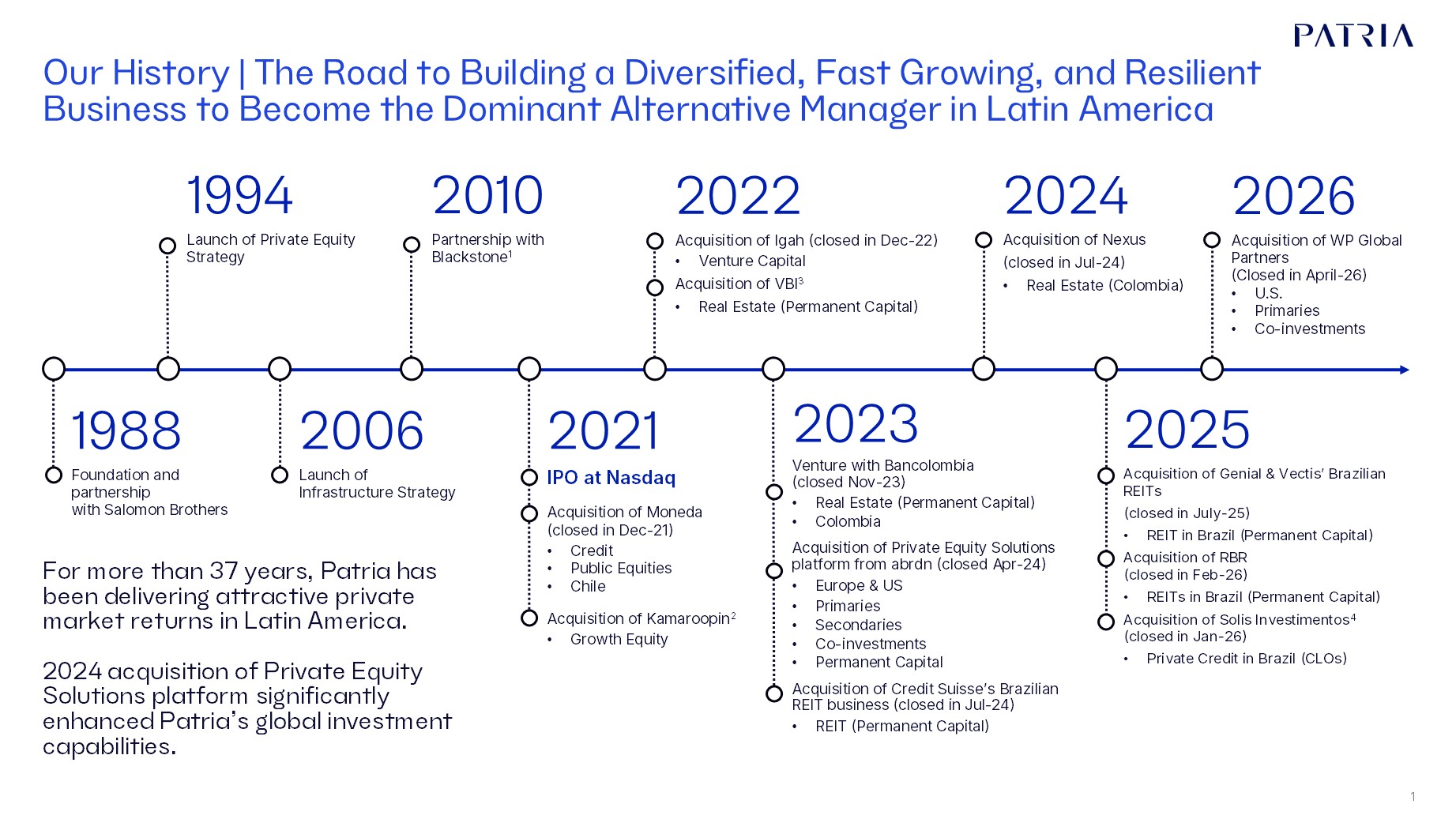
On November 26, 2025, we announced that we signed an agreement to acquire 51% of Solis Investimentos Ltda. ("Solis Investimentos"), a Brazilian investment manager specializing in the structuring and management of Collateralized Loan Obligations ("CLOs"). The acquisition of Solis Investimentos will add approximately US$3.1 billion of fee earning assets under management ("FEAUM"), in 2026 will increase our total Credit FEAUM by approximately 35%, which we believe to solidify our position as one of the leading Credit platforms in Latin America. The partnership positioned Solis Investimentos for a new cycle of growth by connecting its high-quality credit origination, analysis, and monitoring capabilities to our platform, expanding its access to both local and global capital. The transaction closed on January 2, 2026.
Real Estate - Acquisition of RBR Gestão in Brazil
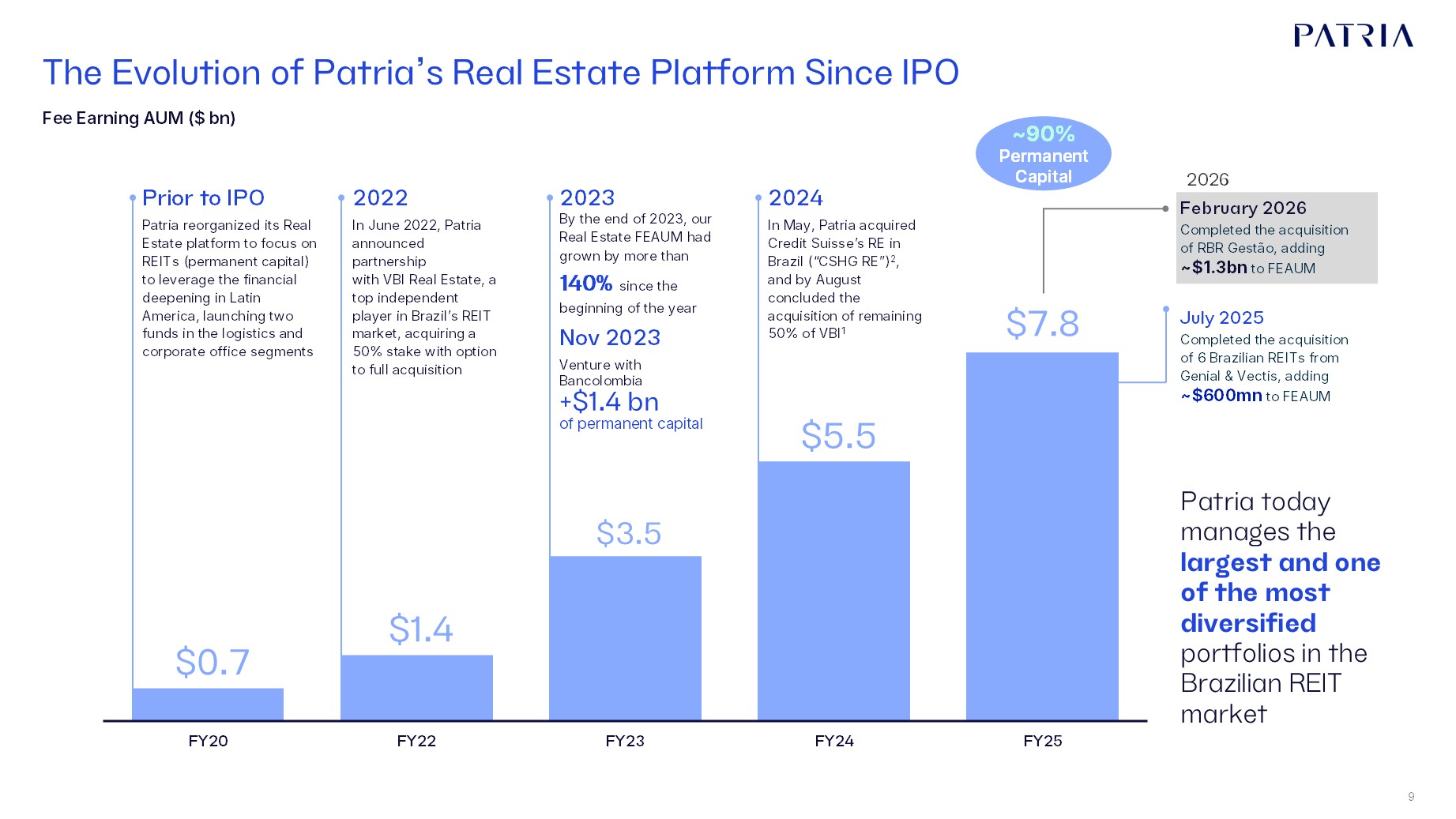
On December 11, 2025, we announced that we had entered into an agreement to acquire RBR Gestão de Recursos Ltda. ("RBR Gestão"), which holds US$1.3 billion of FEAUM listed Real Estate Investment Trusts (“REITs”). RBR manages 12 funds and post acquisition, we believe that will strengthen our position as one of the leading managers of listed REITs in Brazil, with scale across a variety of strategies, including Office, Logistics, Credit, Multi-Assets and Urban Retail. The transaction closed on February 2, 2026.
Acquisition of WP - U.S. Private Markets
On February 2, 2026, we announced an agreement to acquire WP Global Partners LLC ("WP"), a U.S. based private equity solutions manager focused on the lower-middle-market. The acquisition strengthens our local presence and investment capacity in North America and supports increasing global investor demand for middle-market private equity exposure.
Founded in 2005, WP operates from two offices in New York and Chicago and has a team of 30 employees, supported by a team of more than ten experienced investment professionals. Integrating WP’s capabilities and team expands our U.S. presence, investment and fundraising capabilities, complementing our established Private Equity Solutions business and advancing our global diversification strategy. The transaction closed April 1, 2026.
| | | | | | | | |
| Patria Investments Limited | | 1 |
Corporate Structure and Ownership
As of December 31, 2025, we had a total of 159,468,552 common shares issued and outstanding, consisting of 92,945,430 Class B common shares and 66,523,122 Class A common shares. See “Item 7. Major Shareholders and Related Party Transactions—A. Major Shareholders.”
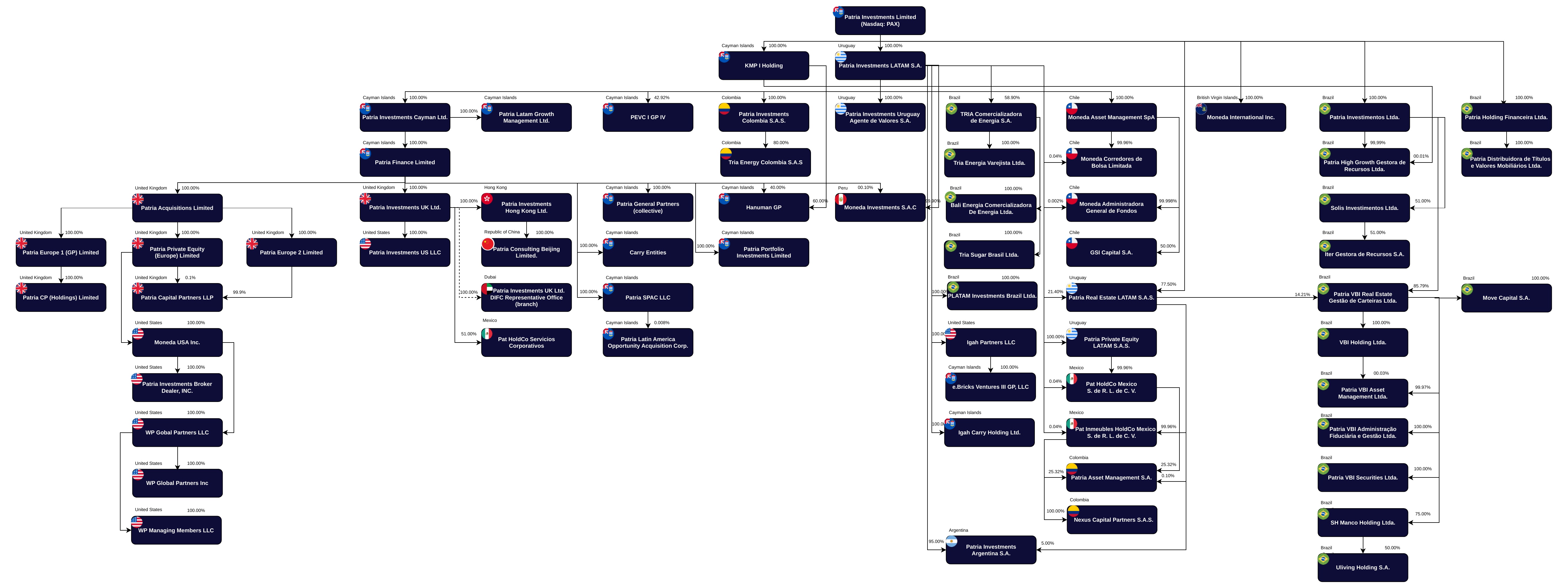
The following chart shows a significant component of our corporate structure and equity ownership as of April 29, 2026, after giving effect to our corporate reorganizations, acquisitions and business combinations. This chart is provided for illustrative purposes only and does not show all of the legal entities:
| | | | | | | | |
| Patria Investments Limited | | 2 |
Special Note Regarding Non-GAAP Financial Measures
This annual report presents our Fee Related Earnings and Distributable Earnings information, which are Non-GAAP measures. A Non-GAAP financial measure is generally defined as one that purports to measure financial performance but excludes or includes amounts that would not be so adjusted in the most comparable IFRS – Accounting Standards measure.
Fee Related Earnings
Fee Related Earnings (“FRE”), is a performance measure used to assess our ability to generate profits from revenues that are measured and received on a recurring basis and not subject to future realizations. FRE is calculated as net revenue from management fees, net revenue from incentive fees, net revenue from advisory and other ancillary fees and related taxes, less personnel expenses including rewards and bonus paid in cash and general and administrative expenses, adjusted for amortization of brands, and amortization of placement agents’ fees, excluding the impacts of share-based incentive plan, consideration payable on post acquisition adjustments, transaction costs, and other nonrecurring expenses related to M&A or restructuring. Incentive fees are realized performance-based fees earned by certain funds when the returns for such funds surpass the relevant benchmark over a specified time horizon. Such incentive fees are included in FRE because they do not dependent on realization events from the underlying investments, although the amount of incentive fees may fluctuate based on the performance of the funds relative to the relevant benchmark.
Distributable Earnings
Distributable Earnings (“DE”), is used to assess our performance and capabilities to distribute dividends to shareholders and reinvest in the company. DE is calculated as net revenue from management fees, net revenue from incentive fees, net revenue from advisory and other ancillary fees and related taxes, less personnel expenses and general and administrative expenses, adjusted for amortization of brands, and amortization of placement agents’ fees, excluding the impacts of share-based incentive plan, consideration payable on/post acquisition adjustments, transaction costs, and other nonrecurring expenses related to M&A or restructuring. Additionally, we reduce current income tax expense, plus net revenue from performance fees, net financial income/(expenses), and other income/(expenses) adjusted to exclude transaction costs, changes to fair value adjustments on contingent consideration payable, gross obligation adjustments, options, unrealized results on warrants liability, SPAC (Professional services and share issuance expenses), non-controlling interest.
We believe FRE and DE are useful to investors because they provide additional insight into the operating profitability of our business and our ability to cover direct base compensation and operating expenses from total fee revenues, as well as our ability to distribute earnings. These metrics exclude the effect of non-cash items and transaction-related costs associated with acquisitions, helping isolate recurring and operating results that more closely reflect the economics of managing third-party capital and generating fee-based earnings. FRE and DE are derived from and reconciled to, but not equivalent to, its most directly comparable IFRS measure of net income. See “Item 5. Operating and Financial Review and Prospects—A. Operating Results—Non-GAAP Financial Measures and Reconciliations” for our reconciliation of FRE.
FRE and DE are measures of profitability and have certain limitations in that they do not take into consideration certain items included under IFRS – Accounting Standards. Such measures may not be comparable to similarly titled measures used by other companies and is not a measure of performance calculated in accordance with IFRS – Accounting Standards. FRE and DE should not be considered in isolation or as a substitute for net income or other income data prepared in accordance with IFRS – Accounting Standards. The use of such measures without consideration of related IFRS – Accounting Standards measures is not adequate due to the adjustments described above. Our management uses FRE and DE as supplemental measures to IFRS – Accounting Standards results, to provide additional understanding of our performance as management measures it. A reconciliation of FRE and DE to their respective most directly comparable IFRS measure of net income before income tax can be found in “Item 5. Operating and Financial Review and Prospects—A. Operating Results—Non-GAAP Financial Measures and Reconciliations”.
Certain Terms Used in this Annual Report as KPIs to Measure Operating Performance
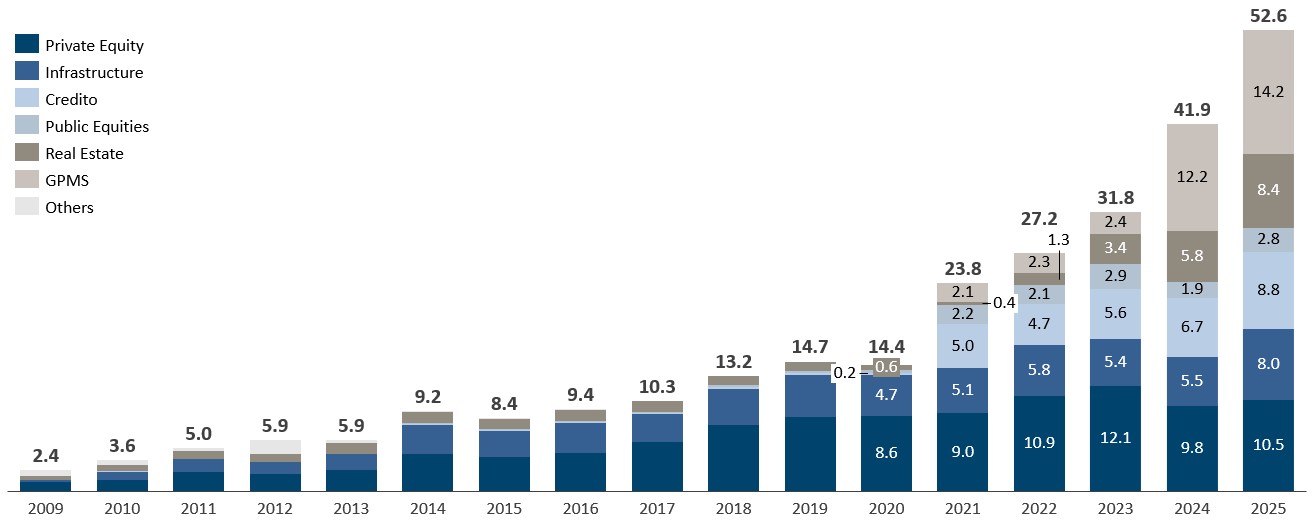
Assets Under Management, ("AUM") refers to the total capital funds managed by us plus the investments directly made by others in the invested companies when offered by us as co-investments. In general, our AUM equals the sum of (i) the fair value of the investments of each one of the funds and co-investments; and (ii) unfunded capital, which is the difference between committed and called capital. The Net asset value (“NAV”), equals total assets minus total liabilities. Committed capital corresponds to the amount which investors have agreed to contribute to an investment fund. Called capital corresponds to the portion of the committed capital called by the fund to make investments or cover expenses, such as management fees.
Our AUM measure includes assets for which we charge nominal or no fees, and is intended to reflect the overall size of our business and products. This definition of AUM is not derived from any specific provisions in our operating agreement or fund management agreements. Due to variations in investment strategies and organizational structures across alternative investment managers, our AUM calculation may differ from those used by others. As a result, this measure may not be directly comparable to similar metrics presented by other firms. We believe our AUM measure provides valuable insight by highlighting our capital raising activities efforts and the growth trajectory of our business. It illustrates the evolution of our business in terms of size, products, and revenue generating potential, particularly when analyzed by product category.
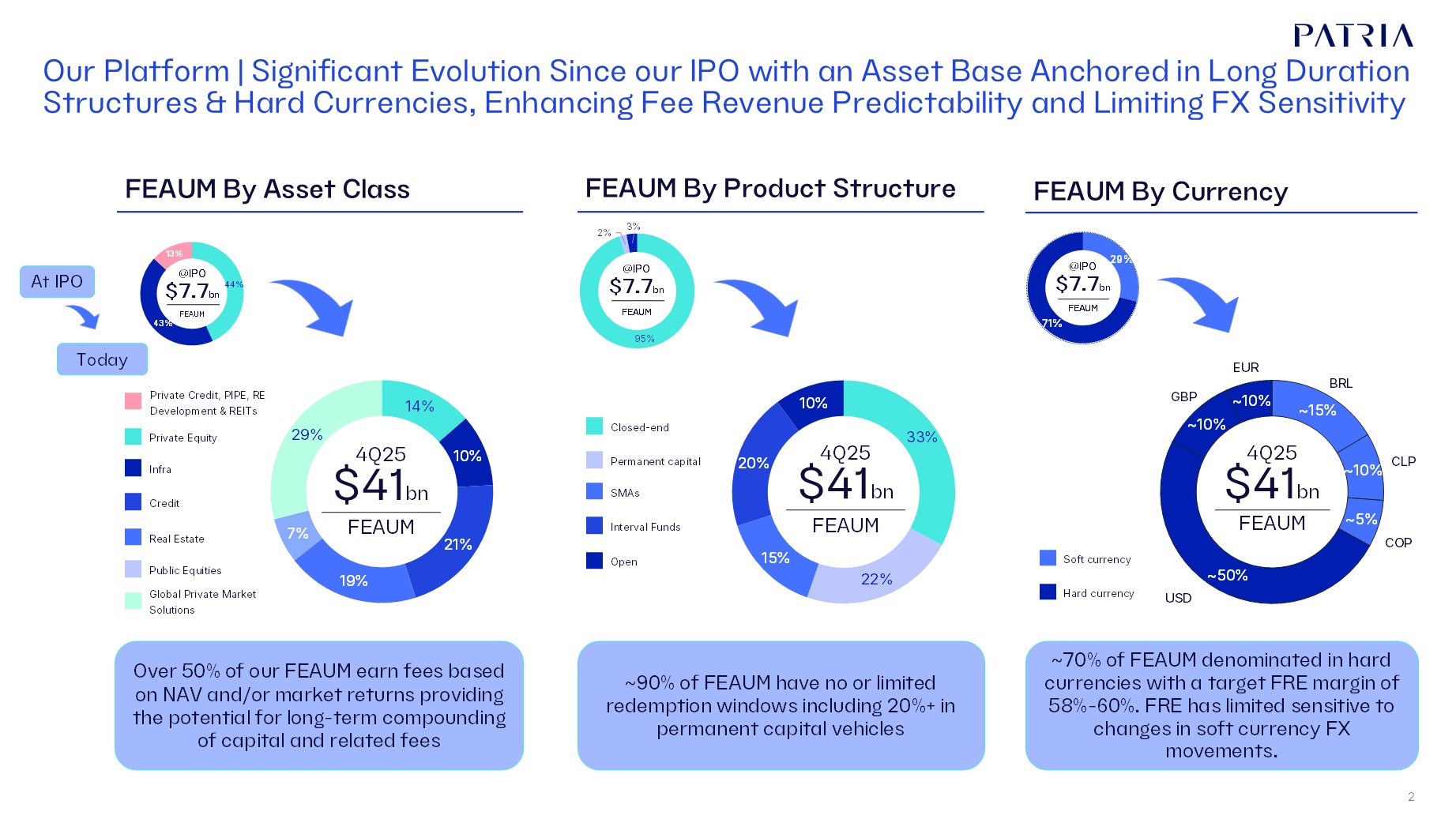
Fee earning assets under management ("FEAUM") is measured as the total capital managed by us on which we derive management fees at a given time. Management fees are based on NAV adjusted cost of all unrealized portfolio investments, capital commitments, or invested capital plus reserved capital (if applicable), each as defined in the applicable management agreement.
Our Net Accrued Performance Fees balance, as of the reporting date, reflects the amount Patria would receive as realized performance fees net of related compensation and revenue taxes if all eligible funds were fully divested at their marks/valuations at the same reporting date.
Market Share and Other Information
This annual report contains data related to economic conditions in the market in which we operate. The information contained in this annual report concerning economic conditions is based on publicly available information from third-party sources that we believe to be reasonable. Market data and certain financial services industry forecast data used in this annual report were obtained from internal reports and studies, where appropriate, as well as estimates, market research, publicly available information (including information available from the United States Securities and Exchange Commission website) and financial services industry publications. We obtained the information included in this annual report relating to the industry in which we operate, as well as the estimates concerning market shares, through internal research, public information and publications on the financial services industry prepared by official public sources, such as the Brazilian Central Bank, the Brazilian Securities and Exchange Commission (Comissão de Valores Mobiliários) (“CVM”), the Brazilian Institute for Geography and Statistics (Instituto Brasileiro de Geografia e Estatística) (“IBGE”), the Brazilian Power Research Company (Empresa de Pesquisa Energética), the Brazilian Association of Food Industries (Associação Brasileira da Indústria de Alimentos), the Bank for International Settlements, DERA/SEC, the Center for Advanced Studies on Applied Economics (Centro de Estudos Avançados em Economia Aplicada) (“CEPEA”), the Luiz de Queiroz Agriculture College (Escola Superior de Agricultura Luiz de Queiroz) (“ESALQ”), the Federal Reserve, the International Monetary Fund, the Brazilian Superintendence of Private Insurance (Superintendência de Seguros Privados) (“SUSEP”), the Organization for Economic Co-operation and Development (“OECD”), the World Bank, as well as private sources, such as the Alternative Credit Council, the Brazilian stock exchange (B3 S.A.—Brasil, Bolsa, Balcão) (“B3”), Bain & Company, Boston Consulting Group (“BCG”), CAIA Association, Cambridge Associates, Campden Wealth, the Economist Intelligence Unit (“EIU”), Ernst & Young (“EY”), the Financial Times newspaper, Greenhill, Hamilton Lane, ILOS—Logistics and Supply Chain Specialists, KPMG, McKinsey, Morningstar, Morgan Stanley, Oliver Wyman, Platform research, Preqin (global data and analytics provider that specializes in the alternative assets industry), PricewaterhouseCoopers (“PwC”), Reuters, The Bertelsmann Stiftung’s Transformation Index (“BTI”), the Brazilian Private Equity and Venture Capital Association (Associação Brasileira de Private Equity e Venture Capital) (“ABVCAP”), the Brazilian Financial and Capital Markets Association (Associação Brasileira das Entidades dos Mercados Financeiro e de Capitais) (“ANBIMA”), the Brazilian Association of Pension Funds (Associação Brasileira das Entidades Fechadas de Previdência Complementar) (“ABRAPP”), the Brazilian Economic Institute of Fundação Getúlio Vargas (Instituto Brasileiro de Economia da Fundação Getúlio Vargas) (“FGV/IBRE”) among others.
Market data used throughout this annual report is based on management’s knowledge of the industry and the good faith estimates of management. All of management’s estimates presented are based on industry sources, including analyst reports and management’s knowledge. We also relied, to the extent available, upon management’s review of independent industry surveys and publications prepared by a number of sources and other publicly available information. We are responsible for all of the disclosure in this annual report, and we believe that each of the publications, studies and surveys used throughout this annual report are prepared by reputable sources and are generally reliable, though we have not independently verified market and industry data from third-party sources. None of the publications, reports or other published industry sources referred to in this annual report were commissioned by us or prepared at our request. We have not sought or obtained the consent of any of these sources to include such market data in this annual report. All of the market data used in this annual report involves a number of assumptions and limitations and therefore is inherently uncertain and imprecise, and you are cautioned not to give undue weight to such estimates. Projections, assumptions and estimates of our future performance and the future performance of the industry in which we operate are necessarily subject to a high degree of uncertainty and risk due to a variety of factors, including those described in “Item 3. Key Information—D. Risk Factors” in this annual report. These and other factors could cause results to differ materially from those expressed in our estimates and beliefs and in the estimates prepared by independent parties.
Portfolio Companies
In this annual report, we make reference to our "Portfolio Companies". In this context, Portfolio Companies refers to the operating companies and other entities in which the investment funds and investment vehicles that we manage hold equity or debt interests. Accordingly, they are not our subsidiaries and not consolidated in our financial statements. Our economic exposure to these entities is limited to the fees that we may earn from the performance of the funds that invest in them.
Rounding
We have made rounding adjustments to some of the figures included in this annual report. Accordingly, numerical figures shown as totals in some tables may not be an arithmetic aggregation of the figures that preceded them.
| | | | | | | | |
| Patria Investments Limited | | 3 |
CAUTIONARY STATEMENT REGARDING FORWARD-LOOKING STATEMENTS
This annual report contains statements that constitute forward-looking statements. Many of the forward-looking statements contained in this annual report can be identified by the use of forward-looking words such as “anticipate,” “believe,” “could,” “expect,” “should,” “plan,” “intend,” “estimate” and “potential,” among others.
Forward-looking statements appear in a number of places in this annual report and include, but are not limited to, statements regarding our intent, belief or current expectations. Forward-looking statements are based on our management’s beliefs and assumptions and on information currently available to our management. Such statements are subject to risks and uncertainties, and actual results may differ materially from those expressed or implied in the forward-looking statements due to various factors, including, but not limited to, those identified under the section entitled “Item 3. Key Information—D. Risk Factors” in this annual report. These risks and uncertainties include factors relating to:
•general economic, financial, political, demographic and business conditions in the jurisdictions in which we operate and conduct our activities, as well as any other macroeconomic factors in the countries we may serve in the future and their impact on our business;
•general economic, financial, political, demographic and business conditions worldwide including as a result of the conflict between Russia and Ukraine, war in Iran and disruption to the Strait of Hormuz, conflict between Israel and Hamas and with respect to the 2026 U.S. military and economic intervention in Venezuela in Latin America, and elsewhere where military action occurs, which may result in, among other things, global security issues that may adversely affect international business and economic conditions, and economic sanctions which may impact the global economy;
•fluctuations in exchange rates, interest and inflation in Latin America, in Europe and any other countries we may serve in the future;
•our ability to find suitable assets for investment;
•our ability to manage operations at our current size or manage growth effectively;
•our ability to successfully expand in Latin America, in Europe and other new markets;
•the fact that we will rely on our operating subsidiaries to provide us with distributions to fund our operating activities, which could be limited by law, regulation or otherwise;
•our ability to arrange financing and maintain sufficient levels of cash flow to implement our expansion plan;
•our ability to adapt to technological changes in the financial services sector;
•the availability of qualified personnel and the ability to retain such personnel;
•our capitalization and our funds’ and Portfolio Companies’ level of indebtedness;
•the interests of our controlling shareholders;
•changes in the laws and regulations applicable to the private investment market in countries in Latin America, in Europe, and in the other countries we operate;
•climate change and our ability to assess the climate related risks we face, as well as those applicable to the funds under our management;
•macroeconomic and political conditions in countries in Latin America, the implementation of tariffs, disruptions in trade with China, the United States, in Europe, or other countries, tax reform and natural disasters such as earthquakes and floods in the region;
•risk associated with our international operations;
•our ability to compete and conduct our business in the future;
•government interventions, resulting in changes in the economy, taxes, rates or regulatory environment;
•our ability to effectively market and maintain a positive brand image;
•the availability and effective operation of management information systems and other technology;
•our ability to comply with applicable cybersecurity, privacy and data protection laws and regulations;
| | | | | | | | |
| Patria Investments Limited | | 4 |
•changes in client demands and preferences and technological advances, and our ability to innovate to respond to such changes;
•our ability to attract and maintain the services of our senior management and key employees;
•the impact of an outbreak, pandemics, epidemics and similar crises, on general economic and business conditions in Latin America, in Europe and globally, and any restrictive measures imposed by governmental authorities in response thereto;
•changes in labor, distribution and other operating costs;
•our compliance with, and changes to, government laws, regulations and tax matters that currently apply to us;
•other factors that may affect our financial condition, liquidity and results of operations; and
•other risk factors discussed under “Item 3. Key Information—D. Risk Factors.”
Forward-looking statements speak only as of the date they are made, and we do not undertake any obligation to update them in light of new information or future developments or to release publicly any revisions to these statements in order to reflect later events or circumstances or to reflect the occurrence of unanticipated events.
| | | | | | | | |
| Patria Investments Limited | | 5 |
ITEM 1. IDENTITY OF DIRECTORS, SENIOR MANAGEMENT AND ADVISERS
A. Directors and Senior Management
Not applicable.
B. Advisers
Not applicable.
C. Auditors
Not applicable.
ITEM 2. OFFER STATISTICS AND EXPECTED TIMETABLE
A. Offer Statistics
Not applicable.
B. Method and Expected Timetable
Not applicable.
ITEM 3. KEY INFORMATION
A. [Reserved]
B. Capitalization and Indebtedness
Not applicable.
C. Reasons for the Offer and Use of Proceeds
Not applicable.
D. Risk Factors
Summary of Risk Factors
An investment in our Class A common shares is subject to a number of risks, including those relating to our business and industry, the countries in which we operate, the activities of our managed funds and their Portfolio Companies, and risks relating to our Class A common shares. The following list summarizes some, but not all, of the principal risks we face. Please carefully read the information in the section entitled “Detailed Risk Factors” for a more thorough description of these and other risks before making an investment decision.
Certain Factors Relating to Our Business and Industry
•Difficult market and geopolitical conditions can adversely affect our business in many ways, each of which could materially reduce our revenue, earnings and cash flow and adversely affect our financial prospects and condition. We may need to reduce our fixed costs and other expenses in order to maintain profitability, including by cutting back or eliminating the use of certain services or service providers, or terminating the employment of a significant number of our personnel that, in each case, could be important to our business and without which our operating results could be adversely affected.
| | | | | | | | |
| Patria Investments Limited | | 6 |
•The ongoing military conflicts in Europe and the Middle East, including hostilities involving Iran that commenced in early 2026, continue to heighten global economic and political uncertainty. Any escalation of these conflicts, including disruptions in energy markets and global supply chains, could adversely impact regions where we do business, Portfolio Companies of the funds we manage, and our energy trading business, increasing operational, compliance, and liquidity risks. A period of economic slowdown, which may be across one or more industries, sectors or geographies, could contribute to adverse operating performance for certain of our funds’ investments, which would adversely affect our operating results and cash flows.
•Changes to U.S. trade policy, tariffs and import/export regulations may adversely affect our operating results. Although the majority of our Portfolio Companies serve local or regional markets and we do not currently expect a material direct impact, trade policy actions could adversely affect macroeconomic conditions in the regions in which we operate, negatively impacting portfolio performance, fund-level returns, liquidity, and our fee-related revenues.
•Volatility in capital markets, tightening credit conditions, and intense industry competition could impair our ability to raise and deploy capital, exit investments, and maintain fee levels, which may materially reduce our assets under management, revenues, and ability to pay dividends. If we cannot make the necessary investments to keep pace with rapid developments and change in our industry, the use of our services could decline, reducing our revenues. The revenues that we earn are driven in part by the pace at which our funds make investments and the size of those investments, and a decline in the pace or the size of such investments may reduce our revenues.
•Our Class A common shares may experience significant volatility due to factors that are difficult to predict. The market price of our Class A common shares may be adversely affected by variables such as our fundraising activity, FEAUM, net income, and the performance of our funds. These factors can fluctuate meaningfully and are inherently difficult to forecast on a quarterly basis. Although these metrics may exhibit greater predictability on an annual basis, such longer‑term visibility does not mitigate the potential for short‑term volatility in the trading price of our Class A common shares.
•In addition to traditional physical and transitional risks, climate change can create other risks that are gaining increasing social, regulatory, economic and political relevance globally. Our efforts may not be successful in mitigating the climate-related risks arising from the increased focus, pace, breadth, and depth of regulatory expectations requiring implementation in short time frames across multiple jurisdictions and from changes in public policy, laws, and regulations of climate change and related environmental sustainability matters, which could affect investments strategies, risk profiles and expected returns of investments made by our funds.
•Climate‑related regulatory frameworks, including emerging disclosure, taxonomy and due‑diligence requirements, may also increase our compliance costs, create operational burdens, or require adjustments to our investment processes. In addition, our Portfolio Companies may face increased scrutiny regarding their greenhouse gas emissions, climate transition plans, and resilience to physical climate risks, which could adversely affect their performance, valuations, or access to financing.
•The occurrence of a natural disaster, widespread health epidemic, pandemics or other outbreaks could adversely impact the performance of investments made by managed funds, as well as the results of operations causing a slowdown in capital raising, capital deployment and realization activity.
•Our success depends on retaining skilled senior executives and key personnel, as their expertise, reputation, and business relationships are crucial for investment performance, asset management, and growth. Losing them could negatively impact revenue, profitability, and operational continuity. Cybersecurity threats, system failures, and regulatory risks could jeopardize our operations, financial stability, and reputation, impacting confidential data, investment security, and compliance efforts.
•We face actual and potential conflicts of interest across our business as we expand into new strategies and markets, which also introduces new regulatory, operational, and financial risks.
•We are subject to extensive and rapidly developing regulations globally, including those relating to data privacy, environmental and social impacts (ESG), and potential application of the U.S. Investment Company Act and Investment Advisers Act.
•Changes in international tax frameworks, local tax reforms, adverse interpretations by tax authorities, or our potential classification as a Passive Foreign Investment Company ("PFIC") could adversely impact our effective tax rate.
•We are subject to substantial litigation risks, and poor performance of our funds could obligate us to repay performance allocations previously paid to us.
| | | | | | | | |
| Patria Investments Limited | | 7 |
•Our due diligence process may not reveal all relevant facts, and our funds invest in illiquid assets and rely heavily on third-party service providers, exposing us to counterparty risks.
•If we fail to maintain effective internal controls over financial reporting, we may be unable to accurately report our results or meet our reporting obligations.
Certain Factors Relating to the Countries in Which We Operate
•Governments have a high degree of influence in Brazil, Chile, Colombia, and in other economies in which we operate. The effects of this influence and political and economic conditions could harm us and the trading price of our Class A common shares. In addition, recent economic and political instability in Brazil, Chile, and Colombia in general has led to a negative perception of these economies and higher volatility in the securities markets, which also may adversely affect us and our Class A common shares.
•Developments and the perceptions of risks in emerging market countries, the United States, Europe, or other regions may harm the economies of countries in which we operate and affect the trading price of our Class A common shares. Crises and political instability in these regions, including increased international trade tensions and protectionist policies, could decrease investor demand for securities offered by companies like ours, including our Class A common shares.
•Inflation and government measures to curb inflation may adversely affect the economies and capital markets in some of the countries in which we operate, and as a result, harm our business and the trading price of our Class A common shares. In the past, high levels of inflation have adversely affected the economies and financial markets of some of the countries in which we operate, particularly Argentina and Brazil, and the ability of their governments to create conditions that stimulate or maintain economic growth.
•Exchange rate instability may have adverse effects on the economies of the countries in which we operate, our business and the trading price of our Class A common shares. Governments in Latin America have implemented various economic plans and used various exchange rate policies, including sudden devaluations, periodic mini-devaluations (during which the frequency of adjustments has ranged from daily to monthly), exchange controls, dual exchange rate markets and a floating exchange rate system.
•Political and social instability, including recent diplomatic conflicts in Venezuela and uncertainties surrounding upcoming elections in Chile, may adversely impact our business, Portfolio Companies, and the economies in which we operate.
Certain Factors Relating to Our Class A Common Shares
•The dual class structure of our share capital, with a ten-to-one voting ratio between our Class B and Class A common shares, concentrates voting control with Patria Holdings (which represents approximately 82.3% of the voting power). This controls all matters requiring shareholder approval and limits your ability to influence corporate matters. We are a Cayman Islands exempted company with limited liability. The rights of our shareholders, including with respect to fiduciary duties and corporate opportunities, may be different from the rights of shareholders governed by the laws of U.S. jurisdictions. In particular, as a matter of Cayman Islands law, directors of a Cayman Islands company owe fiduciary duties to the company and, separately, a duty of care, diligence and skill to the company.
•As a foreign private issuer, we have different disclosure requirements than U.S. domestic registrants, and losing this status would require us to incur significant expenses to comply with the U.S. domestic reporting regime.
•We are subject to the Cayman Islands Economic Substance Act, and failure to satisfy its requirements could result in penalties or require changes to our operations.
Detailed Risk Factors
Certain Factors Relating to Our Business and Industry
The ongoing military conflicts in Europe and the Middle East may have repercussions on the world’s geopolitical and economic scenario
The ongoing conflict between Russia and Ukraine and in the Middle East continue to contribute to heightened global economic and political uncertainty. Governments in the U.S., U.K., and EU have imposed export controls and financial and economic sanctions on certain industry sectors and individuals in Russia. Additional or expanded controls and sanctions could be enacted in the future.
| | | | | | | | |
| Patria Investments Limited | | 8 |
We do not have a physical presence in Russia or Ukraine, and our direct exposure is not material. However, certain of our investors may have personnel or beneficial owners included on international sanctions lists, and certain of our funds hold indirect minority stakes in assets that might be subject to restrictions under U.S. or other sanctions regimes. These investments represent a de minimis share of assets under management.
In late February 2026, the United States and Israel launched significant military operations against Iran, and Iran has responded with retaliatory actions in the region. Any continuation or expansion of hostilities involving Iran, including broader regional conflict, additional sanctions, disruptions in energy markets or shipping routes, or heightened volatility in global financial markets, could adversely affect global economic conditions and the markets in which we operate. Additionally, conflict in the Middle East, and the resulting disruption of transit through the Persian Gulf and the Strait of Hormuz, continues to disrupt global supply chain flows and impact fuel prices.
Any escalation or expansion of these conflicts, including disruptions arising from energy-related sanctions and disruption or a global energy crisis resulting from restrictions on energy exports, could adversely impact certain regions where we do business and certain Portfolio Companies of the funds we manage. We are also susceptible to adverse developments arising from these geopolitical events due to our energy trading business. Sanctions‑related restrictions on commodities, constraints on cross‑border energy flows, and increased volatility in global energy markets could affect trading conditions, counterparty exposures, and hedging strategies, and may increase operational, compliance, and liquidity risks across our trading activities.
Changes to U.S. trade policy, tariff and import/export regulations may adversely affect our operating results.
The U.S. government has indicated its intent to adopt a new approach to trade policy, which may include the imposition or consideration of tariffs on certain foreign goods and the renegotiation or potential termination of existing trade agreements. Changes in U.S. or global trade policy, tariffs, and trade sanctions could increase costs, disrupt supply chains, reduce demand, and heighten global trade tensions affecting the economies in which we operate. Furthermore, changes in U.S. trade policy could result in other countries adopting retaliatory trade policies.
The majority of our Portfolio Companies serve local markets or regional markets, and as a result, we do not currently expect these developments to have material direct impact on our operations. However, this assessment is based on current portfolio composition and market conditions, which are subject to change. Trade policy actions could adversely affect macroeconomic conditions in the regions in which we operate and in which our Portfolio Companies conduct business. Adverse macroeconomic conditions resulting from changes in trade policy – such as economic activity, shifts in cost structures, or disruptions in cross‑border trade - could negatively impact portfolio performance, fund‑level returns, liquidity and our fee‑related revenues.
Governments have a high degree of influence in Brazil, Chile, Colombia and the other markets in which we operate. The effects of this influence and political and economic conditions could harm us and the trading price of our Class A common shares.
Governments in Brazil, Chile, Colombia, and the other markets in which we operate frequently exercise significant influence over their respective economies through monetary and fiscal policies, including changes in interest rates, tax, wage and price controls, foreign exchange rate controls, capital flow controls, and import and export restrictions. These government actions can affect economic growth, inflation, currency volatility, and overall market stability.
Political crises in Brazil – such as corruption investigations including Operação Lava Jato - have historically contributed to economic deceleration, heightened securities market volatility, diminished investors’ confidence and disrupted capital market. The market for securities offered by companies with significant operations in Brazil, Chile, Colombia and other Latin American countries is influenced by political, economic and market conditions in the region and, to varying degrees, market conditions in other emerging markets. We cannot predict whether ongoing or future investigations or policy shifts will lead to further instability.
Our operations and investments are also subject to broader political risks inherent in emerging markets, including nationalization, expropriation, changes in complex regulatory frameworks and limitations on foreign ownership or investments. Any of these developments could adversely affect the performance and valuation of our Portfolio Companies, impair capital deployment, and negatively impact our assets under management, fee revenues, and overall financial results.
| | | | | | | | |
| Patria Investments Limited | | 9 |
Volatility in capital markets and constraints on liquidity could impair our ability to raise and deploy capital, exit investments, and meet our financial obligations, each of which could materially reduce our revenue and adversely affect our financial condition.
Volatility caused by political, market, or economic conditions can materially hinder the initiation of new, large-sized transactions and, together with volatility in equity and debt valuations, may adversely impact our operating results.
Mark-to-market valuations of our funds’ investments are subject to fluctuations driven by broader market conditions and uncertainty regarding governmental policy on tax, financial services regulation, international trade, and other matters. These fluctuations may result in volatility in fund net asset values and may cause variability in the revenue, earnings, and cash flow we report from period to period. Such fluctuations can also affect the timing and magnitude of carried interest recognition, management fees tied to net asset values, and the fair‑value measurement of investment holdings with the corresponding effects on our results.
A significant contraction or sustained weakening in the debt financing market — including higher equity requirements, more restrictive covenants, or reduced access to high-yield debt markets — could have a material adverse impact on our and our funds’ ability to complete acquisitions, refinance existing portfolio company debt, or exit investments at attractive valuations. Such a condition could also delay deployment, increase cost of capital, and negatively affect portfolio‑company performance.
Adverse developments affecting financial institutions, such as the bank failures observed in 2023 (including Silicon Valley Bank), have previously contributed to broad liquidity dislocations, reduced bank lending appetite and increased counterparty risk across the financial system. Similar events in the future could generate renewed stress in credit markets, disrupt syndication activity, and constrain the availability of leverage for private‑market transactions.
More broadly, any instability in the banking and financing markets could limit the availability of funds for financing activities or result in less favorable terms, including systemic limitations on access to credit and liquidity sources. Sustained stress in the financing market could therefore reduce investment activity, impair the operating performance and valuation of our Portfolio Companies, and adversely affect our financial results, including lower performance-based fee realizations.
In addition, we have liquidity requirements at a corporate level, including cash needed to fund operating expenses, seed new investment strategies, satisfy fund capital commitments to existing and future funds and service contingent liabilities. Our ability to meet these liquidity requirements depends on timing and availability of cash flows from management and performance fees, as well as cash from external financing. If our liquidity requirements exceed our available liquid assets, we may be forced to defer or scale back strategic investments, sell assets or raise capital on unfavorable terms.
Adverse market or economic conditions may affect our funds or their Portfolio Companies’, cash generation and ability to renew indebtedness or find alternate financing, including delaying of investment realizations and deployment, and management and performance fees. To the extent such conditions may reduce or defer cash available at corporate level, our ability to continue to pay dividends or to pay at historical levels could be affected.
Our business depends in large part on our ability to raise capital from third-party investors. A failure to raise capital from third-party investors on attractive fee terms, or at all, would impact our ability to collect management fees or deploy such capital into investments and potentially collect carried interest, which would materially reduce our revenue and cash flow and adversely affect our financial condition.
Our asset management business depends on our ability to raise capital from third-party investors. In periods of elevated interest rates, risk‑off market sentiment, or broader macroeconomic uncertainty, it may be more difficult to raise new capital for our funds, particularly in strategies targeting local investors. An investment in a limited partner interest in an alternative investment fund is generally more illiquid and the returns on such investment may be more volatile than an investment in securities for which there is a more active and transparent market. In periods of positive markets and low volatility, for example, investors may favor passive investment strategies such as index funds over our actively managed investment vehicles. Similarly, during periods of high interest rates, investors may favor investments that are generally viewed as producing a risk-free return, such as treasury bonds, over investments in our products, particularly if the spread between the products declines. Alternative investments could also fall into disfavor because of concerns about liquidity and short-term performance. In particular, such concerns could be exhibited by public pension funds, which have historically been among the largest investors in alternative assets.
| | | | | | | | |
| Patria Investments Limited | | 10 |
Furthermore, institutional investors have generally been exerting greater pressure to reduce management and investment fees, whether through direct reductions, fee-holiday structures, deferrals, rebates, or other negotiated concessions. Competitive fundraising dynamics may further intensify these pressures. A failure to successfully raise capital, or a reduction in fee terms, could materially reduce our revenue and cash flow. Moreover, if our funds are unable to deploy capital at a pace sufficient to offset realizations, fee-related revenues may decline due to lower invested capital or lower fee‑earning AUM. Reduced deployment levels may also delay fee commencement for new vintages or new strategies, affecting the timing and predictability of management‑fee revenue.
Our funds invest in illiquid assets for which there is little or no market activity, and the fair value of such investments involves significant management judgment. Realizations at lower values than those reflected in prior fund net asset values would result in reduced gains or losses, a decline in asset management fees, and the reduction of performance allocations.
Rising interest rates coupled with equity and credit market volatility may make it more difficult to find attractive exit opportunities, extend holding periods, or constrain the availability of strategic buyers and financing sources. Prolonged market dislocation may also limit liquidity for secondary sales or delay monetization, negatively affecting fund‑level returns, fee‑earning assets under management, and the timing and predictability of our revenues and cash flows.
We depend on our key senior executives and the ability to attract, recruit, develop and retain qualified employees which is essential to our success and growth. The loss of their services or the failure to attract, recruit, develop and retain other qualified employees would have a material adverse effect on our business, results of operations and financial condition
We depend on the efforts, skill, reputations and business contacts of our key senior executives, the information and deal flow they generate during the normal course of their activities and the synergies among the diverse fields of expertise and knowledge held by our professionals. Accordingly, our success will depend on the continued service of these individuals, who are not obligated to remain employed with us. Some key senior executives have left the firm in the past and others may do so in the future, and we cannot predict the impact that the departure of any key senior executives will have on our ability to achieve our investment objectives. For example, the governing agreements of many of our funds, such as limited partnership agreements and private placement memoranda, generally provide investors with the ability to terminate the investment period in the event that certain “key persons” in the fund do not provide the specified time commitment to the fund or our firm ceases to control the general partner. The loss of the services of any key senior executives could have a material adverse effect on our revenues, net income and cash flows and could harm our ability to maintain or grow assets under management in existing funds or raise additional funds in the future. We have historically relied in part on the interests of these professionals in the investment funds’ performance fees and incentive fees to discourage them from leaving the firm.
Furthermore, in order for us to successfully compete and grow, we must attract, recruit, develop and retain the necessary personnel who can provide the needed expertise across the entire spectrum of our intellectual capital needs. While we have a number of senior executives and other key personnel who have substantial experience with our operations, we must also develop our personnel to provide succession plans capable of maintaining continuity in the midst of the inevitable unpredictability of human capital. However, the market for qualified personnel is competitive, and we may not succeed in recruiting additional personnel or may fail to effectively replace current personnel who depart with qualified or effective successors. We must continue to hire additional personnel to execute our strategic plans. Our effort to retain and develop personnel may also result in significant additional expenses, which could adversely affect our profitability. Despite the existence of multiple long term compensation and career development programs in place, we cannot assure you that our qualified employees will continue to be employed by us or that we will be able to attract and retain qualified personnel in the future and the failure to retain or attract key personnel could have a material adverse effect on our business, financial condition and results of operations.
The asset management business is highly competitive with numerous competitors with greater resources
The asset management business is highly competitive with a large number of both local and international managers, many of which have greater scale and capital resources. Competition in the industry is intense across a variety of dimensions including, but not limited to, investment performance, the quality of service provided to clients, product and asset class offerings and expertise, fees and fund terms, geographic focus, brand recognition and business reputation.
| | | | | | | | |
| Patria Investments Limited | | 11 |
Furthermore, if we are unable to attract new clients or retain existing clients, our assets under management and revenues, earnings, and cash flows could decline, impacting our ability to support our investment teams and investment products, and adversely impacting our ability to service our clients, further impacting our ability to attract new investors.
We compete for investments as well as investor capital with a large number of other entities, including but not limited to various regional and global traditional and alternative asset management firms, to commercial banks, investment banks, sovereign wealth funds, as well as corporate and private investors. Additionally, developments in financial technology, or fintech, such as Artificial Intelligence (AI), and distributed ledger technology, or blockchain, have the potential to disrupt the financial industry and change the way financial institutions, as well as asset managers, do business. A number of factors serve to increase our competitive risks:
•many of our competitors may have greater financial resources with which to invest in their business, retain staff, create or acquire new strategies, and reinvest in the infrastructure of their business;
•competitors' investment performance may be superior to that of our investment products and/or may have lower fee structures;
•investor demand for the types of investment products and strategies we offer may diminish due to factors outside our control such as shifting geopolitical, economic and macro factors;
•some of our competitors may have greater access to a variety of funding sources, allowing them to pursue and take advantage of a wider range of investment opportunities;
•some competitors may operate in jurisdictions with less regulation and greater flexibility to undertake and execute certain businesses or investments;
•as we look to expand the global and regional reach of our business, many competitors may have greater investment expertise, infrastructure and scale in the regions and investment strategies in which we seek to expand;
•some of our competitors may adopt new technologies and expand capabilities more rapidly, providing them with competitive advantages in terms of operating efficiency and/or investment performance and new product offerings;
•barriers to entry in the investment management industry tend to be low;
•some of our competitors for certain investments may, as corporate buyers, be able to achieve synergistic cost savings with respects to an investment, which may provide them with a competitive advantage in bidding for an investment;
•the highly competitive nature of the industry means it may be difficult to retain and recruit talented investment professionals and employees if other managers have greater resources and/or are willing to pay a higher level of compensation and benefits or otherwise provide a more attractive work environment.
Investor investment preferences can change over time in response to shifting asset allocation objectives, macroeconomics, geopolitics and other factors outside of our control.
There is a risk that our fees and fund fees in the alternative investment management industry will decline as return profiles shift over time, new products and strategies are developed, new competitors emerge, and overall competitive dynamics of the industry change, including a greater number of competitors who seek to compete on price and costs.
Our organizational documents do not limit our ability to enter into new lines of businesses, and expansion into new investment strategies, markets, lines of business may introduce new risks and uncertainties into our business.
Our plan is to continue to grow our investment businesses and expand into new investment strategies, asset classes, and geographic markets. Our organizational documents do not limit us to the investment management business and we have pursued and may continue to pursue growth through the acquisition of investment management companies, as well as other businesses, in addition to various other strategic initiatives such as, but not limited to, joint ventures and/or majority or minority stakes in various businesses. To the extent we make strategic investments or acquisitions, or undertake other strategic initiatives such as entering a new line of business, our business will potentially face a variety of additional risks and uncertainties, including risks associated with (1) the required investment of capital and other resources, (2) the possibility that we have insufficient expertise to engage in such activities profitably or without incurring inappropriate amounts of risk, (3) the diversion of management’s attention from our core businesses, (4) the assumption of the liabilities of any acquired business, (5) the disruption of our existing businesses, (6) the complexity of combining or integrating operational and management systems and controls, (7) compliance with additional regulatory requirements and (8) the broadening of our geographic footprint, including the risks associated with conducting operations in several jurisdictions.
| | | | | | | | |
| Patria Investments Limited | | 12 |
Entry into new lines of business may subject us to new laws and regulations with which we are not familiar, or from which we are currently exempt, and may have the potential to lead to increased litigation, as well as higher levels of tax and regulatory risk. For example, we have undertaken business initiatives to offer credit funds and publicly-traded real estate funds (known in Brazil as a Fundo de Investimento Imobiliário, or “FII”) and to increase the number and type of investment products we offer to family offices and high net worth individuals. These activities have and will continue to impose additional compliance burdens on us and could also subject us to enhanced regulatory scrutiny and expose us to greater reputational and litigation risks. In addition, if a new business generates insufficient revenues or if we are unable to efficiently manage our expanded operations or to successfully overcome the challenges we may face in expanding into new businesses our results of operations will be adversely affected. Our strategic initiatives may include, among other things, initiatives seeking to expand our and our Portfolio Companies’ management and operational capabilities, and entry into joint ventures, which may require us to be dependent on, and subject us to liability, losses or reputational damage relating to, systems, controls and personnel that are not under our control.
If we are unable to consummate or successfully integrate new business initiatives, including acquisitions or joint ventures, we may not be able to implement our growth strategy successfully.
Our growth strategy is based, in part, on the selective internal development of new investment solutions as well as the acquisition of complementary investment strategies and investment managers and related businesses which we believe will be additive to our financial results and growth over time. The success of this strategy will be dependent upon a variety of factors including, but not limited to: (1) the availability of suitable acquisition opportunities and our ability to negotiate acceptable transaction terms, (2) the level of competition from competitors, many of which may have greater financial resources and/or superior investment performance and other attributes, (3) our ability to successful identify new business initiatives, build the necessary infrastructure, and fund new product development, (4) our ability to obtain the requisite approvals and licenses from the relevant governmental authorities and to comply with applicable laws and regulations without incurring undue costs and delays, (5) our ability to identify and enter into mutually beneficial relationships with venture partners, and (6) our ability to generate attractive investment returns in both existing and acquired investment strategies. Moreover, even if we are able to identify and successfully complete an acquisition, we may encounter unexpected difficulties or incur unexpected costs associated with integrating and overseeing the operations of the new businesses. If we are not successful in implementing our growth strategy, our business, financial results and the market price for our Class A common shares may be adversely affected.
Changes in relevant tax laws, regulations or treaties or an adverse interpretation of these items by tax authorities could adversely impact our effective tax rate and tax liability.
All jurisdictions in which we operate have enacted transfer pricing rules, and tax authorities globally continue to increase scrutiny of cross-border transactions and related-party arrangements. Ongoing developments in international tax frameworks – such as changes in tax laws, regulations, administrative guidance, or bilateral or multilateral treaties — could adversely impact our deductibility of expenses, allocation of taxable profits and taxation of our legal entities, funds and Portfolio Companies. For further details, see “Item 5 Operating and Financial Review and Prospects—A. Operating Results” and the notes to our audited consolidated financial statements included elsewhere in this annual report.
Adverse interpretations or enforcement positions taken by tax authorities, including those related to transfer pricing, permanent establishment, withholding taxes, indirect taxes, or controlled‑foreign‑corporation rules, could result in increased tax liabilities, higher compliance costs, or protracted tax disputes. Any such developments could materially impact our effective tax rate, cash tax obligations, and financial results.
Our effective tax rate and tax liability is based on the application of current income and revenues tax laws, regulations and treaties. These laws, regulations and treaties are complex, and the manner in which they apply to us and to the funds and other investment vehicles we manage is sometimes open to interpretation. Furthermore, applicable tax authorities may have differing interpretations and guidance with respect to certain tax matters specific to the industry in which we operate (including multi-jurisdictional aspects). Significant management judgment is required in determining our provision for income taxes, our deferred tax assets and liabilities and any valuation allowance recorded against our net deferred tax assets. Although management believes its application of current laws, regulations and treaties to be correct and sustainable upon examination by the tax authorities, the tax authorities could challenge our interpretation resulting in additional tax liability or adjustment to our income and revenues tax provision that could increase our effective tax burden.
| | | | | | | | |
| Patria Investments Limited | | 13 |
Nonresident investors may enjoy certain tax benefits for investing in private equity funds in Brazil (under Brazilian Law No. 11,312/06) that may not be maintained if changes in tax rules occur or an adverse interpretation of such laws by tax authorities and/or courts prevails. In recent years, the Brazilian Federal Revenue Service has been reviewing its interpretation and questioning the commonly used investment structures utilized for private equity investments in Brazil by nonresident investors and, in certain cases, has initiated tax claims related to the alleged failure to withhold income taxes due to the non-compliance with requirements of the tax benefits. If the law establishing such tax benefits is not maintained or an adverse interpretation by tax authorities and/or courts regarding such benefits prevails, our after-tax returns could be adversely affected, which might affect our ability to raise capital, capital return and consequently affect our prospects and results of operations.
Furthermore, all the jurisdictions in which we operate have enacted rules on transfer pricing that require transactions to be conducted on arm’s-length terms. Brazil did not comprehensively adopt the arm’s length terms until December 28, 2022, when Provisional Measure No. 1,152/2022, later converted into Law No. 14,596/2023, was enacted to adapt the Brazilian transfer pricing rules to fully adopt the arm’s length standard. These provisions became effective as of January 2024, except for taxpayers who chose to apply these rules in 2023.
We regularly obtain advice regarding, inter alia, transfer pricing from external tax advisors. We seek to ensure that transactions conducted between and among us and our subsidiaries, including, but not limited to, provision of marketing, investor relations, investment advisory and business support services, are made on a commercial basis and consistent with the arm’s length principle as set forth under the Transfer Pricing Guidelines for Multinational Enterprises and Tax Administrations issued by the Organization for Economic Co-Operation and Development (the “OECD Guidelines”), as well as local legislation of the entities involved in the controlled transactions. However, we are subject to the risk that tax authorities in the jurisdictions in which we operate could dispute our practices, which could adversely affect our business.
As a consequence of globalization and growing world trade, tax authorities worldwide have increased their focus on transfer pricing with respect to cross border transactions, as part of protecting their respective country’s tax base. In the event the tax authorities in the jurisdictions where we operate consider the pricing not to be on arm’s-length terms and were to succeed with such claims, this could result in an increased tax cost, including tax surcharges and interest.
There can be no assurance that we will not be a passive foreign investment company (“PFIC”), for any taxable year, which could subject United States investors in our Class A common shares to significant adverse U.S. federal income tax consequences.
Under the Internal Revenue Code of 1986, as amended (the “Code”), we will be a PFIC for any taxable year in which either (1) 75% or more of our gross income consists of “passive income”, or (2) 50% or more of the average quarterly value of our assets consists of assets that produce, or are held for the production of “passive income.” For this purpose, subject to certain exceptions, passive income includes interest, dividends, rents, gains from the sale or exchange of property that gives rise to such income, gains from the sale of partnership interests and gains from transactions in commodities. We do not believe we were a PFIC for our 2024 taxable year. However, there can be no assurance that the Internal Revenue Service (the “IRS”), will agree with our conclusion. Moreover, our PFIC status is a factual determination that is made on an annual basis. Whether we will be a PFIC in 2025 or in any future year is uncertain because, among other things, our PFIC status depends on the composition of our income and assets and the market value of our assets from time to time (which may be determined, in part, by reference to the market price of our Class A common shares). In addition, it is uncertain whether certain types of income we derive are characterized as passive income for purposes of determining our PFIC status. Accordingly, there can be no assurance that we will not be a PFIC for any taxable year.
| | | | | | | | |
| Patria Investments Limited | | 14 |
If we were a PFIC for any taxable year during which a U.S. Holder (as defined in “Item 10. Additional Information—E. Taxation—Material U.S. Federal Income Tax Considerations for U.S. Holders”) held our Class A common shares (assuming such U.S. Holder has not made and maintained a timely election described under “Item 10. Additional Information—E. Taxation—Material U.S. Federal Income Tax Considerations for U.S. Holders”), gain recognized by the U.S. Holder on a sale or other disposition (including certain pledges) of the Class A common shares would be allocated ratably over the U.S. Holder’s holding period for the Class A common shares. The amounts allocated to the taxable year of the sale or other disposition and to any year before we became a PFIC would be taxed as ordinary income. The amount allocated to each other taxable year would be subject to tax at the highest rate in effect for individuals or corporations, as appropriate, for that taxable year, and an interest charge would be imposed on the tax on such amounts. Further, to the extent that any distributions received by a U.S. Holder on its Class A common shares during a taxable year exceed 125% of the average of the annual distributions on such Class A common shares received during the preceding three years or the U.S. Holder’s holding period, whichever is shorter, those distributions would be subject to taxation in the same manner as gain. U.S. Holders should consult their tax advisors concerning our potential PFIC status and the potential application of the PFIC rules.
Our business is highly dependent on information systems, technology infrastructure, and third‑party service providers, and cybersecurity incidents, system failures, or other disruptions could result in data loss, business interruptions, regulatory actions, reputational harm, and financial losses, which could have a material adverse effect on our business and results of operations.
Our operations rely extensively on the availability, reliability, and security of our information systems and technology infrastructure, including our financial, accounting, communications, and other data processing systems. We also depend on external service providers for certain critical aspects of our business, including fund administration, market information and data, technology platforms, data centers, processing, and other supporting functions, many of which are cloud‑based. In addition, the continued operation of our multiple offices across several countries, as well as the infrastructure supporting those locations, is critical to our day‑to‑day business activities and may bring conflict across jurisdictions, and impose strict requirements on data collection, use, storage, transfer and reporting.
These systems and service providers are subject to a variety of risks, including cybersecurity incidents, system outages, processing errors, service disruptions, capacity limitations, natural disasters, acts of terrorism, vandalism, sabotage, and other events beyond our control. We face ongoing and evolving data privacy risks and cybersecurity threats, which have increased in frequency and sophistication and, in some instances in the past, have included attempts to gain unauthorized access to our proprietary or confidential information, destroy or manipulate data, disrupt or degrade systems, or divert or steal funds. These threats may arise from a wide range of sources, including cybercriminals, nation‑state actors, hacktivists, or insider actions, whether malicious or inadvertent. As an alternative asset management firm, we hold significant amounts of sensitive and confidential information relating to our investors, funds, Portfolio Companies, and potential investments, which may increase our exposure to these risks. Moreover, the integration or use of artificial intelligence (“AI”) in our or our third‑party service providers’ operations may introduce new or unforeseen cybersecurity risks and challenges. For additional information regarding our cybersecurity risk‑management framework and incident‑response processes, see “Item 16K. Cybersecurity”.
Failures, vulnerabilities, or disruptions affecting our systems or those of our third‑party service providers—whether resulting from a cyberattack, failure to timely update or enhance systems, an inability to accommodate business growth, or an interruption in services or facilities—could result in the loss, misuse, or unavailability of data; interruptions to our operations; increased operational and remediation costs; liability to our funds, investors, employees, or counterparties; litigation; and damage to our reputation. Our disaster recovery and business continuity plans may not be adequate to address all such risks, and insurance coverage or other safeguards may be unavailable or insufficient to fully offset the resulting losses.
We are subject to a growing number of laws and regulations across multiple jurisdictions relating to cybersecurity, data privacy, and the protection of personal information, including requirements to notify affected individuals and regulators of certain data breaches, which impose increasing time, resources, and compliance costs. Any failure to comply with these requirements, or to provide timely and appropriate notifications, could result in regulatory investigations, fines, penalties, enforcement actions, negative publicity, and a loss of confidence by investors and clients. In addition, our Portfolio Companies also rely on secure data processing and information systems, and a compromise or disruption of those systems could adversely affect their operations and reduce the value of our investments. Certain Portfolio Companies or assets, including strategic or infrastructure assets or those operating in jurisdictions with less developed legal protections for data and intellectual property, may face heightened risks of theft, compromise, or government‑mandated restrictions, which could further increase our exposure to these risks.
| | | | | | | | |
| Patria Investments Limited | | 15 |
We may not be able to successfully manage our intellectual property and may be subject to infringement claims.
We rely on a combination of contractual rights, trademarks, trade secrets, copyrights, domain names and software to establish and protect our business. Third parties may challenge, invalidate, circumvent, infringe or misappropriate our intellectual property, including at the administrative or judicial level, or such intellectual property may not be sufficient to permit us to take advantage of current market trends or otherwise to provide competitive advantages, which could result in costly redesign efforts, the discontinuance of certain service offerings or other competitive and operational harm. Others, including our competitors, may independently develop similar technology, duplicate our services or design around our intellectual property, and in such cases, we could not assert our intellectual property rights against such parties.
Further, our contractual arrangements may not effectively prevent disclosure of our confidential information or provide an adequate remedy in the event of unauthorized disclosure of our confidential information. We may have to litigate to enforce or determine the scope and enforceability of our intellectual property rights, trade secrets and know-how, which is expensive, could cause a diversion of resources and may not prove successful. It is not possible to guarantee that non-disclosure and confidentiality agreements, or invention assignment agreements, have been concluded with all parties who may have or have had access to our trade secrets or proprietary information, or who have otherwise participated in the development of our intellectual property assets. Also, because of the rapid pace of technological change in our industry, aspects of our business and our services rely on technologies developed or licensed by third parties, and we may not be able to obtain or continue to obtain licenses and technologies from these third parties on reasonable terms or at all. The loss of intellectual property protection, the inability to obtain third-party intellectual property or delay or refusal by relevant regulatory authorities to approve pending intellectual property registration applications could harm our business and ability to compete. With respect to trademarks, loss of rights may result from term expirations, owner abandonment and forfeiture or cancellation proceedings before the Brazilian Patent and Trademark Office (Instituto Nacional da Propriedade Industrial) (“INPI”) or authorities in other relevant jurisdictions. In addition, if we lose rights over registered trademarks, we would not be entitled to use such trademarks on an exclusive basis and, therefore, third parties would be able to use similar or identical trademarks to identify their products or services, as well as claim that our use of such marks infringes their intellectual property rights, which could adversely affect our business.
Rapidly developing and changing global privacy laws and regulations could increase compliance costs and subject us to enforcement risks and reputational damage.
We, the funds we manage, and their Portfolio Companies are subject to various risks and costs associated with the collection, processing, storage and transmission of personally identifiable information (“PII”), and other sensitive and confidential information. This data is wide ranging and relates to our investors, employees, contractors and other counterparties and third parties. Our compliance obligations include those relating to the Cayman Islands Data Protection Act and Brazilian laws such as the Brazilian General Personal Data Protection Law (Lei Geral de Proteção de Dados Pessoais) ("LGPD"), a comprehensive personal data protection law establishing general principles and obligations that applies across multiple economic sectors and contractual relationships and Brazilian bank secrecy laws, as well as obligations relating to data collection and privacy laws in jurisdictions in which we operate, including, for example, the GDPR in Europe, the Data Protection Act in the UK, the Hong Kong Personal Data (Privacy) Ordinance, and equivalent laws in other countries such as Dubai, Colombia, Uruguay, United States, Chile, among others.
Global laws relating to foreign data collection and privacy are rapidly increasing in the scale and depth of their requirements, and are also often extra-territorial in nature. Any additional privacy laws or regulations enacted or approved in the jurisdictions in which we operate could seriously harm our business, financial condition or results of operations. In addition, a wide range of regulators are seeking to enforce these laws across regions and borders. Furthermore, we frequently have privacy compliance requirements as a result of our contractual obligations with counterparties. These legal and contractual obligations heighten our privacy obligations in the ordinary course of conducting our business in all jurisdictions where we operate.
| | | | | | | | |
| Patria Investments Limited | | 16 |
While we have taken various measures and made significant efforts and investment to ensure that our policies, processes and systems are both robust and in compliance with these obligations, our potential liability remains, particularly given the continued and rapid development of privacy laws and regulations around the world, and increased enforcement action. Any inability, or perceived inability, by us or our Portfolio Companies to adequately address privacy concerns, or comply with applicable laws, regulations, policies, industry standards and guidance, contractual obligations, or other legal obligations, even if unfounded, could result in significant regulatory and third-party liability, increased costs, disruption of our and our Portfolio Companies’ business and operations, and a loss of client (including investor) confidence and other reputational damage. Furthermore, as new privacy-related laws and regulations are implemented, the time and resources needed for us and our Portfolio Companies to comply with such laws and regulations continue to increase and become a significant compliance work stream.
Extensive regulation of our businesses affects our activities and creates the potential for significant liabilities and penalties. The possibility of increased regulatory focus could result in additional burdens on our business.
Our business is subject to extensive regulations, including periodic examinations, by governmental agencies and self-regulatory organizations in the jurisdictions in which we operate around the world. These authorities have regulatory powers dealing with many aspects of financial services, including the authority to grant, and in specific circumstances to cancel, permissions to carry on particular activities. Many of these regulators, government agencies and self-regulatory organizations are also empowered to conduct investigations and administrative proceedings that can result in fines, suspensions of personnel, changes in policies, procedures or disclosure or other sanctions, including the issuance of cease-and-desist orders, the suspension or expulsion of an investment adviser from registration or memberships or the commencement of a civil or criminal lawsuit against us or our personnel.
Moreover, the financial services industry continues to be subject to heightened scrutiny, and regulators are focusing attention on alternatives. In that connection, in recent years the SEC’s stated examination priorities have included, among other things, private equity firms’ disclosure and collection of fees and allocation of expenses, their marketing and valuation practices, allocation of investment opportunities, prevention of insider trading, and policies and procedures with respect to conflicts of interest and compliance measures customized to the actual circumstances. We are regularly subject to requests for information and informal or formal investigations by regulatory authorities with which we routinely cooperate, and which have included review of historical practices that were previously examined. Such investigations have previously and may in the future result in deficiency letters, penalties and other sanctions.
Actions and initiatives by regulators can have an adverse effect on our financial results, including as a result of the imposition of a sanction, a limitation on our or our personnel’s activities, or changing our historic practices. Even if an investigation or proceeding did not result in a sanction or the sanction imposed against us or our personnel by a regulator were small in monetary amount, the adverse publicity relating to the investigation, proceeding or imposition of these sanctions could harm our reputation and cause us to lose existing clients or fail to gain new clients.
We are exposed to certain risks that are particular to investing in emerging and other markets.
In maintaining significant investment exposure, in emerging markets in Latin America, we are subject to political, economic, legal, operational and other risks that are inherent to operating and investing in these countries. These risks range from difficulties in settling transactions in emerging markets due to possible nationalization, expropriation, price controls and other restrictive governmental actions. We also face the risk that exchange controls or similar restrictions imposed by foreign governmental authorities may restrict our ability to convert local currency received or held by us in their countries into U.S. dollars or other currencies, or to take those dollars or other currencies out of those countries.
Political developments in Latin America, including government deadlock, material changes to the constitution, political instability and civil strife could impact our operations and have a material adverse effect on our business, financial condition, and results of operations. For instance, on January 3, 2026, the United States launched a series of strikes against Venezuela and captured and removed former President Maduro and his wife, Cilia Flores, from the country. Following the U.S. strikes, Venezuela announced a state of national emergency, and the Vice President, Delcy Rodriguez, has been elevated to the Presidency of Venezuela.
| | | | | | | | |
| Patria Investments Limited | | 17 |
We rely on complex exemptions from statutes in conducting our asset management activities.
We regularly rely on exemptions from various requirements of the U.S. Securities Act of 1933, as amended (the “Securities Act”), the U.S. Securities Exchange Act of 1934, as amended (the “Exchange Act”), the U.S. Investment Company Act of 1940, as amended (the “Investment Company Act”), the Commodity Exchange Act and the U.S. Employee Retirement Income Security Act of 1974, as amended, in conducting our asset management activities. These exemptions are sometimes highly complex and may in certain circumstances depend on compliance by third parties whom we do not control. If for any reason these exemptions were to become unavailable to us, we could become subject to regulatory action or third-party claims and our business could be materially and adversely affected. For example, the “bad actor” disqualification provisions of Rule 506 of Regulation D under the Securities Act ban an issuer from offering or selling securities pursuant to the safe harbor rule in Rule 506 if the issuer or any other “covered person” is the subject of a criminal, regulatory or court order or other “disqualifying event” under the rule which has not been waived. The definition of “covered person” includes an issuer’s directors, general partners, managing members and executive officers; affiliates who are also issuing securities in the offering; beneficial owners of 20% or more of the issuer’s outstanding equity securities; and promoters and persons compensated for soliciting investors in the offering. Accordingly, our ability to rely on Rule 506 to offer or sell securities would be impaired if we or any “covered person” is the subject of a disqualifying event under the rule and we are unable to obtain a waiver. The requirements imposed by our regulators are designed primarily to ensure the integrity of the financial markets and to protect investors in our investment funds and are not designed to protect the holders of our Class A common shares. As a result, they may restrict our activities and impose substantial compliance and operational burdens.
We are subject to increasing scrutiny from certain investors with respect to the societal and environmental impact of investments made by our funds, which may constrain capital deployment opportunities for our funds and adversely impact our ability to raise capital from such investors.
In recent years, certain investors, including public pension funds, have placed increasing importance on the potential negative impacts of investments made by the private equity and other funds to which they commit capital, including with respect to environmental, social, and governance matters. Certain investors have also demonstrated increased demands and expectations with respect to existing investments, including by urging asset managers to take certain actions that could adversely impact the value of an investment, or refrain from taking certain actions that could improve the value of an investment. At times, investors have conditioned future capital commitments on the taking or refraining from taking of such actions. Increased focus and activism related to environmental, social, governance, and similar matters may constrain our capital deployment opportunities, and the demands of certain investors, including public pension funds, may further limit the types of investments that are available to our funds. In addition, investors, including public pension funds, which represent an important portion of our funds’ investor bases, may decide to withdraw previously committed capital from our funds (where such withdrawal is permitted) or to not commit capital to future fundraises as a result of their assessment of our approach to and consideration of the social and environmental cost of investments made by our funds. To the extent our access to capital from investors, including public pension funds, is impaired, we may not be able to maintain or increase the size of our funds or raise sufficient capital for new funds, which may adversely impact our revenues.
In addition, environmental, social, and governance matters and concerns relating to the use of misleading labels and marketing materials in relation to investment products have been the subject of increased focus by regulatory authorities in the EU. For example, in 2021 requirements under Regulation (EU) 2019/2088, also known as the Sustainable Finance Disclosure Regulation ("SFDR"), came into force. The SFDR was introduced to improve transparency in the market for sustainable investment products, to prevent greenwashing and to increase transparency around sustainability claims made by, among others, fund and asset managers. In 2022, the EU Taxonomy Regulation (Regulation (EU) 2020/852) entered into force. The Taxonomy Regulation establishes a framework for classifying whether an economic activity is “environmentally sustainable.” As a result of these and other legislative initiatives, we may be required to provide additional disclosure to EU-based investors in our funds with respect to environmental, social, and governance matters.
Furthermore, global sustainability disclosure standards are rapidly evolving following the creation of the International Sustainability Standards Board ("ISSB") and the issuance of IFRS S1 – General Requirements for Disclosure of Sustainability‑related Financial Information and IFRS S2 – Climate‑related Disclosures. The voluntary adoption of these standards began in January 2024, and mandatory adoption is scheduled for January 2026. This global shift may significantly increase the level of detail, structure, and consistency expected by investors — including public pension funds — regarding how sustainability‑related risks and opportunities affect enterprise value.
| | | | | | | | |
| Patria Investments Limited | | 18 |
In addition, the ISSB has already initiated new standard‑setting projects — expected to evolve into future IFRS S3, S4 and potentially others — covering biodiversity, ecosystems, and nature‑related risks and opportunities, as confirmed during the ISSB meeting held on January 28, 2026. These emerging standards may expand reporting obligations beyond climate to additional environmental and social dimensions, increasing both the breadth and granularity of required disclosures for investment managers and private equity sponsors.
Although we strive to improve our assessment and monitoring of environmental, social, and governance matters regarding our different funds and their investments, in order to pertinently address regulatory and investor expectations, we may fail to do so successfully. Our approach intends to timely identify and address financially material environmental, social, and governance matters. However, we are subject to increasing scrutiny and enhanced requirements on such matters, which may result in constraints to certain capital deployment opportunities for our funds and adversely impact our ability to raise additional capital.
We are subject to substantial litigation risks and may face significant liabilities and damage to our professional reputation as a result of litigation allegations and negative publicity.
In recent years, the volume of claims and amount of damages claimed in litigation and regulatory proceedings against the financial services industry in general have been increasing and are generally expected to continue to increase in the future. The investment decisions we make in our asset management business and the activities of our investment professionals on behalf of Portfolio Companies may subject the companies, funds and us to the risk of third-party litigation arising from investor dissatisfaction with the performance of those investment funds, alleged conflicts of interest, the suitability or manner of distribution of our products, the activities of our funds’ Portfolio Companies, including labor, tax, criminal and environmental claims related thereto, as well as a variety of other litigation claims.
In addition, authorities may, in some cases, apply legal doctrines such as piercing the corporate veil or enact legal statutes that impose joint and several liability or secondary liability, holding controlling shareholders and other companies of an economic group jointly liable for labor, social security, consumer related and environmental obligations, even in the absence of fraudulent conduct. Accordingly, our Portfolio Companies and our funds may be subject to judicial and administrative proceedings related to debts, contingencies or liabilities related to our Portfolio Companies as a whole, and we may ultimately be liable for those debts, contingencies and liabilities if we do not successfully defend ourselves in such proceedings.
The costs and effects of pending and future litigation, investigations or similar matters, or adverse facts and developments related thereto, could materially affect our business, financial position and results of operations. From time to time we, our funds and our funds’ public Portfolio Companies may be subject to securities class action lawsuits by shareholders, as well as class action lawsuits that challenge our acquisition transactions and/or attempt to enjoin them.
In addition, to the extent investors in our investment funds suffer losses resulting from fraud, gross negligence, willful misconduct or other similar misconduct, investors may have remedies against us, our investment funds, our senior managing directors or our affiliates under the relevant securities laws. While the general partners and investment advisers to our investment funds, including their directors, officers, other employees and affiliates, are generally indemnified to the fullest extent permitted by law with respect to their conduct in connection with the management of the business and affairs of our investment funds, such indemnity does not extend to actions determined to have involved fraud, gross negligence, willful misconduct or other similar misconduct.
The activities of our capital markets services business may also subject us to the risk of liabilities to our clients and third parties, including our clients’ shareholders, under securities or other laws in connection with transactions in which we participate.
| | | | | | | | |
| Patria Investments Limited | | 19 |
If any private lawsuits or regulatory actions were brought against us and resulted in a finding of substantial legal liability, it could materially adversely affect our business, financial condition or results of operations or cause significant reputational harm to us, which could seriously harm our business. We depend to a large extent on our business relationships and our reputation for integrity and high-caliber professional services to attract and retain investors and to pursue investment opportunities for our funds. As a result, allegations of improper conduct by private litigants, regulators, or employees, whether the ultimate outcome is favorable or unfavorable to us, as well as negative publicity and press speculation about us, our investment activities, our lines of business or distribution channels, our workplace environment, or the private equity industry in general, whether or not valid, may harm our reputation, which may be more damaging to our business than to other types of businesses.
Further, disputes might arise in relation to the business activities of the funds managed by Patria, or certain of the Portfolio Companies of the funds managed by Patria, or the performance of the service providers thereunder. To the extent that any client of our funds, Portfolio Companies, or their service providers disagrees with us on the quality of the products or services, terms and conditions of the payment or other provisions of such services, we may face claims, disputes, litigation or other proceedings initiated by such clients against us. We may incur substantial expenses and require significant attention of management in defending against these claims, regardless of their merit. We could also face damage to our reputation as a result of such claims, and our business, financial condition, results of operations and prospects could be materially and adversely affected.
Misconduct or other improper activities, including non-compliance with regulatory standards or insider trading by our employees, consultants or subcontractors could harm us by impairing our ability to attract and retain clients and subjecting us to significant legal liability and reputational harm. Fraud and other deceptive practices or other misconduct at our funds’ Portfolio Companies could similarly subject us to liability and reputational damage and also harm performance.
Our employees, consultants and subcontractors could engage in misconduct or other improper activities, including non-compliance with regulatory standards and/or requirements and insider trading. We are subject to a number of obligations and standards arising from our asset management business and our authority over the assets managed by our asset management business. The violation of these obligations and standards by any of our employees, consultants and subcontractors would adversely affect our clients and us. Our business often requires that we deal with confidential matters of great significance to companies in which we may invest. If our employees, consultants and subcontractors were to improperly use or disclose confidential information, we could suffer serious harm to our reputation, financial position and current and future business relationships. We are also exposed to risks in connection with any insider trading violations by employees or others affiliated with us. Detecting or deterring employee misconduct is not always possible, and the extensive precautions we take to detect and prevent this activity may not be effective in all cases. If one of our employees, consultants and subcontractors were to engage in misconduct or other improper activities or were to be accused of such misconduct or other improper activities, our business and our reputation could be adversely affected.
In recent years, regulatory authorities across various jurisdictions, have increasingly focused on enhancing and enforcing anti-bribery laws. While we have developed and implemented policies and procedures designed to ensure strict compliance by us and our personnel with such laws, such policies and procedures may not be effective in all instances to prevent violations. Any determination that we have violated the anti-bribery laws or other applicable anti-corruption laws could subject us to, among other things, civil and criminal penalties or material fines, profit disgorgement, injunctions on future conduct, securities litigation and a general loss of investor confidence, any one of which could adversely affect our business prospects, financial position or the market value of our Class A common shares.
In addition, we may also be adversely affected if there is misconduct by personnel of Portfolio Companies in which our funds invest. For example, financial fraud or other deceptive practices at our funds’ Portfolio Companies, or failures by personnel at our funds’ Portfolio Companies to comply with anti-bribery, trade sanctions, anti-harassment or other legal and regulatory requirements, could subject us to, among other things, civil and criminal penalties or material fines, profit disgorgement, injunctions on future conduct and securities litigation, and could also cause significant reputational and business harm to us. Such misconduct may undermine our due diligence efforts with respect to such Portfolio Companies and could negatively affect the valuations of the investments by our funds in such Portfolio Companies. In addition, we may face an increased risk of such misconduct resulting from our emphasis in making investments in Latin America.
| | | | | | | | |
| Patria Investments Limited | | 20 |
Poor performance of our investment funds would cause a decline in our revenue, income and cash flow, may obligate us to repay performance allocations previously paid to us, and could adversely affect our ability to raise capital for future investment funds.
In the event that any of our investment funds were to perform poorly, our revenue, income and cash flow would decline because the value of our assets under management would decrease, which would result in a reduction in management fees, and our investment returns would decrease, resulting in a reduction in the performance allocations and incentive fees we earn. Moreover, we could experience losses on our investments of our own principal as a result of poor investment performance by our investment funds. Furthermore, if, as a result of poor performance of later investments in a carry fund’s life, the fund does not achieve certain investment returns for the fund over its life, we will be obligated to repay the amount by which performance allocations that were previously distributed to us exceed the amount to which the relevant general partner is ultimately entitled.
Investors and potential investors in our funds continually assess our investment funds’ performance, and our ability to raise capital for existing and future investment funds and avoid excessive redemption levels will depend on our investment funds’ continued satisfactory performance. Accordingly, poor fund performance may deter future investment in our funds and thereby decrease the capital invested in our funds and ultimately, our management fee revenue. Alternatively, in the face of poor fund performance, investors could demand lower fees or fee concessions for existing or future funds which would likewise decrease our revenue.
We Face Actual and Potential Conflicts of Interest Across Our Business
As our business expands across multiple strategies, asset classes, geographies and investment vehicles, we are increasingly exposed to actual and potential conflicts of interest. These conflicts may arise in connection with the allocation of investment and co‑investment opportunities, the use of material non‑public information (“MNPI”), the valuation of investments, the allocation of fees and expenses, and the provision of services by our affiliates to our funds or Portfolio Companies.
Certain of our funds and investments vehicles may pursue overlapping or complementary investment strategies and may target similar targets, issuers or industries, while also operating under differing investment mandates, profile, fee structures, or incentive arrangements. As a result, an investment opportunity may be suitable for more than one fund or vehicle. Decisions regarding allocation often require the exercise of judgment and discretion, and may be challenged by investors or regulators. In addition, differences in fee or incentives arrangements may create incentives to allocate investment or co‑investment opportunities to certain funds or investors over others. We also have broad discretion in determining whether and how to offer co‑investment opportunities, and the terms of co‑investment vehicles may differ from those of our funds, which may give rise to additional conflicts.
We may cause different funds or investment vehicles to invest in the same portfolio company or in different classes of securities of that company, which may create conflicts if the company experiences financial distress or if the interests of the funds diverge.
Our policies and procedures, including information‑barrier arrangements designed to manage MNPI and other regulatory requirements, may limit the sharing of information or investment ideas across our businesses and reduce potential synergies. The increasing use of alternative data and AI‑enabled tools may heighten the risk of inadvertently receiving or using MNPI, which can restrict trading or investment activity for certain funds and create additional conflicts.
We do not control the day‑to‑day operations of Portfolio Companies, and misconduct or compliance failures at the portfolio company level may not be detected or prevented by us. Such events could expose us and our funds to regulatory scrutiny, litigation or reputational harm. Any failure, or perceived failure, to appropriately identify, manage or disclose actual or potential conflicts of interest could result in regulatory action, fines, litigation, reputational damage or adverse effects on our ability to raise additional capital, retain investors or grow our business.
| | | | | | | | |
| Patria Investments Limited | | 21 |
The historical investment performance attributable to our various investment strategies and products should not be considered as indicative of future performance of those strategies and products or of prospective returns from ownership of our Class A common shares.
The historical and potential future investment returns of the various investment strategies and products we manage are not directly linked to returns on our Class A common shares. Therefore, any positive performance of the investment products that we manage are not necessarily correlated to returns to be expected from an investment in our Class A common shares. However, poor performance of the investment products we manage could result in a decline in our assets under management and revenue due to either negative investment performance and/or decreased demand for or increased redemptions from our various investment strategies. This would have a negative effect on our financial results and potentially the returns a shareholder might experience from an investment in our Class A common shares.
Moreover, with respect to the historical returns of our investment funds:
•we may create new funds in the future that reflect an asset mix and investment strategies when compared to our current investment products. These new funds may differ from our current funds in terms of their geographic and industry exposure and mix, which could result in investment returns that differ from those of our existing strategies;
•economic and various other conditions can at times be conducive to generating attractive investment returns, but there can be no assurance that such conditions will repeat or that our current or future investment funds will benefit from a favorable investment environment;
•the rates of returns of our carry funds reflect unrealized gains as of the applicable measurement date that may never be realized, and the ultimate returns realized could differ significantly from unrealized returns reported on any given applicable measurement date;
•competition for investment opportunities could make it more difficult to source or find attractive investment opportunities that meet the return objectives of our investment products;
•historic investment performance may have benefited from favorable investment opportunities and investment environments at different points in time, attributes which may not repeat in the future or otherwise be available; and
•with respect to closed end funds, newly established funds may generate low returns during the period in which they deploy their capital and until those investments have the potential to mature.
Prospective returns for any current or future investment product or strategy may vary considerably from the historical internal rate of return generated by any particular fund, product or strategy. In addition, future returns will be affected by the applicable risks described elsewhere in annual report, including risks that may be specific and unique to each applicable investment product.
The due diligence process that we undertake in connection with investments by our investment funds may not reveal all facts and issues that may be relevant in connection with an investment.
When evaluating a potential business or asset for investment, we conduct due diligence that we deem reasonable and appropriate based on the facts and circumstances applicable to such investment. When conducting due diligence, we may be required to evaluate important and complex issues, including but not limited to those related to business, financial, credit risk, tax, accounting, Environmental, Social and Governance ("ESG"), anti-corruption, Anti‑Money Laundering ("AML"), legal and regulatory and macroeconomic trends. With respect to ESG, the nature and scope of our diligence will vary based on the investment, but may include a review of, among other things: air and water pollution, diversity, employee health and safety, accounting standards and bribery and corruption. Outside consultants, legal advisers, accountants and investment banks may be involved in the due diligence process in varying degrees depending on the type of investment. The due diligence investigation that we will carry out with respect to any investment opportunity may not reveal or highlight all relevant facts (including fraud, money laundering and/or corruption) or risks that may be necessary or helpful in evaluating such investment opportunity and we may not identify or foresee future developments that could have a material adverse effect on an investment, including, for example, potential factors, such as technological disruption of a specific company or asset, or an entire industry. Further, some matters covered by our diligence, such as ESG, are continuously evolving and we may not accurately or fully anticipate such evolution. In addition, when conducting due diligence on investments, including with respect to investments made by our funds, we rely on the resources available to us and information supplied by third parties, including information provided by the target of the investment. The information we receive from third parties may not be accurate or complete and therefore we may not have all the relevant facts and information necessary to properly assess and monitor our funds’ investment.
| | | | | | | | |
| Patria Investments Limited | | 22 |
Our asset management activities involve investments in relatively high-risk, illiquid assets, and we may fail to realize any profits from these activities for a considerable period of time or lose some or all of our principal investments.
Our investment funds invest in securities that are not publicly traded. In many cases, our investment funds may be prohibited by contract or by applicable securities laws from selling such securities or a period of time. Our investment funds will generally not be able to sell these securities publicly unless their sale is registered under applicable securities laws, or unless an exemption from such registration is available. The ability of many of our investment funds, particularly our private equity funds, to dispose of investments may depend on the public equity markets. For example, the ability to realize value from an investment may depend upon the ability to complete an initial public offering of the portfolio company in which such investment is held. Even if the securities are publicly traded, large holdings of securities can often be disposed of only over a substantial length of time, exposing the investment returns to risks of downward movement in market prices during the intended disposition period. Moreover, because the investment strategy of many of our funds, particularly our private equity, infrastructure, credit and real estate funds, often entails our having representation on our funds’ public portfolio company boards, our funds may be restricted in their ability to effect such sales during certain time periods. Accordingly, under certain conditions, our investment funds may be forced to either sell securities at lower prices than they had expected to realize or defer—potentially for a considerable period of time—sales that they had planned to make. We have made and expect to continue to make significant principal investments in our current and future investment funds. Contributing capital to these investment funds is risky, and we may lose some or the entire principal amount of our investments.
Investors in many of our investment products, mainly, but not limited to, open-end and interval funds, as well as separately managed accounts, have the right to redeem their investments in our funds or, in the case of separate accounts, terminate our management of such account on short notice. Lastly, investors in many of our other investment funds have the right, under certain conditions, to cause those investment funds to be dissolved. The occurrence of any of these events have the potential to lead to substantial decreases in our assets under management and related revenues and earnings.
Investors in certain of our funds, mainly in, but not limited to our credit and public equities strategies, may redeem their investments on a periodic basis subject to the applicable fund’s specific redemption provisions. These funds have the potential to periodically experience declines in value due to either general declines in value in the markets in which they invest, or poor investment performance. These conditions have the potential to result in a rise in the pace of redemptions and asset outflows from our investment strategies, resulting in a reduction in our assets under management and related revenues and earnings. In addition, to the extent an investment strategy deploys leverage and sustains declines in value, such declines could have the potential to result in the forced liquidation of assets at unattractive values in order to meet margin calls.
To the extent appropriate and permissible under a fund’s governing documents, we may choose to limit or suspend investor redemptions, in order to protect against the adverse impact of having to sell assets at unfavorable prices in order to meet redemptions or, in some instances, margin calls. A suspension or limit on investors' ability to redeem from a fund could have a negative impact on our reputation with investors in our funds, as well as with investors in our Class A common shares. This could result in declines in the value of our Class A common shares.
The governing agreements of many of our investment funds provide that, subject to certain conditions, third party investors in those funds have the right to remove the general partner of the fund or to accelerate the termination date of the investment fund without cause by a specified percentage vote. Were this to occur, this would result in a reduction in our assets under management and related management fee and performance fee revenues and earnings we would earn from such investment funds. In addition, the governing agreements of most of our investment funds, including limited partnership agreements and private placement memoranda, provide that in the event certain “key persons” in our investment funds do not meet specified time commitments with regard to managing the fund, then investors in certain funds have the right to vote to terminate the investment period by a specified percentage vote in accordance with specified procedures, or accelerate the withdrawal of their capital on an investor-by-investor basis.
Furthermore, performance allocations and incentive fees could be negatively impacted as a result of our inability to maximize the value of investments we manage during the monetization or liquidation of investments in a given fund.
| | | | | | | | |
| Patria Investments Limited | | 23 |
Third-party investors in our investment funds with commitment-based structures may not satisfy their contractual obligation to fund capital calls when requested by us, which could adversely affect a fund’s operations and performance.
Investors in all of our funds make capital commitments to those funds that we are entitled to call from those investors at any time during prescribed periods. We depend on investors fulfilling their commitments when we call capital from them in order for those funds to consummate investments and otherwise pay their obligations (for example, management fees) when due. A default by an investor may also limit a fund’s availability to incur borrowings and avail itself of what would otherwise have been available credit. We have not had investors fail to honor capital calls to any meaningful extent. Any investor that did not fund a capital call would generally be subject to several possible penalties, including having a significant amount of its existing investment forfeited in that fund. However, the impact of the forfeiture penalty is directly correlated to the amount of capital previously invested by the investor in the fund and if an investor has invested little or no capital, for instance, early in the life of the fund, then the forfeiture penalty may not be as meaningful. Third-party investors in private equity, infrastructure, credit and real estate funds typically use distributions from prior investments to meet future capital calls. In cases where valuations of investors’ existing investments fall and the pace of distributions slows, investors may be unable to make new commitments to third-party managed investment funds such as those advised by us. If investors were to fail to satisfy a significant amount of capital calls for any particular fund or funds, the operation and performance of those funds could be materially and adversely affected.
Risk management activities may adversely affect the return on our funds’ investments.
Risk‑management activities, including the use of derivatives such as forward contracts, options, swaps, and other hedging instruments, are used from time to time to manage exposure to market risks. These activities may, however, adversely affect the returns of the investments.
The effectiveness of such strategies depends on our ability to anticipate market movements, the degree of correlation between derivative instruments and the underlying exposures, and the creditworthiness of counterparties. Even when implemented to reduce market risk, hedging transactions may result in lower overall performance than if no hedging had been undertaken and may limit potential gains when the value of hedged positions increases.
In addition, hedging activities may give rise to other risks, including liquidity risk arising from collateral or margin requirements, increased transaction and operational costs, and, in certain cases, regulatory changes that could increase the cost or complexity of using derivative instruments.
| | | | | | | | |
| Patria Investments Limited | | 24 |
Our infrastructure, direct private equity and real estate funds are subject to the risks inherent in the ownership and operation of infrastructure, private equity and real estate and the construction and development of infrastructure, private equity and real estate.
Investments in our infrastructure, private equity and real estate funds will be subject to the risks inherent in the ownership and operation of infrastructure, private equity and real estate and real estate-related businesses and assets, including the deterioration of infrastructure, private equity and real estate fundamentals. These risks include but are not limited to, those associated with the burdens of ownership of real property, general and local economic conditions, changes in the supply of and demand for competing properties in an area (as a result, for instance, of overbuilding), fluctuations in the average occupancy and room rates for hotel properties, operating income, the financial resources of tenants, changes in building, environmental, zoning and other laws, casualty or condemnation losses, energy and supply shortages, various uninsured or uninsurable risks, natural disasters, changes in government regulations (such as rent control or operational licenses), changes in real property tax rates, changes in income tax rates, changes in interest rates, the reduced availability of mortgage funds which may render the sale or refinancing of properties difficult or impracticable, increased mortgage defaults, increases in borrowing rates, changes to the taxation of business entities and the deductibility of corporate interest expense or other applicable tax exemptions or benefits, negative developments in the economy that depress travel activity, environmental liabilities, contingent liabilities on disposition of assets, acts of god, terrorist attacks, war, climate change and other factors that are beyond our control. Climate-related risks include both (1) physical risks, such as rise in temperature, sea-level rise, changes in precipitation patterns, fluctuations in water levels or more frequent occurrence of extreme temperatures, droughts or other extreme meteorological phenomena, such as cyclones or hurricanes and (2) transitional risks, such as changes in laws, regulations, policies, obligations, social attitudes and customer preferences relating to the transition to a lower-carbon economy, which could adversely impact our business and prospects. In addition, if our infrastructure, private equity and real estate funds acquire direct or indirect interests in undeveloped land or underdeveloped real property, which may often be non-income producing, they will be subject to the risks normally associated with such assets and development activities, including risks relating to the availability and timely receipt of zoning and other regulatory or environmental approvals and licenses, the cost and timely completion of construction (including risks beyond the control of our fund, such as weather or labor conditions or material shortages) and the availability of both construction and permanent financing on favorable terms. In addition, our real estate funds may also make investments in real estate projects and/or otherwise participate in financing opportunities relating to residential real estate assets or portfolios thereof from time to time, which may be more highly susceptible to adverse changes in prevailing economic and/or market conditions and present additional risks relative to the ownership and operation of commercial infrastructure, private equity or real estate assets.
Climate change can create transition risks, physical risks and other risks that could adversely affect us.
Climate-related risks can be an aggravating factor for the types of traditional risks that we encounter in the ordinary course of business, including without limitation the risks described in this “Risk Factors” section. Climate change may impact our market share through physical and transition risks. Risks associated with climate change are gaining increasing social, regulatory, economic and political relevance globally.
We strive to monitor increased regulatory compliance with climate-related risks that may result from the increased focus, pace, breadth, and depth of regulatory expectations requiring implementation in short time frames across multiple jurisdictions and from changes in public policy, laws, and regulations, of climate change and related environmental sustainability matters, such as the newly approved Sistema Brasileiro de Comércio de Emissões ("SBCE"), which introduces additional uncertainty for Portfolio Companies, as key regulatory definitions, reporting requirements, and enforcement mechanisms that are still being developed and are expected to be finalized by 2026. However, our efforts may not be successful in mitigating such climate-related risks. Climate-related risks are assessed considering internationally recognized sustainability standards and frameworks.
Based on the current global regulatory and market dynamics, we continue evolving how we assess climate-related risks across our business and the investments made by the funds we manage. Throughout a defined process, climate-related issues are considered in our investments where we assess climate-related risks at different moments and in different levels of depth in the due diligence stage of new investments. In our investments, we also seek to monitor KPIs related to GHG emissions, climate-related risks, and other climate change considerations.
| | | | | | | | |
| Patria Investments Limited | | 25 |
Although it is not possible at this time to predict how new laws or regulations would impact our business, any future requirements imposing carbon pricing schemes, carbon taxes, emission control, or emission reduction obligations on the operations or activities performed by us, our Portfolio Companies or third parties hired to support our business may significantly impact our activities, such as increased compliance costs, impact on supply chain, implications for our employees’ health, among others, which could limit our ability to pursue certain business opportunities and invest in certain business segments, products and services, each of which could adversely affect our business, financial condition and results of operations. Additionally, failure to comply with such laws and regulations could result in liabilities or penalties that could significantly impact our operation and financial condition.
Certain of our investment funds may invest in securities of companies that are experiencing significant financial or business difficulties, including companies involved in bankruptcy or other reorganization and liquidation proceedings. Such investments are subject to a greater risk of poor performance or loss.
Certain of our investment funds may invest in business enterprises involved in workouts, liquidations, spinoffs, reorganizations, bankruptcies and similar transactions and may purchase high-risk receivables. An investment in such business enterprises entails the risk that the transaction in which such business enterprise is involved either will be unsuccessful, will take considerable time or will result in a distribution of cash or a new security the value of which will be less than the purchase price to the fund of the security or other financial instrument in respect of which such distribution is received. In addition, if an anticipated transaction does not in fact occur, the fund may be required to sell its investment at a loss. Investments in troubled companies may also be adversely affected by Brazilian laws relating to, among other things, fraudulent conveyances, voidable preferences, lender liability and a bankruptcy court’s discretionary power to disallow, subordinate or disenfranchise particular claims. Investments in securities and private claims of troubled companies made in connection with an attempt to influence a restructuring proposal or plan of reorganization in a bankruptcy case may also involve substantial litigation. Because there is substantial uncertainty concerning the outcome of transactions involving financially troubled companies, there is a potential risk of loss by a fund of its entire investment in such company. Moreover, a major economic recession could have a materially adverse impact on the value of such securities. Adverse publicity and investor perceptions, whether or not based on fundamental analysis, may also decrease the value and liquidity of securities rated below investment grade or otherwise adversely affect our reputation.
Investments in infrastructure, private equity, real estate and certain other assets may expose us to increased environmental liabilities that are inherent in the ownership of real assets.
The ownership or management of physical, tangible assets—such as infrastructure facilities, energy generation plants, real estate properties, logistics assets or other operational sites—held within our funds or investment vehicles may increase our risk of civil liability under environmental laws that impose, regardless of fault, joint and several liability for the cost of remediating contamination and compensation for damages.
In addition, changes in environmental laws or regulations or the environmental condition of an investment may create liabilities that did not exist at the time of acquisition. Even in cases where we are indemnified by a seller against liabilities arising out of violations of environmental laws and regulations, there can be no assurance as to the financial viability of the seller to satisfy such indemnities or our ability to achieve enforcement of such indemnities.
This civil strict liability regime — that seeks recovery of environmental damage — is distinguished from administrative and criminal liabilities, which require identification of willful misconduct or fault and can result in sanctions by issuance of notices of violation by environmental agencies or conviction for environmental crime, briefly explained as follows. This means certain of our Portfolio Companies are subject to various federal, state and municipal laws and regulations relating to the protection of environment, including pollution, disposal of materials and chemical substances, protected areas, contamination of soil and groundwater, among other impacts to the environment. These laws and regulations are enforced by various governmental authorities.
| | | | | | | | |
| Patria Investments Limited | | 26 |
Noncompliance with those laws and regulations may subject the violator to administrative and criminal sanctions, in addition to the obligation to repair or compensate for damages caused to the environment and to third parties. In this regard, we may also be exposed to liability for environmental violations arising from inadequate environmental management by third parties engaged to carry out activities related to the construction, operation, or maintenance of certain Portfolio Companies. Such activities may involve, for example, the improper disposal of construction waste, the mishandling of hazardous substances—such as fuels, solvents, paint materials, or wastewater—or failures to comply with required environmental controls and procedures. Even if the wrongful act is committed exclusively by a contractor or service provider, Brazilian, Colombian and Chilean environmental law adopts a strict and joint liability framework, which may result in our being held responsible for damages arising from the conduct of such third parties. Moreover, the piercing of the corporate veil of a company may occur to ensure sufficient financial resources for the recovery of environmental damages under the civil liability regime.
Our investments in infrastructure assets may expose us to increased risks that are inherent in the ownership of real assets.
Investments in infrastructure assets may expose us to increased risks that are inherent in the ownership of real estate assets, such as:
•Ownership of infrastructure assets may present risk of liability for personal and property injury or impose significant operating challenges and costs with respect to, for example, compliance with zoning, environmental or other applicable laws;
•Infrastructure asset investments may face development and construction risks including, without limitation: (1) labor disputes, shortages of material and skilled labor, or work stoppages; (2) slower than projected construction progress and the unavailability or late delivery of necessary equipment: (3) less than optimal coordination with public utilities in the relocation of their facilities; (4) adverse weather and climate-related conditions and unexpected construction conditions; (5) accidents or the breakdown or failure of construction equipment or processes; (6) catastrophic events such as explosions, fires, terrorist activities and other similar events; and (7) delays in the issuance of the licenses and approvals needed for the development of the infrastructure. These risks could result in substantial unanticipated delays or expenses (which may exceed expected or forecasted budgets) and, under certain circumstances, could prevent completion of construction activities once undertaken. Certain infrastructure asset investments may remain in development or construction phases for a prolonged period and, accordingly, may not be cash-generative for a prolonged period. Recourse against the contractor may be subject to liability caps or may be subject to default or insolvency on the part of the contractor. Investments under development or investments acquired to be developed may receive little or no cash flow from the date of acquisition through the date of completion of development and may experience operating deficits after the date of completion. Market conditions may change during the course of construction that make such development less attractive than at the time it was commenced. In addition, there are risks inherent in the construction work that may give rise to claims or demands against a fund’s portfolio company. When completing an acquisition or making an investment in a project to be developed, value may be ascribed to infrastructure projects that do not achieve successful implementation, potentially resulting in a lower than expected internal rate of return over the life of the investment or in a total loss of the capital invested in such infrastructure project;
•The operation of infrastructure assets is exposed to potential unplanned interruptions caused by significant catastrophic or force majeure events. These risks could, among other effects, adversely impact the cash flows available from investments in infrastructure assets, cause personal injury or loss of life, damage property, or instigate disruptions of service. In addition, the cost of repairing or replacing damaged assets could be considerable. Repeated or prolonged service interruptions may result in permanent loss of customers, litigation, or penalties for regulatory or contractual noncompliance. Chile lies on the Nazca tectonic plate, making it one of the world’s most seismically active regions. Our financial and operating performance in Chile may be adversely affected by force majeure events, such as natural disasters. Natural disasters such as earthquakes and floods may cause widespread damage which could impair the asset quality of our loan portfolio and could have an adverse impact on the economy of the affected region. Force majeure events that are incapable of, or too costly to, cure may also have a permanent adverse effect on an investment;
| | | | | | | | |
| Patria Investments Limited | | 27 |
•The management of the business or operations of an infrastructure asset may be contracted to a third-party management company unaffiliated with us. Although it would be possible to replace any such operator, the failure of such operator to adequately perform its duties or to act in ways that are in our best interest, or the breach by an operator of applicable agreements or laws, rules and regulations, could have an adverse effect on the investment’s financial condition or results of operations. Infrastructure investments may involve the subcontracting of design and construction activities in respect of projects, and as a result our investments, are subject to the risks that contractual provisions passing liabilities to a subcontractor could be ineffective, the subcontractor fails to perform services which it has agreed to perform and the subcontractor becomes insolvent; and
•Infrastructure projects may have a substantial environmental impact. Land acquisition is often a significant issue when building a new project. Community and environmental groups may raise protests, which may be successful in attracting publicity and persuading governments to take action. Infrastructure projects may attract strong opposition from environmental groups for allegedly generating greater levels of air or water pollution, poor visual impact, effects on local population, flora and fauna, etc. Further, there can be no guarantee that all costs and risks regarding compliance with environmental laws and regulations can be identified. Standards are set by these laws and regulations regarding certain aspects of health and environmental quality, and they provide for penalties and other liabilities for the violation of such standards, and establish, in certain circumstances, joint and several obligations to remediate and rehabilitate current and former facilities and locations where operations are, or were, conducted or where materials were disposed of. New and more stringent environmental and health and safety laws, regulations and permit requirements or stricter interpretations of current laws or regulations could (1) impose substantial additional costs on potential infrastructure investments, (2) create liabilities which did not exist at the time of an acquisition and that could not have been foreseen and (3) otherwise place a fund investment at a competitive disadvantage compared to alternative forms of infrastructure. Required expenditures for environmental compliance have adversely impacted investment returns in a number of segments of the infrastructure industry. Certain industries will continue to face considerable oversight from environmental regulatory authorities and significant influence from non-governmental organizations and special interest groups. Compliance with such current or future environmental requirements does not ensure that the operations of certain invested companies will not cause injury to the environment or to people under all circumstances. Moreover, failure to comply with any such requirements could have a material adverse effect on a fund investment, and there can be no assurance that certain fund investments will at all times comply with all applicable environmental laws, regulations and permit requirements. Past practices or future operations of certain fund investments could also result in material personal injury or property damage claims. Any noncompliance with these laws and regulations could subject the infrastructure funds and their properties to material penalties or other liabilities. In addition, infrastructure funds may be exposed to substantial risk of loss from environmental claims arising from certain of their investments involving undisclosed or unknown environmental, health or other related matters. In addition, certain infrastructure assets held by specific funds may be subject to enhanced environmental and social requirements imposed by particular international investors, which operate over and above the obligations established under local legislation. These requirements include adherence to globally recognized frameworks such as the IFC Performance Standards, which set expectations related to the assessment and management of environmental and social risks (PS1), labor and working conditions (PS2), resource efficiency and pollution prevention (PS3), community health, safety and security (PS4), land acquisition and involuntary resettlement (PS5), biodiversity conservation and sustainable management of living natural resources (PS6), Indigenous Peoples (PS7), and cultural heritage (PS8). Compliance with such frameworks may require more robust due‑diligence processes, expanded stakeholder engagement, and the implementation of mitigation and monitoring measures that exceed local regulatory requirements, which may increase operating costs, heighten project complexity and lead to delays or limitations in the development or operation of certain assets.
| | | | | | | | |
| Patria Investments Limited | | 28 |
Infrastructure investments often involve an ongoing commitment to a municipal, state, federal or foreign government or regulatory agencies. The nature of these obligations expose us to a higher level of regulatory control than typically imposed on other businesses and may require us to rely on complex government licenses, concessions, leases or contracts, which may be difficult to obtain or maintain. Delay in obtaining or failure to obtain and maintain in full force and effect any regulatory approvals, or amendments thereto, or delay or failure to satisfy any regulatory conditions or other applicable requirements could prevent operation of a facility or sales to third parties or could result in additional costs to our infrastructure Portfolio Companies. Infrastructure investments may require operators to manage such investments and such operators’ failure to comply with laws, including prohibitions against bribing of government officials, may adversely affect the value of such investments and cause us serious reputational and legal harm. Revenues for such investments may rely on contractual agreements for the provision of services with a limited number of counterparties, and are consequently subject to counterparty default risk. The operations and cash flow of infrastructure investments are also more sensitive to inflation and, in certain cases, commodity price risk. Furthermore, services provided by infrastructure investments may be subject to rate regulations by government entities that determine or limit prices that may be charged. Similarly, users of applicable services or government entities in response to such users may react negatively to any adjustments in rates and thus reduce the profitability of such infrastructure investments.
Investments by our funds in the power and energy industries may involve various operational, construction, regulatory and market risks.
The development, operation and maintenance of power and energy generation facilities involves many risks, including, as applicable, labor issues, start-up risks, breakdown or failure of facilities, lack of sufficient capital to maintain the facilities and the dependence on a specific fuel source and supply chain disruptions. Power and energy generation facilities in which our funds invest are also subject to risks associated with volatility in energy prices, the price of fuel sources and the impact of unusual or adverse weather conditions or other natural events, as well as the risk of performance below expected levels of output, efficiency or reliability. In addition, solar and wind renewable generation assets may be subject to curtailment imposed by grid operators due to system constraints or insufficient market demand, which can further reduce actual production. The occurrence of any such items could result in lost revenues and/or increased expenses. In turn, such developments could impair a portfolio company’s ability to repay its debt or conduct its operations. We may also choose or be required to decommission a power generation facility or other asset. The decommissioning process could be protracted and result in the occurrence of significant financial and/or regulatory obligations or other uncertainties.
Our power and energy sector Portfolio Companies may also face construction risks typical for power generation and related infrastructure businesses. Such developments could result in substantial unanticipated delays or expenses and, under certain circumstances, could prevent completion of construction activities once undertaken. These risks may also include delays in obtaining or maintaining required permits, licenses and environmental approvals from relevant authorities. Delays in the completion of any power project may result in lost revenues or increased expenses, including higher operation and maintenance costs related to such portfolio company.
The power and energy sectors are the subject of substantial and complex laws, rules and regulation by various federal and state regulatory agencies. Failure to comply with applicable laws, rules and regulations could result in the prevention of operation of certain facilities or the prevention of the sale of such a facility to a third party, as well as the loss of certain rate authority, refund liability, penalties and other remedies, all of which could result in additional costs to a portfolio company and adversely affect the investment results. Any governmental policy changes encouraging or discouraging resource extraction could have the effect of changing energy prices, which could have a negative impact on certain of our investments. In addition, in recent years, there has been an increased focus by investors and other market participants on energy sustainability and increased activism, including through divestment of existing investments, with respect to sustainability-focused investing by asset managers, which could have a negative impact on our ability to exit certain of our energy investments or adversely affect the expected returns of new investment opportunities.
Our businesses that invest in the energy industry also may focus on investments in businesses involved in oil and gas exploration and development, which can be a speculative business involving a high degree of risk, including: (1) the use of new technologies; (2) reliance on estimates of oil and gas reserves in the evaluation of available geological, geophysical, engineering and economic data for each reservoir; and (3) encountering unexpected formations or pressures, premature declines of reservoirs, blowouts, equipment failures and other accidents in completing wells and otherwise, cratering, sour gas releases, uncontrollable flows of oil, natural gas or well fluids, adverse weather conditions, pollution, fires, spills and other environmental risks.
| | | | | | | | |
| Patria Investments Limited | | 29 |
In addition, the performance of the investments made by our credit and equity funds in the energy and natural resources markets are also subject to a high degree of market risk, as such investments are likely to be directly or indirectly substantially dependent upon prevailing prices of oil, natural gas and other commodities. Oil and natural gas prices are subject to wide fluctuation in response to factors beyond the control of us or our funds’ Portfolio Companies, including relatively minor changes in the supply and demand for oil and natural gas, market uncertainty, the level of consumer product demand, weather conditions, climate initiatives, governmental regulation, the price and availability of alternative fuels, political and economic conditions in oil-producing countries, the supply of such commodities and overall domestic and foreign economic conditions. Increases in interest rates or adverse credit market conditions may also increase the financing costs of our Portfolio Companies. These factors make it difficult to predict future commodity price movements with any certainty.
Certain of our Portfolio Companies in the power and energy industries may enter into power purchase agreements (“PPAs”). Payments by power purchasers to our Portfolio Companies pursuant to their respective PPAs may provide the majority of such companies’ cash flows. There can be no assurance that any or all of the power purchasers will fulfill their obligations under their PPAs or that a power purchaser will not become bankrupt or that upon any such bankruptcy its obligations under its respective PPA will not be rejected by a bankruptcy trustee. The failure of a power purchaser to fulfill its obligations under any PPA or the termination of any PPA may have a material adverse effect on the investment of any of our funds in a project that has such PPAs as the major provider of cash flows for that investment.
Finally, certain investments by our funds in the power and energy industries may be particularly sensitive to weather and climate-related conditions. For example, solar power generators rely on the frequency and intensity of sunlight, wind turbines rely on the frequency and intensity of the wind experiencing possible performance variability.
The financial projections of our funds’ Portfolio Companies as well as our own projections could prove inaccurate.
The capital structure of a fund’s portfolio company is generally set up at the time of the fund’s investment in the portfolio company based on, among other factors, financial projects prepared by the portfolio company’s management. These projected operating results will normally be based primarily on judgments of the management of the Portfolio Companies, which are also used as a basis for our own financial projections. In all cases, projections are only estimates of future results that are based upon assumptions made at the time that the projections are developed. General economic conditions, which are not predictable, along with other factors, may cause actual performance to fall short of such financial projections. Because of the leverage we typically employ in our investments, this could cause a substantial decrease in the value of our equity holdings in the portfolio company. The inaccuracy of financial projections could thus cause our funds’ performance as well as our own overall performance to fall short of our expectations.
Contingent liabilities could harm fund performance.
We may cause our funds to acquire an investment that is subject to contingent liabilities. Such contingent liabilities could be unknown to us at the time of acquisition or, if they are known to us, we may not accurately assess or protect against the risks that they present. Acquired contingent liabilities could thus result in unforeseen losses for our funds. In addition, in connection with the disposition of an investment in a portfolio company, a fund may be required to make representations about the business and financial affairs of such portfolio company typical of those made in connection with the sale of a business. A fund may also be required to indemnify the purchasers of such investment to the extent that any such representations are inaccurate. These arrangements may result in the incurrence of contingent liabilities by a fund, even after the disposition of an investment. Accordingly, the inaccuracy of representations and warranties made by a fund could harm such fund’s performance.
Our funds may be forced to dispose of investments at a disadvantageous time.
Our funds may make investments of which they do not advantageously dispose of prior to the date the applicable fund is dissolved, either by expiration of such fund’s term or otherwise. Although we generally expect that our funds will dispose of investments prior to dissolution or that investments will be suitable for in-kind distribution at dissolution, we may not be able to do so. The general partners of our funds have only a limited ability to extend the term of the fund with the consent of fund investors or the advisory board of the fund, as applicable, and therefore, we may be required to sell, distribute or otherwise dispose of investments at a disadvantageous time prior to dissolution. This would result in a lower than expected return on the investments and, perhaps, on the fund itself.
| | | | | | | | |
| Patria Investments Limited | | 30 |
We are subject to risks in using prime brokers, custodians, counterparties, administrators and other agents.
Many of our funds depend on the services of prime brokers, custodians, counterparties, administrators, financial institutions and other agents to carry out certain financial, securities and derivatives transactions. The terms of these contracts are often customized and complex, and many of these arrangements occur in markets or relate to products that are not subject to regulatory oversight.
Our funds are subject to the risk that the counterparty to one or more of these contracts defaults, either voluntarily or involuntarily, on its performance under the contract. Any such default may occur suddenly and without notice to us. Moreover, if a counterparty defaults, we may be unable to take action to cover our exposure, either because we lack contractual recourse or because market conditions make it difficult to take effective action. This inability could occur in times of market stress, which is when defaults are most likely to occur.
In addition, our risk management process may not accurately anticipate the impact of market stress or counterparty financial condition, and as a result, we may not have taken sufficient action to reduce our risks effectively. Default risk may arise from events or circumstances that are difficult to detect, foresee or evaluate. In addition, concerns about, or a default by, one large participant could lead to significant liquidity problems for other participants, which may in turn expose us to significant losses.
Although we have risk management processes to ensure that we are not exposed to a single counterparty for significant periods of time, given the large number and size of our funds, we often have large positions with a single counterparty. For example, certain of our funds have credit lines. If the lender under one or more of those credit lines were to become insolvent, we may have difficulty replacing the credit line and one or more of our funds may face liquidity problems.
In the event of a counterparty default, particularly a default by a major investment bank or a default by a counterparty to a significant number of our contracts, one or more of our funds may have outstanding trades that they cannot settle or are delayed in settling. As a result, these funds could incur material losses and the resulting market impact of a major counterparty default could harm our businesses, results of operation and financial condition.
In the event of the insolvency of a prime broker, custodian, counterparty or any other party that is holding assets of our funds as collateral, our funds might not be able to recover equivalent assets in full as they will rank among the prime broker’s, custodian’s or counterparty’s unsecured creditors in relation to the assets held as collateral. In addition, our funds’ cash held with a prime broker, custodian or counterparty generally will not be segregated from the prime broker’s, custodian’s or counterparty’s own cash, and our funds may therefore rank as unsecured creditors in relation thereto.
The counterparty risks that we face have increased in complexity and magnitude as a result of disruption in the financial markets in recent years. For example, in certain areas the number of counterparties we face has increased and may continue to increase, which may result in increased complexity and monitoring costs. Conversely, in certain other areas, the consolidation and elimination of counterparties have increased our concentration of counterparty risk and decreased the universe of potential counterparties, and our funds are generally not restricted from dealing with any particular counterparty or from concentrating any or all of their transactions with one counterparty. In addition, counterparties have in the past and may in the future react to market volatility by tightening underwriting standards and increasing margin requirements for all categories of financing, which may decrease the overall amount of leverage available and increase the costs of borrowing. See “—Extensive regulation of our businesses affects our activities and creates the potential for significant liabilities and penalties. The possibility of increased regulatory focus could result in additional burdens on our business.”
| | | | | | | | |
| Patria Investments Limited | | 31 |
If we were deemed to be an “investment company” under the Investment Company Act, applicable restrictions could make it impractical for us to continue our business as contemplated and could have a material adverse effect on our business, results of operations and financial condition.
We intend to continue to conduct our operations so that the Company will not be deemed to be an investment company under the Investment Company Act. Rule 3a-1 under the Investment Company Act generally provides that an entity will not be deemed to be an “investment company” for purposes of the Investment Company Act if: (1) it does not hold itself out as being engaged primarily, and does not propose to engage primarily, in the business of investing, reinvesting or trading securities and (2) consolidating the entity’s wholly owned subsidiaries (within the meaning of the Investment Company Act), no more than 45% of the value of its assets (exclusive of U.S. government securities and cash items) consists of, and no more than 45% of its net income after taxes (for the past four fiscal quarters combined) is derived from, securities other than U.S. government securities, securities issued by employees’ securities companies, securities issued by qualifying majority owned subsidiaries of such entity and securities issued by qualifying companies that are controlled primarily by such entity.
We believe that we are engaged primarily in the business of providing asset management services and not in the business of investing, reinvesting or trading in securities. We also believe that the primary source of income from each of our businesses is properly characterized as income earned in exchange for the provision of services. We hold ourselves out as an asset management firm and do not propose to engage primarily in the business of investing, reinvesting or trading in securities. Accordingly, we do not believe that the Company is an “orthodox” investment company as defined in the Investment Company Act and described in clause (1) in the first sentence of the preceding paragraph. Furthermore, the Company’s assets, consolidated with its wholly owned subsidiaries (within the meaning of the Investment Company Act), consist primarily of (1) property, plant and equipment, (2) fee receivables for services rendered, (3) intangible assets that are not securities, (4) goodwill, and (5) other assets that we believe would not be considered securities for purposes of the Investment Company Act. Therefore, we believe that, consolidating the Company’s wholly owned subsidiaries (within the meaning of the Investment Company Act), no more than 45% of the value of its assets (exclusive of U.S. government securities and cash items) consists of, and no more than 45% of its net income after taxes (for the past four fiscal quarters combined) is derived from, securities other than U.S. government securities, securities issued by employees’ securities companies, securities issued by qualifying majority owned subsidiaries of the Company and securities issued by qualifying companies that are controlled primarily by the Company. Accordingly, we do not believe the Company is an inadvertent investment company by virtue of the 45% test in Rule 3a-1 under the Investment Company Act as described in clause (2) in the first sentence of the preceding paragraph. In addition, we believe the Company is not an investment company under section 3(b)(1) of the Investment Company Act because it is primarily engaged in a non-investment company business.
However, our subsidiaries have a significant number of investment securities, and we expect to make investments in other investment securities from time to time. We monitor these holdings regularly to confirm our continued compliance with the assets and income test described above. The need to comply with this test may cause us to restrict our business and subsidiaries with respect to the assets in which we can invest and/or the types of securities we may issue, to sell investment securities, including on unfavorable terms, to acquire assets or businesses that could change the nature of our business or to potentially take other actions that may be viewed as adverse to the holders of our Class A common shares, in order to conduct our business in a manner that does not subject us to the registration and other requirements of the Investment Company Act.
If anything were to happen which would cause the Company to be deemed to be an investment company under the Investment Company Act, we might lose our ability to raise money in the U.S. capital markets and from U.S. lenders, and additional restrictions under the Investment Company Act could apply to us, all of which could make it impractical for us to continue our business as currently conducted. This would materially and adversely affect the value of your Class A common shares and our ability to pay dividends in respect of our common shares
If we are required to register under the Investment Advisers Act, our ability to conduct business could be materially adversely affected.
The U.S. Investment Advisers Act of 1940, as amended (the “Investment Advisers Act”), contains substantive legal requirements that regulate the manner in which “investment advisers” required to register under the Investment Advisers Act are permitted to conduct their business activities. Within the Patria group we do not have a significant number of entities registered as investments advisers, however we believe that we, together with our subsidiaries that are not registered under the Investment Advisers Act (the “Non-RIA Subsidiaries”), to the extent any such entities act as investment advisers within the meaning of the Investment Advisers Act, qualify for exemptions from registration thereunder, including exemptions for non-U.S. investment advisers whose only U.S. clients are private funds that are generally managed outside the United States and for non-U.S. investment advisers with only a small number of U.S. clients with limited assets under management.
| | | | | | | | |
| Patria Investments Limited | | 32 |
Although exempt from registration under the Investment Advisers Act, we or certain of our Non-RIA Subsidiaries may still be required to file reports with the SEC as “exempt reporting advisers” pursuant to the terms of the registration exemption on which they rely. Provisions of the Investment Advisers Act that apply only to registered investment advisers do not apply to exempt reporting advisers. However, exempt reporting advisers are subject to some of the requirements and regulations of the Investment Advisers Act, including, among other things, fiduciary duties to advisory clients, recordkeeping and regulatory reporting requirements, disclosure obligations, limitations on agency cross and principal transactions between an adviser and its advisory clients, anti-corruption rules relating to investors associated with U.S. state or local governments, and general anti-fraud prohibitions. In addition, the SEC is authorized under the Investment Advisers Act to require exempt reporting advisers, including those affiliated with us or our subsidiaries, to maintain records and provide reports, and to examine these advisers’ records.
While we believe our current practices do not require us or any of our Non-RIA Subsidiaries to register as an investment adviser under the Investment Advisers Act, if a regulator were to disagree with our analysis with respect to any portion of our business, we or a Non-RIA Subsidiary may be required to register as an investment adviser and to comply with the Investment Advisers Act. Registering as an investment adviser could adversely affect our method of operation and revenues. For example, registered investment advisers under the Investment Advisers Act are subject to burdensome compliance requirements with respect to, among other things, reporting and recordkeeping, custody of client assets, advertising and performance information, conflicts of interests, restrictions on affiliate transactions, advisory contracts, and aggregation and allocation of client trades. It could be difficult for us to comply with these obligations without meaningful changes to our business operations, and there is no guarantee that we could do so successfully. If we were ever deemed to be subject to, and in noncompliance with, Investment Advisers Act requirements, we could also be subject to various penalties, including administrative or judicial proceedings that might result in censure, fines, civil penalties, cease-and-desist orders or other adverse consequences, as well as private rights of action, any of which could materially adversely affect our business.
In the past, we identified material weaknesses in our internal control over financial reporting and, if we fail to maintain effective internal controls over financial reporting, we may be unable to accurately report our results of operations, meet our reporting obligations and/or prevent fraud.
In the past, we have identified material weaknesses in our internal control over financial reporting, and we cannot provide assurance that significant deficiencies or material weaknesses in our internal control over financial reporting will not be identified in the future. In addition, if we fail to maintain the adequacy of our internal control over financial reporting, as accounting standards are modified, supplemented or amended from time to time, we may not be able to conclude on an ongoing basis that we have effective internal control over financial reporting in accordance with Section 404 of the Sarbanes-Oxley Act of 2002. For further information, see “Item 15. Controls and Procedures—D. Changes in Internal Control Over Financial Reporting.” If we fail to maintain an effective internal control environment, we could suffer material misstatements in our consolidated financial statements, fail to meet our reporting obligations or fail to prevent fraud, which would likely cause investors to lose confidence in our reported financial information. This could, in turn, limit our access to capital markets, harm our results of operations, and lead to a decline in the trading price of our Class A common shares. Additionally, ineffective internal control over financial reporting could expose us to increased risk of fraud or misuse of corporate assets and subject us to potential delisting from Nasdaq, regulatory investigations and civil or criminal sanctions.
We are subject to the Sarbanes-Oxley Act, which requires, among other things, that we establish and maintain effective internal control over financial reporting and disclosure controls and procedures. Under the current rules of the SEC, we are required to perform system and process evaluation and testing of our internal controls over financial reporting to allow management to assess their effectiveness. Our testing may in the future reveal deficiencies in our internal controls that are deemed to be material weaknesses or significant deficiencies and render our internal controls over financial reporting ineffective. If we or our management identifies material weaknesses or significant deficiencies in our internal controls over financial reporting that are deemed to be additional material weaknesses, the market price of our Class A common shares may decline and we may be subject to investigations or sanctions by the SEC, the Financial Industry Regulatory Authority, Inc. (“FINRA”), or other regulatory authorities as well as result in litigation.
| | | | | | | | |
| Patria Investments Limited | | 33 |
Certain Factors Relating to the Countries in Which We Operate
Inflation and government measures to curb inflation may adversely affect the economies and capital markets in some of the countries in which we operate, and as a result, harm our business and the trading price of our Class A common shares.
In the past, high levels of inflation have adversely affected the economies and financial markets of some of the countries in which we operate, particularly Argentina and Brazil, and the ability of their governments to create conditions that stimulate or maintain economic growth. Moreover, governmental measures to curb inflation and speculation about possible future governmental measures have contributed to the negative economic impact of inflation and have created general economic uncertainty and heightened volatility in the capital markets. As part of these measures, governments have at times maintained a restrictive monetary policy and high interest rates that has limited the availability of credit and economic growth. In 2023, elevated interest rates in Brazil contained the rise of inflation, but after initially beginning to cut interest rates, the Brazilian Central Bank reversed course part way through 2024 and began to raise interest rates again in response to persistent inflation. Uncertainty remains as to the continued inflationary pressures resulting from the indirect impacts of conflicts, such as the ongoing wars in Israel and Ukraine, on global supply chains.
According to the National Consumer Price Index (Índice Nacional de Preços ao Consumidor Amplo) (“IPCA”) which is published by the Brazilian Institute for Geography and Statistics (Instituto Brasileiro de Geografia e Estatística) (the “IBGE”), Brazilian inflation rates were 4.3%, 4.8% and 4.6% for the years ended as of December 31, 2025, 2024 and 2023, respectively. Brazil may experience high levels of inflation in the future and inflationary pressures may lead to the Brazilian government’s intervening in the economy and introducing policies that could harm our business and the trading price of our Class A common shares. One of the tools used by the Brazilian government to control inflation levels is its monetary policy, specifically relating to interest rates. An increase in the interest rate restricts the availability of credit and reduces economic growth, and vice versa. During recent years there has been significant volatility in the official Brazilian interest rate, which ranged from 14.25% on December 31, 2015 to 2.00% on August 5, 2020. This rate is set by the Monetary Policy Committee of the Brazilian Central Bank (Comitê de Política Monetária) (“COPOM”). On March 17, 2021, COPOM began to rapidly raise the SELIC rate, first to 2.75% and then by the end of the year to 9.25% on December 8, 2021. In 2022, COPOM continued to raise the rate, reaching a peak of 13.75% on August 3, 2022, where it remained stable. On August 2, 2023, COPOM reversed this trend by lowering the SELIC rate to 13.25%, and continued a pattern of reductions ultimately reducing it to 10.50% on May 8, 2024. Nevertheless, renewed inflationary pressures-driven in part by fiscal concerns stemming from persistent budget deficits and increased government spending-prompted the Brazilian Central Bank to reverse course and resume hiking rates in September 2024, with the SELIC rate reaching 15.00% in mid-2025. As of the date of this annual report, the SELIC rate stands at 14.75% per annum, a level maintained since March 19, 2026, with the next monetary policy decision scheduled for April 29, 2026, reflecting the challenges of controlling inflation amid a strong economy, historically low unemployment levels, and fiscal imbalances requiring tighter monetary policy to maintain economic stability.
In addition, Argentina has been considered highly inflationary under IFRS Accounting Standards. Although inflation rates in certain of the other countries in which we operate have been relatively low in the recent past, we cannot assure you that this trend will continue. The measures taken by the governments of these countries to control inflation have often included maintaining a tight monetary policy with high interest rates, thereby restricting the availability of credit and retarding economic growth. Inflation, measures to combat inflation and public speculation about possible additional actions have also contributed materially to economic uncertainty in many of these countries and to heightened volatility in their securities markets. Periods of higher inflation may also slow the growth rate of local economies that could lead to reduced demand for our products and services as well as those of our Portfolio Companies’ businesses. Inflation is also likely to increase some costs and expenses of our Portfolio Companies’ businesses, which they may not be able to fully pass on to customers and could adversely affect our operating margins and operating income.
Political, legal, regulatory and economic uncertainty arising from social unrest in Chile and the resulting social reforms could adversely impact our business.
Certain of our operations are dependent on the Chilean political and social environment. Thus, our results of operations could be negatively impacted by unfavorable political, legal, regulatory, economic and diplomatic developments, social instability or unrest, as well as dramatic changes in public policies, including expropriation, nationalization, international ownership legislation, interest rate caps and tax policy.
| | | | | | | | |
| Patria Investments Limited | | 34 |
During October 2019, growing public concern over perceived social inequality led to a rise in social unrest. The social unrest caused commercial disruptions throughout the country, especially in Santiago and other major cities, including Valparaíso and Concepción. In response to these events, the former government implemented a social agenda intended to increase basic pensions, expand social health coverage, and reduce and stabilize tariffs for some public services (such as public transportation and electricity) distributed to regulated customers.
Furthermore, after three weeks of nationwide protests, the Chilean government announced in November 2019 that it would initiate a process to draft a new constitution for Chile. When the government announced the process of enacting a new constitution, there was increased volatility in the Chilean stock market and exchange rate fluctuations that resulted in a weakening of the Chilean peso against the U.S. dollar. The share prices on local banks and bond spreads suffered significant declines in the market. After a prolonged drafting process, the draft of the new constitution was rejected by a large majority of voters (around 62%). Due to the rejection of the draft, a new constitutional process began. In December 2023, a second draft of the constitution was put to the vote and more than 55% of voters elected to reject the constitutional amendment. As a result, the constitution drafted in 1980 remains in force. Although the Chilean government has publicly stated that it will not launch a new constitutional reform process, it is uncertain whether this process will not be initiated again at a later date or by a different government. There can be no assurance as to whether a new constitutional reform process, or any amendments to the Chilean constitution implemented as a consequence of such a process, will not have a material adverse effect on our business, financial condition or results of operations.
In addition, we cannot assure you that the social unrest will not reappear in Chile and that violent crimes and insecurity will not further increase in the future and, therefore, we can offer no assurance that it will not have a negative impact on economic growth, the overall Chilean business environment and our results of operations and financial condition. In this regard, in recent years we have seen a surge in certain violent crimes and insecurity in Chile, some of them related to drug trafficking and organized crime, which have raised concerns among the population and the Chilean government. Accordingly, the Chilean congress has approved new legal bodies and the current administration is implementing plans which seek to reinforce public security both at Chilean borders and in specific cities with high criminality indices.
Further, there can be no assurance as to the policies and reforms that the current and future governments and the Chilean congress may propose or take in order to address both social demands or criminality, while their impact on Chile’s economic and fiscal situation, growth, stability, outlook are still uncertain. Likewise, we cannot assure you that the coming presidential primary elections scheduled for June 2025 and the presidential elections to be held in November 2025 will result in reasonable economic and social policies. In this regard, given the emergence of more radical political stances in Chile and abroad over the last decade, we cannot rule out that potential candidates representing such ideas will be elected in Chile and, if that happens, we cannot assure that there will be consistent and adequate political counterweights in Congress. Therefore, we are not able to currently predict the effects that any future policies or reforms in other economic and social fields may have on the Chilean economy, the banking activity and our business, financial condition and results of operations.
Our growth, portfolio asset quality and profitability may be adversely affected by macroeconomic and political conditions in Chile.
A substantial number of our investment portfolio assets and companies are located in Chile. Chile’s economy has experienced significant volatility in recent decades, characterized, in some cases, by slow or regressive growth and declining investment. This volatility resulted in fluctuations in the investment levels and in the relative economic strength of various segments of the economies in which we operate. The Chilean economy may not continue to grow at similar rates as in the past, or future developments may negatively affect Chile’s overall levels of economic activity.
Negative and fluctuating economic conditions, such as slowing or negative growth and a changing interest rate and inflationary environment, may impact our profitability by reducing our Portfolio Companies operational margins and leading to decreased demand for their products and services. Negative and fluctuating economic conditions in Chile, including as a result of fiscal and monetary adjustments during 2023 and 2024 could also result in increased public debt and instability in Chile’s banking system and the Chilean economy as a whole, particularly since commercial banks’ exposure to government debt is high in Chile.
| | | | | | | | |
| Patria Investments Limited | | 35 |
Our revenues are also subject to risk of loss from unfavorable political and diplomatic developments, social instability, international conflicts, and changes in governmental policies, including expropriation, international ownership legislation, and tax policies. Fluctuations in copper prices, including as a result of potential downturns in Chinese demand, may give rise to volatility in the Chilean financial markets and cause further economic instability in the country. Natural disasters such as earthquakes and floods may cause widespread damage which could also impair the asset quality of our loan portfolio and could have an adverse impact on the economy of the affected region. Our growth, portfolio quality and profitability may be adversely affected by volatile macroeconomic and political conditions in Chile. Any material change to United States trade policy with respect to Chile could also have a material adverse effect on the economy, which could in turn materially harm our financial condition and results of operations.
Exchange rate instability may have adverse effects on the economies of the countries in which we operate, our business and the trading price of our Class A common shares.
Our functional currency is the U.S. dollar. Currencies in the countries in which we operate, including in Latin America have been historically volatile and been devalued frequently over the past few decades. Throughout this period, governments in Latin America have implemented various economic plans and used various exchange rate policies, including sudden devaluations, periodic mini-devaluations (during which the frequency of adjustments has ranged from daily to monthly), exchange controls, dual exchange rate markets and a floating exchange rate system. Although long-term depreciation of currencies in Latin America is generally linked to the rate of inflation in those countries, depreciation of the currencies occurring over shorter periods of time has resulted in significant variations in the exchange rate as against the U.S. dollar and other currencies.
The real/U.S. dollar exchange rate reported by the Central Bank was R$4.84 per US$1.00 on December 31, 2023 which reflected a 7.2% appreciation of the real against the U.S. dollar during 2023 due to fluctuating macroeconomic conditions. The real/U.S. dollar exchange rate reported by the Central Bank was R$6.19 per US$1.00 on December 31, 2024, which reflected a 27.9% depreciation of the real against the U.S. dollar during 2024 due to fluctuating macroeconomic conditions. The real/U.S. dollar exchange rate reported by the Central Bank was R$5.50 per US$1.00 on December 31, 2025, which reflected a 11.1% appreciation of the real against the U.S. dollar during 2025 due to fluctuating macroeconomic conditions. As of April 27, 2026, the real/U.S. dollar exchange rate reported by the Central Bank was R$4.97 per US$1.00, an appreciation of 9.7% of the real since December 31, 2025. In addition, the Chilean peso has also been subject to significant devaluation in the past and may be subject to significant fluctuations in the future. The observed Chilean peso exchange rate appreciated approximately 10% in 2025, depreciated 13.7% in 2024 and depreciated 2.9% in 2023. The Chilean peso appreciated in 2025 primarily due to weaker U.S. dollar conditions, easing global interest rate pressures, and stronger commodity prices, particularly copper. However, there can be no assurance that the currencies in the countries in which we operate will not appreciate or further depreciate against the U.S. dollar or other currencies in the future.
A devaluation of the Brazilian real, Chilean peso or other relevant currencies relative to the U.S. dollar could create inflationary pressures in those countries and cause their respective governments to, among other measures, increase interest rates. Any depreciation of the currency may generally restrict access to the international capital markets. It would also reduce the U.S. dollar value of our results of operations. Restrictive macroeconomic policies could reduce the stability of the economies in which we operate, including the Brazilian economy, and harm our results of operations and profitability. In addition, domestic and international reactions to restrictive economic policies could have a negative impact on those economies. These policies and any reactions to them may harm us by curtailing access to foreign financial markets and prompting further government intervention. A devaluation of local currencies relative to the U.S. dollar may also, as in the context of the current economic slowdown, decrease consumer spending, increase deflationary pressures and reduce economic growth.
On the other hand, an appreciation of local currencies relative to the U.S. dollar and other foreign currencies may deteriorate the local foreign exchange current accounts. Depending on the circumstances, either devaluation or appreciation of the local currencies relative to the U.S. dollar and other foreign currencies could restrict the growth of the local economy, and affect our business, results of operations and profitability.
| | | | | | | | |
| Patria Investments Limited | | 36 |
We are subject to significant foreign currency exchange controls and currency devaluation in certain countries in which we operate.
Certain Latin American economies have from time to time experienced shortages in foreign currency reserves and their respective governments have in the past responded by adopting restrictions on the ability to transfer funds out of the country and convert local currencies into U.S. dollars. This may increase our costs and limit our ability to convert local currency into U.S. dollars and transfer funds out of certain countries, including for the purchase of dollar-denominated inputs, the payment of dividends or the payment of interest or principal on our outstanding debt. In the event that any of our subsidiaries are unable to transfer funds to us due to currency restrictions, we are responsible for any resulting shortfall.
For instance, during 2022, the Argentine government tightened restrictions on capital flows and imposed exchange controls and transfer restrictions, substantially limiting the ability of companies to retain foreign currency or make payments outside of Argentina. As a consequence of the reimposition of exchange controls, the spread between the official exchange rate and other exchange rates resulting implicitly from certain capital market operations usually effected to obtain U.S. dollars has broadened significantly. Although such restrictions were loosened, similar actions may occur in the future, including by central banks of other countries, and we may not be able to adequately address such restrictions. As a result, if we are prohibited from transferring funds out of a country in which we operate, our results of operations and financial condition could be materially adversely affected. In addition, the devaluation of the Argentine peso since the end of 2015 led to higher inflation levels, significantly reduced competitiveness, real wages and consumption and had a negative impact on businesses whose success is dependent on domestic market demand and supplies payable in foreign currency. Further currency devaluations in any of the countries in which we operate could have a material adverse effect on our results of operations and financial condition.
Certain of our Portfolio Companies may face restrictions and penalties, and may be subject to proceedings, under the Brazilian Consumer Protection Code in the future.
Brazil has a series of strict consumer protection laws, referred to collectively as the Brazilian Consumer Protection Code (Código de Defesa do Consumidor) (the “Consumer Protection Code”). These laws apply only to instances where there is a supplier, on the one part, the supply of a product or provision of a service under the contract and an end user, on the other part. If the person or entity acquires supplies that will be used in its manufacturing process, it should not be considered “end user” of the respective inputs. Brazilian courts may find that the rules of the Consumer Protection Code apply to instances of exception where a company acquiring the products for its supply chain are considered vulnerable in the areas of technology, finance and law. They include protection against misleading and deceptive advertising, protection against coercive or unfair business practices and protection in the formation and interpretation of contracts, usually in the form of civil liabilities and administrative penalties for violations. In addition, the Consumer Protection Code provides a series of contractual clauses that may be found to be legally insufficient to reduce or limit a supplier’s liability towards consumers; involve a waiver or disposal of rights; transfer liability to third parties; establish obligations on consumers that are non-equitable or abusive, or that lack good faith, among others.
These penalties are often levied by the Brazilian Consumer Protection Authorities (Órgãos de Proteção e Defesa do Consumidor) (“PROCONs”) – local consumer bodies, which oversee consumer issues on a district-by-district basis. Companies that operate across Brazil may face penalties from multiple PROCONs, as well as from the National Secretariat for Consumers (Secretaria Nacional do Consumidor). Should the consumer protection agencies identify a violation of the Consumer Protection Code, said authorities could impose the penalties set forth in section 56 of the Consumer Protection Code (the most common is a fine that varies from R$800.00 up to R$9.5 million, depending on the size of the company, the advantage obtained as result of the practice and the seriousness of the infraction). Consumers may also file civil lawsuits seeking compensation for damages. Companies may settle claims made by consumers via PROCONs by paying compensation for violations directly to consumers and through a mechanism that allows them to adjust their conduct, called a conduct adjustment agreement (Termo de Ajustamento de Conduta) (“TAC”).
Brazilian public prosecutors may also commence investigations of alleged violations of consumer rights and require companies to enter into TACs. Companies that violate TACs face potential enforcement proceedings and other potential penalties such as fines, as set forth in the relevant TAC. Brazilian public prosecutors may also file public civil actions against companies who violate consumer rights or competition rules, seeking strict adherence to the consumer protection laws and compensation for any damages to consumers. In certain cases, certain of our funds or Portfolio Companies may also face investigations and/or sanctions by the Brazilian Federal Antitrust Agency (Conselho Administrativo de Defesa Econômica), in the event our business practices are found to affect the competitiveness of the markets in which we operate.
| | | | | | | | |
| Patria Investments Limited | | 37 |
In addition, certain of our funds and Portfolio Companies may also be subject to legal proceedings by current and/or former consumers alleging breaches of rights granted by the Consumer Protection Code. Even if unsuccessful, these claims may cause negative publicity, entail substantial expenses and divert the time and attention of our management or the management of certain of our Portfolio Companies, materially adversely affecting our results of operations and financial condition.
We are subject to review by taxing authorities, and an incorrect interpretation by us of tax rules and regulations may have a material adverse effect on us.
Our activities require the use of estimates and interpretations of complex tax rules and regulations and are subject to review by taxing authorities and/or courts. We and funds managed by us are subject to the income and investment tax laws of Brazil, Chile and the other jurisdictions in which we operate. These tax rules are complex and subject to different interpretations by the taxpayer, relevant governmental taxing authorities and courts, leading to disputes which are sometimes subject to prolonged evaluation periods until a final resolution is reached. In making investment decisions or in establishing a provision for income tax expense and filing returns, we must make judgments and interpretations about the application of these inherently complex tax rules. If the judgment, estimates and assumptions we use in making our investment decisions or in preparing our tax returns are subsequently found to be incorrect, there could be a material adverse effect on us. The interpretations of Brazilian and Chilean taxing authorities and/courts and the other jurisdictions in which we operate are unpredictable and frequently involve disputes, which introduces further uncertainty and risk leading to increased tax burden.
Changes in taxes, including the corporate tax rate, in the countries in which we operate, may have an adverse effect on us and our Portfolio Companies.
Changes in tax laws, regulations, related interpretations, and tax accounting standards in the jurisdictions where we operate may result in a higher tax rate on our earnings, which could significantly reduce our profits and cash flows from operations.
The Chilean Government enacted various tax reforms in 2014, 2016 and 2020 in order to finance greater social expenditures. The most relevant change was the rise of the corporate tax rate to 27% in 2018. On October 24, 2024, the congress approved a new tax reform aimed at increasing tax revenues by 1.5% of gross domestic product ("GDP"). This reform includes measures to strengthen the tax authorities’ powers to combat tax avoidance and evasion, such as changes to Chile’s GAAR provisions, corporate reorganizations, the statute of limitations, and audit powers and procedures. The government has announced that it will propose another tax reform in 2025 to finance social spending, which is expected to include a comprehensive reform of Chilean income taxes. We cannot predict at this time if these reforms or discussions will have a material impact on our business or Portfolio Companies or if further tax reforms will be implemented in the future. In addition, the effective corporate tax rate of our Portfolio Companies located in Chile could rise in the future, which may have an adverse impact on our results of operations.
In Brazil, Congress is advancing tax reform proposals, with the federal government signaling its intent to enact some of these changes soon. In December 2023, Constitutional Amendment No. 132/2023 was passed, initiating an overhaul of Brazil’s consumption tax system. This reform, set to begin in 2026 and take full effect by 2033, replaces five existing taxes with two value-added taxes: the Tax on Goods and Services (IBS), managed by states and municipalities, which merges ICMS and ISS, and the Contribution on Goods and Services (CBS), managed federally, replacing PIS, COFINS, and IPI. A Selective Tax (IS) will also apply to goods and services considered harmful to the environment or public health.
In January 2025, Congress passed Supplementary Law No. 214 to regulate IBS, CBS, and IS. Financial services, including asset management, will begin to be taxed under this system in 2026. Since the IBS tax rate and calculation method remain undefined, we are evaluating the potential impact. Any increase in ISS-equivalent rates could raise tax costs and affect profitability.
Brazil is also considering income tax reform. Law No. 14,754, enacted in December 2023, introduced new taxation rules for local investment funds and offshore investments. Additional changes may follow, including Bill No. 1,087, proposed on March 18, 2025, which seeks to impose a 10% withholding tax on dividends paid by Brazilian companies to foreign shareholders starting in 2026. While foreign investors may recover part or all of this tax, the specifics remain unclear. The bill is under review and could be amended, with further tax reform measures possible.
| | | | | | | | |
| Patria Investments Limited | | 38 |
The Brazilian government frequently enacts tax reforms that affect businesses and investors. These could result in higher tax burdens for us and our funds and Portfolio Companies, with potential consequences for financial markets and borrowing costs. Changes in how tax authorities interpret taxable events, rates, and calculations could significantly impact funds, investors, and financial performance. While most tax increases follow a calendar-year rule or a 90-day transition period, unexpected changes may still occur, posing compliance and financial risks.
Elsewhere, our subsidiaries in Colombia, Chile, Uruguay, the United Kingdom, Hong Kong, Mexico and the United States are subject to their respective tax laws, including income taxes, indirect taxes, and withholding taxes on dividends and cross-border transactions, which may affect their financial performance. Some of these subsidiaries benefit from special tax regimes or incentives, the interpretation and application of which may vary between us and the tax authorities. For instance, we rely on the Uruguayan Free Trade Zone (FTZ) regime, which grants exemption from national taxes on qualifying activities. Our ability to continue operating under this framework depends on the renewal of essential contractual arrangements and compliance with FTZ requirements.
Changes in tax laws or interpretations affecting the jurisdictions where we operate could increase our tax burden and reduce cash flows. While tax treaties help mitigate double taxation, future tax reforms or regulatory shifts could limit their effectiveness, impacting operations and financial results.
Infrastructure and workforce deficiency in Latin America may impact economic growth and have a material adverse effect on us.
Our performance depends on the overall health and growth of the Latin American economy, especially in Brazil and Chile. Brazilian GDP growth has fluctuated over the past years, with growth of 1.3% in 2017, 1.8% in 2018, and 1.2% in 2019, a contraction of 3.9% in 2020 and a growth of 4.6% and 2.9% in 2021 and 2022. In 2023, Brazilian GDP grew by 2.9%. According to the Brazilian Institute for Geography and Statistics (IBGE), Brazilian GDP grew 3.4% in 2024 and 2.3% in 2025.
In 2022 and 2023, Chilean GDP grew by 2.4% and 0.2% with an unemployment rate of 7.9% and 8.5% as of December 2022 and December 31, 2023, respectively. In 2024 Chilean GDP grew 2.5%, with an unemployment rate of 8.1% as of December 2024. According to Chile’s Monthly Economic Activity Index "IMACEC" released on March 1, 2026, Chile’s economic activity increased by 2.5% year‑over‑year in January 2026, reflecting continued recovery at the start of the year, while the unemployment rate for the moving quarter ended January 2026 reached 8.4%, as reported by the National Institute of Statistics (INE) on February 29, 2026.
Growth is limited by inadequate infrastructure, including potential energy shortages and deficient transportation, logistics and telecommunication sectors, general strikes, the lack of a qualified labor force, and the lack of private and public investments in these areas, which limit productivity and efficiency. Any of these factors could lead to labor market volatility and generally impact income, purchasing power and consumption levels, which could limit growth and ultimately have a material adverse effect on us.
| | | | | | | | |
| Patria Investments Limited | | 39 |
Certain Factors Relating to Our Class A Common Shares
Patria Holdings owns Class A common shares and the majority of our issued and outstanding Class B common shares in addition to some Class A common shares, which together represent approximately 82.3% of the voting power of our issued share capital, and controls all matters requiring shareholder approval. Patria Holdings’ ownership and voting power limits your ability to influence corporate matters.
Patria Holdings controls all matters requiring shareholder approval and beneficially owns 51.9% of our issued share capital through its beneficial ownership of Class A common shares and the majority of our issued and outstanding Class B common shares, and consequently, 82.3% of the combined voting power of our issued share capital. Our Class B common shares are entitled to 10 (ten) votes per share and our Class A common shares are entitled to one vote per share. Our Class B common shares are convertible into an equivalent number of Class A common shares and generally convert into Class A common shares upon transfer, subject to limited exceptions. As a result, Patria Holdings will control the outcome of all decisions at our shareholders’ meetings, and will be able to elect a majority of the members of our board of directors. Patria Holdings’ decisions in areas such as business strategy, financing, distributions, acquisitions and dispositions of assets or businesses may be contrary to your expectations or preferences, and Patria Holdings may take actions that could be contrary to your interests. Patria Holdings will be able to prevent any other shareholders, including you, from blocking these actions. For further information regarding shareholdings in our Company, see “Item 7. Major Shareholders and Related Party Transactions—A. Major Shareholders.”
So long as Patria Holdings continues to beneficially own a sufficient number of Class B common shares, even if Patria Holdings beneficially owns significantly less than 50% of our issued and outstanding share capital, Patria Holdings will be able to effectively control our decisions. For example, if our Class B common shares amounted to 10% of our issued and outstanding common shares and Patria Holdings was the sole owner of all the Class B common shares, Patria Holdings would collectively control 52.6% of the voting power of our issued and outstanding common shares. If Patria Holdings sells or transfers any of its Class B common shares, such shares will generally convert automatically into Class A common shares, subject to limited exceptions, such as transfers to affiliates, to trustees for the holder or its affiliates and certain transfers to U.S. tax exempt organizations. The fact that any Class B common shares convert into Class A common shares if Patria Holdings sells or transfers them means that Patria Holdings will in many situations continue to control a majority of the combined voting power of our issued and outstanding share capital, due to the voting rights of any Class B common shares that it retains. However, if our Class B common shares at any time represent less than 10% of the total voting power of shares in the capital of the Company outstanding, the Class B common shares then outstanding will automatically convert into Class A common shares. For a description of the dual class structure, see “Item 10. Additional Information—B. Memorandum and Articles of Association.”
We are a “controlled company” within the meaning of the rules of the Nasdaq corporate governance rules and, as a result, qualify for and rely on exemptions from certain corporate governance requirements. You will not have the same protections afforded to shareholders of companies that are subject to such requirements.
Patria Holdings beneficially owns the majority of our Class B common shares, representing 82.3% of the voting power of our outstanding share capital. As a result, we are a “controlled company” within the meaning of the corporate governance standards of the Nasdaq corporate governance rules. Under these rules, a company of which more than 50% of the voting power in the election of directors is held by an individual, group or another company is a “controlled company” and may elect not to comply with certain corporate governance requirements. For example, controlled companies:
•are not required to have a board that is composed of a majority of “independent directors,” as defined under the rules of such exchange;
•are not required to have a compensation committee that is composed entirely of independent directors; and
•are not required to have a nominating and corporate governance committee that is composed entirely of independent directors.
We currently rely on these exemptions. As a result, the majority of the directors on our board are not independent. In addition, other than our audit committee, none of the committees of our board consist entirely of independent directors. Accordingly, you will not have the same protections afforded to shareholders of companies that are subject to all of the corporate governance requirements of the Nasdaq.
| | | | | | | | |
| Patria Investments Limited | | 40 |
We have granted the holder of our Class B common shares preemptive rights to acquire shares that we may sell in the future, which may impair our ability to raise funds.
Under our Memorandum and Articles of Association, the holder of our Class B common shares, Patria Holdings, is entitled to preemptive rights to purchase additional common shares in the event that there is an increase in our share capital and additional common shares are issued, upon the same economic terms and at the same price, in order to maintain its proportional ownership interests, which is approximately 51.9% of our outstanding shares. The exercise by the holder of our Class B common shares of its preemptive rights may impair our ability to raise funds, or adversely affect the terms on which we are able to raise funds, as we may not be able to offer to new investors the quantity of our shares that they may desire to purchase. For more information see “Item 10. Additional Information—B. Memorandum and Articles of Association—Preemptive or Similar Rights.”
Class A common shares eligible for sale may cause the market price of our Class A common shares to drop significantly.
The market price of our Class A common shares may decline as a result of sales of a large number of our Class A common shares in the market (including Class A common shares created upon conversion of Class B common shares) or the perception that these sales may occur. These sales, or the possibility that these sales may occur, also might make it more difficult for us to sell equity securities in the future at a time and at a price that we deem appropriate.
As of December 31, 2025, we had outstanding 66,523,122 Class A common shares and 92,945,430 Class B common shares. The Class A common shares sold in our initial public offering are freely tradable without restriction or further registration under the Securities Act by persons other than our affiliates within the meaning of Rule 144 of the Securities Act.
Our existing shareholders or entities controlled by them or their permitted transferees are able to sell their shares in the public market from time to time without registering them, subject to certain limitations on the timing, amount and method of those sales imposed by regulations promulgated by the SEC. If our controlling shareholders, the affiliated entities controlled by them or their permitted transferees were to sell a large number of Class A common shares, the market price of our Class A common shares may decline significantly. In addition, the perception in the public markets that sales by them might occur may also cause the trading price of our Class A common shares to decline.
Sales of a substantial number of our Class A common shares or the perception that such sales may occur could cause our market price to fall or make it more difficult for you to sell your Class A common shares at a time and price that you deem appropriate.
If securities or industry analysts do not continue to publish research, or publish inaccurate or unfavorable research, about our business, the price of our Class A common shares and our trading volume could decline.
The trading market for our Class A common shares depends in part on the research and reports that securities or industry analysts publish about us or our business. If one or more of the analysts who cover us downgrade our Class A common shares or publish inaccurate or unfavorable research about our business, the price of our Class A common shares would likely decline. If one or more of these analysts cease coverage of our Company or fail to publish reports on us regularly, demand for our Class A common shares could decrease, which might cause the price of our Class A common shares and trading volume to decline.
We intend to pay dividends to holders of our common shares, but our ability to do so is subject to our results of operations, cash generation, distributable reserves and solvency requirements; we are not required to pay dividends on our Class A common shares and holders of our Class A common shares have no recourse if dividends are not paid.
In the fourth quarter of 2025 we announced an increase of our fixed quarterly dividend from US$0.15 per share to US$0.1625 per share for the financial year of 2026. However, the declaration and payment of dividends are subject to adjustment, postponement, or cancellation as our board of directors determines to be necessary or appropriate to ensure the conduct of our business, to make appropriate investments in our business and our funds, to comply with applicable law, any of our debt instruments or other agreements, or to provide for future cash requirements such as tax-related payments, clawback obligations, and dividends to shareholders for any ensuing quarter. The declaration and payment of any dividends are at the sole discretion of our board of directors, and may change at any time, including, without limitation, to eliminate dividends entirely.
| | | | | | | | |
| Patria Investments Limited | | 41 |
Any determination to pay dividends in the future will be made at the discretion of our board of directors (or by resolution passed by a simple majority of the voting rights entitled to vote at a general meeting) and will depend upon our results of operations, financial condition, distributable reserves, contractual restrictions, restrictions imposed by applicable law and other factors our board of directors deems relevant. We are not required to pay dividends on our common shares, and holders of our common shares have no recourse if dividends are not declared. Our ability to pay dividends may be further restricted by the terms of any of our future debt or preferred securities. Additionally, because we are a holding company, our ability to pay dividends on our common shares may be limited by restrictions on the ability of our subsidiaries to pay dividends or make distributions to us, including restrictions that may be imposed under the terms of the agreements governing our funds’ and their Portfolio Companies’ indebtedness. There is no assurance that future dividends will be paid, and if dividends are paid, there is no assurance with respect to the amount of any such dividend. See “Item 10. Additional Information—B. Memorandum and Articles of Association—Dividends and Capitalization of Profits.”
Requirements associated with being a public company in the United States require significant company resources and management attention.
We are subject to certain reporting requirements of the Securities Exchange Act of 1934, or the “Exchange Act,” and the other rules and regulations of the SEC and Nasdaq. We are also subject to various other regulatory requirements, including the Sarbanes-Oxley Act. These rules and regulations increase our legal, accounting and financial compliance costs and make some activities more time-consuming and costly. For example, these rules and regulations to make it more difficult and more expensive for us to obtain director and officer liability insurance, and we may be required to accept reduced policy limits and coverage or incur substantial costs to maintain the same or similar coverage. Rules and regulations relating to information disclosure, financial reporting and controls and corporate governance, which could be adopted by the SEC, Nasdaq or other regulatory bodies or exchange entities from time to time, could result in a significant increase in legal, accounting and other compliance costs and make certain corporate activities more time-consuming and costly, which could materially affect our business, financial condition and results of operations. These rules and regulations may also make it more difficult for us to attract and retain qualified persons to serve on our board of directors or as executive officers.
These obligations also require substantial attention from our senior management and could divert their attention away from the day-to-day management of our business.
Our dual class capital structure means our shares will not be included in certain indices. We cannot predict the impact this may have on our share price.
In 2017, FTSE Russell, S&P Dow Jones and MSCI announced changes to their eligibility criteria for inclusion of shares of public companies on certain indices to exclude companies with multiple classes of common shares from being added to such indices. FTSE Russell announced plans to require new constituents of its indices to have at least 5% of their voting rights in the hands of public stockholders, whereas S&P Dow Jones announced that companies with multiple share classes, such as ours, will not be eligible for inclusion in the S&P 500, S&P MidCap 400 and S&P SmallCap 600, which together make up the S&P Composite 1500. MSCI also opened public consultations on their treatment of no-vote and multi-class structures and has determined that it would launch new set of indexes that could give investors an alternative to avoid companies based on voting rights. We cannot assure you that other stock indices will not take a similar approach to FTSE Russell, S&P Dow Jones and MSCI in the future. Under the announced policies, our dual class capital structure could make us ineligible for inclusion in any of these indices and, as a result, mutual funds, exchange-traded funds and other investment vehicles that attempt to passively track these indices will not invest in our shares. These policies are new and it is unclear what effect, if any, they will have on the valuations of publicly traded companies excluded from the indices, but it is possible that they may depress these valuations compared to those of other similar companies that are included. Exclusion from indices could make our Class A common shares less attractive to investors and, as a result, the market price of our Class A common shares could be adversely affected.
| | | | | | | | |
| Patria Investments Limited | | 42 |
The dual class structure of our share capital has the effect of concentrating voting control with Patria Holdings; this will limit or preclude your ability to influence corporate matters.
Each Class A common share entitles its holder to one vote per share, and each Class B common share entitles its holder to 10 votes per share, so long as the total voting power of the issued and outstanding Class B common shares is at least 10% of the total voting power of shares outstanding. Due to the ten-to-one voting ratio between our Class B and Class A common shares, Patria Holdings, the beneficial owner of the majority of our Class B common shares controls the voting power of our common shares and therefore will be able to control all matters submitted to our shareholders so long as the total voting power of the issued and outstanding Class B common shares is at least 10% of the voting power of shares outstanding.
In addition, our Articles of Association provide that at any time when there are Class A common shares in issue, additional Class B common shares may only be issued pursuant to (1) a share split, subdivision of shares or similar transaction or where a dividend or other distribution is paid by the issue of shares or rights to acquire shares or following capitalization of profits, (2) a merger, consolidation, or other business combination involving the issuance of Class B common shares as full or partial consideration or (3) an issuance of Class A common shares, whereby holders of the Class B common shares are entitled to purchase a number of Class B common shares that would allow them to maintain their proportional ownership interests in us (following an offer by us to each holder of Class B common shares to issue to such holder, upon the same economic terms and at the same price, such number of Class B common shares as would ensure such holder may maintain a proportional ownership interest in us pursuant to our Articles of Association).
Future transfers by holders of Class B common shares will generally result in those shares converting to Class A common shares, subject to limited exceptions, such as certain transfers effected to permitted transferees or for estate planning or charitable purposes. The conversion of Class B common shares to Class A common shares will have the effect, over time, of increasing the relative voting power of those holders of Class B common shares who retain their shares in the long term.
In light of the above provisions relating to the issuance of additional Class B common shares, the fact that future transfers by holders of Class B common shares will generally result in those shares converting to Class A common shares, subject to limited exceptions as provided in the Articles of Association, as well as the ten-to-one voting ratio of our Class B common shares and Class A common shares, holders of our Class B common shares in many situations maintain control of all matters requiring shareholder approval. This concentrated control limits or precludes your ability to influence corporate matters for the foreseeable future. For a description of our dual class structure, see “Item 10. Additional Information—B. Memorandum and Articles of Association—Voting Rights.”
We are a Cayman Islands exempted company with limited liability. The rights of our shareholders, including with respect to fiduciary duties and corporate opportunities, may be different from the rights of shareholders governed by the laws of U.S. jurisdictions.
We are a Cayman Islands exempted company with limited liability. Our corporate affairs are governed by our Articles of Association and by the laws of the Cayman Islands. The rights of shareholders and the responsibilities of members of our board of directors may be different from the rights of shareholders and responsibilities of directors in companies governed by the laws of U.S. jurisdictions. In particular, as a matter of Cayman Islands law, directors of a Cayman Islands company owe fiduciary duties to the company and separately a duty of care, diligence and skill to the company. Under Cayman Islands law, directors and officers owe the following fiduciary duties:
•duty to act in good faith in what the director or officer believes to be in the best interests of the company as a whole;
•duty to exercise powers for the purposes for which those powers were conferred and not for a collateral purpose;
•directors should not improperly fetter the exercise of future discretion;
•duty to exercise powers fairly as between different sections of shareholders;
•duty to exercise independent judgment; and
•duty not to put themselves in a position in which there is a conflict between their duty to the company and their personal interests.
| | | | | | | | |
| Patria Investments Limited | | 43 |
With respect to the duty of directors to avoid conflicts of interest, our Articles of Association have modified the obligation mentioned above by providing that a director must disclose the nature and extent of his or her interest in any contract or arrangement, and following such disclosure and subject to any separate requirement under applicable law or the listing rules of the Nasdaq, and unless disqualified by the chairman of the relevant meeting, such director may vote in respect of any transaction or arrangement in which he or she is interested and may be counted in the quorum at the meeting. Conversely, under Delaware corporate law, a director has a fiduciary duty to the corporation and its stockholders (made up of two components) and the director’s duties prohibit self-dealing by a director and mandate that the best interest of the corporation and its shareholders take precedence over any interest possessed by a director, officer or controlling shareholder and not shared by the shareholders generally. See “Item 10. Additional Information—B. Memorandum and Articles of Association—Principal Differences between Cayman Islands and U.S. Corporate Law.”
Our Articles of Association restrict shareholders from bringing legal action against our officers and directors.
Our Articles of Association contain a broad waiver by our shareholders of any claim or right of action, both individually and on our behalf, against any of our officers or directors. Subject to Section 14 of the Securities Act, which renders void any purported waiver of the provisions of the Securities Act, the waiver applies to any action taken by an officer or director, or the failure of an officer or director to take any action, in the performance of his or her duties, except with respect to any matter involving any dishonesty, willful default or fraud on the part of the officer or director. This waiver limits the right of shareholders to assert claims against our officers and directors unless the act or failure to act involves fraud or dishonesty.
We may need to raise additional capital in the future by issuing securities, use our Class A common shares as acquisition consideration, or enter into corporate transactions with an effect similar to a merger, which may dilute your interest in our share capital and affect the trading price of our Class A common shares.
We may need to raise additional funds to grow our business and implement our growth strategy through public or private issuances of common shares or securities convertible into, or exchangeable for, our common shares, which may dilute your interest in our share capital or result in a decrease in the market price of our common shares. In addition, we may also use our Class A common shares as acquisition consideration or enter into mergers or other similar transactions in the future, which may dilute your interest in our share capital or result in a decrease in the market price of our Class A common shares. Any capital raising through the issuance of shares or securities convertible into or exchangeable for shares, the use of our Class A common shares as acquisition consideration, or the participation in corporate transactions with an effect similar to a merger may dilute your interest in our shares or result in a decrease in the market price of our Class A common shares.
As a foreign private issuer, we have different disclosure and other requirements than U.S. domestic registrants.
As a foreign private issuer, we are subject to different disclosure and other requirements than domestic U.S. registrants. For example, as a foreign private issuer, in the United States, we are not subject to the same disclosure requirements as a domestic U.S. registrant under the Exchange Act, including the requirements to prepare and issue quarterly reports on Form 10-Q or to file current reports on Form 8-K upon the occurrence of specified significant events, the proxy rules applicable to domestic U.S. registrants under Section 14 of the Exchange Act or the short-swing profit rules applicable to domestic U.S. registrants under Section 16 of the Exchange Act. In addition, we rely on exemptions from certain U.S. rules which permit us to follow Cayman Islands legal requirements rather than certain of the requirements that are applicable to U.S. domestic registrants.
We follow Cayman Islands laws and regulations that are applicable to Cayman Islands companies. However, Cayman Islands laws and regulations applicable to Cayman Islands companies do not contain any provisions comparable to the U.S. proxy rules, the U.S. rules relating to the filing of reports on Form 10-Q or 8-K or the U.S. rules relating to liability for insiders who profit from trades made in a short period of time, as referred to above.
| | | | | | | | |
| Patria Investments Limited | | 44 |
Furthermore, foreign private issuers are required to file their annual report on Form 20-F within 120 days after the end of each fiscal year, while U.S. domestic issuers that are accelerated filers are required to file their annual report on Form 10-K within 75 days after the end of each fiscal year. Foreign private issuers are also exempt from Regulation Fair Disclosure, aimed at preventing issuers from making selective disclosures of material information, although we are subject to Cayman Islands laws and regulations having substantially the same effect as Regulation Fair Disclosure. As a result of the above, even though we are required to furnish reports on Form 6-K disclosing the limited information which we have made or are required to make public pursuant to Cayman Islands law, or which we are required to distribute to shareholders generally, and that is material to us, you may not receive information of the same type or amount that is required to be disclosed to shareholders of a U.S. company.
As a foreign private issuer, we rely on exemptions from certain Nasdaq corporate governance standards applicable to U.S. issuers, including the requirement that a majority of an issuer’s directors consist of independent directors. This may afford less protection to holders of our Class A common shares.
Section 5605 of the Nasdaq equity rules requires listed companies to have, among other things, a majority of their board members be independent, and to have independent director oversight of executive compensation, nomination of directors and corporate governance matters. As a foreign private issuer, however, we are permitted to follow, and we do follow, home country practice in lieu of the above requirements. See “Item 10. Additional Information—B. Memorandum and Articles of Association—Principal Differences between Cayman Islands and U.S. Corporate Law.”
We may lose our foreign private issuer status which would then require us to comply with the Exchange Act’s domestic reporting regime and cause us to incur significant legal, accounting and other expenses.
In order to maintain our current status as a foreign private issuer, either (1) more than 50% of our Class A common shares must be either directly or indirectly owned of record by nonresidents of the United States or (2)(a) a majority of our executive officers or directors may not be U.S. citizens or residents, (b) more than 50% of our assets cannot be located in the United States and (c) our business must be administered principally outside the United States. If we lose this status, we would be required to comply with the Exchange Act reporting and other requirements applicable to U.S. domestic issuers, which are more detailed and extensive than the requirements for foreign private issuers. We may also be required to make changes in our corporate governance practices in accordance with various SEC and Nasdaq rules. The regulatory and compliance costs to us under U.S. securities laws if we are required to comply with the reporting requirements applicable to a U.S. domestic issuer may be significantly higher than the costs we will incur as a foreign private issuer.
Our shareholders may face difficulties in protecting their interests because we are a Cayman Islands exempted company.
Our corporate affairs are governed by our Articles of Association, by the Companies Act (As Revised) of the Cayman Islands (the "Companies Act") and the common law of the Cayman Islands. The rights of our shareholders and the fiduciary responsibilities of our directors under the laws of the Cayman Islands are not as clearly defined as under statutes or judicial precedent in existence in jurisdictions in the United States. Therefore, you may have more difficulty protecting your interests than would shareholders of a corporation incorporated in a jurisdiction in the United States, due to the comparatively less formal nature of Cayman Islands law in this area.
While Cayman Islands law allows a dissenting shareholder to express the shareholder’s view that a court-sanctioned reorganization of a Cayman Islands company would not provide fair value for the shareholder’s shares, Cayman Islands statutory law does not specifically provide for shareholder appraisal rights in connection with a merger or consolidation of a company that takes place by way of a scheme of arrangement. This may make it more difficult for you to assess the value of any consideration you may receive in such a merger or consolidation or to require that the acquirer give you additional consideration if you believe the consideration offered is insufficient. However, Cayman Islands statutory law provides a mechanism for a dissenting shareholder in a merger or consolidation that does not take place by way of a scheme of arrangement to apply to the Grand Court for a determination of the fair value of the dissenter’s shares if it is not possible for the company and the dissenter to agree on a fair price within the time limits prescribed.
| | | | | | | | |
| Patria Investments Limited | | 45 |
Shareholders of Cayman Islands exempted companies (such as us) have no general rights under Cayman Islands law to inspect corporate records and accounts or to obtain copies of lists of shareholders. Our directors have discretion under our Articles of Association to determine whether or not, and under what conditions, our corporate records may be inspected by our shareholders, but are not obliged to make them available to our shareholders. This may make it more difficult for you to obtain information needed to establish any facts necessary for a shareholder motion or to solicit proxies from other shareholders in connection with a proxy contest.
Subject to limited exceptions, under Cayman Islands’ law, a minority shareholder may not bring a derivative action against the board of directors. Class actions are not recognized in the Cayman Islands, but groups of shareholders with identical interests may bring representative proceedings, which are similar.
We have anti-takeover provisions in our Articles of Association that may discourage a change of control.
Our Articles of Association contain provisions that could make it more difficult for a third party to acquire us without the consent of our board of directors. These provisions provide for:
•the ability of our board of directors to determine the powers, preferences and rights of preference shares and to cause us to issue the preference shares without shareholder approval; and
•a two-class common share structure, as a result of which Patria Holdings generally will be able to control the outcome of all matters requiring shareholder approval, including the election of directors and significant corporate transactions, such as a merger or other sale of our Company or its assets.
These provisions could make it more difficult for a third party to acquire us, even if the third party’s offer may be considered beneficial by many shareholders. As a result, shareholders may be limited in their ability to obtain a premium for their Class A common shares. See “Item 10. Additional Information—B. Memorandum and Articles of Association” for a discussion of these provisions.
United States civil liabilities and certain judgments obtained against us by our shareholders may not be enforceable.
We are a Cayman Islands exempted company and substantially all of our assets are located outside of the United States. In addition, the majority of our directors and officers are nationals and residents of countries other than the United States. A substantial portion of the assets of these persons is located outside of the United States. As a result, it may be difficult to effect service of process within the United States upon these persons. It may also be difficult to enforce in U.S. courts judgments obtained in U.S. courts based on the civil liability provisions of the U.S. federal securities laws against us and our officers and directors who are not resident in the United States and the substantial majority of whose assets are located outside of the United States.
We have been advised by our Cayman Islands legal counsel, Maples and Calder (Cayman) LLP, that the courts of the Cayman Islands are unlikely (1) to recognize or enforce against us judgments of courts of the United States predicated upon the civil liability provisions of the securities laws of the United States or any state; and (2) in original actions brought in the Cayman Islands, to impose liabilities against us predicated upon the civil liability provisions of the securities laws of the United States or any state, to the extent that the liabilities imposed by those provisions are penal in nature. In those circumstances, although there is no statutory enforcement in the Cayman Islands of judgments obtained in the United States, the courts of the Cayman Islands will recognize and enforce a foreign money judgment of a foreign court of competent jurisdiction without retrial on the merits based on the principle that a judgment of a competent foreign court imposes upon the judgment debtor an obligation to pay the sum for which judgment has been given, provided certain conditions are met. For a foreign judgment to be enforced in the Cayman Islands, such judgment must be final and conclusive and for a liquidated sum, and must not be in respect of taxes or a fine or penalty, inconsistent with a Cayman Islands judgment in respect of the same matter, impeachable on the grounds of fraud or obtained in a manner, and/or be of a kind the enforcement of which is, contrary to natural justice or the public policy of the Cayman Islands (awards of punitive or multiple damages may well be held to be contrary to public policy). A Cayman Islands Court may stay enforcement proceedings if concurrent proceedings are being brought elsewhere.
| | | | | | | | |
| Patria Investments Limited | | 46 |
Judgments of Brazilian courts to enforce our obligations with respect to our Class A common shares may be payable only in reais. The exchange rate in force at the time may not offer non-Brazilian investors full compensation for any claim arising from our obligations.
Most of our assets are located in Brazil. If proceedings are brought in the courts of Brazil seeking to enforce our obligations in respect of our Class A common shares, we may not be required to discharge our obligations in a currency other than the real. Under Brazilian exchange control laws, an obligation in Brazil to pay amounts denominated in a currency other than the real may only be satisfied in Brazilian currency at the exchange rate, as determined by the Central Bank, in effect on the date (1) of actual payment, (2) on which such judgment is rendered, or (3) on which collection or enforcement proceedings are started against us, and such amounts are then adjusted to reflect exchange rate variations through the effective payment date. The then-prevailing exchange rate may not afford non-Brazilian investors with full compensation for any claim arising out of or related to our obligations under the Class A common shares.
Our Class A common shares may not be a suitable investment for all investors, as investment in our Class A common shares presents risks and the possibility of financial losses.
The investment in our Class A common shares is subject to risks. Investors who wish to invest in our Class A common shares are thus subject to asset losses, including loss of the entire value of their investment, as well as other risks, including those related to our Class A common shares, us, the sector in which we operate, our shareholder structure and the general macroeconomic environment in Brazil and Chile, among other risks.
Each potential investor in our Class A common shares must therefore determine the suitability of that investment in light of its own circumstances. In particular, each potential investor should:
•have sufficient knowledge and experience to make a meaningful evaluation of our Class A common shares, the merits and risks of investing in our Class A common shares and the information contained in this annual report;
•have access to, and knowledge of, appropriate analytical tools to evaluate, in the context of its particular financial situation, an investment in our Class A common shares and the impact our Class A common shares will have on its overall investment portfolio;
•have sufficient financial resources and liquidity to bear all of the risks of an investment in our Class A common shares;
•understand thoroughly the terms of our Class A common shares and be familiar with the behavior of any relevant indices and financial markets; and
•be able to evaluate (either alone or with the help of a financial adviser) possible scenarios for economic, interest rate and other factors that may affect its investment and its ability to bear the applicable risks.
The Cayman Islands Economic Substance Act may affect our operations.
The Cayman Islands has enacted the International Tax Co-operation (Economic Substance) Act (As Revised) (the “Cayman Economic Substance Act”). We are required to comply with the Cayman Economic Substance Act. As we are a Cayman Islands company, compliance obligations include filing annual notifications for us, which need to state whether we are carrying out any relevant activities and, if so, whether we have satisfied economic substance tests to the extent required under the Cayman Economic Substance Act. We may need to allocate additional resources to comply with the requirements under the Cayman Economic Substance Act, and may have to make changes to our operations in order to comply with all requirements under the Cayman Economic Substance Act. Failure to satisfy these requirements may subject us to penalties under the Cayman Economic Substance Act.
The Cayman Islands Tax Information Authority shall impose a penalty of CI$10,000 (or US$12,500) on a relevant entity for failing to satisfy the economic substance test or CI$100,000 (or US$125,000) if it is not satisfied in the subsequent financial year after the initial notice of failure. Following failure after two consecutive years, the Grand Court of the Cayman Islands may make an order requiring the relevant entity to take specified action to satisfy the economic substance test or ordering that it is defunct or shall be struck off.
| | | | | | | | |
| Patria Investments Limited | | 47 |
ITEM 4. INFORMATION ON THE COMPANY
A. History and Development of the Company
Our History
Initially named Patrimônio Participações, we were founded in 1988 as a Brazilian M&A and financial advisory firm in partnership with Salomon Brothers Inc., a well-known U.S. investment bank at the time. In 1991, we acquired a Brazilian broker-dealer, which later evolved into a fully-fledged investment bank (Banco Patrimônio de Investimentos). In 1994, we started our private equity operations as a proprietary investment vehicle for the Brazilian shareholders of Banco Patrimônio and raised its first fund with independent Limited Partners ("LPs") in 1997. With the sale of Salomon Brothers to Travelers Group in the same year and the subsequent merger of Travelers with Citibank in 1998, we repurchased Salomon Brothers’ 50% interest in our firm and in 1999 sold the entire investment bank operation to Chase Manhattan. We retained the alternative asset management business, which was operated independently of the investment bank, and as a result, the sale of Banco Patrimônio had no impact on our activities. With the sale of Banco Patrimônio, our sole focus became our private equity operations and the development of our private assets investment business, which was still a nascent industry at the time. In 2001, we rebranded our operations as Patria Investments, and focused on solidifying our position as a pioneer in the industry in Latin America.
Our prior relationship with Blackstone, which acquired a 40% non-controlling stake in our business in October 2010, dated back to 1998, when they advised Banco Patrimônio’s shareholders on the repurchase of Salomon Brothers’ 50% interest in the investment bank and the subsequent sale to Chase Manhattan. The partnership with Blackstone, including their presence on our board of directors for a decade, helped us improve our corporate governance and evolve as a company, as we could use Blackstone, a global leader in the alternative asset management industry, as a benchmark.
Despite Blackstone’s substantial shareholding in our business, we maintained complete operational control and independence, including with regard to our fundraising efforts. Our 10-year relationship with Blackstone began to wind down just prior to our initial public offering (“IPO”), in 2021 when Blackstone sold a 10% interest in us to our managing partners, helping us to expand the partnership. Through a secondary sale as part of our IPO, Blackstone further reduced its equity stake in us to 14.4%. Over the subsequent 18 months post our IPO, Blackstone sold its remaining holding and had fully exited its position by December 31, 2022. For further information on our main shareholders, see “Item 7. Major Shareholders and Related Party Transactions—A. Major Shareholders.”
Following our IPO, we embarked on our strategy of significantly expanding, in large part through acquisitions, our investment, product, and distribution capabilities in order to leverage our leading position as a manager of alternative assets in Latin America and serve as the gateway for alternative investing in the region. There are three key elements to this part of our strategy, 1) Provide global institutional investors with unparalleled alternative investment opportunities in the region through an expanding range of strategies and products structures, 2) Serve what we expect will be growing demand for locally managed alternative investment solutions from local institutions and individual investors, and 3) Provide the gateway for local investors to access global alternative investments products.
In 2024 we closed a transaction to acquire a private equity carve-out interest from Aberdeen Plc, ("Abrdn"), a European middle market private equity solutions business, which included primary, secondary, and co-investments fund capabilities, further expanded our investment capabilities outside of Latin America, giving us a foothold in the fast-growing alternative investment industry in developed markets.
One consequence of the expansion of our platform over the years subsequent to our IPO is that we have greatly enhanced the number of investment strategies we offer through a wider variety of investment structures, all while greatly expanding our investor base. We expect this greater diversification of our business will help fuel our growth over time, in addition to greatly enhancing the resiliency of our business. For example, as of December 31, 2025, private equity and infrastructure combined account for approximately 24% of our FEAUM, versus approximately 86% at the time of our IPO. Also as of December 31, 2025 approximately 22% of our FEAUM are in permanent capital vehicles, versus almost zero at the time of our IPO, while about 15% of our FEAUM are held in separately managed accounts ("SMAs"), with large, institutional investors, compared to zero at the time of our IPO.
| | | | | | | | |
| Patria Investments Limited | | 48 |
(1) Blackstone fully exited its ownership position in PAX in 2022; (2) Initially acquired 40% of Kamaroopin in Feb-22. The remaining 60% was acquired in Apr-23 (3) Initially acquired 50% of VBI. The remaining 50% was acquired in Aug-24; (4) Initially acquired 51% of Solis Investimentos (announced in Nov-25, with closing in Jan-26). Remaining 49% expected to be acquired after 3 years through a put/call mechanism.
| | | | | | | | |
| Patria Investments Limited | | 49 |
Corporate Reorganization
On December 1, 2020, we entered into a purchase agreement among Blackstone and certain of its affiliates, Messrs. Alexandre T. de A. Saigh, Olimpio Matarazzo Neto and Otavio Lopes Castello Branco Neto (together referred to as the "Founders"), and certain entities affiliated with the Founders (the “Founder Entities”), and Patria Brazil, as part of a corporate reorganization pursuant to which (1) Patria Holdings acquired 100,000 of our common shares (prior to giving effect to the Share Split) (or 10% of our existing common shares) that were beneficially owned by Blackstone (the “Purchase”) and (2) the 19.6% non-controlling interest in Patria Brazil held by Blackstone and the 29.4% non-controlling interest in Patria Brazil held by one of the Founder Entities was reorganized as follows (the “Roll-Up”): (a) the direct interest held by Blackstone in Patria Brazil was contributed to us in exchange for three of our Class A common shares to be issued to Blackstone; and (b) the direct interest held by such Founder Entity was redeemed in its entirety at par value for a promissory note and one of the Founder Entities contributed the promissory note to us, in consideration for which we issued seven of our Class B common shares to Patria Holdings in the first half of 2021. We refer to these transactions collectively in this annual report as our “corporate reorganization”. The Purchase closed on January 6, 2021 and the Roll-Up closed on July 24, 2021. Upon the consummation of our corporate reorganization, Patria Brazil became a wholly owned subsidiary of the Company. Additionally, on January 13, 2021, we carried out a share split of 117.0:1, and as a result, our share capital represented by 1,000,000 shares was increased to 117,000,000 shares.
Our Initial Public Offering
On January 26, 2021, we closed our initial public offering, pursuant to which we issued and sold 19,147,500 Class A common shares and certain selling shareholders sold an additional 15,466,147 Class A common shares for an aggregate US$588.4 million. We did not receive any proceeds from the sale of Class A common shares by the selling shareholders. Our Class A common shares began trading on the Nasdaq Global Select Market on January 22, 2021, under the symbol “PAX.”
Combination with Moneda Asset Management
On December 1, 2021, we completed our combination with Moneda Asset Management SpA (“Moneda”), a leading asset manager headquartered in Chile. The transaction created a combined asset manager with US$23.8 billion in assets under management as of December 31, 2021, allowing us to solidify ourselves as one of the leading credit platforms in Latin America. As a result, we issued 11,045,430 Class B common shares to entities controlled by certain Moneda partners.
On September 3, 2021, we and our subsidiary Patria Investments LATAM S.A. (“PILatam”), entered into a transaction agreement with Moneda pursuant to which, subject to certain terms and conditions: (1) MAM II HoldCo, an exempted company incorporated in the Cayman Islands with limited liability, that held substantially all assets, liabilities and businesses of Moneda outside of Chile was merged with and into us, with Patria continuing as the surviving company after the merger and (2) the acquisition by PILatam of all of the outstanding shares of Moneda, which held, immediately prior to the closing, substantially all of Moneda’s assets, liabilities and businesses in Chile.
On January 10, 2024 and January 31, 2025, we issued a total of 4,354,014 Class A common shares issued to entities controlled by certain Moneda partners as deferred compensation due pursuant to the Moneda Transaction. Such Class A common shares were registered under the Securities Act of 1933, as amended, pursuant to our registration statement on Form F-3 (Registration No. 333-275787) and the related prospectus supplements filed on January 9, 2024 and January 30, 2025 to be offered and sold by the entities controlled by certain Moneda partners as selling shareholders.
The acquired Moneda business, which was subsequently incorporated under our brand, forms the centerpiece of our credit and public equities businesses, which as of December 31, 2025 had US$8.6 billion and US$2.7 billion of FEAUM, respectively.
| | | | | | | | |
| Patria Investments Limited | | 50 |
Launch of Growth Equity Strategy and Agreement to Partner with Kamaroopin
On December 8, 2021, we announced the launch of a new Growth Equity strategy, anchored by a proposed partnership with Kamaroopin Gestora de Recursos Ltda. (purchased by PILTDA) and Hanuman GP Cayman, LLC (purchased by Patria Finance Ltd.) (collectively “Kamaroopin”). Kamaroopin Gestora de Recursos Ltda. commenced operations in 2018, and at the time of the announcement had four invested Portfolio Companies where they partner with knowledgeable entrepreneurs as investor operators to drive growth through single-minded consumer-focused and tech-enabled business models. Our partnership was structured in two stages with financial terms not disclosed. The first stage included the acquisition of a 40% minority equity stake, at which point we would pursue a joint fundraising campaign for a new growth equity fund. The second stage contemplated the acquisition of the remaining 60% for an undisclosed equity consideration. The first tranche of the acquisition of Kamaroopin was signed on December 8, 2021 and closed on February 1, 2022, whereas the second tranche was signed on March 16, 2023 and closed on April 12, 2023. As a result, we currently own 100% of Kamaroopin Gestora de Recursos Ltda.
Agreement to Acquire VBI Real Estate
On June 9, 2022, we announced an agreement to acquire VBI Real Estate Gestão de Carteiras S.A. (“VBI Real Estate” or “VBI”) one of the leading independent alternative real estate asset managers in Brazil, which had approximately US$1.02 billion or R$5 billion in assets under management across both development and core real estate vehicles.
The transaction was structured in two stages. The first stage closed on July 1, 2022, and entailed the acquisition of 50% of VBI for cash consideration, plus the contribution of our two existing Brazilian REIT vehicles. The second stage allowed us to exercise an option to acquire the remaining 50% of VBI and thus consolidate VBI’s platform into the Patria group.
Over the course of 2023, and in support of our growth initiatives, VBI acquired three small-scale independent asset managers focused on real estate in Brazil: (i) BlueMacaw Asset Management Ltda. ("BlueMacaw") the spin-off portion of BlueMacaw Gestora Limitada (“BlueMacaw Gestora”), an investment manager focused on real Estate assets in Brazil. BlueMacaw Gestora was created as a spin-off of Blackstone's Real Estate operations in Latin America, led by Marcelo Fedak, (ii) Bari Gestão de Recursos Ltda. (later renamed VBI Securities Ltda.) and (iii) More Gestora de Recursos de Crédito Ltda. (later renamed VBI Capital Ltda.).
On August 1, 2024, the second stage of our VBI acquisition was concluded when we exercised our call option and acquired the remaining 50% stake of VBI. As a result, we currently own 100% of VBI.
Upon completion of the transaction involving CSHG Real Estate, we combined it with VBI's strategy, reformulating our real estate platform in Brazil, which we rebranded as "Patria Real Estate". As of December 31, 2025, our Brazilian real estate platform had US$7.8 billion of fee-earning AUM including about 90% in permanent capital vehicles.
Expansion into Venture Capital
On December 1, 2022 we announced the launch of a new venture capital strategy anchored on the acquisition of Igah Partners LLC, PEVC I General Partner IV, Ltd and Igah Carry Holding Ltd. (collectively referred as "Igah Ventures" or "Igah"), one of the pioneers of the sector in Latin America. By expanding our platform to include venture capital, we seek to offer products and solutions throughout the equity investment cycle to address all stages of growth. We believe Igah’s business complements our existing private equity and growth equity strategies, which are focused on relatively mature companies, by adding investment expertise in startups and early-stage companies.
Igah has been operating since 2013 with three funds raised from local and international investors, having invested in startups such as Infracommerce, Contabilizei, Unico, Avenue and Conexa Saúde. As of December 1, 2022, Igah had US$320 million in total assets under management and about US$140 million in fee earning assets under management, as it prepared to launch its fourth fund. We acquired 100% of Igah when the transaction closed in December 2022. The consideration consisted of (i) an upfront cash payment, (ii) equity to be paid in the form of Class A common shares over the course of the next 12 months, and (iii) a deferred payment component subject to certain fundraising targets.
On December 23, 2024, we entered into an agreement to acquire an additional 29.72% stake in PEVC I General Partner IV, Ltd for R$24.3 million (approximately US$3.9 million) that will be paid in cash between the years 2024 and 2028. We now hold 42.92% of PEVC I General Partner IV, Ltd.
| | | | | | | | |
| Patria Investments Limited | | 51 |
Also in December 2024 we combined both venture capital and growth equity strategies from, respectively, Igah and Kamaroopin, to create the new "Patria Growth Equity" platform within our private equity business, being able to offer a full spectrum of private equity solutions to investors from one cohesive and unified platform.
Business Arrangement with Bancolombia
On July 5, 2023, we announced that we had entered into a business arrangement with Bancolombia, a leading full-service financial conglomerate in Colombia, to expand our real estate capabilities into Colombia and leverage our private markets expertise to offer access to alternative investment products to Colombian investors. The transaction closed on November 1, 2023 when we assumed management of approximately US$1.4 billion of real estate AUM in Colombia. We expect to contribute capital to be deployed over multiple years to support Patria Asset Management (“PAM”) ’s operations as well as to fund general partner commitments. We hold 51% of PAM with the remaining 49% being held by Bancolombia.
Acquired Private Equity Solutions Business from Abrdn
On October 16, 2023, we announced an agreement to acquire the carved-out private equity solutions business from Aberdeen Plc, based in Edinburgh, Scotland. Abrdn's acquired business focuses primarily on primary, secondary, and co-investment middle market private equity investments in both commingled and separately managed account ("SMA") vehicles, as well as a private equity investment trust listed on the London Stock Exchange with more than US$1.5 billion in assets. The acquisition closed on April 26, 2024.
The combination of Abrdn's business with certain of our feeder funds that direct Latin American capital to global private markets and our wealth management business in Latin America, formed a new vertical named Global Private Markets Solutions (“GPMS”). This new vertical both enhances our ability to serve as a gateway for Latin American investors to access global private markets, while also expands our investment footprint into developed markets in the fast-growing alternative solutions market. The transaction added more than US$8 billion of FEAUM as of the closing date.
The transaction includes total consideration of up to GBP100 million (approximately US$122 million) payable to the seller in cash as follows: (i) GBP80 million (US$97.6 million) as base value of which GBP60 million (US$73.2 million) was due at closing and GBP20 million (US$24.4 million) is due 24 months after closing; and (ii) GBP20 million contingent on certain performance factors and is due 36 months after closing. As of December 31, 2025, the GPMS vertical had approximately US$11.9 billion of fee-earning AUM.
Acquired Credit Suisse’s Real Estate Business in Brazil
On December 6, 2023, we announced that we had entered into an agreement to acquire Credit Suisse Hedging-Griffo’s Real Estate investment funds business unit in Brazil (“CSHG Real Estate”), for total cash consideration up to R$650 million (or approximately US$130 million at the time of the announcement). The transaction was structured with the payment of R$300 million (or approximately US$60 million at the time of the announcement) upon completion of standard regulatory approvals, and an additional R$350 million (or approximately US$70 million at the time of the announcement) upon the successful transfer of the underlying real estate funds. The funds are listed on the B3 stock exchange and together added approximately R$12 billion (or approximately US$2.4 billion) in FEAUM to our real estate platform. The transaction closed on March 8, 2024, and the transfer of the last real estate fund was concluded on July 22, 2024.
The CSHG Real Estate business, which we more recently combined with VBI as part of our Brazilian real estate platform, had US$4.1 billion of fee-earning AUM as of December 31, 2025. The vast majority of our Brazilian real estate FEAUM, over 90%, is in permanent capital listed REITs. Permanent capital across all of our strategies accounted for approximately 22% of our total FEAUM as of December 31, 2025.
Business Combination regarding Tria
On April 2, 2024, we closed a transaction to acquire a 66.67% interest in Tria Comercializadora de Energia S.A. ("Tria"). The business combination is a joined effort between us and individuals within the energy sector establishing an energy trading company. We invested R$100 million (US$ 19.8 million) of capital for 66.67% of the company and at the same time granted 33.33% of capital to the energy sector individuals for no consideration.
| | | | | | | | |
| Patria Investments Limited | | 52 |
The acquired business contributed other income of US$6.6 million and net profit of US$3.5 million to us for the period from April 2, 2024, to December 31, 2024. The company has no previous operating history, therefore the impact on revenue, other financial income and net profit from the above transaction, had the acquisition taken place on January 1, 2024, is not meaningful.
On March 26, 2025, the minority shareholders of Tria performed an additional capital contribution in Tria, which was already provided for in the transaction documents, decreasing our current equity ownership in Tria to 58.82%.
Agreement to Acquire Nexus
On June 5, 2024, we entered into an agreement to acquire Nexus Capital Partners S.A.S. ("Nexus"), one of the top independent alternative asset managers in Colombia, operating since 2008, with approximately US$700 million in AUM across multiple strategies. The transaction was structured in two stages. The first tranche of the acquisition was signed on June 5, 2024, and closed on July 16, 2024, whereas the second tranche was signed on July 16, 2024 and closed on August 26, 2024. The Nexus business, when combined with the Colombian Real Estate strategies we acquired as part of the business arrangement with Bancolombia in 2023, brought our Colombian based Real Estate FEAUM to approximately US$2.0 billion.
Acquired Helius' Funds in Brazil
On July 10, 2024, we entered into an agreement with Helius Capital Gestão de Recursos S.A. (“Helius”), a small Brazilian independent asset managers focused on long-biased strategy for the assignment of the management of its funds to Patria. The transaction also involved the hiring of Mr. William Leite as the new portfolio manager of our Public Equities team. The transfer of Helius funds was concluded on September 12, 2024 and the transaction closed on September 13, 2024.
Acquired Genial Investimentos’ Funds in Brazil
On May 30, 2025, we announced that we signed an agreement for the transfer of portfolio management of six real estate investment funds (FIIs) from Genial Gestão Ltda. and Plural Gestão de Recursos Ltda. (together, "Genial Investimentos"). This transaction was part of our broader strategy to expand and diversify its Real Estate portfolio. With this transaction, approximately US$0.44 billion or R$ 2.5 billion in assets under management were added to our Real Estate portfolio, bringing the total to around R$26 billion. The transaction closed on July 15, 2025.
Acquired Vectis Gestão in Brazil
On June 11, 2025, we announced that we signed an agreement to acquire Vectis Gestão de Recursos Ltda. ("Vectis Gestão"), a Brazilian asset management firm focused on real estate and agribusiness sectors. This transaction added to our Real Estate Brazil business US$291 million in assets under management, strengthening our presence in the Real Estate Credit fund market and supporting our strategic objective of building a diversified portfolio including the different segments of the market. The asset acquisitions also brought two new funds to our portfolio: VCJR11, which focuses on Real Estate Receivables Certificates ("CRIs") and other financial assets in the real estate sector; and VCRR11, designed for the short-term residential rental market. With this transaction, our Real Estate Brazil portfolio reached approximately US$4.5 billion in assets under management, further consolidating its position as the number one independent real estate fund manager in Brazil. The transaction closed on July 1, 2025.
Acquired Solis Investimentos in Brazil
On November 26, 2025, we announced that we signed an agreement to acquire 51% of Solis Investimentos Ltda. ("Solis Investimentos"), a Brazilian investment manager specializing in the structuring and management of Collateralized Loan Obligations ("CLOs"). The acquisition of Solis Investimentos’ approximately US$3.1 billion of FEAUM will increase our total Credit FEAUM by over 35% in 2026, which we believe solidifies our position as a leading Credit platform in Latin America. The partnership positioned Solis Investimentos for a new cycle of growth by connecting its high-quality credit origination, analysis, and monitoring capabilities to our platform, expanding its access to both local and global capital. The transaction closed on January 2, 2026.
| | | | | | | | |
| Patria Investments Limited | | 53 |
Acquired RBR Gestão in Brazil
On December 11, 2025, we announced that we signed an agreement to acquire RBR Gestão de Recursos Ltda. ("RBR Gestão"), which, after internal corporate reorganization, currently holds approximately US$1.3 billion of FEAUM listed Real Estate Investment Trusts (“REITs”). RBR Gestão is the current manager of 12 funds, of which 11 are listed REITs focused predominately on Credit and Multi-Asset strategies. Other assets that were not within the perimeter of the transaction were carved out under the aforementioned internal corporate reorganization and remained under the management of other RBR Group companies and their respective teams. We believe this acquisition, will position us as one of the leading asset managers of listed REITs in Brazil, with scale across a variety of strategies, including Office, Logistics, Credit, Multi-Asset and Urban Retail.
The addition of RBR's FEAUM into our Real Estate platform will represent a Compound Annual Growth Rate (“CAGR”) of over 65% since our IPO in early 2021. Our high-margin Real Estate strategies, of which 90% is in permanent capital vehicles, will account for over 20% of our total FEAUM. The transaction closed on February 2, 2026.
Acquisition of WP - U.S. Private Markets
On February 2, 2026, we announced an agreement to acquire WP Global Partners LLC ("WP"), a U.S. based private equity solutions manager focused on the lower-middle-market. The acquisition strengthens our local presence and investment capacity in North America and supports increasing global investor demand for middle-market private equity exposure.
Founded in 2005, WP operates from two offices in New York and Chicago and has a team of 30 employees, supported by a team of more than ten experienced investment professionals. Integrating WP’s capabilities and team expands our U.S. presence, investment and fundraising capabilities, complementing our established Private Equity Solutions business and advancing our global diversification strategy. The transaction closed on April 1, 2026.
Corporate Information
We were incorporated in Bermuda on July 6, 2007 as a limited liability exempted company and changed the jurisdiction of its incorporation to the Cayman Islands on October 12, 2020, registering by way of continuation as a Cayman Islands exempted company with limited liability duly registered with the Cayman Islands Registrar of Companies. Our principal executive office is located at 60 Nexus Way, 4th floor, Camana Bay, PO Box 757, KY1-9006, Grand Cayman, Cayman Islands. Our telephone number at our principal executive office is +1 345 640 4900. Our principal website is www.patria.com. The information that appears on our website is not part of, and is not incorporated into, this annual report. In addition, the SEC maintains an Internet website at www.sec.gov, from which you can electronically access this annual report.
B. Business Overview
Overview
| | | | | | | | | | | | | | | | | | | | | | | | | | | | | |
| For the Years Ended December 31, |
| 2025 | | 2024 | | 2023 | | Change 2025/2024 | | Change 2024/2023 |
| (in US$ millions) |
| Net income for the year | 90.5 | | | 75.7 | | | 120.8 | | | 14.9 | | | (45.1) | |
Owners of the Company | 85.7 | | | 71.9 | | | 118.4 | | | 13.8 | | | (46.5) | |
Non-controlling interests | 4.9 | | | 3.8 | | | 2.4 | | | 1.1 | | | 1.4 | |
| | | | | | | | | |
Fee Related Earnings (FRE) | 202.5 | | | 170.1 | | | 147.7 | | | 32.4 | | | 22.4 | |
Distributable Earnings (DE) | 200.9 | | | 189.2 | | | 186.3 | | | 11.7 | | | 2.9 | |
Note: FRE and DE figures reflect only the results attributable for controlling owners to disclose our exposure from our ownership stake on each line item. For their definition and reconciliation from Net Income see "Item 5.A Operating Results - Non-GAAP Financial Measures and Reconciliations".
| | | | | | | | |
| Patria Investments Limited | | 54 |
We are a global alternative investment firm focused on the middle market segment, specializing in resilient sectors across select regions. We are a leading asset manager in Latin America and have a strong presence in Europe, with combined assets under management (“AUM”), of US$52.6 billion and US$41.9 billion as of December 31, 2025 and 2024, respectively. Fee-earnings AUM ("FEAUM"), which are the AUM on which we earn management fees, totaled US$40.8 billion and US$32.9 billion as of December 31, 2025 and 2024, respectively. We seek to be the gateway for alternative investing in Latin America and the partner of choice for both global as well as local Latin American institutional and individual investors. We aim to serve our investors' needs by providing a diverse range of investment solutions that generate attractive risk-adjusted returns in order to help investors meet their specific portfolio objectives. To serve our clients' needs, we offer a comprehensive and expanding array of investments strategies across major asset classes - private equity, infrastructure, credit, real estate, and public equities. We offer these strategies through a variety of product structures designed to meet our clients' investment goals and liquidity needs. Product structures, generally fall into the categories of closed-end funds, permanent capital listed vehicles and interval funds, open end funds, and separately managed accounts ("SMAs"), among others.
As an asset manager, investment performance is the core of our business and a fundamental driver of our growth, and we believe we have built a solid track record across our strategies. The pooled Net Internal Rate of Return ("IRR") for our latest three vintages of closed-end infrastructure development funds, for example, was 10.2% as of December 31, 2025 in U.S. dollars, outperforming the Burgiss Global Infrastructure Median and the DowJones Brookfield Global Infra Index by 2.2% and 8.6%, respectively, and reached 16.0% in local currency. For private equity, the 20-year pooled Net IRR in U.S. dollars for our closed-end buyout funds was 11.0% as of December 31, 2025, outperforming the Burgiss LatAm Private Equity Top Quartile by 1.3 p.p. and on a local currency basis reached 14.4%.
With respect to credit, our Latin America High Yield Credit , our largest strategy, has outperformed its benchmark by 366 basis points ("bps") as of December 31, 2025 since inception in February 4, 2000. The strategy has also beaten its benchmark CEMBI Broad Div Latam HY (J.P. Morgan’s high‑yield Latin American corporate bond index) over the trailing 1, 3 and 5 periods through December 31, 2025. With respect to real estate, of our largest REITs with assets in excess US$75 million, which totals AUM of almost US$5.7 billion, 8 out of 11 have beaten the related benchmark since inception. Finally, in our GPMS business our investments in primaries, secondaries, and co-investments have generated gross IRRs of 17%, 18% and 17%, respectively, since inception and as of September 30, 2024, the latest date for which information is available. For further information on our funds performance, see “—Our Business.”
We believe we have also generated attractive financial performance for our shareholders. Since our IPO, we have grown our FEAUM from US$7.7 billion as of December 31, 2020 to US$40.8 billion as of December 31, 2025. Our Fee Related Earnings grew from US$56.8 million in 2020 to US$202.5 million in 2025, our Net Income grew from US$61.8 million in 2020 to US$90.5 million in 2025 and our Distributable Earnings per Share rose to US$1.27 in 2025 from US$1.02 in 2021, our first year as a public company.
In 2024, as reported before, we implemented several important changes to our capital management policy to enhance our capital flexibility in order to fund our growth, including acquisitions, and long-term shareholder returns. Starting with our dividend, in the second quarter of 2024, we transitioned from a variable quarterly dividend policy of 85% of Distributable Earnings to a fixed quarterly dividend of US$0.15 per share, subject to annual review. In the fourth quarter of 2025 we announced an increase of our fixed quarterly dividend to US$0.16 per share for the financial year 2026. In addition, in the fourth quarter of 2025 we announced that our Board had approved an additional share buyback program of three million shares, on top of the previously approved program of 3 million shares. The Group entered into a total return swap with a financial institution for 1.5 million shares in the third quarter of 2025 and aims to purchase the shares from the financial institution on the maturity of the swap. Our intention continues to be to use repurchases to mitigate the impact of compensation-based share issuance overtime, and we expect to keep our share count between 158 and 160 million shares for the coming year.
As of December 31, 2025, we had 548 professionals, of which 44 were partners, 20 of whom have worked together for more than 15 years. We operate in 15 offices around the globe, including investment offices in, Montevideo (Uruguay), São Paulo (Brazil), Bogotá and Medellín (Colombia), Lima (Peru), Santiago (Chile) and Edinburgh (Scotland) as well as client-coverage offices in New York, Sausalito (United States), Dubai (UAE), Hong Kong (China), Mexico City (Mexico) and Buenos Aires (Argentina) , in addition to corporate business and management office in George Town (Cayman Islands) and London (England).
| | | | | | | | |
| Patria Investments Limited | | 55 |
Our Vision
We seek to expand our successful business and investment strategy, which has been in place since the inception of our Company, as we see the continuing growth of our industry and the increasing demand for our products. We seek to continue to grow as a global mid-market leading alternative asset manager specialized in key resilient sectors in Latin America while selectively expanding into Europe and the United States.
We strongly believe the acquisitions and investments we have made in our investment, product, and distribution capabilities will enable us to expand our leadership position in the regions where we operate in terms of capital raised for alternative strategies and among emerging markets-based alternative investments managers overall.
We understand that to become the gateway to mid-market investment opportunities to our investors, we must focus not only on continuing to deliver attractive risk-adjusted investment returns in our current products, but also develop new product capabilities that cater to the ever evolving investment needs and objectives of our clients. We seek to build long-term relationships with our investors as a solutions-oriented investment provider, as exemplified by the development of our customized SMA capabilities, as opposed to simply a product-centric investment manager.
Historically, our ability to provide returns, products and knowledge to our clients has been predicated on our ability to transform the sectors in which we invest by applying our investment approach which combines deep knowledge of our region, strong sector specialization, expertise in operational value creation, and a competence in working together with talented entrepreneurs, investors, and managers. We believe that by continuing to promote our investment approach, while also deepening and enlarging our sector and geographical expertise, and expanding the range of our investment offerings, we can better serve our clients.
We believe that our ambition can be made viable by our focus on attracting and retaining the best talent from different investment specialties, and regions and leveraging the power of our investment approach to create attractive investment outcomes. In turn, this should help us attract and retain clients and assets, driving our economic returns and helping us to build scale. We seek to scale our operating platform to support the expansion of existing products as well as to launch new ones as we look to serve our clients' evolving needs, which should enable us to translate our growth into high levels of sustained profitability. In addition to attracting top talent and ever-improving our professional standards, we continue to invest in our processes and in the improvement of our technological backbone.
Our Business - Significantly Enhanced our Diversification
As an asset manager, our AUM and FEAUM are two of our most important KPIs, illustrating the evolution of our business in terms of size, products, and capacity to generate revenues. We believe that the growth of our AUM and FEAUM is directly supported by our performance, and our ability to invest these assets to produce attractive risk-adjusted returns. Our calculation of two key measures - Total AUM and FEAUM - may differ from the calculations of other investment managers and, as a result, may not be comparable to similar metrics presented by other investment managers. These measures are defined in the section “Presentation of Financial and Other Information—Certain Terms Used in this Annual Report as KPIs to Measure Operating Performance.”
Since our IPO, product, geographic, and investor diversification have been a key component of our strategy, and we believe we have made significant progress on these objectives. For example, from approximately seven investments strategies at the time of our IPO, we now offer more than 35 investment strategies across a wider variety of asset classes, with plans for continued expansion.
| | | | | | | | |
| Patria Investments Limited | | 56 |
Platform overview by asset class as of December 31, 2025:
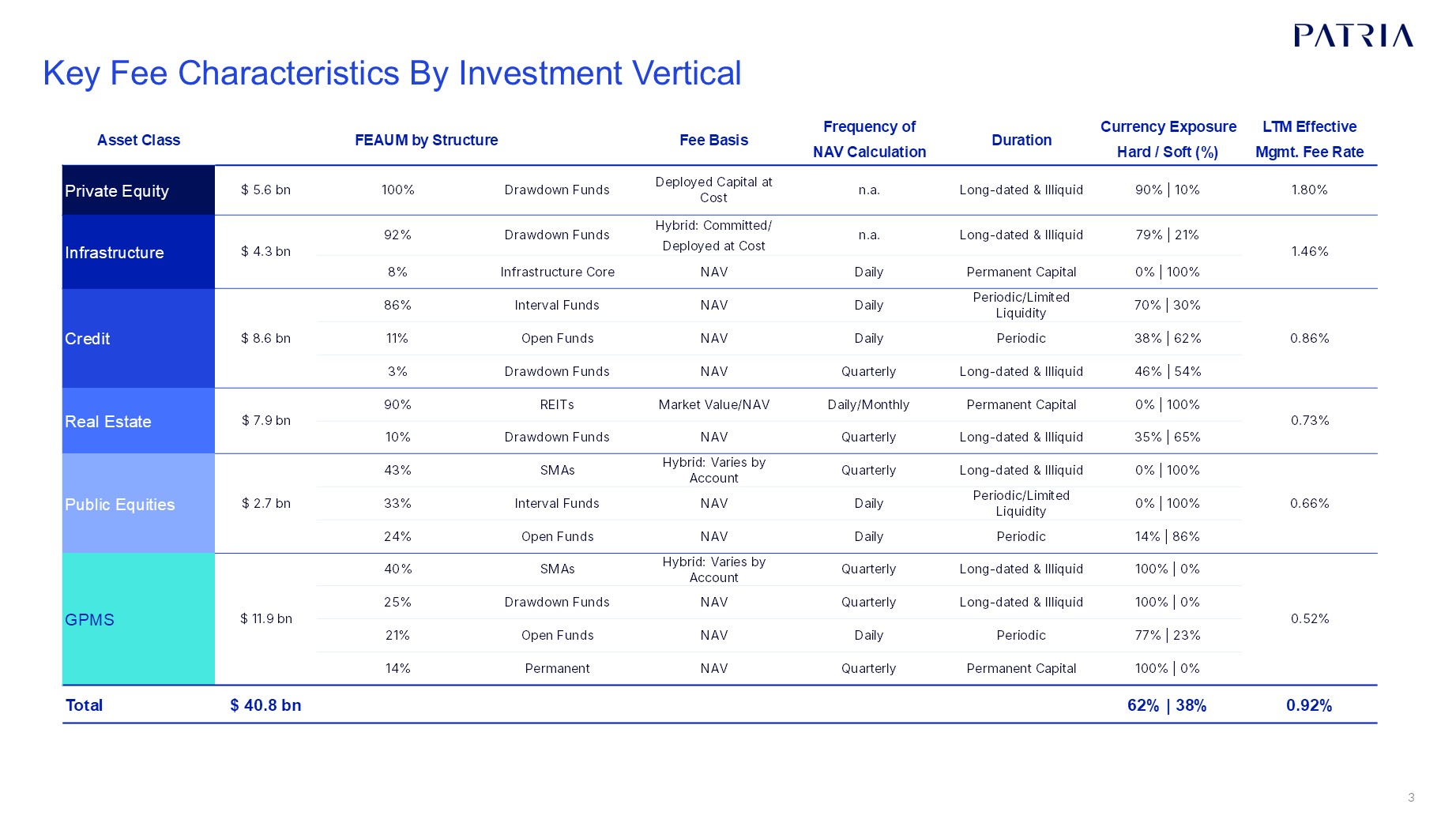
Note: Currency Exposure Hard / Soft (%) reflects the percentage of FEAUM exposed to each classification of currency. Soft currency exposures include vehicles which are either denominated in a soft (i.e. local) currency or have management fee exposure through the underlying investments where fees are charged on net asset value. Effective Management Fee Rate reflects the LTM management fee revenue divided by the average FEAUM for the past 12 months. Real Estate Effective Managemenet. Fee Rate includes the 100% of VBI and the Bancolombia partnership, which was effective at our 50% in part of 2025 for VBI and is 51% ownership levels for Bancolombia partnership. Periodic liquidity for open funds refers to funds which investors can redeem shares in a short period, including but not limited to weekly and monthly; and for Interval Funds refers to funds which investors can only redeem shares at specific intervals, such as quarterly, semi-annually or yearly.
From December 31, 2009 to December 31, 2025, our Total AUM increased from US$2.4 billion to US$52.6 billion at a compounded annual growth rate (“CAGR”), of 21.2% per year. Our FEAUM defines the effective capital managed by us on which we derive management fees, and as of December 31, 2025 our FEAUM were US$40.8 billion and grew at a 40% CAGR from year end 2020, just prior to our January 2021 IPO. Our Total AUM, in addition to our FEAUM, considers the appreciation of the assets and the capital under management which is not generating management fees at a given time, such as the committed and not yet deployed capital of funds that charge management fees over the deployed capital.
| | | | | | | | |
| Patria Investments Limited | | 57 |
The following charts illustrate our Total AUM and FEAUM growth curves:
Total AUM Patria (in US$ billions)
Total FEAUM Patria (in US$ billions)
Note: There can be no guarantee that we will achieve comparable growth metrics in the future. Others includes discontinued strategies such as hedge funds in 2020.
| | | | | | | | |
| Patria Investments Limited | | 58 |
Infrastructure—Creating value through growth and development strategies
We believe we have built one of the leading infrastructure investment products in Latin America in terms of AUM, considering our US$8 billion and US$5.5 billion of Total AUM and US$4.3 billion and US$3.4 billion of FEAUM as of December 31, 2025 and 2024, respectively. We have offered over US$3.3 billion of co-investment opportunities to date since our inception in 2006. As of December 31, 2025, our primary infrastructure products older than 36 months had a consolidated cash-weighted net IRR since inception of 5.5% in U.S. dollars and 13.5% in Brazilian reais. As of December 31, 2025, the consolidated cash-weighted net IRR of our infrastructure Fund III, Fund IV and Fund V, our latest vintages, was 10.2% in U.S. dollars and 16.0% in Brazilian reais, which we believe demonstrates the strength of our most recent funds. Performance in Brazilian reais is particularly noteworthy as it substantially eliminates the impact of U.S. dollar exchange rate volatility and therefore, we believe, offers a more informative perspective of our investment acumen relative to dollar-based returns. In addition, we expect to develop additional infrastructure strategies targeted to local and regional investors who will be investing in local currencies.
The focus of our infrastructure investments is to capture additional returns above relevant market benchmarks “alpha” in Latin America’s infrastructure sectors through a disciplined but flexible investment process that we believe has shown to be value accretive regardless of macroeconomic cycles and external environments, and is based on the following elements:
•Growth: Investments with significant value to be captured by brownfield expansions, consolidation of fragmented markets and other growth vectors;
•Development premium: Opportunities in upgrading, expanding or de-risking projects or assets, and addressing bottlenecks, gaps and inefficiencies in several segments. Approximately two-thirds of our investments in infrastructure were made through new platforms we created, where, in general, we hold a controlling stake;
•Sound capital structure: Deployment of solid capital structures based primarily on long-term project finance and a strong equity capital base, generally prioritizing the gradual deployment of primary capital to fund growth over large buyouts requiring an early infusion of sizable amounts of capital;
•Operation and efficiency gains: Identification of opportunities for efficiency gains and of specific value drivers related to the project and the investment thesis; and
•Platforms: Assembly of experienced management and operating teams at the individual Portfolio Companies that are complemented and supported by seasoned members of our corporate team, all under a set of incentive mechanisms to align the interests of management and operating teams with our fund’s objectives and guidelines.
After building a successful franchise of infrastructure funds that invest in value-add opportunities in Latin America, we have expanded our product offering with infrastructure funds focusing on core infrastructure as well as infrastructure credit. On March 8, 2021, we announced the closing of our first evergreen, publicly traded, Core Infrastructure fund, Patria Infraestrutura Energia Core FIP Infra (“PICE”). PICE has closed on total commitments of approximately US$148 million (approximately R$914 million), and is a yield-focused investment vehicle that seeks to invest in high-quality, operational power generation and transmission assets in Brazil. This platform is designed to hold investments for longer periods than traditional private equity and is listed on the Brazilian Stock Exchange -B3 under the symbol (“PICE11”), which allows for its investors to have liquidity through the secondary market. Other examples of the expansion of our infrastructure platform include: (i) the August 2022 launch of Patria Infraestrutura Energia Core Renda FIP Infra (“PIER”). PIER which now has about US$163 million (R$902 million) and invests primarily in established hydro plants that are fully operational, with inflation-indexed long-term contracts and already distributing yield to investors; (ii) the 2023 launch of our credit infrastructure fund ("Infrastructure Credit"), which combines the strength of both our credit and infrastructure platforms and which now has approximately US$182 million of AUM as of December 31, 2025; (iii) the 2024 acquisition of Tria Comercializadora de Energia S.A., an energy trading company which represents a strategic collaboration between the Patria group and key players in the energy sector. This combination allows us to enhance and diversify our infrastructure vertical by integrating specialized expertise from the Brazilian energy market; and (iv) the November 2025 launch of Patria Infraestrutura Credito DI ("PIDI"), focused on the allocation of infrastructure debentures indexed to the CDI (the Brazilian interbank rate).
| | | | | | | | |
| Patria Investments Limited | | 59 |
Infrastructure | Overview as of December 31, 2025
(1)Burgiss Global Infra Median.as of the third quarter of 2025, latest available.
(2)Capex developed/contracted.
(3)Source: IDB (Inter-American Development Bank) and IMF (International Monetary Fund); Patria internal analysis.
| | | | | | | | |
| Patria Investments Limited | | 60 |
Infrastructure | Performance versus benchmark as of December 31, 2025
(1)Methodology: Cash Weighted Chronological (“Pooled Returns”) consolidates funds return at original dates and cash flows. Latest vintages considers Fund III, IV and V returns as of the fourth quarter of 2025 (~12 years).
(2)Burgiss Global Infra Median as of third quarter of 2025, latest available.
Private Equity—Operational value creation in resilient sectors
We have been evolving our private equity strategies since 1994, applying our investment approach to create leading companies in resilient sectors, such as agribusiness, healthcare, food and beverage, and logistics. As of December 31, 2025 and 2024, our private equity product had US$10.5 billion and US$9.8 billion of AUM and US$5.6 billion and US$5.4 billion of FEAUM, respectively. Collectively, our private equity funds had approximately 77 investments and over 348 underlying acquisitions historically as of December 31, 2025, reflecting the scale of our investment development activities. As of December 31, 2025 and 2024, the consolidated cash-weighted net IRR since inception for our primary private equity funds older than 36 months was 9.1% and 9.5% in U.S. dollars and 16.0% and 15.7% in Brazilian reais, respectively, with limited use of leverage. We believe that performance in reais is a key indicator of our investment acumen as it substantially eliminates the impact of U.S. dollar exchange rate volatility, which is outside of our investment control, and we expect will be of growing importance as we anticipate local investors investing in local currencies will increasingly be attracted to our private equity solutions as we develop products to cater to this market. In addition, with our expansion to venture capital, growth equity, and middle-market private equity solutions in developed markets, we believe our product offering now more fully covers the private equity investment spectrum.
Our performance is a result of our diligent investment process, which includes:
•Our tailored thesis formulation process, which balances macroeconomic analyses to address regional comparative advantages and shortcomings with thoughtful market targeting and sector focus. This approach seeks to identify sectors that are large, growing and resilient where supply-side fragmentation would allow for market consolidation. In general, our investment theses focus on the acquisition of several small to medium sized companies, with an average of approximately six acquisitions per thesis, in order to consolidate a fragmented market;
| | | | | | | | |
| Patria Investments Limited | | 61 |
•Sourcing of specific investment targets based on our team’s extensive professional networks followed by a disciplined investment selection process. This involves a due diligence process focused on mitigating legal, financial and operational risks as well as producing a detailed business plan for the relevant company to deliver the targeted returns. The combination of proprietary sourcing with an operationally intensive due diligence process seeks to ensure that potential investment targets are companies with successful owner-operators interested in partnering with us to drive scale and growth through market consolidation;
•Acquisition of a control position, at an attractive entry price, in companies where execution risk is mitigated by the collaboration between such owner-operator and our team. A key differentiating aspect of our strategy is the focus on partnerships with established owner-operators striving to support the growth of profitable businesses rather than making outright acquisitions;
•Intense hands-on operational involvement in Portfolio Companies, working alongside management to drive revenue growth, consolidate markets through add-on acquisitions to capture synergies and build scale, in addition to other efficiency-enhancing initiatives. We develop detailed business plans, have strong alignment with owner-operators’ long-term plans and onboard strong, experienced management teams, including certain of our own key executives, usually in C-level or director positions;
•Capital is allocated to Portfolio Companies at a gradual pace, consistent with our investment approach based on the consolidation of fragmented markets. This staged deployment allows us to mitigate execution and foreign exchange risks, while seeking to optimize returns by redirecting capital allocation to our best-performing investment theses; and
•Understanding and mapping potential exit strategies from the initial stages of the development of the investment thesis and throughout the entire investment cycle. This involves establishing domestic and international relationships with potential “target buyers” from the start of our investment analysis.
Private Equity | Overview as of December 31, 2025
Note: Past performance is not a guarantee of future results. AUM as of December, 2025. (1) Year-over-year LTM as of September 2025 in BRL; (2) Total Addressable Market for LatAm PE.
| | | | | | | | |
| Patria Investments Limited | | 62 |
Private Equity | Performance versus benchmark as of December 31, 2025 (latest benchmark data available)
(1)Methodology: Cash Weighted Chronological (“Pooled Returns”) consolidates funds return at original dates and cash flows. 20-years considers Fund II, III, IV, V, VI, VII as of December 31, 2025; (2) MSCI Private Capital Benchmarks (20 year) for LatAm as of the third quarter of 2025 (latest benchmark available). (3) Avg. EV/EBITDA of our acquisitions for 2024 and LTM as of September 2025.
Private Equity and Infrastructure Fund Terms
The key terms of our private equity and infrastructure closed-end flagship funds are in general: (1) tenure of 10 to 12 years, extendable for two additional years; (2) 1.5%–2.0% p.a. management fee, charged at cost on either committed or invested capital; (3) five to six years of investment period; (4) for the funds which charge fees over committed capital, reduction of the basis for calculation of the management fee from committed capital to invested capital at the end of the investment period; (5) 0.25% discount on the management fee after raising a successor fund (step-down); (6) 15%–20% carried interest range, European waterfall structure with full catch-up, where performance is measured versus the preferred rate at the fund level (all distributions go to investors and the manager will not participate in profits until the investor’s capital, costs and preferred return have been fully satisfied); and (7) preferred returns from 6% p.a. to 8% p.a.
As our business evolves, many larger investors are increasingly accessing our investment strategies and capabilities through separately managed accounts (“SMAs”). SMAs by design each have unique and customized fee structures and terms and conditions but often allow for the recycling of capital and compounding, and we expect many SMAs will have lives that meet or exceed those of our closed-end funds. As of December 31, 2025 approximately 15% of our FEAUM were in SMAs across the entirety of our platform, including GPMS.
| | | | | | | | |
| Patria Investments Limited | | 63 |
Private Equity and Infrastructure Development Closed-end Funds Investment Record as of December 31, 2025
Note: We report investment performance for Private Equity and Infrastructure funds/strategies with Total AUM equal to or above US$500 million. This table includes funds below that threshold given their disclosure in our reporting since the IPO. Private Equity and Infrastructure net returns presented as ’n/m’ for the fund’s which first deployment of capital date is less than 36 months prior to the period indicated.
(1)As of December 31, 2025, PE VII and IS V committed capital include all specific co-investment and side car vehicles, including non fee paying commitments. Excluding non fee paying co-investments commitments, PE VII and IS V committed capital would be US$1,477 million and US$1,814 million respectively. Gross MOIC and Net Returns only reflect returns on primary funds and fee-paying co-invests.
Credit and Public Equities
The combination with Moneda Asset Management was an important step towards our diversification as it added two new product lines - credit and public equities. As of December 31, 2025 and 2024, the Total AUM for our credit platform was US$8.8 billion and US$6.7 billion, respectively, while FEAUM in credit were US$8.6 billion and US$6.5 billion. Our credit FEAUM grew 32% from December 31, 2024 to December 31, 2025 driven by a combination of strong investment performance, led by our closed-end USD Corporate High Yield fund, and net new business flows.
We expect credit will be a key driver of our growth driven by our strong investment performance, continued investor demand for differentiated credit strategies, and as we continue to expand the range of strategies we offer and the variety of investment vehicles in which we offer our strategies, including Luxembourg-domiciled Undertakings for Collective Investment in Transferable Securities ("UCITs"), Ireland domiciled investment trusts, and a closed-end private credit fund in Brazil. Overall, most of our credit strategies are in long-term or evergreen fund structures such as interval funds that offer limited gates of liquidity.
In the fourth quarter of 2025, we announced the acquisition of 51% of Solis Investimentos, a Brazilian investment manager specializing in the structuring and management of Collateralized Loan Obligations ("CLOs"). The CLO market in Brazil has been benefiting from a variety of structural and secular trends which have driven asset growth at a CAGR of 35% over the last 5 years. The acquisition closed on January 2, 2026, adding approximately US$3.1 billion of FEAUM in 2026 which will increase our total Credit FEAUM by over 35% solidifying our position as one of the leading Credit platform in Latin America. Considering this acquisition, Credit will account for over 26% of our total FEAUM.
Total AUM for our public equities products was US$2.8 billion as of December 31, 2025, up 49% from US$1.9 billion in December 31, 2024 mainly driven by strong investment returns and positive FX impacts, despite the fact that, in general, public equities strategies in Latin America have been negatively impacted by lackluster demand due to competition from new and existing products which benefit from high interest rates. We believe we are well positioned in the event demand for public equities strategies improves given our experienced team and solid long-term track record.
| | | | | | | | |
| Patria Investments Limited | | 64 |
Credit | Overview as of December 31, 2025
Note: Considers NAV appreciation. Past performance is not a guarantee of future results.
| | | | | | | | |
| Patria Investments Limited | | 65 |
Credit | Performance Highlights as of December 31, 2025
Note: Regional Corporate Strategies - Source: Moneda Asset Management, JP Morgan, Evestment. Data calculated by Moneda Asset Management as of December 31, 2025. Benchmarks used: Cembi Broad Div LatAm Index (JP Morgan) for LatAm High Yield, GBI Broad Div Latam Index (JP Morgan) for LatAm Local Currency, RiskAmerica Corporativo Global for Chile High Yield and CDI for Private Credit Brazil.
(1)Evestment by Nasdaq. Data as of December 31, 2025. Data point for the last 13 years of the fund
(2)Data point since inception of the fund. Local Corporate Strategies - Source: Moneda Asset Management, Patria, RiskAmerica. Data as of December 31, 2025. Inception Date of Chile High Yield: December 31st, 2012.
(3) Data as of December 31, 2025, consider the vehicle for individual investors in Brazilian retail platforms. Data point for the last 30 months of the fund. Past performance is not a guarantee of future results.
| | | | | | | | |
| Patria Investments Limited | | 66 |
Public Equities | Overview as of December 31, 2025
(1)Strategy with Largest AUM: Pionero Fondo de Inversion.
(2)Major target markets include Brazil, Chile, Mexico, Colombia, Peru, Argentina and Panamá.
| | | | | | | | |
| Patria Investments Limited | | 67 |
Public Equities | Performance Highlights as of December 31, 2025
Note: Data as of December 31, 2025. LatAm Public Equities Strategy returns have been calculated by Moneda applying the Global Investment Performance Standard methodology and have not been certified by a third party. Inception date LatAm Equities Strategy: May 27th, 2008. Inception Date Chile Equities Strategy: March 18th, 1994. Source: Moneda Asset Management. Inception date Patria Long Biased fund: Oct 30th, 2020 – net returns in BRL. Outperformance reflects primary fund within strategy. Past performance is not a guarantee of future results.
Credit and Public Equities Investment Performance as of December 31, 2025
Note: Includes composite investment performance for funds of strategies with or which have reached in the past Total AUM of US$500 million or more, and where relevant, a weighted composite of underlying benchmarks. Returns as of December 31, 2025 for Credit and Public Equities.
| | | | | | | | |
| Patria Investments Limited | | 68 |
Real Estate
We have significantly expanded our Real Estate investment capabilities in both Brazil and Colombia and total Real Estate AUM and FEAUM as of December 31, 2025 and 2024 were US$8.4 billion and US$5.8 billion and US$7.8 billion and US$5.5 billion, respectively. Approximately US$7.0 billion of our Real Estate FEAUM are in permanent capital vehicles, predominately listed REITs in Brazil.
The expansion of our Real Estate business in Brazil was largely initiated by our acquisitions of VBI and the CSHG Real Estate businesses, which we combined to create "Patria Real Estate" platform in Brazil, with total FEAUM as of December 31, 2024 of US$3.3 billion making us one of the largest independent managers of listed REIT strategies in Brazil. In 2025, we continued to expand our Real Estate business both organically and inorganically, and with the acquisition of RBR Gestão, announced on December 11, 2025, and its approximate US$1.3 billion of FEAUM, we believe that we became one of the largest REIT manager in the country in terms of Assets Under Management. We believe our scale, breadth of strategies, and investment track record leave us well positioned to grow this business over time through a combination of new products, follow-on offerings of existing products, as well as the ability to continue to consolidate what is a highly fragmented market.
Through our business arrangement with Bancolombia and further acquisition of Nexus, we have also built a sizeable Real Estate platform in Colombia that as of December 31, 2025 totaled US$2.7 billion of FEAUM, versus approximately US$2.0 billion as of December 2024, versus US$1.4 billion as of December 2023 and virtually zero as of December 2022. Our Colombian Real Estate strategies are currently focused predominately on institutions through very long-duration commingled investment vehicles.
Real Estate | The Evolution of Our Real Estate Since IPO as of December 31, 2025
(1)FEAUM incorporate 100% of VBI FEAUM
(2)As of July-22-24, we completed the transfer of Credit Suisse’s Brazilian Real Estate underlying funds
| | | | | | | | |
| Patria Investments Limited | | 69 |
Real Estate | Overview as of December 31, 2025
Note: (1) Methodology: Weighted Average Returns consolidates funds return at original dates and cash flows of largest types as of December 31, 2025. We will report investment performance for REITS with AUM in excess of US$75 million. Past performance is not a guarantee of future results.
Note: We will report investment performance for REITS with AUM in excess of US$75 million. Market based return including dividend reinvestment.
(1)Índice de Fundos de Investimentos Imobiliários ("IFIX") launched on December 30, 2010
| | | | | | | | |
| Patria Investments Limited | | 70 |
Global Private Market Solutions
Following the acquisition of the private equity solutions business of Abrdn, which closed on April 26, 2024, and in combination with our pre-existing advisory business directing Latin American capital to global private markets, we created our GPMS. Our GPMS business had US$14.2 billion of AUM and US$11.9 billion of FEAUM as of December 31, 2025 versus US$12.2 billion of AUM and US$10.2 billion of FEAUM as of December 31, 2024. This new vertical both enhances our ability to serve as a gateway for Latin American investors to access global private markets, while expanding our investment footprint into developed markets in the fast-growing alternative solutions market.
In February 2026, we announced that we entered into an agreement to acquire WP Global Partners LLC ("WP"), a U.S. based private equity solutions manager focused on the lower-middle-market. The acquisition aims to enhance our scale in a strategic market, strengthening its middle-market primaries and co-investment private equity capabilities in the U.S. broadening GP relationships and client reach. After the closing this transaction (April 1, 2026), our GMPS Fee Earning Assets under Management investment in the US will increase nearly 40%.
GPMS | Performance as of December 31, 2025
(1) North America and Europe Middle Market (>$250 mn & <$3 bn) Private Equity (Primaries, Secondaries & Co-Investments) AUM as of FY23 – Source: Preqin
(2) Data as of 30 September 2025. Primaries track record: comprises all primary funds selected by current members of our investment team from 2008 to 30 September 2025. Excludes funds selected by former members of the SL Capital team from 2008-2012 and Aberdeen Asset Management team from 2008-2016 in which no current investment team member had any involvement in the selection process. Includes European, North American and Global buyout funds. Secondaries track record: comprises all secondary transactions completed from 2012 to 30 September 2025. Co-investments track record: comprises all investments by current members of our investment team.
Returns are gross and represent the pooled internal rate of return net of management fees, carried interest and expenses charged by the general partners of the underlying investments but before the reduction of our management fees and carried interest, fund expenses and gains/losses on distributed securities. Performance data excludes co-investments completed in 2024 and 2025. In 2026, AUM will increase by US$2.7 billion from WP Global Partners acquisition.
| | | | | | | | |
| Patria Investments Limited | | 71 |
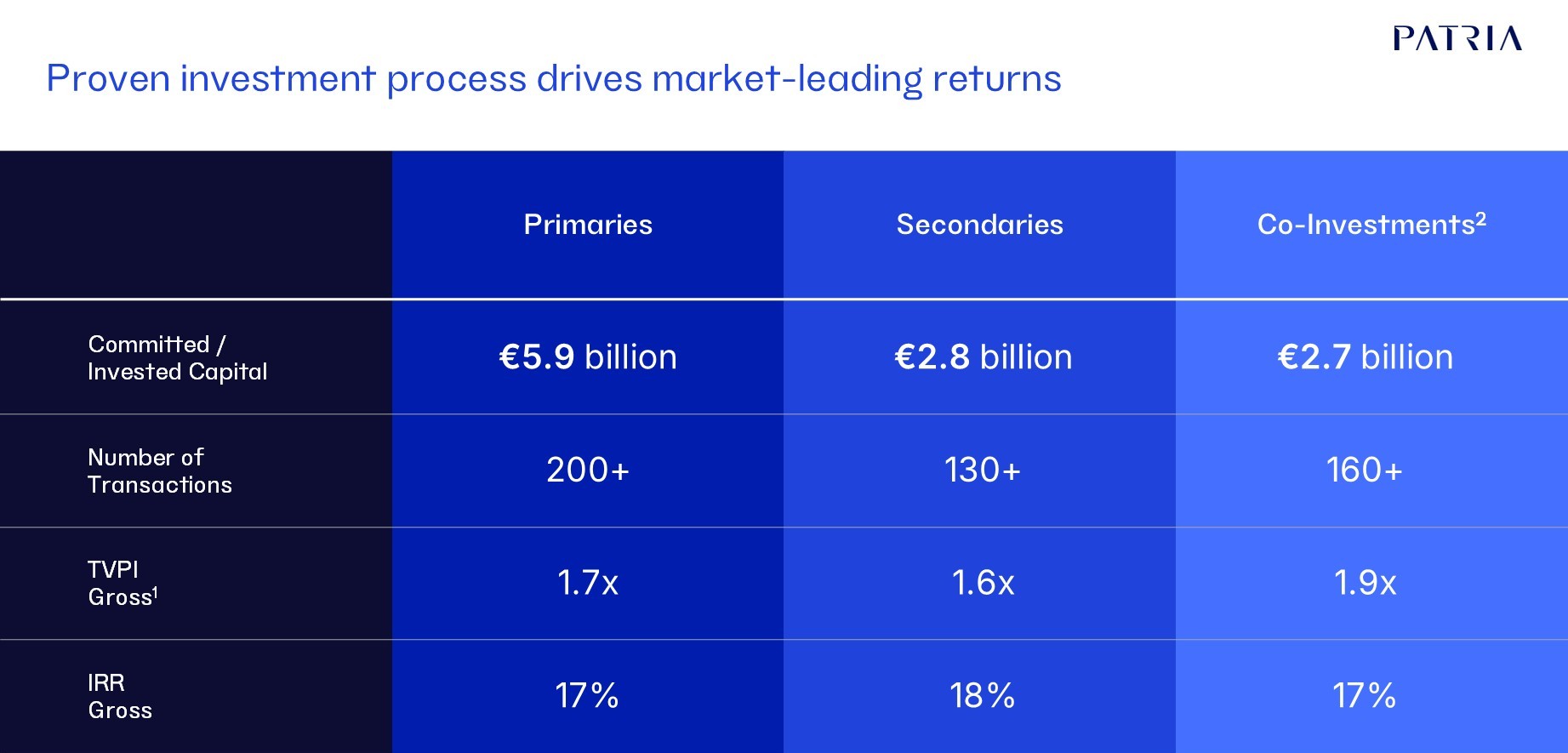
Note: Data as of 30 September 2025. Primaries track record: comprises all primary funds selected by current members of our investment team from 2008 to 30 September 2025. Excludes funds selected by former members of the SL Capital team from 2008-2012 and Aberdeen Asset Management team from 2008-2016 in which no current investment team member had any involvement in the selection process. Includes European, North American and Global buyout funds. Secondaries track record: comprises all secondary transactions completed from 2012 to 30 September 2025. Co-investments track record: comprises all investments by current members of the our investment team. (1) Returns are gross and represent the pooled internal rate of return net of management fees, carried interest and expenses charged by the general partners of the underlying investments but before the reduction of our management fees and carried interest, fund expenses and gains/losses on distributed securities. (2) Performance data excludes co-investments completed in 2024 and 2025
Our Competitive Strengths
Since our inception, we have grown to become one of the leading alternative investment firms focused on Latin America in addition to having a specialized focused on middle market private equity solutions in developed markets, particularly Europe and now also expanding into the United States. We believe the following competitive strengths allow us to capitalize on industry trends and position us well for future growth:
Attractive investment performance track record across market cycles.
We have produced strong long-term investment performance across our product offerings, generating consistent excess returns relative to benchmarks. Our closed-end infrastructure strategy pooled net IRR in U.S. dollars for our latest three vintages was 10.1% as of December 31, 2025, outperforming the Burgiss Global Infrastructure Median and the Dow Jones Brookfield Global Infrastructure Index by 2.1% and 8.5% respectively. In local currencies our last three infrastructure vintages have generated pooled net IRR's of 16.7%. For our closed-end private equity funds pooled 20-year net IRR in U.S. dollars was 11.0% as of December 31, 2025, outperforming the MSCI Private Markets Benchmarks (20 year) for LatAm 130bps as of September 30, 2025, which is the latest benchmark data available. In local currencies our 20-year net IRR return through December 31, 2025 was 14.4%. For Credit, our Latin American High Yield, our Latin American Local Currency and our Chilean Fixed Income strategies have outperformed their benchmarks since inception by 366 bps, 134 bps and 193 bps respectively. For Real Estate, 15 of our 23 REIT's we manage have outperformed the benchmark since inception as of December 31, 2025. Finally, in our GPMS business our investments in primaries secondaries, and co-investments have generated gross IRRs of 17%, 18%, and 17%, respectively, since inception and as of September 30, 2025, the latest available data.
| | | | | | | | |
| Patria Investments Limited | | 72 |
Strong client relationship model and capital raising capabilities.
We are one of the leading alternative investment firms in Latin America in terms of capital raised and therefore are among the world’s largest institutional investors focused on investments in Latin America. As of April 1, 2026, Preqin’s database on fund managers ranks us as the number one asset manager focused in Latin America for private equity and infrastructure in terms of funds raised in the last 10 years. We have been steadily expanding our capital raising capabilities and currently have over 109 individuals in our commercial organization ranging from client coverage and product specialists to investor relations officers, which compares to only 10 at the time of our IPO. Our commercial teams are located in 16 offices globally.
As we have expanded our investment and product capabilities and regional and global reach, we are evolving our commercial organization to better serve our regional and global investors as we shift from a product-oriented sales organization, to a solutions-centric model to better meet our clients ever evolving needs. In recognition that investor needs will vary by location and region and type, we have developed a commercial organization that includes local/regional hubs to better serve local and regional investors, while also expanding our ability to reach global investors with global specialists. Currently, we have three local hubs in Brazil, Chile and Colombia, and anticipate expanding the number of local hubs overtime as we expand our geographic footprint. We also continue to invest in and expand our global investment and distribution capabilities.
Distribution Structure | Global Presence
| | | | | | | | |
| Patria Investments Limited | | 73 |
Highly attractive and scalable business model with robust growth trajectory.
We participate in an industry that we believe benefits from strong secular growth trends, as well as growth as a result of strategic acquisitions and market consolidation. From 2009 to 2025, our Total AUM increased at a CAGR, of 21.2%. Since our IPO in 2021 our FEAUM grew at a compound rate of 40% to December 31, 2025. As of December 31, 2025 approximately 22% of our FEAUM are in permanent capital vehicles and about 90% of our FEAUM are in investment vehicles with no or limited liquidity windows. For details on our AUM and FEAUM growth, see “—Our Business.” We have a strong business with two main revenue streams: management fees and performance or incentive fees. Considering the stickiness and long-duration of our FEAUM, the management fees we generate are highly predictable providing us with highly visible cash flows. The long duration of our assets in combination with our greater diversification relative to the time of our IPO, enhances the resiliency of our business. In addition to management fees, performance and incentive fees provide the potential for additional revenues linked with our investment performance. As of December 31, 2025 and 2024, the sum of our net accrued performance fees was US$249 million and US$319 million, respectively. The decline was mainly the result of the combination of asset sales and realizations, public traded companies stock performance and negative foreign exchange impacts. This metric is defined in the section “Presentation of Financial and Other Information—Certain Terms Used in this Annual Report as KPIs to Measure Operating Performance.
Seasoned management team with entrepreneurial spirit and professional culture.
As of December 31, 2025, we had a management committee team, composed of 26 members. Most of our 44 partners have been working together for more than 15 years on average. Partners and senior management leaders are highly aligned with our clients’ objectives, with sizable personal capital commitments to our active funds. Our team includes more than 200 investment professionals and more than 109 client coverage professionals based in São Paulo (Brazil), Santiago (Chile), Montevideo (Uruguay), Buenos Aires (Argentina), Bogotá and Medellín (Colombia), Lima (Peru), New York and Sausalito (United States), London (England), Edinburgh (Scotland), Dubai (UAE), Hong Kong (China) and Mexico City (Mexico), in addition to our corporate business and management office in George Town (Cayman Islands). Our team blends professionals with complementary competences and experiences, who bring different perspectives to our investment and management decisions, all of whom are committed to sustainable solutions and fully adherent to environmental, social and governance (“ESG”), standards. Our operating partners, usually former C-level executives from the sectors in which we invest, our value creation team staffed by senior functional specialists, and our transactions group of M&A specialists complement the business development competences of our investment team. We also have what we believe to be one of the best entry-level programs in our sector: Patria Academy, our internship program with approximately 147 applicants per position. We also offer our employees the opportunity to rotate between multiple roles. For more information on our management, see “Item 6. Directors, Senior Management and Employees.”
Our entrepreneurial spirit, professional culture, and partnership proposition disseminated at scale are powerful variables that contribute to our execution capabilities and, most importantly, to our ability to attract and retain talent across our business platform. We believe that our recognized brand, together with our cutting-edge transactions, and ability to offer multiple, challenging career paths, all aligned with our award-winning internship program, allows us to attract the best-in-class students from top universities in Latin America and consistently source young talent. Our culture, aligned with a meritocratic environment and a partnership open to all and fast career development, also helps us to retain talented professionals.
Unparalleled brand equity as one of the thought leaders in the region.
The performance of our funds coupled with our expanding range of investment strategies and geographic footprint, helps us attract and retain many of the largest and most relevant institutional global investors. We believe we have evolved to become one of the trusted partners to many of our global clients regarding their Latin American investment decisions. The recognition from such renowned investors reinforces our brand equity and strongly leverages our capital raising capabilities to attract new investors and increase our share of wallet of current clients. In Latin America, we believe our expanded investment capabilities and regional footprint combined with the brand equity we've built over three decades reinforces our position as a thought leader throughout the region. We also seek to provide investors with access to high quality middle market private equity solutions in Europe and North America through our GPMS business as we selectively expand our footprint into developed markets.
| | | | | | | | |
| Patria Investments Limited | | 74 |
Our more than three decades of successful investments in Latin America have made us one of the most recognized private markets investors in the region, especially in the industries in which we focus. Our strong reputation in the Latin American business community attracts talented entrepreneurs, who naturally approach us when seeking a partner to grow, allowing us to invest in attractive entry valuations.
Divestment activities are also positively impacted by our brand equity recognition. Public markets, large corporations, and other strategic investors, which are the usual buyers of our Portfolio Companies and infrastructure investments, recognize our track record of building and structuring companies and assets, with good governance and strong management teams and business processes.
Business Growth Strategy
The alternative investment industry has experienced significant growth, which we expect to continue and contribute to our future growth. Amongst mid-market focused alternative asset managers, we believe we are one of the market leaders with regard to fundraising for alternatives in the regions where we operate. For example, as of April 1, 2026, Preqin’s database on fund managers ranks us as the number one asset manager focused in Latin America for private equity and infrastructure in terms of funds raised in the last 10 years.
A key part of our growth strategy has been to expand our product offering to better serve local and regional investors, in addition to global investors. The expansion in our capabilities, which has been substantially fueled by acquisitions, is highlighted by the expansion in the number of investment strategies we offer to over 40 as of December 31, 2025. We have also expanded the range of asset classes in which we invest as well as our geographic reach. We expect our future growth will continue to be fueled by a combination of organic growth we generate internally, as well as through strategic acquisitions that further enhance our capabilities and scale.
Growing addressable market. Alternative investments are expected to continue to grow vigorously and sustainably over the long-term. According to Preqin’s special report published in 2025, 'The Future of Alternatives in 2030', assets under management ("AUM"), in alternative asset classes (including private markets and hedge funds) is expected to grow at a CAGR of more than 9% to reach more than US$32.0 trillion by the end of 2030, up from US$18.7 trillion in 2024.
We believe the penetration of Latin American private investments as a share of global private markets can increase from the historically low levels. Preqin data as of March 16, 2026 shows that Latin America accounted for approximately 1% of total global private markets AUM, while Latin America GDP in 2024 represented 7% of global GDP. We believe that the volume of capital flowing to private markets in Latin America will increase substantially over time, driven by positive economic and currency cycles and the low correlation between Latin America and the global economy.
Continue to diversify and grow our client base of large global investors. We have a strong, diversified and sophisticated global client base of over 600 institutional, 1,600 high-net-worth investors and over 1.1 million retail investors. As of December 31, 2025, our investors included: (1) 7 of the world’s 10 largest sovereign wealth funds (including LPs with indirect investments — source: Preqin—December 2025); (2) 10 out of the world’s 20 largest pension funds — source: Preqin—December 2025; and (3) 8 out of the U.S.’s 10 largest pension funds — source: Preqin—December 2025. We intend to continue to expand our relationships with existing clients and also intend to capitalize on significant opportunities in new client segments, such as high-net-worth individuals, regional and local institutional investors and also mass affluent investors. We believe these investors offer an attractive opportunity to further diversify and grow our client base because many of them have only recently begun to invest in, or increase their allocations to, private markets investments. In addition, in selected countries within Latin America such as Brazil and Colombia, certain institutional investors are required to invest in local markets, and we believe this home country bias will drive demand for local alternative investment solutions overtime. Developing local strategies to meet this evolving local demand has been a key new business initiative for us.
In this context, today’s largest private market investors are expected to continue their growth trajectory and diversification, establishing a presence in an increasing number of high-growth geographies. We intend to continue building relationships with investors around the world and to position ourselves to participate in the growth of the global private markets. We believe we are well-positioned to pursue the opportunities arising from increased allocations among institutional investors and the rapid wealth creation globally among high-net-worth individuals, given our strong brand and reputation, particularly in Latin America, multi-office resources, top talent investment professionals and comprehensive suite of products and services.
| | | | | | | | |
| Patria Investments Limited | | 75 |
We believe our existing long-term relationships have been built not only through our long-term investment track records and the trust we have engendered over the years, but also through other initiatives, such as:
•Sharing interesting co-investment opportunities: In our infrastructure strategy alone, we've offered more than US$3.3 billion in co-investment opportunities to our LPs since inception;
•Acting as a thought partner to our clients: We are often sought out by our client base for our insights on macroeconomic and sector-specific trends in Latin America, given our successful track record as an investor in key sectors such as healthcare, food & beverage, infrastructure and agribusiness, among others; and
•Our robust and structured reporting process: We offer transparent and regular disclosure of our funds’ performance, as well as detailed information on our portfolio of companies and investments.
As a result of our consistent track record and the trust we have been able to gain and nurture, many of our clients have been supporting us for many years. We intend to capitalize on these competitive strengths to expand the relationships with our existing clients and to pursue opportunities in new client segments such as high-net-worth individuals, regional and local institutional investors, and affluent mass investors, both in Latin America as well as globally.
Continue to increase our product portfolio. Starting from our closed-end private equity and infrastructure funds, we have made significant progress in diversifying our investment platform across major asset classes as we seek to offer a wider range of products to meet the needs of our growing client base. Aligned with our growth strategy, we have used capital raised in our January 2021 IPO, modest amounts of debt, and our strong cash flow to drive inorganic expansion, adding complementary products and scaling our presence in key asset classes such as credit, real estate and developed middle market private equity solutions. We also continue to expand our offerings in our legacy businesses in private equity and infrastructure.
We believe there is growing demand for an expanded product offering leveraging our investment approach and current capabilities, which could address the specific needs of both our current global institutional client base and Latin American investors, including institutional funds, private wealth managers and affluent retail investors. We expect to continue developing new offerings organically, and also pursuing strategic partnerships, including mergers and acquisitions, to expand our portfolio of products, our geographical reach and to strengthen our distribution channels.
Expand access to channels. While we have established a solid direct communication program with global institutional investors, we aim to continue to grow and leverage our existing investor relations and marketing capabilities to access new relationships and investor segments. In addition to continuing to cultivate our rich direct relationships with our current global client base, we expect that deepening our relationships with distributors, private banks, and digital platforms may significantly enhance the marketing potential of our products in Latin America and globally.
Tap a growing demand for private market investment products in Latin America. We believe that we are well-positioned to reap the benefits of the financial deepening in Latin America, which is expected to continue driving greater demand for alternative investment products in the region. We believe our platform has the investment track record and distribution expertise required to expand our capital raising in Latin America by leveraging and expanding our existing local investment products.
Environmental, Social and Corporate Governance—Responsible Investment and Sustainability
We recognize the crucial role that material environmental, social, and governance ("ESG"), considerations can play in shaping long-term value generation, and we assess them in our risk-return investment analysis and decisions. Our approach is governed by our Responsible Investment Policy, updated in 2024, which sets forth our general guidelines.
We believe our investments have positive impacts in the Latin American markets considering the volume of investments and the sensitivity of the industries in which they operate. With this, our investment philosophy is based on long-term value creation through strict investment guidelines and governance principles. Sustainability is an important part of our way of doing business and an important support to our value creation proposal. To underpin this approach, in January 2020, we became a signatory to the Principles for Responsible Investment (PRI), an independent institution supported by the United Nations (UN).
| | | | | | | | |
| Patria Investments Limited | | 76 |
We continue to improve our Responsible Investment framework to assess all considerations rigorously in our investment process through nine steps to evaluate and address material aspects in the three main stages of the investment cycle: (i) investment, (ii) active ownership and, (iii) divestment. The implementation of the different steps varies according to the asset class, the moment in the investment cycle when the step is considered, and the level of depth, based on our leverage, materiality, and priorities:
1.Exclusion List: compliance with the relevant exclusion list(s), according to the fund that will make the investment.
2.Screening: high level review of Responsible Investment Fundamentals that can impact the new investment, based mainly on industry, jurisdiction, and location.
3.Due Diligence (DD): assessment of applicable sustainability regulations, standards, and other relevant aspects identified during the DD process.
4.Action Plan Design: plan to be addressed by the target investment company in the short, medium, and long-term. It includes specific strategies, milestones, and required deliverables.
5.Investment Committee: presentation of sustainability materiality for consideration during the decision-making process.
6.Responsible Business support and Engagement: offering of sustainability expertise and facilitating knowledge building. Supporting investees in the identification and implementation of best practices. Particularly relevant for our private equity and infrastructure portfolio.
7.Key Performance Indicators (KPIs): monitoring, measuring and periodic reporting of material environmental, social, and governance aspects, based on our Responsible Investment Fundamentals.
8.Responsible Business Action Plans Execution in Ownership: monitoring, supporting and calibrating the implementation of Action Plans.
9.Divestment: preparation of material environmental, social, and governance related information to analyze a company’s integral performance for divestment purposes.
As of 2025, in a continuous improvement effort, we restructured our Responsible Investment Governance. The Head of ESG for the Portfolio, retained in 2025, has over 25 years of experience in sustainable business management. The Responsible Investment team sits within the Management and Transformation business area, being closer to the Portfolio Companies, exercising sustainable active ownership while contributing to the Responsible Management of all of our Assets.
The Responsible Investment Team is responsible for ESG-related risks identification and management, both on portfolio, funds and asset class levels, with deeper and more detailed assessments as required by each fund strategy and as requested by our investors. The team is also responsible for identifying and capturing ESG-related opportunities both on a portfolio and assets level.
Responsible investment oversight and implementation (which fall under the responsibility of the Responsible Investment team and Portfolio Companies) is further described in the Responsible Investment Policy.
People & Career
We work tirelessly to attract, develop, and maintain our talent. We believe in the collective, but we recognize the importance of each one of our team members. We look for the best in class, the problem-solvers, who approach challenging issues with an innovative and creative mindset, striving for excellence in everything they do. We value the proactive and hands-on individuals carrying an entrepreneurial spirit to transform ideas into real opportunities.
We and our Portfolio Companies offer multiple career and development opportunities, a combination of financial markets, strategic consulting and management within our investees. At Patria, each individual is ultimately responsible for their own career path, and our partnership is open to all based on meritocracy: performance and values.
Today, we have five seniority levels of investment professionals. Our analysts and associates go through rotations across different practice areas to enhance their development and to identify their talents. Our vice presidents and directors are encouraged towards specialization, in order to achieve elevated levels of performance. Finally, our managing directors and partners extend their range of operation and responsibility as partners with management responsibilities.
| | | | | | | | |
| Patria Investments Limited | | 77 |
We have a simple yet structured employee life cycle. When recruiting, we run well-reasoned processes looking for people with our values and a good fit within our culture and the required technical background and compatible experience with their activity and seniority. For career development, we aim to have multiple learning possibilities, giving equal development opportunities to all employees. The speed of growth is individual and always related to performance. We also have processes to incentivize everyone to take an active approach towards planning and developing their careers. Regarding performance management, all of us are assessed at least annually through a 360-degree review where we are evaluated by our subordinates, superiors, peers and across practice areas. We have three ways of recognizing an investment professional’s performance: (1) promotion; (2) allocation of additional responsibilities; and (3) compensation increase. Our compensation structure is consistently aligned with the performance of our funds and the investment cycle of our businesses. To match this business model, we deploy a competitive compensation package with an emphasis on variable and long-term compensation. Our short-term compensation consists of base salaries aligned with market standards and cash bonuses which are variable and designed to reward performance. Our long-term incentive plans were designed to foster adherence to our culture and values.
Corporate Management & Services Platform
Scalable and Robust Platform
(1)4-tier governance layers refer to the type of capacities present in our governance—strategy, protection, investment & divestment, managerial execution.
Our product lines act independently to preserve each of our funds’ mandates with their respective investors and strategies. Nevertheless, all products are managed as one company and benefit from the synergies and scalabilities of a solid corporate services platform based out of our main corporate and management office in George Town, Cayman Islands.
Our corporate office is responsible for the management of the firm, including financial planning & analysis, accounting, tax, treasury, procurement, funds administration, information technology, compliance, risk & controls and client onboarding functions. Our success is highly dependent on our solid human resources structure, which is composed of business partners distributed across areas and a centralized corporate team. Our corporate team is responsible for all of our support positions and also for any activity which is better and more efficient when centralized, such as payroll and benefits. Our legal and compliance team is structured similarly, through business partners with specialized knowledge and working closely with our investment areas, as well as a strong centralized corporate team. The corporate team not only leverages synergies and the efficiencies resulting from shared, centralized processes, but also ensures that we act as a unit, follow our policies and code of ethics, and support our values, principles and our way of conducting business across all our operations. Additionally, we make sure to partner with the best-in-class service providers available, with the appropriate technical and jurisdiction-specific expertise, building long-term solid relationships.
| | | | | | | | |
| Patria Investments Limited | | 78 |
Our compliance, code of ethics & policies. We have developed a code of ethics and rules of conduct that reflects our mindset on how business should be done and how people should behave to preserve and protect our values and reputation. We have developed a robust set of policies to govern our daily activities, especially with regards to protecting the interests of our investors, including but not limited to: anti-money laundering, confidentiality, documentation retention, conflicts of interest, employee trading, gifts and entertainment.
Our Information Technology. We have state-of-the-art infrastructure technology aligned with what we believe to be best practices. We work to achieve high performance and availability having all critical assets configured to be fault-tolerant to sustain operations in the event of a major failure. We keep appropriate backups through a disk-based and cloud-based approach with data duplication. We have a comprehensive and highly available disaster recovery (“DR”), strategy and solution with multiple layers of redundancy: our file and application servers are replicated in real time to the DR site, our maximum data loss in the event of a disaster is 15 minutes, and we perform disaster recovery tests annually. Finally, we are evolving towards browser-based applications, delivered through software as a service as they are easier to maintain, improve and roll out and are the right fit for most of our business activities, giving us the agility we need with known and recognized security structures.
We classify our security working effort in four categories: (1) monitoring—maintaining a diligent monitoring process aiming to identify potential threats in both internal and external environments; (2) protecting—implementing leading protection technologies ensuring confidentiality, integrity and availability; (3) responding—providing quick response, blocking and isolating the source of malicious behavior or content; and (4) educating—creating a security-aware culture through unique and innovative training exercises, constructing employee’s engagement.
Competition
We compete with a number of strategic buyers, wealthy individuals, private equity funds and other financial services companies such as hedge funds that seek acquisition opportunities in Brazil, Chile and other Latin American countries. The strategic buyers we expect to compete with will vary based on the industry in which the potential acquisition target operates. The asset management industry is intensely competitive, and we expect it to remain so. We compete both globally and on a regional, industry and sector basis. In particular, within our asset management business, we primarily compete in the market for investment products in private equity, infrastructure, credit, real estate sectors, fixed income instruments (private and public credit) and public equities and in fund distribution, including certain funds managed by third parties. Our asset management business competes with a number of private equity funds, specialized investment funds, hedge funds, funds of hedge funds and other sponsors managing pools of capital, as well as corporate buyers, traditional asset managers, commercial banks, investment banks and other financial institutions (including sovereign wealth funds). We compete on the basis of a number of factors, including investment performance, transaction execution skills, access to capital, access to and retention of qualified personnel, reputation, range of products and services, innovation and price.
In our asset management business, we compete with a larger number of financial institutions and asset managers which, in some cases, have much larger amounts of assets under management or offer a more diverse variety of financial products. We face competition both in the pursuit of outside investors for our investment funds and in acquiring investments in attractive Portfolio Companies and making other investments. Although many institutional and individual investors have increased the amount of capital they commit to alternative investment funds, such increases may create increased competition with respect to fees charged by our funds. Certain institutional and other sophisticated investors have demonstrated a preference to in-source their own investment professionals and to make direct investments in alternative assets without the assistance of private equity or public equity advisers like us. We compete for investments with such institutional investors and such institutional investors could cease to be our clients.
| | | | | | | | |
| Patria Investments Limited | | 79 |
Depending on the investment, we face competition primarily from sponsors managing other funds, investment vehicles and other pools of capital, other financial institutions and institutional investors (including sovereign wealth and pension funds), corporate buyers and other parties. Several of these competitors have significant amounts of capital and many of them have investment objectives similar to ours, which may create additional competition for investment opportunities. Some of these competitors may also have a lower cost of capital and access to funding sources or other resources that are not available to us, which may create competitive disadvantages for us with respect to investment opportunities. In addition, some of these competitors may have higher risk tolerances, different risk assessments or lower return thresholds, which could allow them to consider a wider variety of investments and to bid more aggressively than us for investments. Corporate buyers may be able to achieve synergistic cost savings with regard to an investment or be perceived by sellers as otherwise being more desirable bidders, which may provide them with a competitive advantage in bidding for an investment.
In addition, in recent years in Brazil, the equity capital markets have been a significant competition to our business by providing equity funds to companies in need of financing. The same applies to our business in public equities and fixed income funds managed by Moneda, which faces increasing competition to source institutional clients and in the distribution segment of offshore funds. In all of our businesses, competition is also intense for the attraction and retention of qualified employees. Our ability to continue to compete effectively in our businesses will depend upon our ability to attract new employees and retain and motivate our existing employees. For additional information concerning the competitive risks that we face, see “Item 3. Key Information—D. Risk Factors—Certain Factors Relating to Our Business and Industry—The asset management business is highly competitive with numerous competitors with greater resources.”
Regulation and Supervision
As a Global Business, we are regulated and supervised by the relevant authorities in the jurisdictions in which we operate and conduct our regulated activities.
Regulation and Supervision in Brazil
The Company is authorized and regulated in Brazil by the Brazilian Securities and Exchange Commission (Comissão de Valores Mobiliários, “CVM”) which is the governmental authority responsible for overseeing and regulating the securities market and, on a self‑regulatory basis, by the Brazilian Financial and Capital Markets Association (“ANBIMA”). In addition, the Company is subject to anti-money laundering and counterterrorist financing (“AML/CTF”) governed by Law No.9.613 and Anti-bribery framework governed by Law No.12.846.
As a CVM‑regulated entity, the Company must comply with applicable securities laws and regulations, including prudential standards, conduct‑of‑business rules, disclosure obligations, and requirements governing the distribution and management of securities and investment products. The Company is associate and adheres to ANBIMA’s self‑regulatory codes, which establishes best practices the financial and capital markets relating to regulatory practice, governance, suitability, transparency, advertising, and fiduciary conduct. Both CVM and ANBIMA maintain supervisory and enforcement authority, including the ability to conduct inspections, request information, impose sanctions, and issue binding directives.
The Company is required to submit periodic regulatory reports, and any other information they may require under supervisory by the CVM or ANBIMA.
Regulation and Supervision in the Cayman Islands
Our Cayman based operations operate under legal entities acting as a registered person under the Securities Investment Business Act (As Revised) of the Cayman Islands (“SIBA”) and are therefore subject to the regulatory oversight of the Cayman Islands Monetary Authority (“CIMA”). As a SIBA‑regulated entity, the Company must comply with ongoing obligations, including adherence to prudential standards, implementation of robust anti‑money laundering and counter‑terrorist financing controls, and timely submission of regulatory filings and audited financial statements. CIMA retains broad supervisory powers, including the authority to conduct inspections, request information, and impose enforcement actions where necessary. Where the entities incorporated in the Cayman Islands sponsors, manages, or provides services to investment vehicles regulated as mutual funds or private funds, those vehicles must separately comply with the Mutual Funds Act (As Revised) and the Private Funds Act (As Revised), respectively. These regimes impose mandatory registration with CIMA, ongoing filing and audit requirements, and compliance with governance and record‑keeping standards established by CIMA. Such obligations operate in parallel with SIBA and are subject to continuous supervisory oversight from CIMA.
| | | | | | | | |
| Patria Investments Limited | | 80 |
Regulation and Supervision in Chile
Our operations in Chile are subject to oversight by the Comisión para el Mercado Financiero (“CMF”), which is the governmental authority responsible for regulating and supervising securities markets and financial service providers in Chile. As a CMF‑regulated entity, the Company must comply with a comprehensive regulatory framework that includes conduct‑of‑business rules, internal controls, risk‑management obligations, corporate governance standards, and the reporting and disclosure requirements established under applicable Chilean laws and CMF regulations. The Company is required to submit periodic regulatory reports, and any other information the CMF may require under its supervisory authority. The CMF has broad powers to oversee regulated entities, including conducting inspections and on‑site examinations, requesting information, issuing binding instructions, and imposing administrative sanctions and monetary fines for regulatory breaches.
In addition, the Company is subject to Chile anti‑money laundering and counter‑terrorist financing (“AML/CTF”) framework, primarily governed by Law No.19.913 and its associated regulations. As an entity obligated under this law, the Company must maintain AML/CTF policies, procedures, and controls and must report suspicious transactions and other required information to the Unidad de Análisis Financiero (“UAF”), Chile´s financial intelligence unit. The UAF also has supervisory and enforcement powers with respect to AML/CTF compliance and may impose administrative sanctions and monetary fines for violations of AML/CTF obligations.
Regulation and Supervision in Colombia
The Company operates in Colombia under the oversight of the Superintendence of Companies and in compliance with Chapters X and XIII of the Legal Basic Circular, which regulate SAGRILAFT and PTEE, respectively. Companies that operate in Colombia as professional investment fund managers belong to the real sector and are not financial institutions; accordingly, they are not supervised by the Financial Superintendence. Within this framework, the Company adopts a risk-based approach to identify, assess, mitigate, and monitor ML/TF/PF risks, as well as corruption and transnational bribery risks, in alignment with FATF Standards and international best practices. Procedures comprise customer, supplier, and employee due diligence (standard and enhanced), risk-factor segmentation, and ongoing monitoring of transactions, products, channels, and jurisdictions to detect red flags. Unusual activities are analyzed and, where appropriate, reported as suspicious transactions to the UIAF in the manner and within the time limits prescribed by law. The governing principles are set out in the SAGRILAFT and PTEE Manuals, approved by the Board of Directors and mandatory for all personnel. Training is provided to all staff, with differentiated content based on exposure to risk. The Board has appointed a Compliance Officer with decision-making authority and adequate resources to ensure proper management and reporting. Internal Audit and the Statutory Auditor conduct periodic and independent reviews to verify the effectiveness and proper implementation of SAGRILAFT and PTEE in accordance with applicable regulations.
Regulation and Supervision in the UK
The Company is authorized and regulated in the United Kingdom by the Financial Conduct Authority (“FCA”) as a full‑scope Alternative Investment Fund Manager (“AIFM”) under the UK Alternative Investment Fund Managers Regulations 2013 and the FCA Handbook. In addition to its AIFM permissions, the Company holds ancillary permissions under the Markets in Financial Instruments Directive (“MiFID”) regime, which subject it to additional conduct‑of‑business, organizational, and reporting requirements when providing investment services such as investment advice, reception and transmission of orders, or execution‑related activities. As an FCA‑regulated firm, the Company must comply with prudential standards, governance and risk‑management expectations, client‑asset protections where applicable, and detailed disclosure and transparency obligations under the AIFM and MiFID frameworks. The FCA exercises broad supervisory and enforcement authority, including the ability to conduct thematic reviews, request information, perform on‑site inspections, and impose sanctions or other remedial measures.
| | | | | | | | |
| Patria Investments Limited | | 81 |
Regulation and Supervision in Uruguay
The Company operates in Uruguay under the supervision of the Central Bank of Uruguay (Banco Central del Uruguay, “BCU”), acting through its Superintendency of Financial Services (“SSF”), which is responsible for regulating and overseeing financial institutions, securities market participants, and investment service providers. As a regulated entity, the Company must comply with the prudential, operational, and conduct‑of‑business requirements established under Uruguayan law and BCU regulations, including capital adequacy standards, reporting obligations, governance expectations, and rules governing the distribution and management of financial and investment products. The Company is also subject to the self‑regulatory framework of the Bolsa de Valores de Montevideo (“BVM”) or other applicable market institutions, which establish additional standards relating to market conduct, transparency, and professional ethics. The BCU and relevant self‑regulatory bodies maintain broad supervisory and enforcement authority, including the ability to conduct inspections, request information, impose sanctions, and issue binding directives.
Regulation and Supervision in the US
The Company conducts investment advisory activities in the United States through entities registered with the U.S. Securities and Exchange Commission (“SEC”) as investment advisers (“RIAs”) as well as entities that qualify as exempt reporting advisers (“ERAs”) under the Investment Advisers Act of 1940 (the “Advisers Act”). RIAs are subject to the full scope of the Advisers Act and related SEC rules, including fiduciary obligations, compliance program requirements, books‑and‑records rules, marketing and solicitation restrictions, custody requirements, and periodic regulatory reporting through Form ADV and other filings. ERAs, while exempt from full registration, remain subject to certain provisions of the Advisers Act and must comply with reporting obligations, anti‑fraud rules, and applicable state‑level requirements. The SEC maintains broad supervisory and enforcement authority over both RIAs and ERAs, including the ability to conduct examinations, request information, impose sanctions, and mandate remedial measures.
Other jurisdictions
Our subsidiaries in Dubai (UAE), and Hong Kong (China) perform activities that require registration with and regulation by appropriate regulatory authorities in their jurisdictions, as follows:
Patria Investments Hong Kong Limited is a company incorporated in Hong Kong and is licensed as a Type 1 Dealing in Securities, issued by the SFC (Securities and Futures Commission);
Patria Investments UK Ltd. has a branch established in the Dubai International Financial Centre (“DIFC”) and hold a Category 4 license (Advising on Investments and Arranging Deals in investments), regulated by the Dubai Financial Services Authority (“DFSA”).
C. Organizational Structure
For a chart showing our current corporate structure and equity ownership, see “Presentation of Financial and Other Information—Corporate Structure.” Such chart is provided for illustrative purposes only and does not show all of the legal entities.
D. Property and Equipment
Intellectual Property
Most of our services are based on the jurisdictions in which we have offices. We rely on a combination of copyright, industrial property, and software laws, as well as employee and third-party nondisclosure, confidentiality and other types of contractual arrangements to establish, maintain and enforce our intellectual property rights, including with respect to our proprietary rights related to our products and services. In addition, we license technology from third parties.
As of December 31, 2025, we owned a number of trademarks, including, but not limited to, Patria Investimentos, Patria Investments, Moneda, Moneda Asset Management and VBI Real Estate to identify several business and financial services, in Brazil, Chile, Colombia, United Kingdom and other jurisdictions, mostly in Latin America and the European Union. We also own other valuable trademarks and designs covering various brands, products, programs and services, including Patria Finance, Patria Real Estate, Moneda Corredores de Bolsa, Moneda Asset, VBI and VBI Real Estate. We have a number of registered copyrights, software and domain names.
| | | | | | | | |
| Patria Investments Limited | | 82 |
Properties
We lease our corporate business and management office, which is located in 60 Nexus Way, 4th floor, Camana Bay, PO Box 757, KY1-9006, Grand Cayman, Cayman Islands. We also lease additional office space in São Paulo (Brazil), Buenos Aires (Argentina), Montevideo (Uruguay), Bogota and Medellín (Colombia), Lima (Peru), Santiago (Chile), New York and Sausalito (United States), Edinburgh (Scotland), London (England), Dubai (UAE), Hong Kong (China) and Mexico City (Mexico). We do not own any property. Our current facilities are suitable for our business needs and we understand that adequate additional space will be available as and when needed.
ITEM 4A. UNRESOLVED STAFF COMMENTS
Not applicable.
ITEM 5. OPERATING AND FINANCIAL REVIEW AND PROSPECTS
The following discussion contains forward-looking statements that involve risks and uncertainties. Our actual results and the timing of events may differ materially from those expressed or implied in such forward-looking statements as a result of various factors, including those set forth in “Cautionary Statement Regarding Forward-Looking Statements” and “Item 3. Key Information—D. Risk Factors.”
A. Operating Results
The following discussion of our financial condition and results of operations should be read in conjunction with our audited consolidated statement of income as of December 31, 2025 and 2024 and for each of the years in the three-year period ended December 31, 2025 and the notes thereto, included elsewhere in this annual report, as well as the information presented under “Presentation of Financial and Other Information.”
Overview
| | | | | | | | | | | | | | | | | | | | | | | | | | | | | |
| For the Years Ended December 31, |
| 2025 | | 2024 | | 2023 | | Change 2025/2024 | | Change 2024/2023 |
| (in US$ millions) |
| Net income for the year | 90.5 | | | 75.7 | | | 120.8 | | | 14.9 | | | (45.1) | |
Owners of the Company | 85.7 | | | 71.9 | | | 118.4 | | | 13.8 | | | (46.5) | |
Non-controlling interests | 4.9 | | | 3.8 | | | 2.4 | | | 1.1 | | | 1.4 | |
| | | | | | | | | |
Fee Related Earnings (FRE) | 202.5 | | | 170.1 | | | 147.7 | | | 32.4 | | | 22.4 | |
Distributable Earnings (DE) | 200.9 | | | 189.2 | | | 186.3 | | | 11.7 | | | 2.9 | |
Note: FRE and DE figures reflect only the results attributable for controlling owners to disclose our exposure from our ownership stake on each line item. For their definition and reconciliation from Net Income see "Item 5.A Operating Results - Non-GAAP Financial Measures and Reconciliations".
We are a global alternative investment firm focused on the middle market segment, specializing in resilient sectors across select regions. We are a leading asset manager in Latin America and have a strong presence in Europe, with combined assets under management (“AUM”), of US$52.6 billion and US$41.9 billion as of December 31, 2025 and 2024, respectively. Fee-earnings AUM ("FEAUM"), which are the AUM on which we earn management fees, totaled US$40.8 billion and US$32.9 billion as of December 31, 2025 and 2024, respectively. We seek to be the gateway for alternative investing in Latin America and the partner of choice for both global as well as local Latin American institutional and individual investors. We aim to serve our investors' needs by providing a diverse range of investment solutions that generate attractive risk-adjusted returns in order to help investors meet their specific portfolio objectives. To serve our clients' needs, we offer a comprehensive and expanding array of investments strategies across major asset classes - private equity, infrastructure, credit, real estate, and public equities. We offer these strategies through a variety of product structures designed to meet our clients' investment goals and liquidity needs. Product structures, generally fall into the categories of closed-end funds, permanent capital listed vehicles and interval funds, open end funds, and separately managed accounts ("SMAs"), among others.
| | | | | | | | |
| Patria Investments Limited | | 83 |
As an asset manager, investment performance is the core of our business and a fundamental driver of our growth, and we believe we have built a solid track record across our strategies. The 20-year pooled Net IRR for our closed-end private equity buyout funds, for example, was 11.0% as of December 31, 2025 in U.S. dollars and 14.4% in local currencies. For infrastructure, the pooled Net IRR in U.S. dollars for our latest three vintage closed-end development funds was 10.2% as of December 31, 2025, and on a local currency basis was 16.0%.
With respect to credit, our Latin America High Yield Credit, our largest strategy, has outperformed its benchmark by 366 basis points ("bps") as of December 31, 2025 since inception in February 4, 2000. The strategy has also beaten its benchmark CEMBI Broad Div Latam HY (J.P. Morgan’s high‑yield Latin American corporate bond index) over the trailing 1, 3 and 5-year periods through December 31, 2025. With respect to real estate, of our largest REITs with assets in excess US$75 million, which totals AUM of US$5.7 billion, 8 out of 11 have beaten the related benchmark since inception. Finally, in our GPMS business our investments in primaries, secondaries, and co-investments have generated gross IRRs of 17%, 18% and 17%, respectively, since inception and as of September 30, 2025, the latest date for which information is available. For further information on our funds performance, see “—Our Business.”
We believe we have also generated attractive financial performance for our shareholders. Since our IPO, we have grown our Fee-Earning Assets Under Management from US$7.7 billion as of December 31, 2020 to US$40.8 billion as of December 31, 2025. Our Fee Related Earnings grew from US$56.8 million in 2020 to US$202.50 million in 2025, our Net Income grew from US$61.8 million in 2020 to US$90.5 million in 2025 and our Distributable Earnings per Share rose to US$1.27 in 2025 from US$1.02 in 2021, our first year as a public company.
In 2024, as reported before, we implemented several important changes to our capital management policy to enhance our capital flexibility in order to fund our growth, including acquisitions, and long-term shareholder returns. Starting with our dividend in the second quarter of 2024, we transitioned from a variable quarterly dividend policy of approximately 85% of Distributable Earnings to a fixed quarterly dividend of US$0.15 per share, subject to annual review. In the fourth quarter of 2025 we announced an increase of our fixed quarterly dividend to US$0.16 per share for financial year 2026. In addition, in the fourth quarter of 2025 we announced that our Board had approved an additional share buyback program of three million shares, on top of the previously approved program of 3 million shares. The Group entered into a total return swap ("TRS") with a financial institution in September 2025 referencing 1.5 million shares. As the TRS remained outstanding and was not settled as of year‑end, the Company did not obtain title to the underlying shares and therefore no share repurchase was recorded. Our intention continues to be to use repurchases to mitigate the impact of compensation-based share issuance overtime, and we expect to keep our share count between 158 and 160 million shares for the coming year.
As of December 31, 2025, we had 548 professionals, of which 44 were partners, 20 of whom have worked together for more than 15 years. We operate in 15 offices around the globe, including investment offices in, Montevideo (Uruguay), São Paulo (Brazil), Bogotá and Medellín (Colombia), Lima (Peru), Santiago (Chile) and Edinburgh (Scotland) as well as client-coverage offices in New York and Sausalito (United States), London (England), Dubai (UAE), Mexico City (Mexico) Hong Kong (China) and Buenos Aires (Argentina), in addition to our corporate business and management office in George Town (Cayman Islands).
Key Business Metrics
The following table sets forth our key business metrics as of and for the periods indicated. These supplemental business metrics are presented to assist investors to better understand our business and how it operates. This annual report uses the terms AUM, FEAUM, and net accrued performance fee, for which the definitions are presented below. We strongly advise that these measures may differ from the calculations of other companies, and as a result, may not be comparable to similar ones.
| | | | | | | | |
| Patria Investments Limited | | 84 |
The following table presents certain key operating performance metrics for the years ended December 31, 2025, 2024 and 2023:
| | | | | | | | | | | | | | | | | | | | | | | | | | |
| | For the Years Ended December 31, |
| 2025 | 2024 | | 2023 | | 2025/2024
Change | | 2024/2023
Change |
| | (in US$ millions) |
Assets Under Management | 52,609 | | 41,899 | | | 31,843 | | | 10,710 | | | 10,056 | |
Private Equity | 10,482 | | 9,812 | | | 12,064 | | | 670 | | | (2,252) | |
Infrastructure | 8,033 | | 5,537 | | | 5,387 | | | 2,496 | | | 150 | |
Credit | 8,777 | | 6,697 | | | 5,610 | | | 2,080 | | | 1,087 | |
Public Equities | 2,795 | | 1,877 | | | 2,908 | | | 918 | | | (1,031) | |
Real Estate | 8,366 | | 5,791 | | | 3,432 | | | 2,575 | | | 2,359 | |
| GPMS (1) | 14,156 | | 12,184 | | | — | | | 1,972 | | | 12,184 | |
| Advisory & Distribution (1) | — | | — | | | 2,442 | | | — | | | (2,442) | |
Fee Earning AUM | 40,810 | | 32,901 | | | 23,900 | | | 7,909 | | | 9,001 | |
Private Equity | 5,553 | | 5,404 | | | 6,658 | | | 149 | | | (1,254) | |
Infrastructure | 4,271 | | 3,419 | | | 3,272 | | | 852 | | | 147 | |
Credit | 8,586 | | 6,522 | | | 5,381 | | | 2,064 | | | 1,141 | |
Public Equities | 2,698 | | 1,803 | | | 2,910 | | | 895 | | | (1,107) | |
Real Estate | 7,848 | | 5,513 | | | 3,476 | | | 2,335 | | | 2,037 | |
| GPMS (1) | 11,854 | | 10,239 | | | — | | | 1,615 | | | 10,239 | |
| Advisory & Distribution (1) | — | | — | | | 2,204 | | | — | | | (2,204) | |
| Net Accrued Performance Fee (2) | 249 | | 319 | | | 535 | | | (70) | | | (216) | |
(1)Starting with our first-quarter 2024 results, we established a new vertical—Global Private Market Solutions (GPMS). As a result, we reclassified certain assets from Advisory & Distribution into GPMS, Credit, Public Equities and Real Estate. These reclassifications are reflected in the tables detailing changes in AUM and FEAUM
(2)Beginning with our results for the first quarter of 2023, we are reporting Net Accrued Performance Fee balances net of related compensation and revenue taxes only. To be consistent with current reporting methodology, disclosures in prior periods were also adjusted accordingly for comparative purposes.
Assets Under Management
Our AUM provides our operational size and market share perspective. AUM is the total capital funds managed by us plus the investments directly made by others in the invested companies (co-investments).
The following table reflects the changes in our AUM for the years ended December 31, 2025 and 2024:
| | | | | | | | | | | | | | | | | | | | | | | | | | | | | | | | | | | | | | | | | | | | | | | |
| Private Equity | | Infrastructure | | Credit | | Public Equities | | Real Estate | | GPMS | | Advisory & Distribution | | Total |
| (in US$ millions) |
| AUM as of December 31, 2024 | 9,812 | | | 5,537 | | | 6,697 | | | 1,877 | | | 5,791 | | | 12,184 | | | — | | | 41,899 | |
| Reclassification | — | | | — | | | — | | | — | | | — | | | — | | | — | | | — | |
| Acquisitions | — | | | — | | | 7 | | | — | | | 613 | | | — | | | — | | | 621 | |
| Inflows | 365 | | | 2,253 | | | 1,848 | | | 316 | | | 905 | | | 1,978 | | | — | | | 7,666 | |
| Realizations & Dividends | (600) | | | (647) | | | (468) | | | (5) | | | (359) | | | (1,252) | | | — | | | (3,330) | |
| Redemptions | (56) | | | — | | | (352) | | | (437) | | | (21) | | | (320) | | | — | | | (1,186) | |
| Valuation Impact | 57 | | | 188 | | | 833 | | | 805 | | | 744 | | | 619 | | | — | | | 3,246 | |
| Foreign Exchange (FX) | 914 | | | 336 | | | 218 | | | 239 | | | 658 | | | 765 | | | — | | | 3,131 | |
| Funds capital variation | (11) | | | 365 | | | (6) | | | — | | | 34 | | | 181 | | | — | | | 564 | |
| AUM as of December 31, 2025 | 10,482 | | | 8,033 | | | 8,777 | | | 2,795 | | | 8,366 | | | 14,156 | | | — | | | 52,609 | |
| | | | | | | | |
| Patria Investments Limited | | 85 |
The increase in AUM was mainly due new capital raised across all verticals, positive performance of our funds, appreciation of the U.S. Dollar against the local currencies and acquisitions in Real Estate. These increases were partially offset by realizations in our Portfolio Companies and GPMS mandates, dividends distributed from our REITs, credit and public equities funds and redemptions across all verticals except Infrastructure. For more information about the acquisitions, see "Item 4. Information on the Company—A. History and Development of the Company."
The following table reflects the changes in our AUM for the years ended December 31, 2024 and 2023:
| | | | | | | | | | | | | | | | | | | | | | | | | | | | | | | | | | | | | | | | | | | | | | | |
| Private Equity | | Infrastructure | | Credit | | Public Equities | | Real Estate | | GPMS | | Advisory & Distribution | | Total |
| (in US$ millions) |
| AUM as of December 31, 2023 | 12,064 | | | 5,387 | | | 5,610 | | | 2,908 | | | 3,432 | | | — | | | 2,442 | | | 31,843 | |
| Reclassification | — | | | 207 | | | (178) | | | 85 | | | 294 | | | 2,034 | | | (2,442) | | | — | |
| Acquisitions | — | | | — | | | — | | | — | | | 2,834 | | | 9,482 | | | — | | | 12,316 | |
| Inflows | 186 | | | 454 | | | 1,380 | | | 233 | | | 588 | | | 2,314 | | | — | | | 5,154 | |
| Realizations & Dividends | (351) | | | (127) | | | (267) | | | (41) | | | (392) | | | (1,426) | | | — | | | (2,605) | |
| Redemptions | (141) | | | — | | | (388) | | | (799) | | | (65) | | | (402) | | | — | | | (1,795) | |
| Valuation Impact | 41 | | | 242 | | | 698 | | | (368) | | | (277) | | | 376 | | | — | | | 712 | |
| Foreign Exchange (FX) | (1,992) | | | (685) | | | (155) | | | (140) | | | (670) | | | (182) | | | — | | | (3,823) | |
| Funds capital variation | 6 | | | 60 | | | (3) | | | — | | | 47 | | | (13) | | | — | | | 96 | |
| AUM as of December 31, 2024 | 9,812 | | | 5,537 | | | 6,697 | | | 1,877 | | | 5,791 | | | 12,184 | | | — | | | 41,899 | |
Our AUM was US$41,899 million as of December 31, 2024, an increase of US$10,056 million, compared to US$31,843 million as of December 31, 2023. The increase in AUM was mainly due to acquisitions (mostly driven by the acquisition of the private equity solutions business from Abrdn), new capital raised across all verticals and positive performance of our funds. These increases were partially offset by depreciation of the U.S. Dollar against the local currencies, realizations in our Portfolio Companies and GPMS mandates, dividends distributed from our REITs, credit and public equities funds and redemptions across all verticals except Infrastructure. For more information about the acquisitions, see "Item 4. Information on the Company—A. History and Development of the Company."
Fee Earning AUM
Our FEAUM assesses our capability of generating recurring operating revenues. FEAUM is the total capital managed by us on which derive management fees.
The following table reflects the changes in our FEAUM for the years ended December 31, 2025 and 2024:
| | | | | | | | | | | | | | | | | | | | | | | | | | | | | | | | | | | | | | | | | | | | | | | |
| Private Equity | | Infrastructure | | Credit | | Public Equities | | Real Estate | | GPMS | | Advisory & Distribution | | Total |
| (in US$ millions) |
| FEAUM as of December 31, 2024 | 5,404 | | | 3,419 | | | 6,522 | | | 1,803 | | | 5,513 | | | 10,239 | | | — | | | 32,901 | |
| Reclassification | — | | | — | | | — | | | — | | | — | | | — | | | — | | | — | |
| Acquisitions | — | | | — | | | 10 | | | — | | | 592 | | | — | | | — | | | 602 | |
| Inflows | 112 | | | 1,030 | | | 1,806 | | | 275 | | | 679 | | | 1,746 | | | — | | | 5,647 | |
| Realizations & Dividends | (22) | | | (295) | | | (442) | | | (5) | | | (347) | | | (1,169) | | | — | | | (2,280) | |
| Redemptions | — | | | — | | | (350) | | | (437) | | | — | | | (210) | | | — | | | (998) | |
| Valuation Impact | (2) | | | 37 | | | 844 | | | 831 | | | 677 | | | 591 | | | — | | | 2,979 | |
| Foreign Exchange (FX) and Other | 61 | | | 136 | | | 196 | | | 230 | | | 735 | | | 657 | | | — | | | 2,015 | |
| Change in fee basis | — | | | (55) | | | — | | | — | | | (1) | | | — | | | — | | | (56) | |
| FEAUM as of December 31, 2025 | 5,553 | | | 4,271 | | | 8,586 | | | 2,698 | | | 7,848 | | | 11,854 | | | — | | | 40,810 | |
| | | | | | | | |
| Patria Investments Limited | | 86 |
Our FEAUM was US$40,810 million as of December 31, 2025, an increase of US$7,909 million, compared to US$32,901 million as of December 31, 2024. This increase was driven by new capital raised across all verticals, positive performance of our funds, appreciation of the U.S. Dollar against the local currencies and acquisitions in Real Estate. These increases were partially offset by realizations in our Portfolio Companies and GPMS mandates, dividends distributed from our REITs, credit and public equities funds and redemptions in credit, public equities, real estate and GPMS. For more information about the acquisitions, see "Item 4. Information on the Company—A. History and Development of the Company"
The following table reflects the changes in our FEAUM for the years ended December 31, 2024 and 2023:
| | | | | | | | | | | | | | | | | | | | | | | | | | | | | | | | | | | | | | | | | | | | | | | |
| Private Equity | | Infrastructure | | Credit | | Public Equities | | Real Estate | | GPMS | | Advisory & Distribution | | Total |
| (in US$ millions) |
| FEAUM as of December 31, 2023 | 6,658 | | | 3,272 | | | 5,381 | | | 2,910 | | | 3,476 | | | — | | | 2,204 | | | 23,900 | |
| Reclassification | — | | | — | | | 29 | | | 85 | | | 294 | | | 1,796 | | | (2,204) | | | — | |
| Acquisitions | — | | | — | | | — | | | — | | | 2,704 | | | 8,103 | | | — | | | 10,807 | |
| Inflows | 62 | | | 364 | | | 1,293 | | | 184 | | | 523 | | | 1,823 | | | — | | | 4,249 | |
| Realizations & Dividends | (126) | | | (33) | | | (152) | | | (41) | | | (283) | | | (1,550) | | | — | | | (2,186) | |
| Redemptions | — | | | — | | | (387) | | | (791) | | | (48) | | | (113) | | | — | | | (1,338) | |
| Valuation Impact | — | | | 44 | | | 573 | | | (404) | | | (73) | | | 541 | | | — | | | 681 | |
| Foreign Exchange (FX) and Other | (132) | | | (230) | | | (213) | | | (141) | | | (915) | | | (314) | | | — | | | (1,944) | |
| Change in fee basis | (1,058) | | | 2 | | | — | | | — | | | (166) | | | (46) | | | — | | | (1,268) | |
| FEAUM as of December 31, 2024 | 5,404 | | | 3,419 | | | 6,522 | | | 1,803 | | | 5,513 | | | 10,239 | | | — | | | 32,901 | |
Our FEAUM was US$32,901 million as of December 31, 2024, an increase of US$9,001 million, compared to US$23,900 million as of December 31, 2023. This increase was driven by acquisitions (mostly driven by the acquisition of private equity solutions business from Abrdn), new capital raised across all verticals and positive performance of our funds. These increases were partially offset by depreciation of the U.S. Dollar against the local currencies, realizations in our Portfolio Companies and GPMS mandates, dividends distributed from our REITs, credit and public equities funds and redemptions in credit, public equities, real estate and GPMS. For more information about the acquisitions, see "Item 4. Information on the Company—A. History and Development of the Company"
Net Accrued Performance Fee
Our net accrued performance fee measures the amount we would receive as realized performance fees, net of related compensation and revenue taxes, if all eligible funds were fully divested at their marks/valuations at the same reporting date.
| | | | | | | | |
| Patria Investments Limited | | 87 |
The following table reflects the changes in our net accrued performance fee for the years ended December 31, 2025 and 2024:
| | | | | |
| (in US$ millions) |
| Net accrued performance fee as of December 31, 2024 | 318.8 | |
Private Equity Fund III | — | |
Private Equity Fund IV | — | |
Private Equity Fund V | (124.1) | |
Private Equity Fund VI | 73.8 | |
Infrastructure II | (0.1) | |
Infrastructure III | (28.0) | |
Infrastructure IV | (1.7) | |
| Infrastructure V | 8.3 | |
Private Credit | 0.6 | |
Alturas II | 0.7 | |
Payara I | 1.1 | |
Payara II | (1.0) | |
| Growth II | 0.2 | |
| Payara IV | 0.3 | |
| Igah Blend | 0.4 | |
| Net accrued performance fee as of December 31, 2025 | 249.3 | |
(1) Beginning with our results for the first quarter of 2023, we are reporting Net Accrued Performance Fee balances net of related compensation and revenue taxes only.
Our net accrued performance fee was US$249 million on December 31, 2025, a decrease of US$69 million, compared to US$319 million on December 31, 2024. The decrease was primarily due to the US dollar appreciation against other currencies, stock price of the listed companies in the portfolio and the realization of US$20 million in our Infrastructure III fund and the Credit SMA Alturas I.
The following table reflects the changes in our net accrued performance fee for the years ended December 31, 2024 and 2023:
| | | | | |
| (in US$ millions) |
| Net accrued performance fee as of December 31, 2023 | 534.9 | |
Private Equity Fund III | — | |
Private Equity Fund IV | — | |
Private Equity Fund V | (109.7) | |
Private Equity Fund VI | (32.3) | |
Infrastructure II | (0.8) | |
Infrastructure III | (57.6) | |
Infrastructure IV | (13.1) | |
| Agribusiness I | — | |
Alturas II | 1.0 | |
Payara I | (2.9) | |
Payara II | (0.7) | |
| Net accrued performance fee as of December 31, 2024 | 318.8 | |
Our net accrued performance fee was US$319 million on December 31, 2024, a decrease of US$216 million, compared to US$535 million on December 31, 2023. The decrease was primarily due to the US dollar depreciation against other currencies, stock price of the listed companies in the portfolio and the realization of US$39 million in our Infrastructure III fund.
| | | | | | | | |
| Patria Investments Limited | | 88 |
Non-GAAP Financial Measures and Reconciliations
This annual report presents our Fee Related Earnings and Distributable Earnings, and their respective reconciliations, which are Non-GAAP financial measures. A Non-GAAP financial measure is generally defined as a numerical measure of historical or future financial performance, financial position, or cash flow that purports to measure financial performance but excludes or includes amounts that would not be so adjusted in the most comparable IFRS – Accounting Standards measure. For further information on why our management chooses to use these Non-GAAP financial measures, and on the limits of using these Non-GAAP financial measures, please see “Presentation of Financial and Other Information—Special Note Regarding Non-GAAP Financial Measures.”
| | | | | | | | | | | | | | | | | | | | | | | | | | | | | |
| For the Years Ended December 31, |
| 2025 | | 2024 | | 2023 | | Change 2025/2024 | | Change 2024/2023 |
| (in US$ millions) |
| Net income for the year | 90.5 | | 75.7 | | 120.8 | | 14.9 | | (45.1) |
Owners of the Company | 85.7 | | | 71.9 | | | 118.4 | | | 13.8 | | | (46.5) | |
Non-controlling interests | 4.9 | | | 3.8 | | | 2.4 | | | 1.1 | | | 1.4 | |
| | | | | | | | | |
Fee Related Earnings (FRE) | 202.5 | | | 170.1 | | | 147.7 | | | 32.4 | | | 22.4 | |
Distributable Earnings (DE) | 200.9 | | | 189.2 | | | 186.3 | | | 11.7 | | | 2.9 | |
Note: FRE and DE figures reflect only the results attributable for controlling owners to disclose our exposure from our ownership stake on each line item.
| | | | | | | | |
| Patria Investments Limited | | 89 |
Fee Related Earnings (FRE) and Distributable Earnings (DE)
| | | | | | | | | | | | | | | | | | | | | | | | | | | | | |
| For the Years Ended December 31 |
| 2025 | | 2024 | | 2023 | | Change
2025/2024 | | Change
2024/2023 |
| (in US$ millions) |
| Net income for the year | 90.5 | | | 75.7 | | | 120.8 | | | 14.8 | | | (45.1) | |
(-) Deferred income tax (1) | (14.9) | | | (6.4) | | | (13.3) | | | (8.5) | | | 6.9 | |
(-) Amortization of intangibles assets (2) | 35.2 | | | 25.1 | | | 19.6 | | | 10.1 | | | 5.5 | |
(-) Rewards and bonuses - shared based (3) | 20.7 | | | 12.9 | | | 11.7 | | | 7.8 | | | 1.2 | |
(-) Restructuring costs-personnel (4) | 20.2 | | | 3.8 | | | 2.6 | | | 16.4 | | | 1.2 | |
(-) Share Based Incentive Plan (5) | 17.3 | | | 7.5 | | | 1.5 | | | 9.8 | | | 6.0 | |
(-) Deferred consideration expense (6) | 4.0 | | | 11.2 | | | 23.0 | | | (7.2) | | | (11.8) | |
(-) Other Income / (Expenses) (7) | 19.5 | | | 52.7 | | | 18.4 | | | (33.2) | | | 34.3 | |
| (-) Professional services - SPAC (8) | 4.2 | | | 1.1 | | | 1.1 | | | 3.1 | | | — | |
| (-) Net financial income/(expense) (9) | 9.1 | | | 9.5 | | | 3.4 | | | (0.4) | | | 6.1 | |
(-) Non-controlling interests | (4.9) | | | (3.8) | | | (2.4) | | | (1.1) | | | (1.4) | |
| Distributable Earnings | 200.9 | | | 189.2 | | | 186.3 | | | 11.6 | | | 2.9 | |
Current income tax expense (10) | 13.9 | | | 12.4 | | | 10.5 | | | 1.5 | | | 1.9 | |
| Revenue from performance fees | (31.0) | | | (62.3) | | | (73.3) | | | 31.3 | | | 11.0 | |
| Carried interest allocation | 10.6 | | | 20.9 | | | 25.3 | | | (10.3) | | | (4.4) | |
Energy Trading (11) | (7.1) | | | (1.0) | | | — | | | (6.1) | | | (1.0) | |
Net financial income/(expense) (12) | 13.9 | | | 11.5 | | | (1.7) | | | 2.4 | | | 13.2 | |
Other income/(expenses) | (0.1) | | | (0.1) | | | 1.1 | | | — | | | (1.2) | |
| Non-controlling interests/Associates | 1.3 | | | (0.4) | | | (0.4) | | | 1.7 | | | — | |
Fee Related Earnings (FRE) | 202.5 | | | 170.1 | | | 147.7 | | | 32.4 | | | 22.4 | |
| | | | | | | | | |
Note: For our non-GAAP financial measures, we reflect the results attributable for controlling owners to include our exposure from our ownership stake on each line item.
(1)Represents Deferred Income tax as per Note 28 of our audited consolidated financial statements included elsewhere in this annual report excluding Tria Deferred Income tax, included in the Energy Trading line.
(2)Amortization related to acquisitions refers to amortization of intangible assets such as brands, contractual rights, non-compete and non-contractual customer relationship; the amount related to software and placement agent fees amortizations is considered as part of the FRE. For further details, please refer to note 24 of our audited consolidated statement of income included elsewhere in this annual report.
(3)Related to rewards and bonuses paid in shares.
(4)For details, please refer to note 23 of our audited consolidated statement of income included elsewhere in this annual report.
(5)Shared based incentive plan consists of long term employee benefits, including Officers’ Fund tracking shares, IPO’s share-based incentive plan, and legacy strategic bonus from acquired business. Please refer to note 29 (d) of our audited consolidated statement of income included elsewhere in this annual report.
(6)For details, please refer to our audited consolidated statement of income included elsewhere in this annual report.
(7) For details, please refer to note 26 of our audited consolidated statement of income included elsewhere in this annual report excluding Energy Trading results and some other operating expenses.
(8)SPAC Expenses - mainly professional services related to the SPAC - for details, please refer to note 25 of our audited consolidated statement of income included elsewhere in this annual report.
(9) For details, please refer to note 27 of our audited consolidated statement of income included elsewhere in this annual report, excluding consideration payable foreign exchange losses/gains, unrealized losses/gains except for Tria Energy Trading related expenses .
(10)For further details, please refer to note 28 of our audited consolidated statement of income included elsewhere in this annual report.
(11)Refers to the expenses of Energy Trading business, ie personnel expense and general and administrative expense.
(12)Mainly interest on loans and interest on lease partially offset by income from investments and assets (further details on note 27 of our audited consolidated statement of income included elsewhere in this annual report) - sum of comments 9 and 12 are explained in note 27 of our audited consolidated statement of income included elsewhere in this annual report.
| | | | | | | | |
| Patria Investments Limited | | 90 |
Significant Factors Affecting Our Results of Operations
We believe that our results of operations and financial performance will be driven by the following trends and factors:
Business Conditions
Our operating revenues consist mainly of management, performance and incentive fees. Our ability to grow our revenues depends in part on our ability to attract new capital and investors, our successful deployment of capital and our ability to realize investments at a profit.
The attractiveness of private markets. With private markets being an important piece of our product offering, our results of operations are affected by the growth of this industry. Alternative investments are expected to continue to grow vigorously and sustainably in the long-term. According to Preqin’s special report published in 2024, ‘The Future of Alternatives in 2028’, assets under management in alternative asset classes (including private markets and hedge funds) are expected to grow at a CAGR of more than 8% to reach more than US$24 trillion by the end of 2028, up from US$16 trillion in 2023. According to Preqin's report, there is a growing trend of global investors establishing and raising target allocations to alternatives. These actions have been driven by several factors, including: (1) consistent outperformance in alternatives compared to public markets in both short and long-term investment periods; (2) alternatives play a key role on portfolio diversification benefits with low correlation to traditional assets; and (3) lower volatility in alternatives when compared to public markets, particularly during market downturns. We believe the penetration of Latin America private investments as a share of total global private markets can increase from the historically low levels. Preqin data as of April 15, 2024 shows that Latin America accounted for less than 1% of total global private markets AUM, while Latin America GDP in 2023 represented 6% of global GDP. We believe that the volume of capital flowing to private markets in Latin America can increase substantially, driven by positive economic and currency cycles and the low correlations between Latin America and the global economy. For additional information regarding our industry, see “Item 4. Information on the Company—B. Business Overview.”
Our ability to attract new capital and investors. Our ability to attract new capital and investors in our funds is driven by our ability to generate attractive risk-adjusted investment returns that meet our investors evolving needs. Since 1994, we have expanded from our initial closed-end private equity strategies, to other asset classes including infrastructure, credit, real estate, middle market PE solutions and public equities. We also offer a wider variety of strategies within each asset class through an expanding range of fund and product structures including listed permanent capital vehicles, separately managed accounts, interval funds, and closed-end funds. Since our IPO this expansion in our capabilities was fueled by, and made possible by, our acquisition strategy. Additionally, we have built a comprehensive distribution structure that helps us attract and service leading global institutional investors, in addition to expanding our reach with local institutions, retail and high net worth investors. However, capital raising continues to be very competitive. If we are unable to sustain attractive investment returns and successfully raise new capital overtime, our AUM, our FEAUM and associated fees in future periods may be lower than in prior years. See “Item 3. Key Information—D. Risk Factors—Certain Factors Relating to Our Business and Industry—Our asset management business depends in large part on our ability to generate attractive investment returns and raise capital from third-party investors. A failure to generate attractive investment returns and to raise capital from third-party investors on attractive fee terms or at all, would impact our ability to collect management fees or deploy such capital into investments and potentially collect performance allocations, which would materially reduce our revenue and cash flow and adversely affect our financial condition.”
| | | | | | | | |
| Patria Investments Limited | | 91 |
Our ability to successfully deploy capital. Our ability to maintain and grow our revenue base is dependent upon our ability to successfully deploy and invest the capital available to us, generate attractive investment returns, and in certain product structures, most notably closed-end funds, profitably monetize investments through capital markets transactions and strategic sales. As of December 31, 2025, we have overseen the deployment of more than US$39 billion through capital raised by our closed-end products and believe that there are significant market opportunities for us to deploy capital in our investment strategies within our target markets. Nevertheless, greater competition, high valuations, increased overall cost of credit and other general market conditions may impact our ability to identify and execute attractive investments. Additionally, because we seek to make investments that have an ability to achieve our targeted returns while taking on a reasonable level of risk, we may experience periods of reduced investment activity. We have a long-term investment horizon and the capital deployed in any one quarter may vary significantly from the capital deployed in any other quarter or the quarterly average of capital deployed in any given year. Reduced levels of transaction activity also tend to result in reduced potential future investment gains and performance fees, lower transaction fees and lower fees from our product lines, which may earn fees based on deployed capital.
Our ability to realize investments. Challenging market, political and economic conditions, particularly in emerging markets, may adversely affect our ability to exit and realize value from our investments and result in lower-than-expected returns and performance fees. Although the equity markets are not the only means by which we exit investments, the strength and liquidity of the relevant Latin American or global equity markets generally, and the initial public offering market specifically, affect the valuation of, and our ability to successfully exit, our equity positions in our private equity Portfolio Companies in a timely manner. However, when financing is not available or becomes too costly, it may be more difficult to find a buyer that can successfully raise sufficient capital to purchase our investments. In addition, our ability to realize investments also affects our ability to attract new capital and investors, who may focus on our divestment track record in evaluating the attractiveness of our investment products.
Other business conditions that can impact our operating results include (1) the increase of regulatory requirements which could restrict our operations and/or subject us to increased compliance or administrative costs, (2) unpredictable macroeconomic conditions, including political scenarios and interest rates, and (3) our ability to sustain our competitive advantages.
Foreign Exchange Rates
Foreign exchange rates may impact our results, considering that part of our net revenue and expenses are in currencies other than U.S. dollars. In 2025, 46% of our net revenue and 36% of our expenses were denominated in U.S. dollars. In 2024 and 2023, 56% and 68% of our net revenue and 28% and 32% of our expenses were denominated in U.S. dollars, respectively. Based on our current asset class mix, a 10% variance in soft currencies against the dollar impacts FRE by only about 2%, as our expense base provides a substantial hedge against currency movements that may impact our FEAUM. See note 31 to our audited consolidated statement of income included elsewhere in this annual report.
In addition, foreign exchange rates may have a substantial impact on the valuations of our investments which are denominated in currencies other than the U.S. dollar. Our gradual and disciplined portfolio construction, one of the foundations of our investment approach, aims to mitigate currency impacts to investment performance, as the gradual capital deployment helps to average out foreign exchange fluctuations over the long-term. Currency volatility can also affect our businesses and investments that deal in cross-border trade. The appreciation or depreciation of the U.S. dollar is expected to contribute to a decrease or increase, respectively, in the U.S. dollar value of our non-U.S. investments to the extent unhedged. Having investments in multiple currencies across Latin America can be a mitigation factor itself. Moreover, when selecting investments for our funds that are denominated in U.S. dollars, an appreciating U.S. dollar may create opportunities to invest at more attractive U.S. dollar prices in certain countries outside the United States, while a depreciating U.S. dollar would be expected to have the opposite effect. For our investments denominated in currencies other than the U.S. dollar, the depreciation in such currencies will generally contribute to the decrease in the valuation of such investments, to the extent unhedged, and adversely affect the U.S. dollar equivalent revenues of Portfolio Companies with substantial revenues denominated in such currencies, while the appreciation in such currencies would be expected to have the opposite effect. Any negative impact on the valuation of our investments on a U.S. dollar basis would negatively affect our ability to receive performance and incentive fees. For additional information regarding our foreign exchange rate risk, see “—Quantitative and Qualitative Disclosure About Market Risk—Foreign Exchange Risk.”
| | | | | | | | |
| Patria Investments Limited | | 92 |
Inflation Rates
We do not believe that inflation had a major impact on our results of operations for any periods presented herein, however our personnel and administrative expenses should be expected to reflect the general trends of inflation over time.
Latin American Macroeconomic Environment
Our investment approach has developed since 1994 with a view towards producing consistent risk-adjusted returns across vintages and cycles, notwithstanding volatility from time to time in Latin American political and macroeconomic contexts.
As of 2023, Latin America and the Caribbean had a combined estimated total GDP of US$7.1 trillion, approximately 657 million inhabitants, with an average GDP per capita of US$10,797 and average real growth of nearly 2.8% per annum over the past 50 years, according to the World Bank. Important industries have consolidated their presence in the region and acquired scale, the most notable being community and financial services, retail, manufacturing, transportation and communication, construction, agribusiness and mining. We believe that the region has a large and vibrant consumer market. In most countries an increasingly large proportion of the population is experiencing material gains in purchasing power and is being provided with augmented credit facilities, a trend that can be observed even with short-term episodes of economic downturn. Consumer patterns are therefore shifting towards more sophisticated products and services, a phenomenon that calls for enhanced business infrastructure, upgraded human capital and improved real estate facilities, among other requirements, to meet these demands.
Brazil is the largest economy in Latin America, as measured by GDP, and we therefore have historically carried out the majority of our investments in Brazil. As a result, our revenues and profitability are affected by political and economic developments in Brazil and the effect that these factors have on the availability of credit, disposable income, employment rates and average wages in the country. Our operations in Brazil, and the financial services industry in general, are particularly sensitive to changes in Brazilian economic conditions. The real/U.S. dollar exchange rate reported by the Central Bank was R$4.84 per US$1.00 on December 31, 2023, which reflected a 7.2% appreciation of the real against the U.S. dollar during 2023. In 2024, the real depreciated 27.9% to R$6.192 per US$1.00 on December 31, 2024. The real/U.S. dollar exchange rate reported by the Central Bank was R$5.50 per US$1.00 on December 31, 2025, which reflected a 11.1% appreciation of the real against the U.S. dollar during 2025 due to fluctuating macroeconomic conditions. The currency volatility experienced over the years was primarily driven by short-term capital flows resulted from higher global risk aversion, volatility in global capital markets, and persistent domestic political instability. As of April 27, 2026, the real/U.S. dollar exchange rate reported by the Central Bank was R$4.97 per US$1.00, an appreciation of 9.67% of the real since December 31, 2025. There can be no assurance that the real will not appreciate or depreciate against the U.S. dollar or other currencies in the future.
| | | | | | | | |
| Patria Investments Limited | | 93 |
Chile has an estimated GDP of US$301 billion and 19 million inhabitants as of 2023, and exports of goods and services account for approximately one-third of Chile’s economy. Commodities comprise approximately three-quarters of total merchandise exports; copper alone provides nearly a fifth of government revenues. Structural reforms, pursued consistently since the 1980s, have contributed to steady growth, cutting poverty rates by more than half, and helped cement the country’s commitment to democratic and representative government. The country is an OECD member with a consolidated market-oriented economy characterized by a high level of foreign trade together with a long-standing reputation for strong financial institutions and sound government policies. Not surprisingly, Chile has the highest sovereign credit rating in Latin America. Its main industries are mining (copper, coal, and nitrate), food processing, chemicals, wood, and agribusiness (fishing, viticulture, and fruit). In 2020, the Chilean economy suffered due to the COVID-19 pandemic with extensive lockdowns in place, which led to an economic contraction of 6.1% in 2020. During 2021, the Chilean economy started to recover as the extensive lockdowns where lifted and consumption was strongly boosted by the pension fund withdrawals and other support measures given by the government. In 2021, GDP grew 11.7%, but the measures implemented by the government to increase liquidity for households during the COVID-19 pandemic led to an increase in inflation, with inflation reaching 7.2% in 2021 and 12.8% in 2022, based on the Chilean consumer price index. As a result, the Chilean Central Bank increased the MPR multiple times, from a historically low level of 0.5% in 2020 to a historically high level of 11.25% in October 2022. In 2023, inflation began to subside and decreased to 3.9% by the end of the year, based on the Chilean consumer price index. In 2024, the Central Bank was still able to further ease monetary policy to 5% even though inflation has trended slightly higher to 4.5%. See "Item 3. Key Information—D. Risk Factors Certain Factors Relating to Latin America and the Countries in Which We Operate—Political, legal, regulatory and economic uncertainty arising from social unrest and the resulting social reforms could adversely impact our business."
As for the business cycle, the Latin American region experienced a substantial slowdown after the end of the commodity super-cycle and poorer economic policies in large economies, notably Brazil. However, a combination of new governments pursuing better policies, further stabilizing reforms and improving terms of trade, has produced a gradual turnaround. Gradual economic expansion has been taking place since 2017, and we believe that it will gather momentum over the next years, even with the recent market declines and increased volatility caused by elevated global risk-aversion. As a consequence of steady progress in the economic and political agenda in key Latin American countries, such as Brazil, we believe that there is room for additional economic growth over the next decades in the region, together with improvements in socioeconomic inclusion and the stability of institutions in the region. We would also note that our funds’ invested companies’ activities in Argentina, which include certain assets owned by ATIS, a wireless telecom infrastructure provider. These investments are not material to the operations or results of our funds’ invested companies or us, and we have not experienced any material losses, defaults or collection issues associated with these investments.
Recent Accounting Pronouncements
The standards and amendments that came into effect for fiscal years beginning on or after January 1, 2025, did not have a material impact on the Company's statement of income. The Company did not early adopt any other standard, interpretation or amendment that has been issued but is not yet in effect. For information about recent accounting pronouncements that were adopted in 2025, see note 4 to our consolidated statement of income included elsewhere in this annual report.
Cybersecurity, Fraud and Regulatory Compliance Costs
Fundamentally, our society is more technologically reliant than ever before and sensitive information more likely to be accessed and stored in cloud storage services. Governments around the world have brought more attention to cybercrime and have increased the reputational damage of data breaches by forcing all organizations to communicate data breaches, to appoint a data protection officer, to require user consent to process information and anonymizing data for privacy. Regulations and laws in Europe (GDPR) and Brazil (LGPD) are examples of a global trend towards increasing emphasis on data security and public disclosure of data breaches.
Driven by global connectivity and usage of cloud services to store sensitive information, which includes the Company and its clients’ confidential information, our cybersecurity protection measures have increased, impacting our operating costs and IT investments strategy. Our information technology related costs represented approximately 20% of our administrative expenses for the years ended December 31, 2025 and 2024.
| | | | | | | | |
| Patria Investments Limited | | 94 |
Net Revenue From Services
Our net revenue from services relating to our private equity, infrastructure, credit, public equities, real estate and GPMS product lines consists of (1) management fees, (2) performance fees, (3) incentive fees, (4) advisory and other ancillary fees.
We follow a five-step model to recognize revenue in accordance with IFRS 15 – Revenue from Contracts with Customers: (1) identify the contract(s) with a customer; (2) identify the performance obligations in the contract; (3) determine the transaction price; (4) allocate the transaction price to the performance obligations in the contract; and (5) recognize revenue when (or as) the entity satisfies a performance obligation.
Management fees primarily relate to management of an investment fund in our portfolio, and are calculated as a fixed percentage over the committed capital and/or the deployed capital for each one of the investment funds following the relevant Limited Partnership Agreement (“LPA”), or Private Placement Memorandum (“PPM”). We recognize management fees when the services are provided, throughout the period that we provide services to the investment fund. As the manager of the investment funds, we may, in our sole discretion, decrease the percentage or amount of fees being paid by the investment funds directly or indirectly to us or fully waive the payment of fees paid by the investment funds for a determined period or until the maturity of the investment funds. As a result, revenue is not recognized in such cases. Any rebates related to repayments of management fees are presented net within gross management fees in our income statement.
Incentive fees are realized performance-based fees which are measured and received on a recurring basis, and not dependent on realization events from the underlying investments.
Performance fees and other performance-based fees are generally generated only after limited partners ("LPs") have received a full return of their contributed capital to the fund, together with the applicable preferred return for the entire fund. This structure prioritize LP returns and reduces the risk of future claw backs.
Because the performance of our investment fund is susceptible to market volatility and to other factors out of our control, performance-based fees meet the definition of variable consideration under IFRS 15. According to the referred standard, we recognize these fees only when the associated performance obligations are satisfied, the related uncertainties are substantially resolved and the likelihood of a claw-back or reversal is improbable and the likely amount of the transaction prices can be estimated without significant chance of reversal, indicating high probability of economic benefits and cash inflow to us, whereby the performance fee has then realized and can be reliably estimated. Once crystallized, performance fees typically cannot be clawed back. There are no other performance obligations or services provided which suggest these have been earned either before or after the realization date.
Advisory and other ancillary fees primarily relate to services provided to the investment funds’ invested companies; the first relates to support on acquisitions and the latter refers to value-creation ongoing consulting services. Advisory and other ancillary service fees are recognized as the services are provided and/or when certain transactions are completed, as applicable.
Our operational expenses are composed of personnel expenses, carried interest allocation, amortization of intangible assets, deferred consideration on acquisitions, general and administrative expenses, other income/(expenses) and our share of equity-accounted earnings from associate investments.
Personnel expenses and carried interest allocation
Personnel expenses consist of (1) fixed compensation costs composed of salaries and wages, (2) variable compensation costs composed of partners’ compensation, rewards and bonuses and employee profit sharing, (3) social security contribution and payroll taxes and (4) other short and long-term benefits. Personnel expenses also include restructuring costs related to personnel, share‑based incentive plan expenses and amounts related to the officers’ fund, consistent with our audited statement of income. Carried interest allocation refers to our employees' right to up to 35% of the performance fees recognized from investment funds. See “Item 4. Information on the Company—B. Business Overview—People & Career” and “Item 6. Directors, Senior Management and Employees—B. Compensation—Compensation of Directors and Officers.”
| | | | | | | | |
| Patria Investments Limited | | 95 |
Deferred consideration
Deferred consideration primarily refers to the amount accrued during retention period on our acquisition of Moneda and CSHG, recognized as a compensation expense as the employees render services. Deferred consideration also includes retention bonuses and other deferred consideration arrangements related to the acquisition of GPMS (Abrdn carve‑out). Our acquisition of Moneda included US$58.7 million expected to be paid to former shareholders of Moneda in exchange for future services as employees. US$28.7 million outstanding on December 31, 2024, was settled on January 31, 2025 with the issuance of 2,423,546 Class A common shares of the Company. No amount is outstanding on December 31, 2025. The acquisition of CSHG included US$12.5 million (approximately R$77 million) of which US$2.1 million remains payable and will be settled over a two‑year period. Deferred consideration also includes amounts related to commission agreements with key management and employees transferred from Abrdn to GPMS. These amounts continue to be recognized over the respective service periods.
Amortization of intangible assets
Amortization of intangible assets relates to placement agent fees, software, contractual rights, brands and non‑contractual customer relationships, all of which have finite useful lives and are amortized on a straight‑line basis over their estimated useful lives.
Placement agent fees relate to capital‑raising activities and are amortized over the terms of the respective investment funds. Contractual rights are recognized through asset acquisition and business combination transactions. The recognition is at fair value and subsequently amortized on a straight-line basis over the estimated life of the contractual right. Contractual rights include asset acquisitions of Bari, More, BlueMacaw, Vectis, AgroFibra and Genial and business combinations with Patria Asset Management, GPMS, CSHG and Nexus.
Brands and non-contractual customer relationships acquired through business combination are recognized at fair value at the acquisition date. The cost of the intangible asset is then amortized over its estimated useful life using the straight-line method. A brand represents an acquired company’s reputation, investment approach, track record, ability to innovate and overall value proposition. Brands of acquired companies can provide us with a competitive advantage in new markets or regions where we are expanding market share and to generate new revenue streams.
Goodwill is not amortized and is tested for impairment annually, or more frequently if indicators of impairment arise.
General and administrative expenses
General and administrative expenses mainly consist of professional services, including SPAC‑related services, IT and telecom services, depreciation of right-of-use assets and property and equipment, travel expenses, marketing and events expenses, occupancy expenses, insurance, expenses on utilities, materials and supplies, rebate fees (comprising a percentage of the management fee paid to the placement agent during the life of the fund), taxes and contributions and certain other administrative expenses.
Other income/(expenses)
Other income/(expenses) mainly consist of unrealized and realized fair value adjustments on energy trading contracts, gains or losses related to associate derecognition, and certain other non‑operating items. Other expenses include integration and transaction costs related to merger and acquisition activity, share issuance expenses associated with the SPAC, the Group’s share of equity‑accounted profit or loss in associates, and other non‑recurring items, consistent with our audited consolidated statement of income.
Share of equity accounted earnings
Share of equity-accounted earnings consist of the portion of earnings of an associated company where we hold a significant influence but not a controlling stake. The investment is accounted for using the equity method and is initially recognized at cost and subsequently adjusted for our share of the associate’s profit or loss and other comprehensive income. The share of earnings is based on our ownership percentage of the associated company and may include the amortization of identifiable intangible assets (brands and non-contractual customer relationships) that were acquired as part of the investment in the associated company. Our share of results is recognized for the same financial reporting period as the associate.
| | | | | | | | |
| Patria Investments Limited | | 96 |
Net Financial Income/(Expense)
Financial income is mainly composed of interest on highly liquid investments, realized and unrealized gains on short and long-term investments, gains from derivative financial instruments (including fair value adjustments on acquisition‑related receivables and unrealized gains on total return swaps), and asset-linked receivables and foreign exchange gains in monetary items.
Financial expenses include losses on short and long-term investments, losses from derivative financial instruments, interest expenses (including interest on asset‑backed payables), foreign exchange losses in monetary items, banking costs on financial transactions, and fair value adjustments on acquisition‑related obligations such as contingent consideration and other consideration‑payable adjustments, recognized on an accrual basis.
Income taxes expense
As an entity originally headquartered in Bermuda, then moving our headquarters to the Cayman Islands as of October 12, 2020, we are not subject to a special tax regime that exempts us from any income taxes. However, our subsidiaries outside the Cayman Islands may be subject to income tax and/or social contribution in the countries in which they are organized. Our income tax expense includes current and deferred taxes. Current tax reflects the expected tax payable based on applicable tax laws in each jurisdiction, while deferred tax is recognized on temporary differences between the carrying amounts of assets and liabilities and their respective tax bases, including amounts arising from business combinations. Deferred tax assets are recognized only when it is probable that future taxable income will be available to utilize them.
All jurisdictions in which we operate apply transfer pricing rules requiring intragroup transactions to follow the arm’s‑length principle, including Brazil’s adoption of comprehensive arm’s‑length rules effective January 2024. We assessed uncertainties related to income tax treatments and did not identify any significant impact on taxable profit or loss. See note 4(p) to our audited consolidated statement of income included elsewhere in this annual report.
Net Income for the Year
Net income for the year consists of the sum of revenue from services and net financial income minus operating income and expenses and income tax.
| | | | | | | | |
| Patria Investments Limited | | 97 |
Results of Operations
Year Ended December 31, 2025, Compared to the Year Ended December 31, 2024
The following table sets forth our income statement data for the year ended December 31, 2025 and 2024:
| | | | | | | | | | | | | | | | | |
| For the Years Ended
December 31, |
| 2025 | | 2024 | | Variation (%) |
| (in US$ millions, except for percentages) |
| | | | | |
| Net revenue from services | 381.7 | | | 374.2 | | | 2.0 | % |
| | | | | |
| Personnel expenses | (154.4) | | | (111.7) | | | 38.3 | % |
| Carried interest allocation | (10.6) | | | (20.9) | | | (49.1) | % |
| Deferred consideration expense | (4.0) | | | (11.2) | | | (64.4) | % |
| Amortization of intangible assets | (39.7) | | | (30.7) | | | 29.2 | % |
| General and administrative expenses | (50.9) | | | (46.7) | | | 9.1 | % |
| Other income | 12.0 | | | 9.7 | | | 23.8 | % |
| Other expenses | (19.4) | | | (56.0) | | | (65.4) | % |
| | | | | |
| Finance income | 17.4 | | | 17.9 | | | (2.5) | % |
| Finance expense | (39.7) | | | (38.5) | | | 3.2 | % |
| Net income before income tax | 92.3 | | | 86.0 | | | 7.3 | % |
| Income tax expense | (1.7) | | | (10.3) | | | (83.3) | % |
| Net income for the year | 90.5 | | | 75.7 | | | 19.6 | % |
| Owners of the Company | 85.7 | | | 71.9 | | | 19.2 | % |
| Non-controlling interests | 4.9 | | | 3.8 | | | 28.4 | % |
| | | | | | | | |
| Patria Investments Limited | | 98 |
Net Revenue From Services
| | | | | | | | | | | | | | | | | |
| For the Years Ended
December 31, |
| 2025 | | 2024 | | Variation (%) |
| (in US$ millions, except for percentages) |
| Revenue from management fees | 326.9 | | | 287.2 | | | 13.8 | % |
| Private Equity | 96.9 | | | 101.8 | | | (4.8) | % |
| Infrastructure | 55.0 | | | 51.3 | | | 7.2 | % |
| Credit (1) | 58.9 | | | 46.0 | | | 28.2 | % |
Real Estate (2) | 48.1 | | | 37.7 | | | 27.8 | % |
| Public Equities (1) | 12.1 | | | 13.7 | | | (11.9) | % |
| Global Private Market Solutions (1) | 55.9 | | | 36.8 | | | 52.0 | % |
| Revenue from incentive fees | 14.0 | | | 13.8 | | | 1.2 | % |
| Credit | 7.5 | | | 11.0 | | | (31.8) | % |
| Real Estate | 5.5 | | | 2.8 | | | 96.6 | % |
| Public Equities | 1.0 | | | — | | | n.m |
| Revenue from performance fees (3) | 31.0 | | | 62.3 | | | (50.2) | % |
| Credit | 0.8 | | | — | | | n.m |
| Infrastructure | 30.2 | | | 59.7 | | | (49.4) | % |
| Real Estate | — | | | 2.6 | | | n.m |
| Fund fees | 371.8 | | | 363.3 | | | 2.4 | % |
| Revenue from advisory and other ancillary fees | 9.9 | | | 10.9 | | | (9.3) | % |
| Net Revenues from services | 381.7 | | | 374.2 | | | 2.0 | % |
Brazil (4) | 70.1 | | | 63.5 | | | 10.3 | % |
Cayman Islands (5) | 168.4 | | | 202.7 | | | (16.9) | % |
Chile (6) | 40.0 | | | 51.1 | | | (21.7) | % |
Colombia (7) | 19.4 | | | 14.7 | | | 32.1 | % |
Uruguay (8) | 3.4 | | | 2.9 | | | 18.3 | % |
United Kingdom (9) | 77.1 | | | 36.0 | | | 114.3 | % |
United States of America (10) | 3.3 | | | 3.3 | | | (0.9) | % |
n.m. = not meaningful
(1)Prior category "Advisory & Distribution" was reclassified between GPMS, Real Estate, Public Equities, and Credit in 2023.
(2)Includes 50% attributable to non-controlling interest shareholders of VBI Real Estate up to July 31, 2024 and thereafter 0% after we acquired the remaining 50% share in VBI from non-controlling interest. Furthermore, 49.26% is attributable to Patria Asset Management SA. For more information on VBI Real Estate. For more information on Patria Asset Management, see “—Business Arrangement with Bancolombia."
(3)Performance fees and incentive fees are primarily generated when the return of the investment funds exceeds the performance hurdle set out in the related charters. Since the investment funds’ performance are susceptible to market volatility and to factors out of our control, the related fees fall under the variable consideration defined in IFRS 15. According to the referred standard, we recognize these fees when the related uncertainties are resolved, the likelihood of a claw-back or reversal is improbable and the likely amount of the transaction prices can be estimated without significant chance of reversal, indicating high probability of economic benefits and cash inflow to us.
(4)Our Brazil revenue consists primarily of management, incentive and performance fees received by our Brazilian entities relating to the services provided to our funds.
(5)Our Cayman Islands revenue consists of management and performance fees received by our Cayman Islands entities for the services provided to our funds.
(6)Our Chile revenue consists of management, incentive, financial advisory and other fees.
(7)Our Colombia revenue consists of management fees from Patria Asset Management S.A. and Nexus.
(8)Our Uruguay revenue consists of management fees from management services rendered to Igah.
(9)Our United Kingdom revenue consists of management fees from Moneda and GPMS funds managed in the United Kingdom.
(10)Our United States revenue consists of management and incentive fees.
| | | | | | | | |
| Patria Investments Limited | | 99 |
Net revenue from services totaled US$381.7 million in 2025, representing an increase of US$7.5 million, or 2.0%, compared to US$374.2 million in 2024, primarily driven by an increase of US$39.7 million in net revenue from management fees, reflecting the full-year impact from companies acquired in the prior year as well as incremental inflows into FEAUM from fundraising activities, and the deployment of dry powder (i.e. uncalled or undeployed committed capital available for future investments). Net revenue from performance fees decreased by US$31.3 million in 2025 compared to 2024, reflecting the variable nature of such fees and their dependence on the performance and maturity stages of our investment funds and underlying investments. The Performance fees recognized in 2025 were primarily linked to Patria Infrastructure Fund III. In addition, revenue from incentive fees and from advisory and other ancillary fees combined totaled US$23.9 million in 2025, compared to US$24.7 million in 2024, representing a decrease of US$0.8 million mainly due to lower level of advisory activity.
Personnel expenses and carried interest allocation
Personnel expenses in 2025 amounted to US$154.4 million, an increase of US$42.7 million, or 38.3%, from US$111.7 million in 2024, mainly attributable to additional personnel expenses from acquired businesses. Carried interest allocation decreased by US$10.3 million, or 49.1% from US$20.9 million in 2024 to US$10.6 million in 2025, due to a decrease in net revenue from performance fees.
Deferred consideration expense
Deferred consideration relates to certain business combinations and decreased by US$7.2 million in 2025. The decline is mainly attributable to completion and final settlement of Moneda deferred consideration in Q1'2025.
Amortization of intangible assets
Amortization of intangible assets in 2025 amounted US$39.7 million, increased by US$9.0 million, or 29.2%, from US$30.7 million in 2024, mainly due to an increase in intangible assets (brands, non-contractual customer relationships and contractual rights) acquired as part of asset acquisitions.
Net other income/(expenses)
Other expenses, net of other income in 2025 amounted US$7.4 million, decreased by US$38.9 million from US$46.3 million in 2024, mainly attributable to: (i) lower transaction and integration cost related to business combination (from US$14.8 million in 2024 to US$7.7 million in 2025) and (ii) decrease in other expenses by US$5.1 million.
Net finance income/(expense)
Net financial income/(expense) in 2025 were an expense of US$22.3 million, an increase of US$1.7 million from a financial expense of US$20.6 million in 2024, driven by several factors, including higher interest on loans and FX losses.
Net income before income tax
As a result of the foregoing, net income before income tax in 2025 was US$92.3 million, an increase of US$6.3 million, or 7.3%, from US$86.0 million in 2024.
Income Tax
Income tax expense in 2025 was US$1.7 million, a decrease of US$8.6 million from US$10.3 million expense in 2024. This decrease was primarily attributable to the impact of deferred tax liabilities related to prior years business acquisitions recognized in 2025. The differences in deferred taxes arises due to tax rates of foreign subsidiaries.
Net income for the year
As a result of the foregoing, our net income in 2025 was US$90.5 million, an increase of US$14.9 million, or 19.6%, from US$75.7 million in 2024.
| | | | | | | | |
| Patria Investments Limited | | 100 |
Year Ended December 31, 2024, Compared to the Year Ended December 31, 2023
The following table sets forth our income statement data for the year ended December 31, 2024 and 2023:
| | | | | | | | | | | | | | | | | |
| For the Years Ended
December 31, |
| 2024 | | 2023 | | Variation (%) |
| (in US$ millions, except for percentages) |
| | | | | |
| Net revenue from services | 374.2 | | | 327.6 | | | 14.2 | % |
| | | | | |
| Personnel expenses | (111.7) | | | (78.8) | | | 41.8 | % |
| Carried interest allocation | (20.9) | | | (25.3) | | | (17.2) | % |
| Deferred consideration expense | (11.2) | | | (23.0) | | | (51.0) | % |
| Amortization of intangible assets | (30.7) | | | (22.4) | | | 37.4 | % |
| General and administrative expenses | (46.7) | | | (39.2) | | | 19.2 | % |
| Other income | 9.7 | | | 12.8 | | | (24.7) | % |
| Other expenses | (56.0) | | | (32.3) | | | 73.6 | % |
| | | | | |
| Finance income | 17.9 | | | 9.0 | | | 98.6 | % |
| Finance expense | (38.5) | | | (10.7) | | | 261.0 | % |
| Net income before income tax | 86.0 | | | 118.0 | | | (27.1) | % |
| Income tax expense | (10.3) | | | 2.8 | | | (466.0) | % |
| Net income for the year | 75.7 | | | 120.8 | | | (37.4) | % |
| Owners of the Company | 71.9 | | | 118.4 | | | (39.3) | % |
| Non-controlling interests | 3.8 | | | 2.4 | | | 57.8 | % |
| | | | | | | | |
| Patria Investments Limited | | 101 |
Net Revenue From Services
| | | | | | | | | | | | | | | | | |
| For the Years Ended
December 31, |
| 2024 | | 2023 | | Variation (%) |
| (in US$ millions, except for percentages) |
| Revenue from management fees | 303.2 | | | 252.9 | | | 19.9 | % |
| Private Equity | 103.2 | | | 112.0 | | | (7.9) | % |
| Infrastructure | 54.0 | | | 50.2 | | | 7.6 | % |
| Credit (1) | 48.8 | | | 39.6 | | | 23.2 | % |
Real Estate (2) | 39.8 | | | 20.7 | | | 92.3 | % |
| Public Equities (1) | 18.9 | | | 20.1 | | | (6.0) | % |
| Global Private Market Solutions (1) | 38.5 | | | 10.3 | | | 273.8 | % |
| Revenue from incentive fees | 13.8 | | | 4.1 | | | 236.6 | % |
| Credit | 11.0 | | | 3.3 | | | 233.3 | % |
| Real Estate | 2.8 | | | — | | | n.m |
| Public Equities | — | | | 0.8 | | | (100.0) | % |
| Revenue from performance fees (3) | 62.7 | | | 74.7 | | | (16.1) | % |
| Private Equity | — | | | 15.4 | | | n.m |
| Infrastructure | 59.8 | | | 58.1 | | | 2.9 | % |
| Real Estate | 2.9 | | | 1.2 | | | n.m |
| Fund fees | 379.7 | | | 331.7 | | | 14.5 | % |
| Revenue from advisory and other ancillary fees | 10.9 | | | 2.7 | | | 303.7 | % |
| Rebate fees (4) | (9.3) | | | — | | | n.m. |
| Taxes on revenue—performance fees | (0.4) | | | (1.4) | | | (71.4) | % |
| Taxes on revenue—management fees and other | (6.7) | | | (5.4) | | | 24.1 | % |
| Net Revenues from services | 374.2 | | | 327.6 | | | 14.2 | % |
| Brazil (5) | 63.5 | | | 50.2 | | | 26.5 | % |
| Cayman Islands (6) | 202.7 | | | 215.3 | | | (5.9) | % |
| Chile (7) | 51.1 | | | 53.0 | | | (3.6) | % |
| Colombia (8) | 14.7 | | | 2.0 | | | n.m |
| Uruguay (9) | 2.9 | | | 2.2 | | | n.m |
| United Kingdom (10) | 36.0 | | | 0.7 | | | n.m |
| United States of America (11) | 3.3 | | | 4.2 | | | (21.4) | % |
n.m. = not meaningful
(1)Prior category "Advisory & Distribution" was reclassified between GPMS, Real Estate, Public Equities, and Credit in 2023.
(2)Includes 50% attributable to non-controlling interest shareholders of VBI Real Estate up to July 31, 2024 and thereafter 0% after we acquired the remaining 50% share in VBI from non controlling interest. Furthermore, 49.26% is attributable to Patria Asset Management SA. For more information on Patria Asset Management, see “—Business Arrangement with Bancolombia."
(3)Performance fees and incentive fees are primarily generated when the return of the investment funds exceeds the performance hurdle set out in the related charters. Since the investment funds’ performance are susceptible to market volatility and to factors out of our control, the related fees fall under the variable consideration defined in IFRS 15. According to the referred standard, we recognize these fees when the related uncertainties are resolved, the likelihood of a claw-back or reversal is improbable and the likely amount of the transaction prices can be estimated without significant chance of reversal, indicating high probability of economic benefits and cash inflow to us.
(4)In prior financial periods, rebate fees were presented as general and administrative expenses.
(5)Our Brazil revenue consists primarily of management and performance fees received by our Brazilian entities relating to the services provided to our funds and management and performance fees from VBI Real Estate. The growth in revenue in Brazil was further supported by the acquisition of CSHG funds.
(6)Our Cayman Islands revenue consists of management and performance fees received by our Cayman Islands entities for the services provided to our funds.
(7)Our Chile revenue consists of management, incentive, financial advisory and other fees from Moneda's funds managed in Chile.
(8)Our Colombia revenue consists of management fees from Patria Asset Management S.A. and Nexus.
(9)Our Uruguay revenue consists of management fees from management services rendered to Igah.
(10)Our United Kingdom revenue consists of management fees from Moneda and GPMS funds managed in the United Kingdom.
(11)Our United States revenue consists of management and incentive fees from funds managed by Moneda USA Inc.
| | | | | | | | |
| Patria Investments Limited | | 102 |
Net revenue from services in 2024 amounted to US$374.2 million, an increase of US$46.6 million, or 14.2%, from US$327.6 million in 2023, primarily attributable to an increase of US$41 million in net revenue from management fees as a result of additional management fees from acquired companies during 2024. Net revenue from performance fees decreased by US$12.0 million due to the variable nature of performance fees and dependency on the various stages of the life cycle of our investment funds and their respective investments, year-on-year comparison is not meaningful. The 2024 recognized performance fees are linked to Patria Infrastructure Fund III. In addition, revenue from incentive fees and from advisory and other ancillary fees increased by US$17.9 million from US$6.8 million in 2023 to US$24.7 million in 2024. Main drivers for the incentives fees are (i) Credit funds performance responsible for US$7.7 million and (ii) Real Estate funds responsible for US$2.8 million; in both cases, as funds performance were above benchmark, incentive fees were triggered. Regarding, advisory and other ancillary fees the main drivers are higher fundraising for third party managers which amounts to US$4.4 million.
Personnel expenses and carried interest allocation
Personnel expenses in 2024 amounted to US$111.7 million, an increase of US$32.9 million, or 41.8%, from US$78.8 million in 2023, mainly attributable to additional personnel expenses from acquired businesses. Carried interest allocation decreased by US$4.3 million, or 17.2% from US$25.3 million in 2023 to US$20.9 million in 2024, due to a decrease in recognized performance fee revenue.
Deferred consideration expense
Deferred consideration expenses related to the business combinations with Moneda and CSHG, decreased by US$11.7 million in 2024. The decline in the expense is attributable to 50% of the Moneda deferred consideration matured during 2023 with the remaining 50% during December 2024. For Moneda, no further expense is expected in 2025. CSHG deferred consideration will be accrued for over the next five years.
Amortization of intangible assets
Amortization of intangible assets increased by US$8.4 million, or 37.4%, from US$22.4 million in 2023 to US$30.7 million in 2024, mainly due to an increase in the value of identifiable intangible assets (brands, non-contractual customer relationships and contractual rights) acquired as part of acquisition transactions.
Net other income/(expenses)
Other expenses, net of other income increased by US$26.9 million, from US$19.4 million in 2023 to US$46.3 million in 2024, mainly attributable to: (i) an increase of US$25.3 million related to consideration payable adjustment (mainly VBI and GPMS) partially offset by reduction in gross obligation of US$11.7 million; (ii) an increase of US$12.7 million in other expenses as result of integrating acquired business, and (iii) increase in other expenses of US$5.0 million mainly related to a payment for the ISS settlement with the Municipality of São Paulo to the value of US$4.2 million. These expenses were partially offset by Energy Trading TRIA contracts of US$6.6 million.
Net finance income/(expense)
Net financial expenses in 2024 were an expense of US$20.6 million, an increase of US$19.0 million from US$1.7 million in 2023 primarily attributable to higher interest expenses and commissions, brokerage and financial expenses mainly due to bank loans (US$11.7 million) combined with higher unrealized loss on long term investments and gains on asset-linked receivables of US$4.6 million.
Net income before income tax
As a result of the foregoing, net income before income tax in 2024 was US$86.0 million, a decrease of US$32.0 million, or (27.1)%, from US$118.0 million in 2023.
Income Tax
Income tax expense in 2024 was US$10.3 million, an increase of US$13.1 million from a positive balance of US$2.8 million in 2023. This increase was primarily attributable to the impact of different tax rates of foreign subsidiaries mainly due to the jurisdictions of the new acquisitions (mainly Colombia and Brazil).
| | | | | | | | |
| Patria Investments Limited | | 103 |
Net income for the year
As a result of the foregoing, net income of our group in 2024 was US$75.7 million, a decrease of US$45.1 million, or 37.4%, from US$120.8 million in 2023.
B. Liquidity and Capital Resources
General
Our business model derives revenue primarily from third-party assets under management. We are not a capital or balance sheet intensive business. We manage operating expenses with the objective that total management and advisory fees exceed total operating expenses in each reporting period. As of December 31, 2025, we had three credit facilities with aggregate committed capacity of US$226 million. One of these facility is a term loan which was disbursed and used to support the acquisition from Abrdn. The other two are revolving facilities used for working capital needs, which have been partially disbursed at year end.We use a combination of our own realizations, cash flows from operations, and available liquidity to fund commitments to our own funds and to pay dividends to shareholders. See “—Capital Expenditures.” For additional information on our initial public offering, see “Item 4. Information on the Company—A. History and Development of the Company—Our History.”
Sources and Uses of Liquidity
As of December 31, 2025, 2024 and 2023, we had US$88.7 million, US$92.4 million and US$220.6 million in cash, cash equivalents and short-term investments, respectively. Our balances include US$54.1 million and US$187.4 million as of December 31, 2024 and 2023 respectively, related to short-term investments held in a trust account that is restricted to be used for purposes of completing a business combination or redeeming of public shares of the SPAC in our cash, cash equivalents and short-term investments. During the year ended December 31, 2025, SPAC shareholders redeemed US$56.2 million from the trust account.
We believe that our current available cash, cash equivalents, financial investments and cash flows from our operating activities will be sufficient to meet our anticipated working capital requirements and capital expenditures in the ordinary course of business for the next 12 months. These liquidity needs primarily relate to (i) funding operating costs, including employee compensation and bonuses, (ii) payment of dividends to our shareholder, (iii) funding the cash for consideration payable of our acquisitions and (iv) repurchases of shares.
As of December 31, 2025, our current liabilities exceeded our current assets by US$9.7 million. This position primarily reflects deferred consideration and payables arising from business combinations completed as of December 31, 2025 and are contractually due over an extended period from 2026 to 2029 and do not represent a near-term liquidity pressure.
To support our inorganic growth strategy and maintain financial flexibility, we continue to actively manage our capital structure. As needed, we have the ability to meet future cash requirements through a balanced combination of available cash and financial investments, operating cash flows, equity instruments and, where appropriate, existing or additional credit facilities. We believe this disciplined and diversified approach to cash management positions us well to execute our strategic priorities while maintaining a prudent liquidity profile.
The following table shows the generation and use of cash for the year ended December 31, 2025, 2024 and 2023:
| | | | | | | | | | | | | | | | | | | | | | | |
| | | For the Years Ended
December 31 |
| | | 2025 | | 2024 | | 2023 |
| | | (in US$ millions) |
| Net cash generated by operating activities | | | 282.6 | | | 145.9 | | | 156.7 | |
| Net cash generated by investing activities | | | 2.3 | | | 25.3 | | | 62.2 | |
| Net cash used in financing activities | | | (268.2) | | | (151.7) | | | (229.6) | |
| | | | | | | | |
| Patria Investments Limited | | 104 |
Operating Activities
Our net cash generated by operating activities was US$282.6 million as of December 31, 2025, an increase of US$136.7 million, compared to US$145.9 million as of December 31, 2024. The increase is mainly attributable to higher net income from operations activities excluding non-cash items of US$55.1 million. Additionally, we entered into an agreement with a financial institution to sell accounts receivables from Private Equity Fund IV with a cash impact of US$66.2 million (asset-backed payable - refer to note 8(b) of our audited consolidated financial statements included elsewhere in this annual report).
Our net cash generated by operating activities decreased by US$10.8 million, from US$156.7 million for the year ended December 31, 2023 to US$145.9 million for the year ended December 31, 2024, which is mainly attributable to an increased in account receivables US$77.6 million related to performance fee inflows incurred in December 31, 2024. This amount was partially offset by the following items: (i) consideration payable adjustments (US$33.9 million) mainly related to VBI, (ii) shared based incentive plan (US$17.6 million), and (iii) other assets and liabilities (US$32.1 million) mainly related to TRIA energy trading contracts to be settled and to business combination with GPMS and Nexus (US$5.6 million).
Investing Activities
Our net cash generated by investing activities was US$2.3 million for the year ended December 31, 2025 and US$25.3 million in the year ended December 31, 2024, a decreased of US$23.0 million, due to redemptions from the SPAC's trust account which totaled US$56.2 million in 2025 against US$141.3 million in 2024, with an offset of US$111.1 million related to acquisition of subsidiaries (net of cash acquired)
Regarding previous year, our net cash generated by investing activities decreased by US$36.9 million, from US$62.2 million generated in the year ended December 31, 2023 to US$25.3 million cash generated by investing activities for the year ended December 31, 2024, primarily due to redemptions from the SPAC's trust account which resulted in a variation of US$76.1 million offset by acquisition of subsidiaries (net of cash acquired) which resulted in a variation of US$105.5 million.
Financing Activities
Our net cash used in financing activities increased US$116.5 million, from US$151.7 million for the year ended December 31, 2024 to US$268.2 million for the year ended December 31, 2025. The increase primarily consisted of net proceeds/repayment of loans to fund M&A activities in the amount of US$282.6 million partially reduced by the SPAC redemptions of US$83.6 million, dividends to our shareholders of US$46.1 million and payment of consideration of US$37.5 million.
In 2024, our net cash used in financing activities decreased US$78.0 million, from US$229.6 million for the year ended December 31, 2023 to US$151.7 million for the year ended December 31, 2024. The decrease primarily consisted of net proceeds/repayment of loans related to M&A activities that resulted in a variation of US$217.1 million in part reduced by the SPAC redemptions of US$74.2 million and payment of consideration of US$71.5 million.
Indebtedness
As of December 31, 2025, we had US$174.9 million owing on credit facilities with major financial institutions. For 2024 US$228.0 million and 2023, we had no outstanding financial indebtedness.
Off-balance Sheet Arrangements
As of December 31, 2025, 2024 and 2023, we did not have any off-balance sheet arrangements.
| | | | | | | | |
| Patria Investments Limited | | 105 |
Capital Expenditures
In the years ended December 31, 2025, 2024 and 2023, we made capital expenditures of US$32.8 million, US$131.3 million and US$28.3 million, respectively. These capital expenditures mainly include expenditures related to (1) acquisitions of property, equipment, and software and computer programs, (2) acquisition of subsidiaries, net of cash in the entity acquired, which includes engaging in mergers and acquisitions pursuant to our inorganic growth strategy including payments to extend the life of our SPAC to consummate its initial business combination, (3) payments to placement agents related to future expenses regarding our portfolio distribution services to clients, and (4) acquisition of contractual rights and other intangible assets.
We expect to continue investing to support the growth of our business and operations. We expect to meet our capital expenditure needs for the foreseeable future from our operating cash flow, our existing cash and cash equivalents, and credit facilities. Our future capital requirements will depend on several factors, including mergers and acquisitions, payments to placement agents and capex investments to support the execution of our strategy and business plan.
C. Research and Development, Patents and Licenses, etc.
See “Item 4. Information on the Company—D. Property and Equipment—Intellectual Property.”
D. Trend Information
For a discussion of trend information, see “Item 4. Information on the Company—B. Business Overview—Key Market Trends.”
E. Critical Accounting Estimates
Our consolidated financial statements have been prepared in accordance with International Financial Reporting Standards ("IFRS Accounting Standards") issued by the International Accounting Standards Board (“IASB”). In preparing our audited consolidated financial statements, we make assumptions, judgments and estimates that can have a significant impact on amounts reported in our consolidated financial statements. We base our assumptions, judgments and estimates on historical experience and various other factors that we believe to be reasonable under the circumstances. Actual results could differ materially from these estimates under different assumptions or conditions. We regularly reevaluate our assumptions, judgments and estimates, presenting the significant accounting policies in Notes 2 and 4 of our audited consolidated financial statements included elsewhere in this annual report.
ITEM 6. DIRECTORS, SENIOR MANAGEMENT AND EMPLOYEES
A. Directors and Senior Management
We are managed by our board of directors and by our senior management, pursuant to our Memorandum and Articles of Association and the Cayman Islands Companies Act (As Revised).
The following table presents the names of the current members of our board of directors.
| | | | | | | | | | | | | | |
| Name | | Age | | Position |
Olimpio Matarazzo Neto | | 66 | | Chairman |
Daniel Rizardi Sorrentino | | 45 | | Director |
Alexandre Teixeira de Assumpção Saigh | | 58 | | Director and CEO |
Pablo Javier Echeverría Benítez | | 62 | | Director |
Sabrina Bridgett Foster | | 52 | | Independent Director(1) |
Jennifer Anne Collins | | 51 | | Independent Director(1) |
Glen George Wigney | | 70 | | Independent Director(1) |
| | | | | | | | |
| Patria Investments Limited | | 106 |
The following is a brief summary of the business experience of our directors. Unless otherwise indicated, the current business addresses for our directors is currently at 60 Nexus Way, 4th floor, Camana Bay, PO Box 757, KY1-9006, Grand Cayman, Cayman Islands.
Olimpio Matarazzo Neto is one of our founding partners, Chairman of our board of directors, member of our board of directors since 2010 and Chairman of our executive-level Real Estate and Credit Investment and Divestment Committee. Mr. Matarazzo is also a Senior Managing Partner of Patria Investments Limited and an Executive Director of Patria Holdings Limited. He is responsible for setting the strategy and overseeing its execution, ensuring the organization meets compliance, risk and regulation standards. Throughout his career, Mr. Matarazzo acted in different functions within Patria, being primarily responsible for the development of our Real Estate, Credit and Constructivist Equity strategies. Mr. Matarazzo was our founding partner in 2001 (successor of Banco Patrimônio), developing and leading the efforts to make us one of the leading private markets firms in Latin America. Mr. Matarazzo was also one of the founders of Banco Patrimônio in 1988 and led its capital markets and proprietary desks, as well as the relationship with Salomon Brothers’ fixed income desk. After the sale of Patrimônio to Chase Manhattan in 1999, Mr. Matarazzo spent two years at Chase Manhattan where he was co-responsible for its proprietary and capital markets desks in Brazil. Prior to founding Patrimônio, Mr. Matarazzo worked at J.P. Morgan. Mr. Matarazzo holds a bachelor’s degree in Business Administration from Universidade de São Paulo ("USP").
Alexandre Teixeira de Assumpção Saigh is our Chief Executive Officer and is a member of our board of directors since 2010. He is also one of our founding partners, Chairman of our executive-level Private Equity Investment and Divestment Committee. Mr. Saigh is also a Senior Managing Partner of Patria Investments Limited and an Executive Director of Patria Holdings Limited. Before taking the role as our Global CEO, Mr. Saigh was primarily responsible for our Private Equity division being responsible for the start-up and development of this business within Patria. He held and currently holds board member positions in several of our funds’ invested companies. Mr. Saigh was one of our founders in 2001 (successor of Banco Patrimônio), developing and leading the efforts for us to become one of the leading private markets firms in Latin America. Mr. Saigh joined Banco Patrimônio in 1994, as a Managing Partner responsible for the development and execution of the Firm’s private equity business. Between 1994 and 1997, while developing Patrimônio’s private equity strategy, Mr. Saigh was Chief Executive Officer and Chief Financial Officer of Drogasil, one of the leading drugstore chains in Brazil and our first private equity investment. Prior to joining Patrimônio, Mr. Saigh worked at J.P. Morgan Investment Bank from 1989 to 1994, as a Vice President for its private equity, corporate finance and M&A divisions. Mr. Saigh holds a bachelor’s degree in Financial Management and Hotel Administration from Boston University and a Post-Graduate Certificate of Special Studies in Administration and Management from Harvard University.
Pablo Javier Echeverría Benítez is a member of our board of directors since December 2021. Mr. Echeverría is the founding partner of Moneda Asset Management SpA (1994) and Chairman of its board of directors since 2007. He has also been the Head of Latin American Equities and Portfolio Manager of the Chilean equity strategies since the beginning of Moneda. With more than 30 years of experience on investments, Mr. Echeverría has been involved in numerous landmark transactions in the Chilean capital market. Moneda is one of the leading Latin America focused asset managers, with over 25 years investing in Latin American companies across their capital structure, implementing a long-term and fundamental research investment approach. Moneda was founded in 1994 by its main executives, including Mr. Echeverria and with the support of the International Finance Corporation (IFC). Prior to founding Moneda, Mr. Echeverría worked at AFP Santa Maria, a Chilean pension fund manager as an Investment Trader (1989). He then continued his career as an Investment Analyst for Investment Management Company Chile S.A., IMCO (1989-1994), where he later became Chief Investment Officer (CIO), managing one of the first debt to equity convertible funds in Chile. Mr. Echeverría is Chairman of Moneda S.A. AGF and Moneda Asset Management SpA. He also sits on the board of Pucobre S.A., and Watt’s S.A., both listed companies in the Santiago Stock Exchange. Mr. Echeverría holds a bachelor of science’s degree in Industrial Engineering from Universidad de Chile.
| | | | | | | | |
| Patria Investments Limited | | 107 |
Daniel Rizardi Sorrentino is a Managing Partner and current Global Commercial Head, after a successful career within the Commercial & Sales/Distribution, named firstly Brazil’s Country Manager in March 2009 (including Brazilian reais denominated products and strategies), then Head of Sales & Distribution for Latin America in 2021, and after that as our Global Commercial Head Global (current role since mid-2024). Mr. Sorrentino was the Chief of Portfolio Management of the PE Group from March 2017 to December 2021, where he was responsible for the Management and Transformation Team, which included the Operating Partners Group and the value creation team. In that position, he was responsible for overseeing 22 companies of our PE portfolio with total revenues above US$3 billion and over 30,000 employees. Mr. Sorrentino has also worked on several investments and acquisitions in our PE Group since 2009. He had a leadership role on PE Portfolio Companies, including Chairman of Alliar since 2011 and Bioritmo/SmartFit since 2010. Mr. Sorrentino joined Patria in 2001 and became a partner in 2009. From 2003 to 2007, Mr. Sorrentino worked at Anhanguera Educacional leading the M&A team. Prior to that, Mr. Sorrentino worked at DASA in the M&A initiative and for Fotoptica as a business analyst. Mr. Sorrentino holds a bachelor’s degree in Business Administration from Fundação Getúlio Vargas ("FGV").
Sabrina Bridgett Foster is a member of our board of directors since 2021. She serves as a professional independent director and is based in the Cayman Islands. She was appointed to the Board of Directors of the Cayman Islands Monetary Authority (CIMA) on February 7, 2023. She is also the founder and principal of Fifty Eleven Consulting Limited, a legal, regulatory and governance consulting firm. Ms. Foster has over 25 years’ experience in the financial services industry, having practiced law for more than 18 years and served as an independent director since 2013. During her career, Ms. Foster served as a Partner with the global law firm, Appleby (2004 through 2012), where her key practice areas included hedge fund and private equity structuring and formation, commercial and private trust structuring, as well as advising on general corporate matters, corporate governance, financing, and regulatory matters relevant to both regulated and non-regulated investment funds operating in multiple jurisdictions. Ms. Foster also served as a director and shareholder of Paget-Brown Attorneys-at-Law (2012 through 2013) and as an associate at Walkers (1999 through 2004) in the Cayman Islands. Ms. Foster also served as a professional independent director with the governance teams of Intertrust (2013 through 2015) and Maples Fiduciary (2015 through 2020), where she served on a wide range of alternative investment funds including hedge funds, fund of funds, segregated Portfolio Companies, private equity vehicles, hybrid structures, fund management companies and related structures. Ms. Foster holds a Postgraduate Award in Business Administration with Distinction from the University of Warwick and a Bachelor of Law with Honors from the University of Liverpool. She completed her Professional Practitioner’s Course (Cayman Islands) with Queen's University Belfast and earned the Accredited Director designation from the Chartered Governance Institute of Canada. She was admitted as an Attorney-at-Law in the Cayman Islands in 1997. She has been recognized by Legal 500 Caribbean for her corporate and commercial work and by PLC Which Lawyer as a lawyer of choice for private clients. Ms. Foster is a member of the Cayman Islands Legal Practitioners Association, the International Bar Association, the American Bar Association, 100 Women in Finance, the Cayman Islands Directors Association, and the Chartered Governance Institute of Canada. Sabrina is registered as a ‘registered director’ under the Directors Registration and Licensing Act (as amended) of the Cayman Islands. She is also a Notary Public in and for the Cayman Islands and has published several articles relating to financial services.
Jennifer Anne Collins is a member of our board of directors since 2021. She is a non-executive fund director at the Carne Group in the Cayman Islands, which provides independent governance to the alternative fund industry. Ms. Collins has over 20 years’ experience in the financial services industry as a qualified accountant and has been serving as an independent fund director since 2011. Between 2000 and 2011, Ms. Collins worked in the fund administration industry in the Cayman Islands with significant experience in investment fund set up, administration and documentary review requirements for both regulated and non-regulated investment funds operating in the Cayman Islands. In 2011, Ms. Collins transitioned from her career in fund administration to directorship services. She joined the governance teams of Ogier (2011 through 2014) and the Carne (2014 to present) where she serves as a board member of a wide range of alternative investment funds, including hedge funds, fund of funds, segregated Portfolio Companies, private equity vehicles and related structures. Ms. Collins is a Canadian Chartered Professional Accountant and a Certified Public Accountant in the state of Illinois. Ms. Collins also holds the Accredited Director designation from the Chartered Governance Institute of Canada. She is a member of the Chartered Professional Accountants of Canada, the Cayman Islands Institute of Professional Accountants, the Chartered Governance Institute of Canada and the Cayman Islands Directors Association.
| | | | | | | | |
| Patria Investments Limited | | 108 |
Glen George Wigney is currently affiliated with the Cayman Islands firm of Paradigm Governance Partners Limited., which provides independent governance to the alternative investment industry. He was formerly a senior member of Deloitte’s global financial services team and has over 30 years of experience with the Canadian, Cayman Islands and U.S. member firms of Deloitte. He led Deloitte’s Emerging Manager Program in the U.S. Midwest, serving as an audit leader in the investment management practice from 2008 to 2014. Prior to relocating to Chicago in 2008, he was the partner-in-charge of the audit practice of Deloitte Cayman Islands, serving as partner for ten years. During his 20 years in the Cayman Islands, he served on industry committees and Deloitte’s Global Financial Services Industry group. He is the co-founder the Cayman Islands Chapter of Hedge Funds Care and served on the global board of directors for this charity. Mr. Wigney is an Illinois Certified Public Accountant, a member of the Chartered Professional Accountants of Ontario and holds Bachelor of Commerce degree from Carleton University in Ottawa, Canada.
Executive Officers
Our executive officers are responsible for the management and representation of our company. The following table lists our current executive officers:
| | | | | | | | | | | | | | |
| Name | | Age | | Position |
| | | | |
Alexandre Teixeira de Assumpção Saigh | | 58 | | Chief Executive Officer and Director |
Ana Cristina Russo | | 58 | | Chief Financial Officer |
Marco Nicola D’Ippolito | | 49 | | Chief Executive Officer of GPMS |
Ricardo Leonel Scavazza | | 48 | | Chief Executive Officer and Chief Investments Officer of Private Equity |
Andre Franco Sales | | 52 | | Chief Executive Officer and Chief Investment Officer of Infrastructure |
Daniel Rizardi Sorrentino | | 45 | | Global Head of Commercial |
Jose Augusto Gonçalves de Araujo Teixeira | | 47 | | Head of Commercial for Brazil |
Ana Paula Alves dos Santos | | 58 | | Head of Human Resources |
| Guilherme Ferrante Poças | | 46 | | Global General Counsel |
Nicholas David Whitfield | | 42 | | Global Chief Compliance Officer |
The following is a brief summary of the business experience of our executive officers. Unless otherwise indicated, the current business addresses for our executive officers is 60 Nexus Way, 4th floor, Camana Bay, PO Box 757, KY1-9006, Grand Cayman, Cayman Islands.
Alexandre Teixeira de Assumpção Saigh. See “—Board of Directors.”
Ana Cristina Russo is our Chief Financial Officer since January 2023. Ms. Russo is also a member of the Management Committee and is primarily responsible for finance, operations, fund administration, internal controls and technology. Before taking over as CFO of Patria, Ms. Russo was the department head and CFO for Philip Morris International in Central America & the Caribbean from 2004 to 2007, for the Brazilian operations from 2008 to 2012 (and earlier in her career as CFO for Remy Cointreau Brazil). Ms. Russo also served as CFO of Latin America & Canada for Philip Morris International from 2012 to 2014 and as Chief Auditor reporting to the Audit Committee from 2015 to 2018. She has also developed a deep connection with business process, acting as a Business Partner to division leaders and General Managers, as well as managing a full P&L as CEO of Central America & Caribbean from 2018 to 2022. Ms. Russo holds a bachelor’s and post-graduate’s degrees in business administration from FGV, and a Leadership Program certification from the International Institute for Management Development.
Marco Nicola D’Ippolito is the Managing Partner and the Chief Executive Officer of our Global Private Markets Solutions (GPMS) vertical since April 2024. Mr. D’Ippolito is a member of the Management Committee and is primarily responsible for managing the GPMS business. He also acts as the head of Shareholders Relations and Corporate Development. Mr. D’Ippolito served as our COO from February 2009 to July 2020 and as CFO from July 2020 to December 2022. Before that, Mr. D’Ippolito worked at our Private Equity division, being responsible for different investments in the technology, logistics, healthcare, agribusiness and food industries. Mr. D’Ippolito was also responsible for fundraising initiatives within the Patria Private Equity business. In addition, Mr. D’Ippolito was the Chairman of the Board and Board Member of different Portfolio Companies. Before joining Patria in 2005, Mr. D’Ippolito worked for a Latin American family office as private equity portfolio manager between 2002 and 2005. Prior to that, Mr. D’Ippolito participated on the start-up, development and sale of an IT private company in Brazil. Mr. D’Ippolito holds a bachelor’s degree in Economics from Fundação Armando Álvares Penteado ("FAAP") and an MBA from Instituto Brasileiro de Mercado de Capitais ("IBMEC").
| | | | | | | | |
| Patria Investments Limited | | 109 |
Ricardo Leonel Scavazza is a Managing Partner and Chief Executive Officer & Chief Investments Officer of Private Equity for Latin American strategies since August 2005. Mr. Scavazza is primarily responsible for all Latin American Private Equity strategy at Patria. Before taking over as CEO & CIO for Private Equity Latin America, Mr. Scavazza served as the Head of Private Equity Strategy in Brazil. Mr. Scavazza joined Patrimônio in 1999, became a partner in 2005, and has worked on several new investments and acquisitions for the Portfolio Companies of Private Equity Funds I, II, III, IV and V. Mr. Scavazza worked as Chief Executive Officer at Anhanguera between 2009 and 2013. Mr. Scavazza was also Chief Financial Officer at DASA in 2001 and at Anhanguera from 2003 to 2006. Mr. Scavazza holds a bachelor’s degree in Business Administration from FGV and an MBA from Kellogg School of Management, Northwestern University.
Andre Franco Sales is a Managing Partner & Chief Executive Officer and Chief Investment Officer of our Infrastructure division since August 2006. Mr. Sales is primarily responsible for leading our Infrastructure strategies, conducting infrastructure investment in Latin America. Before taking over as CEO and CIO of our Infrastructure strategies, Mr. Sales worked on numerous investments of Patria Infrastructure Funds I, II and III. Mr. Sales also served as a Director at our M&A Advisory division, and co-CEO of ERSA (our Infrastructure Fund I), a company that later became CPFL Renewables. Prior to joining Patria, Mr. Sales was a Senior Manager in the energy business of Vale, and a Senior Associate in the Infrastructure department of the BNDES – Brazilian National Development Bank. Mr. Sales was a co-founder of an internet community and market place sold to Bradesco in 2000. Mr. Sales also worked for four years at J.P. Morgan in São Paulo and New York in the M&A and Corporate Finance division. Mr. Sales holds a bachelor’s degree in Production Engineering from Escola Politécnica da USP.
Daniel Rizardi Sorrentino - see "Board of Directors."
Jose Augusto Gonçalves de Araujo Teixeira is a Partner and current Head of Clients & Commercial for Brazil. From 2020 to 2022, he acted as Head of Marketing and Products for Patria. Before that, Mr. Teixeira served as the Head of Marketing and Investor Relations for Private Equity products between 2013 and 2020. From 2005 to 2013, Mr. Teixeira held various senior positions at Anhanguera Educacional, our closed-end investment in the Post-secondary Education sector, where he served as Chief Financial Officer between 2011 and 2013; Investor Relations Officer between 2007 and 2013; Strategic, Commercial and Financial Planning Director between 2007 and 2011; and Financial Planning Manager between 2005 and 2007. Prior to joining Patria in 2004, Mr. Teixeira worked with the Latin American Research Sales team at Goldman Sachs in New York. Mr. Teixeira holds a bachelor’s degree in Political Science and Economics from Amherst College.
Ana Paula Alves dos Santos is a Partner and Head of Human Resources since March 2022. Ms. Santos’s main responsibilities include supervising all HR teams and activities and to support the diversification, expansion and globalization of our activities. Before taking over as Managing Director and Head of HR, Ms. Santos served as the Head of HR for the Private Equity business unit. Prior to joining Patria in 2020, Ms. Santos acquired extensive experience in Human Resources strategic management in multinational companies from different market sectors such as Coca-Cola (1991-1994), Schering-Plough (1997-2001), Abbott (2002-2011), Marfrig (2011-2012), Carrefour (2012-2014), Telefônica (2017-2018) and, most recently, Walmart Brazil (2018-2019). In addition to her wide practice in the Brazilian market, Ms. Santos has also worked in the United States of America and in France. Ms. Santos is a board member of Elfa Medicamentos and member of the People Committee of Hospital Oswaldo Cruz. Ms. Santos was a counselor member for VisaoPrev and Enactus Brazil. Ms. Santos holds a bachelor’s degree in psychology from UFRJ and a post-graduate degree in Human Resources from PUC. She also holds a specialization course from Stanford and an executive MBA from Coppead (UFRJ).
Guilherme Ferrante Poças is our Global General Counsel since January 2025 and a member of the Management Committee. Mr. Poças was a Managing Director at UBS’s Global Lending Unit in Brazil between October 2023 and August 2024, overseeing lending and restructuring transactions across Latin America. Prior to that, he held the position of Head of General Counsel for Latin America at Credit Suisse between October 2018 and October 2023, where he also acted as Head of General Counsel for Brazil between January 2016 and October 2018 and in-house counsel between July 2004 and January 2016, with extensive legal experience across Asset Management, Wealth Management and Investment Banking. He was also a tax consultant at Deloitte between December 2002 and July 2004. Mr. Poças holds a bachelor’s degree in law from Pontifícia Universidade Católica de São Paulo.
| | | | | | | | |
| Patria Investments Limited | | 110 |
Nicholas David Whitfield is our Global Chief Compliance Officer since October 2025. Mr. Whitfield joined Patria as part of the acquisition of the GPMS business from Aberdeen in 2024 where he was the Chief Compliance Officer of the GPMS Business. Prior to that he held the position as Head of Internal Audit for Aberdeen's Private Markets Business. Mr. Whitfield has 18 years of experience in Financial Services across the three lines of defense and also worked in external audit at EY delivering Financial Statements, Risk & Controls and FCA Compliance Audits. Mr. Whitfield holds a BEng degree in Mechanical Engineering from the University of Edinburgh and is also a qualified Chartered Accountant with the Institute of Chartered Accountants Scotland ("ICAS").
B. Compensation
Compensation of Directors and Officers
Under Cayman Islands law, we are not required to disclose compensation paid to our senior management on an individual basis, and we have not otherwise publicly disclosed this information elsewhere.
Our executive officers, directors and management receive fixed and variable compensation. They also receive benefits in line with market practice. The fixed component of their compensation is set on market terms and adjusted annually. For more information on their variable compensation, see “Item 6. Directors, Senior Management and Employees—B. Compensation.”
For the years ended December 31, 2025 and 2024, aggregate compensation for our directors and executive officers for services in all capacities was US$12.3 million and US$12.4 million, respectively, which includes both benefits paid in kind and variable compensation. Additionally, we paid to certain of our directors and executive officers an aggregate amount of US$7.0 million as bonus compensation in February 2025 and US$8.6 million as bonus compensation in February 2026.
Long-Term Incentive Plan
On November 28, 2022, we adopted and implemented a new equity incentive program, the long-term incentive plan (the “LTIP”) for the purpose of advancing the interests of our shareholders by enhancing our ability to motivate and reward eligible participants to perform at the highest level.
The LTIP governs the issuances of equity incentive awards with respect to our Class A common shares. Our board of directors may at its discretion adjust the number of Class A common shares available for issuance under the LTIP.
Under the LTIP, equity incentive awards may be granted to our employees, non-employee directors, officers, consultants or other individual service providers, as well as holders of equity compensation awards granted by an entity that may be acquired by us in the future.
Awards under the LTIP may be granted in the form of stock options, stock appreciation rights, restricted stock, restricted stock units, performance awards or other stock-based awards. Stock options and stock appreciation rights will have an exercise price determined by the Compensation Committee but that is no less than the fair market value of the underlying Class A common shares on the date of grant.
The vesting conditions for grants under the LTIP are determined by the Compensation Committee and, in the case of restricted stock or restricted stock units, are set forth in the applicable award documentation. For stock options, the Compensation Committee determines the exercise price of the option, the term of the option and the time or times at which the option may be exercised. Performance awards are subject to performance conditions as specified by the Compensation Committee and are settled in cash, Class A common shares, other awards, other property, net settlement or any combination thereof, as determined by the Compensation Committee in its discretion, following the end of the relevant performance period. The LTIP is administered by a long-term incentive plan committee composed by certain members of our board.
IPO Share-Based Incentive Grant
In connection with the completion of our IPO, we made our first equity incentive grant, known as the “IPO grant”. Under the IPO grant, Performance Stock Units (“PSUs”) and Restricted Stock Units (“RSUs”), convertible into Class A common shares were granted to eligible participants.
We set a maximum aggregate of 410,115 Class A common shares to be granted under the LTIP in connection with the IPO grant. We granted a total of 289,183 PSUs and 105,157 were outstanding as of December 31, 2025.
| | | | | | | | |
| Patria Investments Limited | | 111 |
Share-Based Incentive Plan — Equity Incentive Program
Under the LTIP, we have share-based incentive plans including PSUs and RSUs, which are granted to eligible participants and are subject to achieving vesting conditions. Upon meeting vesting conditions, the PSUs and RSUs are convertible into Class A common shares of the Company.
PSUs are subject to both time vesting and market performance conditions. The vesting period is divided into three tranches, vesting on each of the third, fourth and fifth anniversary of the grant date (one third (1/3) of the PSUs per tranche). As a market performance condition, the final number of Class A common shares delivered to participants also depends on the Total Shareholder Return (“TSR”), including share price growth and dividends, relative to a peer group. If TSR equals or exceeds 8% per year at the end of the 3rd, 4th and 5th grant anniversaries, the PSUs are delivered to the participant. If TSR at the end of the last vesting period equals or exceeds the TSR of the determined peer group, each participant is entitled to receive an additional number of PSUs (“boost grant”) equal to twenty percent (20%) of the total PSUs originally granted. The cost of PSUs is measured at fair value at the grant date using the Monte Carlo simulation method, which reflects the market condition regarding TSR relative to the minimum 8% annual return and the peer group comparison, and is expensed over the service period with a corresponding increase in equity.
RSUs are subject solely to time vesting conditions with no market conditions attached. The typical vesting period is also divided into three tranches, vesting on each of the third, fourth and fifth anniversary of the grant date (one third (1/3) of the RSUs per tranche), subject to continued employment. RSUs subject to special grants may have a shorter or longer vesting period. When PSUs and RSUs are vested, the administrator will direct the Group to deliver Class A common shares from either treasury shares or newly issued shares, or may settle in cash at its discretion. If an eligible participant’s employment terminates during the vesting period, such rights are forfeited, except in limited circumstances approved on a case-by-case basis in accordance with the plan’s provisions.
Annual Performance Share Grant
Besides the IPO grant, we have made five additional annual grants under the performance share plan, which provide for the vesting of performance shares based on both time and performance vesting.
In 2023, we set a maximum aggregate grant of 357,132 Class A common shares (297,610 PSUs were granted) and as the date hereof four participants have resigned from Patria and forfeited their right to receive 37,429 Class A common shares under the 2023 grant.
In 2024, we set a maximum aggregate grant of 3,389,796 Class A common shares (2,824,830 PSUs were granted) and three participants resigned from Patria as of the date hereof forfeiting a total of 55,247 Class A common shares under the 2024 grant. 543,953 RSUs were also issued where eligible participants are required to remain in service for a specified period with no performance condition attached to the RSUs.
In 2025 we set a maximum of 2,353,655 Class A common shares under the 2025 grant (1,961,379 PSUs were granted) and four participants have resigned from Patria as of the date of this annual report, forfeiting a total of 17,354 Class A common shares under the 2025 grant.
In 2026 we set a maximum of 2,054,413 Class A common shares under the 2026 grant.
Matching Share Plan
On February 26, 2024, our board of directors approved a new matching share plan for certain participants, offering them the opportunity to convert up to 50% of their cash bonus into equity shares and to receive a matching component in the form of restricted stock units that vest over a five year period, with one third of the applicable grant vesting on each of the third, fourth and fifth anniversary of the date of grant, subject to continued employment through each vesting date. For this matching share plan, we set a maximum aggregate grant of 924,008 Class A common shares (924,008 RSUs were granted) and 7 participants have resigned from Patria as of the date hereof, forfeiting a total of 53,049 Class A common shares from the 2024 grant. In 2025 we set a maximum of 1,557,247 Class A common shares (1,557,247 RSUs were granted) and 3 participants have resigned from Patria as of December 31, 2025, forfeiting a total of 75,740 Class A common shares. In 2026 we set a maximum of 2,213,670 Class A common shares to be granted under this program.
| | | | | | | | |
| Patria Investments Limited | | 112 |
C. Board Practices
Foreign Private Issuer Status
Nasdaq listing rules include certain accommodations in the corporate governance requirements that allow foreign private issuers, such as us, to follow “home country” corporate governance practices in lieu of the otherwise applicable corporate governance standards of Nasdaq. The application of such exceptions requires that we disclose each Nasdaq corporate governance standard that we do not follow and describe the Cayman Islands corporate governance practices we do follow in lieu of the relevant Nasdaq corporate governance standard. We currently follow Cayman Islands corporate governance practices in lieu of the corporate governance requirements of Nasdaq in respect of the following:
•Nasdaq Rule 5605(b), which requires that independent directors comprise a majority of a company’s board of directors. As allowed by the laws of the Cayman Islands, independent directors do not comprise a majority of our board of directors;
•Nasdaq Rule 5605(e)(1), which requires that a company have a nominations committee comprised solely of “independent directors” as defined by Nasdaq. As allowed by the laws of the Cayman Islands, we do not have a nominations committee nor do we have any current intention to establish one;
•Nasdaq Rule 5605(d) & (e), which require that compensation for our executive officers and selection of our director nominees be determined by a majority of independent directors. As allowed by the laws of the Cayman Islands, we do not have a nomination and corporate governance committee or compensation committee nor do we have any current intention to establish either;
•Nasdaq Rule 5635, which requires that a listed issuer obtain shareholder approval prior to an issuance of securities in connection with: (i) the acquisition of the stock or assets of another company; (ii) equity-based compensation of officers, directors, employees or consultants; (iii) a change of control; and (iv) transactions other than public offerings. Pursuant to the laws of the Cayman Islands and our Articles of Association, we are not required to obtain any such approval; and
•Nasdaq Rule 5250(b)(3) and Rule 5250(d), which require certain disclosures of third party director and nominee compensation and distribution of annual and interim reports, respectively. As allowed by the laws of the Cayman Islands, we are not required to disclose such compensation or distribute reports in the manner specified by such rule.
Cayman Islands law does not impose a requirement that the board consist of a majority of independent directors or that such independent directors meet regularly without other members present. Nor does Cayman Islands law impose specific requirements on the establishment of a compensation committee or nominating committee or nominating process.
See also “Item 10. Additional Information—B. Memorandum and Articles of Association—Principal Differences between Cayman Islands and U.S. Corporate Law.”
Controlled Company Exception
Patria Holdings beneficially owns the majority of our Class B common shares, representing 82.3% of the voting power of our outstanding share capital. As a result, we are a “controlled company” within the meaning of the corporate governance standards of the Nasdaq corporate governance rules. Under these rules, a company of which more than 50% of the voting power in the election of directors is held by an individual, group or another company is a “controlled company” and may elect not to comply with certain corporate governance requirements.
As a “controlled company,” we may elect not to comply with certain corporate governance standards, including the requirements (1) that a majority of our board of directors consist of independent directors; (2) that our board of directors have a compensation committee that is comprised entirely of independent directors with a written charter addressing the committee’s purpose and responsibilities; and (3) that our board of directors have a nominating and corporate governance committee that is comprised entirely of independent directors with a written charter addressing the committee’s purpose and responsibilities. For so long as we qualify as a controlled company, we may take advantage of these exemptions. Accordingly, our shareholders may not have the same protections afforded to shareholders of companies that are subject to all of these corporate governance requirements. In the event that we cease to be a “controlled company” and our common shares continue to be listed on the Nasdaq, we will be required to comply with the corporate governance standards within the applicable transition periods.
| | | | | | | | |
| Patria Investments Limited | | 113 |
Audit Committee
The Audit Committee, which consists of Sabrina Bridgett Foster (Chairperson), Jennifer Anne Collins, and Glen George Wigney. All members are financially literate and include two individuals who are considered "Audit Committee Financial Experts" as defined by the SEC. Additionally, the Board of Directors has determined that Sabrina Bridgett Foster, Jennifer Anne Collins and Glen George Wigney satisfy the “independence” requirements set forth in Rule 10A-3 under the Exchange Act., as well as SEC and Nasdaq rules.
The Audit Committee assists the Board in fulfilling its responsibilities related to the Company's internal and external audit processes, financial reporting, and the system of risk assessment and internal controls over financial reporting. It also provides an avenue of communication between management, the independent auditors, the internal auditors, and the Board of Directors.
The Audit Committee operates under a charter that complies with Nasdaq rules and is responsible for:
•Appointment and Oversight of Auditors: Appointing, compensating. retaining, terminating, and overseeing any auditor or accounting firm engaged for audit, review, or attest services.
•Pre-Approval of Services: Pre-approving audit and non-audit services provided by the independent auditor before engagement.
•Audit Review: Reviewing and discussing with the independent auditor their responsibilities under generally accepted auditing standards, the planned scope and timing of the annual audit, and significant findings and any problems or difficulties encountered, including restrictions on scope or access to information, and significant disagreements with management.
•Independence Review: Obtaining and reviewing a report from the independent auditor describing all relationships between the auditor and the Company, consistent with the Public Company Accounting Oversight Board ("PCAOB") requirements regarding auditor communications with the Audit Committee concerning independence.
•Audit Partner Rotation: Confirming and evaluating the rotation of audit partners on the audit engagement team as required by law.
•Financial Reporting Issues: Reviewing significant financial reporting issues and judgments made in connection with the preparation of financial statements, including analyses of the effects of alternative IFRS methods; and other critical accounting policies and practices;
•Internal Controls: Reviewing the Company's disclosure controls and procedures and internal control over financial reporting in conjunction with management, independent auditors, and internal auditors.
•Complaint Procedures: Establishing procedures for the receipt, retention and treatment of complaints regarding accounting, internal accounting controls, or auditing matters, and the confidential, anonymous submission by employees of concerns regarding questionable accounting or auditing matters; and
•Related Party Transactions: Approving or ratifying any related party transactions in accordance with the Company's related party transaction policy.
The Audit Committee reports to the Board of directors and meets as often as it determines appropriate to carry out its responsibilities under its charter, but not less frequently than quarterly.
D. Employees
As of December 31, 2025, and 2024, we had 548 and 577 employees, respectively. As of December 31, 2025, 200 of these employees were investment professionals. The table below breaks down our full-time personnel by function as of December 31, 2025:
| | | | | | | | |
| Patria Investments Limited | | 114 |
| | | | | | | | | | | | | | |
| | As of December 31,
2025 |
| Function | | Number of
Employees | | % of
Total |
Management | | 9 | | 2 | % |
Investment | | 200 | | 36 | % |
Sales & Investor Relations | | 109 | | 20 | % |
Corporate | | 230 | | 42 | % |
Total | | 548 | | 100 | % |
We believe we have a constructive relationship with our employees and certain labor unions, as we have never experienced strikes, work stoppages or disputes leading to any form of downtime.
E. Share Ownership
As of the date of this annual report, the members of our board of directors and our executive officers do not have any family relationships among themselves, with the members of the boards of directors of our subsidiaries, with our controlling shareholder or with the boards of directors of our subsidiaries, other than the fact that Mr. Olimpio Matarazzo Neto, chairman and a member of our board of directors, is a first degree cousin of Mr. Alexandre Teixeira de Assumpção Saigh, our Chief Executive Officer and member of our board of directors.
Any outstanding shares beneficially owned by our directors and officers and/or entities affiliated with these individuals are disclosed in “Item 7. Major shareholders and Related Party Transactions—A. Major Shareholders.”
See “Item 6. Directors, Senior Management and Employees—B. Compensation—Long-Term Incentive Plan” for information on our share option long-term incentive programs.
F. Disclosure of a registrant’s action to recover erroneously awarded compensation
We adopted a compensation recoupment policy on November 23, 2023. Please see Exhibit 97.1 to this annual report.
We have not been required to prepare an accounting restatement at any time during or after our last completed fiscal year and no recovery of awarded compensation is required pursuant to our compensation recoupment policy.
ITEM 7. MAJOR SHAREHOLDERS AND RELATED PARTY TRANSACTIONS
A. Major Shareholders
The following table and accompanying footnotes present information relating to the beneficial ownership of our Class A common shares and Class B common shares as of December 31, 2025, by:
•each person, or group of affiliated persons, known by us to own beneficially 5% or more of our issued and outstanding shares;
•each of our executive officers and directors individually; and
•all executive officers and directors as a group.
The number of common shares beneficially owned by each entity, person, executive officer or director is determined in accordance with the rules of the SEC, and the information is not necessarily indicative of beneficial ownership for any other purpose. Under such rules, beneficial ownership includes any shares over which the individual has sole or shared voting power or investment power as well as any shares that the individual has the right to acquire within 60 days through the exercise of any option, warrant or other right. Except as otherwise indicated, and subject to applicable community property laws, the persons named in the table have sole voting and investment power with respect to all common shares held by that person.
The percentages of beneficial ownership in the table below are calculated as of March 31, 2026 on the basis of the following numbers of shares outstanding: 68,448,417 Class A common shares and 92,945,430 Class B common shares. Our free float consists of 58,350,152 of Class A common shares, which represents 85.2% of total Class A common shares and 5.8% of total voting power.
| | | | | | | | |
| Patria Investments Limited | | 115 |
Unless otherwise indicated below, the address for each beneficial owner is c/o Patria Investments Limited, at 60 Nexus Way, 4th floor, Camana Bay, PO Box 757, KY1-9006, Grand Cayman, Cayman Islands.
| | | | | | | | | | | | | | | | | | | | | | | | | | | | | | | | |
| | Shares Beneficially Owned | | % of Total
Voting
Power(1) |
| | Class A | | Class B | |
Shareholders | | Shares | | % | | Shares | | % | |
| | | | | | | | | | |
| 5% Shareholders | | | | | | | | | | |
| Patria Holdings Limited(2) | | 1,806,916 | | | 2.6 | % | | 81,900,000 | | | 88.1 | % | | 82.3 | % |
| Entities affiliated with Capital Research Global Investors(3) | | 9,182,088 | | | 13.4 | % | | — | | | — | % | | 0.9 | % |
| Entities affiliated with FMR LLC(4) | | 6,652,156 | | | 9.7 | % | | — | | | — | % | | 0.7 | % |
| Entities affiliated with Blackrock, Inc.(5) | | 5,641,279 | | | 8.2 | % | | — | | | — | % | | 0.6 | % |
Entities affiliated with Pertento Partners LLP (6) | | 4,483,299 | | | 6.5 | % | | — | | | — | % | | 0.4 | % |
Entities affiliated with Endure (7) | | 4,584,996 | | | 6.7 | % | | — | | | — | % | | 0.5 | % |
| Executive Officers and Directors | | | | | | | | | | |
Alexandre Teixeira de Assumpção Saigh(2)(8) | | 1,949,596 | | | 2.8 | % | | 81,900,000 | | | 88.1 | % | | 82.3 | % |
Olimpio Matarazzo Neto(2)(8) | | 2,091,625 | | | 3.1 | % | | 81,900,000 | | | 88.1 | % | | 82.3 | % |
Pablo Javier Echeverría Benítez(9) | | 20,217 | | | — | % | | 3,617,260 | | | 3.9 | % | | 3.6 | % |
| Sabrina Bridgett Foster | | — | | | — | % | | — | | | — | % | | — | % |
| Jennifer Anne Collins | | — | | | — | % | | — | | | — | % | | — | % |
| Glen George Wigney | | 2,160 | | | — | % | | — | | | — | % | | — | % |
| Ana Cristina Russo | | 51,335 | | | 0.1 | % | | — | | | — | % | | — | % |
Marco Nicola D’Ippolito(8) | | 326,436 | | | 0.5 | % | | — | | | — | % | | — | % |
Ricardo Leonel Scavazza(8) | | 40,999 | | | 0.1 | % | | — | | | — | % | | — | % |
| Guilherme Ferrante Poças | | 5,900 | | | — | % | | | | | | |
Andre Franco Sales(8) | | 181,116 | | | 0.3 | % | | — | | | — | % | | — | % |
Daniel Rizardi Sorrentino(8) | | 445,462 | | | 0.7 | % | | — | | | — | % | | — | % |
Jose Augusto Gonçalves de Araujo Teixeira(8) | | 35,125 | | | 0.1 | % | | — | | | — | % | | — | % |
| Ana Paula Alves dos Santos | | 191,370 | | | 0.3 | % | | — | | | — | % | | — | % |
| | — | | | — | % | | — | | | — | % | | — | % |
| All directors and executive officers as a group (19 persons) | | 5,341,341 | | | 7.8 | % | | 85,517,260 | | | 92.0 | % | | 86.2 | % |
| | | | | | | | | | |
| Total Free Float | | 58,350,152 | | | 85.2 | % | | — | | | — | % | | 5.8 | % |
*Represents beneficial ownership of less than 1% of our issued and outstanding common shares.
(1)Percentage of total voting power represents voting power with respect to all of our Class A common shares and Class B common shares, as a single class. Holders of our Class B common shares are entitled to 10 votes per share, whereas holders of our Class A common shares are entitled to one vote per share. For more information about the voting rights of our Class A common shares and Class B common shares, see “Item 10. Additional Information—B. Memorandum and Articles of Association—Voting Rights.”
(2) The information in the above table was obtained through public filings, including the Schedule 13D filed with the SEC on February 26, 2026 on behalf of Patria Holdings Limited, which discloses that, as of February 19, 2026 Patria Holdings Limited held of record 1,806,916 Class A common shares and 57,462,802 Class B common shares and that SPV PHL, a wholly owned subsidiary of Patria Holdings Limited, held of record 24,437,198 Class B common shares. Alexandre Teixeira de Assumpção Saigh and Olimpio Matarazzo Neto are controlling shareholders of Patria Holdings Limited (the “Patria Holdings Controlling Shareholders”). Patria Holdings Limited is the sole shareholder of SPV PHL. The Patria Holdings Controlling Shareholders have beneficial ownership of the Class B common shares held of record by Patria Holdings Limited. Each of the Patria Holding Controlling Shareholders disclaims ownership of the Class B common shares except to the extent he has a pecuniary interest therein. The address of each of Patria Holdings Limited, SPV PHL and each Patria Holdings Controlling Shareholders is c/o Patria Holdings Limited, 60 Nexus Way, 4th floor, Camana Bay, PO Box 757, KY1-9006, Grand Cayman, Cayman Islands.
(3) The information in the above table was obtained through public filings, including the sum ownership of our Class A common shares as of December 31, 2025, disclosed in the Form 13F filed with the SEC by Capital Research Global Investors and entities affiliated with Capital Research Global Investors on February 11, 2026. The address of Capital Research Global Investors' principal business office is 333 South Hope Street, 55th Fl., Los Angeles, CA 90071.
(4) The information in the above table was obtained through public filings, including the sum ownership of our Class A common shares as of December 31, 2025, disclosed in the Form 13F filed with the SEC by FMR LLC and entities affiliated with FMR LLC on February 17, 2026. The address of FMR LLC's principal business office is c/o 245 Summer Street, Boston, MA 02210.
(5) The information in the above table was obtained through public filings, including the sum ownership of our Class A common shares as of December 31, 2025, disclosed in the Form 13F filed with the SEC by BlackRock, Inc. and entities affiliated with BlackRock, Inc. on February 12, 2026. The address of BlackRock, Inc's principal business office is 50 Hudson Yards, New York, NY 10001.
(6) The information in the above table was obtained through public filings, including the sum ownership of our Class A common shares as of December 31, 2025, disclosed in the Form 13F filed with the SEC by Pertento Partners LLP and entities affiliated with Pertento Partners LLP on February 17, 2026. The address of Pertento Partners LLP's principal business office is 111 Park Street, London, W1K7JL, United Kingdom.
(7) The information in the above table was obtained through public filings, including the sum ownership of our Class A common shares as of September 30, 2025, disclosed in the Schedule 13G filed with the SEC by Endure Capital Management, LLC and entities affiliated with Endure Capital Management, LLC on November 14, 2025. The address of Endure Capital Management, LLC's principal business office is 6500 River Pl Blvd Building 7, Suite 250, Austin, TX 78730.
(8) While these executive officers and directors do not own common shares in Patria Investments Limited directly, they own equity interests in Patria Holdings Limited. These executive officers and directors disclaim beneficial ownership of the shares held by Patria Holdings Limited except to the extent, if any, of their respective pecuniary interest therein.
| | | | | | | | |
| Patria Investments Limited | | 116 |
B. Related Party Transactions
Partners’ Compensation
We made cash payments (excluding dividends) to our direct partners amounting to US$9.2 million, US$7.4 million, and US$7.0 million in the years ended December 31, 2025, 2024 and 2023, respectively, see note 32(a) to our audited consolidated financial statements included elsewhere in this annual report. Additionally, we paid to certain of our partners an aggregate amount of US$18.5 million as bonus compensation out of which US$10.8 million were paid in cash and US$7.7 million were paid in Class A common shares in the month of February 2026.
Carried Interest Allocation
Our senior managing directors and certain employees are entitled to receive 35% of the performance fee receivable from our investment funds through a carried interest vehicle, as they are its ultimate beneficial owner. See note 23(b) to our audited consolidated financial statements.
Deferred consideration
We entered into deferred consideration agreements with employees and management of the acquired businesses in exchange for their continued services. See note 21(b) to our audited consolidated financial statements.
Long-Term Incentive Plan
We introduced an equity incentive program to provide long-term incentives to certain employees, directors, and other eligible participants in exchange for their services. See “Item 6. Directors, Senior Management and Employees—B. Compensation—Long-Term Incentive Plan” for additional information.
Strategic Bonus
Our employees in Chile are beneficiaries of certain long-term bonuses as part of the compensation for their services. See note 15(b) to our audited consolidated financial statements.
Consideration Payable
Key management personnel are entitled to receive consideration from past acquisitions, such as CSHG and GPMS. See note 32(b) and (c) to our audited consolidated financial statements.
Lease Commitments
Certain lease payments were made for various office premises, a portion of which were paid by Moneda to its related party entity excluded from the acquisition of Moneda. The lease with the related party entity, Moneda III SpA (beneficially owned by Moneda's former partners), commenced in 2021 for Moneda Asset Management SpA (“MAM I”), and Moneda Corredores de Bolsa Limitada (“MCB”). Commencing in 2022, Moneda S.A. Administradora General de Fondos ("MAGF"), entered into a lease contract with Moneda III SpA.
Certain lease payments were made by Patria Investimentos Ltda. for office space leased in Brazil from Gestão e Transformação Infraestrutura, a service provider to Portfolio Companies managed by us.
For the lease payments made during years ended December 31, 2025, 2024 and 2023, see notes 21(a) and 32(f) to our audited consolidated financial statements included elsewhere in this annual report.
Long-term investments
Following the Lavoro Agro Limited ("Lavoro") IPO, in the first quarter of 2023, we received shares on behalf of PBPE General Partner V, Ltd.’s investment fund PE V in Lavoro at a price of US$3.50 per share for a total investment of approximately US$8.2 million. For further detail see note 32(d) to our audited consolidated financial statements included elsewhere in this annual report.
| | | | | | | | |
| Patria Investments Limited | | 117 |
Option arrangements
We entered into option arrangements with the non-controlling interest of Tria Comercializadora de Energía S.A. ("Tria") and PEVC I General Partner IV, Ltd. ("Igah IV") providing us with the option to acquire the remaining 33.33% in Tria and 57.07% in Igah IV. See note 21(d) to our audited consolidated financial statements.
Related Party Transaction Policy
We have in place a related Party Transaction Policy which is reviewed periodically. Under our related party transaction policy, certain related party transactions need to be approved by our board of directors or a designated committee thereof, which may include our audit committee.
Registration Rights Agreement
Moneda Shareholders Registration Rights Agreement
We entered into a registration rights agreement (the “Moneda Registration Rights Agreement”), with Inversiones Puerto Aventura Limitada, Inversiones Orobanca SpA, Inversiones Financieras S.A., Inversiones y Asesorías Santa Loreto Limitada, Asesorias e Inversiones Trialma Limitada, Inversiones Leprechaun SpA, Inversiones Lircay SpA, Asesorias e Inversiones Moraleja SpA, Jadresic Asesorias e Inversiones SpA, Asesorias e Inversiones IOU Limitada, Inversiones Ronin 2 Limitada, Inversiones Oropax and Inversiones VA SpA (the “Moneda Shareholders”) that provides the Moneda Shareholders with a specified number of “demand” registration rights and customary “piggyback” registration rights.
Subject to restrictions on transfer of their shares pursuant to the pledge, security, control and lock-up agreement entered by and between us and each of the Moneda Shareholders, and subject to several exceptions, including our right to defer a request of registration under certain circumstances, the Moneda Shareholders may require that we file short-form registration forms, on Form F-3 or any comparable or successor form, providing for the registration of, and the sale on a continuous or delayed basis of, the Registrable Securities (as defined in the Moneda Registration Rights Agreement) held by such requesting Moneda Shareholder so long as the securities requested to be registered in each short-form registration have an aggregate estimated market value of at least US$25 million.
If we propose to register the sale of any of our securities under the Securities Act for our own account or the account of any other holder (excluding any securities to be registered on a short-term registration statement filed solely to effect a block sale, on Form S-8 relating to shares issued in connection with an employee benefit plan or Form F-4 relating to shares issued in connection with any transaction), our Moneda Shareholders are entitled to a notice of such registration and to request that we include their Registrable Securities for resale on such registration statement, and we are required, subject to certain exceptions, to include such Registrable Securities in such registration statement.
In connection with the transfer of their Registrable Securities, the parties to the Moneda Registration Rights Agreement may assign certain of their respective rights under the Moneda Registration Rights Agreement under certain circumstances. We will pay certain expenses in connection with a registration proposed by us of the sale of any of our securities under the Securities Act for our own account or the account of any other holder. In case of a short-form registration requested by Moneda Shareholders, the expenses will be borne severally and not jointly, pro rata, by the selling Moneda Shareholders and other selling holders. Furthermore, in connection with the registrations described above, we will indemnify any selling shareholders against certain liabilities, subject to certain restrictions, and the selling shareholders will indemnify us against certain liabilities, subject to certain restrictions.
Indemnification Agreements
We entered into indemnification agreements with our directors and executive officers in connection with our initial public offering. The indemnification agreements and our Articles of Association require us to indemnify our directors and executive officers to the fullest extent permitted by law.
C. Interests of Experts and Counsel
Not applicable.
| | | | | | | | |
| Patria Investments Limited | | 118 |
ITEM 8. FINANCIAL INFORMATION
A. Consolidated Statements and Other Financial Information
Dividends and Dividend Policy
The payment of dividends is within the discretion of our board of directors at such times. Accordingly, if we decide to pay dividends, the form, frequency and the amount of any distributions will depend on many factors such as our results of operations, financial condition, cash requirements, prospects and other factors deemed relevant by our board of directors and, where applicable, our shareholders. See “Item 3. Key Information—D. Risk Factors—Certain Factors Relating to Our Class A Common Shares—We intend to pay dividends to holders of our common shares but our ability to do so is subject to our results of operations, distributable reserves and solvency requirements; we are not required to pay dividends on our common shares and holders of our common shares have no recourse if dividends are not paid.” For further information on dividends, see “Item 10. Additional Information—B. Memorandum and Articles of Association—Dividends and Capitalization of Profits.”
In 2024, we implemented several important changes to our capital management policy to enhance our capital flexibility in order to fund our growth, including acquisitions, and long-term shareholder returns. Starting with our dividend in the second quarter of 2024, we transitioned from a variable quarterly dividend policy of approximately 85% of Distributable Earnings to a fixed quarterly dividend of US$0.15 per share, subject to annual review. During 2025, we declared quarterly dividends based on US$0.15 per share. In the fourth quarter of 2025 we announced an increase of our fixed quarterly dividend to US$0.1625 per share for the financial year of 2026.
In the years ended December 31, 2025, 2024 and 2023, dividends paid to our shareholders were US$95.1 million, US$132.4 million and US$145.1 million, respectively. The dividend with respect to the fourth quarter of 2025 was declared on February 2, 2026 and paid on March 12, 2026. See “Item 7. Major Shareholders and Related Party Transactions—B. Related Party Transactions—Shareholders’.
Our ability to pay dividends to our shareholders will depend on a number of factors, including among others general economic and business conditions, our strategic plans and prospects, our business and investment opportunities, our financial condition and operating results, including the timing and extent of our realizations, working capital requirements and anticipated cash needs, contractual restrictions and obligations including fulfilling our current and future capital commitments, legal, tax and regulatory restrictions, restrictions and other implications on the payment of dividends by us to holders of our common shares or payment of distributions by our subsidiaries to us and such other factors as our board of directors may deem relevant. Our ability to pay dividends is also subject to the availability of lawful funds therefore as determined in accordance with applicable law.
Certain Cayman Islands Legal Requirements Related to Dividends
Under the Companies Act and our Articles of Association, a Cayman Islands company may pay a dividend out of either its profit or share premium account, but a dividend may not be paid if this would result in the company being unable to pay its debts as they fall due in the ordinary course of business. According to our Articles of Association, dividends can be declared and paid out of funds lawfully available to us, which include the share premium account. Dividends, if any, would be paid in proportion to the number of common shares a shareholder holds. For further information, see “Item 10. Additional Information—E. Taxation—Cayman Islands Tax Considerations.”
Any dividends we declare on our common shares will be in respect of our Class A and Class B common shares, and will be distributed such that a holder of one of our Class B common shares will receive the same amount of the dividends that are received by a holder of one of our Class A common shares. We will not declare any dividend with respect to the Class A common shares without declaring a dividend on the Class B common shares, and vice versa.
We are a holding company and have no material assets other than our direct and indirect ownership of our operating subsidiaries. If we were to distribute a dividend at some point in the future, we would cause the operating subsidiaries to make distributions to us in an amount sufficient to cover any such dividends to the extent permitted by our subsidiaries’ financing agreements, if any.
| | | | | | | | |
| Patria Investments Limited | | 119 |
Legal Proceedings
From time to time, we are involved in disputes that arise in the ordinary course of our business. Our business is also subject to extensive regulation, which may result in regulatory proceedings against us. See “Item 3. Key Information—D. Risk Factors—We are subject to substantial litigation risks and may face significant liabilities and damage to our professional reputation as a result of litigation allegations and negative publicity.”
We recognize provisions for legal proceedings in our financial statements, in accordance with our management’s assessment, advised by independent outside counsel, that (1) it is probable that an outflow of resources will be required to settle the obligation, and (2) a reliable estimate can be made of the amount of the obligation. The assessment of the likelihood of loss includes analysis by our global general counsel supported by outside counsel and recent court rulings and their relevance in the legal system.
As of December 31, 2025, we have not been directly involved in lawsuits for which the possibility of loss was probable. Therefore, no provision was recorded. However, legal proceedings are inherently unpredictable and subject to significant uncertainties. If one or more cases were to result in a judgment against us in any reporting period for amounts that exceeded our management’s expectations, the impact on our operating results or financial condition for that reporting period could be material.
Civil Matters
As of December 31, 2025, we were involved in (i) a few related proceedings, with an aggregate estimated amount of less than US$10,000, mainly related to lawsuits filed by third parties seeking our joint liability for the acts of certain of our service providers and/or Portfolio Companies of Patria‑managed funds; and (ii) one commercial dispute initiated by third parties seeking to hold us jointly liable in connection with the termination of a share purchase and sale agreement entered into by a portfolio company of one of the funds managed by us, in an amount of approximately US$74.9 million.
Accordingly, the aggregate estimated exposure in connection with these proceedings as of December 31, 2025 was approximately US$75.0 million (December 31, 2024: US$73.1 million).
In early 2026, we were formally released from any liability in respect of the US$74.9 million commercial dispute referenced above. As a result, we are not involved in any material civil proceedings as of the date of this report, and the remaining proceedings represent an aggregate estimated exposure of less than US$10,000.
Labor Matters
We are party to very few labor-related proceeding, all of which are immaterial individually and in aggregate. The cases primarily involve labor claims of third parties’ employees seeking our joint and several liability for the acts of our service providers and/or Portfolio Companies.
Tax Matters
We are involved in very few tax-related proceedings, including three administrative proceedings with a risk of loss evaluated as possible.
The following is a summary of our tax proceedings with a risk of loss evaluated as possible:
•On December 16, 2019, the Brazilian Federal Revenue Service issued a tax assessment notice against one of our subsidiaries (Patria Investimentos Ltda.), to demand the collection of Social Integration Program (“PIS”), and Social Security Financing Contribution (“COFINS”), allegedly due on exported financial advice and consultancy services to Patria Finance Limited in 2015 and 2016. The administrative court has not yet issued a final decision in regard to this administrative proceeding. As of December 31, 2025, the estimated amount involved in this proceeding was around US$7.1 million (December 31, 2024: US$5.5 million ).
•On December 16, 2019, the Brazilian Federal Revenue Service issued a tax assessment notice against one of our subsidiaries (Patria Investimentos Ltda.), to demand the collection of social security contributions on profit sharing program payments and signing bonus in 2015 and 2016. The administrative court has not yet issued a final decision in regard to this administrative proceeding. As of December 31, 2025, the estimated amount involved in this proceeding was around US$2.7 million (December 31, 2024: US$2.1 million ).
| | | | | | | | |
| Patria Investments Limited | | 120 |
•On April 2, 2025, the Brazilian Federal Revenue Service issued a tax assessment notice against one of our subsidiaries (Platam Investments Brazil Ltda.) questioning non-payment of municipal tax over services (“ISS”) in 2022 and 2023. The administrative court has not yet issued a final decision in regard to this administrative proceeding. As of December 31, 2025, the estimated amount involved in this proceeding was around US$1.5 million (December 31, 2024: US$1.0 million).
B. Significant Changes
None.
ITEM 9. THE OFFER AND LISTING
A. Offer and Listing Details
Not applicable.
B. Plan of Distribution
Not applicable.
C. Markets
On January 26, 2021, we completed our initial public offering. Our common shares have been listed on the Nasdaq Global Select Market since January 22, 2021 under the symbol “PAX.”
D. Selling Shareholders
Not applicable.
E. Dilution
Not applicable.
F. Expenses of the Issue
Not applicable.
ITEM 10. ADDITIONAL INFORMATION
A. Share Capital
Not applicable.
B. Memorandum and Articles of Association
General
We were incorporated in Bermuda on July 6, 2007 as a limited liability exempted company and changed the jurisdiction of its incorporation to the Cayman Islands on October 12, 2020, registering by way of continuation as a Cayman Islands exempted company with limited liability duly registered with the Cayman Islands Registrar of Companies. Our corporate purposes are unrestricted and we have the authority to carry out any object not prohibited by any law as provided by Section 7(4) of the Companies Act.
Our affairs are governed principally by: (1) our Memorandum and Articles of Association; (2) the Companies Act; and (3) the common law of the Cayman Islands. As provided in our Articles of Association, subject to Cayman Islands law, we have full capacity to carry on or undertake any business or activity, do any act or enter into any transaction, and, for such purposes, full rights, powers and privileges. Our registered office is at c/o Maples Corporate Services Limited, P.O. Box 309, Ugland House, Grand Cayman, KY1-1104, Cayman Islands.
| | | | | | | | |
| Patria Investments Limited | | 121 |
Our shareholders adopted the Memorandum and Articles of Association included as Exhibit 3.1 to the Amendment No. 2 to our registration statement on Form F-1 (File No. 333-251823), filed with the SEC on January 14, 2021.
Our Memorandum and Articles of Association authorize the issuance of up to US$100,000, consisting of 1,000,000,000 shares of par value US$0.0001. Of those authorized shares, (1) 500,000,000 are designated as Class A common shares, (2) 250,000,000 are designated as Class B common shares, and (3) 250,000,000 are as yet undesignated and may be issued as common shares or shares with preferred rights. As of March 31, 2026, we had a total issued share capital of US$16,139, divided into 161,393,847 common shares. Those common shares are divided into 68,448,417 Class A common shares and 92,945,430 Class B common shares of our authorized share capital were issued, fully paid and outstanding.
Our Class A common shares are listed on the Nasdaq under the symbol “PAX.”
Initial settlement of our Class A common shares took place on the closing date of our initial public offering through The Depository Trust Company (“DTC”), in accordance with its customary settlement procedures for equity securities. Each person owning Class A common shares held through DTC must rely on the procedures thereof and on institutions that have accounts therewith to exercise any rights of a holder of the Class A common shares. Persons wishing to obtain certificates for their Class A common shares must make arrangements with DTC.
The following is a summary of the material provisions of our authorized share capital and our Articles of Association.
The Memorandum and Articles of Association authorize two classes of common shares: Class A common shares, which are entitled to one vote per share, and Class B common shares, which are entitled to 10 votes per share and to maintain a proportional ownership interest in the event that additional Class A common shares are issued. Any holder of Class B common shares may convert his or her shares at any time into Class A common shares on a share-for-share basis. The rights of the two classes of common shares are otherwise identical, except as described below. The implementation of this dual class structure was required by Patria Holdings, one of our existing shareholders, as a condition of undertaking an initial public offering of our common shares. See “—Anti-Takeover Provisions in Our Articles of Association—Two Classes of Common Shares.”
As of the date of this annual report, our total authorized share capital was US$100,000, divided into 1,000,000,000 shares par value US$0.0001 each, of which:
•500,000,000 shares are designated as Class A common shares; and
•250,000,000 shares are designated as Class B common shares.
The remaining 250,000,000 authorized but unissued shares are presently undesignated and may be issued by our board of directors as common shares of any class or as shares with preferred, deferred or other special rights or restrictions in accordance with the Memorandum and Articles of Association.
Treasury Stock
As of the date of this annual report, we have no shares in treasury.
Issuance of Shares
Except as expressly provided in our Articles of Association, the board of directors has general and unconditional authority to allot, grant options over, offer or otherwise deal with or dispose of any unissued shares in the Company’s capital without the approval of our shareholders (whether forming part of the original or any increase in issued share capital), either at a premium or at par, with or without preferred, deferred or other special rights or restrictions, whether relating to dividend, voting, return of capital or otherwise and to such persons, on such terms and conditions, and at such times as the directors may decide, but so that no share shall be issued at a discount, except in accordance with the provisions of the Companies Act. In accordance with our Articles of Association, we shall not issue bearer shares.
| | | | | | | | |
| Patria Investments Limited | | 122 |
Our Articles of Association provide that at any time there are Class A common shares in issue, additional Class B common shares may only be issued pursuant to (1) a share split, subdivision of shares or similar transaction or where a dividend or other distribution is paid by the issue of shares or rights to acquire shares or following capitalization of profits, (2) a merger, consolidation, or other business combination involving the issuance of Class B common shares as full or partial consideration, or (3) an issuance of Class A common shares, whereby holders of the Class B common shares are entitled to purchase a number of Class B common shares that would allow them to maintain their proportional ownership interests in Patria (following an offer by Patria to each holder of Class B common shares to issue to such holder, upon the same economic terms and at the same price, such number of Class B common shares as would ensure such holder may maintain a proportional ownership interest in Patria pursuant to our Articles of Association). In light of: (a) the above provisions; (b) the fact that future transfers by holders of Class B common shares will generally result in those shares converting to Class A common shares, subject to limited exceptions as provided in the Articles of Association; and (c) the ten-to-one voting ratio between our Class B common shares and Class A common shares means that holders of our Class B common shares will in many situations continue to maintain control of all matters requiring shareholder approval. This concentration of ownership and voting power will limit or preclude your ability to influence corporate matters for the foreseeable future. For more information see “—Preemptive or Similar Rights.”
Our Articles of Association also provide that the issuance of non-voting common shares requires the affirmative vote of a majority of the then-outstanding Class A common shares.
Fiscal Year
Our fiscal year begins on January 1 of each year and ends on December 31 of the same year.
Voting Rights
The holders of the Class A common shares and Class B common shares have identical rights, except that (1) the holder of Class B common shares is entitled to 10 votes per share, whereas holders of Class A common shares are entitled to one vote per share, (2) Class B common shares have certain conversion rights and (3) the holder of Class B common shares is entitled to maintain a proportional ownership interest in the event that additional Class A common shares are issued. For more information see “—Preemptive or Similar Rights” and “—Conversion.” The holders of Class A common shares and Class B common shares vote together as a single class on all matters (including the election of directors) submitted to a vote of shareholders, except as provided below and as otherwise required by law.
Our Articles of Association provide as follows regarding the respective rights of holders of Class A common shares and Class B common shares:
•class consents from the holders of Class A common shares or Class B common shares, as applicable, shall be required for any variation to the rights attached to their respective class of shares, however, the directors may treat any two or more classes of shares as forming one class if they consider that all such classes would be affected in the same way by the proposal;
•the rights conferred on holders of Class A common shares shall not be deemed to be varied by the creation or issue of further Class B common shares and vice versa; and
•the rights attaching to the Class A common shares and the Class B common shares shall not be deemed to be varied by the creation or issue of shares with preferred or other rights, including, without limitation, shares with enhanced or weighted voting rights.
As set forth in the Articles of Association, the holders of Class A common shares and Class B common shares, respectively, do not have the right to vote separately if the number of authorized shares of such class is increased or decreased. Rather, the number of authorized Class A common shares and Class B common shares may be increased or decreased (but not below the number of shares of such class then outstanding) by the affirmative vote of the holders of a majority of the voting power of the issued and outstanding Class A common shares and Class B common shares, voting together in a general meeting.
Preemptive or Similar Rights
The Class A common shares and Class B common shares are not entitled to preemptive rights upon transfer and are not subject to conversion (except as described below under “—Conversion”), redemption or sinking fund provisions.
| | | | | | | | |
| Patria Investments Limited | | 123 |
The Class B common shares are entitled to maintain a proportional ownership interest in the event that additional Class A common shares are issued. As such, except for certain exceptions, including the issuance of Class A common shares in furtherance of our initial public offering, if we issue Class A common shares, we must first make an offer to each holder of Class B common shares to issue to such holder on the same economic terms such number of Class B common shares as would ensure such holder may maintain a proportional ownership interest in Patria. This right to maintain a proportional ownership interest may be waived by a majority of the holders of Class B common shares.
Conversion
The outstanding Class B common shares are convertible at any time as follows: (1) at the option of the holder, a Class B common share may be converted at any time into one Class A common share or (2) upon the election of the holders of a majority of the then-outstanding Class B common shares, all outstanding Class B common shares may be converted into a like number of Class A common shares. In addition, each Class B common share will convert automatically into one Class A common share upon any transfer, whether or not for value, except for certain transfers described in the Articles of Association, including transfers to affiliates, transfers to and between trusts solely for the benefit of the shareholder or its affiliates, and partnerships, corporations and other entities exclusively owned by the shareholder or its affiliates. Furthermore, each Class B common share will convert automatically into one Class A common share and no Class B common shares will be issued thereafter if, at any time, the total voting power of the issued and outstanding Class B common shares is less than 10% of the total voting power of shares outstanding.
No class of our common shares may be subdivided or combined unless the other class of common shares is concurrently subdivided or combined in the same proportion and in the same manner.
Equal Status
Except as expressly provided in our Articles of Association, Class A common shares and Class B common shares have the same rights and privileges and rank equally, share ratably and are identical in all respects as to all matters. In the event of any merger, consolidation, scheme, arrangement or other business combination requiring the approval of our shareholders entitled to vote thereon (whether or not Patria is the surviving entity), the holders of Class A common shares shall have the right to receive, or the right to elect to receive, the same form of consideration as the holders of Class B common shares, and the holders of Class A common shares shall have the right to receive, or the right to elect to receive, at least the same amount of consideration on a per share basis as the holders of Class B common shares. In the event of any (1) tender or exchange offer to acquire any Class A common shares or Class B common shares by any third party pursuant to an agreement to which Patria is a party, or (2) any tender or exchange offer by Patria to acquire any Class A common shares or Class B common shares, the holders of Class A common shares shall have the right to receive, or the right to elect to receive, the same form of consideration as the holders of Class B common shares, and the holders of Class A common shares shall have the right to receive, or the right to elect to receive, at least the same amount of consideration on a per share basis as the holders of Class B common shares.
Record Dates
For the purpose of determining shareholders entitled to notice of, or to vote at, any general meeting of shareholders or any adjournment thereof, or shareholders entitled to receive dividend or other distribution payments, or in order to make a determination of shareholders for any other purpose, our board of directors may set a record date which shall not exceed forty (40) clear days prior to the date where the determination will be made.
General Meetings of Shareholders
As a condition of admission to a shareholders’ meeting, a shareholder must be duly registered as a shareholder of Patria at the applicable record date for that meeting and, in order to vote, all calls or installments then payable by such shareholder to Patria in respect of the shares that such shareholder holds must have been paid.
Subject to any special rights or restrictions as to voting then attached to any shares, at any general meeting, every shareholder who is present in person or by proxy (or, in the case of a shareholder being a corporation, by its duly authorized representative not being himself or herself a shareholder entitled to vote) shall have one vote per Class A common share and 10 votes per Class B common share.
| | | | | | | | |
| Patria Investments Limited | | 124 |
As a Cayman Islands exempted company, we are not obliged by the Companies Act to call annual general meetings; however, the Articles of Association provide that in each year the Company will hold an annual general meeting of shareholders, at a time determined by the board of directors. For the annual general meeting of shareholders the agenda will include, among other things, the presentation of the annual accounts and the report of the directors. In addition, the agenda for an annual general meeting of shareholders will only include such items as have been included therein by the board of directors.
Also, we may, but are not required to (unless required by the laws of the Cayman Islands), hold other extraordinary general meetings during the year. General meetings of shareholders are generally expected to take place in São Paulo, Brazil, but may be held elsewhere if the directors so decide.
The Companies Act provides shareholders a limited right to request a general meeting, and does not provide shareholders with any right to put any proposal before a general meeting in default of a company’s Articles of Association. However, these rights may be provided in a company’s Articles of Association. our Articles of Association provide that upon the requisition of one or more shareholders representing not less than one-third of the voting rights entitled to vote at general meetings, the board will convene an extraordinary general meeting and put the resolutions so requisitioned to a vote at such meeting. The Articles of Association provide no other right to put any proposals before annual general meetings or extraordinary general meetings.
Subject to regulatory requirements, the annual general meeting and any extraordinary general meetings must be called by not less than ten (10) clear days’ notice prior to the relevant shareholders meeting and convened by a notice discussed below. Alternatively, upon the prior consent of all holders entitled to receive notice, with regard to the annual general meeting, and the holders of 95% in par value of the shares entitled to attend and vote at an extraordinary general meeting, that meeting may be convened by a shorter notice and in a manner deemed appropriate by those holders.
We will give notice of each general meeting of shareholders by publication on its website and in any other manner that it may be required to follow in order to comply with Cayman Islands law, Nasdaq and SEC requirements. The holders of registered shares may be given notice of a shareholders’ meeting by means of letters sent to the addresses of those shareholders as registered in our shareholders’ register, or, subject to certain statutory requirements, by electronic means.
Holders whose shares are registered in the name of DTC or its nominee, which we expect will be the case for all holders of Class A common shares, will not be shareholders or members of the Company and must rely on the procedures of DTC regarding notice of shareholders’ meetings and the exercise of rights of a holder of the Class A common shares.
A quorum for a general meeting consists of any one or more persons holding or representing by proxy not less than one-third of the aggregate voting power of all shares in issue and entitled to vote upon the business to be transacted.
A resolution put to a vote at a general meeting shall be decided on a poll. An ordinary resolution to be passed by the shareholders at a general meeting requires the affirmative vote of a simple majority of the votes cast by, or on behalf of, the shareholders entitled to vote, present in person or by proxy and voting at the meeting. A special resolution requires the affirmative vote on a poll of no less than two-thirds of the votes cast by the shareholders entitled to vote who are present in person or by proxy at a general meeting. Both ordinary resolutions and special resolutions may also be passed by a unanimous written resolution signed by all the shareholders of our company, as permitted by the Companies Act and our Articles of Association.
| | | | | | | | |
| Patria Investments Limited | | 125 |
Pursuant to our Articles of Association, general meetings of shareholders are to be chaired by the chairman of our board of directors or in his absence the vice-chairman of the board of directors. If the chairman or vice-chairman of our board of directors is absent, the directors present at the meeting shall appoint one of them to be chairman of the general meeting. If neither the chairman nor another director is present at the general meeting within 15 minutes after the time appointed for holding the meeting, the shareholders present in person or by proxy and entitled to vote may elect any one of the shareholders to be chairman. The order of business at each meeting shall be determined by the chairman of the meeting, and he or she shall have the right and authority to prescribe such rules, regulations and procedures and to do all such acts and things as are necessary or desirable for the proper conduct of the meeting, including, without limitation, the establishment of procedures for the maintenance of order and safety, limitations on the time allotted to questions or comments on the affairs of the Company, restrictions on entry to such meeting after the time prescribed for the commencement thereof, and the opening and closing of the polls.
Liquidation Rights
If we are voluntarily wound up, the liquidator, after taking into account and giving effect to the rights of preferred and secured creditors and to any agreement between us and any creditors that the claims of such creditors shall be subordinated or otherwise deferred to the claims of any other creditors and to any contractual rights of set-off or netting of claims between us and any person or persons (including without limitation any bilateral or any multilateral set-off or netting arrangements between the Company and any person or persons), and subject to any agreement between us and any person or persons to waive or limit the same, shall apply our property in satisfaction of its liabilities pari passu and subject thereto shall distribute the property amongst the shareholders according to their rights and interests in Patria.
Changes to Capital
Pursuant to the Articles of Association, we may from time to time by ordinary resolution:
•increase its share capital by such sum, to be divided into shares of such amount, as the resolution shall prescribe;
•consolidate and divide all or any of its share capital into shares of a larger amount than its existing shares;
•convert all or any of its paid-up shares into stock and reconvert that stock into paid-up shares of any denomination;
•subdivide its existing shares or any of them into shares of a smaller amount, provided that in the subdivision the proportion between the amount paid and the amount, if any, unpaid on each reduced share shall be the same as it was in the case of the share from which the reduced share is derived; or
•cancel any shares which, at the date of the passing of the resolution, have not been issued or agreed to be issued to any person and diminish the amount of its share capital by the amount of the shares so canceled.
Our shareholders may by special resolution, subject to confirmation by the Grand Court of the Cayman Islands on an application by the Company for an order confirming such reduction, reduce its share capital or any capital redemption reserve in any manner permitted by law.
In addition, subject to the provisions of the Companies Act and our Articles of Association, we may:
•issue shares on terms that they are to be redeemed or are liable to be redeemed;
•purchase its own shares (including any redeemable shares); and
•make a payment in respect of the redemption or purchase of its own shares in any manner authorized by the Companies Act, including out of its own capital.
Transfer of Shares
Subject to any applicable restrictions set forth in the Articles of Association, any of our shareholders may transfer all or any of his or her common shares by an instrument of transfer in the usual or common form or in the form prescribed by the Nasdaq or any other form approved by our board of directors.
The Class A common shares sold in our initial public offering are traded on the Nasdaq in book-entry form and may be transferred in accordance with our Articles of Association and Nasdaq’s rules and regulations.
| | | | | | | | |
| Patria Investments Limited | | 126 |
However, our board of directors may, in its absolute discretion, decline to register any transfer of any common share which is either not fully paid up to a person of whom it does not approve or is issued under any share incentive scheme for employees which contains a transfer restriction that is still applicable to such common share. The board of directors may also decline to register any transfer of any common share unless:
•a fee of such maximum sum as the Nasdaq may determine to be payable or such lesser sum as the board of directors may from time to time require is paid to us in respect thereof;
•the instrument of transfer is lodged with Patria, accompanied by the certificate (if any) for the common shares to which it relates and such other evidence as our board of directors may reasonably require to show the right of the transferor to make the transfer;
•the instrument of transfer is in respect of only one class of shares;
•the instrument of transfer is properly stamped, if required;
•the common shares transferred are free of any lien in favor of Patria; and
•in the case of a transfer to joint holders, the transfer is not to more than four joint holders.
If the directors refuse to register a transfer, they are required, within two months after the date on which the instrument of transfer was lodged, to send to the transferee notice of such refusal.
Share Repurchase
The Companies Act and the Articles of Association permit us to purchase our own shares, subject to certain restrictions. The board of directors may only exercise this power on behalf of Patria, subject to the Companies Act, the Articles of Association and to any applicable requirements imposed from time to time by the SEC, Nasdaq, or by any recognized stock exchange on which our securities are listed.
Dividends and Capitalization of Profits
Our intention is to pay to holders of Class A common shares dividends representing approximately a fixed quarterly dividend of US$0.1625 per share for the financial year of 2026, subject to annual review and subject to adjustment by amounts determined by our board of directors to be necessary or appropriate. The dividend amount could also be adjusted upwards or downwards. For more information on Distributable Earnings, see “Item 5. Operating and Financial Review and Prospects—A. Operating Results—Non-GAAP Financial Measures and Reconciliations”. For more information on our dividend policy, see “Item 8. Financial Information—A. Consolidated Statements and Other Financial Information.”
Subject to the Companies Act, our shareholders may, by ordinary resolution, declare dividends (including interim dividends) to be paid to shareholders, but no dividend shall be declared in excess of the amount recommended by the board of directors. The board of directors may also declare dividends. Dividends may be declared and paid out of funds lawfully available to Patria. Except as otherwise provided by the rights attached to shares and the Articles of Association of Patria, all dividends shall be paid in proportion to the number of Class A common shares or Class B common shares a shareholder holds at the date the dividend is declared (or such other date as may be set as a record date); but, (1) if any share is issued on terms providing that it shall rank for dividend as from a particular date, that share shall rank for dividend accordingly, and (2) where we have shares in issue which are not fully paid up (as to par value), we may pay dividends in proportion to the amounts paid up on each share.
The holders of Class A common shares and Class B common shares shall be entitled to share equally in any dividends that may be declared in respect of our common shares from time to time. In the event that a dividend is paid in the form of Class A common shares or Class B common shares, or rights to acquire Class A common shares or Class B common shares, (1) the holders of Class A common shares shall receive Class A common shares, or rights to acquire Class A common shares, as the case may be; and (2) the holder of Class B common shares shall receive Class B common shares, or rights to acquire Class B common shares, as the case may be.
| | | | | | | | |
| Patria Investments Limited | | 127 |
Appointment, Disqualification and Removal of Directors
We are managed by our board of directors. The Articles of Association provide that, unless otherwise determined by a special resolution of shareholders, the board of directors will be composed of four to 11 directors, with the number being determined by a majority of the directors then in office. There are no provisions relating to retirement of directors upon reaching any age limit. The Articles of Association also provide that, while our shares are admitted to trading on Nasdaq, the board of directors must always comply with the residency and citizenship requirements of the U.S. securities laws applicable to foreign private issuers.
The Articles of Association provide that directors shall be elected by an ordinary resolution of our shareholders, which requires the affirmative vote of a simple majority of the votes cast on the resolution by the shareholders entitled to vote who are present, in person or by proxy, at the meeting. Each director shall be appointed and elected for such term as the resolution appointing him or her may determine or until his or her death, resignation or removal.
On October 1, 2010, we entered into a shareholders’ agreement (the “Shareholders’ Agreement”), with Patria Holdings Limited and Blackstone PAT Holdings IV, L.L.C. The Shareholders’ Agreement contains certain customary provisions, including the rights of Patria Holdings Limited and Blackstone PAT Holdings IV, L.L.C. to designate a certain number of the members of our board of directors. The Shareholders’ Agreement (including the board designation rights and our rights with respect to use of the Blackstone name) was terminated in connection with the completion of our initial public offering, except for certain provisions that survive in accordance with the terms of the Shareholders’ Agreement, including drag-along and tag-along rights.
Our directors are Olimpio Matarazzo Neto, Alexandre Teixeira de Assumpção Saigh, Daniel Rizardi Sorrentino, Pablo Javier Echeverría Benítez, Sabrina Bridgett Foster, Jennifer Anne Collins and Glen George Wigney. Sabrina Bridgett Foster, Jennifer Anne Collins and Glen George Wigney are “independent” as that term is defined under the applicable rules and regulations of the SEC and the listing standards of Nasdaq. For more information on the current composition of our board of directors and our independent directors, see “Item 6. Directors, Senior Management and Employees—A. Directors and Senior Management.”
Any vacancies on the board of directors that arise other than upon the removal of a director by resolution passed at a general meeting can be filled by the remaining directors (notwithstanding that they may constitute less than a quorum). Any such appointment shall be as an interim director to fill such vacancy until the next annual general meeting of shareholders.
Additions to the existing board (within the limits set pursuant to the Articles of Association) may be made by ordinary resolution of the shareholders.
Since the completion of our initial public offering, our board of directors has in place an audit committee. See “Item 6. Directors, Senior Management and Employees—C. Board Practices—Audit Committee.”
Grounds for Removing a Director
A director may be removed with or without cause by ordinary resolution. The notice of general meeting must contain a statement of the intention to remove the director and must be served on the director not less than 10 calendar days before the meeting. The director is entitled to attend the meeting and be heard on the motion for his or her removal.
The office of a director will be vacated automatically if he or she (1) becomes prohibited by law from being a director, (2) becomes bankrupt or makes an arrangement or composition with his creditors, (3) dies or is in the opinion of all his or her co-directors, incapable by reason of mental disorder of discharging his or her duties as director, (4) resigns his or her office by notice to us or (5) has for more than six months been absent without permission of the directors from meetings of the board of directors held during that period, and the remaining directors resolve that his or her office be vacated.
Proceedings of the Board of Directors
The Articles of Association provide that our business is to be managed and conducted by the board of directors. The quorum necessary for the board meeting shall be a simple majority of the directors then in office (subject to there being a minimum of two directors present) and business at any meeting shall be decided by a majority of votes. In the case of an equality of votes, the chairman shall have a casting vote.
| | | | | | | | |
| Patria Investments Limited | | 128 |
Subject to the provisions of the Articles of Association, the board of directors may regulate its proceedings as they determine is appropriate. Board meetings shall be held at least once every calendar quarter and shall take place either in São Paulo, Brazil or at such other place as the directors may determine.
Subject to the provisions of the Articles of Association, to any directions given by ordinary resolution of the shareholders and the listing rules of the Nasdaq, the board of directors may from time to time at its discretion exercise all powers of Patria, including, subject to the Companies Act, the power to issue debentures, bonds and other securities of the Company, whether outright or as collateral security for any debt, liability or obligation of our company or of any third party.
Inspection of Books and Records
Holders of our shares will have no general right under Cayman Islands law to inspect or obtain copies of the list of shareholders or corporate records of the Company. However, the board of directors may determine from time to time whether and to what extent our accounting records and books shall be open to inspection by shareholders who are not members of the board of directors. Notwithstanding the above, the Articles of Association provide shareholders with the right to receive annual financial statements. Such right to receive annual financial statements may be satisfied by publishing the same on the Company’s website or filing such annual reports as we are required to file with the SEC.
Register of Shareholders
The Class A common shares offered in our initial public offering are held through DTC, and DTC or Cede & Co., as nominee for DTC, is recorded in the shareholders’ register as the holder of our Class A common shares.
Under Cayman Islands law, we must keep a register of shareholders that includes:
•the names and addresses of the shareholders, a statement of the shares held by each member, and of the amount paid or agreed to be considered as paid, on the shares of each member;
•whether voting rights attach to the shares in issue;
•the date on which the name of any person was entered on the register as a member; and
•the date on which any person ceased to be a member.
Under Cayman Islands law, the our register of shareholders is prima facie evidence of the matters set out therein (i.e., the register of shareholders will raise a presumption of fact on the matters referred to above unless rebutted) and a shareholder registered in the register of shareholders is deemed as a matter of Cayman Islands law to have prima facie legal title to the shares as set against his or her name in the register of shareholders. Upon the completion of our initial public offering, our register of shareholders was updated to record and give effect to the issuance of new Class A common shares in our initial public offering. The shareholders recorded in the register of shareholders should be deemed to have legal title to the shares set against their name.
If the name of any person is incorrectly entered in or omitted from the register of shareholders, or if there is any default or unnecessary delay in entering on the register the fact of any person having ceased to be a shareholder of Patria, the person or member aggrieved (or any of our shareholders, or us) may apply to the Cayman Islands Grand Court for an order that the register be rectified, and the court may either refuse such application or it may, if satisfied of the justice of the case, make an order for the rectification of the register.
Exempted Company
We are an exempted company with limited liability under the Companies Act. The Companies Act distinguishes between ordinary resident companies and exempted companies. Any company that is registered in the Cayman Islands but conducts business mainly outside of the Cayman Islands may apply to be registered as an exempted company. The requirements for an exempted company are essentially the same as for an ordinary company except for the exemptions and privileges listed below
•an exempted company does not have to file information related to its shareholders with the Registrar of Companies;
•an exempted company’s register of shareholders is not open to inspection;
•an exempted company does not have to hold an annual general meeting;
| | | | | | | | |
| Patria Investments Limited | | 129 |
•an exempted company may obtain an undertaking against the imposition of any future taxation (such undertakings are usually given for 20 years in the first instance);
•an exempted company may register by way of continuation in another jurisdiction and be deregistered in the Cayman Islands;
•an exempted company may register as a limited duration company; and
•an exempted company may register as a segregated portfolio company.
“Limited liability” means that the liability of each shareholder is limited to the amount unpaid by the shareholder on the shares of the company (except in exceptional circumstances, such as involving fraud, the establishment of an agency relationship or an illegal or improper purpose or other circumstances in which a court may be prepared to pierce or lift the corporate veil).
Upon the closing of our initial public offering, we became subject to reporting and other informational requirements of the Exchange Act, as applicable to foreign private issuers. Except as otherwise disclosed in this annual report, we intend to continue to comply with the Nasdaq rules in lieu of following home country practice.
Anti-Takeover Provisions in Our Articles of Association
Some provisions of the Articles of Association may discourage, delay or prevent a change in our control or management that our shareholders may consider favorable. In particular, our capital structure concentrates ownership of voting rights in the hands of Patria Holdings. These provisions, which are summarized below, are expected to discourage coercive takeover practices and inadequate takeover bids. These provisions are also designed to encourage persons seeking to acquire our control to first negotiate with the board of directors. However, these provisions could also have the effect of discouraging others from attempting hostile takeovers and, as a consequence, they may also inhibit temporary fluctuations in the market price of the Class A common shares that often result from actual or rumored hostile takeover attempts. These provisions may also have the effect of preventing changes in the management of Patria. It is possible that these provisions could make it more difficult to accomplish transactions that shareholders may otherwise deem to be in their best interests.
Two Classes of Common Shares
Our Class B common shares are entitled to 10 votes per share, while the Class A common shares are entitled to one vote per share. Since Patria Holdings beneficially owns all the Class B common shares, Patria Holdings has the ability to elect a majority of the members of our board of directors and to determine the outcome of most matters submitted for a vote of shareholders. This concentrated voting control could discourage others from initiating any potential merger, takeover, or other change of control transaction that other shareholders may view as beneficial.
So long as Patria Holdings has the ability to determine the outcome of most matters submitted to a vote of shareholders, third parties may be deterred in their willingness to make an unsolicited merger, takeover or other change of control proposal, or to engage in a proxy contest for the election of directors. As a result, the fact that we have two classes of common shares may have the effect of depriving you as a holder of Class A common shares of an opportunity to sell your Class A common shares at a premium over prevailing market prices and make it more difficult to replace the directors and management of Patria.
Preferred Shares
Our board of directors is given wide powers to issue one or more classes or series of shares with preferred rights. Such preferences may include, for example, dividend rights, conversion rights, redemption privileges, enhanced voting powers and liquidation preferences.
Despite the anti-takeover provisions described above, under Cayman Islands law, our board of directors may only exercise the rights and powers granted to them under the Articles of Association, for a proper purpose and for what they believe in good faith to be in the best interests of Patria.
| | | | | | | | |
| Patria Investments Limited | | 130 |
Protection of Non-Controlling Shareholders
The Grand Court of the Cayman Islands may, on the application of shareholders holding not less than one-fifth of our shares in issue, appoint an inspector to examine the Company’s affairs and report thereon in a manner as the Grand Court shall direct.
Subject to the provisions of the Companies Act, any shareholder may petition the Grand Court of the Cayman Islands, which may make a winding-up order, if the court is of the opinion that this winding-up is just and equitable.
Notwithstanding the U.S. securities laws and regulations that are applicable to us, general corporate claims against us by our shareholders must, as a general rule, be based on the general laws of contract or tort applicable in the Cayman Islands or their individual rights as shareholders as established by our Articles of Association.
The Cayman Islands courts ordinarily would be expected to follow English case law precedents, which permit a minority shareholder to commence a representative action against Patria, or derivative actions in our name, to challenge (1) an act which is ultra vires or illegal, (2) an act which constitutes a fraud against the minority and the wrongdoers themselves control Patria, and (3) an irregularity in the passing of a resolution that requires a qualified (or special) majority.
Registration Rights and Restrictions on Transfer
See “Item 7. Major Shareholders and Related Party Transactions—B. Related Party Transactions—Registration Rights Agreement.”
Subject to the lock-up agreements described below, in general, shareholders that are our affiliates are able to sell their shares in the public market from time to time without registering them, subject to certain limitations on the timing, amount and method of those sales imposed by regulations promulgated by the SEC. Furthermore, we entered into a registration rights agreement (the “Moneda Registration Rights Agreement”), with certain former shareholders of Moneda (the “Moneda Shareholders”) that provides the Moneda Shareholders with a specified number of “demand” registration rights and customary “piggyback” registration rights. See “Item 7. Major Shareholders and Related Party Transactions—B. Related Party Transactions—Registration Rights Agreement.”
Each Moneda Shareholder entered into a pledge, security, control and lock-up agreement with us (the “Moneda Lock-Up Agreement”) that restrict them from (1)(A) offering, pledging, assigning, selling or otherwise disposing any shares, (B) publicly disclosing the intention to make any offer, pledge, assignment, sale, loan, conversion or disposition or (C) converting any such Class B common shares into Class A common shares, (2) entering into any derivative transaction, swap or other agreement that transfers, in whole or in part, any of the economic consequences of ownership, in whole or in part, directly or indirectly, of such shares, or (3) making any demand for the registration of any shares; held by such persons during the period beginning on the closing date of the Moneda acquisition and, provided that the fifth anniversary of the closing date has occurred, ending on the earlier of (a) the date on which the Moneda Shareholder ceases to be employed by us or any of our affiliates, including any Moneda entity, and (b) the 60th day after the expiration of the relevant tax statute of limitations, with respect to 50% of the relevant collateral shares.
In addition, each of Patria Holdings’ shareholders (which include entities beneficially owned by our Founders and certain of our directors and executive officers) agreed to lock-up restrictions that restrict them from selling their shares in Patria Holdings for a period of five years from the consummation of our initial public offering, except for lock-up restrictions applicable to shares beneficially owned by Mr. Otavio Lopes Castello Branco Neto, which terminate in 2024. Any exception to these restrictions would require an amendment or waiver of such limitations among the shareholders of Patria Holdings. Although the governance and economic strategy of our Founders and senior executives is to retain control and economic interest through Patria Holdings and to reward key executives with participation in Patria Holdings, there are no restrictions on the ability of Patria Holdings to transfer our shares following the expiration of the lock-up agreements entered into with the representatives of the underwriters.
| | | | | | | | |
| Patria Investments Limited | | 131 |
Principal Differences between Cayman Islands and U.S. Corporate Law
The Companies Act was modeled originally after similar laws in England and Wales but does not follow subsequent statutory enactments in England and Wales. In addition, the Companies Act differs from laws applicable to U.S. corporations and their shareholders. Set forth below is a summary of the significant differences between the provisions of the Companies Act applicable to us and the laws applicable to companies incorporated in the United States and their shareholders.
Mergers and Similar Arrangements
The Companies Act permits mergers and consolidations between Cayman Islands companies and between Cayman Islands companies and non-Cayman Islands companies.
For these purposes, (1) “merger” means the merging of two or more constituent companies and the vesting of their undertaking, property and liabilities in one of such companies as the surviving company and (2) a “consolidation” means the combination of two or more constituent companies into a consolidated company and the vesting of the undertaking, property and liabilities of such companies in the consolidated company. In order to effect such a merger or consolidation, the directors of each constituent company must approve a written plan of merger or consolidation, which must then be authorized by (a) a special resolution of the shareholders of each constituent company; and (b) such other authorization, if any, as may be specified in such constituent company’s articles of association. The plan must be approved by the directors of each constituent company and filed with the Registrar of Companies together with a declaration as to: (i) the solvency of the consolidated or surviving company; (ii) the merger or consolidation is bona fide and not intended to defraud unsecured creditors of the constituent companies; (iii) no petition or other similar proceeding has been filed and remains outstanding and no order or resolution to wind up the company in any jurisdiction; (iv) no receiver, trustee, administrator or similar person has been appointed in any jurisdiction and is acting in respect of the constituent company, its affairs or property; (v) no scheme, order, compromise or similar arrangement has been entered into or made in any jurisdiction with creditors; (vi) a list of the assets and liabilities of each constituent company; (vii) the non-surviving constituent company has retired from any fiduciary office held or will do so; (viii) that the constituent company has complied with any requirements under the regulatory laws, where relevant; and (ix) an undertaking that a copy of the certificate of merger or consolidation will be published in the Cayman Islands Gazette, and where the surviving company is a Cayman Islands company, given to the members and creditors of each constituent company
Dissenting shareholders have the right to be paid the fair value of their shares (which, if not agreed between the parties, may be determined by the Cayman Islands’ court) if they follow the required procedures, subject to certain exceptions. Court approval is not required for a merger or consolidation that is effected in compliance with these statutory procedures.
In addition, there are statutory provisions that facilitate the reconstruction and amalgamation of companies, provided that the arrangement in question is approved by a majority in number of each class of shareholders and creditors with whom the arrangement is to be made, and who must in addition represent three-fourths in value of each such class of shareholders or creditors, as the case may be, that are present and voting either in person or by proxy at a meeting, or meetings, convened for that purpose. The convening of the meetings and subsequently the arrangement must be sanctioned by the Grand Court of the Cayman Islands. While a dissenting shareholder would have the right to express to the court the view that the transaction should not be approved, the court can be expected to approve the arrangement if it satisfies itself that:
•We are not proposing to act illegally or ultra vires and the statutory provisions as to majority vote have been complied with;
•the shareholders have been fairly represented at the meeting in question;
•the arrangement is such that may be reasonably approved by an intelligent and honest man of that class acting in respect of his interest; and
•the arrangement is not one that would more properly be sanctioned under some other provision of the Companies Act or that would amount to a “fraud on the minority.”
If the arrangement and reconstruction are thus approved, any dissenting shareholders would have no rights comparable to appraisal rights, which might otherwise ordinarily be available to dissenting shareholders of U.S. corporations and allow such dissenting shareholders to receive payment in cash for the judicially determined value of their shares.
| | | | | | | | |
| Patria Investments Limited | | 132 |
When a takeover offer is made and accepted by holders of 90.0% in value of the shares affected within four months, the offeror may, within a two-month period thereafter, require the holders of the remaining shares to transfer such shares on the terms of the offer. An objection may be made to the Grand Court of the Cayman Islands but is unlikely to succeed unless there is evidence of fraud, bad faith or collusion.
In application may be made by a dissenting shareholder to the Grand Court for an order that the transfer of the shares be made otherwise than on the terms of the offer.
Shareholders’ Suits
Class actions are not recognized in the Cayman Islands, but groups of shareholders with identical interests may bring representative proceedings, which are similar. However, a class action suit could nonetheless be brought in a U.S. court pursuant to an alleged violation of U.S. securities laws and regulations.
In principle, we would normally be the proper plaintiff and as a general rule, while a derivative action may be initiated by a minority shareholder on our behalf in a Cayman Islands court, such shareholder will not be able to continue those proceedings without the permission of a Grand Court judge, who will only allow the action to continue if the shareholder can demonstrate that we have a good case against the defendant, and that it is proper for the shareholder to continue the action rather than the Company’s board of directors. Examples of circumstances in which derivative actions would be permitted to continue are where:
•a company is acting or proposing to act illegally or beyond the scope of its authority;
•the act complained of, although not beyond the scope of its authority, could be effected duly if authorized by more than a simple majority vote that has not been obtained; and
•those who control the company are perpetrating a “fraud on the minority.”
Corporate Governance
Cayman Islands law restricts transactions between a company and its directors unless there are provisions in the Articles of Association which provide a mechanism to alleviate possible conflicts of interest. Additionally, Cayman Islands law imposes on directors duties of care and skill and fiduciary duties to the companies which they serve. Under our Articles of Association, a director must disclose the nature and extent of his interest in any contract or arrangement, and following such disclosure and subject to any separate requirement under applicable law or the listing rules of the Nasdaq, and unless disqualified by the chairman of the relevant meeting, the interested director may vote in respect of any transaction or arrangement in which he or she is interested. The interested director shall be counted in the quorum at such meeting and the resolution may be passed by a majority of the directors present at the meeting.
Subject to the foregoing and our Articles of Association, our directors may exercise all of our powers to vote compensation to themselves or any member of their body in the absence of an independent quorum. Our Articles of Association provide that, in the event a compensation committee is established, it shall be made up of such number of independent directors as is required from time to time by the Nasdaq rules (or as otherwise may be required by law). We do not have a compensation committee.
As a foreign private issuer, we are permitted to follow home country practice in lieu of certain Nasdaq corporate governance rules, subject to certain requirements. We currently rely, and will continue to rely, on the foreign private issuer exemption with respect to the following rules:
•Nasdaq Rule 5605(b), which requires that independent directors comprise a majority of a company’s board of directors. As allowed by the laws of the Cayman Islands, independent directors do not comprise a majority of our board of directors;
•Nasdaq Rule 5605(e)(1), which requires that a company have a nominations committee comprised solely of “independent directors” as defined by Nasdaq. As allowed by the laws of the Cayman Islands, we do not have a nominations committee nor do we have any current intention to establish one;
•Nasdaq Rule 5605(d) & (e), which require that compensation for our executive officers and selection of our director nominees be determined by a majority of independent directors. As allowed by the laws of the Cayman Islands, we do not have a nomination and corporate governance committee or compensation committee nor do we have any current intention to establish either;
| | | | | | | | |
| Patria Investments Limited | | 133 |
•Nasdaq Rule 5635, which requires that a listed issuer obtain shareholder approval prior to an issuance of securities in connection with: (i) the acquisition of the stock or assets of another company; (ii) equity-based compensation of officers, directors, employees or consultants; (iii) a change of control; and (iv) transactions other than public offerings. Pursuant to the laws of the Cayman Islands and our Articles of Association, we are not required to obtain any such approval; and
•Nasdaq Rule 5250(b)(3) and Rule 5250(d), which require certain disclosures of third party director and nominee compensation and distribution of annual and interim reports, respectively. As allowed by the laws of the Cayman Islands, we are not required to disclose such compensation or distribute reports in the manner specified by such rule.
Borrowing Powers
Our directors may exercise all of our powers to borrow money and to mortgage or charge its undertaking, property and assets (present and future) and uncalled capital or any part thereof and to issue debentures, debenture stock, mortgages, bonds and other such securities whether outright or as security for any debt, liability or obligation of ours or of any third party. Such powers may be varied by a special resolution of shareholders (requiring a two-thirds majority vote).
Indemnification of Directors and Executive Officers and Limitation of Liability
The Companies Act does not limit the extent to which a company’s articles of association may provide for indemnification of directors and officers, except to the extent that it may be held by the Cayman Islands courts to be contrary to public policy, such as to provide indemnification against civil fraud or the consequences of committing a crime. Our Articles of Association provide that we shall indemnify and hold harmless our directors and officers against all actions, proceedings, costs, charges, expenses, losses, damages, liabilities, judgments, fines, settlements and other amounts incurred or sustained by such directors or officers, other than by reason of such person’s dishonesty, willful default or fraud, in or about the conduct of our company’s business or affairs (including as a result of any mistake of judgment) or in the execution or discharge of his duties, powers, authorities or discretions, including without prejudice to the generality of the foregoing, any costs, expenses, losses or liabilities incurred by such director or officer in defending (whether successfully or otherwise) any civil, criminal or other proceedings concerning us or our affairs in any court whether in the Cayman Islands or elsewhere. This standard of conduct is generally the same as permitted under the Delaware General Corporation Law for a Delaware corporation.
Insofar as indemnification for liabilities arising under the Securities Act may be permitted to our directors, officers or persons controlling the Company under the foregoing provisions, we have been informed that, in the opinion of the SEC, this indemnification is against public policy as expressed in the Securities Act and is therefore unenforceable.
Directors’ Fiduciary Duties
As a matter of Cayman Islands law, a director of a Cayman Islands company is in the position of a fiduciary with respect to the company. Accordingly, directors owe fiduciary duties to their companies to act bona fide in what they consider to be the best interests of the company, to exercise their powers for the purposes for which they are conferred and not to place themselves in a position where there is a conflict between their personal interests and their duty to the company. Accordingly, a director owes a company a duty not to make a profit based on his or her position as director (unless the company permits him or her to do so) and a duty not to put himself or herself in a position where the interests of the company conflict with his or her personal interest or his or her duty to a third party. However, this obligation may be varied by the company’s articles of association, which may permit a director to vote on a matter in which he has a personal interest provided that he has disclosed that nature of his interest to the board of directors. Our Articles of Association provides that a director must disclose the nature and extent of his or her interest in any contract or arrangement, and following such disclosure and subject to any separate requirement under applicable law or the listing rules of the Nasdaq, and unless disqualified by the chairman of the relevant meeting, such director may vote in respect of any transaction or arrangement in which he or she is interested and may be counted in the quorum at the meeting.
A director of a Cayman Islands company also owes to the company duties to exercise independent judgment in carrying out his functions and to exercise reasonable skill, care and diligence, which has both objective and subjective elements. Recent Cayman Islands case law confirmed that directors must exercise the care, skill and diligence that would be exercised by a reasonably diligent person having the general knowledge, skill and experience reasonably to be expected of a person acting as a director. Additionally, a director must exercise the knowledge, skill and experience which he or she actually possesses.
| | | | | | | | |
| Patria Investments Limited | | 134 |
A general notice may be given to the board of directors to the effect that (1) the director is a member or officer of a specified company or firm and is to be regarded as interested in any contract or arrangement which may after the date of the notice be made with that company or firm, or (2) he or she is to be regarded as interested in any contract or arrangement which may after the date of the notice to the board of directors be made with a specified person who is connected with him or her, which will be deemed sufficient declaration of interest. This notice shall specify the nature of the interest in question. Following the disclosure being made pursuant to our Articles of Association and subject to any separate requirement under applicable law or the listing rules of the Nasdaq, and unless disqualified by the chairman of the relevant meeting, a director may vote in respect of any transaction or arrangement in which he or she is interested and may be counted in the quorum at the meeting.
In comparison, under Delaware corporate law, a director of a Delaware corporation has a fiduciary duty to the corporation and its shareholders. This duty has two components: the duty of care and the duty of loyalty. The duty of care requires that a director act in good faith, with the care that an ordinarily prudent person would exercise under similar circumstances. Under this duty, a director must inform himself or herself of, and disclose to shareholders, all material information reasonably available regarding a significant transaction. The duty of loyalty requires that a director act in a manner he or she reasonably believes to be in the best interests of the corporation. He or she must not use his or her corporate position for personal gain or advantage. This duty prohibits self-dealing by a director and mandates that the best interest of the corporation and its shareholders take precedence over any interest possessed by a director, officer or controlling shareholder and not shared by the shareholders generally. In general, actions of a director are presumed to have been made on an informed basis, in good faith and in the honest belief that the action taken was in the best interests of the corporation. However, this presumption may be rebutted by evidence of a breach of one of the fiduciary duties. Should such evidence be presented concerning a transaction by a director, a director must prove the procedural fairness of the transaction, and that the transaction was of fair value to the corporation.
Shareholder Proposals
Under the Delaware General Corporation Law, a shareholder has the right to put any proposal before the annual meeting of shareholders, provided it complies with the notice provisions in the governing documents. The Delaware General Corporation Law does not provide shareholders an express right to put any proposal before the annual meeting of shareholders, but Delaware corporations generally afford shareholders an opportunity to make proposals and nominations provided that they comply with the notice provisions in the certificate of incorporation or bylaws. A special meeting may be called by the board of directors or any other person authorized to do so in the governing documents, but shareholders may be precluded from calling special meetings.
The Companies Act provides shareholders with only limited rights to requisition a general meeting, and does not provide shareholders with any right to put any proposal before a general meeting. However, these rights may be provided in a company’s articles of association. Our Articles of Association provide that upon the requisition of one or more shareholders representing not less than one-third of the voting rights entitled to vote at general meetings, the board will convene an extraordinary general meeting and put the resolutions so requisitioned to a vote at such meeting. The Articles of Association provide no other right to put any proposals before annual general meetings or extraordinary general meetings.
Cumulative Voting
Under the Delaware General Corporation Law, cumulative voting for elections of directors is not permitted unless the corporation’s certificate of incorporation specifically provides for it. Cumulative voting potentially facilitates the representation of minority shareholders on a board of directors since it permits the minority shareholder to cast all the votes to which the shareholder is entitled on a single director, which increases the shareholder’s voting power with respect to electing such director. As permitted under Cayman Islands law, our Articles of Association do not provide for cumulative voting. As a result, our shareholders are not afforded any less protections or rights on this issue than shareholders of a Delaware corporation.
| | | | | | | | |
| Patria Investments Limited | | 135 |
Removal of Directors
The office of a director shall be vacated automatically if, among other things, he or she (1) becomes prohibited by law from being a director, (2) becomes bankrupt or makes an arrangement or composition with his creditors, (3) dies or is in the opinion of all his co-directors, incapable by reason of mental disorder of discharging his duties as director (4) resigns his or her office by notice to us or (5) has for more than six months been absent without permission of the directors from meetings of the board of directors held during that period, and the remaining directors resolve that his/her office be vacated.
Transaction with Interested Shareholders
The Delaware General Corporation Law provides that, unless the corporation has specifically elected not to be governed by this statute, it is prohibited from engaging in certain business combinations with an “interested shareholder” for three years following the date that this person becomes an interested shareholder. An interested shareholder generally is a person or a group who or which owns or owned 15% or more of the target’s outstanding voting shares or who or which is an affiliate or associate of the corporation and owned 15% or more of the corporation’s outstanding voting shares within the past three years. This has the effect of limiting the ability of a potential acquirer to make a two-tiered bid for the target in which all shareholders would not be treated equally. The statute does not apply if, among other things, prior to the date on which the shareholder becomes an interested shareholder, the board of directors approves either the business combination or the transaction which resulted in the person becoming an interested shareholder. This encourages any potential acquirer of a Delaware corporation to negotiate the terms of any acquisition transaction with the target’s board of directors.
Cayman Islands law has no comparable statute. As a result, we cannot avail ourselves of the types of protections afforded by the Delaware business combination statute. However, although Cayman Islands law does not regulate transactions between a company and its significant shareholders, it does provide that the board of directors owe duties to ensure that these transactions are entered into bona fide in the best interests of the company and for a proper corporate purpose and, as noted above, a transaction may be subject to challenge if it has the effect of constituting a fraud on the minority shareholders.
Dissolution; Winding-Up
Under the Delaware General Corporation Law, unless the board of directors approves the proposal to dissolve, dissolution must be approved by shareholders holding 100% of the total voting power of the corporation. If the dissolution is initiated by the board of directors, it may be approved by a simple majority of the corporation’s outstanding shares. Delaware law allows a Delaware corporation to include in its certificate of incorporation a supermajority voting requirement in connection with dissolutions initiated by the board. Under Cayman Islands law, a company may be wound up by either an order of the courts of the Cayman Islands or by a special resolution of its members or, if the company resolves by ordinary resolution that it be wound up because it is unable to pay its debts as they fall due. The court has authority to order winding-up in a number of specified circumstances, including where it is, in the opinion of the court, just and equitable to do so.
Under the Companies Act, we may be dissolved, liquidated or wound up by a special resolution of shareholders (requiring a two-thirds majority vote). Our Articles of Association also give its board of directors authority to petition the Cayman Islands Court to wind up Patria.
Variation of Rights of Shares
Under the Delaware General Corporation Law, a corporation may vary the rights of a class of shares with the approval of a majority of the outstanding shares of that class, unless the certificate of incorporation provides otherwise. Under our Articles of Association, if the share capital is divided into more than one class of shares, the rights attached to any class may only be varied with the written consent of the holders of two-thirds of the shares of that class or the sanction of a special resolution passed at a separate meeting of the holders of the shares of that class.
Also, except with respect to share capital (as described above), alterations to our Articles of Association may only be made by special resolution of shareholders (requiring a two-thirds majority vote).
| | | | | | | | |
| Patria Investments Limited | | 136 |
Amendment of Governing Documents
Under the Delaware General Corporation Law, a corporation’s certificate of incorporation may be amended only if adopted and declared advisable by the board of directors and approved by a majority of the outstanding shares entitled to vote, and the bylaws may be amended with the approval of a majority of the outstanding shares entitled to vote and may, if so provided in the certificate of incorporation, also be amended by the board of directors. Under Cayman Islands law, our Articles of Association generally (and save for certain amendments to share capital described in this section) may only be amended by special resolution of shareholders (requiring a two-thirds majority vote).
Rights of Nonresident or Foreign Shareholders
There are no limitations imposed by our Articles of Association on the rights of nonresident or foreign shareholders to hold or exercise voting rights on our shares. In addition, there are no provisions in the Articles of Association governing the ownership threshold above which shareholder ownership must be disclosed.
Handling of Mail
Mail addressed to us and received at our registered office will be forwarded unopened to the forwarding address, which will be supplied by us. None of us, our directors, officers, advisors or service providers (including the organization which provides registered office services in the Cayman Islands) will bear any responsibility for any delay howsoever caused in mail reaching the forwarding address.
C. Material Contracts
See “Item 7. Major Shareholders and Related Party Transactions—B. Related Party Transactions.” Except as otherwise disclosed in this annual report on Form 20-F (including the Exhibits), we are not currently, and have not been in the last two years, party to any material contract, other than contracts entered into in the ordinary course of business.
D. Exchange Controls
The Cayman Islands currently has no exchange control restrictions.
E. Taxation
The following summary contains a description of certain Cayman Islands and U.S. federal income tax consequences of the acquisition, ownership and disposition of our Class A common shares. It does not purport to be a comprehensive description of all the tax considerations that may be relevant to a decision to purchase the Class A common shares, is not applicable to all categories of investors, some of which may be subject to special rules, and does not address all of the Cayman Islands and U.S. federal income tax considerations applicable to any particular holder. The summary is based upon the tax laws of the Cayman Islands and the United States and regulations thereunder as of the date hereof, which are subject to change.
Prospective purchasers of our Class A common shares should consult their own tax advisors about the particular Cayman Islands and U.S. federal, state, local and other tax consequences to them of the acquisition, ownership and disposition of our Class A common shares.
Cayman Islands Tax Considerations
The Cayman Islands laws currently levy no taxes on individuals or corporations based upon profits, income, gains or appreciation and there is no taxation in the nature of inheritance tax or estate duty or withholding tax applicable to us or to any holder of Class A common shares. There are no other taxes likely to be material to us levied by the government of the Cayman Islands except for stamp duties which may be applicable on instruments executed in, or after execution brought within the jurisdiction of the Cayman Islands. No stamp duty is payable in the Cayman Islands on transfers of shares of Cayman Islands companies except those which hold interests in land in the Cayman Islands. The Cayman Islands is not party to any double tax treaties which are applicable to any payments made by or to our company. There are no exchange control regulations or currency restrictions in the Cayman Islands.
| | | | | | | | |
| Patria Investments Limited | | 137 |
As a Cayman Islands exempted company with limited liability, we have applied for and received an undertaking as to tax concessions pursuant to Section 6 of the Tax Concessions Act (As Revised) which provides that, for a period of 20 years from the date of issue of the undertaking, no law thereafter enacted in the Cayman Islands imposing any taxes to be levied on profits, income, gains or appreciation will apply to us or our operations.
Payments of dividends and capital in respect of our common shares will not be subject to taxation in the Cayman Islands and no withholding will be required on the payment of a dividend or capital to any holder of our common shares, nor will gains derived from the disposal of our common shares be subject to Cayman Islands income or corporation tax.
There is no income tax treaty or convention currently in effect between the United States and the Cayman Islands.
Material U.S. Federal Income Tax Considerations for U.S. Holders
The following summary describes the material U.S. federal income tax consequences of the acquisition, ownership and disposition of our Class A common shares, but it does not purport to be a comprehensive description of all of the tax considerations that may be relevant to a particular person’s decision to acquire such securities. This summary applies only to U.S. Holders (as defined below) that hold our Class A common shares as capital assets for tax purposes. In addition, it does not describe all of the tax consequences that may be relevant in light of a U.S. Holder’s particular circumstances, including any minimum tax consequences, the potential application of the provisions of the Code, known as the Medicare contribution tax, and tax consequences applicable to U.S. Holders subject to special rules, such as:
•certain financial institutions;
•insurance companies;
•real estate investment trusts or regulated investment companies;
•dealers or traders in securities that use a mark-to-market method of tax accounting;
•persons holding Class A common shares as part of a hedging transaction, straddle, wash sale, conversion transaction or other integrated transaction, or persons entering into a constructive sale with respect to the Class A common shares;
•persons whose functional currency for U.S. federal income tax purposes is not the U.S. dollar;
•tax-exempt entities, including an “individual retirement account” (“Roth IRA");
•entities classified as partnerships for U.S. federal income tax purposes;
•persons that own or are deemed to own ten percent or more of our stock, by vote or value; or
•persons holding our Class A common shares in connection with a trade or business conducted outside of the United States.
If an entity or arrangement that is classified as a partnership for U.S. federal income tax purposes holds our Class A common shares, the U.S. federal income tax treatment of a partner will generally depend on the status of the partner and the activities of the partnership. Partnerships holding our Class A common shares and partners in such partnerships should consult their tax advisors as to the particular U.S. federal income tax consequences of holding and disposing of the Class A common shares.
This discussion is based on the Code, administrative pronouncements, judicial decisions and final, temporary and proposed Treasury regulations, all as of the date hereof, any of which is subject to change or differing interpretations, possibly with retroactive effect.
A “U.S. Holder” is a holder who, for U.S. federal income tax purposes, is a beneficial owner of our Class A common shares and is:
•an individual that is a citizen or resident of the United States;
•a corporation, or other entity taxable as a corporation, created or organized in or under the laws of the United States, any state therein or the District of Columbia; or
•an estate or trust the income of which is subject to U.S. federal income taxation regardless of its source.
U.S. Holders should consult their tax advisors concerning the U.S. federal, state, local and non-U.S. tax consequences of owning and disposing of our Class A common shares in their particular circumstances.
| | | | | | | | |
| Patria Investments Limited | | 138 |
Except where otherwise noted, this discussion assumes that we are not, and will not become a PFIC as described below.
Taxation of Distributions
Subject to the discussion below under “—Passive Foreign Investment Company Rules,” distributions paid on our Class A common shares, other than certain pro rata distributions of common shares, will be treated as dividends for U.S. federal income tax purposes to the extent paid out of our current or accumulated earnings and profits (as determined under U.S. federal income tax principles). Because we do not maintain calculations of our earnings and profits under U.S. federal income tax principles, we expect that distributions generally will be reported to U.S. Holders as dividends. Subject to applicable limitations, dividends paid to certain non-corporate U.S. Holders may be eligible for taxation as “qualified dividend income” and therefore may be taxable at rates applicable to long-term capital gains, so long as our Class A common shares are listed and traded on the Nasdaq or are readily tradable on another established securities market in the United States. U.S. Holders should consult their tax advisors regarding the availability of the reduced tax rate on dividends in their particular circumstances.
The amount of any dividend will generally be treated as foreign-source dividend income to U.S. Holders and will not be eligible for the dividends-received deduction generally available to U.S. corporations under the Code. Dividends will be included in a U.S. Holder’s income on the date of the U.S. Holder’s actual or constructive receipt of the dividend.
Sale or Other Disposition of Class A Common Shares
Subject to the discussion below under “—Passive Foreign Investment Company Rules,” for U.S. federal income tax purposes, gain or loss realized on the sale or other disposition of our Class A common shares will be capital gain or loss and will be long-term capital gain or loss if the U.S. Holder held the Class A common shares for more than one year. The amount of the gain or loss will equal the difference between the U.S. Holder’s tax basis in the Class A common shares disposed of and the amount realized on the disposition, in each case as determined in U.S. dollars. This gain or loss will generally be U.S.-source gain or loss for foreign tax credit purposes. The deductibility of capital losses is subject to various limitations.
Passive Foreign Investment Company Rules
A non-U.S. corporation will be a PFIC for any taxable year in which either (1) 75% or more of its gross income consists of “passive income,” or (2) 50% or more of the average quarterly value of its assets consist of assets that produce, or are held for the production of, “passive income.” For this purpose, subject to certain exceptions, passive income includes interest, dividends, rents, gains from the sale or exchange of property that gives rise to such income, gains from the sale of partnership interests and gains from transactions in commodities. A non-U.S. corporation will be treated as owning its proportionate share of the assets and earning its proportionate share of the income of any other corporation in which it owns, directly or indirectly, more than 25% (by value) of the stock.
We do not believe we were a PFIC for our 2024 taxable year. However, there can be no assurance that the IRS will agree with our conclusion. Moreover, our PFIC status is a factual determination that is made on an annual basis. Whether we will be a PFIC in 2025 or in any future year is uncertain because, among other things, our PFIC status depends on the composition of our income and assets and the market value of our assets from time to time (which may be determined, in part, by reference to the market price of our Class A common shares). In addition, it is uncertain whether certain types of income we derive are characterized as passive income for purposes of determining our PFIC status. Accordingly, there can be no assurance that we will not be a PFIC for any taxable year. If we were a PFIC for any year during which a U.S. Holder holds our Class A common shares, we generally would continue to be treated as a PFIC with respect to that U.S. Holder for all succeeding years during which the U.S. Holder holds the Class A common shares, even if we ceased to meet the threshold requirements for PFIC status.
If we were a PFIC for any taxable year and any of our subsidiaries or other companies in which we owned or were treated as owning equity interests were also a PFIC (any such entity, a “Lower-tier PFIC”), a U.S. Holder would be deemed to own a proportionate amount (by value) of the shares of each Lower-tier PFIC and would be subject to U.S. federal income tax according to the rules described in the subsequent paragraph on (1) certain distributions by a Lower-tier PFIC and (2) dispositions of shares of Lower-tier PFICs, in each case as if that U.S. Holder held such shares directly, even though the U.S. Holder will not have received the proceeds of those distributions or dispositions.
| | | | | | | | |
| Patria Investments Limited | | 139 |
If we were a PFIC for any taxable year during which a U.S. Holder held our Class A common shares (assuming such U.S. Holder has not made and maintained a timely election described below), gain recognized by a U.S. Holder on a sale or other disposition (including certain pledges) of the Class A common shares would be allocated ratably over the U.S. Holder’s holding period for the Class A common shares. The amounts allocated to the taxable year of the sale or other disposition and to any year before we became a PFIC would be taxed as ordinary income. The amount allocated to each other taxable year would be subject to tax at the highest rate in effect for individuals or corporations, as appropriate, for that taxable year, and an interest charge would be imposed on the tax on such amount. Further, to the extent that any distributions received by the U.S. Holder on its Class A common shares exceed 125% of the average of the annual distributions on the Class A common shares received during the preceding three years or the U.S. Holder’s holding period, whichever is shorter, those distributions would be subject to taxation in the same manner as gain, described immediately above.
Alternatively, if we were a PFIC and if the Class A common shares were “regularly traded” on a “qualified exchange,” a U.S. Holder could be eligible to make a mark-to-market election that would result in tax treatment different from the general tax treatment for PFICs described above. Nasdaq, on which the Class A common shares are listed, is a qualified exchange for this purpose. Once made, the election cannot be revoked without the consent of the IRS unless the shares cease to be regularly traded on a qualified exchange.
If a U.S. Holder makes the mark-to-market election, such U.S. Holder generally will recognize as ordinary income any excess of the fair market value of its Class A common shares at the end of each taxable year over their adjusted tax basis, and will recognize an ordinary loss in respect of any excess of the adjusted tax basis of the Class A common shares over their fair market value at the end of the taxable year (but only to the extent of the net amount of income previously included as a result of the mark-to-market election). If the U.S. Holder makes the election, the holder’s tax basis in its Class A common shares will be adjusted to reflect these income or loss amounts recognized. Any gain recognized on the sale or other disposition of Class A common shares in a year when we are a PFIC will be treated as ordinary income and any loss will be treated as an ordinary loss (but only to the extent of the net amount of income previously included as a result of the mark-to-market election). This election will not apply to any of our non-U.S. subsidiaries. Accordingly, the U.S. Holder may continue to be subject to tax under the PFIC excess distribution regime with respect to any Lower-tier PFICs, notwithstanding its mark-to-market election for the Class A common shares.
We do not intend to provide information necessary for U.S. Holders to make “qualified electing fund” elections which, if available, would result in tax treatment different from the general tax treatment for PFICs described above.
In addition, if we were a PFIC or, with respect to a particular U.S. Holder, were treated as a PFIC for the taxable year in which we paid a dividend or for the prior taxable year, the preferential dividend rates discussed above with respect to dividends paid to certain non-corporate U.S. Holders would not apply.
If a U.S. Holder owns Class A common shares during any year in which we are a PFIC, the holder generally must file an annual report containing such information as the U.S. Treasury may require on IRS Form 8621 (or any successor form) with respect to us, generally with the holder’s federal income tax return for that year.
U.S. Holders should consult their tax advisors concerning our potential PFIC status and the potential application of the PFIC rules.
Information Reporting and Backup Withholding
Payments of dividends and sales proceeds that are made within the United States or through certain U.S.-related financial intermediaries generally are subject to information reporting, and may be subject to backup withholding, unless (1) the U.S. Holder is a corporation or other exempt recipient or (2) in the case of backup withholding, the U.S. Holder provides a correct taxpayer identification number and certifies that it is not subject to backup withholding.
Backup withholding is not an additional tax. The amount of any backup withholding from a payment to a U.S. Holder will be allowed as a credit against such holder’s U.S. federal income tax liability and may entitle it to a refund, provided that the required information is timely furnished to the IRS. U.S. Holders should consult their tax advisors regarding the application of the U.S. information reporting and backup withholding rules.
| | | | | | | | |
| Patria Investments Limited | | 140 |
Information with Respect to Foreign Financial Assets
Certain U.S. Holders may be required to report information on their U.S. federal income tax returns relating to an interest in our Class A common shares, subject to certain exceptions (including an exception for Class A common shares held in accounts maintained by certain U.S. financial institutions). U.S. Holders should consult their tax advisors regarding the effect, if any, of this requirement on their ownership and disposition of the Class A common shares.
F. Dividends and Paying Agents
Not applicable.
G. Statement by Experts
Not applicable.
H. Documents on Display
We are subject to the informational requirements of the Exchange Act. Accordingly, required to file reports and other information with the SEC, including annual reports on Form 20-F and reports on Form 6-K. You may inspect and copy the reports and other information to be filed with the SEC at the public reference facilities maintained by the SEC at 100 F Street, N.E., Washington D.C. 20549. Copies of the materials may be obtained from the Public Reference Room of the SEC at 100 F Street, N.E., Washington, D.C. 20549 at prescribed rates. The public may obtain information on the operation of the SEC’s Public Reference Room by calling the SEC in the United States at 1-800-SEC-0330. In addition, the SEC maintains an Internet website at www.sec.gov, from which you can electronically access this annual report.
I. Subsidiary Information
Not applicable.
J. Annual Report to Security Holders
If we are required to provide an annual report to security holders in response to the requirements of Form 6-K, we will submit the annual report to security holders in electronic format in accordance with the EDGAR Filer Manual.
ITEM 11. QUANTITATIVE AND QUALITATIVE DISCLOSURES ABOUT MARKET RISK
We are exposed to market risks in the ordinary course of our business, including the effects of interest rate changes, foreign currency fluctuations and share prices. Information relating to quantitative and qualitative disclosures about these market risks is described below. For more information, see note 31(d) to our audited consolidated financial statements included elsewhere in this annual report.
Credit Risk
Credit risk is the possibility of incurring a financial loss if a client or a counterpart in a financial instrument fails to perform its contractual obligations. We have low exposure to credit risk because our customer base is formed by investors in each investment fund. These investors are required to comply with the capital calls to repay related investment fund expenses. If capital calls are not complied with, the participation of that investor is diluted among the remaining investors of the investment fund. In addition, management fees could be settled by the sale of the underlying investments kept by the investment funds. The cash and short-term investments are maintained in large banks with high credit ratings.
As of December 31, 2025 and 2024, accounts receivable includes management fees from certain investment funds where collection has been postponed in 2024 considering their cash needs and classified as overdue. These overdue balances are related to the estimated asset realization dates within the investment funds and we understand they have no impact on the credit risk profile considering the nature of our operations as an investment manager and our customer base.
| | | | | | | | |
| Patria Investments Limited | | 141 |
Liquidity Risk
Liquidity risk is the possibility of unbalances between tradable assets and liabilities, payables and receivables mismatches, which might affect our payment ability, taking into consideration the different currencies and settlement terms of our assets and liabilities. In addition, we perform the financial management of our cash and cash equivalents, keeping them available for paying our obligations and reducing our exposure to liquidity risk. In addition, we have the option for certain financial instruments to be settled either in cash or through our own equity instruments, such as Class A common shares.
Market Risk
Market risk is defined as the possible negative impact on income caused by changes in market prices, such as interest rate, foreign exchange rate, commodity (energy) and share prices. Our policy aims to mitigate our exposure to market risks; therefore, as of the years ended December 31, 2025 and 2024, to manage price risk arising from investment funds, we diversify our portfolio in accordance with the limits we set according to each strategy. We acquired derivatives in the 2023 financial year such as public warrants and call and put option arrangements from our merger and acquisition activity. For public warrants as it relates to our SPAC, we do not expect a material exposure to market risk nor do we expect it to have a material impact on our cash flow and financial position. We believe that call and put option arrangements included in the purchase agreements of businesses we acquired help us mitigate exposure to market risk as we carry out our expansion and growth strategy.
Security price risk
Long-term investments made by the Company represent investments in investment fund products where fair value is derived from the reported Net Asset Values (“NAV”) for each investment fund, which in turn are based upon the value of the underlying assets held within each of the investment fund products and the anticipated redemption horizon of the investment fund product. Investment fund products expose us to market risk and therefore this process is subject to limits consistent with our risk appetite. To manage our price risk arising from investments in securities, we diversify our portfolio. Diversification of our portfolio is done in accordance with the limits set by the Company.
Foreign Exchange Risk
Foreign exchange risk results from a possible change in foreign exchange rates that would affect the finance results (income and/or costs and expenses) and the balance of contracts (receivable and/or payable) indexed to a foreign currency. We measure our foreign exchange exposure by subtracting our non-U.S. dollar-denominated liabilities from our non-U.S. dollar-denominated assets, thus obtaining our net foreign exchange exposure and the amount actually affected by exchange fluctuations.
Commodity Price Risk
The Company trades energy contracts in Brazil and maintains a portfolio of forward energy contracts involving both the purchase and sale of energy. As a result, the Company is exposed to commodity price risk arising from unexpected fluctuations in energy prices, including those driven by extraordinary events. However, the Company retains flexibility to actively manage these contracts in accordance with its internal policies and risk limits, allowing it to benefit from market price movements.
Interest Rate Risk
The Company has loans with leading financial institutions as part of its capital structure. These loans bear interest at a variable rate based on SOFR plus a fixed margin. Accordingly, the Company is exposed to interest rate risk arising from potential unexpected fluctuations in the SOFR rate.
Sensitivity Analysis
The sensitivity analysis was based on the material assets and liabilities exposed to interest rate and currencies fluctuation against U.S. dollars, as demonstrated in note 31d(iii) to our audited consolidated financial statements.
| | | | | | | | |
| Patria Investments Limited | | 142 |
ITEM 12. DESCRIPTION OF SECURITIES OTHER THAN EQUITY SECURITIES
A. Debt Securities
Not applicable.
B. Warrants and Rights
Not applicable.
C. Other Securities
Not applicable.
D. American Depositary Shares
Not applicable.
| | | | | | | | |
| Patria Investments Limited | | 143 |
ITEM 13. DEFAULTS, DIVIDEND ARREARAGES AND DELINQUENCIES
A. Defaults
No matters to report.
B. Arrears and Delinquencies
No matters to report.
ITEM 14. MATERIAL MODIFICATIONS TO THE RIGHTS OF SECURITY HOLDERS AND USE OF PROCEEDS
A. Material Modifications to Instruments
Not applicable.
B. Material Modifications to Rights
Not applicable.
C. Withdrawal or Substitution of Assets
Not applicable.
D. Change in Trustees or Paying Agents
Not applicable.
E. Use of Proceeds
Not applicable.
ITEM 15. CONTROLS AND PROCEDURES
A. Disclosure Controls and Procedures
We have evaluated, with the participation of our chief executive officer and chief financial officer, the effectiveness of our disclosure controls and procedures as of December 31, 2025. There are inherent limitations to the effectiveness of any system of disclosure controls and procedures, including the possibility of human error and the circumvention or overriding of the controls and procedures. Accordingly, even effective disclosure controls and procedures can only provide reasonable assurance of achieving their control objectives. Based upon our evaluation, our chief executive officer and chief financial officer concluded that our disclosure controls and procedures are effective as of December 31, 2025 to provide reasonable assurance that material information is (1) recorded, processed, summarized and reported within the time periods specified in the applicable rules and forms and (2) accumulated and communicated to our management to allow timely decisions regarding required disclosures.
B. Management’s Annual Report on Internal Control Over Financial Reporting
Our management is responsible for establishing and maintaining adequate internal control over financial reporting, as such term is defined in Rule 13a-15(f) of the Exchange Act. Internal control over financial reporting is a process designed by, or under the supervision of, our chief executive officer and chief financial officer and effected by our board of directors, management and other personnel to provide reasonable assurance regarding the reliability of financial reporting and the preparation of financial statements for external purposes in accordance with the IFRS accounting standards issued by IASB.
| | | | | | | | |
| Patria Investments Limited | | 144 |
Because of its inherent limitations, internal control over financial reporting may not prevent or detect misstatement. Also, projections of any evaluation of effectiveness to future periods are subject to the risk that controls may become inadequate because of changes in conditions, or that the degree of compliance with the policies or procedures may deteriorate.
Our management has assessed the effectiveness of our internal control over financial reporting as of December 31, 2025. In making its assessment of internal control over financial reporting, management used the criteria described in Internal Control—Integrated Framework (2013) issued by the Committee of Sponsoring Organizations of the Treadway Commission (COSO).
Based on this assessment, our management has concluded that our internal controls over financial reporting were effective as of December 31, 2025.
C. Attestation Report of the Registered Public Accounting Firm
The effectiveness of internal control over financial reporting as of December 31, 2025 has been audited by KPMG Auditores Independentes Ltda., or “KPMG”, the independent registered public accounting firm that also audited our consolidated financial statements as of and for the year then ended December 31, 2025. The report dated April 30, 2026, issued by KPMG regarding effectiveness of the internal control over financial reporting as of December 31, 2025, is included herein.
D. Changes in Internal Control Over Financial Reporting
In 2025, all our subsidiaries were subject to our oversight and monitoring processes for our internal control over financial reporting. There is no significant changes in our Internal Controls over Financial Reporting that occurred during 2025.
ITEM 16. [RESERVED]
ITEM 16A. AUDIT COMMITTEE FINANCIAL EXPERT
Our board of directors has determined that Jennifer Anne Collins and Glen George Wigney are audit committee financial experts, as that term is defined by the SEC, and are independent for the purposes of SEC and Nasdaq rules.
ITEM 16B. CODE OF ETHICS
The Company maintains a comprehensive code of ethics applicable to all directors, officers, employees and third parties. The code addresses ethical conduct, conflicts of interest, compliance with laws, financial reporting integrity, and mechanisms for reporting concerns. Any amendments or waivers for senior financial officers will be disclosed on the Company’s website in accordance with SEC requirements. We have posted the full text of our code of ethics on the investor relations section of our website, www.patria.com. Our code of ethics is reviewed periodically by the Board of Directors and there have been no material changes made.
We intend to disclose future material amendments to our code of ethics, or any waivers of such code, on our website or in public filings. Our code of ethics is included as Exhibit 11.1 to this annual report. The information on our website is not incorporated by reference into this Annual Report on Form 20-F, and you should not consider information contained on our website to be a part of this Annual Report on Form 20-F.
ITEM 16C. PRINCIPAL ACCOUNTANT FEES AND SERVICES
The following table sets forth the fees billed to us by our independent registered public accounting firms KPMG and Deloitte during the fiscal years ended December 31, 2025 and 2024 respectively.
| | | | | | | | |
| Patria Investments Limited | | 145 |
| | | | | | | | | | | |
| 2025 | | 2024 |
| (in US$ thousands) |
| Audit fees | 1,400 | | | 1,433 | |
| Audit-related fees | — | | | 41 | |
| Tax fees | — | | | 42 | |
| All other fees | — | | | — | |
| Total | 1,420 | | | 1,516 | |
Audit Fees
Audit fees are fees billed for professional services rendered by the principal accountant for the audit of the registrant’s annual consolidated financial statements or services that are normally provided by the accountant in connection with statutory and regulatory filings or engagements for those fiscal years. It includes the audit of our financial statements, interim reviews and other services that generally only the independent accountant reasonably can provide, such as comfort letters, statutory audits, consents and assistance with and review of documents filed with the SEC.
Audit-Related Fees
Audit-related fees are fees billed for assurance and related services that are reasonably related to the performance of the audit or review of our financial statements and not reported under the previous category. These services may include audit, attestation, review and due diligence services that are not required by statute or regulation.
Tax Fees
The tax services provided to the Company relating to tax compliance.
All Other Fees
In 2025 and 2024, there were no other fees.
Audit Committee Pre-Approval Policies and Procedures
Our Audit Committee has adopted a policy requiring pre‑approval of all audit and permitted non‑audit services to be provided by the Company’s independent registered public accounting firm, in accordance with Section 202 of the Sarbanes‑Oxley Act of 2002.
Under this policy, all proposed engagements of the Company’s independent registered public accounting firm for audit services and permitted non‑audit services are submitted to the Audit Committee for approval prior to the commencement of such services. In connection with its pre‑approval, the Audit Committee evaluates whether the proposed services are permissible under applicable SEC and PCAOB independence requirements and whether the performance of such services would impair the independence of the Company’s independent registered public accounting firm.
ITEM 16D. EXEMPTIONS FROM THE LISTING STANDARDS FOR AUDIT COMMITTEES
See “Item 6. Directors, Senior Management and Employees—C. Board Practices—Foreign Private Issuer Status.”
ITEM 16E. PURCHASES OF EQUITY SECURITIES BY THE ISSUER AND AFFILIATED PURCHASERS
On August 2, 2024, our Board of Directors approved a share repurchase program authorizing the Company, or an “affiliated purchaser” as defined under Rule 10b-18(a)(3) under the Exchange Act, to repurchase up to 1,800,000 of its outstanding Class A common shares. Repurchases may be conducted in the open market, based on prevailing market prices, or through privately negotiated transactions. The program was effective from August 2, 2024 and continued until August 2, 2025.
| | | | | | | | |
| Patria Investments Limited | | 146 |
On August 1, 2025, our Board of Directors approved a new share repurchase program authorizing the Company to repurchase up to 3 million of its outstanding Class A common shares. Repurchases may be conducted in the open market, based on prevailing market prices, or through privately negotiated transactions. The program became effective on August 1, 2025 The repurchase program does not obligate us to acquire any specific number of shares in any period and may be expanded, extended, modified, or discontinued at any time. In addition, in the fourth quarter of 2025, we announced that our Board had approved an additional share buyback program of 3 million shares, on top of the previously approved program of 3 million shares, of which 1.5 million shares were referenced in a TRS in the third quarter of 2025. As the TRS remained outstanding and was not settled as of year‑end, the Company did not obtain title to the underlying shares and therefore no share repurchase was recorded.
We did not effect any purchases of our outstanding Class A common shares during fiscal year 2025.
ITEM 16F. CHANGE IN REGISTRANT’S CERTIFYING ACCOUNTANT
Not applicable.
ITEM 16G. CORPORATE GOVERNANCE
Foreign Private Issuer Status
Nasdaq listing rules include certain accommodations in the corporate governance requirements that allow foreign private issuers, such as us, to follow “home country” corporate governance practices in lieu of the otherwise applicable corporate governance standards of Nasdaq. The application of such exceptions requires that we disclose each Nasdaq corporate governance standard that we do not follow and describe the Cayman Islands corporate governance practices we do follow in lieu of the relevant Nasdaq corporate governance standard. We currently follow Cayman Islands corporate governance practices in lieu of the corporate governance requirements of Nasdaq in respect of the following:
•Nasdaq Rule 5605(b), which requires that independent directors comprise a majority of a company’s board of directors. As allowed by the laws of the Cayman Islands, independent directors do not comprise a majority of our board of directors;
•Nasdaq Rule 5605(e)(1), which requires that a company have a nominations committee comprised solely of “independent directors” as defined by Nasdaq. As allowed by the laws of the Cayman Islands, we do not have a nominations committee nor do we have any current intention to establish one;
•Nasdaq Rule 5605(d) & (e), which require that compensation for our executive officers and selection of our director nominees be determined by a majority of independent directors. As allowed by the laws of the Cayman Islands, we do not have a nomination and corporate governance committee or compensation committee nor do we have any current intention to establish either;
•Nasdaq Rule 5635, which requires that a listed issuer obtain shareholder approval prior to an issuance of securities in connection with: (i) the acquisition of the stock or assets of another company; (ii) equity-based compensation of officers, directors, employees or consultants; (iii) a change of control; and (iv) transactions other than public offerings. Pursuant to the laws of the Cayman Islands and our Articles of Association, we are not required to obtain any such approval; and
•Nasdaq Rule 5250(b)(3) and Rule 5250(d), which require certain disclosures of third party director and nominee compensation and distribution of annual and interim reports, respectively. As allowed by the laws of the Cayman Islands, we are not required to disclose such compensation or distribute reports in the manner specified by such rule.
Cayman Islands law does not impose a requirement that the board consist of a majority of independent directors or that such independent directors meet regularly without other members present. Nor does Cayman Islands law impose specific requirements on the establishment of a compensation committee or nominating committee or nominating process.
ITEM 16H. MINE SAFETY DISCLOSURE
Not applicable.
| | | | | | | | |
| Patria Investments Limited | | 147 |
ITEM 16I. DISCLOSURE REGARDING FOREIGN JURISDICTIONS THAT PREVENT INSPECTIONS
Not applicable.
ITEM 16J. INSIDER TRADING POLICIES
We have adopted an insider trading policy that governs the trading in our securities by our directors, officers and certain other covered persons, and which is reasonably designed to promote compliance with applicable insider trading laws, rules and regulations, and any listing standards applicable to the Company.
A copy of our Insider Trading Policy is included as Exhibit 11.2 to this annual report. We intend to disclose future amendments to our insider trading policy on our website or in public filings. The information on our website is not incorporated by reference into this annual report on Form 20-F, and you should not consider information contained on our website to be a part of this annual report on Form 20-F.
ITEM 16K. CYBERSECURITY
Cybersecurity Risk Management and Strategy
We are committed to maintaining a robust cybersecurity infrastructure to safeguard the integrity, confidentiality and availability of our digital assets, including the data of our investors, employees, Portfolio Companies, and business partners against potential cyber threats, incidents and vulnerabilities. Our cybersecurity framework is an integral part of our risk management and encompasses a comprehensive suite of policies and procedures aimed at strengthening our systems and operations according to the industry’s best practices as discussed below. This framework is supported by a variety of security measures tailored to mitigate risk and enhance our defense mechanisms, including threats and incidents associated with the use of applications developed or services rendered by third-party service providers. These measures include, but are not limited to, the implementation of digital access controls, patch management protocols, identity verification processes, and the deployment of mobile device management solutions. Additionally, we employ security baselines and tools designed to detect and report anomalous activities, alongside continuous monitoring of data usage and the management of our hardware and software resources. With respect to third party service providers, our measures also include risk and compliance assessments and contractual obligations in vendor agreements.
To ensure the efficacy of our cybersecurity defenses, we conduct regular assessments through both automated and manual vulnerability scanning techniques. These assessments are critical in identifying and addressing potential security gaps. Our evaluation process also involves an annual review of our cybersecurity framework, benchmarking its performance against industry standards and recognized frameworks, such as those provided by the National Institute of Standards and Technology (NIST).
We also engage an independent third-party entity to conduct annual external penetration testing, as well as periodic evaluations of our cybersecurity measures. These assessments are instrumental in validating the effectiveness of our security strategies. Recognizing the importance of human factors in cybersecurity, we actively promote awareness and training among our employees on an ongoing basis. This is achieved through targeted internal communications, videos, and regular phishing awareness campaigns, which simulate real-world threats to enhance employee vigilance and response capabilities.
In addition, we have established a comprehensive Cybersecurity Incident Response (CIR) protocol to manage the escalation and resolution of suspected or confirmed cybersecurity events. The CIR protocol outlines the formation of a dedicated response team, comprising individuals from various technical and managerial departments, to investigate and remediate incidents. This team is also responsible for determining the need for external advisory support, including legal, forensic, and law enforcement assistance. Post-incident, the CIR protocol guides the ongoing monitoring and remediation efforts to prevent recurrence. The effectiveness and relevance of the CIR are reviewed on an annual basis.
Cybersecurity Governance
Our cybersecurity team is led by our CISO, who works closely with our senior management. The CISO reports directly to our Chief Information Officer (“CIO”). The CISO is responsible for developing and advancing our cybersecurity strategy.
| | | | | | | | |
| Patria Investments Limited | | 148 |
Our cybersecurity program is overseen by a dedicated Cybersecurity Committee that convenes quarterly to review and assess the program's progress. Key performance indicators (KPIs) are used to measure advancements, while potential risks are continuously evaluated to ensure proactive mitigation. This structured approach enhances our ability to adapt to evolving threats and strengthens our overall security posture.
Our Board of directors has overall oversight responsibility for our cybersecurity risk management program, but has also delegated certain matters regarding our cybersecurity risk management oversight to our audit committee. Our audit committee is responsible for ensuring that management, through our CISO, CTO and CIO, has processes in place designed to identify and evaluate cybersecurity risks to which we are exposed and implement processes and programs to manage cybersecurity risks and mitigate cybersecurity incidents.
Our CISO or CIO reports to our full board of directors and the audit committee at least annually on cybersecurity matters, including related risks. These reports also include, as applicable, an overview of cybersecurity incidents. The audit committee also reports material cybersecurity risks to our full board of directors, as applicable.
We believe our team has solid experience in cybersecurity and technology. Our CISO, Mr. Leonardo Martinez Larramendy, joined Patria in March 2024. He has a bachelor’s degree in systems analysis from ORT Uruguay University. He received the CISSP (Certified Information Systems Security Professional) certification in 2003 (which has been renewed annually) and holds a Master’s degree in Telecommunication and Networks from ORT Uruguay University. Before joining Patria, he led the cybersecurity area at Santander group, Uruguay, from 2011 to 2024.
Our CTO, Mr. Marco Gonçalves, is a Senior Vice President and responsible for all our infrastructure initiatives. Before joining Patria in 2003, Mr. Gonçalves worked for five years at JPMorgan Chase and three years at Banco Patrimônio. Mr. Gonçalves has a bachelor’s degree in data processing technology from Faculdade de Tecnologia de São Paulo ("FATEC‐SP"), a post graduate degree in process management and engineering for software development from FIAP and an MBA in strategic information technology management from FGV.
Our CIO, Angelo Figaro Egido, is one of our officers and Head of IT, being responsible for all our technology. Before joining Patria in 2023, Mr. Figaro Egido was the CIO and VP of innovation and digital for Latin America for Renault-Nissan-Mitsubishi group regarding digital, security, infrastructure, systems, and digital products and was in charge of all information technology operations for Latin America. Mr. Angelo left the company in the first quarter of 2026 and his replacement is expected to join in the second quarter of 2026.
Our CISO, CTO and CIO review the scope of our cybersecurity measures periodically, including in the event of a change in business practices that may implicate the security or integrity of our information and systems.
The CIO promotes the implementation of processes and programs to manage cybersecurity risks and remediate cybersecurity incidents. Management is responsible for identifying, considering, and assessing material cybersecurity risks on an ongoing basis, establishing processes to ensure that such potential cybersecurity risk exposures are monitored, putting in place appropriate mitigation measures and maintaining cybersecurity programs. Our cybersecurity programs are under the direction of our CIO who receives reports from our cybersecurity team and monitors the prevention, detection, mitigation, and remediation of cybersecurity incidents.
In 2025, we did not identify any cybersecurity threats that have materially affected or are reasonably likely to materially affect our business strategy, results of operations, or financial condition. However, despite our efforts, we cannot eliminate all risks from cybersecurity threats, or provide assurances that we have not experienced an undetected cybersecurity incident.
| | | | | | | | |
| Patria Investments Limited | | 149 |
ITEM 17. FINANCIAL STATEMENTS
We have responded to Item 18 in lieu of this item.
ITEM 18. FINANCIAL STATEMENTS
See our audited consolidated financial statements beginning at page F-1.
| | | | | | | | |
| Patria Investments Limited | | 150 |
ITEM 19. EXHIBITS
The following documents are filed as part of this annual report:
| | | | | | | | |
| Exhibit No. | | Exhibit |
| | |
| | |
| | |
| | |
| | |
| | |
| | |
| | |
| | |
| | |
| | |
| | |
| | |
| | |
| | |
| | |
| | |
| | |
| | |
| | |
| | |
| | |
| | |
| | |
| | |
| | |
| | |
| | |
| | |
| | |
| | |
| | |
| | |
| | |
| | |
| 101.INS* | | Inline XBRL Instance Document. |
| | |
| 101.SCH* | | Inline XBRL Taxonomy Extension Schema Document. |
| | |
| 101.CAL* | | Inline XBRL Taxonomy Extension Calculation Linkbase Document. |
| | |
| 101.DEF* | | Inline XBRL Taxonomy Extension Definition Linkbase Document. |
| | |
| 101.LAB* | | Inline XBRL Taxonomy Extension Label Linkbase Document. |
| | |
| 101.PRE* | | Inline XBRL Taxonomy Extension Presentation Linkbase Document. |
| | |
| 104* | | Cover Page Interactive Data File (the cover page XBRL tags are embedded within the inline XBRL document). |
*Filed with this Annual Report on Form 20-F.
†Certain provisions, exhibits and schedules have been omitted pursuant to Item 601(b)(2) of Regulation S-K.
| | | | | | | | |
| Patria Investments Limited | | 151 |
SIGNATURES
The registrant hereby certifies that it meets all of the requirements for filing on Form 20-F and that it has duly caused and authorized the undersigned to sign this annual report on its behalf.
| | | | | | | | |
| PATRIA INVESTMENTS LIMITED |
| |
| April 30, 2026 |
| By: | /s/ Alexandre Teixeira de Assumpção Saigh |
| | Name: Alexandre Teixeira de Assumpção Saigh |
| | Title: Chief Executive Officer |
| | |
| By: | /s/ Ana Cristina Russo |
| | Name: Ana Cristina Russo |
| | Title: Chief Financial Officer |
| | | | | | | | |
| Patria Investments Limited | | 152 |
INDEX TO CONSOLIDATED FINANCIAL STATEMENTS
| | | | | |
| Page |
Report of Independent Registered Public Accounting Firm (PCAOB ID No. 1045/1124) | |
| Audited Consolidated Financial Statements—Patria Investments Limited | |
| |
| |
| |
| |
| |
| |
| | | | | |
| Deloitte Touche Tohmatsu Dr. Chucri Zaidan Avenue, 1.240 - 4th to 12th floors - Golden Tower 04711-130 - São Paulo - SP Brazil Tel.: + 55 (11) 5186-1000 Fax: + 55 (11) 5181-2911 www.deloitte.com.br |
REPORT OF INDEPENDENT REGISTERED PUBLIC ACCOUNTING FIRM
To the shareholders and the Board of Directors of Patria Investments Limited
Opinion on the Financial Statements
We have audited the accompanying consolidated statement of financial position of Patria Investments Limited and subsidiaries (the "Company") as of December 31, 2024, the related consolidated statements of profit or loss, of comprehensive income, of changes in equity and of cash flows, for each of the two years in the period ended December 31, 2024, and the related notes (collectively referred to as the "financial statements"). In our opinion, the financial statements present fairly, in all material respects, the financial position of the Company as of December 31, 2024, and the results of its operations and its cash flows for each of the two years in the period ended December 31, 2024, in conformity with International Financial Reporting Standards - IFRS, as issued by the International Accounting Standards Board - IASB.
Basis for Opinion
These financial statements are responsibility of the Company's Management. Our responsibility is to express an opinion on the Company's financial statements based on our audits. We are a public accounting firm registered with the PCAOB and are required to be independent with respect to the Company in accordance with the U.S. Federal Securities Laws and the applicable rules and regulations of the Securities and Exchange Commission - SEC and the PCAOB.
We conducted our audits in accordance with the standards of the PCAOB. Those standards require that we plan and perform the audit to obtain reasonable assurance about whether the financial statements are free of material misstatement, whether due to error or fraud. Our audits included performing procedures to assess the risks of material misstatement of the financial statements, whether due to error or fraud, and performing procedures that respond to those risks. Such procedures included examining, on a test basis, evidence regarding the amounts and disclosures in the financial statements. Our audit also included evaluating the accounting principles used and significant estimates made by Management, as well as evaluating the overall presentation of the financial statements. We believe that our audits provides a reasonable basis for our opinion.
/s/ DELOITTE TOUCHE TOHMATSU
Auditores Independentes Ltda.
São Paulo, Brazil
May 14, 2025.
We began serving as the Company’s auditor in 2012. In 2025 we became the predecessor auditor.
Report of Independent Registered Public Accounting Firm
To the Stockholders and Board of Directors
Patria Investments Limited
Opinions on the Consolidated Financial Statements and Internal Control Over Financial Reporting
We have audited the accompanying consolidated statement of financial position of Patria Investments Limited and subsidiaries (the Company) as of December 31, 2025, the related consolidated statement of income, comprehensive income, changes in equity and cash flows for the year ended December 31, 2025, and the related notes (collectively, the consolidated financial statements). We also have audited the Company’s internal control over financial reporting as of December 31, 2025, based on criteria established in Internal Control – Integrated Framework (2013) issued by the Committee of Sponsoring Organizations of the Treadway Commission.
In our opinion, the consolidated financial statements referred to above present fairly, in all material respects, the financial position of the Company as of December 31, 2025, and the results of its operations and its cash flows for the year ended December 31, 2025, in conformity with International Financial Reporting Standards – Accounting Standards as issued by International Accounting Standards Board (“IFRS Accounting Standards”). Also in our opinion, the Company maintained, in all material respects, effective internal control over financial reporting as of December 31, 2025, based on criteria established in Internal Control – Integrated Framework (2013) issued by the Committee of Sponsoring Organizations of the Treadway Commission.
Basis for Opinions
The Company’s management is responsible for these consolidated financial statements, for maintaining effective internal control over financial reporting, and for its assessment of the effectiveness of internal control over financial reporting, included in the accompanying Management’s Annual Report on Internal Control Over Financial Reporting. Our responsibility is to express an opinion on the Company’s consolidated financial statements and an opinion on the Company’s internal control over financial reporting based on our audits. We are a public accounting firm registered with the Public Company Accounting Oversight Board (United States) (PCAOB) and are required to be independent with respect to the Company in accordance with the U.S. federal securities laws and the applicable rules and regulations of the Securities and Exchange Commission and the PCAOB.
We conducted our audits in accordance with the standards of the PCAOB. Those standards require that we plan and perform the audits to obtain reasonable assurance about whether the consolidated financial statements are free of material misstatement, whether due to error or fraud, and whether effective internal control over financial reporting was maintained in all material respects.
Our audits of the consolidated financial statements included performing procedures to assess the risks of material misstatement of the consolidated financial statements, whether due to error or fraud, and performing procedures that respond to those risks. Such procedures included examining, on a test basis, evidence regarding the amounts and disclosures in the consolidated financial statements. Our audits also included evaluating the accounting principles used and significant estimates made by management, as well as evaluating the overall presentation of the consolidated financial statements. Our audit of internal control over financial reporting included obtaining an understanding of internal control over financial reporting, assessing the risk that a material weakness exists, and testing and evaluating the design and operating effectiveness of internal control based on the assessed risk. Our audits also included performing such other procedures as we considered necessary in the circumstances. We believe that our audits provide a reasonable basis for our opinions.
Definition and Limitations of Internal Control Over Financial Reporting
A company’s internal control over financial reporting is a process designed to provide reasonable assurance regarding the reliability of financial reporting and the preparation of financial statements for external purposes in accordance with generally accepted accounting principles. A company’s internal control over financial reporting includes those policies and procedures that (1) pertain to the maintenance of records that, in reasonable detail, accurately and fairly reflect the transactions and dispositions of the assets of the company; (2) provide reasonable assurance that transactions are recorded as necessary to permit preparation of financial statements in accordance with generally accepted accounting principles, and that receipts and expenditures of the company are being made only in accordance with authorizations of management and directors of the company; and (3) provide reasonable assurance regarding prevention or timely detection of unauthorized acquisition, use, or disposition of the company’s assets that could have a material effect on the financial statements.
Because of its inherent limitations, internal control over financial reporting may not prevent or detect misstatements. Also, projections of any evaluation of effectiveness to future periods are subject to the risk that controls may become inadequate because of changes in conditions, or that the degree of compliance with the policies or procedures may deteriorate.
Critical Audit Matters
The critical audit matters communicated below are matters arising from the current period audit of the consolidated financial statements that were communicated or required to be communicated to the audit committee and that: (1) relate to accounts or disclosures that are material to the consolidated financial statements and (2) involved our especially challenging, subjective, or complex judgments. The communication of critical audit matters does not alter in any way our opinion on the consolidated financial statements, taken as a whole, and we are not, by communicating the critical audit matters below, providing separate opinions on the critical audit matters or on the accounts or disclosures to which they relate.
Goodwill impairment assessment for cash-generating units
As discussed in Note 14 to the consolidated financial statements, the Company reported goodwill of US$ 440,126 thousand as of December 31, 2025. The Company performs an annual impairment test for goodwill allocated to each cash-generating unit (CGU). If the recoverable amount, determined using a value-in-use model, is less than the carrying amount of the unit, an impairment loss is recognized. The value-in-use calculation is based on discounted cash flow projections using key assumptions such as forecasted cash flows, discount rates, long‑term growth rates, and margins. These assumptions are determined at the CGU level, based on the Company’s operating verticals (global private markets solutions, private equity, credit, real estate, infrastructure, and public equities) to which goodwill and related assets are allocated. No impairment losses have been recognized during the year ended December 31, 2025.
We identified the goodwill impairment assessment for the CGUs as a critical audit matter. A high degree of subjective auditor judgment, including the use of those with specialized skills and knowledge, was required to assess the discounted cash flow (value‑in‑use) impairment model and to evaluate certain assumptions, including the discount rates, long-term growth rates and margins as they were based on subjective determinations of future market and economic conditions.
The following are the primary procedures we performed to address this critical audit matter. We evaluated the design and tested the operating effectiveness of certain internal controls related to the Company’s goodwill impairment assessment for cash-generating units, including (i) management’s assessment of the value-in-use model in relation to the purpose of the impairment test, (ii) management’s review and approval of the cash-flow forecasts and related assumptions used in the value-in-use impairment model, and (iii) management’s determination and review of key valuation assumptions, including discount rates, long-term growth rates and margins. We compared the Company’s historical forecasted cash flows, including long-term growth rates and margin, to actual results to assess the Company’s ability to accurately forecast. As a part of this assessment, we considered relevant market and industry information for comparable companies to evaluate whether the projected long-term growth rates, margins and discount rates were consistent with observable market trends.
We involved valuation professionals with specialized skills and knowledge, who assisted in (i) evaluating the discount rate by comparing it against a discount rate range that was independently developed using publicly available market data for comparable entities, and (ii) assessing the recoverable amount of the cash‑generating unit by evaluating the appropriateness of the discounted cash flow model, testing its mathematical accuracy, and evaluating the consistency and reasonableness of the results derived from the Company’s cash flow assumptions through comparisons to historical performance and relevant market and industry information.
Revenue from performance fees
As discussed in Note 22 to the consolidated financial statements, the Company’s net revenue recognized from services includes revenue from performance fees. Performance fees are primarily generated when the return of the investment funds surpasses the performance hurdle set out in the related charters. Since the investment funds’ performance is susceptible to market volatility and factors outside of the Company’s control, performance fees fall under variable consideration defined in IFRS 15, Revenue from Contracts with Customers. The Company recognizes these fees when the associated performance obligations are satisfied, the related uncertainties are resolved, and the likelihood of a claw-back or reversal is improbable. The Company recognized performance fees totaling US$ 30,980 thousand for the year ended December 31, 2025.
We identified the assessment of revenue recognized from performance fees as a critical audit matter. A high degree of challenging auditor judgment was required in assessing the achievement of contractual performance hurdles and whether performance fees were recognized only when the likelihood of a significant reversal was considered improbable. This assessment was subjective due to the complexity of the contractual arrangements, the sensitivity of fund performance to market conditions, and the use of forward-looking information in evaluating variable consideration.
The following are the primary procedures we performed to address this critical audit matter. We evaluated the design and tested the operating effectiveness of certain internal controls over the recognition of performance fee revenue, including controls over management’s process for determining recognition of performance fees under relevant fund agreements including the timing and amount of revenue recognized. We inspected the limited partnership agreements and a selection of other relevant contractual documentation to evaluate the terms governing performance fee assessments and compared underlying fund performance information to the criteria specified in those agreements to assess whether the contractual performance hurdles had been achieved. We evaluated management’s assessment of the likelihood of reversal by considering factors such as contractual provisions, the length of the performance measurement period, and the sensitivity of fund valuations to market conditions.
/s/ KPMG Auditores Independentes Ltda.
We have served as the Company’s auditor since 2025.
São Paulo, Brazil
April 30, 2026
Consolidated Statement of Financial Position
As of December 31, 2025 and December 31, 2024
(In thousands of United States dollars – US$)
| | | | | | | | | | | | | | | | | | | | |
| Assets | | Note | | 12/31/2025 | | 12/31/2024 |
| | | | | | |
| Cash and cash equivalents | | 6 | | 53,601 | | | 33,418 | |
| Short term investments | | 12(a) | | 35,111 | | | 59,009 | |
Client funds on deposit and receivable | | 7 | | 25,868 | | | 18,704 | |
| Accounts receivable | | 8 | | 118,576 | | | 217,132 | |
| Project advances | | 9 | | 12,270 | | | 7,577 | |
| Other current assets | | 10 | | 16,058 | | | 14,681 | |
| Recoverable taxes | | 11 | | 9,307 | | | 4,512 | |
Energy trading contracts | | 12(c) | | 133,281 | | | 17,646 | |
| Other financial instruments | | 12(c) | | 1,194 | | | — | |
| Current assets | | | | 405,266 | | | 372,679 | |
| Accounts receivable | | 8 | | 95,392 | | | 16,402 | |
| | | | | | |
| Other non-current assets | | 10 | | 10,068 | | | 7,397 | |
| Long-term investments | | 12(b) | | 44,527 | | | 49,216 | |
Energy trading contracts | | 12(c) | | 46,217 | | | 7,523 | |
| Other financial instruments | | 12(c) | | 6,372 | | | 3,578 | |
| Property and equipment | | 13 | | 42,367 | | | 32,622 | |
| Intangible assets | | 14 | | 824,151 | | | 700,866 | |
| Deferred tax assets | | 19 | | 20,749 | | | 15,824 | |
| Non-current assets | | | | 1,089,843 | | | 833,428 | |
| Total assets | | | | 1,495,109 | | | 1,206,107 | |
The accompanying notes are an integral part of these consolidated financial statements.
| | | | | | | | | | | | | | | | | | | | |
| Liabilities and equity | | Note | | 12/31/2025 | | 12/31/2024 |
| Client funds payable | | 7 | | 25,868 | | | 18,704 | |
Energy trading contracts | | 12(c) | | 117,423 | | | 15,606 | |
| Other financial instruments | | 12(c) | | — | | | 6,143 | |
Personnel and related contributions payable | | 15 | | 58,147 | | | 37,269 | |
| Loans | | 16 | | — | | | 78,518 | |
| Taxes payable | | 17 | | 12,037 | | | 6,440 | |
Other current liabilities | | 18 | | 63,747 | | | 46,820 | |
| Commitment subject to possible redemption | | 21(c) | | — | | | 54,053 | |
Consideration payable from acquisitions | | 21(b) | | 118,459 | | | 101,986 | |
| | | | | | |
| Carried interest allocation | | 23(b) | | 19,330 | | | 31,851 | |
| Current liabilities | | | | 415,011 | | | 397,390 | |
Energy trading contracts | | 12(c) | | 32,456 | | | 2,080 | |
Personnel and related contributions payable | | 15 | | — | | | 787 | |
| Loans | | 16 | | 174,868 | | | 149,453 | |
| Other non-current liabilities | | 18 | | 88,125 | | | 18,787 | |
| Deferred tax liabilities | | 19 | | 52,363 | | | 1,774 | |
Consideration payable from acquisitions | | 21(b) | | 65,975 | | | 121,238 | |
| Gross obligation under put option | | 21(d) | | 24,577 | | | 18,258 | |
| Carried interest allocation | | 23(b) | | 8,315 | | | 5,408 | |
| Non-current liabilities | | | | 446,679 | | | 317,785 | |
| Total liabilities | | | | 861,690 | | | 715,175 | |
| Capital | | 29(a) | | 16 | | | 15 | |
| Additional paid-in capital | | 29(b) | | 589,404 | | | 527,239 | |
| Capital reserves | | 29(d) | | 46,646 | | | 22,041 | |
| Cumulative translation adjustment | | 29(f) | | (24,316) | | | (68,217) | |
| Equity attributable to the owners of the Company | | | | 611,750 | | | 481,078 | |
| Non-controlling interests | | 29(g) | | 21,669 | | | 9,854 | |
| Equity | | | | 633,419 | | | 490,932 | |
| Total liabilities and equity | | | | 1,495,109 | | | 1,206,107 | |
| | | | | | | | |
| Patria Investments Limited | | F-7 |
Consolidated Statement of Income
For the years ended December 31, 2025, 2024 and 2023
(In thousands of United States dollars - US$, except earnings per share)
| | | | | | | | | | | | | | | | | | | | | | | |
| Note | | 2025 | | 2024 | | 2023 |
| | | | | | | |
| Net revenue from services | 22 | | 381,730 | | | 374,204 | | | 327,617 | |
| | | | | | | |
| Personnel expenses | 23 | | (154,407) | | | (111,681) | | | (78,778) | |
| Carried interest allocation | 23 | | (10,648) | | | (20,908) | | | (25,257) | |
Deferred consideration expense | | | (4,005) | | | (11,245) | | | (22,961) | |
| Amortization of intangible assets | 24 | | (39,707) | | | (30,727) | | | (22,370) | |
| General and administrative expenses | 25 | | (50,930) | | | (46,681) | | | (39,159) | |
Other income | 26 | | 11,955 | | | 9,660 | | | 12,833 | |
Other expenses | 26 | | (19,390) | | | (55,989) | | | (32,252) | |
| | | | | | | |
Finance income | 27 | | 17,415 | | | 17,858 | | | 8,991 | |
Finance expense | 27 | | (39,748) | | | (38,498) | | | (10,665) | |
Net income before income tax | | | 92,265 | | | 85,993 | | | 117,999 | |
| Income tax expense | 28 | | (1,720) | | | (10,306) | | | 2,816 | |
Net income for the year | | | 90,545 | | | 75,687 | | | 120,815 | |
| | | | | | | |
| | | | | | | |
Net income for the year attributable to: | | | | | | | |
Owners of the Company | | | 85,651 | | | 71,875 | | | 118,400 | |
| Non-controlling interests | 29(g) | | 4,894 | | | 3,812 | | | 2,415 | |
| | | 90,545 | | | 75,687 | | | 120,815 | |
| | | | | | | |
Basic earnings per share | 29(e) | | 0.54 | | 0.47 | | 0.80 |
Diluted earnings per share | 29(e) | | 0.53 | | 0.47 | | 0.80 |
The accompanying notes are an integral part of these consolidated financial statements.
| | | | | | | | |
| Patria Investments Limited | | F-8 |
Consolidated Statement of Comprehensive Income
For the years ended December 31, 2025, 2024 and 2023
(In thousands of United States dollars - US$)
| | | | | | | | | | | | | | | | | |
| 2025 | | 2024 | | 2023 |
| | | | | |
Net income for the year | 90,545 | | | 75,687 | | | 120,815 | |
Items that are or may be reclassified subsequently to net income: | | | | | |
Currency translation adjustment net of taxes | 46,958 | | | (50,445) | | | (992) | |
| Total comprehensive income | 137,503 | | | 25,242 | | | 119,823 | |
| | | | | |
Total comprehensive income attributable to: | | | | | |
Owners of the Company | 129,552 | | | 15,669 | | | 117,867 | |
| Non-controlling interests | 7,951 | | | 9,573 | | | 1,956 | |
| 137,503 | | | 25,242 | | | 119,823 | |
The accompanying notes are an integral part of these consolidated financial statements.
| | | | | | | | |
| Patria Investments Limited | | F-9 |
Consolidated Statement of Changes in Equity
For the years ended December 31, 2025, 2024 and 2023
(In thousands of United States dollars - US$)
| | | | | | | | | | | | | | | | | | | | | | | | | | | | | | | | | | | | | | | | | | | | | | | | | | | | | |
| | | Attributable to owners | | | | |
| Notes | | Capital | | Additional
paid-in
capital | | Capital
reserves | | Retained
earnings | | Cumulative
translation
adjustment | | Equity attributable
to owners of the Parent | | Non-
controlling
interests | | Total Equity |
| | | | | | | | | | | | | | | | | |
| Balance on December 31, 2022 | | | 15 | | | 485,180 | | | 1,495 | | | 77,576 | | | (11,478) | | | 552,788 | | | (39,330) | | | 513,458 | |
Cumulative translation adjustments recognized in other comprehensive income | | | — | | | — | | | — | | | — | | | (533) | | | (533) | | | (459) | | | (992) | |
Net income for the year | | | — | | | — | | | — | | | 118,400 | | | — | | | 118,400 | | | 2,415 | | | 120,815 | |
| Dividends declared | 29(c) | | — | | | — | | | — | | | (145,145) | | | — | | | (145,145) | | | (3,663) | | | (148,808) | |
Share-based incentive plans granted | 29(d) | | — | | | — | | | 1,465 | | | — | | | — | | | 1,465 | | | — | | | 1,465 | |
| Capital contributions | 29(g) | | — | | | — | | | — | | | — | | | — | | | — | | | 4,743 | | | 4,743 | |
| Capital issuance | 29(b) | | — | | | 15,514 | | | — | | | — | | | — | | | 15,514 | | | — | | | 15,514 | |
| Non-controlling interests | 29(g) | | — | | | — | | | — | | | — | | | — | | | — | | | 15,147 | | | 15,147 | |
| Balance on December 31, 2023 | | | 15 | | | 500,694 | | | 2,960 | | | 50,831 | | | (12,011) | | | 542,489 | | | (21,147) | | | 521,342 | |
Cumulative translation adjustments recognized in other comprehensive income | | | — | | | — | | | — | | | — | | | (56,206) | | | (56,206) | | | 5,761 | | | (50,445) | |
Net income for the year | | | — | | | — | | | — | | | 71,875 | | | — | | | 71,875 | | | 3,812 | | | 75,687 | |
| Dividends declared | 29(c) | | — | | | (48,359) | | | — | | | (84,024) | | | — | | | (132,383) | | | (6,744) | | | (139,127) | |
| VBI gross obligation derecognized | 29(g) | | — | | | — | | | — | | | (38,682) | | | — | | | (38,682) | | | 36,233 | | | (2,449) | |
| Tria gross obligation recognized | 29(g) | | — | | | — | | | — | | | — | | | — | | | — | | | (17,117) | | | (17,117) | |
Share-based incentive plans granted | 29(d) | | — | | | — | | | 19,081 | | | — | | | — | | | 19,081 | | | — | | | 19,081 | |
| Capital contributions | 29(g) | | — | | | — | | | — | | | — | | | — | | | — | | | 2,452 | | | 2,452 | |
| Capital issuance | 29(b) | | — | | | 74,904 | | | — | | | — | | | — | | | 74,904 | | | — | | | 74,904 | |
| Non-controlling interests | 29(g) | | — | | | — | | | — | | | — | | | — | | | — | | | 6,604 | | | 6,604 | |
| Balance on December 31, 2024 | | | 15 | | | 527,239 | | | 22,041 | | | — | | | (68,217) | | | 481,078 | | | 9,854 | | | 490,932 | |
Cumulative translation adjustments recognized in other comprehensive income | | | — | | | — | | | — | | | — | | | 43,901 | | | 43,901 | | | 3,057 | | | 46,958 | |
Net income for the year | | | — | | | — | | | — | | | 85,651 | | | — | | | 85,651 | | | 4,894 | | | 90,545 | |
| Dividends declared | 29(c) | | — | | | (9,491) | | | — | | | (85,651) | | | — | | | (95,142) | | | (2,819) | | | (97,961) | |
Share-based incentive plan shares vested | 29(g) | | — | | | — | | | (234) | | | — | | | — | | | (234) | | | — | | | (234) | |
| | | | | | | | | | | | | | | | | |
Share-based incentive plans granted | 29(d) | | — | | | — | | | 36,466 | | | — | | | — | | | 36,466 | | | — | | | 36,466 | |
Share-based incentive plans settled | 29(d) | | — | | | — | | | (11,627) | | | — | | | — | | | (11,627) | | | — | | | (11,627) | |
| Capital contributions | 29(g) | | — | | | — | | | — | | | — | | | — | | | — | | | 6,683 | | | 6,683 | |
| Capital issuance | 29(b) | | 1 | | | 71,656 | | | — | | | — | | | — | | | 71,657 | | | — | | | 71,657 | |
| Balance on December 31, 2025 | | | 16 | | | 589,404 | | | 46,646 | | | — | | | (24,316) | | | 611,750 | | | 21,669 | | | 633,419 | |
The accompanying notes are an integral part of these consolidated financial statements.
| | | | | | | | |
| Patria Investments Limited | | F-10 |
Patria Investments Limited
Consolidated Statement of Cash Flows
For the years ended December 31, 2025, 2024 and 2023
(In thousands of United States dollars - US$)
| | | | | | | | | | | | | | | | | | | | | | | |
| Note | | 2025 | | 2024 | | 2023 |
| | | | | | | |
| Cash flows from operating activities | | | | | | | |
Net income for the years | | | 90,545 | | | 75,687 | | | 120,815 | |
| Adjustments to net income for the year | | | | | | | |
Depreciation and amortization | 24 & 25 | | 46,347 | | | 35,824 | | | 27,117 | |
Loan fees expensed | 16 | | 1,584 | | | 2,004 | | | — | |
Financial investment income | 27 | | (3,286) | | | — | | | (2,120) | |
| Unrealized (gains)/losses on long-term investments | 27 | | 3,003 | | | 16,852 | | | 2,952 | |
| Unrealized (gains)/losses on warrant liability | 27 | | (6,143) | | | 5,823 | | | (690) | |
| Unrealized (gains)/losses on other financial instruments | 27 | | (1,806) | | | (3,597) | | | 3,934 | |
| Unrealized (gains)/losses on asset-linked receivable | 27 | | (3,053) | | | (8,829) | | | (3,503) | |
Unrealized (gains)/losses on total return swap | 27 | | (1,419) | | | — | | | — | |
Unrealized fair value adjustments on energy trading contracts | 26 | | (7,614) | | | (6,429) | | | — | |
Consideration payable from acquisition adjustments | 26 & 27 | | 10,347 | | | 25,280 | | | (8,634) | |
Gross obligation under put option adjustments | 26 | | 3,113 | | | (3,093) | | | 11,666 | |
| Gain on associate derecognition | 26 | | — | | | — | | | (4,199) | |
Interest expense on asset-backed payable | 27 | | 2,144 | | | — | | | — | |
| Interest expense on lease liabilities | 27 | | 1,763 | | | 1,382 | | | 1,243 | |
| Interest expense on loans | 27 | | 12,081 | | | 10,020 | | | — | |
| Deferred income taxes expense | 28 | | (12,142) | | | (2,052) | | | (13,316) | |
| Current income taxes expense | 28 | | 13,862 | | | 12,358 | | | 10,500 | |
| | | | | | | |
| Share based incentive plan | 29(d) | | 36,466 | | | 19,081 | | | 1,465 | |
Deferred consideration expense | | | 4,005 | | | 11,245 | | | 22,229 | |
Other | | | 7 | | | 1,036 | | | 1,374 | |
| Changes in operating assets and liabilities | | | | | | | |
| Accounts receivable | | | 30,840 | | | (90,157) | | | (12,602) | |
Asset-backed payable | | | 66,230 | | | — | | | — | |
| Projects advances | | | (4,202) | | | 6,563 | | | (12,589) | |
| Recoverable taxes | | | (3,065) | | | (2,538) | | | 1,909 | |
| Personnel and related taxes | | | 14,269 | | | 10,365 | | | 2,469 | |
| Carried interest allocation | | | 8,696 | | | 18,652 | | | 19,234 | |
| Taxes payable | | | 3,779 | | | 4,474 | | | (4,493) | |
| Payment of income taxes | | | (12,857) | | | (13,638) | | | (3,254) | |
| Energy trading contracts | | | (13,337) | | | (1,577) | | | — | |
| Other assets and liabilities | | | 4,868 | | | 32,108 | | | 1,816 | |
| Payment of placement agent fees | 14 | | (2,415) | | | (10,897) | | | (6,598) | |
Net cash generated by operating activities | | | 282,610 | | | 145,947 | | | 156,725 | |
| Cash flows from investing activities | | | | | | | |
Disposal of short-term investments | | | 1,701 | | | 10,675 | | | 31,076 | |
Acquisition of short-term investments | | | (26,709) | | | — | | | — | |
Acquisition of long-term investments | | | (8,350) | | | (3,830) | | | (9,793) | |
Disposal of long-term investments | | | 10,532 | | | — | | | — | |
| Investment into SPAC trust account | 21(c) | | (545) | | | (1,977) | | | (2,100) | |
| Proceeds from redemptions from the SPAC trust account | 21(c) | | 56,231 | | | 141,301 | | | 65,164 | |
| Acquisition of property and equipment | | | (10,558) | | | (3,605) | | | (5,870) | |
| Acquisition of software and computer programs | 14 | | (4,378) | | | (4,679) | | | (992) | |
| Acquisition of investments in associates | | | (186) | | | (408) | | | (528) | |
| Acquisition of contractual rights | | | (14,271) | | | — | | | (8,158) | |
| Acquisition of subsidiaries, net of cash acquired | 30 | | (1,078) | | | (112,164) | | | (6,633) | |
Acquisition of other intangible assets | | | (85) | | | — | | | — | |
Net cash generated by investing activities | | | 2,304 | | | 25,313 | | | 62,166 | |
| Cash flows from financing activities | | | | | | | |
Proceeds from loans | 16 | | 261,296 | | | 261,000 | | | 25,000 | |
Repayment of loans | 16 | | (312,766) | | | (35,000) | | | (25,000) | |
Interest paid on loans | 16 | | (13,742) | | | (6,502) | | | — | |
Payment of loan fees | 16 | | (1,573) | | | (3,636) | | | (1,253) | |
| Redemptions from SPAC shareholders | 21(c) | | (56,231) | | | (141,301) | | | (65,164) | |
| Investment into SPAC trust account | 21(c) | | 545 | | | 1,977 | | | — | |
| Dividends paid to the Company’s shareholders | 29(c) | | (95,142) | | | (132,383) | | | (145,145) | |
| Dividends paid to non-controlling interests in subsidiaries | 29(g) | | (2,819) | | | (5,982) | | | (3,639) | |
| Capital contributions received from non-controlling interest (NCI) shareholders | 29(g) | | 6,683 | | | 951 | | | 3,657 | |
Payment of consideration payable from acquisitions | 21(b) | | (48,694) | | | (86,167) | | | (14,684) | |
Total return swap - cash received | | | 225 | | | — | | | — | |
| Lease payments | 21(a) | | (4,222) | | | (3,229) | | | (2,156) | |
| Interest paid on lease liabilities | 21(a) | | (1,763) | | | (1,382) | | | (1,243) | |
Net cash used in financing activities | | | (268,203) | | | (151,654) | | | (229,627) | |
| Foreign exchange variation on cash and cash equivalents in foreign currencies | | | 3,472 | | | (2,238) | | | 267 | |
| Increase/(decrease) in cash and cash equivalents | | | 20,183 | | | 17,368 | | | (10,469) | |
| Cash and cash equivalents at the beginning of the year | 6 | | 33,418 | | | 16,050 | | | 26,519 | |
| Cash and cash equivalents at the end of the year | 6 | | 53,601 | | | 33,418 | | | 16,050 | |
| Increase/(decrease) in cash and cash equivalents | | | 20,183 | | | 17,368 | | | (10,469) | |
| Non-cash operating, investing and financing activity | | | | | | | |
Acquisition of contractual rights | | | 23,466 | | | — | | | — | |
Adjustment to goodwill | 14 | | 60,147 | | | — | | | — | |
Additions to and disposal of right of use assets | 13 | | 3,169 | | | 9,289 | | | 1,860 | |
| Amortization of SPAC issuance costs | | | — | | | — | | | 6,166 | |
| Capital contribution from NCI shareholders in lieu of dividend payable | | | — | | | 1,501 | | | 1,086 | |
| | | | | | | |
| Company Class A common shares issued | 29(b) | | 71,656 | | | 74,904 | | | 15,514 | |
Consideration payable from acquisitions | | | 23,607 | | | 107,889 | | | 29,748 | |
| | | | | | | |
| | | | | | | |
Contingent consideration payable from acquisition | | | (1,048) | | | 30,445 | | | 4,707 | |
| | | | | | | |
| | | | | | | |
Deferred consideration from acquisition | | | — | | | 12,240 | | | — | |
| Interest earned on SPAC trust account subject to redemption | 21(c) | | 1,633 | | | 6,021 | | | 10,109 | |
| NCI recognized in the business combination | 30 | | — | | | 6,604 | | | — | |
Gross obligation under put option recognized | 21(d) | | 1,779 | | | 17,117 | | | — | |
| VBI – 50% acquisition | 5(g) | | — | | | 2,449 | | | — | |
The accompanying notes are an integral part of these consolidated financial statements.
| | | | | | | | |
| Patria Investments Limited | | F-11 |
| | |
Notes to the Consolidated Financial Statements As of December 31, 2025 and 2024 and for the years ended December 31, 2025, 2024 and 2023 (Amounts in thousands of United States dollars - US$, except where otherwise stated) |
1General information
Pátria Investments Limited (“Pátria” or the “Company”) is incorporated under the laws of Bermuda on July 6, 2007, and transferred its registration and domicile by way of registration by continuation to the Cayman Islands on October 12, 2020. The Company’s registered office and headquarters are located in the Cayman Islands, and since that date its legal, regulatory, and financial obligations have been governed by Cayman Islands law.
The Company is a public holding company controlled by Patria Holdings Limited (the “Parent”), which held 51.78% of the Company’s common shares as of December 31, 2025 (December 31, 2024: 53.76%). The Parent is ultimately controlled by a group of individuals. The Company's common shares listed on the Nasdaq Global Select Market (“NASDAQ‑GS”) under the ticker symbol “PAX”.
The Company and its subsidiaries (collectively, the “Group”) are a global alternative investment firm focused on the middle market segment, specializing in resilient sectors across select regions. The Group offers a comprehensive and expanding array of investments strategies across major asset classes - private equity, infrastructure, credit, real estate, and public equities. The Group offer these strategies through a variety of product structures designed to meet our clients' investment goals and liquidity needs. Product structures, generally fall into the categories of closed-end funds, permanent capital listed vehicles and interval funds, open end funds, and separately managed accounts ("SMAs"), among others.
The Group’s operations include investment offices in Montevideo (Uruguay), São Paulo (Brazil), Bogota (Colombia), Medellín (Colombia), Edinburgh (Scotland - United Kingdom), and Santiago (Chile), as well as client-coverage offices in New York (United States), London (United Kingdom), Dubai (United Arab Emirates) and Hong Kong (People's Republic of China) to cover the investor base of its underlying investment products, in addition to its corporate business office in Grand Cayman (Cayman Islands).
The Group’s main executive office is located at 60 Nexus Way, 4th floor, Camana Bay, PO Box 757, KY1-9006, Grand Cayman, Cayman Islands.
2Presentation of financial statements
a.Statement of compliance and basis of preparation
The consolidated financial statements have been prepared in accordance with the International Financial Reporting Standards ("IFRS Accounting Standards") issued by the International Accounting Standards Board (“IASB”).
The board of directors approved the consolidated financial statements on April 30, 2026.
b.Functional and presentation currency
The consolidated financial statements are presented in United States dollars (USD), the functional currency of the Group. The effects of the translation from the functional currency, net of tax impact, into the presentation currency are recognized in equity under the caption “Cumulative Translation Adjustment”.
For details regarding the remeasurement of the balances and transactions in foreign currencies to the functional currency of the Group, refer to note 5 for the functional currency determined for each entity.
All amounts are rounded the nearest thousand USD, unless otherwise stated.
c.Use of estimates and judgements
The preparation of consolidated financial statements requires management to make estimates and judgements about the future affecting reported amounts and disclosures. While management considers these estimates and judgements as reasonable, actual results may differ and such differences could be material. Critical estimates and underlying assumptions are reviewed on an ongoing basis and are consistent with the Group´s risk management commitment where appropriate. Amendments to critical estimates are recognized prospectively.
| | | | | | | | |
| Patria Investments Limited | | F-12 |
| | |
Notes to the Consolidated Financial Statements As of December 31, 2025 and 2024 and for the years ended December 31, 2025, 2024 and 2023 (Amounts in thousands of United States dollars - US$, except where otherwise stated) |
Significant judgements and corresponding assumptions are as follows:
(i)the assessment and measurement of risk relating to provisions and contingencies, where Management, supported by the opinion of its legal counsel, determines the likelihood of losses;
(ii)revenue recognition, where Management considers performance obligations in contracts regarding the timing of when revenue is recognized and the allocation of the transaction price to the performance obligations;
(iii)recognition of a lease and allocation of lease payments, where Management considers the terms of agreements entered into;
(iv)allocation of purchase price in business combination transactions, where Management's assessment includes input from third party professional services to assist in the purchase price allocation;
(v)determination of the cash-generating units ("CGUs") and net asset allocation. For December 31, 2025, Management considered each of its verticals (global private markets solutions, private equity, credit, real estate, infrastructure, and public equities) to be a separate CGU, whereas on December 31, 2024, individual business acquisitions were seen as separate cash generating units. The vertical-based structure reflects the manner in which the chief operating decision maker ("CODM") monitors performance and how cash flows are generated across the Group. The change in the CGU structure is applied prospectively;
(vi)assessment of investments in investees to establish whether the Group controls an investee. If control is exercised, such an investee is consolidated into the Group's consolidated financial statements.
Critical estimates and corresponding assumptions are as follows:
(vii)employee profit-sharing, long-term benefits, and bonus accruals, where Management considers the expected results and targets to estimate the accruals - refer to notes 15 and 29(d);
(viii)the useful lives of tangible and intangible where Management considers the remaining future economic benefits from using these assets - refer to notes 13 and 14;
(ix)recoverability of deferred tax assets, using projections of future cash flows and anticipated income and expense growth rates, as well as considering the timing of utilization of net operating losses, temporary differences and applicable caps for compensation - refer to note 19;
(x)the assessment and measurement of risk regarding provisions and contingencies, where Management, supported by the opinion of its legal counsel, determines the probable cash outcome expected for each claim - refer to note 20;
(xi)revenue recognition, where Management considers performance obligations in contracts estimating the transaction price - refer to note 22;
(xii)recognition of carried interest payable, where Management applies judgment and estimates over revenue allocation in the recognition of performance fees as well as considering threshold and clawback provisions in agreements - refer to note 23(b);
(xiii)the fair value calculation of level 3 financial instruments and share-based incentive plans, using inputs that are primarily unobservable, where Management's assessment includes input from third party professional service providers in the valuation of financial instruments with unobservable inputs - refer to notes 29(d) and 31(b);
(xiv)valuation of lease contracts and the allocation of lease payments, where Management considers the terms of agreements entered into calculating a discount rate that is appropriate for the leased asset's location - refer to note 21(a);
(xv)fair values of identifiable assets and liabilities and contingent consideration from business combination transactions, where Management's assessment includes input from third party professional services to assist in the calculations thereof - refer to note 30;
(xvi)the expected redemption amount of gross obligation in respect of written put option arrangements, where Management makes use of input from third party professional services in their valuations - refer to note 21(d);
| | | | | | | | |
| Patria Investments Limited | | F-13 |
| | |
Notes to the Consolidated Financial Statements As of December 31, 2025 and 2024 and for the years ended December 31, 2025, 2024 and 2023 (Amounts in thousands of United States dollars - US$, except where otherwise stated) |
(xvii)determining the recoverable amounts of CGUs involve future cash flow projections, considering the most recent business plans, revenue generation, and the cost structure associated with each vertical - refer to note 14(d); and
(xviii)applicable tax authorities may have differing interpretations and guidance with respect to certain tax matters specific to the industry in which the Group operates (including multi-jurisdictional aspects). Management's judgment is required in determining the provision for income taxes, deferred tax assets and liabilities and any valuation allowance recorded against net deferred tax assets - refer to note 28.
3Segment information
The Group has a single reportable operating segment, namely asset management. The Group’s executive directors collectively function as the CODM, responsible for allocating resources and assessing performance on a consolidated basis that is in line with the Group’s global strategy, which is based on six verticals: global private markets solutions, private equity, credit, real estate, infrastructure, and public equities.
4Material accounting policies
The material accounting policies described below have been consistently applied in the preparation of the consolidated financial statements.
a.Consolidation
The consolidated financial statements include the financial statements of the Group and all entities controlled by the Group. Details of the subsidiaries included in the consolidated financial statements are set out in Note 5.
Control is achieved when the Group not only has power to direct the financial and operating policies of the investee or rights to variable returns from its involvement with the investee, but also has the ability to use its power to affect the investor’s returns from its involvement with the investee. Thus, an investor or an entity with decision-making rights shall determine whether it is a principal or an agent. An investor or an entity that is an agent does not control an investee when it exercises decision-making rights delegated to it. In these situations, the Group may invest in certain investment funds that it manages holding investment fund units with the same rights as the other investment fund investors. The investment funds and their investees are not consolidated by the Group, given that they operate as agents. These investments did not give the Group control nor significant influence over the respective investment funds.
Additionally, although the Group may exercise some level of influence over investments held in other investment funds in which it invests, it does not have control over the underlying Portfolio Companies held by those funds. Therefore, these investments are accounted for as financial assets and classified as Fair Value Through Profit or Loss (“FVTPL”). Details of these investment funds are included in note 12(b).
Intercompany balances are eliminated, as well as any income and expenses arising from transactions between the subsidiaries and the Company, if any.
Non-controlling interests in subsidiaries are identified separately from the Group’s equity therein. Those interests of non-controlling shareholders that are present ownership interests entitling their holders to a proportionate share of net assets upon liquidation may initially be measured at fair value or at the non-controlling interests’ proportionate share of the fair value of the acquiree’s identifiable net assets. The choice of measurement is made on an acquisition-by-acquisition basis. Subsequent to acquisition, the carrying amount of non-controlling interests is the amount of those interests at initial recognition plus the non-controlling interests’ share of subsequent changes in equity.
Net income and other comprehensive income are attributed to the owners of the Company and non‑controlling interests.
| | | | | | | | |
| Patria Investments Limited | | F-14 |
| | |
Notes to the Consolidated Financial Statements As of December 31, 2025 and 2024 and for the years ended December 31, 2025, 2024 and 2023 (Amounts in thousands of United States dollars - US$, except where otherwise stated) |
b.Investments in associates
Associates are entities over which the Group has significant influence but not control or joint control and are accounted for using the equity method. In assessing significant influence, the Group considers the investment held and its power to participate in the financial and operating policy decisions of the investee through its voting or other rights.
Under the equity method, investments in associates are initially recognized at cost, which include transaction costs, and subsequently adjusted for the Group’s share of net income and other comprehensive income in equity accounted investees until the date on which significant influence or joint control cease. Any excess of the acquisition cost over the Group’s share of the net fair value of identifiable assets and liabilities acquired is recognized as goodwill and included in the carrying amount of the investment, net of impairment, with both fixed and contingent consideration included at acquisition date.
c.Business Combinations
Business combinations are accounted for using the acquisition method of accounting. The acquisition date is the date on which the Group effectively obtains control of the acquiree. The total consideration is determined by:
•fair value of the assets and liabilities acquired;
•fair value of equity instruments issued, and
•contingent consideration, measured at fair value at the acquisition date.
Identifiable assets acquired and liabilities assumed in a business combination are, with limited exceptions, measured initially at their fair value at the acquisition date. Contingent consideration obligations that are elements of purchase consideration are recognized as of the acquisition date either as equity or a financial liability. Expected cash outflows relating to the business combination are estimated and discounted to fair value based on the terms of the purchase agreement and the Group’s knowledge of the acquired business and how the current economic environment is likely to impact it. Changes in fair value of the contingent consideration that qualify as measurement period adjustments are adjusted retrospectively, with corresponding adjustments against goodwill. Measurement period adjustments are adjustments that arise from additional information obtained during the ‘measurement period’ (shall not to exceed one year from the acquisition date) about facts and circumstances which existed at the acquisition date. The subsequent accounting for changes in the fair value of the contingent consideration that do not qualify as measurement period adjustments is dependent on how the contingent consideration was classified. Contingent consideration that was classified as equity is not remeasured at subsequent reporting dates and its subsequent settlement is accounted for within equity. Other contingent consideration is remeasured to fair value at subsequent reporting dates, with changes in fair value recognized in net income. Acquisition-related costs incurred in connection with a business combination, other than those associated with the issue of debt or equity securities are expensed as incurred.
d.Cash and cash equivalents
Cash and cash equivalents represent cash on hand, cash held in banks and short-term, highly liquid investments (maturity equal to or less than 90 days from the date of acquisition) that are readily convertible to known amounts of cash and which are subject to an insignificant risk of changes in value. Cash is measured at amortized cost which approximates fair value. Cash equivalents are recorded at the fair value of the underlying assets on the reporting date.
| | | | | | | | |
| Patria Investments Limited | | F-15 |
| | |
Notes to the Consolidated Financial Statements As of December 31, 2025 and 2024 and for the years ended December 31, 2025, 2024 and 2023 (Amounts in thousands of United States dollars - US$, except where otherwise stated) |
e.Client funds on deposit and receivable and Client funds payable
Client funds on deposit and receivable include amounts representing cash held with Chilean financial institutions for clients of Moneda Corredores de Bolsa Limitada (“MCB”). It consists of accounts in which clients maintain a cash balance or transactions where the settlement date for the purchase of securities has not yet occurred. Amounts are due from clients on the settlement date of the transaction for cash accounts. Settlement of transactions take place within a period not exceeding 3 days. These activities are in accordance with the Comisión para el Mercado Financiero (“CMF”) in Chile and other regulatory authorities and are subject to MCB’s monitoring procedures. The corresponding liabilities related to the above accounts and transactions are included in Client funds payable.
Client funds on deposit & receivable and Client funds payable are financial instruments that are initially recognized at fair value and subsequently measured at amortized cost that approximates fair value.
f.Financial instruments
A financial instrument is recognized when the Group becomes a party to a contract that gives rise to a financial asset or a financial liability or an equity instrument. Financial assets are no longer recognized when the Group’s contractual rights to receive cash flows from the assets have expired or if the Group has transferred the control over substantially all risks and rewards of ownership. Financial liabilities are no longer recognized when these obligations are discharged or cancelled.
Non-derivative financial instruments are comprised of cash and cash equivalents, deposit on lease agreement, project advances, short and long-term investments, client funds, accounts receivable, loans, contingent and deferred considerations payable on acquisition, gross obligations under put option, commitments subject to possible redemption, asset-backed payables and other liabilities. Lease obligations are also included in our analysis of financial instruments for liquidity risk purposes.
Derivative financial instruments are comprised of call options, energy trading contracts and public warrant liabilities. The instruments are financial contracts where the value is derived from the underlying assets, interest rates, indexes or currency exchange rates. Derivative financial instruments are also classified as securities unless they are designated as effective hedging instruments. Derivatives are initially recognized at fair value on the date a derivative contract is entered into, and they are subsequently remeasured to their fair value at the end of each reporting period. Derivative financial instruments are classified in the Group’s Consolidated Statement of Financial Position as current or non-current based on whether or not net-cash settlement or conversion of the instrument could be required within 12 months of the balance sheet date.
(i)Financial assets
At initial recognition, a financial asset is measured at its fair value plus, in the case of a financial asset not at FVTPL, transaction costs that are directly attributable to the acquisition or issue of the financial asset. Transaction costs of financial assets carried at FVTPL are expensed as incurred within the consolidated statement of income.
Financial assets, other than those designated and effective as hedging instruments, are classified into the following categories:
•amortized cost
•fair value through profit or loss (FVTPL)
•fair value through other comprehensive income (FVOCI).
In the years presented, the Group does not have any financial assets designated as FVOCI or financial assets designated as hedging instruments.
The classification is determined by both:
•the entity’s business model for managing the financial asset
•the contractual cash flow characteristics of the financial asset.
| | | | | | | | |
| Patria Investments Limited | | F-16 |
| | |
Notes to the Consolidated Financial Statements As of December 31, 2025 and 2024 and for the years ended December 31, 2025, 2024 and 2023 (Amounts in thousands of United States dollars - US$, except where otherwise stated) |
All income and expenses relating to financial assets that are recognized in net income are presented within finance income or finance expense, except for expected credit losses provided for on accounts receivables that would be presented as a separate line item in the consolidated statement of income (no trade receivables have previously been impaired). The Group has assessed all financial assets to have low credit risk.
Amortized cost
A financial asset is measured at amortized cost, if both of the following conditions are met: (a) the asset is held within a business model whose objective is to hold assets in order to collect contractual cash flows; and (b) the contractual terms of the financial asset give rise on specified dates to cash flows that are solely payments of principal and interest (“SPPI”) on the principal amount outstanding. These assets are initially recognized at fair value plus transaction costs and subsequently measured at amortized cost using the effective interest rate method, less any impairment losses. Receivables with a short duration are measured at their transaction price.
Fair value through profit or loss
A financial asset shall be measured at fair value through profit or loss unless it is measured at amortized cost or at fair value through other comprehensive income.
(ii)Financial liabilities
All financial liabilities are measured at amortized cost, except for financial liabilities at fair value through profit or loss (contingent considerations payable from acquisitions, energy trading contracts as well as warrant liabilities are accounted for at fair value through profit or loss). After initial recognition, an entity cannot reclassify any financial liability.
A financial liability is derecognized when the obligation under the liability is discharged or cancelled or expires. It is treated as the derecognition of the original liability and the recognition of a new liability when an existing financial liability is replaced by another from the same lender on substantially different terms, or the terms of an existing liability are substantially modified, such an exchange or modification is treated as the derecognition of the original liability and the recognition of a new liability. The difference in the respective carrying amounts is recognized in net income.
g.Impairment losses
Financial assets
The Group considers the allowance for losses on financial assets at amortized cost for forward looking Expected Credit Losses. The Group holds receivables with no financing component that have maturities of less than 1 year at amortized cost and as such has chosen to apply an approach similar to the simplified approach for expected credit losses to all its receivables. Therefore, the Group does not track changes in credit risk for the purpose of the loss allowance, but instead recognizes a loss allowance based on lifetime expected credit losses at each reporting date. The Group uses both quantitative and qualitative analysis, consider historical experience and update the credit assessment of receivables from customers when calculating expected credit losses.
An impairment loss in a financial asset measured at amortized cost is calculated as the difference between its carrying amount and the present value of the estimated future cash flows, and it is recognized immediately in the consolidated statement of income. This impairment loss is reversed if justified by any event that occurs after its recognition.
Non-financial assets
The carrying amounts of the Group’s non-financial assets are tested for impairment if there is any indication of loss in its recoverable amount. An impairment loss is recognized if an asset’s carrying amount exceeds its recoverable amount recorded in the consolidated financial statements.
The recoverable amount of an asset is the higher of its value in use and its fair value less costs to sell. To measure the value in use ("VIU"), future cash flows are discounted using a discount rate to arrive at a present value that reflects current market valuations and the asset’s risks.
| | | | | | | | |
| Patria Investments Limited | | F-17 |
| | |
Notes to the Consolidated Financial Statements As of December 31, 2025 and 2024 and for the years ended December 31, 2025, 2024 and 2023 (Amounts in thousands of United States dollars - US$, except where otherwise stated) |
CGUs with allocated goodwill are tested annually for impairment or more often if indicators of impairment exist.
h.Gross obligation under put option
The Group has granted options to non-controlling interest shareholders of certain consolidated subsidiaries. Liabilities from put options granted represent contracts that impose (or may potentially impose) an obligation on the Group to purchase its own equity instruments (including the shares of a subsidiary) for cash or another financial asset. The Group recognizes these commitments as follows:
Put option liabilities (net of any proceeds received) are initially recorded in equity at the present value of the expected redemption amount payable and recorded as a liability in the statement of financial position. The present value is based on a discounted cash flow model, market multiples or a recent transaction during the current year in which the equity value was determined. This applies regardless of whether the Group has the discretion to settle in its own equity instruments or cash. Management’s judgments and estimates relate to the inputs used in determining the present value of the expected redemption amount payable.
The Group has elected to classify the gross obligation arising from business combinations in equity as part of non-controlling interest where the non-controlling interest shareholders still have an economic interest in the underlying business results.
In the event the non-controlling interest shareholders do not have an economic interest in the underlying business results, the Group recognizes the gross obligation under the put option and the corresponding non-controlling interest is eliminated.
Subsequent revisions to the expected redemption amount payable as well as the unwinding of the discount related to the measurement of the present value of the granted put option liability, are recognized in the consolidated statement of income. Where a granted put option expires unexercised or is cancelled, the carrying value of the financial liability is reclassified to the non-controlling reserve in equity. The difference between the carrying amount of the discharged liability and reserve recognized on acquisition of control from business combinations is recorded within equity (retained earnings).
i.Property and equipment
Property and equipment items are stated at purchase cost, less accumulated depreciation and impairment losses. Cost includes, where applicable, expenses directly attributable to the purchase of the assets. Subsequent costs are included in the asset’s carrying amount or recognized as a separate asset, as appropriate, only when it is probable that future economic benefits associated with the item will flow to the Group and the cost of the item can be measured reliably. Any costs related to maintenance and repairs are recorded as part of operating expenses when incurred.
Depreciation, recognized in the consolidated statement of income, is calculated on a straight-line basis over the estimated useful lives of the assets. The useful life is periodically reviewed and updated prospectively if any amendment is required.
The estimated useful lives per category are as follows:
| | | | | |
| Furniture and fixtures | 10 years |
| Building improvements | 10 years |
| Office equipment | 5 years |
The carrying value of an item of property and equipment shall be derecognized on disposal or when no future economic benefits are expected from its use. Gains or losses on disposals are determined by comparing the proceeds with the carrying amount and are recognized in net income.
Although subject to depreciation, these assets are tested for impairment whenever events or changes in circumstances indicate that their carrying amounts may not be recoverable.
| | | | | | | | |
| Patria Investments Limited | | F-18 |
| | |
Notes to the Consolidated Financial Statements As of December 31, 2025 and 2024 and for the years ended December 31, 2025, 2024 and 2023 (Amounts in thousands of United States dollars - US$, except where otherwise stated) |
j.Intangible assets
Intangible assets are non-monetary assets without physical substance. These items are initially measured at cost and subsequently carried at cost less any accumulated amortization and impairment losses. Intangible assets with finite useful lives are amortized on a straight-line basis over their estimated useful lives. Although subject to amortization, these assets are tested for impairment whenever events or changes in circumstances indicate that their carrying amounts may not be recoverable.
The Group has the following intangible assets with finite useful lives:
(i)placement agent fees, which are amortized over the terms of the respective investment funds, with an average estimated term ranging between 10 to 30 years;
(ii)software, with an average estimated useful life of 5 years;
(iii)contractual rights to earn future fee income relating to the acquisition of portfolio management contracts, which are amortized over the respective contractual periods of the underlying investment funds. Amortization details are included under note 14; and
(iv)brands, contractual rights, non-contractual customer relationships and non-compete arrangements, acquired through business combinations are recognized at fair value at the acquisition date, have a finite useful life and are subsequently carried at cost less accumulated amortization and impairment losses. Amortization details are included under note 14.
Intangible assets are derecognized on disposal or when no future economic benefits are expected from their use. The gain or loss from derecognition is recognized in the consolidated statement of income.
Goodwill
Goodwill in a business combination is recognized at the acquisition date when the purchase consideration, and the recognized amount of non-controlling interests exceeds the fair value of the identifiable net assets of the entity acquired. If the purchase consideration is lower than the fair value of the identifiable net assets of the acquiree (a gain from bargain purchase), the difference is recognized in the consolidated statement of income. The gain or loss on the disposal of an entity is calculated after consideration of attributable goodwill. Goodwill is carried at cost less accumulated impairment losses.
Cash-generating units to which goodwill has been allocated are tested for impairment annually, or more frequently when there is an indication that the cash generating unit may be impaired. If the recoverable amount of the cash-generating unit is less than the carrying amount of the unit, an impairment loss is recognized. For the purposes of assessing impairment, assets are grouped at the lowest levels for which there are separately identifiable cash inflows which are largely independent of the cash inflows from other assets or groups of assets. An impairment loss recognized for goodwill is not reversed in a subsequent period.
k.Employees’ benefits
(i)Short-term employee benefits
Current benefits are paid within twelve months and include salaries, social security contributions, bonuses and profit sharing, including carried interest allocations. These benefits are recognized on an accrual basis.
The Group recognizes a provision for profit sharing on an annual basis, according to guidance approved by Management. These amounts are recorded as ‘Personnel expenses’ in the consolidated statement of income.
(ii)Long-term employee benefits – long term incentive program
The long-term incentive plan (“LTIP”) is designed to retain key employees as well as provide alignment between them and the Company’s shareholders. The LTIP is overseen by a committee appointed by the board of directors which is responsible for its monitoring and implementation.
| | | | | | | | |
| Patria Investments Limited | | F-19 |
| | |
Notes to the Consolidated Financial Statements As of December 31, 2025 and 2024 and for the years ended December 31, 2025, 2024 and 2023 (Amounts in thousands of United States dollars - US$, except where otherwise stated) |
The LTIP governs the issuances of equity incentive awards with respect to Class A common shares. The board of directors may at its discretion adjust the number of Class A common shares available for issuance under the LTIP. Equity incentive awards may be granted to the Group’s employees, non-employee directors, officers, consultants, or other individual service providers as well as holders of equity compensation awards granted by an entity that may be acquired in the future.
Equity incentive awards may be granted in the form of stock options, stock appreciation rights, restricted stock, restricted stock units, performance awards or other stock-based awards. Stock options and stock appreciation rights will have an exercise price determined by the administrator but that is no less than the fair market value of the underlying Class A common shares on the date of grant.
The vesting conditions for grants under the LTIP are determined by the administrator of the LTIP and, in the case of restricted stock or restricted stock units, are set forth in the applicable award documentation. For stock options, the administrator determines the exercise price of the option, the term of the option and the time or times at which the option may be exercised. Performance awards are subject to performance conditions as specified by the administrator and are settled in cash, Class A common shares, other awards, other property, net settlement or any combination thereof, as determined by the administrator in its discretion, following the end of the relevant performance period.
Share based incentive plan – equity incentive program
Under the LTIP, the Group has share based incentive plans defined as Performance Stock Units (“PSUs”) and Restricted Stock Units ("RSUs") which are granted to eligible participants and subject to achieving vesting conditions. Upon meeting vesting conditions, the PSUs and RSUs are convertible into Class A common shares of the Company.
PSU’s
The vesting conditions can be divided into two groups, time vesting conditions and market performance conditions.
The vesting period (time vesting conditions) is divided into three tranches as follows:
•third anniversary of the grant date, upon which one third (1/3) of the PSUs will become time vested.
•fourth anniversary of the grant date, upon which one third (1/3) of the PSUs will become time vested.
•fifth anniversary of the grant date, upon which one third (1/3) of the PSUs will become time vested.
As a market performance condition, the final number of Class A common shares delivered to the participants is also dependent on the Total Shareholder Return (“TSR”), including share price growth and dividends in comparison to a peer group. If TSR in comparison to the share price at the beginning of the grant is equal to or exceeds at least 8% per year at the end of the 3rd, 4th and 5th year grant anniversary, the PSUs are delivered to the participant. In addition to that, if the TSR is equal or above the TSR of a determined peer group at the end of the last vesting period, each participant shall be entitled to receive an additional number of PSUs (“boost grant”) equal to twenty per cent (20%) of the total number of PSUs originally granted to the participant.
If an eligible participant’s employment with the Company terminates during the vesting period, such rights shall be forfeited, except in limited circumstances approved on a case‑by‑case basis in accordance with the plan’s provisions.
The cost of the share-based incentive plan is measured using the fair value at the grant date. The cost is expensed over the service period with a corresponding increase in equity as the share-based incentive plans are settled in Class A common shares of the Company.
| | | | | | | | |
| Patria Investments Limited | | F-20 |
| | |
Notes to the Consolidated Financial Statements As of December 31, 2025 and 2024 and for the years ended December 31, 2025, 2024 and 2023 (Amounts in thousands of United States dollars - US$, except where otherwise stated) |
The total amount to be expensed is determined by reference to the fair value of the shares granted at the grant date, which is also based on:
•TSR; and
•The impact of any time-related vesting conditions (i.e. remaining an employee of the entity over a specified time).
The Monte Carlo simulation best reflects the market condition regarding the TSR of the Company in comparison to a minimum TSR of 8% per year, and also in comparison with a peer group. To estimate future share prices of the Company and its peer group, the model considers the share price on the grant date, the expected volatility, an estimated correlation between share prices and United States Treasury Bonds as the risk-free interest rate.
RSU’s
RSUs are dependent on time vesting conditions with no market conditions attached thereto.
The typical vesting period (time vesting conditions) is divided into three tranches as follows:
•third anniversary of the grant date, upon which one third (1/3) of the RSUs will become time vested.
•fourth anniversary of the grant date, upon which one third (1/3) of the RSUs will become time vested.
•fifth anniversary of the grant date, upon which one third (1/3) of the RSUs will become time vested.
RSUs subject to special grants may have a shorter or longer vesting period.
Impact of PSUs and RSUs on the consolidated statement of income
The total expense is recognized over the vesting period, which is the period over which all of the specified vesting conditions are to be satisfied. At the end of each period, the entity revises its estimates of the number of shares that are expected to vest based on the time vesting conditions. The Company recognizes the impact of the revision to original estimates, if any, in the consolidated statement of income, with a corresponding adjustment to equity.
Settlement of vested PSUs and RSUs
When the PSUs and RSUs are vested, the administrator will, at its discretion, direct the Group to deliver Class A common shares of the Company from either treasury shares or newly issued shares to satisfy the delivery of incentives pursuant to this share-based incentive plan. The administrator may also decide to settle the delivery of incentives pursuant to this share-based incentive plan in cash.
Equity reserves for the share-based incentive plan do not include any tax benefits on total share-based incentive plan expense. The tax benefits will be considered when the PSUs and RSUs are converted into Class A common shares.
l.Provisions, contingent assets and contingent liabilities
The recognition, measurement and disclosure of provisions, contingent assets and contingent liabilities and legal obligations are performed as per the below criteria:
•Provisions: are recognized in the financial statements when, based on Management’s assessment supported by the input from the legal counsel, the risk of an unfavorable outcome in a judicial or administrative proceeding is considered probable, and whenever the amounts involved can be reliably measured.
•Contingent Assets: are not recognized, except if the realization of the asset is virtually certain.
| | | | | | | | |
| Patria Investments Limited | | F-21 |
| | |
Notes to the Consolidated Financial Statements As of December 31, 2025 and 2024 and for the years ended December 31, 2025, 2024 and 2023 (Amounts in thousands of United States dollars - US$, except where otherwise stated) |
•Contingent Liabilities: are disclosed in the notes to the financial statements when, based on Management’s assessment supported by input from the legal counsel, the risk of an unfavorable outcome in a judicial or administrative proceeding is considered possible. The contingent liabilities for which the risk of an unfavorable outcome in a judicial or administrative proceeding is considered remote are neither accounted for nor disclosed.
•Contingent Liabilities recognized in business combinations: are accounted for at fair value on the date of acquisition and subsequently accounted for at the higher of:
i.the present value of future expected settlement; and
ii.the amount initially recognized less amounts subsequently derecognized.
The above measurement of contingent liabilities recognized in business combinations applies until settled, cancelled or expired.
m.Leases
A contract is, or contains, a lease if the contract conveys the right to control the use of an identified asset for a period of time in exchange for consideration. The Group determines the lease term as the non-cancellable period of a lease, together with both: (a) periods covered by an option to extend the lease if the lessee is reasonably certain to exercise that option; and (b) periods covered by an option to terminate the lease if the lessee is reasonably certain not to exercise that option.
The Group does not hold lease contracts as a lessor. For the contracts in which the Group is the lessee, the Group recognizes a right-of-use asset and a lease liability at the commencement date. A right-of-use asset is measured at cost at the commencement date, which consists of: (a) the amount of the initial measurement of the lease liability; (b) any lease payments made at or before the commencement date, less any lease incentives received; (c) any initial direct costs incurred by the Group; and (d) an estimate of costs to be incurred by the Group in dismantling and removing the underlying asset, restoring the site on which it is located or restoring the underlying asset to the condition required by the terms and conditions of the lease. After the commencement date, the Group measures the right‑of‑use asset at cost, less any accumulated depreciation and any accumulated impairment losses, and adjusts it for any remeasurement of the lease liability. The right-of-use asset is depreciated over the lease period.
At the commencement date, the Group measures the lease liability at the present value of the lease payments that are not paid at that date. The lease payments are discounted using the interest rate implicit in the lease, if that rate can be readily determined. If that rate cannot be readily determined, the Group uses the Group’s incremental borrowing rate. After the commencement date, the Group measures the lease liability by: (a) increasing the carrying amount to reflect interest on the lease liability; (b) reducing the carrying amount to reflect the lease payments made; and (c) remeasuring the carrying amount to reflect any reassessment or lease modifications.
If the Group has contracts eligible as short-term leases and leases for which the underlying asset is of low value, the low value exemption is applied and the rental payment is recognized as an expense in the consolidated statement of income as incurred.
n.Revenues
The Group’s revenues from services consist of (i) management fees, (ii) performance fees, (iii) incentive fees, (iv) advisory fees and (v) other ancillary services fees, reported net of applicable taxes.
The Group follows a five-step model to recognize revenue: (1) identify the contract(s) with a customer; (2) identify the performance obligations in the contract; (3) determine the transaction price; (4) allocate the transaction price to the performance obligations in the contract; and (5) recognize revenue when (or as) the entity satisfies a performance obligation.
| | | | | | | | |
| Patria Investments Limited | | F-22 |
| | |
Notes to the Consolidated Financial Statements As of December 31, 2025 and 2024 and for the years ended December 31, 2025, 2024 and 2023 (Amounts in thousands of United States dollars - US$, except where otherwise stated) |
Management fees are primarily related to management of investment funds. Management fees of illiquid investment funds are calculated as a fixed percentage over the committed capital and/or the deployed capital for each one of the investment funds following the relevant Limited Partnership Agreement or Private Placement Memorandum. Management fees of investment funds are generally based on an agreed percentage of Net Asset Value or Assets Under Management. Management fees are recognized when the services are provided, throughout the year that the Group provides the services to the investment fund. As manager of the investment funds, the Group may, at its sole discretion, decrease the percentage or amount of fees being paid by the investment funds directly or indirectly to the Group or fully waive the payment of fees paid by the investment funds, for a determined period of time or until the maturity of the investment funds. Revenue is not recognized in such cases.
Performance fees and other performance-based fees are primarily generated when the return of the investment funds surpasses the performance hurdle set out in the related charters. Since the investment funds’ performance is susceptible to market volatility and to factors out of the Group’s control, the related fees are considered to be a variable consideration. The Group recognizes these fees when the associated performance obligations are satisfied, the related uncertainties are resolved, the likelihood of a claw-back or reversal is highly improbable and the likely amount of the transaction prices can be estimated without significant chance of reversal, indicating high probability of economic benefits and cash inflow to the Group, whereby the performance fee has then realized and can be reliably estimated. Once realized, performance fees typically cannot be clawed back. There are no other performance obligations or services provided which suggest these have been earned either before or after the realization date. Incentive fees are realized performance-based fees which are measured and received on a recurring basis, and not dependent on realization events from the underlying investments.
Advisory and other ancillary fees primarily relate to services provided to the investment funds’ invested companies; the first relates to support on acquisitions and the latter refers to value-creation ongoing consulting services. Advisory and other ancillary service fees are recognized as the services are provided and/or when certain transactions are completed, as applicable.
o.Finance income and Finance expenses
Finance income primarily consists of interest income and gains on short and long-term investments, gains from derivative instruments and foreign exchange gains in monetary items.
Finance expenses primarily include losses on short and long-term investments, losses from derivative instruments, interest expenses, foreign exchange losses in monetary items and banking costs on financial transactions, recognized on an accrual basis.
p.Income tax expenses – current and deferred
Income tax consists of current and deferred income taxes.
Current tax is the expected tax payable on the taxable income for the year and any adjustment to tax payable in respect of previous years. The income tax basis and the current tax rates are determined according to criteria established by the prevailing tax law applicable in the jurisdictions where the Company and its subsidiaries operate. Temporary differences for all subsidiaries have no statute of limitation and no limitation for offsetting.
Deferred tax is calculated using the statement of financial position method that is based on temporary differences between the carrying amounts of assets and liabilities for financial reporting purposes and the amounts used for taxation purposes, including deferred tax recognized in business combinations on fair value adjustments to assets acquired and liabilities assumed. The amount of deferred tax recognized is based on the expected manner of realization or settlement of the carrying amount of assets and liabilities, using tax rates enacted or substantively enacted at the reporting date. Deferred tax assets and liabilities shall be recognized for unused tax losses as well as deductible and taxable temporary differences. Deferred tax assets are recognized only when it is probable that future taxable income will be generated and available to utilize the asset.
| | | | | | | | |
| Patria Investments Limited | | F-23 |
| | |
Notes to the Consolidated Financial Statements As of December 31, 2025 and 2024 and for the years ended December 31, 2025, 2024 and 2023 (Amounts in thousands of United States dollars - US$, except where otherwise stated) |
All the jurisdictions in which the Group operate have enacted rules on transfer pricing that require intragroup transactions to be conducted on arm’s-length terms. Brazil did not comprehensively adopt the arm’s length terms until December 28, 2022, when Provisional Measure No. 1,152/2022, later converted into Law No. 14,596/2023, was enacted to adapt the Brazilian transfer pricing rules to fully adopt the arm’s length standard. These provisions became effective as of January 2024 and were adopted by the Group.
The Group assessed uncertainty over the treatment of income tax and did not identify a significant impact on its taxable net income.
q.Foreign-currency transactions
Transactions denominated in foreign currencies (i.e., in any currency other than the respective functional currencies of the Group entities) are translated into the respective functional currencies of the Group at the exchange rates at the time of occurrence.
Monetary items are retranslated at each reporting date using the rates prevailing at that date. Non-monetary items that are measured at fair value in a foreign currency are translated using the exchange rates at the date the fair value was determined. Non-monetary items that are measured in terms of historical cost are not retranslated at each reporting date. Foreign exchange gains and losses are recognized in the consolidated statement of income.
To present the consolidated financial statements, the assets and liabilities of the Group’s foreign operations are translated at exchange rates prevailing on the reporting date. Income and expense items are translated at the average exchange rates for the period and exchange differences arising, if any, are recognized in the consolidated statement of comprehensive income and accumulated in a cumulative translation adjustment reserve.
r.Dividends
Dividend distribution to the Company’s shareholders is recognized directly in equity in the Group’s consolidated financial statements in the period in which the dividend is declared. For purposes of the consolidated statement of cash flows, dividends paid are included as cash flows used in financing activities.
s.New and amended accounting standards adopted by the Group
The Group has applied the following standard for the first time in their annual reporting period commencing January 1, 2025:
•Lack of Exchangeability – Amendments to IAS 21 The Effects of Changes in Foreign Exchange Rates that addresses the challenges entities face when a currency cannot be exchanged for another currency. The implementation of this standard had no significant impact on the Group's consolidated financial statements as all currencies of subsidiaries are exchangeable with the U.S. Dollar.
t.New standards and interpretations not yet adopted by the Group – applicable and mandatory for fiscal years beginning on or after January 1, 2026:
January 1, 2026
Amendments to:
•IFRS 9 Classification and Measurement of Financial Instruments
•IFRS 7 Financial Instruments: Disclosures
•Contracts Referencing Nature-dependent Electricity - Amendments to IFRS 9 and IFRS 7
•IFRS 1 First-time Adoption of International Financial Reporting Standards
•IFRS 7 Financial Instruments: Disclosures and its accompanying Guidance on implementing IFRS 7
•IFRS 9 Financial Instruments
| | | | | | | | |
| Patria Investments Limited | | F-24 |
| | |
Notes to the Consolidated Financial Statements As of December 31, 2025 and 2024 and for the years ended December 31, 2025, 2024 and 2023 (Amounts in thousands of United States dollars - US$, except where otherwise stated) |
•IFRS 10 Consolidated Financial Statements; and
•IAS 7 Statement of Cash flows
Impact of new and amendments to standards on the Group
The implementation of the amendments above is not expected to have a significant impact on the Group's consolidated financial statements.
January 1, 2027
•IFRS 18 Presentation and Disclosure in Financial Statements
•IFRS 19 Subsidiaries without Public Accountability: Disclosures
•IAS 21 Translation to a Hyperinflationary Presentation Currency: Amendments to IAS 21
Impact of new and amendments to standards on the Group
IFRS 18 will impact the Group's consolidated financial statements in the following manner:
i.The order of disclosure in the consolidated statement of income with additional subtotals as required by IFRS 18;
ii.The disclosure of Management's performance measures in the Group's consolidated financial statements; and
iii.A reconciliation of Management's performance measures to the most appropriate subtotal in the consolidated statement of income, if different.
IFRS 19 is not expected to have a significant impact on the Group's consolidated financial statements.
IAS 21 is not expected to have a significant impact on the Group's consolidated financial statements.
5Group Structure
a.Consolidation and subsidiaries
The consolidated financial statements include the entities listed below, which are direct or indirect subsidiaries of the Company:
| | | | | | | | | | | | | | | | | | | | | | | | | | | | | | | | |
| Subsidiaries | | Principal Activities | | Country of Incorporation | | Functional Currency | | Equity interest (direct or indirect) (%) |
| | | | | | | | December 31,
2025 | | December 31,
2024 |
| | | | | | | | | | |
| Patria Finance Ltd. | | Asset management & administration | | KY | | USD | | 100.00 | % | | 100.00 | % |
| Patria Brazilian Private Equity III, Ltd. | | Investment fund manager | | KY | | USD | | 100.00 | % | | 100.00 | % |
| PBPE General Partner IV, Ltd. | | Investment fund manager | | KY | | USD | | 100.00 | % | | 100.00 | % |
| PBPE General Partner V, Ltd. | | Investment fund manager | | KY | | USD | | 100.00 | % | | 100.00 | % |
| Patria Brazilian Private Equity General Partner VI, Ltd. | | Investment fund manager | | KY | | USD | | 100.00 | % | | 100.00 | % |
| Patria Brazil Real Estate Fund General Partner II, Ltd. | | Investment fund manager | | KY | | USD | | 100.00 | % | | 100.00 | % |
| Patria Brazil Real Estate Fund General Partner III Ltd. | | Investment fund manager | | KY | | USD | | 100.00 | % | | 100.00 | % |
| Patria Brazil Retail Property Fund General Partner, Ltd. | | Investment fund manager | | KY | | USD | | 100.00 | % | | 100.00 | % |
| | | | | | | | |
| Patria Investments Limited | | F-25 |
| | |
Notes to the Consolidated Financial Statements As of December 31, 2025 and 2024 and for the years ended December 31, 2025, 2024 and 2023 (Amounts in thousands of United States dollars - US$, except where otherwise stated) |
| | | | | | | | | | | | | | | | | | | | | | | | | | | | | | | | |
| Subsidiaries | | Principal Activities | | Country of Incorporation | | Functional Currency | | Equity interest (direct or indirect) (%) |
| | | | | | | | December 31,
2025 | | December 31,
2024 |
| | | | | | | | | | |
| Patria Investments UK Ltd. | | Investor relations, marketing & administration | | UK | | GBP | | 100.00 | % | | 100.00 | % |
| Patria Investments US LLC | | Investor relations, marketing & administration | | US | | USD | | 100.00 | % | | 100.00 | % |
| Patria Investments Colombia S.A.S. | | Advisory, investor relations & marketing | | CO | | COP | | 100.00 | % | | 100.00 | % |
| Infrastructure II GP, Ltd. | | Investment fund manager | | KY | | USD | | 100.00 | % | | 100.00 | % |
| Infrastructure III SLP Ltd. | | Investment fund manager & advisory | | KY | | USD | | 100.00 | % | | 100.00 | % |
| Patria Infrastructure General Partner IV Ltd. | | Investment fund manager | | KY | | USD | | 100.00 | % | | 100.00 | % |
| Patria Investimentos Ltda. ("PILTDA") | (e) | Asset management & administration | | BR | | BRL | | 100.00 | % | | 100.00 | % |
| Patria Investments Latam S.A. | | Holding company | | UY | | USD | | 100.00 | % | | 100.00 | % |
| Patria Investments Uruguay Agente de Valores S.A. | | Broker, advisory, investor relations & marketing | | UY | | USD | | 100.00 | % | | 100.00 | % |
| Patria Investments Cayman Ltd. | | Holding company | | KY | | USD | | 100.00 | % | | 100.00 | % |
| Patria Investments Hong Kong, Ltd. | | Investor relations, marketing & administration | | CN | | HKD | | 100.00 | % | | 100.00 | % |
| Platam Investments Brazil Ltda. | | Asset management & administration | | BR | | BRL | | 100.00 | % | | 100.00 | % |
| Patria Constructivist Equity Fund General Partner II, Ltd. | | Investment fund manager | | KY | | USD | | 100.00 | % | | 100.00 | % |
| PI General Partner V Ltd. | | Investment fund manager | | KY | | USD | | 100.00 | % | | 100.00 | % |
| PPE General Partner VII, Ltd. | | Investment fund manager | | KY | | USD | | 100.00 | % | | 100.00 | % |
| PI Renewables General Partner, Ltd. | | Investment fund manager | | KY | | USD | | 100.00 | % | | 100.00 | % |
| Patria SPAC LLC | | Holding company & SPAC Sponsor | | KY | | USD | | 100.00 | % | | 100.00 | % |
| Patria Latin American Opportunity Acquisition Corp. | (h) | SPAC | | KY | | USD | | 100.00 | % | | 100.00 | % |
| Moneda Asset Management SpA (“MAM I”) | | Holding company | | CH | | CLP | | 100.00 | % | | 100.00 | % |
| Moneda Corredores de Bolsa Limitada (“MCB”) | | Broker | | CH | | CLP | | 100.00 | % | | 100.00 | % |
| Moneda S.A. Administradora General De Fondos (“MAGF”) | | Asset management | | CH | | CLP | | 100.00 | % | | 100.00 | % |
| Moneda II SpA (“MAM II”) | | Holding company | | CH | | USD | | 100.00 | % | | 100.00 | % |
| Moneda International Inc. | | Investment fund manager | | BV | | USD | | 100.00 | % | | 100.00 | % |
| Moneda USA Inc. | | Advisory | | US | | USD | | 100.00 | % | | 100.00 | % |
Moneda Investments S.A.C. | | Asset management | | PE | | PEN | | 100.00 | % | | — | % |
| Patria VBI Real Estate Gestão de Carteiras Ltda. (“VBI”) | (g) | Asset management | | BR | | BRL | | 100.00 | % | | 100.00 | % |
| Patria VBI Administração Fiduciaria e Gestão Ltda | (g) | Administration | | BR | | BRL | | 100.00 | % | | 100.00 | % |
| BREOF Partners Ltda | | Holding company | | BR | | BRL | | — | % | | 100.00 | % |
| Igah Partners LLC | (i) | Asset management | | US | | USD | | 100.00 | % | | 100.00 | % |
| e.Bricks Ventures III GP, LLC | | Investment fund manager | | KY | | USD | | 100.00 | % | | 100.00 | % |
| Igah Carry Holding Ltd | | Carry vehicle | | KY | | USD | | 100.00 | % | | 100.00 | % |
| PEVC I General Partner IV, Ltd. | (i) | Holding company | | KY | | USD | | 42.92 | % | | 42.92 | % |
| Patria Real Estate Latam S.A.S | | Holding company | | UY | | USD | | 98.90 | % | | 98.90 | % |
| Patria Private Equity Latam S.A.S | | Holding company | | UY | | USD | | 100.00 | % | | 100.00 | % |
| | | | | | | | |
| Patria Investments Limited | | F-26 |
| | |
Notes to the Consolidated Financial Statements As of December 31, 2025 and 2024 and for the years ended December 31, 2025, 2024 and 2023 (Amounts in thousands of United States dollars - US$, except where otherwise stated) |
| | | | | | | | | | | | | | | | | | | | | | | | | | | | | | | | |
| Subsidiaries | | Principal Activities | | Country of Incorporation | | Functional Currency | | Equity interest (direct or indirect) (%) |
| | | | | | | | December 31,
2025 | | December 31,
2024 |
| | | | | | | | | | |
| VBI Holding Ltda (formerly NewCo BlueMacaw Partner Ltda.) | (g) | Holding company | | BR | | BRL | | 100.00 | % | | 100.00 | % |
| Patria VBI Asset Management Ltda. | (a)(g) | Asset management | | BR | | BRL | | 100.00 | % | | 100.00 | % |
| KMP I Holding | | Holding company | | KY | | USD | | 100.00 | % | | 100.00 | % |
| Kamaroopin Gestora de Recursos Ltda. (“Kamaroopin Ltda”) | | Asset management | | BR | | BRL | | 100.00 | % | | 100.00 | % |
| Hanuman GP Cayman, LLC (“Hanuman”) | | Asset management | | KY | | USD | | 100.00 | % | | 100.00 | % |
| Pat HoldCo Mexico S. de R.L. de C.V. | | Holding company | | MX | | MXN | | 100.00 | % | | 100.00 | % |
| Pat Inmuebles HoldCo Mexico S. de R.L. de C.V. | | Holding company | | MX | | MXN | | 100.00 | % | | 100.00 | % |
| Pat HoldCo Servicios Corporativos S. de R.L. de C.V. | (b) | Holding company | | MX | | MXN | | 51.00 | % | | 100.00 | % |
| Patria Investments Argentina S.A. | | Holding company | | AR | | USD | | 100.00 | % | | 100.00 | % |
| Patria VBI Securities Ltda. (formerly “Bari Gestao De Recursos Ltda.”) | (a)(g) | Asset management | | BR | | BRL | | 100.00 | % | | 100.00 | % |
| Patria Asset Management S.A. (“PAM”) | | Asset management | | CO | | COP | | 50.74 | % | | 50.74 | % |
| VBI Capital Ltda. | | Asset management | | BR | | BRL | | — | % | | 100.00 | % |
| Move Capital S.A. | (g) | Asset management | | BR | | BRL | | 100.00 | % | | 100.00 | % |
| SH Manco Holding Ltda. | (k) | Holding company | | BR | | BRL | | 75.00 | % | | 75.00 | % |
| Patria Acquisitions Limited | | Holding company | | UK | | GBP | | 100.00 | % | | 100.00 | % |
| Patria Energía Participações Ltda. | (c) | Holding company | | BR | | BRL | | 100.00 | % | | 100.00 | % |
| Tria Comercializadora de Energía S.A. | (c) | Energy trading company | | BR | | BRL | | 58.82 | % | | 66.67 | % |
| Tria Energia Varejista Ltda. | | Energy trading company | | BR | | BRL | | 58.82 | % | | 66.67 | % |
| Bali Energia Comercializadora de Energia Ltda. | (j) | Energy trading company | | BR | | BRL | | 58.82 | % | | 66.67 | % |
| Tria Energy Colombia S.A.S. | (j) | Energy trading company | | CO | | COP | | 80.00 | % | | 80.00 | % |
| Pátria Holding Financeira Ltda. | (j) | Holding company | | BR | | BRL | | 100.00 | % | | 100.00 | % |
| Pátria Distribuidora de Títulos e Valores Mobiliários Ltda. | | Dormant | | BR | | BRL | | 100.00 | % | | 100.00 | % |
| Patria Europe 1 (GP) Limited | (d) | Investment fund manager | | UK | | GBP | | 100.00 | % | | 100.00 | % |
| Patria Europe 2 Limited | (d) | Holding company | | UK | | GBP | | 100.00 | % | | 100.00 | % |
| Patria Private Equity (Europe) Limited | (d) | Asset management | | UK | | GBP | | 100.00 | % | | 100.00 | % |
| Patria CP Holdings Limited | (d) | Asset management | | UK | | GBP | | 100.00 | % | | 100.00 | % |
| Patria Capital Partners LLP | (d) | Asset management | | UK | | GBP | | 100.00 | % | | 100.00 | % |
| Nexus Capital Partners S.A.S | (f) | Asset management | | CO | | COP | | 100.00 | % | | 100.00 | % |
| Patria Portfolio Investments Limited | | Holding company | | KY | | USD | | 100.00 | % | | 100.00 | % |
PCF General Partner LTD. | | Asset management | | KY | | USD | | 100.00 | % | | 100.00 | % |
Patria CIV GP | | Asset management | | KY | | USD | | 100.00 | % | | 100.00 | % |
Patria CIV PE VII GP | | Asset management | | KY | | USD | | 100.00 | % | | 100.00 | % |
| Brazilian Private Equity Feeder General Partner III, Ltd. | | Asset management | | KY | | USD | | 100.00 | % | | 100.00 | % |
| PBPE General Partner III (M), Ltd. | | Asset management | | KY | | USD | | 100.00 | % | | 100.00 | % |
| PBPE General Partner III-A (C), Ltd. | | Asset management | | KY | | USD | | 100.00 | % | | 100.00 | % |
| PBPE General Partner III-B (I), Ltd. | | Asset management | | KY | | USD | | 100.00 | % | | 100.00 | % |
| PI Feeder General Partner II (I), Ltd. | | Asset management | | KY | | USD | | 100.00 | % | | 100.00 | % |
| PI General Partner II (M), Ltd. | | Asset management | | KY | | USD | | 100.00 | % | | 100.00 | % |
| PI General Partner II-2 (C), Ltd. | | Asset management | | KY | | USD | | 100.00 | % | | 100.00 | % |
| PIFACI-B General Partner, Ltd. | | Asset management | | KY | | USD | | 100.00 | % | | 100.00 | % |
| Latam Core I GP | | Asset management | | KY | | USD | | 100.00 | % | | 100.00 | % |
| Brazilian Alphaville Investments GP, L.L.C. | | Asset management | | US | | USD | | 100.00 | % | | 100.00 | % |
| Brazilian Real Estate Investments GP, L.L.C. | | Asset management | | US | | USD | | 100.00 | % | | 100.00 | % |
| Brazilian Real Estate Investments III GP, L.L.C. | | Asset management | | US | | USD | | 100.00 | % | | 100.00 | % |
| | | | | | | | |
| Patria Investments Limited | | F-27 |
| | |
Notes to the Consolidated Financial Statements As of December 31, 2025 and 2024 and for the years ended December 31, 2025, 2024 and 2023 (Amounts in thousands of United States dollars - US$, except where otherwise stated) |
| | | | | | | | | | | | | | | | | | | | | | | | | | | | | | | | |
| Subsidiaries | | Principal Activities | | Country of Incorporation | | Functional Currency | | Equity interest (direct or indirect) (%) |
| | | | | | | | December 31,
2025 | | December 31,
2024 |
| | | | | | | | | | |
| Brazilian Real Estate Opportunities III GP, L.L.C. | | Asset management | | US | | USD | | 100.00 | % | | 100.00 | % |
| Infrastructure Fund III GP, L.L.C. | | Asset management | | US | | USD | | 100.00 | % | | 100.00 | % |
| Infrastructure Investments III GP, L.L.C. | | Asset management | | US | | USD | | 100.00 | % | | 100.00 | % |
| Infrastructure Opportunities III GP, L.L.C. | | Asset management | | US | | USD | | 100.00 | % | | 100.00 | % |
| P2 Brasil Private Infrastructure Fund II GP, L.L.C. | | Asset management | | US | | USD | | 100.00 | % | | 100.00 | % |
| P2 Infrastructure Opportunities GP, L.L.C. | | Asset management | | US | | USD | | 100.00 | % | | 100.00 | % |
| Patria Alphaville GP, L.L.C. | | Asset management | | US | | USD | | 100.00 | % | | 100.00 | % |
| Patria Brazil RE Fund II GP, L.L.C. | | Asset management | | US | | USD | | 100.00 | % | | 100.00 | % |
| Patria Brazil RE Fund III GP, L.L.C. | | Asset management | | US | | USD | | 100.00 | % | | 100.00 | % |
| Private Equity Fund IV GP, LLC | | Asset management | | US | | USD | | 100.00 | % | | 100.00 | % |
Private Equity Fund V General Partner, LLC | | Asset management | | US | | USD | | 100.00 | % | | 100.00 | % |
| Private Equity Investments IV GP, LLC | | Asset management | | US | | USD | | 100.00 | % | | 100.00 | % |
Private Equity Investments V General Partner, LLC | | Asset management | | US | | USD | | 100.00 | % | | 100.00 | % |
| Private Equity Opportunities IV GP, LLC | | Asset management | | US | | USD | | 100.00 | % | | 100.00 | % |
Private Equity Opportunities V General Partner, LLC | | Asset management | | US | | USD | | 100.00 | % | | 100.00 | % |
| Brazil Retail Property Opportunities General Partner, LLC | | Asset management | | US | | USD | | 100.00 | % | | 100.00 | % |
| P2 Infrastructure Investments GP, L.L.C. | | Asset management | | US | | USD | | 100.00 | % | | 100.00 | % |
GPMS GP Commitment I GP LTD. | | Asset management | | KY | | USD | | 100.00 | % | | 100.00 | % |
“USD” United States dollars, “BRL” Brazilian Real, “GBP” Pound Sterling, “CLP” Chilean peso, “COP” Colombian peso, “HKD” Hong Kong dollar, “ARS” Argentine Peso, “MXN” Mexican Peso, "PEN" Peruvian Nuevo Sol
“KY” Cayman Islands, “BR” Brazil, “CO” Colombia, “CH” Chile, “UK” United Kingdom, “US” United States, “BV” British Virgin Islands, “MX” Mexico, “AR” Argentina, “UY” Uruguay, “CN” China, "PE" Peru
(a)The Group acquired Vectis Gestão and the real estate fund management rights from Genial Investimentos on July 1, 2025, and July 15, 2025, respectively, with the management activities of such funds merged into the operations of Patria VBI Securities and Patria VBI Asset Management.
(b)On December 15, 2025, Pat HoldCo Servicios Corporativos S. de R.L. de C.V. acquired the fund management rights in AgroFibra, a specialized Real Estate Investment Trust ("REIT") in Mexico that is focused on agro-industrial real estate assets. Prior to 2025, the Group held 100% of Pat HoldCo Servicios Corporativos S. de R.L. de C.V. and the company had no assets or liabilities. With the acquisition of the AgroFibra fund management rights, the Group paid 51.00% of the purchase price with the non-controlling interest paying 49.00% thereof. On December 31, 2025, the Group holds 51.00% in Pat HoldCo Servicios Corporativos S. de R.L. de C.V.
(c)On April 2, 2024, the Group closed on a transaction acquiring 66.67% interest in Tria Comercializadora de Energia Ltda (“Tria”). The business combination is a joint effort between the Group and individuals within the energy sector establishing an energy trading company. The non-controlling shareholders of Tria contributed R$20 million (US$3.5 million) additional capital on March 26, 2025, diluting the Group’s holding in Tria to 58.82%.
(d)On April 26, 2024, the Group closed a transaction acquiring a carve-out interest in Aberdeen, an European private equity business. The acquired business, together with our existing global private markets vehicles, formed a new vertical – Global Private Markets Solutions (“GPMS”). This vertical aims to enhance our capabilities to serve clients as a gateway to private markets on a global scale.
(e)On March 8, 2024, the Group closed on a transaction with Credit Suisse acquiring its Real Estate business in Brazil. The business includes seven REITs with over 960 thousand shareholders which will add additional scale to our Real Estate business and solidifies our position as a leading independent manager of REITs in Brazil and Latin America. The management activities of the funds were merged into the operations of PILTDA.
| | | | | | | | |
| Patria Investments Limited | | F-28 |
| | |
Notes to the Consolidated Financial Statements As of December 31, 2025 and 2024 and for the years ended December 31, 2025, 2024 and 2023 (Amounts in thousands of United States dollars - US$, except where otherwise stated) |
(f)On July 16, 2024, the Group completed a 100% acquisition of Nexus Capital, an independent alternative real estate asset manager in Colombia. The acquisition is expected to add a high value in Permanent Capital vehicles that will be immediately accretive to our Fee Related and Distributable Earnings.
(g)On August 1, 2024, the Group exercised its option to acquire the remaining 50% interest in VBI. The option arrangement was put in place between the Group and the non-controlling interest of VBI upon the business combination that took place during July 2022. A breakdown of the consideration paid is summarized under note 21(b)(a)(v). The gross obligation under put option and non-controlling were derecognized on July 31, 2024 – refer to notes 21(d) and 29(g) respectively. The net effect of the transaction amounted to US$2.4 million loss recognized directly in retained earnings for the year ended December 31, 2024.
(h)Patria Latin American Opportunity Acquisition Corp. (the “SPAC” or “PLAO”), a special purpose acquisition company incorporated in the Cayman Island and sponsored by Patria SPAC LLC (the “SPAC Sponsor”) for the purpose of effecting a business combination with one or more businesses with a focus in Latin America.
On June 12, 2024, PLAO’s shareholders approved at an extraordinary general meeting an additional 15-month extension to provide time for PLAO to complete a business combination. For each month spent during this extension period, the SPAC sponsor will deposit US$0.015 per public share into the trust account (approximately US$68 thousand per month). The holders of Public Shares could elect to redeem shares in connection with the Extension Amendment, and 12,339,057 shares were redeemed on September 12, 2024.
The extension of June 12, 2024, ended in September 2025, and a further redemption of 4,541,424 public shares was made on September 16, 2025, for a total value of US$56 million that fully depleted the investment in trust account balance (refer note 21(c)). With the final redemption of public shares made on September 12, 2025, the Class A Ordinary shares of the SPAC were cancelled with only Class B Ordinary shares outstanding.
The PLAO securities were delisted from The Nasdaq Global Market at the opening of business on March 17, 2025. The delisting of securities was due to PLAO not completing a business combination within 36 months from its Initial Public Offering ("IPO") registration statement. On December 31, 2025, the Group has not selected any business combination target for PLAO.
(i)Igah Partners LLC (“Igah Ventures”), a subsidiary of the Group acquired through a business combination that serves as manager of venture capital related funds. Additionally, PEVC I General Partner IV, Ltd (“Igah IV”) was also acquired. Igah Ventures and Igah IV are collectively referred to as “Igah”. On December 23, 2024, the Group entered into an agreement acquiring an additional 29.72% interest in Igah IV for R$24.3 million (approximately US$4.2 million) that will be paid in cash between the years 2024 and 2028. The Group holds 42.92% interest in Igah with the option to acquire the remaining equity from the non-controlling shareholders (refer to note 21(d)(ii)).
(j)Newly incorporated subsidiaries without assets, liabilities or operations.
(k)SH Manco Holding Ltd. was established during 2024 to hold the investment in Uliving Holding S.A., an associate within the VBI group of entities. The Group holds 75.00% of SH Manco Holding Ltd. which in turn holds 50.00% of Uliving Holding S.A.
6Cash and cash equivalents
| | | | | | | | | | | |
| December 31, 2025 | | December 31, 2024 |
| | | |
Cash at bank and on hand | 48,410 | | | 30,608 | |
Short-term deposits and shares of mutual funds (a) | 5,191 | | | 2,810 | |
| Cash and cash equivalents | 53,601 | | | 33,418 | |
(a)Short-term deposits and shares of mutual funds are cash equivalents held for the purpose of meeting short-term cash commitments with maturities of three months or less from the date of acquisition and subject to insignificant risk of changes in value.
| | | | | | | | |
| Patria Investments Limited | | F-29 |
| | |
Notes to the Consolidated Financial Statements As of December 31, 2025 and 2024 and for the years ended December 31, 2025, 2024 and 2023 (Amounts in thousands of United States dollars - US$, except where otherwise stated) |
The breakdown of cash and cash equivalents by region is as follows:
| | | | | | | | | | | |
| December 31, 2025 | | December 31, 2024 |
| | | |
Brazil | 23,595 | | | 2,645 | |
Chile | 11,835 | | | 6,047 | |
Colombia | 2,988 | | | 8,674 | |
United Kingdom | 7,335 | | | 10,920 | |
Uruguay | 3,475 | | | 3,013 | |
Other | 4,373 | | | 2,119 | |
Cash and cash equivalents | 53,601 | | | 33,418 | |
7Client funds on deposit and receivable and Client funds payable
| | | | | | | | | | | |
| December 31, 2025 | | December 31, 2024 |
| | | |
| Client funds on deposit | 17,307 | | | 13,288 | |
| Other receivables from clients (a) | 8,561 | | | 5,416 | |
Client funds on deposit and receivable (b) | 25,868 | | | 18,704 | |
Client funds payable | 25,868 | | | 18,704 | |
Client funds payable (b) | 25,868 | | | 18,704 | |
(a)Other receivables from clients are unsettled trades from brokerage activities for client transactions that are entered into and recorded on the date of the transaction.
(b)Clients funds on deposit and receivable and Client funds payable are recorded in assets and liabilities due to the settlement thereof are not a net basis.
| | | | | | | | |
| Patria Investments Limited | | F-30 |
| | |
Notes to the Consolidated Financial Statements As of December 31, 2025 and 2024 and for the years ended December 31, 2025, 2024 and 2023 (Amounts in thousands of United States dollars - US$, except where otherwise stated) |
8Accounts receivable
Accounts receivable is comprised of amounts receivable for fund management services, reimbursement of expenses from investment funds, fees for financial advisory services and settlements receivable from energy trading contracts.
Based on the Group's history on uncollectable debt, no write-offs or provisions for expected credit losses ("ECL") on accounts receivable were recognized for the periods presented in these consolidated financial statements.
| | | | | | | | | | | |
| December 31, 2025 | | December 31, 2024 |
| | | |
| Current (a) (b) | 118,576 | | | 217,132 | |
Non-current (b) (c) | 95,392 | | | 16,402 | |
| Accounts receivable | 213,968 | | | 233,534 | |
(a)Current accounts receivable for December 31, 2025, included US$10.9 million (December 31, 2024: US$59.7 million) in performance fees receivable from Patria Infrastructure Fund III. An amount of US$0.6 million was received on March 12, 2026, with the remainder of the performance fee to be received during the second quarter of 2026. The performance fee of US$59.7 million receivable on December 31, 2024, was collected on February 28, 2025.
(b)Non-current accounts receivable includes US$76.8 million for PBPE Fund IV that relates to a postponed collection of management fees (the amount was presented under current accounts receivable on December 31, 2024). The renegotiated and postponed balance of US$76.8 million is expected to be received during June 2027 subject to the timing of the realization of underlying investment fund assets and the estimated cash needs of the investment funds. Due to contracts and commitments with the investors of the funds and the funds having significant investments to be realized that will generate sufficient cash to settle the outstanding balance with the Group, Management has evaluated and concluded that no ECL needs to be recognized on December 31, 2025.
On June 25, 2025, and September 29, 2025, the Group sold, with recourse, US$65.6 million and US$9.4 million, respectively, of the receivable from PBPE Fund IV at a total discounted amount of US$66.9 million to a financial institution. The responsibility of collecting the outstanding receivable from PBPE Fund IV remains with the Group and the Group shall pay collections made from PBPE Fund IV over to the financial institution as settlement of the selling price received. The full amount of US$75.0 million shall be settled by June 2027, with an earn-out available to the Group for early settlement of the outstanding balances.
(c)In addition to (b) above, non-current accounts receivable as of December 31, 2025, include the Lavoro asset-linked receivable of US$15.4 million (December 31, 2024: US$12.3 million) as disclosed under note 12(b). No interest is charged on the asset-linked receivable as the receivable is accounted for at fair value.
9Project advances
| | | | | | | | | | | |
| December 31, 2025 | | December 31, 2024 |
| | | |
| Current | 12,270 | | | 7,577 | |
| | | |
| Project advances | 12,270 | | | 7,577 | |
Project advances are comprised of funding provided by the Group to fund managers for the development process of new investment funds and the capture of non-capitalized investment funds. In both cases, the amounts are subject to reimbursement to the Group as provided for in the respective agreements between the Group and investment funds.
| | | | | | | | |
| Patria Investments Limited | | F-31 |
| | |
Notes to the Consolidated Financial Statements As of December 31, 2025 and 2024 and for the years ended December 31, 2025, 2024 and 2023 (Amounts in thousands of United States dollars - US$, except where otherwise stated) |
10Other assets
| | | | | | | | | | | |
| December 31, 2025 | | December 31, 2024 |
| | | |
| Advances to employees | 2,260 | | | 2,604 | |
| Advances to suppliers | 5,981 | | | 3,052 | |
Investment funds receivable (a) | 2,283 | | | — | |
Prepaid expenses (b) | 3,870 | | | 7,163 | |
Unamortized fund structuring costs (c) | 774 | | | 394 | |
Other | 890 | | | 1,468 | |
| Other current assets | 16,058 | | | 14,681 | |
Deposits on lease agreements (d) | 2,558 | | | 2,247 | |
Investment in associate | 36 | | | 811 | |
Prepaid expenses (b) | 136 | | | 168 | |
| | | |
Unamortized fund structuring costs (c) | 6,643 | | | 3,553 | |
Other | 695 | | | 618 | |
| Other non-current assets | 10,068 | | | 7,397 | |
(a)The investment funds receivable is comprised of unsettled trades on the Group's proprietary trading portfolio. The investment funds were received in full during January 2026.
(b)Prepaid expenses are comprised of IT related services and insurance. These costs will be recognized as an expense in the period the services are received from suppliers.
(c)Unamortized fund structuring costs represent the cost incurred in the set-up of funds that are amortized over the life of the respective funds.
(d)Deposits on lease agreements are subject to reimbursement at the end of the lease contract period. No interest is accrued for on these deposits.
11Recoverable Taxes
| | | | | | | | | | | |
| December 31, 2025 | | December 31, 2024 |
| | | |
Income tax recoverable (a) | 7,439 | | | 3,706 | |
| Other recoverable taxes | 1,868 | | | 806 | |
| Recoverable Taxes | 9,307 | | | 4,512 | |
(a) Recoverable taxes mainly consist of income taxes paid in advance to tax authorities in Brazil, Chile and the United Kingdom.
12Investments
a.Short-term investments
| | | | | | | | | | | |
| December 31, 2025 | | December 31, 2024 |
| | | |
| Securities (a) | 35,111 | | | 4,956 | |
| Investments held in trust account (b) | — | | | 54,053 | |
| Short-term investments | 35,111 | | | 59,009 | |
(a)Securities are liquid investment funds, with portfolios holding term deposits, equities, government bonds, and other short-term liquid securities.
| | | | | | | | |
| Patria Investments Limited | | F-32 |
| | |
Notes to the Consolidated Financial Statements As of December 31, 2025 and 2024 and for the years ended December 31, 2025, 2024 and 2023 (Amounts in thousands of United States dollars - US$, except where otherwise stated) |
(b)Investments held in the trust account represented funds raised through PLAO’s Initial Public Offering (“IPO”) and consisted of U.S. government securities classified and measured at fair value through profit or loss (“FVTPL”). These funds were restricted and could be used solely to complete an initial business combination or to redeem public shares. During the year ended December 31, 2025, 4,541,424 public shares were redeemed for at total of US$56 million resulting in the full depletion of the trust account balance. During the year ended December 31, 2024, 12,339,057 public shares were redeemed for a total of US$141 million (refer to note 21(c)).
b.Long-term investments
| | | | | | | | | | | |
| December 31, 2025 | | December 31, 2024 |
| | | |
KMP Growth Fund II (Cayman), LP (“KMP Growth Fund II”) (a) | 23,144 | | | 20,525 | |
AgroFibra Mexico (b) | 3,048 | | | — | |
| Patria Infrastructure Fund V, L.P. | 2,628 | | | 8,479 | |
| Patria Infra Crédito FIDC | 2,369 | | | 547 | |
Lavoro Agro Fi Nas Cadeias Produtivas Agroindustriais Fiagro Direitos Creditorios (c) | 1,731 | | | 1,246 | |
| Patria Infra Energia Core FIP EM Infraestrutura | 1,667 | | | 1,309 | |
Lavoro Agro Limited (d) | 1,065 | | | 11,337 | |
| Igah Ventures IV (e) | 782 | | | 819 | |
Other investments | 8,093 | | | 4,954 | |
| Long-term investments | 44,527 | | | 49,216 | |
Some investments in securities are expected to be maintained until the investment funds’ respective termination date. On December 31, 2025, the Group’s ownership interest in each of these investments (excluding interest owned through investment funds in notes (a) to (e)) ranged from 0.00005% to 0.1996% . (December 31, 2024: 0.00005% to 9.78%). Investments are measured at FVTPL.
i.The Group has committed approximately 46.06% of capital to KMP Growth Fund II for both 2025 and 2024. As of December 31, 2025, the fund held interests in several Brazil‑based Portfolio Companies operating primarily in the healthcare technology and financial services sectors, including both direct and indirect equity positions. KMP Growth Fund II maintained exposure to Dr. Consulta Clínica Médica Ltda. and Conexa, both healthcare technology companies, as well as to Consorciei Participações S.A., through indirect ownership interests. During 2025, the fund also rebalanced its portfolio, disposing of its investment in Startse Informações e Sistemas S.A., a Brazilian education and startup crowdfunding platform, and redeploying the proceeds into an investment in Rands, a Brazil‑based financial solutions company.
ii.The Group holds 10.10% in AgroFibra's certificates on December 31, 2025. AgroFibra is Mexico's first Real Estate Investment Trust focused on the Mexican agri-business sector, established mainly to acquire, develop, own and lease a wide variety of assets in the agri-food and related services sectors.
iii.An investment is held in Lavoro Agro Fi Nas Cadeias Produtivas Agroindustriais Fiagro Direitos Creditorios (34.95% of the net asset value on December 31, 2025, and 5.62% on December 31, 2024), a trust invested in securities related to agribusiness production chains in Brazil, such as agribusiness receivables, real estate receivables backed by credits from agribusiness production chains and liquidity assets within the agribusiness.
| | | | | | | | |
| Patria Investments Limited | | F-33 |
| | |
Notes to the Consolidated Financial Statements As of December 31, 2025 and 2024 and for the years ended December 31, 2025, 2024 and 2023 (Amounts in thousands of United States dollars - US$, except where otherwise stated) |
iv.With the IPO of Lavoro on March 1, 2023, realized performance fees became payable to the Group. The limited partner of the fund and the Group agreed to settle the realized performance fees through Lavoro issuing shares to the Group for a total amount of US$15.4 million or US$6.50 per share. To cover the full IPO subscription price of US$10.0 per share, the Group paid an additional amount of US$3.50 per share on behalf of PBPE General Partner V, Ltd., for a total investment of US$8.2 million. With the issuance of the shares, the investment fund agreed to cover the spread between US$3.50 and US$10.0 per share on the future sale of the shares by the Group. As of December 31, 2025, the receivable from the investment fund amounts to US$15.4 million (December 31, 2024: US$12.3 million) for the fund's commitment to cover the spread - refer to note 8(c) for the receivable recognized. On December 31, 2025, and 2024, the Group held a 2.00% interest in Lavoro.
v.The Group holds 16.90% (December 31, 2024: 39.01%) of capital in Igah Ventures IV. The objective of the fund is to make venture capital investments, primarily by directly investing in and holding equity and equity-oriented securities of privately held technology-enabled businesses operating primarily in Brazil.
The following is the breakdown of long-term investments by region:
| | | | | | | | | | | |
| December 31, 2025 | | December 31, 2024 |
| | | |
| Brazil | 33,963 | | | 37,449 | |
Mexico | 3,048 | | | — | |
| Other | 7,516 | | | 11,767 | |
| Balance | 44,527 | | | 49,216 | |
Single investments held through investment funds are allocated in accordance with the country of incorporation of underlying investments.
c.Energy trading contracts and Other financial instruments
Energy trading contracts substantially relate to fair value adjustments recognized that are based on energy prices as published by BBCE – Balcão Brasileiro De Comercialização De Energia. The fair value adjustments together with realized gains and losses are recognized in other income (refer to note 26).
Other financial instruments are comprised of options, warrants and swaps that are recognized in accordance with the following criteria:
•Options – option contracts provide the purchaser the right to buy the instrument at a pre-determined base price at a future date. The fair value is determined using a Monte Carlo simulation with fair value adjustments from options valuations recognized in finance income or finance expense (refer to note 27).
•Warrants – the warrant liabilities issued by PLAO contain features that qualify as embedded derivatives. The fair value of the warrant liabilities is determined using a Monte Carlo simulation with the impact of the valuation recognized as unrealized loss on warrant liability in finance income or finance expense (refer to note 27).
•Total return swap – fair value adjustments are based on the fluctuation in the PAX share price less the cost incurred on the swap plus dividends receivable on the shares (if declared but unpaid). The fair value adjustments on the swap are recognized in finance income or finance expense (refer to note 27).
| | | | | | | | |
| Patria Investments Limited | | F-34 |
| | |
Notes to the Consolidated Financial Statements As of December 31, 2025 and 2024 and for the years ended December 31, 2025, 2024 and 2023 (Amounts in thousands of United States dollars - US$, except where otherwise stated) |
Details of options, warrants and the total return swap are as follows:
Warrants - SPAC
On March 14, 2022, PLAO concluded its IPO of 23,000,000 Units including the issuance of 3,000,000 Units as a result of the underwriter’s exercise in full of its over-allotment option. Each Unit consists of one SPAC Class A Ordinary Share, par value US$0.0001 per share, and one-half of one redeemable warrant of PLAO (each whole warrant, a “Warrant”). The Units were sold at a price of US$10.00 per Unit, generating gross proceeds to PLAO of US$230 million.
Each whole warrant entitles the holder thereof to purchase one SPAC Class A Ordinary Share at a price of US$11.50 per share, subject to adjustment. The warrants will become exercisable 30 days after the completion of the initial business combination and will expire five years after the completion of the initial business combination or earlier upon redemption or liquidation. On the exercise of any warrant, the warrant exercise price will be paid directly to the SPAC and not placed in the trust account.
The Group recognizes the warrants as financial liabilities at fair value and remeasures the warrants at fair value at each reporting period, and any change in fair value is recognized in the Group’s consolidated statement of income. On December 31, 2025, the warrants were valued using a combination of Binomial Lattice and Monte Carlo simulation models. Management further assessed the value of the warrants to be US$ Zero based on the insignificant values obtained from the valuation model.
Tria – option arrangements
The business combination with Tria during 2024, as disclosed in note 30, included a call and put option arrangement (collectively “Tria Option Arrangements”) with the non-controlling interest shareholders, exercisable at specified future dates. The non-controlling shareholders granted to the Group a call option arrangement (“Tria Call Options”) which includes the right for the potential acquisition of the remaining 41.18% non-controlling interest in Tria (December 31, 2024: 33.3%). In addition, the Group granted the non-controlling interest with a put option arrangement (“Tria Put Options”).
The Tria Put Options can be individually exercised by each non-controlling shareholder, on December 31, (i) 2029; (ii) 2030; or (iii) 2031, the “Base Date” and during April in each of the years 2029, 2030 and 2031 the “Option Window”. If the Tria put options are not exercised during the Option Window, the Group may exercise the Tria Call Options in the month of May immediately after the end of each Tria Put Option Window.
Total return swap
During September 2025, the Group entered a total return swap with a financial institution, which under the terms of the swap, the financial institution purchased 1.5 million PAX shares. The swap allows the Group to receive dividends on the shares and provides exposure to the movement in the share price. A fixed cost is paid to the financial institution for holding the shares until the swap matures in September 2026. At maturity, the Group expects to settle the cost of the total return swap, transfer the shares back to the Group and retire the shares.
| | | | | | | | |
| Patria Investments Limited | | F-35 |
| | |
Notes to the Consolidated Financial Statements As of December 31, 2025 and 2024 and for the years ended December 31, 2025, 2024 and 2023 (Amounts in thousands of United States dollars - US$, except where otherwise stated) |
Below is the composition of other financial instrument portfolios (assets and liabilities) by type of instrument, fair value and maturity as of December 31, 2025, and December 31, 2024.
| | | | | | | | | | | | | | | | | | | | | | | | | | | | | | | | | | | | | | |
| Financial instruments | | December 31, 2025 |
| Notional | | Fair Value | | % | | Up to 3 months | | From 4 to 12 months | | Above 12 months |
| | | | | | | | | | | | |
| Assets | | | | | | | | | | | | |
| Energy trading contracts | | 622,759 | | | 179,498 | | | 96 | | 38,102 | | | 95,179 | | | 46,217 | |
| Tria call option | | 53,397 | | | 6,372 | | | 3 | | — | | | — | | | 6,372 | |
Total return swap | | 22,050 | | | 1,194 | | | 1 | | — | | | 1,194 | | | — | |
| Total | | 698,206 | | | 187,064 | | | 100 | | 38,102 | | | 96,373 | | | 52,589 | |
| | | | | | | | | | | | |
| Liabilities | | | | | | | | | | | | |
| Energy trading contracts | | 562,219 | | | 149,879 | | | 100 | | 32,465 | | | 84,958 | | | 32,456 | |
Warrants - SPAC | | 132,250 | | | — | | | 0 | | — | | | — | | | — | |
| Total | | 694,469 | | | 149,879 | | | 100 | | 32,465 | | | 84,958 | | | 32,456 | |
| | | | | | | | | | | | |
| Financial instruments | | December 31, 2024 |
| Notional | | Fair Value | | % | | Up to 3 months | | From 4 to 12 months | | Above 12 months |
| | | | | | | | | | | | |
| Assets | | | | | | | | | | | | |
| Energy trading contracts | | 90,386 | | | 25,169 | | | 88 | | | 8,354 | | | 9,292 | | | 7,523 | |
| Tria call option | | 24,125 | | | 3,578 | | | 12 | | | — | | | — | | | 3,578 | |
| Total | | 114,511 | | | 28,747 | | | 100 | | | 8,354 | | | 9,292 | | | 11,101 | |
| | | | | | | | | | | | |
| Liabilities | | | | | | | | | | | | |
| Warrants - SPAC | | 132,250 | | | 6,143 | | | 26 | | | — | | | 6,143 | | | — | |
| Energy trading contracts | | 82,704 | | | 17,686 | | | 74 | | | 7,699 | | | 7,907 | | | 2,080 | |
| Total | | 214,954 | | | 23,829 | | | 100 | | | 7,699 | | | 14,050 | | | 2,080 | |
| | | | | | | | |
| Patria Investments Limited | | F-36 |
| | |
Notes to the Consolidated Financial Statements As of December 31, 2025 and 2024 and for the years ended December 31, 2025, 2024 and 2023 (Amounts in thousands of United States dollars - US$, except where otherwise stated) |
13Property and equipment
| | | | | | | | | | | | | | | | | | | | | | | | | | | | | | | | | | | | | | |
| | 2025 |
| Changes in cost | | Opening balance | | Additions | | Disposals / Remeasurements | | Transfers | | CTA (b) | | Closing balance |
| | | | | | | | | | | | |
| Furniture and fixtures | | 2,337 | | | 250 | | | — | | | — | | | 200 | | | 2,787 | |
| Building improvements | | 11,778 | | | 3,174 | | | — | | | — | | | 1,067 | | | 16,019 | |
| Work-in-progress | | 1,581 | | | 6,595 | | | — | | | — | | | 253 | | | 8,429 | |
| Office equipment | | 6,302 | | | 465 | | | (59) | | | — | | | 636 | | | 7,344 | |
| Right-of-use assets (a) | | 29,243 | | | 2,194 | | | — | | | — | | | 2,337 | | | 33,774 | |
Total - Cost of property and equipment | | 51,241 | | | 12,678 | | | (59) | | | — | | | 4,493 | | | 68,353 | |
| | | | | | | | | | | | |
| | 2025 |
| Changes in accumulated depreciation | | Opening balance | | Additions | | Disposals / Remeasurements | | Transfers | | CTA (b) | | Closing balance |
| | | | | | | | | | | | |
| (-) Furniture and fixtures | | (1,249) | | | (165) | | | — | | | — | | | (131) | | | (1,545) | |
| (-) Building improvements | | (5,105) | | | (1,329) | | | 51 | | | — | | | (470) | | | (6,853) | |
| (-) Office equipment | | (4,061) | | | (849) | | | 58 | | | — | | | (433) | | | (5,285) | |
| (-) Right-of-use assets (a) | | (8,204) | | | (4,297) | | | 975 | | | — | | | (777) | | | (12,303) | |
| Total - Accumulated depreciation | | (18,619) | | | (6,640) | | | 1,084 | | | — | | | (1,811) | | | (25,986) | |
| Property and equipment, net | | 32,622 | | | 6,038 | | | 1,025 | | | — | | | 2,682 | | | 42,367 | |
| | | | | | | | | | | | | | | | | | | | | | | | | | | | | | | | | | | | | | | | | | | | |
| | 2024 |
| Changes in cost | | Opening balance | | Additions | | Disposals / remeasurements | | Transfers | | Acquisitions of subsidiaries | | CTA (b) | | Closing balance |
| | | | | | | | | | | | | | |
| Furniture and fixtures | | 1,868 | | | 611 | | | (20) | | | 158 | | | — | | | (280) | | | 2,337 | |
| Building improvements | | 11,280 | | | 1,974 | | | (355) | | | 511 | | | — | | | (1,632) | | | 11,778 | |
| Work-in-progress | | 5,379 | | | — | | | — | | | (3,347) | | | — | | | (451) | | | 1,581 | |
| Office equipment | | 5,983 | | | 1,020 | | | (3) | | | 276 | | | 49 | | | (1,023) | | | 6,302 | |
| Right-of-use assets (a) | | 20,329 | | | 9,289 | | | — | | | 2,402 | | | — | | | (2,777) | | | 29,243 | |
Total - Cost of property and equipment | | 44,839 | | | 12,894 | | | (378) | | | — | | | 49 | | | (6,163) | | | 51,241 | |
| | | | | | | | | | | | | | |
| | 2024 |
| Changes in accumulated depreciation | | Opening balance | | Additions | | Disposals / remeasurements | | Transfers | | Acquisitions of subsidiaries | | CTA (b) | | Closing balance |
| | | | | | | | | | | | | | |
| (-) Furniture and fixtures | | (1,334) | | | (146) | | | 16 | | | — | | | — | | | 215 | | | (1,249) | |
| (-) Building improvements | | (5,490) | | | (921) | | | 355 | | | — | | | — | | | 951 | | | (5,105) | |
| (-) Office equipment | | (3,985) | | | (776) | | | — | | | — | | | (27) | | | 727 | | | (4,061) | |
| (-) Right-of-use assets (a) | | (5,845) | | | (3,254) | | | — | | | — | | | — | | | 895 | | | (8,204) | |
| Total - Accumulated depreciation | | (16,654) | | | (5,097) | | | 371 | | | — | | | (27) | | | 2,788 | | | (18,619) | |
| Property and equipment, net | | 28,185 | | | 7,797 | | | (7) | | | — | | | 22 | | | (3,375) | | | 32,622 | |
(a) The Group is a lessee in lease agreements for which the underlying assets are office spaces located in different jurisdictions (refer to note 21 (a)).
(b) "CTA" – Cumulative translation adjustment.
| | | | | | | | |
| Patria Investments Limited | | F-37 |
| | |
Notes to the Consolidated Financial Statements As of December 31, 2025 and 2024 and for the years ended December 31, 2025, 2024 and 2023 (Amounts in thousands of United States dollars - US$, except where otherwise stated) |
Impairment of property and equipment
On December 31, 2025, and 2024, there was no indication that any of the Group's assets were impaired.
Property and equipment by region
The following is a breakdown of the total property and equipment assets by region:
| | | | | | | | | | | |
| 2025 | | 2024 |
| | | |
| Brazil | 11,700 | | | 8,726 | |
| Cayman Islands | 8,405 | | | 5,331 | |
| Chile | 5,427 | | | 5,888 | |
| Colombia | 2,800 | | | 2,595 | |
| United Kingdom | 11,155 | | | 6,654 | |
| United States of America | 2,658 | | | 3,166 | |
| Other | 222 | | | 262 | |
| Balance | 42,367 | | | 32,622 | |
Property and equipment assets are allocated based on location and include leasehold improvements and right-of-use lease assets.
| | | | | | | | |
| Patria Investments Limited | | F-38 |
| | |
Notes to the Consolidated Financial Statements As of December 31, 2025 and 2024 and for the years ended December 31, 2025, 2024 and 2023 (Amounts in thousands of United States dollars - US$, except where otherwise stated) |
14Intangible assets
| | | | | | | | | | | | | | | | | | | | | | | | | | | | | | | | |
| | 2025 |
| Changes in costs | | Opening balance | | Additions | | Business combinations | | CTA(*) | | Closing Balance |
| | | | | | | | | | |
| Placement agents (a) | | 53,400 | | | 2,415 | | | — | | | 2,154 | | | 57,969 | |
| Contractual rights (b) | | 281,119 | | | 37,737 | | | — | | | 20,691 | | | 339,547 | |
| Non-contractual customer relationships (c) | | 110,782 | | | — | | | — | | | 10,939 | | | 121,721 | |
| Software | | 8,453 | | | 4,378 | | | — | | | 506 | | | 13,337 | |
| Brands (c) | | 17,998 | | | — | | | — | | | 1,398 | | | 19,396 | |
| Goodwill (d) | | 355,958 | | | — | | | 61,225 | | | 22,943 | | | 440,126 | |
| Non-compete – GPMS & Nexus | | 5,480 | | | — | | | — | | | 483 | | | 5,963 | |
Other | | — | | | 85 | | | — | | | 3 | | | 88 | |
| Total - Cost of intangible assets | | 833,190 | | | 44,615 | | | 61,225 | | | 59,117 | | | 998,147 | |
| | | | | | | | | | |
| | 2025 |
| Changes in accumulated amortization | | Opening balance | | Additions | | Business combinations | | CTA(*) | | Closing Balance |
| | | | | | | | | | |
| (-) Placement agents (a) | | (33,419) | | | (2,696) | | | — | | | (366) | | | (36,481) | |
| (-) Contractual rights (b) | | (48,516) | | | (15,716) | | | — | | | 2,260 | | | (61,972) | |
| (-) Non-contractual customer relationships (c) | | (35,957) | | | (13,886) | | | — | | | (2,692) | | | (52,535) | |
| (-) Software | | (3,412) | | | (1,914) | | | — | | | (377) | | | (5,703) | |
| (-) Brands (c) | | (9,815) | | | (3,693) | | | — | | | (640) | | | (14,148) | |
| (-) Non-compete – GPMS & Nexus | | (1,205) | | | (1,801) | | | — | | | (150) | | | (3,156) | |
(-) Other | | — | | | (1) | | | — | | | — | | | (1) | |
| Total - Accumulated amortization | | (132,324) | | | (39,707) | | | — | | | (1,965) | | | (173,996) | |
| Intangible assets, net | | 700,866 | | | 4,908 | | | 61,225 | | | 57,152 | | | 824,151 | |
| | | | | | | | |
| Patria Investments Limited | | F-39 |
| | |
Notes to the Consolidated Financial Statements As of December 31, 2025 and 2024 and for the years ended December 31, 2025, 2024 and 2023 (Amounts in thousands of United States dollars - US$, except where otherwise stated) |
| | | | | | | | | | | | | | | | | | | | | | | | | | | | | | | | | | | | | | |
| | 2024 |
| Changes in costs | | Opening balance | | Additions | | Transfer | | Business combinations | | CTA(*) | | Closing Balance |
| | | | | | | | | | | | |
| Placement agents (a) | | 46,041 | | | 10,897 | | | — | | | — | | | (3,538) | | | 53,400 | |
| Contractual rights (b) | | 88,092 | | | — | | | 2,139 | | | 216,733 | | | (25,845) | | | 281,119 | |
| Non-contractual customer relationships (c) | | 120,795 | | | — | | | (2,139) | | | — | | | (7,874) | | | 110,782 | |
| Software | | 4,564 | | | 4,679 | | | — | | | — | | | (790) | | | 8,453 | |
| Brands (c) | | 19,824 | | | — | | | — | | | — | | | (1,826) | | | 17,998 | |
| Goodwill (d) | | 311,174 | | | — | | | — | | | 68,446 | | | (23,662) | | | 355,958 | |
| Non-compete – GPMS & Nexus | | — | | | — | | | — | | | 5,569 | | | (89) | | | 5,480 | |
| Total - Cost of intangible assets | | 590,490 | | | 15,576 | | | — | | | 290,748 | | | (63,624) | | | 833,190 | |
| | | | | | | | | | | | |
| | 2024 |
| Changes in accumulated amortization | | Opening balance | | Additions | | Transfer | | Business combinations | | CTA(*) | | Closing Balance |
| | | | | | | | | | | | |
| (-) Placement agents (a) | | (31,244) | | | (2,782) | | | — | | | — | | | 607 | | | (33,419) | |
| (-) Contractual rights (b) | | (39,694) | | | (12,648) | | | 4,359 | | | — | | | (533) | | | (48,516) | |
| (-) Non-contractual customer relationships (c) | | (23,238) | | | (9,091) | | | (4,359) | | | — | | | 731 | | | (35,957) | |
| (-) Software | | (2,374) | | | (1,520) | | | — | | | — | | | 482 | | | (3,412) | |
| (-) Brands (c) | | (6,928) | | | (3,452) | | | — | | | — | | | 565 | | | (9,815) | |
| (-) Non-compete – GPMS & Nexus | | — | | | (1,234) | | | — | | | — | | | 29 | | | (1,205) | |
| Total - Accumulated amortization | | (103,478) | | | (30,727) | | | — | | | — | | | 1,881 | | | (132,324) | |
| Intangible assets, net | | 487,012 | | | (15,151) | | | — | | | 290,748 | | | (61,743) | | | 700,866 | |
(*) CTA – Cumulative translation adjustment
On December 31, 2025, and 2024, there was no indication that the Group's intangible assets were impaired.
(a)Placement agents refer to amounts capitalized for investment placement agent agreements entered into during the fundraising stage. These assets are amortized based on the estimated duration of the respective investment funds. In case of an early liquidation of an investment fund, the amortization period is also amended accordingly.
The remaining balance on December 31, 2025, is expected to be amortized as depicted below:
| | | | | | | | | | | | | | | | | | | | | | | | | | | | | | | | | | | | | | | | | | | | | | | | | | | | | | | | | | | | | | | | | |
| 2026 | | 2027 | | 2028 | | 2029 | | 2030 | | 2031 | | 2032 | | 2033 | | 2034 | | 2035 - 2055 | | Total |
| | | | | | | | | | | | | | | | | | | | | |
| Placement agent fees | 2,404 | | | 2,231 | | | 2,215 | | | 2,209 | | | 2,209 | | | 2,195 | | | 1,964 | | | 1,070 | | | 927 | | | 4,064 | | | 21,488 | |
(b)Contractual rights relate to the management of investment funds that were recognized from:
i.the asset acquisition transactions of Vectis, Genial and AgroFibra completed on July 1, 2025, July 15, 2025, and December 15, 2025, respectively.
ii.business combinations with GPMS, CSHG and Nexus completed during the year ended December 31, 2024 - refer to note 30;
iii.the asset acquisition transaction of Blue Macaw, Bari and Move and the business combination with Patria Asset Management (“PAM”) completed during the year ended December 31, 2023; and
iv.the acquisition of controlling interest in P2 Brasil Private Infrastructure General Partner II Ltd. and P2 Brasil Holding Ltd. (collectively the “P2 Group”) on December 25, 2015, from Promon International Inc. On December 31, 2025, the P2 Group contractual rights were fully amortized.
| | | | | | | | |
| Patria Investments Limited | | F-40 |
| | |
Notes to the Consolidated Financial Statements As of December 31, 2025 and 2024 and for the years ended December 31, 2025, 2024 and 2023 (Amounts in thousands of United States dollars - US$, except where otherwise stated) |
The amortization periods for contractual rights are depicted in the table below:
| | | | | | | | | | | | | | | | | | | | | | | | | | | | | | | | | | | | | | | | | | | | | | | | | | | | | | | | | | | | | | | | | | | | |
| | Amortization period - in years |
| Intangible asset | | P2 Group | | Blue Macaw | | Bari | | Move | | PAM | | GPMS | | CSHG | | Nexus | | Genial | | Vectis | | AgroFibra |
| | | | | | | | | | | | | | | | | | | | | | |
| Contractual rights | | 8-12 | | 3-20 | | 19 | | 17 | | 22 | | 6-26 | | 31-33 | | 17 | | 23 | | 21-23 | | 23 |
(c)Non-contractual customer relationships refer to client relationships of Moneda, VBI, Igah and Kamaroopin. VBI customer relationships have a longer expected amortization period based on the nature of the capital structure of the underlying investment funds consisting of permanent capital. Brands refer to Moneda, VBI and Kamaroopin brands acquired through business combination. The table below summarizes the amortization period:
| | | | | | | | | | | | | | | | | | | | | | | |
| Amortization period - in years |
| Intangible asset | Moneda | | VBI | | Igah | | Kamaroopin |
| | | | | | | |
| Non-contractual customer relationships | 9 | | 29 | | 3 | | 5 |
| Brands | 5 | | 8 | | — | | 8 |
(d)The goodwill recognition through business combinations and subsequent changes to goodwill the years ended December 31, 2025, and 2024, were as follows:
| | | | | | | | | | | | | | | | | | | | | | | |
| Acquisition | | Adjustments to goodwill in 2025 | | Deferred tax liability recognized (1) | | Total change in goodwill December 31, 2025 | Total change in goodwill December 31, 2024 |
| | | | | | | |
| Moneda | | — | | | 18,957 | | | 18,957 | | — | |
| VBI | | 994 | | | 2,516 | | | 3,510 | | — | |
| Igah | | — | | | — | | | — | | — | |
| Kamaroopin | | — | | | 1,266 | | | 1,266 | | — | |
| Patria Asset Management | | — | | | 10,819 | | | 10,819 | | — | |
| GPMS | | 1,078 | | | 20,793 | | | 21,871 | | 30,544 | |
| Tria | | 1,972 | | | — | | | 1,972 | | 6,604 | |
| CSHG | | — | | | — | | | — | | 20,745 | |
| Nexus | | (1,049) | | | 3,879 | | | 2,830 | | 10,553 | |
| Total | | 2,995 | | | 58,230 | | | 61,225 | | 68,446 | |
1.During 2025, a deferred tax liability ("DTL") was recognized with a corresponding increase in goodwill for the fair value adjustments made on the date of acquisition to intangible assets acquired through business combinations - refer to note 19. These business combinations took place prior to 2025 and the recognition of the deferred tax liability with the corresponding increase in goodwill relate to prior financial periods.
Cash flow impact for changes to goodwill
The cash flow impact for changes to goodwill includes US$1,078 for GPMS and presented under cash flow from investing activities in the statement of cash flow as "Acquisition of subsidiaries, net of cash acquired". The remaining amount of US$ 60,147 represents non-cash changes to goodwill.
Tax impacts of goodwill recognized:
(i)Goodwill recognized for Moneda; Igah; Hanuman; Patria Asset Management; GPMS and Nexus are not deductible for tax purposes given the jurisdiction and/or specific tax regulations applicable to the acquiring companies for the transactions.
(ii)Goodwill arising from the acquisition of CSHG’s Real Estate business is not tax-deductible in Brazil, as the transaction did not involve the acquisition of a legal entity, as required by the local legislation. The acquisition was merged into PILTDA.
| | | | | | | | |
| Patria Investments Limited | | F-41 |
| | |
Notes to the Consolidated Financial Statements As of December 31, 2025 and 2024 and for the years ended December 31, 2025, 2024 and 2023 (Amounts in thousands of United States dollars - US$, except where otherwise stated) |
(iii)Goodwill arising from the acquisition of Tria is not deductible for tax purposes under Brazilian legislation as the goodwill is held by a non-operational holding company. To utilize the goodwill for tax purposes, 100% ownership in Tria is required, along with a corporate restructuring, such as a reverse merger with the operating company. However, due to Tria's status as a regulated energy trading company, such restructuring may be subject to regulatory constraints making the utilization of goodwill for tax purposes not feasible.
(iv)Goodwill recognized in VBI and the first tranche of Kamaroopin for interest held through Brazilian subsidiaries is not deductible for tax purposes until there is the absorption of the invested entity's assets due to a merger, split, and/or incorporation. Upon restructuring, the deferred tax will be recognized in line with the Brazilian tax laws and regulations.
Impairment considerations:
The Group performs an annual impairment test and when circumstances indicate that the carrying value of a cash generating unit may be impaired. The recoverable amounts of cash generating units ("CGUs") are based on value-in-use ("VIU") that is calculated using discounted cash flow models. Cash flow projections used in discounted cash flow models incorporate the most recent business plans, revenue generation, and the cost structure associated with each CGU after considering product‑level pipelines, historical fundraising cycles, investor behavior, and macro-economic conditions. The cash flow projections cover a period of five years plus an in-perpetuity value.
The following CGUs were tested for impairment together with most sensitive key assumptions used in the VIU calculations for the year ended December 31, 2025:
| | | | | | | | | | | | | | | | | | | | | | | | | | | | | | | | | | | | | | | | | | | | |
| Key assumption | | Credit | | Infrastructure | | Private Equity | | GPMS | | Public Equities | | Real Estate | | Energy trading |
| | | | | | | | | | | | | | |
Growth rate | | 2.4% | | 2.6% | | 2.6% | | 2.4% | | 3.3% | | 4.3% | | 4.3% |
Discount rate | | 12.3% | | 15.2% | | 15.2% | | 12.3% | | 13.6% | | 16.6% | | 10.2% |
•Growth rate represents the terminal growth after 2030 and is based on the expected long-term growth in the relevant markets where each CGU operates.
•Discount rate represents the weighted average cost of capital that is calculated using the capital asset pricing model and incorporates a risk‑free rate based on the U.S. 10‑year Treasury bond, a market-related equity risk premium, and a beta calculated using a set of public comparables.
The most sensitive key assumptions used in the VIU calculations for the year ended December 31, 2025, are consistent with the assumptions used in the December 31, 2024, VIU calculations.
Based on the value-in-use as recoverable amount, no impairment losses on goodwill have been recognized for the years ended December 31, 2025, and 2024. Sensitivity analysis performed on key assumptions used in the impairment analysis of CGUs indicated no potential impairment loss.
During the year, the Group revised the operating structure to better reflect the manner in which operations are managed and performance is monitored. As a result, the composition of the Group’s CGUs changed and goodwill has been reallocated accordingly using a reasonable and consistent basis based on relative values.
The revised CGU structure applies from December 31, 2025. Comparative information has not been restated as it reflects the CGU structure in place in the prior year. Accordingly, comparative CGU disclosures are not directly comparable to those presented for the current year. The following tables present the composition of goodwill allocated to individual CGUs as of December 31, 2025, and 2024 (including the effects of CTA).
| | | | | | | | |
| Patria Investments Limited | | F-42 |
| | |
Notes to the Consolidated Financial Statements As of December 31, 2025 and 2024 and for the years ended December 31, 2025, 2024 and 2023 (Amounts in thousands of United States dollars - US$, except where otherwise stated) |
| | | | | | | |
Cash generating unit | 2025 | | |
| | | |
Credit | 152,524 | | | |
GPMS | 101,464 | | | |
Infrastructure | 2,750 | | | |
Private Equity | 36,391 | | | |
Public Equities | 48,515 | | | |
Real Estate | 90,453 | | | |
Energy trading | 8,029 | | | |
| Balance | 440,126 | | | |
| | | | | | | | | | | |
| Cash generating unit | 2024 | | 2025 CGU allocation |
| | | |
Moneda* | 231,142 | | | Credit/GPMS/Infrastructure/Public Equities/Real Estate |
| VBI | 14,967 | | | Real Estate |
| Igah | 21,006 | | | Private Equity |
| Kamaroopin | 13,469 | | | Private Equity |
| Patria Asset Management | 12,511 | | | Real Estate |
| GPMS | 30,691 | | | GPMS |
| Tria | 5,382 | | | Energy trading |
| CSHG | 17,257 | | | Real Estate |
| Nexus | 9,533 | | | Real Estate |
| Balance | 355,958 | | | |
*The goodwill recognized in the business combination with Moneda is allocated to verticals based on the percentage fee-earning assets under management allocated to each vertical.
(a)The table below depicts the breakdown of intangible assets by region:
| | | | | | | | | | | |
Country | 2025 | | 2024 |
| | | |
Brazil (i) | 254,780 | | | 190,695 | |
| Cayman Islands | 215,231 | | | 213,489 | |
Chile (ii) | 117,270 | | | 101,369 | |
Colombia (iii) | 81,308 | | | 60,062 | |
Mexico | 4,127 | | | — | |
United Kingdom (iv) | 149,258 | | | 125,876 | |
| United States of America | 32 | | | 9,375 | |
| Other | 2,145 | | | — | |
| Balance | 824,151 | | | 700,866 | |
Intangible assets are allocated based on where the assets are located and include acquired intangible assets. For acquired intangible assets, the Group consider that the location of the intangibles is best reflected by the location of the manager of those assets.
i.Goodwill and intangible assets acquired allocated to Brazil include the impact from business combinations with VBI; Kamaroopin; Tria and CSHG. Furthermore, intangible assets acquired as asset acquisitions include BlueMacaw, Bari, Move, Genial and Vectis.
ii.Goodwill and intangible assets acquired allocated to Chile include the impact from Moneda for the acquisition of MAM I.
iii.Goodwill and intangible assets acquired allocated to Colombia include the impact from business combinations with Patria Asset Management and Nexus.
| | | | | | | | |
| Patria Investments Limited | | F-43 |
| | |
Notes to the Consolidated Financial Statements As of December 31, 2025 and 2024 and for the years ended December 31, 2025, 2024 and 2023 (Amounts in thousands of United States dollars - US$, except where otherwise stated) |
iv.Goodwill and intangible assets acquired allocated to the United Kingdom include the impact from the carve-out acquisition of GPMS.
15Personnel and related contributions payable
| | | | | | | | | | | |
| December 31, 2025 | | December 31, 2024 |
| | | |
| Personnel and related taxes | 7,667 | | | 5,616 | |
| Accrued vacation and related charges | 4,546 | | | 3,452 | |
| Employee profit sharing (a) | 45,934 | | | 28,201 | |
Personnel and related contributions payable - current | 58,147 | | | 37,269 | |
Strategic bonus | — | | | 787 | |
Personnel and related contributions payable - non-current | — | | | 787 | |
(a)The Group recognizes a provision for the payment of profit share to employees, according to conditions approved by Management, which is recorded as personnel expenses in the consolidated statement of income. The balance on December 31, 2025, of US$45,934 was fully settled by February 28, 2026.
16Loans
The Group has entered into several credit agreements with leading financial institutions through Patria Finance Ltd. ("PFL") as the counterparty and the Company as guarantor.
On December 1, 2023, PFL entered into an unsecured credit facility with Banco Santander S.A. for US$100.0 million. The credit facility carried interest of SOFR plus 2.6% per annual and had a maturity date of April 22, 2025. Upon maturity, the Group settled an outstanding amount of US$75.0 million. The facility was renewed as a revolving credit facility for a further three years (due in December 2028) carrying an annual interest rate of SOFR plus 2.5%. Total closed-end of US$181.5 million were made on the renewed credit facility with total repayments of US$133.3 million. The balance of US$48.2 million is outstanding on December 31, 2025.
On October 11, 2023, PFL entered into two standby letters of credit (SBLCs) with Mizuho Bank, Ltd. and Citibank, N.A., each for GBP 11.0 million (a total of GBP 22.0 million). The SBLCs charge an annual interest rate of 2.5% and have a maturity date of June 30, 2026. The Group has not drawn down on either SBLC as of December 31, 2025.
On January 31, 2024, PFL entered into two term loans with Mizuho Bank, Ltd. and Citibank, N.A., each for US$38.0 million (a total of US$76.0 million). Both term loans carry interest of SOFR plus 2.5% on an annual basis and each has a maturity date of January 31, 2027. During the period January 1, 2024, to December 31, 2024, the Group drew down US$76.0 million, which remains payable on December 31, 2025.
On March 8, 2024, PFL entered into a revolving credit facility with Banco Santander, S.A. for US$25.0 million. The credit facility carried interest of SOFR plus 2.5% per annum and had a maturity date of March 8, 2025. The Group drew down a total of US$48.0 million (US$23.0 million for 2025) and repaid US$48.0 million leaving the credit facility fully settled on the maturity date.
On August 21, 2023, Moneda Asset Management (MAM) entered into a working capital facility with Banco de Chile for CLP 5.0 billion (US$5.2 million). The credit facility carries interest of Tasa Bancária Nominal + 3.60%, per annum and matured on September 28, 2025. The facility was renewed on October 27, 2025, under the same conditions, expiring on September 27, 2026, with no drawdowns made on the available amount.
On December 6, 2024, the Group entered into a revolving credit facility with Mizuho Bank for the value of US$50.0 million. The facility carries interest of SOFR + 2.25% per annum with December 03, 2025, as maturity date. The maturity date of the revolving credit facility was extended to December 03, 2026. Total drawdowns of US$106.4 million (US$56.4 million for 2025) were made on the credit facility with total repayments of US$56.4 million. The balance of US$50.0 million is outstanding on December 31, 2025.
| | | | | | | | |
| Patria Investments Limited | | F-44 |
| | |
Notes to the Consolidated Financial Statements As of December 31, 2025 and 2024 and for the years ended December 31, 2025, 2024 and 2023 (Amounts in thousands of United States dollars - US$, except where otherwise stated) |
The following table presents the changes in the loans for the period ending December 31, 2025:
| | | | | | | | | | | |
| Balance as of | | December 31, 2025 | December 31, 2024 |
Opening balance at the beginning of the reporting period | | 227,971 | | — | |
Loans drawn | | 261,296 | | 261,000 | |
Loans acquired through a business combination with Nexus | | — | | 95 | |
Loans paid | | (312,766) | | (35,000) | |
| Loan fees incurred | | (1,573) | | (3,636) | |
| Loan fees amortization | | 1,584 | | 2,004 | |
| Interest expense accrued | | 12,081 | | 10,020 | |
| Interest paid | | (13,742) | | (6,502) | |
| Cumulative translation adjustment | | 17 | | (10) | |
| Closing balance at the end of the reporting period | | 174,868 | | 227,971 | |
| | | |
| Current | | — | | 78,518 | |
| Non-current | | 174,868 | | 149,453 | |
Loans are initially measured at fair value less transaction costs and subsequently measured at amortized cost.
Covenants
According to the terms of the credit agreements, the Group shall comply with the following financial covenants, on an annual basis:
(i)To maintain a Total Debt ¹ to Fee Related Earnings (“FRE”) ² not exceeding 2.5:1.0; and
(ii)To maintain a minimum Assets Under Management (“AUM”) ³ of US$20,000 million.
¹ Total debt is comprised of all loan facilities from banks.
² Fee Related Earnings (“FRE”), is a performance measure used to assess our ability to generate profits from revenues that are measured and received on a recurring basis and not subject to future realizations. FRE is calculated as net revenue from management fees, net revenue from incentive fees, net revenue from advisory and other ancillary fees and related taxes, less personnel expenses, including rewards and bonus paid in cash, and general and administrative expenses, adjusted for amortization of brands, and amortization of placement agents’ fees, excluding the impacts of share-based incentive plan, consideration payable on post acquisition adjustments, transaction costs, and other nonrecurring expenses related to M&A or restructuring. Incentive fees are realized performance-based fees earned by certain funds when the returns for such funds surpass the relevant benchmark over a specified time horizon. Such incentive fees are included in FRE because they do not dependent on realization events from the underlying investments, although the amount of incentive fees may fluctuate based on the performance of the funds relative to the relevant benchmark.
³ AUM refers to the total capital funds managed by the Group plus the investments directly made by others in the invested companies when offered by the Group as co-investments. In general, the Group’s AUM equals the sum of (i) the fair value of the investments of each one of the funds and co-investments; and (ii) unfunded capital, which is the difference between committed and called capital. The Net asset value (“NAV”), equals total assets minus total liabilities. Committed capital corresponds to the amount which investors have agreed to contribute to an investment fund. Called capital corresponds to the portion of the committed capital called by the fund to make investments or cover expenses, such as management fees.
On December 31, 2025, and 2024, the Group was compliant with the stipulated financial covenants as stated above.
| | | | | | | | |
| Patria Investments Limited | | F-45 |
| | |
Notes to the Consolidated Financial Statements As of December 31, 2025 and 2024 and for the years ended December 31, 2025, 2024 and 2023 (Amounts in thousands of United States dollars - US$, except where otherwise stated) |
17Taxes payable
| | | | | | | | | | | |
| December 31, 2025 | | December 31, 2024 |
| | | |
Income taxes payable (a) | 8,380 | | | 3,642 | |
| Taxes on revenues | 2,835 | | | 2,347 | |
| Other taxes payable | 822 | | | 451 | |
| Taxes payable | 12,037 | | | 6,440 | |
(a)Income taxes payable is mainly comprised of income taxes due to tax authorities in Chile, Colombia and the United Kingdom.
18Other liabilities
| | | | | | | | | | | |
| December 31, 2025 | | December 31, 2024 |
| | | |
Suppliers | 58,841 | | | 41,788 | |
Dividends payable | — | | | 1,302 | |
Lease liabilities (a) | 4,333 | | | 3,721 | |
| | | |
Other | 573 | | | 9 | |
| Other current liabilities | 63,747 | | | 46,820 | |
Asset-backed payable (b) | 68,374 | | | — | |
Lease liabilities (a) | 19,483 | | | 18,717 | |
Other | 268 | | | 70 | |
| Other non-current liabilities | 88,125 | | | 18,787 | |
(a)The Group is the lessee in lease agreements for which the underlying assets are office spaces located in Bogotá, Edinburgh, Grand Cayman, London, Medellín, Montevideo, New York, Santiago and São Paulo as disclosed in note 21(a).
(b)The Group entered into an agreement with a financial institution selling US$75.0 million accounts receivable from PBPE Fund IV at a discounted amount of US$66.9 million (refer to Note 8(b) in these consolidated financial and incurred an agreement fee of US$0.7 million. The selling price of US$66.9 million is accounted for at amortized cost and discounted at an effective interest rate of 6.08% per annum with the agreement fee expensed in the consolidated statement of income when incurred. The liability is to be settled by June 2027.
| | | | | | | | |
| Patria Investments Limited | | F-46 |
| | |
Notes to the Consolidated Financial Statements As of December 31, 2025 and 2024 and for the years ended December 31, 2025, 2024 and 2023 (Amounts in thousands of United States dollars - US$, except where otherwise stated) |
19Deferred taxes
| | | | | | | | | | | | | | | | | | | | | | | | | | | | | | | | | | | | | | | | | | | | | | | | | | | | | | | | |
| Temporary differences | | | | | | December 31, 2023 | | (Charged)/credited | | December 31, 2024 | | (Charged)/credited | | December 31, 2025 |
| | | | | | | to net income | | directly to equity / CTA | | | to net income | | to goodwill (c) | | directly to equity / CTA | |
| | | | | | | | | | | | | | | | | | | | | | |
Derivative options | | | | | | | | 10,643 | | | (9,304) | | | (1,339) | | | — | | | — | | | — | | | — | | | — | |
Employee profit sharing provision and other personnel accruals | | | | | | | | 3,249 | | | 4,242 | | | (735) | | | 6,756 | | | (1,079) | | | — | | | 593 | | | 6,270 | |
| Intangible assets from business combinations | | | | | | | | 1,818 | | | 379 | | | (420) | | | 1,777 | | | 14,942 | | | (58,230) | | | (1,050) | | | (42,561) | |
| Deferred consideration from business combinations | | | | | | | | — | | | 720 | | | (70) | | | 650 | | | (123) | | | — | | | 88 | | | 615 | |
| Price adjustments from business combinations | | | | | | | | — | | | 166 | | | (166) | | | — | | | — | | | — | | | — | | | — | |
Contingent consideration payable | | | | | | | | 639 | | | 4,801 | | | (622) | | | 4,818 | | | — | | | — | | | 651 | | | 5,469 | |
| Tax losses (a) | | | | | | | | 26 | | | 2,225 | | | (305) | | | 1,946 | | | (5) | | | — | | | 217 | | | 2,158 | |
| Tax on Accrual for expenses | | | | | | | | 15 | | | 579 | | | (13) | | | 581 | | | 1,818 | | | — | | | 17 | | | 2,416 | |
| Tax depreciation of fixed assets | | | | | | | | (308) | | | (9) | | | 45 | | | (272) | | | (80) | | | — | | | — | | | (352) | |
| Deferred tax on performance fees - IFRS 15 | | | | | | | | (625) | | | 510 | | | 63 | | | (52) | | | (993) | | | — | | | (14) | | | (1,059) | |
| Gain from bargain purchase | | | | | | | | (107) | | | 31 | | | 12 | | | (64) | | | 4 | | | — | | | — | | | (60) | |
| Fair value adjustments (b) | | | | | | | | (53) | | | (2,316) | | | 118 | | | (2,251) | | | (2,500) | | | — | | | (124) | | | (4,875) | |
| Impact of IFRS 16 | | | | | | | | 174 | | | 35 | | | (43) | | | 166 | | | 158 | | | — | | | 46 | | | 370 | |
| Other | | | | | | | | 1 | | | (7) | | | 1 | | | (5) | | | — | | | — | | | — | | | (5) | |
| Net deferred tax balance | | | | | | | | 15,472 | | | 2,052 | | | (3,474) | | | 14,050 | | | 12,142 | | | (58,230) | | | 424 | | | (31,614) | |
| | | | | | | | | | | | | | | | | | | | | | |
Deferred tax balance allocated on subsidiary level: | | | | | | | | | | | | | | | | |
| Deferred tax assets | | | | | | | | 15,472 | | | | | | | 15,824 | | | | | | | | | 20,749 | |
| Deferred tax liabilities | | | | | | | | — | | | | | | | (1,774) | | | | | | | | | (52,363) | |
| | | | | | | | 15,472 | | | | | | | 14,050 | | | | | | | | | (31,614) | |
(a)Deferred tax assets have been recognized in respect of tax losses in PILTDA, Moneda, VBI and Tria, based on Management’s assessment that sufficient future taxable profits are probable, supported by financial forecasts.
(b)Fair value adjustments include a US$5,054 deferred tax liability arising from unrealized gains recognized on energy trading contracts.
(c)During 2025, a deferred tax liability ("DTL") was recognized with a corresponding increase in goodwill for the fair value adjustments made on the date of acquisition to intangible assets acquired through business combinations - refer to note 14. These business combinations took place prior to 2025 with the respective recognition of the DTL and corresponding increase in goodwill during 2025 relating to prior financial periods. The deferred tax liability is recycled to the consolidated statement of income over the useful lives of the respective intangible assets.
Realization of deferred tax assets recognized on temporary differences and assessed losses
On December 31, 2025, the Group recognized deferred tax assets (DTA) to the value of US$20,749 that include deferred tax on temporary differences and tax losses carried forward.
Management assessed the Group's ability to realize DTA recognized and concluded that the full amount of DTA reported on December 31, 2025, will be realized within the next ten years. The Group continues to monitor the realization of DTA.
| | | | | | | | |
| Patria Investments Limited | | F-47 |
| | |
Notes to the Consolidated Financial Statements As of December 31, 2025 and 2024 and for the years ended December 31, 2025, 2024 and 2023 (Amounts in thousands of United States dollars - US$, except where otherwise stated) |
20Provisions and contingent liabilities
For the periods covered by these consolidated financial statements, the Group was not directly involved in lawsuits for which the possibility of loss was probable. Therefore, no provision was recognized for the matters below.
Tax Matters
The Group is involved in three administrative or judicial proceedings with a risk of loss evaluated as possible. These cases are summarized below:
(a)On December 16, 2019, the Brazilian Federal Revenue Service issued a tax assessment notice against one of the Group’s subsidiaries (Patria Investimentos Ltda.), demanding the collection of Social Integration Program (“PIS”), and Social Security Financing Contribution (“COFINS”), allegedly due on exported financial advice and consultancy services to Patria Finance Limited in 2015 and 2016. As of December 31, 2025, the estimated value involved in this proceeding was US$7.1 million (December 31, 2024: US$5.5 million).
(b)On December 16, 2019, the Brazilian Federal Revenue Service issued a tax assessment notice against one of the Group’s subsidiaries (Patria Investimentos Ltda.), to demand the collection of social security contributions on profit sharing program payments and signing bonus in 2015 and 2016. We filed our defense and a decision by the administrative court is currently pending. As of December 31, 2025, the estimated amount involved in this proceeding was US$2.7 million (December 31, 2024: US$2.1 million).
(c)On April 02, 2025, Platam Investments Brazil Ltda. (“PLATAM”) received a tax assessment notice questioning non-payment of municipal tax over services (“ISS”) in 2022 and 2023. The aggregated amount involved in this proceeding on December 31, 2025, was US$1.5 million (December 31, 2024: US$1.0 million).
Civil Matters
On December 31, 2025, the Group was involved in (i) a few related proceedings, with an aggregate estimated amount of less than US$10,000, mainly related to lawsuits filed by third parties seeking the Group's joint liability for the acts of certain of the Group's service providers and/or Portfolio Companies of Patria‑managed funds; and (ii) one commercial dispute initiated by third parties seeking to hold the Group jointly liable in connection with the termination of a share purchase and sale agreement entered into by a portfolio company of one of the funds managed by the Group, in an amount of approximately US$74.9 million.
Accordingly, the aggregate estimated exposure in connection with these proceedings as of December 31, 2025 was approximately US$75.0 million (December 31, 2024: US$73.1 million).
In early 2026, the Group has been formally released from any liability in respect of the US$75.0 million commercial dispute referenced above. As a result, the Group is not involved in any material civil proceedings as of the date of this report, and the remaining proceedings represent an aggregate estimated exposure of less than US$10,000.
Labor Matters
The Group is party to a few labor-related proceeding, all of which are immaterial individually and in aggregate. With input from the Group’s external counsel, management assessed the risk of loss in these proceedings as possible, and no provision has been recorded.
21Commitments
The Group is subject to commitments which occur in the normal course of business. The Group plans to fund these commitments out of existing facilities, internally generated funds or with the issuance of Class A common shares of the Company.
a.Lease commitments
The lease commitments in which the Group is a lessee relate to the leasing of its office spaces located in Bogotá, Edinburgh, Grand Cayman, London, Medellín, Montevideo, New York, Santiago and São Paulo.
| | | | | | | | |
| Patria Investments Limited | | F-48 |
| | |
Notes to the Consolidated Financial Statements As of December 31, 2025 and 2024 and for the years ended December 31, 2025, 2024 and 2023 (Amounts in thousands of United States dollars - US$, except where otherwise stated) |
The consolidated financial statements disclose the following amounts relating to leases:
Amounts recognized in the consolidated statement of financial position
| | | | | | | | | | | |
| December 31, 2025 | | December 31, 2024 |
| | | |
| Right-of-use assets | 33,774 | | | 29,243 | |
| (-) Depreciation of right-of-use assets | (12,303) | | | (8,204) | |
Right-of-use assets classified in Property and equipment | 21,471 | | | 21,039 | |
| Lease liabilities (other current liabilities) | 4,333 | | | 3,721 | |
| Lease liabilities (other non-current liabilities) | 19,483 | | | 18,717 | |
| Lease liabilities | 23,816 | | | 22,438 | |
Amounts recognized in the consolidated statement of income
| | | | | | | | | | | | | | | | | |
| 2025 | | 2024 | | 2023 |
| | | | | |
| Depreciation of right-of-use assets | (4,297) | | | (3,254) | | | (3,019) | |
| Interest on lease liabilities | (1,763) | | | (1,382) | | | (1,243) | |
Amounts recognized in the consolidated statement of cash flows
| | | | | | | | | | | | | | | | | |
| 2025 | | 2024 | | 2023 |
| | | | | |
| Principal paid | (4,222) | | | (3,229) | | | (2,156) | |
| Interest on lease liabilities | (1,763) | | | (1,382) | | | (1,243) | |
The notable lease movement that took place during the financial year ended December 31, 2025, is as follows:
(i)On January 6, 2025, Patria Private Equity (Europe) Limited, as lessee, entered into a lease agreement with Abrdn UK Real Estate Funds ICVC for its investment offices in Edinburgh, Scotland – United Kingdom. The lease is for a period of ten years.
Refer to note 31 for liquidity analysis on lease contracts and note 32 for disclosures on leases with related parties.
| | | | | | | | |
| Patria Investments Limited | | F-49 |
| | |
Notes to the Consolidated Financial Statements As of December 31, 2025 and 2024 and for the years ended December 31, 2025, 2024 and 2023 (Amounts in thousands of United States dollars - US$, except where otherwise stated) |
b.Consideration payable from acquisitions
The table below summarizes the consideration payable from acquisition transactions.
| | | | | | | | | | | |
| December 31, 2025 | | December 31, 2024 |
| | | |
| Consideration payable from acquisition (a) | 130,512 | | | 139,469 | |
| Contingent consideration payable (b) | 41,429 | | | 38,628 | |
| Deferred consideration payable (c) | 10,100 | | | 42,900 | |
| Other consideration payable | 2,393 | | | 2,227 | |
Total consideration payable from acquisitions | 184,434 | | | 223,224 | |
| | | |
| Consideration payable from acquisition (a) | 102,382 | | | 59,789 | |
Contingent consideration payable (b) | 7,021 | | | 7,214 | |
Deferred consideration payable (c) | 9,056 | | | 34,983 | |
Current liabilities – consideration payable from acquisitions | 118,459 | | | 101,986 | |
| | | |
| Consideration payable from acquisition (a) | 28,130 | | | 79,680 | |
Contingent consideration payable (b) | 34,408 | | | 31,414 | |
| Deferred consideration payable (c) | 1,044 | | | 7,917 | |
Other consideration payable | 2,393 | | | 2,227 | |
| Non-current liabilities – consideration payable from acquisitions | 65,975 | | | 121,238 | |
(a)Consideration payable from acquisition is comprised of outstanding purchase prices payable for the acquisition of businesses and fund management rights. The consideration payable balances outstanding on December 31, 2025, are as follows:
i.On July 15, 2025, the Group acquired the fund management rights of Genial Gestão and Plural Gestão de Recursos for R$82.0 million (US$14.9 million). The amount of R$31.6 million (US$5.9 million) was paid in cash at acquisition with the remaining balance payable in two equal installments on January 31, 2026, and June 30, 2026 (adjusted for time value of money using the Brazilian CDI rate). On December 31, 2025, a balance of US$9.6 million remains payable. On January 29, 2026, the Group paid US$5.1 in cash as part settlement of the amount outstanding - refer to note 33.
ii.On July 1, 2025, the Group acquired Vectis Gestão de Recursos for R$100.0 million (US$18.3 million) which was merged into Patria VBI Securities Ltda. The amount of R$25.0 million (US$4.6 million) was paid on July 1, 2025, with the outstanding balance to be settled within the next thirty-six months (adjusted for time value of money using the Brazilian CDI rate). On December 31, 2025, a balance of US$14.6 million remains payable.
iii.On December 23, 2024, the Group entered into an agreement acquiring an additional 29.72% interest in Igah IV for the amount of R$24.3 million (US$4.4 million) that will be settled in cash between the years 2024 and 2028 (adjusted for time value of money using the Brazilian CDI rate). The Group settled the amount of R$4.1 millions (US$0.8 million) during December 2024 and R$2.9 million (US$0.5 million) on January 31, 2025. On December 31, 2025, a balance of US$2.8 million remains payable (December 31, 2024: US$2.5 million). Between February 28, 2026, and March 5, 2026, the Group paid US$1.3 million in cash settling the current portion of the consideration payable - refer to note 33.
iv.On April 26, 2024, the Group acquired a carve-out interest in Aberdeen. The Group paid the amount of US$20.1 million on February 06, 2025, with a balance of US$29.0 million outstanding on December 31, 2025 (December 31, 2024: US$44.6 million). The outstanding amount was settled on April 24, 2026 - refer to note 33.
| | | | | | | | |
| Patria Investments Limited | | F-50 |
| | |
Notes to the Consolidated Financial Statements As of December 31, 2025 and 2024 and for the years ended December 31, 2025, 2024 and 2023 (Amounts in thousands of United States dollars - US$, except where otherwise stated) |
v.On August 1, 2024 (closing date), the Group exercised its option to acquire the remaining 50% interest in VBI from the non-controlling interest. The option arrangement was put in place between the Group and the non-controlling interest of VBI upon the business combination that took place during July 2022 (refer note 21(d)). The option arrangement includes the acquisition of 50% common shares and the preferred stock from previous owners of VBI. The consideration of R$404.5 million (US$73.5 million) for the 50% common shares of VBI will be settled through cash (R$229.2 million or US$41.7 million) and the issue of Class A common shares of the Company (R$175.3 million or US$31.9 million).
The cash consideration will be/was settled as follows:
▪R$22.2 million (US$4.2 million) on closing date (amount was paid on August 1, 2024);
▪R$98.4 million (US$18.3 million) twelve months after closing date (amount was paid on August 13, 2025); and
▪R$108.6 million (US$19.7 million) twenty-four months after the closing date (August 1, 2026).
The preferred stock of R$38.7 million (US$7.1 million) will be settled in cash over the next two years. The first payment of R$3.8 million (US$0.7 million) was made on August 1, 2024, with a second payment of R$4.2 million (US$0.8 million) on July 31, 2025.
On December 31, 2025, US$39.6 million remains payable (December 31, 2024: US$64.3 million). On January 20, 2026, the Group issued 1,074,339 Class A common shares of the Company (approximately US$15.9 million) settling the equity portion of the consideration payable - refer to note 33. Additionally, on January 29, 2026, the Group paid US$2.8 million in cash as settlement of the cash consideration payable - refer to note 33.
vi.The acquisition of CSHG in 2024 triggered a R$50 million (US$9.1 million) price adjustment to the consideration paid for the acquisition of VBI. R$25.0 million (US$4.9 million) was paid on April 1, 2024, issuing 337,992 Class A common shares of the Company. The remaining amount of R$28.4 million or US$5.2 million became due and payable on the finalization of CSHG funds transfer of which R$8.3 million (US$1.5 million) was settled in cash on August 1, 2024, and R$9.5 million (US$1.8 million) on August 13, 2025. R$10.6 million (US$1.9 million) remains payable on December 31, 2025, and will be settled in cash on August 1, 2026 (December 31, 2024: US$2.8 million).
vii.For the year ended December 31, 2025, no payments were due for the acquisition of Patria Asset Management (formerly BanColombia) with a balance of US$33.0 million that remains payable (December 31, 2024: US$25.3 million).
(b)Contingent consideration payable is comprised of earn-outs payable to former owners of acquired businesses if agreed targets are reached - refer to note 31 in these consolidated financial statements for details on fair value measurements. The contingent consideration balances outstanding on December 31, 2025, are as follows:
i.The earn-out payable for Kamaroopin had a fair value of US$ Zero on December 31, 2025, that resulted in a reversal of US$7.2 million during 2025.
ii.The earn-out payable linked to the carve-out acquisition in Aberdeen Inc. had a fair value of US$29.1 million on December 31, 2025, and remains payable on December 31, 2025.
iii.The earn-out for BlueMacaw has a fair value of US$7.5 million on December 31, 2025. The Group recognized a payable of US$8.5 million during the year ended December 31, 2025, and settled US$1.0 million (US$0.5 million on April 10, 2025, and August 1, 2025, respectively). US$7.5 million remains payable on December 31, 2025. On April 7, 2026, the Group paid US$2.2 million - refer to note 33.
iv.The earn-out payable to the previous owners of Nexus had a fair value of US$4.8 million on December 31, 2025, and was adjusted downwards compared to the fair value of US$6.1 million on December 31, 2024. On January 29, 2026, the Group settled the contingent consideration payable - refer to note 33.
| | | | | | | | |
| Patria Investments Limited | | F-51 |
| | |
Notes to the Consolidated Financial Statements As of December 31, 2025 and 2024 and for the years ended December 31, 2025, 2024 and 2023 (Amounts in thousands of United States dollars - US$, except where otherwise stated) |
(c)Deferred consideration payable is comprised of retention bonuses payable to management and employees of certain acquired businesses. The retention bonuses outstanding on December 31, 2025, are as follows:
i.A retention bonus to the amount of US$2.1 million (December 31, 2024: US$1.9 million) is payable to employees of CSHG that will be settled over a period of two years.
ii.A deferred consideration payable to the amount of US$6.4 million (December 31, 2024: US$12.3 million) relates to commission agreements in place with key management and employees of Aberdeen who were transferred to GPMS during the carve-out acquisition on April 26, 2024. The deferred consideration payable was settled on February 28, 2026 - refer to note 33.
iii.On January 31, 2025, the Group settled the deferred consideration payable to Moneda partners with the issuance of 2,423,546 Class A common shares of the Company. No amount is outstanding on December 31, 2025 (December 31, 2024: US$28.7 million).
The reconciliation of consideration payable from acquisitions for the years ended December 31, 2025, and 2024 is presented below:
| | | | | | | | | | | | | | |
| Note | | 2025 | 2024 |
| | | | |
Balance on January 1 | | | 223,224 | 101,940 |
Present value remeasurements and changes in fair values | 26(a) & 27(e) | | 10,347 | | 25,280 | |
Acquisition payables recognized from asset acquisitions | | | 23,346 | | 84,551 | |
Acquisition payables recognized on business combination | 30 | | — | | 138,334 | |
Deferred consideration expense | | | 4,005 | | 11,245 | |
Deferred consideration recognized on business combination | | | — | | 16,549 | |
| Deferred consideration settled in Class A common shares of the Company | 29(b) | | (29,741) | | (32,705) | |
| Acquisition payables settled in cash | | | (48,694) | | (86,167) | |
| Acquisition payables settled in Class A common shares of the Company | 29(b) | | (14,687) | | (4,870) | |
| Transfers | | | — | | (3,979) | |
| Cumulative translation adjustment | | | 16,634 | | (26,954) | |
Balance on December 31 | | | 184,434 | | 223,224 | |
c.SPAC commitment subject to possible redemption
The holders of SPAC Class A Ordinary Shares of PLAO have the right to redeem their shares in cash upon the completion of PLAO’s initial business combination. With the 15-month extension approved on June 12, 2024, the holders of shares redeemed 12,339,057 shares with the remaining 4,541,424 share redeemed on September 16, 2025 (refer note 5(h) and note 12(a)).
The Group accounts for the SPAC Class A Ordinary Shares subject to redemption as a financial liability measured at amortized cost which as of December 31, 2025, was US$ Zero (December 31, 2024: US$54,053). The instrument was initially recognized at fair value, net of the corresponding eligible transaction costs. The warrant component issued to the shareholders of PLAO is separately accounted as derivatives and measured at fair value with the change in fair value recorded in the consolidated statement of income (refer to note 12(c) and note 27).
For the year ended December 31, 2025, and 2024 no offering costs were expensed.
Changes during the year in the Group’s commitment subject to possible redemption are detailed below. Changes in the SPAC’s IPO initial costs and interest earned represent a non-cash charge against commitments subject to redemption and have no impact on the Group’s consolidated statement of cash flows during the year which will be settled upon any redemptions:
| | | | | | | | |
| Patria Investments Limited | | F-52 |
| | |
Notes to the Consolidated Financial Statements As of December 31, 2025 and 2024 and for the years ended December 31, 2025, 2024 and 2023 (Amounts in thousands of United States dollars - US$, except where otherwise stated) |
| | | | | |
| Commitment subject to possible redemption |
| |
| |
| |
| |
| |
| |
| Balance at December 31, 2023 | 187,356 | |
| Interest earned on trust account | 6,021 | |
| Deposits | 1,977 | |
| Redemptions | (141,301) | |
| Balance at December 31, 2024 | 54,053 | |
| Interest earned on trust account | 1,633 | |
| Deposits | 545 | |
| Redemptions | (56,231) | |
| Balance at December 31, 2025 | — | |
d.Gross obligation under put option
i.VBI – Option arrangements
The business combination concluded on July 1, 2022, included VBI Option arrangements with the non-controlling shareholders of VBI. The Group exercised its call option on August 1, 2024, that resulted in the derecognition of the gross obligation under put option.
ii.Igah GP IV – Option arrangements
The business combination with Igah GP IV concluded on November 30, 2022, and included Igah Option arrangements to acquire the remaining interest in Igah GP IV from the selling shareholders.
The Group increased its interest in Igah GP IV on December 23, 2024, that resulted in partial derecognition of the gross obligation. The option to exercise the remaining portion of the call and put option was extended to take place between November 2025 and November 2027. The gross obligation under put option had a fair value of US$ Zero on December 31, 2025.
iii.Tria – Option arrangements
The business combination with Tria, concluded on April 2, 2024, includes option arrangements with the non-controlling shareholders of Tria. The Tria put options can be individually exercised by each non-controlling shareholder, being December 31, (i) 2029; (ii) 2030; or (iii) 2031, the “Base Date” and each month of April for the years between 2029, 2030 or 2031 the “Option Window”. If the Tria put options are not exercised during the option window, the Group may exercise the Tria call options in the month of May immediately after the end of each Tria put option window.
The fair value of the Tria put option was determined using a Monte Carlo simulation. The assumptions for the simulation are the volatility of the variable in question, the risk-free discount rate and the time remaining until maturity.
| | | | | | | | |
| Patria Investments Limited | | F-53 |
| | |
Notes to the Consolidated Financial Statements As of December 31, 2025 and 2024 and for the years ended December 31, 2025, 2024 and 2023 (Amounts in thousands of United States dollars - US$, except where otherwise stated) |
Changes in gross obligations under put option for the periods ended December 31, 2025, and 2024, were as follows:
| | | | | | | | | | | | | | | | | | | | | | | | | | | | | |
| Note | | VBI | | Igah IV | | Tria | | Total |
| | | | | | | | | |
| | | | | | | | | |
| | | | | | | | | |
| | | | | | | | | |
| | | | | | | | | |
| Balance at December 31, 2023 | | | 81,588 | | | 11,338 | | | — | | | 92,926 | |
| Cumulative translation adjustment | | | (10,782) | | | (1,694) | | | (3,193) | | | (15,669) | |
| Gross obligation recognized / (derecognized) | | | (69,834) | | | — | | | 17,117 | | | (52,717) | |
| Transferred to acquisitions payable | | | — | | | (3,189) | | | — | | | (3,189) | |
Gross obligation fair value changes | 26 | | (972) | | | (3,952) | | | 1,831 | | | (3,093) | |
| Balance at December 31, 2024 | | | — | | | 2,503 | | | 15,755 | | | 18,258 | |
| Cumulative translation adjustment | | | — | | | (897) | | | 2,324 | | | 1,427 | |
Gross obligation recognized / (derecognized) | | | 257 | | | (637) | | | 2,159 | | | 1,779 | |
Gross obligation fair value changes | 26 | | (257) | | | (969) | | | 4,339 | | | 3,113 | |
| Balance at December 31, 2025 | | | — | | | — | | | 24,577 | | | 24,577 | |
The gross obligation fair value changes are recognized in the consolidated statement of income under other income or other expense - refer to note 26.
22Net revenue from services
| | | | | | | | | | | | | | | | | |
| 2025 | | 2024 | | 2023 |
| | | | | |
Net revenue from management fees | 326,851 | | | 287,166 | | | 247,529 | |
Net revenue from incentive fees | 14,010 | | | 13,788 | | | 4,051 | |
Net revenue from performance fees | 30,980 | | | 62,324 | | | 73,295 | |
Net fund fees | 371,841 | | | 363,278 | | | 324,875 | |
| Revenue from advisory and other ancillary fees | 9,889 | | | 10,926 | | | 2,742 | |
Net revenue from services | 381,730 | | | 374,204 | | | 327,617 | |
The following is the breakdown of net revenue by region (a): | | | | | |
| Brazil | 69,900 | | | 63,574 | | | 50,177 | |
| British Virgin Islands | — | | | — | | | 23 | |
| Cayman Islands | 168,549 | | | 202,710 | | | 215,296 | |
| Chile | 40,014 | | | 51,058 | | | 53,032 | |
| Colombia | 19,417 | | | 14,674 | | | 1,993 | |
| United Kingdom | 77,149 | | | 35,974 | | | 713 | |
| United States of America | 3,270 | | | 3,318 | | | 4,168 | |
| Uruguay | 3,431 | | | 2,896 | | | 2,215 | |
| Net revenue from services | 381,730 | | | 374,204 | | | 327,617 | |
(a)Disclosure of revenue by geographic location is based on the registered domicile of the manager receiving fees. The investment funds managed by the Group attract and retain many global investors that represent the Group’s portfolio of clients. None of the Group’s individual clients represents more than 10% of the total revenues for the periods presented.
| | | | | | | | |
| Patria Investments Limited | | F-54 |
| | |
Notes to the Consolidated Financial Statements As of December 31, 2025 and 2024 and for the years ended December 31, 2025, 2024 and 2023 (Amounts in thousands of United States dollars - US$, except where otherwise stated) |
Fund fees by vertical
The Group has six verticals, namely global private markets solutions, private equity, credit, real estate, infrastructure, and public equities, from which net revenues from services are earned. Private equity and infrastructure are the largest fee earning verticals and contributed 26% and 23%, respectively, towards net revenue from services for the year ended December 31, 2025. Credit, global private market solutions and real estate contributed 47% to net revenue from services with public equities, being the smallest vertical, contributing the remaining 4%.
23Personnel expenses and carried interest allocation
| | | | | | | | | | | | | | | | | |
| 2025 | | 2024 | | 2023 |
| | | | | |
| Salaries and wages | (56,226) | | | (47,872) | | | (37,945) | |
Restructuring costs – personnel | (20,178) | | | (3,820) | | | (2,247) | |
Rewards and bonuses (a) | (42,189) | | | (36,296) | | | (25,397) | |
| Share based incentive plan (refer to note 29(d)) | (17,298) | | | (7,454) | | | (1,465) | |
| Social security contributions and payroll taxes | (9,269) | | | (7,711) | | | (5,236) | |
| | | | | |
| Other short-term benefits | (9,247) | | | (8,528) | | | (6,488) | |
| Personnel expenses | (154,407) | | | (111,681) | | | (78,778) | |
| | | | | |
Carried interest allocation (b) | (10,648) | | | (20,908) | | | (25,257) | |
(a)Includes rewards and bonus paid in cash and shares.
(b)Carried interest allocation refers to the eligible Group employees’ right to receive up to 35% of net performance fees recognized from certain investments funds. As of December 31, 2025, US$27.6 million (US$19.3 million as current and US$8.3 million as non-current) (December 2024: US$37.3 million with US$31.9 million as current and US$5.4 million as non-current) remains payable primarily related to performance fees recognized from investment funds.
24Amortization of intangible assets
| | | | | | | | | | | | | | | | | |
| 2025 | | 2024 | | 2023 |
| | | | | |
Amortization of brands | (3,693) | | | (3,452) | | | (3,553) | |
Amortization of contractual rights | (15,716) | | | (12,648) | | | (3,123) | |
Amortization of non-compete agreements | (1,801) | | | (1,234) | | | — | |
Amortization of non-contractual customer relationships | (13,886) | | | (9,091) | | | (12,970) | |
Amortization of placement agents’ fees | (2,696) | | | (2,782) | | | (1,931) | |
Amortization of software and other | (1,915) | | | (1,520) | | | (793) | |
Amortization of intangible assets (refer to note 14) | (39,707) | | | (30,727) | | | (22,370) | |
| | | | | | | | |
| Patria Investments Limited | | F-55 |
| | |
Notes to the Consolidated Financial Statements As of December 31, 2025 and 2024 and for the years ended December 31, 2025, 2024 and 2023 (Amounts in thousands of United States dollars - US$, except where otherwise stated) |
25General and Administrative expenses
| | | | | | | | | | | | | | | | | |
| 2025 | | 2024 | | 2023 |
| | | | | |
| Depreciation of property and equipment | (2,343) | | | (1,843) | | | (1,728) | |
| Depreciation of right-of-use assets | (4,297) | | | (3,254) | | | (3,019) | |
| Insurance | (758) | | | (764) | | | (669) | |
| IT and telecom services | (5,337) | | | (7,157) | | | (6,325) | |
| Marketing and events | (4,315) | | | (4,469) | | | (2,877) | |
| Materials and supplies | (778) | | | (490) | | | (346) | |
| Occupancy expenses | (1,598) | | | (1,697) | | | (1,079) | |
Professional services | (17,742) | | | (16,839) | | | (10,823) | |
| Professional services - SPAC | (4,198) | | | (1,064) | | | (1,089) | |
Rebate fees (a) | — | | | — | | | (6,473) | |
| Taxes and contributions | (972) | | | (1,099) | | | (775) | |
Travel expenses | (6,464) | | | (5,950) | | | (2,671) | |
| Other administrative expenses | (2,128) | | | (2,055) | | | (1,285) | |
| General and Administrative expenses | (50,930) | | | (46,681) | | | (39,159) | |
(a)Rebate fees are presented as part of net revenue from services for 2024 and thereafter.
26Other income and Other expenses
| | | | | | | | | | | | | | | | | |
| 2025 | | 2024 | | 2023 |
| | | | | |
Other income | | | | | |
Consideration payable from acquisition adjustments (a) | — | | | — | | | 8,634 | |
Energy trading – unrealized fair value adjustments | 7,614 | | | 6,429 | | | — | |
Energy trading – net realized gains | 4,341 | | | 138 | | | — | |
| Gain on associate derecognition | — | | | — | | | 4,199 | |
Gross obligation adjustments (a) | — | | | 3,093 | | | — | |
| 11,955 | | | 9,660 | | | 12,833 | |
Other expenses | | | | | |
Consideration payable from acquisition adjustments (a) | — | | | (25,280) | | | — | |
Fair value adjustments on contingent consideration payable (a) | (1,122) | | | — | | | — | |
Gross obligation adjustments (a) | (3,113) | | | — | | | (11,666) | |
Integration costs (b) | (7,697) | | | (14,809) | | | (2,104) | |
Share issuance expenses – SPAC (notes 5(h) and 21(c)) | — | | | — | | | (6,167) | |
| | | | | |
Transaction costs (b) | (4,801) | | | (8,178) | | | (9,618) | |
Other expenses | (2,657) | | | (7,722) | | | (2,697) | |
| (19,390) | | | (55,989) | | | (32,252) | |
| | | | | |
| | | | | |
(a)Present value remeasurements of consideration payable from acquisitions and gross obligations under put option as well as fair value adjustments recognized on contingent considerations payable. Present value remeasurements of consideration payable from acquisitions are presented as part of finance income or finance expense for 2025 and thereafter.
(b)Transaction and integration costs include expenses incurred on business combinations.
27Finance income and Finance expense
| | | | | | | | | | | | | | | | | |
| 2025 | | 2024 | | 2023 |
| | | | | |
Finance income | | | | | |
| | | | | |
Foreign exchange gains | 1,533 | | | 2,580 | | | 831 | |
Financial investment income | 3,286 | | | 2,196 | | | 2,120 | |
| Realized gains from long-term investments | 59 | | | 452 | | | 1,797 | |
| | | | | | | | |
| Patria Investments Limited | | F-56 |
| | |
Notes to the Consolidated Financial Statements As of December 31, 2025 and 2024 and for the years ended December 31, 2025, 2024 and 2023 (Amounts in thousands of United States dollars - US$, except where otherwise stated) |
| | | | | | | | | | | | | | | | | |
| 2025 | | 2024 | | 2023 |
| | | | | |
Unrealized gains on asset-linked receivable (a) | 3,053 | | | 8,829 | | | 3,503 | |
| | | | | |
Unrealized gains on other financial instruments (b) | 1,806 | | | 3,597 | | | — | |
Unrealized gain on total return swap (c) | 1,419 | | | — | | | — | |
Unrealized gains on warrant liability (d) | 6,143 | | | — | | | 690 | |
| Other financial income | 116 | | | 204 | | | 50 | |
| Total finance income | 17,415 | | | 17,858 | | | 8,991 | |
| | | | | |
Finance expense | | | | | |
Commission, brokerage and financing expenses | (3,209) | | | (2,126) | | | (443) | |
Consideration payable from acquisition adjustments (e) | (9,225) | | | — | | | — | |
Foreign exchange losses | (6,031) | | | — | | | (614) | |
Interest on asset-backed payable (f) | (2,144) | | | — | | | — | |
| Interest on lease liabilities | (1,763) | | | (1,382) | | | (1,243) | |
| Interest on loans (refer to note 16) | (12,081) | | | (10,020) | | | — | |
| Realized losses on forward | — | | | (302) | | | (252) | |
Unrealized loss on warrant liability (d) | — | | | (5,823) | | | — | |
| | | | | |
Unrealized losses on long-term investments (g) | (3,003) | | | (16,852) | | | (6,883) | |
| Other financial expenses | (2,292) | | | (1,993) | | | (1,230) | |
| Total finance expenses | (39,748) | | | (38,498) | | | (10,665) | |
| | | | | |
| | | | | |
(a)Unrealized gains on asset-linked receivable are attributable to the fluctuation in Lavoro Agro Limited share price – refer to note 12(b) for details.
(b)Unrealized gains on other financial instruments are comprised of the fair value adjustments recognized on Tria call option - refer to note 12(c).
(c)Refer to note 12(c) for details on the total return swap.
(d)Unrealized gains and losses on warrant liability relate to the public warrants issued by the SPAC - refer to note 12(c) for details.
(e)Present value remeasurements of consideration payable from acquisitions.
(f)The interest on asset-backed payable in linked to the selling of PBPE Fund IV receivable - refer to notes 8(b) and 18(b) for details.
(g)Unrealized losses on long-term investments include US$10.3 million unrealized loss for the investment in Lavoro Agro Limited.
| | | | | | | | |
| Patria Investments Limited | | F-57 |
| | |
Notes to the Consolidated Financial Statements As of December 31, 2025 and 2024 and for the years ended December 31, 2025, 2024 and 2023 (Amounts in thousands of United States dollars - US$, except where otherwise stated) |
28Income taxes expense
As an entity headquartered in the Cayman Islands, the Company is subject to a tax neutral regime whereas subsidiaries of the Group headquartered in Brazil, Colombia, Chile, Mexico, the United Kingdom, the United States of America, and Hong Kong are subject to income taxes as set out by local tax laws.
| | | | | | | | | | | | | | | | | | | | |
| Reconciliation of income tax | | 2025 | | 2024 | | 2023 |
| | | | | | |
Net income before income tax | | 92,265 | | | 85,993 | | | 117,999 | |
| | | | | | |
| Impact of difference in tax rates of foreign subsidiaries | | (509) | | | (10,006) | | | 2,681 | |
| Permanent differences | | (1,211) | | | (300) | | | 135 | |
Total income tax expense | | (1,720) | | | (10,306) | | | 2,816 | |
| | | | | | |
Total income tax expense is comprised of (a) | | | | | | |
Current income tax | | (13,862) | | | (12,358) | | | (10,500) | |
Deferred income tax (b) | | 12,142 | | | 2,052 | | | 13,316 | |
| Origination and reversal of temporary differences | | 2,675 | | | 2,052 | | | 13,316 | |
Prior year (over)/under provision (c) | | 9,467 | | | — | | | — | |
Total income tax expense | | (1,720) | | | (10,306) | | | 2,816 | |
| | | | | | |
Effective tax rate | | 1.86 | % | | 11.98 | % | | (2.39) | % |
(a)No amounts related to income taxes have been recognized directly in equity.
(b)Refer to note 19 for a breakdown in deferred tax movements for the years ended December 31, 2025, and 2024.
(c)Deferred tax liability recycled to the income tax expense in 2025 for prior years - refer to notes 14 and 19.
Income tax rates
For the jurisdictions in which the Group operates, there were no changes to the corporate income tax rates applied in the calculation of income tax during the years ended December 31, 2025, 2024 and 2023.
The corporate tax rate in the United Kingdom was amended on April 1, 2023; however, the Group did not have operations or tax exposure in the United Kingdom at the time. Accordingly, the tax rate change had no impact on the Group’s tax calculations.
International Tax Reform – Pillar Two
The International Tax Reform - Pillar Two Model Rules, also referred to as the “Global Anti-Base Erosion” or “GloBE” Rules, was released by the Organization for Economic Co-operation and Development ("OECD") on December 20, 2021. Delegates from all Inclusive Framework ("IF") member jurisdictions developed the rules, and over 135 jurisdictions agreed to update the international tax system, considering it was no longer fit for purpose in a globalized and digitalized economy.
Pillar Two Rules aim to ensure that large multinational enterprises with consolidated revenues of EUR750.0 million or more in at least two of the last four years pay a minimum effective corporate tax rate of 15% on income arising in each jurisdiction with revenue-generating activities. The means by which GloBE must be incorporated into domestic law is determined by each implementing jurisdiction.
For the year ended December 31, 2025, the Group has not incurred any top-up tax, as the Group did not meet the requirements to be classified as a large multinational enterprise. The global revenues accounted for have not exceeded EUR750.0 million in at least two of the last four years, and the Group also does not expect to exceed the mentioned threshold in the 2026 financial year. The Group continues to monitor the developments of Pillar Two within the jurisdictions it operates, and on December 31, 2025, the status of the enactment of local legislation was as follows:
| | | | | | | | |
| Patria Investments Limited | | F-58 |
| | |
Notes to the Consolidated Financial Statements As of December 31, 2025 and 2024 and for the years ended December 31, 2025, 2024 and 2023 (Amounts in thousands of United States dollars - US$, except where otherwise stated) |
•Cayman Islands; Colombia; Chile; Peru; Mexico; and Argentina:
◦No public announcements
•Brazil
◦In December 2024, a law was approved, ensuring a minimum effective tax rate of 15% for multinational groups with consolidated annual revenues exceeding EUR750.0 million.
•Hong Kong:
◦In December 2024, Hong Kong published a bill introducing the GloBE rules, including the Income Inclusion Rule, Undertaxed Profits Rule, and the Hong Kong Minimum Top-Up Tax.
•United Kingdom ("UK"):
◦The UK has enacted comprehensive legislation implementing the OECD Pillar Two global minimum tax framework on July 11, 2023, introduced the Income Inclusion Rule, referred to locally as the Multinational Top‑Up Tax, and a Domestic Minimum Top‑Up Tax, both applicable to accounting periods beginning on or after December 31, 2023. The Undertaxed Profits Rule was introduced for accounting periods beginning on or after December 31, 2024. Simplified calculations for non‑material constituent entities is expected to be enactment in 2026, while the Side‑by‑Side Safe Harbour package is expected to apply for accounting periods beginning on or after January 1, 2026.
•United States of America:
◦On June 26, 2025, the U.S. Department of the Treasury and the other G7 countries (including Canada, France, Germany, Italy, Japan, the United Kingdom and the European Union) reached an agreement to exclude U.S. companies from certain aspects of Pillar Two. In January 2026, the OECD published the “side by side” arrangement package to implement this exclusion.
•Uruguay:
◦On December 16, 2025, a Domestic Minimum Top‑Up Tax was introduced applicable to fiscal years ending on or after that date and complies with the GloBE rules. For Free Zone Users, a conditional exemption from the Domestic Minimum Top‑Up Tax applies for entities with existing contracts as of December 16, 2025, subject to specific criteria related to effective taxation abroad and creditability under the GloBE framework.
Transfer pricing and related tax considerations
All the jurisdictions in which the Group operates have enacted rules on transfer pricing that require intragroup transactions to be conducted on arm’s-length terms.
The Group regularly obtains advice regarding, inter alia, transfer pricing from external tax advisors to ensure that transactions conducted between and among subsidiaries, including, but not limited to, provision of marketing, investor relations, investment advisory and business support services, are made on a commercial basis and consistent with the arm’s length principle as set forth under the Transfer Pricing Guidelines for Multinational Enterprises and Tax Administrations issued by the Organization for Economic Co-Operation and Development (the “OECD Guidelines”), as well as local legislation of the entities involved in the controlled transactions.
29Equity
a.Capital
The Company’s Memorandum and Articles of Association (“Articles of Association”) authorizes the issuance of up to US$100,000, consisting of 1,000,000,000 shares of par value US$ 0.0001. Of those authorized shares, (i) 500,000,000 are designated as Class A common shares, (ii) 250,000,000 are designated as Class B common shares, and (iii) 250,000,000 are undesignated as yet and may be issued as common shares or shares with preferred rights. Class B common shares are entitled to 10 votes per share and Class A common shares are entitled to one vote per share.
| | | | | | | | |
| Patria Investments Limited | | F-59 |
| | |
Notes to the Consolidated Financial Statements As of December 31, 2025 and 2024 and for the years ended December 31, 2025, 2024 and 2023 (Amounts in thousands of United States dollars - US$, except where otherwise stated) |
On December 31, 2025, the Company had a total of 159,468,552 common shares issued and outstanding, of which 66,523,122 are Class A common shares and 92,945,430 are Class B common shares.
Conversion
The outstanding Class B common shares are convertible at any time as follows: (1) at the option of the holder, a Class B common share may be converted at any time into one Class A common share or (2) upon the election of the holders of a majority of the then-outstanding Class B common shares, all outstanding Class B common shares may be converted into the same quantity of Class A common shares. In addition, each Class B common share will convert automatically into one Class A common share upon any transfer, whether for value or no value, except for certain transfers described in the Articles of Association. Furthermore, each Class B common share will convert automatically into one Class A common share and no Class B common shares will be issued thereafter if, at any time, the total number of the issued and outstanding Class B common shares is less than 10.0% of the total number of shares outstanding.
Restrictions on transfer
As part of the Moneda business combination, Moneda’s former partners have entered into a Moneda Lock-Up Agreement restricting them from selling any shares held by them, disclosing their intention to sell any shares held by them, converting Class B common shares into Class A common shares, entering into any derivative transactions or making any demand for the registration of any shares held by them. These restrictions are in place from the fifth anniversary of the Moneda acquisition’s closing date (December 1, 2021) until the earlier of (a) the Moneda former partner’s termination of employment with the Group or its affiliates, and (b) the 60th day after the expiration of the relevant tax statute of limitations for 50.0% of the relevant collateral shares.
On December 31, 2025, 2024 and 2023 the issued share capital was distributed as follows:
| | | | | | | | | | | | | | | | | | | | | | | | | | | | | | | | | | | |
| 2025 | | 2024 | | 2023 |
| Shares | | Capital
(US$) | | Shares | | Capital
(US$) | | Shares | | Capital
(US$) |
| | | | | | | | | | | |
| Total | 159,468,552 | | 15,947 | | | 153,586,168 | | 15,358 | | | 148,253,938 | | 14,826 | |
| Class A | 66,523,122 | | 6,652 | | | 60,640,738 | | 6,063 | | | 55,308,508 | | 5,531 | |
| Class B | 92,945,430 | | 9,295 | | | 92,945,430 | | 9,295 | | | 92,945,430 | | | 9,295 | |
Shares repurchase program
On July 24, 2025, the Company renewed its share repurchase program. Under the renewed program, the Company may repurchase up to three million of its outstanding Class A common shares in the open market, based on prevailing market prices, or in privately negotiated transactions, over a period beginning in August 2025 continuing until the earlier of the completion of the repurchase or August 2026, depending upon market conditions. The program does not obligate the Company to acquire any specific number of shares in any period, and may be expanded, extended, modified or discontinued at any time.
As part of the share repurchase program, the Group entered into a total return swap with a financial institution in September 2025. The institution bought 1,500,000 Pax shares and will hold the shares for the duration of the swap (maturing in September 2026). The Group expects to settle the cost of the total return swap by mid-2026, transfer the shares back to the Group and retire the shares - refer to note 12(c).
| | | | | | | | |
| Patria Investments Limited | | F-60 |
| | |
Notes to the Consolidated Financial Statements As of December 31, 2025 and 2024 and for the years ended December 31, 2025, 2024 and 2023 (Amounts in thousands of United States dollars - US$, except where otherwise stated) |
b.Additional paid-in capital
The additional paid-in capital amounts recorded on December 31, 2025, 2024 and 2023 are presented below:
| | | | | | | | | | | | | | | | | |
| 2025 | | 2024 | | 2023 |
| | | | | |
| Class A | 461,153 | | | 389,497 | | | 314,593 | |
| Class B | 186,101 | | | 186,101 | | | 186,101 | |
Total additional paid-in capital | 647,254 | | | 575,598 | | | 500,694 | |
Utilized for dividend distribution (refer to note 29(c)) | (57,850) | | | (48,359) | | | — | |
| Net additional paid-in capital | 589,404 | | | 527,239 | | | 500,694 | |
The changes in additional paid-in capital for December 31, 2025, are summarized below:
i.On January 17, 2025, the Company issued 1,246,846 Class A common shares of the Company (US$14.7 million) to VBI’s previous owners as part settlement of the VBI option exercise.
ii.On January 31, 2025, the Company issued 2,423,546 Class A common shares of the Company (US$28.7 million) settling the second and final tranche of the Moneda deferred consideration.
iii.On February 28, 2025, and October 28, 2025, the Company issued 812,702 and 1,556 Class A common shares of the Company (US$9.5 million) respectively settling the bonus share plan.
iv.On June 4, 2025, the Company issued 1,377,266 Class A common shares of the Company (US$18.5 million) as part settlement of carried interest payable.
v.For the year ended December 31, 2025, the Company issued 20,468 Class A common shares of the Company (US$0.2 million) as compensation for Grant C restricted stock units that vested – refer to note 29(d).
The changes in additional paid-in capital for December 31, 2024, are summarized below:
i.On January 10, 2024, the Company issued 1,879,977 Class A common shares (US$28.7 million) in part settlement of the Moneda deferred consideration.
ii.On February 28, 2024, and during the second half of 2024, the Company issued 595,898 and 323,600 Class A common shares, respectively, in part settlement of bonuses for selected employees and key management (US$12.5 million).
iii.On April 1, 2024, the Company issued 337,992 Class A common shares to VBI’s previous owners as part of the VBI acquisition price adjustment that emerged from the CSHG deal (US$4.9 million).
iv.On May 16, 2024, the Company issued 740,634 Class A common shares as part settlement of the Group’s carried interest allocation liability outstanding (US$10.3 million).
v.On July 16, 2024, and August 26, 2024, the Company issued 903,988 and 245,355 Class A common shares, respectively, to the previous owners of Nexus as settlement of the business combination purchase consideration (US$14.7 million).
vi.On August 26, 2024, and August 30, 2024, the Company issued 303,388 and 1,398 Class A common shares, respectively, as settlement of the retention bonus payable to CSHG employees (US$3.7 million).
The changes in additional paid-in capital for December 31, 2023, are summarized below:
i.On June 15, 2023, the Company issued 682,741 Class A common shares in part settlement of the Kamaroopin acquisition payable (US$10.1 million).
ii.On November 30, 2023, the Company issued 378,267 Class A common shares in part settlement of the Igah acquisition payable (US$5.4 million).
| | | | | | | | |
| Patria Investments Limited | | F-61 |
| | |
Notes to the Consolidated Financial Statements As of December 31, 2025 and 2024 and for the years ended December 31, 2025, 2024 and 2023 (Amounts in thousands of United States dollars - US$, except where otherwise stated) |
c.Dividends
Dividends are declared and paid to the Company’s shareholders deploying accumulated retained earnings. The current year’s dividends declared resulted in a depletion of available retained earnings, however, under Cayman Law, dividends may also be declared and distributed out of additional paid-in capital. As a result, additional paid-in capital to the value of US$ 9,491 (December 31, 2024: US$48,359) was deployed to fund the short-fall in accumulated retained earnings. The Group remains in a position to pay its debts as they fall due in the ordinary course of business.
Dividends declared and paid by the Group to the Company’s shareholders for the year ended December 31, 2025, 2024 and 2023 were:
| | | | | | | | | | | | | | | | | | | | | | | | | | | | | | | | | | | |
| Shareholder | 2025 | | 2024 | | 2023 |
| | | US$ | | | | US$ | | | | US$ |
| | | | | | | | | | | |
| Class A | 39,375 | | | 0.60 | | | 51,375 | | | 0.87 | | | 53,687 | | | 0.98 | |
| Class B | 55,767 | | | 0.60 | | | 81,008 | | | 0.87 | | | 91,458 | | | 0.98 | |
| Total | 95,142 | | | 0.60 | | | 132,383 | | | 0.87 | | | 145,145 | | | 0.98 | |
On an annual basis, the Board reviews the dividend policy and for the 2026 financial year, the Board proposed paying a fixed quarterly dividend of US$0.1625 per share (US$0.65 for the 2026 financial year). The declaration and approval of the quarterly dividend is subject to meeting liquidity and solvency requirements.
d.Share based incentive plans
The equity incentive programs under the long-term incentive plan (“LTIP”) are restricted share plans in which eligible participants include members of the Group’s management and its employees. Beneficiaries under the equity incentive programs are granted rights to shares based on certain criteria (time and performance vesting conditions). The final eligibility of any beneficiary to participate in the LTIP is determined by the LTIP Committee.
The LTIP was approved and launched on November 28, 2022. From 2022 going forward a maximum of 600,000 shares can be granted from the LTIP. As of December 31, 2025, Grants A and B disclosed below have been granted from the LTIP.
A new LTIP was approved and launched on February 26, 2024. From 2024 going forward, a maximum of 5,380,000 shares can be granted from the LTIP. As of December 31, 2025, Grant C, Grant D and the Matching program disclosed below have been granted from the LTIP.
Grant A
Grant A was provided to eligible participants commencing from January 2022 in accordance with the terms of the LTIP.
The defined maximum number of shares under Grant A shall not exceed 101,408 (84,506 Performance Stock Units (“PSUs”) were granted to eligible participants under Grant A and the remaining 16,902 PSUs may be issued in the future, subject to the boost grant requirements being met).
Grant B
Grant B was provided to eligible participants commencing from January 2023 in accordance with the terms of the LTIP.
The defined maximum number of shares under Grant B shall not exceed 357,132 (297,610 PSUs were granted to eligible participants under Grant B and the remaining 59,522 PSUs may be issued in the future, subject to the boost grant requirements being met).
| | | | | | | | |
| Patria Investments Limited | | F-62 |
| | |
Notes to the Consolidated Financial Statements As of December 31, 2025 and 2024 and for the years ended December 31, 2025, 2024 and 2023 (Amounts in thousands of United States dollars - US$, except where otherwise stated) |
Grant C
Grant C was provided to eligible participants commencing from June 2024 in accordance with the terms of the LTIP.
The defined maximum number of shares under Grant C shall not exceed 3,389,796 (2,384,830 PSUs were granted to eligible participants under Grant C, and the remaining 564,966 PSUs may be issued in the future, subject to the boost grant requirements being met). 543,953 Restricted Stock Units (“RSUs”) were also issued where eligible participants are required to remain in service for a specified period with no performance condition attached to the RSUs.
Grant D
Grant D was provided to eligible participants commencing from January 2025 in accordance with the terms of the LTIP.
The defined maximum number of shares under Grant D shall not exceed 2,353,655 (1,961,379 PSUs were granted to eligible participants under Grant D and the remaining 392,276 PSUs may be issued in the future, subject to the boost grant requirements being met.)
Matching program
The Matching program was provided to eligible participants commencing from February 2024 in accordance with the terms of the LTIP.
The defined maximum number of shares under the Matching program shall not exceed 924,008 RSUs which were granted during 2024.
The defined maximum number of shares under the Matching program for 2025 shall not exceed 1,557,247 RSUs which were all granted.
IPO Grant
The IPO Grant was subject to the completion of the IPO registration and approved by the board of director’s meeting on May 19, 2021, and is closed to new participants. The IPO grant mirrors the vesting conditions of Grant A, excluding the commencement date and share price on grant date used for measuring achievement of time and vesting conditions.
The defined maximum number of shares under the IPO grant shall not exceed 410,115 (289,183 PSUs were granted and the remaining 120,932 PSU might be issued subject to the boost grant requirements being met). As of Dec 31st 2025 there was a total of 105,157 outstanding granted units.
| | | | | | | | |
| Patria Investments Limited | | F-63 |
| | |
Notes to the Consolidated Financial Statements As of December 31, 2025 and 2024 and for the years ended December 31, 2025, 2024 and 2023 (Amounts in thousands of United States dollars - US$, except where otherwise stated) |
The table below reflects the share plan activity for the years ending December 31, 2025, 2024 and 2023.
| | | | | | | | | | | | | | | | | | | | | | | | | | | | | | | | | | | | | | | | | |
| IPO Grant | | Grant A | | Grant B | | Grant C | | Grant D | | Grant C | | Matching program |
| Number of PSUs (in thousands) | | | | Number of RSUs (in thousands) |
| | | | | | | | | | | | | |
| Outstanding, December 31, 2022 | 184 | | 85 | | — | | — | | — | | — | | | — | |
| Granted | — | | — | | 298 | | — | | — | | | — | | — | |
| Forfeited | (53) | | — | | (1) | | — | | — | | | — | | — | |
| Outstanding, December 31, 2023 | 131 | | 85 | | 297 | | — | | — | | — | | — | |
| Granted | — | | — | | — | | 2,823 | | | — | | | 544 | | 924 | |
| Forfeited | (26) | | (20) | | (37) | | (38) | | — | | | — | | (16) | |
| Outstanding, December 31, 2024 | 105 | | 65 | | 260 | | 2785 | | — | | 544 | | 908 | |
| Granted | — | | — | | — | | | — | | | 1,961 | | | — | | | 1,557 | |
| Forfeited | — | | — | | — | | | (15) | | | (17) | | | — | | | (112) | |
Vested | — | | — | | — | | | — | | | — | | | (61) | | | — | |
| Outstanding, December 31, 2025 | 105 | | 65 | | 260 | | 2,770 | | | 1,944 | | | 483 | | 2,353 | |
For the year ended December 31, 2025, a total of 61,404 Grant C RSU’s vested. The Group issued Class A common shares of the Company as compensation for 20,468 units with the remaining settlement to take place in due course. The intention of the Committee as of December 31, 2025, was to settle any future vesting through delivery of Class A common shares of the Company to participants.
The weighted-average fair value of PSU and RSU shares was determined on the grant date and calculated based on a Monte Carlo simulation, which incorporates the effects of the performance conditions on the fair value. Dividends were not considered separately in the model since the participants are compensated with more shares when dividends are distributed during the vesting period and the Total Shareholder Return (“TSR”) performance condition already considers dividends distributed as part of the calculation.
| | | | | | | | | | | | | | |
| LTIP | | Grant date | | Weighted-average fair value |
| | | | |
| IPO grant | | January 22, 2021 | | US$ 13.05 |
| Grant A | | December 1, 2022 | | US$ 8.80 |
| Grant B | | January 22, 2023 | | US$ 12.37 |
| Grant C - PSU | | January 19, 2024 | | US$ 9.99 |
| Grant C - RSU | | June 30, 2024 | | US$ 12.06 |
Grant D - PSU | | January 22, 2025 | | US$ 7.51 |
| Matching program | | February 28, 2024 | | US$ 14.89 |
Matching program | | February 28, 2025 | | US$ 9.12 |
| | | | | | | | |
| Patria Investments Limited | | F-64 |
| | |
Notes to the Consolidated Financial Statements As of December 31, 2025 and 2024 and for the years ended December 31, 2025, 2024 and 2023 (Amounts in thousands of United States dollars - US$, except where otherwise stated) |
Reconciliation of the capital reserves:
| | | | | | | | | | | | | | | | | | | | |
| Description | | Amount (US$)'000 |
| | 2025 | | 2024 | | 2023 |
| | | | | | |
Opening balance – January 1 | | 22,041 | | | 2,960 | | | 1,495 | |
Share-based incentive plan expense (a) | | 17,298 | | | 7,454 | | | 1,465 | |
Bonus share plan accrual (b) | | 19,168 | | | 11,627 | | | — | |
Bonus share plan settled | | (11,627) | | | — | | | — | |
RSU vested | | (234) | | | — | | | — | |
| Closing balance – December 31 | | 46,646 | | | 22,041 | | | 2,960 | |
| | | | | | |
Closing balance consists of: | | | | | | |
- Share-based incentive plan | | 27,478 | | | 10,414 | | | 2,960 | |
- Bonus share plan | | 19,168 | | | 11,627 | | | — | |
| | 46,646 | | | 22,041 | | | 2,960 | |
(a) Refer to note 23 for expenses incurred for the years ended December 31, 2025, 2024 and 2023.
(b) The Group entered into a bonus share plan with senior employees providing them with the option to receive bonus payments in cash or equity. Equity settlement will be in the form of Class A common shares of the Company. Once the qualifying employees elected to receive cash or equity, the equity portion of the bonus payable is recognized directly in equity of the Group with no vesting conditions attached to the instruments. On December 31, 2025, an estimated amount of US$ 19.2 million was raised in capital reserves to be settled with Class A common shares of the Company. The post-tax amount of US$11.3 million was settled with the issuance of 747,898 shares during February 2026 - refer to note 33.
e.Earnings per share (basic and diluted)
Basic earnings per share have been calculated based on the Group’s consolidated net income for the year attributable to the holders of the Company's common shares.
Share transactions that impacted basic earnings per share
VBI call option exercised
On August 1, 2024, the Group exercised its option to acquire the remaining 50% interest in VBI. The option arrangement was put in place between the Group and the non-controlling interest of VBI upon the business combination that took place during July 2022. The option arrangement includes the acquisition of 50% common shares and the preferred stocks from previous owners of VBI with the purchase consideration that includes an equity settlement of R$175.3 million (approximately US$32.0 million) that will be settled with the issuance of Class A common shares of the Company in two equal tranches during January 2025 and January 2026. The 2025 tranche was settled on January 17, 2025, and the weighted average impact of approximately 1,247,000 shares has been included in basic earnings per share for the year ended December 31, 2025.
For the second tranche to be settled in 2026, except for the passage of time, no vesting conditions are linked to the issue of shares. The weighted average impact of approximately 1,034,000 shares has been included in basic earnings per share for the year ended December 31, 2025.
| | | | | | | | |
| Patria Investments Limited | | F-65 |
| | |
Notes to the Consolidated Financial Statements As of December 31, 2025 and 2024 and for the years ended December 31, 2025, 2024 and 2023 (Amounts in thousands of United States dollars - US$, except where otherwise stated) |
Moneda deferred consideration
On January 29, 2025, an amendment to the Moneda share purchase agreement was executed with Moneda’s former partners, who are currently employees of the Group, to settle the second installment of deferred consideration with equity through issuance of the Company’s Class A common shares. On January 31, 2025, 2,423,546 Class A common shares were issued with the weighted average impact of the issuance (approximately 2,238,000 shares) has been included in basic earnings per share for the year ended December 31, 2025.
Employee-profit sharing
Eligible employees received their profit-sharing awards for the year ending December 31, 2024, in the form of Class A common shares of the Company. As the shares vested with the issuance of 814,258 Class A common shares of the Company to the eligible employees, the weighted average impact of the issuance (approximately 685,000 shares) has been included in basic earnings per share for the year ended December 31, 2025.
Carry bonus
On June 4, 2025, the Company issued 1,377,266 Class A common shares of the Company settling a part of carried interest payable. The weighted average impact of the issuance (approximately 797,000 shares) has been included in basic earnings per share for the year ended December 31, 2025.
Vesting of Grant C restricted stock units
On January 19, 2025, 61,404 Grant C restricted stock units vested and will be settled with the issuance of Class A common shares of the Company. The weighted average impact of the vested shares (approximately 59,000 shares) has been included in basic earnings per share for the year ended December 31, 2025.
Potential share transactions considered for diluted earnings per share
Share based incentive plans
PSUs
The potential dilutive impact of share-based incentive programs with performance conditions is dependent on whether vesting conditions are deemed to be met on the reporting date. On December 31, 2025, and December 31, 2024, the performance conditions were not met with no impact on diluted earnings per share. PSUs could potentially dilute basic earnings per share in future.
RSUs
RSUs are stock units with a service condition. On reporting date, all the service conditions are deemed to be met for outstanding RSUs and the weighted average number of potential shares, determined by using the treasury share method, is included in the calculation of diluted earnings per share for the year ended December 31, 2025 (approximately 1,045,000 shares).
CSHG deferred consideration – with vesting requirements
With the acquisition of CSHG key employees of the acquired business will be compensated through the issue of Class A common shares of the Company, if the required vesting conditions are met. The total future and outstanding compensation of approximately US$5.0 million is subject to a vesting period between 2026 until 2027. The weighted average number of potential shares to be issued, if vesting conditions are met, are included in the calculation of diluted earnings per share for the year ended December 31, 2025 (approximately 64,000 shares).
There are no further outstanding financial instruments or agreements convertible into potentially dilutive common shares of the Company for the year ended December 31, 2025.
| | | | | | | | |
| Patria Investments Limited | | F-66 |
| | |
Notes to the Consolidated Financial Statements As of December 31, 2025 and 2024 and for the years ended December 31, 2025, 2024 and 2023 (Amounts in thousands of United States dollars - US$, except where otherwise stated) |
| | | | | | | | | | | | | | | | | |
| 2025 | | 2024 | | 2023 |
| | | | | |
| Net income for the year attributable to the Owners of the Company | 85,651 | | | 71,875 | | | 118,400 | |
| Basic weighted average number of shares | 159,643,687 | | 153,293,782 | | 148,207,379 |
Basic earnings per share | 0.54 | | | 0.47 | | | 0.80 | |
| Diluted weighted average number of shares | 160,756,015 | | | 153,921,883 | | | 148,679,965 | |
Diluted earnings per share | 0.53 | | | 0.47 | | | 0.80 | |
f.Cumulative Translation Adjustments
The Company translates the financial information of its subsidiaries from their functional currency to U.S. dollars, which is the Company’s and the Group’s presentation currency. The effects of the translation are accounted for and presented in Equity under the caption “Cumulative Translation Adjustment”.
g.Non-controlling interests
On December 31, 2025, the Group had six subsidiaries with non-controlling interests as per the table below.
| | | | | | | | | | | | | | | | | | | | | | | | | | | | | | | | | | | | | | | | | | | | |
| | | | Equity | | Income (Loss) |
| Non-controlling interest | | Interest | | 2025 | | 2024 | | 2023 | | 2025 | | 2024 | | 2023 |
| | | | | | | | | | | | | | |
VBI Real Estate* | | —% | | — | | | — | | | (37,564) | | | — | | | 1,842 | | | 2,128 | |
| Patria Asset Management | | 49.26% | | 19,937 | | | 17,076 | | | 16,417 | | | 2,111 | | | 733 | | | 287 | |
| Tria | | 41.18% | | (1,092) | | | (7,523) | | | — | | | 2,610 | | | 1,182 | | | — | |
| Patria Real Estate Latam* | | 1.10% | | 232 | | | 70 | | | — | | | 7 | | | 20 | | | — | |
| PEVC I General Partner IV* | | 57.08% | | 157 | | | 28 | | | — | | | 129 | | | 42 | | | — | |
Pat HoldCo Servicios* | | 49.00% | | 2,337 | | | — | | | — | | | (2) | | | — | | | — | |
| SH Manco Holding* | | 25.00% | | 98 | | | 203 | | | — | | | 39 | | | (7) | | | — | |
| | | | 21,669 | | | 9,854 | | | (21,147) | | | 4,894 | | | 3,812 | | | 2,415 | |
*Due to immaterial values attributable to the non-controlling interest in these subsidiaries, no additional disclosure is presented in the consolidated financial statements.
Below is summarized financial information for subsidiaries that have material non-controlling interests. The amounts disclosed are before inter-company eliminations.
Consolidated statement of financial position – December 31, 2025, and 2024
| | | | | | | | | | | | | | | | | | | | | | | | | | |
| Summarized Statement of Financial Position | | Patria Asset Management | | Tria |
| December 31, 2025 | | December 31, 2024 | | December 31, 2025 | | December 31, 2024 |
| | | | | | | | |
| Current assets | | 13,580 | | | 10,651 | | | 186,126 | | | 50,133 | |
| Current liabilities | | (5,820) | | | (4,644) | | | (161,807) | | | (34,731) | |
| Current net assets | | 7,760 | | | 6,007 | | | 24,319 | | | 15,402 | |
| | | | | | | | |
| Non-current assets | | 3,460 | | | 2,079 | | | 48,541 | | | 7,990 | |
| Non-current liabilities | | (1,086) | | | (707) | | | (37,378) | | | (4,100) | |
| Non-current net assets | | 2,374 | | | 1,372 | | | 11,163 | | | 3,890 | |
| | | | | | | | |
Net assets | | 10,134 | | | 7,379 | | | 35,482 | | | 19,292 | |
| | | | | | | | |
| | | | | | | | |
| Patria Investments Limited | | F-67 |
| | |
Notes to the Consolidated Financial Statements As of December 31, 2025 and 2024 and for the years ended December 31, 2025, 2024 and 2023 (Amounts in thousands of United States dollars - US$, except where otherwise stated) |
Consolidated statement of income – December 31, 2025, 2024 and 2023
| | | | | | | | | | | | | | | | | | | | | | | | | | | | | | | | | | |
| Summarized Income Statement | | Patria Asset Management | | Tria |
| For the year ended December 31 | | For the year ended December 31 |
| | 2025 | | 2024 | | 2023 (a) | | 2025 | | 2024 (b) | | |
| Net revenue from services | | 13,595 | | | 12,537 | | | 1,993 | | | — | | | — | | | |
| | | | | | | | | | | | |
| Personnel expenses | | (4,826) | | | (6,101) | | | (742) | | | (2,135) | | | (1,339) | | | |
| Amortization of intangible assets | | — | | | — | | | — | | | (52) | | | (29) | | | |
| General and administrative expenses | | (1,792) | | | (1,658) | | | (179) | | | (715) | | | (376) | | | |
| | | | | | | | | | | | |
| Other income/(expenses) | | (82) | | | (23) | | | (151) | | | 11,793 | | | 6,567 | | | |
Finance income | | 248 | | | 12 | | | — | | | 1,509 | | | 643 | | | |
| Finance expense | | (322) | | | (110) | | | (25) | | | (562) | | | (92) | | | |
| Income before income tax | | 6,821 | | | 4,657 | | | 896 | | | 9,838 | | | 5,374 | | | |
| | | | | | | | | | | | |
| Income taxes | | (2,405) | | | (1,666) | | | (310) | | | (3,165) | | | (1,827) | | | |
| Current | | (2,545) | | | (2,175) | | | (293) | | | (420) | | | — | | | |
| Deferred | | 140 | | | 509 | | | (17) | | | (2,745) | | | (1,827) | | | |
Net income for the year | | 4,416 | | | 2,991 | | | 586 | | | 6,673 | | | 3,547 | | | |
| | | | | | | | | | | | |
| Attributable to non-controlling interest | | 2,111 | | | 733 | | | 287 | | | 2,610 | | | 1,182 | | | |
(a)Patria Asset Management was acquired on November 1, 2023, and operated for two months during the 2023 financial year.
(b)Tria was acquired on April 2, 2024, and operated for nine months during the 2024 financial year.
Reconciliation of the non-controlling interest balance for the years ended December 31, 2025, 2024 and 2023:
| | | | | | | | | | | | | | | | | | | | | | | | | | | | | |
| VBI Real Estate | | Patria Asset Management | | Tria | | Other (a) | | Total |
| | | | | | | | | |
| Balance on December 31, 2022 | (39,330) | | | — | | | — | | | — | | | (39,330) | |
| Recognized in business combination | — | | | 15,147 | | | — | | | — | | | 15,147 | |
| Net income for the period | 2,128 | | | 287 | | | — | | | — | | | 2,415 | |
| Dividends declared (b) | (3,663) | | | — | | | — | | | — | | | (3,663) | |
| Capital contributions | 4,743 | | | — | | | — | | | — | | | 4,743 | |
| Cumulative translation adjustment | (1,442) | | | 983 | | | — | | | — | | | (459) | |
| Balance on December 31, 2023 | (37,564) | | | 16,417 | | | — | | | — | | | (21,147) | |
| Recognized in business combination | — | | | — | | | 6,604 | | | — | | | 6,604 | |
| Net income for the period | 1,842 | | | 733 | | | 1,182 | | | 55 | | | 3,812 | |
| Dividends declared (b) | (6,227) | | | (517) | | | — | | | — | | | (6,744) | |
| Capital contributions | 2,204 | | | — | | | — | | | 248 | | | 2,452 | |
| Gross obligation under put option | — | | | — | | | (17,117) | | | — | | | (17,117) | |
| Derecognition of non-controlling interest | 36,233 | | | — | | | — | | | — | | | 36,233 | |
| Cumulative translation adjustment | 3,512 | | | 443 | | | 1,808 | | | (2) | | | 5,761 | |
| Balance on December 31, 2024 | — | | | 17,076 | | | (7,523) | | | 301 | | | 9,854 | |
| Net income for the period | — | | | 2,111 | | | 2,610 | | | 173 | | | 4,894 | |
Dividends declared (b) | — | | | (2,819) | | | — | | | — | | | (2,819) | |
Capital contributions | — | | | — | | | 4,409 | | | 2,274 | | | 6,683 | |
| Cumulative translation adjustment | — | | | 3,569 | | | (588) | | | 76 | | | 3,057 | |
| Balance on December 31, 2025 | — | | | 19,937 | | | (1,092) | | | 2,824 | | | 21,669 | |
| | | | | | | | |
| Patria Investments Limited | | F-68 |
| | |
Notes to the Consolidated Financial Statements As of December 31, 2025 and 2024 and for the years ended December 31, 2025, 2024 and 2023 (Amounts in thousands of United States dollars - US$, except where otherwise stated) |
(a)"Other" represents the non-controlling interest in Patria Real Estate Latam, PEVC I General Partner IV and SH Manco Holding and Pat Holdco Servicios.
(b)The dividends declared to non-controlling interests represent the share of the subsidiary’s profits that are distributed to the shareholders who hold the non-controlling interests. These dividends are accounted for as a decrease in equity attributable to the non-controlling interests.
Gross obligation – non-controlling interest
The business combination with Tria includes put option arrangements relating to the non-controlling interest as disclosed in note 21(d). The amounts payable under the option arrangements are recognized as the consolidated financial instruments reflecting the present value of the expected gross obligation payable under the arrangements and form part of non-controlling interest in the consolidated statement of changes in equity. As of December 31, 2025, the gross obligation had a present value of US$24.6 million (December 31, 2024: US$ 15.8 million).
30Business combinations
The following business combinations were completed during the years ended December 31, 2024 and 2023, that were accounted for under the acquisition method.
No business combinations were entered into by the Group for the year ended December 31, 2025.
Year ended December 31, 2024
a.Tria
On April 2, 2024, the Group closed on a transaction acquiring 66.67% interest in Tria Comercializadora de Energia Ltda. The business combination is a joined effort between the Group and individuals within the energy sector establishing an energy trading company. The Group invested R$100 million (US$19.8 million) of capital for 66.67% of Tria. The remaining 33.3% share capital was acquired by non-controlling interest for no consideration.
Details of the purchase consideration paid, the net identifiable assets acquired, non-controlling interest and goodwill recognized are listed in the table below. The cash consideration is comprised of cash and accounts receivable paid by the Group for its investment in Tria. On a consolidated level there were no cash outflows for the Group.
b.GPMS
On April 26, 2024, the Group closed a transaction acquiring a private equity carve-out interest from Aberdeen Plc, a European global investment group. The newly acquired business, together with Patria’s existing global private markets vehicles, will form a new vertical – Global Private Markets Solutions (“GPMS”).
The purchase consideration includes a contingent consideration recognized at a fair value of GBP 21.6 million (US$ 29.1 million). The settlement of the contingent consideration will take place between thirty-four and thirty-six months after the closing date and depends on GPMS achieving set revenue targets. The contingent consideration is capped at a maximum amount of GBP 20.0 million (US$ 26.9 million) plus interest.
Upon finalization of the acquisition price paid, additional goodwill to the value of GBP0.9 million (US$1.1 million) was recognized for the year ended December 31, 2025.
Details of the purchase consideration paid, the net identifiable assets acquired, and goodwill recognized are listed in the table below.
| | | | | | | | |
| Patria Investments Limited | | F-69 |
| | |
Notes to the Consolidated Financial Statements As of December 31, 2025 and 2024 and for the years ended December 31, 2025, 2024 and 2023 (Amounts in thousands of United States dollars - US$, except where otherwise stated) |
c.CSHG
On May 24, 2024, the Group closed on a transaction with Credit Suisse acquiring 100% of its Real Estate business in Brazil (“CSHG”) that includes seven REITS. Details of the purchase consideration, the net identifiable assets acquired, and the goodwill are listed in the table below.
d.Nexus
On July 16, 2024, the Group completed a 100% acquisition of Nexus Capital, an independent alternative real estate asset manager in Colombia. The Permanent Capital vehicles linked to the acquisition is expected to be immediately accretive to the Group's Fee Related and Distributable Earnings. The business combination with Nexus includes a contingent consideration recognized at a current fair value of COP 18 billion (US$4.8 million). The settlement of the contingent consideration is due by 2027 and is dependent on the business achieving set benchmark fees with no limit placed on the potential final contingent settlement. Details of the purchase consideration, the net identifiable assets acquired, and the goodwill are listed in the table below.
Details of the purchase consideration, the net identifiable assets acquired, and the goodwill are listed in the table below.
| | | | | | | | | | | | | | | | | | | | | | | | | | |
| Acquisition date fair value of each major class of identifiable assets and liabilities recognized |
| | 66.67% Tria April 2, 2024 | | GPMS carve-out April 26, 2024 | | 100% Credit Suisse’s Real Estate business May 24, 2024 | | 100% Nexus July 16, 2024 |
| | | | | | | | |
| Total purchase consideration | | | | | | | | |
| Cash consideration paid (a) | | 19,811 | | | 73,772 | | | 58,243 | | | — | |
| Equity consideration paid | | — | | | — | | | — | | | 14,690 | |
| Consideration payable | | — | | | 37,551 | | | 70,338 | | | — | |
| Contingent consideration payable | | — | | | 24,087 | | | — | | | 6,358 | |
| Total consideration transferred | | 19,811 | | | 135,410 | | | 128,581 | | | 21,048 | |
| | | | | | | | |
| Non-controlling interest (b) | | 6,604 | | | — | | | — | | | — | |
| Total consideration | | 26,415 | | | 135,410 | | | 128,581 | | | 21,048 | |
| | | | | | | | |
| The assets and liabilities recognized because of the acquisition are as follows: (c) | | | | | | | | |
| Cash and cash equivalents | | 9,906 | | | 19,506 | | | — | | | 345 | |
| Accounts receivable | | 9,905 | | | 1,751 | | | — | | | 491 | |
| Recoverable taxes | | — | | | — | | | — | | | 376 | |
| Short term investments | | — | | | — | | | — | | | 3 | |
| Property, plant and equipment | | — | | | — | | | — | | | 22 | |
| Other assets | | — | | | 48,127 | | | — | | | 2 | |
| Accounts payable | | — | | | (226) | | | — | | | — | |
| Personnel liabilities | | — | | | (7,170) | | | (1,903) | | | (255) | |
| Tax liabilities | | — | | | — | | | — | | | (474) | |
| Deferred tax asset / (liabilities) (c) | | — | | | 24 | | | — | | | (235) | |
| Loans | | — | | | — | | | — | | | (95) | |
| Deferred consideration payable on acquisition | | — | | | — | | | (4,368) | | | — | |
| Other liabilities | | — | | | (54,258) | | | — | | | (768) | |
| Intangible assets: contractual rights | | — | | | 92,754 | | | 114,107 | | | 9,872 | |
| Non-compete | | — | | | 4,358 | | | — | | | 1,211 | |
| Net identifiable assets acquired | | 19,811 | | | 104,866 | | | 107,836 | | | 10,495 | |
| | | | | | | | |
| Total consideration less net identifiable assets acquired: Goodwill (c) | | 6,604 | | | 30,544 | | | 20,745 | | | 10,553 | |
| | | | | | | | |
| Patria Investments Limited | | F-70 |
| | |
Notes to the Consolidated Financial Statements As of December 31, 2025 and 2024 and for the years ended December 31, 2025, 2024 and 2023 (Amounts in thousands of United States dollars - US$, except where otherwise stated) |
(a)Purchase consideration – cash outflow for the year ending December 31, 2024, to acquire the subsidiary, net of cash acquired:
| | | | | | | | | | | | | | | | | | | | | | | | | | | | | | | | |
| | 66.67% Tria April 2, 2024 | | GPMS carve-out April 26, 2024 | | 100% Credit Suisse’s Real Estate business May 24, 2024 | | 100% Nexus August 26, 2024 | | Total |
| | | | | | | | | | |
Cash flow reconciliation | | | | | | | | | | |
| Cash consideration | | 19,811 | | | 73,772 | | | 58,243 | | | — | | | 151,826 | |
| Less: Cash acquired | | (19,811) | | | (19,506) | | | — | | | (345) | | | (39,662) | |
| Net outflow/(inflow) of cash - investing activities | | — | | | 54,266 | | | 58,243 | | | (345) | | | 112,164 | |
| | | | | | | | | | |
| Non-cash reconciliation | | | | | | | | | | |
| Total consideration | | 26,415 | | | 135,410 | | | 128,581 | | | 21,048 | | | 311,454 | |
| Less: Cash consideration paid | | (19,811) | | | (73,772) | | | (58,243) | | | — | | | (151,826) | |
| Less: Class A common share issued | | — | | | — | | | — | | | (14,690) | | | (14,690) | |
| Non-cash additions to the Group’s Statement of Financial Position | | 6,604 | | | 61,638 | | | 70,338 | | | 6,358 | | | 144,938 | |
(b)The Group recognizes non-controlling interests in an acquired entity either at fair value or at the non-controlling interest’s proportionate share of the acquired entity’s net identifiable assets. The decision is made on an acquisition-by-acquisition basis. For the non-controlling interests in Tria, the Group elected to recognize the non-controlling interests at its proportionate share of the acquired net identifiable assets.
(c)During 2025, a deferred tax liability ("DTL") was recognized with a corresponding increase in goodwill for the fair value adjustments made on the date of acquisition to intangible assets acquired through business combinations. The recognition of the DTL with the corresponding increase in goodwill was not considered in the purchase price allocation for the business combinations during 2024 and as a result not included in the purchase allocation above. The impact in 2025 for business combinations that took place in 2024 amounted to US$24,672 - refer to note 14.
Year ended December 31, 2023
a.Kamaroopin
On April 12, 2023, the Group closed on the transaction with the controlling shareholder of Kamaroopin to acquire the remaining 60% interest and enter a business combination with Kamaroopin. The acquisition date carrying value of the Group’s previously held equity interest in Kamaroopin was remeasured to fair value at the acquisition date resulting in a US$4.2 million gain recognized in net income within other income (refer to note 26 for the 2023 financial year). The acquisition is structured as a combination of cash and equity consideration. Details of the purchase consideration, the net assets acquired, and the goodwill are listed below. The first tranche of the acquisition of Kamaroopin was signed on December 8, 2021, and closed on February 1, 2022, and the second tranche was signed on March 16, 2023, and closed on April 12, 2023. The second stage completed the acquisition of the remaining 60%. As a result, Patria currently owns 100% of Kamaroopin.
b.Patria Asset Management
(formerly Gestoría Externa de Portafolios S.A.)
On November 1, 2023, the Group closed on a transaction with Banca de Inversión Bancolombia S.A. Corporación Financiera (“Bancolombia”), a financial conglomerate in Colombia entering into an agreement for the Group to subscribe for the acquisition of 50.74 per cent of the controlling shareholding in a Colombian entity Gestoría Externa de Portafolios S.A. renamed to Patria Asset Management. Bancolombia remains as the non-controlling interest shareholder entering into a shareholders agreement relating to the new entity. Details of the purchase consideration, the net assets acquired, and the goodwill are listed below.
| | | | | | | | |
| Patria Investments Limited | | F-71 |
| | |
Notes to the Consolidated Financial Statements As of December 31, 2025 and 2024 and for the years ended December 31, 2025, 2024 and 2023 (Amounts in thousands of United States dollars - US$, except where otherwise stated) |
| | | | | | | | | | | |
| The assets and liabilities recognized because of the acquisition are as follows: | | | |
| 100% Kamaroopin April 12, 2023 | | 50.74% Patria Asset Management November 1, 2023 |
| | | |
| Total purchase consideration | | | |
| Cash consideration paid (a) | 2,024 | | | 4,787 | |
| Consideration payable | — | | | 24,415 | |
| Contingent consideration payable | 4,707 | | | — | |
Equity consideration | 10,130 | | | — | |
| Total consideration transferred | 16,861 | | | 29,202 | |
| | | |
| Non-controlling interest (b) | — | | | 15,147 | |
| Fair value of equity interest previously held | 11,132 | | | — | |
| Total consideration | 27,993 | | | 44,349 | |
| | | |
The assets and liabilities recognized as a result of the acquisition are as follows: (c) | | | |
| Cash and cash equivalents | 178 | | | — | |
| Net working capital | (101) | | | — | |
Intangible assets: contractual rights | — | | | 30,911 | |
Intangible assets: non-contractual customer relationships | 10,560 | | | — | |
| Intangible assets: brands | 868 | | | — | |
| Property and equipment | 15 | | | — | |
| Net identifiable assets acquired | 11,520 | | | 30,911 | |
| | | |
Total consideration less net identifiable assets acquired: Goodwill (c) | 16,473 | | | 13,438 | |
(a)Purchase consideration – cash outflow for the year ending December 31, 2023, to acquire the subsidiary, net of cash acquired:
| | | | | | | | | | | | | | | | | |
| Cash flow reconciliation | Kamaroopin | | Patria Asset Management | | Total |
| Cash consideration | 2,024 | | | 4,787 | | | 6,811 | |
| Less: Cash acquired | (178) | | | — | | | (178) | |
| Net outflow of cash -investing activities | 1,846 | | | 4,787 | | | 6,633 | |
| | | | | |
| Non-cash reconciliation | | | | | |
| Total consideration | 16,861 | | | 29,202 | | | 46,063 | |
| Less: Cash consideration paid | (2,024) | | | (4,787) | | | (6,811) | |
| Less: Class A common share issued | (10,130) | | | — | | | (10,130) | |
| Non-cash additions to the Group’s Statement of Financial Position | 4,707 | | | 24,415 | | | 29,122 | |
(b)The Group recognizes non-controlling interests in an acquired entity either at fair value or at the non-controlling interest’s proportionate share of the acquired entity’s net identifiable assets. The decision is made on an acquisition-by-acquisition basis. For the non-controlling interests in Patria Asset Management (“PAM”), the Group elected to recognize the non-controlling interests at its proportionate share of the acquired net identifiable assets.
(c)During 2025, a deferred tax liability ("DTL") was recognized with a corresponding increase in goodwill for the fair value adjustments made on the date of acquisition to intangible assets acquired through business combinations. The recognition of the DTL with the corresponding increase in goodwill was not considered in the purchase price allocation for the business combinations during 2023 and as a result not included in the purchase allocation above. The impact in 2025 for business combinations that took place in 2023 amounted to US$12,085 - refer to note 14.
| | | | | | | | |
| Patria Investments Limited | | F-72 |
| | |
Notes to the Consolidated Financial Statements As of December 31, 2025 and 2024 and for the years ended December 31, 2025, 2024 and 2023 (Amounts in thousands of United States dollars - US$, except where otherwise stated) |
31Financial instruments
a.Financial instruments by categories
The Group classifies its financial instruments into the categories below:
| | | | | | | | | | | | | | | | | |
| Fair value Level | | December 31, 2025 | | December 31, 2024 |
| | | | | |
| Financial assets | | | | | |
| | | | | |
| Financial assets at amortized cost | | | | | |
| Accounts receivable | | | 198,583 | | | 221,202 | |
| Cash and cash equivalents | | | 53,601 | | | 33,418 | |
Client funds on deposit and receivable | | | 25,868 | | | 18,704 | |
| Deposit/guarantee on lease agreement | | | 2,558 | | | 2,247 | |
Investment funds receivable | | | 2,283 | | | — | |
| Project advances | | | 12,270 | | | 7,577 | |
Other financial instruments - pre-paid energy trading contracts | | | 15,049 | | | — | |
| | | | | |
| Financial assets at fair value through profit or loss | | | | | |
| Accounts receivable - Lavoro | 2 | | 15,385 | | | 12,332 | |
Investments held in trust account | 2 | | — | | | 54,053 | |
Long-term investments - KMP Growth Fund II | 2 | | 23,144 | | | 20,525 | |
| Long-term investments - Lavoro | 1 | | 1,065 | | | 11,337 | |
Long-term investments - Other | 2 | | 20,318 | | | 17,354 | |
| Short term investments | 1 | | 35,111 | | | 4,956 | |
| Other financial assets – Call options | 3 | | 6,372 | | | 3,578 | |
| Other financial assets – Energy trading contracts | 2 | | 164,449 | | | 25,169 | |
Other financial assets – Total return swap | 2 | | 1,194 | | | — | |
| | | | | |
| Financial liabilities | | | | | |
| Financial liabilities at amortized cost | | | | | |
Asset-backed payable | | | 68,374 | | | — | |
| Client funds payable | | | 25,868 | | | 18,704 | |
| Commitment subject to possible redemption | | | — | | | 54,053 | |
Consideration payable from acquisitions | | | 143,005 | | | 184,596 | |
| Gross obligation under put option | | | 24,577 | | | 18,258 | |
| Lease liabilities | | | 23,816 | | | 22,438 | |
| Loans | | | 174,868 | | | 227,971 | |
| Suppliers | | | 58,841 | | | 41,788 | |
| | | | | |
| Financial liabilities at fair value through profit or loss | | | | | |
Contingent consideration payable from acquisitions | 3 | | 41,429 | | | 38,628 | |
| Other financial liabilities – Energy trading contracts | 2 | | 149,879 | | | 17,686 | |
| Other financial liabilities – Warrants | 3 | | — | | | 6,143 | |
b.Financial instruments measured at fair value through profit or loss
The fair value hierarchy indicated for financial instruments measured at fair value through profit or loss are classified according to the following hierarchical levels:
•Level 1: measurement based on quotations of identical financial instruments, traded in an active market, without any adjustments;
| | | | | | | | |
| Patria Investments Limited | | F-73 |
| | |
Notes to the Consolidated Financial Statements As of December 31, 2025 and 2024 and for the years ended December 31, 2025, 2024 and 2023 (Amounts in thousands of United States dollars - US$, except where otherwise stated) |
•Level 2: valuation techniques based on observable inputs. This category covers financial instruments that are valued using: (i) quotations of similar financial instruments, traded in an active market; (ii) quotations of identical or similar financial instruments, traded in a fairly inactive market; and (iii) other valuation techniques in which all significant inputs are directly or indirectly observable in market input;
•Level 3: valuation techniques based on unobservable inputs. This category covers all financial instruments whose valuation techniques are based on inputs not observable in market inputs when such inputs have a significant impact on the measurement of their fair values. This category includes financial instruments that are valued based on quotations of similar financial instruments that, however, require adjustments and assumptions to ensure that their fair values reflect the differences among them.
Transfers between Levels
Transfers between fair value hierarchy levels are analyzed at the end of each reporting period. A transfer into Level 3 would be deemed to occur where there is a change in liquidity or other inputs used in the valuation of the financial instrument.
For the year ended December 31, 2025, the Group had the following transfer between Levels 1 and 2:
On January 1, 2025, the "Accounts receivable – Lavoro" financial instrument was transferred from Level 1 to Level 2. The asset-linked receivable is not traded in active market, however, the valuation of the receivable is linked to the publicly trade share price of Lavoro as observable input (Level 2 measurement) - refer to note 12(b). The value of the "Accounts receivable – Lavoro" financial instrument was not affected by the transfer between levels.
For the year ended December 31, 2024, the Group had the following transfers between Levels 1, 2 and 3.
Transfer from Level 1 to Level 3 fair value measurement
On November 15, 2024, the "Other financial liabilities - Warrants" financial instrument was transferred from Level 1 to Level 3. On September 30, 2024, the fair value of the Warrants issued in connection with the IPO of PLAO was measured using the listed market price of such Warrants, a Level 1 measurement, valued at US$0.3 million. The Warrants were delisted on November 15, 2024, and from December 31, 2024, fair value is measured using a Monte Carlo simulation. The Monte Carlo simulation arrived at a liability of US$6.1 million with a loss of US$5.8 million recognized in the consolidated statement of income for the year ended December 31, 2024 (refer to note 27).
Transfer from Level 3 to Level 2 fair value measurement
On December 31, 2024, the "Long-term investment – KMP Growth Fund II" financial instrument was transferred from Level 3 to Level 2. The valuation methodology changed from using a discounted cash flow to adjusting the valuation in line with the capital account statements received from the fund administrator. The Level 2 allocation is consistent with the Level allocation of other long-term investments held by the Group.
Level 2 valuation techniques – Observable inputs
Investments held in trust account
The SPAC Trust Account is comprised of U.S. treasury notes and bills. The current issued US treasury notes and bills serve as observable input for the valuation of the US treasury notes and bills held by the SPAC (SPAC held US treasury notes and bills were issued before the most recent issue and still outstanding at measurement day (off-the-run)). The investment held in trust account was fully depleted during 2025 with the redemption of SPAC public shares - refer to note 12.a(b).
Accounts receivable – Lavoro
The valuation of the receivable is linked to the publicly traded share price of Lavoro (refer to note 12(b) for details) that serves as observable input for the valuation at measurement date.
| | | | | | | | |
| Patria Investments Limited | | F-74 |
| | |
Notes to the Consolidated Financial Statements As of December 31, 2025 and 2024 and for the years ended December 31, 2025, 2024 and 2023 (Amounts in thousands of United States dollars - US$, except where otherwise stated) |
Long-term investments
The valuation of long-term investments at measurement date is based on capital account statements received from fund administrators.
Energy trading contracts
Fair value adjustments on energy trading contracts are based on energy prices as published by BBCE – Balcão Brasileiro De Comercialização De Energia, adjusted for the time value of money and taxes using interest - and tax rates available in the market as observable inputs.
Total return swap
The valuation of the total return swap is linked to the publicly traded share price of PAX and the Secured Overnight Financing Rate ("SOFR") that serve as observable inputs for the valuation at measurement date.
Level 3 valuation techniques - Unobservable inputs
The following analysis illustrates valuation techniques, unobservable inputs used to value Level 3 financial instruments and the sensitivity to reasonable changes in the most significant underlying variables used in the measurement.
| | | | | | | | | | | | | | | | | | | | | | | | | | | | | | | | | | | | | | | | | |
| Description | | Note | | Valuation technique | | Unobservable inputs | | Range of unobservable inputs | | Sensitivity | | Financial impact |
| | | | | | | | | | | | | |
| Other financial instruments | Tria call option | | 21 (c) | | Monte Carlo simulation | | Average EBITDA * | | Risk neutral EBITDA with Standard deviation incorporated | | 10% change | | Increase: US$ 1.4 million Decrease: US$ 1.1 million |
Other financial instruments | Warrant liability | | 21 (c) | | Monte Carlo simulation | | Business combination probability | | 1.0% to 10.0% | | 1% 10% | | US$ - million |
| Consideration payable from acquisition | Contingent consideration payable from acquisition – GPMS | | 21 (b) | | Discounted cash flow | | Discount rate Projected revenue targets | | 5.7% | | 100 basis points | | US$ 0.4 million |
| Consideration payable from acquisition | Contingent consideration payable from acquisition – Nexus | | 21 (b) | | Contractual payment achieving benchmark fees | | Achieving benchmark fees | | Benchmark fees as per acquisition agreement | | 1% Change | | US$ 0.1 million |
Consideration payable from acquisition | Contingent consideration payable from acquisition – BlueMacaw | | 21 (b) | | Discounted cash flow | | Discount rate Achieving fundraising targets | | 14.7% | | 100 basis points | | US$ 0.1 million |
| Consideration payable from acquisition | Contingent consideration payable from acquisition – Kamaroopin | | 21 (b) | | Discounted cash flow | | Discount rate Achieving fundraising targets | | 14.7% | | 100 basis points | | US$ - million |
| | | | | | | | | | | | | |
*EBITDA - Earnings before interest, tax depreciation and amortization
Other financial instruments:
(i)The Tria Call Option was valued using a Monte Carlo simulation. The expected life of the Tria Option arrangements is in accordance with the timeline disclosed in note 12(c) with an estimated Earnings Before Interest, Taxation, Depreciation and Amortization (EBITDA) as the unobservable input. The derivative was recorded as a financial asset in the Group’s consolidated statement of financial position with the impact from this transaction presented in notes 12(c) and 27.
| | | | | | | | |
| Patria Investments Limited | | F-75 |
| | |
Notes to the Consolidated Financial Statements As of December 31, 2025 and 2024 and for the years ended December 31, 2025, 2024 and 2023 (Amounts in thousands of United States dollars - US$, except where otherwise stated) |
(ii)The PLAO public warrants were valued using a Monte Carlo simulation until Class A ordinary shares and warrants began trading separately on May 4, 2022. From May 4, 2022, through September 30, 2024, the PLAO warrants have been measured using the listed market price. In the fourth quarter of the 2024 financial year, the PLAO public warrants ceased trading on Nasdaq as they did not meet the continued listing requirement. On December 31, 2025, the warrants were valued using a Monte Carlo simulation with a fair value of US$ Zero. The impact of the fair value adjustment is presented in note 27.
Contingent consideration payable from acquisition:
(i)GPMS business combination
The Group is required to make a contingent payment, subject to the acquired Aberdeen carve-out funds achieving set revenue targets per the terms of the purchase agreement with a maximum of GBP20.0 million (US$26.9 million) plus interest as potential earn-out settlement. The contingent consideration payment (payable in GBP) had a fair value of US$ 24.1 million and US$29.1 million on acquisition date (April 26, 2024) and December 31, 2025. The fair value was estimated on the acquisition date by projecting revenue target over thirty-four-month period from the acquisition date. The potential earn-out was calculated using unobservable revenue targets and discount rate as inputs to estimate the fair value at the acquisition date. The earn-out is expected to be settled by April 2027 with the impact of the fair value adjustments presented in note 26.
(ii)Nexus business combination
The Group is required to make a contingent payment, subject to the acquired entity achieving set benchmark fees per the terms of the purchase agreement with no cap on the potential earn-out settlement. The contingent consideration payment (payable in COP) had a fair value of US$ 6.4 million and US$4.8 million on acquisition (July 16, 2024) date and December 31, 2025, respectively. The potential earn-out was calculated using unobservable benchmark fees and discount rate as inputs to estimate the fair value at the acquisition date. The earn-out is expected to be settled by July 2027 with the impact of the fair value adjustments presented in note 26.
(iii)BlueMacaw fund management rights acquisition
The Group is required to make contingent payments, subject to the acquired fund managing activities achieving certain fundraising objectives per the terms of the purchase agreement. The contingent consideration payment (payable in USD) had a fair value of US$ Zero and US$7.5 million on acquisition date (April 3, 2023) and December 31, 2025, respectively. The earn-out is expected to be settled between 2026 and 2028 with the impact of the fair value adjustments presented in note 26.
(iv)Kamaroopin business combination
The Group is required to make contingent payments, subject to the acquired entity achieving certain fundraising objectives per the terms of the purchase agreement (earn-out range between US$ 4.0 million and US$ 10.1 million). The contingent consideration payment (payable in BRL) had a fair value of US$4.70 million and US$ Zero on acquisition date (April 12, 2023) and December 31, 2025, respectively. The deadline to achieve targeted fundraising lapsed and the contingent consideration was derecognized with the impact of the derecognition presented in note 26.
| | | | | | | | |
| Patria Investments Limited | | F-76 |
| | |
Notes to the Consolidated Financial Statements As of December 31, 2025 and 2024 and for the years ended December 31, 2025, 2024 and 2023 (Amounts in thousands of United States dollars - US$, except where otherwise stated) |
The following table presents a reconciliation of financial instruments measured at fair value on a recurring basis using significant unobservable inputs (Level 3) as of December 31, 2025, and December 31, 2024:
| | | | | | | | | | | | | | | | | | | | | | | |
| Contingent considerations payable (a) | | Long term investments at fair value through profit or loss (b) | | PLAO Warrant liability | | Call options (c) |
| | | | | | | |
| Fair value of Level 3 financial instruments on December 31, 2023 | 18,201 | | | 27,624 | | | — | | | 2,896 | |
| Cumulative translation adjustment | (2,774) | | | — | | | — | | | (393) | |
| Additions | 30,445 | | | — | | | — | | | 791 | |
| Derecognition / settlements - VBI | (10,118) | | | — | | | — | | | (2,522) | |
| Transfer from level 1 to level 3 | — | | | — | | | 470 | | | — | |
| Transfer from level 3 to level 2 | — | | | (27,624) | | | — | | | — | |
Changes in fair value * | 2,874 | | | — | | | 5,673 | | | 2,806 | |
| Fair value of Level 3 financial instruments on December 31, 2024 | 38,628 | | | — | | | 6,143 | | | 3,578 | |
| | | | | | | |
| Cumulative translation adjustment | 3,728 | | | — | | | — | | | 988 | |
| Derecognition | (1,049) | | | — | | | — | | | — | |
Settlement - BlueMacaw | (1,000) | | | | | | | |
| Change in fair value * | 1,122 | | | — | | | (6,143) | | | 1,806 | |
| Fair value of Level 3 financial instruments on December 31, 2025 | 41,429 | | | — | | | — | | | 6,372 | |
* Changes in fair value include the impact from price risk and/or foreign exchange rate risk.
(a)Include contingent consideration payable from acquisitions to sellers of VBI, Kamaroopin, Nexus, BlueMacaw and GPMS (refer note 21 (b)). The VBI contingent consideration was settled on August 1,2024, with the exercise of the call option.
(b)Relates to investments in Patria Growth Capital Fund I Fundo de Investimento em Participações Multiestratégia, and KMP Growth Fund II (refer note 12(b)).
(c)Include VBI and Tria call option arrangements to purchase remaining non-controlling interest and other purchased options (refer note 21(d)). The VBI call option was exercised on August 1, 2024.
c.Financial instruments measured at amortized cost
On December 31, 2025, and 2024, the recognized values of financial instruments measured at amortized cost correspond approximately to their fair values. Financial instruments are initially recognized at the present value of the future settlement value and subsequently adjusted for the time value of money where the future expected settlement value is significantly different from the present value. Time value of money is accounted for on loans, gross obligation under put options, consideration payable from acquisitions, lease liabilities and the asset-backed payable. The remainder of financial instruments are considered short-term in nature and the current recognized value approximates its’ fair value.
d.Risk management
The Group is exposed to the following risks arising from the use of financial instruments:
(i)Credit risk
(ii)Liquidity risk
(iii)Market risk
The Group determines concentrations of risk by assessing the nature, extent, and impact of risks in its investment portfolio. This assessment considers a range of factors that are relevant to its investment strategy and objectives, including geographic concentration, industry concentration, credit risk, market risk, and liquidity risk.
| | | | | | | | |
| Patria Investments Limited | | F-77 |
| | |
Notes to the Consolidated Financial Statements As of December 31, 2025 and 2024 and for the years ended December 31, 2025, 2024 and 2023 (Amounts in thousands of United States dollars - US$, except where otherwise stated) |
To manage concentrations of risk, the Group uses various risk management strategies, including diversification, hedging, and monitoring of counterparty credit risk. The Group also regularly reports on its risk management activities and the effectiveness of its risk management policies and procedures to its audit committee and board of directors.
While the Group uses quantitative measures, such as percentages of its portfolio invested in particular regions or industries, to help determine concentrations of risk, it also uses its judgment and experience in assessing the overall impact of concentrations of risk on its investment portfolio and making informed investment decisions.
(i)Credit risk
Credit risk is the possibility of incurring a financial loss if a client or a counterpart in a financial instrument fails to perform its contractual obligations.
The Group has low exposure to credit risk because its customer base is formed by investors in each investment fund. These investors are required to comply with the capital calls to repay related investment fund expenses. If capital calls are not complied with, the participation of that investor is diluted among the remaining investors of the investment fund. Additionally, management fees could be settled by the sale of the underlying investments kept by the investment funds. The cash and short-term investments are maintained in large financial institutions with high credit ratings.
Furthermore, accounts receivable balances on December 31, 2025, consist of management fees, performance fees of investment funds, advisory fees and reimbursement of expenses to be received from investees of such investment funds as well as settlements receivable form energy trading contracts.
The amounts receivable, including project advances, on December 31, 2025, are expected to be received as demonstrated below:
| | | | | | | | | | | | | | | | | | | | | | | | | | | | | | | | | | | | | | | | | | | | | | | | | | | | | | | | | | | | | | | | | |
| Overdue | | Due in | | |
| Less
than 90
days | | 91 to
180
days | | 181 to
270
days | | 271 to
360
days | | Over
360
days | | 01 to
90 days | | 91 to
180
days | | 181 to
270
days | | 271 to
360
days | | Over
360
days | | Total |
| | | | | | | | | | | | | | | | | | | | | |
| Accounts Receivable (a) | 4,627 | | | 2,685 | | | 1,554 | | | 1,171 | | | 9,446 | | | 79,121 | | | 12,507 | | | 223 | | | 7,242 | | | 95,392 | | | 213,968 | |
| Project Advances | — | | | — | | | — | | | — | | | — | | | 3,533 | | | 3,049 | | | 1,512 | | | 4,176 | | | — | | | 12,270 | |
| Total | 4,627 | | | 2,685 | | | 1,554 | | | 1,171 | | | 9,446 | | | 82,654 | | | 15,556 | | | 1,735 | | | 11,418 | | | 95,392 | | | 226,238 | |
(a)Due in "Over 360 days" include:
•The postponed balance of US$76.8 million for PBPE VI LP. (“PBPE Fund IV”) - refer to note 8(b).
•The Lavoro asset-linked receivable of US$15.4 million - refer to note 8(c).
ii.Liquidity risk
Liquidity risk is the possibility that an entity will encounter difficulty in meeting obligations associated with financial liabilities that are settled by delivering cash or another financial assets which might affect the Group’s payment ability, taking into consideration the different currencies and settlement terms of its financial assets and financial liabilities.
The Group performs the financial management of its cash and cash equivalents and short-term investments, keeping funds available for honoring its obligations and reducing its exposure to liquidity risk. Additionally, the Group has the option for certain financial instruments to be settled either in cash or through issuing Class A common shares of the Company.
| | | | | | | | |
| Patria Investments Limited | | F-78 |
| | |
Notes to the Consolidated Financial Statements As of December 31, 2025 and 2024 and for the years ended December 31, 2025, 2024 and 2023 (Amounts in thousands of United States dollars - US$, except where otherwise stated) |
Expected future payments reflect undiscounted future cash outflows to settle financial liabilities on December 31, 2025, which are shown below.
| | | | | | | | | | | | | | | | | | | | | | | | | | | | | | | | | | | |
| Expected liabilities to be paid in |
| 01 to 60
days | | 61 to 120
days | | 121 to
180 days | | 181 to
360 days | | Over 360
days | | Total |
| | | | | | | | | | | |
| Suppliers | 58,841 | | | — | | | — | | | — | | | — | | | 58,841 | |
| Lease payments | 1,051 | | | 1,052 | | | 1,052 | | | 3,157 | | | 22,832 | | | 29,144 | |
| Loans (a) | 264 | | | 3,728 | | | 1,461 | | | 5,354 | | | 182,095 | | | 192,902 | |
Consideration and deferred consideration payable | 31,123 | | | 29,538 | | | 4,599 | | | 29,570 | | | 37,253 | | | 132,083 | |
Contingent consideration payable | 4,836 | | | 2,185 | | | — | | | — | | | 38,506 | | | 45,527 | |
| Gross obligation under put option | — | | | — | | | — | | | — | | | 44,217 | | | 44,217 | |
Financial liabilities – energy trading contracts (b) | 19,425 | | | 20,861 | | | 15,479 | | | 61,658 | | | 32,456 | | | 149,879 | |
Asset-backed payable (c) | — | | | — | | | — | | | — | | | 75,000 | | | 75,000 | |
Client funds payable (d) | 25,868 | | | — | | | — | | | — | | | — | | | 25,868 | |
| Total | 141,408 | | | 57,364 | | | 22,591 | | | 99,739 | | | 432,359 | | | 753,461 | |
(a)Principal values outstanding on December 31, 2025, are expected to be settled on maturity – refer to note 16 for maturity dates of loans with financial institutions.
(b)The Group has an equivalent of US$179.5 million in energy trading financial assets which decreases the Group's liquidity risk on settlement date – refer to note 12(c) for the aging of financial assets and liabilities on energy trading.
(c)To be settled with funds receivable from PBPE Fund IV - refer to note 8(b).
(d)Settled with proceeds held in Client funds on deposit account - refer note 7.
iii.Market risk
Market risk is defined as the risk that the fair value or future cash flows of a financial instrument will fluctuate because of changes in market prices. The Group is exposed to the following market risks:
•security price risk,
•commodity price risk,
•interest rate risk, and
•foreign exchange risk
The Group's policy is to minimize its exposure to market risk.
Security price risk:
Long-term investments made by the Group represent investments in investment fund products where fair value is derived from the reported Net Asset Values (“NAV”) for each investment fund, which in turn are based upon the value of the underlying assets held within each of the investment fund products and the anticipated redemption horizon of the investment fund product. Investment fund products expose the Group to market risk and therefore this process is subject to limits consistent with the Group’s risk appetite. To manage its price risk arising from investments in securities, the Group diversifies its portfolio. Diversification of the portfolio is done in accordance with the limits set by the Group.
A 10% (December 31, 2024: 10%) increase in the price of Level 2 Long-term investments, with other variables held constant, would have increased the net income before income tax by US$4.3 million (December 31, 2024: US$2.9 million). A 10% decrease in the price will have an equal but opposite impact.
| | | | | | | | |
| Patria Investments Limited | | F-79 |
| | |
Notes to the Consolidated Financial Statements As of December 31, 2025 and 2024 and for the years ended December 31, 2025, 2024 and 2023 (Amounts in thousands of United States dollars - US$, except where otherwise stated) |
In addition to the investments in investment fund products, the Group holds publicly traded shares in Lavoro, a Level 1 financial instrument. The Group is exposed to security price risk if the shares trade below US$3.50 as a price below US$3.50 will fall outside of the spread covered by the investment fund – refer to note 12(b). On December 31, 2025, the share price of Lavoro was trading for US$0.45 that resulted in a net unrealized loss of US$7.2 million recognized in consolidated statement of income for the year.
The valuation of the total return swap is linked to the fluctuation in PAX share price and a 10% increase in the share price would increase the net income before income tax by US$2.4 million. A 10% decrease in the price will have an equal but opposite impact.
Commodity price risk
The Group trades energy contracts in Brazil as disclosed in note 12(c). Commodity price risk exists as the Group is exposed to unexpected changes in energy prices due to extraordinary events. The risk is managed by controlling exposure to price fluctuations within acceptable parameters while optimizing returns.
The Group has a net financial asset position in energy contracts of US$29.6 million - refer to note 12(c). A 10% fluctuation in current energy prices in Brazil will result in a US$1.9 million change in the Group’s net financial asset position.
Interest rate risk
The Group has loans with leading financial institutions as summarized in note 16. The financial institutions charge interest at SOFR plus a fixed premium. An interest rate risk exists due to possible unexpected changes in the SOFR rate.
The sensitivity analyses have been determined based on the exposure for floating rate payables at the reporting date.
| | | | | | | | | | | | | | | | | | | | |
| | | | | | |
Interest rate exposure | | Net income impact * | | Sensitivity - 100bps Increase | | Sensitivity - 100bps Decrease |
| | | | | | |
Sensitivity on net income before tax | | 12,081 | | | (1,840) | | | 1,840 | |
*The net income impact represents the interest expense for the year ended December 31, 2025 - refer to note 27.
Foreign exchange risk
Foreign exchange risk exists as the Group is exposed to changes in foreign exchange rates affecting the income or expenses, and the assets or liability balances of contracts indexed to a foreign currency. The Group measures its foreign exchange exposure by subtracting its non-US dollar currency liabilities from its respective non-US dollar currency denominated assets, thus obtaining its net foreign exchange exposure and the amount affected by exchange fluctuations.
The sensitivity analysis below is based on financial assets and financial liabilities exposed to currency fluctuations against the US dollar, as demonstrated below:
| | | | | | | | |
| Patria Investments Limited | | F-80 |
| | |
Notes to the Consolidated Financial Statements As of December 31, 2025 and 2024 and for the years ended December 31, 2025, 2024 and 2023 (Amounts in thousands of United States dollars - US$, except where otherwise stated) |
| | | | | | | | | | | | | | | | | | | | | | | | | | | | | | | | | | | | | | | | | |
| On December 31, 2025 | Balance in each exposure currency | | | | Exchange Variation impact in US$ considering 10% change in the reporting date rates. |
| BRL(a) | | HKD (b) | | CLP (c) | | COP (d) | | GBP (e) | | Other (f) | |
| | | | | | | | | | | | | |
| Cash and cash equivalents | 129,832 | | | 6,107 | | | 10,682,087 | | | 11,298,921 | | | 5,446 | | | 4,679 | | | 4,795 | |
| Short term investments | 93,147 | | | — | | | 804,002 | | | 35,544,150 | | | — | | | — | | | 2,722 | |
Client funds on deposit & receivable | — | | | — | | | 23,347,795 | | | — | | | — | | | — | | | 2,587 | |
| Accounts receivable | 366,100 | | | — | | | 11,401,065 | | | 17,387,010 | | | 7,866 | | | — | | | 9,436 | |
| Projects Advance | 24,911 | | | — | | | 224,938 | | | 1,125,556 | | | 221 | | | — | | | 537 | |
| Deposit/guarantee on lease agreement | 88 | | | 336 | | | 1,212,992 | | | 104,959 | | | 589 | | | — | | | 222 | |
| Long-term investments | 9,607 | | | — | | | 481,354 | | | 7,295,837 | | | 2,381 | | | — | | | 742 | |
Investment funds receivable | — | | | — | | | 2,060,675 | | | — | | | — | | | — | | | 228 | |
| Client funds payable | — | | | — | | | (23,347,795) | | | — | | | — | | | — | | | (2,587) | |
| Lease liabilities | (30,458) | | | — | | | (3,002,414) | | | (5,652,410) | | | (6,139) | | | — | | | (1,862) | |
| Suppliers | (259,339) | | | (271) | | | (1,444,443) | | | (2,142,549) | | | (4,300) | | | — | | | (5,512) | |
| Other financial assets | 1,021,493 | | | — | | | — | | | — | | | — | | | — | | | 18,565 | |
| Other financial liabilities | (824,699) | | | — | | | — | | | — | | | — | | | — | | | (14,988) | |
| Loans | — | | | — | | | (106) | | | (1,500,227) | | | — | | | — | | | (40) | |
| Gross obligation under put option | (123,904) | | | — | | | — | | | — | | | — | | | — | | | (2,252) | |
Consideration and deferred consideration payable from acquisitions | (388,294) | | | — | | | — | | | (133,897,759) | | | (26,273) | | | — | | | (14,135) | |
Contingent consideration payable from acquisition | — | | | — | | | — | | | (18,288,540) | | | (21,579) | | | — | | | (3,391) | |
| Net Impact | | | | | | | | | | | | | (4,933) | |
| | | | | | | | | | | | | | | | | | | | | | | | | | | | | | | | | | | | | |
| On December 31, 2024 | Balance in each exposure currency | | | | Exchange Variation impact in US$ considering 10% change in the reporting date rates. |
| BRL(a) | | HKD (b) | | CLP (c) | | COP (d) | | GBP (e) | | | |
| Cash and cash equivalents | 16,381 | | | 8,165 | | | 5,801,886 | | | 38,227,167 | | | 8,711 | | | | | 2,912 | |
| Short term investments | 9,015 | | | — | | | 1,211,133 | | | 595 | | | — | | | | | 267 | |
Client funds on deposit & receivable | — | | | — | | | 18,612,153 | | | — | | | — | | | | | 1,870 | |
| Accounts receivable | 280,434 | | | 1 | | | 10,655,062 | | | 11,129,539 | | | 12,122 | | | | | 7,371 | |
| Projects Advance | 15,075 | | | — | | | 957,783 | | | 1,659,138 | | | 413 | | | | | 431 | |
| Deposit/guarantee on lease agreement | 88 | | | 240 | | | 1,187,614 | | | 149,008 | | | 514 | | | | | 192 | |
| Long-term investments | 6,540 | | | — | | | 575,532 | | | 7,891,367 | | | 118 | | | | | 357 | |
| Client funds payable | — | | | — | | | (18,612,153) | | | — | | | — | | | | | (1,870) | |
| Lease liabilities | (37,170) | | | — | | | (3,639,862) | | | (5,710,950) | | | (4,358) | | | | | (1,642) | |
| Suppliers | (127,861) | | | (261) | | | (2,133,015) | | | (4,788,674) | | | (4,749) | | | | | (2,986) | |
| Other financial assets | 178,011 | | | — | | | — | | | — | | | — | | | | | 2,875 | |
| Other financial liabilities | (109,517) | | | — | | | — | | | — | | | — | | | | | (1,769) | |
| Loans | — | | | — | | | 100 | | | 341,037 | | | — | | | | | 8 | |
| | | | | | | | | | | | | |
| Gross obligation under put option | 97,561 | | | — | | | — | | | — | | | — | | | | | 1,576 | |
Consideration and deferred consideration payable from acquisitions | (443,089) | | | — | | | — | | | (121,147,698) | | | (45,319) | | | | | (15,585) | |
Contingent consideration payable from acquisition | (44,673) | | | — | | | — | | | (26,817,201) | | | (20,206) | | | | | (3,863) | |
| Net Impact | | | | | | | | | | | | | (9,856) | |
(a)BRL - Brazilian Real, (b) HKD - Hong Kong dollar, (c) CLP - Chilean Peso, (d) COP - Colombian Peso, (e) GBP - Pound Sterling (f) Other - Mexican Peso & Peruvian Nuevo Sol
| | | | | | | | |
| Patria Investments Limited | | F-81 |
| | |
Notes to the Consolidated Financial Statements As of December 31, 2025 and 2024 and for the years ended December 31, 2025, 2024 and 2023 (Amounts in thousands of United States dollars - US$, except where otherwise stated) |
32Related parties
a.Key management compensation
The amounts paid to directors and officers for their roles as executives for the years ended December 31, 2025, 2024 and 2023 included in “Personnel expenses” are shown below:
| | | | | | | | | | | | | | | | | |
| For the years ended December 31, |
| 2025 | | 2024 | | 2023 |
| | | | | |
| Key management compensation | (9,240) | | | (7,397) | | | (6,971) | |
For the year ended December 31, 2025, the Group has accrued US$17.6 million (2024: US$13.2 million) as bonuses payable to key management. The accrued bonus is comprised of US$6.8 million in cash and US$10.8 million in equity as part of the share-based bonus payable. The expense for key management bonuses provided for are included in "Personnel expenses".
Additionally, for the year ended December 31, 2025, the Group accrued US$0.8 million (2024: US$0.8 million) as a Strategic Bonus payable to key management. The balance of US$1.6 million is payable on December 31, 2025 (December 31, 2024: US$0.8 million). The expense for the strategic bonus is included in "Deferred consideration expense" in the consolidated statement of income.
The Group has share-based incentive plans which provide long-term incentives to key management in exchange for their services - refer to note 29(d). For the year ended December 31, 2025, the Group recognized US$17.3 million as an expense (December 31, 2024: US$7.5 million) with a balance of US$27.5 million outstanding on December 31, 2025, (December 31, 2024: US$10.4 million). The expense for the incentive plans is included in "Personnel expenses".
b.Deferred consideration
As described in note 21.b(c), deferred consideration is payable to the management of CSHG and GPMS. The deferred consideration payable to Moneda management was finalized and paid for by issuing 2,423,546 Class A common shares on January 31, 2025.
c.Consideration payable from acquisitions
As described in note 21.b(b)(iii), US$7.5 million as earn-out is payable to a member of key management.
d.Long-term investments
As described in notes 12(b), on March 1, 2023, the Group purchased shares on behalf of PBPE General Partner V, Ltd.’s investment fund Private Equity Fund V (PE V) in Lavoro Agro Limited (“Lavoro”) for approximately US$8.2 million. On December 31, 2025, the investment had a value of US$1.1 million - refer to note 12(b). Lavoro was a private equity investment of PE V prior to going public and entering into a business combination (closed February 28, 2023) with an independent SPAC entity, formerly known as TPB Acquisition Corporation I. The impact on the consolidated statement of income is presented under note 27(g).
e.Carried interest allocation
As described in note 23(b), up to 35% of the performance fee receivable from certain of the Group’s investment funds are payable to key management of the Group.
f.Lease commitments
Note 21(a) details lease payments made for various office premises and include the following leases with related parties:
i.Moneda has a related party entity that was excluded from the Moneda acquisition. As a result, a lease contract was entered into by MAM I and MCB in 2021 and MAGF in 2022 with their related party entity Moneda III SpA (beneficially owned by Moneda’s former partners).
ii.PLATAM leases office space in Brazil from Gestão e Transformação Infraestrutura, a service provider to Portfolio Companies managed by the Group.
| | | | | | | | |
| Patria Investments Limited | | F-82 |
| | |
Notes to the Consolidated Financial Statements As of December 31, 2025 and 2024 and for the years ended December 31, 2025, 2024 and 2023 (Amounts in thousands of United States dollars - US$, except where otherwise stated) |
iii.Patria Asset Management leases office space in Medellín, Colombia, from Fondo Inmobiliario Colombia, a fund managed by the Group.
The impact of the abovementioned leases on the consolidated statement of financial position and consolidated statement of income was as follows:
Consolidated statement of financial position
| | | | | | | | | | | | | | |
| Related party lease - Santiago | | 2025 | | 2024 |
| | | | |
| Lease liabilities (current) | | 574 | | | 803 | |
| Lease liabilities (non-current) | | 1,610 | | | 2,854 | |
| | | | | | | | | | | | | | |
| Related party lease - Gestão e Transformação Infraestrutura | | | | |
| | | | |
| Lease liabilities (current) | | 300 | | | 260 | |
| Lease liabilities (non-current) | | 934 | | | 1,203 | |
| | | | | | | | | | | | | | |
| Related party lease - Fondo Inmobiliario Colombia | | | | |
| | | | |
| Lease liabilities (current) | | 67 | | | 48 | |
| Lease liabilities (non-current) | | 809 | | | 707 | |
Consolidated statement of income
| | | | | | | | | | | | | | | | | | | | |
| Related party lease - Santiago | | 2025 | | 2024 | | 2023 |
| | | | | | |
| Principal paid | | 526 | | | 844 | | | 538 | |
| Depreciation of right-of-use assets | | 533 | | | 785 | | 551 |
| Interest on lease liabilities | | 53 | | | 94 | | 79 |
| | | | | | | | | | | | | | | | | | | | |
| Related party lease - Gestão e Transformação Infraestrutura | | | | | | |
| | | | | | |
| Principal paid | | 431 | | | 249 | | | — | |
Depreciation of right-of-use asset | | 292 | | | — | | | — | |
| Interest on lease liabilities | | 152 | | | 122 | | | — | |
| | | | | | | | | | | | | | | | | | | | |
| Related party lease - Fondo Inmobiliario Colombia | | | | | | |
| | | | | | |
| Principal paid | | 160 | | | 102 | | | — | |
| Depreciation of right-of-use assets | | 91 | | 48 | | | — | |
| Interest on lease liabilities | | 105 | | 94 | | | — | |
g.SPAC
Refer to notes 5(h) and 21(c) for related party transaction with the SPAC.
h.Tria option arrangements
Four directors of Tria hold a 41.18% interest in Tria. The option arrangements provide the Group with the option to acquire the remaining 41.18% interest in Tria from these individuals – refer to note 21(d)(iii).
i.Igah option arrangements
Three directors of PILTDA hold a 57.08% interest in Igah GP IV. The option arrangements provide the Group with the option to acquire the remaining 57.08% interest in the company from these individuals – refer to note 21(d)(ii). Amounts payable for the additional interest in Igah GP IV are presented under note 21(b) with adjustments to the consideration payable from acquisitions in note 27.
| | | | | | | | |
| Patria Investments Limited | | F-83 |
| | |
Notes to the Consolidated Financial Statements As of December 31, 2025 and 2024 and for the years ended December 31, 2025, 2024 and 2023 (Amounts in thousands of United States dollars - US$, except where otherwise stated) |
j.Dividends payable
No related party dividends were outstanding for December 31, 2025. For December 31, 2024, dividends were payable to the previous non-controlling interest of VBI which were settled in 2025.
33Events after the reporting period
Acquisition – Solis Investimentos in Brazil
On November 26, 2025, the Group entered into an agreement to acquire a 51% controlling interest in Solis Investimentos Ltda., a Brazilian investment manager specializing in structuring and management of Collateralized Loan Obligations ("CLOs").
On January 2, 2026, the Group completed the execution of the agreement and entered into a business combination with Solis Investimentos, for a total consideration of R$220.7 million (US$40.1 million). During the first quarter of 2026, the Group paid 76% of the total consideration, with the remaining balance payable in 2027.
Acquisition – RBR Gestão de Recursos in Brazil
On December 11, 2025, the Group entered into a definite agreement to acquire 100% interest in RBR Gestão de Recursos Ltda. ("RBR"), a Brazilian investment manager overseeing twelve funds, eleven of which are listed Real Estate Investment Trusts (“REITs”) primarily focused on credit and multi-asset strategies. The acquisition solidifies our position as one of the leading manager of listed REITs in Brazil, while further enhancing our scale in strategically critical credit and multi-asset strategies.
On February 2, 2026, the Group completed the execution of the agreement and entered into a business combination with RBR for a total consideration of R$478.9 million (US$86.7 million). As of the date of the issuance of these financial statements, the Group had paid 26% of the total consideration, with the remaining balance payable between the second half of 2026 and 2029.
Acquisition – WP Global Partners in the United States of America
On February 2, 2026, the Group entered into an agreement to acquire 100% interest in WP Global Partners LLC, a US based private equity solutions manager focused on the lower-middle market. The acquisition aims to strengthen the Group's local presence and investment capacity in North America and supports increasing global investor demand for middle-market private equity exposure.
On April 1, 2026, the Group completed the execution of the agreement and entered into a business combination with WP Partners, for a total consideration of US$30.0 million plus earn out conditioned to certain revenues increase thresholds up to US$50 million. The Group settled a total US$15.0 million of the consideration during April 2026 with the remainder of the cash consideration to be settled between 2027 and 2029.
Acquisitions - Solis, RBR and WP
On the date these consolidated financial statements were authorized for issue, the Group has not yet completed the purchase price allocations related to the acquisitions above due to it short period of time. Management expects that the considerations paid will be substantially allocated to contractual rights, non-contractual customer relationships and goodwill. Upon completion of the initial accounting for the business combinations, the disclosures will be supplemented with the following:
•acquisition-date fair value of each major class of assets acquired and liabilities assumed;
•the acquisition-date fair value of each major class of consideration transferred, including any contingent consideration:
•the fair value of any goodwill recognized including related tax implications; and
•the fair value of any contingent liabilities assumed.
| | | | | | | | |
| Patria Investments Limited | | F-84 |
| | |
Notes to the Consolidated Financial Statements As of December 31, 2025 and 2024 and for the years ended December 31, 2025, 2024 and 2023 (Amounts in thousands of United States dollars - US$, except where otherwise stated) |
Consideration payable from acquisitions
The Group settled the following consideration payable from acquisitions post year-end up until the date of issuance of these consolidated financial statements:
•On January 20, 2026, the Group issued 1,074,339 Class A common shares of the Company (approximately US$15.9 million) to the previous owners of VBI as settlement of the call option equity consideration payable – refer to note 21.b (a)(v). Additionally, on January 29, 2026, the Group paid US$2.8 million in cash as settlement of the cash consideration payable for the call option exercised.
•On January 29, 2026, the Group paid US$5.1 million in cash settling the contingent consideration payable for the acquisition in Nexus - refer to note 21.b(b)(iv).
•On January 29, 2026, the Group paid US$5.1 million in cash settling the current portion of the consideration payable for the fund management rights acquisition in Genial - refer to note 21.b(a)(i).
•On February 28, 2026, the Group settled the amount payable to GPMS key management for commission agreements in place issuing 65,905 Class A common shares of the Company (US$1.0 million net of taxes) and paid US$6.0 million in cash - refer to note 21.b(c)(ii).
•Between February 28, 2026, and March 5, 2026, the Group paid US$1.3 million in cash settling the current portion of Igah consideration payable for the additional interest acquired in Igah IV - refer to note 21.b(a)(iii).
•On April 7, 2026, the Group paid US$2.2 million in cash settling the current portion of BlueMacaw contingent consideration - refer to note 21.b(b)(iii).
•On April 24, 2026, the Group paid US$29.5 million in cash settling the consideration payable for the carve-out acquisition in Aberdeen - refer to note 21.b(a)(iv).
Bonus share payable
During February 2026, the Group issued 747,898 Class A common shares of the Company (approximately US$11.3 million net of taxes) settling of the bonus share plan for December 31, 2025 (refer to note 29(d)).
Dividends
A cash dividend of US$0.15 per share for the quarter ended December 31, 2025, was declared by the Board to record holders of common stock at the close of business on February 20, 2026. The dividends of US$24.1 million in aggregate were paid on March 12, 2026.
* * *
Douglas Caffagni do Ouro
Accountant
Ana Cristina Russo
Group Chief Financial Officer
Alexandre T. A. Saigh
Group Chief Executive Officer
| | | | | | | | |
| Patria Investments Limited | | F-85 |