UNITED STATES
SECURITIES AND EXCHANGE COMMISSION
Washington, D.C. 20549
_____________________
FORM
_____________________
CURRENT REPORT
PURSUANT TO SECTION 13 OR 15(d)
OF THE SECURITIES EXCHANGE ACT OF 1934
Date of Report (Date of Earliest Event Reported):
_____________________
(Exact name of registrant as specified in its charter)
(State or other jurisdiction of incorporation) |
(Commission File Number) |
(I.R.S. Employer Identification No.) |
|
|
||
| (Address of principal executive offices) | (Zip Code) |
(Registrant’s telephone number, including area code)
Coeptis Therapeutics Holdings, Inc.
(Former name or former address, if changed since last report)
Check the appropriate box below if the Form 8-K filing is intended to simultaneously satisfy the filing obligation of the registrant under any of the following provisions:
| Written communications pursuant to Rule 425 under the Securities Act (17 CFR 230.425) |
| Soliciting material pursuant to Rule 14a-12 under the Exchange Act (17 CFR 240.14a-12) |
| Pre-commencement communications pursuant to Rule 14d-2(b) under the Exchange Act (17 CFR 240.14d-2(b)) |
| Pre-commencement communications pursuant to Rule 13e-4(c) under the Exchange Act (17 CFR 240.13e-4(c)) |
Securities registered pursuant to Section 12(b) of the Act:
| Title of each class | Trading Symbol(s) |
Name of each exchange on which registered | ||
|
|
|
|
Indicate by check mark whether the registrant is an emerging growth company as defined in Rule 405 of the Securities Act of 1933 (§230.405 of this chapter) or Rule 12b-2 of the Securities Exchange Act of 1934 (§240.12b-2 of this chapter).
Emerging growth company
If an emerging growth company, indicate by check mark if the registrant has elected not to use the extended transition period for complying with any new or revised financial accounting standards provided pursuant to Section 13(a) of the Exchange Act. ☐
CAUTIONARY NOTE REGARDING FORWARD-LOOKING STATEMENTS
On April 24, 2026, CP Merger Sub, Inc., a Wyoming corporation (“Merger Sub”) and wholly owned direct subsidiary of Coeptis Therapeutics Holdings, Inc., a Delaware corporation (“Coeptis”), merged with and into Z Squared Inc., a Wyoming corporation (“Z Squared”), with Z Squared surviving as a wholly owned subsidiary of Coeptis (the “Merger”). The Merger was completed on April 24, 2026 (the “Closing Date”). In connection with the Merger, pursuant to the Articles of Merger, the surviving corporation changed its name to Z Squared OpCo Inc. (“OpCo”). Coeptis is the parent holding company of OpCo and, following the Merger, on April 27, 2026, pursuant to an amendment to Coeptis’ certificate of incorporation, Coeptis changed its name to Z Squared Inc., a Delaware corporation, and is referred to herein as “Pubco”. References to “we,” “us,” “our,” and “the company” refer to Pubco unless the context otherwise requires.
These forward-looking statements are only predictions, are uncertain and involve substantial known and unknown risks, uncertainties and other factors which may cause our (or our industry’s) actual results, levels of activity or performance to be materially different from any future results, levels of activity or performance expressed or implied by these forward-looking statements. The “Risk Factors” section of this current report sets forth detailed risks, uncertainties and cautionary statements regarding our business and these forward-looking statements.
We cannot guarantee future results, levels of activity or performance. You should not place undue reliance on these forward-looking statements, which speak only as of the date that they were made. These cautionary statements should be considered with any written or oral forward-looking statements that we may issue in the future. Except as required by applicable law, including the securities laws of the United States, we do not intend to update any of the forward-looking statements to conform these statements to reflect actual results, later events or circumstances or to reflect the occurrence of unanticipated events.
| i |
EXPLANATORY NOTE
On April 24, 2026, CP Merger Sub, Inc., a Wyoming corporation (“Merger Sub”) and wholly owned direct subsidiary of Coeptis Therapeutics Holdings, Inc., a Delaware corporation (“Coeptis”), merged with and into Z Squared Inc., a Wyoming corporation (“Z Squared”), with Z Squared surviving as a wholly owned subsidiary of Coeptis (the “Merger”). The Merger was completed on April 24, 2026 (the “Closing Date”). In connection with the Merger, pursuant to the Articles of Merger, the surviving corporation changed its name to Z Squared Opco Inc. (“OpCo”). Coeptis is the parent holding company of OpCo and, following the Merger, on April 27, 2026, pursuant to an amendment to Coeptis’ certificate of incorporation, Coeptis changed its name to Z Squared Inc., a Delaware corporation, and is referred to herein as “Pubco”. References to “we,” “us,” “our,” and “the company” refer to Pubco unless the context otherwise requires.
This Current Report contains summaries of the material terms of various agreements executed in connection with the transactions described herein. The summaries of these agreements are subject to, and are qualified in their entirety by, reference to these agreements, all of which are incorporated herein by reference.
This Current Report is being filed in connection with a series of transactions consummated by the company and certain related events and actions taken by the company.
This current report responds to the following items on Form 8-K:
| Item 2.01 | Completion of Acquisition or Disposition of Assets |
| Item 5.01 | Changes in Control of the Registrant |
| Item 5.02 | Departure of Directors or Principal Officers; Election of Directors; Appointment of Principal Officers; Compensatory Arrangements of Certain Officers |
| Item 5.03 | Amendments to Articles of Incorporation or Bylaws; Change in Fiscal Year |
| Item 9.01 | Financial Statements and Exhibits |
| ii |
TABLE OF CONTENTS
| iii |
| Item 2.01. | Completion of Acquisition or Disposition of Assets |
THE MERGER AND RELATED TRANSACTIONS
The Merger
On April 25, 2025, Coeptis Therapeutics Holdings, Inc., a Delaware corporation (“Coeptis”), CP Merger Sub, Inc., a Wyoming corporation and wholly owned direct subsidiary of Coeptis (“Merger Sub”), and Z Squared Inc., a Wyoming corporation (“Z Squared”), entered into an Agreement and Plan of Merger, as may be amended from time to time (the “Merger Agreement”), pursuant to which, subject to the satisfaction or waiver of the conditions set forth in the Merger Agreement, Merger Sub merged with and into Z Squared, with Z Squared surviving as a wholly owned subsidiary of Coeptis (the “Merger”). The Merger was completed on April 24, 2026 (the “Closing Date”). In connection with the Merger, pursuant to the Articles of Merger, the surviving corporation changed its name to Z Squared OpCo Inc. (“OpCo”). Coeptis is the parent holding company of OpCo and, following the Merger, on April 27, 2026, pursuant to an amendment to Coeptis’ certificate of incorporation, Coeptis changed its name to Z Squared Inc., a Delaware corporation, and is referred to herein as “Pubco”. References to “we,” “us,” “our,” and “the company” refer to Pubco unless the context otherwise requires.
At the effective time of the Merger (the “Effective Time”), each share of Z Squared’s common stock, par value $0.001 (the “Z Squared Common Stock”) outstanding immediately prior to the Effective Time was converted into the right to receive one share of Coeptis’ common stock, par value $0.0001 per share (the “Coeptis Common Stock”), which shares of Coeptis Common Stock were issued at the Effective Time as consideration for the Merger, as calculated pursuant to the terms set forth in the Merger Agreement.
As consideration for the Merger, upon the consummation of the Merger (the “Closing”), the Z Squared stockholders collectively received from Coeptis, in the aggregate, 43,877,497 shares of Coeptis Common Stock, representing the Applicable Percentage (as defined in the Merger Agreement) of Coeptis’ issued and outstanding shares of Coeptis Common Stock as calculated on a fully-diluted basis, as provided in the Merger Agreement (the “Merger Consideration”).
The rights attendant to the Coeptis Common Stock are set forth in the Pubco’s Certificate of Incorporation, as amended to date, a copy of which is attached hereto as Exhibits 3.1 and 3.2.
On April 27, 2026, concurrent with the Merger, we amended our certificate of incorporation to change the name of the company from Coeptis Therapeutics Holdings, Inc. to “Z Squared Inc.” The Certificate of Incorporation, as amended, is included as Exhibits 3.1 and 3.2 hereto.
Commencing on April 27, 2026, the trading symbol for the Pubco Common Stock, which is currently listed on the Nasdaq Global Market, changed from “COEP” to “ZSQR.”
The Merger will be treated as a reverse merger of Coeptis for financial accounting purposes. The historical financial statements of Coeptis before the Merger will be replaced with the historical financial statements of OpCo before the Merger in all future filings with the Securities and Exchange Commission (the “SEC”).
Following the Closing Date, our board of directors consists of five members. On the Closing Date, pursuant to the Merger Agreement, all of the then-serving directors and executive officers of Coeptis resigned at or prior to the Effective Time. Prior to the Effective Time but to be effective immediately following the closing of the Merger and ratification by the new Pubco Board, the Coeptis Board elected five designees selected by Z Squared to serve as members of the board of directors of Pubco effective upon consummation of the Merger. The composition of the board of directors of Pubco following the Effective Time in the aggregate satisfies the requisite independence requirements, as well as the sophistication and independence requirements for the required committees, pursuant to Nasdaq listing requirements. As of the Effective Time, the board of directors of Pubco is as follows:
| David Halabu | Chief Executive Officer, President and Director | |
| Adam Sohn | Director | |
| Bryan Fuerst | Director | |
| Kenneth Cooper | Director | |
| Michelle Burke | Director and Chief Operating Officer |
| 1 |
The executive officers of Pubco following the consummation of the Merger are: David Halabu (Chief Executive Officer); Michelle Burke (Chief Operating Officer); and Brian Cogley (Chief Financial Officer).
The parties have taken all actions necessary to ensure that the Merger is treated as a tax-free exchange under Section 368(a) of the Internal Revenue Code of 1986, as amended.
On April 15, 2026, Coeptis undertook a reorganization of its assets related to its biopharmaceutical operations (other than its assets with respect to GEAR Therapeutics, Inc.) to reorganize such assets to be held directly or indirectly by a new subsidiary Coeptis Holdings, Inc (“CHI”). Specifically, and in connection therewith, Coeptis entered into two assignment and assumption agreements and a contribution agreement pursuant to which substantially all of such assets and liabilities were assigned/contributed to CHI, in exchange for the issuance to Coeptis of a 100% ownership interest in CHI. Further, as of immediately prior to the consummation of the Merger, Coeptis declared a one-for-one pro rata dividend of its ownership interest in CHI to the stockholders of Coeptis existing as of January 2, 2026 (the record date for Coeptis’ most recent shareholder meeting), which pro rata distribution was effected prior to the closing of the Merger.
In addition, in exchange for Coeptis keeping in its organization on a post-Merger basis its subsidiary GEAR Therapeutics, Inc, Coeptis issued to CHI 1,000,000 shares of Coeptis’ common stock and executed and delivered to CHI an option agreement that grants CHI a limited time option exercisable in its discretion to acquire GEAR Therapeutics, Inc. for the fair market value of GEAR Therapeutics, Inc. at the time of exercise. The option becomes exercisable on October 24, 2026, is exercisable for a period of twenty-four (24) months from the date on which such option becomes exercisable, and contemplates that the exercise price for the option may be paid at the option of CHI in cash, by return of shares of Coeptis common stock based on the value of the Coeptis common stock at the time of exercise of the option, or a combination thereof.
Current Ownership
Immediately after giving effect to the Merger, our issued and outstanding securities as of the Closing Date of the Merger are 51,431, 493 shares of Pubco Common Stock .
Accounting Treatment; Change of Control
The Merger is being accounted for as a “reverse merger,” and OpCo is deemed to be the acquirer in the reverse merger. Consequently, the assets and liabilities and the historical operations that will be reflected in the financial statements prior to the Merger will be those of OpCo, and the consolidated financial statements after completion of the Merger will include the assets and liabilities of OpCo, historical operations of OpCo and operations of OpCo from the Closing Date of the Merger. Except as described in the previous paragraphs, no arrangements or understandings exist among present or former controlling stockholders with respect to the election of members of our board of directors and, to our knowledge, no other arrangements exist that might result in a change of control of Pubco. Further, as a result of the issuance of the shares of Coeptis Common Stock pursuant to the Merger, a change in control of the Pubco occurred as of the date of consummation of the Merger.
| 2 |
DESCRIPTION OF BUSINESS
Immediately following the Merger, the business of OpCo became the business of Pubco. Because the Merger is being accounted for as a “reverse merger,” and OpCo is deemed to be the acquirer in the reverse merger, the business description below is a description of Pubco’s business based on OpCo’s operations.
Corporate Information
Pubco is a public corporation, and its securities are traded on the Nasdaq Global Market under the ticker (ZSQR). The principal executive offices of Pubco are located at 550 South Andrews Ave. Ste. #700, Fort Lauderdale, FL 33301, which we lease, and its telephone number is (954) 400-9994.
Company History
General. Coeptis was originally incorporated in the British Virgin Islands on November 27, 2018, under the name Bull Horn Holdings Corp. On October 27, 2022, Bull Horn Holdings Corp. domesticated from the British Virgin Islands to the State of Delaware. On October 28, 2022, in connection with the closing of the merger, Coeptis changed its corporate name from Bull Horn Holdings Corp. to “Coeptis Therapeutics Holdings, Inc.”
The 2021 Recapitalization Transaction
Coeptis Pharmaceuticals, LLC was formed on July 12, 2017 as a Pennsylvania multi-member limited liability company. On December 1, 2018, the members of LLC contributed their interest to a newly formed corporation, Coeptis Pharmaceuticals, Inc. As of December 1, 2018, the LLC became a disregarded single-member limited liability company which is wholly owned by the newly formed corporation. On February 12, 2021, Vinings Holdings, Inc., a Delaware corporation (“Vinings”), merged with and into Coeptis Pharmaceuticals, Inc. On July 12, 2021, Vinings legally changed its name from Vinings Holdings, Inc. to Coeptis Therapeutics, Inc. Coeptis was the surviving corporation of that merger. As a result of the merger, Vinings acquired the business of Coeptis and continued the existing business operations of Coeptis as a wholly owned subsidiary. The merger was treated as a recapitalization of the company for financial accounting purposes. The historical financial statements of Vinings before the merger were replaced with the historical financial statements of Coeptis before the Merger in all future filings with the SEC.
The 2022 Merger Transaction. On October 28, 2022, a wholly owned subsidiary of Bull Horn Holdings Corp., merged with and into Coeptis Therapeutics, Inc., with Coeptis Therapeutics, Inc. as the surviving corporation of the 2022 merger. As a result of the 2022 merger, Coeptis acquired the business of Coeptis Therapeutics, Inc., which Coeptis operated as a wholly owned subsidiary.
The 2026 Merger Transaction. As described in more detail above, on April 24, 2026, Merger Sub merged with and into Z Squared, with Z Squared surviving as a wholly owned subsidiary of Coeptis. On April 27, 2026, Coeptis Therapeutics Holdings, Inc. changed its name to “Z Squared Inc.”
DESCRIPTION OF THE BUSINESS CONDUCTED BY OPCO
Overview
OpCo is a development-stage, vertically integrated cryptocurrency mining firm focused on optimized, multi-asset digital mining. OpCo will operate advanced mining facilities strategically distributed across North America (specifically North Carolina, South Carolina, and Iowa).
Following the acquisition of mining assets from BSG Series CM, LLC, as described under “Material Agreements” herein, OpCo will mine major cryptocurrency assets Dogecoin (DOGE) and Litecoin (LTC). OpCo’s mining operations are expected to span six locations across South Carolina, Iowa, and North Carolina, with 9,800 machines to be deployed, including 8,228 L7s, 849 L9s, and 723 DG1+ units and precise strategies tailored for each asset and mining algorithm (e.g., SHA-256, Scrypt, kHeavyHash).
| 3 |
Key elements of OpCo’s operations will include:
| · | Fleet Optimization: Continuous monitoring and rotation of miners based on performance, age, and market conditions. | |
| · | Repair & Spare Parts Program: In-house process for tracking, repairing, and recycling units, maximizing hardware lifecycle and reducing capital waste. | |
| · | Power Strategy: Dynamic response to curtailment and seasonal electricity rates, optimizing cost per kilowatt-hour and maintaining uptime. Energy costs are expected to be uniform at $0.088 per kWh, as set forth in the master Services Agreement with Minting Dome, and no material cost differences are anticipated at this stage. | |
| · | Performance Reporting: Custom-built dashboards for real-time visibility into Hash Rate, unit status, revenue per machine, and operational health. |
Mining Overview
OpCo will mine major cryptocurrency assets Dogecoin (DOGE) and Litecoin (LTC). It manages a substantial fleet of specialized ASIC miners—including Antminer models (L7, L9, and DG1+)—with precise strategies tailored for each asset and mining algorithm (e.g., SHA-256, Scrypt, kHeavyHash).
Mined crypto assets will be promptly converted to fiat or stablecoins rather than held for extended periods, aligning with a risk-averse strategy to mitigate price volatility. This conversion-focused approach supports compliance with accounting standards under ASC 350-60, where crypto assets are measured at fair value, and helps avoid classification issues under securities regulations. The typical holding period for mined assets is expected to be brief, not exceeding a period of up to two weeks from the receipt of mined crypto assets. This short duration minimizes exposure to market fluctuations and facilitates rapid liquidity. USD proceeds from converting mined digital assets typically vary from the spot value at receipt due to market movement and execution effects. Based on current experience, this variance is typically under approximately 3.0%, but may be higher or lower and is not a fee, cap or guarantee. OpCo may use automated conversion protocols to minimize exposure to short-term price swings. While OpCo aims to mitigate volatility, there may still be short-term fluctuations between mining and conversion that could affect net proceeds.
In connection with the Merger, a nationally recognized valuation firm performed a valuation analysis on behalf of Coeptis to estimate the fair market value of OpCo’s mining operations as of January 31, 2025. On April 22, 2025, the firm completed its valuation analysis wherein it ascribed a value of approximately $660,300,000 for OpCo’s mining machine assets. The valuation was based on the assumption that all of the company’s machines are L9 application-specific integrated circuit (ASIC) miners dedicated to mining Dogecoin (DOGE). However, it should be noted that the machines are in fact L7 ASIC miners, which are utilized to mine a broader range of digital assets, including Dogecoin (DOGE) and Litecoin (LTC). Notwithstanding this clarification, no material update to the valuation report is required. Each machine is routinely optimized on-site to reach L9-equivalent performance levels through methods such as overclocking and firmware updates.
Current Market Conditions
As of April 27, 2026, DOGE and LTC were priced at $0.098985 and $55.52, respectively. OpCo expects to operate with an average energy cost of $0.088/kWh. Mining economics were analyzed using three ASIC models, with Bitmain’s L9 demonstrating the highest efficiency (0.21 J/MH) and positive profit margins under current conditions. DOGE contributes approximately 85–90% of daily mining revenue, with LTC as a secondary component. Break-even DOGE prices range from $0.086 to $0.149, depending on miner type. Sensitivity analysis shows that a 20% increase in energy prices or 10% drop in crypto prices would compress margins but leave operations with thinner-margin units like the L7 most affected.
| 4 |
Hash Rate
Hash Rate is the total computational power a miner contributes to a network. Generally speaking, higher hash rate increases the probability of successfully mining a block and receiving the associated block reward + transaction fees. Hash rate is directly correlated to revenue, only to the extent that it proportionally outpaces the network difficulty and competitors' aggregate hash rate. With respect to energy consumption, mining hardware converts electricity into hashing power. Energy usage is a function of the efficiency of the hardware (e.g., J/TH), the hash rate being maintained, and uptime (ideally 100%). Mining Costs are primarily driven by electricity costs, cooling and infrastructure, depreciation of hardware, and hosting/lease agreements. With higher hash rate, more blocks mined would be expected (assuming network difficulty remains fixed), but if network difficulty rises, the same hash rate would generate lower rewards. Similarly, if market prices for DOGE or LTC decrease, revenue in fiat terms declines despite static performance.
Energy costs are also a critical metric. Less efficient miners can become unprofitable during price compression or halving events. Margins can also be affected due to price volatility or difficulty spikes.
Dogecoin (DOGE)
Dogecoin is a decentralized, peer-to-peer cryptocurrency that was initially introduced in 2013 as a light-hearted alternative to Bitcoin. Based on the Scrypt algorithm and derived from the Litecoin codebase, Dogecoin offers relatively fast transaction times and low fees. Despite its origins as a meme-inspired digital asset, Dogecoin has gained significant popularity and adoption, driven in part by its active online community and high-profile endorsements. Dogecoin is primarily used for tipping, microtransactions, and charitable donations, though it has increasingly been integrated into select payment systems.
Litecoin (LTC)
Litecoin is a decentralized, open-source cryptocurrency launched in 2011 as one of the earliest alternatives to Bitcoin. The Litecoin network utilizes the Scrypt proof-of-work algorithm and is designed to provide faster transaction confirmation times and a different hashing algorithm than Bitcoin. Litecoin’s maximum supply is capped at 84 million coins, and it has been widely adopted for peer-to-peer transactions and as a testbed for innovations later implemented in other cryptocurrencies, such as Segregated Witness (SegWit) and the Lightning Network. Litecoin is often referred to as the “silver to Bitcoin’s gold.”
OpCo will distinguish itself within the cryptocurrency mining industry through its specialized altcoin-centric mining strategy, bolstered by extensive and proven operational experience.
Unlike most major cryptocurrency mining firms focused solely on bitcoin, OpCo will strategically mine altcoins, Dogecoin (DOGE) and Litecoin (LTC). This portfolio enables OpCo to:
| · | Maximize profitability by rapidly reallocating hash power to coins offering superior short- to medium-term ROI, especially during market fluctuations. |
| · | Reduce asset-specific risk, ensuring more balanced, stable revenue streams even during downturns or volatile market conditions. |
| · | Optimize hardware investment by deploying specialized, highly-efficient ASIC miners uniquely tailored for specific altcoin algorithms, enhancing mining profitability compared to competitors using generalized equipment. |
The Dogecoin and Litecoin networks are decentralized and do not require governmental authorities or financial institution intermediaries to create, transmit or determine the value of Dogecoin or Litecoin. Rather, Dogecoin and Litecoin are created by the Dogecoin and Litecoin network protocols through a process referred to as “mining” and the persons or machines that provide transaction verification services to the Dogecoin and Litecoin networks are rewarded with new Dogecoin and Litecoin. They are called “miners.”
| 5 |
The Dogecoin and Litecoin blockchains are a digital chain of blocks with each block containing information relating to a group of Dogecoin or Litecoin transactions. Miners validate Dogecoin and Litecoin transactions, securing the blocks and adding the blocks of transactions to the blockchain record by using computer processing power to solve complex mathematical problems. Solving the problems will result in the block being successfully added to the chain. This means that the Dogecoin or Litecoin transaction information in the block is verified and locked into the blockchain where it remains as a permanent record on the blockchain network. The record set maintained by the Dogecoin and Litecoin networks is publicly viewable and accessible to all. As an incentive to those who incur the computational cost of securing the Dogecoin and Litecoin networks by validating transactions, the miner who correctly solves the problem resulting in a block being added to the Dogecoin or Litecoin blockchain is rewarded with Dogecoin or Litecoin.
To begin Dogecoin or Litecoin mining, a user can download and run Dogecoin or Litecoin network mining software, which turns the user’s computer into a “node” on the Dogecoin or Litecoin network that validates blocks. Each block contains the details of some or all of the most recent transactions of Dogecoin and Litecoin submitted by users of the Dogecoin and Litecoin network that are not already included in prior blocks, and a transaction awarding an amount of Dogecoin and Litecoin to the miner who will add the new block. Each unique block can be solved and added to the blockchain by only one miner. Therefore, individual miners and mining pools (i.e., groups of miners acting together) on the Dogecoin and Litecoin networks are engaged in a competitive process of increasing their computing power to improve their likelihood of solving for new blocks and receiving Dogecoin or Litecoin rewards. As more miners join the Dogecoin and Litecoin networks and its collective processing power increases, the Dogecoin and Litecoin networks adjust the complexity of the block-solving equation to maintain a predetermined pace of adding a new block to the blockchain, which varies by blockchain. A miner’s proposed block is added to the blockchain once a majority of the nodes on the Dogecoin or Litecoin network confirms the miner’s work. Miners that are successful in adding a block to the blockchain are awarded Dogecoin or Litecoin for their effort and may also receive transaction fees paid by transferors whose transactions are recorded in the block. This reward system is the method by which new Dogecoin and Litecoin enter into circulation.
Performance Metrics - Network Hash Rate and Difficulty
In cryptocurrency mining, “Hash Rate” or “hashes per second” are the measuring units of the processing speed of a mining computer mining Dogecoin or Litecoin. “Hash Rate” is defined as the speed at which a computer can take any set of information and use an algorithm to reduce that information into a string of letters and numbers of a certain length, known as a “hash.” A “hash” is the computation run by mining hardware in support of the blockchain; therefore, a miner’s “Hash Rate” refers to the rate at which it is capable of solving such computations.
An individual miner has a Hash Rate measured as the total Hash Rate of all of the miners it deploys in its Dogecoin and Litecoin mining operations, and network-wide there is a total Hash Rate of all miners seeking to mine Dogecoin and Litecoin. The higher total Hash Rate of a specific miner, as a percentage of the network wide total Hash Rate, generally results over time in a corresponding higher success rate in Dogecoin and Litecoin rewards as compared to miners with lower Hash Rates. Today, network wide Hash Rates are measured in peta hashes per second, or one quadrillion (1,000,000,000,000,000) hashes per second, and exa hashes per second, or one quintillion (1,000,000,000,000,000,000) hashes per second.
“Difficulty” is a relative measure of how complex the process is made to successfully solve the algorithm and obtain a Dogecoin or Litecoin award. The difficulty is adjusted by the Dogecoin network mining software periodically generally as a function of how much hashing power is deployed by the network of miners and designed to maintain certain mining results so that, on average, one minute is required to produce a Dogecoin block. If the time to produce a block is generally exceeding the one minute expectation, which suggests that the target difficulty is set too high, the network reduces the degree of difficulty and vice versa, with this protocol called difficulty retargeting.
Mining Power Requirements
OpCo excels at leveraging dynamic power strategies, including curtailment programs and proactive adjustments based on real-time electricity pricing. This allows OpCo to operate at significantly lower and more predictable energy costs compared to competitors, creating a sustainable cost advantage.
| 6 |
Breakeven Analysis
OpCo plans to operate a substantial fleet of specialized ASIC miners, including Bitmain Antminer L7, Bitmain Antminer L9, and ElphaPex DG1+ miners, all of which are specifically designed for mining Scrypt-based cryptocurrencies Dogecoin (DOGE) and Litecoin (LTC). The breakeven analysis of mining DOGE and LTC with this fleet is computed by setting the normalized power cost per (GH/s)-day, equal to merged-mining revenue per (GH/s)-day and solving for the DOGE price using contemporaneous DOGE and LTC coin yields per (GH/s)-day computed from network hashrate or difficulty.
The normalized power cost per (GH/s)-day (the “Fleet-Weighted Energy Cost”) represents the daily power cost per unit of hash rate normalized to 1 GH/s for one day, and is calculated by multiplying the total power (kW) of the fleet × 24 hours × the electricity hosting rate of $0.088/kWh, and dividing the product by the total hashrate (GH/s) of the fleet. Using this calculation and applying manufacturer-listed hashrate (GH/s) and power consumption (kW) data for the expected fleet of miners, OpCo estimates the Fleet-Weighted Energy Cost to be approximately $0.7451 per GH per day, which represents the cost of electricity required to operate 1 GH/s of hashrate for a full day.

Cost per unit of hash = (34,063 kW × 24h × 0.088 USD/kWh) / 96,555 GH/s
= $0.7451 per GH per day
The expected merged-mining revenue (i.e. combined DOGE and Litecoin LTC coin yields per (GH/s)-day)) is computed from contemporaneous network statistics (block reward and block cadence) using network hashrate or, conversely, network difficulty. To mitigate day-to-day randomness in block discovery and to stabilize estimates for the breakeven analysis, the date range (April 18–27, 2026) is used by computing the expected coins on each day (using that day’s network hashrate or difficulty) and then averaging across the window to obtain period-average DOGE and LTC coin yields per (GH/s)-day.
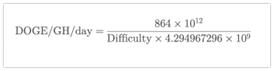
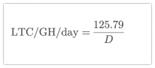
DOGE has a fixed reward of 10,000 DOGE per block and targets ~1 minute per block, while LTC’s current reward is 6.25 LTC per block and targets ~2.5 minutes per block. For coins (DOGE or LTC), expected coins per (GH/s) per day are calculated by multiplying the blocks per day by the coins per block, and dividing by the network hashrate in GH/s using the network hashrate method:
Network hashrate method:

Network difficulty method:

| 7 |
| Network Hashrate Method | Network Difficulty Method |
|
5.0979 DOGE per (GH/s)-day |
5.0979 DOGE per (GH/s)-day |
|
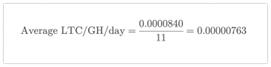
0.001448 LTC/GH/day (average)
|
0.001448 LTC/GH/day (average) |
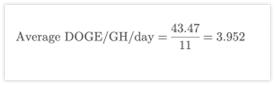
Independently, the difficulty method over the same window yields ≈ 5.0979 DOGE and ≈ 0.001448 LTC coins per (GH/s)-day.
Using the April 18–27, 2026 window and LTC at $55.52, with a fleet-weighted energy cost of $0.7451 USD per (GH/s)-day, the DOGE breakeven prices are approximately 0.1462 USD/DOGE (DOGE-only) and 0.1304 USD/DOGE when crediting LTC at $55.52 per LTC.
| DOGE-only: | 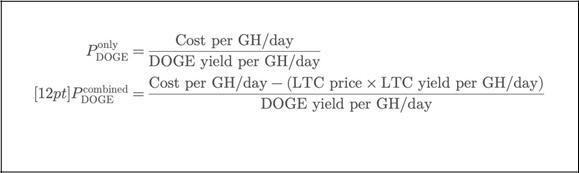 |
| 8 |
DOGE with LTC credit at LTC $55.52 (April 27, 2026 close): |
|
The breakeven price of merged mining is influenced primarily by two factors: (i) the cost of electricity and (ii) the global hashrate of the Dogecoin/Litecoin networks. The breakeven analysis is an operational metric. and the estimated breakeven amounts assume that the electricity and hosting rate of $0.088/kWh under the Master Services Agreement with Minting Dome remains constant. While direct operational costs, such as electricity and hosting, are considered, the breakeven analysis also assumes continuous operation of the miners on a 24 hours/day, 7 days/week basis; and excludes pool fees and transaction fees, setup costs, maintenance, insurance, repairs, and other necessary costs and expenses of OpCo.
By equating the Fleet-Weighted Energy Cost to the expected merged-mining revenue (per unit of hash rate derived from contemporaneous network hashrates, block times, and block rewards), OpCo arrived at the breakeven point for the price per DOGE when considering Dogecoin yields alone, as well as the price per DOGE when including the offsetting value of Litecoin produced through merged mining. Therefore, if OpCo mines DOGE at the same price, it would achieve a breakeven.
| Inputs from April 18-27, 2026 | |
| LTC Price (as of April 27, 2026) | $55.52 |
| Total Power (kW) of miner fleet | 34,063 |
| Total Hashrate (GH/s) of miner fleet | 96,555 |
| DOGE Yield Average | 5.0979 DOGE coins per (GH/s)-day |
| LTC Yield Average | 0.001448 LTC coins per (GH/s)-day |
| Breakeven (DOGE only) | 0.1462 USD |
| Breakeven (DOGE with LTC) | 0.1304 USD |
Digital Asset Mix
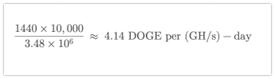
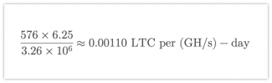
Upon commencement of OpCo’s mining operations, DOGE will contribute 85-90% of daily mining revenue, and LTC will contribute the remaining, secondary component. Using the above closing prices for DOGE and LTC on April 27, 2026, DOGE daily issuance value of 1,440 blocks per day materially exceeds LTC’s at 576 blocks per day. When both DOGE and LTC are merged-mined on Scrypt hardware, DOGE’s larger reward value accounts for the principal driver of daily revenue based on the current prices and rewards.
DOGE’s outsized revenue contribution is due in part to current network conditions. A higher LTC price or, alternatively, a lower LTC network hashrate, would increase the LTC contribution in the DOGE breakeven formula and reduce the breakeven price, which in turn would increase margins.
| 9 |
Mining Pools
OpCo intends to register and operate its mining hardware within mining pools managed by third-party mining pool operators, each of whom ranks among the top five largest global mining pool operators for Dogecoin and Litecoin, such as EMCD, Antpool and ViaBTC. OpCo will contribute its hash rate to one or more global mining pools operated by the third-party mining pool operators, subject to their terms of service. In simple terms, the mining pool operator calculates and pays miners, such as OpCo, their share of the reward, which is a function of: (a) the miners’ actual hash rate contributed and (b) global network difficulty. The operator pays the miners (e.g. OpCo) in arrears for their mathematically calculated share of global block rewards (net of fees to the operator) plus our share of global transaction fees.
Each mining pool operator maintains different fee structures and reward methods for different coins, which are subject to change. The fee charged by each mining pool operator varies and is subject to change. OpCo expects fees to vary in an amount up to 4%.
Mining Pool Service Agreements
OpCo intends to “sign-up” with the mining pool operators on-line according to pre-arranged parameters, whereby OpCo’s hash rates are added to the pool in exchange for a ratable share of the pool’s Rewards based on the hash rate contributed by OpCo. The service agreements entered into with each mining pool operator are standard and typically commence as of the date of registration of a user account and continue for the lifetime of such account, under which the user undertakes to provide computing power in exchange for the cryptocurrencies mined, which are governed by and subject to the operator’s published online terms of use/service.
Mining Pool Verification of Rewards
In exchange for providing computing power, which represents OpCo’s performance obligation, OpCo would be entitled to non-cash consideration in the form of cryptocurrency, calculated under one of two payout methods, depending on the coin mined and the reward system used by the mining pool operator to distribute mining rewards. For example, the EMCD pool operates on the PPS+ and PPLNS models for Litecoin and Dogecoin, respectively. In the PPLNS (or Pay-Per-Last-N-Shares) reward distribution method, rewards depends on: (1) the mining pool’s luck in finding a block — the reward will only be paid if the pool finds blocks during a specific period (if the pool finds more blocks, the miners receive a higher reward); and (2) The number (N) of the last shares the miners’ equipment contributed to the pool — miners who worked longer during the period will receive higher rewards compared to those with short-term connections.
Rewards under PPS+ (or Pay Per Share Plus) reward method depend on the number of shares sent by the miners’ equipment (as in PPS) and the pool's luck in finding the block — in this case the miners get an additional reward if the pool finds a block (as in PPLNS). The higher the luck, the more blocks the pool will find, and the more additional rewards the miners get. OpCo will use dashboard metrics provided by the mining pool operator and blockchain explorers to calculate/verify its share of rewards received. Online agreements with each mining pool operator define payout terms, fees, and operational obligations, and are publicly available on each operator’s website.
Key Storage
Anchorage Digital employs a sophisticated Multi-Party Computation (MPC) with quorum requirements and multiple signors, as confirmed by OpCo's usage. This architecture provides the following security features:
Hardware Security Module (HSM) Integration
Anchorage Digital utilizes FIPS 140-2 certified hardware security modules that keep private key material completely offline within air-gapped hardware while enabling real-time transaction processing. The HSMs perform independent verification of transaction instructions and organizational policies before authorizing any asset movement.
| 10 |
Multi-Party Computation Framework:
The MPC system ensures that private keys never exist in complete form at any location or time. Key shares are distributed across multiple secure environments, with threshold signatures requiring a predetermined quorum for transaction authorization. This eliminates single points of failure inherent in traditional custody models.
Quorum-Based Authorization:
Anchorage Digital's policy engine validates that transactions meet organizational policies through cryptographic signatures from multiple hardware devices. The system requires biometric voice and video transaction approval from authorized users, with cryptographically signed instructions endorsing source, destination, currency, and amount.
Geographic and Access Controls:
Anchorage Digital maintains geographically distributed infrastructure with strict physical access controls meeting ISO 13491-2 and other security standards. The system provides proof of exclusive control and auditable records for compliance purposes.
Insurance
OpCo will maintain insurance with Anchorage Digital. The insurance policy covers digital assets throughout their life cycle, addressing gaps that typically exist in crypto custody insurance. Anchorage Digital maintains an aggregate $100 million commercial crime insurance policy that provides coverage for certain losses due to theft, robbery, burglary, as well as third-party computer and funds transfer fraud. This coverage applies to assets at all times when held at Anchorage Digital Bank, with no distinction between hot and cold storage, and provides comprehensive “end-to-end” insurance coverage not typically available at other custodians whose insurance coverage applies only to cold storage. As a federally chartered bank, Anchorage Digital’s insurance arrangements are subject to federal banking oversight, providing additional assurance of coverage adequacy and claims-paying ability. Digital assets held in custody by Anchorage Digital, however, are not guaranteed by Anchorage Digital and are not subject to the insurance protections of the Federal Deposit Insurance Corporation (FDIC).
Material Agreements
Master Services Agreement with Minting Dome
OpCo is party to a Master Services Agreement (“MSA”) with Minting Dome, a leading provider of digital asset infrastructure and tokenization services. Minting Dome provides technical and operational support for the issuance, management, and lifecycle services of digital assets and tokens related to OpCo’s blockchain initiatives, specifically, the optimized, multi-asset digital mining of Dogecoin and Litecoin. Pursuant to the MSA, Minting Dome hosts sites/locations whereby it provides electrical power at $0.088 per KWh, internet access, and connection equipment necessary for the operation of OpCo’s ASIC miners. Following the installation of OpCo’s ASIC miners, Minting Dome provides (i) management services, including remote monitoring to oversee the uptime of the ASIC miners and to facilitate repairs, (ii) on-site personnel to rack, set-up and de-rack the ASIC miners, and (iii) operation and maintenance of the ASIC miners in accordance with industry standards. The MSA provides that Minting Dome is the exclusive provider of these services to OpCo.
The agreement sets forth key terms including service level commitments, data security obligations, confidentiality and intellectual property rights. OpCo pays certain delivery and installation, logistics coordination, repair services, racking and de-racking, and hosting and management services fees.
The MSA became effective at the Effective Time and is structured with an initial term of three (3) years, with automatic renewal provisions unless terminated by either party in accordance with the agreement’s terms.
| 11 |
Master Services Agreement with Anchorage Digital
OpCo has also entered into a Master Custody Services Agreement (the “Custody Agreement”) with Anchorage Digital, a regulated digital asset custodian and infrastructure provider. Under the terms of the Custody Agreement, Anchorage Digital will act as custodian of OpCo’s digital assets deposited with Anchorage Digital. Anchorage Digital will provide services through its technology platform, which include: (i) the storage of OpCo’s digital assets, specifically, Dogecoin and Litecoin, (ii) handling and settlement of digital assets pursuant to OpCo’s authenticated instructions, and (iii) determining the eligibility of digital assets for continued storage. Anchorage Digital also provides support services, such as access to representatives for account management and, if needed, lock-up support services to restrict withdrawals and transfers from OpCo’s accounts with Anchorage Digital. Further, Anchorage Digital may, in its sole discretion, offer on-chain services to OpCo that include staking, voting, vesting, signaling, and other activities involving interaction with the blockchain underlying the Dogecoin and Litecoin digital assets. The Custody Agreement governs custody services only and does not provide for conversion services. Any conversion services, if utilized, would be provided under a separate arrangement with an Anchorage Digital affiliate or through third-party providers.
In consideration for Anchorage Digital providing the preceding services, OpCo will pay to Anchorage Digital fees depending on the Assets Under Custody (“AUC”) tier, ranging from 35 annual basis points (“Annual Basis Points”) for AUC under $10 million to 15 Annual Basis Points for AUC greater than $500 million. The Custody Agreement includes provisions related to security protocols, regulatory compliance, indemnification, and fees. Anchorage Digital does not have the authority to assign, hypothecate, pledge, encumber or otherwise dispose of OpCo’s digital assets. The Custody Agreement became effective on August 14, 2025 for an initial term of one year and will automatically renew for a renewal term of one year following the initial term unless terminated in accordance with its terms. While the Custody Agreement is currently effective, OpCo will begin using Anchorage Digital’s custodian services in full under the Custody Agreement following the Effective Date and concurrently with the commencement of OpCo’s business operations. Anchorage Digital’s services support OpCo’s commitment to operating in a secure and compliant digital asset environment.
Amended and Restated Asset-For-Share Exchange Agreement
Concurrently and in connection with the closing of the Merger Transaction, OpCo acquired operational mining computer assets comprised of 8,228 Bitmain Antminer L7 units, 849 Bitmain Antminer L9 units and 723 ElphaPex DG1+ units from BSG Series CM in exchange for 44,062,947 shares of OpCo Common Stock issued to BSG Series CM at a cost basis of $16.31 per share pursuant to an Asset-For-Share Exchange Agreement (as amended by the First Amendment to the Amended and Restated Asset-For-Share Exchange Agreement dated February 10, 2026, and the Second Amendment to the Amended and Restated Asset-For-Share Exchange Agreement dated April 23, 2026, the “Asset-For-Share Exchange Agreement”). The shares will be issued to BSG Series CM pursuant to an exemption from registration under the Securities Act. The Asset-For-Share Exchange Agreement was consummated concurrently with the Merger Transaction with the representations and warranties of OpCo and BSG Series CM surviving, along with the following share transfer restrictions.
Pursuant to the Asset-For-Share Exchange Agreement, BSG Series CM agreed to not sell, dispose of, or otherwise transfer the shares received from OpCo unless the volume-weighted average price of OpCo’s Common Stock over the ten (10) consecutive days immediately prior to the proposed sale date is greater than $16.31 per share. BSG Series CM further agreed that, commencing on the date on which OpCo’s Common Stock becomes publicly traded on a national securities exchange or recognized over-the-counter market, and continuing for a period of eighteen (18) months thereafter, BSG Series CM and each transferee of OpCo Common Stock transferred from BSG Series CM will not sell more than one-eighteenth of the total number of OpCo shares beneficially owned by it in any calendar month, not engage in any short selling, or sales that exceed five percent (5%) of the average daily trading volume of OpCo’s Common Stock over the ten (10) trading days immediately preceding such sale. Notwithstanding the lock-up and leak-out restrictions, BSG Series CM may sell OpCo Common Stock if the publicly quoted closing price exceeds $35.00 per share for any two (2) consecutive trading days. These restrictions also apply to any transferees of the shares held by BSG Series CM.
| 12 |
Competition
The digital asset mining industry is intensely competitive and rapidly evolving. We face competition from a range of companies that are well-capitalized, technologically advanced, and geographically diversified. These competitors include public and private entities that operate large-scale mining operations and infrastructure, many of which have significant access to renewable and low-cost energy sources.
Our competitors have invested heavily in purpose-built facilities, state-of-the-art mining hardware, and proprietary software to optimize operational efficiency. Several of these companies emphasize sustainability and environmental responsibility by sourcing energy from low-carbon or renewable sources, including hydroelectric, solar, wind, nuclear, and captured methane. Some are vertically integrated, managing everything from equipment procurement to facility operations, and are actively developing multi-gigawatt mining campuses powered by renewable energy.
Additionally, some competitors have global footprints, with operations spanning North America, the Middle East, Europe, and Asia. These companies benefit from economies of scale, strategic energy partnerships, and favorable regulatory environments in certain jurisdictions. Others support the decentralization of mining by providing institutional mining services, equipment financing, and large-scale mining pool operations.
The market also includes entities that have recently diversified into mining new proof-of-work digital assets beyond bitcoin, further increasing competition for infrastructure and capital. In this dynamic environment, we compete primarily on the basis of energy cost, access to capital, mining efficiency, facility uptime, regulatory compliance, and environmental stewardship.
While we believe our strategic positioning, technological capabilities, and commitment to sustainable practices offer significant competitive advantages, there is no assurance that we will be able to compete successfully against current or future industry participants.
Competitive Advantages
OpCo will distinguish itself in the cryptocurrency mining industry through a unique altcoin-focused strategy, deep operational expertise, and agile infrastructure management. Unlike many of its peers that concentrate exclusively on bitcoin mining, OpCo will strategically balance its operations with altcoins, Dogecoin (DOGE) and Litecoin (LTC). This altcoin-centric approach enables OpCo to dynamically reallocate hash power to assets offering superior short- to medium-term returns, particularly during periods of market volatility. The result is a more resilient and balanced revenue profile, mitigating asset-specific risk and maximizing capital efficiency. OpCo will also deploy specialized ASIC hardware tailored to the unique algorithms of these altcoins, allowing for greater mining efficiency than firms reliant on generalized mining equipment.
OpCo’s leadership team brings a track record of success in cryptocurrency mining, marked by sophisticated logistics, infrastructure optimization, and economic discipline. Michelle Burke, Chief Operating Officer of OpCo, is experienced in directing strategic vision, financial oversight and daily operations for a successful crypto mining operation from her roles as Chief Executive Officer of Minting Dome and Chief Operating Officer of Wattum Management. OpCo will excel in the full lifecycle management of its mining assets, supported by advanced repair systems, component reclamation processes, and techniques that extend hardware longevity. These practices minimize downtime, reduce capital expenditure, and lower environmental impact. OpCo’s real-time analytics infrastructure will enable precise, data-driven decision-making at both strategic and operational levels, ensuring sustained performance optimization across its fleet.
Operational agility is another key differentiator. OpCo will use Minting Dome’s hosting facility network to swiftly redeploy mining equipment across facilities to capitalize on favorable electricity rates, regulatory conditions, or other operational efficiencies. This flexibility allows OpCo to adapt more quickly than many of its competitors in an ever-evolving industry. Additionally, OpCo will leverage dynamic power management strategies, including curtailment programs and real-time electricity pricing models, to significantly reduce and stabilize energy costs - one of the most critical inputs in cryptocurrency mining.
Finally, OpCo’s distributed, facility-agnostic infrastructure reduces exposure to localized disruptions such as regulatory shifts or grid instability. This structure not only enhances operational resilience but also supports rapid scalability into new geographies and emerging technologies, providing OpCo with long-term strategic advantage.
| 13 |
Operational Strategy
OpCo employs a lean, data-driven, and asset-optimized operational strategy designed to maximize returns from digital assets, namely Dogecoin and Litecoin. Rather than focusing solely on scale, OpCo emphasizes operational flexibility, lifecycle efficiency, and precision execution to sustain competitive mining performance. Central to this approach is OpCo’s altcoin opportunism strategy, which will target assets such as Dogecoin and Litecoin-cryptocurrencies offering favorable short- to mid-term return potential. By deploying highly specialized ASIC miners tailored to these alternative algorithms, OpCo will be able to unlock greater efficiency and profit margins than firms focused exclusively on bitcoin.
OpCo’s hash power management will be continuously informed by real-time analysis of market trends, network difficulty, and token-specific profitability. This enables dynamic reallocation of mining resources to optimize returns as market conditions evolve. Operations are distributed across multiple third-party and partner-owned facilities in a facility-agnostic structure. This approach avoids over-reliance on any single hosting provider and supports agile relocation of equipment based on shifting power costs, infrastructure readiness, and uptime performance.
OpCo will implement comprehensive, end-to-end equipment lifecycle management to protect and extend the value of its mining assets. Each unit is tracked from deployment through repair and eventual retirement. A structured spare parts and reclamation system enables OpCo to extract usable components from decommissioned equipment, while in-house repair coordination reduces downtime and minimizes capital expenditure.
Operational decisions are grounded in real-time analytics integrated through centralized dashboards, aggregating data from mining pools, facility APIs, and internal sensors. This infrastructure will enable daily monitoring of unit-level Hash Rate, energy consumption, and profitability. The data is used to proactively detect underperformance, identify facility issues, and ensure energy efficiency across the fleet.
OpCo will also manage energy costs through a responsive curtailment strategy. It proactively adapts operations to curtailment schedules, seasonal rate fluctuations, and electricity market conditions-throttling or shifting activity to preserve profitability during high-cost periods. Facility-level downtime is analyzed and categorized to distinguish between voluntary curtailment, forced outages, and repair-related downtime.
A core component of OpCo’s future success will lie in its asset agility and logistical precision. Standard operating procedures govern the decommissioning, repair, and inventory management of hardware. On-the-ground personnel oversee installations, PDU swaps, and physical control of mining units. Every piece of equipment will be tracked via serial number and shipping records to maintain accountability and prevent loss during transfers or facility moves.
Rather than pursuing scale for its own sake, OpCo’s growth philosophy centers on sustainable efficiency. OpCo will avoid overleveraging and remain focused on optimizing hardware, adapting to network shifts, and positioning itself to capitalize on emerging asset classes. This operational discipline enables OpCo to scale effectively and profitably within an increasingly competitive mining ecosystem.
Intellectual Property
OpCo holds no patents, copyrights, trademarks, or licensing agreements.
| 14 |
Government Regulation
Government regulation of digital assets, including cryptocurrency, and blockchain technology is being actively considered by the United States federal government via a number of agencies and regulatory bodies, as well as similar entities in other countries. State government regulations also may apply to OpCo’s mining activities and other related activities in which OpCo participates or may participate in the future. Certain regulatory bodies have shown an interest in regulating or investigating companies engaged in the blockchain technology or business.
In addition, because transactions in cryptocurrency provide varying degrees of anonymity, they are susceptible to misuse for criminal activities, such as money laundering. This misuse, or the perception of such misuse (even if untrue), could lead to greater regulatory oversight of cryptocurrency platforms, and there is the possibility that law enforcement agencies could close cryptocurrency platforms or other crypto-related infrastructure with little or no notice and prevent users from accessing or retrieving cryptocurrency held via such platforms or infrastructure.
Multiple United States federal agencies and regulators have been active in rulemaking, issuing guidance and regulating various actors in the blockchain technology industry, including the CFTC, SEC, FINRA, OCC, CFPB, FinCEN, OFAC, IRS, FDIC, and Federal Reserve. In response to these events, the digital asset markets have experienced extreme price volatility. As the regulatory and legal environment evolves, OpCo may become subject to new laws, further regulation by the SEC, and other federal or state agencies, which may affect OpCo’s Dogecoin and Litecoin mining and other related activities. Certain state and local authorities have introduced and passed legislation that may affect OpCo’s business and the business of crypto mining.
For additional discussion regarding OpCo’s belief about the potential risks existing and future regulations pose to OpCo’s business, see “Risk Factors” herein.
Environmental Considerations
OpCo is aware that energy consumption is both a principal cost driver and a key environmental consideration within the cryptocurrency mining industry. As part of its commitment to sustainable operations, OpCo integrates energy efficiency and environmental responsibility into its facility selection, operational planning, and equipment lifecycle strategies.
Electricity represents the largest variable expense in OpCo’s future mining operations. OpCo will continuously monitor power pricing at each hosting facility, including $/kWh rates, time-of-use pricing structures, and peak-hour penalties. By leveraging real-time Hash Rate analytics, OpCo dynamically adjusts its mining loads to reduce operational intensity during periods of elevated energy costs or utility curtailment events, thereby optimizing profitability while minimizing environmental strain.
Facility selection is strategically driven by energy profile considerations. OpCo will partner exclusively with hosting providers that offer competitive long-term power agreements and infrastructure capable of efficiently supporting high-density ASIC hardware. This ensures not only cost-effective operations but also the use of stable, grid-compliant energy solutions with lower transmission losses.
As part of its sustainability initiative, OpCo will employ a comprehensive equipment lifecycle management strategy focused on waste minimization and resource efficiency. OpCo will actively reuse functional hardware components—such as hash boards, control boards, and cooling fans—and work with certified e-waste recyclers to responsibly dispose of non-repairable units. These practices reduce the volume of electronic waste and limit demand for new raw materials by extending the operational lifespan of mining equipment through repair and parts reclamation.
OpCo will also participate in structured energy curtailment programs offered by its hosting partners, such as Duke Energy’s PowerShare initiative in North Carolina. These programs typically involve 2–3 curtailment periods per year, most often during peak demand times such as extreme heat or cold. The maximum curtailment period is up to 8 hours per event, though the duration is typically 4–5 hours. During a curtailment event, the mining facility does not shut down operations entirely. Instead, demand load levels are reduced, allowing mining machines to temporarily idle (“sleep”) while cooling fans continue to run. This approach reduces stress on hardware and enables the facility to resume full operations quickly after the curtailment ends. Because there are 8,760 potential operating hours in a year, and curtailment is expected to total no more than approximately 24 hours annually, the impact represents roughly 0.3% of total operating time. As a result, curtailment is not expected to materially reduce OpCo’s overall mining capacity or hash power.
| 15 |
OpCo’s equipment procurement decisions will prioritize energy efficiency over raw Hash Rate. It favors next-generation miners with superior joules-per-terahash (J/TH) performance, including models such as the L9 for Scrypt-based assets with favorable energy profiles. Each hardware purchase is evaluated based on projected energy return on investment (EROI), ensuring that equipment decisions support both economic performance and environmental responsibility.
Through these integrated measures, OpCo seeks to maintain operational excellence while reducing its environmental impact and contributing to the long-term sustainability of the digital asset mining ecosystem.
Legal Proceedings
OpCo may become engaged, in litigation in the ordinary course of business. Subject to the inherent uncertainties of litigation and although no assurances are possible, we believe that there are no pending lawsuits or claims that, individually or in the aggregate, will have a material adverse effect on our business, financial condition or our results of operations.
OpCo is party to the Asset-For-Share Exchange Agreement with BSG Series CM, LLC (“BSG Series CM”), an entity currently named as a defendant in ongoing litigation initiated by the Securities and Exchange Commission involving allegations of misconduct related to certain investment activities. BSG Series CM is subject to regulatory monitoring and oversight pursuant to court orders issued in connection with this litigation. While OpCo is not a party to the litigation, it acknowledges that its contractual relationship with BSG Series CM may expose it to certain reputational and operational risks associated with the ongoing legal proceedings and monitoring.
Planned Business Operations Following the Merger Transaction
OpCo’s planned business operations over the next 12 months center on deploying and activating its fleet of approximately 9,800 ASIC miners across multiple hosting sites in the United States, while simultaneously laying the groundwork for infrastructure and product-oriented initiatives that support long-term scalability.
Q1 2026 Operational Plan:
Upon closing, OpCo expects to initiate the following critical operational steps:
| · | Execute hosting agreements and energize facilities in multiple states |
| · | Install approximately 9,000 ASIC units across hosting sites |
| · | Inventory and document all OpCo assets |
| · | Link all operational machines to the selected mining pool(s) |
| · | Establish daily miner health monitoring protocols and uptime reporting |
| · | Investigate a strategy for adding additional ASIC units to the fleet as sourcing opportunities arise |
| · | Finalize remote management processes for real-time visibility |
These deployments are expected to occur in a staged rollout, with full activation of the fleet targeted by the end of Q2 2026.
| 16 |
Q2 2026 Strategic Development Focus:
In parallel with core mining operations, OpCo has begun evaluating and planning for additional revenue-generating opportunities that align with its infrastructure, existing asset base, and market expertise. These early-stage initiatives are subject to feasibility review, partner discussions, and technical assessment before any capital-intensive implementation occurs. Planned areas of focus include potential retail-facing services, and risk mitigation strategies related to evolving consensus models within the Dogecoin ecosystem.
Funding Requirements and Implementation Plan:
OpCo intends to fund its near-term operations through a near term equity financing. The anticipated use of proceeds includes fleet activation, hosting contracts, infrastructure installation, system monitoring, and foundational support functions. The company believes the combined post-merger structure provides a strong platform for capital formation. There is no assurance, however, that the required funding will be provided through equity financing or another source. Any delay in funding or lack thereof will delay the implementation of our business strategy and may cause the company to consider strategic alternatives, including debt financing or reorganization of the company.
Spin-Out of Coeptis Legacy Assets
On April 15, 2026, Coeptis undertook a reorganization of its assets related to its biopharmaceutical operations (other than its assets with respect to GEAR Therapeutics, Inc.) to reorganize such assets to be held directly or indirectly by a new subsidiary Coeptis Holdings, Inc (“CHI”). Specifically, and in connection therewith, Coeptis entered into two assignment and assumption agreements and a contribution agreement pursuant to which substantially all of such assets and liabilities were assigned or contributed to CHI, in exchange for the issuance to Coeptis of a 100% ownership interest in CHI (the “Spin Out”). Further, as of immediately prior to the consummation of the Merger, Coeptis declared a one-for-one pro rata dividend of its ownership interest in CHI to the stockholders of Coeptis existing as of January 2, 2026 (the record date for Coeptis’ most recent shareholder meeting).
In connection with the Spin Out, Coeptis spun out its biopharmaceutical operations, other than those conducted through GEAR Therapeutics, Inc. In exchange for Coeptis keeping in its organization, on a post-Merger basis, its subsidiary GEAR Therapeutics, Inc, Coeptis issued to CHI 1,000,000 shares of Coeptis’ common stock and executed and delivered to CHI an option agreement that grants CHI a limited time option exercisable in its discretion to acquire GEAR Therapeutics, Inc. for the fair market value of GEAR Therapeutics, Inc. at the time of exercise. The option becomes exercisable on October 24, 2026, is exercisable for a period of twenty-four (24) months from the date on which such option becomes exercisable, and contemplates that the exercise price for the option may be paid at the option of CHI in cash, by return of shares of Coeptis common stock based on the value of the Coeptis common stock at the time of exercise of the option, or a combination thereof. The GEAR Therapeutics, Inc. retained operations are not material to OpCo’s continuing business strategy, and OpCo does not currently intend to make additional investments in or further pursue such legacy business line.
| 17 |
RISK FACTORS AND SPECIAL CONSIDERATIONS
You should carefully consider all the following risk factors, together with all of the other information in this Current Report, including the financial information. We operate in a highly competitive and highly regulated business environment. Our business can be expected to be affected by government regulation, economic, political and social conditions, business’ response to new and existing products and services, technological developments and the ability to obtain and maintain patent and/or other intellectual property protection. Our actual results could differ materially from management’s expectations because of changes both within and outside of our control. Due to such uncertainties and the risk factors set forth in this Current Report, prospective investors are cautioned not to place undue reliance upon such forward-looking statements.
Throughout this section, references to “we,” “us,” “our,” and “the company” refer to Pubco and its consolidated subsidiaries as the context so requires.
This Report contains forward-looking statements. Information provided in this Current Report may contain forward-looking statements which reflect management’s current view with respect to future events, the viability or efficacy of our products and our future performance. Such forward-looking statements may include projections with respect to market size and acceptance, revenues and earnings, marketing and strategies and business operations.
Risks Related to Our Business
General Risks
OpCo is an early-stage company and has a limited history of generating profits.
OpCo was formed out of a shell company formed in December 2022, and has a limited history upon which an evaluation of OpCo’s performance and future prospects can be made. OpCo anticipates mining operations to begin in Q2 2026, and had no previous existing operations. OpCo’s current and proposed operations are subject to all of the business risks associated with new enterprises. These include likely fluctuations in operating results as OpCo reacts to developments in its market, manages its growth and operations, and responds to the entry of competitors into the market. Further, there is no assurance that OpCo can successfully execute its business plan. OpCo has had limited revenues generated.
Pubco may be unable to access sufficient additional capital to fund its operations or for future strategic growth initiatives.
OpCo’s purchase of its fleet of Dogecoin and Litecoin miners was a capital intensive project, and OpCo anticipates that future strategic growth initiatives will likewise be capital-intensive. If Pubco raises capital through public or private equity offerings, the ownership interest of Pubco’s existing stockholders will be diluted, and the terms of these securities may include liquidation or other preferences that adversely affect Pubco’s stockholders’ rights. If Pubco raises capital through debt financing, Pubco may be subject to covenants limiting or restricting Pubco’s ability to take specific actions, such as incurring additional debt or liens, making capital expenditures or declaring dividends. Further, Pubco may be unable to raise capital in a timely manner, in sufficient quantities, or on terms acceptable to Pubco, if at all. If Pubco is unable to raise the capital needed to fund its operations or execute future strategic growth initiatives, Pubco may be less competitive in its industry and its results of operations and financial condition may suffer. The value of its securities may also be materially and adversely affected.
Pubco’s loss of any of its management or advisory team, its inability to execute an effective succession plan, or its inability to attract and retain qualified personnel, could adversely affect Pubco’s business.
Pubco’s success and future growth will depend to a significant degree on the skills and services of its management and advisors, including David Halabu, Pubco’s Chief Executive Officer and President. Pubco will need to continue to grow its management in order to alleviate pressure on its existing team and in order to continue to develop its business. If Pubco’s management, including any new hires that Pubco may make, fail to work together effectively and to execute Pubco’s plans and strategies on a timely basis, Pubco’s business could be harmed. Furthermore, if Pubco fails to execute an effective contingency or succession plan with the loss of any member of management, the loss of such management personnel may significantly disrupt its business.
| 18 |
The loss of key members of management or advisory team could inhibit Pubco’s growth prospects. Pubco’s future success also depends in large part on its ability to attract, retain and motivate key management and operating personnel. As Pubco continues to develop and expand its operations, it may require personnel with different skills and experiences, and who have sound understandings of OpCo’s business and the Dogecoin and Litecoin network industry. The market for highly qualified personnel in this industry is very competitive, and Pubco may be unable to attract such personnel. If Pubco is unable to attract such personnel, its business could be harmed.
There is a substantial doubt about our ability to continue as a going concern.
The report of our independent registered public accounting firm that accompanies our consolidated financial statements includes an explanatory paragraph indicating there is a substantial doubt about our ability to continue as a going concern, citing our need for additional capital for the future planned expansion of our activities and to service our ordinary course activities (which may include servicing of indebtedness). The inclusion of a going concern explanatory paragraph in the report of our independent registered public accounting firm will make it more difficult for us to secure additional financing or enter into strategic relationships on terms acceptable to us, if at all, and likely will materially and adversely affect the terms of any financing that we might obtain. Our consolidated financial statements do not include any adjustments that may result from the outcome of this uncertainty.
We have incurred significant losses in prior periods, and losses in the future could cause the quoted price of our Common Stock to decline or have a material adverse effect on our financial condition, our ability to pay its debts as they become due, and on its cash flows.
For the year ended December 31, 2025, we incurred a net loss of $12,277,192 and, as of that date, we had an accumulated deficit of $109,953,728. For the year ended December 31, 2024, we incurred a net loss of $10,877,412 and, as of that date, had an accumulated deficit of $98,233,673. Any losses in the future could cause the quoted price of our Common Stock to decline or have a material adverse effect on our financial condition, its ability to pay its debts as they become due, and on its cash flows.
To date, we have generated only minimal revenue. We expect that our planned product development and strategic expansion pursuits will increase losses significantly over the next five years. In order to achieve profitability, we will be required to generate significant revenue. We cannot be certain that we will generate sufficient revenue to achieve profitability. We anticipate that we will continue to generate operating losses and experience negative cash flow from operations at least through the first quarter of 2026 or longer. We cannot be certain that we will ever achieve profitability or that, if profitability is achieved, that is will be maintained. If our revenue grows at a slower rate than we anticipate or if our product development, marketing and operating expenses exceed our expectations or cannot be adjusted accordingly, our business, results of operation and financial condition will be materially adversely affected and we may be unable to continue operations.
We expect that we will need to rely on key third-party agreements, in order to be in a position to realize material revenues in the future, and we may never enter into any such agreements or realize material, ongoing future revenue. Even if we eventually generate revenues, we may never be profitable, and, if we do achieve profitability, we may not be able to sustain or increase profitability on a quarterly or annual basis.
If we are unable to manage future expansion effectively, our business may be adversely impacted.
In the future, we may experience rapid growth in our business, which could place a significant strain on our operations, in general, and our internal controls and other managerial, operating and financial resources, in particular. If we are unable to manage future expansion effectively, our business would be harmed. There is, of course, no assurance that we will enjoy rapid development in our business.
If we are unable to recruit and retain key personnel, our business may be harmed.
If we are unable to attract and retain key personnel, our business may be harmed. Our failure to enable the effective transfer of knowledge and facilitate smooth transitions with regard to our key employees could adversely affect our long-term strategic planning and execution.
| 19 |
Our business plan is not based on independent market studies.
We have not commissioned any independent market studies concerning our business plans. Rather, our plans for implementing our business strategy and achieving profitability are based on the experience, judgment and assumptions of our management. If these assumptions prove to be incorrect, we may not be successful in our business operations.
Our Board of Directors may change our policies without shareholder approval.
Our policies, including any policies with respect to investments, leverage, financing, growth, debt and capitalization, will be determined by our Board of Directors or officers to whom our Board of Directors delegate such authority. Our Board of Directors will also establish the amount of any dividends or other distributions that we may pay to our shareholders. Our Board of Directors or officers to which such decisions are delegated will have the ability to amend or revise these and our other policies at any time without shareholder vote. Accordingly, our shareholders will not be entitled to approve changes in our policies, which policy changes may have a material adverse effect on our financial condition and results of operations.
We need to obtain financing in order to continue our operations and pursue strategic transactions.
On a prospective basis, we will require both short-term financing for operations and long-term capital to fund our expected growth. We currently have no existing bank lines of credit and have not established any definitive sources for additional financing. We believe that cash on hand will be sufficient to meet our short-term financial requirements through at least the second quarter of 2026 assuming that we elect not to pursue and consummate strategic transactions prior to that time. However, we will require additional funds if we want to fully implement our business plan and growth strategy, including strategic transactions, which funds could come in the form of equity, debt (including secured debt) or a combination of the two. Additional financing may not be available to us, or if available, then it may not be available upon terms and conditions acceptable to us. If adequate funds are not available, then we may be required to delay, reduce or eliminate product development or clinical programs. Our inability to take advantage of opportunities in the industry because of capital constraints may have a material adverse effect on our business and our prospects.
While we expect to seek additional funding through public or private financings, we may not be able to obtain financing on acceptable terms, or at all. In addition, the terms of our financings may be dilutive to, or otherwise adversely affect, holders of our common stock and other capital securities. We may also seek additional funds through arrangements with collaborators or other third parties. We may not be able to enter into such agreements, on acceptable terms, if at all.
We currently do not have sufficient cash to fully implement our business plan.
We have experienced a lack of adequate capital resources causing us to be unable to fully implement our full business plan. We believe that we need to raise or otherwise obtain additional financing beyond our current cash position in order to satisfy our existing obligations and fully implement our business plan. We do not expect to have positive cash flow for the foreseeable future. If we are not successful in obtaining additional financing we will not be able to fully implement our business plan and we may not be able to continue our operations.
We have a limited operating history and a history of operating losses, and expect to incur significant additional operating losses.
We began our business in 2017 and have a limited operating history. Our lack of historical operational experience may cause us to encounter unforeseen problems that could have a material adverse effect on our business and financial condition going forward. Further, there is limited historical financial information upon which to base an evaluation of our performance.
| 20 |
We will be required to sustain and further build our intellectual property rights.
We do not currently have any intellectual property rights in our name in respect of our current assets, and instead have rights in respect of our current assets through agreements with third parties. We intend to fully protect any product, formulation and process that we develop with appropriate intellectual property registrations. If we fail to sustain and further build our direct and indirect intellectual property rights, competitors will be able to take advantage of our research and development efforts. If we are not able to protect our proprietary technology, trade secrets, and know-how, our competitors may use our inventions to develop competing businesses. Our future patents and patent applications, even if granted, may not protect us against our competitors. The standards which the United States Patent and Trademark Office uses to grant patents, and the standards which courts use to interpret patents, are not always applied predictably or uniformly and can change, particularly as new technologies develop. Consequently, the level of protection, if any, that will be provided by our direct or indirect patent rights from time to time if we attempt to enforce them, and they are challenged, is uncertain. In addition, the type and extent of patent claims that will be issued to us in the future is uncertain. Any patents that are issued may not contain claims that permit us to stop competitors from using similar technology.
In addition, we may also rely on unpatented technology, trade secrets, and confidential information. We may not be able to effectively protect our rights to this technology or information. Other parties may independently develop substantially equivalent information and techniques or otherwise gain access to or disclose our technology. We will generally require each of our employees, consultants, collaborators, and certain contractors to execute a confidentiality agreement at the commencement of an employment, consulting, collaborative, or contractual relationship with us. However, these agreements may not provide effective protection of our technology or information or, in the event of unauthorized use or disclosure, they may not provide adequate remedies.
Patent positions are often uncertain and involve complex legal and factual questions. In addition, the laws of some foreign countries do not protect proprietary rights to the same extent as the laws of the United States. Whether filed in the United States or abroad, our patent applications may be challenged or may fail to result in issued patents. In addition, any future patents we obtain may not be sufficiently broad to prevent others from practicing our technologies or from developing or commercializing competing products. Our patents may be challenged, invalidated or fail to provide us with any competitive advantages. We may not have the funds available to protect our patents or other technology; such protection is costly and can result in further litigation expenses.
We will be required to comply with our obligations in our intellectual property licenses and other agreements with third parties.
If we fail to comply with our obligations in our intellectual property licenses and other agreements with third parties, we could lose license rights that are important to our business. We may enter into licenses and co-development and other agreements in the future, and we expect these agreements to impose, various diligences, milestone payment, royalty, insurance and other obligations on us. If we fail to comply with these obligations, the licensor may have the right to terminate the license, in which event we might not be able to market any product that is covered by the licensed patents.
We may need to resort to litigation to enforce or defend our intellectual property rights, including any patents issued to us. If a competitor or collaborator files a patent application claiming technology also invented by us, in order to protect our rights, we may have to participate in an expensive and time-consuming interference proceeding before the United States Patent and Trademark Office. We cannot guarantee that our product candidates will be free of claims by third parties alleging that we have infringed their intellectual property rights. Third parties may assert that we are employing their proprietary technologies without authorization and they may resort to litigation to attempt to enforce their rights. Third parties may have or obtain patents in the future and claim that the use of our technology infringes their patents. We may not be able to develop or commercialize combination product candidates because of patent protection others have. Our business will be harmed if we cannot obtain a necessary or desirable license, or if we can obtain such a license only on terms we consider to be unattractive or unacceptable. Obtaining, protecting and defending patent and other intellectual property rights can be expensive and may require us to incur substantial costs, including the diversion of management and technical personnel. An unfavorable ruling in patent or intellectual property litigation could subject us to significant liabilities to third parties, require us to cease developing, or using the affected processes, require us to license the disputed rights from third parties, or result in awards of substantial damages against us.
| 21 |
There can be no assurance that we would prevail in any intellectual property infringement action, will be able to obtain a license to any third-party intellectual property on commercially reasonable terms, successfully develop non-infringing alternatives on a timely basis, or license non-infringing alternatives, if any exist, on commercially reasonable terms. Any significant intellectual property impediment to our ability to develop and commercialize our products could seriously harm our business and prospects.
Patent litigation or other litigation in connection with our intellectual property rights may lead to publicity that may harm our reputation and the value of our common stock may decline.
During the course of any patent litigation, there may be public announcements of the results of hearings, motions, and other interim proceedings or developments in the litigation. If securities analysts or investors regard these announcements as negative, the value of our common stock may decline. General proclamations or statements by key public figures may also have a negative impact on the perceived value of our intellectual property.
Our competitors and potential competitors may develop technologies that make ours less attractive or obsolete.
Many companies have greater resources and significantly greater experience in financial, research and development, manufacturing, marketing, and technical regulatory matters than we have. In addition, many competitors have greater name recognition and more extensive collaborative relationships. If we are unable to compete effectively against these companies, then we may not be able to commercialize our product candidates or achieve a competitive position in the market. This would adversely affect our ability to generate revenues.
Pubco’s business and operations could be negatively affected if it becomes subject to any securities litigation or shareholder activism, which could cause Pubco to incur significant expense, hinder execution of business and growth strategy and impact its stock price.
In the past, following periods of volatility in the market price of a company’s securities, securities class action litigation has often been brought against that company. Shareholder activism, which could take many forms or arise in a variety of situations, has been increasing recently. Volatility in the stock price of the common stock or other reasons may in the future cause it to become the target of securities litigation or shareholder activism. Securities litigation and shareholder activism, including potential proxy contests, could result in substantial costs and divert management’s and board of directors’ attention and resources from Pubco’s business. Additionally, such securities litigation and shareholder activism could give rise to perceived uncertainties as to Pubco’s future, adversely affect its relationships with service providers and make it more difficult to attract and retain qualified personnel. Also, Pubco may be required to incur significant legal fees and other expenses related to any securities litigation and activist shareholder matters. Further, its stock price could be subject to significant fluctuation or otherwise be adversely affected by the events, risks and uncertainties of any securities litigation and shareholder activism.
There has been no prior public market for Pubco’s common stock, the price of common stock may be volatile or may decline regardless of its operating performance and you may not be able to resell your shares at or above the purchase price.
There has been no public market for Pubco’s common stock. Although Pubco’s common stock is listed on Nasdaq Global Market, an active trading market for Pubco’s common stock may never develop or be sustained following the Merger. The price that Pubco trades at immediately following the Merger may not necessarily reflect the price at which investors in the market will be willing to buy and sell the shares on a sustained basis. In addition, an active trading market may not develop of the Merger or, if it is developed, may not be sustained. The lack of an active market may impair your ability to sell your shares at the time you wish to sell them or at a price that you consider reasonable. An inactive market may also impair Pubco’s ability to raise capital by selling shares of common stock and may impair Pubco’s ability to acquire other businesses or technologies using Pubco’s shares of common stock as consideration, which, in turn, could materially adversely affect Pubco’s business. The market price of Pubco’s common stock may fluctuate significantly in response to numerous factors, many of which are beyond Pubco’s control, including:
| · | overall performance of the equity markets; |
| · | Pubco’s operating performance and the performance of other similar companies; |
| 22 |
| · | the published opinions and third-party valuations by banking and market analysts; |
| · | changes in Pubco’s projected operating results that it provides to the public, Pubco’s failure to meet these projections or changes in recommendations by securities analysts that elect to follow the combined organization’s common stock; |
| · | regulatory or legal developments in the United States and other countries; |
| · | the level of expenses related to operations; |
| · | Pubco’s failure to achieve its goals in the timeframe it announces; |
| · | announcements of acquisitions, strategic alliances or significant agreements by Pubco; |
| · | recruitment or departure of key personnel; |
| · | the economy as a whole and market conditions in Pubco’s industry; |
| · | trading activity by a limited number of stockholders who together beneficially own a majority of Pubco’s outstanding common stock; |
| · | the expiration of market standoff or contractual lock-up agreements; |
| · | the size of Pubco’s market float; |
| · | political uncertainty and/or instability in the United States; and |
| · | any other factors discussed in this Current Report on Form 8-K. |
In addition, the equity markets have experienced extreme price and volume fluctuations that have affected and continue to affect the market prices of equity securities of many data mining and cryptocurrency companies. Stock prices of many data mining and cryptocurrency companies have fluctuated in a manner unrelated or disproportionate to the operating performance of those companies. In the past, stockholders have filed securities class action litigation following periods of market volatility. If Pubco were to become involved in securities litigation, it could subject Pubco to substantial costs, divert resources and the attention of management from Pubco’s business and adversely affect its business.
Pubco will continue to incur increased costs as a result of operating as a public company, and its management team will be required to devote substantial time to new compliance initiatives.
As a public company, Pubco will continue to incur significant legal, accounting, and other expenses that Pubco did not incur as a private company. In addition, the Sarbanes-Oxley Act and rules subsequently implemented by the SEC and Nasdaq have imposed various requirements on public companies, including establishment and maintenance of effective disclosure and financial controls and corporate governance practices. Pubco’s management and other personnel will need to devote a substantial amount of time to these compliance initiatives. Moreover, these rules and regulations will increase Pubco’s legal and financial compliance costs and will make some activities more time-consuming and costly.
| 23 |
Pursuant to Section 404, Pubco is required to furnish a report by its management on its internal control over financial reporting, which may include an attestation report on internal control over financial reporting issued by its independent registered public accounting firm. While Pubco remains a “smaller reporting company” with less than $100 million in annual revenues, it will not be required to include an attestation report on internal control over financial reporting issued by its independent registered public accounting firm. Following the closing of the Merger, Pubco will need to continue to dedicate internal resources, potentially engage outside consultants, maintain a detailed work plan to assess and document the adequacy of internal control over financial reporting, continue steps to improve control processes as appropriate, validate through testing that controls are functioning as documented, and implement a continuous reporting and improvement process for internal control over financial reporting. Despite Pubco’s efforts, there is a risk that neither it nor its independent registered public accounting firm if required will be able to conclude that its internal control over financial reporting remains effective as required by Section 404. This could result in an adverse reaction in the financial markets due to a loss of confidence in the reliability of Pubco’s financial statements.
Current or future litigation may harm our financial condition or results of operations.
Litigation proceedings may be uncertain, and adverse rulings could occur, resulting in significant liabilities, penalties or damages. Such current or future substantial legal liabilities or regulatory actions could have a material adverse effect on our business, financial condition, cash flows and reputation. BSG Series CM LLC, which beneficially owned approximately 80% of Pubco’s issued and outstanding Common Stock immediately following the Merger Transaction before distributing the Common Stock to its members, is currently a defendant in Securities and Exchange Commission v. David Feingold, et al., Case No. 1:25-cv-20436-DPG (S.D. Fla.). As a result of this matter and any potential future litigation impacting this shareholder, Pubco could itself be subject to among other things, demands, regulatory inquiries, and litigation. Responding thereto could divert management time and Pubco’s resources.
Future sales and issuances of Pubco’s common stock or rights to purchase common stock, including pursuant to Pubco’s equity incentive plan, could result in dilution of the percentage ownership of its stockholders and could cause Pubco’s stock price to fall.
Additional capital will be needed in the future to continue Pubco’s planned operations. To the extent Pubco raises additional capital by issuing equity securities, its stockholders may experience substantial dilution. Pubco may sell common stock, convertible securities or other equity securities in one or more transactions at prices and in a manner it determines from time to time. If Pubco sells common stock, convertible securities or other equity securities in more than one transaction, investors may be materially diluted by subsequent sales. These sales may also result in material dilution to Pubco’s existing stockholders, and new investors could gain rights superior to existing stockholders.
Pubco does not currently intend to pay dividends on Pubco’s common stock, and, consequently, your ability to achieve a return on your investment will depend on appreciation, if any, in the price of Pubco’s common stock.
Pubco has never declared or paid any cash dividend on Pubco common stock. The expectation is that Pubco will retain future earnings for the development, operation and expansion of Pubco’s business and Pubco does not anticipate declaring or paying any cash dividends for the foreseeable future. In addition, the Anchorage Loan Agreement prohibits Pubco, and will prohibit Pubco, from declaring or paying any cash dividends without Anchorage’s prior written consent, and the terms of any future debt agreements may preclude Pubco from paying dividends. Any return to stockholders will therefore be limited to the appreciation of their stock. There is no guarantee that shares of Pubco’s common stock will appreciate in value or even maintain the price at which stockholders have purchased their shares.
| 24 |
The unaudited pro forma condensed combined financial information presented herein may not be representative of Pubco’s results after the Merger.
The unaudited pro forma condensed combined financial information included elsewhere in this Current Report on Form 8-K has been presented for informational purposes only and is not necessarily indicative of the financial position or results of operations that actually would have occurred had the Merger been completed as of the date indicated, nor is it indicative of future operating results or financial position. The unaudited pro forma condensed combined financial information has been derived from the historical financial statements of Coeptis and Pubco and adjustments and assumptions have been made regarding Pubco after giving effect to the Merger. The information upon which these adjustments and assumptions have been made is preliminary, and these kinds of adjustments and assumptions are difficult to make with accuracy. Moreover, the unaudited pro forma condensed combined financial information does not reflect all costs that are expected to be incurred by Pubco as an operating company after the Merger. The assumptions used in preparing the unaudited pro forma condensed combined financial information may not ultimately be accurate, and other factors may affect Pubco’s results and financial condition following consummation of the Merger. The unaudited pro forma condensed combined financial information does not reflect the costs of integration activities contemplated as part of the Merger. Accordingly, the unaudited pro forma condensed combined financial information included elsewhere in this Current Report on Form 8-K does not reflect what Coeptis’ or Pubco’s results or financial condition would have been had Coeptis and Pubco been a consolidated entity during all periods presented.
Pubco’s management will be required to devote a substantial amount of time to comply with public company regulations.
As a public company, Pubco will incur significant legal, accounting and other expenses that Pubco did not incur as a private company. The Sarbanes-Oxley Act, the Dodd-Frank Wall Street Reform and Consumer Protection Act as well as rules implemented by the SEC and Nasdaq, impose various requirements on public companies, including those related to corporate governance practices. Pubco’s management and other personnel will need to devote a substantial amount of time to these requirements. Certain members of Pubco’ management, which will continue as the management of Pubco, do not have significant experience in addressing these requirements. Moreover, these rules and regulations will increase Pubco’s legal and financial compliance costs relative to those of Pubco and will make some activities more time-consuming and costly.
Among other things, Pubco’ management will be responsible for establishing and maintaining adequate internal control over financial reporting as defined in Rules 13a-15(f) and 15d-15(f) under the Exchange Act. Pubco’s compliance with these requirements will require that it incur substantial accounting and related expenses and expend significant management efforts. Pubco will need to hire additional accounting and financial staff to comply with public company regulations. The costs of hiring such staff may be material and there can be no assurance that such staff will be immediately available to Pubco.
Moreover, if Pubco identifies deficiencies in its internal control over financial reporting that are deemed to be material weaknesses, investors could lose confidence in the accuracy and completeness of Pubco’s financial reports, the market price of Pubco’s common stock could decline and Pubco could be subject to sanctions or investigations by Nasdaq, the SEC or other regulatory authorities.
The sale or availability for sale of a substantial number of shares of common stock of Pubco after the Merger could adversely affect the market price of such shares after the Merger.
Sales of a substantial number of shares of common stock of Pubco in the public market after the Merger and other legal restrictions on resale, or the perception that these sales could occur, could adversely affect the market price of such shares and could materially impair Pubco’s ability to raise capital through equity offerings in the future. Coeptis and Pubco are unable to predict what effect, if any, market sales of securities held by significant stockholders, directors or officers of Pubco or the availability of these securities for future sale will have on the market price of Pubco’s common stock after the Merger.
Once Pubco is no longer a smaller reporting company or otherwise no longer qualifies for applicable exemptions, Pubco will be subject to additional laws and regulations affecting public companies that will increase Pubco’s costs and the demands on management and could harm Pubco’s operating results.
| 25 |
Pubco will be subject to the reporting requirements of the Exchange Act, which requires, among other things, that Pubco file with the SEC annual, quarterly and current reports with respect to Pubco’s business and financial condition as well as other disclosure and corporate governance requirements. However, as a “smaller reporting company,” Pubco may take advantage of some exemptions from disclosure requirements, including not being required to comply with the auditor attestation requirements of Section 404 of the Sarbanes-Oxley Act and reduced disclosure obligations regarding executive compensation in Pubco’s periodic reports and proxy statements. Once Pubco is no longer a smaller reporting company or otherwise qualifies for these exemptions, Pubco will be required to comply with these additional legal and regulatory requirements applicable to public companies and will incur significant legal, accounting and other expenses to do so. If Pubco is not able to comply with the requirements in a timely manner or at all, Pubco’s financial condition or the market price of Pubco’s common stock may be harmed.
Risks Related to Our Organization and Structure
Delaware law and the Amended and Restated Certificate of Incorporation and Bylaws contain certain provisions, including anti-takeover provisions that limit the ability of stockholders to take certain actions and could delay or discourage takeover attempts that stockholders may consider favorable.
Pubco’s Amended and Restated Certificate of Incorporation and Bylaws, and the DGCL, contain provisions that could have the effect of rendering more difficult, delaying, or preventing an acquisition deemed undesirable by Pubco’s Board and therefore depress the trading price of the common stock. These provisions could also make it difficult for stockholders to take certain actions, including electing directors who are not nominated by the current members of Pubco Board or taking other corporate actions, including effecting changes in management. Among other things, the Amended and Restated Certificate of Incorporation and Bylaws include provisions regarding:
| · | the ability of Pubco Board to issue shares of preferred stock, including “blank check” preferred stock and to determine the price and other terms of those shares, including preferences and voting rights, without stockholder approval, which could be used to significantly dilute the ownership of a hostile acquirer; |
| · | the limitation of the liability of, and the indemnification of, Pubco’s directors and officers; |
| · | the right of Pubco Board to elect a director to fill a vacancy created by the expansion of Pubco Board or the resignation, death or removal of a director, which prevents stockholders from being able to fill vacancies on Pubco Board; |
| · | a prohibition on stockholder action by written consent (except as required for holders of future series of preferred stock), which forces stockholder action to be taken at an annual or special meeting of stockholders and could delay the ability of stockholders to force consideration of a stockholder proposal or to take action, including the removal of directors; |
| · | the requirement that a special meeting of stockholders may be called only by Pubco Board, the chairman of Pubco Board, which could delay the ability of stockholders to force consideration of a proposal or to take action, including the removal of directors; |
| · | controlling the procedures for the conduct and scheduling of Pubco Board and stockholder meetings; |
| · | the requirement for the affirmative vote of holders of at least a majority of the voting power of all of the voting power of the then outstanding shares of the voting stock, voting as a single class, to amend, alter, change or repeal any provision of Pubco’s Bylaws and certain provisions in the Amended and Restated Certificate of Incorporation, respectively, which could preclude stockholders from bringing matters before annual or special meetings of stockholders and delay changes in Pubco Board and also may inhibit the ability of an acquirer to effect such amendments to facilitate an unsolicited takeover attempt; |
| 26 |
| · | the ability of Pubco Board to amend the Bylaws by an affirmative vote of a majority of the Board, which may allow Pubco Board to take additional actions to prevent an unsolicited takeover and inhibit the ability of an acquirer to amend the Bylaws to facilitate an unsolicited takeover attempt; and |
| · | advance notice procedures with which stockholders must comply to nominate candidates to Pubco Board or to propose matters to be acted upon at a stockholders’ meeting, which could preclude stockholders from bringing matters before annual or special meetings of stockholders and delay changes in Pubco Board and also may discourage or deter a potential acquirer from conducting a solicitation of proxies to elect the acquirer’s own slate of directors or otherwise attempting to obtain control of Company. |
These provisions, alone or together, could delay or prevent hostile takeovers and changes in control or changes in Pubco Board or management.
In addition, as a Delaware corporation, Pubco will generally be subject to provisions of Delaware law, including Section 203 of the DGCL.
Any provision of the Amended and Restated Certificate of Incorporation, Bylaws or Delaware law that has the effect of delaying or preventing a change in control could limit the opportunity for stockholders to receive a premium for their shares of Pubco’s capital stock and could also affect the price that some investors are willing to pay for the common stock.
The Amended and Restated Certificate of Incorporation designates a state or federal court located within the State of Delaware as the exclusive forum for substantially all disputes between Pubco and its stockholders, which could limit Pubco’s stockholders’ ability to choose the judicial forum for disputes with Pubco or its directors, officers, or employees.
The Amended and Restated Certificate of Incorporation provides that, unless Pubco consents in writing to the selection of an alternative forum, the Court of Chancery of the State of Delaware, or if such court does not have subject matter jurisdiction, any other court located in the State of Delaware with subject matter jurisdiction, will be the sole and exclusive forum for (i) any derivative action or proceeding brought on behalf of Pubco, (ii) any action asserting a claim of breach of a fiduciary duty owed by any current or former director, officer, other employee or stockholder of Pubco to Pubco or Pubco’s stockholders, (iii) any action asserting a claim against Pubco or its officers or directors arising pursuant to any provision of the DGCL or the Amended and Restated Certificate of Incorporation or Bylaws or as to which the DGCL confers jurisdiction on the Court of Chancery of the State of Delaware, or (iv) any action asserting a claim against Pubco or any director or officer of Pubco governed by the internal affairs doctrine of the law of the State of Delaware; provided, that, if and only if the Court of Chancery of the State of Delaware dismisses any such action for lack of subject matter jurisdiction, such action may be brought in another state court sitting in the State of Delaware. Additionally, the Amended and Restated Certificate of Incorporation provides that, unless Pubco consents to the selection of an alternative forum, the federal district courts of the United States of America shall, to the fullest extent permitted by law, be the sole and exclusive forum for the resolution of any complaint asserting a cause of action arising under the Securities Act; provided, however, that such provision will not apply to suits brought to enforce any liability or duty created by the Exchange Act, or any other claim for which the federal courts have exclusive jurisdiction. However, there is uncertainty as to whether a court would enforce this provision and investors cannot waive compliance with the federal securities laws and the rules and regulations thereunder. Section 22 of the Securities Act creates concurrent jurisdiction for state and federal courts over all suits brought to enforce any duty or liability created by the Securities Act or the rules and regulations thereunder.
Any person or entity purchasing or otherwise acquiring any interest in any of the securities of Pubco will be deemed to have notice of and consented to these provisions. These exclusive-forum provisions may limit or make more costly a stockholder’s ability to bring a claim in a judicial forum of its choosing for disputes with Pubco or its directors, officers, or other employees, which may discourage lawsuits against Pubco and its directors, officers, and other employees. If a court were to find these exclusive-forum provisions to be inapplicable or unenforceable in an action, Pubco may incur additional costs associated with resolving the dispute in other jurisdictions, which could harm its results of operations.
| 27 |
To the extent that any such claims may be based upon federal law claims, Section 27 of the Exchange Act creates exclusive federal jurisdiction over all suits brought to enforce any duty or liability created by the Exchange Act or the rules and regulations thereunder.
Section 22 of the Securities Act creates concurrent jurisdiction for federal and state courts over all suits brought to enforce any duty or liability created by the Securities Act or the rules and regulations thereunder. However, the combined company’s amended and restated certificate of incorporation contains a federal forum provision which provides that unless the combined company consents in writing to the selection of an alternative forum, the federal district courts of the United States of America will be the exclusive forum for the resolution of any complaint asserting a cause of action arising under the Securities Act. Any person or entity purchasing or otherwise acquiring any interest in any of the combined company’s securities shall be deemed to have notice of and consented to this provision. This exclusive forum provision may limit a stockholder’s ability to bring a claim in a judicial forum of its choosing for disputes with the combined company or its directors, officers or other employees, which may discourage lawsuits against the combined company or its directors, officers and other employees. If a court were to find the exclusive forum provision in the combined company’s amended and restated certificate of incorporation to be inapplicable or unenforceable in an action, the combined company may incur additional costs associated with resolving the dispute in other jurisdictions, which could harm the combined company’s results of operations.
Risks Related to Our Capital Requirements and Capital Structure
Nasdaq may delist Pubco’s securities from trading on its exchange, which could limit investors’ ability to make transactions in Pubco’s securities and subject Pubco to additional trading restrictions.
Pubco’s securities were listed on The Nasdaq Capital Market (“Nasdaq”) effective as of the opening of business on June 13, 2023, and, as of April 27, 2026, Pubco’s securities are listed on The Nasdaq Global Market. There can be no assurance, however, that Pubco’s securities will maintain such listing at all times. To maintain the listing of Pubco’s securities on Nasdaq, Pubco must maintain certain financial, distribution, liquidity and stock price levels to satisfy Nasdaq’s continued listing requirements. Pubco must, among other things, maintain a minimum bid price of $1.00 per share, a minimum market value of listed securities of $35 million and a minimum of 300 public shareholders. The foregoing is a brief description of The Nasdaq Global Market continued listing requirements applicable to Pubco’s securities, and more detailed information about such requirements is set forth in Nasdaq Rules 5450. If Pubco is unable to maintain a minimum bid price for its shares of $1.00 per share, or to satisfy any other continued listing requirement, Nasdaq may delist Pubco’s securities from trading on its exchange. Such a delisting would likely have a negative effect on the price of Pubco’s securities and may impair your ability to sell or purchase Pubco’s securities when you wish to do so.
On January 29, 2024, we received notice from the Listing Qualifications Staff of Nasdaq indicating that, based upon the closing bid price of our common stock for the prior 30 consecutive business days, we were not in compliance with the requirement to maintain a minimum bid price of $1.00 per share for continued listing on Nasdaq as set forth In Nasdaq Listing Rule 5550(a)(2). At that time, Pubco was provided a compliance period of 180 calendar days, or until July 29, 2024, to regain compliance with the Minimum Bid Price Requirement, pursuant to Nasdaq Listing Rule 5810(c)(3)(A). As previously disclosed, on July 30, 2024, Coeptis received a letter from the Listing Qualifications Staff of Nasdaq indicating that Pubco did not regain compliance with the Minimum Bid Price Requirement by July 29, 2024, and it was determined that Pubco was not eligible for another 180 calendar-day extension because it did not meet the minimum stockholders’ equity initial listing requirements of $5,000,000 for Nasdaq, as set forth under Nasdaq Listing Rule 5505(b). Pubco appealed the decision, as previously disclosed. On September 17, 2024, Pubco received a letter from Nasdaq advising Pubco that Pubco was granted an extension through January 15, 2025, to regain listing compliance. On January 21, 2025, Pubco was notified by Nasdaq that Pubco has regained compliance with the minimum bid price of $1.00, and that Nasdaq has determined to continue the listing of Pubco’s securities.
If Nasdaq delists Pubco’s securities from trading on its exchange and Pubco is not able to list its securities on another Nasdaq trading tier or on another national securities exchange, Pubco’s securities may be quoted on an over-the-counter market. However, if this were to occur, Pubco could face significant material adverse consequences, including:
| · | a limited availability of market quotations for its securities; |
| · | reduced liquidity for its securities; |
| 28 |
| · | a determination that the Common Stock is a “penny stock” which will require brokers trading in the common stock to adhere to more stringent rules and possibly result in a reduced level of trading activity in the secondary trading market for Pubco’s securities; |
| · | a limited amount of news and analyst coverage; and |
| · | a decreased ability to issue additional securities or obtain additional financing in the future. |
If securities or industry analysts do not publish research or reports about our business or publish negative reports about our business or our industry, the trading price and volume of our securities could decline.
The trading market for our securities will depend in part on the research and reports that securities or industry analysts publish about us or our business, our market and our competitors. We do not have any control over these analysts. If one or more of the analysts who cover us downgrade our shares or change their opinion of our shares, the trading price for our securities would likely decline. If one or more of these analysts cease coverage of our company or fail to regularly publish reports on us, we could lose visibility in the financial markets, which could cause the trading price or volume of our securities to decline.
Risks Related to the Price of Cryptocurrencies
OpCo’s future success will depend upon the value of cryptocurrency; the value of cryptocurrency may be subject to pricing risk and has historically been subject to wide swings.
OpCo’s operating results depend on the value of Dogecoin (DOGE) and Litecoin (LTC). Specifically, OpCo’s revenues from its mining operations are based on two factors: (1) the rewards OpCo earns from its mining operations and (2) the value of the cryptocurrencies it mines. OpCo’s operating results are directly impacted by changes in the value of the cryptocurrencies because under the value measurement model, impairment of the cryptocurrencies and realized gains will be reflected in OpCo’s statement of operations (i.e., OpCo will be marking the cryptocurrencies to fair value each closing period). This means that OpCo’s operating results will be subject to swings based upon increases or decreases in the value of the cryptocurrencies. If the value of DOGE and LTC were to decline, particularly if such decline were significant or over an extended period of time, OpCo’s operating results would be adversely affected, and there could be a material adverse effect on Pubco’s ability to continue as a going concern or to pursue OpCo’s strategy at all, which could have a material adverse effect on Pubco’s business, prospects or operations, and harm investors.
Cryptocurrencies’ market prices, which have historically been volatile and are impacted by a variety of factors (including those discussed below), are determined primarily using data from various exchanges, over-the-counter markets and derivatives platforms. Furthermore, such prices may be subject to factors such as those that impact commodities, more so than business activities, which could be subjected to additional influence from fraudulent or illegitimate actors, real or perceived scarcity, and political, economic, regulatory or other conditions. Pricing may be the result of, and may continue to result in, speculation regarding future appreciation in the value of cryptocurrencies, which inflates and makes its market prices more volatile or creates “bubble” type risks for cryptocurrencies.
Dogecoin and Litecoin price volatility may affect our ability to effectively manage our growth plans and profitability. The market price of DOGE is extremely volatile, and in fiscal year 2025 the price range of Dogecoin was between approximately $0.142 and $0.41. Similarly, the market price of LTC has been highly volatile; in fiscal year 2025, the price range of Litecoin was between approximately $70.00 and $140.00. The cost to mine Dogecoin is independent of the current price of Dogecoin, so when DOGE prices are low, the cost to mine may limit our ability to upgrade mining equipment and infrastructure or fund other strategic initiatives. Additionally, because our revenue will be primarily derived from mining Dogecoin and Litecoin, our profitability will fluctuate in direct correlation with price movements. A decrease in Dogecoin price results in a corresponding decrease in the value of the Dogecoin we mine, reducing our revenues and profitability on a dollar-for-dollar basis. Given the volatility of DOGE prices, we are unable to accurately predict our future growth trajectory or reliably forecast our revenue and profitability for any given reporting period.
Unlike most other cryptocurrencies, Dogecoin has unlimited supply, which creates inflation pressure on the price and decreases incentive to hold Dogecoin.
| 29 |
The rapidly evolving and uncertain regulatory landscape for cryptocurrencies exposes OpCo to legal risks, compliance costs, and potential business disruptions.
If any particular digital asset OpCo intends to mine or transact in is classified as a “security”, OpCo may be subject to extensive regulation, which could result in significant costs or force OpCo to cease certain operations. Regulatory changes or interpretations that classify crypto assets as a security under the Securities Act of 1933, as amended (the “Securities Act”) or Investment Company Act of 1940, as amended (the “Investment Company Act”), could require us to register and comply with additional regulations. Compliance with these requirements could impose extraordinary, non-recurring expenses on our business. If the costs and regulatory burdens become too great, we may be forced to modify or cease certain operations, which could be detrimental to our investors.
The SEC has previously indicated that certain digital assets may be considered securities depending on their structure and use. While no formal regulations have been proposed to classify Dogecoin or Litecoin as a security, future developments could change its legal status, requiring us to comply with securities laws. If we fail to do so, we may be forced to discontinue some or all of our business activities, negatively impacting investments in our securities. If the SEC or other regulators determine that the Dogecoin or Litecoin we hold qualify as securities, we may be required to register as an investment company under the Investment Company Act. This classification would subject us to additional periodic reporting, disclosure requirements, and regulatory compliance obligations, significantly increasing our operational costs. Furthermore, state regulators may conclude that the digital assets we hold are securities under state laws, requiring us to comply with state-specific securities regulations. States like California have stricter definitions of “investment contracts” than the SEC, increasing the risk of additional regulatory scrutiny.
OpCo may face several risks due to disruptions in the crypto asset markets, including but not limited to the risk from depreciation in Pubco’s stock price, financing risk, risk of increased losses or impairments in its investments or other assets, risks of legal proceedings and government investigations, and risks from price declines or price volatility of crypto assets.
The use of crypto assets to, among other things, buy and sell goods and services and complete other transactions is part of a new and rapidly evolving industry that employs crypto assets based upon a computer generated mathematical and/or cryptographic protocol. The growth of this industry in general, and the use of crypto assets in particular, is subject to a high degree of uncertainty, and the slowing or stopping of the development or acceptance of protocols may adversely affect OpCo’s operations. The factors affecting the further development of the industry, include, but are not limited to:
| · | Continued worldwide growth in the adoption and use of crypto assets; |
| · | Governmental and quasi-governmental regulation of crypto assets and their use, or restrictions on or regulation of access to and operation of networks or similar crypto asset systems; |
| · | Changes in consumer demographics and public tastes and preferences; |
| · | The maintenance and development of the open source software protocol of crypto asset networks; |
| · | The availability and popularity of other forms or methods of buying and selling goods and services, including new means of using fiat currencies; |
| · | General economic conditions and the regulatory environment relating to crypto assets; and |
| · | Consumer sentiment and perception of Dogecoin and Litecoin specifically and crypto assets generally. |
| 30 |
Many crypto asset exchanges currently do not provide the public with significant information regarding their ownership structure, management teams, corporate practices or regulatory compliance. As a result, in times of volatility in crypto assets, particularly the most prominent crypto assets, the marketplace may lose confidence, which may be exacerbated by the lack of transparency of in crypto asset exchanges, which may cause the price of Dogecoin and Litecoin to decline. These times of volatility exacerbated by lack of transparency by exchanges, resulting in lower prices of crypto assets broadly have also negatively impacted the liquidity of the crypto asset market as a whole. Additionally, crypto asset prices are susceptible to price volatility drive by social media, which can create wide price swings. If the liquidity of the crypto asset market continues to be negatively impacted by these events, crypto asset prices, including the price of Dogecoin and Litecoin, may continue to experience significant volatility and confidence in the crypto asset markets may be further undermined. A perceived lack of stability in the crypto asset exchange market and the closure or temporary shutdown of crypto asset exchanges due to business failure, hackers or malware, government-mandated regulation or enforcement actions or fraud, may reduce confidence at least in part in crypto asset networks and result in greater volatility in Dogecoin and Litecoin’s value. Because the value of Dogecoin and Litecoin is derived from the continued willingness of market participants to exchange government-issued currency that is designated as legal tender in its country of issuance through government decree, regulation or law for Dogecoin and Litecoin should the marketplace for Dogecoin and Litecoin be jeopardized or disappear entirely, permanent and total loss of the value of Dogecoin and Litecoin may result. Such a decrease in Dogecoin and Litecoin price may have a material and adverse effect on OpCo’s results of operations and financial condition as the results of OpCo’s operations are significantly tied to the price of Dogecoin and Litecoin.
The lack of regulation of digital asset exchanges on which Dogecoin and Litecoin, are traded, may expose OpCo to the effects of negative publicity resulting from fraudulent actors in the cryptocurrency space, and can adversely affect an investment in Pubco.
The digital asset exchanges on which Dogecoin and Litecoin are traded are relatively new and largely unregulated. Many digital asset exchanges do not provide the public with significant information regarding their ownership structure, management teams, corporate practices, or regulatory compliance. As a result, the marketplace may lose confidence in, or may experience problems relating to, such digital asset exchanges, including prominent exchanges handling a significant portion of the volume of digital asset trading. As a result, many digital asset markets, including the market for Dogecoin and Litecoin experience increased price volatility. These events are continuing to develop and it is not possible to predict, at this time, every risk that they may pose to OpCo, OpCo’s service providers, or the digital asset industry as a whole. A perceived lack of stability in the digital asset exchange market and the closure or temporary shutdown of digital asset exchanges due to business failure, hackers or malware, government-mandated regulation or enforcement actions, or fraud, may reduce confidence in digital asset networks and result in greater volatility in cryptocurrency values. These potential consequences of a digital asset exchange’s failure could adversely affect an investment in Pubco.
The Dogecoin and Litecoin markets are exposed to financially troubled cryptocurrency-based companies.
The failure of several cryptocurrency platforms has impacted and may continue to impact the broader cryptocurrency economy; the full extent of these impacts may not yet be known. Dogecoin and Litecoin are part of the cryptocurrency environment and are subject to price volatility resulting from financial instability, poor business practices, and fraudulent activities of players in the cryptocurrency market. When investors in cryptocurrency and cryptocurrency-based companies experience financial difficulty as a result of price volatility, poor business practices, and/or fraud, it has caused, and may continue to cause, loss of confidence in the cryptocurrency space, reputational harm to cryptocurrency assets, heightened scrutiny by regulatory authorities and law makers, and a steep decline in the value of Dogecoin and Litecoin, among other material impacts. Such adverse effects have affected, and may in the future continue to affect, the profitability of OpCo’s Dogecoin and Litecoin mining operations.
There is a lack of liquid markets for, and possible manipulation of, cryptocurrency.
Cryptocurrencies that are represented and trade on a distributed ledger-based platform may not necessarily have the benefit of viable trading markets. Stock exchanges have listing requirements and vet issuers, requiring them to be subjected to rigorous listing standards and rules, and monitor investors transacting on such platform for fraud and other improprieties. These conditions may not necessarily be replicated on a distributed ledger platform, depending on the platform’s controls and other policies. The more lax a distributed ledger platform is about vetting issuers of cryptocurrency assets or users that transact on the platform, the higher the potential risk for fraud or the manipulation of the ledger due to a control event. These factors may decrease liquidity or volume or may otherwise increase volatility of investment securities or other assets trading on a distributed ledger-based system. Such circumstances could have a material adverse effect on Pubco’s ability to continue as a going concern or to pursue its strategy at all, which could have a material adverse effect on Pubco’s business, prospects or operations and potentially the value of any Dogecoin and Litecoin that OpCo mines or otherwise acquires or holds for its own account, which in turn could harm investors.
| 31 |
Acceptance and/or widespread use of Dogecoin and Litecoin are uncertain.
Currently, there is a relatively limited use of Dogecoin and Litecoin in the retail and commercial marketplace. Banks and other established financial institutions may refuse to process funds for Dogecoin, Litecoin, transactions, process wire transfers to or from Dogecoin or Litecoin exchanges, Dogecoin and Litecoin-related companies or service providers, or maintain accounts for persons or entities transacting in Dogecoin or Litecoin. Conversely, a significant portion of Litecoin, demand is generated by investors seeking a long-term store of value or speculators seeking to profit from the short- or long-term holding of the asset. Price volatility undermines Dogecoin and Litecoin’s role as a medium of exchange, as retailers are much less likely to accept it as a form of payment. Market capitalization for Dogecoin and Litecoin as a medium of exchange and payment method may always be low.
The relative lack of acceptance of Dogecoin and Litecoin in the retail and commercial marketplace limits the ability of end users to use Dogecoin and Litecoin to pay for goods and services. Such lack of acceptance could have a material adverse effect on Pubco’s ability to continue as a going concern or to pursue OpCo’s strategy at all, which could have a material adverse effect on OpCo’s business, prospects or operations and potentially the value of Dogecoin and Litecoin OpCo mines or otherwise acquires or holds for its own account.
The further development and acceptance of digital asset networks and other digital assets, which represent a new and rapidly changing industry, are subject to a variety of factors that are difficult to evaluate. The slowing or stopping of the development or acceptance of digital asset systems may adversely affect an investment in Pubco.
The use of cryptocurrencies to, among other things, buy and sell goods and services and complete transactions, is part of a new and rapidly evolving industry that employs cryptocurrency assets, including Dogecoin and Litecoin, based upon a computer-generated mathematical and/or cryptographic protocol. Large-scale acceptance of Dogecoin, and Litecoin as a means of payment has not, and may never, occur. The growth of this industry in general, and the use of Dogecoin and Litecoin in particular, is subject to a high degree of uncertainty, and the slowing or stopping of the development or acceptance of developing protocols may occur unpredictably. The factors include, but are not limited to:
| · | continued worldwide growth in the adoption and use of Dogecoin and Litecoin as a medium of exchange; |
| · | governmental and quasi-governmental regulation of Dogecoin and Litecoin and their use, or restrictions on or regulation of access to and operation of the Dogecoin and Litecoin networks or similar cryptocurrency systems; |
| · | changes in consumer demographics and public tastes and preferences; |
| · | the maintenance and development of the open-source software protocol of the network; |
| · | the increased consolidation of contributors to the Dogecoin and Litecoin blockchain through mining pools; |
| · | the availability and popularity of other forms or methods of buying and selling goods and services, including new means of using fiat currencies; |
| · | the use of the networks supporting cryptocurrencies for developing smart contracts and distributed applications; |
| · | general economic conditions and the regulatory environment relating to cryptocurrencies; and |
| · | negative consumer sentiment and perception of Dogecoin and Litecoin, specifically and cryptocurrencies generally. |
The outcome of these factors could have negative effects on Pubco’s ability to continue as a going concern or to pursue Pubco’s business strategy at all, which could have a material adverse effect on Pubco’s business, prospects or operations as well as a potentially negative effect on the value of any Dogecoin and Litecoin that OpCo mines or otherwise acquires or holds for Pubco’s own account, which would harm investors.
| 32 |
The reward for successfully uncovering a block on Litecoin will decrease in the future and Litecoin value may not adjust to compensate OpCo for the reduction in the rewards OpCo receives from its mining efforts.
The reward for successfully mining a block on Litecoin will decrease in the future and the value of those cryptocurrencies may not adjust to compensate OpCo for the reduction in the rewards OpCo receives from its mining efforts. Halving reduces block rewards by half and is built into many blockchain protocols in order to control the rate at which new cryptocurrency is introduced into circulation for the purpose of ensuring predictable and decreasing supply over time. The next halving event is expected to occur around July 2027, at which time the block subsidy will decrease to 3.125 LTC. The halving process will continue at regular intervals until the maximum supply of 84 million LTC is mined, which is anticipated to occur in or around the year 2142. Litecoin halving is a protocol-defined event that occurs on the Litecoin blockchain network approximately every 840,000 blocks, or roughly every four years. The halving is a key element of Litecoin’s monetary policy and is intended to regulate the rate at which new Litecoin (LTC) are introduced into circulation. At the point of halving, the block subsidy—the portion of the reward paid to miners for successfully adding a block to the blockchain—is reduced by 50%. This mechanism is designed to maintain scarcity and mitigate the inflationary risk associated with digital assets that utilize a Proof-of-Work consensus algorithm. When Litecoin launched in 2011, the initial block subsidy was set at 50 LTC per block. The Litecoin network has undergone halving events three times since inception, most recently in August 2023, when the subsidy was reduced from 12.5 LTC to 6.25 LTC. Dogecoin is not subject to halving as it has an unlimited supply.
The halving process has historically had implications for the economics of mining activity. By reducing the per-block reward, halvings can increase operational pressure on miners, particularly those with higher electricity or infrastructure costs. Additionally, while some market participants anticipate that halvings may exert upward pressure on the price of Litecoin due to reduced issuance, the actual impact of any future halving on the market price of Litecoin remains uncertain. The price of Litecoin is influenced by a variety of factors beyond block rewards, including global market conditions, regulatory developments, network demand, and broader digital asset sentiment. As such, we cannot predict whether the price of Litecoin will increase, decrease, or remain stable in advance of or following future halving events.
We intend to mitigate the effect of halving events by: (1) optimizing hosting costs by relocating to lower-rate regions; (2) curtailing operations during high-cost periods; (3) pursuing supplemental revenue opportunities such as compute leasing and energy resale; and (4) deploying efficient hardware to preserve margins. However, there can be no assurance that these measures will be successful or sufficient to offset the impact of halving events. If we are unable to effectively implement these mitigation strategies, our mining revenues, margins, and overall results of operations could be materially and adversely affected.
The decrease in rewards on Litecoin designed to control circulation, maintain scarcity, and thus, maintain price. Should the price of Litecoin (LTC) fail to rise sufficiently to compensate for the decreased rewards, OpCo or other miners may not have an adequate incentive to continue mining and may cease mining operations. Miners ceasing operations would reduce the collective processing power on the network, which would adversely affect the confirmation process for transactions (i.e., temporarily decreasing the speed at which blocks are added to a blockchain until the next scheduled adjustment in difficulty for block solutions) and make the networks more vulnerable to a malicious actor or botnet obtaining control in excess of 50 percent of the processing power active on a blockchain, potentially permitting such actor or botnet to manipulate a blockchain in a manner that adversely affects OpCo’s activities. A reduction in confidence in the confirmation process or processing power of the network could result and be irreversible. Such events could have a material adverse effect on OpCo’s business, prospects or operations and potentially the value of any coin that OpCo mines or otherwise acquires or holds for its own account.
| 33 |
Cryptocurrencies, including Dogecoin (DOGE) and Litecoin (LTC), face significant scaling obstacles that can lead to high fees or slow transaction settlement times.
Cryptocurrencies face significant scaling obstacles that can lead to high fees or slow transaction settlement times, and attempts to increase the volume of transactions may not be effective. Scaling cryptocurrencies is essential to the widespread acceptance of cryptocurrencies as a means of payment, which widespread acceptance is important to the continued growth and development of OpCo’s business. Many cryptocurrency networks, including the Dogecoin and Litecoin networks, face significant scaling challenges. For example, cryptocurrencies are limited with respect to how many transactions can occur per second. Participants in the cryptocurrency ecosystem debate potential approaches to increasing the average number of transactions per second that the network can handle and have implemented mechanisms or are researching ways to increase scale, such as increasing the allowable sizes of blocks, and therefore the number of transactions per block, and sharding (a horizontal partition of data in a database or search engine), which would not require every single transaction to be included in every single miner’s or validator’s block. However, there is no guarantee that any of the mechanisms in place or being explored for increasing the scale of settlement of cryptocurrency and, specifically, Dogecoin and Litecoin transactions will be effective, or how long they will take to become effective, which could adversely affect OpCo’s business.
Cryptocurrencies built on blockchain networks that use custom smart contract language, may have increased risk of bugs or vulnerabilities, smaller developer talent pools, and limited functionality as compared to other more established languages.
Cryptocurrencies that are developed on blockchain networks utilizing custom smart contract languages, may present disadvantages relative to some more widely used smart contract languages such as Solidity or Rust. Custom languages may have an increased risk of bugs or vulnerabilities and may lack mature tooling and debugging frameworks. The smaller developer talent pools for custom languages may make hiring more difficult, decrease peer review and contribution, and reduce the pace of innovation and troubleshooting, which may limit the platform development over time. The custom languages may also have limited functionality due to less community support, fewer third-party integrations, and limited libraries.
Cryptocurrencies built on blockchain networks that use novel architecture may pose an increased risk of network instability, inability to scale, or data inconsistency and may result in lower usage.
Cryptocurrencies that utilize novel blockchain architectures may introduce innovative approaches to various challenges, but may introduce additional risks. Those risks may include impacts to network stability, data consistency, and scalability. Architectures that are different from the widely used and tested linear blockchain models such as the Bitcoin and Ethereum blockchains may not reap the benefits from the extensive real-world testing and validation of those linear blockchains These risks may result in slower adoption, fewer users, and result in inability to scale.
Merge mining of Dogecoin (DOGE) and Litecoin (LTC) may have the effect of creating dependency of Dogecoin (DOGE) on Litecoin (LTC), and may create a ripple effect of security and reliability issues from Litecoin (LTC) to Dogecoin (DOGE).
Merge mining of Dogecoin (DOGE) and Litecoin (LTC) allows both cryptocurrencies to be mined simultaneously using the same proof-of-work algorithm. Merge mining may introduce interdependency that can create a ripple effect, particularly from Litecoin to Dogecoin. Dogecoin’s security is dependent on Litecoin’s mining ecosystem because Dogecoin’s blocks are secured by the hash power of Litecoin miners, which reduces the autonomy of Dogecoin. A decline in Litecoin’s mining activity may weaken the security of Dogecoin. Additionally, network instability or security issues with Litecoin could impact Dogecoin.
| 34 |
A change of a blockchain from a Proof-of-Work consensus mechanism to a Proof-of-Stake consensus mechanism could negatively impact OpCo’s business and risk profile.
Certain digital asset blockchains, such as bitcoin, use a Proof-of-Work consensus algorithm. The genesis block on the Bitcoin blockchain was mined in 2009, and Bitcoin’s blockchain has been in operation since then. Many newer blockchains including Ethereum, following the completion of the merger with Bull Horn Holdings Corp. in 2022, use a newer consensus mechanism known as Proof-of-Stake. Proof-of-Stake blockchains are thought to be more energy efficient with greater accessibility, which may be balanced by a lower attack cost. As Proof-of-Stake is newer, it is less tested than Proof-of-Work. This could lead to these blockchains, and their associated digital assets, having undetected vulnerabilities, structural design flaws, suboptimal incentive structures for network participants, technical disruptions, or a wide variety of other problems, any of which could cause these blockchains not to function as intended, lead to outright failure to function entirely causing a total outage or disruption of network activity, or to suffer other operational problems or reputational damage, leading to a loss of users or adoption or a loss in value of the associated digital assets, including OpCo’s assets. Should Dogecoin and/or Litecoin move away from a Proof-of-Work consensus mechanism (for example, to Proof-of-Stake or another method), merge mining of Dogecoin may no longer be possible and Dogecoin may have to be mined separately from Litecoin. Should any blockchain on which OpCo mines cryptocurrency move from Proof-of-Work to Proof-of-Stake, there is risk in the transition that may result in a chain split, security bugs, lost support, volatility in assets, or other technological and business risks.
Unlike Proof-of-Work, in which miners expend computational resources to compete to validate transactions and are rewarded coins in proportion to the amount of computational resources expended, in Proof-of-Stake, validators risk or “stake” coins to compete to be randomly selected to validate transactions and are rewarded coins in proportion to the amount of coins staked. Rewards, and sometimes penalties, are issued based on the amount of digital assets a user has “staked” in order to become a validator. A shift from Proof-of-Work to Proof-of-Stake by any of the blockchains on which OpCo mines may require OpCo to have inventory to stake and may render our mining business materially less competitive. Such a shift in consensus mechanism may negatively impact the use or value of our mining machines, the secondary market for which may be depressed as a result of such a shift, and may otherwise negatively impact our investment in technology and staff for our mining business.
Transaction fees may decrease demand for Dogecoin and Litecoin and prevent expansion that could adversely impact an investment in Pubco.
As the number of Dogecoin and Litecoin awarded for solving a block in a blockchain decreases, to incentivize miners to continue to contribute to the Dogecoin and Litecoin networks, the Dogecoin and Litecoin networks may either formally or informally transition from a set reward to transaction fees earned upon solving a block. This transition could be accomplished by miners independently electing to record in the blocks they solve only those transactions that include payment of a transaction fee. If transaction fees paid for Dogecoin and Litecoin transactions become too high, the marketplace may be reluctant to accept Dogecoin and Litecoin as a means of payment and existing users may be motivated to switch from Dogecoin and Litecoin to another cryptocurrency or to fiat currency. Either the requirement from miners of higher transaction fees in exchange for recording transactions in a blockchain or a software upgrade that automatically charges fees for all transactions may decrease demand for Dogecoin and Litecoin and prevent the expansion of the Dogecoin and Litecoin networks to retail merchants and commercial businesses, resulting in a reduction in the price of Dogecoin and Litecoin that could adversely impact OpCo’s business. Decreased use and demand for Dogecoin and Litecoin that OpCo has accumulated may adversely affect their value and may adversely impact an investment in Pubco.
The price of Dogecoin and Litecoin may be affected by other vehicles investing in Dogecoin and Litecoin, or tracking Dogecoin and Litecoin markets.
The global market for Dogecoin and Litecoin is characterized by supply constraints that differ from those present in the markets for commodities or other assets such as gold and silver. The mathematical protocols under which Litecoin are mined permit the creation of a limited, predetermined amount of currency, while others have no limit established on total supply including Dogecoin. To the extent that other vehicles investing in Dogecoin and Litecoin or tracking Dogecoin and Litecoin markets form and come to represent a significant proportion of the demand for Dogecoin and Litecoin, large redemptions of the securities of those vehicles and the subsequent sale of Dogecoin and Litecoin by such vehicles could negatively affect Dogecoin and Litecoin prices and therefore affect the value of the Dogecoin and Litecoin holdings OpCo holds. Such events could have a material adverse effect on Pubco’s ability to continue as a going concern or to pursue OpCo’s new strategy at all, which could have a material adverse effect on Pubco’s business, prospects or operations and potentially the value of any Dogecoin and Litecoin that OpCo mines or otherwise acquires or holds for its own account.
| 35 |
The development of other cryptocurrencies and/or digital currencies may adversely affect the value of Dogecoin and Litecoin.
To the extent that other cryptocurrencies are introduced into the market, gain traction and are supported by the deployment of significant resources, the success of any such cryptocurrency could lead to a decrease in demand and the potential exclusion of existing cryptocurrencies, such as Dogecoin and Litecoin.
In addition, central banks in some countries have started to introduce digital forms of legal tender. Whether or not they incorporate blockchain or similar technology, central bank digital currencies as legal tender in the issuing jurisdiction could have an advantage in competing with, or replacing, Dogecoin and Litecoin as a medium of exchange or store of value. As a result, the value of Dogecoin and Litecoin could decrease, which could have a material adverse effect on Pubco’s business, prospects, financial condition, and operating results.
If a malicious actor obtains control in excess of 50% of the processing power active on any digital asset network, including the Dogecoin and Litecoin network, it is possible that such actor could manipulate the blockchain in a manner that adversely affects an investment in Pubco.
If a malicious actor obtains a majority of the processing power dedicated to mining on any digital asset network, including the Dogecoin or Litecoin network, it may be able to alter the blockchain by constructing alternate blocks if it is able to solve for such blocks faster than the remainder of the miners on the blockchain can add valid blocks. In such alternate blocks, the malicious actor could control, exclude or modify the ordering of transactions, though it could not generate new digital assets or transactions using such control. Using alternate blocks, the malicious actor could “double-spend” its own digital assets (i.e., spend the same digital assets in more than one transaction) and prevent the confirmation of other users’ transactions for so long as it maintains control. To the extent that such malicious actor does not yield its majority control of the processing power or the digital asset community does not reject the fraudulent blocks as malicious, reversing any changes made to the blockchain may not be possible. Such changes could adversely affect an investment in Pubco.
The decentralized nature of cryptocurrency systems may lead to slow or inadequate responses to crises, which may negatively affect OpCo’s business.
The decentralized nature of the governance of cryptocurrency systems may lead to ineffective decision making that slows development or prevents a network from overcoming emergent obstacles. Governance of many cryptocurrency systems is by voluntary consensus and open competition with no clear leadership structure or authority. To the extent lack of clarity in corporate governance of the Dogecoin and Litecoin blockchains leads to ineffective decision making that slows development and growth of the Dogecoin and Litecoin network protocols, OpCo’s business may be adversely affected.
The open-source structure of the Dogecoin and Litecoin network protocols means that the contributors to the protocol are generally not directly compensated for their contributions in maintaining and developing the protocol. A failure to properly monitor and upgrade the protocol could damage the Dogecoin and Litecoin networks and an investment in Pubco.
As open-source projects, Dogecoin and Litecoin are not represented by an official organization or authority. As the Dogecoin and Litecoin network protocols are not sold and its use does not generate revenues for contributors, contributors are generally not compensated for maintaining and updating the Dogecoin and Litecoin network protocols. The lack of guaranteed financial incentive for contributors to maintain or develop the Dogecoin and Litecoin network and the lack of guaranteed resources to adequately address emerging issues with the Dogecoin and Litecoin networks may reduce incentives to address the issues adequately or in a timely manner. Changes to a digital asset network that OpCo will mine on may adversely affect an investment in Pubco.
| 36 |
Mining equipment may become obsolete quickly due to technological advancements, and fluctuations in crypto-asset prices could render our operations unprofitable, adversely affecting our financial condition.
OpCo’s revenue is primarily dependent on the market prices of the crypto-assets it mines, initially focused on Litecoin (LTC) and Dogecoin (DOGE). These prices are subject to high volatility, with potential for rapid and significant declines influenced by market sentiment, regulatory developments, or macroeconomic factors. Concurrently, our mining hardware faces accelerated depreciation from the introduction of more efficient models, rising network difficulty, and increasing energy costs. If prices fall or costs rise unexpectedly, the company may incur impairments or be forced to idle machines. Mitigation strategies such as rapid conversion of mined assets, energy cost controls, and phased equipment upgrades have been added, though risks remain material. Should crypto-asset prices drop below our operational breakeven point (including electricity, maintenance, and other variable costs), we may need to suspend mining activities, sell equipment at a loss, or impair asset values on our balance sheet. In such cases, we may not fully recover the carrying value of our mining equipment, which could materially impact our liquidity, results of operations, and overall financial health. While we monitor market trends and may hedge certain exposures, there is no assurance that these measures will fully mitigate these risks.
The impact of geopolitical and economic events on the supply and demand for Dogecoin and Litecoin is uncertain.
Geopolitical crises may motivate large-scale purchases of Dogecoin and Litecoin, which could increase the price of Dogecoin and Litecoin rapidly. This may increase the likelihood of a subsequent price decrease as crisis-driven purchasing behavior dissipates, which would adversely affect the value of OpCo’s Dogecoin and Litecoin value following such downward adjustment. Such risks are similar to the risks of purchasing commodities in uncertain times, such as the risk of purchasing, holding or selling gold. Alternatively, as an emerging asset class with limited acceptance as a payment system or commodity, global crises and general economic downturns may discourage investment in Dogecoin and Litecoin as investors focus their investments on less volatile asset classes as a means of hedging their investment risks.
As an alternative to fiat currencies that are backed by central governments, Dogecoin and Litecoin which is relatively new, is subject to supply and demand forces. How such supply and demand will be impacted by geopolitical events is largely uncertain but could be harmful to OpCo. Political or economic crises may motivate large-scale acquisitions or sales of Dogecoin and Litecoin either globally or locally. Such events could have a material adverse effect on Pubco’s ability to continue as a going concern or to pursue OpCo’s new strategy at all, which could have a material adverse effect on OpCo’s business, prospects or operations and potentially the value of any Dogecoin and Litecoin that OpCo mines or otherwise acquires or holds for its own account.
OpCo faces risks of Internet disruptions, which could have an adverse effect on the price of Dogecoin and Litecoin.
A disruption of the Internet may affect the use of Dogecoin and Litecoin. Generally, Dogecoin and Litecoin and OpCo’s business of mining Dogecoin and Litecoin are dependent upon the Internet. A significant disruption in Internet connectivity could disrupt a currency’s network operations until the disruption is resolved and have an adverse effect on the price of Dogecoin and Litecoin and OpCo’s ability to mine Dogecoin and Litecoin.
Any valuation at this stage is difficult to assess.
OpCo’s valuation is based upon a number of estimates and assumptions that may prove later to be inaccurate or incomplete. Unlike listed companies that are valued publicly through market-driven stock prices, the valuation of private companies, especially startups, is difficult to assess and investors may risk overpaying for their investments. OpCo began its operations in April 2025 and has limited operating experience and performance history, which makes valuation difficult.
If the Dogecoin and Litecoin reward for solving blocks and transaction fees is not sufficiently high, OpCo may not have an adequate incentive to continue mining and may cease mining operations, which will likely lead to OpCo’s failure to achieve profitability.
| 37 |
As the number of Dogecoin and Litecoin rewards awarded for solving a block in a blockchain decreases, OpCo’s ability to achieve profitability declines. Decreased use and demand for Dogecoin and Litecoin rewards may adversely affect OpCo’s incentive to expend processing power to solve blocks. If the award of Dogecoin and Litecoin rewards for solving blocks and transaction fees are not sufficiently high, OpCo or other miners may not have an adequate incentive to continue mining and may cease mining operations. Miners ceasing operations would reduce the collective processing power on the network, which would adversely affect the confirmation process for transactions (i.e., temporarily decreasing the speed at which blocks are added to a blockchain until the next scheduled adjustment in difficulty for block solutions) and make the Dogecoin and Litecoin networks more vulnerable to a malicious actor obtaining control in excess of 50 percent of the processing power active on a blockchain, potentially permitting such actor to manipulate a blockchain in a manner that adversely affects OpCo’s activities. A reduction in confidence in the confirmation process or processing power of the network could result and be irreversible. Such events could have a material adverse effect on OpCo’s business, prospects or operations and potentially the value of any Dogecoin and Litecoin that OpCo mines or otherwise acquires or holds for its own account.
Dogecoin and Litecoin mining activities are energy-intensive, which may restrict the geographic locations of mining machines and have a negative environmental impact. Government regulators may potentially restrict the ability of electricity suppliers to provide electricity to mining operations, such as OpCo’s.
Mining Dogecoin and Litecoin requires massive amounts of electrical power, and electricity costs are expected to account for a significant portion of OpCo’s overall costs. The availability and cost of electricity will restrict the geographic locations of OpCo’s mining activities. Any shortage of electricity supply or increase in electricity costs in any location where OpCo plans to operate may negatively impact the viability and the expected economic return for Dogecoin and Litecoin mining activities in that location.
Further, OpCo’s business model can only be successful and OpCo’s mining operations can only be profitable if the costs, including electrical power costs, associated with Dogecoin and Litecoin mining are lower than the price of Dogecoin and Litecoin itself. As a result, any equipment OpCo deploys can only be successful if OpCo can obtain access to sufficient electrical power on a cost-effective basis through hosting arrangements with mining data centers. OpCo’s deployment of new mining equipment requires OpCo to find sites where that is the case. Even if OpCo’s electrical power costs do not increase, significant fluctuations in, and any prolonged periods of, low Dogecoin and Litecoin prices may also cause OpCo’s electrical supply to no longer be cost-effective.
Furthermore, if cryptocurrency mining becomes more widespread, government scrutiny related to restrictions on cryptocurrency mining facilities and their energy consumption may significantly increase. The considerable consumption of electricity by mining operators may also have a negative environmental impact, including contribution to climate change, which could set the public opinion against allowing the use of electricity for Dogecoin and Litecoin mining activities. This, in turn, could lead to governmental measures restricting or prohibiting the use of electricity for Dogecoin and Litecoin mining activities.
Additionally, the mining data centers at which OpCo maintains its mining equipment could be materially adversely affected by power outages and similar disruptions. Given the power requirements for OpCo’s mining equipment, it would not be feasible to run this equipment on back-up power generators in the event of a government restriction on electricity or a power outage. If OpCo is unable to receive adequate power supply and is forced to reduce its operations due to the availability or cost of electrical power, it would have a material adverse effect on OpCo’s business, prospects, financial condition, and operating results.
OpCo’s Dogecoin and Litecoin may be subject to loss, theft or restriction on access.
There is a risk that some or all of OpCo’s Dogecoin and Litecoin could be lost or stolen. Cryptocurrencies are stored in cryptocurrency sites commonly referred to as “wallets” by holders of cryptocurrencies, which may be accessed to exchange a holder’s cryptocurrency assets. Access to OpCo’s Dogecoin and Litecoin assets could also be restricted by cybercrime against a service at which OpCo maintains a hosted hot wallet. A hot wallet refers to any cryptocurrency wallet that is connected to the Internet. Generally, hot wallets are easier to set up and access than wallets in cold storage, but they are also more susceptible to hackers and other technical vulnerabilities. Cold storage refers to any cryptocurrency wallet that is not connected to the Internet.
| 38 |
Hackers or malicious actors may launch attacks to steal, compromise or secure Dogecoin and Litecoin such as by attacking the Dogecoin and Litecoin network source code, exchange miners, third-party platforms, cold and hot storage locations or software, through phishing schemes or by other means. Several errors and defects in such codes have been found previously, including those that disabled some functionality for users and exposed users’ information. Exploitations of flaws in the source code that allow malicious actors to take or create money have previously occurred. Despite OpCo’s efforts and processes to prevent breaches, OpCo’s devices, as well as OpCo’s miners, computer systems and those of third parties that OpCo uses in its operations, are vulnerable to cybersecurity risks, including cyberattacks such as viruses and worms, phishing attacks, denial-of-service attacks, physical or electronic break-ins, employee theft or misuse, and similar disruptions from unauthorized tampering with OpCo’s miners and computer systems or those of third parties that OpCo uses in its operations. Any of these events may adversely affect OpCo’s operations and, consequently, OpCo’s investments and profitability. The loss or destruction of a private key required to access OpCo’s digital wallets may be irreversible and OpCo may be permanently denied access to its Dogecoin and Litecoin holdings or the holdings of others held in those compromised wallets. OpCo’s loss of access to its private keys or a data loss relating to OpCo’s digital wallets could adversely affect OpCo’s investments and assets.
OpCo does not engage in direct self-custody of crypto assets. Instead, the company will use Anchorage Digital Bank National Association, the only federally chartered crypto bank in the United States, for comprehensive custody services. This approach eliminates the material risks typically associated with self-custody while maintaining institutional-grade security and regulatory compliance. Anchorage Digital operates under federal banking oversight by the Office of the Comptroller of the Currency (OCC) and provides qualified custodian services that meet SEC custody rule requirements. As a federally regulated bank, Anchorage Digital segregates client assets from its own funds and maintains bankruptcy-remote custody protections
Cryptocurrencies are controllable only by the possessor of both the unique public and private keys relating to the local or online digital wallet in which they are held, which wallet’s public key or address is reflected in the network’s public blockchain. OpCo will publish the public key relating to digital wallets in use when OpCo verifies the receipt of transfers and disseminates such information into the network, but OpCo will need to safeguard the private keys relating to such digital wallets. OpCo operates using Anchorage Digital’s Multi-Party Computation (MPC), which means no single person holds a complete private key. Control is distributed among multiple approved parties, and a quorum is required to authorize any transaction. You may be assigned a key share, but all actions involving asset movement must be collectively approved. Security measures which Anchorage enforces are: biometric-secured device access, role-based controls and custom policy settings, hardware-level protection of key shares & multi-party approval requirements for transactions.
In contrast to self-custody where lost keys can result in permanent asset loss, Anchorage Digital's MPC architecture enables recovery procedures without compromising security. The distributed key shares allow for account recovery even if individual components are compromised. While OpCo's use of Anchorage Digital eliminates direct self-custody risks, it creates dependency on a single custody provider. However, this is mitigated by Anchorage Digital's regulatory status, insurance coverage, and proven institutional adoption. Anchorage Digital’s insurance policy covers digital assets end-to-end throughout their entire life cycle, addressing gaps that typically exist in crypto custody insurance. Anchorage Digital maintains an aggregate $100 million commercial crime insurance policy that provides coverage for certain losses due to theft, robbery, burglary, as well as third-party computer and funds transfer fraud. This coverage applies to assets at all times when held at Anchorage Digital Bank, with no distinction between hot and cold storage, and provides comprehensive “end-to-end” insurance coverage not typically available at other custodians whose insurance coverage applies only to cold storage. As a federally chartered bank, Anchorage Digital’s insurance arrangements are subject to federal banking oversight, providing additional assurance of coverage adequacy and claims-paying ability. Digital assets held in custody by Anchorage Digital, however, are not guaranteed by Anchorage Digital and are not subject to the insurance protections of the Federal Deposit Insurance Corporation (FDIC).
To the extent such private keys are lost, destroyed or otherwise compromised, OpCo will be unable to access its Dogecoin and Litecoin rewards and such private keys may not be capable of being restored by any network. Any loss of private keys relating to digital wallets used to store OpCo’s Dogecoin and Litecoin could have a material adverse effect on OpCo’s ability to continue as a going concern or to pursue its new strategy at all, which could have a material adverse effect on OpCo’s business, prospects or operations and potentially the value of any Dogecoin and Litecoin that OpCo mines or otherwise acquires or holds for its own account.
| 39 |
Our ability to adopt technology in response to changing security needs or trends and reliance on third parties for custody poses a challenge to the safekeeping of our digital assets.
The history of digital asset exchanges has shown that exchanges and large holders of digital assets must adapt to technological change in order to secure and safeguard their digital assets. We rely on Anchorage Digital’s asset custody solution held in a purpose-built physically-secure environment based on established, industry best practices to safeguard our digital assets from theft, loss, destruction or other issues relating to hackers and technological attack. We believe that it may become a more appealing target of security threats as the size of our Dogecoin and Litecoin holdings grow. To the extent that either Anchorage Digital or we are unable to identify and mitigate or stop new security threats, our digital assets may be subject to theft, loss, destruction or other attack, which could adversely affect an investment in us. To the extent that Anchorage Digital is no longer, due to the current banking crisis, able to safeguard our assets, we would be at risk of loss if safeguarding protocols fail.
Incorrect or fraudulent cryptocurrency transactions may be irreversible.
Cryptocurrency transactions are irrevocable and stolen or incorrectly transferred cryptocurrencies may be irretrievable. As a result, any incorrectly executed or fraudulent Dogecoin and Litecoin transactions could adversely affect OpCo’s investments and assets. Cryptocurrency transactions are not, from an administrative perspective, reversible without the consent and active participation of the recipient of the cryptocurrency from the transaction. In theory, Dogecoin and Litecoin transactions may be reversible with the control or consent of a majority of processing power on the Dogecoin or Litecoin network; however, OpCo does not now, nor is it feasible that OpCo could in the future, possess sufficient processing power to effect such a reversal. Once a transaction has been verified and recorded in a block that is added to a blockchain, an incorrect transfer of a cryptocurrency or a theft thereof generally will not be reversible and OpCo may not have sufficient recourse to recover its losses from any such transfer or theft. It is possible that, through computer or human error, or through theft, fraud, phishing schemes or other criminal action, OpCo’s cryptocurrency rewards could be transferred in incorrect amounts or to unauthorized third parties or uncontrolled accounts. Further, at this time, there is no specifically enumerated U.S. or foreign governmental, regulatory, investigative or prosecutorial authority or mechanism through which to bring an action or complaint regarding missing or stolen cryptocurrency. In the event of a loss, OpCo would be reliant on existing private investigative entities to investigate any such loss of OpCo’s Dogecoin and Litecoin assets. These third-party service providers rely on data analysis and compliance of Internet service providers with traditional court orders to reveal information such as the IP addresses of any attackers who may have targeted OpCo. To the extent that OpCo is unable to recover its losses from such action, error, theft or other criminal action, such events could have a material adverse effect on OpCo’s ability to continue as a going concern or to pursue OpCo’s new strategy at all, which could have a material adverse effect on OpCo’s business, prospects or operations of and potentially the value of any Dogecoin and Litecoin that OpCo mines or otherwise acquires or holds for its own account.
Risks Related to Our Operations
OpCo may be affected by price fluctuations in the wholesale and retail power markets.
Market prices for power, generation capacity and ancillary services, are unpredictable. Depending upon the effectiveness of any price risk management activity undertaken by OpCo, including but not limited to attempts to secure hosting services contracts at fixed fees, an increase in market prices for power, generation capacity, and ancillary services may adversely affect OpCo’s business, prospects, financial condition, and operating results. Long- and short-term power prices may fluctuate substantially due to a variety of factors outside of OpCo’s control, including, but not limited to:
| · | increases and decreases in generation capacity; |
| · | changes in power transmission or fuel transportation capacity constraints or inefficiencies; |
| · | volatile weather conditions, particularly unusually hot or mild summers or unusually cold or warm winters; |
| 40 |
| · | technological shifts resulting in changes in the demand for power or in patterns of power usage, including the potential development of demand-side management tools, expansion and technological advancements in power storage capability and the development of new fuels or new technologies for the production or storage of power; |
| · | federal and state power, market and environmental regulation and legislation; and |
| · | changes in capacity prices and capacity markets. |
If OpCo is unable to secure power supply at prices or on terms acceptable to it, a material adverse effect on OpCo’s business, prospects, financial condition, and operating results would occur.
To remain competitive in OpCo’s industry, OpCo seeks to grow its Hash Rate to match the growing network Hash Rate and increasing network difficulty of the Dogecoin and Litecoin blockchain, and if OpCo is unable to grow its Hash Rate at pace with the network Hash Rate, OpCo’s chance of earning Dogecoin and Litecoin from its mining operations would decline.
As the adoption of Dogecoin and Litecoin has increased, the price of Dogecoin and Litecoin has generally appreciated, causing the demand for new Dogecoin and Litecoin rewards for successfully solving blocks on the Dogecoin and Litecoin blockchain to likewise increase. This has encouraged more miners to attempt to mine Dogecoin and Litecoin, which increases the global network Hash Rate deployed in support of the Dogecoin and Litecoin blockchain.
Because a miner’s relative chance of successfully solving a block and earning a new Dogecoin and Litecoin reward is generally a function of the ratio the miner’s individual Hash Rate bears to the global network Hash Rate, as the global network Hash Rate increases, a miner must increase its individual Hash Rate to maintain its chances of earning new Dogecoin and Litecoin rewards. Therefore, as new miners enter the industry and as miners deploy greater and greater numbers of increasingly powerful machines, existing miners must seek to continually increase their Hash Rates to remain competitive. Thus, a feedback loop is created: as Dogecoin and Litecoin gain popularity and their relative market price increases, more miners attempt to mine Dogecoin and Litecoin and the Dogecoin and Litecoin network Hash Rate is increased; in response, existing miners and new miners devote more and more Hash Rate to the Dogecoin and Litecoin blockchain by deploying greater numbers of increasingly powerful machines in an attempt to ensure their abilities to earn additional Dogecoin and Litecoin rewards do not decrease. Compounding this feedback loop, the network difficulty of the Dogecoin and Litecoin network (i.e., the amount of work (measured in Hashes) necessary to solve a block) is periodically adjusted to maintain the pace of new block additions, and thereby control the supply of Dogecoin and Litecoin. As miners deploy more Hash Rate and the Dogecoin and Litecoin network Hash Rate is increased, the Dogecoin and Litecoin network difficulty is adjusted upwards by requiring more Hash Rate to be deployed to solve a block. Thus, miners are further incentivized to grow their Hash Rates to maintain their chances of earning new Dogecoin and Litecoin rewards. In theory, these dual processes should continually replicate themselves until the supply of available Litecoin is exhausted. In response, miners have attempted to achieve greater Hash Rates by deploying increasingly sophisticated and expensive miners in ever greater quantities. This has become the Dogecoin and Litecoin mining industry’s great “arms race.” Moreover, because there are very few manufacturers of miners capable of producing a sufficient number of miners of adequate quality to meet this need, scarcity results and miner prices increase. Some manufacturers of Dogecoin and Litecoin miners may increase their prices for new miners as the market price of Dogecoin and Litecoin increases.
Accordingly, for OpCo to maintain its chances of earning new Dogecoin and Litecoin rewards and remaining competitive in its industry, OpCo must seek to continually add new miners to grow its Hash Rate at pace with the growth in the Dogecoin and Litecoin networks Hash Rate. However, as demand has increased and scarcity in the supply of new miners has resulted, the price of new miners has increased, and OpCo expects this process to continue in the future as demand for Dogecoin and Litecoin increases. Therefore, if the price of Dogecoin and Litecoin is not sufficiently high to allow OpCo to fund its Hash Rate growth through new miner acquisitions, and if OpCo is otherwise unable to access additional capital to acquire these miners, OpCo’s Hash Rate may stagnate and OpCo may fall behind its competitors. If this happens, OpCo’s chances of earning new Dogecoin and Litecoin rewards would decline and, as such, its results of operations and financial condition may suffer.
| 41 |
OpCo’s business is dependent on a small number of digital asset mining equipment suppliers.
OpCo’s business is dependent upon digital asset mining equipment suppliers providing an adequate supply of new generation digital asset mining machines at economical prices to customers intending to purchase its hosting and other solutions. The growth in OpCo’s business is directly related to increased demand for hosting services and digital assets such as Dogecoin and Litecoin, which is dependent in large part on the availability of new generation mining machines offered for sale at a price conducive to profitable digital asset mining, as well as the trading price of digital assets such as Dogecoin and Litecoin. The market price and availability of new mining machines fluctuates with the price of Dogecoin and Litecoin and can be volatile. Higher Dogecoin and Litecoin prices increase the demand for mining equipment and increase the cost. In addition, as more companies seek to enter the mining industry, the demand for machines may outpace supply and create mining machine equipment shortages. There are no assurances that digital asset mining equipment suppliers will be able to keep pace with any surge in demand for mining equipment. Further, manufacturing mining machine purchase contracts are not favorable to purchasers and OpCo may have little or no recourse in the event a mining machine manufacturer defaults on its mining machine delivery commitments. If OpCo and its customers are not able to obtain a sufficient number of digital asset mining machines at favorable prices, its growth expectations, liquidity, financial condition and results of operations will be negatively impacted.
Mining machines rely on components and raw materials that may be subject to price fluctuations or shortages.
In order to build and sustain OpCo’s self-mining operations, OpCo will depend on third parties to provide it with critical components for its mining equipment, which may be subject to price fluctuations or shortages. There is also a risk that a manufacturer or seller of necessary mining equipment may adjust the prices according to Dogecoin and Litecoin, so the cost of new machines could become unpredictable and extremely high. As a result, at times, OpCo may be forced to obtain mining machines and other hardware at premium prices, to the extent they are even available. Such events could have a material adverse effect on OpCo’s business, prospects, financial condition, and operating results.
OpCo’s reliance primarily on a single model of miner may subject its operations to increased risk of design flaws.
The performance and reliability of OpCo’s miners and its technology is critical to OpCo’s reputation and its operations. It manages a substantial fleet of specialized ASIC miners—including Antminer models (L7, L9, and DG1+)—with precise strategies tailored for each asset and mining algorithm (e.g., SHA-256, Scrypt, kHeavyHash). If there are issues with those machines, OpCo’s entire system could be affected. Any system error or failure may significantly delay response times or even cause OpCo’s system to fail. Any disruption in OpCo’s ability to continue mining could result in lower yields and harm its reputation and business. Any exploitable weakness, flaw, or error common to our miners could affect all of OpCo’s miners; therefore, if a defect or other flaw exists and is exploited, OpCo’s entire miner fleet could be adversely impacted. Any interruption, delay or system failure could result in financial losses, a decrease in the value of OpCo’s stock and damage to OpCo’s reputation.
There are risks related to technological obsolescence, the vulnerability of the global supply chain to Dogecoin and Litecoin hardware disruption, and difficulty in obtaining new hardware, which may have a negative effect on OpCo’s business.
OpCo’s mining operations can only be successful and profitable if the costs of mining Dogecoin and Litecoin, including hardware and electricity costs, associated with mining Dogecoin and Litecoin are lower than the price of a Dogecoin and Litecoin. As OpCo’s mining facility operates, OpCo’s miners experience ordinary wear and tear, and may also face more significant malfunctions caused by a number of extraneous factors beyond OpCo’s control. The physical degradation of OpCo’s miners will require OpCo to, over time, replace those miners which are no longer functional. Additionally, as the technology evolves, OpCo may be required to acquire newer models of miners to remain competitive in the market.
| 42 |
The mining data centers at which OpCo maintains its mining equipment may experience damages, including damages that are not covered by insurance.
OpCo maintains its mining equipment at mining data centers in North Carolina, South Carolina, and Iowa. The mining data centers at which OpCo maintains its mining equipment, and any future mining data centers at which OpCo maintains its mining equipment will be, subject to a variety of risks relating to physical condition and operation, including:
| · | the presence of construction or repair defects or other structural or building damage; |
| · | any non-compliance with or liabilities under applicable environmental, health or safety regulations or requirements or building permit requirements; |
| · | any damage resulting from natural disasters, such as hurricanes, earthquakes, fires, floods and windstorms; and |
| · | claims by employees and others for injuries sustained at OpCo’s properties. |
For example, the mining data centers at which OpCo maintains its mining equipment could be rendered inoperable, temporarily or permanently, as a result of a fire or other natural disaster or by a terrorist or other attack on the facilities where OpCo’s mining equipment is located. The security and other measures OpCo takes to protect against these risks may not be sufficient. Any property insurance OpCo obtained in the future may not be adequate to cover the losses OpCo suffers as a result of any of these events. In the event of an uninsured loss, including a loss in excess of insured limits, at any of the mining data centers at which OpCo maintains its mining equipment, such mining data centers may not be adequately repaired in a timely manner or at all and OpCo may lose some or all of the future revenues anticipated to be derived from OpCo’s equipment located at such mining data centers.
OpCo may not be able to compete with other companies, some of whom have greater resources and experience.
OpCo may not be able to compete successfully against present or future competitors. OpCo does not have the resources to compete with larger providers of similar services at this time. The Dogecoin and Litecoin industry has attracted various high-profile and well-established operators, some of which have substantially greater liquidity and financial resources than OpCo does. With the limited resources OpCo has available, OpCo may experience great difficulties in expanding and improving its network of computers to remain competitive. Competition from existing and future competitors, particularly those that have access to competitively-priced energy, could result in OpCo’s inability to secure acquisitions and partnerships that OpCo may need to expand OpCo’s business in the future. This competition from other entities with greater resources, experience and reputations may result in OpCo’s failure to maintain or expand its business, as OpCo may never be able to successfully execute its business plan. If OpCo is unable to expand and remain competitive, its business could be negatively affected.
OpCo’s operations, investment strategies and profitability may be adversely affected by competition from other methods of investing in Dogecoin and Litecoin.
OpCo competes with other users and/or companies that are mining Dogecoin and Litecoin and other potential financial vehicles, including securities backed by or linked to Dogecoin and Litecoin through entities similar to OpCo. Market and financial conditions, and other conditions beyond OpCo’s control, may make it more attractive to invest in other financial vehicles, or to invest in Dogecoin and Litecoin directly. The emergence of other financial vehicles and exchange-traded funds have been scrutinized by regulators and such scrutiny and the negative impressions or conclusions resulting from such scrutiny could be applicable to OpCo and impact OpCo’s ability to successfully pursue its strategy or operate at all, or to establish or maintain a public market for OpCo’s securities. Such circumstances could have a material adverse effect on OpCo’s ability to continue as a going concern or to pursue its strategy at all, which could have a material adverse effect on OpCo’s business, prospects or operations and potentially the value of any Dogecoin and Litecoin that OpCo mines or otherwise acquires or holds for its own account, and harm investors.
| 43 |
The development and acceptance of competing blockchain platforms or technologies may cause consumers to use alternative distributed ledgers or other alternatives.
The development and acceptance of competing blockchain platforms or technologies may cause consumers to use alternative distributed ledgers or an alternative to distributed ledgers altogether. OpCo’s business utilizes presently existent digital ledgers and blockchains and OpCo could face difficulty adapting to emergent digital ledgers, blockchains, or alternatives thereto. This may adversely affect OpCo and OpCo’s exposure to various blockchain technologies and prevent OpCo from realizing the anticipated profits from its investments. Such circumstances could have a material adverse effect on OpCo’s ability to continue as a going concern or to pursue OpCo’s strategy at all, which could have a material adverse effect on its business, prospects or operations and potentially the value of any Dogecoin and Litecoin that OpCo mines or otherwise acquires or holds for OpCo’s own account, which could in turn harm investors.
OpCo may not adequately respond to price fluctuations and rapidly changing technology, which may negatively affect OpCo’s business.
Competitive conditions within the Dogecoin and Litecoin markets require that OpCo use sophisticated technology in the operation of OpCo’s business. The blockchain technology industry is characterized by rapid technological changes, new product introductions, enhancements and evolving industry standards. New technologies, techniques or products could emerge that might offer better performance than the software and other technologies OpCo currently utilizes, and OpCo may have to manage transitions to these new technologies to remain competitive. OpCo may not be successful, generally or relative to OpCo’s competitors in the Dogecoin and Litecoin industry, in timely implementing new technology into OpCo’s systems, or doing so in a cost-effective manner. During the course of implementing any such new technology into OpCo’s operations, OpCo may experience system interruptions and failures during such implementation. Furthermore, there can be no assurances that OpCo will recognize, in a timely manner or at all, the benefits that OpCo may expect as a result of implementing new technology into its operations. As a result, OpCo’s business and operations may suffer.
OpCo may not be able to realize the benefits of forks. Forks in a digital asset network may occur in the future which may affect the value of Dogecoin and Litecoin held by OpCo.
To the extent that a significant majority of users and miners on a cryptocurrency network install software that changes the cryptocurrency network or properties of a cryptocurrency, including the irreversibility of transactions and limitations on the mining of new cryptocurrency, the cryptocurrency network would be subject to new protocols and software. However, if less than a significant majority of users and miners on the cryptocurrency network consent to the proposed modification, and the modification is not compatible with the software prior to its modification, the consequence would be what is known as a “fork” of the network, with one prong running the pre-modified software and the other running the modified software. The effect of such a fork would be the existence of two versions of the cryptocurrency running in parallel, yet lacking interchangeability and necessitating exchange-type transactions to convert currencies between the two forks. Additionally, it may be unclear following a fork which fork represents the original asset and which is the new asset. Different metrics adopted by industry participants to determine which is the original asset include: referring to the wishes of the core developers of a cryptocurrency, blockchains with the greatest amount of hashing power contributed by miners or validators, or blockchains with the longest chain. A fork in the Dogecoin and Litecoin network could adversely affect OpCo’s ability to operate.
OpCo may not be able to realize the economic benefit of a fork, either immediately or ever, which could adversely affect OpCo’s business. If OpCo holds Dogecoin and Litecoin at the time of a hard fork into two cryptocurrencies, industry standards would dictate that OpCo would be expected to hold an equivalent amount of the old and new assets following the fork. However, OpCo may not be able, or it may not be practical, to secure or realize the economic benefit of the new asset for various reasons. For instance, OpCo may determine that there is no safe or practical way to custody the new asset, that trying to do so may pose an unacceptable risk to OpCo’s holdings in the old asset, or that the costs of taking possession and/or maintaining ownership of the new cryptocurrency exceed the benefits of owning the new cryptocurrency. Additionally, laws, regulations or other factors may prevent OpCo from benefitting from the new asset even if there is a safe and practical way to custody and secure the new asset.
| 44 |
The impacts of climate change may result in additional costs or risks.
The physical risks of climate change may impact the availability and cost of materials and natural resources, sources and supply of energy, demand for Dogecoin and Litecoin, and other operating costs. If environmental laws or regulations or industry standards are either changed or adopted and impose significant operational restrictions and compliance requirements on OpCo’s operations, or if OpCo’s operations are disrupted due to physical impacts of climate change, OpCo’s business, capital expenditures, results of operations, financial condition and competitive position could be negatively impacted.
Risks Related to Governmental Regulation and Enforcement
As cryptocurrencies may be determined to be investment securities, OpCo may inadvertently violate the Investment Company Act of 1940 and incur large losses as a result and potentially be required to register as an investment company or terminate operations and OpCo may incur third-party liabilities.
OpCo believes that it is not engaged in the business of investing, reinvesting, or trading in securities, and it does not hold itself out as being engaged in those activities. However, under the Investment Company Act of 1940 (the “Investment Company Act”), a company may be deemed an investment company under section 3(a)(1)(C) thereof if the value of its investment securities is more than 40% of its total assets (exclusive of government securities and cash items) on an unconsolidated basis.
As a result of OpCo’s investments and its mining activities, including investments in which it does not have a controlling interest, the investment securities OpCo holds could exceed 40% of OpCo’s total assets, exclusive of cash items and, accordingly, OpCo could determine that it has become an inadvertent investment company. The Dogecoin and Litecoin that OpCo owns, acquires or mines may be deemed an investment security by the SEC, although OpCo does not believe any of the Dogecoin and Litecoin it owns, acquires or mines are securities. An inadvertent investment company can avoid being classified as an investment company if it can rely on one of the exclusions under the Investment Company Act. One such exclusion, Rule 3a-2 under the Investment Company Act, allows an inadvertent investment company a grace period of one year from the earlier of (a) the date on which an issuer owns securities and/or cash having a value exceeding 50% of the issuer’s total assets on either a consolidated or unconsolidated basis and (b) the date on which an issuer owns or proposes to acquire investment securities having a value exceeding 40% of the value of such issuer’s total assets (exclusive of government securities and cash items) on an unconsolidated basis. As of the date of this Current Report on Form 8-K, OpCo does not believe it is an inadvertent investment company. OpCo may take actions to cause the investment securities held by it to be less than 40% of its total assets, which may include acquiring assets with OpCo’s cash and Dogecoin and Litecoin on hand or liquidating OpCo’s investment securities or Dogecoin and Litecoin or seeking a no-action letter from the SEC if OpCo is unable to acquire sufficient assets or liquidate sufficient investment securities in a timely manner.
As the Rule 3a-2 exception is available to a company no more than once every three years, and assuming no other exclusion were available to OpCo, OpCo would have to keep within the 40% limit for at least three years after it ceases being an inadvertent investment company. This may limit OpCo’s ability to make certain investments or enter into joint ventures that could otherwise have a positive impact on OpCo’s earnings. In any event, OpCo does not intend to become an investment company engaged in the business of investing and trading securities.
Classification as an investment company under the Investment Company Act requires registration with the SEC. If an investment company fails to register, it would have to stop doing almost all business, and its contracts would become voidable. Registration is time consuming and restrictive and would require a restructuring of OpCo’s operations, and OpCo would be very constrained in the kind of business it could do as a registered investment company. Further, OpCo would become subject to substantial regulation concerning management, operations, transactions with affiliated persons and portfolio composition, and would need to file reports under the Investment Company Act regime. The cost of such compliance would result in OpCo incurring substantial additional expenses, and the failure to register if required would have a materially adverse impact to conduct OpCo’s operations.
| 45 |
If regulatory changes or interpretations of OpCo’s activities require its registration as a money services business under the regulations promulgated by The Financial Crimes Enforcement Network under the authority of the U.S. Bank Secrecy Act, OpCo may be required to register and comply with such regulations. If regulatory changes or interpretations of OpCo’s activities require the licensing or other registration of OpCo as a money transmitter (or equivalent designation) under state law in any state in which OpCo operates, OpCo may be required to seek licensure or otherwise register and comply with such state law. In the event of any such requirement, to the extent OpCo decides to continue, the required registrations, licensure and regulatory compliance steps may result in extraordinary, non-recurring expenses to OpCo. OpCo may also decide to cease its operations. Any termination of certain operations in response to the changed regulatory circumstances may be at a time that is disadvantageous to investors.
To the extent that OpCo’s activities cause it to be deemed a money service business under the regulations promulgated by the Financial Crimes Enforcement Network of the U.S. Treasury Department (“FinCEN”) under the authority of the U.S. Bank Secrecy Act, OpCo may be required to comply with FinCEN regulations, including those that would mandate OpCo to implement anti-money laundering programs, make certain reports to FinCEN and maintain certain records.
To the extent that OpCo’s activities cause OpCo to be deemed a money transmitter or equivalent designation under state law in any state in which OpCo operates, OpCo may be required to seek a license or otherwise register with a state regulator and comply with state regulations that may include the implementation of anti-money laundering programs, maintenance of certain records and other operational requirements.
Such additional federal or state regulatory obligations may cause OpCo to incur extraordinary expenses, which could affect OpCo’s business in a material and adverse manner. Furthermore, OpCo and its service providers may not be capable of complying with certain federal or state regulatory obligations applicable to money service businesses and money transmitters. If OpCo is deemed to be subject to and determined not to comply with such additional regulatory and registration requirements, OpCo may act to dissolve and liquidate OpCo. Any such action may adversely affect an investment in Pubco.
OpCo is subject to an extensive, highly evolving and uncertain regulatory and business landscape and any adverse changes to, or its failure to comply with, any laws and regulations, and adverse business reactions from counterparties could adversely affect its brand, reputation, business, operating results, and financial condition.
OpCo’s business is subject to extensive laws, rules, regulations, policies, orders, determinations, directives, treaties, and legal and regulatory interpretations and guidance, as well as counterparty risk in the markets in which it operates, including regulatory aspects from financial services, federal energy and other regulators, the SEC, the CFTC, credit, crypto asset custody, exchange, and transfer, cross-border and domestic money and crypto asset transmission, consumer and commercial lending, usury, foreign currency exchange, privacy, data governance, data protection, cybersecurity, fraud detection, antitrust and competition, bankruptcy, tax, anti-bribery, economic and trade sanctions, anti-money laundering, and counter-terrorist financing, as well as the same regulatory risks applicable to counterparties, most notably hosting businesses, as well as the recent economic issues and bankruptcies befalling some in this industry. Many of these legal and regulatory regimes were adopted prior to the advent of the internet, mobile technologies, crypto assets, and related technologies. As a result, some applicable laws and regulations do not contemplate or address unique issues associated with the crypto economy, are subject to significant uncertainty, and vary widely across U.S. federal, state, and local and international jurisdictions. These legal and regulatory regimes, including the laws, rules, and regulations thereunder, evolve frequently and may be modified, interpreted, and applied in an inconsistent manner from one jurisdiction to another, and may conflict with one another. Moreover, the complexity and evolving nature of OpCo’s business and the significant uncertainty surrounding the regulation of the crypto economy requires OpCo to exercise its judgment as to whether certain laws, rules, and regulations apply to us, and it is possible that governmental bodies and regulators may disagree with OpCo’s conclusions. To the extent OpCo has not complied with such laws, rules, and regulations, it could be subject to significant fines, revocation of licenses, limitations on its products and services, reputational harm, and other regulatory consequences, each of which may be significant and could adversely affect its business, operating results, and financial condition.
| 46 |
Additionally, various governmental and regulatory bodies, including legislative and executive bodies, in the United States and in other countries may adopt new laws and regulations, the direction and timing of which may be influenced by changes in the governing administrations and major events in the crypto economy. Federal and state legislatures and regulatory agencies are expected to introduce and enact new laws and regulations to regulate digital asset intermediaries, such as digital asset exchanges and custodians. The U.S. regulatory regime - namely the Federal Reserve Board, U.S. Congress and certain U.S. agencies (e.g., the SEC, the CFTC, FinCEN, the Office of the Comptroller of the Currency, the Federal Deposit Insurance Corporation (“FDIC”), and the Federal Bureau of Investigation) as well as the White House have issued reports and releases concerning digital assets, including Dogecoin and Litecoin and digital asset markets. In the near future, various governmental and regulatory bodies, including in the United States, may introduce new policies, laws, and regulations relating to crypto assets and the crypto economy generally, and crypto asset platforms in particular. However, the extent and content of any forthcoming laws and regulations are not yet ascertainable with certainty, and it may not be ascertainable in the near future. The failures of risk management and other control functions at other companies that played a role in these events could accelerate an existing regulatory trend toward stricter oversight of crypto asset platforms and the crypto economy.
Although OpCo is not directly connected to the recent cryptocurrency market events, OpCo may still suffer reputational harm due to its association with the cryptocurrency industry in light of the recent disruption in the crypto asset markets. Due to its business activities, OpCo may be subject to ongoing examinations, oversight, and reviews and currently are, and expect in the future, to be subject to investigations and inquiries, by U.S. federal and state regulators, many of which have broad discretion to audit and examine its business. Moreover, new laws, regulations, or interpretations may result in additional litigation, regulatory investigations, and enforcement or other actions, including preventing or delaying OpCo from offering certain products or services offered by its competitors or could impact how it offers such products and services. Adverse changes to, or its failure to comply with, any laws and regulations have had, and may continue to have, an adverse effect on its reputation and brand and its business, operating results, and financial condition.
There is no one unifying principle governing the regulatory status of cryptocurrency nor whether cryptocurrency is a security in each context in which it is viewed. Regulatory changes or actions in one or more countries may alter the nature of an investment in Pubco or restrict the use of digital assets, such as cryptocurrencies, in a manner that adversely affects Pubco’s business, prospects or operations.
As cryptocurrencies have grown in both popularity and market size, governments around the world have reacted differently, with certain governments deeming cryptocurrencies illegal, and others allowing their use and trade without restriction. In some jurisdictions, such as in the U.S., digital assets, like cryptocurrencies, are subject to extensive, and in some cases overlapping, unclear and evolving regulatory requirements. On March 8, 2022, President Biden announced an executive order on cryptocurrencies, which seeks to establish a unified federal regulatory regime for cryptocurrencies. Regulatory and enforcement scrutiny has also increased, including from the DOJ, the SEC, the CFTC, the White House and Congress. OpCo is unable to predict the nature or extent of new and proposed legislation and regulation.
Dogecoin and Litecoin and other forms of cryptocurrencies have been the source of much regulatory consternation, resulting in differing definitional outcomes without a single unifying statement. Dogecoin and Litecoin and other digital assets are viewed differently by different regulatory and standards setting organizations globally as well as in the United States on the federal and state levels. For example, the Financial Action Task Force (“FATF”) and the Internal Revenue Service (“IRS”) consider a cryptocurrency as currency or an asset or property. Further, the IRS applies general tax principles that apply to property transactions to transactions involving virtual currency.
If regulatory changes or interpretations require the regulation of Dogecoin and Litecoin under the securities laws of the United States or elsewhere, including the Securities Act of 1933, the Exchange Act and the 1940 Act or similar laws of other jurisdictions and interpretations by the SEC, the CFTC, the IRS, Department of Treasury or other agencies or authorities, OpCo may be required to register and comply with such regulations, including at a state or local level. To the extent that OpCo decides to continue operations, the required registrations and regulatory compliance steps may result in extraordinary expense or burdens to OpCo. OpCo may also decide to cease certain operations and change OpCo’s business model. Any disruption of OpCo’s operations in response to the changed regulatory circumstances may be at a time that is disadvantageous to Pubco.
| 47 |
Current and future legislation and SEC-rulemaking and other regulatory developments, including interpretations released by a regulatory authority, may impact the manner in which Dogecoin and Litecoin are viewed or treated for classification and clearing purposes. In particular, Dogecoin and Litecoin may not be excluded from the definition of “security” by SEC rulemaking or interpretation requiring registration of all transactions unless another exemption is available, including transacting in Dogecoin and Litecoin or cryptocurrency among owners and require registration of trading platforms as “exchanges”.
OpCo cannot be certain as to how future regulatory developments will impact the treatment of Dogecoin and Litecoin under the law. While OpCo received crypto assets other than Dogecoin and Litecoin from the private placement of stock, OpCo has long since sold these assets and currently does not hold any crypto assets other than Dogecoin and Litecoin. Additionally, OpCo does not intend to expand its business by acquiring digital assets other than Dogecoin and Litecoin. Nonetheless, if Dogecoin and Litecoin becomes subject to additional regulatory and registration requirements, and OpCo fails to comply with these, OpCo may seek to cease certain of its operations or be subjected to fines, penalties and other governmental action. Such circumstances could have a material adverse effect on Pubco’s ability to continue as a going concern or to pursue its business model at all, which could have a material adverse effect on its business, prospects or operations and potentially the value of any cryptocurrencies OpCo plans to hold or expect to acquire for its own account.
Banks and financial institutions may not provide banking services, or may cut off services, to businesses that engage in Dogecoin and Litecoin-related activities or that accept Dogecoin and Litecoin as payment, including financial institutions of investors in Pubco’s common stock.
A number of companies that engage in Dogecoin and Litecoin and/or other cryptocurrency-related activities have been unable to find banks or financial institutions that are willing to provide them with bank accounts and other services. Similarly, a number of companies and individuals or businesses associated with Dogecoin and Litecoin may have had and may continue to have their existing bank accounts closed or services discontinued with financial institutions in response to government action, particularly in China, where regulatory response to cryptocurrencies has been to exclude their use for ordinary consumer transactions within China.
OpCo also may be unable to obtain or maintain these financial services for OpCo’s business. The difficulty that many businesses that provide Dogecoin and Litecoin and/or derivatives on other cryptocurrency-related activities have and may continue to have in finding banks and financial institutions willing to provide them services could decrease their usefulness and harm their public perception in the future and may be decreasing the usefulness of Dogecoin and Litecoin as a payment system and harming public perception of Dogecoin and Litecoin.
The usefulness of Dogecoin and Litecoin as a payment system and the public perception of Dogecoin and Litecoin could be damaged if banks or financial institutions were to close the accounts of businesses engaging in Dogecoin and Litecoin and/or other cryptocurrency-related activities. This could occur as a result of compliance risk, cost, government regulation or public pressure. The risk applies to securities firms, clearance and settlement firms, national stock exchanges and commodities derivatives exchanges, the over-the-counter market, and the Depository Trust Company, which, if any of such entities adopts or implements similar policies, rules or regulations, could negatively affect OpCo’s relationships with financial institutions and impede OpCo’s ability to convert Dogecoin and Litecoin to fiat currencies. Such factors could have a material adverse effect on OpCo’s ability to continue as a going concern or to pursue its strategy at all, which could have a material adverse effect on Pubco’s business, prospects or operations and harm investors.
It may be illegal now, or in the future, to acquire, own, hold, sell or use Dogecoin or Litecoin, participate in blockchains or utilize similar cryptocurrency assets in one or more countries, the ruling of which would adversely affect OpCo.
As Dogecoin and Litecoin has grown in both popularity and market size, governments around the world have reacted differently to cryptocurrencies; certain governments have deemed them illegal, and others have allowed their use and trade without restriction, while in some jurisdictions, such as in the U.S., subject to extensive, and in some cases overlapping, unclear and evolving regulatory requirements. Until recently, little or no regulatory attention has been directed toward Dogecoin and Litecoin and the Dogecoin and Litecoin network by U.S. federal and state governments, foreign governments and self-regulatory agencies. As Dogecoin and Litecoin has grown in popularity and in market size, the Federal Reserve Board, U.S. Congress and certain U.S. agencies (e.g., the Commodity Futures Trading Commission, the SEC, FinCEN and the Federal Bureau of Investigation) have begun to examine the operations of the Dogecoin and Litecoin network, Dogecoin and Litecoin users and the Dogecoin and Litecoin exchange market.
| 48 |
One or more countries such as China and Russia, which have taken harsh regulatory action in the past, may take regulatory actions in the future that could severely restrict the right to acquire, own, hold, sell or use these cryptocurrency assets or to exchange for fiat currency. In many nations, particularly in China and Russia, it is illegal to accept payment in Dogecoin and Litecoin for consumer transactions and banking institutions are barred from accepting deposits of Dogecoin and Litecoin. Such restrictions may adversely affect OpCo as the large-scale use of Dogecoin and Litecoin as a means of exchange is presently confined to certain regions globally. Such circumstances could have a material adverse effect on OpCo’s ability to continue as a going concern or to pursue OpCo’s strategy at all, which could have a material adverse effect on Pubco’s business, prospects or operations and potentially the value of any Dogecoin and Litecoin that OpCo mines or otherwise acquires or holds for its own account, and harm investors.
OpCo’s interactions with a blockchain may expose OpCo to specially designated nationals or blocked persons or cause OpCo to violate provisions of law that did not contemplate distributed ledger technology.
The Office of Financial Assets Control of the U.S. Department of Treasury (“OFAC”) requires OpCo to comply with its sanction program and not conduct business with persons named on its specially designated nationals list. However, because of the pseudonymous nature of blockchain transactions, OpCo may inadvertently and without OpCo’s knowledge engage in transactions with persons named on OFAC’s specially designated nationals list. OpCo’s policy prohibits any transactions with such specially designated national individuals, but OpCo may not be adequately capable of determining the ultimate identity of the individual with whom OpCo transacts with respect to selling Dogecoin and Litecoin assets. Moreover, federal law prohibits any U.S. person from knowingly or unknowingly possessing any visual depiction commonly known as child pornography. Recent media reports have suggested that persons have imbedded such depictions on one or more blockchains. Because OpCo’s business requires it to download and retain one or more blockchains to effectuate OpCo’s ongoing business, it is possible that such digital ledgers contain prohibited depictions without OpCo’s knowledge or consent. To the extent government enforcement authorities literally enforce these and other laws and regulations that are impacted by decentralized distributed ledger technology, OpCo may be subject to investigation, administrative or court proceedings, and civil or criminal monetary fines and penalties, all of which could harm Pubco’s reputation.
Pubco’s management and compliance personnel have limited experience handling a listed cryptocurrency mining-related services company.
Pubco’s management and compliance personnel have limited experience in handling regulatory and compliance matters relating to a listed cryptocurrency mining-related services company. Pubco’s key compliance documents and compliance programs, such as AML and KYC procedures, also have a recent history only. Pubco believes that its measures designed to limit its counterparty risks are appropriate. While Pubco has been devoting a substantial amount of time and resources to various compliance initiatives and risk management measures, including but not limited to, developing a dedicated internal compliance function, Pubco cannot assure you the practical application and effectiveness of its compliance program and risk management measures, nor that there will not be a failure in detecting regulatory compliance issues or managing risk exposure, which may adversely affect its reputation, business, financial condition and results of operations.
| 49 |
MANAGEMENT’S DISCUSSION AND ANALYSIS OF FINANCIAL CONDITION AND RESULTS OF OPERATIONS
Management’s Discussion and Analysis of Financial Condition and Results of Operations of Coeptis for the years ended December 31, 2025 and 2024, is set forth in Coeptis’ Annual Report on Form 10-K, filed on March 19, 2026, as amended, under the heading “MANAGEMENT’S DISCUSSION AND ANALYSIS OF FINANCIAL CONDITION AND RESULTS OF OPERATIONS” and is incorporated herein by reference.
Management’s Discussion and Analysis of Financial Condition and Results of Operations of OpCo for the years ended December 31, 2024 and 2023 are set forth in Coeptis’ Registration Statement on Form S-4 filed on June 26, 2025, as amended, under the heading: “Z SQUARED MANAGEMENT’S DISCUSSION AND ANALYSIS OF FINANCIAL CONDITION AND RESULTS OF OPERATIONS,” and is incorporated herein by reference.
| 50 |
SECURITY OWNERSHIP OF CERTAIN STOCKHOLDERS AND MANAGEMENT
The following table sets forth certain information regarding our Common Stock beneficially owned immediately following the Merger Transaction for (i) each stockholder who will become the beneficial owner of more than 5% of our outstanding Common Stock (ii) all named executive officers; (iii) all directors; and (iv) all directors and executive officers as a group.
Unless otherwise indicated and subject to applicable community property and similar laws, we believe that all persons named in the table below have sole voting and investment power with respect to the voting securities beneficially owned by them.
| Name of Beneficial Ownership | Number of shares beneficially owned post-transaction | Percentage of shares beneficially owned post-transaction | ||||||
| BSG Series CM (1)(2) | 41,521,276 | 80.73% | ||||||
| David Halabu (3) | 1,412,855 | 2.74% | ||||||
| Michelle Burke (4) | 0 | * | ||||||
| Adam Sohn (5) | 0 | * | ||||||
| Bryan Fuerst (6) | 0 | * | ||||||
| Kenneth Cooper (7) | 0 | * | ||||||
| Brian Cogley (8) | 22,500 | * | ||||||
| Executive Officers and Directors as a Group | 1,435,355 | 2.79% | ||||||
| * | Less than 1.0%. |
| (1) | BSG Series CM LLC – 211 N Main St. Greenville, SC 29601. |
| (2) | With respect to BSG Series CM, the natural persons with voting and/or dispositive power are Steven Baldassarra and Joseph Baldassarra. Following the Closing, BSG Series CM LLC will distribute the 41,521,276 shares of Common Stock to its members on a pro rata basis (the “BSG Dividend”). Following the BSG Dividend, no member of BSG Series CM LLC will beneficially own more than 5% of the company’s outstanding Common Stock. |
| (3) | David Halabu – c/o Z Squared Inc., 550 South Andrews Ave. Ste #700 Fort Lauderdale, FL 33301. Mr. Halabu is the beneficial owner of SMSC Capital Holdings LLC, which holds 1,412,855 shares of Common Stock immediately following the Merger Transaction. |
| (4) | Michelle Burke – c/o Z Squared Inc., 550 South Andrews Ave. Ste #700 Fort Lauderdale, FL 33301. |
| (5) | Adam Sohn – c/o Z Squared Inc., 550 South Andrews Ave. Ste #700 Fort Lauderdale, FL 33301. |
| (6) | Bryan Fuerst – c/o Z Squared Inc., 550 South Andrews Ave. Ste #700 Fort Lauderdale, FL 33301. |
| (7) | Kenneth Cooper – c/o Z Squared Inc., 550 South Andrews Ave. Ste #700 Fort Lauderdale, FL 33301. |
| (8) | Brian Cogley, c/o Coeptis Therapeutics, Inc., 105 Bradford Rd. Suite 420, Wexford, PA 15090. |
| 51 |
DIRECTORS AND EXECUTIVE OFFICERS
Executive Officers and Directors of Pubco
The following table lists the names, ages and positions of the individuals who are expected to serve as executive officers and directors of Pubco upon completion of the Merger:
| Name | Age | Position | ||
| Directors: | ||||
| Adam Sohn | 57 | Director | ||
| Bryan Fuerst | 52 | Director | ||
| Kenneth Cooper | 53 | Director | ||
| Executive Officers: | ||||
| David Halabu | 49 | Chief Executive Officer and Director | ||
| Michelle Burke | 40 | Chief Operating Officer and Director | ||
| Brian Cogley | 39 | Chief Financial Officer |
Executive Officers
David Halabu, age 49, has served as Chief Executive Officer of OpCo since June 2024. Mr. Halabu started his career as a trader at Broadway Training in New York City then moved on to head the trading desk for Assent LLC in South Florida from 2001 to 2011. In 2013, he co-founded Group 10 Capital Management LLC to invest in non-performing real estate debt, and it has since evolved to have separate divisions for private lending, commercial value-add and residential rentals. He has been an avid real estate entrepreneur as well as an investor in many alternatives such as real estate, distressed debt and operating businesses. In the last five years, Mr Halabu has owned and operated a Remediation and Construction company in South Florida, as well as been an active investor in a number of residential and commercial real estate projects in Florida, Michigan, and the Carolinas. He began working with Broadstreet Inc, in late 2021 and has taken an active role on both capital markets and business strategy. Additionally, he is a member of Entrepreneurs Organization and Chartered Alternative Investment Analysts (CAIA). Mr. Halabu graduated as a Deans Honors Scholar from Tulane University (La.) with a BS in Economics and minor in Mathematics.
Michelle Burke, age 40, has served as Chief Operating Officer of OpCo since June 2024. Ms. Burke has also served as the Chief Executive Officer of Minting Dome since July 2024. Ms. Burke initially joined Minting Dome as the Chief Operating Officer in October 2022, playing an integral role in developing the company from inception to its current prominence. She established foundational infrastructure, developed extensive training programs, and innovated remote operational management systems leveraging Asana. During this period, she oversaw the deployment and management of 50MW of Altcoin mining equipment and significantly expanded the company’s operational capacity through integration with 11 third-party hosting facilities. Her effective leadership and strategic foresight, including the successful launch of the comprehensive MD Playbook, resulted in her promotion to Chief Executive Officer. Between May 2021 and July 2022, Ms. Burke served as Chief Operating Officer of Wattum Management, where she led significant operational and strategic expansions. Prior to that, from June 2017 to May 2021, Ms. Burke founded and operated Lab Testing API, a pioneering health technology platform connecting over 4,000 testing locations and medical professionals nationwide. From November 2011 to August 2017, she served as Chief Operating Officer at Personalabs, successfully streamlining operations through SOP implementation, managing digital transformations, and tripling annual revenues. Ms. Burke holds a bachelor’s degree in E-Business Management from Newport University.
| 52 |
Brian Cogley, age 39, has over 17 years of accounting and finance experience, having previously held positions of increasing authority at two “Big 4” accounting firms and served on the management teams of multiple companies in diverse industries. An accountant by training, Mr. Cogley arrives at Pubco with a career in corporate finance and accounting during which he advised and led the financial operations for companies spanning multiple industries including life sciences, pharmaceuticals, financial services, and manufacturing. Mr. Cogley served as the Chief Financial Officer of Coeptis Therapeutics Holdings, Inc. since May 2023, and will continue on in such capacity with Pubco. At Coeptis, Mr. Cogley led the company’s financial strategy, capital markets initiatives, and public company reporting. Mr. Cogley played a critical role in guiding the company through strategic transactions, financial planning and analysis, and the execution of financing activities to support its clinical and operational goals. He oversees all aspects of the company’s financial operations, including budgeting, treasury, audit, and internal controls, while supporting cross-functional growth initiatives. From February 2022 until May 2023, Mr. Cogley was a Senior Manager, Accounting Advisory at CFGI, LLC where he served pharmaceutical and financial services clients in technical accounting implementations and execution, interim Controller roles, interim SEC Reporting Manager roles, segment reporting and carve-out engagements. From 2017-2022 Mr. Cogley held the position of Vice President of Finance & Accounting at NexTier Bank where he was a member of the company’s senior management team and led its accounting and finance operations, including the general ledger, financial planning and analysis, internal and external financial reporting, and human resources. From 2015-2017 Mr. Cogley held the position of Global Cash Manager for Calgon Carbon Corporation, where he was responsible for all daily cash decisions across the global enterprise. From 2012-2015 Mr. Cogley was a Financial Analyst at TriState Capital Bank where he was responsible for building its Sarbanes-Oxley control environment, SEC/regulatory reporting and new system implementation, while also working on various process improvement projects. Mr. Cogley began his career at KPMG, LLP, providing audit and assurance services to a variety of clients in the financial services industry. Mr. Cogley earned a B.A. with a concentration in accounting and a Master of Business Administration with a concentration in finance from Duquesne University.
Election of Officers
Pubco’s executive officers will be appointed by, and serve at the discretion of, Pubco’s board of directors. There are no family relationships among any of Pubco’s proposed directors or executive officers.
Board of Directors of Pubco Following the Merger
Upon completion of the proposed transaction, Pubco’s Board of Directors will consist of five members, structured to ensure effective oversight, strategic guidance, and strong corporate governance. Three of the five directors will be independent. The directors of Pubco will include: Bryan Fuerst, Adam Sohn, David Halabu, Kenneth Cooper and Michelle Burke.
Bryan Fuerst, age 52, is a highly accomplished financial executive with over 25 years of experience across multiple industries, including healthcare and financial services. Mr. Fuerst currently serves as the Chief Financial Officer of Alliance Health Systems. In this role, he oversees all financial functions of the organization, including accounting, audit, treasury, corporate finance, budgeting, and investor relations. He is a vital member of the Executive Committee, where he contributes to the development and execution of strategies that advance Alliance’s mission to expand its reach and provide exceptional healthcare to more patients nationwide. Prior to joining Alliance in September 2024, Mr. Fuerst spent more than two decades at Propel Health, where he was a founding member and served as the company’s CFO. During his tenure from July 2001 to August 2024, Bryan was instrumental in transforming Propel from a private equity-backed startup into one of the largest privately held healthcare marketing firms in the United States. Mr. Fuerst held multiple strategic roles at Propel Health, including Vice President of Integrations, Senior Vice President of Finance, and Chair of the Investment and Audit Committees. His responsibilities spanned accounting, finance, human resources, and legal functions. He also played a pivotal role in identifying acquisition targets, securing funding for deals, and ensuring seamless post-merger integrations. Prior to that, Mr. Fuerst began his career at Cantor Fitzgerald, where he bridged finance and technology to develop innovative reporting tools and metrics. His ability to integrate accounting expertise with data-driven insights earned him progressively senior roles, including Vice President of the Partnership Investing Group, where he facilitated funding for new partners, and Global Controller, managing domestic and international finance and regulatory audits. Mr. Fuerst holds a Bachelor of Science in Accounting from LIU Post and an MBA from New York University’s Stern School of Business. He has been recognized as a “Top CFO” in New Jersey and is an active member of several industry and finance groups across the country.
| 53 |
Adam Sohn, age 57, is the current Chief Executive Officer of Narravance Inc., where he has served since September 2022 a leader in cyber-social threat identification technology; supporting both the threat intelligence and financial service sectors. Prior to taking this position, he formerly served as Chief Executive Officer of NCRI the Network Contagion Research Institute where he served from February 2020, as a non-profit the NCRI identifies and forecasts emerging threats that threaten the economic, physical and social health of civil society. He also served as the Chief Growth officer of the Society for Human Resource Management, the world’s largest human resource association, where he served from April 2019 through February, 2020. Mr. Sohn also served as the Director of Communications for former Florida governor Jeb Bush’s cabinet. As Director of Communications, Mr. Sohn held a unique role that extends beyond traditional responsibilities. In addition to overseeing communications, Mr. Sohn lead partnerships within the state of Florida, working closely with the private sector. Mr. Sohn successfully negotiated deals with major companies such as Lowe’s, Home Depot, Publix, Winn-Dixie, and MasterCard. Furthermore, Mr. Sohn established partnerships with all the major sports teams across the state, using these alliances to encourage Floridians to prepare for hurricane season. Mr. Sohn holds a bachelor’s degree in international affairs from Columbia University. Mr. Sohn is well qualified to serve as a director due to his experience in emerging social and technological trends.
David Halabu, age 49, has served as Chief Executive Officer of OpCo since June 2024. Mr Halabu started his career as a trader at Broadway Training in New York City then moved on to head the trading desk for Assent LLC in South Florida from 2001 to 2011. In 2013, he co-founded Group 10 Capital Management LLC to invest in non-performing real estate debt, and it has since evolved to have separate divisions for private lending, commercial value-add and residential rentals. He has been an avid real estate entrepreneur as well as an investor in many alternatives such as real estate, distressed debt and operating businesses. In the last five years, Mr Halabu has owned and operated a Remediation and Construction company in South Florida, as well as been an active investor in a number of residential and commercial real estate projects in Florida, Michigan, and the Carolinas. He began working with Broadstreet Inc, in late 2021 and has taken an active role on both capital markets and business strategy. Additionally, he is a member of Entrepreneurs Organization and Chartered Alternative Investment Analysts (CAIA). Mr. Halabu graduated as a Deans Honors Scholar from Tulane University (La.) with a BS in Economics and minor in Mathematics.
Michelle Burke, age 40, has served as the Chief Executive Officer of Minting Dome since July 2024. Ms. Burke initially joined Minting Dome as the Chief Operating Officer in October 2022, playing an integral role in developing the company from inception to its current prominence. She established foundational infrastructure, developed extensive training programs, and innovated remote operational management systems leveraging Asana. During this period, she oversaw the deployment and management of 50MW of Altcoin mining equipment and significantly expanded the company’s operational capacity through integration with 11 third-party hosting facilities. Her effective leadership and strategic foresight, including the successful launch of the comprehensive MD Playbook, resulted in her promotion to Chief Executive Officer. Between May 2021 and July 2022, Ms. Burke served as Chief Operating Officer of Wattum Management, where she led significant operational and strategic expansions. Prior to that, from June 2017 to May 2021, Ms. Burke founded and operated Lab Testing API, a pioneering health technology platform connecting over 4,000 testing locations and medical professionals nationwide. Concurrently, she served as Chief Operating Officer at Personalabs, successfully streamlining operations through SOP implementation, managing digital transformations, and tripling annual revenues. Ms. Burke holds a bachelor’s degree in E-Business Management from Newport University.
Kenneth Cooper, age 53, is a highly accomplished CEO and financial executive with over 25 years of experience across multiple industries, including healthcare and financial services. He has been recognized as a Forbes “Top 20 CEO”. Mr. Cooper currently serves as the Founder and Chief Executive Officer of Pur Health Holdings. In this role, he oversees all Executive and financial functions of the organization including Board and investor relations. Mr Cooper oversees the development and execution of strategies that advance The Pur health mission to create access to care through expansion of the physical network and the tele health platform while providing industry leading behavioral healthcare to patients. Prior to founding Pur Health in January 2023, Mr. Cooper spent 15 years at North American dental group (NADG) where he was a founding member and served as the company’s CEO. During his tenure from October 2007 to Sept August 2021, Kenneth was visionary that created NADG and led the organization from a startup into one of the largest upper middle markets privately held private equity backed DSO’s in the United States. Mr. Cooper attended Youngstown State University.
| 54 |
Director Independence
Nasdaq’s listing standards require that Pubco’s board of directors consist of a majority of independent directors, as determined under the applicable rules and regulations of Nasdaq. Three of the five directors (all but David Halabu and Michelle Burke) of Pubco are expected to qualify as independent directors following the completion of the Merger.
Committees of the Board of Directors
Coeptis’ Board had the following standing committees: Audit Committee, Compensation Committee, and Nominating and Corporate Governance Committee. Each of the standing committees is composed solely of independent directors. Following the completion of the Merger, Pubco will continue to have the following standing committees: Audit Committee, Compensation Committee, and Nominating and Corporate Governance Committee.
Audit Committee
Coeptis’ audit committee’s duties, included, but were not limited to: (i) reviewing and discussing with management and the independent auditor the annual audited financial statements, and recommending to the board whether the audited financial statements should be included in our annual reports; (ii) discussing with management and the independent auditor significant financial reporting issues and judgments made in connection with the preparation of our financial statements; (iii) discussing with management major risk assessment and risk management policies; (iv) monitoring the independence of the independent auditor; (v) verifying the rotation of the lead (or coordinating) audit partner having primary responsibility for the audit and the audit partner responsible for reviewing the audit as required by law; (vi) reviewing and approving all related-party transactions; (vii) inquiring and discussing with management our compliance with applicable laws and regulations; (viii) pre-approving all audit services and permitted non-audit services to be performed by our independent auditor, including the fees and terms of the services to be performed; (ix) appointing or replacing the independent auditor; (x) determining the compensation and oversight of the work of the independent auditor (including resolution of disagreements between management and the independent auditor regarding financial reporting) for the purpose of preparing or issuing an audit report or related work; (xi) establishing procedures for the receipt, retention and treatment of complaints received by us regarding accounting, internal accounting controls or reports which raise material issues regarding our financial statements or accounting policies; and (xii) approving reimbursement of expenses incurred by our management team in identifying potential target businesses.
The audit committee of Pubco is expected to retain these duties and responsibilities following the completion of the Merger.
In connection with the closing of the Merger, Pubco’s board of directors is expected to select members of the audit committee. To qualify as independent to serve on Pubco’s audit committee, listing standards of Nasdaq and the applicable SEC rules require that a director not accept any consulting, advisory or other compensatory fee from Pubco, other than for service as a director, or be an affiliated person of Pubco. Coeptis and Pubco believe that, following the completion of the Merger, the composition of the audit committee will comply with the applicable requirements of the rules and regulations of Nasdaq and the SEC.
Compensation Committee
Coeptis’ compensation committee had the overall responsibility for determining and approving the compensation of the Company’s Chief Executive Officer and reviewing and approving the annual base salaries and annual incentive opportunities of the Company’s executive officers. The company may utilize the services of independent consultants to perform analyses and to make recommendations relative to executive compensation matters. These analyses and recommendations are to be conveyed to the Compensation Committee, and the Compensation Committee takes such information into consideration in making its compensation decisions.
The compensation committee of Pubco is expected to retain these duties and responsibilities following completion of the Merger.
| 55 |
In connection with the closing of the Merger, Pubco’s board of directors is expected to select members of the compensation committee. Each member of Pubco’s compensation committee is expected to be a “non-employee” director within the meaning of Rule 16b-3 of the rules promulgated under the Exchange Act and independent within the meaning of the independent director guidelines of Nasdaq. Coeptis and Pubco believe that, following the completion of the Merger, the composition of the compensation committee will comply with the applicable requirements of the rules and regulations of Nasdaq.
Nominating and Corporate Governance Committee
The functions of Coeptis’ nominating and corporate governance committee included (i) identifying, evaluating and selecting, or recommending that Board approve, nominees for election to Board; (ii) evaluating, on an annual basis, the performance of Board and of individual directors; (iii) establishing subcommittees for the purpose of evaluating special or unique matters; (iv) evaluating the adequacy of corporate governance practices and reporting; (v) reviewing management succession plans; and (vi) developing and making recommendations to Board regarding corporate governance guidelines and matters.
The nominating and corporate governance committee of Pubco is expected to retain these duties and responsibilities following completion of the Merger.
In connection with the closing of the Merger, Pubco’s board of directors is expected to select members of the nominating and corporate governance committee. Coeptis and Pubco believe that, after the completion of the Merger, the composition of the nominating and corporate governance committee will meet the requirements for independence under, and the functioning of such nominating and corporate governance committee will comply with, any applicable requirements of the rules and regulations of Nasdaq.
Compensation Committee Interlocks and Insider Participation
In connection with the closing of the Merger, Pubco’s board of directors is expected to select members of the compensation committee. Each member of the compensation committee is expected to be a “non-employee” director within the meaning of Rule 16b-3 of the rules promulgated under the Exchange Act and independent within the meaning of the independent director guidelines of Nasdaq. None of the proposed Pubco executive officers serves as a member of the board of directors or compensation committee of any entity that has one or more executive officers who is proposed to serve on Pubco’s board of directors or compensation committee following the completion of the Merger.
Non-Employee Director Compensation
Non-employee directors will receive an annual retainer fee and equity compensation in the form of a stock option grant.
| 56 |
EXECUTIVE COMPENSATION
The table below sets forth the compensation earned by our executive officers for the years ended December 31, 2025 and 2024.
Summary Compensation Table
The following table sets forth information regarding each element of compensation that we paid or awarded to our named executive officers and for the years ended December 31, 2025 and 2024.
Summary Compensation Table
Name and Principal Position |
Year | Salary ($) |
Bonus ($) |
Stock Awards ($) |
Option Awards ($) |
Non-Equity Incentive Plan Compensation ($) |
Non-qualified Deferred Compensation Earnings ($) |
All Other Compensation ($) |
Total ($) |
||||||||||
| David Halabu | 2025 | – | – | – | – | – | – | – | – | ||||||||||
| Chief Executive Officer | 2024 | – | – | – | – | – | – | – | – | ||||||||||
| Michelle Burke | 2025 | – | – | – | – | – | – | – | – | ||||||||||
| Chief Operating Officer | 2024 | – | – | – | – | – | – | – | – | ||||||||||
| Brian Cogley | 2025 | 215,385 | 95,000 | – | – | – | – | – | 310,385 | ||||||||||
| Chief Financial Officer | 2024 | 200,000 | – | – | – | – | – | – | 200,000 | ||||||||||
| David Mehalick (1) | 2025 | 360,000 | 237,000 | – | – | – | – | – | 597,000 | ||||||||||
| Former Chairman, CEO and President | 2024 | 360,000 | – | – | – | – | – | – | 360,000 | ||||||||||
| Daniel Yerace (2) | 2025 | 360,000 | 92,000 | – | – | – | – | – | 452,000 | ||||||||||
| Former Vice President of Operations | 2024 | 360,000 | – | – | – | – | – | – | 360,000 | ||||||||||
| Colleen Delaney (3) | 2025 | 96,385 | – | – | – | – | – | – | 96,385 | ||||||||||
| Chief Scientific and Medical Officer | 2024 | 360,000 | – | – | – | – | – | – | 360,000 | ||||||||||
| Christine Sheehy (4) | 2025 | 75,000 | – | – | – | – | – | – | 75,000 | ||||||||||
| Former Chief Financial Officer | 2024 | 83,769 | – | – | – | – | – | – | 83,769 |
(1) Mr. Mehalick resigned as Chairman, CEO and President on April 24, 2026 in connection with the Closing of the Merger.
(2) Mr. Yerace resigned as Vice President of Operations on April 24, 2026 in connection with the Closing of the Merger.
(3) Ms. Sheehy stepped down as Chief Financial Officer in 2023 and remains with the company as Vice President of Compliance and Secretary.
(4) Ms. Delaney stepped down as Chief Medical and Scientific Officer in March 2025 and continues with Coeptis on a consulting basis to provide transition services for up to six months.
| 57 |
Potential Payments upon Termination or Change in Control
We are not aware of any arrangements or a party to arrangements, including any pledge by any person of our securities, the operation of which may at a subsequent date result in a change of control.
Outstanding Equity Awards at 2025 Fiscal Year-End
The company had unexercised options (including stock options that have not vested) to purchase an aggregate of 437,000 shares of Common Stock outstanding for executive officers, directors, and consultants as of December 31, 2025. The company had unexercised options to purchase an aggregate of 279,625 shares of Common Stock outstanding for executive officers, directors, and consultants as of December 31, 2024.
Pension Benefits
None of our employees participate in or have account balances in qualified or non-qualified defined benefit plans sponsored by us. Our Compensation Committee may elect to adopt qualified or non-qualified benefit plans in the future if it determines that doing so is in our company’s best interest.
Non-qualified Deferred Compensation
None of our employees participate in or have account balances in non-qualified defined contribution plans or other non-qualified deferred compensation plans maintained by us. Our Compensation Committee may elect to provide our officers and other employees with non-qualified defined contribution or other non-qualified compensation benefits in the future if it determines that doing so is in our company’s best interest.
Director Compensation
Non-employee directors were each paid a total of $20,000 and $20,000 for service as a director during 2025 and 2024, respectively.
Compensation Committee Interlocks and Insider Participation
None of the company’s officers currently serves, and in the past year has not served, (i) as a member of the compensation committee or the board of directors of another entity, one of whose officers served on the company’s compensation committee, or (ii) as a member of the compensation committee of another entity, one of whose officers served on the company Board.
Post-Closing of the Merger Executive Compensation
Following the closing of the Merger on April 24, 2026, the board of directors of Pubco will develop an executive compensation program that is designed to align compensation with Pubco’s business objectives and the creation of stockholder value, while enabling Pubco to attract, retain, incentivize and reward individuals who contribute to the long-term success of Pubco. Decisions regarding the executive compensation program will be made by the compensation committee of the board of directors of Pubco. This section describes the plans and arrangements the board of directors of Pubco will maintain following the closing of the Merger, for the benefit of employees, including the named executive officers.
| 58 |
The company will implement the following executive compensation arrangements, effective as of the Effective Date. David Halabu shall receive an annual base salary of $300,000, payable in accordance with the company’s customary payroll practices and applicable wage laws. The Compensation Committee of the Board (the “Compensation Committee”) shall periodically review and may adjust this base salary, provided it does not fall below the stated minimum. In addition to base salary, David Halabu will be eligible for an annual equity bonus in the form of restricted stock units (“RSUs”) with a grant date fair market value equal to four times the then-current base salary (i.e., $1,200,000 as of the Effective Date), vesting in equal quarterly installments over one year, subject to continued employment. David Halabu shall also be eligible to receive a performance-based annual RSU award, also equal to four times base salary (i.e., $1,200,000 as of the Effective Date), contingent upon the company achieving at least 95% operational uptime for the fiscal year. If achieved, such RSUs will vest in full on the one-year anniversary of the applicable fiscal year end, subject to continued employment. In addition, David Halabu shall be granted stock appreciation options to purchase 500,000 shares of common stock at the fair market value on the Effective Date. These options will vest in full upon the company’s stock price appreciating by 50% above the grant-date value, and remain exercisable for ten years, subject to earlier termination under the company’s equity incentive plan. The Compensation Committee may also, in its sole discretion, grant David Halabu additional equity awards from time to time.
Michelle Burke shall receive an annual base salary of $250,000, subject to periodic review and potential adjustment (but not below the initial amount) by the Compensation Committee. In addition, Michelle Burke will be eligible for an annual RSU bonus equal to four times the then-current base salary (i.e., $1,000,000 as of the Effective Date), vesting quarterly over one year, subject to continued employment. Michelle Burke shall also be eligible for a performance-based RSU award equal to four times base salary (i.e., $1,000,000 as of the Effective Date), subject to the company’s installed and non-defective mining equipment maintaining an operational uptime average of at least ninety percent (90%) (i.e., online and actively hashing with 10% or less downtime) during the applicable fiscal year, with full vesting on the one-year anniversary of such fiscal year end if the condition is met and the Executive remains employed through the vesting date. The Compensation Committee may, at its discretion, grant additional equity awards to Michelle Burke under the company’s equity incentive plans.
Mr. Cogley’s annual base salary shall be $200,000, subject to periodic review and potential adjustment (but not below the initial amount) by the Compensation Committee. In addition, Mr. Cogley will be eligible for an annual equity bonus in the form of RSUs with a grant date fair market value equal to one times the then-current base salary (i.e., $180,000 as of the Effective Date), vesting in equal quarterly installments over one year, subject to continued employment. Mr. Cogley shall also be granted stock appreciation options to purchase 100,000 shares of common stock at the fair market value on the Effective Date. These options will vest in full upon the company’s stock price appreciating by 50% above the grant-date value, and remain exercisable for ten years, subject to earlier termination under the company’s equity incentive plan.
All RSU and option awards described herein shall be subject to the terms and conditions of the company’s equity incentive plan and applicable award agreements, which shall control in the event of any inconsistency.
Compensation of Directors
The company will implement the following compensation program for its non-employee directors. Each independent director shall receive a cash retainer of $6,000 per quarter, payable in accordance with the company’s standard director compensation practices. The Chairperson of the Audit Committee shall receive a higher quarterly cash retainer of $8,500 in recognition of the additional responsibilities associated with that role. In addition to cash compensation, each independent director shall be granted an initial award of RSUs with a grant date fair market value of $150,000. Thereafter, each independent director shall receive an annual grant of RSUs with a grant date fair market value of $36,000, and the Chairperson of the Audit Committee shall receive an annual grant of RSUs with a grant date fair market value of $50,000. These RSUs shall vest in full on the one-year anniversary of the grant date, subject to the director’s continued service on the Board through the applicable vesting date. All RSU awards shall be subject to the terms and conditions of the company’s equity incentive plan and the applicable award agreements, which shall govern in all respects.
| 59 |
CERTAIN RELATIONSHIPS AND RELATED TRANSACTIONS
In addition to the compensation arrangements, including employment, termination-of-employment and change-in-control arrangements with the directors and executive officers of Pubco, the following is a description of each transaction since November 1, 2022, and each currently proposed transaction, in which Pubco, any of its subsidiaries, including OpCo, and Coeptis, was or is to be a participant, in which:
| · | the amounts involved exceeded or will exceed the lesser of $120,000 and 1% of the average total assets at year-end for the last two completed fiscal years, as applicable; and | |
| · | any directors, executive officers or holders of more than 5% of Pubco’s capital stock, or an affiliate or immediate family member of the foregoing persons, had or will have a direct or indirect material interest. |
Coeptis Transactions
As of the date of this Current Report on Form 8-K, there are no material arrangements, agreements and transactions since November 1, 2022, or any currently proposed transactions, in which Coeptis was or is to be a participant and in which any person designated by Pubco to serve as an executive officer or director of Pubco had or will have a direct or indirect material interest.
Indemnification
Pubco’s bylaws provide that it will indemnify our directors and officers to the fullest extent permitted by the DGCL, subject to certain exceptions contained in our bylaws. In addition, its certificate of incorporation provides that our directors will not be liable for monetary damages for breach of fiduciary duties.
Further, OpCo has entered into indemnification agreements with each of our directors and executive officers. The indemnification agreements provide, among other things, that we will indemnify and hold harmless each person subject to an indemnification agreement (each, an “Indemnified Party”) to the fullest extent permitted by applicable law from and against all losses, expenses, damages, liabilities, judgments, penalties, fines, and other matters that may result or arise in connection with such Indemnified Party serving in his or her capacity as a director or officer of Pubco. The indemnification agreements further provide that, upon an Indemnified Party’s request, Coeptis will advance expenses to the Indemnified Party. Pursuant to the indemnification agreements, an Indemnified Party is presumed to be entitled to indemnification unless proven otherwise. In addition, the company maintains in effect policies of directors’ and officers’ liability insurance.
Insofar as indemnification for liabilities arising under the Securities Act may be permitted to our directors, officers, and controlling persons pursuant to the foregoing provisions, or otherwise, Coeptis has been advised that in the opinion of the Securities and Exchange Commission such indemnification is against public policy as expressed in the Securities Act and is, therefore, unenforceable.
OpCo Transactions
OpCo is party to a Master Services Agreement (“MSA”) with Minting Dome, dated July 26, 2025, pursuant to which Minting Dome will provide technical and operational support for the issuance, management, and lifecycle services of digital assets and tokens related to OpCo’s mining of Dogecoin and Litecoin. Michelle Burke serves as both the Chief Operating Officer and a member of the board of directors of Pubco, and the Chief Executive Officer and board member of Minting Dome. Although Ms. Burke does not hold any equity interest in Minting Dome, her service in executive and director roles for both entities constitutes a related person interest under Item 404 of Regulation S-K.
Payments to Minting Dome under the MSA are expected to vary based on the scope and scale of OpCo’s operations; however, such payments are expected to represent a material operating expense to OpCo. The Company believes that the terms of the MSA were negotiated on an arm’s-length basis.
| 60 |
DESCRIPTION OF CAPITAL STOCK
The following description summarizes the most important terms of our capital stock. Because it is only a summary of the provisions of our certificate of incorporation, as amended (the “Certificate of Incorporation”), and bylaws, as amended (the “Bylaws”), it does not contain all of the information that may be important to you. For a complete description of the matters set forth in this “Description of Capital Stock,” you should refer to our Certificate of Incorporation and Bylaws, each of which are included as exhibits to this Current Report on Form 8-K, and to the applicable provisions of Delaware law.
As discussed elsewhere in this Current Report on Form 8-K, at the company’s annual stockholders’ meeting on December 18, 2024, the company’s stockholders approved a proposal to grant authority to our board of directors to amend our certificate of incorporation to combine outstanding shares of our common stock into a lesser number of outstanding shares, or a “reverse stock split,” at a specific ratio within a range of one-for-three (1-for-3) to a maximum of a one-for-forty (1-for-40) split, with the exact ratio to be determined by our board of directors in its sole discretion. On December 26, 2024, the company filed with the Secretary of State of the State of Delaware a certificate of amendment of the company’s amended and restated certificate of incorporation effecting a reverse stock split at a ratio of one-for-twenty (1-for-20) (the “Reverse Stock Split”), which Reverse Stock Split became effective at 5 pm on December 30, 2024. The primary purpose of the Reverse Stock Split was to assist with the company’s compliance with the Minimum Bid Price Requirement, pursuant to Nasdaq Listing Rule 5810(c)(3)(A).
Authorized and Outstanding Stock
The company’s authorized capital stock, including after giving effect to the Reverse Stock Split, consists of:
| · | 150,000,000 shares of common stock, par value $0.0001 per share; and |
| · | 10,000,000 shares of preferred stock, par value $0.0001 per share. |
Common Stock
Voting. The holders of common stock will be entitled to one vote for each share held of record on all matters on which the holders are entitled to vote (or consent pursuant to written consent). Directors will be elected by a plurality of the votes present in person or represented by proxy and entitled to vote.
Dividends. The holders of common stock will be entitled to receive, ratably, dividends only if, when and as declared by the company Board out of funds legally available therefor and after provision is made for each class of capital stock having preference over the Common Stock.
Liquidation Rights. In the event of the company’s liquidation, dissolution or winding-up, the holders of common stock will be entitled to share, ratably, in all assets remaining available for distribution after payment of all liabilities and after provision is made for each class of capital stock having preference over the common stock.
Conversion Right. The holders of common stock will have no conversion rights.
Preemptive and Similar Rights. The holders of common stock will have no preemptive or similar rights.
Redemption/Put Rights. There will be no redemption or sinking fund provisions applicable to the Common Stock. All of the outstanding shares of common stock are fully-paid and nonassessable.
Options/Stock Awards. There were stock options outstanding at December 31, 2025 to purchase an aggregate of 339,500 shares of our common stock granted under the 2022 Equity Incentive Plan to various officers, directors, employees and consultants, at an average exercise price of $13.99 per share.
| 61 |
Preferred Stock
The company Board has the authority to issue shares of preferred stock from time to time on terms it may determine, to divide shares of preferred stock into one or more series and to fix the designations, preferences, privileges, and restrictions of preferred stock, including dividend rights, conversion rights, voting rights, terms of redemption, liquidation preference, sinking fund terms, and the number of shares constituting any series or the designation of any series to the fullest extent permitted by the DGCL.
On June 2024, the company created the company’s series A preferred stock (the “Series A Preferred Stock”). The key terms of the Series A Preferred Stock are as follows:
Conversion. Each share of Series A Preferred Stock is convertible at the option of the holder, subject to the beneficial ownership and, if applicable, the primary market limitations described below, into such number of shares of the company’s common stock as is equal to the number of shares of Series A Preferred Stock to be converted, multiplied by the stated value of $1,000 (the “Stated Value”), divided by the then conversion price. The initial conversion price was $0.40 per share of common stock, which is now $8.00 per share of common stock as a result of the Reverse Stock Split), and is subject to adjustment in the event of stock splits, stock dividends, and similar transactions. In addition, the Series A Preferred Stock will automatically convert into shares of the company’s common stock, subject to the beneficial ownership and, if applicable, the primary market limitations described below upon the consummation of a fundraising transaction in which the company raises gross proceeds of at least $20 million.
Rank. The Series A Preferred Stock will be senior to the company’s common stock and any other class of the company’s capital stock that is not by its terms senior to or pari passu with the Series A Preferred Stock.
Dividends. The holders of Series A Preferred Stock will be entitled to dividends equal, on an as-if-converted to shares of the company’s common stock basis (in each case after applying the beneficial ownership and, if applicable, the primary market limitations described below), to and in the same form as dividends actually paid on shares of the company’s common stock when, as, and if such dividends are paid on shares of the company’s common stock.
Liquidation. In the event of any voluntary or involuntary liquidation, dissolution or winding up of the company, the holders of shares of Series A Preferred Stock then outstanding will be entitled to be paid out of the assets of the company available for distribution to its stockholders, before any payment shall be made to the holders of the company’s common stock by reason of their ownership thereof, an amount per share equal to the greater of (i) the Stated Value, plus any dividends accrued but unpaid thereon, or (ii) such amount per share as would have been payable had all shares of Series A Preferred Stock been converted (in each case after applying the beneficial ownership and, if applicable, the primary market limitations described below) into the company’s common stock immediately prior to such event.
Voting. On any matter to be acted upon or considered by the stockholders of the company, each holder of Series A Preferred Stock shall be entitled to vote on an “as converted” basis (after applying the beneficial ownership and primary market limitations described below).
Beneficial Ownership Limitation. The company will not affect any conversion of the Series A Preferred Stock, and a holder will not have the right to receive dividends or convert any portion of its Series A Preferred Stock, to the extent that prior to the conversion such holder (together with such holder’s affiliates, and any persons acting as a group together with such holder or any of the holder’s affiliates) beneficially owns less than 20% of the company’s outstanding common stock and, after giving effect to the receipt of dividends or the conversion, the holder (together with such holder’s affiliates, and any persons acting as a group together with such holder or any of the holder’s affiliates) would beneficially own 20% or more of the company’s outstanding common stock.
| 62 |
Exchange Limitation. Unless the approval of the company’s stockholders is not required by the applicable rules of Nasdaq for issuances of the company’s common stock in excess of 19.99% of the outstanding common stock as of June 14, 2024 (the “Market Limit”), or unless the company has obtained such approval, the company shall not affect any conversion of the Series A Preferred Stock, including, without limitation, any automatic conversion, and a holder shall not have the right to receive dividends on or convert any portion of the Series A Preferred Stock, to the extent that, after giving effect to the receipt of the company’s common stock in connection with such dividends or conversion, the holder would have received in excess of its pro rata share of the Market Limit.
In connection with the sale of the Series A Preferred Stock, the company filed a Certificate of Designation of Preferences, Rights and Limitations of the Series A Preferred Stock with the Secretary of State of the State of Delaware.
Warrants
The company has warrants outstanding to purchase (i) 570,105 shares of our common stock at an average exercise price of approximately $31.71 per share which were assumed from Coeptis Therapeutics, Inc. as part of the Merger, and (ii) 375,000 shares of our common stock at an exercise price of $230 per share, which were issued prior to the Merger.
Anti-Takeover Effects of the Certificate of Incorporation, the Bylaws and Certain Provisions of Delaware Law
The Amended and Restated Certificate of Incorporation, the Bylaws and the DGCL contain provisions, which are summarized in the following paragraphs, are intended to enhance the likelihood of continuity and stability in the composition of the company Board and to discourage certain types of transactions that may involve an actual or threatened acquisition of the company. These provisions are intended to avoid costly takeover battles, reduce the company’s vulnerability to a hostile change of control or other unsolicited acquisition proposal, and enhance the ability of the company Board to maximize stockholder value in connection with any unsolicited offer to acquire the company. However, these provisions may have the effect of delaying, deterring or preventing a merger or acquisition of the company by means of a tender offer, a proxy contest or other takeover attempt that a stockholder might consider in its best interest, including attempts that might result in a premium over the prevailing market price for the shares of Common Stock. The Amended and Restated Certificate of Incorporation provides that any action required or permitted to be taken by the company’s stockholders must be effected at a duly called annual meeting of such stockholders and may not be effected by any consent in writing by such holders unless such action is recommended by all directors of the company Board then in office, except that holders of one or more series of Preferred Stock, if such series are expressly permitted to do so by the certificate of designation relating to such series, may take any action by written consent if such action permitted to be taken by such holders and the written consent is signed by the holders of outstanding shares of the relevant class or series having not less than the minimum number of votes that would be necessary to authorize or take such action at a meeting.
Authorized but Unissued Capital Stock
Delaware law does not require stockholder approval for any issuance of authorized shares. However, the listing requirements of Nasdaq, which would apply if and so long as the Common Stock remains listed on Nasdaq, require stockholder approval of certain issuances equal to or exceeding 20% of the then outstanding voting power or then outstanding number of shares of Common Stock. Additional shares that may be issued in the future may be used for a variety of corporate purposes, including future public offerings, to raise additional capital or to facilitate acquisitions.
One of the effects of the existence of unissued and unreserved Common Stock may be to enable the company Board to issue shares to persons friendly to current management, which issuance could render more difficult or discourage an attempt to obtain control of the company by means of a merger, tender offer, proxy contest or otherwise and thereby protect the continuity of management and possibly deprive stockholders of opportunities to sell their shares of Common Stock at prices higher than prevailing market prices.
| 63 |
Election of Directors and Vacancies
The Amended and Restated Certificate of Incorporation provides that the company Board will determine the number of directors who will serve on the board, subject to the rights of the holders of any series of preferred stock to elect additional directors. The exact number of directors will be fixed solely and exclusively by resolution duly adopted from time to time by the company Board.
In addition, the Amended and Restated Certificate of Incorporation provides that any vacancy on the company Board, including a vacancy that results from an increase in the number of directors or a vacancy that results from the death, resignation, disqualification or removal of a director, may be filled only by a majority of the directors then in office, even if less than a quorum, subject to the rights, if any, of the holders of preferred stock.
Notwithstanding the foregoing provisions of this section, each director will serve until his successor is duly elected and qualified or until his earlier death, resignation or removal. No decrease in the number of directors constituting the company Board will shorten the term of any incumbent director.
Business Combinations
The company is subject to the provisions of Section 203 of the DGCL. In general, Section 203 prohibits a publicly held Delaware corporation from engaging in a “business combination” with an “interested stockholder” for a period of three years after the date of the transaction in which the person became an interested stockholder, unless the business combination is approved in the following prescribed manner:
| · | prior to the time of the transaction, the board of directors of the corporation approved either the business combination or the transaction which resulted in the stockholder becoming an interested stockholder; |
| · | upon completion of the transaction that resulted in the stockholder becoming an interested stockholder, the stockholder owned at least 85% of the voting stock of the corporation outstanding at the time the transaction commenced, excluding for purposes of determining the number of shares outstanding (1) shares owned by persons who are directors and also officers and (2) shares owned by employee stock plans in which employee participants do not have the right to determine confidentially whether shares held subject to the plan will be tendered in a tender or exchange offer; and |
| · | on or subsequent to the time of the transaction, the business combination is approved by the board and authorized at an annual or special meeting of stockholders, and not by written consent, by the affirmative vote of at least 66⅔% of the outstanding voting stock which is not owned by the interested stockholder. |
Generally, for purposes of Section 203, a “business combination” includes a merger, asset or stock sale, or other transaction resulting in a financial benefit to the interested stockholder. An “interested stockholder” is a person who, together with affiliates and associates, owns or, within three years prior to the determination of interested stockholder status, owned 15% or more of a corporation’s outstanding voting securities.
Such provisions may encourage companies interested in acquiring the company to negotiate in advance with the company Board because the stockholder approval requirement would be avoided if the company Board approves either the business combination or the transaction that results in the stockholder becoming an interested stockholder. However, such provisions also could discourage attempts that might result in a premium over the market price for the shares held by stockholders. These provisions also may make it more difficult to accomplish transactions that stockholders may otherwise deem to be in their best interests.
Quorum
The Bylaws provide that at any meeting of the company Board, a majority of the directors then in office constitutes a quorum for all purposes.
| 64 |
No Cumulative Voting
Under Delaware law, the right to vote cumulatively does not exist unless the certificate of incorporation expressly authorizes cumulative voting. The Amended and Restated Certificate of Incorporation does not authorize cumulative voting.
General Stockholder Meetings
The Amended and Restated Certificate of Incorporation provides that special meetings of stockholders may be called only by the company Board acting pursuant to a resolution approved by the affirmative vote of a majority of the company Board, subject to the rights, if any, of the holders of any series of preferred stock.
Requirements for Advance Notification of Stockholder Meetings, Nominations and Proposals
The Bylaws establish advance notice procedures with respect to stockholder proposals and the nomination of candidates for election as directors, other than nominations made by or at the direction of the company Board. For any matter to be “properly brought” before a meeting, a stockholder will have to comply with advance notice requirements and provide the company with certain information. Generally, to be timely, a stockholder’s notice must be received by the Secretary at the company’s principal executive offices not less than 90 days nor more than 120 days prior to the one-year anniversary of the date of the preceding annual meeting of stockholders (for the purposes of the first annual meeting of the stockholders of the company following the adoption of the Bylaws, a stockholder’s notice must be received by the Secretary at the company’s principal executive offices not later than (i) 90 days prior to the date of the first annual meeting or (ii) less than 10 days following the date the first annual meeting is publicly announced). The Bylaws also specify requirements as to the form and content of a stockholder’s notice. The Bylaws allow the company Board or a committee of the company Board to determine whether a nomination or any business proposed to be brought before a special meeting of the stockholders was made in accordance with the Bylaws. These provisions may also defer, delay or discourage a potential acquirer from conducting a solicitation of proxies to elect the acquirer’s own slate of directors or otherwise attempting to influence or obtain control of the company.
Amendment Provisions
The Amended and Restated Certificate of Incorporation and the Bylaws provide that the company Board, by the affirmative vote of a majority of the company Board, is expressly authorized to make, alter, amend, change, add to, rescind or repeal, in whole or in part, the Bylaws without a stockholder vote in any matter not inconsistent with the laws of the State of Delaware. Any amendment, alteration, rescission or repeal of the Bylaws by the company’s stockholders requires the affirmative vote of the holders of at least a majority in voting power of all the then outstanding shares of stock entitled to vote thereon, voting together as a single class.
The Amended and Restated Certificate of Incorporation provides that it may be amended, altered, changed or repealed in accordance with the DGCL.
| 65 |
Exclusive Forum
The Amended and Restated Certificate of Incorporation provides that, unless the company consents to the selection of an alternative forum, any (i) derivative action or proceeding brought on behalf of the company, (ii) action asserting a claim of breach of a fiduciary duty owed by any director, officer or other employee of the company to the company or the company’s stockholders, creditors or other constituents, (iii) action asserting a claim against the company or any director or officer of the company arising pursuant to, or a claim against the Corporation or any Director or officer of the Corporation with respect to the interpretation or application of any provision of, the DGCL, the Amended and Restated Certificate of Incorporation or the Bylaws or (iv) action asserting a claim against the company or any director or officer of the company governed by the internal affairs doctrine will, to the fullest extent permitted by law, be solely and exclusively brought in the Court of Chancery of the State of Delaware or, if such court does not have subject matter jurisdiction thereof, any other court located in the State of Delaware with subject matter jurisdiction. To the fullest extent permitted by law, any person or entity purchasing or otherwise acquiring or holding any interest in shares of capital stock of the company will be deemed to have notice of and consented to the forum provisions in the Amended and Restated Certificate of Incorporation. However, it is possible that a court could find the company’s forum selection provisions to be inapplicable or unenforceable. Although the company believes this provision benefits it by providing increased consistency in the application of Delaware law in the types of lawsuits to which it applies, the provision may have the effect of discouraging lawsuits against Company’s directors and officers.
The Amended and Restated Certificate of Incorporation provides that, unless the company consents to the selection of an alternative forum, the federal district courts of the United States of America shall, to the fullest extent permitted by law, be the sole and exclusive forum for the resolution of any complaint asserting a cause of action arising under the Securities Act of 1933, as amended; provided, however, that this provision will not apply to suits brought to enforce any liability or duty created by the Securities Exchange Act of 1934, as amended, or any other claim for which the federal courts have exclusive jurisdiction.
Limitations on Liability and Indemnification of Officers and Directors
The DGCL authorizes corporations to limit or eliminate the personal liability of directors to corporations and their stockholders for monetary damages for breaches of directors’ fiduciary duties, subject to certain exceptions. The Amended and Restated Certificate of Incorporation includes a provision that eliminates the personal liability of directors for monetary damages for any breach of fiduciary duty as a director, except for liability (i) for any breach of the director’s duty of loyalty to the company or its stockholders, (ii) for acts or omissions not in good faith or which involve intentional misconduct or a knowing violation of law, (iii) under Section 174 of the DGCL or (iv) for any transaction from which the director derived an improper personal benefit. The effect of these provisions is to eliminate the rights of the company and its stockholders, through stockholders’ derivative suits on the company’s behalf, to recover monetary damages from a director for breach of fiduciary duty as a director, including breaches resulting from grossly negligent behavior. However, exculpation does not apply to any director if the director has acted in bad faith, knowingly or intentionally violated the law, authorized illegal dividends or redemptions or derived an improper benefit from his or her actions as a director.
The Bylaws provide that the company must indemnify and advance expenses to directors and officers to the fullest extent authorized by the DGCL. The company is also expressly authorized to carry directors’ and officers’ liability insurance providing indemnification for directors, officers and certain employees for some liabilities. The company believes that these indemnification and advancement provisions and insurance are useful to attract and retain qualified directors and executive officers.
The limitation of liability, indemnification and advancement provisions in the Amended and Restated Certificate of Incorporation and the Bylaws may discourage stockholders from bringing a lawsuit against directors for breach of their fiduciary duty. These provisions also may have the effect of reducing the likelihood of derivative litigation against directors and officers, even though such an action, if successful, might otherwise benefit the company and its stockholders. In addition, your investment may be adversely affected to the extent the company pays the costs of settlement and damage awards against directors and officers pursuant to these indemnification provisions. The company believes that these provisions, liability insurance and the indemnity agreements are necessary to attract and retain talented and experienced directors and officers.
| 66 |
Insofar as indemnification for liabilities arising under the Securities Act may be permitted to the company’s directors, officers and controlling persons pursuant to the foregoing provisions, or otherwise, the company has been advised that in the opinion of the SEC such indemnification is against public policy as expressed in the Securities Act and is, therefore, unenforceable.
There is currently no pending material litigation or proceeding involving any of the company’s respective directors, officers or employees for which indemnification is sought.
Transfer Agent and Registrar
The Transfer Agent and registrar for the shares of Common Stock is Continental Stock Transfer & Trust Company.
Listing
Our Common Stock is listed on The Nasdaq Global Market under the symbol “ZSQR”.
| 67 |
MARKET FOR COMMON EQUITY AND RELATED STOCKHOLDER MATTERS
The Pubco Common Stock is currently listed on The Nasdaq Global Market under the symbol “ZSQR.”
The closing price of the Pubco Common Stock on April 24, 2026, the Closing Date of the Merger, was $16.40 per share, as reported on The Nasdaq Capital Market.
Following the consummation of the Merger, on April 27, 2026, the Coeptis Common Stock began trading on The Nasdaq Global Market under Coeptis’ new name, “Z Squared Inc.”, and new trading symbol “ZSQR.”
As of April 24, 2026, there were approximately 138 registered holders of record of the Pubco Common Stock.
As of April 24, 2026, there were approximately 4 registered holders of record of the OpCo Common Stock.
Dividends
Coeptis has never declared or paid any cash dividends on the Coeptis Common Stock and does not anticipate paying cash dividends on the Coeptis Common Stock for the foreseeable future. Notwithstanding the foregoing, any determination to pay cash dividends subsequent to the Merger will be at the discretion of Pubco’s then-current board of directors and will depend upon a number of factors, including Pubco’s results of operations, financial condition, future prospects, contractual restrictions, restrictions imposed by applicable law and other factors the then-current board of directors deems relevant.
Pubco has never paid or declared any cash dividends on the Pubco Shares. Any future determination to pay dividends will be at the discretion of the Pubco Board and will depend upon a number of factors, including its results of operations, financial condition, future prospects, contractual restrictions, and restrictions imposed by applicable laws and other factors the Pubco Board deems relevant.
| 68 |
LEGAL PROCEEDINGS
Pubco may become engaged, in litigation in the ordinary course of business. Subject to the inherent uncertainties of litigation and although no assurances are possible, we believe that there are no pending lawsuits or claims that, individually or in the aggregate, will have a material adverse effect on our business, financial condition or our results of operations.
Coeptis is currently not a defendant in any litigation or threatened litigation that will have a material adverse effect on our business, financial condition or our results of operations.
OpCo is party to the Asset-For-Share Exchange Agreement with BSG Series CM, LLC (“BSG Series CM”), an entity currently named as a defendant in ongoing litigation initiated by the Securities and Exchange Commission involving allegations of misconduct related to certain investment activities. BSG Series CM is subject to regulatory monitoring and oversight pursuant to court orders issued in connection with this litigation. While OpCo is not a party to the litigation, it acknowledges that its contractual relationship with BSG Series CM may expose it to certain reputational and operational risks associated with the ongoing legal proceedings and monitoring.
| 69 |
INDEMNIFICATION OF OFFICERS AND DIRECTORS
Under Section 145 of the General Corporation Law of the State of Delaware, we may indemnify our directors and officers against liabilities they may incur in such capacities, including liabilities under the Securities Act. Our Certificate of Incorporation provides that, pursuant to Delaware law, our directors shall not be liable for monetary damages for breach of the directors’ fiduciary duty of care to us and our stockholders. This provision does not eliminate the duty of care, and in appropriate circumstances equitable remedies such as injunctive or other forms of non-monetary relief will remain available under Delaware law. In addition, each director will continue to be subject to liability for breach of the director’s duty of loyalty to us or our stockholders for acts or omissions not in good faith or involving intentional misconduct or knowing violations of the law, for actions leading to improper personal benefit to the director, and for payment of dividends or approval of stock repurchases or redemptions that are unlawful under Delaware law. The provision also does not affect a director’s responsibilities under any other law, such as the federal securities laws or state or federal environmental laws.
Our Bylaws provide for the indemnification of its directors to the fullest extent permitted by the Delaware General Corporation Law.
We have been advised that in the opinion of the SEC, insofar as indemnification for liabilities arising under the Securities Act may be permitted to its directors, officers and controlling persons pursuant to the foregoing provisions, or otherwise, such indemnification is against public policy as expressed in the Securities Act and is therefore unenforceable. In the event a claim for indemnification against such liabilities (other than the our payment of expenses incurred or paid by a director, officer or controlling person in the successful defense of any action, suit or proceeding) is asserted by such director, officer or controlling person in connection with the securities being registered, we will, unless in the opinion of its counsel the matter has been settled by controlling precedent, submit to a court of appropriate jurisdiction the question of whether such indemnification by the us is against public policy as expressed in the Securities Act and will be governed by the final adjudication of such issue.
PART F/S
Reference is made to the disclosure set forth under Item 9.01 of this Current Report, which disclosure is incorporated herein by reference.
| 70 |
INDEX TO EXHIBITS
See Item 9.01(c) below, which is incorporated by reference herein.
DESCRIPTION OF EXHIBITS
See Exhibit Index below and the corresponding exhibits, which are incorporated by reference herein.
| Item 5.01. | Changes in Control of the Registrant. |
The information set forth in Item 2.01 of this Current Report on Form 8-K regarding the Merger and the information set forth in Item 5.02 of this Current Report on Form 8-K regarding the company’s board of directors and executive officers following the Merger are incorporated by reference into this Item 5.01.
| Item 5.02. | Departure of Directors or Certain Officers; Election of Directors; Appointment of Certain Officers; Compensatory Arrangements of Certain Officers. |
The disclosure set forth in Item 2.01 to this Current Report is incorporated into this item by reference.
| Item 5.03. | Amendments to Articles of Incorporation or Bylaws; Change in Fiscal Year. |
On April 27, 2026, we amended our certificate of incorporation to change the name of the company from Coeptis Therapeutics Holdings, Inc. to “Z Squared Inc.” The Certificate of Incorporation, as amended, is included as Exhibits 3.1 and 3.2 hereto.
Commencing on April 27, 2026, the trading symbol for the company Common Stock, which is currently listed on the Nasdaq Global Market, changed from “COEP” to “ZSQR.”
| Item 9.01. | Financial Statements and Exhibits. |
| (a) | Financial Statements of business acquired |
The company intends to file the financial statements of Z Squared required by Item 9.01(a) as part of an amendment to this Current Report on Form 8-K not later than 71 calendar days after the date this Current Report on Form 8-K is required to be filed.
| (b) | Pro forma financial information |
Pro forma financial information giving effect to the Spin Out is filed as Exhibit 99.1 hereto. The Company intends to file pro forma financial information giving effect to the Merger as part of an amendment to this Current Report on Form 8-K not later than 71 calendar days after the date this Current Report on Form 8-K is required to be filed.
| 71 |
| (c) | Exhibits |
______________________
| * | Filed herewith | |
| ** | Previously Filed |
| 72 |
SIGNATURES
Pursuant to the requirements of the Securities Exchange Act of 1934, the registrant has duly caused this report to be signed on its behalf by the undersigned hereunto duly authorized.
| Z Squared Inc. | ||
| Date: April 30, 2026 | By: | /s/ Brian Cogley |
|
Brian Cogley Chief Financial Officer | ||
| 73 |